



Wisconsin, Vermont and Tennessee each need $862,500 in signed match letters by Dec. 1. Fresno State needs $575,000. At least $6.325M in farm and processor grants rides on it.
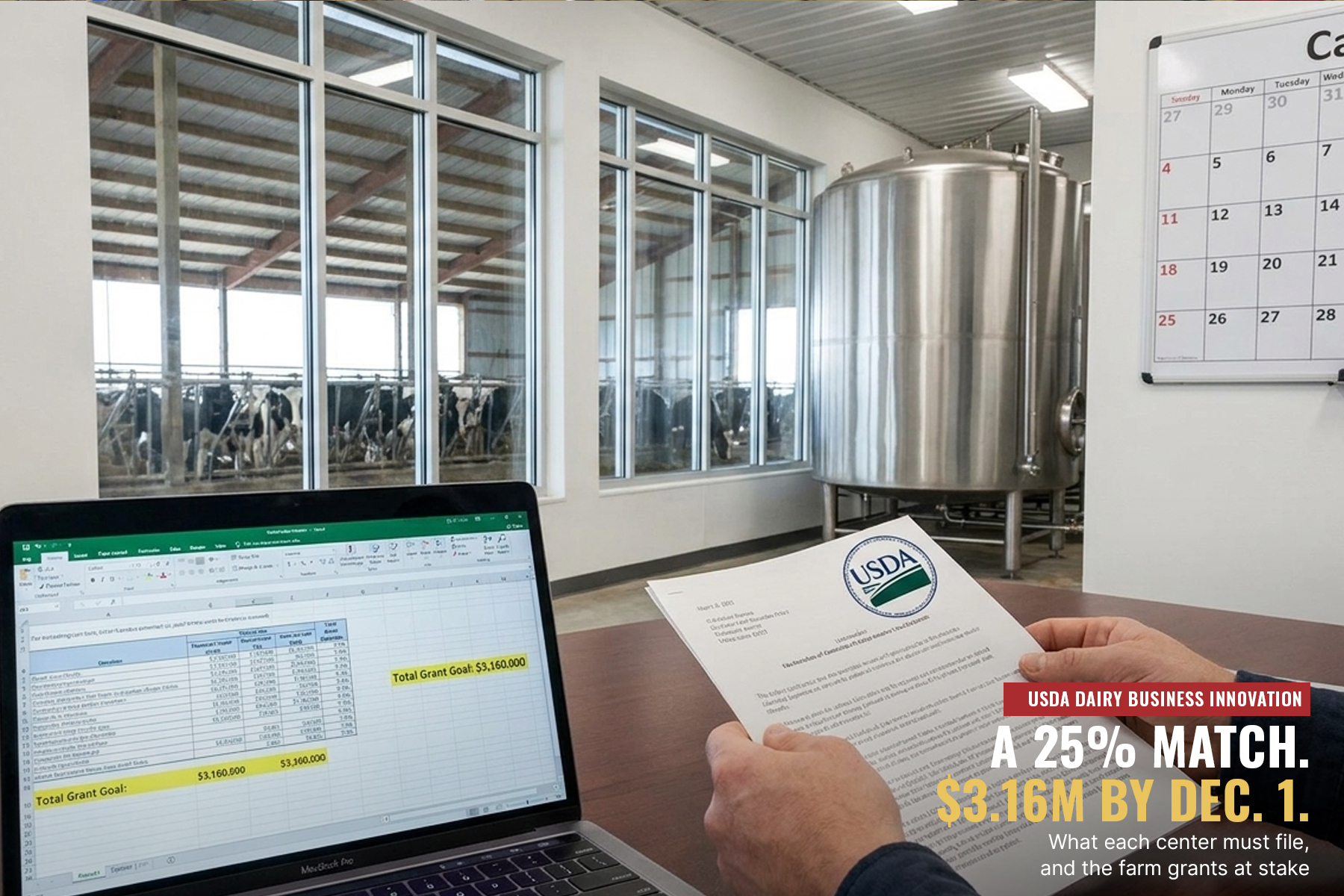
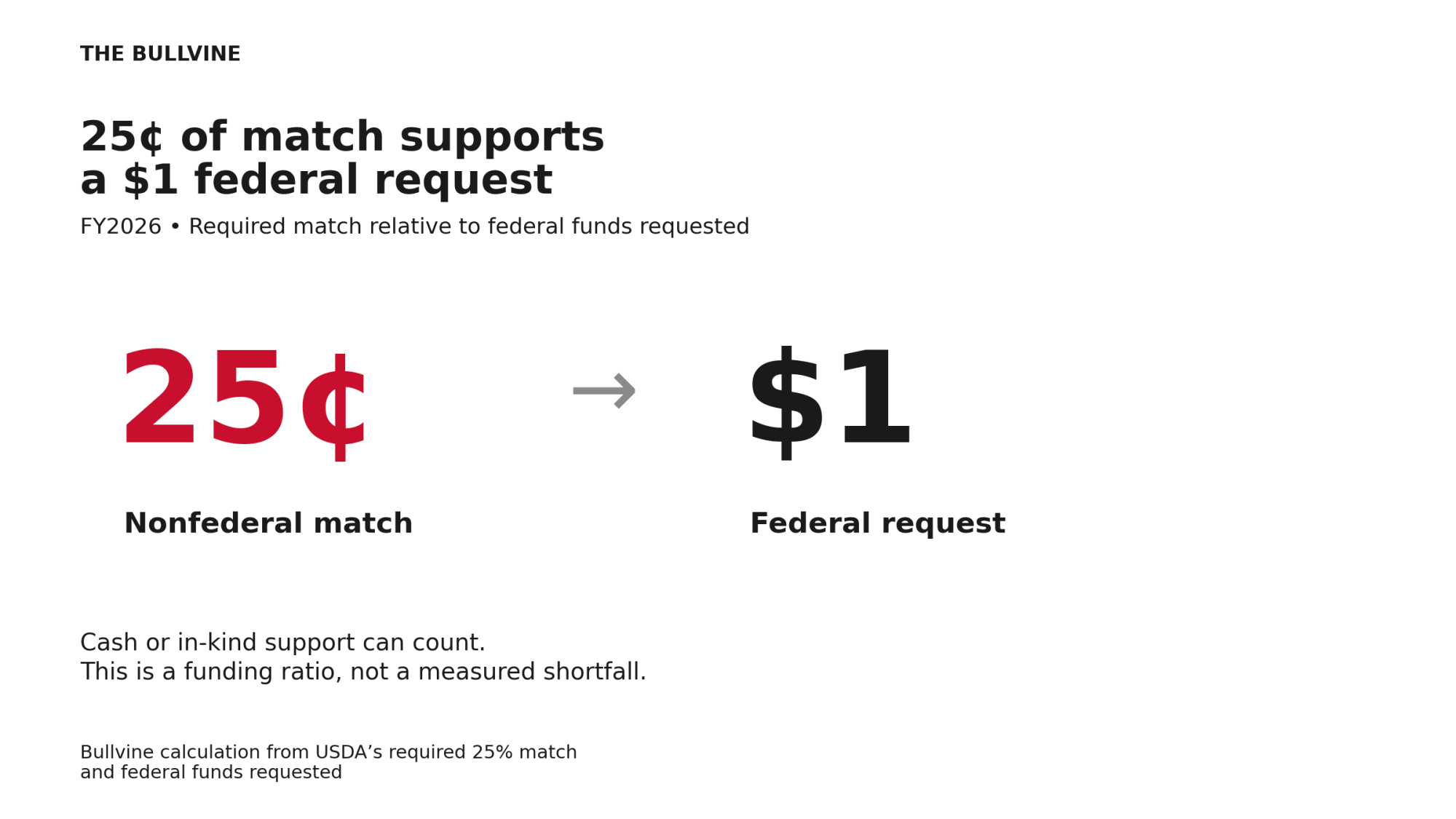
USDA’s Sept. 30 notice offers $12.65 million to the four Dairy Business Innovation centers, with a condition it lists among its major changes: a 25% nonfederal match, documented in signed letters filed by Dec. 1. Cash and in-kind support count; federal money doesn’t, and every dollar must be secured before USDA issues an award. Bullvine’s math: every 25 cents of match a center can’t document costs it $1 of federal request, and by law at least half that dollar funds farm and processor grants. No record reviewed shows how much any center has secured, so 2027 farm and plant projects in all four regions are budgeting around uncommitted money.
USDA’s new Dairy Business Innovation grant cost share for 2026, a 25% match, now stands between four regional centers and at least $6.325 million in grants for dairy farms and processors. USDA strongly encourages the centers to put that money into equipment and infrastructure. It only flows if the centers line up $3.16 million in matching commitments. Farms and processors don’t apply under this USDA notice. They apply to their regional center afterward. What the centers can document in the next six weeks decides what’s there for your 2027 projects.
What each center must provide
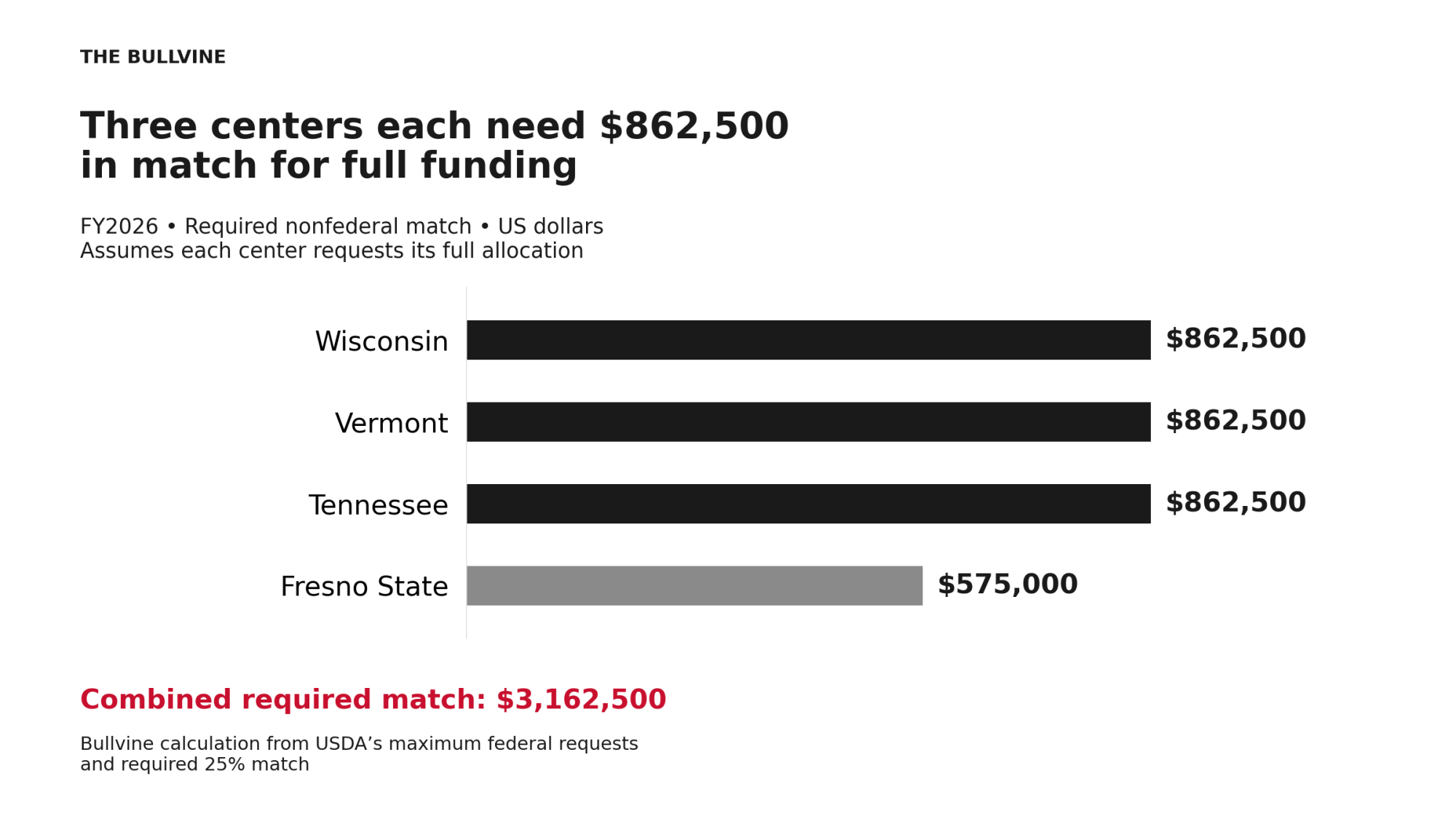
| Applicant | Maximum Federal Request | Required Match (25%) | Minimum for Farm & Processor Grants |
| Univ. of Wisconsin (DBIA) | $3,450,000 | $862,500 | $1,725,000 |
| Vermont Agency of Ag (Northeast) | $3,450,000 | $862,500 | $1,725,000 |
| Univ. of Tennessee (Southeast) | $3,450,000 | $862,500 | $1,725,000 |
| Fresno State (Pacific Coast) | $2,300,000 | $575,000 | $1,150,000 |
| Total | $12,650,000 | $3,162,500 | $6,325,000 |
Bullvine math, assuming each center requests its full allocation. By law, at least half of each center’s federal money must go out as grants to dairy businesses.
Bullvine math: For every 25 cents of required match a center can’t document, it gives up $1 of federal funding it could otherwise request. At least half of that dollar was earmarked for farm and processor grants. USDA says it will redistribute money a center doesn’t request among the other centers. So a shortfall in one region doesn’t necessarily mean a national loss. It does mean less for that region’s farms.
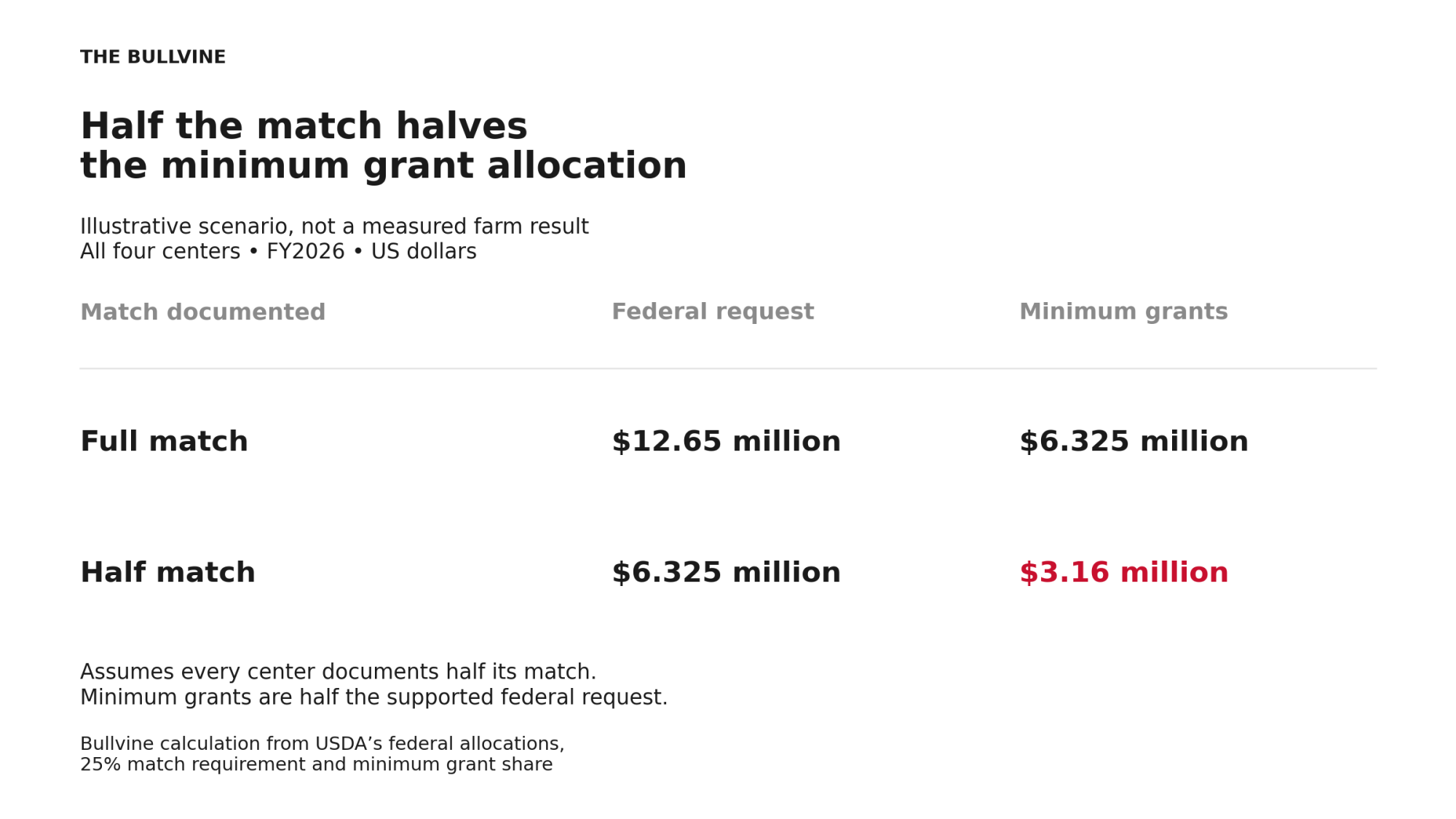
Bullvine math: A center that documents half its match can request half its allocation. For Wisconsin, Vermont or Tennessee, that’s $1.725 million instead of $3.45 million, and the grant floor drops by $862,500. Across all four centers, it drops by $3.16 million. That’s a coincidence of the ratios, not the match itself. Half-funded centers give up $6.325 million in federal request, and half of that was the grant floor.
What centers must file by Dec. 1
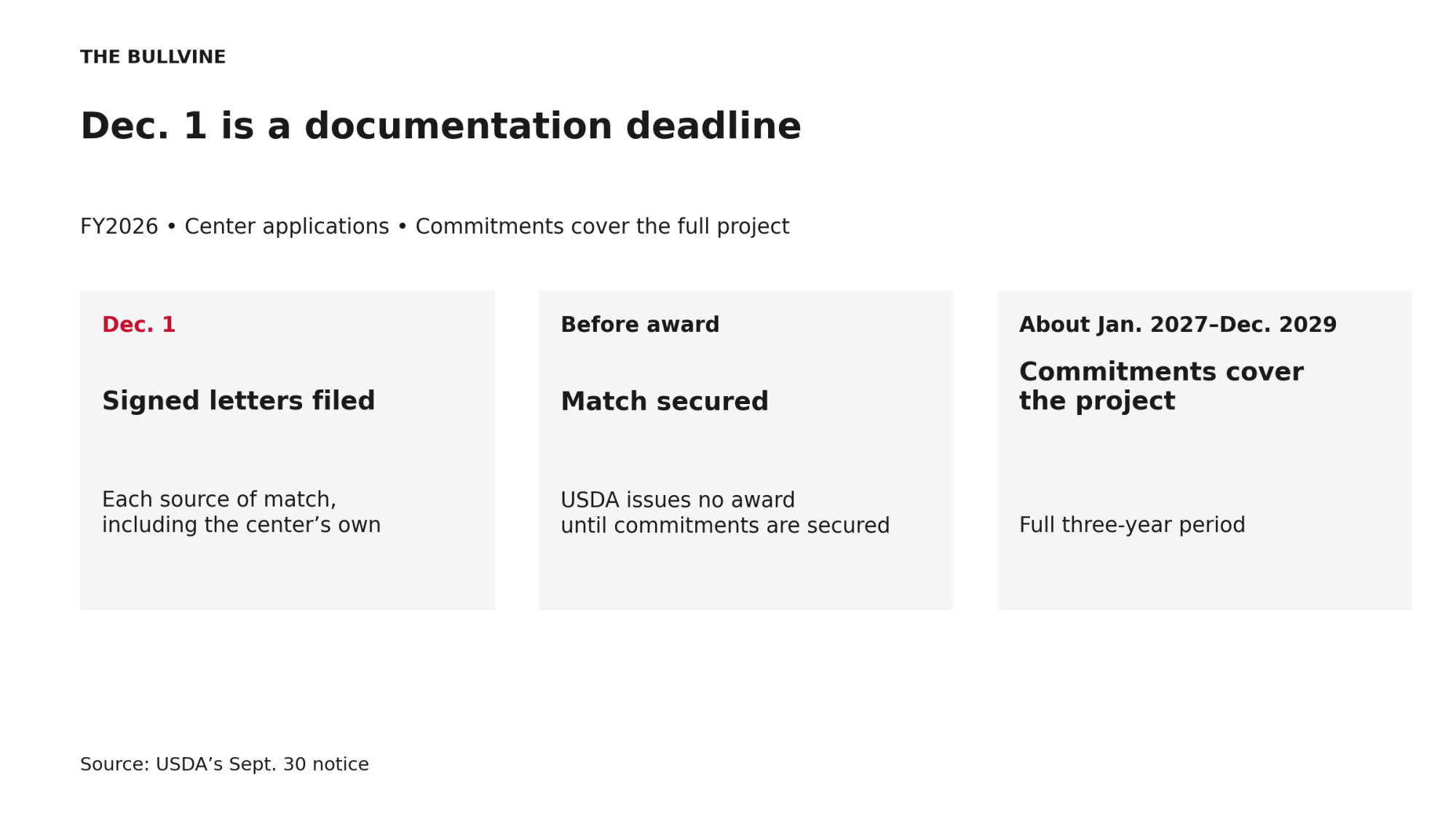
December 1 is a documentation deadline, not a payment deadline. Each center must file a signed letter for every source of match, including its own, showing annual and total commitments. USDA won’t accept unsigned letters or letters emailed separately.
The FY2026 award is set to start about January 1, 2027, and the commitments cover the full three-year project, through about December 2029. All match must be committed or secured before USDA issues an award. Anticipated match that isn’t in place when the project starts doesn’t count.
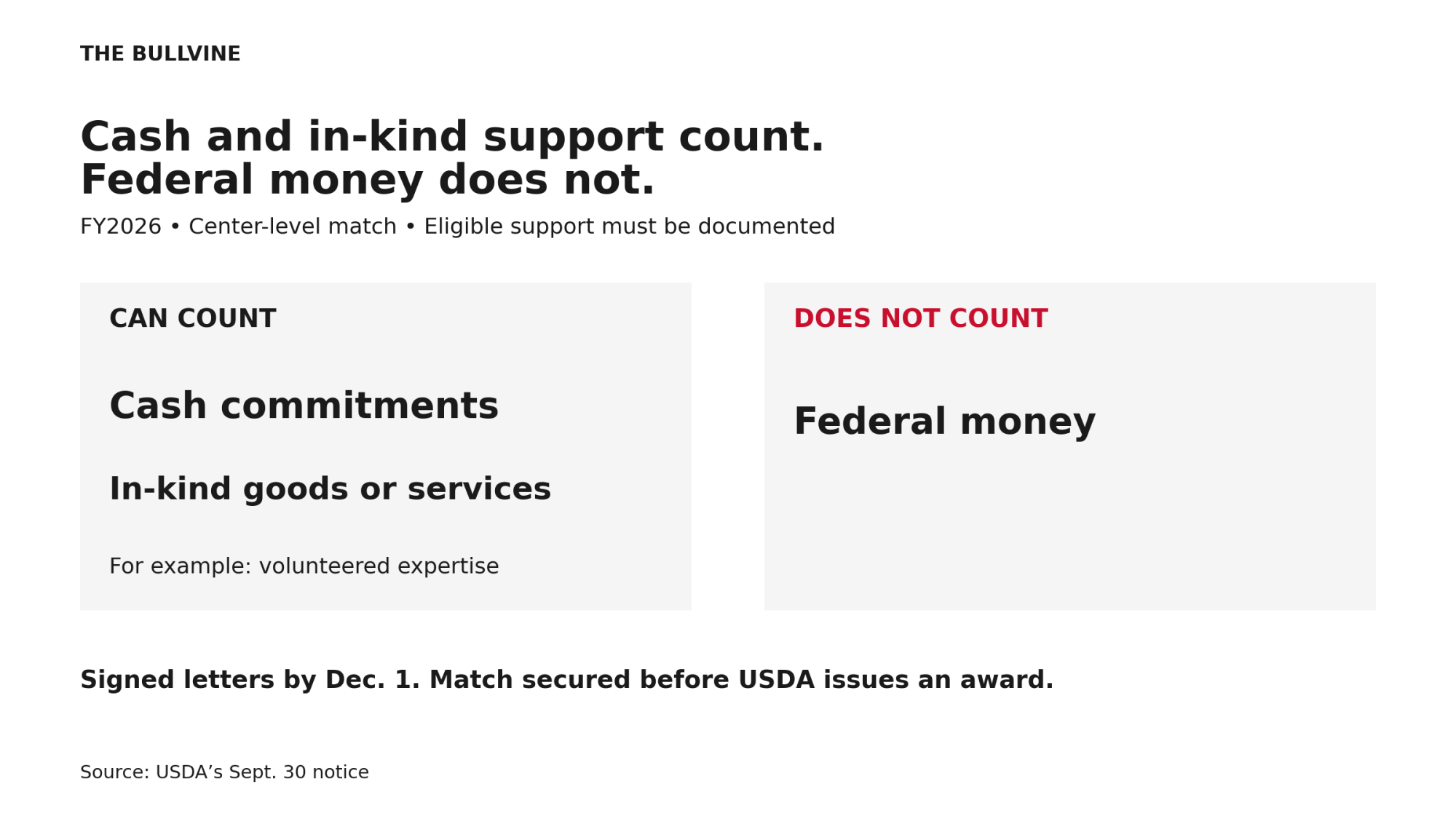
Cash counts, and so does in-kind support: goods or services a partner provides with no money changing hands, such as volunteered professional expertise. Federal money doesn’t. USDA lists the match among the “major changes” since its last funding notice.
Regional consequences
- Northeast: In April 2026, the center announced $801,542 for 12 farm modernization projects in six states. That round equals 46% of the Northeast’s $1.725 million FY2026 grant floor (Bullvine math). Its grants page, checked October 22, says the center is “currently waiting on our next round of funding from the USDA, which will support next year’s dairy grants.” It expects to offer its farm and processor modernization grants again in 2027 and lists an October–December 2026 pre-application window for the farm grant.
- Midwest: The Dairy Business Innovation Alliance announced $2.9 million for 28 Dairy Business Builder recipients in June 2026. That one round was larger than DBIA’s $1.725 million FY2026 minimum. Rounds can draw on more than one year’s award, so this compares scale, not one-for-one funding (Bullvine math).
- Pacific Coast: The Pacific Coast Coalition announced 15 Round 7 processor contracts in California, Oregon and Washington in June 2026. It didn’t publish the round’s dollar total or individual awards.
- Southeast: The University of Tennessee’s 2026 Farm Infrastructure Improvement grant already requires recipients to put up a 25% cash match. The new USDA match sits one level up, with the center.
So recipient cost-sharing already exists in some regional rounds. But USDA’s notice says “the DBI initiatives must provide the cost share.” Whether a farm’s or processor’s contribution could count toward a center’s match needs confirmation under the approved budget and USDA rules.
What this means for your operation
- Ask your center which federal award funds the round you’re applying to. You don’t file under this USDA notice.
- Northeast farms: The center lists an October–December 2026 pre-application window for its Farm Improvement & Modernization grant. The contact is Ben Eldredge at the Vermont Agency of Agriculture (ben.eldredge@vermont.gov, 802-522-9478), and current details are on the NE-DBIC grants page.
- Budget the project’s full cost. Carry unawarded grant money at zero in your base-case funding plan until you have a signed award.
- Set a mid-December checkpoint. Bullvine’s advice: if your center hasn’t confirmed its FY2026 request by mid-December, don’t schedule equipment delivery that depends on a 2027 award.
- Check payment terms before ordering equipment. They vary by round, so read your round’s RFA, including when payments are released and whether costs before award are covered.
- If you’re asked to supply match: Get written guidance on valuation, eligible dates and records. Don’t pledge the same contribution to two federal grants.
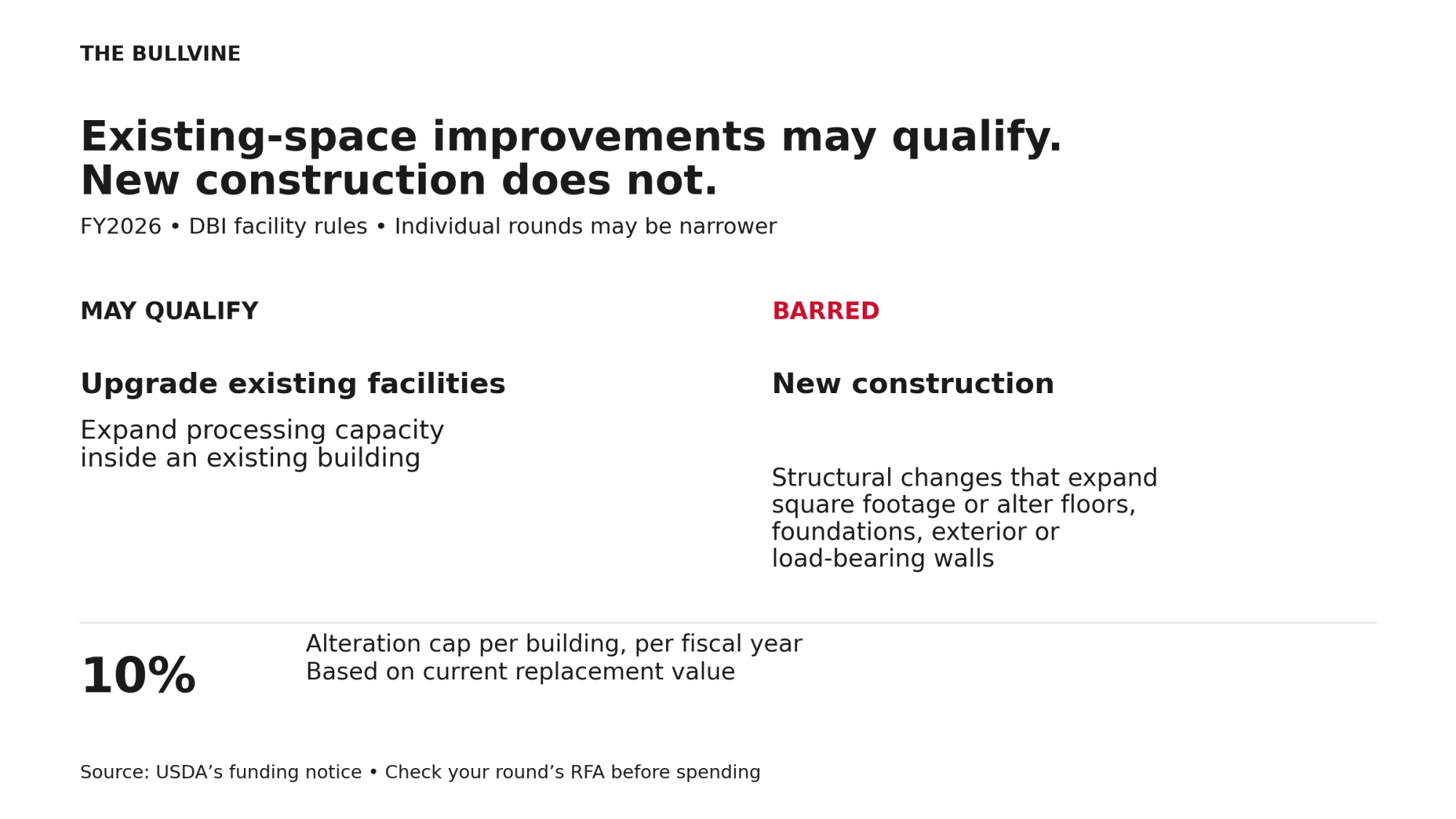
- Facility work: USDA’s DBI terms allow upgrading or modernizing existing facilities, including expanding processing capacity inside an existing building. They bar new construction and structural changes that expand square footage or touch floors, foundations, or exterior or load-bearing walls. The funding notice caps alterations to any one building at 10% of its current replacement value per fiscal year. Your round can set narrower rules, so check its RFA before you spend.
Who wants the match gone, and what nobody has disclosed
A coalition of 28 dairy and agricultural organizations has asked USDA to eliminate the match, reissue the notice and extend the deadline by 60 days. The Wisconsin Cheese Makers Association posted the coalition’s letter on October 12. WCMA’s release says previous DBI funding notices “did not require matching funds.” It describes the four host institutions as “none of which has the resources available to meet the new matching requirement.”
“Adding a 25 percent cost-share requirement to a program designed to help them compete and grow risks putting proven resources out of reach,” said Rebekah Sweeney, WCMA’s senior director of programs and policy, in the October 12 release.
On October 20, Rep. Mark Pocan and Sen. Peter Welch led a letter signed by 16 members of Congress. It urges Agriculture Secretary Brooke Rollins to withdraw the “newly added 25% cost-share requirement” and reissue the notice without one.
The records reviewed don’t show how much match any center has actually secured. Two questions will decide what reaches farms:
- How much qualifying match has each center committed, and as of what date?
- Will any gap shrink its request or delay specific grant rounds?
As of October 22, the materials reviewed included no USDA explanation for the requirement and no announced change.
What to watch
- No amendment yet: As of October 22, the Grants.gov listing for USDA-AMS-TM-DBI-G-26-0011 is still Version 1, posted Sept. 30, and the notice, terms and narrative template all show Sept. 30 as their last update. Watch for a formal amendment or replacement notice.
- Any extension of the December 1 deadline.
- Center statements on how much match is committed.
- Any center requesting less than its full allocation, and whether the match limited that request.
- USDA’s response to the coalition and congressional letters.
The question to put to your center now: Which federal award funds the round I’m applying to, and does the new match requirement affect it?
Complete references and supporting documentation are available upon request by contacting the editorial team at editor@thebullvine.com.
Learn More
- Maximize Dairy Farm Efficiency: How Robots Can Cut Costs When Managed Properly — Dismantles the myth that automation instantly eliminates labor expenses. Arms you with a realistic look at specialized maintenance fees and upskilling costs, proving you must shift to data management to realize true per-cow savings.
- Gold Medal Margins: Italy Turns Less Milk into €22.8B. You’re Stuck at $18.95. — Exposes how European consortiums build multi-billion dollar premiums by enforcing scarcity instead of expanding herds. Follows the math on four distinct paths to escape the commodity trap, revealing exactly what upfront capital each pivot demands.
- Dairy Technology 2026: Robotics, Sensors, AI and Real-World ROI — Breaks down the 6.4-year payback window for the robotic sweet spot. Delivers hard capital cost baselines and proves why computer vision will soon render standard RFID tags obsolete in your transition pen.
The Sunday Read Dairy Professionals Don’t Skip.

Every week, thousands of producers, breeders, and industry insiders open Bullvine Weekly for genetics insights, market shifts, and profit strategies they won’t find anywhere else. One email. Five minutes. Smarter decisions all week.