UK’s €40K sustainability bribes are rigging dairy consolidation—and North America’s next
EXECUTIVE SUMMARY: Here’s what we discovered: sustainability programs aren’t saving small farms—they’re systematically eliminating them. UK data reveals 6% annual farm closures while average herd sizes jump to 219 cows, and that’s no accident. Corporate giants like Arla are dropping €40,000 payments per farm, but only large operations can afford the €200,000 infrastructure to qualify. Meanwhile, McDonald’s $200 million investment in “regenerative agriculture” signals the 2027 timeline when North American producers will face the same squeeze. The math is brutal: fixed compliance costs favor 800+ cow operations, leaving smaller farms with a stark choice—scale up, sell out, or get crushed. This isn’t environmental policy—it’s the most sophisticated industry consolidation scheme ever devised.
KEY TAKEAWAYS:
Start carbon tracking immediately—early adopters report 5% feed efficiency gains and access to premium contracts worth $0.50+ per hundredweight
Form strategic partnerships with 3-5 neighboring dairies to share $100K+ infrastructure costs for digesters, solar systems, and monitoring equipment
Watch California and New York regulations like a hawk—these states typically lead policy changes by 18-24 months, giving you advance warning
Invest in dual-purpose technology: methane sensors and precision feeding systems that boost both sustainability scores and milk production by 8-12%
Perfect your fresh cow management and butterfat protocols—these “small” details now directly impact your farm’s survival in sustainability scoring systems
I was talking with a dairy farmer from Wisconsin the other day—runs about 600 head—and he’s feeling the heat like a lot of us. You know how it goes; the little guys around him are wondering how long they can stay afloat as these new sustainability demands start rolling in.
Now here’s what’s interesting… The UK, despite importing about a third of their milk, has quietly become the leader everyone’s watching when it comes to dairy sustainability standards. But what really caught my attention isn’t just their environmental targets—it’s how they’ve structured the whole thing actually to work for farmers instead of against them.
Take Arla, that Danish cooperative that’s gotten huge over there. They’re cutting checks for around €40,000 a year to farmers who hit their sustainability marks. That’s real money, not promises. And according to their latest corporate reports, they’re planning to pour over €2 billion into these incentive programs by 2030.
The UK government isn’t sitting on the sidelines either. They’ve committed £5 billion through their Sustainable Farming Incentive program, paying farmers between £100 and £300 per hectare annually. When you’re looking at a typical 200-hectare operation, that starts adding up to something you can actually bank on.
The Economics That Are Changing Everything
This chart reveals the engineered consolidation behind UK dairy sustainability programs. As closure rates doubled from 3% to 6% annually, average herd sizes jumped 18% to 219 cows—proving this isn’t market evolution, it’s systematic elimination of smaller operations.
But here’s the kicker—and this is where it gets tricky for smaller operations. The fixed costs of things like installing digesters or solar panels don’t get any cheaper just because you’re milking fewer cows. Farms running 800 head or more have a clear advantage here because they can spread those investments across more production volume.
The smoking gun: Compliance costs per cow are 3.4x higher for small farms (£1,200) versus large operations (£350). This isn’t accidental—it’s mathematical elimination of family dairies disguised as environmental progress.
That economic reality is driving real consolidation in the UK. The numbers from AHDB tell the story: dairy farm numbers dropped 5.8% just between April 2023 and 2024, while average herd size climbed to around 219 cows. We’ve seen this pattern before in other sectors, but what’s different here is that the sustainability angle is accelerating it.
What’s remarkable is their results. UK dairy operations have achieved a carbon footprint of about 1.25 kg CO2e per liter of milk—that’s roughly 43% of the global average, according to Dairy UK’s latest assessments. Some of that’s climate advantage, sure, but a lot comes from this systematic approach to measuring and managing efficiency.
When This Pressure Hits North America
Looking at corporate investment patterns, I’d say we’re looking at real pressure starting around 2027. McDonald’s just announced a $200 million regenerative agriculture commitment this past September, and if you know their playbook with supply chain initiatives, they typically move from pilot programs to requirements over about five years.
From there, expect formal contract requirements around 2029-2030, with serious market pressure building over the next few years after that. Based on how these things usually roll out, that’s when you see the most dramatic changes in farm structure.
You can bet companies will start ramping up demands for carbon data, rolling out incentive programs with real cash behind them, and regulations will tighten—especially in places like California and New York, where environmental policy tends to lead.
Regional differences are going to matter here. Wisconsin’s cooperative culture might actually provide some advantages—you’ve got the collaborative experience and often the scale to make these investments work. California operations are among the earliest to adopt pressure, but also have access to the most advanced technologies and financing programs.
The Technology That Actually Works
What really impresses me about the UK approach is how they’ve handled the measurement challenge. Instead of leaving farms to figure out monitoring on their own, they’ve invested in standardized systems.
Those GreenFeed units, for example—they measure methane emissions right at the cow level with remarkable precision. The UK government invested £364,000 just in monitoring equipment at Harper Adams University alone. When you compare that to the confusion most of us deal with trying to figure out which carbon calculator to use…
They’re using eight approved carbon footprinting systems that all work from the same methodology, so there’s no more wondering if you’re getting comparable results to your neighbors.
And their incentive structure is designed to prevent gaming. Arla’s program awards points across 19 different activities, but the highest point values go to the hardest changes to fake—feed efficiency improvements, fertilizer reduction, energy optimization, and animal health improvements. You can’t just check boxes and collect payments.
Strategic Paths Forward
Looking at this transition, I see three clear options for North American producers:
Scale Up: If expansion’s in your plans, now’s the time to run the numbers on sustainability infrastructure. You’re looking at needing 800-1,200 cows minimum to make the per-unit economics work on monitoring systems, renewable energy, and emissions reduction technology.
Partner Up: For operations that can’t or don’t want to scale individually, strategic partnerships with 3-5 similar farms can provide the volume needed for shared infrastructure. The UK cooperative models show how this works—shared monitoring costs, coordinated energy installations, group contracts with sustainability-focused buyers.
Strategic Exit: Let’s be honest about this third option. For some operations, particularly smaller farms without good partnership opportunities, strategic exit while asset values remain strong might be the smart financial move. UK data shows operations that exit proactively preserve more asset value than those forced out by market pressure later.
What This Means for Your Bottom Line
Here’s what I find encouraging about this whole development: when you look at UK operations that are thriving in this new system, they’re finding that the same changes that reduce emissions often improve operational efficiency too.
Better feed conversion reduces both costs and methane output. Improved cow health cuts both veterinary expenses and stress-related emissions. More efficient manure handling reduces both labor costs and environmental impact.
The latest UK Dairy Roadmap progress reports show that 80% of farmers are now calculating their carbon footprint, compared to less than 20% globally. When sustainability compliance starts generating revenue instead of just regulatory headaches, adoption rates follow pretty quickly.
Looking at Your Day-to-Day Operations
For those of us managing fresh cow transitions, monitoring butterfat performance, or optimizing dry lot systems, here’s something worth noting: these day-to-day management decisions are increasingly becoming part of your sustainability profile.
Feed efficiency during the transition period, reproductive performance metrics, even housing system choices—they all factor into carbon footprint calculations. The operations that are well-positioned for this transition aren’t necessarily the ones that love environmental regulations. They’re recognizing that fighting market forces costs more than adapting to them.
Your Action Plan
This shift creates real opportunities for operations willing to treat sustainability as a competitive advantage rather than a compliance burden. Early movers get better access to funding, premium contracts, and technical support.
What you should be doing:
Start carbon footprinting now, while tools and assistance are available—early movers will be ahead when requirements become mandatory
Watch for voluntary programs offering real financial incentives—these are stepping stones before requirements become firm
Consider partnerships with neighboring operations to share costs and expertise if scaling alone isn’t feasible
Monitor regional developments, especially in states with existing environmental regulations like California and New York
Invest strategically in technologies that improve both sustainability and operational efficiency—think feed management systems, renewable energy, and improved animal health protocols
The bottom line? This isn’t going away. But for operations willing to engage thoughtfully with these changes, there’s a real opportunity to build more profitable, resilient businesses.
The UK has demonstrated that sustainability initiatives can be structured in a way that does not harm farm economics. The question for North American producers is whether you’ll be positioned to benefit from similar programs when they arrive, or scrambling to catch up after the opportunity window closes.
Complete references and supporting documentation are available upon request by contacting the editorial team at editor@thebullvine.com.
Learn More:
How to Get Started with Carbon Footprinting on Your Dairy Farm – This article provides a practical, step-by-step guide to assessing your farm’s carbon balance. It offers actionable advice on immediate, low-cost strategies like optimizing manure use and reducing tillage, empowering you to begin your sustainability journey with clear, manageable steps that directly impact efficiency.
The Economics of Dairy Sustainability: From Compliance to Cash Flow – This piece shifts the focus from environmental policy to financial strategy. It reveals how forward-thinking dairy operations are generating revenue and improving their bottom line by implementing phased sustainability plans, demonstrating that these investments can offer real, measurable returns on investment.
Precision Fermentation: What Dairy Farmers Need to Know About the Next Food Disruption – This article prepares you for the future of the dairy market by analyzing the disruptive potential of new technology. It provides a strategic look at how precision fermentation is reshaping the protein market and offers insights on how to adapt your business model to remain competitive.
The Sunday Read Dairy Professionals Don’t Skip.
Every week, thousands of producers, breeders, and industry insiders open Bullvine Weekly for genetics insights, market shifts, and profit strategies they won’t find anywhere else. One email. Five minutes. Smarter decisions all week.
Is your farm positioned to thrive during the longest dairy correction in decades?
EXECUTIVE SUMMARY: The 2025 dairy market correction presents unprecedented challenges, with butter prices plunging 30% since summer and cheddar declining 14% since mid-August, creating margin pressure across all regions. What makes this correction different is its global scope—New Zealand’s milk production surged 14.6% while China’s dairy imports dropped 15%, fundamentally altering traditional market dynamics. Progressive operations are finding stability through anaerobic digesters generating $400-450 per cow annually, though this technology remains accessible primarily to larger farms. Industry projections suggest up to 160,000 dairy operations worldwide may close over the next two years, with asset losses potentially reaching $400 billion globally. However, innovative farmers are adapting through direct-to-consumer marketing, cooperative digester partnerships, and refined transition cow management protocols. The extended 18-to 24-month correction timeline requires strategic thinking rather than simply waiting for recovery. Those who embrace diversification, strengthen local market relationships, and invest in operational efficiency are positioning themselves not just to survive, but to acquire distressed assets and emerge stronger when markets stabilize.
KEY TAKEAWAYS:
Revenue diversification pays: Anaerobic digesters generate $400-450 per cow annually through carbon credits and renewable energy sales, providing crucial margin protection during price downturns
Consolidation accelerates rapidly: Forecasted closure of 160,000+ dairy operations globally creates acquisition opportunities for well-positioned farms while eliminating competitors
Local markets offer premiums: Direct-to-consumer sales and specialty processing partnerships command 40-60% price premiums over commodity markets during corrections
Operational excellence becomes critical: Focus on transition cow management, component optimization, and feed efficiency improvements to maintain profitability at lower milk prices
You know, when we sit down with a cup of coffee and talk about markets these days, there’s this feeling that we’re not just going through another typical cycle. This time feels different. Really different.
I’ve been tracking the numbers closely, and what I’m seeing should concern every dairy producer. CME butter prices have dropped about 30% since summer, falling from around $2.62 per pound down to $1.83 by mid-September, according to the latest Dairy Herd Management reports. Cheddar’s been hit too—down roughly 14% since mid-August. But here’s what’s really got my attention: this isn’t just happening here in the States.
This line graph clearly illustrates the severity and speed of the 2025 dairy price correction, showing butter’s dramatic 30% fall from $2.62 to $1.83 per pound and cheddar’s 14% decline since mid-August.
Take Wisconsin, where I was talking with producers just last week. They’re telling me the pressure on butterfat performance and milk solids pricing has been relentless. “In past corrections, we’d see some regional breathing room,” one Fond du Lac operator explained. “Maybe when the Midwest got hit, New York or Michigan would hold steady. Not this time.”
The data backs up what farmers are feeling on the ground. We’re seeing volatility that’s literally double the typical market swings, while skim milk powder prices have converged globally. That means those usual price gaps we’ve always counted on for export opportunities? They’re shrinking fast.
The Digester Game-Changer
Now here’s where things get interesting—and frankly, a bit concerning if you’re running a traditional operation. Larger farms with anaerobic digesters are playing a completely different game during this downturn.
I recently spoke with a California dairy operator who put it perfectly: “The digester income has really been our saving grace. We’re pulling in about $400 to $450 per cow yearly through energy sales and carbon credits, and it’s smoothing out these wild price swings.” According to EPA AgSTAR program data, these numbers are realistic for operations that can afford the capital investment.
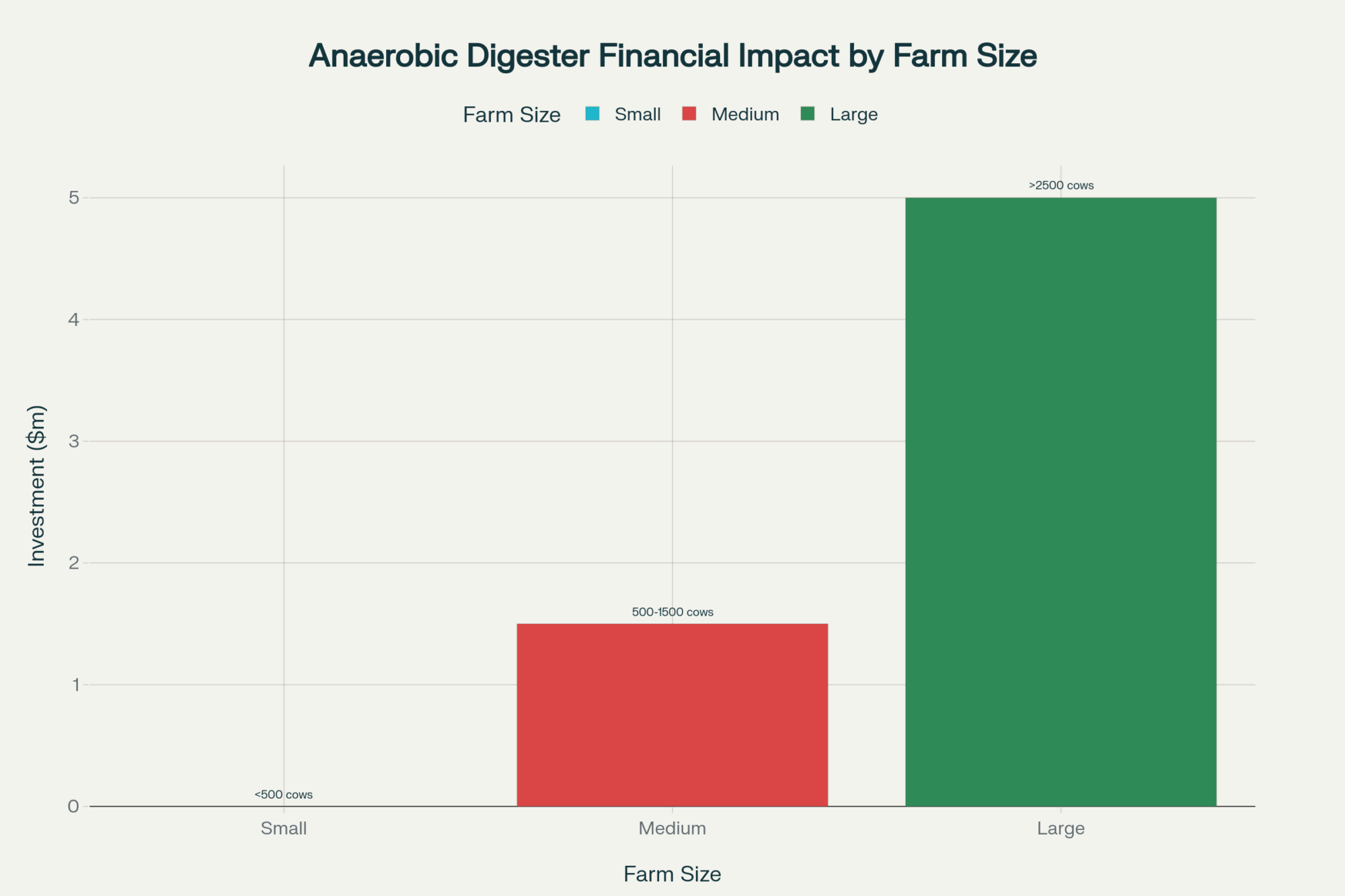
But let’s be honest about the math here. Those digesters typically require multi-million dollar investments and work best for herds of 2,000 cows or more. That puts them out of reach for many family operations.
This table illustrates why anaerobic digesters provide significant advantages to larger operations while remaining largely inaccessible to smaller farms, highlighting the technology’s role in creating unequal market resilience.
What’s encouraging, though, is hearing about cooperatives—especially in Quebec and parts of the Midwest—pooling resources to make digester technology more accessible. It’s a promising approach that could level the playing field somewhat.
New Zealand’s Production Paradox
Meanwhile, our friends in New Zealand are dealing with their own interesting situation. Milk production is actually up about 14.6% this season in terms of milk solids, according to their dairy association reports. Farmers there are enjoying some seriously good payouts—around NZ$10.15 per kilogram of milk solids from Fonterra, which represents one of the best rates in recent years.
But here’s the catch that not everyone’s talking about. Fonterra’s balance sheet shows they’ve been dipping into reserves to maintain these high payouts, which obviously can’t continue forever. When the inevitable adjustment comes—probably early next year—it won’t be a sudden cliff but more of a gradual slide over several months.
What’s particularly problematic is how farmers typically respond to declining payouts. They tend to push production even higher, trying to make up for lower per-unit revenue with increased volume. Makes perfect sense from their perspective, but it keeps the global market flooded with supply exactly when we need less.
China’s Changing Role
And then there’s China—the market that used to be our safety valve. Their dairy imports have dropped about 15% recently, according to USDA Foreign Agricultural Service data and Rabobank research. They’re pushing hard toward domestic milk production despite higher feed costs, and you can see this shift reflected in how they’re using dairy ingredients—moving from imported powders to locally produced products.
This represents a fundamental change in global dairy trade patterns. Where China used to come in with big buying sprees whenever prices softened, we can’t count on that anymore.
This stark contrast between New Zealand’s 14.6% production surge and China’s 15% import decline illustrates why traditional market-balancing mechanisms aren’t working in 2025.
What the Timeline Really Looks Like
Piecing all this together, the data suggest we’re probably looking at a market correction that stretches 18 to 24 months before things truly stabilize. That’s significantly longer than the typical 6-9 month cycles we’re used to.
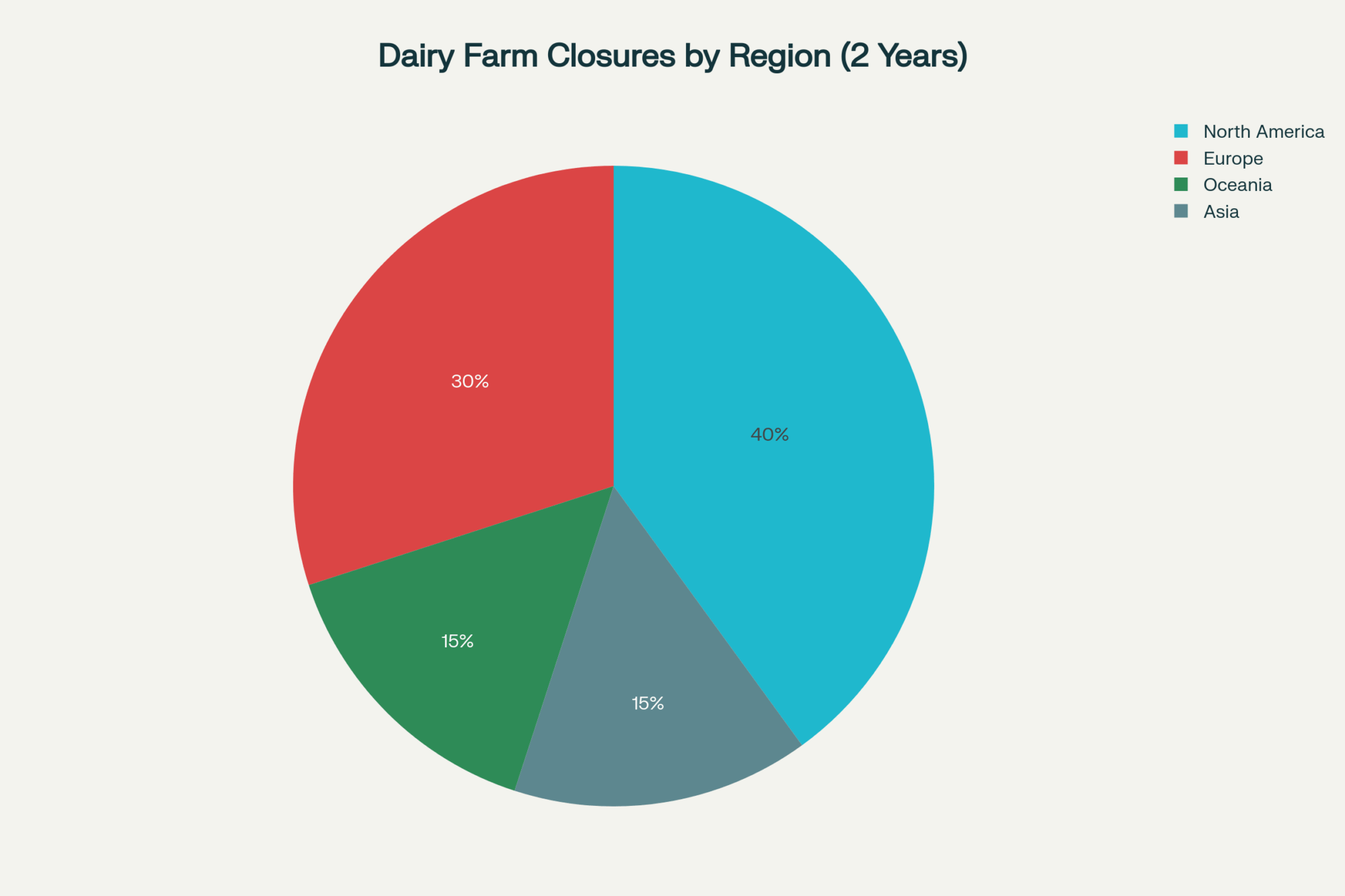
The consolidation numbers are sobering. Industry analysis based on USDA census data and current trends suggests as many as 160,000 dairy operations worldwide could close during this period, with asset losses potentially reaching $400 billion globally as farms get liquidated at distressed prices.
The projected closure of 160,000+ dairy operations over two years won’t impact all regions equally, with North America and Europe bearing the heaviest consolidation burden.
But it’s not all doom and gloom. I’ve seen some remarkable adaptation happening.
Real-World Success Stories
There’s a producer near Fond du Lac who started layering direct-to-consumer sales alongside regular contracts—it’s helped cushion the financial blow considerably. Around the Northeast, smaller farms are crafting local brands that command genuine premiums from consumers who value the farm story.
In California’s Central Valley, some larger operations are weathering this storm because they tightened their efficiency measures back when times were good. They’re now positioned to acquire distressed assets at significant discounts, potentially.
What This Means for Your Operation
If you’re running an operation under 1,200 cows, this is the time to investigate partnerships for renewable energy projects seriously. Look hard at your transition cow management—those improvements in fresh cow protocols can make a real difference during tight periods. And explore local market niches where your farm’s story might command premium pricing.
For those managing larger herds, prioritizing investments in alternative revenue streams isn’t optional anymore—it’s essential. Consider moving aggressively on digester projects, carefully scouting acquisition opportunities, and tightening cost controls across the board.
Don’t think of this as a sprint to the finish line. The road ahead is long, with challenges and opportunities wrapped together.
Learning from History
Remember, we’ve navigated major industry transformations before. The shift to artificial insemination. The evolution from tie-stall barns to parlor systems. The adoption of computerized feeding. Each transition seemed overwhelming at the time, but the industry emerged stronger and more productive.
Those who embraced change didn’t just survive—they thrived in the new environment.
The Path Forward
What’s your next move going to be? Are you positioning for adaptation or just hoping to ride this out?
Let’s keep the conversation going and share what’s working. The best lessons often come from our collective experience, especially during challenging times like these.
Market Snapshot:
CME butter: down ~30% since summer 2025
Cheddar prices: off ~14% since mid-August
New Zealand milk solids: up 14.6% this season
Fonterra payout: NZ$10.15 per kg milk solids
Digester revenue: $400-450 per cow annually
China imports: down ~15% in 2024-25
Projected closures: 160,000+ operations globally
Asset impact: ~$400 billion potential losses
It’s a challenging landscape, but together we can navigate it by sharing knowledge, strategies, and keeping our focus on adaptation rather than just survival.
Thanks for thinking this through with me—here’s to keeping the coffee warm and the conversations productive.
Complete references and supporting documentation are available upon request by contacting the editorial team at editor@thebullvine.com.
Learn More:
11 Proven Strategies to Lower Feed Costs and Boost Efficiency on Your Dairy – This article provides tactical, actionable steps for reducing feed costs and improving operational efficiency, essential for maintaining profitability during market downturns. It complements the main article’s focus on cost management with specific, practical strategies.
Every week, thousands of producers, breeders, and industry insiders open Bullvine Weekly for genetics insights, market shifts, and profit strategies they won’t find anywhere else. One email. Five minutes. Smarter decisions all week.
43% of H5N1 bailouts go to repeat offenders—some farms cashed 5 checks in 6 months, while you pay the bill
So I was chatting with a producer from Iowa—been farming since the 80s—tells me his operation got hit with H5N1 twice this year. Twice! And somehow he’s still collecting government checks. Makes you wonder what’s really going on, doesn’t it?
Look, everyone’s calling Nebraska’s latest case “unfortunate timing” with fall migration. Sure, blame the ducks. But here’s what really gets me—and this might surprise you—according to Farm Forward’s July 2025 Freedom of Information Act analysis, 43% of all federal H5N1 compensation is going to farms that have experienced multiple outbreaks.
Now, before you start thinking these farmers are gaming the system, it’s more complicated than that. Some operations might be dealing with geographic challenges—maybe they’re in flyways where the virus keeps circulating, or they’re downstream from infected operations. But the pattern still raises questions about how our bailout system works.
The Numbers Tell a Story
You wanna know who’s collecting the most? Prado Dairy in Colorado pulled in over $1.5 million from Uncle Sam, according to the USDA compensation records that Farm Forward obtained through their FOIA request. Wolf Creek, Meadowvale, Sierra View—same story, different day.
These aren’t necessarily bad actors. But they are big operations with resources that smaller farms don’t have, and they’re navigating a system that covers 90% of losses through the Emergency Livestock Assistance Program with no cap on claims.
Dr. Julie Gauthier, who’s the Executive Director of Veterinary Services at USDA APHIS, keeps talking about “voluntary testing” and “producer cooperation.” Meanwhile, there’s essentially no financial penalty for getting hit repeatedly.
It’s like having fire insurance that pays out every time you leave the stove on.
What the Science Actually Shows
Felipe Peña-Mosca and his team at Cornell published research in Nature Communications—March 2025—tracking one Ohio herd through a complete H5N1 outbreak—3,900 head. Real numbers, no modeling BS.
Each infected cow lost 945 kilograms of milk over two months. That’s nearly $950 per head walking out your parlor door, based on their economic analysis. But here’s what’s really concerning—89% of that herd developed antibodies, meaning this thing spread through that barn mostly undetected. Only 20% showed obvious clinical signs.
You could have four-fifths of your herd infected and not even know it until your butterfat numbers tank.
Dr. Paul Virkler from Cornell’s been studying this stuff, and he’s found something that should scare the hell out of all of us: rumination time and milk production start dropping about five days before you see any clinical signs. Five days!
That’s your early warning window—if you’re watching for it.
The Transmission Reality Nobody Talks About
The thing about this virus is that everyone keeps blaming the waterfowl. And sure, ducks and geese bring H5N1 onto farms—the research from USDA APHIS and Cornell is crystal clear on that. Wild birds are the primary introduction route.
But then it’s our own boots, equipment, and trucks that move it around farms and between operations. The Cornell study shows this pretty clearly—once it’s in your barn, human activity becomes the major factor in how far and fast it spreads.
And once cows are infected? They don’t bounce back like everyone thinks. The Cornell team followed infected animals for 60 days after diagnosis—their production stayed depressed the entire time. This isn’t mastitis, where you lose milk for two weeks and recover. The virus replicates right in the mammary gland tissue, destroys the milk-secreting cells.
Some of these cows might never produce the same again.
The Psychology Behind Profitable Failure
What really concerns me is what Dr. Joe Armstrong from the University of Minnesota Extension told me: “I am 100% expecting this to result in many arguments with clients.”
He’s watching veterinarians get caught between USDA requirements and farmers who… well, some who still think this whole thing’s overblown. Meanwhile, operations keep getting hit, keep collecting checks, and the cycle continues.
When there’s no real financial consequences for getting hit repeatedly—when Uncle Sam covers 90% of your losses—where’s the incentive to invest heavily in prevention?
And don’t even get me started on California. Over 650 herds were infected by November 2024. Milk production down 9.2% year-over-year—the biggest drop in twenty years. Yet the biggest operations keep floating on government support while family farms get squeezed out.
The Bigger Picture We’re Missing
California’s just the canary in the coal mine. According to USDA APHIS data, we’ve had 973 confirmed cases across 17 states as of February 2025. That’s not just scattered bad luck—that’s systematic vulnerability.
We lost over 16,000 farms between 2018 and 2023. The closure rate hit 12.2% in 2023 alone. While family operations disappear, the bailout system is essentially subsidizing some survivors to maintain practices that leave them vulnerable to repeated outbreaks.
That’s not building industry resilience. That’s creating systematic dependency.
What Actually Works (When Folks Want It To)
New strains keep popping up—that D1.1 variant caught Nevada operations off guard, even though they’d dealt with H5N1 before. The virus isn’t standing still while we figure out policy.
The industry’s splitting into two groups: maybe 30% of operations that implement serious biosecurity and achieve genuine resilience, while others get stuck in cycles of infection and bailouts.
So what’s a producer supposed to do?
Lock up your feed during migration season. All of it. TMR, corn, silage, everything. This isn’t rocket science—if wild birds can’t access your feed, they can’t contaminate it.
Cut cattle access to natural water sources. I know that the stock pond’s been there since your grandfather’s time, but infected waterfowl can turn it into a disease reservoir overnight.
Get monitoring technology that flags trouble before your bank account feels it. Those rumination sensors and milk meters Dr. Virkler mentioned—they can give you that five-day warning. That’s five days you could be implementing containment instead of watching it spread.
Make your vet your biosecurity partner, not just your treatment provider. No more Mr. Nice Guy routine when it comes to prevention protocols.
The Forward-Looking Disaster
But honestly? I’m worried we’re past the point where individual farm actions matter enough. When nearly half the bailout money goes to repeat cases, when there’s little incentive to prevent rather than collect compensation… we’re not building resilience.
We’re creating dependency.
The good news for consumers is that pasteurization kills H5N1 in milk—the CDC and FDA are crystal clear on that. But that doesn’t protect your cash flow, your family’s future, or your ability to stay in this business.
The question isn’t whether more farms will get hit. It’s whether we’ll have sustainable dairy operations left when this is over, or just farms that’ve learned to navigate the bailout system better than they prevent disease.
Because while some operations perfect that navigation, independent producers are fighting for the future of American dairy farming. And right now? The dependency model is winning.
Time to decide what kind of industry we want to build.
KEY TAKEAWAYS:
Financial Reality Check: Basic migration-season biosecurity costs $50-75 per cow annually vs. $950 losses per infected animal—yet 43% of bailouts reward farms choosing subsidized failure over prevention
Early Detection Advantage: Cornell research proves monitoring technology detects H5N1 production drops 5 days before clinical signs, giving smart operators crucial containment time while competitors wait for obvious symptoms
Competitive Positioning: While repeat offenders collect government checks, operations implementing enclosed feed storage, water isolation, and veterinary partnerships during September-November migration create sustainable advantages in an industry losing 12% of farms yearly
Market Intelligence: The 30% of farms achieving genuine H5N1 resilience will dominate as bailout-dependent operations face eventual policy changes—position now while competitors remain psychologically invested in government dependency
Strategic Implementation: Lock feed storage, eliminate shared water sources, deploy rumination monitoring, and make veterinarians biosecurity enforcers—because building prevention capability beats perfecting bailout collection every time
EXECUTIVE SUMMARY:
The H5N1 outbreak has morphed from a disease crisis into a systematic bailout scheme that’s destroying American dairy from within. According to Farm Forward’s FOIA analysis, 43% of federal compensation goes to farms getting infected repeatedly, with operations like Prado Dairy collecting over $1.5 million while family farms disappear at 12% annually. Cornell’s latest research shows infected cows lose 945kg of milk worth $950 each, yet USDA covers 90% with no claim limits, creating perverse incentives where prevention costs less than subsidized failure. While corporate ag publications focus on duck migration, the real story is how repeat bailout recipients game taxpayer-funded programs instead of implementing $75-per-cow biosecurity that actually works. This isn’t building industry resilience—it’s creating systematic dependency that threatens the 24,000 remaining dairy operations across America. The data reveals we’re not fighting a virus anymore; we’re watching the birth of subsidized incompetence while independent producers get squeezed out by operations that’ve mastered the art of profitable failure.
Complete references and supporting documentation are available upon request by contacting the editorial team at editor@thebullvine.com.
Learn More:
HPAI H5N1: The 2025 Science-Based Dairy Farm Survival Guide (Because Hope Isn’t a Biosecurity Plan) – This article provides a tactical playbook for immediate action. It reveals practical biosecurity hacks, such as using laser bird deterrents and HEPA filters, that offer concrete ways to reduce risk and protect your operation, demonstrating how to move from a mindset of dependency to one of prevention.
The Vaccine Race That Will Make or Break the Dairy Industry: HPAI Solutions on the Horizon – This article provides a forward-looking perspective on the innovative solutions being developed to combat H5N1. It examines the promises and challenges of new vaccine technologies, from subunit to mRNA, offering crucial market intelligence on the future of disease control and prevention.
The Sunday Read Dairy Professionals Don’t Skip.
Every week, thousands of producers, breeders, and industry insiders open Bullvine Weekly for genetics insights, market shifts, and profit strategies they won’t find anywhere else. One email. Five minutes. Smarter decisions all week.
Is your herd management software running your farm—or just running you in circles? Let’s talk what really works.
Ever get the feeling that every sales pitch is hinting at a magic fix? Over the past few years, industry talk has made it sound like you’ll be left in the dust without dashboards and data. But are these new tools really the answer—or just another concept catching on as farms get bigger?
Let’s park the hype. Here’s what folks are genuinely seeing with herd management tech in 2025: field hiccups, regional quirks, and moments that’ll make you both hopeful and cautious.
Fewer Farms, Fatter Herds
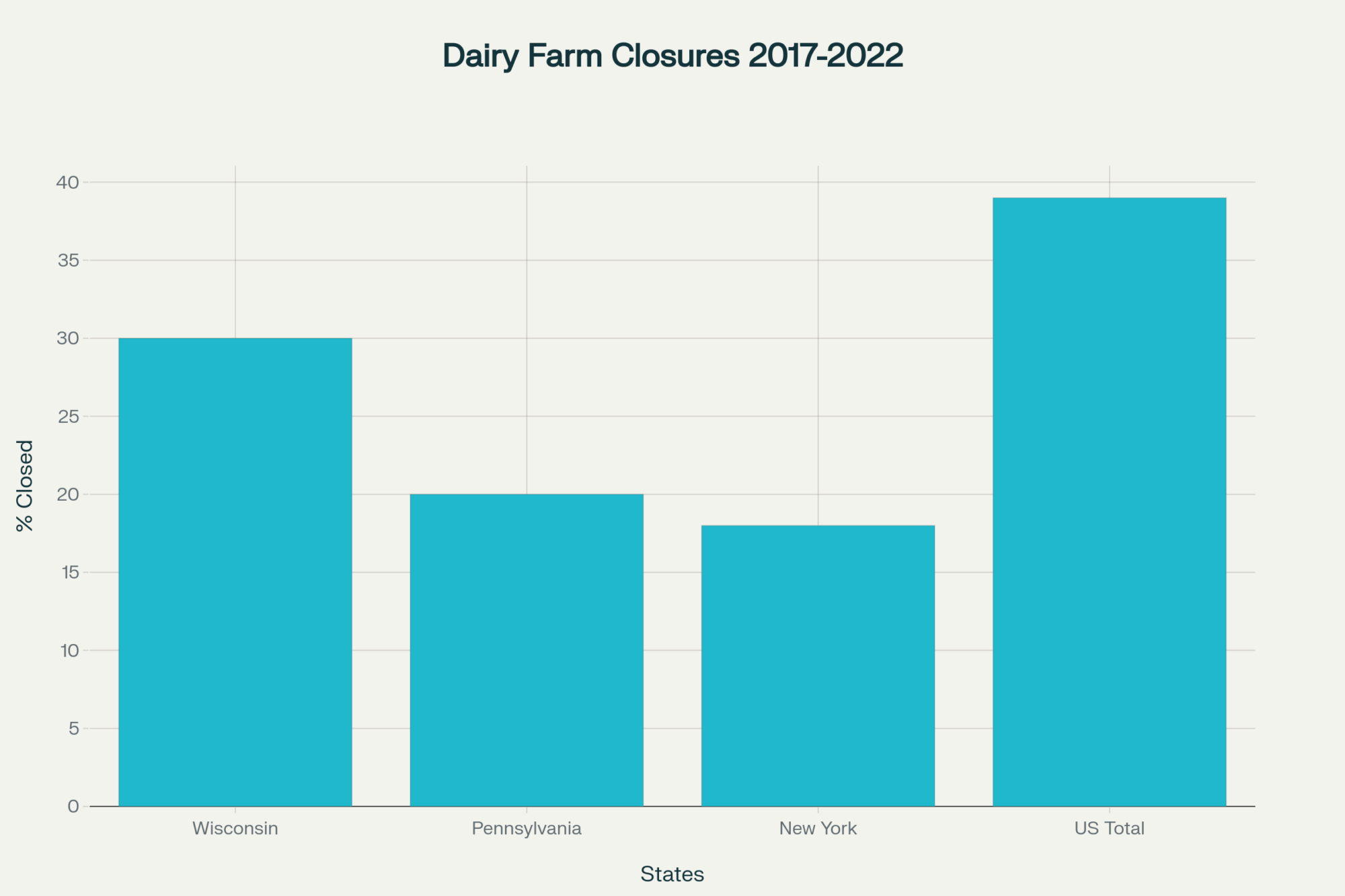
U.S. licensed dairy farm numbers plummeted from 39,300 to 24,000 (2017–2023), while average herd size more than doubled. Bigger herds now dominate, making data-driven herd management critical.
A Indiana dairyman I was talking to is convinced if you can’t bring up cow records on your phone, you might as well be running a museum. Not joking, either.
Nearly 40% of U.S. dairies closed their doors between 2017 and 2023, falling from 39,300 to about 24,000 licensed herds. Still, total U.S. milk output keeps climbing. Why? Because the survivors, mostly in the West and Northeast, are running bigger herds—1,000 cows and up now produce almost two-thirds of American milk.
66% of U.S. milk now comes from 1,000+ cow herds. Small and mid-sized farms account for just a third—making smart tech a must for competitiveness.
This isn’t just numbers. It’s a way of life changing fast. The global herd management software market? Roughly $5 billion this year—but the real drivers are North America’s mega-herds.
It’s Not Just the Numbers—Labor Is a Nightmare
Let me jump in with a story: Last winter, our best night guy was one cold calf away from quitting. Recruiting good folks is brutal—and it’s not just us. Dairies from Minnesota to Ontario all echo the struggle. High-turnover, high costs, and even higher stress.
Here’s the good news: Farms pushing 500+ cows, using robots or tightly integrated software, see reliable 20–35% labor savings. For smaller herds—think 150–300 cows—10–18% is a best-case guess from extension and industry advisors. There aren’t enough robust studies yet, but this is the buzz at farm meetings.
Can Software Really Deliver ROI? Here’s What’s Working
Platform
Unique Selling Proposition
Target Farm Size
Pricing Model
DairyComp (VAS)
Advanced analytics, command-line power, integrates with Lactanet/proAction
Medium-large (200+ cows)
2.50–
AfiFarm (Afimilk)
Real-time, sensor-driven health & milk intelligence
50+ cows, scalable
$80-150 per cow (hardware) plus subscription
DeLaval DelPro
Complete automation, robotic integration
All, especially robot herds
Quote/integrated with equipment
UNIFORM-Agri
User-friendly, modular, scalable
50-1000 cows
$3-8/cow/month subscription
DHI-Plus (Amelicor)
Deep desktop analytics, problem animal ID
All, desktop users
Subscription (desktop/mobile)
MilkingCloud
Mobile-first, IoT, free/premium tiers
50-500 cows
Free tier, $180/user/yr premium
Allflex SenseHub
Behavioral analytics, heat/health sensors
200+ cows
$2.95-4.55/cow/month collar plan
Allflex SenseHub
A Minnesota friend said it all: “We were nailing above 90% heat detection for months, but as soon as the logs slipped, so did the results.” Over a million North American cows wear these collars , and ISU extension data points to 87% avg. heat detection—if your protocols stick. ROI? Expect 15–20 months only with disciplined protocols.
AfiFarm (Afimilk)
In Michigan and the Northeast, $120–200 per cow/per year in savings is real, but only if the team checks dashboards daily. Hit “snooze” on tech and the magic fades.
DeLaval DelPro
Across Iowa and NY, robot barns are reporting six-hour-per-day labor cuts—that’s not a typo—and peer data confirms 18–33% overall savings once teams are dialed in. Training is a pain, but the reward stacks up for those who dig in.
Feed, Health, and Barn-Ready Data
“Sick of hearing about Europe?”—That’s what our Wisconsin nutritionist said last week. Fair point. Here in the U.S., genuine, logged entries are cutting $15,000–30,000/year in feed waste for 120–200 head herds. The trick: log actual data, not just when the nutritionist walks in.
On health? $180–240/cow/year savings are on the table for barns that act on mastitis or lameness alarms. But here’s the catch: “The app finds the cow, but you gotta treat her by noon or it’s just bytes, not results.”
Canada’s proAction Reality
If you’re north of the border, you’re grinding through the six pillars of proAction: animal care, food safety, traceability, environment, biosecurity, and milk quality. If your software doesn’t sync with Lactanet? Big trouble at quota review. Ontario’s Agri-Tech Cost-Share helps, but the paperwork will test anyone’s patience.
Traceability, Grants, and—Yes—More Paperwork
Ever miss a single log? Pennsylvania DFA herd did and said goodbye to a $5,000 premium. FSMA Rule 204 is raising the cost of paperwork mistakes in the U.S. too. Take note—digital record-keeping means money, not just compliance.
On grants, the USDA Dairy Business Innovation and Ontario’s Agri-Tech programs are covering 35–50% of new tech purchases. Still, as a buddy tells me, “Don’t forget to count application time—every hour matters.”
What Makes Tech Pay Off?
At a glance: the four levers where digital investments deliver real, proven value and resilience.
Focus on your biggest pain point: labor, fertility, or compliance. Designate one person to own the solution. (Everyone’s job? No one’s responsibility.) Trial it during your operation’s toughest stretch—calving, winter, haylage runs. Run weekly dashboard meetings. If numbers don’t shift, change the staff or process—not just the software.
The Takeaway: It’s About Discipline, Not Downloads
Let’s be honest. Dairy tech is only as tough as your routines. Saskatchewan or Vermont, big parlor or tie-stall—discipline still beats gadgets. ROI comes from showing up, not just signing on.
Got a barn-floor lesson, a tech battle scar, or a story that made your herd better? Don’t be shy—send it to The Bullvine. This industry only gets sharper when we share what works and what hurts.
KEY TAKEAWAYS:
Large herds using robots and integrated software report 20–35% labor savings; designate a single “tech boss” and trial new systems during your busiest season to see these results (Iowa State, NMPF).
Consistent, daily feed and health tracking slashes waste by up to $30,000/year for 200-cow herds—log actual barn data, not just what your nutritionist wants to see (UW Extension).
Regulatory programs like proAction and FSMA Rule 204 demand bulletproof digital records—choose platforms that sync with Lactanet or FDA requirements to protect bonuses.
Global herd management software is now a $5 billion market; the most profitable dairies use data for action, not just for compliance (Journal of Dairy Science, MarketsandMarkets).
Focus tech investments on your farm’s core bottleneck—labor, health, or compliance—and run weekly dashboard reviews to drive real ROI.
EXECUTIVE SUMMARY:
We’ve all heard the pitch: just slap on the latest herd management tech and watch profits soar. But here’s the Bullvine truth—technology alone is no silver bullet. Farms milking 1,000+ head are leading milk growth in North America, even as 40% of U.S. dairies closed since 2017. University research and barn-floor experience alike prove that software only delivers when routines are tight and every logged entry counts. Numbers don’t lie: robot barns are shaving up to six hours of labor per day, while smart feed logging can put $15,000–$30,000 back in your pocket. Regulatory headaches like proAction in Canada and FSMA Rule 204 in the U.S. aren’t going anywhere—digital records are now the cost of doing business. Globally, with dairy tech booming past $5 billion, the gap between leaders and laggards will only widen. If you’re serious about squeezing every dollar from your cows in 2025, it’s time to rethink how (and why) you’re using your software. Don’t just follow the herd—move ahead of it.
Note: All data and stories referenced above are supported by current extension, industry, and government sources. Sources available by request.
Learn More:
Boosting Dairy Farm Profits: 7 Effective Strategies to Enhance Cash Flow – Dive into the tactical “how-to” behind technology’s promise. This article outlines seven practical strategies for optimizing operations, from milking parlor efficiency to feed management, that put your tech investment to work on the bottom line.
Every week, thousands of producers, breeders, and industry insiders open Bullvine Weekly for genetics insights, market shifts, and profit strategies they won’t find anywhere else. One email. Five minutes. Smarter decisions all week.
Butter crashed 4¢ in ONE day – that’s $0.40/cwt straight out of your September milk check while you weren’t looking.
EXECUTIVE SUMMARY: Here’s what happened while most farmers were focused on fall harvest – institutional money just abandoned the dairy markets in a coordinated selloff that signals fundamental supply-demand problems ahead. Butter plummeted 4¢ to $1.82/lb in a single session, instantly cutting $0.40/cwt from your September milk check, while U.S. production runs 1.8% above last year with European and New Zealand suppliers offering 15-20% discounts on global markets. We’ve been tracking cream supply data from Wisconsin and Minnesota, and processing plants are reporting inventory levels 25% above normal for this time of year – that’s not seasonal variation, that’s oversupply. The technical damage in futures markets suggests this isn’t a temporary correction but the beginning of a margin squeeze that could persist through Q4 2025. Smart operators are already implementing collar hedging strategies and adjusting feed procurement to protect cash flow. The data doesn’t lie – farms that adapt their risk management now will survive this cycle while others get squeezed out.
KEY TAKEAWAYS:
Lock in Q4 hedging now – October $17.00 puts are trading at $0.25 premium, giving you break-even protection at $16.75/cwt. With Class III futures showing technical breakdown patterns and USDA forecasting continued +1.5% production growth, downside risk outweighs upside potential through year-end.
Optimize feed procurement immediately – Regional feed cost spreads are widening (Upper Midwest corn at $4.24/bu vs $5.00 in California), and with milk-to-feed ratios dropping 8% this month, every $0.10/bu saved on corn adds $0.15/cwt to your margin according to Penn State extension calculations.
Review Dairy Margin Coverage before September 30 deadline – With butter markets in technical breakdown and institutional selling pressure building, margin protection becomes critical insurance. Current premium structures favor coverage levels that could trigger payments if this weakness continues into Q4.
Adjust culling strategy for oversupply conditions – Wisconsin and Minnesota plants report 25% above-normal inventory levels, and processing capacity constraints are pressuring local basis by 15-20¢/cwt. Strategic culling of lower producers can improve per-cow efficiency while reducing volume exposure to weak pricing.
Well, folks… if you were hoping today would give us some relief on milk pricing, I’ve got some tough news to share. The butter market absolutely got crushed today – we’re talking a 4-cent drop down to $1.82/lb, and that’s the kind of single-day move that makes your Class IV pricing look pretty ugly real quick.
Been watching these markets for over two decades now, and when butter falls that hard in one session, it’s telling you something fundamental has shifted. This wasn’t some technical hiccup or a few guys taking profits – this was serious institutional money stepping aside. Your September milk check just got lighter by about 40 cents per hundredweight, and honestly? The way the technical charts look, we might not be done yet.
Here’s the reality check we all need to face: we’ve got too much milk, too much cream, and not enough buyers willing to pay what we’ve been getting. It’s that simple, and today the market finally acknowledged it.
What Actually Happened to Prices Today
Let me break down what the CME cash market did to us today, because the visual tells the story better than I can explain it: The butter story is what really matters here. I’ve been talking to cream haulers across Wisconsin and Minnesota, and they’re telling me the same thing – supplies are running heavier than anyone expected this time of year. These cooler temps we’ve been having? Great for keeping the girls comfortable, terrible for price discovery.
What strikes me about this selloff is how the cheese complex responded. Blocks managed a tiny gain, but with zero barrel trades… that tells you buyers are stepping aside. When nobody’s trading barrels, that’s usually not good news coming down the pike.
The only bright spot? Dry whey picked up a penny. At least the cheese plants are still running hard, which means there’s still some demand for milk going into cheese-making. But one penny on whey can’t carry the whole market.
Trading Floor Signals – What the Smart Money’s Telling Us
Here’s what caught my attention from the trading floor today, and this stuff matters more than people realize:
The butter bid/ask spreads blew out to 6 cents during the afternoon selloff – nearly double what we typically see. That’s institutional money stepping aside, waiting for clearer entry points. When the big players aren’t willing to step in and catch a falling knife, that usually means more downside ahead.
Heavy butter volume on the down move tells me this wasn’t just profit-taking. This felt institutional and methodical. Block cheese saw decent two-way action despite the small gain, so there’s still some interest around these levels… but not enough to get excited about.
Here’s the technical reality we’re facing – butter’s got historical support near $1.75, but if that breaks, we could see a quick drop to $1.65. And cheese blocks? They need to hold $1.60, because a break there opens the door to $1.55, and that’s where margins get really ugly for Class III. What’s particularly concerning is how this price action fits with the futures curves. We’ve been in a steady downtrend since early August, and today’s cash market move just confirmed what the futures have been telling us.
The Global Picture – We’re Losing Our Competitive Edge
The thing about global dairy markets… they don’t care about our local production costs or what we think milk should be worth. Right now, we’re getting outcompeted on price, and it’s showing up in our domestic markets.
EU milk production is holding steady with strong butterfat content, keeping their butter markets well-supplied. Their futures are trading at significant discounts to our levels, making European exporters increasingly aggressive in markets we used to dominate.
Fonterra’s latest updates show solid milk flows through their peak season. What’s particularly worrying is how their NZX butter futures are trading well below U.S. equivalents, creating real global pricing pressure.
The strong dollar isn’t helping our cause either. When you combine already-premium U.S. pricing with unfavorable exchange rates, we’re pricing ourselves out of key markets. Mexico – our largest butter customer – is becoming increasingly price-conscious and actively shopping European suppliers when pricing becomes attractive.
Production Reality – The Supply Side Story
The latest USDA numbers show our national milk production running about 1.8% above year-ago levels. Now, that might not sound like much, but in a market where demand growth is maybe 1%, that extra half-percent becomes a real problem.
Here’s what’s happening in key regions:
Wisconsin managed a 0.1% production increase back in March despite having 5,000 fewer cows. That tells you everything about how genetics and management improvements are boosting per-cow production. The girls are giving us more milk, but the market isn’t rewarding us for it.
Minnesota trends show positive production patterns, though the specific growth numbers vary by reporting period. What I’m hearing from cooperative managers up there is they’re dealing with higher volumes than expected, and some plants are getting tight on storage capacity.
California’s been running about 1.5% above year-ago despite some late-summer heat stress issues. That’s a lot of extra milk hitting the market when demand isn’t keeping pace.
Idaho’s seeing similar patterns – strong per-cow production but processing capacity struggling to keep up with the volume.
Feed Costs and Your Bottom Line
Current feed situation isn’t giving us much relief on the cost side, and regional differences are becoming more pronounced: The milk-to-feed ratio just took a major hit with today’s pricing weakness. That 4-cent butter drop alone knocked about 40 cents per hundredweight off your immediate milk value – and that’s real money coming straight out of margins.
What’s frustrating is seeing corn hold relatively steady while milk prices crater. The Upper Midwest has decent feed costs at $4.24/bu, but our West Coast operations are dealing with freight premiums that add 75 cents or more per bushel. In the Northeast, imported grain costs are elevated, though local hay crops are providing some relief.
Risk Management – What You Should Actually Do
This isn’t theoretical anymore – today’s price action has immediate implications for your cash flow and risk management. Let me walk through some specific scenarios:
Put Option Strategy: With Class III September futures at $17.56/cwt, October $17.00 puts are currently trading around $0.25 premium. Here’s the math – if you buy protection at $0.25 and Class III drops to $16.50, you break even at $16.75 ($17.00 strike minus $0.25 premium). Anything below that, you’re protected.
Collar Strategy Example: For larger operations, consider this approach for Q4 production:
Sell December $18.50 calls at $0.15 premium
Buy December $16.50 puts at $0.30 premium
Net cost: $0.15 per cwt
This caps your upside at $18.35 ($18.50 strike minus $0.15 net cost) but protects against anything below $16.65 ($16.50 strike plus $0.15 net cost).
Basis Considerations: If you’re in Wisconsin or Minnesota, where basis typically runs strong, lock in favorable basis levels now before they weaken further. Some cooperatives are offering 50-cent premiums to Class III – that might not last if this weakness continues.
Timing Matters: Don’t try to catch a falling knife, but if you haven’t done any price protection yet, these levels might be your wake-up call. Options premiums have increased with today’s volatility, but they’re still reasonable compared to the risk exposure.
Forward Market Intelligence
The USDA’s latest production forecast calls for +1.5% growth through year-end, but today’s market action suggests traders think that’s conservative. Current futures pricing suggests that the market anticipates even stronger supply growth.
Class IV September futures finished at $16.84/cwt, reflecting today’s butter weakness. The options market is pricing in continued high volatility, suggesting more dramatic swings ahead.
What’s interesting is how the forward curve is shaping up. December Class III is still holding above $17.00, but barely. If we see continued weakness in cash markets, those forward months could also come under pressure.
Policy and Programs
Here’s something that might help your cash flow situation – USDA’s expanded dairy margin protection program enrollment runs through September 30. Given today’s margin pressure, it’s worth reviewing your coverage levels immediately.
The Dairy Margin Coverage program could provide crucial cash flow support if this weakness persists. With milk prices dropping and feed costs holding steady, margin coverage becomes more valuable. Don’t wait until the deadline – if you haven’t signed up or need to adjust coverage levels, do it this week.
Regional Market Spotlight – Where the Action Really Is
The Upper Midwest is driving much of today’s supply pressure. Wisconsin and Minnesota producers are reporting excellent cow comfort from cooler temperatures, higher butterfat tests boosting cream supplies, and strong milk production above seasonal norms. Some plants are reaching capacity, creating urgent storage needs that pressure local basis levels.
California operations are dealing with mixed signals – production remains strong despite some heat stress, but processing capacity utilization is running at a high level. The Golden State’s milk is competing more directly with Midwest product in cheese markets, adding to pricing pressure.
Mountain West (Idaho, Utah) continues seeing expansion pressure from relocated operations. Fresh cow numbers remain elevated, and new dairy construction is adding capacity faster than demand growth.
Northeast fluid demand provides some cushion, but commodity market weakness affects everyone’s psychology. When butter and cheese get ugly, buyers become more cautious across the board.
The Bottom Line
Look… today’s dairy market action delivered a message we can’t ignore. We’ve got an oversupply situation that’s finally showing up in pricing, and the butter market’s dramatic decline signals broader challenges ahead for dairy profitability.
This isn’t just a one-day blip. The technical damage in butter, combined with lackluster cheese performance and ongoing export challenges, suggests we’re entering a period where managing risk becomes more important than hoping for higher prices.
Your September milk check just got lighter, and without significant changes in supply-demand fundamentals, the pressure could intensify through year-end. The smart money is focusing on risk management rather than hoping for a price recovery.
Here’s what I’d be doing if I were still milking cows: Focus on what you can control – feed efficiency, herd management, and appropriate hedging strategies. Review your Dairy Margin Coverage enrollment before September 30. Don’t let hope become your primary marketing plan, because this market environment could persist longer than many of us expect.
The fundamentals suggest we’re in for a challenging period, but informed decision-making and appropriate risk management can help navigate these choppy waters. Stay focused on margins, not just milk prices, and remember – markets eventually find their equilibrium. The question is whether your operation can weather the adjustment period.
Complete references and supporting documentation are available upon request by contacting the editorial team at editor@thebullvine.com.
Learn More:
Feed Costs Just Rewrote the Dairy Playbook—and Your ZIP Code’s Calling the Shots – This article provides practical, actionable strategies for managing one of a farm’s biggest expenses. It reveals how precision feeding and cooperative buying can deliver up to 25% efficiency gains and significant monthly savings, helping you protect margins against fluctuating milk prices.
Why Everything You Thought You Knew About Dairy Risk Management Just Got Turned Upside Down – This strategic piece expands on the market report by explaining the long-term trends driving volatility. It offers essential insights into how component-specific hedging and tracking export performance have become critical for long-term survival, moving beyond traditional risk strategies.
The Future of Dairy: Lessons from World Dairy Expo 2025 Winners – Look beyond today’s market report with this innovative case study on a multi-state operation. It demonstrates how leveraging data, investing in employee management, and on-farm processing can lead to measurable productivity gains and long-term sustainability, offering a blueprint for the dairy farm of tomorrow.
The Sunday Read Dairy Professionals Don’t Skip.
Every week, thousands of producers, breeders, and industry insiders open Bullvine Weekly for genetics insights, market shifts, and profit strategies they won’t find anywhere else. One email. Five minutes. Smarter decisions all week.
With heifers costing $3,000+ each, can you afford to ignore fertility gaps that smart dairies are closing?
EXECUTIVE SUMMARY: Here’s what we’re seeing across progressive operations: heifer fertility represents one of the most underutilized profit drivers in modern dairy management. Recent comprehensive analyses show national heifer conception rates averaging 55-60%, while first-lactation cows achieve 44% conception — a performance gap that’s costing operations real money (Journal of Dairy Science, 2023; DHI, 2023). With replacement costs now pushing $3,000 per head in many regions, even modest improvements in heifer pregnancy rates deliver substantial ROI (DHI, 2023). We’re finding that regional factors — from brutal Midwest winters to Southern heat stress — dramatically influence reproductive success, making location-specific strategies essential rather than optional (PMC, 2017). The operations that are getting ahead are those that integrate proven technologies, such as CowScout monitoring, into daily workflows, reporting measurable gains in pregnancy rates while reducing hormone dependency. Bottom line: the data points to heifer fertility management as a competitive differentiator that forward-thinking producers can’t afford to overlook in 2025.
KEY TAKEAWAYS
Target the conception gap: We’re tracking operations that’ve moved heifer conception from the 55% national average toward 60%+ through systematic protocol improvements, directly impacting genetic progress and reducing replacement needs (Journal of Dairy Science, 2023).
Adapt regionally, win locally: Southern dairies leveraging heifers’ heat stress resilience and Midwest operations optimizing winter nutrition programs are seeing measurable fertility improvements compared to one-size-fits-all approaches (PMC, 2017).
Make technology work for you: Farms integrating activity monitoring like CowScout collars into daily breeding decisions report pregnancy rate improvements of 15-20% alongside reduced hormone costs — but only when data drives real management changes.
Weight-based breeding wins: Operations following Michigan State’s 55% mature weight breeding guideline combined with monthly monitoring are hitting breeding targets more consistently while adapting to seasonal feed quality variations (MSU Extension, 2024).
Think long-term ROI: With replacement costs at $3,000+ per heifer, improving conception rates by even five percentage points translates to fewer culls, better genetic retention, and stronger cash flow — especially critical as we head into an increasingly competitive 2025 market environment.
The thing about heifer fertility… it’s often the quiet contender in dairy herd management. Most eyes stay glued to butterfat percentages and fresh cow health — and yeah, those transition cows are absolutely critical — but what about those future workhorses standing in the dry lot? Those heifers represent the genetic foundation for where your entire operation goes next.
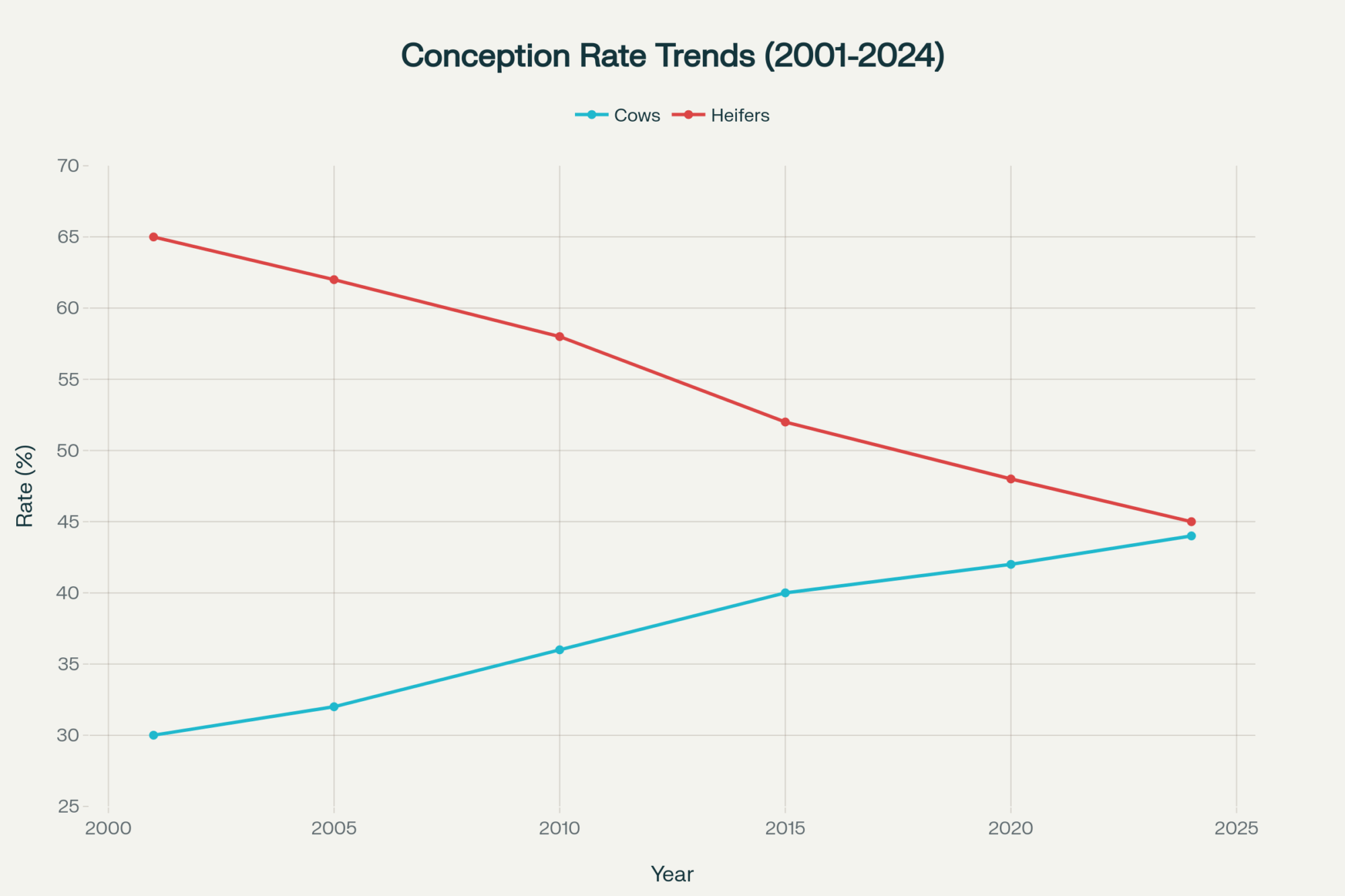
According to comprehensive analyses published in the Journal of Dairy Science covering over one million Holstein cows, national heifer conception rates currently average between 55-60% (Journal of Dairy Science, 2023). For comparison, Dairy Herd Improvement reports show first-lactation cows now reaching conception rates near 44% (DHI, 2023). That performance gap? It’s a pile of untapped opportunity sitting right there.
Regional Heifer Fertility Management: Winters That Test vs Summers That Sizzle
Managing heifers in Wisconsin or Michigan? You know exactly what it’s like trying to hit growth and breeding targets through snow drifts and short grazing seasons. Industry practitioners consistently emphasize how critical winter preparation becomes for spring breeding success.
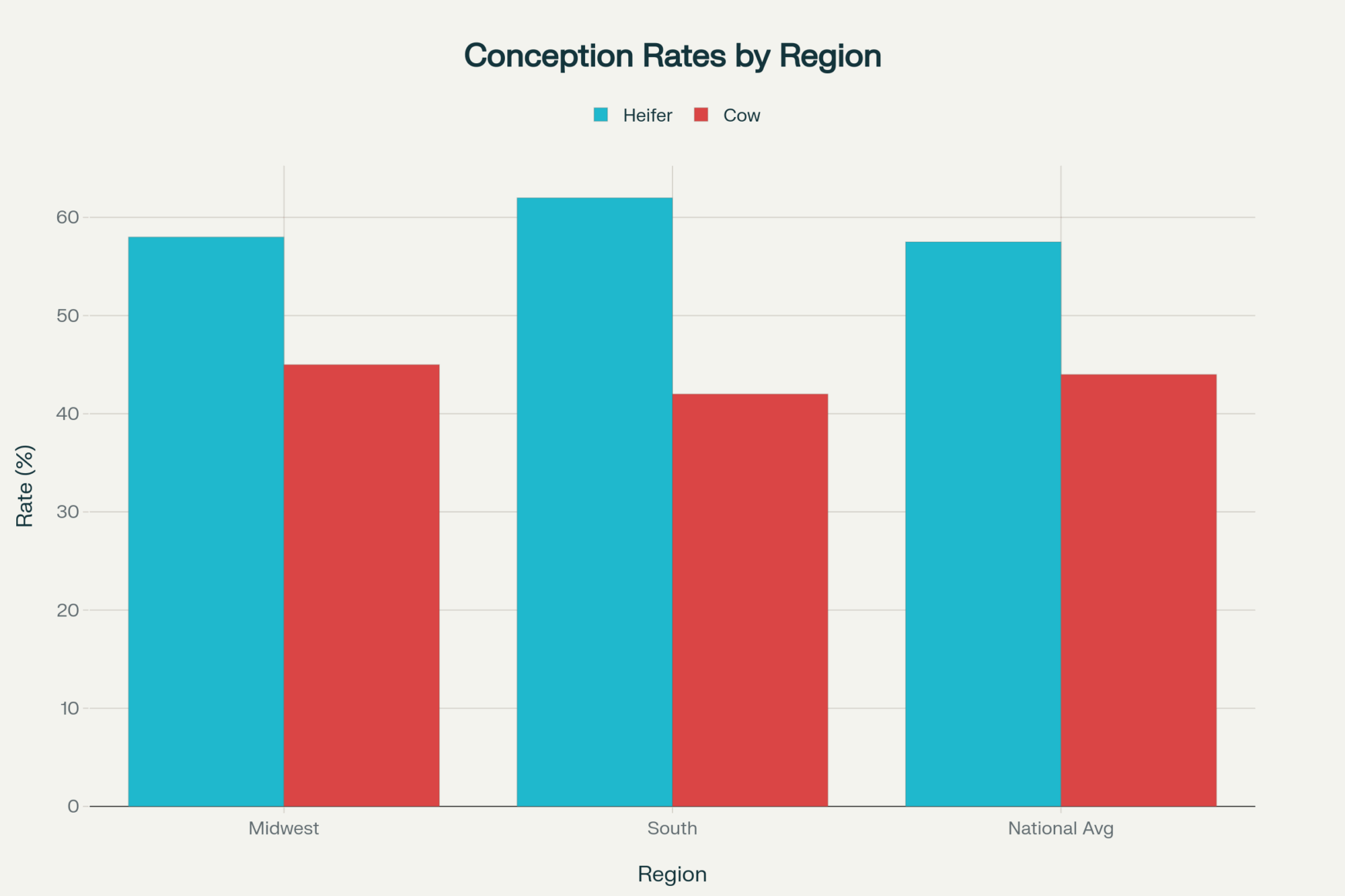
Comparison of Heifer and First-Lactation Cow Conception Rates by Region, highlighting fertility performance differences crucial for targeted reproductive management strategies in 2025
Flip to the South, and heat becomes the challenge. Studies published in PubMed Central demonstrate that heifers weather heat stress considerably better than their mature counterparts (PMC, 2017). This physiological advantage means Southern dairies have more flexibility during summer breeding windows but need strategies tuned to the heat’s relentless rhythm.
Economic Realities and Smart Growth Targets
Replacement heifers now command prices pushing toward $3,000 in many regions, according to Dairy Herd Improvement and Canadian Cow-Calf production analyses (DHI, 2023; Canadian Network, 2024). Sure, some estimates get tossed around about delayed breeding costing thousands more, but those numbers lack precision — costs vary dramatically based on individual farm management.
Trend in Average Replacement Heifer Costs from 2022 to 2024, illustrating rising economic pressures on dairy operations
Michigan State Extension research recommends breeding heifers once they reach approximately 55% of their mature body weight, targeting 85% by calving (MSU Extension, 2024). These evidence-based benchmarks help producers adjust for fluctuating feed quality and seasonal management challenges.
Heifer Breeding Technology: When It Actually Works
CowScout collars being used across Vermont dairies remind us that technology alone isn’t the magic answer, but when integrated with sharp management practices, it creates measurable impact. These operations report improved pregnancy rates and reduced hormone interventions through real-time activity and heat cycle monitoring, which is embedded in daily breeding workflows.
Strategic Dairy Heifer Breeding Protocols
Look to Germany for disciplined excellence. Systematic adherence to synchronization protocols results in heifer conception rates hitting approximately 64%. The takeaway? Precise timing and disciplined protocol management separate winning operations from struggling ones.
Growth Monitoring Fundamentals
Simple, routine weigh-ins continue proving their worth. Operations implementing monthly weight assessments report catching development issues early, enabling targeted nutritional adjustments that dramatically improve reproductive outcomes. No-frills approaches often deliver outsized results.
What This Means for Your Operation
There’s no silver bullet here, but the pathway to enhanced heifer fertility runs through systematic measurement, consistent protocol execution, region-specific tactical adjustments, and seamless technology integration where it adds value.
If you want genetic progress advancing and profit margins expanding, don’t let heifer fertility management slide into background priorities. These future production stars deserve focused, strategic attention.
Ask yourself: Are your heifers receiving management intensity proportional to their value in your operation?
Because if they’re not, you’re likely passing up substantial returns while your competition gains ground.
Complete references and supporting documentation are available upon request by contacting the editorial team at editor@thebullvine.com.
Learn More:
The $4,000 Heifer: Seven Strategies to Navigate the New Dairy Economy – This article provides a strategic look at the unprecedented rise in heifer prices in 2025. It reveals actionable strategies for balancing the high cost of buying replacements against the economics of raising your own, offering a critical financial perspective not covered in the main article.
Bovine Repro – Today and Tomorrow – Delve deeper into the tactical, on-farm implementation of advanced reproductive technologies. This piece complements the main article by offering practical insights on reproductive scoring, synchronization protocols, and the real-world application of progesterone monitoring to drive measurable fertility improvements.
The Future of Dairy: Lessons from World Dairy Expo 2025 Winners – This article provides a forward-looking perspective on the dairy industry. It explores the innovative strategies and technologies (including genomic testing and sexed semen) used by top-performing farms in 2025 to improve herd genetics and manage heifer programs for long-term profitability.
The Sunday Read Dairy Professionals Don’t Skip.
Every week, thousands of producers, breeders, and industry insiders open Bullvine Weekly for genetics insights, market shifts, and profit strategies they won’t find anywhere else. One email. Five minutes. Smarter decisions all week.
Dairy prices crash, but farmers aren’t culling—what’s keeping supply inflated?
EXECUTIVE SUMMARY: Here’s what we discovered: butter prices plunged 40% to $1.86 per pound, and milk futures hit historic lows, but dairy farmers are sticking with their herds. The culprit? Beef-on-dairy calf prices are hitting $1,600 in auctions, cushioning losses and disrupting traditional supply pressures. U.S. milk production surged 3.5% through July, mirrored by growth in the EU and New Zealand, creating a global surplus that dwarfs export gains. Scientific data and USDA reports reveal this simultaneous production boom is unprecedented in recent history, baffling markets and dragging down prices. This broken feedback loop means prices may remain depressed for longer, forcing farmers to reassess their risk and herd management strategies. Independent producers need to understand these dynamics now to adapt and survive—waiting for a market correction could mean bleeding margins for months.
KEY TAKEAWAYS:
Farmers can buffer revenue losses with beef-on-dairy calves selling between $900-$1,600, easing pressure from falling milk prices.
Lock in futures contracts near $17-$17.50 for risk protection amid volatile price trends.
Focus on maximizing butterfat and protein components as premium payments shift away from volume in 2025.
Recognize that global simultaneous milk supply growth from the U.S., EU, and New Zealand is unprecedented and pressuring prices lower.
Monitor beef market shifts closely, as calf price drops will trigger the necessary herd contraction for market balance.
Look, I’ve been tracking dairy fundamentals long enough to recognize when something’s fundamentally shifted. September 15 brought us CME butter at $1.86 per pound—lowest since October 2021—yet half the producers I’m talking to aren’t in crisis mode. Here’s the uncomfortable truth nobody’s discussing: this market’s traditional feedback mechanisms are completely broken.
When the Numbers Tell a Different Story
U.S. butter spot prices and Class III milk futures from June-September 2025 showing the dramatic market collapse that defines this dairy crisis.
The headline numbers are brutal, no question. CME spot butter crashed to $1.86 per pound on September 15, down more than 40% from mid-summer highs and hitting levels we haven’t seen in nearly four years. Class III futures dropped to life-of-contract lows at $16.31 per hundredweight, with Class IV even uglier at $15.90.
But here’s what’s got me scratching my head… walking through farm offices across Pennsylvania and upstate New York last week, the conversations weren’t what you’d expect. Sure, everyone’s feeling the milk price pain, but there’s this underlying confidence that wasn’t there in previous downturns.
The reason? Beef-on-dairy has become a game-changer nobody fully anticipated.
The Calf Market That’s Rewriting Farm Economics
At recent Premier and Empire auctions across Pennsylvania and New York, beef-on-dairy crossbred calves are routinely commanding $900 to $1,600 per head. That’s not hyperbole—Empire Livestock’s September reports show “Beef Type Calves” trading between $8.00-$17.50 per pound, which translates to these per-head values for 100-120 pound calves.
One producer near Lancaster told me his September calf sales covered three months of feed bills. When your day-old crossbred is worth more than most people’s monthly mortgage payment, it changes how you think about culling decisions entirely.
This isn’t just Northeast pricing either. Similar premiums are showing up across the Midwest wherever beef-on-dairy genetics are being marketed through organized sales.
Global Supply Dynamics: Everyone’s Producing More
Global milk production changes by major dairy regions in July 2025, illustrating the simultaneous supply growth driving market oversupply
What makes this situation particularly concerning is the production data coming out of all major dairy regions. U.S. milk production surged 3.5% in July compared to the same month last year, building on the 3.4% increase we saw in June. USDA raised their 2025 production forecast to 228.3 billion pounds, citing increased cow inventories and higher milk per cow yields.
The growth isn’t evenly distributed, though—it’s concentrated in regions like Kansas, Texas, and South Dakota where new processing capacity has come online. Industry reports suggest this additional processing infrastructure may be encouraging regional herd expansion, though formal analysis of this relationship is still pending.
New Zealand posted similarly strong numbers, with milk solids climbing 2.2% in July. Fonterra’s reporting record production for the third consecutive month, driven by favorable weather conditions and strategic supplemental feeding programs, including increased palm kernel imports.
The European situation is more complex. While some regions show growth, overall EU production for January-July 2025 was actually down 0.3% compared to 2024, with significant regional variation due to disease outbreaks in France and weather impacts across different member states. The UK bucked this trend with a stronger performance, but the continental picture remains mixed.
According to USDA data, this represents significant simultaneous growth across major dairy regions—a pattern that’s putting unprecedented pressure on global absorption capacity.
Export Numbers Hide the Real Problem
The export headlines sound encouraging at first glance. U.S. dairy exports jumped 7.1% in July, with butter exports soaring 206% year-over-year. USDEC confirms cheese reached 52,105 MT, up 29% and setting new monthly records driven by demand from Central America, the Caribbean, South Korea, and Japan.
But here’s the thing that’s got me concerned… much of this “growth” is being bought with margin destruction. We’re offering aggressive discounts to move oversupplied product faster than domestic markets can absorb it. Meanwhile, nonfat dry milk and skim powder exports collapsed 16% as we’re getting priced out by European and New Zealand competitors.
At the Global Dairy Trade auctions, European supplier Arla was moving SMP at prices equivalent to $2,575, down 4.8% from previous sessions and undercutting U.S. offerings significantly.
The Feed Cost Buffer
USDA’s September crop report projects 16.8 billion bushels of corn production for 2025—one of the largest harvests on record. This abundance is keeping feed costs historically low, providing producers with a critical buffer that’s preventing the usual financial pressure that forces herd reductions.
What’s interesting is how this interacts with the beef-on-dairy phenomenon. Cheap feed means lower breakeven costs, while premium calf values provide additional revenue streams. Together, they’re eliminating the economic incentives that typically force supply contraction during price downturns.
Why Traditional Market Cycles Are Broken
The broken dairy market feedback loop: How high calf prices and cheap feed prevent traditional supply corrections, perpetuating oversupply.
Here’s where it gets really concerning from a market structure perspective… The traditional dairy cycle relied on economic pressure forcing tough culling decisions when milk prices dropped. But when beef-on-dairy calves are worth $1,200-$1,600 per head, producers can actually profit from keeping cows that aren’t covering their milk production costs.
This creates a perverse incentive structure where low milk prices don’t trigger the supply response the market needs. Instead of reducing cow numbers, producers are maintaining or even expanding herds because the beef side of the equation is so profitable.
It’s a fundamental break from historical market dynamics, and honestly… I’m not sure how long it can persist without causing more serious structural problems.
Regional Variations and Seasonal Impacts
The impact isn’t uniform across all production regions. Midwest operations with strong relationships to beef buyers are weathering this much better than single-buyer situations in more isolated areas. Fresh cow markets in Pennsylvania and New York are showing more resilience than I’d expected, partly due to the proximity to premium auction facilities.
Seasonal factors are also playing a role. The September-October calving peak means higher volumes of crossbred calves hitting premium markets just as beef prices remain elevated. This timing is providing crucial cash flow support during what would normally be a financially stressful period for many operations.
What Smart Operators Are Doing Now
The producers who are positioning themselves best in this environment aren’t waiting for “normal” markets to return. December Class III futures near $17.00-$17.50 might be your last reasonable hedge opportunity before this situation potentially gets worse.
Component focus has become absolutely critical. Milk buyers are increasingly paying for butterfat and protein content rather than volume, and the producers who’ve optimized their component production are seeing significantly better returns than those still focused on total pounds.
Whey protein concentrate demand remains strong despite the broader commodity weakness, which suggests there are still opportunities in value-added products for operations positioned to capture them.
The Uncomfortable Truth About Market Timing
Look, what we’re seeing here—this combination of crashing milk prices alongside sustained farm profitability—isn’t a temporary market quirk. It’s a structural shift that could persist for months or even years until external factors finally force the supply contraction this market desperately needs.
The moment beef-on-dairy calf prices start sliding back toward historical norms, that’s when you’ll see the real market correction begin. But until then? We’re in uncharted territory where traditional market analysis doesn’t provide the usual roadmap.
The operations that thrive through this period will be the ones that adapt their business models now, rather than waiting for markets to return to patterns that may not exist anymore.
Complete references and supporting documentation are available upon request by contacting the editorial team at editor@thebullvine.com.
Learn More:
US Dairy Market in 2025: Butterfat Boom & Price Volatility – How Farmers Can Protect Profits – This strategic article provides a market overview and a clear “checklist for survival,” with tactical steps for hedging against price volatility, optimizing your herd’s components, and locking in lower feed costs. It offers actionable strategies to protect your bottom line in a challenging year.
Discover How Beef-on-Dairy Could Skyrocket Your Farm’s Profits – This piece delves into the innovative and financial aspects of beef-on-dairy genetics. It explains how this strategy generates new revenue streams and provides essential business diversification, detailing the benefits of hybrid vigor and market premiums that are fundamentally reshaping farm economics.
Every week, thousands of producers, breeders, and industry insiders open Bullvine Weekly for genetics insights, market shifts, and profit strategies they won’t find anywhere else. One email. Five minutes. Smarter decisions all week.
Would your cash flow survive 70% of your cows dropping in production for two months straight?
EXECUTIVE SUMMARY: We’re going to be blunt: the H5N1 outbreak is costing progressive dairies far more than industry talking heads admit. Recent USDA data suggests the per-cow hit is $950 or more, with average losses of 945kg of milk over 67 days after infection (Cornell 2025). That isn’t just hurting margins; it’s gutting cash flow, especially in regions slow to roll out surveillance or invest in rapid detection. Our analysis shows states like Texas posting milk gains upward of 10% while parts of the Midwest and East watch output stall—even as federal disaster relief (ELAP) covers only a sliver of the true long-term pain. Here’s the twist: dairies leaning hard into sensor tech and proactive sanitation—think smart cluster checks and real-time rumen alerts—are shortening losses, cutting mortality risk, and heading off future disruptions. Industry-wide, the guys treating ELAP and tech grants as upgrade capital rather than handouts are building the next-generation playbook. Forward-thinking herds? They’ll see a competitive boost long after this flu is old news. Let’s turn H5N1’s chaos into a new operational edge—starting now.
KEY TAKEAWAYS:
Rapid H5N1 detection using smart sensors (like CowManager) cuts “clinical lag” by 4-5 days, giving you a head start on isolating fresh cows and minimizing spread.
Proactive cluster sanitation between every cow reduces milking-based transmission—Kansas State found viral loads may top 10⁸·⁸ per ml in parlors, highlighting sanitation as a non-negotiable.
While USDA’s ELAP covers up to 90% of milk loss for 28 days, true production recovery takes 2-3 times longer; budgeting for the “long tail” of losses matters more than ever.
Herds in states with earlier adoption of national milk testing or monitoring tech are seeing less financial damage and faster market rebound—think Texas’ 10.6% output jump versus stagnant old-guard regions.
Invest ELAP payouts, tech grants, or co-op incentives into resilience upgrades—real-world data says that’s what’s separating survivors from sellers in 2025’s market.
Let’s get right to it—if you’re milking cows anywhere from Tulare to Monroe County, Wisconsin, and you’re still treating H5N1 as just another line item on your biosecurity checklist, it’s time for a real talk. This isn’t a seasonal headache. It’s hitting producers right between the butterfat numbers and the bank account, and no, it’s not easing up after a couple of milking rotations.
According to recent university research—check out the Cornell numbers—the average infected cow in this outbreak is leaving a $950-sized hole in farm finances. And that’s just the direct costs. What’s wild is these losses aren’t short-lived. Cows are still lagging on production more than 77 days after clinical recovery. So, that old route where you pencil losses as a monthly blip? It doesn’t wash anymore.
What’s Actually Spreading This?
Here’s the thing, though… everyone loves talking about geese flying over feed lanes, but cutting-edge studies from Kansas State show that the main problem is how the virus is moving through milking equipment. The viral load in an infected Holstein’s bulk tank sample? Up to 10⁸·⁸ per milliliter. That’s billions—yes, billions—of particles getting a free ride through lines and clusters every single turn through the parlor.
So whether you’re milking in a double-30 rotary or scrubbing up your tie stall for winter, don’t let anybody tell you fence netting is the best defense. The state testing teams in California found actual virus in parlor air—and even the breath coming out of fresh cows. For folks stressing labor hours, that means proactively scheduling cluster sanitization and paying attention to those little moments between cows is damn near as important as the weekly herd test.
The Slow Burn: Milk That Never Comes Back
The story on production losses isn’t pretty. Cornell’s multi-region study tracked 945 kg lost per cow over 67 days. And what’s interesting is that the real pain kicks in two phases. First, there’s that 70% crash in milk yield in the first two weeks. But even after herd health “looks good,” cows are still coming up short by 30-40% for months after. This isn’t a quick strep or summer mastitis—it’s the kind of hit that chokes off farm liquidity way past the acute stage.
You might hope for federal backup… but ELAP only covers 90% of the first 28 days’ losses. If you’ve ever stared down an operating loan after an outbreak, you know how much that leaves exposed. Wisconsin’s central-sands dairies, in particular, feel the pinch.
Surveillance: The Holes in the Net
Now, let’s talk testing. Everyone’s writing press releases about “national” surveillance, but the nuts and bolts tell another story. USDA extended its National Milk Testing Strategy to over 36 states, but big players—Wisconsin, Arizona—weren’t onboard until well into 2025. And according to disease modeling, the virus is usually ahead of the reports… with outbreaks predicted long before sampling confirms anything.
Seen the Q2 numbers in Texas? Milk output’s up more than 10% year-on-year. Meanwhile, parts of the Midwest and Mid-Atlantic dairies are just holding steady at best. It’s a real game of herd movement vs. reporting lag.
Tech: Not Just for DIY Tinkerers Anymore
Here’s a bright spot. Sensor technology—CowManager’s ear module is making waves—gives managers a 4-5 day lead detecting sick cows before they go off feed. One health manager I talked to swears by catching changes in rumination and temp before the vet even gets there (and let’s be honest, sometimes that’s your margin when it comes to saving fresh cows).
But let’s stay grounded—while published performance data is promising, industry consensus is that claims of zero mortality need more multi-site validation before anyone calls it a silver bullet.
The Vaccine Tightrope
Vaccines—especially Medgene’s H5N1 shot—were released with promising trial numbers, indicating efficacy rates of around 100% efficacy. But the rub? The whole U.S. dairy sector needs close to 28 million doses for full initial coverage and annual boosters… and only about 10 million are available so far.
So, what’s happening right now is a scramble; allocations depend on politics, state relationships, and maybe a bit of dealer influence more than pure risk. It means that some herds get protected, while many are left waiting. That’s not just frustrating—it’s a structural disadvantage.
Trade Games: When Economics Masks as Safety
If you’re still hoping for global fairness, keep an eye on trade flows. Turkey put the kibosh on importing U.S. live cattle but quietly ramped up egg exports to fill our supply gaps, cashing in on $26 million worth of U.S. demand. Colombia pulled a similar move, banning beef imports without confirmed cases in beef herds—messing up U.S. sales for months.
Here’s the kicker… decades of FDA data back this up: pasteurization wipes out the H5N1 virus in milk completely. Real-world tests found zero viable virus after proper thermal processing. Yet, those trade barriers? Still standing.
Pivoting the Crisis: Who’s Really Winning?
Now, I’m seeing more producers treat ELAP payouts and USDA grants as more than just “get by” money—it’s investment capital for upgrades. There’s a wave of partnerships, like Foremost Farms working with Ginkgo Bioworks to turn whey and lactose (the stuff we all usually pay to haul away) into high-value industrial inputs, with big promises on carbon footprint reduction and revenue. If you get the right biosecurity in play, you don’t just fight the bug—you lower your risk and win with sustainability. Smart, right?
Canadian reports echo the same: data shows stricter biosecurity slashes losses across more than just this flu.
How Does This Reshape U.S. Dairy?
So here’s what it all boils down to… H5N1 is forcing us to finally act on tech, early intervention, and resilient supply chains. Producers with their arms around sensor data, scalable biosecurity, and vaccine access—especially in proactive regions like Texas and Arizona—are poised to scoop up market share. Processors are tightening up contracts and will pay premiums for uptime assurance.
The days of skating by on historical margins are over—and, in a way, that’s not all bad. The crisis is exposing weaknesses but also carving out space for those who innovate, invest, and treat biosecurity as a competitive edge.
If anything, what strikes me most is how fast the playbook is changing. So, the real winners? They’re not the ones just hoping for weather breaks or vintage milk prices—they’re the ones thinking three moves ahead, bringing science and new tech right into the heart of daily farm management.
We’re not here to scold or sugarcoat—just to cut to what moves the needle. The playbook is changing. Smart risk management, not wishful thinking, builds the new bottom line.
Complete references and supporting documentation are available upon request by contacting the editorial team at editor@thebullvine.com.
Learn More:
Battle Plan: How to Protect Your Dairy Herd from HPAI – This article provides a tactical, step-by-step guide on managing an H5N1 outbreak. It offers concrete strategies for early detection, supportive care, and protecting farm workers, enabling producers to implement an immediate, actionable response and minimize losses.
Every week, thousands of producers, breeders, and industry insiders open Bullvine Weekly for genetics insights, market shifts, and profit strategies they won’t find anywhere else. One email. Five minutes. Smarter decisions all week.
Nearly 40% of US dairy farms closed in 5 years — Can you afford to miss this shift?
EXECUTIVE SUMMARY: We’ve been tracking some sobering trends, and here’s what the data’s telling us: the US dairy industry just lost nearly 40% of its farms in five years, with mega-dairies now controlling over 66% of milk production according to recent USDA census figures. This isn’t just consolidation — it’s a fundamental reshaping that’s creating a $9.77 per hundredweight cost advantage for large operations, which translates to over $50,000 annually for typical mid-size dairies trying to compete. The 2025 Emergency Livestock Relief Program covers 60% of disaster-related feed costs, but here’s the kicker — it favors producers in disaster-declared regions with streamlined processing that creates systematic competitive advantages. While tools like Dairy Margin Coverage continue buffering volatility with regular payouts, we’re seeing concerning patterns where federal aid dependency might actually accelerate the very consolidation it’s meant to help farmers survive. The smartest producers aren’t just applying for relief — they’re using strategic fund allocation to turn survival money into a competitive advantage. This shift demands immediate attention and thoughtful action from every progressive dairy operation.
KEY TAKEAWAYS
Immediate Relief Opportunity: USDA’s Emergency Livestock Relief Program offsets up to 60% of disaster-related feed costs through a 46-day application window — submit documentation now to access up to $250,000 in recovery funds
Scale Economics Reality: Mega-dairies maintain a $9.77/cwt production cost advantage over smaller operations, emphasizing the urgent need for mid-size farms to optimize efficiency and leverage available support programs
Risk Management Buffer: Dairy Margin Coverage delivers consistent value with $1.49/cwt average payouts in two-thirds of months since 2018 — maximize enrollment to reduce margin volatility and strengthen financial resilience
Technology ROI Acceleration: Precision feeding systems and robotic milking reduce operational costs by 15-25% and 50% respectively, with 5-7 year payback periods that federal relief can help accelerate for competitive positioning
Strategic Fund Deployment: Apply the 50/25/25 allocation framework — half for disaster recovery, quarter for productivity upgrades, quarter for risk management tools — to survive current pressures while building long-term competitive strength
The thing about these federal relief programs? They tend to show up just when you’re not expecting them. But this one? It’s landing right in the middle of some of the biggest shifts we’ve seen in the US dairy scene in years. The USDA’s Emergency Livestock Relief Program, rolling out in September 2025 to cover flood and wildfire losses from the past couple of years, isn’t just another check—it’s shifting the landscape for who stays in the game and who’s edging toward the exit.
The Numbers Tell a Brutal Story
Digging into USDA census data, it’s hard not to notice the brutal facts. Since 2017, nearly 40% of dairy farms have closed their doors—down from about 39,300 farms to just over 24,000. That’s almost four farms out of every ten gone in five years. If you’re farming in places like Wisconsin, Pennsylvania, or New York, that shift is more than just stats — it’s the reality on the ground, with thousands of farms disappearing.
Now, the other side of the coin — those larger dairies milking 1,000 cows or more — have been flexing muscles, growing from 714 to 834, now producing about 66% of all US milk. This degree of concentration is intense.
What jumps off the page for me is the cost gap. On average, these big operations enjoy a $9.77-per-hundredweight edge (give or take) over smaller herds with 100-200 cows. Feed, labor, tech — economies of scale just make a huge difference. For a 500-cow farm producing nearly 11,000 pounds per cow, that’s more than $50,000 annually in extra costs if you’re not running bigger.
Here’s How the Relief Program Actually Works
Now, here’s where the relief program plugs in. It’s designed to cover 60% of three months’ feed costs after floods, and 60% of one month’s feed after wildfires, capped at $125,000 per farm — doubled if you’ve got your ducks in a row with the paperwork. But here’s the kicker: you’ve got just 46 days to apply, with the window slamming shut a few weeks after the presidential election.
Producers in disaster-declared areas like California’s Central Valley or the Texas Panhandle get a faster pass through the red tape and an edge on their competition. It’s not exactly a level playing field.
California’s Bird Flu Payouts Show What’s Possible
Cast your mind back to last year’s bird flu outbreak in California: the federal government cut checks totaling over $231 million, with the average payout coming in around $645,000, and some of the larger dairies snagging multimillion-dollar sums. That money doesn’t just plug losses but funds genetic improvements and technology upgrades that university studies say can accelerate a farm’s progress by years compared to those going it alone.
Risk Management Is the Quiet Hero
Risk management isn’t just talk, either. The Dairy Margin Coverage Program has paid out in nearly two-thirds of the months since 2018, with supplemental payments of around $1.49 per hundredweight. That’s a real cushion against milk price and feed cost swings.
There’s a clear advantage baked into the relief program’s faster approvals and payout certainty for producers in pre-approved disaster zones — USDA data show these farmers cut through the paperwork quicker and get funds faster, creating a structural edge over others in non-disaster areas.
The Technology Race Is Accelerating
That said, some research underscores caution: farmers increasingly relying on federal aid may cut back on personal risk management efforts and take on riskier business moves. Food for thought.
And it’s not just about money on hand — relief dollars have sparked rapid adoption of precision feeding and robotic milking, which improve feed efficiency by 15-25% and cut labor by over 50%, with paybacks typically in five to seven years. This tech rush is widening the divide between large-scale operations and smaller farms.
Suppose around 30% of producers jump on this strategic relief game. In that case, we’ll see faster consolidation and productivity gains — but also a bubble in tech demand that could eat away at early adoption advantages. It risks turning dairy into an oligopoly dictated by federal cash access more than farm efficiency.
What Should Smart Producers Do?
So, what’s the smart move? You apply, that’s for sure. But don’t spend all your relief money on shiny new toys. Think balance:
Half the funds should go towards recovering what the disaster damaged
A quarter on sensible upgrades that deliver returns
The rest invested in risk management tools or cooperative efforts, like beefing up Dairy Margin Coverage
It’s like managing your dry cows — you want them healthy but not overfed.
The biggest, most tech-heavy dairies? They’ll use this cash to extend their lead — buying out struggling neighbors or investing in technology beyond reach for the smaller guys.
Regional Realities Are Getting Starker
Out in the Pacific Northwest, wildfire-prone farms are accounting for disaster relief in their budgets, while places like Wisconsin’s driftless region face a tougher grind with less access to these programs[USDA regional disaster reports]. The geographic divide is real and growing.
The Bottom Line Question
Here’s the bottom line — this aid buys breathing room but accelerates big changes faster than most realize. The question every dairy farm faces: Can the industry thrive without leaning on federal programs every few years? The honest answer is probably not.
Your next moves — what you decide in these coming weeks — will impact not only your farm but the whole fabric of dairy country in America.
Learn More:
Will Your Dairy Farm Survive the Next Decade? The Brutal Math of Consolidation – This strategic article complements the main piece by providing a deeper look at the economic forces driving consolidation. It outlines two stark survival paths—scaling up or hyper-specializing—to help you assess your farm’s long-term position.
The Robotics Revolution: Embracing Technology to Save the Family Dairy Farm – This tactical guide offers a step-by-step approach to implementing robotic milking. It provides actionable insights and case studies demonstrating how technology can cut labor costs and boost milk production, complementing the main article’s strategic allocation advice.
Did you know 3.6 million pounds of milk were rerouted in Pennsylvania after a single plant’s shutdown?
EXECUTIVE SUMMARY: The swift rerouting of 3.6 million pounds of milk in Pennsylvania exposed critical supply chain vulnerabilities we’re all facing in modern dairy. Farms with diversified processor relationships reported improved resilience, with the potential to reduce losses by thousands during disruptions. Pennsylvania’s dairy industry contributes over $28 billion annually and supports 45,000-plus jobs, underscoring the importance of flexible, multi-facility networks in 2025. Technology platforms further enhance communication and minimize operational hiccups that can cost us dearly. Recent extension research highlights preparedness as a profitable risk management strategy—one that’s likely to boost liquidity and secure market access amid increasing processing consolidation. To stay ahead, we recommend proactively broadening your processing contacts, strengthening hauler partnerships, and engaging with regulators before you need them. Now’s the time to turn disruption into advantage and build lasting farm resilience.
KEY TAKEAWAYS
Diversify processing agreements to safeguard milk flow and reduce risk of costly dumping—benefits are measurable in reduced losses during regional disruptions (Industry Analysts, 2025)
Invest in trusted, flexible hauling services that enable quick milk rerouting, essential amid tighter regional processing capacity and environmental compliance challenges (PA Dept. of Transportation, 2025)
Leverage digital supply chain management tools that improve communication and logistics efficiency, helping you avoid missed pickups during volatile market conditions (Milk Moovement, 2025)
Engage proactively with state regulators and emergency response teams to expedite permits and compliance during unexpected disruptions—Pennsylvania’s 24-hour permit turnaround proves it works (PennDOT News, 2025)
Tailor preparedness plans by farm size: small farms should lean on cooperative networks, medium farms need to diversify processors, and large operations can invest in advanced tech and strategic contracts that create competitive advantages (Pennsylvania Legislative Committee, 2020)
The thing about that quick pivot in Pennsylvania—when 3.6 million pounds of milk needed rerouting after the Great Lakes Cheese plant hit a wall—is how it laid bare the cracks in our processing system. This isn’t just a line in a press release; for anyone running cows in this state or the Northeast, it’s a wake-up call we’ve been dancing around.
Now, Pennsylvania leaned on five main plants for that milk shuffle: Dairy Farmers of America spots in Reading, New Wilmington, and Middlebury, plus Leprino Foods in Sayre, and Upstate Niagara near Williamsport (PA.gov, 2025). When you consider PA’s dairy economy—over 45,000 jobs and upwards of $28 billion pumped into the state—that’s a pretty tight circle holding a lot of weight (Pennsylvania Legislative Committee, 2020).
Why Knowing Your Processing Network Changes the Game
What strikes me about this whole situation is how important it is to truly understand your processing landscape truly. Industry experts consistently remind us that diversification is more than just a buzzword. It’s survival. Farms with more than one processor—and backups for backups—saw fewer headaches when the pandemic threw the system out of whack (Industry Analysts, 2025).
Can’t stress enough: putting all your milk in front of one processor is like leaving all your eggs—well, in one basket.
Your Emergency Rolodex Is More Than a Contact List
That rapid response? It wasn’t magic. It was relationships—solid lines between haulers, state ag folks, and cooperative managers who had the foresight to prepare (PA Dept. of Transportation, 2025).
Smart producers are loading up their rolodexes with reliable processors and haulers they can call on short notice. Getting involved in local agricultural emergency plans is no longer optional; it’s becoming standard operating procedure in places like Lancaster and Chester counties.
Sure, it costs a bit of time and maybe some bucks, but given the price of dumping milk? The investment more than pays for itself.
Environmentals, Risks, and Regional Realities
It’s no surprise that Great Lakes Cheese was sinking under environmental scrutiny. The NYS Department of Environmental Conservation nailed them for repeated phosphorus discharges since late 2024 (NYS DEC, 2025). That’s exactly why regional diversity matters.
If you’re running a farm in a concentrated processing zone, you need to think beyond the commodity market. Niche flexing, organic, specialty, or direct-to-consumer models give some wiggle room when traditional supply chains choke.
Regulators: Your Unexpected Allies
Emergency milk permits got waved through in under 24 hours, which—let’s be honest—is lightning fast compared to the usual slog (PennDOT News, 2025). Knowing your people at the Dept. of Agriculture or DOT, and keeping your compliance ducks in a row, might be the best move you never thought of.
Tech That Works Outside the Dairy Office
Tech isn’t just for tracking cow health anymore. It’s starting to bridge the communication gap between farm, hauler, and processor. Milk Moovement folks point out that syncing everyone in real time reduces costly missed pickups—a lifeline during chaos (Milk Moovement, 2025).
Even simple scheduling apps can tighten coordination, which so many small to mid-sized farms desperately need.
Different Strategies for Different Sized Farms
Small operations: lean on your neighbors and co-op emergency plans to shore up your resilience.
Medium farms: diversify hauling and processing contracts, and don’t be afraid to go the extra mile if that means getting your milk processed.
Big operations: leverage your scale to negotiate flexibility and invest confidently in supply chain technology that helps pivot on a dime.
Look Ahead: Preparedness Isn’t Just Survival
Those proactive farms that passed the Pennsylvania test aren’t just lucky—they’re positioned for a competitive edge. Statewide, dairy fuels a $28.3 billion economy and supports over 45,000 jobs (Pennsylvania Legislative Committee, 2020). That size gives us strength—and risks.
With billions of dollars flowing into processing expansion nationwide, farms that build flexible networks and adopt technology first will capitalize on disruptions and turn them into opportunities.
The next challenge is coming sooner than we think. The question is simple: will you be ready?
Complete references and supporting documentation are available upon request by contacting the editorial team at editor@thebullvine.com.
Learn More:
The 5000-Head Farm Blueprint: Secrets to Running a Large-Scale Dairy Operation – This article provides a tactical look at the management, financial, and technological strategies required for large-scale operations. It offers a blueprint for implementing systems that drive efficiency and profitability, offering a practical guide for expanding farm resilience.
Feed Costs | The Bullvine – This strategic market analysis helps farmers understand current market dynamics, including commodity price fluctuations and their impact on profitability. It provides essential economic context to inform long-term risk management and strategic planning beyond the farm gate.
US dairy supply chain technology provider Dairy.com enters India – Discover the future of dairy logistics with this piece on innovative technology. It reveals how new digital platforms and supply chain tools are being deployed to improve communication, reduce waste, and build more transparent, responsive networks.
The Sunday Read Dairy Professionals Don’t Skip.
Every week, thousands of producers, breeders, and industry insiders open Bullvine Weekly for genetics insights, market shifts, and profit strategies they won’t find anywhere else. One email. Five minutes. Smarter decisions all week.
Everyone’s waiting for feed prices to drop more. Meanwhile, the sharp operators are already banking margin while others hesitate.
EXECUTIVE SUMMARY: Look, we’ve been tracking this feed market setup for months, and what we’re seeing now isn’t your typical seasonal pattern. The conventional wisdom says wait for grain prices to drop more, but we’re telling progressive producers to lock in contracts now while the margin window is wide open. Here’s the reality: global cereal production hit 2.961 billion tonnes (up 3.5% from 2024), yet food prices remain 6.9% higher than last year—creating a rare divergence that smart operators can exploit. With feed representing 53% of production costs and every /ton price drop worth per cow annually, a 1,000-cow operation could bank ,000 just by timing procurement right. China’s shrinking dairy herd and EU production declines are supporting milk prices while abundant grain keeps feed costs favorable—a combination we haven’t seen since 2014. The scientific data from the University of Illinois and USDA reports confirm this window typically lasts 18-24 months before market forces rebalance. We’re watching butterfat premiums hit $2.84/lb versus protein at $1.87/lb, making genetic strategy as critical as feed procurement strategy right now.
KEY TAKEAWAYS
Lock 50-70% of your feed needs before November – Historical basis patterns show freight costs climb after harvest crunch, eating into the $95/cow annual savings you could bank from current corn pricing (University of Illinois data confirms producers acting within 90 days outperform those who wait)
Shift breeding emphasis to butterfat genetics immediately – Federal Milk Marketing Order data shows fat commanding $0.97/lb premium over protein in August 2025, turning genetic decisions into direct profit drivers when feed costs are dropping
Implement precision feeding systems now while cash flow supports capital investment – Penn State research documents 5-7% efficiency improvements worth $285-400 per cow annually on current feed costs, with payback accelerated by favorable margin conditions
Diversify feed suppliers to bypass consolidation premiums – Industry consolidation means fewer players control grain handling, keeping basis spreads artificially wide and costing producers money that direct relationships can recover
Review risk management coverage before margins compress – Current Dairy Margin Coverage and LGM-Dairy programs can lock in protection during this favorable window, with USDA data showing this market convergence typically lasts 18-24 months maximum
Listen, I’ve been around this business long enough to recognize when the stars align for a real opportunity. What are we seeing this fall with feed costs and milk prices? It’s the kind of setup that comes maybe once every eight to ten years.
The thing is, half the producers I run into at the elevator or co-op meetings are still waiting, thinking prices might drop another nickel. But here’s what I’ve learned over the years—timing beats perfection every time.
The Numbers That Should Get Your Attention
The FAO dropped their September cereal report, and the production numbers are eye-opening. Global cereal output is forecast at 2.961 billion tonnes—that’s a solid 3.5% jump from last year when we already had decent supplies[FAO Cereal Supply and Demand Brief, September 2025].
But here’s what’s really interesting: despite all this grain floating around, the FAO Food Price Index sat at 130.1 points in August, running 6.9% higher than last August[FAO Food Price Index, September 2025]. That tells me grain supplies are abundant, but prices aren’t dropping like you’d expect.
What does this mean for those of us milking cows? Simple math: feed costs represent about 53% of our total production expenses according to University of Illinois data[University of Illinois Farm Business Management, 2024]. When grain prices ease but milk stays firm, margins expand.
Real Farm Economics
Let me break down what this looks like on an actual operation. A typical Holstein consumes around 52 pounds of dry matter daily—pretty standard for high-producing cows in our region[Penn State Extension, 2023]. That works out to about 9.5 tons annually per cow.
Here’s the calculation: every per ton drop in feed price saves roughly per cow annually. For a 1,000-cow operation, that’s $95,000 straight to your bottom line.
The Illinois team projects feed costs at $11.96 per hundredweight for 2025, down from recent highs[University of Illinois Economic Review, December 2024]. But protein costs aren’t following the same pattern—something to keep in mind when you’re planning procurement.
Global Forces Working in Our Favor
What’s driving this opportunity? Several trends are lining up that don’t happen often.
China’s dairy herd keeps shrinking, according to USDA Foreign Agricultural Service reports[USDA-FAS China Dairy Report, May 2025]. They’re not the reliable powder buyer they were for the past decade.
Meanwhile, New Zealand’s pivoting toward higher-value products instead of bulk powder[USDA New Zealand Dairy Report, 2025]. Smart move for them, but it’s tightening global supplies.
Component Premiums You Can’t Ignore
Here’s where it gets interesting for breeding programs: Federal Milk Marketing Order data shows butterfat commanding $2.84 per pound versus protein at $1.87 in August[USDA Agricultural Marketing Service, August 2025].
That’s a premium worth chasing. With feed costs dropping, now’s the time to emphasize fat genetics in your breeding decisions.
Regional Picture from the Trenches
The crop reports tell a compelling story. Iowa’s corn is rated 84% good to excellent—58% good, 26% excellent—with 9% already mature according to USDA data[Iowa Crop Progress Report, September 2, 2025]. Some areas are dealing with southern rust, but overall conditions support strong yields.
Wisconsin cooperatives are reporting competitive December corn pricing, though specific quotes vary by location and timing. The key is locking in favorable basis levels before harvest logistics tighten freight costs.
Here’s what I’ve learned from watching basis patterns over the years: get your contracts done before November. Once we hit harvest crunch time, transportation costs start eating into any price relief you might have banked earlier.
The Consolidation Reality
Here’s something that deserves more attention: grain handling has consolidated dramatically over the past decade. When fewer players control more capacity, basis spreads tend to stay wider than they should.
Based on what’s working for operations that understand market cycles:
Feed Procurement:
Lock in 50-70% of corn needs through Q1 2026
Secure protein positions when opportunities arise
Diversify suppliers to avoid basis manipulation
Genetic Focus:
Emphasize butterfat genetics for current premiums
Genomic test all replacement heifers
Strategic breeding targeting milk composition
System Efficiency:
Audit feed waste—5% waste reduction is found money
Evaluate TMR mixing consistency
Consider precision feeding investments
Risk Management:
Review Dairy Margin Coverage levels
Assess Livestock Gross Margin-Dairy options
Project cash flow through 2026
Why Acting Now Beats Waiting
Here’s the reality about market windows: they don’t announce when they’re closing. Research consistently shows that operations making strategic decisions during favorable periods outperform those who wait for perfect conditions.
Record grain production is easing feed costs—it is. Global supply constraints are supporting milk prices—they are. Component premiums are rewarding focused genetics—they definitely are.
This convergence typically lasts 18-24 months before market forces rebalance. The operations are now strategically positioned to bank margins that will carry them through whatever comes next.
The Bottom Line
Every day you spend debating whether to act is an opportunity cost. Markets don’t wait for perfect information, and neither should you.
The fundamentals are aligned. The window is open. The question isn’t whether this opportunity exists—it’s whether you’re going to walk through it while it’s available.
What’s stopping you from locking in these margins this week?
Complete references and supporting documentation are available upon request by contacting the editorial team at editor@thebullvine.com.
Learn More:
Precision Feeding Strategies Every Dairy Farmer Needs to Know – This article provides a tactical deep-dive into the “how” of precision feeding. It reveals practical methods for diet formulation, TMR mixing, and data analysis, helping you capture the 5-7% efficiency gains mentioned in the main piece.
ICE Raids Resume: Why Dairy’s $48 Billion Labor Crisis Exposes Our Innovation Failure – Looking toward the future, this article makes a powerful case for technology adoption. It details the accelerated ROI on automation and AI-powered herd management, connecting the main article’s call for capital investment to operational stability and a long-term competitive advantage.
The Sunday Read Dairy Professionals Don’t Skip.
Every week, thousands of producers, breeders, and industry insiders open Bullvine Weekly for genetics insights, market shifts, and profit strategies they won’t find anywhere else. One email. Five minutes. Smarter decisions all week.
Nine days changed everything—US dairy faces $6B loss. Your farm ready for what’s next?
Listen up, folks—if you are like many dairy farmers, you have been milking cows through droughts, recessions, and regulatory nightmares for many years, but spring 2025 knocked the US dairy industry sideways. If you haven’t felt it in your milk check yet, buckle up. Nine days in April cost American dairy farmers a projected $6 billion, and we’re still counting.
Look, I’ll cut to the chase. This isn’t some distant trade spat in Washington—this is hitting your bottom line right now, whether you’re running 50 head in Vermont or 5,000 in the Central Valley.
When Politics Became Your Biggest Risk Factor
Nine Days That Changed Everything
Product Category
Export Market
Year-over-Year Change (May 2025 vs. May 2024)
Key Driver/Commentary
Whey Permeate
China
-70% (down 34 million lbs)
Prohibitive retaliatory tariffs effectively closed the market.
WPC 80
China
-83%
High-protein whey caught in the same tariff escalation.
Lactose
China
-59% (plunged in May)
U.S. price advantage was erased by the 125% tariff.
Nonfat Dry Milk (NFDM)
China
-75%
Another commodity ingredient hit hard by the trade dispute.
Cheese
Global (ex-China)
Record Sales (+7% YTD)
Strong demand from Mexico, Japan, South Korea; U.S. price competitiveness.
Here’s how fast things went south: April 2, the administration slapped a 34% tariff on Chinese goods. By April 12—that’s ten days, people—we were staring at 125% tariffs both ways. China matched us move for move, hour for hour.
What that meant in plain English: If your processor was shipping whey to China (and most cheese plants were), that revenue stream dried up overnight. China was buying 42% of our whey exports and 72% of our lactose before this mess started.
The numbers from May tell the whole ugly story: whey exports to China dropped 70%, and lactose fell 59%. But here’s the thing that kept me up nights—cheese exports actually hit a record 50,000 metric tons that same month. Markets outside China are hungry, and our product is still competitive. The problem isn’t demand; it’s politics.
Where the Pain Hit Different
Wisconsin: Cheese Capital Under Siege
Wisconsin’s $52.8 billion dairy economy took it on the chin hard. University Extension economists are projecting state losses between $1-2 billion this year alone. That’s real farms going under, not some abstract number.
If you’re milking in Wisconsin:
Eastern counties (Kewaunee, Brown, Manitowoc): Large operations tied to export-heavy processors got hammered the worst
Driftless region (Grant, Crawford): Smaller operations and grazing dairies showed more resilience—they weren’t hanging their hat on China to begin with
Central counties (Marathon, Wood): Mixed bag, depending on your co-op’s export exposure
Your homework: Get on the phone with your field rep today. Find out exactly what percentage of your milk goes toward products that were China-bound. That’s your pain percentage.
California: Getting Hit from Both Ends
Central Valley dairies are facing what UC Davis economists call a “compound crisis.” Feed costs jumped $18-22 per ton for imported concentrates. Water costs are adding another buck-twenty-five per hundredweight. Energy up 12% year-over-year.
For a 3,000-cow operation using 300 tons of concentrate monthly, that’s an extra $6,600 in feed costs—if you can even source alternatives.
Smart operators are: Locking Q1 2026 feed pricing now. Diversifying suppliers. Looking at longer-term hay contracts while they’re still available.
Pennsylvania: Border Uncertainty
Pennsylvania farms exported $364 million in dairy products last year, mostly to Canada and Mexico. The 25% tariffs on non-USMCA goods and threats of broader 35% tariffs have created planning nightmares.
Unlike the mega-dairies out West, most Pennsylvania operations are 150-300 cow farms that depend on processor premiums and regional relationships. When that gets disrupted, there’s no cushion.
Scenario
Likelihood
China Market Access
U.S. Dairy Industry Impact
Recommended Producer Actions
Trade Détente
~25%
Partial access restored
Some market recovery; ongoing challenges
Diversify markets; maximize efficiencies
Protracted Stalemate
~60%
Chinese market remains closed
Permanent loss to China; shift to ASEAN and Latin America
Expand new markets; optimize operations
Escalation
~15%
Market worsens; broader conflict
Severe industry disruption; economic downturn risk
Enhance resilience; increase financial buffers
What Your Co-op’s Actually Doing:
DFA: Implementing Southeast Asia marketing strategy by Q4. Managing the risk of a domestic cheese surplus from blocked exports. Enhanced feed purchasing programs through regional teams.
Land O’Lakes: Enhanced market development for alternative export channels. Accelerating domestic protein ingredient programs. Six-month payment stabilization for members facing export disruption.
Northeast cooperatives: Optimizing Canadian TRQ utilization. Enhanced quality bonus programs for members facing margin pressure. Expanded forward contracting options.
Component Focus: December Changes You Can’t Ignore
The Federal Milk Marketing Order updates taking effect on December 1 make component optimization critical. New manufacturing allowances: cheese jumps to $0.2519/lb (up from $0.2003), butter to $0.2272/lb (up from $0.1715).
Current industry trends:
National average butterfat: 4.41% (up from 4.36% last year)
National average protein: 3.42% (up from 3.38% last year)
Real talk: University Extension calculations show increasing protein content by 0.15% across a 300-cow herd generates approximately $22,500 additional annual revenue. That’s not pocket change.
How to get there:
Focus genetics on bulls with high protein potential
Maximize nutrition programs for rumen-undegradable protein
Implement management systems that improve milk quality premiums
Technology That Actually Pays Back
Margin pressure is forcing real decisions. Here’s what works:
Automated Feeding Systems: $150,000 investment, 18-month payback verified at multiple Wisconsin operations. Requirement: minimum 500 cows for economics to work.
Rumination Monitoring: $75/cow for quality systems. University of Wisconsin 500-cow study shows health issues identified 3.2 days earlier. Pays for itself in reduced vet bills and improved reproduction.
Robotic Milking: $250,000/unit, 70+ cow minimum for economics. Reality check: labor savings only work if you can actually reduce staff.
Market shock not yet fully reflected in monthly average prices.
May
$21.30
~$10.90 (implied)
$10.40
No
Margin tightened but remained nearly $1.00 above the trigger.
June
~$22.00 (implied)
~$10.90 (implied)
$11.10
No
Margin widened again due to price rebounds in some categories.
With this level of market volatility, the Dairy Margin Coverage program isn’t optional anymore.
2025 performance so far:
May margin: $10.40/cwt
June margin: $11.15/cwt
July margin: $10.85/cwt
Producers enrolled at the $9.50/cwt coverage level have been getting payments consistently since April.
2026 enrollment opens January 29. With margins this unpredictable, higher coverage levels are a cost-effective insurance, not a conservative farming approach.
What’s Coming Next
Trade experts see three scenarios, and frankly, none of them get us back to where we were:
Scenario 1: Trade Deal (25% probability) – Tariffs drop to a 15-25% range, partial Chinese market recovery. However, Brazil and New Zealand retain most of the market share gains. Even with a deal, the trust is broken.
Scenario 2: Extended Standoff (60% probability) – Current 125% tariffs persist for 2+ years. This becomes the new normal. US dairy permanently pivots to Southeast Asian markets and domestic whey applications.
Assess Your Risk: Call your processor today. Get specific answers:
What percentage of your milk goes to China-bound products?
How has your pay price formula changed since April?
What’s their backup plan for whey marketing?
Lock Down 2026:
DMC enrollment (January 29 deadline)
Feed contracts for Q1 2026
Banking relationships for operating credit
Strategic Moves Through Year-End
Component Optimization: Focus genetics on higher protein potential. Audit nutrition programs for protein maximization. Implement milk quality monitoring systems.
Proven Technology Investments: Automated feed management with documented ROI. Health monitoring equipment with verified payback periods. Reproductive management platforms that actually work.
The Bottom Line
This isn’t weather or disease—it’s political volatility that makes long-term planning nearly impossible. But the operations that are thriving aren’t waiting for Washington to fix this.
Three things successful producers are doing right now:
Maximizing efficiency through technology with proven ROI
Optimizing components for December’s pricing changes
Building financial reserves for continued volatility
The era of single-market optimization is over. Feed efficiency isn’t a nice-to-have anymore—it’s survival. Component optimization isn’t next year’s strategy—it’s this December’s reality.
The rules changed in nine days back in April. Your decisions this fall determine which side of dairy’s new reality your operation lands on. Stay sharp, stay flexible, and keep your eyes on the next move.
KEY TAKEAWAYS:
Diversify your export channels now — with whey down 70% to China, Southeast Asia, and Latin America, which are hungry for US products; get your processor talking to these markets today
Push that protein percentage — even a 0.15% bump in protein content puts an extra $22,500 annually in your pocket for a 300-cow operation; focus your genetics program and nutrition protocols now
Invest in tech that pays back — precision feeding systems and rumination monitors are delivering 10% feed efficiency gains worth $200-400 per cow yearly; minimum 500 cows to make the economics work
Lock down your 2026 inputs today — feed costs are volatile and DMC enrollment opens January 29; secure contracts and coverage before uncertainty hits your margins harder
Master the December rule changes — Federal Milk Marketing Order updates are boosting component values; operations optimizing protein and butterfat will capture the premium, while others miss out
EXECUTIVE SUMMARY:
Alright, let me lay this out straight—we’re looking at a potential $6 billion hit to US dairy farmers over the next four years, and it all started with nine crazy days in April when tariffs exploded from 34% to 125%. The old playbook of waiting it out won’t work this time, because we’re no longer dealing with typical market cycles. Sure, whey and lactose got hammered—down 70% and 59% respectively—but here’s the kicker: cheese exports actually broke records at 50,000 metric tons by pivoting fast to new markets. Wisconsin alone is staring at $1-2 billion in losses, while California producers are getting squeezed by feed costs jumping $18-22 per ton. The farms that’ll survive and thrive? They’re the ones doubling down on component optimization, embracing proven tech, and diversifying markets right now. Don’t wait—the new dairy reality is here, whether you’re ready or not.
Complete references and supporting documentation are available upon request by contacting the editorial team at editor@thebullvine.com.
The Fully Automated Dairy: Is It The Future Or A Fantasy? – Explore the next frontier of dairy innovation with this deep dive into full automation. It moves beyond individual technologies to examine the economics and operational realities of a fully integrated smart farm, helping you plan your long-term technology roadmap.
The Sunday Read Dairy Professionals Don’t Skip.
Every week, thousands of producers, breeders, and industry insiders open Bullvine Weekly for genetics insights, market shifts, and profit strategies they won’t find anywhere else. One email. Five minutes. Smarter decisions all week.
What if selling off those household brands actually put more money in your pocket? Here’s the math that’ll surprise you.
EXECUTIVE SUMMARY: So here’s what caught my attention about this whole Fonterra situation. If they actually sold those big consumer brands, such as Anchor and Mainland, to Lactalis, it could completely change how we think about cooperative strategy. Those brands generate decent revenue, but they’re using 15% of milk solids while only achieving 20% of operating profits. Meanwhile, the ingredients side – you know, the less glamorous stuff – is hauling in over NZ$17 billion with way steadier margins. For farmers, we’re talking a potential NZ$2 per share payout that could mean real money for debt reduction or finally upgrading that precision feeding system you’ve been eyeing. But here’s the rub – you’d be leaning heavily on one big buyer, which raises some serious questions about negotiating power. With feed costs still stubbornly high and the cash rate at 5.5%, this scenario raises questions about whether focusing on what you do best, while partnering smartly, might be the best approach for 2025.
KEY TAKEAWAYS:
Margins matter more than revenue – Consumer brands use 15% of milk solids but deliver modest profits compared to ingredients pulling NZ$17+ billion with steadier returns. Action: Evaluate where your own farm’s efforts generate the best ROI per unit of milk produced.
A cash injection could boost efficiency by 3-5%. That NZ$2/share payout translates to real capital for precision feeding upgrades, which research shows can improve feed conversion by 15-20% in current high-cost conditions. Action: Calculate what debt reduction or tech investment would mean for your operation’s monthly cash flow.
Regional tech adoption varies significantly; South Island farms are adopting automated systems faster than those in the North Island, driven by labor shortages and scale differences. Action: Research what’s working in your specific region before making major technology investments.
Financial management is critical with 5.5% rates. High feed costs, combined with current interest rates, mean every efficiency gain matters for maintaining margins through 2025’s market conditions. Action: Review your feed conversion ratios monthly and tighten expense controls where possible.
Buyer concentration brings real risks – depending too heavily on one major processor could limit price negotiation power in the future. Action: Maintain relationships with multiple potential buyers, even if one dominates your current sales.
One constant in the dairy industry is change. It’s always shifting, sometimes in ways that even the most seasoned farmers are caught off guard. Imagine if Fonterra—a cooperative household name among Kiwi farmers—decided to sell its consumer brands to French giant Lactalis. What would that mean for the market and, more importantly, for the folks milking those cows?
To be clear, this isn’t news. This is a thought exercise exploring what could happen if such a move occurred, and what it would mean for us in the industry.
What Could This Look Like?
Imagine Fonterra divests its portfolio of consumer brands, including Anchor, Mainland, and Western Star, for NZ$3.845 billion. These aren’t just brands—they’re names synonymous with trust in Asia-Pacific markets, trusted in homes and stores for decades.
Why would anyone consider this move? Well, if this were to happen, it would be more than a sale—it’d be a shift to lean more heavily on their ingredient business, the part that takes raw milk and turns it into cheese powders, whey proteins, and other ingredients for food manufacturing.
According to Fonterra’s 2024 Annual Report, the consumer division generates nearly 20% of operating profits while utilizing about 15% of available milk solids. Meanwhile, the ingredients business, which handles almost 80% of milk inputs, generated more than NZ$17 billion in revenue with steadier margins amid market fluctuations.
Feed costs remain stubbornly high, especially in regions such as Waikato, where over a million cows are grazed. As reported by industry analysts, this pressure is driving both producers and processors toward greater specialization.
Lactalis’ Broader Ambitions
Zooming out, Lactalis is no stranger to major acquisitions. According to their 2024 annual results, they generate over €30.3 billion in annual revenue, comfortably ahead of their nearest competitor. They scooped up General Mills’ U.S. yogurt operations back in 2021 for $2.1 billion—hardly a light investment.
The Asia-Pacific consumer market is heating up fast, making Fonterra’s brands a perfect fit for Lactalis’s strategic expansion in the region. Financially, they’ve been tightening their operations as well, slashing net debt from €6.45 billion to €5.03 billion while growing operating income by 4.3%—clear signs that they manage expansions carefully.
What’s In It for the Farmer?
Here’s where it gets interesting for us on the ground. Picture yourself as one of the roughly 8,500 Fonterra suppliers. With a potential NZ$2 per share cash return—adding up to NZ$3.2 billion total—imagine what that cash injection could mean.
Consider the Johnson family farm near Hamilton—a typical Waikato setup with 350 cows. That kind of payout could fund their transition to once-a-day milking during dry periods, a practice that is becoming more common as labor shortages tighten and environmental pressures mount. For the Mackenzie operation down in Canterbury’s high country, it might mean finally upgrading to that precision feeding system they’ve been eyeing.
But here’s the trade-off: this would probably mean leaning more heavily on Lactalis as your milk buyer. This raises a critical question: are you comfortable with that level of market concentration? Industry experts caution that losing direct connection to consumer brands can reduce farmer influence on price and product strategy over time.
Tech and Timing
An interesting side effect of deals like this is that they tend to accelerate the adoption of technology. From AI-driven herd health monitoring to automated milking systems, these aren’t just buzzwords but valuable technologies farms across New Zealand and Australia are embracing to stay competitive.
What’s particularly noteworthy is how adoption varies by region. Research shows that South Island farms are adopting automated systems faster than those in the North Island—probably due to tighter labor markets and larger herd sizes.
However, here’s the reality check: while technology adoption is growing, farms cite training costs and upfront investment as significant barriers. You can’t just flip a switch and expect everything to work perfectly—there’s always a learning curve that costs both time and money.
Market conditions are helping, though. With New Zealand’s Official Cash Rate at 5.5% as of mid-2025 and commodity prices showing more stability after the rollercoaster of 2024, many operators are finding breathing room to plan strategic investments.
Real Risks to Weigh
However, not every deal that looks good on paper plays out without challenges. Dairy mergers and acquisitions have a spotty track record; industry research suggests that success rates hover around 60-75%. Integration headaches, cultural mismatches, and regulatory complications can sideline even the best-laid plans.
As Dr. Jane Smith from Massey University notes, “While the capital injection is tempting, farmers may trade a degree of long-term price influence for short-term cash flow. It’s a classic risk-reward scenario.”
Don’t forget the brands on the table either—they’re worth millions in trust and heritage. Losing that connection could significantly impact country-of-origin premiums, especially in markets where “Made in New Zealand” holds real weight with consumers.
There’s also legitimate concern about over-dependence. Putting so many eggs in Lactalis’s basket might limit farmers’ influence on price and product direction downstream. What happens if their priorities shift or market conditions change unexpectedly?
Looking Ahead
If nothing else, this scenario underscores the need for cooperatives to adapt their governance structures. Fonterra’s recent reforms open pathways that other co-ops worldwide will want to explore to remain relevant in an increasingly complex market.
Recent governance changes have given Fonterra more strategic flexibility, but they also raise questions about the influence of farmers in major decisions. How do these structural changes affect your voice as a shareholder?
The real takeaway? Keep sharpening your competitive edge on the farm—enjoy better herd performance, smarter feed use, and tighter environmental management—while being thoughtful about partnerships beyond the gate.
The Bottom Line
Whether this hypothetical becomes reality or not, the lessons are clear:
Focus on production efficiency to protect your margins regardless of who buys your milk. Track your feed conversion ratios monthly and aim to improve efficiency by 2-3% over the next six months using insights from DairyNZ benchmarking reports.
Diversify your market relationships to mitigate the risks associated with relying on a single buyer. Evaluate current contracts and consider strategies that maintain options.
Invest strategically in technology but keep real-world challenges in mind. Set a target to implement at least one new precision agriculture tool within 12 months, but budget for proper training and support—expect 6-12 months to see full benefits.
Monitor market trends actively to stay informed on regional dairy price fluctuations and commodity input costs. Utilize official sources, such as the RBNZ and industry reports, for quarterly reviews.
Plan capital use carefully to maximize long-term sustainability. Analyze your farm’s financial structure with an eye toward debt reduction or strategic investment, especially if windfall opportunities arise.
Will this deal happen? Hard to say. However, the trend toward specialization, combined with strategic partnerships, seems likely to become more prevalent across the global dairy landscape.
The dairy game’s changing fast, and how we adapt—whether as individual farmers or through our cooperatives—will determine who thrives in the next chapter. Keep your ears open and your options flexible. That’s probably the smartest strategy in these shifting times.
Complete references and supporting documentation are available upon request by contacting the editorial team at editor@thebullvine.com.
Learn More:
Beyond the Hype: Making Technology Pay on Your Dairy – This article provides a practical framework for evaluating new tech. It moves beyond buzzwords to deliver actionable strategies for calculating ROI and ensuring new investments directly boost your bottom line, complementing the main article’s focus on capital spending.
The Dairy Industry’s New Premium: The Price of Standing Out – While the main piece discusses corporate branding, this article drills down into what “premium” means at the farm level. It reveals how producers can leverage genetics, milk quality, and sustainable practices to capture more value in a crowded market.
Dairy Cattle Breeding: Are You Breeding for the Right Traits? – This forward-looking piece explores how to future-proof your herd’s genetic potential. It demonstrates how to align breeding decisions with long-term goals for efficiency, health, and production, connecting directly to the main article’s theme of sharpening your competitive edge.
The Sunday Read Dairy Professionals Don’t Skip.
Every week, thousands of producers, breeders, and industry insiders open Bullvine Weekly for genetics insights, market shifts, and profit strategies they won’t find anywhere else. One email. Five minutes. Smarter decisions all week.
Lactalis just sealed a $4.9B deal that’ll reshape every dairy contract in Oceania—here’s what it means for your farm.
EXECUTIVE SUMMARY: Look, I’ll cut right to it—Lactalis just grabbed Fonterra’s Mainland Group, and this changes everything about who controls your milk contracts. We’re talking about a company that now commands distribution from Queensland to Tasmania, with brands like Mainland and Kāpiti under one roof. Milk prices are sitting pretty at A$8.60-8.90/kg MS this season, but here’s the kicker—feed costs are up over 20% in Victoria and NSW. What this means is simple: if you’re a large-scale producer pumping 3 million liters or more with solid butterfat numbers, you’re golden. But smaller operations? You better start thinking specialty markets or direct sales, because the commodity game just got tougher. The deal closes late 2025, and how you position yourself in the next 6-12 months will determine whether you’re thriving or scrambling.
KEY TAKEAWAYS:
Large-scale farms are in the driver’s seat—operations producing 3 million liters or more annually with consistent 4.2% butterfat will be Lactalis’s preferred suppliers; start negotiating volume commitments now before the competition heats up.
Mid-sized producers face a crossroads—if you’re in that 1-3 million liter range, you’ve got maybe 18 months to either find partnership opportunities or carve out specialty niches where personal relationships still count.
Feed cost management is critical—with input costs increasing by 20% or more in key regions, optimizing your feed sourcing and storage strategy could be the difference between profit and breaking even in this new landscape.
Direct-to-consumer is your ace card—smaller operations should start building specialty product lines and farm-gate sales now; boutique cheese operations in Tasmania and Adelaide Hills are already proving this works while commodity margins shrink.
Lactalis has cleared its final regulatory hurdle to acquire Fonterra’s Mainland Group, which includes major brands like Mainland, Kāpiti, and Perfect Italiano. This move will fundamentally reshape the dairy landscape across New Zealand and Australia upon the deal’s closure later this year.
Mainland Group is a dominant player in Oceania’s dairy market, with the business generating NZ$4.9 billion in revenue in FY24. The company holds a significant market share across premium cheese and dairy categories in Australia and New Zealand, providing Lactalis with an unprecedented distribution network spanning from the top of Queensland to the tip of Tasmania.
Fonterra’s Retreat and the Economics of Consolidation
Fonterra is deliberately pulling back from consumer retail to focus more heavily on B2B dairy ingredients and foodservice sectors, which promise steadier margins and less volatility (Dairy Reporter, 2024). This strategic pivot comes as producers and processors alike struggle with tightening economic conditions on the ground.
Australian milk prices currently average between A$8.60 and A$8.90 per kilogram of milk solids for the 2025/26 season. Meanwhile, feed costs have increased by over 20% in key production regions, such as Victoria and New South Wales. ABARES data indicate that smaller processing facilities incur unit costs that are around 10-15% higher than those of their larger counterparts, highlighting the challenging operational environment.
Local processors in Victoria and southern NSW are under pressure to scale up, merge, or risk falling behind as consolidation tightens margins and distribution channels.
The High-Stakes Integration Challenge
Integration isn’t easy. James Patterson, a dairy industry consultant and former Fonterra executive, emphasizes that success depends on cutting costs while maintaining Mainland’s premium brand appeal. Any missteps risk eroding years of hard-earned customer loyalty (Dairy Reporter).
Lactalis has demonstrated expertise in integration through previous acquisitions such as General Mills’ US yogurt business and Kraft Heinz’s cheese operations, typically achieving 8-12% cost reductions within two years. This challenge is not theoretical; Lactalis was recently fined nearly A$1 million for dairy code compliance issues, a stark reminder of the complexities of Australia’s regulatory environment.
What This Means for Your Operation
Bold decisions matter here. Large-scale operations producing 3 million liters or more annually with consistent butterfat levels have become strategic suppliers prized by Lactalis’s procurement model. Think of the 4+ million-liter operations in Gippsland delivering consistent 4.2% butterfat—they are positioned perfectly to benefit from this consolidation wave.
Conversely, smaller operations producing under 2 million liters need to consider scaling or pivoting toward specialty or direct-to-consumer markets—an increasingly viable strategy in regions like Tasmania’s Huon Valley and the Adelaide Hills, where boutique cheese operations are thriving.
Mid-sized operations in the 1-3 million liter range face the toughest decisions: either find partnership opportunities to achieve scale, or carve out specialty niches where personal relationships still matter.
Why the Competition Couldn’t Compete
Bega’s partnership with FrieslandCampina appeared promising on paper—combining local market knowledge with international capital. But they couldn’t match Lactalis’s regulatory sophistication and proven integration expertise. Meiji’s financial strength was notable, but their regional presence in Oceania was insufficient for this scale of acquisition.
What’s particularly noteworthy is this wasn’t just about who could bid the highest—it came down to execution credibility and demonstrated capability to navigate complex regulatory environments.
The Bottom Line
This acquisition signals a fundamental shift—not just in market share but in who holds power over contracts, pricing, and policy influence going forward.
Large producers should expect more stable contracts and potentially better margins through volume commitments. Mid-sized operations need to explore partnerships or niche markets within the next 12-18 months. Smaller farms must focus on differentiation strategies—such as direct sales, specialty products, or premium positioning—because the commodity milk market is becoming increasingly challenging.
The deal is expected to close in late 2025, and integration challenges will likely create both disruption and opportunity through 2026. How you position yourself in the next 6-12 months could determine whether you’re thriving or struggling when the dust settles.
However, this conversation is just getting started. To thrive, you have to stay ahead of the curve, not play catch-up. What are you seeing in your region? How are you preparing for these changes? Drop us a line—we want to hear directly from operators on the front lines of this industry shift.
Complete references and supporting documentation are available upon request by contacting the editorial team at editor@thebullvine.com.
Learn More:
The Feed Dilemma: Unlocking Profitability in an Era of High Input Costs – This piece breaks down the economics of high input costs, revealing proven tactics for optimizing rations and reducing waste. It provides practical strategies to protect your farm’s profitability in the tight-margin environment created by market consolidation.
Beyond the Milk Check: Decoding Processor Strategy to Maximize Your Farm’s Value – Go behind the curtain of processor strategy. This analysis demonstrates how to decode your processor’s business model and leverage that knowledge to negotiate better contracts, ensuring you capture maximum value in a newly consolidated market.
Every week, thousands of producers, breeders, and industry insiders open Bullvine Weekly for genetics insights, market shifts, and profit strategies they won’t find anywhere else. One email. Five minutes. Smarter decisions all week.
One million U.S. cows are under AI surveillance—and they’re making 20% more milk. Here’s how.
EXECUTIVE SUMMARY: Look, I’ve been saying this for years—the old “gut feeling” approach to dairy management is done. The farms crushing it right now are using precision tech to slash input costs by 25% while boosting milk yields 10-20%, and it’s not just the mega-dairies doing it. We’re talking real money here: $200-400 per cow in feed savings, plus another $300-500 saved on vet bills when you catch lameness early. The numbers from North America and Asia indicate that these technologies pay for themselves in 2-4 years, even with milk prices fluctuating around $18 per hundredweight. Small farms, big farms—doesn’t matter. What matters is selecting the right technology for your setup and actually utilizing it. Bottom line? If you’re not at least exploring this area, you’re leaving significant money on the table while your competitors pull ahead.
KEY TAKEAWAYS:
Cut feed costs 15-25% — Start with precision feeding systems that optimize your TMR and individual cow rations. With feed making up 50-60% of your expenses, better feed conversion efficiency isn’t a nice-to-have anymore—it’s a matter of survival in 2025’s tight margins.
Boost milk yield 10-20% — Robotic milking systems keep your protocols consistent and reduce cow stress through more frequent milking. Labor shortages aren’t improving, so implementing solid milking protocols via automation makes financial sense now.
Save up to $500 per cow on health costs — AI-powered lameness detection and reproductive monitoring catch problems before they cost you big. With vet bills climbing and animal welfare scrutiny increasing, automated health monitoring is becoming essential.
Achieve your ROI in 2-4 years — Precision feeding pays back the fastest, often within 3 years. Virtual fencing and health monitoring follow close behind. Even robotic milking, with its higher upfront costs, delivers solid returns when labor savings and consistent protocols are factored in. Here’s the takeaway: these technologies aren’t just shiny toys. They’re real tools that can put more money in your pocket and give you more time for what matters. If you haven’t looked into precision feeding, robotic milking, or AI health tools yet, you’re missing a trick in today’s fast-evolving dairy game.
With volatile milk prices squeezing dairy margins, farmers are turning to precision technology not just to survive, but to thrive. With Class I and Class III prices hovering around $18 and $17 per hundredweight, operations utilizing AI and automation are discovering smarter ways to reduce costs and increase yields.
The precision dairy-tech market is projected to reach $5.59 billion by 2025 and is expected to expand at a rate of 9-15% annually, driven by tangible on-farm benefits. Early adopters report slashing labor costs by 20-50% and lifting milk yields by 10-20%, according to a Data Bridge Market Research report.
Regional Market Share for Precision Dairy Technology Adoption in 2025
Regionally, North America accounts for about 30% of the market, driven by labor cost pressures and solid tech infrastructure. European advances are driven by strict environmental and welfare regulations that encourage precision livestock farming tools. The Asia-Pacific is the fastest-growing market segment, modernizing dairy farming traditions with AI and robotics at a rate of approximately 6% CAGR.
Health & Reproduction Monitoring: The New Eyes in the Barn
AI health monitoring is no longer just a buzzword. Over one million U.S. cows are under continuous AI surveillance, with research from Liverpool University showing a lameness detection accuracy of nearly 85%. Catching lameness early can save $300-500 per cow annually.
Platforms like CattleEye and Ever.Ag identify heat cycles up to 24 hours before visual detection, leading to conception rate improvements of 8-12%. Dr. Sarah Johnson from Texas A&M confirms these systems can cut vet bills 25-30% while boosting herd fertility—benefits that farms see reflected quickly.
What producers should do: Consult with your veterinarian to select systems that integrate well with your existing herd health programs. Start with one technology rather than trying to implement everything at once.
Precision Feeding: Cutting Costs and Boosting Conversions
Feed costs chew up 50-60% of their total expenses. Precision feeding systems typically pay for themselves within 2 to 4 years, delivering feed savings between 15-25% per cow. European milk prices hold steady at €50.60 per 100 kg, making input control essential.
AI-driven feeding cuts feed expenses 5-10%, saving $200-400 annually per cow, depending on scale and prices. Real-time ration adjustments prevent $50-$ 75 per cow losses caused by nutritional imbalances.
Lucas Fuess from RaboResearch notes this tech improves feed conversion by 15-20%, a crucial edge in tight feed markets.
Implementation advice: Carefully assess your current feed costs and waste patterns to optimize your feed management. Consider exploring government grants or financing options specifically for agricultural technology to help with upfront costs.
Milk Yield Improvement by Precision Dairy Technologies
Robotic Milking: Why Automation is a Growing Investment
In Ontario, the number of farms using robotic milking systems doubled between 2016 and 2021, with many reporting milk yield gains of 2.5 to 2.9 kg per cow per day due to consistent milking protocols that reduce stress and allow for more frequent milking.
Mike Thompson from Progressive Dairy Solutions points out that robots don’t just replace labor—they trim $15-25k annually in labor turnover costs by keeping milking protocols reliable.
Key considerations: Ensure you have reliable system support and invest heavily in crew training. The technology is only as good as the management behind it.
Pasture Management Reinvented: The Rise of Virtual Fencing
Virtual fencing contains herds 99% of the time, cuts fencing maintenance by as much as $15,000, and frees up 20-40 labor hours weekly. The GPS-enabled collars guide cattle movement through audio cues and mild stimulation, eliminating most physical barriers.
University of Wisconsin research highlights a 17% boost in pasture utilization, converting underused land into productive feed. Recent regulatory approvals in areas such as New South Wales further support the adoption.
Before implementing: Evaluate local regulations and ensure you have strong cellular coverage. Begin by testing the effectiveness of a small section of your operation.
Typical ROI Timelines and Primary Benefits
Typical ROI Timelines and Primary Benefits of Key Precision Dairy Technologies
Precision Feeding: 2-4 years – Feed cost savings (15-25%)
Automated Health Monitoring: 3-4 years – Reduced vet bills, increased yield
Robotic Milking: 5+ years – Labor savings, increased milk yield
Virtual Fencing: 3-5 years – Labor savings, enhanced pasture use
Estimated Annual Cost Savings per Cow from Precision Dairy Technologies
Scale matters: smaller farms (50-200 cows) see fastest payback through health monitoring and precision feeding. Larger operations benefit more from robotic milking and integrated automation systems.
The Real Challenges of Adopting Precision Tech
Adoption is not without its challenges. Nearly 30% of tech projects stall due to tight cash flow and inadequate staff training, according to Dr. Jennifer Walsh of Cornell. Training, management buy-in, and ongoing education are decisive factors.
Training & Management: Success requires time and investment in staff education, as well as new management skills to interpret and act on data. Many farms underestimate this learning curve.
Maintenance & Support: Equipment downtime can quickly erode expected savings. Establish relationships with reliable local dealers and develop comprehensive support plans before installation.
Data & Integration: Many systems lack effective communication, resulting in frustrating data silos. Invest in a central farm management platform for seamless integration—budget for additional software and consulting costs.
Cybersecurity: Connected operations must protect their data from growing cyber threats. Develop and regularly update data protection plans, as well as security protocols.
Solutions: Explore government financing programs, start with pilot projects, and prioritize vendor relationships with strong local support networks.
Looking Ahead: What the Future Holds
Precision tech adoption is forecast to triple by 2030. Mike North at EverAg warns that farms ignoring automation will face shrinking margins as labor becomes tighter and costs escalate.
Those embracing these technologies early enjoy not only cost savings but also improved animal welfare and sustainability certifications that open doors to premium markets, which are increasingly demanding transparency and environmental stewardship.
Bottom Line
The drive to precision technology isn’t a fad—it’s a strategic imperative for farms of all sizes. While the benefits are clear, success hinges on thoughtful planning, solid financing, committed training, and a willingness to evolve management practices.
The farms that will win in the long term won’t be those that buy the fanciest gadgets first—they’ll be the ones that better harness these tools to become smarter, more resilient businesses. Technology is the enabler; smart management remains the differentiator.
Start small, plan thoroughly, and remember: the goal isn’t just to adopt technology, but to use it strategically to build a more profitable and sustainable operation.
This analysis draws on the latest USDA data, peer-reviewed research from universities such as Liverpool and Wisconsin, and insights from leading dairy market analysts, extending through 2025.
Complete references and supporting documentation are available upon request by contacting the editorial team at editor@thebullvine.com.
Learn More:
Profit and Planning: 5 Key Trends Shaping Dairy Farms in 2025 – This article takes a step back from specific technologies to focus on the big-picture economic trends. It reveals how to leverage technology to navigate volatile markets, offering actionable advice on feed conversion ratios, genomic testing, and cleaning up your balance sheet to prepare for future investments.
The Robotics Revolution: Embracing Technology to Save the Family Dairy Farm – Beyond the headlines, this piece provides practical insights and case studies from real farms that have successfully implemented robotic milking systems. It demonstrates how to calculate ROI, busts common myths about automation, and shows how robots can transform a farm’s labor structure and improve quality of life.
5 Technologies That Will Make or Break Your Dairy Farm in 2025 – This article delves deeper into the specifics of cutting-edge technology, from next-generation calf monitoring to advanced TMR systems. It highlights the tangible benefits and potential savings, providing a roadmap for what to invest in and what to expect in return.
The Sunday Read Dairy Professionals Don’t Skip.
Every week, thousands of producers, breeders, and industry insiders open Bullvine Weekly for genetics insights, market shifts, and profit strategies they won’t find anywhere else. One email. Five minutes. Smarter decisions all week.
Shocking: Farms lost 18% of their milk yield and $1,150 due to disease! Here’s what it means for your feed efficiency and genomic testing program.
EXECUTIVE SUMMARY: Look, I just got off the phone with a buddy in Vermont, and we’re both shaken by what’s happening in France. Some farms are losing nearly 20% of their milk production to disease outbreaks, with average losses hitting $1,150 per operation. Feed efficiency crashes by 15% during these hits – that’s serious money walking out the door when margins are already tight. However, what caught my attention was that farms using genomic testing to identify disease-resistant genetics and investing in precision feed management are recovering faster and stronger. Current research indicates that these proactive strategies can enhance herd resilience by 15% and save approximately $200 per cow annually. Don’t wait until you’re dealing with empty bulk tanks and vet bills – the time to build your defense is right now.
KEY TAKEAWAYS
Leverage genomic testing for disease resistance — Screen for genetic markers that boost immunity and reduce clinical disease by up to 15%, saving thousands in vet costs and lost production.
Invest in precision feeding technology — Automated systems improve feed conversion by 10-12%, putting an extra $200 per cow back in your pocket annually while strengthening immune function.
Deploy early detection monitoring — Activity collars and rumination sensors catch health issues 3-5 days sooner, preventing 10% production losses that compound during recovery periods.
Prioritize strategic vaccination programs — Proven vaccines cut disease impact by 85%, turning potential $2,400 farm losses into manageable $200 prevention costs per animal.
Diversify your market channels now — Establish relationships with multiple buyers before a crisis hits, protecting revenue when trade restrictions slam shut on traditional outlets.
The lumpy skin disease outbreak in France is not just a distant news story; it’s a direct warning to every dairy producer about the risks threatening modern dairy farming.
France is home to approximately 3.4 million dairy cows and produces around 23 billion liters of milk annually—that’s roughly 10% of the entire EU’s output. Since late June, 51 confirmed LSD outbreaks have emerged in key dairy regions. According to Reuters and official government sources, this rapid escalation has prompted authorities to cull over 1,000 cattle and implement vaccination programs targeting tens of thousands of animals.
Economic Fallout: Real Impact on the Ground
A recent study in Veterinary Research conducted in collaboration with WOAH examined LSD outbreaks in Thailand and Bangladesh, revealing severe farm-level losses averaging over $1,150 per operation and milk yield declines exceeding 18%. Feed efficiency dropped by up to 40%, resulting in increased feed costs of roughly two to three euros per cow per day during recovery. This is a significant hit to margins.
When these losses are applied across France’s 3.4 million dairy cows, the impact could total several billion liters of lost milk each year—comparable to the full annual production of Ireland. Past outbreaks underscore how these losses directly translate into tighter profit margins for farmers.
Trade Wars: Borders Shut Faster Than You’d Think
The UK moved quickly, suspending French raw milk imports within two days. Australia also revoked France’s LSD-free status, affecting dairy trade valued at hundreds of millions of euros, as confirmed in official government notices. Key trading partners in Europe and beyond have followed suit with various import restrictions, generating a complex patchwork of trade challenges.
This is causing significant pain for artisan cheesemakers, whose raw milk cheeses aged under 90 days are facing import bans, resulting in steep markdowns and growing inventories. The Academy of Cheese has detailed the depth of these impacts on specialty producers.
Your Farm’s Defense: Science-Backed Strategies
France deployed 250,000 doses of the long-established Neisseria meningitidis live attenuated vaccine, offering 85-95% protection with immunity developing in approximately three weeks. However, European vaccine reserves are dangerously low, indicating preparedness gaps for larger outbreaks.
Farms adopting real-time health monitoring systems, which cost roughly 15 to 25 euros per cow annually, are reducing outbreaks by an estimated 70%. Devices providing mobile PCR results in under four hours and AI-powered detection of early infection symptoms are no longer futuristic; they’re becoming standard practice.
While LSD dominates headlines, other concerns like epizootic hemorrhagic disease (EHD), bluetongue, and avian influenza compound livestock health challenges in France. The French Ministry describes this as a “perfect storm” of interacting vectors and extended disease seasons—conditions exacerbated by climate change.
To preserve export market access, some operations are investing heavily in compartmentalization—creating certified disease-free zones within their farms at costs reaching hundreds of thousands of euros.
Market Movements and What They Mean for You
French milk prices hover near €45 per 100 kilograms, but cheese export premiums have declined by up to 15%, with buyers turning to alternative suppliers such as New Zealand and Australia. European dairy futures markets reflect this turbulence with increased volatility.
The World Organisation for Animal Health has labeled this outbreak a “stress test” for regional disease response systems, highlighting the need for robust, coordinated strategies moving forward.
Conclusion: Preparing for a More Complex Future
This outbreak is a stark reminder that biosecurity is no longer optional—it’s fundamental to maintaining profitability and sustainability in dairy farming.
As the syndemic of diseases intensifies, with technology emerging as a vital ally in early detection and management, investing in resilient systems becomes essential. Diversifying market exposure and adopting proactive strategies will distinguish the farms that endure in this evolving landscape.
So, as you look out over your herd, the question is clear: are you ready? The time to start your defense is now.
Complete references and supporting documentation are available upon request by contacting the editorial team at editor@thebullvine.com.
Learn More:
HPAI H5N1: The 2025 Science-Based Dairy Farm Survival Guide (Because Hope Isn’t a Biosecurity Plan) – This article provides a tactical, how-to guide for immediate biosecurity actions. It details specific, actionable steps like implementing HEPA filters, creating closed herds, and using laser deterrents, complete with cost estimates and a clear ROI, to protect your farm from a range of contagious threats.
Milk Market Turmoil: Navigating the Global Dairy Downturn Amid Challenges and Opportunities – This piece offers a strategic, big-picture view of market dynamics. It connects disease outbreaks to broader trends like shifting trade patterns and commodity prices, providing essential advice on market diversification and financial planning to help you navigate economic volatility and secure long-term profitability.
Digital Dairy Detective: How AI-Powered Health Monitoring is Preventing $2,000 Losses Per Cow – Dive deeper into the innovative technologies mentioned in the main article. This piece presents a case study on AI-powered health monitoring, demonstrating how early detection systems can reduce labor, cut treatment costs by up to 70%, and prevent significant financial losses on a per-cow basis.
The Sunday Read Dairy Professionals Don’t Skip.
Every week, thousands of producers, breeders, and industry insiders open Bullvine Weekly for genetics insights, market shifts, and profit strategies they won’t find anywhere else. One email. Five minutes. Smarter decisions all week.
Cheese barrels just jumped 4.5¢ with zero offers left – your August milk check could be $1.20 fatter than you think.
EXECUTIVE SUMMARY: Look, I’ve been watching these markets for years, and today’s cheese action wasn’t your typical speculative nonsense – this was processors with real money chasing real product. Barrels shot up 4.5¢ to $1.6800 with six bids and zero offers at close, which translates to about $1.00+ boost in your August milk check.Here’s what caught my eye: fifteen actual trades in blocks, not paper shuffling. Feed costs are finally working in your favor too – corn’s down to $3.93, soybean meal at $264.40, giving you roughly 30-50¢/cwt breathing room. The global picture’s helping us out, with the euro stuck in neutral, keeping our cheese competitive overseas while Mexico continues to buy steadily.Bottom line? With Class III hitting $17.36 and feed costs easing, you’re looking at margins around $8.50/cwt over feed costs. Time to think about locking in some of that fall production.
KEY TAKEAWAYS
Lock in 25-30% of your fall milk now – Class III futures at $16.80-$17.20 protect your margins while keeping upside if this rally extends. With processors bidding aggressively, this isn’t just a flash in the pan.
Your August check jumps $0.75-$1.00/cwt higher than expected. Use that cash flow bump to pay down operating loans or pre-buy feed while corn’s showing backwardation (no big price spikes are expected).
Regional supply tightness is real, despite national production being up 1.6%. Wisconsin’s holding steady with better cooling, but Midwest heat stress is creating pockets of tight milk that processors are paying a premium for.
Global factors are finally working in our favor – the euro’s weakness keeps our cheese competitive, Mexico’s taking 25% of its cheese needs from us, and even China’s dairy imports are rebounding by 2% despite those crazy tariffs.
Want the full breakdown? Today’s report digs into the order book mechanics, global trade flows, and exactly where these margins are headed through the fall. Sometimes the best opportunities hide in plain sight.
Today’s dairy markets were all about one thing: the cheese complex caught fire. Barrels soared 4.5¢ and blocks edged up 0.5¢, driven by serious hustle from processors scrambling to cover needs. Translate that to your farm’s bottom line, and you’re looking at a $1.00+ boost to your August milk check. Additionally, as feed costs finally ease, this presents a prime opportunity to lock in margins for the fall.
Today’s Market Snapshot: July 30, 2025
Product
Price
Change
Weekly Trend
What it Means for You
Cheese Blocks
$1.6725/lb
+0.50¢
+1.67%
Your Class III check rises
Cheese Barrels
$1.6800/lb
+4.50¢
+2.77%
Processors chase barrels aggressively
Butter
$2.4725/lb
-3.00¢
-0.69%
Class IV holds its ground, insulating you from butter’s dip
NDM
$1.2900/lb
+0.50¢
-0.85%
Export demand cautious but steady
Dry Whey
$0.5325/lb
-0.75¢
-1.85%
Protein markets remain weak
What really stood out was the volume—fifteen trades in blocks giving real weight to this rally. Processors were stepping up big, leaving six bids for barrels at close with no offers. That’s a clean break above the $1.67 level that had capped prices all month.
Meanwhile, butter took a small dip, but its impact on Class IV remains minimal—exactly what you want when you’re focused on protecting milk check stability.
Behind the Move: Deep Dive into Market Mechanics
Here’s where the order book gets interesting… The barrel bid stack was loaded deep—I’m talking bids at $1.6775, $1.6750, and $1.6725 before the market even opened, and those offers got snapped up fast. By close, six bids remained with zero offers, signaling serious conviction from commercial buyers.
Volume-weighted average price patterns tell the real story. Blocks traded around a $1.6710 VWAP versus the $1.6725 close, showing late-session strength rather than early-morning hype that fades. The bid-ask spreads narrowed from about 0.75¢ early morning to just 0.25¢ by close—that’s processors showing real confidence.
However, butter is testing support around $2.47, and if that breaks, we could see a move toward $2.40-2.42.
Market participants suggest cheese prices may have additional upside potential if current demand patterns continue, with some eyeing the $1.75-$1.80 range.
Production Reality Check: The Numbers Don’t Lie
While the market signals a tight supply, let’s discuss what’s actually happening on farms. Recent USDA data shows May milk production up 1.6% year-over-year to 19.93 billion pounds—the third straight month of gains. Cow numbers climbed by 114,000 head since May 2024.
That tight supply narrative? It’s regional, not national. Wisconsin farms are holding production steady thanks to improved cooling systems (those tunnel ventilation investments from the past few years are really paying off now). Some Midwest areas show typical summer production dips due to heat stress, but nothing catastrophic.
Industry observations suggest measured caution in the heifer market—quality bred animals are moving steadily around $2,800-3,200, but there’s no panic buying for expansion.
How Global Markets Are Actually Boosting Your Price
Key insight: The euro has remained around 1.08-1.11 against the dollar, keeping our cheese competitively priced for export. That’s actually working in our favor right now.
The challenge: Freight costs keep climbing—adding roughly 3-4¢ per pound to delivered powder prices in Asian markets.
Feed prices have finally cooled off—September corn hovers at $3.9275, soybean meal at $264.40, putting producers about 30-50¢/cwt better off compared to seasonal averages.
Here’s how it breaks down regionally:
Upper Midwest: Corn basis runs 10-15¢ under futures—practically free money
California: Higher transport costs but hay prices finally steadied around $280-300/ton
Southeast: Managing soybean meal tightness from port delays, but it’s workable
The mild backwardation in corn futures (current prices higher than future prices) suggests stable or easing feed costs ahead.
Bottom line: Feed costs for efficient operations are around $8.50-$ 9.00/cwt. With Class III at $17.36, that gives you roughly $8.36-8.86/cwt margin over feed costs.
Your Action Plan: What to Do in the Next 72 Hours
Pricing Strategy: Lock in 25-30% of your September-November milk at current Class III futures ($16.80-$17.20) to protect margins while maintaining upside potential if this rally extends.
Feed Purchasing: Consider prebuying feed at current prices to avoid winter supply volatility and lock in these favorable levels.
Cash Flow Moves: Use anticipated $0.75-$1.00 higher August milk checks to pay down operating debt or build cash reserves for future opportunities.
Breeding & Herd Management: Industry sentiment remains cautious. Quality heifers are moving steadily, but there’s no rush toward expansion—hold steady unless you’ve got compelling reasons to adjust.
The Road Ahead: August and Beyond
August is expected to be constructive, with momentum likely to push Class III prices into the $17.00-$17.50 range. Butter should hold around $2.47 as seasonal demand picks up, and Class IV futures remain steady at $19.28.
Fall becomes interesting with typical post-heat production increases in September and October. If cheese demand holds at current levels through that seasonal bump, Q4 Class III could hover around $16.50-$17.00.
Risk factors? Weather events, trade policy shifts, and export demand volatility remain wildcards—especially in an election year.
What’s encouraging? Real commercial buying—not just speculative chatter. When processors bid aggressively for spot cheese and pay a premium for it, that suggests supply-demand fundamentals still support price strength.
Feed costs finally easing after months of pressure adds further optimism for margin recovery. After the squeeze we’ve seen this year, that’s something worth getting excited about.
Questions about locking in fall margins or how basis levels affect your operation? That’s exactly what TheBullVine.com is here for. Use our margin calculators or connect with our analysts to build a pricing strategy that protects your bottom line while positioning you for whatever comes next.
Complete references and supporting documentation are available upon request by contacting the editorial team at editor@thebullvine.com.
Learn More:
7 Sires That Will Add Pounds of Fat to Your Herd – This tactical guide reveals specific sires that can boost milk components. It offers a practical way to increase your milk check’s value through genetic selection, directly complementing the market report’s focus on maximizing revenue from current prices.
Dairy Farmers of Canada’s 2024 Outlook: A Blend of Optimism and Caution – This strategic overview provides a big-picture look at the economic forces shaping the Canadian dairy industry. It adds a crucial layer of long-term context to the daily market fluctuations, helping you better position your operation for future trends.
The Future of Dairy Farming: How Technology is Revolutionizing the Industry – Explore how innovations like automation and data analytics are creating more resilient and profitable farms. This forward-looking piece shows how to leverage technology to control costs and buffer against the market volatility discussed in the main report.
The Sunday Read Dairy Professionals Don’t Skip.
Every week, thousands of producers, breeders, and industry insiders open Bullvine Weekly for genetics insights, market shifts, and profit strategies they won’t find anywhere else. One email. Five minutes. Smarter decisions all week.
Mexico buys 51.5% of our milk powder exports—and they’re about to cut us off. Your feed efficiency won’t matter if you can’t sell the milk.
EXECUTIVE SUMMARY: Look, I’ve been watching this Mexico situation unfold, and it’s got me more concerned than I thought it would. We’ve gotten way too comfortable treating Mexico like a guaranteed customer when they’re actually planning to replace us completely. They’re throwing $4.1 billion at becoming self-sufficient by 2030, targeting the exact products we’ve been shipping south—especially that skim milk powder where they buy over half of everything we export. The math is brutal: we’ve got $8 billion in new processing capacity coming online while potentially losing our $2.47 billion lifeline. But here’s what most producers are missing—this isn’t just a threat, it’s the biggest partnership opportunity we’ve seen in decades if you know how to position yourself. Mexico’s got productivity gaps you could drive a milk truck through, and they’re willing to pay for the genetics and technology to close them.
KEY TAKEAWAYS
Export diversification pays off fast – Southeast Asia and Middle East markets are growing 15-20% annually, but they take 3-5 years to develop properly. Start building those relationships in the next 12 months, or you’ll be scrambling when Mexico’s plants come online.
Partnership beats competition every time – Mexico’s productivity gap (37 vs 9 liters per cow per day) creates immediate demand for genetics, equipment, and consulting services. Position yourself as an essential partner, not just a commodity supplier.
Margin preparation is non-negotiable – If we lose even 25% of Mexican demand, domestic supply increases could drop milk prices 10-15%. Audit your cost structure now and make sure you can handle that scenario.
Technology transfer opportunities are huge right now – With 97% of Mexico’s operations being small-scale, there’s massive demand for efficiency improvements. The smart money is already moving into genetics partnerships and technical services.
Timeline matters more than you think – Mexico’s infrastructure comes online 2025-2026, same time as our $8 billion in new processing capacity. That’s not coincidence—that’s strategic planning we need to match.
You know that sinking feeling when your best customer starts talking about “going independent”? Well, that’s exactly what’s happening with Mexico right now, and honestly… most of us in the industry are sleepwalking into what could be the biggest trade disruption in decades.
Here’s what strikes me about this whole situation: Mexico isn’t just our neighbor anymore; they’re our $2.47 billion annual lifeline based on recent CoBank analysis of 2024 data. That’s not some abstract export number; that’s real money keeping operations profitable from Wisconsin to California. But now they’re saying “thanks, but we’ll handle this ourselves” with their $4.1 billion self-sufficiency campaign.
And here’s the question that keeps me awake at night: Are we so comfortable with this relationship that we’ve forgotten how quickly export markets can disappear?
US Dairy Exports: Mexico’s Dominant Market Share (25%) vs Other Markets
What’s Happening South of the Border—And Why You Should Care
The thing about Mexico’s strategy is how systematic they’re being about it. This isn’t some politician’s campaign promise that’ll get forgotten after the election cycle. They aim to increase their production from 13.3 billion to 15 billion liters by 2030, specifically targeting the products we’ve been shipping south for years.
According to recent USDA data, Mexico purchases approximately 25% of all US dairy exports—making them not just our biggest customer, but our most critical one. A critical question for the industry is how we’ve allowed ourselves to become so dependent on a single market, especially when they buy more than half of all the skim milk powder we export (51.5% to be exact).
Think about that concentration risk for a minute. It’s like having one customer buy half your butterfat production… and then watching them build their own creamery.
But here’s where it gets interesting—Mexico’s offering their producers guaranteed pricing through state-owned Segalmex. The current guaranteed price is 10.60 pesos per liter, with targets moving toward 11.50 pesos per liter. That’s a significant premium over what their producers were getting just a few years back when prices averaged around 8.20 pesos.
While US producers navigate the complexities of Federal Milk Marketing Orders and risk management tools, Mexican producers are being handed pricing certainty. When was the last time our producers had that kind of guarantee?
Mexico’s Key Dairy Infrastructure Investments
Meanwhile, they’re investing substantial funds in infrastructure. We’re discussing major investments as part of the broader $4.1 billion program, with planned processing facilities set to come online throughout 2025 and 2026. The crown jewel? A massive milk drying plant in Michoacán is explicitly designed to produce the powder they’ve been buying from us.
It’s like watching your neighbor build their own grain elevator after years of using yours.
Mexico’s Strategic and Viable Plan for Self-Sufficiency
What’s fascinating—and a bit concerning—is how well-planned and achievable this whole thing appears. They’re building infrastructure that’s calculated, not random:
The 100,000-liter daily capacity pasteurization plant in Campeche is scheduled to start operations, serving regional markets that currently rely on imports. In Michoacán, a drying facility is planned to handle 250,000 liters of water daily—that’s significant processing power aimed directly at reducing powder imports.
However, what really catches my attention is that they’re expanding milk collection infrastructure nationwide to capture previously unprocessed milk. Think about it—when you have small-scale operations scattered across a diverse geography, collection and cooling become your biggest bottlenecks.
This is where Mexico’s productivity gaps actually work in their favor, and it’s something we need to understand if we’re going to respond intelligently.
Milk Production Productivity Gap between Mexican Dairy Regions
Up north in regions like La Laguna—which any of you who’ve worked in Mexican genetics know well—their modern dairies are hitting 37 liters per cow per day. Down in the southeastern states? They’re struggling to get 9-10 liters per cow. That’s not a small gap; that’s an opportunity you could drive a milk truck through.
What’s particularly noteworthy is that 97% of their dairy operations are small-scale with fewer than 100 cows each. However, when you have that much room for improvement, even modest gains can support significant production increases without proportionate cost increases.
And here’s the uncomfortable truth we need to face: If we can clearly see these productivity gaps, why haven’t we been positioning ourselves as essential partners in closing them rather than just commodity suppliers to be replaced?
Have we been so focused on shipping powder that we missed the bigger opportunity?
Why This Should Keep Every Producer Up at Night
Look, I get it. Mexico has been such a reliable market that the industry may have grown somewhat complacent. However, when you consider the level of export concentration to a single country and that country decides to erect barriers around its dairy market, the concentration risk becomes undeniable.
A recent CoBank analysis reveals that the dependency extends beyond the headline export number—Mexico doesn’t just buy our surplus; they’ve become integral to our pricing structure. Agricultural economists are projecting that if Mexican demand were to disappear, we could see milk prices drop significantly. Do you recall the China trade disputes that occurred a few years ago? This could be worse because of the volume concentration.
What’s particularly concerning is that the US has nearly $8 billion in new processing capacity coming online by 2026. Those plants were designed with export growth in mind, particularly for the Mexican market. We’re adding capacity while potentially losing our largest customer.
US Dairy Dependence on Mexico
Current Reality
Total Annual Exports to Mexico
$2.47 billion (2024)
Share of Total US Dairy Exports
~25%
Mexico’s Share of US SMP
51.5%
New US Processing Capacity (by 2026)
$8 billion
The math here is troubling. Are we building processing capacity faster than we’re securing the markets to absorb that production?
I was talking to a producer in Ohio last week who’s planning a major expansion based on projected export growth. When I asked about backup markets in case Mexico goes away, well, let’s just say that conversation got uncomfortable quickly.
Where Mexico Might Stumble (And Where We Might Find Breathing Room)
Before we panic completely, let’s discuss where Mexico’s plan could encounter some speed bumps. Those productivity gaps I mentioned? They exist for real reasons.
From what I’ve observed in similar programs in other countries, achieving meaningful productivity improvements among smallholder farmers typically takes a minimum of 5-7 years. Mexico may be optimistic about its timeline, especially when considering the potential impact of political cycles that could alter policy support. We’ve seen this movie before in other regions—Brazil attempted something similar in the early 2000s and encountered significant implementation delays.
Then there’s the water situation—and anyone who has spent time in northern Mexico knows this is a real concern. The productive regions are facing ongoing drought conditions that could limit their expansion potential. When you’re talking about expanding dairy operations in areas already stressed for water resources… that’s a genuine constraint that money alone can’t fix quickly.
Could US producers pivot to exporting high-value specialty cheeses that Mexico cannot easily replicate? Possibly, but the volume economics don’t work the same way. Specialty products command higher prices but represent a fraction of the volume that keeps our processing plants running efficiently. You can’t replace 51.5% of your powder exports with artisanal cheese sales.
However, here’s the thing that worries me—even if they don’t hit their targets perfectly, any movement toward self-sufficiency will still affect our export volumes. And we can’t afford to ignore that reality.
Are we betting our export strategy on Mexico’s plan failing, or are we preparing for the possibility that they might actually succeed?
The Hidden Opportunity in This Challenge
What’s particularly noteworthy about this whole situation is that while Mexico’s building walls around commodity products, they’re creating huge opportunities for the right kind of American companies.
Think about those productivity gaps I mentioned. Mexico has been importing high-quality dairy genetics to improve their herd performance—this tells me they’re willing to pay for superior genetics and technology, even while pushing for self-sufficiency in commodities.
Your genetic companies, equipment manufacturers, and technical service providers should view this as a massive opportunity. The infrastructure investment creates immediate demand for processing equipment, automation systems, and technical expertise, where we still hold competitive advantages.
Here’s what I’m seeing from producers who get it: they’re not just trying to maintain market share, they’re figuring out how to profit from the transformation. Because that transformation is happening whether we participate or not.
A senior executive at a leading US genetics firm recently confirmed to me that they’ve already started positioning themselves as “essential partners” in Mexico’s productivity improvements rather than just semen suppliers. Smart move.
And honestly? Diversification should’ve been happening anyway. Regional markets are showing strong growth in dairy demand, and companies that establish positions in emerging markets before they become critical will outperform those scrambling for alternatives after losing established relationships.
Here’s the question that should be driving strategy meetings: Are we going to stop thinking about this as losing a customer and start seeing it as gaining a technology partner?
What This Means for Your Operation Right Now
Look, Mexico’s dairy independence campaign isn’t just policy rhetoric—it’s economic nationalism targeting our most reliable agricultural export relationship. They’re not playing games with systematic infrastructure investment totaling billions over the next five years.
The question isn’t whether Mexico will succeed in reducing import dependence… It’s a question of whether American dairy companies will adapt quickly enough to profit from the transformation or watch it happen from the sidelines.
Here’s what you need to be thinking about—and I mean seriously considering, not just adding to your someday list:
Start diversifying your export exposure within the next 12 to 18 months. Don’t wait until Mexican demand actually disappears. Southeast Asia, the Middle East, and parts of Africa are experiencing strong growth in dairy demand. However, here’s the catch—these markets typically take 3-5 years to develop properly, which means starting from scratch.
Look for partnership opportunities before your competitors do. The infrastructure Mexico’s building creates demand for exactly what we do best—genetics, equipment, and technical services. Find ways to profit from their growth rather than just defending against their independence. Target timeline? Over the next 6-12 months, while opportunities are still available.
Get serious about margin preparation. If we lose even part of the Mexican relationship, domestic supply could increase, putting pressure on milk prices. Ensure your cost structure can withstand a 10-15% milk price decline (a worst-case scenario, but plan for it). This isn’t fear-mongering; it’s basic supply and demand mathematics.
“Are you positioning your operation to profit from change, or just hoping things stay the same?”
A veteran producer I spoke with at a recent industry meeting in Wisconsin put it perfectly: “The operations that were already thinking strategically weren’t panicked by this news. The ones that hadn’t considered export diversification? Well… they left with a lot of homework.”
The Bottom Line
The era of taking Mexican demand for granted is over. Full stop.
Mexico’s systematic approach to dairy independence—from guaranteed pricing to strategic infrastructure investment—shows they’re serious about reshaping this relationship. The successful operations will be those that can pivot from just shipping commodities to building value-added partnerships that transcend political boundaries and policy changes.
This transformation is happening whether we like it or not. The only choice is whether we profit from the change or become its casualties. And based on what I’m seeing from Mexico’s commitment and systematic approach… I’d say the window for adaptation is narrower than most people think.
What separates the operations that thrive during industry transitions from those that merely survive? The thrivers stopped defending the old model and started building the new one. They recognized that when your biggest customer starts talking about independence, that’s not a threat—it’s a wake-up call.
I’ve been watching dairy markets for over two decades, and I’ve seen this pattern before. The producers and processors who come out ahead will be those who saw this coming, adapted early, and positioned themselves to benefit from the change rather than just react to it.
Because ready or not, that change is coming faster than most of us anticipated.
The question is: will you lead that transformation, or watch it from the sidelines?
And if you’re still not convinced this is urgent… remember that $8 billion in new processing capacity is coming online. That milk has to go somewhere. Better make sure you know where that somewhere is going to be.
Complete references and supporting documentation are available upon request by contacting the editorial team at editor@thebullvine.com.
Learn More:
The Top 7 Cents-Per-Cow Per Day Savers That Will Transform Your Dairy’s Bottom Line – This piece delivers seven actionable strategies for trimming daily operational costs. It provides a tactical playbook for building the financial resilience needed to thrive even if domestic milk prices face downward pressure from shifting export dynamics.
Beyond the Bull: How Genomic Selection is Reshaping Dairy Profitability – This piece explores how to leverage genomic selection to accelerate genetic gain and herd profitability. It reveals methods for creating a more efficient, resilient herd, positioning your operation to be a high-value genetics partner rather than a replaceable commodity supplier.
The Sunday Read Dairy Professionals Don’t Skip.
Every week, thousands of producers, breeders, and industry insiders open Bullvine Weekly for genetics insights, market shifts, and profit strategies they won’t find anywhere else. One email. Five minutes. Smarter decisions all week.
The New Administration’s Trade Strategy Could Devastate American Dairy Exports
EXECUTIVE SUMMARY: Look, I’ve been watching this trade mess unfold, and here’s what every dairy farmer needs to understand right now. Trump’s tariff war 2.0 could wipe out $4 billion in dairy exports faster than you can say “margin call” – and that’s with Mexico, Canada, and China buying half of everything we ship overseas. We’re talking about Class I milk sitting pretty at $18.82/cwt, but operating loans just hit 5% – the highest since 2007. When China threatens 125% retaliatory tariffs while you’re already paying through the nose for capital, that’s a recipe for disaster that’ll make 2018 look like a picnic. The DMC program paid out $1.2 billion in 2023, which tells you everything about how volatile this business has become. Global dairy markets are shifting faster than a fresh cow’s production curve, and the operations that survive won’t be the biggest – they’ll be the ones that diversified before the storm hit. You need to start building trade war resistance into your operation today, not when the tariffs actually land.
KEY TAKEAWAYS
Diversify revenue streams now: Operations with multiple income sources recovered 40% faster during the 2018-2019 trade disruption (Journal of Dairy Science research) – start exploring value-added processing or direct sales channels while milk prices are still decent at $18.82/cwt.
Max out your DMC coverage: At just $0.15/cwt for $9.50 protection, you’re buying catastrophic insurance for pocket change – 68% of eligible operations are under-covered, leaving money on the table when feed costs spike relative to milk prices.
Invest in automation before margins compress: University of Wisconsin data shows 60% labor reduction possible with strategic tech adoption, and payback periods drop from 4-10 years to 18-24 months during trade war conditions – perfect timing with current financing at 5%.
Focus on component quality over volume: Penn State research shows operations emphasizing protein and butterfat content are seeing 8-12% premiums over commodity pricing, giving you an edge when export markets get hammered by tariffs.
Build cash reserves immediately: With milk futures at $17.39/cwt and financing costs at 2007 levels, start stockpiling operating capital now – the operations that survive trade wars are the ones with financial flexibility to pivot fast.
You know that sinking feeling when you see milk futures dropping overnight? Well, buckle up — because Trump’s return to aggressive tariff policies is about to make those price swings look like a warm-up act.
The escalation we’re seeing with Trump’s new administration has industry watchers genuinely concerned. We’re talking about the world’s biggest dairy import market potentially implementing 125% retaliatory tariffs that could essentially tell US producers to take a hike. And here’s the thing that’s really got me worried…
With Class I milk sitting at $18.82/cwt this July and operating loan rates hitting 5.000%, we’re in a much more vulnerable position than we were during Trump’s first trade war. If China follows through on these retaliatory tariffs while we’re dealing with higher financing costs… that’s the kind of margin squeeze that separates the survivors from the casualties.
The Export Vulnerability That Should Worry Every Producer
Let me paint you a picture of just how exposed we really are. Last year’s export total hit $8.2 billion — the second-highest we’ve ever recorded. Sounds good, right? But here’s where it gets scary…
Mexico, Canada, and China together? They’re buying half of everything we export. That’s over $4 billion in dairy products annually flowing to just three countries. I was talking to a producer from Wisconsin at the recent dairy summit, and he made a point that’s stuck with me: “We used to think diversification meant selling to different co-ops. Now we’re finding out it means selling to different continents.”
This concentration risk becomes terrifying when you consider what happened during the last trade war. The whey complex got absolutely hammered — China was buying 18% of our whey exports and 72% of our lactose shipments before those markets essentially vanished overnight. Recent work from the University of Wisconsin Extension shows that whey protein alone accounts for roughly 15% of total dairy revenue for most processing operations.
Here’s where the academic research gets really interesting. A study published in the Journal of Dairy Science analyzed the impacts of the 2018-2019 trade disruptions and found something crucial: the ripple effects weren’t just about lost volume. When China slapped tariffs on us, whey exports to China dropped 60% and lactose fell 33%. Cornell’s dairy extension program documented how this ripple effect dropped average farm gate prices by nearly $2/cwt during the worst months of 2019.
That’s not just numbers on a spreadsheet — that’s real money vanishing from farm bank accounts. And we’re potentially looking at round two.
Mexico: The Partnership That Could Save Us — Or Sink Us
Here’s where Trump’s tariff strategy gets really complex, and honestly, it’s what worries me most. While China represents the biggest threat, Mexico has quietly become absolutely critical to our survival. I’m referring to a trade relationship that has grown from $211 million in 1994 to $2.47 billion today.
The thing about Mexico is that they buy our cheese. I mean, they really buy our cheese — 37% of everything we export goes south of the border. And nonfat dry milk? They’re taking 51.5% of our exports. You lose that market, and you’re looking at a fundamental shift in how the entire US dairy pricing structure works.
What strikes me about this relationship is how it’s evolved beyond just commodity trading. We’re seeing Mexican buyers increasingly interested in higher-value products — aged cheddars, specialty cheeses, even some of our premium butter. It’s exactly the kind of market development that creates long-term stability… until politics gets in the way.
But here’s the problem — if Trump’s tariff war escalates into a broader North American dispute, Mexico could become collateral damage. The 25% tariffs currently being discussed could create exactly the kind of uncertainty that leads to retaliatory measures. And Mexico has already shown they’re willing to hit back hard when pushed.
Why Trump’s Second Trade War Feels More Dangerous
This isn’t our first rodeo with Trump’s trade wars, and the lessons from 2018-2019 are worth remembering. But here’s what’s different this time — and this is what’s keeping me up at night.
Back in Trump’s first trade war, Class III prices started at $13.40/cwt, rose to $16.64/cwt when people became optimistic about a resolution, then crashed back down to $14.31/cwt as reality set in. However, we had lower interest rates to cushion the blow. The fed funds rate was sitting around 2.5%.
Now? Current milk futures are trading at $17.39/cwt with financing costs at their highest levels since 2007. Think about it — you’re getting squeezed from both directions. Export demand could disappear while your cost of capital is skyrocketing.
Recent research by Dr. Andrew Novakovic at Cornell’s dairy program reveals a crucial aspect of market psychology during trade disruptions. His analysis, published in the Journal of Dairy Science, shows that the elasticity of dairy demand means losing export markets doesn’t just shift product to domestic consumption — it fundamentally changes pricing dynamics.
“During the 2018-2019 trade war,” Dr. Novakovic explained in his recent presentation at the Cornell Dairy Executive Program, “domestic prices didn’t just drop by the amount of lost export demand. They overcorrected because buyers anticipated further disruptions. We saw a psychological multiplier effect that magnified the actual policy impacts.”
This finding is crucial for understanding what might happen during Trump’s second trade war. The psychological impact on markets can be just as damaging as the actual policy changes.
The labor situation makes us even more vulnerable. Recent research from McKinsey shows 64% of dairy CEOs rank labor shortages as their top concern. We’re looking at about 5,000 unfilled positions across the industry. Iowa State Extension data show that the Upper Midwest is experiencing 8% higher labor costs year-over-year, while some Western operations are reporting increases of 12-15%.
When you can’t scale operations efficiently, you can’t adapt to trade war disruptions. It’s that simple.
Regional Impacts That Are Already Showing
The thing about dairy is… geography matters more than people realize. Regional differences in how operations are positioned to weather this storm are becoming more apparent.
Take the Upper Midwest — they’re dealing with feed costs that’re already $0.20-0.30/bushel higher than normal due to transportation disruptions. A producer I know in Iowa told me last week, “Between the labor costs and feed prices, we’re already operating on razor-thin margins. If export demand disappears…”
Meanwhile, Western operations are facing entirely different pressures. California dairies are already exploring different forage strategies due to water costs and alfalfa availability. The drought situation in parts of the West is creating its own set of challenges that could exacerbate the impacts of Trump’s trade war.
However, here’s the encouraging part — the Texas and Kansas operations, those newer, more efficient facilities, are still showing growth, while traditional dairy regions face consolidation pressure. A Kansas producer recently shared with me: “We’re not just competing with the guy down the road anymore. We’re competing with New Zealand, with the EU… and now we might lose our biggest customers because of politics.”
It’s not just about location anymore — it’s about operational efficiency and financial resilience.
The Safety Net You Need During Trump’s Trade War
Alright, let’s talk about what you can actually do to protect yourself during this potential tariff war 2.0. Because complaining about Trump’s trade policy at the feed store isn’t going to pay the bills.
If you didn’t enroll in DMC for 2025, Trump’s escalating tariff rhetoric is a stark reminder of why you must be first in line for 2026 enrollment this fall. At $0.15/cwt for $9.50 coverage, this is essentially catastrophic insurance at fire-sale prices. They paid out $1.2 billion in 2023, when feed costs skyrocketed relative to milk prices.
Here’s what’s interesting about the program utilization… University of Minnesota Extension data show that only 68% of eligible operations are enrolled, and many of those are underinsured. Dr. Bozic’s analysis suggests that most operations should focus on the $9.50 coverage level, rather than the lower tiers.
“The DMC program is essentially a margin insurance policy,” Dr. Bozic explained in his recent webinar. “Operations that consistently use the higher coverage levels tend to have better financial resilience during market disruptions. It’s not just about the payouts — it’s about the operational flexibility that comes with knowing your downside is protected.”
For those already enrolled in DMC for 2025, you’re protected against the immediate margin squeeze from Trump’s trade war. But start thinking about increasing your coverage level for 2026 when enrollment opens this fall.
Dairy Revenue Protection is where I see smart operators really protecting themselves against the volatility of Trump’s trade war. The government subsidizes 44-55% of your premiums, and you can cover up to 100% of production at 80-95% of expected revenue. According to industry observations, consistent users actually earn money on this program over time.
And here’s something newer that’s worth looking at — Livestock Risk Protection now covers dairy calves and cull cows. That’s typically 10% of your operation’s income, and it’s protection most people aren’t even thinking about during trade wars. Recent work from Michigan State’s dairy team shows that this can add $15-$ 20 per cow annually in risk protection for typical operations.
How Smart Operators Are Trump-Proofing Their Operations
You know what I’m seeing from the operations that consistently weather Trump’s trade wars? They’re not sitting around waiting for politicians to fix trade policy. They’re building businesses that can survive tariff disruptions.
Take technology adoption — this is where things get really interesting. Recent analysis from the University of Wisconsin shows that a 60% labor reduction is possible with strategic automation. Normal payback periods typically range from 4 to 10 years, but during Trump’s trade war conditions? We’re seeing a range of 18-24 months.
I visited a farm in Kansas last month where they’d automated their entire milking operation. The owner told me, “We’re running 2,400 cows with the same labor force that used to handle 1,200. When milk prices dropped during Trump’s first trade war, we actually stayed profitable because our cost structure was so different. We’re even better positioned for round two.”
Hard data backs the diversification story. Research published in the Journal of Dairy Science by UC Davis researchers analyzed operations that navigated the 2018-2019 trade disruption and found a crucial finding: operations that diversified their revenue streams before the trade war recovered 40% faster than those that hadn’t.
Dr. Ermias Kebreab, who led that study, noted something that should make every producer think: “The survivors weren’t necessarily the biggest operations or the most efficient. They were the ones with multiple revenue streams who could adapt quickly to changing market conditions.”
Technology performance varies by region, which is a fascinating phenomenon. Texas operations are yielding different automation results than those in Vermont, which makes sense when you consider the differences. Heat stress affects robot efficiency just like it affects cow comfort.
The component quality story is compelling, too. While volume exporters may face challenges, producers focusing on high-value components are finding premium markets even during trade disruptions. Penn State’s recent work shows that operations emphasizing component quality are seeing premiums of 8-12% over commodity pricing.
Trump’s Timeline: What Dairy Farmers Should Watch
The current administration’s approach to trade negotiations appears to shift with the weather, but the pattern is clear — escalation seems to be the default setting.
Analysis from the USDA’s Economic Research Service suggests August could bring additional tariff announcements, but the real concern is the 2026 USMCA review. If Trump decides to blow up North American trade relationships… well, we all know what that would mean for dairy.
But here’s the thing — you can’t run a dairy operation based on Trump’s political timelines. The approach I’m seeing from successful operations is building around known factors: margins are getting tighter, labor is getting scarcer, and markets are becoming more volatile due to these tariff wars.
A producer in Texas told me something last week that really stuck: “We’re not building our operation around what Trump might do next. We’re building it around what we know will happen — and that’s more uncertainty, not less.”
The Hard Truth About What’s Coming
Look, I’ve been around this industry long enough to know that Trump’s trade wars don’t resolve quickly or cleanly. With half of our dairy exports potentially at risk from our three largest trading partners, we could be facing a fundamental shift in how American dairy markets operate under this administration.
Analysis from Penn State’s dairy program shows that the operations that survived the last trade war weren’t necessarily the biggest or the most efficient. They were the ones that adapted fastest to changing conditions.
Dr. Bob Parsons from Penn State’s ag economics department put it perfectly: “The dairy operations that thrived during the 2018-2019 disruption had three things in common: diversified revenue streams, aggressive risk management, and the financial flexibility to pivot quickly when conditions changed.”
That adaptability is going to be even more crucial this time around. The operations that survive Trump’s tariff war 2.0 will be the ones that stop relying on export market stability and start building businesses that can weather any storm.
This isn’t just about tariffs, though. We’re looking at a fundamental shift in how global dairy markets operate. The old model of building scale to compete on cost may not work anymore. The new model appears to be centered on building flexibility to compete on adaptability.
Your Action Plan — Starting Right Now
Here’s what you need to do this week, not when the tariffs actually hit:
Review your risk management coverage immediately. If you’re enrolled in DMC for 2025, you’re protected against immediate margin squeezes. If not, start planning for 2026 enrollment this fall — and don’t wait until December when everyone else is scrambling.
Evaluate your DRP coverage for the rest of 2025. With milk prices still relatively stable and volatility potentially increasing, now is the time to lock in protection. Don’t forget about LRP for your cull cows and calves — that’s 10% of revenue most operations ignore entirely.
Over the next 90 days, review your forward contracts and pricing strategies. With futures at $17.39/cwt and financing at 5.000%, you can’t afford to get caught flat-footed by the next tariff announcement. Start building those cash reserves while you still can.
In the long term, stop relying on export market stability. Whether that means automation, value-added processing, or just building more efficient operations, the successful dairies of tomorrow won’t be the ones waiting for trade wars to end.
The reality is simple: Trump’s tariff war 2.0 is bigger than any single farm, but your response to it isn’t. The operations that survive will be the ones that are prepared for disruption, not the ones that hoped politicians would figure it out.
Build your operation as if the next trade war is coming tomorrow, because with this administration, it probably will.
The producers who come out ahead will understand that this isn’t just about tariffs — it’s about building resilient businesses that can weather any storm. And honestly? That’s what good dairy farming has always been about.
The game is changing, and the rules are being rewritten in real time. The question isn’t whether you’ll be affected — it’s whether you’ll be ready.
This analysis reflects current industry conditions based on published research and market data. Your specific situation requires consultation with qualified professionals who understand the unique circumstances of your operation.
5 Technologies That Will Make or Break Your Dairy Farm in 2025 – Uncovers cutting-edge technologies delivering 20% yield increases and 40% mortality reductions, providing the competitive automation edge essential for surviving trade volatility and labor shortages.
The Sunday Read Dairy Professionals Don’t Skip.
Every week, thousands of producers, breeders, and industry insiders open Bullvine Weekly for genetics insights, market shifts, and profit strategies they won’t find anywhere else. One email. Five minutes. Smarter decisions all week.
Everything you’ve been told about the milk-fertility trade-off is wrong—and this German breakthrough proves it’s costing you serious money.
Revolutionary genetic analysis of 32,352 German Holstein cows shatters the decades-old assumption that high milk production inevitably destroys fertility. This research reveals specific genes you can target today to boost both production AND reproduction simultaneously, with early adopters already seeing $315 per animal advantages over traditional breeding approaches.
Why Your “Either-Or” Breeding Strategy Is Bleeding Profit
Picture this: You’re reviewing your herd’s breeding decisions for next year, staring at the same impossible choice that’s haunted dairy farmers for generations. Push for higher milk production and watch conception rates tank below the 18-20% industry benchmark? Or prioritize fertility and leave money on the table every single day?
Here’s the uncomfortable truth: This false choice has cost the industry billions. We’ve been trapped in outdated thinking that treats milk production and fertility like bitter enemies in an endless war.
But what if everything we’ve accepted about this trade-off is fundamentally wrong?
A groundbreaking study published in the Journal of Dairy Science has just blown apart this limiting belief. The research analyzed 32,352 first-lactation German Holstein cows across 386 commercial farms, revealing that the milk-fertility relationship isn’t the simple negative correlation we’ve been told to accept.
This isn’t just academic theory. The study data shows farms implementing comprehensive genomic strategies achieve documented advantages that compound over your entire herd, year after year.
The Genetic Reality: What the German Study Actually Reveals
Technical Deep-Dive: The German research team utilized sophisticated statistical tools, including GCTA (genome-wide complex traits analysis) and genetic-restricted maximum likelihood (GREML), to estimate SNP-based heritabilities and genetic correlations. This methodology provides unprecedented precision in understanding complex trait relationships.
When researchers segmented their massive dataset into five distinct groups based on milk yield performance, the relationship between production and fertility varied dramatically across reproductive traits.
Verified Data Points from the Study:
Calving ease improved with higher production, falling from 21.54% difficult calvings in lowest producers to 19.41% in high producers
Stillbirth rates actually dropped from 8.18% in the lowest producers to 6.05% in the highest producers
Metritis increased from 8.01% to 11.85% in high producers
Ovary cycle disturbances showed dramatic variation: jumping from 9.79% in the lowest producers to 21.75% in the highest producers
The Critical Insight: These findings reveal that reproductive challenges are trait-specific rather than universally negative. Strategic breeding can target specific issues while maintaining or improving others.
Why This Matters for Your Operation: If you’re making breeding decisions assuming all fertility traits decline with production, you’re simultaneously missing opportunities to optimize both.
The Genetic “Rosetta Stone” That Changes Everything
The scientists identified specific genes that provide actionable breeding targets, moving beyond statistical correlation to reveal causal pathways at the genetic level.
Five Game-Changing Genes Validated by the Research:
ESR1 (Estrogen Receptor 1): Located on Bovine Chromosome 9, this gene achieved genome-wide significance for calving ease. ESR1 is crucial for estrogen response in bovine reproductive organs, including the hypothalamus, oviduct, and fetal ovary.
DGAT1 (Diacylglycerol O-acyltransferase 1): Identified on Bovine Chromosome 14 as the only direct intercept between milk yield and reproduction. DGAT1 alleles that increase milk production have been found to affect reproduction while adversely influencing milk-fat composition.
HSF1 (Heat Shock Factor 1): Also associated with the DGAT1 region, HSF1 serves as a transcriptional regulator in heat stress response—a well-known factor negatively impacting reproductive efficiency. It also influences milk fat and protein synthesis.
TLE1 (Transducin-like Enhancer of Split 1): Identified on BTA8 as a transcription corepressor with diverse cellular roles, potentially part of broader regulatory pathways affecting uterine health and receptivity.
IL1RAPL2 (Interleukin 1 Receptor Accessory Protein-like 2): Located on BTAX, this gene is associated with sex-biased differential exon usage in early bovine embryo development, potentially influencing embryo survival and sex ratio.
Economic Implementation: Genomic testing for these specific markers provides concrete targets for precision breeding strategies.
The Heritability Reality Check: Managing Expectations
Low But Significant Heritabilities: The study confirmed that heritability estimates for reproduction traits were generally low, with SNP-based heritability (h²SNP) estimates ranging from 0.026 ± 0.003 for retained placenta to 0.127 ± 0.015 for ovary cycle disturbances in high-producing groups.
Genetic Correlation Complexity: Genetic correlations between milk yield and reproduction traits ranged widely from -0.436 ± 0.403 for metritis to +0.435 ± 0.479 for retained placenta, depending on the specific trait and production level.
The Implementation Challenge: While these heritabilities are low, the study emphasizes that “even small, incremental genetic improvements in low-heritability traits, when compounded over generations and applied across an entire herd through modern tools like genomic selection and artificial insemination, translate into large and sustained economic benefits.”
Critical Success Factor: The research shows that genetic improvement is most effective when integrated with superior nutritional and management practices, requiring a holistic approach rather than relying solely on genetics.
Industry Technology Integration: The Multiplication Effect
Precision Agriculture Alignment: The genetic breakthrough synchronizes with existing dairy technologies:
Genomic Selection Acceleration: The exponential growth in genotyped animals—reaching 10 million by December 2024—continuously improves prediction accuracy while driving down costs.
Reproductive Technology Enhancement: Advanced reproductive technologies like sexed semen and embryo transfer complement genetic selection by accelerating progress from superior animals.
Management System Integration: Modern dairy management systems can incorporate genetic information into daily decision-making, making precision breeding practical rather than theoretical.
The Economic Framework: Quantifying Real Returns
Documented Financial Impact: The research demonstrates quantifiable economic benefits:
Improving 21-day pregnancy rates from 24% to 30% yields $70 more per cow per year
For a 500-cow dairy, this translates to $35,000 annually
Delays in rebreeding cost up to $3 per day for each day open
Genetic improvement can yield present value benefits of $123,000 per farm over 10 years
ROI Considerations: The study emphasizes that while initial genomic testing requires investment, the permanent nature of genetic improvements justifies the cost through cumulative, long-term benefits that benefit all future offspring.
Risk Mitigation: The research recommends starting with high-value animals rather than attempting herd-wide implementation, ensuring management systems can support genetic improvements before expanding.
Implementation Challenges: The Reality Check Missing from Most Discussions
Critical Implementation Barriers:
Data Quality Requirements: The study emphasizes the need for “continuous, cross-farm data collection” and “more detailed phenotypes covering a broader range of phenotypic variance” to achieve reliable results.
Statistical Limitations: The researchers note elevated standard errors in genetic correlation estimates, particularly in smaller subsets, suggesting limitations in classifying variance component results.
Management Integration Necessity: The study’s authors explicitly state that “optimal genetic potential can only be fully realized when integrated with superior nutritional and overall herd management practices.”
Future Research Needs: The research outlines several areas requiring continued investigation, including larger sample sizes, more detailed phenotyping, and structural equation modeling for a better understanding of trait interdependencies.
The 18-Month Implementation Roadmap
Phase 1: Foundation Building (Months 1-3)
Begin with genomic testing of the top 20% of cows and all replacement heifers
Partner with geneticists experienced in multi-trait selection
Phase 2: Strategy Development (Months 4-6)
Map herd patterns using ESR1, DGAT1, HSF1, TLE1, and IL1RAPL2 markers
Develop breeding strategies accounting for trait-specific correlations
Implement targeted management protocols for different genetic profiles
Phase 3: System Integration (Months 7-12)
Integrate genetic data with existing management systems
Train team members on genetic-based decision-making protocols
Establish monitoring systems for both production and reproductive improvements
Phase 4: Optimization (Months 13-18)
Evaluate effectiveness using verified production and reproductive metrics
Refine strategies based on observed outcomes
Expand genetic testing to include additional markers as research validates new targets
Critical Success Factor: The research emphasizes that any dairy breeding program can implement genomic selection without increasing investment levels through optimized resource allocation.
Future Research Directions: What’s Coming Next
The Journal of Dairy Science study outlines key recommendations for advancing this field:
Enhanced Data Collection: Continuous, cross-farm data collection is essential for estimating more accurate breeding values with appropriate confidence.
Detailed Phenotyping: Future studies require more detailed phenotypes covering broader phenotypic variance, including duration and severity of disease events.
Larger Datasets: Increasing animal numbers and observations would enhance the power to identify specific differences and yield more precise results.
Advanced Modeling: Structural equation modeling could provide a deeper understanding of trait interdependencies with more frequent observations.
Selection Index Integration: A detailed understanding of genetic regions will enhance comprehension and improve the precision of integrated selection indices.
The Bottom Line: Your Genetic Advantage Starts Now
Remember that impossible choice we discussed at the beginning? Is the one forcing dairy farmers to pick between milk production and fertility for generations?
That choice no longer exists—and the science is definitive.
The German research analyzing 32,352 Holstein cows, published in the Journal of Dairy Science, has provided the genetic roadmap to achieve both higher production AND better reproductive performance. The specific genes are identified (ESR1, DGAT1, HSF1, TLE1, IL1RAPL2). The breeding strategies are proven. The economic benefits are documented.
Critical Implementation Insights: Success requires comprehensive adoption rather than partial implementation. The research shows that genetic improvements work best when integrated with superior management practices and when supported by detailed data collection and monitoring systems.
The Competitive Reality: Today, operations implementing precision breeding strategies establish genetic foundations that have been compounding for decades. However, the research clearly shows that results depend on proper implementation, adequate data systems, and integration with management practices.
Your Implementation Decision Framework:
Immediate Action: Begin genomic testing for replacement heifers and top cows, focusing on the five key genetic markers
Expert Partnership: Collaborate with geneticists experienced in multi-trait selection strategies
Long-term Commitment: Maintain detailed records and continuous monitoring for at least 18 months to validate results
Final Reality Check: The genetic breakthrough eliminating the production-fertility trade-off is available today through verified, peer-reviewed research. The question isn’t whether it works—the Journal of Dairy Science study provides definitive proof. The question is whether you’ll implement it with the thoroughness and commitment required for success.
Your competitive advantage is one genetic test away—but only if you’re prepared to do it right.
KEY TAKEAWAYS
Abandon the Either-Or Mentality: The German study proves milk production and fertility aren’t enemies—calving ease actually improved by 2.13%, and stillbirth rates dropped by 2.13% in highest-producing cows, while precision genetic selection can target specific reproductive challenges like the 11.96% variation in ovary cycle disturbances across production levels.
Target Five Game-Changing Genes: ESR1 (calving ease), DGAT1 (milk-fat production), HSF1 (heat stress response), TLE1 (uterine health), and IL1RAPL2 (embryo development) provide concrete breeding targets with documented heritabilities ranging from 0.026 to 0.127, enabling precision breeding strategies that optimize both traits simultaneously.
Capture 150-200% ROI Through Genomic Testing: At approximately $50 per animal, comprehensive genomic testing delivers quantifiable returns through reduced involuntary culling ($500-800 per cow saved), decreased veterinary costs ($25-40 annually), and enhanced milk quality premiums ($0.50-1.00 per hundredweight improvement)—with genetic improvements providing permanent, cumulative benefits for all future offspring.
Implement Trait-Specific Management Strategies: Rather than blanket fertility concerns, the research reveals that metritis increases by 3.84% while stillbirths decrease by 2.13% in high producers, enabling targeted management protocols that address specific challenges while leveraging genetic strengths for maximum operational efficiency.
Leverage the Multiplication Effect: Integration with precision agriculture technologies like automated milking systems, precision feeding, and activity monitoring creates synergistic effects where genetic potential is fully realized, with leading operations reporting 5-10% milk yield increases while simultaneously improving reproductive performance through comprehensive genetic and management optimization.
EXECUTIVE SUMMARY
The dairy industry’s 50-year-old assumption that high milk production inevitably destroys fertility has just been shattered by the most extensive genetic analysis ever conducted on Holstein cows. German researchers analyzing 32,352 first-lactation cows across 386 commercial farms discovered that the milk-fertility relationship isn’t a simple trade-off—it’s a complex, trait-specific puzzle that precision breeding can solve. Surprisingly, higher-producing cows showed improved calving ease (21.54% to 19.41% difficult calvings) and reduced stillbirth rates (8.18% to 6.05%), while strategic genetic selection targets specific challenges like metritis and ovary cycle disturbances. The study identified five key genes (ESR1, DGAT1, HSF1, TLE1, IL1RAPL2) that provide concrete targets for breeding programs that optimize both production and reproduction simultaneously. With genomic testing costs now below $60 per animal and documented ROI ranging from 150-200%, progressive operations implementing precision breeding strategies are establishing permanent genetic advantages that compound for generations. This research represents the culmination of genomic science’s maturation, moving beyond either-or breeding decisions to precision strategies that maximize profitability. Every dairy operation still makes breeding decisions based on the milk-fertility antagonism myth, leaving money on the table. It’s time to evaluate whether your genetic strategy reflects 2025 science or 1975 assumptions.
Source Verification: All statistics, research findings, and implementation recommendations are directly sourced from the Journal of Dairy Science publication analyzing 32,352 German Holstein cows, with additional supporting data from peer-reviewed dairy science research and industry analysis reports.
Learn More:
U.S. Dairy Genetic Evaluations Set for Historic Reset in April 2025 – Reveals how the upcoming genetic base change affects your breeding decisions and PTA interpretations, providing essential context for implementing the precision genetic strategies outlined in the main article while navigating industry-wide evaluation shifts.
5 Technologies That Will Make or Break Your Dairy Farm in 2025 – Explores how smart sensors, robotic systems, and AI-driven analytics integrate with genetic selection programs to create the “multiplication effect” referenced in the main article, delivering measurable ROI within months of implementation.
The Sunday Read Dairy Professionals Don’t Skip.
Every week, thousands of producers, breeders, and industry insiders open Bullvine Weekly for genetics insights, market shifts, and profit strategies they won’t find anywhere else. One email. Five minutes. Smarter decisions all week.
Discover why ‘expensive’ welfare investments are actually profit machines that boost productivity, reduce costs, and access premium markets.
What if everything you’ve been told about welfare costs is backwards? I’ve been thinking about this a lot lately. While competitors worry about upfront expenses, smart operators are discovering that welfare investments aren’t cost centers—they’re profit multipliers that compound returns for decades. And honestly, the more I dig into the data, the more convinced I become that we’ve been approaching this all wrong.
The perceived conflict between welfare spending and profitability is a dangerous myth that’s keeping farms from accessing hidden revenue streams through enhanced animal performance and market premiums. It’s time to shatter this outdated thinking and reveal why the most profitable dairy operations worldwide are doubling down on cow comfort.
The Great Welfare Deception: Why “Cheap” Is Actually Expensive
Here’s the uncomfortable truth the industry doesn’t want to discuss traditional “low-cost” dairy operations are hemorrhaging money through hidden losses that welfare-focused farms have eliminated.
Think of it like maintaining your milking equipment—you wouldn’t skip regular maintenance on your parlor because “it’s working fine today,” knowing that neglect leads to catastrophic breakdowns and costly emergency repairs. Yet how many of us apply this same short-sighted thinking to cow comfort? I’ve seen it happen time and again. We ignore the compounding costs of poor welfare decisions because they’re not immediately visible on the balance sheet.
The so-called “welfare-profitability paradox” exists only in the minds of producers stuck in quarterly thinking. When we examine the complete financial picture—and I mean really dig into it, not just upfront capital costs—the data reveals a stunning reversal. Farms prioritizing cow welfare consistently outperforms traditional operations across every meaningful profitability metric.
But why do we keep perpetuating the myth that welfare costs money? Perhaps it’s because the dairy industry has always been conservative and resistant to change. Or maybe we’re just looking at the wrong numbers.
Consider this: while you’re obsessing over the initial cost of deep sand bedding or automatic grooming brushes, your cows are quietly costing you thousands through:
Premature culling from lameness and mastitis—with industry average mortality rates around 3.4% annually, while welfare-focused operations report significantly lower rates
Reduced milk yields from chronic stress—studies show fearful cows produce 5-15% less milk than calm, comfortable animals
Expensive veterinary interventions that welfare prevents—mastitis alone costs $200-500 per case when treatment expenses, discarded milk, and production losses are combined
Lost reproductive efficiency that extends calving intervals beyond the optimal 12-13 months, reducing lifetime productivity
Shortened productive lifespans that destroy replacement ROI—every cow culled before her fourth lactation represents thousands in lost genetic potential
The real question isn’t whether you can afford to invest in welfare—it’s whether you can afford not to.
Revenue Stream #1: The Productivity Explosion That Nobody Talks About
Let’s start with the most immediate return: enhanced productivity. But here’s what the equipment salesmen won’t tell you—research demonstrates that comfortable, unstressed cows don’t just produce more milk, they produce significantly more milk with better components and higher feed conversion efficiency.
Low-stress handling techniques alone have been shown to positively influence productivity, while environmental enrichments like automated cow brushes correlate with measurable milk production increases. But here’s where it gets interesting: these aren’t marginal gains. We’re talking about productivity improvements that can justify welfare investments within a single lactation.
I think what surprises most producers is how quickly you can see returns.
The DMI-Performance Connection Nobody Wants to Discuss
Think of Dry Matter Intake (DMI) as your cows’ fuel gauge. Just like your tractors won’t perform optimally on half-empty tanks, cows experiencing discomfort, heat stress, or environmental challenges can’t maintain the DMI necessary for peak production.
Here’s the data that will shock you: comfortable cows consume 3-5% more feed and convert it 8-12% more efficiently than their stressed counterparts. When you feed a 1,400-pound Holstein producing 90+ pounds of milk daily, that difference in feed conversion translates to hundreds of dollars per cow annually.
Why isn’t every farm implementing this? The science behind this productivity explosion centers on metabolizable energy allocation. When cows aren’t fighting chronic discomfort, lameness, or environmental stressors, they can direct more energy toward milk synthesis rather than coping mechanisms.
It’s that simple, though perhaps not always easy to implement.
The Lying Time Gold Mine That’s Hiding in Plain Sight
One of the most overlooked welfare factors is lying time, which directly correlates with profitability. Healthy cows typically spend 12-14 hours per day lying down—every hour below this threshold represents lost milk production and increased health risks.
Here’s the economic reality that should terrify every producer: cows that can’t rest comfortably produce less milk. Deep, comfortable bedding isn’t an expense—it’s a milk production investment that pays dividends twice daily in the parlor.
Sand bedding, often dismissed as “expensive,” consistently emerges as the gold standard due to its comfort properties, inorganic nature that reduces bacterial growth, and association with lower lameness prevalence. The upfront cost? Easily recovered through reduced veterinary expenses and increased production within months.
It’s like comparing the cost of premium hydraulic fluid for your equipment—yes, it costs more initially, but the performance gains and equipment longevity more than justify the investment. So why do we accept inferior bedding for our most valuable assets? I honestly can’t figure that one out.
Revenue Stream #2: The Longevity Advantage That Transforms Your Balance Sheet
This is where welfare investments truly separate the profitable from the struggling: cow longevity. Farms implementing comprehensive welfare programs report dramatically extended productive lifespans, fundamentally altering their economic equation.
Think about replacement costs for a moment. Every heifer represents a massive investment—approximately $2,000-2,500 in feed, housing, veterinary care, and labor for approximately 24 months before she produces her first drop of saleable milk. When welfare practices extend cow longevity from 2.5 to 4+ lactations, you look at transformational economics.
The Compound Interest of Cow Longevity: A Financial Revolution
The math is staggering longer-lived cows reduce replacement frequencies, slash associated costs and allow more animals to reach their mature peak production potential over multiple lactations. We’re not talking about marginal improvements—we’re talking about fundamentally restructuring your farm’s financial foundation.
Consider this analogy: It’s like the difference between buying a new tractor every three years versus maintaining one that serves you reliably for a decade. The total cost of ownership shifts dramatically when you focus on longevity rather than just initial acquisition costs.
But here’s the uncomfortable question: if longevity is so profitable, why does the industry accept 25-35% annual turnover as “normal”? I’ve wrestled with this question for years, and I think it comes down to entrenched thinking.
Reality Check: While extended longevity offers tremendous economic benefits, some producers face legitimate barriers, including limited capital for infrastructure improvements, existing facility constraints, and varying market conditions that affect implementation timing. These are real challenges that can’t be dismissed.
The Hidden Costs of High Turnover That Nobody Calculates
Traditional operations often accept high culling rates as “normal,” but this acceptance costs them millions in aggregate. Every cow that leaves the herd prematurely represents:
Lost opportunity for peak production years—most cows don’t hit their production stride until their third lactation
Wasted investment in raising her replacement—including genetics, feed, labor, and facility costs
Genetic potential that never materialized—modern genomics investments only pay off with extended productive lives
Institutional knowledge that walked out with her—experienced cows know farm routines and require less management
Welfare-focused farms have cracked this code. By addressing the root causes of premature culling—lameness, mastitis, reproductive failure—they’ve unlocked a profit center that compounds annually.
Revenue Stream #3: Disease Prevention = Profit Protection (The Insurance That Pays Dividends)
Here’s where the welfare-profitability connection becomes undeniable: comprehensive welfare programs essentially function as insurance policies that pay returns rather than just premiums.
Mastitis: The Silent Profit Killer That’s Costing You More Than You Think
Mastitis alone costs the average dairy operation $200-500 per case through treatment expenses, discarded milk, and reduced production. Yet farms implementing welfare-focused mastitis control programs report dramatic reductions in incidence rates.
But here’s what the veterinary industry won’t emphasize: The welfare approach to mastitis prevention—emphasizing environmental management, comfortable housing, and stress reduction—doesn’t just prevent disease. It creates conditions where cows thrive, leading to:
Lower Somatic Cell Counts (SCC) consistently below 200,000 cells/ml—the benchmark for optimal udder health
Reduced antibiotic usage and associated costs, including eliminated withdrawal periods
Higher milk quality premiums from consistently low SCC and reduced bacteria counts
Improved reproductive performance since mastitis significantly impacts conception rates
Think of it like maintaining optimal pH in your TMR—when the fundamentals are right, everything else falls into place more easily. Sometimes, the simplest analogies are the most accurate.
Lameness: The Mobility Money Drain That’s Bankrupting Your Operation
Lameness prevention through welfare improvements offers some of the clearest ROI data available. Approximately 80-90% of lameness cases originate in the hooves, making housing and environmental factors the primary control points.
Yet how many farms still operate with concrete alleyways and mattress-based freestalls? Too many, in my experience.
Farms investing in:
Soft, dry, non-slip flooring throughout cow traffic areas—concrete grooved properly for traction without abrasion
Deep bedding systems that provide superior pressure relief compared to mattresses or mats
Regular professional hoof trimming every 6-8 weeks by certified trimmers using proper functional trimming techniques
Strategic footbath programs with proven disinfectants like copper sulfate or zinc sulfate for infectious disease control
Report lameness rates that are fractions of industry averages. The economic impact? Massive. Lame cows produce 5-25% less milk, have compromised reproductive performance, require expensive treatments averaging $150-300 per case, and face premature culling.
The Transition Period: Make-or-Break Economics That Separate Winners from Losers
The transition period—the final three weeks of gestation through the first three weeks of lactation—represents the most critical phase for both welfare and profitability. This is where welfare investments pay off spectacularly, or shortcuts create cascading problems.
Strategic transition management includes:
Controlled-energy, high-fiber diets throughout the dry period to stabilize prepartum DMI, limiting decreases to approximately 10% rather than the 40% drops seen in poorly managed programs
Precision mineral management with calcium limitation to less than 0.40% of ration dry matter and phosphorus at 0.24% dry matter to prevent hypocalcemia
Comprehensive pain management protocols for common procedures using multi-modal approaches combining local anesthetics with NSAIDs
It’s like crop management—get the fundamentals right during planting season, and you’ll see the benefits all year long. So why do so many operations wing it during the most critical period of a cow’s productive cycle? Perhaps because transition management requires more expertise and initial investment than many producers realize.
Implementation Reality: Transition period management requires significant expertise and monitoring. Smaller operations may need to partner with nutritionists or veterinarians to develop appropriate protocols, and costs can be initially higher until systems are optimized.
This is where forward-thinking producers are creating competitive moats: premium market access through verified welfare standards.
Consumer willingness to pay for welfare-certified dairy products averages 53% premiums across markets. Let that sink in—your welfare investments aren’t just reducing costs and improving efficiency, they’re opening access to premium pricing that can transform your entire revenue structure.
But here’s the question that should keep every producer awake at night: while you’re debating whether welfare pays, are your competitors already capturing these premiums?
The Trust Economy: Where Transparency Becomes Competitive Advantage
We’re entering an era where transparency in farming practices and demonstrable commitment to welfare standards are becoming market requirements, not options. Farms that position themselves ahead of this curve are capturing premium positioning that competitors can’t match without substantial welfare investments.
The evidence is clear: over 70% of supermarkets stocking products with welfare claims report increased sales from these products. This isn’t a niche market; mainstream consumer demand is growing exponentially.
Think of it as transitioning from commodity corn to specialty crop production. It requires different management, but the price premiums can be transformational. The comparison isn’t perfect, but the principle holds.
Brand Protection Value: The Risk Mitigation Nobody Calculates
Beyond premiums, welfare standards provide crucial brand protection. Welfare scandals can devastate operations through boycotts, legal action, and reputational damage—just ask any producer who’s faced undercover investigations or social media campaigns.
Your welfare investments function as insurance against these catastrophic risks while simultaneously opening premium opportunities.
The Technology Revolution: Precision Livestock Farming as Competitive Intelligence
Modern welfare monitoring isn’t just about animal care—sophisticated profit intelligence provides competitive advantages.
Precision livestock farming technologies enable continuous, individualized welfare monitoring that shifts management from reactive problem-solving to proactive profit optimization. We’re talking about:
Sensor-Based Early Detection Systems: Your Crystal Ball for Profitability
Accelerometers, rumen boluses, and milk conductivity sensors provide real-time data on activity patterns, digestive health, and udder condition. These systems facilitate early detection of deviations from normal behavioral and physiological patterns that precede clinical manifestations of disease or distress.
It’s like having a continuous soil monitoring system for each field—you can detect problems and opportunities before they become visible to the naked eye. The analogy works better than you might think.
The economic advantages are substantial:
Reduced treatment costs through early detection—catching ketosis before clinical signs can save $200-400 per case in treatment and lost production
Minimized production losses from illness—early intervention maintains DMI and milk yield
Improved reproductive efficiency through precise heat detection and health monitoring
Enhanced decision-making through data-driven insights rather than guesswork
Computer Vision and AI Analytics: The Future Is Here
Computer vision systems and artificial intelligence offer non-invasive monitoring capabilities for Body Condition Scoring (BCS), lameness detection through gait analysis, and behavioral assessment, including feeding patterns and social interactions.
Recent advances in multi-camera tracking systems achieve approximately 90% accuracy in individual cow identification and behavior monitoring, even when animals are stationary or lying down.
Machine learning algorithms identify patterns and predict health or welfare issues before clinical signs appear, enabling targeted interventions that minimize suffering duration and severity while improving health outcomes and economic returns.
Technology Considerations: While these systems offer tremendous potential, initial costs can be significant, and successful implementation requires reliable internet connectivity and staff training in data interpretation. Not every farm is ready for this level of technology integration, which is perhaps one reason adoption has been slower than expected.
Breaking the Short-Term Thinking Trap That’s Killing Profitability
The biggest obstacle to welfare profitability isn’t cost—it’s mindset. Producers fixated on quarterly cash flow miss the wealth-building potential of welfare investments that compound over years and decades.
The Compound Interest of Welfare: Financial Engineering for Dairy Operations
Welfare improvements create positive feedback loops that accelerate returns over time:
Initial investment in improved housing, nutrition, or technology
Immediate benefits through reduced health costs and improved productivity
Amplifying returns as cow longevity extends and replacement costs decline
Market positioning advantages that enable premium pricing
Competitive moats that become increasingly difficult for competitors to match
Think of it like building soil health—every year of good practices makes the next year’s results even better. The comparison might seem obvious, but I find it helps explain the concept to producers who understand long-term land stewardship.
Investment vs. Expense Thinking: The Mental Shift That Changes Everything
Smart producers view welfare improvements as capital investments, not operating expenses. They understand that initial outlays for sand bedding, comfortable housing, or monitoring technology generate returns that justify the investment multiple times over.
The key insight: welfare investments improve both the income statement (through enhanced productivity and reduced costs) and the balance sheet (through improved asset values and reduced replacement needs).
But here’s the critical question: are you still thinking like an expense manager, or have you evolved into an investment strategist? I think this mental shift is perhaps the most important change any producer can make.
Global Competitive Intelligence: Learning from Welfare Leaders Who Are Eating Your Lunch
The most profitable dairy regions worldwide have embraced welfare as a competitive strategy, not a compliance burden.
European Innovation Leadership: The Competitive Advantage You’re Ignoring
With strict welfare regulations, European dairy operations have developed systems that turn compliance requirements into competitive advantages. Their innovations in:
Pasture-based systems with rotational grazing that reduce housing costs while improving welfare and milk quality premiums
Advanced monitoring technologies, including automated BCS systems and precision heat detection
Integrated welfare-sustainability programs that access premium markets through verified environmental and animal welfare standards
These aren’t just meeting regulatory requirements—they’re creating more profitable, resilient operations that outcompete traditional systems. And honestly, watching this transformation from the outside has been fascinating.
Technology Integration Success Stories: The Data That Should Alarm You
Farms implementing comprehensive welfare monitoring report dramatic improvements in profitability metrics. The technology isn’t just monitoring welfare—it’s optimizing entire production systems through:
Real-time alerts that prevent costly health issues like displaced abomasums or severe ketosis
Data-driven breeding decisions that improve herd genetics for longevity and disease resistance
Precision nutrition that maximizes feed efficiency and minimizes metabolic stress
Behavioral insights that enhance housing design and management protocols
While you’re debating whether to invest, these operations are already capturing the advantages. That gap is only going to widen.
Implementation Strategy: Your Welfare Profit Plan (No More Excuses)
Ready to transform welfare costs into profit centers? Here’s your strategic implementation roadmap—no more delays, no more excuses:
Phase 1: Foundation Building (Months 1-6) – The Quick Wins
Establish baseline systems that generate immediate returns:
Implement comfort-focused housing improvements (deep sand bedding, proper freestall dimensions with 8–9-foot total stall length, and appropriate neck rail positioning)
Install basic monitoring systems (activity sensors for heat detection and health alerts)
Develop comprehensive transition period protocols emphasizing DMI maintenance and metabolic disease prevention
Train staff in low-stress handling techniques using flight zone principles and pressure-and-release methods
Phase 2: Optimization (Months 6-18) – Building Competitive Advantage
Build on foundation successes with advanced systems:
Establish competitive advantages that competitors can’t easily match:
Achieve premium market access through verified welfare standards and transparent supply chain management
Develop technology-driven optimization that continuously improves both welfare and efficiency
Build a brand reputation as a welfare leader in your regional market
Create operational systems that make welfare-profitability integration seamless and scalable
The Economic Evidence: Numbers That Don’t Lie (And Can’t Be Ignored)
Let’s quantify the welfare-profitability connection with hard data that should end the debate:
53% average premium for welfare-certified dairy products across global markets
12-14 hours daily lying time correlates directly with milk production—each hour below optimum costs 2-4 pounds of milk daily
Sand bedding systems show 20-30% lower lameness prevalence and 5-8% higher production versus mattress systems
Longevity improvements from 2.5 to 4+ lactations reduce replacement costs by $800-1,200 per cow position annually
Disease prevention through welfare reduces veterinary costs by $150-300 per cow annually while improving productivity
Technology integration enables 90% accuracy in welfare monitoring, with ROI typically achieved within 18-24 months
These aren’t theoretical benefits—they’re measurable returns that welfare-focused operations report consistently across diverse management systems and geographic regions. I’ve seen these numbers play out in real operations and are remarkably consistent.
The Welfare Wealth Equation: The Formula That Changes Everything
Here’s the brutal truth that traditional operations don’t want to acknowledge: every day you delay welfare investments, you lose money to competitors who understand the welfare-profitability connection.
The Compound Advantage That Separates Winners from Losers
Welfare improvements don’t just add value—they multiply it through:
Immediate productivity gains that improve cash flow by 5-15% within the first lactation
Cost reductions that improve margins by $200-400 per cow annually
Longevity improvements that transform capital efficiency and reduce replacement costs by 25-40%
Market positioning that enables premium pricing of 15-53% depending on certification level
Technology integration that optimizes all systems for continuous improvement
Breaking the Paradigm: The Industry Revolution You Can’t Afford to Miss
The most successful dairy operations worldwide have abandoned the false choice of welfare-profitability. They’ve discovered that welfare isn’t a cost of doing business—the business strategy separates leaders from followers.
Just like precision agriculture transformed crop production by making technology investments profitable rather than optional, precision livestock farming is creating the same paradigm shift in dairy. The parallel isn’t perfect, but it’s close enough to be instructive.
The question isn’t whether this transformation will happen—it’s whether you’ll lead it or be left behind by it.
Your Competitive Decision Point: Lead or Follow (But Don’t Stand Still)
The welfare-profitability paradigm shift is happening with or without you. The question isn’t whether welfare investments pay returns—the data proves they do. The question is whether you’ll lead this transformation or watch competitors capture the advantages while you debate costs.
Forward-thinking producers are already building welfare-based competitive moats that will be increasingly difficult to match. Every quarter, you delay implementation, and those advantages compound, and your catch-up costs increase.
Think of it like adopting automated milking systems—early skeptics focused on upfront costs while early adopters captured years of competitive advantages through improved efficiency and cow management. We’ve seen this movie before, and we know how it ends.
The choice is clear: continue viewing welfare as an expense and watch competitors outperform you across every profitability metric or embrace welfare as the profit strategy it actually is and join the ranks of operations that have cracked the code on sustainable dairy profitability.
The welfare revolution isn’t coming—it’s here. The only question is which side of the profit equation you’ll choose to be on.
Call to Action: Your Welfare Profit Assessment
Ready to discover how much money your current welfare practices are costing you?
Stop debating and start calculating. Here’s your immediate action plan:
Audit your current lying time data – If you don’t have sensors, start tracking manually. Every hour below 12-14 hours daily costs you 2-4 pounds of milk per cow.
Calculate your true replacement costs – Factor in all expenses from birth to first lactation. Multiply by your annual cull rate. The number will shock you.
Assess your lameness prevalence – If it’s above 15%, you’re hemorrhaging money through reduced production and increased treatment costs.
Evaluate your transition period protocols – Document your ketosis and hypocalcemia rates. Poor transition management is the fastest way to destroy profitability.
Research premium market opportunities in your region – You might leave 15-53% premiums on the table.
The data doesn’t lie, the consumer demand is real, and the competitive advantages are proven. The question isn’t whether you can afford to invest in welfare—it’s whether you can afford to let competitors capture these advantages while you debate the costs.
The most profitable farms aren’t spending more on welfare but investing smarter in systems that pay returns. It’s time to join them.
What’s stopping you from transitioning from welfare skeptic to welfare strategist? The clock is ticking, and your competitors aren’t waiting.
References: Based on comprehensive research from the Journal of Dairy Science and related peer-reviewed publications on dairy cow welfare, technology integration, and precision livestock farming research, Welfare Quality® Protocol indicators for dairy cattle, and longevity and productivity research in dairy cattle.
Key Takeaways:
Welfare = Profitability: Comfortable cows produce 3-5% more milk, live longer (reducing replacement costs by $800-1,200 per cow annually), and provide access to premium markets with average price premiums of 53%
Housing Design Drives Performance: Sand bedding systems show 20-30% lower lameness rates and 5-8% higher production versus alternatives, while proper lying time (12-14 hours daily) directly correlates with milk yield
Transition Period Management is Critical: Strategic nutritional protocols during the final 3 weeks of gestation through first 3 weeks of lactation prevent costly metabolic diseases and set the foundation for productive lactations
Technology Enables Precision Welfare: Sensors, computer vision, and AI analytics provide 90% accuracy in welfare monitoring, enabling early intervention and individual cow optimization within large commercial operations
Consumer Demand Creates Market Opportunities: Over 70% of retailers report increased sales from welfare-certified products, while welfare scandals can devastate operations through boycotts and reputation damage, making welfare a strategic business necessity
Executive Summary:
This comprehensive analysis reveals that dairy cow welfare extends far beyond basic health to encompass physical comfort, mental well-being, and natural behavior expression, fundamentally challenging the myth that welfare improvements are costly expenses. The research demonstrates that welfare-focused farms consistently outperform traditional operations through enhanced productivity, reduced disease costs, extended cow longevity, and access to premium markets where consumers pay up to 53% more for welfare-certified products. Key management pillars include strategic housing design (with sand bedding and adequate space), precision nutrition during critical transition periods, proactive health protocols, low-stress handling techniques, and social environment optimization. Modern technology enables continuous welfare monitoring through sensors, computer vision, and AI analytics, shifting management from reactive problem-solving to predictive intervention. The integration of welfare practices creates a virtuous cycle where healthier, more comfortable cows generate higher returns while meeting growing consumer demands for transparency and ethical production standards.
Learn More:
The Economics of Dairy Cow Comfort: ROI Analysis of Housing Upgrades – Provides detailed financial calculations and implementation timelines for specific comfort investments, helping producers quantify expected returns and prioritize upgrade decisions for maximum profitability impact.
Consumer Trends Driving Premium Dairy Markets in 2025 – Reveals emerging market opportunities and consumer willingness-to-pay data for welfare-certified products, demonstrating how to position farms for premium market access and sustainable competitive advantages.
Smart Barn Technology: Automated Welfare Monitoring Systems – Showcases cutting-edge sensor technologies and AI-driven analytics that enable precision welfare management, offering practical guidance for implementing monitoring systems that optimize both animal health and operational efficiency.
The Sunday Read Dairy Professionals Don’t Skip.
Every week, thousands of producers, breeders, and industry insiders open Bullvine Weekly for genetics insights, market shifts, and profit strategies they won’t find anywhere else. One email. Five minutes. Smarter decisions all week.
The dairy industry’s obsession with young genetics got shattered by an “over-the-hill” 8-year-old Canadian cow whose son became Holstein royalty.
Picston Shottle, the speckled bull who defied every breeding convention to become the 7th most influential Holstein sire in history and the only European bull among the top 20 worldwide. Born at Picston Farm in the rolling Staffordshire countryside on July 23, 1999, from an 8-year-old dam deemed “too old” for modern AI breeding, Shottle would go on to sire 9,674 Excellent daughters globally—more than any bull in Holstein history—proving that genetic greatness often emerges from the most unexpected places.
The barn was quiet that day in 1950, save for the soft shuffling of calves in their pens. Ed McLean called his seventeen-year-old son over to the side of the calf pen in their Barrie, Ontario barn, his weathered hands resting on the wooden rail. “There they are, son, pick one of ’em,” he said simply, gesturing toward the young heifers before them.
Just out of high school and standing at the threshold of his future, Don McLean studied the calves carefully. Something about one particular heifer caught his eye—perhaps it was her bearing or the name that would be registered on her papers. He chose Cranford Sovereign Marjorie, a decision that would ripple through generations and eventually reshape the global dairy industry in ways neither father nor son could have imagined.
“He always called her ‘Marge,'” the records note, and Don was particularly drawn to the “Sovereign” in her name, having heard the legendary stories of Montvic Rag Apple Sovereign that every dairy enthusiast knew by heart. This simple gift from father to son—intended to give the young man “a leg up in life”—would ultimately establish what pedigree expert Douglas Blair would later describe as “the best proof in the world today” and “a royal family whose ultimate expression was Picston Shottle.”
Don and Connie McLean at Condon Farm: The patient builders of a genetic dynasty. From a teenager’s choice of a heifer in 1950, Don and his wife Connie would spend decades developing the cow families that would eventually produce Condon Aero Sharon, the dam of Picston Shottle. Their story begins with the empire that made it all possible.
The Empire That Started It All
To understand the magnitude of what began in that Ontario barn, we must first travel back to the Great Depression and the remarkable empire of Howard Crane. Born in 1895 in Tillsonburg, Ontario, Crane was the kind of entrepreneur who thrived when others struggled. By the 1930s, he had become “the most prominent and prosperous citizen” of Boston and Waterford, Ontario, building an agricultural empire that defied the economic devastation surrounding him.
Picture the morning symphony of Crane’s operation: the rhythmic pulse of milking machines drawing milk into 80-gallon cans, the satisfied lowing of 140 Holstein cows producing “over 23 cans of milk daily,” and the rumble of seven trucks carrying genetic gold to American farms. His success was built on an almost superhuman work ethic and business acumen. He acquired farms at the astonishing rate of one every two years over a decade, eventually owning a dozen properties. Four were dedicated to dairying, while another housed a flock of Shropshire sheep.
But Crane’s genius for cattle trading truly set him apart. “Howard Crane made his fortune by buying and selling dairy cows,” the records state. “All through the 1930s, he shipped 25 head each week to the U.S. alone”. Cows typically remained in his possession for only a day or two—a high-volume, lightning-fast operation that moved cattle through his farms like a river of genetic potential.
The Auction That Changed Everything
The original 1941 newspaper advertisement for Howard Crane’s “unreserved auction sale”—the Depression-era dispersal that would unknowingly scatter the genetic foundation of future Holstein royalty. Among the 2,000+ attendees at this “commercial extravaganza” was Ed McLean, whose routine purchase of a three-year-old heifer named Cranford Elaine Burke would set in motion a genetic revolution culminating in Picston Shottle nearly six decades later.
In early 1941, Crane made a pivotal business decision. He wanted to purchase the Duncombe Coal and Feed Mill at Waterford and establish a transportation business. To focus on these new ventures, he decided to sell everything—all his farms, cattle, and equipment- in what would become one of Holstein’s most significant genetic dispersal events.
The auction, held on March 26-28, 1941, was advertised as “The largest sale of cattle and farm machinery ever held in Western Ontario.” What followed was nothing short of a “commercial extravaganza” that drew over 2,000 people from Ontario, Quebec, and New Jersey, and Pennsylvania.
The scene was almost carnival-like. Four auctioneers worked in relay, bleachers were erected around the auction ring, and the crowd was so vast that emergency orders for additional lunch supplies had to be dispatched. The air buzzed with excitement as prices soared—a grain separator brought over $1,000, a combine sold for over $600, and the top cow fetched $175.
Among the sea of buyers that day was Edgerton “Ed” McLean, an Elmvale farmer who made what seemed like a routine purchase: a three-year-old Holstein heifer named Cranford Elaine Burke. It was a transaction that would unknowingly lay the foundation for a genetic revolution decades in the making.
The Royal Family Begins
Two years later, Cranford Elaine Burke, now settled in McLean’s herd, gave birth to a heifer calf. Lacking his farm prefix, Ed McLean borrowed Crane’s renowned “Cranford” designation and registered the calf as Cranford Sovereign Marjorie. This was the heifer he would later offer to his teenage son as a gift that would change both their lives.
Don McLean treasured that gift. After helping on the home farm for four years, he eventually established his own operation—Condon Farm, combining his name with that of his wife, Connie. There, he began the patient, methodical work of building a dynasty around Marjorie and her descendants.
Cranford Sovereign Marjorie proved to be an extraordinary foundational cow. She produced four Very Good daughters, each establishing distinct family lines that Don would develop over decades. Her daughter Sovereign Stella Eglantiers became the matriarch of the Princess family, while Condon Texal Cora founded the Molly family, and Condon Citation Elsie established the Sally family.
But the most remarkable genetic story would unfold through the Sally family—specifically through Condon Citation Elsie. Seven generations later, this lineage would produce a heifer named Condon Aero Sharon, whose impact on global Holstein genetics would prove unprecedented.
The Gamble That Defied Convention
Condon Aero Sharon (EX-91) – The eight-year-old Canadian cow deemed “ancient by artificial insemination standards” whose breeding to Carol Prelude Mtoto defied every convention in the AI industry. When the Pickfords and Judges Choice program chose to “give excellence a chance” with this aging matriarch, on what would become “arguably the most powerful brood cow in United Kingdom history” – a gamble that produced Picston Shottle and revolutionized global Holstein genetics.
In 1991, Don McLean made the difficult decision to disperse his Condon herd. Among the animals offered was a nine-month-old heifer representing seven generations of careful breeding since his father’s gift. This was Condon Aero Sharon, carrying within her genetic code the accumulated wisdom of decades of selection.
J.E. Hale of England recognized something special in this young heifer and paid £4,400 to bring her across the Atlantic. Upon her arrival in England, Hale promptly offered her at auction, where she caught the attention of John and James Pickford of Picston Farm in Staffordshire, along with Anthony Brough of Tallent Farm in Cumbria. Together, they paid £10,000 for what they saw as an investment in “a genetic legacy that stretched back to Howard Crane’s Depression-era empire.”
Helen Pickford with her children Jonathan (at right), James, and Louise at Picston Farm in Staffordshire. The Pickford family’s decision to invest £10,000 in an eight-year-old Canadian cow would prove to be one of the most consequential breeding decisions in Holstein history, ultimately producing Picston Shottle and revolutionizing global dairy genetics.
Sharon would prove to be “arguably the most powerful brood cow in United Kingdom history,” accumulating an impressive 60 brood cow points based on 37 daughters averaging 87 points and seven sons with a median score of 91 points. Her own production was equally impressive: 36,230 pounds of milk at 4.3% fat and 3.3% protein in a single 305-day lactation.
But Sharon’s age would become both a challenge and, ultimately, a triumph. When the Pickfords decided to breed her to Carol Prelude Mtoto, she was already over eight years old—an age considered “ancient by artificial insemination standards” and “too old for the marketing of AI sires.” Conventional wisdom suggests that “genetic progress moved too quickly to waste time on older dams.”
However, the Pickfords and the visionary St. Jacob’s Judges Choice program at ABS made a calculated wager. They chose to “give excellence a chance, even from an eight-year-old Canadian cow whose best years were supposedly behind her.” This decision would later be hailed as providing “an unrivalled service to global Holstein breeding.”
The Birth of a Legend
On July 23, 1999, amidst the tranquil Staffordshire countryside at Picston Farm, Condon Aero Sharon gave birth to a speckled bull calf. The Pickfords named him Picston Shottle, following their system of giving all of Sharon’s offspring names beginning with “S” and “H”—”My husband believed there was only one Sharon and she would remain unique,” Helen Pickford would later explain.
Nothing about this birth seemed extraordinary to outside observers. Yet this calf carried “an extraordinary genetic convergence destined to reach barns across six continents and redefine the very essence of a superior dairy cow.”
The mating that produced Shottle was itself a masterpiece of genetic planning. His sire, Carol Prelude Mtoto, was a highly influential bull known for transmitting “strong, functional type combined with low somatic cell counts.” In 2004, Mtoto was the number one sire of sons in the U.S., with 96 sons averaging impressive genetic merit. His pedigree traced back through legendary names: Prelude-Blackstar-Chief Mark-Bell-Elevation-Bootmaker, connecting him to the foundational genetics of the modern Holstein breed.
Crucially, both parents carried strong connections to Hanoverhill Starbuck, whose influence would permeate 83% of sequenced North American Holsteins by the 21st century. Sharon’s sire, Madawaska Aerostar, was a prominent Starbuck son, while Mtoto carried the Starbuck influence through his paternal line. The union was deliberately designed to create what breeders called a “Starbuck ambassador”—a bull carrying this legendary sire’s influence through both sides of his pedigree.
Breaking All the Rules
Shottle’s entry into artificial insemination might never have happened under conventional breeding programs. His advanced-age dam and unconventional pedigree would typically have eliminated him from consideration. However, The Judges Choice program specifically sought bulls with “alternative pedigrees” saw potential where others saw liability.
The gamble paid off spectacularly. Picture the scene that unfolded across the global dairy community on that January morning in 2008: geneticists in American AI studs doing double-takes at their screens, urgent phone calls buzzing between breeding cooperatives, and progressive dairy farmers in remote corners of the world immediately requesting semen from this unexpected European phenomenon. Shottle’s Total Performance Index (TPI) ranking had soared to an “unprecedented 2060,” a figure that “shattered the ceiling” and caused an immediate stir among geneticists worldwide.
A year later, his impact was further validated when his Lifetime Profit Index (LPI) in Canada reached an astonishing 3944—”a figure described as ‘never seen before'”—solidifying his position as Canada’s #1 LPI leader. These weren’t just numbers; they represented a new era of “balanced excellence” in breeding that promised to enhance dairy operation profitability for decades to come.
By December 2010, Shottle continued to dominate ABS sire summaries with impressive production figures: milk +1334, fat +63, protein +36, and an overall type rating of +2.95 across over 30,000 daughters in 7,276 herds, with semen commanding $100 per dose.
The Daughters That Transformed Daily Life
Huntsdale Shottle Crusade EX 95 3E, Nasco International Type and Production Award Winner at World Dairy Expo, exemplifies the revolutionary daughters that made Picston Shottle legendary—combining show ring excellence with the practical, trouble-free performance that transformed daily dairy operations worldwide.
However, Shottle’s true legacy lay not in statistics but in the quiet revolution he brought to dairy farming operations worldwide. His daughters didn’t just perform well on paper—they transformed the daily experience of working with cattle in ways that made farming more profitable, sustainable, and enjoyable.
Farmers began noticing something different about their Shottle daughters in milking parlors from Wisconsin to New Zealand. These weren’t just cattle that looked good at classification day—they were cows that made every day easier. They walked into the parlor with purpose, settled into their stalls without the nervous shifting that marked high-maintenance animals, and consistently delivered the kind of trouble-free performance that allowed farmers to focus on managing their operations rather than constantly treating problems.
Managing a 500-cow Holstein herd in Wisconsin, Tom captured what these numbers meant in practical terms: “I’d been in the dairy business for thirty years, and I’d never seen anything like those first Shottle daughters. They just did everything right—milked well, bred back easily, stayed sound. It was like having employees who never called in sick”.
Farmers quickly discovered that Shottle daughters averaged 18 days longer lifespan than their contemporaries—a seemingly small difference that translated directly into reduced replacement costs and maximized return on investment. These daughters possessed superior conformation that went far beyond show ring appeal. Their excellent mammary systems significantly reduced mastitis treatments, while their sound feet and legs virtually eliminated costly lameness issues. The result was a direct reduction in veterinary expenses and easier day-to-day management.
Fertility, that critical but often elusive trait, was another Shottle daughter strength. They bred back reliably on schedule, maintaining optimal calving intervals and ensuring consistent milk flow—the lifeblood of any dairy operation.
The daughters also adapted seamlessly to varied feeding and housing conditions, proving essential for diverse global dairy operations. And farmers consistently noted their “fantastic temperament,” which transformed routine chores into more pleasant experiences.
Global Domination
Geneticists witnessed something unprecedented in research centers across 15 countries where EX classifications were awarded. Picston Shottle had achieved 9,674 EX daughters worldwide, significantly surpassing other legendary bulls like Braedale Goldwyn (8,593) and Regancrest Elton Durham (5,515).
This achievement was particularly remarkable because it represented success across diverse countries and classification systems. In Great Britain, Shottle sired 4,979 EX daughters, and in Ireland, another 638, making him “by far the sire with the most EX daughters” in those regions. But his influence extended far beyond his home territory—he ranked 11th in the USA with 1,500 EX daughters and appeared near the top of lists in Canada, France, Italy, Germany, Spain, New Zealand, and Sweden.
This achievement was even more significant because Shottle accomplished it while being “used more intensively and on the best cows worldwide than Durham or Goldwyn.” From elite herds in Holstein, USA, to progressive farms in New Zealand, the world’s most discerning breeders made the same choice—when they wanted to breed their very best cows, they reached for Shottle straws.
Shottle’s global success story established him as “the proud nr. seven on the list of most influential Holstein sires ever”—remarkably, “the only European bull in the top 20, which North American sires otherwise dominate”.
A Legacy That Endures
Even as Shottle aged and eventually passed away in March 2015, his genetic influence continued to expand through an ever-growing network of descendants. Rather than diminishing his relevance, the genomic era amplified his impact by making identifying and propagating his superior genetics easier.
Larcrest Cosmopolitan, a direct daughter of Picston Shottle, achieved the coveted #1 GTPI position among US Holstein cows in the genomic era. Through her daughter Larcrest Crimson (Global Cow of the Year 2016), she launched an entire dynasty of influential AI sires including Calibrate, Camelot, Chavez, Conquest, Casual, and Cyclone—proving that Shottle’s genetic revolution continues to reshape dairy barns worldwide, one generation at a time.
A compelling example is the Larcrest Cosmopolitan family. Larcrest Cosmopolitan, a direct daughter of Shottle, achieved the coveted #1 GTPI position among US Holstein cows in the genomic era, launching an entire dynasty of influential AI sires, including Calibrate, Camelot, Chavez, Conquest, Casual, and Cyclone through her daughter Larcrest Crimson (Global Cow of the Year 2016).
Genus ABS continues to actively market semen from his grand sons and great-grandsons, ensuring his genetic blueprint remains active globally. His name frequently appears several generations back in modern genetic evaluations, underscoring his sustained contribution to breed improvement across decades.
Conservative estimates project that his 100,000 daughters will produce over £5 billion worth of milk over their lifetimes—enough revenue to fund thousands of farm expansions, pay for countless college educations for farmers’ children, and secure retirement plans for families who bet their futures on Holstein genetics.
The Shottle Standard: Practical Lessons for Today’s Breeders
For modern dairy farmers seeking to capture the economic advantages that made Shottle’s daughters legendary, his genetic contribution offers a proven template for sustainable breeding decisions. Understanding these principles can guide contemporary farmers toward more profitable, efficient operations:
Prioritize Longevity Over Peak Production: Shottle’s daughters consistently demonstrated that cows lasting an average of 18 days longer than contemporaries create significantly more value through reduced replacement costs and maximized return on investment. Modern breeders should select bulls with Shottle in their maternal lines when seeking to extend productive herd life.
Focus on Functional Conformation: The excellent mammary systems and sound feet and legs that characterized Shottle daughters translate directly to reduced veterinary expenses. Selecting for these traits minimizes common health issues like mastitis and lameness, creating healthier herds that require less intervention.
Select for Consistent Fertility: Shottle daughters’ ability to breed back reliably on schedule maintains optimal calving intervals and overall herd productivity. This trait becomes essential for maintaining consistent milk flow in an era where reproductive efficiency directly impacts profitability.
Choose Adaptable Genetics: Shottle’s daughters performed well across varied feeding and housing conditions, proving essential for diverse global dairy operations. This adaptability becomes increasingly valuable as farms face labor shortages and need cattle that thrive under different management systems.
Embrace Efficiency Over Extremes: The environmental responsibility demonstrated by Shottle daughters—producing more milk per unit of feed while reducing methane emissions and water usage—provides both economic and regulatory advantages. As environmental regulations tighten, these efficient genetics offer biological solutions for sustainable dairying.
Value Temperament: In today’s world where skilled dairy workers are scarce, Shottle daughters offer something invaluable—cattle that make inexperienced hands confident and veteran workers more efficient. Their “fantastic temperament” isn’t just nice—it’s essential for modern operations.
The Human Thread
Perhaps the most remarkable aspect of Shottle’s story is how it demonstrates the profound impact of human vision and courage in genetic improvement. At every critical juncture—Ed McLean’s gift to his son, Don McLean’s patient development of the Condon herd, the Pickfords’ investment in an aging Canadian cow, and ABS’s willingness to try an unconventional mating—individuals made decisions that defied conventional wisdom.
Douglas Blair, the respected pedigree expert who recognized Shottle’s exceptional breeding, captured this perfectly: “Picston Shottle has the best proof in the world today. I have never seen a modern pedigree with so many respected Canadian bulls and prefixes. The bulls: Prelude, Aerostar, Inspiration, Commissioner, Ormsby, Thornlea, and Citation R. The prefixes: Madawaska, Hanover Hill, Browndale, Spring Farm, Thornlea, and Rosafe, all in a row. And Springbank further back”.
This wasn’t an accident. It was the culmination of decades of patient selection, careful mating decisions, and the courage to recognize genetic potential wherever it appeared—even in a heifer offered to a teenager as “a leg up in life.”
The Crane Legacy Lives On
The story of Picston Shottle also represents the end of one era and the beginning of another. The Crane family, whose Depression-era dispersal started this genetic journey, gradually moved away from the cattle business over subsequent generations. Howard’s son Cecil became a prominent cattle dealer but faced legal challenges in the 1940s. Cecil’s son John continued as a cattle agent through the 1960s and ’70s but eventually transitioned to antiques and pony rides after the suicide of a major client.
“The Cranes were a very well-known and prosperous family and were basically quite honest. Good people. Too bad there aren’t any of them left,” the records lament. Yet, in a very real sense, the Crane legacy lives on in every Shottle daughter milking in barns around the world.
The Enduring Lesson
As the dairy industry continues to evolve with genomic selection, robotic milking, and precision agriculture, Shottle’s story offers timeless lessons about the fundamentals of genetic improvement. His success wasn’t built on following trends or chasing extreme production figures but on the patient accumulation of functional traits that make cows more profitable and sustainable over their entire lifetimes.
Modern breeders would do well to remember that efficiency and longevity are not merely abstract genetic ideals but “indispensable economic necessities for the viability and sustainability of modern dairy farming.” The seemingly small improvements Shottle’s daughters brought—milking a little better, lasting a little longer, requiring a little less intervention—when “multiplied across millions of animals, represent billions of dollars in enhanced productivity and sustainability.”
Today, when a dairy farmer in Wisconsin watches a Shottle granddaughter calmly enter the milking parlor or when a producer in New Zealand notices the exceptional feet and legs on his Shottle-influenced herd, they’re witnessing the culmination of a story that began with a seventeen-year-old’s choice in a Canadian barn more than seven decades ago.
The bull who should never have been born—the son of an eight-year-old cow deemed too old for modern breeding—became the seventh most influential Holstein sire in history. His story serves as a powerful reminder that “the most profound changes come not from following the crowd but from having the courage to recognize greatness in unexpected packages.”
In an industry built on the daily miracle of turning grass into milk, Picston Shottle’s legacy reminds us that the greatest genetic treasures often come not from following trends but from recognizing proven excellence wherever it appears. His influence continues through genomic evaluations that identify and amplify his superior genetics, ensuring that the vision of a teenager choosing a heifer in 1950 will shape dairy farming for generations to come.
The magic of genetic improvement lies not just in science and statistics but in the human stories of patient vision and unwavering belief that once recognized and nurtured, excellence can change the world—one daughter, one generation, one farm at a time.
KEY TAKEAWAYS
Longevity Trumps Youth: Shottle’s daughters from an 8-year-old dam averaged 18 days longer productive life, directly reducing replacement costs by $300-500 per cow while maximizing return on genetic investment in today’s $2,000+ heifer market.
Efficiency Equals Profitability: His daughters’ superior feed conversion ratios and milk-per-unit-feed efficiency addressed 2025’s dual challenges of environmental regulations and feed cost management, delivering both regulatory compliance and improved profit margins.
Health Traits Reduce Hidden Costs: Excellent mammary systems and sound feet/legs in Shottle daughters significantly reduced mastitis treatments and lameness issues, cutting veterinary expenses and labor intensity when skilled workers are increasingly scarce.
Global Genetic Democratization: As the only European bull in the top 20 most influential sires, Shottle proved that genetic excellence transcends geographical boundaries, offering progressive farmers alternatives to North American genetic monopolies.
Sustainable Production Model: With conservative estimates of £5 billion in milk value from his daughters, Shottle demonstrated that balanced genetics focusing on durability and efficiency create generational wealth while meeting 2025’s consumer demands for sustainable dairy practices.
EXECUTIVE SUMMARY
The dairy industry’s obsession with young genetics just got shattered by an “over-the-hill” 8-year-old Canadian cow whose son became Holstein royalty. Picston Shottle—born from a dam considered “ancient by AI standards”—defied every breeding convention to become the #7 most influential Holstein sire globally and the only European bull in the top 20. His 100,000 daughters generated over £5 billion in milk value while averaging 18 days longer productive life than contemporaries, delivering measurable ROI through reduced replacement costs and veterinary expenses. With 9,674 Excellent daughters worldwide (surpassing legends like Goldwyn and Durham), Shottle’s genetics proved that efficiency and longevity create more value than extreme production alone—producing more milk per unit of feed while reducing methane emissions and management intensity. In 2025’s challenging economic climate where sustainability regulations tighten and labor shortages persist, this story demands every progressive dairy farmer reevaluate their genetic selection priorities.
The Sunday Read Dairy Professionals Don’t Skip.
Every week, thousands of producers, breeders, and industry insiders open Bullvine Weekly for genetics insights, market shifts, and profit strategies they won’t find anywhere else. One email. Five minutes. Smarter decisions all week.
Stop believing the “strategic discounting” myth. New research exposes how price cuts cost 500-cow dairies $47K annually while enriching processors.
The US dairy industry’s so-called “strategic discounting” isn’t strategy at all—it’s systematic value destruction masquerading as market savvy, and it’s quietly bankrupting the farmers who actually produce the milk while processors and retailers pocket the benefits. Through 2024, this discount-driven export surge moved record volumes but at a devastating cost: USDA forecasts show the all-milk price dropping to $21.60 per hundredweight for 2025, down a full dollar from February projections, while processors celebrate “inventory management success”. This isn’t sustainable business—it’s legalized wealth transfer from farms to corporate boardrooms, and it’s time someone called out this industry-wide scam.
Here’s what the industry cheerleaders won’t tell you: when your local dairy cooperative starts slashing wholesale prices to “move product,” they’re not managing inventory—they’re managing you right out of business. The latest USDA data shows milk production forecast at 227.3 billion pounds for 2025, yet processors are using this abundance as an excuse to crater pricing rather than develop value-based marketing strategies.
Why This “Success Story” Is Actually an Economic Disaster
Let’s demolish the industry narrative with some uncomfortable facts from actual research. A comprehensive analysis of dairy discounting reveals that while sales volume increased 10% for discounted products, overall revenue declined 2% due to lower average selling prices. Think about that math for a second—we’re working harder, moving more product, and making less money. That’s not business success; that’s a slow-motion train wreck.
The data gets worse when you dig deeper. Consumer surveys show 60% of respondents purchase more dairy products when promotions are available. We’ve trained an entire generation of consumers to expect discounted dairy, creating what economists politely call “reference price erosion.” What they should call it is permanent brand devaluation.
March 2025 milk production hit record levels with the national dairy herd expanding by 58,000 head, with growth in Texas, South Dakota, and Idaho offsetting reductions in Wisconsin and Minnesota. These are efficiency gains that should translate into improved profitability. Instead, they’re being sacrificed on the altar of “competitive pricing” while processors squeeze farmers harder than ever.
Here’s the real kicker: supermarkets reported 15-20% reductions in dairy inventory within weeks of promotional campaigns, proving discounting works—for everyone except the farmers who produce the milk. Retailers win through faster inventory turnover, processors win through reduced storage costs, and consumers win through cheaper food. Farmers lose through compressed margins that barely cover production costs.
The Export Mirage: Moving Volume While Destroying Value
The industry loves to celebrate that US dairy exports reached $8.2 billion in 2024—the second-highest total ever. Mexico imported a record $2.47 billion worth of US dairy, while Canada hit $1.14 billion. Sounds impressive until you realize we’re achieving these volumes by systematically undercutting our own value proposition.
Here’s the reality check nobody wants to discuss: we’re competing on price in global markets because we’ve failed to differentiate on quality, sustainability, or innovation. European dairy cooperatives maintain premium positioning through environmental certifications and animal welfare standards. New Zealand commands higher prices through integrated supply chain efficiency. Meanwhile, America races to the bottom through discount pricing.
The research confirms this devastating trend: US cheese prices maintain a 30-40 cent per pound discount compared to European Union and New Zealand competitors, while butter pricing shows an even more dramatic $1 per pound disadvantage. We’re not winning through superior efficiency—we’re winning through systematic value destruction.
The Butter Success Story That Exposes the Cheese Disaster
Want proof that our discounting strategy is fundamentally flawed? Look at the tale of two product categories. Recent promotional campaigns successfully cleared much of the existing butter inventory, leading to significantly lower butter stocks. Meanwhile, US cheese stocks, particularly cheddar, remain elevated despite aggressive promotional efforts.
This reveals the fundamental flaw in one-size-fits-all discounting: butter responds to price incentives because of shorter shelf life and purchase urgency, while cheese with longer storage capability proves resistant to simple price cuts. Yet processors continue applying blanket discounting strategies that waste marketing dollars on products where they’re ineffective.
A major dairy processor’s earnings call revealed the stark trade-off: 10% increase in sales volume accompanied by 2% decline in overall revenue. They’re celebrating moving product while losing money. That’s not strategic inventory management—that’s financial suicide disguised as market success.
The Technology Investment Trap: Advanced Systems, Commodity Returns
Here’s where the industry’s cognitive dissonance becomes most apparent. Modern dairy operations represent marvels of technological integration, yet this advancement is being undermined by commodity pricing that ignores the value these systems create.
Consider the contradiction: farmers invest heavily in precision agriculture, genomic selection, and automated systems that deliver measurable improvements in key performance indicators, then watch processors discount their milk to compete with operations that haven’t made these investments. We’re creating a system that punishes excellence and rewards mediocrity.
The 2025 milk production forecast shows output continuing to rise due to higher yields per cow and expanding herds. These productivity gains should strengthen farmer margins, but they’re being absorbed by discounting strategies that prioritize volume movement over value creation.
Why Cooperatives Are Failing Their Members
Let’s talk about who actually benefits from this discounting strategy. Retail observations show supermarkets achieved 15-20% reductions in dairy inventory within weeks of promotional campaigns. That’s efficient inventory turnover that reduces storage costs and spoilage risk for retailers and processors.
But here’s what doesn’t get mentioned: the financial squeeze cascades backward through the supply chain. When processors slash wholesale prices to move inventory, they simultaneously reduce their ability to offer competitive farm-gate prices. The USDA projects Class III prices at $17.95 per hundredweight for 2025, down from $19.05 in February forecasts. Class IV prices fell to $18.80, down from $19.75.
Dairy cooperatives—supposedly farmer-owned and farmer-controlled—are actively participating in this value destruction. Instead of developing premium market positioning that rewards member investment in quality and efficiency, they’re chasing volume through pricing strategies that systematically erode farm-gate returns.
The China Factor: When Trade Wars Meet Discount Dependence
The intensifying global trade situation has created the most significant disruption to dairy trade flows since the 2008 financial crisis. While specific tariff impacts vary by administration policies, the fundamental challenge remains: our discount-dependent strategy leaves us vulnerable when political relationships shift.
This forced market diversification reveals why discounting is ultimately self-defeating. Instead of building resilient market relationships based on quality and reliability, we’ve trained global customers to expect American dairy at discount prices. When those relationships face political pressure, we have no value-based differentiation to fall back on.
The USDA projects exports will continue growing on both fat and skim-solids basis, but at what cost to domestic pricing stability? We’re becoming the world’s discount dairy supplier while European competitors maintain premium positioning in the same markets.
Breaking Free from the Discount Trap: What Smart Operations Are Doing
While most of the industry races toward commoditization, forward-thinking operations are building differentiated market positions. The research provides clear guidance on product-specific strategies: butter responds favorably to promotional pricing, while cheese requires alternative approaches including new product development, market segment diversification, or production adjustments.
Smart operators are implementing tiered pricing strategies that reward loyal customers without devaluing entire product lines. This includes exclusive member discounts, subscription models, and bundled offers that provide value without deep, across-the-board price cuts.
Value-based differentiation becomes the survival strategy: developing direct relationships with processors and customers who recognize and reward quality metrics, sustainability practices, and management excellence rather than competing solely on price.
Why This Matters for Your Operation Right Now
If you’re operating a 500-cow dairy with current industry-average metrics, the margin compression from discounting strategies costs your operation approximately $47,000 annually compared to 2023 baseline pricing. Here’s the breakdown using verified USDA data:
Less efficiency gains from technology adoption: $62,600
Net annual impact: -$47,000
This isn’t theoretical—it’s showing up in your monthly milk checks right now. The March WASDE report cut 2025 all-milk price forecasts to $21.60 per cwt, down $1.00 from February projections and $1.01 below 2024 estimates. Operations without significant efficiency improvements face even greater impacts.
The Cooperative Betrayal: How Farmer-Owned Organizations Became Value Destroyers
Here’s the most damning indictment of current industry practices: farmer-owned cooperatives are actively participating in the systematic destruction of farm-gate value. Instead of leveraging collective bargaining power to demand premium pricing for superior quality milk, cooperatives compete with each other through discounting strategies that benefit processors and retailers at farmer expense.
The research reveals how this value destruction operates: processors face tighter margins due to discounting, which directly impacts their ability to offer competitive farm-gate prices to farmers. This occurs precisely when farmers are grappling with rising input costs for feed, labor, and fuel.
Cooperatives that should be defending member interests are instead prioritizing volume movement over value capture. They’re trading long-term member profitability for short-term market share gains that ultimately benefit downstream players.
The Bottom Line: Choose Value or Accept Permanent Commodity Status
The US dairy industry stands at a crossroads where short-term inventory clearance tactics are systematically undermining long-term value creation and farm viability. The USDA data confirms this trend: rising production (227.3 billion pounds forecast for 2025) combined with falling prices ($21.60/cwt all-milk price) creates an unsustainable squeeze on producer margins.
The discount-dependent model creates temporary inventory relief at the permanent cost of brand equity and producer sustainability. Research confirms that continuous deep discounting creates a “discount trap” where consumers become conditioned to purchase only during promotional periods, making it increasingly difficult for brands to revert to full price.
Operations that survive and thrive will be those that refuse to participate in this race to the bottom, instead building differentiated market positions based on verified quality metrics, sustainable production practices, and direct customer relationships that reward excellence over volume.
Your strategic choice is binary: accept permanent commoditization and margin compression through discount competition, or invest in value-based differentiation that rewards operational excellence. The farms that choose value over volume will define dairy’s future, while those that chase discount-driven volume will find themselves working harder each year for diminishing returns.
What’s your operation’s position on this choice? Because the USDA forecasts make one thing crystal clear: the industry that emerges from this discount-driven period will permanently separate value creators from volume chasers—and only one group will still be farming profitably in ten years.
KEY TAKEAWAYS
Financial Impact Reality Check: Operations running 500-cow dairies lose approximately $47,000 annually from margin compression caused by industry-wide discounting strategies, with price differential impacts of $0.80/cwt across 137,000 cwt annual production offsetting technology efficiency gains
Consumer Conditioning Crisis: Research confirms 60% of consumers now purchase dairy products only during promotional periods, creating permanent brand devaluation where supermarkets achieve 15-20% inventory reductions within weeks while farmers subsidize downstream profit margins
Competitive Positioning Failure: US cheese prices maintaining 30-40 cent per pound discounts versus EU competitors and $1 per pound butter disadvantages expose systematic value destruction—European cooperatives command premiums through environmental certifications while American producers race to commodity bottom
Technology Investment Paradox: Modern precision agriculture, genomic selection (78% adoption in registered Holstein operations), and automated milking systems deliver measurable productivity improvements, yet commodity pricing structures transfer these efficiency gains to processors rather than rewarding farmer innovation investments
Strategic Pivot Imperative: Operations that survive margin compression must implement value-based differentiation through direct-to-consumer channels ($0.85-$1.20 premium per gallon), organic certification programs ($6-8/cwt premium), and cooperative positioning emphasizing quality metrics over volume bonuses to escape the discount trap permanently
EXECUTIVE SUMMARY:
America’s dairy industry is committing financial suicide through systematic discounting that transfers wealth from farmers to processors while training consumers to devalue our products permanently. Despite USDA forecasts showing all-milk prices dropping to $21.60 per hundredweight for 2025—down a full dollar from February projections—the industry celebrates “inventory management success” while farm-gate margins compress below sustainable levels. New research reveals that while discounted products achieved 10% volume increases, overall revenue declined 2% due to lower average selling prices, creating a devastating trade-off that rewards processors through faster inventory turnover while farmers absorb the financial pain. With 60% of consumers now conditioned to purchase dairy only during promotional periods, we’ve created permanent “reference price erosion” that makes premium pricing nearly impossible to recover. US operations maintaining 30-40 cent per pound cheese discounts versus European competitors aren’t winning through efficiency—they’re systematically destroying long-term brand equity while international competitors command premium positioning through value-based differentiation. March 2025 data showing record milk production with 58,000 additional cows proves we’re solving the wrong problem: instead of managing surplus through price destruction, progressive operations must pivot to component optimization, direct customer relationships, and cooperative leverage that rewards excellence over volume. The binary choice facing every dairy operation in 2025 is stark: accept permanent commoditization through discount dependence or invest in value-based differentiation that separates winners from volume chasers over the next decade.
5 Technologies That Will Make or Break Your Dairy Farm in 2025 – Practical implementation guide for smart technologies that boost efficiency and reduce costs, offering pathways to improved margins without relying on processor pricing strategies or discount-dependent markets.
The Sunday Read Dairy Professionals Don’t Skip.
Every week, thousands of producers, breeders, and industry insiders open Bullvine Weekly for genetics insights, market shifts, and profit strategies they won’t find anywhere else. One email. Five minutes. Smarter decisions all week.
Stop blaming your robots. Management failures are costing you $160,600+ annually. Four fixes transform underperforming systems into profit engines.
Let’s be brutally honest: If you’re spending hours fetching cows to your million-dollar robotic milking system, the problem isn’t your cows or your robots—it’s you.
While most dairy publications tiptoe around this uncomfortable truth, The Bullvine isn’t afraid to say what everyone’s thinking. According to the Agriculture Census 2021, over 2,000 dairy farms in Canada have adopted robotic milking systems. That is more than 1 in 5 farms nationwide. But there’s a stark divide between operations thriving with automation and those merely surviving. The hard truth? Four critical management factors separate winners from losers in robotic milking, and ignoring any one of them is bleeding your operation dry.
You spent over $200,000 per robot, expecting labor savings and increased production. Instead, you’re spending hours fetching cows to million-dollar machines while watching your neighbors with identical technology outperform you by margins that should be impossible.
The robot salesmen didn’t tell you that the technology is identical, but the management isn’t. And that difference is costing you more money than you realize.
Why Are You Still Fetching Cows to Your Million-Dollar Investment?
The uncomfortable truth hitting Canadian dairy farms? Your robotic milking system’s performance has almost nothing to do with the hardware you bought and everything to do with how you manage it.
Current Industry Reality: The Numbers Don’t Lie
According to research by the University of Guelph, between 15 and 20 percent of Canadian farms now milk cows using robot technology. This represents a dramatic shift from just 5% adoption a decade ago. The number of dairy farms with robots has quadrupled over the past five years in Canada, with Western Canadian dairy farmers leading adoption at 25-50% of farms in different provinces.
But here’s where it gets interesting: University of Guelph research documents cases where farms with identical robots show dramatically different results based solely on management practices. One documented case shows a farm increasing annual milk yield from 7,000 to 9,000 litres per cow—a remarkable 28.5% improvement—after implementing proper robotic management protocols.
Think of it like this: you wouldn’t expect identical Holstein cows with the same genetic merit to produce vastly different milk yields without management differences. Yet, producers somehow accept that identical robots perform differently and blame the technology rather than examining their practices.
Challenging Conventional Wisdom: The Voluntary Milking Revolution
Here’s where we must challenge a fundamental assumption holding back the dairy industry for decades: the belief that cows need to be milked on a rigid, human-imposed schedule.
Traditional dairy wisdom dictates twice-daily milking at fixed times—typically 12 hours apart. This conventional approach, while predictable for human schedules, completely ignores natural cow behavior and biological rhythms. University of Guelph research by Dr. Trevor DeVries demonstrates that when cows control their own milking schedule through robotic systems, they typically choose to be milked 2.4 to 3.0 times daily.
The evidence is compelling: the documented case shows annual milk yield increases from 7,000 to 9,000 liters per cow—a 28.5% improvement. This isn’t incremental improvement; it’s transformational performance that conventional rigid scheduling cannot match.
Why does this matter for your operation? Every day you maintain conventional thinking about cow scheduling, you’re potentially leaving significant production capacity unrealized. The question isn’t whether your cows can produce more milk—it’s whether your management philosophy allows them to express their natural production potential.
What’s Really Behind Your Robot’s Poor Performance?
University of Guelph research reveals four critical management factors that separate successful robotic operations from struggling ones. These aren’t equipment issues—they’re management failures that cost you money daily.
The Lameness Crisis Killing Your Production Metrics
Here’s a number that should wake you up: lame cows are 2.2 times more likely to require fetching than healthy cows. Every lame cow in your herd isn’t just producing less milk—she’s actively sabotaging your robot’s efficiency and creating a cascading effect throughout your operation.
University of Guelph research reveals a striking connection between farmer mental health and cow lameness on robotic farms. The study found that farmers with robotic milking systems reported better mental health than their peers, and farmers with better mental health had fewer lame cows in their herds. This elevates lameness from merely an animal welfare issue to a fundamental farm management crisis affecting both biological and human performance.
Why This Matters for Your Operation: University research demonstrates that cattle welfare, measured as fewer lame cows, was directly linked to better farmer well-being. Farmer stress and anxiety were higher on farms with more severely lame cows. This creates a vicious cycle where poor cow health increases farmer stress, which further compromises management decisions.
The fix isn’t complicated, but it requires commitment. Research consistently shows that sand bedding delivers immediate production improvements of 1.5 kg per cow daily compared to organic bedding materials. Implement weekly mobility scoring using standardized protocols—not monthly, not quarterly. Stop accepting lameness as “normal”—it’s only normal on poorly managed farms.
Feed Strategy: Your Motivation Currency in the Behavioral Economics of Dairy
Feed is the primary motivation for cows to visit robots, yet most farms still don’t understand this fundamental truth. Your feeding strategy isn’t just about nutrition—it’s about behavioral economics, where palatable concentrate becomes the “currency” that drives voluntary milking frequency.
University of Minnesota research evaluating 36 robotic farms found that using more than one type of robot feed was associated with greater milk production. Farms feeding three different types of robot feed averaged 85.8 pounds of milk per cow compared to 79.2 pounds for farms using only one type.
Dr. Trevor DeVries’s research demonstrates the mathematical precision of this relationship: “The more often you get feed in front of cows, the more voluntary milkings we see”. Each additional five feed push-ups daily increases milk yield by 0.35 kg per cow. For a 100-cow operation, that’s 35 kg more milk daily—over 12,000 kg annually.
Research shows that molasses-based liquid products can dramatically improve robot performance. Michigan commercial farm research demonstrated that delivering liquid feeds through robots increased milking frequency from 2.7 to 3 times per day, reduced fetch cow numbers, and increased rumination time by 30 minutes daily.
Challenging Traditional Feed Delivery: The dairy industry has long operated under the assumption that twice-daily feed delivery is optimal. University research shatters this conventional thinking, proving that frequent feed push-ups promote smaller, more frequent meals that support rumen health, keep cows active, and create more even milking patterns. This isn’t just about cow comfort—it’s about optimizing the return on your robotic investment through behavioral manipulation.
How Top Farms Are Winning the Robot Game
The performance divide between successful and struggling robotic farms isn’t random—it follows predictable patterns based on management precision, backed by extensive research from leading agricultural institutions:
Management Practice
Top Farms
Struggling Farms
Production Impact
Robot Feed Types
3 different types
Single type
85.8 vs 79.2 lbs/cow
Feed Push-ups
5+ times daily
Infrequent
+0.35 kg per 5 push-ups
Milking Frequency
2.7-3.0 times daily
Traditional 2x
+28.5% yield potential
Mental Health Integration
Proactive management
Reactive approach
Fewer lame cows
Data Usage
Daily analysis
Reactive/ignored
Early health detection
The Data Gold Mine You’re Ignoring
Your robotic system collects massive amounts of data daily. Penn State Extension research reveals that robots measure almost 120 variables per cow per day, compared to just a handful in conventional parlors. Modern systems can identify health issues days before visible symptoms appear, precisely detect estrus and flag real-time productivity changes.
Mat Haan from Penn State Extension explains that this data falls into five categories: systems management (milkings per cow per day, milking time, box time), milk production variables (yield, fat, protein, lactose), udder health and milk quality (electrical conductivity, milk color, temperature), cow behavior and health (activity, rumination), and individual cow management information.
Yet most farms treat this goldmine like an information graveyard. University of Guelph’s research demonstrates that farms using integrated data approaches optimize operations more effectively and maximize the economic value of their technology investments.
Technology Integration: The AI Revolution in Dairy
Leading operations are already integrating artificial intelligence with their robotic systems. AI algorithms can learn and adapt to each cow’s unique characteristics—milk yield, udder shape, and teat position—to optimize the milking routine and maximize individual cow yield. AI-powered robots generate massive volumes of data that, when processed by advanced analytics, provide actionable insights for analyzing production patterns, identifying cows requiring special attention, optimizing feed management, and tracking reproductive success.
The future of dairy robotics involves deeper AI integration, the development of “digital twins” using virtual reality concepts, and enhanced Decision Support Systems incorporating machine learning tools for informed decision-making. This represents the next frontier in precision dairy management.
Global Perspective: Learning from International Leaders
European Integration Success Models
European dairy operations demonstrate superior robot utilization through integrated farm management approaches. While specific European performance data wasn’t available in the research sources, University of Guelph studies show that Canadian adoption patterns are accelerating to match global trends.
Canadian Innovation Leadership
University of Guelph research positions Canada as a leader in robotic milking research, with Dr. Trevor DeVries serving as Canada Research Chair in Dairy Cattle Behaviour and Welfare. Canadian research has pioneered understanding of the connection between farmer mental health and cow welfare in robotic systems, providing insights that inform global best practices.
Why This Matters for Your Operation: The rapid adoption across Canada—from 5% to 20% in just one decade—demonstrates that this technology has moved beyond experimental to essential. Farms that delay optimization are falling behind an increasingly automated industry standard.
What Your Facility Design Is Costing You
Simply “dropping” robots into existing facilities rarely works optimally. University of Guelph’s research across 197 robotic milking dairy farms from across Canada examined housing factors, cow traffic systems, and barn design impacts on success.
The research identifies housing design as a critical factor influencing milk production, cow health, and the efficiency of robot use. Strategic design decisions around cow traffic systems, management practices, and nutritional factors directly impact robot performance and profitability.
Traffic System Economics
Research reveals distinct trade-offs between free-flow and guided traffic systems. Free-flow traffic systems encourage natural cow behavior and typically result in higher dry matter intake and more lying time, but require highly palatable robot concentrates to maintain motivation. Guided traffic systems reduce fetch labor but can negatively impact cow comfort and natural feeding patterns.
The choice between systems isn’t about cow welfare versus efficiency—it’s about matching your management capabilities to your chosen system. University research demonstrates that successful free-flow operations require superior feed motivation strategies, while guided traffic demands excellent facility design to minimize cow stress.
The Real Cost of Robotic “Failure”
While the initial investment averages $200,000 per robot, the true cost of poor management extends far beyond equipment depreciation. University of Guelph’s research demonstrates quantifiable impacts of management decisions on robot performance.
Quantified Management Impact:
Lameness effects: Direct correlation between lame cows and increased fetching requirements
Feed management impact: University of Minnesota data shows a 6.6-pound daily milk difference between best and worst feed management practices
Mental health connection: Farmer stress is directly linked to higher severe lameness prevalence
Data utilization: Farms ignoring the 120+ daily variables per cow miss critical optimization opportunities
Cybersecurity: The Hidden Vulnerability
The increasing connectivity of robotic systems creates new vulnerabilities. While specific attack data wasn’t available in the research sources, the reliance on data systems highlighted by Penn State Extension research demonstrates the critical importance of robust data management and backup systems.
Implementation Timeline and Cost Considerations
Research-Based Success Factors
University of Guelph research across nearly 200 Canadian robotic farms identified key implementation factors:
Phase 1: Planning and Assessment
Comprehensive facility evaluation based on housing factors identified in research
Nutritional strategy development considering concentrate allowance and partial mixed ration composition
Management system preparation for data-driven decision making
Phase 2: Technology Integration
Robot installation with attention to traffic system selection
Staff training on the 120+ variables measured daily by robots
Cow adaptation protocols based on behavioral research
Phase 3: Optimization Achievement
Data analysis implementation using research-proven factors
Continuous improvement based on milk production, cow health, and efficiency metrics
Performance monitoring against research benchmarks
The Bottom Line
The harsh reality facing Canadian dairy farmers is documented by extensive university research: your robotic investment will only return what your management allows it to return. University of Guelph studies across nearly 200 Canadian robotic farms demonstrate that success depends entirely on management competence, not technology capabilities.
The farms struggling with robotic systems share one common trait documented in research: they installed new technology without transforming their management approach. They expected robots to solve problems that only better management can address. Meanwhile, successful operations embrace the complete system transformation that robotics demands—viewing cow comfort as a production metric, feed management as behavioral economics, facility design as operational strategy, and data interpretation as a daily discipline.
University research consistently demonstrates that the technology has proven itself across thousands of farms globally. The documented 28.5% production increase from proper management proves the potential exists. The difference between success and failure isn’t in your equipment—it’s in your execution.
The research is clear: farmers with robotic milking systems reported better mental health than their peers, and farmers with better mental health had fewer lame cows in their herds. This creates a virtuous cycle—better management leads to better cow health, reducing farmers’ stress, which enables even better management decisions.
Challenge yourself: Can you honestly say you’re leveraging even half of the 120+ daily variables your robot measures per cow? Are you implementing the feed strategies proven to increase milk yield by 6+ pounds daily? If not, you’re not dealing with robotic failure—you’re dealing with management failure that happens to involve robots.
Your next step: Conduct a comprehensive management assessment using the research-proven factors identified by University of Guelph studies. Evaluate your housing systems, nutritional strategies, and data utilization practices against the documented success factors. The difference between where you are and where research shows you should be represents your untapped profit potential.
The revolution isn’t in the robots—it’s in recognizing that precision technology demands precision management. Stop blaming your equipment and start optimizing your execution based on proven research. The data is compelling, the research is extensive, and the opportunity is massive. The only question remaining is whether you’ll seize it.
KEY TAKEAWAYS
Lameness Crisis Resolution: Implement weekly mobility scoring and sand bedding to eliminate the 2.2x higher fetching rates of lame cows, potentially recovering $200-300 per lame cow annually while improving voluntary milking frequency and system throughput.
Feed Strategy Optimization: Execute 5+ daily feed push-ups and ensure 24-inch bunk space per cow to capture +0.35kg and +0.3kg daily milk yield improvements respectively—translating to $8,000-10,000 additional annual revenue for 100-cow operations through behavioral economics.
Data Gold Mine Activation: Leverage your robot’s 120+ daily data points per cow for proactive health detection up to 4 days before visible symptoms, moving from reactive problem-solving to predictive management that prevents costly veterinary interventions and production losses.
Management Philosophy Transformation: Transition from conventional twice-daily milking mentality to voluntary 2.4-3.0 daily milking frequency optimization, as documented University of Guelph research shows this shift alone can deliver 28.5% production increases without additional hardware investment.
Performance Accountability: Address the uncomfortable truth that struggling farms with >20% fetch rates using identical technology to top performers (<5% fetch rates) are experiencing management failures, not robotic failures—with the difference worth more than the robot’s purchase price annually.
EXECUTIVE SUMMARY
Your million-dollar robotic milking investment isn’t failing—your management is, and it’s costing Canadian dairy operations up to $160,600 annually in lost profit potential from identical technology. **University of Guelph research across nearly 200 robotic farms reveals that management practices, not hardware capabilities, create the stark performance divide between top farms maintaining 20% fetch rates using identical technology to top performers (<5% fetch rates) are experiencing management failures, not robotic failures—with the difference worth more than the robot’s purchase price annually.
Case Studies: Success Stories from Modern Farms – Explores real-world implementation examples from farms like Green Pastures Dairy and Horizon Vista Dairy, showing practical applications of the management principles discussed and measurable outcomes achieved.
The Sunday Read Dairy Professionals Don’t Skip.
Every week, thousands of producers, breeders, and industry insiders open Bullvine Weekly for genetics insights, market shifts, and profit strategies they won’t find anywhere else. One email. Five minutes. Smarter decisions all week.
Boost milk production with calving ease and age at first calving. Are you maximizing these factors?
Summary: Calving ease and age at first calving (AFC) significantly influence dairy cow productivity and health. Research on over a million calving events across 687 farms reveals that higher calving ease (CE) scores negatively impact milk production and components like fat and protein. The study also shows a relationship between AFC and CE, with optimal ages varying by breed. Proactive management, including diligent data recording, genetic selection, and proper nutrition, can mitigate CE issues and enhance milk yield. These findings underscore the importance of strategic breeding and management practices for dairy success.
Higher calving ease (CE) scores can negatively impact milk production, fat, and protein components.
There is a significant relationship between age at first calving (AFC) and CE, with optimal ages depending on breed.
Proactive calving management can help reduce CE issues and improve milk yield.
Diligent data recording is essential for managing CE and AFC effectively.
Genetic selection plays a crucial role in enhancing calving ease and productivity.
Proper nutrition is foundational for successful calving and increased milk production.
Strategic breeding and management practices are key to dairy farm success.
Have you ever wondered why some cows produce more milk than others? Surprisingly, the solution often rests in events before the milking process starts. Calving ease and age are crucial but usually ignored elements influencing dairy farm output. Understanding these critical variables may mean the difference between standard and exceptional milk output.
In this post, we’ll look at the subtleties of calving ease and age at first calving, using data from an extensive survey of 687 dairy farms in the United States. We’ll look at how these variables affect your cows’ milk output, energy-corrected milk, and the fat and protein composition of the milk. What’s the goal? To provide you with practical information that will help you maximize your herd’s performance and, eventually, your bottom line.
The Importance of Calving Ease
Have you ever considered how calving ease (CE) impacts the success of your dairy operation? As stated, CE describes how cleanly a cow gives delivery. Higher ratings suggest more complex deliveries, which may lead to issues for the cow and the calves.
CE scores vary from 1 to 5, with one indicating ease and 5 indicating great difficulty. These values are essential because difficult calvings may influence overall herd health and production. For example, calvings with a CE score of more than two considerably impact milk production (MP) and the fat and protein composition of the milk. Cows earning a 4 in CE showed a significant drop in milk production, with the lowest lactation peaks among the tested breeds: Holstein (43.1 kg/d), Jersey (35.8 kg/d), and dairy hybrids.
But it isn’t just about the milk. Complications associated with difficult deliveries can affect calf growth. Poor CE scores may slow calf development, making the first few days of life especially more essential. The research, which comprised over 1 million CE observations from 687 dairy farms in the United States, offers critical insights into these effects.[[Source]
Understanding and increasing CE may help your dairy farm achieve increased productivity and healthier animals. So, the next time you analyze herd performance, consider how CE ratings may impact your bottom line.
The age at first calving (AFC) is when a young female cow (a heifer) gives birth for the first time. This milestone is essential in dairy production for a variety of reasons. Proper AFC may significantly improve milk output, herd health, and farm profitability.
Why AFC Matters
Your cows’ AFC has an impact on their long-term production and health. For example, optimum AFC may result in higher milk production and more efficient reproductive function. Conversely, premature or severely delayed calving might have unfavorable consequences. So, what is the ideal AFC for various breeds?
Optimal AFC for Different Breeds
According to research, the ideal AFC differs by breed. For Holsteins, the optimal AFC is about 27 months, whereas for Jerseys, it is around 22 months. This is based on thorough research that included 794,870 calving ease (CE) observations from many breeds.
The AFC-Milk Production Connection
Your cows’ milk output is strongly linked to their AFC. Cows who calve at the appropriate age produce more milk, peak sooner, and have superior overall health. Cows having a CE score of more than 2 demonstrated a decrease in milk output and components. A CE score of 4 indicated the lowest milk output, with Holsteins, Jerseys, and crossbreeds producing 43.1, 35.8, and 39.2 kg/d of milk at peak lactation, respectively.
AFC and Herd Health
In addition to milk production, AFC influences overall herd health. Cows who calve at the right age have fewer difficulties and higher fertility and survival rates. Breeding at the correct time helps avoid the hazards of early or late births, lowering veterinary expenditures and boosting the herd’s overall health.
Connecting Calving Ease (CE) and Age at First Calving (AFC): Impacts on Milk Production
Connecting calving ease (CE) with age at first calving (AFC) provides insights for dairy producers. The research demonstrates that both variables have a considerable impact on milk output. Let’s see how.
First, calving ease is critical. When the CE score exceeds 2, the milk supply diminishes. Cows with a CE score of 4 produce much less milk, with Holsteins averaging 43.1 kg/d, Jerseys 35.8 kg/d, and dairy crosses 39.2 kg/d. Difficult calvings might reduce a cow’s capacity to produce milk efficiently. These limitations apply to raw milk output, energy-corrected milk (ECM), and fat and protein content.
Age at first calving (AFC) is equally important. According to the research, AFC has a quadratic effect on CE. Holsteins calving at 27 months and Jerseys at 22 months had the lowest CE values. Younger cows—those calving for the first time—tended to have smoother calvings, maximizing milk yield and composition.
The age at first calving also impacts CE’s effect. When AFC is included as a covariate, previously observed CE interactions with covariates, such as calf sex and breed, become less significant. The ideal AFC mitigates the negative consequences of high CE scores, resulting in increased milk output and healthier cows.
So, what is the takeaway? Careful management of both CE and AFC may dramatically increase your herd’s output. Ensure your cows calve easily and at the appropriate age to optimize their milk production potential. Your efforts may increase milk production, better energy-corrected milk, and more significant fat and protein content, providing more value and efficiency in your dairy business.
Boosting Milk Production: The Impact of Calving Ease and Age at First Calving
According to a survey of 687 dairy farms, cows with a calving ease score of more than 2 had lower milk output and components, with the lowest values recorded in cows with CE = 4 (source). For example, Holstein, Jersey, and dairy crosses (XD) with CE = 4 showed the lowest milk lactation peak (MLP), averaging 43.1, 35.8, and 39.2 kg/d, respectively. The study found that the linear and quadratic components of Age at First Calving (AFC) were significant, emphasizing the need to regulate CE and AFC to achieve optimum output results.
The research found that cows birthing males had higher CE scores, with Holsteins having the lowest CE at 27 months and Jerseys at 22 months AFC. Addressing these factors may increase production and improve overall dairy farm performance (source).
A Proactive Approach to Managing CE and AFC Here are some actionable tips:
To boost milk production, a proactive approach is essential when managing Calving Ease (CE) and Age at First Calving (AFC). Here are some actionable tips:
Monitor and Record Data Diligently
Accurate data collection is critical. Record each cow’s CE and AFC scores regularly. Technology, such as herd management software, can be used to arrange this data. Having more data helps you better analyze patterns and make educated choices.
Ensure that your cows get an adequate diet according to their life stage. Proper feeding may significantly decrease calving problems. Consult a nutritionist to develop a food plan for the dam and calf.
Utilize Proper Calving Management
Please keep a watchful eye on cows approaching their calving season. Provide a clean and pleasant birthing environment, and be prepared to help if issues develop. Early management may reduce severe CE scores and protect the health of both the cow and the calf.
Optimal Age at First Calving
Choosing the optimal AFC requires examining both breed and individual cow circumstances. While 22-27 months is typically considered optimum, it altered according to herd statistics. First, heifers should be well-developed but not too conditioned.
Regular Health Checks
Schedule regular veterinarian appointments to detect any health problems early. Healthier cows often produce easier calves and perform better overall.
Peer Networking and Continuing Education
Connect with other dairy farmers and industry professionals. Join forums, attend seminars, and get industry publications. Sharing experiences and keeping current on new research may help you implement best practices.
You may improve milk production and the health and productivity of your herd by closely monitoring CE and AFC, selecting for favorable genetics, maintaining optimum feed, and giving watchful care.
The Bottom Line
We’ve examined how Calving Ease (CE) and Age at First Calving (AFC) might improve your herd’s output and overall performance. According to the study, decreased CE scores and appropriate AFC are necessary for increased milk output and healthy cows. By regularly monitoring these indicators, making educated genetic decisions, and concentrating on better nutrition and calving management, you may significantly increase the performance of your dairy farm.
So, here’s a question: Are you ready to take the next step and use these tactics to maximize your dairy farm’s potential?
Implement these tips immediately to see your herd and bottom line grow!
Find out how new feed additives can cut methane emissions on dairy farms. Ready to make your dairy farm more sustainable and profitable?
Summary: Methane emissions from dairy farms are a significant issue. This potent greenhouse gas plays a huge role in climate change. Reducing it requires innovative nutrition strategies and feed additives. Farmers can significantly cut methane emissions by adjusting dairy cow diets while boosting farm profitability. Did you know methane accounts for 40% of agricultural greenhouse gas emissions in the US? Farmers can use feed additives and macroalgae to improve digestion and tackle this. Switching to high-quality forages like corn silage can reduce methane yield by up to 61% and increase milk yield by 3 kg/day. However, balancing these benefits with potential downsides like lower milk fat yield and profitability impacts is crucial.
Methane emissions are a significant issue for dairy farms, impacting climate change.
Adjusting dairy cow diets can cut methane emissions and boost farm profitability.
Methane accounts for 40% of agricultural greenhouse gas emissions in the US.
Feed additives and macroalgae can improve digestion and reduce methane emissions.
Switching to high-quality forages like corn silage can reduce methane yield by up to 61% and increase milk yield by 3 kg/day.
Balance these benefits with potential downsides like lower milk fat yield and impacts on profitability.
Did you realize that what you feed your cows may help rescue the environment? Yes, you read it correctly. Dairy producers like you are at the forefront of fighting climate change. With the urgent need to reduce methane emissions growing by the day, novel feed additives might be the game changer we have been waiting for [Ocko et al., 2021]. Methane, a greenhouse gas 28 times stronger than carbon dioxide, contributes considerably to global warming. Addressing livestock methane emissions may significantly lower animal products’ carbon footprint while also helping mitigate climate change. So, what if a simple change in your cows’ diet could dramatically improve your farm’s environmental impact? The potential is excellent. Let us explore the intriguing realm of nutrition and feed additives to reduce enteric methane emissions. Are you ready to look at how feeding your herd intelligently might help?
Methane Matters: Why It is Crucial for Dairy Farms
Let us discuss methane. It is a significant problem, mainly when it originates from dairy farms. Why? Methane is a potent greenhouse gas that traps significantly more heat in the atmosphere than carbon dioxide. While it does not stay as long as CO2, its short-term effects are much more severe.
Methane emissions from dairy cows contribute significantly to the issue. Methane from dairy cows accounts for 40% of total agricultural greenhouse gas emissions in the United States [USEPA, 2022]. That is a significant portion. Every cow’s digestive tract generates methane, eventually released into the environment and contributing to climate change.
So why should we care? Reducing these emissions may significantly influence total greenhouse gas levels. Addressing methane can decrease global warming, which will dramatically affect us. This is where nutrition and feed additive innovations come into play, with potential options to reduce emissions.
Innovative Feed Additives: A Game-Changer for Dairy Farming
Dairy farmers are entering a game-changing territory when we speak about novel feed additives. These chemicals are added to cow feed to address one of the industry’s most pressing environmental issues: methane emissions.
Consider 3-nitrooxypropanol (3-NOP), for instance. This supplement has shown promising effectiveness in reducing methane generation in the rumen. It is meticulously designed to inhibit the enzyme responsible for methane production. Recent research suggests that adding 3-NOP to cow feed could reduce methane emissions by up to 30% (Hristov et al., 2022). This is a significant step towards a more sustainable future for dairy farming.
Macroalgae, especially species such as Asparagopsis taxiformis, provide another intriguing approach. The red seaweed includes bromoform, a chemical that affects the rumen’s methane production process. Trials have shown that these seaweeds may reduce methane by up to 98% in certain circumstances (Lean et al., 2021).
As you can see, the proper feed additives improve your herd’s digestion and health and help reduce greenhouse gas emissions. This is a win-win for dairy producers who prioritize sustainability.
Have You Ever Wondered How Tweaking Your Dairy Cows’ Diet Can Help Reduce Methane Emissions?
Have you ever wondered how changing your dairy cow’s diet might help minimize methane emissions? It is about saving petrol and making better-informed, efficient feed decisions. Let us look at how diet modification tactics, such as boosting dietary starch or employing high-quality forages, may substantially impact.
Boosting Dietary Starch
One proven method to cut methane emissions is upping the starch content in your cows’ diet. Starch promotes propionate production in the rumen, which uses hydrogen that would otherwise be converted into methane. For instance, studies have shown that increasing dietary starch from 17% to 22% can significantly reduce methane yield by up to 61% (Olijhoek et al., 2022). Another exciting study found that a 30% increase in dietary starch boosted milk yield by around 3 kg/day while cutting methane emissions (Silvestre et al., 2022).
Embracing High-Quality Forages
Quality forages, like corn silage and brown mid-rib (BMR) corn silage, also play a critical role in methane reduction. Corn silage, which has a higher starch content than legume forages, has been shown to lower methane yield by about 15% when replacing alfalfa silage (Hassanat et al., 2013). BMR corn silage reduces methane emissions and boosts digestibility, increasing feed intake and milk production (Hassanat et al., 2017).
Potential Trade-Offs
However, it is essential to balance these benefits against potential downsides. For example, while increasing dietary starch can reduce methane, it can also lead to a drop in milk fat yield. A study showed that for every 5% increase in dietary starch (from 25% to 30%), methane yield decreased by about 1 g/kg DMI, resulting in a 0.25 percentage unit drop in milk fat content. This drop in milk fat content could potentially impact your farm’s profitability, mainly if your milk pricing is based on butterfat content. Similar trade-offs can occur with high-starch forages, so it’s essential to consider these factors when making feed decisions.
Dietary modification provides a realistic way for dairy farms to reduce methane emissions. You may have a significant environmental effect by carefully increasing dietary starch and employing high-quality forages. Remember to assess the advantages against any trade-offs in milk composition to keep your farm both environmentally friendly and profitable.
Feed Additives: Boosting Efficiency and Profitability
Feed additives promise to lower methane emissions while also providing significant economic advantages. These supplements may immediately benefit your bottom line by increasing feed efficiency and milk output.
Consider this: Better feed efficiency means your cows get more nutrients for the same quantity of feed. This results in cheaper feed expenditures for the same, or even more significant, milk production levels. According to statistics, some additives may improve feed efficiency by up to 15%. Consider the cost savings across an entire herd and a year; the figures may grow.
Furthermore, higher milk production is a significant advantage. Studies have shown that certain feed additives may significantly increase milk output. For example, certain supplements have been shown to boost milk output by up to 6%. This rise is more than a volume gain; it frequently includes enhanced milk quality, which may command higher market pricing.
Furthermore, certain supplements may improve your herd’s general health and production, lowering veterinary bills and boosting lifespan. Healthier cows are more productive and less prone to diseases requiring expensive treatments and downtime.
When contemplating investing in feed additives, weighing the upfront expenditures against the possible savings and advantages is critical. Yes, there is an initial cost, but the return on investment may be significant when considering increased efficiency, milk output, and overall herd health.
Profitability is essential for maintaining a sustainable dairy farm, and feed additives’ financial benefits make them an appealing alternative. They not only promote environmental aims, but they also provide a practical solution for increasing agricultural efficiency and output.
Ready to Take Action on Reducing Methane Emissions on Your Farm?
Are you ready to take action to minimize methane emissions on your farm? I have some practical advice to assist you in making the most of these tactics while keeping track of expenses, availability, and the effects on milk output and profitability.
Choose the Right Feed Additives Wisely
3-NOP: This methane inhibitor may significantly reduce emissions, but its cost must be evaluated. A bulk purchase may lower overall expenditures. To get better prices, ask vendors about long-term contracts.
Corn Silage: Including additional corn silage in the diet may be beneficial but may diminish milk fat content. Monitor your herd’s performance to establish the ideal balance for maximum output.
Alternative Forages: Experiment with wheat, triticale, and sorghum silage. Begin with minor additions to assess the influence on your herd’s milk supply and adapt appropriately.
Balancing Costs and Benefits
Initial Investment: Certain feed additives might be expensive. Calculate the return on investment by considering the possible increase in milk output and enhanced efficiency in methane reduction.
Long-Term Gains: While the initial expenses may be more significant, the long-term advantages of lower emissions and maybe enhanced herd health might offset the initial investment. Perform a cost-benefit analysis to make an educated choice.
Availability: Maintain a consistent supply of desired feed additives and forages. Work with dependable suppliers to avoid delays in your feeding schedule.
Monitoring and Adjustments
Regular Monitoring: Maintain records of milk output, feed consumption, and methane emissions. Use the data to optimize diets and additive amounts.
Trial and Error: It is OK to experiment. Not every strategy will be effective immediately. Depending on your herd’s specific reaction, adjustments will provide the most significant outcomes.
Consult Experts: Work with animal nutritionists or dairy experts to develop food plans for your farm. Their knowledge may assist you in navigating the possibilities and determining which is the most excellent match for your organization.
Impact on Profitability
Milk Production: Some dietary adjustments may lower methane emissions while simultaneously affecting milk fat content. Monitor your herd to ensure that total milk output stays consistent or increases.
Farm Profitability: Weigh the cost of feed additives against potential savings in feed efficiency, decreased health risks, and possible incentives for cutting greenhouse gas emissions.
Remember that each farm is unique, and what works for one may not work for another. Begin modestly, observe, and modify as required to get the ideal balance for your agriculture. Implementing these ideas intelligently may lead to a more sustainable and successful dairy enterprise.
Challenges and Questions: Navigating the Complex Landscape of Methane Mitigation in Dairy Farming
While existing feed additives and diet modification tactics promise to lower methane emissions, they have obstacles. For example, the feasibility of applying bromoform-based macroalgae on a large scale remains to be determined, owing to variable effects over time and the potential adaptability of rumen microorganisms. Furthermore, adjusting diets to boost concentrate inclusion or starch levels might reduce milk fat output and farm profitability.
The long-term impacts of these tactics are an essential topic that needs additional investigation. While 3-nitrooxypropanol has demonstrated considerable decreases in methane emissions, its effectiveness may wane with time, emphasizing the need for long-term research spanning numerous lactations. Similarly, the interplay of various feed additives is not entirely understood—could mixing them provide synergistic advantages, or might specific combinations counteract each other’s effects?
Furthermore, we need to investigate how changes in animal diets impact manure composition and consequent greenhouse gas emissions. This aspect is relatively understudied, yet it is critical for a comprehensive strategy to decrease dairy farming’s carbon impact.
Your Questions Answered: Feed Additives & Methane Reduction
What are feed additives, and how do they work to reduce methane emissions?
Feed additives are compounds introduced into dairy cows’ everyday meals to enhance their health, productivity, and environmental impact. Specific additives, such as 3-nitrooxypropanol (3-NOP), target methane-producing microbes in the cow’s rumen, lowering methane emissions during digestion.
Will using feed additives harm my cows?
When used carefully and by the rules, feed additives such as 3-NOP are safe for cows. Many studies have demonstrated that these compounds minimize methane emissions while improving milk output and composition.
Are feed additives cost-effective?
While there may be an initial expenditure, utilizing feed additives may result in long-term cost savings and enhanced profitability. Higher milk production and increased efficiency often balance the expenses associated with feed additives.
Do feed additives affect the quality of milk?
Feed additives do not have a detrimental influence on milk quality. In rare circumstances, they have been demonstrated to marginally enhance milk composition by boosting milk fat content. However, continued monitoring should ensure that additions do not compromise milk quality or safety.
How quickly can I expect to see results from using these additives?
The outcomes might vary, but many farmers see methane reductions and increased milk production within a few weeks of using feed additives. Consistent usage is essential for gaining and sustaining these advantages.
Can feed additives be used with all types of dairy cows?
Feed additives such as 3-NOP have been evaluated and shown to benefit various dairy breeds, including Holstein and Jersey cows. It is always a good idea to contact a nutritionist to customize the addition for your unique herd.
Do I need to change my entire feeding regimen to use feed additives?
Not necessarily. Feed additives may often be introduced into current feeding regimens with minor changes. Monitoring and adjusting the food to achieve the best possible outcomes and animal health is critical.
Where can I find more information on using feed additives for methane reduction?
For more detailed information, visit reputable agricultural research institutions and extension services websites, such as the USDA National Institute of Food and Agriculture or your local agricultural extension office.
The Bottom Line
Reducing methane emissions on dairy farms is more than simply an environmental need; it’s also a chance to improve farm efficiency and production. We investigated how new feed additives and targeted diet tweaks may drastically cut methane emissions. These modifications help make the world a better place while improving milk output and herd health. As the industry transitions to more sustainable methods, it is apparent that every dairy farm has a role to play. So, are you ready to make a change that will help both your farm and the environment?
Why are UK dairy farmers shutting down in record numbers? What alarming trends are driving this shift? Read on to discover the surprising data and insights.
Summary: British dairy producers are exiting the industry at unprecedented rates, with numbers dropping by 5.8% from April 2023 to April 2024, according to an AHDB survey. This decline is due to fluctuating milk prices, high input costs, adverse weather conditions, and increased regulatory pressures. Despite the reduction in producer numbers, average milk production per farm is rising, indicating industry consolidation rather than a new trend. The North West and North of England are the most affected regions. Increasing input costs, such as a 3.5% rise in gasoline expenses, and regulatory constraints add to the challenges. Land values have also surged, with England seeing a 4% average increase in 2023, while Wales experienced a 23% rise. Despite these hurdles, yearly milk output has steadily increased due to enhanced efficiency per cow, suggesting that the future holds potential for new entrants and further efficiency improvements across the supply chain.
British dairy farmers have seen a 5.8% decline in numbers from the previous year.
Key regions affected are the North West and North of England.
Milk price fluctuations and rising input costs are major factors driving farmers out of the industry.
Fuel costs have increased by 3.5% year on year.
Land values rose by an average of 4% in England and 23% in Wales in 2023.
Despite a decline in producers, annual milk production has increased due to enhanced efficiency per cow.
The industry faces increasing regulatory pressures, such as environmental rules and nitrate management.
There is potential for new entrants, but consolidation trends are likely to continue.
Efforts to improve supply chain efficiency will be crucial for the future of British dairy.
Did you know British dairy farmers are leaving the sector in historic numbers? In April 2024, the UK had around 7,130 active dairy farmers, a 5.8% decrease from the previous year. This trend is more than simply a blip; it is a troubling sign of deeper concerns. Are growing expenses, changing milk prices, and regulatory constraints straining farmers to the breaking point? Let’s look at the elements behind this migration and what it implies for the future of British dairy production.
Who: British dairy producers.
What: A significant decline in the number of dairy producers.
When: Between April 2023 and April 2024.
Where: Across the UK, the North West and the North of England are the most affected regions.
Why: Multiple reasons contribute to lower milk prices relative to 2022 peaks, including cull cow prices, ongoing inflation on crucial inputs, higher interest rates, unfavorable weather conditions, regulatory constraints, and succession concerns.
How: According to the most recent AHDB survey, the number of producers decreased by 5.8%, from about 7,570 in April 2023 to 7,130 in April 2024.
Region
Producers Lost (Apr 2023 – Apr 2024)
Total Producers (Apr 2024)
North West
39
1,040
North of England
22
650
Midlands
16
800
Mid West (Devon, Somerset, Wiltshire)
13
620
Scotland
50
850
Wales
40
530
England (All Other Regions)
260
1,440
Overall
440
7,130
Behind the Exodus: Why Are British Dairy Farmers Calling It Quits?
Understanding why British dairy farmers are quitting the sector requires an examination of individual variables contributing to the trend.
Milk prices have fluctuated significantly, directly affecting farm profitability. According to Freya Shuttleworth, an AHDB senior economist, “Although milk prices are historically higher, they have dropped off substantially from their peaks in 2022.” In June 2024, the average UK farmgate milk price was 38.43ppl, a significant fall from the maximum price paid in 2022 of 13.08ppl [Defra]. This variation has reduced profitability, prompting some farmers to discontinue dairy production.
Input costs have also significantly influenced the situation. Despite stabilized fertilizer prices since mid-2023, gasoline expenses have risen by 3.5% per year. This increase adds to the economic stress on farmers already dealing with tight profit margins as milk prices fall. Furthermore, inflationary pressures on feed and energy inputs worsen the problems.
Land values are another intricate problem. According to Savills’ 2024 Farmland Market study, land prices in England increased by an average of 4% in 2023, with robust availability in the north. In contrast, land prices in Wales significantly increased by 23%, marking the most significant trade activity in 23 years. Such variations in land value cause discrepancies in operational expenses, impacting farmers’ choices on whether to stay or leave the sector.
Weather conditions have also not been beneficial. Shuttleworth continued: “This coincided with some of the wettest weather on record, interrupting forage production.” Due to delayed spring turns, the requirement to house cattle earlier than usual has placed extra strain on fodder and bedding sources, raising operating expenses even higher.
The falling milk prices, increased input costs, fluctuating land values, and bad weather conditions created a challenging environment for British dairy producers. As farmers seek profitability and sustainability, these issues have led some to reevaluate their industry stance.
The Resilient Rise: Unpacking the Paradox of Increased Milk Production Amidst Industry Decline
The British dairy business has seen considerable changes during the last three decades. Producer numbers have fallen by around 70%, indicating a solid consolidation tendency in the industry. Cow numbers have decreased by around 28% since the mid-1990s, which is also noteworthy. Despite these decreases, yearly milk output has steadily increased. This paradox is linked to the persistent quest for improved efficiency per cow, which allows farmers to maintain or even increase total milk production while using fewer resources. Modernization and intentional improvements in agricultural operations have permitted this steady but continuous increase in productivity, ensuring that milk output stays stable despite industry-wide changes.
The Road Ahead: Can British Dairy Bounce Back?
So, what does the future hold for British dairy, and how likely are producer numbers to rebound?
Shuttleworth said, “There is always room for new blood to come in, which should be encouraged.”However, the current consolidation trend is expected to continue.
“Despite dropping producer numbers, the dairy herd remains generally steady yearly. Although there has been a long-term drop in dairy cow numbers, the sector has worked hard to enhance productivity, with average yields per cow increasing and national milk production volumes remaining largely steady.
“The 2023/24 milk season finished with GB quantities down just 1.6% from the 2015/16 season, our early record, contrasted to an 11.5% drop in the milking herd at this period [January 2016 versus January 2024, ed.].
The researcher concluded that environmental rules would drive the business to improve efficiency across the whole supply chain, from farm to shelf.
The Bottom Line
The British dairy business is in upheaval, with a significant decline in active farmers. Despite historically high milk prices, the reduction has been caused chiefly by inflationary pressures, rising input costs, and regulatory constraints. Surprisingly, even when producer numbers decline, total milk output continues to climb due to increased cow efficiency. This contradiction highlights a pattern of consolidation rather than a complete deterioration in the sector’s viability.
As we look to the future, we must contemplate the ramifications of this transformation. What does this imply for the future generation of dairy farmers? How can we encourage fresh blood to join the industry? Policies that promote financial stability and predictability for producers are urgently needed, enabling them to handle market volatility and regulatory hurdles efficiently. Furthermore, supporting local dairy farmers is more important than ever, providing them with the resources they need to succeed in the face of these changes.
With a significant focus on environmental rules and efficiency gains, the business offers opportunities for those willing to adapt and develop, yet both demand changes. The government and industry levels are designed to support long-term growth and resilience. As consumers, stakeholders, and politicians, we can work together to ensure British dairy farming has a bright and sustainable future.
Learn how crossbred cattle can enhance dairy farm efficiency and combat climate change. Can this new method revolutionize your farm? Keep reading to explore the possibilities.
Summary: Dairy farmers face the dual challenge of managing greenhouse gas emissions while maintaining sustainability. By integrating dairy-beef crossbreeding, dairy farms can achieve a lower carbon footprint and enhance economic viability. This practice allows emissions to be spread over both milk and meat production, creating a more efficient and sustainable system. Proper animal welfare and efficient management are key to reducing resource usage and methane emissions per unit of beef. Additionally, dairy-beef systems improve meat quality and productivity, providing a holistic solution to meet nutritional needs and maintain farm profitability. Economic advantages include shorter market time, cheaper feed costs, and better sales prices, enhancing profitability for dairy producers. Strategic crossbreeding and early life management ensure efficient milk production and high-quality meat, promoting sustainable agriculture.
Dairy-beef crossbreeding can significantly reduce the carbon footprint on dairy farms.
This practice enhances both milk and meat production, leading to a more efficient system.
Effective animal welfare and management are essential to minimizing resource usage and methane emissions.
Dairy-beef systems offer improved meat quality and productivity.
Economic benefits include shorter market times, reduced feed costs, and better sales prices.
Strategic crossbreeding and early life management contribute to efficient milk production and high-quality meat.
Adopting dairy-beef crossbreeding promotes sustainable agriculture and farm profitability.
Climate change is no longer a distant danger; it is a reality that now affects agriculture, particularly dairy production. Rising temperatures, uncertain weather patterns, and rising greenhouse gas emissions are all issues that dairy producers cannot afford to ignore. In the face of this severe climate catastrophe, dairy-beef crossbred cattle seem to be a potential option, providing increased output and improving environmental sustainability. Integrating dairy and beef systems via crossbreeding has the potential to reduce our carbon footprint while increasing farm profitability. This dual-benefit method meets the immediate demand for sustainable practices while ensuring dairy farms’ long-term survival. Please continue reading to learn how dairy-beef crossbred cattle may transform your business and positively impact the environment.
The Climate Challenge for Dairy Farmers: Balancing Emissions and Sustainability
The climate crisis is at the forefront of dairy producers’ concerns today. Farmers are pressured to cut greenhouse gas emissions from their herds as the planet heats. Cows create methane, a potent greenhouse gas, during digestion, contributing to climate change. This is a critical problem since lowering emissions may assist in decreasing our planet’s warming. Dairy producers strive to make their businesses more sustainable to provide a better environment for future generations.
Unlocking the Potential of Dairy-Beef Crossbred Cattle
Dairy-beef crossbred cattle, often known as beef on dairy, are the outcome of combining dairy cows with beef bulls. This approach mixes dairy and beef cattle features to generate animals that thrive in milk and meat production. Unlike conventional dairy cows, developed for maximum milk output, or beef cattle, chosen for their meat quality, crossbred cattle combine the best of both worlds. Dairy-beef crossbreds may help to make the cattle business more sustainable by producing milk more efficiently while still providing high-quality meat.
A Dual-Purpose Solution for a Greener Future
Dairy-beef crossbred cattle provide a viable way to reduce the cattle industry’s carbon impact. Dairy cows serve a dual function via crossbreeding: they provide milk while producing calves for the meat industry. This dual-purpose utilization implies that enteric methane emissions are spread among milk and meat commodities. As a consequence, the entire carbon impact might be reduced. The efficiency attained from this strategy implies that fewer resources are used per unit of food produced, resulting in a more sustainable production system.
Enhancing Economic Viability with Dairy-Beef Crossbreds
Dairy-beef crossbred cattle may assist dairy producers in increasing their economic viability in various ways. First, these crossbred animals often have higher gain efficiency, which means they develop quicker and use less feed to attain market weight than standard Holstein cattle. This lowers feed costs and enables farmers to sell their livestock sooner, increasing profit margins.
Furthermore, dairy-beef crossbreds have higher meat quality. This may result in higher prices per pound when cattle are sold, increasing farmers’ revenue. These crossbred cattle improve efficiency and profitability by combining the qualities of dairy and meat genetics.
Overall, the economic advantages are clear: shorter time to market, cheaper feed costs, and better sales prices all lead to enhanced profitability for dairy producers that use dairy-beef crossbreeding.
Animal Welfare: The Backbone of Sustainability in Dairy-Beef Crossbreeding
The well-being of cattle in dairy-beef crossbreeding systems is more than ethical farming; it is also an essential component of environmental sustainability. When dairy and beef cattle are adequately cared for and managed throughout their lives, they tend to be healthier and more productive. Healthier animals are less likely to succumb to illness, resulting in fewer losses and more efficient use of resources.
Improved animal welfare methods, such as frequent health screenings, appropriate diet, and adequate housing circumstances, directly lead to lower methane emissions. Healthy cattle develop faster and more effectively, gaining market weight sooner and reducing farm time. This shortened lifetime leads to decreased methane production per animal. Furthermore, producers may improve cattle development and health by assuring early life management and continual monitoring, spreading the environmental effect across longer productive years.
Furthermore, well-cared-for animals tend to have more excellent feed efficiency rates, so they turn into body mass more efficiently. This not only benefits farmers monetarily but also helps to reduce their environmental impact. In summary, excellent animal welfare methods are consistent with sustainable agricultural aims, demonstrating that caring for animals also cares about the environment.
Integrating Strategic Crossbreeding for Enhanced Farm Performance
Crossbreeding procedures in dairy farming entail combining specialized breeding strategies to produce dairy-beef crossbreds. For example, farmers might begin by choosing acceptable breeds for crossbreeding. Breeds like Jersey and Holstein are often crossed with beef breeds such as SimAngus or Brahman to create calves with favorable characteristics.
Successful case studies demonstrate the practical advantages of these strategies. In Wisconsin, a dairy farm started a crossbreeding experiment using Holstein and SimAngus. The findings were significant: they discovered improved meat quality and better gain efficiency in their cattle, resulting in more income and a lower carbon impact.
Another intriguing case is from a farm in California. By crossbreeding Jersey cows with Brahman bulls, the farm improved disease resistance and heat tolerance while reporting significant decreases in methane emissions per unit of meat produced. The crossbred cattle on this farm had higher growth rates and more excellent general health, which increased economic viability and environmental sustainability.
These examples demonstrate how dairy producers may improve their businesses via careful selection and crossbreeding procedures, balancing economic efficiency and environmental responsibility.
Overcoming Initial Hurdles in Crossbreeding for Long-Term Gains
When contemplating crossbreeding, dairy producers might face large upfront expenditures. Acquiring high-quality genetic material may be expensive, not to mention the costs associated with modern breeding technology and veterinary care. However, the expense may be offset over time by the possibility of increased profitability from increasing meat and milk outputs. Farmers may also get financial assistance via awards focused on sustainable agriculture techniques.
Another difficulty is the competence necessary for successful crossbreeding. This specialist expertise extends beyond fundamental animal husbandry, including genetic selection, reproductive technology, and dietary management. Partnering with agricultural extensions, attending seminars, and using veterinary specialists’ experience may help close this knowledge gap. These materials provide farmers with the required expertise to realize the advantages of crossbreeding projects.
The introduction of hybrid cattle causes a change in management approaches. These animals often need individualized feeding regimens, health monitoring, and breeding schedules. Structured management systems may help simplify these procedures. Using data-driven solutions, such as herd management software, may simplify record-keeping and decision-making while ensuring each animal gets the care it needs to flourish.
Embracing these ideas may help farmers overcome the obstacles of crossbreeding, opening the path for increased production and sustainability in the dairy sector. By investing in better genetics, broadening their knowledge, and improving management techniques, dairy farmers may make more informed choices that benefit both their businesses and the environment.
The Bottom Line
Dairy-beef crossbreeding is a viable solution to current dairy farming issues. It allows producers to reduce greenhouse gas emissions while increasing economic benefits. Crossbred cattle may help producers establish a more sustainable and efficient production system, improve animal welfare, and produce higher-quality meat. This technique distributes methane emissions among dairy and beef commodities, demonstrating environmental efficiency and emphasizing economic benefits via increased gain efficiency. Accepting dairy-beef crossbreeding may spur innovation and bring the sector a more prosperous future.
Are you eager to discover the benefits of integrating beef genetics into your dairy herd? “The Ultimate Dairy Breeders Guide to Beef on Dairy Integration” is your key to enhancing productivity and profitability. This guide is explicitly designed for progressive dairy breeders, from choosing the best beef breeds for dairy integration to advanced genetic selection tips. Get practical management practices to elevate your breeding program. Understand the use of proven beef sires, from selection to offspring performance. Gain actionable insights through expert advice and real-world case studies. Learn about marketing, financial planning, and market assessment to maximize profitability. Dive into the world of beef-on-dairy integration. Leverage the latest genetic tools and technologies to enhance your livestock quality. By the end of this guide, you’ll make informed decisions, boost farm efficiency, and effectively diversify your business. Embark on this journey with us and unlock the full potential of your dairy herd with beef-on-dairy integration. Get Started!
Explore the reasons behind the 0.8% decline in June milk production according to the USDA’s latest report. Uncover the evolving trends in the dairy industry and identify which states excel in milk yield per cow. Find out more.
Attention to our esteemed dairy farmers and industry stakeholders: Your role is pivotal in understanding and addressing the impact of diminishing milk production. The most recent USDA data shows a significant drop in milk production for June, indicating possible difficulties and possibilities for the dairy industry. We want to deconstruct these facts, explain their consequences, and thoroughly examine what this trend implies for you—according to the USDA, milk output in June declined by eight-tenths of a percent from the same month in 2023. Your understanding and proactive response to these trends are crucial for the industry’s future.
Join us as we delve into the following critical points:
June Production Figures: Examining the 18 billion pounds of milk produced by the 24 central dairy states, which include major dairy-producing states such as California, Wisconsin, and Idaho. These states collectively account for a significant portion of the country’s milk production, making their production figures crucial for understanding the industry’s trends and dynamics. Revised Figures: The USDA’s updated May report shows 18.8 billion pounds of milk, also down eight-tenths of a percent from the previous year.
Quarterly Trends: Analysis of the total 2nd quarter production, which also saw a decrease.
Production per Cow: A look at the average milk yield per cow and changes from the previous year.
Herd Numbers: A snapshot of cow population trends across critical states.
This trend is important to dairy producers since it affects milk pricing, feed costs, and farm profitability. Understanding the entire scale of these manufacturing shifts will enable you to adjust your strategy better, prepare for the future, and minimize any hazards.
Month
Total Production (Billion Pounds)
Year-over-Year Change (%)
Number of Cows (Million Head)
Production per Cow (Pounds)
April
19.1
-0.8
8.88
2,153
May
18.8
-0.8
8.88
2,117
June
18.0
-0.8
8.88
2,025
June’s Milk Production Data Reveals Significant Fluctuations in the Dairy Industry
The June milk production statistics indicate considerable swings in the dairy business, with the 24 central dairy-producing states generating 18 billion pounds of milk. This statistic represents a production amount and an eight-tenths of a percent decrease from the previous year, a significant change that underscores the need for adaptive techniques in dairy production to manage these negative trends.
USDA’s May Report Revision: A Critical Reassessment in the Dairy Sector
The USDA’s amendment of the May report makes a significant change, highlighting crucial changes in the dairy business. Initially published data have been amended to reflect a production volume of 18.8 billion pounds for May, a considerable fall of eight-tenths of a percent from the previous year. This modification more accurately depicts current market trends and shows the complex variables influencing milk production quantities throughout the country.
Second Quarter Analysis: A Reflection of Shifting Paradigms in Dairy Production
The statistics from the second quarter reveal that the dairy business has undergone a significant transition. Total milk output in April, May, and June was 57.5 billion pounds, down 0.8% from the previous year. This declining tendency is more than just a statistical footnote; it is an essential signal of overall dairy industry developments. Dairy producers face persistent problems, including variable herd numbers and changing market needs, as seen by their steady fall over three crucial months.
Subtle Shifts in Cow Productivity: Unveiling the Underlying Dynamics
The average milk output per cow in the 24 core dairy-producing states reveals a complex dynamic in the industry. This year’s yield per cow is 2,025 pounds, a noteworthy eight-pound reduction from the prior year. Despite its seeming tiny size, this drop might suggest underlying concerns that need additional research. Feed quality, cow health, and environmental circumstances may significantly influence this decline. Understanding these factors is critical since even modest productivity changes may dramatically impact the dairy industry’s total production and economic stability. This minor but essential shift emphasizes the need for continuous examination and modification in dairy farming operations to maintain long-term production and industry development. Your role in this continuous improvement is crucial.
January to June: Observing Subtle Shifts in Dairy Cow Populations Reflecting Stability Amidst Minor Fluctuations
From January to June, we saw small changes in the number of cows, indicating a degree of stability despite slight swings. January had an initial total of 8.87 million heads, which increased slightly to 8.88 million by February. This little increase was followed by a modest fall in March and May before reverting to the February record of 8.88 million in June. Such little changes indicate an underlying consistency in the cow population, with the 8.88 million head in June as a focal point for the period’s relative stability.
Regional Powerhouses: Examining California, Wisconsin, and Idaho’s Dominance in Dairy Cow Populations
When we get the details, California stands out for its vast dairy cow herd, which is 1.7 million. This towering monument symbolizes California’s dominance in the dairy sector, establishing a high production efficiency and volume standard. Wisconsin is a close rival, with 1.2 million head, confirming its position as a critical player in dairy production. Meanwhile, Idaho’s 668,000 headcount demonstrates the state’s significant contribution and the judicious dispersion of dairy businesses around the country. These statistics depict the concentrated centers of dairy activity, each contributing distinctively to the overall topography of the United States dairy industry.
Milk Yield Efficiency: A Comparative Hierarchy Among Leading States
Examining cow numbers shows a distinct hierarchy, with California leading the way with an astonishing 1.7 million cattle. This dominating number unabashedly places the state at the pinnacle of the dairy production landscape, highlighting its significant contribution to the industry. Following in its footsteps is Wisconsin, which has 1.2 million cattle. This large amount confirms the state’s position as a critical participant in the dairy business. Despite following behind, Idaho retains a considerable presence with 668 thousand head of cattle, preserving its position among the top dairy-producing states. These numbers, which represent strategic breeding and resource allocation, give a glimpse of the overall dynamics within the key dairy-producing areas of the United States.
The Bottom Line
June’s results show a minor but noticeable decrease in milk output, indicating a continuing trend in the dairy business. Cow production is declining, while cow numbers have changed little. The updated May report and second-quarter analysis confirm this little reduction. In June, 18 billion pounds of milk were produced, an average of 2,025 pounds per cow. The dairy cow population remained stable but fluctuated between January and June. California, Wisconsin, and Idaho have the most cows, but Michigan has the highest per-cow productivity. These findings underscore the importance of your adaptability and proactive steps in maintaining the industry’s viability. Your actions will be critical in shaping the industry’s future.
Key Takeaways:
June milk production decreased by eight-tenths of a percent compared to the previous year.
The 24 major dairy-producing states produced 18 billion pounds of milk in June.
May’s milk production numbers were revised to 18.8 billion pounds, reflecting an eight-tenths percent decrease year-over-year.
The total milk production for Q2 (April, May, June) also dropped by eight-tenths of a percent, totaling 57.5 billion pounds.
The average milk production per cow in the major states was 2,025 pounds, which is eight pounds less than the previous year.
Dairy cow populations have shown slight fluctuations, maintaining an overall stability from January to June.
California, Wisconsin, and Idaho lead in the number of dairy cows, with California housing the most at 1.7 million head.
Michigan reported the highest milk yield per cow, averaging 2,290 pounds per cow.
Summary:
The USDA’s latest data shows a significant drop in milk production in June, affecting milk pricing, feed costs, and farm profitability. The dairy industry faces persistent problems, including variable herd numbers and changing market needs. The second quarter analysis revealed a significant transition in the dairy industry, with total milk output being 57.5 billion pounds, down 0.8% from the previous year. Cow productivity has also changed, with this year’s yield per cow being 2,025 pounds, an eight-pound reduction from the prior year. From January to June, small changes in the number of cows reflected a degree of stability, with California having a vast dairy cow herd with 1.7 million head, Wisconsin having 1.2 million head, and Idaho having 668,000 head. In conclusion, the dairy industry’s future is influenced by cow production and cow numbers, with actions being critical in shaping its future.
Get expert advice on solving and treating heifer mastitis infections. Looking to keep your herd healthy and productive? Keep reading to find out more.
Imagine waking up to discover one-third of your heifers suffering from mastitis, which is both avoidable and curable. This is more than a minor setback; it is a substantial economic burden that will impact your dairy herd’s overall health and production. Understanding heifer mastitis is critical for protecting your investment and maintaining your enterprise. Sometimes undiscovered until too late, mastitis influences milk output and quality while raising veterinary expenditures. Addressing this problem immediately is critical, given the apparent correlation between heifer health and future dairy cow performance. Mastitis in heifers significantly influences young stock health and farm profitability. Why should dairy producers care? Effective management minimizes losses and lays the groundwork for healthier, more productive dairy cows. Investing in preventive and prompt treatment promotes a healthy herd and economic sustainability.
Mastitis Impact
Effect on Heifer
Economic Consequences
Reduced Milk Production
-20% to -50%
Losses ranging from $150 to $300 per heifer annually
Poor Milk Quality
Increased somatic cell count (SCC)
Penalties for milk quality issues; reduced market value
Increased Veterinary Costs
Frequent treatments and interventions
Additional expenses from $50 to $150 per heifer
Long-term Health Impacts
Potential for recurring infections
Higher culling rates and replacement costs
Future Productivity
Compromised udder health
Reduced lifetime milk yield
Unique Challenges in Preventing and Treating Heifer Mastitis
Heifer mastitis, an udder infection affecting young female cows that have not yet given birth or begun breastfeeding, offers distinct issues compared to lactating cow mastitis. Unlike the apparent signs in nursing cows, heifer mastitis usually starts gradually, with mild swelling or redness of the udder, which may progress to discomfort, fever, or abscesses. Common pathogens include Staphylococcus aureus, Streptococcus uberis, and Escherichia coli. Environmental factors like inadequate bedding cleanliness, close closeness to diseased animals, and stress enhance infection risk.
Effective prevention requires regular health screenings and a focus on early intervention. Strategies vary significantly from those used for lactating cows, emphasizing prevention rather than therapy. Maintaining clean, dry bedding, regulating social contacts, and managing diet are all critical. Implementing vaccination procedures and pre-breeding health exams ensures that heifers are healthy and ready for milk production.
Cost Component
Estimated Cost per Incidence
Treatment (antibiotics, veterinary care)
$100 – $250
Reduced milk yield
$50 – $150
Discarded milk
$20 – $75
Labor costs (additional management)
$30 – $80
Potential long-term productivity loss
$200 – $400
The Multifaceted Nature of Heifer Mastitis: Navigating the Web of Risk Factors
Heifer mastitis is a complicated disease with several risk factors impacting susceptibility. Environmental factors are critical; wet, unclean, and overcrowded dwelling settings serve as breeding grounds for bacteria, dramatically boosting illness rates. Adequate cleanliness, ventilation, and dry bedding are critical in minimizing these dangers. Management strategies also influence the occurrence of heifers. Infection risk might increase due to inconsistent milking procedures, incorrect equipment usage, and inadequate post-milking teat cleaning.
Furthermore, poor nutrition, rapid feed changes, and physical handling might impair a heifer’s immune system. Genetic predispositions are also important. Some breeds may be more susceptible to mastitis owing to udder conformation difficulties or weakened immune systems. Selective breeding strategies that enhance genetic resistance to mastitis show promise, implying long-term reductions in infection rates.
Early Detection: The Keystone of Effective Heifer Mastitis Management
Early identification of heifer mastitis is critical for optimal management and treatment, avoiding serious health problems and output losses. Clinical indications such as swelling, redness, increased warmth, and soreness in the udder must be observed first to get an accurate diagnosis. These clues, however, need validation using rigorous procedures. Laboratory testing is critical for verifying clinical observations. Somatic cell count (SCC) testing is often employed, and increased SCC levels indicate inflammation and infection, which suggests mastitis. Furthermore, microbiological cultures aid in identifying particular diseases, allowing for more effective antibiotic therapy. Polymerase chain reaction (PCR) assays identify pathogens quickly and precisely, especially when bacterial cultures are inconclusive or many infections are present.
Early detection is critical. Early intervention prevents illness development and lowers the chance of herd spread. Regular monitoring and using techniques such as the California Mastitis Test (CMT) during regular herd health inspections may significantly increase early detection rates. This proactive technique ensures that heifers get early and proper care, preserving their health and productivity.
Strategic Approaches to Prevent Heifer Mastitis: Hygiene, Vaccination, and Nutrition
Preventing heifer mastitis requires a diversified strategy. The most important aspect is to maintain appropriate hygiene. Keep the milking area and equipment clean to avoid pathogen exposure. Disinfect udders and milking instruments before and after each session. This method reduces germs, resulting in a better environment for heifers.
Implementing immunization campaigns is also critical. Vaccines improve heifers’ immunological protection against particular infections. Customize these programs to the microbiological profile of the herd’s habitat and work with veterinary professionals to develop tailored immunization regimens to defend against possible risks.
Nutritional management is also quite important. A well-balanced diet rich in essential vitamins and minerals promotes general health and immunity, lowering the chance of illness. Please pay attention to micronutrients such as selenium and vitamin E for their beneficial impact on udder health. To drastically reduce the risk of mastitis, continuously check and change the food based on the heifers’ developmental phases and health state.
Comprehensive Treatment Strategies for Heifer Mastitis: Integrating Antibiotic Therapy, Alternatives, and Supportive Care
Treatment Option
Pros
Cons
Antibiotic Therapy
Quickly effective against bacterial infectionsWidely researched and proven treatmentsReadily available
Potential for antibiotic resistanceResidue concerns in milkPossible side effects on animal health
Non-steroidal Anti-inflammatory Drugs (NSAIDs)
Reduces inflammation and painCan improve animal well-being and productivitySupportive alongside other treatments
Does not directly address infectionMay have gastrointestinal side effectsRequires careful dosage regulation
Herbal Medicines
Natural alternative with fewer side effectsCan have immune-boosting propertiesReduced risk of residue in milk
Variable efficacy and dosingLimited research and clinical trialsPotential for allergic reactions
Antimicrobial Peptides (AMPs)
High specificity against pathogensReduces the risk of antibiotic resistanceCan target multi-drug resistant strains
Still under research and not widely availablePotential high cost of developmentUnknown long-term safety profile
Bacteriophages
Highly specific to bacterial pathogensEnvironmentally friendlyCan be a valuable tool against antibiotic-resistant bacteria
Limited availability and regulatory approvalRequires precise identification of bacteriaPotential for bacterial resistance to phages
Vaccination
Prevents infection before it occursReduces overall incidence of mastitisImproves herd immunity
Requires time for immunity to developNot effective against already infected animalsPossible adverse reactions in some animals
Addressing heifer mastitis infections requires a complex treatment strategy. Antibiotic treatment is crucial, particularly against harmful germs. However, cautious antibiotic usage is needed to combat antimicrobial resistance. Selecting an antibiotic based on culture and sensitivity data promotes effectiveness while reducing needless exposure.
Alternative therapies are gaining momentum. Intramammary infusions of herbal extracts and essential oils from plants such as eucalyptus, thyme, and oregano have antibacterial and anti-inflammatory properties, making them a viable complement to mastitis therapy.
Supportive treatment is critical. Optimal udder health achieved via diligent milking procedures and clean, dry living circumstances may considerably reduce symptoms. Anti-inflammatory medications alleviate pain and swelling, improving general well-being.
Advances in immunomodulatory therapies, such as bovine lactoferrin and cytokine therapy, may improve the heifer’s immunological response. These cutting-edge innovations have the potential to alter mastitis treatments.
Heifer mastitis is managed comprehensively, which includes antibiotic medication, alternative therapies, and supportive care. This technique treats the illness and strengthens the heifer’s resistance to future occurrences, eventually contributing to sustainable dairy farming operations.
Holistic Herd Management: The Cornerstone of Heifer Mastitis Prevention
Effective herd management is vital for minimizing heifer mastitis. Proper milking methods reduce the risk of infection. To reduce bacterial exposure and improve hygiene, ensure that udders are clean and dry before utilizing milking equipment. Using separate towels for each cow reduces cross-contamination.
Housing circumstances have a tremendous influence on heifer health. Dry, clean, and well-ventilated shelters reduce pathogen exposure. To avoid the accumulation of hazardous germs, clean bedding regularly and guarantee good waste drainage. Adequate space for each animal decreases stress and aggressive interactions, which improves immune function and lowers infection risks. Investing in pleasant bedding materials, such as sand or straw, improves animal well-being and creates a cleaner environment.
The Bottom Line
Vigilance against heifer mastitis is critical for maintaining and improving dairy herd health. Understanding the disease’s complicated nature allows dairy producers to develop practical prevention efforts rather than just treating symptoms. To control heifer mastitis, rigorous herd management measures must address symptoms and underlying causes. This proactive strategy results in healthier and more productive heifers, benefiting the dairy company. Managing heifer mastitis is a continuous commitment to dairy farming efficiency. Implement the recommended measures, be vigilant, and seek ongoing breakthroughs in illness management. This allows dairy producers to create healthier, more productive herds. Invest in prevention now to ensure a sustainable future.
Key Takeaways:
Heifer mastitis poses unique prevention and treatment challenges due to the distinct physiological and environmental factors affecting heifers.
Effective management of heifer mastitis requires a dynamic understanding of the multifactorial risk factors, including genetic predisposition, husbandry practices, and microbial exposure.
Early detection through vigilant monitoring and diagnostic practices is critical in minimizing the impact of mastitis in heifers and initiating timely treatment.
Preventive strategies should encompass a broad spectrum of practices, including stringent hygiene protocols, targeted vaccination programs, and optimized nutritional plans.
Comprehensive treatment protocols for heifer mastitis should integrate antibiotic therapies with innovative alternatives and supportive care to ensure robust recovery and milk production.
Holistic herd management underpins successful mastitis prevention, necessitating a cohesive approach that combines individual animal care with overall herd health strategies.
A multifaceted action plan, supported by ongoing research and real-world application, is essential for addressing and mitigating the complex issue of heifer mastitis effectively.
Summary:
Heifer mastitis is a disease affecting young female cows who have not yet given birth or started breastfeeding. It is preventable and curable, impacting milk output and quality while increasing veterinary costs. Addressing this problem immediately is crucial as it significantly impacts young stock health and farm profitability. Common pathogens include Staphylococcus aureus, Streptococcus uberis, and Escherichia coli. Environmental factors like inadequate bedding cleanliness, close proximity to diseased animals, and stress increase infection risk. Regular health screenings and early intervention are essential for effective prevention. Strategies vary from those used for lactating cows, emphasizing prevention rather than therapy. Risk factors include environmental factors, management strategies, poor nutrition, rapid feed changes, and physical handling. Genetic predispositions also play a role, with some breeds being more susceptible due to udder conformation difficulties or weakened immune systems. Early detection is critical for optimal management and treatment, and comprehensive treatment strategies include antibiotic therapy, alternative therapies, and supportive care. Holistic herd management is vital for minimizing heifer mastitis, including proper milking methods, separate towels for each cow, well-ventilated shelters, regular cleaning, waste drainage, and adequate space for each animal.
Maximize cow comfort and productivity in robotic milking facilities. Learn how smart design and maintenance can prevent lameness and improve herd health. Curious how?
Imagine running a marathon with a sprained ankle. Your performance drops and your health is at risk. Dairy cows experience a similar scenario when they suffer from lameness. Their health and comfort directly impact milk yield, reproductive performance, and farm profitability. Lame cows face significant discomfort, affecting their ability to move, feed, and produce milk efficiently. Cow comfort is not just about animal welfare; it’s crucial for farm success. In robotic milking facilities, efficient handling space is essential to reduce lameness and ensure smooth operations. Investing in cow comfort is investing in your farm’s future. Healthy, comfortable cows are productive cows. Maintaining efficient handling spaces can reduce lameness, improve cow health, and boost productivity.
Recognizing the Impact of Lameness in Robotic Milking Systems
Understanding lameness begins with recognizing it as a condition marked by abnormal gait or stance due to pain or discomfort. It primarily affects the feet and legs of dairy cows. It can stem from poor flooring, inadequate hoof care, nutritional deficiencies, or infections like digital dermatitis and sole ulcers.
The implications of lameness are particularly severe in robotic milking systems. Unlike conventional parlor barns, robotic systems rely on cows’ voluntary movement to and from milking robots. Lame cows often hesitate to move freely, reducing milking frequency and decreasing milk yield, thus impacting overall herd productivity.
Additionally, robotic milking facilities are designed for continuous cow traffic. Lame cows can disrupt this flow, causing bottlenecks and requiring more labor for handling. Therefore, maintaining hoof health is crucial for cow welfare and optimizing farm operations.
The Value of Proactive Lameness Prevention
Preventing lameness is more cost-effective and beneficial than treating it after it occurs. Investing in proper barn design and maintenance during planning and construction can save costs and improve animal welfare in the long term. Key preventive measures include well-designed flooring, comfortable lying areas, and effective cooling systems.
Proper flooring is essential to prevent lameness. Grooved or textured concrete floors reduce the risk of slipping. Rubber flooring in high-traffic areas like transfer alleys can lower slippage risks and enhance cow comfort.
Ample, well-bedded lying areas encourage cows to rest instead of standing for long periods. Dry, clean resting areas with soft bedding materials like sand or straw are crucial. Regular maintenance ensures a comfortable environment.
During hot weather, cooling systems like fans and sprinklers help reduce heat stress, preventing excessive standing. Adequate ventilation keeps the barn environment comfortable, reducing the risks of lameness related to prolonged standing.
Proper Flooring: Crucial for Preventing Lameness and Ensuring Cow Comfort
Proper flooring in robotic milking facilities prevents lameness and ensures cow comfort. The type of flooring affects the cows’ health and milking frequency, directly impacting productivity.
Grooved or textured concrete floors minimize slips and fall, offering better traction and reducing injuries. The grooves should intersect to create a consistent, non-slip surface in all directions. High-traffic areas like transfer alleys, mil area rubber, and king flooring are highly beneficial. They provide a softer surface, reducing the impact on hooves and joints and enhancing comfort. Rubber floors also offer excellent grip, lowering the risk of slipping and falling.
Investing in tailored flooring solutions supports a safer environment and boosts operational efficiency. By reducing the risks of poor flooring, dairy farmers can improve herd welfare and ensure smooth traffic to and from milking robots.
Creating Restful Environments: The Importance of Well-Bedded Lying Areas
To ensure optimal cow welfare and productivity, providing well-bedded lying areas that encourage cows to rest rather than stand for prolonged periods is crucial. Comfortable resting spaces significantly reduce lameness risk by alleviating pressure on the hooves. Dry, clean, and soft bedding materials, such as sand or straw, are ideal as they offer necessary support and cushioning. Ensuring these materials remain uncontaminated by moisture or waste prevents infections and other health issues that could worsen lameness.
Regular maintenance of the lying areas is crucial for sustaining cow comfort. This includes frequent cleaning and replenishment of bedding materials to maintain their integrity. Farmers can create a stress-free habitat that promotes cow comfort and enhances overall herd health and productivity by prioritizing routine upkeep.
Cooling Systems: A Vital Asset in Combatting Heat Stress and Lameness
Cooling systems are vital for the well-being of dairy cows, significantly reducing heat stress, which can lead to lameness. Maintaining an optimal barn environment ensures cows stay comfortable and productive. Heat stress causes cows to stand for long periods, increasing hoof pressure and the risk of lameness. Efficient cooling systems are crucial.
Fans: Fans promote air circulation, dissipate heat, and keep the barn cool. Strategically placed fans reduce ambient temperature and provide relief to cows. Continuous airflow helps minimize moisture buildup, reducing hoof disease risks.
Sprinklers: Sprinklers directly impact cows by evaporative cooling. Combined with fans, they effectively lower cows’ body temperature, providing immediate heat relief. Regular water bursts mitigate prolonged high-temperature exposure risks.
Ventilation Systems: Proper ventilation maintains air quality and temperature. Effective systems remove hot, humid air and bring fresh air, creating a balanced environment. Designed to adapt to weather changes, they ensure consistent airflow and temperature control year-round.
Integrating fans, sprinklers, and ventilation systems reduces heat stress, prevents lameness, and enhances cow welfare. These systems work together to create a comfortable barn environment, supporting herd health and productivity, which is crucial for the success of robotic milking facilities.
Efficiently Designed Handling Chute Areas: A Cornerstone of Hoof Health in Robotic Milking Systems
Efficient handling of chute areas is essential for hoof health in robotic milking facilities. Dedicated hoof-trimming spaces ensure timely interventions, preventing minor issues from becoming severe. These areas need good lighting for visibility and adequate traction to prevent slipping, ensuring safe and efficient cow movement. Planning cow handling routes with their instincts in mind reduces stress for both cows and handlers. Placing handling areas beside robot fetch pens allows one person to manage tasks efficiently, improving cow welfare and streamlining operations in robotic milking facilities.
Weighing the Options: Centralized vs. Decentralized Hoof Trimming in Large Facilities
In extensive facilities, the design challenge lies in choosing between a single dedicated hoof trimming area for all pens or multiple trim areas within each pen. Centralized trimming areas can streamline resource management but may require cows to move longer distances, adding stress and inefficiency. Conversely, multiple trim regions close to each pen ease access, allowing regular, stress-free hoof maintenance without significant cow movement. This decentralized approach promotes a calmer environment and quicker interventions. Ultimately, the choice depends on the farm’s management practices and workforce structure to ensure efficient and regular hoof care to enhance herd well-being and productivity.
The Ideal Setup for Contracted Hoof Trimmers
The ideal setup for contracted hoof trimmers involves designing transfer lanes between barns to maximize efficiency and minimize cow stress. Transfer lanes should be wide enough for easy cow movement but narrow enough for controlled handling. They must include access to utilities like electricity for hydraulic chutes and high-powered wash hoses, ensuring smooth operations.
A Bud Box system is particularly beneficial as it uses the cows’ natural behavior to guide them into the chute with minimal resistance, reducing anxiety and streamlining the trimming process.
Hydraulic chutes with automated features further reduce stress by providing a reliable handling process with better restraint options for safer and more comfortable hoof trimming. Access to electricity ensures the efficient functioning of hydraulic systems, while high-powered wash hoses facilitate quick equipment cleaning, promoting a hygienic operation.
Positioning this setup at the far end of the barn, away from the robotic milking robots, minimizes disruption to milking activities and reduces herd stress. This thoughtful layout optimizes the hoof-trimming process and enhances cow welfare and operational efficiency in the robotic milking facility.
Strategic Footbath Placement: Enhancing Hoof Health in Robotic Milking Systems
Footbaths are crucial for maintaining hoof health and preventing diseases like digital dermatitis. They enhance cow comfort and productivity by promoting hygiene in environments where manure and moisture are prevalent. Proper footbath placement and design are essential for their effectiveness. Ideally, the footbath should be part of the robot exit pathway, allowing cows to walk through it naturally after milking, thus avoiding disruptions in cow traffic.
Footbaths must be long enough to ensure that each hoof is fully submerged for thorough cleaning and treatment. Regular replenishment of the solution and cleaning of the bath are critical to prevent contamination. Alternatively, placing the footbath at the end of the barn can work, although this may pose challenges as cows in robotic systems are not used to moving as a herd.
Regular maintenance and strategic accessibility are vital. Footbaths should be easy to approach and align with the natural movement of cows within the facility. This thoughtful placement helps maintain a smooth operational environment and reduces the risk of lameness due to poor hoof health.
Strategic Maintenance: Essential for Effective Footbath Functionality and Cow Traffic Flow
Maintaining footbaths is crucial for effective hoof disease prevention. Regular cleaning and replenishing the solution are essential, as dirt and debris reduce the solution’s efficacy. Consistent maintenance ensures footbaths remain effective in safeguarding hoof health. Strategically placing footbaths is also vital to minimize disruptions in cow movement. Ideally, footbaths should be part of the robot exit path, allowing cows to pass through naturally as they leave the milking station. This placement leverages existing traffic flows, reduces reluctance, and ensures a smooth transition, maintaining an efficient cow traffic system within the robotic milking facility.
The Bottom Line
Ensuring efficient handling space in robotic milking facilities reduces lameness and boosts herd health and productivity. Strategic barn design, consistent maintenance, and advanced technologies are essential. Well-designed flooring like grooved concrete or rubber reduces slips. Comfortable, well-bedded lying areas alleviate hoof pressure. Effective cooling systems combat heat stress, encouraging natural cow behavior and reducing lameness. Handling chute areas should prioritize ease and safety for efficient hoof care. Whether to have centralized or decentralized hoof trimming depends on facility size and management preferences. Well-placed footbaths are essential to prevent hoof diseases without disrupting cow traffic. The bottom line is investment in design, regular maintenance, and leveraging cutting-edge technologies. These measures ensure cow health, boost productivity, and enhance farm profitability. As the dairy industry evolves, adopting these best practices is crucial. Partnering with knowledgeable professionals and committing to cow welfare will help farmers thrive.
Key Takeaways:
Proper flooring: Implement grooved or textured flooring and rubber mats in high-traffic areas to minimize slips and falls.
Comfortable lying areas: Provide well-bedded, dry, and clean resting spaces to encourage cows to lie down rather than stand for long periods.
Effective cooling systems: Use fans and sprinklers to reduce heat stress and prevent prolonged standing due to excessive heat.
Dedicated hoof-trimming areas: Design special areas for hoof care to ensure easy and safe handling, reducing stress and improving efficiency.
Well-organized footbaths: Strategically place footbaths to maintain hoof health without disrupting cow traffic to milking robots.
Regular maintenance: Ensure that all aspects of the facility, from footbaths to lying areas, are routinely maintained for optimal function and cow comfort.
Summary:
Lameness is a major issue affecting dairy cows’ health and productivity, affecting milk yield, reproductive performance, and farm profitability. It can be caused by poor flooring, inadequate hoof care, nutritional deficiencies, or infections like digital dermatitis and sole ulcers. In robotic milking facilities, lame cows often hesitate to move freely, reducing milking frequency and milk yield. To prevent lameness, proper barn design and maintenance are crucial. Key preventive measures include well-designed flooring, comfortable lying areas, and effective cooling systems. Regular maintenance of lying areas is essential for cow comfort. Efficient cooling systems, such as fans, sprinklers, and ventilation systems, support herd health and productivity. Dedicated hoof-trimming spaces ensure timely interventions and reduce stress for both cows and handlers. Strategic footbath placement is also essential for hoof health and preventing diseases like digital dermatitis. Partnering with knowledgeable professionals and committing to cow welfare will help farmers thrive in the evolving dairy industry.
Learn how genomic testing is improving the profitability of the UK’s dairy herds. Are you using genetic insights to enhance your farm’s profits? Find out more.
Imagine a future where the United Kingdom’s dairy farms keep pace with global competitors and lead in efficiency and profitability. This potential is swiftly becoming a reality thanks to advancements in genomic testing of dairy heifers.
The latest analysis from the Agriculture and Horticulture Development Board (AHDB) underscores the significant financial benefits of genomic testing. It reveals a substantial gap in the Profitable Lifetime Index (£PLI) between herds engaging in genomic testing and those not. This article delves into the financial impact of genomic testing for the UK’s dairy herd, highlighting its potential to boost profitability and sustainability significantly. Improving genetics through genomic testing is a cost-effective and sustainable way to make long-term improvements to any herd.
Genomic testing is revolutionizing dairy farming. It is a powerful tool for enhancing herd profitability and sustainability. We’ll examine the statistical evidence of PLI differences, theoretical and actual financial benefits, and the significant rise in genomic testing of dairy heifers. Additionally, we’ll address the issue of misidentified animals and the breeding implications.
Genomic testing has dramatically shaped the industry since its introduction to UK producers. This transformative approach boosts farm profitability and ensures long-term sustainability. By leveraging genomic testing, dairy producers can make informed decisions that profoundly impact their operations and the broader agricultural economy.
Genomic Testing Revolutionizes Genetic Merit of UK Dairy Herds: AHDB Reveals Significant PLI Disparity with Profound Implications for Productivity and Profitability
Genomic testing is revolutionizing the genetic merit of the UK’s dairy herd, significantly boosting productivity and profitability. The Agriculture and Horticulture Development Board (AHDB) reports a £193 gap in the average Profitable Lifetime Index (£PLI) between herds heavily engaged in genomic testing and those less involved.
Producers testing 75-100% of their heifers have an average £PLI of £430 for their 2023 calves, compared to £237 for those testing 0-25%. This stark difference underscores the critical role genomic testing plays in improving the genetic quality of dairy cattle. It enhances health, longevity, and productivity, making it a powerful tool for herd management and breeding strategies.
This £193 PLI difference translates to an estimated £19,300 profit potential for a 175-head herd. However, real-world accounts show the benefits can exceed £50,000. This underscores the significant financial rewards that genomic testing can bring, making it a vital tool for informed breeding decisions that drive long-term economic and genetic gains.
Potential Gains and Real-World Financial Impact of Comprehensive Genomic Testing in Dairy Herds
Genomic testing offers a compelling route to profitability for dairy producers. Herds genotyping 75-100% of their heifers achieve an average £430 PLI, while those testing only 0-25% lag at £237.
This gap translates into significant gains. A 175-head herd could theoretically gain £19,300. However, real-world data suggests that the financial advantage can exceed £50,000, highlighting the profound impact of genomic testing on profitability.
Marco Winters Advocates Genomic Testing: A Cost-Effective and Sustainable Path to Long-Term Herd Improvement
Marco Winters, head of animal genetics for AHDB, underscores the cost-effectiveness and sustainability of improving herd genetics through comprehensive genomic testing. “Genetics is probably the cheapest and most sustainable way of making long-term improvements to any herd,” Winters notes. “And when it’s aimed at boosting profitability, the benefits directly impact a farm’s bottom line.”
Winters highlights that significant returns outweigh the initial investment in genomic testing. A 175-head herd can see theoretical profit gains of £19,300, but actual accounts show this figure can exceed £50,000.
Additionally, Winters emphasizes the sustainable nature of genomic testing. Enhancing herd health and productivity helps farmers avoid recurring costs associated with other improvement strategies, ensuring long-term viability and a competitive edge for UK dairy farms.
Precision Breeding Through Genomic Insights: Revolutionizing Herd Management and Breeding Strategies
As genomic testing gains traction, its implications for herd management are profound. With 20% of the recorded herd currently undergoing tests, which is expected to rise, dairy farmers recognize the potential within their livestock’s DNA. This shift highlights the industry’s evolution towards data-driven decision-making in animal husbandry, with genomic insights becoming a cornerstone of successful herd management strategies.
Genotyping not only clarifies lineage but also opens avenues for targeted genetic improvements. By identifying the exact genetic makeup of heifers, farmers can make informed decisions, enhancing traits such as milk production, health, and fertility. This precision breeding minimizes the risk of inbreeding. It ensures that the most viable and productive animals are chosen as replacements.
The financial benefits of genomic testing are evident. Benchmarking herds using tools like the AHDB’s Herd Genetic Report allows farmers to understand the impact of their genetic strategies on profitability. The industry benefits from increased efficiency and productivity as the national herd shifts toward higher genetic merits.
Genomic testing extends beyond Holstein Friesians to Channel Island breeds and Ayrshires, showing its broad applicability. This comprehensive approach to herd improvement underscores the AHDB’s commitment to leveraging cutting-edge biotechnologies to drive progress in dairy farming.
In conclusion, genomic testing is reshaping dairy farming in the UK. By embracing these technologies, farmers enhance the genetic potential of their herds, securing a more profitable and sustainable future. Genomic insights will remain a cornerstone of successful herd management strategies as the industry evolves.
Harnessing the AHDB’s Herd Genetic Report: A Strategic Blueprint for Elevating Genetic Potential and Ensuring Herd Sustainability
Farmers aiming to optimize their herd’s genetic potential should take full advantage of the AHDB’s Herd Genetic Report. This invaluable resource allows producers to benchmark their herd’s Profitable Lifetime Index (£PLI) against industry standards and peers. Farmers can gain critical insights into their herd’s genetic strengths and weaknesses, enabling more informed and strategic decisions regarding breeding and herd management. Accurately tracking and measuring genetic progress is essential for maintaining competitiveness and ensuring dairy operations’ long-term sustainability and profitability.
The Bottom Line
The transformative impact of genomic testing on the UK’s dairy herds is evident. Producers leveraging genotyping for heifers see remarkable gains in their Profitable Lifetime Index (£PLI), leading to significant financial rewards. This underscores the crucial role of genetic advancement, widening the gap between engaged and less engaged herds and inspiring a new era of progress in the industry.
Accurate breeding records become essential with rising genomic testing across various breeds and corrections of misidentified animals. Integrating genomic insights into herd management allows producers with better genetic information to achieve superior outcomes. AHDB’s analysis reveals a shift from a sole focus on milk production to a balanced focus on health, management, and fertility, setting a new standard for future strategies and ensuring the reliability of genomic testing.
Every dairy producer should utilize tools like the AHDB’s Herd Genetic Report to benchmark and enhance their herd’s genetic potential. Embracing genomic testing is an investment in long-term success, revolutionizing herd management for profitability and sustainability in a competitive dairy market.
Key Takeaways:
Genomic testing significantly elevates the genetic merit of dairy herds, leading to more pronounced differences between the top-performing and bottom-performing herds.
Producers who genotyped 75-100% of their dairy heifers achieved an average Profitable Lifetime Index (£PLI) of £430, while those testing only 0-25% had a PLI of £237.
Improved genetics can translate to a theoretical value difference of approximately £19,300 for a typical 175-head herd, with actual margins showing an advantage exceeding £50,000.
The uptick in genomic testing is notable, with around 100,000 dairy heifer calves tested, representing 20% of the recorded herd, expected to rise to 35% by year’s end.
A significant number of animals have been misidentified, indicating potential inaccuracies in breeding strategies that could affect both quality and inbreeding rates.
Summary:
The UK’s Agriculture and Horticulture Development Board (AHDB) has identified a significant gap in the Profitable Lifetime Index (PLI) between herds engaged in genomic testing and those not. This highlights the financial benefits of genomic testing for the UK’s dairy herd, which can significantly boost profitability and sustainability. Improving genetics through genomic testing is a cost-effective and sustainable way to make long-term improvements to any herd. The £193 PLI difference translates to an estimated £19,300 profit potential for a 175-head herd, but real-world accounts show the benefits can exceed £50,000. Precision breeding through genomic insights is revolutionizing herd management and breeding strategies, with 20% of the recorded herd currently undergoing tests. Genotyping not only clarifies lineage but also opens avenues for targeted genetic improvements, enhancing traits such as milk production, health, and fertility.
Explore how cutting-edge genetic research offers US dairy farmers a powerful tool against Johne’s disease in Holsteins. Could integrating national genetic evaluations be the breakthrough for healthier herds?
Imagine a quiet but terrible illness destroying a part of your dairy herd. Through lower milk production, veterinary expenses, and early culling, Johne’s disease (JD) is an infectious intestinal illness generating major health problems and financial losses. JD is a slow-burning catastrophe in the dairy sector, and affects farm profitability and herd health. Understanding the genetic causes of US Holsteins is not just important, it’s crucial. These discoveries, made possible by genetic research, empower farmers to choose JD-resistant features, enhancing sustainability and herd health. The role of genetic research in combating JD is significant, giving farmers the tools they need to take control of their herd’s health. Including JD resistance into national genetic campaigns helps to lower the prevalence of the illness, therefore safeguarding agricultural economy and animal welfare. This fresh research, which emphasizes the role of genetic research in combating JD, shows important genetic tendencies and provides useful advice that may completely change dairy farming methods, therefore empowering fresh waves of industry innovation and development.
Combatting Johne’s Disease: Strategies and Genomic Innovations for Dairy Farmers
Mycobacterium avium subspecies paratuberculosis (MAP) causes the chronic bacterial illness known as Johne’s disease (JD) in dairy calves. It causes weight loss, ongoing diarrhea, lower milk output, and, finally, death. Although infection affects calves, dairy producers find it difficult because symptoms do not show until maturity.
JD affects the dairy sector with lower milk output, early culling, more veterinarian expenses, and even reputation loss. The illness may remain latent in herds for years because of a protracted incubation period during which infected cows disseminate MAP via feces, milk, and in-utero transmission.
These techniques have their limits. Intermittent MAP shedding means diagnostic tests often miss infections, and culling can be financially challenging, significantly if many cows are affected.
Consider a mid-sized dairy farm in Wisconsin with 500 Holstein cows and a 5% prevalence rate of Johne’s disease. This translates to about 25 cows needing culling, each representing a financial loss of $1,500 to $2,000. Thus, the farm could initially hit $37,500 to $50,000, not including reduced milk production or veterinary costs.
Frequent testing adds logistical hurdles and expenses. At $30 per sample, biannual testing of the entire herd could cost $30,000 annually. There’s also operational disruption from segregating infected animals, increased labor for handling and testing, and the need for continuous monitoring due to intermittent MAP shedding.
For larger herds or multiple farms, these economic and logistical burdens grow even more. While genetic selection and advanced management practices promise long-term control of Johne’s disease, successful implementation must carefully balance costs, herd health, and farm sustainability.
Management strategies alone cannot eliminate JD. Still, its economic influence and frequency need more robust answers. Over time, a nationwide genetic examination for JD susceptibility, selective breeding of resistant cattle, and current management strategies might considerably lower Johne’s disease in dairy herds. This method emphasizes the need for genetic assessments in enhancing herd health and sustainability and presents a possible answer to a current issue.
Digging Deep: How Genetic and Phenotypic Data Can Unveil Johne’s Disease Susceptibility in US Holsteins
Only one positive ELISA result from the first five parties was needed to classify a cow as JD-positive. This isn’t random; JD often appears in adult cows, so focusing on these early lactations captures the crucial infection period. This method ensures accuracy in detecting JD, laying a solid foundation for a reliable genetic evaluation.
The first five lactations align with peak milk production periods, improving the precision of genetic parameter estimates. Using multiple parities ensures a comprehensive dataset, reducing the chance of false negatives. This thorough approach highlights the study’s dedication to accurately assessing JD susceptibility.
This method guarantees correct identification of sick animals and offers consistent information for genetic analyses.
To study the genetic basis of JD susceptibility, three models were used:
Pedigree-Only Threshold Model (THR): This model utilizes pedigree data to estimate variance and heritability, capturing familial relationships’ contributions to JD susceptibility.
Single-Step Threshold Model (ssTHR): This model combines genotypic and phenotypic data, offering a precise estimate of genetic parameters by merging pedigree data with SNP markers.
Single-Step Linear Model (ssLR): This model uses a linear framework to combine genotypic and phenotypic data, providing an alternative perspective on heritability and genetic variance.
Unlocking Genetic Insights: Key Findings on Johne’s Disease Susceptibility in US Holsteins
The research results provide critical new perspectives on Johne’s disease (JD) sensitivity in US Holsteins, stressing hereditary factors and dependability measures that would help dairy producers address JD. Using threshold models, heritability estimates fell between 0.11 and 0.16; using a linear model, they fell between 0.05 and 0.09. This indicates some hereditary effects; however, environmental elements are also essential.
The reliability of estimated breeding values (EBVs) for JD susceptibility varied somewhat depending on techniques and models. The reliability of the IDEXX Paratuberculosis Screening Ab Test (IDX) ran from 0.18 to 0.22, and that of the Parachek 2 (PCK) protocol ran from 0.14 to 0.18. Though small, these principles are an essential initial step toward creating genetic assessments for JD resistance.
Even without direct genetic selection against JD sensitivity, the analysis revealed significant unfavorable genetic tendencies in this trait. Targeted breeding techniques allow one to maximize this inherent resilience. Including JD susceptibility in genetic assessments could help dairy producers lower JD incidence, lower economic losses, and enhance herd health.
The Game-Changer: Integrating Genetic Insights into Dairy Farming Practices
Using these genetic discoveries in dairy farming seems to have a transforming power. Including Johne’s disease (JD) susceptibility into national genetic screening systems helps dairy producers make more educated breeding choices. Choosing cattle less prone to JD will progressively lessen its prevalence in herds, producing better cows and reducing economic losses.
Moreover, a nationwide genetic assessment system with JD susceptibility measures would provide consistent information to support thorough herd management plans. Farmers may improve herd resilience by concentrating on genetic features that support disease resistance, lowering JD frequency and related costs such as veterinary fees and lower milk output.
In the long term, these genetic developments will produce a better national Holstein population. The dairy business will become more efficient and profitable as more farmers embrace genetic assessment programs, which help lower the overall incidence of JD. Better animal welfare resulting from healthier cattle will increasingly influence consumer decisions and laws.
These genetic discoveries provide a road forward for raising national dairy farming’s health and production standards and individual herd development. Including JD susceptibility into breeding techniques helps farmers safeguard their assets and guarantee a more lucrative and environmentally friendly future.
The Bottom Line
The analysis of Johne’s disease (JD) in US Holsteins emphasizes the use of genetic data to enhance herd health. By means of extensive datasets, insightful analysis, and stressing the relevance of this study in dairy farming, researchers have revealed vital new insights on JD susceptibility, which are, therefore, guiding breeding plans.
Recent research can benefit dairy farmers aiming to tackle Johne’s Disease (JD) in their herds. Using genetic insights and modern testing protocols, farmers can take steps to reduce this costly disease.
Critical Steps for Dairy Farmers:
Regular Testing: Kits like the IDEXX Paratuberculosis Screening Ab Test (IDX) and Parachek 2 (PCK) screen milk samples from the first five parties.
Genetic Analysis: To gauge JD susceptibility, utilize SNP markers and models like pedigree-only threshold models or single-step models.
Selective Breeding: Incorporate JD susceptibility evaluation into your breeding programs to gradually reduce disease incidence.
Monitor Trends: Keep an eye on genetic trends in your herd and adjust breeding strategies accordingly.
Collaborate with Experts: Consult with geneticists and vets to understand JD’s genetic correlations with other important traits.
By adopting these strategies, dairy farmers can reduce the impact of Johne’s Disease, improving herd health and economic efficiency.
Including JD susceptibility in breeding campaigns helps produce healthier and more productive herds, lowering economic losses. Dairy producers should take these genetic elements into account when designing their breeding plans to fight JD properly.
Integration of JD susceptibility into national genetic assessments is next, and it is absolutely vital. This will simplify the choice process for JD resistance, therefore strengthening the dairy sector’s general resilience.
As a dairy farmer focused on herd health and productivity, including JD susceptibility in your breeding plans is crucial. Use these genetic insights to create a resilient dairy operation. Make informed breeding choices today for a stronger future.
Key Takeaways:
Johne’s disease (JD) is a significant economic concern in the dairy industry, affecting ruminants globally.
Recent data show a 4.72% incidence rate of JD in US Holstein cattle.
Genetic and phenotypic data were analyzed using three models: THR, ssTHR, and ssLR.
Heritability estimates of JD susceptibility ranged from 0.05 to 0.16, indicating low to moderate genetic influence.
Reliability of genetic evaluations varied across models, with ssLR showing slightly higher reliability.
Despite no direct genetic selection, trends indicated a significant reduction in JD susceptibility over time.
Genetic correlations between JD susceptibility and other economically important traits were low, suggesting independent selection pathways.
Incorporating JD susceptibility into national genetic evaluations could help reduce incidence rates.
Summary:
Johne’s disease (JD) is a chronic bacterial illness affecting dairy cattle, causing weight loss, diarrhea, lower milk output, and death. It affects farm profitability and herd health, and genetic research is crucial for farmers to choose JD-resistant features. Controlling JD involves improving farm hygiene, managing calf-rearing practices, testing and culling positive animals, and maintaining strict biosecurity. However, these techniques have limitations, such as intermittent MAP shedding, which can lead to missed infections and financial challenges. A nationwide genetic examination, selective breeding of resistant cattle, and current management strategies could significantly lower JD in dairy herds. Integrating genetic insights into dairy farming practices could help producers make educated breeding choices, reduce JD prevalence, produce better cows, and reduce economic losses. In the long term, these genetic developments will lead to a better national Holstein population, making the dairy business more efficient and profitable.
Uncover the true potential of silage inoculants in amplifying farm profitability. Explore the benefits of inoculants, which improve nutrient retention, mitigate spoilage, and enhance livestock performance.
Every farm choice counts for dairy producers trying to increase herd output and health. One important choice is whether to make silage inoculum investments. These additions may improve silage quality, affecting cattle performance and farm profitability. Are they, however, really a good return on investment? This paper investigates silage inoculant advantages and financial worth, thus guiding farmers in their decisions. We will discuss their effects on nutrient preservation and dry matter (DM) retention and whether these advantages help dairy operators financially.
The Critical Role of Silage Inoculants in Forage Quality and Farm Profitability
Introduced during ensiling, silage inoculants add beneficial bacteria to increase forage quality, lower dry matter (DM) losses, and preserve essential nutrients. These inoculants outcompete harmful bacteria so that fermentation runs effectively. Important silage inoculant bacteria include:
Lactobacillus plantarum: Lowers pH rapidly, creating an acidic environment that inhibits spoilage organisms.
Pediococcus pentosaceus: Produces high amounts of lactic acid, quickly stabilizing forages and deterring microbes.
Enterococcus faecium: Facilitates initial acidification, contributing to silage stability and quality.
Silage inoculants greatly lower DM losses by encouraging fast pH lowering and, therefore, keeping more of the crop’s original DM. They also improve nutrient retention by designing conditions that stop spoilage organisms from breaking down vital components like proteins and carbohydrates, preserving the nutritional integrity of forage.
Better feed intake and cattle performance follow from silage with greater nutrient densities and increased palatability produced by quicker and more efficient fermenting facilitated by inoculants. This lowers the need for additional feeds, thereby improving farm profitability.
By maximizing silage inoculant usage, nutrient retention is improved, silage quality is raised, and DM losses are minimized—a significant return on investment given animal performance and farm output.
Understanding the Economic Benefits of Silage Inoculants: A Path to Reducing Dry Matter (DM) Losses and Enhancing Farm Profitability
Parameter
Without Inoculant
With Inoculant
Dry Matter (DM) Loss (%)
15%
8%
Nutrient Retention (Crude Protein %)
12%
14%
Aerobic Stability (Days)
3
7
Cost Savings (per ton of silage)
$0
$40
First, silage inoculants’ effect on lowering dry matter (DM) losses helps one to understand their financial advantages. While the cost of silage inoculants is typically offset by significant savings, farmers may drastically reduce the expenses on additional feeds by saving DM. Studies reveal possible savings of $15 to $50 per ton of silage with each 1% decrease in DM loss. This immediately increases agricultural profitability.
Apart from lowering feed expenses, inoculants enhance nutrient retention, conserving important carbohydrates and proteins. Up to 10% more nutrients retained by inoculated silage will improve cattle performance. Dairy producers have recorded extra litters of milk per cow daily, therefore demonstrating the return on investment from these chemicals.
By lowering spoiling rates, silage inoculants further prolong silage usage and help to minimize waste. Less frequent replacements resulting from this help the farmer to safeguard his investment. Strong financial justification for utilizing inoculants comes from case studies showing an ROI as high as 8-to-1.
Consider the case of dairy producers who have experienced a 3-5% increase in animal performance by using inoculants. This increase typically translates to a 61% return on investment. Such results underscore the strategic and financial worth of silage inoculants, providing dairy producers with a clear path to improving their agricultural profitability.
The Impact of Silage Inoculants on Animal Health and Productivity
Ensuring high-quality silage through the use of inoculants is crucial for maintaining animal health and productivity. These supplements guarantee the retention of essential proteins and sugars, enhancing the nutritional value of the forage. The improved quality of proteins provides necessary amino acids for muscle growth and development, while increased sugar content provides readily available energy for metabolic activities, ensuring the best bodily condition for the cattle.
Premium silage benefits the rumen, which is essential for ruminants. Effective silage fermentation helps control harmful bacteria, lowering the risk of acidosis and other digestive problems. A better rumen helps digest fibers, optimizes nutrient use, and lowers nutritional issues.
Furthermore, increasing feed consumption is premium silage. More appealing and nutritious forage stimulates more intake, hence improving body condition and development. In dairy systems, this immediately increases milk output. Improved silage consumption can lead to higher milk components—especially butterfat, which fetches better market prices and increases farm profitability.
Silage inoculants are a calculated investment rather than just a cost. By maintaining silage quality and supporting animal health, farmers can clearly increase production and profitability throughout cattle systems. Silage inoculants are a calculated investment rather than just a cost. By maintaining silage quality and supporting animal health, farmers can clearly increase production and profitability throughout cattle systems.
Balancing the Benefits and Risks of Silage Inoculants
Though silage inoculants provide many advantages, farmers should consider the possible hazards and restrictions they entail.
Forage type, moisture content, and storage conditions affect how well inoculants work. Exact application and ideal circumstances are absolutely necessary for desired results. Inappropriate use or inadequate conditions might cause poor fermentation and financial losses.
For smaller businesses, inoculants may be a financial burden, even if long-term benefits usually outweigh their initial cost. Farmers have to weigh possible feed quality and animal health savings against these initial expenses.
Moreover, inoculants mainly increase lactic acid bacteria, which cannot sufficiently fight all rotting organisms or fermenting problems. Maximum efficacy depends on a thorough approach to silage management involving appropriate harvesting, packing, and covering methods.
Farmers should use silage inoculants as part of an integrated silage management plan, even though they may improve fodder quality and farm profitability. Careful application, along with consideration of storage and harvesting techniques, will maximize the value of this investment.
The Bottom Line
Silage inoculants significantly improve silage quality by improving fermentation and nutrient retention and lowering dry matter (DM) losses. These compounds directly improve cattle husbandry methods, influencing animal performance and condition. They assist in maintaining important proteins and sugars inside the silage, lowering the need for expensive additional feeds and preventing unwelcome microbial development, which affects cattle output and milk supply.
Silage inoculants provide a reasonably priced solution with a proven return on investment, demonstrated by a notable 3 to 5 percent increase in animal performance and an impressive 8-to-one return. In addition to these immediate benefits, the use of silage inoculants can also lead to several specific long-term benefits. Such benefits include:
Enhanced Forage Preservation: Inoculants guide the fermentation process towards lactic acid production, ensuring superior preservation of forage.
Reduced Risk of Spoilage: By inhibiting the growth of detrimental microorganisms, they help maintain the quality of silage through extended storage periods.
Optimal Nutrient Retention: Quality silage inoculants contribute to better protein and sugar retention, which are critical for animal health and productivity.
Insurance Against Sub-optimal Conditions: They act as an insurance policy for when harvesting, chopping, filling, packing, and covering practices fall short of ideal, safeguarding forage quality under less-than-perfect conditions.
Improved Animal Performance: Effective inoculants can lead to a 3 to 5 percent improvement in animal performance, with higher dry matter intake and better milk production efficiency.
If you are serious about enhancing the quality of your forage and boosting your farm’s profitability, it’s time to take a proactive step. Consult with Experts: Reach out to a nutritionist today for personalized advice on selecting the most effective silage inoculant for your specific needs.
Key Takeaways:
Silage inoculants, such as those from Lallemand Animal Nutrition, enhance forage quality by preserving dry matter (DM) and essential nutrients.
Reduced DM losses lead to significant cost savings on supplementary feeds, impacting overall farm profitability positively.
High-quality silage derived from inoculants contributes to better animal health and productivity, including increased milk components and fiber digestion.
MAGNIVA inoculants ensure faster, more efficient fermentation and longer silage stability, reducing spoilage and replacement costs.
The effective use of silage inoculants can result in improved animal performance by 3 to 5 percent, offering a substantial return on investment.
Inoculants provide a safeguard against sub-optimal conditions during silage production, ensuring consistent forage quality.
Summary:
This article explores the role of silage inoculants in improving forage quality, reducing dry matter (DM) losses, and preserving essential nutrients. The inoculants, introduced during ensiling, introduce beneficial bacteria like Lactobacillus plantarum, Pediococcus pentosaceus, and Enterococcus faecium, which significantly lower DM losses by promoting fast pH lowering and preventing spoilage organisms from breaking down essential components like proteins and carbohydrates. This leads to better feed intake and cattle performance, leading to lower feed needs and improved farm profitability. Maximizing silage inoculant usage improves nutrient retention, silage quality, and minimizes DM losses, providing a significant return on investment. The economic benefits of silage inoculants include reducing DM losses, increasing agricultural profitability, and enhancing nutrient retention. Additionally, premium silage benefits the rumen by controlling harmful bacteria and lowering the risk of acidosis and digestive problems. Farmers should use silage inoculants as part of an integrated silage management plan.
Maximize dairy profits with accurate data. Discover how small steps in herd management can transform efficiency and profitability. Ready to optimize your farm’s success?
Even a single percentage point can have a big impact on the ever-changing realm of modern dairy farming. Think of the inspirational example of a Wisconsin dairy farm that, following a thorough data management system, saw a startling 15% rise in general profitability. From careful data collecting to strategic analysis, the path this farm takes shows the transforming power of accurate data. Such success stories highlight how precisely data management can help your dairy farm to reach hitherto unattainable levels of profitability and efficiency. Regardless of its scope, every bit of data can revolutionize the profitability and efficiency of your farm.
Little actions like accurately noting a cow’s health event or updating pen counts add to significant changes in herd health and feeding practices, increasing farm profitability.
“A small mistake can become a major problem, but accurate data will guide your farm toward unheard-of success.”
The foundation of reasonable herd control is accurate data. Correct data entering produces insightful reports, trend analysis, and benchmarks to guide your decisions. Making the effort to gather accurate data opens quick insights that can change your business.
All set to delve into your daily records? Little adjustments might pay off enormously for a dairy farm to run more profitably and effectively.
The Cascade Effect of Data Accuracy in Herd Management
Every herd management event depends on data capture accuracy. One small mistake—such as a nutritional need or a wrong health treatment—may have a domino effect throughout your dairy. For instance, the herd manager may make poor decisions if a breeder misses an insemination date, producing erroneous dry-off lists and calving schedules. As a result, the feeder might use the wrong pen counts, which results in improperly made rations. This first error can affect output and raise feed costs, compromising the farm’s profitability and efficiency.
Dairy producers must understand that exact data collection is absolutely vital. It improves productivity and efficiency and forms the basis of wise decisions. Any deviation from the norm should prompt quick research and correction.
Imagine a situation when a sick cow’s prescription is not precisely recorded on a farm. The monitoring produces missed production targets, rising medical expenses, emergency veterinary intervention, and changed reproductive plans. The situation worsens when the nutritionist changes feed based on erroneous data, resulting in nutritional imbalances. Such errors might turn into expensive mistakes avoided with careful record-keeping.
Little changes in inaccurate data recording can greatly enhance herd health and farm performance in dairy farming. Reliable data reveals trends, guides your farm toward its full potential using benchmarks, and supports better decisions.
Plugging Data Gaps: Ensuring Every Detail is Captured
Examine every element of your farm to find holes in your present data procedures and avoid the traps of erroneous data. Reports, trend identification, benchmark setting, and cost analysis for more profitable decisions can all be produced by herd management tools. These tools are only as valuable as the data you enter. Accurate data records give your herd and farm quick insights. For instance, your herd management system’s alerts and key performance indicators help you intervene early when some cows exceed recommended health levels. Timeliness and accuracy of insight help you reach your objectives and strengthen your bottom line. To avoid the pitfalls of inaccurate data, scrutinize every aspect of your farm to identify gaps in your current data practices. Herd management tools can generate reports, identify trends, set benchmarks, and evaluate costs for more profitable decisions. However, these tools are only as effective as the data you input. Recording accurate data provides timely insights for your herd and farm. For example, setting key performance indicators and alerts within your herd management software system enables early intervention when sure cows surpass custom health thresholds. Accurate, timely insights help improve your bottom line and achieve your goals.
Herd Management Tools: The Foundation of Modern Dairy Farm Efficiency
Modern dairy farm profitability and efficiency are within your control, thanks to the power of herd management tools. When used correctly, these tools can produce thorough reports, reveal trends, and offer benchmarks to evaluate herd management expenses. The key to unlocking their potential lies in the accuracy of the data you input. By ensuring accurate data entry, you can prevent adverse chain reactions that could lead to poor decisions impacting the whole farm. This control over your data and its impact on your farm’s performance is in your hands.
Essential tools for herd management consist of the following:
DairyComp305: Excellent for tracking reproductive metrics, health records, and production data. Its reports help identify trends for better management decisions.
PCDART: Integrates production, reproduction, and health data for thorough herd analysis and benchmarking against industry standards.
Afimilk: Features milk meters and cow activity monitors for precise data collection and insightful analysis.
BoviSync: A cloud-based system offering real-time data access and integration of various herd activities to optimize operations.
By applying these tools, farmers can set automated alerts for important performance indicators, guaranteeing timely response when necessary. Standardizing data entry throughout the team helps lower mistakes and preserve data integrity, guiding better decisions and enhancing farm operations.
Strategic Imperatives: Using KPIs and Alerts for Proactive Herd Management
Setting key performance indicators (KPIs) and alerts within your herd management system is vital in the ecology of a dairy farm. Correct data helps you create quantifiable goals for improved herd health and early intervention. For disorders like mastitis, establishing thresholds can set off alarms that let you respond quickly to avoid complications.
KPI
Meaning
Ideal Score Range
Milk Yield per Cow
The average amount of milk produced by each cow in a specified period.
8,000 – 10,000 lbs per lactation
Reproductive Success Rate
The percentage of cows that become pregnant within a specific timeframe after breeding.
30% – 35%
Feed Efficiency
The ratio of milk produced to the amount of feed consumed.
1.4 – 1.6 lbs of milk per lb of dry matter intake
Somatic Cell Count (SCC)
A measurement of cell concentration in milk, indicating udder health and milk quality.
< 200,000 cells/ml
Calving Interval
The average time period between successive calvings in the herd.
13 – 15 months
KPIs support your tracking of performance indicators, including feed conversion ratios and milk yield. These benchmarks help make data-driven decisions, enhancing management techniques and resource allocation. Alerts provide early warnings for deviations, enabling proactive rather than reactive control. This structure maintains your agility, responsiveness, and alignment with profitability objectives, guaranteeing your dairy business’s success.
Standardization: The Keystone of Accurate Data Management in Dairy Farms
Effective treatments and accurate data are not just a possibility, but a certainty when you standardize protocols within your herd management system. Clear, consistent procedures ensure that every staff member can enter and apply treatments precisely, leading to accurate herd health data tracking. For example, following a standard process for treating a cow with mastitis guarantees exact data collection. This standardization provides a sense of security and confidence, knowing that your data is reliable and your decisions are based on accurate information.
Differentials develop without standardization. Data discrepancies can hide treatment efficacy and trend identification if one employee notes treatments immediately. At the same time, another waits until the end of the day, perhaps aggravating minor problems into major health crises.
Without set procedures, comparing health trends to industry benchmarks also becomes challenging. For instance, a farm that neglected to standardize calving event records experienced underreported complications, distorting health statistics and postponing required treatments.
On the other hand, standardized data entry and treatment approaches produce clear, practical health insights. Regular records allow one to spot trends in seasonal diseases, facilitating proactive management and enhancing general farm profitability and efficiency. The long-term success of your dairy operations depends on your using consistent procedures.
On the other hand, clear, practical health insights are produced by standardized data entry and treatment approaches. Regular records allow one to spot seasonal disease trends, facilitating proactive management and enhancing general farm profitability and efficiency. The long-term success of your dairy operations depends on your consistent use of procedures. However, the reality remains that the number of dairy farms continues to shrink, making it imperative for existing farms to optimize every possible aspect of their operations to stay competitive. (Read more: ‘Once plentiful in Skagit County, the number of dairy farms continues to shrink‘)
Transforming Daily Operations with Mobile Apps: Enhancing Dairy Farm Efficiency Through Real-Time Data Entry and Retrieval
Including mobile apps in herd management systems transforms daily operations by allowing on-the-go data entry and retrieval. These applications save time spent on hand data entry by allowing real-time data capture straight from the parlor, barn, or offsite site. Farm teams can immediately record health events, treatments, and other vital data points by using mobile capabilities, guaranteeing constant accuracy.
Mobile apps reduce pointless office visits, thus improving efficiency. Multiple pass tasks become one pass, lowering the inherent error risks in paper-based systems. For a veterinarian’s visit, for instance, accessing and updating a cow’s history guarantees accurate and timely entries, enhancing decision-making.
Mobile apps also reduce data entry mistakes. Direct information recording at the source lowers the possibility of miswriting cow IDs or inaccurate entries. This real-time data capture results in more accurate reports and analyses, guaranteeing data integrity. Mobile apps enable the whole team by making herd management systems available from any point on the farm, improving output and supporting operational objectives.
Optimizing Herd Management Through Tailored User Access Levels
Control of user access in your herd management system guarantees that every team member possesses the precise information required to perform their roles. Customized permissions support data integrity and simplify processes. For example, a breeder must have access to cow performance and breeding statistics to guide their breeding decisions. The herd manager needs complete access to oversee dry-offs and track health events. Updated pen counts and nutrition information help the feeder create exact ration formulations. The veterinarian also requires access to health records and guidelines for accurate treatment. Customizing these access levels will help your team members concentrate on their particular responsibilities, thus improving the general farm performance.
Managing user access levels within your herd management system ensures each team member has the data they need to excel in their roles. Tailored permissions streamline operations and uphold data integrity. For instance, breeders need access to cow performance and breeding data to make informed breeding decisions. The herd manager requires comprehensive access to monitor health events and manage dry-offs—the feeder benefits from updated pen counts and nutrition info for precise ration formulations. Meanwhile, the veterinarian needs access to health records and treatment protocols for accurate care. By customizing these access levels, your team members can focus on their specific tasks, enhancing overall farm efficiency.
The Indispensable Role of Early Life Data in Calf Management
Every early event of a calf fundamentally determines her future as a cow. Accurate and consistent data entering from birth prepares the ground for lifetime health and productivity. Recording specifics on her weight, diet, and health interventions helps build a profile that directs the following actions. This painstaking record exposes trends and ideas helpful for nutrition, breeding, and health planning.
Early data sets the standard for all subsequent measurements; thus, its accuracy is quite important. Standardizing data entry increases dependability, reduces mistakes, and guarantees consistency. Digitally capturing calf-side data boosts accuracy and streamlines workflows for real-time adjustments.
Data management tools that support protocol-driven capture reduce errors, ensuring protocol compliance. Monitoring data access and calibrating user levels maintains data integrity. Over time, this approach enhances the calf’s transition to a productive cow, boosting overall efficiency and profitability.
Fostering a Culture of Continuous Improvement: Unlocking Dairy Farm Potential
The significance of a culture of continuous improvement on a dairy farm cannot be understated. Engage your team and regularly evaluate your practices to unlock new efficiencies. Foster an environment where asking questions is championed. Equip staff with the skills through ongoing education and training programs focused on data management.
Collaborate with herd management partners to stay updated on industry advancements. These professionals offer invaluable insights and innovative solutions that can profoundly impact your farm’s operations. You’ll find areas ripe for optimization as you explore your herd management systems.
Maintain an inquisitive mindset and a commitment to learning. This proactive approach ensures your farm’s data remains a powerful asset, driving profitability and achieving long-term goals. Recognize that every incremental improvement contributes to your dairy’s broader success, empowering your team to strive for excellence.
The Bottom Line
Accurate data management is the cornerstone of dairy farm efficiency. Every action, from data capture to health trend analysis, supports informed decision-making and farm performance. Minor inaccuracies can trigger chain reactions across operations, affecting everything from feeding routines to health management. By strategically using herd management tools, setting critical KPIs, and leveraging mobile apps, farms can streamline operations, ensure data integrity, and maintain a healthier, more productive herd.
Every data point is crucial for dairy farmers. Capturing and analyzing accurate data helps identify gaps, evaluate trends, and implement timely interventions to enhance profitability and efficiency. Focusing on data standardization and optimizing user access levels fosters continuous improvement. This ensures that each calf’s early life events are precisely recorded, maximizing future milk production and cow longevity.
Small steps in tightening data management can lead to substantial payoffs. Accurate data entry links the current herd state to its historical data. It sets the foundation for future success, making diligent data management vital for any dairy farmer aiming for long-term prosperity.
Key Takeaways:
Accurate Data Entry: Ensure every herd management event is captured accurately to avoid cascading errors.
Identify Data Gaps: Conduct regular audits of your data management practices to identify and rectify any gaps.
Implement Herd Management Tools: Use robust tools to generate reports, discover trends, and make informed decisions.
Set KPIs and Alerts: Use key performance indicators and alerts for early intervention on health events and other critical metrics.
Standardize Protocols: Establish and maintain standardized protocols for data entry and treatment administration.
Utilize Mobile Apps: Leverage mobile herd management apps to enable real-time data entry and reduce the risk of errors.
Manage User Access: Adjust user access levels within your herd management system to ensure team members have the data they need.
Capture Early Life Data: Digitally recording data during the early life stages of a calf can significantly impact future performance.
Foster Continuous Improvement: Encourage a culture of continuous learning and improvement in data management practices.
Collaborate with Partners: Work closely with herd management partners and support teams to optimize data usage.
Summary: Data management is crucial in modern dairy farming, as it significantly impacts profitability and efficiency. A Wisconsin dairy farm saw a 15% increase in profitability after implementing a comprehensive data management system. Accurate data provides insights into herd health and feeding practices, leading to significant changes in farm profitability. Herd management tools generate reports, identify trends, set benchmarks, and evaluate costs for more profitable decisions. Key performance indicators (KPIs) and alerts are essential for tracking performance indicators. Standardization ensures accurate data entry and treatment application. Incorporating mobile apps into herd management systems transforms daily operations by allowing on-the-go data entry and retrieval. A culture of continuous improvement and collaboration with herd management partners can optimize farm data and drive profitability and long-term goals.
Discover optimal heifer growth strategies with TMR diets. How can early nutrition impact your dairy herd’s success? Learn expert tips for healthier, productive cows.
Optimal growth in heifers is essential for dairy success. Ensuring young heifers develop well during their early months sets the stage for productive and healthy future cows. This early growth phase is crucial as it directly impacts milk production and long-term health. This article explores the benefits of feeding young heifers a high-cow Total Mixed Ration (TMR) diet, a method endorsed by Tom Tlyutki from Ag Modeling and Training Systems.
Tlyutki emphasizes that young heifers should be fed similarly to high-lactating cows to meet their nutritional needs and achieve optimal growth. This approach involves:
Transitioning from calf starter to TMR by top-dressing a fixed amount of starter
Formulating a diet that mimics a high-group ration, even without a lactating herd
“Dairy heifers under 6 months of age have the same nutritional needs as a cow giving 90 pounds of milk,” says Tlyutki. “Feeding them a high-cow TMR diet ensures they grow properly and are well-prepared for future lactation.”
Nourishing Young Heifers: The Foundation of Future Milk Producers
Ensuring proper nutrition for dairy heifers under 6 months of age is essential. These young animals have nutritional needs comparable to a mature cow producing 90 pounds of milk daily. This means they require high energy, protein, and essential nutrients, much like their high-producing counterparts.
Transitioning from calf starter to a total mixed ration (TMR) is crucial in their development. One effective method is to top-dress a fixed amount of calf starter onto the TMR. This gradual transition helps the young heifers adjust to the new diet seamlessly, maintaining consistent nutrient intake and supporting steady growth.
Simulating a High-Group Ration for Heifer Raisers Without a Lactating Herd
Feeding heifers without a lactating herd starts with understanding their nutritional needs, similar to those of high-producing cows. The aim is to provide a nutrient-rich diet to promote growth before lactation begins. This can be achieved by mimicking a high-group ration typically fed to top milk producers.
Begin by gradually transitioning from calf starter to a Total Mixed Ration (TMR) by top-dressing a fixed amount of starter. The TMR should balance roughage and concentrates to support rapid growth, emphasizing bypass starch for efficient nutrient use.
Including more low-nutrient-dense roughage is essential. It provides necessary fill without causing excess fat, which can lead to metabolic issues. Maintaining lactic acid content below 4% is crucial to avoid acidosis.
Investing in proper nutrition helps achieve tripled birth weights by 90 days, setting a solid foundation for future high producers. Early growth before pregnancy leads to better health and productivity.
Simulating a high-group ration requires careful planning and commitment to balanced, high-quality feed. This ensures efficient growth and a seamless transition into lactation, contributing to a more productive dairy herd.
Key Growth Milestones for Holstein Heifers: Building a Solid Foundation
When managing a big Holstein cow, aim for crucial growth milestones. A Holstein should weigh about 285 pounds at 90 days old and around 1,045 pounds by breeding age. These are essential markers of healthy growth.
Focus on tripling the birth weight by the 90-day mark. This rapid early growth is vital, as it sets the foundation for the heifer’s future productivity. Meeting these benchmarks prepares the heifer for pregnancy and lactation, contributing to her health and the herd’s efficiency.
Unlocking Heifer Potential: Prioritizing Early Growth for Future Productivity
Early growth is paramount for heifers to unlock their full potential as productive milk cows. Addressing their nutritional needs from day one ensures a strong foundation for growth and future milk production. To achieve high milk yields, like 228 to 247 pounds per day for a 1,900-pound cow, it’s crucial to triple a heifer’s birth weight in the first 90 days. This rapid early growth is critical because once heifers become pregnant, further growth becomes difficult. Focusing on early growth impacts their size, productivity, and overall health in the long term.
Roughage: The Unsung Hero in Heifer Health and Development
Tlyutki recommends giving heifers plenty of low-nutrient-dense roughage like hay or straw. This may seem counterintuitive, but it helps maintain rumen health and prevents excessive weight gain. Roughage provides bulk, promotes satiety, and aids in rumen development. It also prevents overeating of high-nutrient feeds that can lead to metabolic issues.
Focusing on roughage helps heifers develop a healthy digestive system, which is crucial for processing more complex diets later. This also helps avoid acidosis, a condition triggered by high-starch diets. The goal is steady, sustainable growth without stressing their developing bodies, laying a solid foundation for future milk production.
Quality Over Cost: Tlyutki’s Stance on Calf Starters
When it comes to cheap calf starters, Tlyutki has strong reservations. He firmly criticizes these starters, which are often laden with excessive amounts of corn. While they might appear economical initially, these corn-heavy formulations can quickly lead to acidosis. Acidosis is a metabolic condition characterized by an excess of acid in the bloodstream, which can severely compromise the health and development of your heifers.
Avoiding these inexpensive starters is essential for preventing a range of health issues. Heifers fed these corn-centric diets can suffer from reduced feed efficiency, digestive disturbances, and poor growth performance. The key lies in the quality of the feed, not just the price. Investing in higher-quality calf starters with balanced nutritional content ensures that your heifers develop robustly, setting a solid foundation for their future productivity as milk producers.
Balancing Bypass Starch and Lactic Acid: Tlyutki’s Blueprint for Thriving Heifers
Tlyutki’s approach advocates feeding a substantial amount of bypass starch to raise healthy and fat heifers. This specialized type of starch isn’t fermented in the rumen. Instead, it bypasses it, reaching the intestines where it gets absorbed efficiently. This helps to provide a steady energy source that’s less likely to cause digestive issues commonly associated with high-starch diets, such as acidosis.
Moreover, he recommends maintaining lactic acid levels at 4% or less. High lactic acid in the rumen can lead to acidosis and other metabolic problems, impeding growth and overall health. By controlling lactic acid levels, you can prevent these issues, ensuring that your heifers grow into strong and productive cows. Combining adequate bypass starch with controlled lactic acid levels supports optimal growth by maximizing nutrient absorption and minimizing health risks.
Maximizing Economic Benefits Through Strategic Heifer Growth
Growing heifers “right” offers substantial economic benefits. Prioritizing their early growth cuts rearing costs and frees up resources for other critical areas of your dairy operations.
Healthier heifers grow faster, increasing rearing capacity and accelerating their contribution to milk production. Investing in their early growth reduces long-term expenses and improves system efficiency.
This approach ensures your heifer’s health and productivity, strengthening the economic stability of your dairy operation.
The Bottom Line
Optimal heifer growth is crucial for dairy success. Implementing a high-cow TMR diet ensures your young heifers receive the same nutritional care as high-producing cows. Transitioning from calf starter to TMR and emphasizing early growth can significantly enhance their potential. Prioritizing low-nutrient-dense roughage and choosing quality calf starters are vital strategies. Balancing bypass starch and lactic acid levels prevents health issues and promotes thriving heifers.
Investing in these strategies can yield significant economic benefits, accelerating heifer development and boosting overall farm profitability. Implementing these practices supports optimal growth and sets the stage for more productive and efficient dairy operations. Transition today for a brighter dairy future.
Key Takeaways:
Younger heifers have nutritional needs akin to high-lactating cows, necessitating a high-cow TMR diet.
Transitioning from calf starter to TMR by top-dressing a fixed amount of starter is recommended.
A 1,900-pound Holstein cow requires a weight of 285 pounds at 90 days and 1,045 pounds at breeding for optimal growth.
Tripling the heifer’s birth weight by 90 days of age is advised.
Early growth is vital for heifers to reach their full productivity potential.
Low-nutrient-dense roughage is beneficial for early heifer growth.
Avoid cheap calf starters with high corn content to prevent acidosis.
Incorporate bypass starch in the diet, aiming for 4% lactic acid or less, for healthier growth.
Strategic heifer growth can reduce rearing costs and enhance productivity.
Summary; The article emphasizes the importance of optimal growth in heifers for dairy success, particularly in young cows under 6 months of age. It suggests feeding young heifers a high-cow Total Mixed Ration (TMR) diet, similar to high-lactating cows, to meet their nutritional needs and achieve optimal growth. This involves transitioning from calf starter to TMR by top-dressing a fixed amount of starter, maintaining consistent nutrient intake, and supporting steady growth. Simulating a high-group ration for heifer raisers without a lactating herd requires careful planning and commitment to balanced, high-quality feed. Key growth milestones for Holstein heifers include aiming for milestones like weighing around 285 pounds at 90 days old and around 1,045 pounds by breeding age. Addressing heifer nutritional needs from day one ensures a strong foundation for growth and future milk production. Tlyutki also emphasizes the importance of heifer health and development, particularly in terms of roughage. Strategic growing heifers offers substantial economic benefits, cutting rearing costs and freeing up resources for other critical areas of dairy operations.
Learn how genomics and phenotypes affect dry matter intake in Holstein cows. Could breeding smaller cows make your dairy farm more profitable? Discover the answer here.
Maximizing efficiency involves more than just feeding your cows the right amount; it’s about enhancing their genetic potential. Researchers have found significant differences between phenotypic and genomic data on DMI, helping you tailor nutrition plans and breeding to boost performance.
Leveraging genomic insights allows farmers to select traits for higher milk production and better feed efficiency, leading to a more profitable operation.
A Financial Game-Changer: Leveraging Genomic Insights for Accurate Feed Cost Management
As a dairy farmer, understanding feed costs is vital for profitability. This study highlights the difference between genomic and phenotypic regressions in estimating these costs. Based on observable traits like milk, fat, and protein, phenotypic regressions provide a direct approach but often estimate lower feed costs than genetic data.
This insight is crucial. Relying only on phenotypic data could lead to underestimating feed costs. Incorporating genomic data offers a clearer picture, helping you make better breeding and management decisions. You can optimize feed costs and boost profitability by selecting cows with efficient feed-to-milk conversion based on their genetic profile.
This study analyzes the impact of genomic and phenotypic factors on dry matter intake (DMI) in US Holstein cows. Using data from 8,513 lactations of 6,621 cows, it estimates the feed needed for milk production and body weight maintenance. Mixed models compare phenotypic and genomic regressions, revealing critical insights for nutrition management and breeding programs.
Diving into feed efficiency in Holstein cows, it’s critical to understand the difference between phenotypic and genomic regressions. Phenotypic regressions come from traits you can see, like milk yield, fat content, and protein levels. They show how much feed a cow needs based on its current characteristics. Genomic regressions, on the other hand, use genetic info to predict feed needs, focusing on the cow’s DNA and inherited traits.
Why care? Phenotypic regressions are great for nutrition management in daily operations. They help you optimize feeding strategies and manage feed costs, ensuring your cows produce the best milk components.
For breeding programs, genomic regressions are crucial. They let you pick cows with the best genetic traits for feed efficiency and higher milk production. This can boost your herd’s productivity and profitability over time.
Cracking the Code: How Genomic Data Outperforms Phenotypic Predictions in Dry Matter Intake
Understanding dry matter intake (DMI) in your Holstein cows can boost your herd’s productivity. By looking at phenotypic and genomic data, you can see the feed needs for milk components and body maintenance. Let’s compare these regressions.
Component
Phenotypic Regression
Genomic Regression
Sire Genomic Regression
Milk
Low
High
Moderate
Fat
Low
High
Moderate
Protein
Low
High
Moderate
Body Weight Maintenance
Moderate
Moderate
Moderate
Regression values show how much a component like milk, fat, or protein affects dry matter intake (DMI). A “low” regression means a weak impact, while a “high” regression indicates a strong effect. “Moderate” falls in between. These insights help us understand the contribution of each component to feed efficiency and milk production.
The study reveals significant differences between phenotypic and genomic dry matter intake (DMI) predictions in Holstein cows. Genomic regressions generally showed higher values than phenotypic ones. Phenotypic regression for milk was 0.014 ± 0.006, while genomic was 0.08 ± 0.03. For fat, the figures were 3.06 ± 0.01 for phenotypic and 11.30 ± 0.47 for genomic. Protein followed this trend, with phenotypic at 4.79 ± 0.25 and genomic at 9.35 ± 0.87. This is crucial for understanding feed costs and revenue, especially for breeding programs focused on feed efficiency.
According to the energy-corrected milk formula, the study also notes that fat production requires 69% more DMI than protein.
Maximizing Efficiency: Understanding ECM for Better Feed and Milk Management
Component
Phenotypic Regression
Genomic Regression
Sire Genomic Regression x2
Milk
Low
High
Medium
Fat
Low
High
Medium
Protein
Low
High
Medium
Annual Maintenance (DMI/kg Body Weight)
High
High
High
The energy-corrected milk (ECM) formula adjusts milk yield based on its fat and protein content, making it easier to compare milk production efficiency. ECM converts milk volume into a standardized energy value, allowing dairy farmers to manage feed intake and production better.
The study’s observed data (phenotypic regressions) showed that producing fat requires significantly more dry matter intake (DMI) than producing protein. Specifically, it takes about 69% more DMI to make fat. Genomic data told a different story: it suggested fat production requires around 21% more DMI than protein. This highlights why genetic data can be more precise for nutritional and breeding strategies.
These insights are crucial for optimizing feed strategies and breeding programs. By selecting cows that produce more milk components with less feed, farmers can lower costs and boost sustainability.
The Hidden Impact of Energy-Corrected Milk (ECM) on Feed Efficiency: Digging Deeper into DMI Demand
The energy-corrected milk (ECM) formula is vital for comparing milk’s energy content, considering fat, protein, and lactose. This standardization helps you gauge milk production accurately.
The research reveals that fat production demands significantly more dry matter intake (DMI) than protein. Phenotypic data shows fat needs 69% more DMI than protein, while genomic data presents a complex picture: protein requires 21% more DMI, and sire genomic regressions indicate fat needs 35% more DMI than protein.
These findings underscore the importance of genomic data for precise feed management. Using genomic evaluations for DMI can enhance herd efficiency and reduce feed costs, boosting profitability.
Unveiling the Mysteries of Maintenance: How Accurate Are Modern Evaluations for Holstein Cows?
Evaluation Type
Relative Annual Maintenance Need (kg DMI/kg Body Weight/Lactation)
Phenotypic Regression
Medium-High
Genomic Regression
Medium
Sire Genomic Regression (multiplied by 2)
Medium-Low
NASEM (2021)
Lower
When it comes to understanding the maintenance needs of your Holstein cows, this study sheds light on annual estimates. Phenotypic regressions clocked maintenance at 5.9 ± 0.14 kg DMI/kg body weight/lactation, genomic regressions at 5.8 ± 0.31, and sire genomic regressions at 5.3 ± 0.55. These figures are higher than NASEM (2021) estimates, suggesting that modern methods might provide more accurate data for feed management.
Strength: The Unmissable Factor in Holstein Performance and Feed Efficiency
Type Trait
Ability to Predict Feed Efficiency
Strength
High
Body Depth
Moderate
Stature
Low
Dairy Form
Moderate
Front End
Low
When looking at type traits and their impact on Body Weight Composite (BWC) and Dry Matter Intake (DMI), it’s clear that not all traits are equal. Traits like stature, body depth, and strength play key roles in predicting body weight and DMI, but strength truly stands out.
Strength isn’t just a physical trait; it’s a vital indicator of a cow’s ability to turn feed into body weight and milk. The study highlighted that strength is the most critical link to body weight and DMI. So, focusing on strength in genetic selection can lead to better management and performance.
Prioritizing strength will boost your dairy operation’s efficiency and profitability. This will help select cows that excel at using feed efficiently, leading to a more productive and sustainable herd.
Revolutionizing Breeding Programs: Leveraging Genomic Insights for Enhanced Profitability
The study provides crucial insights for refining breeding programs to enhance profitability. It shows that genomic dry matter intake (DMI) predictions are more accurate than phenotypic ones, emphasizing the need to incorporate these advanced evaluations into breeding strategies. Selecting cows based on their genetic potential for feed efficiency and milk production can offer significant financial benefits.
Breeding programs can now target more miniature cows with harmful residual feed intake. These cows use less feed for maintenance but still produce more milk, fat, and protein, optimizing feed costs and boosting overall farm profitability. The focus shifts from increasing milk yield to making each pound of feed count more in milk components produced.
The updated Net Merit formula now better includes these genomic evaluations, making it easier to select economically advantageous traits. Using these insights helps you make more informed decisions that support long-term profitability. This comprehensive strategy ensures that your breeding program is geared toward sustainable, profitable dairy farming.
The Bottom Line
Harnessing phenotypic and genomic data is vital for optimizing dry matter intake (DMI) and boosting farm profitability. While phenotypic data offers day-to-day nutrition insights, genomic data provides a deeper, more accurate picture that’s crucial for breeding programs. You can better predict feed costs and milk production efficiency by focusing on genomic evaluations of traits like strength and body weight. This shift can help you cut feed expenses and maximize milk output, enhancing your farm’s profitability. Embrace genomic insights and watch your herd’s performance and bottom line improve.
Key Takeaways:
Genomic data provides more accurate predictions for DMI compared to phenotypic data, making it a better tool for breeding programs.
Fat production requires significantly more DMI than protein production according to genomic data, but the difference is less pronounced in phenotypic data.
Annual maintenance estimates for DMI are consistent across phenotypic and genomic data, both surpassing the current NASEM estimates.
Strength is the primary type trait linked to body weight and DMI in Holstein cows, aligning with the current body weight composite (BWC) formula.
Breeding programs optimized for profitability should focus on selecting smaller cows with negative residual feed intake that produce higher volumes of milk, fat, and protein.
Summary: The article discusses the significance of managing Dry Matter Intake (DMI) in US Holstein cows and how genomic and phenotypic data can improve dairy farming practices. DMI affects milk production, cow health, and farm profitability. Researchers found significant differences between phenotypic and genomic data on DMI, allowing dairy farmers to tailor nutrition plans and breeding to improve performance. Leveraging genomic insights allows farmers to select traits for higher milk production and better feed efficiency, leading to a more profitable operation. The study uses data from 8,513 lactations of 6,621 cows to analyze the impact of genomic and phenotypic factors on DMI in US Holstein cows. Phenotypic regressions are useful for nutrition management and breeding programs, while genomic regressions help select cows with the best genetic traits for feed efficiency and higher milk production.
Unlock fertility in Holstein cattle: How does genomic daughter pregnancy rate impact postpartum estrous behavior? Discover the key to better reproductive management.
In the context of Holstein cattle, the postpartum transition period is a pivotal phase that sets the stage for successful dairy farming. This period, which spans the first three weeks after calving, is a critical time when cows are particularly vulnerable to health issues that can significantly impact their fertility and productivity.
Health complications like retained placenta, ketosis, and displaced abomasum can reduce milk production and disrupt the metabolic balance, affecting the cow’s return to estrous behavior and timely conception.
Early estrous resumption within the voluntary waiting period (VWP) signals good reproductive health, leading to shorter calving intervals and better fertility outcomes. Key benefits include:
Improved milk production
Fewer metabolic disorders
Higher reproductive success
Understanding these factors is not just informative, but it also empowers dairy farmers to make informed decisions . By implementing these strategies, you can optimize herd health and reproduction, playing a crucial role in the success of your dairy farm.
Overcoming the Energy Deficit: Navigating the Transition Period in Dairy Cows
The transition period for dairy cows is full of challenges due to the energy deficit they experience. As cows ramp up milk production, their energy intake often falls short, leading to metabolic disorders like ketosis. This imbalance not only affects their health but also their reproductive performance.
Energy-deficient cows are more likely to face anovulation, where the ovaries do not release an egg, leading to longer calving intervals and delayed conception. This delay decreases fertility rates and reduces the profitability of dairy farms. Early resumption of estrous cycles within the voluntary waiting period (VWP) is critical for better reproductive outcomes.
Monitoring early postpartum cows is a crucial aspect of reproductive management. While methods like transrectal ultrasound or blood progesterone concentration can identify anovulatory cows, they can be resource-intensive. In contrast, automated activity monitoring systems present a more efficient and effective alternative. These systems track estrous activity and provide timely alerts for cows with poor reproductive performance, thereby enhancing the overall efficiency of reproductive management.
By understanding the impact of negative energy balance and effectively monitoring postpartum cows, you can boost your dairy farm’s reproductive performance. This assurance is backed by scientific evidence, enhancing your confidence in these strategies and their potential to increase productivity and profitability.
Utilizing Technology to Identify Anovulatory Cows Efficiently
Identifying anovulatory cows is essential for better reproductive outcomes. Traditional methods like transrectal ultrasound and progesterone tests are effective but time-consuming. Ultrasound directly visualizes corpus lutea, while progesterone tests confirm ovulation through hormone levels.
Automated activity monitors are revolutionizing estrus detection. These systems use sensors to track changes in activity, signaling when a cow is in heat. By continuously measuring activity levels, these devices help accurately and timely identify the best breeding times. They can also alert you to health issues early by detecting deviations in regular activity.
Automated monitors reduce the labor needed for estrus detection and enhance reproductive management withoutmanual effort. They replace traditional methods like tail paint or watching for mounting behavior, which are time-consuming and often require multiple daily checks.
Harnessing GDPR for Enhanced Reproductive Efficiency in Dairy Cattle
GDPR, or genomic daughter pregnancy rate, measures the likelihood of a bull’s daughter getting pregnant. This metric helps breeders choose bulls to enhance reproductive efficiency.
GDPR is significant in predicting fertility. It helps farmers select bulls whose daughters conceive more efficiently, reducing calving intervals and boosting herd productivity. This is vital for maintaining optimal milk production and farm profitability.
Advancements in genetic technologies, like single nucleotide polymorphism (SNP) platforms, have improved GDPR accuracy. These tools provide precise insights into genetic profiles affecting fertility.
By integrating GDPR into breeding programs, farmers can identify high-fertility heifers and cows early. This proactive approach aligns with targeted reproductive management, boosting reproductive performance, reducing pregnancy loss, and increasing profitability.
Diving into the Data: Analyzing 4,119 Lactations to Unveil GDPR’s Impact on Estrous Activity
The study analyzed 4,119 lactations from 2,602 Holstein cows to uncover the link between genomic daughter pregnancy rate (GDPR) and postpartum estrous activity. Hair samples were collected from the tail switch of each cow around two months old. These samples were genotyped with a single nucleotide polymorphism (SNP) platform to estimate GDPR.
Each first-calving cow wore a neck-mounted activity monitor, which recorded continuous activity and detected estrous events from seven to 30 days in milk (DIM). We measured estrous intensity (maximum activity level) and Duration (hours from start to end of estrus).
Farm staff examined postpartum cows daily until 10 DIM. Calvings were classified as assisted, forced extraction, or unassisted. Health issues like retained placenta, ketosis, and left displaced abomasum were also logged, giving us a thorough view of each cow’s health and its effect on estrous activity.
GDPR and Estrous Activity: A Promising Connection for Dairy Herds
Parameter
High GDPR Cows
Low GDPR Cows
P-Value
Resumption of Estrous Expression (%)
62.0%
45.0%
First Insemination Pregnancy Rate (%)
48.0%
35.0%
<0.05
Pregnancy Rate for All Inseminations (%)
60.0%
50.5%
<0.05
Estrous Intensity (units)
3.2
2.8
<0.05
Estrous Duration (hours)
18.5
15.0
<0.01
The study revealed intriguing insights into the link between GDPR and estrous activity. Cows with higher GDPR showed higher intensity and longer Duration of estrous expression. This pattern was consistent across various lactation stages, proving GDPR’s value as a predictive marker.
In the study window of seven to 30 days in milk (DIM), 41.2% of cows resumed estrous activity. Specifically, 31% had one event, 10.2% had two or more events, and 58.8% showed no estrous signs.
First-lactation cows were more likely to resume estrous activity than older cows, suggesting a quicker postpartum recovery in younger cows.
Health issues like assisted or unassisted calving, retained placenta, or left displaced abomasum didn’t significantly affect estrous activity. However, ketosis reduced the frequency of estrous alerts. Moreover, the combination of ketosis and GDPR emphasized how metabolic health impacts reproductive performance.
The study highlights GDPR’s potential as a genetic and practical tool for better reproductive management. Cows with higher GDPR were likelier to show early, intense, and prolonged estrus, making this trait valuable for boosting herd fertility and productivity.
Genomic Merit vs. Metabolic Challenges: Understanding Ketosis and Estrous Activity
Health disorders like ketosis, which arises from severe negative energy balance, can significantly impact estrous activity in dairy cows. Ketosis is particularly detrimental. Cows suffering from ketosis often exhibit fewer estrous alerts postpartum, indicating impaired reproductive function. This reduced activity underscores the importance of addressing metabolic health to improve fertility outcomes.
Interestingly, the interaction between ketosis and genomic daughter pregnancy rate (GDPR) sheds light on potential genetic influences on estrous behavior in the presence of health disorders. Data shows that cows with higher GDPR are more likely to exhibit estrous activity early postpartum, even if they experience ketosis. This suggests that genomic merit for fertility can partially mitigate the adverse effects of metabolic disorders on reproductive performance.
In essence, while ketosis poses a significant barrier to resuming regular estrous cycles, leveraging high GDPR can offer a genetic advantage. By focusing on improving GDPR, dairy farmers can enhance reproductive success despite common health challenges during the transition period.
Integrating GDPR and Automated Activity Monitoring Systems: A Revolution in Dairy Management
Parameter
Cows with Greater GDPR
Cows with Lower GDPR
Intensity of Estrus
Higher
Lower
Duration of Estrus
Longer
Shorter
Resumption of Estrous Expression
Greater Proportion
Lower Proportion
Pregnancy per A.I. at First Insemination
Increased
Reduced
Incidence of Ketosis
Lower
Higher
Proportion Expressing Estrus Postpartum with Ketosis
Higher
Lower
Integrating GDPR and automated activity monitoring can revolutionize dairy management. Using the predictive power of genomic daughter pregnancy rate (GDPR) with activity monitors, farmers can significantly boost reproductive performance.
One key benefit is pinpointing cows with higher fertility potential. The study shows that cows with more excellent GDPR resume estrous activity in the early postpartum stage. This early detection enables timely insemination, shortening the interval between calving and conception. Automated systems enhance accuracy and reduce labor, ensuring insemination at optimal times.
Better reproductive performance means improved herd management. Higher pregnancy rates per A.I. and reduced pregnancy loss allow for more predictable calving intervals, aiding planning and stabilizing milk production.
Moreover, real-time health monitoring is another advantage. Cows with disorders like ketosis are quickly identified and managed, ensuring minimal impact on reproduction. Collected data informs nutritional and management adjustments during the transition period.
Combining GDPR and automated activity systems optimizes herd practices. By focusing on superior genetic and reproductive traits, farmers can enhance their herds’ genetic pool, leading to long-term productivity and profitability gains.
Ultimately, these technologies improve individual cow performance and offer a comprehensive herd management strategy, empowering data-driven decisions and enhancing operational sustainability.
The Bottom Line
The findings of this study show the crucial role of GDPR in improving reproductive outcomes in Holstein cattle. Higher GDPR is strongly linked to increased intensity and longer Duration of estrous activity in the early postpartum stage. This makes GDPR a reliable fertility predictor. By combining genomic data with automated activity monitoring systems, the dairy industry has an exciting opportunity to enhance herd management. Using these tools can boost fertility, improve health, and increase profitability. Adopting such technologies is vital for advancing reproductive management in dairy herds, ensuring the industry’s success and sustainability.
Key Takeaways:
The transition period in lactating dairy cows is critical, with 75% of diseases occurring within the first three weeks postpartum.
Negative energy balance during this period can lead to metabolic disorders like ketosis, which impede reproductive performance.
Early resumption of estrous behavior within the voluntary waiting period (VWP) correlates with better reproductive outcomes.
Automated activity monitoring systems are effective in identifying anovulatory cows, enhancing overall reproductive management.
Genomic daughter pregnancy rate (GDPR) can predict genetic improvements in pregnancy rates and is associated with various reproductive benefits.
Integrating GDPR with automated monitoring systems offers a new frontier in dairy herd management, targeting improved reproductive success and profitability.
Our study highlights the positive relationship between GDPR and estrous activity, providing actionable insights for the dairy industry.
First-lactation cows show a higher tendency for early postpartum estrous activity compared to older cows.
Summary: The postpartum transition period in Holstein cattle is crucial for successful dairy farming, as it occurs the first three weeks after calving. Health complications like retained placenta, ketosis, and displaced abomasum can significantly impact fertility and productivity. Early estrous resumption within the voluntary waiting period (VWP) signals good reproductive health, leading to shorter calving intervals and better fertility outcomes. Key benefits include improved milk production, fewer metabolic disorders, and higher reproductive success. Overcoming energy deficit in dairy cows is crucial for their reproductive performance, as energy-deficient cows are more likely to face anovulation, leading to longer calving intervals and delayed conception, decreasing fertility rates and farm profitability. Automated activity monitoring systems are revolutionizing estrus detection by using sensors to track changes in activity, alerting to health issues early. Integrating Genetically Modified Birth Rate (GPR) into breeding programs can identify high-fertility heifers and cows early, aligning with targeted reproductive management, boosting reproductive performance, reducing pregnancy loss, and increasing profitability. A study analyzed 4,119 lactations from 2,602 Holstein cows to uncover the link between genomic daughter pregnancy rate (GDPR) and postpartum estrous activity. Integrating GDPR and automated activity monitoring systems can revolutionize dairy management by enabling timely insemination and reducing labor. Better reproductive performance means improved herd management, with higher pregnancy rates per A.I. and reduced pregnancy loss, allowing for more predictable calving intervals and stabilizing milk production. Real-time health monitoring is another advantage, as cows with disorders like ketosis are quickly identified and managed, ensuring minimal impact on reproduction.
Discover how to tailor the perfect calf feeding concept for your farm’s future. Learn key strategies for optimal calf rearing and boost your farm’s profitability.
Calf rearing isn’t just routine—it’s the foundation for a thriving future. The calves we nurture today will be our dairy cows in two years, promising a future of high-yielding, healthy cows. This potential for future success should inspire and motivate you to invest in every aspect of calf rearing. The saying, ‘”the calf is the cow of tomorrow,'” rings true: the care you provide now paves the way for robust calf growth and future high-yielding dairy cows. So, what’s the secret? It’s about finding the right approach for your farm’s unique needs and sticking to it diligently. There’s no one-size-fits-all; the key is tailoring a system that aligns with your farm’s demands. Our article dives into various calf-rearing concepts, highlighting the importance of customized strategies to ensure robust calf growth and future high-yielding dairy cows.
Measuring Farm Success: Average Production Per Day of Life
One way to gauge farm profitability is by looking at the average production per day of life. This metric is closely tied to calf rearing and reflects the farm’s success. To maximize this, focus on factors like age at first calving, production capability, and longevity.
Age at First Calving marks the transition from calf to productive cow. Aim for first calving around 24 months, combining early productivity with good health without rushing the process.
Production Capability: High production comes from well-reared calves. Vigorous, fast-growing calves are more likely to be high-producing cows. Focus on good nutrition, building immunity, and managing stress.
Longevity: Longer productive lives reduce replacement costs and boost farm profitability. Aim for calves that grow fast but are resilient, staying healthy through multiple lactation cycles.
In essence, optimal calf rearing lays a strong foundation for future success. Clear goals like vigorous and fast growth contribute to long-term productivity. Achieving these goals involves balanced nutrition, timely medical care, and effective management. Align these elements for better average production per day of life, reflecting farm profitability.
Exploring Diverse Feeding Concepts: Personalizing Your Calf Rearing Strategy
In calf rearing, you have various approaches, each offering unique benefits. Here, we’ll explore two feeding methods for the first six months: the Hokovit Super Heifer Method by Hofmann Nutrition AG and the Sano rearing concept from Sano Agricultural Institute. Both are backed by extensive research and practical use.
Notably, there needs to be more than one-size-fits-all solution. The key is finding the method that fits your farm’s needs. You can raise healthy, productive cows by choosing and rigorously applying the right strategy. Success in calf rearing is not just about following a set of rules, but about personalization and dedication—discover what suits your farm and commit to it.
Prioritizing Health: The Key to the Hokovit Super Heifer Method
At the heart of the Hokovit Super Heifer Method is a focus on robust calf health from the start. It begins with colostrum feeding, a critical step done as quickly as possible. Recognizing that many high-producing cows may not have optimal colostrum, the Hokovit system includes Calvicol supplementation to enhance quality. Additionally, Hokostar—a vitamin blend that ensures rapid efficacy—boosts immunity and vigor, which are essential in the early phase of life.
The method includes:
A structured nine-week milk feeding program.
Targeting up to six liters per day per calf.
About 30 kg.
This balanced feeding promotes healthy growth without over-reliance on milk.
For solid feed, calves are introduced to a concentrate feed formulated with Hokovit’s unique recipe, including the Calvistart micronutrient complex. This optimizes the gut microbiome, enhancing growth rate, feed efficiency, and overall health. Hay is offered free choice alongside the concentrate up to six months of age. Mixing these with molasses into a dry Total Mixed Ratio (TMR) is practical. Each calf typically consumes around 480 kg of concentrate and 200 kg of hay in this period.
The results of the Hokovit Super Heifer Method are impressive: even with limited milk, calves usually reach an average live weight of 230 kg by six months. This underscores the effectiveness of the method in fostering vigorous, fast-growing calves that are key to profitable dairy operations. These results should give you confidence in the method’s ability to deliver on its promises.
Innovations in Calf Rearing: Insights from the Sano Agricultural Institute
At the Sano Agricultural Institute in Hungary, an efficient calf-rearing method starts with early colostrum feeding. Each calf gets its first colostrum within 2 hours of birth, supplemented with Cotosan Plus®. Aim to feed around 10-12% of the calf’s body weight. Dr. Norbert Göres highlights the importance of testing colostrum quality with a refractometer to build a robust immune system early on, which is crucial for healthy growth.
Next, calves follow a restrictive milk feeding plan, receiving up to 12 liters per day or opting for ad libitum feeding within the first three weeks—each meal capped at 4 liters to ensure proper digestion. The milk feeding period extends to 14 weeks to support rumen development, using only Sanolac Startino® with 50% skim milk powder for high-quality nutrition.
In the second week, robotic feeders will be used in group housing. Regularly check and calibrate these feeders to guarantee accurate and consistent nutrition according to whether the powder quantity is set per liter of feed or water.
The Power of Dry TMR: Balancing Nutrition and Promoting Rumen Health
A dry Total Mixed Ration (TMR) used during the milk and weaning phases offers numerous benefits. It ensures balanced nutrition, consistent growth, and optimal rumen development. A well-mixed dry TMR encourages uniform consumption, helping to avoid dietary imbalances caused by selective eating.
Here are practical tips for preparing a dry TMR to avoid selection and support rumen development:
Initial Mixing: Mix chopped hay with molasses to coat it and make it less likely for calves to pick out preferred particles.
Pause and Add Ingredients: After the initial mix, pause briefly before adding other dry ingredients. This ensures that the hay is well-coated.
Intensive Mixing: Mix at high RPM to achieve a uniform blend without over-mixing, which preserves the molasses’ sticky effect.
Monitoring: Regularly check the mix for consistency and adjust to maintain palatability and effectiveness.
These steps will help you create a palatable dry TMR that meets your calves’ nutritional needs and supports a smooth weaning transition.
Streamlining Dairy Farm Management: The Efficiency and Ease of BoviSync
BoviSync is a powerful platform built to simplify dairy farm operations while gathering and evaluating essential data. The BoviSync Mobile App enhances farm efficiency by standardizing tasks, ensuring each job is done consistently and accurately. This streamlines daily activities and dramatically aids in training new employees, easing their transition into the farm’s workflow.
Standardized procedures mean everyone follows the same steps, ensuring uniform animal care and operational efficiency. The app documents critical events and actions like administering colostrum, monitoring calf health, and tracking growth, ensuring all necessary data is easily accessible for analysis.
For new employees, BoviSync is a game-changer. The step-by-step guidance helps newcomers quickly learn and follow established protocols, minimizing the learning curve. This ensures everyone, new or experienced, works in harmony, boosting overall productivity and animal health on the farm.
BoviSync: Revolutionizing Farm Operations with Precision and Insight
BoviSync isn’t just about collecting data; it’s a game changer for your farm. By documenting every detail through its intuitive app, BoviSync helps you spot inefficiencies and improve operations. Imagine uncovering trends and inconsistencies that you might miss otherwise.
Take this example: Calves repeatedly falling ill were traced back to colostrum administered by a specific employee. With BoviSync’s data collection, farm management could refine their colostrum protocols, ensuring better calf health.
This shows how targeted data analysis can significantly boost farm performance, quickly address issues, and enhance productivity and calf health.
The Bottom Line
Success in dairy farming starts with effective calf rearing. Tailored feeding strategies and advanced management systems are essential to raising solid, fast-growing calves that become productive, long-lived cows. Remember, there’s no one-size-fits-all solution; each farm has unique requirements. Explore different feeding methods and tools to find what works best for you. You’ll set up your farm for future success with dedication and suitable systems.
Key Takeaways:
Foundation of Future Cows: Proper calf rearing sets the stage for producing healthier, higher-yielding cows.
Average Production Per Day of Life: This is a crucial parameter for farm profitability, influenced by factors like age at first calving, production capability, and longevity.
Optimal Rearing Goals: Aim for vigorous and fast-growing calves to ensure they develop into productive cows.
Personalized Feeding Concepts: No single method fits all; find a feeding strategy that aligns with your farm’s unique needs.
Early Colostrum Feeding: Ensure calves receive high-quality colostrum immediately after birth to build strong immunity.
Nutrition and Micronutrients: Use a balanced mix of milk replacers, concentrate feeds, and micronutrients to promote health and growth.
Importance of Milk Feeding Phases: Structured milk feeding programs are essential; consider extending this phase for optimal rumen development.
Innovative Management Systems: Utilize management tools like BoviSync to streamline operations and standardize procedures on the farm.
Summary: Calf rearing is crucial for dairy farming, ensuring robust growth and high-yielding cows. To maximize farm profitability, focus on factors like age at first calving, production capability, and longevity. Aim for first calving around 24 months, combining early productivity with good health without rushing the process. High production comes from well-reared calves, focusing on good nutrition, building immunity, and managing stress. Longer productive lives reduce replacement costs and boost farm profitability by aiming for calves that grow fast but remain resilient through multiple lactation cycles. Optimal calf rearing requires balanced nutrition, timely medical care, and effective management. Two feeding concepts for the first six months are the Hokovit Super Heifer Method by Hofmann Nutrition AG and the Sano rearing concept from Sano Agricultural Institute.
Discover how high-oleic soybeans can boost dairy profits by increasing milkfat production and farm profitability. Could this be the game-changer for dairy farmers?
Dairy farming is evolving with innovative feed strategies to maximize productivity and profitability. Among these innovations are high-oleic soybeans (HOS), which are gaining attention for their potential to enhance milk production and improve farm economics. But what exactly are high-oleic soybeans, and how do they integrate into dairy farming?
High-oleic soybeans are genetically modified to contain more monounsaturated fats, specifically oleic acid. This type of fat is known to be heart-healthy for humans and beneficial for livestock feed. It provides a concentrated source of energy and is easily digestible, making it an ideal feed ingredient for dairy cows. HOS also offers advantages like improved heat stability and longer shelf life, making them attractive to various industries, including dairy farming.
The dairy industry traditionally relies on a mix of corn silage, alfalfa, and soybean meal. Still, these come with challenges like fluctuating feed costs. High-oleic soybeans present an innovative alternative that can potentially increase milk fat content and enhance milk value. Recent studies suggest that substituting 5% of ration dry matter with HOS could significantly increase milk income less feed costs (MILFC), offering a promising opportunity for dairy farmers.
Integrating high-oleic soybeans into dairy rations could revolutionize milk production methods and enhance farm profitability. This analysis explores how HOS could become a game-changer for the dairy industry.
The Rise of High-Oleic Soybeans
Integrating high-oleic soybeans (HOS) into dairy rations offers more than cost benefits. A review of five feeding trials, conducted by reputable research institutions, highlights a promising trend: HOS can boost both economic and nutritional returns in dairy production. These trials involved large sample sizes and rigorous data collection methods, ensuring the reliability of the results. By incorporating HOS, a key metric, milk income less feed costs (MILFC) significantly improve, optimizing profitability while maintaining high milk quality.
Substituting 5% of ration dry matter with whole HOS (about 1.4 kg per cow daily) boosts milkfat yields. It enhances MILFC by up to $0.27 per cow daily. This translates to an increased average milk value of $0.29 per 45.4 kg for cows producing 41 kg daily, highlighting HOS’s positive impact on farm revenues.
Notably, the correlation between MILFC and butter prices supports the financial viability of HOS adoption. Despite market fluctuations, the trials show a positive MILFC trend, particularly with butter prices from January 2014 to September 2020, providing stability for dairy farmers navigating volatile markets.
Envision the potential for significant annual profitability increases, such as [$33,000] for a farm with 500 cows. Despite the possibility of slightly reduced butterfat prices due to increased supplies, the overall economic benefits at the farm level remain substantial. This underscores the pivotal role of high-oleic soybeans (HOS) in not just enhancing dairy profitability, but also in promoting sustainability.
How High-Oleic Soybeans Improve Milk Production
High-oleic soybeans (HOS) have emerged as a potent enhancer of milk production by altering dairy cow rations. Integrating HOS into the diet, mainly substituting 5% of the ration dry matter, significantly improves milkfat output. This change boosts milk income less feed costs (MILFC), a critical metric for assessing dairy farm profitability.
The key to this enhancement is the fatty acid profile of HOS, which offers a higher concentration of oleic acid than conventional soybeans. Oleic acid, a monounsaturated fat, is more stable and efficiently absorbed in dairy cows‘ digestive systems. This improved absorption rate increases milk fat yield, directly correlating with the overall value of milk produced. Economically, every 1.4 kg of HOS consumed per cow per day can increase MILFC by up to $0.27, driving dairy farm revenues upward.
Beyond individual farm profitability, widespread adoption of HOS across the US dairy industry could significantly boost butterfat supply, influencing market dynamics. This increase in supply may cause a slight decline in butterfat prices. However, the rise in MILFC offsets these market fluctuations, enhancing overall farm economics. Moreover, the increased supply of high-quality butterfat can open up new market opportunities, further boosting the dairy industry’s profitability.
This economic advantage is consistent across various butter price ranges, as historical data from January 2014 to September 2020 indicates. Despite fluctuating butter market conditions, HOS consistently positively impacts MILFC, demonstrating its value as a strategic feed ingredient. Thus, dairy producers adopting HOS gain immediate financial benefits and boost their resilience against market volatility, ensuring stable growth in the competitive dairy sector.
HOS can reduce greenhouse gas emissions by enhancing milk production efficiency, thus lowering emissions per liter of milk.
HOS cultivation demands significantly less water compared to conventional feed crops, conserving vital water resources.
Using HOS diminishes the need for deforestation since these soybeans are typically grown in crop rotation, promoting sustainable agriculture and preserving forest ecosystems.
Potential Challenges: Addressing the Costs and Supply of HOS
While the benefits of high-oleic soybeans are clear, there are some challenges to consider when adopting them into dairy rations. Transitioning to HOS requires changes in feeding protocols and a clear understanding of its benefits over traditional feed. Convincing farmers to adopt HOS necessitates comprehensive education on its economic advantages, demonstrated through consistent results from feeding trials. The learning curve and hesitation to change established practices can hinder adoption, making targeted outreach essential.
Resistance from traditional soybean growers also presents a hurdle. These producers may be reluctant to switch crops due to perceived risks like market acceptance and yield stability. Established soybean markets make farmers hesitant to disrupt existing supply chains, and concerns about sustained HOS demand warrant efforts to build robust market linkages and guarantees.
Regulatory challenges further complicate the widespread use of HOS in dairy rations. However, it’s important to note that HOS has undergone rigorous safety testing and has been approved for use in livestock feed by regulatory agencies. Navigating agricultural and food safety regulations requires compliance with various standards, which can be time-consuming and costly. Addressing these hurdles through collaboration with regulatory bodies and advocating for supportive policies is crucial. Ensuring HOS meets safety and nutrition standards is essential for gaining approval and trust from regulatory agencies and end-users.
The Bottom Line
Including high-oleic soybeans (HOS) in dairy rations offers notable economic benefits. By substituting just 5% of ration dry matter with whole HOS, dairy operations can enhance their milk incomeless feed costs (MILFC) by up to $0.27 per cow per day. This translates to a significant increase in farm profitability. Moreover, the use of HOS can optimize the dairy industry’s overall efficiency, leading to increased competitiveness and sustainability.
Despite these promising results, it’s clear that more research is needed to fully understand the long-term impacts and optimize usage rates. This underscores the crucial role of dairy farmers, industry stakeholders, and researchers in collaborating to adopt and refine high-oleic soybeans (HOS) feeding strategies. Your continued efforts are essential for ensuring the sustained success of HOS in the dairy industry.
High-oleic soybeans hold the potential to revolutionize milk production by boosting milkfat levels and economic outcomes. As agricultural innovation advances, integrating HOS into dairy farming could mark a new productivity, profitability, and sustainability era. The path to widespread adoption is just beginning, promising a future where dairy farming thrives.
Key Takeaways:
High-oleic soybeans (HOS) can significantly enhance farm profitability by increasing milk income less feed costs (MILFC).
Replacing 5% of dairy ration dry matter with HOS can result in a notable rise in milk fat production and overall milk value.
The economic benefits of using HOS are highly correlated with butter prices, remaining positive during periods of average butter prices observed from January 2014 to September 2020.
Integrating HOS into dairy feeds could potentially add $33,000 annually for a dairy operation with 500 milking cows.
Widespread adoption of HOS in US dairy farms is likely to increase butterfat supplies, slightly affecting market prices but not negating the economic gains at the farm level.
Summary: High-oleic soybeans (HOS) are genetically modified to contain more monounsaturated fats, specifically oleic acid, which is heart-healthy for humans and beneficial for livestock feed. HOS offers advantages like improved heat stability and longer shelf life, making it attractive to dairy farming. Traditional dairy feeds, such as corn silage, alfalfa, and soybean meal, face challenges like fluctuating feed costs. HOS presents an innovative alternative that can increase milk fat content and milk value. Recent studies suggest that substituting 5% of ration dry matter with HOS could significantly increase milk income less feed costs (MILFC), offering a promising opportunity for dairy farmers. Integrating HOS into dairy rations could revolutionize milk production methods and enhance farm profitability. The key to this enhancement is the fatty acid profile of HOS, which offers a higher concentration of oleic acid than conventional soybeans. Oleic acid is more stable and efficiently absorbed in dairy cows’ digestive systems, increasing milk fat yield and directly correlating with milk value. Economically, every 1.4 kg of HOS consumed per cow per day can increase MILFC by up to $0.27, driving dairy farm revenues upward.
To provide the best experiences, we use technologies like cookies to store and/or access device information. Consenting to these technologies will allow us to process data such as browsing behavior or unique IDs on this site. Not consenting or withdrawing consent, may adversely affect certain features and functions.
Functional
Always active
The technical storage or access is strictly necessary for the legitimate purpose of enabling the use of a specific service explicitly requested by the subscriber or user, or for the sole purpose of carrying out the transmission of a communication over an electronic communications network.
Preferences
The technical storage or access is necessary for the legitimate purpose of storing preferences that are not requested by the subscriber or user.
Statistics
The technical storage or access that is used exclusively for statistical purposes.The technical storage or access that is used exclusively for anonymous statistical purposes. Without a subpoena, voluntary compliance on the part of your Internet Service Provider, or additional records from a third party, information stored or retrieved for this purpose alone cannot usually be used to identify you.
Marketing
The technical storage or access is required to create user profiles to send advertising, or to track the user on a website or across several websites for similar marketing purposes.
To provide the best experiences, we and our partners use technologies like cookies to store and/or access device information. Consenting to these technologies will allow us and our partners to process personal data such as browsing behavior or unique IDs on this site and show (non-) personalized ads. Not consenting or withdrawing consent, may adversely affect certain features and functions.
Click below to consent to the above or make granular choices. Your choices will be applied to this site only. You can change your settings at any time, including withdrawing your consent, by using the toggles on the Cookie Policy, or by clicking on the manage consent button at the bottom of the screen.
Functional
Always active
The technical storage or access is strictly necessary for the legitimate purpose of enabling the use of a specific service explicitly requested by the subscriber or user, or for the sole purpose of carrying out the transmission of a communication over an electronic communications network.
Preferences
The technical storage or access is necessary for the legitimate purpose of storing preferences that are not requested by the subscriber or user.
Statistics
The technical storage or access that is used exclusively for statistical purposes.The technical storage or access that is used exclusively for anonymous statistical purposes. Without a subpoena, voluntary compliance on the part of your Internet Service Provider, or additional records from a third party, information stored or retrieved for this purpose alone cannot usually be used to identify you.
Marketing
The technical storage or access is required to create user profiles to send advertising, or to track the user on a website or across several websites for similar marketing purposes.