










It’s day two of silage, the crop’s at perfect moisture, and your chopper drops into limp mode — and you can’t clear the code. That lockout is what Deere just got ordered to end. Mostly.
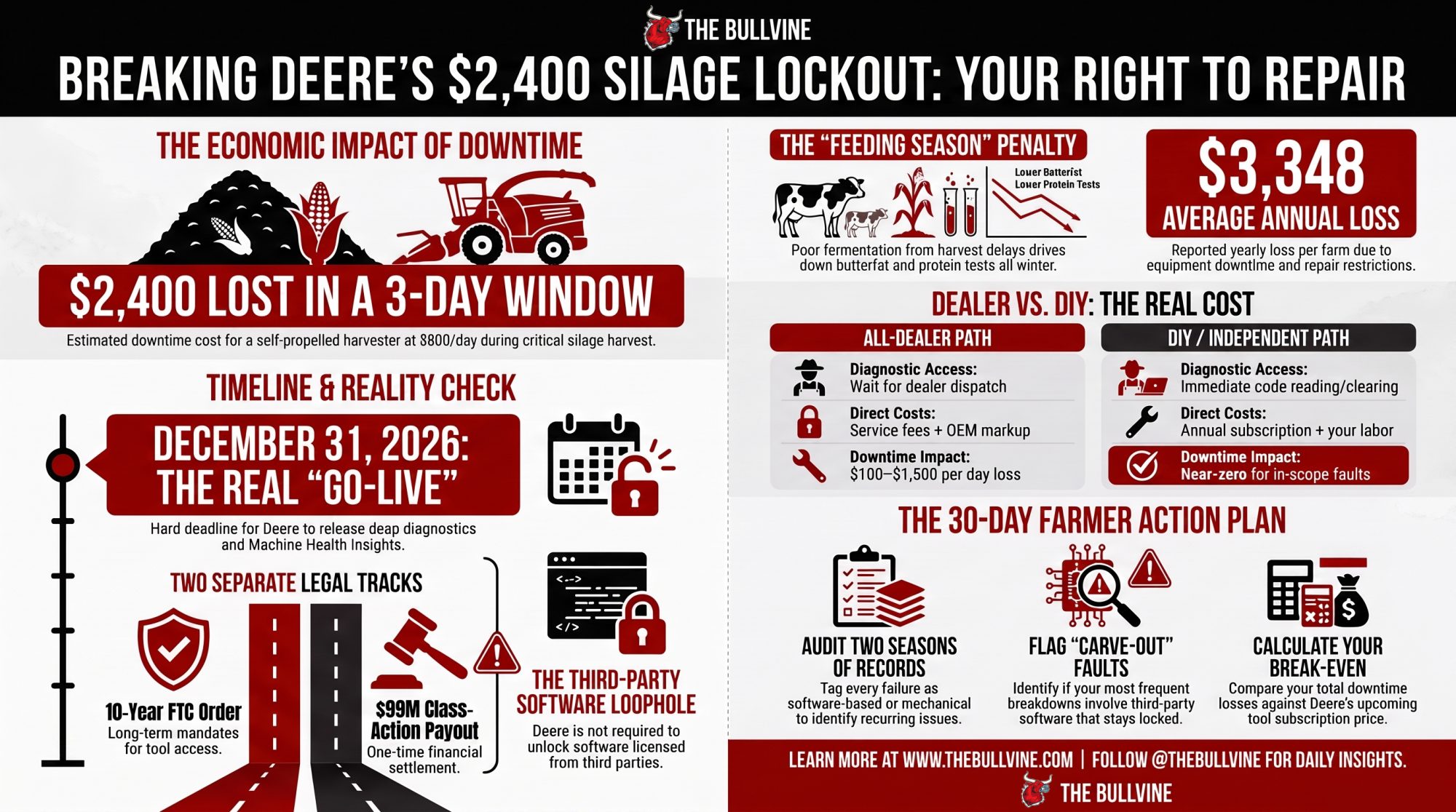
Executive Summary: On July 8, 2026, the FTC and five state AGs (Illinois, Arizona, Michigan, Minnesota, Wisconsin) locked Deere into a 10-year order to hand owners and independent shops the same repair tools its dealers get — fault-code clearing, ECU reprogramming, and the limp-mode restart that used to strand a machine cold until a tech showed up. The everyday tools are covered now; the deeper diagnostics (Machine Health Insights, DTAC, offline mode, full PIP access) don’t have to land until December 31, 2026, so that’s your real go-live date, not July 8. Here’s why it matters to a dairy: a self-propelled harvester down three days in your silage window runs roughly $2,400 in downtime alone at $800/day — before the service call. And that’s likely a floor once you count the fermentation hit and a winter of feeding compromised forage. Two catches keep this from being a clean win. “Fair and reasonable terms” is a seven-factor legal test, not a price cap, and Deere still hasn’t posted what owner-tier access will cost — so nobody can say yet whether DIY actually beats the dealer. And a slice of fault codes runs on third-party software Deere only has to make “reasonable best efforts” to unlock, with no deadline, meaning your most breakdown-prone system could stay dealer-locked indefinitely. Before December, pull two seasons of repair records, tag every failure as software or mechanical, and flag which software faults are recurring and which sit behind that carve-out — that’s the difference between a subscription that pays for itself and one that changes nothing. (The separate $99M class-action settlement for 2018–2026 repairs is a different track, with an Oct. 29 fairness hearing — don’t confuse the two.)
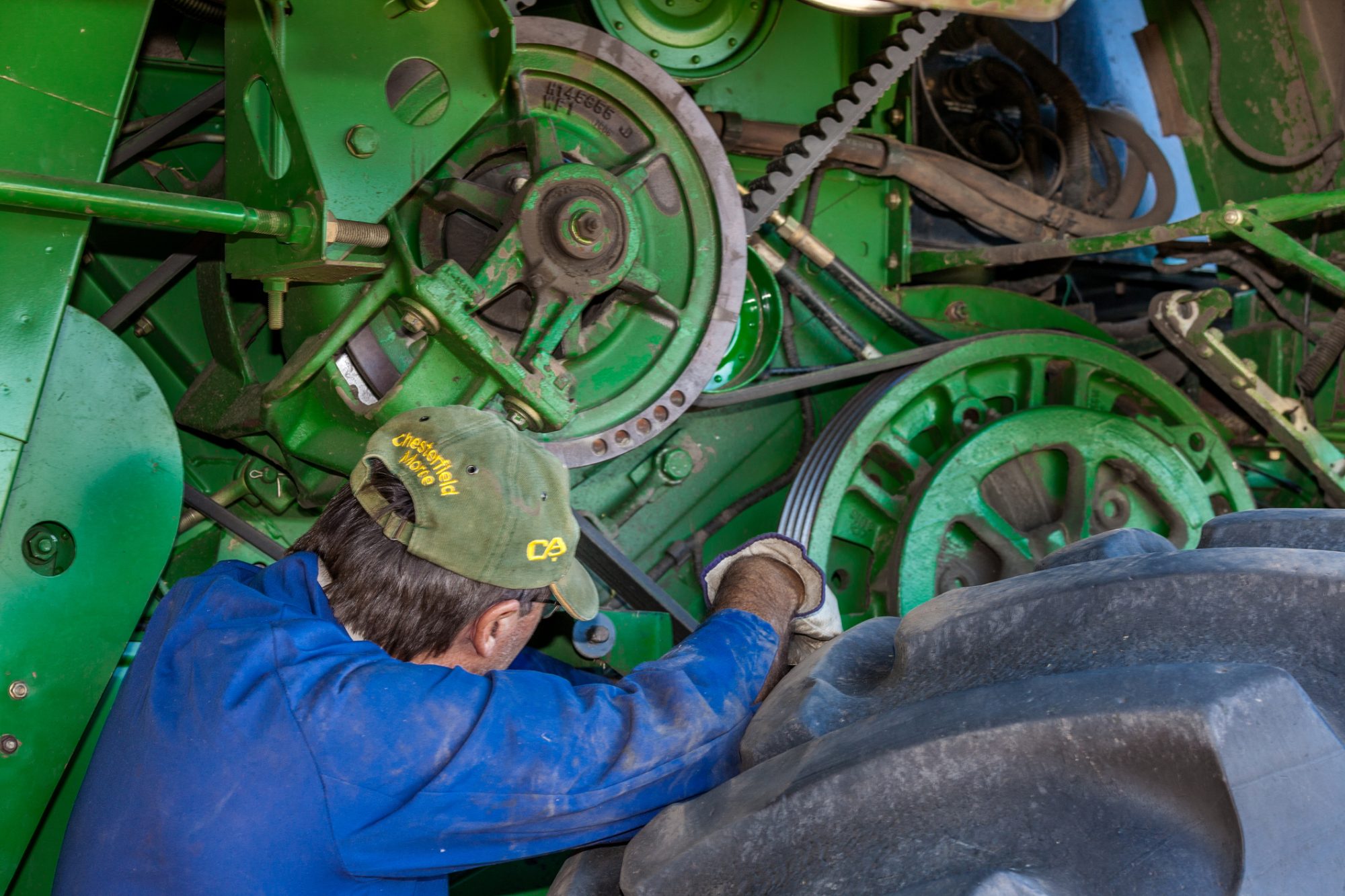
It’s day two of corn silage, the crop’s sitting at exactly the moisture you’ve been chasing all season, and your self-propelled forage harvester throws an ECU fault and drops into limp mode. The nearest Deere tech can’t roll out for days. You can’t clear the code yourself — the software’s locked to the dealer — so the chopper sits while your window closes. That’s the scenario a July 8 federal settlement is supposed to end, and for a dairy it’s the difference between good fermentation and a bunk face that heats and molds all winter.
Farmer Jason Wilson knows the lockout firsthand. He and hundreds of other plaintiffs argued in a separate class-action suit that Deere’s dealer-only software renders most independent repairs “nearly unfeasible,” as NBC News reported in April 2025. It’s the same argument that ran straight through the FTC’s case — the one the agency just spent 18 months winning.
On July 8, 2026, the Federal Trade Commission and five state attorneys general — Illinois, Arizona, Michigan, Minnesota, and Wisconsin — filed a stipulated order in the U.S. District Court for the Northern District of Illinois, settling the monopolization case they’d brought against Deere & Company back in January 2025. Deere agreed to the terms without admitting any violation of the law. Every outlet ran the “10-year win” headline. Hardly any ran the barn math, flagged the deadline that actually matters, or warned you about the loophole that could keep your machine dealer-locked anyway.
That last part determines whether this cracks your lock or rattles it. One scope note before you get excited: this is a U.S. federal order — Canadian producers don’t get anything directly from it, though it shifts what’s technically possible on the same machines running in barns on both sides of the border.
What a Silage-Window Breakdown Really Costs a Dairy
Here’s why this lands harder on a dairy than a row-crop operation. When an SPFH goes down mid-harvest, the loss isn’t just a delayed field. You blow past the ideal chop-moisture window, and everything downstream follows.
Corn chopped too dry packs poorly and traps oxygen, which means unstable fermentation and a bunk face that heats and molds all winter. Chop it too wet waiting on a fix, and you get clostridial fermentation, effluent losses, and lower intakes. Either way, you’re feeding compromised forage for months — the kind that quietly pulls down butterfat and protein tests, drives up feed shrink at the bunk, and forces you to buy your way back with more purchased protein or a rebalanced ration. One missed window doesn’t cost you a day. It costs you a feeding season.
That’s the real stake behind a fault code your dealer used to control. And it’s the number the national coverage never put in dairy terms.
What Deere Actually Has to Hand Over Now
The heart of the order is plain enough. Deere has to give owners and independent repair shops the same repair resources it gives its own dealers, on “fair and reasonable terms” — on a license, subscription, or purchase basis, software tools included. Most of it covers the everyday jobs that used to require a dealer: reading, clearing, and resetting electronic fault codes, reprogramming and pairing new electronic parts, and the “limp mode” restart after an emissions shutdown. That last one’s the function that used to strand a machine cold until a tech showed up.
There’s also a forward-looking trigger worth knowing. Any future repair resource Deere rolls out has to reach farmers and independent shops too — once Deere makes it available to more than 50% of its U.S. authorized dealer network. So the door doesn’t just open once. It’s supposed to stay open as the tools evolve.
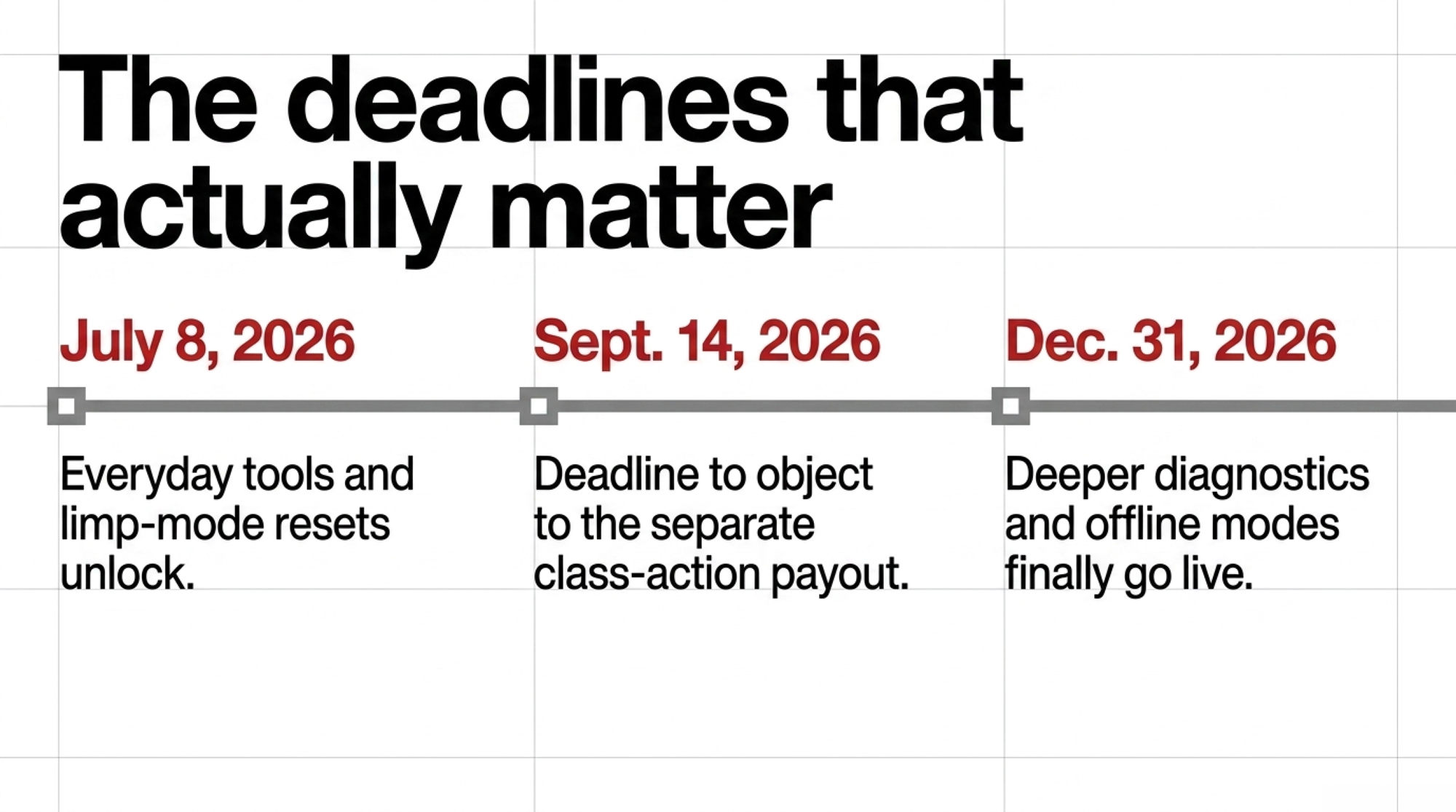
But “covered by the order” doesn’t mean “live on day one.” A specific batch of tools carries a hard December 31, 2026 deadline written into the filed order: Deere Machine Health Insights, DTAC Solutions, fluid sampling, and offline-mode diagnostics and reprogramming, plus the full suite of Product Improvement Programs. So if you’re building next season’s repair plan around this, that’s your real go-live date for the deeper tools. Not July 8. The order runs 10 years and can be extended if Deere violates its terms. Deere also agreed to pay the five states a combined $1 million — not $1 million each — to cover their legal costs.
Why Doesn’t “Fair and Reasonable” Mean Cheap?
Here’s where the celebrating gets ahead of the facts. “Fair and reasonable terms” isn’t a price cap. Per the filed order, it’s a seven-factor test — what dealers pay for the same tools, what it costs Deere to prepare and distribute them, what rival makers charge for comparable software, your ability to pay, how the tool’s distributed, how much it gets used, and inflation. Legal analysts reading the order note that affordability is only one of several factors.
That’s a wide fairway for Deere to set a number in. And as of the July 8 filing, Deere reaffirmed its commitment to the tools but hadn’t posted what owner-tier access will actually cost. Anyone telling you the DIY route is automatically cheaper is guessing. The tools are coming. The price tag isn’t nailed down yet.
The Loophole Nobody Put in the Headline
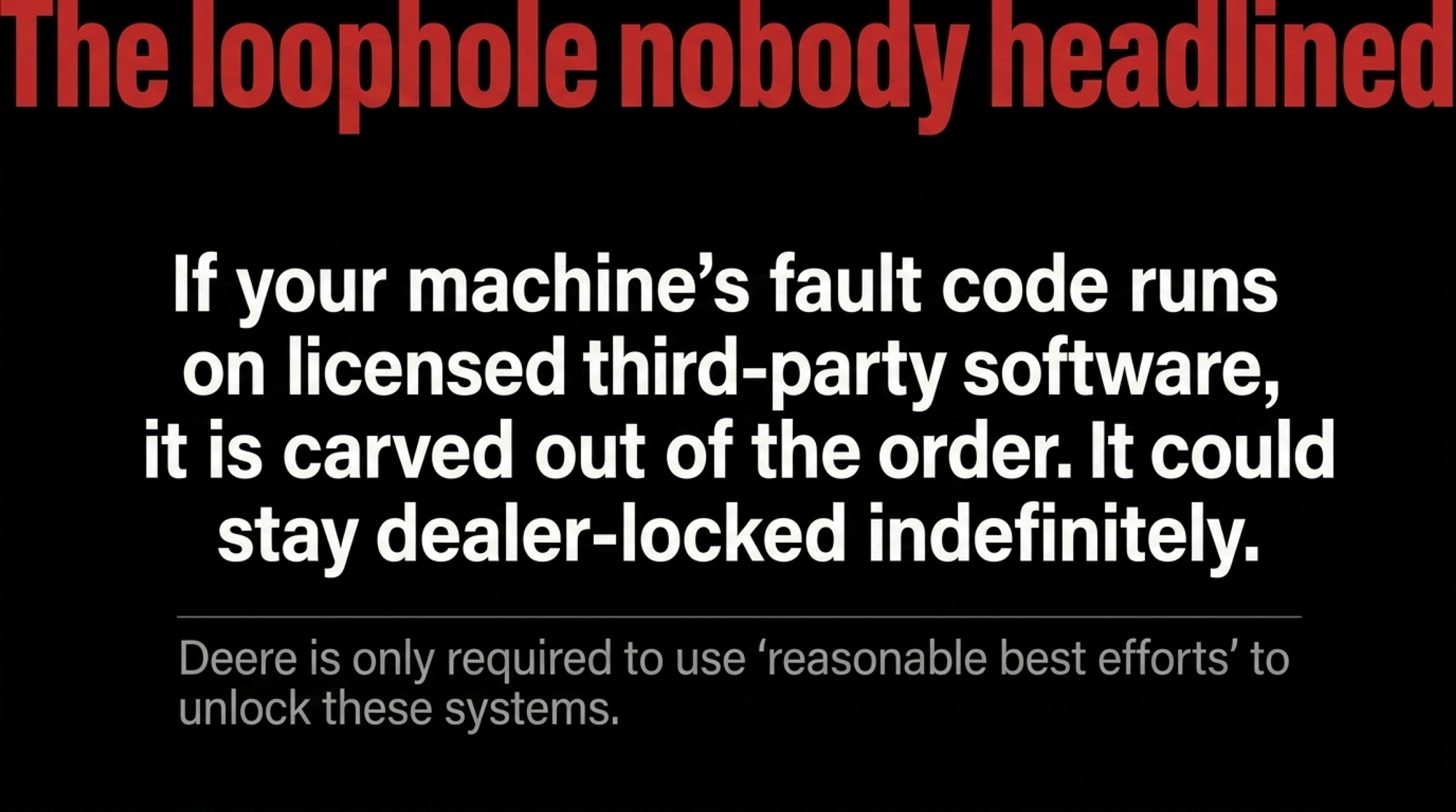
Now the part that got buried. Some ECU functions run on software Deere licenses from a third party — a company that isn’t named in the order and never sat at the table. For those functions, according to the filed order and independent legal reads of it, Deere only has to use “reasonable best efforts” to win that third party’s approval before it opens them up. No deadline attached.
Read that twice, because your budget hangs on it. A slice of your machine’s fault codes could stay dealer-only indefinitely — not because Deere’s dragging its feet, but because the settlement couldn’t bind a company that was never a party to the case. Before you tear up a dealer service agreement, you’d better know whether your most breakdown-prone system falls inside that carve-out.
Where Does the Break-Even Actually Sit?
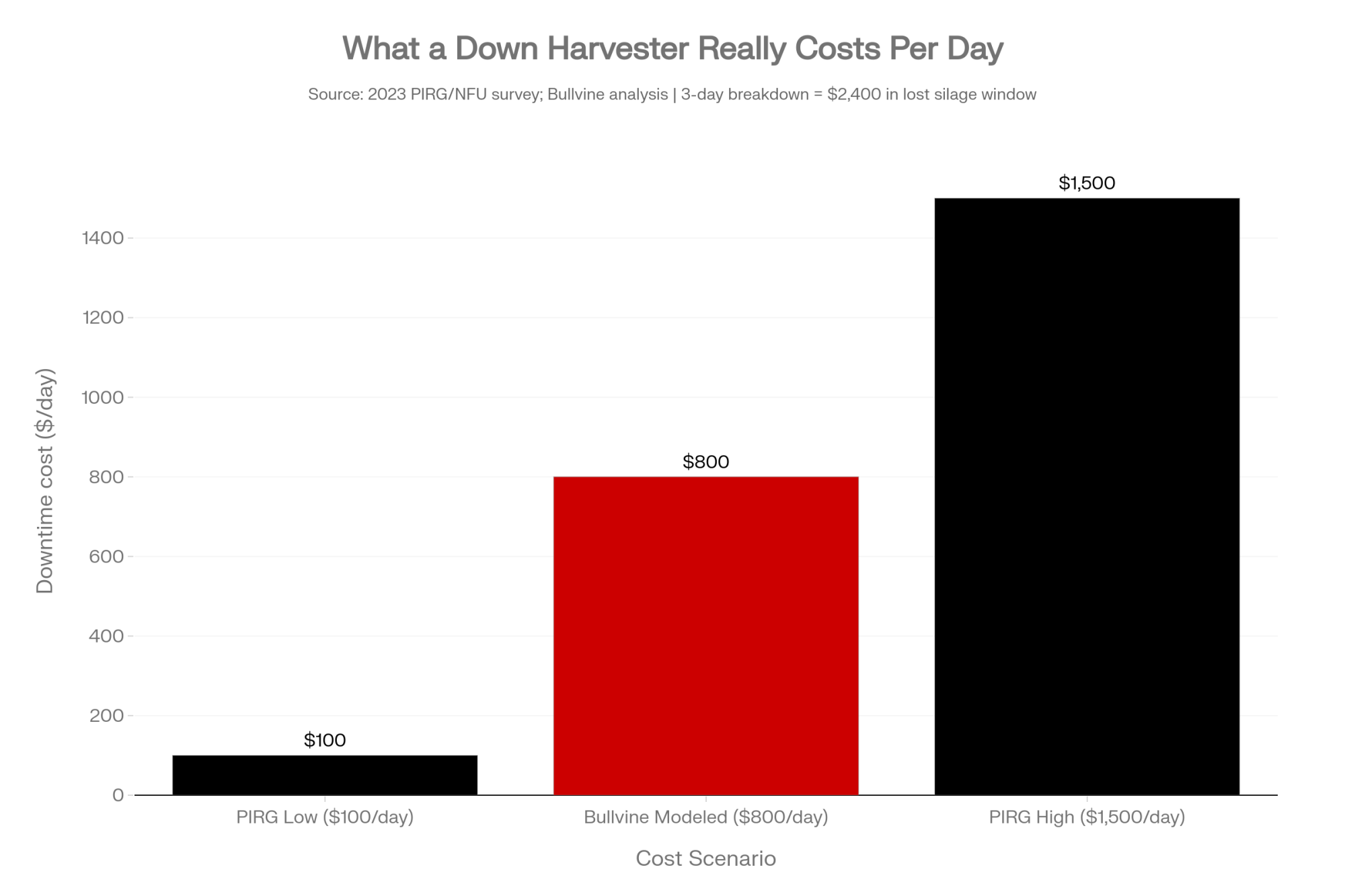
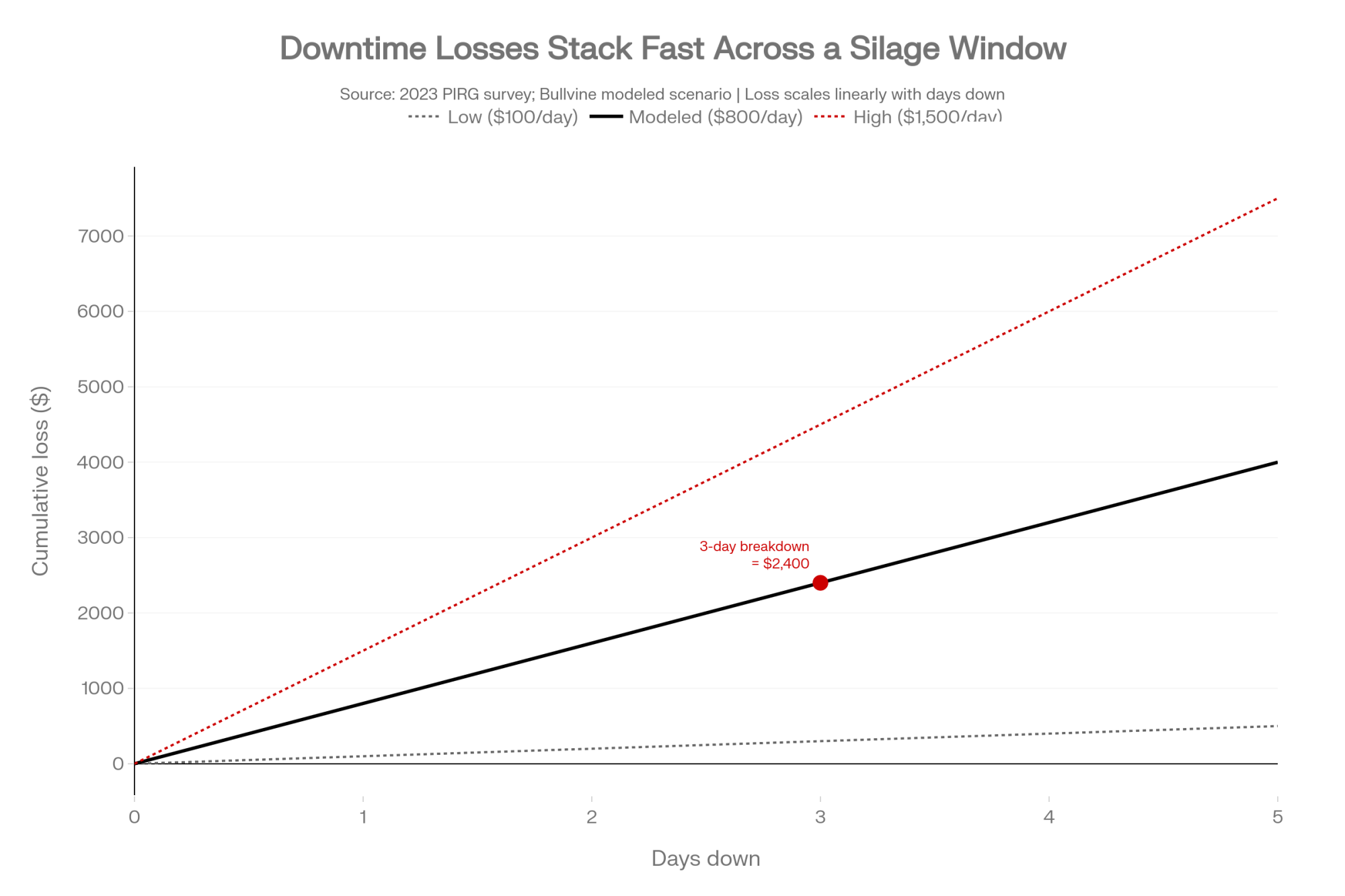
This is the math nobody ran, so let’s run it. Say that harvester’s down three days in the silage window — the kind of “key times” delay farmers described waiting on a dealer. A 2023 PIRG survey of 53 farmers put reported downtime losses in a credible band of $100 to $1,500 per day — the range researchers kept after trimming the outliers on both ends.
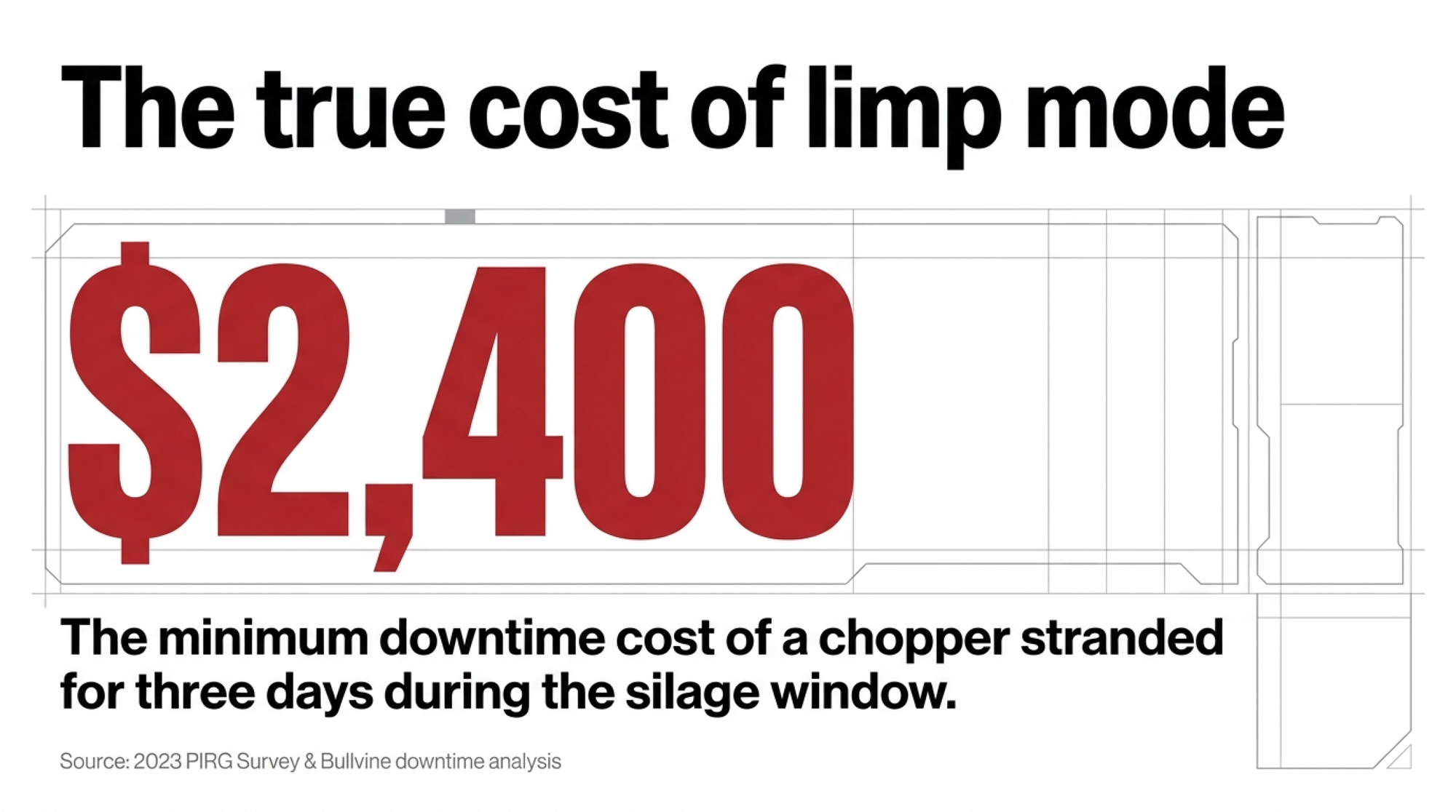
Take a figure inside that band. Three days at $800 a day is $2,400 in downtime on one breakdown — before you’ve paid a nickel of the service call, the labor, or the parts markup. That’s a modeled example, not a real farm’s invoice, so plug in your own daily figure: your feed shrink, your milk-check hit, your custom-hire backup rate. For a dairy staring down lost silage quality, $800 a day may run low, not high — the 2023 PIRG band leaned on row-crop responses, and a spoiled harvest window hits your ration for months, not a single delayed pass.
For the full break-even by herd size once Deere posts a price, run the same logic you’d use on any capital tool — the way we break down robot payback.
| Factor | All-Dealer Path | DIY / Independent Path (Post-Settlement) | Carve-Out Risk |
|---|---|---|---|
| Diagnostic access | Wait for dealer dispatch; vulnerable during peak season | Immediate code reading/clearing (if in scope) | No deadline if fault runs on third-party ECU software |
| Direct cost/season | Service call + hourly labor + parts markup | Annual subscription (price pending) + labor | Unknown — Deere hasn’t posted owner-tier pricing |
| Downtime impact | $100–$1,500/day lost momentum | Near-zero for in-scope faults | Unchanged for carve-out faults |
| Go-live date | N/A (dealer-controlled today) | Everyday tools: live now; deep diagnostics: Dec 31, 2026 | Indefinite for carve-out software |
The decision rule is straightforward. Take your real downtime days per season, multiply them by your honest daily loss, and stack that against Deere’s annual tool price once it’s public — then check whether your recurring faults fall within the settlement or behind the carve-out. Lose a day maybe once a year at the low end of that band, and a dealer relationship might still win. Bleed multiple days per breakdown in a two-week window, and the math tips toward owning the tool in a hurry.
For scale, the same 2023 PIRG/National Farmers Union survey pegged the average farm’s yearly loss from downtime and repair restrictions at $3,348, part of an industry-wide estimate of near $3 billion in downtime and $1.2 billion in excess repair costs. Those numbers lean toward row crops, not dairy, and they’re two years old. A downed harvester in your silage window is its own beast — treat $3,348 as a floor, not your number. It stacks straight onto your real cost of production per cwt.
Is This the Same Thing as the $99 Million Deere Payout?
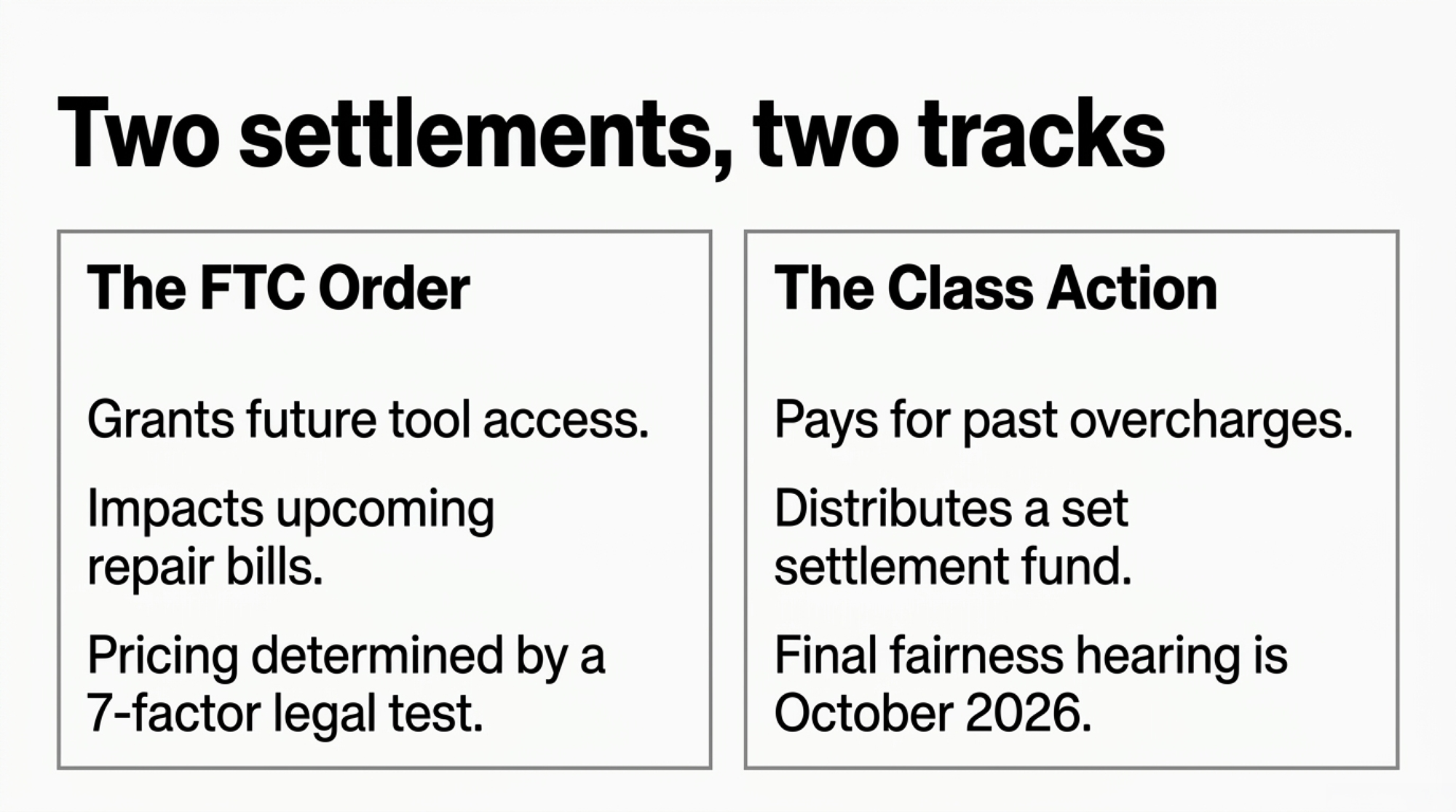
No. And don’t let anyone tell you it is. Deere agreed in April 2026 to a separate $99 million private class-action settlement — the same suit Wilson and more than 200,000 other farmers were part of — resolving claims that its repair restrictions inflated what farmers paid for large-equipment repairs from January 10, 2018 through the date of preliminary approval. That’s money tied to past repair costs. A federal court granted preliminary approval in May 2026, and producers have until Sept. 14, 2026 to object ahead of a final fairness hearing set for Oct. 29, 2026. Those windows are effectively closing as this settlement takes hold.
| Detail | FTC/State AG Order (Jul 8, 2026) | Class-Action Settlement |
|---|---|---|
| What it covers | Future repair tool access | Past repair overcharges, Jan 2018–2026 |
| Value | No cash payment (tools access) | $99 million payout |
| Term | 10-year order | One-time settlement fund |
| Key date | Deep diagnostics live Dec 31, 2026 | Objection deadline Sep 14, 2026; fairness hearing Oct 29, 2026 |
| Applies to | Repair tool access going forward | Farmers who paid for repairs 2018–2026 |
The July 8 FTC order is on an entirely different track. It’s about the tools you get going forward — not a check for the past. Same defendant, two different pockets. Keep them straight when you read the coverage, because plenty of it conflates the two.
Options and Trade-Offs for Your Operation
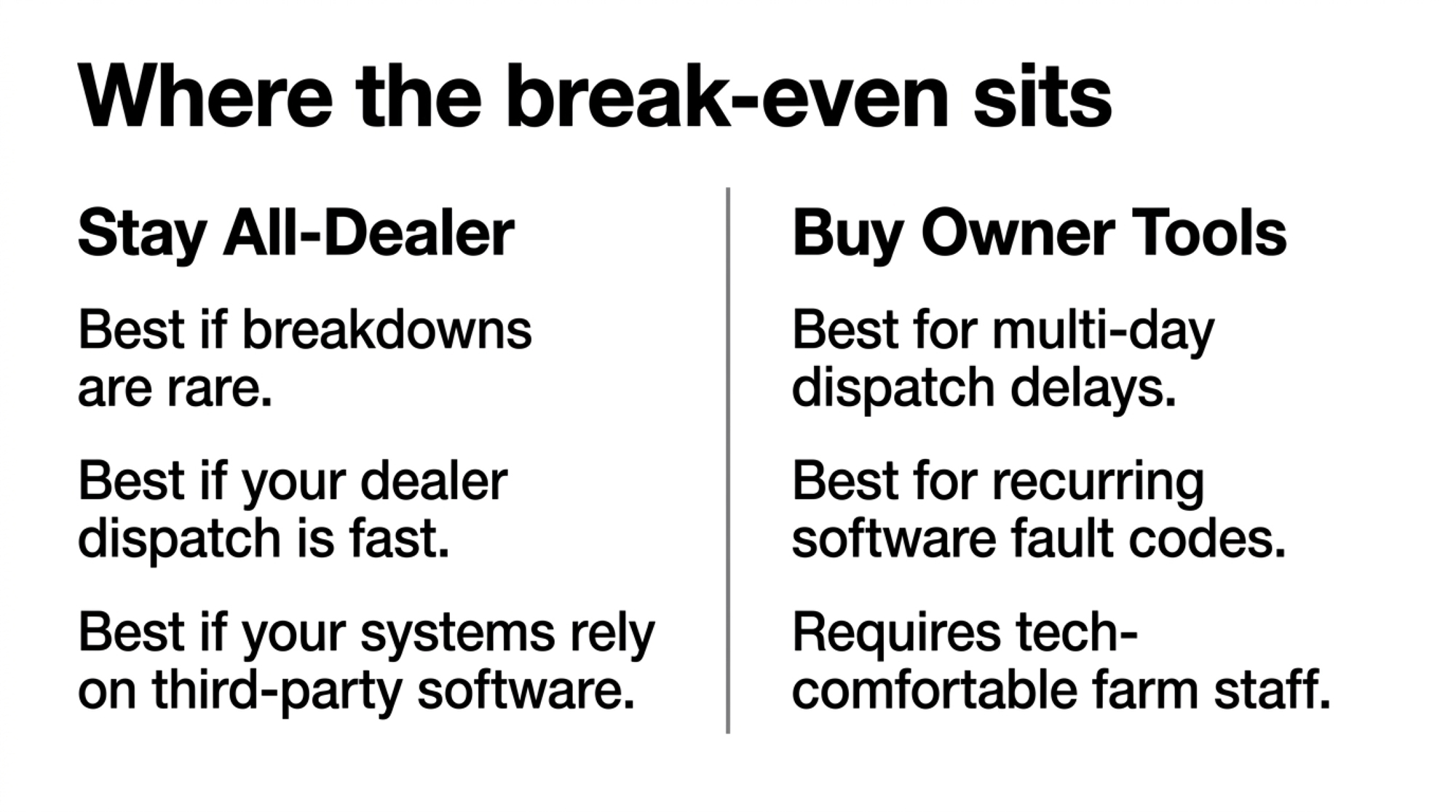
Stay all-dealer. Makes sense if breakdowns are rare, your dealer’s quick, and your machines lean hard on carve-out software. You give up nothing you were counting on and dodge a new subscription. The risk: you’re still exposed to those service gaps “during key times” when everyone’s cutting at once.
Buy the owner-tier tools when they post. This is the play if you already run your own repairs and lose real days to dispatch delays. It takes a tech-comfortable hand on staff and a subscription cost that isn’t public yet. Watch the pricing announcement before you commit — “fair and reasonable” hands Deere plenty of latitude.
Lean on an independent shop. Best fit for a mid-size operator who doesn’t want to run diagnostics but wants out of the dealer bottleneck. The order tells Deere’s dealers to promote these resources and not to retaliate against customers who use independent repair — but that shop still hits the same carve-out wall you would.
Your 30-Day Move
Before December 31, give yourself one afternoon of homework:
- Pull your last two seasons of repair records. Every service call, every code.
- Tag each failure — ECU/software or mechanical. Only the software faults are in play here.
- Flag which software faults are recurring. Those are the ones a subscription would actually pay to fix.
- Cross-check them against the carve-out. If your worst offender runs on third-party software, budget as if nothing changed.
Do that, and you’ll walk into the pricing announcement with a number in hand instead of a guess. It’s the same discipline behind counting what a breakdown really costs beyond the repair line.
Key Takeaways
- If your recurring faults are ECU/software-based, then the everyday tools (fault codes, reprogramming, limp-mode restart) are covered now, but the deeper diagnostics land by December 31, 2026 — plan around that date.
- If a downed machine costs you more than roughly $800 a day in your window, then even a modest subscription likely pays for itself on a single multi-day breakdown.
- If your worst failures run on carve-out third-party software, then budget as if nothing changed — that access has no deadline.
- If you’re weighing DIY against the dealer, then wait for Deere’s posted pricing before you decide; “fair and reasonable” is a legal test, not a bargain.
- If you paid Deere for repairs between January 2018 and 2026, then that’s the $99M class action — a separate track from this order, with the objection window closing Sept. 14 and a fairness hearing Oct. 29.
- If you farm in Canada, then treat this as a signal, not a right — the order stops at the U.S. border even when the machine doesn’t.
So where does your repair bill actually sit? Pull the records this month, tag the software faults, and you’ll know before the price is even public whether this settlement changes your barn or changes the sales pitch you get. When Deere posts the real subscription number, we’ll run the full break-even against dairy-specific downtime — that deeper math lands in The Bullvine Weekly, so you can drop in your own herd’s figures before you sign or cancel a thing.
Complete references and supporting documentation are available upon request by contacting the editorial team at editor@thebullvine.com.
Learn More
- Retrofit or New Robot Barn? The $17000‑Per‑Cow Choice That Can Lock Canadian Tie‑Stall Herds Into Bad Cow‑Flow Under the 2027 Code — Armed with exact layout math, you can safeguard your daily margins before signing an equipment upgrade. It breaks down how a flawed setup burns $8,250 annually in extra fetch labor, proving why structural cow-flow dictates technical investment returns.
- Small herd cost of production: the $20.70 milk trap — Producers seeking a 3-to-5-year market edge will discover how to stress-test their operation’s baseline against tightening margins. It follows the money on how a $3/cwt equity drain threatens farm survival, mirroring the exact discipline needed for long-term tech contracts.
- Robot ROI Reality Check – Free Dairy Robot Calculator — Exposing the true 6.5% average operational downtime reveals the hidden liabilities embedded in automation contracts. This tool delivers a reality check on software-heavy machinery by showing how a $50,000 sensor system captures data intelligence without adding heavy debt.
 The Sunday Read Dairy Professionals Don’t Skip.
 The Sunday Read Dairy Professionals Don’t Skip.
Every week, thousands of producers, breeders, and industry insiders open Bullvine Weekly for genetics insights, market shifts, and profit strategies they won’t find anywhere else. One email. Five minutes. Smarter decisions all week.




