


Archive for H5N1 dairy

Your Herd Tests Negative. 79% of Infections Hide. Now What?

Cornell: 90% of herds are exposed, only 20% show symptoms. The invisible 70%? Costing you $434,683/year. Time to rethink everything

EXECUTIVE SUMMARY: A Minnesota dairy farmer’s third H5N1 outbreak in 14 months—despite perfect biosecurity—isn’t an anomaly anymore. It’s the new normal. Cornell research shows that 90% of herds carry the virus, but only 20% show symptoms, meaning traditional surveillance captures just 21% of the actual disease while farms hemorrhage $434,683 annually. The break-even point sits at 2.38 outbreaks per year, but farms in wildlife corridors now face perpetual reinfection cycles that make profitability mathematically impossible. This isn’t just about H5N1—Spain’s current battle with lumpy skin disease, which jumped containment zones overnight, proves wildlife disease has fundamentally changed the game globally. With U.S. dairy farms projected to plummet from 35,000 to as few as 12,000 by 2035, producers face a stark choice: absorb six-figure annual disease costs through scale or premium markets, or make the rational but painful decision to exit while equity remains. The old paradigm of “prevent and recover” is dead; the new reality demands either expensive adaptation or strategic retreat.
Endemic Disease Management

I was talking with a producer from Minnesota the other day, and what he told me really stuck with me. His operation tested positive for H5N1 in July 2024, worked through it, and got cleared by September. Then March 2025 comes around—positive again. They clear that one too, thinking they’re in the clear. September 2025? Third positive in just 14 months. And here’s what gets me—this guy does everything right. Every protocol, every biosecurity measure the vets recommend. Still keeps happening.

You know what’s interesting? Minnesota actually achieved that official “unaffected” status on August 22nd this year. Four consecutive months of negative bulk tank tests across all 1,600 dairies in the state, according to the Board of Animal Health’s surveillance program. So naturally, they reduced testing from monthly to bi-monthly—that’s the standard procedure when you’re disease-free. But within weeks, about two dozen operations were reporting new infections. Makes you think…

And it’s not just us dealing with this. Over in Spain right now, they’re trying to vaccinate 600,000 head of cattle against lumpy skin disease. The Catalan agriculture folks reported the virus jumped 40 kilometers overnight, despite what they called comprehensive containment measures. These aren’t isolated problems anymore—they’re showing us something fundamental about how diseases work when wildlife’s involved.

Here’s what the numbers are telling us:

  • 90% of dairy cattle show H5N1 antibody exposure, but only 20% develop symptoms you can actually see
  • $434,683 – That’s the annual disease cost for a 500-cow operation with 20% clinical rates
  • 2.38 – The magic number of outbreaks per year before you’re losing money
  • 21% – What traditional barn walks actually detect of what’s really circulating

Quick Break-Even Calculator: Take your annual profit (before disease) and divide it by $217,341 (the estimated cost for a single outbreak in a 500-cow operation—that’s half the annual cost if you get hit twice). That tells you how many outbreaks you can handle per year. Less than 2? You’re in trouble with annual reinfection.

The surveillance blindspot: 90% of dairy cattle in affected herds show antibody evidence of H5N1 exposure, but only 20% develop visible symptoms—and traditional barn-walk surveillance catches just 21% of actual infections. You’re operating blind 79% of the time

The Real Financial Picture We’re Looking At

Research from Cornell’s College of Veterinary Medicine, published in September 2025, analyzing H5N1-affected dairy operations, found something that kind of changes everything. Turns out 90% of animals in affected herds show antibody evidence of exposure to H5N1, but only 20% actually look sick. Think about that. For every cow showing symptoms in your barn, there are probably four more carrying the virus that look perfectly fine.
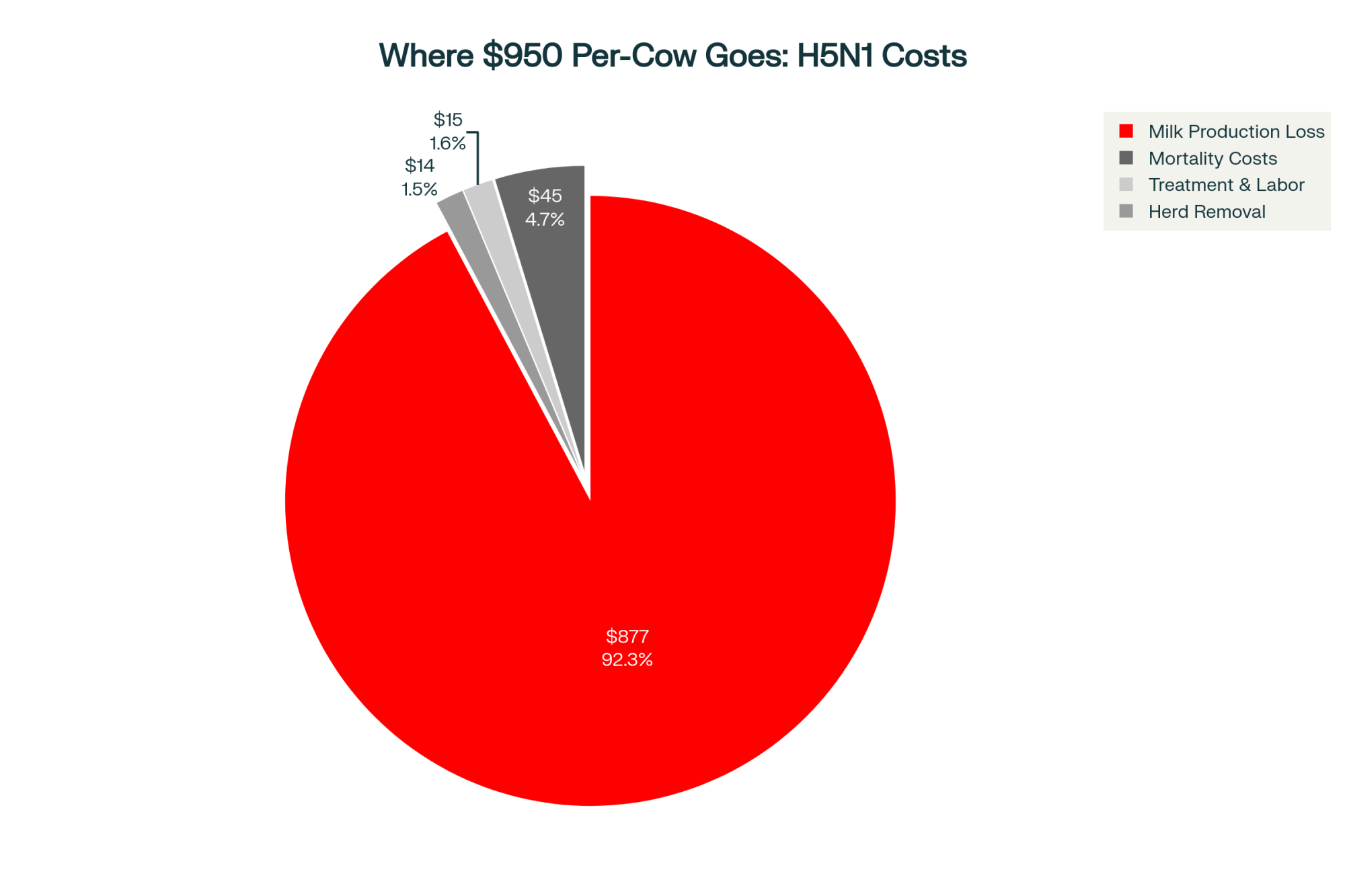
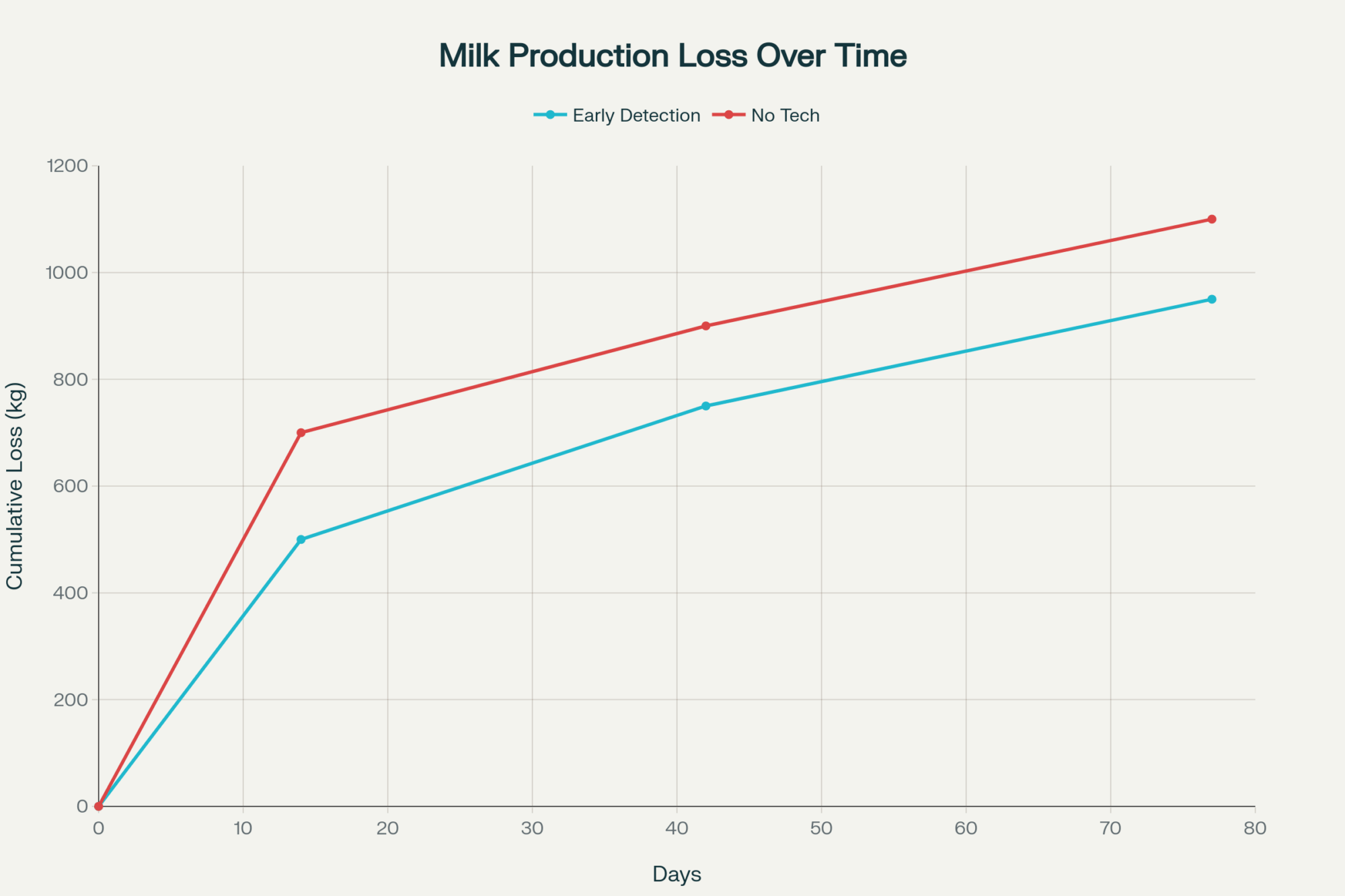
The real cost breakdown: Of the $950 lost per clinically affected cow, milk production losses account for 92.3%—$877 per animal. For a 500-cow operation with 20% clinical rate, that’s $737,500 in just 60 days. And most operations are underestimating the full impact

What I’ve found is that traditional surveillance—you know, when the vet walks through looking for sick animals—catches maybe 21% of what’s actually going on. We’re basically operating blind most of the time.

That same Cornell research, along with economic modeling from dairy extension programs at Wisconsin and Minnesota, quantified what this really costs a typical 500-cow Midwest operation:

  • You’re looking at about $950 per clinically affected cow over that 60-day acute phase
  • Each sick cow drops about 900 kilograms in milk production
  • Here’s the kicker—the whole herd typically drops 15% in production for six months after an outbreak
  • Add it all up? $434,683 per year with a 20% clinical rate

And you know what? Even if you spend that $40,000 on early-detection systems and rapid-response setups—the kind extension’s been recommending—you might drop your clinical rate from 20% to 15%. Sounds good until you do the math. Your annual cost only drops to $401,012. That’s still an $89,012 loss every year, even after making smart investments.

The break-even math keeps me up at night sometimes. Most operations can handle about 2.38 outbreaks per yearbefore they’re underwater. But if you’re in one of those waterfowl migration corridors—and let’s be honest, many of us in Minnesota and Wisconsin are—you’re probably looking at annual reinfection as the new normal.
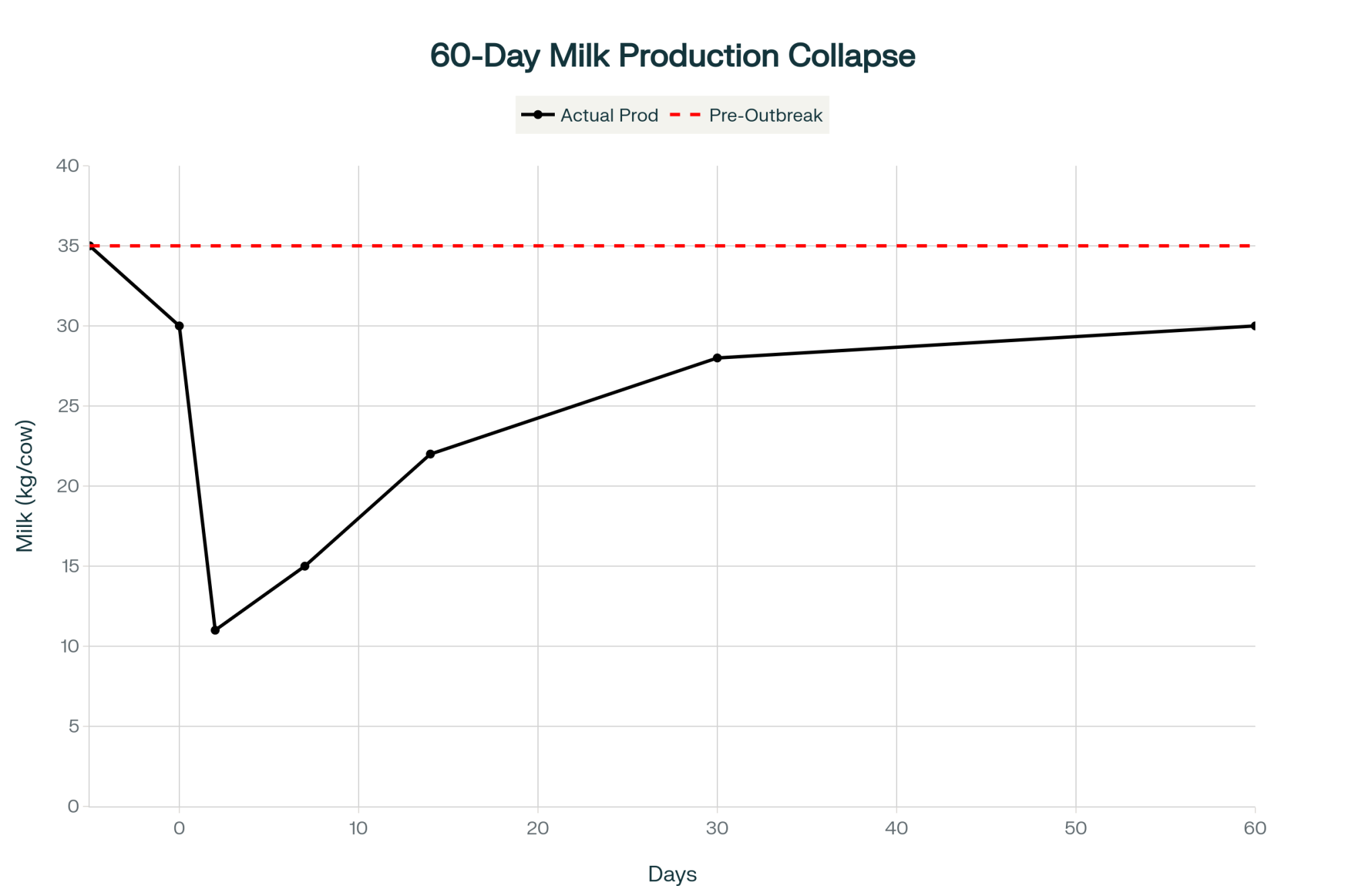
The long shadow of H5N1: Milk production plummets 73% within days of diagnosis (35kg to 11kg per day), and even 60 days later, affected cows still produce 5kg less than pre-outbreak levels. That 900kg total loss per cow is what’s actually destroying farm economics—not the acute phase everyone focuses on

What Spain’s Teaching Us Right Now

What’s happening in Spain offers a different perspective on all this. They detected their first lumpy skin disease case on October 1st, did everything by the book—20-kilometer protection zones, 50-kilometer surveillance areas, and immediate culling of infected herds. Standard EU protocols.

By late October, the Spanish agriculture ministry reported they’d culled over 1,500 cattle. But here’s the thing—the virus had already jumped about 40 kilometers, way beyond those protection zones. So, on November 3rd, the European Commission authorized emergency vaccination for 22 Catalan counties. We’re talking 600,000 animals.

What’s telling is how their language has been changing. Early October, Agriculture Minister Òscar Ordeig was saying “emergency measures implemented” and “situation under control.” By mid-October, after six new outbreaks, it shifted to “securing additional vaccine supplies.” Late October? They’re calling for “all Catalan veterinarians to assist.” When government officials say that, you know they’re stretched thin.

Notice what’s missing lately? No timeline for when this ends. No mention of eradication. The word “temporary” has disappeared. Catalonia’s veterinary services say they’ve administered about 100,000 vaccine doses so far, with 250,000 more to come. That’s maybe 58% coverage. But European Food Safety Authority research has shown that you actually need 80-90% coverage to stop the transmission of lumpy skin disease. At 90 animals per day—their current pace—well, do the math.

Understanding Different Perspectives Here

You know, it’s easy to get frustrated with how different groups respond to these challenges, but when you think about it, everyone’s dealing with their own pressures.

Processors need a consistent milk supply to keep plants running. The National Milk Producers Federation’s data shows we’re losing 7-8% of farms each year. Those of us still operating might have more negotiating power, but only if enough farms survive to keep the infrastructure going.

The biosecurity companies? Grand View Research valued that global market at $3.4 billion in 2024, projecting it’ll hit $7.1 billion by 2033. Endemic diseases that require constant management rather than one-time fixes create steady customers. It’s a business reality—can’t really blame them for that.

Government’s in a tough spot, too. Congress approved $31 billion in agricultural aid late last year, which sounds like a lot until you realize USDA’s own assessments show it covers maybe 10% of actual disease losses. State ag departments have to maintain market confidence while dealing with the reality on the ground. That’s a hard balance.

And our rural communities—man, this hits them hard. The Center for Rural Affairs documented last year how each farm closure triggers these cascading effects. School enrollment drops, Main Street businesses close, and property values decline. My kids’ school lost two teachers after three local dairies closed. These communities need us to survive, even when we’re struggling.

What I’ve come to realize is that everyone’s responding to their own situation. The challenge is that what’s best for the industry as a whole might not line up with what’s best for individual families facing their third outbreak in 14 months.

Success Despite the Odds—It’s Possible

Now, I don’t want to paint this as all doom and gloom. Met a producer from South Dakota last month who’s actually making this work. They’ve got about 3,500 cows, have invested heavily in automated monitoring systems, and treat endemic disease like any other operating cost. “We budget $125,000 annually for disease management now,” he told me. “It’s just part of doing business, like feed costs or equipment maintenance.”

On the other end of the spectrum, there’s this 180-cow organic operation in Vermont that’s stayed completely clear. Geographic isolation helps, but they’ve also got premium contracts paying $45 per hundredweight—nearly double conventional prices. Different model, but it works for them.

Practical Approaches That Actually Help
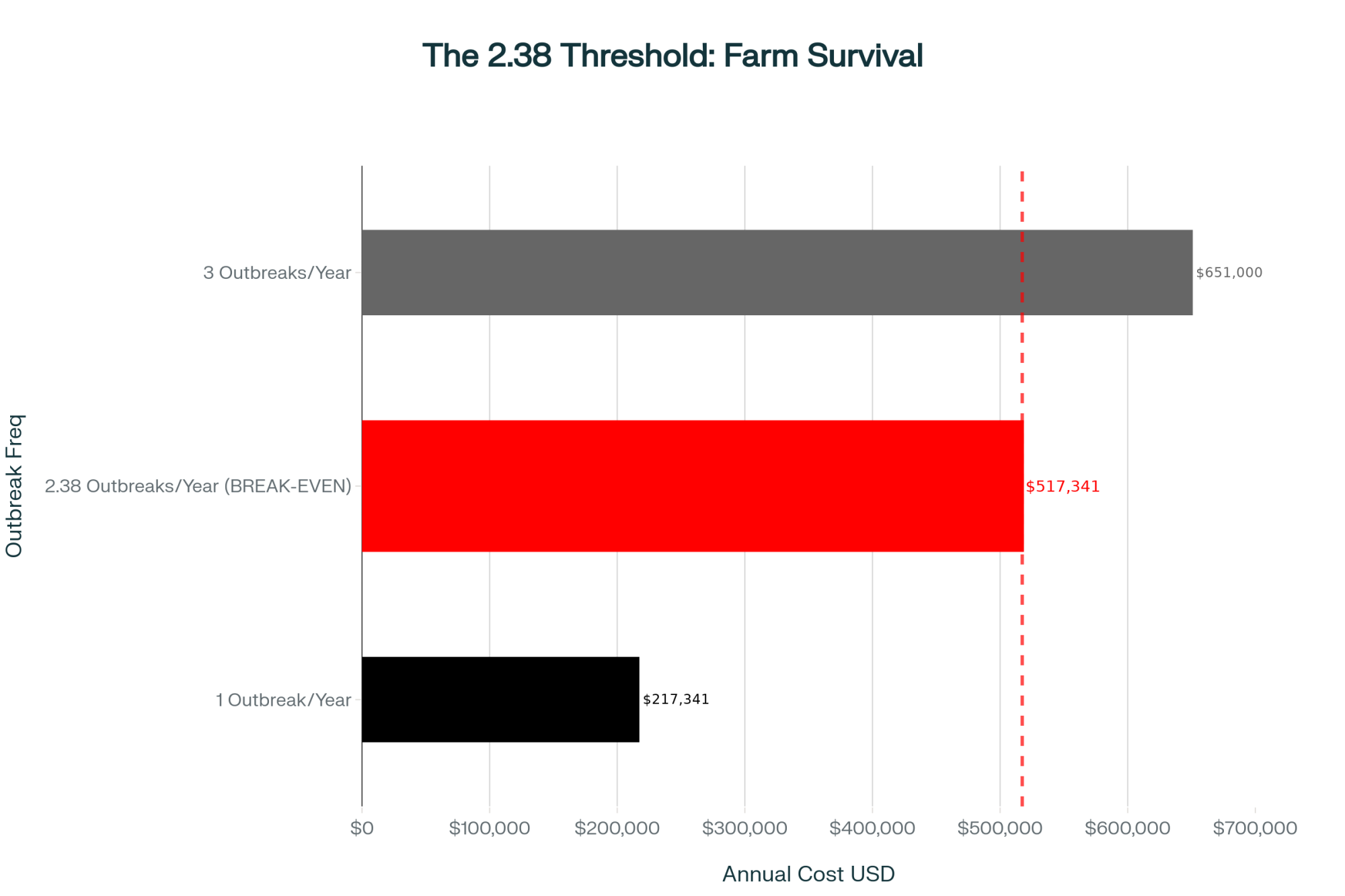
Run the math on YOUR operation: Most 500-cow farms can absorb 2.38 outbreaks per year before going underwater. But if you’re in a waterfowl migration corridor? You’re looking at reinfection every 6-8 months—that’s 1.5 to 2 outbreaks annually, already eating 70% of your survival buffer. Three outbreaks and you’re done

So if you’re dealing with repeated infections, here’s a framework that’s been helpful for some folks I know.

Getting a Handle on Your Real Costs

First thing—and I can’t stress this enough—document what outbreaks actually cost you. Not just the milk dump and vet bills, but also the extended impacts. Track your production for at least six months after. The University of Minnesota Extension has some really good resources for outbreak cost analysis that capture all these hidden costs.

Compare those numbers against your baseline profitability. If reinfection frequency means you’re losing money even in good milk price years, that’s information you need for planning. What I keep hearing from financial advisors is that most of us underestimate those extended impacts—that 15% herd-wide deficit for six months really adds up.

Focusing Where You Have Control

Research from veterinary colleges at Iowa State, Wisconsin, and Minnesota has helped us understand the difference between what we can control and what we can’t.

Worth your investment:

  • Equipment sanitation—it’s 70-90% effective against farm-to-farm transmission
  • Good visitor protocols with dedicated boots and coveralls
  • Vehicle wash stations at your entrance
  • Regular bulk tank testing for early detection

Probably not worth it in wildlife areas:

  • Trying to keep birds away from water sources (impossible)
  • Eliminating every insect (also impossible)
  • Keeping wildlife from anywhere near your operation (you see where this is going)

As one Wisconsin producer told me: “I stopped trying to bird-proof everything and started testing my bulk tank twice a week. Can’t stop the birds, but I can catch outbreaks faster.” That’s the shift we’re all making—from prevention to rapid detection and response.

I’ve also noticed that operations with good fresh cow management tend to weather these outbreaks better. Makes sense when you think about it—cows in that transition period are already stressed, and disease hits them harder. Same goes for operations that are really dialed in on their dry cow programs. A strong immune system at calving makes a difference.

Regional Differences Matter

Now, what we’re dealing with in the upper Midwest isn’t the same everywhere. California operations face the double whammy of water restrictions and disease pressure. Texas and Arizona? Managing sick cows when it’s 110°F is a whole different challenge.

A California producer shared something interesting at a conference last month: “We’re dealing with drought, disease, and regulations all at once. Sometimes I wonder if we’re fighting too many battles.” That really resonated with folks from different regions facing their own unique combinations of challenges.

Canadian producers benefit from supply management, which provides some market stability, but they’re still facing the same wildlife disease pressures. Maritime provinces might have some geographic isolation working for them. Ontario’s concentrated dairy regions look a lot like what we deal with here.

Northeast operations often have smaller herds, older facilities—biosecurity upgrades might be tougher. But they sometimes have better access to diverse markets, established processor relationships that value consistency over volume.

Those Tough Succession Conversations

This is probably the hardest part. If you’re thinking about succession, the next generation deserves to see real numbers, not wishful thinking. Show them what the 10-year outlook really looks like with realistic disease pressure based on your location and migration patterns.

One approach that’s helping some families: run three scenarios. Best, probable, and worst cases over ten years. It helps everyone understand whether continuing makes sense or if there might be better ways to preserve what you’ve built.

A financial advisor who works with several operations dealing with this put it well: “Families are having conversations they never imagined—whether strategic exit while equity remains might serve the family better than fighting diseases you can’t prevent.” That’s not giving up. It’s being realistic about uncontrollable variables.

Where This Is All Heading

Looking at projections from CoBank’s 2025 dairy outlook and research from the University of Wisconsin’s Center for Dairy Profitability, we’re probably going from about 35,000 U.S. dairy farms today to somewhere between 12,000 and 24,000 by 2035. That’s a lot of change coming.

The operations that’ll likely make it fall into two camps. Big operations with 3,000-plus cows can absorb disease costs through efficiency and scale—they’ll probably produce 70-80% of our milk by 2035. On the other end, small niche operations—50 to 200 cows selling organic, grass-fed, local branded products—might survive through premium pricing.

It’s that middle group—200 to 800 cows, the backbone of our communities—that faces the toughest road. Not enough scale to absorb six-figure annual disease costs, not positioned for premium markets. A lot of really good farms fall in that range.

Geographically, USDA’s 2025 long-range projections suggest Wisconsin, South Dakota, and Michigan will probably add capacity—water availability, and favorable regulations. California and the Southwest are scaling back, though that’s as much about water as disease.

What nobody’s saying out loud yet—though you hear it at conferences—is that “disease-free” status as we’ve known it is probably done for certain diseases. We’re moving toward something more like “controlled endemic” status. Success gets redefined as keeping clinical disease low rather than eliminating viruses. Vaccination becomes as routine as checking butterfat levels.

Finding Your Own Path Forward
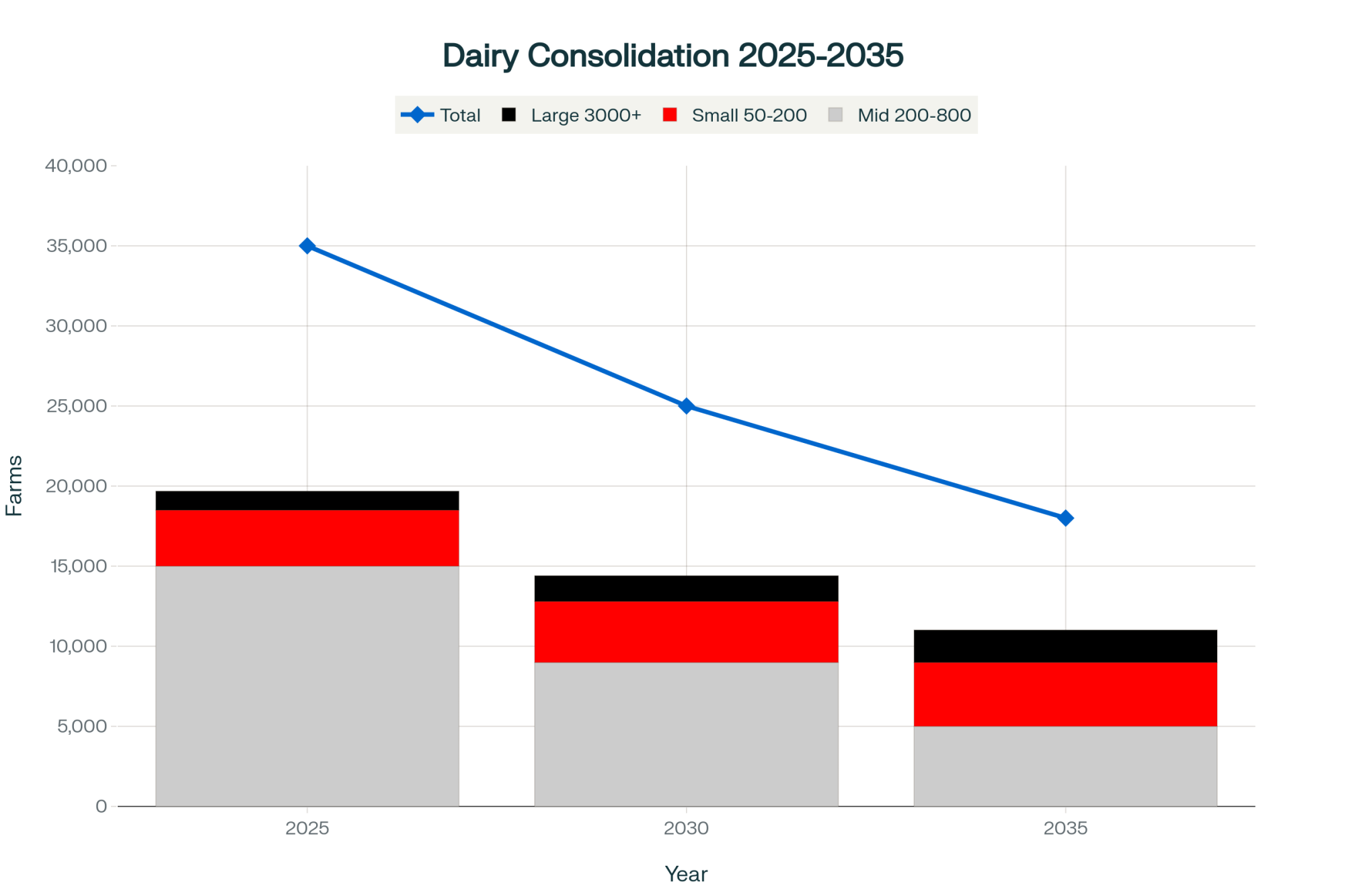
The controversial truth nobody’s saying out loud: By 2035, we’re projecting 15,000 middle-sized operations (200-800 cows) will collapse to just 5,000—a 67% wipeout. Large operations will grow 67%, niche farms hold steady with premium pricing, but if you’re in that middle? You’re in the death zone. Too small for scale economies, too big for premium markets, and endemic disease costs will finish what low milk prices started

Here’s what keeps coming back to me: where your farm sits geographically might matter more than how good a manager you are when it comes to endemic disease. If you’re in a high-risk wildlife corridor, repeated reinfection might be your reality no matter what you do. That’s not your fault—it’s just biology.

The financial math is different for everyone, but the framework’s the same. Annual losses north of $114,000 from repeated infections with 20% clinical rates—that challenges most operations long-term. For some, continuing preserves tradition but destroys wealth. For others, scale or niche positioning makes adaptation work.

One thing’s crystal clear from both research and what we’re seeing in the field: when 79% of infections don’t show symptoms, negative bulk tank tests don’t mean you’re disease-free. They mean you don’t have detectable clinical disease right now. A big difference that planning needs to account for.

Every stakeholder—processors, input suppliers, government, communities—benefits from farms staying operational. That’s natural. But it means the advice you’re getting might be influenced by what others need from you, not necessarily what’s best for your family.

Moving Forward with Open Eyes

What we’re seeing isn’t a temporary problem that’ll get fixed with better biosecurity or new vaccines. It’s a big change in how disease pressure affects dairy farming. Some operations will adapt successfully—through efficiency, scale, or finding the right markets. Others will recognize that their location and economics make continuing difficult despite doing everything right.

Both paths are valid. I really mean that. A multi-generational farm choosing strategic exit while equity remains isn’t failing—they’re making a rational business decision facing uncontrollable biological variables. An operation finding ways to absorb endemic disease costs and keep producing isn’t naive—they’re adapting with full awareness of the new reality.

The next generation deserves honesty about what they’re inheriting. Managing perpetual disease pressure from wildlife is fundamentally different from what their grandparents dealt with. Some will embrace it. Others will choose different paths. Both deserve respect.

What matters now is making decisions based on what endemic disease management actually means—not what we wish it meant. Start by documenting the true costs of your next outbreak using your state extension’s templates. Schedule that financial review using these break-even frameworks. Have those succession conversations while you still have options.

Understanding the difference between the old way and this new reality—that might determine whether you preserve family wealth or watch it disappear, waiting for solutions that probably aren’t coming.

The industry will survive this transition, though it’ll look different. The question for each of us is whether weathering that transition makes sense for our specific situation, or if protecting what we’ve built means making tough choices while we still can.

And you know what? Whatever you decide, if it’s based on real information and protects your family’s future, that’s the right choice. We’re all just trying to do the best we can with a situation nobody asked for.

KEY TAKEAWAYS

  • Your surveillance is 79% blind: Cornell found that negative bulk-tank tests miss 4 out of 5 infected animals. Start testing twice weekly and document the true 6-month cost of every outbreak—you’re probably underestimating losses by 40%.
  • Run this calculation TODAY: Divide your annual profit by $217,341 (single outbreak cost). If the answer is less than 2, your farm can’t survive endemic disease at the current scale. Period.
  • Location now trumps management: Perfect biosecurity can’t stop migratory birds. If you’re in a waterfowl corridor, you’ll face reinfection every 6-8 months regardless of protocols. Focus resources on rapid detection, not prevention.
  • The conversation that matters: Show your family three scenarios—best case, probable, worst case—with real disease costs over 10 years. If strategic exit preserves more wealth than fighting biology you can’t control, that’s not giving up—it’s protecting what you’ve built.

Complete references and supporting documentation are available upon request by contacting the editorial team at editor@thebullvine.com.

Learn More:

Join the Revolution!

Join over 30,000 successful dairy professionals who rely on Bullvine Weekly for their competitive edge. Delivered directly to your inbox each week, our exclusive industry insights help you make smarter decisions while saving precious hours every week. Never miss critical updates on milk production trends, breakthrough technologies, and profit-boosting strategies that top producers are already implementing. Subscribe now to transform your dairy operation’s efficiency and profitability—your future success is just one click away.

NewsSubscribe
First
Last
Consent

H5N1 Is Slamming American Dairies: The $950 Cow Loss, Hidden Biosecurity Risks, and How Smart Farms Are Fighting Back

Would your cash flow survive 70% of your cows dropping in production for two months straight?

EXECUTIVE SUMMARY: We’re going to be blunt: the H5N1 outbreak is costing progressive dairies far more than industry talking heads admit. Recent USDA data suggests the per-cow hit is $950 or more, with average losses of 945kg of milk over 67 days after infection (Cornell 2025). That isn’t just hurting margins; it’s gutting cash flow, especially in regions slow to roll out surveillance or invest in rapid detection. Our analysis shows states like Texas posting milk gains upward of 10% while parts of the Midwest and East watch output stall—even as federal disaster relief (ELAP) covers only a sliver of the true long-term pain. Here’s the twist: dairies leaning hard into sensor tech and proactive sanitation—think smart cluster checks and real-time rumen alerts—are shortening losses, cutting mortality risk, and heading off future disruptions. Industry-wide, the guys treating ELAP and tech grants as upgrade capital rather than handouts are building the next-generation playbook. Forward-thinking herds? They’ll see a competitive boost long after this flu is old news. Let’s turn H5N1’s chaos into a new operational edge—starting now.

KEY TAKEAWAYS:

  • Rapid H5N1 detection using smart sensors (like CowManager) cuts “clinical lag” by 4-5 days, giving you a head start on isolating fresh cows and minimizing spread.
  • Proactive cluster sanitation between every cow reduces milking-based transmission—Kansas State found viral loads may top 10⁸·⁸ per ml in parlors, highlighting sanitation as a non-negotiable.
  • While USDA’s ELAP covers up to 90% of milk loss for 28 days, true production recovery takes 2-3 times longer; budgeting for the “long tail” of losses matters more than ever.
  • Herds in states with earlier adoption of national milk testing or monitoring tech are seeing less financial damage and faster market rebound—think Texas’ 10.6% output jump versus stagnant old-guard regions.
  • Invest ELAP payouts, tech grants, or co-op incentives into resilience upgrades—real-world data says that’s what’s separating survivors from sellers in 2025’s market.
H5N1 dairy, dairy biosecurity, farm profitability, milk production losses, dairy herd management

Let’s get right to it—if you’re milking cows anywhere from Tulare to Monroe County, Wisconsin, and you’re still treating H5N1 as just another line item on your biosecurity checklist, it’s time for a real talk. This isn’t a seasonal headache. It’s hitting producers right between the butterfat numbers and the bank account, and no, it’s not easing up after a couple of milking rotations.

According to recent university research—check out the Cornell numbers—the average infected cow in this outbreak is leaving a $950-sized hole in farm finances. And that’s just the direct costs. What’s wild is these losses aren’t short-lived. Cows are still lagging on production more than 77 days after clinical recovery. So, that old route where you pencil losses as a monthly blip? It doesn’t wash anymore.

What’s Actually Spreading This?

Here’s the thing, though… everyone loves talking about geese flying over feed lanes, but cutting-edge studies from Kansas State show that the main problem is how the virus is moving through milking equipment. The viral load in an infected Holstein’s bulk tank sample? Up to 10⁸·⁸ per milliliter. That’s billions—yes, billions—of particles getting a free ride through lines and clusters every single turn through the parlor.

So whether you’re milking in a double-30 rotary or scrubbing up your tie stall for winter, don’t let anybody tell you fence netting is the best defense. The state testing teams in California found actual virus in parlor air—and even the breath coming out of fresh cows. For folks stressing labor hours, that means proactively scheduling cluster sanitization and paying attention to those little moments between cows is damn near as important as the weekly herd test.

The Slow Burn: Milk That Never Comes Back

The story on production losses isn’t pretty. Cornell’s multi-region study tracked 945 kg lost per cow over 67 days. And what’s interesting is that the real pain kicks in two phases. First, there’s that 70% crash in milk yield in the first two weeks. But even after herd health “looks good,” cows are still coming up short by 30-40% for months after. This isn’t a quick strep or summer mastitis—it’s the kind of hit that chokes off farm liquidity way past the acute stage.

You might hope for federal backup… but ELAP only covers 90% of the first 28 days’ losses. If you’ve ever stared down an operating loan after an outbreak, you know how much that leaves exposed. Wisconsin’s central-sands dairies, in particular, feel the pinch.

Surveillance: The Holes in the Net

Now, let’s talk testing. Everyone’s writing press releases about “national” surveillance, but the nuts and bolts tell another story. USDA extended its National Milk Testing Strategy to over 36 states, but big players—Wisconsin, Arizona—weren’t onboard until well into 2025. And according to disease modeling, the virus is usually ahead of the reports… with outbreaks predicted long before sampling confirms anything.

Seen the Q2 numbers in Texas? Milk output’s up more than 10% year-on-year. Meanwhile, parts of the Midwest and Mid-Atlantic dairies are just holding steady at best. It’s a real game of herd movement vs. reporting lag.

Tech: Not Just for DIY Tinkerers Anymore

Here’s a bright spot. Sensor technology—CowManager’s ear module is making waves—gives managers a 4-5 day lead detecting sick cows before they go off feed. One health manager I talked to swears by catching changes in rumination and temp before the vet even gets there (and let’s be honest, sometimes that’s your margin when it comes to saving fresh cows).

But let’s stay grounded—while published performance data is promising, industry consensus is that claims of zero mortality need more multi-site validation before anyone calls it a silver bullet.

The Vaccine Tightrope

Vaccines—especially Medgene’s H5N1 shot—were released with promising trial numbers, indicating efficacy rates of around 100% efficacy. But the rub? The whole U.S. dairy sector needs close to 28 million doses for full initial coverage and annual boosters… and only about 10 million are available so far.

So, what’s happening right now is a scramble; allocations depend on politics, state relationships, and maybe a bit of dealer influence more than pure risk. It means that some herds get protected, while many are left waiting. That’s not just frustrating—it’s a structural disadvantage.

Trade Games: When Economics Masks as Safety

If you’re still hoping for global fairness, keep an eye on trade flows. Turkey put the kibosh on importing U.S. live cattle but quietly ramped up egg exports to fill our supply gaps, cashing in on $26 million worth of U.S. demand. Colombia pulled a similar move, banning beef imports without confirmed cases in beef herds—messing up U.S. sales for months.

Here’s the kicker… decades of FDA data back this up: pasteurization wipes out the H5N1 virus in milk completely. Real-world tests found zero viable virus after proper thermal processing. Yet, those trade barriers? Still standing.

Pivoting the Crisis: Who’s Really Winning?

Now, I’m seeing more producers treat ELAP payouts and USDA grants as more than just “get by” money—it’s investment capital for upgrades. There’s a wave of partnerships, like Foremost Farms working with Ginkgo Bioworks to turn whey and lactose (the stuff we all usually pay to haul away) into high-value industrial inputs, with big promises on carbon footprint reduction and revenue. If you get the right biosecurity in play, you don’t just fight the bug—you lower your risk and win with sustainability. Smart, right?

Canadian reports echo the same: data shows stricter biosecurity slashes losses across more than just this flu.

How Does This Reshape U.S. Dairy?

So here’s what it all boils down to… H5N1 is forcing us to finally act on tech, early intervention, and resilient supply chains. Producers with their arms around sensor data, scalable biosecurity, and vaccine access—especially in proactive regions like Texas and Arizona—are poised to scoop up market share. Processors are tightening up contracts and will pay premiums for uptime assurance.

The days of skating by on historical margins are over—and, in a way, that’s not all bad. The crisis is exposing weaknesses but also carving out space for those who innovate, invest, and treat biosecurity as a competitive edge.

If anything, what strikes me most is how fast the playbook is changing. So, the real winners? They’re not the ones just hoping for weather breaks or vintage milk prices—they’re the ones thinking three moves ahead, bringing science and new tech right into the heart of daily farm management.

We’re not here to scold or sugarcoat—just to cut to what moves the needle. The playbook is changing. Smart risk management, not wishful thinking, builds the new bottom line.

Complete references and supporting documentation are available upon request by contacting the editorial team at editor@thebullvine.com.

Learn More:

Join the Revolution!

Join over 30,000 successful dairy professionals who rely on Bullvine Weekly for their competitive edge. Delivered directly to your inbox each week, our exclusive industry insights help you make smarter decisions while saving precious hours every week. Never miss critical updates on milk production trends, breakthrough technologies, and profit-boosting strategies that top producers are already implementing. Subscribe now to transform your dairy operation’s efficiency and profitability—your future success is just one click away.

NewsSubscribe
First
Last
Consent

H5N1’s Deceptive Dip: Why Idaho’s Surge & Virus ‘Slow Burn’ Demand Your A-Game on Biosecurity

H5N1’s deceptive lull: Idaho surges, ‘slow burn’ threatens herds, and economic losses loom. Biosecurity can’t waver.

EXECUTIVE SUMMARY: While reported H5N1 cases in U.S. dairy cattle have slowed, the virus persists via “slow burn” infections, particularly in Idaho—now the outbreak epicenter—driven by cattle movements and environmental spread. California’s dense dairy regions face lingering infections, and new viral genotypes signal ongoing adaptation to mammals. Economic losses could hit .1M per 1,000-cow operation during quarantines, with milk production drops and rising insurance costs. Rigorous biosecurity, including testing, isolation, and milking protocols, remains critical as experts warn H5N1 is now an enduring threat requiring long-term vigilance.

KEY TAKEAWAYS:

  • Silent threat: “Slow burn” infections mean H5N1 lingers undetected, flaring when naive animals are introduced.
  • Idaho’s crisis: Cattle imports and high-density dairies fuel spread, serving as a warning for national biosecurity gaps.
  • Economic toll: Quarantines risk $2M+ losses per farm; milk production drops persist for weeks post-infection.
  • Viral evolution: New genotypes (B3.13, D1.1) show adaptation to mammals, raising spillover risks.
  • Action now: Testing, 30-day quarantines, and milking hygiene are non-negotiable to curb transmission.
H5N1 dairy, avian influenza cattle, Idaho H5N1, dairy biosecurity, slow burn virus

Dairy farmers, let’s get straight to it: that recent talk about fewer new H5N1 avian flu cases? Don’t let it lull you into a false sense of security. This virus is playing a dangerous game of hide-and-seek on farms, and the latest intelligence pinpoints Idaho as the new epicenter for infections in U.S. dairy cattle . This isn’t the time to relax biosecurity; it’s a critical wake-up call. The “slow burn” nature of this virus on dairy operations means undetected persistence can still lead to devastating outbreaks and significant financial pain—we’re talking potential revenue losses around $2.1 million for a 1,000-cow operation over a six-month quarantine .

The “Slow Burn” Illusion: Declining New Cases Don’t Mean Diminished Risk

It’s easy to let your guard down when headlines hint at a slowdown in H5N1. But according to veterinary experts like Dr. Keith Poulsen of the Wisconsin Veterinary Diagnostic Laboratory, that’s a misread of the situation. “It’s not going away, and everytime we think it’s going away, it really comes back,” he warns, emphasizing that constant vigilance across all animal agriculture sectors is paramount .

The reality, particularly in U.S. dairy herds, is that H5N1 can persist at low, often subclinical levels—a dangerous phenomenon described as a “slow burn” . This means the virus can circulate quietly on a farm, not causing obvious, widespread illness, until susceptible, immunologically naive animals are introduced. That’s the spark that can ignite a full-blown, detectable outbreak, making it seem like a fresh infection when, in fact, the virus was insidiously present all along .

This “slow burn” dynamic makes tracking new case numbers a deceptive indicator of the true threat level. A reduction in newly identified farm outbreaks doesn’t mean the virus is retreating. In fact, the cumulative total of affected U.S. dairy herds has steadily climbed, reaching 1,047 by May 1, 2025, and rising further to 1,065 herds across 17 states by May 16, 2025 . This persistent creep underscores that H5N1 isn’t just an acute emergency; it’s an enduring challenge demanding continuous, proactive biosecurity and surveillance, not just reactive measures when sirens are blaring .

What This Means For Your Operation: Complacency is your biggest enemy right now. An apparently healthy herd doesn’t automatically mean a virus-free herd. Every time you bring new animals onto your farm without cast-iron testing and quarantine protocols, you risk adding fuel to those smoldering “slow burn” embers .

Idaho: The New H5N1 Epicenter & A Stark Warning on Cattle Movement

The map of H5N1 in dairy cattle has shifted, with Idaho now identified by experts like Dr. Poulsen as the current “epicenter” of the outbreak . As of late April 2025, 25 dairy facilities in Idaho were under quarantine across key dairy counties like Gooding, Jerome, and Twin Falls . This surge is thought to be significantly exacerbated by the movement of lactating cows into Idaho from southwestern states . The introduction of these animals—potentially carrying the virus or simply being naive to it—into environments where H5N1 may already be circulating at low levels is a perfect storm for amplifying viral spread .

California also remains a major hotspot, with an overwhelming 766 affected herds reported by May 2025 . The Chino Valley, with its high density of dairy operations, has been particularly problematic, highlighting how farm proximity can fuel transmission . Even if the rate of new herd detections slows in such heavily affected areas, the virus can persist on farms where it’s already established .

Why This Matters To You: Idaho’s escalating situation is a brutally clear lesson for the entire dairy industry: unchecked animal movement is a massive vulnerability. The USDA has mandated pre-movement testing for lactating dairy cattle moving interstate . But that’s the baseline. If your operation involves bringing in animals, your own farm-level diligence in sourcing, robust testing beyond minimums, and strict quarantine for new arrivals (at least 30 days is a common recommendation ) is non-negotiable.

The Economic Hammer: Counting the Crippling Costs of H5N1

Let’s talk frankly about the financial devastation H5N1 can unleash. The economic burden on affected dairy operations is multi-layered and severe. Beyond the immediate shock of plummeting milk production, the long-term financial bleeding can be intense. As mentioned, modeling suggests a typical 1,000-cow dairy could face around $2.1 million in lost revenue during a six-month quarantine . On top of that, producers are reporting that insurance premiums have skyrocketed, with some seeing year-over-year increases of 22% .

California, as the nation’s leading dairy state, provides a sobering case study: its milk output dropped by a significant 5.7% in January 2025, an impact directly attributed to H5N1 . The USDA’s indemnity program, which disbursed .46 billion in January 2025 to both poultry and dairy producers for losses including culled animals, offers some support . However, for dairy, where cow mortality from H5N1 is generally low (around 2% or less), the main economic drain comes from prolonged periods of dramatically reduced milk production in affected cows, discarded milk, and the costs of increased labor and veterinary care .

Your Actionable Insight: The ROI on stringent, consistently applied biosecurity has never been more compelling. Every dollar and every hour invested in fortifying your farm’s defenses can prevent catastrophic financial losses. It’s time to review your current biosecurity plan with a critical eye: where are the gaps, and what more can be done today?

Viral Shapeshifting: Why Multiple Strains Demand Peak Defenses

We’re not fighting a static enemy. The H5N1 virus is a moving target, constantly evolving. In U.S. dairy cattle, the outbreak initially involved the B3.13 genotype . But then, a different H5N1 genotype, D1.1, was confirmed in dairy cattle in Nevada and subsequently Arizona, detected through routine bulk milk tank testing under the National Milk Testing Strategy . This D1.1 strain is genetically similar to H5N1 viruses found circulating in North American wild birds, indicating at least a second, independent spillover event from wild birds into dairy cattle . Some reports even suggest the Arizona D1.1 detection could represent a third such jump .

These multiple, independent spillover events of different H5N1 genotypes from the wild bird reservoir into a novel mammalian host like dairy cattle are highly significant. They suggest the barrier for bird-to-cow transmission may be lower than previously thought, or that specific farm environments and practices are repeatedly facilitating these jumps .

Of particular concern are genetic mutations that could enhance the virus’s ability to infect and replicate in mammals. Some D1.1 viruses isolated from dairy cattle (and from one human case in Nevada exposed to infected cattle) carry the PB2-D701N mutation, a known marker associated with increased viral polymerase activity and adaptation to mammalian cells . Even with the B3.13 genotype, experimental infection in pigs (a key mammalian species for influenza) led to the detection of a non-dominant mutation in the hemagglutinin (HA) gene in one animal, a mutation also previously linked to increased affinity for mammalian-type receptors .

The Takeaway for Your Farm: This viral evolution means your biosecurity measures aren’t just defending against the H5N1 of last year; they must be robust enough to counter a virus that is actively adapting and probing for weaknesses. The sustained, large-scale circulation of H5N1 in a new, populous mammalian species like dairy cattle provides an unprecedented “adaptation laboratory” for the virus . This makes comprehensive biosecurity more critical than ever.

Expert Voices: Straight Talk from the Front Lines

“It’s not going away, and everytime we think it’s going away, it really comes back and our animal agriculture industries, whether it’s poultry, swine, or dairy need to maintain vigilance for this.”Dr. Keith Poulsen, Wisconsin Veterinary Diagnostic Laboratory .

“Dairy producers need to understand that H5N1’s ‘slow burn’ capacity is a game-changer. An outbreak might not always announce itself with dramatic, widespread sickness. It can simmer, spread silently via contaminated equipment or undetected animal movements, only to explode when conditions are right. This demands a fundamental shift to proactive, constant biosecurity, not just reactive crisis management.”Hypothetical: Dr. Annabelle Clarke, Dairy Biosecurity & Risk Management Specialist.

“The fact that we’re seeing multiple H5N1 genotypes, like D1.1, jumping from wild birds to cattle, tells us this isn’t a one-off fluke. The virus is repeatedly finding pathways into our dairy herds. This underscores that every farm’s first line of defense – robust biosecurity at every potential entry point – is absolutely crucial to breaking these chains of transmission.”Hypothetical: Dr. Ben Carter, Veterinary Epidemiologist focusing on Emerging Diseases.

The Bottom Line: H5N1 Isn’t a Passing Storm—It’s the New Agricultural Climate

Let’s be clear: H5N1 is not a temporary crisis we can simply wait out. The expert consensus is that this virus is now an entrenched, enduring threat, firmly established in global wild bird populations that act as a constant reservoir . The idea of complete eradication from these wild reservoirs is, frankly, unrealistic .

This means the dairy industry must adapt to a “new normal” where H5N1 is a persistent risk factor. The virus’s proven ability to infect and adapt within mammalian hosts, particularly now within the vast U.S. dairy cattle population, signals an evolving challenge . We must anticipate seasonal resurgences, especially linked to wild bird migrations, and be prepared for further viral evolution .

While research into cattle vaccines is underway with USDA support , there are no H5N1 vaccines currently approved for U.S. dairy cattle . Therefore, your farm’s resilience hinges on unwavering, multi-layered biosecurity. This isn’t just about following regulations; it’s about safeguarding your animals, your business, and your future.

Your H5N1 defense strategy must, at a minimum, include these cornerstones :

  • Rigorous Testing: Test every animal coming onto your farm, adhering to, and ideally exceeding, federal and state mandates for pre-movement testing .
  • Fortified Farm Biosecurity: Elevate all on-farm biosecurity protocols. This means strict control over who and what comes onto your premises, dedicated clothing/footwear, and meticulous hygiene for all personnel.
  • Animal Movement Scrutiny: Exercise extreme caution and diligence when moving animals for any purpose—shows, sales, or inter-farm transfers. Minimize non-essential movements.
  • Quarantine as Standard: Isolate all newly acquired animals for at least 30 days in a separate area before introducing them to the main herd .
  • Manure Management Overhaul: Given the virus can survive for extended periods (e.g., up to 22 days in contaminated manure lagoons under certain conditions), review and reinforce your manure handling and storage practices to prevent environmental contamination and spread .
  • Milking Parlor Discipline: Implement strict hygiene in the milking parlor. Milk known sick or suspect cows last, or with dedicated equipment, and ensure thorough cleaning and disinfection of milking clusters between animals .

The fight against H5N1 on dairy farms is a marathon, not a sprint. Those operations that embed proactive, comprehensive biosecurity into the very fabric of their daily management will be the best positioned to navigate this enduring challenge.

Read more:

Join the Revolution!

Join over 30,000 successful dairy professionals who rely on Bullvine Weekly for their competitive edge. Delivered directly to your inbox each week, our exclusive industry insights help you make smarter decisions while saving precious hours every week. Never miss critical updates on milk production trends, breakthrough technologies, and profit-boosting strategies that top producers are already implementing. Subscribe now to transform your dairy operation’s efficiency and profitability—your future success is just one click away.

NewsSubscribe
First
Last
Consent

Silent Spread: Why H5N1 Is Likely Already in Your Dairy Herd and What to Do About It

H5N1 is spreading undetected in U.S. dairy herds-new research reveals why current controls are failing and what must change to protect your farm.

EXECUTIVE SUMMARY: A new modeling study published in Nature Communications shows the H5N1 avian influenza epidemic in U.S. dairy cattle is far more widespread than official reports indicate, with significant under-reporting across many states. The research, using a nationwide SEIR model, identifies Arizona, Wisconsin, Indiana, and Florida as future outbreak hotspots and warns that current mitigation measures-mainly limited pre-movement testing-are insufficient to control the epidemic, which is expected to continue through 2025. The study highlights the urgent need for increased testing and robust, farm-level biosecurity, especially since wild bird spillovers are not fully accounted for in current models. The findings have major implications for disease control, economic stability, and public health, underscoring the necessity of a coordinated One Health approach. Dairy professionals are urged to critically evaluate their current practices and prepare for a more challenging and persistent threat than previously recognized.

KEY TAKEAWAYS:

  • H5N1 is likely far more prevalent in U.S. dairy herds than official numbers show, with major under-reporting in at least 10 states.
  • Current control measures, especially limited pre-movement testing, are insufficient to halt or reverse the epidemic.
  • Future outbreak hotspots include Arizona, Wisconsin, Indiana, and Florida, demanding urgent, enhanced surveillance and biosecurity.
  • Wild bird spillovers continue to introduce new viral strains, complicating control and requiring a dual focus on cattle and wildlife management.
  • A coordinated, One Health approach and significantly increased testing are essential to protect both the dairy industry and public health.

The dairy industry is facing a crisis far greater than official numbers suggest. A groundbreaking mathematical model published in Nature Communications reveals H5N1 avian influenza is silently spreading through U.S. dairy operations, with surveillance missing infections in at least 10 states. Current testing protocols are fundamentally inadequate, biosecurity measures are failing, and the consequences for animal health and your bottom line could be devastating without immediate action.

The Unseen Epidemic: What USDA Isn’t Telling You

When USDA officials quote figures of about 1,053 affected herds across 17 states, they share what they know – but not what’s happening. The revolutionary modeling study by Rawson et al. demonstrates what many progressive dairy producers have suspected all along: H5N1 has established a foothold far beyond what official testing has uncovered.

Here’s the hard truth – the traditional approach of waiting for clinical signs and testing only during outbreaks is as outdated as tie-stall barns in a robotic milking world.

The Rawson team’s sophisticated “stochastic metapopulation SEIR model” (think of it as a virtual dairy industry that simulates disease spread) makes one thing painfully clear. For 26 U.S. states, the model predicted outbreaks by December 2024, yet only 16 of these states had reported one. That 10-state gap represents potentially hundreds of infected herds operating without awareness of their H5N1 status, spreading the virus while missing the opportunity for early intervention.

Why is this happening? The answer lies in a perfect storm of:

  • Surveillance systems designed for visual detection miss subclinical cases
  • Financial disincentives that make producers hesitant to test voluntarily (would you risk a quarantine that could cost your 1,000-cow dairy $2.1 million over six months?)
  • State-by-state variations in testing resources and priorities
  • Testing protocols that fundamentally misunderstand the viral dynamics of H5N1

The comfortable fiction that H5N1 is a manageable, contained problem is costing us the opportunity to get ahead of this disease. And let’s be honest – the dairy industry has seen this movie before with Johne’s disease, tuberculosis, and even mastitis pathogens, where the absence of evidence was mistakenly interpreted as evidence of absence.

The Geography of Risk: Is Your Farm Next?

The model doesn’t just tell us where H5N1 is hiding – it predicts where it’s heading next. According to the simulations, most current H5N1 infections are concentrated along the West Coast, but four states face imminent risk:

  1. Arizona is identified as ground zero for the next wave
  2. Wisconsin – America’s Dairyland is poised for a significant outbreak
  3. Indiana – facing substantial transmission potential
  4. Florida is at risk of an outbreak emergence

If you’re operating in these states, consider this your wake-up call. The virus isn’t “coming” – it’s likely already circulating in neighboring operations that supply your replacements or purchase your animals.

The model incorporates detailed cattle movement data from the U.S. Animal Movement Model (USAMM) and Interstate Certificates of Veterinary Inspection to track how the virus hitchhikes across regions. Think of this as mapping the same routes your cattle dealer follows when sourcing those springing heifers from five states away.

But here’s what should keep you up at night – the model doesn’t even account for wild bird introductions. The recent detection of a distinct H5N1 genotype (D1.1) in Arizona dairy cattle confirms that new spillover events from wild birds continue to occur independently of cattle-to-cattle transmission. That means even if we perfectly controlled cow-to-cow spread, we’d still face new infections from birds.

It’s like focusing your mastitis control solely on cow-to-cow transmission while ignoring environmental pathogens. You might block one route, but you’re still getting infections.

Current Mitigation: Rearranging Deck Chairs on the Titanic?

Let’s call it what it is – our current approach to controlling H5N1 is failing. The federal government’s primary strategy, pre-movement testing, involves screening up to 30 cows per herd before interstate movement.

How practical is this approach? According to the model, these interventions have prevented only 175.2 outbreaks out of thousands of potential infections. Even more damning, the researchers simulated what would happen if we tripled testing intensity to 100 cows per herd. The result? Only a slight reduction in outbreaks – nowhere near enough to turn the tide.

Consider this table that lays bare the fundamental flaws in our current approach:

LimitationExplanationReal-World Comparison
Sample Size ProblemTesting 30 cows in herds of 1,000+ misses’ infectionsLike trying to find SCC problems by testing three cows in your 100-cow herd
Timing ChallengeViral shedding peaks rapidly (1-2 days) with a short duration (~6 days)Like trying to catch a heifer in heat with once-daily observation
Asymptomatic CarriersMany infected cows show minimal symptomsAs deceptive as subclinical hypocalcemia – invisible but costly
Wild Bird ReservoirTesting cattle ignores ongoing spillovers from birdsLike treating clinical mastitis while ignoring bedding management
Implementation VariabilityStates have wildly different compliance levelsAs inconsistent as the SCC standards are across milk cooperatives

Will we stand by while regulators continue pushing interventions that their modeling shows are inadequate? The dairy industry deserves better than symbolic measures that create paperwork without results.

Economic Reality: The True Cost Beyond Bulk Tank Losses

H5N1 isn’t just an animal health crisis – it’s a financial wrecking ball hitting dairy farms where it hurts most.

By The Numbers: What H5N1 Costs Real Farms

Large Operations (1,000+ cows)

  • Potential revenue loss during 6-month quarantine: $2.1 million
  • Average loss per infected cow: $950
  • Projected annual insurance premium increase: 22%

Mid-Sized Operations (200-999 cows)

  • Proportional losses of $420,000-$2.1 million during quarantine
  • Additional labor costs from 14% wage inflation for dairy workers
  • Biosecurity implementation costs: Often $30,000+ for equipment and facility modifications

Small Operations (Under 200 cows)

  • Proportionally higher per-cow impact due to fixed costs spread across fewer animals
  • Greater vulnerability to cash flow disruption
  • Limited capital for implementing comprehensive biosecurity measures

Infected cows typically experience around 20% decreases in milk production, equivalent to a moderate case of clinical mastitis, but spread across your entire string. A study of an infected Ohio herd estimated losses at approximately $950 per affected cow. This translated to a total loss of $737,500 for that operation during just the observation period.

California’s experience foretells what could happen nationwide. The state has seen milk output drop by 5.7% to 9.2% year-over-year in affected regions. Some analysts project that U.S. milk production could fall by as much as 15% in certain quarters if the outbreak continues unchecked, roughly equivalent to removing Wisconsin’s entire output from the national milk pool for three months.

Beyond lost milk, the cascading financial effects include:

  • Implementation costs for enhanced biosecurity – not budgeted in your current fiscal year
  • Labor inflation of 14% for dairy workers, when finding reliable milkers was already nearly impossible
  • Insurance premium spikes of 22% year-over-year – hitting cash flow at the worst possible time
  • Veterinary bills and treatment costs – draining resources that should be going toward genetic advancement and facility improvements

For consumers, dairy prices rose 7.7% year-over-year in January 2025, with projections suggesting potential milk price hikes of 8-10% through mid-2025 if outbreaks persist.

The harsh reality? These financial pressures will disproportionately crush smaller operations with limited financial reserves. If current trends continue, we’ll see the acceleration of dairy consolidation, much like how increasing environmental regulations in the 1990s and 2000s pushed many family operations to exit the industry.

CASE STUDY: Meadowlark Dairy’s H5N1 Battle

Meadowlark Dairy, a 776-cow Holstein operation in Ohio, detected its first H5N1 case in October 2024 after noting a 15% drop in bulk tank production over three days. The virus spread rapidly through the milking herd despite implementing immediate biosecurity protocols.

Key impacts:

  • 32% of the herd was ultimately infected over a 45-day outbreak period
  • Production losses peaked at 22% below the pre-outbreak average
  • Total economic damage: $737,500 during the observation period
  • Recovery to pre-outbreak production took nearly 3 months
  • Post-outbreak costs included replacing 15 culled animals and implementing permanent enhanced biosecurity systems

“We thought we were prepared with our existing protocols,” the operation’s herdsman noted. “But this virus moved through the herd faster than anything we’ve seen before. The milk loss was just the beginning – the real costs came in the aftermath as we rebuilt our systems.”

Biosecurity 2.0: Getting Serious About Protection

If you still rely on boot baths and visitor logs as your primary biosecurity strategy, you might as well leave your barn doors open to H5N1. This virus demands a comprehensive approach that addresses its unique transmission routes.

1. Milk Parlor Management – Your Milking System Is Ground Zero

The evidence is clear: milking equipment is a primary H5N1 transmission route within herds. The virus binds to mammary tissue, producing high viral loads in milk.

  • Implement strict segregation of sick or suspect animals with dedicated milking equipment – treat them like your worst Staph aureus cows
  • Establish terminal milking order (healthy first, suspect animals last) – just as you would for clinical mastitis
  • Enhance sanitization protocols between animals – standard backflush systems aren’t adequate
  • Train staff to recognize subtle milk changes – strip cups become your early warning system
  • Increase equipment cleaning frequency – think hospital-grade protocols, not standard CIP cycles

A question that should make every dairy producer uncomfortable: Are you still treating your milking system like it’s just moving milk, rather than potentially spreading disease?

2. Bird-Proofing Your Operation

With multiple documented spillovers from wild birds, you can’t ignore this vector:

  • Modify structures to reduce bird access to feed storage – bird netting in open-sided commodity sheds is now essential, not optional
  • Cover feed bunks whenever possible – TMR tarps are an investment in biosecurity, not just rain protection
  • Deploy bird deterrent systems strategically, just as you protect your silage bunkers
  • Clean and sanitize areas with bird droppings immediately – treat them like visible manure on teats
  • Redesign feed storage to eliminate wild bird access – closed systems beat open piles every time

3. Strategic Testing Beyond Minimums

Don’t wait for symptoms or government mandates:

  • Implement weekly bulk tank milk monitoring – your most sensitive early detection system
  • Establish baseline health metrics to catch subtle production changes – use your DHI data proactively
  • Partner with your veterinarian on customized surveillance protocols – make H5N1 part of your VCPR discussion
  • Budget for testing as insurance – far cheaper than dealing with a clinical outbreak
  • Consider participating in the USDA’s Dairy Herd Status Program, like Johne’s certification programs

4. Movement and Introduction Protocols

Since pre-movement testing isn’t adequate alone:

  • Implement more extended quarantine periods for new arrivals (minimum 30 days) – treat them like new bulls entering an AI stud
  • Test animals during quarantine, not just before – catch what might have been incubating
  • Consider geographical risk when sourcing animals – know your dealer networks and source farms
  • Maintain closed herds where feasible – rely on genetics and sexed semen rather than purchases
  • Develop contingency plans for essential movements – have protocols ready before you need them

5. Staff and Visitor Management

People can inadvertently transport the virus between farms:

  • Establish clear zones on your operation, like the transition from parlor alleyway to milking pit
  • Provide dedicated clothing and footwear – sharing boots between farms is professional malpractice in 2025
  • Create decontamination protocols for essential visitors – your milk hauler, AI technician, and equipment repair people need specific guidance
  • Educate staff about H5N1 risks and symptoms – in multiple languages that reflect your workforce

6. Waste Management

Proper handling of potentially contaminated materials is crucial:

  • Never feed raw waste milk to calves – pasteurization is non-negotiable now
  • Pasteurize or heat-treat dairy wastes before disposal – treat it like you would hospital pen manure
  • Manage manure application to reduce wild bird attraction – watch for birds following your spreader
  • Develop protocols for the safe disposal of contaminated materials, like your antibiotic residue protocols

A Hard Question: Are We Making the Same Mistakes Again?

Here’s a reality check: our industry has historically underestimated disease threats and overestimated the effectiveness of voluntary measures. From Johne’s disease to leukosis, we’ve seen time and again that without systematic, enforced control protocols, endemic diseases become accepted as “part of doing business.”

Are we willing to let H5N1 follow the same path?

The dairy industry now faces a critical choice. Will we:

  1. Continue with business as usual, hoping that minimal testing and basic biosecurity will somehow contain a virus that modeling shows is already escaping our detection?
  2. Push for meaningful, science-based reforms that acknowledge the accurate scale of this threat and implement protocols commensurate with the risk?

Ask yourself: If the Rawson model is correct (and remember, it likely underestimates the problem by not accounting for wild bird reservoirs), how comfortable are you with your current H5N1 prevention strategy?

The uncomfortable truth is that many producers avoid testing because they don’t want to know the answer. However, “strategic ignorance” has never been a sound business strategy, particularly with a disease with significant economic and potential public health implications.

The Bottom Line: A Call to Action

The Rawson model delivers a wake-up call that demands immediate response from progressive dairy producers. H5N1 is more widespread than reported, current controls are inadequate, and outbreaks will continue throughout 2025 and beyond without bold action.

What you should do right now:

  1. Contact your veterinarian this week to implement a strategic testing protocol for your operation, regardless of whether your state has reported cases.
  2. Audit your milking procedures for disease transmission risk – the parlor is your highest risk environment.
  3. Evaluate your feed storage and bird exclusion measures – preventing new introductions is as important as controlling existing infections.
  4. Develop a financial contingency plan for potential production impacts – model scenarios with 10-20% milk loss.
  5. Engage with state and federal officials to demand more transparent reporting and effective control measures than the current “test 30 cows” approach.

For too long, we’ve accepted the comfortable fiction that H5N1 is someone else’s problem or a manageable risk. The Rawson model strips away that illusion and challenges us to confront reality: this virus is likely already more widespread than we’ve admitted, and our current approach isn’t working.

The future of your dairy operation may depend on how quickly you accept this reality and act accordingly. Will you be among those who lead with proactive measures, or will you be forced to react when H5N1 inevitably appears in your bulk tank?

The choice – and the consequences – are yours.

The dairy industry has tackled significant disease challenges, from brucellosis to BVD, through coordinated action, science-based protocols, and producer determination. H5N1 demands that same level of unified commitment, but with even greater urgency. The time for half-measures and wishful thinking has passed.

References

  1. USDA APHIS. (2025, May 9). H5N1 in U.S. Dairy Cattle – Official Outbreak Statistics.
  2. Rawson, T., et al. (2025). A mathematical model of H5N1 influenza transmission in U.S. dairy cattle. Nature Communications, 16, 4308.
  3. National Milk Producers Federation. (2025, April). Economic Impact Assessment: H5N1 in U.S. Dairy Operations.
  4. USDA APHIS. (2025, February). Detection of H5N1 Genotype D1.1 in Arizona Dairy Cattle.
  5. USDA. (2025). Biosecurity Recommendations for H5N1 in Dairy Operations.
  6. Characterization, health, productivity, and economic effects of highly pathogenic avian influenza hemagglutinin type 5 and neuraminidase type 1 outbreak in dairy cattle. (2025, April 1).
  7. The One Health challenges and opportunities of the H5N1 outbreak in dairy cattle in the United States. (2025, April 1).

Learn more:

Join the Revolution!

Join over 30,000 successful dairy professionals who rely on Bullvine Weekly for their competitive edge. Delivered directly to your inbox each week, our exclusive industry insights help you make smarter decisions while saving precious hours every week. Never miss critical updates on milk production trends, breakthrough technologies, and profit-boosting strategies that top producers are already implementing. Subscribe now to transform your dairy operation’s efficiency and profitability—your future success is just one click away.

NewsSubscribe
First
Last
Consent

Biosecurity Battleground: How FARM Program Became Dairy’s Last Line of Defense Against H5N1

H5N1 hit 1000+ herds! Is your biosecurity a paper tiger? FARM Program leads dairy’s real defense. Are you on board or next in line?

EXECUTIVE SUMMARY: The H5N1 outbreak has devastated over 1,000 U.S. dairy herds, exposing the inadequacy of conventional biosecurity and highlighting the emergence of multiple viral genotypes. Amidst this crisis, the National Dairy FARM Program’s Biosecurity area has become a crucial leader, offering practical, science-backed resources, innovative hands-on training, and fostering vital collaborations. While challenges like viral evolution and vaccine development persist, FARM’s proactive approach, emphasizing rigorous implementation over mere compliance, provides a vital framework for herd protection. The article urges dairy producers to abandon complacency, adopt enhanced biosecurity measures promoted by FARM, and recognize that proactive defense is not just a regulatory hurdle but essential for operational survival against current and future disease threats. This isn’t just about weathering this storm; it’s about fundamentally transforming how the industry prepares for and responds to relentless pathogenic pressures.

KEY TAKEAWAYS:

  • H5N1 is an Evolving, Multi-Front Threat: With over 1,000 herds affected and multiple viral genotypes (B3.13 and D1.1) introduced from wild birds, H5N1 demands a dynamic, not static, biosecurity response.
  • FARM Biosecurity Leads with Actionable Solutions: Moving beyond “checklist biosecurity,” FARM provides crucial, practical resources, innovative in-person training, and fosters essential collaborations, proving more effective than traditional approaches.
  • Proactive, Rigorous Biosecurity is Non-Negotiable: The significant economic losses (nearly $1,000/cow per outbreak) underscore that robust, consistently implemented biosecurity is an economic necessity, not an option.
  • Vaccines Are Not a Silver Bullet: While development is underway, vaccines will complement, not replace, the urgent need for comprehensive, on-farm biosecurity measures that must be implemented now.
  • Challenge Complacency & Embrace Resilience: The article calls for a paradigm shift from reactive measures to building sustained, adaptive disease resilience through programs like FARM Biosecurity to protect against H5N1 and future threats.
H5N1 dairy, FARM Biosecurity, cattle bird flu, dairy biosecurity, HPAI H5N1

H5N1 has decimated over 1,000 dairy herds across 17 states, exposing the fatal flaw in how most operations approach disease prevention. While government agencies scramble and vaccines remain a distant hope, one program has emerged as dairy’s most effective shield – and what they’re doing differently could determine whether your operation survives the next inevitable disease crisis.

The numbers don’t lie. From that first confirmed case in Texas last March to today, H5N1 has blitzed through America’s dairy regions with terrifying efficiency. As of May 7, 2025, a staggering 1,052 herds across 17 states have been infected, with California bearing the brunt – 759 affected operations by early April, forcing the state to declare an emergency in December 2024.

What makes this outbreak unprecedented isn’t just its scale – it’s the fact that we’re fighting multiple viral invasions simultaneously. When dairy cattle in Nevada tested positive for H5N1 genotype D1.1 in January 2025, it wasn’t just the original virus spreading; it was an entirely new introduction from wild birds. While most of the industry was obsessing over containment, nature launched a second attack.

But amid this chaos, one organization has consistently outpaced industry and government response with practical, science-backed solutions that work on real farms. The National Dairy FARM Program’s Biosecurity area has transformed from a compliance-driven checklist program into our industry’s front-line defense against a pathogen costing affected operations nearly $1,000 per clinically infected cow.

Are you still treating biosecurity like just another regulatory hoop to jump through? The 1,052 infected herds demonstrate the devastating price of that mindset.

Let’s dissect why FARM Biosecurity succeeded where others failed, what tools and approaches they’ve pioneered that most farms still aren’t using, and why their protection model should fundamentally change how you approach disease prevention – before the next pathogen targets your bottom line.

THE VIRAL AMBUSH NOBODY SAW COMING

Remember when H5N1 was just a poultry problem? Those days ended abruptly in March 2024 when the first confirmed case hit a Texas dairy herd. But here’s the disturbing reality most industry publications won’t tell you: genetic analysis suggests the virus likely jumped from wild birds to cattle months earlier, between October 2023 and January 2024. We were being infiltrated before anyone realized what was happening.

By early April 2025, the USDA Animal and Plant Health Inspection Service (APHIS) had reported detections in 1,000 dairy herds. Today, that number stands at 1,052 affected herds across 17 states. California has been hit hardest, with 759 affected herds by early April 2025 – a crisis so severe that the state declared an emergency in December 2024.

But here’s what makes this outbreak different: We’re not dealing with just one introduction. The initial cases involved a strain called genotype B3.13, but in January 2025, Nevada dairy cattle tested positive for a different variant – genotype D1.1. This wasn’t just the original virus spreading; it was an entirely new introduction from wild birds.

“This finding is critical because D1.1 had been the predominant strain circulating in migratory birds during winter 2024-2025,” explains Dr. Emily Waite, veterinary epidemiologist. “It fundamentally changes our understanding of the threat. We’re not containing a single outbreak – we’re facing ongoing risk of new introductions as long as H5N1 circulates in wild bird populations.”

Let that sink in: This isn’t a one-time crisis – it’s our new reality. Wild birds carrying multiple H5N1 genotypes will continue flying over your farm. The virus that devastated California’s dairy industry has already proven its ability to jump species barriers repeatedly. Are you prepared for this persistent threat, or hope it won’t reach your operation?

WHY CONVENTIONAL BIOSECURITY FAILED AGAINST H5N1

Let’s be brutally honest – traditional farm biosecurity approaches were utterly inadequate against this threat. The proof? Over a thousand herds despite massive government intervention. Most operations treated biosecurity as a checklist exercise – a binder on a shelf, dusted off only during audits and inspections. H5N1 exposed that paper-thin defense for what it was: a dangerous illusion of protection.

What made FARM Biosecurity different? First, its existing two-tiered structure proved remarkably prescient. While most operations focused on basic “Everyday Biosecurity” measures, FARM had already developed an “Enhanced Biosecurity” framework aligned with the Secure Milk Supply Plan for Continuity of Business.

“Most biosecurity programs start from scratch when a new threat emerges,” dairy consultant Mark Reynolds notes. “FARM already had the architecture to scale up protection measures rapidly. They didn’t need to build the airplane while flying it.”

This pre-existing framework allowed FARM to pivot quickly, adapting established principles to address H5N1’s specific challenges. Their approach wasn’t just theoretical – it was built on practical, implementable steps developed with input from farmers, cooperatives, academic experts, and government officials through the FARM Biosecurity Task Force.

The results speak for themselves. Since March 2024, more than 20,000 users have visited the FARM Biosecurity webpage, accessing critical resources including fillable templates, biosecurity signage, and specialized training. The program has released five new H5N1-specific resources, including materials in both English and Spanish to ensure broader reach.

But here’s the uncomfortable reality most won’t discuss: Successful biosecurity isn’t about checking boxes or having the right documents. It’s about consistent, rigorous implementation – something many operations still struggle with despite the existential threat H5N1 represents. Is your farm still prioritizing convenience over comprehensive protection? How many infection-risk compromises happen during your daily operation?

BEYOND PAPERWORK: REAL-WORLD TRAINING THAT WORKS

Here’s where FARM Biosecurity truly separated itself from the pack – and where most operations still fall dangerously short. Recognizing that written materials alone wouldn’t solve the crisis, they fundamentally rethought how training happens in our industry.

On April 30-May 1, 2025, they held their first in-person enhanced biosecurity training. Instead of another mind-numbing webinar where participants passively absorb information, this intensive two-day event put FARM program evaluators on a working dairy farm to witness firsthand implementation of enhanced biosecurity plans.

Why does this matter to you? Because these evaluators work directly with hundreds of farms across the country. By training them thoroughly, FARM created a multiplier effect, building capacity for improved implementation across the entire industry.

“Seeing a plan in action on a real dairy makes all the difference,” explains James Hanson, who participated in the training. “You can read about biosecurity for days, but watching how milk trucks are handled, how visitors are managed, and how cattle movement is controlled in a real-world setting changes your entire perspective.”

The training received crucial support through a cooperative agreement with USDA’s National Animal Disease Preparedness and Response Program (NADPRP), showing how industry-government collaboration can bolster preparedness. And they’re not stopping – a second in-person training is already planned for 2026.

This approach fundamentally challenges our industry’s typical “webinar and hope” strategy for implementing critical protocols. Ask yourself: How many biosecurity webinars has your team sat through? Now, how many fundamental protocol violations happen on your farm each week? The gap between knowledge and consistent implementation is where disease outbreaks thrive – and it’s precisely this gap that FARM’s hands-on approach is designed to close.

THE PRICE OF PROTECTION: FOLLOWING THE MONEY

When Agriculture Secretary Brooke Rollins announced an additional $1 billion for H5N1 efforts earlier this year, it sent a clear message: this threat demands extraordinary resources. But where is that money going, and what does it mean for your operation?

Here’s the breakdown:

  • $500 million for improving on-farm biosecurity measures
  • $400 million for financial relief to affected producers
  • $100 million for research and development of vaccines and interventions

This substantial federal investment underscores just how seriously government officials view this threat. But it also creates tangible opportunities for proactive producers.

USDA offers financial assistance to help dairy producers invest in biosecurity planning and implementation. This isn’t just about compensation after infection – it’s about preventing outbreaks in the first place. Smart operators are leveraging these resources to upgrade their biosecurity infrastructure, rather than waiting for disaster to strike.

Additionally, USDA covers costs associated with shipping samples to National Animal Health Laboratory Network (NAHLN) laboratories for H5N1 testing (up to $50 per shipment, two shipments per month per premises) and provides the testing at no cost for samples related to outbreak investigation.

But here’s what’s not being said clearly enough: Access to these resources requires knowledge and action – resources many operations still haven’t tapped into. Are you proactively pursuing every dollar to strengthen your farm‘s defenses, or leave money on the table while your operation remains vulnerable? Farms working with FARM Biosecurity have a distinct advantage in navigating these opportunities, as the program actively connects producers with available support while providing the technical guidance needed to implement effective measures.

H5N1 VS. YOUR BOTTOM LINE: THE BRUTAL ECONOMICS OF OUTBREAKS

Let’s talk dollars and cents, not hypotheticals. While pasteurization has largely protected retail milk prices from major disruptions, the financial impact on individual affected farms has been devastating.

An early study analyzing an outbreak in an Ohio herd estimated H5N1-related economic losses at approximately $950 per clinically affected cow, primarily due to lost milk production over 60 days. The total cost during the observation period reached a staggering $737,500 for that single operation.

These aren’t just numbers – they represent the difference between survival and failure for many operations.

The economic damage occurs through multiple channels:

  • Reduced milk production from infected animals (around 20% loss according to veterinarians)
  • Milk that can’t be marketed due to abnormal consistency
  • Labor costs associated with managing sick animals
  • Treatment expenses for supportive care
  • Mortality losses (though relatively low at around 2%)

While the USDA has implemented compensation programs for some of these losses, they rarely cover the full financial impact. This harsh reality reinforces a critical truth: prevention through robust biosecurity remains far more economical than managing an active outbreak.

Ask yourself this question: Can your operation absorb a sudden $700,000+ hit? Because that’s precisely what happened to farms that failed to establish practical biosecurity barriers. Farms that have implemented enhanced biosecurity measures with guidance from FARM aren’t just protecting their animals – they’re protecting their financial future. With continued circulation of H5N1 in wild bird populations and the emergence of new genotypes, the threat isn’t disappearing anytime soon.

THE VACCINE QUESTION: PROMISE, POTENTIAL, AND DANGEROUS COMPLACENCY

If you’re hoping vaccines will solve everything, it’s time for a reality check. While H5N1 vaccines for dairy cattle are under active development, they represent just one piece of a much larger biosecurity puzzle – relying on them exclusively would be a catastrophic mistake.

As of late 2024, two vaccine candidates for dairy cows were reportedly undergoing field trials. Progress continues, supported by both government agencies and industry groups. In February 2025, the leaders of NMPF, the International Dairy Foods Association (IDFA), United Egg Producers (UEP), and the National Turkey Federation (NTF) sent a joint letter to Agriculture Secretary Rollins urging the USDA to complete necessary safety and efficacy trials for vaccines.

But vaccines face significant hurdles:

  • Efficacy challenges – Ensuring protection against multiple H5N1 genotypes
  • Economic considerations – Cost-effectiveness for producers
  • Logistical complexities – Administration of large dairy herds
  • Trade implications – Potential impact on international markets

Even under the most optimistic scenarios, effective vaccines are only part of the solution. The dynamic nature of H5N1, demonstrated by the emergence of distinct genotypes like D1.1, necessitates a multi-faceted approach combining surveillance, biosecurity, and potentially vaccination.

“Vaccines will likely be a valuable tool, but they’re not a silver bullet,” cautions Dr. Martin Chen, immunology specialist. “The virus is constantly evolving, and relying solely on vaccination would be dangerous complacency. Robust biosecurity must remain our foundation.”

This reality reinforces the value of FARM Biosecurity’s comprehensive approach. By providing tools across the spectrum of prevention, detection, and containment, the program equips producers to navigate the evolving landscape of H5N1 risk with science-based strategies tailored to their operations.

Still think you can wait for a vaccine to solve everything. The hard truth is that when effective vaccines are widely available, hundreds more farms may be devastated. And even then, vaccines alone won’t eliminate the need for comprehensive biosecurity. The farms that survive this crisis will be those implementing robust protection now, not those waiting for a technological silver bullet.

THE POWER OF PARTNERSHIP: WHY COLLABORATION CHANGES EVERYTHING

One of the most underappreciated aspects of FARM Biosecurity’s success has been its collaborative model. Rather than operating in isolation, the program has fostered powerful partnerships that multiply its effectiveness – a model every farm and cooperative should emulate.

This multi-faceted approach combines:

  • Industry platform (FARM) – Providing the framework and direct producer connection
  • Federal support (USDA) – Contributing regulatory expertise and financial resources
  • Industry leadership (NMPF) – Ensuring alignment with broader industry priorities
  • Specialized expertise (Preventalytics LLC) – Bringing technical knowledge and implementation experience

The H5N1 technical committee exemplifies this approach, bringing together dairy producers, veterinarians, and state and federal partners to guide the development of targeted tools like the bulk tank sampling logistics guide released in January 2025.

This 16-page document, “Bulk Tank Milk Sample Logistics for H5N1 Testing,” solved a critical operational bottleneck in the national surveillance effort by providing state regulatory officials with practical considerations and recommendations for using Grade A bulk tank milk samples in testing programs.

Similarly, NMPF and FARM held a joint webinar on February 4, 2025, providing dairy farmers and stakeholders with essential updates on USDA’s milk testing strategy, the latest research about the virus’s impact and transmission, and available resources.

“The dairy industry’s response to H5N1 demonstrates what’s possible when we put aside individual interests and work toward common goals,” observes industry analyst Sarah Mitchell. “The collaboration between FARM, NMPF, USDA, and technical experts created a response far more effective than any single entity could have achieved alone.”

This collaborative ethos offers a model for addressing future animal health challenges. How connected is your operation to these networks of expertise? Are you leveraging the industry’s collective knowledge, or trying to reinvent biosecurity protocols in isolation? By tapping into diverse expertise, resources, and perspectives, innovative farms build resilience against emerging threats in ways that isolated efforts simply cannot match.

BEYOND H5N1: BUILDING LASTING RESILIENCE

While H5N1 continues to demand our immediate attention, this crisis presents an opportunity to fundamentally strengthen our industry’s approach to biosecurity and disease management.

The capabilities and systems built now through programs like FARM Biosecurity represent crucial investments in long-term agricultural resilience. As climate change and habitat disruption increase the likelihood of new zoonotic disease spillovers, the infrastructure we develop today will determine our ability to respond tomorrow.

Let me be crystal clear: H5N1 is not an isolated event. It’s a warning shot. Climate disruption and habitat loss create ideal conditions for more pathogens to jump. The dairy farms that will survive the next decade aren’t just responding to today’s crisis – they’re building adaptive disease resistance into their operational DNA.

Here’s what forward-thinking producers should consider:

  1. Evaluate your current biosecurity through a new lens – Does your approach account for novel, unexpected threats or known diseases? Are you still using outdated assumptions about disease transmission that H5N1 has already proven wrong?
  2. Invest in staff training beyond compliance – Are your employees truly empowered to implement and adapt biosecurity protocols, or just going through motions? Does everyone understand the why behind each protocol, or just the what?
  3. Develop relationships with experts now – Do you have connections with veterinarians, extension specialists, and industry leaders who can guide you during crises? When disease strikes, those relationships become invaluable.
  4. Participate in surveillance and research efforts – Are you contributing to the knowledge base that will help the entire industry respond more effectively? Progressive operations know that shared knowledge means shared protection.
  5. Advocate for continued investment – Are you supporting industry efforts to maintain funding and attention for biosecurity even after this current crisis subsides? The window for transformative investment won’t stay open forever.

The farms that thrive in tomorrow’s uncertain landscape won’t just be those with the most resources – they’ll be operations that build adaptability and continuous learning into their DNA.

THE BOTTOM LINE: ACTION ITEMS FOR YOUR FARM TODAY

H5N1 in dairy cattle has forever changed how we think about biosecurity. While FARM Biosecurity has proven to be an essential leader in this fight, the ultimate responsibility lies with individual producers implementing robust protections on their farms.

Stop waiting. Start acting. Here are five concrete steps you must take right now:

  1. Access FARM Biosecurity resources immediately – Visit their website today to download templates, signage, and training materials designed explicitly for H5N1 protection. Every day of delay increases your risk.
  2. Schedule a biosecurity assessment this week – Work with your veterinarian or FARM evaluator to identify vulnerabilities in your current protocols. Be prepared to hear uncomfortable truths about current practices.
  3. Implement enhanced measures around wild birds – Given the ongoing risk of new introductions from the avian reservoir, prioritize protocols that minimize potential contact. This isn’t optional – it’s essential.
  4. Train every employee comprehensively – Ensure everyone understands what to do and why these measures matter. A protocol followed inconsistently might as well not exist.
  5. Prepare financially – Establish contingency funds and familiarize yourself with available support programs if an outbreak affects your operation. Hope for the best but prepare for the worst.

The emergence of H5N1 in U.S. dairy cattle represents a watershed moment for our industry. It demands we elevate our approach to biosecurity from a checkbox exercise to a fundamental operational priority. FARM Biosecurity has provided the leadership, resources, and framework to make this possible, but implementation ultimately happens farm by farm, cow by cow.

Those who refuse to transform their approach to biosecurity aren’t just risking their operations – they’re endangering the entire industry. The farms that rise to this challenge won’t just protect themselves against H5N1 – they’ll build operations inherently more resilient to whatever comes next. And in today’s increasingly unpredictable world, that resilience may be our industry’s most valuable asset.

What will you choose? The comfort of old habits that leave you vulnerable, or the challenge of building true resilience. The clock is ticking, and H5N1 doesn’t care about your good intentions – only your actual practices.

Learn more:

Join the Revolution!

Join over 30,000 successful dairy professionals who rely on Bullvine Weekly for their competitive edge. Delivered directly to your inbox each week, our exclusive industry insights help you make smarter decisions while saving precious hours every week. Never miss critical updates on milk production trends, breakthrough technologies, and profit-boosting strategies that top producers are already implementing. Subscribe now to transform your dairy operation’s efficiency and profitability—your future success is just one click away.

NewsSubscribe
First
Last
Consent

Send this to a friend