










Riverview’s Hillsboro dairy isn’t built yet, but it’s already spoken for 700,000 gallons a day — about 125 barns your size. Here’s the water math to run before the co-op does.
Executive Summary: Riverview ND’s Herberg Dairy near Hillsboro is permitted for 25,000 head — about 2.5 times North Dakota’s entire remaining dairy herd on one site — and it’s still stuck in court after Judge Susan Bailey took the Dakota Resource Council’s appeal under advisement on July 13. At Riverview’s own 20–30 gal/cow/day, that barn draws roughly 700,000 gallons daily, on the order of 125 times what a 200-cow neighbor pulls from the same aquifer or rural co-op. DEQ signed off on a “sufficient cropland” manure plan in a 641-page decision, which means the spreading ground within hauling distance is about to either gain value as free fertilizer for your grain neighbors or get locked into contracts you’re not part of. If you milk within 30–50 miles of Hillsboro, this reaches your well, your rented acres, and your milk route whether or not you ever ship a load to Riverview — and North Dakota’s already down from 1,810 dairies in 1987 to about 18 Grade A operations today. Three moves this month: call your water provider about capacity and rate exposure, audit how many spreading acres you actually own versus rent, and ask your hauler what a 25,000-cow anchor does to your pickup window. Watch Bailey’s ruling — uphold means lock your contracts now; remand means tighter basin-wide nutrient caps are coming for your barn too.
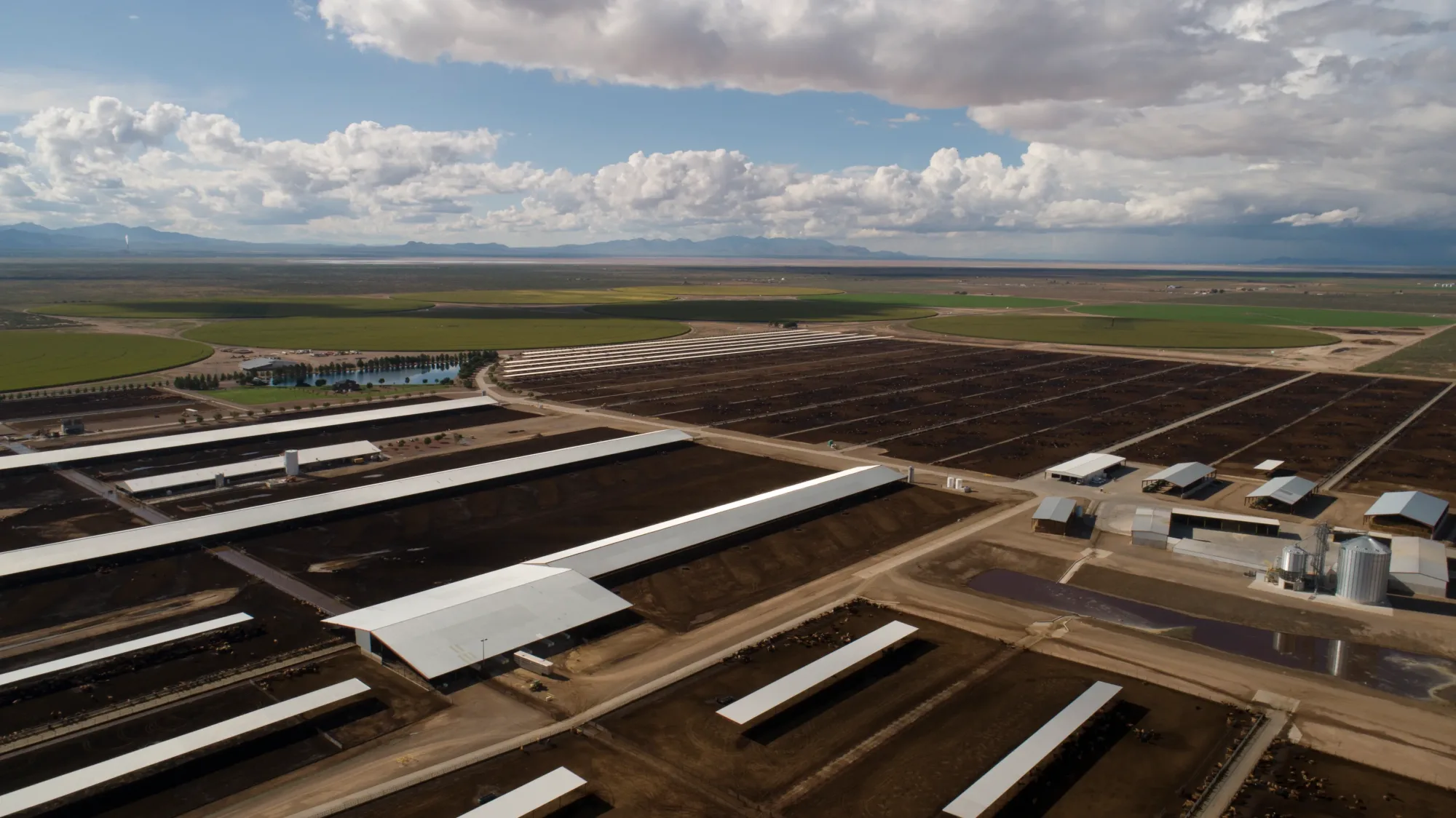
Based on regulatory filings and court proceedings as of July 16, 2026. Judge Susan Bailey had not ruled at publication. Riverview ND, LLP’s public statements on the project are included below.
The Holle family has already run out of easy options. Their Northern Lights Dairy, a 1,000-cow Holstein herd about 12 miles south of Mandan, has been forced to find a new milk buyer twice in 30 months, and now hauls to a Bongards plant in Perham, Minnesota — about five hours one way. “We don’t know what we are going to do,” the family told The Bullvine in early 2026. Now, three hours east of them, a project is taking shape that would make Northern Lights look small — and reset the water, land, and hauling math for every small barn around it.
That project is Herberg Dairy near Hillsboro. It isn’t built yet. But the neighbors are already doing the water math, and you should too.
What’s Actually Been Approved Near Hillsboro?
Riverview ND, LLP — the Morris, Minnesota company behind several Upper Midwest mega-dairies — holds a state permit to build a 25,000-head dairy in Traill County, about seven miles east of Interstate 29 near the Red River. Roughly 21,250 of those animals would be milking cows, and the site would fill about 22 tanker loads a day — more than 170,000 gallons of milk, by Riverview’s own estimate — making Herberg the largest dairy in North Dakota history by a wide margin.
The paperwork is already dense. In a 641-page final decision dated September 24, 2025, the North Dakota Department of Environmental Quality (DEQ) approved a Concentrated Animal Feeding Operation permit after a 45-day comment period and a public hearing at Hillsboro High School the previous spring. That permit covers manure handling, storage, and land application. It does not cover water rights — Riverview still needs a separate water-supply permit and a rural water contract before the first slab gets poured.
So the cows aren’t here. The obligations already are.
How Much Water Does a 25,000-Cow Dairy Actually Pull?
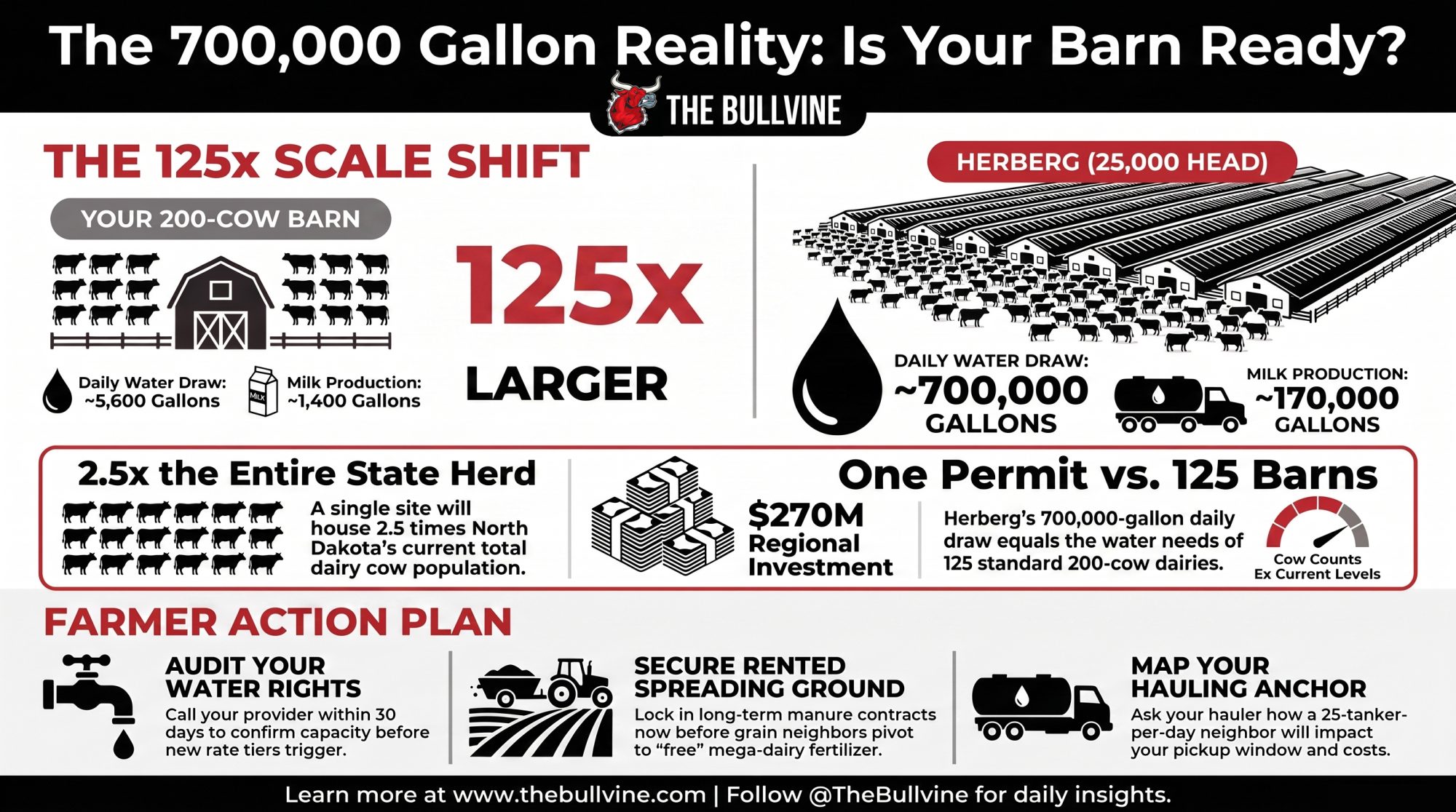
This is where a 200-cow operator should grab a pen. Riverview’s own filing estimates Herberg will use 20 to 30 gallons of water per cow, per day. At 25,000 head, that’s roughly 500,000 to 750,000 gallons per day, with DEQ using a figure of about 700,000 gallons per day.
Now hold the water use per cow the same on both sides and stack the two operations against each other:
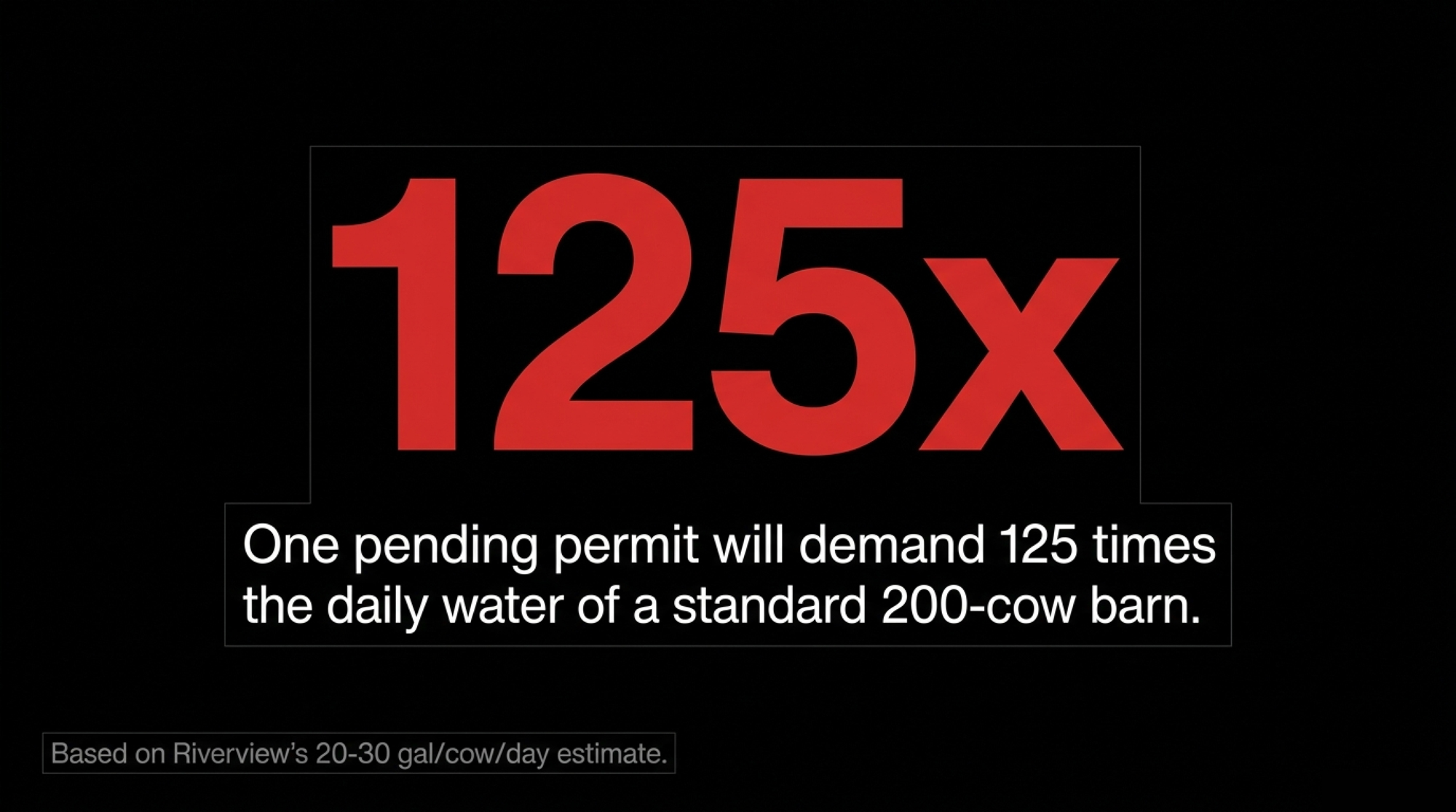
| Metric (at 20–30 gal/cow/day) | Your 200-cow barn | Herberg (25,000 head) | Scale difference |
| Head count | 200 | 25,000 | 125x larger |
| Daily water draw | ~4,000–6,000 gal | ~700,000 gal | ~115–175x |
| Milking cows | ~170 | ~21,250 | ~125x |
| Tanker loads shipped/day | <1 | ~22 (170,000+ gal milk) | dozens x |
Both figures use Riverview’s own 20–30 gal/cow/day estimate, so the comparison is apples-to-apples.
That’s a scale comparison, not a claim that your well runs dry tomorrow. We’ve watched this single-site scale play out before — it’s the same story as Riverview’s 18,855-cow West River permit that cleared with no full review, where a single permit reset the local math overnight.
And the water question isn’t hypothetical for this company. In January 2026, Arizona’s Attorney General announced a settlement requiring Riverview to fallow 2,000 acres in the Willcox basin and fund $11 million in relief for residents whose wells were hit by over-pumping — the kind of after-the-fact accountability that only arrives once the wells are already stressed. The lesson for North Dakota is about timing: the leverage to set terms sits with the neighbors and the co-op before a water contract is signed, not after. If Riverview taps your rural water system or the same aquifer, you stop being the customer the network was sized around. You become the exception in a system built for someone else’s demand.
The Manure Problem Behind “Sufficient Cropland”
DEQ’s approval leans hard on Riverview’s manure plan. The agency says the company identified enough cropland acreage to spread manure as fertilizer, and it kept fields inside the 100-year floodplain off the application list pending further review. Riverview, for its part, says its dairies are built to safeguard surface waters and prevent any manure discharge — with waste stored in a synthetic-lined lagoon before it’s incorporated into the soil as organic fertilizer.
But “sufficient cropland” is where the small-farm fight actually lives. Court filings by the opposition, drawing on the permit, tie a facility this size to enormous volumes of nitrogen-, phosphorus-, and bacteria-laden waste — a characterization DEQ addressed by concluding that the approved nutrient-management plan meets state water-quality standards and requires no federal discharge permit. All of that manure has to land on real fields — owned, rented, or contracted — somewhere in your neighborhood.
Here’s the double-edged part. For a cash-grain neighbor, a manure contract with a big dairy can read as free fertilizer — nitrogen and phosphorus they’d otherwise buy, delivered and spread. Where local crop farmers actively want those nutrients, Herberg’s manure could actually ease competition for spreading ground because both the dairy and the grain grower win. But that same demand cuts against you if your nutrient plan leans on rented acres. A landowner who used to rent you 80 or 100 acres for spreading now has a counterparty willing to pay in fertilizer value, which could reshape what that ground is worth. There’s no public data yet showing per-acre rent shifts tied to Herberg — that’s an honest gap. It rhymes with the land-base squeeze we tracked in Wisconsin, where data-center money pushed farmland toward $21,946 an acre: once a deep-pocketed buyer enters a fixed-acre market, price discovery stops working in the small operator’s favor.
Who’s Fighting the Permit, and Why It’s Really About Review Scope
The opposition isn’t a handful of anonymous complainers. It’s named groups with lawyers on retainer. The Dakota Resource Council, backed by Food & Water Watch, filed suit and appealed in October 2025, arguing DEQ’s review was inadequate and that a dairy this size should require a federal permit under the Clean Water Act.
Their argument is straightforward: opponents contend a facility generating that much waste near the Red River watershed poses a discharge risk deserving federal oversight, and they warn it threatens the river and, downstream, Lake Winnipeg in Canada. DEQ’s counter is just as plain — in its 641-page decision, it held that under state law a federal NPDES permit is only required if there’s an actual discharge, and it found Herberg’s design and nutrient plan are built to prevent one.
On July 13, 2026, that clash came before Judge Susan Bailey. As of mid-July, she’d taken it under advisement with no ruling. The permit still stands. Construction is still conceptually greenlit. But the legal risk is live, and every lender and processor watching the region is quietly pricing it in — a shift in regulatory risk we continue to track closely as permit fights rewrite local lending standards.
There’s a cross-border wrinkle too. Manitoba groups, including the Manitoba Eco-Network and the Save Lake Winnipeg Project, pushed for scrutiny of cumulative nutrient loading — and the International Joint Commission has directed its International Red River Watershed Board to review the North Dakota dairy projects. That’s not directly about your barn. But if international boards start pressing for tighter nutrient caps on the basin, small operators can end up bound by limits triggered entirely by someone else’s scale.
One State’s Whole Dairy Sector, Rebuilt Around Two Sites
To feel the weight of this, layer it on North Dakota’s collapse. The state had around 1,810 dairy farms in 1987. By the 2022 Census of Agriculture, it was down to just 24 — and by early 2026, the Holle family counted the number of Grade A dairies even lower, at around 18. Total cows left in the state run somewhere between 8,700 and 10,000, per USDA NASS and state reporting.
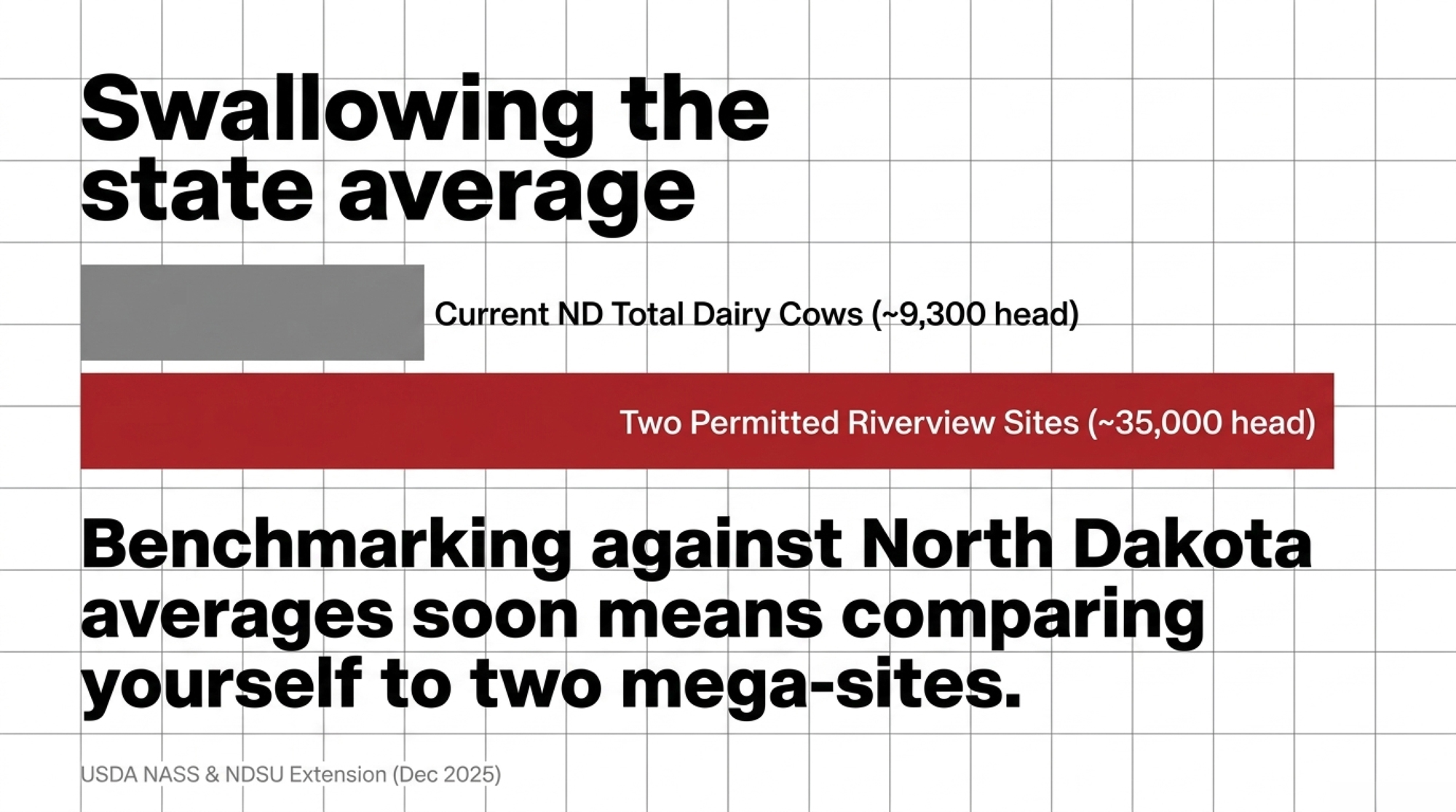
Herberg alone would run about 2.5 times the entire current state herd on a single site. Pair it with Riverview’s second permitted project — a dairy near Abercrombie in Richland County licensed for 10,625 milking cows plus 1,875 dry cows — and the two facilities would add nearly four times the state’s current cow count, pushing the total to roughly five times what’s milked in North Dakota today. An NDSU Extension analysis from December 2025 estimated that the two dairies would require about $270 million in initial investment and generate gross annual revenue between $122 million and $227 million, depending on milk prices. That collapse from 1,810 dairies to two dozen is a story in its own right — the kind of long arc that explains why a single applicant now carries this much weight in a state that used to spread its milk across a thousand barns.
Read that plainly. The state’s dairy sector shifts from a scattered mix of 20-some herds to a two-anchor system with a handful of satellites. When that happens, the “state average” producer stat you get benchmarked against — by USDA, by your lender, by input surveys — is basically describing two facilities that aren’t you.
What Does This Mean for a 200-Cow Dairy Down the Road?
Get out of the courtroom and into your barn office. Say you milk 200 cows within 30 to 50 miles of Hillsboro. Here’s how Herberg’s numbers reach you even if you never trade a single load with Riverview.
On water: their 700,000 gallons a day is on the order of 125 times your daily draw at the same per-cow rate. You’re not going to lose your well tomorrow. But any future change in co-op capacity, pressure, or rate structure will get designed around their profile first, and yours second.
On land: DEQ already blessed a “sufficient cropland” plan for a 25,000-cow manure load. Translation — the spreading ground within hauling distance is either about to gain value as free fertilizer for your grain neighbors, or get locked up in contracts you’re not part of. Either way, if your manure plan leans on rented acres, your negotiating position just changed.
How Do You Protect Your Operation Before the Concrete Trucks Roll?
Start with three checks you can knock out this month.
Call your water provider within the next 30 days. Ask your rural water co-op or well-permitting office one direct question: would Herberg’s application trigger new capacity limits, infrastructure upgrades, or a new rate tier that would hit you? Get the answer before you finalize any parlor or herd-expansion assumptions. Build a water-cost buffer into those plans now, not after the fact.
Audit your manure land base. Figure out exactly how many of your spreading acres are owned versus rented. If rented acres are load-bearing for your nutrient plan, open the conversation on term length and pricing early. Long-term contracts are cheap insurance against a much larger operation entering the same market.
Map your milk route and your backup plant. North Dakota’s processing side is already brittle. Prairie Farms closed its Bismarck plant in September 2023, DFA shut its Pollock, South Dakota plant effective August 30, 2024, and that leaves Cass-Clay’s Fargo facility as the last milk plant standing in-state. When Pollock closed, one producer northwest of Bismarck saw milk rerouted 151 miles at a $0.55 per hundredweight freight surcharge. Haulers build routes around anchors, and a 25,000-cow site is the biggest anchor the region has ever seen. Ask your hauler, straight up, what that could mean for your pickup window — not for a quote, just for an honest read.
Options and Trade-Offs
There’s no single right move here, and the right one depends on where your barn sits and how leveraged you are.
| Move | Best fit | Upfront cost | Main risk |
|---|---|---|---|
| Lock in now (contracts + acres) | Rely on rented ground/shared water, milking 5+ yrs | Small premium for longer terms | Overpay if permit gets tossed |
| Wait and watch | Cash-tight, water and land fully owned | None | Good acres/capacity gone when you move |
| Reposition entirely | Neighborhood economics already shifting | Highest — consolidate or relocate | Highest friction; only if both sites clear |
| Watch Bailey’s ruling | Everyone within 30–50 mi | None | Uphold = lock now; remand = tighter caps coming |
Lock in now — contracts and acres. Makes sense if you rely on rented spreading ground or shared water and you plan to keep milking five-plus years. It requires having the conversations early and maybe paying a small premium for a longer term. The risk: you commit to costs before the court rules, and if the permit gets tossed, you overpaid for security you didn’t need. Watch Judge Bailey’s ruling as your signal — if she upholds the permit, the market pressure is real and near-term.
Wait and watch. Makes sense if you’re cash-tight and your water and land are fully owned. It costs you nothing upfront. The risk is obvious — you’re betting the good acres and the co-op capacity are still there when you finally move. If the ruling favors DEQ and construction accelerates, this path narrows fast.
Reposition entirely. For some operators near a project this size, the honest read is that the neighborhood economics are shifting under them, and the move is to consolidate, relocate spreading ground, or rethink the milking enterprise. It’s the highest-cost, highest-friction path. But it’s the one to model if the ruling clears the way for both Riverview sites and for a third or fourth project to follow — the same cumulative-scale scrutiny Manitoba regulators are already pushing toward international review.
Key Takeaways
- If your water comes from a shared co-op or aquifer near Hillsboro, call the provider within 30 days — before Herberg, not after, is when you have leverage to ask about capacity and rate protection.
- If more than half your manure acres are rented, treat contract renewal as urgent, not routine — a 25,000-cow neighbor changes the bidding pool, and whether that helps or hurts you depends on how badly your grain neighbors want the nutrients.
- If Judge Bailey upholds the permit, read that as your signal to lock contracts; if she orders deeper review, expect tighter basin-wide nutrient rules that will eventually reach your barn too.
- If you’re benchmarking against “North Dakota average” milk or cost numbers, stop — once two mega-sites dominate, the state average describes them, not a 200-cow herd.
Here’s the real question to sit with tonight: can your operation survive in a landscape where a single permit sets the baseline for water, manure, and haul logistics across your whole county? North Dakota went from 1,810 dairies to two dozen in one lifetime, and the Holles are hauling five hours one way to prove what’s left of the map. The next chapter is being written in a Traill County courtroom right now, and it won’t wait for you to catch up.
Run your own numbers against Herberg’s. Then, if you want the full consolidation model — the per-acre rent scenarios, the water-competition math, and the cost curves behind the collapse — that’s exactly what we dig into in The Bullvine Weekly and our deeper economics coverage.
Run Your Numbers
Dairy Farm Corridor Score Calculator — Herberg reshapes the water, land, and hauling map around your barn. Feed in your state, herd size, and hauling cost per cwt to see whether your location is quietly turning into a red-zone milk-check risk before the concrete trucks roll.
Complete references and supporting documentation are available upon request by contacting the editorial team at editor@thebullvine.com.
Learn More
- Riverview’s 18855‑Cow Bet: The $0.60/cwt Drain That Won’t Show Up on Your Milk Check — Arms you with a financial stress test by modeling how a single massive regional permit alters plant intake, potentially docking your mailbox price by forty to sixty cents per hundredweight.
- Riverview West River permit: the 200-cow squeeze — Exposes the long-term regional positioning required when corporate expansions bypass environmental review, matching Arizona groundwater depletion trends against local water co-op infrastructure realities.
- The Great American Dairy Heist – Who Really Owns Your Milk Check in 2025? — Delivers the critical market disruption data behind an eleven-billion-dollar processor boom engineered specifically for mega-dairies, providing survival strategies for mid-sized herds trapped in the supply chain crosshairs.
 The Sunday Read Dairy Professionals Don’t Skip.
 The Sunday Read Dairy Professionals Don’t Skip.
Every week, thousands of producers, breeders, and industry insiders open Bullvine Weekly for genetics insights, market shifts, and profit strategies they won’t find anywhere else. One email. Five minutes. Smarter decisions all week.




