







She farms ground homesteaded in 1863. Today it’d cost $22,000 per acre — and at $20.70 per cwt of milk, the cows can’t cover a sixth of that payment. So who’s really bidding?
Executive Summary: A 207-acre farm near Madison sold this April for $21,946 an acre, and at $20.70/cwt milk, the cows can’t cover a sixth of the payment that price demands. That’s the wall facing operators like Amber Horn-Leiterman at Hornstead Dairy in Brillion, Wisconsin: land has jumped 70.5% since 2020, while milk has done nothing close, and now data-center capital paying $10–12 million per megawatt is bidding on the same acres, water, and power you are. Run the math, and it’s brutal — University of Illinois farmdoc pegs 2025 cost of production near $5,499 a cow against roughly $5,090 in returns, so you’re underwater before a single dollar goes toward land. Finance an acre at $22,000, and the payment runs about $1,580; even at $10,000, it doesn’t pencil because the starting margin is already negative. The real damage shows up in your appraisal file and your kid’s buyout number, whether or not a server farm ever lands on your road. The decision rule is blunt: if you’re not generating a clear positive margin per cow, no land buy works on milk at any price — you’re making an equity bet and financing it yourself. What’s left to decide is which acres are part of your dairy’s future, and which are only worth their price because AI might someday sit where your alfalfa grows.
Amber Horn-Leiterman is the sixth generation to farm the ground her family first homesteaded near Brillion, Wisconsin, in 1863 — 40 acres claimed under a Lincoln-era homestead grant that became Hornstead Dairy. Today, she helps manage an operation running 2,400 milking and dry cows plus 1,600 youngstock in Calumet County, the kind of herd that lives or dies on the spread between the milk check and the cost of making it. And in that corner of the state, the value of dirt has climbed to a number that has nothing to do with what a cow can pay back.
This isn’t just a local spike. It’s a structural shift playing out across the country — the same shift that led an 82-year-old Kentucky woman to turn down $60,000 an acre for her ground this spring rather than watch it become a server farm. More on her shortly. The point for now: when this kind of capital starts pricing farmland, the bid stops having anything to do with what the land can grow.
A decade ago, good dairy land near Brillion changed hands well under five figures an acre. By late 2024, the Growers Edge Farmland Value Index pegged Calumet County at about $13,030 an acre, with neighboring Outagamie at $14,502. Then this April, a 207-acre farm in Dane County — about 15 miles south of Madison — sold in five tracts for roughly $4.55 million, an average of $21,946 per acre, with the top tract at $22,000 per acre. Here’s the kicker: the winning bidder was reported to be a local dairy farmer, not an outside fund. Dairy land is already trading at prices milk can’t justify — and now a new bidder is showing up who doesn’t even need a milk check.
What’s Changing, and Why It’s Happening Now
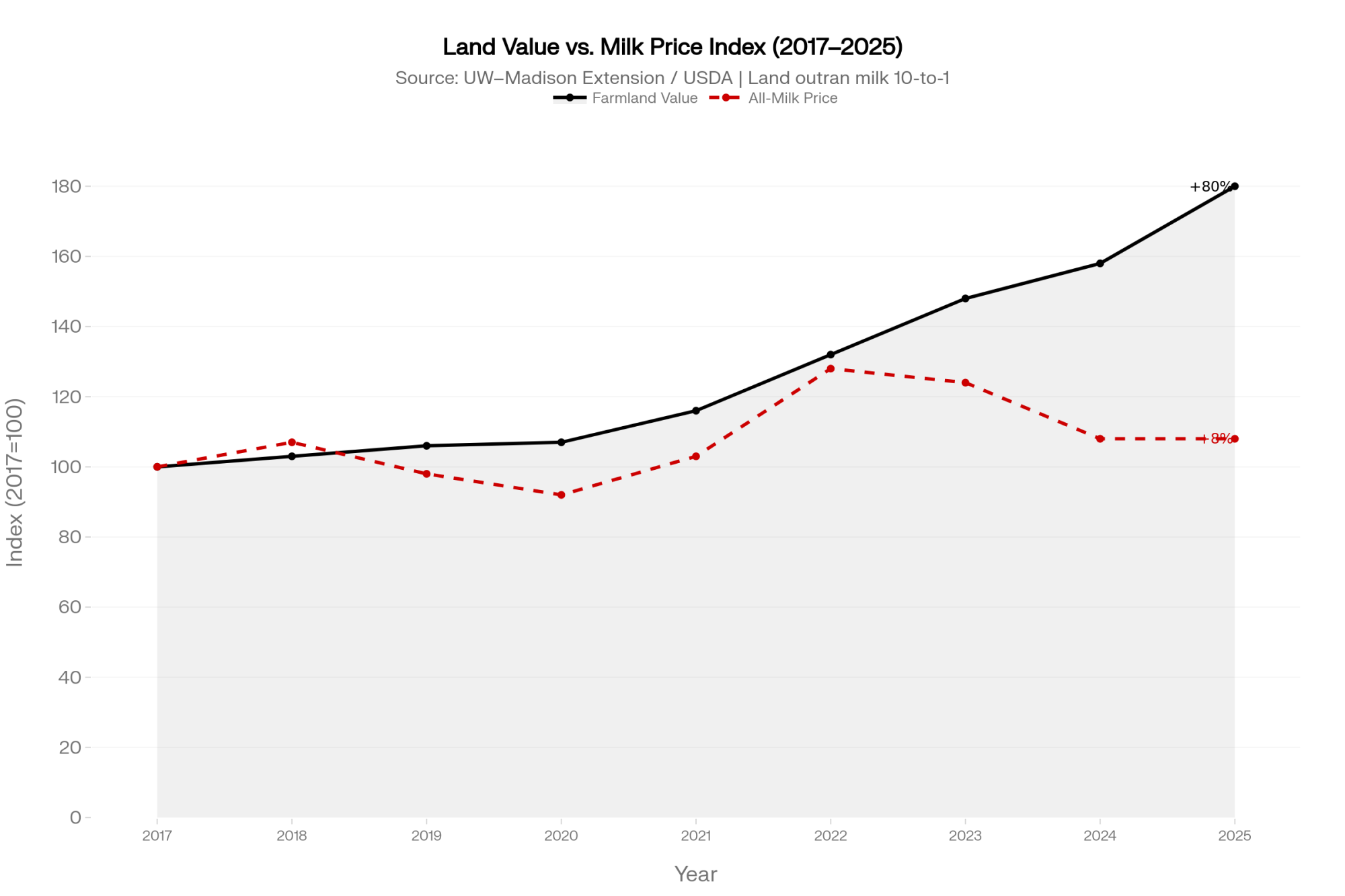
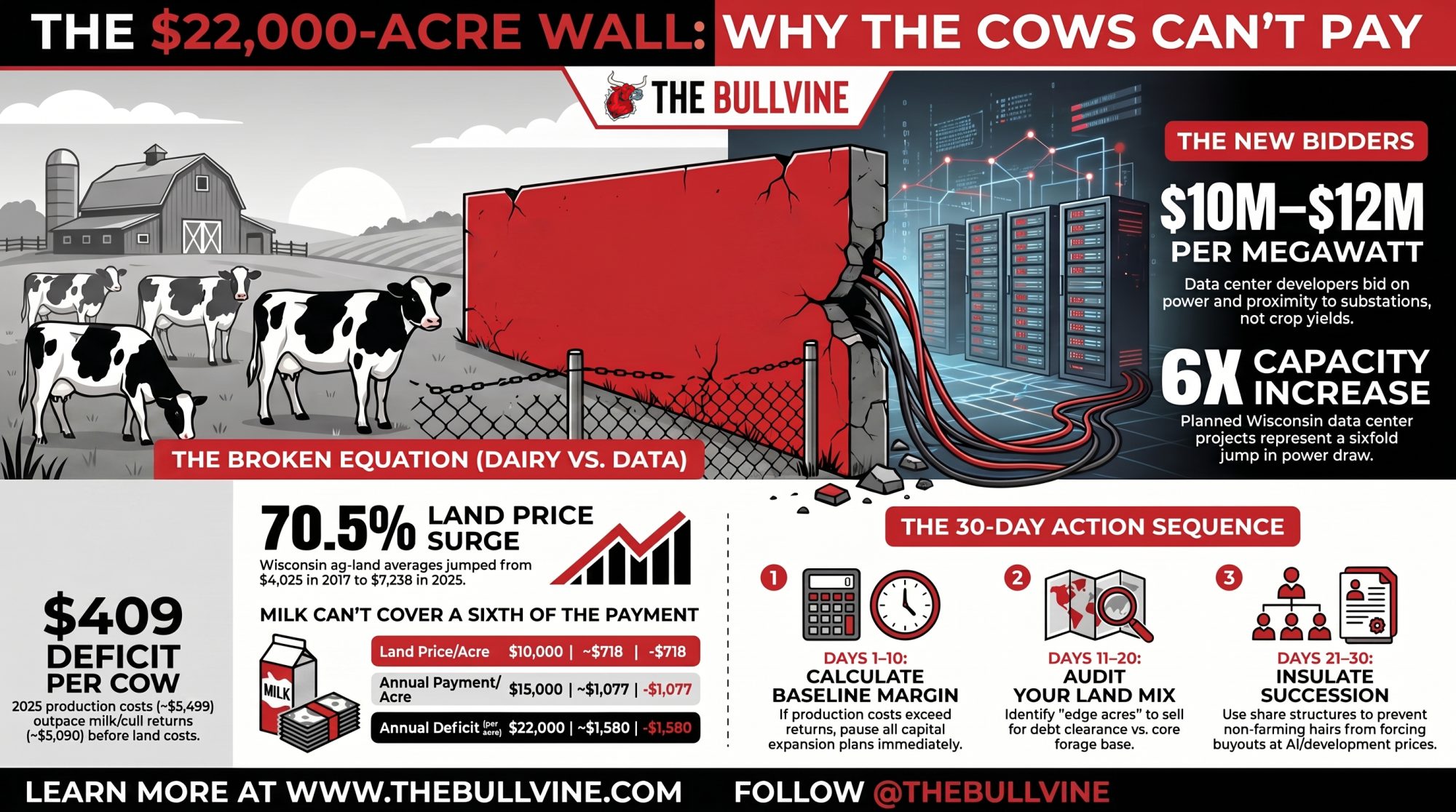
For years, rising land was a slow grind. Wisconsin’s statewide average ag-land sale price ran around $4,025 an acre in 2017. In 2025, it hit $7,238 — a 70.5% jump just since 2020, with one in five sales now clearing $10,000 an acre, according to UW–Madison Extension. Prime Wisconsin ground is already topping $21,500 an acre in spots. That alone outran milk. But it was still a farm-to-farm market: neighbors, grain guys, the occasional outside investor.
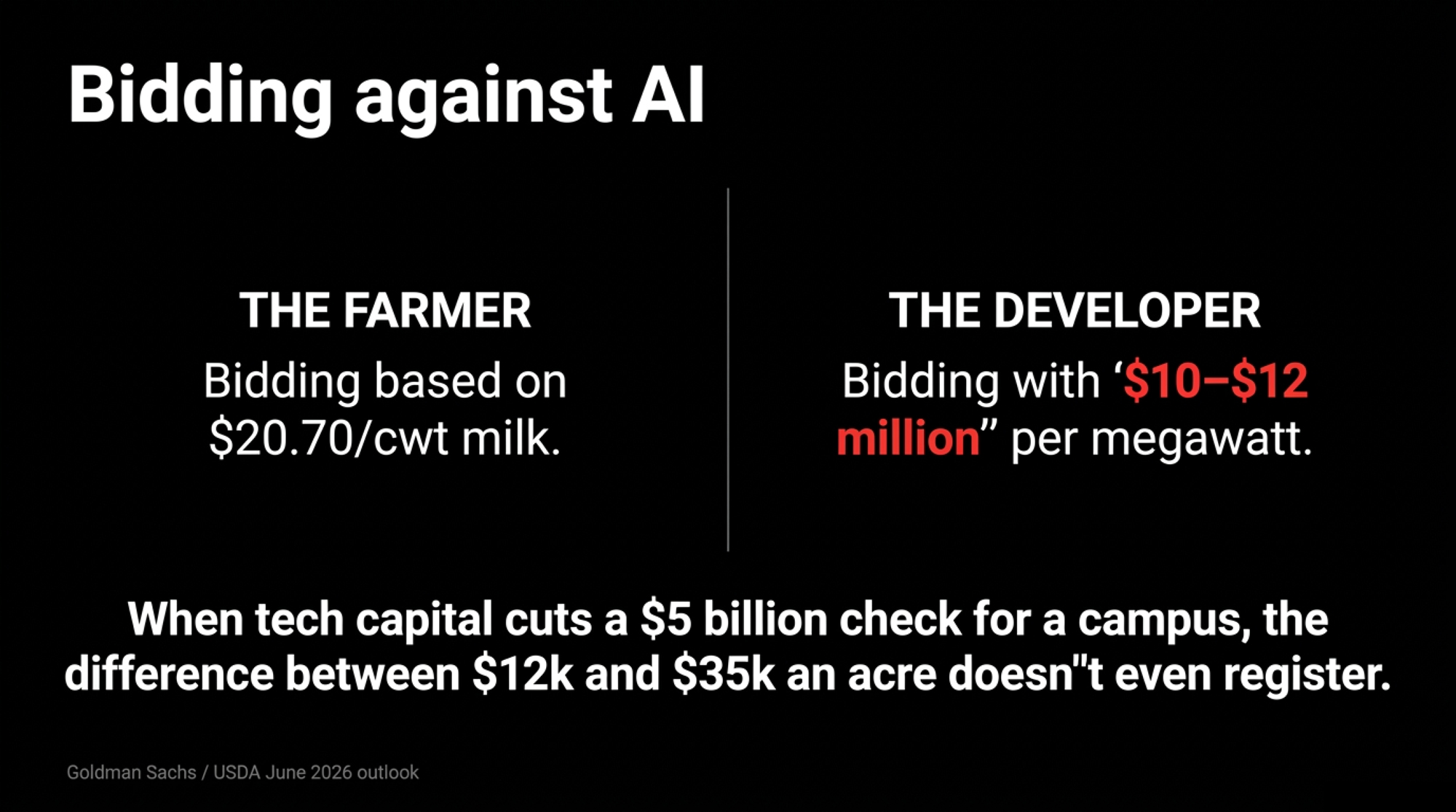
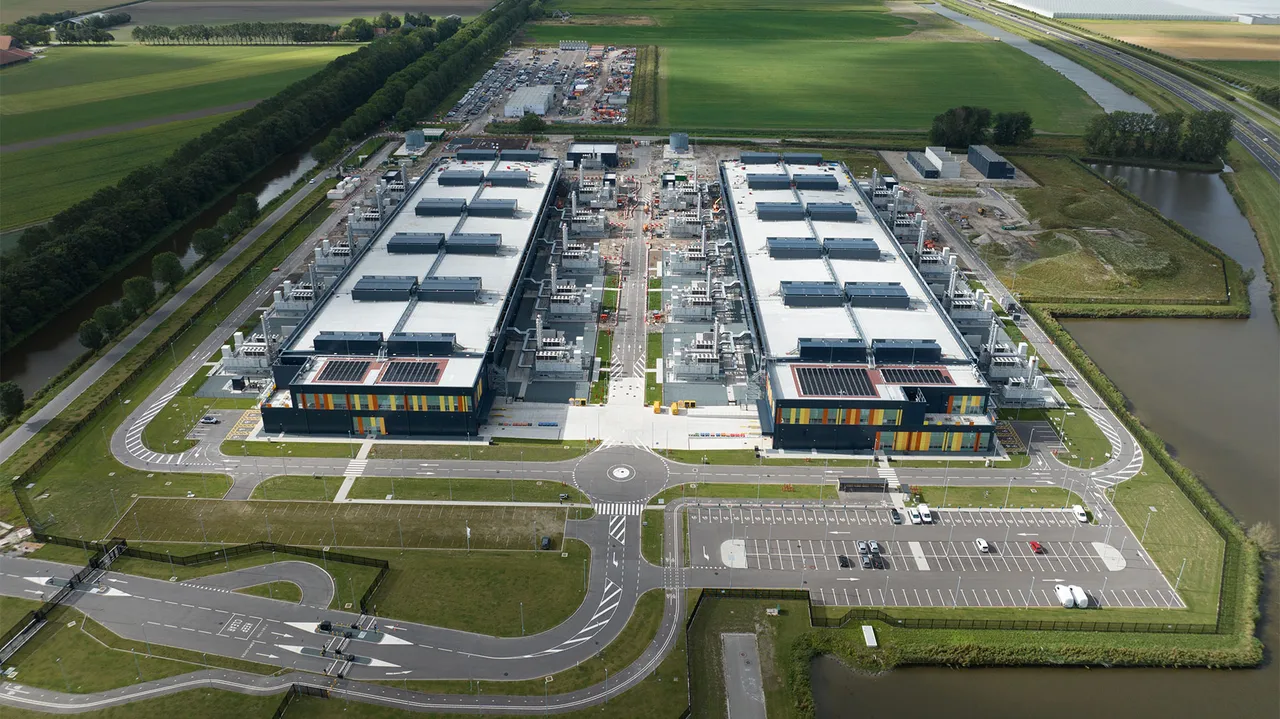
What’s new is a buyer playing a completely different game. Goldman Sachs projects U.S. data-center power demandwill climb from 31 gigawatts in 2025 to 66 GW by 2027 — more than doubling in two years, driven mostly by AI. To build that capacity, operators are paying $10–$12 million per megawatt for standard sites and more than $20 million per megawatt for AI-heavy ones. When you’re cutting a $2.5–$5 billion check for a single 250-MW campus, the difference between $12,000 and $35,000 an acre barely registers on the spreadsheet.
The farms most exposed sit in dairy-dense counties with good power, flat ground, and water. That describes a lot of eastern and southern Wisconsin. And this isn’t a southeast-corner problem anymore — Outagamie County is rewriting its 1989 zoning code, with supervisors openly debating whether to keep data centers out of certain towns. Shawano County advanced a temporary moratorium to its full board in June. Counties don’t pick those fights unless real projects are already knocking.
This Is Already Wisconsin’s Reality, Not a Forecast
The footprint is on the ground now. Wisconsin has four operating data centers totaling 424 MW, with ten more planned that would add another 2,320 MW of capacity — a nearly sixfold jump if they’re all built. Microsoft’s Mount Pleasant campus, billed as the world’s most powerful AI data center, is slated to come online in early 2026, carrying a dedicated 250 MW solar project in Portage with it. Together, Mount Pleasant and the Vantage center in Port Washington are projected to draw a combined 3.9 gigawatts — more power than every home in Wisconsin uses combined, per Clean Wisconsin.
And the land hunger is moving inland from Lake Michigan. A $1 billion, 520-acre data center surfaced in tiny Beaver Dam, roughly an hour from Brillion, before most locals knew it was coming. These projects don’t sip land — they buy it in blocks, at prices set by power and proximity to a substation. Every one of those deals becomes a comp. That’s the mechanism that drags the number on your own ground higher, whether or not a server hall ever lands on your road.
How This Lands on a Real Farm
Here’s where it gets concrete for a herd at your scale. Take a well-run operation shipping around 25,000 lbs per cow a year — call it 250 cwt. At $20.70/cwt all-milk, the figure the USDA set in its June 2026 outlook, that’s about $5,175 in milk revenue per cow. Sounds like real money. Now put it against the cost of making that milk.
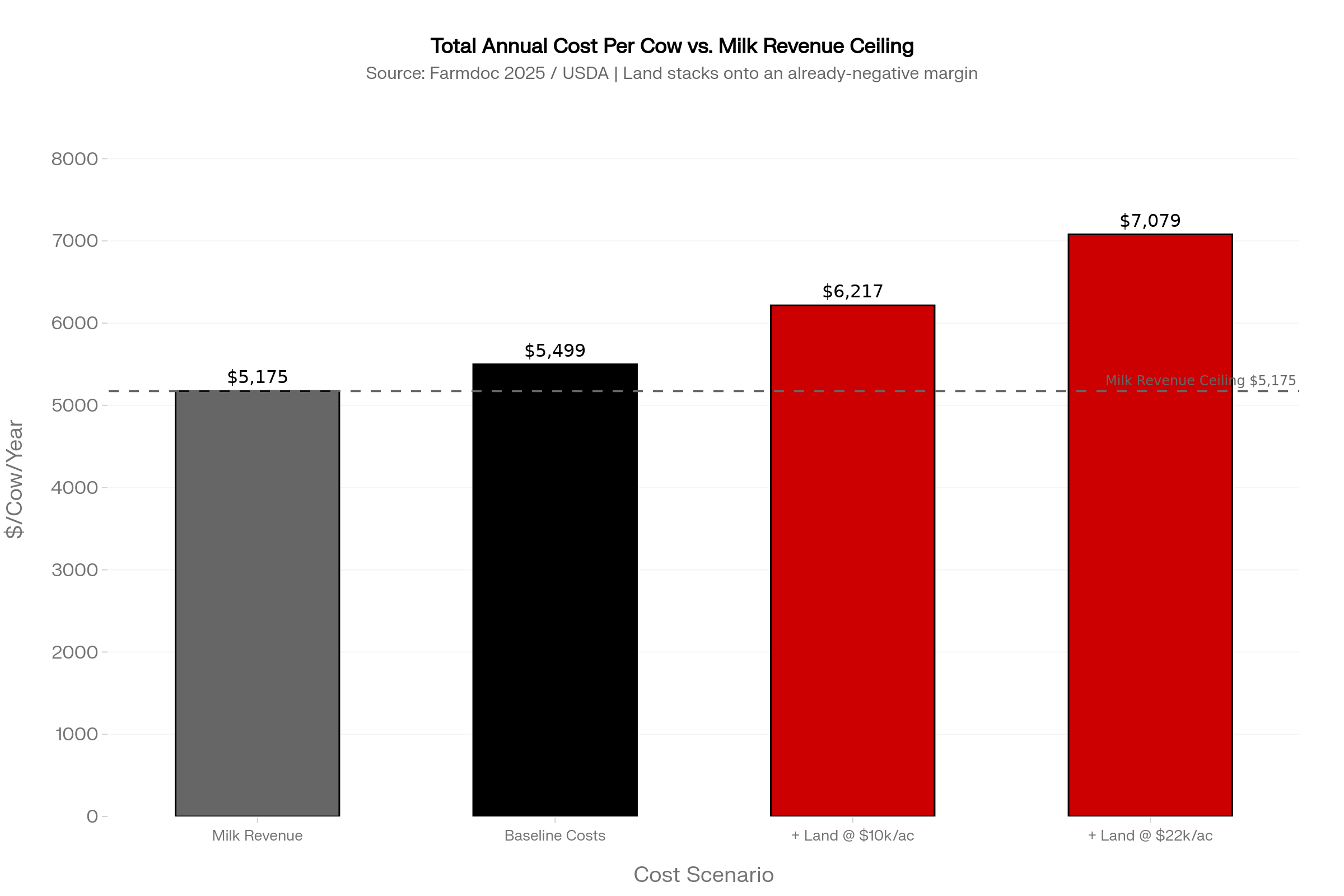
The University of Illinois farmdoc team pegs the 2025 total cost of producing milk at roughly $5,499 per cow, compared with total milk-and-cull returns of near $5,090. Read that again. The model herd is already running a small negative economic margin before a single dollar goes toward land. There’s nothing left over to service an acre payment, because there’s nothing left over, period. (Those are Illinois figures used as a Midwest benchmark; plug in your own numbers and the shape won’t change much.)
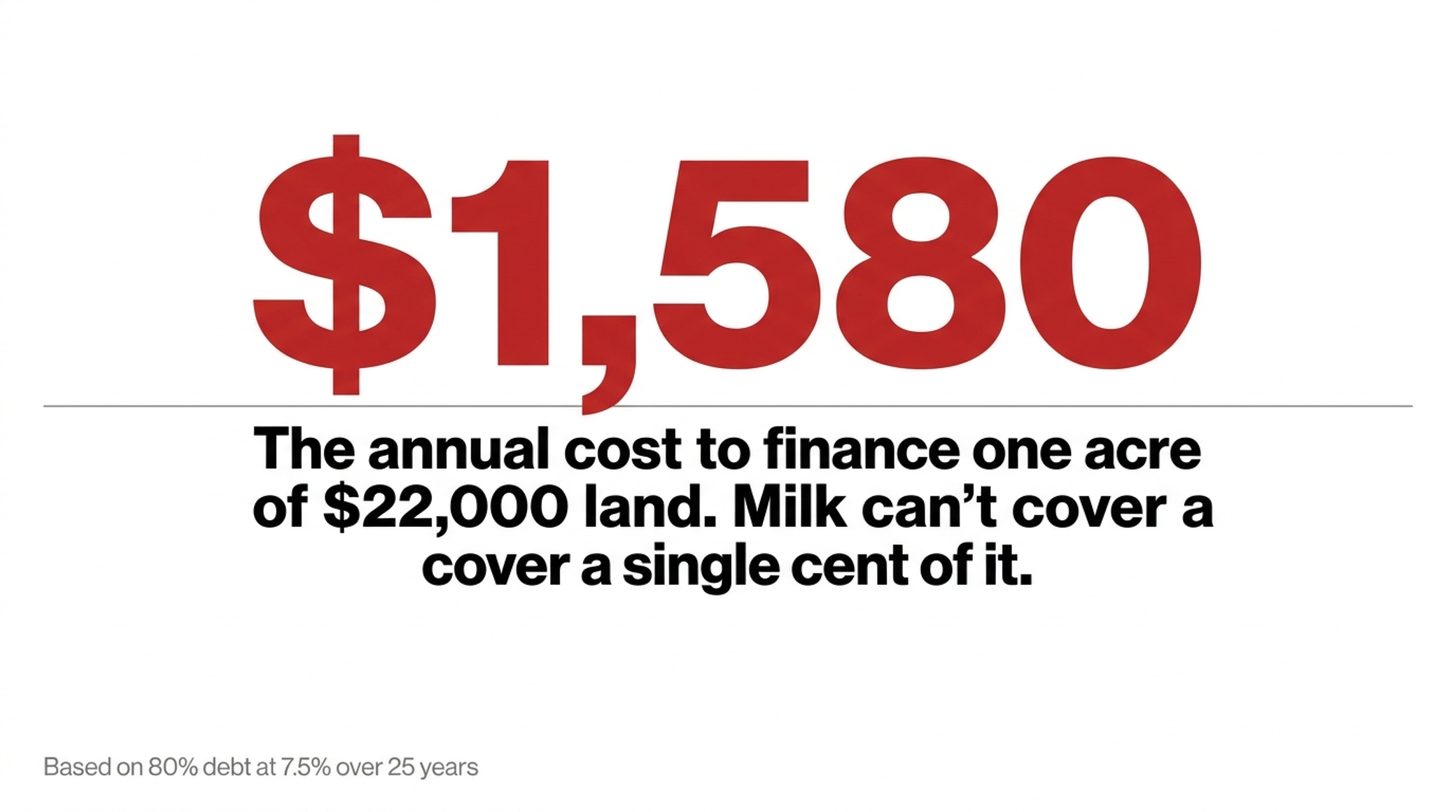
So here’s the wall. Finance an acre at $22,000 with 80% debt at 7.5% over 25 years, and the annual payment runs about $1,580 per acre — close to $1,740 a cow, assuming roughly an acre of ground per cow once you spread it across the herd. Stack that on a cost of production that already tops income, and total cost runs past $7,200 a cow against roughly $5,100 coming in. Milk doesn’t cover a sixth of that land payment. It covers none of it — equity, off-farm income, or appreciation has to carry the whole thing. Even at $10,000 per acre, with the payment dropping to nearly $718, the math doesn’t improve because the starting margin is still underwater. The data-center money didn’t break the equation. It just makes the gap impossible to look away from.
At What Price Does Buying Stop Penciling?
The truth is harder than “data centers ruined it.” At $20.70 per cwt for milk and the University of Illinois farmdoc benchmark costs, there is no positive operating margin to allocate to a land payment. The question isn’t “What’s the magic price?” It’s “How big is the deficit at each price point?”
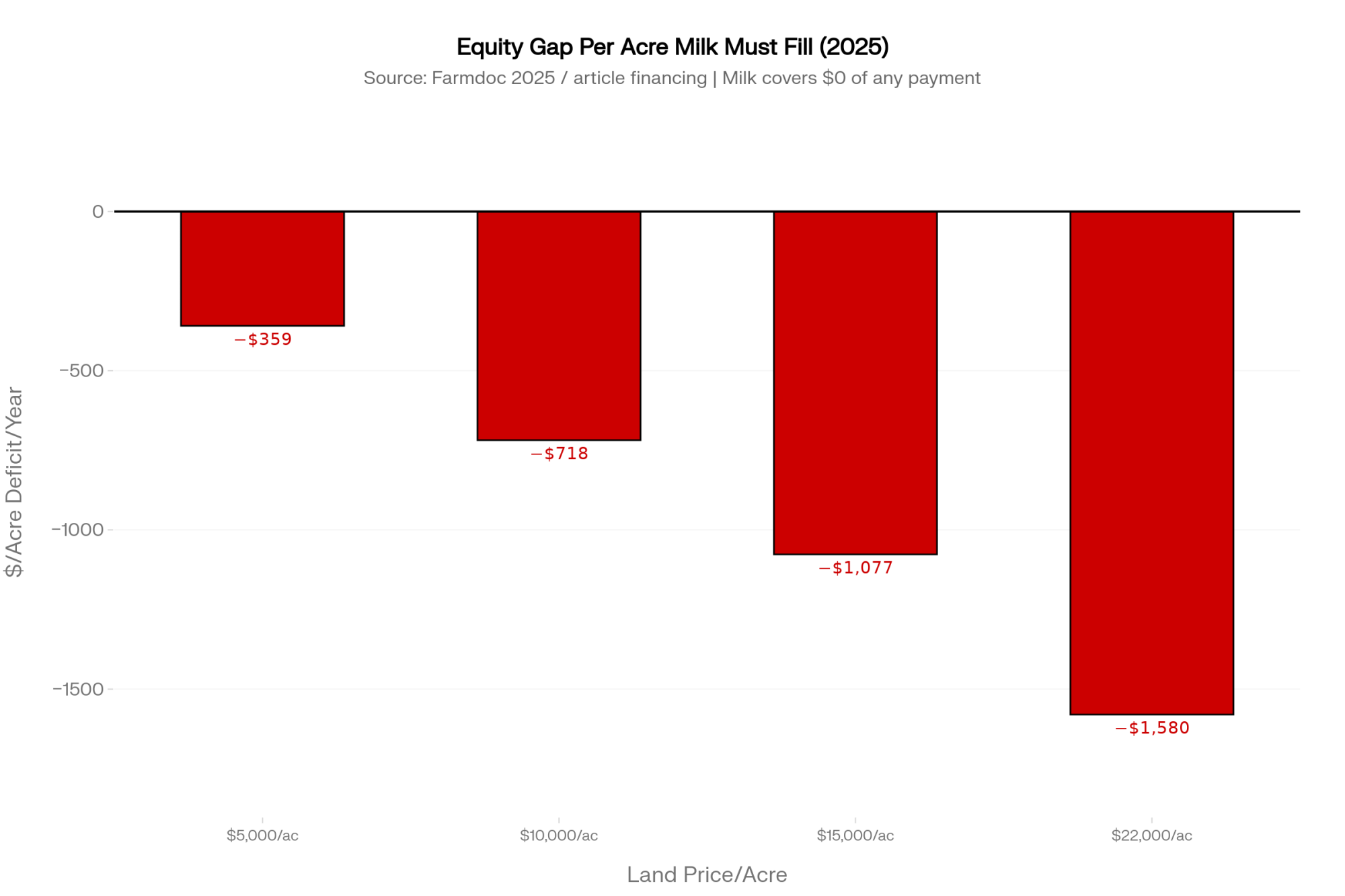
| Land price / acre | Annual payment / acre (80% debt, 7.5%, 25 yr) | Operating margin available from milk | Annual deficit per acre (covered by equity/off-farm) |
| $5,000 | ~$359 | $0 (margin already negative) | −$359 |
| $10,000 | ~$718 | $0 | −$718 |
| $15,000 | ~$1,077 | $0 | −$1,077 |
| $22,000 | ~$1,580 | $0 | −$1,580 |
Payment figures are illustrative and calculated based on the stated financing assumptions; the zero operating margin reflects the farmdoc 2025 cost-vs-returns gap. Figures assume an acre of owned or rented ground per cow — a tighter or looser land base shifts the per-cow number but not the direction. At the $22,000 row, that works out to a deficit north of $1,700 per cow per year that milk doesn’t fund. The hard decision rule: if your operation isn’t generating a clear, positive margin per cow after feed and overhead, no land purchase pencils on milk at any of these prices. You’re making an appreciation bet and financing it entirely with equity.
Why a Sale Three Counties Over Lands in Your File
The reason this feels different from a normal hot market is that it is, in fact, one. A neighbor bids up land based on what milk or corn can return — and even those bids already blow past what the cows justify. A data-center developer bids on megawatts, cooling, and how close he can get to a substation, none of which has anything to do with your component check. When that buyer sets the price at the margin, the whole comp set moves with him.
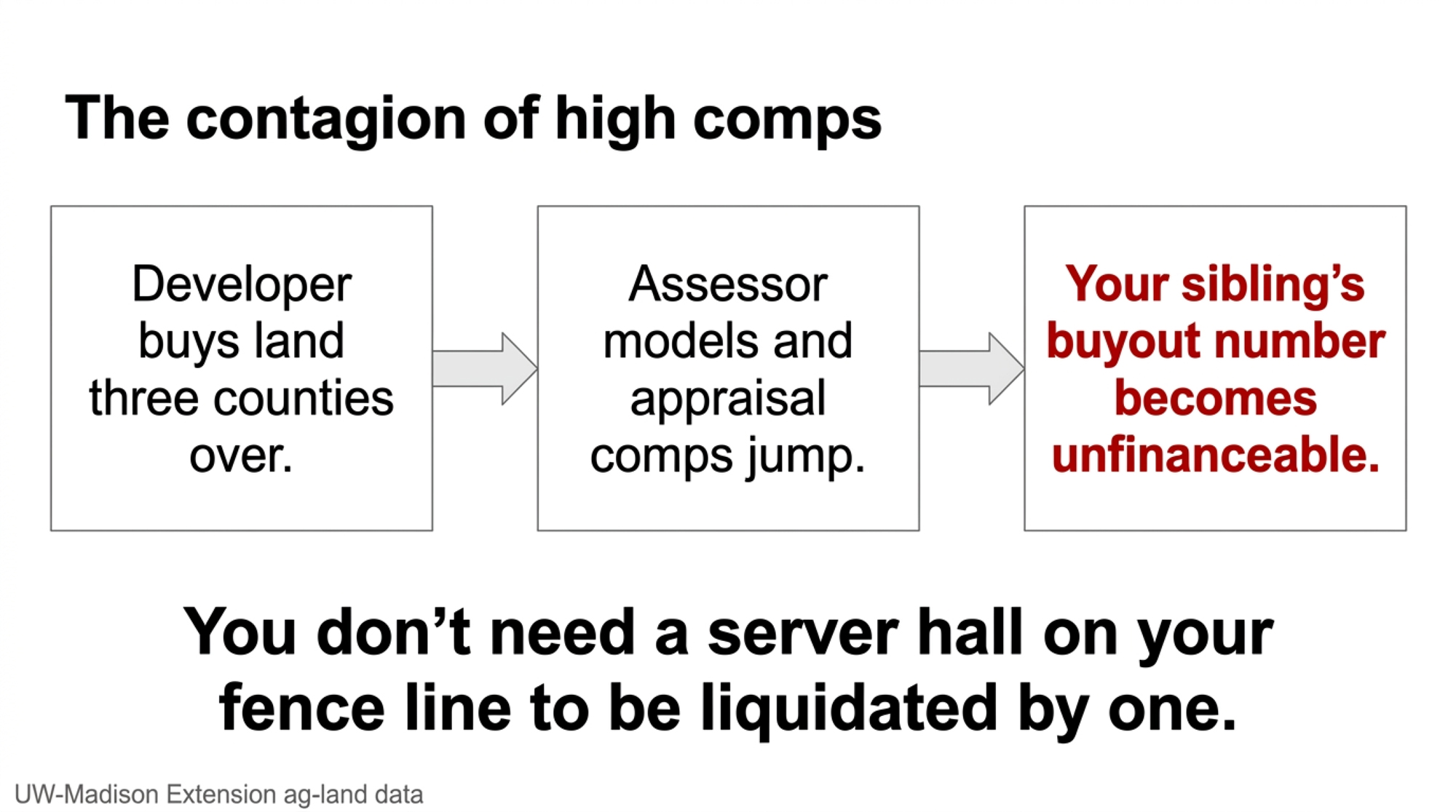
And here’s the part that’s easy to miss. You don’t need a server hall on your fence line to feel this. One high sale three counties over shows up in your appraisal file, in your assessor’s model, and eventually in the number your kid has to finance to buy out a sibling. Appraisers work off comps. Lenders work off appraisals. Siblings work off whatever they saw on their phone. None of those people is waiting for your opinion.
Water tightens the screw. A large data center can pull hundreds of thousands of gallons a day, and the National Wildlife Federation has flagged that these centers are becoming major water users, often in already water-stressed regions, drawing from the same municipal and groundwater that farm country depends on. So the same capital is bidding against you for land, power, and water all at once.
How Much Does “Waiting and Seeing” Actually Cost You?
More than most families want to admit — because sitting still isn’t neutral here. While you wait, the comps keep printing, the appraisals keep climbing, and your assessed value rises whether or not you ever sell a single acre. UW Extension’s data show land values up 70.5% in five years, while milk did nothing close to that. Every year you put off the conversation, the gap between what the land is “worth” on paper and what your dairy can actually service gets wider, and the buyout your successor faces gets steeper.
The bank, the assessor, and a site selector are all running their numbers on your ground right now. The only real question is whether you’re running yours, too. And if you’re not near a substation — up in Shawano or out toward Marinette, figuring this is somebody else’s headache — that comfort is exactly the trap. The pressure doesn’t spread by proximity. It spreads through comps, appraisals, and rezoning votes that hop county lines long before a developer turns down your road.
Is Your Succession Plan Already Negotiating Against a Phone Screen?
This is where it gets personal. Only about 16.5% of dairy farms reach a third generation, by The Bullvine’s own reckoning of family-business and dairy data — and that was true before AI money ever entered the picture. Now picture the one kid who wants to milk sitting across the Thanksgiving table from siblings who’ve never run a parlor but have a $22,000 comp pulled up on their phones.
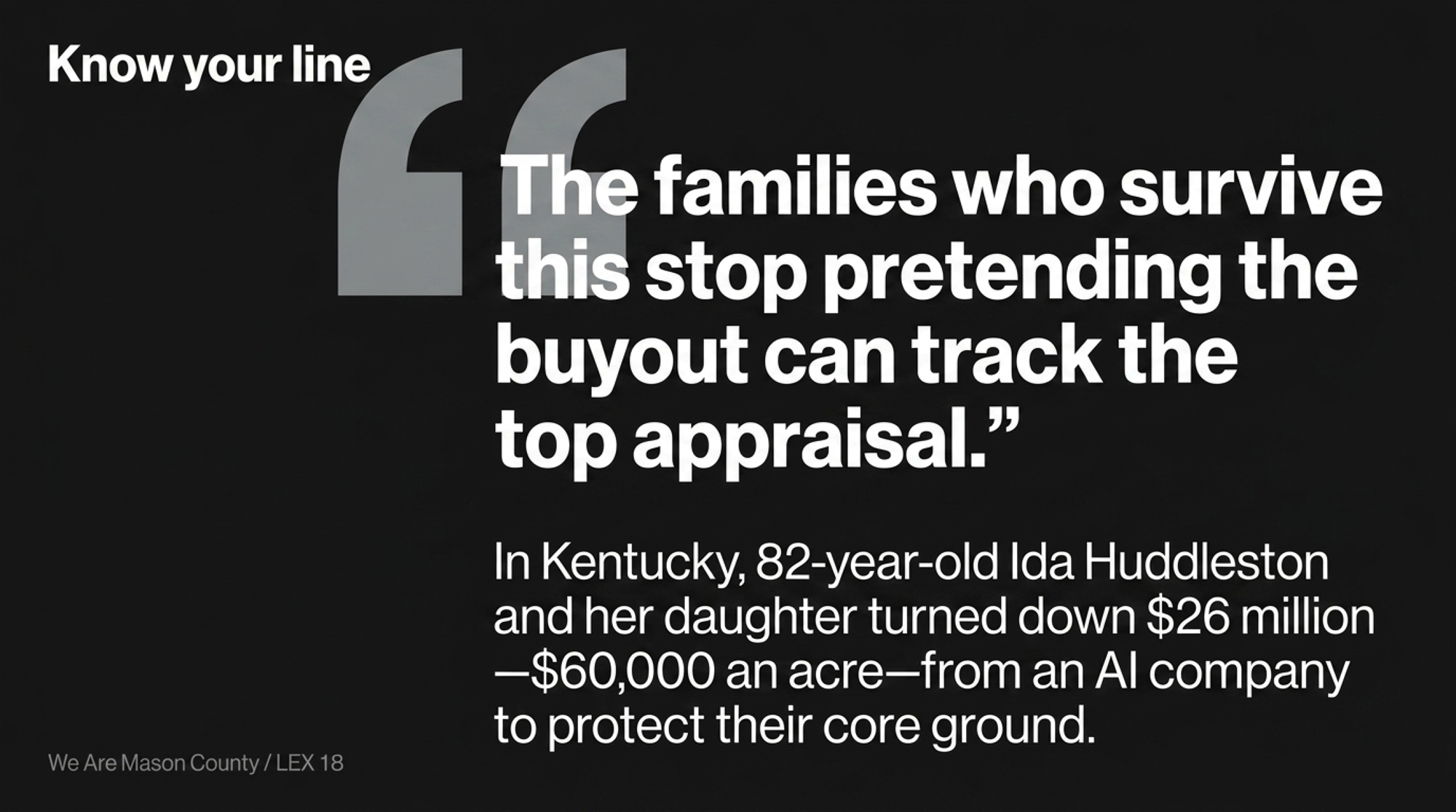
There’s no version in which the farming heir borrows enough to pay everyone the full development value and still have a dairy that pencils. The families who survive this stop pretending the buyout can track the top appraisal — they discount the transfer price, carve off non-core acres to fund the rest, or use share structures so non-farming siblings hold real value without forcing a cash-out at AI prices. The ones who don’t aren’t doing succession planning anymore. They’re negotiating a liquidation, and they usually don’t see it until the bank does the math for them.
That’s the math. The choice is what you do over the next 30 days — and it follows a specific order.
Your 30-Day Action Sequence
No move lets milk outbid a $5 billion build. But you control how much of this you carry, how it’s structured, and who captures the upside if an offer ever lands. Work it in sequence.
1. Calculate your baseline margin — Days 1–10. Pull your last 12 months of financials. Figure your exact cost of production per cwt and benchmark it against the farmdoc averages, which are near $5,499/cow. If your margin is negative before land, pause all capital expansion plans immediately. The trade-off is real: holding pat can feel like falling behind, but buying into a negative margin funds the gap with equity you can’t replace.
2. Audit your land mix — own vs. rent — Days 11–20. Wisconsin non-irrigated cropland cash rent averaged $161 per acre in 2025; compare that to a $1,580-per-acre ownership payment. Rent you can shed in a bad year — a land note at 7.5% you can’t. Identify your “edge acres,” the parcels you could sell to clear high-interest debt without crippling your core forage base. The risk to watch: a landlord can sell rented ground into a development offer and pull it on short notice, so know which acres you truly can’t replace.
| Land Price/Acre | Annual Ownership Payment/Acre | WI Cash Rent/Acre (2025) | Rent Savings vs. Buy | Break-Even Milk Price to Fund Payment | Verdict |
| $5,000 | ~$359 | $161 | $198 | ~$21.90/cwt | ⚠️ Marginal |
| $10,000 | ~$718 | $161 | $557 | ~$23.50/cwt | 🔴 Red — milk at $20.70 falls short |
| $15,000 | ~$1,077 | $161 | $916 | ~$25.20/cwt | 🔴 Red — deeply negative |
| $22,000 | ~$1,580 | $161 | $1,419 | ~$27.10/cwt | 🔴 Red — unfundable on milk alone |
3. Insulate your succession plan — Days 21–30. Sit down with a transition planner. If non-farming heirs are eyeing local data-center comps, build share structures or discounted transfer agreements so they hold real value without forcing a cash-out at speculative AI valuations. Don’t make the farming successor buy out siblings at development pricing — that’s the move that turns a transfer into a liquidation.
And know your line before anyone calls. In Mason County, Kentucky, 82-year-old Ida Huddleston was offered $60,000 an acre for her 71 acres, and her daughter Delsia Bare turned down $48,000 an acre for her 463 — together more than $26 million from a Fortune-50 AI company, roughly ten times the going rate. They said no. The county rezoned 2,080 acres across 28 properties around them anyway, and a citizens’ group, We Are Mason County, sued to block it — with a court hearing set for June 26, 2026. A development-priced sale of non-core ground can fund a succession that otherwise can’t close — but once it’s a server farm, that ground never grows feed again. Decide which acres you’d refuse at any price, and which you’d let go.
Key Takeaways
- If your margin per cow is at or below the farmdoc benchmark — roughly break-even to negative for 2025 — treat any land purchase above $10,000 an acre as an equity bet, not a milk-funded one. The cows aren’t paying for it.
- If you can rent solid ground for $160–$200, run the comparison before you buy. Rent you can shed in a bad year; a $1,500-plus land payment you can’t.
- If you’re carrying land debt, stress-test it at a milk price two dollars below today’s price this month, and see whether the payment still clears.
- If you own edge parcels with obvious non-farm value, decide now which acres you’d refuse at any price and which you’d sell — before a sibling, lender, or developer decides for you.
- If there’s a successor in the picture, put a date on the calendar within 30 days and bring three things: your real cost of production, a net-worth snapshot, and a color-coded land map. Bring numbers, not feelings.
The honest question for the next 24 months isn’t whether data centers reshape farm country — they already are. It’s narrower, and it sits at your kitchen table: which acres on your place are part of your dairy’s future, and which are only worth their price because a server farm might someday sit where your alfalfa grows now? Ida Huddleston answered it at 82. Where do you land?
Run Your Numbers
Dairy Profit Projector — Before you bid on another acre, run your herd through the Dairy Profit Projector and find your real breakeven milk price and IOFC per cow. It shows whether you’ve got any margin left to service land — or whether, like the math here, the cows can’t cover the payment at all.
Land values and prices cited reflect public auction results, USDA, University of Illinois farmdoc, University Extension, Clean Wisconsin, Cleanview, LEX 18, WCPO, and other published data as of June 2026.
Complete references and supporting documentation are available upon request by contacting the editorial team at editor@thebullvine.com.
Learn More
- Why 70% of Dairy Farms Never Make It Past Dad – The Psychology, Math, and Monday Morning Fix — Arms you with a tactical framework to overcome the psychological friction of succession planning. Learn how to draft a written sweat equity ledger and create a structured timeline that prevents local land speculation from turning an internal family buyout into an involuntary liquidation.
- Dairy Farm Economics 2026: Milk Pricing, Margins & Risk Playbook — Delivers a complete financial blueprint to insulate your operation against a projected negative net economic return of −$4.71/cwt. Explores specific mathematical math models to optimize your existing herd size, evaluate robotic milking payback windows, and deploy aggressive risk management strategies before interest rate exposure strips your equity base.
- Data Centers, Water Rights, and Your Dairy’s Future: The 18-Month Window That Changes Everything — Exposes the hidden structural costs that digital infrastructure infrastructure imposes on neighboring producers, including a $0.25/cwt hit to milk production via surging utility grid rates. Reveals how aggressive tech industry competition for regional water tables threatens multi-generational wells while creating temporary, unprecedented 400% land exit premiums.
 The Sunday Read Dairy Professionals Don’t Skip.
 The Sunday Read Dairy Professionals Don’t Skip.
Every week, thousands of producers, breeders, and industry insiders open Bullvine Weekly for genetics insights, market shifts, and profit strategies they won’t find anywhere else. One email. Five minutes. Smarter decisions all week.