Think it’s the bugs causing cow deaths? Think again—it’s the feed, and here’s the fix.
EXECUTIVE SUMMARY: Folks, here’s the deal: the real cause of hemorrhagic bowel syndrome isn’t just bacteria—it’s microscopic damage to the cow’s gut lining from rough feed particles. Data from farms in North America and beyond show nearly 1% of cows are lost annually to this syndrome, costing $100K+ on big herds. Tighten up your feed particle size—cut the big bits to under 18% of the ration—and you’ll slash cases by roughly 30%. Pair that with feeding fresh more often and adding immune-boost supplements, and farms report payback within a year. This isn’t theory—it’s proven results you should try this season.
KEY TAKEAWAYS
Reducing particles >4 mm to under 18% of ration DM cuts HBS cases by 30%—an easy change you can make today.
Minnesota Extension’s simple scorecard spots high-risk cows early, boosting confirmation accuracy from <20% to >70%.
Push fresh feed every 2 hours to stabilize rumen pH and curb digestive upsets—low effort, proven by UC Davis.
Adding yeast-based products and trace minerals slashes gut health issues by up to 20%, backed by UK and KY trials.
Every cow saved is fewer replacements and ~1.2 tonnes CO₂e saved—vital for 2025 sustainability goals and compliance.
What makes hemorrhagic bowel syndrome (HBS) so dangerous is its stealth. I’ve talked to dairy folks from Wisconsin barns to New Zealand pastures, and the stories are the same. One moment, your top milker is chewing cud; the next, she’s down—and sometimes gone before breakfast.
Here’s the good news: HBS isn’t bad luck—it’s a risk you can manage. Here’s how to get ahead and keep your herd thriving.
What’s Happening With HBS?
Imagine a soggy spring in Ontario. Jerseys dropped unexpectedly. Baleage lab tests passed, but necropsies revealed over 20% of ration particles exceeded 4 mm—enough to scrape the gut lining. DairyNZ’s 2024 trials show trimming that below 18% cuts HBS incidence by roughly 32%.
In the U.S., about 15% of herds report HBS outbreaks annually, losing 0.5–1% of cows. It’s not chance—it’s risk you can reduce.
New Science: It’s More Than Bacteria
Clostridium perfringens was long blamed, but Ghent University’s ex vivo work challenges that. They found mucosal abrasion—tiny tears from coarse feed—as the real spark. Those abrasions let bacteria and toxins breach the gut wall, triggering fatal hemorrhaging.
Worried about low-mold silage? Even “clean” silage can hold rough particles that damage sensitive, high-producing fresh cows.
Spotting HBS Early
Minnesota Extension’s triage tool scores seven signs—sudden collapse, abdominal swelling, dark or bloody manure, cold extremities, recent diet shifts, and days in milk over 100. A score ≥6 means call the vet for a necropsy. Farms using this system improved necropsy confirmation from under 20% to over 70%.
Fighting Back
Particle control: Keep feed particles >4 mm under 18% of ration DM to cut cases by ~32%.
Frequent feed pushes: Every two hours steadies rumen function (UC Davis study).
Gentle transitions: Stretch diet changes over ≥7 days to avoid gut stress.
Silage face care: Remove 1–2 feet of silage daily; discard any mold to maintain a smooth, tight face.
Immune support: Yeast cell walls, zinc/selenium, and mycotoxin binders can reduce HBS risk by up to 20%.
Dollars & Sense
One 900-cow Minnesota dairy lost eight cows—$106,000 in losses—in six months. After adopting these measures, they had one case in the next half-year, saving over $90,000. Prevention investments typically pay off within a year.
Action Plan for Monday Morning
Calibrate a forage sieve; set particle-size targets.
Train staff on the necropsy scoring tool.
Schedule feed pushes every two hours.
Tighten silage face management—pitch mold daily.
Begin immune-support supplementation for fresh and early-lactation cows.
Sustainability & Compliance
Fewer losses mean fewer replacements—each avoided heifer saves about 1.2 tonnes of CO₂e. Consumers and regulators are watching. “Managing HBS is a win for animal health, profitability, and environmental stewardship,” says Dr. Laura Schmidt, dairy health specialist at the University of Wisconsin–Madison.
Bottom Line
HBS isn’t a phantom—it’s treatable. Master feed particle size, vigilant cow monitoring, disciplined silage practices, and targeted immune support. Farms from Wisconsin to New Zealand are already reaping healthier herds and better profits—now it’s your turn.
Complete references and supporting documentation are available upon request by contacting the editorial team at editor@thebullvine.com.
Learn More:
7 Common TMR Mixer Mistakes and How to Avoid Them – This article provides the hands-on operational guide to achieving the feed consistency discussed in the main piece. It reveals practical methods for optimizing your mixing protocol to prevent the very particle size issues that trigger HBS and hurt profitability.
The Hidden Costs of a High Culling Rate: Are You Losing More Than You Think? – Moving from a single disease to overall herd strategy, this piece examines the long-term financial drain from cow losses. It helps you calculate the true economic impact of syndromes like HBS on herd structure, genetic progress, and replacement costs.
The Sensor Revolution: How Wearable Tech is Transforming Dairy Health Management – While the main article details a manual scorecard for HBS detection, this piece explores the future of proactive health monitoring. It demonstrates how innovative sensor technology automates early detection of distress, allowing for intervention before a crisis hits.
The Sunday Read Dairy Professionals Don’t Skip.
Every week, thousands of producers, breeders, and industry insiders open Bullvine Weekly for genetics insights, market shifts, and profit strategies they won’t find anywhere else. One email. Five minutes. Smarter decisions all week.
Think feed additives are the only way? There’s an air-based fix to check out.
EXECUTIVE SUMMARY: MEPS slashes barn methane by up to 90% and ammonia by 80%—far beyond the ~30% cut from feed additives like Bovaer. It even converts ammonia into ammonium chloride fertilizer, which is worth money. With milk at $21.60/cwt and carbon credits near $60/t CO₂e, controlling methane at the source can boost your bottom line. Proven in Denmark and now in large-scale U.S trials at Benton Group (4,000 cows), this tech is poised to reshape dairy in 2025. You owe it to your profit and planet—give it a try.
KEY TAKEAWAYS
Achieve up to 90% methane and 80% ammonia reduction in barn air—tested in real barns.
Optimize ventilation: about 4,200 m³/hr per 250 cows maximizes gas removal.
Monetize offsets: carbon credits trading at $50–$75/t CO₂e add revenue.
Plan for a 5–7 year payback on $500 K–$1 M installs—plus fertilizer byproduct sales.
Start measuring methane now; partner with extension specialists and neighbors for joint trials.
The thing about methane is, it’s sneaking into every corner of the barn—from fresh-cow breath to manure heaps—and with regulations tightening across the U.S. and Canada, it’s shifted from an environmental buzzword into a real cost on the farm.
But here’s an interesting twist. Ambient Carbon, a company that flies somewhat under the radar, is taking a different approach. Instead of fiddling with feed additives or wrestling manure, they’ve built a system that zaps methane right out of the barn air. Their Methane Eradication System, MEPS, has achieved significant results in the field.
Breaking Down the Barn Barrier
A 250-cow Danish farm running MEPS 12 hr/day at ~4,200 m³/h airflow saw barn-air methane plunge by 90% and ammonia by 80%, turning that ammonia into ammonium chloride fertilizer—a potential revenue stream (University of Copenhagen study). MEPS achieves this by generating chlorine radicals through saltwater electrolysis and UV light—tiny molecular scissors that slice methane apart at room temperature, thereby avoiding the high-heat safety risks associated with traditional methods.
Scaling Up in the U.S.
Danone North America is funding a large-scale trial at Benton Group Dairies in Indiana—a 4,000-cow freestall facility—so we can see how this Danish technology performs in American barns and climates (PR Newswire).
How It Stacks Up
Bovaer cuts ~30% of rumen methane (FDA approved) but ignores barn-air emissions (Elanco data).
Anaerobic digesters trap methane from manure, but do nothing to address airborne off-gassing.
MEPS addresses all emission streams—enteric, manure, and bedding—for a comprehensive barn solution.
Does It Pencil Out?
Milk price: ~$21.60 per hundredweight (Aug 2026, USDA AMS).
Carbon credits: $50–$75 per tonne of CO₂ equivalent (tCO₂e) on voluntary markets.
At $60/tCO₂e, a 250-cow MEPS unit can earn ~$45 K/year, yielding a 6–8 year payback on a $500 K–$1 M install—before fertilizer value or low-carbon milk premiums.
On-the-Ground Realities
MEPS arrives containerized, plugs into the barn’s ventilation and power system, and requires routine UV lamp swaps, as well as effective saltwater management. It draws ~3 kW continuously, and farmers must safely manage the ammonia-rich byproduct.
Dr. Amanda Stone of Cornell’s Ag & Biological Engineering cautions that long-term durability and total cost of ownership remain unknown—multi-year performance data are vital.
Regional Adaptation Matters
Wisconsin’s climate-controlled freestalls aren’t the same as California’s cross-ventilated barns baking under Central Valley sun. Upcoming regional trials will reveal whether MEPS can flex across extremes.
Your Monday-Morning Action Plan
Measure methane at the barn exhaust using a certified NDIR/FTIR device, aiming for a concentration of under 10 parts per million (ppm).
Target an airflow of approximately 4,200 cubic meters per hour (m³/h) per 250 cows.
Investigate opening accounts with carbon credit registries (e.g., Verra) to monetize offsets in the $50–$75/tCO₂e range.
Develop safe protocols for handling ammonium chloride fertilizer byproduct.
Coordinate trial collaborations or shared equipment purchases with nearby farms to maximize resources and efficiency.
Keep your eyes on Benton’s Indiana pilot—if it confirms the early Danish results, comprehensive methane management could become a competitive advantage.
Where do you stand? Are you lining up your next steps or waiting to see how the dust settles? Share your thoughts below. If you’d like a copy of our ROI worksheet to run your own numbers or some social media templates to spark conversation, let us know in the comments.
Learn More:
The Carbon Credit Programs Every Dairy Should Join Before 2026 – This article provides a strategic deep-dive into monetizing carbon credits. It reveals specific aggregator programs, typical revenue splits, and the critical cost considerations, demonstrating how to turn environmental compliance into a robust profit center for your operation.
Sustainable Dairy Farming: Revolutionizing Practices for a Greener, Profitable Future – This piece offers tactical, on-farm strategies beyond air-based fixes. It explores practical methods for water conservation, waste-to-energy conversion, and soil health improvement, showing how holistic management can boost both sustainability and overall farm productivity.
6 Game-Changing ID Technologies Every North American Dairy Farm Needs Now – Look to the future with this overview of innovative herd management tools. It details how technologies like facial recognition and rumen biosensors are creating data-driven efficiency gains, offering a complementary view on how tech can optimize your entire operation.
The Sunday Read Dairy Professionals Don’t Skip.
Every week, thousands of producers, breeders, and industry insiders open Bullvine Weekly for genetics insights, market shifts, and profit strategies they won’t find anywhere else. One email. Five minutes. Smarter decisions all week.
Farms boosting profits by $400 per cow? It’s happening, and here’s how.
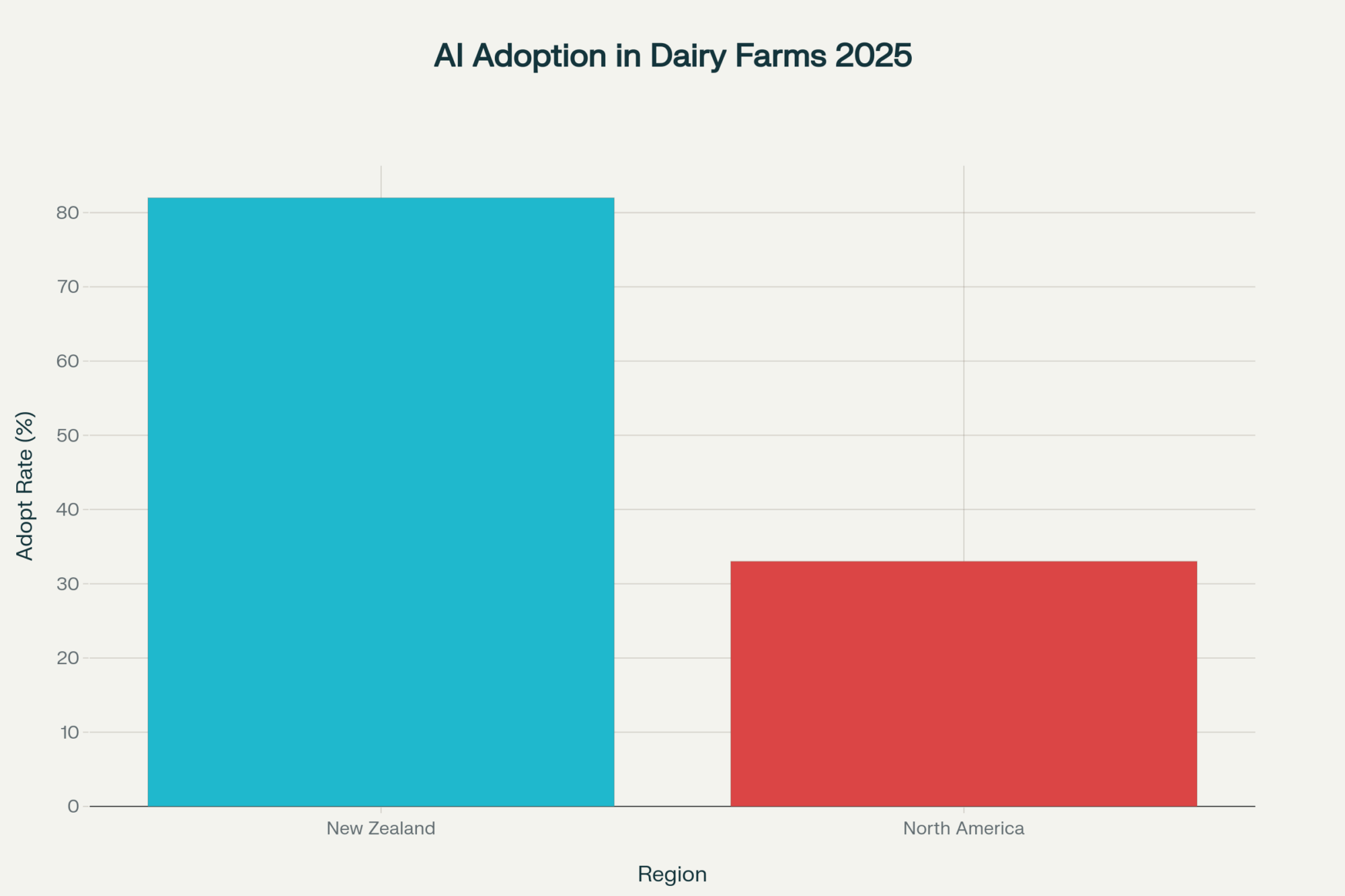
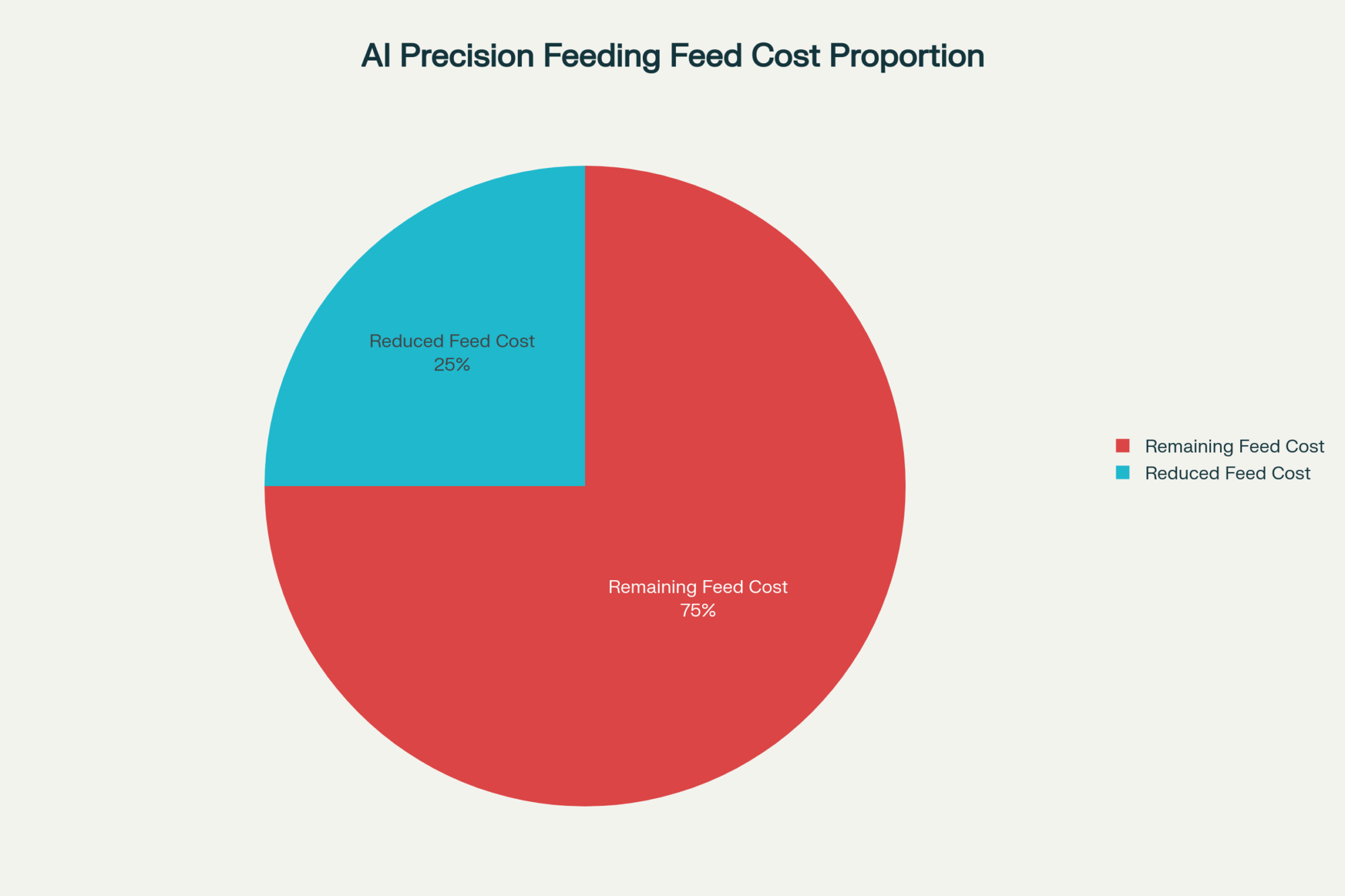
Executive Summary: Here’s the deal—precision tech isn’t a future dream anymore; it’s putting real money in farm checks. Farms adopting these tools report an extra $200–$400 net profit per cow annually. Feed costs can drop by up to 25%, and automated health checks catch lameness with 85% accuracy—double what a quick barn walk finds. From Europe, trimming carbon footprints by 6–9%, to bold moves in Denmark and the Midwest, this trend marries profit with sustainability. Cornell and UC Davis experts warn that the gap between adopters and laggards is widening. With milk selling for around $19/cwt, squeezing margins, this is a no-brainer ROI play—you should consider this now.
Key Takeaways
Cut feed costs by up to 25% with AI-optimized rations—talk to your nutritionist about precision feeding to lock in savings this season.
Save $300–$500 per cow annually by catching lameness early—install automated health monitors as per Journal of Dairy Science findings.
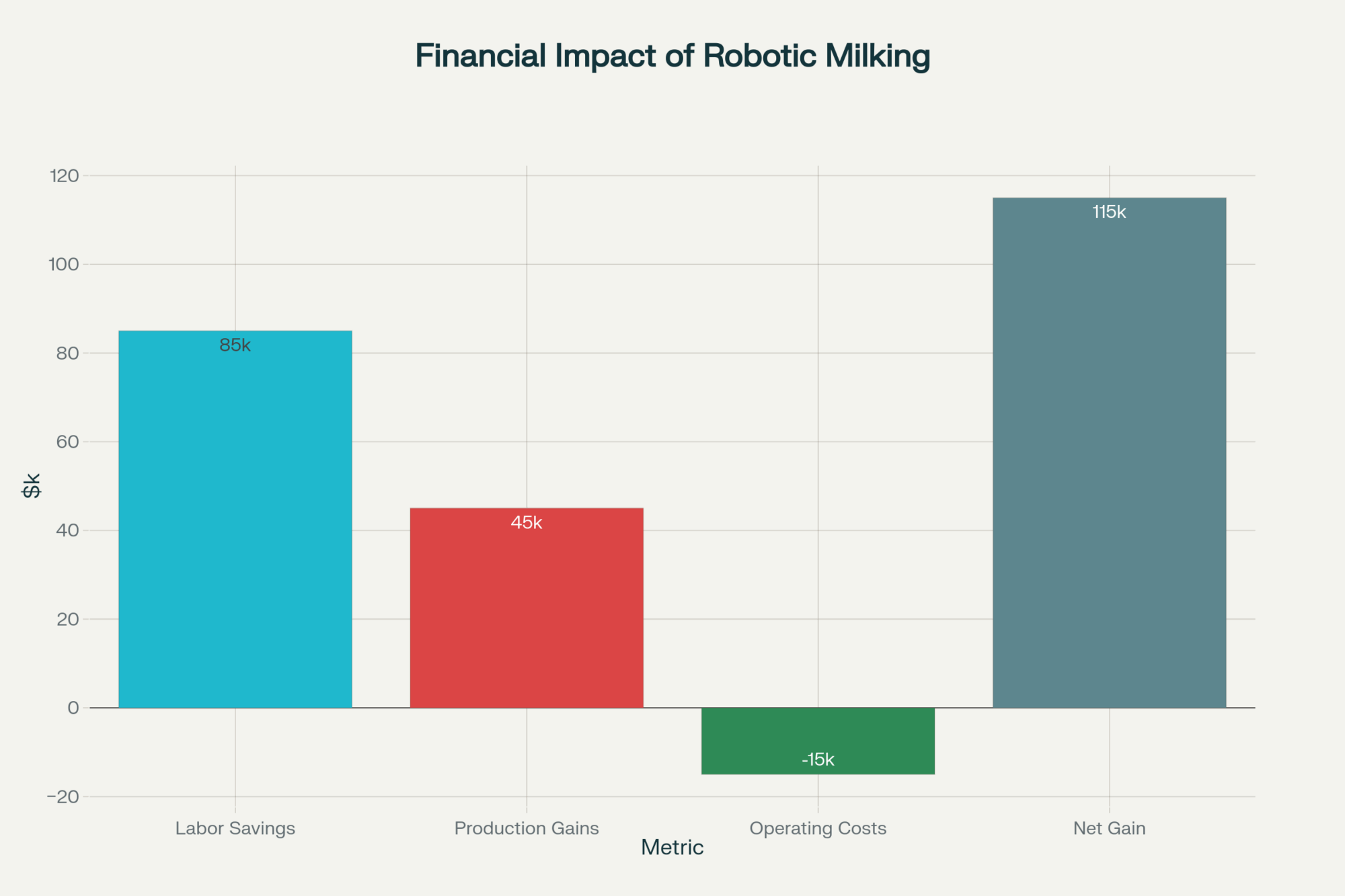
Expect a 2–5 year payback on robotic milking investments, which is critical when $19/cwt milk prices erode margins.
Confirm your infrastructure: 480 V three-phase power and at least 25 Mbps upload—tech only pays if it runs smoothly.
Watch regional trends: the Midwest races toward robotics, the West maximizes feed efficiency in drought, and Europe drives carbon cuts—tailor your strategy accordingly.
Let’s be clear about AI in dairy: it’s not theory anymore—it’s cash in your pocket. Farms using these tools are seeing an extra $200–$400 in annual cash flow per cow. This isn’t just one miracle gadget; it’s a savvy mix of feed savings, sharper health monitoring, and production boosts.
Slashing Feed Costs, Boosting Herd Health
Feeding has long been the farm’s biggest cost drain. Precision feeding systems can pay for themselves in as little as two years, typically by year four. According to a 2024 University of Illinois Extension bulletin, AI-optimized rations trim about $0.30 per cow per day in feed costs without denting yields.
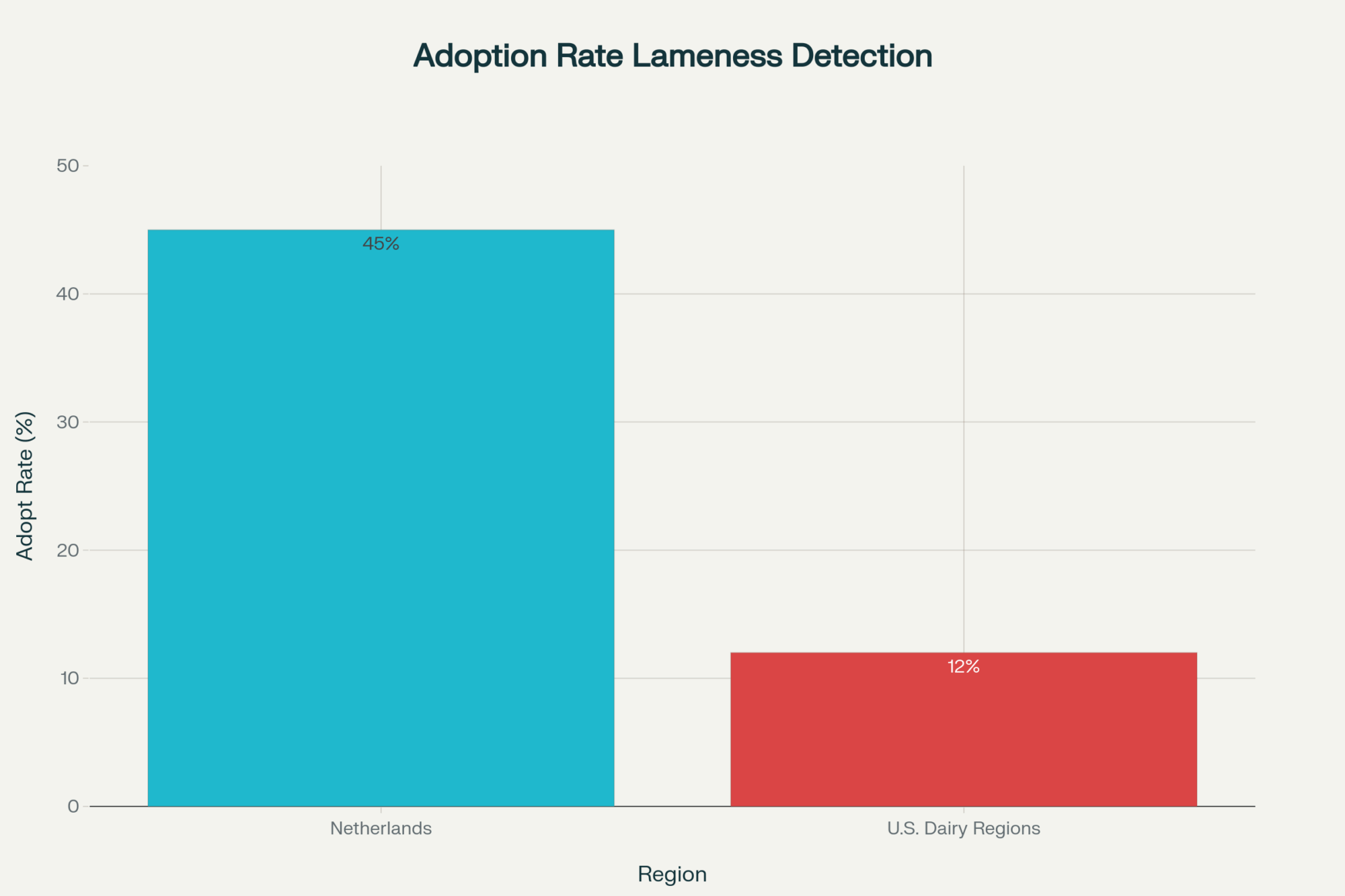
Health monitoring is quietly emerging as a key player. A 2023 Journal of Dairy Science study found that automated systems spot lameness with 85% accuracy—double the accuracy of what we detect by eye—saving around $300–$500 per cow annually and boosting fertility, as confirmed by Cornell research.
At milk near $19 per hundredweight and feed gobbling over half the check, automation is no longer a luxury. European farms under strict sustainability mandates reduce their carbon footprints by up to 9% while maintaining—or even increasing—production.
From Robots to Lameness Detection: Tech in Action
Today’s tech watches over 50 cow behaviors—from chewing time to standing duration—flagging trouble days before visible symptoms. Here are a few standout examples:
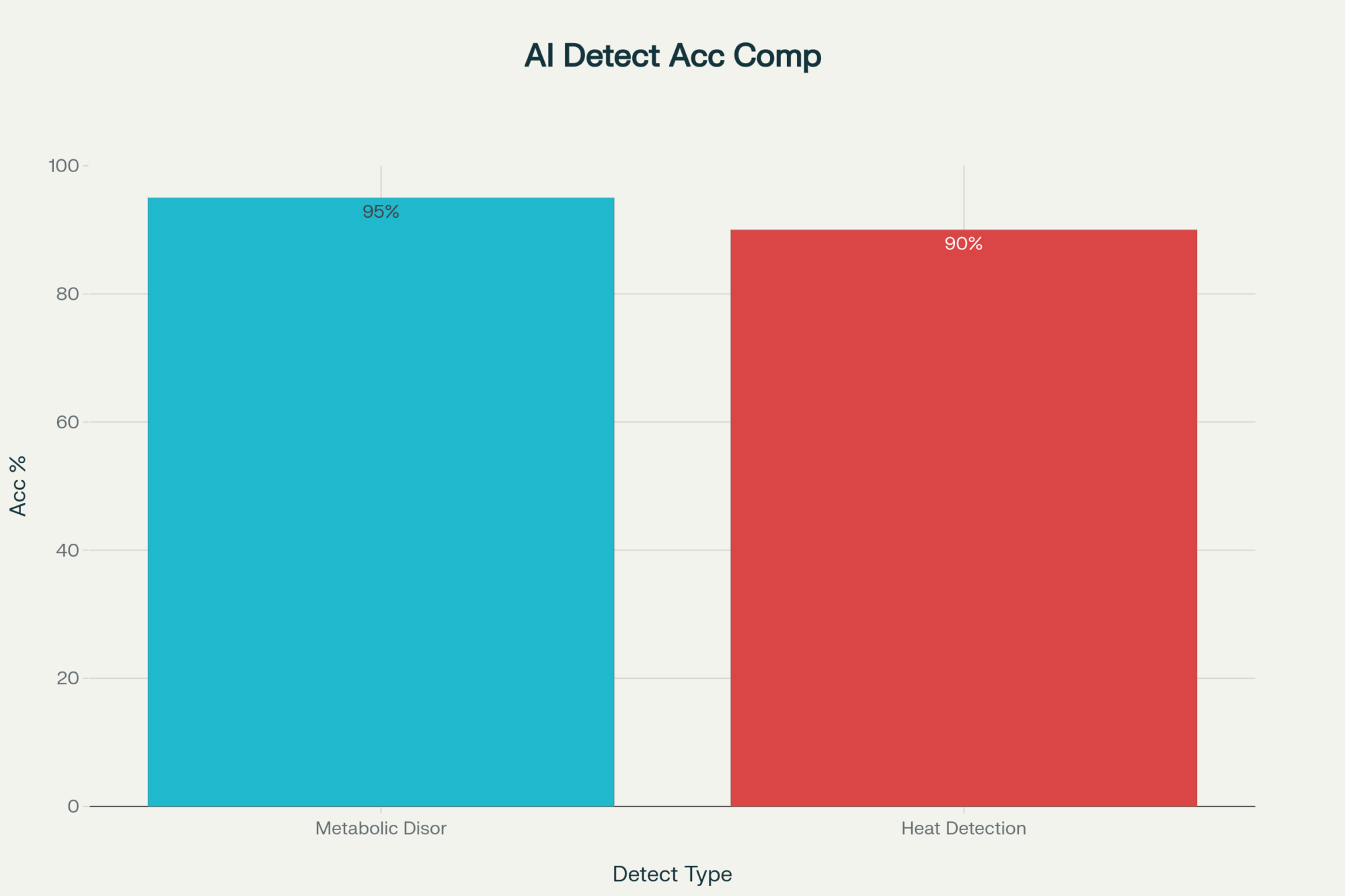
SCR’s Heatime system hits 95% accuracy in detecting heats. With its acquisition of CattleEye, GEA now monitors over 100,000 cows worldwide for lameness and changes in condition.
The Vray Holsteins farm in France, a roughly 200-cow operation, recorded a 10% production increase after installing Lely A4 robots, with fresh cows regularly producing over 40 kg/day.
Calculating the Real Cost of Automation
The initial investment for robotic systems ranges from $75,000 for small setups to over $ 600,000 at scale. Brazilian studies suggest a typical payback near five years. Additionally, budget for annual maintenance (15–20% of capital costs), software subscriptions, and increased electricity bills.
Avoiding the Implementation Pitfalls
Implementation hurdles often boil down to wiring and team training. Purdue’s Dr. John Bernard recommends phased rollouts—start small, build confidence, then scale.
Infrastructure: Rock-solid 480 V three-phase power and ≥ 25 Mbps upload.
Integration: Systems must “talk” or data silos stall progress.
Flag 3–5 high-risk cows weekly via lameness alerts; treat within 48 hrs.
Verify electrical/internet readiness before upgrades: 480 V three-phase, 25 Mbps upload.
Phase rollouts over 3–6 months, prioritizing staff training and data integration.
The Verdict: Adapt or Be Left Behind
Halter’s $100M raise vaulted its valuation past $1B; McKinsey forecasts up to $90B in ag-AI value by 2030. Regional flavors matter: Midwest automation for labor, West precision feeding amid drought, Europe’s sustainability tech, and Denmark’s near-universal robotics.
Dr. Sarah Johnson of UC Davis warns that the gulf between adopters and laggards is widening. Cornell’s Dr. Michael Gould of the Dyson School offers a stark conclusion:
“At Cornell, we say waiting could cost you your competitive edge—the time to act is now.”
This isn’t tinkering at the edges; it’s a farm-management revolution. The pack is already sprinting. The only question is whether you’ll lead it or watch it disappear over the horizon.
Complete references and supporting documentation are available upon request by contacting the editorial team at editor@thebullvine.com.
Learn More:
Maximize Dairy Farm Efficiency: How Robots Can Cut Costs When Managed Properly – This article provides a tactical guide to robotics, moving beyond ROI to focus on the hands-on management required to truly maximize efficiency, reduce costs, and improve herd comfort and health—essential for anyone considering the operational side of automation.
AI and Precision Tech: What’s Actually Changing the Game for Dairy Farms in 2025? – For a strategic overview, this piece frames precision technology as a survival tool in a tight market. It details the economic trends driving adoption and breaks down the specific ROI timelines for different technologies, from feeding systems to virtual fencing.
Every week, thousands of producers, breeders, and industry insiders open Bullvine Weekly for genetics insights, market shifts, and profit strategies they won’t find anywhere else. One email. Five minutes. Smarter decisions all week.
US dairy herds are growing at the fastest rate since 2008, with the worst heifer shortage in 50 years. How’s that even possible?
EXECUTIVE SUMMARY: Here’s what’s blowing my mind right now. We’re expanding dairy herds faster than we have since 2008, even though replacement heifers have just reached their lowest level since 1978 — a mere 3.9 million head available nationwide.The math shouldn’t work, but it does because farmers are keeping cows longer instead of culling them. Why? Because buying replacements now costs nearly $3,000 per head, with some California operations paying over $3,800 for bred heifers.Meanwhile, Texas is crushing it with 50,000 new cows and 10%+ increases in per-cow production. And get this — 72% of farms are now using beef-on-dairy genetics to squeeze more value from their bottom-tier animals. The butterfat numbers are actually improving, despite the age of the herds, jumping from 4.17% to 4.24%.This isn’t just an American thing — it’s part of a global shift in how we think about dairy economics and herd management. You need to start adjusting your strategy now, as the old rules no longer apply.
KEY TAKEAWAYS
Replacement economics are brutal — at $ 2,870 per head or more, extending lactations becomes profitable, even with increased health costs. Start tracking which cows justify the extra investment in monitoring tech.
Beef-on-dairy isn’t optional anymore — 4 million crossbred calves in 2024 heading to 6 million by 2026. Evaluate your bottom 30% for strategic beef crosses and check local auction prices for crossbred premiums.
Data-driven culling is the new normal — successful farms run monthly profit analyses on every cow over 36 months. Invest in rumination monitors and activity trackers if you’re serious about extended lactations.
Texas demonstrates what’s possible — their 10.6% production increase per cow, while adding 50,000 head, proves that scale and efficiency can work together. Study their management systems for ideas that fit your operation.
Cash flow modeling is critical — with interest rates climbing and feed costs volatile, you can no longer afford to wing it. Model extended lactation costs versus replacement purchases using your actual numbers, not industry averages.
The thing about dairy expansion in 2025 is it’s downright wild. Here we are, with American dairy farmers growing their herds at the fastest pace since 2008 — even though replacement heifer numbers have dropped to the lowest level in nearly 50 years.
If you’re scratching your head, wondering how that happens, trust me, you’re not alone. This paradox isn’t just a curiosity—it’s rewriting the playbook on herd growth.
The Numbers That Don’t Add Up
Take the numbers: According to a recent analysis from Dairy Management Inc. (DMI) and USDA’s January 2025 Cattle Inventory report, the national dairy herd is climbing — but replacement heifers have plummeted to around 3.9 million, the smallest count since 1978.
Here’s the kicker — from September 2023 through March 2025, farmers slaughtered nearly 500,000 fewer cows than expected, per recent data. That “hold onto older cows” strategy has basically propped up the national herd in ways none of us predicted.
But is it sustainable? Just holding cows longer comes with significant risks and costs, and many farmers are feeling the pinch.
When Replacement Economics Get Crazy
Pricing plays a significant part in this story. USDA data show that replacement heifer prices increased to an average of $2,870 in April 2025. Sure, that’s jaw-dropping — but anecdotal reports and auction results from several regions show even crazier bids. For example, some heifers are reportedly fetching over $3,800 a head at auction.
That kind of premium is forcing producers to rethink their culling practices — keeping cows they might have culled before, simply because replacing them is no longer financially feasible.
What’s interesting is that milk quality hasn’t taken a hit. According to a detailed Bullvine study, butterfat percentages have actually risen from 4.17% to 4.24% year-over-year, and component-adjusted milk production has increased by 3%. It appears that years of genetic investment are finally paying off.
The Beef-on-Dairy Revolution
Now, one of the game changers? Beef-on-dairy breeding. Data from Farm Bureau indicates 72% of dairy farms are now using beef genetics to boost the value of calves from lower-performing cows.
This trend gained momentum in 2024, with nearly 4 million crossbred calves born nationally, a figure forecasted to reach 6 million by 2026. And nowhere is this more obvious than Texas, where herd counts ballooned by 50,000 cows, complemented by a production spike of over 10% per cow.
Of course, such growth raises questions about sustainability. Water scarcity, especially concerning the Ogallala Aquifer, looms large. But that’s a story for another day.
Feed Economics and Longevity
This strategy also hinges on feed economics and longevity. Nutrition experts point out that cows in their third or fourth lactations tend to convert feed more efficiently than first-lactation heifers, but this isn’t a simple fix.
Managing longer lactations demands precision — automated rumination monitors and activity trackers are proving essential. Field reports from progressive operations, including one in Wisconsin, demonstrate that extending average lactations from 2.8 to 3.2 over just a few years yields significant benefits.
However, don’t fool yourself — this increased longevity comes with risks. Fertility dips, udder health challenges, and mobility issues. Without top-tier herd health protocols and facilities, these can quickly erode profits.
Add financial headwinds — with current interest rates higher than many have seen — and the risk scale tips even further.
What Smart Producers Are Doing
Smart farms are responding with surgical decisions — beef genetics on the lower tier, heavy genomic investments on the best cows.
Some are running monthly profitability analyses on individual cows over three years old, matching management micro-decisions with broader goals. Are you tracking your cows at that level? Because that’s where the industry’s heading.
The successful operations I’m seeing aren’t just extending lactations randomly — they’re being strategic about which animals receive the extended treatment and which ones are bred for beef.
Bottom Line: Your Monday Morning Action Plan
If you’re not already reviewing your herd and strategy with this data-driven lens, now’s the time.
Start by evaluating which cows are prime candidates for beef breeding. Track your local auction results for beef-cross calves to understand which sire genetics are bringing the highest premiums.
Invest in health monitoring tech ASAP. Without good data on rumination, activity, and health indicators, you’re flying blind on extended lactation decisions.
Tighten your genetics spend. When replacements cost nearly three grand, every breeding decision matters more than ever.
Reinforce herd health programs focused on fertility, mastitis prevention, and mobility. These become critical when you’re counting on cows for additional lactations.
And don’t forget cash flow — crunch those numbers and run scenarios comparing extended lactation costs versus replacement purchases. Factor in your specific feed costs, facilities, and management capabilities.
This is a moment of big change — a rewriting of the rules that have governed dairy expansion for decades.
Those who grasp these evolving dynamics first will set the pace and shape the future. The question isn’t whether this trend will continue… it’s whether you’ll be leading it or following it.
So, what’s your move?
Complete references and supporting documentation are available upon request by contacting the editorial team at editor@thebullvine.com.
Learn More
Why Reduced Culling is Inflating Heifer Prices – Go deeper into the market forces driving record-high replacement costs. This strategic analysis breaks down the long-term economic implications of reduced culling, helping you make smarter financial decisions about when to buy, sell, or raise your own heifers.
Beef on Dairy: Are You Maximizing Your Opportunities? – This article provides a tactical guide for optimizing your beef-on-dairy program. It reveals practical strategies for sire selection and terminal cross-breeding to maximize the marketability and value of every crossbred calf, turning a good idea into a significant profit center.
The Data Doesn’t Lie: How Herd Monitoring Is Revolutionizing Dairy Management – Explore the technology that makes extended lactations profitable and sustainable. This piece demonstrates the clear ROI of modern herd monitoring systems, revealing how data on health and rumination can directly reduce culling, improve longevity, and secure your herd’s future.
The Sunday Read Dairy Professionals Don’t Skip.
Every week, thousands of producers, breeders, and industry insiders open Bullvine Weekly for genetics insights, market shifts, and profit strategies they won’t find anywhere else. One email. Five minutes. Smarter decisions all week.
Where should you really be milking in 2025? Hint: It’s not where you think.
EXECUTIVE SUMMARY: Here’s the deal: dairy’s economic heart is shifting to the Plains, fast. Kansas milk production jumped 18.64%, South Dakota’s rose 10.64%, and the combined investment in processing has topped $2 billion since 2020. Those numbers aren’t just stats—they mean smaller hauling costs, stronger margins, and better feed efficiency according to Kansas State’s latest research. Meanwhile, Wisconsin lost over 300 farms, but milk production’s holding steady by consolidating on bigger, more efficient farms. Globally, efficiency and cost advantages drive production shifts—and the US Plains are no exception. If you’re considering where to grow or reinvest, it’s time to examine the economics, from water reliability to mailbox prices. This isn’t about tradition—it’s about profitability. You should be watching these trends closely and adapting now.
KEY TAKEAWAYS:
Kansas and South Dakota reported milk production gains of over 10% in 2025, driven by infrastructure investments. Producers should evaluate nearby processing plants to reduce hauling costs and boost margins in today’s volatile market.
Feed conversion improvements in new Plains dairies give a measurable cost advantage—start tracking feed efficiency with DairyComp and compare to regional benchmarks for better ROI.
California faces high regulatory costs (~$245/cow) but offsets some with digester and LCFS credits—producers should assess environmental programs’ ROI and explore similar revenue streams.
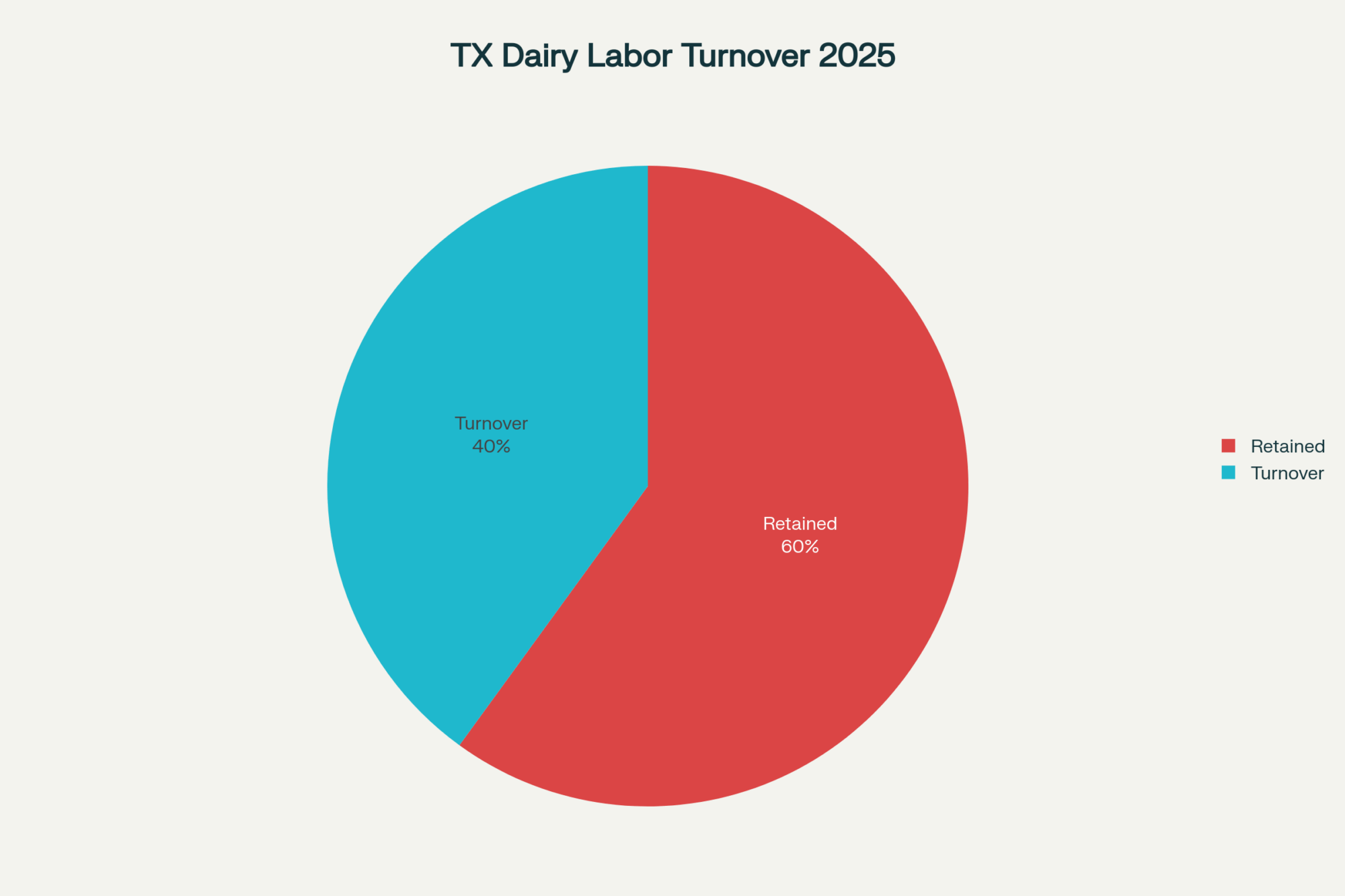
Labor turnover exceeds 40% in parts of Texas; implementing effective retention practices can help stabilize operations, reduce costs, and improve herd performance in the 2025 tight labor market.
Land values in key Plains expansion areas jumped 22%, so timing land purchases carefully and monitoring cropland prices are vital for strategic growth and profitability.
While traditional dairy states grapple with rising costs and regulatory pressures, a new economic reality takes hold in America’s heartland. According to August 2025 data from USDA-NASS, Kansas posted an 18.64% jump in milk production from the previous year, with South Dakota following at 10.64%. Since 2020, milk output has grown the fastest in Texas, South Dakota, and Kansas, while legacy states like Wisconsin and California have maintained their volume through consolidation, rather than by adding farms. The net effect is more milk being produced closer to new processing plants — and farther from some older ones.
The Data Driving the Shift
The numbers from Kansas are striking, with the state delivering an 18.64% increase in milk production from the previous year, followed closely by South Dakota at 10.64%. Texas continues to cement its position, producing 1.51 billion pounds in July while steadily expanding its herds.
What really stands out is how these newer Plains dairies are improving feed conversion. Agricultural economists at Kansas State University reported meaningful efficiency gains, meaning these farms get more milk from every pound of feed compared to older operations — a critical advantage when feed costs remain stubbornly high.
South Dakota’s growth is similarly well-founded. Herd numbers are up, and the state has seen substantial investment in infrastructure and feed supply, supporting sustained expansion.
Meanwhile, Wisconsin faced the closure of 313 dairy farms in 2024, highlighting the pressure on producers in traditional regions. However, production has remained resilient as dairy cows are consolidated on fewer, more efficient farms, helping maintain output and profitability.
California faces similar challenges — but with key advantages. California dairy producers benefit from proximity to major processors, higher milk solids, and revenue streams from digester-generated energy and Low Carbon Fuel Standard (LCFS) credits, which can offset some regulatory costs.
The Core Economics: Water, Labor, and Regulation
Water adds considerable complexity. Parts of the High Plains, particularly western Kansas and the Texas Panhandle, rely heavily on the Ogallala Aquifer, where water levels are declining rapidly. However, other regions, like eastern South Dakota and Nebraska, experience more stable groundwater supplies. For long-term investments, reliability and costs — including heat stress-related cooling — must factor heavily into planning.
California producers face strict water regulations, which drive up costs and incentivize innovative solutions. Regulatory costs are high, but partly offset by additional revenue from environmental credits and proximity to processing facilities.
Labor is another hurdle. Automation and efficient facility design help newer Plains dairies reduce labor per hundredweight of milk. Wisconsin and California are adapting—but the learning curves and capital needs remain significant.
Regulatory compliance costs in California are among the highest in the country — estimated at roughly $245 per cow annually, compared with $70 per cow in Plains regions. But environmental credits help some producers offset these expenses. Still, overall operational costs remain a significant factor in expansion decisions.
Where the Smart Money Is Flowing
Since 2020, investors have poured over $2 billion into dairy processing infrastructure across Kansas, Texas, and South Dakota, including expansions at the Hilmar Cheese plant in Kansas, Leprino Foods facilities in Texas and Colorado, and Valley Queen Cheese’s plant in South Dakota. These investments support and attract growing milk supplies in the region.
One 1,800-cow Plains dairy operator, speaking on the condition of anonymity, said, “The cost advantages out here allow us to reinvest and grow in ways that weren’t possible back East.”
Access to favorable financing tends to favor larger operations, though exact rates vary and are often proprietary.
Automation investments, such as milking systems, typically pay back in 18-24 months on average in these growth areas, driven by increased production and labor savings.
Proximity to processing plants is also a game-changer. The Plains benefit from facilities like Hilmar Cheese in Kansas, Leprino’s operations in Texas and Colorado, and Valley Queen in South Dakota. Herds delivering milk over shorter distances avoid the margin erosion caused by long-distance hauling.
Growth Pains: Risks to Watch
The National Weather Service highlights increasing weather variability in the Plains, posing risks to feed costs and cow comfort management.
Labor challenges persist, with turnover rates exceeding 40% at Texas dairies, according to the Texas Association of Dairymen.
Export demand appears promising, with the USDA projecting 4-6% growth for 2025; however, trade policies pose risks to maintaining this momentum.
Land prices are climbing rapidly. The Kansas City Fed reports a 22% increase in cropland values in Western Missouri over the past year, restricting the window for affordable expansion.
Disease outbreaks, animal movement restrictions, and gaps in insurance coverage for extreme weather add additional risk layers.
Why Scale Matters
Research by Cornell University confirms that dairies running more than 2,000 cows achieve significant economic advantages across geographies.
Your Strategic Takeaways
Monitor mailbox pricing and basis differences carefully, as these swings impact profitability more than volume changes. Track feed and forage costs, including sourcing silage and alfalfa locally versus transporting feed into expanding regions. Factor hauling distances and processing capacity availability into your cost analysis.
Consider potential impacts from upcoming federal milk marketing order reforms, which may alter class price relationships and influence regional payouts.
Test the sensitivity of your operation to 15% variations in feed costs, $1 modifications in milk prices, and additional cooling hours due to heat stress to refine strategic plans.
Look, I know change isn’t easy in this business. But the numbers don’t lie—and neither do your margins. Whether you’re considering expansion, exploring new technology, or simply trying to stay competitive, these shifts are happening whether we like it or not.
What do you think? Are you witnessing any of this unfold in your area?
Complete references and supporting documentation are available upon request by contacting the editorial team at editor@thebullvine.com.
Learn More:
The Unseen Costs of Employee Turnover on Your Dairy – Our analysis flags the 40% turnover in Texas as a major risk. This article breaks down the hidden financial drain of that churn and provides practical strategies for improving employee retention to cut costs and stabilize your workforce.
Is Your Dairy Ready for the AI Revolution? – We’ve established efficiency as a key driver for growth. This piece explores the next frontier: artificial intelligence. It demonstrates how to leverage predictive analytics for superior herd health, reproductive performance, and enhanced profitability in a competitive future.
The Sunday Read Dairy Professionals Don’t Skip.
Every week, thousands of producers, breeders, and industry insiders open Bullvine Weekly for genetics insights, market shifts, and profit strategies they won’t find anywhere else. One email. Five minutes. Smarter decisions all week.
Milk prices held steadier than expected last week — but the underlying pressures are real. Here’s what smart producers are doing.
EXECUTIVE SUMMARY: Listen up — there’s some serious turbulence brewing in dairy markets right now. The Global Dairy Trade auction saw just a 0.3% price dip, but don’t let that fool you — U.S. cheese prices plummeted nearly 4% in one week, and China’s still pulling back hard from imports while Europe floods the market with surplus milk. Here’s what caught my attention… the producers who are thriving right now aren’t the ones with the most cows — they’re the ones milking smarter, not harder. We’re talking about farms that can break even at $17/cwt, while others are scrambling at $20. The difference? They’ve got their feed costs locked down, they’re culling strategically, and they’re using risk management tools that most farmers ignore. This isn’t just a rough patch — it’s a fundamental shift separating the wheat from the chaff.
KEY TAKEAWAYS:
Lock in your downside with Dairy Revenue Protection — it’s not just insurance, it’s profit protection when milk hits $16-17/cwt (and with current trends, that’s not fantasy anymore)
Feed strategy wins are real money — producers locking soybean meal contracts now are saving $30-50 per cow monthly compared to spot pricing
Strategic culling delivers 5-12% efficiency gains — removing the bottom 20% performers can boost your per-cow average by 200+ pounds monthly
Lender relationships matter more than ever — proactive communication about cash flow keeps credit lines open when markets get ugly (and they’re getting ugly)
Market intelligence pays — tracking Global Dairy Trade auctions and China’s import data gives you a 2-3 week advance warning on price moves that can make or break your quarter
We get it. You see those market signals, and it makes your stomach drop.
Let’s sit down with a coffee and unpack what’s really going on with the dairy market in 2025—and what you can do on your farm to face these times head-on.
The Numbers Don’t Lie — And They’re Talking
Here’s what the latest data tells us:
U.S. milk production in July 2025 hit 19.23 billion pounds, up 3.3% from last year, with nearly 9.47 million cows and average milk per cow climbing about 1.7% to over 2,000 pounds monthly. What’s particularly noteworthy is that producers across the Midwest are crediting better herd management and refined feeding programs with driving these gains.
Meanwhile, European producers aren’t sitting idle. EU milk production reached 160.8 million tonnes in 2023, marking steady growth driven by favorable weather conditions and lower feed costs.
Now here’s the kicker: China, our longtime dairy superconsumer, has pulled back hard. Multiple industry reports confirm that they’ve dramatically scaled back imports due to high inventories sitting in warehouses, as well as economic headwinds that aren’t expected to subside anytime soon.
Look at the Global Dairy Trade auction on August 19—prices declined just 0.3%, suggesting some market stabilization after months of volatility. To put that in perspective, Fonterra’s benchmark unsalted butter sold for $7,175 per tonne, while their key Whole Milk Powder product fetched $4,025 per tonne.
But closer to home? CME cheese prices tell a different story.
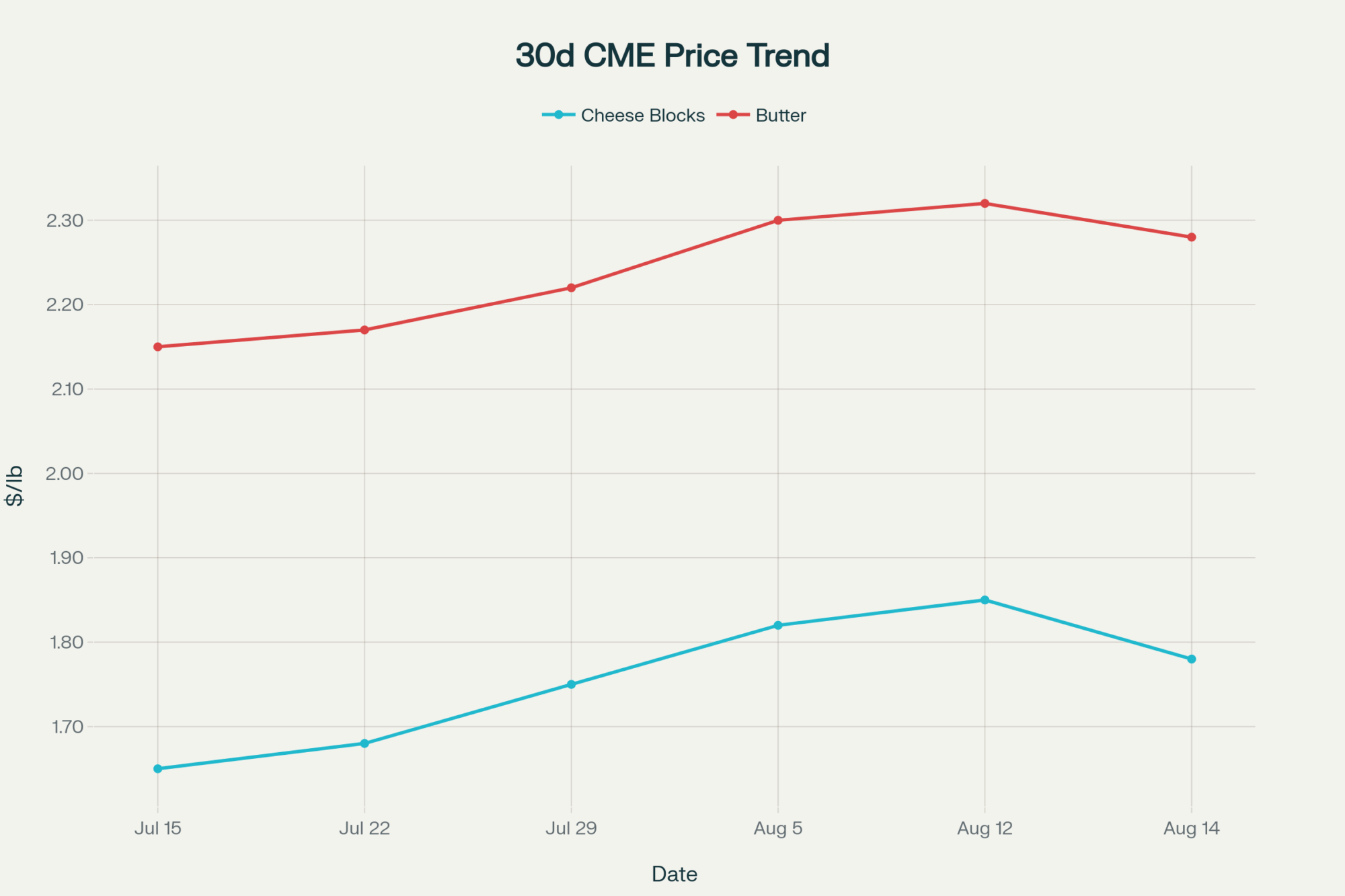
Block cheddar dropped from $1.83 to $1.76 per pound (a 3.8% decline), while barrel prices took a 5% hit over the week ending August 22. Meanwhile, the European Mild Cheddar index is holding firmer at €4,435 per tonne, showing some regional price differences. That’s your classic foodservice demand warning signal right there.
What You Need to Do Right Now
If you can’t break even with milk around $17/cwt, it’s time for a hard look at your cost structure. Here’s what smart producers are focusing on:
Get serious about risk management. Tools like Dairy Revenue Protection aren’t just government programs—they’re lifelines when markets get nasty.
Optimize your feed strategy. With grain markets looking somewhat friendlier than last year, this might be your chance to lock in favorable contracts, especially on soybean meal. But don’t get greedy—flexibility has value too.
Make tactical culling decisions. I know it’s painful, but removing your lower-performing cows earlier can save serious feed costs and help you right-size production for market realities.
Don’t ghost your lender. Keep that relationship strong. Share your numbers, explain your plan, and show them you’re thinking ahead.
The Big Picture — Supply, Demand, and Reality
Here’s what’s fascinating about this cycle:
Europe’s creating what everyone’s calling a “wall of milk,” with massive volumes getting processed into skim powder. The U.S. is steadier but still quietly adding volume through those productivity gains I mentioned.
Add in the Southern Hemisphere’s seasonal flush—New Zealand’s spring milk is just starting to ramp up—and you’ve got a supply picture that’s, frankly, overwhelming.
But demand? That’s where things get interesting.
China’s absence has left this massive hole that nobody else can fill. This is creating some interesting trade shifts. For example, with European products needing a home, recent shipments of EU butter to the U.S. surged by over 80%. At the same time, China has been taking advantage of lower tariffs to buy huge volumes of whey from the U.S., even while shunning milk powder.
Southeast Asia and the Middle East are buying, sure, but they’re opportunistic and price-sensitive. They’ll nibble at the edges, but they can’t absorb the surplus.
Technology in Tough Times
What strikes me is how many producers continue to invest in automation, despite tight margins.
Robotic milking systems are now operating on about 20% of Canadian farms, and I get why—better consistency, reduced labor headaches, more detailed cow monitoring.
But let’s be real: these aren’t magic bullets. Recent industry analysis indicates that while efficiency improvements can be substantial, success ultimately depends on how effectively you manage both the technology and your operations. In this market, you’d better have rock-solid numbers before making that kind of investment.
Eyes on the Horizon
Mark your calendars for a few key dates:
The next Global Dairy Trade auction, scheduled for September 2, will reveal whether the price stabilization holds. China’s August import data (due in mid-September) could be a real game-changer if it signals a resumption of buying. Europe’s production report in late September will tell us if their supply surge is finally moderating.
And here’s something most folks miss: keep an eye on the U.S. Restaurant Performance Index. It’s your early warning system for foodservice demand, which drives a huge chunk of cheese consumption.
Bottom Line — Tough Times, Tougher Farmers
This industry has weathered brutal cycles before, and this time will be no different.
The producers who stay sharp on their numbers, utilize available safety nets, and make tough decisions now will be the ones who emerge stronger. This downturn won’t last forever, but the choices you make today will define your operation tomorrow.
The bottom line? While everyone else is complaining about prices, savvy operators are positioning themselves to emerge from this downturn stronger than when they entered.
What strategies are working on your farm to weather this storm? Share your insights in the comments below.
Complete references and supporting documentation are available upon request by contacting the editorial team at editor@thebullvine.com.
Learn More:
Dairy Farming’s Brutal Reality: The Cold Hard Truth About the Cost of Production – This article provides a tactical masterclass in cost management. It reveals practical methods for analyzing your true cost of production, helping you identify immediate opportunities for efficiency gains that are crucial for profitability in a down market.
The ROI of Dairy Automation: Is It Worth the Investment? – This piece examines the real-world return on investment for the technologies mentioned in the main article. It demonstrates how to evaluate if automation is the right fit for your operation, ensuring your capital investments directly translate into measurable cost savings.
The Sunday Read Dairy Professionals Don’t Skip.
Every week, thousands of producers, breeders, and industry insiders open Bullvine Weekly for genetics insights, market shifts, and profit strategies they won’t find anywhere else. One email. Five minutes. Smarter decisions all week.
Fonterra’s about to pocket 5x more revenue per dollar by ditching consumer brands. Smart move or missed opportunity?
EXECUTIVE SUMMARY: Look, here’s what’s really happening with Fonterra’s potential consumer brand sale… They’ve figured out something most co-ops haven’t: ingredients make 5x more money per dollar than consumer products. We’re talking NZ$17.4 billion from ingredients versus just NZ$3.3 billion from brands like Anchor.Meanwhile, European giants are consolidating into €19 billion powerhouses, and sustainability programs are paying farmers up to 25 cents extra per kg of milk solids. The kicker? Precision feeding tech is saving farms $180-220 per cow annually with payback in 18-24 months.Bottom line — whether you’re milking 200 cows or 2,000, this shift toward specialization and tech adoption isn’t optional anymore. You need to pick your lane and dominate it.
KEY TAKEAWAYS
Focus pays off big: Fonterra’s ingredients-first strategy delivers 500% better returns than trying to do everything — time to audit where your farm really makes money
Sustainability = serious cash: Programs now paying up to 25c/kg milk solids for verified environmental practices — audit your practices this month to capture these premiums
Tech ROI is proven: Precision feeding delivers 8-12% better feed conversion, saving $180-220 per cow annually — calculate your payback today (hint: it’s under 2 years)
Size determines strategy: Small farms (<200 cows) should focus on niche markets, medium operations (200-800) need to modernize or specialize, large farms (>800) should lead with AI and robotics
Consolidation creates opportunity: With fewer but bigger buyers, quality producers finally have leverage again — now’s the time to position as a preferred supplier
Have you ever had one of those mornings where the coffee and the news combine to make you stop and say, ‘Wait — did everything just shift?’ That’s the vibe right now as Fonterra explores selling their consumer portfolio, including household names like Anchor and Mainland. This isn’t a done deal yet, but the portfolio’s worth billions, and the shakes are starting in the industry.
Now, potential buyers — including giants like Lactalis — could be gearing up to make a massive move, signaling a big shift in how milk gets from your parlor to global markets. It’s a move that redefines the dairy playbook.
Fonterra’s ‘Ingredients First’ Strategy: Why Focus Pays Off
Let me tell you, Fonterra’s leadership isn’t reacting out of fear. The data from their latest report shows that the ingredients division moves about 80% of their milk and pulls in close to NZ$17.4 billion — dwarfs the consumer segment that grabbed around NZ$3.3 billion and has struggled with impairments, as detailed in The Bullvine’s coverage of Fonterra’s financial turnaround.
This paints a clear picture: ingredients deliver more than five times the revenue per dollar compared to consumer products. So doubling down on what pays and letting specialists handle the rest is smart business widely seen in boardrooms right now.
Interestingly, the consumer division isn’t a deadbeat. It actually showed a 103% profit jump in Q3, FY24. No panic selling here — more like strategic repositioning.
Across Midwest co-ops, there’s a buzz about this partner/not-own model. The recipe? Really scrutinize where value is created, plug the complex bits into partners’ hands, and prioritize returning capital to your producers instead of chasing too much growth.
But it won’t be easy. Transitioning ownership is rarely seamless. Industry estimates show retention is about 85-90%, and merging a Kiwi cooperative culture with the corporate efficiency of a French multinational will present significant hurdles.
Graduating to the Big League: Consolidation and Supply Crunch
Out on the European front, dairy is consolidating fast. Cooperatives are merging into mega players valued over €19 billion, as covered in The Bullvine’s analysis of the Arla-DMK merger. That means fewer but much mightier players, shifting power dynamics completely.
“The leverage is shifting back to quality producers for the first time in years,” according to a leading dairy market analyst we spoke with.
At the same time, environmental rules and shrinking herds are tightening supply, pushing prices higher and sending premiums into overdrive. Premium dairy is growing at somewhere between 7-12% CAGR, while commodity milk grows just 2-4%.
How Sustainability Delivers Payday
Speaking of cash, Fonterra’s now paying producers up to 25c/kg of solids for verified sustainability improvements, part of broader industry trends explored in The Bullvine’s sustainability coverage. If you’re not factoring that in, you’re leaving potential revenue on the table.
How Dairy Tech Delivers Real ROI
Recent studies show precision feeding improves feed conversion 8-12%, saving $180-220 per cow annually with investments typically paid off within 18-24 months, as detailed in The Bullvine’s precision technology analysis.
AI systems for lameness detection are no gimmick, reaching over 99% accuracy and helping save thousands in treatment and lost production on farms around the world. The Bullvine has extensively covered how this technology is revolutionizing herd health management.
What This Means By Farm Size
Farm Size
Financial Impact
Operational Changes
Tech Uptake
Small (<200 cows)
Indirect benefits, price stability
Steady contracts, minimal change
Tech adoption limited by cost
Medium (200-800)
Moderate gains, modernization pressure
Adjust supply relationships
Growing tech adoption
Large (>800)
High returns, premium access
Complex contract management
Leading in AI and robotics
“The middle ground is disappearing—either scale or carve out a niche,” said a leading dairy analyst.
A Practical Plan For Your Farm
Next 30 days
Benchmark milk quality and components against DHIA data
Calculate potential tech ROI and prioritize investments
Audit sustainability programs and capture incentives
Next 90 days
Refine investments and partnerships based on updated strategy
Update sales approaches aligned with market shifts
Consolidation isn’t coming; it’s here. The question isn’t if you’ll benefit, it’s when. Those who double down on their strengths, invest in smart tech, and lead on sustainability will thrive.
“The question isn’t whether consolidation will continue—it’s whether you’ll be ready when the dust settles,” says one industry expert.
How will you respond? The dairy industry’s playbook is being rewritten, and your farm’s future depends on how quickly you adapt to these new rules.
Complete references and supporting documentation are available upon request by contacting the editorial team at editor@thebullvine.com.
Learn More:
Navigating the Dairy Downturn: 5 Proven Strategies from Top Producers to Protect Your Bottom Line – This piece provides a strategic playbook for building financial resilience amidst market volatility. It details five proven strategies top producers use to manage risk and protect profits, offering a crucial economic perspective that complements this article’s market consolidation analysis.
Beyond the Bull: How AI is Decoding Dairy Genetics for Unprecedented Herd Improvement – Explore how AI is unlocking new frontiers in dairy genetics. This article demonstrates how predictive analytics can future-proof your genetic strategy, offering an innovative look beyond operational tech to the very foundation of your future herd’s potential.
The Sunday Read Dairy Professionals Don’t Skip.
Every week, thousands of producers, breeders, and industry insiders open Bullvine Weekly for genetics insights, market shifts, and profit strategies they won’t find anywhere else. One email. Five minutes. Smarter decisions all week.
The dairy industry is being reshaped by 5 powerful forces. Are you prepared to adapt, or will you be left behind?
EXECUTIVE SUMMARY: Here’s what I’m hearing from farms I visited: The labor problem isn’t going away — 51% of our dairy workforce is immigrant, producing 80% of the milk. When that’s shaky, so is your paycheck. Farmers like Tom down in Wisconsin dropped $500K on robotic milkers and cut labor costs by half while boosting production 12%. Plant-based milk’s still a $36 billion competitor, reshaping markets and pushing us to up our game. AI on feeding? It’s saving farmers up to 15% on feed costs… cash in the pocket and healthier cows. Sustainability’s not just good for the planet — $18K+ per year from programs and energy sales says it pays. If you’re sticking to old ways, it’s time to rethink. Jump on these trends or risk falling behind.
KEY TAKEAWAYS
Slash labor dependency with robotics — 28% of farms now using automated systems report payback under 2 years, especially with current wage pressures. Start researching cooperative buying if the upfront cost seems steep.
Push those milk components hard — average butterfat hit 4.36% this year, and that ain’t just a number, it’s premium cash. Talk to your nutritionist about optimizing for components over volume.
Cut feed bills using AI precision feeding — farms are seeing up to 15% savings on feed costs while improving cow health. With feed representing 50%+ of operating costs, that’s serious money.
Diversify income through sustainability programs — verified regenerative practices and biogas systems are generating $18K+ in additional annual revenue that doesn’t fluctuate with milk prices.
Master volatility management like a pro — with milk forecasts ranging $22-23/cwt, using Dairy Margin Coverage and forward contracts isn’t optional anymore. It’s survival insurance.
You know what? I’ve been crisscrossing dairy country lately—from Wisconsin’s rolling pastures to California’s sprawling operations—and everywhere I stop, the conversation circles back to the same thing.
The ground is shifting under our feet. Not the usual market ups and downs we’ve weathered for generations, but structural changes that are fundamentally rewriting how we think about dairy farming.
And I’m not being dramatic here. This is real stuff that’s happening right now, affecting operations I know personally.
Force 1: The Labor & Automation Equation
Let’s start with the elephant in the barn that everyone’s talking about but nobody wants to address head-on.
Here’s the tough reality: 51% of our dairy workforce consists of immigrant labor, which produces nearly 80% of the nation’s milk. That’s not just a statistic—that’s the backbone of American dairy, and right now it’s dangling in a storm of policy uncertainty and political rhetoric that could snap it clean off.
What happens if that lifeline goes? Economic models paint a stark picture: a 90% spike in retail milk prices and a $32 billion hit to the broader economy. The H-2A guest worker program? It’s designed for seasonal work, making year-round dairy operations ineligible for this critical labor pipeline.
So when labor volatility meets rising wages, farms like Tom’s in Wisconsin face a hard choice: adapt fast or fold.
Tom’s running 450 Holsteins, been doing it the same way for two decades. But when I walked into his barn last month, I didn’t see Tom or his usual crew of three guys at morning milking. Instead, I watched two sleek DeLaval robots doing the work.
“Cut my labor costs clean in half,” Tom told me over coffee afterward, that satisfied look dairy farmers get when the numbers actually work out. “Payback’s been about 18 months instead of the five years they promised, thanks to what I’m paying for decent help these days.”
The investment? $500,000 for two robotic milking units—about $250,000 per robot. However, what caught my attention was that Tom’s production increased by 12% after the switch, and his component levels also improved. Not because robots milk better than people (though they’re pretty consistent), but because his cows can choose when to get milked. Instead of that rigid twice-a-day schedule, they’re hitting those robots about 2.8 times daily on average.
However, here’s the catch that’s reshaping our entire industry: not every operation can afford that kind of capital investment, especially when you’re already juggling feed costs, equipment payments, and all the other expenses. The constant churn of labor volatility only stokes the urgency to invest, creating a permanent divide between those who can afford the technology and those who can’t.
Force 2: The Data-Driven Bottom Line
Now, this robot revolution isn’t just about replacing people—it’s about the explosion of information these machines generate.
We’re talking 50+ data points per cow, per day. Activity levels, rumination patterns, milk conductivity, and step counts —things that would take a human hours to track—are happening automatically, and the farms that master this data are pulling ahead quickly.
The University of Wisconsin’s Dairy Brain project has been pioneering this approach, and their results are pretty impressive. Dr. Kent Weigel’s team has demonstrated that AI-powered feeding decisions can reduce feed costs by up to 15% in some herds—that’s real money, translating to over $30 per cow annually, simply from smarter rations.
“What we’re seeing,” Weigel told me during a recent industry meeting, “is that precision nutrition isn’t just about efficiency anymore. These systems are reducing nitrogen excretion by 5.5 kg per cow while maintaining production levels.”
I was chatting with farmers at a county meeting in Minnesota, and they’re not just tracking this data—they’re transforming their operations based on it. Early mastitis detection with 72% accuracy, individualized feeding programs, optimal breeding timing—it’s like having a digital herdsman that never sleeps.
But here’s the thing that separates the winners from the also-rans: you’ve got to be able to interpret all this information. The successful farms aren’t just the ones with the fanciest equipment—they’re the ones that can turn data into informed decisions.
Force 3: The Component-First Mandate
OK, let me tell you about something that’s completely flipping how we think about milk quality. And I mean completely.
I was at a processor meeting in Wisconsin last month, and the purchasing manager laid it out plain: “We don’t care about your gallons anymore. We care about what’s in those gallons.”
Here’s the data that’ll knock your socks off: while overall U.S. milk production dropped 0.35% year-to-date, milk solids production jumped 1.65%. Farmers are literally changing the composition of what they’re producing, pushing butterfat from an average of 3.95% five years ago to 4.36% today.
Why? Because processors are investing over $8 billion in new cheese and butter plants, rather than fluid milk facilities. These plants need high-component milk to run efficiently, and they’re willing to pay for it.
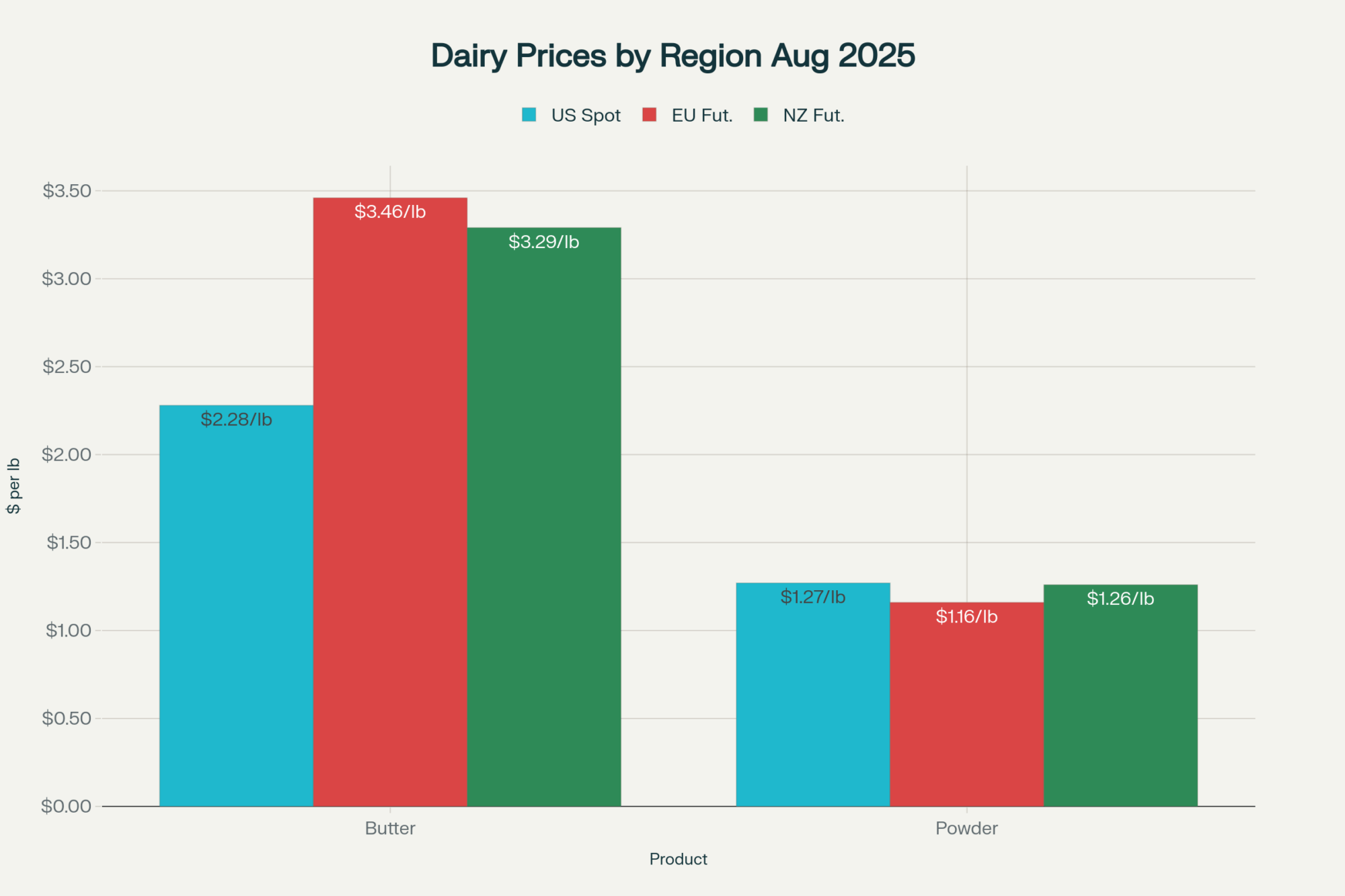
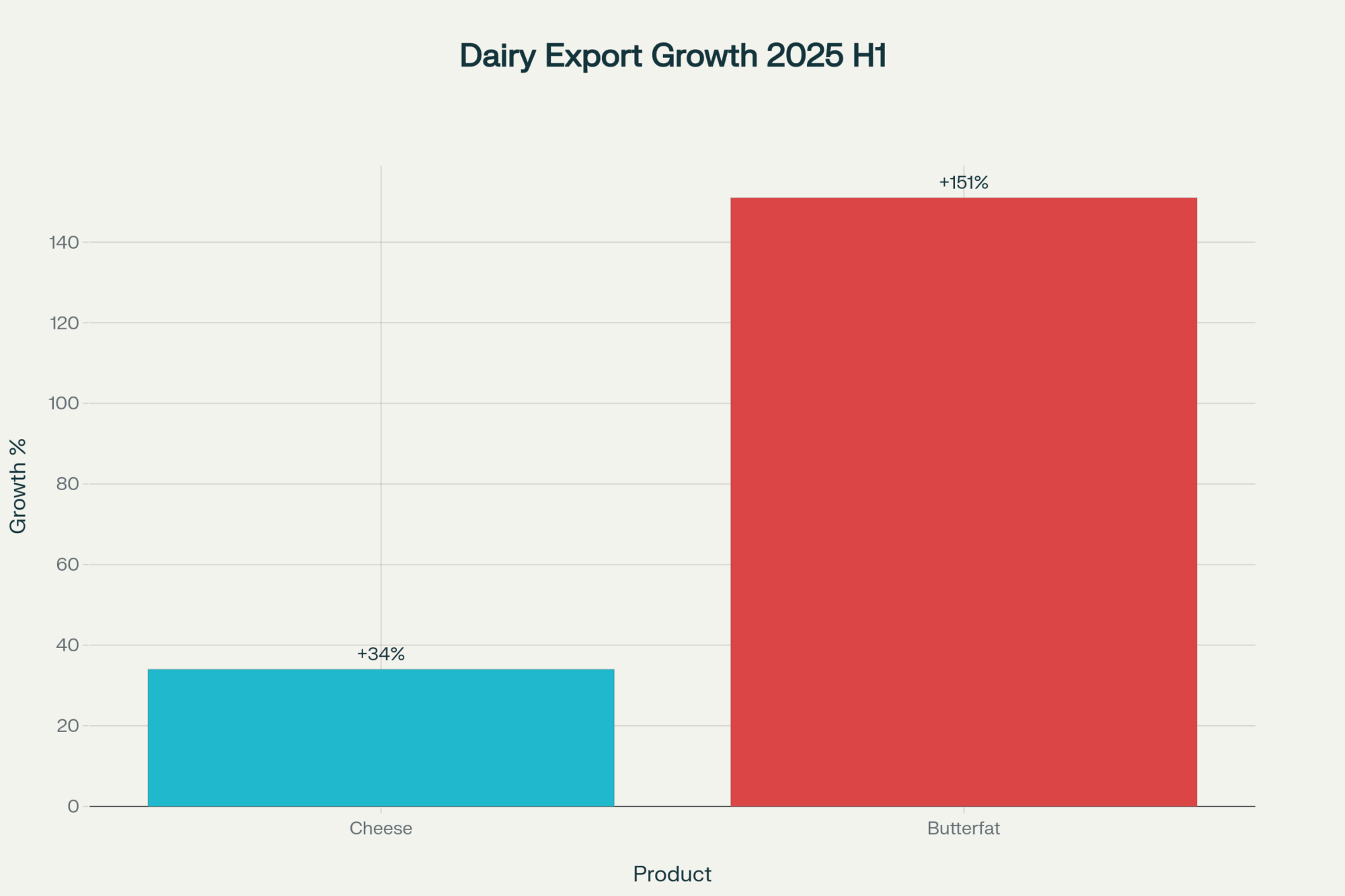
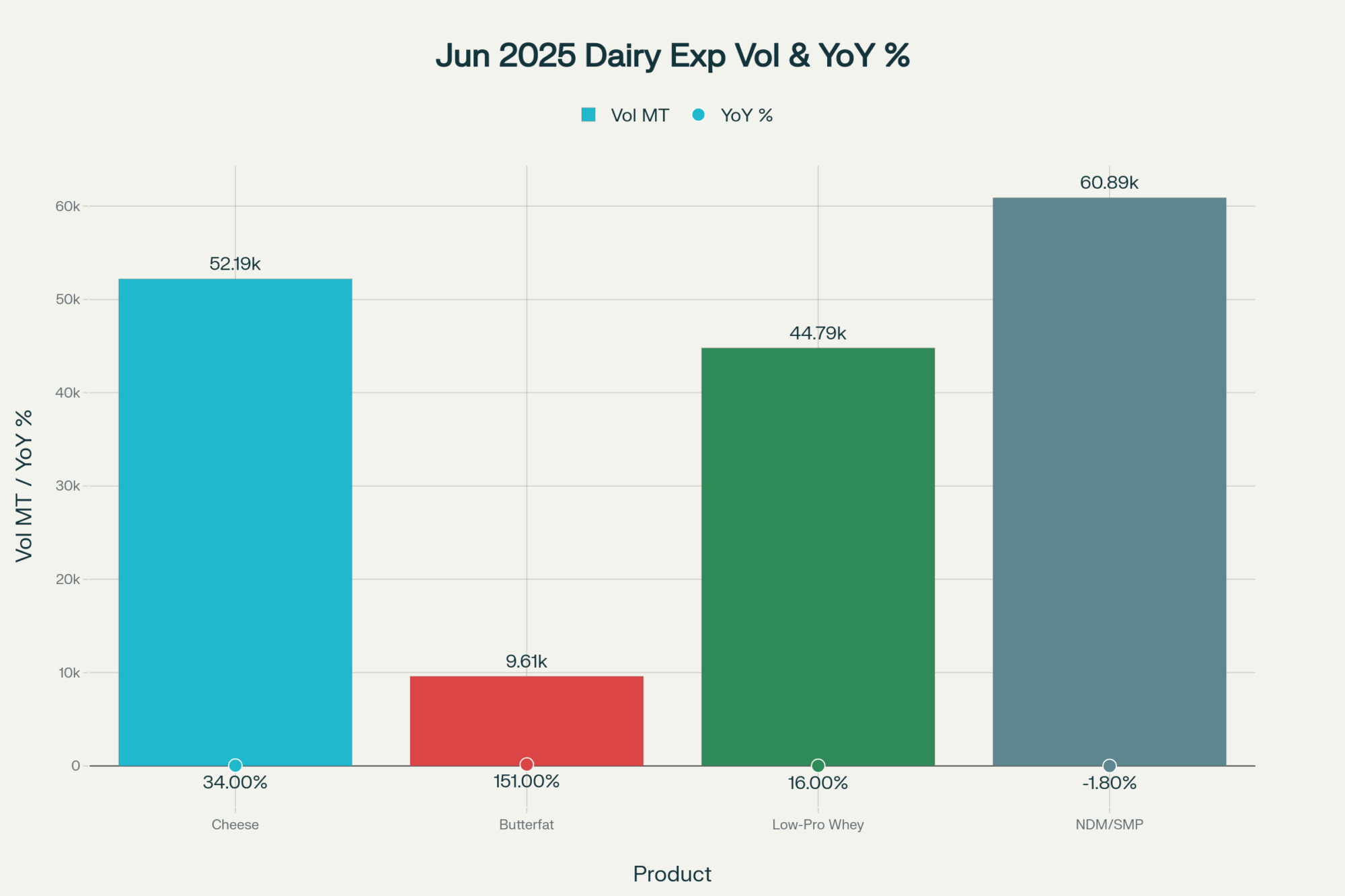
The export numbers tell the whole story. Over the last year, U.S. butter exports increased by 41%, with some specialty butterfat products rising by over 500%. When U.S. butter hits world markets at $2.33 per pound while European butter costs $3.75, that’s not just competitive—that’s dominance.
Here’s why this matters more than ever: milk price volatility makes these component premiums absolutely essential for survival. When the base price swings wildly, farms that optimize for butterfat and protein have a premium buffer that can mean the difference between profit and loss.
I know guys in Minnesota who’ve completely redesigned their nutrition programs around maximizing components. They’re breeding for butterfat and protein, tweaking rations down to the individual cow level, and the premiums they’re getting make it worth every penny spent on genetic programs.
The math is simple: farms focused on volume are producing a lower-value commodity in a market that’s demanding high-value raw materials.
Force 4: The Sustainability Payoff
Now, here’s where things get interesting from a business perspective, and frankly, where I see some of the biggest opportunities to buffer against market volatility.
Sarah runs a beautiful operation down in Tillamook County, Oregon. She’s been doing regenerative grazing for about five years now, and when I looked at her books… well, let’s just say she’s not doing it for the warm fuzzies.
“DFA’s paying me $18,000 a year just for documenting what I’m already doing,” Sarah explained while we watched her Holsteins rotate through a silvopasture system she’s developed. “Cover crops, rotational grazing, reduced tillage—it’s not just better for the soil, it’s cutting my input costs by about 20%.”
But the real kicker? Sarah has an anaerobic digester that processes not just her manure, but also organic waste from three local restaurants. Between the renewable natural gas sales and the electricity she’s feeding back to the grid, she earns an additional $85,000 annually.
The whole system cost her $2.1 million, but she’s looking at a seven-year payback, thanks in large part to federal grants and state incentives. “Not bad for something that also happens to be good for the planet,” she said with that practical smile Oregon farmers are known for.
What’s smart about Sarah’s approach is that these sustainability revenue streams help insulate her from milk price swings. When the market’s volatile, she has a stable income from energy sales and premium payments flowing in regardless.
This is no longer a fringe environmental movement. Three-quarters of dairy companies now have formal sustainability strategies, and 84% are actively investing money in them. Programs like Land to Market certification are appearing on retail shelves, commanding premium prices that flow back to producers who can demonstrate their regenerative practices.
Force 5: The Consumer-Crafted Market
The consumer side of this equation is fascinating and, honestly, a little scary if you’re not paying attention.
I was talking to a product development manager from a major processor recently, and she told me something that stuck: “We’re not making products for consumers anymore. Consumers are telling us exactly what products to make.”
Functional dairy is exploding—stuff fortified with probiotics, omega-3s, protein, even ingredients for better sleep and stress management. The organic milk market reached $21.3 billion this year, with 9% growth, while the grass-fed segment is expanding at 7.4% annually.
However, what keeps me awake is that, although the plant-based alternatives segment is slowing, it still represents a substantial $36 billion industry globally. Almond milk alone grabbed 61% of the non-dairy market. That’s not a trend—that’s a structural shift in how younger consumers think about dairy.
The good news? Dairy has something plant-based can’t replicate: biological customization. Imagine being able to adjust cow diets based on real-time consumer health data, naturally boosting specific nutrients in milk. That’s the kind of precision agriculture that meets precision nutrition, which could leave plant-based options in the dust.
Over 90% of Gen Z and Millennial consumers report actively seeking out new flavors and functional benefits. The farms and processors that can deliver on that demand—backed by real dairy’s natural advantages—are the ones that’ll capture market share.
The Big Picture Nobody’s Talking About
Here’s what strikes me as I piece all this together: these aren’t five separate forces. They’re interconnected currents that feed off each other, operating in an environment of constant volatility.
Labor shortages drive automation. Automation generates data. Data enables precision agriculture. Precision agriculture produces higher-value components. Higher-value components require sustainable practices to meet consumer demands. Sustainable practices create new revenue streams that help finance more automation and buffer against price swings.
It’s a virtuous cycle if you can get into it, or a vicious one if you’re stuck on the outside.
The farms that’ll be here in 2030 aren’t necessarily the biggest ones, but they’re the smartest ones—the operations that figured out how to dance with all five of these forces instead of fighting them.
Your Next Steps (The Practical Stuff)
Given this volatile environment where everything’s connected, here’s how to manage the risks while capturing the opportunities:
Master the Volatility Tools: Risk management is no longer optional. Dairy Margin Coverage, futures contracts, forward contracting—farms that aren’t using these tools are essentially gambling with their survival. The beef-on-dairy Strategy has become standard practice for managing both genetics and revenue streams.
30-Day Action Items:
Review your DHIA reports and calculate your current component averages
Research DMC program options and enrollment deadlines
Evaluate your current labor situation and backup plans
Connect with your processor about component premiums
90-Day Strategy:
Conduct a technology ROI analysis for your operation size
Explore sustainability programs available in your region
Assess your feed program for component optimization opportunities
Develop relationships with agricultural lenders familiar with dairy technology financing
Operation Size Strategies:
For smaller operations (under 200 cows), focus on niche markets where personal relationships and quality premiums are valued. Consider shared services for technology access—cooperative robotic milking is happening in some regions.
For mid-size farms (200-800 cows): This is the danger zone. You need a clear strategy—either scale up to afford the technology or differentiate through specialty products, such as organic or grass-fed.
For larger operations (800+ cows): You’re likely already investing in automation and data systems. The key is maximizing that investment through advanced analytics and component optimization.
The Bottom Line
Every conversation I have these days seems to circle back to the same question: What’s your plan for staying relevant in this new volatility?
Because here’s the truth nobody wants to say out loud—incremental improvements aren’t going to cut it anymore. The gap between leaders and laggards is widening fast, and once you fall behind, catching up gets exponentially harder.
The capital requirements alone for staying competitive are staggering. The knowledge base you need spans everything from data analytics to soil biology to international trade policy. The financial sophistication required would make your banker proud.
But for those who master this dance? The opportunities are enormous. Premium markets, component bonuses, sustainability payments, energy revenues, export opportunities—there’s money to be made in this new world, just not the old ways.
So when we’re grabbing coffee next week at the co-op or the equipment dealer, I’ll be curious to hear your take. Are you riding these waves, or are they washing over you?
From where I sit, the choice is becoming clearer every day. And the window for making that choice is getting smaller.
What’s your biggest challenge with these industry changes? Drop me a line or catch me at the next industry meeting. This conversation is just getting started.
Complete references and supporting documentation are available upon request by contacting the editorial team at editor@thebullvine.com.
Learn More:
Unlocking the Full Potential of Your Beef on Dairy Program – This tactical guide provides practical strategies for maximizing genetic selection, nutrition, and marketing in a beef-on-dairy program, helping you turn a secondary revenue stream into a significant profit center that buffers against milk price volatility.
Decoding Dairy’s Future: Navigating Volatility and Growth in 2024 and Beyond – For a deeper dive into market dynamics, this strategic analysis examines the global economic trends, consumer behavior shifts, and policy changes influencing dairy prices, equipping you with the foresight needed for long-range planning and risk management.
Robotic Milking Systems: Are They the Right Fit for Your Dairy? – Thinking about automation? This article moves beyond the “why” to the “how,” offering a detailed framework for evaluating the ROI, operational changes, and management mindset required to successfully implement robotics on your specific operation.
The Sunday Read Dairy Professionals Don’t Skip.
Every week, thousands of producers, breeders, and industry insiders open Bullvine Weekly for genetics insights, market shifts, and profit strategies they won’t find anywhere else. One email. Five minutes. Smarter decisions all week.
One exec’s $277K kickback scheme just exposed how much dairy farmers can lose to corruption
EXECUTIVE SUMMARY: So here’s what went down in New Zealand—and why it matters to every one of us. A former executive at Open Country Dairy was caught taking $276,668 in kickbacks over four years, selling pricing information to Indonesian traders. Those insider tips were worth $ 15,000-$ 25,000 per container—that’s serious money walking out the door. Dr. Jacqueline Rowarth from DairyNZ warns about “sticky discount pricing” where trust breaks can cost you for 3-5 years straight. With China cutting imports and global competition intensifying, we can’t afford reputation hits. The kicker? Buyers will pay 3-5% premiums for verified clean supply chains—the University of Guelph proved it. Lock down your data access now, because competitors are watching every move.
KEY TAKEAWAYS:
Audit your info access immediately: Keep pricing data locked tight—one leak can cost you premium contracts worth thousands per load
Invest in monitoring tech: Behavioral analytics catch sketchy patterns early, protecting margins that fraud could wipe out in days
Get independent audits on major customers: Third-party verification strengthens your market position and prevents nasty surprises
Leverage trust for premiums: Clean, transparent operations command 3-5% higher prices—that’s real money in your pocket monthly
Eye the Asian markets: Indonesia imports 2.5 million tons yearly; even grabbing 2% market share means $160-200 million in potential revenue
Trust is the foundation of the dairy industry. When insider pricing information leaks, the entire supply chain feels the impact. Recently, New Zealand’s Serious Fraud Office charged Simon Stewart, former group market manager at Open Country Dairy, with accepting $276,668.92 in kickbacks from Indonesian trader PT Anta Tirta Kirana. Over four-and-a-half years, 27 payments were made for insider pricing and other favors. Such breaches go beyond company losses—they shake global confidence. Open Country Dairy is New Zealand’s second-largest milk processor and the world’s second biggest exporter of whole milk powder. When trust cracks here, it sends ripples worldwide.
Global Ripples from a Local Crack
New Zealand dairy consistently earns price premiums because buyers trust the supply chain from farm to freight. In a DairyNZ interview, Dr. Jacqueline Rowarth, DairyNZ director and adjunct professor at Lincoln University, explained that such reputational damage creates “sticky discount pricing”—a penalty that can linger for three to five years. This reputational risk emerges as global demand continues to climb steadily and competition from European and U.S. exporters intensifies, according to Rabobank’s 2025 Global Dairy Quarterly.
China’s drop in imports—driven by growing domestic production—redirects New Zealand exporters to Southeast Asia. Indonesia imports roughly $300 million worth of New Zealand dairy annually, which is where this case hits hardest.
A Calculated Corruption Scheme
Stewart’s scheme was sophisticated. Analysts from HighGround Dairy estimate that having a 2-3 day price lead—prices that fluctuate by about $50 per ton—could boost profits by $15,000-$25,000 per container. PT Anta Tirta is a major Indonesian player spanning 17,000 islands, with deep ties in the pharmaceutical and food sectors. They structured payments to avoid detection—calculated corruption.
Processors are fighting back. European firms are now utilizing AI-powered analytics to identify suspicious communication patterns, while others are implementing blockchain trails, biometric logins, and strict data compartmentalization to keep pricing and sales teams separate, thereby drastically enhancing security.
Legal expert Gerald Podolsky of Russell McVeagh notes a 60% conviction rate in cross-border dairy fraud cases, highlighting that many evade penalties amid tight margins and rising industry pressures.
Producer’s Playbook: Taking Control
Farmers and processors, here’s your action plan:
Immediate Steps:
Audit who has access to price data and monitor sales-customer communications strictly
Implement behavioral monitoring technology—costs may seem steep, but they protect against million-dollar frauds
Use independent “clean team” audits to verify major customer relationships
Segregate pricing and customer information to prevent insider abuse
Strategic Opportunities: Open Country’s crisis creates openings for processors with bulletproof governance. Fonterra, despite past challenges, continues rebuilding its reputation as a trusted partner. With Indonesia importing 2.5 million metric tons of dairy annually, even a 2% market share gain (about 50,000 tons) could deliver $160-$200 million in additional revenue at current whole milk powder prices.
The reputation stakes are real everywhere. A Pennsylvania producer I know spent five years pushing his herd’s butterfat from 3.8% to 4.2% to land a lucrative contract with an artisanal cheesemaker. A single compliance issue with his processor—completely unrelated to his milk quality—resulted in his farm being flagged, and he lost access to that premium market overnight. That’s exactly what happens when trust breaks down, even far from New Zealand.
Buyers aren’t just evaluating butterfat numbers and somatic cell counts anymore. Ethics, transparency, and traceability drive premiums. A 2024 study from the University of Guelph found that consumers and B2B buyers are willing to pay 3-5% more for products with certified clean sourcing, emphasizing the real business case for transparency.
The key takeaway? Guard your reputation like your best cows in the dry lot. Once lost, trust takes years to rebuild—and competitors won’t wait.
Complete references and supporting documentation are available upon request by contacting the editorial team at editor@thebullvine.com.
Learn More:
The Ultimate Guide to Improving Feed Efficiency in Dairy Cattle – This article provides tactical, on-farm strategies for optimizing your largest variable cost: feed. It details how to measure and improve feed conversion, directly impacting the razor-thin margins and rising cost pressures mentioned in the main article.
The 5 Biggest Trends That Will Disrupt The Dairy Industry – For a strategic, market-focused view, this piece explores the long-term forces reshaping the industry beyond immediate fraud risks. It contextualizes the competitive pressures from U.S. and European exporters and helps producers anticipate future market dynamics.
Is A.I. The Future of Dairy Farming? – Focusing on innovation, this article dives deeper into the AI-powered monitoring systems mentioned as a key defense against corruption. It showcases how technology is moving beyond security to optimize herd health, reproduction, and overall profitability.
The Sunday Read Dairy Professionals Don’t Skip.
Every week, thousands of producers, breeders, and industry insiders open Bullvine Weekly for genetics insights, market shifts, and profit strategies they won’t find anywhere else. One email. Five minutes. Smarter decisions all week.
4,000 for a single heifer? That’s not auction fever — that’s your new reality.
EXECUTIVE SUMMARY: Look, heifer prices aren’t just expensive anymore — they’ve gone completely bonkers. We’re talking $3,010 nationally, with top auctions reaching $ 4,000 and above. The farms still winging it on replacement costs are hemorrhaging money they don’t even realize they’re losing. Here’s what the data shows: raising your own animals can save you anywhere from $400 to $1,400 per animal compared to buying, but only if you do it right. The beef-on-dairy craze has driven inventories to 47-year lows, and with $8 billion in new processing capacity coming online, this isn’t a temporary spike. Smart producers are already switching gears — tracking real-time costs, partnering up, and treating their replacement program like the investment portfolio it really is. Don’t get caught flat-footed when everyone else is adapting.
KEY TAKEAWAYS
Get your numbers straight — Track both auction prices and your actual raising costs weekly. Farms doing this consistently save 15-20% on replacement decisions.
Talk money before you need it — Schedule that lender meeting now. With heifer inventories at historic lows, cash flow planning is no longer optional.
Genomics pays off big — Each percentage point of genetic improvement adds $40-50 lifetime profit per cow. That’s not theory, that’s Cornell research.
Team up or get left behind — cooperative buying and shared raising programs are helping savvy operators weather 70% price swings, as Wisconsin recently experienced.
Crunch the raise-vs-buy math — Current costs run $1,600-$2,400 to raise your own versus $3,000+ to buy. Do the math for your situation, but use 2025 numbers, not those from ancient history.
It’s enough to make any dairy farmer do a double-take: $4,000 for a single replacement heifer. That’s not just a number; it’s a signal that the ground is shifting beneath our feet. While it’s easy to get stuck on sticker shock, the producers who will thrive in the next decade are those who see this as more than a temporary market swing—it’s a fundamental change in dairy economics. Are you ready to adapt?## Stop guessing, Start Calculating your replacement decisions. Are they still based on what heifers cost two years ago? In today’s market, historical data can hinder your progress. According to the latest USDA Agricultural Prices report, replacement heifers averaged $3,010 nationally in July 2025—a 164% jump from 2019’s baseline of $1,100.
Dig into current auction reports and benchmark those prices against your farm’s true cost to raise a calf. If you don’t know what it really costs you to raise a heifer from birth to breeding age, you’re flying blind—and that’s a risk you can’t afford in this market.
Drive Down Your Input Costs
With feed costs climbing and milk prices stabilizing around $20-22 per hundredweight, managing your input costs can’t be an afterthought. Track feed efficiency and health metrics closely—these will significantly impact your cost of raising replacements.
Small improvements in feed conversion or reducing mortality rates can add significantly to your bottom line. When replacement heifers cost this much, every efficiency gain matters.
Talk to Your Lender Early
Don’t wait until cash flow gets tight before chatting with your lender. The USDA’s February 2025 cattle inventory report shows dairy heifer inventories at a 47-year low of 3.9 million head, suggesting these elevated prices aren’t going away anytime soon.
Schedule a meeting now to discuss more flexible lines of credit and your long-term plan. Show them you’re proactive about managing volatility, and they’ll be more likely to work with you when market pressures intensify.
Leverage Genomics and Technology
Modern genomic testing tools offer precision like never before. By identifying which animals possess the best genetics, you can make more informed breeding decisions and avoid costly missteps.
The 2024 NAAB semen sales report shows nearly 10 million beef semen units used on dairy cows last year, driven by $600-900 premiums on crossbred calves. But remember—those decisions create a 2.5-year lag before you see replacement heifers, so balance short-term gains with long-term herd needs.
Build Partnerships
The market shifts faster than most of us can handle alone. Consider forming cooperative agreements with neighboring farms or suppliers to share replacement risks and mitigate supply challenges.
Wisconsin saw replacement prices increase by 70% in one year, from $1,990 to $ 3,450. Having partners who can help balance demand and supply fluctuations isn’t just smart—it’s essential for managing this volatility.
Balance Raising vs. Buying
Raising replacement heifers on your farm can be less expensive in the long run, but it requires space, labor, and capital. Research from Cornell’s Pro-Dairy Program indicates that on-farm costs range from $1,600 to $2,400 per heifer, depending on management intensity and regional factors.
Analyze whether your operation can effectively manage this investment. Sometimes, strategic purchases align better with cash flow and risk tolerance, especially when you factor in facilities, labor, and opportunity costs.
Plan for the Long Haul
Market experts anticipate that replacement prices will remain elevated through at least 2027, given the biological timeline and current breeding patterns. Meanwhile, over $8 billion in new processing capacity is coming online by 2026, creating additional demand for milk.
Model your finances with extended high prices in mind, and keep your strategy flexible. It’s not just about surviving this cycle—it’s about positioning yourself to thrive in the next one.
What the Experts Say
Dr. Victor Cabrera, agricultural economist at the University of Wisconsin-Madison, emphasizes that producers must adapt their mindset: “These aren’t temporary price spikes—they represent structural changes in dairy economics. The operations that recognize this and adjust their strategies accordingly will have significant competitive advantages.”
CoBank’s Corey Geiger adds: “Reliable milk supply is the linchpin for new processing plants, and tight cow inventories are pushing replacement costs higher as processors compete for limited production capacity.”
So, how can you put these insights into action on your farm?
Your Strategic Roadmap
Regularly update your replacement costs using real-time auction data and your actual raising costs
Secure flexible financing by engaging lenders well before cash flow pressures hit
Improve operational ROI by tracking feed efficiency, herd health, and investing strategically in technology suited to your scale
Build risk-sharing partnerships with local suppliers and neighboring farms
Weighing raising your own heifers versus buying with a clear-eyed analysis of costs and resources
Maintain adaptable financial plans that account for 50-75% higher replacement costs through 2027
Analyze seasonal buying patterns to capitalize on lower prices, especially during fall auctions
Pro Tip: Many successful producers time their purchases for fall, when auction activity typically softens, providing strategic buying windows that can ease cash flow pressures during traditionally tight periods.
The Bottom Line
That $4,000 price tag isn’t just a challenge—it’s a filter. It will separate the farms that are reacting to the market from those building resilient businesses for the future.
By embracing data-driven approaches to genetics, finances, and partnerships, you won’t just survive this market transformation—you’ll be positioned to lead it. The producers who view this as a strategic inflection point rather than just another cost increase will define the industry’s next chapter.
The ground has shifted. The question is: will you shift with it?
Complete references and supporting documentation are available upon request by contacting the editorial team at editor@thebullvine.com.
Learn More:
The Real Cost of Raising Heifers: Are You Leaving Money on the Table? – This article provides a tactical framework for accurately calculating your farm’s true cost to raise a replacement. It offers practical strategies for identifying hidden expenses and optimizing inputs to drive down costs in a high-priced market.
Beef on Dairy: The Trend That’s Reshaping the Cattle Industry – For a strategic look at the market forces driving heifer shortages, this piece breaks down the economics of the beef-on-dairy boom. It reveals how to balance short-term calf premiums with long-term herd replacement needs.
Genomics: The Difference Between Guessing and Knowing – Explore the innovative power of genomics with this deep dive into maximizing your herd’s genetic potential. It demonstrates how to leverage genomic data to ensure every dollar spent on high-cost replacements delivers a measurable return on investment.
The Sunday Read Dairy Professionals Don’t Skip.
Every week, thousands of producers, breeders, and industry insiders open Bullvine Weekly for genetics insights, market shifts, and profit strategies they won’t find anywhere else. One email. Five minutes. Smarter decisions all week.
US dairy exporters only fill 42% of the Canadian quota—that’s leaving millions on the table while you’re fighting for every cent.
EXECUTIVE SUMMARY: Listen, Canada’s “unbreakable” dairy fortress is showing serious cracks — and smart producers are already positioning for what’s coming. We’re talking about a system where US exporters can’t even fill 42% of their allocated quota because Canada hands the keys to their own processors. Meanwhile, Canadian farmers are paying around $41,500 per cow just for quota rights — that’s working capital that could be improving operations instead. With feed costs potentially spiking 8-15% from China’s canola mess and Class III hovering at $18.80/cwt, margins are tighter than ever. The 2026 USMCA review isn’t some distant policy debate — it’s a business reality that’ll reshape how we all operate. If you’re not hedging feed costs and building cross-border relationships now, you’re missing a significant opportunity.
KEY TAKEAWAYS
Lock in your feed costs today — CME futures can protect against that 8-15% protein spike; cover at least 50% of your next six months’ needs for around $50-100 per contract
Audit your cost structure now — with milk at $18.80/cwt, every efficiency gain matters; benchmark against your region’s top performers using extension data
Get border-ready with HACCP certification — takes 90-120 days and $3,000-5,000, but positions you for expanded market access when quotas open up
Start processor conversations — relationships built today could be worth millions when trade barriers fall, especially critical for operations within 200 miles of the border
Watch that 65% quota threshold — when US utilization hits this level, it signals real market shifts and your window to capitalize
The Canadian supply management system—that seemingly unshakeable foundation of the Canadian dairy sector—is facing coordinated pressure unlike any we’ve seen before. Between Trump’s August tariff escalation, New Zealand’s legal victory, and China’s retaliatory action against canola, the 2026 USMCA review is shaping up to be a pivotal moment for every dairy operation in North America.
What strikes me about this moment is how synchronized it’s all become. We’re no longer looking at isolated trade spats; this is systematic pressure that’s already changing how astute producers think about their operations.
The real bottleneck isn’t tariffs—it’s the quota game. Canada predominantly hands import licenses to its own processors rather than to American exporters. According to 2024 year-end data from the USDA’s Foreign Agricultural Service, US dairy exporters are using only about 42% of their allocated quotas.
I was speaking with a Wisconsin cheese producer last week, who summed it up perfectly: “They give us permission to knock on the door, then they give the key to our competition.”
The Kiwi Playbook That’s Got Everyone’s Attention
New Zealand’s approach has been brilliant. Instead of fighting tariff battles, they challenged Canada’s administrative processes under CPTPP and won. The result? $157 million annually in additional dairy access by forcing changes to how quotas actually work.
This isn’t just a New Zealand story—US trade lawyers are studying every detail of their strategy for the 2026 review.
Why China’s Canola Move Hits Your Feed Bill
China’s 75.8% tariff on Canadian canola has effectively eliminated a $5 billion export market. Canadian farmers are scrambling to reallocate acres, while US soybean producers are positioned to capture displaced Chinese demand.
Here’s where it gets interesting for dairy operations… According to a recent analysis from Iowa State University agricultural economists, these types of oilseed disruptions typically increase protein feed costs by 8-15% within six months. A feed supplier I know in Iowa mentioned they’re already adjusting September contracts—protein meal prices are creeping up as the supply picture tightens.
With Class III milk prices averaging $18.80 per cwt, that’s margin pressure we can’t ignore.
What the Numbers Tell Us
Here’s some perspective on what we’re dealing with: Based on recent industry data, quota values in key Canadian provinces now average around $41,500 per cow equivalent—that’s a massive amount of working capital tied up solely for the right to produce milk. Compare that to the flexibility US producers have to respond to market signals.
The political math is shifting as well. Canada has roughly 9,000 dairy farmers, representing less than 0.5% of its workforce, who defend this system against pressure from its three largest trading partners.
The Canadian Counter-Move
While US producers focus on hedging and export positioning, Canadian producers are taking different strategic approaches. Forward-thinking Canadian operations are focusing relentlessly on operational efficiency, benchmarking against top provincial performers to stay competitive amid growing pressure.
Many are exploring value-added routes—think organic, A2, or grass-fed—that leverage supply management’s stability for brand development. The predictable pricing structure becomes a platform to build premium market positions that aren’t easily disrupted by trade disputes.
Engagement with provincial boards and the Dairy Farmers of Canada is intensifying, pushing for a modernization narrative that strikes a balance between protection and evolution. Getting involved with policy discussions isn’t optional anymore—producers need to be part of shaping what comes next, not just defending what exists.
What Proactive Producers Are Doing
While policy will unfold over the next 18 months, savvy producers on both sides of the border are taking targeted steps to mitigate risk and prepare for opportunities. Here’s the playbook they’re using:
This month (For All Producers): Lock in feed costs for the next six months using CME futures. Even covering 30-50% of your protein needs gives you protection against these supply disruptions. Contract costs run $50-100, but that beats getting blindsided by a 15% feed spike.
Next 90 days (For U.S. Border-State Producers): If you’re within 200 miles of the Canadian border, get your HACCP certification current. The process takes 90-120 days and costs around $3,000-$ 5,000, but it positions you for opportunities when access becomes available.
Strategic positioning (For All Producers): Start conversations with processors on both sides of the border. A dairy operation near the Quebec border told me they’re already exploring partnerships with Canadian co-ops. When rules change, relationships matter more than paperwork.
Risk Management (For US Producers): The USDA Market Access Program provides up to 50% cost-sharing for export development, offering good financing for positioning investments.
Ongoing (For Canadian Producers): Focus on operational efficiency, benchmarking production costs against top provincial performers to maintain competitiveness as external pressures mount.
Exploration (For Canadian Producers): Pursue value-added niches such as organic, A2, or grass-fed products that leverage supply management’s stability for premium positioning.
Advocacy (For Canadian Producers): Engage with provincial boards and Dairy Farmers of Canada to support modernization efforts that preserve farmer viability while reducing trade friction.
What to Watch For
Industry analysts are tracking three key signals: quota utilization rates climbing above 65% (we are currently at 42%), Canadian industry messaging shifting from “protection” to “modernization” language, and protein meal basis levels widening in your region.
Research from the University of Guelph suggests that even partial Canadian market opening could generate hundreds of millions annually in additional US dairy exports, supporting domestic milk prices through expanded demand.
The 2026 Moment We’re All Preparing For
The USMCA review next summer represents the biggest structural opportunity for North American dairy integration since NAFTA. US dairy organizations are systematically building their case, with New Zealand’s victory providing both precedent and tactical guidance.
Keeping Perspective
Canada’s supply management system has provided real benefits—income stability, supply predictability, and rural economic support that shouldn’t be dismissed. The challenge isn’t destroying what works for Canadian farmers, but finding evolution that reduces trade friction while preserving viability.
The pressure we’re seeing suggests change is coming, but how it unfolds depends on finding solutions that work for everyone.
The Bottom Line Strategy
Immediate (All Producers): Hedge feed costs through futures contracts to manage price volatility from supply chain disruptions
Short-term (All Producers): Audit production efficiency against regional benchmarks and update relevant certifications
Near-term (Border-Area Producers): Build cross-border relationships with processors and distributors for partnership opportunities
Long-term (All Producers): Monitor quarterly TRQ reports and policy signals while developing financial flexibility for rapid opportunity capture
The Canadian fortress isn’t falling overnight, but the foundation is definitely shifting. Producers who prepare strategically now—through operational excellence, risk management, and relationship building—will be positioned to benefit when market access expands.
In this business, being ready beats being right. The 2026 review is coming, whether we’re prepared or not.
The bottom line? This isn’t about politics — it’s about your farm’s future profitability. The producers preparing now will be the ones cashing in when the walls come down.
Complete references and supporting documentation are available upon request by contacting the editorial team at editor@thebullvine.com.
Learn More:
The 7 Key Performance Indicators Every Dairy Farmer Should Be Tracking – This article provides a tactical guide to benchmarking your herd’s performance. It reveals the essential metrics you need to monitor for improving operational efficiency, controlling costs, and making data-driven decisions to boost your bottom line.
A2 Milk: Is it the answer for the dairy industry? – Explore the strategic market potential of value-added dairy. This piece examines the A2 milk trend, offering insights into changing consumer preferences and helping you evaluate whether niche markets could build a more resilient revenue stream for your operation.
Dairy Genetics 101: A Producer’s Guide to Profitable Breeding – A forward-looking guide on how to leverage genetics as a competitive advantage. It breaks down how strategic breeding decisions can drive long-term profitability by creating a more efficient, healthy, and productive herd ready for future market demands.
The Sunday Read Dairy Professionals Don’t Skip.
Every week, thousands of producers, breeders, and industry insiders open Bullvine Weekly for genetics insights, market shifts, and profit strategies they won’t find anywhere else. One email. Five minutes. Smarter decisions all week.
Margins are locked up tight—did you know Midwest IOFC is hovering just above breakeven, with Class III nearly $0.60/cwt squeezed by feed costs?
EXECUTIVE SUMMARY: Hey, here’s what’s really going on—everyone talks about cheese leading the market, but it’s feed costs and weak powder exports that’ll make or break your milk check. Look at today’s numbers: block cheese up $0.02/lb, sure, but butter dropped to $2.32/lb and dry whey sank to just $0.59/lb. IOFC ratios in Wisconsin and California are pinched, with some herds seeing margins slip below $1.50/cwt profit. Globally, the U.S. still undercuts Europe on butter, but powder competition from New Zealand is brutal. That’s why the big co-ops are hedging feed like crazy… and pushing for forward risk programs. If you’re not watching both Class III futures and your soybean meal contract, you could be missing real opportunities for profit. Try this: reset your hedging—lock in a milk floor, book feed when it dips, and don’t sleep on export chatter. That combo could easily put an extra $4,000–$7,000 in your pocket this quarter.
KEY TAKEAWAYS
Cheese blocks are propping up Class III, but dry whey at $0.59/lb wipes out up to $0.40/cwt from your pay price. Check your monthly USDA checkoff for the hit.
Soybean meal hit $295.70/ton—a 7% rise over summer—so locking feed early could save you thousands on IOFC alone. Talk to your nutritionist before the next rally.
Export butter opportunities remain strong, but logistics will decide whether U.S. product actually clears the dock. Watch USDA and trader calls for trends.
Culling’s picking up across Midwest dairies due to heat and feed pressure; monitoring herd health now means less risk come fall. Review your cow records and adjust if needed.
Don’t wait for whey or powder prices to rebound—use DRP or puts on Class III while the floor’s holding at $18.86, lock in margin, and keep cash flow steady.
That’s what I’m seeing out here—dairy’s never just the spot cheese price. If you want paychecks that translate to growth, watch those feed numbers and export flows like a hawk. Seriously, try these tweaks. They’re what the progressive outfits are doing… and they’re seeing the difference right in their milk checks.
What’s happening in the CME dairy pit today? If you blinked, you might’ve missed it—cheese blocks put on a small rally ($0.02/lb up), but everything else? Butter nudged lower, NDM keeps feeling soft, and dry whey? It’s almost like nobody showed up to buy. That’s the sort of start that gets barn conversation rolling: “Are the cheese buyers trying to lift this whole market on their own?”
What strikes me about today’s story isn’t just who’s leading, but who’s dragging. Block cheese is standing up—anyone milking for Class III is grateful for it. But whey’s like that last stubborn heifer—won’t budge, and until she does, Class III just can’t run.
Here’s a quick scan of the numbers that hit your milk check:
Product
Price
Move
Key Driver
Short-Term Outlook
Farm Impact
Cheese Block
$1.85/lb
+2.00¢
Food Service Demand
Slightly Bullish
Shoring up your next Class III check.
Cheese Barrel
$1.81/lb
Flat
Retail Packager Demand
Neutral
No change, but block strength helps.
Butter
$2.32/lb
-1.25¢
Export Pricing Gap
Tentative
Softens Class IV—needs global pull.
NDM Grade A
$1.265/lb
-0.50¢
Export Competition
Weak
Squeezes Class IV, flattens margins.
Dry Whey
$0.59/lb
-1.50¢
Oversupply
Heavy
The biggest drag on Class III right now.
What This Means for Your Milk Check
Class III September futures parked at $18.86/cwt; Class IV, $18.42/cwt. If you’re hedging next month’s milk, the window sits around $18-$19/cwt—solid, not a home run, but block cheese is your best friend. A floor trader mentioned, “Everybody’s selling butter; nobody needs it now.” With nine open offers and zero bids at the close, it’s like waiting for rain when you’ve got hay stacked high. Butter barely moved (just two trades all day), and the rest just marked—to market. Low conviction leads to wide spreads, and that usually means volatility is waiting in the wings if traders wake up.
The Squeeze at Home: Feed Costs & Herd Health
If you’re watching feed costs, there’s good news and bad. December corn trickled down to $4.03/bu (small win), but soybean meal surged to $295.70/ton. IOFC ratios in Wisconsin and upstate New York are not great. We’re seeing a 2.15 ratio; guys feeding fresh cows in California say their basis is even hotter. One Chippewa Falls producer texted, “Block numbers look strong, but feed costs have us on edge.” Midwest cows aren’t showing peak yield, culling’s ticking up, and if prices don’t turn, regional supplies could tighten come September. Northeast producers echo the same sentiment: young cows are keeping up, but older cows are dropping off.
The Global Wild Card: Will Exports Show Up?
Here’s the thing, though—exports are the wild card. U.S. butter is a steal compared to European or New Zealand products. Export brokers expected a flood of outbound loads, but freight and logistics are real headaches, and some are starting to wonder if it’ll get solved this season. Processors in the Southwest are amped for exporting butter if logistics open up—“Asia wants the fat, but we need more trucks than we’ve got,” said one plant manager. NDM and powders? We’re still getting undercut by Europe on SMP, and New Zealand’s pricing is tough. Southeast Asia’s buying, but every contract feels like a knife fight. Mexico’s steady, but picky.
A look at the IOFC numbers for August (see the chart at the end of this article) shows margins in the Midwest remain tight, and with feed options limited and meal basis burning out west, everyone’s feeling the pinch.
Actionable Strategy: Farmer’s Short List
Here’s what I’d do (and what I’m hearing from guys across the belt):
Lock a floor with DRP or put it in if Class III fits your cost structure; don’t wait for the whey.
Hedge soybean meal, especially if your ration’s heavy.
Keep your cash flow plan on a tight leash. Sideways checks for September; don’t overlever if whey and powder keep softening.
Watch export chatter and FMMO headlines—basis changes next season could change the local payout picture.
Industry Pulse and Final Insights
The FMMO reform discussion is currently trending. Webinar feedback suggests that Southwest and Northeast producers should watch how test formulas play out. Regulatory changes are coming—could be a game changer for your Class III/IV checks if the USDA gets its way.
If there’s one theme, it’s balance—cheese blocks are trying to hold margins, but the rest of the barn’s getting squeezed. Export prospects are real but fragile, and feed is where next month’s check could get eaten up. If you haven’t dialed in a risk plan, don’t wait. And if you want the real scoop, check those IOFC visuals—sometimes the charts say as much as any table.
Stay loose, ask around, and keep sharing what’s happening at your place—the smartest moves come from what we learn off each other’s experience.
Complete references and supporting documentation are available upon request by contacting the editorial team at editor@thebullvine.com.
Learn More:
Unlocking Dairy Profitability: Mastering Margin Management and Risk Mitigation – This article provides a step-by-step guide to the risk management tools mentioned in the report. It details practical strategies for using DRP and hedging to protect your bottom line against the exact market volatility analyzed above.
Navigating the Tides of the Global Dairy Market: A 2024-2025 Outlook – Go beyond the daily numbers with this strategic outlook on the global dairy market. This piece analyzes the broader economic forces and long-term trends shaping prices, helping you make more informed decisions for future planning and investment.
The ROBOT REVOLUTION: How Automation is Reshaping the Modern Dairy – Explore how leading dairies are using automation to combat the margin pressure discussed in the report. This article showcases how robotic technology can boost efficiency and lower production costs, offering a proactive strategy to improve profitability.
The Sunday Read Dairy Professionals Don’t Skip.
Every week, thousands of producers, breeders, and industry insiders open Bullvine Weekly for genetics insights, market shifts, and profit strategies they won’t find anywhere else. One email. Five minutes. Smarter decisions all week.
A sick calf costs $1,000+ over its lifetime. What if $35 up front could prevent that?
The thing about this “$35 per calf” ROI figure… I kept hearing it tossed around at industry meetups, and honestly? It made my skeptical farmer radar go off. So, I did what any good dairy person does—I dug into the actual numbers. Not the glossy marketing stuff, but real farm data.
Here is what really changes the game, though: since June 2023, the FDA has classified all medically important antimicrobials as prescription-only. The days of metaphylactic treatments as a management crutch? Those are done.
What the Research Actually Says (And Doesn’t)
That foundational Cornell work from Soberon and Van Amburgh (2013) still holds water—1,000 kg more milk in first lactation for every kilogram of extra pre-weaning ADG Solid science, but remember that was controlled university research. Your mileage will definitely vary.
Cornell University Research: Impact of Pre-weaning ADG on First Lactation Milk Production and Revenue
What hits closer to home is Dubrovsky’s 2020 work in the Journal of Dairy Science. They found BRD treatment costs ranging from $42 to $395 per case, depending on the severity of the condition and the method of treatment. That is not a narrow range—that is the difference between “manageable expense” and “profit killer.”
The probiotic research? It is getting more nuanced. Most of the new data on biotics (probiotics/prebiotics) has shown advantages in daily gain and animal health, which is helping to position these additives as part of a good calf management system.
Crunching Numbers (With Honest Caveats)
ROI Analysis of Calf Nutrition Investment Strategies: Investment Costs, Net Benefits, and Return on Investment
If you are considering a $35 per calf nutrition investment, here is how the math might work:
Potential milk revenue gain: Around $485 (based on that Cornell research and current milk prices)
Disease cost reduction: Highly variable—could be zero on a well-managed farm, or $100+ if BRD’s been killing you.
Feed efficiency improvements: $15-20 over the pre-weaning period.
Total potential return? Looks impressive on paper. But—and this is crucial—I have seen operations where this pencils out beautifully, and others where it makes no difference.
Real Talk from Real Farms
I cannot give you specific farm names (producers value their privacy), but I will say this: the operations seeing consistent results are not just throwing supplements at problems. They are being systematic.
One mid-sized Wisconsin operation with which I am familiar implemented targeted nutrition, upgraded colostrum protocols, improved hutch ventilation, and began regularly tracking growth. Their ADG improved from around 1.4 to 1.8 lbs/day.
But here is their honest take: they cannot tell you exactly how much came from the $35 nutrition program versus the management improvements. And do you know what? They do not care. The entire system got better.
Sponsored Post
Implementation Is Everything
This is where many farms fall short. Quality matters. Strain specificity matters. Timing matters. I have seen operations spend good money on generic probiotics and wonder why they did not get research-trial results.
A calf nutritionist I respect puts it this way: “Supplements are fine-tuning tools, not foundation fixes. Get the basics right first—colostrum, housing, feeding consistency—then talk about additives.”
Geography and Scale Reality Check
What works in Vermont dairy country does not always translate to Texas. Disease pressure varies. Climate stress varies. Feed costs vary.
In the upper Midwest, respiratory challenges are prevalent, making pathogen-binding strategies a sensible approach to addressing these issues. Down south, heat stress and digestive efficiency become bigger factors. California’s Central Valley has different challenges than Wisconsin’s rolling hills.
Operations with fewer than three hundred cows face different economics than those with 1,000 or more cows. The big guys can justify automated feeding systems and precise protocols. Smaller operations require simpler, yet more robust, approaches.
Estimated Economic Returns per Calf from Nutrition Investment
Your Monday Morning Action List
Based on what works across different farm types:
Start tracking calf weights weekly—target 1.5-1.8 lbs/day ADG (NAHMS benchmark data shows this separates good from mediocre)
Document every BRD case and associated costs—you cannot improve what you do not measure.
Improve ventilation and feeding consistency before investing in supplements.
Know your break-even point—calculate what disease reduction you need to justify program costs.
The Uncomfortable Truths
Some farms should not be spending extra on calf nutrition. If your mortality is high because of poor colostrum management or drafty housing, supplements will not fix that. You are treating symptoms, not causes.
Also, not every calf responds the same way. Genetics matter. Birth weight matters. Health status at birth matters. You won’t obtain uniform results across all animals.
Looking Forward
The trend toward precision nutrition is real, but we are still in early innings. Most farms are not ready for individual animal monitoring and adjustment. What I do see is better data discipline—operations getting smarter about connecting early investments to long-term performance.
Regulatory pressure is not easing up. Consumer preferences are not changing back. The economic incentives for proactive management are only getting stronger.
The Bottom Line
Is there a “$35 advantage” in calf nutrition? On some farms, absolutely. On others, that money generates better returns invested in basic management improvements.
The key is an honest assessment of where your operation stands. If you are already hitting 1.8+ lbs/day ADG with minimal health issues, nutrition supplements are not your highest priority. Fix labor efficiency or breeding instead.
But if you are struggling with respiratory disease or poor growth rates, targeted nutrition investments can pay off—if implemented as part of systematic improvement, not as a magic bullet.
The real value is not in any $35 supplement. It is in the time you take to analyze your own data and figure out what your calves need.
That is what separates the operations thriving in 2025 from those that will struggle to keep up.
This isn’t feel-good farming. It’s a dollars-and-cents strategy backed by solid science Your calves are either an investment or an expense—which camp are you in?
KEY TAKEAWAYS:
Track those weights religiously—calves gaining 1.8+ lbs daily before weaning set you up for an extra 1,100 lbs milk in first lactation. That’s $500 more revenue per cow.
Cut your treatment bills in half with strategic colostrum programs and targeted supplements. Less time treating sick calves means more time on profitable work.
Boost feed efficiency 10% using proven nutritional tools like probiotics and MOS—we’re talking $180+ savings per calf during the most critical growth phase.
Every calf you save matters more now—with replacement costs hitting $3,010 and labor scarce, preventing death loss isn’t just good animal care, it’s smart economics.
Adapt to the new reality—FDA restrictions on antibiotics and soaring labor costs mean proactive nutrition programs aren’t nice-to-have anymore. They’re survival tools for 2025 and beyond.
EXECUTIVE SUMMARY:
Here’s what caught my attention in this research: investing $35 per calf in targeted nutrition isn’t just feeding—it’s strategic profit planning. Cornell’s data shows calves hitting 1.8 lbs/day growth before weaning produce roughly 1,100 pounds more milk in first lactation. At today’s prices, that’s nearly $500 extra per cow. But here’s the kicker—with BRD treatment running anywhere from $42 to $395 per case and replacement heifers pushing $3,010, every sick calf you prevent saves serious money. The research breaks down how probiotics, MOS supplements, and better colostrum management can cut treatment costs by 50% while boosting feed efficiency by 10%. With antibiotics getting harder to use and labor costs climbing, this proactive approach isn’t optional anymore. Time to stop playing defense and start programming your calves for profit.
Complete references and supporting documentation are available upon request by contacting the editorial team at editor@thebullvine.com.
Learn More:
4 Golden Rules for Optimal Colostrum Feeding – This article provides a tactical deep-dive into colostrum, a topic the main article identifies as a foundational priority. It offers practical, step-by-step protocols for producers to ensure their calves get the essential immunity needed for any nutritional program to succeed.
Replacement Economics: Why Raising Your Heifers Just Became Profitable Again – Expanding on the market realities, this piece details the strategic financial pressures behind the soaring replacement heifer costs. It reinforces the main article’s economic argument by showing readers the hard numbers and long-term market dynamics driving the need for proactive calf management.
The $500,000 Precision Dairy Gamble: Why Most Farms Are Being Sold a False Promise – This piece offers a critical, innovative perspective on technology that complements the main article’s forward-looking conclusion. It provides a reality check on high-tech investments, urging producers to focus on data and foundational management before adopting expensive new systems.
The Sunday Read Dairy Professionals Don’t Skip.
Every week, thousands of producers, breeders, and industry insiders open Bullvine Weekly for genetics insights, market shifts, and profit strategies they won’t find anywhere else. One email. Five minutes. Smarter decisions all week.
Cornell just dropped a bombshell: $950 lost per sick cow from H5N1—and 75% show zero symptoms.
EXECUTIVE SUMMARY: Look, I’ve been digging into this H5N1 mess, and honestly… it’s worse than most of us thought. Cornell’s latest research shows we’re losing nearly $950 per clinically sick cow, but here’s the kicker—that Ohio operation had 89.4% of their herd test positive while three-quarters never looked sick. Do the math on a 500-cow dairy: if 20% get clinical symptoms, you’re staring at $40,000 in lost milk revenue alone at today’s $19.75/cwt prices. Those sick cows? Six times more likely to die early. Meanwhile, European dairies are playing prevention while we’re playing catch-up—and guess who’s winning? Time to get serious about tightening up your biosecurity game before fall migration kicks into high gear.
KEY TAKEAWAYS:
Save $40K per outbreak by upgrading quarantine facilities now—subclinical spread is your biggest blind spot this season
Pasteurize all waste milk immediately or drop pH below 5.0 to protect calves—it’s the cheapest insurance policy you’ll buy
Lock down wildlife access points before September migration peaks—models show Arizona and Wisconsin farms at highest risk
Train staff on H5N1-specific PPE protocols today—multiple worker infections prove this isn’t just a cow problem anymore
Track your bulk tank SCC trends weekly as an early warning system—viral RNA shows up before clinical signs do
Look, I’ve been following this H5N1 situation closely, and the latest numbers from Cornell are a gut punch. A July 2025 study published in Nature pegs direct losses at $950 for every clinically sick cow, and that’s before you consider all the other ways this virus hits your bottom line.
This isn’t happening to someone else anymore. As of mid-August, USDA APHIS data shows over 1,000 confirmed cases across 17 states, including Texas, Michigan, and Wisconsin. With Class III futures bouncing around $19.75/cwt, none of us can afford to ignore the risk.
What’s Really Happening in the Field
I spoke with a producer in Ohio whose experience mirrors what the Cornell study found. He asked to remain anonymous—and you can understand why. Out of his 850-cow herd, 759 tested positive for H5N1. That’s 89.4% if you’re counting. But here’s the kicker: three-quarters of those positive cows never showed clinical signs.
The H5N1 Snapshot: By the Numbers
89.4% of the herd tested positive.
75% of positive cows were asymptomatic.
Milk production in sick cows dropped from 35 kg/day to 10 kg/day.
Clinically ill cows face a 6x higher risk of death.
Think about that: animals looking perfectly normal, silently spreading this virus through your entire operation.
The sick cows’ drop was brutal to watch. High-producing animals lost roughly 900 kilograms of milk over the outbreak.
For a typical 500-cow Midwestern operation, 20% showing clinical signs means losing 90,000 kilograms of milk, which at a Class III milk price of $19.75/cwt, equates to over $39,000 in lost revenue alone. We haven’t even touched on fertility setbacks, extra veterinary bills, or early culling.
Those sick cows face six times the risk of dying and 3.6 times the chance of premature culling compared to healthy herdmates.
Why Everything We’re Doing Feels Like Playing Catch-Up
Despite federal mandates and surveillance efforts, a 2025 Cornell study modeling outbreak control indicates that we’ve only prevented approximately 175 outbreaks nationwide. That isn’t containment—it’s barely a speed bump.
The same biosecurity gaps continue to appear. A 2025 survey by the University of Vermont Extension found 14% of farms introduce unquarantined heifers, 76% lack adequate quarantine facilities, and 86% keep barn cats—major pathways for virus spread.
The USDA’s National Milk Testing Strategy has helped detect cases before symptoms appear; however, it remains fundamentally reactive because viral RNA often appears in bulk tanks after internal spread has begun.
Models flag Arizona and Wisconsin as high-risk states, underscoring the urgency for biosecurity upgrades if you’re farming there.
What Europe’s Doing Right (And We’re Not)
Across the Atlantic, the European Food Safety Authority has identified migratory birds as the primary threat and is focusing on prevention, rather than reaction.
The European Commission’s June guidelines establish clear triggers for escalating measures—like mandatory quarantines, intensified surveillance during bird migrations, and preemptive culls near vulnerable zones—well before positive cases appear.
It’s proactive thinking that begs the question: What might have been different if U.S. regulators focused on prevention instead of reaction?
The Real Costs Run Well Beyond $950
That Cornell figure only covers immediate losses; total impacts include reproductive problems, labor spikes, veterinary care, and infrastructure changes.
A 500-cow dairy experiencing a 20% clinical infection rate may incur total costs of approximately $190,000. And with feed running between $9.50 and $10.80/cwt, the pressure’s only building.
What Actually Works (Based on Real Experience)
Good news: pasteurization kills H5N1, making it essential for all waste milk fed to calves.
If pasteurization isn’t an option, acidifying milk to a pH of 5.0 or below is also effective. Producers who’ve tried it say consistency is key.
Wildlife management requires more than bird-scaring tape. This virus lingers in contaminated water and feed areas, so you need proper fencing and habitat control.
Multiple farm worker infections underscore the importance of not overlooking PPE, health checks, and staff training.
Costing Out Biosecurity: What Producers Are Spending
Surveillance systems, multiple quarantine zones, professional disinfection
Small dairies with fewer than 300 cows typically spend $18,000–$28,000 upgrading basics like visitor controls, pasteurization, and quarantine areas.
Mid-sized farms (300–1,000 cows) may spend $45,000–$80,000 on dedicated quarantine spaces, ventilation, wildlife fencing, and staff protocols.
Large operations often budget $125K+ for surveillance, multiple quarantine zones, and thorough disinfection systems.
Investments certainly appear reasonable when weighed against the six-figure losses from outbreaks.
What’s Next?
The CDC ended its emergency response in July, but USDA testing will continue through September.
With fall migration about to ramp up, the risk window opens again for new outbreaks in areas that thought they’d dodged it.
Your Monday Morning Reality Check
This disease isn’t theoretical. The $950-per-cow loss is a documented fact. Here’s your immediate action plan before fall migration kicks into gear:
REVIEW: Your quarantine protocols against USDA guidelines.
AUDIT: Your bulk tank somatic cell trends for early detection.
TRAIN: Staff on proper PPE use and biosecurity.
VALIDATE: Waste milk treatment (pasteurization or acidification).
SCHEDULE: A vet consultation for an H5N1-specific herd plan.
It’s not a question of if H5N1 comes to your farm. It’s whether you’ll be ready when it does.
Complete references and supporting documentation are available upon request by contacting the editorial team at editor@thebullvine.com.
Learn More:
Biosecurity on Dairy Farms: The Ultimate Guide – This guide provides a comprehensive, farm-wide biosecurity checklist. It reveals practical strategies for controlling traffic, managing new arrivals, and protecting your herd from more than just H5N1, reducing overall disease risk and future treatment costs.
Navigating the Twists and Turns of the 2024-2025 Dairy Markets – This analysis breaks down the key economic drivers impacting your milk check. It offers strategic insights into managing risk and navigating market volatility, helping you protect your operation’s financial health during uncertain times like the H5N1 outbreak.
The Genomic Revolution: Breeding for Health, Not Just Production – Explore how to leverage genomic data to build a more resilient herd. This article demonstrates methods for selecting health and immunity traits, creating a long-term strategy to reduce disease incidence, lower vet costs, and improve your farm’s future profitability.
The Sunday Read Dairy Professionals Don’t Skip.
Every week, thousands of producers, breeders, and industry insiders open Bullvine Weekly for genetics insights, market shifts, and profit strategies they won’t find anywhere else. One email. Five minutes. Smarter decisions all week.
Are your robots generating revenue or simply draining your patience? Let’s break it down.
EXECUTIVE SUMMARY: Here’s the truth many overlook: mastering your AMS management system is more effective than chasing the latest technology. Industry benchmarks, such as 60-70 cows per robot and 2.6-3 visits per day, aren’t just numbers; they translate to hard cash on your milk checks. Penn State Extension says over 90% teat-prep success is your frontline defense for top-quality milk, preserving premiums. With payback periods commonly ranging from 5 to 7 years, this is about more than automation—it’s about making automation pay amid 2025’s tight labor and capital pressures. Global trends indicate that this isn’t just a local hustle; progressive dairies worldwide recognize the importance of blending feeding strategies, traffic flow, and technology to stay profitable. If you’re running robots but not following these KPIs, you’re leaving profits on the table. It’s time to step up your game.
KEY TAKEAWAYS:
Drive 2.6+ visits per cow daily by balancing a solid PMR and targeted box concentrate; this step can boost milk flow and revenue right away.
Maintain teat-prep technical success above 90%, auditing weekly to prevent SCC creep—a key factor in protecting premium milk prices during heat seasons in 2025.
Plan capacity around 60-70 cows per robot; oversizing kills payback by stretching maintenance and labor efforts thin.
Expect 5-7 year payback on well-managed installations; disciplined maintenance and feeding strategies ensure you hit that sweet spot.
Optimize ventilation and water access at robot lanes to fight the summer slump, protecting SCC and premium payments in humid regions.
Success with robotic milking isn’t about having the latest gear—it’s about mastering the management system. The real winners, I know, focus on three pillars: managing cow flow, protecting milk quality, and maintaining a tight grip on finances. Nail these, and that shiny robot actually becomes a profit machine instead of an expensive headache.
The Non-Negotiable KPIs
Industry data establishes a planning baseline of 60 to 70 cows per robot. Meanwhile, recent Penn State Extension 2024 field work confirms the operational sweet spots:
Daily Visits: 2.6 to 3.0 per cow
Teat-Prep Success: >90%
Daily Milkings: >170 per robot
These aren’t just suggested targets—they’re benchmarks proven by producers who consistently turn robots into profit.
Pillar 1: Controlling Cow Flow and Feeding for Visits
Driving consistent cow traffic to the robot is a blend of art and science. Cornell-aligned studies back maintaining a stable partial mixed ration at the bunk, paired with targeted concentrate feeding during milking, as critical to motivating voluntary visits. Whether you run a free-flow or guided-flow system is less important than eliminating bottlenecks that jam cow traffic and slow down throughput. Don’t underestimate the power of frequent feed push-ups to keep cows moving and visits steady throughout the day.
Pillar 2: Guarding Milk Quality and Fighting the Summer Slump
Robots don’t automatically improve milk quality—that’s up to your management. Penn State Extension’s 2024 studies make it crystal clear: consistent teat-prep success, vacuum stability, and timely liner changes are key to controlling somatic cell counts. Dairy Herd Management’s “Stop the Summer Surge” program emphasizes ensuring airflow and water access, specifically at robot approach lanes and holding areas—these steps protect summer premiums that otherwise evaporate when the dewpoint won’t drop.
Pillar 3: Facing the Financial Facts in 2025
Robotic milking machines come with steep price tags, usually mid-six figures excluding barn infrastructure. Most farms install two to four units based on herd size. According to recent extension data, payback generally falls between five and seven years if you maintain visits, upkeep, and milk quality. This isn’t a new lesson—a foundational 2013 Iowa State University study emphasized payback hinges on budgeting correctly for labor savings and milk yield gains. Today, lenders are more vigilant than ever, scrutinizing these same factors closely.
A Proven Management Template
Here’s what this looks like in practice on a well-managed 280-cow farm running four robot units. The manager’s weekly playbook demands: hitting 2.6 to 3 visits per cow daily, keeping milking times between 7 and 8 minutes, and managing fetch lists tightly. Weekly teat-prep checks and vigilant liner and vacuum monitoring keep the system primed and running smoothly. During summer heatwaves, night feeding increases, and ventilation is maximized in key areas of cow traffic. This routine blends KPI mastery, quality control, and financial savvy into a seamless weekly management strategy.
Bottom Line
Robotic milking pays handsomely—but only for those who manage it sharply. Balancing cow flow, focusing on SCC, and maintaining a precise handle on costs define success in 2025’s tight labor and capital markets.
Complete references and supporting documentation are available upon request by contacting the editorial team at editor@thebullvine.com.
Learn More:
Feeding Strategies for Robotic Milking Success – This article provides a tactical deep-dive into optimizing your feeding strategy to drive robot visits. It reveals practical methods for using Partial Mixed Rations and managing bunk space to directly impact daily labor efficiency and increase milk yields.
Robotic Milking Revolution: Why Modern Dairy Farms Are Choosing Automation in 2025 – This piece examines the strategic market trends and long-term economic realities driving the shift to automation. It demonstrates how to reframe labor from a quantity to a quality metric, maximizing your return on this significant capital investment.
Unlocking Dairy Robot Financing: How Smart Farmers Are Funding Their Automated Future – Focusing on the innovative financial side, this article reveals creative methods for funding automation. It explores leasing options, manufacturer financing, and emerging pay-per-liter models, offering a roadmap for making the investment financially manageable and reducing upfront capital risk.
The Sunday Read Dairy Professionals Don’t Skip.
Every week, thousands of producers, breeders, and industry insiders open Bullvine Weekly for genetics insights, market shifts, and profit strategies they won’t find anywhere else. One email. Five minutes. Smarter decisions all week.
Some Central Valley dairies have cut water use by 30% while ditching commercial nitrogen completely. Here’s how they’re doing it.
EXECUTIVE SUMMARY: Look, I’ve been watching this subsurface drip thing for years, and it’s finally hitting its stride. The most savvy dairy operators are leveraging SDI to transform their largest cost centers—water and nitrogen—into competitive advantages. We’re talking real numbers here: some California dairies cut applied water by 30% while meeting all their nitrogen needs through lagoon effluent, completely eliminating commercial N purchases on those fields.Kansas State’s research shows the secret sauce isn’t fancy tech—it’s proper filtration and maintenance discipline. Your energy bills also drop because SDI runs at 8-15 PSI, instead of those power-hungry sprinklers. With programs like California’s Dairy Plus offering incentives for water-smart projects, the payback math becomes even more favorable.Globally, precision irrigation is becoming the norm, not the exception—European dairies learned this lesson years ago. This isn’t just about being water-efficient; it’s about building a more profitable, resilient operation. If you’ve got clay loam fields near your lagoon, you’d be crazy not to pilot this on 60-80 acres and see what happens.
KEY TAKEAWAYS
Slash irrigation water use by 20-30% compared to your current flood setup, especially valuable with 2025’s tight allocations and climbing pump costs; start by identifying your best clay loam fields within 500 yards of your lagoon for maximum impact.
Kiss commercial nitrogen goodbye on manure SDI fields by timing lagoon effluent to coincide with crop uptake through precise fertigation; obtain quarterly effluent N tests and pair them with tissue sampling at V6/V10 to dial in the perfect application.
Cut pumping energy costs significantly since SDI operates at 8-15 PSI, versus 30+ PSI for most sprinklers. Run a one-week kWh comparison on your current system to baseline potential savings.
Layer in cost-share money from programs like Dairy Plus that can cover 50-75% of installation costs; call your local NRCS office this month to get pre-qualified before the next funding cycle.
Make filtration your religion—automated backflush every 45 minutes, weekly chemistry checks, and seasonal distribution uniformity tests. Skip this discipline, and you’ll turn a 15-year asset into a 5-year headache.
What’s happening on a lot of North American dairies right now—Central Valley, Snake River Plain, the St. Lawrence–Ontario corridor—won’t surprise anyone milking cows. Water certainty’s slipping, nitrogen isn’t cutting deals, and interest rates are still sticky enough to stretch paybacks. If irrigation is just a cost line, it drags. If it steadies forage and trims inputs, it earns its keep.
What strikes me is who’s pushing SDI forward: folks who’ve learned—sometimes the hard way—that filtration, Distribution Uniformity (DU), and disciplined Operations & Maintenance (O&M), not glossy catalogs, decide whether drip actually pays. According to recent work by Kansas State University on maintaining drip irrigation systems and filtration considerations, filtration is the keystone, and clogging is the top failure mode. Getting depth, lateral spacing, pressure, and maintenance right is what protects DU over time (K‑State, MF2178; MF2361).
The SDI Payoff: More Than Just Water Savings
Here’s the thing: drip only pencils when the fundamentals match your soils and water. In hot, dry conditions—and we’re seeing more of them—Subsurface Drip Irrigation (SDI) reduces evaporation and runoff compared to flood irrigation. That’s exactly when overhead can fight wind and heat, and surface sets lose at the edges. It’s the edge producers chase in July and August when every drop counts.
And we’ve got current, field-level reporting to back this up. A Central Valley dairy that maintained commercial forage yields while cutting applied water and, on those SDI fields, met nitrogen demand with lagoon effluent—no commercial N on those blocks—under tight filtration and scheduling across multiple seasons. What’s particularly noteworthy is how they’ve maintained this performance consistently.
Sustainable Conservation’s Manure Subsurface Drip Irrigation (MSDI) Summary Evaluation documents similar results. When you pair solids separation with sand-media filtration (automated backflush), protective screening, and chemical injection to manage biofilm and mineral scaling—backed by operator training—dairies can replace a meaningful portion of commercial N while improving nutrient capture and reducing losses. No yield sacrifice required (Sustainable Conservation, 2024).
On the ground, most producers aren’t flipping their entire ranches. That would be… well, crazy. A practical start has been 40–80 acres where the odds stack in their favor: clay or silt loam for better lateral water movement, straightforward plumbing to the lagoon if MSDI is in scope, and a water price or allocation that rewards precision. Schedules often lean toward frequent, short sets to hold the root zone steady—small swings, fewer stress dips. In alfalfa, that tightens cutting windows and helps protect quality. In corn silage, it reduces late-July stress that quietly shaves tonnage and feed value. It’s not flashy. It’s consistent.
The Catch: Where Drip Systems Fail (And How to Avoid It)
Kansas State’s materials are blunt about this: filtration is the keystone. Undersize it, skip chemistry, or let backflush cycles slide, and clogging starts quietly and ends expensively (K‑State, MF2178; MF2361). The guidance also makes it clear that maintenance schedules—such as backflushing, chemical dosing, and inspection—are integral to the design, not an afterthought.
In terms of hydraulics and energy, SDI commonly operates at lower pressure than many sprinkler packages—often 8-15 PSI—which can reduce pumping energy if the Total Dynamic Head (TDH) and your well characteristics cooperate. Actual savings depend on site conditions and should be metered, not assumed (K‑State, MF2178; MF2361). Here’s the reality check, though: soils matter. Sandy ground can work, but it typically requires closer lateral spacing and tighter scheduling, which pressures economics. Run the math before tying up big acres.
Rodents and pests don’t read manuals; line protection and inspections are part of ownership. And expect a labor shift: less time moving sets, more time monitoring flow, pressure, Electrical Conductivity (EC), and DU. Different skills. Not less work—just smarter work. This is becoming more common as operations get more sophisticated.
The Playbook: Your First 80 Acres
Map Your Ground First
Target clay and silt loam fields with the highest water cost or strictest nutrient limits. If MSDI is planned, choose acres near the lagoon. This is where SDI’s stacked benefits—water reduction, N displacement, potential energy savings, and incentives—have the best chance to outpace capital cost.
Test Your Water (and Effluent)
Before design, commission two baselines. First, a water-quality panel covering solids, EC, hardness, iron, and biological indicators to size filtration and chemical injection properly (K‑State, MF2361). Second, run a DU test on your current system using NRCS/extension protocol to benchmark distribution and build a measurement culture for the new system.
Vet the Design Like Your Money Depends on It
Sanity-check vendor specs against K‑State parameters. Dripline depth: aim for 12–18 inches in corn and 8–12 inches for alfalfa. Lateral spacing: match to soil hydraulics—wider in clays and silt loams, closer in sands. Emitter flow: target 0.5–1.0 gph, depending on soil intake rates and uniformity goals. Operating pressure: ensure the design is low and stable, and confirm the strategy for pressure regulation and air/vacuum relief is robust (K‑State, MF2178; MF2361).
For MSDI, follow Sustainable Conservation’s framework, which includes solids separation/pretreatment, sand-media filtration with automated backflush, protective screens, and chemical injection to control biofilm and precipitation, supported by operator training and logs (Sustainable Conservation, 2024).
Run the Numbers (Stack Those Benefits)
With 2025 financing still elevated, payback stretches unless multiple benefits are realized. Here’s what to stack: Water savings from reduced applied volume relative to your current system, especially valuable under tight allocations or high pumping costs. Nitrogen credits calculated from displaced purchased N by fertigating with lab-verified lagoon effluent timed to crop uptake—validate with in-season tissue tests. Energy reduction metered through pump logs before and after; lower operating pressure may reduce kWh/acre if your TDH cooperates. Incentive programs, such as California’s Dairy Plus, which may fund projects that improve groundwater and nutrient management when proper monitoring is documented (CDFA, 2024; CMAB, 2025).
Do a modest stress test on a 70-acre pilot: raise water price 15%, N cost 10%, energy 5%. If the pilot remains cash-positive on an annualized basis, scale to similar soils. If not, you’ve learned which lever—water, N, or incentives—needs to move.
Looking Ahead: What’s Coming Down the Pike
What’s fascinating is how SDI technology continues to evolve. Self-flushing driplines are reducing maintenance requirements. Smart emitters with flow regulation and monitoring are becoming more common. We’re even seeing biodegradable mulch films for enhanced moisture conservation in some operations. The integration with precision ag platforms—real-time monitoring via smartphone apps, automated fertigation based on soil sensors, weather-based scheduling—is making SDI less of a “set it and forget it” system and more of a dynamic management tool.
Based on industry observations, dairies achieving the best results treat SDI as both a data collection system and an irrigation method. They’re logging everything: flow rates, pressure variations, EC readings, DU tests, energy consumption. This data-driven approach is what separates the success stories from the expensive lessons.
The Bottom Line: Boring Is Profitable
SDI isn’t a magic button, and it’s not for every acre. However, it’s a precision platform that, when engineered to Kansas State’s standards and run with the MSDI lessons Sustainable Conservation has documented, can turn water and nutrient uncertainty into steadier forage and lower purchased inputs. Recent intelligence suggests that real dairies are indeed doing exactly that under pressure from the Central Valley.
The dairies that pilot thoughtfully, measure relentlessly for two full seasons, and scale only where the numbers hold… they’re the ones turning SDI from “interesting tech” into a dependable business tool. The winners aren’t the ones with the fanciest hardware. They’re the folks with the cleanest filters, the tightest DU, and the most boringly consistent schedules.
Not glamorous. Profitable.
Complete references and supporting documentation are available upon request by contacting the editorial team at editor@thebullvine.com.
Learn More
Unlocking Hidden Profits: A Dairy Farmer’s Guide to Advanced Nutrient Management – This guide provides a farm-wide strategy for manure and nutrient planning. It perfectly complements the SDI article by showing how to maximize the value of lagoon effluent before it even hits the dripline, ensuring your fertigation plan is profitable.
The Sustainable Dairy Farm: Turning Green Practices into Black Ink – Explore the market forces making sustainability a key driver of profitability. This piece connects the on-farm water and nitrogen efficiencies gained from SDI to the broader business strategy of building a more resilient and valuable dairy operation for the future.
Every week, thousands of producers, breeders, and industry insiders open Bullvine Weekly for genetics insights, market shifts, and profit strategies they won’t find anywhere else. One email. Five minutes. Smarter decisions all week.
When Hardy Shore Jr. died, the Holstein industry lost more than a breeder—it lost the final chapter of its greatest dynasty.
Have you ever gotten one of those calls that just… stops you cold? Mine came the day after Christmas, 2013. Hardy Shore Jr. was gone.
I’d been half-expecting it, honestly. We all had. Hardy had been wrestling with his demons for years—the kind of personal battles that shadow brilliant minds in our industry more often than we’d like to admit. This time, though… this time he’d lost the fight.
What struck me afterward wasn’t just losing another talented breeder. It was how quiet everything felt across Ontario’s dairy community. Like walking into your barn when the ventilation fans suddenly quit—you don’t realize how much background noise there was until it’s gone.
That’s when it hit me. We hadn’t just lost Hardy Jr. We’d watched the end of something much bigger unfold. The conclusion of a dynasty that had shaped our industry for over a century.
That silence got me thinking, not just about the Shores, but about the nature of greatness in our industry.
The Thing About Certain Farm Families…
On operations across Ontario and the upper Midwest, I’m seeing something special in certain bloodlines—not just in our cattle, but in our people, too.
Some families just have it in their DNA, you know? The way they read a cow’s conformation through a barn aisle during morning chores, the timing of their breeding decisions when feed costs are squeezing margins tighter than bark on a tree. They can spot genetic potential in a gangly heifer where the rest of us see just another mouth to feed.
The Shores of Glanworth, Ontario, had that gift in spades.
What really strikes me about their story is how it mirrors the challenges we face today. Think about it—four generations, each adapting to massive technological disruptions that could’ve buried them. From William H. Shore’s leap into purebreds in 1910 (when most guys thought he’d lost his mind) to Hardy Jr.’s embryo exports in the genomic era… it’s like watching a century of dairy evolution through one family’s eyes.
Consider William’s decision in 1910 to buy those first purebred Holsteins from Herman Bollert. Mixed farming was safe, predictable, profitable—especially in those rich Talbot Settlement soils south of London where corn grows like weeds and hay makes itself. But William saw where the industry was heading and bet everything on black and whites.
Sound familiar? How many of us are making similar pivots right now with robotic milking systems, precision nutrition protocols, or these carbon-neutral initiatives that seem to change every time the USDA or AAFC puts out new guidance? The parallels are everywhere if you look for them.
Here’s what I’m seeing on farms from Wisconsin to New York—producers with that same Shore mentality. Willing to look beyond this quarter’s milk check when interest rates are killing them, investing in genetics that might not show returns for three, four years. That long-term thinking… it’s what separates the survivors from the legends.
The Talbot Settlement: Where Greatness Took Root
The Shore story begins in the 1850s in a small hamlet called Glanworth, located just south of London, Ontario. This was Colonel Thomas Talbot’s domain—part of that massive land settlement scheme that carved some of the best dairy country in Canada out of raw wilderness.
What’s fascinating is how Talbot hand-picked his settlers. Kept out the speculators and get-rich-quick types, made sure the land went to families who’d actually work it. Sound like any farm succession planning discussions you’ve sat through lately? Same philosophy, different century.
That approach—long-term thinking, community commitment, building something that lasts through market cycles, adverse weather conditions, and government interference—it’s the same foundation driving successful dairy operations today. The Shores didn’t just inherit good land; they inherited a culture that valued persistence over quick profits.
William H. Shore, born in 1870, ran a diversified operation that would be recognized today. Shorthorns bunked next to grade Holsteins, with some horse trading on the side—kind of like how some Ontario producers today run cash crops alongside their dairy herds to spread risk when milk prices tank.
But William was restless… always on the road, always chasing the next opportunity. His real talent wasn’t farming—it was reading markets. And in 1910, he made the read of his lifetime.
The Pivot Point: 1910
Here’s where it gets interesting. William bought his first purebred Holsteins—two females and a bull—from Herman Bollert’s herd.
Now, if you know your Canadian Holstein history, that name should ring bells. Bollert’s cattle traced directly back to Michael Cook’s 1881 imports—the foundation animals that established our breed in Canada. William wasn’t just buying cattle; he was buying into genetic royalty. Think of it like getting first pick in a genomic draft before anyone knew what genomics was.
The bulls he chose tell you everything about his vision. Faforit Champion Echo was a maternal brother to the legendary May Echo Sylvia. Keldy Grange King Segis came from proven Western Ontario bloodlines. These weren’t just breeding decisions—they were market positioning moves.
What really strikes me is how William understood brand building before the term was even coined. He wasn’t just improving his herd; he was positioning himself at the center of an emerging industry. It’s the same strategic thinking I see in today’s top producers who were early adopters of A2 genetics or genomic selection.
The thing is, though, this was 1910. No genomic testing, no AI catalogs filled with EPDs, no production records to compare. William was making these calls based on pedigree, conformation, and gut instinct. That takes… well, that takes exactly the kind of courage we need today when we’re deciding whether to invest in automated feeding systems or transition to organic production, with all the headaches that come with it.
Hardy Sr.: Building the Brand Through the Show Ring
A portrait of leadership: Hardy Shore Sr. served as President of the Holstein-Friesian Association of Canada in 1967, a role that solidified the family’s reputation for excellence far beyond the show ring.
When Hardy Shore Sr. joined his father in 1933, he did something that seems simple now but was revolutionary then—he started using the “Shore” prefix on their cattle.
Picture Hardy Sr. standing in that barn, watching his father work with those foundation animals, and making the decision that would define the next century. That black and white prefix board hanging outside their barn? It became a quality guarantee that buyers from New York to Alberta learned to trust.
Consider that in today’s context: how many of us are building brand recognition for our sustainability practices, animal welfare protocols, or genetic programs? The Shores figured out something we’re still learning—reputation travels faster than advertising.
The thing is, though, building a brand in the show ring takes more than good cattle. It takes consistency, patience, and the guts to bounce back from setbacks that would crush most operations. The Shores proved this in 1942 when financial pressures forced a herd dispersal. Most producers would have liquidated everything and started over—or gotten out entirely.
However, Hardy Sr. made a decision that highlights the difference between good operators and great ones. He kept six animals. Three daughters and three granddaughters of Montvic Rag Apple Paul.
Six cows. That’s it.
But those six became the foundation for everything that followed. By the late 1940s, their herd was simply “the herd to beat” at Western Fair. Nine Premier Exhibitor banners. Ten All-Canadian awards. The peak came in 1952 when they had five animals nominated for All-Canadian consideration in a single year.
A familiar sight in the 1950s: Hardy Shore Sr. collecting the Premier Breeder and Premier Exhibitor banners at the 1956 Western Fair. These consistent wins in the show ring were the foundation of the Shore brand.
I was talking to an old-timer at a Holstein meeting last spring who remembered those Western Fair shows in the ’50s. Said you could feel the tension in the barn when the Shore cattle were led out. Everyone knew they were the standard to beat. That’s the kind of presence you build over decades, not months.
The Cow That Made the Name
Here is the “presence that separates the good from the great.” Fran-Lee Lass’s show ring dominance in the early 1950s created massive demand for Shore bloodlines and validated the family’s entire breeding program.
There was one cow that really put the Shore name on the map—Fran-Lee Lass. I never saw her myself, but you should see how the old-timers’ eyes light up when they talk about her.
Picture this: it’s 1951, and Fran-Lee Lass is moving through the show ring at the Royal Winter Fair. The crowd goes quiet as she approaches the judge—perfect udder, flawless type, that presence that separates the good from the great. She’s named an All-Canadian three-year-old and wins best udder at the Royal.
The following year, she’s Grand Champion at Western Fair before earning Reserve All-Canadian honors for 4-year-olds. When she eventually sold to Fred Baer’s herd in New York and established a world-class family there, it completed the perfect circle.
Show ring success creates market demand. Market demand validates the genetics. And suddenly, everyone wants Shore bloodlines.
That’s a lesson that’s as relevant today as it was seventy years ago. Whether you’re showing at Madison or posting videos on social media, excellence creates its own marketing momentum. The platforms change, but the principle remains the same.
The Twin Bulls That Changed Everything
Here’s where the genetics get really interesting—and where Hardy Sr. showed his breeding genius. His greatest early contribution came through twin bulls: Rockwood Rag Apple Romulus and Remus.
The key to compounding genetic interest. When his twin brother was sold, Hardy Sr. leased Rockwood Rag Apple Remus to continue the powerful bloodline. Remus’s value as a sire of bulls like Shore Royal Duke would echo for decades.
Their dam, Amulree Baroness Pietje, had a lactation record that came within five pounds of making her the Canadian butterfat champion. Five pounds! Can you imagine being that close to history? Her record was 32,080 pounds of milk with 1,259 pounds of fat. In today’s terms, that’s like missing a genomic ranking by a decimal point.
But Romulus… this bull accomplished something that’s never been done before or since. In 1950, he sired both the All-Canadian senior yearling heifer and the All-Canadian junior yearling heifer—both carrying the Shore prefix, both bred by the same operation.
Genetically, creating two All-Canadian yearlings from the same sire, in the same year, from the same herd… the odds are astronomical.
When Romulus was sold for export to South America, Hardy Sr. showed the kind of strategic persistence that characterizes successful breeding programs. He leased the twin brother, Remus, from a breeder in Oklahoma. That’s the kind of move you make when you understand that genetic value compounds over generations—like putting money in the bank and letting compound interest work its magic.
What’s truly fascinating is how that genetic pathway evolved over the course of the decades. Follow the line from Remus to Shore Royal Duke, whose daughter produced Fairlea Royal Mark—described as “possibly the best bull to come out of Western Ontario”.
Keep tracing that line forward, and you’ll find it leads directly to Braedale Goldwyn. We’re discussing breeding decisions made in the 1940s that shaped the breed through to the 2000s. That’s the kind of long-term thinking that’s becoming essential in today’s genomic era, where the genetic decisions we make today will have a lasting impact on future breeding—assuming we have the patience to let them play out.
The Auction Empire: Where Dreams Met Reality
While Hardy Sr. was building a genetic empire, he also recognized something fundamental about our business—there’s more money in merchandising than in routine dairy farming.
Sound familiar? It’s the same realization driving today’s focus on branded genetics, premium programs, and value-added marketing. Think about how many top operations today make as much from genetics sales as they do from their milk check. The Shores saw that coming sixty years early.
During the Depression, while other farm families struggled to keep the lights on, the Shores found opportunity. They started exporting dairy cattle to the United States, acting as sales agents who’d drive American buyers farm to farm. Their reputation opened doors that stayed closed to everyone else.
More than just a barn, this was the stage where records were broken. The Shore sales arena became a legendary marketplace where elite genetics found their true value under the gavel.
The masterstroke came in 1949 when Hardy Sr. and his brother Don bought a seventy-acre farm on Glanworth Road and built an auction barn. Picture that first sale—Don chanting while Hardy stood beside him, making announcements, their combined reputations the only guarantee buyers had.
But it was Bob Shore who really turned the auction barn into legend.
Bob Shore: The Voice of an Industry
Bob joined the operation in 1951, fresh from the Ontario Agricultural College and auctioneering school. The irony? He was shy, uncomfortable in crowds. But something magical happened when he stepped into that ring.
I’ve seen this transformation before—quiet farm kids who become different people when they’re working with cattle. Bob found his voice at the sales barn, and once he found it, there was no stopping him.
His training ground was the Talbotville sales barn, selling beef animals “by the pound” every Saturday. Thirty-second intervals, prices measured in fractions of cents—it created that distinctive Shore style: crisp, fast, commanding.
When you’re working at that pace, every word matters. No wasted syllables, no hesitation. Just pure, focused communication. It’s like watching a skilled AI technician work during breeding season—every motion deliberate and efficient.
This is what opportunity looked like in 1960. As the industry consolidated, the Shore sales arena became the essential marketplace where buyers from across the continent came to find their next foundation cow.
The Shore Canadian Classic, launched in 1964, became the premier North American marketplace for elite Holstein genetics. World-record prices were set at these events. The \$115,000 syndication of Weavers Reflection Apex in 1967, the \$125,000 sale of the famed show cow, Johns-Lucky-Barb, known affectionately as ‘Blacky,’ in 1974… but the one that truly made headlines was when Bob brought the gavel down on what industry sources reported as the first million-dollar cow sale.
The success wasn’t just about Bob’s auctioneering skills, though he was arguably the best in North America. It was perfect timing, meeting perfect preparation. The bulk cooler revolution in the mid-1950s forced thousands of smaller dairy producers out of the industry. Their dispersals needed a marketplace, and the Shore arena was ready.
Here’s what’s really interesting—that bulk cooler disruption parallels what we’re seeing today with environmental regulations, labor shortages, and the adoption of precision agriculture. The producers who adapt find opportunity; those who resist get left behind. The Shores understood this dynamic better than anyone.
The Genomic Visionary: Hardy Jr.
The innovative mind behind Shoremar Inc.: Hardy Shore Jr. focused on cutting-edge genetics and left an indelible mark on the Holstein breed.
The fourth generation brought a different kind of genius to the operation. Hardy Jr. left high school at sixteen to attend Reisch Auction School in Iowa. By his early twenties, he had what industry veterans call “cow talent”—that ability to see genetic potential before it’s proven.
But Hardy Jr. was… complicated. Brilliant, visionary, but drawn to what was delicately described as “high-risk behavior”. When his parents agreed to bring him into the business, it came with conditions. The result was Shoremar Inc., a company that immediately signaled a new direction.
While his father and grandfather had mastered selling live cattle, Hardy Jr.’s focus was on the cutting edge—marketing frozen embryos worldwide. His breeding philosophy was perfectly calibrated for the modern era: “strong type, solid cow families and modern genetics,” seeking what he called “a balance of type, fat, protein and modern sires”.
The interesting thing about Hardy Jr.’s approach is how it anticipated today’s genomic selection strategies. He was breeding for balanced improvement decades before we had the tools to measure it precisely. Sometimes the best breeders are the ones who see what’s coming before the rest of us catch up.
The Acquisition That Defined a Generation
This is the cow that defined a generation. Hardy Jr. saw foundation-quality perfection in Aitkenbrae Starbuck Ada, and his vision was validated when she produced arguably the most influential pair of full sisters in modern Holstein history.
Hardy Jr.’s greatest stroke of genius came in acquiring Aitkenbrae Starbuck Ada. As a former hoof trimmer, he understood foundation quality when he saw it—and Ada had perfect feet and legs.
Picture Hardy Jr. walking through that barn, his trained eye taking in everything from hock angle to heel depth. Most people see a pretty cow; he saw the genetic architecture that would support decades of production. That’s cow sense you can’t teach.
But it was what he did next that showed his vision. The decision to flush Ada to Donnandale Skychief produced what may be the most influential pair of full sisters in modern Holstein history.
The result of a “stroke of genius.” Shoremar S Alicia, one of Ada’s legendary twin daughters, fulfilled her genetic promise by becoming a World Champion in 2000 and a cornerstone brood cow for the next generation.
Shoremar S Alicia became a breed legend—classifying EX-97 and winning the World Championship in 2000. With 32 excellent daughters in the US and Canada, she ranks among the elite transmitters of North America.
The influence echoes through the generations. A direct descendant of Aitkenbrae Starbuck Ada, MS Goldwyn Alana (EX-96) continued the family’s winning ways by capturing the Grand Champion banner at the 2015 Quebec Spring Show.
Her sister, MS Kingstead Chief Adeen, proved equally influential as a brood cow, producing 51 daughters classified Excellent worldwide—ranking her second all-time for most EX daughters.
A transmitting legend in her own right. Ms Kingstead Chief Adeen, one of the two famous daughters of Ada, became a cornerstone brood cow whose influence extends globally through her famous descendants.
When I look at those numbers… 51 EX daughters from one cow? That’s not luck. That’s the result of understanding genetic architecture at a level most of us can only dream about. And this was before genomic testing made genetic prediction routine.
Transmitting power, generations later. Jeanlu Stanleycup Alexis (EX-96) carries on the genetic influence of her granddam, MS Kingstead Chief Adeen, proving that the foundation laid by Ada is still producing champions today.
The Genetic Crescendo
The ultimate validation of Hardy Jr.’s vision came through the bulls he bred. His most famous achievement was Shoremar James, born from his foundation cow Stelbro Jenine Aerostar.
This is what Hardy Jr.’s vision looked like on the world stage. Thrulane James Rose, a daughter of Shoremar James, fulfilled the genetic promise of the Shore dynasty by dominating the show ring.
James became a phenomenal sire of show cows—his daughters were voted World Champion Holstein Cow three times in four years. But James’s greatest legacy wasn’t his show daughters. It was his most famous son: Braedale Goldwyn.
The Shoremar James influence knew no borders. In Europe, his daughter Castel James Jolie became an icon, proving that the genetic power forged in Glanworth could dominate on any continent.
Here’s what blows my mind about Goldwyn’s creation—it wasn’t an accident or luck. You can trace the genetic pathways directly from Hardy Sr.’s breeding decisions in the 1940s. Those twin bulls, Romulus and Remus, led to Fairlea Royal Mark, whose lineage eventually produced Maughlin Storm, who sired Braedale Baler Twine—Goldwyn’s dam. Hardy Jr. bred the sire, Shoremar James.
The dynasty’s legacy of show ring dominance continued for generations. RF Goldwyn Hailey, a daughter of Braedale Goldwyn, exemplifies the superstar quality that traced directly back to the breeding decisions made in Glanworth.
When those two lines converged, they created a genetic perfect storm. Industry records show that Goldwyn’s influence extended to herds on every continent. It’s like watching a master chess player execute a strategy that unfolds over the course of decades.
The Complexity of Genius
The ultimate proof of a foundation cow’s influence. Decades later, the genetic power of Aitkenbrae Starbuck Ada was still producing champions like GALYS-VRAY, whose EX-95 mammary system helped her conquer the European show circuit in 2016.
For all his brilliance, Hardy Jr.’s life was marked by profound personal struggle. The same intensity that drove him to acquire cows like Ada and breed bulls like James also led him to what observers called “the edge of the abyss”.
Those of us who knew Hardy Jr. understood this complexity. Eighteen bulls from his program received major awards in Canada, and three became number one sires in different countries. But privately, we watched with concern as he navigated battles that were as intense as his triumphs.
The Holstein community’s response to his struggles revealed something beautiful about our industry. We recognized genius when we saw it, even when it came with complications.
The flip side of creative genius is sometimes a very dark place.
People remembered him as “gifted, talented, remarkable beyond one’s imagination”. The same creative fire that produced breakthrough genetics also fueled personal demons that few understood.
It’s a reminder that innovation often comes with a price—that the very traits that drive visionary thinking can also create profound personal challenges. We’ve seen this pattern in other brilliant minds in our industry, haven’t we? The relentless drive that creates breakthrough genetics sometimes carries a hidden cost.
When the Gavel Fell Silent
December 26, 2013. Hardy Shore Jr. died at his home at age 57.
The industry’s response spoke to the profound connections he’d forged throughout his career. Despite his struggles, colleagues remembered his kindness, optimism, and unwavering passion for the Holstein breed.
The final detail—the family’s request that memorial donations be made to the Men’s Mission Services of London—provided quiet testimony to the nature of his struggles. A man who dealt in world-record prices and global genetics, fighting private battles that few understood.
Sometimes the most brilliant minds carry the heaviest burdens. The Holstein community’s ability to honor his contributions while acknowledging his struggles showed the best of what our industry can be.
What This Means for Us Today
So, what does the Shore story teach those of us who are still making breeding decisions, still building something for the next generation?
First, it’s about vision beyond the immediate cash flow pressures that keep us awake at night. William H. Shore could have stayed with mixed livestock forever—safe, predictable, profitable. Instead, he bet on purebreds when most thought he was crazy. Hardy Sr. kept six females when forced to disperse, understanding that genetic value compounds over time like interest in a savings account.
Today’s genomic tools give us unprecedented ability to make these long-term decisions—if we have the courage to use them.
Second, it’s about recognizing industry shifts before they hit your bottom line. The bulk cooler revolution could have been devastating—instead, the Shores turned it into their greatest opportunity. Today’s shifts toward sustainability, animal welfare, and precision agriculture require the same strategic thinking.
The producers who adapt first create the biggest advantages. Consider the early adopters of robotic milking or those who entered organic production before the premiums were eroded by oversupply.
Third, it’s about understanding that reputation matters as much as genetics. The Shore name opened doors because it stood for integrity, quality, and innovation. In our age of social media and instant communication, building that kind of trust is both easier and harder than ever.
But perhaps most importantly, it’s about persistence through complexity. Hardy Jr.’s story reminds us that innovation often comes with personal costs; the very traits that drive breakthrough thinking can also create challenges that are not always apparent from the outside.
The industry’s response—celebrating his contributions while supporting him through difficulties—shows the best of what our community can be.
The echoes of a dynasty. As a daughter of Braedale Goldwyn, Loyalyn Goldwyn June is a direct descendant of the Shoremar James line, proving that the family’s genetic influence continues to produce champions in today’s show rings.
The Legacy Lives On
Walk through any modern dairy barn today, and you’ll find cattle whose pedigrees trace back to Glanworth. The “Shore” prefix may no longer appear on registration papers, but their genetic influence flows through the global Holstein population like underground streams feeding a river.
The auction barn on Glanworth Road stands quiet now. But the echoes of that distinctive auctioneer’s chant still resonate through every major sale, every breeding decision based on balanced genetics, every young producer who dares to dream of creating the next genetic revolution.
For the better part of a century, the Shores were the business. And in many ways, they still are. Every superior cow carrying their bloodlines, every successful breeding program following their example of long-term thinking, every auction where quality genetics find their true value… that’s the Shore legacy.
The dynasty may have ended, but its influence remains. That’s immortal.
And in our industry, where the right genetic decision can echo for generations, immortality is the only currency that really matters.
KEY TAKEAWAYS
The Shore family profoundly shaped the Canadian and North American Holstein industry across four generations, building an enduring legacy through strategic breeding, merchandising, and auctioneering.
Their long-term vision—starting with William H. Shore’s early 20th-century bet on purebreds, through Hardy Sr.’s brand-building via the show ring, to Hardy Jr.’s genomic advances—offers valuable lessons for modern dairy producers navigating today’s technological and market shifts.
The Shore dynasty exemplifies how combining superior genetics with innovative business acumen, such as capitalizing on technological disruptions like the bulk milk cooler, can create a lasting competitive advantage.
The story highlights the human complexity behind industry success, particularly Hardy Shore Jr.’s personal struggles amid professional brilliance, underscoring the industry’s need for compassion alongside admiration.
The Shore genetic influence endures globally, notably through iconic cattle like Shoremar Alicia and Braedale Goldwyn, demonstrating the multi-generational impact of deliberate, balanced breeding strategies.
EXECUTIVE SUMMARY
The Shore family legacy is a cornerstone of the Canadian and North American Holstein dairy industry, spanning four generations from the early 1900s to 2013. Their journey began with William H. Shore’s pivotal decision to invest in purebred Holsteins in 1910, a bold move that laid the genetic foundation for future success. Hardy Shore Sr. and his successors built a revered brand through show ring dominance and an innovative auction business that capitalized on industry shifts, such as the bulk tank revolution. The third and fourth generations, led by Bob Shore and Hardy Shore Jr., advanced the family’s influence through legendary auctioneering and cutting-edge genetic marketing, including the global success of Shoremar S Alicia and Braedale Goldwyn. While personal struggles marked Hardy Shore Jr.’s life, his professional contributions reflect visionary breeding that shaped Holstein genetics worldwide. The Shore dynasty exemplifies long-term strategic thinking, adaptability, and the intricate interplay between human complexity and industrial advancement. Today, their genetic imprint continues to impact cattle across continents, underscoring a legacy that is both historic and enduring.
Learn More:
Breeding for Profit: A Cow-Side Revolution – This article provides a modern framework for the Shore’s profit-focused mindset. It details tactical breeding strategies for today’s market, focusing on health and efficiency traits that directly impact your bottom line and long-term herd profitability.
Dairy Genetics: Is Bigger Really Better? – While the Shores built an independent dynasty, this piece analyzes the modern strategic landscape of dairy genetics. It explores the pros and cons of industry consolidation, offering critical insights for breeders navigating today’s market to maintain genetic diversity and profitability.
The Future of Dairy Breeding: Is Gene Editing the Answer? – Just as the Shores embraced new technologies, this article looks to the future. It demystifies gene editing, exploring its potential to accelerate genetic progress for health and production traits, and what it could mean for the next generation of elite cattle.
The Sunday Read Dairy Professionals Don’t Skip.
Every week, thousands of producers, breeders, and industry insiders open Bullvine Weekly for genetics insights, market shifts, and profit strategies they won’t find anywhere else. One email. Five minutes. Smarter decisions all week.
How razor-thin margins, labor costs, and the drive for efficiency are forcing a reckoning in the British dairy industry.
Here’s what the dairy industry won’t tell you: those 190 UK farms that just quit? They were doing everything ‘right’ according to conventional wisdom—and it still wasn’t enough. Three decades after deregulation, a perfect storm of ruthless margin squeeze and the relentless demand for scale is forcing a harsh reckoning for producers.
The Numbers Tell a Stark Story
UK dairy producer numbers have plummeted from 30,000 in 1994 to just over 7,000 today – a devastating 77% decline following milk market deregulation
The latest data from AHDB’s survey of major milk buyers hits hard. Approximately 190 dairy farms exited the industry in the year ending April 2025, reducing the producer count to about 7,040—a 2.6% decline from the previous year. This marks one of the sharpest contractions in decades.
The sobering detail is that many of these exiting farms weren’t outliers; they were operating around the national average. As detailed in AHDB’s Producer Survey 2024, simply hitting average yields no longer guarantees survival.
The farms that remain are pursuing smarter growth strategies. The 2024 Defra Agricultural Census reports that average herd sizes have increased to approximately 165 cows. These producers balance improved genetics, refined feeding strategies, and the selective adoption of technology to expand without escalating costs.
The Unavoidable Economics of Dairy Farm Scale
Scale is no longer optional—it’s essential. According to Promar International’s UK Dairy Producer Cost Analysis 2025, leading producers sustain production costs between 41 and 43 pence per litre, closely aligned with milk prices, leaving minuscule profit margins.
Smaller farms, especially those managing fewer than 120 cows, face pronounced challenges. The Royal Association of British Dairy Farmers’ 2023 report notes that those hitting better yields can reduce costs by 2 to 4 pence per litre, a crucial buffer given feed prices oscillate between £280 and £320 per tonne.
Feed efficiency is where the real battle is fought. According to AHDB’s 2024 Feed Efficiency Benchmarking, achieving a feed conversion ratio below 0.9 kg dry matter per litre is not optional—it’s a vital survival metric.
Rising UK Dairy Labor Costs Force an Automation Reckoning
Labor costs continue to intensify. The 2024 Arla Foods UK Workforce Survey finds that skilled workers earn between £12 and £14 an hour. These are significant costs that demand a clear return on investment.
Automation can offer relief but carries a high price. Lely’s 2023 Robotic Milking Systems Report places system costs between £150,000 and £180,000, which typically require a herd of 60-70 cows to deliver a meaningful return. Borrowing rates at 6 to 8% further increase the financial risk.
Nevertheless, studies from the University of Reading document robotic milking’s potential to boost yields by 8 to 12 percent with optimized schedules and health monitoring—if margins and cash flow permit.
Market Power: How UK Milk Processors Squeeze Farm Margins
David Harvey, a professor at Newcastle University, notes that processors shift market risks to farmers while maintaining control over retail prices. Despite contract law reforms, the market balance remains skewed.
Two Paths Forward—Neither’s Easy
Producers face two main options: scale aggressively to trim costs or move into premium markets. Organic milk commands higher prices, but premiums vary by certification and region.
Dr. Sarah Jones of Harper Adams University warns growth must be smart—more than just adding cows, it’s about operational agility and economies of scale before costs spiral.
Which route makes sense for your operation? That depends on your current financial position, available capital, and a realistic assessment of local market access. One thing is certain: doing nothing guarantees exit.
What’s Coming Down the Track
Looking ahead, AHDB’s Market Outlook forecasts that the number of viable UK dairy farms will decline below 5,500 by 2030, signaling a consolidation wave that will reshape the industry’s production.
Though inheritance tax grabs headlines, The Conversation’s 2024 analysis clarifies that margin challenges, scale demands, and market consolidation are the true survival factors.
Bottom Line: Your Survival Checklist
Here’s what demands immediate attention:
Understand your true costs—calculate exactly what each litre costs to produce and benchmark against industry standards
Evaluate your scale honestly—determine whether you’re large enough to capture meaningful efficiencies or need to grow or specialize
Manage labor with clear eyes—decide whether you can afford competitive wages or if automation makes financial sense for your herd size
Clarify your market access—identify whether you’re limited to commodity pricing or can access premium distribution channels
This is the daily reality farmers face. Those who adapt strategically will continue to thrive years from now.
The right moves on scale, quality, and efficiency are your toolkit. Policy won’t be the safety net.
The consolidation wave is here and accelerating. The only question is whether you’re positioned to ride it—or be swept away.
KEY TAKEAWAYS:
Hit that 0.9 kg DM/litre feed conversion target, and you’re looking at saving £12+ per cow monthly; start measuring it weekly using your existing feed management software
Robotic milking pays off at 60+ cows with 8-12% yield bumps, but run those ROI numbers hard against current 6-8% borrowing rates before you commit
Scale economics matter more than ever—farms under 120 cows face 15-20% higher costs; consider partnerships or growth strategies now while credit’s still available
Labor costs hit £12-14/hour in the UK (similar pressures here); automate where it makes sense or get creative with efficiency improvements that don’t require new hires
Track your margins monthly, not quarterly—use farm management tools to spot trends early because 2025’s market volatility isn’t slowing down anytime soon
EXECUTIVE SUMMARY: Look, I’ve been digging into these UK farm exits, and here’s what’s really getting me… farms producing at national averages are still going under—that’s not supposed to happen, right? However, here’s the thing: the survivors aren’t just meeting benchmarks; they’re crushing feed efficiency targets, achieving below 0.9 kg DM per litre, and saving 2-4 pence per litre in costs. We’re talking about operations that’ve figured out the automation game too—robotic milking systems boosting yields 8-12% when you’ve got the herd size to justify it. The data from AHDB and similar research shows that it’s not necessarily about getting bigger… It’s about getting smarter with what you have. Those precision feeding tweaks? The genomic testing for better breeding decisions? That’s where the money is. You can’t just coast on “good enough” anymore—the margins won’t let you.
Complete references and supporting documentation are available upon request by contacting the editorial team at editor@thebullvine.com.
Learn More:
Unlocking Feed Efficiency: The Key to Dairy Profitability – This piece moves from theory to practice, offering actionable strategies to improve your feed conversion ratio. It details specific methods for ration formulation and bunk management that directly translate to lower costs and higher margins, as highlighted in our analysis.
The Dairy Business Plan: Your Roadmap to Success – While our article outlines the market pressures, this guide provides the framework for navigating them. It demonstrates how to build a robust business plan to manage risk, secure financing for growth, and make strategic decisions about scaling or specialization.
Genomic Testing: Is It Worth the Investment for Your Herd? – Beyond automation, this article explores a key tool for genetic improvement. It reveals how strategic genomic testing can boost herd efficiency, health, and long-term profitability, offering a different pathway to the ‘smarter growth’ our analysis identifies as crucial.
The Sunday Read Dairy Professionals Don’t Skip.
Every week, thousands of producers, breeders, and industry insiders open Bullvine Weekly for genetics insights, market shifts, and profit strategies they won’t find anywhere else. One email. Five minutes. Smarter decisions all week.
Still treating biosecurity like optional insurance? What if I told you it’s the difference between profit and going under in 2025?
EXECUTIVE SUMMARY: Look, I’ve been watching this industry long enough to know when something’s a game-changer—and biosecurity isn’t just about keeping bugs out anymore, it’s about keeping your operation profitable. The HPAI outbreak affected 930+ farms across 17 states, costing producers $800-$ 1,100 per cow, when factoring in lost milk and culling. But here’s what caught my attention: farms with solid biosecurity protocols saw 420% returns on their calf investments while others watched $5,000 walk out the door with every dead calf. Meanwhile, 80% of Salmonella Dublin strains are now resistant to multiple antibiotics, making prevention your only effective defense. Countries like New Zealand reduced BVD infections from 15% to 5% by implementing coordinated biosecurity—proof that this approach works when done correctly. Bottom line? With milk prices around $20/cwt, you can’t afford NOT to get serious about biosecurity.
KEY TAKEAWAYS:
Cut calf losses by $5,000 each through strict 21-30 day quarantine protocols—test every new animal for BVD and Salmonella Dublin before they touch your herd. One infected calf can cost you more than most people’s annual salary.
Generate 420% ROI on calf health investments by implementing the “High-Impact Five” protocol—quarantine, zoning, visitor control, feed protection, and proper sanitation. Smart producers are turning biosecurity from a cost center into a profit driver.
Avoid BVD outbreaks, which can cost $ 2,600-$100,000+, by following New Zealand’s playbook: bulk milk testing, targeted individual testing, and systematic removal of persistently infected animals. They cut infection rates by two-thirds using simple, cost-effective tools.
The thing about calf ranches these days is you can’t just treat biosecurity like another box to check — it’s become the backbone of every successful dairy operation’s survival.
What’s happening right now across the industry is pretty eye-opening. In 2024 and 2025, Highly Pathogenic Avian Influenza (HPAI) spread through over 930 dairy farms in 17 states, according to USDA reports. Areas like California’s Central Valley and Texas took a serious hit — losses sitting somewhere between $800 and $1,100 per cow on affected farms when you count lost milk, sickness, and culling. But here’s the kicker: this virus jumped species — from birds to cattle and then to people working those dairies, flipping our whole understanding of risk on its head.
When Reality Hit Hard
We saw a rapid federal response. By April 2024, the USDA required negative Influenza A tests on all lactating cows moving between states, and later that year, it launched a National Milk Testing Strategy. Dairy producers had been sounding the alarm about animal movement being the weak link, and this finally pushed regulation to catch up.
Now, here’s the thing, though — it’s not just about the new kid on the block. Salmonella Dublin, for instance, is sneaking in the back door, and the problem’s only getting worse. According to recent work by Michigan State University Extension and veterinary researchers, more than 80% of Salmonella Dublin strains in North America are resistant to multiple antibiotics. This is more than a treatment headache; it’s a game-changer. And Mycoplasma bovis? That bacterium’s not just stubborn; it’s shape-shifting its way around vaccines and hitching rides in colostrum and waste milk, making respiratory disease and arthritis a constant challenge.
Dairy calf groups recommend keeping pre-weaning mortality below 5% and scours under 25%, but hitting those marks? It’s still an uphill battle for many. I keep hearing about producers losing calves — and financially, it adds up fast. A 2023 University of Minnesota Extension study estimates the total economic impact of a lost calf, factoring in genetics, treatment, and future production, to be approximately $5,000. That’s serious money walking out the gate.
The Numbers That Make Sense
What about the ROI for all this biosecurity talk? A 2022 study examining 156 Irish dairy farms found that vaccination and bulk tank milk testing were associated with improved gross margins. Not exact dollar-for-dollar returns, but the evidence is there that investing in solid biosecurity pays off. The Bullvine’s 2025 analysis estimates a potential return of up to 420% per calf when top protocols are in place.
With milk prices hovering around $20 per hundredweight lately, these numbers aren’t just academic. Bovine Viral Diarrhea outbreaks are costing farms between $2,600 and over $100,000, depending on herd size and the severity of the infection. That’s something you can’t ignore.
Learning from the Winners
There’s a lot we can learn from the global stage as well. New Zealand’s industry-driven BVD program, for example, has reduced active infections from 15% to under 5% by identifying persistently infected calves, utilizing bulk milk testing, and strategically culling. A laser-focused but straightforward approach.
Canada, meanwhile, kept their herds HPAI-free through aggressive cattle import testing and domestic milk surveillance — solid border biosecurity at work.
Across the pond, European farms are taking biosecurity seriously — they build it in. Young calves and adult herds are kept well apart, quarantine areas are clearly defined, and there’s tight perimeter fencing to keep wildlife out. Additionally, their traceability systems enable outbreaks to be identified and contained quickly.
What Actually Works (From Someone Who’s Seen It)
Here’s what’s really getting the job done day-to-day:
First, quarantine. Every. Single. New animals spend at least 21-30 days apart, are tested for BVD, Salmonella Dublin, and other threats.
Then, zoning. Keep clean and dirty spaces separate. Handle your youngest and healthiest calves first, then move on to older or sick animals.
Manage people and vehicles closely — visitors must log in, wear farm boots and coveralls, and trucks aren’t allowed to travel through manure-heavy areas.
Keep feed and water safe. Never use tools for manure handling to deliver feed, and pasteurize waste milk before giving it to calves.
And clean right. Scrape off all dirt and manure first, then wash with hot water and disinfect thoroughly. Sunlight drying on hutches isn’t just nature’s bonus—it’s free sanitizer.
Technology’s buzzing in the background with AI sensors, rapid DNA tests, even drones, but most producers I talk to? They see tech as a luxury, not a lifesaver just yet.
Dr. Sarah Raabis, DVM — a seasoned veterinary consultant in dairy calf health — hits the nail on the head: “Technology can enhance what you do, but it can’t replace consistent, disciplined biosecurity by your staff. The culture is what drives success.”
The Human Factor (Always the Wild Card)
And culture’s tricky. Without management buying in and staff fully engaged, even the best plans fall flat.
With all this uncertainty — fluctuating markets, changing rules, and evolving pathogens — the farms that stick to smart, evidence-based biosecurity will have the upper hand.
When winter hits the Upper Midwest, for instance, I’ve seen that dry lot sanitation and keeping vehicle traffic out of frozen, mushy lanes make a huge difference. Small dairies have their own challenges, but these core principles hold true everywhere.
Your Monday Morning Game Plan
If you’re wondering what to tackle next Monday morning, here’s what I’d do: pull your calf morbidity and mortality numbers and benchmark them against the Dairy Calf and Heifer Association standards; get serious about quarantines; walk through your barn with fresh eyes to spot contamination risks; separate your feed and manure tools; and run a solid staff training on biosecurity basics.
This is no longer an optional extra. It’s what profitable, sustainable dairy farming looks like in 2025 — and beyond.
Complete references and supporting documentation are available upon request by contacting the editorial team at editor@thebullvine.com.
Learn More:
The 10 Commandments for Healthy Calves – This article provides a tactical checklist for daily calf management, from colostrum to weaning. It offers practical strategies for executing the hands-on protocols the main article advocates, helping you turn biosecurity theory into consistent, actionable results in your barns.
The 5 Biggest Threats to the Future of the Dairy Industry – Gain a strategic market perspective on why biosecurity matters beyond your farm gate. This piece reveals how managing disease and animal welfare directly impacts consumer trust and your social license, connecting on-farm practices to long-term industry viability and profitability.
Dairy Cattle Breeding: Are We Sacrificing Health for Production? – Look beyond immediate prevention and explore the future of herd resilience. This innovative article demonstrates how to leverage genomics and balanced breeding to create inherently healthier animals, reducing your reliance on reactive treatments and building a more robust, profitable future herd.
The Sunday Read Dairy Professionals Don’t Skip.
Every week, thousands of producers, breeders, and industry insiders open Bullvine Weekly for genetics insights, market shifts, and profit strategies they won’t find anywhere else. One email. Five minutes. Smarter decisions all week.
Think cultural barriers don’t matter in dairy trade? India just proved you wrong with their $227B fortress blocking US exports.
EXECUTIVE SUMMARY: Let me tell you—all the feed efficiency in the world won’t open India’s door if you don’t play by their rules. India’s not just another export market; it’s a $227 billion fortress with tariffs up to 60%, and a “vegetarian feed” policy that instantly blocks about two-thirds of U.S. herds. Last year, U.S. dairies moved a record $8.2 billion in exports, but think about this: not a drop of U.S. milk gets in unless you overhaul your rations… and, honestly, are we set up for that kind of shift? Add to it: India’s local producers—over 80 million of them—are pumping out 216 million metric tons of milk, growing more than 6% a year. The bottom line? Maximizing butterfat or investing in genomic testing is only part of the equation—the global rules have changed. If you’re not treating culture as a business risk, you’re leaving real money on the table. If there’s a lesson from 2025’s trade blowup, it’s this: don’t just optimize for milk yield—optimize for where your milk can actually go.
KEY TAKEAWAYS
If your ration includes animal proteins, India’s “pure veg” requirement means a 100% market loss—review feed labels and talk with your nutritionist before targeting value-add exports.
Indian tariffs (30-60%) and cultural rules can wipe out ROI on feed efficiency improvements—before investing in add-ons, run the numbers for export eligibility and market fit.
Local Indian herds are now producing at scale: 216M metric tons, up 6% yearly—stay updated with USDA trade newsletters and Journal of Dairy Science to spot trends and threats early.
Genomic and milk yield advances only pay off if markets are open—start mapping your real exposure by country in your milk contracts and ask your co-op for a 2025 regional breakdown.
Here’s the first thing to understand about international dairy trade: it’s rarely just about economics. Cultural quirks, political realities—they shape markets just as much, maybe more. Take a look at the developments in US-India dairy tensions this summer. This isn’t your typical trade spat that gets resolved over coffee and handshakes.
What’s Actually Going Down
So here’s where things stand as of mid-August 2025. After five rounds of talks, negotiations have been stalling—as of mid-August 2025—with another round scheduled for August 25th. The US imposed tariffs approaching 50%, aiming to pry open India’s markets. India, however, dug in, fiercely shielding its dairy sector from imports, especially anything crossing their vegetarian feed rules.
Here’s the real kicker: India’s “vegetarian feed requirement” effectively shuts out about two-thirds of US dairy operations. Most American rations include blood meal or animal proteins—key to achieving the solid feed efficiency gain that producers seek. Combine that with Indian tariffs ranging from 30% to 60%, and you have a fortified dairy market—hard for US exports to crack.
Feed Component
Standard US Ration
India-Compliant
Cost Impact/Cow/Year
Protein Source
Blood meal, meat meal
Plant proteins only
+$45-85
Mineral Mix
Bone meal included
Synthetic alternatives
+$15-25
Fat Sources
Tallow acceptable
Plant oils only
+$20-35
Total Impact
Baseline
Vegetarian compliant
+$80-145
Why Your Operation Should Care
Now, India’s import market is valued at around $180 million—pocket change compared to their massive $227 billion domestic industry. However, what stands out is that, according to the final 2024 trade data, US dairy exports reached $8.2 billion, indicating a significant export dependency. And get this—Mexico now accounts for $2.47 billion, nearly a third of our total exports. This heavy reliance means that a single political or logistical disruption south of the border could have a significantly disproportionate impact on US milk prices. This risk is magnified by ongoing trade disputes with China, where tariffs have escalated to 125% on certain products, and suddenly, you’re facing serious market concentration issues. A recent analysis from the US Dairy Export Council called this a “structural challenge threatening farm profitability.”
2024 US Dairy Exports by Destination, showing Mexico’s significant 30.1% market share indicating concentration risk
How India Built This Defense
Market
Tariff Range
Cultural Barriers
Market Access
2024 US Exports
India
30-60%
Vegetarian feed mandate
Severely restricted
Minimal
China
Up to 125%
None significant
Trade war restrictions
~$600M
Mexico
0-5%
None
Open access
$2.47B
Canada
0%
None
USMCA access
~$1.1B
EU
Variable
Geographical indicators
Complex but accessible
~$800M
India’s position isn’t just about tariffs—it’s cultural bedrock. They’re producing over 216 million metric tons annually from 80-plus million smallholders with 2-3 cow operations. That’s not just numbers—it’s political power.
The vegetarian feed mandate? Sacred territory. No politician in India dares mess with that. Amul is projecting over $12 billion in revenue by 2026 and isn’t about to open its import doors without massive concessions.
What’s truly striking is India’s domestic growth, which averages over 6% annually. They absorb in days what our entire export relationship represents.
Meanwhile, Competitors Are Moving
While we’re hitting walls, others are making hay. New Zealand’s dairy exports climbed nearly 5% in 2024, Australia’s eyeing China aggressively, and the EU? They’re smart—cheese exports to Asia grew by nearly 13% by leveraging cultural preferences through geographical indications.
The Europeans seem to grasp something we often overlook—cultural alignment matters just as much as product quality.
Where Smart Money’s Looking
Region
Growth Rate
Cultural Barriers
Entry Difficulty
Market Size
Latin America
20%+
Low
Medium
$2.1B
Southeast Asia
15-25%
Variable
Medium-High
$1.8B
Africa
25%+
Low
High
$800M
Middle East
12-18%
Moderate
Medium
$1.2B
All this points point to one reality: cultural barriers aren’t disappearing, they’re accelerating trade shifts. Strong domestic markets, backed by political will, can weather the pressure of superpower influence.
So where does that leave producers? Latin America looks promising—fewer cultural hurdles, growth rates often exceeding 20%. Parts of Southeast Asia and emerging African markets offer similar opportunities without the cultural land mines.
Gregg Doud, president of the National Milk Producers Federation (NMPF), captured it perfectly when he discussed “strategic patience”—focusing resources where we can actually win, rather than beating our heads against fortress walls. It makes you wonder how many operations are still banking on cracking these cultural barriers.
Your Monday Morning Reality Check
This isn’t just trade policy—it’s a matter of survival. Understanding cultural trade dynamics should rank alongside genetics and feed efficiency in your risk management toolkit.
The producers who started diversifying away from culturally sensitive markets two to three years ago? They’re seizing new opportunities, while others grapple with closed doors and mounting tariffs.
What you can do right now:
Ask your co-op: “How much of our milk ends up in Mexico?” That kind of direct question reveals your exposure risks
Connect with regional cooperatives exploring Latin American opportunities
Review contracts for trade disruption protection
Start conversations about alternative market development
You’ve got to treat cultural intelligence like butterfat numbers or dry matter intake—because ignoring it costs real money. In this volatile landscape, the operations that embrace this reality will be the ones still standing when everything settles.
So what’s your play? Keep hammering on yesterday’s doors, or start building tomorrow’s bridges?
Because one thing’s certain—global dairy success isn’t just about production efficiency anymore. It’s about who adapts fastest to cultural and political realities.
Complete references and supporting documentation are available upon request by contacting the editorial team at editor@thebullvine.com.
Learn More
Navigating The Dairy Markets: Hedging For Profitability – Master practical hedging strategies to protect your milk check from the global market volatility highlighted in this article. This guide offers actionable steps to manage price risk and secure your operation’s financial future against unpredictable trade disputes.
The Future of Dairy Exports: Opportunities and Challenges – Explore the next high-growth export destinations beyond the saturated and blocked markets discussed above. This strategic outlook identifies key opportunities in emerging dairy markets, providing a roadmap for successful diversification and long-term, sustainable growth for your operation.
The Digital Dairy Farm: How Data is Transforming Herd Management – Leverage on-farm data to meet complex export demands, like vegetarian feed verification, and boost overall efficiency. This piece reveals how digital herd management tools can unlock new levels of profitability and prove compliance in a shifting global landscape.
The Sunday Read Dairy Professionals Don’t Skip.
Every week, thousands of producers, breeders, and industry insiders open Bullvine Weekly for genetics insights, market shifts, and profit strategies they won’t find anywhere else. One email. Five minutes. Smarter decisions all week.
Are you pocketing every $3/cwt premium—or losing it to $9 feed costs? This fall, your margin tells the real story behind your milk check.
EXECUTIVE SUMMARY: You know what gets missed in all the talk about milk prices? It’s not just about shipping more—it’s about the margin between your component bonuses and your feed bill. That’s where the smart money is, especially this season. Herds pushing above 3.85% butterfat got $2.90/cwt extra last month (check out the DFA sheet), and some farmers added $3.12/cwt by bumping protein with a simple canola tweak. Meanwhile, if your feed stays under $9.50/cwt, you’re locked in better than most of the industry—USDA’s latest Wisconsin average was $8.39/cwt. And with Paloma Creek out west, that robotic feeding paid back in just over a year—a 9% feed conversion boost is real dollars, not hype. Global feed markets keep shifting, and lenders want real margin data. Bottom line? Run your numbers, lean into those components, and see where your next $3 bonus is hiding. You’ll be glad you did.
KEY TAKEAWAYS
Hit 3.85% butterfat for a $2.90/cwt premium (per DFA, July 2025)—start by reviewing your herd’s last DHI test and recalibrating your component targets.
Drop feed costs under $9.50/cwt (USDA-ERS benchmark)—call your nutritionist today and price new canola or DDGS blends.
Install tech that pays back fast: Paloma Creek’s robotic system boosted feed efficiency by 9%—check ROI before buying, not after.
Chase protein, not just milk volume—Williams Dairy’s protein tweak netted $3.12/cwt more last month. Review your TMR for bypass protein sources.
Lenders are laser-focused on margin reports as of July 2025—tighten up your spreadsheet and track every premium and cost, not just hundredweight shipped.
Forget the FAO Food Price Index. The only numbers that matter on your dairy this fall are on two documents: your processor’s component premium sheet and your feed bill. The game is won or lost in the margin between those two figures. Let’s break down the data on how top herds are maximizing that spread.
The Income Side (Premiums)
The income side of the margin equation is all about component strategy. The July DFA Northeast Premium Sheet, for example, shows herds crossing 3.85% butterfat received a $2.90/cwt component premium (DFA Northeast, July 2025). This isn’t theoretical. After running a bypass canola test, Williams Dairy in Wayne County lifted its eight-week protein average from 3.04% to 3.25%, capturing a protein premium of $3.12/cwt on its July invoice (Cooperative Digest, July’ 25). If you’re wondering whether that’s repeatable, put those numbers side by side with your own settlement checks.
The Expense Side (Feed Costs)
Of course, premiums are meaningless if feed costs erase the gains. The latest USDA-ERS reports show July feed costs were $8.39/cwt in Wisconsin and $9.68/cwt in Idaho, setting a tough benchmark. On-farm numbers confirm this reality. Recent TMR audits from producers in Chenango County, NY, for example, show blended grain costs at $8.30/cwt for rations specifically designed to utilize those components. If your feed bill is creeping up, now’s the time to renegotiate with your suppliers or rethink ration formulation—don’t just hope the margin will hold.
The Technology X-Factor (Tools to Widen the Margin)
Technology is the wild card in the margin battle, capable of driving efficiency or draining capital. Implemented correctly, it widens the gap. At Paloma Creek Dairy in Oregon, a switch to robotic feed delivery improved feed conversion by 9%, leading to a 14-month ROI by directly attacking the largest cost center (Agri Benchmark, July 2025). But it’s not a silver bullet. One Minnesota herd’s $56,000 investment in auto-composting bedding has yet to break even, a stark reminder that ROI promises from salespeople don’t always survive contact with farm reality.
The External Pressures
This intense focus on margin is critical, as both consumers and lenders are scrutinizing the numbers. While AC Nielsen’s Q2 Grocery Index notes consumer “price sensitivity for protein,” it’s the lenders who have the final say. Farm Credit East’s July 2025 report confirms that herds proving strong net margins—often through diversified income streams—are in the driver’s seat. If you’re meeting with your lender, have those spreadsheets buttoned up and ready to back up every number.
The Bottom Line
Here’s the bottom line for 2025: Winning the margin game comes down to this—piling up verified $3/cwt premiums month-over-month while keeping feed costs under $9.50/cwt. The data and the checks back it up, not the buzzwords or feel-good projections. If you’re locking in those premiums for three months running and beating the regional cost average, you’re moving the dial. If not? Start with the numbers, not the headlines.
That’s the practical play. Real margins, proven performance, and farm finance that actually works go a long way in keeping your dairy operation viable this year.
Complete references and supporting documentation are available upon request by contacting the editorial team at editor@thebullvine.com.
Learn More:
11 Proven Strategies to Lower Feed Costs and Boost Efficiency on Your Dairy – This article provides a tactical playbook for attacking the expense side of the margin equation. It reveals practical strategies for everything from optimizing forage quality to implementing data-driven feeding systems, helping you cut waste and improve your bottom line.
Profit and Planning: 5 Key Trends Shaping Dairy Farms in 2025 – For a strategic, market-focused view, this piece examines the economic landscape beyond your fenceline. It demonstrates how global production shifts, processing capacity, and feed efficiency benchmarks are directly impacting farm profitability and long-term planning.
5 Technologies That Will Make or Break Your Dairy Farm in 2025 – Looking at the future of innovation, this article expands on the “Technology X-Factor.” It explores emerging solutions in calf monitoring, genetics, and herd health that promise significant ROI, showing you which investments are critical for staying competitive.
The Sunday Read Dairy Professionals Don’t Skip.
Every week, thousands of producers, breeders, and industry insiders open Bullvine Weekly for genetics insights, market shifts, and profit strategies they won’t find anywhere else. One email. Five minutes. Smarter decisions all week.
Are you leaving money on the table by ignoring real-time milk data? Let’s fix that.
EXECUTIVE SUMMARY: This year’s markets are forcing us to take the basics seriously. Here’s something that’ll grab your attention: just 10% better feed efficiency can add over $100 per cow annually to your bottom line. That’s real money we’re talking about, Milk yield improvements through genomic testing? You’re not just throwing darts anymore — you’re making calculated moves. Farms around the globe that’ve embraced these tools are actually squeezing out better margins despite rising feed costs. The Journal of Dairy Science and USDA data back this up. With milk prices fluctuating as they are, adapting isn’t optional anymore. To stay profitable, you need to get ahead in genetics and feed efficiency now. Don’t wait — farm profits sure won’t.
KEY TAKEAWAYS
Boost feed efficiency by 10% using precision feeding tech — that translates to $100+ extra per cow in 2025 margins. Get a feed analysis this week to spot where you’re losing money.
Leverage genomic testing to improve milk yield by up to 15% over traditional herds. Contact your breeding consultant tomorrow to discuss a tailored genetic plan.
Monitor your milk-to-feed ratio monthly — target 1.8 or above to protect margins when prices get volatile. Track this through your DHI reports starting now.
Stay ahead of export demand by adjusting production to seasonal swings. Review USDA export data quarterly so you’re not caught off guard.
Apply for those Dairy Business Innovation Alliance grants — up to $100K for efficiency projects that pay back in 1-2 years. Begin your application this month if you haven’t already started. The bottom line? Markets are rewarding the prepared and punishing those who wait. These aren’t just nice-to-have improvements anymore — they’re survival tools for 2025 and beyond.
The thing about today’s cheese market moves? They’ve shaken up what was shaping up to be a pretty steady run for Class III prices this summer. Cheese blocks? They dropped 10¢, slicing through the optimism like a wire through butterfat. Moments like this get your attention fast — especially when you’re counting every cent on the farm.
But butter? Butter’s steady, hanging in there even though the weekly numbers show some softness creeping in. What strikes me is how exports keep bolstering these prices — like a sturdy fence you can lean on when the wind howls. Lock in those profits when you can, especially on cheese, because these swings aren’t waiting around.
Let’s get real with the numbers farmers actually care about — none of that finance jargon that’ll put you to sleep.
Weekly volume comparison for key CME dairy products, week ending August 15, 2025
Market Snapshot & What It Means to Your Farm
Product
Price
Change
Weekly Trend
Farm Impact
Cheese Blocks
$1.78/lb
-10¢
+2.1%
Today’s drop could reduce your milk checks by about 60¢/cwt, based on the latest Class III formula weightings.
Cheese Barrels
$1.83/lb
-4¢
+2.9%
A softer drop here, but just as much a signal of jitters.
Butter
$2.28/lb
Unchanged
-4.8%
Standing firm for now, though weekly softness rings alarms for Class IV pricing.
NDM Grade A
$1.26/lb
-0.5¢
-1.4%
Steady as the export bookings hold strong.
Dry Whey
$0.60/lb
-1¢
+5.6%
Minor pullback, but the weekly trend says it’s riding high.
Here’s what’s interesting: while cheese blocks saw a gain earlier this week, padding that weekly climb to 2.1%, today’s sharp 10-cent pullback feels like the market taking a breath — a sprint, then a pause, if you will. Real markets don’t operate in a straight line.
That late-day selling? Probably some profit-taking and hedging ahead of reports. Only a handful of loads changed hands, but that’s enough to send a signal.
Butter has been more active this week, a sign that exports are still fueling interest. Cheese? Traders are a little more hesitant.
30-Day Price Trends: Cheese and Butter
This shows the gradual rise with today’s bump downward — a sign the market’s keeping everyone on their toes.
How Are We Doing Globally?
No matter how tight things look here, it’s a global market. Our butter prices are about a dollar cheaper than those in Europe and New Zealand, and NDM prices are comparable. That helps us stay competitive on exports — the lifeblood of our market.
Product
U.S. Price
Europe Price
New Zealand Price
Butter
$2.28/lb
~$3.20/lb
~$3.29/lb
NDM
$1.26/lb
~$1.08/lb
~$1.26/lb
California farms face higher feed and energy costs — an extra 15 to 25 cents per cwt — because water’s expensive and drought has tightened availability. That’s pushing folks to double down on water-saving tech and efficiency tweaks.
This August’s heatwave is another story — the Southwest’s dealing with stressed cows and chipped feed quality, which is cutting milk production there somewhat. Meanwhile, the Upper Midwest has been fortunate with timely rain, which has improved forage and sustained production.
Exports: Where The Pressure and Opportunity Meet
Exports stay strong. USDA’s Foreign Agricultural Service shows cheese shipments up roughly 25% year-over-year through June. Mexico remains a solid top customer, while Southeast Asia and the Middle East emerge as new markets. But the EU and Australasia aren’t giving up any ground.
China’s ramping up selective butter imports even as their milk production slips — something to watch.
And USDA keeps the 2025 all-milk price pegged near $22 per cwt, with Class III and IV futures about $17.40 and $18.54. Locking prices ahead feels smart.
If you’re considering investments or diversification, consider grants like those offered by the Dairy Business Innovation Alliance. They’re offering up to $100,000 for efficiency and modernization projects.
Dairy-beef crosses and automation technologies — such as feeders and meters — are becoming increasingly vital for managing the fluctuations.
What It Means for You
Markets are swinging — today’s cheese price pullback is proof. If you can, lock in your prices to protect your margins.
Know your local reality: feed costs and weather conditions differ widely by region, so tailor your plan to your specific farm.
Keep an ear on global trade moves and currency shifts. That’s the tune your milk check dances to.
The bottom line? This industry rewards the prepared and punishes the complacent. Today’s moves are just another reminder that having a plan — and sticking to it — beats hoping prices will always go your way.
Complete references and supporting documentation are available upon request by contacting the editorial team at editor@thebullvine.com.
Cracking the Code: The Unseen Financial Power of A2 Milk in Your Herd – For a tactical edge, this piece reveals how to leverage genetic selection for A2 milk to unlock new revenue streams and increase herd value. It offers a practical guide to capitalizing on a high-demand consumer trend.
The Digital Cow: How Big Data is Revolutionizing Dairy Farming – Looking to the future, this article explores how innovative data analytics and AI are transforming herd management. It demonstrates how to turn farm data into predictive insights for boosting efficiency, health, and your overall bottom line.
The Sunday Read Dairy Professionals Don’t Skip.
Every week, thousands of producers, breeders, and industry insiders open Bullvine Weekly for genetics insights, market shifts, and profit strategies they won’t find anywhere else. One email. Five minutes. Smarter decisions all week.
Butter slides $2.50/lb – your August Class IV check takes a punch while whey rally keeps Class III hopes alive.
EXECUTIVE SUMMARY: Look, I’ve been watching today’s market action, and here’s what really jumped out at me. Most producers are still thinking backwards – chasing milk price rallies instead of locking in the feed cost savings that just landed in their lap. That 61¢ corn drop translates to real money when your milk-to-feed ratio hits 4.67, but here’s the kicker – operations running precision genomic testing are seeing 2-3% higher yields while cutting feed costs by $470 per cow annually. With replacement heifers hitting $3,000+ in premium markets and beef-on-dairy breeding crushing the replacement pipeline, you can’t afford to guess on genetics anymore. The European competition is eating our lunch on powder exports, but smart U.S. producers are using this market disruption to invest in feed efficiency and genetic improvements that compound annually. Trust me, while everyone else is watching butter prices swing, the profitable operations are building permanent competitive advantages through genomic selection and feed optimization that’ll matter long after today’s volatility fades.
KEY TAKEAWAYS
Lock in feed savings immediately – The 61¢ corn crash saves roughly $85-$ 120 per cow for fall feeding, but only if you forward contract now at these levels. Start tracking your milk-to-feed ratio weekly and target that 1.4 pounds of milk per pound of feed that top herds achieve.
Implement genomic testing for replacement decisions – At $35 per head, genomic testing identifies low-merit heifers before you waste $1,400-2,000 in feed costs raising them. Focus on feed efficiency and component traits, not just production volume, in this volatile 2025 market environment.
Capitalize on precision feeding technology – Systems delivering 40-50¢ daily savings per cow while boosting yields 3-5% pay for themselves quickly when feed represents 50-60% of your variable costs. Begin with TMR analysis if you’re running operations with 200+ heads.
Protect against Class IV weakness with strategic hedging – Today’s 2.5¢ butter drop signals potential $0.80-1.20 per cwt reduction in August milk checks. Consider put options or DRP for Q4 production while butter prices remain under pressure from seasonal demand fade.
Focus on permanent genetic improvements over temporary price gains. While markets fluctuate daily, genetic progress compounds annually. Herds testing 75-100% of heifers show $50,000+ higher annual profits than those testing under 25%, creating sustainable competitive advantages regardless of commodity volatility.
know how some days the market just can’t make up its mind? Well, today was one of those days that’ll have you scratching your head while simultaneously reaching for your calculator. Butter took an absolute beating – we’re talking a 2.5¢ nosedive that basically erased a week’s worth of gains in one session. But here’s where it gets interesting… dry whey went completely the other direction, rallying 2.75¢, as if someone had just discovered a new use for the stuff.
The thing is, this isn’t just noise. That butter drop is going straight to your Class IV check – we’re probably looking at $0.80 to $1.20 less per hundredweight for that portion of your August milk payment. Meanwhile, the whey rally is single-handedly keeping your Class III calculation from falling apart. And then corn… man, corn just had one of those days you don’t see very often, crashing 61¢ like someone suddenly found a billion bushels hiding in a barn somewhere.
Today’s Price Action – The Numbers That Matter to Your Operation
Product
Price
Today’s Move
Weekly Trend
What This Really Means
Cheese Blocks
$1.8800/lb
Flat
+3.4%
Processors comfortable with inventory levels – steady as she goes
Cheese Barrels
$1.8600/lb
Flat
+4.2%
That 2¢ spread to blocks? Classic balanced market signal
Butter
$2.2800/lb
-2.50¢
-5.7%
Your Class IV headache right here – summer demand fade is hitting hard
NDM Grade A
$1.2650/lb
+1.50¢
-0.9%
Trying to help, but still priced out of too many export markets
Dry Whey
$0.6125/lb
+2.75¢
+8.6%
The hero of the day – Southeast Asia can’t get enough of this stuff
Feed Costs Just Threw You a Curveball (A Good One, Finally)
This corn move today… I mean, when’s the last time you saw a 61¢ drop in one session? That takes corn down to $3.73/bu for September delivery, which is the kind of relief your feed budget’s been praying for.
Here’s your new reality:
Corn (Sep): $3.7275/bu (down 61¢) – biggest single-day drop in months
Soybean Meal (Sep): $286.90/ton (up $5.60) – protein costs still climbing the wall
Current Milk-to-Feed Ratio: 4.67 (well into profitable territory above the 3.0 line). What’s fascinating is how this creates a weird split in your feed costs. Energy has become cheap quickly, but protein remains expensive as ever. If you’re in the Midwest with decent access to local corn, you’re probably feeling pretty good right now. But those of you dealing with freight costs out West? You’re seeing some of the benefit, just not all of it.
Another thing worth noting – and this is something I’ve been watching for months – is the increasing volatility of these feed ingredient relationships. It used to be that corn and beans moved together more often than not. Now? They’re doing their own thing, which makes feed planning… well, let’s just say it keeps you on your toes.
Trading Floor Drama (Or Lack Thereof)
So here’s what was really happening in the pits today… The butter action was legit – 14 loads traded hands with that 2.5¢ slide, which tells you real money was making real decisions about where they think prices should be headed. That’s not some thin market phantom move; that’s fundamental repricing happening in real time.
But the cheese market? Dead as a doornail. One block trade. Zero barrels. That’s not traders being lazy – that’s everyone sitting on their hands waiting for someone else to show their cards first.
What the volume told us: Butter’s 14-load volume confirms this wasn’t just some computer algorithm having a bad day. Serious money changed hands, and they were selling into strength. The cheese market’s virtual silence means today’s flat prices don’t mean much either way.
Technical levels that matter: Butter support’s sitting right around $2.25 now. Break that, and we could see another leg down pretty quickly. For cheese, that $1.85 floor has been holding for weeks and still looks solid.
The bid-ask spread story: In butter, seeing 14 bids against 10 offers at the close suggests some smart money was stepping in at lower levels. It’s possible that we won’t fall much further, at least not immediately. In cheese, that single bid-offer situation screams thin liquidity – classic setup for a big move once someone decides which direction they want to go.
The Bigger Picture – Global Competition Reality Check
Do you want to know where we stand compared to the competition? Here’s the real deal, converting everything to apples-to-apples dollar pricing (using €1.08/$ exchange rate):
Product
U.S. Spot
EU Futures (Aug)
NZ Futures (Aug)
What This Means
Butter
$2.28/lb
~$3.46/lb
~$3.29/lb
We’re practically giving it away – export opportunity
Powder
$1.265/lb
~$1.16/lb
~$1.26/lb
Getting schooled by Europe, matched by New Zealand
The story these numbers tell is pretty clear if you’ve been watching export trends. The world wants our butter – we’re more than a dollar per pound cheaper than everyone else. But powder? We’re losing our lunch to European competition, and that’s been evident in disappointing export volumes for months.
This competitive dynamic also explains a significant portion of today’s price action. That butter weakness might actually help our export competitiveness, despite sounding strange. And the powder strength? Well, it’s nice, but it’s pricing us further out of global markets.
Production & Supply – What’s Really Happening Out There
We’re deep in summer heat stress season, and it’s showing up exactly where you’d expect. California’s Central Valley, Texas, and Wisconsin’s southern counties – all dealing with the usual August production challenges. However, what’s interesting about the current supply picture is…
According to the latest USDA data, the national dairy herd’s holding steady at about 9.47 million head, which is actually up slightly from earlier in the year. Culling rates are running about 2% of the herd – pretty normal for this time of year. What’s really wild, though, is what’s happening with replacement heifers.
Get this – heifer inventories are at the lowest levels since 1978. I mean, 1978! That’s pushing replacement costs through the roof. USDA’s reporting average prices around $2,660 per head nationally, but if you’re shopping for quality animals in California or Minnesota, you’re looking at $3,000-plus easily.
The beef-on-dairy breeding trend is absolutely crushing the replacement market. Producers are getting $200/cwt for live cattle and breeding half their herd to beef bulls. Smart from a cash flow standpoint, but it’s creating this massive bottleneck in the replacement pipeline.
What’s Really Moving These Markets
The domestic demand story is pretty straightforward – butter’s following its seasonal script. The summer grilling season’s winding down, and retail promotions are pulling back, which is showing up directly in spot prices. Food service cheese demand remains the bedrock of the market – steady and reliable, but not growing fast enough to drive prices higher on its own.
Export markets are where the real drama is. Mexico consistently ranks as our most reliable customer. They’re savvy buyers who time their purchases well, often stepping in when others are selling.
But Southeast Asia? That’s become the story for whey. The demand from that region has been absolutely relentless – feed applications and food uses; they can’t get enough. Today’s 2.75¢ rally reflects just how hungry they are for our product, and it’s becoming a genuinely important price driver for the whole whey complex.
The concerning part is our powder pricing in global markets. Europeans are consistently undercutting us, and until we become more competitive, we will continue to lose market share. That’s a strategic issue that extends beyond daily price fluctuations.
Historical Context – Where Today Fits
This August 13th action sits right in the normal seasonal range, but the volatility’s definitely running above average. What strikes me most is the divergence between fat and protein markets – we’re seeing increasingly complex global trade dynamics affect different dairy components in completely different ways.
The correlation breakdowns between products are creating opportunities for savvy marketers, but they’re also making traditional hedging strategies more complicated. Once, you could pretty much predict how cheese and butter would move relative to each other. Not so much anymore.
Looking Ahead & Taking Action
Futures market guidance:
Class III (Aug): $17.40/cwt
Class III (Sep): $17.21/cwt
Class IV (Aug): $18.54/cwt
Class IV (Sep): $18.66/cwt
The curve’s telling us to expect a bumpy sideways ride for Class III, with perhaps some improvement into the fall, while Class IV faces near-term pressure from today’s butter slide.
Here’s what’s interesting about the volatility picture – the options market’s pricing in about 15% more uncertainty than we typically see this time of year. The 90-day historical volatility for Class III is running significantly above seasonal norms. Put options are more expensive, but given these mixed signals, they might be worth considering for Q4 production.
Seasonal probability analysis based on the last five years suggests that we have about a 65% chance of seeing Class III prices improve by $0.50-$1.00 from current levels by October. But (and this is important) that’s assuming normal seasonal tightening patterns, and this year’s been anything but normal.
Correlation analysis shows that the usual relationships between products are breaking down. Historically, cheese and butter moved together about 70% of the time. This year? It’s more like 45%. That creates both opportunities and challenges for risk management.
Regional Market Deep Dive – Upper Midwest Focus
Let’s talk about what’s happening in Wisconsin and Minnesota specifically, because this region’s dealing with some unique dynamics right now.
Regional production patterns: Despite the heat stress episodes, milk production has been holding up reasonably well, thanks to improved cooling systems and better heat stress management. The local basis to national prices has been running tighter than usual as processing plants operate at full capacity.
Feed cost advantages: Today’s corn crash is particularly beneficial here, given the proximity to growing regions. Local basis for corn is typically $0.10-$0.15 under futures, so producers are seeing the full benefit of that 61¢ drop.
Processing dynamics: The numerous specialty cheese plants throughout Wisconsin and Minnesota are especially benefiting from whey strength. These facilities often generate significant whey volumes relative to cheese output, so that a 2.75¢ rally adds meaningful revenue beyond just the cheese pricing.
Transportation factors: Regional trucking rates have been relatively stable, though driver availability remains a challenge. Most plants are within reasonable hauling distance, so milk marketing flexibility remains good.
Risk Management Tools & Hedging Strategies
Given today’s market action and volatility levels, here are some specific strategies worth considering:
For Class IV exposure: Consider put options around the $18.00 strike for October and November contracts. Premium’s running about $0.25-$0.30, which isn’t cheap, but given butter’s weakness, it might be worth the cost.
Class III hedging: The September contract at $17.21 offers some interesting opportunities. Consider selling calls at around $18.00 and buying puts at around $16.50 for a collar strategy that costs approximately $0.15-$0.20 net.
Feed cost management: That corn drop creates a great opportunity to lock in fall and winter pricing. Consider buying December corn futures or entering into a forward contract with your supplier. Don’t get too cute trying to time the absolute bottom.
Volatility plays: With implied volatility elevated, selling option spreads might generate some premium income. For example, selling the $17.50-$18.50 call spread on September Class III for about $0.10-$0.15.
Immediate Action Items for Your Operation – Feed procurement:
Lock in that corn price drop immediately. When corn falls 61¢ in one session, you don’t wait around for it to fall another 20¢. Contact your supplier today to discuss securing fall and winter corn at these levels.
Milk pricing: With butter showing this weakness and Class IV under pressure, consider establishing some downside protection for fall production. Dairy Revenue Protection or put options make sense for Q4 output.
Cash flow planning: Your August milk check will reflect today’s butter weakness, so adjust your cash flow projections accordingly. But the feed cost relief should help overall margins even if milk prices stay soft.
Production planning: Heat stress management remains critical through the rest of August. Any investments in cow comfort that maintain production during these stress periods will pay dividends.
Industry Intelligence & Strategic Developments – Processing capacity updates:
That major Southwest cheese plant expansion we’ve been hearing about is reportedly coming online ahead of schedule. Word is they’re offering premiums that are starting to influence producer decisions across a pretty wide geographic area. Could significantly shift regional milk flow patterns.
Technology trends: The adoption of precision feeding systems continues to accelerate, particularly with protein costs remaining elevated. The ROI calculations for these systems are looking increasingly favorable for larger operations that deal with volatile ingredient pricing.
Regulatory environment: There’s ongoing discussion about potential changes to federal milk marketing orders in the upcoming Farm Bill negotiations. Nothing imminent, but worth staying informed about how these conversations develop. Any changes could reshape regional pricing dynamics.
Global trade developments: Keep an eye on EU production trends and any changes in their regulatory environment. Their ability to undercut our powder pricing continues to be a strategic challenge for U.S. exports.
The bottom line?
Today’s mixed signals remind us why diversified marketing strategies and solid risk management remain essential, regardless of what any single day’s trading brings. This market’s going to keep throwing curveballs, but that corn price relief gives us some breathing room to make smart decisions rather than panicked ones.
Your operation needs to stay flexible, seize opportunities like today’s feed cost break when they arise, and manage downside risk on the milk side. The dairy business has always been about rolling with the punches – today just gave us a few more to roll with.
Complete references and supporting documentation are available upon request by contacting the editorial team at editor@thebullvine.com.
Learn More:
Genomic Testing: A Game-Changer for Profitable Breeding Decisions – This article provides a tactical framework for using genomic data to make immediate culling and breeding decisions. It demonstrates how to translate test results into actionable steps that increase genetic gain, cut replacement-rearing costs, and boost overall herd profitability.
Beef on Dairy: The Ultimate Guide to Getting It Right! – Complementing the report’s market analysis, this guide delves into the strategic implementation of a beef-on-dairy program. It reveals methods for selecting the right beef genetics and managing crossbred calves to capitalize on high beef prices and optimize herd value.
The Digital Dairy Farm: How Technology is Transforming Herd Management – Taking a future-focused perspective, this piece explores how integrated technologies, including the precision feeding systems mentioned in the report, are creating smarter, more efficient farms. It highlights innovative tools that unlock new levels of herd health and productivity.
The Sunday Read Dairy Professionals Don’t Skip.
Every week, thousands of producers, breeders, and industry insiders open Bullvine Weekly for genetics insights, market shifts, and profit strategies they won’t find anywhere else. One email. Five minutes. Smarter decisions all week.
Bulls losing 102 points overnight while proven sires gain $2,400/cow advantage? August’s genomic chaos changes everything we know.
EXECUTIVE SUMMARY
The August 2025 genetic evaluations reveal a critical shift in the dairy industry, as the proven reliability of daughter-backed sires increasingly outshines the volatile promise of their genomic counterparts. This trend is highlighted by major ranking changes, including Stantons Remover PP leaping to the #1 proven spot in Canada, while genomic bulls like Cookiecutter Hadley-ET experienced dramatic drops. The displacement of established sires like Genosource Captain in the UK further signals a rapid industry shift towards functional traits, such as health and efficiency. This dynamic underscores a move by breeders to prioritize real-world economic performance, exemplified by GENOSOURCE RETROSPECT-ET’s dominance in the US Net Merit rankings, leading to breeding strategies that now favor the stability of proven genetics.
KEY CHANGES
Stantons Remover PP: The biggest mover, leaping from #7 to become the new #1 proven sire in Canada (LPI) after his first daughters validated his genomic potential.
Cookiecutter Hadley-ET: A prime example of genomic volatility, going from #2 to #10 in the Italian genomic rankings in a single evaluation cycle.
OCD Trooper Sheepster: Emerged as the new #1 daughter-proven sire in the UK (£PLI), showcasing a desirable combination of production and a high lifespan improvement.
GENOSOURCE RETROSPECT-ET: The new leader for Net Merit ($NM) in the US, headlining Genosource’s complete domination of the economic-focused index.
Genosource Captain: A significant change, this former industry-leading sire dropped to fifth place in the UK and 3rd place in the US, highlighting the rapid genetic progress and shifting priorities towards health and efficiency traits.
Evenstar & Pennywise: A pair of “twin” sires who became the new #1 genomic leaders in Germany ($RZG), both achieving an elite score of 164.
Peak Spellbound-ET: Surged to become the new #1 genomic sire in Italy ($gPFT), noted for his exceptional component percentages that appeal to the cheese market.
The August 2025 genetic evaluations have delivered the most dramatic ranking reshuffles we’ve seen in years, with proven sire Stantons Remover PP leaping from #7 to #1 in Canada, while Italian genomics swung by 100+ points in single evaluations. The real story? Proven reliability is increasingly outperforming genomic promises as economic pressures force progressive breeders to prioritize profitable genetics over flashy TPI numbers.
Look, I’ve been watching genetic evaluations for over two decades, and what just dropped in August 2025 has me scratching my head in the best possible way. We’re seeing ranking shifts that would’ve been unthinkable just a few years ago—and the implications for your breeding program are massive.
The thing that’s really got my attention isn’t just the new leaders (though they’re impressive), it’s this growing tension between what genomics promise and what proven bulls actually deliver. And frankly, some of the volatility we’re seeing should prompt every breeder to pause before they become too aggressive with unproven genetics.
The Great Genomic Reality Check—And Why It Matters to Your Bottom Line
Here’s what’s happening across the major Holstein markets, and it’s telling a story that every progressive breeder needs to understand. We’re looking at the United States, Canada, the UK, Germany, and Italy—basically the genetic powerhouses that drive most of our industry decisions.
The pattern that’s emerging? Genomic predictions are becoming increasingly volatile, while proven bulls are demonstrating the kind of consistency that actually pays the bills. Take what just happened in Italy—Cookiecutter Hadley-ET dropped from #2 to #10 genomic, losing 102 points in one evaluation cycle. That’s not a small adjustment; that’s a complete reversal of fortune.
Meanwhile, proven sire ZFZ Crisalis RF gained 29 points, strengthening his position as #1. The guy has thousands of daughters, actually milking in real barns, dealing with real feed costs and real heat stress. There’s something to be said for that kind of validation.
What really drives this home is the German comparison. Their genomic leaders, Evenstar and Pennywise, both reached RZG 164—that’s a 17-point advantage over proven leader Zivet, who reached RZG 147. Now, if you’re doing the math on lifetime profit, that gap represents serious money… if the predictions hold true.
Marco Winters from AHDB put it perfectly when he looked at the UK situation: “The six new graduates in the top 10 already have around 7,000 heifers registered in UK milk-recorded herds, with some now milking. Their proven £PLI values deviate by just one point on average from their earlier genomic predictions.”
That’s the kind of validation that makes you feel good about using genomics early. But here’s the thing—not every market is showing that kind of accuracy.
North America: Where Economic Reality Meets Genetic Hype
The United States: Genosource’s Economic Domination
What’s fascinating about the US August proofs is how they reveal a fundamental shift toward economic reality. Sure, BEYOND HI-LEVEL-ET claimed the #1 genomic spot at +3539 TPI, but honestly, that’s not the story that’s going to matter to your milk check.
The real story is how Genosource has completely taken over the Net Merit rankings. I mean completely. GENOSOURCE RETROSPECT-ET leads at +1317 NM$, followed by his stable mates GENOSOURCE ENDURANCE-ET (+1233NM) and GENOSOURCE PURDY-ET (+1222 NM$).
This isn’t a coincidence—this is systematic breeding for traits that actually make money rather than chasing TPI points that look good on paper but don’t always translate to profitability. And with feed costs where they are in 2025, that focus on economic merit is becoming non-negotiable.
In the proven ranks, SDG CAP GARZA-ET is leading at +3488 TPI with 98% reliability. What I like about Garza is his balance—+146 lbs fat, +53 lbs protein, and +3.7 PL. Those are the kind of numbers that keep operations profitable when everything else goes sideways.
Canada: The Remover Revolution (And What It Really Means)
Now this is where August got really interesting. Stantons Remover PP made this spectacular jump from #7 in April to #1 in August (+3897 LPI). That’s not just a statistical blip—this bull’s backed by 234 daughters across 32 herds, which means we’re looking at real-world validation of genomic predictions.
What strikes me about Remover is his profile. He’s not just high-scoring, he’s balanced in exactly the ways that Canadian producers need as replacement costs keep climbing. The durability traits are there, the production is solid, and crucially, he’s proving himself in diverse management systems across the country.
The genomic young sire category is where things get really exciting, though. OCD Milan-ET leads at +4118 GPA LPI, and his numbers tell a story: +638 Milk, +108 Fat, plus strong type (+10 Mammary System, +6 Feet & Legs). This combination of production and structural soundness is exactly what the Canadian industry has been selecting for—cattle that can handle our diverse climate and management challenges.
European Markets: The Functional Excellence Revolution
United Kingdom: When Genomic Predictions Actually Work
The UK market gave us probably the strongest validation of genomic accuracy we’ve seen recently. Six new daughter-proven sires graduated into the top 10 PLI positions, and here’s the kicker—their proven values are matching their genomic predictions almost perfectly.
OCD Trooper Sheepster emerged as the new proven leader at £779 PLI. His production numbers are impressive (47.8kg fat, 35.7kg protein), but what really catches my attention is the +113-day lifespan improvement. With replacement costs exceeding £ 2,000 per animal, longevity traits like these are becoming the difference between profit and loss.
The genomic leader, Peak AltaValuepack, at £877 PLI, shows even stronger longevity (+122 days) while maintaining solid production (+785kg milk). This represents what I think is the modern ideal—comprehensive genetic merit that addresses both production and durability.
What’s particularly noteworthy is how Genosource Captain dropped to fifth place (£723 PLI) despite having over 2,000 UK milking daughters. This displacement illustrates how rapidly genetic progress can transform breeding hierarchies when functional traits take precedence over other traits. The Captain has been a reliable choice for years, but the industry’s moving toward health, fertility, and efficiency traits faster than many expected.
Germany: Precision Breeding at Its Finest
German evaluations consistently demonstrate why their breeding program is considered world-class. Proven leader Zivet commands RZG 147 through this impressive balance: +1,971 kg milk, +88 kg fat, +86 kg protein, combined with functional traits (RZN 121, RZGes 113) that actually work in commercial settings.
The genomic sphere produced these twin leaders in Evenstar and Pennywise, both at RZG 164. Evenstar’s projections (+2,090 kg milk, +120 kg fat, +69 kg protein, RZN 134) position him as a premium choice for operations serious about maximizing both production and longevity.
What’s interesting is how Red Holstein genetics keep showing up in top rankings. Ginger leads proven sires at RZG 143 with +2,638 kg milk through 510 daughters. In genomics, Schach achieved RZG 161. This demonstrates continued genetic progress in color variants—something that’s becoming increasingly important as producers seek ways to differentiate their cattle.
Italy: The Volatility That Should Worry Everyone
The Italian evaluations provided the starkest illustration of genomic volatility I’ve seen. Peak Spellbound-ET surged to #1 genomic position at 5458 gPFT—he’s an Overdrive son showing impressive components (+1.07% fat, +0.54% protein) that appeal to Italy’s cheese-focused industry.
But here’s what should concern every breeder: the dramatic swings in genomic rankings. Bulls gaining or losing 100 points or more in a single evaluation raise serious questions about reliability. This underscores why the Italian proven bull rankings, where ZFZ Crisalis RF maintains steady leadership at 5169 gPFT, provide such important stability.
The Italian ICS-PR€ index tells another story entirely. Smartie P-ET leads with 1398 ICS-PR€, demonstrating the economic reality that in value-added dairy systems, components matter more than volume. This is particularly relevant as more operations explore premium markets.
The Trends That Are Reshaping Everything
Health and Longevity: No Longer Optional
What’s becoming increasingly clear across all markets is that health and longevity traits are no longer nice-to-have features—they’re essential for profitability. PROGENESIS WATCHMAN’s elite 8.6 Health Index represents the kind of defensive genetics that operations need against rising veterinary costs.
The UK’s emphasis on HealthyCow values and Germany’s focus on RZGes scores reflect an industry-wide recognition that profitable cows must first be healthy cows. This isn’t just about animal welfare (though that matters), it’s about economic survival in an environment where every sick cow threatens your bottom line.
Component Production: The New Economic Reality
The shift toward fat and protein production rather than volume alone is evident everywhere you look. German proven sire Ginger’s+2,638 kg milk production demonstrates that volume still matters, but bulls like Peak Spellbound-ET, with +1.07% fat, are capturing attention in component-focused markets.
This trend makes sense when considering where milk prices are headed. Component premiums are becoming more significant, and operations that can deliver high-quality fat and protein are seeing better returns than those focused purely on volume.
Polled Integration: Finally Happening Seamlessly
Polled genetics are showing up in top rankings without the performance compromises we used to see. Germany’s Create P achieving RZG 161 and Canada’s Vogue A2P2-PP maintaining +15 CONF demonstrate successful integration of polled traits into elite genetic packages.
This matters because consumer pressure around dehorning isn’t going away, and having polled options that don’t sacrifice performance removes a major management headache.
The Bloodline Concentration Problem
Here’s something that should concern everyone: the dominance of specific sire lines across multiple countries. Overdrive sons appear in top rankings across markets, while Genosource genetics dominate US economic merit rankings.
This concentration delivers short-term genetic progress, but it’s creating long-term risks to breed adaptability. We’ve seen this movie before with other breeds, and it doesn’t end well if we’re not careful about maintaining genetic diversity.
Economic Pressures Driving Everything
Feed Efficiency: The Make-or-Break Trait
With feed costs still elevated in 2025, bulls showing superior feed conversion are becoming premium choices. The UK’s emphasis on Maintenance Index scores and Italy’s ICS-PR€ rankings reflect an industry that can no longer afford inefficient genetics.
Genosource Captain’s Feed Advantage, with a +255, exemplifies why these traits matter so much. When margins are this tight, feed efficiency often determines profitability more than raw production numbers. This is basic math that every operation needs to understand.
Replacement Costs: Why Longevity Pays
Rising replacement heifer costs are elevating longevity traits to critical importance. OCD Trooper Sheepster’s+113 days lifespan improvement and Peak AltaValuepack’s+122 days longevity represent real economic value when replacements cost $2,000+ per animal.
The math here is straightforward—every additional lactation from a cow represents thousands of dollars in value. Operations that ignore longevity traits in favor of short-term production are essentially choosing to hemorrhage money on replacement costs.
What This Means for Your Breeding Strategy
The Portfolio Approach (Because Balance Matters)
The volatility we’re seeing suggests genetic diversification rather than relying on a single bloodline. Successful operations are adopting portfolio approaches—combining proven reliability with selective use of high-potential genomics. My recommendation? Build genetic portfolios with 60-70% proven sires and 30-40% genomic young sires, adjusting based on your risk tolerance and genetic progress objectives. This captures advancement while maintaining reliability.
Market-Specific Selection (One Size Doesn’t Fit All)
Each market’s payment systems and management conditions require tailored strategies. Italian producers focused on cheese production, with weight component percentages, differently than Canadian operations that sell fluid milk.
UK producers must balance production with stringent health and welfare requirements.
This means you can’t just follow rankings blindly—you need to understand what traits actually drive profitability in your specific market situation.
Timing Genomic Adoption (When to Jump, When to Wait)
The UK’s validation of genomic predictions through proven daughters provides confidence for early adoption of superior young sires. However, the Italian experience suggests that extensive use of unproven genetics carries a substantial risk.
Successful breeders are adopting measured approaches—using genomic bulls selectively while maintaining core breeding programs on proven genetics. It’s about being progressive without being reckless.
Looking Forward: The Real Strategic Imperatives
What the August 2025 evaluations really reveal is that the industry is striking a balance between the promise of genomics and economic reality. The winners aren’t chasing the highest TPI or PLI scores—they’re building profitable, sustainable herds adapted to their specific conditions.
Success belongs to breeders who strategically combine proven genetics as their foundation with selective genomic advancement. The future isn’t about choosing between proven and genomic selection—it’s about leveraging both approaches to create cattle that thrive in an increasingly challenging environment.
The real winners are already emerging, and they’re not just showing up in rankings. They’re showing up in milk checks and bottom lines of operations that have learned to balance genetic potential with economic reality. Because at the end of the day, that’s what actually matters in this business.
Every week, thousands of producers, breeders, and industry insiders open Bullvine Weekly for genetics insights, market shifts, and profit strategies they won’t find anywhere else. One email. Five minutes. Smarter decisions all week.
The August proofs are out. Don’t just chase the #1 bull. Discover the winning strategies that will actually drive your profitability.
Executive Summary: The August 2025 sire proofs reveal a key strategic crossroads for dairy producers, contrasting the high-potential genomics of the new #1 GTPI® sire, BEYOND HI-LEVEL-ET, with the data-backed reliability of proven powerhouses like SDG CAP GARZA-ET. This analysis delves deeper than the headline rankings, questioning the industry’s focus on TPI points versus true on-farm profitability. It highlights the dominance of Genosource in the Net Merit category, led by GENOSOURCE RETROSPECT-ET, as a case study in breeding for economic success. Ultimately, the article argues that the “real winners” are sires that deliver balanced traits, such as health and longevity, urging producers to build resilient, profitable herds rather than simply chasing the highest-ranking genomic bull.
The August 2025 sire proofs are out, and they paint a clear picture of the two paths available to dairy producers: the high-risk, high-reward world of elite genomics, and the reliable, data-backed foundation of proven sires. Understanding the leaders in each category—and the larger trends they represent—is crucial for building a profitable breeding strategy in today’s demanding market.
Genomic Leaders: A Glimpse into the Future
The top of the young sire list is where we see the absolute cutting edge of genetic potential.
The New #1: BEYOND HI-LEVEL-ET has claimed the top spot at +3539 TPI (Over 1 year of age). His well-rounded profile features a +1048 NM$, solid production, and a strong +7.0 Health Index, making him a complete package on paper.
The Contenders: Right behind him, OCD RADICAL JOSH ALLEN-ET (+3534 TPI) offers a higher Net Merit at +1097 NM$ and massive milk (+1765 lbs). However, for many producers focused on trouble-free cows, PROGENESIS WATCHMAN is a standout. His elite 8.6 Health Index offers a powerful defense against costly vet bills and labor challenges.
Proven Sires: The Gold Standard of Reliability
While the genomic list offers potential, the proven sire list delivers confidence backed by thousands of real-world milking daughters.
The Proven Powerhouse:SDG CAP GARZA-ET leads this list at +3488 TPI with an exceptional 98% reliability. His combination of high-volume components (+146 lbs fat, +53 lbs protein) and solid longevity (+3.7 PL) makes him a go-to sire for predictable results.
The Veterans:OCD TROOPER SHEEPSTER-ET (+3458 TPI) and GENOSOURCE CAPTAIN-ET (+3429 TPI) are titans of the industry. Sheepster built his reputation on massive production validated across diverse environments, while Captain is a cornerstone sire known for building lasting, profitable cow families with his 99% reliability.
The Genosource Phenomenon: Cracking the Profitability Code
Across the rankings, one trend is undeniable: Genosource’s dominance in delivering profitable genetics.
Net Merit Leaders: GENOSOURCE RETROSPECT-ET is crushing the competition at +1317 NM, driven by elite fat production (+144lbs) and longevity (+6.0PL, +7.2 Health Index). He is followed by a stable of herd mates like GENOSOURCE ENDURANCE-ET (+1233NM) and GENOSOURCE PURDY-ET (+1222 NM$).
The Strategy: This isn’t just about genetic concentration. Genosource has clearly developed a winning formula for identifying sires that excel in traits directly driving profit. Their laser focus on the Net Merit formula is a strategy the entire industry can learn from.
The Color Advantage: Grounded Genetics in a Volatile Market
For breeders looking for solid performance without the volatility of chasing the #1 genomic bull, the Red & White and Red Carrier lists offer compelling opportunities.
Red & White (R&W): While SIEMERS RLE PAPAYA-RED-ET leads at +3245 TPI, the bull to watch for commercial durability is APRILDAY ORPHS AESOP-RED-ET (+3195 TPI). His +5.3 PL and 8.2 Health Index are exactly what’s needed to lower involuntary culling when replacement heifers are at a premium.
Red Carrier (RC):S-S-I SIEMERS FALCIFORM-ET (+3305 TPI) and OCD DOMINANCE SUNDAY-ET (+3304 TPI) both offer elite production packages, though Sunday’s 3.02 SCS warrants careful mating to maintain udder health.
Type Specialists: Precision Tools for Conformation
The top of the PTAT list is reserved for specialists. These bulls fill a specific niche in breeding programs—think of them as surgical tools, not everyday workhorses.
The Extreme Tier:SHG LEGO (+3.89 PTAT) and REDCARPET STORY ARC-ET (+3.88 PTAT) remain the clear leaders for extreme type.
The Balanced Option:SIEMERS HULU PALDWYN-ET deserves special attention. At +3.18 PTAT combined with a strong +3069 TPI, he represents one of the best options for improving conformation without sacrificing significant overall genetic merit.
The Bottom Line: Breeding for Profit, Not Just Points
When making breeding decisions, consider these key takeaways from the August proofs:
Study the Winners: Genosource’s Net Merit dominance isn’t an accident. Analyze their approach to selecting for the traits that drive economic success.
Prioritize Health: With soaring costs, the high Health Index scores on bulls like Watchman and Aesop are becoming non-negotiable for building a resilient and profitable herd.
Use Type Strategically: Leverage extreme PTAT sires as corrective tools for your worst-conformed animals, but build your herd’s foundation on profitable production and health genetics.
The smart money isn’t just chasing the latest #1 genomic bull. It’s about learning from proven programs and building a balanced herd that can thrive, no matter what the market throws at you.
Top 25% of dairy producers earn $10 more per hundredweight than the rest. Here’s how they’re turning regulations into profit.
EXECUTIVE SUMMARY: Look, here’s what’s really happening out there. The smartest dairy producers have figured out how to turn regulatory compliance from a cost center into a profit engine — and they’re pulling ahead by nearly $10 per hundredweight while everyone else complains about red tape. We’re seeing farms cut feed costs by 15% with precision feeding tech, boost reproductive success by integrating welfare upgrades, and cash in on Class III prices that just hit $18.93 per hundredweight in August. Countries like Canada are mandating welfare changes by 2027, while EU tariffs are reshaping trade flows — but the producers who get ahead of these trends are the ones banking the profits. Environmental regs aren’t going anywhere, so you might as well make them work for you. The data’s crystal clear: proactive compliance management isn’t just good farming — it’s good business, and you should be doing this yesterday.
KEY TAKEAWAYS:
Slash feed costs up to 15% by piloting precision feeding systems this fall — start with one group and track your feed conversion ratios for immediate ROI proof.
Turn welfare regs into breeding wins — farms adopting loose housing early report 20% better reproductive rates plus lower vet bills, positioning you ahead of 2027 Canadian mandates.
Beat the “compliance valley” if you’re running 200-999 cows by joining cooperative tech-sharing programs — split costs while accessing the same tools big operations use.
Leverage volatile markets with Class III at $18.93/cwt by tightening component efficiency — every 0.1% boost in protein pays off when margins are this tight.
Get audit-ready with blockchain and RFID before it’s mandatory — early adopters are cutting compliance time by 60% while improving traceability for premium market access.
The dairy industry’s profitability gap is stubbornly persistent. Despite talk of consolidation and efficiency, recent analyses—including USDA Economic Research Service data and Bullvine studies—show that the top quartile of producers still out-earn others by as much as ten dollars per hundredweight. This margin is more than herd size alone; it hinges on mastering regulatory costs.
Reality on the Ground
University of Wisconsin Extension programs document measurable decreases in veterinary costs and improved reproductive rates associated with proactive compliance management across Midwest farms. These aren’t just regulatory checkboxes—they translate into tangible business performance gains that show up in your butterfat numbers and breeding success rates.
Canada’s dairy sector is undergoing significant welfare reforms. Leading provinces Ontario and Quebec are mandating the phase-out of continuous tethering by April 2027 and require loose maternity pens by April 2029, according to reports from the National Farm Animal Care Council and Dairy Global. Farms adopting early reporting systems are notable for vet cost reductions and reproductive improvements, affirming that welfare upgrades can enhance profitability.
Metric
Early Adopters
Industry Average
Laggards
Vet Costs (per cow/year)
$45
$65
$85
Reproductive Success Rate
85%
75%
65%
Feed Conversion Efficiency
1.35
1.45
1.55
Compliance Audit Time (hours)
12
25
40
Premium Market Access
90%
60%
30%
Why Some Farms Are Getting Ahead
Environmental regulations are becoming increasingly complex with each passing season. University of Wisconsin Extension research shows farms integrating nutrient and emissions tracking are achieving both sustainability gains and cost benefits.
Trade policy complicates dairy economics in ways most producers aren’t tracking. A recent Dairy Reporter article, “How Trump’s ‘Liberation Day’ tariffs impact global dairy markets” (April 2025), highlights how U.S. tariffs impose a 20% duty on EU dairy products but only 10% on New Zealand’s offerings. This tariff disparity distorts prices and competition, underscoring the need for farms to leverage compliance strategically to maintain a competitive position in an increasingly complex marketplace.
Economics That Keep Farmers Up at Night
Farms break down into three categories: small (under 200 cows), mid-sized (200-999), and large (over 1,000 head). Mid-sized dairies face a “compliance valley of death”—burdened by high per-cow compliance costs but lacking the scale needed for technology efficiencies.
Organic producers, notably in Ontario, grapple with certification and compliance costs often surpassing their premiums—an ongoing economic challenge that’s slowing conversion rates despite strong consumer demand.
Smart Moves
Technology providers like VES-Artex and Novus International document significant feed cost savings tied to precision feeding systems, according to Dairy Global coverage from 2024.
RFID usage is expanding to enhance herd health and compliance monitoring, creating tangible operational benefits that go well beyond basic regulatory requirements, according to Dairy Global’s 2025 analysis.
Consumer appetite in Europe for animal welfare-certified dairy remains strong, with studies documented by Dairy Reporter (2024) showing willingness to pay up to 5% premiums, offering producers significant marketing advantages for compliance leadership.
Environmental reporting and carbon accounting frameworks are anticipated within the next five years, based on current policy trajectories. Early adopters using integrated compliance-management technology platforms, as highlighted by Peruza (2024), will gain significant competitive advantages.
The Bottom Line
Here’s the deal: farmers face a fundamental choice. Use compliance as a stepping stone—or let it become a stumbling block that limits your operation’s potential.
Your action plan should include:
Start small with pilot programs before major technology investments
Engage early with regulatory timelines rather than scrambling to meet deadlines
Partner in cooperative cost-sharing initiatives where available
Seek extension service audits to identify your biggest opportunities
Train your staff thoroughly to avoid costly implementation failures
Compliance is no longer optional—it’s your ladder to future success in an increasingly competitive and regulated industry. The only question remaining is whether you’ll climb it proactively or let your competitors use it to gain the high ground.
Complete references and supporting documentation are available upon request by contacting the editorial team at editor@thebullvine.com.
Learn More:
Profit and Planning: 5 Key Trends Shaping Dairy Farms in 2025 – This article provides a tactical breakdown of how to leverage current market trends for immediate profit gains. It offers a direct action plan for improving feed efficiency, managing debt, and making strategic technology investments that have a tangible impact on your bottom line.
Why Everything You Thought You Knew About Dairy Risk Management Just Got Turned Upside Down – Dive into the strategic, market-focused dynamics that are reshaping how milk checks are calculated. This piece reveals how component-specific risk management and tracking export dependency are now mandatory for success, helping you navigate volatile pricing and secure your operation’s future.
Every week, thousands of producers, breeders, and industry insiders open Bullvine Weekly for genetics insights, market shifts, and profit strategies they won’t find anywhere else. One email. Five minutes. Smarter decisions all week.
“Playing it safe” with milk prices? That’s the riskiest move you can make in 2025. Here’s why the old playbook will crush your margins.
You know what happened while most of us were arguing with feed dealers over spring contracts? $22 billion in potential dairy export value just… vanished from industry forecasts. And I’m betting half the producers in your neck of the woods still don’t get how this connects to their next milk check—or what the sharpest operators are already doing about it.
Look, those 3 AM worry sessions you’ve been having? They’re not in your head. USDA took a machete to 2025 milk price forecasts, slashing them to $21.60 per hundredweight. For your typical 500-cow operation, that’s about $125,000 in lost annual revenue—real money that was sitting there in March planning meetings and disappeared by June.
But here’s what’s really keeping folks like me awake at night: this is just the warm-up act. Trade tensions are building like one of those late-July storms that rolls across Wisconsin dairy country, Chinese import patterns are more unpredictable than spring weather in Vermont, and those same market forces that created brutal 150% price swings back in the day? They’re now supercharged by algorithms that trade faster than you can get from the parlor to the office.
Breaking Down That $175,400 Number (Because You Asked)
Let me be straight about that headline figure—because producers like you deserve the real math, not marketing fluff. That $175,400 represents the combined annual profit optimization potential for a typical 500-cow operation that actually implements comprehensive risk management. Here’s how it breaks down:
Labor automation gets you about $40,000 annually per robotic milking system (most 500-cow operations need two systems). Feed efficiency programs can save $18,750 at $1.25 per hundredweight improvement on 1.5 million pounds annually. Component optimization adds another $18,150 from just a 0.1% butterfat improvement. Risk management tools reduce income volatility by $15,000-25,000 through blended strategies. Technology integration brings $25,000 in operational efficiencies. Infrastructure improvements save $12,000-15,000 from reduced feed waste alone.
That’s not pie-in-the-sky thinking—it’s what forward-thinking operations are already banking while traditional dairies keep playing defense.
The Thing About Playing It Safe? It’s Become the Most Dangerous Game
What strikes me about this industry after twenty-plus years is that the old playbook of crossing your fingers for stable prices and just focusing on production has become a recipe for getting steamrolled.
Current market conditions make this crystal clear. U.S. cattle inventory has shrunk to 86.7 million head—the lowest in decades. Replacement dairy heifers? Down to levels we haven’t seen since 1978. These supply constraints create the kind of price volatility that unprepared operations simply can’t weather.
According to recent research published in the Journal of Dairy Science, farms operating without structured risk management strategies experience 40% greater income volatility compared to those with comprehensive approaches. What’s particularly noteworthy is how this research quantifies what many of us have been observing… that the performance gap between prepared and unprepared operations keeps widening.
What “Hoping for the Best” Actually Costs You
Here’s the reality check: Farm labor costs are expected to rise by 3.6% in 2025 according to USDA projections, and with industry turnover averaging 30-38.8%, operations without automation strategies face annual swings of $45,000 per critical position. I was just talking to a producer in central Wisconsin who lost his experienced herdsman during breeding season—it cost him more than what a new robot would have run.
Meanwhile, farms implementing automated milking systems capture $32,000-$45,000 in annual labor savings per robot with payback periods of 18-24 months. The DeLaval and Lely systems I’ve seen basically pay for themselves in labor savings alone—and that’s before you factor in the data advantages.
Feed cost reality: Corn hit $4.58 per bushel in Q1 2025, and without precision nutrition programs, you’re accepting whatever feed efficiency your current system delivers. But here’s what’s interesting… producers using data-driven ration formulation are saving significant money per hundredweight—money that flows straight to your bottom line regardless of what milk prices do.
The Risk Management Revolution Most Producers Are Missing
Here’s what’s fascinating about our industry right now… dairy has undergone this quiet revolution in risk management tools, but adoption remains surprisingly low. Research from the USDA Economic Research Service shows only about 20% of producers use any form of price risk management, meaning 80% are operating without protection against market volatility. And honestly? That number hasn’t budged much in five years.
This isn’t about complicated financial instruments that require a Wall Street background. It’s about practical tools that successful producers already use to stabilize operations and capture opportunities that volatility creates.
The Blended Approach That’s Actually Working
The most successful producers aren’t trying to eliminate risk entirely—they’re using blended risk management strategies that provide stability while preserving flexibility to capture favorable movements.
The winning formula? Successful operations typically contract about 40% of production six months ahead, 30% three months ahead, and leave 30% exposed to cash markets. This approach keeps milk revenue within 5% of budgeted projections while maintaining upside potential. Think of it like having crop insurance while still being able to benefit from a bumper year.
According to University of Wisconsin Extension research, covering the first 5 million pounds of production with DMC at the $9.50 margin would have generated positive net benefits in 13 of 15 years. That’s an 87% success rate—better than most investment strategies you’ll find.
Technology Integration: Where the Real Money Lives
The precision dairy farming revolution is happening whether you’re part of it or not. According to the latest Global Dairy Equipment Market Report, the market reached $12.05 billion in 2025, representing a 6.8% compound annual growth. This growth reflects increasing automation adoption across the industry, and early adopters are capturing the biggest advantages.
Real-world example: Last spring, I visited an 850-cow operation outside Fond du Lac that implemented comprehensive technology over three years. The producer—let’s call him Jim since he doesn’t want his exact numbers floating around—started with automated milking systems in 2022, added precision nutrition monitoring in 2023, and integrated comprehensive data analytics in 2024.
Here’s what happened: Labor costs dropped 35% despite wage increases. Feed efficiency improved 12%. Most importantly, milk revenue stayed within 3% of budgeted projections throughout 2024’s price volatility, while neighboring operations without risk management saw 15-20% swings.
“The data from our AMS systems revealed production patterns we never would’ve spotted otherwise,” Jim explained during my visit. “We’re making breeding, feeding, and culling decisions based on individual cow data rather than gut feelings. It’s like having X-ray vision into your herd.”
Automated milking systems do more than save labor—they generate valuable individual cow performance data that enables management decisions you simply can’t make with traditional systems. The technology creates feedback loops where better data leads to better decisions, which leads to better financial outcomes.
Precision nutrition programs transform your largest operational expense into a competitive advantage. According to Penn State’s dairy extension team, farms with covered feeding areas show 8-12% better feed conversion rates with payback periods averaging 4-6 years.
What’s Happening in Global Markets (And Why You Should Care)
While you’re focused on daily operations—and rightfully so—global market forces are directly impacting your operation. China’s role as the world’s largest dairy importer means their policy decisions affect your milk price. According to Rabobank’s latest analysis, Chinese dairy imports are expected to grow by 2% in 2025, creating opportunities for global suppliers.
But here’s where it gets concerning… recent research from Cornell’s Agricultural Economics department shows that potential retaliatory tariffs could cost dairy farmers $6 billion in profits over four years. The U.S. exports nearly one-fifth of its dairy production, making trade policy a real risk factor that most producers aren’t prepared for.
What’s particularly noteworthy is how quickly these global shifts translate to local markets. When Chinese buying patterns change, it affects New Zealand export patterns, which influences global commodity prices, which shows up in your milk check within weeks. It’s like dominoes falling, except each domino is worth millions of dollars in market value.
Regional Variations That Matter
The thing about risk management strategies is that they don’t work the same everywhere. What pencils out for a 2,000-cow operation in the Central Valley might not make sense for a 300-cow farm in Vermont.
In the Upper Midwest—Wisconsin, Minnesota, Iowa—I’m seeing a lot of focus on automation and efficiency gains. Labor’s getting harder to find, and the seasonal challenges of feeding in those barns during winter make precision nutrition systems more valuable.
Southwest operations—Arizona, New Mexico, parts of California—tend toward scale advantages and component optimization. The consistent climate and feed access allow for different strategies than what works when you’re dealing with snow and mud seasons.
Northeast producers often pursue premium strategies—organic, grass-fed, direct-to-consumer—that provide protection from commodity volatility. A 150-cow organic operation in Pennsylvania might be more profitable than a 500-cow conventional farm in Iowa, depending on how they manage their risks.
How Risk Management Tools Actually Work
Let me walk you through the practical options without all the financial jargon…
Dairy Margin Coverage (DMC) is basically insurance for the gap between what you get paid for milk and what you pay for feed. At the $9.50 margin level, it costs about $0.155 per hundredweight but pays out when margins get squeezed. University of Wisconsin research shows it would have paid out in 13 of the last 15 years.
Class III futures let you lock in a milk price you’ll produce months from now. It’s like forward contracting your grain, except for milk. The minimum contract is 200,000 pounds, so it works for most commercial operations.
Livestock Gross Margin (LGM-Dairy) protects against the relationship between milk prices and feed costs, both corn and soybean meal. This one’s particularly useful when feed prices are volatile, which… let’s be honest, they always are.
Here’s a comparison that might help:
Tool
Best For
What It Protects
Typical Cost
When It Pays
DMC ($9.50 margin)
Most farms
Income margin
$0.155/cwt
When margins drop below $9.50
Class III Futures
Larger operations
Milk price
Variable
Price protection at the chosen level
LGM-Dairy
Feed cost exposure
Gross margin
$0.50-$1.00/cwt
When margins compress
Revenue Protection
Income stability
Quarterly revenue
Premium varies
Revenue drops below coverage
Assessing Where Your Operation Really Stands
Financial vulnerability check: How sensitive is your cash flow to a $2 per hundredweight milk price drop? If that creates serious stress, you need stronger risk management. What percentage of your revenue comes from base milk prices versus premiums? The higher the base percentage, the more exposed you are to commodity volatility.
I was working with a 400-cow operation in Pennsylvania last month, and we ran through this exercise. Turns out they were getting 85% of their revenue from base milk prices—no component premiums, no quality bonuses, nothing. That’s like driving without a seatbelt in a snowstorm.
Operational efficiency reality: What’s your feed conversion efficiency compared to regional averages? If you’re not measuring it precisely, you’re probably leaving money on the table. How much individual cow data do you collect and analyze? Manual systems miss optimization opportunities that automated systems capture every day.
Technology adoption status: Are you using precision feeding systems? Do you have automated monitoring for cow health and reproduction? How quickly can you identify and respond to production changes? Slow response times cost money in today’s competitive environment.
Your Next Steps: Moving from Knowledge to Action
Here’s where the rubber meets the road… knowing what to do and actually doing it are two different things.
This week: Get yourself enrolled in DMC coverage at the $9.50 margin level through your local FSA office. Takes about an hour and costs pennies compared to the protection. Request a feed efficiency analysis from your nutritionist—if you don’t have baseline data, you can’t improve. Start tracking butterfat and protein percentages by individual cow if you’re not already.
This month: Complete that financial vulnerability assessment I mentioned earlier. Schedule a sit-down with your banker to discuss cash reserve strategies (most successful operations keep 3-6 months of operating expenses in reserve). Contact at least two equipment dealers about automation options—even if you’re not ready to buy, understanding your options is crucial for planning.
This quarter: Implement at least one precision nutrition improvement based on your feed efficiency analysis. Establish forward contracting relationships with your milk handler or co-op. Complete a comprehensive risk assessment with an agricultural specialist—many extension services offer this for free or low cost.
Key resources you need to know about: Your local Farm Service Agency office handles DMC enrollment and can walk you through the process. University extension dairy specialists provide operational guidance and often have benchmarking data for your region. Agricultural risk management consultants can help develop comprehensive strategies tailored to your operation.
The thing is… every operation is different, and what works for that 3,000-cow dairy in Arizona might not be the right approach for a 150-cow operation in Vermont. But the principles remain the same: measure what matters, protect against catastrophic losses, and continuously improve your operational efficiency.
What’s Coming Down the Pike
Looking ahead, several trends are going to reshape how we think about risk management…
Continued consolidation means the efficiency gap between large and small operations will keep widening. This doesn’t mean small farms can’t succeed, but it does mean they need clear competitive advantages—whether that’s location, premium products, or exceptional efficiency.
Technology integration will become standard rather than optional. Operations not adopting precision dairy technologies will find themselves at increasing disadvantage. The question isn’t whether to automate, but how quickly and effectively you can implement these systems.
Climate variability is creating new operational challenges. Heat stress management, feed security planning, and weather-related disruptions require different risk management approaches than we’ve traditionally used.
What’s particularly interesting is how global market integration continues to accelerate. Dairy markets will become increasingly connected to international trade, currency fluctuations, and global economic conditions. Local operations need to understand these trends and their implications.
The Industry’s Economic Reality
Here’s something that doesn’t get talked about enough… the dairy industry’s economic impact extends far beyond individual farms. According to the International Dairy Foods Association, dairy supports over 3 million American jobs, $198 billion in wages, and nearly $780 billion in total economic impact. This massive economic footprint underscores why industry stability and growth matter—not just for individual producers, but for entire rural communities.
Supply chain integration means that what happens on your farm affects feed suppliers, equipment dealers, veterinarians, truckers, processors, and retailers. When dairy operations struggle, it ripples through the entire economy. When they thrive, everyone benefits.
The Bottom Line: Your Competitive Future
The dairy producers who emerge strongest from current market volatility will be those who embrace comprehensive risk management as a competitive advantage rather than viewing it as a necessary cost center.
Every day you delay implementation, you’re essentially choosing to accept whatever market conditions deliver rather than actively managing your operation’s financial future. In an industry where margins are thin and volatility is increasing, that’s a choice you literally can’t afford to make.
Here’s the thing I’ve learned after working with hundreds of dairy operations: the producers who wait for perfect conditions never get started. The ones who take action with the information they have are the ones who succeed. Your operation’s financial future depends on decisions you make today, not tomorrow.
The tools are available, the strategies are proven, and the window for implementation is wide open. The $175,400 in profit optimization opportunities we discussed aren’t going away—but they might go to your more prepared competitors if you don’t act.
Will you be ready for the next market disruption? Or will you be another casualty of volatility that could have been managed?
The choice, as always, is yours. But choose quickly—the industry isn’t waiting.
KEY TAKEAWAYS
Automate your labor headaches away – Robotic milking systems deliver $32,000-$45,000 annual savings per unit with 18-24 month payback periods. Start by contacting two equipment dealers this month to understand your options, especially with 2025’s 30-38% industry turnover rates crushing labor budgets.
Turn feed costs into competitive advantage – Precision nutrition programs save $0.75-1.25 per hundredweight through data-driven ration formulation. Get a feed efficiency analysis from your nutritionist immediately – if you’re not measuring conversion rates precisely, you’re bleeding money with corn futures swinging from $3.94 to $4.80 per bushel.
Lock in DMC coverage before you regret it – The $9.50 margin level costs just $0.155 per hundredweight but historically pays out 87% of the time. Enroll at your local FSA office this week – it’s cheap insurance that successful operations use as their safety net foundation.
Optimize components for instant cash flow – Every 0.1% butterfat increase adds $0.15-0.20 per hundredweight, translating to $18,150 annually for a 500-cow operation. Start tracking individual cow butterfat and protein percentages now – component premiums are your buffer against commodity price volatility.
Implement blended risk strategies like the pros – Contract 40% of production six months ahead, 30% three months ahead, leave 30% exposed to capture upside. This approach keeps revenue within 5% of budget projections while global trade tensions threaten $6 billion in dairy farmer profits over four years.
EXECUTIVE SUMMARY
Look, I get it – you’re busy milking cows and don’t have time for fancy financial instruments. But here’s what caught my attention: while 80% of producers are flying blind without risk management protection, the smart ones are systematically capturing $175,400 in annual profit optimization. We’re talking real money here – $40,000 per robotic milking system, $18,750 from feed efficiency improvements, another $18,150 just from bumping butterfat by 0.1%. With USDA slashing 2025 milk forecasts to $21.60 per hundredweight and trade tensions building like a summer storm, the old “hope and pray” approach isn’t cutting it anymore. Global market forces – especially China’s shifting import patterns – are creating volatility that’ll steamroll unprepared operations. You need to start implementing these risk management strategies this week, not next year.
Complete references and supporting documentation are available upon request by contacting the editorial team at editor@thebullvine.com.
Every week, thousands of producers, breeders, and industry insiders open Bullvine Weekly for genetics insights, market shifts, and profit strategies they won’t find anywhere else. One email. Five minutes. Smarter decisions all week.
Milk yield jumped 3.4% but cheese hit $1.85—are you maximizing component value
EXECUTIVE SUMMARY: You’ve probably noticed something’s different out there. The old milk pricing playbook just got tossed out the window. Latest USDA numbers show we’re cranking out 3.4% more milk—cows hitting 2,045 pounds monthly—but here’s where it gets interesting. Cheddar blocks jumped to $1.85/lb while butter dropped 4.3% in the same week. That’s not a typo… it’s the new reality. Cheese exports smashed records at 52,191 metric tons (up 34%), and butterfat exports doubled. Meanwhile, feed costs are finally giving us a break with corn near $4.05/bushel, potentially boosting margins by $12/cwt. Bottom line? If you’re not targeting component-specific marketing and genomic selection for feed efficiency, you’re leaving serious money on the table.
KEY TAKEAWAYS
Genomic testing isn’t optional anymore—select for higher PTA fat and protein to ride the cheese wave. With cheddar up 3.93% recently, every percentage point of butterfat matters. Start reviewing your bull lineup today.
Hedge smart, not hard—lock in 25-30% of fall milk using Class III futures at current $17.50/cwt levels. The cheese market’s on fire, and you want in on this action before it cools.
Feed costs are your friend right now—corn futures sitting pretty at $4.05/bushel with soybean meal declining. Forward contract now to bank those savings worth up to $12/cwt through 2025.
Export dependency is real—cheese exports up 34%, butterfat 151%. Your milk check depends on keeping foreign buyers happy, so watch those trade numbers like a hawk.
Geography matters more than ever—Plains states like Kansas are crushing it with 19% growth while Washington’s down 9.4%. Know your region’s trajectory and plan accordingly.
Look, I’ll cut to the chase here — this week’s numbers aren’t just another set of monthly reports. We’re watching the dairy market rewrite its own rulebook in real-time, and if you’re still pricing milk like it’s 2020, you’re about to get a very expensive education.
The thing is, most producers I talk to are still thinking in terms of the old Class III versus Class IV relationship… but that relationship just died. And what’s replacing it? Well, that’s what’s keeping me up at night.
The Numbers That Don’t Make Sense (Until They Do)
So here’s what happened in June — and trust me, this matters more than you think. Milk production jumped 3.4% to hit 18.5 billion pounds across the 24 major dairy states. More cows, better per-cow productivity (we’re talking a 2,045-pound monthly average), and yet…
Cheese prices are climbing like they’re rocket-powered while butter is sliding down a greased hill. Makes no sense, right?
Well, here’s where it gets interesting. I was chatting with some folks out in Wisconsin last week — spots that were trading at discounts to Class III just fourteen days ago are now commanding premiums. That’s not seasonal fluctuation, folks. That’s demand that’s so tight it’s changing the fundamental economics of spot milk pricing.
What strikes me about this is how quickly processors are adapting. When you’ve got CME cheddar blocks jumping to $1.85/lb while butter drops to $2.36/lb in the same week… that tells you something fundamental has shifted in how the market values different components of our milk.
The Export Dependency That Should Concern You
Here’s what really caught my attention in the latest numbers: cheese exports hit 52,191 metric tons in June. That’s not just strong — that’s a 34% jump over last year and an all-time monthly record.
But here’s the kicker… we’re now exporting close to 9% of our total cheese production. A decade ago? That number was around 5%.
The butterfat story is even more dramatic. Exports surged 151% year-to-date, and we’re trading at massive discounts to European benchmarks — sometimes 40% gaps.
[Insert chart here: Bar chart showing 34% growth in cheese exports and 151% growth in butterfat exports for first half 2025 vs 2024]
I keep asking myself: what happens if those international buyers suddenly decide they don’t need our cheese? Because right now, with domestic demand basically flat, those export markets are literally the only thing standing between current prices and a complete collapse.
Think about that for a minute. When did we become so reliant on selling our milk overseas?
Geographic Reality Check: The Great Dairy Migration
This isn’t random market forces — it’s strategic capital allocation happening in real-time. The Plains and Mountain West offer modern processing infrastructure, lower regulatory burdens, and what economists call a “processing-production feedback loop.”
And for traditional dairy regions? When you’ve got operations running on infrastructure built in the 1980s competing against facilities designed for today’s efficiency standards… well, the economics get pretty brutal pretty fast.
I’ve been to some of these new facilities, and the difference is staggering. We’re talking about processing capacity that can handle today’s milk volumes with half the labor and twice the efficiency.
The Policy Curveball That Blindsided Everyone
Here’s something that caught even the sharpest market watchers off guard: those Federal Milk Marketing Order reforms that kicked in during June.
Let me walk you through what actually changed, because this matters more than most people realize. The pricing formula for Class I (fluid milk) now uses the “higher-of” Class III or Class IV skim milk prices. Previously, Class IV often led because it typically carried a premium.
Now that premium has evaporated. So when Class III is at $17.37 and Class IV drops to $17.20, suddenly Class III is setting your fluid milk floor instead.
What’s particularly noteworthy is how this demonstrates that in dairy, there’s always another variable lurking in the background. Just when you think you understand the pricing structure, policy changes interact with market dynamics in ways nobody anticipated.
Risk management professionals across cooperatives are telling me they’re having to rewrite their entire hedging models because the old relationships just don’t work anymore.
Feed Markets: Finally Some Good News
The feed situation is actually offering genuine relief, which honestly couldn’t come at a better time. December corn futures are trading around $4.05/bushel, well below recent peaks. Soybean meal has backed off toward $285/ton for December delivery.
Current margin calculations show income-over-feed-cost averaging $8.50/cwt, with some projections suggesting annual averages could reach $12.99/cwt. Those are levels that historically support herd expansion and reinvestment — which explains some of the production growth we’re seeing.
But here’s the uncomfortable truth… improved margins from lower feed costs might actually make our export dependency problem worse by encouraging even more production. It’s like we’re trapped in this cycle where good news becomes bad news.
What This Means for Your Operation Starting Monday
Look, the reality is that traditional All-Milk price hedging strategies just became obsolete overnight. You need to understand your specific component exposure because this market bifurcation isn’t going away.
If your milk flows primarily to cheese plants, you’re sitting in the sweet spot right now. Class III futures for fall delivery are holding above $17.00/cwt, and the export momentum shows no signs of slowing. I’d seriously consider locking in 25-30% of fall production using current futures contracts.
For operations in butter/powder regions… this environment demands way more defensive positioning. Butter inventories continue building despite record exports, which suggests prices may need to fall further before finding sustainable support.
The feed cost outlook presents clear opportunities. Forward contracting corn and soybean meal at current levels could lock in these improved margin opportunities for months ahead.
Bottom Line: Five Things You Must Do This Week
Component-specific risk management is mandatory. Generic All-Milk hedging strategies won’t cut it anymore. You need to understand exactly where your milk goes and price accordingly.
Export performance has become your most important leading indicator. Monthly trade data deserves more attention than production reports. If you’re not tracking these numbers, you’re flying blind.
Feed cost advantages create strategic opportunities for forward contracting that could lock in improved margins through volatile periods. Don’t let this window close because you’re overthinking it.
Geographic production shifts are accelerating. If you’re in a declining region, you need to think seriously about your long-term positioning. The data is clear about where this is heading.
Market dependency on exports creates vulnerability that requires constant monitoring of global competitive positioning. This isn’t set-it-and-forget-it territory anymore.
The Hard Truth About What Comes Next
What keeps industry veterans like me awake at night? Our entire price structure now balances on export competitiveness. Domestic demand simply can’t absorb current production levels at profitable prices.
The cheese complex demonstrates this perfectly. Those record export volumes are literally the only thing preventing inventory accumulation and price collapse. Remove that export demand, and the math gets ugly real fast.
This development is fascinating from a market structure perspective, but it’s also concerning. We’ve never been this dependent on global buyers for price stability. The U.S. dairy industry has essentially become an export-driven business without most producers fully realizing it.
The producers who understand their specific component exposure, adapt risk management accordingly, and capitalize on feed cost advantages will navigate this successfully. Those clinging to traditional approaches? They’re going to learn some expensive lessons about how markets evolve.
This is the new reality every dairy operation needs to plan for. The sooner you adapt, the better positioned you’ll be for whatever comes next — because if there’s one thing I’m certain about, it’s that this market evolution is just getting started.
Complete references and supporting documentation are available upon request by contacting the editorial team at editor@thebullvine.com.
5 Technologies That Will Make or Break Your Dairy Farm in 2025 – Looking to the future, this article explores the innovative technologies that enable the strategies discussed in the main report. It details how tools like smart calf sensors and advanced health monitoring can build a more resilient and profitable operation.
The Sunday Read Dairy Professionals Don’t Skip.
Every week, thousands of producers, breeders, and industry insiders open Bullvine Weekly for genetics insights, market shifts, and profit strategies they won’t find anywhere else. One email. Five minutes. Smarter decisions all week.
Think feed efficiency can’t improve? Mexico has just revealed a 280% yield gap that we’re ignoring.
EXECUTIVE SUMMARY: Mexico’s throwing $4.1 billion at their dairy industry, and here’s what caught my attention… they’ve got farms producing 9 liters per cow while others hit 37 liters daily—that’s a staggering 280% difference. Now, they’re importing 8,000+ Australian Holsteins and betting big on genomic selection to close that gap. The kicker? Research shows that they could see a 20% productivity gain just from better genetics. Meanwhile, their precision feeding systems are paying for themselves in 18-24 months, even with heat stress reducing summer production by 25%. With cheese demand climbing 5% this year and lending rates around 11-12%, the message is clear: upgrade now or watch your margins shrink. Don’t let your neighbors get ahead while you’re still trying to figure out genetics.
KEY TAKEAWAYS:
Close that productivity gap quickly — genomic testing and elite breeding can boost your yields by 15-20%. Contact your genetics representative this week and inquire about genomic selection programs.
Precision feed equals precision profits — Install automated feeding systems that tailor rations to each cow. Track your feed conversion rates monthly to see where you’re leaving money on the table.
Beat the heat, keep the milk — Invest in cooling systems and water conservation technology now, before summer heat steals 25% of your production, as it does in Mexico.
Finance smart in this rate environment — With lending at 11-12%, explore government subsidies and co-op financing to make capital improvements pencil out.
Ride the cheese wave — Partner with local processors targeting the 5% growth in cheese consumption. Value-added products mean better milk prices for you.
Mexico has launched a $4.1 billion initiative to increase dairy production by 13% and reduce milk powder imports by 30% by 2030, reshaping its dairy industry and altering North American trade dynamics.
Currently, Mexico accounts for nearly 30% of U.S. dairy exports, totaling approximately $2.47 billion in 2024, making it America’s largest foreign dairy market—surpassing exports to Canada and China combined (USDA Foreign Agricultural Service). The Mexican government plans to invest roughly 13.6 billion pesos (~$680 million) in 2025 to upgrade dairy processing infrastructure.
A massive productivity gap defines the central challenge: farms in southern Mexico produce approximately 9-10 liters per cow daily, while northern operations achieve 37 liters—a 280% difference (The Bullvine). This disparity highlights the urgent need for genetic advancements and improved management, rather than simply expanding herds.
To address this deficit, Mexico imported over 8,000 Australian Holstein heifers, averaging 10,220 kilograms per lactation, demonstrating a commitment to genetic improvement. Research confirms genomic evaluations can deliver productivity gains up to 20% when implemented effectively.
Technology adoption accelerates rapidly. Precision feeding and automated milking systems are estimated to have payback periods of 18-24 months, depending on farm conditions. Meanwhile, heat stress reduces milk yields by up to 25% during summer months (Frontiers in Veterinary Science) in northern Mexico, driving demand for cooling and water conservation technologies.
Financing remains challenging, with lending rates ranging from 11% to 12% (Trading Economics), necessitating clear returns on investment. Government subsidies and innovative financing models support adoption.
Consumer demand continues to expand, with cheese consumption projected to grow 5% in 2025, opening new avenues for specialized dairy ingredients and advanced processing technology.
The dairy sector is bifurcating into a public segment focused on self-sufficiency and import reduction, and a dynamic private sector pursuing innovation and operational efficiency.
To capitalize on this shift, U.S. suppliers should focus on three key areas:
🧬 Genetic Improvement: With a documented 280% productivity gap, the demand for elite genetics is undeniable. Genomic testing, embryo transfer, and high-quality semen offer immediate solutions to Mexico’s biggest operational challenge.
🤖 Precision Agriculture: Technologies addressing heat stress and water scarcity are critical tools in Mexico’s challenging climates. Cooling systems, water conservation tech, and automated feeding deliver measurable returns.
⚙️ Processing & Automation: A wave of government and private spending targets plant modernization, creating sustained demand for everything from pasteurizers to advanced automation and quality control systems.
Regional differences necessitate tailored approaches; northern producers exhibit higher technology adoption rates and greater financial capacity compared to southern operations.
Mexico’s dairy transformation signals opportunity rather than market exit for U.S. industry participants. The documented productivity gaps and infrastructure investments create sustained demand for proven genetics, advanced technology, and operational expertise.
The question is no longer if U.S. suppliers can succeed in Mexico, but who will move fast enough to capture the opportunity. The smart money isn’t just selling products anymore; it’s selling solutions.
This analysis incorporates data from USDA, industry reports, and credible sources to provide accurate market intelligence for dairy industry professionals.
Complete references and supporting documentation are available upon request by contacting the editorial team at editor@thebullvine.com.
Learn More:
Genomic Testing: A Step-by-Step Guide for Dairy Producers – This guide provides a practical framework for implementing the genomic selection programs discussed in the main article. It details how to interpret results and make breeding decisions that directly boost herd productivity and profitability.
The 5 Key Trends Shaping Dairy Farm Profitability in 2025 – For a wider market view, this article analyzes the economic forces impacting dairy operations. It offers strategic insights into navigating market volatility and aligning your business model with long-term trends beyond the immediate opportunities in Mexico.
Automated Dairy Farming: A Case Study in Efficiency and Profit – See precision agriculture in action with this deep dive into a fully automated operation. The piece demonstrates the real-world ROI of robotic milking and automated feeding systems, revealing methods for maximizing labor efficiency and animal welfare.
The Sunday Read Dairy Professionals Don’t Skip.
Every week, thousands of producers, breeders, and industry insiders open Bullvine Weekly for genetics insights, market shifts, and profit strategies they won’t find anywhere else. One email. Five minutes. Smarter decisions all week.
When a single facility can eliminate a quarter-billion in annual imports, traditional exporters face unprecedented market disruption
EXECUTIVE SUMMARY: Look, here’s what’s happening while we’re all focused on our daily routines. Algeria just built a $3.5 billion dairy operation that’s going to produce 100,000 tons of milk powder annually — and they’re doing it in the freaking desert with technology that makes most of our setups look ancient. They’re reducing their import dependency by 23%, which means traditional exporters like New Zealand are likely to lose over $1 billion in trade. But here’s the thing… while everyone’s panicking about market disruption, the smart operators are asking: “What can I learn from this?” These individuals are utilizing advanced genomic selection, precision feeding systems, and climate-controlled environments to make desert dairying profitable. The global market’s shifting — EU production’s down, China’s buying less — and the farms that survive are the ones maximizing every dollar of feed efficiency and milk yield through better genetics and data. This isn’t just a foreign news story; this is your wake-up call to take operational excellence seriously.
KEY TAKEAWAYS
Slash feed costs by 12-18% through genomic-guided feeding programs — start by reviewing your current genomic evaluations and match feeding strategies to individual cow genetic potential for feed conversion
Boost milk yield 8-15% annually by implementing precision agriculture tech similar to what Algeria’s using — invest in automated feeding systems and real-time milk monitoring to optimize production per cow
Cut SCC levels and improve milk quality premiums using genomic testing for mastitis resistance — test your replacement heifers and adjust breeding decisions based on health trait data from proven genomic indices
Prepare for tighter export markets in 2025 by diversifying your milk marketing strategies — explore value-added products and direct-to-consumer options while traditional commodity channels face pressure from new global producers
Leverage climate-adaptive technologies now — Algeria’s success in extreme conditions shows that proper cooling, ventilation, and feed management can work anywhere, potentially improving your summer production by 10-20%
Make no mistake: Algeria’s new dairy project isn’t just another processing plant. It’s a seismic event. Backed by a $3.5 billion war chest, this move signals that the global milk powder market is being fundamentally redrawn, and exporters who fail to pay attention will be left behind.
Production is planned to start in late 2027. German engineering firm GEA Group has secured a €140-170 million contract to supply advanced processing equipment, including automated milking, membrane filtration, and spray drying facilities, specifically designed for arid environments.
The technology here isn’t a shot in the dark. Baladna is leveraging its hard-won experience from running a massive dairy in Qatar’s desert climate. This includes sophisticated cooling and feed management systems tailored to extreme conditions, representing a significant advance in climate-adapted dairy farming.
Algeria’s government is actively supporting this initiative through expanded agricultural financing, with all public banks mandated to provide credit for projects of this nature.
And the timing couldn’t be more critical. With China scaling back powder imports and European production contracting, Algeria’s move toward self-reliant production is poised to further reshape global trade flows.
Economically, Algeria is playing with a stacked deck. Favorable policy interest rates and government subsidies give it a powerful advantage over traditional exporters who face steeper financing costs and less state support.
From a regional standpoint, Algeria’s per capita dairy consumption is between 110 and 147 kilograms annually, significantly outpacing the averages of its neighboring countries. This suggests the new capacity will meet existing demand, not just stimulate it.
Regional Context and Strategic Positioning
Looking at the bigger picture, the MENA dairy market is projected to reach about 85 million tons by 2035, positioning Algeria strategically as a key supplier within this growing market.
Operating in desert conditions is no small feat — water management presents significant challenges, with desert dairy operations typically requiring substantially higher water inputs than those in temperate climates. Managing feed logistics across such a scale requires expert planning. Yet, modern automated and integrated management technologies engineered for arid environments are making this feasible.
The Shockwave for Global Exporters
On the export front, New Zealand’s trade with Algeria, valued at over NZ$1 billion annually, is expected to contract. Similarly, Fonterra’s recent outlook paints a picture of tightening global export markets.
European producers confront similar challenges as a shrinking whole milk powder sector reshapes trade flows, with displaced export revenue potentially exceeding $200-250 million per year. Operational efficiency and geographic diversification remain critical adaptation strategies, supported by research that emphasizes improvements in feed conversion efficiency.
Algeria’s adoption of advanced dairy processing sets a new standard in the region, underscoring a broader trend toward technology-enabled, climate-resilient dairy production in emerging markets.
The project is expected to create approximately 5,000 direct jobs in a region eager for economic development.
What This Means For Your Business: A 3-Point Action Plan
1. Benchmark Your Cost of Production, Relentlessly. Algeria is gaining a competitive edge through state support and the adoption of advanced technology. For exporters, the path forward is clear: you must rigorously assess your cost per kilogram of milk solids. How efficient is your feed conversion? Are you ready to compete on more than just volume? Complacency simply won’t cut it anymore.
2. Aggressively Pursue New Markets. Algeria’s growth means less market share for exporters there. It’s time to look beyond traditional partners towards emerging regions, such as Southeast Asia (Vietnam, the Philippines), and parts of Africa, where demand is rising. This shift isn’t merely about finding a new buyer—it’s about forging new, resilient supply chains before market dynamics change completely.
3. Explore Value-Added Specialization. Competing solely on bulk powder prices will become increasingly challenging. Consider moves into specialized milk powders for infant formula, sports nutrition, or medical applications. Shifting even part of your production toward higher-margin products can offer insulation against commodity price swings.
The Bottom Line
The era of predictable trade flows is over. Food sovereignty is the new priority, challenging exporters to pivot quickly. Replace assumptions with detailed analysis, and make strategy deliberate and proactive. The dairy market transformation is happening now, and your adaptation strategy must keep pace.
Complete references and supporting documentation are available upon request by contacting the editorial team at editor@thebullvine.com.
Learn More:
The Feed Efficiency Revolution: Are Your Cows Genetically Wired to Save You Money? – This article provides a practical playbook for implementing genomic selection to improve feed efficiency. It demonstrates how to identify genetically superior animals that convert feed into milk more effectively, directly lowering your largest operational cost and boosting profitability.
Beyond the Horizon: Navigating the Top 5 Global Dairy Market Trends for 2025 – Go beyond the headlines with this strategic analysis of the key economic and consumer trends shaping tomorrow’s dairy markets. This report reveals where future demand lies, helping you position your operation to capture opportunities in a rapidly changing global landscape.
The Digital Dairy: How Precision Agriculture is Redefining Farm Profitability – Explore the specific technologies that make desert dairying possible. This piece breaks down the ROI of precision agriculture, revealing how automated systems for feeding, health monitoring, and data analysis can drive significant gains in yield and operational efficiency.
The Sunday Read Dairy Professionals Don’t Skip.
Every week, thousands of producers, breeders, and industry insiders open Bullvine Weekly for genetics insights, market shifts, and profit strategies they won’t find anywhere else. One email. Five minutes. Smarter decisions all week.
The thing about lameness is it’s often the quiet money-drainer on your farm—the kind that creeps in unnoticed until the bill gets too big to ignore.
EXECUTIVE SUMMARY: Here’s the deal: up to 70% of lame cows slip past farmers unnoticed—and that’s costing around $337 per case, according to University of Wisconsin research. With milk prices hovering near $21.60/cwt and feed costs hitting $280/ton in 2025, those hidden losses could drain $40,000+ annually from a 500-cow operation.The University of Minnesota team, working with CattleEye (now owned by GEA), has cracked the code on spotting lameness up to four weeks earlier using AI camera systems. Europe’s already way ahead—45% adoption versus our measly 12%—and it shows in their bottom lines.Look, this isn’t just another tech toy. It’s proven, it’s here, and if you’re serious about protecting your margins, you need to pay attention.
KEY TAKEAWAYS:
Slash feed waste by up to 20% when you catch lameness early—lame cows burn more feed for less milk. Action step: Start tracking mobility scores with AI monitoring to spot inefficient cows before they tank your feed conversion.
Tighten up reproduction and cut calving intervals by 32-47 days—that’s huge money in 2025’s tight market. Action step: Use AI alerts to time breeding decisions better and stop missing heat cycles on compromised cows.
Drop treatment costs 15-25% through proactive management instead of crisis response. Action step: Integrate lameness data with your vet protocols—catch problems before they become expensive emergencies.
Boost cow longevity and milk components by combining mobility data with your genomic testing program.
Researchers at the University of Minnesota, funded by the Foundation for Food & Agriculture Research (FFAR), are fine-tuning autonomous camera systems that identify lameness weeks before visual signs appear. This technology builds on solutions from CattleEye, a company acquired by Germany’s GEA in 2024, already keeping an eye on over 150,000 cows globally.
According to a 2022 study from the University of Wisconsin, the average cost per lameness case is about $337, primarily due to lost milk and reduced fertility. Most farms miss over 70% of lame cows relying on visual detection alone, allowing these hidden losses to quietly eat away at profits.
Lameness: The $40,000-a-Year Problem You Might Not See
Lame cows don’t just limp; they’re burning more feed for less milk. Research published in the Journal of Dairy Science shows lame cows can require up to 20% more feed per pound of milk produced. That means a typical 500-cow dairy paying approximately $280 per ton for feed could be losing over $40,000 a year, before considering reproductive setbacks or culling costs.
In 2025, tight margins and USDA projections of milk prices near $21.60 per hundredweight make these hidden losses a direct challenge to profitability.
Extension data confirms lameness can delay calving intervals by 32 to 47 days and reduce lifetime productivity by 8-12%. Many producers remain unaware of the true prevalence because of detection gaps.
How AI Detects Lameness Up to a Month Early
Autonomous camera systems mount 2D vision units about four meters above high-traffic walkways like parlor exits. The AI analyzes gait patterns—stride, back arch, head position—with 81-86% accuracy compared to veterinary assessments.
CattleEye’s platform detects lameness up to four weeks before human observation, using cloud-computed analytics to send alerts at approximately $1.45 per cow per month. This early signal enables timely intervention, reducing losses.
But implementation requires more than just camera placement. Successful adoption depends on:
Reliable high-speed internet connection
Staff trained to understand and act on alerts
Integration with existing herd management software
Farms typically require six to eight weeks for full adjustment. Having dedicated technology specialists or consultants can improve outcomes.
Navigating Adoption and ROI
There remains a notable technology adoption gap between Europe and the U.S. Approximately 45% of Dutch dairies employ automated monitoring tools compared to about 12% in major U.S. dairy regions.
Automated detection also supports welfare documentation critical for sustainability certifications and premium market opportunities.
The Council on Dairy Cattle Breeding continues to lead the way by incorporating lameness detection data into genetic evaluations focused on hoof health, a key step to improve long-term herd resilience and profitability.
Investment in this technology requires careful planning. Farms need broadband infrastructure, skilled personnel, and strong partnerships with knowledgeable providers or consultants to achieve success.
With 9.4 million dairy cows in the U.S., automated lameness detection is expected to be a critical tool for improving welfare and economic performance.
Industry data estimates that lameness costs the global dairy sector billions every year—a compelling reason for producers to prioritize effective detection and management.
Ready to Adopt? Here’s How to Start
Talk with your veterinarian, nutritionist, or extension agent about integrating early lameness detection into your herd health program.
Attend webinars or demos from technology providers like CattleEye to understand capabilities and costs.
Connect with other producers who have adopted these tools to learn about their experiences.
Precision livestock management, powered by AI monitoring, is quickly becoming essential for sustainable and profitable dairy farming. Early detection reduces treatment costs, supports longer cow longevity, and improves butterfat yields.
This technology doesn’t just improve detection—it offers a real competitive advantage by exposing hidden losses and helping maintain herd productivity in today’s challenging dairy market.
Complete references and supporting documentation are available upon request by contacting the editorial team at editor@thebullvine.com.
Learn More:
The Lameness Detection Wake-Up Call: What Three-Quarters of Your Herd is Costing You – This article provides a crucial tactical perspective by diving into the specific economic triggers of lameness. It offers actionable insights on how to establish a baseline for your herd’s mobility and demonstrates how automated systems can cut losses by 65% by pinpointing problems far earlier than visual observation.
Why the Global Dairy Market is Making Waves in 2025 (and What That Means for You) – This piece offers a strategic, market-focused view. It analyzes the broader economic shifts in 2025—from European production declines to changing component pricing—that make margin protection non-negotiable. It helps readers understand why investing in technologies like AI lameness detection is a vital defensive strategy against global volatility.
Temple Grandin’s Message for Dairy Farmers: Why ‘Optimal’ Beats ‘Maximum’ – This article brings an innovative, welfare-oriented perspective. It features insights from Dr. Grandin on the concept of “bad becoming normal” and how focusing on cow comfort and subtle health cues leads to a more “optimal” and profitable herd. It underscores the connection between objective data, welfare, and long-term success.
The Sunday Read Dairy Professionals Don’t Skip.
Every week, thousands of producers, breeders, and industry insiders open Bullvine Weekly for genetics insights, market shifts, and profit strategies they won’t find anywhere else. One email. Five minutes. Smarter decisions all week.
78% of Vermont dairies milk under 200 cows—perfect for robots boosting feed efficiency and milk yield like never before.
EXECUTIVE SUMMARY: You may be doing things the same way, but robotics, combined with genomic testing, is pushing milk yield and feed efficiency to new heights, driving real profits. Studies show a 60% reduction in milking labor and annual gains of over $115,000 on Vermont dairies. Pair that with feed efficiency improvements from genetics, and you’re looking at a healthier herd and fatter margins. The trend of global farms embracing tech reports stronger ROI amid tight 2025 milk prices and rising feed costs. If you haven’t explored this yet, 2025 is your wake-up call — it’s the ROI and game-changing move your operation needs.
KEY TAKEAWAYS
Cut milking labor 60% with robotics — get your barn flow diagnosed by UVM Extension for best fit and efficiency
Boost milk yield and feed efficiency with targeted genomic testing — team up with a trusted genetic advisor now
Drop somatic cell counts below 200k using robotic health-monitoring tech — catch diseases early to protect profits
Prepare financially — robotic systems + barn upgrades cost $185k-$230k + $50k-$75k; phase your purchases to suit 2025 market pressures
If your herd is under 200 cows, you’re sitting on the perfect automation sweet spot — now’s the time to act
Vermont’s dairy industry is at a crossroads. As labor shortages and rising wages squeeze margins, a growing number of producers are discovering that automation isn’t just a luxury—it’s a necessity. This marks a significant milestone for the state’s adoption of robots. With labor costs up and milk margins still tight, the math for robotic systems is finally making sense for many Vermont dairy farmers.
Milk prices recently averaged $21.50 per hundredweight in July, according to USDA data — a number that’s better than past years but still challenged by inflation and rising feed costs.
The Real Numbers That Matter
So what about the financials? A Penn State Extension study found that robotic milking can reduce milking labor by approximately 60%, with milk quality remaining strong — somatic cell counts typically staying under 200,000. For a 200-cow Vermont farm, that means roughly $85,000 saved on labor, about $45,000 in production gains thanks to healthier cows and more consistent milking, and around $15,000 in operating costs for the machines. That’s a $115,000 annual boost before debt service.
Here’s the catch, though: the payback takes time — usually five to seven years with steady management. And robotic systems don’t come cheap: units run between $185,000 and $230,000 each, with barn retrofits adding another $50,000 to $75,000. Total project costs can exceed $1 million, and with lending rates recently hovering around 7-8%, financing is a significant part of the puzzle.
Vermont Farms Making the Switch
There’s good news on the ground. Ben Williams of Moo Acres in Fairfield spent around $450,000 on two robots. He told folks at UVM Extension how the efficiency gains turned the operation around — “I’m spending less time stressing over milking and more on pasture management and herd health,” he said. The learning curve was real for his team, but the payoff’s starting to show.
Similarly, Four Girls Dairy in Fairfax snagged the 2024 Vermont Dairy Farm of the Year award. Owner Peter Rainville runs 60 cows, averaging 80 pounds daily, by combining robotic milking with solar power and robotic feed pushers to achieve maximum efficiency.
The Vermont Extension estimates that approximately 50 to 70 farms in the state currently use robotic milking, and with labor markets tightening, this number is expected to increase.
The Tech That Keeps Getting Smarter
Now, here’s what’s impressive — the technology behind these robots keeps getting smarter. Health monitoring systems can detect lameness up to 72 hours before it is noticed, using weight and gait sensors. Mastitis detection algorithms identify infections early, which helps maintain butterfat and protein levels — exactly what producers want in their milk checks.
Around here, Lely’s Astronaut A5 is a fan favorite. Its hybrid robotic arm and next-gen teat detection combine precision and speed, while the automatic milk filter saves farmers endless hassle. That little thing alone is a lifesaver on busy days.
But don’t let the tech hype create unrealistic expectations. Vermont’s rural broadband infrastructure remains inconsistent, resulting in delays for remote monitoring and diagnostics. Vermont’s ongoing broadband expansion programs are attempting to close this gap, but they present a significant challenge on farms.
The Financing Hurdle
Financing hits some folks hard and demands serious planning:
Most banks want 25 to 30% down on robots, noticeably more than the 15 to 20% common with traditional equipment loans
Manufacturer financing options help, but typically come with vendor strings attached
And here’s a curveball — the cultural shift. Moving from hands-on parlor work to watching data dashboards isn’t easy for multi-generational farm families. It’s a mindset change as much as anything.
Not everyone’s convinced the transition makes sense. Some Vermont producers who looked into robots ultimately decided against them. One Franklin County farmer noted, “The numbers looked good on paper, but between the learning curve and financing requirements, we decided to stick with our double-8 parlor. Maybe in a few years, when the technology matures more.”
Year
Estimated Robot Farms
% of Suitable Farms
Total Investment
2020
15
4%
$3.5M
2022
35
9%
$8.2M
2024
55
15%
$12.9M
2026 (projected)
85
23%
$19.9M
2028 (projected)
120
32%
$28.2M
Bottom Line
So what’s the takeaway? Vermont dairies are staring down squeezed margins and worker shortages. Robots aren’t a silver bullet, but they offer a path forward for many operations. Start smart: get a professional facility assessment from UVM Extension to evaluate barn layouts, cow flow, and infrastructure. Phased installation can keep the process manageable.
Robots don’t just replace labor — they open the door to better data, healthier cows, and more time to focus on running the farm instead of chasing chores.
The question isn’t if automation comes to Vermont dairy, but when. For many operations facing the crunch of rising wages, tight margins, and shrinking labor pools, that moment is now. Those making the move strategically today aren’t just buying equipment — they’re positioning themselves to define Vermont dairy’s competitive future.
Complete references and supporting documentation are available upon request by contacting the editorial team at editor@thebullvine.com.
Learn More:
Feeding Strategies for Robotic Milking Success – This article provides tactical, how-to advice on optimizing your feeding strategy to drive robot visits. It reveals practical methods, such as using Partial Mixed Rations and managing bunk space, to increase milk yields and reduce the need for fetching cows, thereby directly impacting daily labor efficiency.
Stop Blaming Your Robots: The Million-Dollar Management Mistakes Killing Your Dairy’s Profitability – Go beyond the hardware to uncover the strategic management factors that separate successful robotic farms from the rest. This piece offers a critical examination of the long-term trends and economic realities of automation, illustrating how effective management can significantly enhance ROI and improve performance.
The Robotics Revolution: Embracing Technology to Save the Family Dairy Farm – This article offers a future-focused perspective on how technology is evolving, from AI-driven health monitoring to predictive maintenance. It showcases emerging innovations that will further improve efficiency and sustainability, providing insights into the next wave of opportunities for your operation.
The Sunday Read Dairy Professionals Don’t Skip.
Every week, thousands of producers, breeders, and industry insiders open Bullvine Weekly for genetics insights, market shifts, and profit strategies they won’t find anywhere else. One email. Five minutes. Smarter decisions all week.
The dairy industry in 2025 is splitting into distinct paths, a divergence that breeders, producers, and consultants feel directly.
EXECUTIVE SUMMARY: Here’s what’s happening — the real money isn’t in pumping more milk, it’s in making better milk. US producers figured this out already… they’ve bumped production about 2% while cranking up butterfat and protein levels, adding over $110 per cow straight to the bottom line. Meanwhile, Europe’s struggling with disease outbreaks and shrinking herds, which actually creates opportunities for the rest of us. Feed prices? They’re all over the map, but smart operators are locking in contracts now. Don’t just milk more cows — make every drop work harder through genomics and precision tech. The farms winning in 2025 are the ones making data-driven moves, not just gut decisions.
KEY TAKEAWAYS FOR ACTION
Bump your milk protein 0.2% and butterfat 0.3% using genomic selection — we’re talking potentially $120+ more per cow annually. Start by pulling up your herd’s genomic profiles this week.
Cut feed waste with precision feeding tech — early adopters report 12% savings on feed costs. Begin with a pilot zone to test and optimize feed intake before rolling it out.
Lock in feed prices NOW before the predicted 10% spike hits — call your supplier today about volume contracts. Don’t wait and regret it later.
Use real-time monitoring to catch mastitis and lumpy skin early — quick intervention can prevent 5%+ production losses. Disease prevention beats treatment every time.
Diversify your milk sales channels to protect against trade chaos — use market intelligence from USDA and Rabobank reports to find new opportunities while others scramble.
Let me break it down for you. The US is absolutely charging ahead right now. According to the latest USDA Livestock, Dairy, and Poultry Outlook from July 2025, milk production is expected to reach approximately 228 billion pounds in 2025, with a slight increase to around 229 billion in 2026. But here’s the kicker: it’s not just about adding more cows. Producers are dialing in higher butterfat and protein yields—that’s the new competitive edge that’s propelling American cheese and butter to the top tier globally.
Now look to Europe, where a different reality is unfolding. The EU’s milk output is forecast to decline slightly, from 149.6 million tonnes last year to approximately 149.4 million tonnes this year. The herd is shrinking by an estimated 3 percent, squeezed by tighter environmental controls and soaring costs. Toss in some serious disease outbreaks—such as bluetongue and lumpy skin, particularly affecting Italy and France—and you’ve got producers pivoting hard toward cheese production, where margins still hold solid.
Regional Winners and Losers Keep Emerging
What strikes me about Argentina is how producers there are riding a solid wave. DairyNews reports roughly 11% growth in milk production for the first half of 2025, though much of that surge is feeding growing domestic consumption rather than export markets.
Australia’s story is more nuanced. Despite some conflicting forecasts, multiple sources indicate that production is expected to settle around 8.6 million tonnes for 2025—reflecting the ongoing impacts of drought and rising input costs that continue to squeeze smaller farms out of the market.
In New Zealand, the picture is both steady and unstable. Fonterra’s forecast ranges between NZ$8 and NZ$11 per kg of milk solids for 2025-26, with a midpoint around NZ$10. That volatility means cash flow management has become absolutely essential for Kiwi farmers.
Here’s an interesting twist: the broader economic outlook from the World Bank predicts that commodity prices will soften overall, yet dairy bucks the trend, propped up by tight supplies and robust demand.
Feed Markets and Growing Trade Tensions
Feed markets are painting a mixed picture. The latest forecast from the International Grains Council signals a strong corn crop for 2025-26, although it is flagging volatility driven by weather and biofuel policy shifts. Smart operators are locking in feed prices early—I’ve seen operations save $150-$ 200 per cow annually simply by timing their grain purchases correctly.
But watch out—risks are mounting. Disease challenges like bluetongue and lumpy skin disease continue pressing hard in Europe. Meanwhile, the escalating US-China tariff conflict—which involves tariffs of up to 125% imposed by the US on certain dairy categories and retaliatory tariffs exceeding 120% by China—continues to disrupt traditional trade flows.
What Smart Operators Are Doing Right Now
So, what’s a savvy dairy operator to do in this fractured landscape?
Genomic testing isn’t optional anymore. Focus on breeding for higher fat and protein yields—this is where the real premiums are. A Wisconsin producer I know increased his component premiums by $0.45 per hundredweight just by selecting bulls with superior genetic merit for milk components.
Lock in feed contracts early—don’t get caught off guard by market swings. One Iowa operation saved nearly $180 per cow last year by forward contracting corn when prices dipped in spring.
Embrace precision technology—whether it’s robotic milking systems or precision feeding platforms, the ROI is becoming clearer every quarter. A 1,200-cow California dairy reported a 12% improvement in feed efficiency after installing automated systems.
Monitor disease developments constantly. With what’s happening in Europe, proactive health protocols aren’t just good practice—they’re survival tactics.
Diversify your market strategies—don’t put all your eggs in one basket, especially with trade policies shifting so rapidly.
The margins for error are shrinking; however, the opportunities for those who adapt quickly are substantial. US producers who understand their competitive position in components—the European processors pivoting to maximize value from limited milk, the New Zealand farmers managing cash flow through price volatility—they’re all writing the playbook for what works in this new reality.
For smaller operations, this might mean forming partnerships to access elite genetics and technology. For larger farms, it’s about leveraging scale to implement comprehensive strategies faster than competitors can react.
This isn’t the dairy landscape our grandparents knew. It’s faster, more complex, and honestly, more unforgiving to those who don’t stay ahead of the curve. However, for producers ready to embrace change and think strategically about their positioning, there are real opportunities not only to survive but also to thrive.
The key takeaway? Success in 2025 hinges not only on volume but also on strategic, data-driven decisions that capitalize on regional strengths and navigate global market challenges.
Keep your eyes sharp—this year is shaping up to reshape everything we thought we knew about dairy.
Complete references and supporting documentation are available upon request by contacting the editorial team at editor@thebullvine.com.
Your 2025 Dairy Gameplan: Three Critical Areas Separating Profit from Loss – Get tactical with this how-to guide on immediate operational improvements. It offers practical strategies for optimizing silage, utilizing key feed additives, and perfecting transition cow management to save thousands of dollars and boost your bottom line this year.
Every week, thousands of producers, breeders, and industry insiders open Bullvine Weekly for genetics insights, market shifts, and profit strategies they won’t find anywhere else. One email. Five minutes. Smarter decisions all week.
US milk production dropped 0.37% while margins hit $12.33/cwt — here’s why that gap matters for YOUR farm.
EXECUTIVE SUMMARY: Look, I’ve been crunching numbers from this latest industry data, and here’s what jumped out at me. Farms hitting 1.4 pounds of milk per pound of feed are absolutely destroying those stuck at 1.1 — and with corn hovering around $4.20 per bushel, that 0.3-pound difference translates to serious money over a full lactation. We’re seeing wild regional swings too… India just crossed 216 million tonnes while the US dropped 0.37% thanks to H5N1 hits. Meanwhile, processors are throwing $8 billion at new capacity, but here’s the kicker — if milk volumes don’t rebound, we’re looking at overcapacity that’ll squeeze producer prices hard. The smart money’s on precision feeding, genomic testing for the right traits, and getting your financial house in order before this wave hits. Trust me, the farms tracking feed conversion ratios by group and investing in the right tech now? They’re gonna be the ones still standing when the dust settles.
KEY TAKEAWAYS:
Target that 1.4 lbs milk per lb feed ratio — closing even half that gap from 1.1 adds $2,000+ annually on a 100-cow operation. Start tracking feed intake and milk yield by group this week.
Get selective with genomic testing — focus on feed efficiency and component traits, not just production. Test your replacement heifers annually for about $35/head and watch your ROI climb.
Precision feeding pays big — systems save 40-50 cents per cow daily while boosting yields 3-5%. Begin with TMR analysis, then consider automated feeding if your herd’s 200+ cows.
Watch your processor relationships closely — with processing capacity jumping 20 million lbs daily by 2027, lock in contracts that protect against oversupply price drops before it’s too late.
Clean up your balance sheet now — average dairy debt-to-asset ratios hit 47%, so use these strong margins to pay down debt and position for the technology investments coming down the pipeline.
While global dairy stats may seem straightforward at first glance, a deeper dive reveals significant regional and structural shifts that are reshaping the industry. Recent reports from the International Dairy Federation indicate that global milk output in 2024 increased by approximately 1.4% to around 978 million tonnes. Sounds simple, right? However, what strikes me is how that headline completely overlooks the significant regional shifts that have occurred.
Some places are reining production in; others are full throttle ahead. This mix — influenced by disease outbreaks, infrastructure booms, and shifting markets — is reshaping what’s possible for your farm’s bottom line.
Milk Production’s Shifting Map: A Tale of Two Giants
US production dropped 0.37% last year, says USDA data — a dip tied closely to H5N1 outbreaks that slammed several Midwest states like Michigan and Texas. I was speaking with a producer in Wisconsin last month who lost nearly 60 heads to H5N1… it’s real, and it’s hitting harder than most anticipated. Meanwhile, India continued to steamroll forward, crossing 216 million tonnes, according to detailed USDA Foreign Agricultural Service numbers and India’s Ministry of Fisheries, Animal Husbandry, and Dairying.
Dr. Michael Hutjens, a familiar voice in dairy nutrition from the University of Illinois, zeroes in on feed efficiency gaps that should worry many of us more. “Top farms push 1.4 pounds of milk out for every pound of feed, while many others barely break 1.1,” he notes. Given that corn prices linger near $4.20 per bushel, that difference is a serious game-changer over a full season — we’re talking thousands of dollars in extra profit or lost opportunity.
China also experienced a 1.2% decline in milk production, and what’s fascinating about this is that Rabobank’s Q1 2025 briefing explains it’s not about problems — it’s about strategic consolidation and a sharper focus on self-reliance. That’s huge for worldwide exporters who’ve counted on Chinese demand.
However, despite shrinking production in some areas, US dairy profit margins reached their highest levels since 2022 — $12.33 per hundredweight, according to the latest CoBank report. The lesson? It’s not just about volume; it’s about managing supply tightness and costs smartly.
The Processing Boom: $8 Billion on the Table
Beyond production numbers, a major trend affecting US producers is the massive investment in processing infrastructure. A 2024 industry analysis, citing industry coverage, reported that the US dairy industry is splashing out over $8 billion in processing plant upgrades through 2027. These new plants should add capacity for 20 million pounds of milk daily.
But here’s where it gets interesting — and a bit concerning. Dr. John Lucey at Wisconsin’s Dairy Research Center highlights several significant challenges: costs have increased by 35%, skilled labor is scarce (finding qualified plant technicians is particularly difficult these days), and equipment deliveries are significantly delayed. I know of three projects in my region alone that are running 8-10 months behind schedule.
Expert economic analysis suggests that plants need to operate at 85-90% capacity to remain profitable. Below 75%, margins get squeezed hard. We’ll need a rebound in milk volumes soon or risk serious overcapacity… and that’s when things get ugly for producer prices.
Meanwhile, India is also doubling down, devoting more than ₹8,000 crores to machinery and plant upgrades to keep pace with booming production. They’re no longer just thinking domestically — they’re eyeing global markets.
Follow the Money: Why Components and Exports Matter
Export data from Eurostat tells a familiar tale: cheese costs around $4.85 per kilogram, well above the $3.20 per kilogram that powdered milk fetches. What’s particularly noteworthy is how consistent this spread has become.
Dr. Marin Bozic from the University of Minnesota shed light on a key shift at the 2024 ADSA meeting: protein fractions, such as casein, are now carrying a growing weight in export values. While the exact percentages shift, this protein obsession is changing how producers select genetics and manage cows. We’re seeing Holstein operations in California specifically breeding for casein content — something that would’ve seemed crazy five years ago.
The European Union remains the top exporter worldwide in terms of value, but it’s fighting an uphill battle. Tough environmental regulations are driving herd consolidation — larger but fewer farms — and the euro’s strength is making EU dairy products more expensive internationally. It’s a squeeze play that’s got European producers worried.
Technology: The Divide Widens
The push to precision feeding isn’t slowing, and frankly, it shouldn’t. According to recent industry studies, these systems can reduce feed expenses by $0.40 to $0.50 per cow per day and increase milk yields by 3 to 5%. Now, that might not sound like much, but run those numbers on a 1,000-cow operation…
At a 2024 dairy tech symposium, Dr. Jeffrey Bewley of the University of Kentucky discussed how automated systems can achieve uptimes of nearly 99%, even if payback timelines extend 7 to 8 years under current lending rates. Here’s what’s concerning, though: big farms, with 500-plus cows, are adopting precision tech at rates nearing 35%, while smaller farms lag behind at 12%. This gap is opening wider each season, and it’s creating real competitive disadvantages.
I visited a 300-cow operation in Pennsylvania last fall that was struggling to compete with their larger neighbors who’d invested in precision feeding. The difference in feed efficiency was stark—and so was the difference in profitability.
The Gene Game: A2 and Certification
A2 beta-casein milk is commanding premiums — sometimes as much as $2 per hundredweight according to market reports — though premiums vary significantly by region and processor relationships.
However, it doesn’t happen overnight, and this is where many producers get tripped up. Transitioning a herd can take 3 to 5 years, and the cost of genetic testing is approximately $35 per cow. That’s a serious upfront investment before you see any premium returns.
Export certifications are also not inexpensive. USDA compliance and processing approvals tack on roughly 12 to 18 cents per pound. Big farms tend to have an easier time absorbing these costs — another example of scale advantages that smaller operations can’t match.
Then there’s debt to consider. According to 2024 data, the average dairy farm debt-to-asset ratio is near 47%. That’s a serious balancing act when you’re trying to invest in new technologies or genetics programs.
What This Means for You
With these trends in mind, here’s what this all means for your operation:
Target feed efficiency first — closing the gap Dr. Hutjens identified between 1.1 and 1.4 pounds of milk per pound of feed can add thousands to your bottom line annually.
Monitor your processors carefully because of the potential for overcapacity and its impact on producer prices. Some of these new plants are going to struggle if milk volumes don’t rebound.
Invest thoughtfully in technology — with payback periods of 7-8 years —to ensure your future success for the long game and that automated systems fit your operational timeline.
Plan your genetics strategy carefully — start with your replacement heifers and conduct genetic testing to build your A2 herd over time rather than trying to convert your entire milking herd at once.
Mind your financial health — use improving margins to manage debt and set your farm up for long-term sustainability rather than just short-term gains.
The dairy business is evolving in ways we haven’t seen before. Staying nimble, informed, and proactive isn’t just smart—it’s essential for survival.
Remember, the window for positioning yourself well is open — but it won’t be for long. Good luck out there!
The Digital Dairy Revolution: How IoT and Analytics Are Transforming Farms in 2025 – This article provides a tactical look at implementing modern technology. It details how IoT sensors and data analytics improve efficiency, cut costs, and enable real-time herd management, demonstrating how to move beyond traditional farming methods for a competitive edge.
71% of AI breedings now use genomic bulls under 2 years old. Your conception problems? Probably not the bull’s fault.
EXECUTIVE SUMMARY: Look, here’s what I’ve learned talking to producers across the Midwest: blaming bulls for fertility problems is costing you serious cash and missing the real issues. We’re talking $5 per day for every cow that takes an extra 10 days to breed—that’s $25,000 walking out the gate on a 500-cow operation. The genomic revolution means today’s bulls are vetted harder than ever, with less than 10% failing quality checks after intense pre-selection. Meanwhile, the real fertility killers are hiding in plain sight: cows slipping into negative energy balance, heat stress knocking 15-20% off conception rates, and AI technicians whose skills can swing results by 10 percentage points. Smart producers are shifting focus to body condition scoring, environmental controls, and timed AI protocols that actually move the needle. With feed costs high and weather getting more extreme in 2025, you can’t afford to keep chasing the wrong problems.
KEY TAKEAWAYS
Save $25K annually by preventing breeding delays — Start weekly body condition scoring to catch cows dropping below 3.0 BCS before they hit negative energy balance. With current feed prices, keeping cows in proper condition is your best ROI move for 2025.
Boost conception rates 1.5% with better semen handling — Train your AI techs on precise thawing protocols (95-98°F for exactly 45 seconds) and invest in calibrated thermometers. As genomic sires flood the market, proper cryopreservation handling is non-negotiable.
Combat heat stress cutting fertility up to 20% — Upgrade cooling systems and shift feeding to cooler hours. Monitor your Temperature Humidity Index daily and consider Timed AI protocols to work around weather challenges hitting dairy regions harder each year.
Close the sexed semen fertility gap (now 85-90% of conventional) — Use TAI protocols specifically designed for sexed semen timing. With producers demanding more heifer calves and beef crosses, mastering sexed semen management is becoming essential for profitability.
You know that moment when you’re standing around the coffee pot at a dairy conference and someone starts venting about their conception rates? Last month, I had exactly that conversation with a Wisconsin producer running about 500 head. His numbers had dropped 15 percentage points over six months, and his first instinct was to point fingers at the AI company.
“Must be the bulls,” he said, shaking his head. “Quality’s just not what it used to be.”
Here’s the thing that’s got me fired up—that knee-jerk reaction to blame the bull isn’t just outdated thinking, it’s costing dairy operations serious money. And honestly, after digging into the latest research and talking with folks across the industry, I think it’s time we had a blunt conversation about where fertility failures actually originate.
Because here’s the brutal math: every cow that takes an extra 10 days to get bred costs you roughly $5 per day after 100 days in milk. On a 500-cow dairy running 65% conception rates instead of 75%? That’s $25,000 walking out your gate annually. And that’s before you factor in additional semen costs, vet bills, and the compounding effect of delayed rebreeding.
The Bull Factor: More Bulletproof Than Ever
Let me start with something that might surprise you. By 2021, a staggering 71% of all AI breedings in U.S. dairy herds were using genomic young sires—bulls that didn’t even have milking daughters yet[1]. But here’s what that actually means inside the AI stud, and why it changes everything.
Industry insiders will tell you that twenty years ago, the typical collection bull was a mature powerhouse, often over 4 years old, producing between 800 to 1,000 doses per collection. Today? The median age has dropped dramatically to under 2 years, which means we’re shifting from relying on a few high-output older bulls to many younger bulls, each producing fewer doses — typically 300 to 500 per collection — but boasting superior genetics.
This shift goes hand in hand with unprecedented early-life control over these bulls. Leading AI studs don’t just scout for promising prospects at a few months old; they nurture their best genetics from birth. Many bull calves are brought into AI facilities around 6 weeks of age, while still on milk, enabling precise management of nutrition and health — a level of care unimaginable a generation ago. By the time that semen straw hits your farm tank, it’s the survivor of an elimination process that literally starts moments after birth.
What strikes me about this shift is how it’s fundamentally changed the reliability equation. Instead of waiting 4-7 years to figure out if a bull’s any good, AI companies can now analyze tens of thousands of DNA markers right after birth and pick the genetic elite early. The competition is so fierce that most major AI studs are now screening out 10-20 genetically inferior bull calves for every single one that makes it into their collection program.
The genetic screening is so ruthless that the idea of a bull just “not being fertile” is almost off the table. What is the failure rate for young bulls entering the system? Less than 10% don’t make the grade—because the genetic duds have already been identified and removed from the pipeline.
The scientific side has evolved dramatically as well. Yeah, cryopreservation still kills about 40-50% of sperm cells—that’s just the brutal reality of freezing and thawing. But modern extenders aren’t your grandfather’s egg yolk mixture. Today’s formulations are packed with antioxidants, including glutathione, resveratrol, and vitamins, that actively protect sperm DNA and membranes during the freeze-thaw cycle.
And here’s something concrete: the industry’s shift from 0.5cc to 0.25cc straws isn’t just about convenience. The smaller diameter allows for more uniform cooling and heating, resulting in a measurable 1.5% improvement in conception rates. Not earth-shattering, but in a business where every percentage point matters, it makes a significant difference.
Quality control has become ruthlessly objective. Computer-assisted sperm analysis (CASA) systems track hundreds of individual sperm cells, measuring parameters such as progressive motility (minimum 30%) and morphology (minimum 70% normal). Leading studs go even further with DNA fragmentation testing and flow cytometry to identify subtle issues that could impact fertility in the future. They’re even analyzing why a bull might produce great conventional semen but struggle to make a high-fertility sexed product, or vice versa. That’s the level of microscopic detail they’re managing before a single straw is cleared for sale.
Where the Real Action Is: The Cow’s Metabolic Tightrope
This is where things get complicated—and honestly, where I see the biggest opportunities for improvement. The modern dairy cow is performing an almost impossible balancing act, especially during the critical weeks leading up to calving.
Picture this: your fresh cow is producing 80+ pounds of milk while recovering from calving, regaining her reproductive system, and maintaining her body condition. It’s like asking someone to run a marathon while doing calculus. Something’s got to give, and usually, it’s fertility.
Negative Energy Balance (NEB) is the technical term, but what it really means is your cow is burning more calories than she’s consuming. This isn’t just about looking thin—it’s about hormonal chaos. When a cow slips into deep NEB, her hypothalamic-pituitary-ovarian axis basically hits the pause button.
The most practical way to monitor this? Body Condition Scoring. Research consistently shows that cows with a BCS below 3.0 at first breeding have significantly lower conception rates compared to those at 3.0 or higher. I’ve seen herds where getting serious about BCS management—really serious, not just eyeballing it—improved first-service conception by 8-12 points.
But here’s what keeps me up at night: the cascade effect of postpartum health problems. A difficult calving isn’t just a bad day—it’s the starting gun for weeks or months of reproductive challenges. Metritis alone can knock 20% off your first-service conception rate, while dystocia and retained placentas typically cost you 4-10%.
Then you add heat stress to the mix… and that’s a fertility killer if there ever was one. We’re seeing 15-20% drops in conception rates during hot summer months across much of the country. Texas, Arizona, and even parts of Wisconsin and New York during heatwaves—it doesn’t discriminate by geography.
And then there’s lameness—the silent fertility assassin. Lame cows have elevated cortisol levels that actively suppress reproductive hormones. I’ve walked through barns where 15-20% of the cows had some degree of lameness, and the owners couldn’t figure out why their conception rates were in the tank.
The Human Element: Where Small Mistakes Make Big Differences
Even with perfect genetics and healthy cows, poor management can torpedo your conception rates faster than you can say “heat detection.”
That semen straw is stored in liquid nitrogen at -196°C. At this temperature, all biological processes stop—but damage from ice recrystallization starts at just -130°C. That means even brief exposure to the warmer temperatures in your tank’s neck can be cumulative and irreversible.
The thawing protocol isn’t negotiable: a 95-98°F water bath for a minimum of 45 seconds, using a calibrated thermometer and timer. No pocket thawing, no “warming it up in the cow,” no shortcuts.
But here’s something that really gets my attention: the skill gap between AI technicians. Studies show that individual inseminator performance can create 5-10% swings in conception rates. That’s enormous in a business where 2-3% improvements can transform profitability.
The Game-Changer: Your Fertility Action Plan
Here’s where we get tactical. Instead of playing defense and reacting to problems, I want you to think offense. Here’s the systematic approach I use with operations that are serious about fertility:
Week 1: Semen Management Audit
Calibrate your thermometer and timer
Observe every AI technician’s thawing protocol
Check tank nitrogen levels and straw organization
Document any deviations from standard protocol
Week 2: Body Condition Scoring Blitz
Score every cow in the breeding pen
Identify cows below 3.0 BCS
Adjust rations for thin cows immediately
Set up a weekly BCS monitoring system
Week 3: Postpartum Health Review
Pull health records for the last 6 months
Calculate the incidence of metritis, retained placenta, and dystocia
Meet with your vet to tighten prevention protocols
Train staff on early disease detection
Conception Rate Over 6 Months: Timely AI vs Heat Detection
Week 4: Heat Detection Analysis
Review breeding records for missed heats
Consider activity monitors or tail paint systems
Evaluate the timing of the current AI relative to the observed heat
Plan transition to TAI if heat detection is inadequate
Week 5: Environmental Controls
Install or service cooling fans and water systems
Provide adequate shade for all holding areas
Adjust feeding times to cooler parts of the day
Monitor Temperature-Humidity Index daily
Week 6: Staff Training and Protocols
Retrain all AI technicians on proper technique
Standardize record-keeping procedures
Establish accountability measures for conception rates
Create an ongoing training schedule
Each week builds on the previous one. By week six, you’ve systematically addressed every major controllable factor in your fertility program.
The Bottom Line: It’s About Systems, Not Scapegoats
The evidence is crystal clear: in modern dairy reproduction, the bull is rarely the primary limiting factor. The intensive genomic selection, advanced semen processing, and rigorous quality control systems have mitigated mainly the risks associated with the male contribution.
Instead, conception success hinges on three manageable factors: cow readiness, precise management, and the strategic deployment of reproductive technologies.
The farms that get this right aren’t necessarily spending more money. They’re spending it more strategically, focusing on the factors that actually drive reproductive success rather than chasing ghosts.
So the next time someone in your area starts complaining about bull fertility, maybe suggest they look a little closer to home first. The answers are usually there—in the feed bunk, the breeding barn, and the protocols that govern how everything comes together.
Because at the end of the day, that $25,000 you’re potentially losing? It’s not walking out the gate because of the bull. It’s walking out because of decisions and systems you can actually control.
Take a stand on the things that matter. Your bottom line depends on it.
Complete references and supporting documentation are available upon request by contacting the editorial team at editor@thebullvine.com.
Learn More:
The Dairy Producer’s Guide to Breeding Synchronization Programs – This guide offers a tactical deep-dive into implementing Timed AI. It breaks down the pros and cons of different protocols, helping you choose and execute the most cost-effective system to reduce days open and maximize pregnancy rates in your herd.
Is Beef on Dairy the Answer to Volatile Milk Prices? – Explore the strategic economics of a “beef-on-dairy” program. This article reveals how to segment your herd to create high-value beef-cross calves from lower-genetic-merit animals, turning a reproductive decision into a powerful secondary revenue stream.
Beyond the Pedometer: How AI is Revolutionizing Dairy Fertility – Look to the future with this analysis of precision fertility technologies. It demonstrates how AI-powered sensors are moving beyond simple activity monitoring to predict health issues and pinpoint ovulation, offering a glimpse at the next leap in reproductive efficiency.
The Sunday Read Dairy Professionals Don’t Skip.
Every week, thousands of producers, breeders, and industry insiders open Bullvine Weekly for genetics insights, market shifts, and profit strategies they won’t find anywhere else. One email. Five minutes. Smarter decisions all week.
Think chasing top TPI is pure profit? Your pocketbook might be tanking from inbreeding you can’t see.
A sentiment echoing from industry leaders around the world is that the genetic diversity challenge is about to shift from crucial to absolutely critical. What we’re seeing with inbreeding today is just the tip of the iceberg — this is poised to become a major industry crisis if we don’t get ahead of it now.
You know what keeps coming back to me during all these dairy chats I’ve been having lately? It’s how much time we spend chasing the highest genomic indexes and fancy TPI numbers, but we hardly ever dig into what’s lurking beneath those shiny scores — the risk of losing genetic diversity and quietly bleeding cash without even realizing it.
Just last month, I was up in upstate New York, walking through a solid 2,500-cow operation. The owner was beaming, boasting about his herd’s average TPI, which had hit 2,800. Great numbers, right? But here’s the thing… behind those glittering stats, the genetic base looked dangerously narrow. That’s when our conversation flipped — from celebrating elite genetics to facing the looming threat of a shrinking gene pool.
And honestly? It got uncomfortable real quick.
The Math That Should Keep You Awake at Night
Let’s talk dollars and cents — those losses you actually feel in your wallet. Every 1% uptick in a cow’s inbreeding coefficient can cost you around $22 to $24 in lifetime profit. That’s not some theoretical number buried in research papers; that’s real money walking right out your barn door.
Economic impact of inbreeding depression showing cumulative losses per cow based on inbreeding coefficient levels
However, here’s the kicker that really makes me sit up: a 2023 Italian study suggested that the real damage might be 40% worse than previous estimates indicated. Put simply, where pedigree-based calculations said you’d lose 44 kg of milk per 1% inbreeding increase, genomic data showed a 61 kg drop. Ouch.
Comparison of milk production losses calculated using pedigree-based versus genomic-based inbreeding assessments
With milk prices hovering near $18.93 a hundredweight and labor costs pushing $18 an hour, those losses aren’t small potatoes. They add up fast, especially when you multiply them across your entire herd.
Have you actually calculated your operation’s inbreeding exposure? Most producers I know haven’t. And I get why — it’s not exactly the sexy topic your AI rep brings up during sire selection meetings.
Economic Impact of Inbreeding on Dairy Cattle Showing Milk Yield and Profit Loss over Inbreeding Level (1-15%)
When “Elite” Becomes the Problem, Nobody Wants to Talk About
The unspoken consensus among many industry geneticists is that our most powerful tool for genetic advancement has become a double-edged sword. While genomic selection has driven incredible progress, it has also accelerated inbreeding at an unprecedented pace, creating a genetic bottleneck that threatens the health and productivity of our dairy herds.
“Our most powerful tool for genetic advancement has become a double-edged sword.”
That’s the paradox that’s reshaping everything. The numbers back this up. According to Council on Dairy Cattle Breeding data, genetic concentration in North American AI programs reached concerning levels by 2017, when just a handful of elite sires were responsible for producing the majority of young bulls entering AI programs globally. When you multiply that concentration across millions of breeding decisions… well, you get the picture.
The genetic bottleneck becomes inevitable.
Trend showing increasing inbreeding levels in Holstein cattle from 2000-2025, comparing pedigree-based versus genomic-based measurements
Enter the “Elite Outcross” Revolution
So what’s the fix? This is where things get interesting…
Once, outcrossing had a bad reputation — people feared it would dilute their prized bloodlines. Random mating to genetically distant but inferior animals? Yeah, that would set any breeding program back.
But now? It’s precision science, leveraging genomic data to make calculated, surgical strikes, not wild gambles.
Here’s something that’s caught my attention lately — many industry insiders from companies like Select Sires and ABS are moving away from the term “outcrossing” altogether. They’re talking about “diversity” instead, and their reasoning makes a lot of sense. The real goal isn’t just finding one genetically distant bull — it’s about using many different genetic lines to build true resilience in your herd. A single outcross bull might still be mediocre quality, but when you focus on genetic variety across both sides of the pedigree, you’re building something much stronger.
Look at proven examples: CO-OP BOSSIDE MASSEY brought wide appeal, ZANI BOLTON MASCALES introduced European bloodlines to North America, and more recently, stars like 14HO15179 TROOPER and his son 7HO16276 SHEEPSTER proved you can blend unique maternal lines with high merit to create genuine value.
These bulls validate the strategy: outcrossing isn’t gambling when robust genomic data and clear breeding objectives back it.
What’s fascinating is how this shifts the entire conversation. Instead of just asking “What’s his TPI?” the smart money now asks “What’s his relationship to my herd?” and “How does his genetic background complement what I’ve got?”
How the Smart Money Is Playing This Game
AI companies have figured this out, and they’re adapting fast. They’re not just selling semen packages anymore — they’re selling sophisticated genetic risk management.
However, here’s the challenge they’re all facing: German AI professionals have observed that large commercial operations often prioritize top performance indexes over everything else, including diversity of pedigree. The market reality is that many large dairies will select the bull with the highest TPI, regardless of genetic relationships, which doesn’t exactly reward companies for maintaining diverse genetic portfolios.
That’s what makes the Canadian approach so interesting. Semex has deliberately maintained what they call genetically “free” female lines — unique cow families that aren’t heavily related to the mainstream population. This strategy ensures they can always bring something genuinely different to the market when diversity becomes critical. It’s a long-term vision that’s particularly relevant for us here in Ontario, where Semex’s home base provides them with a Canadian perspective on sustainable breeding.
Take ABS Global’s approach. Their Genetic Management System 2.0 utilizes genomic intelligence to guide mating choices, explicitly incorporating genomic inbreeding calculations to manage relationships with greater precision than pedigree-based methods have ever allowed.
Semex hands the keys to farmers through tools like SemexWorks and OptiMate, letting producers define their own economic parameters and build personalized selection indexes. It’s like giving you the GPS instead of just telling you where to go.
Select Sires? They’re mixing high-touch consulting with modern tech, offering programs like StrataGEN that manage inbreeding by rotating distinct, unrelated sire lines every 18 months. Simple but brilliant.
My advice? Don’t take the sales patter at face value. Ask hard questions about true genetic diversity in their outcross catalogs. Who’s really getting you diverse genetics, and who’s just selling shiny promises?
The Future: When AI Meets Genetics
Timeline showing the evolution of dairy cattle breeding methods from visual assessment to AI-optimized genetic management
Here’s where it gets really exciting… the future belongs to machine learning, crunching massive genomic databases and optimizing matings through algorithms like Optimal Contribution Selection (OCS).
Think of it as playing chess on a global board, where every move considers not just immediate genetic gain but long-term sustainability. OCS calculates the ideal genetic contribution from each potential parent to maximize progress while simultaneously constraining inbreeding to acceptable levels.
The companies mastering this intersection of artificial intelligence and artificial insemination? They’ll dominate the next chapter. It’s not just about who has the best bulls anymore — it’s about who has the sharpest algorithms.
Your Action Plan (Because Knowledge Without Action Is Just Expensive Education)
First things first: audit your genetic risk exposure. Most producers I work with have zero clear picture of their herds’ inbreeding levels or the relationships among their AI sires. Begin by conducting genomic testing on your breeding females to establish a baseline.
Second, evaluate your AI company’s diversity management capabilities honestly. Companies that utilize genomic inbreeding calculations, offer genuine outcross options, and provide sophisticated mating programs will deliver superior long-term results.
Third, develop a systematic approach to elite outcrossing. Consider this scenario: You have cow families tracing back to the same popular sire line as half of your herd. Instead of using another bull from that same genetic background, identify a high-merit outcross that brings fresh genetics while maintaining or improving economic performance.
That’s not gambling. That’s strategic breeding.
The Global Picture (Because Your Herd Doesn’t Exist in Isolation)
Here’s something that might surprise you: the Holstein breed is now effectively a single global population. Elite genetics flow freely across borders, and North American bloodlines dominate worldwide — sometimes representing over 90% of genetics in certain regions.
Italy is taking this challenge seriously at a policy level. They’ve updated their national genetic index — the PFT — to include a direct mathematical correction based on each bull’s Expected Future Inbreeding. Bulls that increase inbreeding are penalized in their official rankings, while those that bring genetic diversity receive a boost. It’s the first time I’ve seen a country incorporate inbreeding management into its national breeding policy.
Organizations such as the Council on Dairy Cattle Breeding and Interbull work behind the scenes to coordinate international genetic evaluations and ensure data integrity. Their systems help producers understand how genetics will perform under specific conditions while managing global genetic diversity.
Looking Ahead: The Technology Revolution Continues
Gene editing with CRISPR holds incredible promise for precise genetic tweaks — adding polled genetics to elite lines, boosting disease resistance, even modifying milk composition for better cheese yield — all without the linkage drag of traditional breeding.
Think of it as the ultimate “elite outcross.” It’s the surgical introduction of desired genetic diversity without any of the associated baggage.
But regulatory and ethical hurdles remain significant, and public perception will play a huge role in adoption.
The Bottom Line
Ignore genetic risk management at your peril — it quietly drains profits while you’re not looking.
“The most expensive cow isn’t the one that costs the most upfront; it’s the one that silently costs you money for years without you knowing it.”
Start by gauging your herd’s genetic risk, rethink sire selection strategies, and demand transparency from your AI partners. This isn’t just theory — it’s what will separate thriving operations from those scrambling to catch up a decade down the road.
What questions do you have about your herd’s genetic diversity strategy? Because honestly, this conversation is just getting started, and waiting only makes managing the risk more expensive.
Those who act now will be the winners when genetic diversity becomes the industry’s scarcest resource.
KEY TAKEAWAYS:
Save up to $24 per cow annually by managing inbreeding levels strategically. Start by genomic testing your breeding females to establish baseline inbreeding coefficients (FROH). Context: Essential with 2025’s margin squeeze from high feed and energy costs.
Recover potentially 61kg of lifetime milk production per cow by reducing genetic bottlenecks. Ask your AI rep specifically about “elite outcross” sires that bring diversity without sacrificing merit. Context: Part of the global shift toward sustainable genetic management happening right now.
Cut veterinary and replacement costs through better fertility and longevity outcomes. Push for mating strategies using Optimal Contribution Selection (OCS) that balance gain with genetic health. Context: Forward-thinking operations are already seeing results with these AI-driven tools in 2025.
Future-proof your operation against the genetic squeeze that’s tightening worldwide. Demand transparency from your genetics provider about actual relationships in their bull lineup — don’t just take TPI at face value. Context: Critical as global “holsteinization” continues consolidating the gene pool faster than ever.
EXECUTIVE SUMMARY:
Look, I just dug into some eye-opening research that’s got me pretty fired up. That relentless chase for sky-high genomic indexes? It’s quietly costing you $24 per cow for every 1% jump in inbreeding — and most of us have no clue it’s happening. Here’s the kicker: new Italian data shows we’ve been underestimating milk losses by 40% — we’re talking 61kg drops per percentage point, not the 44kg we thought. With feed costs still brutal and milk prices bouncing around in 2025, this isn’t pocket change anymore. The thing is, this genetic squeeze is happening globally as the same elite bloodlines get used everywhere through AI. But here’s what smart producers are already doing — they’re using genomic testing and something called “elite outcrossing” to keep their herds genetically strong without sacrificing performance. Trust me, you need to get ahead of this before it really bites your bottom line.
Complete references and supporting documentation are available upon request by contacting the editorial team at editor@thebullvine.com.
Inbreeding Alert: How Hidden Genetic Forces Are Reshaping Your Dairy Herd’s Future – This article provides tactical steps for managing herd diversity. It explores the practical impact of the 2025 genetic base change on PTAs and delivers actionable strategies for outcross sire selection and using mating programs to improve your herd’s resilience.
5 Technologies That Will Make or Break Your Dairy Farm in 2025 – Looking forward, this piece showcases the innovative technologies that complement advanced breeding. It details how smart calf monitoring, automated feeding systems, and whole-life sensors are creating the data-rich environments necessary to maximize the potential of your genetic investments.
The Sunday Read Dairy Professionals Don’t Skip.
Every week, thousands of producers, breeders, and industry insiders open Bullvine Weekly for genetics insights, market shifts, and profit strategies they won’t find anywhere else. One email. Five minutes. Smarter decisions all week.
90% methane cut, 14% less feed, same milk yield? This seaweed study changes everything we thought we knew.
EXECUTIVE SUMMARY: Look, I’ve been tracking this UC Davis research for months, and it’s a game-changer. These researchers proved you can slash methane emissions by 90% without killing milk production – actually, cows eat 14% less feed and maintain the same weight gain. Producers in Wisconsin and Michigan are already seeing $ 250 or more per cow annually from carbon credits, plus feed savings. The FDA approval’s coming in 2026, which means now’s the time to start planning your integration strategy. Global markets are demanding sustainability credentials, and this is no longer just about being green – it’s about staying profitable. If you’re not preparing for this shift, you’re gonna get left behind.
KEY TAKEAWAYS:
Cut methane 80-90% with solid ROI: UC Davis 147-day trial shows massive emission reductions earning up to $80/cow/year in carbon credits – start discussing seaweed integration with your nutritionist now.
Feed efficiency boost saves real money: 14% reduction in dry matter intake means serious cost savings; precise dosing at 0.5-1% of DMI is critical – work with your feed rep to nail the protocol.
Watch your margins closely: Supplement costs range from $0.75 to $1.50/cow/day, so crunch those numbers against current feed prices and carbon credit rates before making a decision.
Plan for market volatility: Carbon credits below $20/ton and feed price spikes can squeeze profits – consider hedging strategies on both feed costs and carbon contracts.
First-mover advantage is real: UW’s Brian Gould says early adopters will capture premium market positioning as regulations tighten – don’t wait until everyone else figures this out.
You know what’s got everyone buzzing at dairy conferences lately? It’s not another robotic milker or the latest genomics breakthrough… it’s seaweed. Yeah, seaweed. Specifically, this red marine algae, Asparagopsis taxiformis, is slashing methane emissions by up to 90% while actually helping cows maintain their production. The early adopters? They’re banking potential gains north of $200 per cow annually.
Quick heads-up for U.S. producers: While this technology is already commercially available in some countries, the FDA has not yet approved Asparagopsis-based feed additives in the U.S. A final decision is expected by mid-2026.
The Breakthrough That Changed Everything
The game-changer came from Dr. Ermias Kebreab’s team at UC Davis. Their comprehensive 147-day trial showed consistent methane reductions of 80-90% when cattle were supplemented with Asparagopsis. But here’s what really grabbed producers’ attention: those same cows maintained identical weight gains while consuming 14% less feed.
I’ve been chatting with producers across the Midwest – places like Wisconsin and Michigan, where feed costs continue to climb and weather patterns are becoming increasingly unpredictable. One 1,200-cow operation that’s been part of university-monitored trials put it straight: “The combined value from carbon credits, feed savings, and potential premium pricing for low-methane milk creates a compelling business case.”
Proportional Financial Contributions of Carbon Credits, Feed Savings, and Supplement Costs
Here’s where things get interesting. CH4 Global’s EcoPark facility in South Australia began production in January 2024 – not this year, as some reports suggest – with a capacity to serve 45,000 cattle daily. According to the company, their pond-based cultivation system cuts production costs by up to 90% compared to traditional methods.
Meanwhile, Fonterra has been quietly scaling up trials, dosing herds of up to 900 cows with no reported issues regarding milk quality. When a cooperative that size commits to expansion, you know the economics are making sense.
For U.S. producers, Symbrosia submitted its Environmental Impact Assessment to the FDA earlier this year, with approval expected by mid-2026.
Breaking Down the Economics (Including the Real Costs)
Estimated Annual Financial Impacts per Cow from Using Asparagopsis Supplement
Let’s talk real numbers – and this time, we’re including the supplement costs that everyone seems to forget. For a 600-cow dairy, here’s what the complete financial picture looks like:
Complete Financial Reality Check:
Carbon credits: $27,000-$48,000 annually ($45-$80 per cow)
Feed efficiency savings: $35,000-$65,000 annually ($58-$108 per cow)
Supplement costs: $11,000-$33,000 annually ($18-$55 per cow)*
Net financial gain: $51,000-$80,000 annually ($85-$133 per cow)
*Based on projected commercial-scale pricing of $0.05-$0.15 per cow per day
University of Wisconsin-Madison’s Brian Gould told me: “Producers implementing these technologies early will likely capture premium market advantages as regulatory frameworks solidify.”
Herd Size
Annual Carbon Credits
Feed Savings
Net Benefit
100 cows
$4,500-8,000
$5,800-10,800
$8,500-14,000
300 cows
$13,500-24,000
$17,400-32,400
$25,500-42,000
600 cows
$27,000-48,000
$35,000-65,000
$51,000-80,000
1000 cows
$45,000-80,000
$58,000-108,000
$85,000-133,000
What’s fascinating about the biochemistry is that bromoform blocks methane production by inhibiting those methanogenic archaea, redirecting hydrogen toward propionate synthesis. You’re literally converting waste gas into usable energy for the cow.
Implementation: Simpler Than You’d Think, But Precision Matters
Most commercial operations are dosing at 0.5-1% of dry matter intake, mixing the powder or oil directly into TMR. But here’s the thing – precision is absolutely critical. Research indicates that dosing variability exceeding 15% significantly reduces effectiveness.
For grazing operations, they’re experimenting with water-soluble formulations and slow-release boluses, but these delivery methods are still being refined.
The Risks Nobody Talks About (But You Need to Know)
Studies indicate that overdosing – generally above 1.5% of dry matter intake – can reduce dry matter intake by up to 7%, potentially wiping out your production gains. Plus, batch-to-batch variability in bromoform content means quality control becomes non-negotiable.
Here’s what could actually hurt you:
Carbon credit prices below $20/ton compress margins by 40-60%
Feed cost spikes of 15% can eliminate profitability entirely
Quality control failures with >20% bromoform variation kill effectiveness
Storage humidity above 60% degrades active compounds
What strikes me is how few operations are planning for these scenarios. The smart producers I speak with are diversifying carbon credit contracts, maintaining 90-day feed cost hedging positions, and implementing dual sourcing for seaweed suppliers.
The Strategic Play: Early Movers vs. Wait-and-See
Here’s what’s really interesting – this isn’t just about emissions anymore. It’s becoming a market access requirement. Retailers and processors are demanding verifiable sustainability credentials. Having these systems in place isn’t just environmentally responsible; it’s becoming competitively necessary.
For a 500-cow operation, the combined potential from carbon credits and feed savings (minus supplement costs) could still deliver solid five-figure annual returns. But timing matters. Move too early and you pay premium prices; wait too long and you lose competitive positioning.
The Bottom Line
What strikes me about this development is that we finally have a technology that addresses dairy’s biggest challenge – remaining profitable while meeting environmental requirements. Even after accounting for supplement costs, we’re looking at genuine economic benefits that make business sense.
The takeaway isn’t to rush out and pre-order something that hasn’t been approved yet. The smart play is to start due diligence now: model the economics for your specific operation, discuss TMR integration with your nutritionist, and initiate conversations about carbon market verification.
Those who do their homework today will be well-positioned to act decisively when regulatory approval is received.
Key Financial and Operational Summary:
Metric
Value
Source
Methane Reduction
80-90%
UC Davis Study
Feed Efficiency Improvement
14% reduction in feed intake
UC Davis Study
Carbon Credit Earnings (per 600 cows)
$27,000 – $48,000 annually
Current market estimates
Feed Cost Savings (per 600 cows)
$35,000 – $65,000 annually
Current feed cost projections
Supplement Costs (per 600 cows)
$11,000 – $33,000 annually
Industry projections
Net Financial Gain (per 600 cows)
$51,000 – $80,000 annually
After all costs
Dosing Rate
0.5% – 1% of dry matter intake
Industry practice
CH4 EcoPark Capacity
45,000 cattle per day
CH4 Global
FDA Approval Timeline
Expected mid-2026
Industry sources
The ocean just became your next feed supplier. Will you be ready to dive in when the opportunity arises, or will you be watching from shore while others capture the early mover advantages in sustainable dairy production?
Complete references and supporting documentation are available upon request by contacting the editorial team at editor@thebullvine.com.
Global Dairy Market in 2025: Production Shifts, Demand Fluctuations, and Trade Dynamics – For a strategic outlook, this piece analyzes the global market forces, including shifting consumer preferences toward sustainability, that will dictate the ultimate ROI of technologies like seaweed. It explains the economic context in which these innovations must compete to succeed.
The Robotics Revolution: Embracing Technology to Save the Family Dairy Farm – This case-study-rich article showcases how to successfully integrate major innovations like robotic milking systems. It demonstrates the operational mindset and planning required to adopt transformative technologies, offering a blueprint for managing the transition to a more automated and data-driven future.
The Sunday Read Dairy Professionals Don’t Skip.
Every week, thousands of producers, breeders, and industry insiders open Bullvine Weekly for genetics insights, market shifts, and profit strategies they won’t find anywhere else. One email. Five minutes. Smarter decisions all week.
Here’s what caught my attention today: Cheese barely budged, but the margin window just cracked wide open
EXECUTIVE SUMMARY: Look, I’ve been watching these markets for years, and the margin spread we’re seeing right now between feed costs and forward milk prices is absolutely historic. While everyone’s fixated on that penny move in block cheese today, December corn just dropped below $4.15 while Q4 Class III futures are trading over $19 – that’s your signal to act. The milk-to-feed ratio jumped from 1.8 to 2.05, putting income over feed cost near $10 per hundredweight… numbers like that don’t stick around long.Here’s the thing – Europe’s cutting production by 0.2%, Australia’s battling a perfect storm of drought and high costs, but we’ve got $8 billion in new processing capacity coming online that needs to be fed. The smart money isn’t waiting for cheese to rally another nickel. They’re locking in feed prices now and hedging 25-30% of their fall milk production while this window’s open.
KEY TAKEAWAYS
Lock in your feed costs immediately – December corn at $4.13/bu and soybean meal at $274/ton won’t last with this harvest uncertainty. Midwest producers already getting 10-20¢ under futures on their corn basis… that’s real money saved.
Price 25-30% of Q4 and Q1 production now – December Class III trading $2+ over August futures means the market’s paying you to think ahead. Forward contracts or CME options, doesn’t matter – just get some coverage before this contango flattens.
Your butterfat is worth more globally than ever – U.S. butter trading $2,400/MT cheaper than European, $1,844/MT under New Zealand. Export demand from MENA and Southeast Asia is pulling our fat premiums higher.
Regional heat stress = spot milk premiums – Processors paying up to $2 over Class in the Central region right now. If you’re in a cooler microclimate keeping production steady, leverage that advantage.
Processing demand is structural, not cyclical – These new Hilmar, Leprino, and Fairlife plants need 55 million pounds of milk daily by 2026. Build those relationships now because this demand floor isn’t going anywhere.
Look, if you’re focusing on today’s penny move in block cheese, you’re missing the forest for the trees. Sure, blocks ticked up a cent to $1.6825 on zero trades, but that’s not the most significant development. The game-changer is the bullish gap between declining feed costs and firm milk futures – December corn sitting under $4.15 while Q4 Class III futures trade at a hefty premium to cash. This kind of spread doesn’t come around every day.
Today’s Numbers – And What They Actually Mean for Your Operation
Product
Price ($/lb)
Daily Move
Monthly Trend
What This Means for You
Cheese Blocks
$1.6825
+1¢
+3.4%
Slight Class III support, but volume needed to confirm
Cheese Barrels
$1.6800
Unchanged
+3.4%
Holding gains, but flat close shows buyer hesitation
Butter
$2.4725
Unchanged
-1.1%
Class IV steady, butterfat still soft
NDM
$1.2900
Unchanged
-0.2%
Export demand cautious, not driving Class IV higher
Dry Whey
$0.5325
Unchanged
-1.4%
Continues to drag on Class III protein markets
After yesterday’s explosive session with 15 block trades and barrels jumping 4.5 cents, today felt like the market catching its breath. Zero trades in butter or cheese, just two NDM loads changing hands.
What’s particularly interesting is how the order book closed. We had four unfilled bids in blocks at $1.6825 with zero offers. That’s quietly bullish – buyers were still there at the close, but sellers weren’t willing to meet them.
The Global Picture – Where We Stand Against the Competition
I’ve been watching our international competitive position closely, and the current situation is remarkable.
Product
U.S. Price (USD/MT)
EU Price (USD/MT)
NZ Price (USD/MT)
U.S. Price Advantage/(Disadvantage)
Butter
~$5,451
~$7,856 (€7,205)
~$7,295
+$2,405 vs EU, +$1,844 vs NZ
SMP/NDM
$2,844
~$2,657 (€2,437)
~$2,835
($187) vs EU, ($9) vs NZ
Cheese
~$3,710
N/A
N/A
Competitive advantage
Key Takeaway: This puts U.S. powders at a slight price disadvantage to our competitors—explaining why NDM exports face headwinds when this premium widens.
Comparison of US, EU, and New Zealand dairy product prices (Butter, SMP/NDM, Cheese) as of July 31, 2025
European Union: According to recent USDA analysis, they’re looking at a 0.2% decline in milk deliveries for 2025. Shrinking herds in Germany and France, plus all those EU Green Deal regulations. European processors are shifting focus to high-value cheese over butter and powders.
New Zealand: Industry reports suggest their production is off to a strong start this season. Early production trends look positive with that $10.00/kgMS opening price. If weather cooperates, current indicators point to potential growth, which will weigh on global powder prices.
Australia: Recent USDA projections show production declining to 8.6 million metric tons – they’re navigating what industry folks call a “perfect storm” of drought, flooding, and high input costs.
Feed Costs – The Story Everyone Should Be Watching
Here’s what’s really driving the margin opportunity:
Feed Component
Current Price
Trend
Impact on Margins
Corn (Dec ’25)
$4.1375/bu
Down
Lower feed costs for fall/winter
Soybean Meal (Dec ’25)
$276.30/ton
Down
Easing protein costs
Alfalfa Hay (WI Prime)
~$290/ton
Stable
Forage costs remain significant
Milk-to-Feed Ratio
~2.05
Improving
Profitability turning positive
Income Over Feed Cost
~$9.95/cwt
Strengthening
Strong margins to lock in
What strikes me about this setup is the timing. December corn settled at $4.1375 today, significantly below the $4.43 we saw in the expired September 2024 contract. That milk-to-feed ratio of 2.05 is a marked improvement from the 1.8 we saw recently – which is considered tight margin territory.
Production Reality – The National vs Regional Story
According to recent USDA data, we had 18.5 billion pounds in June from the 24 major dairy states, up 3.4% from last year. The dairy herd is expanding – 9.47 million head as of June, up from last year.
But here’s what’s fascinating… for a producer dealing with summer heat stress, that “Milk Production Up 3.4%” headline can feel completely disconnected from reality. Processors in the Central region are actively hunting for spot loads, paying up to $2 over Class. This dichotomy is crucial – national supply provides a ceiling on prices, while regional weather-driven tightness creates a floor.
What’s Really Moving These Markets
Consumer demand? Steady but uninspired. Recent quarterly reports from major pizza chains indicate year-over-year declines in same-store sales – a key cheese demand indicator. This lackluster consumer pull is capping cheese prices.
Processing demand? According to recent industry analysis, the U.S. dairy industry is in the middle of a massive capital investment cycle exceeding $8 billion. These new plants are already pulling milk from the market, running at two-thirds capacity or more.
Export markets continue telling that component story. Mexico remains our most reliable partner. Industry trends suggest butterfat exports have been strengthening. The MENA region has shown substantial growth in demand for U.S. butterfat – industry reports indicate significant increases in early 2025.
Forward Curve – The Opportunity Staring Us in the Face
Contract Month
Price ($/cwt)
Premium to August
Profit Opportunity
August ’25
$17.12
—
Current market
September ’25
$17.79
+$0.67
Lock in 4% premium
October ’25
$18.78
+$1.66
Lock in 10% premium
December ’25
$19.15
+$2.03
Lock in 12% premium
USDA’s latest WASDE forecasts all-milk price for 2025 averaging $21.60/cwt. But the futures market shows clear contango:
August ’25: $17.12
September ’25: ~$17.79
October ’25: ~$18.78
December ’25: ~$19.15
For producers, this transforms abstract market concepts into concrete business opportunities. The market is explicitly offering higher prices for future milk than today’s cash price.
Regional Spotlight: Upper Midwest Dynamics
Regional trends suggest Wisconsin and Minnesota production showed growth patterns consistent with national data. Cool overnight temperatures are mitigating daytime heat impacts, keeping volumes relatively steady.
Feed cost advantage for Midwest producers is significant. Local corn basis trades at a discount to CME futures. Wisconsin hay reports show Prime Alfalfa small squares averaging ~$290/ton.
What Producers Should Actually Do Right Now
Pricing & Risk Management: Seriously consider pricing 25-30% of Q4 2025 and Q1 2026 projected production. December Class III trading over $2.00/cwt above August protects excellent current margins.
Feed Procurement: Contact suppliers immediately for firm quotes on corn and soybean meal through end of 2025. Corn and meal futures are soft due to large harvest expectations.
Cash Flow Planning: Strong margins projected for second half of 2025 make this ideal for detailed planning. Model expected cash flow based on locked-in prices for strategic debt reduction or capital improvements.
Industry Intelligence You Should Know
The processing expansion wave is fundamentally reshaping our landscape. Hilmar Cheese in Dodge City, Kansas; Leprino Foods in Lubbock, Texas; Fairlife in Webster, New York – they’re part of an expansion exceeding $8 billion creating massive, long-term milk demand.
June 2025 brought significant FMMO pricing formula changes. New “make allowances” for manufactured products reflect rising processing costs. Net impact varies by region depending on local milk utilization mix.
Destination
Key Products
Growth Trend
Price Driver
Mexico
Cheese, NDM, Butterfat
Strong, reliable
All components
Southeast Asia
Cheddar cheese
Growing demand
Competitive pricing
MENA Region
Butterfat
+770% in early 2025
Massive price advantage
Overall Impact
Fat & protein
Export strength
$2,400/MT butter advantage
Putting Today in Perspective
Today’s quiet session was consolidation – a pause following this week’s significant, volume-driven cheese rally. Despite the flat close, spot block and barrel cheese prices are still up over 3% for the week.
The most significant story isn’t the silent CME screen. It’s that powerful, actionable margin opportunity opening up for producers. The divergence between falling new-crop feed costs and strong forward milk prices has created historically favorable profitability windows.
Producers who recognize this opportunity and take strategic action managing both input costs and milk price risk will position their operations for success through the second half of 2025 and beyond.
And honestly? That opportunity might not stay open forever.
Complete references and supporting documentation are available upon request by contacting the editorial team at editor@thebullvine.com.
Learn More:
Dairy Feed Costs: Top 10 Ways To Tame The Feed Bill Beast – This article reveals 10 practical strategies for cutting on-farm feed expenses. It provides the tactical know-how to actively lower your cost of production and fully capitalize on the margin opportunity identified in today’s report.
The 5 Unbreakable Rules for Profitable Dairy Farming – To complement the report’s market tactics, this piece outlines the core strategic principles for long-term success. It demonstrates how to build a resilient, low-cost operation that can consistently thrive through any market cycle, not just the current one.
Genomics: The Secret Weapon for Accelerated Genetic Progress – The report highlights new processing plants demanding high-quality milk. This article provides a blueprint for using genomic testing to breed healthier, more efficient cows specifically tailored to deliver the high-component milk these new facilities require.
The Sunday Read Dairy Professionals Don’t Skip.
Every week, thousands of producers, breeders, and industry insiders open Bullvine Weekly for genetics insights, market shifts, and profit strategies they won’t find anywhere else. One email. Five minutes. Smarter decisions all week.
AI feeding saves $31/cow while your neighbors debate whether it works—Cornell proves 95% accuracy in detecting sick cows before you see symptoms.
EXECUTIVE SUMMARY: Listen, I’ve been watching this AI thing unfold for months, and here’s what’s actually happening… Progressive operations are generating $210 per cow annually by allowing technology to handle monitoring, while they focus on strategic decisions. We’re talking real money here—Wisconsin producers hitting 30% pregnancy rates, California farms cutting mastitis by 40% in year one. The University of Wisconsin documented $31 per cow from smarter feeding alone, and Cornell has proven 95% accuracy in catching metabolic problems before even the best cowman would notice. In New Zealand, 82% of dairies are already using this technology, while we’re at around 30% adoption. Look, I get the hesitation—40% of projects fail because farms skip the training or try to do too much too fast. But are the farms getting it right? They’re not just surviving tight margins; they’re thriving in them.
KEY TAKEAWAYS
Start with feeding optimization — AI-driven precision feeding delivers $31 annual savings per cow through reduced waste and better ration management. Pilot test on 10-20% of your herd this fall when feed costs matter most.
Early disease detection pays off big — Cornell research shows 95% accuracy in spotting metabolic disorders days before clinical symptoms appear. That’s $65 saved for every day you catch mastitis early; plus, the milk you don’t lose.
Heat detection accuracy jumps to 90% — University of Guelph data confirms 30% better pregnancy rates with AI monitoring versus traditional methods. With breeding costs what they are, that ROI calculation writes itself.
Scale matters for success — Operations with 300-1000 cows hit 80-90% implementation success rates. If you’re in that sweet spot, the infrastructure investment makes sense with the current 7.2% loan rates.
Budget beyond equipment costs — Plan 20-30% extra for training and integration support. The farms that skimp on staff education are the ones hitting those 40% failure rates everyone talks about.
The thing about dairy farming is, we’ve always relied on good instincts—your grandfather’s watchful eye, that feeling you get walking through the barn at dawn. However, what I’m witnessing across leading operations from Wisconsin to California is that the sharpest producers are blending those time-tested instincts with some compelling data. And, man, the results are showing up where they count most.
Take feeding, for instance. Producers are banking around $31 per cow annually just by letting AI fine-tune their feeding programs, according to recent work from the University of Wisconsin’s Dairy Brain Initiative. That’s not marketing fluff—that’s actual cash reclaimed from smarter rations and cutting waste where it hurts most.
Here’s what catches my attention: the precision livestock farming market has officially crossed $5.59 billion worldwide, according to the “Precision Livestock Farming Market Report (2025)” by Market Research Future. That kind of momentum doesn’t happen because farmers love shiny tech toys—it happens because there’s real value being captured.
At last year’s Canadian XPO, Jack Rodenburg from the University of Guelph put it perfectly: “You can’t watch every cow all the time when you’ve got hundreds in the barn. AI systems are like having that one employee who never takes a coffee break, spotting those subtle changes we sometimes miss.”
We’ve all been there—felt the sting of a mastitis case that slipped past us. Michigan State University Extension research drives the point home: every day you delay treatment; you pay an average of $65 extra. Early detection through AI sensors literally reclaims those expensive days.
AI adoption rates across regions showing 82% adoption in New Zealand versus 33% in North America (2025)
Here’s something that keeps coming up in conversations… there’s this noticeable split in adoption rates globally. New Zealand’s way out in front, with 82% of dairies embracing AI technology, according to DairyNZ’s 2025 industry data. In contrast, here in North America, depending on your region and operation size, we’re looking at somewhere around 25-35%.
That gap represents an opportunity—and a competitive advantage being captured while others debate implementation costs.
The composite picture is compelling: operations leveraging AI report profit boosts averaging $210 per cow annually, according to IFCN’s 2025 economic analysis report. This isn’t the $31 feeding savings stacked on top of other benefits—it’s the total lift from better feeding, health monitoring, and reproductive management working together.
Proportion of feed cost savings through AI-driven precision feeding showing 25% reduction in feed costs
Digging deeper into the nutritional aspect, Spanish researchers at IRTA have shown that operations can reduce feed costs by approximately 25% without compromising production. When you think about corn, silage, and supplement price volatility—especially with the weather patterns we’ve been seeing—that kind of precision really matters.
Comparison of AI detection accuracy for metabolic disorders and heat detection in dairy cows
I can’t name specific operations—farmers rightfully keep some cards close to their vest—but Wisconsin producers I’ve spoken with mention achieving 30% pregnancy rates after integrating comprehensive monitoring systems. These are sharp operators who’ve figured out how to let the data enhance their barn sense, not replace it.
Down in California’s Central Valley, dairy farmers report solid 7% production increases alongside a nearly 40% reduction in mastitis cases in their first year with AI support. Real, tangible impacts you can take to the bank.
Farm size drives implementation success in ways you’d expect. Operations with 300 to 1,000 cows consistently hit 80-90% success rates with these systems, according to data from Agricultural Economics Research International—a clear reflection of scale economics and infrastructure capabilities.
Here’s what nobody talks about enough: industry consultants at the Agricultural Economics Institute estimate that roughly 40% of AI projects fail to deliver expected returns, usually due to integration problems or a lack of ongoing support after the sale.
My take? Start small and scale smart. Test AI applications on a subset of your herd first—health monitoring or reproductive management work well as pilots. Get your team appropriately trained… extension services consistently report that operations that skimp on training hit roadblocks they could’ve avoided.
Before jumping in anywhere, establish clear baselines. Track your current mastitis treatment costs, feed conversion efficiency, and reproductive performance metrics. Without baseline data, you’re flying blind on measuring real impact.
The Future That’s Already Starting
What gets me excited is watching how AI, genetics data, and nutritional management are starting to weave together. We’re moving beyond individual tools toward integrated decision-making systems that learn your operation’s unique patterns and challenges.
The bottom line? Operations that feed precisely, monitor continuously, and act early on problems are consistently outperforming traditional approaches. The competitive advantage is becoming measurable and sustainable.
If you haven’t started exploring these technologies, today might be a good day for a conversation with your county extension agent or established technology providers. Ask the hard questions about training, support, and realistic implementation timelines. What’s the one area on your farm where you think data could make the biggest difference?
Because really, the best time to plant that tree was twenty years ago. The second best time is today.
Your cows are generating data every minute, whether you use it or not. The question is whether you’ll let that information work for your operation’s future.
Complete references and supporting documentation are available upon request by contacting the editorial team at editor@thebullvine.com.
Learn More:
The 7 Habits of Highly Effective Robotic Milking Herds – Go beyond the purchase price with this tactical guide. It reveals the essential management protocols that top producers use to maximize milk output and herd health in an automated milking environment, turning your technology investment into a true profit center.
The 8 Profitability Metrics That Define Success in Today’s Dairy Industry – This strategic overview breaks down the key financial metrics that separate profitable dairies from the rest. Learn to analyze your operation’s performance beyond milk price, giving you a powerful framework to measure the true impact of your technology investments.
Genomics: The Crystal Ball That’s Reshaping the Dairy Industry – Look beyond operational AI and into the future of herd improvement. This piece details how genomic testing provides predictive insights to accelerate genetic gain, reduce disease risk, and build a more profitable and resilient herd for the next decade.
The Sunday Read Dairy Professionals Don’t Skip.
Every week, thousands of producers, breeders, and industry insiders open Bullvine Weekly for genetics insights, market shifts, and profit strategies they won’t find anywhere else. One email. Five minutes. Smarter decisions all week.
African dairy farms are generating $ 500,000+ annually from smart sustainability—while boosting milk yields. Missing out?
EXECUTIVE SUMMARY: Look, I just spent time digging into what’s happening in African dairy, and honestly? These guys are making sustainability pay like nothing I’ve seen before. We’re talking real money here—operations saving $500,000+ annually on energy costs while earning $11.55 per carbon credit. Fan Milk cut their CO2 by 2,513 tons and banked half a million in energy savings. Nestlé’s sequestering 6,000 tons of carbon per farm while recycling millions of gallons of water. The kicker? Milk production’s actually going up 34% in these systems. With feed costs and energy prices hammering everyone in 2025, these African producers found the sweet spot where good farming meets great business. Time to pay attention.
KEY TAKEAWAYS:
Solar ROI that actually works: 1MW installations paying back in 3-4 years while cutting energy costs 40-60% during peak hours—audit your energy bills and run the numbers
Carbon credits aren’t just hype: Verified programs paying $10-15 per ton of CO2 sequestered through better soil management—call your extension agent about soil carbon programs
Biogas systems are hitting 96% emission reductions while producing organic fertilizer worth thousands—evaluate your manure management for biogas potential this quarter
AI-driven feed efficiency cuts costs 5% through precision nutrition and herd monitoring—invest in data collection tools before feed prices spike again
Energy independence = market resilience: Solar and biogas protecting against volatile energy costs that crushed margins in 2024—diversify your energy sources now
The African dairy sector is undergoing a transformation that few expected to arrive this quickly: smart decarbonization that’s paying off in real, measurable ways.
“Implementing solar-powered systems hasn’t just cut our costs,” explains Samuel Mwangi, a third-generation dairy farmer from Kenya’s central highlands. “It’s given us resilience against grid failures—something we couldn’t afford before when a single outage could spoil an entire day’s production.”
Where the Big Money’s Going
Across Kenya, Rwanda, Tanzania, and Uganda, the DaIMA programme has mobilized nearly $358 million to reshape how millions of farmers produce milk—a coordinated effort that’s proving profitability and sustainability aren’t mutually exclusive. What strikes me about this initiative is how it has adapted to regional differences… some areas with better grid infrastructure can focus on efficiency improvements, while others need to prioritize energy independence first.
Take Nestlé’s work in South Africa, where they plan to scale regenerative practices across 96 farms by mid-2024. At their flagship Skimmelkrans Farm, they’re sequestering about 6,000 tonnes of carbon annually while recycling 14.5 million liters of water—impressive numbers when you consider the Western Cape’s ongoing water challenges.
Meanwhile, in Ghana, Fan Milk completely overhauled its energy approach with biomass boilers, which cut CO2 emissions by roughly 2,513 tonnes per year while saving more than half a million dollars in energy costs. That’s the kind of win-win that gets CFOs excited.
Zimbabwe’s Dairibord Holdings wasn’t sitting on the sidelines either—they dropped $2 million on a 1MW solar plant at their Chipinge dairy facility, which is slated to come online in 2025 to power their entire production line.
The Carbon Credit Reality Check
Here’s where it gets interesting for smaller operations. AgriCarbon’s pilot project has issued over 182,909 verified carbon credits from 29 South African farms, paying farmers an average of $11.55 per credit—a competitive rate in the global voluntary market.
“The carbon payments aren’t making anyone rich,” admits Johann van der Merwe, whose family farm near Stellenbosch participates in the program, “but they’re covering the cost of soil testing and some of the regenerative practices we wanted to try anyway. It’s like getting paid to improve your land.”
“Sustainability isn’t a buzzword anymore—it’s a legitimate business strategy that’s reshaping profit margins across the continent.”
The Technical Reality
The science behind all this is pretty compelling. Ethiopian dairy, which FAO data shows released approximately 116 million tonnes of CO2 equivalent in 2013—mostly enteric methane, with which we are all familiar—has managed to reduce emission intensity to approximately 24.5 kg CO2 equivalent per kilogram of fat- and protein-corrected milk through improved feeding and management practices.
Emission sources in the Ethiopian dairy sector in 2013, highlighting enteric methane’s 87% share. (Source: FAO)
What’s particularly fascinating is how biogas systems capture 85-90% of methane emissions, effectively reducing total farm emissions by up to 96% compared to untreated waste. The digestate becomes valuable organic fertilizer—it’s circular economics at work.
The Operational Challenges Nobody Talks About
But let’s be honest about the challenges, because they’re real. South African dairy farmers continue to struggle with load shedding, which forces them to rely on expensive diesel generators. I’ve seen operations where fuel costs alone can eat up 15-20% of gross margins during heavy outage periods.
Zimbabwe presents different headaches—rising administrative and compliance costs that are pushing some smaller producers toward the exit. The paperwork burden alone can cost operations $5,000-$ 10,000 annually in administrative overhead.
And solar? It’s fantastic when the sun shines, but cloudy days reduce generation by 20-30%, which means you’re likely to consider battery storage or backup generators that add significant upfront capital costs.
The Technology Leap
One genuinely exciting development: AI adoption in African dairies is accelerating efficiency gains at a rate faster than anyone predicted. Farms are using machine learning for everything from predicting heat cycles to optimizing feed rations based on real-time milk composition data.
Different Paths for Different Operations
Technology
Farm Size
Initial Investment
Payback Period
Annual Savings
Carbon Credits
<500 cows
Low
1-2 years
$10K-$50K
Solar Systems
500-2000 cows
$1M-$3M
3-5 years
$200K-$500K
Biogas Systems
>2000 cows
$2M-$5M
4-7 years
$300K-$1M+
What I find most practical about this whole movement is how scalable it is:
Small-scale operations (under 500 cows) can start with carbon credit programs—lower capital requirements, faster payback, and you’re building soil health while generating revenue.
Mid-sized dairies should consider solar installations closely, especially in areas where grid reliability is uncertain. The energy independence alone justifies the investment in many regions.
Large commercial operations can maximize returns through integrated biogas systems that simultaneously manage waste, generate energy, and produce fertilizer.
What This Means for Global Competition
But this isn’t just an African story. These processors are building competitive advantages that will matter in global trade. As carbon border adjustments and sustainability certifications become standard requirements for premium markets, the early movers are positioning themselves perfectly.
The DaIMA programme projects avoiding 2.1 million tonnes of GHG emissions over 20 years while increasing milk production by 34%. That’s not just environmental improvement—that’s operational efficiency that translates directly to cost advantages.
The Bottom Line for Everyone
Whether you’re milking cows in Wisconsin or the Western Cape, watching this African transformation offers real lessons. The early adopters—the ones implementing these integrated approaches now—aren’t just preparing for future regulations. They’re building more resilient, profitable operations that can weather volatility in energy costs, input prices, and climate variability.
“The farms that adapt quickly to these innovations will be the ones still thriving in 20 years,” reflects David Kiprotich, whose family has been dairy farming in Kenya for three generations. “We’re not just changing how we produce milk—we’re changing what it means to be profitable in agriculture.”
The pace of change is accelerating, and the financial benefits are becoming undeniable. For dairy professionals worldwide, ignoring this shift means risking competitive disadvantage in an industry that’s increasingly rewarding environmental performance alongside production efficiency.
This isn’t about being green for green’s sake—it’s about being smart for profit’s sake. Currently, some of the most innovative developments in dairy are taking place in Africa.
“Decarbonization has shifted from cost center to competitive advantage. The question isn’t whether to adapt—it’s how quickly you can learn from the pioneers.”
Complete references and supporting documentation are available upon request by contacting the editorial team at editor@thebullvine.com.
Unlocking Carbon Credits in Agriculture: What You Need to Know – This article breaks down the practical steps for entering the carbon market. It reveals methods for quantifying your farm’s sequestration potential and provides key questions to ask before signing any contract, helping you turn soil health into a bankable asset.
3,000-Cow Dairy Goes Solar With 719-kW Tracking System – See the real-world ROI of a large-scale solar installation on a U.S. dairy. This case study demonstrates how to evaluate system specs and energy output against capital costs, providing a tangible blueprint for achieving grid independence and long-term savings.
The Sunday Read Dairy Professionals Don’t Skip.
Every week, thousands of producers, breeders, and industry insiders open Bullvine Weekly for genetics insights, market shifts, and profit strategies they won’t find anywhere else. One email. Five minutes. Smarter decisions all week.
To provide the best experiences, we use technologies like cookies to store and/or access device information. Consenting to these technologies will allow us to process data such as browsing behavior or unique IDs on this site. Not consenting or withdrawing consent, may adversely affect certain features and functions.
Functional
Always active
The technical storage or access is strictly necessary for the legitimate purpose of enabling the use of a specific service explicitly requested by the subscriber or user, or for the sole purpose of carrying out the transmission of a communication over an electronic communications network.
Preferences
The technical storage or access is necessary for the legitimate purpose of storing preferences that are not requested by the subscriber or user.
Statistics
The technical storage or access that is used exclusively for statistical purposes.The technical storage or access that is used exclusively for anonymous statistical purposes. Without a subpoena, voluntary compliance on the part of your Internet Service Provider, or additional records from a third party, information stored or retrieved for this purpose alone cannot usually be used to identify you.
Marketing
The technical storage or access is required to create user profiles to send advertising, or to track the user on a website or across several websites for similar marketing purposes.
To provide the best experiences, we and our partners use technologies like cookies to store and/or access device information. Consenting to these technologies will allow us and our partners to process personal data such as browsing behavior or unique IDs on this site and show (non-) personalized ads. Not consenting or withdrawing consent, may adversely affect certain features and functions.
Click below to consent to the above or make granular choices. Your choices will be applied to this site only. You can change your settings at any time, including withdrawing your consent, by using the toggles on the Cookie Policy, or by clicking on the manage consent button at the bottom of the screen.
Functional
Always active
The technical storage or access is strictly necessary for the legitimate purpose of enabling the use of a specific service explicitly requested by the subscriber or user, or for the sole purpose of carrying out the transmission of a communication over an electronic communications network.
Preferences
The technical storage or access is necessary for the legitimate purpose of storing preferences that are not requested by the subscriber or user.
Statistics
The technical storage or access that is used exclusively for statistical purposes.The technical storage or access that is used exclusively for anonymous statistical purposes. Without a subpoena, voluntary compliance on the part of your Internet Service Provider, or additional records from a third party, information stored or retrieved for this purpose alone cannot usually be used to identify you.
Marketing
The technical storage or access is required to create user profiles to send advertising, or to track the user on a website or across several websites for similar marketing purposes.









 The Sunday Read Dairy Professionals Don’t Skip.
 The Sunday Read Dairy Professionals Don’t Skip.