



Archive for milk component value

The $28,614 Tenth: Why Upper Midwest Protein Is Now Worth More Than Fat

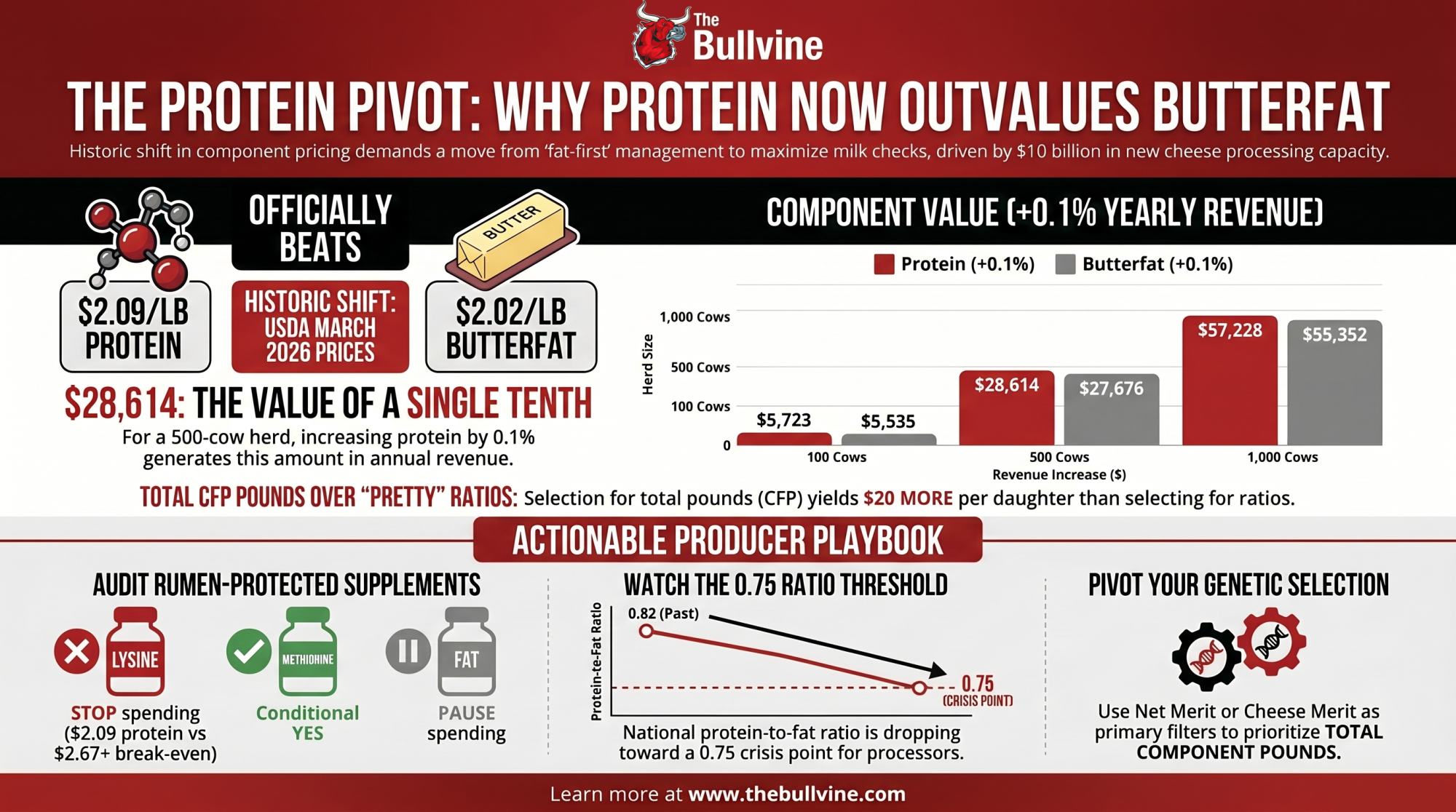
USDA set March protein at $2.0905/lb against butterfat at $2.0220. On a 500-cow Order 30 herd at 75 lbs/day, that tenth is worth $28,614 a year — $938 more than fat. First sustained flip in a decade.
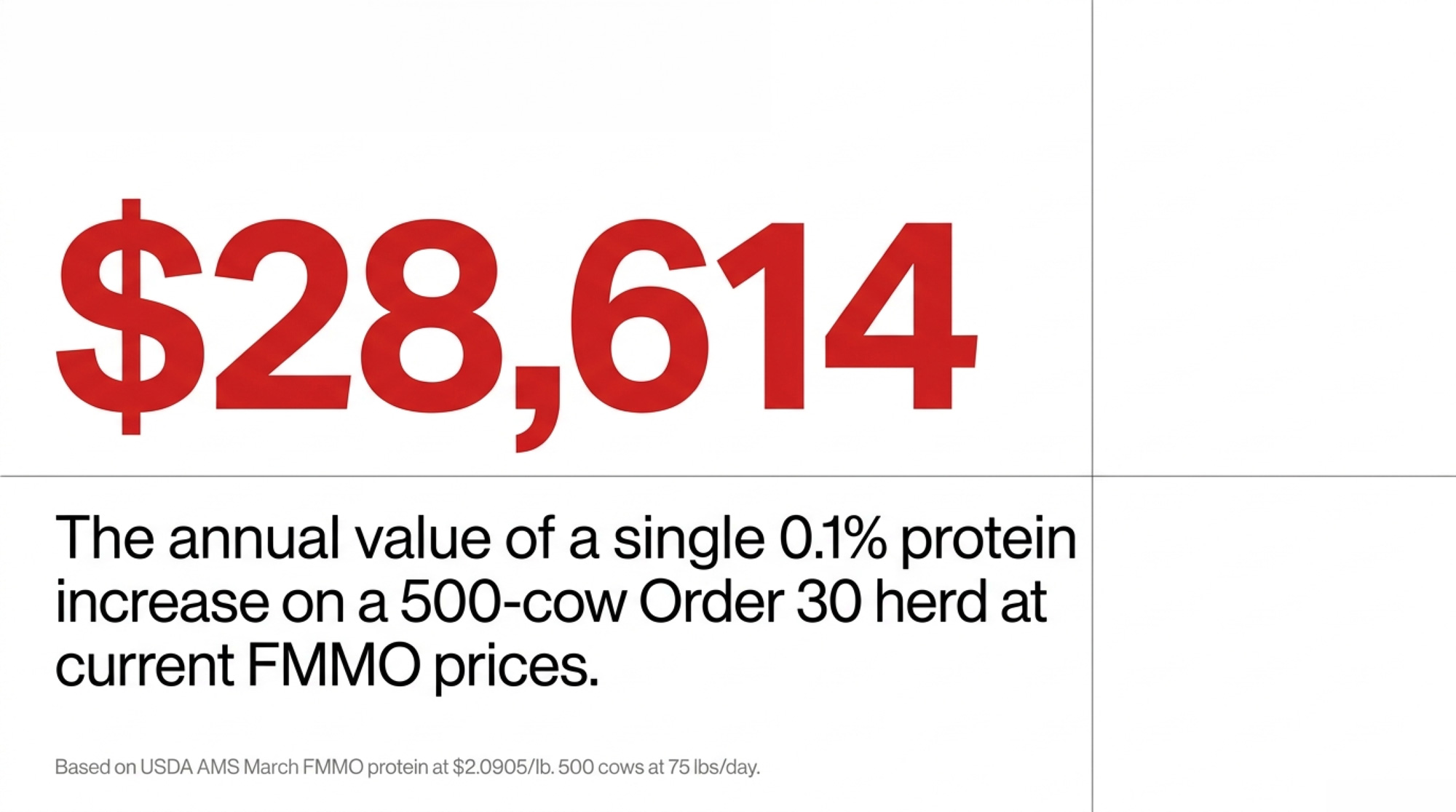
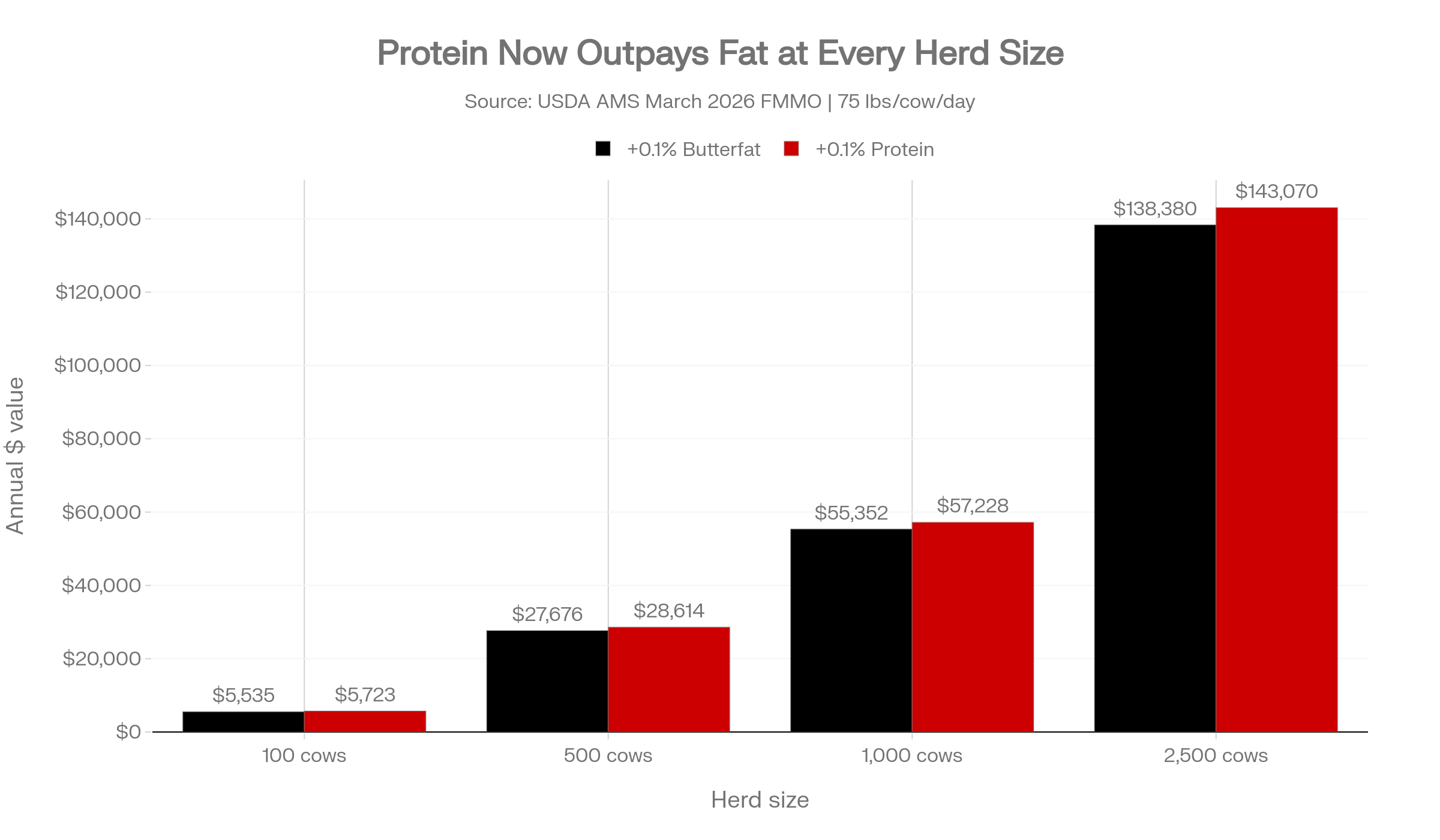
At the March 2026 Federal Milk Marketing Order announcement, USDA AMS set the protein price at $2.0905/lbagainst butterfat at $2.0220/lb — the first sustained stretch in a major cycle where a pound of milk protein outvalues a pound of milk fat. For a 500-cow Wisconsin or Minnesota shipper into Order 30 moving 75 lbs/cow/day, a single tenth-of-a-percent gap in protein now runs $28,614 a year; fat lands close behind at $27,676.

👉 Run those numbers on your own herd — open the Component Value Tracker →

That’s the stake for a mid-size Upper Midwest herd still calibrated to the old fat-premium world. The trap: a decade of fat-first genetics, fat-first rations, and fat-first contracts running headlong into roughly $10 billion in new cheese capacity that needs protein and doesn’t much care about the butter side anymore.

Dairy component economics 2026 isn’t a theme. It’s the math on your next milk check.

This is Issue #1 of The Bullvine Component Value Tracker — a monthly read translating the FMMO announcement into herd-specific dollar decisions, ranking nutrition break-evens against current prices, and scoring where the month’s highest-return component moves actually sit. May 2026 baseline: 58/100 — Maintain and Reposition Toward Protein.

The Signal the Market Already Sent

For eight of the ten years leading into 2025, butterfat paid more per pound than protein. Producers answered the signal. Genetics companies bred for fat. Nutritionists optimized rations for butterfat response. It worked — arguably too well.

U.S. butterfat climbed 0.58 points between 2015 and 2025, from 3.75% to a record 4.33%, per USDA NASS data compiled by FMMA30 — a 15.5% lift off the 2015 baseline. Over the same window, EU butterfat gained roughly 2.4% and New Zealand roughly 2.5%, per FMMA30’s international comparison. Protein climbed too — 3.11% to 3.29% — but that 5.8% gain only looks healthy until you stack it next to fat running at nearly triple the pace.

CoBank’s lead dairy economist Corey Geiger flagged the problem in the bank’s September 25, 2025 Knowledge Exchange brief, warning that excessive butterfat can compromise cheese quality and that cheesemakers target a protein-to-fat ratio near 0.80, with ratios significantly below that threshold reducing yield efficiency. At the time, the ratio sat at 0.77. Seven months later, with full-year 2025 butterfat averaging 4.33% against protein stuck at 3.29%, it’s dropped to 0.760 (3.29 ÷ 4.33 = 0.7598).

Over half of U.S. milk now moves into cheese. Those plants were calibrated for 0.82. The milk arriving at the dock doesn’t match the equipment on the other side.

Why Should Upper Midwest Producers Care About the 0.75 Threshold?
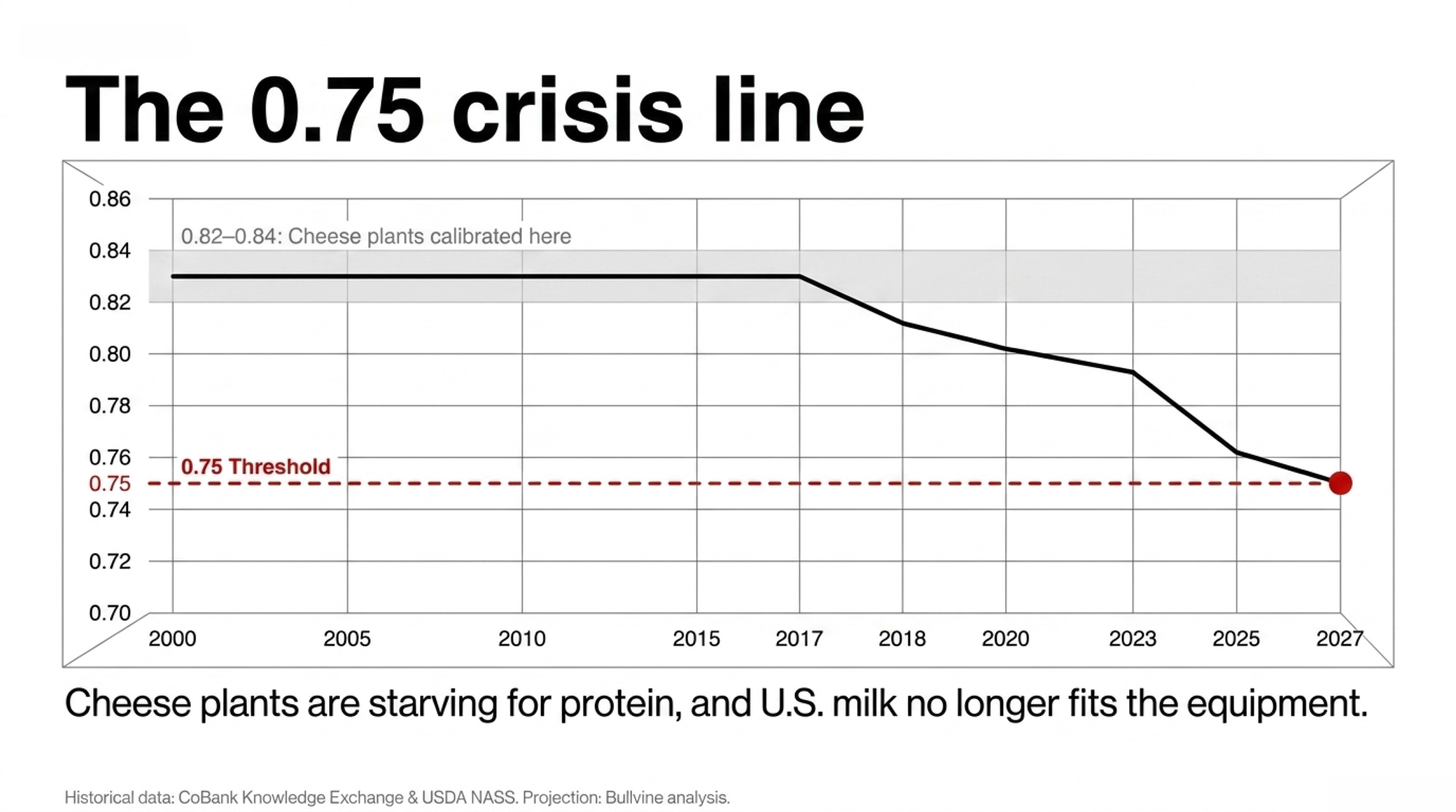
From 2000 to 2017, the U.S. protein-to-fat ratio held flat between 0.82 and 0.84, per CoBank’s Knowledge Exchange. That’s the band processors built their plants around. Starting in 2018, the line bent.
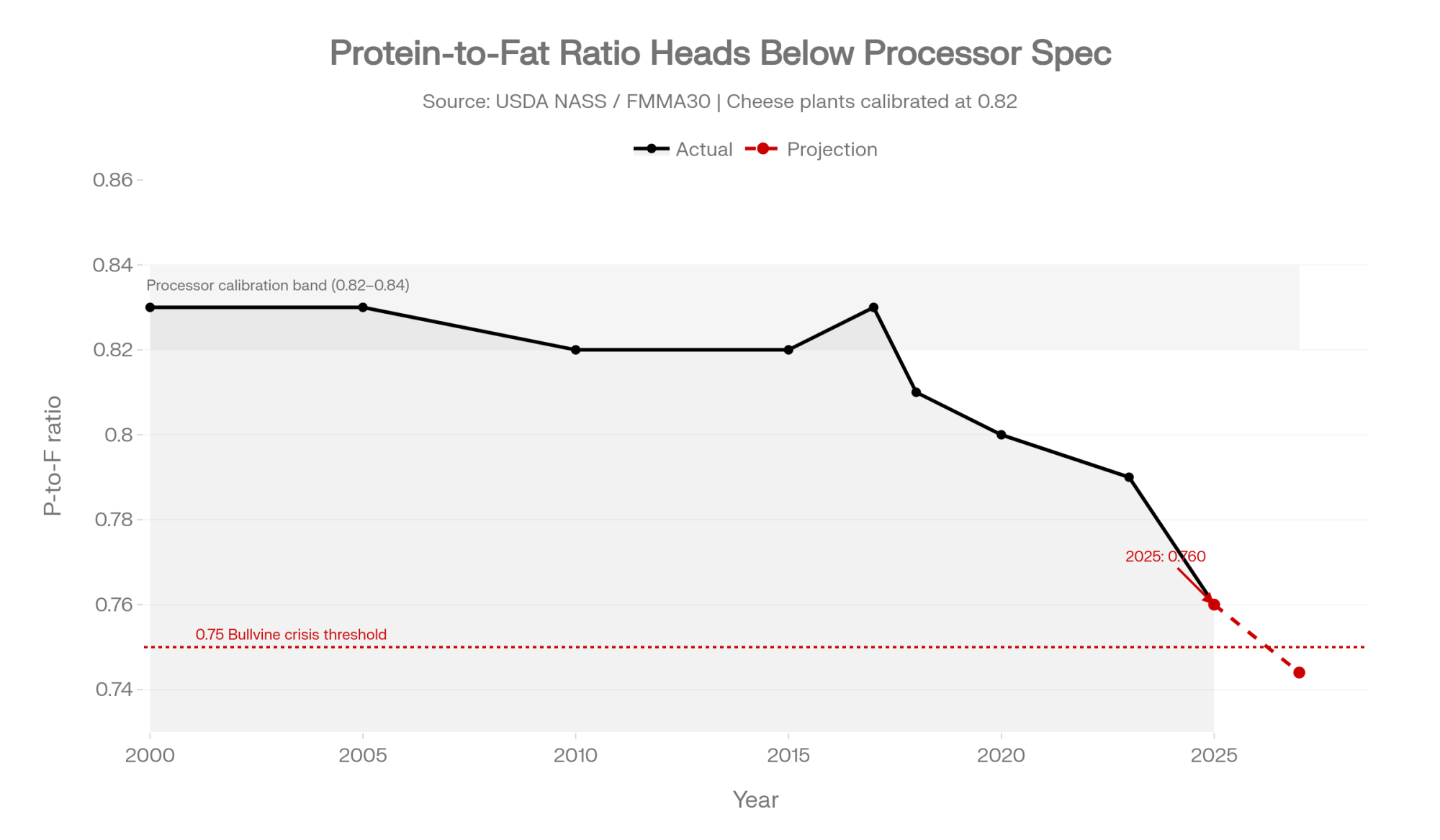
YearP-to-F RatioContext
2000–20170.82–0.84Stable — cheese plants calibrated here
2018~0.81Decline begins
2020~0.80Geiger’s “near 0.80” cheese-quality target
2023~0.79Decline accelerates
2025 full-year0.760FMMA30 / USDA NASS annual
Bullvine crisis threshold0.75Named in this issue
Projected arrivalLate 2027 (~16 months out)Bullvine projection, ~0.008/year decline

The Bullvine is putting a stake in the ground: the U.S. protein-to-fat ratio crosses 0.75 within roughly 16 months at current decline rates, and that’s where standardization costs, whey-stream fat losses, and processor basis negotiations visibly reprice Upper Midwest milk checks. If the ratio turns upward before late 2027, the Tracker will say so in writing and retire the call. If it doesn’t, this stops being a chart. It’s the basis for a pricing correction that’s already started.

The structural driver keeping the ratio suppressed is genetics, and the indexes don’t agree on which way out. Holstein USA’s April 2026 TPI revision shifted production weights to 24% protein and 14% fat — a 5-point move in each direction. Top-10% bulls saw an average 34-point TPI decline, with 26.6 of those points attributable to the formula change itself rather than routine evaluation updates. USDA’s Net Merit 2025 moved the opposite direction — 31.8% fat, 13.0% protein. Two major indexes. Two opposite signals. One breeder trying to mate cows this week.

Running the Numbers: What 0.1% Is Worth on a 500-Cow Order 30 Herd

Before you read the rest of this issue, run this math on your own operation.

Scope. 500-cow Wisconsin or Minnesota shipper into FMMO Order 30. 75 lbs/cow/day rolling average. March 2026 FMMO prices.

Formula:

Incremental annual revenue = 0.001 × daily lbs/cow × number of cows × 365 × FMMO component price per lb

Protein at $2.0905/lb:

  • 0.001 × 75 = 0.075 extra lbs/cow/day
  • 0.075 × 500 = 37.5 lbs/day herd-wide
  • 37.5 × 365 = 13,687.5 lbs/year
  • 13,687.5 × $2.0905 = $28,614/year

Butterfat at $2.0220/lb:

  • 13,687.5 × $2.0220 = $27,676/year
Herd SizeDaily lbs/cow+0.1% Butterfat/Year+0.1% Protein/YearCombined
100 cows75$5,535$5,723$11,258
500 cows75$27,676$28,614$56,290
1,000 cows75$55,352$57,228$112,580
2,500 cows75$138,380$143,070$281,450

March 2026 FMMO component prices, USDA AMS. Linear scaling.

Where the $83,000–$140,000 bulk-tank gap comes from. A 500-cow Order 30 shipper at 4.0% fat against a 2025 national average of 4.33% is carrying a 0.33-point fat gap. Three 0.1% increments × $27,676 = roughly $83,000/year in fat alone. Add a 0.2-point protein gap (3.09% vs. 3.29% national), and 2 × $28,614 pulls another ~$57,000/year. The $140,000 upper bound is a composite of two gaps on two components, not one factor. The low end is fat alone.

That’s the money. Not theoretical. Sitting in the bulk tank every month it ships short of county average.

If you’re leveraged. On a 500-cow shop running DSCR closer to 1.1 than 1.3, a captured $56,290 from a combined 0.1%/0.1% component move is the difference between a lender conversation you choose when to have and one your lender chooses for you. Component revenue doesn’t carry the manure tax added volume does — no extra cow, no extra parlor time, no extra lagoon capacity. It’s the highest-leverage margin move currently on the table.

Run the Numbers on Your Herd: The Bullvine Component Value Tracker

Every calculation above is scoped to a 500-cow Wisconsin or Minnesota shipper at 75 lbs/cow/day against March 2026 FMMO prices. Your operation isn’t that one.

The Tracker runs the +0.1% value, the component-gap dollars, and the $17 Class III capital stress-test against your actual numbers — same methodology, your inputs. Plug in your cow count, production level, fat and protein tests, and the dollar numbers move in real time.

Launch the Tracker pre-loaded with this article’s May 2026 baseline — 500 cows, 75 lbs/day, 4.33% fat, 3.29% protein, $2.0220 fat price, $2.0905 protein price, $19.70 USDA all-milk forecast, $16.16 CME Class III futures:

Bookmark the result once you’ve loaded your own cow count, production, and last month’s component tests — that’s your personal Tracker baseline for the Issue #2 refresh against May FMMO prices.

Why Does Chasing a Better Protein-to-Fat Ratio Cost You Money?

Here’s the assumption the “protein market” headlines set up: the right sire in a protein-premium cycle is the one with the best protein-to-fat ratio. Run the dollars at March 2026 prices, and that logic breaks.

Two sires. Identical on everything else.

SireFat PTA (lbs)Protein PTA (lbs)Fat ValueProtein ValueTotal per Daughter/LactationWinner
Sire A+45+3545 × $2.0220 = $90.9935 × $2.0905 = $73.17$164.16+$19.88
Sire B (prettier ratio)+30+4030 × $2.0220 = $60.6640 × $2.0905 = $83.62$144.28

Sire B has the prettier protein-to-fat ratio. Sire A has the heavier check — by $19.88 per daughter per lactation, in a protein-premium market. Total CFP pounds drive the milk check. Ratio doesn’t.
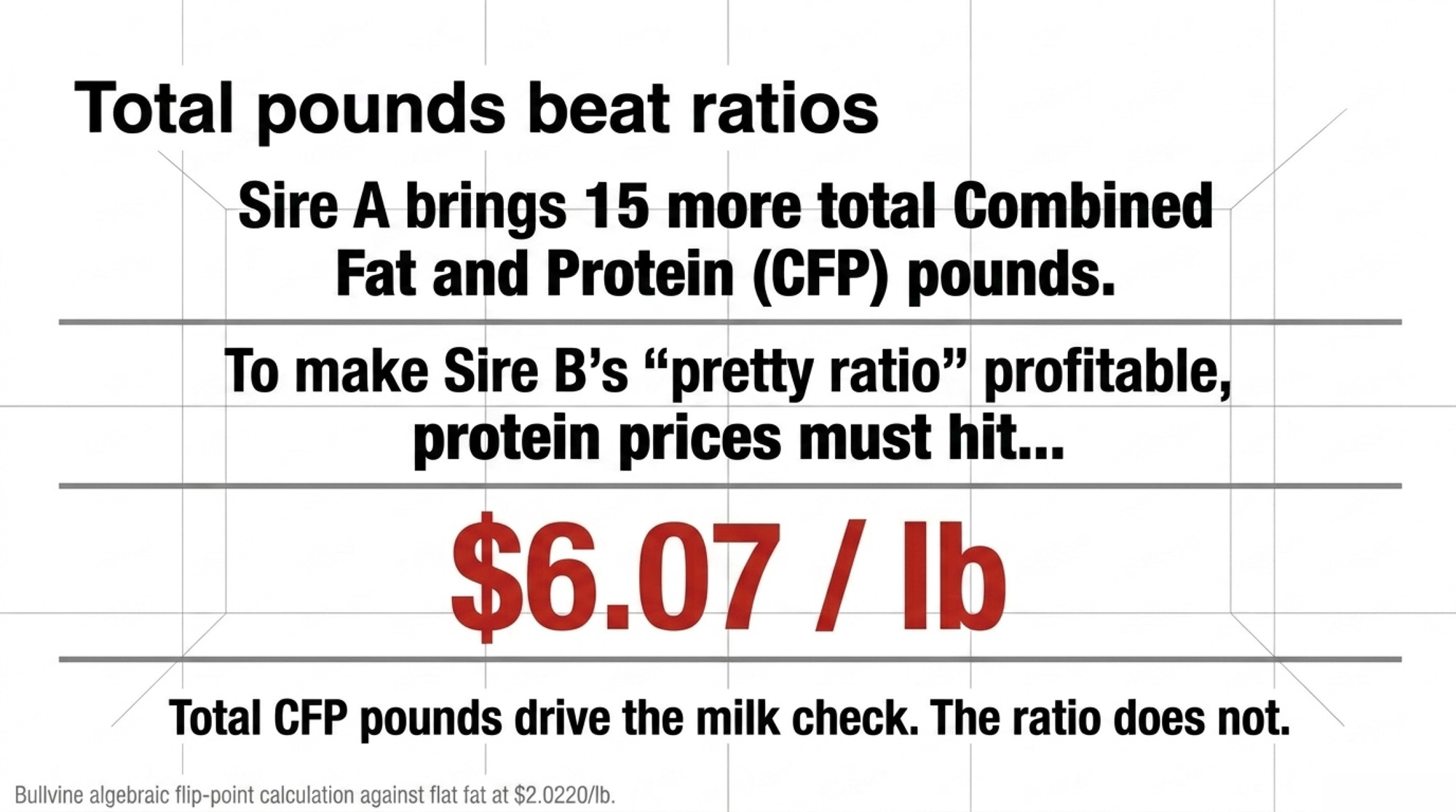
The flip point isn’t where headline logic puts it. Setting Sire A’s value equal to Sire B’s and solving for protein against flat fat at $2.0220/lb:

(45 × $2.0220) + (35 × P) = (30 × $2.0220) + (40 × P) 15 × $2.0220 = 5 × P P = $6.07/lb protein

At flat fat, protein would have to triple from $2.09 to roughly $6/lb before Sire B’s ratio edge overcomes Sire A’s 15-lb CFP advantage. Sire A’s win isn’t marginal. It’s structural — the total-pounds gap is large enough that no realistic protein price flips it.

Picture a Brown County 500-cow operation — a hypothetical herd representative of Order 30 shippers we’ve modeled — that filtered its April sire list on protein-to-fat ratio and surfaced Sire B at the top. Across a typical replacement pipeline of 150 heifers/year and 2.8 lactations per cow in the milking string (Bullvine modeling assumption), that single $19.88/daughter/lactation delta compounds to roughly $8,350/year in steady-state drag once the selection cycles through the lactating herd (150 × 2.8 × $19.88). Filter-the-whole-sire-list style ratio-first selection — not just one sire swap — carries materially more drag; The Bullvine’s April 2026 TPI analysis modeled it at roughly $17,500/year for herds that filtered broadly on ratio across multiple placements.

The ruleset for this mating season:

  • Primary filter: Net Merit or Cheese Merit — both balance full economics, not just protein percent
  • Sort by: total CFP pounds
  • Tie-breaker: protein PTA, when CFP is equivalent
  • Don’t: select on protein-to-fat ratio at the expense of total CFP

There’s an interpretive tension inside TPI itself worth flagging — this is Bullvine analysis, not a Holstein USA position. Under the April 2026 formula, one pound of PTA protein carries roughly 1.7× the leverage of one pound of PTA fat in the index. TPI’s own Feed Efficiency formula still values fat at $1.86/lb against protein at $1.75/lb. Same index. Two signals. Trust the price on the milk check, not the coefficient on the ranking sheet.

Which Supplements Still Pencil at $2.09/lb Protein?

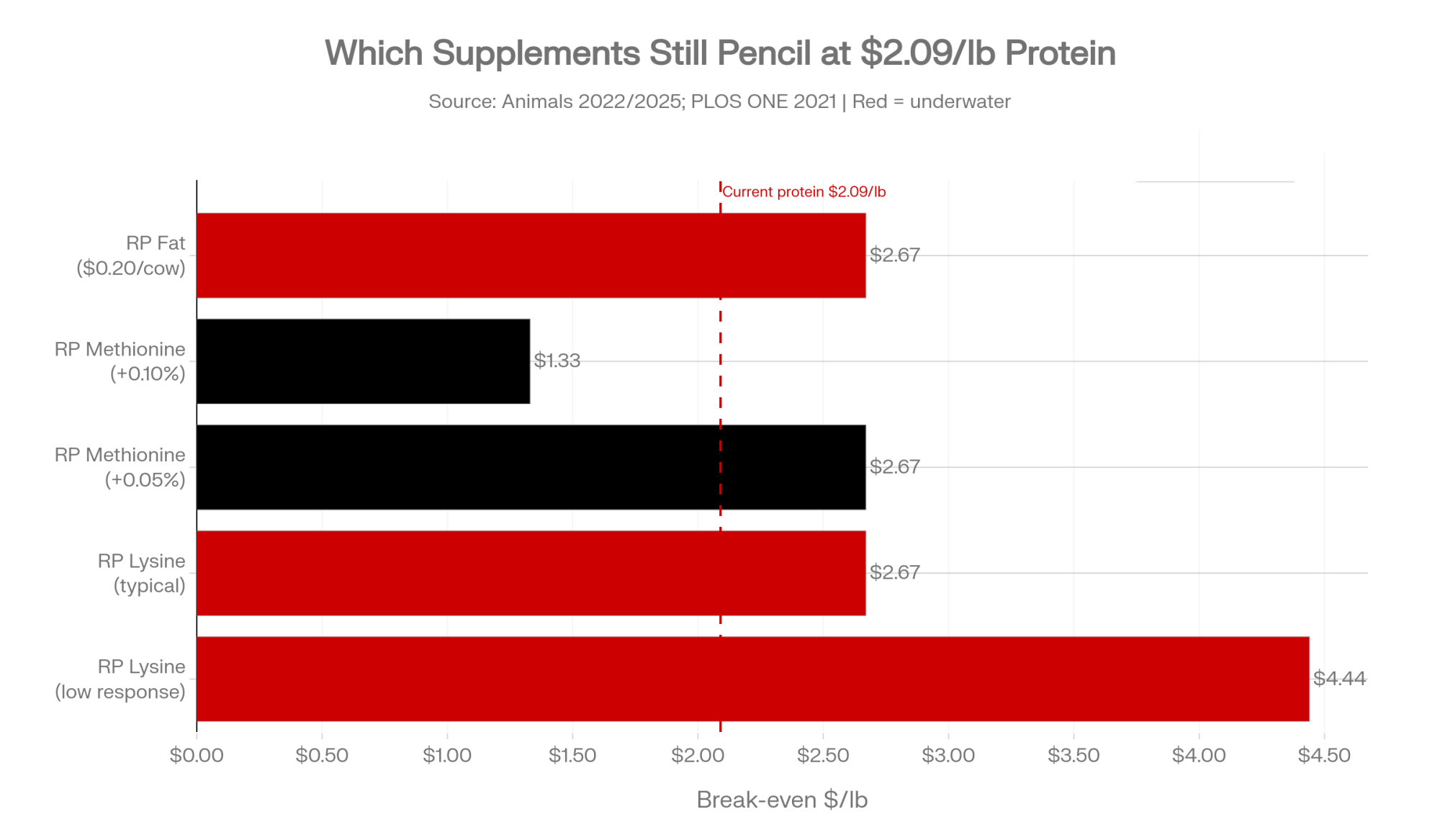
Component prices shifted. Not every ration has caught up. Break-evens below are scoped to a 500-cow, 75 lbs/cow/day Order 30 operation at March 2026 FMMO prices.
Rumen-Protected Methionine: Conditional Yes

A peer-reviewed meta-analysis in Animals (PMC9219501, 2022) puts RPM’s protein response range at +0.07% to +0.15%, with yield gains of 27–43 g/day. The 2025 combined RPLM paper (Animals, PMC12691028) confirms response is heavily dependent on basal diet and a roughly 3:1 lysine-to-methionine target.

At $0.10/cow/day, +0.05% response:

  • Extra protein: 0.0005 × 75 = 0.0375 lbs/cow/day
  • Break-even protein price: $0.10 ÷ 0.0375 = $2.67/lb
  • Current: $2.09/lb — marginally negative

At $0.10/cow/day, +0.10% response:

  • Extra protein: 0.075 lbs/cow/day
  • Break-even: $0.10 ÷ 0.075 = $1.33/lb
  • Margin vs. current: +$0.76/lb — strongly positive

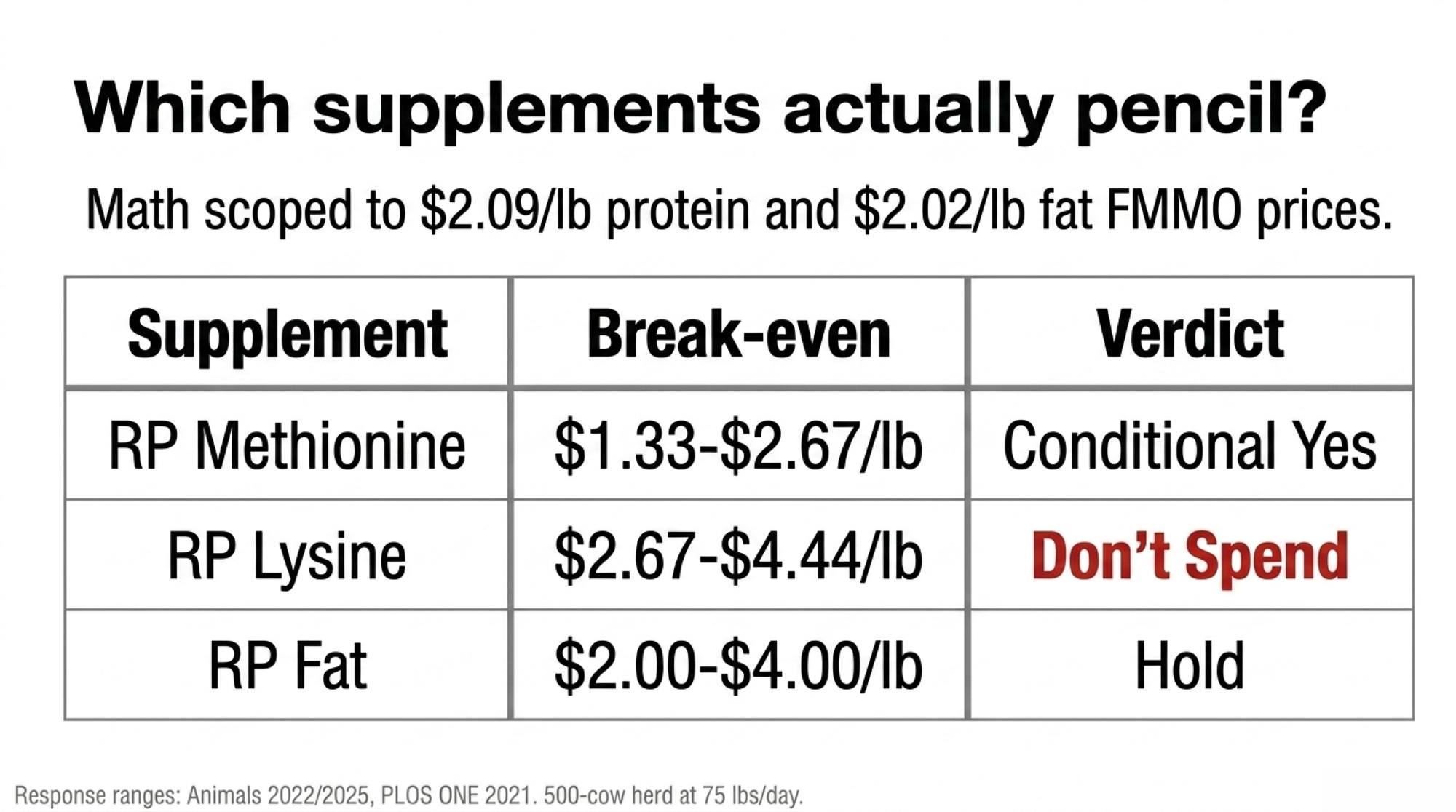
Methionine pays when the cost is low and the response is real. It doesn’t pay when either assumption slips. That’s a ration-audit conversation, not a standing order.

Rumen-Protected Lysine: Don’t Spend

Commercial RPL response on Holsteins runs +0.03% to +0.08% protein at $0.08–$0.15/cow/day, per trial work summarized in PLOS ONE (pone.0243953, 2021).

  • At $0.10/cow/day, +0.05% response: break-even $2.67/lb
  • At $0.10/cow/day, +0.03% response: break-even $4.44/lb

Current protein: $2.09/lb. Unless you’ve got 30+ days of bulk-tank data proving outlier response on your herd, lysine’s a ration tax right now. Not a component strategy.

The flip point. Protein above $2.75/lb sustained before lysine pencils at typical commercial response — $0.66/lb of price movement away.

Rumen-Protected Fat: Hold

At March 2026 butterfat of $2.0220/lb, the break-even for RP fat lands at $2.67/lb (at $0.20/cow/day cost and a +0.10% response: $0.20 ÷ 0.075 = $2.667). Current butterfat sits $0.65 below that threshold. The math works only at lower cost or higher verified response — $0.15/cow/day against the same +0.10% response drops break-even to $2.00/lb, right at the current FMMO.

A year ago, with butterfat peaking at $2.95/lb in January 2025 before collapsing 46% to $1.58/lb by December 2025, the math worked early and not at all by year-end. Any response shortfall flips the decision today.

The flip point. Butterfat sustained above $2.67/lb at typical $0.20/cow/day cost, or contract RP fat below $0.15/cow/day with herd-specific +0.10% response confirmed.

SupplementCost/Cow/DayResponse RangeBreak-Even (typical)Current FMMOVerdict
RP Lysine$0.08–$0.15+0.03–0.08% protein~$2.67–$4.44/lb$2.09/lbDon’t spend
RP Methionine$0.10–$0.14+0.07–0.15% protein$1.33–$2.67/lb (response-dependent)$2.09/lbConditional yes — low cost + verified response only
RP Fat$0.15–$0.30+0.10–0.20% butterfat$2.00–$4.00/lb (cost- and response-dependent)$2.02/lbHold — break-even at or above current FMMO

Response ranges: Animals 2022 (PMC9219501); Animals 2025 (PMC12691028); PLOS ONE 2021 (pone.0243953). Herd response varies by basal ration, stage of lactation, and product specification.

How Much Does Your FMMO Order Change the Protein Payoff?

Same genetics move. Same ration tweak. Different milk check — because FMMO class utilization dictates how much the market pays for what you improved.

Order 30 (Upper Midwest) routes 83.9% of producer milk to Class III cheese use, per FMMA30 2025 annual data. Wisconsin contributes 69.6% of Order 30 volume; Minnesota adds 21.0%. In a cheese-heavy order, protein dominates.

FMMO / RegionClass UtilizationP-to-FPriority
Upper Midwest (30)83.9% Class III0.759Protein first at current FMMO prices — highest protein ROI among major orders
Southwest (126) / TexasExpanding cheese0.767Hilmar + Leprino pulling hard; contract premiums emerging
California (51)Class 4a heavy0.763Fat premiums compressed; repositioning window
Northeast (1)Balanced I/III0.776Fluid share moderates protein premium

FMMA30 Upper Midwest 2025 annual; ratios derived from regional component averages in FMMO reporting.

Texas production ran +10.6% in 2025, Kansas +11.4%, per USDA NASS. Idaho regained the nation’s #3 spot at 18.26 billion lbs of milk, edging Texas’s 18.21 billion by roughly one day’s worth of production. The processing gravity wells driving that growth:

  • Hilmar Cheese, Dodge City, KS — $600M, operational since March 2025
  • Leprino Foods, Lubbock, TX — approximately $1B complex, ~600 employees, designed for ~1M lbs cheese/day
  • Valley Queen, Milbank, SD — expansion completed 2025, anchoring the I-29 corridor
  • Leprino, Lemoore East, CA — closing in 2026, driving California capacity losses

Early-2026 trade coverage of High Plains and I-29 corridor contract offers has flagged structural premium tiers rewarding herds that reach roughly 4.2% fat and 3.3% protein. The specific cwt figure varies heavily by plant, co-op, and volume commitment — verify premium language against your own contract before building the number into a budget. What matters here isn’t the exact number at any one plant. It’s that the premium structure exists where the cheese capacity is landing, and it didn’t exist 18 months ago.

California production ran -5.74% in 2025 (USDA NASS), on water scarcity, regulatory pressure, and lost processing capacity. For the dairies that stay, the shift from fat-heavy checks toward protein-relevant ones is a repositioning window. Not a crisis.

Trade-offs to Watch

  • Net Merit or Cheese Merit over TPI as your primary screen gives up benchmarking some buyers still reference for genetic marketing. You gain pricing accuracy on the milk check. You give up pedigree shorthand at the auction ring.
  • Locking 60–75% of feed at $3.90–$4.10 corn needs equal-weight milk-side coverage. One-sided hedging is worse than no hedge — if corn drops and milk drops with it, you’re paying above-market for feed into a weaker check.
  • Genomic-testing 100% of heifers at ~$40/head runs roughly $6,000/year on a 150-heifer pipeline. Payback only lives in the sorting decision. Testing without changing which heifers breed to elite component sires is a $6,000 data subscription.

What Does a 58/100 Component Opportunity Score Actually Tell You to Do?

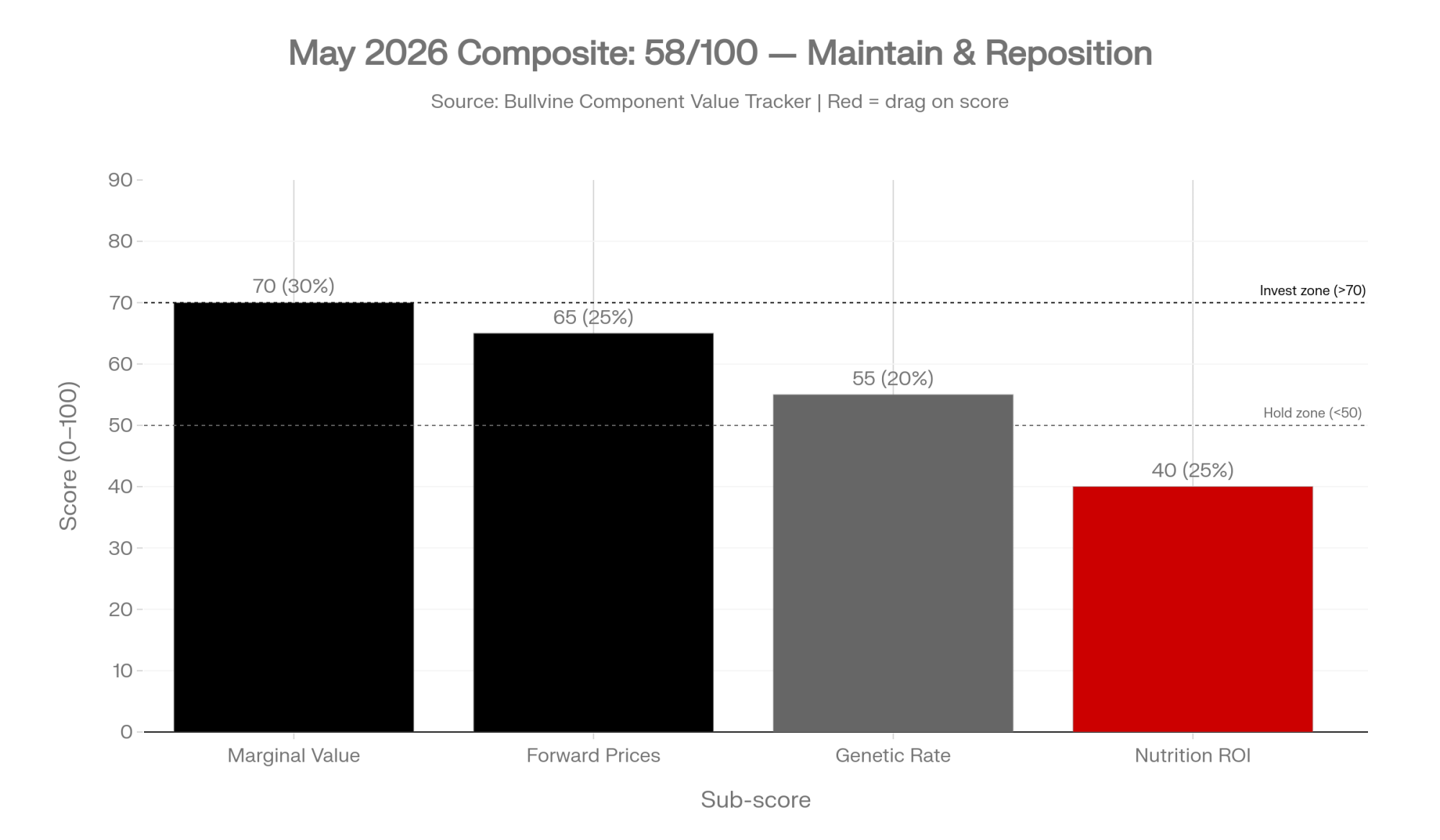
Each Tracker issue compresses four market conditions into one score. May 2026 baseline:
Sub-ScoreWeightReadingScore
Marginal Value ($/0.1% at current FMMO)30%$27,676 fat + $28,614 protein on 500-cow Order 30 — off 2025 peaks but meaningful70
Forward Price Trajectory (CME 6-month)25%Butter and cheese in slight contango from depressed levels — stabilizing, not surging65
Genetic Improvement Rate (CDCB trends)20%Fat PTA still outpacing protein PTA; April 2026 TPI starts the correction, pipeline lag is real55
Nutrition ROI Opportunity25%Lysine negative; methionine conditional; RP fat break-even at or above current FMMO40

Composite: (70 × 0.30) + (65 × 0.25) + (55 × 0.20) + (40 × 0.25) = 21.0 + 16.25 + 11.0 + 10.0 = 58.25/100

ZoneRangeAction
Invest Aggressively>70Component premiums justify significant new nutrition + genetics spending
Maintain and Reposition50–70Premiums positive but compressed; genetics and market positioning carry highest forward returns
Hold<50Premiums don’t justify added investment

A 58 doesn’t mean spend everywhere. It means stay in the component game and be ruthless about which marginal dollar goes where. The 40 on nutrition reflects real margin compression — methionine’s the only consistent winner, and only at the low end of cost. The 55 on genetics reflects the lag between what the market wants and what the CDCB pipeline delivers today.

What pushes the score toward 80+: protein sustaining above $2.50/lb as new cheese plants come online; butterfat stabilizing above $2.25/lb; FMMO reform that increases component weight in pricing.

What drops it below 40: both prices falling below $1.75/lb; a feed-cost spike raising all break-evens; component tests plateauing nationally.

The 30/90/365-Day Playbook for a 500-Cow Order 30 Shipper

30-Day Actions

1. Pull last month’s milk check this week and run the 0.1% formula on your own numbers. Compare your protein test to the Order 30 average near 3.29%. The gap has a dollar sign in front of it — and at current prices, that gap’s worth more per pound than it was 18 months ago. Plug actual fat and protein tests into the embedded Tracker at March 2026 FMMO prices.

  • Requires: three milk statements, herd size, daily lbs/cow average.
  • Red-flag trigger: protein test more than 0.15 points below the Order 30 average = over $40,000/year on the table for a 500-cow herd at current prices. Urgent.
  • Watch for: seasonal variation. Compare trailing 12 months, not just last month.

2. Audit every rumen-protected supplement — and stop RP Lysine this month if response isn’t documented. Pull the invoice cost per cow per day. At $2.09/lb protein and typical commercial lysine response rates, the math is underwater by roughly $0.60 to $2.35/lb depending on your inputs. If you can’t show 30 days of bulk-tank data proving outlier response, it’s a ration tax.

  • Requires: feed invoices, nutritionist response data, bulk-tank component trend.
  • Red-flag trigger: any supplement with implied break-even above $2.09/lb protein or $2.02/lb fat, and no 30-day before-and-after data proving the response — cost to eliminate.
  • Watch for: products bundled into larger mixes where per-cow-per-day cost is hard to isolate. Ask for it in writing.

3. Put a methionine kill switch in writing with your nutritionist. +0.05% protein minimum, $0.12/cow/day maximum. Review date on the calendar. No exceptions.

  • Requires: nutritionist sign-off, 30-day bulk-tank baseline.
  • Red-flag trigger: either threshold violated for 30 consecutive days — pull the product, reset the ration, re-baseline before adding back.
  • Watch for: “the response will show up next month.” Put a review date on the calendar and hold it.

4. Before your next breeding decision, ask two questions. “What’s this bull’s total CFP in pounds?” Then: “What’s that worth per lactation at $2.0905 protein and $2.0220 fat?” That conversation surfaces the ratio trap before it ends up in your herd — at current prices, a 15-lb CFP gap between two sires is worth ~$20/daughter/lactation, and no realistic protein price flips that math.

  • Requires: current sire-list CFP data, March 2026 FMMO prices in the genetic advisor’s conversation.
  • Red-flag trigger: advisor defaults to protein-to-fat ratio or last year’s prices — stop the meeting and reset the reference numbers.
  • Watch for: marketing materials built on 2024 component prices. The math has moved.

90-Day Actions

5. Rebuild sire selection criteria around total CFP. Shift from protein-ratio filters to Net Merit or Cheese Merit as the primary screen. Sort by total CFP pounds. Protein PTA as tie-breaker only.

  • Requires: a conversation with your genetic advisor using March 2026 FMMO prices, not 2024’s. Bring current herd-average component tests.
  • Threshold: if your current bull lineup’s average CFP sits below the breed top 50% on the current CDCB run, you’re leaving component revenue on the table genetics-to-barn is slow to fix.
  • Watch for: over-tilting toward protein at the expense of health and fertility. Net Merit and Cheese Merit already hold that balance. Don’t override the index manually for ratio.
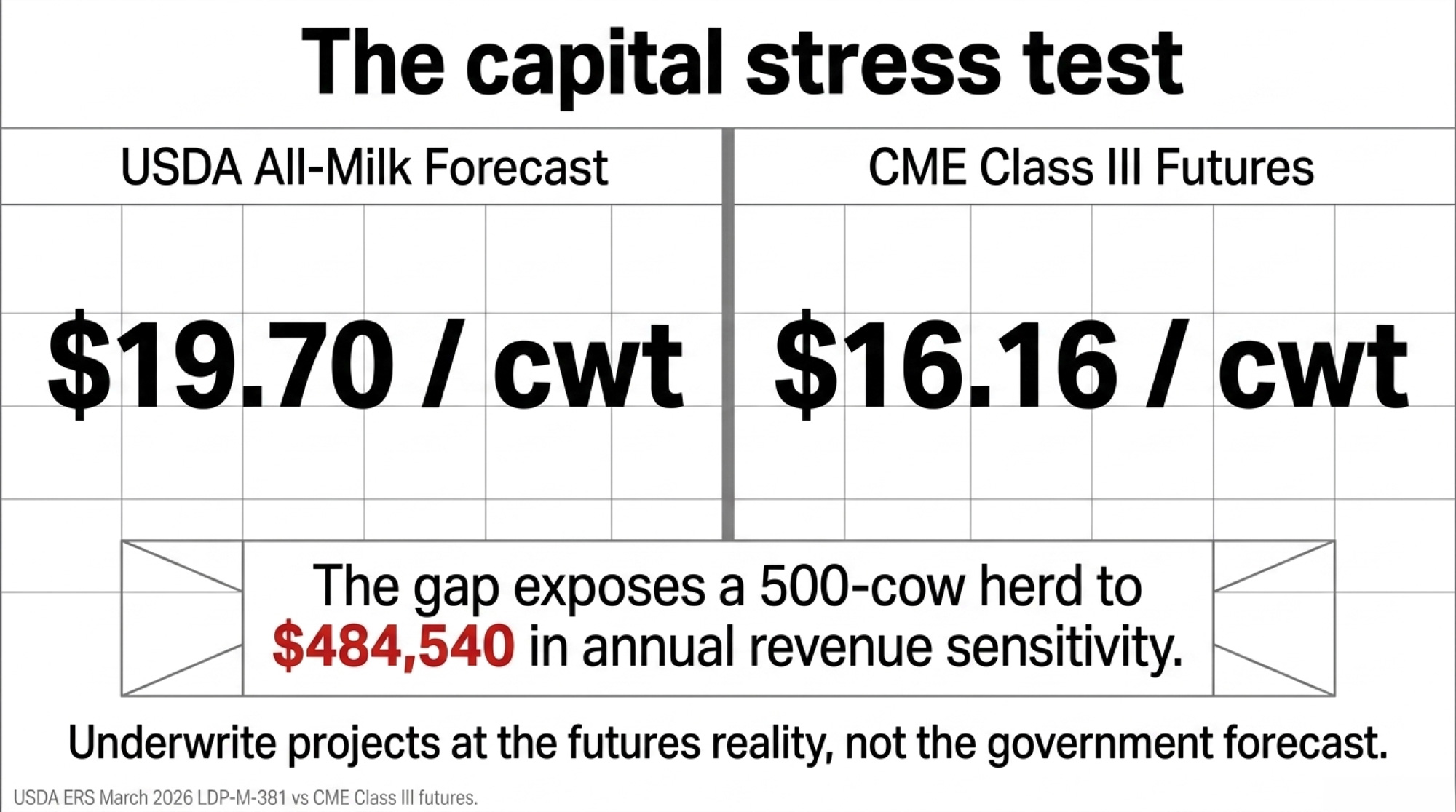
6. Stress-test every capital project at $17 Class III, not $19.70 all-milk. USDA’s March 2026 LDP-M-381 outlook projects 2026 all-milk at $19.70/cwt; CME Class III futures at the same moment traded closer to $16.16/cwt. A $3.54/cwt gap between the government forecast and the market’s own price signal is real-money exposure on any capital underwriting. On a 500-cow herd shipping roughly 136,875 cwt/year (500 × 75 × 365 ÷ 100), that’s approximately $484,540/year of revenue sensitivity between the two benchmarks — enough to break a project that only pencils at the USDA forecast. The gap between the government forecast and the futures board is the gap between a project that survives and one that breaks the operation.

  • Requires: your CPA or lender running sensitivity on barn, robot, and equipment purchases at $17 Class III.
  • Threshold: if a project’s DSCR drops below 1.2 at $17 milk for three consecutive months, treat as a luxury, not a necessity.
  • Watch for: contractors and equipment sellers pitching against the USDA forecast. The futures market is the one you hedge.

7. Lock in 60–75% of feed needs when corn projects at $3.90–$4.10/bu. Per the source economic analysis cited in this issue’s methodology, corn in that band yields roughly $11.56/cwt feed cost — manageable against current Class III.

  • Requires: cash flow for the hedging strategy, or a relationship with your co-op’s risk management service.
  • Threshold: corn in-band → lock. Corn above $4.25/bu with basis strengthening → wait for pullback or shorten coverage horizon.
  • Watch for: locking feed without also locking enough milk. You want both sides covered, not just the cost side.

365-Day Moves

8. Map your FMMO basis against the processing gravity wells. If you sit within draw radius of Lubbock, Dodge City, or an I-29 corridor plant, you have pricing leverage producers 200 miles farther out don’t. Structural demand from ~$10B in new cheese processing supports protein prices for the next two to three years. Renegotiate before capacity is fully committed.

  • Requires: 12 months of basis data against your plant vs. Order 30 statistical uniform price.
  • Opportunity signal: basis tightened to within $0.30/cwt of the Statistical Uniform Price while your component tests exceed county average — room to ask for contract improvements.
  • Watch for: short-term premiums written with pull-back triggers tied to volume. Read the basis-when-volumes-fall clause specifically. It’s the clause nobody reads until it triggers.

9. Track the 0.75 milestone quarterly. If the national ratio hits 0.75 on the late-2027 projected timeline, processor standardization costs accelerate and basis pressure increases on fat-heavy, protein-light herds. Herds repositioned 12–18 months ahead feel it least.

  • Requires: Tracker updates plus your own herd’s component trend line.
  • Opportunity signal: national ratio stabilizing above 0.76 for three consecutive months = evidence the market is self-correcting. Different strategy.
  • Watch for: short-term seasonal swings masking a trend reversal. Quarterly, not monthly.

10. Genomic-test for component direction, not just rank. At $30–$40/head, genomic testing identifies the top 20–30% of heifers worth breeding back to elite component sires. Bottom tier goes beef-on-dairy to capture beef-cross value while the pipeline tightens on components.

  • Requires: ~$40 × testing population + time to integrate results into breeding decisions.
  • Threshold: if your current replacement pipeline runs less than 25% genomic-tested heifers and you milk 500+, the sorting decision pays back within the replacement cycle at current component prices.
  • Watch for: testing without changing what you do with the data. ROI lives in the sorting decision, not the test itself.

The market already repriced. Your milk check is catching up. Every month the operation stays calibrated to the old fat-premium world is a month of compounding gap against herds that already moved. You gain cushion on components here. You give up flexibility on ration-by-habit there.

Two questions to take to your next milk meeting. What does your processor contract actually say about basis when Order 30 cheese utilization exceeds 85%? And what’s your real margin over feed per cwt this month versus 90 days ago — at $2.0905 protein, not last year’s number?
Key Takeaways

  • March 2026 FMMO flipped the component stack: protein at $2.0905/lb now beats butterfat at $2.0220, and on a 500-cow Order 30 herd at 75 lbs/day, every tenth of protein is worth $28,614 a year.
  • The national protein-to-fat ratio hit 0.760 in 2025 against cheese plants calibrated for 0.82; if you ship into Order 30, you’ve got roughly 16 months before the 0.75 line starts showing up in basis conversations.
  • At current prices, total CFP pounds drive the milk check — not protein-to-fat ratio. If your sire list is sorted on ratio, you’re leaving roughly $20 per daughter per lactation on the table and you won’t outrun that math until protein triples.
  • Stress-test every 2026 capital project at $16.16 CME Class III, not USDA’s $19.70 all-milk forecast. The $3.54/cwt gap is about $484,540/year of revenue sensitivity on a 500-cow herd — the difference between a project that survives and one that doesn’t.
Methodology and Sources

Scope. All barn math uses March 2026 USDA AMS FMMO component prices (protein .0905/lb, butterfat .0220/lb) on a 500-cow Wisconsin/Minnesota operation shipping into FMMO Order 30 at 75 lbs/cow/day, unless stated otherwise. Prices refresh with each month’s FMMO announcement. The interactive Component Value Tracker at thebullvine.com/tools lets readers substitute their own herd parameters against the same formulas and price inputs.

Bullvine projections, labeled as such. The 0.75 crisis threshold, the ~16-month timeline, the Component Opportunity Score methodology, the ~$8,350 Brown County single-sire-swap scenario, the $17,500 broad-filter ratio-trap estimate, and the 150-heifer/2.8-lactation replacement-pipeline assumptions are proprietary Bullvine modeling — published here for the first time.

External sources. USDA AMS FMMO March 2026 component prices; FMMA30 Upper Midwest 2025 annual class utilization and international component comparison; USDA NASS Milk Production Reports, February and March 2026; USDA ERS Livestock, Dairy, and Poultry Outlook, March 2026 (LDP-M-381); CoBank Knowledge Exchange, “While U.S. Leads Milk Component Growth, Butterfat May Be Growing Too Fast,” September 25, 2025; Holstein Association USA Geneticist Insights, April 2026; Select Sires / CDCB April 2025 Base Change documentation; Animals meta-analysis of rumen-protected methionine (PMC9219501, 2022); Animals combined RPLM supplementation study (PMC12691028, 2025); PLOS ONE rumen-protected methionine trial (pone.0243953, 2021).

Learn More

The Sunday Read Dairy Professionals Don’t Skip.

Every week, thousands of producers, breeders, and industry insiders open Bullvine Weekly for genetics insights, market shifts, and profit strategies they won’t find anywhere else. One email. Five minutes. Smarter decisions all week.
NewsSubscribe
First
Last
Consent

The $1,500‑Per‑Cow Whey Trap: Why $11/lb Whey Only Shows Up as 69¢ on Your Milk Check

$11/lb whey. 69¢ on your milk check. We ran the FMMO barn math on a 300‑cow herd to see where the other $1,500 per cow actually went. 

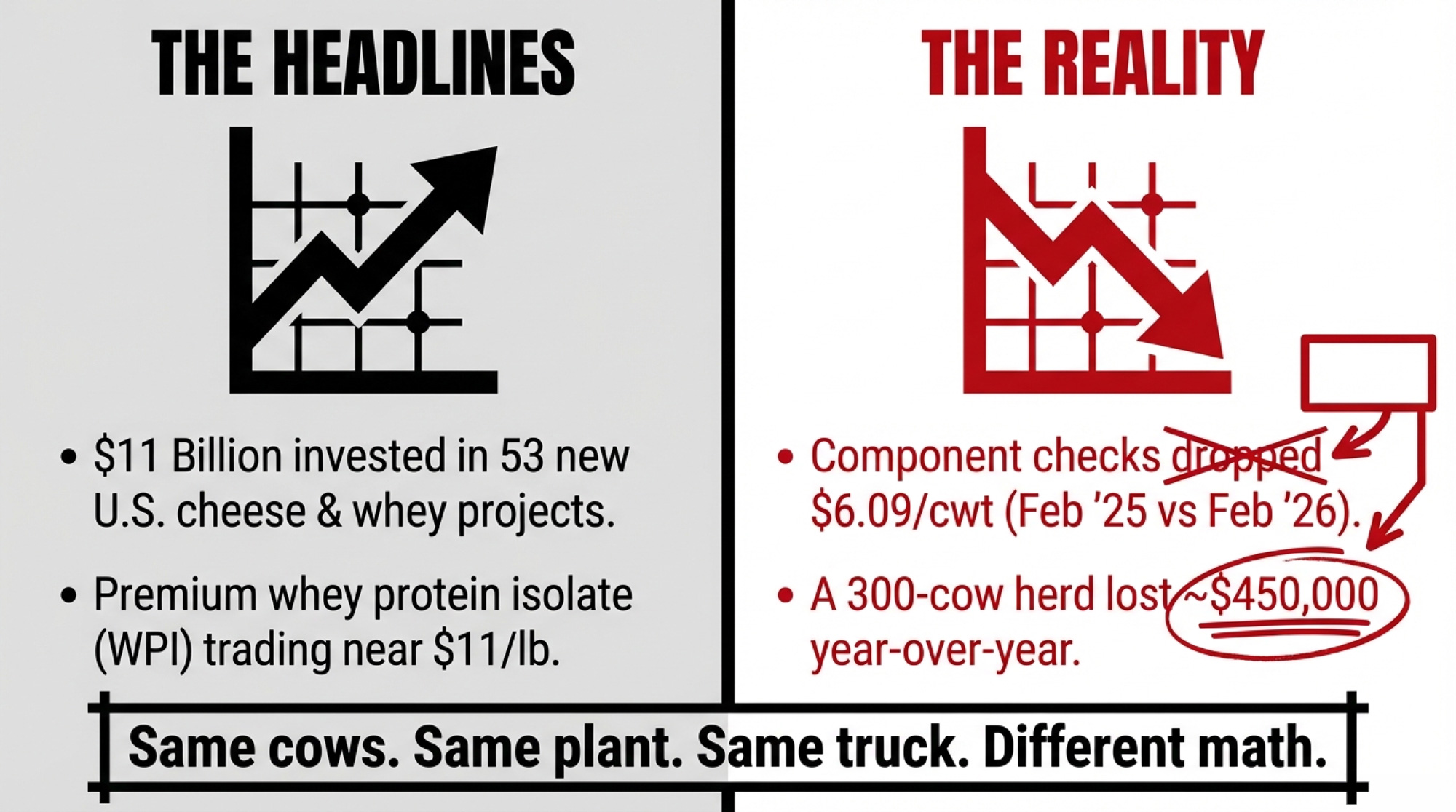
Executive Summary: Your component check dropped about $1,520 per cow from February 2025 to February 2026 while premium whey climbed to $11/lb and plants poured $11 billion into new cheese and whey capacity. FMMO’s new make‑allowance formula now prices other solids off 69‑cent dry whey and higher processor costs, cutting roughly 24¢/cwt from your other‑solids line even as whey markets rally. Butterfat and protein did the rest of the damage, taking total Class III components down about $6.09/cwt — a $450K‑plus swing on a 300‑cow herd. At the same time, beef‑on‑dairy calves are throwing off $500–$800/head, helping cash flow but leaving the U.S. roughly 800,000 heifers short heading into a capacity build‑out. The article walks through barn‑level scenarios if whey and cheese both correct, including how negative PPDs could stack another $1–$2/cwt on top of what you’ve already lost. Then it lays out a 30/90/365‑day playbook: audit your component line against AMS values, stress‑test your DMC and DRP coverage, and rebuild any expansion math around ~$15.50/cwt components instead of 2025 peaks. If you’ve got 200–500 cows on a component order and you’re not sure how much of that $11/lb whey is in your milk check, this is the 10‑minute read to run before your next contract or barn decision.

Milk check analysis

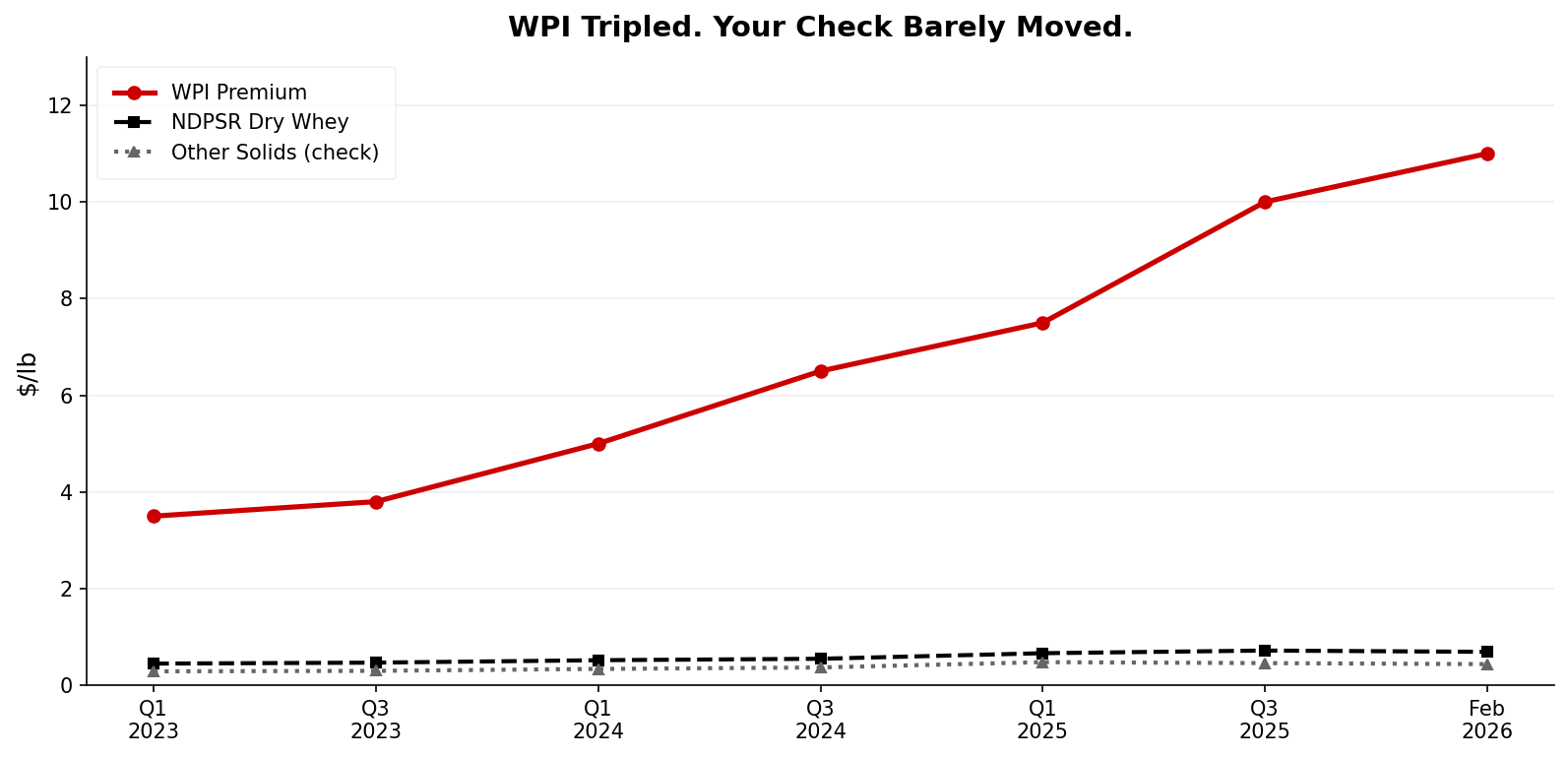
Eleven dollars a pound. That’s where high‑grade whey protein isolate has traded since late 2025, according to Ever.Ag Insight — roughly triple the price three years ago. Cheese plants are sometimes pulling more revenue from the whey stream than the cheese block itself. 

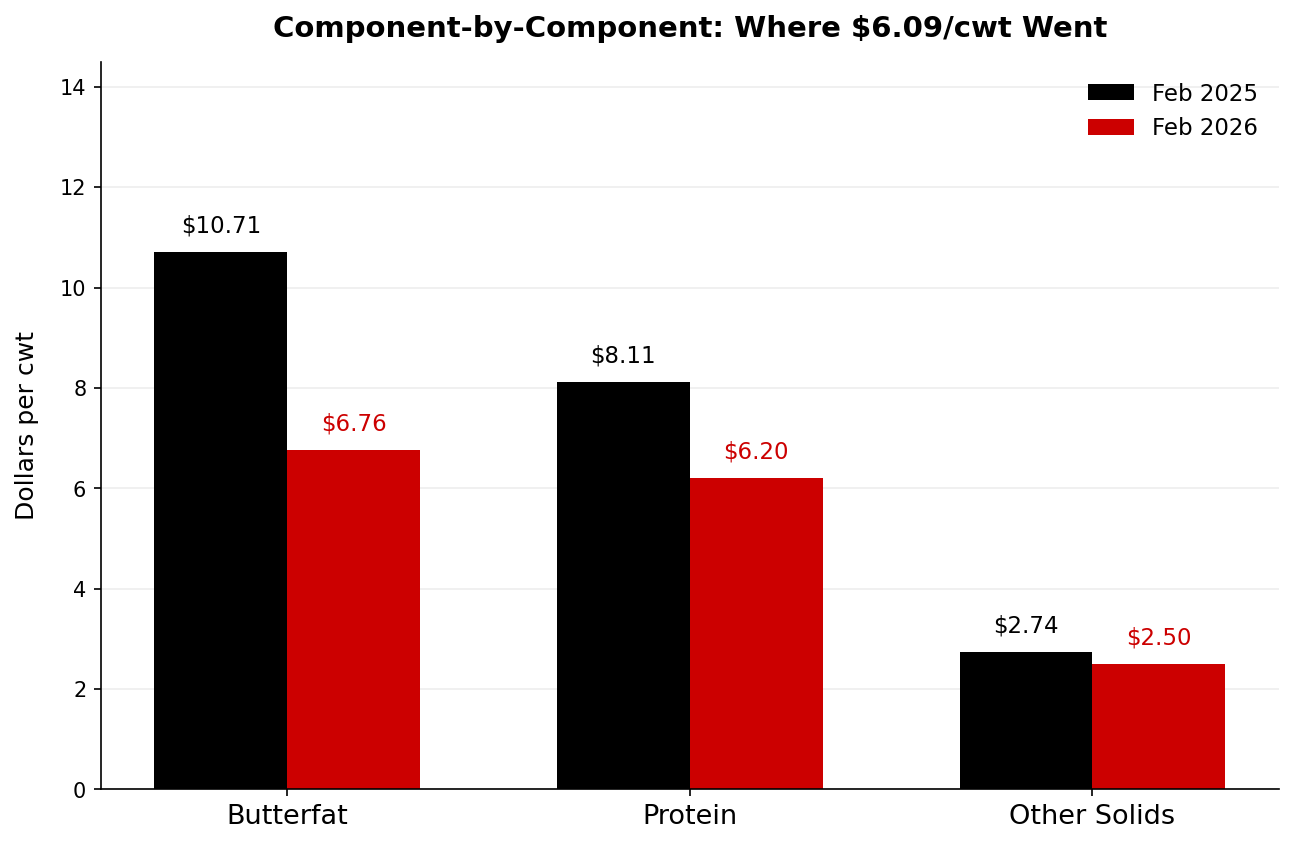
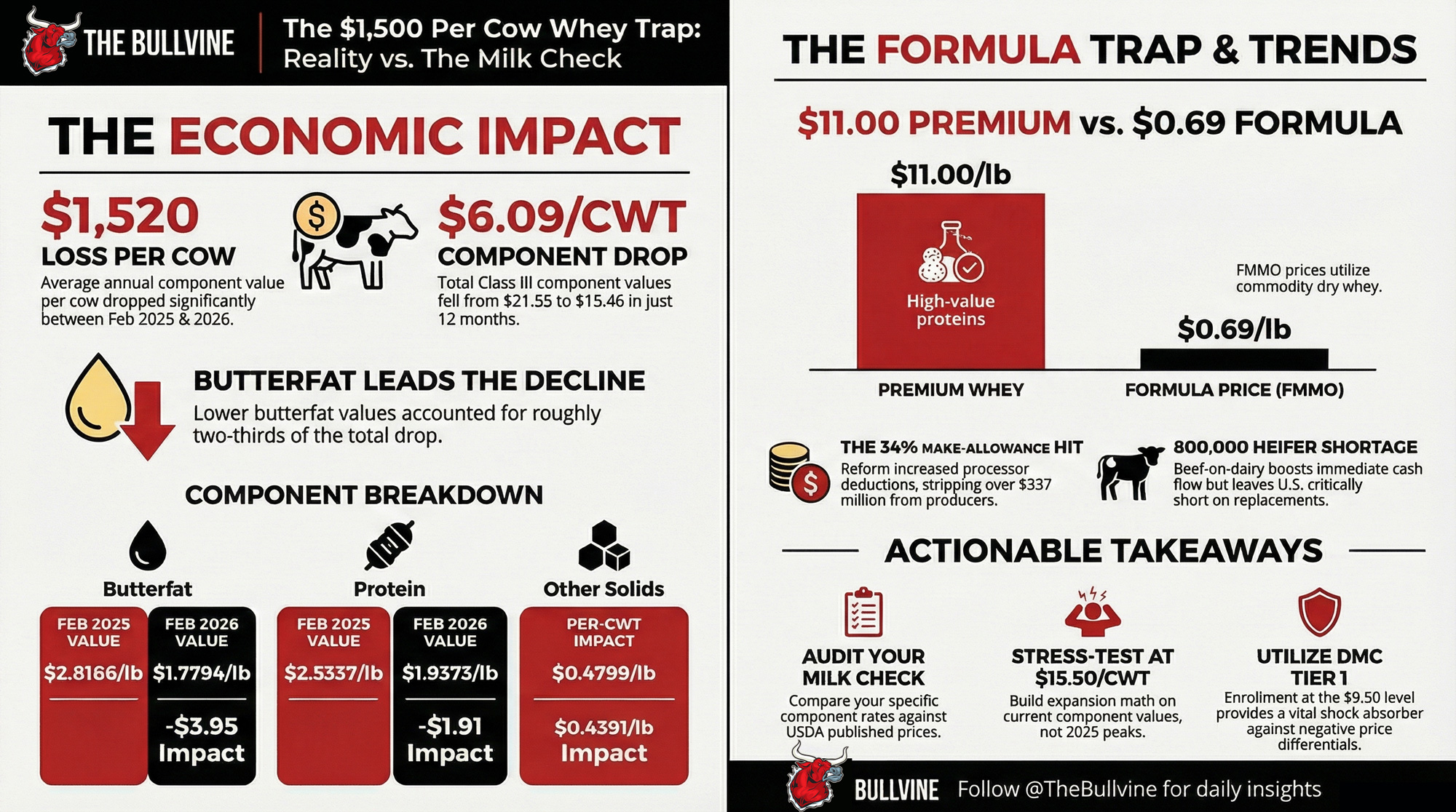
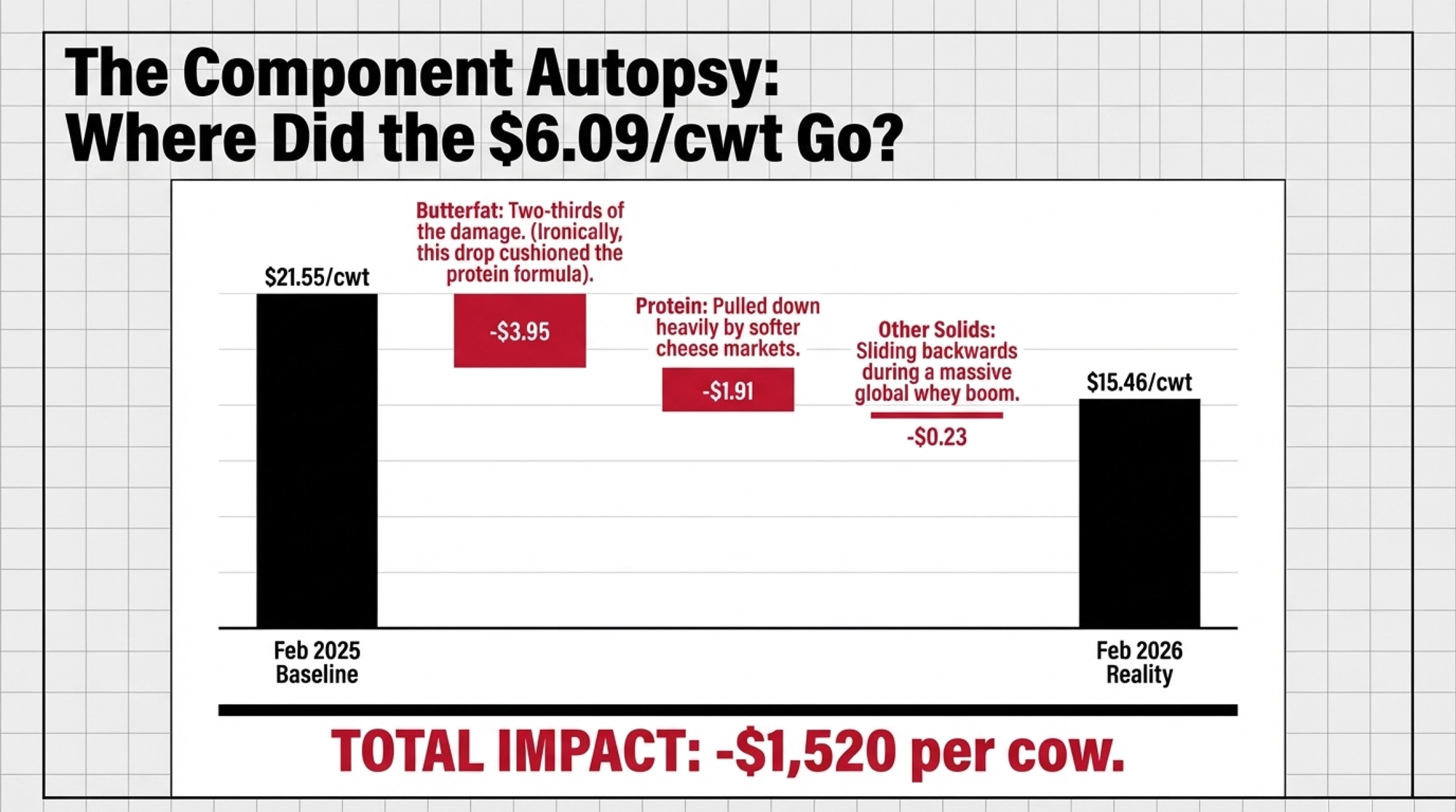
But pull your early‑2026 milk check, and a different number stares back. USDA’s February 2026 Class III component values, at standard test of 3.8% fat, 3.2% protein, and 5.7% other solids, work out to about $15.46/cwt — down from $21.55/cwt in February 2025. That’s a drop of $6.09/cwt, or roughly $1,520 per cow on 25,000 lb shipped. 

At the National Farmers Union’s 124th annual convention this March, Wisconsin Farmers Union president Darin Von Ruden dropped a number that landed hard: about $50,000. That’s how much less a 300‑cow dairy operator in southwest Wisconsin received on his January 2026 milk check compared with January 2025. Same cows. Same plant. Same truck. The formulas changed. As Von Ruden told Brownfield Ag News, this wasn’t a model herd or a spreadsheet example — it was a neighbor he’d spoken with the week before. 

And the $11 billion pouring into 53 new and expanded U.S. dairy processing projects across at least 19 states, according to IDFA, hasn’t changed that producer’s other‑solids line by a dime. 

How Much Whey Value Actually Reaches Your Milk Check?

Almost none. And the formula explains why.

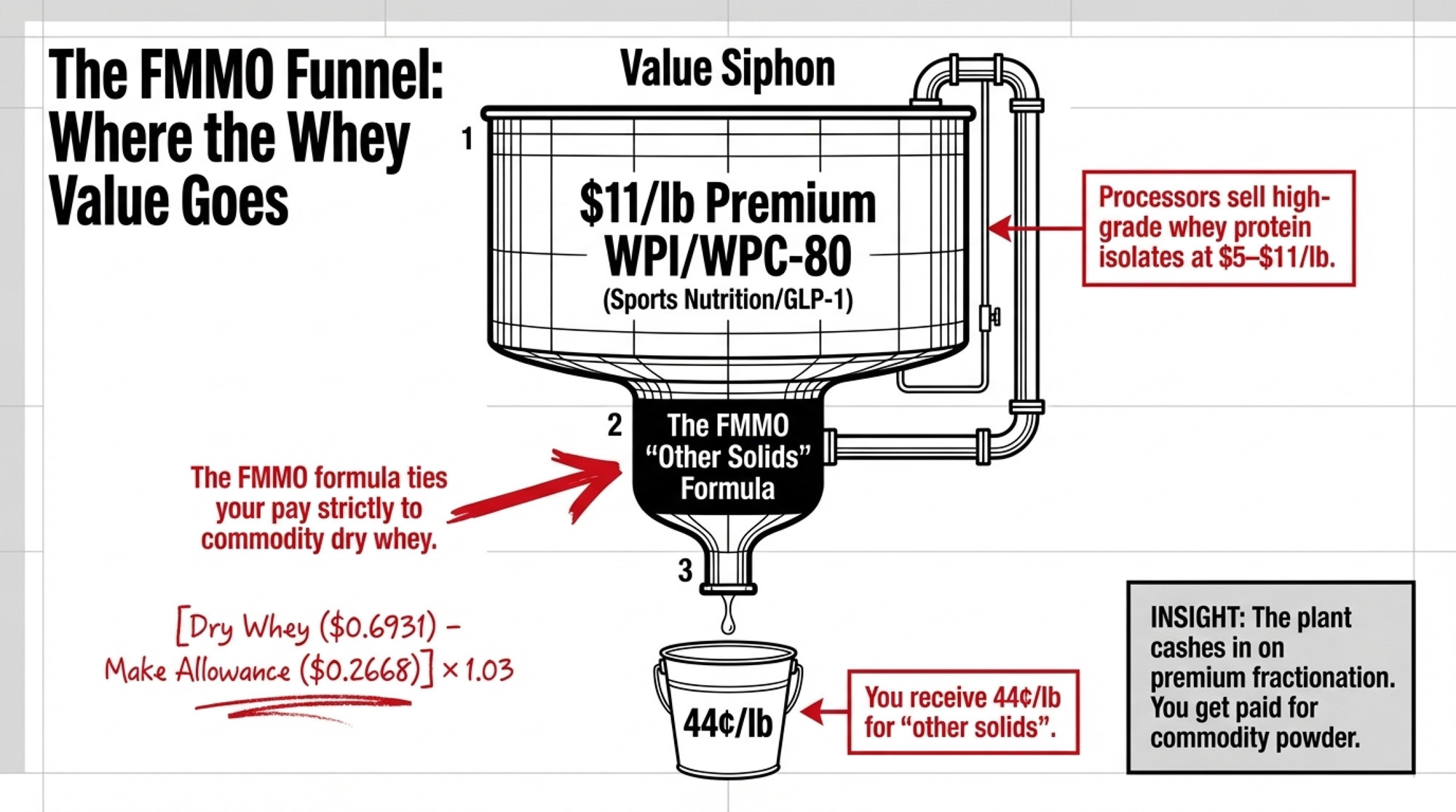
Your “other solids” component — the FMMO line where whey economics should show up — is calculated from commodity dry whey, not the premium WPI or WPC‑80 driving the headlines. Under USDA’s January 2025 Final Rule, effective June 1, 2025: 

Other‑solids price = (Dry whey price − $0.2668) × 1.03

USDA’s February 2026 “Announcement of Class and Component Prices” puts NDPSR dry whey at $0.6931/lb. Run the math: 

  • $0.6931 − $0.2668 = $0.4263
  • $0.4263 × 1.03 = $0.4391/lb of other solids.

That matches the published number exactly. Meanwhile, premium WPI trades near $11/lb, and WPC‑80 has approached €20,000/ton in Europe. Those are totally different products from the commodity dry whey that feeds the FMMO formula. 

Your other‑solids line is tethered to 69‑cent dry whey and pays 44¢/lb. Your processor’s ingredient desk is selling $5–$11/lb whey proteins into sports nutrition and GLP‑1 diets. That’s the first piece of the disconnect — and it’s the piece Rabobank’s Lucas Fuess has been warning about in interview after interview since late 2025. 

The Make‑Allowance Hit You Voted For

There’s a second piece, and this one was literally on the referendum ballot.

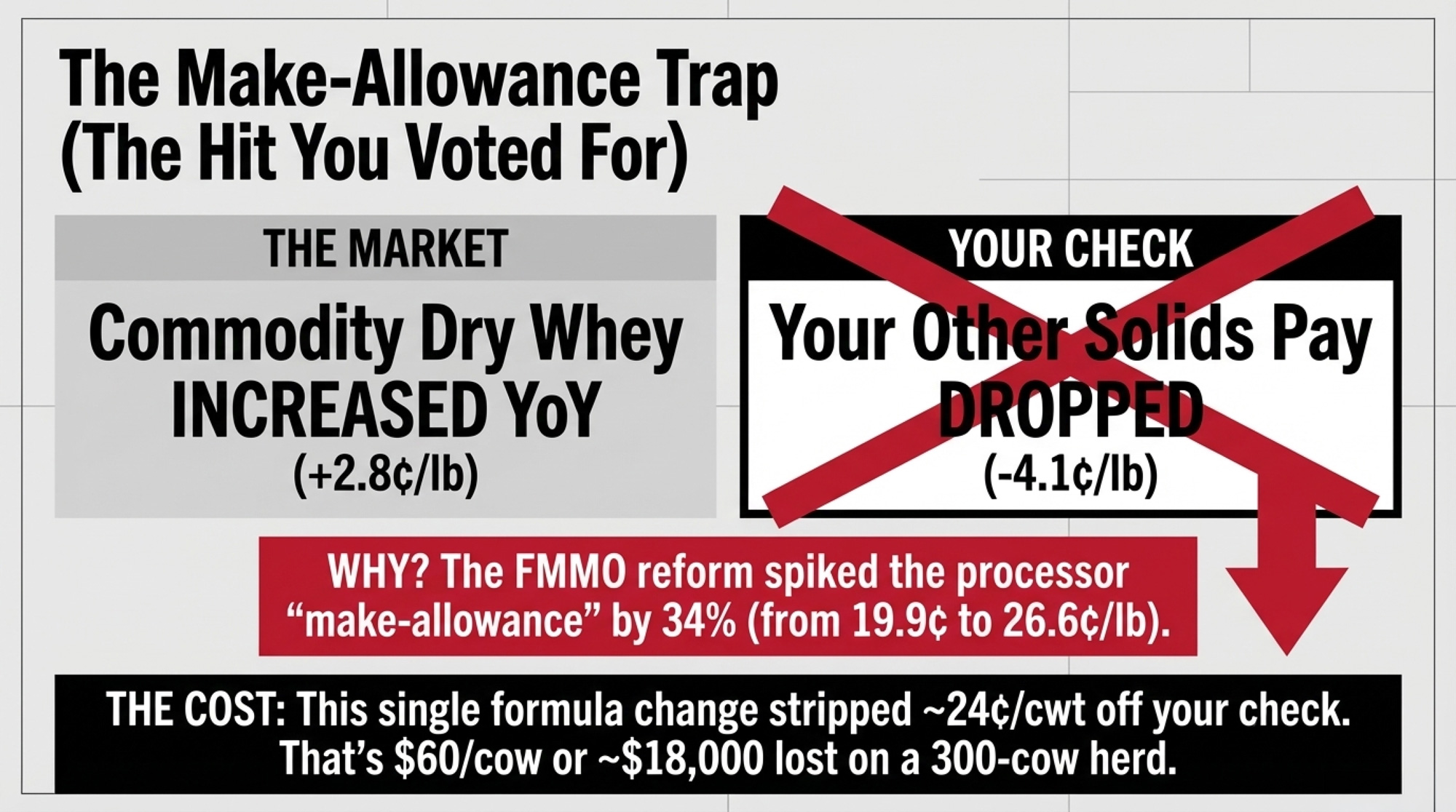
Dry whey did move up year‑over‑year. February 2025’s NDPSR average: $0.6650/lb. February 2026: $0.6931/lb  — an increase of 2.8¢/lb. But your other‑solids value didn’t climb. It slid. 

  • February 2025 other‑solids price: $0.4799/lb (old formula). 
  • February 2026 other‑solids price: $0.4391/lb (new formula). 

Dry whey up 2.8¢. Other solids down 4.1¢/lb.

The reason: the FMMO reform raised the dry whey make allowance from $0.1991 to $0.2668/lb — a 34% jump,shifting value from producer to processor. Producers approved it in the December 2024–January 2025 referendum. AFBF economist Danny Munch calculated that in the first three months alone, higher make allowances stripped more than $337 million in combined pool value nationally — class price reductions of 85 to 93 cents per hundredweightdepending on the order (AFBF Market Intel, September 2025). As Munch told Brownfield Ag News, the higher allowances “more than wipe out” the gains from other reforms. 

Here’s the barn math at your test level (5.7 lbs OS/cwt):

  • 2025 OS component: $0.4799 × 5.7 = $2.74/cwt.
  • 2026 OS component: $0.4391 × 5.7 = $2.50/cwt.

That’s 24¢/cwt gone from other solids alone. Over 25,000 lb per cow, roughly $60/cow, and about $18,000 on a 300‑cow herd. Even though dry whey itself went up.

Premium whey triples. Commodity dry whey inches up. The make allowance change eats that small gain and then some. It’s exactly the make‑allowance hit we laid out in the FMMO piece earlier this month.

Where Did the ~$6/cwt Actually Go?

The component hit isn’t just whey. It’s the combination of weaker butterfat, softer cheese, and those other solids squeezed all at once.

Using USDA AMS component values for February 2025 vs. February 2026 at standard test: 

ComponentFeb 2025Feb 2026Change/lbPer‑cwt impact
Butterfat (3.8%)$2.8186/lb$1.7794/lb−$1.0392−$3.95
Protein (3.2%)$2.5337/lb$1.9373/lb−$0.5964−$1.91
Other solids (5.7%)$0.4799/lb$0.4391/lb−$0.0408−$0.23
Total   −$6.09/cwt

Butterfat did about two‑thirds of the damage. Softer cheese pulled protein lower and took another third. Other solids were the smallest slice — but in a whey boom, you’d expect them to be climbing, not sliding.

Per 25,000‑lb cow:

  • Feb 2025: $21.55/cwt × 250 cwt = $5,387/cow.
  • Feb 2026: $15.46/cwt × 250 cwt = $3,865/cow.

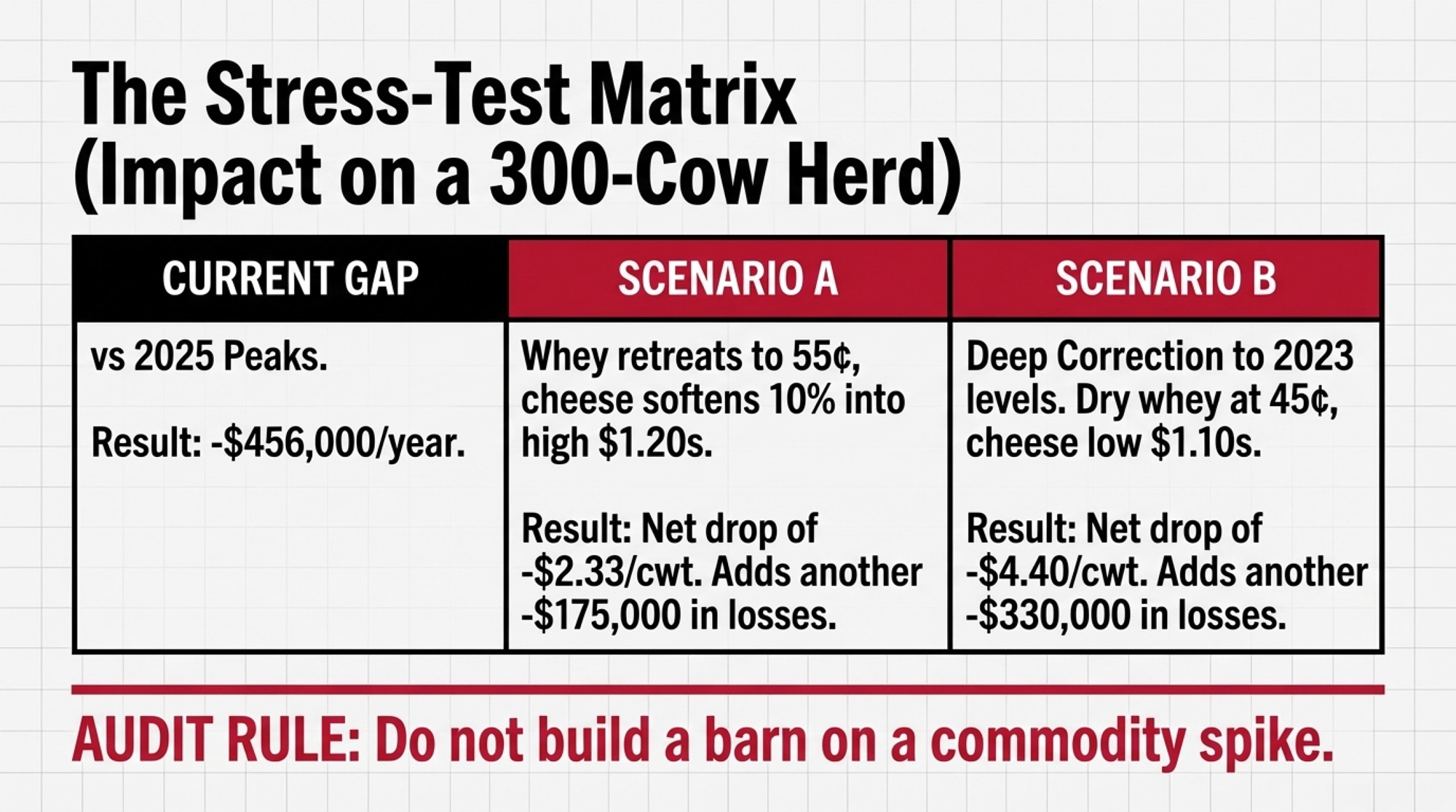
That’s about $1,520/cow gone — roughly $456,000 on Von Ruden’s 300‑cow neighbor. And through all of that, processors with whey-fractionation capacity booked elevated whey-ingredient margins. 

One quirk worth flagging: the FMMO protein formula includes a butterfat deduction. The butterfat drop in early 2026 actually cushioned the protein decline. If butterfat recovers while cheese stays soft, the protein line can fall further, even without another move in cheese. 

Who’s Building the Stainless — and Who’s Sharing?

StoneX dairy consultant John Lancaster told DairyReporter that “almost weekly you hear about a small or medium‑sized investment increasing capacity”. Put some names on that $11 billion: 

  • Glanbia/Southwest Cheese — adding significant WPI capacity in Clovis, New Mexico, through a JV with DFA. 
  • Idaho Milk Products — investing roughly $200 million in a new protein and powder blending facility. 
  • Wisconsin Whey Protein — finishing a plant targeting up to 13 million lbs of WPI annually. 
  • Arla Foods Ingredients contracted with Valley Queen in South Dakota for WPC manufacturing. 
  • Globally: Fonterra ($50M Studholme expansion, NZ), Tirlán (€126M new facility, Ireland), Amul (doubling a whey plant plus two new builds, India). 

Every pound of WPI starts as your cow’s milk going through a cheese vat. The FMMO formula turns that into $0.4391/lb of other solids. The plant’s ingredient desk sells that same stream at several dollars per pound. 

Whey ProductMarket Price (Feb 2026)FMMO Formula PayGap per PoundWho Captures It
Whey Protein Isolate (WPI)$11.00/lb$0.4391/lb$10.56Processor ingredient desk
WPC-80~$9.00/lb (€20k/t equiv.)$0.4391/lb$8.56Processor ingredient desk
NDPSR Dry Whey$0.6931/lb$0.4391/lb$0.254Partially shared via FMMO
Commodity Dried Whey Permeate~$0.38/lbNot in formulaN/AProcessor

Some co‑ops return a slice through patronage dividends or over‑order premiums tied to ingredient economics. In the Upper Midwest, industry sources report some operations have negotiated premiums of $0.20–$0.30/cwt above pool pricing, structured as multi‑year agreements. In a lot of plants, though, any whey value is buried inside the overall component or patronage numbers — not broken out on your statement. 

McCully Consulting’s Mike McCully predicts processors will soon be “forced into fights for milk by paying more, meaning some will not get all the milk they need”. That’s your leverage. But only if you know what your milk is worth to the plant buying it — and whether a competing plant within hauling range is offering a clearer premium. 

What Happens When $11 Billion in U.S. Dairy Capacity Comes Online?

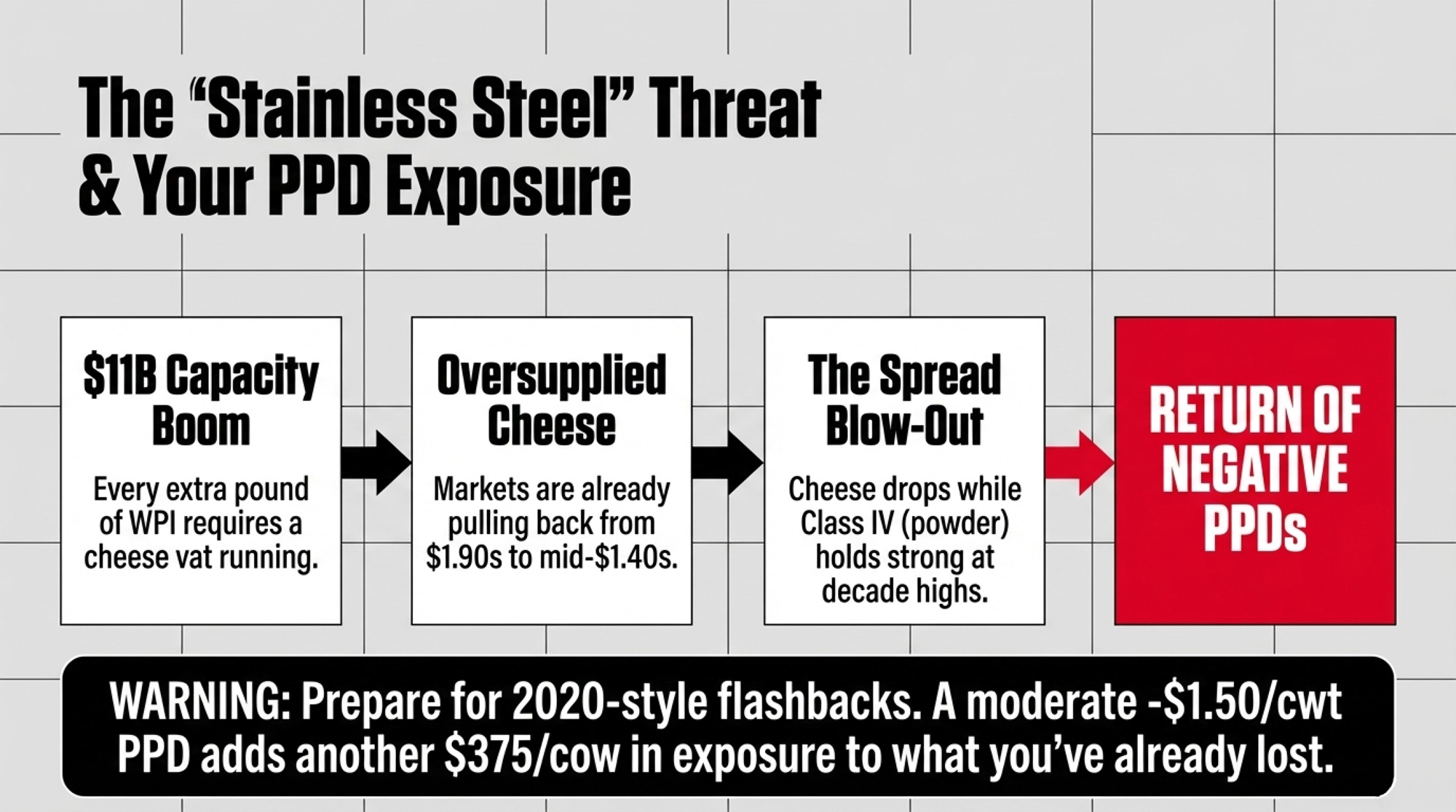
Every extra pound of premium whey requires another cheese vat running. All that new stainless means more cheese — whether the market is ready or not.

Rabobank’s Fuess warned in March 2026 that these expansions “could temporarily lead to an oversupplied market and reduce cheese prices in the near term as the market works to absorb the additional output”. Cheese has already pulled back from around $1.90/lb a year ago to the mid‑$1.40s in early 2026. 

Exports are doing their best to bail the boat. USDEC data show U.S. dairy exports started 2026 with 12% year‑over‑year volume growth in January — the biggest January on record — with cheese up 11%, butter up 187%, and NFDM/SMP up 19%. 

But here’s the stress test. Using the USDA’s component formulas and historical price ranges, two downside scenarios:

Scenario A — Whey retreats, cheese softens:

  • Dry whey slides to $0.55/lb (mid‑2025 levels). Cheese eases ~10% into the high‑$1.20s.
  • Other solids drop to roughly $0.29/lb. Protein falls to mid‑$1.40s/lb.
  • Net: about −$2.33/cwt from February 2026 levels → −$582/cow → −$175,000/year on 300 cows.

Scenario B — Deeper correction:

  • Dry whey returns to $0.45/lb (closer to 2023 levels). Cheese drops ~20% into the low‑$1.10s.
  • Other solids fall to roughly $0.19/lb. Protein slides toward $1.00/lb.
  • Net: about −$4.40/cwt → −$1,100/cow → −$330,000/year on 300 cows.

Scenario A isn’t far‑fetched. NDPSR dry whey sat in the 50–60¢ band for stretches of 2024 and 2025.

Now add the hidden multiplier: PPDs. If cheese drops while Class IV holds firm — CME nonfat dry milk has been trading at some of its strongest levels in more than a decade, near $1.94/lb in March 2026  — the spread blows out, and negative Producer Price Differentials come back. In 2020, some orders saw PPDs past −$4 to −$8/cwt. Even a moderate −$1.50/cwt PPD adds another ~$375/cow in exposure. 

If you lived through 2020–2021 negative PPDs, you know this isn’t theoretical. And it’s exactly the kind of peak‑price trap that backfired for Kiwi producers when Fonterra built budgets around NZ$9.70 milk.

The Calf Check: One of the Few Hedges Hitting Cash Today

While the FMMO formula fails to capture the $11/lb whey premium, beef‑on‑dairy is one place producers are actually winning back margin in cash.

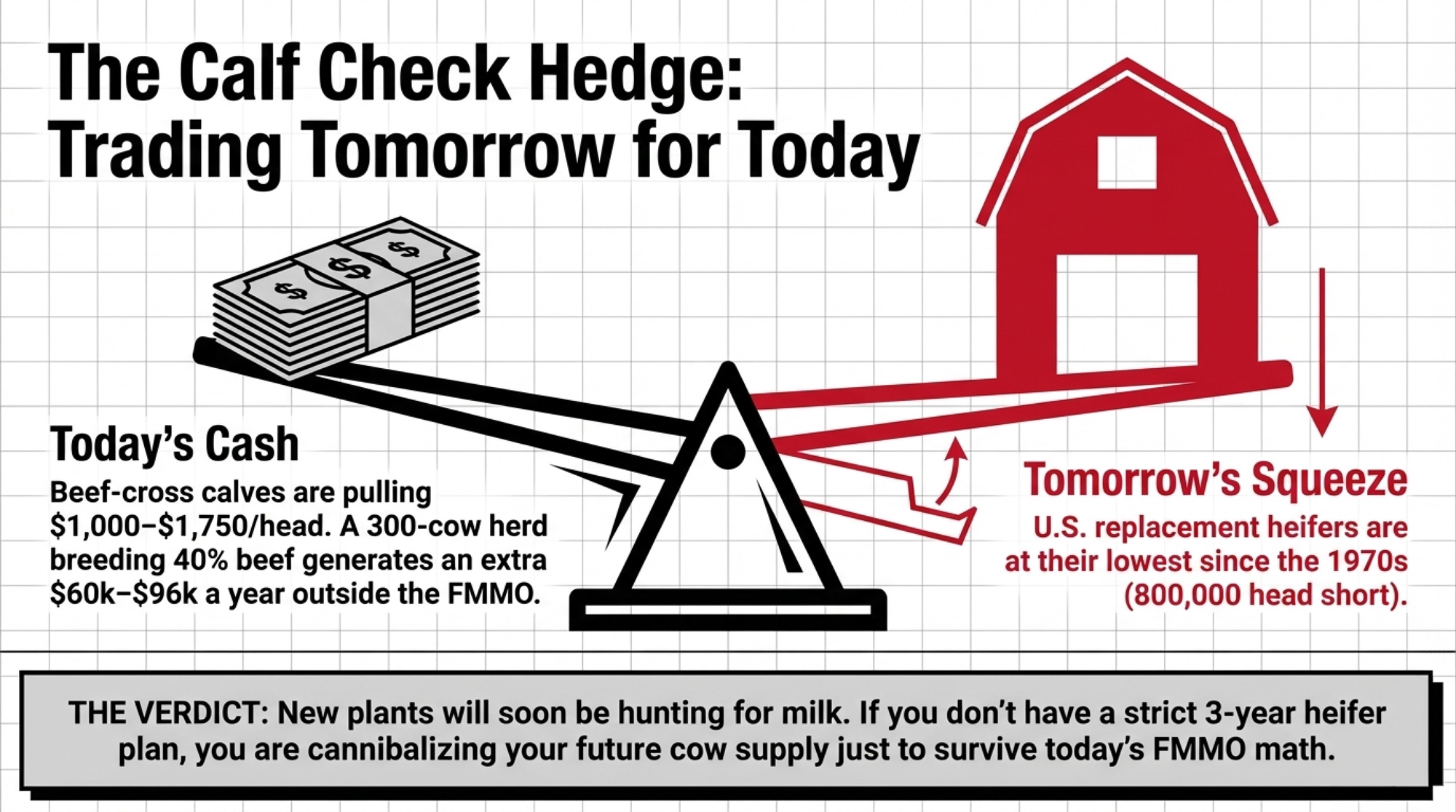
In strong Wisconsin markets, beef‑cross calves have brought up to $1,750 a head, with Premier’s January 2026 report listing beef‑dairy crosses at $1,000–$1,750. Holstein bull calves, by comparison, sit in the $700–$1,150 range. 

That extra $500–$800 per calf functions as a de facto hedge. On 300 cows breeding 40% to beef semen, that’s 120 calves generating roughly $60,000–$96,000/year that never touches a federal order.

The trade‑off is real, though. USDA’s January 1, 2026, cattle report puts U.S. dairy replacement heifers at 3.905 million head — the lowest since the late 1970s and about 16% below January 2020. CoBank dairy economist Corey Geigerprojects the gap at roughly 800,000 fewer replacements across 2025–2026 before inventories begin to rebound sometime in 2027. As Geiger put it: “We don’t see a rebound until 2027, and that will be up 285 thousand, but you’ve got to remember, that’s going to be after 800 thousand fewer heifers”. 

Fewer replacements mean fewer cows when all that new stainless steel starts hunting for milk. That takes you straight back to McCully’s question: “Who won’t get the milk?” 

Beef‑on‑dairy props up your cash and tightens the supply that new capacity needs. But it comes with a shelf life — and if more than half your AI program is going to beef without a three‑year heifer plan, you’re trading tomorrow’s cow supply for today’s calf check. We walked through exactly how that math can break on a 400‑cow herd last week.

What This Means for Your Operation

  • Your component check has already absorbed roughly $1,520/cow from February 2025 to February 2026 — about $456,000 on 300 cows. If your expansion budget or debt‑service math is built on early‑2025 component values, you’re building on a number that isn’t there anymore. 
  • The FMMO reform alone shaved about $60/cow off your other‑solids line via the higher make allowance — roughly $18,000/year on 300 cows — even as processors booked stronger whey ingredient margins. 
  • You need to know what your plant does with whey and how they share it. If your co‑op’s annual report shows whey ingredient revenue growing faster than patronage per cwt, that gap is worth understanding — and worth raising at your next member meeting.
  • Beef‑on‑dairy calves at $1,400–$1,750 are real margin, but they’re also tightening heifer supply in ways that make the coming milk bidding wars more brutal. Your beef‑to‑dairy AI ratio needs to line up with your three‑year heifer plan, not just this month’s calf check. 
  • Negative PPDs are the hidden multiplier. With Class IV buoyed by strong powder and cheese under pressure, the setup looks uncomfortably similar to 2020 and late 2024. Model another $1–$2/cwt of exposure.
  • Don’t build a barn on a commodity spike. Stress‑test every expansion pro forma at about $15.50/cwt component value, not $21. If it doesn’t cash‑flow there, you’re not investing — you’re betting.
  • Price the haul to a competing plant. If whey capacity is being added within hauling range, ask directly what the over‑order premium is and how ingredient economics show up in their payment structure. McCully’s “who won’t get the milk?” question is where your leverage comes from. 

Your 30/90/365‑Day Playbook

TimeframeKey ActionTarget BenchmarkRed Flag ThresholdTool / Source
30 DaysAudit milk check vs. USDA valuesProtein: $1.9373/lb; OS: $0.4391/lb; Fat: $1.7794/lb>$0.15/cwt below FMMO after haulingUSDA AMS February 2026 component prices
30 DaysRequest co-op whey breakdownPatronage per cwt growing with ingredient revenueWhey revenue growing faster than patronageCo-op annual report / equity statement
90 DaysStress-test DMC coverageTier 1 at $9.50 (up to 6M lb)Margin drops below $9.50 in Scenario AUSDA DMC / Center for Dairy Excellence
90 DaysModel PPD exposure$0/cwt PPDPPD turns -$1.50/cwt or worseClass III vs. Class IV spread monitor
12 MonthsRe-run expansion pro formaBase case: $15.50/cwt componentsOnly pencils out above $20/cwtInternal proforma, lender review
12 MonthsPrice hauling alternativesConfirm over-order premium structurePlant within haul range offers no premiumMcCully/StoneX consultant framework

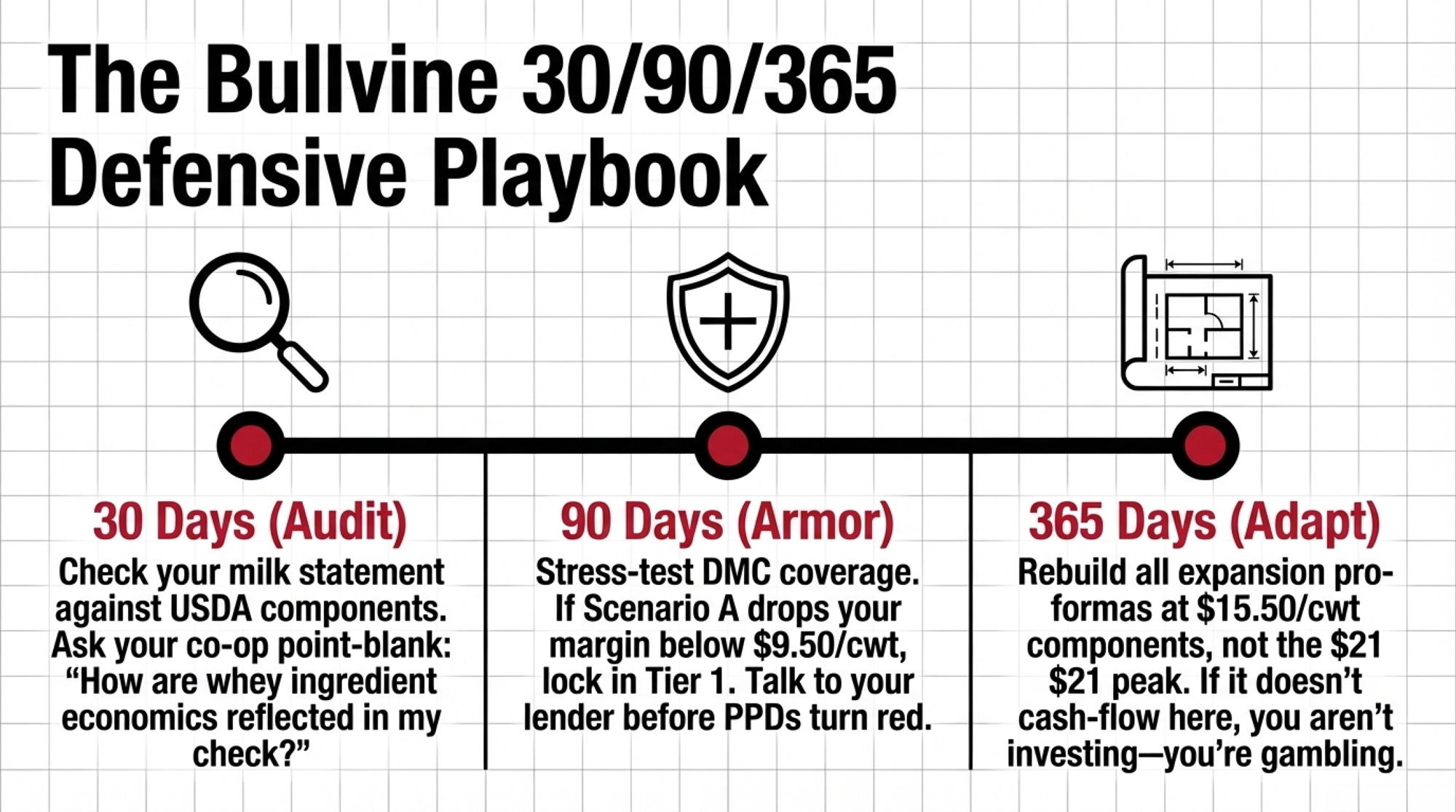
Within 30 days: Audit your check against USDA component values.

Pull your last three milk statements. Compare your protein, other solids, and butterfat rates to USDA’s February 2026 published component prices: protein at $1.9373/lb, other solids at $0.4391/lb, butterfat at $1.7794/lb

If your combined protein‑plus‑other‑solids payment runs more than $0.15/cwt below the FMMO values after hauling and marketing deductions, call your co‑op and ask one direct question: “How are whey ingredient economics reflected in my component check?”

If you get a non‑answer, request the co‑op’s annual financial report and equity statement. Compare ingredient revenue to patronage distributions. That gap — if it’s growing — is the conversation to bring to the next member meeting. It’s the kind of thing that costs real money when you put off the hard financial questions.

Within 90 days: Stress‑test your DMC coverage and talk to your lender.

USDA’s January 2026 DMC margin landed at $7.81/cwt, triggering a $1.69/cwt indemnity for herds enrolled at the $9.50 Tier 1 level. February’s margin was projected to be around $8.07/cwt by the Center for Dairy Excellence. 

Walk your own numbers through Scenario A:

  • Knock $2.33/cwt off your current component value.
  • Layer in a −$1.50/cwt PPD if you’re in an order that’s likely to go negative.
  • See where your income‑over‑feed margin lands relative to $9.50/cwt.

If the margin drops below $9.50 in that scenario, the expanded Tier 1 coverage — now up to 6 million pounds under the One Big Beautiful Bill Act  — is likely your cheapest shock absorber. 

Then bring both scenarios to your lender. Ask specifically: what debt‑service coverage ratio would they need to see — 1.2×? 1.3×? — to stay comfortable if those margins showed up for 12 months. Better to push that conversation now than have your banker push it when the PPD turns red.

Within 12 months: Rebuild your expansion math around post‑reform prices.

Run every major capital decision at three component levels:

  • $15.50/cwt — roughly where early‑2026 Class III components sit. 
  • $19.20/cwt — a 2025‑style “good year” average.
  • Scenario A with a −$1.50 PPD — your personal worst‑case stress.

You don’t control whether WPI stays at $11 or glides down to $6. You do control whether your business can survive both.

Key Takeaways

  • If your expansion or refinance pencils out only at a $20+ component value, you’re exposed. Re‑run at $15.50/cwt and see if it still holds water.
  • If you can’t see whey in your milk check, assume it’s not there. Plan your cash flow on FMMO components alone until your statement or co‑op report shows a clear whey‑linked premium.
  • If more than half your AI is going to beef without a three‑year heifer plan, you’re trading future cow supply for today’s calf check. Make sure that’s intentional.
  • If you’re not enrolled at $9.50 DMC Tier 1 and you’re running 200–500 cows, you’re choosing to self‑insure against a whey/cheese/PPD shock. Do the math with your lender, not in your head.

The Bottom Line

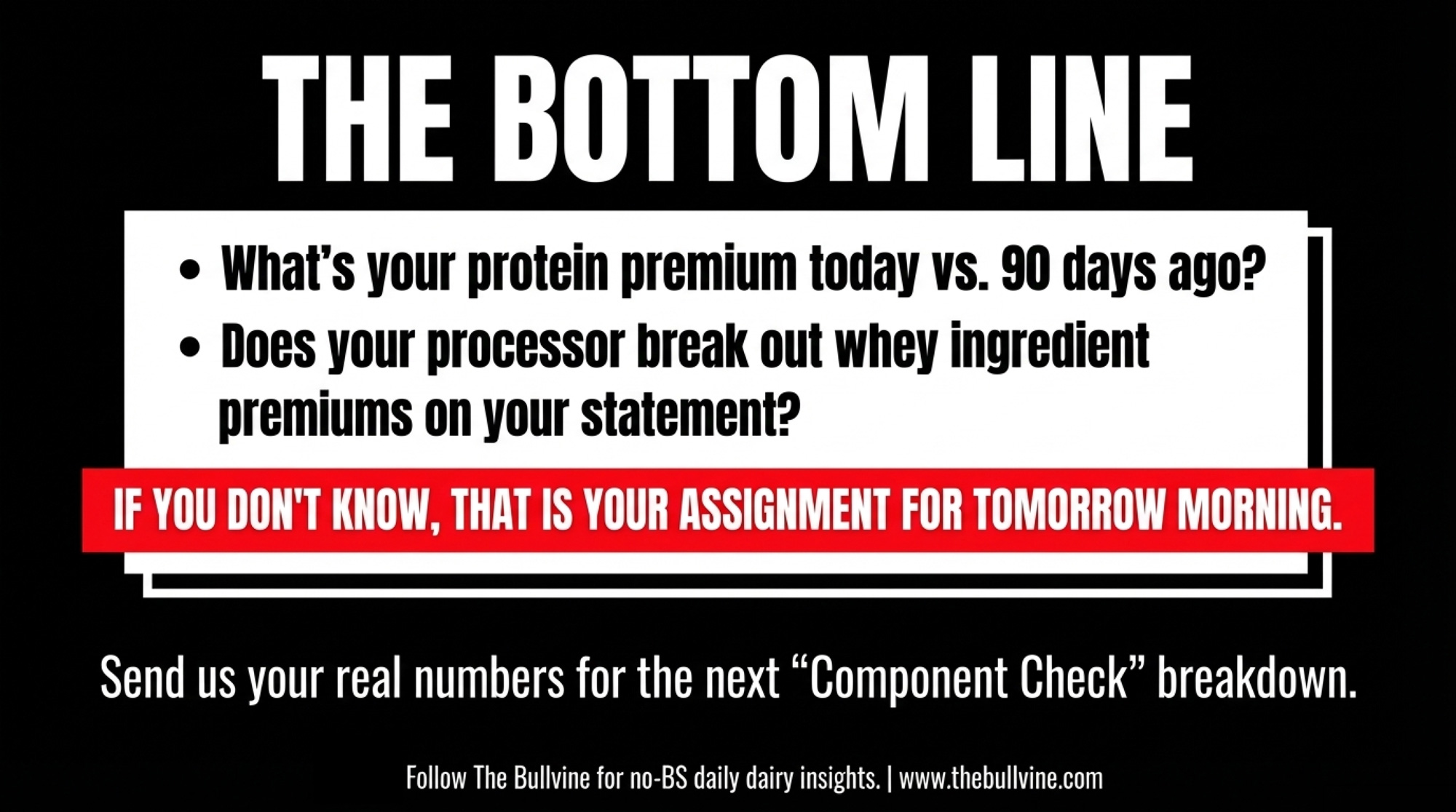
What’s your protein premium per cwt this month versus 90 days ago? Does your processor break out whey solids or ingredient premiums anywhere on your statement? And if you’re in a co‑op, how did last year’s patronage per cwt move compared to the co‑op’s reported whey ingredient revenue?

If you don’t know any of those answers, that’s your 30‑day assignment.

Next in “Component Check”: we run the math on how the April DMC margin and the whey premium interact on a 500‑cow milk check. If you want us to use your real numbers, send them.

This analysis uses publicly available USDA data, published analyst commentary, and FMMO pricing formulas. It’s intended as economic education and decision support for dairy producers, not as investment advice or a recommendation regarding any specific co‑op, processor, or financial product.

Complete references and supporting documentation are available upon request by contacting the editorial team at editor@thebullvine.com.

Learn More

The Sunday Read Dairy Professionals Don’t Skip.

Every week, thousands of producers, breeders, and industry insiders open Bullvine Weekly for genetics insights, market shifts, and profit strategies they won’t find anywhere else. One email. Five minutes. Smarter decisions all week.
NewsSubscribe
First
Last
Consent

Butterfat vs. Powder: What the Great Dairy Divide Really Means for Your Bottom Line

Butterfat’s on top, powder’s under pressure—and the milk check now tells a story few saw coming

EXECUTIVE SUMMARY: Butterfat’s booming, powders are sliding, and together they’ve redrawn the dairy marketplace. This isn’t just another price cycle—it’s a lasting shift in how milk value is measured and paid. China’s preference for premium fats, new processor investments, and stronger herd genetics are driving a global realignment. Farmers who embrace component-based pricing, focused feeding, and risk protection remain profitable even as traditional markets weaken. The message heading into 2026 is clear: the future belongs to those who manage what’s inside the tank, not just how much fills it.

Walk into any farm shop or co-op office this fall, and chances are you’ll hear the same discussion. Butterfat is holding strong, while powders just can’t find their footing. The market doesn’t feel balanced anymore. What’s interesting here is that this gap doesn’t seem like a short-term pricing quirk—it looks and feels like a lasting shift in how milk value is determined.

Fat Holds Steady, Powder Loses Traction

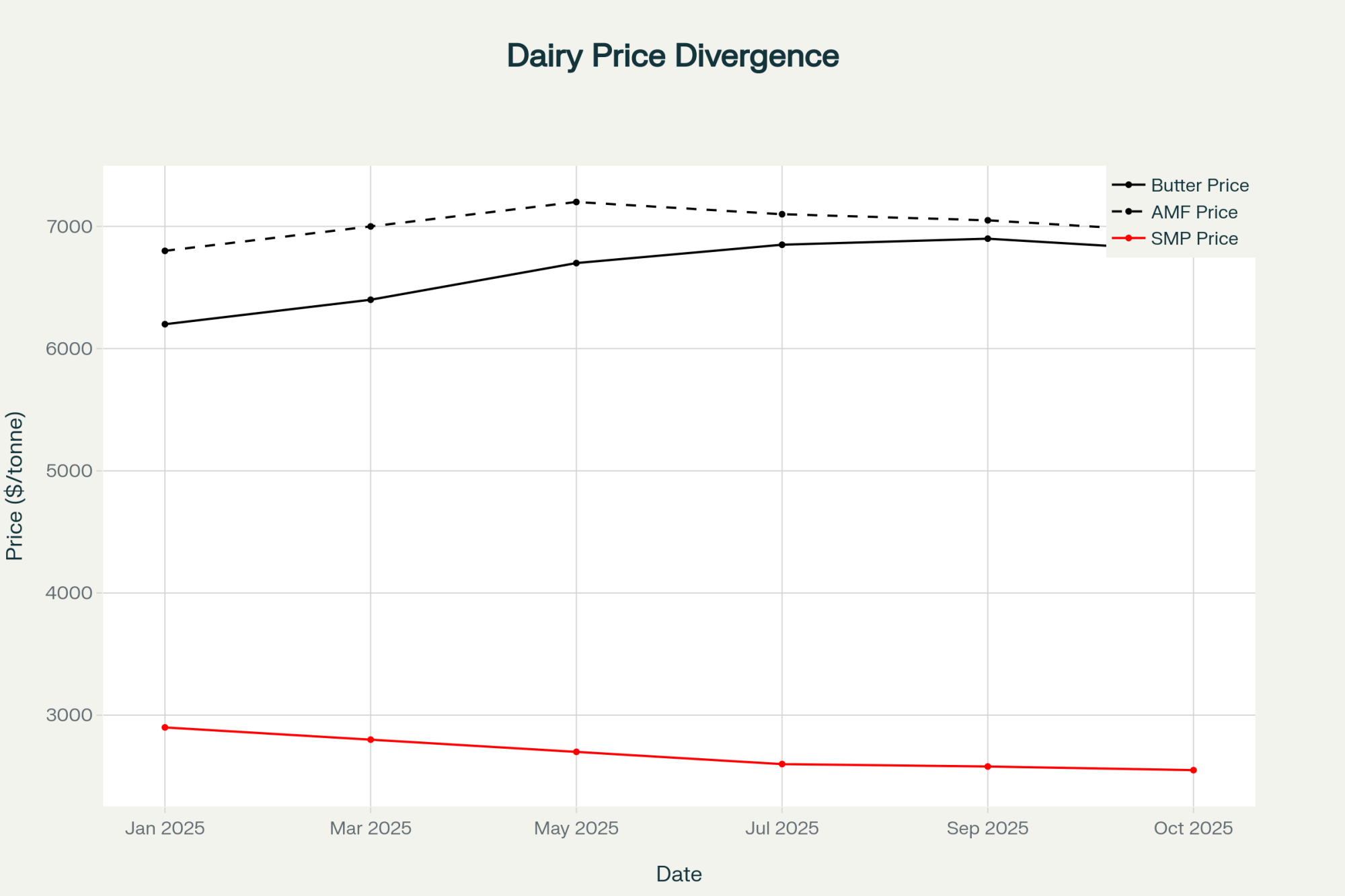
Looking at the latest Global Dairy Trade (GDT) auctions, it’s easy to see the disconnect. The GDT index has fallen for five consecutive events, down roughly 1.4% in mid-October. Butter and anhydrous milk fat (AMF), however, remain firm, trading between $6,600 and $7,000 per tonne. Meanwhile, skim milk powder (SMP) is soft, sitting near $2,550 per tonne.

The Great Dairy Divide: Butterfat products command $6,800-7,200 per tonne while skim milk powder has collapsed to $2,550—a pricing gap that’s rewriting the economics of every dairy farm in America

That pattern isn’t isolated to one region. According to the EU Commission Market Observatory, SMP fell about 1% this month, while butter barely moved. In the United States, USDA Dairy Market News reported CME butter prices hovering around $3.15 per pound, roughly aligned with global benchmarks after accounting for shipping and grading differences.

The CoBank Dairy Outlook (October 2025) calls this “a composition-driven divergence.” In simple terms, the milk market isn’t paying for volume anymore—it’s paying for what’s inside. AMF, at 99.8% pure milkfat, is ideal for global manufacturers who need precision and performance. Butter, at 82% fat, still has a place, but powders are losing ground as demand in infant formula and rehydrated products slows.

China’s Import Strategy Speaks Volumes

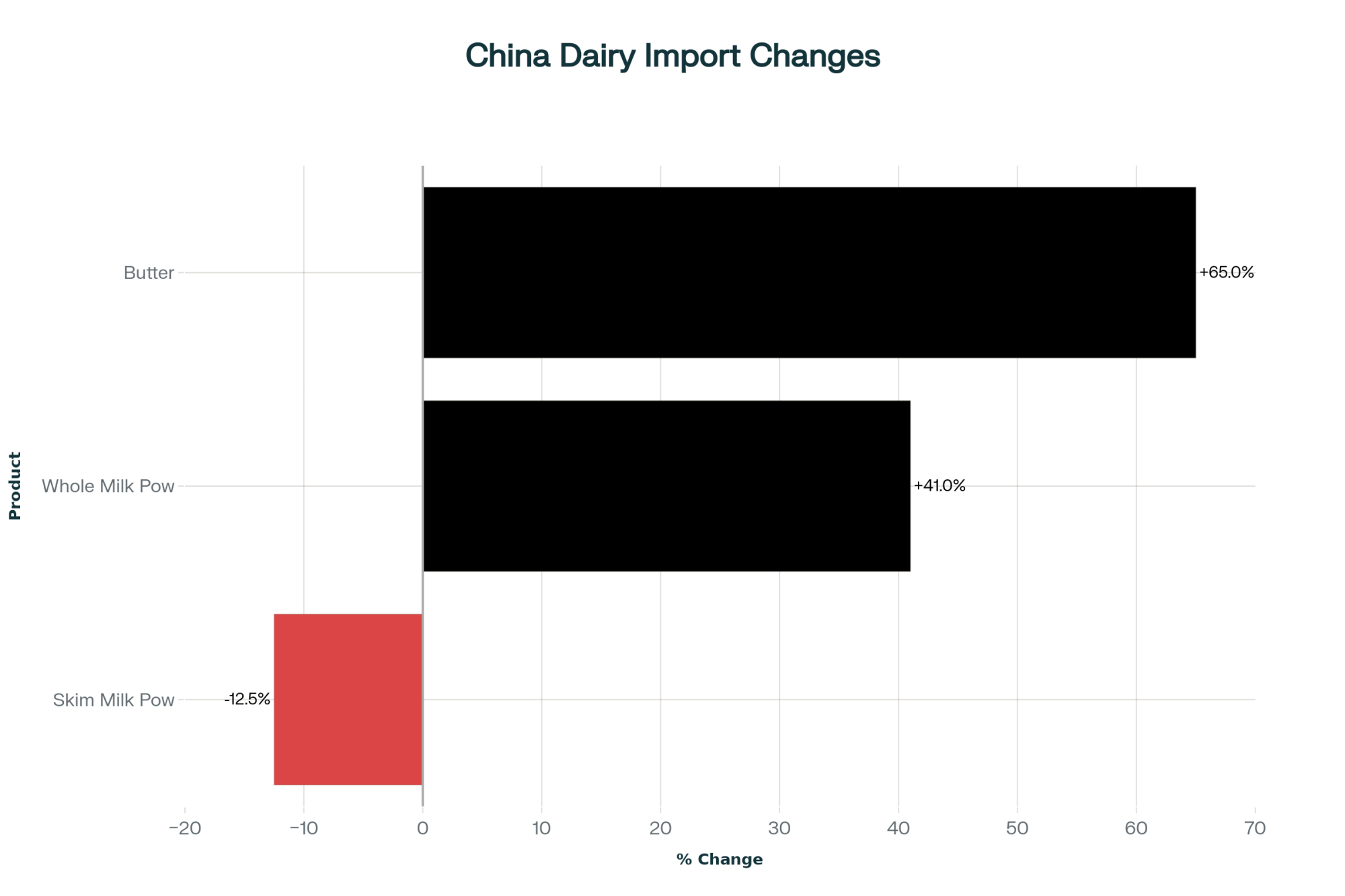
The best way to understand this trend is to look at China, where import behavior has changed dramatically. The Chinese Customs Administration reported that butter imports rose 65% year over year, whole milk powder climbed 41%, and SMP dropped 12.5%.

China’s dairy import strategy reveals the future: butter imports surged 65%, whole milk powder up 41%, while skim milk powder dropped 12.5%—they’re buying precision fats and making powder at home

At the same time, the USDA Foreign Agricultural Service (FAS) confirmed that China’s milk production grew to 41.9 million tonnes in 2024, a rise of 6.7%. Those numbers sounded encouraging, but they also created oversupply at home. Processing plants are drying roughly 20,000 tonnes of milk a day, often at a loss. The OCLA Argentina Dairy Market Outlook (September 2025) estimates those losses at 10,000 yuan per tonne, or about $1,350 USD, thanks to high input and energy costs.

Here’s where things get interesting. China can produce plenty of powder. Where it struggles is in high-purity fats like AMF and industrial butter. Domestic processors lack the cream-separation and fractionation capacity found in markets like New Zealand, Europe, and the U.S. So their strategy has shifted. They’re importing what they can’t make efficiently. That choice has reinforced fat premiums in the global marketplace.

This development suggests a new normal for international trade. Countries will compete not on total milk output, but on how effectively they produce—and market—the right components.

Why U.S. Farmers Are Still Standing tall

Looking back through cycles like 2015 or 2020, it’s clear farmers have become better prepared to weather volatility. Part of that comes down to management maturity and new financial safety nets that didn’t exist a decade ago.

Risk Management Tools Are Paying Off
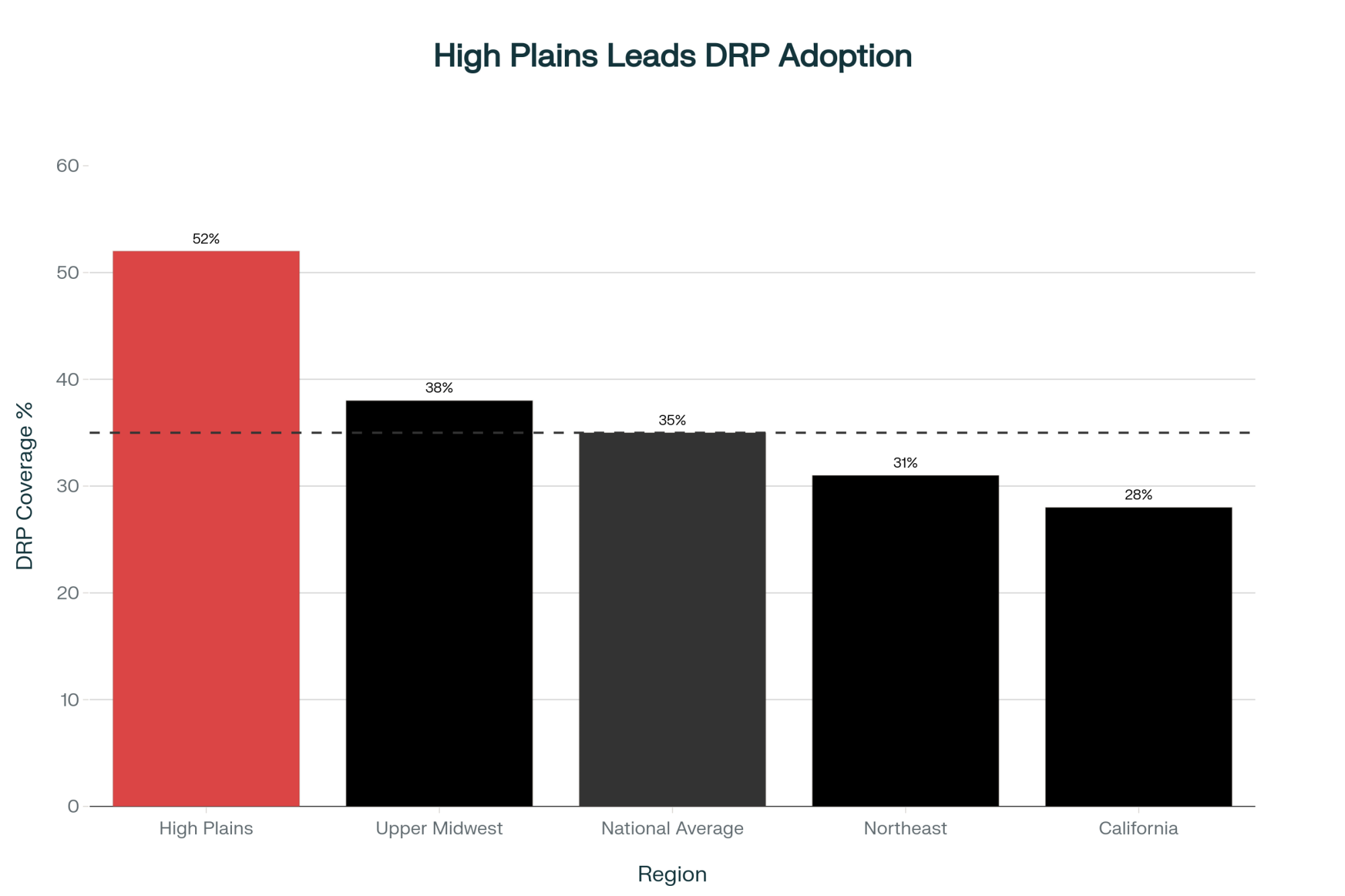
According to the USDA Risk Management Agency (RMA), about 35% of U.S. milk production is now protected under Dairy Revenue Protection (DRP), with participation surpassing 50% in the High Plains. Those policies are helping farms hold margins through increasingly unpredictable shifts in global pricing.

Smart farmers are protecting margins: 52% of High Plains milk production is covered by Dairy Revenue Protection, nearly double California’s 28%—proof that the best operators plan for volatility before it hits

Component Programs Reward Quality, Not Quantity
More than 90% of milk in the country is now sold under Multiple Component Pricing (MCP). Herds averaging 4.3% butterfat and 3.4% protein consistently earn $1.50 to $2.00 per hundredweight more than standard 3.7/3.1 herds, according to USDA AMS data. That’s a structural incentive, not a fad.

Genetics and Feeding Continue to Change the Curve
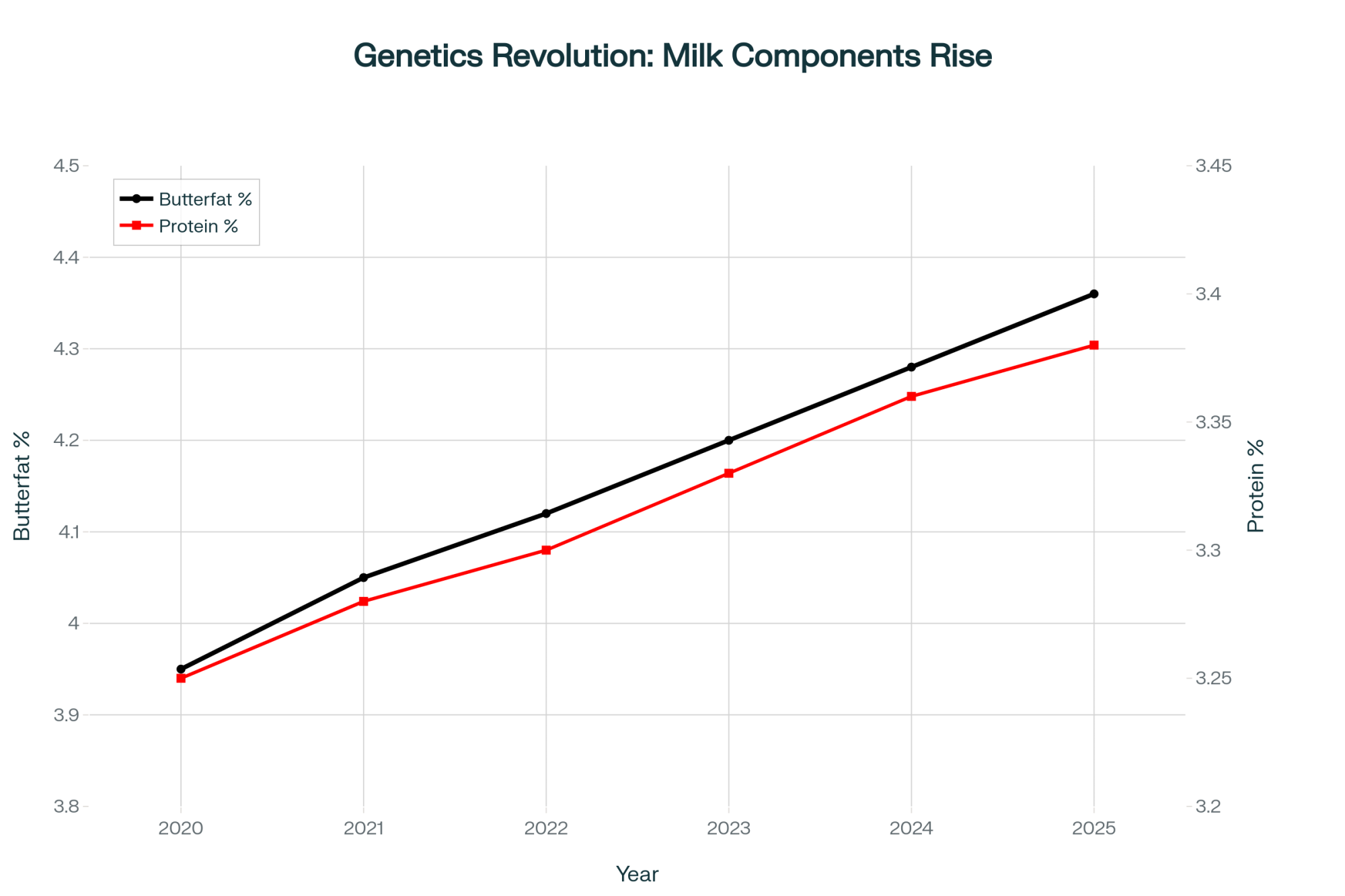
CoBank and USDA data show national butterfat averages rising from 3.95% in 2020 to 4.36% this year, while protein moved to 3.38%. The Michigan State University Extension (2025) recently found that feeding 5–6 pounds of high-oleic roasted soybeans per cow daily improved butterfat by 0.25–0.4 percentage points within 30 days, while enhancing rumen consistency and herd condition.

American dairy genetics are delivering: butterfat jumped from 3.95% to 4.36% in just five years while protein climbed to 3.38%—improvements that translate directly to bigger milk checks every month

What’s encouraging here is that improvements are cumulative. As one extension specialist explained during a recent producer roundtable, “The cows are doing the same work, but the milk’s worth more.” It’s proof that managing for higher components is one of the most direct paths to better returns.

The Processor Pivot: From Volume to Value

Processors are feeling this market divide just as strongly as producers are. And frankly, some are better positioned than others.

Let’s look at Darigold’s Pasco, Washington facility, which represents one of the industry’s most ambitious bets on global powder capacity. The plant—a $1.1 billion facility capable of processing 8 million pounds of milk per day—was planned to supply milk powders and butter to Southeast Asian buyers when those markets were booming back in 2019. But global dynamics changed faster than expected. Reports confirm the company had to deduct around $4 per hundredweight from producers’ milk checks this summer to offset startup losses. Powder-heavy exports aren’t what they used to be.

Contrast that with processors like Hilmar Cheese (Texas), Leprino Foods (Kansas), and Lactalis USA, which have expanded into cheese, whey protein, and AMF production. They’re diversifying toward higher-solids, higher-margin production that keeps milk geographically and economically competitive. Reports from First District Association (Minnesota) and Idaho Milk Products echo the same trend—premium payments now hinge on component tests because that’s where processors make their profit.

Here’s the hard truth: the U.S. industry is splitting not just by product, but by intent. Powder is still a volume game. Component ingredients are an efficiency game.

Could Butterfat Overshoot?

It’s a fair question to ask whether everyone aiming for higher fat could create the next surplus. CoBank’s August 2025 Outlook flagged that butterfat production might be “growing faster than demand absorption.”

But here’s where genetics help us. The USDA Agricultural Research Service (ARS) and Holstein Association USAperiodically adjust their Net Merit (NM$) and Total Performance Index (TPI) formulas to reflect changes in milk pricing. That means breed selection is constantly reweighted to economic reality. If fat premiums fall or protein values recover, herd objectives shift almost automatically.

The point is, dairy efficiency—not just butterfat—is what creates long-term stability. It’s why balance will always outlast fads.

The Metric That Matters: Component Spread

When you strip away all the noise, one figure tells the story: the component spread—the pay gap between baseline milk (3.5% fat / 3.0% protein) and high-component milk (4.4% fat / 3.4% protein).

Component pricing isn’t subtle: premium milk at 4.4% fat earns $2.00/cwt more than standard 3.7% fat milk—that’s $14,600 annually for a 100-cow herd, and the gap keeps widening

As USDA AMS Federal Order data shows, that premium has averaged more than $2 per hundredweight throughout 2025. If it holds, producers essentially have proof that processors are permanently paying for composition, not volume.

A USDA market economist summed it up best in a September forum: “When the value is tied to solids instead of water, you’re not in a price cycle anymore—you’re in a new structure.”

Practical Lessons Going Into 2026

The roadmap is clear: track components monthly, breed strategically, match your processor, feed for balance, and protect margins—five concrete moves that separate winning farms from the rest
  1. Track Your Components Monthly.
    Treat butterfat and protein performance as management metrics alongside fertility, transitions, or somatic cell counts. Precision wins.
  2. Start Small, Build Momentum.
    Genomic testing (around $40 per heifer) and ration adjustments are quick-return investments in this pricing climate.
  3. Match Your Processor Relationship.
    AMF and cheese plants prize solids. Powder plants still chase volume. Know which market pays for the milk you make.
  4. Breed and Feed for Balance.
    Fat and protein efficiency outweigh extremes. Avoid chasing a single number.
  5. Protect Margins with Modern Tools.
    DRP coverage, component contracts, and multi-year agreements keep income steady when markets fluctuate.

The Bottom Line: This Isn’t a Crisis—It’s an Adjustment

Every producer knows the milk market runs in cycles. But what’s happening right now feels different. Butterfat remains firm because the world wants quality ingredients that add value to food manufacturing. SMP is struggling because bulk reconstitution isn’t growing anymore.

For farmers, the lesson is clear: you don’t have to rebuild your entire operation to adapt—just fine-tune what you’re already measuring. Improving components, reviewing contracts, and aligning milk output with processor demand will go further than chasing volume.

The bottom line? The milk check no longer rewards gallons—it rewards balance, precision, and composition. The farms paying attention today are the ones positioning themselves to thrive long-term.

Key Takeaways:

  • Butterfat is booming while powders slide, signaling a lasting shift in dairy value and pay structures.
  • China’s strategic focus on high-fat imports and domestic powder production is reshaping global trade dynamics.
  • U.S. farmers maximizing components—and protecting with DRP—are turning market volatility into opportunity.
  • Processors investing in solids-based products like cheese and AMF are outpacing those tied to bulk powder markets.
  • Heading into 2026, milk checks will favor precision over production—the farms that measure will be the ones that win.

Complete references and supporting documentation are available upon request by contacting the editorial team at editor@thebullvine.com.

Learn More:

The Sunday Read Dairy Professionals Don’t Skip.

Every week, thousands of producers, breeders, and industry insiders open Bullvine Weekly for genetics insights, market shifts, and profit strategies they won’t find anywhere else. One email. Five minutes. Smarter decisions all week.
NewsSubscribe
First
Last
Consent

Why Everything You Thought You Knew About Dairy Risk Management Just Got Turned Upside Down

Milk yield jumped 3.4% but cheese hit $1.85—are you maximizing component value

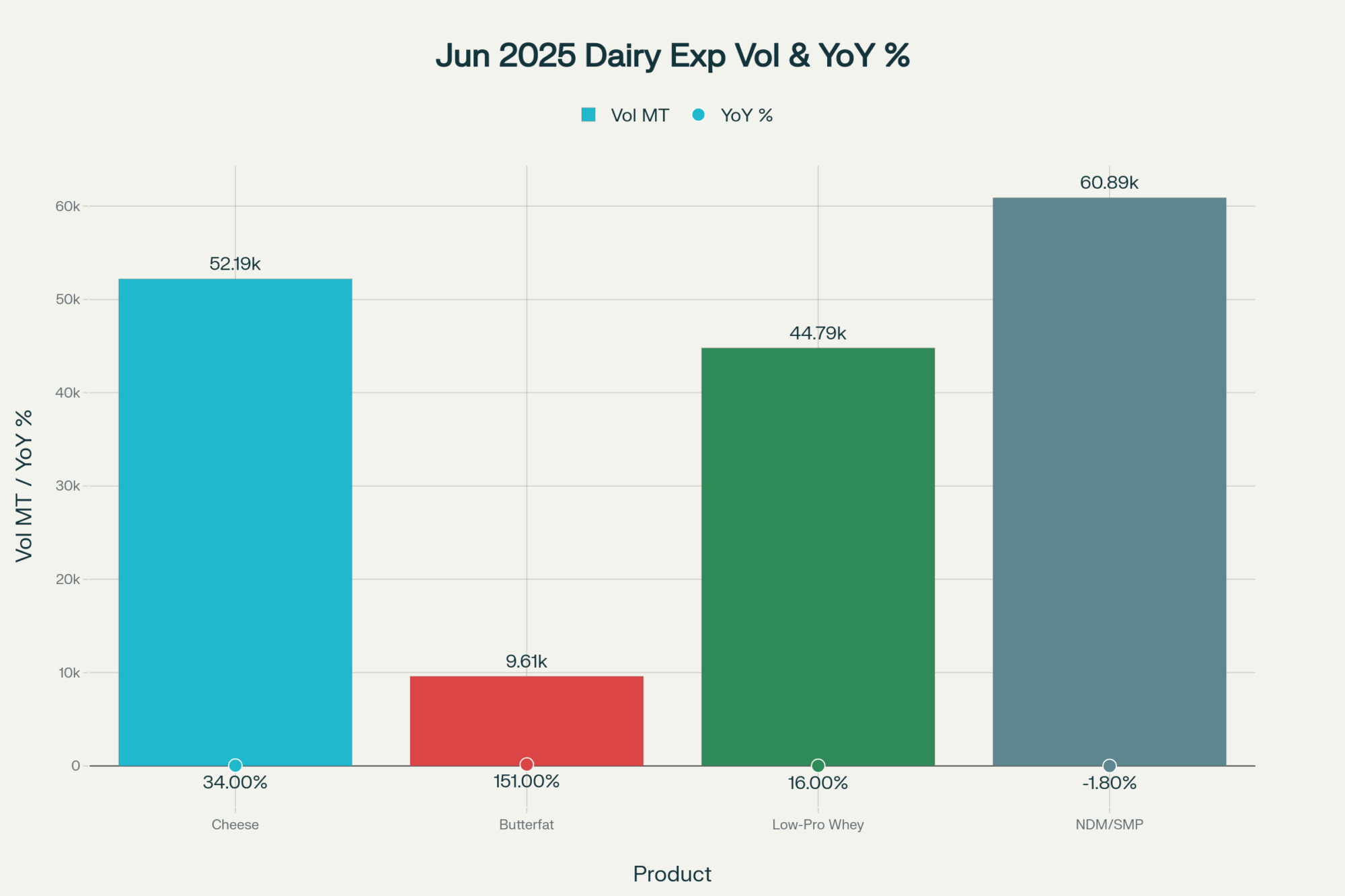
EXECUTIVE SUMMARY: You’ve probably noticed something’s different out there. The old milk pricing playbook just got tossed out the window. Latest USDA numbers show we’re cranking out 3.4% more milk—cows hitting 2,045 pounds monthly—but here’s where it gets interesting. Cheddar blocks jumped to $1.85/lb while butter dropped 4.3% in the same week. That’s not a typo… it’s the new reality. Cheese exports smashed records at 52,191 metric tons (up 34%), and butterfat exports doubled. Meanwhile, feed costs are finally giving us a break with corn near $4.05/bushel, potentially boosting margins by $12/cwt. Bottom line? If you’re not targeting component-specific marketing and genomic selection for feed efficiency, you’re leaving serious money on the table.

KEY TAKEAWAYS

  • Genomic testing isn’t optional anymore—select for higher PTA fat and protein to ride the cheese wave. With cheddar up 3.93% recently, every percentage point of butterfat matters. Start reviewing your bull lineup today.
  • Hedge smart, not hard—lock in 25-30% of fall milk using Class III futures at current $17.50/cwt levels. The cheese market’s on fire, and you want in on this action before it cools.
  • Feed costs are your friend right now—corn futures sitting pretty at $4.05/bushel with soybean meal declining. Forward contract now to bank those savings worth up to $12/cwt through 2025.
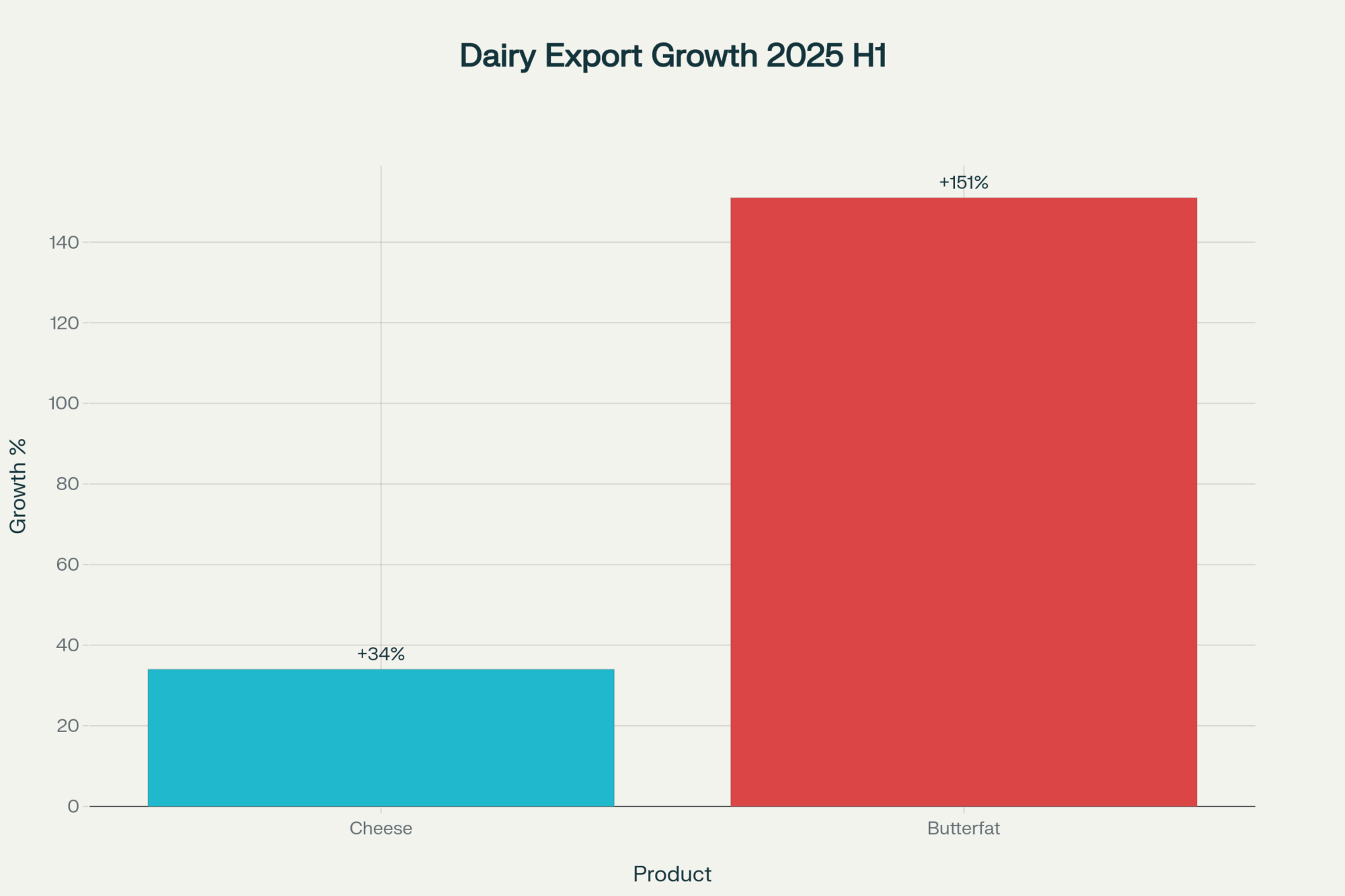
  • Export dependency is real—cheese exports up 34%, butterfat 151%. Your milk check depends on keeping foreign buyers happy, so watch those trade numbers like a hawk.
  • Geography matters more than ever—Plains states like Kansas are crushing it with 19% growth while Washington’s down 9.4%. Know your region’s trajectory and plan accordingly.
dairy risk management, milk component value, dairy farm profitability, Class III milk hedging, genomic selection

Look, I’ll cut to the chase here — this week’s numbers aren’t just another set of monthly reports. We’re watching the dairy market rewrite its own rulebook in real-time, and if you’re still pricing milk like it’s 2020, you’re about to get a very expensive education.

The thing is, most producers I talk to are still thinking in terms of the old Class III versus Class IV relationship… but that relationship just died. And what’s replacing it? Well, that’s what’s keeping me up at night.

The Numbers That Don’t Make Sense (Until They Do)

So here’s what happened in June — and trust me, this matters more than you think. Milk production jumped 3.4% to hit 18.5 billion pounds across the 24 major dairy states. More cows, better per-cow productivity (we’re talking a 2,045-pound monthly average), and yet…

Cheese prices are climbing like they’re rocket-powered while butter is sliding down a greased hill. Makes no sense, right?

Well, here’s where it gets interesting. I was chatting with some folks out in Wisconsin last week — spots that were trading at discounts to Class III just fourteen days ago are now commanding premiums. That’s not seasonal fluctuation, folks. That’s demand that’s so tight it’s changing the fundamental economics of spot milk pricing.

What strikes me about this is how quickly processors are adapting. When you’ve got CME cheddar blocks jumping to $1.85/lb while butter drops to $2.36/lb in the same week… that tells you something fundamental has shifted in how the market values different components of our milk.

The Export Dependency That Should Concern You

Here’s what really caught my attention in the latest numbers: cheese exports hit 52,191 metric tons in June. That’s not just strong — that’s a 34% jump over last year and an all-time monthly record.

But here’s the kicker… we’re now exporting close to 9% of our total cheese production. A decade ago? That number was around 5%.

The butterfat story is even more dramatic. Exports surged 151% year-to-date, and we’re trading at massive discounts to European benchmarks — sometimes 40% gaps.

[Insert chart here: Bar chart showing 34% growth in cheese exports and 151% growth in butterfat exports for first half 2025 vs 2024]

I keep asking myself: what happens if those international buyers suddenly decide they don’t need our cheese? Because right now, with domestic demand basically flat, those export markets are literally the only thing standing between current prices and a complete collapse.

Think about that for a minute. When did we become so reliant on selling our milk overseas?

Geographic Reality Check: The Great Dairy Migration

What’s happening regionally is just as important as the overall numbers, and honestly, it’s accelerating faster than I expected. Kansas posted 19% year-over-year growth. South Dakota hit 11.5%. Idaho came in at 9.7%. Meanwhile, Washington dropped 9.4% and Oregon fell 1.9%.

This isn’t random market forces — it’s strategic capital allocation happening in real-time. The Plains and Mountain West offer modern processing infrastructure, lower regulatory burdens, and what economists call a “processing-production feedback loop.”

And for traditional dairy regions? When you’ve got operations running on infrastructure built in the 1980s competing against facilities designed for today’s efficiency standards… well, the economics get pretty brutal pretty fast.

I’ve been to some of these new facilities, and the difference is staggering. We’re talking about processing capacity that can handle today’s milk volumes with half the labor and twice the efficiency.

The Policy Curveball That Blindsided Everyone

Here’s something that caught even the sharpest market watchers off guard: those Federal Milk Marketing Order reforms that kicked in during June.

Let me walk you through what actually changed, because this matters more than most people realize. The pricing formula for Class I (fluid milk) now uses the “higher-of” Class III or Class IV skim milk prices. Previously, Class IV often led because it typically carried a premium.

Now that premium has evaporated. So when Class III is at $17.37 and Class IV drops to $17.20, suddenly Class III is setting your fluid milk floor instead.

What’s particularly noteworthy is how this demonstrates that in dairy, there’s always another variable lurking in the background. Just when you think you understand the pricing structure, policy changes interact with market dynamics in ways nobody anticipated.

Risk management professionals across cooperatives are telling me they’re having to rewrite their entire hedging models because the old relationships just don’t work anymore.

Feed Markets: Finally Some Good News

The feed situation is actually offering genuine relief, which honestly couldn’t come at a better time. December corn futures are trading around $4.05/bushel, well below recent peaks. Soybean meal has backed off toward $285/ton for December delivery.

Current margin calculations show income-over-feed-cost averaging $8.50/cwt, with some projections suggesting annual averages could reach $12.99/cwt. Those are levels that historically support herd expansion and reinvestment — which explains some of the production growth we’re seeing.

But here’s the uncomfortable truth… improved margins from lower feed costs might actually make our export dependency problem worse by encouraging even more production. It’s like we’re trapped in this cycle where good news becomes bad news.

What This Means for Your Operation Starting Monday

Look, the reality is that traditional All-Milk price hedging strategies just became obsolete overnight. You need to understand your specific component exposure because this market bifurcation isn’t going away.

If your milk flows primarily to cheese plants, you’re sitting in the sweet spot right now. Class III futures for fall delivery are holding above $17.00/cwt, and the export momentum shows no signs of slowing. I’d seriously consider locking in 25-30% of fall production using current futures contracts.

For operations in butter/powder regions… this environment demands way more defensive positioning. Butter inventories continue building despite record exports, which suggests prices may need to fall further before finding sustainable support.

The feed cost outlook presents clear opportunities. Forward contracting corn and soybean meal at current levels could lock in these improved margin opportunities for months ahead.

Bottom Line: Five Things You Must Do This Week

  • Component-specific risk management is mandatory. Generic All-Milk hedging strategies won’t cut it anymore. You need to understand exactly where your milk goes and price accordingly.
  • Export performance has become your most important leading indicator. Monthly trade data deserves more attention than production reports. If you’re not tracking these numbers, you’re flying blind.
  • Feed cost advantages create strategic opportunities for forward contracting that could lock in improved margins through volatile periods. Don’t let this window close because you’re overthinking it.
  • Geographic production shifts are accelerating. If you’re in a declining region, you need to think seriously about your long-term positioning. The data is clear about where this is heading.
  • Market dependency on exports creates vulnerability that requires constant monitoring of global competitive positioning. This isn’t set-it-and-forget-it territory anymore.

The Hard Truth About What Comes Next

What keeps industry veterans like me awake at night? Our entire price structure now balances on export competitiveness. Domestic demand simply can’t absorb current production levels at profitable prices.

The cheese complex demonstrates this perfectly. Those record export volumes are literally the only thing preventing inventory accumulation and price collapse. Remove that export demand, and the math gets ugly real fast.

This development is fascinating from a market structure perspective, but it’s also concerning. We’ve never been this dependent on global buyers for price stability. The U.S. dairy industry has essentially become an export-driven business without most producers fully realizing it.

The producers who understand their specific component exposure, adapt risk management accordingly, and capitalize on feed cost advantages will navigate this successfully. Those clinging to traditional approaches? They’re going to learn some expensive lessons about how markets evolve.

This is the new reality every dairy operation needs to plan for. The sooner you adapt, the better positioned you’ll be for whatever comes next — because if there’s one thing I’m certain about, it’s that this market evolution is just getting started.

Complete references and supporting documentation are available upon request by contacting the editorial team at editor@thebullvine.com.

Learn More:

The Sunday Read Dairy Professionals Don’t Skip.

Every week, thousands of producers, breeders, and industry insiders open Bullvine Weekly for genetics insights, market shifts, and profit strategies they won’t find anywhere else. One email. Five minutes. Smarter decisions all week.
NewsSubscribe
First
Last
Consent
Send this to a friend