



Archive for milk check analysis

The $1,500‑Per‑Cow Whey Trap: Why $11/lb Whey Only Shows Up as 69¢ on Your Milk Check

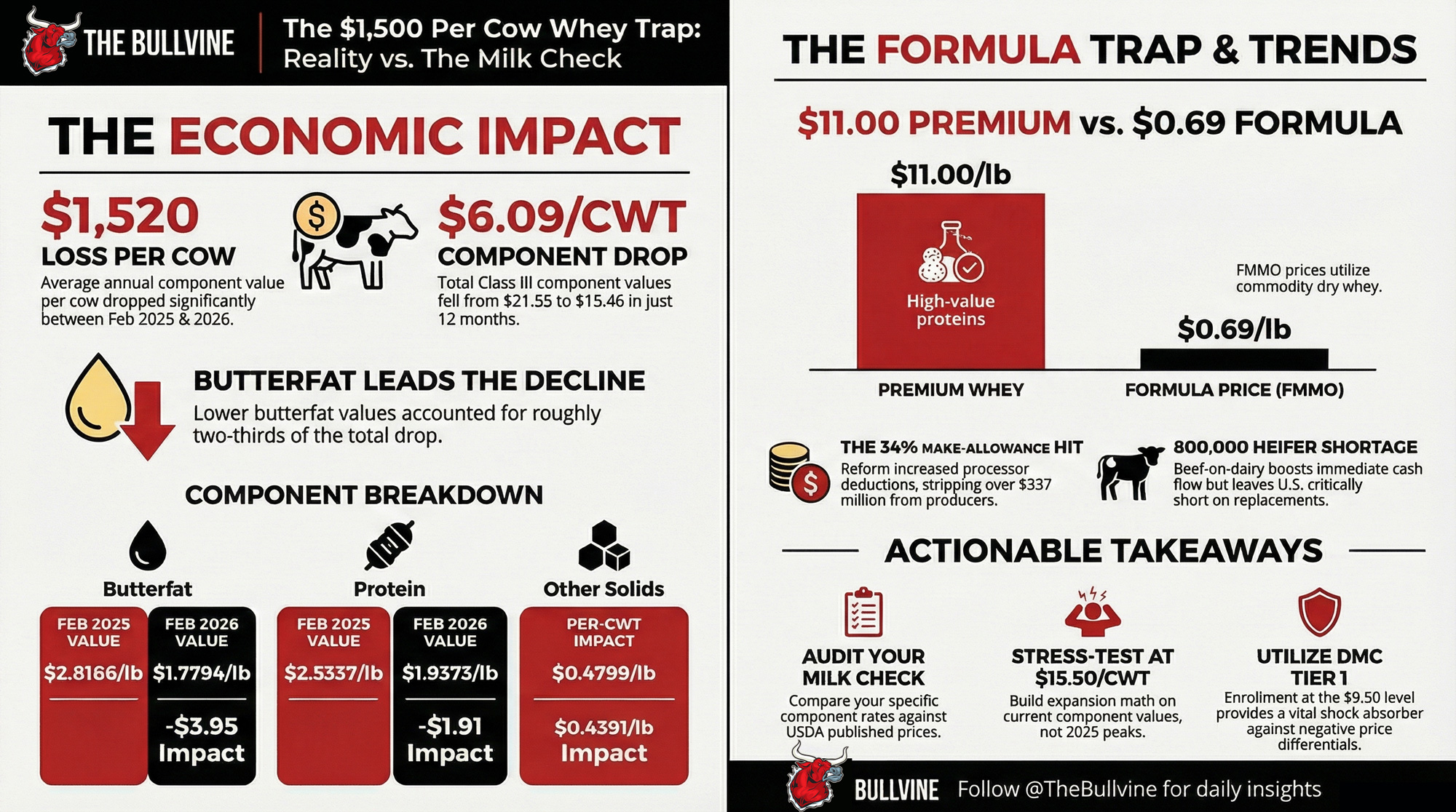
$11/lb whey. 69¢ on your milk check. We ran the FMMO barn math on a 300‑cow herd to see where the other $1,500 per cow actually went. 

Executive Summary: Your component check dropped about $1,520 per cow from February 2025 to February 2026 while premium whey climbed to $11/lb and plants poured $11 billion into new cheese and whey capacity. FMMO’s new make‑allowance formula now prices other solids off 69‑cent dry whey and higher processor costs, cutting roughly 24¢/cwt from your other‑solids line even as whey markets rally. Butterfat and protein did the rest of the damage, taking total Class III components down about $6.09/cwt — a $450K‑plus swing on a 300‑cow herd. At the same time, beef‑on‑dairy calves are throwing off $500–$800/head, helping cash flow but leaving the U.S. roughly 800,000 heifers short heading into a capacity build‑out. The article walks through barn‑level scenarios if whey and cheese both correct, including how negative PPDs could stack another $1–$2/cwt on top of what you’ve already lost. Then it lays out a 30/90/365‑day playbook: audit your component line against AMS values, stress‑test your DMC and DRP coverage, and rebuild any expansion math around ~$15.50/cwt components instead of 2025 peaks. If you’ve got 200–500 cows on a component order and you’re not sure how much of that $11/lb whey is in your milk check, this is the 10‑minute read to run before your next contract or barn decision.
Milk check analysis

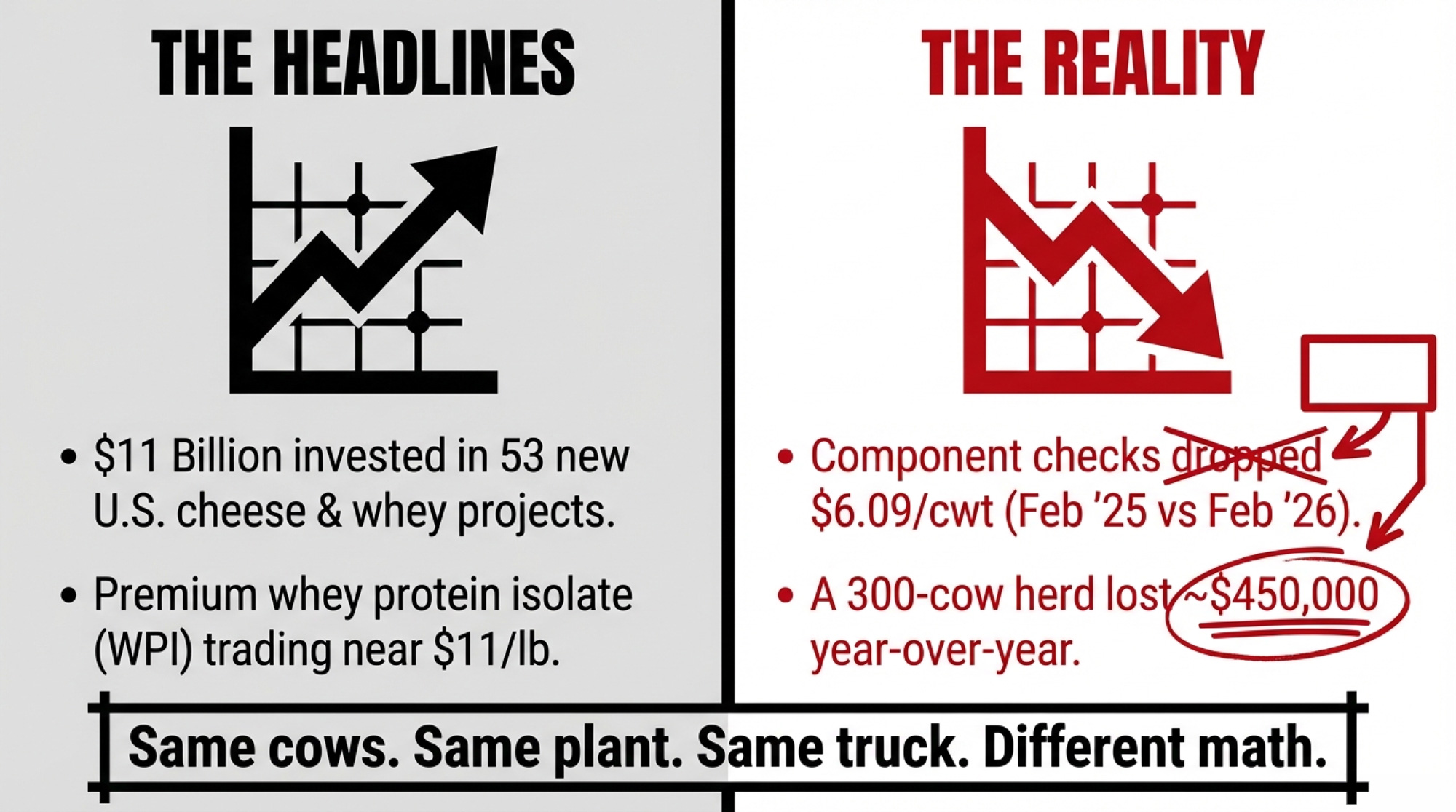
Eleven dollars a pound. That’s where high‑grade whey protein isolate has traded since late 2025, according to Ever.Ag Insight — roughly triple the price three years ago. Cheese plants are sometimes pulling more revenue from the whey stream than the cheese block itself. 

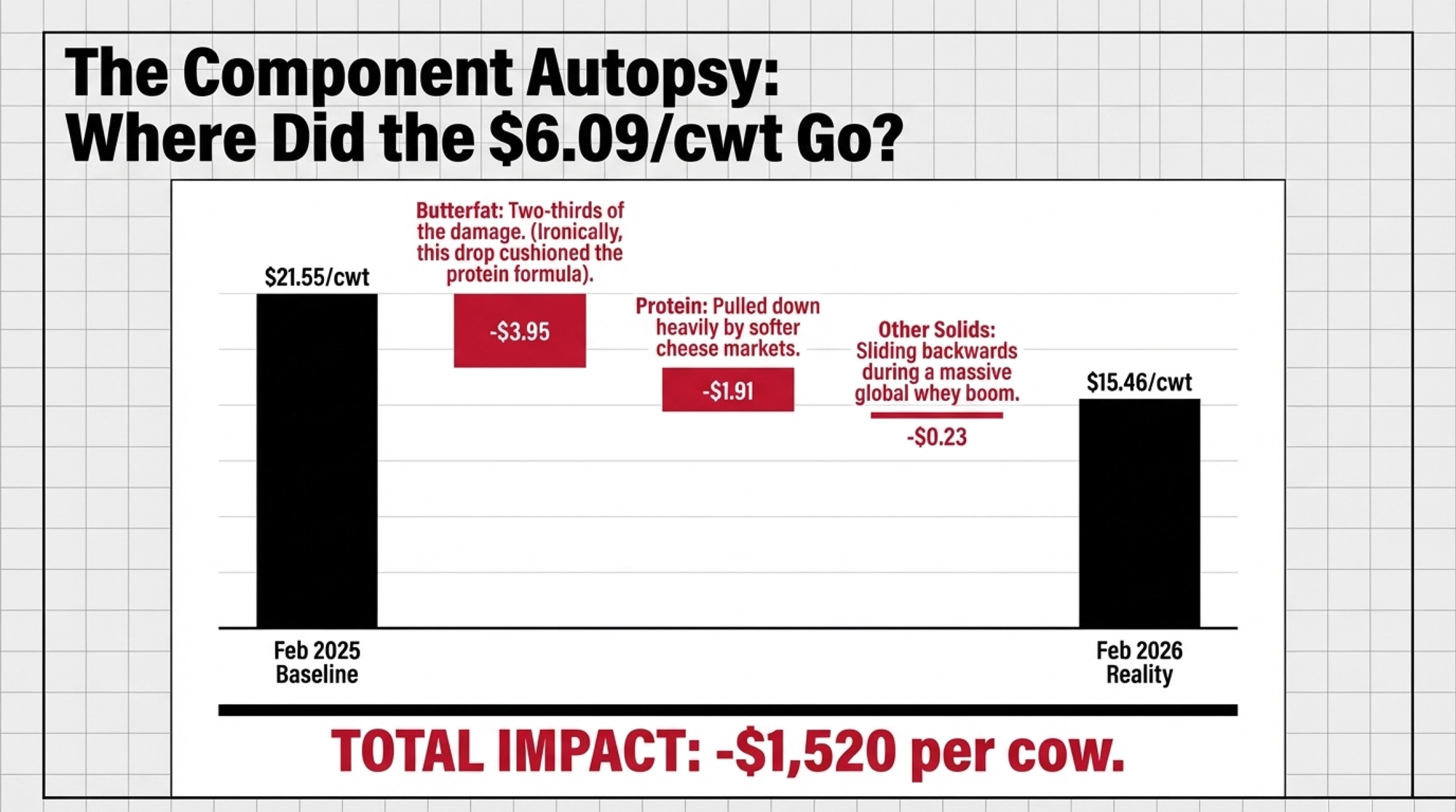
But pull your early‑2026 milk check, and a different number stares back. USDA’s February 2026 Class III component values, at standard test of 3.8% fat, 3.2% protein, and 5.7% other solids, work out to about $15.46/cwt — down from $21.55/cwt in February 2025. That’s a drop of $6.09/cwt, or roughly $1,520 per cow on 25,000 lb shipped. 
At the National Farmers Union’s 124th annual convention this March, Wisconsin Farmers Union president Darin Von Ruden dropped a number that landed hard: about $50,000. That’s how much less a 300‑cow dairy operator in southwest Wisconsin received on his January 2026 milk check compared with January 2025. Same cows. Same plant. Same truck. The formulas changed. As Von Ruden told Brownfield Ag News, this wasn’t a model herd or a spreadsheet example — it was a neighbor he’d spoken with the week before. 

And the $11 billion pouring into 53 new and expanded U.S. dairy processing projects across at least 19 states, according to IDFA, hasn’t changed that producer’s other‑solids line by a dime. 
How Much Whey Value Actually Reaches Your Milk Check?

Almost none. And the formula explains why.
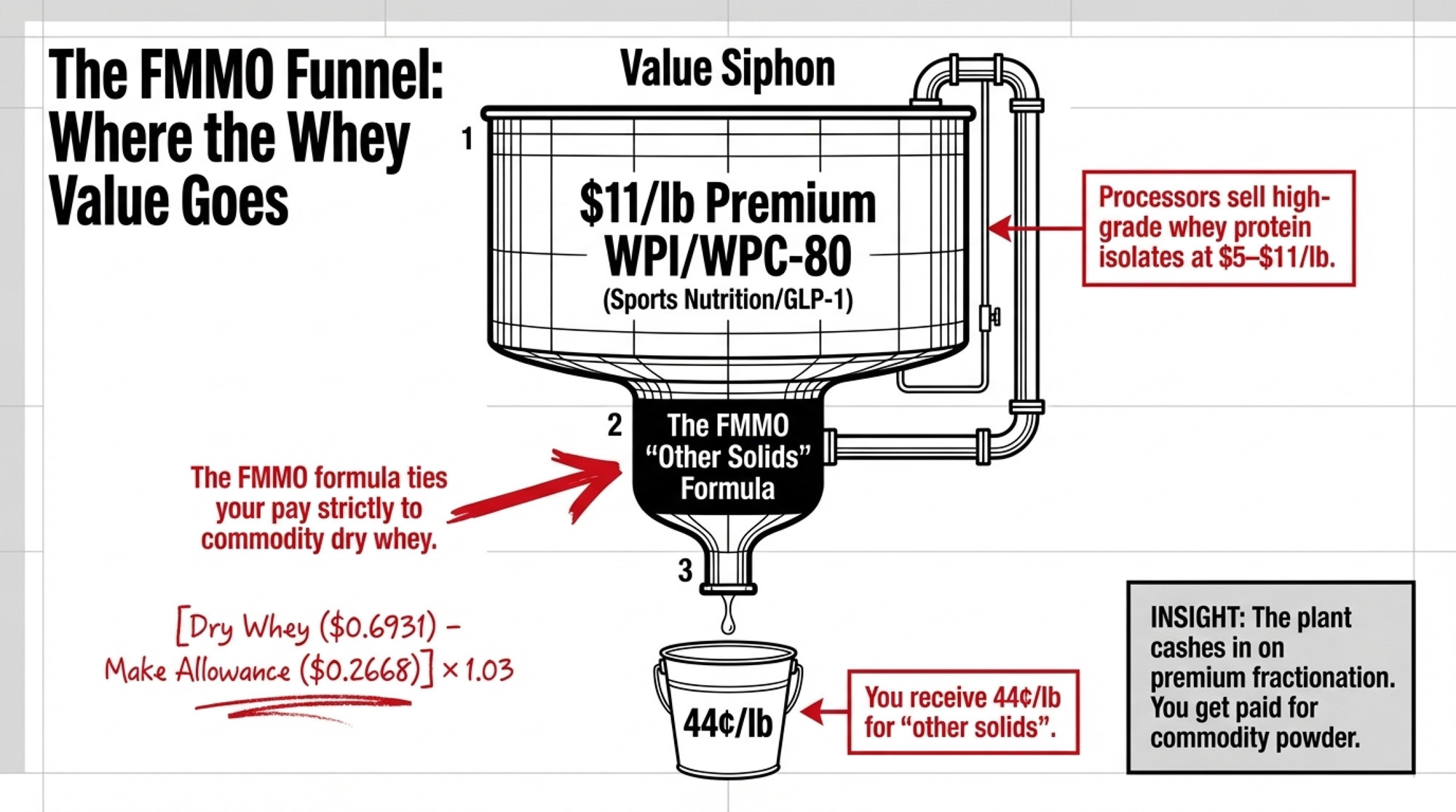
Your “other solids” component — the FMMO line where whey economics should show up — is calculated from commodity dry whey, not the premium WPI or WPC‑80 driving the headlines. Under USDA’s January 2025 Final Rule, effective June 1, 2025: 

Other‑solids price = (Dry whey price − $0.2668) × 1.03
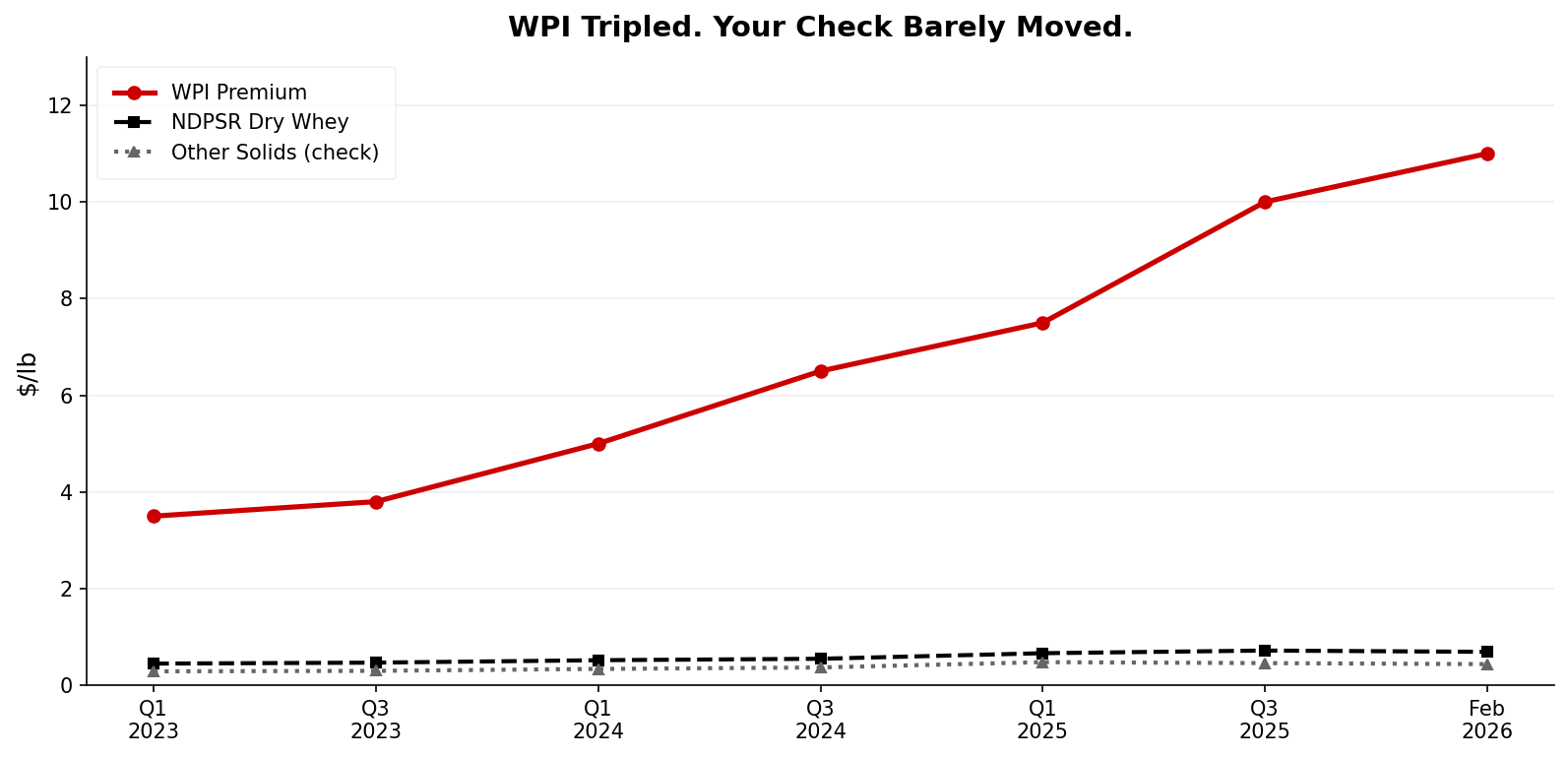
USDA’s February 2026 “Announcement of Class and Component Prices” puts NDPSR dry whey at $0.6931/lb. Run the math: 

  • $0.6931 − $0.2668 = $0.4263
  • $0.4263 × 1.03 = $0.4391/lb of other solids.

That matches the published number exactly. Meanwhile, premium WPI trades near $11/lb, and WPC‑80 has approached €20,000/ton in Europe. Those are totally different products from the commodity dry whey that feeds the FMMO formula. 

Your other‑solids line is tethered to 69‑cent dry whey and pays 44¢/lb. Your processor’s ingredient desk is selling $5–$11/lb whey proteins into sports nutrition and GLP‑1 diets. That’s the first piece of the disconnect — and it’s the piece Rabobank’s Lucas Fuess has been warning about in interview after interview since late 2025. 

The Make‑Allowance Hit You Voted For

There’s a second piece, and this one was literally on the referendum ballot.

Dry whey did move up year‑over‑year. February 2025’s NDPSR average: $0.6650/lb. February 2026: $0.6931/lb  — an increase of 2.8¢/lb. But your other‑solids value didn’t climb. It slid. 

  • February 2025 other‑solids price: $0.4799/lb (old formula). 
  • February 2026 other‑solids price: $0.4391/lb (new formula). 

Dry whey up 2.8¢. Other solids down 4.1¢/lb.
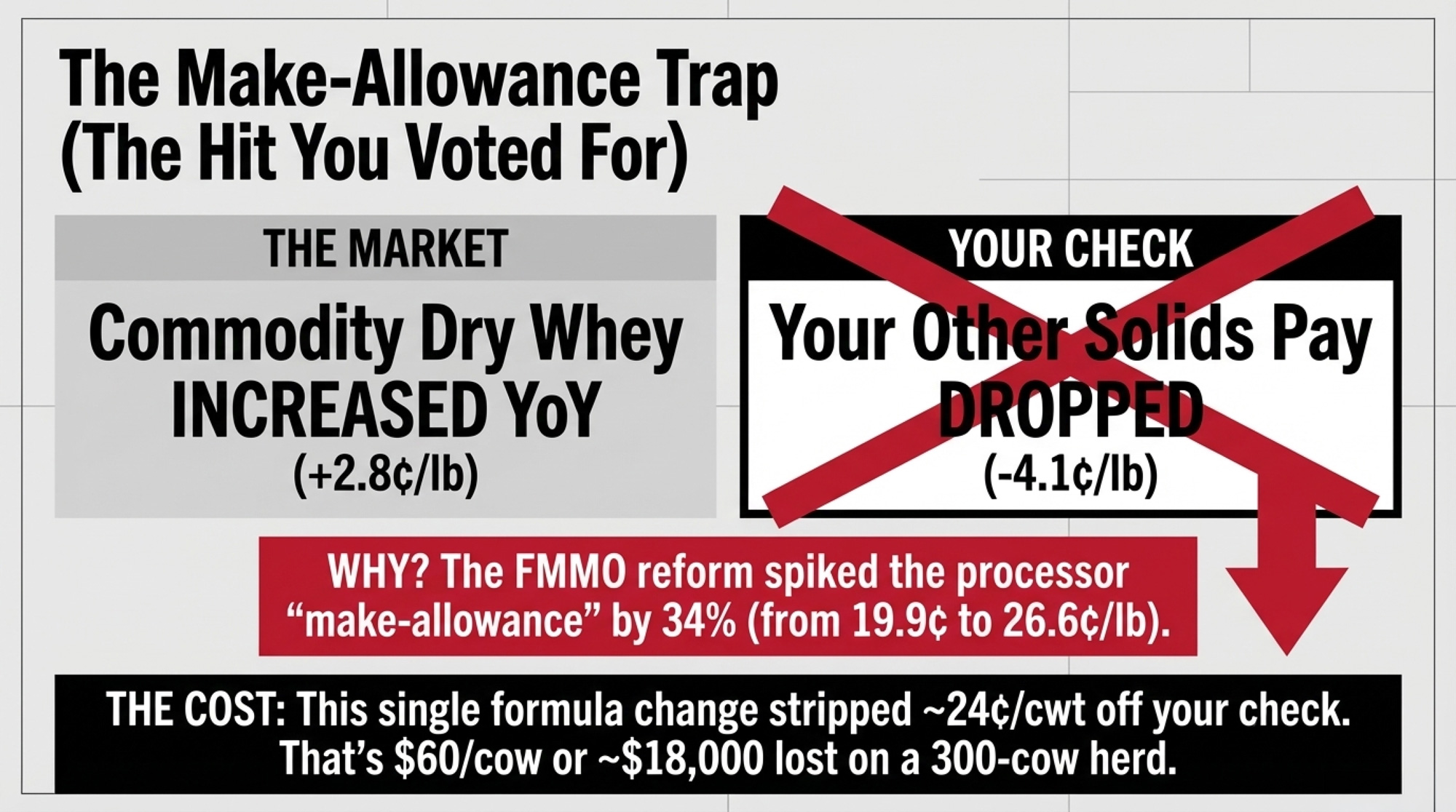
The reason: the FMMO reform raised the dry whey make allowance from $0.1991 to $0.2668/lb — a 34% jump,shifting value from producer to processor. Producers approved it in the December 2024–January 2025 referendum. AFBF economist Danny Munch calculated that in the first three months alone, higher make allowances stripped more than $337 million in combined pool value nationally — class price reductions of 85 to 93 cents per hundredweightdepending on the order (AFBF Market Intel, September 2025). As Munch told Brownfield Ag News, the higher allowances “more than wipe out” the gains from other reforms. 

Here’s the barn math at your test level (5.7 lbs OS/cwt):

  • 2025 OS component: $0.4799 × 5.7 = $2.74/cwt.
  • 2026 OS component: $0.4391 × 5.7 = $2.50/cwt.

That’s 24¢/cwt gone from other solids alone. Over 25,000 lb per cow, roughly $60/cow, and about $18,000 on a 300‑cow herd. Even though dry whey itself went up.

Premium whey triples. Commodity dry whey inches up. The make allowance change eats that small gain and then some. It’s exactly the make‑allowance hit we laid out in the FMMO piece earlier this month.

Where Did the ~$6/cwt Actually Go?

The component hit isn’t just whey. It’s the combination of weaker butterfat, softer cheese, and those other solids squeezed all at once.

Using USDA AMS component values for February 2025 vs. February 2026 at standard test: 
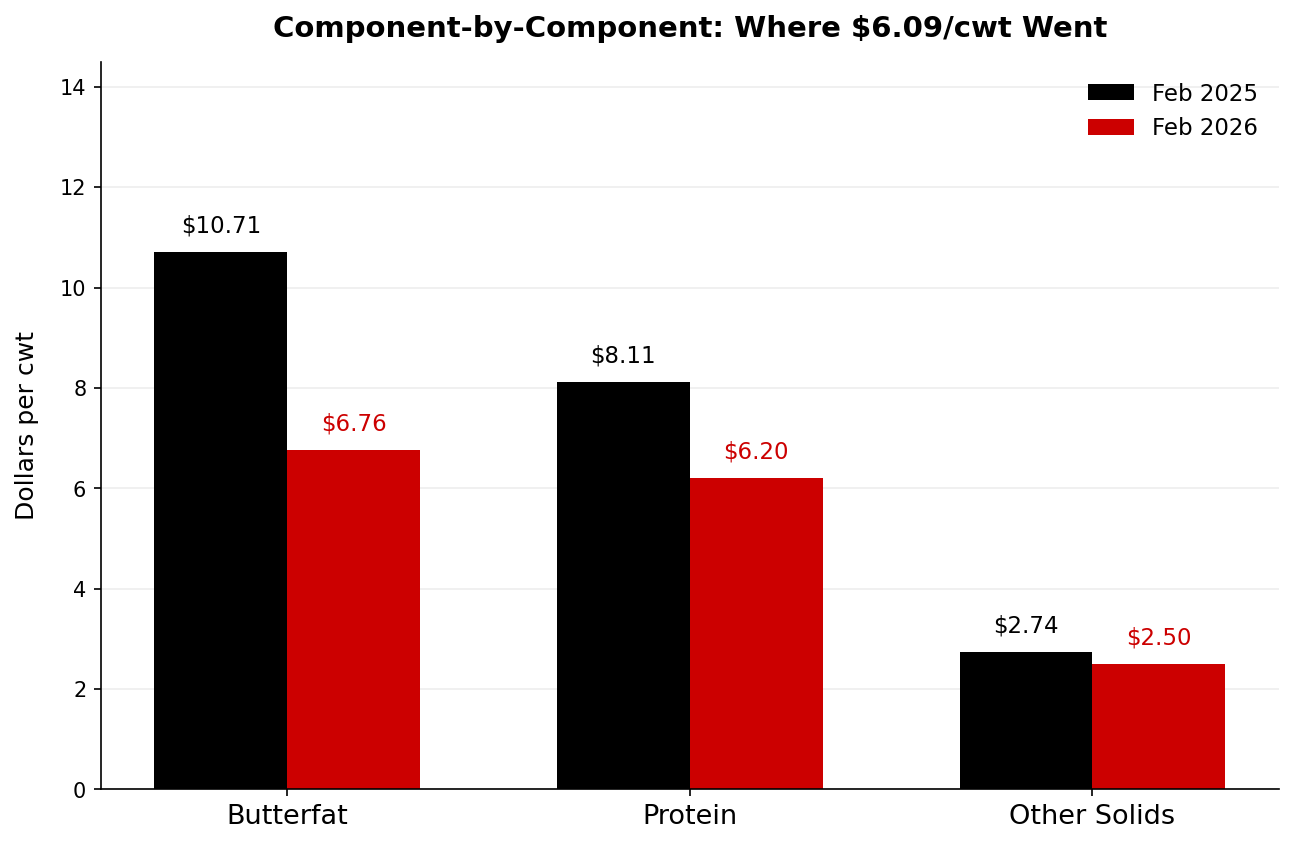
ComponentFeb 2025Feb 2026Change/lbPer‑cwt impact
Butterfat (3.8%)$2.8186/lb$1.7794/lb−$1.0392−$3.95
Protein (3.2%)$2.5337/lb$1.9373/lb−$0.5964−$1.91
Other solids (5.7%)$0.4799/lb$0.4391/lb−$0.0408−$0.23
Total   −$6.09/cwt

Butterfat did about two‑thirds of the damage. Softer cheese pulled protein lower and took another third. Other solids were the smallest slice — but in a whey boom, you’d expect them to be climbing, not sliding.

Per 25,000‑lb cow:

  • Feb 2025: $21.55/cwt × 250 cwt = $5,387/cow.
  • Feb 2026: $15.46/cwt × 250 cwt = $3,865/cow.

That’s about $1,520/cow gone — roughly $456,000 on Von Ruden’s 300‑cow neighbor. And through all of that, processors with whey-fractionation capacity booked elevated whey-ingredient margins. 

One quirk worth flagging: the FMMO protein formula includes a butterfat deduction. The butterfat drop in early 2026 actually cushioned the protein decline. If butterfat recovers while cheese stays soft, the protein line can fall further, even without another move in cheese. 

Who’s Building the Stainless — and Who’s Sharing?

StoneX dairy consultant John Lancaster told DairyReporter that “almost weekly you hear about a small or medium‑sized investment increasing capacity”. Put some names on that $11 billion: 

  • Glanbia/Southwest Cheese — adding significant WPI capacity in Clovis, New Mexico, through a JV with DFA. 
  • Idaho Milk Products — investing roughly $200 million in a new protein and powder blending facility. 
  • Wisconsin Whey Protein — finishing a plant targeting up to 13 million lbs of WPI annually. 
  • Arla Foods Ingredients contracted with Valley Queen in South Dakota for WPC manufacturing. 
  • Globally: Fonterra ($50M Studholme expansion, NZ), Tirlán (€126M new facility, Ireland), Amul (doubling a whey plant plus two new builds, India). 

Every pound of WPI starts as your cow’s milk going through a cheese vat. The FMMO formula turns that into $0.4391/lb of other solids. The plant’s ingredient desk sells that same stream at several dollars per pound. 

Whey ProductMarket Price (Feb 2026)FMMO Formula PayGap per PoundWho Captures It
Whey Protein Isolate (WPI)$11.00/lb$0.4391/lb$10.56Processor ingredient desk
WPC-80~$9.00/lb (€20k/t equiv.)$0.4391/lb$8.56Processor ingredient desk
NDPSR Dry Whey$0.6931/lb$0.4391/lb$0.254Partially shared via FMMO
Commodity Dried Whey Permeate~$0.38/lbNot in formulaN/AProcessor

Some co‑ops return a slice through patronage dividends or over‑order premiums tied to ingredient economics. In the Upper Midwest, industry sources report some operations have negotiated premiums of $0.20–$0.30/cwt above pool pricing, structured as multi‑year agreements. In a lot of plants, though, any whey value is buried inside the overall component or patronage numbers — not broken out on your statement. 

McCully Consulting’s Mike McCully predicts processors will soon be “forced into fights for milk by paying more, meaning some will not get all the milk they need”. That’s your leverage. But only if you know what your milk is worth to the plant buying it — and whether a competing plant within hauling range is offering a clearer premium. 

What Happens When $11 Billion in U.S. Dairy Capacity Comes Online?

Every extra pound of premium whey requires another cheese vat running. All that new stainless means more cheese — whether the market is ready or not.

Rabobank’s Fuess warned in March 2026 that these expansions “could temporarily lead to an oversupplied market and reduce cheese prices in the near term as the market works to absorb the additional output”. Cheese has already pulled back from around $1.90/lb a year ago to the mid‑$1.40s in early 2026. 

Exports are doing their best to bail the boat. USDEC data show U.S. dairy exports started 2026 with 12% year‑over‑year volume growth in January — the biggest January on record — with cheese up 11%, butter up 187%, and NFDM/SMP up 19%. 

But here’s the stress test. Using the USDA’s component formulas and historical price ranges, two downside scenarios:
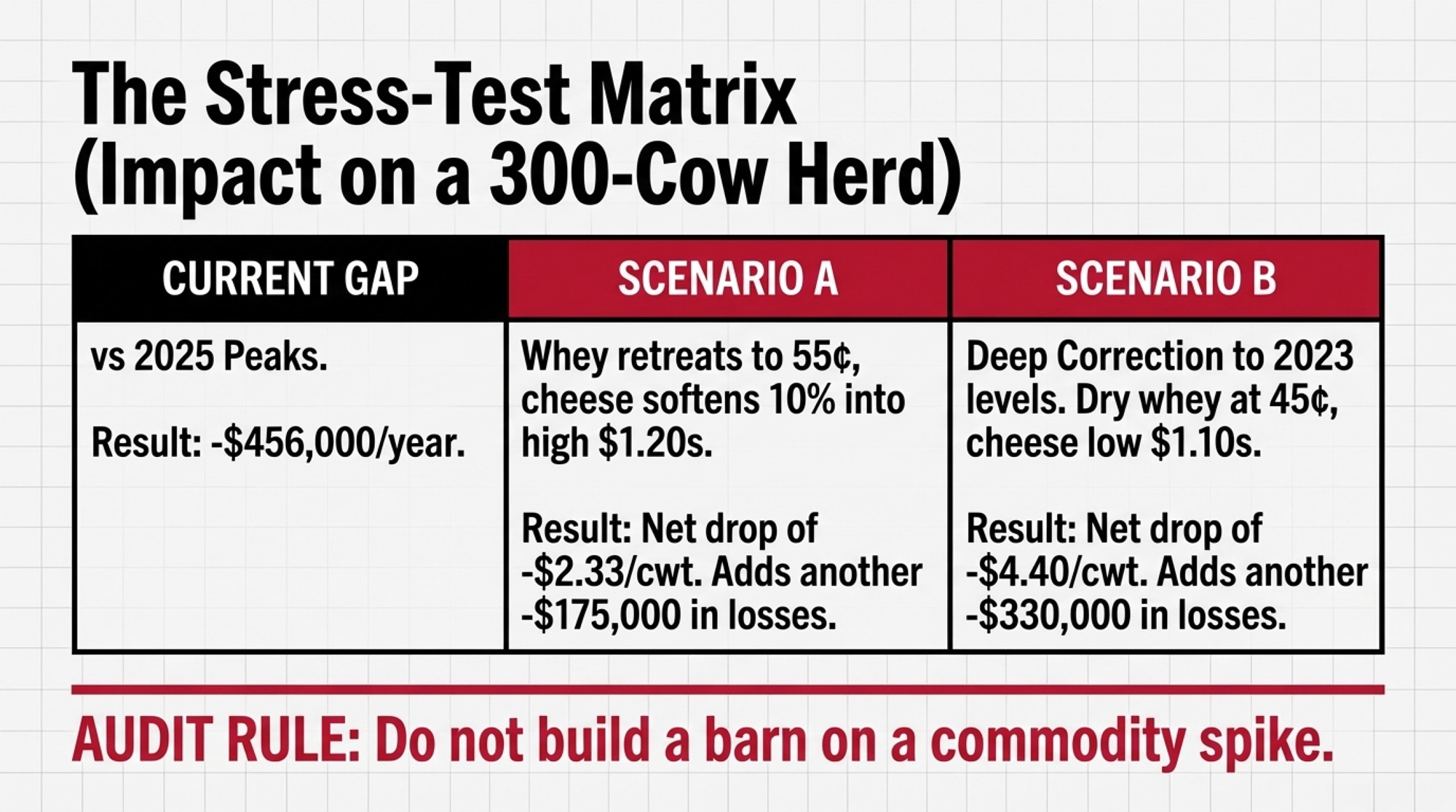
Scenario A — Whey retreats, cheese softens:

  • Dry whey slides to $0.55/lb (mid‑2025 levels). Cheese eases ~10% into the high‑$1.20s.
  • Other solids drop to roughly $0.29/lb. Protein falls to mid‑$1.40s/lb.
  • Net: about −$2.33/cwt from February 2026 levels → −$582/cow → −$175,000/year on 300 cows.

Scenario B — Deeper correction:

  • Dry whey returns to $0.45/lb (closer to 2023 levels). Cheese drops ~20% into the low‑$1.10s.
  • Other solids fall to roughly $0.19/lb. Protein slides toward $1.00/lb.
  • Net: about −$4.40/cwt → −$1,100/cow → −$330,000/year on 300 cows.

Scenario A isn’t far‑fetched. NDPSR dry whey sat in the 50–60¢ band for stretches of 2024 and 2025.
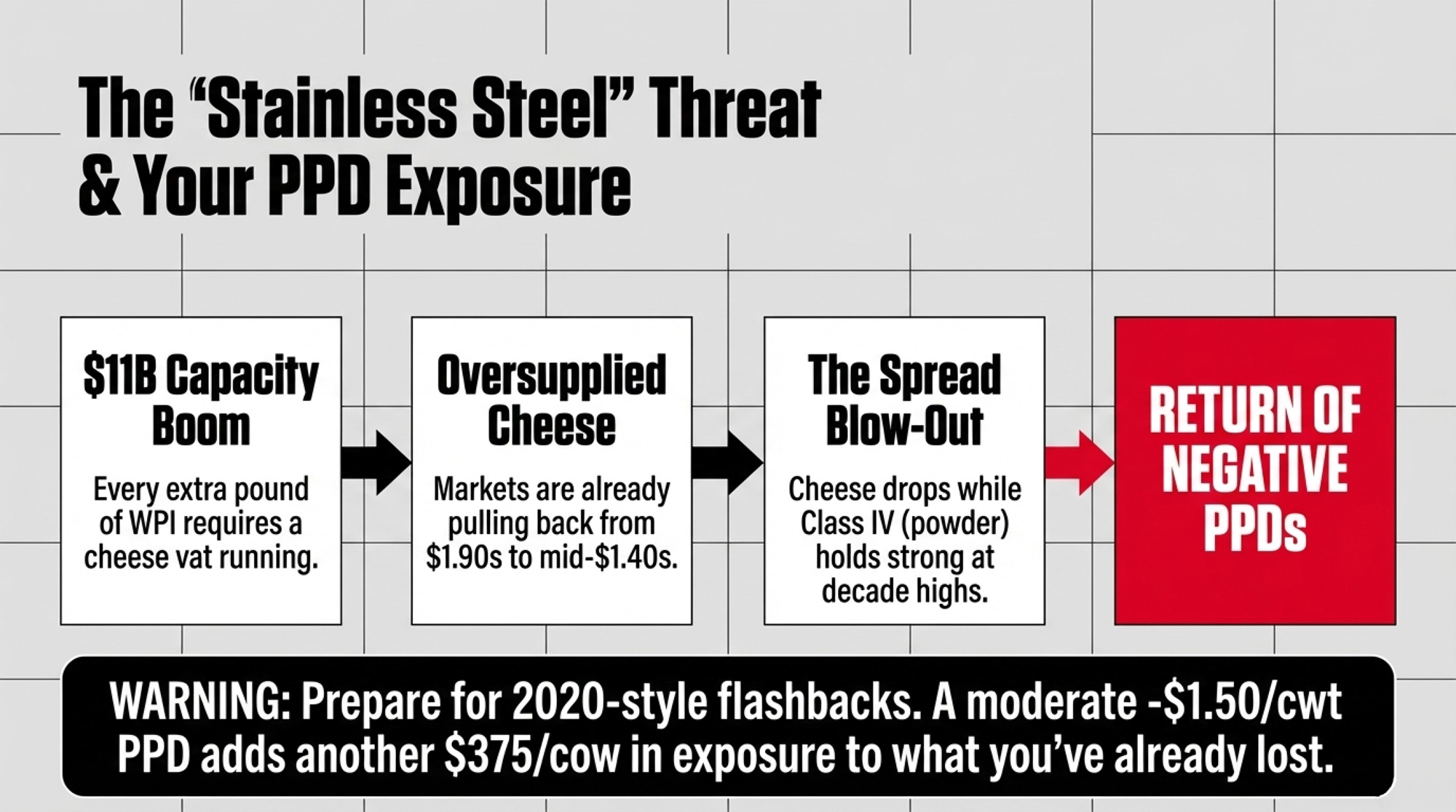
Now add the hidden multiplier: PPDs. If cheese drops while Class IV holds firm — CME nonfat dry milk has been trading at some of its strongest levels in more than a decade, near $1.94/lb in March 2026  — the spread blows out, and negative Producer Price Differentials come back. In 2020, some orders saw PPDs past −$4 to −$8/cwt. Even a moderate −$1.50/cwt PPD adds another ~$375/cow in exposure. 

If you lived through 2020–2021 negative PPDs, you know this isn’t theoretical. And it’s exactly the kind of peak‑price trap that backfired for Kiwi producers when Fonterra built budgets around NZ$9.70 milk.

The Calf Check: One of the Few Hedges Hitting Cash Today

While the FMMO formula fails to capture the $11/lb whey premium, beef‑on‑dairy is one place producers are actually winning back margin in cash.
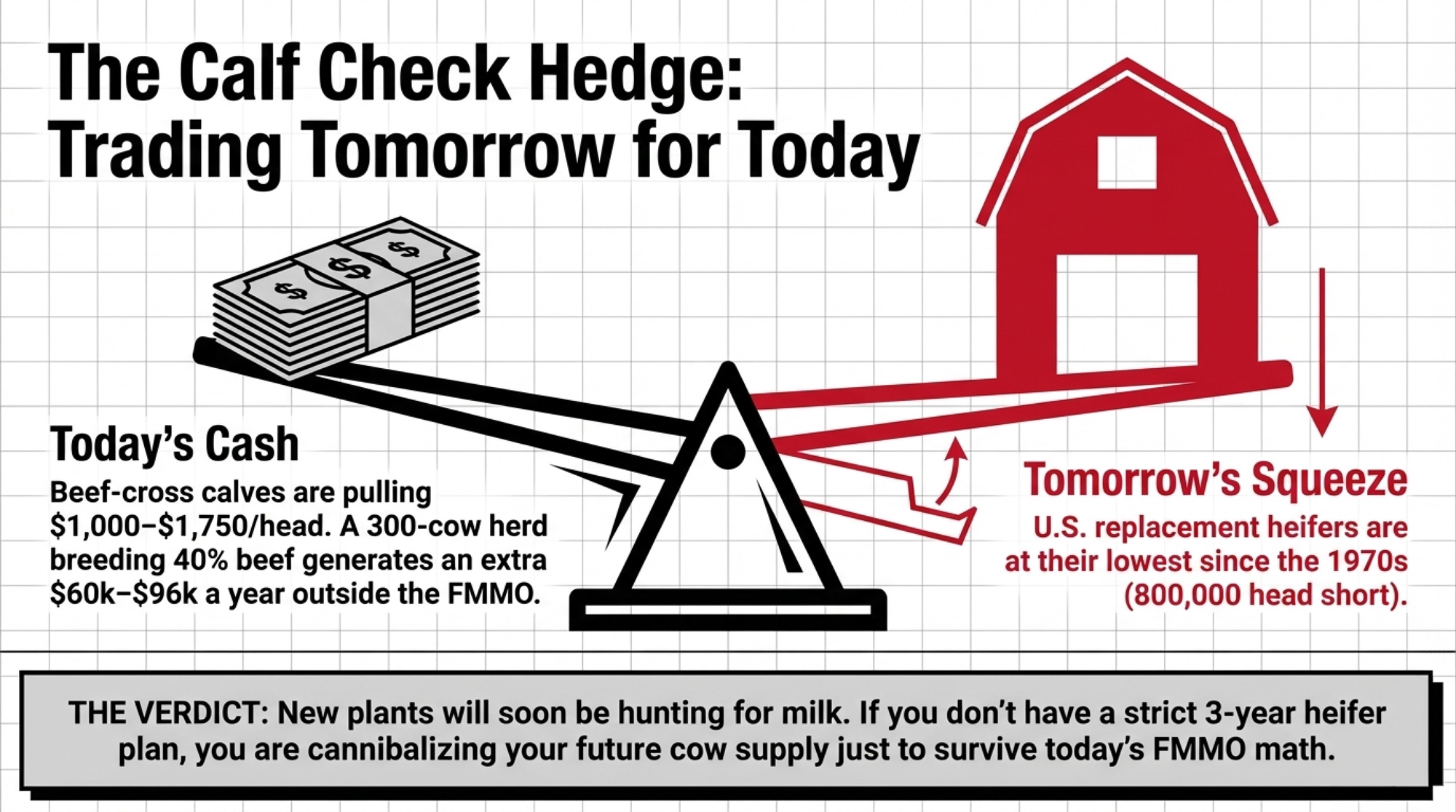
In strong Wisconsin markets, beef‑cross calves have brought up to $1,750 a head, with Premier’s January 2026 report listing beef‑dairy crosses at $1,000–$1,750. Holstein bull calves, by comparison, sit in the $700–$1,150 range. 

That extra $500–$800 per calf functions as a de facto hedge. On 300 cows breeding 40% to beef semen, that’s 120 calves generating roughly $60,000–$96,000/year that never touches a federal order.

The trade‑off is real, though. USDA’s January 1, 2026, cattle report puts U.S. dairy replacement heifers at 3.905 million head — the lowest since the late 1970s and about 16% below January 2020. CoBank dairy economist Corey Geigerprojects the gap at roughly 800,000 fewer replacements across 2025–2026 before inventories begin to rebound sometime in 2027. As Geiger put it: “We don’t see a rebound until 2027, and that will be up 285 thousand, but you’ve got to remember, that’s going to be after 800 thousand fewer heifers”. 

Fewer replacements mean fewer cows when all that new stainless steel starts hunting for milk. That takes you straight back to McCully’s question: “Who won’t get the milk?” 

Beef‑on‑dairy props up your cash and tightens the supply that new capacity needs. But it comes with a shelf life — and if more than half your AI program is going to beef without a three‑year heifer plan, you’re trading tomorrow’s cow supply for today’s calf check. We walked through exactly how that math can break on a 400‑cow herd last week.

What This Means for Your Operation

  • Your component check has already absorbed roughly $1,520/cow from February 2025 to February 2026 — about $456,000 on 300 cows. If your expansion budget or debt‑service math is built on early‑2025 component values, you’re building on a number that isn’t there anymore. 
  • The FMMO reform alone shaved about $60/cow off your other‑solids line via the higher make allowance — roughly $18,000/year on 300 cows — even as processors booked stronger whey ingredient margins. 
  • You need to know what your plant does with whey and how they share it. If your co‑op’s annual report shows whey ingredient revenue growing faster than patronage per cwt, that gap is worth understanding — and worth raising at your next member meeting.
  • Beef‑on‑dairy calves at $1,400–$1,750 are real margin, but they’re also tightening heifer supply in ways that make the coming milk bidding wars more brutal. Your beef‑to‑dairy AI ratio needs to line up with your three‑year heifer plan, not just this month’s calf check. 
  • Negative PPDs are the hidden multiplier. With Class IV buoyed by strong powder and cheese under pressure, the setup looks uncomfortably similar to 2020 and late 2024. Model another $1–$2/cwt of exposure.
  • Don’t build a barn on a commodity spike. Stress‑test every expansion pro forma at about $15.50/cwt component value, not $21. If it doesn’t cash‑flow there, you’re not investing — you’re betting.
  • Price the haul to a competing plant. If whey capacity is being added within hauling range, ask directly what the over‑order premium is and how ingredient economics show up in their payment structure. McCully’s “who won’t get the milk?” question is where your leverage comes from. 

Your 30/90/365‑Day Playbook
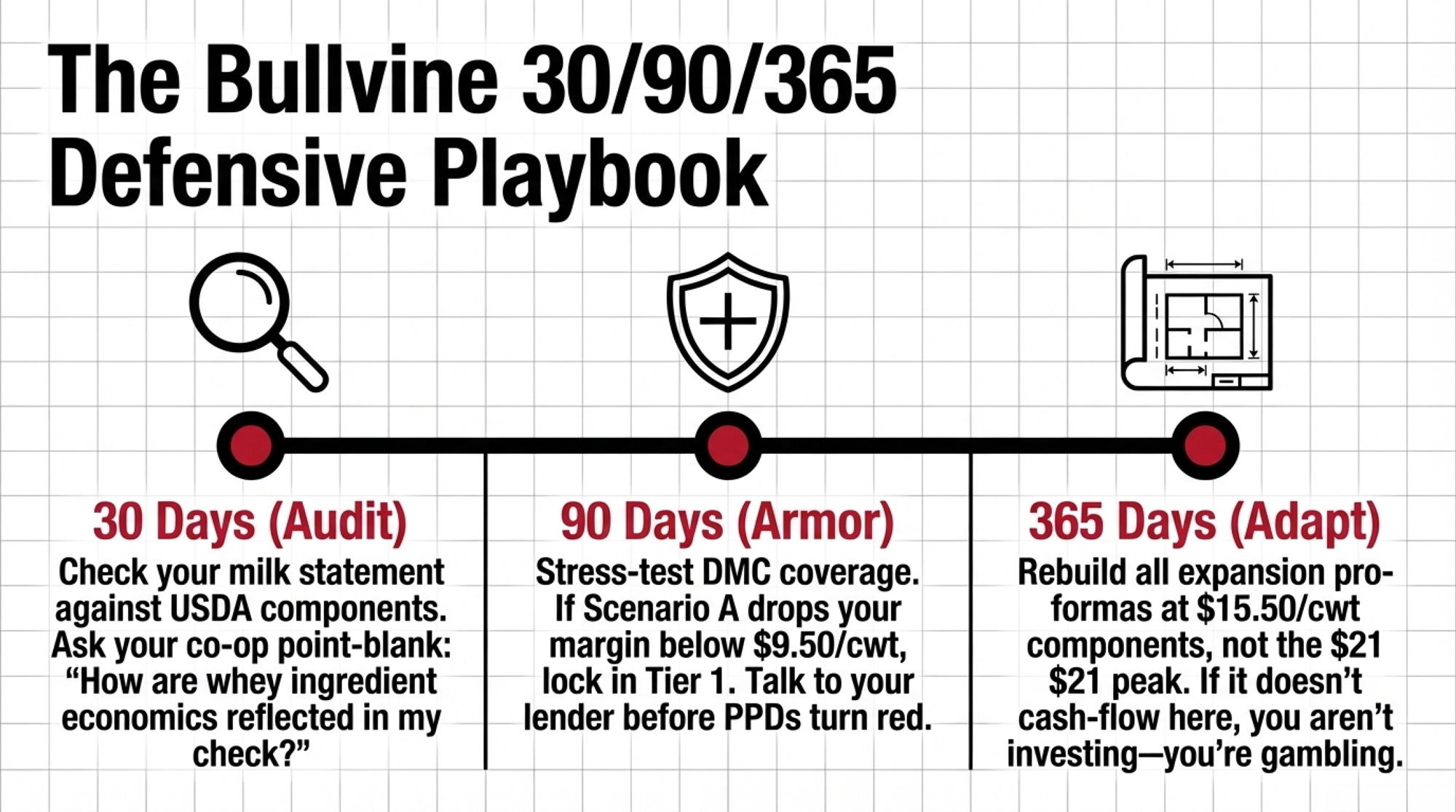
TimeframeKey ActionTarget BenchmarkRed Flag ThresholdTool / Source
30 DaysAudit milk check vs. USDA valuesProtein: $1.9373/lb; OS: $0.4391/lb; Fat: $1.7794/lb>$0.15/cwt below FMMO after haulingUSDA AMS February 2026 component prices
30 DaysRequest co-op whey breakdownPatronage per cwt growing with ingredient revenueWhey revenue growing faster than patronageCo-op annual report / equity statement
90 DaysStress-test DMC coverageTier 1 at $9.50 (up to 6M lb)Margin drops below $9.50 in Scenario AUSDA DMC / Center for Dairy Excellence
90 DaysModel PPD exposure$0/cwt PPDPPD turns -$1.50/cwt or worseClass III vs. Class IV spread monitor
12 MonthsRe-run expansion pro formaBase case: $15.50/cwt componentsOnly pencils out above $20/cwtInternal proforma, lender review
12 MonthsPrice hauling alternativesConfirm over-order premium structurePlant within haul range offers no premiumMcCully/StoneX consultant framework

Within 30 days: Audit your check against USDA component values.

Pull your last three milk statements. Compare your protein, other solids, and butterfat rates to USDA’s February 2026 published component prices: protein at $1.9373/lb, other solids at $0.4391/lb, butterfat at $1.7794/lb

If your combined protein‑plus‑other‑solids payment runs more than $0.15/cwt below the FMMO values after hauling and marketing deductions, call your co‑op and ask one direct question: “How are whey ingredient economics reflected in my component check?”

If you get a non‑answer, request the co‑op’s annual financial report and equity statement. Compare ingredient revenue to patronage distributions. That gap — if it’s growing — is the conversation to bring to the next member meeting. It’s the kind of thing that costs real money when you put off the hard financial questions.

Within 90 days: Stress‑test your DMC coverage and talk to your lender.

USDA’s January 2026 DMC margin landed at $7.81/cwt, triggering a $1.69/cwt indemnity for herds enrolled at the $9.50 Tier 1 level. February’s margin was projected to be around $8.07/cwt by the Center for Dairy Excellence. 

Walk your own numbers through Scenario A:

  • Knock $2.33/cwt off your current component value.
  • Layer in a −$1.50/cwt PPD if you’re in an order that’s likely to go negative.
  • See where your income‑over‑feed margin lands relative to $9.50/cwt.

If the margin drops below $9.50 in that scenario, the expanded Tier 1 coverage — now up to 6 million pounds under the One Big Beautiful Bill Act  — is likely your cheapest shock absorber. 

Then bring both scenarios to your lender. Ask specifically: what debt‑service coverage ratio would they need to see — 1.2×? 1.3×? — to stay comfortable if those margins showed up for 12 months. Better to push that conversation now than have your banker push it when the PPD turns red.

Within 12 months: Rebuild your expansion math around post‑reform prices.

Run every major capital decision at three component levels:

  • $15.50/cwt — roughly where early‑2026 Class III components sit. 
  • $19.20/cwt — a 2025‑style “good year” average.
  • Scenario A with a −$1.50 PPD — your personal worst‑case stress.

You don’t control whether WPI stays at $11 or glides down to $6. You do control whether your business can survive both.
Key Takeaways

  • If your expansion or refinance pencils out only at a $20+ component value, you’re exposed. Re‑run at $15.50/cwt and see if it still holds water.
  • If you can’t see whey in your milk check, assume it’s not there. Plan your cash flow on FMMO components alone until your statement or co‑op report shows a clear whey‑linked premium.
  • If more than half your AI is going to beef without a three‑year heifer plan, you’re trading future cow supply for today’s calf check. Make sure that’s intentional.
  • If you’re not enrolled at $9.50 DMC Tier 1 and you’re running 200–500 cows, you’re choosing to self‑insure against a whey/cheese/PPD shock. Do the math with your lender, not in your head.
The Bottom Line

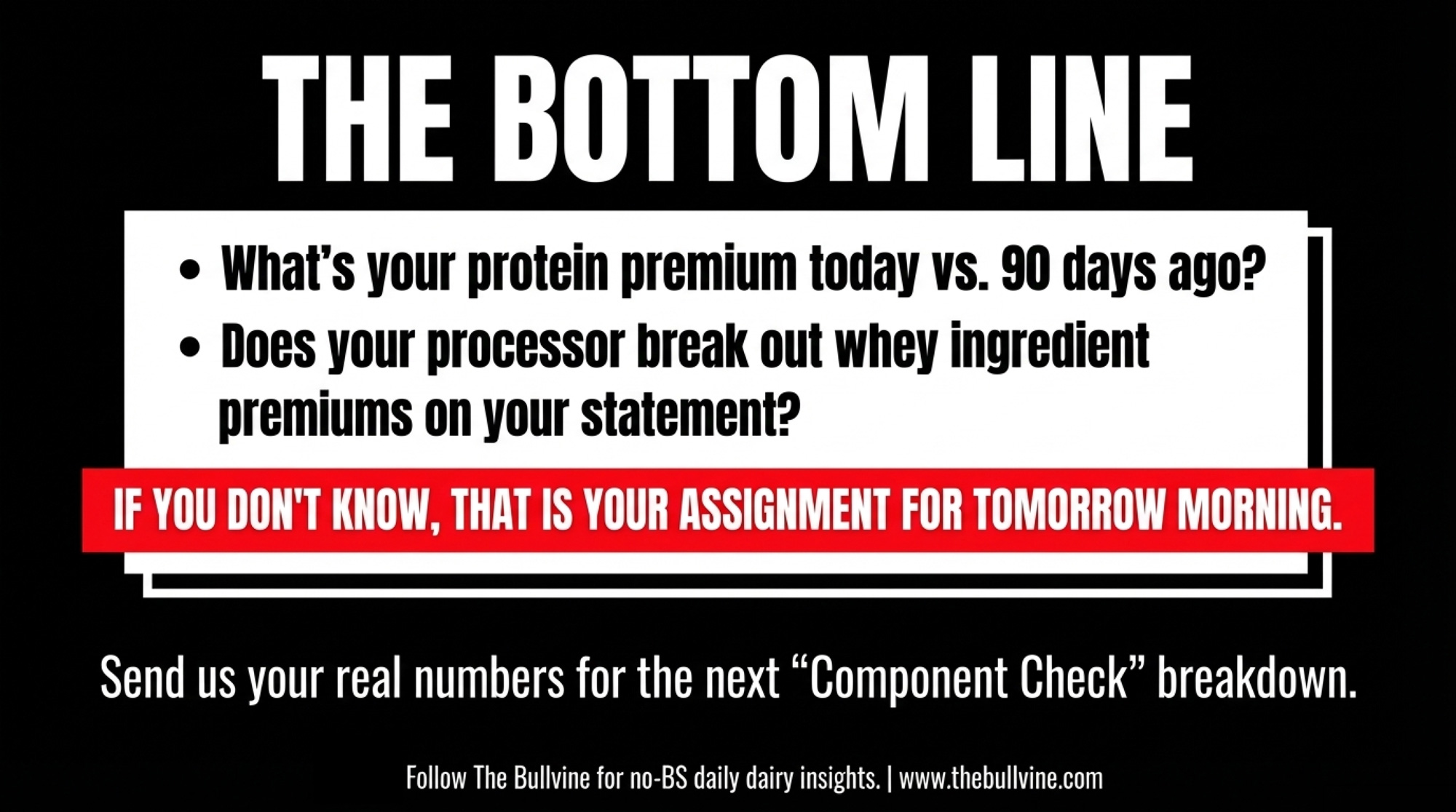
What’s your protein premium per cwt this month versus 90 days ago? Does your processor break out whey solids or ingredient premiums anywhere on your statement? And if you’re in a co‑op, how did last year’s patronage per cwt move compared to the co‑op’s reported whey ingredient revenue?

If you don’t know any of those answers, that’s your 30‑day assignment.

Next in “Component Check”: we run the math on how the April DMC margin and the whey premium interact on a 500‑cow milk check. If you want us to use your real numbers, send them.

This analysis uses publicly available USDA data, published analyst commentary, and FMMO pricing formulas. It’s intended as economic education and decision support for dairy producers, not as investment advice or a recommendation regarding any specific co‑op, processor, or financial product.

Complete references and supporting documentation are available upon request by contacting the editorial team at editor@thebullvine.com.

Learn More

The Sunday Read Dairy Professionals Don’t Skip.

Every week, thousands of producers, breeders, and industry insiders open Bullvine Weekly for genetics insights, market shifts, and profit strategies they won’t find anywhere else. One email. Five minutes. Smarter decisions all week.
NewsSubscribe
First
Last
Consent

FMMO Pays $1.71/lb for Butterfat Worth $2.95: What USDA’s December Report Tells You About Your Milk Check in 2026

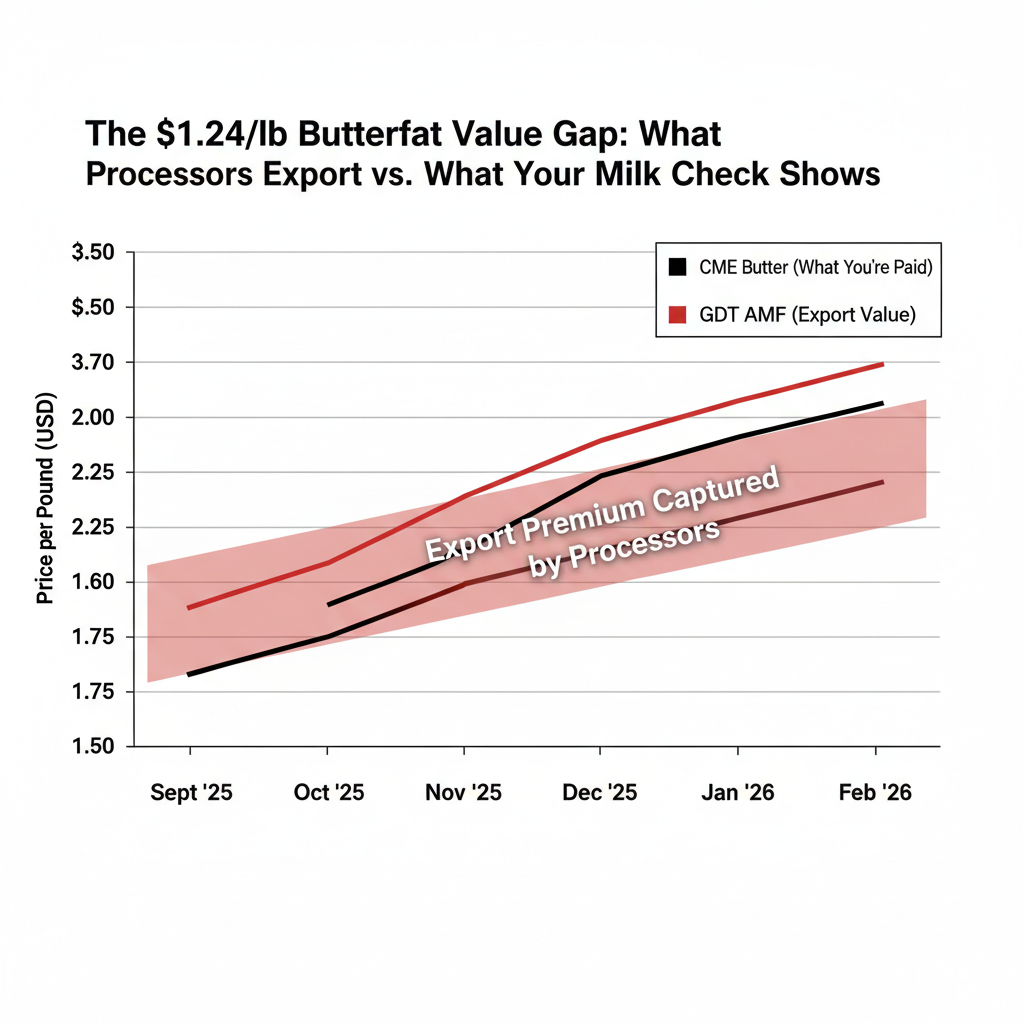
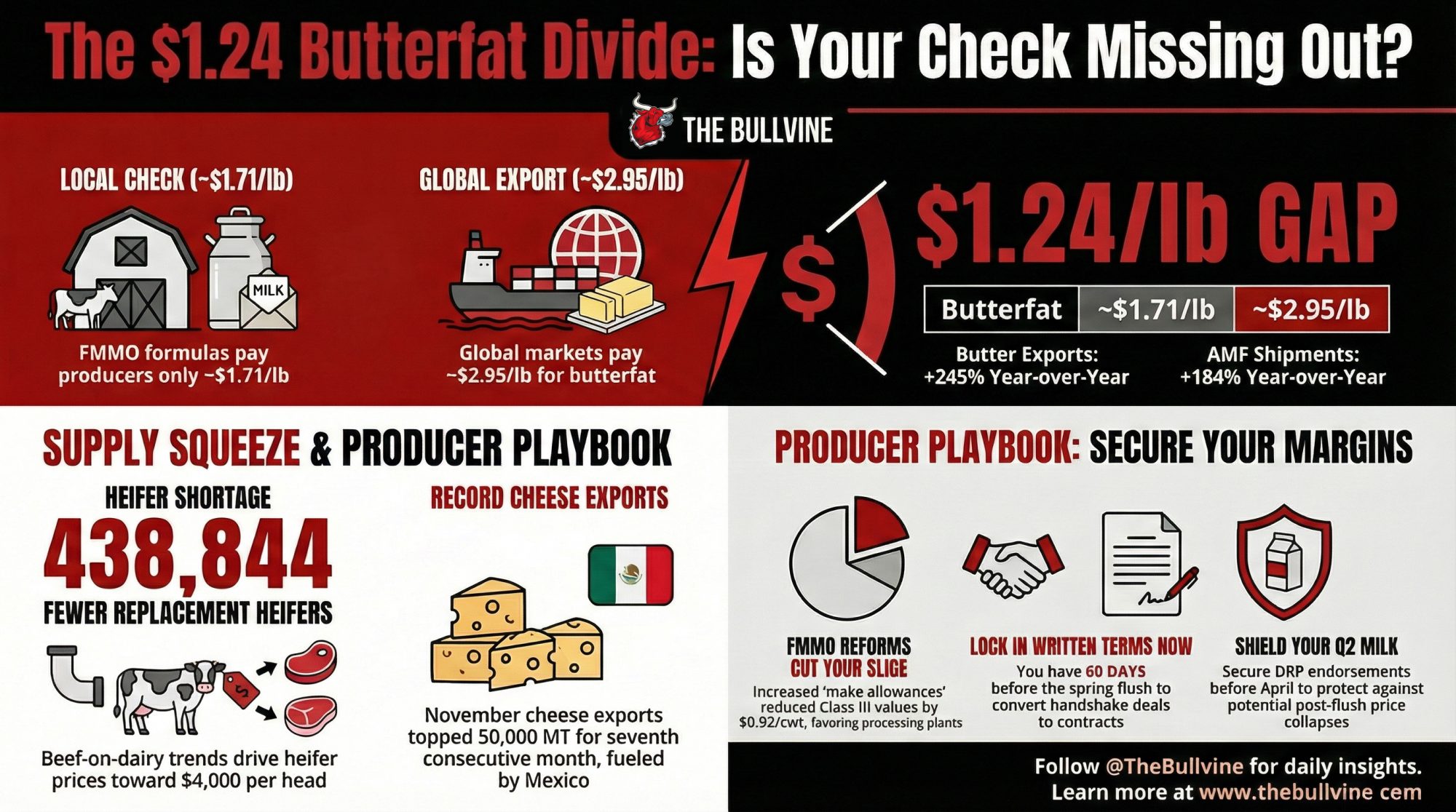
Processors are exporting your butterfat at roughly $2.95/lb while the FMMO pays you based on ~$1.71. Here’s how that gap formed — and what you need to lock in before spring flush closes the window.

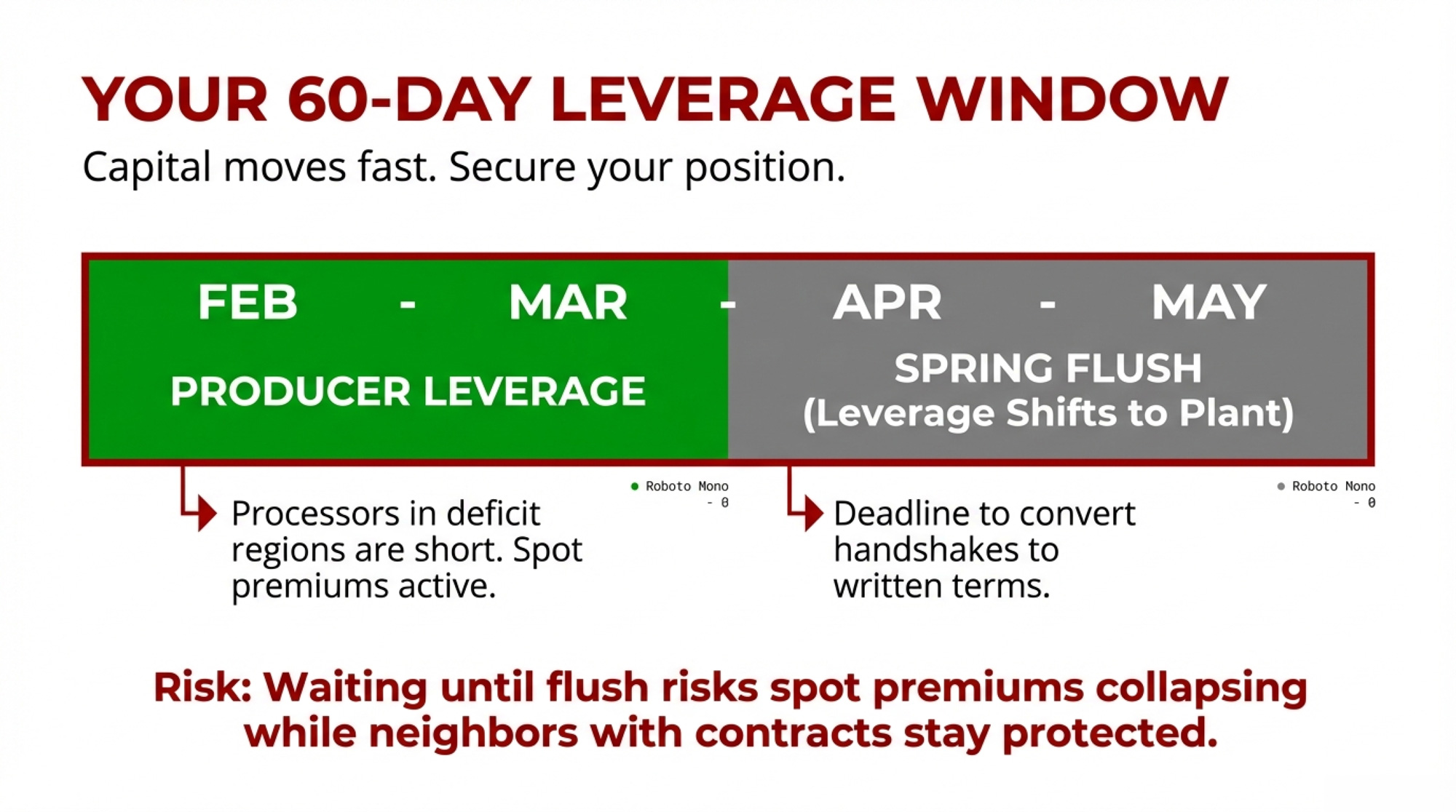
EXECUTIVE SUMMARY: Your butterfat is worth $2.95/lb on the global market. The FMMO pays you based on $1.71. That $1.24/lb gap — exposed in USDA’s December 2025 report — flows to processors exporting record butter and AMF volumes, not to the producers making the components. June’s FMMO modernization widened the divide: raised make allowances cut Class III by $0.92/cwt handing plants a bigger slice while yours shrank. Supply pressure is building from the other direction — CoBank projects 438,844 fewer replacement heifers by 2026, with prices at $3,010–$4,000/head, just as $10 billion in new processing capacity needs milk. Component-focused operations in deficit regions have roughly 60 days before the spring flush to convert handshake deals into written terms. After that, the leverage shifts.

Cheese blew past expectations. Butter missed — again. NFDM production fell, but stocks climbed anyway. When USDA dropped the December 2025 Dairy Products report on February 5, 2026, futures barely flinched. Everything traded flat except powder, which caught immediate sell-side pressure.

The headline numbers look simple enough: total cheese at 1.28 billion pounds (+6.7% year over year), butter at 204 million pounds (+2.0%), nonfat dry milk at 127 million pounds (down 2.7%), per USDA NASS. But underneath those percentages sits a widening disconnect between the global value of your components and what actually shows up on your milk check — a gap that should be front-of-mind for every component-focused operation heading into spring 2026.

For the component-focused operations tracking their butterfat premium against the blend, December’s milk check told a familiar story: the premium was up, but not nearly as much as the export math suggested it should be. The rest of the value? It left the country.

Cheese: $10 Billion in Capacity, and the Export Machine Is Absorbing It

Cheddar alone hit 340,350 thousand pounds in December — up 9.0% from a year ago. Not a one-month blip. Full-year 2025 cheddar finished 5.3% above 2024, and total cheese came in 2.9% higher. Italian types weren’t far behind: mozzarella up 5.9%, Parmesan up a striking 22.9%.

Announced U.S. dairy processing investments total roughly $10 billion through 2027, according to CoBank. The industry braced for a glut that would crush the board.

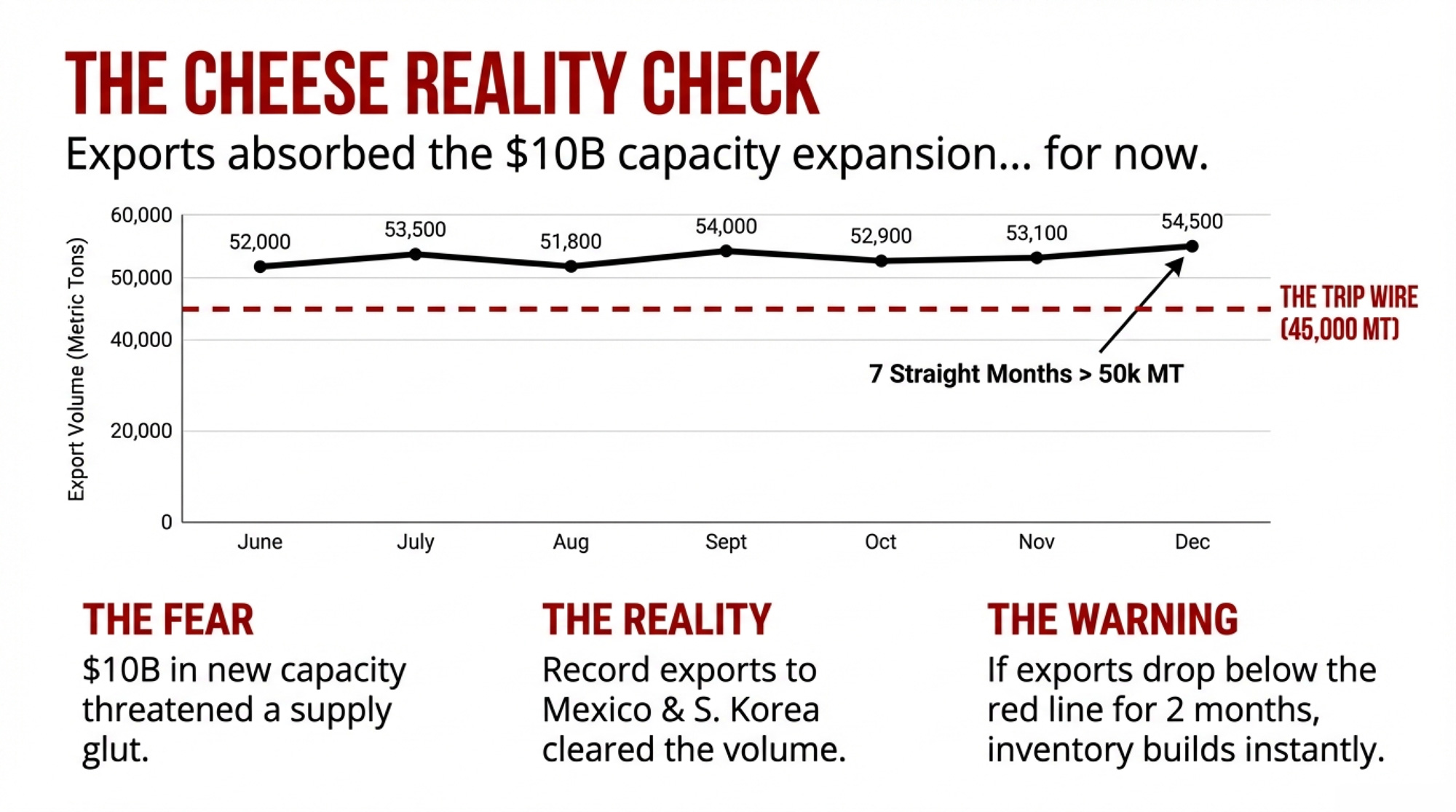
It hasn’t happened — because export demand ate through the extra volume. USDEC’s January 2026 trade summary puts November 2025 cheese exports at 50,775 metric tons, up 28% year over year. That’s the seventh consecutive month above 50,000 MT — a threshold never breached before 2025. Volume rose significantly to Mexico and South Korea, which USDEC says is “poised to set an annual record for U.S. cheese purchasing.” Southeast Asia cheese exports surged 92%.

MonthU.S. Cheese Exports (MT)YoY Change (%)Status vs. 50k MT Threshold
May 202551,240+18%✓ Above
June 202552,890+22%✓ Above
July 202553,470+24%✓ Above
Aug 202551,920+21%✓ Above
Sept 202554,110+26%✓ Above
Oct 202552,650+23%✓ Above
Nov 202550,775+28%✓ Above

But 28% export growth isn’t a number you can bank on forever. Here’s the threshold worth watching: if monthly cheese exports drop below 45,000 MT for two consecutive months while new plants keep ramping, domestic inventories will build faster than the market can clear. That’s not a prediction. It’s a trip wire.

Butter: Your Fat Leaves the Country at ~$2.95. Your Check Reflects ~$1.71.

Butter production came in at 203,848 thousand pounds, just 2.0% above December 2024. Full-year 2025 butter was up 5.7% — not a collapse — but December fell well short of private forecasts for the second straight month. USDA’s January 23 Milk Production report showed December output in the 24 major states at 18.8 billion pounds, up 4.6%year over year, with 222,000 more cows and 42 more pounds per cow generating plenty of cream.

So where’d all the butter go? Overseas. Where the margins are.

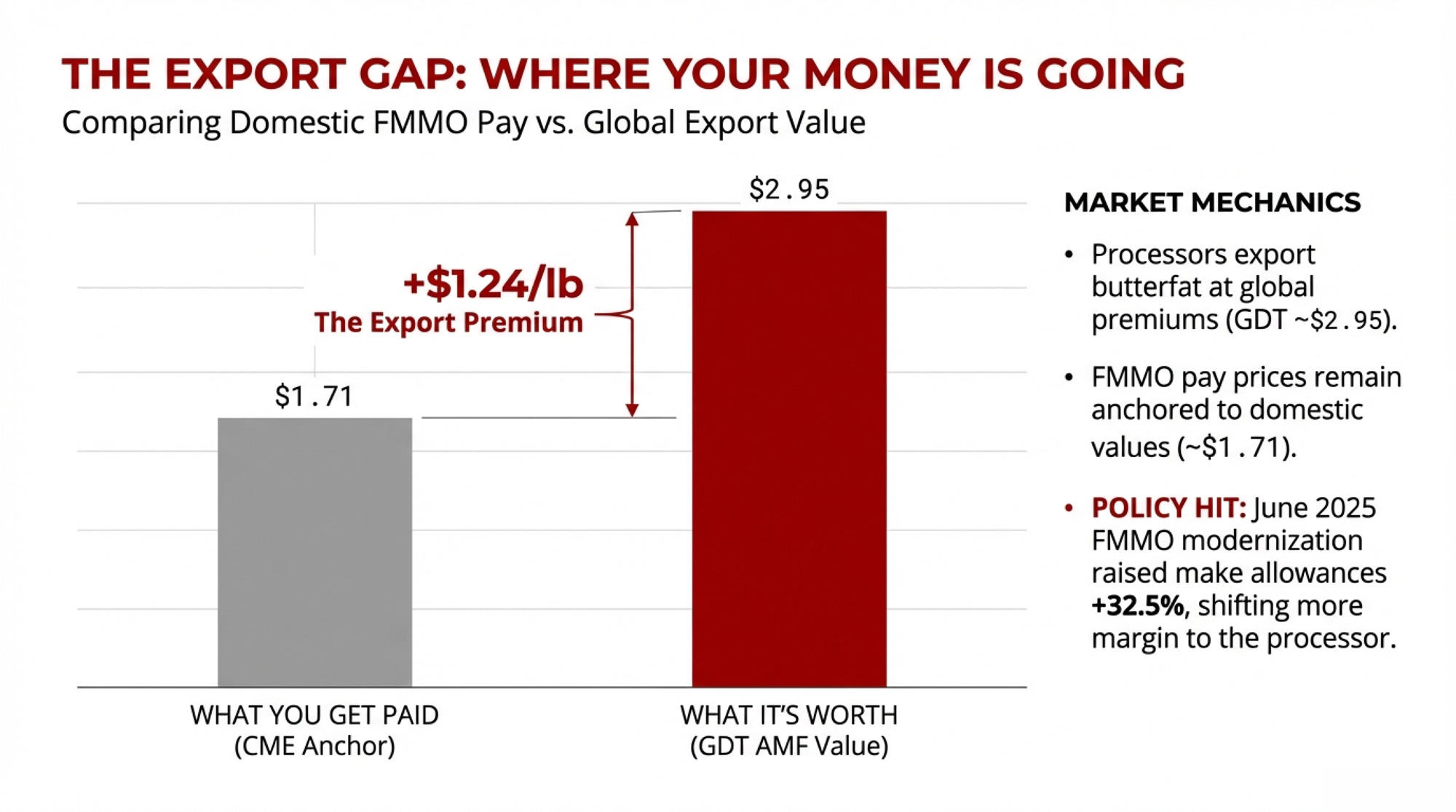
Per the CME cash dairy trade the week of February 3 (prices as of February 5, 2026), spot butter closed at approximately $1.71/lb, up from around $1.58 earlier in the week. GDT futures for February 2026 delivery had butter at roughly $2.64/lb and anhydrous milk fat at roughly $2.95/lb, per the Daily Dairy Report. That’s a spread of about $0.93/lb between CME and GDT butter — and $1.24/lb between CME butter and GDT AMF.

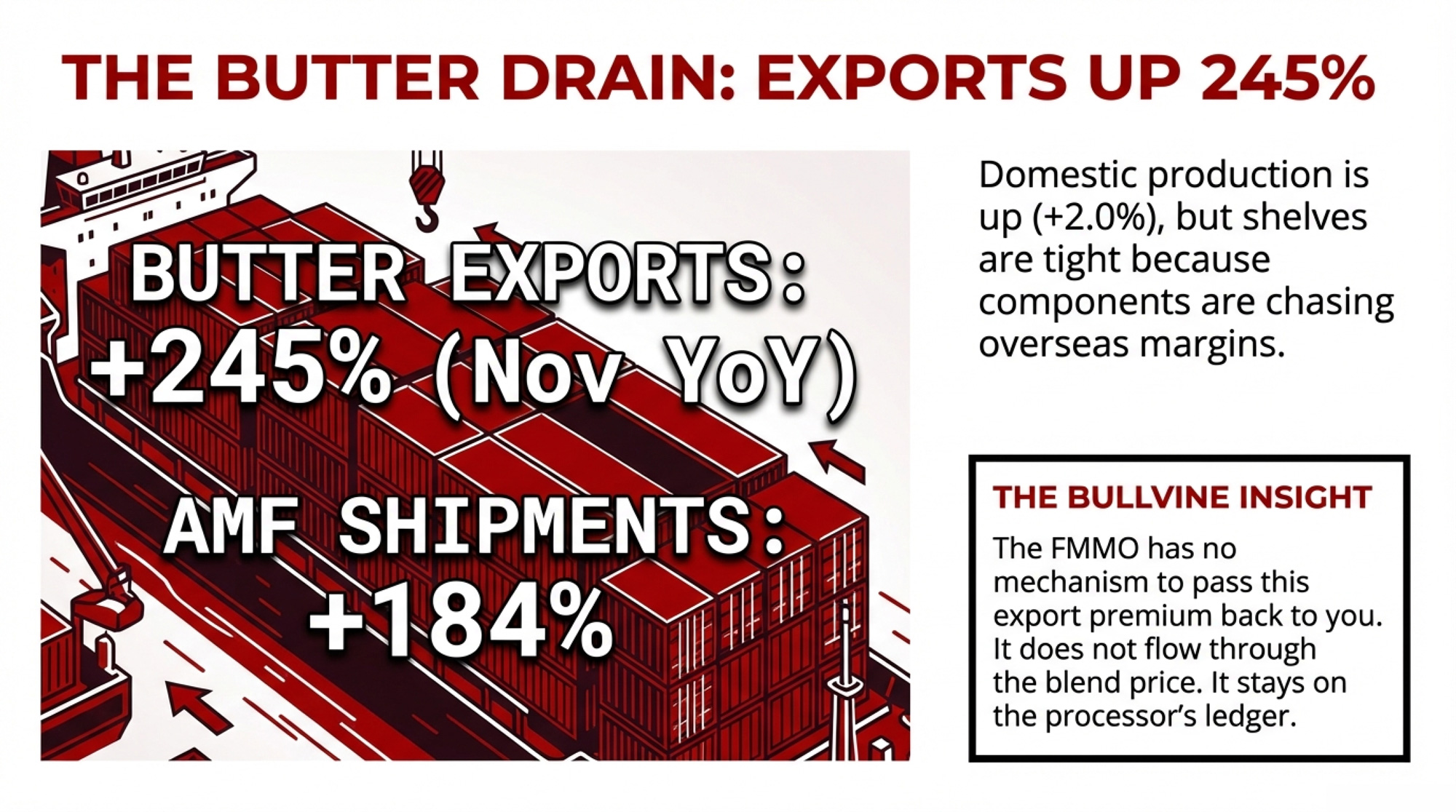
USDEC confirms processors are leaning hard into that spread. November butter exports surged 245% year over year. AMF shipments jumped 184%. USDEC called it the highest single month on a milk-fat basis for U.S. dairy exports — total butterfat exports reached 15,308 metric tons.

Now stack FMMO math on top. The June 2025 Federal Order modernization raised the butter make allowance from $0.1715/lb to $0.2272/lb — a 32.5% increase, per the USDA final rule published January 17, 2025. The changes “lowered the value of producer milk,” with the new cheese make allowances alone reducing the Class III price by $0.92/cwt.

The formula changes gave plants a bigger slice of the value pie. Your slice got smaller.

You produce the butterfat. Your plant converts it to 82% butter or AMF and sells it into an export channel, priced off GDT. Your milk check stays anchored to CME butter minus a bigger make allowance. The FMMO has no mechanism to pass that export premium back to you. Not through your blend price. Not through your component premium.

Product / MetricCME Price ($/lb)GDT Price ($/lb)Spread ($/lb)Value Gap per Tanker
Butter (82% fat)$1.71$2.64+$0.93~$5,580
Anhydrous Milk Fat$1.71*$2.95+$1.24~$7,440
Your Butterfat (3.7% test)Based on $1.71 CMEActual export value $2.95+$1.24~$7,440
Per Cwt Impact (80 lb/cwt @ 3.7% BF)Paid ~$5.06/cwt BFWorth ~$8.74/cwt BF-$3.68/cwt-$221/tanker

One partial exception worth investigating: if you’re a co-op member, your cooperative may return a share of export value through patronage dividends or retained earnings. Pull your co-op’s annual financial statement. Ask the question directly at your next member meeting. You might not like the answer — but you deserve to know it.

NFDM: Production Down, Stocks Up — Powder Took the Only Futures Hit

This is where the December report sent its clearest signal, and the one place futures actually listened.

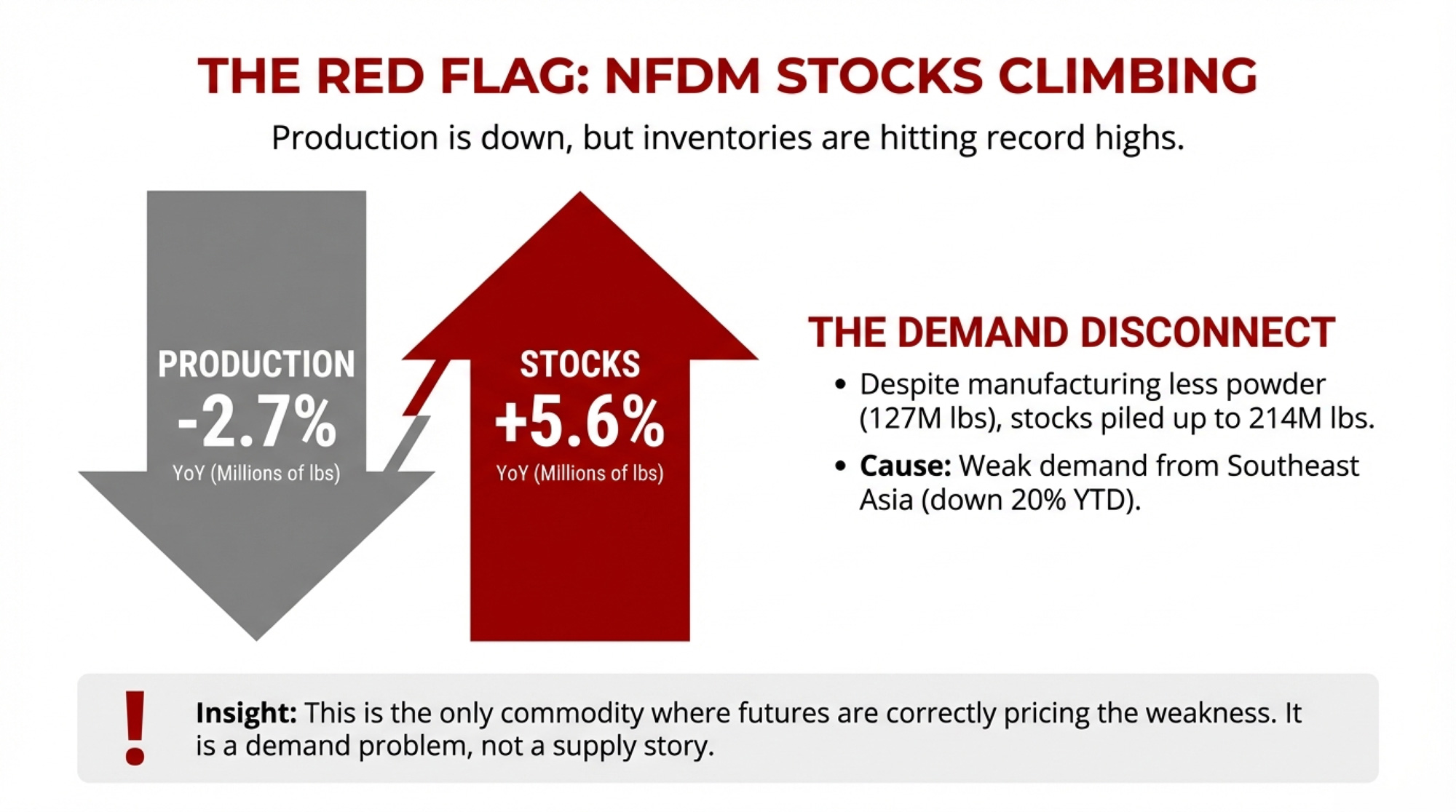
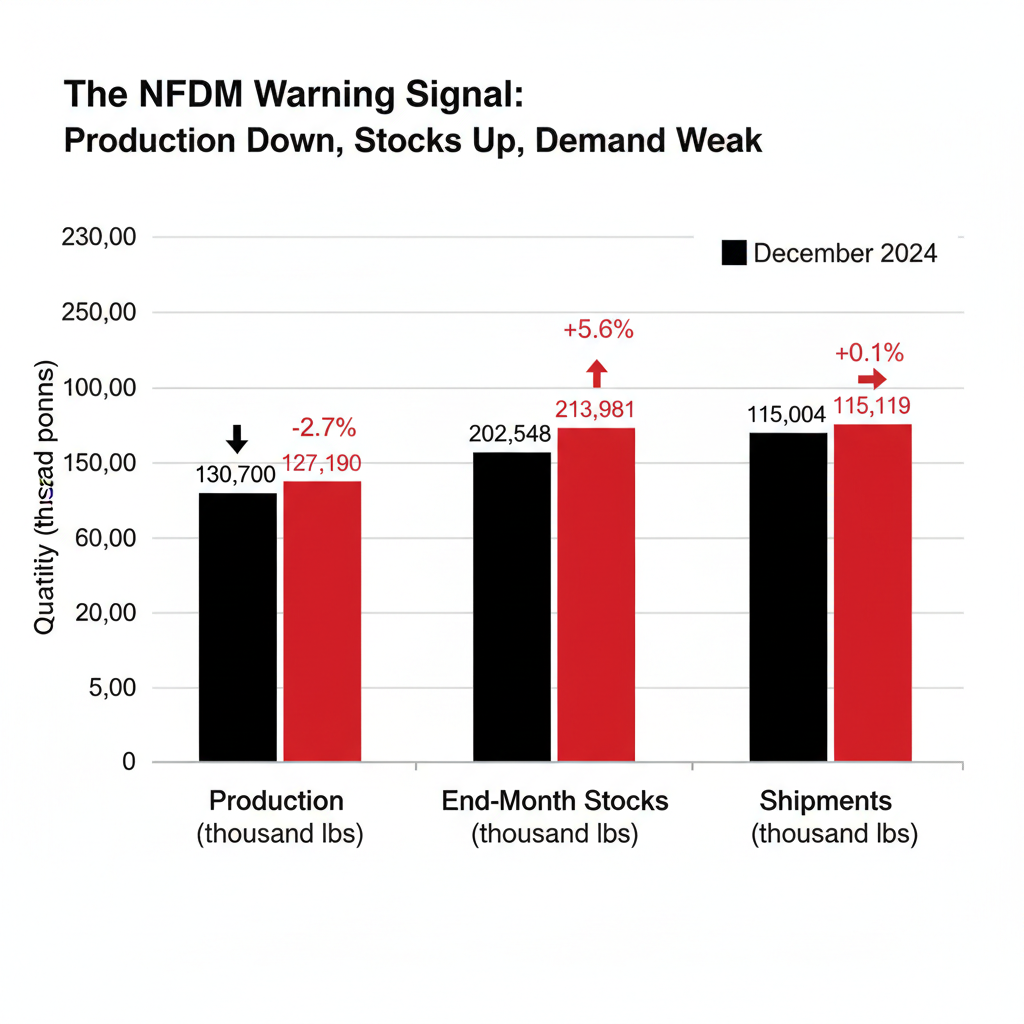
December NFDM production came in at 127,190 thousand pounds, down 2.7% year over year. Skim milk powder dropped even harder — down 15.2%. If you only saw the production side, you’d assume a tightening powder complex.

CategoryDec 2024Dec 2025Change
Production130,700127,190-2.7% ↓
End-Month Stocks202,548213,981+5.6% ↑
Shipments115,004115,119+0.1% →

End-of-month manufacturer stocks told a different story: 213,981 thousand pounds, up 5.6% from 202,548 a year ago. NFDM shipments were essentially flat at 115,119 thousand pounds (+0.1%). USDEC’s trade data through three quarters showed total export volume up only 1.7% through September, while powder shipments to Mexico and Southeast Asia posted year-over-year declines. USDEC directly noted that “a decline in exportable supplies of milk powder from the U.S., combined with tepid demand from SEA, has caused volumes into the region to fall.”

November did bring a rebound in Southeast Asian powder shipments — NFDM/SMP to the region jumped 23%, driven almost entirely by Indonesia — but year-to-date milk powder exports to Southeast Asia were still down 20% through November.

Falling production. Rising stocks. Flat-to-weak exports. That’s a demand problem, not a supply story.

The Quiet Whey Shift: Putting a Floor Under Class III

One number buried in this report deserves your attention. Whey protein isolate production jumped 11.7% year over year to 20,644 thousand pounds, while WPI stocks fell 5.4%. Consumer demand for high-protein products is pulling whey streams into higher-value WPI — human dry whey was up only 4.0% despite 6.7% more cheese generating more liquid whey.

Because dry whey feeds the Class III formula, that structural pull is quietly supporting one of the inputs that determines your Class III price. If you’re on Class III, your dry whey component isn’t eroding the way the powder side is. Small bright spot in a complicated picture.

438,000 Fewer Heifers vs. $10 Billion in Hungry Plants

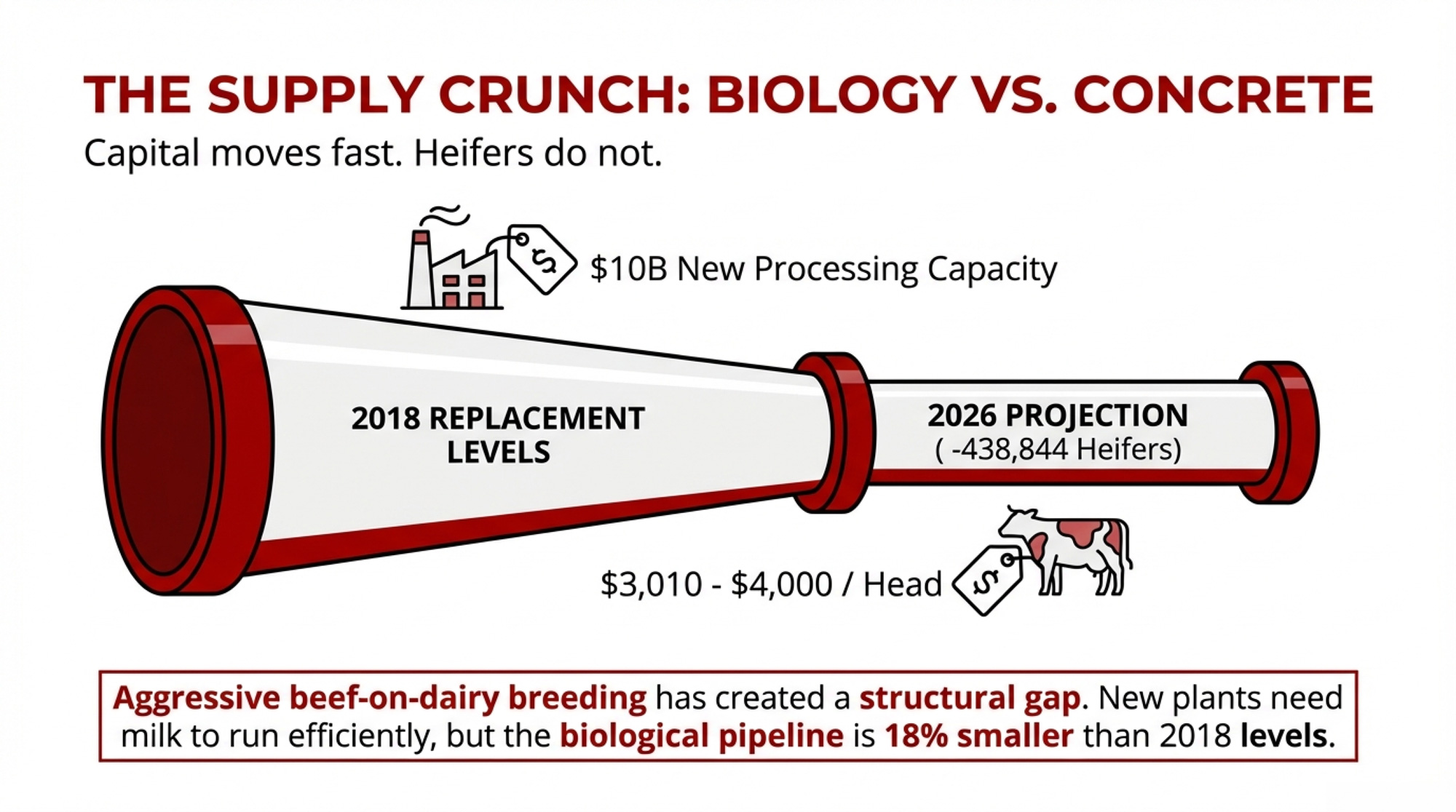
Every capacity story runs into the same wall. Biology doesn’t move at the speed of capital.

CoBank’s Corey Geiger projected in August 2025 that U.S. dairy heifer inventories would shrink by 438,844 head between 2025 and 2026, driven by beef-on-dairy breeding decisions that sent skyrocketing volumes of beef semen into dairy herds — 7.9 million units in 2024 alone, per NAAB data. Over two years, CoBank estimates the total decline could reach roughly 800,000 fewer replacement heifers, with a rebound starting in 2027. USDA’s January 2025 Cattle report showed 3.914 million dairy replacements — 18% fewer than in 2018.

YearHeifer Inventory (million)Cumulative Capacity Investment ($B)
20243.91$2.5
20253.69$5.8
20263.47$8.5
20273.58 (projected rebound starts)$10.0

December 2025 milk production still looked strong — up 4.6% in the 24 major states with 222,000 more cows and 42 more pounds per cow. But USDA’s January 2026 WASDE pegs 2026 production at 234.3 billion pounds, up roughly 1.4% from 2025, as a thinning replacement pipeline starts to constrain herd expansion.

Geiger didn’t sugarcoat it: “The short answer is that it will be tight. Those dairy plants will require more annual milk and component production, largely butterfat and protein. And it will take many more dairy heifer calves in future years to bring the national herd back to historic levels.”

Heifer prices already reflect the squeeze, from $1,720/head in April 2023 to roughly $3,010 by mid-2025 per the USDA’s July 2025 Agricultural Prices report. Top dairy heifers in California and Minnesota auction barns were bringing upwards of $4,000 per head by mid-year 2025, according to CoBank.

Why Flat Futures Don’t Mean the Fundamentals Are Wrong

If all this tension is real, why did cheese and butter futures trade flat on report day?

Near-term data wasn’t wildly off expectations. Cheese was already strong in November. Butter’s miss fit the ongoing “tight but not panicked” narrative. NFDM was the exception because rising stocks directly contradicted the bullish price story—a signal even a thin market could quickly process.

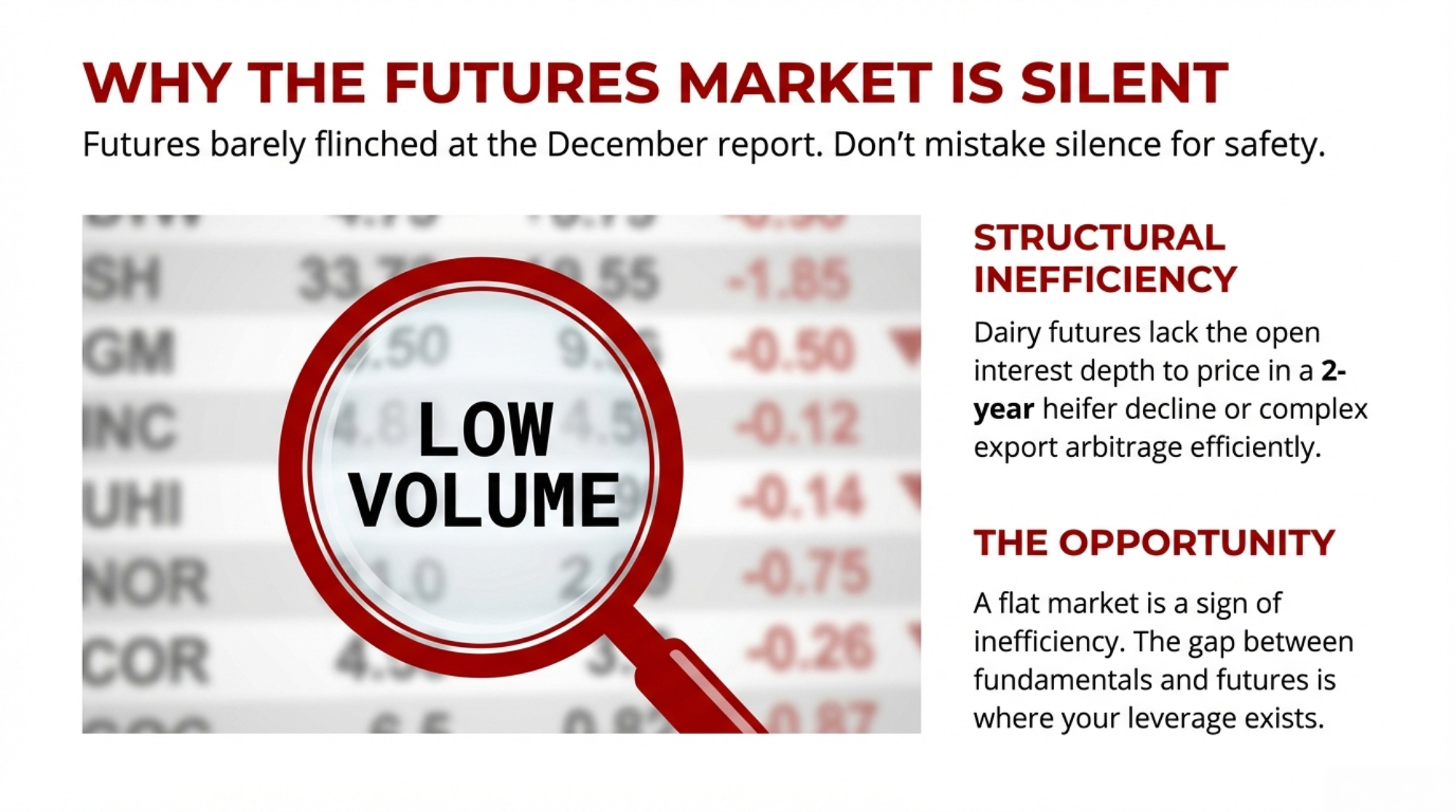
The deeper issue is structural. Dairy futures trade at a fraction of the open interest depth seen in cattle or hog contracts. That’s not a market that can efficiently price a two-year heifer decline or a multi-year butterfat export arbitrage. The flat response isn’t the market disagreeing with the fundamentals. It’s the market admitting it can’t fully express them.

And that gap between what futures say and what the fundamentals show? That’s where the opportunity sits for producers paying close attention.

What This Means for Your Operation

  • Your butterfat is underpriced relative to global value. As of February 5, 2026: GDT AMF at roughly $2.95/lb; CME butter at approximately $1.71/lb. Your Class IV price is anchored to CME plus a bigger make allowance. Component optimization still pays inside the system, but the extra export margin sits on the processor’s ledger. The spread to watch: if CME stays below $1.80 while GDT holds above $2.50, processors have no incentive to redirect cream to domestic channels, and your Class IV component value stays compressed. Pull your last three milk checks. Compare your butterfat premium per hundredweight to the CME butter price on those settlement dates. The gap between what you’re getting and what GDT says your fat is worth — that’s the number this article is about.
  • If you’re in a deficit region, your leverage is real — but it has a shelf life. Processors in short areas are paying to secure a supply right now. That urgency fades as cooperatives formalize long-haul logistics and spring flush arrives in April–May. The most important move in the next 60 days isn’t a hedge — it’s getting written terms on component premiums, hauling, and volume commitments while plants still feel short. Twelve-to eighteen-month agreements balance security with flexibility. The trade-off: if spot premiums spike higher than your locked rate during peak shortage, you’ll watch neighbors on handshake deals get paid more. But you’ll also sleep through the months when premiums collapse post-flush.
  • Watch NFDM stocks, not price. If manufacturer stocks hold above 210 million pounds through the March report while exports stay flat, that’s your signal to layer in Class IV put protection before spring flush. DRP Q2 2026 endorsements (April–June milk) are mostly written in the late-January to March window, outside of USDA report release days when sales are suspended. You want protection in place before April, not after.
  • Run the heifer math before you bid. At $3,500/head (midpoint of the $3,010–$4,000 range CoBank reported) and current carrying costs — Penn State Extension’s most recent data puts total rearing costs at roughly $1.60–$2.82 per head per day depending on operation type and region — a heifer needs to enter your string within about 24 months to break even against buying a fresh cow. But retaining heifers ties up capital and bunk space for 22+ months before they generate a dollar of milk revenue. Buying springers costs more per head but puts milk in the tank within weeks. Your cash flow position — not just the per-head price — should drive this call.
  • Check your Federal Order’s Class IV exposure. If you’re in Order 5 (Appalachian) running high Class I utilization, the differential increases from the June 2025 reforms may partially offset the make allowance pain — analysis found Orders 1, 5, 7, and 33 gained value under the new structure, while Order 30 (Upper Midwest) lost value. Run your margin-over-feed calculation against current component values to see where your breakeven actually sits under the new formulas.
Federal Milk Marketing OrderOrder #Value ImpactPrimary Driver
Northeast1Gained ValueHigher Class I differentials offset make allowance increases
Appalachian5Gained ValueHigh Class I utilization + differential increases
Southeast7Gained ValueClass I differential structure favorable
Upper Midwest30Lost ValueHeavy Class III/IV exposure + make allowance cuts hit hard
Mideast33Gained ValueClass I differential gains exceeded component losses

Key Takeaways

  • Cheese is running hot but roughly in balance thanks to record exports — November was the seventh straight month above 50,000 MT. The risk trigger: monthly exports below 45,000 MT for 2 consecutive months while new plants keep coming online.
  • Butterfat is where the value gap is widest. CME butter at ~$1.71/lb vs. GDT AMF at ~$2.95/lb as of February 5, 2026, represents a $1.24/lb spread that FMMO pricing doesn’t capture for producers. Co-op members: ask what share, if any, flows back through patronage.
  • NFDM sent the clearest warning in this report. Stocks up 5.6% while production fell 2.7%, and year-to-date powder exports to Southeast Asia were down 20% through November — that’s the pattern that precedes price weakness, not strength.
  • The heifer shortage is real and has come at a bad time. It won’t choke production in 2026, but by 2027 — when new plants need to run full — the math stops working without more replacements than the pipeline can deliver.
  • Check your DRP windows. Q2 2026 endorsements are mostly written in the late-January to March window. If NFDM stocks stay elevated and spring flush hits Class IV values, you want coverage locked before April.

The Bottom Line

The next two months aren’t about whether exports stay strong or heifers tick up another $200. They’re about whether you’ll have written terms — or still be on a handshake — when your plant decides who to lock in for the next cycle. And whether the terms you’re milking under today reflect even a fraction of what your components are actually worth on the global market.

Complete references and supporting documentation are available upon request by contacting the editorial team at editor@thebullvine.com.

Learn More

The Sunday Read Dairy Professionals Don’t Skip.

Every week, thousands of producers, breeders, and industry insiders open Bullvine Weekly for genetics insights, market shifts, and profit strategies they won’t find anywhere else. One email. Five minutes. Smarter decisions all week.
NewsSubscribe
First
Last
Consent

From Shutdown to Showdown: How Dairy’s 2026 Wake-Up Call Is Redefining Survival

What the End of Government Relief Really Meant—and How Smart Farms Are Turning Uncertainty Into Opportunity

EXECUTIVE SUMMARY: From Shutdown to Showdown: How Dairy’s 2026 Wake-Up Call Is Redefining Survival” details how the end of the government shutdown set the stage for a year of unprecedented challenge—and opportunity—in the dairy sector. Instead of relief marking the finish line, the reopening exposed new processor contract demands, profit headwinds from make allowance adjustments, and a high-stakes shift to protein-centric pricing, all verified through university extension findings and current market data. The article demonstrates how farms that capitalize on narrow timing windows, lean into peer networks, and embrace collaborative learning are gaining margin and flexibility amidst change. Practical checklists, region-specific examples, and expert-backed insights make it useful at the barn and the boardroom table alike. By weaving in both the pressures and pathways open to all sizes of operation, the story embodies The Bullvine’s commitment to presenting real decisions, not just headlines. In the end, it shows that survival—and success—are less about official relief and more about being prepared to adapt, connect, and strategize for what 2026 brings next.

Dairy Profit Strategy

You know, as much as we all soaked in the relief of those USDA payments and the delayed Milk Production reports this past fall, the lesson of the moment is clearer than ever: what matters most heading into 2026 is how quickly and thoughtfully we respond to the challenges—not just what help the government sends. What I’ve noticed—confirmed by producers in Wisconsin, Florida, and even out west—is that “relief” doesn’t make the difference for your bottom line. It’s how you move with the changing facts, the shifting contracts, and the farm realities in front of you.

Pull up a stool. Here’s how that’s actually playing out in barns, co-op meetings, and balance sheets, with credible trail markers for farms of all sizes.

Speed Kills (Complacency): Margins in the Data Gaps

What farmers are finding is that, in this climate, the winners are the ones ready to act. When the USDA’s October Milk Production report was missing for weeks, extension specialists and loan officers across the Midwest were fielding anxious calls. Herds that moved quickly—hedged milk at $17.35/cwt right after the report, or locked in feed at $4.10—wound up with $2,000-$2,500 more on every 500 cows compared to those who waited. CME and Wisconsin extension data both show how waiting for “certainty” can shrink margins before you even see the warning.

It’s not luck. It’s keeping your strategy loose, your phone handy, and your local data bookmarked. Fresh cow management, feed contracts, and market windows—they all demand being both alert and decisive, especially as 2026 approaches.

Make Allowance Leaks: When Efficiency Quietly Costs You

The Allowance Shift: June 2025 Make Allowance Increase Transfers ~$0.50/cwt from Producer Milk Checks to Processor Margins

Let’s lay out the dollars and cents. Thanks to FMMO make allowance changes last summer, about $82 million annually has shifted from producer checks into processor cost recovery, according to the American Farm Bureau and university research. That hits particularly hard for 400-600 cow herds in the Midwest, where $8,000-$15,000 in value quietly vaporized from family budgets in 2025 alone. While vertically integrated co-ops sometimes recoup some through patronage, for most, these quieter cost shifts are exactly what force new choices—do we hold, reinvest, cut inputs, or consider transitioning out?

The lesson? It’s time to double down on IOFC, watch every transition group closely, and look at every feed and labor line as a matter of survival, not just habit.

Premium Contracts: New Growth, New Hurdles

The Processor Divide: Expanded Capacity and Premium Contracts Favor Large Operations—Small Farms Face Component Quality Barriers Worth $4.40/cwt

Let’s get real about processor expansion. Yes, IDFA and DFO confirm $11 billion in new milk-processing capacity, but the “growth” headlines come with some fine print. Today’s direct contracts expect you to consistently deliver volume (often 1,000+ cows), protein over 3.2%, and sub-Grade A somatic cell counts.

Why the clampdown? Processors need stable, high-quality components to secure export and retail channels, invest in automation, and deliver on food safety for globally diverse buyers. UW reports and field officers say this shift is now woven into most new plant supplier specs.

It’s not all doom. Farms who began investing in butterfat genetics, precision feed systems, and herd data management years ago are fielding more calls, not fewer. Those focusing just on short-term barn expansion are finding that you can’t rush a protein curve or a culture of quality management. Extension and Minnesota case studies show that slow, steady moves—targeting milk components and recordkeeping upgrades first—put herds in the fast track for premium deals.

December’s 3.3% Rule: Protein as the Baseline

Speed Kills Complacency: How Quick Response to Market Data Translates to $1,400+ More Per 500 Cows

Here’s what’s interesting: this year’s biggest structural shift might be USDA’s new baseline for protein—up from 3.1% to 3.3% (USDA Final Rule). It’s been a long time coming, and peer-reviewed research had foreshadowed the change for several years. Genetics, feeding, and savvy fresh cow management have all nudged national averages upward. But it’s the local impacts—from blend checks to contract premiums—that hit home.

What does that mean practically? A 0.2% difference in protein, per 100 cows, adds up to $400-800 in annual check value, per the latest Midwest and Ontario extension data. Above 3.3%? You’re in the bonus column. Below? Now’s the time to pull out the ration notes and see where you can tweak, swap, or invest before the next round of pricing hits.

More importantly, more farms are opening up the books—digitizing records, crowdsourcing advice in peer groups, and trading input strategy tips without fear of “giving away secrets.” As more transition into 2026, collaborative learning is proving, in the field and in extension trials, to be a margin driver as real as any piece of steel.

Transition Planning: The Strongest Exit Isn’t Running—It’s Timing

One of the biggest takeaways this year is that transition can be a strength, not a sign of retreat. USDA NASS land reports peg the Midwest ground firmly above $25K/acre; extension planners increasingly help herds time “retirement” or partner transitions before the next storm hits. The real win? Leaving with financial options and the pride of calling the shot on your terms.

Herds still thinking big? UW and DFO studies show that the best results come when expansion is built on several years of component improvement and a fresh-cow strategy—not as a panic reaction to price. Dry lot and fresh group upgrades, pooled input efforts, and peer feedback show up again and again in success stories.

And for those holding steady, including herds in the 200-700 cow bracket, “optimization” is earning a new respect. Peer networks and beef-on-dairy strategies (with calves bringing $400-600, latest UMN data) are now front-line tools, and regular peer benchmarking is ensuring that the smartest changes don’t just sit on paper—they get put into practice.

Are You Fast Enough for 2026?

Pulling together farmer panels and co-op roundtables, it’s clear: being nimble, not just knowledgeable, is the new shield against margin loss. Extension economic analysis calls it “window management”—profits are made in these small, rapid openings, not in broad trends or after-the-fact decision meetings.

Facing Protein Gaps? Your Action Checklist

  • Bring three years of production and component records to a dairy-literate advisor. 
  • Model the value and cost of boosting protein (and the status quo if you don’t). 
  • Sit down with a local extension or farm business group—where are your best, region-specific levers hiding?
  • Use your peer network: tested approaches and hard-learned lessons are worth more than a new gadget.

So if there’s one sure thing heading into our “2026 wake-up call,” it’s that resources, relationships, and rapid response matter. Let’s keep those mugs full and the learning real—together, we’ll keep setting the pace for the next curve in dairy.

KEY TAKEAWAYS:

  • Farms that respond swiftly to new information—securing prices or input deals as data shifts—routinely outperform those waiting for a “clear signal.”
  • The new normal: Processor contracts and milk pricing now demand higher protein, stricter quality, and more documentation, making management upgrades and peer collaboration must-haves.
  • Smart transition planning—whether exiting, scaling, or realigning—can be a competitive edge, helping farm families lock in value rather than react to crises.
  • Operational resilience is increasingly about connecting with peer networks, bulk-buying alliances, and benchmarking tools—not just individual innovation.
  • For 2026, the most resilient farms will be those that adapt fastest to changing rules, seize learning opportunities, and stay proactive in their markets.

Complete references and supporting documentation are available upon request by contacting the editorial team at editor@thebullvine.com.

Learn More:

The Sunday Read Dairy Professionals Don’t Skip.

Every week, thousands of producers, breeders, and industry insiders open Bullvine Weekly for genetics insights, market shifts, and profit strategies they won’t find anywhere else. One email. Five minutes. Smarter decisions all week.
NewsSubscribe
First
Last
Consent
Send this to a friend