










A 200-cow dairy outside Uberlândia ran the numbers on swapping corn silage for sorghum. The gap: 360 liters a day — and that was before they opened the bunker.
Executive Summary: A 200‑cow dairy in Brazil’s Triângulo Mineiro nearly gave up 360 liters of milk per day by treating “cheap” sorghum silage as a 1:1 swap for corn. The article walks through current Brazilian and international research showing conventional forage sorghum typically runs at roughly 80–85% of corn silage’s energy and can drop milk by about 1.6–1.8 kg/cow/day if you don’t rebuild the ration. It breaks sorghum into grain, forage, sweet, biomass, and BMR types and shows where each actually fits — including why biomass sorghum’s high lignin makes it a tonnage tool, not feed for 40-liter cows. BMR sorghum can hang with corn on milk in well‑managed diets, but brings a 12–15% yield penalty and a higher seed bill, so it only pencils out as a premium forage, not “cheap corn.” The piece also lays out harvest and fermentation rules specific to sorghum — soft dough at ~28–30% DM, serious processing, and roughly 56 days in the bunker — so you’re not throwing starch out the back end. Finally, it offers four “sorghum lanes” (split‑group, BMR partial replacement, one‑TMR moderate inclusion, or walk‑away) and a 30‑day assignment: pull 12 months of records, calculate feed cost per liter, and see which lane your herd can actually manage on paper.
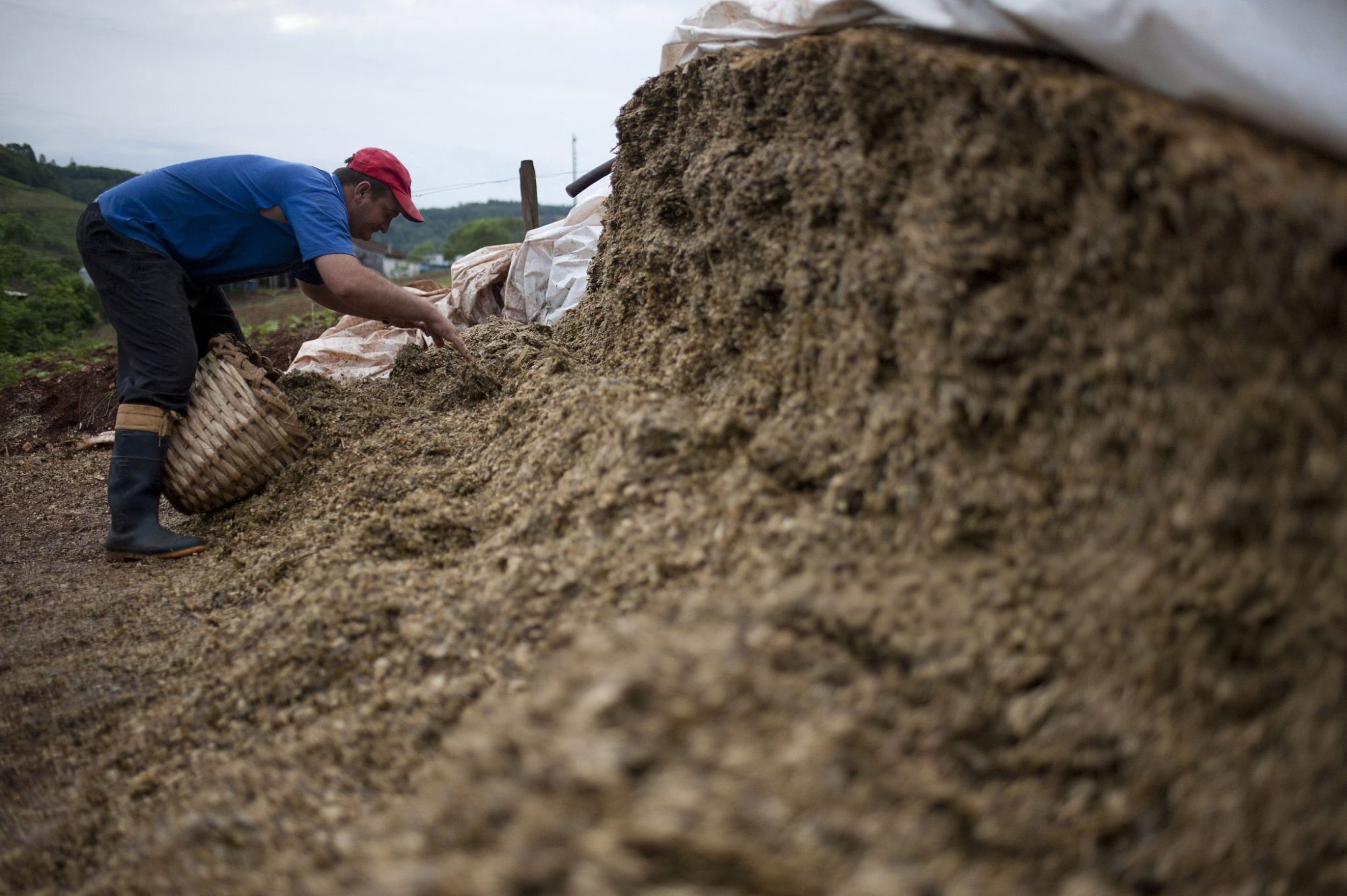
When a small dairy outside Uberlândia decided to lean harder on sorghum silage a couple of seasons ago, the move felt pretty logical. Sorghum would fill the bunkers when second‑crop corn missed rain, cut the seed bill, and keep corn reserved for the high group.
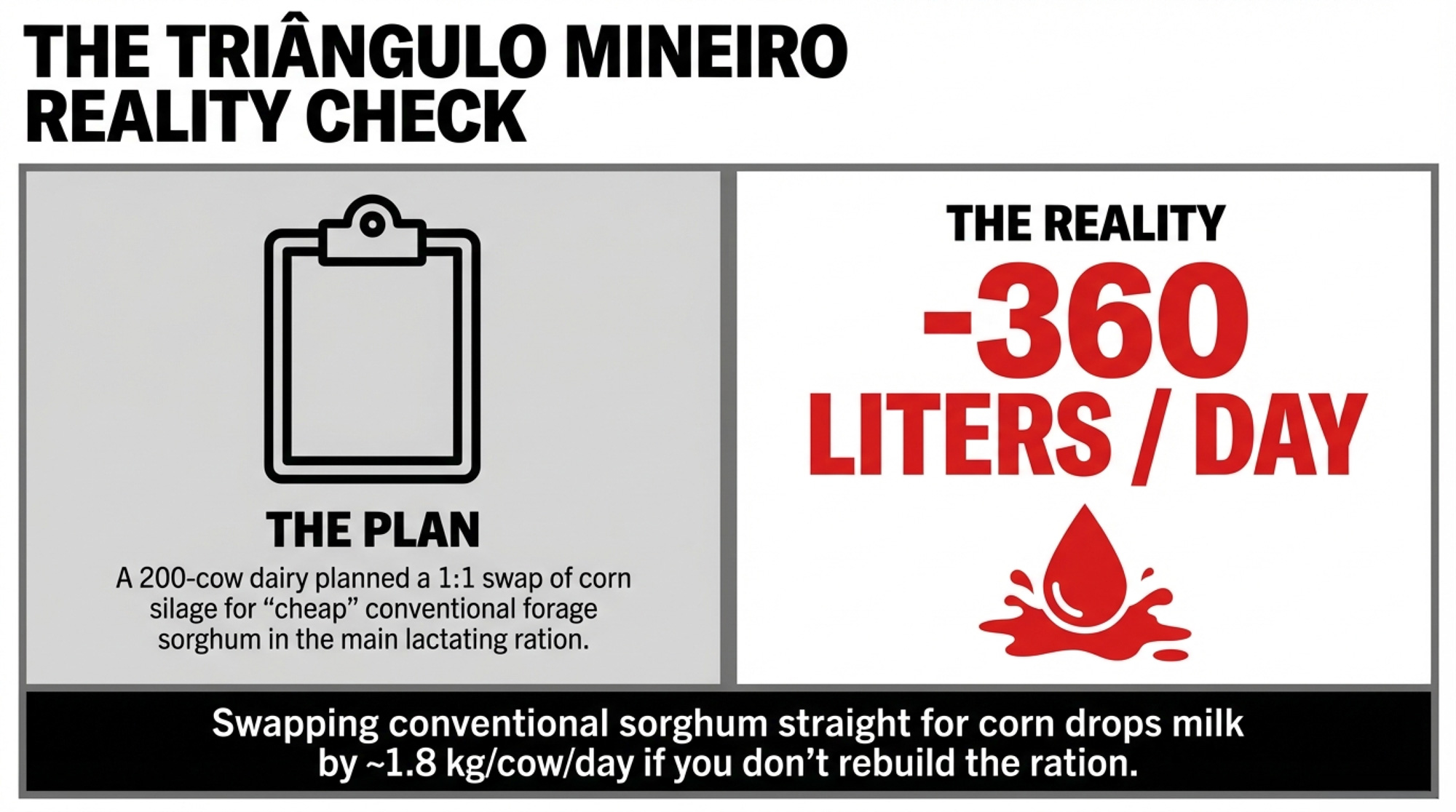
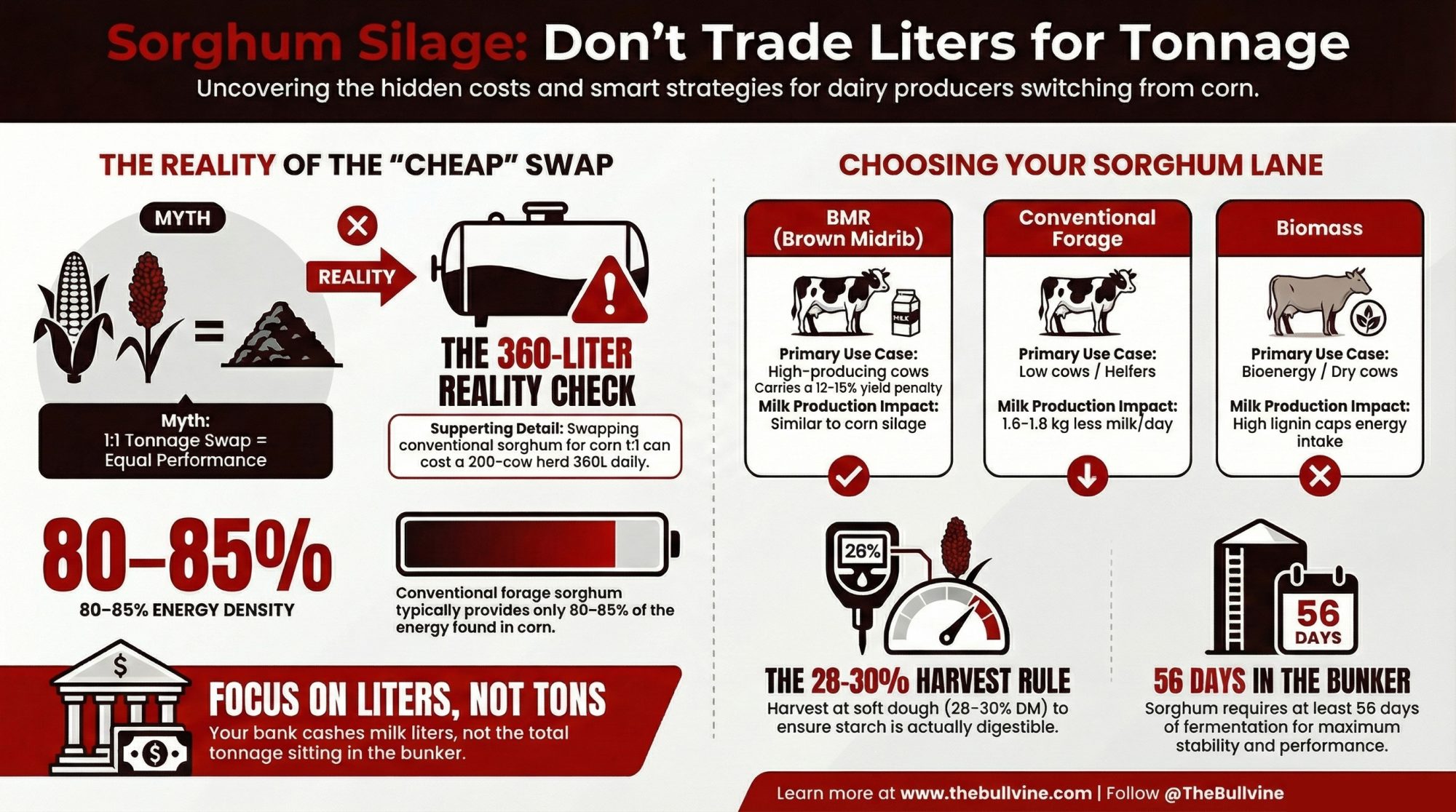
Then the family sat down with their nutritionist and ran the barn math. Swapping conventional forage sorghum straight in for corn, 1:1 in the main lactating ration, would cost them roughly 360 liters of milk every day on a 200‑cow herd — about 1.8 kg less milk per cow per day than a comparable corn‑silage diet. That 1.8‑kg gap lines up with a 2019 Journal of Dairy Science meta‑analysis that compared conventional sorghum, brown‑midrib (BMR) sorghum, and corn silages at the same dry matter intake.
They never made that full swap. But that number stuck. And it’s exactly why “cheap” sorghum silage is suddenly a hot, uncomfortable topic in a lot of Brazilian‑style climates.
What’s Really at Stake with Sorghum Silage in Brazil?
Brazil isn’t dabbling in sorghum anymore. According to recent CONAB‑aligned and USDA/FAS analyses, sorghum planted area climbed to around 1.5 million hectares in 2024/25, up about 6.5% from the previous season, with production projected near 5 million tons, roughly 12% more than 2023/24. Growth has been driven hard by the Cerrado and other water‑stressed regions where double‑crop corn is increasingly a weather gamble instead of a sure bet.
From the agronomy side, Embrapa’s national sorghum program and Brazilian economic studies all circle the same points. Sorghum:
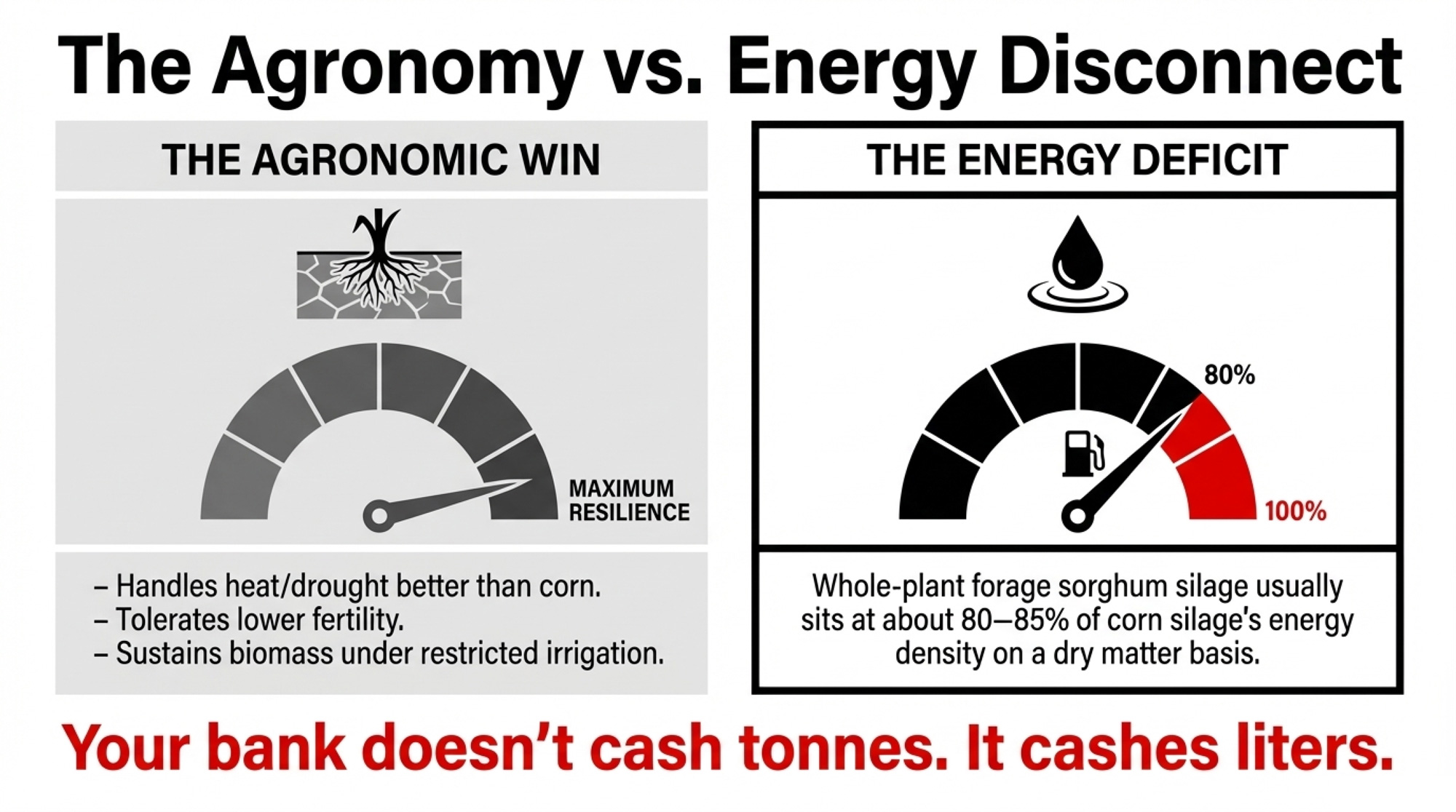
- Handles heat and drought better than corn.
- Tolerates lower fertility and marginal soils.
- Often needs less fertilizer and crop protection to stay viable.
Work under restricted irrigation shows sorghum maintaining biomass production where corn yields drop sharply, with some trials reporting sorghum sustaining comparable biomass while using considerably less water, depending on hybrid and soil.
But your bank doesn’t cash tonnes. It cashes liters.
Feeding trials and meta‑analyses give a consistent story when both crops are harvested and ensiled properly:
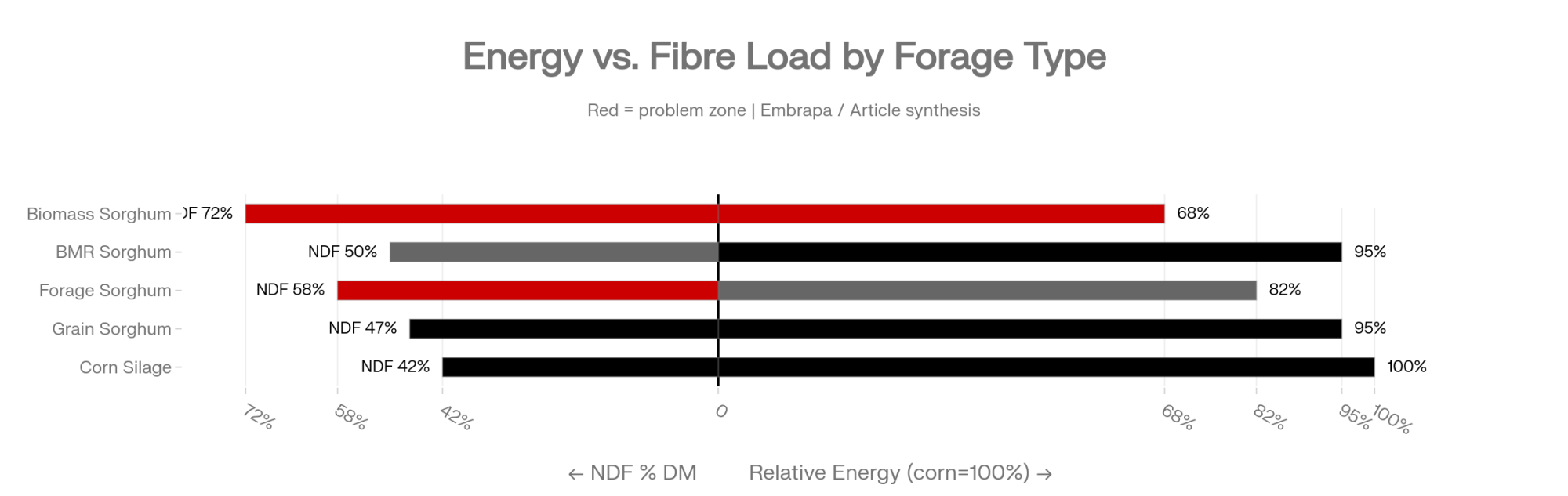
- Whole‑plant forage sorghum silage usually sits at about 80–85% of corn silage’s energy density on a dry matter basis.
- Across multiple experiments, cows on conventional sorghum silage diets produced roughly 1.6–1.8 kg less milk per day than cows on corn‑silage diets at similar dry matter intake.
Do that math on a 200‑cow herd, and you’re staring at something very close to 360 liters of milk per day if you treat conventional forage sorghum like a one‑for‑one corn replacement and don’t rebuild the ration.
The Triângulo family didn’t fully go there. They kept corn silage anchored in the high‑group ration and parked sorghum with low cows and heifers. That’s the only reason the 360-liter number stayed on paper and not in their milk sheets.
That’s the heart of the sorghum silage story right now. It’s not “good vs bad.” It’s whether you’re measuring it in tonnes per hectare or feed cost per liter of milk.
Are You Growing the Right Sorghum for the Right Cows?
One of the quickest ways to get burned is talking about “sorghum” like it’s one crop. Embrapa doesn’t even do that. Their breeding work splits sorghum into at least five main types:
- Grain sorghum — shorter plants, high grain proportion, lower whole‑plant yield, high energy density.
- Forage sorghum — taller plants, strong fresh‑matter yields, more fiber, less starch than grain sorghum or corn.
- Sweet sorghum — juicy, high‑sugar stems often used for juice or biofuels.
- Biomass sorghum — very tall bioenergy types bred for fiber and tonnage.
- Broom sorghum — niche type for panicles.
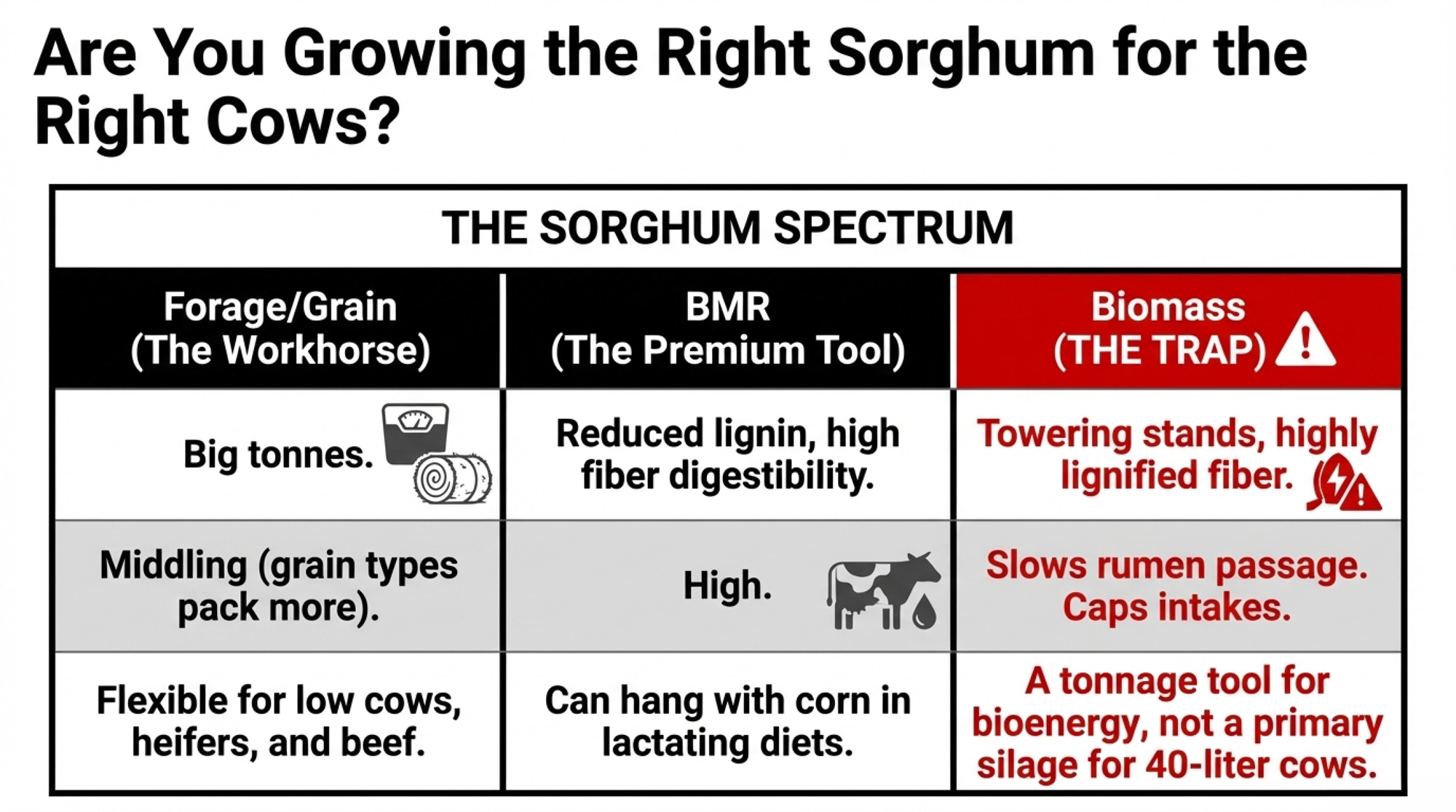
On Brazilian dairy farms, the ones that really show up in bunkers are forage sorghum and some dual‑purpose grain sorghum. Grain sorghum silage gives up tonnage but packs more energy per kilogram of dry matter thanks to the head. Forage sorghum is the workhorse compromise: big tonnes, middling energy, flexible enough for low cows, heifers, and beef.
Biomass sorghum is a different animal. Embrapa and recent genotype work under tropical conditions show that, compared with forage sorghum, biomass types tend to bring:
- Very high fresh‑matter yields from very tall plants.
- Very high NDF, low crude protein, and higher lignin.
That lignified fiber doesn’t just look impressive across the field. It sits in the rumen, slows passage, and caps how much energy a 40-liter cow can eat. High lignin drags down fiber digestibility; more of that massive biomass passes through the cow without doing much work.
From the road, biomass sorghum looks brilliant — towering stands, heavy wagons, deep bunkers. At the bunk, it can feel more like a trap when intakes slide, and you see stem fiber coming out the back end.
Brazilian researchers are straightforward about this. Right now, biomass sorghum is best treated as:
- A tonnage tool for low‑demand cattle or bioenergy, or
- A secondary forage that you use carefully in dairy rations when you’re ready to pay for extra grain.
The dairies that are genuinely happy with sorghum tend to do one simple thing: match the sorghum type to the job.
Can BMR Sorghum Really Get Close to Corn Silage?
The brown‑midrib (BMR) trait is where sorghum stops being just “cheap tonnage” and starts looking like a serious dairy forage.
BMR sorghum has a mutation that reduces lignin in the plant. Less lignin usually means more digestible fiber, which can support higher intakes and more milk. In 2019, Sanchez‑Duarte and colleagues published a meta‑analysis of nine experiments looking at cows fed:
- Conventional sorghum silage (CSS)
- Conventional corn silage (CCS)
- BMR sorghum silage (BMRSS)
They found:
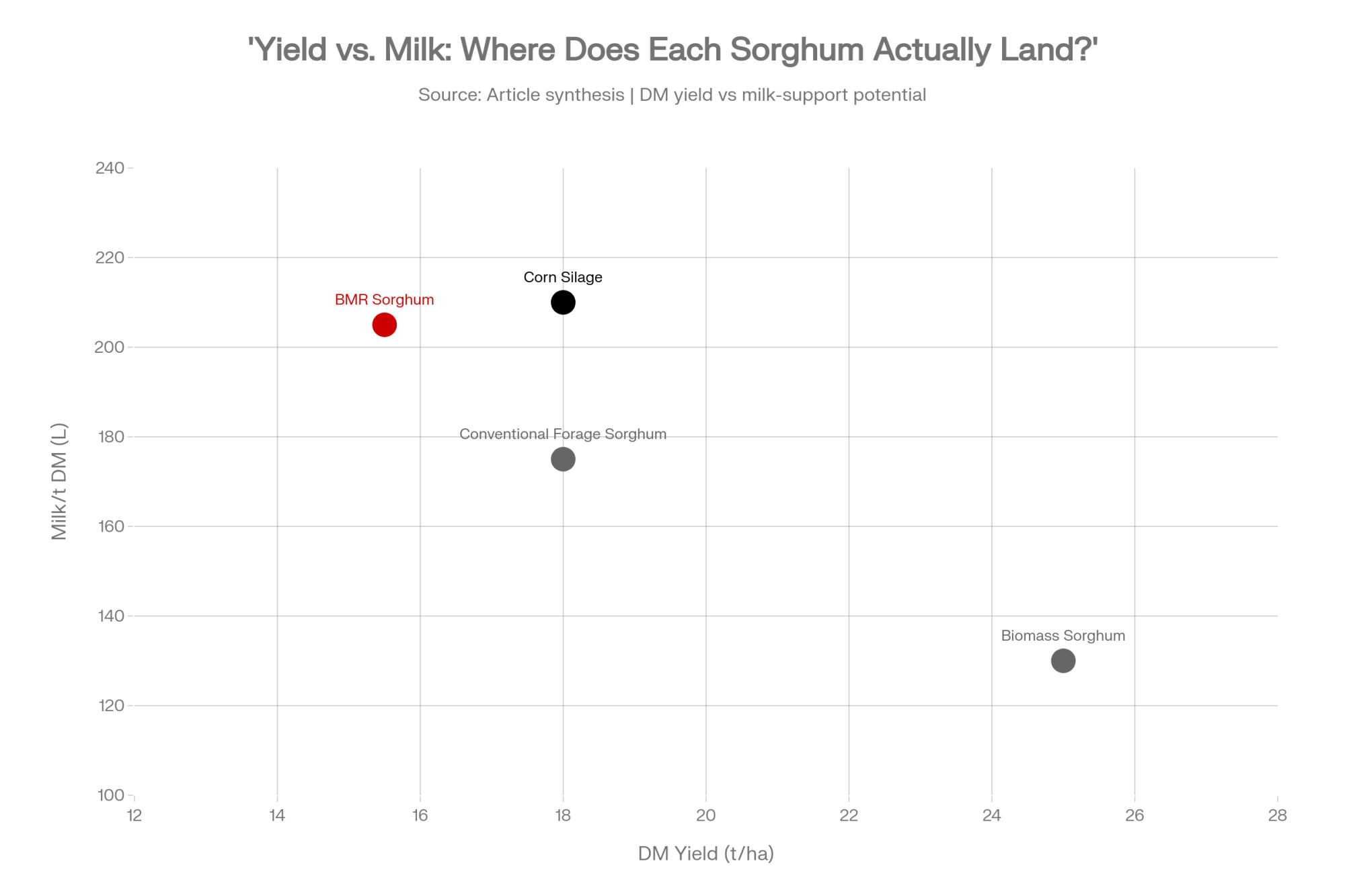
- Cows on BMR sorghum silage produced similar milk yield to cows on corn silage when diets were properly balanced for energy and nutrients.
- Compared with BMR diets, cows on conventional sorghum silage produced about 1.64 kg/day less milk and had 0.09 percentage points lower milk‑fat concentration, with lower fat yield.
- BMR sorghum diets tended to lift milk fat percentage slightly and drop protein percentage slightly compared with corn silage diets, but total milk and component yields were in the same neighborhood.
U.S. university work says roughly the same thing. Trials from the Upper Midwest and the South report that diets based on BMR forage sorghum silage can deliver similar DMI and milk yield to corn‑silage diets when maturity, kernel processing, and ration starch are managed well.
So yes, under the right management, BMR forage sorghum can get very close to corn silage on milk — and in plenty of trials, essentially match it. But there’s fine print that matters in Brazilian‑type systems:
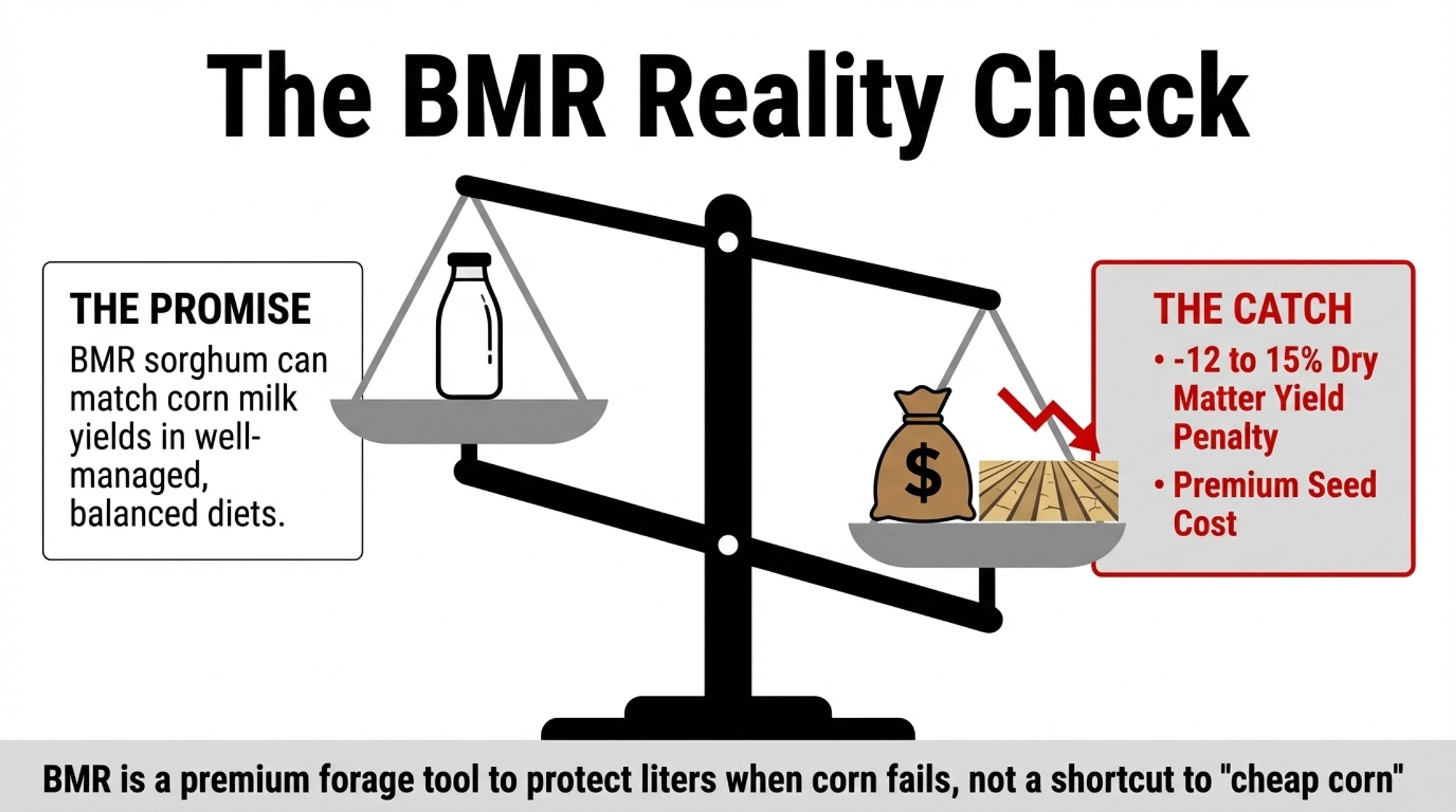
- A 2025 meta‑analysis on BMR sorghum reports about a 12–15% reduction in dry matter yield for BMR lines compared with non‑BMR sorghums across trials.
- BMR seed usually carries a premium price over conventional forage sorghum.
- Embrapa emphasizes that BMR breeding is active, but commercial hybrid availability and adaptation still vary by region and seed supplier.
Put that together, and your cost per tonne of BMR sorghum silage can land similar to or higher than corn silage, depending on yield and seed deals. For a high‑output herd dealing with drought or input costs, that can still be a smart trade if BMR sorghum helps protect liters when corn fails. But it only makes sense if you treat BMR as a premium forage tool, not a shortcut to “cheap corn.”
Are You Letting Corn Protocols Ruin Your Sorghum Silage?
The next failure point isn’t genetics. It’s harvest and fermentation.
With corn, pushing toward ⅔–¾ milkline usually buys more starch, and a decent kernel processor will bust open even hard kernels. Harvesting around 32–35% dry matter fits the crop and the bunker.
Sorghum doesn’t behave the same. If you chase more starch past soft dough into hard dough without serious processing horsepower, total starch might tick up on the lab sheet, but starch digestibility heads the wrong way. Sorghum berries are smaller and harder than corn kernels. If a processor doesn’t crack them, they come out the back end as expensive bird feed — exactly what a lot of people see in manure behind poorly harvested forage sorghum.
Brazilian and U.S. work on sorghum maturity and silage quality points to a different target.
- A Brazilian study on sorghum BRS‑610 found that ensiling between the milky/dough and dough stages gave very good fermentation and nutritive value.
- Forage sorghum trials in Texas and other hot regions show soft‑dough harvest balances yield with lower NDF and better energy.
- That typically lines up with whole‑plant dry matter in the high‑20s to around 30%, rather than pushing to 35% and beyond.
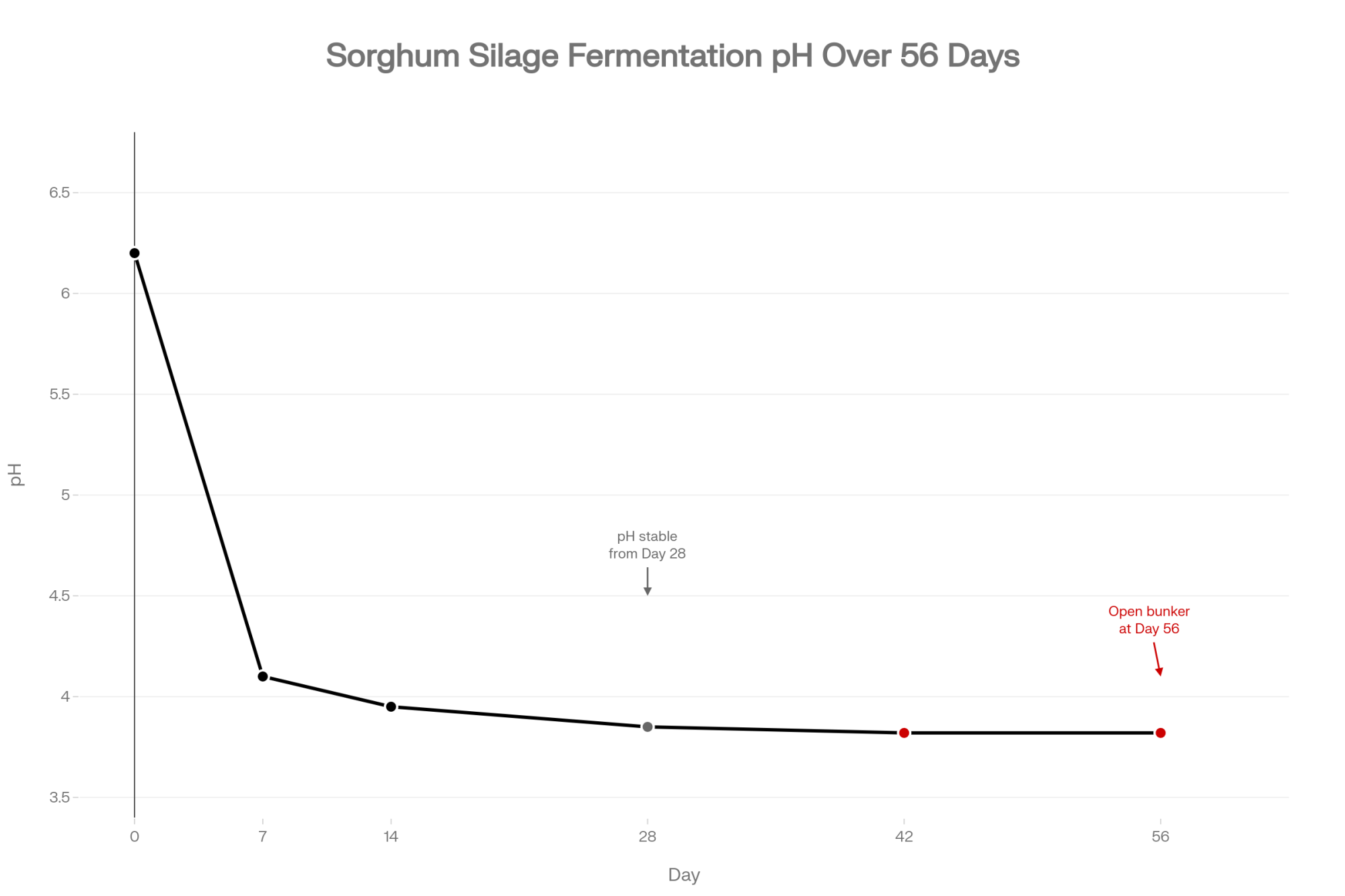
On fermentation time, a 2022 study following sorghum stalk silage from Day 0 to Day 56 found that pH reached its lowest point by Day 7 and fermentation parameters stayed stable from about Day 28 through Day 56, with good preservation and low dry matter losses. A 2021 study on whole‑plant sorghum silage reported improved aerobic stability and heterofermentative co‑fermentation at 56 days when inoculated with Lactobacillus plantarum and L. buchneri. A 2018 trial with sorghum silages showed that adding L. buchneri reduced yeast populations and increased aerobic stability, confirming the role of heterofermentative inoculants.
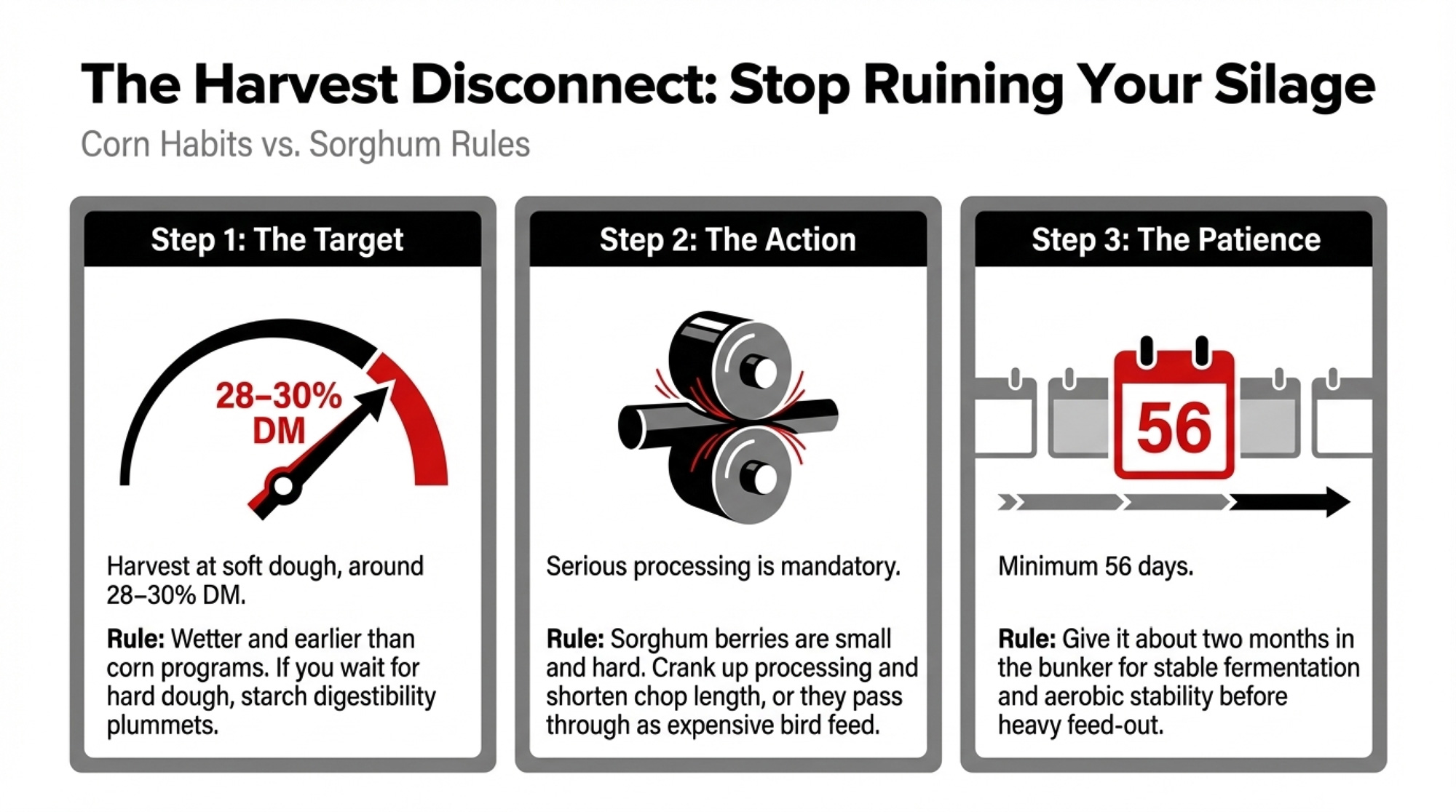
Taken together, they all point to the same practical window: aim to harvest at soft dough around 28–30% DM, then give sorghum silage about two months in the silo before you really lean on it.
If you’re already committed to sorghum, the protocol that protects your investment looks like this:
- Aim for soft dough at about 28–30% dry matter. Earlier and wetter than a lot of corn programs, but where berries are still crackable, and starch is usable.
- Crank up processing and shorten chop length. Tighten roll gaps and chop finer so more berries are actually opened. If you don’t have a processor, chop shorter to improve exposure and packing.
- Give it time in the bunker. Plan on at least 56 days of fermentation before heavy feed‑out; multiple studies around 56–60 days show stable sorghum silages with strong fermentation profiles and better aerobic stability when inoculated.
- Use the right inoculant on sweet or high‑sugar types. Research on whole‑plant sorghum and sweet sorghum silages shows that heterofermentative lactic acid bacteria, especially strains containing L. buchneri, increase acetic acid, suppress yeasts, and extend aerobic stability.
No harvest protocol will turn conventional forage sorghum into BMR or corn. But a sloppy harvest can easily give away another chunk of value between the field and the face.
Where Sorghum Actually Fits: Triângulo, Mato Grosso, the South, and Cariri
The Triângulo family that did the 360-liter math isn’t the only one treating sorghum as “insurance.” A 2024 characterization of corn silage from dairy farms in the Triângulo Mineiro region found that many herds were already leaving performance on the table because of silage quality issues and recommended more targeted technical assistance and better forage management. In that context, using sorghum to guarantee bunker volume and control per‑hectare costs while keeping corn silage concentrated in high‑producing groups is a pattern that lines up with how nutritionists describe their strategies in similar Brazilian climates.
In Mato Grosso and other parts of the Cerrado, sorghum has a natural lane in integrated crop‑livestock systems and as a second‑crop option behind soybeans. A 2022 longitudinal study of Brazilian food production shows cropping systems in the Midwest shifting toward more resilient, lower‑input species as heat and water stress trends intensify. Climate‑impact modeling on corn/soy double‑cropping indicates that future drought scenarios hit second‑crop corn yields especially hard in these regions. When late corn hits flowering and grain fill under high temperatures and erratic rain, its yield potential drops off fast — while sorghum’s physiology gives it more room to cope.
In parts of southern Brazil, agronomists like Dr. Arthur Behling Neto have seen a different picture. He notes that in the south of Brazil, sorghum “does not work properly,” while it performs much better in drier eastern regions like north of Minas Gerais and south of Bahia, where rainfall is more limiting. The lesson isn’t “never plant sorghum in the south.” It’s “don’t assume a Cerrado or Cariri playbook will work the same way in a completely different climate without local data.”
In Cariri, Paraíba, sorghum isn’t a nice‑to‑have option; it’s the backbone. A 2014 survey of 100 dairy farms in Caturité and Boqueirão found 88% cultivated sorghum as silage forage for feeding dairy cows, making sorghum forage the most commonly used silage type there. Under that kind of rainfall pattern and soil, “just grow more corn” isn’t realistic. Those producers still have to respect sorghum’s fiber and energy limits like anyone else — they don’t have many second chances if they bet wrong.
Across those regions, the common thread is simple. Sorghum works when it reduces drought and input risk without wrecking your feed cost per liter of milk. It fails when you buy it in tonnes and feed it like corn.
Which Sorghum Lane Are You Actually In?
Listen to enough producers and nutritionists talk through their forage programs, and four clear “sorghum lanes” show up. It’s worth being honest with yourself about which one your farm actually lives in — not which one you recite when the seed rep pulls in.
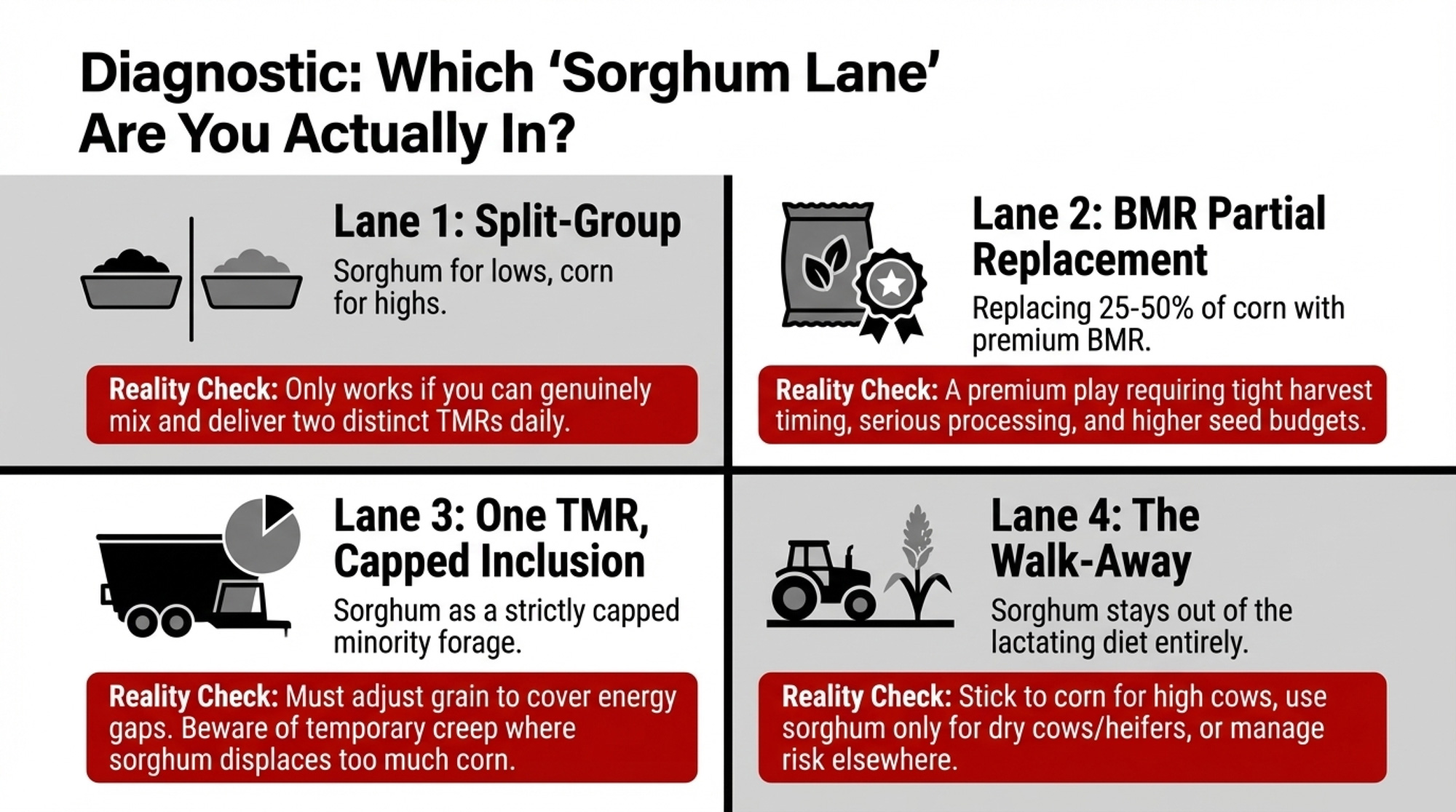
Lane 1: Split‑Group — Sorghum for Lows, Corn for Highs
This is the lane many Triângulo‑type dairies aim for.
- Corn silage stays anchored in the high‑group ration.
- Conventional forage sorghum feeds low producers, late‑lactation cows, heifers, and dry cows.
It only really works if:
- You truly feed two distinct TMRs every day.
- Your pen layout actually keeps high and low cows separate.
- Your nutritionist actively rebuilds both rations when silage inventories shift.
On an 80–120‑cow herd with two pens and disciplined feeding, that’s achievable. On a “one TMR and hope the lows eat less” operation, it’s fiction. If you can’t reliably run two rations, you’re not in this lane — even if your whiteboard says so.
Lane 2: BMR Sorghum as Partial Corn Replacement
Here, you’re using BMR forage sorghum to replace maybe 25–50% of corn silage in the high‑group ration.
The 2019 meta‑analysis and newer BMR work say this can hold milk production at corn‑silage levels when diets are handled properly. But BMR sorghum:
- Brings roughly a 12–15% yield penalty in dry matter vs conventional sorghum lines across trials.
- Costs more in seed.
- Needs tight harvest timing and serious processing to cash in on its fiber digestibility.
This lane fits if you’re fighting drought and forage cost:
- You can consistently source BMR hybrids adapted to your region.
- You have processing capacity for small, hard berries.
- You’re ready to manage cutting dates and fermentation like a hawk.
It’s a premium play. Treat it like one.
Lane 3: One TMR, Some Sorghum, No Drama
Plenty of mid‑size herds land here, whether they admit it or not.
They run one main lactating TMR and use sorghum as a minority forage, with corn or other high‑energy options still anchoring the ration. They cap sorghum inclusion rates and tweak concentrates as inventory changes.
This lane works if:
- You’re honest that you’re a one‑TMR outfit because of labor or barn design.
- You set a realistic max sorghum percentage in the lactating ration and stick to it.
- You and your nutritionist actually adjust grain and other forages when sorghum replaces corn in the pile.
The main risk is “temporary” creep: sorghum quietly displaces more corn than planned “just for this month,” and the ration never gets rebuilt. Your bulk tank tells the story later.
Lane 4: Walk‑Away — Sorghum Stays Out of the High Group
The last lane is the walk‑away: sorghum doesn’t go near high‑cow diets.
That’s a perfectly valid decision when:
- You’re in a region where corn silage consistently performs and drought risk is manageable.
- Your current silage program already hits your feed cost per liter targets.
- You’re not under pressure to plant sorghum just because it’s on the flyer.
Even in this lane, sorghum might still earn a spot with dry cows, heifers, or beef animals. But you’re clear that, in your climate and infrastructure, corn is the better dairy forage bet — and you’ll manage weather and cost risk with other tools.
In the next 30 days, the most useful move you can make is simple:
- Pull the last 12 months of milk and feed records.
- With your nutritionist or advisor, calculate feed cost per liter of milk for your current setup.
- Then ask one direct question:
“If we brought sorghum into this system — in a lane that actually fits our pens and labor — what would feed cost per liter look like with the ration you’d really build?”
If nobody can answer that clearly on paper, you’re not ready to plant sorghum for your dairy cows yet.
| Lane | Who It Actually Fits | Core Requirement | ⚠️ Red Flag | Feed Cost/Litre Risk |
|---|---|---|---|---|
| Lane 1: Split-Group | 80–120-cow herds with 2 real pens and daily TMR discipline | True two-ration feeding every day | If you run “one TMR and hope lows eat less” — you’re not in this lane | Low, if executed; HIGH if pen separation fails |
| Lane 2: BMR Partial Replacement | High-output herds fighting drought or input costs; strong processing equipment | BMR-adapted hybrid available locally; tight harvest timing and fermentation | 12–15% DM yield penalty + premium seed = cost/tonne often equals corn | Neutral to low — only if BMR protects litres corn cannot |
| Lane 3: One-TMR Moderate Inclusion | Mid-size herds with labor or barn constraints; honest single-ration operations | Hard cap on sorghum % in ration; active ration rebuilding as inventory changes | “Temporary” creep — sorghum quietly displaces more corn than planned, ration never rebuilt | Medium-HIGH if inclusion drifts; Low if cap is respected |
| Lane 4: Walk-Away | Regions where corn silage consistently performs; current feed cost/litre already on target | Nothing — sorghum stays out of the high group entirely | Planting sorghum because it’s “on the flyer” — not because the numbers say so | Lowest risk — manage weather/cost with other tools |
What This Means for Your Operation
- Judge sorghum on feed cost per liter, not R$/tonne. Before you chase “cheap” tonnage, work with your nutritionist to run at least one real ration scenario in which sorghum replaces part of your corn silage, and see what happens to liters and feed cost per liter on paper.
- Be brutally honest about how many TMRs you can actually run. If barn layout and labor effectively give you a single lactating ration, forget complex split‑group sorghum strategies. You’re either in the moderate‑sorghum single‑TMR lane or the walk‑away lane.
- Know exactly which sorghum you’re planting. Before you buy seed, confirm whether the hybrid is grain, forage, sweet, biomass, or BMR. For high‑producing cows, forage and BMR sorghums are your main options; biomass types are usually tonnage tools for low‑demand cattle or bioenergy, not a primary silage for 40-liter cows.
- Match harvest and fermentation to sorghum, not corn habits. If your crew is going to wait until hard dough, as we do with corn, and your processor isn’t dialed in, you should expect more undigested berries and lower starch digestibility. Target soft dough around 28–30% dry matter, and plan on about two months of fermentationbefore you feed sorghum heavily.
- Treat BMR sorghum as a premium tool, not a shortcut. BMR forage sorghum can come very close to corn silage on milk in well‑managed diets, but the 12–15% yield penalty and higher seed cost mean your cost per tonne often climbs. It makes sense when it protects litres you can’t afford to lose, not when it’s sold as “cheap corn.”
- Use this month for barn math, not brochure math. In the next 30 days, actually sit down with your numbers and run at least one sorghum scenario in each lane that could realistically fit your herd. If the answer on feed cost per litre or expected milk change feels fuzzy, you’ve got more homework before you drop a sorghum planter in the ground.
Key Takeaways
If you don’t know your current feed cost per litre, adding sorghum to your system is a blind bet — that’s the first report you should pull before you plant a hectare.
If your barn and labor setup only support one main lactating TMR, either cap sorghum inclusion in that ration at a level your nutritionist is comfortable putting on paper, or keep sorghum out of the high group entirely and use it for lows, dry cows, and beef animals.
If the hybrid on the quote sheet is a biomass sorghum, assume it’s a tonnage‑first forage for low‑demand animals, not a primary silage for your top group, unless you’re willing to buy a lot more grain to cover its fiber load.
If you have access to BMR forage sorghum hybrids adapted to your region, treat them as a premium: they can get very close to corn-on-the-ear in milk under the right management, but they won’t be cheap, and they won’t rescue a ration that’s already short on energy.
Next time someone offers you a screaming deal on sorghum seed, don’t just ask, “How many tonnes can I get?” Ask: “Where, exactly, in my herd can this forage live without costing me liters?” If you can’t answer that on one sheet of paper, it might not be such a bargain.
Learn More
- Ishler vs. Ferreira: The Feed‑Cost Trap Hiding $547,500 in Your IOFC – This analysis arms you with the exact “trip wires” needed to protect your margin this year. It breaks down how small feed-cost jumps can vanish $547,500 in annual income if you don’t pivot immediately.
- More Milk, Fewer Farms, $250K at Risk: The 2026 Numbers Every Dairy Needs to Run – This report exposesthe $250,000 margin gap facing mid-size herds and delivers four strategic paths to preserve equity. It prepares you for the “more milk, fewer farms” structural shift through 2026.
- The Hidden Carbon Challenge: Why Soil Management Could Make or Break Your Dairy’s Path to Net Zero – This deep dive reveals why intensive silage is a “hidden withdrawal” from your soil’s bank account. It breaks down how winter annuals and perennials create the long-term resilience corn silage alone cannot offer.


 The Sunday Read Dairy Professionals Don’t Skip.
 Join the Revolution!



