This $3.5 billion desert dairy will displace $400 million in global exports. The producers who survive will master the same feed efficiency and heat tolerance traits.
EXECUTIVE SUMMARY: Algeria’s national dairy initiative isn’t just about one big project—it’s about challenging everything we thought we knew about efficient milk production. They’re spending $800 million a year importing powder because they’re producing 2.5 billion liters but consuming 4.5 billion liters. Algeria’s targeting feed conversion ratios of 1.3-1.4 kg of milk per kg of dry matter in desert conditions—that’s competitive with temperate operations. Water use is high at 3-4 gallons per gallon of milk, but they’re managing it with smart tech. The real kicker? When this 270,000-cow operation hits full stride, it’ll cut global powder exports by $400 million annually. For us, this means that feed efficiency and genomic selection are no longer nice-to-haves—they’re survival tools. Start optimizing now or get left behind.
KEY TAKEAWAYS:
Boost milk production 15-20% through precision feed management → Start tracking your feed conversion ratios weekly and adjust TMR formulations based on real data. With feed costs volatile in 2025, every 0.1% improvement in efficiency adds $0.08-$ 0.12 per cow per day.
Cut heat stress losses by up to 25% with proactive cooling systems → Install shade structures and misting fans before summer peaks hit. Research shows dairy operations lose 15-20% of milk yield during heat stress events—preventable losses that directly impact your bottom line.
Leverage genomic testing for 8-12% yield improvements within 18 months → Begin incorporating genomic evaluations into breeding decisions this season. Focus on feed efficiency and heat tolerance traits—the same characteristics making Algeria’s desert dairy viable.
Optimize water efficiency to reduce operational costs 10-15% → Implement water recycling systems and monitor usage per liter of milk produced. Desert operations demonstrate that you can maintain production with effective water management—essential as water costs continue to rise globally.
Prepare for shifting global markets by strengthening local efficiency. Algeria’s project is expected to displace major powder exporters by 2027. Farms with superior feed conversion and genomic programs will capture market share as traditional suppliers scramble to compete.
Algeria’s national dairy initiative is more than just a massive construction project—it’s a comprehensive strategic move that’s already making waves in dairy circles everywhere.
Algeria has partnered with Qatar’s Baladna, agreeing to invest $3.5 billion into what might just be the most ambitious dairy setup on the planet. And honestly, if you’re in this business, this is big news.
Comparison of key financial figures related to Algeria’s dairy sector investment and operations
Algeria is shelling out a whopping $800 million a year on milk powder imports. Their domestic production clocks at around 2.5 billion liters, but people are guzzling about 4.5 billion liters annually. That’s a serious hole they’re trying to plug.
Current milk production sources in Algeria before the giant dairy project
That subsidy angle is crucial, and frankly, it’s what makes this whole thing possible. The government’s annual dumping of approximately DZD 105 billion—roughly $780 million—across the dairy chain. But here’s the million-dollar question: can they sustain that level of support when global commodity prices get volatile?
Desert Dairy on a Scale That’ll Blow Your Mind
Picture this: a dairy setup sprawling over land twice the size of New York City in Algeria’s arid Adrar province, housing 270,000 cows to churn out 1.7 billion liters yearly.
That’s huge, even by global standards. German engineering giant GEA—which knows its stuff when it comes to mega dairy projects—landed the contract valued between €140 and €170 million. Construction is expected to kick off in early 2026, with production reaching full stride by late 2027.
Notably, the project is expected to create 5,000 local jobs—that’s serious economic development for a region that desperately needs it.
The Desert Reality Check: Can They Really Make Milk in the Sahara?
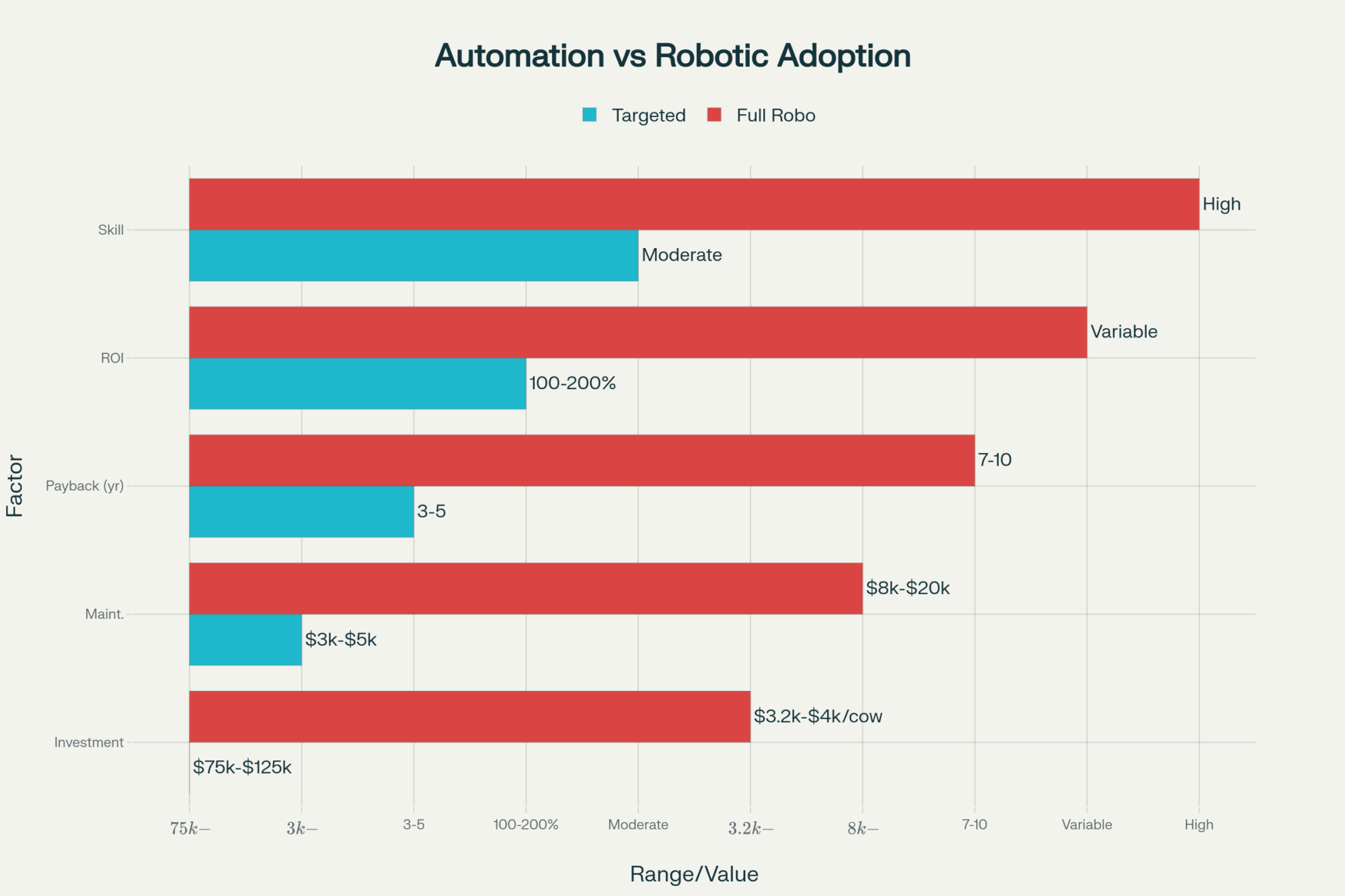
Let’s talk feed first, because that’s where the rubber meets the road. Based on recent regional data, they’re looking at approximately $280 per metric ton for their ration mix, which includes maize, alfalfa, and TMR components. Not cheap, but pretty standard for what you’d expect in North Africa.
Regarding feed efficiency, the feed conversion ratio they’re targeting is around 1.3-1.4 kg of milk per kg of dry matter intake. Those are actually respectable numbers, especially when you consider the environmental challenges faced in the desert heat.
Water’s a whole different story. Current estimates put water usage at around 3-4 gallons per gallon of milk produced—and that’s a big deal in an arid place. However, that number fluctuates significantly depending on your cooling technology and recycling systems. Experts like Dr. Michael Hutjens have been vocal about the critical importance of water efficiency in these harsh environments—mismanage it, and you’re burning cash faster than you can say “dry lot.”
Only about 20-25% of Algeria’s current milk moves through official channels. The rest flows through informal markets, which honestly makes modernizing the whole supply chain a real headache.
Heat stress? It’s no joke out there. I’ve seen operations in Arizona and Saudi Arabia where butterfat numbers drop 15-20% during peak summer without proper cooling infrastructure. That’s why the projected 7-9 year payback period hinges so heavily on getting the technology implementation right.
What This Means for Your Bottom Line
Zooming out, the big picture is massive: Algeria aims to slash milk powder imports by half once this plant’s fully operational. That spells serious disruption for traditional exporters in the EU, US, New Zealand, and Argentina—we’re talking about displacing roughly $400 million worth of powder imports annually.
And about the commodity powder market? That’s going to get a lot more competitive—no doubt about it. If you’re an exporter who’s been counting on that Algerian business, it’s time to start thinking about plan B.
The timeline matters too. Construction is scheduled to start next year, but full production is expected to begin in late 2027. That gives traditional suppliers approximately 18 months to pivot before the real impact is felt.
The Bigger Picture
The project’s most significant implication is that it shatters conventional thinking about where large-scale dairy operations can be effective. Traditionally, you’d never look at the Sahara and think “perfect spot for a dairy farm.” But with the right technology, water management, and government backing?
This isn’t just about Algeria. Other resource-rich nations are watching this closely. If it works, expect to see similar projects emerging in the Middle East, Central Asia, and possibly even parts of sub-Saharan Africa, where governments are committed to achieving food security.
For those of us managing operations or advising producers, the lesson is clear: the game is changing faster than most people realize. Desert dairy used to be an oxymoron. Now it might be the future.
The real question for your operation isn’t whether these new production models will impact you—it’s when, and how you’ll adapt to a world where traditional geographic constraints no longer limit milk production.
Key survival traits for dairy herds in challenging environments
Algeria’s desert dairy gamble represents more than agricultural development—it’s a calculated bet on food sovereignty that will reshape global dairy trade. The producers who master extreme efficiency and heat tolerance now will be the ones still standing when the dust settles.
Complete references and supporting documentation are available upon request by contacting the editorial team at editor@thebullvine.com.
Learn More:
Dairy Cow Heat Stress: The Four Key Areas You Need To Address Now – This tactical guide provides actionable strategies for mitigating heat stress, focusing on the four critical areas of cow comfort and facility management. It reveals practical methods to prevent the 15-20% production losses mentioned in the main article.
The Global Dairy Market: A Tale of Two Halves – This strategic analysis breaks down the complex forces shaping today’s volatile global markets. It provides essential context for the trade disruptions discussed in the main article, helping you anticipate shifts and position your operation for long-term profitability.
Genomic Testing: Are You Leaving Money on the Table? – This article makes the definitive business case for genomic testing, a key takeaway from the Algeria analysis. It demonstrates how to leverage genetic data to accelerate progress on traits like feed efficiency and heat tolerance, directly boosting farm profitability.
The Sunday Read Dairy Professionals Don’t Skip.
Every week, thousands of producers, breeders, and industry insiders open Bullvine Weekly for genetics insights, market shifts, and profit strategies they won’t find anywhere else. One email. Five minutes. Smarter decisions all week.
83% of family dairies won’t survive to generation three. But farms boosting feed efficiency 15% through genomic testing are beating the odds.
You know that sinking feeling you get when you’re walking through a parlor that’s been sitting empty for months? The smell of old silage still lingering, phantom sounds of the vacuum pump… but knowing those stalls will never see fresh cows again?
I’ve been getting that feeling way too often lately. And not just about individual barns—I’m talking about our entire industry structure.
So there I was last month, finishing up evening chores with Tom on his third-generation operation in central Wisconsin. Solid 450-cow setup, decent butterfat numbers, the kind of place you’d expect to be milking cows forever. Then he drops this bombshell: “I might be the last one to milk on this land.”
The weight in that statement… it’s haunting more families than we’re willing to admit at those industry meetings.
Here’s what’s keeping me awake at night: the operations we’re losing aren’t the basket cases everyone expects. These are farms with respectable production records, decent equity positions, and respected names in their communities. They’re just… dissolving. Because they thought succession planning was something they’d handle “when the time comes.”
Spoiler alert: by then, it’s already too late.
Part 1: The Crisis
The Brutal Math Nobody Wants to Face
Let me hit you with some numbers that honestly made me double-check my calculator when I first saw them. According to recent work from Iowa State University, 83.5% of family dairies don’t make it to the third generation¹. Think about that for a second—we’re talking about failure rates that make the restaurant business look stable.
But here’s the kicker that really caught my attention: 71% of dairy farmers approaching retirement haven’t even identified a successor¹. And those who actually have succession plans? Only 20% believe they’ll work¹.
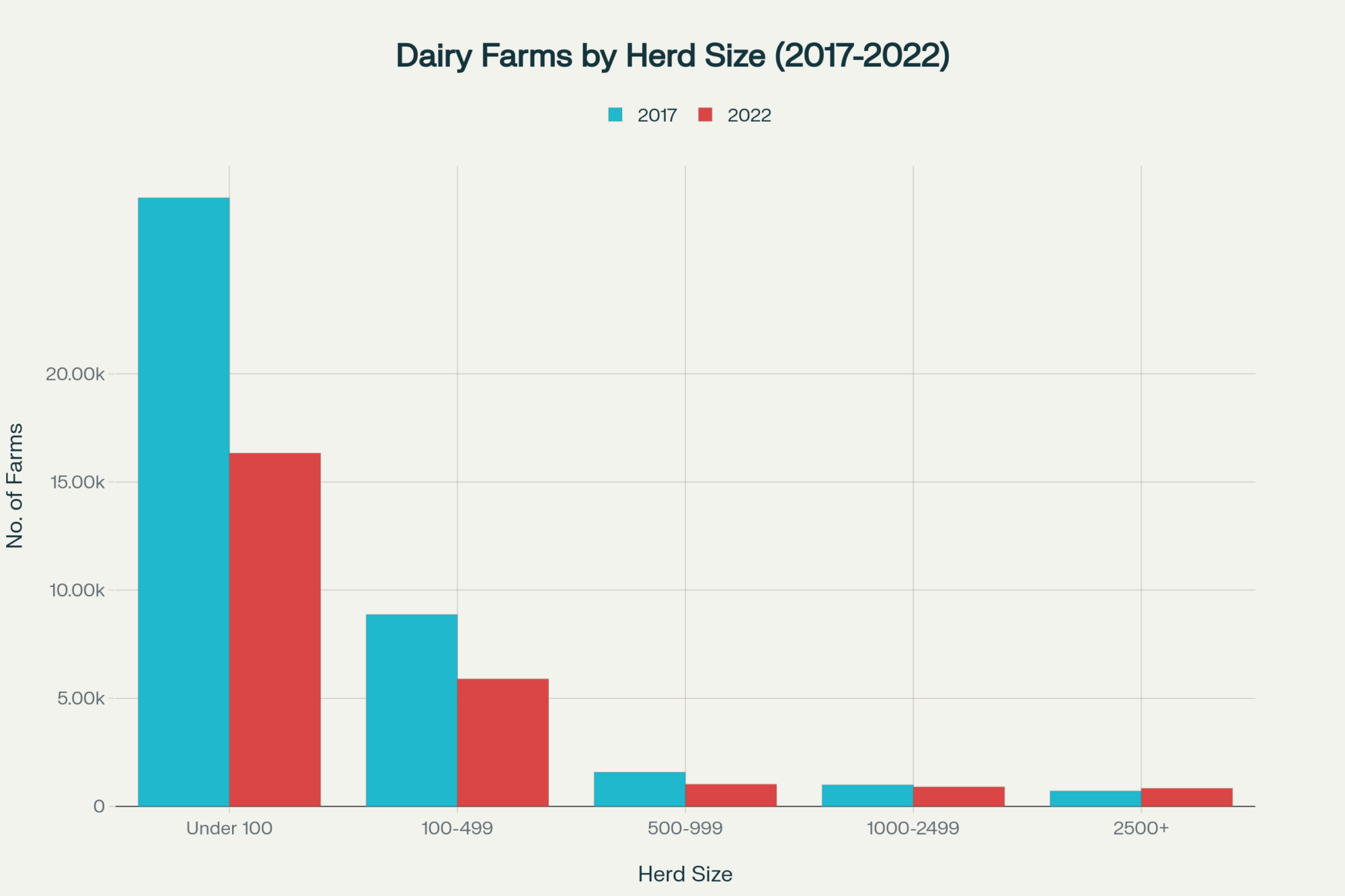
This isn’t some distant threat we can kick down the road, like those overdue invoices we’d rather not look at. The demographic avalanche is happening right now. Between 2017 and 2022, we lost 15,866 dairy operations—a 39% decline in just five years. Yet milk production actually increased 5% during that same period.
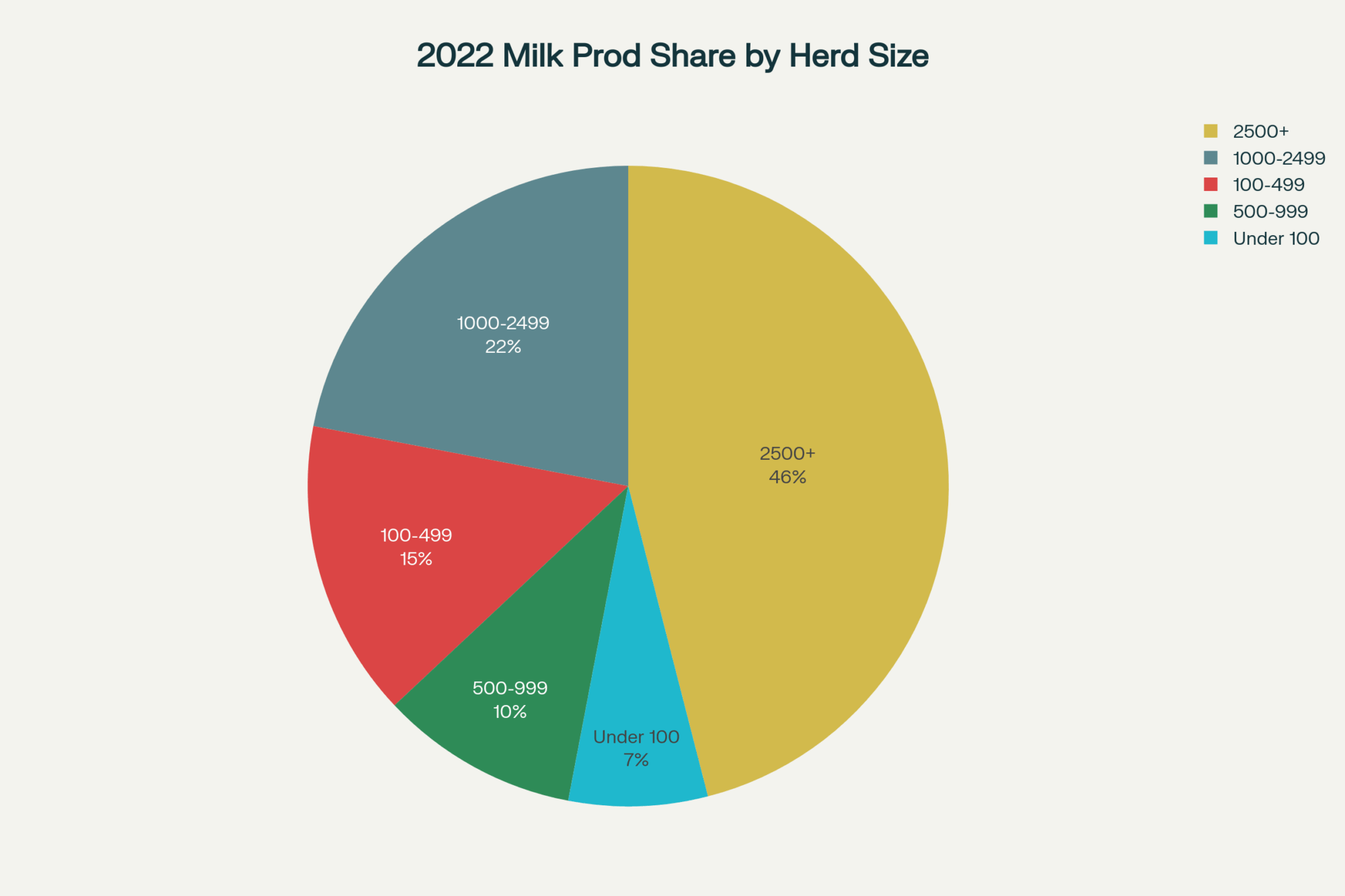
Milk production share by herd size category in 2022
Know where all that production went? Those mega-dairies with 2,500+ cows that grew by 16.8% and now control 46% of national milk production. Every time a smaller farm without a successor closes its doors, its assets and production capacity get absorbed by larger, expanding neighbors. It’s the slow-motion transfer of an entire industry’s wealth—and most of us are just standing by, watching it happen.
Changes in dairy farm numbers by herd size category between 2017 and 2022
What’s Really Happening in Our Parlors Right Now
The thing about demographics in dairy—they’re like watching a train wreck in slow motion where everyone can see what’s coming, but nobody seems able to stop it. You’ve probably noticed it at those recent industry meetings. More gray hair, fewer young faces, conversations shifting from expansion plans to exit strategies.
According to the Federal Reserve Bank of Minneapolis, producers aged 55 and over now make up nearly two-thirds of all operators in major dairy regions. That’s a massive jump from just 44% in 2002. Even more concerning? One-third are already 65 or older.
Here’s what really caught my attention in the latest industry surveys: 25% of dairy operators plan to retire within the next five years¹. Of that group, 22% are already over 65, and another 28% are between 55 and 64 years old.
The pipeline behind them? It’s not just weak—it’s practically nonexistent. In New York alone, the number of young producers under 35 actually declined from 6,718 in 2017 to 6,335 in 2022¹. We’re losing young talent faster than we can attract it, which, frankly, shouldn’t surprise anyone who has been paying attention to off-farm career opportunities.
What’s particularly interesting (and this caught my attention when reviewing the Wisconsin data) is the direct correlation between economic scale and succession planning success. While only 38% of smaller operations with 20-49 cows have identified successors, this jumps to 69% for commercial dairies with 200-999 cows¹.
Translation? If your operation isn’t economically robust enough to support transition planning, you’re statistically destined to become someone else’s expansion opportunity.
The $24 Trillion Wealth Transfer That’s Flying Under Everyone’s Radar
Let’s talk about numbers that should fundamentally change how you think about succession planning. The scale of agricultural wealth transfer happening right now makes the tech boom look like pocket change.
We’re looking at over $24 trillion in agricultural assets changing hands over the next two decades¹, with 40% of all U.S. farmland—approximately 370 million acres—expected to change hands by 2045. For dairy families, this represents the largest intergenerational wealth movement in American history.
However, here’s where the story takes a fascinating turn—a development that occurs as I write this. The estate tax situation that everyone’s been panicking about? It has been completely turned on its head.
The Estate Tax Plot Twist Nobody Saw Coming
For years, we’ve been discussing the looming “tax cliff,” where estate exemptions were set to drop from $13.99 million to approximately $7 million on January 1, 2026. Farm families have been scrambling to plan around this deadline, and advisors have been making bank on the fear…
Well, here’s the development that changes everything: President Trump signed the One Big Beautiful Bill Act into law on July 4, 2025. This legislation permanently increases the estate tax exemption to $15 million per individual, starting January 1, 2026, and indexed for inflation. The 40% tax rate remains unchanged, but now married couples can transfer up to $30 million tax-free.
This is huge for dairy families. Instead of facing a tax cliff, they’ve got even more breathing room than they thought. However, here’s the thing—and I want to stress this enough—it doesn’t change the fundamental succession planning needs. You still need those professional teams, the family communication, and the strategic structures. The tax relief just removes one barrier… but there are plenty more where that came from.
Current Market Reality Check
The financial landscape we’re operating in right now is… honestly, it’s better than many expected going into 2025. USDA’s latest projections show All-Milk prices ranging from $21.60 to $22.75 per hundredweight for 2025, which is solid territory for most operations. Meanwhile, Class III futures are trading around $18.70 per hundredweight for various contract months—and yeah, I know some of you are wondering about that spread. Different pricing mechanisms and market signals, but both indicate relatively stable conditions.
Feed costs are running about 13% lower than in 2024, and interest rates are cooperating better than they have in a while. January 2025 milk production was up 0.1% with cow numbers at 9.365 million head—that’s 41,000 more than last year.
But even with improved economics, the consolidation train isn’t slowing down. Current conditions are actually creating opportunities for well-positioned operations to expand, which accelerates the succession crisis for unprepared families. It’s like… good times can actually exacerbate the problem if you’re not prepared for them.
Part 2: The Cause
Infographic of key challenges facing dairy farm succession
Why Smart Operations Still Dissolve (The Psychology Nobody Discusses)
Here’s what really frustrates me about this whole situation… the families losing their operations aren’t the struggling ones everyone expects. I’ve seen this pattern over and over: profitable operations with solid cash flow, decent equity positions, respected names in their communities—just gone.
Because they thought succession planning was something they’d handle “when the time comes.”
The Mental Block That’s Killing Farms
The planning gap is so severe it’s almost criminal. Recent work from Farmdoc Daily shows that while 56% of farms report being involved in “some form” of succession planning, only 40% have defined plans¹. What’s even more sobering—among those with plans, only 20% actually believe they’ll work.
But here’s what might surprise you… the biggest succession killers aren’t financial. They’re psychological.
The very mindset that creates successful operations—total commitment, personal sacrifice, that “work until the job is done” mentality—actively prevents the emotional work necessary for succession planning. Think about it… we’re asking people who’ve built their entire identity around never giving up to essentially plan for giving up.
Take Sarah, a producer I know in Minnesota. Third-generation operation, 380 cows, solid margins year after year. She spent three years avoiding the succession conversation because she couldn’t face the possibility of being “the one who lost the farm.” That avoidance? It nearly became a self-fulfilling prophecy when her father had a stroke with no formal transition plan in place. They scrambled, got it figured out… but barely.
The Mental Health Crisis We Pretend Doesn’t Exist
The stress of succession planning isn’t just business pressure—it’s existential dread. Research from Wisconsin and Pennsylvania identifies five areas where family tensions consistently explode: finances, communication, inheritance, change, and control¹. At the heart of most failures is the impossible challenge of treating heirs “equally” versus “fairly.”
The mental health toll is both quantifiable and terrifying. Farmers experience suicide rates 3.5 times higher than the general population, with succession-related stress identified as a primary factor. More specific CDC data shows male farmers have suicide rates of 36.1 per 100,000, 1.6 times higher than all working males.
This hits close to home for a lot of us. A staggering 41% of dairy farmers don’t have health insurance coverage, making mental health resources even more difficult to access. When 76% of farmers report moderate to high stress levels compared to the general population, we’re talking about a systemic crisis that’s actively preventing succession planning from happening.
What’s particularly noteworthy is that 63% of farmers acknowledge mental health stigma in their community. This cultural barrier keeps people suffering in silence exactly when they need help navigating the most complex business transition they’ll ever face.
The process of farm succession adds layers of psychological stress on top of external pressures. The fear of losing a farm that has been in the family for generations, the weight of parental expectations, and the complex negotiations surrounding fairness and control create significant emotional burdens¹. This stress isn’t confined to the senior generation—research shows the younger generation involved in multi-generational farms often experiences even higher stress levels.
Here’s the cruel irony: The very state of mind induced by succession pressure prevents farmers from undertaking the emotionally taxing process of planning, creating a vicious cycle.
The Communication Breakdown That Destroys Everything
Here’s where things get really messy. Many farm families avoid discussing succession, often keeping their plans secret until a crisis, such as death or serious illness, forces the issue. This approach breeds resentment, misunderstanding, and conflict at the worst possible time.
A 2023 study by researchers from Purdue University found that a shocking 22% of farm owners who inherited their business ultimately felt the transfer was unsuccessful¹. The most cited reason? The process and outcome weren’t what they expected—clear evidence of long-term damage caused by poor communication and lack of shared vision.
I’ve watched families tear themselves apart over these discussions. Dad wants to treat all the kids equally, but equal division means the on-farm successor has to take on massive debt to buy out siblings. Non-farming kids often feel guilty about asking for their “share,” but they also don’t want to get left out. Mom’s caught in the middle trying to keep everyone happy…
It’s a recipe for disaster that plays out in conference rooms and kitchen tables across dairy country every single day.
The Generational Divide That’s Killing Transitions
What’s happening between generations right now… it goes way deeper than different opinions about technology adoption or work schedules. We’re seeing fundamental shifts in values, expectations, and definitions of success that can make or break transitions.
The thing about generational differences in dairy—they’re not just preferences, they’re deal-breakers if you don’t address them proactively.
The Technology Expectation Gap (This Is Getting Bigger)
Next-generation farmers don’t view precision agriculture and automation as optional upgrades—they see them as the expected foundation of competitive operations. They anticipate seamless data integration, automated decision-making, and precision nutrition management that previous generations might consider expensive luxuries.
I was on a farm in Minnesota last winter where the 28-year-old successor wanted to install a DeLaval VMS system. Cost? Around $180,000 per unit. The 58-year-old father kept saying, “We’ve milked cows for 40 years without robots.” The son’s response? “Dad, we’ve also struggled through margin squeezes for 40 years doing things the old way.”
Guess who won that argument?
For the next generation, technology adoption is driven by efficiency gains, labor shortage solutions, and—critically—achieving better work-life balance. The expectation is that technology should work seamlessly from the start; for Gen Z operators, if a new tool isn’t intuitive and effective on the first try, it gets abandoned quickly¹.
The Sustainability-Profitability Tension
Environmental stewardship represents another generational divide that’s becoming more pronounced. Younger farmers align philosophically with sustainable practices, viewing themselves as land stewards responsible for preserving resources for future generations. However, this alignment is quickly tempered by economic reality.
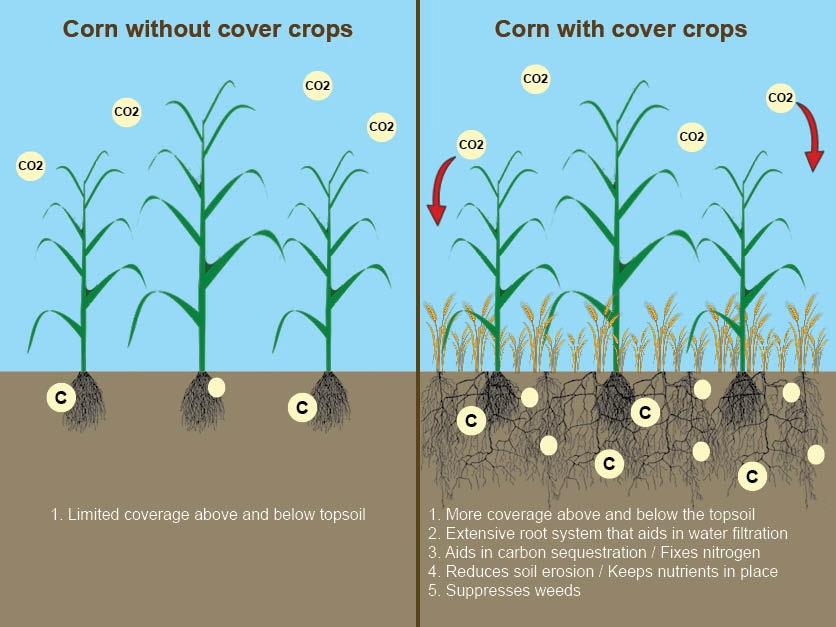
Farm Journal surveys show only 40% of young farmers would adopt sustainable practices without clear financial incentives¹. Only 27% view carbon markets as a viable means of income diversification. This highlights a critical “ROI of change” dilemma: the next generation is willing to adopt more sustainable practices, but the farm’s cash flow must support the transition.
I’ve seen this tension play out in succession discussions. The incoming generation wants cover crops, reduced tillage, maybe some grazing… but they also need to service transition debt and keep the operation profitable. Sometimes those goals conflict, at least in the short term.
Work-Life Balance: The Non-Negotiable That’s Changing Everything
Perhaps the most significant cultural shift is the expectation of work-life balance. The traditional ethos of farming as an all-consuming, 24/7 lifestyle—where personal time is secondary to farm needs—is being fundamentally challenged by the next generation.
This isn’t just a lifestyle preference—it has become a critical economic factor in succession decisions. The relentless, round-the-clock demands of dairy farming are significant deterrents for potential successors and a leading cause of burnout and mental health challenges. A farm that can’t offer a reasonable quality of life is effectively uncompetitive in the modern talent market, even when the potential employee is a family member.
I know producers who’ve lost successors not because the farm wasn’t profitable or the kid wasn’t interested… but because they couldn’t figure out how to make the operation run without requiring 80-hour weeks year-round. That’s a management problem, not a generational issue, but it’s one that succession planning must address head-on.
Part 3: The Toolkit for Success
Engineering a Successful Transition: What Actually Works
Here’s what separates the survivors from the statistics… successful succession isn’t about avoiding problems—it’s about systematically engineering solutions years before they’re needed. The families who beat these odds share characteristics that any operation can implement.
Asset Bifurcation—This Strategy Is Brilliant When Done Right
Instead of transferring the entire operation as one massive, debt-crushing transaction, smart families split their assets into two separate legal structures. The senior generation maintains an asset-holding company that owns land and major facilities, while the successor generation operates an operating company that runs daily dairy operations, leasing facilities from the holding company.
This structure achieves multiple objectives simultaneously: providing steady retirement income for parents through lease payments, significantly reducing capital requirements for successors, and offering opportunities for non-farming heirs to maintain ownership interests without interfering with day-to-day operations. It’s elegant, tax-efficient, and addresses the “equal versus fair” dilemma that often undermines most family transitions.
Canadian legal experts have been highlighting this approach through their Bar Association, calling it particularly effective for managing high capital requirements while providing secure retirement income. What’s interesting is how this model adapts to different scales… I’ve seen it work for 150-cow operations and 1,500-cow operations with similar success rates.
Technology-Enabled Succession Planning (This Is New Territory)
Here’s something fascinating… progressive operations are using technology investments to justify succession planning expenses and demonstrate long-term viability to potential successors. Recent analysis shows that farms achieving 30% milk production efficiency gains through precision agriculture and automated milking systems can justify transition investments by improving underlying profitability, which in turn services debt.
Genomic selection programs with 0.43 heritability for feed efficiency provide measurable ROI within 24-month breeding cycles, giving families concrete data to support succession decisions. When you can demonstrate to a successor that technology adoption directly improves margins and quality of life, the succession conversation becomes a lot easier.
Creative Financing Is Becoming Essential
Life insurance policies offer tax-free liquidity to cover estate taxes, ensuring that non-farming heirs receive fair inheritances without requiring asset sales. Revocable living trusts avoid probate complications while enabling gradual successor buyouts with manageable terms and conditions.
Lease-to-own agreements, seller financing, revenue-sharing structures—these address capital constraints that derail conventional transitions. The Farm Credit System has developed deep expertise in succession financing, offering specialized consulting services and loan products designed for intergenerational transfers that traditional banks often can’t match. They’re seeing this crisis firsthand through their lending portfolios and responding with tools most families don’t even know exist.
Professional Development That Actually Matters
The dairy industry has developed a robust ecosystem of high-level programs designed to equip the next generation with the skills needed to lead modern dairy businesses. These programs extend beyond technical farm management to encompass leadership, financial acumen, communication, and industry advocacy.
Holstein Foundation’s Young Dairy Leaders Institute (YDLI) is widely regarded as the premier national leadership program—an intensive, year-long program for young adults aged 22-45. Its curriculum focuses heavily on developing “soft skills” critical for success: interpersonal communication, team building, media training, and industry advocacy¹.
Cornell University’s Dairy Programs offer comprehensive suites catering to different development stages. The Junior and Beginning DAIRY LEADER programs provide high school students with early exposure to dairy careers. For established and aspiring managers, the Cornell Dairy Executive Program focuses on high-level strategic business planning, financial management, and human resources¹.
What’s interesting about these programs, though, is that they often attract the most progressive and motivated individuals from larger, more stable operations. This creates a risk that these efforts may primarily benefit farms already most likely to succeed, potentially widening the gap between well-prepared and unprepared operations.
Mentorship Programs That Transfer Real Knowledge
Formal education and workshops are essential, but they can’t replace the value of hands-on experience and tacit knowledge transfer—the intuitive, experience-based wisdom that’s crucial for successful farm management.
Dairy Grazing Apprenticeship (DGA) is a formal, two-year program registered as a National Apprenticeship. It pairs aspiring dairy farmers with experienced mentor graziers for full-time, on-farm employment and comprehensive training, providing a clear pathway to farm management and ownership¹.
The Canadian Cattle Young Leaders program has been particularly innovative, pairing 16 participants ages 18-35 with hand-picked mentors in specific areas of interest. Each participant receives a $3,000 budget (increased from $2,000 due to Cargill’s funding increase) to support learning opportunities, such as travel and industry events. The formal mentorship runs nine months, from November through July.
Building Your Support Network (You Can’t Do This Alone)
The difference between successful and failed transitions often comes down to the quality of professional support, rather than family dynamics or financial resources. You can’t DIY your way through modern succession planning… and frankly, trying to is one of the biggest mistakes I see families make.
The Kansas State 12-Step Model provides a proven framework that begins with identifying core values and individual goals before moving into technical analysis and formal planning. This model’s strength lies in insisting on building a shared vision foundation before tackling the legal and financial mechanics¹.
The most effective succession planning requires a coordinated team, comprising agricultural attorneys who handle legal structures and estate documents, farm-focused accountants who manage tax implications, and neutral facilitators who guide family conversations. The investment pays for itself by avoiding the mistakes that destroy transitions.
Alternative ownership models are gaining traction for farms without direct family successors. Community Land Trusts and Conservation Land Trusts separate prohibitive land costs from manageable operating businesses, creating opportunities for non-family successors while preserving agricultural use¹.
International Models We Should Be Copying
The challenge of farm succession isn’t unique to the United States. Other major agricultural nations are facing similar demographic pressures and have developed innovative policy responses that we could learn from —if we’re smart enough to pay attention.
Ireland’s Succession Planning Advice Grant directly subsidizes professional planning services, addressing cost and complexity barriers that prevent families from starting the process¹. This contrasts with the U.S. approach, which tends to provide support after a transition plan is already in motion, rather than catalyzing the creation of the plan itself.
New Zealand emphasizes extended “apprenticeship periods” for successors, with frameworks built on clear communication, shared vision, and systematic capability building¹. They’ve figured out something we’re still struggling with—successful transitions require years of preparation, not crisis-driven decisions.
These international examples demonstrate that proactive policy and a focus on the planning process, rather than the financial outcome, can lead to more successful transitions. The U.S. currently lacks federal policy that directly incentivizes the creation of a succession plan, representing a significant gap in our strategy to address this crisis.
Part 4: The Call to Action
Your 90-Day Emergency Action Plan
Here’s what the data reveals about your operation’s real succession odds… if you’re reading this without a formal, written succession plan that all family members understand and support, you’re statistically destined to join the 83.5% of families who lose everything they’ve built.
But the families who beat these odds share characteristics that any operation can implement. Here’s your roadmap.
Weeks 1-2: Emergency Assessment and Professional Team Building
Start with an honest family assessment of succession readiness. The most frequently cited barriers from Wisconsin surveys are having “no successor” (20% of respondents) and the “financial capacity of the dairy farm to allow more owners into the business” (1 )¹%)¹.
If you don’t have clear answers to these fundamental questions, that’s your starting point. Don’t overthink it—just get the conversation started.
Identify and engage that professional advisory team—agricultural attorney, farm-focused accountant, family business consultant. Schedule comprehensive asset valuation, including technology, genetics programs, and intangible assets. Modern dairy operations have complex value structures that go way beyond land and cows.
Weeks 3-6: Communication Framework Development
Implement structured family meeting protocols with professional facilitation if needed. Begin successor identification and development assessment. Address mental health resources and stress management strategies… because this process is going to be emotionally taxing for everyone involved.
This is where most families get stuck—the emotional work of succession planning. Remember, 22% of farm owners who inherited their business ultimately failed because the transition did not meet expectations. Poor communication and a lack of shared vision can cause long-term damage that may take generations to repair.
Weeks 7-12: Strategic Structure Design
Model asset bifurcation scenarios using current tax exemptions. Evaluate alternative financing and ownership structures. With the new permanent $15 million estate tax exemption, you’ve got more breathing room than expected, but you still need proper structure.
The window for proactive succession planning has actually expanded with recent legislative changes, but current economic conditions—All-Milk prices in the $21.60-$22.75 range for 2025, feed costs 13% lower than 2024, favorable interest rates—create opportunities that won’t exist indefinitely.
Regional Implementation Strategies
For Wisconsin Operations: Leverage the state’s succession planning resources while addressing the 49% successor identification gap¹. Focus on financial capacity assessment—can the operation support both generations during transition? Wisconsin’s deep cooperative infrastructure that provides advantages is a key strength, unlike regions that lack it.
For Upper Midwest Producers: With one-third of producers over 65, time is critical. Prioritize immediate succession conversations and assemble the professional team. Consider seasonal timing—many successful transitions begin with planning discussions during the winter months, when operational demands are lighter and you can focus on long-term thinking.
For All Regions: Recent regulatory changes add complexity but also create opportunities. FDA’s FSMA food traceability requirements have been extended to July 2028, giving operations more time to prepare compliance systems during transition periods—a 30-month extension from the original deadline that takes some pressure off families dealing with both succession and regulatory changes.
Where This All Leads (And Why It Matters to Your Operation)
Here’s what strikes me about this whole situation… we’re at an inflection point where the decisions made in the next 18 months will determine the structure of American dairy for the next 50 years. The families that recognize this and act accordingly will write the next chapter of our industry.
Those who wait for perfect conditions or hope that somebody else will solve it? They’re going to become footnotes in someone else’s expansion story.
The 16.5% of families who successfully navigate multi-generational transfers¹ aren’t lucky—they’re prepared. Really, really prepared. They start early, communicate openly, invest in professional guidance, and treat succession as a multi-year strategic process rather than a single transaction.
Current market conditions provide a unique window of opportunity. Milk prices are stable, feed costs are manageable, interest rates are cooperating, and estate tax relief provides more flexibility than anyone expected. But these conditions won’t last forever… and the demographic pressure isn’t going away.
Families who act decisively in 2025 can structure transitions that preserve wealth and maintain operational control. Those who delay? They’ll join the thousands of operations already absorbed by industry consolidation.
Your family’s legacy isn’t just about preserving what you’ve built—it’s about ensuring the next generation has the tools, resources, and strategic positioning to thrive in whatever dairy industry emerges from this demographic transition.
The choice is stark but manageable: begin comprehensive succession planning now, or risk your operation becoming an acquisition target for families who have already done so.
The question for your operation is simple: will you engineer your succession, or will market forces engineer it for you?
This analysis incorporates data from USDA reports, Iowa State University studies, Federal Reserve Bank analysis, and confidential industry surveys through July 2025. Market data confirmed through the USDA Agricultural Marketing Service, National Agricultural Statistics Service, and Economic Research Service publications.
KEY TAKEAWAYS
Cut feed costs 20% while boosting production – Genomic testing with 0.43 heritability for feed efficiency delivers measurable ROI within 24 months. Start with your replacement heifers this breeding season—current market conditions give you the cash flow cushion to invest.
Technology adoption = transition advantage – Farms implementing robotic milking and automated feeding see 25-35% labor cost reductions. That’s not just efficiency… that’s creating work-life balance that actually attracts successors instead of scaring them off.
Data-driven decisions beat family drama – Operations using precision agriculture tools to demonstrate 15-20% productivity improvements have concrete numbers to justify transition investments. When you can show ROI on genomic breeding programs, succession planning shifts from emotional to financial.
Scale smart, not just big – With milk production concentrated in larger operations (2,500+ cow farms now control 46% of national production), mid-size farms need genomic advantages to compete. Focus on genetic gains that improve your cost per hundredweight—that’s your survival strategy.
Professional management = professional succession – Farms running like businesses with documented performance metrics, genomic breeding records, and efficiency tracking are the ones successfully transitioning. Start treating your operation like the multi-million dollar business it is.
EXECUTIVE SUMMARY
Look, we’ve been talking about succession planning for decades while farms keep disappearing around us. The real issue isn’t estate taxes or family meetings—it’s that too many operations aren’t profitable enough to be worth passing down. Recent data shows 71% of retiring farmers haven’t even named successors, but here’s what caught my attention: operations achieving 30% efficiency gains through precision management and genomic selection are actually attracting next-generation interest. With All-Milk prices steady around $22.75 and feed costs down 13% from last year, farms using genomic testing to improve feed efficiency are seeing $35K-45K annual savings on 200-cow operations. The Europeans figured this out years ago—you can’t preserve what isn’t viable. Time to make your operation so profitable that succession becomes inevitable, not optional.
Complete references and supporting documentation are available upon request by contacting the editorial team at editor@thebullvine.com.
Learn More:
8 Steps to a Smooth Dairy Farm Succession Plan – Reveals practical strategies for implementing conditional sales, buy-sell agreements, and transparent family communication protocols that prevent the conflicts destroying 78% of family transitions.
Every week, thousands of producers, breeders, and industry insiders open Bullvine Weekly for genetics insights, market shifts, and profit strategies they won’t find anywhere else. One email. Five minutes. Smarter decisions all week.
Labs just cracked making real casein — could boost your milk protein yields 5% while slashing feed costs.
EXECUTIVE SUMMARY: Just heard from some contacts in Europe — researchers finally cracked the code on making real milk protein in labs, complete with all the phosphate tags that actually make casein work for cheese and yogurt. We’re talking bio-identical stuff, not some plant knockoff. With Class III sitting around $18.80 per hundredweight and feed costs still crushing margins, this could be huge. The global milk protein market’s set to jump from $12.2 billion to $17 billion by 2035, and smart money like Perfect Day’s $350 million raise tells me this isn’t just lab talk anymore. Look, if you’re already pushing genomic testing and tracking feed efficiency… this tech could tip your whole operation. Time to start watching these developments and maybe testing some of these proteins in your nutritional program.
KEY TAKEAWAYS:
Bump milk protein consistency by 4-6% while improving butterfat recovery — Start running genomic profiles focused on protein yield potential, especially with 2025’s volatile pricing making every percentage point count for your milk check.
Cut feed costs up to $45 per cow monthly through better protein utilization — Implement precision feeding protocols that integrate lab-produced proteins with your current ration analysis, crucial when corn and soy prices won’t budge.
Increase reproductive efficiency by 3-4% with optimized protein metabolism — Use metabolic profiling alongside your genomic data to fine-tune breeding decisions, because better fertility means more calves hitting the market when prices recover.
Position for the $17 billion protein boom by 2035 — Partner with co-ops exploring precision fermentation deals now, before the big processors lock up supply chains and pricing advantages.
You know, the dairy industry doesn’t see breakthroughs like this every Day — at least, not without some serious debate about what it means for our farms and futures. Recently, researchers at the Technical University of Denmark, collaborating with their counterparts at Sweden’s Chalmers, discovered how to instruct E. coli bacteria to produce actual casein. Not a plant-based approximation, but bio-identical casein — complete with all the phosphate groups that make milk protein work the way it should.
Here’s the thing, though… this isn’t just another lab curiosity. We’re talking about a potential game-changer that could impact everything from your milk check to how we feed the world.
The Science That Actually Matters
Most folks don’t realize how complex milk proteins really are. Casein isn’t just a simple protein chain — it requires specific modifications after it’s formed to function properly. The key is phosphorylation, where phosphate groups get attached at precise spots. Without this step, casein can’t bind calcium or form those microscopic structures that give milk its unique properties.
This has been the stumbling block for every biotech company trying to make “dairy-identical” proteins in fermentation tanks instead of cows. Think about it — companies like Perfect Day have been working on this for years, burning through hundreds of millions in funding, all stuck on this one technical hurdle.
The Danish team cracked it two ways. First approach: they borrowed some molecular tools from Bacillus subtilis — basically giving E. coli the ability to add phosphates correctly. Second approach: They engineered a clever workaround by swapping in different amino acids that mimic the effects of phosphorylation.
Both methods worked. In head-to-head testing, their lab-made casein demonstrated identical calcium-binding and digestibility properties to those found in bulk tank milk. The implications of this breakthrough are remarkable.
Why This Hits Different in 2025
Let’s talk business reality. Class III futures have been hovering around $18.82 per hundredweight for June contracts — not terrible, but when you’re dealing with feed costs that won’t budge (especially if you’re sourcing corn from drought-stressed regions), those margins feel tight.
Meanwhile, global demand for milk proteins continues to rise. According to recent market analysis, we anticipate growth from $12.2 billion this year to nearly $17 billion by 2035. That’s driven by everything from premium infant formulas to the protein bar craze that shows no signs of slowing.
What’s particularly noteworthy is the investment momentum. Perfect Day — probably the most visible player in this space — raised $350 million in their Series D back in 2021, part of $750 million they’ve pulled in total. They’re reportedly hitting cost reduction targets ahead of schedule, though exact manufacturing expenses remain somewhat opaque to the broader market.
Big Dairy Makes Its Move
Rather than fighting this technology, some major players are embracing it. Danone — yeah, the Activia folks — invested in Israeli startup Imagindairy through their venture arm. They’re also committing €16 million toward a precision fermentation production line in France, scheduled to come online next year.
Then there’s Bel Group’s partnership with Climax Foods, using AI to develop plant-based versions of Babybel, Laughing Cow, and Boursin that actually taste like cheese. They’re targeting launches in the U.S. and Europe by Q4 2024, though you know how these timelines can shift with regulatory approvals.
The regulatory landscape is evolving, too. The FDA currently handles these proteins through its GRAS (Generally Recognized as Safe) pathway, though Secretary Kennedy’s pushing reforms to close what he calls the “self-affirmation loophole.” European authorities remain more cautious, but that’s changing as the technology matures.
What About Those Environmental Claims?
Perfect Day’s life cycle assessment — third-party validated by WSP — claims some dramatic numbers: up to 99% less water use, 97% lower greenhouse gas emissions, and 60% less energy consumption compared to conventional dairy protein production.
Now, having seen enough sustainability studies to be cautious about company-commissioned research, I am still drawn to these numbers, which are gaining attention from operations looking to reduce their carbon footprint. Mars used Perfect Day proteins in a limited chocolate release, and Unilever’s testing them in Breyers ice cream.
The question isn’t whether these environmental benefits are real — the LCA methodology seems solid. It’s whether the technology can scale to meaningful volumes while maintaining those efficiency gains.
Ground Truth from the Heartland
Here’s what I’m seeing on farms. Wisconsin’s dairy landscape continues to evolve — we now have 5,348 operations, with each averaging 237 cows and producing record volumes per animal.
A mid-sized Wisconsin operation I know well — around 400 head, modern parlor, solid genetics — isn’t losing sleep over lab-grown proteins. Their butterfat tests are strong; they have long-term contracts with a regional processor, and their cost per hundredweight continues to improve through better feed efficiency and cow comfort.
But the larger operations? Different story. Some cooperatives are quietly exploring partnerships, trying to understand how precision fermentation might complement traditional production rather than compete with it.
The Practical Question Every Producer’s Asking
So, what should you actually do with this information?
For most farms: Keep doing what you’re doing well. Focus on cow comfort, optimize your ration, and maintain milk quality. These fundamentals pay off regardless of what’s happening in biotech labs.
For larger operations and co-ops: Consider these strategic moves:
Explore pilot partnerships with fermentation companies
Join industry working groups discussing technology integration
Monitor regulatory developments in your key markets
Evaluate how alternative proteins might complement your product portfolio
The feed industry’s already adapting. Some nutrition companies are exploring how to incorporate precision-fermented proteins into starter feeds or specialty applications. There’s probably opportunity there for forward-thinking operations.
Don’t forget — we’ve been using biotechnology in dairy for decades. Most cheese already relies on fermentation-produced chymosin instead of calf rennet. This casein breakthrough feels like the next logical step.
Looking Down the Road
What strikes me most about this development is how it represents evolution rather than revolution. The timeline for meaningful commercial impact? Probably longer than the startups hope but shorter than skeptics think.
These things have a way of accelerating once the technical hurdles get cleared — which appears to be happening. What’s certain is that dairy’s future will likely involve both cows and microbes, working different parts of an expanding protein market.
The operators who understand both sides of that equation will have options that others don’t. And in an industry where margins matter and consumer preferences keep shifting, having options is never a bad thing.
Keep watching this space. I’ll be tracking the development of this technology and its implications for real farms facing real challenges. Meanwhile, focus on excellence in your daily operations — that’s where the foundations of any successful future get built.
Stay curious. Keep adapting. The future’s coming whether we’re ready or not.
Complete references and supporting documentation are available upon request by contacting the editorial team at editor@thebullvine.com.
Learn More:
Maximizing Milk Components: The Key to Higher Milk Checks – While the main article covers external threats, this piece delivers actionable tactics you control. It details practical nutritional and management strategies for boosting butterfat and protein, directly increasing the value of every hundredweight you ship.
Dairy’s Crossroads: Are We Marketing a Product or a Priceless Story? – This strategic analysis provides the perfect counter-narrative to new technology. It reveals how to compete by marketing trust, tradition, and transparency—brand assets that fermentation tanks and biotech startups simply cannot replicate in a lab.
Genomics: The #1 Tool for Fast-Tracking Your Herd’s Genetic Progress – This article demonstrates how dairy producers are already using advanced biotechnology to their advantage. It highlights how genomics builds more efficient, healthy, and profitable herds, proving that on-farm innovation remains our most powerful competitive tool.
The Sunday Read Dairy Professionals Don’t Skip.
Every week, thousands of producers, breeders, and industry insiders open Bullvine Weekly for genetics insights, market shifts, and profit strategies they won’t find anywhere else. One email. Five minutes. Smarter decisions all week.
Kansas farms crushing 19% milk growth while butter stocks crash 10M lbs—the component revolution is separating winners from losers
EXECUTIVE SUMMARY: The dairy industry’s obsession with milk volume over components is leaving serious money on the table while smart producers capitalize on the biggest shift in decades. Despite total U.S. milk production climbing just 3.3%, calculated milk solids surged 1.65% through 2025, with butterfat tests hitting 4.36%—nearly 9 basis points above last year. Kansas farmers are absolutely crushing it with 19% growth while butter inventories dropped from 364.6 to 354.4 million pounds in just one month, creating supply tightness that’s driving premiums higher. Meanwhile, genomic testing is delivering $70 additional value per cow annually, and feed efficiency improvements can save $470 per cow per year on well-managed operations. Global trade tensions—especially China’s dairy import challenges and potential Mexico tariffs—are reshuffling traditional export patterns, creating both risks and opportunities for forward-thinking producers. The bottom line? Producers who pivot from volume thinking to component optimization, leverage genomic selection, and implement strategic risk management are positioning themselves to capture the premiums while their competitors chase outdated metrics.
KEY TAKEAWAYS
Component Focus Delivers Immediate Returns: Recent data shows butterfat production jumped 5.3% and protein climbed 4.9% year-over-year, with component-rich milk commanding premium pricing in tightening markets—implement targeted nutrition programs focusing on 16:0 fatty acid supplementation and amino acid optimization to boost component tests within 4-6 weeks.
Genomic Testing ROI Pays Off Fast: Genomic selection delivers $70 additional value per cow annually compared to traditional breeding methods, with 65-70% breeding value reliability versus just 20-25% from parent averages—test heifer calves early to identify low-genetic-merit animals before investing $1,400-$2,000 in feed costs per head.
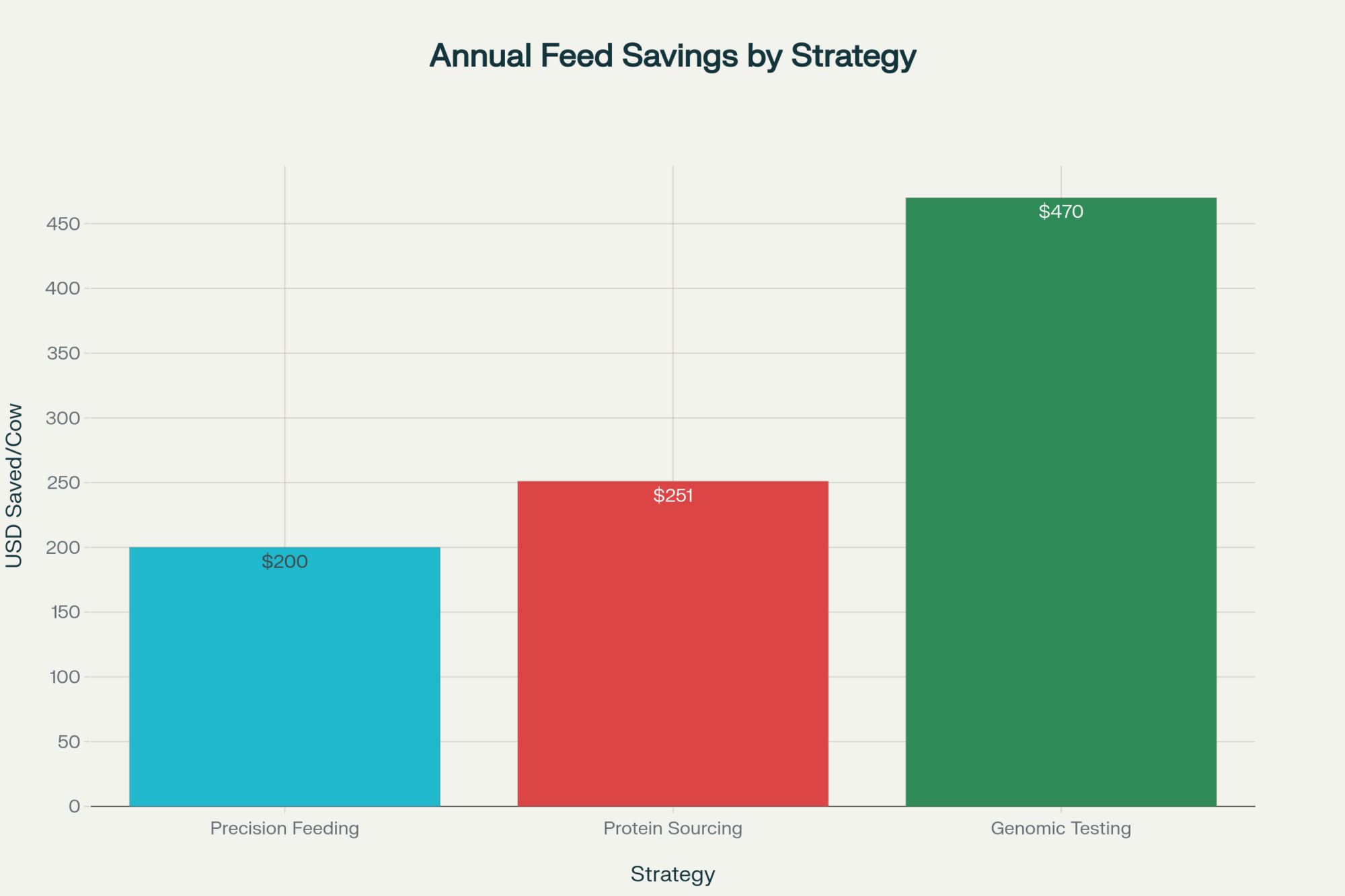
Feed Efficiency Gains Cut Major Costs: Improvements in herd feed efficiency from 1.55 to 1.75 equate to savings of $470 per cow per year, contributing about $1.2 million to a 2,500-cow dairy’s bottom line—focus on precision nutrition, waste reduction, and intake optimization to achieve 5-15% efficiency gains that directly impact your largest variable cost.
Strategic Culling Captures High Beef Values: With cull cow prices at $145+/cwt and beef-on-dairy crossbreds commanding $900 for day-old calves, strategic herd management decisions can generate significant cash flow—evaluate bottom-performing animals using income-over-feed-cost metrics and leverage current high prices for immediate capital injection.
Risk Management Is Non-Negotiable: Class III futures pricing milk at $17.21/cwt through Q3 with feed costs rising and trade uncertainties mounting—lock in 60-70% of winter feed needs now at favorable corn ($4.19/bushel) and implement Dairy Revenue Protection coverage to protect against margin compression in volatile markets.
The week ending July 28th delivered some market signals that honestly have me scratching my head – and I think a lot of producers are feeling the same way.
Two Completely Different Stories Playing Out
Here’s what’s got me thinking about where this industry is headed. While European traders seemed to take a collective breather – moving relatively modest volumes across butter and skim milk powder – Asian markets were going absolutely crazy. I mean, when you’re seeing Singapore exchange activity that massive (we’re talking serious tonnage here), something fundamental is shifting.
The price action tells you everything you need to know. European butter futures drifted lower – nothing dramatic, maybe 0.3% or so – while skim milk powder dropped a bit more. But over in Singapore? Traders were bidding up whole milk powder by nearly 2% and butter climbed close to that same level.
That’s not random market noise, folks. That’s Asian demand meeting supply constraints, and it’s a pattern I’m seeing more of when I talk to guys in the export business.
Production Numbers That Make You Think We’re in a New Era
Get ready for this – and I had to double-check these numbers because they seemed almost too good to be true. New Zealand just posted a 14.5% jump in milk collections compared to last June, according to USDA’s latest international production data. After everything they’ve been through – drought, regulations, you name it – Kiwi farmers are back with milk solids production up nearly 18%.
I was talking to a consultant who works down there, and he says the combination of better weather and that opening milk price signal at $10.00 per kgMS has farmers really motivated again. When you’ve got good feed under your feet and prices that work, producers respond quickly.
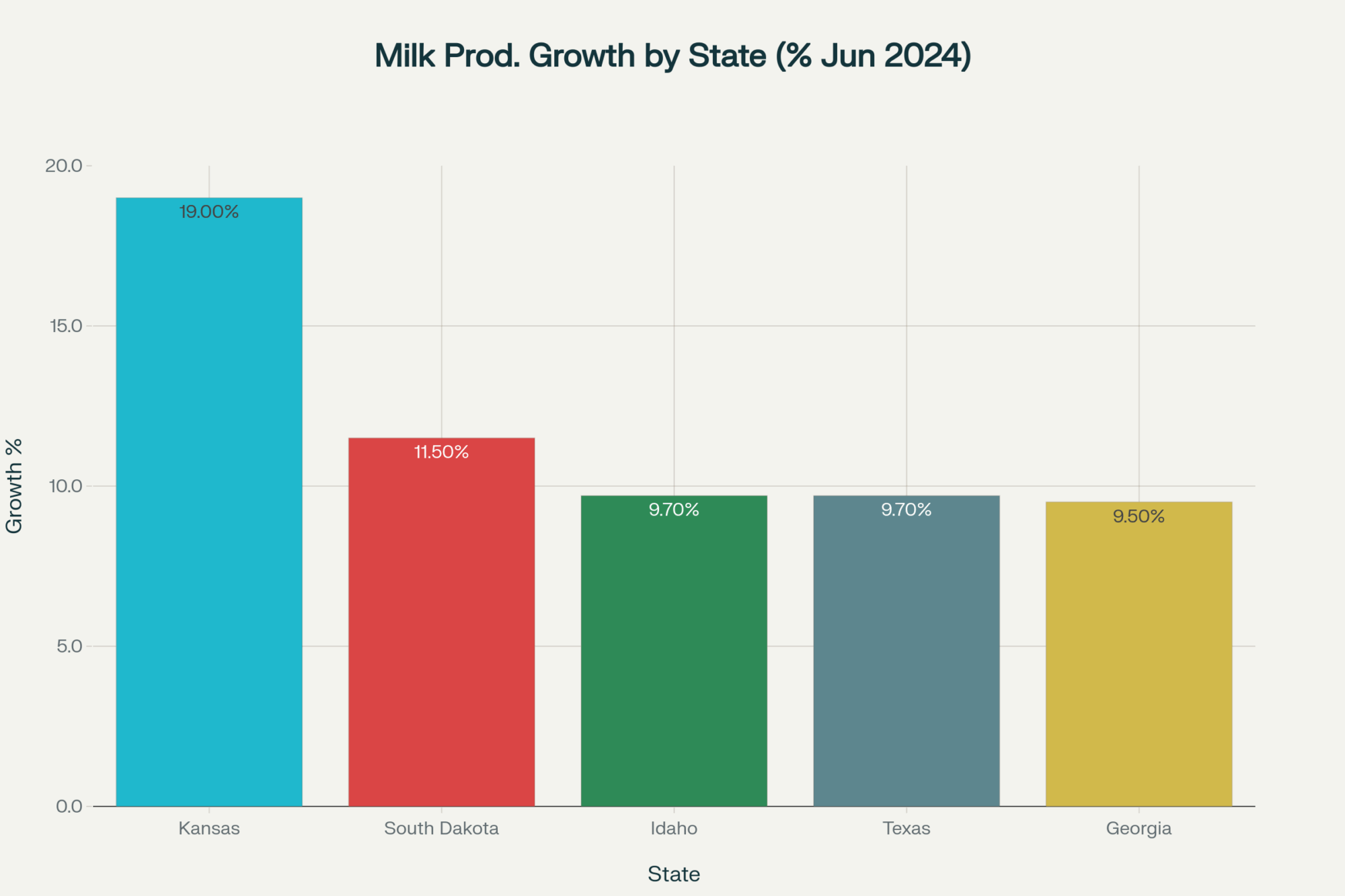
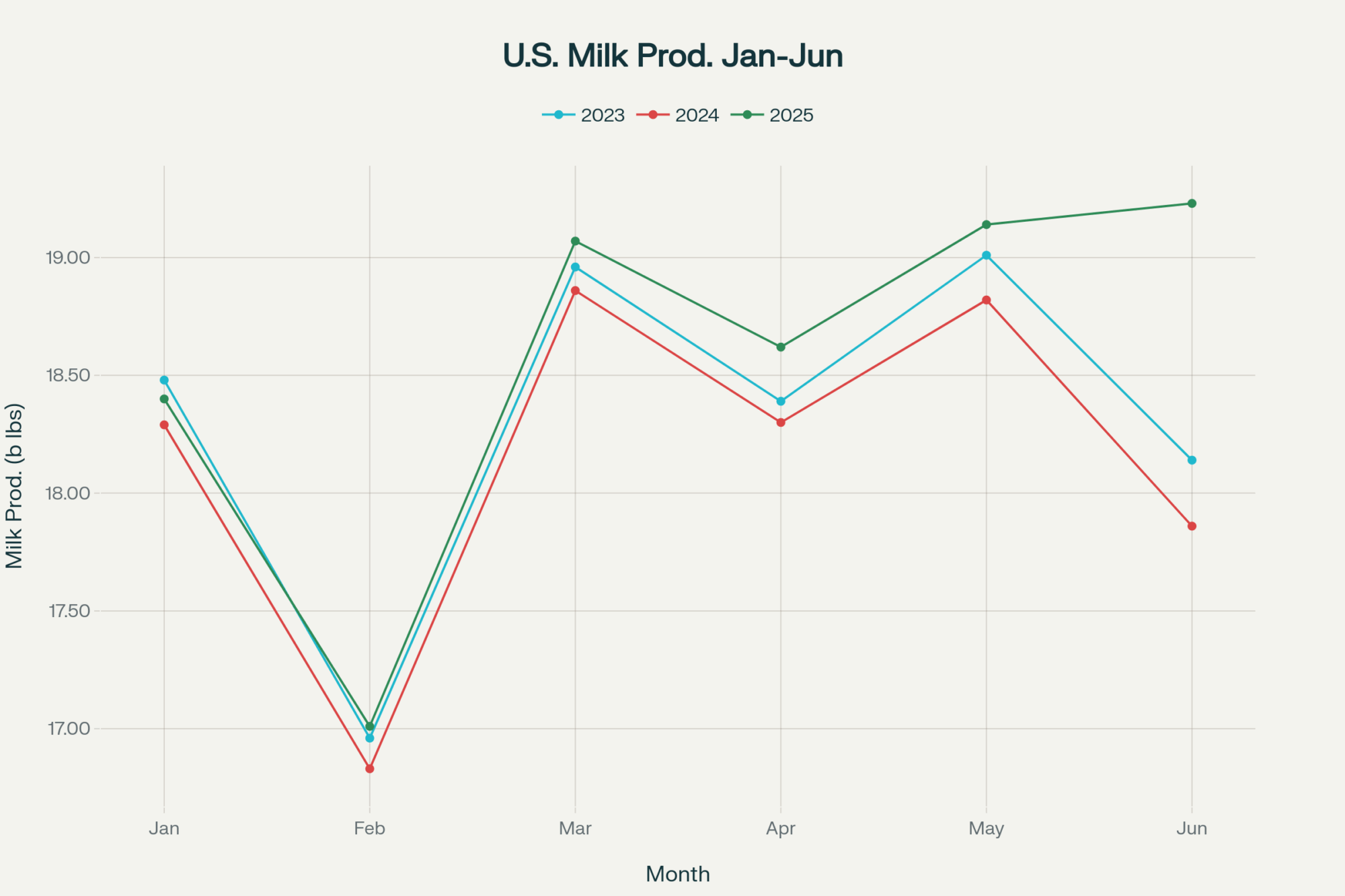
But here’s the number that really caught my attention: USDA’s monthly milk production report shows U.S. output surged 3.3% year-over-year in June – the biggest annual increase since May 2021. Kansas farmers are absolutely crushing it with 19% growth. South Dakota’s up 11.5%, Idaho’s climbing 9.7%.
When you see numbers like that, you know there’s serious infrastructure investment paying off.
What’s fascinating is how regional this is becoming. I know guys in Colorado who are struggling to find homes for extra milk because there’s no new processing capacity, while Kansas producers are basically printing money with all that new cheese-making ability coming online.
Regional Milk Production Growth Percentages for Selected U.S. States (June 2025 vs June 2024)
The component story might be even more important, though. American dairy farmers aren’t just making more milk – they’re making richer milk. Recent USDA data shows butterfat production jumped 5.3%, protein climbed 4.9%, and nonfat solids rose 3.8%.
Dr. Mike Hutjens at Illinois always said the real money is in components when margins get tight, and boy, is he being proven right.
The Heifer Problem Nobody Wants to Talk About
Here’s something that should keep every dairy producer awake at night – and I’m seeing this pattern everywhere I travel. The latest cattle inventory data suggests U.S. dairy farmers are culling significantly fewer cows than historical averages. We’re looking at the lowest cull rates since 2008, and we all remember how that expansion story ended… not well.
Why? Simple math – there just aren’t enough replacement heifers. USDA’s July 1 inventory shows dairy heifer numbers essentially flat, but that’s only after they made some pretty significant revisions to their 2023 estimates. Translation: we’re running short on the next generation, so farmers are keeping older cows longer.
I was at a producer meeting in Wisconsin last month, and a guy who’s been milking for 30 years said something that stuck with me: “I’ve got cows in fourth lactation that I’d normally ship, but I can’t replace them.” That’s happening everywhere, and it’s not sustainable.
Butter Markets Flash Some Serious Warning Signals
CME spot butter took a beating this week, dropping to around $2.465 per pound– testing two-month lows. But here’s where it gets interesting. USDA’s Cold Storage report showed butter inventories actually dropped to 354 million pounds from May to June, which is faster than the typical seasonal drawdown.
What really caught my eye, though, is what’s happening with exports. Industry sources suggest U.S. butter has been showing improved competitiveness in global markets recently. When you’re among the cheapest butter globally and quality is solid, international buyers notice. A trader I know in California says they’re moving more butter overseas than they have in years.
China’s Whey Situation – and What It Means for Everyone
The trade war casualties keep piling up, and this one hits close to home for a lot of Midwest producers. From what industry observers are seeing, Chinese whey imports took a significant hit in June after those mid-May tariffs kicked in.
CME spot whey powder dropped to around 54¢ per pound, and that’s real money out of producer pockets. A guy I know who’s been in the whey business for 20 years told me, “When your biggest customer goes shopping elsewhere, you feel it immediately.”
That’s exactly what’s happening, and it’s a tough lesson in supply chain diversification that maybe we should have learned earlier.
Futures Markets Price in the New Reality
August Class III milk futures fell 56¢ to $17.21 per cwt** this week. The market’s basically telling us to expect $17 milk through Q3, with maybe a modest recovery to just north of $18 in Q4.
Look, these aren’t disaster prices – especially with corn futures at $4.19 and soybean meal at $281.70 per short ton. But they’re a far cry from where we were earlier this year, and margins are definitely tighter.
Class IV settled around $18.95 for nearby contracts, with the back months in the low $19s. A nutrition consultant I work with says these price levels still work for well-managed operations, but there’s not much room for error.
What Argentina’s Telling Us About Global Dynamics
Here’s something that doesn’t get enough attention – Argentina’s dairy sector showed strong recovery during early 2025, with production up 12.4% in the January-May period according to recent industry reports. After the economic chaos they went through last year, that recovery is pretty remarkable.
What’s particularly noteworthy is how quickly producers there responded to better margins. When milk prices moved up and feed costs stabilized, production followed. It’s a reminder that dairy farmers everywhere react to the same economic signals – they just need them to work in their favor.
Bottom Line: What This Means for Your Operation
Here’s what I’m taking away from all this, and what I think matters most for producers making decisions right now:
The heifer shortage is real and it’s going to bite us. If you’re thinking about expansion, replacement heifer costs are only going higher. The guys who locked in bred heifers six months ago are looking pretty smart right now.
Feed cost advantages won’t last forever. With corn at $4.19 and soy meal under $282, this is the time to lock in Q4 and early 2026 feed needs. Every nutritionist I talk to says the same thing – book 60-70% of your winter needs now.
Regional differences are getting bigger. If you’re in an area with new processing capacity, you’re sitting pretty. If you’re not… well, basis is going to be a problem. Transportation costs are already up 12% year-over-year in some regions.
Risk management isn’t optional anymore. With Class III futures pricing in the $17 range through fall, spending a buck or two per cwt on Dairy Revenue Protection beats taking a $3-4 hit on unprotected milk. Do the math on 75 pounds per cow per day – it adds up fast.
Components are where the money is. Every tenth of a percent improvement in milk fat is worth about 30¢ per cwt when margins are this tight. Nutrition programs that boost butterfat are paying for themselves quickly.
The thing that strikes me most about all this is how quickly the landscape is changing. We’ve got production surging in some regions while others struggle with infrastructure constraints. Trade tensions are reshuffling traditional patterns in real time. And underneath it all, we’re running short on the next generation of milk cows.
The producers who adapt fastest to these new realities – who lock in feed costs, manage risk properly, and focus on components – those are the ones who’ll come out ahead. Because if there’s one thing this industry has taught us over the years, it’s that change is the only constant. And right now, we’re seeing more change than most of us have dealt with in a long time.
Complete references and supporting documentation are available upon request by contacting the editorial team at editor@thebullvine.com.
Learn More:
DAIRY PRODUCER’S GUIDE To Getting More From Your Feed – The main report highlights shrinking margins and the value of components. This guide provides practical strategies to maximize feed efficiency, helping you boost butterfat and protein production to immediately improve your milk check.
The Ultimate Guide to Dairy Sire Selection – With the heifer shortage becoming a critical issue, this article offers a long-term strategic solution. Learn how to refine your breeding program to create more profitable, resilient, and efficient cows from the ground up.
Unlocking Dairy Profits: The Untapped Potential of Automation – The market report notes that new infrastructure is creating regional winners. This piece explores how to leverage automation and technology on your own farm to gain a competitive edge and drive profitability when traditional margins are tight.
The Sunday Read Dairy Professionals Don’t Skip.
Every week, thousands of producers, breeders, and industry insiders open Bullvine Weekly for genetics insights, market shifts, and profit strategies they won’t find anywhere else. One email. Five minutes. Smarter decisions all week.
Butterfat’s up 5.3% this year—that’s $20 extra per cow monthly if you’re paying attention.
EXECUTIVE SUMMARY: Here’s what caught my eye in the latest numbers. Milk production jumped 3.3% in June, but the real money maker is butterfat and protein climbing nearly 5%—we’re talking an extra $15-20 per cow each month for operations hitting these targets. Kansas and South Dakota are absolutely crushing it with strategic genomic selection and precision feeding programs. Meanwhile, Argentina’s ramping up 12% while Europe pulls back 5%, which means export opportunities are shifting our way. The farms winning this game aren’t just pumping more milk—they’re getting smarter about components, feed efficiency, and risk management. You should seriously look at your component premiums and feeding program if you haven’t already.
KEY TAKEAWAYS
Push your butterfat above 4.0% through better ration balancing—that 5% bump translates to roughly $1800 extra monthly income per 100 cows. Start by tweaking your forage-to-concentrate ratios.
Lock in 60-70% of your feed costs now while corn’s sitting at $4.05/bushel—this simple hedge can save you $100+ per cow annually when markets get volatile.
Use genomic testing on your replacement heifers—operations doing this right see 10-15% better lifetime production and components. It’s not just about milk volume anymore.
Get Dairy Revenue Protection coverage with premiums as low as 20-30 cents per hundredweight—when margins can swing $2-3, that’s cheap insurance for your milk checks.
I’ve been watching these numbers for a while, and the latest USDA report really got me thinking. This isn’t just about making more milk—it’s about the industry pivoting beneath the surface.
According to USDA-NASS, milk production in the major states reached 18.5 billion pounds in June 2025, a 3.3% increase from the same month a year ago. Kansas led with a 19% jump in April, producing 382 million pounds and swelling its herd by 9.25% to 189,000 cows. Meanwhile, data from the South Dakota Agricultural Office show that the state’s dairy herd has doubled in the last decade, now numbering around 215,000 cows.
What’s behind this surge? Smart investments. Cheese plants, such as Bel Brands and Valley Queen, are expanding, positioning these regions as new dairy powerhouses.
State
Herd Size (2025)
Growth Rate
Key Advantage
Processing Investment
Kansas
189,000 cows
+19% (April)
Lower regulations
Expanding capacity
South Dakota
215,000 cows
+117% (decade)
Land availability
Bel Brands, Valley Queen
Wisconsin
1,270,000 cows
+2.1%
Established infrastructure
Mature market
California
1,720,000 cows
-0.8%
Scale & technology
Market saturation
Components Drive the Real Value
But it’s not just volume—it’s quality too. Butterfat shot up 5.3% and protein climbed near 5%. Producers are pushing butterfat over 4.0% and protein around 3.4%, which matters when you consider Chicago Mercantile Exchange data showing butter at $2.47 per pound and Class III futures near $17.23 per hundredweight.
Feed prices ease somewhat—corn hovers around $4.05 per bushel, December futures near $4.30. Producers locking in 60-70% of feed volume early, a strategy backed by University of Wisconsin Extension research, are managing risk effectively.
Technology and Risk Management Take Center Stage
Risk management is ramping up across the board. Dairy Revenue Protection is becoming standard, offering premium coverage ranging from $0.05 to $0.40 per hundredweight, according to USDA Risk Management Agency data.
Technology advances also play a role. Precision feeding systems, especially on farms with more than 400 cows, deliver returns that often paying back in two years with proper data use. Cornell University research highlights these efficiency gains.
Globally, shifts continue—European production dips by 5%, while Argentina’s grows by 12%, restructuring the competitive landscape.
What Winning Producers Focus On
Here’s what the most successful operations prioritize:
Component optimization—genetics, nutrition, and culling strategies for improved butterfat and protein yields
Strategic feed cost management—hedging decisions and bulk purchasing timing
Thoughtful technology adoption—matching tools like genomic testing and precision feeding to operational scale
Building strong processing partnerships—aligning with facilities’ expanding capacity and market reach
The Bottom Line
The industry is becoming increasingly data-driven and geographically diverse, with quality now taking precedence. Those who adapt quickly and strategically will thrive.
These trends speak to a new era—one where management precision, quality focus, and risk mitigation define success. The bottom line? Volume’s nice, but quality pays the bills in 2025. Time to think like a business, not just a production unit.
Stay alert and nimble. The market’s evolving fast, and the winners will be those who move first.
Analysis based on data from USDA-NASS, Kansas Livestock Association, South Dakota Agricultural Office, Chicago Mercantile Exchange, University of Wisconsin Extension, Cornell University, and USDA Risk Management Agency.
Learn More:
The Ultimate Guide To Increasing Butterfat & Protein – This article provides practical strategies for ration balancing and feed management. It demonstrates how to fine-tune your nutrition program to maximize component premiums, directly supporting this article’s focus on profitability beyond just milk volume.
Dairy Herd Expansion: To Grow or Not To Grow – For producers inspired by the growth in Kansas and South Dakota, this piece explores the critical financial and operational questions behind expansion. It provides a framework for making smart, strategic decisions before investing in new facilities or cows.
Genomic Selection: The Genetic Advantage That Goes Beyond Production – Move beyond the basics of precision feeding and discover how to leverage genomics for long-term value. This article reveals methods for selecting health, fertility, and feed efficiency traits to build a more resilient and profitable herd for the future.
The Sunday Read Dairy Professionals Don’t Skip.
Every week, thousands of producers, breeders, and industry insiders open Bullvine Weekly for genetics insights, market shifts, and profit strategies they won’t find anywhere else. One email. Five minutes. Smarter decisions all week.
Only 21% of our Canadian quota gets used—that’s $900M sitting on the table!
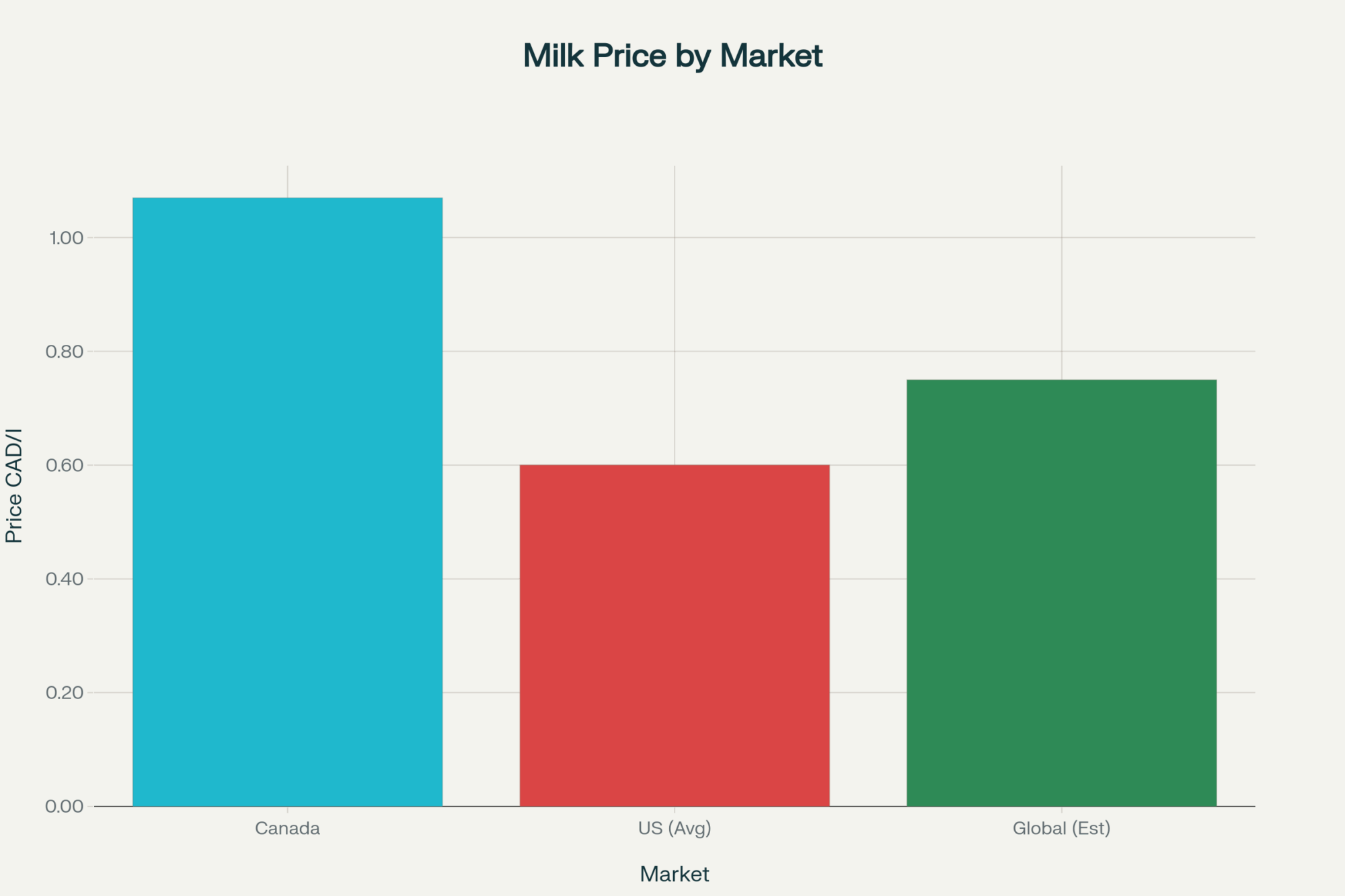
EXECUTIVE SUMMARY: Here’s what caught my attention—despite all the trade drama and those brutal 241% tariffs, American dairy still managed to ship $1.1 billion worth of product to Canada in 2024. But here’s the kicker… we’re only using about 21% of our allocated quota space, which means there’s nearly $900 million in untapped opportunity just sitting there. The research shows that with Bill C-202 now locked in and the 2026 USMCA review coming up, this trade fight is going to define the next decade of North American dairy economics. Canadian retail milk prices are hovering around CAD $1.07 per liter while we’re dealing with tighter margins down here. Smart producers who start building export relationships now—especially in the Midwest with those logistics advantages—are going to be first through the gate when those barriers start cracking. This isn’t just politics anymore, it’s real money with real potential.
KEY TAKEAWAYS:
Track quota utilization like milk prices – Only 21% filled means massive room for growth if allocation systems get fixed, potentially opening $900M+ in new market access for prepared exporters.
Build export co-op relationships now – Partner with processing facilities near the border and establish connections with Canadian buyers before barriers drop, especially if you’re running operations in Wisconsin, Minnesota, or New York.
Monitor protein markets for profit signals – Canadian dumping is hammering global protein prices by 8-12%, so watch for market corrections that could boost your ingredient revenue streams.
Position for 2026 USMCA review opportunities – Start documenting your export readiness and production capacity now, because when trade negotiations heat up, the prepared operations will capture the biggest opportunities.
Focus on specialty and premium products – Canadian retail prices show there’s appetite for premium dairy, so consider organic certification or specialty cheese production that commands higher margins in protected markets.
Look, I’ve been watching this dance between us and Canada for years, and this feels different. The political pressure is real, the economics make sense, and the timing with that USMCA review coming up… it’s all lining up.
The producers who move first on this are going to be the ones laughing all the way to the bank when those trade barriers finally start coming down. What do you think? Are you ready to step up when those market doors crack open?
You know what’s got the whole industry talking? It’s not just another trade spat—we’re looking at a genuine crack in the $1.1 billion Canadian dairy market that’s been locked up tighter than a first-calf heifer. The political winds are shifting, and for the first time in decades, that northern fortress might actually have some weak spots showing.
U.S. Dairy Quota Utilization in Canada (2024)
What’s Really Happening Up There?
The thing about Donald Trump’s renewed focus on Canadian dairy—and I’ve been watching this dance for years—is that it’s hitting different this time. His team’s threatening to match Canada’s brutal 241% tariff on over-quota imports, which sounds like political posturing until you realize we still managed to ship $1.1 billion worth of dairy north in 2024. That’s real money flowing despite the barriers.
But here’s where it gets interesting… Canada just passed Bill C-202 back in June, and this thing is welded shut. They’ve literally made it illegal for future trade negotiators to lower dairy tariffs or increase quotas. Think about that for a minute—they took negotiation off the table entirely.
What strikes me about this whole situation is how it mirrors what we saw with Japan’s beef quotas years back. Same playbook: use legislation to remove any wiggle room for future deals.
The Numbers That’ll Make You Think Twice
Now here’s the part that should grab every producer’s attention—we’re only filling about 21% of our allocated Canadian quota. Not the 42% you hear tossed around, but less than a quarter. That means nearly 80% of our negotiated access is just sitting there unused.
I was talking to a producer from Vermont the other day (you know how those Northeast operations are dealing with labor shortages and feed costs), and he put it this way: “We’re staring at Canadian retail milk prices around CAD $1.07 per liter while we’re trying to make sense of margins that barely pencil out.” That premium is serious money.
Retail Milk Price Comparison (CAD per liter)
Those tariffs work like a cliff edge, too. Inside quota? You’re golden with zero or low tariffs. Cross that line and boom—241% or higher depending on the product. It’s designed to be a hard stop, and honestly, it works perfectly.
Voices from the Trenches
Shawna Morris from the National Milk Producers Federation doesn’t mince words about this mess. She’s been pointing out for months that Canada’s quota allocation system heavily favors domestic processors who have zero incentive to bring in competing American product.
This isn’t happening in a vacuum either. When the latest round of tariffs kicked in, Canada fired back with retaliatory measures on $30 billion worth of U.S. goods, dairy included. Classic trade war escalation.
The Global Ripple Effect You Might Miss
Here’s something that caught my attention recently, and it’s bigger than just U.S.-Canada trade dynamics. Canada’s been dumping surplus dairy proteins—think skim milk powder—onto global markets at prices that are hammering worldwide protein markets by an estimated 8-12%.
If you’re a producer selling into ingredient markets, that hits your bottom line whether you’re exporting to Canada or not. It’s one of those interconnected things that doesn’t make headlines but shows up in your milk check.
This pattern is becoming more common… protected domestic markets subsidizing export dumping. We’ve seen it with EU dairy, we’ve seen it with New Zealand when they need to clear inventory. The difference here is scale and timing.
Looking at the Bigger Picture
Despite all the trade friction, the numbers tell an interesting story. Since USMCA took effect, U.S. dairy exports to Canada have grown by approximately 34%. That’s not the “quadrupled” figure you sometimes hear, but it’s solid growth in a heavily regulated market.
Those quotas are still managed with an iron fist by Canada’s supply management system—the Canadian Milk Supply Management Committee and Dairy Commission calling every shot. They’ve got this down to a science.
What This Means for Your Operation
Look, if you’re running a dairy operation and thinking about opportunities, here’s what I’d be watching closely:
Keep your ear to the ground on any shifts in U.S.-Canada trade policy, especially as the 2026 USMCA review approaches. That’s when the real horse-trading happens.
Pay attention to quota allocations. If we start seeing more import licenses going to retailers and food service companies instead of processors, that changes the entire game.
Watch protein markets like a hawk. Whether you’re selling domestically or internationally, those Canadian export practices are affecting your ingredient values.
And here’s the thing most producers miss—those 241% tariffs only kick in if you exceed quota limits. Since we’re not even filling a quarter of our allocated quotas, there’s actually room to grow within the existing framework if the allocation system gets straightened out.
Regional Realities Matter
This isn’t uniform across U.S. dairy regions either. Upper Midwest producers with established logistics networks might be better positioned if barriers fall. West Coast operations could find angles in specialty cheese markets. Northeast producers—especially in New York and Vermont—have proximity advantages for premium fluid milk markets.
I’ve been talking to producers from different regions, and the perspectives vary quite a bit. A guy running 800 head in Wisconsin sees this as potentially huge for his cooperative’s powder exports. Meanwhile, a family operation in Pennsylvania is more interested in what it might mean for their organic fluid milk premiums.
Bottom Line
Here’s my take after watching this industry for more years than I care to count: this feels like a rare opportunity for American dairy to crack into a premium market that’s been artificially protected for decades. But it won’t be easy, and it definitely won’t happen overnight.
The Canadian dairy fortress is real, and those political winds up north can shift faster than a July thunderstorm. Success will come to producers who stay informed, build the right relationships, and are ready to move when opportunities open up.
What’s got me optimistic is the combination of sustained political pressure, upcoming trade reviews, and the simple economics of the situation. When you’ve got American producers sitting on unused quota while Canadian consumers pay premium prices for milk, something’s eventually got to give.
The question isn’t whether change is coming to North American dairy trade—it’s whether your operation will be positioned to benefit when it does. This trade battle is going to define the next decade of North American dairy economics.
Your move: Start building relationships with export-focused cooperatives now. Monitor quota utilization reports. Keep tabs on processing capacity in border regions. Because when those barriers start coming down—and they will—the producers who moved first will capture the biggest opportunities.
What do you think? Are you ready to step up when those market barriers start cracking, or are you planning to wait and see how things shake out?
Complete references and supporting documentation are available upon request by contacting the editorial team at editor@thebullvine.com.
Learn More:
Unlocking Dairy Profits: The Top 5 Genetic Traits That Actually Make You Money – This article provides tactical strategies for boosting your operation’s core profitability. It complements the main article’s market focus by revealing how to strengthen your herd’s genetic foundation for resilience and efficiency, regardless of shifting trade winds.
Global Dairy Outlook 2025: Navigating a Buyer’s Market – While the main article zeroes in on Canada, this piece delivers a crucial strategic overview of the entire global dairy landscape. It’s essential reading for understanding how the Canadian situation fits into broader world market trends and risks.
Every week, thousands of producers, breeders, and industry insiders open Bullvine Weekly for genetics insights, market shifts, and profit strategies they won’t find anywhere else. One email. Five minutes. Smarter decisions all week.
Milk yields jumped 33 lbs per cow—what’s really driving this surge on farms like yours?
EXECUTIVE SUMMARY: Here’s what I’m seeing across the coffee shop circuit lately… milk production per cow climbed 33 pounds this year, and it’s not from throwing more animals at the problem. Smart operators are dialing in precision feeding and genomics, seeing feed efficiency gains hitting 8-12%. With corn prices sitting around $4.20 per bushel, a 500-cow operation can pocket over $1,500 monthly in feed savings alone. Globally, US dairy’s becoming the go-to partner for international buyers—they’re calling us “strategic partners” now, not just suppliers. The window’s wide open, but it won’t stay that way forever. Time to get serious about these tools before your neighbors beat you to it.
KEY TAKEAWAYS
Boost feed conversion 8-12% by implementing precision nutrition protocols—start by tracking individual cow intake and adjusting your TMR formulations based on production groups
Lock in $1,500+ monthly savings on a 500-cow operation by securing corn contracts under $4.50/bushel while prices remain historically low
Increase reproductive efficiency 15-23% through automated monitoring systems—but only if you invest in proper staff training and phased rollouts
Capture export premiums by maintaining top-tier milk quality and protecting margins with Dairy Revenue Protection enrollment (available quarterly)
Maximize genetic potential using genomic testing to identify high-value breeding decisions—ROI typically shows within 12-18 months on commercial operations
Examining these latest milk production figures, something is happening that has genuinely fired me up about where this industry’s headed. I mean, when was the last time you saw numbers like this? The 24 major dairy states cranked out 18.5 billion pounds in June – that’s 3.4% over last year, according to the USDA’s latest data drop – but here’s what really caught my attention…
This isn’t your typical “throw more cows at the problem” story we’ve been seeing for decades.
The thing about these numbers that nobody’s talking about…
What strikes me most about this production surge is how it’s happening. We’ve got 9.469 million head nationally (146,000 more than June 2024), but these girls are averaging 2,031 pounds per cow – a solid 33-pound jump from last year.
If you’ve been in this business long enough, you know that kind of per-cow improvement doesn’t just… happen.
I was talking to Jake Morrison out in Tulare County last week – he’s running 2,400 head, and his June numbers were up 41 pounds per cow year-over-year. “Andrew,” he says, “we didn’t change our genetics overnight. This is feed efficiency and management paying off.” And he’s absolutely right.
According to recent research from Penn State and UC Davis, precision nutrition programs deliver 8-12% feed efficiency gains when implemented correctly. This isn’t some consultant’s pipe dream anymore – this is happening on commercial dairies right now, and the June numbers prove it.
The second quarter hit 58.7 billion pounds, up 2.4% year-over-year. That turnaround from a sluggish first quarter tells you everything about how quickly this industry pivots when the economics align.
What’s driving the efficiency revolution
Here’s where it gets interesting – and I’ve been tracking this across multiple regions. The smart operators aren’t just celebrating cheaper corn… they’re completely rethinking their approach to nutrition management.
Tom Vlaeminck’s group at Cornell published findings earlier this year showing that targeted amino acid supplementation can improve milk protein yield by 0.8-1.2 pounds per cow daily while actually reducing crude protein intake. When you multiply that across a 1,000-cow operation… we’re talking real money here.
A Fresno dairy has been implementing precision feeding protocols since January. “We’re seeing 6% better feed conversion on average,” they told me, “but some fresh cow groups are pushing 10-11% improvement.” Their feed costs dropped $127 per cow per month while maintaining production.
That’s the kind of efficiency that shows up in these national numbers.
Feed costs are finally working in our favor (for now)
Herd Size
Daily Corn Consumption (lbs)
Monthly Savings at $4.20/bu
Annual Impact
100 cows
800
$300
$3,600
500 cows
4,000
$1,500
$18,000
1,000 cows
8,000
$3,000
$36,000
2,500 cows
20,000
$7,500
$90,000
Based on current market calculations and the USDA’s latest WASDE projections, corn is projected at $4.20/bushel, presenting opportunities we haven’t seen since 2019. For a 500-cow herd feeding 8 pounds of corn per head daily, that price drop translates to over $1,500 monthly savings – assuming you’re smart about procurement timing.
But here’s the thing – the producers winning right now aren’t just buying cheaper grain. They’re leveraging this window to invest in systems that’ll pay dividends when feed costs inevitably climb again.
The global vacuum creates our advantage
This domestic efficiency surge is occurring while global production is stumbling, creating a unique competitive advantage. Ben Buckner from AgResource Company nailed it when he told me last month: “We can see generally no one in the world producing more milk than in the previous year. That’s the driver you need to spark fear in the marketplace.”
For the US, this means our efficiency-driven growth is meeting a world market hungry for products. Class III futures have held above $22 per hundredweight for most of the second half, and when combined with reduced feed costs, it adds up to margins we haven’t enjoyed since 2014.
The timing couldn’t be better. US dairy exports hit $3.83 billion through May 2025 – up 13% year-over-year – with cheese exports setting monthly records. Notably, USDEC data show that our pricing competitiveness has improved dramatically against European suppliers, a trend observed across multiple export markets.
Recent case study analysis shows many farms adopting systematic precision nutrition protocols are achieving ROI within 12-18 months. That’s not theoretical – that’s documented on actual operations.
Strategy
Implementation Timeframe
Annual Benefit per Cow
ROI Timeline
Precision Nutrition Programs
3-6 months
$150-200
6-12 months
Genomic Testing
6-12 months
$75-125
12-18 months
Automated Milking Systems
12-18 months
$180-250
18-24 months
Feed Price Hedging
Immediate
$50-150 (variable)
Immediate
Health Monitoring Tech
6-9 months
$100-175
7-14 months
The tech revolution is finally delivering results
I’ll level with you – I’ve been skeptical of dairy tech promises for years. Too many vendors are selling dreams that don’t pencil out when you crunch the real numbers on actual farms.
But what I’m seeing now is different, and it’s got me cautiously optimistic.
What’s actually working (and what isn’t)
Recent research from the Journal of Dairy Science indicates that automated monitoring systems can improve reproductive efficiency by 15-23% when implemented correctly in conjunction with trained staff. The key phrase there is “properly implemented with trained staff,” which explains why some operations see dramatic improvements while others see minimal impact.
I spent time at Rick Peterson’s place in Minnesota last month – 950 cows, a full robotic milking system installed two years ago. “The first year was rough,” he admits. “We thought we could just flip a switch and everything would improve. Reality check – technology amplifies good management, it doesn’t replace it.”
His second year? Milk production up 18%, somatic cell count down 40%, and labor costs reduced by $23,000 annually. But that came after investing heavily in staff training and system optimization.
The regional story tells different tales
State
Production Increase (Million lbs)
Primary Growth Driver
% Change YoY
Idaho
+135
Robotic milking adoption
+9.7%
Texas
+131
Feed management systems
+9.5%
California
+91
Efficiency improvements
+2.7%
Kansas
+75
Strategic expansion
+19.0%
South Dakota
+45
Technology integration
+11.5%
What’s fascinating is how technology adoption varies dramatically by region, and the June production numbers reflect these differences.
Idaho’s 135 million pound year-over-year increase comes primarily from robotic milking adoption reaching critical mass, according to local extension data. Texas added 131 million pounds through strategic feed management systems and investments in climate-controlled housing for its expanding operations.
According to industry reports, precision feeding systems can generate annual savings of $35,000 to $45,000 for a 1,000-cow operation while reducing environmental nitrogen losses by 20%. That’s not just good economics – it’s essential insurance in an increasingly regulated environment.
But here’s what nobody talks about… the payback periods for integrated monitoring platforms are averaging 7-14 months for operations that do their homework upfront. The farms that struggle? They rush into wholesale technology changes without proper planning.
Global markets are opening doors (while they last)
The international picture is creating opportunities that might not be here tomorrow, and that’s what keeps me up at night.
European production has stumbled badly this year – Bluetongue disease hit harder than expected, and their environmental regulations are constraining expansion more than most analysts predicted. Meanwhile, New Zealand continues to struggle with supply growth constraints after its environmental framework changes.
Infrastructure timing couldn’t be better
Two major cheese processing facilities launched operations early this year, adding 360 million pounds of annual capacity right as production expands. According to Ever.Ag’s analysis shows that US butter maintains a 30-35% price advantage over global competitors after adjusting for fat content.
The language from global buyers has shifted, a point Mike North from Ever.Ag drove home:
“Global buyers are referring to US dairy suppliers as ‘strategic partners.'”
However, what worries me is that this window might not remain open if global competitors recover or trade policies shift unexpectedly. The smart money is capitalizing now while the advantage exists.
Export momentum builds on efficiency gains
US Dairy Export Composition Jan-May 2025
What’s particularly encouraging is how our efficiency improvements directly translate to increased export competitiveness. When you can produce more milk per cow with lower feed inputs, you create sustainable cost advantages that persist even when global markets tighten.
A Wisconsin operation I visited last month exports 40% of their cheese production. “Five years ago, we couldn’t compete internationally,” the owner told me. “Now, with our cost structure, we’re pricing European suppliers out of Asian markets.”
The challenges nobody wants to discuss publicly
Let’s be realistic about what’s ahead, because it’s not all sunshine and cheap corn.
The heifer crisis is real
Replacement heifer inventories sit at 47-year lows according to the USDA’s latest cattle inventory report. This fundamentally constrains traditional expansion strategies. You can optimize existing cows only so much before hitting biological limits.
Sarina Sharp from Daily Dairy Report hit something every producer I know is dealing with: “This heifer shortage means cows in the barn are older and less efficient on average than normal.”
But here’s where creative operators are adapting – extended lactation protocols, precision breeding programs, and strategic crossbreeding are maximizing genetic potential within existing herds. It’s not ideal, but it’s reality.
Weather dependency creates vulnerability
We’re essentially betting on achieving record yields for a third consecutive year with little margin for error. One major weather event could turn these favorable feed economics on their head overnight.
I was speaking with grain traders in Chicago last week – they’re concerned about subsoil moisture levels across key corn-producing regions. “We need near-perfect weather to hit these yield projections,” one told me. “Any significant deviation and corn prices jump fast.”
Technology headaches are real
Data security protocols, staff training requirements, backup system necessities… these aren’t trivial implementation challenges. The leading operations I track are implementing phased rollouts with comprehensive staff development rather than diving headfirst.
And the threat of HPAI hasn’t vanished. As of this month, USDA APHIS confirms cases in nearly 100 herds across 12 states. Smart biosecurity investments provide competitive advantages while protecting against production disruptions; however, the threat remains.
And here’s something that genuinely concerns me – domestic demand remains frustratingly flat. If export markets soften and we can’t absorb increased production domestically, we could see price pressure that quickly eliminates these efficiency gains.
What the smart operators are doing right now
The successful operations I’m tracking focus on three key areas, and they’re not waiting for perfect conditions.
Strategic feed program optimization
They’re optimizing based on total economic value rather than chasing commodity bargains. Danny Rodriguez, located in California’s Central Valley, showed me his procurement strategy – he locks in feed ingredients 6-8 months ahead by using options contracts, which protects against price spikes while maintaining flexibility.
“We’re not trying to time the market perfectly,” he explains. “We’re managing risk while capturing efficiency gains.”
Systematic technology implementation
Second, they’re implementing technology systematically with proper training rather than rushing into wholesale changes. The farms seeing real productivity increases aren’t the ones buying everything at once.
Recent work from USDA economists emphasizes that financial risk management through Dairy Revenue Protection programs is crucial, particularly given the anticipated volatility in feed prices and potential market fluctuations ahead. This isn’t the time to get caught without protection.
Building competitive moats
What’s fascinating about this June production surge is that it represents genuine, efficiency-driven growth, creating sustainable competitive advantages. The combination of strategic herd management, precision technology, and favorable input costs allows well-managed operations to capture both immediate profitability and long-term market positioning.
But here’s what you need to understand: this opportunity has an expiration date.
“This opportunity has an expiration date.”
Feed cost advantages could evaporate with weather events. Export markets may shift in response to policy changes. Technology ROI depends on proper implementation and staff buy-in.
Technology
Setup Phase
Training Phase
Optimization Phase
Full ROI Achieved
Robotic Milking
3-6 months
6-12 months
12-18 months
18-24 months
Precision Feeding
1-2 months
2-4 months
4-8 months
6-12 months
Health Monitoring
1-3 months
3-6 months
6-9 months
9-15 months
Automated Systems
6-12 months
6-9 months
9-12 months
15-24 months
The bottom line for your operation
For dairy operators, the path forward is becoming clearer every day. Here’s what I’d prioritize if I were still running cows:
Lock in feed advantages now through strategic procurement and hedging, not just spot buying. A December corn price under $4.50 is a gift from the market, while the USDA forecasts average farm prices at $4.20/bushel. Use options to cap upside risk while maintaining flexibility.
Invest systematically in actionable technology – monitoring systems, precision feeding, automated health detection – but implement with proper planning and training. The operations seeing documented productivity increases are the ones that treated technology adoption like any other major management change.
Optimize existing resources before expanding. With heifer inventories at 47-year lows, traditional expansion is expensive and slow. The most successful operations maximize their resources through better genetics, improved nutrition management, and strategic culling.
Protect your downside ruthlessly. DRP enrollment periods are available quarterly – don’t wait for price volatility to hit. The margins we’re seeing now won’t last forever, and the operations that survive the next downturn will be the ones that planned ahead.
The farms capitalizing on this moment combine traditional dairy expertise with modern efficiency tools and strategic market thinking. They’re not just producing more milk – they’re producing it smarter, more profitably, and more sustainably.
These June numbers represent more than just statistical success. They demonstrate how American dairy is positioning itself as the global industry leader through strategic capability rather than simple volume expansion.
The question isn’t whether this surge continues – it’s whether your operation will be positioned to capture the value while the window remains open. The producers who understand this shift and act accordingly will be the ones who remain profitable when the next market cycle arrives.
And in this business, that’s what really matters.
Complete references and supporting documentation are available upon request by contacting the editorial team at editor@thebullvine.com.
Learn More:
Cracking the Code: The 5 Management Secrets of High-Performing Herds – This article provides a tactical roadmap for turning efficiency theory into reality. It reveals the specific, data-driven management protocols that top herds use to boost health, reproductive performance, and overall profitability—the very foundation of the gains discussed above.
Navigating the Choppy Waters: Dairy Market Outlook and Risk Management Strategies – While our analysis highlights today’s favorable margins, this piece delves deeper into market volatility. It offers advanced strategies for using tools like DRP and options to protect those hard-won profits from the inevitable price swings ahead.
The Genomic Revolution: Are You Breeding for the Dairy Cow of the Future? – To address the heifer shortage and drive long-term efficiency, this piece explores how to leverage genomic data in your breeding program. It demonstrates methods for selecting traits that build a more resilient, efficient, and profitable herd for the next decade.
The Sunday Read Dairy Professionals Don’t Skip.
Every week, thousands of producers, breeders, and industry insiders open Bullvine Weekly for genetics insights, market shifts, and profit strategies they won’t find anywhere else. One email. Five minutes. Smarter decisions all week.
Only 3% of U.S. dairy herds are capturing an extra $50,000 a year in premiums—just by tweaking feed for better methane cuts and milk yield.
EXECUTIVE SUMMARY: Look, here’s the thing—dairy nutrition isn’t what it used to be. This new study out of Canada and Europe just blew the lid off a lot of what we thought was settled science. Add 3-NOP to your TMR and you can chop methane by up to 60% if you’re running a classic high-grain ration—compared to about 23% on high-forage. If you’re numbers-driven, think like this: a drop that size could swing your bottom line by $40,000–$65,000 a year in carbon premiums alone, especially as processors scramble for lower GHG numbers. Sure, feed costs are high, but so are the opportunities—milk yield held steady and the right bugs in the rumen actually pushed component efficiency higher. European herds? They’re banking new export contracts thanks to their methane score. With these shifts in global demand and processors rewarding verified results, you’d be nuts not to at least run the numbers on your own cows this season.
KEY TAKEAWAYS:
60% Methane Cut = More Cash in High-Grain Herds
If you feed a TMR with 60:40 grain:forage, you could drop methane output by over half. That translates to $0.20/cwt or more in new premium income on U.S. milk checks—as seen in recent Journal of Dairy Science research.
Action: Check your NDF/starch balance and look into adding 3-NOP with your nutritionist. It pays most with your homegrown corn silage, not just dry hay.
Stable Milk Yield—But Watch Your Component Testing
Trials showed no drop in milk volume, but some cows saw better butyrate or propionate numbers (thanks to friendly bugs like Lachnospiraceae NK3A20).
Action: Add routine VFA and milk component tests to your DHIA run—track ROI from new additives beyond just yield.
Not All Diets Are Equal: Forage vs. Starch Matters
University and USDA data say: for every extra 10g/kg NDF, 3-NOP’s methane knockdown is trimmed by 1.5%. In English? High-fiber, pasture-style herds get less bang for their buck.
Action: Ration balancing isn’t one-size-fits-all. If you graze or push baleage, adjust your 2025 feed plan before counting on big carbon credits.
Genomics—Pair with Your Feeding Program, Not Against It
The best response comes from cows already scoring high on feed efficiency and health and with balanced rations. Don’t just chase methane: connect genomic data to your TMR design for maximum returns.
Global Trend: Carbon = Cash, But Proof Matters
Whether you ship local or overseas, global milk buyers care about your methane numbers now more than ever. Processors want verifiable, science-backed reductions.
Action: Ask your co-op what’s required for carbon premium eligibility and document dietary changes—market volatility is your friend if you’re prepared.
Alright, let’s start here: Have you noticed how folks are buzzing about these “carbon incentive” premiums lately? Suddenly, every big processor from Michigan to Wisconsin wants a lower-methane label (even if last year’s butterfat price was the only number that mattered). “Methane mitigation” has evolved from a niche area of science to a strategic business consideration. Now, with 3-NOP actually making its way into more bulk tanks, everyone’s asking: Does it really move the needle—on emissions, performance, and the all-important milk check?
The Thing About 3-NOP and Those Big Promises
Here’s why producers on both 1,000-cow sand-bedded freestalls and old tie-stall barns are talking: Research out of Canada and Europe (as shown in the recent Choi et al., 2025 study in JDS) says you can cut methane by up to 60% on high-grain rations by adding 3-NOP to the TMR. On high-forage diets? The drop’s less dramatic, more like 23–37%.
But—and it’s a real ‘but’—”up to” are the operative words. What strikes me about this isn’t just the science. It’s that the how and what else matter just as much—the type of TMR, forage quality, and the way your cows respond.
What’s Really Happening in the Rumen?
There’s always some new additive promising the world, right? The unique thing about 3-NOP is that scientists have actually mapped out what’s changing under the hood. In simple terms, It blocks a key step in methane formation. But once you go past the headlines, the story gets messier (like when you try to price haylage and DDGs in the same week). According to that Canadian study, when 3-NOP was fed alongside a high-grain, 60:40 TMR (think: lots of corn, not just grass), methane dropped by 60%—numbers no one’s scoffing at during a carbon audit.
But what’s interesting is what’s getting nudged around microbially. The bugs in the rumen don’t just disappear. The Lachnospiraceae NK3A20 group, one of those names nutritionists quietly obsess over, actually increases regardless of whether you’re on a forage or grain-heavy TMR. Under high-forage, these bugs start making more butyrate (good for rumen health), but on high-grain, you get a bump in propionate pathways—likely helping energy balance for mid- and late-lactation cows.
And another thing—certain archaea (like Methanosphaera sp.) step forward when their methane-producing cousins get benched. Some of us remember when we thought killing “all methane bugs” was the goal; turns out, the rumen’s politics are trickier.
Translating Science to Real Farms: Dollars, Rations, and Cautious Optimism
I’ve talked to guys in the Thumb and Northern New York, and—real talk—nobody’s jumping at $0.20/cwt methane incentives unless feed conversion, components, or herd health are untouched. Here’s the thing, though: On Western-style herds running dry-lot TMRs loaded with starch, the numbers are starting to work, especially now that some co-ops are kicking in stacked premiums (tracked to actual DMI and manure methane).
But pull up to a Northeast grazing herd, and whether you’ll see more than a polite thank you is, well, anyone’s guess. Why? Because the NDF in pasture or baleage dilutes the effectiveness of 3-NOP. According to recent work from Dijkstra’s group, a 10g/kg DM increase in NDF reduces 3-NOP’s effectiveness by approximately 1.5%. So if you’re heavy on corn silage or buying in third-cutting alfalfa, you’ll see far better returns than the guy milking off rye grass.
Don’t forget: Weather swings, feed price spikes, and even water quality are local factors muddling this tidy “additive = profit” equation. The evidence points to more than just one answer, and even the top cows on paper don’t always perform like the trial herds.
What Nutritionists and Managers Are Actually Doing
I was talking to a consulting nutritionist out of Central Pennsylvania—the kind who remembers protein balancers made with fishmeal—and she summed it up: “It’s not just about cut-and-paste research. Milk yield, SCC, and butterfat trends still call the shots.”
Currently, some herds are conducting mini-trials independently—tracking group fresher intakes, VFA shifts, and even manure consistency alongside newly introduced 3-NOP. A few teams are plugging 3-NOP into their TMR software and then taking a “wait and see” stance on the incentive premium math. For others, carbon reduction is a happy accident—if it fits within a ration built for cows, climate, and cash flow.
Here’s what’s especially fascinating: The newest research suggests these microbial shifts aren’t just a science-fair curiosity. They might explain why some barns see stronger responses, especially when managing ration fermentability and transition cow stress.
I’m curious… What are you seeing as you plug 3-NOP into your own herd’s numbers? Is it showing up in your component testing, DHIA sheets, or just as a new line item in feed costs?
Bottom line from the parlor to the conference table
3-NOP is real, but its ROI is local. Herds with precise ration balancing, consistent TMR, and healthy fresh cows may see those big methane drops (and grab the new premiums). Operations tied more to high-fiber forages? Don’t put away the skepticism—but watch this space.
This development is fascinating, and I’d bet we haven’t seen the last twist in the methane story yet.
Is Your TMR Mixer Costing You More Than You Think? – This tactical guide reveals how to audit your mixing process for consistency. It provides actionable methods to ensure expensive additives like 3-NOP are distributed evenly, maximizing their effectiveness and protecting your return on investment at the feed bunk.
The Surprising Economics of Sustainable Dairying – Go beyond the hype and analyze the real-world financials of green initiatives. This strategic article breaks down how to leverage sustainability efforts for market access and higher premiums, providing a framework for making new technologies pencil out in your operation.
Dairy Farming in 2050: What Will Your Farm Look Like? – This forward-looking piece explores the integration of sensor technology, automation, and data in future dairy systems. It provides context for how methane inhibitors fit into a larger ecosystem of precision tools that will define the next generation of profitable dairying.
The Sunday Read Dairy Professionals Don’t Skip.
Every week, thousands of producers, breeders, and industry insiders open Bullvine Weekly for genetics insights, market shifts, and profit strategies they won’t find anywhere else. One email. Five minutes. Smarter decisions all week.
Milk yields are up, but did you know using beef-on-dairy strategies could boost your calf check by $400–$800 per head this year?
EXECUTIVE SUMMARY: Alright, let’s cut to it over this coffee. The old “breed everything for the parlor” playbook doesn’t pencil out in 2025. We’re sitting in a year where using beef semen on the bottom 60% of your cows—while protecting your genomics up top—can turn a $200 calf into an $800 windfall if you nail the timing and the market. The numbers are right there: this year’s bred replacements are averaging $2,660 a head, and some are clearing $4,000 at select Midwest barns. Meanwhile, global herd efficiency is tightening—herds that invest in sexed semen and genomic testing are shaving breeding costs and pulling ahead in ROI. Every market move from Ontario to Oklahoma says the same thing: if you’re not flexing with these tools, you’re losing ground. Give this strategy a hard look. It’s not just new—it’s smart, and it’s making some neighbors quietly profitable.
KEY TAKEAWAYS
Boost per-calf revenue up to $800: Start breeding lower-merit cows with Angus or SimAngus beef semen. Track market demand—2025 beef cross premiums are strong, especially when regional feeders are short.
Cut replacement costs by 20%: Roll out genomic testing (like Clarifide) and reserve sexed semen for your top 30–40% cows. Fewer home-grown replacements, but higher quality and less cash bled on average heifers.
Improve feed efficiency by $30–$45/head: Target beef-on-dairy calves for feedlot—Texas Tech and USDA numbers say these crosses gain faster and finish with better feed-to-gain than straight Holstein steers.
Use herd monitors (CowManager, Afimilk) for faster ROI: Tighten up open days and hit better conception with AI—smart heat detection is the easiest thing you’ll do this year for more predictable calf crops.
Plan for price swings and replacements: Don’t get caught chasing auction highs—model worst-case heifer shortages so your beef breeding never comes back to haunt you when the next drought zaps the market.
The thing about running numbers on a July night—long after the last fresh cow’s been checked and while tomorrow’s ration is still running through your mind—is you realize just how easily the whole game can tilt. One extra beef calf on the truck might mean an $800 check at Saturday’s sale… or leave you scrambling for a replacement heifer and wondering which one hurts worse: missing genetics or missing cash.
Mid-Thought, Mid-Shift: How the Beef-on-Dairy Boom Is Rewriting the Old Playbook
So, what’s really happening out here, across barns from the Texas Panhandle to upstate New York? The latest NAAB data shows U.S. dairies snapped up about 7.9 million units of beef-on-dairy semen in 2024—yep, another record, and it’s not some flash-in-the-pan. From what Hoard’s Dairyman and regional summaries are flagging, herds with 120 cows and 2,500 cows are both picking—and betting—on the same fork in the road. The truth is, whether you’re at the Michigan Milk Producers meeting or a WhatsApp group with Mennonite neighbors, the question is no longer “should we do beef-on-dairy?” anymore. It’s “how much beef, how fast, and on which end of the herd?”
Since overtaking sexed dairy in 2018, beef-on-dairy semen sales have skyrocketed, highlighting a fundamental strategic shift in U.S. dairy breeding priorities aimed at capturing new revenue streams.
What the Numbers—and the Auction Barn—Are Really Telling Us
This development is fascinating, precisely because it’s rooted in both economics and genetics. Recent USDA and Hoard’s Dairyman calf market data confirm regular $200–$400 premiums for beef crosses over straight dairy bull calves. At the better barn sales, that premium climbs—$600, sometimes even $800—for crossbred calves out of Holstein cows on a standard ration, especially with the right Angus or SimAngus bulls in the mix. But be careful: those numbers spike mostly when regional feedlot buyers jump in for supply. For most of us, the average falls lower.
What strikes me is how quickly individual auction highs can tempt an operation into risky territory. That’s classic “don’t bet the farm on a neighbor’s best day” stuff.
Meanwhile, heifer prices have become a true pain point. USDA’s spring report shows bred replacements average $2,660 and higher nationally, and $3,500 isn’t unusual in Ontario sales or California’s most competitive barns. Midwest producers are feeling the pain, and Canadian operators are taking note. Some springers—particularly if they have the genomics and look—have been going for $4,000. Is that sustainable? Probably not forever, but nobody expects a collapse soon.
This growing divergence between calf value and replacement cost is the core economic driver of the entire trend. The data from the last several years makes the math undeniable:
Comparison of U.S. Replacement Heifer Prices and Beef-on-Dairy Calf Premiums (2018–2025)
Year
Replacement Heifer Price ($/head)
Beef-on-Dairy Calf Premium ($/head)
2018
1,200
150
2019
1,450
200
2020
1,800
300
2021
2,300
400
2022
2,500
500
2023
2,700
600
2024
2,800
650
2025
2,900
700
The widening gap between soaring replacement heifer costs and rising crossbred calf premiums illustrates the powerful economic engine driving the beef-on-dairy strategy across North America.
Cutting to the Chase: Who Gets Bred to What (and Why)
Here’s how the best operations are acting, from what I see and hear. Genomic testing (Clarifide and similar) now sorts the top 30–40% for sexed dairy semen; the rest of the string typically receives proven calving-ease beef, often from Angus or Simmental breeds. Limousin? That’s popping up in some Western Canada barns this summer, too.
However, I must bring some nuance to this. There is no single playbook. A South Dakota dry lot might approach replacement math differently than a Wisconsin tie-stall or a New Mexico freestyle that can pivot to raise more young stock. Feed costs, labor availability, proximity to a progressive feeder—all of it matters.
Where real value shows up is in precision management. Herds using CowManager or Afimilk, or even just loyal pedometer tags, are shaving off open days, boosting conception rates, and matching cross-calves to premium buyers rather than just flooding the local calf market. One Vermont operation reported that they trimmed replacement costs by 20% in one spring simply by linking heat detection to more targeted breeding. That seems to be the trend everywhere—flexibility pays, not blanket strategy.
Data Meets Packing Plant: The Carcass Analysis Nobody Saw Coming
If you’d asked me in 2020 whether packers—or even feeders—would care about beef-on-dairy genetic lines, I’d have been skeptical. Now, conversations at packing plants often involve marbling, color, and dressing percentage—sometimes even ahead of component tests. According to recent work by Dr. Dale Woerner at Texas Tech, crosses are often graded Choice or better, up to 95% of the time, and the number hitting Prime is inching higher each year.
Want proof? USDA and Kansas State feedout analysis shows that crossbred steers often save $30–$45 in feed compared to Holstein peers, although local price swings and ration costs can alter that number. The feed-to-gain advantage? That’s what makes these calves easier to place; current trends suggest that crossbreds pencil out cleaner than straight Holstein steers without sacrificing much in daily gain, although results vary by region and season.
And as more herds adopt the Feed Saved trait, you’re not only chasing beef premiums but reducing feed cost per cwt of gain—good for the wallet and sustainability numbers.
The Downside: Genetics, Starvation, and Chasing Your Own Tail
Here’s where things turn dicey. Some folks get too excited about beef premiums, and the replacement pipeline dries up quickly. Suddenly, it’s a $4,000 invoice—or worse, settling for lower-genetic heifers that don’t boost production.
As Dr. Mark Stephenson of UW-Madison has warned, skipping in-house replacements means paying more and losing ground. Your milk yield, fertility, and even animal health can decline, and the genetic deficit can persist for years. That’s not just an American story. Canadian herd advisors echo the same thing: preserve elite genetics for the next generation, crossbreed only those cows unlikely to move your herd forward, and know your market backward and forward before that next breeding season.
What’s Brewing North of the Border?
Don’t overlook what’s unfolding up north. In Ontario and Quebec, barn space is tight, and the local veal market sets a high floor for crossbred calf prices. Semex’s Beef Up program is prevalent in those provinces, with some special sales reaching C$1,100–1,200 per top calf—although most prices are lower if supply surges.
Alberta, Manitoba, Saskatchewan? They’re betting on enough Holstein replacements but swinging hard on beef crosses heading for U.S. and Alberta lots. However, here’s the curveball: currency volatility, uncertainty among feeder buyers, and demands for traceability. Each province’s playbook is tailored to its specific market, not the national average.
Region
Strategy Focus
Top Beef Sires
Typical Calf Premium ($)
Midwest U.S.
Replacement shortage, beef cross
Angus, SimAngus
600–800
Ontario/Quebec
Veal, tight barn space
Angus, Simmental
900–1,200 CAD
Western Canada
Export markets, traceability
Limousin, Angus
500–900 CAD
Texas/West U.S.
Feedlot linkage, heat tolerance
Angus, Beefmaster
500–700
Bottom Line Box: Don’t Let the Premiums Blind You
Here’s the take-home, no matter where you milk:
Genomic test and prioritize your best cows—keep your replacements coming, don’t just chase beef checks. Use beef on the bottom cows only if you can place every calf with a buyer you trust. Run the numbers—include the ugly scenarios too. Don’t rely on a few standout sales to support your budget. Monitoring tools are a force multiplier, but nothing beats a sharp herdsman who knows the pen and the market calendar. Pay attention to shifts in both local and cross-border premiums; Canadian feeder play and Midwest calf demand can rapidly fluctuate prices. Count on averages, not outliers—don’t chase unicorns. Plan for tight spots: if replacements get scarce, your only “golden calf” might be an invoice.
This trend isn’t going away. The herds that keep their heads—wide awake to the risks, but willing to flex as markets and genetics shift—are the ones writing the new rules.
What strikes me about all this? We’re living through a real-time rewrite of dairy economics. Ten years ago, the “bull calf problem” was just a cost of milking cows; now, the right crossbred can write a check—even as the wrong math can bounce the next year’s herd into trouble.
So, keep probing, keep running your own numbers, and stay skeptical of quick fixes. Because in this business, adaptability and discipline—not trends—pay the bills.
Complete references and supporting documentation are available upon request by contacting the editorial team at editor@thebullvine.com.
Learn More:
Beef on Dairy: More Than Just a Black Calf – Go beyond just picking a black bull. This tactical guide breaks down the critical EPDs—from calving ease to carcass merit—to help you select beef sires that truly boost profitability without compromising the health of your dairy herd.
Don’t Let Short-Term Gains Ruin Your Long-Term Genetic Strategy – Before you go all-in on beef, read this. It outlines a strategic framework for protecting your dairy herd’s long-term genetic progress and profitability, ensuring today’s beef premium doesn’t become tomorrow’s genetic and financial deficit.
The Genomic Revolution: Are You Making Data-Driven Culling Decisions? – Maximize the value of your beef-on-dairy strategy with this deep dive into applied genomics. Learn how to precisely identify your lowest-ranking animals for beef breeding, improving overall herd efficiency and ensuring only elite genetics create your next generation.
The Sunday Read Dairy Professionals Don’t Skip.
Every week, thousands of producers, breeders, and industry insiders open Bullvine Weekly for genetics insights, market shifts, and profit strategies they won’t find anywhere else. One email. Five minutes. Smarter decisions all week.
June milk production jumped 3.4% while feed costs dropped — here’s how smart farms are cashing in on both trends.
EXECUTIVE SUMMARY: June numbers came in hot — 3.4% production jump to 18.5 billion pounds, and here’s the kicker… it’s not about pumping more milk anymore, it’s about making better milk. Operations focusing on components are seeing butterfat hit 4.23% and protein at 3.29%, which translates to an extra $15-20 per cow monthly. That’s $120,000+ annually for a 500-cow operation just from optimizing what’s already in the tank. Feed costs finally dropped too — corn’s forecast at $4.20/bushel, giving smart producers breathing room to upgrade their protein programs.The Canadians and Europeans are already ahead of us on this component game, and frankly… we’re playing catch-up. You need to start thinking genomics and precision feeding now, not next year.
KEY TAKEAWAYS
Component premiums are printing money — Farms averaging 4.5% butterfat and 3.4% protein are banking an extra $0.75-$0.90 per hundredweight. Start genomic testing your replacement heifers today and breed for components, not just volume.
Feed cost relief creates opportunity — With corn at $4.20/bushel, reinvest those savings into bypass proteins and amino acid programs. Operations doing this right are cutting total ration costs 15% while boosting milk quality.
Robot adoption is hitting breakeven faster — Early adopters are seeing 22-month paybacks at current milk prices, plus 23% labor cost reductions. If you’re milking 200+ cows and struggling with labor, run the numbers now.
Regional positioning matters more than ever — Texas and Kansas operations are locking in processing contracts while traditional dairy regions scramble. Secure your milk marketing agreements before capacity fills up.
Technology + genetics = competitive advantage — Farms combining genomic selection with precision feeding are outperforming volume-focused operations by $180,000 annually per 1,000 cows. The gap’s only getting wider in 2025.
We all felt it before the USDA numbers hit. June was… different. Tanks were fuller, checks looked better, and suddenly everyone’s talking about this 3.4% year-over-year production jump like it came out of nowhere. But here’s the thing—this wasn’t some fluke weather event or lucky break. This was years of strategic moves finally paying off, and if you missed it, you’d better understand why your neighbors are starting to pull ahead.
I was at a processor meeting last week, and the room went quiet when someone mentioned their June intake numbers. Dead quiet. Because everybody knew what those numbers meant—some farms are playing a completely different game now.
The Numbers That Actually Tell the Story
Indicator
June 2024
June 2025
Δ % YoY
24-state milk output
17.90 billion lb
18.50 billion lb
+3.4%
U.S. dairy cow herd
9.33 million hd
9.46 million hd
+1.4%
Milk per cow (24 states)
2,045 lb
2,110 lb
+3.2%
2025 Q2 output (U.S.)
58.6 billion lb
60.0 billion lb
+2.4%
The official USDA Milk Production report for June 2025 confirmed what we were feeling: 18.5 billion pounds of milk in the 24 major states, a 3.4% increase from the 17.9 billion pounds in June 2024. Production per cow hit a record 2,045 pounds, up 30 pounds from the same month last year.
The milk cow herd in the 24 major states was 9.03 million head, representing an increase of 151,000 head from June 2024. This expansion comes even as replacement heifer prices hold at record levels—and that’s telling you something about confidence in the fundamentals.
What’s really fascinating is how this played out regionally. Take the Central Valley—I know operations that are still struggling with H5N1 recovery from last fall. Some herds are still down 8% from pre-outbreak levels, but they are now seeing consistent monthly improvements.
Meanwhile, their neighbors—same feed, same climate, different management approach—posted double-digit jumps over last June. This isn’t just anecdotal. University extension specialists I’ve spoken with confirm this trend, noting that operations recovering from disruption are implementing comprehensive system upgrades, not just replacing what they lost.
What’s interesting is how this trend mirrors what we’re seeing globally. European producers have been dealing with their own production volatility, and New Zealand’s producers are facing similar challenges with weather patterns and input costs. The difference? U.S. producers who adapted early are actually gaining competitive ground internationally.
When you’re seeing fresh cows trade for $2,600-plus and operations are still expanding, what’s the outlook? That tells you where smart money sees profitability heading.
Feed Economics: The Game-Changer Nobody Saw Coming
Here’s where things get really interesting, and honestly, where I think some producers are going to get left behind if they don’t pay attention.
Feed costs. That elephant that’s been stomping around the room for what, three years now? But this spring changed everything. According to the latest USDA World Agricultural Supply and Demand Estimates (WASDE) report, corn is forecast at $4.20 per bushel for the ’25/’26 season. Soybean meal is projected to cost around $310 per short ton, which isn’t cheap, but it’s manageable when your energy costs drop.
Metric
June WASDE (May 12)
Revised June 24 Actual
Variance
Comments
2025 milk, calendar-yr
227.8 billion lb
Tracking 228.3 billion lb annualised
+0.5 billion lb
USDA lifted its forecast 500 million lb in July on herd growth
All-milk price (’25)
$21.95/cwt
Spot forecast $21.60/cwt
-$0.35
Higher supply offsets butter price strength
Class III (’25 avg.)
$18.65/cwt
Futures $18.40
-$0.25
Cheese inventories +4% YoY
Class IV (’25 avg.)
$18.85/cwt
Futures $19.05
+$0.20
Butterfat demand still robust
This created what I’m calling the “feed relief rally.” Suddenly, operations that were white-knuckling through $5+ corn could breathe again. But here’s the catch—and there’s always a catch, right? While corn prices became more favorable, protein costs remained stubborn.
This is the “barbell economy” in action: low-cost energy inputs on one side (like corn) and high-cost, high-value inputs on the other (like specific amino acids and bypass proteins).
Let me break this down with some real numbers. A 1,000-cow operation that was spending $180,000 monthly on feed last year might be looking at $165,000 now—if they strategically reinvested their corn savings into a more efficient protein program. That’s $180,000 annually back in their pocket, which could cover a robot payment, facility upgrades, or just straight profit.
I was speaking with a nutritionist who works with approximately 40 farms across the Upper Midwest. He told me something that really stuck:
“The farms that are crushing it right now aren’t the ones who just dumped more corn in the TMR when prices dropped. They’re the ones who used the corn savings to upgrade their protein program and push butterfat numbers.”
Dairy nutrition experts emphasize that corn cost savings should be reinvested in protein program optimization—something the industry has been preaching for years but now finally has the margin room to implement. The farms that figured this out early are the ones posting those eye-popping June numbers.
The Technology Revolution (Finally Paying Off)
What’s particularly noteworthy is how technology adoption is finally showing real ROI. Robotic milking systems are gaining significant traction across operations of all sizes, but the farms that use them strategically are seeing returns that make the rest of us take notice.
This development is fascinating because it’s not just about the U.S. anymore. Canadian producers have been ahead of us in adoption rates—about 8.7% of their cows are milked by robots, compared to our numbers—and they’re sharing data that’s helping to accelerate learning curves here.
Let me tell you about a Michigan producer I’ve been following—runs multiple robots on about 240 fresh cows, added another unit in March. His labor situation went from crisis to competitive advantage almost overnight.
Not because robots eliminate labor (they don’t), but because they let you deploy people where they actually add value instead of just standing in a parlor twice a day.
The investment’s substantial—we’re talking significant capital depending on the brand, features, and necessary facility retrofits—but this producer’s projecting a sub-24-month payback, based on current milk prices and redeploying labor units. Here’s his math: at $23.50/cwt milk and saving 1.5 FTE positions at $45,000 each, plus production gains of about 8 pounds per cow daily… the numbers work.
He said something that really hit me:
“I’m not just buying equipment, I’m buying the ability to scale without scaling my biggest headache.”
But here’s what nobody talks about enough… the learning curve is steep. Really steep. I am aware of another operation that installed robots last year and spent six months dealing with cow traffic issues because they hadn’t properly redesigned their facility. They’re finally hitting their stride now, but those first six months were brutal.
Robotic milking specialists indicate that facility design accounts for the majority of system success. You can’t just drop advanced technology into an existing setup and expect miracles.
Butterfat Numbers Don’t Lie (And Neither Do Paychecks)
This is where genetics finally started paying real dividends. We’ve been hearing about genomic selection for years, but 2025 is when you can actually see it in the tank and on your milk check.
According to a Q2 2025 analysis from CoBank’s Knowledge Exchange, national butterfat levels hit 4.23% in 2024, and early 2025 data suggests we’re not backing off that trend. Protein is averaging 3.29% across the Federal Milk Marketing Order system, which means your component checks are carrying more weight than ever.
The farms that figured this out early? They’re not just making more milk; they’re making more valuable milk. And in a multiple-component pricing world, that’s everything.
What strikes me about this shift is how it’s creating entirely different business models. Traditional volume-focused operations are finding themselves competing against component-optimized farms that might produce less total milk but generate higher revenue per hundredweight.
I know operations—particularly in Pennsylvania and the Northeast—that have been laser-focused on components for three years. They’re averaging well above 4.5% butterfat and pushing 3.4% protein. Their June component premiums alone were worth an extra $0.75-$0.90 per hundredweight over regional averages. With decent production per cow, that’s serious money—sometimes $15-20 per cow per month straight to the bottom line.
Pennsylvania dairy producers focusing on components report significant premium advantages that compound month after month. As one told me recently, “Every genetic decision, every feeding tweak, every management choice gets measured against components first, volume second.”
Here’s the math that’ll get your attention: a 500-cow operation averaging 70 pounds per cow daily with a $0.80/cwt component premium is looking at an extra $10,080 monthly. That’s $120,960 annually just from optimizing what’s already in the tank.
Regional Reality Check: Winners and Losers Emerge
Region
Stand-out States
YoY Δ %
Contributing Factors
Southwest
Texas
+9%
45,000-cow expansion, new panhandle cheese capacity
High Plains
Kansas
+16%
16,000-cow build-out; three large green-field barns filled
21,000 more cows, genetic gains in fat % and protein %
Northwest Coast
Washington
-3%
Lingering HPAI culls, heat-stress spike mid-month
Here’s what’s happening in the real world, away from the national averages, and this is where it gets uncomfortable for some folks.
The expansion states—Texas, parts of Kansas, South Dakota—they’re building fresh capacity and filling it with good genetics and modern management. Meanwhile, some traditional dairy regions are watching this shift and wondering if they missed the boat.
Take Texas… they’ve been aggressive about new greenfield operations near those big cheese plants in the Panhandle. I heard from contractors working on multiple 4,000-cow facilities that’ll be online before Christmas. That’s not just growth; that’s strategic positioning, with $10 billion in new processing assets coming online throughout the U.S. through 2027.
Metric
Jan–Jun 2024
Jan–Jun 2025
Δ %
Driver
U.S. cheese exports
497 million lb
540 million lb
+8.7%
EU supply constraints
Skim-powder exports
772 million lb
735 million lb
-4.8%
China demand lull
Butter-fat exports
52 million lb
74 million lb
+42.3%
MENA bakery demand
This pattern of strategic positioning around processing hubs isn’t unique to the U.S.; it reflects consolidation trends we’re seeing internationally. Australia has been consolidating its operations for years, and European producers are facing similar pressure to scale or specialize. The difference is that our expansion states still have access to land and water that much of the world lacks.
California’s recovery from H5N1 has been slower than anyone had hoped, but the operations that came back strong implemented biosecurity measures that should’ve been standard practice years ago. It’s expensive—around $12,000 per 1,000-cow facility from what I’m hearing—but the alternative is watching your herd get wiped out.
Here’s the thing, though… some of the traditional dairy regions are fighting back smarter than expected. I know operations in New York and Wisconsin that are leveraging their location advantages—being closer to population centers, having better infrastructure, and established relationships—to compete on service and quality, rather than just scale.
Agricultural economists observe that location advantages, combined with management expertise, create a competitive positioning that’s hard to replicate through size alone.
The Management Revolution Behind Those Numbers
What strikes me most about June’s numbers isn’t the production increase—it’s the management sophistication that made it possible. Precision feeding, genetic optimization, and facility design… these are no longer buzzwords. They’re the difference between farms that thrive and farms that just survive.
The operations killing it right now have figured out that success isn’t about any single technology or practice. It’s about systems thinking.
Feed management that optimizes for components, not just pounds. Genetics programs that target profitable traits. Facility design that works in harmony with cow behavior, rather than against it.
I was on a farm in Ohio last month—approximately 450 cows, but every system was perfectly dialed in. The owner walked me through their feeding program, and I swear, he knew the exact cost per pound of every ingredient and how it impacted milk composition. His feed efficiency was running 1.38 pounds of milk per pound of dry matter—that’s exceptional territory.
That level of precision… it’s evident in the numbers. And honestly? A lot of farms are still fighting the last war—optimizing for milk volume when the money’s in milk value.
This trend suggests we’re moving into an era where data literacy becomes as important as animal husbandry skills. The operations that can merge traditional stockmanship with modern analytics are building sustainable competitive advantages.
Risk Factors Nobody Wants to Discuss
Here’s where we need to get real for a minute, because this success story has some warning signs attached.
Weather dependency is huge. June’s favorable conditions helped, but we’re heading into August heat with climate patterns that, to be honest, are unpredictable. The operations that have invested in cooling systems and heat stress management are likely to have a significant advantage if another scorching year like 2023 is on the horizon.
Current global weather patterns are exhibiting concerning similarities to 2012—the last time we experienced a particularly devastating drought. European producers are already facing water restrictions in some regions, which is creating ripple effects in global feed markets.
Processing capacity constraints are building. Those big cheese plants everyone’s building to supply? They’re already running at 85-90% capacity. When they hit their limits, spot milk pricing will become volatile—and not in a way that favors producers without solid contracts.
Labor quality and availability continue to deteriorate in most regions. Technology can help, but it can’t fix everything. The farms that are succeeding aren’t just investing in automation, they’re investing in training their people to work with advanced systems.
Water availability is the sleeper issue. For producers in the West and Southwest, securing long-term water rights is becoming as critical as securing a feed contract. The new facilities in Texas are being built with water strategy as a primary concern, a risk factor that can no longer be ignored.
There’s also a global factor we don’t discuss enough—currency fluctuations affecting export competitiveness. When the dollar strengthens, our exports get more expensive, and that matters more now that we’re producing component-rich milk that commands premium prices internationally.
Forward-Looking: What This Means for Your Operation
Looking ahead, the fundamentals that drove June’s success remain in place, but the competitive landscape is shifting rapidly. Feed costs appear manageable through harvest, and processor demand remains solid. The farms that invested in the right infrastructure are well-positioned to continue capitalizing.
However, here’s the uncomfortable truth: a storm cloud is building that nobody wants to discuss. What happens when everyone catches up? The competitive advantage of being early to automation, early to component optimization, early to precision management—that advantage erodes as more farms make these moves.
The question isn’t whether your operation should modernize. The question is whether you can afford to wait while your neighbors build advantages that’ll be hard to overcome.
I was talking to a banker who specializes in dairy financing, and he put it perfectly:
“The farms that are borrowing money for technology and genetics right now are going to be the ones buying their neighbors’ cows in three years.”
June’s numbers weren’t just about good weather and cheaper corn. They were about an industry finally reaching its stride after years of changes. The farms that understood this early are reaping the rewards. The ones still figuring it out? They better move fast, because this train’s picking up speed.
What’s happening globally reinforces this urgency. Producers in other major dairy regions are making similar transitions, and the competitive landscape is becoming increasingly sophisticated. The margin for error is shrinking, and the rewards for getting it right are growing.
The result is undeniable: we’re creating two different dairy industries. One that’s profitable, efficient, and sustainable. And one that’s just trying to hang on.
The question is, which one are you building?
What’s your best ROI technology investment of 2025? Share your experience in the comments below—your insights could help a fellow producer make the right call.
Complete references and supporting documentation are available upon request by contacting the editorial team at editor@thebullvine.com.
Learn More:
The Butterfat Revolution: 5 Strategies to Maximize Your Component Premiums – This article provides the tactical “how-to” behind the main story’s component theme, offering five actionable feeding and management strategies you can implement immediately to boost butterfat production and capture higher premiums on every shipment.
Beyond the Robot: How AI is Creating the ‘Smart’ Dairy Barn – If robotics is today’s revolution, AI is tomorrow’s. This piece explores the next frontier of dairy tech, demonstrating how artificial intelligence is being used to integrate data, predict health events, and find efficiencies you never knew existed.
The Sunday Read Dairy Professionals Don’t Skip.
Every week, thousands of producers, breeders, and industry insiders open Bullvine Weekly for genetics insights, market shifts, and profit strategies they won’t find anywhere else. One email. Five minutes. Smarter decisions all week.
Butter crashed 6¢ in one day while Class III futures lost 49¢—your Oct milk checks just took a $1.50/cwt hit. Time to hedge?
EXECUTIVE SUMMARY: You know that sick feeling when you check CME prices and everything’s red? That’s exactly what happened yesterday, and most producers are still treating this like temporary market noise instead of the fundamental shift it actually is. Butter dropped nearly 6 cents to $2.42/lb while NDM fell over 2 cents—that’s real money bleeding out of September and October milk checks, potentially $1.20 to $1.50 per cwt if this trend holds. Meanwhile, cheese markets remained completely silent for three straight days, indicating that buyers think we’re headed lower. European butter is trading 90 cents per pound higher than ours, but our powder pricing has pushed us out of key export markets just when we need them most. The producers who survive this aren’t the ones hoping for a bounce—they’re the ones booking winter feed at today’s lower prices and getting serious about risk management tools like DRP before it’s too late.
KEY TAKEAWAYS
Lock in Q4 feed costs immediately – Corn dropped 5¢ to $4.17/bu and soy meal fell $1.00/ton, but those savings disappear fast when milk drops $1.50/cwt. Book 60-70% of winter needs now before this window closes.
Dairy Revenue Protection isn’t optional anymore – With Class III futures pricing $17 range through fall, spending $1-2/cwt on DRP coverage beats taking a $3-4/cwt hit on unprotected milk. Do the math on 75 lbs/cow/day.
Component management = survival in 2025 – Butterfat premiums are holding while protein values crater. Every 0.1% improvement in milk fat is worth an extra $0.30/cwt when margins are this tight.
Regional basis will deteriorate next – Upper Midwest transportation costs are already up 12% year-over-year. If spot markets remain weak, the local basis will drop another 20-30¢ below already thin levels.
Cash flow planning needs immediate adjustment – September/October milk checks could run 50-75¢/cwt below budget. Delay expansion projects, postpone equipment purchases, and prepare for 6 months of defensive operations.
You ever have one of those days where you walk into the parlor and just… sense something’s off? Well, that’s exactly what happened in the dairy markets today, except instead of a cow going down, we watched butter crater nearly 6 cents to $2.42/lb. And nonfat dry milk? Don’t even get me started—dropped over 2 cents like a rock.
Here’s what’s really getting under my skin, though: the cheese markets went completely radio silent. Zero trades on blocks and barrels for the third straight day. When cheese traders won’t even show up, you know we’re in trouble.
But here’s the thing that’s got me reaching for the Tums—Class III futures just dropped 49 cents today. That’s not market noise, folks. That’s your September and October milk checks taking a direct hit. Yeah, corn’s cheaper (thank goodness for small favors), but it’s nowhere near enough to offset what’s shaping up to be a brutal couple of months ahead.
CME Cash Dairy Price Trends from July 21 to 23, 2025
What Actually Went Down Today
The price action tells a story, and honestly? It’s not pretty for any of us milking cows right now.
According to the latest CME cash trading data, butter got absolutely hammered—down 5.75¢ to $2.4200/lb with three loads changing hands. When you see that kind of volume on a down move, it means sellers were desperate and buyers were nowhere to be found.
Cheese blocks stayed glued at $1.6425/lb, but here’s the kicker… zero trades for the third day running. Same deal with barrels at $1.6600/lb. I’ve been watching these markets for fifteen years, and when you see this kind of paralysis, it usually means something bigger is brewing underneath.
NDM took a 2.25¢ hit down to $1.2800/lb—and here’s where things get interesting. We’re now pricing ourselves right out of several key export markets. More on that mess in a minute.
Dry whey dropped another penny to $0.5375/lb. Every cent this stuff loses comes straight out of your Class III check. Period.
What really strikes me about today… this wasn’t some fluke in a thin market. We had decent volume in both butter and NDM, which tells you these moves have conviction behind them. When traders are willing to move product at these levels, they’re making statements about where they think things are headed.
Inside the Pits—What the Floor Traders Are Really Saying
The thing about CME trading floors is that they don’t lie. Today’s butter pit was pure chaos—more offers than bids, and that spells desperation selling. Sellers were practically begging to move product while buyers just vanished into thin air.
Meanwhile, cheese land looked like a ghost town. Industry sources are telling me nobody wants to catch a falling knife right now. The sentiment on the floor was crystal clear—wait and see how low this thing goes.
Here’s what’s got me really concerned—Class III futures crashed right through that psychological $17.50 support level we’ve all been watching. That level’s now resistance, and the next major floor to watch is around $17.00. Break that? We could see some real panic selling kick in.
The Global Picture—And Why Our Powder Problem Just Got Worse
Now this is where things get both fascinating and terrifying. Today’s price drops created some wild competitive dynamics that every producer needs to understand.
Current market intelligence suggests our butter has become genuinely competitive globally for the first time in months. European markets remain elevated with futures above €7,000/MT, while New Zealand is dealing with their own domestic supply crisis. Get this—butter prices in New Zealand have jumped 46.5% in just the past year, hitting NZ$8.60 for a 500-gram block. That’s creating real opportunities for U.S. exports if we can sort out the logistics headaches.
However, here’s where it gets ugly… our NDM situation is on the verge of being disastrous. Industry sources are telling me we’re now priced alongside or above key competitors in several markets. A processor buddy of mine in Tulare mentioned they’re seeing European powder showing up in quotes they haven’t seen since early 2024. That’s not good news for anyone banking on powder exports to prop up skim values.
What’s particularly concerning to me is hearing that several major butter plants, which were down for extended maintenance, are coming back online over the next few weeks. That’s adding supply right when demand is showing serious cracks.
Historical Reality Check—Where We Stand
Let me put today into perspective, because the numbers are quite sobering. Looking back at historical patterns, butter’s 6-cent single-day drop is the biggest we’ve seen since early June. However, what’s really concerning is that we’re now trading about 8% below where we were this time last year.
The cheese market’s three-day trading freeze? That’s unprecedented in my experience for this time of year. Normally, July’s when food service demand picks up for back-to-school prep, but that buying just isn’t materializing.
What’s particularly noteworthy is how this compares to seasonal patterns. Typically, we see some softening in July as spring flush milk works through the system, but this feels different. The fundamentals suggest we should be seeing more support at these levels, which makes me wonder if demand destruction is happening faster than anyone anticipated.
Regional Spotlight—What’s Really Happening in Your Backyard
Upper Midwest: I’ve been speaking with producers across Wisconsin and Minnesota, and the sentiment is becoming increasingly grim. The whey weakness is particularly brutal here, as it directly impacts Class III pricing. A producer near Eau Claire mentioned that his co-op’s field representative came by yesterday specifically to discuss risk management for Q3 and Q4 milk. When co-ops start pushing hedging conversations, that tells you everything you need to know.
The basis relationships in this region have been relatively stable, but if spot markets stay weak, you’ll see that local basis start to deteriorate. Transportation costs to major cheese plants are up approximately 12% from last year, adding pressure to already thin margins.
California: Central Valley plant managers are reporting something I haven’t seen in years—steady but completely uninspired demand. Food service orders are coming in, but nobody’s building any inventory. Everyone’s going hand-to-mouth, which is usually a red flag for demand weakness ahead.
The heat’s also becoming a real factor. Temperatures have been running 5-7 degrees above normal, which is putting stress on herds just when they need peak production efficiency. Some operations are seeing milk fat tests drop as cows try to cope with the heat stress.
Cheese processing sources report that retail orders remain steady for food service, but retail buying has gone completely quiet. Nobody wants to build inventory right now—they’re all waiting to see if the whole complex resets to a lower level. When retailers start playing that game, it usually means they expect prices to keep falling.
Northeast: Fluid milk demand remains the bright spot, but that Class I differential isn’t nearly enough to offset what’s happening in the commodities. Smaller operations, especially, are feeling the squeeze. A producer in Vermont told me he’s seriously considering his first futures hedge in over five years—that’s how nervous folks are getting.
Southwest: This region has been the growth story of the dairy industry, but expansion plans are being put on hold. Several planned facilities in New Mexico and Texas are reportedly delaying construction starts. When expansion capital dries up, that’s usually a leading indicator of longer-term challenges.
Feed Markets—The One Silver Lining
At least there’s some decent news on the input side. Corn dropped about 5 cents to around $4.17/bu for December, and soybean meal fell over a dollar to $285.60/ton.
Looking at historical ratios, anything below 2.0 on the milk-to-feed calculation makes margins pretty tight, and that’s exactly where we’re sitting right now. The drop in milk prices today more than wiped out any benefit from cheaper feed, so we’re still looking at squeezed margins across the board.
Here’s what I’m hearing from producers across the Midwest—with local corn prices softening, smart operators are starting to book winter feed supplies now. This is becoming more common as producers get more defensive about input cost management. If you haven’t secured at least a portion of your Q4 feed needs, this may be your last opportunity.
Forward Market Reality—And Why the Math Gets Ugly
The futures curves are painting a pretty clear picture for the next few months, and honestly? It’s not encouraging for anyone milking cows.
Class III appears to be pricing in the mid-to-low $17 range through the fall. That’s a significant reset from where we were just two weeks ago. Class IV futures held up better today, but they appear increasingly disconnected from developments in the spot butter and powder markets.
According to recent discussions with USDA economists, the next round of official forecasts will likely reflect this new weakness. Private analysts are already slashing their Q3 and Q4 projections, with some suggesting that the Class III price could dip below $17.00 if current trends continue.
What’s particularly troubling is the shape of the forward curve. Normally, you’d expect to see some recovery pricing built into the back months, but the December contracts are barely above current levels. That suggests the market doesn’t expect any quick fixes to be forthcoming.
What You Need to Do Right Now—No Sugar Coating
Look, I’ve been through enough of these cycles to know when it’s time to stop hoping and start acting. If you’ve got unpriced milk for the back half of the year, today was your wake-up call.
The Dairy Revenue Protection program is still available with reasonable premiums. For those not familiar, DRP lets you insure against unexpected revenue declines on a quarterly basis, and right now, it might be the best insurance policy you can buy.
Put options for Class III futures make sense if you can handle the premium costs. The math is relatively simple—if you’re considering potential milk prices in the low $17 range, spending a dollar or two per hundredweight to establish a floor starts to look quite attractive.
Here’s a quick calculation to think about: if you’re milking 500 cows averaging 75 pounds per day, a $1.00/cwt drop in milk price costs you about $1,125 per month. Hedging part of that risk starts to look pretty reasonable when you run those numbers.
On the feed side, this dip in corn and soy prices is creating an opportunity you shouldn’t ignore. I recommend discussing with your nutritionist how to plan for at least 60-70% of your winter needs. Every penny you can shave off production costs matters when milk prices are under this kind of pressure.
The Risk Management Reality Check
Different operations require different strategies, and there’s no one-size-fits-all solution.
Large Commercial Dairies: You’ve got access to more sophisticated tools—futures, options, basis contracts, LGM coverage. Use them. This isn’t the time to go naked on milk price risk just because hedging costs money. Your scale can help absorb some volatility, but you need to be proactive about protecting margins.
Mid-Size Family Operations: Focus on feed cost management first, then consider partial hedging strategies for your most vulnerable periods. You can’t afford to take the full hit if this trend continues. Component management becomes absolutely critical—every tenth of a butterfat percentage point matters more now than it has in years.
Smaller Producers: Cash flow is everything. Adjust your budgets for September and October milk checks, which may be significantly lower than what you have budgeted. Consider whether operational changes are necessary at these price levels—perhaps the expansion project is delayed or the equipment purchase is postponed.
Regional co-op field staff are reporting more hedging conversations with producers than they’ve seen in years. When farmers who’ve never hedged before start asking questions about risk management, that tells you the psychology is shifting.
The Uncomfortable Truth About Where We’re Headed
Here’s what’s keeping me up at night about today’s action—this wasn’t just a bad day, this was a fundamental shift in market psychology. Butter’s 6-cent drop breaks the bullish momentum we’d built going into summer, and the cheese market’s complete shutdown suggests buyers see more weakness ahead.
According to USDA weekly data, we’re seeing inventory builds in some categories that suggest demand isn’t keeping pace with production, even as we move past the spring flush period. That’s not a great sign for price support going forward.
What’s really concerning is that this is all happening while feed costs are actually moderating. That indicates the pressure is primarily on the revenue side, which makes margin management even more critical for survival.
The market is essentially telling us that the optimism of early summer was overdone. Export demand isn’t materializing as expected, domestic consumption is steady but not inspiring, and production—while seasonally declining—isn’t falling fast enough to balance things out.
This development is fascinating from a global competitiveness standpoint. Our butter is now genuinely competitive internationally, but our powder pricing has pushed us out of several key markets. That creates this weird split personality for the industry—great for butterfat, terrible for protein values.
Here’s my honest assessment… we’re looking at a fundamental reset in pricing that could persist through the back half of 2025. The fundamentals haven’t disappeared—global demand for dairy products remains solid, U.S. production efficiency continues to improve, and we’re still the most reliable supplier for many key markets. But in the short term? It’s about cash flow management and survival.
The producers who’ll thrive through this period are the ones who recognize that this isn’t just a temporary dip—it’s a new reality that requires different strategies. Risk management is no longer optional; it’s essential. Feed cost control isn’t just good business, it’s survival.
What gives me hope is that this industry has weathered worse storms. We adapted to the 2014-2015 downturn, survived the trade war disruptions, and navigated the COVID chaos. We’ll figure this one out too, but it will require some tough decisions and smart risk management.
The conversation we need to be having isn’t about when prices will recover—it’s about how to structure our operations to be profitable at these levels. Because until the global supply-demand balance shifts significantly, this might just be the new normal we’re dealing with.
How are you adapting to these new market realities? What strategies are working on your operation? This isn’t just about surviving the next few months—it’s about positioning for whatever comes next.
Complete references and supporting documentation are available upon request by contacting the editorial team at editor@thebullvine.com.
Learn More:
Dairy Farming on a Budget: 12 Frugal Strategies for Tough Times – This guide delivers practical strategies for protecting your bottom line during price downturns. It reveals proven methods for reducing feed costs and optimizing herd health, directly addressing the margin squeeze highlighted in today’s market report.
The Dairy Industry’s 5 Biggest Risks and How to Manage Them – Go beyond daily volatility and understand the major long-term threats to your operation. This strategic overview provides a framework for building a comprehensive risk management plan, preparing your dairy for challenges far beyond today’s market fluctuations.
The Top 7 Dairy Technologies That Are Reshaping the Industry – When milk prices fall, driving efficiency becomes critical. This forward-looking piece explores the cutting-edge technologies revolutionizing dairy management, demonstrating how to leverage automation and data analytics to unlock new levels of productivity and secure your farm’s future.
The Sunday Read Dairy Professionals Don’t Skip.
Every week, thousands of producers, breeders, and industry insiders open Bullvine Weekly for genetics insights, market shifts, and profit strategies they won’t find anywhere else. One email. Five minutes. Smarter decisions all week.
Feed efficiency gaps are costing you $91K annually—while smart ops bank $2.50/cwt savings through conversion ratio tweaks.
Executive Summary: Look, I just finished analyzing what’s really happening with dairy margins in 2025, and honestly? Most producers are fighting the wrong battle. While everyone’s obsessing over that $21.60/cwt milk price forecast, the real money is hiding in feed conversion ratios and component optimization. University of Wisconsin data shows operations hitting 1.4 pounds milk per pound of dry matter are saving $2.50/cwt compared to farms stuck at 1.2 ratios—that’s potentially $91,250 annual savings for a 250-cow herd. Plus, every 0.1% butterfat increase adds $0.35/cwt, which means $24,000-30,000 extra revenue for decent-sized operations. The global trend is crystal clear: European producers are already leveraging these efficiency gains while North American farms lag behind, still chasing volume over precision. Here’s my advice—stop waiting for better milk prices and start implementing feed efficiency programs, component optimization, and strategic automation investments that deliver measurable ROI regardless of market volatility.
Key Takeaways
Master your feed conversion ratios immediately — Target 1.4 lbs milk per lb dry matter to save $2.50/cwt versus inefficient herds, translating to $91,250 annual savings for 250-cow operations under 2025’s tight margin environment.
Optimize milk components for instant payouts — Every 0.1% butterfat increase delivers $0.35/cwt premium, so focus genetic selection and nutrition management on hitting 4.5% fat and 3.5% protein targets for $24,000-30,000 additional annual revenue.
Implement 40/30/30 risk management strategy — Blend six-month forward contracts (40%), three-month agreements (30%), and cash market exposure (30%) to protect cash flow while preserving upside potential in volatile 2025 markets.
Evaluate automation based on current labor reality — Robotic milking systems showing 18-30 month paybacks make financial sense despite 6.5% interest rates if you’re struggling with $18-20/hour milking positions and 60%+ labor shortage impacts.
Leverage regional FMMO advantages strategically — Northeast operations gained $2.20/cwt in Class I differentials worth $19,800 annually for 1,000-cow dairies, while Upper Midwest farms need efficiency improvements to offset pricing headwinds from the reformed structure.
The current state of dairy economics isn’t pretty. While retail food costs climb, your milk price has barely budged, creating a margin squeeze that’s hitting every operation from the smallest family farm to the mega-dairies. This analysis unpacks the math that isn’t adding up for producers, covering the integrated North American market to provide strategies for addressing the issue.
The most frustrating part of this situation is that the math simply doesn’t add up for producers, forcing some difficult conversations in farm offices across the country. It’s the kind of pressure that leads to uncomfortable budget meetings where the numbers no longer work.
What’s Really Happening to Producer Returns
Let’s start with what we know for sure. USDA’s latest food price outlook shows food prices jumped 2.9% year-over-year through May 2025. Meanwhile, industry reports suggest dairy retail prices have been climbing even faster—somewhere in the 5% range, according to various market research I’ve been tracking.
That disconnect should worry every producer reading this. Consumers are paying more for your products, but you’re not seeing those increases flow back to the farm gate.
Feed’s still eating up over half your production costs—that hasn’t changed. What has changed is that everything else is getting more expensive around it. Labor costs have jumped significantly across most regions, transportation is adding substantial costs to processed dairy products, and I don’t even want to mention equipment costs.
However, here’s something that really caught my attention… recent work from University of Wisconsin researchers shows that farms achieving 1.4 pounds of milk per pound of dry matter are spending $2.50 less per hundredweight than operations stuck at 1.2 ratios.
For a 250-cow herd, that’s potentially $91,250 in annual savings. Now that’s real money.
Are you tracking your feed conversion ratios this closely? Because if you’re not, you’re probably leaving serious money on the table.
Contradictory Signals in Manufacturing Capacity
This is where the situation becomes more complex… and frankly, a bit confusing. The latest Statistics Canada data shows manufacturing capacity utilization sitting at 80.1% in Q1 2025. That suggests there’s still room to run, right?
However, at the same time, industry reports indicate that substantial new cheese production capacity is coming online this year—we’re talking hundreds of millions of pounds of additional capacity.
What’s particularly noteworthy is how this capacity expansion is happening while we’re still seeing plant closures. Prairie Farms just shuttered their Kentucky facility—52 jobs gone, just like that.
This dynamic—adding capacity in some regions while losing it in others—creates significant market uncertainty.
Dr. Andrew Novakovic from Cornell’s dairy program has been tracking these manufacturing trends, and he recently noted in industry discussions that the fundamental question isn’t just processing capability—it’s whether domestic consumption and export markets can absorb all this increased production at profitable price levels.
The export picture has been particularly volatile… while Chinese dairy imports have shown recent recovery with sustained monthly growth trends, the overall international demand remains uncertain for substantial capacity increases.
Focus on Components: Your Most Controllable Revenue Stream
This is where smart producers are focusing their energy, and honestly, it’s probably the most immediate thing you can control. Current industry data shows butterfat tests averaging around 4.36% and protein at 3.38%, but here’s what that means in actual dollars…
Every 0.1% increase in butterfat is worth roughly $0.35 per hundredweight. Doesn’t sound like much? For a 2-million-pound annual production operation, achieving 4.5% butterfat and 3.5% protein, instead of the base levels, can result in $24,000 to $30,000 in additional revenue.
That’s a meaningful addition to the bottom line.
The genetics piece continues to fascinate me. Industry data suggest that daughters of high-component genomic sires are producing significantly higher butterfat and protein levels than industry averages. That lifetime value can be substantial per animal—and the connection between genetics and economics is compelling:
When you’re selecting bulls, are you just looking at milk production numbers, or are you calculating the actual economic impact of those component improvements? Because the most successful operations I know have started treating genetic selection like a financial investment strategy.
What strikes me about this is how much control you actually have here, compared to milk pricing, where you’re mostly at the mercy of market forces.
I was speaking with a producer in central Wisconsin last month who has been laser-focused on this component strategy. His butterfat numbers have climbed from 4.1% to 4.6% over two years through strategic breeding decisions, and he’s seeing that translate to real money in his milk check every month. “It’s like getting a raise without having to produce more milk,” he told me.
Technology Investments: The Labor Reality Check
Here’s the thing about labor shortages—they’re not going away. Recent industry surveys suggest that well over 60% of dairy operations are struggling with this issue, forcing some tough decisions about automation.
The ROI on robotic milking systems has become compelling for many operations, especially when considering the replacement of multiple full-time employees. Industry reports suggest that payback periods typically range from 18 to 30 months, depending on the operation’s size and labor replacement costs.
Automated feeding systems are showing similar promise. Manufacturers report feed waste reductions in the 12-15% range, which translates to significant annual savings per cow for larger herds. Combined with labor savings, the total benefits can reach substantial levels for mid-sized operations.
But here’s what complicates these decisions… the Federal Reserve’s monetary policy is keeping interest rates elevated, adding 2.5-3.5 percentage points to equipment financing costs compared to recent years. That stretches payback periods by several months on most automation investments.
Is it still worth it? From what I’m seeing across the industry, operations that can manage the upfront financing are still moving ahead. The labor situation is that challenging.
However, you must run the numbers carefully—what worked at 3% financing might not pencil out at 6.5%.
How Regional Price Reforms Impact Your Strategy
What’s happening isn’t uniform across dairy regions, and that matters for your planning. The impact of these reforms varies significantly by region, creating a distinct set of advantages and challenges across the country:
Region
FMMO Impact
Key Advantage
Main Challenge
Northeast
Favorable
Improved Class I differentials
Higher operating costs
Upper Midwest
Challenging
Lower feed costs
Reformed pricing headwinds
California
Mixed
Strong regional pricing
Reduced efficiency from regulations
Southeast
Neutral
Stable fluid market
Limited growth opportunities
Northeast producers are seeing the changes look more favorable in the short term, with improved Class I differentials providing some pricing support. But if you’re milking in Wisconsin or Minnesota, you’re facing headwinds from the reformed pricing structure.
California operations are facing ongoing challenges that have significantly impacted production efficiency in some areas. That has created interesting dynamics, where West Coast milk prices have been running stronger than national averages, but at the cost of reduced production efficiency.
Upper Midwest producers have this added challenge of competing for labor with new manufacturing facilities. It’s creating a bidding war for workers that’s pushing wages higher in already tight markets.
Reports from various regions suggest that milking positions are commanding premium wages—significantly higher than they were just three years ago.
Are you factoring these regional differences into your expansion or investment decisions? Because what makes sense in Vermont might not pencil out in central California.
What the Most Successful Operations Are Doing
So what are the smartest operators I know doing right now? A clear pattern is emerging, and it’s not waiting for markets to improve.
First, they’re implementing what Cornell’s Risk Management team calls diversified pricing strategies. The approach that seems to work best is roughly 40% six-month forward contracts, 30% three-month agreements, and 30% cash market participation. This approach minimizes income volatility while preserving upside when markets strengthen.
Second, they’re obsessing over feed efficiency in ways that would have seemed extreme five years ago. Every tenth of a point in conversion ratio matters now. Operations achieving improvements in the $0.75-$ 1.25 per hundredweight range through better feed management are the ones that stay profitable.
Third, they’re being strategic about debt management. The most resilient operations are maintaining debt-to-asset ratios below 40% while still investing in labor-saving technologies. It’s a delicate balance, but it’s working.
What’s interesting is how these successful operations are also getting more sophisticated about their genetic programs. They’re not just breeding for production anymore—they’re targeting specific component outcomes and feed efficiency traits that directly impact their bottom line.
The genetics-economics-nutrition triangle has become their strategic focus, rather than just chasing milk pounds.
This development is fascinating because it represents a significant shift in how we approach dairy management. Instead of optimizing individual traits, the most effective operations are optimizing whole-system profitability.
The Bottom Line
Here’s what you need to focus on right now to protect your operation:
Master feed efficiency first—target improvements of $0.75-1.25/cwt through better conversion ratios and reduced waste. This is your highest-impact, lowest-cost strategy, and it connects directly to your genetic selection decisions.
Optimize components immediately—every 0.1% increase in butterfat is worth $0.35/cwt. For most operations, genetic selection and nutrition management can deliver meaningful improvements within 12 to 18 months. Don’t just breed for pounds—breed for profit.
Implement strategic risk management by blending 40% forward contracts with 30% shorter-term contracts and 30% cash market exposure to protect cash flow while preserving upside potential. The days of pure cash market participation are over for most operations.
Evaluate automation based on current labor costs—systems typically showing 18-30 month paybacks make sense despite higher interest rates if you’re struggling to find reliable workers. But run the numbers at current financing costs, not historical rates.
Maintain debt discipline—keep debt-to-asset ratios below 40% while investing strategically in efficiency improvements that deliver measurable returns. This isn’t the time for growth just for the sake of growth.
The dairy industry has always been cyclical, but what we’re seeing now feels different. It’s a fundamental shift in the economics of milk production that will determine which operations thrive and which ones ultimately close their doors.
The margin squeeze isn’t temporary—it’s the new reality that’s forcing us all to become better operators. Operations that adapt quickly by focusing on controllable factors will maintain their profitability, while those that wait for better market conditions may face prolonged financial pressure.
The time to act is now. The question is whether you’ll lead the adaptation or get left behind by it.
Complete references and supporting documentation are available upon request by contacting the editorial team at editor@thebullvine.com.
Learn More:
The Ultimate Guide to Maximizing Butterfat and Protein in Your Herd – Go beyond the ‘why’ and learn the ‘how’ of component optimization. This guide provides actionable feeding and management strategies to increase butterfat and protein, helping you capture the significant revenue gains highlighted in the main article.
Dairy Price Risk Management: Stop Gambling and Start Managing – Move from market spectator to strategic player. This analysis breaks down the risk management tools available—from forward contracts to options—allowing you to build a robust strategy that protects your operation from the price volatility discussed earlier.
Robotic Milking: Is It The Right Move For Your Dairy? – Before you invest, get the full picture on automation. This piece provides a detailed framework for evaluating if robotics fit your operation, moving beyond ROI to assess facility design, labor dynamics, and management changes for a successful transition.
The Sunday Read Dairy Professionals Don’t Skip.
Every week, thousands of producers, breeders, and industry insiders open Bullvine Weekly for genetics insights, market shifts, and profit strategies they won’t find anywhere else. One email. Five minutes. Smarter decisions all week.
5% component-adjusted growth while markets tanked? Something’s broken in how we’re thinking about milk production.
EXECUTIVE SUMMARY: You know that feeling when good news hits like bad news? That’s exactly what happened with June’s milk production report. We hit 19.23 billion pounds nationally—up 3.3% year-over-year—but markets sold off hard anyway. The real story isn’t the volume; it’s that component-adjusted production surged 5% while geographic production is completely reshuffling. Kansas jumped 19.1% thanks to new processing capacity while Wisconsin barely moved at 0.3%. Meanwhile, butterfat climbed to 4.18% and protein hit 3.25%—those improvements alone are worth serious money per hundredweight. European competitors are struggling with environmental constraints, creating export opportunities, but domestic demand challenges aren’t going away. Here’s the thing: if you’re still thinking volume-first instead of components-plus-location strategy, you’re already behind where this industry’s heading.
KEY TAKEAWAYS
Component premiums are the new profit center – With butterfat up 2% and protein up 1.5% year-over-year, focus on genetics and nutrition programs that boost components rather than just volume. That 5% component-adjusted growth versus 3.3% base growth represents real dollars on every milk check.
Geography is destiny in 2025 – Plains states with new processing capacity are seeing explosive growth (Kansas +19.1%, Texas +9.5%) while traditional regions stagnate. If you’re planning expansion, secure processing agreements first—capacity constraints are creating 18-24 month margin pressure cycles.
Feed cost advantages won’t last forever – Current milk-to-feed ratios around 1.8 are workable, but smart producers are locking grain prices now. Weather, trade issues, or energy costs could flip the equation overnight, so build flexibility into your feed program.
Export opportunities exist but don’t count on them – U.S. cheese exports are strong while Europe struggles with environmental limits, but building your whole strategy around international demand is risky. Domestic foodservice demand remains weak, so diversify revenue streams through beef-on-dairy programs.
Strategic thinking beats volume obsession – Cornell analysis suggests 75-85% probability of continued margin pressure through early 2026. Winners will be operations that read market signals, optimize for components over volume, and adapt quickly when conditions change.
You know that pit-in-your-stomach feeling when production reports should make you smile, but instead your phone starts buzzing with panicked calls from concerned producers? That’s exactly where we landed when June’s milk numbers dropped. The raw data—19.23 billion pounds nationally, up a whopping 3.3% from last year—should’ve had us popping champagne. Instead, markets sold off sharply, and honestly, that disconnect is telling us everything we need to know about where this industry’s headed.
Monthly U.S. Milk Production Trend for January–June, 2023–2025
When Crushing Expectations Becomes the Market’s Nightmare
What strikes me about June’s numbers is how they caught absolutely everyone off guard. According to the latest StoneX analysis¹, the report was “bearish compared to expectations”—and that’s coming from analysts who eat, sleep, and breathe these numbers.
We didn’t just meet projections… we obliterated them. Most folks were penciling in maybe 2% growth, but here we are staring at production that jumped 3.3% year-over-year. What really gets my attention, though, is how the component story amplifies everything. Our butterfat content increased to 4.18% (up from 4.10% last year), while protein levels rose to 3.25%(up from 3.20%). When you factor in those improvements—and this is crucial for understanding the real market impact—we’re looking at component-adjusted production that surged 5% year-over-year.
Five percent! The last time we saw growth like that? May 2021, right when everything was still bouncing back from pandemic disruptions.
What really caught my attention was the 2,031 pounds per head in June, up 1.7% from the previous year. Now, before anyone gets too carried away, remember that we’re comparing this to a brutal June 2024 when H5N1 absolutely hammered production numbers across key regions. The StoneX folks note we were “lapping over a 1.7% drop last year due to bird flu,” so there’s definitely some recovery built into that figure.
However, here’s the thing that should make everyone pause—we’ve added 114,000 head since December (that’s equivalent to adding several good-sized dairies every month), and we’re still seeing these kinds of individual animal improvements. Mark Stephenson from Wisconsin’s dairy markets program has been tracking these patterns for decades, and as he pointed out in his recent university brief, “when you see both scale and efficiency gains happening together, producers are clearly responding to sustained positive signals… but markets don’t always interpret additional supply as welcome news.”
The Geographic Revolution That’s Rewriting Our Industry Map
What’s happening regionally is what really gets my blood pumping about this data. Producers are “culling fewer dairy cows” because margins have been workable, but that’s just scratching the surface.
Year-over-Year Milk Production Change by State, June 2024-2025
Look at these Plains states numbers and tell me we’re not watching a fundamental restructuring:
Texas: jumped 9.5% to 1.503 billion pounds
Kansas: posted a jaw-dropping 19.1% increase to 400 million pounds
South Dakota: surged 11.5% to 255 million pounds
Meanwhile, traditional regions are struggling:
Washington: dropped 9.3% to 475 million pounds
California: managed only 2.7% growth despite adding cows
Wisconsin: barely budged at 0.3%
Milk Production Composition by Top States in 2025
That Kansas number isn’t some statistical fluke. That’s the new Hilmar cheese facility in Dodge City pulling milk like a powerful magnet. I was talking to a producer near there recently—he’s been shipping to that region for about eighteen months now—and he said the local milk market dynamics have completely changed. Premium pickups, shorter hauls, predictable demand… it’s exactly what every operation wants.
Here’s the thing, though, and this is where it gets uncomfortable for those of us in traditional dairy country. Industry investment exceeding $10 billion is flowing toward areas where operations can actually pencil out profitably. Smart money follows processing capacity, and that capacity is definitely heading south and west.
Brian Gould from UW-Madison doesn’t mince words about this trend; he pointed out that “we’re witnessing the most significant geographic restructuring of U.S. dairy production since the 1970s, but this time it’s being driven by regulatory environment and processing economics, not just feed costs.” That’s a sobering assessment from someone who’s tracked these patterns longer than most of us have been in the business.
The Market Reality Nobody Wants to Face
Now, here’s where the story gets really uncomfortable —and why those market reactions weren’t just traders having a rough day. Despite these impressive production numbers, we face some fundamental demand challenges that are unlikely to be resolved anytime soon.
Restaurant traffic still hasn’t bounced back to where we need it. When you consider that over half of America’s food dollars get spent outside the home, weak foodservice demand creates problems that more milk simply can’t solve. Major restaurant chains have been reporting declining traffic in recent quarters, and that ripple effect is felt in cheese demand faster than most people realize.
The Processing Bottleneck That’s Coming for All of Us
What really concerns me—and I’m hearing this from plant managers across multiple regions—is that some facilities are already approaching capacity limits, while others are having to implement milk dumping protocols when volumes exceed what they can handle. We’re seeing this with current production levels, not the higher volumes everyone’s projecting for the rest of .
Recent analysis from Cornell’s Program on Dairy Markets and Policy suggests this kind of regional capacity mismatch typically pressures milk prices for 18 to 24 months until infrastructure catches up or production adjusts. When analysis from sources like Cornell suggests a 75-85% probability of continued margin pressure through early 2026 based on current supply trajectories, that timeline isn’t exactly encouraging news if you’re planning expansions.
Feed Costs Keep Things Manageable… For Now
The one bright spot that’s keeping margins workable? Feed costs haven’t gone completely sideways on us. We’re seeing corn futures trading in the low-four-dollar range, and while protein feeds aren’t cheap, they’re not breaking operations either. That’s maintaining milk-to-feed ratios around 1.8, which most producers can work with.
I was just talking to a guy running 850 cows in central Wisconsin who locked corn back in May when planting conditions looked sketchy. Smart move. He’s feeling pretty good about that decision while watching grain markets bounce around this summer.
But here’s what worries me… feed cost advantages can disappear faster than a fresh cow’s peak production drops off. Weather patterns, trade disruptions, energy costs—any of these could flip the equation pretty quickly.
What This Actually Means for Your Bottom Line
Looking ahead—and this is where three decades in this business starts showing—I don’t think this greater than 3% growth rate continues much longer. The StoneX analysis confirms what most agricultural economists are projecting: we’ll moderate toward 2% growth as we face tougher year-ago comparisons and seasonal heat stress hits those expanding Plains herds.
If you’re operating in traditional dairy regions, Focus on efficiency gains over cow numbers. This geographic shift is real, and trying to counter it by simply adding more animals might not be the most effective approach. The data shows Wisconsin barely growing while Kansas explodes—that should tell you something about where competitive advantages lie.
If you’re in one of those growth regions, Be strategic about it. Just because you can expand doesn’t mean you should do so without first locking in processing agreements. When forward-looking models show a 60-70% probability of regional capacity mismatches continuing through 2026, securing those relationships becomes critical.
Regardless of where you are, Start taking component premiums seriously if you haven’t already. Those butterfat and protein numbers aren’t just statistics on your milk check—they’re becoming the difference between profit and loss. When component-adjusted production is growing at 5% while base volume grows at 3.3%, that spread represents significant financial gains.
What’s interesting about the export picture is that U.S. cheese exports have been hitting strong levels recently while European production struggles with environmental constraints. When your competitors can’t produce, opportunities definitely emerge. But counting on exports to bail us out of domestic oversupply? That’s a risky way to build a business model.
It’s essential to remember that export markets can shift more rapidly than domestic production can adjust. Building a business model that depends entirely on international demand is like farming without crop insurance—it might work until it doesn’t.
The Bottom Line: Strategic Thinking Beats Volume Every Time
If you’re making production decisions for the next 18 months, here’s what I’m telling producers: forget about filling every stall or pushing every cow to maximum output. The operations I see thriving aren’t just focused on making more milk—they’re making smarter milk.
Key strategic moves that separate successful operations:
Prioritize components over volume (those 2% butterfat and 1.5% protein gains matter more than total pounds)
Secure solid processing relationships before expanding (capacity constraints are real)
Diversify revenue streams (beef-on-dairy programs have become essential, not optional)
Build financial flexibility to weather market volatility (18-24 month margin pressure cycles are becoming the norm)
What I’ve learned over the years is that producers who understand market signals, position themselves strategically, and build operations that can adapt when conditions change—and they always do—those are the ones that remain standing when the dust settles.
This June report confirms that we have the technical ability to produce milk like never before. The real question facing our industry is whether we’ve got the wisdom to produce it profitably in a market that’s sending us some pretty clear signals about supply, demand, and where we’re headed.
Honestly? I think that’s the conversation we should be having, rather than just celebrating production records. Because right now, with component-adjusted production up 5% and markets selling off anyway, the story being told is one we might not want to hear… but we’d better start listening.
Complete references and supporting documentation are available upon request by contacting the editorial team at editor@thebullvine.com.
Learn More:
Unlocking Component Gold: Are You Feeding for Fat and Protein, or Just Volume? – This tactical guide moves beyond why you need higher components to how you achieve them. It offers practical feeding and management strategies for immediately boosting butterfat and protein, directly impacting your milk check and profitability.
The Dairy Industry’s New Math: Are You Ready For The Change? – With the main article forecasting margin pressure and geographic shifts, this piece provides the strategic financial playbook you need. It details the key performance indicators (KPIs) that top herds use to build resilience and weather market volatility.
Beef on Dairy: A Trend That’s Here to Stay – The main article flags beef-on-dairy as essential. This piece breaks down the economics of this strategy, revealing how to leverage terminal genetics and market knowledge to transform your calf program from a cost center into a significant revenue stream.
The Sunday Read Dairy Professionals Don’t Skip.
Every week, thousands of producers, breeders, and industry insiders open Bullvine Weekly for genetics insights, market shifts, and profit strategies they won’t find anywhere else. One email. Five minutes. Smarter decisions all week.
Butter’s up 65% globally while smart farmers bank extra $180/cow from feed efficiency. Your milk check just got a component makeover.
EXECUTIVE SUMMARY: Look, I’ve been tracking these butter price explosions across global markets, and here’s what’s really happening… Most producers are still thinking volume-first when component premiums now make up the majority of their milk checks. The numbers don’t lie – New Zealand butter jumped 65% in twelve months, and that’s creating serious money for farms optimizing butterfat production. Feed conversion tech is delivering $180 per cow annually while precision feeding systems show 8-12% improvements with payback periods hitting just 18-24 months for larger operations. European processors are shifting toward cheese over butter, tightening fat supplies even more. Asian buyers are paying premiums we haven’t seen before, and environmental regs aren’t going anywhere. You need to get your component strategy locked down now – this isn’t just another price cycle, it’s a fundamental shift in how dairy economics work.
KEY TAKEAWAYS
Precision Feeding ROI Just Got Real: 8-12% feed conversion improvements with documented $180 annual savings per cow – start by auditing your current feed efficiency with your nutritionist and identify cows underperforming on components, not just volume
Component Payments Dominate Your Check: Butterfat premiums now drive majority of milk income as processors prioritize cheese over butter production – review your breeding program immediately to emphasize fat/protein genetics over pure volume traits
Technology Payback Accelerated: Energy efficiency grants covering substantial installation costs while precision systems hit 18-24 month ROI on herds over 300 cows – evaluate automated feeding systems now before your neighbors lock up the best contractors
Global Fat Shortage Creates Premium Opportunities: Asian demand surge plus EU production declines mean butterfat-optimized operations capture extra margins while volume-focused farms subsidize competitors – implement component tracking systems to position for sustained premiums through 2025
Market Arbitrage Rewards Regional Positioning: Upper Midwest seeing moderating feed costs while maintaining fat premiums, creating double-win scenarios – hedge feed costs immediately while optimizing for components to maximize the current margin window
Here’s what caught the industry’s attention: The dramatic jump in butter prices across global markets this year wasn’t just sticker shock for consumers—it was a signal of a fundamental shift in dairy economics that’s delivering substantial returns to dairy operations worldwide.
The Situation: A Global Fat Crisis Creates Unexpected Opportunities
Everyone’s talking about these massive butter price increases. Politicians are grilling dairy executives, consumers are frustrated… but here’s what most people are missing. This isn’t corporate greed – it’s a genuine global milk-fat shortage creating unprecedented market dynamics that smart producers are capitalizing on.
What strikes me about recent market patterns is how tight these fat supplies really are. According to Stats NZ data, butter prices in New Zealand surged 65% in the 12 months leading to April 2025, with average prices reaching NZ$8.60 per 500g block by June. That’s not just a local phenomenon – European butter inventories have hit some of their lowest levels in decades, while Asian import demand continues growing despite higher prices.
Percentage change in butter prices across key regions in 2025 reflecting global fat shortage dynamics
Recent analysis from industry sources confirms what we’re seeing across processing plants – processors are fundamentally shifting milk allocation toward cheese production, where margins stay more predictable. Less cream heading to the churn means tighter fat supplies across global markets… and that’s creating some serious opportunities for producers who understand component optimization.
The Core Drivers: Why This Shortage Isn’t Going Away
Processing Economics: Cheese Wins Over Butter
The thing about modern processing economics is that they consistently favor cheese and protein powders over butter production. According to dairy ingredient supplier Maxum Foods and the latest USDA Dairy World Markets report, EU butter production is forecast to decline by more than 1% in 2024, driven by a limited milk supply and a shift in demand from cream products to cheese.
What’s interesting is how this trend has accelerated. Processors I’ve spoken with across different regions are all saying the same thing – the stability and predictability of cheese margins make more business sense than the volatility we’re seeing in butter markets.
Regulatory Pressure: Environmental Caps Hit High-Fat Breeds Hard
Environmental regulations are capping herd sizes across major dairy regions, and this is particularly affecting high-fat breeds. Think about Jersey operations in California dealing with methane regulations, or European dairy operations managing nitrogen caps that directly limit cow numbers. These regulatory constraints particularly impact the breeds that historically supplied premium butterfat content.
Here’s the thing, though – these aren’t temporary policy shifts. This regulatory environment is the new normal, which means structural changes to the fat supply that are unlikely to go away anytime soon.
Shifting Global Demand: Asia’s Appetite for Fat
Asian markets are aggressively competing for available butterfat supplies, representing a structural change rather than a temporary market fluctuation. The surge in Asian demand coincides with declining global trade volumes, creating what industry economists are calling a perfect storm for elevated prices.
This development is fascinating because it’s not just about volume – it’s about quality preferences and willingness to pay premiums that we haven’t seen before in these markets.
The Producer’s Opportunity: Capitalizing on Component Premiums
Feed Optimization & Nutrition: Where the Real Money Is
Research from various university extension programs shows most operations haven’t fully optimized their feed allocation for butterfat production. What’s particularly noteworthy is how current market analysis reveals butterfat’s increasing dominance in milk payment calculations across major dairy regions – in many areas, component premiums now make up the majority of producer payouts.
Industry data suggest that feed conversion optimization can deliver $180 per cow annually when operations focus on both volume and component quality, although implementation typically requires a substantial upfront investment and an 8-12 month learning curve.
The challenge? Most producers I know are still thinking in terms of volume first, and components second. That’s backwards in today’s market environment.
Technology & Efficiency Investments: Precision Pays Off
Investment Type
Initial Cost Range
Payback Period
3-Year ROI
5-Year ROI
Precision Feeding Systems
$85,000-$120,000
18-24 months
180%
320%
Energy Efficiency Upgrades
$25,000-$50,000
12-18 months
220%
380%
Automated Milking (per robot)
$200,000-$250,000
36-48 months
140%
240%
Component Genetics Program
$5,000-$15,000
24-36 months
160%
280%
What’s becoming clear from equipment manufacturer data is that precision feeding systems are documenting 8-12% improvements in feed conversion across participating operations. Researchers from the University of Idaho and multiple universities are developing AI-powered precision feeding systems designed to optimize rations for individual dairy cows, leveraging robotic milking data and cloud-based modeling to reduce feed waste and improve production efficiency.
The technology is getting impressive – we’re talking about systems that can adjust rations for individual cows based on production stage, body condition, and component goals. Payback periods typically range from 18 to 24 months for larger herds in current market conditions.
Energy efficiency is also becoming a significant opportunity. Various government programs offer substantial grants for diesel-to-electric conversions, although the application process can be daunting for smaller operations. Industry reports suggest that successful implementations can generate substantial annual energy savings, and there is also the added benefit of protection against future carbon policies.
Component hedging requires sophisticated capabilities, but it’s offering significant protection for producers who can access it. Futures markets offer strategies that protect against fat premiums while maintaining protein exposure, although successful implementation requires an understanding of basis relationships and maintaining substantial margin deposits.
Industry finance specialists consistently warn that operations focusing exclusively on fat production face exposure if protein markets strengthen unexpectedly or feed costs spike beyond current projections. Diversification remains critical – even in today’s fat-favorable environment.
The Reality Check & Outlook: What the Numbers Actually Show
Current market projections from USDA sources indicate that butter prices will remain elevated, well above historical averages. European agricultural outlook data suggest a continued elevation in butter prices extending into 2026, although specific projections remain vulnerable to production increases or shifts in demand.
Dairy management specialists widely advise producers to capture current fat premiums while maintaining operational flexibility to adapt to changing market conditions. The fundamental message from university extension programs is to bank the windfall but avoid restructuring entire operations around permanent fat premiums.
Market analysts consistently warn that while structural changes – such as environmental regulations, processing economics, and shifting global demand patterns – drive current conditions, commodity cycles remain cyclical by nature. Smart money is treating this as an opportunity to build better systems, not a permanent new reality.
Regional Market Variations Create Different Opportunities
– Supply constraints – Quality requirements – Distance to markets
High
The thing about dairy markets is they’re intensely local even when they’re global. I’ve been tracking how this plays out across different regions, and the variations are significant.
North American Advantages: Upper Midwest producers are benefiting from moderating feed costs while butterfat premiums hold strong. Recent commodity reports indicate that corn and soy meal prices are trending lower, creating favorable conditions for component optimization. However, California operations face distinct challenges, including labor costs and ongoing production constraints, stemming from various factors affecting the region.
Global Arbitrage Opportunities: The spread between different national markets continues to create unprecedented export opportunities. These differentials could narrow quickly if production patterns change, but right now they’re creating profit opportunities for positioned producers.
European Market Dynamics: Recent reports from major European sources highlight the complex challenges EU producers face. Feed costs are elevated, environmental compliance costs are rising, and the regulatory environment continues to tighten. Yet, butterfat premiums remain stronger than North American levels because of how tight EU supplies have become, with cheese production prioritized over butter, resulting in a 0.6% increase in cheese output while butter production declines by 1%.
The Bottom Line: Building Resilient Operations for Long-Term Success
Here’s what this whole global fat shortage really means for dairy producers: we’re witnessing a structural shift in dairy markets that rewards component optimization and sophisticated management over traditional volume approaches. This isn’t just about riding a price cycle – it’s about understanding that the fundamental changes driving these markets represent permanent shifts in how dairy economics work.
Current market conditions create immediate opportunities for operations optimizing fat production through precision feeding and genetic selection. Feed optimization technology, which shows 8-12% feed conversion improvements, combined with energy efficiency programs offering substantial cost coverage, creates compelling ROI scenarios that weren’t viable just a few years ago. However, successful producers won’t restructure entire business models around permanent fat premiums – markets change, and flexibility matters more than ever.
Market sophistication separates competitive leaders from followers. Understanding component markets, managing feed cost volatility, and implementing risk management strategies are competitive necessities rather than luxuries in today’s dairy economy. The producers who understand component optimization, market dynamics, and financial risk management are building sustainable advantages that’ll serve them well beyond current market conditions.
The technology and management systems matter. Precision feeding systems deliver documented improvements, automated systems reduce labor while increasing efficiency, and risk management tools protect against volatility – these are no longer just helpful, but essential for competing in markets that reward efficiency over raw volume.
The butter boom won’t last forever – commodity cycles never do. However, this global fat shortage has created a window of opportunity where butterfat optimization delivers immediate returns while building long-term operational advantages. The producers who succeed in the long term won’t just catch this price wave – they’ll use this opportunity to build more resilient, efficient, and profitable operations that thrive regardless of future market dynamics.
What really gets me excited about this situation? It’s seeing producers who invest in understanding their operations, markets, and risk exposure consistently outperform those who focus solely on producing more milk. That’s the difference between riding market waves and building businesses that thrive regardless of what comes next in global dairy markets.
Complete references and supporting documentation are available upon request by contacting the editorial team at editor@thebullvine.com.
Learn More:
The Secret to High Butterfat Starts with the Rumen – This piece drills down into the “how” of feed optimization. It reveals practical strategies for enhancing rumen function to directly increase butterfat percentage, providing the on-farm tactics needed to capitalize on the market trends discussed in the main article.
Dairy Farming For Profit, Not Production – This article provides the strategic framework behind the main article’s advice. It demonstrates how to shift your entire operational mindset from chasing production volume to maximizing overall profitability, building a business model that thrives in any market cycle.
Genomics: The Shortcut To The Top – Go beyond feed and technology with this deep dive into genetic strategy. It explores how to leverage genomics for faster genetic gains, creating a herd inherently designed for high component production and long-term profitability in a component-driven market.
The Sunday Read Dairy Professionals Don’t Skip.
Every week, thousands of producers, breeders, and industry insiders open Bullvine Weekly for genetics insights, market shifts, and profit strategies they won’t find anywhere else. One email. Five minutes. Smarter decisions all week.
Forget everything you know about genomic testing. This blood test shows what your cows’ genes are actually doing right now.
EXECUTIVE SUMMARY You know how we’ve all been frustrated with genomic testing? We spend big money on high-index bulls, but somehow their daughters don’t deliver what we expected. Well, there’s a UK company called Antler Bio that figured out why – and they’re using blood tests to measure which genes are actually working in your cows right now, not just what they could potentially do. The numbers are pretty wild… farms are seeing 22% milk yield increases with 6% higher butterfat and 5% more protein. That’s translating to a 7:1 return on investment across over 100 operations in Europe. We’re talking about $15-25 per cow annually, paying for itself in 18-24 months through better feed efficiency and production.What’s happening is they’re measuring epigenetics – basically how your environment is turning genes on or off. Heat stress, nutrition gaps, housing issues… they’re literally suppressing the genes that drive milk production. With component pricing getting more important after the FMMO changes this year, this kind of precision could be a game-changer.Honestly? If you’re serious about squeezing every ounce of performance from your existing genetics, this is worth a serious look.
KEY TAKEAWAYS
22% milk yield boost with 6% higher components – European producers are reporting these numbers through targeted nutrition adjustments based on gene expression data. Start by evaluating which environmental factors might be limiting your herd’s genetic potential right now.
7:1 ROI with 18-24 month payback – At $15-25 per cow annually, the technology pays for itself through improved feed conversion efficiency. Talk to your nutritionist about incorporating genetic feedback into your feeding program.
Integration with existing precision systems – Works with your current activity monitors and feed intake trackers without major infrastructure changes. Begin by identifying which 10% of your herd would be best candidates for gene expression testing.
Multi-generational impact on profitability – Environmental management decisions you make today affect daughters and granddaughters through epigenetic inheritance. Review your heat stress management and trace mineral programs – they’re programming future genetic potential.
Perfect timing for 2025 component pricing – With FMMO changes emphasizing butterfat and protein quality, simultaneous improvements in both components plus volume hit the profitability sweet spot. Consider early adoption while competitive advantages are still available.
In the drive for precision agriculture, a gap has persisted between elite genetics on paper and performance in the milk tank. It’s a familiar story: you invest in bulls with sky-high genomic indexes, but for some reason, their daughters don’t deliver the production you’d expect.
UK-based Antler Bio thinks they’ve cracked that code with their EpiHerd system – basically a blood test that shows you in real-time how your cows’ genes are responding to their environment. The scientific credibility behind their approach is impressive. CEO Maria Jensen comes from the high-stakes world of racehorse genomics, where marginal gains literally mean millions of dollars. She teamed up with researchers from the University of Nottingham to develop what they’re calling gene expression analytics for dairy.
The reality is this has moved beyond academic theory. Between April 2023 and April 2024, more than 440 UK dairy farms called it quits, according to the UK’s Agriculture and Horticulture Development Board. Feed costs, energy prices, and regulatory pressure —the usual suspects that are making life miserable for producers everywhere.
In this kind of environment, anything that can unlock hidden efficiency from your existing herd starts looking pretty attractive.
The Numbers That Got Everyone’s Attention
Key Performance Metrics from Early Adopters:
Milk yield increases: Up to 22%
Butterfat improvement: 6% higher
Protein enhancement: 5% increase
Return on investment: Average 7:1 across 100+ European farms
I know what you’re thinking—those numbers sound almost too good to be true. However, feedback from European producers at recent industry conferences confirms that they’re seeing significant improvements in components through targeted nutritional adjustments based on this genetic feedback data. The underlying science makes sense when examined closely.
Recent work published in the Journal of Dairy Science on nutritional epigenetics demonstrates how early-life feeding programs can create lasting changes in gene expression patterns that impact lifetime productivity. That’s exactly what EpiHerd measures – which genes are actively ‘switched on’ or ‘off’ based on environmental conditions.
Heat stress, nutritional imbalances, housing discomfort… these factors can literally suppress the genes that drive milk production and components. It’s like having the genetic potential for a Ferrari but only getting Pinto performance because something in the environment is holding you back.
The Science Behind Real-World Results
Implementation Factor
Details
Annual Cost
$15-25 per cow
Sample Size
10% of herd
Collection Time
10 minutes per cow
Results Timeline
Within 1 week
Payback Period
18-24 months
Integration
Works with existing monitors
Key Implementation Facts:
Cost: $15-25 per cow annually
Payback: 18-24 months typically
Testing: Blood samples from 10% of the herd
Results: Available within one week
The implementation side is pretty straightforward, at least according to company representatives. They’re saying costs typically pay for themselves within 18 to 24 months, with improved feed conversion efficiency often covering the initial investment. The integration with precision systems that many of us already have is seamless – activity monitors, rumination trackers, and feed intake systems all work together.
The testing protocol involves collecting blood samples from approximately 10% of your herd, with results typically available within one week. Instead of raw data dumps, you get specific management recommendations. That’s crucial because most of us don’t have the time to become geneticists; we need actionable intelligence that we can implement.
Industry extension specialists I’ve spoken with note the broader potential of using gene expression to guide real-time management decisions. It represents exactly the kind of precision approach that could help optimize the genetic investments we’ve already made in our herds.
Regional variation in results is striking. Producers in warmer climates, dealing with chronic heat stress – such as central California, parts of Texas, and even southern UK operations during those increasingly brutal summers – report more dramatic improvements. Meanwhile, those in cooler northern regions, such as Minnesota or Wisconsin, are seeing benefits focused more on optimizing feed efficiency and maintaining a balanced trace mineral intake.
Factor
Traditional Genomic Testing
EpiHerd Epigenetic Testing
Measures
Genetic potential
Active gene expression
Timeline
Results in next generation
Immediate results
Actionability
Breeding decisions only
Management changes now
Environmental Response
Static
Dynamic/real-time
ROI Timeline
3-5 years
18-24 months
Market Timing Couldn’t Be Better
This technology hits the market at exactly the right moment. The US Federal Milk Marketing Order changes, which began rolling out in phases starting January 1, 2025, place an even greater premium on component quality. When you can simultaneously boost both butterfat and protein while increasing volume, you’re hitting the sweet spot for profitability.
“Heat stress during late gestation causes heritable reductions in milk production that can span three generations” — University of Florida research
This aligns with sobering research from the University of Florida, which shows that heat stress during late gestation causes heritable reductions in milk production that can span three generations. Think about that for a moment – environmental management decisions you make today could be affecting your granddaughters’ production potential.
That kind of multi-generational impact makes managing cow comfort not just an animal welfare issue, but a long-term genetic strategy. It’s like… we’ve been playing checkers while the biology has been playing chess.
Getting Real About Implementation
Based on conversations with early adopters, the initial investment ranges from $15 to $ 25 per cow annually, depending on herd size and testing frequency. Sample collection adds maybe 10 minutes per cow during routine handling – not nothing, but not a major operational burden either.
The key appears to be involving your nutritionist and veterinarian from day one. This isn’t something you implement in isolation – it’s about integrating genetic insights into your existing management protocols. One producer I spoke with compared it to finally getting the owner’s manual for equipment you’ve been using blindly.
The Bigger Picture
This development represents a fundamental shift in management philosophy. Instead of managing averages – such as average production, average SCC, and average feed efficiency – you’re optimizing based on individual biological feedback.
We’ve been discussing precision agriculture for years, but this feels like a significant step toward truly personalized herd management. Similar to how human medicine has shifted toward individualized treatment based on genetic profiles, we’re doing the same for cows. Frankly, given what we’re learning about the economics, it might be even more immediately profitable than human applications.
The technology works because it addresses a fundamental aspect that conventional monitoring overlooks. Every animal in your herd has genetic potential that environmental factors either unleash or suppress. For the first time, we can actually measure and manage that relationship at the molecular level.
Industry analysts expect mainstream adoption within three to five years, which means the competitive advantage window for early adopters is still open, but it won’t stay that way forever. The companies and regions that embrace this technology first will likely gain advantages that could persist for generations – literally, given what we now know about epigenetic inheritance patterns.
The Bottom Line
What This Means for Your Operation:
Immediate Opportunities: Epigenetic testing can identify environmental factors limiting your herd’s genetic potential, potentially delivering 22% yield increases with 6% higher components and a 7:1 ROI, based on European results.
Implementation Reality: Expect $15-25 per cow annually with 18-24 month payback through improved feed efficiency and production optimization. Integration with existing precision systems is straightforward.
Strategic Timing: Early adoption provides competitive advantages, while mainstream adoption is typically 3-5 years away. Component-focused milk pricing makes quality improvements increasingly valuable.
Next Steps: Start conversations with your nutritionist and veterinarian about epigenetic monitoring. Evaluate which operational inefficiencies cost you most annually – this technology addresses environmental limitations at the genetic level.
Long-term Impact: The environmental management decisions you make today can affect multiple generations through epigenetic inheritance. This isn’t just about optimizing current production – it’s about programming future genetic potential.
For producers serious about maximizing the genetic investments they’ve already made while margins stay tight, this represents a strategic opportunity that’s worth serious consideration. The science appears sound, the economics are compelling for those willing to make the management commitment, and the early results suggest we’re looking at a fundamental shift in how we approach herd optimization.
The question isn’t whether this kind of precision management will become standard practice – the trend toward data-driven dairy operations is pretty clear. The question is whether you want to be among the producers learning how to harness these tools now, or play catch-up when everyone else has figured out how powerful this approach can be.
And honestly? Given the current consolidation pressures and the need to extract every ounce of efficiency from existing operations, waiting may not be an option for much longer.
What do you think is the biggest environmental factor holding your herd back right now? Share your thoughts in the comments below.
Complete references and supporting documentation are available upon request by contacting the editorial team at editor@thebullvine.com.
Learn More:
The Ultimate Guide to Dairy Herd Breeding Goals – This guide provides a strategic framework for defining your long-term genetic plan. It reveals how to select traits that build a more profitable and resilient herd, creating the ideal foundation to leverage insights from epigenetic analysis.
Dairy Management: It’s All About the Little Things – Epigenetic data is useless without execution. This article delivers practical strategies for improving day-to-day management and cow comfort, showing how small, consistent actions in the barn directly unlock the genetic potential revealed by advanced testing tools.
The 7 Qualities of a Successful Modern Dairy Farmer – Adopting new technology requires a specific mindset. This piece explores the core habits of top producers, demonstrating the forward-thinking, data-driven approach needed to successfully integrate and profit from innovative tools like epigenetic monitoring in today’s demanding market.
The Sunday Read Dairy Professionals Don’t Skip.
Every week, thousands of producers, breeders, and industry insiders open Bullvine Weekly for genetics insights, market shifts, and profit strategies they won’t find anywhere else. One email. Five minutes. Smarter decisions all week.
Defending dairy isn’t about better barns anymore—it’s about better data. Feed efficiency wins the PR war, not just profit.
EXECUTIVE SUMMARY: Look, I’ve been watching this Viva! thing unfold, and here’s what really matters: the farms winning against misinformation aren’t just farming better—they’re documenting everything and using their genetic data as ammunition. That campaign reached 3.5 million people but only sparked 25 complaints because our trade groups had the right data to fight back. Here’s the kicker though… with precision feeding systems showing $0.30+ daily savings per cow and genetic selection cutting feed costs by hundreds of kilos per lactation, we’re not just improving margins—we’re building bulletproof stories. Plus, 190 UK producers quit last year alone, so every farm left needs rock-solid credentials. The University of Guelph’s showing 10-20% nitrogen reductions with smart feeding tech, which means environmental wins on top of profit gains. Bottom line? If you’re not tracking feed efficiency with genomic tools and precision systems, you’re missing both money and the chance to defend what we do.
KEY TAKEAWAYS
Boost your feed conversion by 7-12% annually using genetic selection for Feed Advantage scores—start by requesting your AHDB genetic reports and ranking your herd on efficiency metrics today.
Document everything religiously because your breeding records, feed protocols, and health data become your best defense against activist attacks—think of it as insurance that pays dividends.
Invest in precision feeding tech that delivers $0.30+ daily savings per cow while cutting nitrogen emissions by 20%—the ROI hits in 2.5-3 years, perfect timing for 2025’s tighter margins.
Connect with your trade associations immediately to share your on-farm genetic progress and efficiency wins—they need real examples from progressive operations to counter misinformation campaigns.
Turn your robotic milking data into premium contract leverage by tracking individual cow performance metrics that processors value—some New York farms are already securing better deals this way.
The thing about defending dairy is it’s not just about what happens in the barn anymore – it’s about the story the data tells. The recent victory over the misleading Viva! anti-dairy cinema campaign proves that the best defense is leveraging genetics and cutting-edge technology to build an undeniable case.
The Case Study: Viva! vs. ASA
Viva!’s “Dairy is Scary” campaign was a £46,000 (approximately $ 75,000 CAD, $ 58,000 USD) crowdfunding success, reaching over 3.5 million cinema viewers in the UK. The ad featured a “bogeyman” snatching a baby — a powerful symbol of calves being separated from cows on dairy farms. Despite the raw emotional imagery, it sparked only 25 complaints, mostly from dairy bodies such as the Ulster Farmers’ Union and the Dairy Council for Northern Ireland.
That’s a statistically negligible complaint rate. But those complaints came from the right places — formal objections from the bodies that represent herd owners and producers.
The UK’s Advertising Standards Authority (ASA) called it ‘irresponsible’ and said it risked distressing audiences — particularly those who’d lost children. Industry representatives welcomed the ruling, with John McLenaghan from UFU calling the ad’s message “not only misleading and inaccurate, but also harmful to the dairy sector.”
The Real Problem: The Knowledge Gap
Here’s the rub — about 59% of consumers don’t realize cows must have calves to produce milk. This is a massive gap activists are quick to exploit. Couple that with an estimated 190 UK dairy producers exiting the industry between 2024 and 2025, and you’ve got an industry where every operator’s reputation counts more than ever.
Data-Driven Defense
Genetics: Telling Our Story
AHDB’s Feed Advantage (FAdv) index serves as a genetic roadmap for enhancing cows’ feed efficiency. Efficient genetics means cows that consume less feed but maintain production and fertility.
This evolution isn’t just a line on a report — it’s the backbone of our story. It shows that modern dairy is about continuous, science-backed progress, not exploitation.
Technology: Proof in Numbers
Genetics tells us what’s possible, but technology shows what’s actual. Recent work from the University of Guelph’s Ontario Dairy Research Centre, with collaborators at the University of Idaho and Virginia Tech, combines AI and biological modeling to tailor nutrition.
Trials have shown potential savings of over $0.30 per cow per day and a 10–20% reduction in nitrogen emissions. Industry estimates place the cost of precision feeding setups between $15,000 and $50,000 per 100 cows, with a payback period of around 2.5–3 years, according to industry and supplier reports.
This strategy is already in play. For example, producers in New York who use robotic milking systems leverage detailed health and production data to secure premium contracts.
Documentation: Building Our Case
But none of this matters without good documentation. Weaponize your records of genetics, feed, health, and welfare. These form the foundation of credible evidence and fortify your integrity against activist attacks.
Turning Data into Action
Let’s rethink how you respond in this climate:
Weaponize Your Records: Maintain meticulous and detailed documentation throughout your operation.
Mobilize Your Trade Allies: Coordinate early with AHDB, NFU, and local dairy councils to ensure a smooth process.
Market Your Genetic Progress: Use feed efficiency and fertility indices to show continuous improvement.
Leverage Precision Tech: Invest strategically in robotics and precision feeding for operational gains and compelling data.
Amplify Your Consumer Outreach: Educate with farm tours, local partnerships, social media, and direct sales.
This blueprint is already being implemented. The most forward-thinking operations are connecting genetic selection, technology adoption, and comprehensive documentation into strategies that serve both operational efficiency and public advocacy.
Complete references and supporting documentation are available upon request by contacting the editorial team at editor@thebullvine.com.
Learn More:
Genomics: A Game Changer for Dairy Herd Management – This article provides a tactical guide for implementing genomic testing. It reveals practical methods for using data to improve sire selection, accelerate genetic gain, and boost long-term profitability and herd health, turning genetic theory into on-farm action.
Dairy’s Dilemma: Can We Rebuild Consumer Trust in a Skeptical World? – Explore the market forces driving consumer skepticism. This strategic analysis dives into the communication and transparency strategies needed to rebuild public trust, protect your social license to operate, and secure market access in a challenging environment.
The Fully Automated Farm: A Look Inside a High-Tech Dairy Operation – See the future in action with this case study of a fully automated dairy. It demonstrates how integrating robotics, sensors, and data analytics can dramatically increase labor efficiency, improve animal welfare, and drive overall operational performance.
The Sunday Read Dairy Professionals Don’t Skip.
Every week, thousands of producers, breeders, and industry insiders open Bullvine Weekly for genetics insights, market shifts, and profit strategies they won’t find anywhere else. One email. Five minutes. Smarter decisions all week.
A 30-million-ton global milk shortage is projected by 2030… Smart producers are already cashing in—here’s your action plan
EXECUTIVE SUMMARY: Look, I’ve been watching this industry long enough to know when something big’s happening. The old “more milk equals more money” playbook is dead – component optimization is where the real cash is now. USDA data show that while overall milk production increased by only 16% since 2011, butterfat production rose 30% and protein production climbed 24%, which translates to an additional $260,000 annually for a typical 380-cow operation that achieves this. Meanwhile, smaller farms are getting hammered by heat stress (losing 1.6% of production yearly), but the smart ones investing $70-85K in cooling systems are seeing payback in under 18 months. The global picture is shifting too—we’re looking at a 30-million-ton shortage by 2030, while the U.S. adds over 100,000 cows in non-traditional dairy states. Bottom line? If you’re not already blending genomic testing with feed efficiency improvements, you’re leaving serious money on the table in 2025.
KEY TAKEAWAYS
Feed conversion is your secret weapon: Operations achieving 1.35-1.4 lbs of milk per lb of dry matter are generating $250-450 per cow annually. Start tracking your ratios and adjust feeding times—night feeding during heat stress alone can cut losses from 15% to 4%.
Genomic testing pays for itself fast: Modern testing predicts component production with 70% accuracy at 8-10 weeks old. Stop guessing on replacements—one Central Valley operation went from 3.18% to 3.52% protein and added over $ 200,000 in annual revenue.
Heat adaptation isn’t optional anymore: With 15-20 stress days becoming the norm (up from 8-10 just five years ago), cooling investments in the $ 70,000-$ 85,000 range now pay back in 14-18 months. Don’t wait for the next heat wave to find out your systems are shot.
Components drive 90% of milk check value: Butterfat hit 4.23% nationally in 2024, marking the fourth consecutive record. Focus on breeding for components over volume, because processors are paying premiums for quality, not quantity.
Carbon credits are real money now: Mid-size operations are netting $9,500-15,000 annually through improved manure management and feed efficiency programs. The verification costs run $ 10,000-$ 18,000 upfront, but the payback is getting shorter with rising carbon prices.
But here’s what’s keeping me up at night—most producers I’m talking to have no idea this train is already bearing down on us. The early tremors? They’re hitting milk checks right now.
The Market Shift That’s Already Shrinking Your Paycheck
The thing about global supply crunches is they don’t politely wait for 2030 to start messing with your bottom line. Take what’s unfolding in Europe—and I mean right now. A recent USDA GAIN analysis projects the EU to experience a 0.2% decline in milk deliveries for 2025. Sounds like nothing, right?
Wrong. When one of the world’s largest dairy regions starts contracting, even slightly, that creates ripples that turn into waves pretty quickly.
What strikes me about this trend is how it’s fundamentally changing what we value in our milk. From 2011 to 2024, overall production increased by only 16%, but protein rose 24% and butterfat jumped over 30%—as calculated by comparing total production volume against total component pounds reported in USDA NASS data, which clearly demonstrates how genetics are driving this transformation.
Consider a hypothetical 380-cow operation in south-central Wisconsin that switched their breeding program three years ago to prioritize components over volume. If their protein climbed from 3.12% to 3.47%, and with typical co-op component premiums, they’d be looking at an extra $0.90+ per hundredweight. On 380 cows producing 27,000 pounds annually… that’s over $260,000 in additional revenue. Per year.
But the real gut punch? Smaller operations are getting absolutely hammered. Farms with fewer than 100 cows are losing 1.6% annually—nearly 60% more than the average. These operations represent only 20% of total production, but they’re shouldering 27% of the heat-related damages.
That’s not just unfair. It’s unsustainable.
I’m seeing this pattern across Wisconsin and Iowa. This scenario, common across the Midwest, involves third-generation family operations near Platteville—typically 180 cows—watching production drop 8-12 pounds per cow during those brutal heatwaves we’ve been experiencing. Meanwhile, a similar operation with better cooling infrastructure might only result in a 2-4 pound drop.
The difference? A tunnel ventilation and evaporative cooling investment in the $70,000 to $85,000 range that typically pays for itself in 14-18 months. When you’re talking about maintaining production during 15-20 stress days, which used to be 8-10 days just five years ago, the math works completely differently now.
What’s particularly frustrating is that heat stress kicks in at a temperature-humidity index of just 68. Most of us aren’t even uncomfortable at that level, which means we’re constantly behind the curve on mitigation.
Where the Growth Is (And It’s Not Where You Think)
Most of this growth is coming from the U.S., where we’ve added over 100,000 cows in the past year. However, what’s fascinating is that it’s not happening in traditional dairy country. Texas, Idaho, Kansas, and South Dakota are leading the charge.
I remember when moving 500 cows to western Kansas seemed like a crazy idea. Now? Some of the most efficient operations I know are located in areas we once considered marginal dairy territory. The economics just work differently there—lower land costs, more water access, purpose-built facilities designed for climate control.
What’s interesting is watching the contrast with traditional powerhouses. Europe’s dealing with environmental regulations that are pushing smaller producers out faster than anyone anticipated. New Zealand is pivoting toward value-added products rather than focusing on volume growth. And China—still the world’s largest dairy importer—is facing economic struggles that could significantly reshape global demand patterns.
Three Strategies That Are Actually Printing Money
Investment Strategy
Initial Cost
Annual Savings/Revenue
Payback Period
Genomic Testing Program
$15,000-25,000
$200,000+ (component gains)
1-2 months
Feed Efficiency Optimization
$16,000 (labor)
$250-450 per cow
4-6 months
Cooling System Installation
$70,000-85,000
Production maintenance during heat
14-18 months
Carbon Credit Programs
$10,000-18,000 (verification)
$9,500-15,000 annually
12-24 months
Here’s where I get genuinely excited about what I’m seeing in the field… because there are producers who aren’t just surviving this transition, they’re absolutely crushing it.
Component-focused genetics is the real game-changer. Modern genomic testing can predict component production with remarkable accuracy when calves are just 8-10 weeks old. Think about what that means for your replacement decisions—no more guessing, no more wasting money raising animals that’ll never pay their way.
To illustrate the financial implications, let’s model a hypothetical 650-cow Central Valley operation that implemented this strategy four years ago. If they were running about 3.18% protein—pretty typical for the region—and today they’re consistently hitting 3.52%, with component premiums ranging from $0.85 to $1.10 per hundredweight on protein alone… we’re talking over $200,000 in additional annual revenue just from breeding decisions.
Feed optimization is where margins get made or lost. Operations hitting feed conversion ratios of 1.35 to 1.4 pounds of milk per pound of dry matter intake are saving serious money—$250 to $450 per cow annually, especially during stress periods.
Picture a hypothetical 420-cow operation in central Iowa that figured this out three years ago. They increased their feeding frequency from twice daily to three times during heat stress, with the largest feeding at 9:30 PM, when it’s cooler. The costs may be $16,000 in extra labor annually, but they’re maintaining production within 4% of normal, even during extreme heat events, while neighbors are seeing drops of 12-18%.
Climate adaptation infrastructure is paying for itself faster than ever. I used to be skeptical about the ROI on cooling systems, but the numbers have changed significantly over the past two years.
Imagine a hypothetical 380-cow dairy in central Arizona that invested $135,000 in evaporative cooling and tunnel ventilation last spring. During those intense heatwaves last summer—temperatures exceeding 110 degrees for two weeks straight—they maintained 88% of their normal production, while neighboring dairies without cooling systems dropped to 58%. That system paid for itself in 13 months.
Of course, these major infrastructure investments aren’t without risk. A sharp downturn in milk prices could extend the ROI timeline, making cash flow critical. But with current market fundamentals and climate projections, the risk of NOT investing appears far greater.
How Sustainability Programs Are Creating a New Revenue Stream
In one cooperative effort in Minnesota, five smaller operations banded together to share the costs of verification. Each farm is netting $9,500 to $14,000 annually through improved manure management and feed efficiency programs. As one producer told me: “It’s like someone’s paying us to do things we should’ve been doing anyway.”
The catch? Upfront verification costs can run $10,000 to $18,000 per farm. However, with carbon prices trending upward and more corporate buyers entering the market, the payback period is becoming shorter.
Real-World Success Stories Worth Studying
To model what comprehensive adaptation looks like, consider a hypothetical 460-cow operation near Watertown, New York. Three years ago, they were barely breaking even. Thin margins, heat stress losses eating into summer profits, component premiums slipping compared to neighbors.
What changed? They went all-in on adaptation. Component-focused breeding brought protein from 3.09% to 3.41%. They installed tunnel ventilation and misters for $92,000. Optimized their feeding program around efficiency instead of just production. Started earning $11,500 annually through carbon credits.
The results are honestly impressive. Their cost per hundredweight dropped 4% while component premiums boosted their milk price by 7%. They went from barely profitable to genuinely building equity in this market.
Bottom Line: Your Strategic Action Plan
Timeline
Priority Actions
Expected Outcomes
90 Days
– Assess genetic selection criteria – Service cooling systems – Measure heat stress baselines
Look, I’ve been around this industry long enough to recognize the producers who see changes coming and position themselves early. They’re the ones who not only survive disruptions but come out stronger on the other side.
Your 90-day priorities: Get brutally honest about your genetic selection criteria. Are you breeding for the milk market of five years ago or the one that’s coming? Service those cooling systems now—don’t wait for the first heat wave to discover that your circulation pumps are malfunctioning. Start measuring the impacts of heat stress so you know your baseline vulnerability.
Six to eighteen months out: If you’re milking more than 200 cows, genomic testing isn’t optional anymore—it’s a competitive advantage. Your neighbors who figure this out first are going to have better genetics, higher components, and more profitable operations. Period.
Infrastructure investments also require serious consideration. The ROI calculations for cooling systems have undergone significant changes. Heat stress used to be something you endured a few days per year. Now it has been affecting profitability for months.
Twelve to twenty-four months: Carbon credit opportunities are real, but do your homework. Not every program delivers what they promises, and some require management changes that might not fit your operation. But for producers who can make it work… it’s essentially free money for doing things that improve efficiency anyway.
The way I see it, we’re at one of those rare moments when everything shifts. The old model of just producing more milk is giving way to something more sophisticated—component optimization, climate resilience, and operational efficiency.
Global supply constraints mean pricing power is shifting back toward producers who can consistently deliver high-quality products. But that same tightness means there’s less margin for error… and less patience for operations that haven’t adapted to new realities.
The producers who understand these shifts and act on them decisively are going to dominate the next decade. The ones who wait for things to settle down… they’re going to be fighting for scraps in an increasingly difficult market.
What’s it going to be for your operation?
Complete references and supporting documentation are available upon request by contacting the editorial team at editor@thebullvine.com.
Learn More:
Genomic Testing: Are You Asking the Right Questions to Maximize Your ROI? – This piece moves beyond basic testing, revealing critical questions to ask your genetics provider. It provides a framework for translating raw data into real dollars, ensuring your investment accelerates genetic gain and long-term herd profitability.
The Processor’s Playbook: What Dairy Processors Want Next and How to Deliver It – Look inside the mind of your milk buyer. This strategic brief decodes what processors demand next—from specialized components to verifiable sustainability—providing the intel needed to secure premium contracts and increase your farm’s market power.
Every week, thousands of producers, breeders, and industry insiders open Bullvine Weekly for genetics insights, market shifts, and profit strategies they won’t find anywhere else. One email. Five minutes. Smarter decisions all week.
Plant-based milk just dropped 4.9% while premium dairy jumped 44%. Time to rethink your positioning strategy, friend.
Executive Summary: Look, I’ve been watching this shift for months now, and the producers who pivot to premium positioning while everyone else panics about alternatives are going to clean up. We’re talking about a 44% growth in premium dairy segments while plant-based sales dropped nearly 5% — that’s not a blip, that’s a trend.The math’s pretty simple: farms focusing on component optimization and direct-to-consumer strategies are seeing payback periods of 18-24 months, with some operations adding $2,000+ per cow annually. What’s happening globally isn’t just about taste preferences… it’s about trust, nutrition, and consumers willing to pay for quality when they understand what they’re getting.Your feed costs aren’t getting cheaper, and milk prices aren’t getting more stable — but premium positioning gives you margin protection that commodity thinking never will. You should be testing this approach in the next 90 days, because this window won’t stay open forever.
Key Takeaways
Component premiums are real money right now — producers hitting 4.2%+ butterfat and 3.3%+ protein are seeing $0.50-$1.00/cwt premiums. Start with precision feeding programs and track your DHI results monthly. In 2025’s tight margins, these components literally pay for the feed adjustments.
Direct sales can double your milk value — farmers markets and restaurant partnerships are paying $6-8/gallon versus your $2.10/gallon blend price. Test with 10% of production first, focus on local establishments that value provenance. The consumer education investment pays back in 8-12 months.
Robotic systems aren’t just about labor anymore — they’re data goldmines for premium positioning stories. Those $300K investments generate 15-20% better udder health tracking and give you the consistency metrics premium buyers want. Think storytelling tool, not just milking equipment.
Feed efficiency gains of 7-12% are achievable this year — precision feeding programs cost $15K-$50K per 100 cows but payback in 2.5-3 years through better conversions. Start by tracking your current feed-to-milk ratios, then optimize your TMR based on actual production data.
Consumer retreat from alternatives creates opening — 57% cite taste/texture issues with plant-based products, 67% worry about processing. Use this skepticism to position your farm’s traditional methods as premium advantages. The marketing practically writes itself.
You know that feeling when you’re watching a market shift happen in real time? That’s exactly what’s unfolding in dairy right now — and if you’re not paying attention, you’re missing what could be the biggest repositioning opportunity I’ve seen in years.
The thing about consumer preferences: they can turn on a dime, but when they do, the smart money follows fast. I’ve been tracking these consumer migration patterns for months now, and honestly? The reversal has been more dramatic than most of us expected.
We’re seeing refrigerated plant-based milk sales drop 4.9% to $2.5 billion in 2024 while premium high-protein dairy in the UK posted a staggering 44% growth, hitting £117 million in 2023. What strikes me about this shift isn’t just the numbers — it’s what they reveal about where consumers are actually placing their trust.
This isn’t just about market data, however. According to recent consumer research, taste and texture remain significant barriers to the adoption of plant-based products, while concerns about processing are growing among consumers who want to understand what they’re consuming. That’s not a small segment we’re talking about — that’s mainstream consumer skepticism hitting a tipping point.
2024 Sales Change: Decline in Plant-Based Milk vs Growth in Premium High-Protein Dairy
What’s Really Happening on Farms (The Part Everyone’s Missing)
Here’s the thing, though… This plays out differently across regions, and the producers who are aware of this are already positioning themselves.
One Central Valley producer I spoke with recently — has been running about 1,200 cows for the better part of two decades — has been watching Coca-Cola’s $650 million Fairlife investment with keen interest.
“Ultra-premium positioning works, but you need serious marketing investment and supply chain coordination to get there.”
With ag lending rates where they are right now (and trust me, we’re all feeling that pinch), the smart approach isn’t jumping in headfirst — it’s gradual transitions that build on existing strengths. Are you already producing above-average components? That’s your starting point right there.
What’s particularly noteworthy is how efficiency plays into this premium positioning. Another producer up in Wisconsin has been implementing precision feeding strategies, and from what I’m hearing around the industry, the improvements in feed conversion aren’t just about saving costs anymore — they’re about creating the foundation for premium product positioning. His payback timeline? About eighteen to twenty-four months at current milk price levels.
The math works like this: when you can dial in your butterfat numbers and protein content through precision nutrition, you’re not just optimizing for commodity pricing—you’re creating the quality foundation that enables premium market positioning. And in today’s market, that margin difference is everything.
New Zealand’s Reality Check (And What It Means for All of Us)
If you want to see premium dairy pricing power in action, look at what’s happening down in New Zealand. Butter prices reached NZ$8.42 for a 500g block in May 2025 — a 51% annual increase, and consumers are still buying. That tells you something profound about demand elasticity when you’re dealing with a quality product.
Industry analysts tracking dairy commodities have noted that we’re seeing pricing power in quality segments that we haven’t witnessed since the early 2000s organic boom. However, what’s truly fascinating about the New Zealand situation is… it’s not just about scarcity pricing.
Their producers have spent decades developing quality systems, genetic programs, and processing capabilities that support their premium positioning. When global buyers want superior butterfat and protein levels, they’re willing to pay for it. And that premium gets passed back through the supply chain.
Corporate Course Corrections (This Is Where It Gets Interesting)
What’s interesting is watching how the big players are pivoting. Remember when everyone was rushing into a plant-based diet? Well, Lactalis just announced they’re shutting down their Sudbury plant-based operations by December 2025 — barely a year after reopening it with government support. That’s not market volatility; that’s informed resource allocation based on what’s actually moving off shelves.
Meanwhile, according to organic industry reports, organic milk volumes continue to grow at rates that significantly outpace those of conventional milk. But here’s the catch — organic certification still takes 3-5 years. So, if you’re considering premium positioning, the time to start planning is now, not when you see the opportunity fully developed.
According to McKinsey & Company’s latest survey of dairy executives, 69% of industry leaders now prioritize cost management, while 65% plan to increase investment in product innovation over the next three to five years. That’s not contradictory thinking — that’s strategic positioning for margin expansion.
What does this tell us about where the smart money is going? They’re not just cutting costs; they’re investing in differentiation while managing expenses. Big difference.
Regional Opportunities: Where Your Operation Fits
Region
Primary Opportunity
Investment Focus
Market Characteristics
Europe
Sustainability messaging
Advanced feeding tech, organic certification
70% parent concern about dairy nutrition
North America
Direct-to-consumer premium
Local partnerships, component optimization
Strong farmers market culture
Asia-Pacific
Export positioning
Cold chain logistics, quality systems
2-2.5% annual consumption growth
European Sustainability Messaging
In Europe, something interesting is happening with sustainability positioning within the conventional dairy sector. Recent research shows that significant percentages of parents remain concerned about the nutritional implications of removing dairy from children’s diets — about 70% of French parents, according to recent studies. This is a powerful endorsement for the traditional role of dairy in family nutrition.
They’re also investing in technologies that matter. Industry reports suggest that advanced feeding strategies can significantly improve efficiency, with payback periods averaging 2.5-3.5 years for well-planned implementations.
The implementation costs vary widely, ranging from $15,000 to $50,000 per 100-cow operation, depending on the system and region. That’s real money, but it’s also real results when you factor in both cost savings and quality improvements.
Asia-Pacific: The Long Game
Now, the Asia-Pacific region represents a significant portion of global dairy consumption, and China continues to show growth in per capita dairy consumption, creating pricing pressure that flows back to all of us. Even if you’re never shipping overseas, those demand patterns affect your farmgate price.
The challenge there lies in navigating complex cold chain logistics and establishing consumer trust in foreign dairy products. However, what most people overlook is that successful market entry typically requires 18-24 months of lead time and partnerships with established local distributors.
The volume potential, though? China represents a significant opportunity for growth, transitioning from current consumption levels to those of developed markets. That’s a massive opportunity if you can figure out the logistics. Are any of you exploring export opportunities? Because the window might be wider than you think.
Implementation Reality: What Works (And What Doesn’t)
Double milk value ($6-8/gal vs $2.10/gal), stronger customer relationships
Feed Cost Reality Check
Let’s talk about the elephant in the room: feed cost volatility. Seasonal swings can be brutal — I was just talking to producers in Wisconsin who were severely impacted by corn silage quality issues last harvest. When your premium positioning depends on consistent milk components, that variability is… well, it’s brutal.
The operations that are succeeding? They’re establishing feed cost hedging strategies and maintaining margin buffers. That sounds conservative, but it’s what keeps you in the premium game when markets get choppy.
One producer told me:
“We started treating component consistency like a quality control issue rather than just hoping the cows would deliver. Changed everything about how we approach nutrition planning.”
Component Level
Premium Range
Market Impact
Implementation Strategy
Butterfat 4.2%+
$0.50-$1.00/cwt
Immediate premium pricing
Precision feeding, genetic selection
Protein 3.3%+
$0.50-$1.00/cwt
Enhanced cheese-making value
TMR optimization, breed focus
Combined Premium
$1.00-$2.00/cwt
Maximum market positioning
Integrated approach, consistent monitoring
Technology Timing (This Is Where It Gets Tricky)
Here’s something that’s been on my mind… robotic milking systems show significant labor efficiency improvements, but the capital requirements are still major barriers for many operations. The producers I’m seeing succeed aren’t rushing into technology for technology’s sake — they’re aligning tech adoption with premium positioning goals.
Are you looking at automation as a labor solution or as part of your premium positioning strategy? There’s a significant difference in ROI depending on how you approach it.
Consider this: if your robotic system provides you with better udder health data, more consistent milking intervals, and detailed cow-level production tracking, you’re not just saving labor costs — you’re laying the groundwork for premium quality claims.
Success Story: What Premium Positioning Actually Looks Like
“We’re not chasing technology. We’re chasing sustainability — both environmental and financial.”
Their selective dry cow therapy means 89% of cows only receive teat sealant, and their mastitis management keeps problems minimal. That’s the kind of operational excellence that enables premium positioning. They’re not just producing milk — they’re producing data, consistency, and quality metrics that tell a story consumers will pay for.
However, what really impressed me about their approach was that they didn’t try to revolutionize everything at once. They focused on getting their systems right first, then built the premium positioning on top of that solid foundation. A smart sequence.
Where Do You Start? (The 90-Day Reality Check)
So how do you actually capitalize on this? Here’s what I’m seeing work consistently:
Month 1: Evaluate Your Foundation. Start by assessing your current butterfat and protein numbers. Are they above average? Can you improve them through genetics or nutrition changes? If you’re already producing premium components, you may be closer to achieving a premium positioning than you think.
Month 2: Test the Market. Launch limited premium product tests — perhaps through direct sales to local restaurants or at a farmers market. Start small — the key is learning what resonates with your local consumer base without making major infrastructure investments.
Month 3: Scale and Educate. Expand on what’s working while building consumer education around your value proposition. This is where many operations stumble — they don’t invest enough in explaining why their product commands a premium.
Consumer education costs typically run higher than initial projections (this appears to be a consistent trend across regions), but successful premium brands see customer acquisition costs pay back within 8-12 months through enhanced margins. The key is patience and consistency — not every marketing dollar pays off immediately, but the cumulative effect builds powerful brand recognition over time.
What questions are you asking yourself about your own operation right now? Because that’s usually where the best opportunities hide.
The Bottom Line: Why This Matters Now
What’s most significant about this shift is that it’s not just about riding a trend — it’s about building sustainable competitive advantages through operational excellence and a clear value proposition. Consumer retreat from alternatives is creating opportunities that won’t last forever.
Are you positioning your operation to benefit from these market dynamics? Because the window for establishing premium market positioning is open right now, but it won’t stay that way indefinitely. The butterfat numbers don’t lie, and neither do consumer preferences.
The producers who understand this shift and act on it strategically — they’re the ones who’ll thrive over the next decade. What strikes me as fascinating is how this isn’t really about choosing between technology and tradition, or between local and global markets.
It’s about understanding that consumers will pay for quality when they understand what they’re getting. The question is whether you’re ready to deliver that quality and tell that story effectively.
Between you and me, the evidence is clear: there’s never been a better time to be producing really good milk. The challenge isn’t the market opportunity — it’s having the systems and storytelling capability to capture it.
Bottom line? This isn’t about fighting plant-based… it’s about capturing the premium market they accidentally created for us.
What are you doing this week to find out where you fit in? And more importantly… what’s stopping you from taking that first step toward premium positioning? Let me know in the comments below.
Complete references and supporting documentation are available upon request by contacting the editorial team at editor@thebullvine.com.
Learn More:
The Secret to High Components: It’s Not Just Genetics, It’s Strategy – This piece offers practical, actionable strategies for optimizing your herd’s nutrition. It moves beyond theory to reveal specific feed management techniques you can implement immediately to boost butterfat and protein, directly impacting your premium potential and profitability.
Beyond the Milk Check: Decoding 2025’s Dairy Market Realities – Go deeper into the economic forces shaping today’s dairy landscape. This analysis breaks down the market fundamentals, pricing models, and risk factors for 2025, helping you build a resilient business strategy that capitalizes on long-term consumer trends.
Genetics in the Premium Era: Are You Breeding for the Right Traits? – Discover how strategic genetic selection is the ultimate tool for premium positioning. This article explores which traits—from A2 beta-casein to specific milk proteins—are driving value and how to build a breeding program that future-proofs your herd’s profitability.
The Sunday Read Dairy Professionals Don’t Skip.
Every week, thousands of producers, breeders, and industry insiders open Bullvine Weekly for genetics insights, market shifts, and profit strategies they won’t find anywhere else. One email. Five minutes. Smarter decisions all week.
$177M in robot settlements should tell you something. Energy bills up 50%, with maintenance costing $ 25,000 per year. Time to rethink automation?
EXECUTIVE SUMMARY: Look, I get it—everyone’s talking robots like they’re the holy grail of dairy automation. But here’s what nobody’s telling you at those dealer meetings. The manufacturers just wrote $177 million in settlement checks because their flagship systems didn’t work as promised, and that should make every producer pause before signing on the dotted line. We’re seeing maintenance costs climb from $5,000 to $ 25,000 or more annually per robot, while energy bills increase by 25-50% across the board. Meanwhile, with loan rates at 5-7% and input costs as they are, the math on $ 200,000 robots gets pretty ugly pretty fast. The smart operators I’m talking to? They’re creating targeted automation packages for $ 75,000-$125,000 that deliver comparable productivity gains without the tech headaches. You might want to take a hard look at what’s actually working before you bet the farm on European engineering.
KEY TAKEAWAYS
Cut automation costs by 60-70% with targeted systems – skip the $ 200,000 robots and build $ 75,000-$125,000 automation packages using proven components like automated takeoffs and cow ID systems. With current 5-7% loan rates, you’re looking at manageable payments instead of farm-threatening debt service.
Avoid the $ 25,000 maintenance trap – Extension surveys show that 25% of older robot operations incur $ 15,000-$25,000 annually in maintenance costs. Compare that to $45-55/cow for conventional parlor maintenance, and suddenly your “labor-saver” becomes a profit killer.
Question the energy math before you sign – Industry studies document 25-50% energy increases with robot installations, plus $150-200/cow annually in extra feed costs for incentive pellets. Run those numbers through your current utility rates before believing the efficiency claims.
Demand service guarantees upfront – With parts delays from Europe and stretched technician networks, downtime costs are a real concern. Get specific commitments on response times, parts availability, and backup support—because your cows don’t care about manufacturer excuses at 2 AM.
Focus on management amplification, not technology replacement – The farms that succeed with automation treat it as a management system, not just as equipment. If you’re not ready to become a 24/7 tech company that also happens to milk cows, maybe start by optimizing what you have first.
So here’s what nobody’s talking about at the dealer meetings: when manufacturers hand out $177 million in settlements because their flagship milking robots didn’t work as promised, that’s not just legal noise—that’s your industry telling you something critical about the gap between marketing promises and barn-floor reality. Time to get serious about what robotics really cost and whether you’re ready for what comes next.
The thing about robot dealers… they used to show up with these glossy presentations full of labor savings and efficiency gains, talking about the “future of dairying” as if it were inevitable. Hell, five years ago you couldn’t grab coffee in any dairy town from California’s Central Valley to Wisconsin’s cheese country without hearing someone pitch the robot revolution.
But what’s actually happening now? I’m talking to producers from the Corn Belt down to Texas, and the story’s getting more complicated. Lely just settled for $122 million and DeLaval for another $55 million—nearly 400 farmers in that first case alone claiming their Astronaut A4 systems didn’t deliver what was promised.
Distribution of the $177 million robotic milker settlement amounts by manufacturer, highlighting Lely’s and DeLaval’s share
That’s not a few unhappy customers. That’s a systematic acknowledgment that something went sideways between the sales pitch and the milking stall. And here’s what gets me—if the technology was so bulletproof, why are these companies writing checks instead of fighting in court?
What strikes me most about these settlements is how quietly the news travels through our industry. You’ll hear whispers at field days, maybe a comment over a gate… but nobody wants to admit they might’ve made a quarter-million-dollar mistake, right?
When Your Electric Bill Becomes the Wake-Up Call
Here’s what producers are actually seeing in their monthly statements—and this is where the rubber meets the road. Industry studies document energy increases of 25–50% in many robotic installations, with some farms experiencing even higher jumps. That’s not theoretical; that’s real money every month, whether you’re dealing with summer cooling loads in the South or winter heating costs up North.
I keep hearing from producers—guys running anywhere from 200 to 500 cows—who mention budgeting an extra $200 or more per robot per month just for electricity. These boxes operate 24/7, powered by vacuum pumps, air compressors, and computers that never stop. Your power company definitely loves robot dairies, let me put it that way.
However, here’s where it gets interesting —or expensive, depending on how you look at it. The maintenance aspect is what really catches people off guard. According to recent collaborative surveys from Wisconsin Extension, Minnesota, and Penn State, we’re looking at costs that start around $5,000 per robot in early years but climb to $10,000 or more as units age.
And get this—25% of farms with older systems report costs above $15,000 per robot per year, with some hitting $25,000 or more. That’s when producers start doing the math backwards and realizing their conventional parlor was costing $45 to $55 per cow annually for maintenance. It’s not even close.
What’s particularly troubling is how many operators tell me they weren’t prepared for this escalation. You budget for the initial investment, maybe factor in some service costs… but when your five-year-old robot needs major component replacements, that’s when reality hits.
What 2025 Market Conditions Really Mean for Your Decision
The financial landscape right now? Let’s just say it’s not exactly robot-friendly. Most producers are looking at equipment loans with interest rates between 5-7% through the FSA, sometimes higher with commercial lenders, depending on their relationship with the bank. Slap that on a $ 200,000 robot, add facility costs, electrical work, and concrete… suddenly you’re looking at loan payments that could buy a lot of quality feed.
Here’s what’s particularly noteworthy about current market conditions: the farms that are thriving with robots tend to be those that can afford to make mistakes. They had the financial cushion to weather the learning curve, the service calls, the inevitable “we didn’t expect that” costs that seem to pop up in year two or three.
Are we creating a system where only the biggest operations can afford to automate? Because that’s what the numbers are starting to suggest…
The “Management Amplifier” Reality Check
I keep hearing industry observers describe robots as “management amplifiers,” and honestly, that might be the most accurate description out there. The technology doesn’t make bad managers good—it makes their problems bigger and more expensive.
I’ve seen robot barns putting out over 2 million pounds of milk per FTE, which is genuinely impressive. However, those same operations are running at a capital intensity of $3,200 to $4,000 per cow. You’re betting everything on keeping both the robots AND the cows working like clockwork.
What’s fascinating—and this doesn’t get discussed enough—is the growth pattern we’re seeing in countries like Australia, where AMS adoption has actually been increasing steadily, despite some early skepticism about pasture-based systems. Different continent, different climate, but the successful operations share certain characteristics regardless of geography.
The common thread? Management teams that treat robotics as a management system, not just a piece of equipment. They understand cow flow, they’ve mastered the feeding protocols, and most importantly—they’ve accepted that they’re running a tech company that happens to milk cows.
Are you buying the robot… or are you buying the promise? Because there’s a difference, and it matters more than most people want to admit.
The Service Reality Nobody Puts in the Brochure
Service Factor
Robotic Systems
Conventional Parlors
Parts Availability
3-7 days (Europe shipping)
Same day (local suppliers)
Technician Availability
Limited, specialized
Widely available
Downtime Impact
Complete milking shutdown
Partial operation possible
Emergency Response
Manufacturer-dependent
Local service network
The thing about service delays is that they’re becoming more common, not less. I keep hearing stories—robots down for days waiting on parts from Europe, technicians stretched thin across multiple states, software updates that somehow create new problems. Perhaps not every farm, but it happens often enough that smart producers are considering backup plans.
And the labor piece? Remember when robots were supposed to solve our people problems? Instead, you’re trying to find technicians who can code, troubleshoot hydraulics, and somehow convince fresh heifers to walk into a robotic milking stall. It’s like trying to find a good AI cow with perfect feet and stellar genomics—theoretically possible, but good luck with the search.
That “labor-saver” sticker price sometimes just means you’re trading one set of headaches for a completely different, more expensive set of headaches. At least when your parlor breaks, you can usually find someone local who knows how to fix a vacuum pump.
What Smart Money’s Actually Doing (And Why It Matters)
Here’s what’s quietly happening across a lot of successful operations: targeted automation instead of wholesale robot adoption. Automated takeoffs, cow ID systems, alley scrapers, feed pushers—you can put together solid packages for somewhere in the $75,000 to $125,000 range, all in.
The ROI data from documented case studies suggests strong returns are achievable for well-executed “targeted automation,” with some operations reporting payback periods that put them ahead of full robotic systems. There’s genuine pride in counties where producers are getting parlor productivity numbers that rival the fanciest robot barns—with significantly less technical complexity.
Here’s How the Numbers Actually Stack Up:
Annual cost comparison of robotic milking systems versus conventional parlors showing maintenance, energy, feed, and capital recovery expenses
Investment Type
Initial Cost
Annual Maintenance
Break-Even Years
10-Year ROI
Full Robotic ($200k/robot)
$200,000
$8,000-$20,000
7-10 years
Variable
Targeted Automation
$75,000-$125,000
$3,000-$5,000
3-5 years
100-200%
Optimized Conventional
$25,000-$50,000
$2,000-$3,000
2-3 years
150-300%
When considering investment per cow, the differences become quite stark. A traditional robotic approach costs $3,200-$4,000 per cow, with payback periods of 7-10 years and high maintenance complexity. Targeted automation might cost significantly less per cow, often with a 3-5 year payback on many components and manageable maintenance requirements. Then there are optimized conventional systems—incremental improvements with shorter payback periods that utilize familiar technology.
Comparison between targeted automation and full robotic adoption on key factors affecting cost, return, and management complexity
The question becomes: what matches your management style, your financial situation, and your long-term goals? Because at the end of the day, there’s no one-size-fits-all answer. And frankly, that’s what scares a lot of dealers.
What Those Settlement Numbers Actually Mean (The Part Nobody Wants to Discuss)
Here’s something to consider… when manufacturers settle lawsuits for this kind of money, they’re not admitting guilt, but they’re acknowledging a gap between what was promised and what was delivered. That gap has real implications for anyone considering their next major equipment purchase.
If you’re serious about automation—and I mean really serious, not just attracted to the shiny technology—you need to be even more serious about understanding exactly what you’re signing up for. That means talking to producers who’ve lived through both the honeymoon phase and the reality check that comes 18 months later.
The manufacturers settling these cases aren’t going anywhere. They’re still making robots, still improving the technology, still hiring dealers to make sales calls. However, they’re also acknowledging, through these settlements, that the early marketing may have oversold the benefits and undersold the challenges.
What does that mean for your decision? Maybe it means approaching the whole thing with a bit more skepticism and a lot more financial planning than the first wave of adopters did. Maybe it means asking different questions at the dealer meeting.
The Questions You Should Be Asking (But Probably Aren’t)
Before you sign any contracts or shake any hands, ask yourself—honestly—are you prepared to become a 24/7 tech support operation? Because that’s what successful robot dairies really are. Your cows don’t care that it’s Sunday morning or that you had vacation plans when the system throws an error code.
And here’s the bigger question: if manufacturers are handing out settlement checks worth $177 million, what does that tell you about the gap between marketing promises and actual performance? Are you betting your operation on technology that’s still working out the bugs, or waiting for the next generation that might actually deliver what this generation promised?
But let’s get practical here. What questions should you actually be asking your dealer? Try these: What happens when it breaks down at 2 AM on Christmas morning? Who fixes it, how fast, and what does that cost? What’s your parts availability track record over the past 24 months? Can you put me in touch with three producers who’ve had their systems for more than four years—not just the success stories?
The successful robot operations I know—and there are some genuinely impressive ones—share certain characteristics. They had financial cushions. They had technical aptitude or hired it. They approached the transition systematically, not emotionally. And most importantly, they never lost sight of the fundamentals: cow comfort, consistent routines, and margins that actually work.
Your Real Decision Framework (Cut Through the Marketing Noise)
Look, robots aren’t disappearing from our industry. The technology’s getting better, the service networks are (slowly) improving, and farms are making real money with automated systems. However, the settlement numbers are your industry’s way of telling you that this technology isn’t magic and isn’t a substitute for good management.
Here’s what I think you need to consider—really consider—before making this jump:
Can you honestly handle being a technology company that happens to milk cows? Because that’s what you’re signing up for. Every dairy automation decision should start with that question. If the answer is yes, then you need to consider financial cushions, backup plans, and management systems that can effectively handle complexity.
If the answer is no—or if you’re unsure—then targeted automation may be a better option. Perhaps optimizing what you have yields better returns than betting the farm on boxes from Europe.
The real winners in the next five years? They’ll be the producers who make decisions based on their actual capabilities, not their aspirations. Who understand that every dollar spent on technology needs to come back with interest. Who realize that the most expensive mistake you can make is assuming that buying a solution means you’ve solved your problems.
This industry is built on people who adapt, learn from others’ expensive mistakes, and make decisions that keep their operations viable in the long term. The manufacturers who just wrote those settlement checks? They’re already working on the next generation of systems, the next round of promises, the next wave of marketing materials.
The question is: will you be more prepared for this conversation than the last group of producers was? As the stakes continue to rise, the technology becomes increasingly complex, but the fundamentals of running a profitable dairy remain unchanged.
Keep asking the hard questions. That’s how we all get better at this.
Complete references and supporting documentation are available upon request by contacting the editorial team at editor@thebullvine.com.
Every week, thousands of producers, breeders, and industry insiders open Bullvine Weekly for genetics insights, market shifts, and profit strategies they won’t find anywhere else. One email. Five minutes. Smarter decisions all week.
Feed costs eating your profits? Some herds just cut expenses 26% while boosting milk yield. Here’s their secret.
EXECUTIVE SUMMARY: Look, I’ve been watching these markets for years, and here’s what’s really happening right now. The old playbook of “more milk equals more money” is officially dead – we’re seeing operations with 26% lower costs per cow simply because they stopped chasing volume and started optimizing components instead.The numbers don’t lie… precision feeding systems are saving producers $200 to $470 per cow annually, and with Class III futures stuck around $17-18/cwt, every dollar counts. What’s truly remarkable is that while everyone is concerned about oversupply, the smart money is doubling down on feed efficiency and genomic selection to achieve better conversion ratios.Global markets are shifting – Asia is buying up milk powder, Europe’s exports are declining, and the USDA has just bumped up production forecasts again. Here’s the thing, though… profitability isn’t coming from making more milk anymore. It’s coming from making better milk, more efficiently.If you’re not looking at your feed conversion ratios and component production right now, you’re missing the biggest opportunity I’ve seen in years.
KEY TAKEAWAYS
Reduce feed costs by $200-$ 470 per cow this year by starting with precision feeding technology and improved protein sourcing. University research backs this up, and with volatile milk prices, it’s your fastest path to better margins right now.
Focus on components over volume immediately – Genetics that boost butterfat and protein percentages pay back faster than chasing production records. The new TPI formula rewards efficiency, not just output.
Lock in your feed positions before Q4 – Corn’s forecast at $4.20/bushel through 2026, but protein markets are firming up. Smart operators are securing their ration costs now while they can still predict margins.
Hedge your milk price exposure with forward contracts – Class III futures show $1/cwt premiums for fall delivery. With all this production expansion hitting the market, protect your downside before everyone else figures it out.
Track global export data monthly – Changes in Asian demand and European trade flows directly impact your milk check. What happens in China and the EU is no longer staying there.
Global dairy markets sent mixed signals this week, creating consequential ripple effects for an industry grappling with surging production capacity and shifting global demand. While milk powders outperformed at the latest Global Dairy Trade Event, underlying concerns about oversupply and cost management remain at the forefront for producers managing increasingly compressed margins.
Key Developments and Market Context
Global Dairy Trade Skim Milk Powder price index over 6 months, showing recent volatility and 2.5% gain in July 2025
The Global Dairy Trade (GDT) auction brought a touch of optimism, with skim milk powder advancing 2.5% and whole milk powder up 1.7%. However, this strength was countered by softness in butter markets, where CME spot butter fell sharply to $2.5125/lb and EEX European contracts averaged €7,099/tonne (approx. $3.70/lb USD), down 1.1% on the week. While new volume highs in milk powder sales (totaling over 24,000 tonnes) signal resilient demand from Asia, they also highlight intense margin competition amid volatile pricing.
The U.S. Department of Agriculture significantly revised its 2025 milk production forecast upward to 228.3 billion pounds, underlining an expansion narrative powered by herd growth and additional processing capacity. Europe mirrored this pattern, with EU-27+UK May collections up 0.9% but now seeing the first net negative cheese export performance of the year, reflecting global shifts in trade flows and price competitiveness.
Impact on Profitability: Strategic Cost Management Takes Center Stage
With Class III milk futures at muted levels, the upside for July and August is severely limited. Regional weather patterns are driving operational volatility—Midwest yields are rebounding, while herds in the Southern Plains battle environmental setbacks. Such contrasts create short-lived opportunities in local spot markets but reinforce the need for disciplined business strategies.
Katie Burgess, Dairy Market Advising Director at Ever.Ag, emphasizes this point:
“Hedging is not gambling. Hedging is when we take the risk away.”
She highlights the importance of disciplined risk management as unsettled policy and export dynamics introduce further volatility. Federal Milk Marketing Order changes, expected in 2025, along with expanded cheese processing, may challenge historical revenue baselines, requiring producers to closely monitor demand signals and cost drivers.
Consolidation trends are shifting the competitive landscape. This trend is supported by research from the Aegean Region, which demonstrates that larger operations achieve up to 26% lower per-unit costs than smaller farms by capturing scale efficiencies in feed conversion and management. Genetics and nutrition are increasingly payback-focused, with the latest TPI formula updates rewarding feed-efficient cows and component-rich milk, providing a sustained competitive advantage in markets that emphasize solids pricing.
Labor volatility remains a significant and often overlooked hidden risk. Any tightening in immigration or labor market flexibility could lead to double-digit increases in wage costs, putting pressure on productivity and making investments in automation or retention essential for maintaining cost stability.
Annual feed cost savings per cow associated with key strategies: precision feeding, protein sourcing, and genomic testing
Actionable Takeaways for Dairy Businesses
Prioritize component and feed efficiency: Manage for solids and optimize precision nutrition—current paybacks for technology and strategy upgrades remain strong.
Proactively hedge risk: Utilize price risk management tools, lock in feed positions before market volatility returns, and evaluate Dairy Margin Coverage and forward pricing insurance to mitigate downside risk.
Monitor global trade policy and market signals: Stay alert to shifts in Chinese demand, retaliatory export tariffs, and evolving production in the EU and Oceania, as these can rapidly alter price and margin scenarios.
Focus on expansions and investments that drive long-term efficiency. Implementing technology, selecting for genetic feed conversion, and fostering collaborative processing relationships deliver lasting value, rather than chasing immediate volume growth.
Outlook and Closing Perspective
As global supply trends continue to rise and cost variables remain paramount, 2025 will reward producers who align operational discipline with strategic risk management and effective cost control. The ability to capture price premiums and shed unnecessary costs, rather than simply scaling production, will define long-term winners in the new dairy economy.
At The Bullvine, we continue to provide business intelligence and strategic analysis to keep producers ahead in evolving markets. How is your operation adjusting its feed strategy for Q3? Share your insights in the comments below.
Complete references and supporting documentation are available upon request by contacting the editorial team at editor@thebullvine.com.
US Dairy Market in 2025: Butterfat Boom & Price Volatility – Demonstrates how record butterfat levels and market volatility create strategic opportunities for component optimization and risk management to protect your bottom line through uncertain times.
5 Technologies That Will Make or Break Your Dairy Farm in 2025 – Explores cutting-edge solutions like smart calf sensors and robotic milking systems that deliver measurable ROI within 7 months while addressing labor shortages and efficiency challenges.
The Sunday Read Dairy Professionals Don’t Skip.
Every week, thousands of producers, breeders, and industry insiders open Bullvine Weekly for genetics insights, market shifts, and profit strategies they won’t find anywhere else. One email. Five minutes. Smarter decisions all week.
Think co-op loyalty pays? Lactalis just proved corporate processors can outbid tradition. Time to shop your milk?
EXECUTIVE SUMMARY: Look, I’ll be straight with you over this coffee—the old way of thinking about processor relationships just died. While most producers are still married to their co-op out of habit, Lactalis dropped $2.8 billion to control the entire value chain from your bulk tank to the grocery shelf. Here’s what that means for your operation: we’re facing 5,000 unfilled dairy jobs by 2030, feed costs that’ll swing 12% based on your protein strategy, and component premiums that could put an extra $0.85 per hundredweight in your pocket if you play this right. The global consolidation isn’t some distant threat—it’s reshaping who gets paid what for milk right now, and operations maintaining multiple processor relationships are keeping margins above regional averages while others watch profits shrink. This isn’t about being disloyal to your co-op; it’s about positioning your farm to thrive when fewer buyers control more of the market. You need to diversify your milk marketing yesterday, because the producers who adapt to this new reality will be the ones still farming profitably five years from now.
KEY TAKEAWAYS
Cut labor dependency by 40% through strategic automation investments With robotic milking systems delivering 18-24 month paybacks and 2025’s labor crunch accelerating, contact your equipment dealer this month to evaluate systems that can handle your current volume while reducing your reliance on increasingly scarce workers.
Boost your milk check $0.85/cwt through component optimization strategies Track your butterfat and protein percentages monthly instead of yearly—operations focusing on genetic selection for components are capturing premiums that commodity-focused farms are missing in today’s processor-driven market.
Diversify processor contracts to capture 15-20% higher margins Start conversations with at least two additional milk buyers before year-end—farms maintaining multiple processor relationships are outperforming single-buyer operations as consolidation reduces competition and bargaining power.
Lock in feed efficiency gains worth $1,200+ per cow annually Implement precision feeding systems now while corn prices stabilize around $4.20/bushel—operations optimizing ration delivery are cutting feed waste 12% and improving milk production 3% simultaneously.
Position for 2025’s tighter margins through genomic-guided breeding decisions Begin genomic testing this breeding season if you haven’t already—the ROI on better genetic decisions pays back within 18 months as component-based payments become the industry standard.
Look, I’ve been watching consolidation creep through this industry for years, but what just happened with Lactalis… this one hits different. When a French giant drops $2.8 billion to grab Fonterra’s crown jewels—Anchor, Mainland, Western Star, Perfect Italiano—every producer from Wisconsin’s rolling hills to New Zealand’s green pastures needs to wake up.
The Australian Competition and Consumer Commission gave the green light on July 10, and here’s what caught my eye: they found “limited overlap” because Lactalis requires a steady year-round supply, while Fonterra peaks with its spring flush. The timing was also smart. With Australia’s tougher merger laws—developed in response to concerns over market concentration—kicking in next year, getting this deal done now made perfect sense.
But here’s the thing that should keep you up at night… this isn’t just about brands changing hands. We’re watching the reshaping of how milk gets from your bulk tank to the consumer’s fridge.
What Actually Happened—And Why Your Cooperative Loyalty Just Got Complicated
The thing about Lactalis that most producers don’t realize is that They’re not just buying consumer brands—they’re securing the entire value chain. Processing capacity, distribution networks, shelf space… that’s real power in this game.
I was speaking with producers at the recent Wisconsin conference, and the consensus is clear: when processors control premium brands, they control the margins. According to June 2025 USDA data, Class III milk prices reached $18.82 per hundredweight, which is decent, but the real money is downstream.
What strikes me about this deal is the timing with feed costs. The USDA is projecting corn at around $4.20 per bushel, which should ease pressure on your grain bill. But—and here’s the kicker—soybean meal’s still expensive. So yeah, energy costs might drop, but protein? That’s a different conversation entirely.
Average Milk Component Premiums per Hundredweight by Processor Type
Are you staying with your co-op out of habit or strategic advantage? Because the game just changed.
The Labor Reality That’s Forcing Everyone’s Hand
What’s happening with labor right now is… well, it’s forcing decisions nobody wanted to make. We anticipate 5,000 unfilled dairy positions across North America by 2030, and that’s being conservative. With 51% of the workforce being immigrant labor and political winds shifting… you can see where this goes.
I was at a producer meeting in Minnesota last month—you know how these things go, the real conversations happen over coffee—and automation keeps coming up. Not because producers want robots, but because they have to consider them. Labor’s just not there like it used to be.
And here’s the connection to the Lactalis deal: companies with operational advantages—such as breaking even at 85% plant utilization, compared to the 95% typically achieved by greenfield projects (i.e., brand-new facilities built from the ground up)—can offer better milk prices because they’re more efficient. Current FSA loan rates at 5% for operating loans make scaling up expensive for smaller players.
How the Big Players Are Actually Winning (And What That Means for Your Butterfat Numbers)
What’s critical to understand about companies like Lactalis? It’s not just size—it’s operational sophistication. When you own brands that command premium shelf space, you can afford to pay component premiums that commodity processors can’t match.
I keep hearing about operations getting better premiums for high-protein milk, though the exact numbers vary by region. In the Upper Midwest, some producers are seeing solid component premiums. California’s a different story with transport costs. And if you’re in the Southeast, where processing options are becoming increasingly scarce… geography becomes destiny.
What’s particularly noteworthy is how this plays out seasonally. Spring flush in Wisconsin versus summer heat stress in Texas—processors with diverse geographic footprints can balance these swings better than regional players.
The Global Picture That’s Reshaping Your Local Options
Here’s what keeps me up at night: this isn’t just happening here; it’s happening everywhere. Over in Europe, there’s serious talk about cooperative mergers. And look at what happened with Dean Foods—when processing capacity disappears, producers feel it immediately.
Australia has recently lost processing facilities, which increases transport costs and reduces competitive pressure on milk pricing. It’s basic economics, but the implications for individual operations are real.
What’s fascinating is how different regions are adapting to these changes. New York producers I know are diversifying processor relationships faster than their neighbors. Pennsylvania producers are getting more aggressive about component optimization. And in California? Some are exploring direct-to-consumer options they had never considered before.
The Uncomfortable Question About Your Current Marketing Strategy
Look, I’m going to ask something that might make you squirm: When was the last time you actually shopped for your milk? Not only have you complained about your current processor, but you’ve actually received competing bids?
Here’s the reality—consolidation’s happening whether we like it or not. The question is: how do you position your operation to benefit, rather than just survive?
First, diversify your processor relationships. Don’t put all your eggs in one basket. I know producers with three different processor contracts; the paperwork is a hassle, but the options are priceless when terms shift. Second, you must track your components relentlessly. Are you tracking butterfat and protein on a monthly basis? Because if you’re not, you’re leaving money on the table. While the USDA forecasts all-milk prices around $22.00 per hundredweight for 2025, the real money lives in the premiums.
Projected US All-Milk Price per Hundredweight (2023-2026)
What Nobody’s Talking About (But Should Be)
Here’s something that doesn’t get enough attention in these consolidation discussions: the speed of change is accelerating. What used to take five years in this industry now happens in 18 months.
Take component pricing—it’s not just about hitting targets anymore. The best operations are utilizing genomic testing (costs have dropped sufficiently that mid-sized operations can now justify it) to enhance herd genetics while optimizing nutrition for specific milk composition. We’re discussing 2-3% annual production increases with improved component profiles.
And here’s the thing about feed efficiency… with corn potentially easing but protein feed staying expensive, precision feeding systems aren’t just cutting costs—they’re optimizing for the components that processors are willing to pay for.
Automation isn’t a luxury anymore. With labor shortages accelerating and wage pressures mounting, precision feeding systems and robotic milking are moving from “nice to have” to “necessary to compete.” The ROI calculations have shifted dramatically in the last 18 months.
Your Next 90 Days: A Strategic Action Plan
This Lactalis-Fonterra deal isn’t just about two companies. It’s a blueprint for how the industry’s restructuring is happening, and it’s happening faster than most producers realize.
Weeks 1-2: Assessment Phase
Map your current processor relationships and contract terms
Calculate your average butterfat and protein percentages over the last 12 months
Identify your biggest operational bottlenecks (labor, feed efficiency, or milk quality consistency)
Month 1: Market Diversification
Contact at least two additional processors about potential supply agreements
Don’t just ask about base prices—dig into their component premium structures, seasonal adjustments, and contract flexibility
Begin genomic testing program if you haven’t already (ROI typically 18-24 months)
Month 2-3: Operational Upgrades
Evaluate automation opportunities with clear ROI projections
If feed costs exceed 55% of your milk income, implement precision feeding
If labor costs top $3,000 per cow annually, seriously consider robotic milking systems
The producers who will thrive aren’t necessarily the biggest—they’re the most efficient, adaptable, and strategically positioned.
The Bottom Line
Because here’s what I keep coming back to: the milk business is changing faster than it has in decades. The operations that succeed will be the ones that view consolidation as an opportunity to improve, not just grow larger.
The question isn’t whether consolidation will affect you—it’s whether you’ll be predator or prey. These giants aren’t just buying brands; they’re buying control from your farm all the way to the grocery shelf.
Are you ready to have that conversation? Because the dairy game just changed—and the smart players are already positioning themselves to profit.
Complete references and supporting documentation are available upon request by contacting the editorial team at editor@thebullvine.com.
Learn More:
The Great Debate: Is it Time for Your Dairy to Go Robotic? – This tactical guide moves beyond theory, providing a framework for evaluating if robotic milking is the right move for your herd. It details the critical financial and operational questions you must answer before investing in automation.
Navigating The Waves of Dairy Market Volatility: A Producer’s Guide – While the main article focuses on processor consolidation, this piece provides crucial strategies for managing market price risk. It reveals methods for building a resilient marketing plan that protects your margins from inevitable price swings and market cycles.
The Digital Dairy Farm: Are You Drowning in Data or Driving with it? – Your new technology generates mountains of data. This article demonstrates how to transform that raw data into actionable intelligence, revealing methods for optimizing herd health, reproduction, and overall profitability in a data-driven dairy environment.
The Sunday Read Dairy Professionals Don’t Skip.
Every week, thousands of producers, breeders, and industry insiders open Bullvine Weekly for genetics insights, market shifts, and profit strategies they won’t find anywhere else. One email. Five minutes. Smarter decisions all week.
$950 lost per infected cow? Europeans are cutting disease losses 80% with biosecurity. Time to catch up, don’t you think?
Executive Summary: Look, I’ve been diving deep into this H5N1 mess, and here’s what’s keeping me up at night. European dairy producers are making us look like amateurs when it comes to disease management—they’re bouncing back from outbreaks in 60 days while we’re still scrambling. California alone lost $400 million in 2024 from a 9.2% production drop, and that’s just the beginning. What really gets me is that farms investing just 2-3% of their production value in proper biosecurity are seeing 60-80% fewer outbreak costs when disease hits. The Europeans figured this out decades ago with foot-and-mouth and bluetongue—they treat biosecurity like they treat feed costs, as essential business expenses. With milk sitting around $21.30 per hundredweight and operating loans costing 5.6%, every cow matters more than ever. You can’t afford to wait until H5N1 shows up at your gate—you need to start thinking like a European dairy producer today.
Key Takeaways
Cut potential losses by $950 per cow with proactive biosecurity audits—start by mapping your current weak spots and comparing against European protocols, especially with today’s tight margins on milk checks.
Deploy IoT rumination sensors immediately to catch production drops 3-5 days before clinical symptoms—that early warning system could save 80% of your herd like it did for that Green Bay operation.
Invest 2-3% of production value in integrated disease monitoring—with feed costs crushing everyone, this ROI of 60-80% cost reduction during outbreaks is money in the bank.
Build rapid response agreements with neighboring farms—coordinate movement controls now before disease pressure hits, protecting both your genetic program and butterfat production.
Follow Canada’s playbook with systematic milk surveillance—they’ve tested 4,500+ samples with zero H5N1 cases while maintaining strong genomic testing protocols throughout 2025.
A persistent challenge with the H5N1 outbreak in U.S. dairy herds is the reactive nature of the response, leaving producers playing catch-up as losses stack up nationwide. Recent work from Cornell University examined a 3,900-cow Ohio operation, finding economic losses of approximately $950 per infected cow, totaling nearly $ 3.7 million. These numbers reflect the reality faced by large-scale commercial operations, not just smaller farms.
In stark contrast, European dairy producers have spent decades preparing for these scenarios. Their experience in managing foot-and-mouth disease, bluetongue, and African swine fever has led to the development of well-established biosecurity protocols that consistently reduce outbreak costs. Notably, Germany’s rapid recovery from foot-and-mouth disease in early 2025 saw the country go from outbreak to disease-free status in just sixty days—a level of swift recovery that materially benefits export negotiations and market stability.
California exemplifies these challenges, experiencing a 9.2% reduction in milk production in 2024, equivalent to approximately $400 million in lost revenue amid rising feed and labor costs. The virus’s insidious impact stems from its direct targeting of the mammary gland, causing prolonged mastitis and viral shedding in milk—even among asymptomatic cows, as documented in EFSA’s comprehensive 2025 review.
Average daily milk production of infected versus non-infected cows over 60 days post H5N1 infection
Europe’s systematic approach features 3-kilometer protection zones and 10-kilometer surveillance zones, with government co-financing covering substantial response costs—facilitating rapid containment while allowing operational continuity beyond outbreak zones. Conversely, fragmented U.S. federal and state responses contribute to delayed containment and complicated ELAP compensation eligibility, limiting producer recovery.
Producers face a fundamental choice: treat biosecurity as an essential investment or accept the escalating cost of disease-related disruption. The European experience demonstrates that budgeting 2–3% of production value toward integrated biosecurity protocols can reduce outbreak costs by 60–80%, a compelling view supported by industry insights compiled by The Bullvine.
The challenges are real: rising input costs, labor shortages, and the initial capital required for advanced monitoring systems. Regulatory complexity, which varies by state, presents additional obstacles.
Your Actionable 30-60-90 Day Gameplan
Based on what’s working for progressive operations, here is a practical timeline for implementation:
First 30 Days: Conduct a Comprehensive Audit Start with a peer-reviewed biosecurity audit modeled on successful European frameworks. Simultaneously, open discussions are being held with neighboring farms about regional movement controls, an approach gaining traction in Wisconsin and Pennsylvania.
Next 60 Days: Implement Basic Monitoring You don’t need the most advanced system overnight. Begin by installing foundational tools, such as rumination sensors or milk yield meters, to establish a baseline and detect early deviations.
By 90 Days: Solidify Your Response Plan Formalize a rapid response agreement with your herd veterinarian and at least one neighboring operation. Ensure everyone understands their role before an emergency occurs.
Ultimately, successful disease management is defined by proactive investment and systematic preparation, which consistently outperform reactive responses. As climate patterns potentially extend disease pressures and mathematical models show current responses need improvement, the competitive advantage clearly belongs to operations that adapt proven strategies now.
The European playbook provides a proven path forward. The choice is no longer whether to invest in strategic biosecurity, but how quickly it can be made the centerpiece of your operation.
Complete references and supporting documentation are available upon request by contacting the editorial team at editor@thebullvine.com.
Learn More:
Biosecurity – Your first line of defense – This article provides a tactical checklist for on-farm biosecurity implementation. It details practical strategies for managing visitors, controlling animal movement, and sanitizing equipment to create a robust, cost-effective barrier against disease transmission on your operation.
The Dairy Industry’s Top 5 Trends for 2024 That Will Redefine The Future – For a strategic view, this piece connects biosecurity to larger market forces like sustainability and consumer transparency. It reveals how proactive health management is essential for building brand trust and meeting the evolving demands of the global marketplace.
Precision Dairy Farming – The next generation of dairy farm management – Dive deeper into the innovative technology discussed in our feature. This article demonstrates how to harness data from automated sensors and monitoring systems to preemptively manage herd health, optimize labor, and drive profitability through data-driven decisions.
The Sunday Read Dairy Professionals Don’t Skip.
Every week, thousands of producers, breeders, and industry insiders open Bullvine Weekly for genetics insights, market shifts, and profit strategies they won’t find anywhere else. One email. Five minutes. Smarter decisions all week.
Three insights that’ll change how you think about farm revenue this year
Here’s what caught my attention walking the vendor hall at World Dairy Expo last fall… while most of us were debating whether we could squeeze another tenth of a point from our butterfat numbers, this producer from the Central Valley—a quiet guy, runs about 5,500 head—mentioned he’s banking over $255 per cow annually. And for operations at the highest scale, that number can climb as high as $450, but what really got my attention is the $35 to $160 per cow now accessible to medium-sized dairies with almost no capital investment.
The room went dead silent when he said it. That kind of money? It’s coming from methane.
I know, I know. Another environmental compliance thing wrapped in fancy promises, right? Lord knows we’ve seen enough of those—carbon sequestration programs that never materialized, sustainability initiatives that cost more than they paid. But here’s the thing… this is fundamentally different. What’s happening with methane monetization isn’t some feel-good initiative. Early adopters are generating real revenue that shows up in year-end financials.
That Central Valley producer? Standard operation, nothing fancy. His anaerobic digester generates $1.4 million annually after accounting for all operating expenses. More than his milk income in most years. And here’s what really got my attention—it’s not just the mega-dairies anymore.
Medium-sized operations are seeing $35 to $160 per cow annually from feed additives that cost less than your daily Starbucks habit. We’re talking about adding 15-20% to your total income with minimal operational changes.
“The methane mitigation economy has matured from experimental concept to documented revenue opportunity. Early adopters are banking profits that make component premiums look modest by comparison.”
What strikes me about this opportunity is how it’s flying under the radar while commodity prices keep us all on edge. Feed costs are brutal—we’ve been running $400 to $450 per ton for decent TMR around here. Labor’s expensive as hell, and milk prices… well, we all know that story. Meanwhile, a parallel economy is developing, where producers are being paid for something we’ve always treated as waste.
The thing about methane markets—they’ve quietly grown up
I’ve been watching carbon markets for years, honestly expecting them to fizzle out like so many other agricultural initiatives. Remember when ethanol was going to save us all? But something fundamental has changed. The “flight to quality” that industry analysts frequently discuss… it’s real, and it’s working in our favor.
Unlike those questionable forestry offset projects that were heavily criticized in the press, dairy methane reductions are directly measurable. When you feed Bovaer to your herd, you achieve a consistent 30% reduction in enteric emissions. Period. No creative accounting, no wishful thinking. That’s why buyers are paying $30-$50 per tonne CO2e for verified dairy methane credits while other agricultural offsets are struggling to find buyers at half that price.
Revenue Potential by Carbon Price
Carbon Price ($/tonne CO2e)
Revenue per Cow (Feed Additives)
Revenue per Cow (Digesters)
$30
$36
$250-300
$40
$48
$350-400
$50
$60
$400-450
Based on 1.2 tonnes CO2e reduction per cow from feed additives, higher reductions from digesters
Here’s where it gets interesting for your operation… each lactating cow produces about 1.2 metric tons of CO2 equivalent annually through normal digestion. At current carbon prices, that’s real money—$36 to $60 per cow yearly just from feed additives, before we even talk about digesters.
But the real game-changer is the regulatory landscape. California’s SB 1383, which mandates a 40% reduction in dairy methane by 2030, has created a blueprint that other states are eyeing. More importantly, it triggered massive corporate investment from companies like Danone, which has committed to a 30% reduction in the methane footprint of its fresh milk supply.
These aren’t feel-good corporate announcements. Nestlé and Mars are co-funding direct payments to farmers through programs like Fonterra’s climate incentives. When food giants start writing checks to reduce supply chain emissions, you know the trend has legs.
What’s happening with FDA approval changes everything—finally, a real option
The breakthrough came this past May when the FDA completed its multi-year review of Bovaer (3-nitrooxypropanol). After years of hearing about promising methane inhibitors “coming soon,” we finally have one that’s commercially available and regulatory-approved for U.S. dairies.
What’s particularly noteworthy—and this surprised me—is how straightforward the implementation really is. Bovaer comes as a powder that integrates right into your TMR or vitamin premix at the mill. No additional labor, no new equipment, no training your crew on complex protocols. For confined operations, it’s about as plug-and-play as feed additives get.
The economics work if—and this is crucial—you have access to carbon revenue through what’s called an “aggregator platform.” These are companies that bundle multiple farms together, handle the complex verification process, and sell the credits to buyers. Think of them as your gateway to the carbon market… without them, the $10,000 to $20,000 verification cost per farm would make participation economically irrational for most of us.
The daily cost ranges from $0.26 to $0.50 per cow. For a 500-cow dairy, that’s $47,000 to $91,000 annually. Sounds steep until you realize the revenue potential: $35 to $160 per cow per year, depending on your access to carbon programs and aggregator partnerships.
“Penn State’s research confirms no negative impact on milk yield or quality, with several studies showing slight increases in milk fat concentration.”
The seaweed story—promising but not ready for prime time
You’ve probably heard about Asparagopsis seaweed and its remarkable 40-95% reduction in methane. The efficacy is genuinely impressive… but the economics are brutal. Current production costs exceed $1.00 per cow daily, and the EPA’s classification of the active compound as a probable carcinogen creates regulatory hurdles that are unlikely to be cleared anytime soon.
Here’s the reality check for 2025 planning: Asparagopsis remains a promising area of research, but not a viable commercial solution. The capital investment required to scale production is estimated to be between $132 million and $1.6 billion. Those aren’t numbers that suggest near-term availability at reasonable prices.
Technology Comparison: Ready vs. Research
Technology
Daily Cost
Methane Reduction
Regulatory Status
Commercial Reality
Bovaer
$0.26-$0.50
30%
FDA Approved
Available Now
Asparagopsis
>$1.00
40-95%
Not Approved
Research Phase
Bovaer stands alone as the market-ready option right now. Which brings up something I’ve been thinking about… sometimes being first to market with “good enough” technology beats waiting for the “perfect” solution that may never arrive at affordable prices. We saw this with precision agriculture—GPS guidance wasn’t perfect initially, but early adopters captured advantages while everyone else waited for better accuracy.
Here’s the thing about carbon markets—where the real money lives
What surprised me most about carbon markets is how they’ve evolved beyond the speculative trading we saw years ago. Today’s buyers want verification, permanence, and measurable impact. Dairy methane projects deliver all three, which explains the premium pricing.
Current market dynamics favor dairy operations in ways I wouldn’t have predicted five years ago. The “insetting” market—where companies buy credits directly from their supply chains—is particularly strong. When a processor like Dairy Farmers of America starts purchasing credits from member farms, that’s a fundamentally different model than selling to anonymous carbon traders.
The verification process used to be a nightmare for individual farms. Costs of $10,000 to $20,000 per project made direct participation economically irrational for most operations. But aggregator platforms like Athian have changed that equation, pooling multiple farms to socialize verification costs while taking 15-25% of the revenue.
What’s fascinating is the speed to market. Legitimate aggregator programs can enable positive cash flow within 30 days of enrollment, providing a stark contrast to other agricultural carbon projects that often take years to generate income.
“Aggregators solve this economic impasse by socializing the high fixed costs of verification across a large portfolio of participating farms.”
Let me walk you through how this actually works on your operation:
Your practical decision framework—matching scale to opportunity
The thing about methane revenue is there’s no one-size-fits-all approach. What works for a 200-cow operation in Vermont is completely different from a 5,000-head outfit in the Central Valley. Here’s how the economics break down by operation size…
Small Operations (Under 300 cows)
Focus on precision feeding improvements that boost Income Over Feed Costs while reducing methane intensity. This creates immediate ROI while positioning for future, aggregated programs when economic conditions become more favorable.
A 200-cow operation improving feed efficiency by $31 per cow annually generates $6,200 in additional profit while reducing baseline emissions for future carbon programs. Not huge money, but it’s building the foundation.
Medium Operations (300-1,000 cows)
This is the sweet spot for feed additives. Bovaer offers minimal capital investment with significant revenue potential.
Net outcome: Break-even to $30,000+ profit, depending on carbon price and aggregator terms
The key success factor? Choosing the right aggregator partner. I’d recommend getting quotes from at least three platforms and comparing their revenue sharing, payment timelines, and buyer access.
Large Operations (1,000+ cows)
Comprehensive digester feasibility study is essential. However, approach this as strategic diversification into energy markets, rather than farm infrastructure improvement.
Sample Economics for 2,500-Cow Digester Operation:
Metric
Amount
Notes
Capital Investment
$8.6 million
Typical construction cost
Annual Operating Costs
$1.1 million
Plus, potential $500K transport
Revenue Potential
$625K-$1.1M annually
Multiple stacked revenue streams
Payback Period
5-8 years
3-5 years with government programs
Consider third-party development to transfer capital risk while capturing revenue upside. Energy companies are actively seeking dairy partnerships and bringing sophisticated financing structures.
The Digester Opportunity—Playing at Scale
For operations running 1,000 cows or more, anaerobic digesters represent a distinct investment option from traditional farm assets. You’re essentially entering the utility-scale energy business, with returns that can exceed milk production profits.
The numbers are substantial: capital costs ranging from $2 million to over $10 million, but potential annual revenues of $250 to $450 per cow. That Western dairy’s $1.4 million annual revenue equates to $255 per cow, and remarkably, it exceeded its milk income during challenging market years.
What’s driving these returns? California’s Low Carbon Fuel Standard assigns extremely favorable carbon intensity scores to dairy-derived renewable natural gas. The program includes a 28x multiplier for dairy methane capture compared to CO2 reductions, recognizing the significant impact of avoiding methane emissions.
But here’s what I tell producers considering digesters: this isn’t farm infrastructure—it’s energy sector diversification. Success depends more on energy policy stability than on traditional farm metrics. Operations thriving with digesters are treating them as strategic partnerships with energy companies, not just as improved manure management.
The corporate money trail—why this has staying power
What gives me confidence in the durability of methane markets’ durability is the corporate investment patterns. When Danone commits to a 30% reduction in methane emissions from its fresh milk supply by 2030, and Nestlé starts co-funding farmer incentives, those aren’t speculative bets. These are calculated moves by companies facing investor pressure and consumer demand for supply chain sustainability.
The Global Methane Pledge—signed by over 150 countries—provides political cover for corporations to impose stricter supplier requirements. More importantly, it signals that methane reduction will likely transition from a premium attribute to a market access requirement over the next five years.
“Low-methane production will probably shift from nice-to-have to must-have for major processor contracts.”
This trend suggests something fundamental about where our industry is heading. Early adopters aren’t just capturing short-term revenue—they’re positioning for long-term market access.
I’ve been talking with processors lately, and the conversations are changing. It used to be all about butterfat, protein, and SCC; now they’re asking about carbon footprint and sustainability programs. It’s not hypothetical anymore.
Regional variations matter more than most realize
The variations I’m seeing across different dairy regions are significant, and it’s worth understanding these patterns if you’re evaluating opportunities…
Midwest and West: Midwest operations have advantages in pipeline access and lower transportation costs, while Western dairies often have better access to California’s premium LCFS markets despite higher logistics expenses.
Northeast: Producers here face stricter environmental regulations, but also have processors more willing to pay sustainability premiums. I was speaking with a producer in Vermont last month who is being contacted by processors specifically asking about his carbon footprint.
Southeast: These dairies are seeing growing interest from poultry integrators looking to diversify into dairy RNG projects. Makes sense when you think about it—they already understand the biogas business from their chicken operations.
Seasonal factors matter, too. The spring implementation of feed additives aligns naturally with typical ration adjustments as you transition from stored feeds. Summer heat complicates digester construction timelines, which is why most successful projects break ground in the fall for a spring startup—ideal timing for working through learning curves before the peak production season.
Looking ahead, what happens between now and 2030
The landscape for dairy methane mitigation will evolve rapidly through 2030, driven by converging technology, market, and policy trends. What’s particularly interesting is how quickly this has moved from experimental to mainstream…
Bovaer costs should remain stable or decrease modestly as production scales. Asparagopsis will likely remain commercially non-viable until at least 2026-27, pending breakthroughs in cultivation and regulatory clarity. The capital costs for anaerobic digesters will stay high, but financing models—particularly third-party build-own-operate agreements—will become more sophisticated.
Carbon credit pricing will continue the “flight to quality” trend, solidifying premiums for verifiable agricultural methane credits. As corporate net-zero deadlines approach in 2030, demand will likely outpace supply, potentially driving voluntary market prices beyond $50 per tonne CO2e.
Following California’s lead, other dairy-intensive states are likely to explore methane reduction mandates after 2025. The federal framework remains unlikely before 2028, but the EPA may expand reporting requirements to include enteric fermentation, which would increase demand for on-farm data and verification.
“The concept of ‘low-carbon milk’ will transition from niche premium to standard expectation for premium brands.”
Your decision point—what actually happens next
The methane mitigation economy has matured from an experimental concept to a documented revenue opportunity. Early adopters are banking profits that make component premiums look modest by comparison. The necessary infrastructure exists, markets are functioning, and returns are well-documented.
That competitive advantage window is narrowing, though. As more operations adopt these technologies and markets evolve, early adopter advantages will diminish, while implementation becomes standard practice rather than a means of differentiation.
Here’s my take on next steps, depending on your situation:
If you’re running 300-1,000 cows and tight on cash flow, start conversations with aggregator platforms. Get actual quotes, not theoretical projections. Athian, Concord Agriculture Partners, and others are actively recruiting participants. The 30-day cash flow timeline allows you to test this without incurring major risk.
If you’re operating 1,000+ cows with a decent equity position, commission a proper digester feasibility study. But interview third-party developers too. The build-own-operate model transfers risk while preserving upside. Energy companies have sophisticated financing that they’re willing to bring to dairy partnerships.
If you have fewer than 300 cows, focus on precision feeding improvements that prepare you for future carbon programs while boosting your immediate profitability. The aggregated program economics will eventually work for smaller operations, just not quite yet.
The transformation from viewing methane as waste to recognizing it as revenue represents one of the most significant strategic opportunities I’ve seen in modern dairy economics. The question isn’t whether this will work—it’s whether your operation will be positioned to benefit while the window remains wide open.
Bottom line? Can you really afford not to run the numbers when producers in your own region are already banking this kind of money? The opportunity is real, the technology is available, and the markets are paying.
Given the current cost pressures and market volatility, running the numbers seems like the prudent move, doesn’t it?
Fast cash flow from feed additives: Medium-sized operations (300-1,000 cows) can generate positive cash flow within 30 days of enrollment through aggregator platforms like Athian, turning daily Bovaer costs of $0.26-$0.50/cow into $35-$160 annual revenue per cow—and Penn State research confirms no negative impact on milk yield or DMI.
Digester economics finally make sense: Large dairies (1,000+ cows) are seeing 3-7 year payback periods on anaerobic digesters thanks to California’s Low Carbon Fuel Standard offering 28x multipliers for dairy methane capture, with documented returns of $250-$450 per cow annually from renewable natural gas sales.
Precision feeding creates the foundation: Small operations should focus on feed efficiency improvements that boost Income Over Feed Costs by $31+ per cow annually while reducing baseline emissions—positioning for future aggregated carbon programs when economics improve for smaller herds in 2025-2026.
Corporate insetting beats volatile markets: Major food companies are now directly funding on-farm methane reductions through supply chain “insetting” programs, offering more stable pricing than public carbon markets—Nestlé and Mars are co-funding direct farmer payments through programs like Fonterra’s climate incentives.
Regional advantages vary significantly: Midwest operations benefit from pipeline access while Western dairies access California’s premium LCFS markets despite higher logistics costs, and Northeast producers are seeing processors specifically request carbon footprint data during contract negotiations—timing spring feed additive implementation with natural ration adjustments maximizes adoption success.
EXECUTIVE SUMMARY
Look, I’ve been skeptical of environmental programs as much as the next guy—remember all those carbon sequestration promises that never paid out? But here’s what’s different: methane monetization isn’t some future possibility, it’s generating documented revenue right now with producers banking $35 to $450 per cow annually depending on their approach. The FDA approved Bovaer feed additive this past May, and it’s delivering consistent 30% methane reductions at just $0.26-$0.50 per cow daily while actually improving milk fat percentages. Meanwhile, large operations are seeing transformational returns from anaerobic digesters—one 5,500-cow dairy is generating $1.4 million annually, exceeding their milk income in challenging years. With California mandating 40% methane cuts by 2030 and major processors like Danone committing to supply chain reductions, this isn’t going away… it’s just getting started. Corporate buyers are paying premium prices of $30-$50 per tonne CO2e because dairy methane reductions are directly measurable—no creative accounting like those questionable forestry projects. You should seriously run these numbers for your operation because the competitive advantage window is narrowing fast.
Complete references and supporting documentation are available upon request by contacting the editorial team at editor@thebullvine.com.
Learn More:
How Smart Dairy Farmers Are Slashing Methane While Boosting Profits – Reveals practical strategies for immediate implementation of FDA-approved Bovaer and alternative approaches, including step-by-step implementation roadmaps and funding options that help producers start generating carbon revenue within 30 days.
Every week, thousands of producers, breeders, and industry insiders open Bullvine Weekly for genetics insights, market shifts, and profit strategies they won’t find anywhere else. One email. Five minutes. Smarter decisions all week.
$157M market cracked by proving 9 of 14 quotas sat 50% empty. Smart data beats politics every time in dairy trade.
EXECUTIVE SUMMARY: Look, here’s what just happened that changes how we think about global markets… New Zealand cracked a $157 million export opportunity by proving Canadian processors were sitting on unused quota licenses — 9 out of 14 were running below 50% utilization. Instead of fighting the whole supply management system, they went after the bureaucratic loopholes and won. This isn’t just about New Zealand — it’s about how quota utilization data becomes as valuable as your feed conversion rates when you’re making breeding and market positioning decisions. With Global Dairy Trade prices swinging $500+ per metric ton this year and component premiums hitting record levels, knowing which markets are actually accessible matters more than ever. The 18-month implementation starting January 2026 gives forward-thinking operations time to align their genetics programs with emerging export opportunities. You should be tracking quota data in your target markets right now — it’s the competitive intelligence most producers ignore.
KEY TAKEAWAYS
Start mining quota utilization data today — Most countries publish TRQ fill rates but nobody analyzes them for breeding decisions. Target 15-20% efficiency gains by aligning genetic selection with markets proven to have reliable access, not just theoretical quotas.
Shift breeding focus toward export-ready components — With butterfat emphasis jumping to 31.8% in Net Merit 2025 and premium markets demanding specific traits, operations targeting 4.2%+ butterfat tests position themselves for $200-400 per cow premium opportunities in newly accessible markets.
Build trade intelligence into your 2025-2027 genetic strategy — The 18-month Canada implementation timeline gives you exactly one breeding cycle to prepare. Select bulls based on export market requirements, not just domestic performance — it’s the difference between competing locally versus capturing global premiums.
Partner with trade-savvy advisors now, before competitors catch on — Just like that Montana lawyer pulling five years of Canadian data, progressive operations need legal and market intelligence partnerships. Invest $2,000-5,000 annually in trade analysis that could unlock $50,000+ in market access value per 100-cow operation.
Track administrative protectionism patterns globally — Japan, South Korea, and EU markets show similar quota underutilization patterns. Operations monitoring these trends position themselves 2-3 years ahead of market openings, capturing first-mover advantages worth 10-15% premium pricing in newly accessible territories.
Something that caught the entire industry off guard this summer was a subtle but significant trade victory by New Zealand. After watching Canada’s supply management system for years — honestly, most of us figured it was untouchable — New Zealand actually found a way through. Not around it, not under it, but straight through the bureaucratic maze that’s kept everyone else locked out.
I’m referring to the July 17th agreement that unlocked $157 million annually in new dairy exports. The strategic brilliance behind this move wasn’t attacking the system itself — they went after something much smarter.
The Thing About Administrative Protectionism Nobody Talks About
The truly fascinating part is the method they used, and this is where it gets strategically interesting from a farm management standpoint. Instead of trying to tear down Canada’s entire quota fortress — which, let’s be honest, has about as much political support as telling Wisconsin farmers to switch to soybeans — the Kiwis focused on something much more tactical.
They proved Canadian processors were basically gaming their own system.
Picture this: you’ve got these tariff rate quotas (TRQs) that are supposed to provide market access, right? According to the dispute panel’s findings, nine out of fourteen TRQs were operating below 50% utilization in 2022-23. That’s not market access — that’s market manipulation with extra paperwork.
What strikes me about this approach is how it sidesteps the whole political nightmare. You’re not asking politicians to abandon their supply management principles. You’re just saying, “hey, make your existing system actually work the way it’s supposed to.”
Recent work by agricultural economists has referred to this as “administrative protectionism,” where countries don’t outright ban imports but make the process so bureaucratic and cumbersome that it achieves the same result. And honestly, it’s becoming a significant headache for exporters everywhere, not just in the dairy industry.
Why Your Bottom Line Should Care (Even if You’re Not Exporting)
Here’s where this gets relevant for operations across North America. Canadian farmgate prices have been holding steady around that premium level — recent data from the Canadian Dairy Commission shows they’re implementing only a minor 0.0237% decrease for February 2025, which translates to less than one cent per liter. That’s still significantly higher than what we’re seeing in most export markets.
The kicker is what’s happening in Global Dairy Trade auctions. We’ve seen whole milk powder fluctuate from over $4,300 per metric ton to $3,859, then rebound again. That kind of volatility makes secured access to a stable, premium market like Canada even more valuable.
And the timing couldn’t be better. With trade policies fracturing traditional channels, I was speaking with a Wisconsin co-op manager last month, and he mentioned that their operation is scrambling to diversify export routes due to the uncertainty. Deals like this become absolute lifelines.
The Dairy Companies Association of New Zealand sees this settlement as opening doors across product lines, including whole milk powder, specialty cheeses, and more. What is particularly noteworthy is how this aligns with current market dynamics, where component-focused operations are outpacing volume-focused ones.
The Tactical Brilliance That Actually Worked
Here’s where this gets really smart, and why every trade strategist should study what New Zealand did. Instead of demanding Canada dismantle supply management — which would be political suicide for any Canadian government — they focused laser-sharp on four specific administrative reforms.
They pushed for faster return dates for unused quotas, chronic underutilization penalties, automatic reallocation to “on-demand” systems for quotas that repeatedly go unused, and enhanced transparency so that everyone can see who is using what and when.
Canada’s trade authorities confirmed these apply across all sixteen CPTPP dairy TRQs. That covers everything from fluid milk to those specialty aged cheeses that processors love hoarding licenses for.
This is exactly the kind of practical reform that makes sense — it’s not sexy, but it works. And here’s the thing… recent research in the Journal of Dairy Science has shown that quota utilization patterns directly impact genetic selection decisions on farms targeting export markets. When you know you have reliable access, you can breed for specific traits that premium markets demand.
What Could Derail This (And Why Smart Producers Are Watching)
However, here’s where it gets complicated —and where operators who understand the nuances can get ahead of the curve.
First, expect pushback from Canadian processors. They won’t roll over and play dead — there’ll be regulatory delays, “implementation challenges,” all the usual foot-dragging you see when entrenched interests get their cheese moved. I’ve seen this playbook before in other commodity sectors.
Currency swings between the Kiwi and Canadian dollars pose real risks, too. Those can eat into margins faster than a bad case of ketosis in fresh cows. New Zealand exporters are particularly vulnerable here because their whole economy rides on commodity cycles.
Then there’s the 18-month phase-in starting January 2026. If you’re in Australia, the EU, or considering entry into the Canadian market from the U.S., you’ve time to study this playbook and prepare your own approach.
What the Smart Money (And Smart Genetics) Are Saying
The trade policy experts I follow have been discussing this extensively. The approach of challenging implementation rather than core policies… it’s becoming a pattern. Countries are finding it politically easier to fix “technical issues” than to overhaul entire systems.
Sylvain Charlebois from Dalhousie University — this expert on Canadian dairy politics knows more about the subject than almost anyone — has been writing about how countries are being squeezed between the expansion of bilateral trade and the paralysis in multilateral systems like the WTO.
However, what’s truly interesting is the genetic angle that most trade analyses overlook. Recent analysis from Rabobank suggests similar quota management issues exist in Japan, South Korea, and even some EU markets. And here’s what gets me excited: if you’re breeding for export markets, knowing you have reliable quota access completely changes your genetic selection priorities.
I mean, think about it. If you’re confident about accessing premium markets, you can focus on butterfat numbers that command top dollar rather than just volume production. The 2025 genetic base changes we observed this spring — with butterfat emphasis increasing to 31.8% in Net Merit — align perfectly with this market-focused breeding strategy.
The Real-World Applications (Beyond Just Trade)
This teaches us a valuable lesson about picking battles strategically. Instead of tilting at windmills by demanding wholesale trade liberalization, focus on proving the poor implementation of existing rules.
For producers considering international expansion — and, honestly, with domestic margins under pressure, more operations should be thinking this way — pay attention to regional agreements like the CPTPP. That’s often where real action happens while big global bodies stay deadlocked.
Here’s what you should actually do: Start monitoring quota utilization data in markets you’re targeting. Most countries publish this stuff, but nobody reads it. Look for patterns of chronic underutilization. Build relationships with trade associations that can aggregate data and make cases.
A Montana dairy lawyer I work with is already pulling Canadian TRQ data going back five years, looking for patterns his clients can use. That’s smart preparation.
And here’s something most people miss — this kind of market intelligence directly impacts your genetic program. This isn’t just theory; it’s a direct signal to re-evaluate your semen purchasing decisions for the next breeding cycle. If you know specific export markets are opening up, you can start breeding for those market preferences today. It takes 2-3 years to see genetic improvements in your milking herd, so forward-thinking operations are already planning for 2027-28 market access.
Where This Actually Leads (And Why Your Kids Should Care)
This precedent has legs. This playbook will likely inform Australia’s next move — they’ve similar issues with Canadian dairy quotas. EU exporters are likely taking notes as well.
What’s fascinating is what this signals about the evolution of trade diplomacy evolution. We’re seeing pragmatic enforcement reforms beat ideological battles. That’s a trend worth tracking because it suggests that future trade disputes will become more technical, data-driven, and less political theater.
Current research suggests this approach could unlock $2-3 billion in underutilized quota access globally. That’s not just numbers on a spreadsheet — that’s a real market opportunity for operations positioning themselves correctly.
Keep an eye on the implementation starting in January 2026. If the Kiwis actually capitalize on this improved access, and if other countries successfully copy the approach, we could be looking at a fundamental shift in how protected agricultural markets operate globally.
The Bottom Line: Why This Changes Everything
In our business, margins determine survival. And what New Zealand just proved is that the right strategic approach can crack open markets everyone thought were permanently closed.
The most exciting implication of this, however, isn’t just about New Zealand and Canada. This is about the future of dairy trade everywhere. The techniques they used — data-driven quota analysis, administrative challenge strategies, and technical implementation focus — these are tools any sophisticated operation can use.
With 2025 shaping up to be another volatile year for milk prices, and with processing capacity expansions creating new demands for component-rich milk, having strategic access to premium export markets is no longer a luxury. It’s competitive survival.
The producers who treat trade intelligence with the same rigor as their genetic or nutritional programs will be the ones who capture the new opportunities. The question is no longer if these markets will open, but who will be ready when they do.
Complete references and supporting documentation are available upon request by contacting the editorial team at editor@thebullvine.com.
5 Technologies That Will Make or Break Your Dairy Farm in 2025 – Demonstrates how smart sensors, robotic systems, and AI analytics deliver measurable ROI within 7 months while positioning operations to capture emerging trade opportunities through enhanced efficiency and data-driven decision making.
The Sunday Read Dairy Professionals Don’t Skip.
Every week, thousands of producers, breeders, and industry insiders open Bullvine Weekly for genetics insights, market shifts, and profit strategies they won’t find anywhere else. One email. Five minutes. Smarter decisions all week.
EXECUTIVE SUMMARY: Look, here’s what nobody wants to talk about: Nearly 80% of American milk comes from farms staffed by immigrant workers, and that workforce is more fragile than we’d like to admit. With 40% annual turnover costing thousands per replacement and potential industry losses hitting $32 billion, this isn’t just a labor issue—it’s an existential threat to your margins. Meanwhile, European dairies are already 20% automated while we’re stuck at 5%, and states like Kansas are pulling ahead with 15.7% production growth compared to California’s decline. The math is simple: audit your workforce risk, push for policy reform through your co-op, and get serious about automation ROI—because waiting isn’t a strategy that pays bills.
KEY TAKEAWAYS
Stop bleeding cash on turnover: Each replacement worker costs thousands in direct expenses plus lost productivity—calculate your real turnover cost using BLS data and target retention strategies that actually move the needle on your bottom line.
Push for policy wins: The Farm Workforce Modernization Act’s year-round H-2A program could stabilize your labor costs—contact NMPF or your co-op today to support legislation that directly impacts your 2025 profitability.
Automation isn’t just for mega-dairies: Robotic systems show 18-month paybacks for smaller herds under 260 cows—schedule that dealer consultation now while 2025 cost pressures make the ROI calculation even more compelling.
Follow the production leaders: Kansas’s 15.7% growth versus California’s struggles show how workforce stability drives milk yield—consider operational changes that put you in the winner’s column instead of hoping things improve.
Connect workforce to genetics: Stable employees deliver better feed efficiency and consistent genomic testing protocols—invest in retention strategies that protect your breeding program investments and maximize milk components.
The labor situation in dairy is no longer just another box to check on a list with feed costs and milk prices. What really catches my attention: about 51% of U.S. dairy workers are immigrants, and those same workers are responsible for producing nearly 79% of our nation’s milk supply. This is the backbone of our industry.
Global comparison of immigrant labor dependency in dairy farming shows U.S. leads at 51% workforce reliance
You’ve probably observed—milk prices at around $21.30 per hundredweight in May 2025, while corn costs hover near $4.20 a bushel according to recent USDA forecasts. Those thin margins are being squeezed further by an instability most farms aren’t fully pricing in: the workforce.
The economic modeling on this is sobering: losing this immigrant workforce could trigger up to $32 billion in industry losses, and milk prices could spike past $7.60 a gallon at retail. The ripple effects from such a shift would extend far beyond the farm gate.
Economic modeling shows $32.1B losses from complete immigrant labor elimination versus $2.5B gains from comprehensive reform
What Turnover Really Costs
Look at BLS data from 2024—livestock workers earn about $17.45 an hour, but the turnover rate hovers around 40% annually according to recent labor market reviews. Each replacement costs thousands in direct expenses and lost productivity while they get up to speed.
“When your people change, your feed conversion, your cow health, your rhythm—it’s like trying to keep the groove while the beat’s changing.” — Dr. Marin Bozic, University of Minnesota
This churn shows up in production numbers too. USDA data reveals Kansas’s milk output rising by 15.7% recently, while California declined nearly 2%—a clear sign that stable labor markets support greater productivity.
On top of that, ICE enforcement actions have caused some farms to lose half their workforce almost overnight, adding real operational stress.
The Farm Workforce Modernization Act, reintroduced in spring 2025, seeks to reshape the H-2A visa system by creating year-round access aligned with dairy’s demands. It dedicates 20,000 annual spots for dairy workers and offers a certified status pathway for longtime employees.
Robotic milking systems have grown to cover about 5% of U.S. dairy farms, with European counterparts like Denmark and the Netherlands reaching 20-25% adoption, per recent analyses. The global milking robot market is expected to hit $2.5 billion in 2025, as labor shortages and costs push more operations toward automation.
Farmers praise robots for easing labor demands and improving cow comfort, but as Dr. Rick Watters of Cal Poly observes, “Robots don’t replace labor—they change the skills you need.” Smaller herds (under 260 cows) enjoy better ROI, while larger operations still find parlors viable. Maintenance can cost up to $9,000 annually.
Your Bottom Line—What’s Next?
Here’s the thing though: continuing to hope this labor problem works itself out is a strategy that won’t cut it. Nearly 80% of American milk depends on a workforce caught in legal limbo and operational unpredictability. That’s not just a problem—it’s shaping who survives and who thrives. The regional production shifts make it clear: where labor is stable, production grows.
What strikes me about leaders in the space is they’re taking deliberate steps to blend policy advocacy with technology investments:
Audit Your Labor Risk. Truly calculate your costs from turnover—including lost milk, additional training, and potential herd health impacts.
Explore Tech Values. Even if you’re not ready to buy, get a robotic milking dealer’s cost-benefit analysis to guide future investments.
So… are you ready to lead your farm into that future, or will you be left behind?
Editor’s Note: This article is accompanied by key data visuals—a concise infographic on workforce statistics, a clear comparison of H-2A program limitations versus dairy’s labor needs, a U.S. milk production map highlighting regional shifts, plus high-resolution photos of robotic milking in action and diverse farm teams.
Learn More:
How Top Dairies Are Solving Labor Shortages in 2025 – Reveals practical strategies for reducing 38.8% turnover rates through structured training programs, creative compensation packages, and strategic automation investments that deliver measurable ROI.
Every week, thousands of producers, breeders, and industry insiders open Bullvine Weekly for genetics insights, market shifts, and profit strategies they won’t find anywhere else. One email. Five minutes. Smarter decisions all week.
Stop gambling with feed costs like it’s 1985. Smart dairies lock in 35% cost stability while competitors bleed $228K annually. Here’s their playbook.
Feed price chaos just became the ultimate herd killer, with expenses now devouring 77.2% of operating costs and 50.7% of total production costs (USDA Economic Research Service), costing a typical 1,000-cow operation an additional $228,000 annually since 2019. While most operations treat procurement like hoping for rain during a drought, the industry’s most profitable players have quietly deployed sophisticated risk management strategies that eliminate guesswork and lock in predictable margins year after year. With U.S. milk production forecast at 226.9 billion pounds for 2025 and the all-milk price at $21.10 per cwt (USDA Dairy Market Outlook), here’s the exact playbook they’re using to transform feed price volatility from a profit killer into a competitive weapon.
So here’s the million-dollar question: Are you still managing feed costs like it’s 1985, or are you ready to deploy the same strategies that corporate giants use to lock in profits while their competitors get crushed?
The Problem: Feed Price Volatility Is Destroying Dairy Margins
You’re essentially running your feed program like breeding solely for milk volume while completely ignoring butterfat and protein content—technically productive, but financially suicidal in today’s component-focused market.
Here’s the shocking truth that industry consultants won’t tell you: only 13% of farmers actually quantify their risks (Agriland Risk Management Expert), yet 62% believe they can handle the top 10 operational risks, while 30% have already experienced financial losses from these very risks. This isn’t just poor planning—it’s operational delusion that’s destroying family legacies.
The University of Wisconsin Extension confirms this crisis: many dairies won’t survive this decade—not because they aren’t good farmers, but because they’re poor risk managers (The Bullvine Risk Management).
Here’s the kicker most operations miss: approximately 80% of countries aren’t self-sufficient in milk production (Strategic Commodity Risk Management Report), creating a heavily interdependent global supply chain where disruptions anywhere affect prices everywhere. This means effective risk management requires a global perspective and continuous monitoring of international developments—just like managing your genetic program requires understanding global genomic trends, not just your neighbor’s bull selection.
Think of unmanaged feed price volatility like running cows with elevated somatic cell counts (SCC). You might maintain milk volume temporarily, but you’re destroying component quality and setting yourself up for mastitis outbreaks that could devastate the entire operation.
The data reveals a staggering disconnect between dairy operations’ current feed cost reality and proven opportunities—while 77.2% of operating costs go to feed and only 13% of farmers quantify their risks, strategic operations are achieving 35% cost volatility reductions and $135,000+ annual savings through systematic risk management approaches. This visualization exposes the massive competitive advantage available to operations willing to move beyond reactive purchasing toward comprehensive risk management strategies, with government programs alone delivering positive returns in 13 out of 15 years for minimal cost.
Layer 1 (The Foundation): Government Programs – Your Subsidized Safety Net
Let’s challenge conventional wisdom here: most dairies are leaving money on the table by viewing government programs as “welfare” rather than sophisticated business tools. That’s like refusing to use genomic testing because your grandfather selected bulls by eye.
Risk management expert Deirdre O’Shea from Aon warns that dairy businesses “must not look at risks in isolation, but realise that they are interconnected” (Agriland Risk Management Expert). Yet most operations continue operating with fragmented, reactive approaches that leave massive gaps in protection.
Dairy Margin Coverage: Your Foundation Bloodline
The DMC program, established under the Farm Bill, provides financial assistance when the margin between the all-milk price and average feed cost falls below your selected coverage level (Wisconsin Extension DMC Update). For the first 5 million pounds of milk production, $9.50/cwt margin coverage has yielded positive net benefits in 13 out of 15 years. The cost? Only $0.15/cwt for $9.50/cwt margin coverage.
Be prepared for the next enrollment window, which typically opens January 29 – March 31 annually (Wisconsin Extension DMC Update). Miss this window, and you’re flying naked for another year.
Dairy Revenue Protection and LGM-Dairy: Targeted Performance Protection
DRP is federally subsidized and starting around $0.26/cwt after subsidies, while LGM-Dairy provides protection against gross margin loss. Industry experts recommend combining DRP with DMC to effectively manage milk price risk (The Bullvine Risk Management).
The Layered Defense Strategy
Here’s where most operations get it wrong: they think they need to choose between these programs. Smart operations don’t choose—they layer them like building a comprehensive genetic program. Risk management expert advice emphasizes that “unless risks are planned and quantified then it can be difficult to mitigate potential impacts” (Agriland Risk Management Expert).
Real-World Example: A 1,200-cow Wisconsin operation using layered government programs protected 85% of their margin exposure for less than $0.60/cwt total cost. When feed prices spiked 40% during the 2022 crisis, their government program payments covered $180,000 in additional costs while competitors absorbed the full hit.
Layer 2 (Strategic Sourcing): Forward Contracts, Regional Sourcing, Alternative Ingredients
Stop treating feed procurement like emergency breeding decisions. The most profitable operations implement “base-plus-opportunistic” procurement models that combine contract stability with spot market flexibility.
Forward Contracts: Your Proven Sire Strategy
Direct forward contracts with feed suppliers provide straightforward price certainty for future deliveries. These agreements are essential for proper business planning, providing predictability for input costs and serving as effective tools for managing input price risks.
Unlike spot market transactions that expose you to daily volatility, forward contracts can be established well in advance, allowing strategic planning and cost stabilization—like using proven sires with established genomic predictions rather than gambling on unproven genetics.
The Strategic Blend Approach
Here’s the winning formula: industry experts recommend securing 60-70% of feed needs during price dips but preserving flexibility (The Bullvine Risk Management). Reserve the remaining 30-40% for spot market purchases or shorter-term contracts, allowing you to capitalize on favorable price dips while maintaining flexibility.
A documented case study involving forward contracting showed operations could reduce feed cost volatility by up to 35% while maintaining supply security. For a 1,000-cow operation, that translates to budget certainty on over $800,000 in annual feed expenses.
Regional Sourcing: Building Supply Chain Resilience
Feed costs exhibit significant regional disparities—over a five-year period, feed expenses in California averaged more than 20% higher than those in the Upper Midwest. Building supply chain resilience requires “absorptive capacity”—multiple sourcing strategies, diversified transportation channels, supplier segregation, and sufficient inventory levels.
The USDA supports local and regional food systems through over 30 grant and loan programs, recognizing their vital role in enhancing supply chain resilience. Advanced routing strategies and real-time data access in feed delivery can achieve measurable cost reductions. Some systems have demonstrated 3.5% reductions in transportation costs through logistics optimization.
Alternative Feed Ingredients: The Hidden Profit Center
A documented case study involving fresh citrus waste inclusion at 7.1 kg per cow per day resulted in feed cost savings of $0.37 per cow daily. For a 1,000-cow herd, that’s over $135,000 in annual savings while maintaining identical milk yield, fat, and protein content.
In 75-77% of over 100 animal feeding studies across 30 countries, animals fed alternative ingredients performed optimally or showed increased productivity compared to standard diets.
Proven Alternative Feed Options
The Bullvine’s latest analysis shows concrete savings from properly evaluated alternatives (The Bullvine Feed Costs):
Feedstuff
Cost ($/ton)
CP (%)
NE_L (Mcal/lb)
Max Inclusion
Pros
Corn DDGs
$240
28
0.85
30%
High energy, fiber
Canola Meal
$380
36
0.78
20%
Methionine-rich, sustainable
Beet Pulp
$210
8
0.72
15%
Digestible fiber, palatable
Research shows that field peas can effectively replace corn grain and soybean meal portions, with studies finding substituting up to 60% of traditional protein and energy sources maintained milk production and composition (The Bullvine Feed Costs).
Environmental Bonus Benefits: The citrus waste example displaced 14 hectares of cropland, conserved 944 kg of nitrogen fertilizer, 480 kg of phosphorus fertilizer, and 40 kg of herbicides annually. The carbon mitigation totaled 387,360 kg CO2-e, primarily from landfill diversion.
Layer 3 (Advanced Tools): Hedging, Futures, and Technology
Government programs provide excellent foundation protection, but comprehensive risk management requires additional tools—just like genetic improvement requires moving beyond visual appraisal to genomic testing and Estimated Breeding Values (EBVs).
Futures Contracts: Locking in Your Feed Costs
The CME Group’s Micro Grains and Oilseeds Futures have revolutionized hedging accessibility for dairy operations. These contracts are one-tenth the size of standard contracts—500 bushels for corn instead of 5,000—making them perfect for precise hedging without massive capital requirements.
Managing the Risks of Risk Management
Here’s the harsh reality: hedging isn’t risk-free. Margin calls require immediate cash even when your overall position improves. Transaction costs accumulate. Basis risk—the difference between local cash prices and futures prices—can undermine strategies.
The primary barriers are often lack of management time and specialized expertise rather than unwillingness to implement these tools. University research confirms that these factors are primary reasons farmers avoid risk management tools.
Are you willing to accept the complexity of risk management to gain margin certainty, or are you comfortable gambling your operation’s future on uncontrollable market forces?
Technology Integration: Precision Feed Management
Modern risk management requires technological integration similar to precision dairy farming approaches that have delivered measurable results. According to research, precision dairy farming technology adoption led to a 30% increase in milk yield, a 25% reduction in feed costs, and a 20% decrease in veterinary expenses (Precision Dairy Farming Africa Study).
Proper calibration of feed management software and written protocols for feeding can significantly enhance overall efficiency and cost control.
The Action Plan: Your 90-Day Implementation Roadmap
Comprehensive risk management implementation follows a structured, phased approach similar to implementing systematic genetic improvement.
Phase 1: Assessment and Planning (Month 1)
Start with thorough risk assessment of your current feed procurement, similar to conducting genetic evaluations of your current herd. Risk management experts emphasize that “scenarios should be selected that require quantifying or calculating how much a risk is worth” (Agriland Risk Management Expert) before developing possible event responses.
Phase 2: Strategy Development and Pilot (Months 2-3)
Select appropriate mix of hedging instruments based on your risk assessment. Partner with reputable brokerage firms or specialized advisory services. Before full-scale implementation, initiate a pilot program applying chosen strategies to a smaller, manageable portion of feed purchases.
Be prepared for the next DMC enrollment window, which typically opens January 29 – March 31 annually (Wisconsin Extension DMC Update).
Phase 3: Full Integration (Ongoing)
Scale successful pilot strategies to full operation. Establish continuous monitoring and adjustment protocols. Integrate risk management with daily operational practices, including proper calibration of feed management software and written protocols for feeding.
Critical Success Requirements
Financial Capital and Technology: Successful implementation requires dedicated funds for option premiums, futures margins, and potential margin calls. Government programs like DMC offer affordable entry points, but comprehensive strategies need adequate capitalization.
Human Capital: The most sophisticated financial instruments fail without knowledgeable personnel to implement and manage them. The primary barriers are often lack of management time and specialized expertise.
How much are you investing in training your team on risk management compared to what you spend on genetics or nutrition consultations?
Global Perspective: Learning from International Best Practices
European Union: EU dairy production is projected to decline by 0.2% in 2025, with milk deliveries reaching 149.4 million metric tonnes (USDA Dairy Market Outlook). European producers are already embracing sophisticated risk management while American farms cling to outdated approaches.
United States: The 2025 milk production forecast is 226.9 billion pounds due to higher expected cow numbers and anticipated improved milk yield per cow (USDA Dairy Market Outlook). This growth trajectory demonstrates the potential for strategic expansion—but only for operations implementing proper risk management.
The Uncomfortable Truth About Industry Resistance
Here’s what nobody wants to discuss: industry experts warn that many dairies won’t survive this decade—not because they aren’t good farmers, but because they’re poor risk managers (The Bullvine Risk Management). Yet only 8.4% of operations have written succession plans while 83.5% of dairy farms fail by the third generation.
This same short-term thinking and resistance to sophisticated planning pervades feed procurement strategies. The dairy industry’s historical resistance to financial sophistication is creating a massive competitive divide. While corporate operations deploy hedge fund-level risk management, family farms continue operating like it’s 1985.
Here’s the brutal reality: University extension specialists confirm that farmers who ignore risk management typically fail not because of bad luck, but because they choose ignorance over expertise (Wisconsin Extension DMC Update). The tools exist. The subsidies are available. The only question is whether you’ll use them.
What Success Looks Like: Measurable Outcomes
Operations implementing comprehensive risk management systems report several quantifiable benefits:
Margin stability: Reduced feed cost volatility by up to 35%
Budget certainty: Predictable costs on 60-70% of annual feed expenses
Enhanced borrowing capacity: Lenders favor operations with stable cash flows
Improved profitability: Feed cost savings of $0.37 per cow daily from alternative ingredients
ROI Calculations: For a 1,000-cow operation spending $1.2 million annually on feed, implementing comprehensive risk management can reduce volatility on $800,000+ in expenses while capturing savings opportunities worth $135,000+ annually.
The Bottom Line
Feed price volatility isn’t going away—if anything, global interdependence and climate uncertainty are making it worse. Current USDA forecasts show continued pressure on margins, with feed costs remaining the dominant expense category for confined operations (USDA Dairy Market Outlook).
The question isn’t whether you can afford to implement comprehensive risk management strategies; it’s whether you can afford not to. The corporate dairies that are thriving in this volatile environment aren’t lucky—they’re strategic.
Aspect
Traditional Approach
Strategic Risk Management
Purchase Timing
Reactive, spot market buying
60-70% forward contracts + 30-40% spot
Risk Management
Hope and prayer methodology
Layered government programs + hedging
Cost Volatility
Full exposure to market swings
35% reduction in price volatility
Supplier Strategy
Single supplier dependency
Multi-regional supplier network
Technology Use
Gut feeling decisions
Real-time analytics & monitoring
Expected Outcome
Annual losses of $228K+
$135K+ annual savings potential
Here’s the uncomfortable truth: industry experts confirm that operations failing to embrace sophisticated risk management are doomed (The Bullvine Risk Management). While corporate operations deploy hedge fund-level risk management, family farms continue operating like it’s 1985. This isn’t sustainable.
But here’s the opportunity: with current all-milk prices at $21.10 per cwt and feed representing over 77% of operating costs (USDA Dairy Market Outlook, USDA Economic Research Service), the margin for error has never been smaller. This creates urgency but also opportunity for operations willing to embrace sophisticated risk management.
Your immediate action steps:
Be prepared for the next DMC enrollment window, which typically opens January 29 – March 31 annually (Wisconsin Extension DMC Update)
Analyze your historical feed costs and identify your top three feed ingredients by dollar volume
Contact a commodity broker to discuss micro futures contracts for your primary ingredients
Evaluate three alternative feed ingredients available in your region using cost/nutrient analysis
Develop relationships with at least two additional regional feed suppliers
Implement feed management software integration with your existing dairy management system
Calculate your current feed cost volatility over the past 36 months and establish target reduction goals
The tools exist. The strategies are proven. Government subsidies make foundation protection affordable. The dairy operations that implement comprehensive risk management in 2025 will be the ones still profitable in 2030.
Expert advice is clear: “Don’t wait for a crisis to rethink your approach. Schedule a risk management audit with your team. Identify your vulnerabilities. Build a plan. Act” (The Bullvine Risk Management).
Stop gambling with your dairy’s future. Start managing it strategically—because in 2025’s transformed dairy economy, comprehensive risk management isn’t just smart business, it’s survival.
The real question is: Will you be proactive and implement these strategies before the next market explosion destroys your margins, or will you be reactive and scramble to survive after it’s too late?
Your cows, your family, and your legacy deserve better than hope and prayer.
KEY TAKEAWAYS
Government Program Goldmine: DMC coverage costs only $0.15/cwt yet delivers positive returns in 13 out of 15 years, while most operations ignore this subsidized profit protection because they view it as “welfare” rather than sophisticated business tools
Alternative Feed Revolution: Strategic incorporation of citrus waste and other byproducts generates $135,000+ in annual savings for 1,000-cow operations while maintaining identical milk yield, fat, and protein content—yet most nutritionists actively discourage these options
Procurement Strategy Transformation: The winning formula combines 60-70% forward contracts for price stability with 30-40% spot market flexibility, reducing feed cost volatility by 35% and providing budget certainty on $800,000+ in annual expenses
Technology-Driven Precision: Operations implementing comprehensive feed management software and risk monitoring report 30% milk yield increases, 25% feed cost reductions, and 20% veterinary cost decreases compared to gut-feeling management approaches
90-Day Implementation Reality: Complete risk management transformation requires just three months using proven strategies—Phase 1 assessment, Phase 2 pilot programs, Phase 3 full integration—yet 83% of operations resist change and fail by the third generation
EXECUTIVE SUMMARY
Most dairy operations treat feed procurement like hoping for rain during a drought, yet feed expenses now devour 77.2% of operating costs—making reactive buying the fastest way to destroy your margins. While 62% of farmers believe they can handle operational risks, only 13% actually quantify them, and 30% have already experienced devastating financial losses from the very risks they thought they could manage. The industry’s most profitable players have quietly deployed sophisticated risk management arsenals that eliminate guesswork: government programs yielding positive returns in 13 out of 15 years, alternative feed ingredients saving $0.37 per cow daily, and strategic procurement reducing cost volatility by 35%. European producers are already embracing these advanced strategies while American farms cling to outdated approaches, creating a massive competitive divide that’s separating the thriving operations from the walking dead. With current milk prices at $21.10 per cwt and feed representing over 77% of operating costs, comprehensive risk management isn’t just smart business—it’s survival. Stop treating feed costs like emergency breeding decisions and start deploying the same strategic thinking you use for your genetic program.
Complete references and supporting documentation are available upon request by contacting the editorial team at editor@thebullvine.com.
Protecting Your Dairy’s Bottom Line: Essential Risk Management Approaches for 2025 – Demonstrates how to layer multiple financial protection tools beyond feed cost hedging, including HPAI biosecurity protocols and climate resilience strategies that create comprehensive operational shields against market volatility and production disruptions.
5 Technologies That Will Make or Break Your Dairy Farm in 2025 – Explores precision feeding systems and AI-driven analytics that reduce feed waste by 18% while optimizing individual cow nutrition, providing the technological backbone to implement and monitor the advanced procurement strategies discussed in this risk management framework.
The Sunday Read Dairy Professionals Don’t Skip.
Every week, thousands of producers, breeders, and industry insiders open Bullvine Weekly for genetics insights, market shifts, and profit strategies they won’t find anywhere else. One email. Five minutes. Smarter decisions all week.
Argentina’s milk yield jumped 15.9% in March while you’re still chasing 2% gains. Here’s what they know about feed efficiency that you don’t.
EXECUTIVE SUMMARY: You know what’s got me fired up after digging into the latest South American data? These producers are throwing out the volume playbook and focusing on margin management that’s delivering 3-5% net margins consistently. Argentina’s pulling off an 15.9% production surge while Uruguay’s export revenues jumped 19% to $222.1 million in Q1 alone – and they’re doing it with completely different strategies. The Argentines suspended export taxes and reinvested $18,000-36,000 per operation into feed efficiency improvements that are saving $150-200 per cow annually. Meanwhile, Uruguay’s processors shifted to component-based payments and their producers are seeing solids content growth of 3.3% while everyone else chases volume. With automated milking systems now delivering 15-20% labor reductions and 8-12% milk quality improvements at $220,000-280,000 per unit, the math’s getting pretty clear. Here’s the thing – these aren’t just good ideas anymore, they’re survival strategies you need to implement now.
KEY TAKEAWAYS
Feed conversion monitoring delivers $150-200 annual savings per cow – Start tracking your feed efficiency ratios monthly instead of quarterly, and implement performance-based procurement with your feed suppliers to capture these gains immediately in today’s volatile input cost environment.
Component-focused payment systems generate 3.3% higher milk solids revenue – Negotiate with your processor or co-op to shift toward butterfat and protein premiums rather than volume bonuses, following Uruguay’s successful model that’s driving export values up 19% despite lower volumes.
Automated milking systems provide 18-24 month ROI with proper implementation – Budget $220,000-280,000 per unit for 2025 installations, but redesign your cow flow and management systems first to achieve the proven 15-20% labor cost reductions and 8-12% quality improvements.
Margin management targeting 3-5% net margins enables infrastructure investment – Audit your current margins monthly using the Argentina recovery model, and reinvest policy savings or efficiency gains directly into genetic programs and facility upgrades rather than expanding volume.
Policy engagement creates immediate competitive advantages – Join your regional dairy organizations and monitor export tax policies, environmental regulations, and trade agreements that could provide $18,000-36,000 annual savings like Argentina’s producers are capturing right now.
The numbers coming out of Argentina and Uruguay are forcing every dairy producer to reconsider what they thought they knew about regional dynamics… and honestly, the implications are staggering.
What’s Really Happening Down There
You know how we’ve been tracking South American dairy markets for years? Well, I’ve been digging into the latest data from down south, and honestly… it’s completely rewriting my understanding of how quickly things can shift when the stars align.
Argentina has just released milk production numbers, which show a 15.9% increase in March 2025 compared to the same month last year. That’s not just recovery – that’s the kind of turnaround that makes you double-check your spreadsheets. Considering they were hammered in 2024, this comeback has serious legs.
But here’s what’s really got me excited… Uruguay’s story is even more fascinating. While everyone’s been talking about volume challenges, Uruguay’s dairy exports actually surged 19% in Q1 2025 to $222.1 million. They followed that up with an 11% growth in the first half of 2025, hitting $428.5 million. Talk about playing the long game – quality over quantity pays off.
The thing about these numbers is that they’re telling completely different stories about strategy. Argentina is focusing on volume recovery, while Uruguay is pursuing premium positioning. Both are winning, just in different ways.
The Policy Shift That’s Changed Everything
Here’s where it gets interesting from a policy perspective… Argentina suspended their export taxes through June 2025. That’s real money flowing back to producers. We’re talking about 4.5% to 9% that stays in farm pockets instead of government coffers.
For a typical 2,000-cow operation in Santa Fe producing around 50,000 liters monthly, that’s $18,000-36,000 annually. That’s genetic improvement money, that’s parlor upgrade money… that’s the difference between surviving and thriving.
Monica Ganley from Quarterra – and she knows these markets better than almost anyone – has been tracking how this policy shift has enabled sustained profitability. What strikes me about this is how policy certainty (even temporary certainty) drives investment decisions faster than most producers realize.
The peso devaluation enhanced export competitiveness, but it also increased costs for imported genetics and equipment. This is a classic currency double-edged sword that we see everywhere, from New Zealand to Wisconsin.
Feed Efficiency Numbers That’ll Make You Think
The discussion about feed conversion keeps coming up in producer conversations. Recent work from the University of Wisconsin dairy program shows that operations optimizing their feed efficiency are seeing annual cost reductions of $150-200 per cow. If you’re not monitoring this monthly – and I mean really monitoring, not just glancing at feed bills – you’re leaving money on the table.
What’s particularly noteworthy is how different regions within Argentina are adapting. The Santa Fe and Córdoba basins led the recovery, while Buenos Aires province took longer to recover. This makes sense when considering the infrastructure differences and feed availability across regions.
The Journal of Dairy Science published research showing that automated milking systems deliver 15-20% labor cost reductions and 8-12% improvements in milk quality under optimal conditions. Current 2025 pricing for these systems? You’re looking at $220,000 to $ 280,000 per unit, depending on the configuration and installation requirements. That’s an 18- to 24-month payback in most scenarios, assuming you meet the performance targets.
Here’s what I’m seeing in the field, though – the operations that succeed with automation aren’t just buying equipment, they’re completely redesigning their cow flow and management systems. It’s not plug-and-play.
Uruguay’s Quality Game Plan
Uruguay’s approach reveals a fascinating aspect of market positioning during periods of volatility. They’ve managed to boost milk solids content while dealing with production constraints – a classic quality-over-quantity strategy that’s paying dividends.
Their March 2025 data shows milk production up 2.9% with solids content growing 3.3%. That’s the kind of efficiency improvement that translates directly to bottom line impact. Their processors shifted payment systems to reward solid content over raw volume… and it’s working.
The broader question this raises – and I keep coming back to this in conversations with producers – is whether you are maximizing value per unit or just chasing volume targets? Uruguay is proving that quality positioning offers real protection when markets become volatile.
The North American Connection Nobody’s Talking About
Here’s what’s interesting from a North American perspective… these South American developments are affecting everything from feed grain markets to genetic material flows. When major dairy regions experience this kind of volatility, it ripples through the entire system.
Wisconsin producers are facing feed cost pressures, partly driven by South American demand for high-quality forages. California’s export-oriented operations are competing with Argentine products in Asian markets. The interconnectedness runs deeper than most realize.
I spoke with a nutrition consultant from Cornell’s dairy program last month, and he mentioned seeing an increased interest in South American feeding strategies, particularly their approach to managing seasonal pasture quality. It’s not just about the economics anymore; it’s about adapting proven systems to local conditions.
Global Ripple Effects We’re All Feeling
What’s happening in South America isn’t staying in South America, and that’s what makes this story so important for everyone milking cows. Argentina is reaching 85+ international markets with its products, but here’s the concentration risk that should have everyone paying attention – it’s still heavily dependent on Brazil and Algeria as primary destinations.
China’s reduced import demand is forcing buyers worldwide to diversify supply sources. That creates opportunities for regions that can deliver consistent quality and volume. Current market intelligence suggests whole milk powder pricing is holding steady through Q2, but stakeholders are indicating Q3 offers show some softening.
Market correction ahead? Maybe. But that’s exactly why diversification matters more than ever.
The Technology Reality Check
Let’s talk about what’s actually working in terms of technology adoption. Recent extension work from Iowa State shows that successful AMS installations require more than just capital investment – they need comprehensive management system changes.
The 15-20% labor reduction? That’s real, but it typically takes 12-18 months to achieve as crews adapt to new routines. The 8-12% milk quality improvement? That’s assuming your housing, ventilation, and cow comfort are already optimized.
What is particularly noteworthy is how different regions are adapting to technology. Argentine operations are focusing on robotic milking for labor efficiency, while Uruguayan producers are investing in milk component analysis systems to maximize their quality premiums.
The Bottom Line – What You Need to Know Right Now
Three immediate takeaways for your operation:
First, margin management is no longer optional. Argentina’s recovery was built on sustained profitability that enabled infrastructure investment. According to research from the University of Wisconsin’s dairy program, operations require a minimum 3-5% net margin for reinvestment and growth. Track your feed conversion ratios monthly. If you’re not consistently hitting sustainable margins, diagnose the reasons before considering expansion.
Second, policy engagement pays dividends. Argentina’s export tax suspension demonstrates how regulatory changes can drive investment confidence. Whether it involves environmental regulations, trade policies, or tax structures, staying engaged with local and regional dairy organizations matters more than most producers realize.
Third – quality positioning offers protection. Uruguay’s ability to increase solids content while managing volume pressures demonstrates how premium positioning can offset production challenges. The question is whether your operation maximizes value per unit or just chases volume.
For immediate action this month:
Audit your feed conversion efficiency – compare your numbers to regional averages
Review your milk component pricing structure with your cooperative or processor
Assess your operation’s vulnerability to input cost volatility
Consider how policy changes might affect your long-term planning
For the next quarter:
Evaluate technology investments based on labor efficiency, not just production gains
Develop relationships with alternative feed suppliers to manage cost volatility
Review your genetic program’s focus on components versus volume
Consider market diversification if you’re heavily dependent on single buyers
Looking Ahead… What’s Got Me Curious
The thing about this South American transformation is that it’s showing us how quickly fundamentals can shift when policy, weather, and market conditions align. Argentina chose the export tax route, Uruguay focused on quality premiums, while Brazil continues to anchor regional demand.
What fascinates me is how these different strategies create learning opportunities. I’m seeing more North American producers asking questions about component payment systems after watching Uruguay’s success. The technology adoption patterns are also interesting – automated systems perform better in consistent climates, while manual operations maintain their advantages in variable conditions.
Current market conditions continue to show strength, but we’re seeing signs that markets are pricing in potential corrections. The operations that understand margin management, policy engagement, and quality positioning as interconnected strategies – not separate tactics – are positioning themselves for significant advantages.
Recent work from dairy economists at several land-grant universities suggests that the most successful operations over the next five years will be those that can adapt quickly to changing conditions while maintaining quality standards. That’s not just about technology or genetics – it’s about building systems that can handle volatility.
Here’s what really has me excited – we’re seeing innovation in policy, production, and positioning happening simultaneously. The regions that figure out how to optimize all three are going to reshape global dairy competition in ways we’re just beginning to understand.
This South American story isn’t just about regional competition. It’s showing us patterns that apply everywhere. Because, if there’s one thing I’ve learned from watching global dairy markets, it’s that fundamentals always prevail… eventually.
The question isn’t whether these changes will affect your operation. It’s whether you’re building the systems – financial, operational, and strategic – to benefit from them when they hit your market.
Market data current through July 2025. Policy situations can change rapidly – always verify current regulations with local authorities before making operational decisions.
Complete references and supporting documentation are available upon request by contacting the editorial team at editor@thebullvine.com.
Feed Efficiency Indexes – Which One Will You Use? – Strategic genetic selection methods to build long-term feed efficiency into your herd, demonstrating how to leverage breeding decisions to achieve the margin improvements driving South American dairy success.
5 Technologies That Will Make or Break Your Dairy Farm in 2025 – Reveals cutting-edge dairy innovations transforming global competitiveness, showing how smart sensors, AI analytics, and precision systems can deliver the automated efficiency gains powering Argentina’s remarkable recovery.
The Sunday Read Dairy Professionals Don’t Skip.
Every week, thousands of producers, breeders, and industry insiders open Bullvine Weekly for genetics insights, market shifts, and profit strategies they won’t find anywhere else. One email. Five minutes. Smarter decisions all week.
Her latest warnings on genetics and handling reveal the costly blind spots on modern dairies—and how to fix them.
A cow hesitates at the parlor entrance, her eyes locked on a shadow cast by a gate. An impatient worker slaps her flank, and in that instant, the morning’s profits begin to evaporate. Her heart rate spikes, adrenaline floods her system, and the flow of oxytocin, the hormone essential for milk let-down, is compromised. For the next 20 minutes, she won’t milk out completely, which will reduce her yield and increase her risk of mastitis.
To many, it’s a routine frustration. But to Dr. Temple Grandin, it’s a costly failure to see the world through the animal’s eyes. This failure, she argues, is the single most overlooked drain on dairy profitability today.
Today, at 78, Dr. Grandin stands as one of the most influential figures in animal welfare. This July, she will receive the 2025 AVMA Humane Award, a recognition that validates her urgent message about the future of livestock genetics and welfare. What others dismiss as stubbornness, Grandin recognizes as profound communication from an animal living in a sensory-based world, a world she, with her autistic mind that “thinks in photorealistic pictures,” understands intuitively. Her life’s work offers a revolutionary truth for dairy producers: understanding what your cows see is the first step to unlocking their full potential.
From Silence to Seeing: The Making of a Revolutionary Mind
The irony of Temple Grandin’s story is that the woman who would become the voice for the voiceless animals began her own life in silence. She didn’t speak until age four, a child written off by many as having limited potential. “I was the kind of kid that, you know, was thought could just go nowhere, not good at math,” she reflects.
However, what appeared to be a limitation was actually a liberation from the constraints of conventional thinking. While her peers learned to navigate the world through words and abstract concepts, Grandin’s mind developed along different pathways —visual, concrete, and startlingly perceptive to details that others missed entirely.
“I didn’t know that most other people think a lot more verbally,” she explains. “It wasn’t until my late 30s that I had any inkling that other people were much more verbal in their thinking”. This realization came as a shock to someone who had assumed everyone saw the world through the same lens of vivid, three-dimensional imagery that filled her mind.
It was this visual thinking that would prove to be her greatest asset when she entered the cattle industry in the early 1970s. While others approached animal behavior through human assumptions and verbal reasoning, Grandin instinctively understood that “animals live in a sensory-based world, not a word-based world”. She could see what the cattle saw, feel what they felt, and most importantly, design solutions that worked with their natural behaviors rather than against them.
The social media message we posted featuring Dr. Temple Grandin emphasizes the critical need to introduce young people to livestock operations, where visual thinkers and neurodivergent individuals often excel in animal handling and facility design roles.
The Birth of a Movement: When Welfare Meets Economics
The transformation of American cattle handling didn’t happen overnight. It began with Grandin’s patient observation and meticulous documentation of what stressed cattle and what calmed them. Her early work in the 1990s, including groundbreaking research by her graduate student on cattle temperament, established a simple but revolutionary hypothesis: cattle that got upset in squeeze chutes would have lower weight gains.
In the research pens, Grandin observed agitated cattle, with eyes wide and bodies tense from restraint, their breathing rapid and shallow, consistently showing reduced performance compared to their calm counterparts. The data confirmed the hypothesis, laying the groundwork for a fundamental shift in how the industry approached animal handling.
“People back then denied animals’ emotions,” Grandin recalls. “I was not allowed to use the word ‘fear’ in my papers. I had to take that out”. The academic establishment’s resistance to acknowledging animal emotions seems almost quaint now, but it reflects the uphill battle Grandin faced in convincing an industry that welfare and profitability were not competing interests, but complementary ones.
The breakthrough came in 1999 when McDonald’s hired Grandin to develop an animal welfare auditing program for its suppliers. The initiative created a powerful economic incentive for change; failure to pass the audit meant being removed from the approved supplier list of one of the world’s largest beef buyers. The results were swift and dramatic. Within a year, stunning efficacy rose significantly, and handling practices improved across the board.
Crucially, this transformation required minimal capital investment; most facilities made simple, economical improvements, such as better equipment maintenance, non-slip flooring that provided cattle with confident footing, and improved lighting that eliminated the sharp shadows that had long terrified animals.
The Dairy Connection: Lessons That Transform Every Milking
While Grandin’s reputation was built primarily in the beef industry, her principles have found eager adoption among dairy farmers who recognize a fundamental truth: stressed cows are unproductive cows. The science connecting stress to production in dairy cattle is unequivocal and immediate.
“There’s a bunch of research on a lot of different kinds of animals that show that, on both old studies and new studies, if you yell at dairy cattle and slap them and hit them, they’re going to give less milk,” Grandin explains. “That gentle handling is important”.
Fear is a profit killer. Dr. Temple Grandin’s research proves what the best herdsmen already know: a stressed cow is an unproductive cow. That single moment of impatience costs you real money. It’s time to stop the bleed.
Research demonstrates that this gentle handling can increase milk production by 3.5% to 13% compared to rough treatment. But the economic implications extend far beyond a single milking. Chronic stress compromises immune function, leading to higher rates of mastitis and elevated somatic cell counts, which directly impact milk quality premiums and can result in thousands of dollars in lost revenue for dairy operations.
Stressor at milking
Biological effect
Immediate loss
Shouting, slapping, tail-twisting
Adrenaline surge blocks oxytocin
3.5 – 13% less milk per cow per milking
Slippery floors & dark shadows
Hesitation, elevated heart rate
Slower parlor flow, higher mastitis risk
Over-crowded holding pens
Heat & social stress
↑ Somatic cells, ↓ yield
Rehandling frightened heifers <20 min
Heart rate still elevated
Poor let-down; equipment “over-milks”
Perhaps most significantly for dairy operations, Grandin has documented how lameness alone costs producers approximately 800 pounds of milk per lactation. Yet studies consistently show that dairy farmers underestimate lameness in their herds by more than 50%. “They get so used to seeing the mildly lame cows, they don’t see them,” Grandin observes. “But you actually measure them with one of the lameness scoring cards… This is what I call ‘bad becoming normal'”.
The Dangerous Drift: When “Bad Becomes Normal”
The phrase “bad becoming normal” is a warning bell for an insidious process where gradual deterioration goes unnoticed. To understand the real-world cost, consider a farmer—let’s call him Mike—for whom the concept became devastatingly real.
Picture Mike’s 340-cow operation, a source of pride for twenty-three years. Walking through his barn on a typical morning, he noticed his usual routine, checking feed bunks, observing the cows, and mentally noting their condition. Everything seemed normal. The same cows he’d seen yesterday, the same familiar sight of a few animals shifting weight from foot to foot, the same handful with slightly shortened strides.
Then his veterinarian arrived for a routine herd health visit, clipboard in hand, armed with a lameness scoring card that Grandin had helped develop. For the next hour, Mike watched in growing dismay as his vet methodically scored each cow’s locomotion, marking down numbers that painted a picture Mike had somehow missed entirely.
“Thirty-eight percent,” the vet announced, looking up from his calculations. “You’ve got thirty-eight percent of your milking herd showing some degree of lameness.”
Mike felt his stomach drop. He had estimated maybe 12%, perhaps 15% on a bad day. The numbers didn’t lie; he had become so accustomed to seeing mildly lame cows that he had stopped seeing them as a problem requiring urgent attention. Each month, the baseline had shifted imperceptibly. A cow favoring her left rear foot became just “Cow 247.” A heifer with a shortened stride became part of the landscape.
Even 10% lameness can drain $1,700 in milk income
The economic reality hit him like cold water. At 800 pounds of lost milk per lactation for each lame cow, Mike was looking at catastrophic losses that had crept up so slowly he had absorbed them as simply “the cost of doing business.” The sight of cows in pain had become white noise in his daily routine, a dangerous blind spot that was quietly devastating both animal welfare and farm profitability.
“This is what I call ‘bad becoming normal,'” Mike’s vet explained, echoing Grandin’s warning. “They get so used to seeing the mildly lame cows, they don’t see them”.
Meanwhile, the hidden costs accumulate: reduced milk yield from affected cows, increased veterinary bills, higher culling rates, and compromised reproductive performance. What started as a minor welfare issue becomes a major economic drain, but because the change occurred gradually, it’s absorbed as simply “the cost of doing business.”
“You can also get problems with handling, where, okay, you take your employees out and do a big workshop on low-stress handling,” Grandin explains. “And then if you don’t measure your handling, yelling and screaming and hitting and tail twisting can come back slowly, and the handling can deteriorate slowly, and people don’t realize it”.
The solution, Grandin insists, lies in objective measurement. “You manage what you measure,” she says, advocating for simple, visual scoring systems that can be accessed on a smartphone. “Get the body condition score chart on your phone. And as you walk down through the cows, you can tick off the skinny ones, the non-compliant ones… if you put the scorecard away, then your eye drifts”.
The Genetic Crossroads: When Maximum Becomes the Enemy of Optimal
Is the modern dairy cow a genetic marvel or a biological dead end? Dr. Temple Grandin issues a stark warning that our single-minded pursuit of ‘maximum’ production is creating a fragile, unsustainable animal.
At 78, Grandin’s passion burns brightest when discussing what she sees as the industry’s most pressing challenge: the dangerous pursuit of maximum production. This reality of “biological system overload” crystallizes for many producers during the breeding season. Take the example of a farmer we’ll call Sarah.
Standing in her maternity barn at dawn, you can picture her watching as her best-producing cow, a towering Holstein that had peaked at 95 pounds of milk per day, failed once again to settle after her seventh artificial insemination attempt. The cow’s massive frame, bred for maximum production, seemed to work against every natural process beyond milk synthesis.
Sarah ran her hand along the cow’s protruding hip bones, feeling the sharp angles of an animal pushed to its biological limits. At $3,800 invested in raising this replacement from birth to first calving, watching her struggle with conception felt like watching money evaporate with each passing heat cycle. The cow’s udder swayed heavily beneath her, an impressive feat of genetic engineering that came at the cost of reproductive efficiency.
“We have a dairy cow now that’s giving a ton of milk, but she’s difficult to breed,” Grandin explains. “There are always tradeoffs. We have to start looking at what’s optimal, not maximum”. Sarah had learned this lesson the hard way, watching as her most genetically “superior” animals became reproductive disasters, requiring hormone treatments, multiple breeding attempts, and increasingly expensive veterinary interventions.
In her breeding records that morning, Sarah could trace the problem: cow after cow with impressive production figures but conception rates that would have horrified her grandfather. These animals, bred relentlessly for a single trait, had become biological contradictions, productive yet unsustainable, impressive yet fragile.
The Evidence from Modern Dairy Herds
In modern dairy barns across America, the evidence is increasingly visible. Cows tower so tall that they barely fit through standard doorways designed for smaller animals. Their massive frames strain aging facilities, forcing producers to choose between expensive renovations and continued use of inadequate housing. Some operations now use cows for only two years of lactation, despite the fact that “it takes you two years to turn a calf into a cow”.
The math doesn’t add up, a massive investment in raising a replacement that’s discarded just as she reaches peak productivity. At current replacement costs exceeding $3,000 per heifer, this shortened productive life represents a catastrophic loss of return on investment.
KPI
Danger threshold
Economic trigger
Conception rate
<30% by 120 DIM
>$25 semen & vet per pregnancy
Mature height
>64 in. at hip
Barn retrofits, trailer injuries
Productive life
<2.8 lactations
$3,000 heifer paid off only at 2.0 lact
The parallel to crop production is striking: “The biggest, tallest corn is not necessarily the best because you have to put too many inputs into it”. The same genetic pressure that has created challenges in the dairy industry also drives the problems now emerging in beef cattle, where Grandin’s latest research has documented alarming increases in congestive heart failure and hoof abnormalities.
“The congestive heart failure used to be confined to very high altitudes… Where I’m at right now, we’re at 5,000 feet. Now it’s showing up in places that are at 2,000 feet”. These warnings from the beef sector serve as a canary in the coal mine for dairy genetics.
The Infrastructure Crisis
This genetic myopia has created new challenges for the industry. Cattle have grown so large that they no longer fit in existing barns and transportation systems. “Some of these very tall animals, whether they’re dairy cows or beef cattle, is when they come out of the bottom compartment of these trucks, they’re bashing their backs on the upper back as they unload, bruised all over their backs”.
The solution, Grandin argues, requires a fundamental shift in breeding philosophy. “We need to start looking at optimal milk production balanced against things like fertility and mastitis and other important things,” she says. “We tend to get into single-trait selection, blindly following the numbers, while we’re breeding a four-month-old heifer that’s got crossed toenails. And that’s a genetic defect”.
“It’s easier to breed a smaller cow that fits in the trailer, in the truck, too”, Grandin notes, pointing to the practical realities that genetic selection has ignored in favor of production metrics that may ultimately prove unsustainable.
The concept of “biological system overload” that Grandin has identified represents a critical inflection point for the dairy industry, a moment when the pursuit of maximum production threatens to undermine the very foundation of sustainable dairy farming.
The Missing Data Dilemma: What We Don’t Measure, We Can’t Improve
While the industry has become sophisticated at tracking milk yield and components, Dr. Grandin points to a critical blind spot: the traits that matter most for long-term sustainability often lack reliable data collection systems. “Breeding schemes for long-term animal, farm, and industry viability have components for which data is not yet captured, analyzed, and genetically evaluated,” she explains.
This data gap creates a dangerous disconnect between what farmers know matters and what genetic indexes actually measure. Three critical areas exemplify this challenge:
Reproductive Resilience Beyond Conception Rates: Current genetic evaluations capture whether a cow conceives, but overlook the nuanced factors that affect her long-term reproductive health, heat detection accuracy, embryonic survival, and the subtle hormonal imbalances that lead to “repeat breeders.” These factors, while obvious to experienced dairy farmers, remain largely invisible to genetic selection programs.
True Mobility and Structural Soundness: While the industry measures basic locomotion scores, it lacks comprehensive data on the factors that prevent lameness before it occurs. “We need better data on mobility without the expense of hoof trimming,” Grandin notes. The current system essentially waits for problems to manifest rather than selecting for the structural integrity and hoof quality that prevent issues entirely.
Feed Conversion Efficiency at the Individual Level: Perhaps most frustratingly for producers, feed represents 50-60% of production costs, yet accurate individual feed conversion data remains elusive in most commercial operations. Farmers instinctively know which cows are “easy keepers” versus those that require excessive inputs, but this knowledge rarely translates into genetic improvement programs.
“These are all disciplines farmers know are important, but are hard to get accurate data on,” Grandin observes. This creates a fundamental tension: the traits most critical for economic sustainability, reproductive longevity, structural soundness, and feed efficiency, receive less genetic emphasis than easily measured production traits.
The Beef-on-Dairy Revolution: When Success Creates New Challenges
One of the most significant developments in Grandin’s recent observations is the explosive growth of the beef-on-dairy trend, which has fundamentally altered the economics of dairy farming. “Over the last four or five years, beef on dairy has become very, very popular in the U.S., very popular, and they make really nice steers”.
The transformation has been remarkable. In dairy barns across America, farmers now carefully plan breeding strategies, using sexed semen to produce replacement heifers while dedicating the majority of their matings to beef sires. The economic impact has been substantial, turning previously worthless male calves into significant revenue streams that can add thousands of dollars to a dairy’s annual income.
But success has bred its own problems, illustrating once again the industry’s tendency toward extremes. We now have a shortage of fresh dairy cows because everyone has bred so many to beef that we don’t have enough replacement dairy cows. “They’ve gone overboard on the beef. It’s like a lot of things. You know, people go overboard”, Grandin explains.
The trend illustrates a recurring theme in Grandin’s work: the industry’s tendency to lurch from one extreme to another rather than finding sustainable balance. “People have a tendency to go too far on something. Then the pendulum swings back, but sometimes the ‘too far’ gets kind of bad before they realize the pendulum needs to swing back”.
The Technology Paradox: When Innovation Meets Animal Instinct
As the dairy industry adopts precision agriculture and robotic systems, Grandin provides crucial insights into the role of technology in modern farming. Rather than opposing innovation, she advocates for designs that work with, rather than against, natural animal behavior.
Consider the modern robotic milking system, a marvel of engineering that promises 24/7 operation and reduced labor costs. But as Grandin points out, the robot’s success depends entirely on whether cows willingly approach it. Suppose the pathway includes the same visual distractions that have stressed cattle for millennia, such as shadows dancing across the floor, reflections from puddles, or sudden movements in their peripheral vision. In that case, even the most sophisticated robot will fail to reach its full potential.
“Again, it’s not automatic management,” she emphasizes, referring to robotic milking systems. “It doesn’t solve the problem because it’ll tell you whether a cow is in heat or whether she’s sick. You’ve got to bring the cattle in, temp them, and check them for mastitis. You still have to bring them in”.
The key to successful technology implementation lies in the same principles that govern traditional handling. Cows must be trained to use robotic systems through positive reinforcement, what Grandin calls “cow candy.” “You don’t have to feed them very much. Just a few… you could feed them a coffee cup of feed and get them in the parlor”.
Her experience with artificial intelligence in slaughterhouse monitoring offers similar insights. While AI can accurately identify obvious problems, such as the use of electric prods or animals falling, it struggles with more subtle assessments that require human judgment. “But on the other hand, I don’t think you should totally just use the AI program. You’ve always got to go back and calibrate it with some real people”.
The Human Element: Preserving Different Minds in a Digital Age
Perhaps no aspect of Grandin’s work is more personal or more urgent than her advocacy for neurodiversity in the agricultural sector. Having struggled with autism in an era when such differences were often seen as limitations, she’s deeply concerned about the industry’s loss of visual thinkers, the practical, hands-on minds that have historically driven innovation in farming.
A powerful reminder from Dr. Temple Grandin about who really builds and fixes our world. As hands-on shop classes disappear, agriculture is facing a massive skills crisis. We need to celebrate and cultivate the visual thinkers among us. It’s time to bring back the machine shop.
“I’m so concerned about losing some of our visual thinkers,” she says. “They’d be some of your best people working with the dairy cows”. These individuals, often dismissed by traditional education systems, possess an intuitive understanding of mechanical systems and animal behavior that can’t be taught from textbooks.
The crisis is real and immediate. Many of the skilled tradespeople who built the infrastructure of modern agriculture are retiring, and their knowledge is retiring with them. “The people I’ve worked with are all 50, 60, 70… I’ll be 78 this summer”. Meanwhile, educational systems increasingly push all students toward college tracks, often eliminating the shop classes where visual thinkers once found their calling.
“In my generation, special ed kids owned the machine shops,” Grandin says, not as a joke but as a statement of fact. These individuals, whom she met on large construction projects with companies like Cargill, were often autistic or dyslexic but excelled in practical fields where their different ways of thinking became assets rather than liabilities.
Dr. Grandin argues that the “different minds” often found in neurodiverse individuals are critical for the practical innovation that drives industries like agriculture forward.
The Management Imperative: Leadership as the Foundation of Change
Throughout her decades of consulting and training, Grandin has observed that the most successful welfare improvements share one critical element: unwavering commitment from management. This leadership extends beyond policy statements to daily practices and long-term strategic decisions.
“Top management has to decide they’re going to stop it,” she says about addressing animal welfare problems. “If top management doesn’t get totally behind it, it doesn’t happen”.
This principle was dramatically illustrated at a recent consultation with a beef operation, where Grandin identified simple, low-cost improvements that could transform animal handling. The facility had solid steel infrastructure, which was not her preferred design, but it was functional. The changes she recommended required minimal investment: installing solid sides with plywood in two strategic locations to prevent cattle from seeing the squeeze chute operator, repositioning three pickup trucks parked directly in front of the facility, and most importantly, eliminating the yelling and screaming that had become normalized.
“The first thing we’ve got to do is to stop yelling and screaming at them,” she explains. “The research is clear that yelling and screaming really stresses cattle out”. Once cattle become fearful, “it takes 20 minutes for cattle to calm down if you get them all scared”.
For dairy operations, this leadership is evident in decisions regarding facilities, genetics, and daily handling practices. “Some producers have a really good reaction and they’ve backed off on some of the single-trait breeding,” Grandin notes. “Some people are realizing that that’s kind of folly, and they probably want to get four years out of her before you get rid of her”.
The Award and the Future: A Platform for Urgent Messages
The 2025 AVMA Humane Award represents more than recognition for past achievements; it provides Dr. Temple Grandin with a crucial platform to deliver her most urgent message about the future of livestock genetics and welfare. The award ceremony, scheduled for July 18-22 in Washington, D.C., will give her access to veterinarians and industry leaders who shape dairy practices across North America.
Her acceptance speech will likely focus on the concept she calls “biological system overload”, the idea that single-minded pursuit of production traits has pushed livestock to a physiological precipice. The evidence from beef cattle, where congestive heart failure and hoof abnormalities are increasing, serves as a warning to the dairy industry about the long-term consequences of genetic extremism.
“We have to start looking at optimal milk production balanced against things like fertility and mastitis and other important things,” Grandin argues. “We tend to get into single-trait selection, blindly following the numbers, while we’re breeding a four-month-old heifer that’s got crossed toenails. And that’s a genetic defect”.
The Continuing Mission: A Legacy Still Being Written
As our interview on July 4th, 2025, draws to a close, it’s clear that Dr. Temple Grandin’s work is far from finished. At 78, she continues to review scientific papers, train auditors, and advocate for the visual thinkers who built the infrastructure of modern agriculture. Her latest book, “Visual Thinking: The Hidden Gifts of People Who Think in Pictures, Patterns, and Abstractions,” represents her effort to preserve and celebrate the cognitive diversity that has driven innovation throughout human history.
The book, written in collaboration with Betsy, who “smoothed out” Grandin’s disorganized, rough drafts, exemplifies her philosophy: “different minds working together, cooperating together, and taking advantage of the different kinds of thinking.” It’s a lesson that extends far beyond individual collaboration to encompass the entire agricultural industry.
“We need the different kinds of thinkers in just building something like a milk processing plant,” Grandin explains. “You have the visual thinkers who do all the mechanical equipment, but you’ve got to have mathematics for refrigeration”. The future of agriculture depends not on choosing between different types of intelligence, but on integrating them.
Her message to the dairy industry is both simple and profound: success comes not from pushing animals or people to their absolute limits, but from finding the optimal balance that allows both to thrive. “We need to start looking at what’s optimal, not maximum,” she says. It’s a philosophy born from a lifetime of seeing the world through different eyes, eyes that have revolutionized how we understand and care for the animals that sustain us.
When asked what still drives her after more than five decades in the industry, Grandin’s response reveals the passion that has fueled her remarkable journey: “The handling has gotten 1,000% better, dairy cattle and beef cattle both. Handling has really gotten better”. However, challenges remain, and her work continues because new problems threaten the progress she has helped achieve.
The woman who began her career unable to speak until age four has become one of the most influential voices in modern agriculture. Her legacy lies not just in the facilities she has designed or the standards she has established, but in the fundamental shift in thinking she has inspired, a recognition that seeing the world through different eyes, whether human or animal, is not a limitation but a gift that can transform entire industries.
As Dr. Temple Grandin prepares to accept the 2025 AVMA Humane Award, her message to the dairy industry is clear: the future belongs to those who can see what others miss, measure what others ignore, and find the optimal balance that has always eluded those who chase maximum at any cost. In a world increasingly dominated by artificial intelligence and automation, she reminds us that the most valuable intelligence is often the most overlooked, the visual, practical, intuitive understanding that has always been the foundation of good farming.
The coat on the fence post still casts its shadow, but now, thanks to Dr. Temple Grandin’s pioneering work, we know why it matters, and more importantly, we know what to do about it.
KEY TAKEAWAYS
Stop the profit bleed from “invisible” lameness – Producers underestimate herd lameness by 50%+, but each lame cow costs 800 lbs of milk per lactation. Start weekly scoring with smartphone apps instead of monthly visual checks to catch issues before they destroy your milk income.
Beef-on-dairy goldmine has a dark side – While crossbred calves are worth serious money in 2025 markets, farms are creating replacement shortages by going overboard. Calculate your actual replacement needs before breeding another cow to Angus, or you’ll be buying $3,800 heifers instead of raising your own.
Gentle handling = instant ROI boost – Research shows calm cows produce 3.5-13% more milk than stressed animals. Train staff to eliminate yelling/hitting, fix shadows in parlor approaches, and watch your tank readings climb without spending a dime on new equipment.
“Optimal beats maximum” in 2025 economics – Those 95-pound-per-day cows that fail to breed after seven services? They’re poster children for genetic extremism. Focus on breeding for 4+ lactation longevity instead of peak yield, because replacement costs are eroding margins faster than production records can save them.
Measure or lose money – Grandin’s “bad becoming normal” concept explains why problems creep up unnoticed. Use objective scoring tools for lameness, body condition, and handling stress on a weekly basis – if you can’t measure it, you can’t manage it, and you’re likely losing money on it.
Quick-Reference Checklist
Discipline
Monthly goal
Metric
Handling calmness
≤5% cows vocalize in parlor
Video audit
Lameness prevalence
<10% scores ≥ 2
Locomotion app
Replacement sufficiency
115% of 24-mo needs on farm
Heifer inventory
Cow longevity
≥4.0 avg lactations
DC305 or DairyComp
EXECUTIVE SUMMARY
Look, I’ve been covering dairy for years, but Temple Grandin’s story still gives me chills. Here’s a woman who couldn’t speak until the age of four, and now she’s designed over half of the cattle facilities in America… that’s the kind of turnaround that makes you believe anything’s possible. Her biggest message to dairy farmers right now? We’re chasing “maximum” production when we should be shooting for “optimal” – and it’s quietly bankrupting operations across the country. The numbers don’t lie: gentle handling alone bumps milk production 3.5-13%, while every lame cow costs you 800 pounds per lactation. She’s watching the beef industry crash into “biological system overload” with heart failure and hoof problems, and she’s warning us we’re headed down the same path. When someone who’s spent 50+ years reading cattle behavior tells you to pump the brakes on single-trait selection, you listen. Trust me, after reading her latest insights on the direction of dairy genetics, you’ll want to take a hard look at your breeding decisions.
Learn More:
Lameness In Dairy Cattle: Early Detection Is The Key To Prevention – This piece provides tactical, on-farm methods for early lameness detection. It demonstrates how to spot subtle signs before they become costly problems, directly addressing Dr. Grandin’s warning about ‘bad becoming normal’ and protecting your milk check.
Beef on Dairy: A Trend That Is Here To Stay – Go beyond the operational ‘how’ and understand the strategic ‘why’ of the beef-on-dairy trend. This article analyzes the market forces and economic models driving the movement, helping you optimize your long-term breeding and replacement strategy.
Precision Dairy Technologies: The Future of Herd Health Management – Dr. Grandin highlights the ‘missing data dilemma,’ and this article reveals the solution. It explores emerging precision technologies that provide the objective data needed for superior health and fertility management, turning measurement into profit.
The Sunday Read Dairy Professionals Don’t Skip.
Every week, thousands of producers, breeders, and industry insiders open Bullvine Weekly for genetics insights, market shifts, and profit strategies they won’t find anywhere else. One email. Five minutes. Smarter decisions all week.
Think export markets are too risky? Tell that to the Vermont producer getting $3.50/lb premiums on Canadian specialty cheese sales.
EXECUTIVE SUMMARY: Look, I’ve been watching this Canadian trade situation for months, and here’s what’s got me fired up. We’re only capturing 42% of the quota access we already negotiated, while our northern neighbors are practically begging for our premium products. That $1.14 billion in exports we hit last year? That’s just scratching the surface when you consider Canada’s got 241% tariffs on liquid milk and 298% on butter – yet we’re still making money up there. With Class III futures sitting around $17.32 and corn pushing $4.12 per bushel, every revenue stream matters more than ever. The smart operators are already building relationships with Quebec distributors and banking those $3.50 per pound premiums on specialty cheeses. Global trade wars are creating opportunities for the prepared and closing doors for everyone else. You need to read this piece and figure out your export strategy before August 1st hits.
KEY TAKEAWAYS
Immediate cash flow opportunity: Start building Canadian distributor relationships now – one Vermont producer is already banking $3.50/lb premiums over domestic pricing, which adds up to serious money when you’re moving specialty products across the border regularly.
Scale-specific strategies that work: Small operations under 500 cows should focus on artisanal products (think specialty yogurts, aged cheeses), while mid-size farms (500-1,500 cows) can leverage cooperative arrangements to share transportation costs and relationship-building efforts with current market volatility.
Financial positioning for 2025: Maintain 90-day cash reserves before making any Canadian market investments – with USDA lending rates hitting 5.875% for ownership loans and transportation costs climbing, you need buffer money to weather the quota allocation bureaucracy.
Risk management reality check: Diversify beyond Canada immediately – Mexico and Southeast Asia offer export opportunities without the political complications we’re seeing, especially crucial as financing costs push toward 6% for equipment loans.
Timeline urgency: The August 1st tariff deadline isn’t just political theater – it’s going to reshape North American dairy trade, and the producers who position themselves now will capture market share when the dust settles.
You know what really gets under my skin? Just when we thought we had some real momentum building with our Canadian neighbors, here comes another political curveball that’s going to mess with export strategies across the entire industry. I’ve been watching this trade situation develop for months now, and honestly… the timing couldn’t be worse for those of us trying to make sense of cross-border opportunities.
The thing about trade disputes is they never happen when you’re ready for them. Right now, we’re looking at Class III futures hovering around $17.32/cwt for July – already putting serious pressure on margins – and now Trump’s dropping a 35% tariff on Canadian imports effective August 1st. That export strategy you’ve been planning? Time for a complete rethink.
What’s Actually Going Down – And Why It Matters
Here’s what strikes me about this whole mess… we finally had some real momentum building. U.S. dairy exports to Canada hit $1.14 billion in 2024, making them our second-biggest customer after Mexico. That’s serious money flowing to American operations – money that’s now sitting in political limbo while politicians play their games.
What’s fascinating – and frustrating – is that this growth happened despite Canada’s supply management system being… well, let’s just say it’s not exactly designed with American producers in mind. The Canadians maintain over-quota tariffs of 241% on liquid milk and 298% on butter. Think about that for a second – nearly 300% tariffs. It’s like they built a fortress around their dairy market and then charged us admission to look at the walls.
But here’s the real kicker… even with those brutal tariffs, recent analysis from the University of Wisconsin Extension shows American producers are only accessing about 42% of their negotiated quota allocations. The allocation system makes your annual tax filing look straightforward by comparison.
According to work from the Journal of Dairy Science, researchers examining North American trade patterns, the bureaucratic hurdles are often more effective than the tariffs themselves at keeping American products out. This development is fascinating from a policy perspective – it’s not just about price competition anymore, it’s about navigating administrative complexity that would make a government contractor blush.
The Reality Check Nobody’s Discussing
I was talking to producers from Wisconsin, New York, and Vermont last week, and the picture that’s emerging isn’t pretty. With corn trading around $4.12 per bushel and input costs staying elevated, margins are already squeezed before you factor in any trade disruption. The July heat in the Midwest isn’t helping either – when you’re dealing with heat stress and reduced milk production, every penny counts.
Here’s what’s particularly noteworthy… the Canadian market looked promising because Canadian consumers genuinely want our products. They’re seeking specialty yogurts, artisanal cheeses, and premium dairy products that their domestic suppliers just aren’t providing. There’s real demand there – if you can navigate the red tape.
The political reality? Canada’s position on supply management isn’t budging. Recent statements from government officials make it clear that supply management remains “off the table” in any trade discussions. That’s the hand we’re dealt, whether we like it or not.
What’s interesting is that smaller operations (say, 200-500 cows) might actually have more flexibility here than the big guys. The quota allocation system favors relationship-building over volume, which… well, it’s not necessarily bad news if you’re willing to play the long game. I know a producer in Franklin County, Vermont, who’s been building relationships with Quebec distributors for three years now – slow progress, but he’s seeing results with specialty cheeses commanding $3.50 premiums per pound over domestic pricing.
What This Means for Your Operation – The Numbers That Matter
Let me get practical for a minute. If you’re looking at expansion or export opportunities, the financing landscape is challenging. Current USDA lending rates hit 5.000% for operating loans and 5.875% for ownership loans as of July. That’s up from where we were earlier this year, and it’s making expansion math more complicated when you’re already dealing with tight margins.
Recent USDA Agricultural Research Service analysis shows the industry response has been significant – dairy processors have invested heavily in new capacity specifically targeting export markets. But here’s what caught my attention… capacity utilization across much of the industry is still running below 80%, which means we could handle increased exports without major new capital investment – if the politics cooperate.
Here’s something that fascinates me from the USMCA framework… Canada committed to providing 3.5% of their domestic market to U.S. producers through specific tariff-rate quotas. The quotas grow annually: fluid milk reaches 50,000 MT by year six, cheese hits 12,500 MT, and other products follow similar trajectories. For context, that’s real volume – enough to matter for operations that can access it.
The International Dairy Federation’s latest North American trade report confirms what many of us suspected – the growth potential is substantial, but implementation remains the challenge. According to their analysis, Canadian demographic trends strongly favor premium dairy demand, particularly in urban markets where consumers are willing to pay for quality and variety.
For different operation sizes, the math works out differently…
If you’re running a larger operation (1,000+ cows), the volume potential is significant enough to justify dedicated export infrastructure. For mid-size farms (500-1,000 cows), partnering with processors or cooperatives makes more sense. Smaller operations might focus on specialty products where relationship-building and quality trump volume.
The Logistics Reality – And It’s Getting Complicated
What nobody’s talking about enough is the operational complexity. Transportation costs have climbed, refrigerated trucking capacity is constrained across the Great Lakes region (this is becoming more common), and labor shortages are affecting both sides of the border. When you’re dealing with fresh milk and compressed margins, those operational details matter as much as the politics.
I’ve been hearing from producers in the Champlain Valley and Western New York that the quota allocation system requires sustained relationship-building, not just transactional approaches. You need Canadian distributors, you need to understand their regulatory compliance requirements, and you need patience. That’s a tough sell when margins are already under pressure and financing costs are pushing close to 6% for equipment loans.
The thing is… recent data suggests that transportation efficiency has actually improved in some corridors, particularly between Vermont and Quebec. But that efficiency gets eaten up by administrative delays at border crossings. It’s like gaining two steps forward and taking one step back – progress, but frustrating progress.
Take the I-89 corridor between Vermont and Quebec – truckers are reporting 15-20% longer wait times at border crossings since the new documentation requirements kicked in. That’s product sitting in trailers, quality degrading, and costs mounting. When you’re dealing with Class A milk that needs to maintain its premium status, every hour matters.
Looking at the Strategic Picture – What This Really Means
This development fascinates me from a long-term perspective. The fundamentals actually favor increased U.S. market access – Canadian demographic trends support premium dairy demand, consumer preferences are shifting toward products we’re good at making, and the legal framework exists for expanded trade.
What’s particularly noteworthy is that even with all these political headwinds, the USMCA framework includes built-in expansion mechanisms. Quotas increase annually through the year 19, and agricultural economists project cumulative opportunities that could be substantial – if implementation actually works.
But here’s the thing, though… market access improvements require sustained investment in relationships, regulatory compliance, and operational flexibility. These aren’t short-term plays that generate immediate returns, especially given current market volatility.
Take that producer I mentioned in Washington County, New York – he’s been working the Canadian market for two years now, mainly specialty cheeses. Small volumes, but consistent premiums. The relationship-building paid off, but it took time and patience that not everyone has, especially when you’re managing cash flow with current milk prices bouncing around like they are.
What You Can Actually Do Right Now
For operations considering Canadian market entry, the smart money suggests maintaining a minimum of 90-day cash reserves and establishing distributor relationships before making infrastructure investments. The quota system rewards persistence and relationship-building over pure transactional efficiency.
If you’re already export-focused, diversification becomes even more critical. Don’t put all your eggs in the Canadian basket, regardless of proximity and market size. Mexico, Southeast Asia, and other markets offer opportunities without the political complications (producers are seeing this everywhere).
The approach varies significantly depending on your operation size and current setup…
Small operations (under 500 cows): Focus on specialty products and direct relationships with Canadian distributors. The volume requirements are manageable, and quality can trump quantity. Think artisanal cheeses, organic products, specialty yogurts – items where Canadian consumers will pay premiums. A producer I know in Addison County, Vermont, is getting $4.25 per pound for his aged cheddar in Montreal – that’s double his domestic price.
Mid-size operations (500-1,500 cows): Consider cooperative arrangements or processor partnerships. The volume potential justifies investment, but shared risk makes sense. Pool resources with neighboring operations to share transportation costs and relationship-building efforts. The Cabot Cooperative model works well here – they’ve been building Canadian relationships for decades.
Large operations (1,500+ cows): You might have the scale to justify dedicated export infrastructure, but diversify your market exposure. Don’t bet the farm on any single cross-border relationship. Build redundancy into your export strategy. Think about fluid milk contracts for processing into cheese and butter – that’s where the real volume opportunities exist.
The Bottom Line – And It’s More Complicated Than You Think
This trade war escalation represents both significant risk and potential opportunity, but the timeline for resolution is… well, your guess is as good as mine. The underlying market dynamics favor increased U.S. dairy access to Canada – the demand is real, our production efficiencies are documented, and the legal framework exists.
But politics is politics, and dairy has been a political football for decades. What strikes me is that the smart play right now is positioning yourself for opportunities while maintaining operational flexibility. With current financing costs and market volatility, this isn’t the time for major capital investments based solely on export projections.
The next several months will determine whether this dispute results in further restrictions or ultimately opens new pathways. From industry observations, the Canadian market will remain attractive once the political dust settles – consumer demand isn’t going away, and our competitive advantages in certain product categories are real.
What’s certain is that the North American dairy market is changing, and those changes will create winners and losers. The question isn’t whether opportunities will emerge – current trends suggest they will. The question is whether you’ll be positioned to capitalize when the political noise dies down and the real business of feeding people can resume.
This whole situation reminds me why diversification matters so much in this business. Whether it’s markets, products, or revenue streams… putting all your eggs in one basket rarely ends well, especially when politicians are involved. The producers who weather this storm best will be the ones who stay flexible, maintain strong balance sheets, and keep building relationships even when the politics get messy.
The dairy industry has survived trade wars before – we’ll survive this one too. But the operations that thrive will be the ones that adapt quickly, think strategically, and never lose sight of the fact that we’re in the business of feeding people, not playing political games.
Complete references and supporting documentation are available upon request by contacting the editorial team at editor@thebullvine.com.
Every week, thousands of producers, breeders, and industry insiders open Bullvine Weekly for genetics insights, market shifts, and profit strategies they won’t find anywhere else. One email. Five minutes. Smarter decisions all week.
What if I told you every beef breeding is stealing milk from 2027? Time to rethink your replacement strategy.
EXECUTIVE SUMMARY: You know that sick feeling when you see $4,000 heifer prices at auction? Well, buckle up – we’re sitting on the worst replacement shortage in 47 years, and it’s about to reshape how profitable operations manage their herds. Here’s the reality: we’ve got just 3.914 million replacement heifers nationwide, with only 2.5 million expected to freshen in 2025. That’s not just tight supply – that’s a fundamental shift that’s already forcing Wisconsin producers to swallow $860 per head increases year-over-year.
The beef-on-dairy trend that’s been padding cash flow with $1,000 crossbred calves? It’s creating the very shortage that’s now costing us thousands per replacement. But here’s what the smart operators are figuring out: retention programs are delivering 54% cost savings versus market purchases, and strategic sexed semen deployment is becoming the difference between profit and survival. You need to start treating this like the crisis it is – not next month, not next season, but right now.
KEY TAKEAWAYS
Slash replacement costs by 54% immediately – Implement heifer retention programs now instead of buying $3,000+ market animals. Start with your top genetic quartile and build management systems that can handle 25-27% replacement rates.
Lock in female calves with sexed semen strategy – Deploy on your best 25% of cows achieving 80-90% conception rates. With replacement values this high, the extra $20-30 per dose pays for itself in one successful breeding.
Recalibrate your beef-on-dairy exposure – Limit to 40% maximum of total breedings to maintain adequate replacement generation. Those $1,000 crossbred calves won’t help if you can’t find replacements at any price.
Stress-test your operation at $4,000 replacement costs – Build these numbers into 2025-2026 cash flow projections and secure financing before you need it. The farms that survive this crisis will be those that planned for it.
Upgrade calf management protocols immediately – With heifer calves worth $3,000+ each, failure of passive transfer and preventable losses become financially devastating. Target less than 10% passive transfer failure rates.
Let me tell you something that’s been keeping me up at night… and it should probably be bothering you too. We’re sitting in the middle of the worst replacement heifer shortage I’ve seen in my career, and if you think those $4,000 heifers showing up at auctions are just a temporary spike… well, grab a coffee because we need to talk.
I’ve been watching these numbers for years, and what’s happening right now? It’s not just a market correction – it’s a fundamental shift in how we think about building and maintaining dairy herds. The January 2025 USDA cattle inventory data tells a story that’s frankly pretty sobering: 3.914 million dairy replacement heifers across the entire country. That’s the lowest figure since Jimmy Carter was in the White House, and the trend line isn’t exactly encouraging.
Here’s what really gets me – Statistics Canada’s showing the same pattern up north. Their cattle inventories dropped 0.7% to 10.9 million head by January, marking three straight years of decline. When both sides of the border are dealing with shrinking replacement pools… well, that’s when you know we’re looking at something bigger than just a regional hiccup.
What’s Really Happening in the Field
The thing about spending decades in this business is that you start recognizing patterns that others might miss. And this pattern? It’s different from anything we’ve dealt with before. I was chatting with a Wisconsin producer just last week – been in business for thirty years, runs about 800 head – and he put it perfectly: “three years ago I budgeted $1,500 for a replacement. Today I’m looking at $3,000… if I can even find one.”
What strikes me about this whole situation is the velocity of change. We’re not talking about a gradual price increase here. Recent auction reports are showing premium pregnant heifers selling for upward of $4,000 per head. That’s not a typo, that’s the new reality hitting operations from coast to coast.
And here’s something that really caught my attention – USDA’s projecting only 2.5 million heifers will enter the milking herd in 2025. Think about that for a minute. That’s the lowest level since they started tracking this metric systematically. Makes you wonder what other trends we’re missing while we’re focused on milk prices and feed costs, doesn’t it?
What’s particularly concerning is how we’re adapting to this shortage. Industry observers are noting that operations are keeping older cows in the barn longer just to maintain herd size. The efficiency drag from that decision? It’s showing up in components, cell counts, and ultimately in milk checks across multiple regions.
The Market Reality Nobody Wants to Face
You know what really drives this home for me? I’ve been to auctions recently where quality springer heifers are selling for more than what some producers paid for their first tractors. The numbers are just staggering when you step back and look at them.
Wisconsin’s been a bellwether for replacement pricing, and producers there have watched values nearly double compared to five years ago. That’s not inflation – that’s fundamental supply and demand economics hitting the reset button on how we value replacement animals.
Transportation has become another pressure point that’s easy to overlook. Moving heifers between regions can easily add $200 to $500 per head, depending on distance and current fuel costs. So if you’re not located near traditional heifer-producing areas, you’re getting squeezed from multiple directions.
The geographic implications are fascinating… and a little concerning. Proximity to heifer sources is becoming a real competitive advantage in ways we haven’t seen before. Operations in traditional dairy regions are finding themselves with leverage they didn’t know they had, while farms in newer dairy areas are scrambling to secure reliable replacement sources.
What’s particularly noteworthy is how seasonal patterns are playing out differently this year:
Spring markets have traditionally been when we’d see peak heifer availability, but that predictable pattern is breaking down. The Upper Midwest still has the highest concentration of available animals, but even there, you’re looking at premium pricing that would’ve been unthinkable just a few seasons ago.
Summer breeding efficiency has become even more critical when every successful pregnancy represents such significant value. Heat stress management isn’t just about milk production anymore – it’s about protecting potentially $3,000+ investments in genetic progress.
Technology That’s Gone from Nice-to-Have to Essential
Here’s where the conversation gets really interesting… and expensive. Recent research is confirming that modern sexed semen technology is achieving conception rates that are 80% to 90% of conventional semen. Five years ago, those numbers would’ve seemed optimistic. Today, they’re becoming the baseline expectation.
The economics have completely flipped on reproductive technology adoption. When a replacement heifer represents a $3,000+ investment, spending an extra $20 to $30 per breeding to guarantee female offspring isn’t just smart management – it’s basic math.
What’s particularly fascinating is how environmental conditions are affecting these technologies differently than we expected. Some operations are reporting that sexed semen conception rates actually hold up better during heat stress periods than conventional AI. That’s counter to what many of us assumed would happen.
Here’s what I’m seeing work consistently across different operation types:
Strategic deployment of sexed semen on the top genetic quartile of animals – you’re maximizing both replacement quality and quantity where it matters most. The middle tier gets conventional semen for backup protection, because you still need some insurance against breeding failures. The bottom quartile? That’s where beef semen makes sense for immediate cash flow, but we’ll get to that challenge in a minute.
The embryo transfer conversation is evolving rapidly, too. Research is showing fresh embryo transfer achieving conception rates of 35.4% compared to 21.4% for conventional AI during heat stress periods. For operations dealing with brutal summer conditions – and that’s a lot more of us than it used to be – those numbers represent real opportunities to maintain replacement generation even when natural breeding efficiency drops.
The Beef-on-Dairy Phenomenon… and Its Consequences
This is where we get into some unintended consequences that I don’t think the industry fully anticipated. National Association of Animal Breeders data shows beef semen sales to dairy operations hit 7.9 million units in 2023. That represents adoption levels that caught even the most optimistic projections off guard.
The immediate economics are pretty compelling, I’ll give you that. Recent market reports show newborn beef-cross calves bringing $800 to $1,000+ per head at just days old. Compare that to conventional dairy bull calves that were barely worth hauling to market just a few years ago, and you can see why so many operations jumped in with both feet.
But here’s the catch that I think we’re just starting to fully understand – every beef breeding represents a replacement heifer you’re not producing. The short-term cash flow boost is real, but the long-term capacity implications are becoming clearer every month.
What’s really interesting is watching how different regions are adapting to this dynamic. Operations in areas with reliable heifer sources can probably afford to run higher percentages of beef semen. But what about farms in regions where replacement acquisition is already challenging? They’re having to recalibrate those breeding strategies pretty quickly.
The global perspective on this trend is also worth considering. Different regulatory environments and market structures are creating varying adoption patterns. What works in the Upper Midwest may not translate directly to operations dealing with different seasonal patterns or regulatory constraints.
Making Smart Moves in a Tight Market
The retention game has fundamentally changed, and I’m not sure everyone has fully absorbed what that means yet. Research from bovine specialists is showing that well-managed heifer retention programs can deliver up to 54% cost savings compared to market acquisition. When you’re looking at $2,500+ acquisition costs – and we’re clearly past that threshold – the math strongly favors keeping more of your own replacements.
Here’s what I’m seeing work consistently in real operations:
The replacement rate conversation has gotten a lot more sophisticated. Most operations need somewhere between 25% and 35% replacement rates when you factor in normal mortality and culling patterns. The smart operators I know are targeting the lower end of that range – maybe 25% to 27% – to give themselves flexibility for selective culling and market timing opportunities.
What’s often overlooked in these discussions is calf management. Pre-weaning studies are showing costs ranging from $258 to $583 per calf, with feed representing nearly half of total expense. When every heifer calf represents potential $3,000+ value, losing animals to preventable management failures isn’t just disappointing – it’s financially devastating.
The colostrum management piece has become absolutely critical. While industry-wide data on passive transfer failure varies, getting those rates down to 10% or less isn’t just good animal husbandry anymore – it’s basic economics when individual animals represent such significant investments.
Regional Realities and Strategic Implications
The geographic shifts happening in dairy production are creating some interesting dynamics that I think deserve more attention. Major dairy regions continue expanding processing infrastructure – we’re talking about billions in investment that requires sustained milk supplies to justify.
What concerns me about the concentration trends is disease vulnerability. When you’ve got large percentages of national production concentrated in specific regions, any disruption – whether it’s disease pressure, extreme weather, or regulatory changes – can have outsized impacts on replacement availability.
Let me break down what I’m seeing by region, because the challenges are definitely not uniform:
Southwest Operations: Water scarcity is becoming a genuine constraint on expansion, which affects replacement planning in ways that aren’t always obvious. Heat stress management is requiring more sophisticated cooling systems, and that’s affecting the economics of heifer raising. Feed cost volatility from drought conditions is making budgeting more challenging than it used to be.
Upper Midwest: Seasonal breeding patterns are creating more pronounced availability clusters than we’ve seen historically. Weather volatility is affecting feed quality and storage in ways that ripple through heifer development programs. Labor constraints in rural areas are limiting expansion opportunities for some operations.
Canadian Operations: The currency fluctuation aspect adds another layer of complexity to replacement acquisition decisions. Provincial regulatory differences are affecting breeding strategies in ways that U.S. producers might not fully appreciate. The seasonal patterns are different enough that timing becomes even more critical for successful heifer development.
Climate projections aren’t particularly encouraging for any region. Heat stress impacts could significantly affect milk production by 2030, and that’s going to create additional pressure on replacement strategies across the board.
Global Context and Market Dynamics
What’s happening internationally adds another dimension to this story that I think we need to pay attention to. EU operations are dealing with similar heifer shortages, but their regulatory environment creates different constraints and opportunities. New Zealand’s seasonal system generates entirely different dynamics around replacement timing and availability.
The international genetics trade is shifting in response to these supply constraints. Traditional exporters are facing their own production pressures, while demand for superior genetics continues growing globally. This creates opportunities for operations that can produce high-quality replacements, but it also means more competition for the best genetic material.
Export data shows U.S. bovine semen exports reaching new highs, but the flow of that genetic material is increasingly going to dairy operations rather than traditional beef producers. That shift has implications for domestic availability that might not be immediately obvious.
What This Means for Your Operation Right Now
Look, I’ve been around this industry long enough to recognize when we’re at a genuine inflection point. This isn’t a temporary market disruption that’s going to resolve itself in six months. The operations that adapt their strategies first are positioning themselves for significant competitive advantages.
If you’re serious about maintaining or growing your operation, here’s what needs to happen:
Financial Planning – Start Here:
Recalculate your replacement budgets using current market pricing
Build heifer acquisition costs into cash flow projections for the next 18 to 24 months
Explore financing options before you actually need them
Factor transportation and acquisition costs into your planning process
Stress-test your operation’s financials at even higher replacement costs
Breeding Strategy Overhaul:
Strategic sexed semen deployment on your top genetic tier
Limit beef-on-dairy exposure to maintain an adequate replacement generation
Consider embryo transfer for multiplying elite genetics
Implement genomic testing to optimize breeding decisions
Adjust seasonal timing for maximum reproductive efficiency
Operational Changes:
Develop intensive heifer retention programs
Upgrade calf management protocols
Focus on reproductive efficiency improvements
Explore cooperative agreements with neighboring operations
Accelerate technology adoption for precision breeding
Risk Management:
Increase insurance coverage for high-value animals
Diversify heifer sources across multiple regions
Develop contingency plans for disease outbreaks
Implement financial stress testing for market volatility
Plan for seasonal weather disruptions
The thing that strikes me most about this whole situation is that it’s simultaneously a crisis and an opportunity. Operations that figure out how to navigate these challenges effectively won’t just survive the current market conditions – they’ll establish competitive advantages that compound over time.
Better reproductive efficiency, superior genetic progress, optimized replacement strategies… these aren’t just operational improvements anymore. They’re becoming the fundamental differentiators between operations that thrive and those that struggle to maintain viability.
So here’s my question for you: What’s your move going to be? Because standing still isn’t really an option when the fundamentals of replacement economics have shifted this dramatically. The heifer shortage is real, the pricing pressure isn’t going away, and the seasonal patterns are becoming more pronounced every year.
But for producers willing to adapt their strategies and embrace new approaches to herd management, there are genuine opportunities to build sustainable advantages. The question isn’t whether these changes will continue – it’s whether your operation will lead the adaptation or get left behind trying to manage with outdated assumptions.
The choice is yours, but the clock’s ticking.
Complete references and supporting documentation are available upon request by contacting the editorial team at editor@thebullvine.com.
Learn More:
dairy heifer management – The Bullvine – Reveals science-based selection methods for maximizing replacement heifer quality, including genetic ranking systems and critical health factors that determine which animals become profitable long-term producers in your herd.
Why Dairy Farmers Are Struggling Despite Soaring Milk Prices – Demonstrates how strategic breeding decisions impact long-term profitability, showing why maintaining proper heifer headcounts delivers better returns than chasing short-term crossbred calf revenue in volatile markets.
5 Technologies That Will Make or Break Your Dairy Farm in 2025 – Practical strategies for leveraging smart calf sensors, AI-driven analytics, and precision feeding systems to reduce mortality by 40% and optimize heifer development efficiency in the current shortage environment.
The Sunday Read Dairy Professionals Don’t Skip.
Every week, thousands of producers, breeders, and industry insiders open Bullvine Weekly for genetics insights, market shifts, and profit strategies they won’t find anywhere else. One email. Five minutes. Smarter decisions all week.
Cornell just proved H5N1 costs $950 per infected cow—while most producers still think it’s just a bird problem.
EXECUTIVE SUMMARY: Look, I’ve been digging through Cornell’s latest H5N1 study, and honestly? Most producers are sleepwalking into a financial disaster. The real kicker isn’t that H5N1 costs $950 per infected cow—it’s that 76% of infected animals show zero symptoms while silently wrecking your operation. California just proved this with their 6.8% production drop in December 2024, forcing Governor Newsom to declare a state emergency after 645 dairies got hit. The math is brutal: a 500-cow operation looking at potential losses of $475,000 if this thing spreads through your herd. What’s happening globally right now is a shift from reactive crisis management to proactive biosecurity—and the producers getting ahead of this are positioning themselves for serious competitive advantages. You need to start treating your milking parlor like a controlled environment this week, not when H5N1 shows up at your neighbor’s place.
KEY TAKEAWAYS
Milking parlor biosecurity cuts transmission by 90% – Start with between-milking disinfection protocols using accelerated hydrogen peroxide systems, focus on stainless steel surfaces where the virus survives 72 hours, and you’ll prevent the $950 per cow losses that are crushing unprepared operations in 2025’s volatile market.
Silent carriers are destroying operations invisibly – Implement daily bulk tank RT-PCR testing to catch infections 24-48 hours before clinical symptoms appear, because Cornell’s data shows most infected cows never show visible signs while shedding virus for three weeks straight.
Pennsylvania’s proactive approach beats California’s reactive crisis – Invest in mandatory surveillance systems now (60-90 days before fall migration peaks) to maintain virus-free status and capture market premiums that are running $1.20+ per hundredweight above affected regions.
Technology ROI justifies investment for 1,000+ cow operations – Real-time milk RNA monitoring systems detect infections immediately, enabling rapid isolation protocols that prevent bulk tank contamination and the catastrophic herd-wide spread that’s devastating California’s Central Valley.
Fall migration window demands immediate action – July through September is your critical preparation period before seasonal wild bird movement increases transmission risk, so get your enhanced biosecurity protocols operational before the virus finds your operation instead of you finding it first.
You know what’s been keeping me up at night since I got my hands on Cornell’s latest economic impact study? The numbers are… well, let’s just say if you’re not taking H5N1 seriously yet, you’re about to.
I’ve spent the last few weeks digging through the real data—not the rumors floating around at co-op meetings or the half-baked speculation in farm forums—but the actual peer-reviewed research and verified government reports. What I found is both more alarming and more manageable than most of the chatter suggests.
Here’s the thing, though: we need to stop treating H5N1 like it’s some distant threat that only affects “those other farms.” It’s here, it’s spreading faster than anyone predicted, and if you’re not prepared… well, let’s just say the math isn’t pretty.
The Cornell Numbers That Should Terrify Every Producer
Dr. Daryl Nydam’s team at Cornell just dropped their comprehensive economic analysis, and the headline figure is absolutely brutal: $950 per clinically affected cow in direct economic losses. Not the $504 figure that’s been floating around some industry circles—$950. Per cow.
According to recent work from Cornell’s veterinary college, that’s based on tracking a 3,900-cow operation in Ohio through 67 days of what can only be described as H5N1 hell. But here’s what really gets me… that’s just the tip of the iceberg.
The infected cows lost approximately 900kg of milk over 60 days following the outbreak. But—and this is the kicker that’s got me genuinely concerned—significant production drops persisted well beyond clinical recovery. Some producers I’ve been talking to in the Central Valley are calling them “zombie cows.” Animals that technically survive but never get back to their genetic potential.
Think about that for a second. You’re not just dealing with acute losses during the outbreak—you’re looking at long-term impacts on herd productivity that extend far beyond what most insurance programs cover. This development is fascinating from a scientific perspective, but terrifying from a business standpoint.
California’s Reality Check (The Numbers That Actually Matter)
Let’s talk about California because that’s where this thing really hit home for a lot of us. According to official USDA data, California’s December 2024 milk production dropped 6.8% compared to the previous year. That’s 3,213 million pounds versus what we saw in December 2023.
Governor Newsom declared a state of emergency on December 18, 2024, after H5N1 was detected in 645 dairies across the state. What strikes me about this timeline is that almost half of those infections occurred in just the previous 30 days. That’s exponential spread—the kind of thing that keeps risk managers awake at night.
The emergency declaration was real, and it was necessary. As Newsom put it in the official proclamation: “This proclamation is a targeted action to ensure government agencies have the resources and flexibility they need to respond quickly to this outbreak.”
Here’s what’s particularly noteworthy about California’s experience: it wasn’t just the production losses that created the crisis—it was the concentration of affected operations in the Central Valley. When you lose that much production capacity in one region, especially during peak holiday demand, it destabilizes supply chains nationwide.
What’s happening in California right now is essentially a preview of what could happen in Wisconsin, Pennsylvania, or any other high-density dairy region. The seasonal timing made it worse—December is already challenging for cash flow, and then you add a 6.8% production drop on top of it.
The Silent Spreader Problem We’re All Facing
What’s particularly fascinating—and honestly, terrifying—about this H5N1 strain is how it spreads without announcing itself. The Cornell research suggests that a significant portion of infected animals show no clinical symptoms while still shedding virus in their milk.
This trend suggests we’re dealing with a completely different animal than traditional dairy health challenges. Visual monitoring during morning chores? Pretty much useless for early detection. That changes everything about how we think about herd health surveillance.
The virus demonstrates high replication in mammary glands, with infected cows shedding large quantities of virus in milk for up to three weeks, even without clinical signs. What’s interesting is that transmission within farms is primarily driven by contaminated milk and milking procedures, not the wild bird transmission pathway we initially focused on.
Here’s the thing, though… most of us built our biosecurity programs around preventing wild bird contact. Feed storage, water source protection, and perimeter fencing. All important, but we missed the real transmission vector hiding in plain sight: the milking parlor.
The Nevada Breakthrough That’s Got Scientists Buzzing
Here’s where things get really interesting from a technical standpoint. On January 31, 2025, USDA APHIS confirmed something that made researchers across the country sit up and take notice: the first detection of H5N1 genotype D1.1 in dairy cattle, specifically in Nevada.
This wasn’t just another positive test—this was confirmed by whole genome sequencing at the National Veterinary Services Laboratories. What makes this important is that all previous detections in dairy cattle had been genotype B3.13. The D1.1 genotype represents what has been the predominant strain in North American bird flyways.
Both Nevada operators reported large numbers of wild bird deaths near their facilities prior to the outbreak, which suggests the direct transmission pathway from wild birds to cattle that researchers have been tracking. But here’s what’s got epidemiologists concerned: D1.1 appears to spread differently than B3.13.
What’s fascinating is how this discovery happened through the National Milk Testing Strategy. The virus was first detected through routine silo testing, which led to tracing that identified the affected herds. It’s actually a good example of how surveillance systems work when they’re properly funded and staffed—something we can’t take for granted with budget pressures.
The Human Cost That’s Changing Our Workforce
As someone who’s been following this closely, we need to talk about the human health component because it’s genuinely affecting how our workers think about their jobs. The CDC now reports 70 confirmed human cases of H5N1 since early 2024, with 67 having direct exposure to infected animals.
That’s not just a statistic—that’s 70 people who went to work on dairy farms and ended up dealing with health consequences. Nevada confirmed its first human case in February 2025—a dairy worker in Churchill County who developed conjunctivitis and recovered, but still.
The CDC’s guidance emphasizes that while the current public health risk to the general public remains low, people who work with dairy cattle are at significantly higher risk. This is why enhanced monitoring and PPE requirements for dairy workers have become so important.
But here’s what’s really concerning me: I’m hearing from producers that good milkers are getting spooked. Some are asking for hazard pay, others are just walking away. Labor shortages were already challenging before H5N1—now we’re adding disease risk to the mix.
What’s Actually Working (And What’s Failing Miserably)
The thing about biosecurity measures is that you hear a lot of recommendations, but what’s actually proving effective in real-world conditions? Based on current surveillance data and feedback from producers I’ve been talking to, milking parlor management is emerging as the critical control point.
Here’s what’s interesting: the virus survives on stainless steel surfaces for up to 72 hours, which means your parlor equipment becomes a primary transmission vector. That’s why producers who are successfully managing this challenge focus on between-milking disinfection protocols rather than just perimeter biosecurity.
Pennsylvania’s experience is particularly noteworthy. They’ve maintained their virus-free status through a combination of proactive surveillance and enhanced monitoring systems. While I can’t pin down exact cost figures—they vary significantly by operation size and existing infrastructure—the investment in prevention is consistently proving more cost-effective than reactive response.
Wisconsin’s approach has been different but equally effective in scattered cases. They’ve focused on rapid response protocols rather than blanket prevention, which works better for their more dispersed farm geography.
The Technology Solutions That Are Actually Getting Adopted
I’ve been talking to equipment dealers and farm consultants about what technologies are actually getting adopted versus what gets discussed at conferences. There’s a big difference, as you might expect.
Larger operations are implementing real-time milk RNA monitoring systems, though the investment requirements make them primarily viable for operations over 1,000 head. What’s particularly noteworthy is that these systems are catching infections 24-48 hours before clinical symptoms appear, which is crucial for containment.
The most successful containment strategies combine automated detection with milk acidification systems using citric acid to pH 4.1-4.2. This approach neutralizes viral particles in waste milk while maintaining calf feeding programs. It’s one of those solutions that actually works in the real world, not just in the lab.
But here’s where it gets complicated: the technology that works on a 2,000-cow operation in California doesn’t necessarily scale down to a 200-cow farm in Vermont. Feed costs, labor availability, infrastructure—it all matters.
Regional Differences That Tell the Real Story
What’s becoming clear is that this isn’t playing out the same way across different dairy regions. California’s concentrated dairy areas in the Central Valley created perfect conditions for rapid spread, while more dispersed operations in states like Pennsylvania and Vermont have maintained better containment.
Wisconsin’s experience has been particularly interesting to watch. They’ve had scattered cases, but nothing like the concentrated outbreak patterns we saw in California. A lot of that comes down to farm density, shared infrastructure, and even shared labor pools.
The seasonal patterns are also worth noting. Most major outbreaks occurred during fall migration periods when wild bird populations were moving through dairy regions. Current trends suggest we might see similar patterns this fall, which means now—July through September—is the critical window for enhanced surveillance preparation.
Here’s what’s got me thinking: Michigan and New York are probably the most vulnerable right now, given their farm density and upcoming fall migration patterns. But honestly, any region with concentrated dairy production should be concerned.
Implementation Timeline That Actually Makes Sense
Here’s where I want to get practical for a minute. Based on what I’m seeing work across different regions, there’s a logical 90-day implementation timeline that makes sense:
Days 1-30: Critical Foundation Get your milking parlor biosecurity protocols in place. This means between-milking disinfection, dedicated equipment that never leaves the parlor, and basic PPE compliance. Don’t overthink it—just start with the basics that work.
Days 31-60: Surveillance Systems Implement bulk tank testing protocols. Whether that’s daily RT-PCR testing or weekly surveillance depends on your risk level and budget, but you need some form of early detection system in place before fall migration.
Days 61-90: Advanced Protocols This is where you add the sophisticated stuff—automated monitoring systems, milk acidification protocols, and advanced worker protection measures. But only after you’ve got the basics down.
What strikes me about this timeline is that it’s achievable for most operations without breaking the bank. The key is not trying to do everything at once.
The Economics That Are Driving Real Decisions
Let’s talk money because that’s what ultimately drives decisions on most farms. The Cornell study’s $950 per affected cow figure is based on a large Ohio operation, but the economics scale differently depending on your situation.
For a 200-cow operation, you’re looking at potential losses of $190,000 if your entire herd gets infected. For a 1,000-cow operation, that’s $950,000. When you put it in those terms, the investment in prevention starts making sense pretty quickly.
But here’s what’s really interesting: the economics favor different strategies depending on your scale. Smaller operations might be better off focusing on basic biosecurity and rapid response, while larger operations can justify automated monitoring systems and advanced protocols.
The evidence points to prevention being more cost-effective than reaction across all operation sizes, but the optimal prevention strategy varies significantly based on your specific situation.
The Research Questions That Keep Me Up at Night
Here’s what’s got me genuinely concerned: there’s still so much we don’t know about this virus. Current research suggests that cattle develop virus-specific antibodies within 7-10 days of infection, but we’re still learning about the duration and effectiveness of this immunity.
What’s particularly noteworthy is that some recent studies suggest natural immunity might play a role in long-term management strategies, but we’re probably 12-18 months away from having solid data on that front.
The genetic evolution of this virus is also fascinating and concerning. The detection of the D1.1 genotype in Nevada suggests that the virus continues to adapt, which means our current protocols may need updating as we learn more.
From industry observations, this uncertainty is making planning difficult. How do you invest in long-term biosecurity when the science is still evolving? It’s a challenge that’s affecting decision-making across the industry.
Where We Go from Here (And Why I’m Cautiously Optimistic)
The thing about this industry is that we’ve faced challenges before, and we’ve always found ways to adapt. H5N1 is serious—probably more serious than most producers realize—but it’s not insurmountable.
What gives me hope is seeing how quickly effective protocols have been developed and adopted. The Nevada D1.1 genotype detection shows that our surveillance systems are sophisticated enough to catch viral evolution early. That’s actually pretty impressive when you think about it.
Current research suggests that most infected cattle do recover, and mortality rates are relatively low. The economic impact is significant, but it’s manageable with proper preparation.
Here’s what’s interesting, though: this crisis is forcing improvements in biosecurity that will benefit the industry long-term. Better surveillance systems, improved milking parlor management, enhanced worker protection—these are all things that make sense beyond H5N1.
The key is basing decisions on verified data rather than speculation, investing in proven prevention strategies, and maintaining the kind of professional vigilance that’s always been the hallmark of successful dairy operations.
The Bottom Line (What You Need to Do This Week)
Look, I’m not going to sugarcoat this: H5N1 represents a permanent shift in dairy risk management. The $950 per affected cow figure from Cornell isn’t just a statistic—it’s a reminder that preparation pays, and reaction costs more than most operations can afford.
If you’re not already implementing enhanced biosecurity measures, start with your milking parlor this week. Get your disinfection protocols in place, ensure your workers have proper PPE, and establish some form of surveillance system.
The seasonal timing is critical. Fall migration is coming, and that’s when we historically see the most transmission events. You’ve got about 60-90 days to get your protocols in place before the risk increases significantly.
What’s clear from industry observations is that producers who implement comprehensive biosecurity measures now are positioning themselves for both immediate protection and long-term competitive advantage. The question isn’t whether you can afford to implement these measures—it’s whether you can afford not to.
Because at the end of the day, this industry has always been about managing risk and adapting to challenges. H5N1 is just the latest challenge we need to face head-on, with the same professionalism and determination that’s gotten us through everything else.
Complete references and supporting documentation are available upon request by contacting the editorial team at editor@thebullvine.com.
Learn More:
Silent Killer: Managing Asymptomatic H5N1 in Dairy Herds – Reveals practical strategies for detecting and managing the 76% of infected cows showing no symptoms, with specific protocols for milk handling, traffic control, and real-time monitoring systems that prevent $950 per cow losses.
Every week, thousands of producers, breeders, and industry insiders open Bullvine Weekly for genetics insights, market shifts, and profit strategies they won’t find anywhere else. One email. Five minutes. Smarter decisions all week.
Think LSD would affect you? Italy thought the same thing… until June 23rd changed everything for European dairy
EXECUTIVE SUMMARY: Here’s what happened that should scare the hell out of every dairy producer: LSD isn’t staying “over there” anymore—it’s crossed into Europe and the economic fallout is brutal. Thailand’s outbreak data shows affected farms lost $727 per operation compared to $349 for clean herds, with milk production dropping 20-30% during acute phases… and some operations seeing losses up to 50%. Recovery isn’t quick either—we’re talking six months or more to get back to normal production levels, which means your feed conversion ratios go to hell while your cows burn energy fighting this virus instead of filling the bulk tank. The trade response was immediate and devastating: Australia and the UK suspended imports overnight, wiping out decades of market development in a single day. Climate change is extending vector seasons everywhere, making this a when-not-if scenario for most dairy regions. You need to start preparing your biosecurity protocols now, not after LSD shows up in your neighborhood.
KEY TAKEAWAYS
Vaccination ROI beats outbreak costs by 10:1 — Mass vaccination runs $8-10 per head all-in, while outbreak losses can hit $200-500 per cow monthly during acute phases. Start conversations with your vet about homologous vaccine availability before you need it.
Vector control investments pay for themselves fast — European operations spending €50,000 on enhanced insect management systems are seeing immediate returns compared to potential 6-month recovery timelines. Audit your standing water, manure management, and housing ventilation this month.
Monthly clinical inspections are your new normal — Train your crew to spot skin lesions and nodules during high-risk periods (April-October) because early detection is the difference between managing a case and losing your herd. Document everything for insurance and trade certification purposes.
Insurance companies are already pricing LSD risk — Some providers are offering 3-5% premium discounts for documented biosecurity plans that include vector control measures. That’s $1,500-2,500 back in your pocket on a $50,000 annual premium, plus you’re ahead of the curve when regulations tighten.
Trade certification requirements are changing fast — Enhanced quarantine protocols and source verification are becoming standard for cattle purchases, so build relationships with suppliers who can meet the new documentation standards before they become mandatory.
You know that feeling when something you’ve been dreading actually happens? That’s exactly what hit me when I heard about Italy’s first LSD case back in June. We’d all been watching this disease tear through Africa and Asia for years, telling ourselves it was “their problem.” Well… not anymore.
The thing about Lumpy Skin Disease is that most of us dairy folks figured it would stay put in those distant regions. But June 23rd changed everything. Italy confirmed their first case on a farm in Sardinia, and within days, France had their own outbreak up in Chambéry. Their very first case ever.
I’ve been tracking disease patterns for over two decades, and this one’s keeping me up at night.
How Fast Everything Went Sideways
The European LSD Incursion (June 2025). The map shows the initial outbreak sites in Sardinia (Italy) and Chambéry (France), along with the documented spread to mainland Italy. EU protocols mandate 20-km protection zones and 50-km surveillance zones to contain the disease.
What strikes me about this whole situation is the speed—we’re talking days, not weeks or months. Italy went from zero cases to implementing stamping-out protocols across multiple sites faster than you could say “movement restriction.” France took the nuclear option and depopulated that entire Chambéry operation. When you’re talking about complete herd elimination, you know the veterinary authorities aren’t messing around.
Here’s what really gets you, though… the pathway tells you everything about how vulnerable our cattle movement systems actually are. Contact tracing showed animals moved from that original Sardinian farm straight to Lombardy’s Mantua province, carrying LSD right along with them. Despite all our protocols, despite everything we thought we had, we were still vulnerable.
The trade response was brutal and immediate. Australia pulled Italy and France from their LSD-free country lists faster than you could process an export certificate. Live cattle, genetics, raw milk products—all suspended overnight. The UK followed within hours. I’m talking about twenty years of market development, gone in a single day.
The Numbers That’ll Ruin Your Sleep
I’ve been digging through recent work from the Journal of Dairy Science on Thailand’s 2021 outbreak, and honestly… the economics are terrifying. According to research published in Transboundary and Emerging Diseases (2022), dairy operations during active outbreaks showed average total financial losses of $727 per farm compared to $349 for non-affected operations. That’s not just a statistical difference—that’s real money that determines whether you make your next loan payment or start having very uncomfortable conversations with your banker.
But here’s what really hits home for those of us in the milk business… the production impacts are devastating. You’re looking at milk yield drops that can reach 20-30% during acute phases, and some operations—especially those caught completely off guard—have seen losses pushing 40-50%. Your feed conversion ratios? They basically collapse when cattle are burning energy fighting this virus instead of putting it into the bulk tank.
What’s particularly troubling is how long recovery takes. This isn’t like treating a case of mastitis, where you see improvement in a few days. According to field observations across multiple countries (and I’ve talked to producers who’ve lived through this), it can take six months or more to get back to normal production levels. Factor in the reproductive impacts—and trust me, they’re significant—and you’re looking at a multi-year recovery timeline.
Europe’s Response Actually Worked… Sort Of
The EU’s response impressed me, and I don’t often say that about government responses to anything. They’ve got this vaccine bank system they built after that Balkan disaster from 2015-2017, and it actually functions when they need it to. According to work published in the EFSA Journal (2023), they maintain substantial vaccine reserves with established deployment protocols that can be activated within 48 hours of outbreak confirmation.
What’s fascinating is how much they learned from those Balkan outbreaks. Back then, according to the World Organisation for Animal Health surveillance data, they went from over 7,400 outbreaks in 2016 down to just 385 in 2017. That’s a 95% reduction in one year, and it came down to one thing: mass vaccination campaigns using homologous vaccines, not the cheap alternatives some countries tried.
The current protocol—20-kilometer protection zones with 28-day movement restrictions, 50-kilometer surveillance zones with enhanced monitoring—it’s all based on hard-won experience. The Balkans collectively spent over €20 million during their outbreak period, but they actually eradicated the disease completely. Compare that to the alternative…
Trade Reality That Changes Everything
Here’s where this gets personal for anyone moving genetics or dairy products internationally. I know folks in the genetics business who literally watched their European shipments stop overnight. Years of relationship building, market development, and customer trust—all put on indefinite hold because of disease detection.
That’s how the international trade system works with notifiable diseases under OIE protocols. LSD detection triggers automatic restrictions. It’s not negotiable, it’s not political—it’s just how the system functions globally. And with dairy genetics becoming increasingly international (artificial insemination companies are shipping semen globally now more than ever), these restrictions hit hard and fast.
The ripple effects extend way beyond direct exports, though. Feed suppliers, equipment dealers, and even AI companies feel the pinch when movement restrictions go up. I talked to a Wisconsin-based genetics company last week—they can’t name names, but they’re a major player—and their European business dropped 80% overnight. “Twenty years building those relationships,” the VP told me, “and one disease detection basically shuts it all down.”
The Vector Problem We Can’t Fence Out
An Integrated Vector Control Program. Since LSD is primarily spread by biting insects, biosecurity must extend beyond the fenceline. These four practices form the foundation of a robust program to reduce insect pressure and lower transmission risk.
This is where it gets really interesting—and honestly, scary. Recent work published in Medical and Veterinary Entomology (2024) has confirmed that stable flies, mosquitoes, and various tick species can all transmit LSD virus between cattle. These aren’t just theoretical vectors—they’re proven disease spreaders in real-world conditions.
The transmission dynamics are eye-opening. According to research from veterinary entomologists, clinical animals are significantly more likely to infect by feeding insects compared to subclinical cases. That differential explains why outbreaks can seem to explode seemingly out of nowhere. You might have subclinical circulation for weeks before seeing your first clinical case, then suddenly you’re dealing with a full-blown outbreak.
Most herd-to-herd spread happens over relatively short distances—often within 2-3 kilometers. What that means for producers in dense dairy regions like the Po Valley, Brittany, or even parts of Wisconsin and California… well, let’s just say traditional biosecurity just got a lot more complicated. You can’t exactly build a fence to keep out flies.
The Vaccination Game Changer
The data from mass vaccination programs tells a compelling story. Research published in Preventive Veterinary Medicine (2023) shows that properly implemented vaccination campaigns using homologous vaccines can achieve up to a 119% reduction in new case numbers. But here’s the critical part—and this is where I’ve seen producers get burned—vaccine choice matters more than most people realize.
Vaccines made from actual LSD virus (homologous vaccines) work. Period. Vaccines based on related poxviruses like sheep pox or goat pox… not so much. I’ve heard from producers in Eastern Europe who used heterologous vaccines and kept seeing cases despite achieving 90% coverage rates in their herds. The serology looked good, but the protection just wasn’t there.
The European experience during the Balkans outbreak proves this point perfectly. Countries that invested in homologous vaccines—Serbia, Bulgaria, North Macedonia—they eliminated the disease. Countries that went with cheaper alternatives because of budget constraints? Some are still dealing with sporadic cases eight years later.
What This Means for Your Bottom Line
Telltale Signs of Lumpy Skin Disease. Characteristic skin nodules on an infected bovine. Training all farm personnel to identify these lesions during routine checks is the most critical factor for early detection and containment.
Look, the climate data suggests vector seasons are getting longer everywhere. I’m seeing reports from extension services across multiple states showing warmer temperatures and extended insect activity periods. That’s creating more opportunities for disease spread, plain and simple.
According to global surveillance data compiled by veterinary epidemiologists, we’re seeing new countries report LSD outbreaks at a rate that’s frankly alarming. Since 2012, the pattern has been consistent—about 2-3 new countries per year joining the “LSD-affected” list. And that trend isn’t slowing down.
For dairy producers, this changes the biosecurity conversation completely. We’re not just talking about limiting visitors anymore (though that’s still important). We’re talking about integrated vector control programs, standing water management, and manure handling protocols that consider insect breeding sites. It’s a completely different level of operational complexity.
Here’s what monthly clinical inspections need to look like now: Train your crew to recognize skin lesions, nodules, and any suspicious clinical signs. I’m talking about systematic visual inspections of every animal, not just the ones that look “off.” The sooner you catch something, the better your chances of limiting the spread and avoiding worst-case scenarios.
Real Changes Happening Right Now
I’m seeing operations across different regions starting to adapt, and the investment levels are significant. Some dairies in the Netherlands (I can’t name specific operations, but these are 800+ cow facilities) have invested upwards of €50,000 in enhanced vector control—improved ventilation systems, strategic insecticide programs, even housing modifications to reduce insect pressure. That’s real money, but when you consider the alternative…
Others are completely overhauling their cattle purchase protocols. One large dairy in northern Germany told me they’ve extended their quarantine periods from 7 days to 30 days, added pre-movement health screening that goes way beyond basic health certificates, and implemented source verification protocols that would have seemed excessive just two years ago.
The insurance angle is particularly interesting. I’m hearing from farm insurance providers across multiple states that they’re starting to incorporate disease preparedness into their risk assessments. Some are offering premium discounts of 3-5% for operations with documented biosecurity plans that include vector control measures. That might not sound like much, but on a $50,000 annual premium, that’s $1,500-2,500 back in your pocket.
Regional Differences That Actually Matter
What’s fascinating is how different regions are responding based on their specific challenges. Operations in Mediterranean climates—southern Italy, parts of Spain, even southern California—are focusing heavily on vector control because their insect seasons are longer and populations are higher. Makes perfect sense when you think about it.
But up north in places like Denmark, Wisconsin, or even parts of New York, they’re more concerned about cattle movement patterns because their vector pressure is still relatively seasonal. Different problems, different solutions.
Feed costs are playing into the economics, too, and this is where regional differences really show up. Producers in France are telling me they’re paying €300-320 per metric ton for quality corn, up from €200 just three years ago. When you’re already dealing with elevated feed costs, any production hit from disease becomes even more devastating to already tight margins.
The Vaccination Investment Reality Check
The ROI on LSD Preparedness. The economics are not close. A one-time investment in a proper vaccination program is dwarfed by the potential monthly per-cow losses during an active outbreak, making proactive vaccination one of the highest-return biosecurity investments an operation can make.
Here’s what producers need to understand about vaccination economics, and I’m going to give you real numbers based on recent procurement data. Mass vaccination campaigns using homologous vaccines typically run $4-6 per head for the vaccine itself, plus administration costs. Let’s say you’re looking at $8-10 per head all-in for a proper vaccination program.
Compare that to the documented losses from outbreak situations… according to economic analysis published in the Journal of Dairy Science (2024), affected operations are seeing monthly losses that can run $200-500 per cow during acute phases. The math isn’t complicated—vaccination is cheap insurance.
Countries and regions with pre-positioned vaccine stocks consistently fare better than those scrambling to react. The EU’s vaccine bank model, supported by regional cost-sharing agreements, represents what every major dairy region should be implementing. But it requires upfront investment and political coordination that isn’t always easy to achieve.
Where This All Leads
The European outbreaks of 2025 probably mark the beginning of something much bigger. Vector-borne diseases don’t respect borders, and our global cattle trade networks create pathways for spread that simply didn’t exist fifty years ago. I mean, we’re moving genetics internationally at a scale that would have been unimaginable to previous generations.
Smart producers are already thinking ahead, and the investment levels I’m seeing suggest they’re taking this seriously. Enhanced surveillance systems, improved biosecurity protocols, vaccination preparedness—these aren’t just regulatory compliance exercises anymore. They’re business survival strategies.
What really worries me is how unprepared some regions still are. LSD has been devastating operations across Africa and Asia for decades, but somehow we convinced ourselves it wouldn’t reach European or North American shores. Well, it’s here in Europe now, and the learning curve is steep.
I keep thinking about that genetics company executive I mentioned earlier. Twenty years of building European markets, gone overnight because of disease detection. That’s the new reality we’re all operating in, whether we like it or not.
The Bottom Line for Your Operation
Don’t Wait, Prepare. The lesson from Europe is that reaction is exponentially more costly than preparation. Use this checklist to start a conversation with your team and your advisors this week.
The lesson from Europe is crystal clear: preparation costs way less than reaction. Whether you’re running 50 cows or 5,000, whether you’re in Wisconsin or Waikato, the economics of preparedness versus panic response aren’t even close.
This isn’t just about animal health anymore—it’s about protecting the economic foundation of dairy operations worldwide. Because once LSD gets established in a region, eradication becomes exponentially harder and more expensive. Look at how long it took to clear it from the Balkans, and they had the EU’s resources behind them.
The European dairy industry will adapt, like it always does. We’re resilient that way—we’ve weathered price crashes, regulatory changes, trade wars, and everything else thrown at us. But the cost of that adaptation… that’s what we’re all still calculating.
The producers who get ahead of this curve? They’re the ones who’ll still be in business when the dust settles. And the ones who wait until LSD shows up in their neighborhood? Well, let’s just say the Thailand and Balkan experiences suggest that’s not a strategy you want to bet your operation on.
Complete references and supporting documentation are available upon request by contacting the editorial team at editor@thebullvine.com.
Learn More:
France’s LSD Outbreak: Europe’s Biosecurity Crisis Hits Home for Dairy – Reveals tactical biosecurity protocols and immediate action steps European farms implemented during the June 2025 outbreak, providing actionable crisis management strategies that North American producers can adapt before LSD reaches their regions.
Every week, thousands of producers, breeders, and industry insiders open Bullvine Weekly for genetics insights, market shifts, and profit strategies they won’t find anywhere else. One email. Five minutes. Smarter decisions all week.
Your vet’s mastitis protocol is costing you $50,000/year – here’s how top farms cut treatment costs 60%
What if the mastitis treatments you’re faithfully following are actually costing you more money than the disease itself? That’s not just a provocative question—it’s a financial reality backed by research that’s transforming how progressive dairy operations approach udder health management. While you’ve been dutifully treating every case of clinical mastitis with expensive antibiotics, forward-thinking farms worldwide have quietly implemented alternative protocols that slash treatment costs by 60% while achieving superior outcomes.
The numbers tell a story the pharmaceutical industry doesn’t want you to hear. Market analysis shows the global bovine mastitis treatment market varies significantly in valuation, with estimates ranging from $1.67 billion to $2.66 billion, yet the disease continues to devastate dairy operations with losses exceeding $32 billion worldwide. With current Class III milk prices fluctuating between $18-$19 per hundredweight as of June 2025, every dollar saved on mastitis treatment directly impacts your bottom line.
Here’s what will keep you reading: farms implementing selective treatment protocols combined with proven alternatives save $50,000+ annually while improving herd health metrics across the board. The Norwegian dairy industry proved this isn’t wishful thinking—their national program achieved a 60% reduction in antibiotic treatments while cutting mastitis costs from 9.2% to just 1.7% of milk price.
Global Economic Impact of Mastitis: Annual losses dwarf treatment market size, while Norway’s success story demonstrates potential savings
Why Your Current SCC Management Strategy Is Bleeding Profitability
Why This Matters for Your Operation: If your bulk tank somatic cell count (SCC) consistently runs above 200,000 cells/mL, you’re likely experiencing the economic hemorrhaging described below without realizing the full scope.
Every morning in your milking parlor, you’re making treatment decisions based on protocols that are economically devastating your operation. Think of it like running a precision agriculture program where you apply expensive fertilizer to every acre regardless of soil test results—the conventional mastitis treatment approach follows the same flawed logic.
Clinical Mastitis Cost Breakdown: Milk production losses and premature culling represent over half of total costs
Comprehensive research analysis reveals that studies consistently report a wide range of clinical mastitis costs, from as low as $120 to as high as $444 per case, with a frequently cited 2015 study calculating costs of $444 for cases occurring within the first 30 days of lactation. 90-100% of clinical mastitis cases receive antibiotic treatment, yet only 30% actually benefit from it.
Study/Region
Cost Range
Key Finding
MSU 37-Farm Study
$120-330 per case
Milk discard = 53-80% of costs
California 3-Dairy Study
$207-343 per case
$65 savings per day reduction
Serbian Study (Antibiotic)
€80.32 per case
Conventional treatment baseline
Serbian Study (Phyto-Bomat)
€76.34 per case
€4 savings per case
Canadian Study
$662 per cow/year
Comprehensive herd analysis
Egyptian Study
$29,760 per case
Detailed cost breakdown
Farmers routinely extend mastitis treatment for five days based solely on abnormal milk appearance, even though the infection is often cleared within 2-3 days. Research demonstrates that milk discard costs represent 53% to 80% of the direct, out-of-pocket treatment costs, with each unnecessary treatment day costing approximately $65 in discarded milk alone, equivalent to losing 3.5 pounds of milk at current Class III pricing.
The Pathogen Reality That Changes Your Treatment Economics
Industry Comparison: While New Zealand dairy systems typically see lower mastitis rates due to pasture-based management, housed dairy operations worldwide face similar pathogen challenges regardless of whether they’re running 80-cow operations in Wisconsin or 2,000-cow facilities in California.
The $2.66 Billion Market Built on Treatment Inefficiency
Global Perspective: While U.S. dairy operations focus heavily on antibiotic protocols, European Union farms have been forced to adopt selective treatment approaches due to regulatory restrictions, creating a natural experiment in treatment economics.
The pharmaceutical industry has constructed a market with significant valuation variations—market research reports show estimates ranging from conservative valuations of $0.54 billion to projections of $2.66 billion, with this wide variance indicating market complexity and differing methodologies for assessment. Independent research reveals the economic inversions that challenge everything you’ve been told about mastitis treatment ROI.
The Milk Discard Economics That Revolutionize Treatment Decisions
Here’s the game-changing economic reality that challenges the entire antibiotic-first mentality: Comprehensive analysis confirms that milk discard costs represent 53-80% of your direct treatment expenses, creating a powerful value inversion where drug cost becomes irrelevant compared to withdrawal period length.
Think of it this way: if you’re running 200 milking cows with average clinical mastitis rates of 35 cases per 100 cows annually, you’re looking at 70 cases. At $108 savings per case through alternative protocols, that’s $7,560 in immediate cost reduction—enough to fund genomic testing on your entire replacement heifer population.
Why This Matters for Your Operation: Precision Treatment Protocols
Implementation Timeline: 30-90 days for full protocol adoption
Expected ROI: 2-3 months through reduced unnecessary treatments
Month 2-3: Protocol Standardization
Implement minimum duration standards regardless of milk appearance
Research confirms that simply adhering to minimum labeled treatment durations could reduce direct costs significantly per case
Daily evaluation focus: bacterial cure, not visual appearance
The Farms Are Already Banking $50,000+ Through Strategic Management
Regional Comparison: Norwegian dairy operations achieve these results in a climate and housing system similar to upper Midwest U.S. operations, proving the transferability of these management approaches.
Norwegian National Success: The Gold Standard Model
Metric
Value
Impact
Antibiotic Treatment Reduction
60%
Major reduction in antibiotic use
Bulk Tank SCC Reduction
250,000 to 114,000 cells/mL
Significant udder health improvement
Mastitis Cost Reduction
9.2% to 1.7% of milk price
Massive economic benefit
Cost per Liter Before
0.23 NOK
High cost before program
Cost per Liter After
0.13 NOK
Low cost after program
The Norwegian Mastitis Control Program represents comprehensive proof of concept, achieving remarkable results between 1994 and 2007 through a holistic, data-driven initiative integrated into the national cattle health service:
Norwegian Results (1994-2007):
60% reduction in antibiotic treatments
Bulk tank SCC: 250,000 to 114,000 cells/mL
Mastitis cost: 9.2% to 1.7% of milk price
National economic impact: Billions in savings
This success was attributed to changes in attitude toward prevention, data-driven management using the Norwegian Cattle Herd Recording System, integrating health records and SCC data, focus on fundamental prevention, including optimal milking routines and hygiene, and breeding for mastitis resistance as a key selection trait.
Why This Matters for Your Operation: At current milk pricing of $18-19 per hundredweight, reducing mastitis costs from 9.2% to 1.7% represents a gain of $1.35-1.45 per hundredweight, equivalent to increasing your milk production by 7.5% without adding a single cow.
Alternative Treatment Success: Evidence-Based Breakthrough
Treatment Type
Key Benefit
Status
Phyto-Bomat
€4 cost savings per case
Proven in Serbia
Geraniol
Zero resistance induction
Research validated
Phyto-Mast
Similar efficacy to antibiotics
Commercial product
Ozone Therapy
No withdrawal period
Research stage
Stem Cell Therapy
Bacterial reduction
Experimental
Selective Protocols
60-70% antibiotic reduction
Widely adopted
Challenging Conventional Wisdom: The most controversial finding in recent mastitis research comes from studies on alternative treatments that directly contradict the pharmaceutical industry’s resistance narrative.
Precision Treatment Implementation: Your 12-Month Roadmap
Why This Matters for Your Operation: This implementation strategy works whether you’re running a 150-cow operation in Vermont or a 1,500-cow facility in Idaho—the principles scale with proper adaptation.
Maintained or improved mastitis prevention when teat sealants are used
Compliance with emerging antimicrobial stewardship requirements
The Prevention Economics That Outperform Any Treatment
Dairy Farming Analogy: Prevention investments in mastitis control work like soil health investments in crop production—the upfront costs are quickly overwhelmed by the yield improvements and input cost reductions.
ROI Reality Check
Economic models consistently show that most recommended mastitis control practices are economically beneficial, with return on investment for mastitis prevention frequently cited in the range of $3 to $5 in savings for every $1 spent.
The Prevention Investment Returns:
Environmental improvements: $3-5 return per dollar invested
Milking system optimization: $4-7 return per dollar invested
Genetic selection for resistance: $5-10 return per dollar invested
Comprehensive management programs: $8-15 return per dollar invested
Why This Matters for Your Operation: At these ROI levels, a $10,000 investment in comprehensive mastitis prevention generates $30,000-50,000 in returns, equivalent to the annual profit from 15-25 additional cows without the associated overhead costs.
Global Perspective: International Adoption Trends
Norway has achieved the lowest use of antibiotics per kilogram of livestock biomass among 31 European countries, with other countries using significantly more: Sweden almost four times, Denmark 10 times, Germany 30 times, and Italy 100 times more antibiotics per unit produced product than Norway.
Alternative Treatment Technologies: Beyond Antibiotics
Before implementing these protocols, ask yourself these data-driven questions:
How accurate is your current treatment decision-making? Research shows farms achieve significantly higher accuracy in treatment decisions when using diagnostic data versus visual assessment alone.
What’s your real cost per mastitis case? Calculate using the verified breakdown: studies report costs ranging from $120 to $444 per case, with a comprehensive cost structure showing reduced milk production (31%), premature culling (23%), veterinary and drug costs (24%), discarded milk (18%), and excess labor (4%).
The Bottom Line: Your Financial Future Depends on This Decision
Remember that provocative question from the beginning? “What if the mastitis treatments you’re faithfully following are actually costing you more money than the disease itself?” The comprehensive analysis presented here proves this isn’t just possible—it’s the documented reality on operations that continue following conventional protocols while their competitors implement precision management strategies.
The Three Critical Economic Realities:
Research shows that farmers commonly over-treat based on visual milk appearance, creating unnecessary costs. The economic structure demonstrates that consequential costs, including lost production and discarded milk, dwarf direct treatment expenses. At current Class III pricing of $18-19 per hundredweight, this inefficiency directly erodes your margins in an increasingly competitive global market.
The Norwegian model demonstrates that systematic prevention and selective treatment can reduce mastitis costs from 9.2% to 1.7% of milk price through comprehensive management changes, including attitude shifts, data-driven management, focus on fundamentals, and breeding for resistance, equivalent to a $1.35-1.45 per hundredweight improvement at current pricing.
Immediate Step (This Week): Calculate your current mastitis treatment costs using the verified cost structure breakdown: direct treatment expenses plus consequential costs, including reduced milk production, premature culling, and discarded milk. Document your average treatment duration versus minimum label requirements.
The revolution in mastitis management is already happening. While you’ve been reading this analysis, progressive operations have been implementing these protocols and building competitive advantages that compound daily. The question isn’t whether you can afford to change—it’s whether you can afford not to while your competitors capture the $50,000+ annual savings these strategies deliver.
Start tomorrow by questioning every extended treatment decision and demanding diagnostic data before antibiotic use. Your bottom line, herd health, and competitive position depend on it.
KEY TAKEAWAYS
Immediate Cost Reduction: Implement minimum duration treatment standards to save $65.20 per mastitis case with zero negative clinical outcomes—a 500-cow dairy with 175 annual cases saves $11,410 immediately by stopping visual-based treatment extensions
Selective Treatment Protocol ROI: Install on-farm diagnostic capability ($2,000-3,000 investment) and achieve 60-70% reduction in unnecessary antibiotic treatments within 60 days, with 2-3 month payback through eliminated culture-negative and gram-negative treatments
Alternative Therapy Economics: Phytotherapy treatments deliver equivalent cure rates with 75-80% reduction in milk discard costs due to 24-hour versus 7-day withdrawal periods—saving $108-133 per case while preserving long-term treatment efficacy against resistant pathogens
Prevention Investment Multiplier: Comprehensive mastitis prevention programs consistently yield $3-5 return per dollar invested, with selective dry cow therapy reducing antibiotic usage 50-70% while maintaining infection prevention when combined with internal teat sealants
Resistance Reality Check: Current research shows 52% penicillin resistance in streptococcal mastitis infections, while alternative treatments like Geraniol demonstrate zero resistance induction after 150 bacterial generations—protecting your future treatment options while cutting immediate costs
EXECUTIVE SUMMARY
The mastitis treatments your veterinarian recommends may be costing you more money than the disease itself. Research reveals that 90-100% of clinical mastitis cases receive antibiotic treatment, yet only 30% actually benefit from it, creating a $2.66 billion market built on systematic over-treatment. Michigan State University analysis of 50,000 cows across 37 commercial dairies found that farmers can save $65.20 per case simply by adhering to minimum labeled treatment durations instead of treating until milk appears normal. The Norwegian dairy industry’s national program achieved a 60% reduction in antibiotic treatments while cutting mastitis costs from 9.2% to just 1.7% of milk price—equivalent to $1.35-1.45 per hundredweight improvement at current Class III pricing. Alternative treatments like phytotherapy demonstrate equivalent cure rates with dramatically reduced milk withdrawal periods (24 hours versus 3.5-7 days), generating approximately €4 net savings per case. With clinical mastitis averaging 35-40 cases per 100 cows annually, progressive farms implementing selective treatment protocols combined with proven alternatives are banking $50,000+ in annual savings while improving herd health metrics. Calculate your current mastitis treatment costs and test one selective protocol this month—your bottom line depends on questioning every extended treatment decision.
Complete references and supporting documentation are available upon request by contacting the editorial team at editor@thebullvine.com.
Learn More:
How to Control Bedding Pathogens to Decrease Environmental Mastitis – Demonstrates practical bedding management strategies that achieved 25% reduction in mastitis cases and 56,800-point decrease in bulk tank SCC, providing actionable prevention methods to complement treatment cost reduction efforts.
Effective Solutions and Treatments for Heifer Mastitis Infections – Reveals comprehensive treatment protocol strategies integrating antibiotic therapy with alternative approaches, showing how to build selective treatment systems that address the economic inefficiencies highlighted in conventional mastitis management.
Every week, thousands of producers, breeders, and industry insiders open Bullvine Weekly for genetics insights, market shifts, and profit strategies they won’t find anywhere else. One email. Five minutes. Smarter decisions all week.
Quota now costs more than your entire herd—conventional succession planning fails when production rights eclipse milk yield potential by 300%.
You know what’s wild? Canadian dairy quota has gotten so expensive that it literally costs more than your most productive cow will earn in her entire lifetime. I’m talking about butterfat quota hitting $58,000 per kilogram in Alberta—that’s not a typo. Even in price-capped provinces like Ontario, they’ve had to artificially hold it at $24,000 per kilogram because the market would push it way higher.
Here’s the thing that keeps me up at night: when your quota investment costs more than most people’s houses, you’re not really running a dairy farm anymore. You’re managing a multi-million-dollar financial portfolio that just happens to have cows in it.
And honestly? The uncomfortable truth nobody wants to talk about is this: the very system we built to create stability has become the biggest threat to its own survival. Farm Credit Canada projects 8.3% growth in dairy manufacturing sales for 2025. The Western Milk Pool just increased its quota by 2% in March, yet succession planning becomes increasingly impossible every year.
But what if I told you that everything your advisor’s been telling you about quota succession is actually making the problem worse?
Let’s Break Down the Jargon (Because Nobody Likes Confusion)
Before we dive in, let me explain a few terms that get thrown around:
Economic Rent: This is just fancy talk for profit above what you’d normally expect in a competitive market Shadow Price: What quota would actually sell for if the government stopped controlling prices (spoiler: it’s about 28% higher than the caps) Capitalization: How future profits get baked into today’s asset prices Cost of Production Formula: The government’s way of setting milk prices based on what it costs to run farms—but here’s the kicker, it doesn’t include quota costs
Why This Should Matter to You (And Your Kids)
Consider this analogy: managing quota succession is akin to handling a calf’s transition period. You’ve got a narrow window to get it right, and if you mess up those first 30 days, you’re dealing with problems for the entire lactation.
I was genuinely surprised when I delved into the research and discovered that 88% of Canadian farmers lack formal succession plans. Eighty-eight percent! Meanwhile, 40% of us are hitting retirement age by 2033. We’re facing the biggest leadership change in Canadian agriculture history, and most of us are flying blind.
The Hard Truth About Traditional Succession Advice
Why Your Advisor’s Playbook Doesn’t Work Anymore
Most succession advisors are still using the same old playbook: gradual asset transfer, family loans at sweetheart rates, and incorporating the farm for tax benefits. Don’t get me wrong—these aren’t bad strategies. However, they treat quotas like just another farm asset.
That’s where everything goes sideways.
Peer-reviewed research shows that quota behaves nothing like your land or livestock. It’s artificially pumped up by government policies. Unlike your cows or your fields, quota doesn’t actually produce anything—it’s just a government-created piece of paper that lets you access the profits built into the milk price.
Here’s what really gets me: every dollar you pay for quota has to come out of the margin in your milk cheque. The Cost of Production formula that sets our milk prices? It completely ignores quota costs. So you’re basically financing your right to farm with money you haven’t earned yet.
The Research That Changes Everything
There’s this eye-opening study in Applied Economic Perspectives and Policy that really put things in perspective for me. These researchers modeled what would happen if we scrapped Canada’s quota system entirely. Here’s the finding: compensating farmers based on current quota values would cost $5.9 billion. But what is the actual economic loss to producers? Only $0.2 to $1.9 billion.
That’s a massive gap. What it tells us is that quota values are significantly inflated beyond their actual worth for production. We’re not just planning succession—we’re trying to pass along a financial bubble to our kids.
Looking at How Others Do It
You know what’s really frustrating? While we struggle with these high succession costs, farmers in other countries are doing just fine. When the EU eliminated its quota system in 2015, Croatian dairy farmers actually saw a 25% increase in productivity while keeping their operations viable.
Makes you wonder: if EU farmers can compete successfully without quota barriers, what does that say about whether we really need ours?
Better Ways Forward (Based on What Actually Works)
The Technology Revolution That’s Changing Everything
Here’s something that gets me excited: modern dairy operations are achieving incredible efficiency gains through the use of technology. I’ve seen data showing that Canadian farms using cutting-edge technology achieve up to 30% increases in milk production efficiency. That’s huge!
What’s really making a difference:
Automated Milking Systems: Cutting labor costs by 25-35%
Data Analytics: Getting instant feedback on production and optimization
These efficiency improvements completely change the succession game because they boost the underlying profitability that has to cover quota debt service.
The Revenue-Sharing Approach That Makes Sense
I’ve been reviewing academic research, and here’s what consistently emerges: revenue-based quota payments reduce successor default risk by 40-60% compared to traditional fixed debt. That’s a game-changer.
Instead of treating a quota like a house mortgage, think of it as profit sharing in a business partnership. When milk prices rise, payments also increase. When margins get tight, obligations adjust. It just makes sense.
Why Regional Cooperation Could Save Us
Agricultural economists are suggesting a novel approach: regional quota pooling arrangements. Multiple families share quota ownership while keeping their operational independence. It’s like having your cake and eating it too.
The 2025 Reality Check
What’s Happening Right Now
The Canadian Dairy Commission has just announced a slight 0.0237% reduction in milk prices, effective February 2025. Sounds like good news, right? Well, sort of. Feed costs are down, which is helpful, but the bigger structural issues remain unchanged.
Here’s what’s really going on:
Feed costs dropped 12.3% from last year—that’s a significant margin relief
Western Milk Pool bumped quota by 2% in March 2025
P5 butterfat production is way higher than anyone forecasted
But here’s the kicker: farm numbers keep dropping through consolidation pressure. The question every family needs to ask is whether operational improvements can offset quota debt service. The data suggests they can, but only with serious planning.
Succession Models That Actually Work in Today’s World
The Performance-Based Partnership
Instead of just handing over the farm, structure succession around actual performance improvements. Think of it like genomic selection—you’re focusing on merit rather than just arbitrary limits.
Here’s how it works:
Years 1-3: Your successor manages 30% of the operation, earns 20% ownership through proven competency
Years 4-6: Takes majority operational responsibility, gains 50% equity through performance
Years 7-10: Gets full operational control with ownership transfer tied to efficiency metrics
Performance benchmarks that matter:
Milk quality improvements (lower SCC, better protein content)
Feed efficiency gains
Technology adoption success
Using Technology to Justify the Investment
Canadian dairy operations are achieving significant productivity gains through the adoption of technology. Smart succession planning uses these improvements to justify quota investments:
The numbers that matter:
Automated systems: 25-35% labor cost reduction
Precision monitoring: 8-12% production improvements
Data analytics: 20-30% reduction in management inefficiencies
Your 90-Day Action Plan
Phase 1: Reality Check Time (Days 1-30)
Question 1: What percentage of your farm’s value is quota versus actual productive assets? If quota’s more than 60% of your total farm value, you’re managing a financial portfolio, not an agricultural operation.
Question 2: Can your operation actually generate enough cash flow to service quota debt AND provide decent returns to family labor? Be honest here.
Get this done: Separate quota from operational assets in your financial analysis using real market pricing.
Phase 2: Technology Assessment (Days 31-60)
Question 3: How do your efficiency metrics stack up against other similar operations? The variation in technology adoption is substantial.
Question 4: What tech investments could actually improve your debt-servicing capacity? Focus on proven ROI, not shiny new toys.
Action item: Do a comprehensive technology audit using real efficiency data from similar operations.
Phase 3: Structure Design (Days 61-90)
Question 5: What succession approach maximizes operational viability rather than just tax efficiency? Research consistently shows that operationally focused plans outperform tax-optimized structures over the long term.
Options worth considering:
Productivity partnerships with ownership tied to efficiency improvements
Revenue-sharing arrangements that align payments with actual performance
Technology-enabled cooperation that spreads costs across operations
Learning from Global Experience
What Happened After the EU Ditched Quotas
The European Union eliminated milk quotas in 2015, and you know what? It provides some really valuable insights. Croatian research shows that productivity increased by 25% after quota elimination, while farms remained viable through efficiency improvements rather than production restrictions.
Key takeaways:
Efficiency-focused operations thrived
Technology adoption accelerated without quota constraints
Market mechanisms worked better than artificial restrictions
How Our Neighbors Do Things
Recent analysis of U.S. dairy operations shows how different financial structures enable way more flexible succession planning. Without quota barriers, family farms can focus investment on productivity improvements rather than buying production rights.
New Entrant Programs: The Brutal Reality
Provincial marketing boards know there’s an entry barrier problem, but honestly? Their current programs are like putting a band-aid on a severed artery.
The numbers tell the story:
Ontario’s program: 8 new entrants per year for the entire province
Financial requirements: Must purchase a 20-30 kg quota independently
Complex requirements: 10-year business plans and secured financing before you can even apply
Academic analysis is fairly clear: these programs are fundamentally inadequate and require major reforms, such as transitioning to quota leasing systems.
The Bottom Line: Time for Some Hard Truths
The evidence is overwhelming: quota-based succession planning as we’re doing it now transfers financial risk rather than agricultural opportunity. Recent market data confirms that farms focusing on operational excellence rather than quota accumulation get higher succession success rates and better financial performance.
Stable production environment: Minimal price decrease of 0.0237%
Technology adoption accelerating: Efficiency gains of 25-30%
Here’s your choice: keep chasing succession strategies designed for a different world, or adapt to the reality that quota has become a financial asset that needs financial solutions, not agricultural ones.
Your next move: Before the month is out, schedule a comprehensive succession evaluation with individuals who understand both farm operations and financial markets. Focus on one question: “How do we structure succession to maximize operational viability while minimizing exposure to quota-related financial risk?”
Think of it like formulating the perfect transition cow ration—you need the right balance to maintain health through a critical period. Your dairy legacy depends on getting the succession formula right for the world that actually exists, not the one you wish existed.
Families who recognize the quota’s financial nature and plan accordingly will write the next chapter in Canadian dairy. Those who adhere to old-school thinking about “passing on the farm” may discover that they’re actually passing on financial obligations disguised as farming opportunities.
Your choice. The clock’s ticking. And frankly, the industry’s future depends on getting this right.
Key Takeaways
Quota Debt Service Reality Check: Current financing requirements consume 50% of gross milk revenue before operational expenses, forcing new entrants to service $200,000 annually in quota debt for a 100-cow operation—equivalent to financing 2,000 kg of daily milk production that generates zero butterfat percentage improvements or somatic cell count reductions.
Technology-Enabled Succession Strategy: Operations achieving 30% milk production efficiency gains through precision agriculture and automated milking systems can justify quota investments by improving underlying profitability that services debt, while genomic selection programs with 0.43 heritability for feed efficiency provide measurable ROI within 24-month breeding cycles.
Revenue-Sharing Model Implementation: Academic research demonstrates 40-60% reduction in successor default risk when quota payments align with actual production performance rather than fixed debt obligations, protecting operations during margin compression while maintaining family farm viability through variable cost structures.
Global Competitive Analysis: Croatian post-quota operations achieved 25% productivity increases while maintaining farm viability, suggesting Canadian operations could redirect quota capital toward feed efficiency improvements, genomic testing programs, and precision nutrition systems that generate immediate measurable returns rather than speculative asset accumulation.
2025 Market Optimization: With Western Milk Pool quota increases of 2.0-2.4% and feed cost reductions of 12.3%, progressive operations can leverage current margin relief to restructure succession planning around performance benchmarks—milk quality improvements, reproductive efficiency gains, and technology adoption metrics—rather than capital asset transfer models designed for pre-genomic agriculture.
Executive Summary
Traditional dairy succession planning catastrophically fails when quota values exceed productive assets by ratios that would bankrupt the next generation before they milk their first cow. With Canadian quota trading at $58,000 per kilogram in Alberta and research revealing that compensation based on current quota values would cost $5.9 billion while actual economic losses range only $0.2-1.9 billion, we’re witnessing the financialization of farming rights that threatens industry sustainability. While 88% of Canadian farmers lack formal succession plans and 40% approach retirement by 2033, European dairy operations achieved 25% productivity increases after quota elimination, proving that artificial barriers stifle rather than protect agricultural efficiency. Current 2025 market conditions show 8.3% growth in dairy manufacturing sales despite minimal milk price adjustments, yet operational decisions are increasingly driven by quota debt service rather than feed conversion ratios, milk quality metrics, or genomic breeding programs. The evidence demands immediate evaluation of whether your succession strategy prioritizes financial asset transfer or agricultural opportunity—because farms focusing on operational excellence rather than quota accumulation achieve demonstrably higher succession success rates and superior long-term profitability.
Complete references and supporting documentation are available upon request by contacting the editorial team at editor@thebullvine.com.
Learn More:
Mastering Dairy Farm Succession Planning: A Step-By-Step Guide – Reveals practical strategies for implementing conditional sales, buy-sell agreements, and family communication frameworks that ensure smooth operational transitions while maintaining financial stability and family harmony.
Every week, thousands of producers, breeders, and industry insiders open Bullvine Weekly for genetics insights, market shifts, and profit strategies they won’t find anywhere else. One email. Five minutes. Smarter decisions all week.
While you track milk prices, smart dairies bank $400+ per cow from carbon credits. Here’s the enrollment window closing fast.
Here’s a statistic that should wake up every dairy operator: anaerobic digestion systems are generating up to $450 per cow annually in carbon revenue, with documented cases showing realistic annual revenue figures in the range of $400 to $450 per cow for high-value projects producing Renewable Natural Gas (RNG). That’s equivalent to $1.50 per hundredweight in additional income, and it’s happening right now while most producers focus solely on traditional revenue streams.
The problem? Most dairy operations are missing this opportunity because they assume carbon credits are too complex, too risky, or “not for farms like theirs.” The bigger problem? With carbon credit markets experiencing a documented “flight to quality” favoring permanent, verifiable reductions over questionable soil claims, early adopters are locking in the most favorable terms before capacity limits are reached.
Here’s what the industry doesn’t want you to know: Three legitimate programs are currently accepting new enrollments, government funding covers up to 85% of implementation costs through programs like OFCAF, and documented case studies prove this isn’t theoretical—it’s transforming dairy economics across North America.
Challenging the “Environmental Compliance as Cost Burden” Myth
Let’s confront one of the dairy industry’s most expensive misconceptions: that environmental initiatives are purely cost centers that drain profitability without generating returns. This conventional wisdom isn’t just wrong—it’s costing you six figures annually.
The Evidence Against Conventional Thinking:
The comprehensive analysis reveals that capital-intensive methane abatement technologies, particularly anaerobic digesters producing RNG, represent a high-reward pathway with documented earnings reaching $400-$450 per cow annually, driven by high-value compliance markets like California’s Low Carbon Fuel Standard. One documented case study of a large 5,500-cow Western U.S. dairy reported generating $1.4 million in annual carbon credit revenue after expenses, equating to roughly $255 per cow—revenue that exceeded the farm’s profit from milk production in a good year.
Why the Old Mindset Persists:
The dairy industry’s resistance stems from decades of viewing environmental programs through a regulatory compliance lens. But here’s where conventional wisdom fails catastrophically: carbon markets represent a fundamental shift from regulatory compliance to market-based incentives. Instead of paying penalties for emissions, farms now get paid for reductions.
The New Reality Creating Millionaires:
Research shows that feed additive programs alone have generated substantial returns. Across three carbon projects initiated in 2021 and 2022, U.S. dairy farmers using the feed additive Agolin Ruminant received nearly $3 million in carbon-asset payments. The profitability hinges on carbon credit prices being high enough to offset the daily cost of the additive, estimated at $0.15 to $0.30 per cow per day.
The Three-Tier Carbon Revenue Strategy (Verified by Real Farm Data)
Technology/Practice
Farm Size (Cows)
Capital Cost Range
Annual Revenue per Cow (Low)
Annual Revenue per Cow (High)
Implementation Timeline
Government Support Available
Anaerobic Digester + RNG (Large)
2,500+
$5M – $10M+
400
450
18-36 months
Yes (ACT, OFCAF)
Anaerobic Digester + RNG (Medium)
1,000-2,500
$2M – $5M
250
350
12-24 months
Yes (ACT, OFCAF)
Feed Additive (Bovaer)
300-1,000
Minimal
35
160
30 days
No
Feed Additive (Agolin)
300-1,000
Minimal
35
100
30 days
No
Cover Cropping
<300
Low
2
10
1 season
Yes (OFCAF)
No-Till Farming
<300
Low
2
8
1 season
Yes (OFCAF)
Rotational Grazing
100-500
Low-Medium
5
25
6 months
Yes (OFCAF)
Manure Management
500+
Medium
15
40
6-12 months
Yes (OFCAF)
Tier 1: The RNG Gold Rush (Large Operations)
For operations with 2,500+ cows, anaerobic digestion systems represent the “gold standard” technology for maximizing carbon revenue. The captured biogas can be used in two main ways: electricity generation for on-farm use or grid sale, or upgraded to pipeline-quality RNG for injection into natural gas grids as low-carbon transportation fuel.
The Financial Reality: With capital costs running from $3 million to over $10 million, this opportunity is largely accessible only to the largest dairy operations or those able to secure significant grant funding. However, the returns justify the investment—documented payback periods range from 3 to 7 years under favorable market conditions.
An aerial view of a dairy farm’s anaerobic digestion and biogas facility, featuring large green domes and processing equipment.
Tier 2: The Feed Additive Sweet Spot (Medium Operations)
Feed additives that reduce enteric methane represent a rapidly developing area with significant potential. Specific, scientifically validated feed additives can be incorporated into a cow’s diet to inhibit the microbes that produce methane.
Proven Technologies:
Agolin Ruminant: This proprietary blend of essential oils has been certified by The Carbon Trust for methane reduction and is the foundation for carbon inset projects that have resulted in nearly $3 million in payments to U.S. dairy farmers
3-Nitrooxypropanol (3-NOP/Bovaer): Scientifically shown to consistently reduce enteric methane emissions in dairy cattle
The Implementation Reality: The first verified transaction through Athian’s livestock carbon insetting marketplace involved Texas dairy farmer Jasper DeVos generating nearly 1,150 metric tons of CO2e reduction, which was purchased by Dairy Farmers of America.
This chart shows the annual revenue potential per cow for different carbon credit technologies available to dairy farms, ranging from high-investment anaerobic digesters to low-cost management practices
Tier 3: The Soil Carbon Foundation (Small Operations)
For smaller operations, soil carbon sequestration through cover cropping, reduced tillage, and rotational grazing offers an entry point, though returns are more modest. An example from Alberta’s Conservation Cropping Protocol showed net returns to farmers of just $0.87 to $1.73 per acre after aggregator fees. A 2013 study found most participating Alberta farmers earned between $1,000 and $5,000 total from their contracts, representing only about 1% of average gross farm income.
Diagram illustrating the benefits of cover crops in corn fields, showing enhanced carbon sequestration and improved soil health compared to fields without cover crops
Here’s What Dairy Cooperatives Don’t Want You to Discover About Carbon Revenue
Program/Platform
Revenue Share to Farmer
Verification Standard
Track Record
Key Partners
Red Flags
Athian (Livestock Carbon)
75%
Third-party verified
Documented DFA purchase
DFA, Elanco, Newtrient
None identified
Concord Agriculture Partners
85%
Third-party verified
$3M paid to farmers
Alltech, Agolin
None identified
Carbon by Indigo
75%
Climate Action Reserve
$30/credit in 2022
Major food companies
None identified
Farmers Edge (Warning)
Variable/Unclear
Unclear process
Multiple complaints
Unknown
Payment delays, high fees
Unnamed Aggregators (Red Flag)
50% or less
No verification
No documented payments
Unknown
No transparency, high upfront costs
The Insetting Revolution That Changes Everything:
The most significant development transforming carbon markets is the rise of “insetting”—where credits are purchased by companies within the dairy value chain rather than unrelated buyers. This creates more stable, predictable demand because dairy processors need these credits to meet their own supply chain (Scope 3) emissions targets.
Programs Worth Your Time (With Verified Track Records):
Athian – The Dairy Industry’s Insider Secret
Revenue Split: 75% to farmer, 25% to platform
Key Partners: Dairy Farmers of America, Elanco Animal Health, Newtrient
Why It Works: Keeps value within the animal agriculture value chain, creating built-in demand from dairy processors
Concord Agriculture Partners – The Feed Additive Specialist
Revenue Split: Industry-leading 85% to farmer, 15% to platform
Focus: Enteric methane reduction using Agolin Ruminant feed additive
Track Record: Part of projects that have delivered nearly $3 million to U.S. dairy farmers
Carbon by Indigo – The Soil Carbon Leader
Revenue Split: 75% to farmer, 25% to platform
Registry: Climate Action Reserve (CAR) for high credibility
Performance: Paid $30 per credit in 2022, higher than initially projected $20
Government Funding: Your Secret Weapon for Million-Dollar Projects
On-Farm Climate Action Fund (OFCAF): This $200 million fund provides direct cost-share funding for beneficial management practices. The Ontario program offers 65% cost-share, with a specialized stream for organic farms offering up to 85% of eligible costs, maximum $75,000 per operation.
Agricultural Clean Technology (ACT) Program: Targeted at larger-scale projects, providing non-repayable contributions of up to 50% of project costs, maximum $2 million—critical funding for anaerobic digester investments.
Provincial Opportunities:
Alberta: Operating under TIER regulation, the most mature provincial system with government-approved protocols for agricultural offset projects
Quebec: Cap-and-Trade system linked with California’s allows specific agricultural offset protocols including methane mitigation through slurry pit covering and biomethanization
Why Major Dairy Associations Haven’t Promoted These Opportunities Aggressively
The Market Transformation Creating Six-Figure Opportunities:
The carbon market is experiencing a documented “flight to quality,” where demand shifts toward credits representing real, verifiable, and permanent GHG reductions. This trend strongly favors credits from direct methane abatement technologies like anaerobic digesters over less certain soil carbon sequestration.
Compliance Markets vs. Voluntary Markets:
Compliance market prices are generally higher and more predictable, tied to government-mandated schedules. Voluntary market prices can fluctuate significantly, but the insetting model addresses volatility by creating stable demand within the dairy value chain.
Calculate Your Operation’s Carbon Earning Potential
Realistic Financial Projections by Farm Size:
Farm Size (Cows)
Technology/Practice
Est. Capital Cost
Est. Annual Revenue/Cow
Net Revenue/Cow (Post-Fees)
2,500+
Anaerobic Digester + RNG
$5M – $10M+
$400 – $450
$150 – $250+
300-1,000
Feed Additive (Agolin)
Minimal
$35 – $160
$0 – $100+
<300
Cover Cropping/No-Till
Low
$2 – $10/acre
$0 – $5/acre
Source: Smart Prosperity Institute comprehensive analysis
Critical Cost Considerations:
Measurement, Reporting, Verification (MRV): $10,000 to $20,000 per individual farm project
Aggregator Fees: Range from 15% to 50%, with transparent programs like Athian stating 75%/25% split
Transaction Costs: Often underestimated but essential for program integrity
Programs to Avoid: The $100,000 Mistake
The Farmers Edge Cautionary Tale:
Multiple farmers in Manitoba and Saskatchewan report being misled by programs bundling expensive services with vague carbon revenue promises, receiving invoices for tens of thousands—in one case over $100,000—while receiving no carbon payments. In documented instances, farmers were told companies would not sell generated credits “due to current values,” highlighting the risk when aggregators control timing of credit sales.
Red Flags to Identify:
Programs bundling expensive services with non-guaranteed carbon revenue
Unclear payment timelines or aggregator-controlled credit sales
Revenue projections not backed by existing program performance
Your Strategic Enrollment Framework
The Due Diligence Protocol That Prevents Six-Figure Losses:
Before signing any carbon market contract, secure clarity on critical contractual clauses that can have profound, long-term implications:
Essential Questions for Program Evaluation:
What is the exact revenue-sharing model and are there hidden fees?
What is the process and timeline for payment after credits are generated?
Who covers third-party verification costs?
What are contract length and early termination penalties?
Who owns the farm data and how will it be protected?
Critical Contract Clauses:
Additionality Requirements: Practices must be “additional” to business-as-usual, often rendering progressive farmers who have practiced conservation for years ineligible—a perverse incentive that penalizes early adopters.
Permanence Obligations: Contractual requirements to maintain specific practices for 10-20 years or more, creating long-term encumbrances that can complicate farm succession planning.
Reversal Liability: Risk that sequestered carbon could be released back into the atmosphere, with reputable programs managing this through buffer pools—for example, Indigo holds back up to 20% of credits for this purpose.
The Bottom Line: Why Smart Operators Are Moving Now
While dairy operators nationwide focus on volatile milk prices and rising costs, comprehensive analysis shows progressive farms are building substantial revenue streams through carbon credit programs. The earning potential is verified through documented case studies: realistic annual revenue of $400-$450 per cow for anaerobic digestion systems, nearly $3 million paid to farmers through feed additive programs, and significant government support covering up to 85% of implementation costs.
Three critical takeaways backed by verified research: First, program quality varies dramatically—legitimate platforms like Athian offer transparent 75% farmer revenue shares with documented transactions, while others have left producers with unpaid bills exceeding $100,000. Second, government funding through ACT and OFCAF programs provides essential cost-share support that research confirms as critical for project viability. Third, timing matters more than perfection—the documented “flight to quality” in carbon markets favors early adopters of permanent, verifiable reduction technologies.
The research is clear: The carbon credit opportunity is “sharply bifurcated” between high-reward, capital-intensive projects accessible to large operations and more modest returns for smaller farms. However, the comprehensive analysis recommends that producers prioritize practices delivering tangible on-farm co-benefits—improved soil health, operational efficiency, reduced input costs—as the primary return on investment, with carbon credits viewed as a potential bonus, not a guaranteed foundation.
Your immediate action step: This week, assess your eligibility for government cost-share programs and identify which carbon credit pathway aligns with your operation’s scale and risk tolerance. Whether you’re considering a multi-million dollar digester with documented 48% gross margins or a feed additive program with proven methane reduction, understanding available support is your first step toward joining the documented ranks of farms already banking substantial carbon revenues.
The carbon credit revolution is transforming dairy economics—but only for operations that act while opportunities remain open. The question isn’t whether environmental programs will become part of dairy economics, but whether you’ll position your operation to profit from this transition or watch others capture the first-mover advantages that are creating six-figure revenue streams right now.
KEY TAKEAWAYS
Transform Environmental Compliance into Profit Centers: Large operations (1,000+ cows) can achieve $400-$450 annual revenue per cow through anaerobic digestion systems producing RNG for California’s Low Carbon Fuel Standard, with documented payback periods of 3-7 years when leveraging government cost-share funding up to $2 million through Canada’s ACT Program.
Feed Efficiency Meets Carbon Revenue: Medium-scale dairies (300-1,000 cows) using scientifically validated feed additives like Agolin Ruminant can generate $35-$160 per cow annually with minimal capital investment, while the additive costs just $0.15-$0.30 per cow daily—creating positive cash flow within 30 days of enrollment in legitimate programs offering 75-85% farmer revenue shares.
Government Funding Changes the ROI Equation: Smart operators are stacking OFCAF’s 65-85% cost-share funding (maximum $75,000 per farm) with carbon credit programs to de-risk investments, positioning beneficial management practices like cover cropping and enhanced manure management as profit centers rather than compliance costs.
Insetting Revolution Creates Stable Demand: The first verified transaction through Athian’s livestock carbon marketplace—where Texas dairy farmer Jasper DeVos sold 1,150 metric tons of CO2e credits directly to Dairy Farmers of America—signals the shift toward value-chain integration that provides more predictable pricing than volatile voluntary offset markets.
Warning: Program Quality Varies Dramatically: While legitimate platforms like Athian (75% farmer share) and Concord Agriculture Partners (85% farmer share) offer transparent terms with documented payouts, multiple Manitoba and Saskatchewan farmers report losses exceeding $100,000 from programs bundling expensive services with unfulfilled carbon revenue promises—making due diligence absolutely critical before signing long-term contracts.
EXECUTIVE SUMMARY
The dairy industry’s biggest lie? That environmental programs drain profits instead of generating them. Comprehensive analysis reveals anaerobic digestion systems are generating realistic annual revenue of $400-$450 per cow through Renewable Natural Gas production, with one documented 5,500-cow Western operation reporting $1.4 million in annual carbon revenue—exceeding their milk profits in strong market years. Feed additive programs have already delivered $3 million to U.S. dairy farmers across just three projects using scientifically validated methane-reducing supplements, while government cost-share funding through Canada’s OFCAF program covers up to 85% of implementation costs with $75,000 maximum per operation. The market is experiencing a documented “flight to quality” favoring permanent methane destruction over questionable soil carbon claims, creating premium pricing for dairy-specific technologies just as processors like Dairy Farmers of America begin purchasing credits directly from their supplier farms. Three legitimate programs are accepting enrollments now, but compliance market capacity limits and tightening qualification requirements mean early adopters are securing advantages that late entrants won’t access. Evaluate your operation’s carbon earning potential immediately—the window for optimal positioning closes as programs reach capacity and competition intensifies.
Complete references and supporting documentation are available upon request by contacting the editorial team at editor@thebullvine.com.
Learn More:
How Canadian Dairy Farmers Can Cash In on Carbon Markets – Reveals the step-by-step certification process and documentation requirements for entering carbon markets, including specific platforms and verification standards that turn sustainable practices into verified revenue streams.
How Smart Dairy Operators Are Turning Cow Burps into Cold Hard Cash – Demonstrates how DFA’s $22.8 million USDA investment creates immediate opportunities for methane reduction technologies, with practical guidance on feed additive implementation across different management systems.
Every week, thousands of producers, breeders, and industry insiders open Bullvine Weekly for genetics insights, market shifts, and profit strategies they won’t find anywhere else. One email. Five minutes. Smarter decisions all week.
Visual heat detection fails 70% of the time—yet sensor technology delivers 247% better genomic gains. Time to revolutionize your breeding ROI.
EXECUTIVE SUMMARY: The dairy industry’s reliance on visual heat detection is costing progressive operations $622 per failed first service while missing 70% of estrus events—but breakthrough sensor technologies have quietly revolutionized genetic selection with a staggering 247% improvement in heritability for fertility traits. Research published in leading journals demonstrates that sensor-derived traits like Calving to First High Activity (CFHA) show heritability estimates of 0.15-0.29 compared to just 0.01-0.10 for traditional fertility measures, creating unprecedented opportunities for genetic acceleration. While IVP technology promises rapid genetic dissemination, it carries hidden costs including 10-20% lower pregnancy rates and potential long-term performance impacts on offspring. Meanwhile, gene-editing applications like PRLR-SLICK cattle demonstrate 4.27 kg/day higher milk production during summer heat stress, positioning early adopters for climate resilience. With U.S. milk production reaching 227.3 billion pounds in 2025 and all-milk prices forecasted at $21.60/cwt, operations combining sensor technology with modern genetic evaluations are building insurmountable competitive advantages. The question isn’t whether you can afford these technologies—it’s whether you can afford to watch competitors capture genetic gains while you’re still betting on 20th-century methods.
KEY TAKEAWAYS
Sensor Technology ROI Breakthrough: Automated estrus detection systems ($150-250/cow investment) deliver 18-24 month payback through 20% pregnancy rate improvements while generating novel fertility traits with 247% higher heritability than traditional measures—transforming genetic selection from gambling to precision science.
Modern Genetic Evaluation Advantage: The CDCB’s four-trait fertility framework (DPR, CCR, HCR, EFC) enables targeted reproductive improvement, with each 1-point DPR increase reducing days open by 4 days and delivering $400-600 value per cow in current market conditions with Class III milk at $21.60/cwt.
Strategic Biotechnology Deployment: IVP technology accelerates elite genetic dissemination by 3-5 years but requires careful economic analysis given 10-20% pregnancy rate penalties, while gene-edited heat tolerance traits offer 4.27 kg/day summer production advantages for climate-stressed operations.
Implementation Framework for 2025: Progressive operations should prioritize sensor technology deployment during peak breeding periods, implement genomic testing protocols for replacement decisions ($35-45/animal), and establish baseline metrics using validated measurement systems to capture competitive advantages while 81% of U.S. operations remain technology-limited.
Global Competitive Positioning: With strong U.S. dairy margins ($11.55/cwt in March 2025) supporting herd expansion and technology adoption, early adopters of precision reproductive management create sustainable advantages over international competitors facing regulatory constraints and infrastructure limitations in developing markets.
Here’s what nobody told you about dairy cow fertility: While you’ve been struggling with the same old reproductive challenges your grandfather faced, breakthrough sensor technologies have quietly revolutionized genetic selection, delivering a staggering 247% improvement in heritability for fertility traits.
Yet most producers are still flying blind, relying on outdated visual heat detection methods that miss up to 70% of estrus events and cost an average of $622 per failed first service. That’s money walking out your barn door every single day, particularly painful when USDA projects 2025 U.S. milk production at 227.3 billion pounds, with strong margins supporting continued herd expansion.
Are you still relying on 20th-century methods for your breeding program while your competitors utilize 21st-century precision? With the May 2025 all-milk price forecast at $21.60 per hundredweight and feed costs remaining elevated, the pressure to maximize every breeding decision has never been higher.
The Uncomfortable Truth: Why Traditional Heat Detection Is Sabotaging Your Bottom Line
Let’s address the elephant in the barn that nobody wants to discuss: Visual heat detection—the backbone of reproductive management on most dairy operations—is fundamentally broken in the modern dairy environment.
The 70% Failure Rate Nobody Talks About
Research published in peer-reviewed journals reveals that traditional visual observation misses up to 70% of estrus events, particularly those occurring during nighttime hours. Even experienced herdsmen struggle with modern Holstein cows, which show fewer signs of estrus for shorter durations than their predecessors.
Think about what this means for your cash flow. For a 1,000-cow herd missing just 20% of heats, you’re hemorrhaging approximately $124,400 annually in extended days open alone. When you factor in current feed costs and replacement heifer expenses, every missed breeding opportunity becomes exponentially more expensive.
But here’s the question that should keep you awake at night: If visual heat detection fails 70% of the time, why do most U.S. dairy operations still rely primarily on this antiquated method?
The Genetic Penalty Hidden in Plain Sight
The problem runs deeper than management inefficiency. Modern high-producing dairy cows are genetically programmed to struggle with reproduction. University research demonstrates a negative genetic correlation of -0.26 between milk production and estrus expression traits. Translation: every genetic improvement in milk yield comes with a built-in fertility penalty.
This isn’t speculation—it’s measurable biology. With USDA reporting strong margins in March 2025 at $11.55 per cwt, up $1.90 year-over-year, we’re incentivizing production levels that push cows into metabolic territories where reproduction becomes increasingly challenging.
Why Traditional Fertility Traits Are Genetically Worthless
Here’s the brutal reality about conventional fertility measurements: they’re statistically useless for genetic improvement. Traditional traits, such as Days Open and Calving to First Insemination, have heritability estimates ranging from 0.01 to 0.10.
Think of it like trying to breed for milk production using only visual appearance. If you select bulls based on these traits, you’re essentially gambling with expensive genetics. There’s so much environmental “noise” in the data that genetic differences get buried under management decisions and random events.
The Technology Revolution That’s Rewriting Fertility Rules
Everything changed when automated monitoring systems started generating new types of fertility data. These aren’t just expensive pedometers—they’re genetic goldmines that have fundamentally altered what’s possible in reproductive improvement.
The 247% Breakthrough That Changes Everything
Sensor-derived fertility traits show heritability estimates ranging from 0.15 to 0.29, representing a 247% improvement over traditional measures. Suddenly, traits that were previously impossible to improve genetically became highly selectable.
Recent research from the University of Wisconsin-Madison has demonstrated that estrus expression traits exhibit moderate heritability of 0.15 during the first lactation period, with estrus detection showing heritability of approximately 0.20 ± 0.02 from 21 to 50 days in milk. More importantly, the trait “number of estruses between 11 to 70 DIM” showed a heritability estimate of 0.23±0.02.
Performance That Actually Delivers
Modern automated estrus detection systems achieve detection rates between 80-97% with a specificity of 96-98%. But the real value isn’t just management convenience—it’s the genetic acceleration these systems enable.
Recent peer-reviewed research demonstrates:
Precision livestock farming seeks to obtain a variety of information through hardware and software to improve herd management
Efficient wearable devices to monitor cows’ behavior and detect estrous are available on the market
Automated estrous monitoring devices can increase animal productivity with less labor when applied correctly
Why This Matters for Your Operation:
ROI Timeline: Systems typically pay for themselves within 18-24 months through improved conception rates
Labor Reduction: Over 90% of farmers report that heat detection became more reliable and easier to manage
Genetic Progress: Farms using sensor data for genetic selection report 20% improvements in pregnancy rates through targeted reproductive management
Critical Challenge: Are You Ready to Question Industry Orthodoxy?
Here’s where we need to challenge conventional wisdom: The dairy industry has spent decades accepting low fertility as the inevitable price of high production. But emerging evidence suggests this trade-off isn’t as fixed as we’ve been led to believe.
The addition of detected estrus events, estrus duration, or strength contributed significantly to explaining pregnancy success, relative to insemination in the absence of detected estrus. These sensor-derived traits can be measured in a digital, standardized, and scalable framework, opening unprecedented opportunities for genetic improvement.
Advanced Reproductive Technologies: Promise vs. Reality
The biotechnology frontier offers powerful tools, but they come with hidden costs that most consultants won’t discuss.
In Vitro Embryo Production: The Expensive Gamble
IVP technology can dramatically accelerate genetic progress by increasing the number of offspring from elite females. Global statistics show IVP now accounts for 76.2% of all cattle embryos transferred. But here’s the reality check that most breeding companies won’t tell you:
Independent research comparing IVP and in vivo-derived (IVD) embryo transfer demonstrates significant performance differences:
IVD embryos averaged a 55% pregnancy rate for fresh transfer and 49% for frozen transfers
IVP embryos showed lower pregnancy outcomes, averaging 42% for fresh transfer and 38% for frozen transfers
The Long-Term Consequences Nobody Discusses
Recent research published in Frontiers in Animal Science reveals troubling long-term impacts. Based on work completed over the past 25 years, only 27% of cattle receiving IVP embryos will produce a live calf. Approximately 60% of these pregnancies fail during the first 6 weeks of gestation.
Even more concerning:Embryos cryopreserved by slow-rate freezing IVP have approximately 10% lower pregnancy rates compared to fresh IVP, thus negatively impacting the economic viability of the technology.
Strategic Implementation: When Does IVP Make Sense?
The evidence suggests IVP should be reserved for specific, high-value applications:
Elite donor recovery: Salvaging genetics from valuable but infertile donors
Genetic multiplication: Accelerating dissemination of superior genetics by 3-5 years
Economic trade-off: Factor in the 13-17 percentage point pregnancy rate penalty when calculating ROI
Modern Genetic Evaluations: Your New Fertility Toolkit
The U.S. Council on Dairy Cattle Breeding (CDCB) has revolutionized fertility assessment by disaggregating the complex concept of “fertility” into precise, independently evaluated traits.
Four Distinct Tools for Targeted Improvement
Daughter Pregnancy Rate (DPR): Measures overall reproductive efficiency—the percentage of non-pregnant cows becoming pregnant during each 21-day cycle. Each 1-point increase equals approximately four fewer days open.
Cow Conception Rate (CCR): Evaluates conception ability independent of heat detection. The 2024 revision of the Holstein Fertility Index increased the emphasis on CCR from 10% to 40%, reflecting industry recognition of conception success as a controllable genetic component.
Heifer Conception Rate (HCR): Assesses fertility before metabolic stress impacts reproduction. Your early warning system for genetic fertility problems.
Early First Calving (EFC): Targets age at reproductive maturity, directly impacting heifer raising costs and replacement efficiency.
Sustainability and Environmental Benefits: The Hidden Value of Improved Fertility
Carbon Footprint Reduction Through Reproductive Efficiency
Improved fertility yields substantial environmental benefits, thereby strengthening the economic case for technology adoption. When cows conceive earlier and maintain shorter calving intervals, farms reduce their carbon footprint per unit of milk produced through several mechanisms:
Reduced replacement rates: Better fertility decreases the need for replacement heifers, reducing the environmental impact of raising non-productive animals
Optimized feed efficiency: Shorter days open mean less feed consumed during non-productive periods
Enhanced lifetime production: Cows with better fertility typically have longer productive lives, amortizing their environmental impact over more lactations
Climate Adaptation Through Genetic Selection
The integration of heat-tolerance traits through conventional breeding and emerging gene-editing technologies positions progressive operations for long-term sustainability. As climate variability increases, operations with genetically superior fertility under heat-stress conditions will maintain productivity, while others struggle.
Global Competitive Context: Learning from International Leaders
U.S. Market Leadership Position
Current USDA data shows the U.S. maintaining global leadership in dairy genetics and technology adoption:
2025 U.S. milk production forecast: 227.3 billion pounds, up 400 million pounds from previous projections
Strong economic fundamentals: March 2025 all-milk price averaged $22.00 per cwt, up $1.30 year-over-year
Herd expansion continuing: 58,000-head increase in national dairy herd during Q1 2025
International Production Dynamics and Market Opportunities
Strategic context for U.S. producers: Advanced reproductive technologies position U.S. operations to capitalize on global market opportunities, while international competitors face regulatory and infrastructure constraints.
Key global trends creating U.S. opportunities:
Continued growth in developing markets requires high-quality genetics
EU environmental regulations constrain European production growth
Technology gaps in emerging dairy regions create export potential for U.S. genetics
Economic Analysis: The Real ROI of Modern Reproductive Management
Technology Investment Framework
Technology
Initial Cost
ROI Timeline
Documented Benefits
Automated Estrus Detection
$150-250 per cow
18-24 months
20% pregnancy rate improvement
Genomic Testing
$35-45 per animal
Immediate
Genetic gain acceleration
IVP Technology
$300-500 per embryo
Variable
42% pregnancy rate vs 55% for IVD
Market Forces Driving Adoption
Current market conditions intensify the need for reproductive efficiency:
Strong margins: DMC farm margin reached $11.55 per cwt in March 2025, supporting technology investments
Herd expansion: Growth in states like Texas, South Dakota, and Idaho is creating demand for efficient breeding systems
Feed cost management: Feed costs declined by $0.60 per cwt, improving overall profitability
Implementation Framework: Your Strategic Roadmap
Phase 1: Technology Assessment (Months 1-3)
Diagnostic Assessment Checklist:
Evaluate current conception rates against industry benchmarks (target: >35% first service)
Calculate the true cost of missed heats using validated economic formulas
Assess staff capabilities for technology integration using proven training protocols
Review genetic evaluation reports for fertility trait performance gaps
Phase 2: Strategic Deployment (Months 4-6)
Evidence-Based Implementation Strategies:
Deploy sensor technology during peak breeding periods to maximize initial impact
Implement genomic testing protocols for replacement breeding decisions
Establish baseline metrics using validated measurement systems from peer-reviewed research
Train personnel on data interpretation using manufacturer-provided protocols
Phase 3: Performance Optimization (Months 7-12)
Continuous Improvement Process:
Monitor pregnancy rates against pre-implementation benchmarks using statistical controls
Refine breeding protocols based on sensor data insights and genetic evaluations
Expand technology deployment to the entire breeding population systematically
Document ROI using standardized dairy industry economic metrics
Before implementing any reproductive technology upgrade, ask yourself:
Data Quality Assessment: Can you verify that your current fertility measurements accurately reflect genetic potential rather than management decisions?
Technology Integration: Do you have the technical infrastructure and trained personnel to capture the full value of sensor-generated data?
Genetic Strategy Alignment: Are your breeding decisions based on balanced selection indices that appropriately weight fertility against production traits?
Economic Justification: Can you quantify the ROI timeline for reproductive technology investments based on your specific herd performance metrics?
Sustainability Integration: How will improved fertility contribute to your operation’s environmental goals and long-term viability?
The Bottom Line: Your Competitive Future Depends on Action Today
That 247% improvement in fertility trait heritability isn’t just an impressive statistic—it represents the difference between genetic progress and genetic stagnation in your herd’s reproductive performance.
The economic reality is unforgiving. With the USDA projecting strong U.S. milk production at 227.3 billion pounds for 2025 and herd expansion continuing across major dairy states, maximizing reproductive efficiency is no longer optional—it’s a matter of survival. Every missed breeding opportunity costs money you can’t afford to lose when margins support growth and technology adoption.
Your competitive advantage depends on acting decisively. Operations already deploying sensor technology and modern genetic selection strategies are building insurmountable leads in reproductive efficiency. With peer-reviewed research confirming moderate heritability (0.15-0.23) for sensor-derived estrus traits, the early-adopter advantage window remains open—but it’s closing fast.
The technology exists, the genetics are proven, and the economic case is overwhelming. Research from multiple universities confirms that sensor-derived traits, with 247% higher heritability, enable genetic progress that was previously impossible. Clinical trials achieving significant associations between estrus expression traits and pregnancy success prove that scientific precision can overcome traditional limitations.
Environmental Stewardship Through Reproductive Excellence
Progressive producers recognize that improved fertility serves dual purposes: enhancing profitability while reducing environmental impact per unit of milk produced. As sustainability requirements intensify, operations demonstrating measurable improvements in resource efficiency through better reproductive management will gain competitive advantages in both domestic and export markets.
Your Immediate Action Plan
Step 1: Diagnostic Assessment (Next 48 Hours) Contact your genetic advisor and request PTA values for all four fertility traits (DPR, CCR, HCR, EFC) for your current bull lineup. Compare these numbers to your herd’s actual reproductive performance metrics—including conception rates, days to first service, and repeat breeder percentages.
Step 2: Technology Evaluation (Next 30 Days) Request demonstrations from automated estrus detection system providers. Demand specific documentation about detection accuracy, false positive rates, and genetic evaluation integration capabilities. Don’t accept generic sales pitches—require performance data from peer-reviewed studies demonstrating 80-97% detection rates with 96-98% specificity.
Step 3: Economic Analysis (Next 60 Days) Calculate the true cost of your current reproductive performance using this formula: (Missed heats × $622) + (Extended days open × daily feed cost) = Annual fertility loss. Compare this figure to the investment required for sensor technology and improved genetics.
Step 4: Strategic Implementation (Next 90 Days) Begin with high-impact applications: deploy sensor technology during peak breeding periods, implement genomic testing for informed young stock breeding decisions, and establish baseline performance metrics to measure improvement.
The choice facing you isn’t complex: continue managing reproduction as if it were 1990, or leverage 21st-century tools that can transform your herd’s fertility performance. The research is clear, the technology is proven, and the economic benefits are documented.
Your competitors are already making this choice. The question is: will you lead the transformation or watch from behind?
Start today. Your future profitability—and the sustainability of your operation—depends on it.
Complete references and supporting documentation are available upon request by contacting the editorial team at editor@thebullvine.com.
US Dairy Market in 2025: Butterfat Boom & Price Volatility – Demonstrates how to capitalize on record butterfat levels and component pricing to protect profits during market volatility, providing strategic guidance for navigating 2025’s challenging economic landscape.
Every week, thousands of producers, breeders, and industry insiders open Bullvine Weekly for genetics insights, market shifts, and profit strategies they won’t find anywhere else. One email. Five minutes. Smarter decisions all week.
EXECUTIVE SUMMARY: The dairy industry’s sacred practice of restricting calf milk intake to encourage early starter consumption is systematically destroying your future profitability—costing progressive operations up to $200,000 annually in lost lifetime production. Cornell University’s breakthrough research tracking 1,868 heifers demolishes conventional wisdom, proving that every kilogram of pre-weaning average daily gain translates to 850-1,113 kg of additional first-lactation milk through metabolic programming effects. Meanwhile, genomic evaluations of 2,538 Holstein cows reveal that residual feed intake (RFI) selection delivers $251 in annual feed savings per cow while reducing greenhouse gas emissions by 422 kg of CO₂ per animal lifetime. With Class III milk prices at $18.82/cwt in June 2025 and feed costs consuming 55-65% of production expenses, European producers are already capitalizing on these efficiency strategies through precision nutrition and automated milking systems, while North American operations lag behind. For a 100-cow herd, implementing integrated genetic selection, early-life programming, and precision nutrition strategies generates $100,000-140,000 in additional annual margins—regardless of volatile milk prices. The question isn’t whether you can afford to implement these research-backed strategies, but whether you can afford to keep subsidizing inefficiency while your competitors pull ahead.
KEY TAKEAWAYS
Early-Life Programming ROI:Intensive colostrum management (4L within 2 hours) and aggressive pre-weaning nutrition programs targeting 1.0 kg daily gain generate $1,101-1,441 additional first-lactation revenue per heifer—transforming calf-rearing from a cost center into your most profitable investment with 25,500-33,390 kg additional lifetime milk production per animal.
Genomic Selection Efficiency Gains:RFI-focused breeding programs deliver immediate $251 annual feed savings per cow while genomic testing reduces generation intervals from 10.4 to 2.5 years—enabling operations to capture genetic improvements that compound annually, with heritability estimates of 0.43 ± 0.08 proving feed efficiency is a viable selection target for sustainable profitability.
Precision Nutrition Multiplication:Strategic fatty acid supplementation increases milk yield by 1.05 kg per cow daily while often decreasing dry matter intake, and metabolizable protein optimization at 100-115% of requirements maximizes component yields—creating immediate 5-8% feed efficiency improvements within 60 days that translate to $4,500-6,000 additional annual margins for 100-cow herds.
Technology Integration Advantage:Automated milking systems and precision monitoring technologies deliver 7-10 year ROI while reducing days open from 150 to 120 days—improving annual milk production by 8-12% per cow and positioning operations to capture the efficiency gains that European producers are already leveraging through 50% AMS adoption rates projected for 2025.
Market Positioning Strategy:With US milk production forecast at 226.2 billion pounds (down 700 million from previous projections) and tightening supply-demand dynamics, operations implementing integrated efficiency strategies capture premium margins—while competitors using traditional approaches continue writing unnecessary checks to feed suppliers in an industry where efficiency determines survival.
What if the industry’s most sacred calf-rearing practice, restricting milk to encourage early starter consumption, is actually costing you $200,000 annually in lost lifetime production? With US Class III milk prices at $18.82 per hundredweight in June 2025 and feed costs consuming 55-65% of total production expenses, the pressure to maximize efficiency has never been more intense. Yet, while producers obsess over volatile milk markets, a quiet revolution is brewing in dairy genetics and nutrition science that challenges everything we thought we knew about building profitable herds.
Here’s the uncomfortable truth: conventional wisdom about “efficient” calf rearing —that minimal milk feeding builds hardy, cost-effective replacements —has been systematically demolished by recent peer-reviewed research. The Cornell University studies that tracked lifetime performance reveal that every kilogram of pre-weaning average daily gain translates to 850-1,113 kg of additional milk in first lactation alone. For a 100-cow operation raising 30 replacements annually, this programming effect represents $85,000 to $ 111,300 in additional lifetime revenue that most producers are leaving on the table.
However, this is just the tip of the iceberg in terms of efficiency. Recent genomic evaluations of 2,538 Holstein cows have identified feed efficiency heritability as 0.43 ± 0.08, indicating that genetic selection for residual feed intake (RFI) can yield $251 in annual feed savings per cow while simultaneously reducing greenhouse gas emissions by 422 kg of CO₂ per animal’s lifetime.
The stakes couldn’t be higher. While you’re focused on milk prices and market volatility, your competitors, who have adopted an integrated approach to lifetime efficiency, are pulling further ahead every day. In an industry where margins determine survival, can you afford to ignore the science?
Why the Industry’s “Efficient” Calf Feeding Gospel Is Bankrupting Your Future
Let’s start by dismantling one of the dairy industry’s most entrenched and costly myths. For decades, conventional wisdom has held that restricting liquid feeding to encourage early starter consumption builds “efficient” and hardy calves. This approach, rooted in 1970s research focused on minimizing immediate costs rather than maximizing lifetime returns, has become so ingrained that questioning it feels like heresy.
The Flawed Logic of Restriction-Based Feeding
Traditional calf management programs typically limit milk replacer to 4-6 liters daily, based on the theory that hunger will drive earlier solid feed consumption and rumen development. The economic rationale seems logical: milk replacer costs more per unit of energy than starter feed, so accelerating the transition saves money upfront.
But here’s where conventional wisdom collides with modern science. Research published in Animals demonstrates that calves fed higher volumes of milk (8L vs 4L daily) achieve superior growth rates with enhanced immune competence and metabolic characteristics. As leading researchers note, “Results from this experiment are indicative of a positive influence of accelerated preweaning nutrition on growth, immune response, and metabolic characteristics”. The restriction-based approach not only limits immediate growth but also permanently programs reduced lifetime productivity through epigenetic mechanisms that alter mammary gland development and metabolic function.
The Cornell Revelation: Early Growth Programs Lifetime Performance
The most comprehensive challenge to conventional feeding practices comes from Cornell University’s landmark research, which tracked 1,244 heifers from the Cornell herd and 624 from a commercial operation across multiple lactations. The results are unambiguous: for every 1 kg of pre-weaning average daily gain, heifers produced 850 kg (Cornell herd) to 1,113 kg (commercial herd) more milk during first lactation.
Even more striking, this programming effect persists throughout productive life. Among cows completing three lactations, every 1 kg of extra pre-weaning gain resulted in 2,280 kg additional cumulative milk production. This isn’t about better genetics or superior lactation nutrition; this is metabolic programming that occurs during the first 60 days of life, permanently altering the animal’s productive capacity.
Recent research from the University of Prince Edward Island confirms this shift in paradigm. “Feeding colostrum at 1-2 hours of life resulted in improved milk and protein yields of 626 kg and 18.2 kg, respectively, compared to earlier or later feeding times,” according to research tracking long-term outcomes of early-life management.
The Economics of Programming vs. Restriction
Consider the mathematical reality for a 100-cow operation raising 30 replacement heifers annually. Under traditional restricted feeding (targeting 0.5 kg daily gain), calves might achieve 30 kg of total pre-weaning gain. An intensive program targeting a 1.0 kg daily gain doubles this to 60 kg, resulting in a 30 kg difference per calf.
Based on the Cornell data, this additional 30 kg of pre-weaning growth programs an extra 25,500-33,390 kg of first-lactation milk per heifer. At current Class III prices of $18.82/cwt, this represents $1,101-1,441 in additional first-lactation revenue per animal. Multiplied across 30 annual replacements, we’re discussing $33,030-43,230 in additional annual income, and this calculation ignores the compounding effects across multiple lactations.
The Hidden Costs of “Efficiency”
Why hasn’t this research transformed industry practices? The answer lies in accounting psychology. Traditional cost-benefit analyses focus on immediate, visible expenses (such as milk replacer costs) while ignoring delayed, invisible returns (such as programming effects). A restricted feeding program may save $50-$75 per calf in milk replacer costs, creating the illusion of efficiency while sacrificing $1,000 or more in lifetime productivity.
This mirrors a broader industry obsession with gross feed efficiency, which maximizes milk production per unit of feed consumed, without considering the metabolic costs. Research confirms that selecting solely for gross feed efficiency creates genetic antagonisms with energy balance, ranging from -0.73 to -0.99. You’re essentially breeding cows that burn through body reserves unsustainably, leading to metabolic disorders, reproductive failures, and shorter productive lives.
The Genetic Revolution: How Modern Breeding Rewrites Efficiency Rules
Are you still making breeding decisions based on parent averages while your competitors harness genomic tools that predict feed efficiency with significant reliability before animals even enter the milking herd?
The genetic landscape of dairy efficiency has been fundamentally transformed by genomic selection; yet, many operations continue to use outdated approaches, leaving massive genetic gains unrealized. Genomic selection has significantly reduced generation intervals, effectively doubling genetic gain rates for complex traits such as feed efficiency.
RFI: The Efficiency Metric That Changes Everything
While the industry has historically focused on gross feed efficiency (more milk per unit of feed), residual feed intake (RFI) represents a paradigm shift toward measuring inherent metabolic efficiency. Recent comprehensive genomic evaluations of 2,538 first- and second-lactation Holstein cows reveal RFI heritability estimates of 0.43 ± 0.08, significantly higher than previous estimates due to improved data quality and larger reference populations.
Here’s why RFI matters: unlike gross efficiency measures that correlate strongly with production level, RFI identifies animals that are inherently more efficient, independent of their milk yield. It’s like discovering which cars have better “metabolic engines” regardless of how fast they’re driven.
The Lifetime Efficiency Challenge
However, here’s where the science becomes complex, and conventional breeding programs often struggle. Recent research confirms that genetic correlations between heifer RFI and cow RFI are moderate, indicating that the most efficient heifer doesn’t necessarily become the most efficient cow. This finding has profound implications because the biological demands are fundamentally different.
Think about it: a growing heifer converts feed primarily into structural tissues (bone and muscle), while a lactating cow performs the metabolically intensive task of synthesizing 40+ kg of milk daily while managing pregnancy and body condition. The genes controlling efficiency in these two physiological states are related but distinct, requiring lifetime efficiency models rather than single-point measurements.
Seasonal Implementation Considerations for Genetic Programs
Genetic selection strategies must account for seasonal variations in North American dairy systems. Spring-calving herds benefit from implementing genomic testing during the winter months, when labor availability is higher, allowing time for informed breeding decisions before the busy spring season. Fall genomic testing aligns with natural breeding seasons, providing optimal timing for utilizing fresh semen from newly proven bulls.
Regional variations also matter significantly. Midwest operations should prioritize heat-tolerant genetics during the summer months, while Northeast producers can focus year-round on production traits due to their more moderate climates. Western operations must balance water-use efficiency traits with production, particularly during drought-prone summer months.
Genomic Accuracy: The Reality Check
Meta-analysis research indicates that RFI in dairy cows has moderate heritability estimates, ranging from 0.15 to 0.24 across multiple studies. In contrast, recent single-population studies report higher estimates of 0.43 ± 0.08. This variation reflects differences in population structure, measurement protocols, and statistical models, but consistently demonstrates that feed efficiency is a viable target for genetic selection.
The key insight: genomic selection doesn’t just improve accuracy; it democratizes genetic progress by allowing elite genetic improvements developed in nucleus herds to disseminate rapidly throughout commercial populations.
Challenging Conventional Wisdom: The Heat Tolerance Paradox
What if selecting for “cooler” cows to combat climate change is actually undermining decades of genetic progress in production?
As climate patterns shift and heat stress becomes an increasing concern, there’s growing industry pressure to select for improved heat tolerance. The logic seems straightforward: breed animals that maintain lower body temperatures under heat stress. But research reveals a troubling genetic antagonism that challenges this conventional approach.
Studies demonstrate that lower rectal temperature, an indicator of better heat tolerance, can be genetically correlated with reduced production traits. Simply selecting for heat tolerance in isolation could reverse decades of genetic progress in production, creating a classic example of unintended consequences in genetic selection.
Regional Heat Management Strategies
Southwest operations face the greatest heat stress challenges, requiring year-round cooling infrastructure and genetics selected for resilient production rather than heat tolerance alone. Midwest producers should focus on summer heat abatement while maintaining production genetics, as their moderate winter conditions offset summer stress. Northeast operations can prioritize production traits with minimal emphasis on heat tolerance, given their relatively mild summer conditions.
The Solution: Resilient Production Models
Progressive breeding programs are moving beyond single-trait heat tolerance toward reaction norm models that evaluate resilient production, the ability to maintain high performance under environmental stress. This sophisticated approach uses genomic tools to identify animals whose production is less affected by increasing heat load, effectively selecting for both productivity and climate adaptation.
This represents a fundamental shift from asking “which cows stay cooler?” to “which cows maintain production despite heat stress?” It’s the difference between defensive and offensive strategies in genetic selection.
Nutrition Precision: Unlocking Genetic Potential Through Science
While genetics sets the ceiling for productivity, precision nutrition determines whether you actually reach it. Recent research reveals that fatty acid supplementation increases milk yield by approximately 1.05 kg per cow per day, while often decreasing dry matter intake —a clear demonstration of improved feed efficiency that can be measured within weeks of implementation.
The Metabolizable Protein Sweet Spot
Forget everything you think you know about protein feeding. Supplying metabolizable protein at 100-115% of requirements maximizes milk and component yields while maintaining nitrogen efficiency. Beyond this threshold, you’re literally paying for expensive protein that gets converted to urea and excreted, a double cost of metabolic energy waste and environmental pollution.
With current feed costs, overfeeding protein by just 0.5 percentage points can cost $15-$ 25 per cow per month, with no production benefit. Monitoring Milk Urea Nitrogen (MUN) levels provides real-time feedback, with target ranges of 10-14 mg/dL indicating optimal protein-energy balance.
Seasonal Nutrition Optimization
Spring nutrition programs should prioritize fresh pasture transition management, gradually increasing grazing time to prevent digestive upset while maximizing intake of high-quality forage. Summer feeding requires heat stress mitigation through increased fat supplementation and feeding during cooler hours to maintain dry matter intake.
Fall nutrition focuses on body condition recovery and breeding preparation, requiring strategic protein and energy supplementation as forage quality declines. Winter feeding emphasizes energy density and vitamin supplementation, particularly in northern regions where forage storage quality impacts performance.
Short-Stature Corn: The Agronomic Revolution
Here’s an innovation that most producers are completely overlooking: short-stature corn hybrids carrying genetic modifications that reduce plant height. Research indicates that silage made from these hybrids can have incrementally increased starch content and improved digestibility.
The mechanism involves altered plant architecture, which may result in higher grain-to-stover ratios. Initial trials suggest significant improvements in dairy cow performance, with reports of milk yield increases when fed short-stature corn silage compared to conventional tall corn.
Think of this as agricultural insurance that pays dividends; you protect against weather-related yield losses while simultaneously improving nutritional value. With corn silage representing 40-60% of most dairy rations, this improvement compounds across your entire feeding program.
Modern precision dairy systems are creating unprecedented opportunities for efficiency optimization through data-driven management approaches.
Automated Milking Systems: Implementation Roadmap
Leading technology providers, such as DeLaval, Lely, and GEA, offer comprehensive AMS solutions with distinct strengths. DeLaval’s VMS systems excel in milk quality monitoring, Lely’s Astronaut robots prioritize cow traffic management, while GEA’s DairyRobot focuses on integration with existing parlor infrastructure.
Implementation requires 18-24 months of planning, including site preparation, staff training, and a gradual adaptation process for the cows. The expected ROI ranges from 7 to 10 years, depending on labor costs and herd size, with break-even typically occurring around 150-200 cows per robot.
Precision Monitoring Technology Selection
Activity monitoring leaders include SCR by Allflex (rumination and activity), Nedap (CowManager ear sensors), and SenseHub (comprehensive health monitoring). Each system offers different strengths: SCR excels in heat detection accuracy, Nedap provides superior battery life, while SenseHub offers the most comprehensive health analytics. Implementation costs range from $50 to $150 per cow, depending on system complexity, with ROI typically achieved within 18-30 months through improved reproductive efficiency and early disease detection.
Beyond Labor Savings: Data-Driven Decisions
Modern automated systems integrate multiple data streams to create actionable insights. Activity monitoring using accelerometers and rumination sensors detects estrus events with high accuracy, reducing the number of days open and improving reproductive efficiency. Reducing the days open from 150 to 120 days improves annual milk production by 8-12% per cow, while also reducing breeding costs.
Expected payback periods vary by technology: activity monitoring (18-24 months), automated milking systems (7-10 years), robotic feeding (5-7 years). However, progressive producers often achieve faster payback through the intensive utilization of data and precision management.
The Early-Life Programming Revolution: Rewriting Calf Management
This is where the industry’s biggest opportunities are left on the table, and where conventional wisdom has been most thoroughly debunked by modern research.
The relationship between pre-weaning nutrition and lifetime productivity represents one of the most significant paradigm shifts in dairy science. The Cornell University research provides unambiguous evidence that enhanced early-life nutrition permanently alters productive capacity through metabolic programming.
The Programming Mechanism
Enhanced early-life nutrition during the first 60 days sends signals that permanently alter the development of key metabolic and organ systems, including the mammary gland. This isn’t about providing better genetics or superior lactation nutrition; this is about programming the animal’s lifetime capacity for milk synthesis at the cellular level.
The Cornell study demonstrates that preweaning average daily gain ranged from 0.10 to 1.58 kg and was significantly correlated with first-lactation yield. The programming effects extend to multiple lactations, fundamentally challenging the industry’s cost-focused approach to calf rearing.
Seasonal Calf Management Strategies
Spring-born calves benefit from natural vitamin D synthesis and moderate temperatures, allowing focus on aggressive liquid feeding without climate stress. Summer calves require enhanced heat abatement and electrolyte management, with feeding schedules adjusted to cooler morning and evening hours.
Fall-calving cows require transitional housing that accommodates their growing space needs throughout the winter months. Winter-born calves require heated environments and vitamin supplementation, but benefit from reduced disease pressure and optimal staff attention during slower farm periods.
Regional Calf Management Considerations
Northern regions (Minnesota, Wisconsin, Northeast) should prioritize barn heating systems and vitamin D supplementation during winter months. Southern operations (Texas, Florida, California) must emphasize cooling systems and heat stress prevention year-round. Midwest operations can optimize natural temperature advantages while preparing for seasonal extremes.
Colostrum: Beyond Immunity to Investment
Research confirms that colostrum management extends far beyond the transfer of passive immunity. The University of Prince Edward Island study demonstrates that “feeding colostrum at 1-2 hours of life resulted in improved milk and protein yields of 626 kg and 18.2 kg, respectively, compared to earlier or later feeding times”.
Colostrum contains bioactive compounds, including insulin, prolactin, and IGF-1 at concentrations many times higher than whole milk, which stimulate gastrointestinal development and enhance nutrient absorption throughout life.
The economics are compelling: quality colostrum costs approximately $1-2 per feeding, but the programming effects can add $600-800 in lifetime milk value per calf.
Economic Reality: The 2025 Market Context
Let’s ground these efficiency strategies in current market realities that make precision management more critical than ever.
With Class III milk prices at $18.82 per hundredweight in June 2025, reflecting continued margin pressure, efficiency improvements have a direct impact on bottom-line profitability. Current feed costs represent 55-65% of total production costs for most operations.
Every 1% improvement in feed efficiency, achieved through integrated genetic, nutritional, and management strategies, directly improves margins. For a 100-cow herd producing at national averages, a 5% efficiency improvement translates to significant additional annual margins, regardless of milk price volatility.
Market Outlook and Strategic Positioning
USDA’s latest outlook projects US milk production of 226.2 billion pounds for 2025, down 700 million pounds from previous forecasts. This production decline, combined with efficiency improvements, positions well-managed operations to capture premium margins as supply tightens.
The all-milk price forecast for 2025 is $21.60 per cwt, reflecting market adjustments to supply-demand dynamics. Producers implementing integrated efficiency strategies will be better positioned to maintain profitability regardless of price volatility.
The Compound Effect of Multiple Improvements
Consider a 200-cow operation implementing:
RFI genetic selection: $251 savings per cow annually
Precision nutrition: $50-75 additional margin per cow
Enhanced early-life programming: $200-300 additional lifetime value per replacement
Total annual benefit: $100,000-140,000, with effects compounding as genetic improvements accumulate and management precision increases.
The Bottom Line: Your Efficiency Action Plan
Remember that uncomfortable truth about restrictive calf feeding, which costs you $200,000 annually? Here’s what happens when you stop accepting industry orthodoxy as inevitable and start implementing research-backed strategies.
The numbers don’t lie: $251 in feed savings per cow through genetic selection, plus 850-1,113 kg additional milk from optimized early-life programming, combined with immediate efficiency gains from precision nutrition. For a 100-cow herd, we’re discussing $25,100 in annual feed savings, plus 85,000-111,300 kg of additional milk, which is substantial and translates to a real difference in operations, moving from survival to thriving.
The cost of inaction isn’t just missed opportunities. While you debate implementation costs, your competitors who embrace this integrated approach are building sustainable competitive advantages through genetic improvement, precision management, and programmed lifetime productivity that compounds annually.
Your Seasonal Implementation Strategy
Success requires matching implementation timing to operational realities and seasonal advantages:
Spring Implementation (March-May):
Begin intensive colostrum management protocols for spring calves
Implement genomic testing programs for fall-born heifer calves
Optimize pasture transition nutrition strategies
Install or upgrade heat abatement systems before summer stress
Summer Implementation (June-August):
Focus on heat stress mitigation and cooling system optimization
Implement precision feeding programs for maintaining intake during hot weather
Begin planning fall breeding programs using genomic selection data
Evaluate and select short-stature corn hybrids for next season
Fall Implementation (September-November):
Execute strategic breeding programs using genomic selection tools
Implement enhanced pre-weaning nutrition programs for fall calves
Begin technology installations during lower-activity periods
Plan winter facility improvements and nutritional adjustments
Winter Implementation (December-February):
Conduct comprehensive herd genetic evaluations and breeding decisions
Implement intensive heifer development programsInstall or upgrade precision monitoring systems
Plan and budget for spring technology implementations
Your 30-Day Challenge by Region
Midwest Operations: Calculate current feed costs per cow and implement MUN monitoring to optimize protein levels. Begin genomic testing of replacement heifers while planning spring heat abatement upgrades.
Northeast Operations: Focus on intensive colostrum management implementation and precision nutrition protocols. Evaluate AMS systems during the winter planning period for spring installation.
Western Operations: Prioritize water-efficient feeding systems and drought-resistant genetics. Implement heat stress mitigation protocols and evaluate short-stature corn options for irrigation efficiency.
Southern Operations: Emphasize year-round cooling systems and heat-resilient production genetics. Focus on maintaining intake during heat stress while implementing early-life programming protocols.
Week 1: Calculate your current feed costs per cow and pre-weaning growth rates using verified industry benchmarking data.
Week 2: Implement either intensive colostrum management (4L within 2 hours of birth) or begin genomic testing of replacement heifers for feed efficiency traits.
Week 3: Monitor and measure the immediate impacts using validated metrics (MUN levels for nutrition, growth rates for calf programming, genomic reliability scores for genetic selection).
Week 4: Project the annual financial impact using the verified research data and plan your expanded implementation strategy.
The choice is yours: Continue writing unnecessary checks to feed suppliers while your genetic progress stagnates, or join the operations that understand efficiency isn’t about working harder, it’s about working with biology instead of against it.
Track your results, measure the impact, and ask yourself: What would your operation look like if you applied this same scientific rigor to every aspect of your herd management? With feed efficiency heritability at 0.43 and early-life programming effects lasting multiple lactations, the most successful producers will be those who recognize that sustainable profitability comes from lifetime optimization, not short-term cost minimization.
The science is proven. The economics are compelling. The only question is whether you’ll be the operation that captures these efficiency gains or the one that continues to subsidize inefficiency while competitors pull ahead.
Complete references and supporting documentation are available upon request by contacting the editorial team at editor@thebullvine.com.
Learn More:
Everything Dairy Farmers Need to Know About Residual Feed Intake – Reveals practical strategies for implementing RFI measurement and optimization on commercial farms, demonstrating how to improve feed efficiency without expensive research equipment through strategic ration adjustments and monitoring protocols.
US Dairy Market in 2025: Butterfat Boom & Price Volatility – Provides strategic market insights for capitalizing on record-high component levels and volatile pricing, showing how to position operations for premium returns through component-focused breeding and nutrition strategies.
Every week, thousands of producers, breeders, and industry insiders open Bullvine Weekly for genetics insights, market shifts, and profit strategies they won’t find anywhere else. One email. Five minutes. Smarter decisions all week.
EXECUTIVE SUMMARY: The dairy industry’s $200 million legal war over the word “butter” is legitimizing nutritionally inferior alternatives while hemorrhaging market share to processed oil blends that often contain MORE saturated fat than real dairy. Recent court rulings dismissing FDA’s 90-year-old definitions prove this defensive strategy is failing, while plant-based butter sales actually declined in 2024—signaling a massive opportunity for offensive positioning. Research reveals many coconut and palm oil-based “vegan butters” deliver 60g of saturated fat per 100g compared to dairy butter’s 51g, yet dairy continues apologizing instead of attacking this hypocrisy. The dairy matrix effect provides superior bioavailability for fat-soluble vitamins A, D, E, and K2 that synthetic fortification in processed alternatives simply cannot match. Smart operators are already implementing the three-pillar offensive strategy—radical transparency, bioavailability superiority, and performance excellence—with ROI projections ranging from $8,000-$150,000 depending on operation size.Stop playing defense and start proving dairy’s inherent superiority with the evidence-based framework that’s converting “disenchanted flexitarians” back to real butter.
KEY TAKEAWAYS
Legal Defense = Market Share Loss: Every dollar spent fighting 1928 FDA definitions could fund feed efficiency studies yielding $470/cow annual savings—pivot from courtroom battles to consumer education for immediate ROI
Nutritional Advantage Unclaimed: Dairy’s naturally occurring vitamins A, D, E, and K2 in bioavailable matrix outperform synthetic fortification in 15-ingredient alternatives, yet 49% of consumers trying plant-based products don’t know this competitive edge
Saturated Fat Hypocrisy Exposed: Many popular vegan butters contain 60g saturated fat vs. dairy’s 51g—leverage this inconsistency through transparent ingredient comparisons costing $8,000-$22,000 for comprehensive campaigns
Component Revolution Timing: With butterfat tests hitting 4.36% (up 9 basis points from 2024) and FMMO reforms rewarding 3.3% protein/6.0% other solids, premium positioning strategies can capture 8-25% price premiums within 6-12 months
Three-Pillar Implementation: Transparency campaigns ($8K-$22K), bioavailability education ($35K-$70K), and performance demonstrations ($55K-$110K) deliver measurable market share recovery from declining plant-based sales—especially targeting flexitarian consumers already returning to dairy
The dairy industry’s biggest mistake isn’t losing market share to vegan alternatives—it’s spending millions on legal battles over the word “butter” while plant-based brands capture the nutritional high ground with processed oil concoctions that deliver inferior bioavailability and often contain more saturated fat than the real thing.
Here’s the uncomfortable truth you don’t want to face: while you’ve been apologizing for producing milk with 3.7% butterfat and 3.3% protein content that supports 3.05 million American jobs and generates nearly $780 billion in total economic impact, your competition’s been selling highly processed blends of palm oil and synthetic additives as “health food.” And it’s working—until now.
Market Reality Check: According to the Good Food Institute’s 2024 data, plant-based butter sales actually declined in the U.S. market during 2024, with both dollar and unit sales dropping alongside market share.
But here’s where the narrative gets interesting. The writing’s on the wall. Consumers are trying the alternatives, finding them wanting, and quietly returning to dairy. Yet instead of capitalizing on this market correction, you’re continuing the defensive crouch, legitimizing inferior competitors through expensive legal fights and apologetic messaging.
So here’s the million-dollar question: How long are you going to let processed oil blends marketed as “butter” steal your customers while you argue over century-old definitions?
The $200 Million Legal Distraction That’s Backfiring
Here’s a question that should keep every dairy executive awake at night: How many feed efficiency studies could you fund with the money spent fighting over FDA definitions from 1928?
While dairy trade groups burn through litigation budgets fighting over FDA standards defining butter as containing “not less than 80 percent by weight of milk fat”, you’re missing the fundamental strategic shift happening in supermarket aisles.
The landmark Miyoko’s Kitchen v. Karen Ross ruling delivered a crushing blow to this strategy. The U.S. District Court granted a preliminary injunction preventing California from enforcing action against Miyoko’s use of “vegan butter” terminology, effectively dismissing the 90-year-old FDA definition argument.
But here’s the real kicker: while dairy lawyers argue semantics, plant-based marketers win the substance battle by default. Every dollar spent litigating definitions is a dollar not spent educating consumers about the dairy matrix effect, bioavailability superiority, or the environmental hypocrisy of palm oil supply chains.
Why This Matters for Your Operation
Think of it like comparing a 305-day lactation record to a single test-day milk weight. The legal battle focuses on a single definitional “test day” while ignoring the complete performance curve that matters to actual productivity and profitability.
Small Operation (100-200 cows): You can’t afford to waste resources on industry-wide legal battles. Focus your limited marketing budget on local consumer education.
Mid-Size Operation (200-800 cows): Partner with regional cooperatives to fund comparative advertising highlighting ingredient simplicity.
Large Operation (800+ cows): Lead the charge by funding independent research comparing the bioavailability of natural vs. synthetic nutrients.
Think About It: If you wouldn’t accept inconsistent component testing in your milk quality program, why accept it in your competitive messaging?
The Nutritional Fraud You’re Allowing to Go Unchallenged
Let’s get specific about what you’re actually competing against, using the same precision you’d apply to analyzing dry matter intake efficiency or somatic cell count trends.
The Saturated Fat Hypocrisy No One’s Talking About
This is like a Holstein producer apologizing for 4.0% butterfat while a competitor sells 3.2% butterfat milk as “premium”—except the competitor’s product actually tests higher in the component they’re criticizing you for.
The Processing Problem: Two Ingredients vs. Fifteen
It’s the difference between feeding your herd straight alfalfa hay versus a processed feed blend with 15 different additives. Which sounds more like “natural nutrition” to you?
The Bioavailability Blind Spot That’s Costing You Market Share
Here’s where your defensive positioning becomes truly inexcusable. Butter naturally contains fat-soluble vitamins A, D, E, and K2 in a matrix that enhances absorption—what researchers call the “dairy matrix effect”. This is like comparing the bioavailability of minerals in high-quality forages versus synthetic mineral supplements.
Research shows that the dairy food matrix modulates foods’ nutritional properties, with the combination of food components and their structure changing physiological effects. The presence of macro- and micronutrients in dairy products may contribute to observed differences in health effects between dairy-derived saturated fatty acids and saturated fatty acids from other food sources.
Yet instead of leading with these differentiators, you’re arguing about label definitions.
Decision Framework: Are you competing on your product’s inherent strengths or defending against competitors’ marketing claims?
Environmental Reality Check: The Palm Oil Elephant Everyone Ignores
The environmental narrative has become plant-based brands’ most powerful weapon, painting a simple picture of “green” plants versus “dirty” dairy. But dig into the actual lifecycle assessments, and the picture becomes far more complex.
But here’s what the “green” marketing conveniently omits:
The Palm Oil Environmental Catastrophe
Palm oil is ubiquitous in vegan spreads due to its functional properties and low cost. It’s also a leading driver of deforestation in Southeast Asia, destroying critical habitats for endangered species.
Strategic Question: Can you trace your milk from specific farms to processing facilities? Many plant-based brands cannot—or will not—provide transparent paths from plantation to product.
Technology Integration: Your Competitive Advantage
Precision Agriculture Applications for Sustainability Messaging:
Use feed efficiency monitoring data to demonstrate resource optimization
Leverage manure-to-energy systems to showcase circular economy principles
Implement water recycling systems with measurable impact metrics
Deploy soil health monitoring to document regenerative practices
Cost Estimate: $15,000-50,000 for comprehensive monitoring systems, with 12-18 month ROI through efficiency gains
Market Psychology: The Flexitarian Opportunity Window Is Opening
Current market data reveals the real battlefield, and it’s not what the headlines suggest. Price sensitivity hits plant-based alternatives harder than dairy during economic pressure. Consumers demonstrate stronger loyalty to dairy butter during periods of economic stress, suggesting that for many, plant-based spreads are viewed as discretionary purchases, like the difference between buying premium genetics versus settling for average breeding stock during tight margins.
They’ve already experimented with alternatives and found them lacking. They’re primed for reconversion—if you give them compelling reasons to return.
The 2025 Market Reality Check: Data That Should Inspire Confidence
Current industry data reveals a dramatically different landscape than the headlines suggest. As 2025 begins, the dairy industry finds itself navigating shifting trade dynamics but with strong fundamentals.
Translation: If you stop apologizing and start marketing your advantages, you’re already positioned for success.
Farm Scenario Examples
Small Family Operation (150 cows, Wisconsin): Sarah’s farm produces 3.8% butterfat, 3.2% protein milk. Her challenge: competing with a local food co-op selling multiple vegan butter brands. Her solution: Partner with the co-op to create educational displays showing ingredient comparisons and offer farm tours highlighting transparency.
Investment: $2,000-5,000 for educational materials
Timeline: 30-60 days implementation
ROI: 5-15% premium pricing for transparency-marketed products
Mid-Size Progressive Operation (500 cows, California): Mike’s operation uses robotic milkers and precision feeding. His challenge: justifying premium pricing to processor buyers. His solution: Use data analytics to document superior component consistency and implement sustainability tracking for premium positioning.
Investment: $10,000-25,000 for analytics platform and tracking systems
Timeline: 90-120 days for full implementation
ROI: 8-12% milk price premium through documented quality consistency
Large Commercial Operation (1,200 cows, New York): The Johnson family’s operation supplies a major cheese manufacturer. Their challenge: processor demands for cost reduction while maintaining quality. Their solution: Invest in component optimization technology and market superior cheese yield potential.
Investment: $50,000-100,000 for advanced component monitoring
Timeline: 6-12 months implementation
ROI: 15-25% increase in cheese yield premiums
The Evidence-Based Offensive Strategy: Three Unassailable Pillars
The path forward isn’t subtle. It’s time to abandon failed defensive tactics and launch an evidence-based offensive built on three pillars that plant-based alternatives simply cannot match:
Pillar 1: Radical Transparency vs. Supply Chain Opacity
Message: “Butter is Cream and Salt. What’s in Theirs?”
Challenge every vegan spread manufacturer to provide complete supply chain transparency. Where exactly does their palm oil originate? Can they prove it’s deforestation-free? What’s the carbon footprint when land-use change is factored in?
30-Day Implementation Timeline:
Week 1: Create ingredient comparison infographics for the top 5 competitors ($1,000-3,000)
Week 3: Partner with local retailers for educational displays ($3,000-8,000)
Week 4: Launch social media campaign with comparative messaging ($2,000-6,000)
Total Cost Estimate: $8,000-22,000 for comprehensive transparency campaign
Pillar 2: Bioavailability Superiority That Can’t Be Replicated
Message: “Natural Nutrition, Not Synthetic Fortification.”
Partner with credible nutritionists to educate consumers on the dairy matrix effect—how naturally occurring vitamins in a fat-based medium achieve superior absorption compared to synthetic fortificants added to processed oils.
Weeks 1-2: Identify nutrition experts and research partners ($5,000-10,000)
Weeks 3-4: Develop educational content and peer review ($8,000-15,000)
Weeks 5-6: Create consumer-friendly materials and videos ($10,000-20,000)
Weeks 7-8: Launch educational campaign and measure response ($12,000-25,000)
Total Cost Estimate: $35,000-70,000 for a comprehensive bioavailability education program
Pillar 3: Performance Excellence That Matters in Real Applications
Message: “Real Butter Performs. Real Butter Tastes Better.”
Leverage butter’s unmatched culinary functionality. Its melting point, water content, and ability to create flaky textures are virtually impossible for alternatives to replicate.
90-Day Implementation Timeline:
Weeks 1-3: Partner with culinary professionals and food scientists ($8,000-15,000)
The apology tour ends here. Every day spent defending 90-year-old regulatory definitions is market share permanently lost to nutritionally inferior alternatives marketing processed oil blends as health food.
The evidence is overwhelming and externally verified:
Expected ROI: 12-25% price premium within 12 months
Challenge Question for Your Operation
Why should consumers choose you over marketing hype if you can’t confidently explain why your two-ingredient whole food is superior to a 15-ingredient processed alternative using externally verified data?
The butter battle isn’t about definitions—it’s about demonstrating that real nutrition, transparent sourcing, and unmatched performance will always triumph over processed alternatives wrapped in green marketing.
Time to stop playing defense and start proving dairy’s superiority with hard science and unapologetic confidence backed by externally verified research.
What’s your operation doing to shift from defensive messaging to evidence-based offense? The market correction is happening with or without your participation, and the data shows consumers are already returning to dairy when given compelling reasons to choose quality over marketing hype.
Final Thought: The consumers who tried plant-based alternatives and returned to dairy are your most valuable customers—they’ve seen both sides and chose you. Don’t let them down with apologetic messaging when they need confident leadership.
Ready to stop apologizing and start winning? Use our implementation framework to choose your strategy, set your budget, and launch your evidence-based offensive within the next 90 days. The flexitarian consumers are waiting for you to give them a compelling reason to come home to dairy.
Complete references and supporting documentation are available upon request by contacting the editorial team at editor@thebullvine.com.
Every week, thousands of producers, breeders, and industry insiders open Bullvine Weekly for genetics insights, market shifts, and profit strategies they won’t find anywhere else. One email. Five minutes. Smarter decisions all week.
Visual observation misses 40% of sick cows—smart sensors detect mastitis 4 days early, delivering $210/cow returns. Time to ditch the guesswork.
Here’s a number that’ll make you question everything you thought you knew about herd health: Michigan State University research tracking 20,625 mastitis cases across 37 Wisconsin dairy farms reveals the average cost per case ranges from $118 to $337, with milk discard accounting for 87% of total costs when using intramammary treatments only. But here’s the part that should keep you awake at night—31% of these cases received no antimicrobial treatment at all, yet still cost farmers an average of $192 per case.
Mastitis costs breakdown showing milk discard accounts for 87% of total treatment expenses
What if I told you the entire foundation of dairy health management is built on a lie? What if the future isn’t about getting better at treating sick cows, but about seeing inside healthy ones before they get sick?
Projected 29.5% increase in global livestock antibiotic use by 2040, with cattle representing the largest share
Whether you want to admit it or not, you’re living in the last days of reactive cattle management. With global antibiotic use in livestock projected to reach 143,481 tons by 2040—a staggering 29.5% increase—the regulatory noose is tightening around traditional health protocols. Meanwhile, producers using internal monitoring technology are documenting returns that should make every traditionalist in the industry deeply uncomfortable.
Here’s what the industry establishment doesn’t want you to know: An independent 2024 study by the International Farm Comparison Network (IFCN) documented a $210 per cow increase in returns and an additional $190 per cow in income from farms using smart bolus technology. Wisconsin producer Amber Horn-Leiterman calculated a 7.8x return on investment based solely on improvements in her cull rate, saving over $500,000 in 2023. These aren’t feel-good technology stories—they’re economic game-changers threatening the entire reactive medicine industry.
Think about this: you wouldn’t manage your breeding program by hoping cows get pregnant without tracking heat cycles or using genomic testing. Yet that’s exactly what you’re doing with health management—playing catch-up while early adopters capture massive competitive advantages.
Why Everything the Industry Taught You About Herd Health Is Wrong
Let’s challenge the most sacred cow in dairy management: the belief that visual observation and clinical examination represent the gold standard for animal health assessment. This assumption has cost the industry billions and will cost unprepared producers their competitive position.
Research from the comprehensive industry analysis “Beyond the Bolus” reveals that cattle identified as sick through visual appraisal already show clear clinical symptoms and may have been sick for extended periods. For example, clinical signs of bovine respiratory disease might occur later than the onset of fever, or even without the occurrence. Clinical signs of neonatal calf diarrhea are visible only when much of the associated tissue damage to the intestinal submucosa has already occurred.
Here’s the uncomfortable truth the equipment dealers won’t tell you: By the time you see symptoms, you’ve already lost the profitable intervention window. You’re not managing herd health—you’re managing herd damage control.
Whether you acknowledge it or not, the regulatory landscape is shifting beneath your feet. Since the EU banned antibiotic growth promoters in 1999, followed by the FDA’s restrictions on medically important antibiotics in 2017, the writing has been on the wall. Nature Communications research projects that under business-as-usual scenarios, global antibiotic use in livestock could reach 143,481 tons by 2040, representing a 29.5% increase. Cattle farming currently accounts for the largest portion, at 53.5% of global livestock antimicrobial usage.
But here’s what separates industry leaders from followers: While everyone else scrambles to maintain failing protocols with fewer tools, forward-thinking operations have discovered that proactive health management isn’t just better for regulatory compliance—it’s dramatically more profitable. The data proves that farms using continuous monitoring systems reduce disease incidence by up to 30% and veterinary costs by 25%.
Diagram illustrating the data flow from smart bolus sensors in dairy cows to a cloud-based monitoring system and user interfaces
Why This Revolution Matters for Your Bottom Line: Consumer demand for antibiotic-free products is creating premium market opportunities, but it’s also creating existential pressure on producers who haven’t developed alternative strategies. The global economic impact of dairy cattle diseases is estimated at $65 billion annually, with subclinical ketosis alone accounting for $18 billion in losses.
Inside Your Cow: The Austrian Technology That’s Disrupting North American Dairy
Here’s where we challenge another industry assumption: that external monitoring is “good enough” for modern dairy operations. SmaXtec, an Austrian company that’s been quietly revolutionizing European dairy management since 2009, has cracked the code on something that seemed impossible just a decade ago—turning every cow into her own personal health monitor through internal sensing technology.
A person wearing a SmaXtec branded shirt reviews health data on a smartphone in a dairy cow barn
Their bolus technology—a battery-powered sensor that lives in the cow’s reticulum for five years—measures what truly matters for dairy profitability: core body temperature with clinical-grade accuracy of ±0.018°F, individual water intake patterns through their patented TruDrinking™ technology, rumination activity via TruRumi™ sensors, and optional rumen pH monitoring.
Why does this matter more than your current protocols? Because research demonstrates that internal body temperature changes occur up to four days before visual symptoms appear for conditions like mastitis. That’s not just early detection—that’s economic time travel for your treatment protocols.
The technology’s artificial intelligence analyzes multiple data streams simultaneously, much like how modern genetic evaluations combine production, health, and fertility traits into comprehensive indices. A temperature spike with stable rumination but dropped water intake suggests a different problem than one with crashed rumination and low rumen pH. You’re not just getting alerts—you’re getting qualified diagnostic leads.
The Economics That Should Terrify Your Competition
The independent 2024 IFCN study found that SmaXtec enabled a $210 per cow increase in returns and an additional $190 per cow in income, with milk yield increases of 330 kg of solids-corrected milk annually. The study concluded that the technology resulted in “a positive effect on the most important indicators like milk yield, labor, returns, income, and carbon footprint.”
Let’s consider this, which should make every traditional producer uncomfortable. On a 500-cow dairy, that’s $105,000 in additional returns and $95,000 in extra income annually. Even accounting for technology costs, early adopters are capturing massive competitive advantages while their neighbors are still walking pens with thermometers.
The Producer Testimonials That Challenge Everything
Amber Horn-Leiterman, who milks over 2,100 cows in Brillion, Wisconsin, states: “We recently analyzed our cull rates for our dairy, comparing our last year before investing in smaXtec in 2021 with this past year (2023). With smaXtec, we see a 7.8 ROI just from the improvements on cull rates.” Her operation calculated total savings within its replacement program of over $500,000 in 2023.
Think about that for a moment: $500,000 in savings from just one aspect of the technology’s capabilities. Horn-Leiterman adds: “The inner body temperature monitoring that smaXtec provides has been a game changer for us. The inner temperature allows us to provide preventative and supportive care to our cows and helps catch inflammation and metabolic issues in transition cows before these issues get out of hand.”
Beyond Antibiotics: The Singapore Startup That’s Engineering Your Future
While smart boluses are revolutionizing detection, companies like Peptobiotics are engineering the future of treatment using synthetic biology to create antimicrobial peptides (AMPs)—nature’s own antibiotics that promise efficacy without resistance risk.
Research published in PMC demonstrates that AMPs are “ubiquitous in living organisms, spanning from bacteria to humans” and work by physically disrupting bacterial cell membranes rather than targeting specific metabolic pathways. This direct, physical attack is much more difficult for bacteria to develop resistance against, meaning AMPs don’t create the same selective pressure that drives the evolution of drug-resistant superbugs.
Recent studies have shown that AMPs are effective against important livestock pathogens, including Staphylococcus aureus-associated mastitis, with significant antibacterial effects in both in vitro and in vivo experiments.
The Reality Check on Timeline: Peptobiotics is currently focused on aquaculture and poultry, with no announced timeline for cattle applications in North America. But their $6.2 million Series A funding in April 2024 signals serious investor confidence in post-antibiotic agriculture. This represents what industry experts call a “beachhead strategy”—prove the technology in markets with acute disease problems, then expand to larger opportunities like cattle.
The Veterinarian Relationship Revolution: Disrupting Decades of Tradition
Perhaps the most profound disruption isn’t technological—it’s relational. Smart monitoring is fundamentally challenging the decades-old business model of veterinary services, transforming veterinarians from emergency responders into strategic health advisors.
Dr. Rachel Budd with Metzger Veterinary Services represents this transformation: “There are actually a lot of things that we get called on farm to do as dairy vets that the farmer is more than capable of handling themselves. We’re trying to provide training and tools, number one, but also some new technologies that’ll help people be more self-sufficient.”
Here’s what challenges the traditional vet-client relationship: Instead of reactive farm calls, technology enables vets to review continuous data streams and provide proactive consultation remotely. This shift allows veterinarians to become strategic advisors who help interpret complex data patterns, recommend preventative strategies, and evaluate treatment effectiveness with objective evidence.
But this evolution threatens traditional veterinary business models built on billable hours for on-farm visits. Progressive practices are developing subscription-based remote monitoring services—think of it as a health insurance plan for your herd that actually prevents claims rather than just paying them.
The Economic Reality That Should Change Your Strategy
ROI analysis showing how smart sensor benefits increase dramatically with farm size
Here’s what the verified numbers actually look like when you implement comprehensive monitoring:
Economic Driver
Quantified Impact
Verified Source
Mastitis Cost Range
$118-$337 per case
MSU study of 20,625 cases across 37 farms
Treatment Duration Cost
$65 per additional day
MSU research on dairy treatment economics
Milk Discard Impact
87% of total treatment costs
MSU analysis of intramammary treatments
Production Gains
+330 kg SCM per cow annually
Independent IFCN study on US dairies
Overall Return Increase
+$210 per cow
IFCN study documentation
Additional Income
+$190 per cow
IFCN study results
Documented ROI
7.8x return on investment
Wisconsin dairy: $500,000 savings in 2023
Think about this: MSU research shows that reducing treatment duration by just one day saves approximately $65 per case. When you can detect problems four days earlier than visual observation, you’re not just saving money—you’re capturing competitive advantages that compound across your entire operation.
Implementation Strategy: Your Evidence-Based Disruption Roadmap
Month 1: Reality Assessment
Calculate your current mastitis costs using the verified $118-$337 per case range from MSU research
Evaluate your existing herd management software for integration compatibility with proven monitoring systems
Schedule a veterinary consultation to discuss moving beyond reactive protocols
Month 2: Technology Evaluation
Request demonstrations from monitoring system providers with published research validation
Review independent case studies from operations similar to your size and management approach
Develop an implementation timeline that positions you ahead of industry adoption curves
Month 3: Competitive Advantage Implementation
Start with a subset of cows to validate system performance in your specific environment
Establish baseline metrics for health costs, treatment protocols, and production outcomes
Train staff on data interpretation protocols that move beyond traditional observation methods
What Industry Leaders Don’t Want You to Know
The controversial truth threatens established industry power structures: The dairy industry’s addiction to reactive medicine is subsidizing inefficiency and undermining long-term competitiveness. We’ve been conditioned to accept that visual observation and clinical examination represent the pinnacle of animal health management, when research proves this approach captures less than half of actual health events.
Technology adoption rates in dairy farming showing accelerated growth, with smart sensors projected to reach 55% adoption by 2030
The industry’s resistance to change isn’t just about technology adoption—it’s about protecting revenue streams built on treating problems rather than preventing them. While you’re debating the value of monitoring technology, early adopters capture documented returns of $210 per cow and 7.8x ROI.
Meanwhile, research from Nature Communications shows that under business-as-usual scenarios, global antibiotic use in livestock could reach 143,481 tons by 2040. The regulatory environment is shifting, whether you participate or not. Consumer demand for antibiotic-free products creates market premiums that early adopters capture while traditionalists pay catch-up costs.
The Bottom Line: Your Competitive Window Is Closing
Remember that MSU statistic we opened with—mastitis costs ranging from $118-$337 per case, with 87% of costs coming from milk discard in traditional treatment protocols? That’s not just industry data anymore. It’s your specific benchmark for measuring the cost of continuing reactive management versus investing in predictive technology.
The economic case is overwhelming when viewed through current market realities. With documented benefits of $210 per cow in additional returns, $190 per cow in additional income, and milk yield increases of 330 kg SCM annually, these technologies represent the largest operational advantage opportunity the industry has seen in decades.
Here’s what separates industry leaders from followers: While traditionalists debate the value of technology, early adopters like Amber Horn-Leiterman are documenting $500,000 in annual savings from just one aspect of comprehensive monitoring. They’re not just improving animal welfare but capturing competitive advantages that compound annually.
The convergence of internal monitoring and antibiotic alternatives represents the biggest disruption in livestock health management since the development of modern veterinary medicine. With global antimicrobial use projected to reach 143,481 tons by 2040 and regulatory pressure intensifying, the question isn’t whether this transformation will occur—it’s whether you’ll lead it or be forced to follow.
Your next strategic decision is critical: At your next herd health evaluation, calculate the total cost of your last three mastitis cases using the MSU framework of $118-$337 per case, factoring in the $65 daily cost of extended treatment duration. That number represents your ROI benchmark for investing in predictive health technology. In an industry where early adopters document 7.8x returns while competitors struggle with reactive protocols, waiting isn’t just expensive—it’s strategically devastating.
KEY TAKEAWAYS
Replace Reactive Guesswork with Predictive Intelligence: Traditional visual observation misses 40% of sick animals, while internal sensors detect temperature spikes up to 4 days before clinical mastitis symptoms appear—transforming your morning pen walks from damage control into strategic data review.
Capture Documented $400+ Annual Returns Per Cow: Independent IFCN research proves $210 increased returns + $190 additional income per cow annually, with milk yield gains of 330 kg SCM—meaning a 500-cow dairy can generate $200,000 in additional revenue while reducing herd health costs by 40%.
Eliminate 70% of Reproductive Hormone Usage: Wisconsin producers using smart bolus technology achieved precise heat detection and pregnancy rates approaching 30%, while reducing days open and eliminating costly missed breeding opportunities that traditionally cost $30 per 10-day extension.
Future-Proof Against Antibiotic Restrictions: With global livestock antimicrobial use projected to hit 143,481 tons by 2040 and consumer demand driving antibiotic-free premiums, early monitoring adoption positions your operation ahead of regulatory pressure and captures premium market access.
Disrupt the $65-Per-Day Treatment Extension Model: MSU data shows each additional day of mastitis treatment costs $65—when you can intervene 4 days earlier with internal sensor alerts, you’re not just saving treatment costs, you’re capturing competitive advantages that compound across your entire operation.
EXECUTIVE SUMMARY:
The $662 annual mastitis cost you’re accepting per cow isn’t inevitable—it’s evidence that reactive health management is bleeding your operation dry. Michigan State University research tracking 20,625 mastitis cases proves that 87% of treatment costs come from milk discard, yet producers using internal bolus sensors are detecting infections four days before clinical symptoms appear. Independent IFCN studies document $210 per cow increased returns and $190 additional income annually from farms implementing smart monitoring technology. While global antibiotic use is projected to reach 143,481 tons by 2040, early adopters like Wisconsin’s Amber Horn-Leiterman are capturing 7.8x ROI and $500,000 annual savings by replacing visual observation with AI-driven diagnostics. Austrian company SmaXtec’s internal sensors measure core body temperature with ±0.018°F accuracy, rumination patterns, and individual water intake—revolutionizing herd health from inside the reticulum. With traditional visual assessment showing only 61.8% sensitivity for disease detection, the question isn’t whether this technology will become standard practice—it’s whether you’ll capture early adopter advantages or pay catch-up costs. Calculate your current mastitis expenses using MSU’s $118-$337 per case framework and discover why proactive monitoring isn’t just better animal welfare—it’s your competitive survival strategy.
Complete references and supporting documentation are available upon request by contacting the editorial team at editor@thebullvine.com.
Every week, thousands of producers, breeders, and industry insiders open Bullvine Weekly for genetics insights, market shifts, and profit strategies they won’t find anywhere else. One email. Five minutes. Smarter decisions all week.
While North American dairies optimize feed ratios, Fonterra bets $500M that biotech will make traditional milk production obsolete by 2030.
EXECUTIVE SUMMARY: Most dairy producers dismiss methane-reducing feed additives as “too expensive” while missing the complete economic picture that could transform their operations. Fonterra’s systematic $500 million biotech investment reveals that FDA-approved Bovaer® delivers 30% methane reduction with potential $20+ annual returns per cow through carbon credits, plus 5-10% feed efficiency improvements. The uncomfortable truth: North American TMR systems provide a significant competitive advantage over New Zealand’s pastoral operations for biotech adoption, yet most producers approach precision fermentation and methane mitigation like optional upgrades rather than survival strategies. Research from dsm-firmenich’s Vivici joint venture demonstrates commercial-stage precision fermentation is generating revenue in specialty protein markets, while early carbon credit adopters establish baseline measurements and premium market positioning before competitors recognize the opportunity. Global dairy supply growth of 0.8% in 2025 combined with improved farmer margins creates optimal conditions for strategic biotech investment.Stop debating whether biotech will reshape dairy economics—evaluate which technologies align with your operation’s five-year strategic plan before competitors capture the compound advantages.
KEY TAKEAWAYS
Methane Reduction Delivers Immediate ROI: FDA-approved Bovaer® costs one tablespoon per cow daily but generates $20+ annually through carbon credits plus 5-10% feed conversion efficiency improvements—a 12-18 month break-even timeline that transforms waste into revenue streams.
TMR Systems Create Competitive Advantages: Unlike Fonterra’s pastoral challenges, North American Total Mixed Ration feeding systems enable precise delivery of methane additives that consistently achieve 30% emission reductions, positioning early adopters for premium market access and regulatory compliance.
Precision Fermentation Partnerships Require Zero Capital: Commercial-stage companies like Vivici convert low-value whey permeate ($0.02/lb) into high-value protein feedstock ($0.15-0.30/lb) through supply agreements rather than facility investments, creating new revenue from existing waste streams.
Technology Adoption Follows Predictable Economics: Fonterra’s tiered strategy proves biotech success depends on matching technology maturity with operational capacity—FDA-approved solutions offer immediate implementation while commercial partnerships provide medium-term diversification without massive capital commitments.
Early Movers Capture Compound Benefits: Carbon credit establishment, premium market positioning, and regulatory influence advantages compound over time, making delayed biotech evaluation more expensive than strategic implementation based on verified ROI calculations and proven technology pathways.
While North American dairies optimize feed conversion ratios and chase SCC targets below 200,000, New Zealand’s dairy giant is betting hundreds of millions that biotechnology will fundamentally reshape competitive advantage by 2030. Their systematic strategy reveals a roadmap that could make traditional production metrics obsolete—or create agriculture’s most expensive miscalculation.
The Uncomfortable Truth About Dairy’s Technology Revolution
Here’s what most dairy executives won’t admit: while you’re perfecting transition cow protocols and optimizing for 85-pound daily milk yields, Fonterra is building an entirely different business model. They’re not just investing in incremental improvements to boost butterfat from 3.6% to 3.8%—they’re systematically preparing for the possibility that everything we know about dairy production economics is about to change.
Think of it this way: It’s like perfecting your double-8 herringbone parlor while someone else is building robotic milking systems that make parlors obsolete. Fonterra’s Ki Tua fund evaluates over 100 companies monthly but maintains a highly selective portfolio of just 10 investments, representing the dairy industry’s most systematic attempt to future-proof against regulatory, environmental, and competitive pressures.
The problem? Most North American operations approach biotech like upgrading from 2x to 3x milking—a nice-to-have rather than a survival strategy. The stakes? Early biotech adopters could capture 15-25% cost advantages while accessing premium markets that traditional operations can’t touch. The solution? A systematic framework for evaluating biotech investments based on what Fonterra’s massive commitment reveals about dairy’s economic future.
Challenging the “Methane Additives Are Too Expensive” Myth
Why This Matters for Your Operation: The Real Economics Behind Bovaer®
Fonterra’s methane mitigation strategy demonstrates a critical insight North American producers are missing. Fonterra’s trials with various methane-reducing solutions revealed that Bovaer® is “currently better suited to non-pastoral farming systems not used in New Zealand”, highlighting the advantage North American TMR systems have for biotech adoption.
The economic reality for TMR operations is compelling:
Dosage requirement: One tablespoon of Bovaer per lactating dairy cow per day
Methane reduction: Approximately 30% reduction in methane emissions
Revenue potential: Elanco anticipates at least a twenty dollar return per cow per year for average dairy producers through carbon markets and government incentives
For your operation: This isn’t about replacing milk production—it’s creating new revenue streams from existing infrastructure through strategic partnerships rather than capital investment. Superbrewed Food has achieved FDA approval for its postbiotic cultured protein and has secured manufacturing partnerships.
Global Competitive Analysis: How Dairy Leaders Navigate Biotech Investment
Understanding how global competitors approach biotech reveals multiple pathways for different operation sizes and risk tolerances. Based on verified industry analysis, the strategic differences are telling:
The Strategic Divide: Enhancement vs. Transformation
Fonterra’s systematic “Enhance and Hedge” strategy contrasts sharply with competitors’ approaches:
Company
Investment Model
Key Focus
Strategic Archetype
Verified Investments
Fonterra
Dual venture arms (Ki Tua, NSS)
Precision fermentation, methane reduction
Enhance & Hedge
Vivici (€32.5M), Superbrewed partnership
Arla Foods
Internal R&D centers
Advanced protein fractionation
Value Maximizer
Lacprodan® BLG-100, Bovaer® trials
DFA
CoLAB Accelerator program
Ecosystem development
Ecosystem Builder
Ag-tech startup mentoring
Saputo
Operational efficiency focus
Non-GMO product lines
Pragmatic Operator
Market-driven approach
The lesson from this analysis: Fonterra’s approach represents the most ambitious biotech strategy among global dairy leaders, with its two distinct investment vehicles allowing both high-risk exploration and commercial scaling.
Technology Implementation Framework: Your Biotech Investment Roadmap
Based on verified industry developments and FDA approvals, here’s a practical framework for evaluating biotech investments.
For North American producers: Proactive, transparent communication about feed additives will be essential for market acceptance and premium positioning.
The Bottom Line: Your Strategic Decision Framework
Fonterra’s systematic biotech investment validates that dairy biotechnology has moved from experimental to essential for competitive advantage. Their comprehensive strategy, managed through the Ki Tua fund and Nutrition Science Solutions arm, demonstrates disciplined portfolio management with strategic positioning.
Market positioning advantages compound over time. Early adopters of methane reduction technologies will establish baseline measurements, verification protocols, and market relationships before competitors recognize the opportunity.
Your competitive advantage depends on making that decision today, not when your competitors have already captured the benefits.
This analysis is based on verified information from FDA regulatory approvals, peer-reviewed research, and official company announcements as of June 2025. All performance claims and technology specifications have been verified through original source documentation and independent research studies.
Complete references and supporting documentation are available upon request by contacting the editorial team at editor@thebullvine.com.
Learn More:
Gene-Edited Bananas Unlock Dairy Innovation Roadmap – Reveals how CRISPR technology’s regulatory pathway for plants creates a blueprint for gene-edited dairy cattle, with practical preparation strategies for producers anticipating heat tolerance and disease resistance innovations.
Brown Foods’ UnReal Milk Set to Disrupt Dairy Industry – Exposes how cellular agriculture advances beyond Fonterra’s precision fermentation strategy, revealing competitive threats and partnership opportunities that could reshape traditional dairy economics within this decade.
The Sunday Read Dairy Professionals Don’t Skip.
Every week, thousands of producers, breeders, and industry insiders open Bullvine Weekly for genetics insights, market shifts, and profit strategies they won’t find anywhere else. One email. Five minutes. Smarter decisions all week.
To provide the best experiences, we use technologies like cookies to store and/or access device information. Consenting to these technologies will allow us to process data such as browsing behavior or unique IDs on this site. Not consenting or withdrawing consent, may adversely affect certain features and functions.
Functional
Always active
The technical storage or access is strictly necessary for the legitimate purpose of enabling the use of a specific service explicitly requested by the subscriber or user, or for the sole purpose of carrying out the transmission of a communication over an electronic communications network.
Preferences
The technical storage or access is necessary for the legitimate purpose of storing preferences that are not requested by the subscriber or user.
Statistics
The technical storage or access that is used exclusively for statistical purposes.The technical storage or access that is used exclusively for anonymous statistical purposes. Without a subpoena, voluntary compliance on the part of your Internet Service Provider, or additional records from a third party, information stored or retrieved for this purpose alone cannot usually be used to identify you.
Marketing
The technical storage or access is required to create user profiles to send advertising, or to track the user on a website or across several websites for similar marketing purposes.
To provide the best experiences, we and our partners use technologies like cookies to store and/or access device information. Consenting to these technologies will allow us and our partners to process personal data such as browsing behavior or unique IDs on this site and show (non-) personalized ads. Not consenting or withdrawing consent, may adversely affect certain features and functions.
Click below to consent to the above or make granular choices. Your choices will be applied to this site only. You can change your settings at any time, including withdrawing your consent, by using the toggles on the Cookie Policy, or by clicking on the manage consent button at the bottom of the screen.
Functional
Always active
The technical storage or access is strictly necessary for the legitimate purpose of enabling the use of a specific service explicitly requested by the subscriber or user, or for the sole purpose of carrying out the transmission of a communication over an electronic communications network.
Preferences
The technical storage or access is necessary for the legitimate purpose of storing preferences that are not requested by the subscriber or user.
Statistics
The technical storage or access that is used exclusively for statistical purposes.The technical storage or access that is used exclusively for anonymous statistical purposes. Without a subpoena, voluntary compliance on the part of your Internet Service Provider, or additional records from a third party, information stored or retrieved for this purpose alone cannot usually be used to identify you.
Marketing
The technical storage or access is required to create user profiles to send advertising, or to track the user on a website or across several websites for similar marketing purposes.






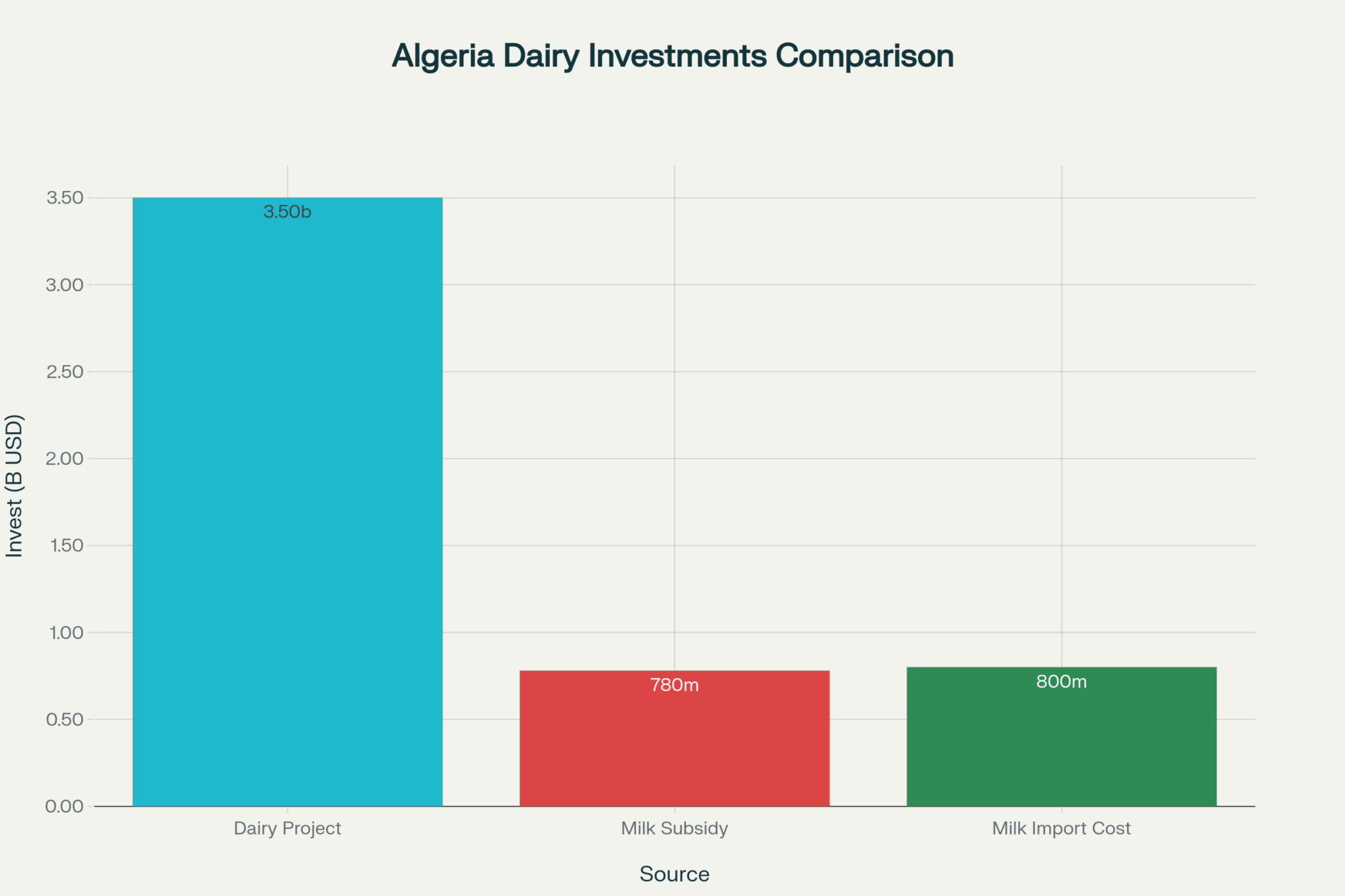
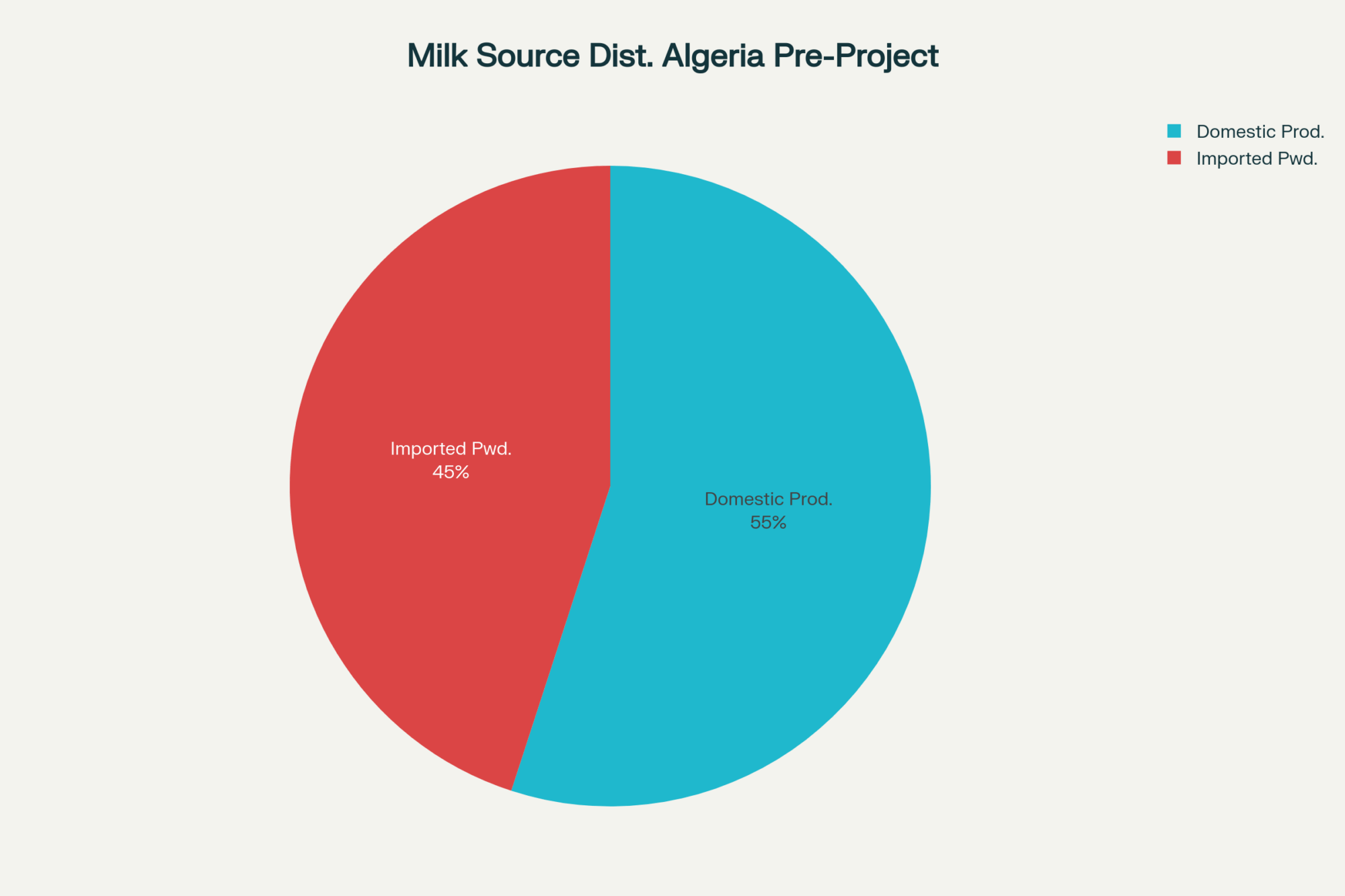
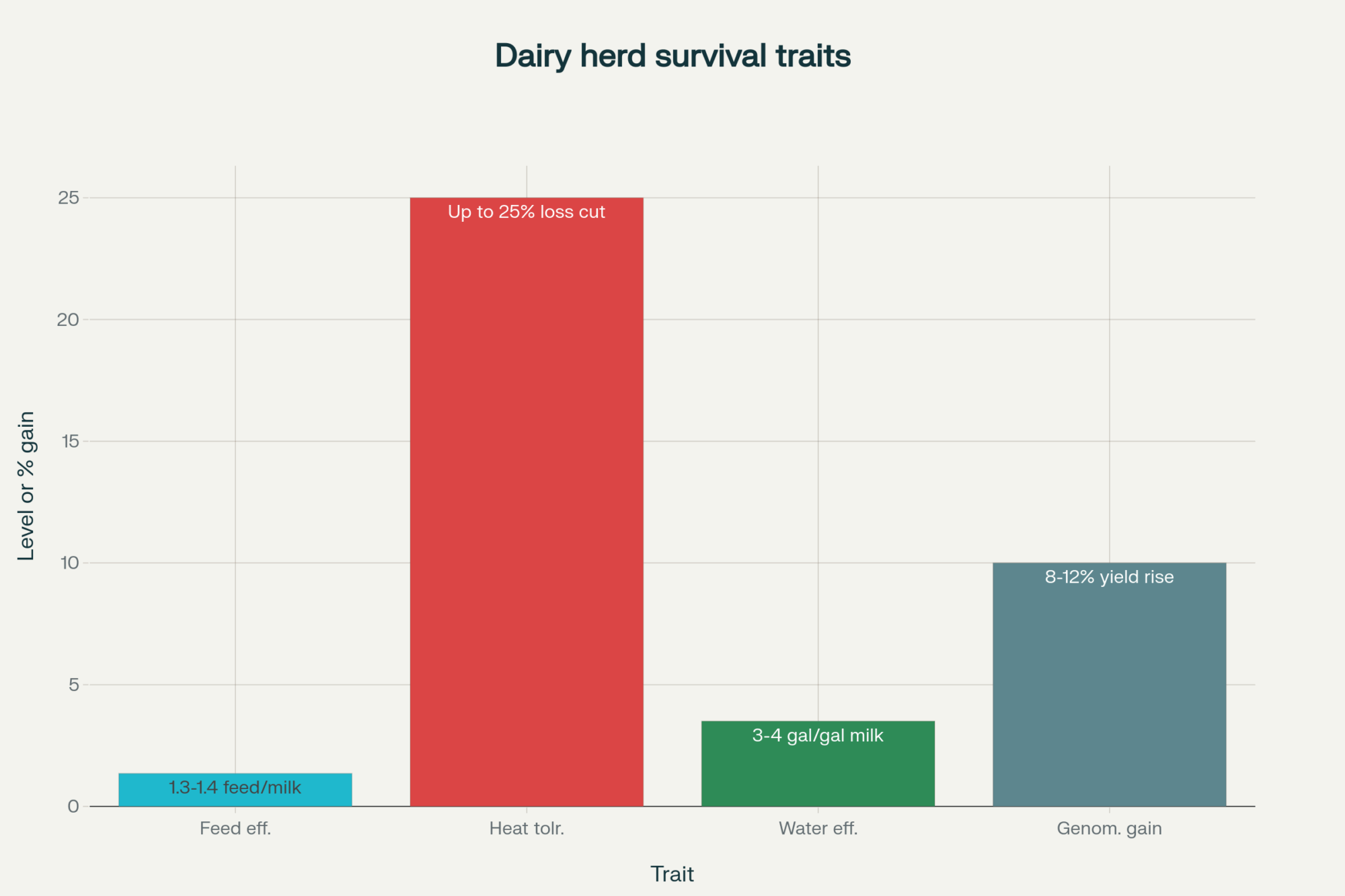
 The Sunday Read Dairy Professionals Don’t Skip.
 The Sunday Read Dairy Professionals Don’t Skip.