Archive for replacement heifer shortage

The $97,000 Breeding Meeting: How a 500-Cow Dairy Capped Beef at 35%

The calf buyer wanted more. The spreadsheet said cap it at 35%. ERS forecasts 25.31B lbs of beef in 2027 and heifers near $3,800. The lever’s on your breeding sheet right now.

Editor’s Note: The following case study is a composite scenario modeled from multiple Eastern U.S. herds reviewed by The Bullvine and its consulting sources in Spring 2026.

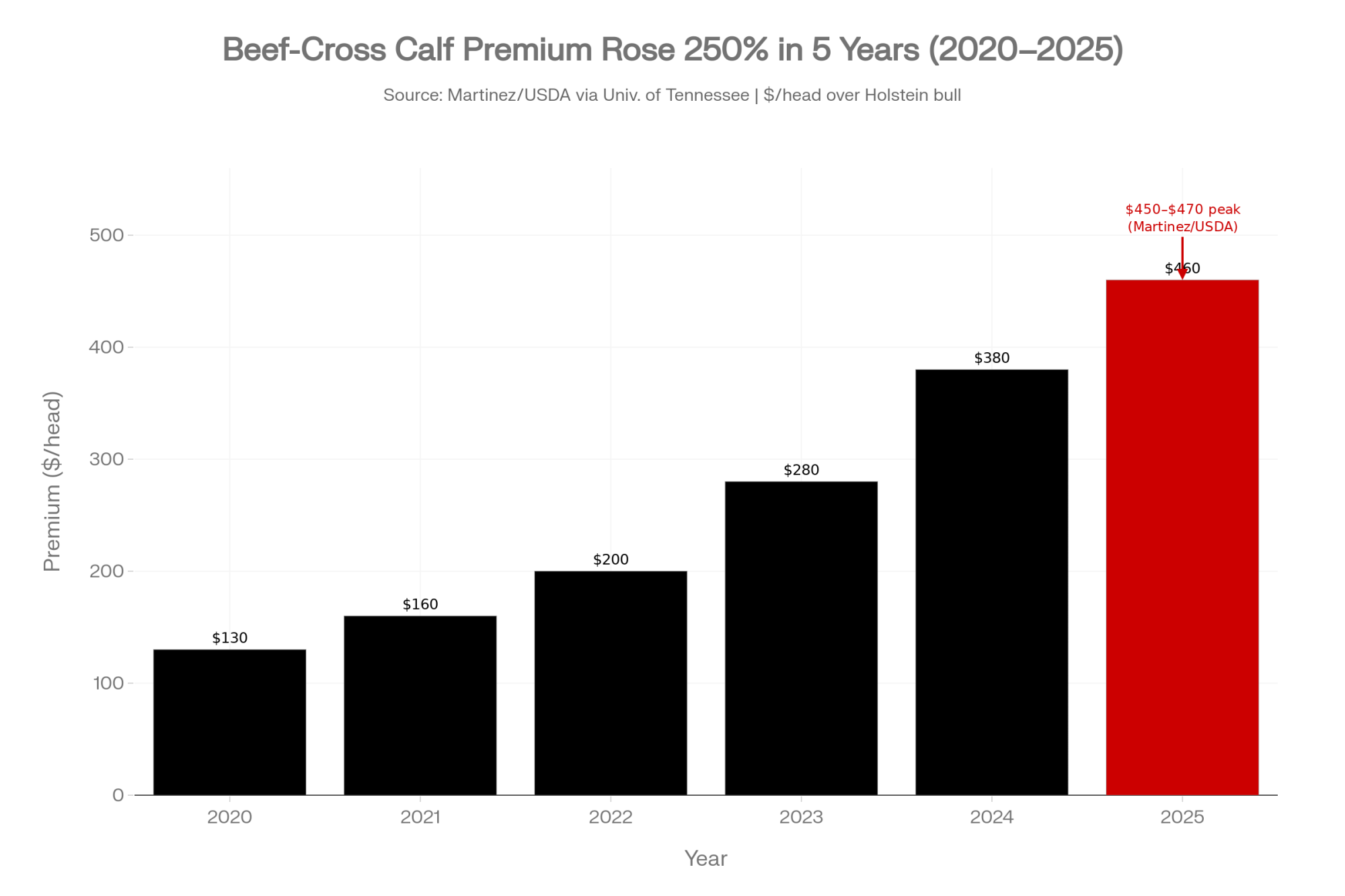
The breeding meeting was a kitchen table, three coffees, and a stack of October calf tickets the buyer had been calling about for weeks. A 500-cow Eastern dairy was about to push beef semen from 45% of services up to 55%. Day-old beef-on-dairy calves were clearing roughly $1,200 a head. The math for “more beef” looked like free money.

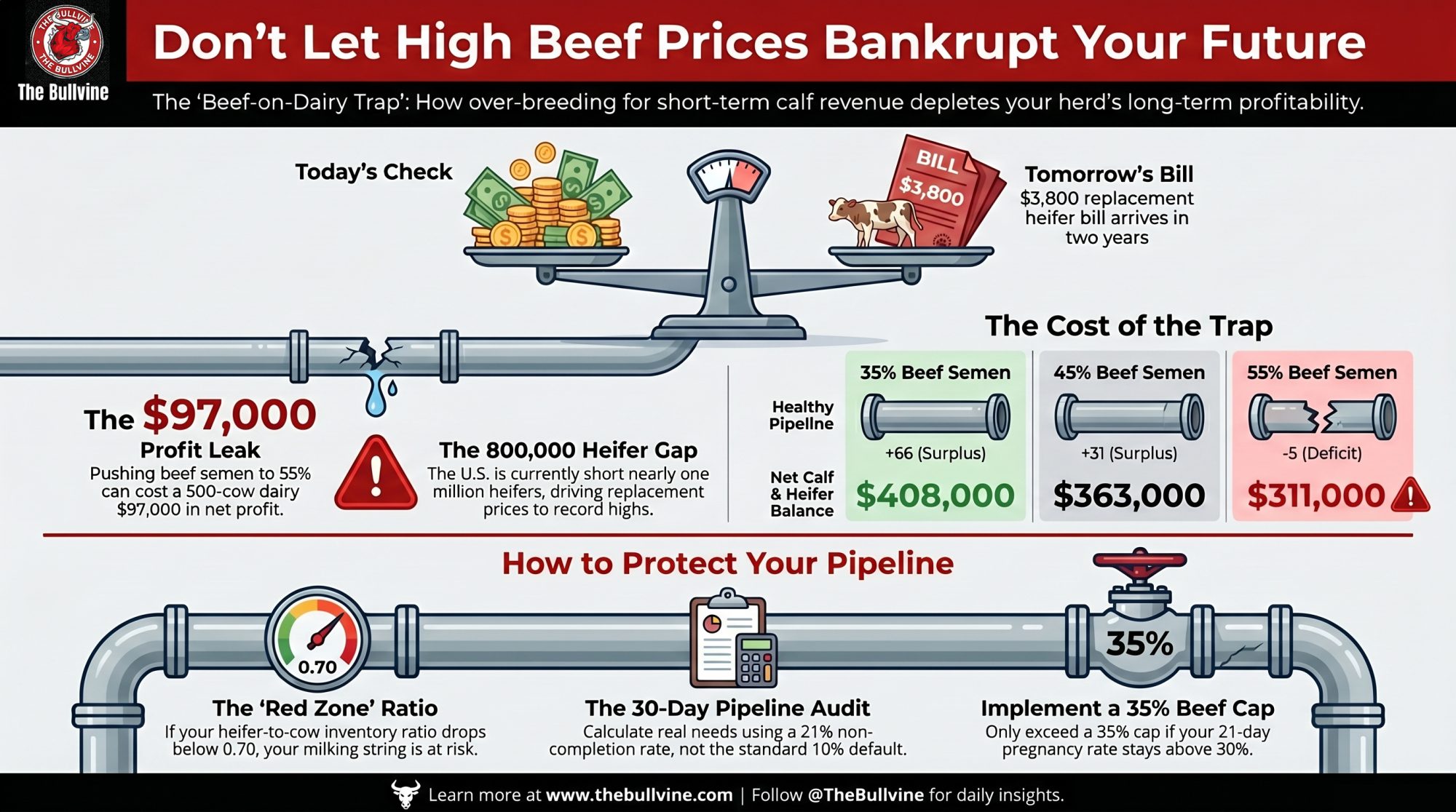
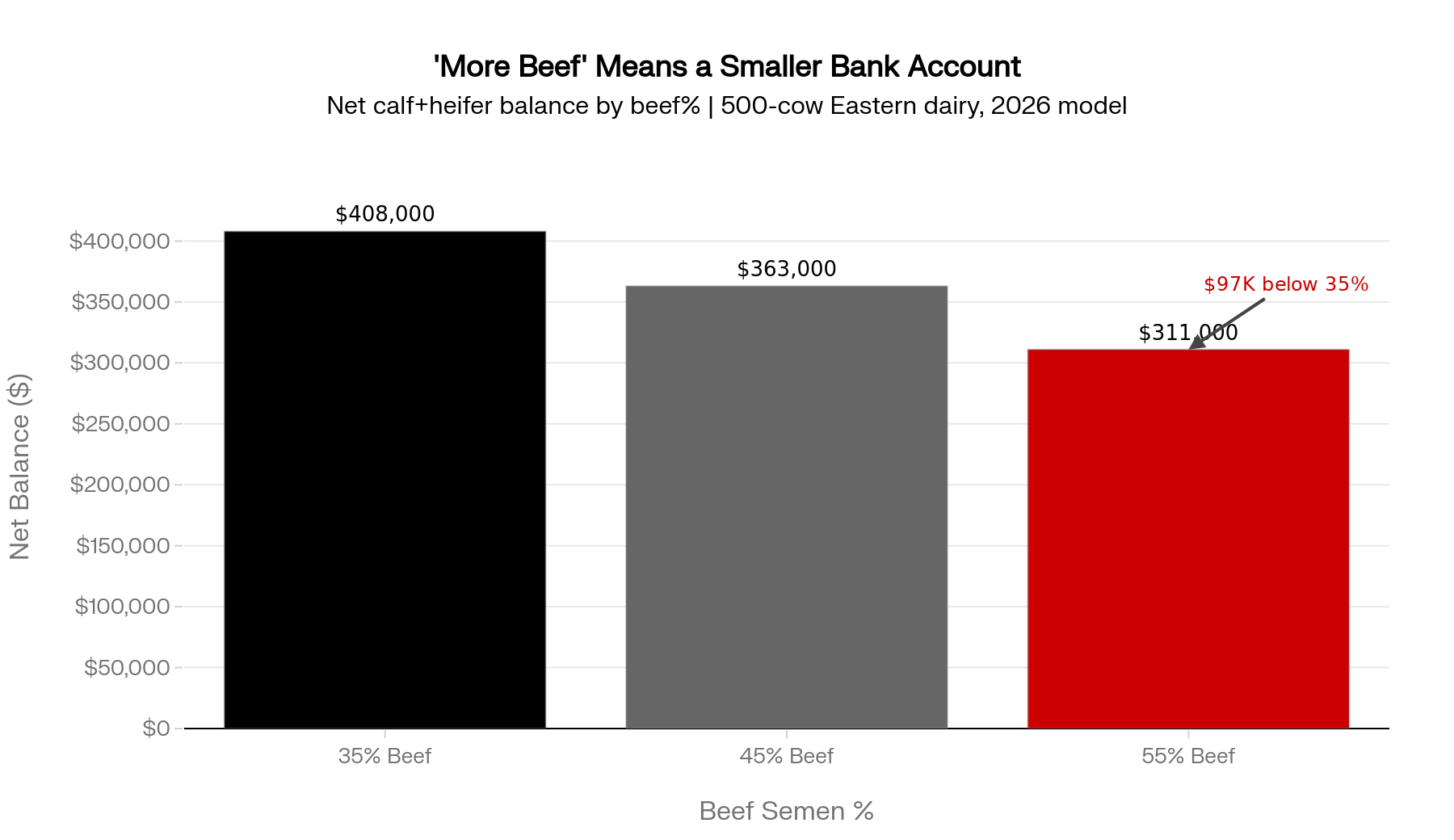
By the end of the meeting, beef was capped at 35%. That single line on the consultant’s spreadsheet — going from 45% to 55% beef — carried roughly $97,000 a year in net profit risk under the herd’s real assumptions. That’s the beef-on-dairy economics 2026 story most spreadsheets aren’t catching.

What USDA Just Told Both Sides of the Barn

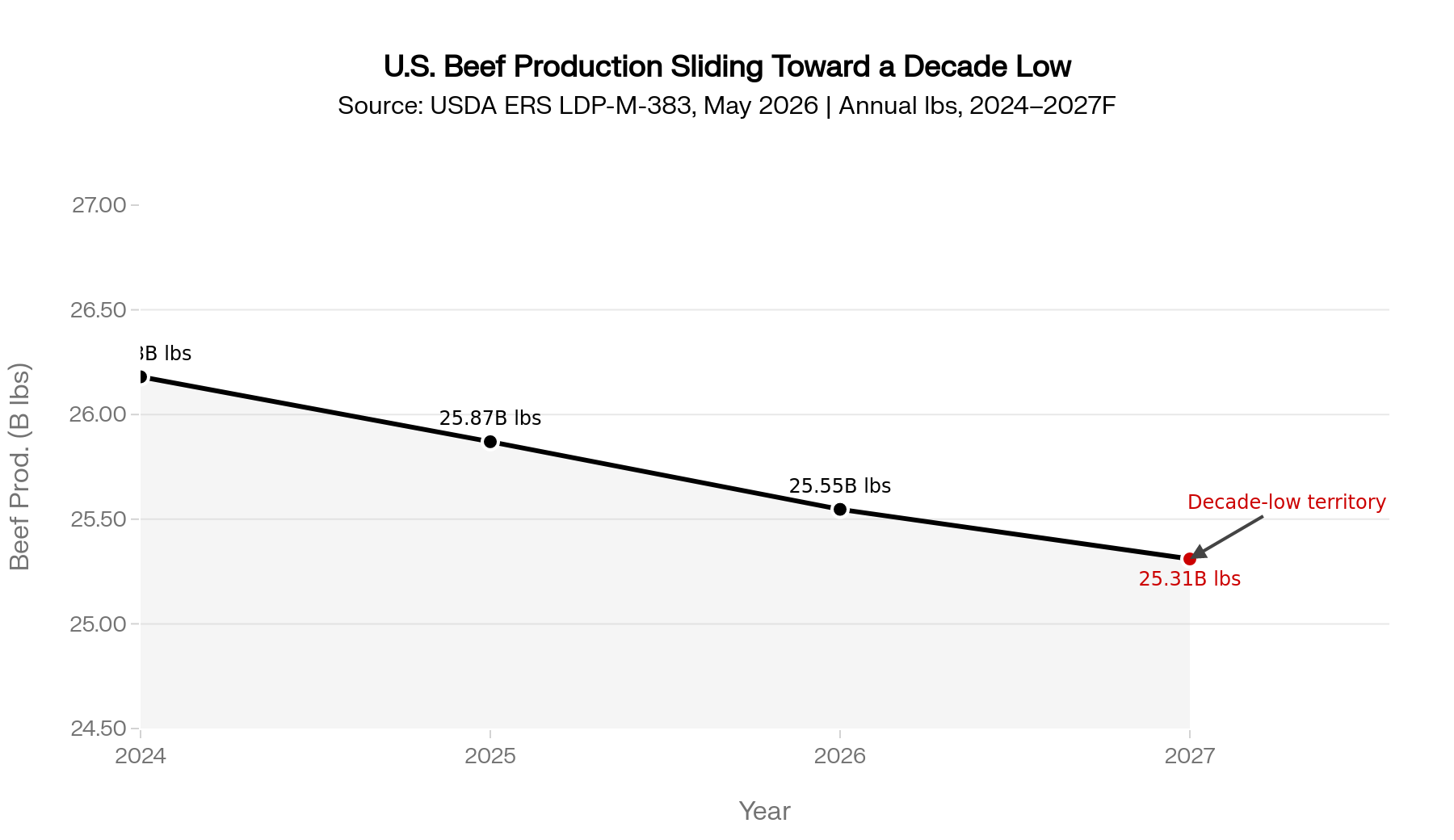
USDA’s Economic Research Service released its May 2026 Livestock, Dairy, and Poultry Outlook (LDP-M-383) in mid-May. The cattle headlines are loud. ERS forecasts U.S. beef production at 25.547 billion pounds in 2026 — down 243 million pounds from April’s projection — and 25.310 billion pounds in 2027, a 0.9% year-over-year decline and one of the lowest annual U.S. beef production figures of the past decade.

Feeder steers in the 750–800 lb range at the Oklahoma City National Stockyards traded near record territory the first week of May 2026, with reported daily averages around $388/cwt in the AMS Oklahoma City weekly summary. Slaughter steers ran in the same neighborhood, in the $258/cwt range on the AMS 5-Area Weekly Weighted Average for the same window. ERS expects new highs across feeder, slaughter, and cull cattle through 2027.

Then there’s the line dairy operators should read twice. ERS notes dairy cow slaughter is running at multi-year lows, partly because beef-cross calf returns are keeping marginal cows in the parlor longer.

That’s a feedback loop, not a coincidence. More beef-on-dairy calves means tighter beef supply means stronger cattle prices means even more beef-on-dairy calves. It also masks how thin your replacement pipeline has become.

The Other USDA Report Nobody’s Putting on the Same Page

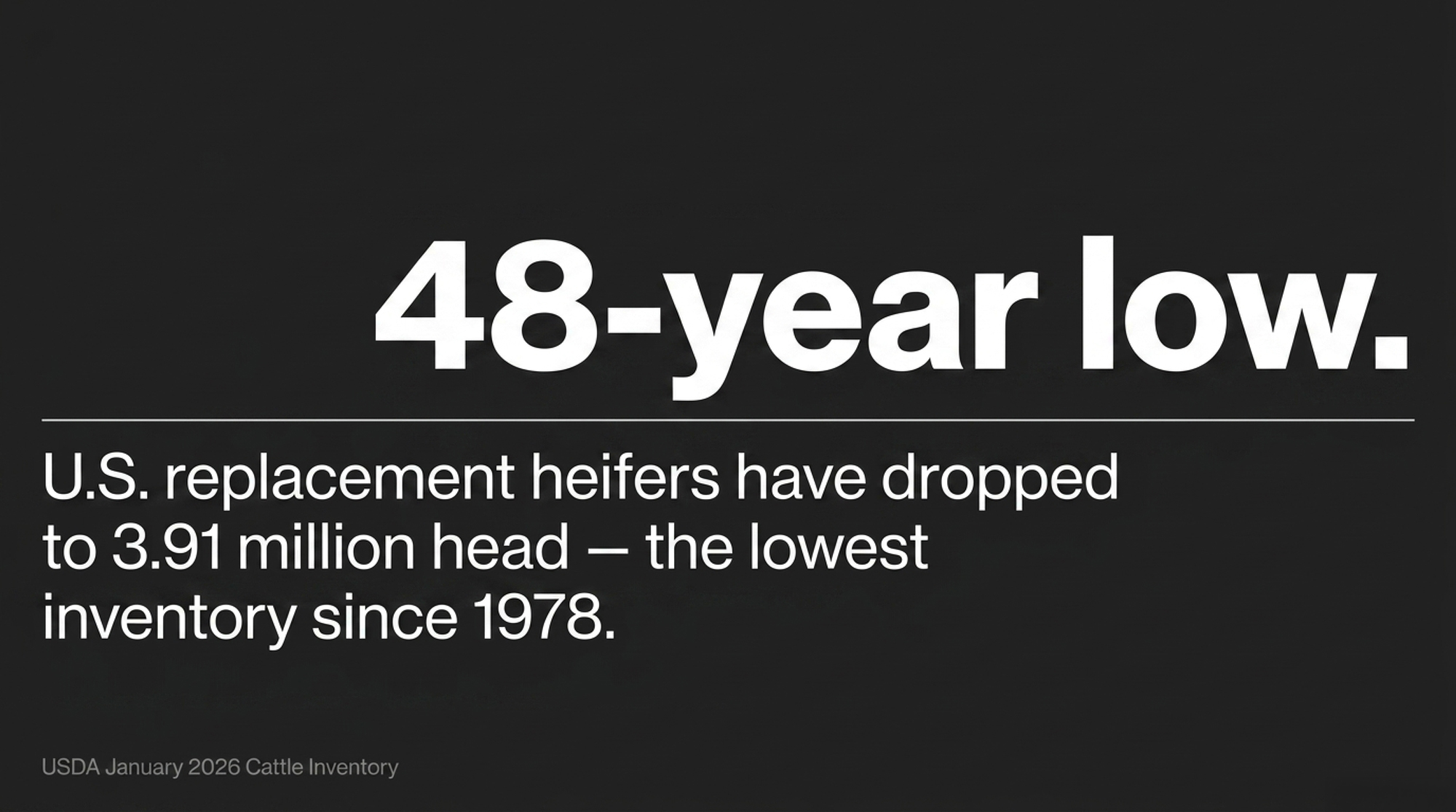
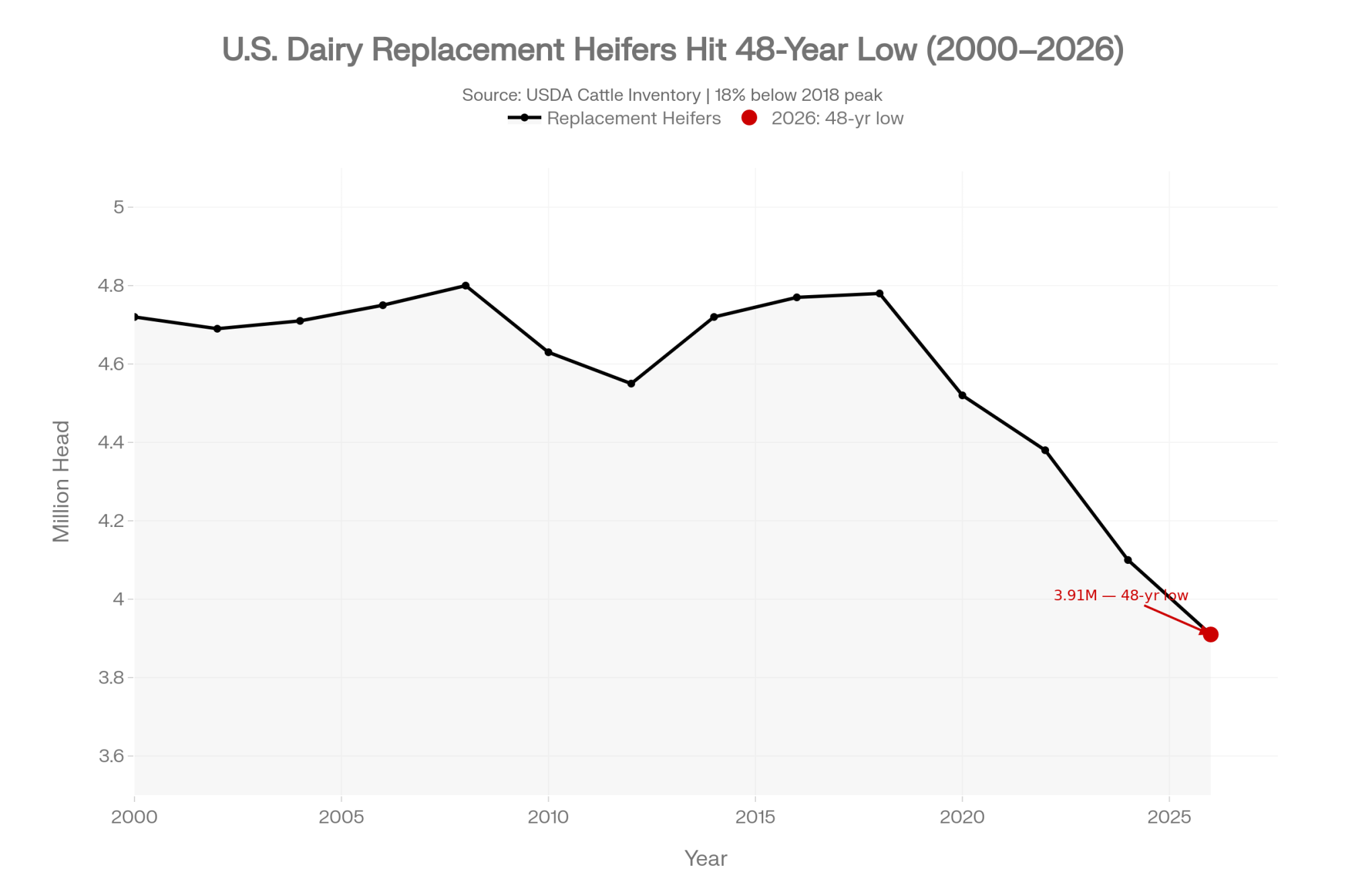
Flip to NASS and CoBank, and the picture inverts. The January 30, 2026 NASS Cattle Inventory shows roughly 3.90 million dairy replacement heifers as of January 1, 2026 — the lowest count in the recent NASS historical series. CoBank Knowledge Exchange’s Q1 2026 dairy quarterly modeling has the U.S. short about 800,000 heifers through 2026, with 2027 adding back only around 285,000.

National replacement heifer prices sit near $3,010/head in current AMS National Dairy Market News reporting. Tight regional markets — Equity Cooperative Livestock Sales Association at Reedsville, Wisconsin and Northeast dairy auctions through April and May 2026 — have been clearing $3,800–$4,800/head. That’s the 2027 heifer pen showing up early.

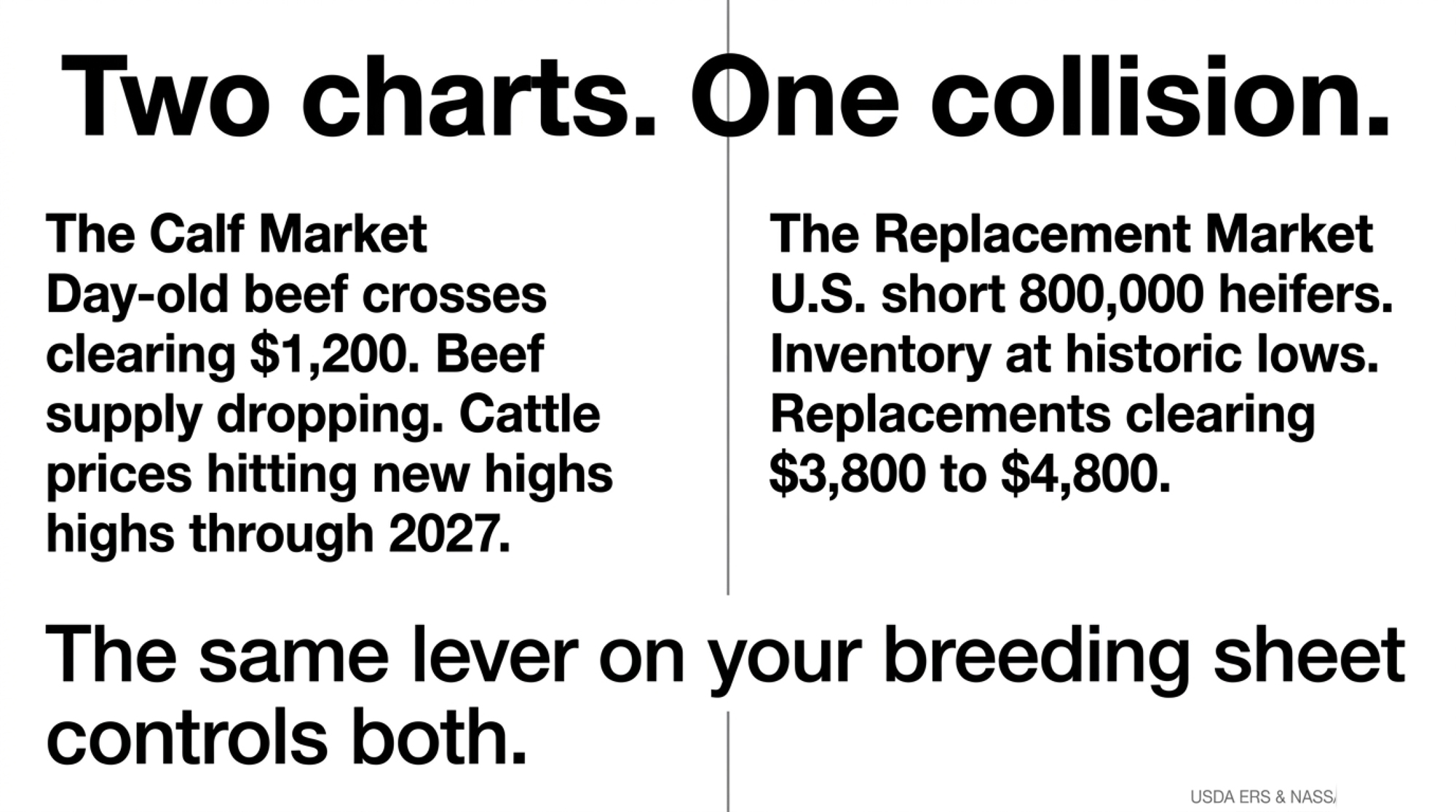
Two charts. One collision. Beef-on-dairy calf revenue has rarely paid better. The dairy replacement pipeline has rarely been thinner. The same lever on your breeding sheet — beef semen percentage — controls both numbers, and the cost of getting it wrong is bigger in both directions than it was even two years ago.

Running the Numbers: 35% vs 55% Beef on a 500-Cow Eastern Dairy

ScenarioHeifers to First CalvingNet Heifer StatusBeef Calf RevenueNet Calf+Heifer Balance
35% Beef~231+66 Surplus$210,000$408,000
45% Beef~196+31 Surplus$270,000$363,000
55% Beef~160-5 Deficit$330,000$311,000 (–$97K vs 35%)

This is the spreadsheet that ended the meeting. Every figure here reflects the herd’s stated assumptions, not a regional benchmark. Plug your own numbers in and watch what happens.

The consultant who chaired the meeting summed up the cap this way: when the calf market is hot and the heifer market is hotter, you don’t pick the percentage that maximizes today’s revenue — you pick the one your 2028 milking string can survive. That’s the rule that landed beef at 35%.

The inputs:

  • 500 cows, 30% cull rate
  • Age at first calving (AFC): 24-month target, 26-month actual
  • Heifer non-completion (born to first calving): 21% (79% completion), consistent with USDA NAHMS Dairy mortality and culling commentary
  • Beef-cross day-old calf value: $1,200/head
  • Replacement heifer purchase price: $3,800/head
  • Surplus heifer sale price: $3,000/head
  • Sexed dairy semen: 42% conception, 90% heifer ratio, 79% rearing-completion, drawn from the 85-herd commercial Holstein dataset associated with Dr. Michael Overton’s published Zoetis work
  • Beef semen conception: 57%
  • Services-per-pregnancy: 2.4 sexed dairy / 1.8 beef, consistent with the consultant’s economic matrix

The Forward Replacement formula every operator should know by heart:

Replacements Needed = Herd Size × (Actual AFC ÷ 24) × Cull Rate × (1 + Non-Completion Rate)

Plug it in: 500 × (26/24) × 0.30 × 1.21 ≈ 197 heifers/year to hold herd size at this herd’s actual AFC and non-completion. Note the gap. The herd’s original spreadsheet baseline was 165 heifers, built off a 24-month AFC and a 10% non-completion default. The scenarios below run against that 165 figure — the same number the consultant’s spreadsheet used the day of the meeting. Run yours against your own real-world AFC and non-completion before quoting any of this as your own.

The table that ended the meeting

ScenarioHeifers to First CalvingNet Heifer StatusBeef Calf RevenueNet Calf-and-Heifer Balance
35% Beef~231+66 (Surplus)$210,000$408,000
45% Beef~196+31 (Surplus)$270,000$363,000
55% Beef~160–5 (Deficit)$330,000$311,000

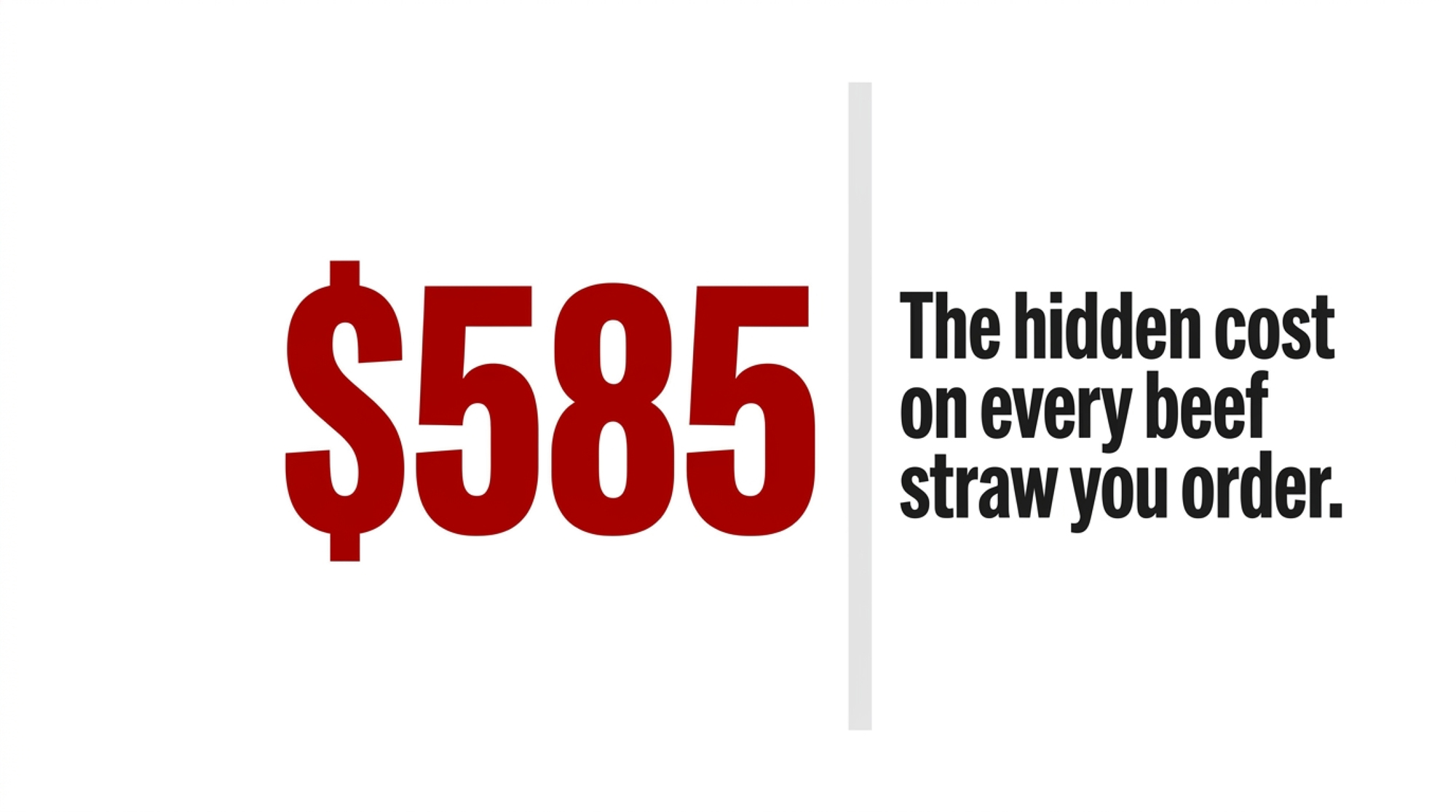
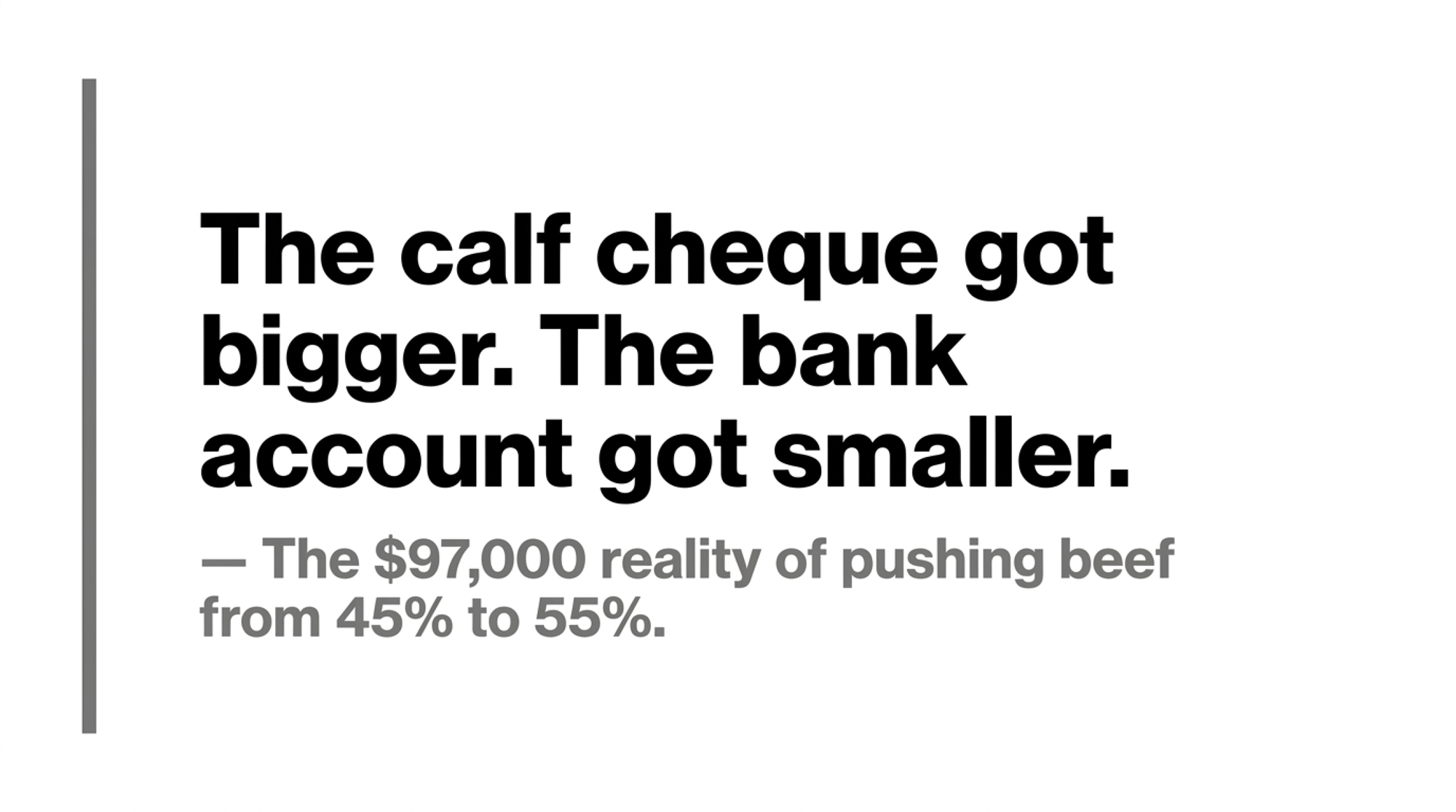
Net-net: 55% beef adds $120,000 in calf cheques and quietly costs $97,000 once the replacement bill arrives. Bigger top line. Smaller bottom line.

“The calf cheque got bigger. The bank account got smaller.”

What’s the Trap Hiding Inside a $1,200 Calf?

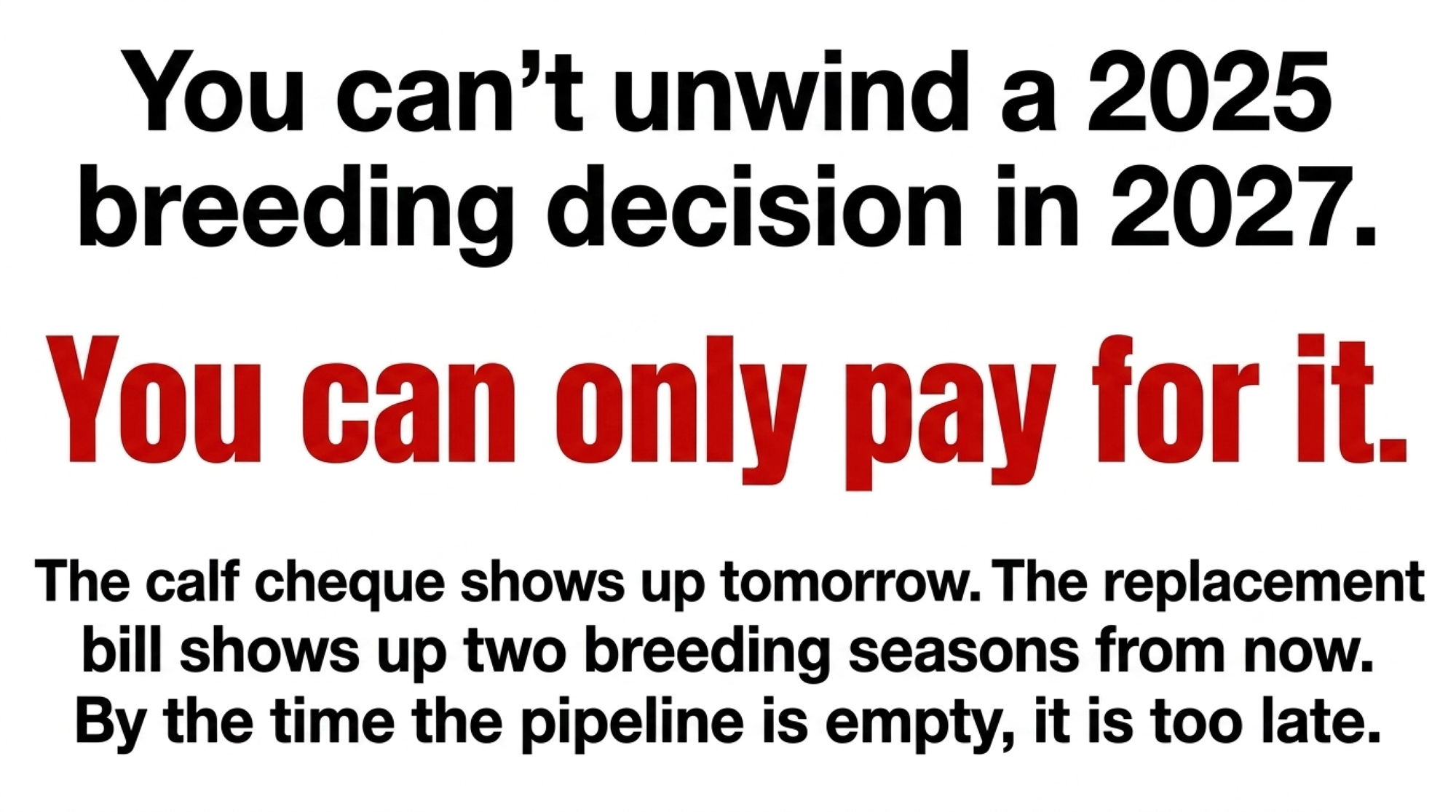
Timing. The calf cheque shows up tomorrow. The replacement bill shows up two breeding seasons from now.

That’s the whole trap. There’s no way to make it disappear. The biology runs on a 24-to-30-month clock, so by the time a thin pipeline shows up empty in the parlor, the cows that should have been bred to sexed dairy are dry, sold, or already gone. You can’t unwind a 2025 breeding decision in 2027. You can only pay for it.

Everyone assumed the calf cheque was pure upside. The math says it’s a loan against your 2028 milking string, and the interest rate depends on what replacements cost when the bill arrives.

Scaling Up: What This Looks Like at 1,200 Cows

Run the same Eastern-herd inputs at a 1,200-cow operation and the modeled gap between 35% and 55% beef widens to roughly $235,000 in net calf-and-heifer balance. Drop the calf price toward $900 — within the range U.S. markets have hit before — and the gap widens further, because the lost calf revenue inside the 55% scenario can no longer cover the locked-in heifer purchase exposure.

The October 2025 Warning Shot

AMS regional calf reporting in mid-October 2025 described day-old beef-on-dairy calf values dropping in the $150-plus per-head range over roughly two weeks of trade. Anyone running a breeding program built on top-of-cycle calf prices got an unwelcome stress test, fast.

What Does Your Calf Have to Clear to Beat a Sexed Dairy Service?

The right comparison isn’t calf price. It’s expected value per service. Here’s the cleanest version of the math.

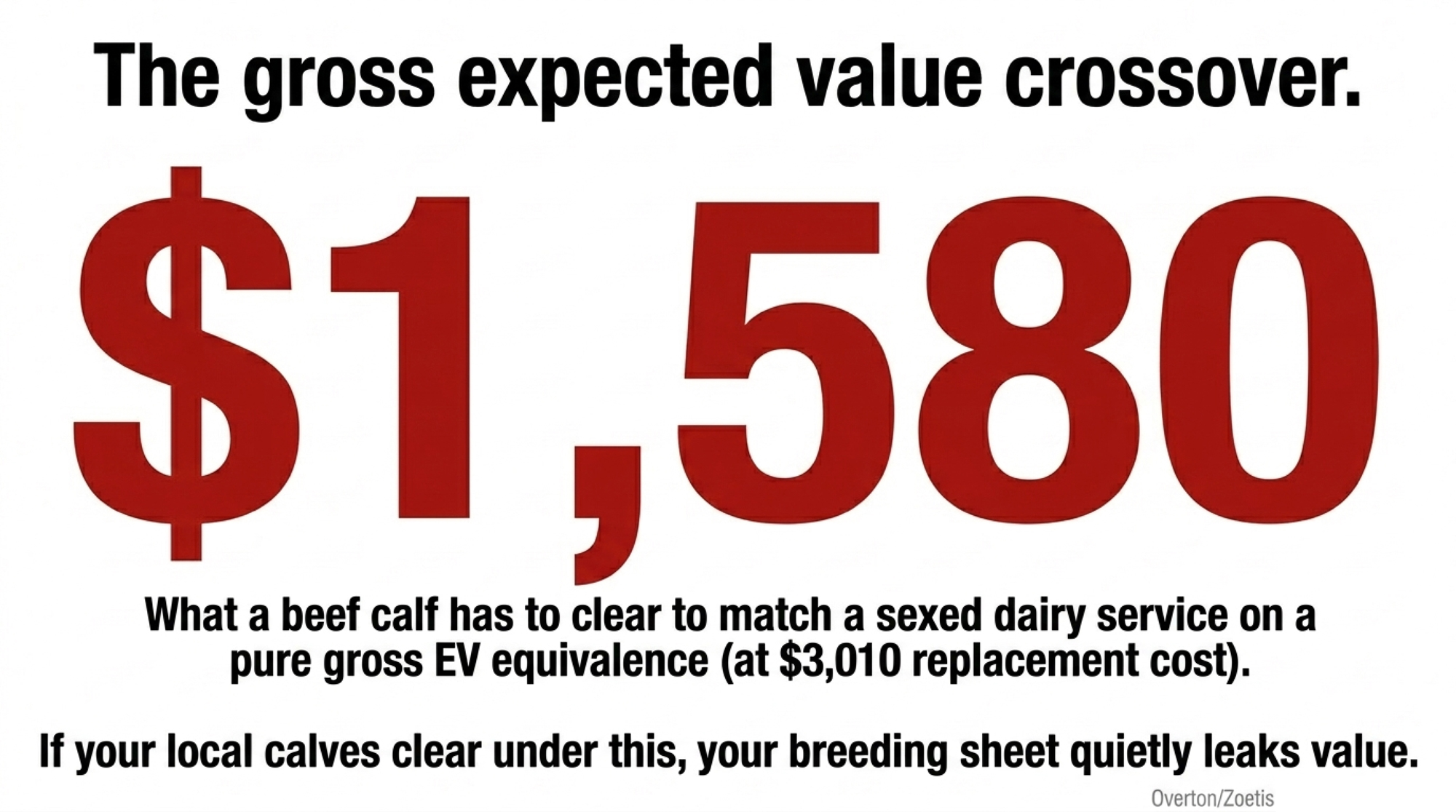
Using the Overton/Zoetis 85-herd Holstein assumptions (42% sexed-dairy conception, 90% heifer ratio, 79% rearing-completion, 95% pregnancy survival), gross expected value per sexed-dairy service comes to roughly $854 at $3,010 replacements, ~$993 at $3,500, and ~$1,163 at $4,100. These are gross EV figures before rearing and opportunity-cost adjustments. Apply your own cost stack to land on a net EV for your operation. Beef-on-dairy at a $1,200 calf and 57% conception comes in around $650/service after a small marketing-and-mortality adjustment.

That sets the crossover — the day-old beef calf value where beef finally matches sexed dairy on EV. On a pure gross-EV equivalence (EV ÷ 0.57 conception), the crossovers come in at roughly $1,498 / $1,742 / $2,040 at $3,010 / $3,500 / $4,100 replacements. Layering in rearing and opportunity-cost terms — heifers cost real money to grow, and a sexed dairy service forecloses a beef calf that day — pushes the crossovers to roughly $1,580 / $1,931 / $2,262 in the consultant’s full cost-adjusted matrix.

Replacement Heifer PriceGross EV Crossover ($/calf)Full Cost-Adjusted Crossover ($/calf)Typical Regional Market (May 2026)Below Crossover?
$3,010/head$1,498$1,580~$1,200Yes — $380 below
$3,500/head$1,742$1,931~$1,200Yes — $731 below
$4,100/head$2,040$2,262~$1,200Yes — $1,062 below
$3,800 (AMS tight mkts)$1,895$2,100~$1,200Yes — $900 below

The exact crossover dollar varies by which cost stack you use. The conclusion doesn’t: most regional U.S. calf markets we’ve reviewed are clearing well below either set of numbers. A lot of breeding sheets look profitable on the calf invoice and quietly leak value on the replacement side.

Is Your Heifer Pipeline Already Telling You Something Your Spreadsheet Isn’t?

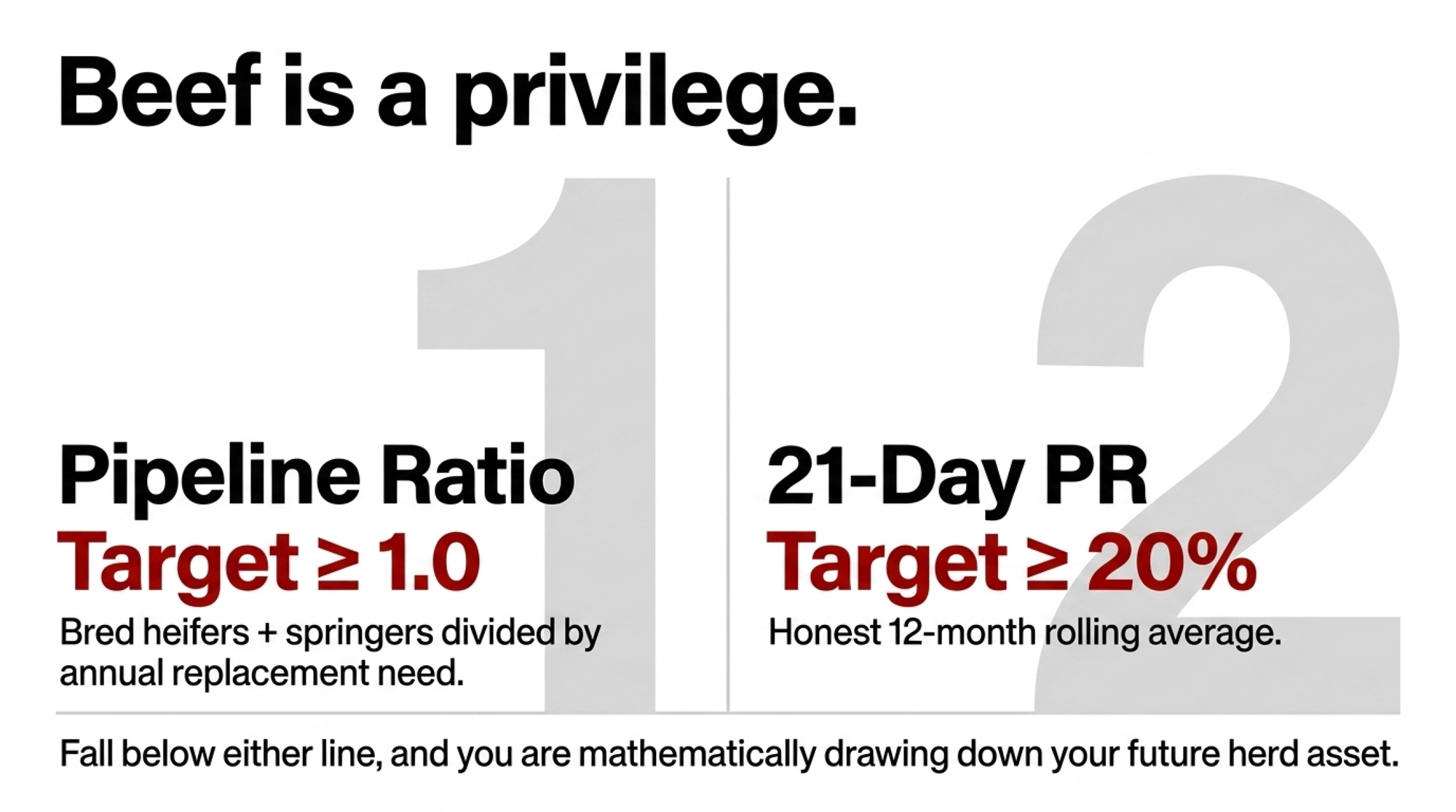
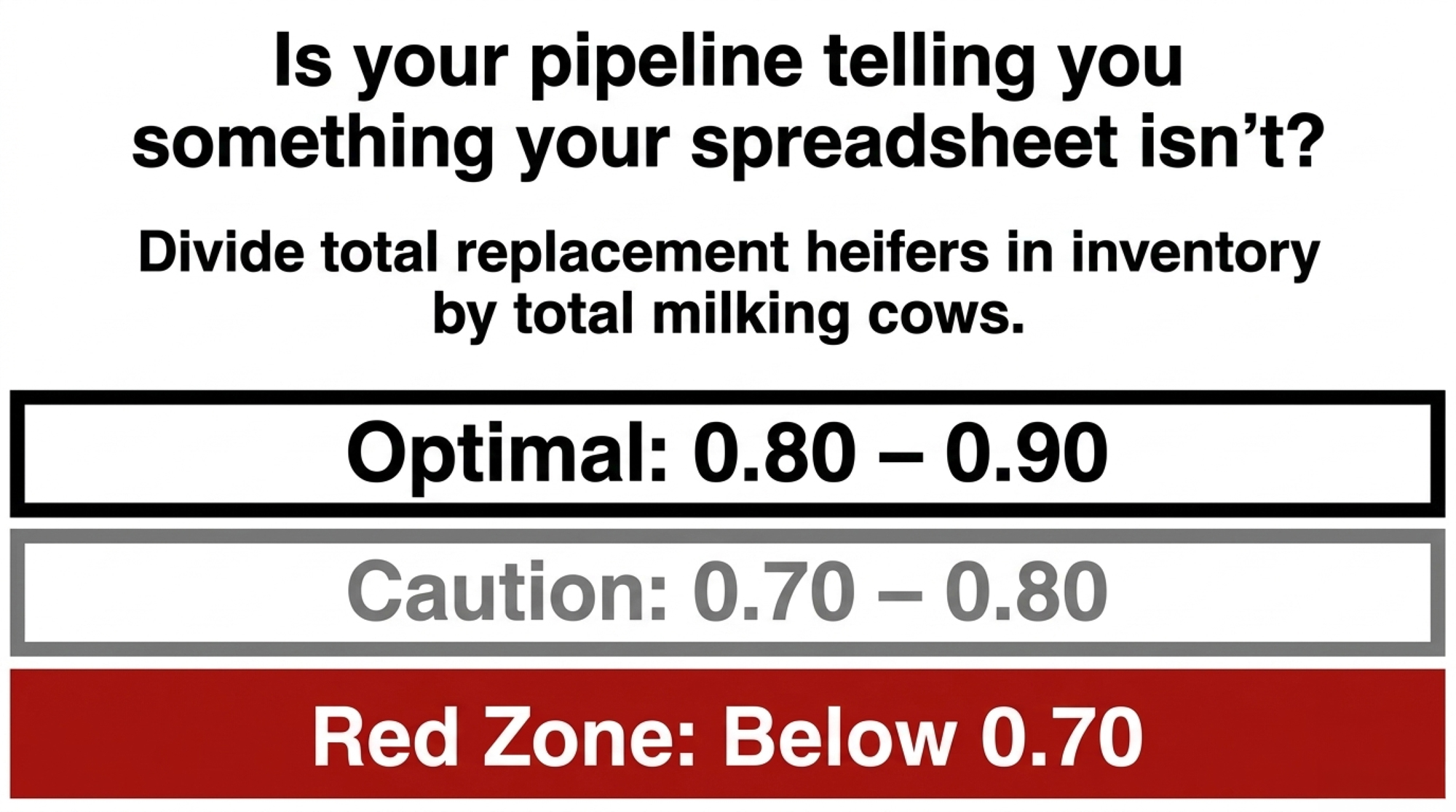
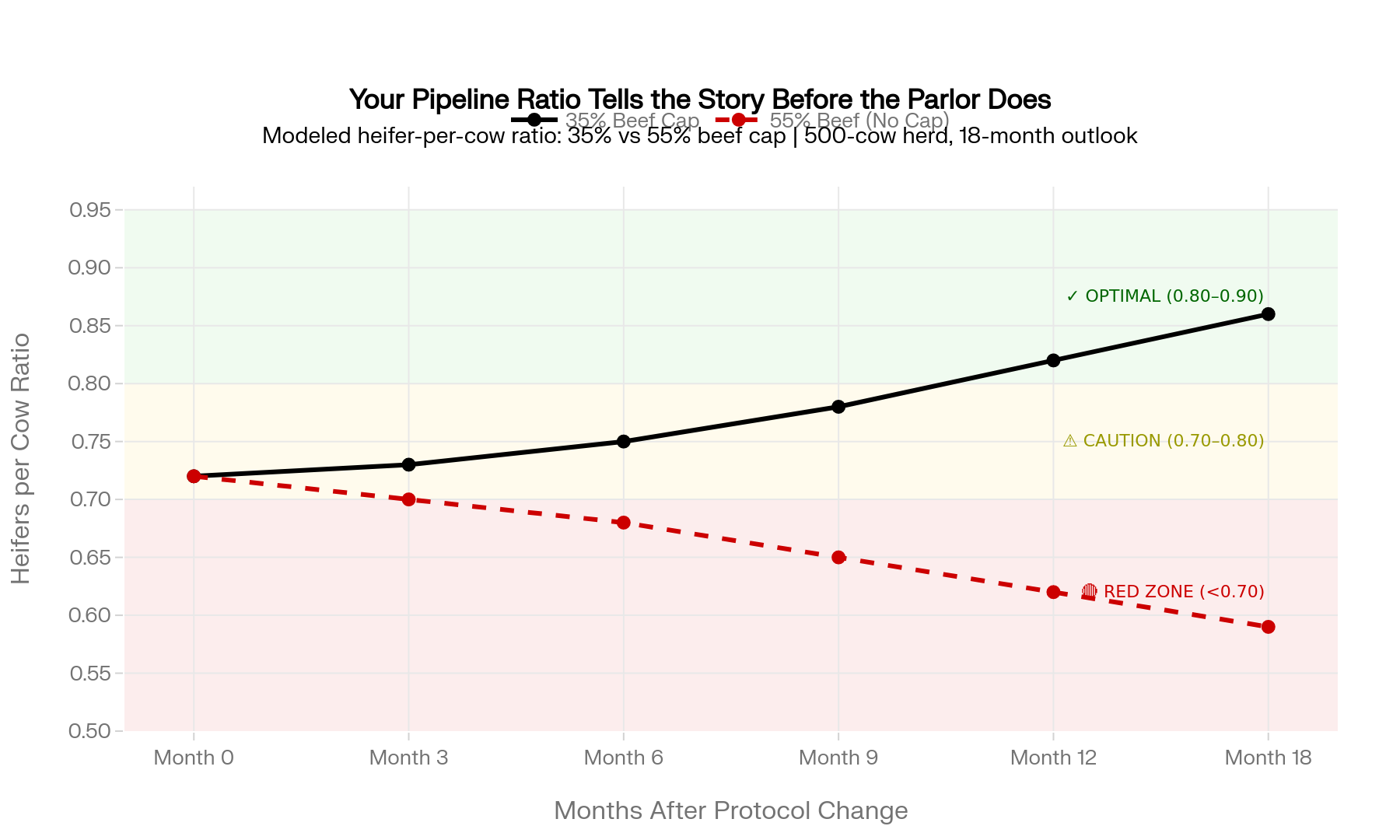
The metric most operators don’t track monthly: total replacement heifers in inventory divided by total milking cows. Treat it as a Bullvine planning framework consistent with Penn State Extension replacement-economics commentary.

  • 0.80–0.90 = Optimal
  • 0.70–0.80 = Caution
  • Below 0.70 = Red

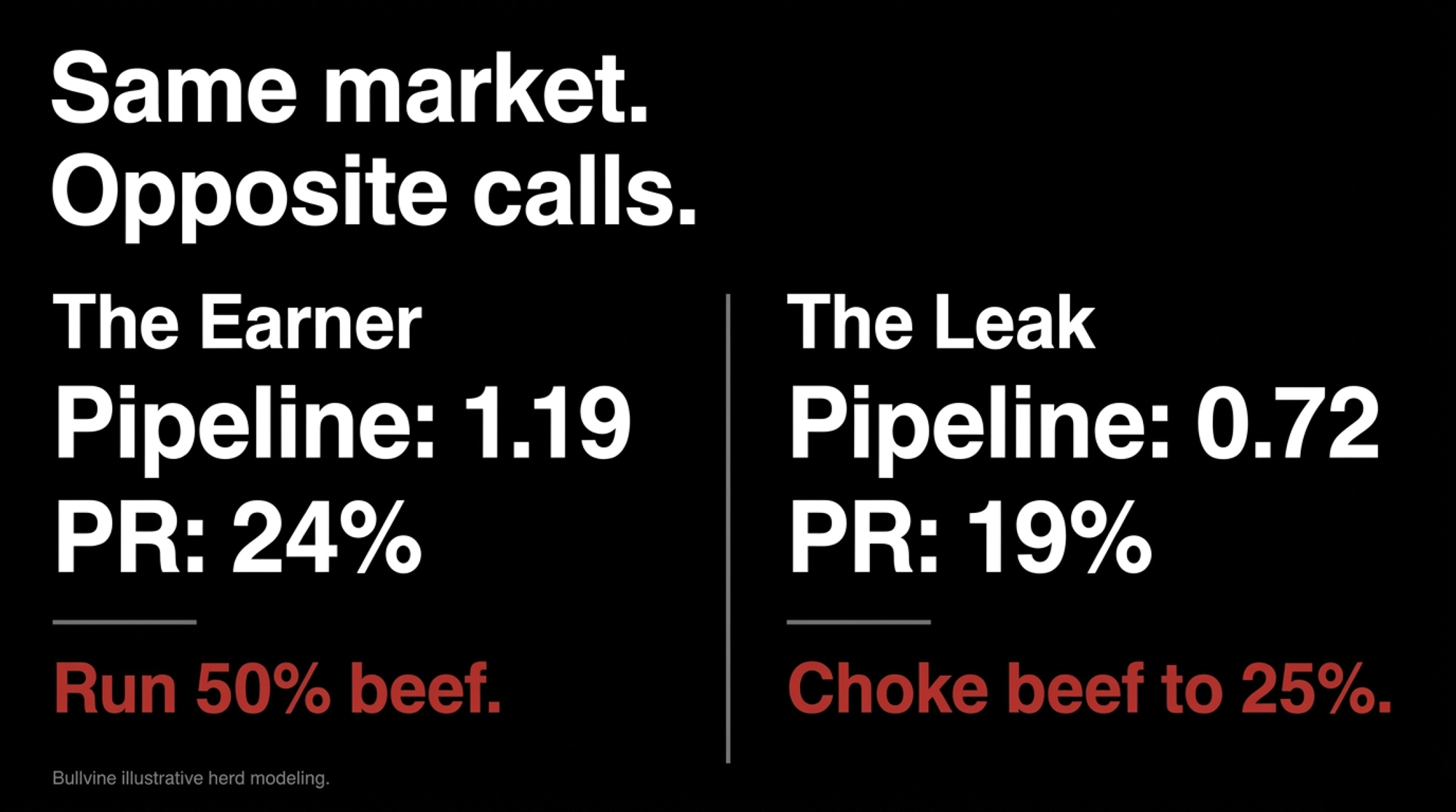
In the 500-cow Eastern model this article is built on, the pipeline ratio sat at 0.70–0.75 when the breeding meeting started. Eighteen months out, with the modeled 35% beef cap and sexed dairy locked onto the top genomic and high-fertility cows, the projected ratio climbs into the mid-0.80s. That’s a model projection from the consultant’s spreadsheet — not a measured outcome — and the phase pattern is what’s worth borrowing even if your numbers don’t match.

Pregnancy mix typically shifts within ~90 days of a protocol change. Heifer birth pattern shifts at roughly six months.

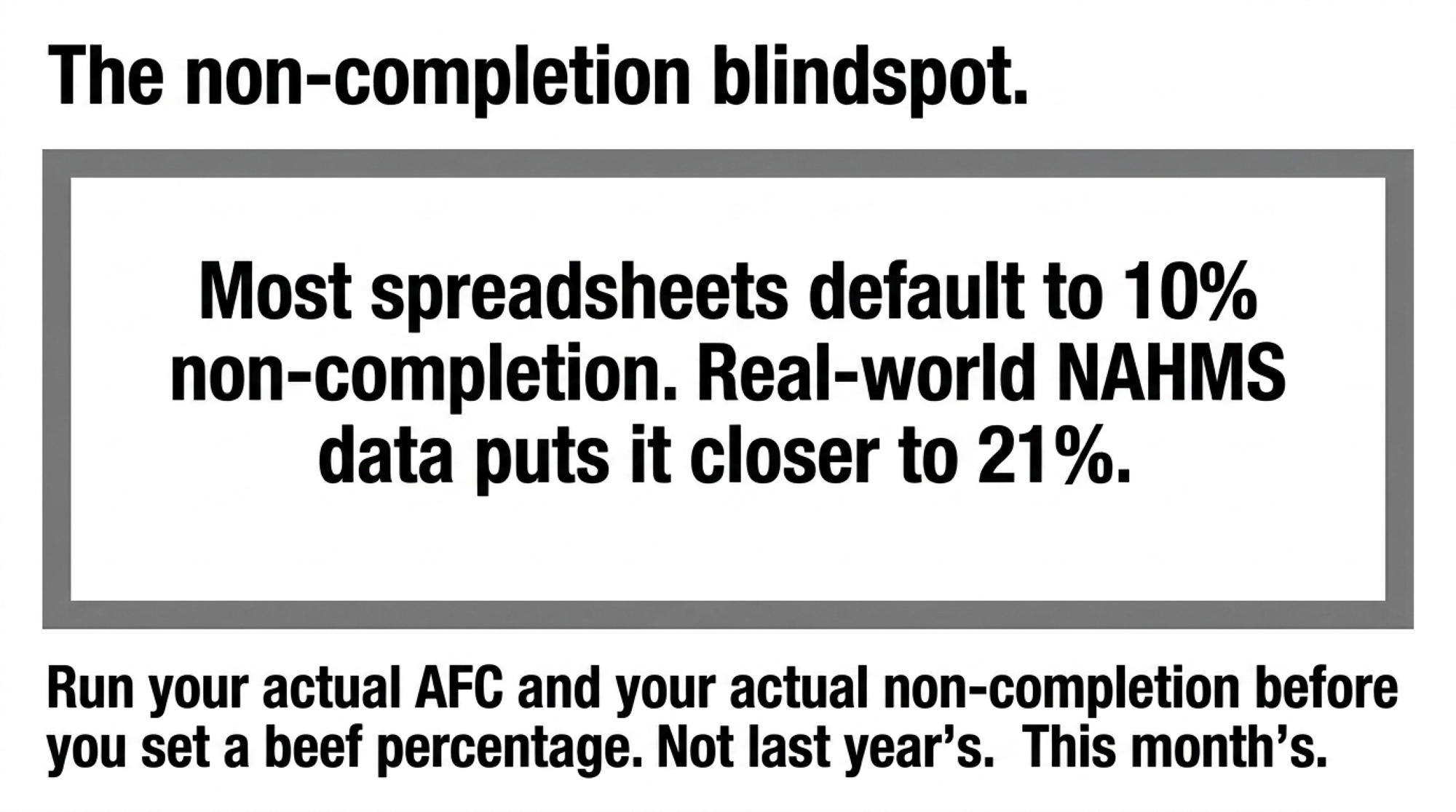
The pipeline ratio itself doesn’t catch up until ~9 months out. It often lands behind the spreadsheet because real-world non-completion (closer to 21% than the 10% most working spreadsheets default to) and AFC drift take bigger bites than projected.

That gap — between NAHMS-documented heifer non-completion and the assumptions sitting inside most working spreadsheets — is the one most often catching operators by surprise. Run your own Forward Replacement formula with your actual AFC and your actual non-completion before you set a beef percentage. Not last year’s. This month’s.

Options and Trade-Offs for Farmers

Action 1: Execute the 30-Day Pipeline Audit

Pull your last 12 months of heifer births, multiply by 0.79 to estimate completions (that’s 1 minus the 21% non-completion rate), and stack it against your (herd size × cull rate). Calculate your heifers-per-cow ratio and your real annual replacement need. If your ratio drops below 0.80, your beef percentage is already too high — no matter what the calf buyer is promising today. Requires clean DHIA or on-farm records, two to four hours depending on how clean those records are, and the willingness to act on the answer. Where it backfires: sloppy birth or AFC records produce false confidence in either direction. Forward-looking signal: if ERS’s 2027 forecast holds and replacement prices stay firm into 2028, this audit is the cheapest defense against a 2028 milking-string shortage.

Action 2: Implement a Dynamic Breeding Band

Stop treating beef percentage as a static number. Base it at 35% only when your 21-day pregnancy rate stays above 30% and your pipeline ratio sits comfortably between 0.80–0.90. If either metric slips, aggressively choke beef back to 25–30%. Pull beef entirely if dairy pregnancies drop below 42% of weekly total for three consecutive weeks. Requires weekly repro reporting and someone with veto authority who can hold the cap when the calf market argues against it. Let the metrics run the cap, not the calf market.

Action 3: Enforce Strict Genomic Quartiles

Lock sexed dairy onto your top 25–30% cows by GTPI/NM$ and components. Beef goes on the bottom genomic quartile, repeat breeders, and old parities. Period. No “she looks good” overrides. That’s how the protocol collapses by month three.

What this requires in practice: genomic testing on every heifer (commercial Holstein testing runs $40–$50 per animal, varying by lab and CDCB nomination fees), a written eligibility rule, and an exception protocol that forces a one-for-one heifer trade rather than a one-way override. If average GTPI on your fresh 2-year-old string ticks up materially over 18 months, the protocol is working before the pipeline ratio fully catches up.

Action 4: Stress-Test the Plan at $900 Calves

If the math only works at $1,200, you don’t have a strategy. You have a bet on the top of the cycle. Build a scenario column at $1,200, $900, and $700 calves. Trigger: if 55% beef only beats 35% beef at $1,200+ calves, the cap stays at 35%. Pair it with USDA RMA’s Livestock Risk Protection coverage on feeder cattle and slaughter cattle if your calf marketing pattern fits the LRP coverage windows under current RMA program rules.

Key Takeaways

  • If your heifers-per-cow ratio is below 0.80, cap beef tighter than the calf market is asking — your 2028 milking string is already getting short.
  • If your 55% beef scenario only beats your 35% beef scenario at $1,200+ calves, your beef percentage stays at 35%. Don’t let the calf cheque run the breeding sheet.
  • If your AFC is 26 months instead of 24, you need about 8% more replacements per year to hold herd size. Real non-completion at 21% instead of 10% adds another 10% on top.
  • Your top genomic quartile getting beef semen because she’s a repeat breeder? She’s the first cow to move back to sexed dairy — not the last.
  • If your local calves are clearing under your crossover price, beef belongs capped tighter than your calf buyer is suggesting.

What’s Your Move?

ERS is telling you cattle prices stay strong through 2027. NASS and CoBank are telling you replacements stay short and expensive. So what does your breeding sheet actually say about heifers per cow, AFC, and real non-completion this month — and what does your calf buyer’s contract look like 18 months from now if you keep your beef percentage exactly where it is today?

Learn More

The Sunday Read Dairy Professionals Don’t Skip.
Every week, thousands of producers, breeders, and industry insiders open Bullvine Weekly for genetics insights, market shifts, and profit strategies they won’t find anywhere else. One email. Five minutes. Smarter decisions all week.
NewsSubscribe
First
Last
Consent

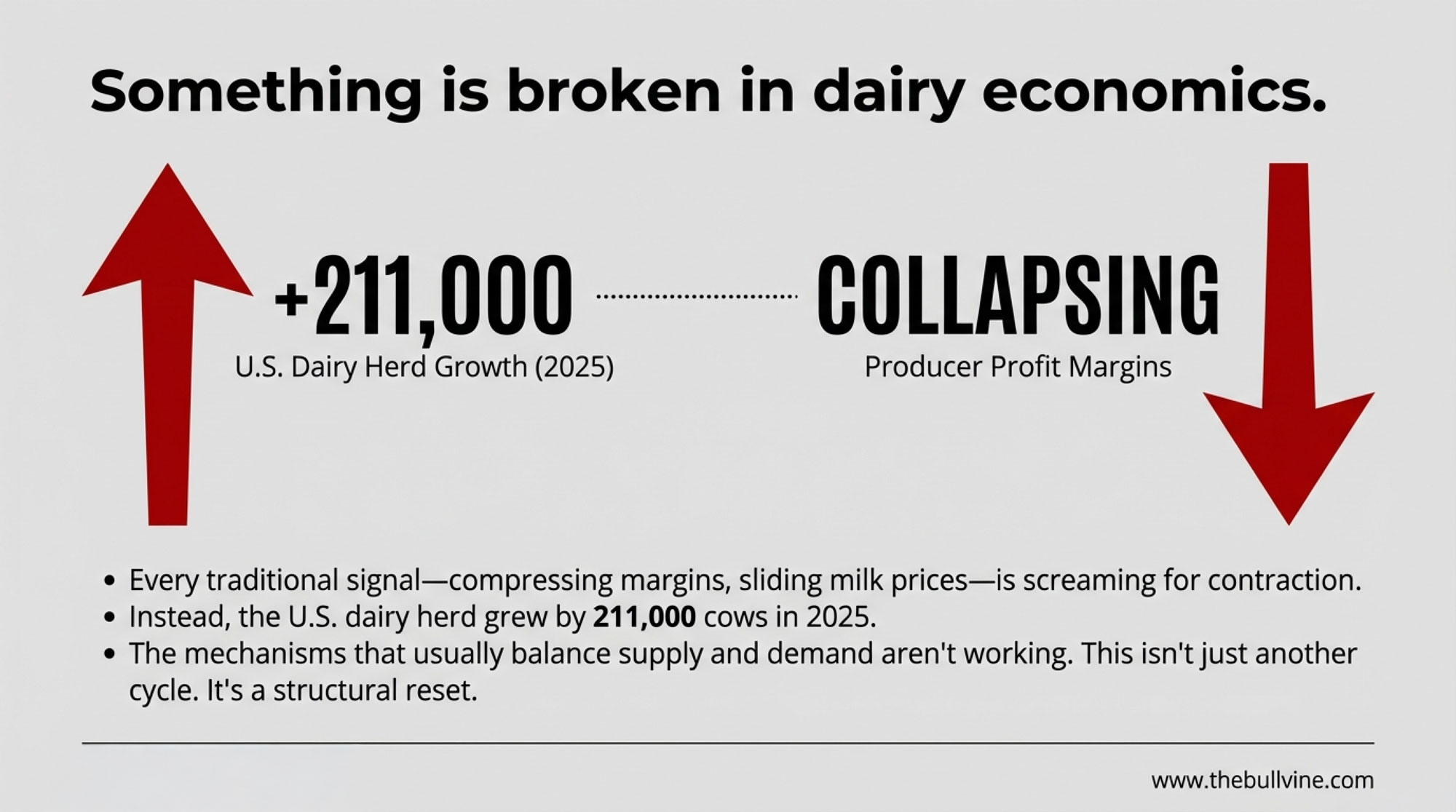
211,000 More Dairy Cows. Bleeding Margins. The 2026 Math That Won’t Wait.

$17.40 cash break-even. $19.80 real break-even. That $2.40/cwt you’re ignoring? It’s the whole ballgame in 2026.

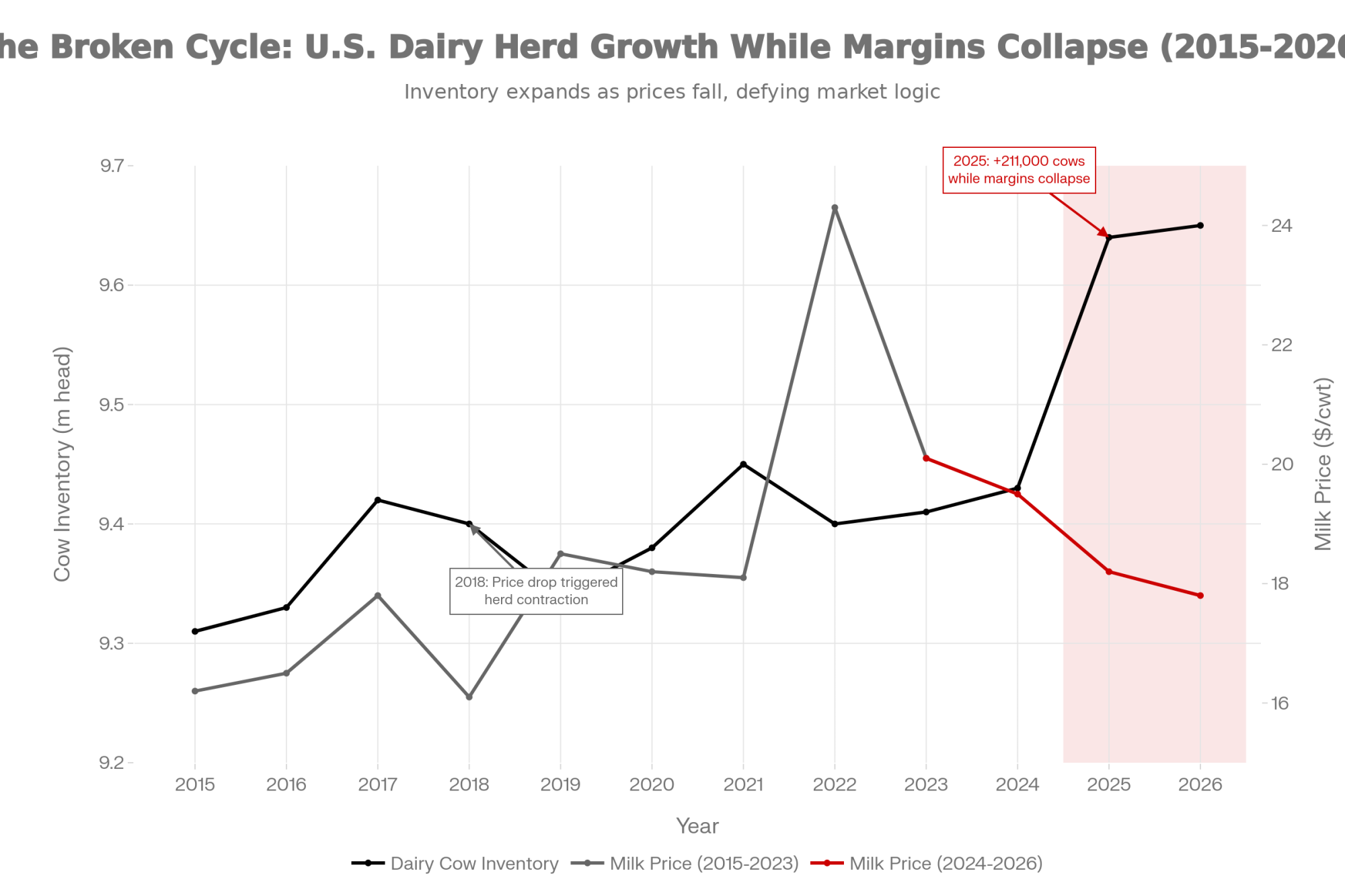
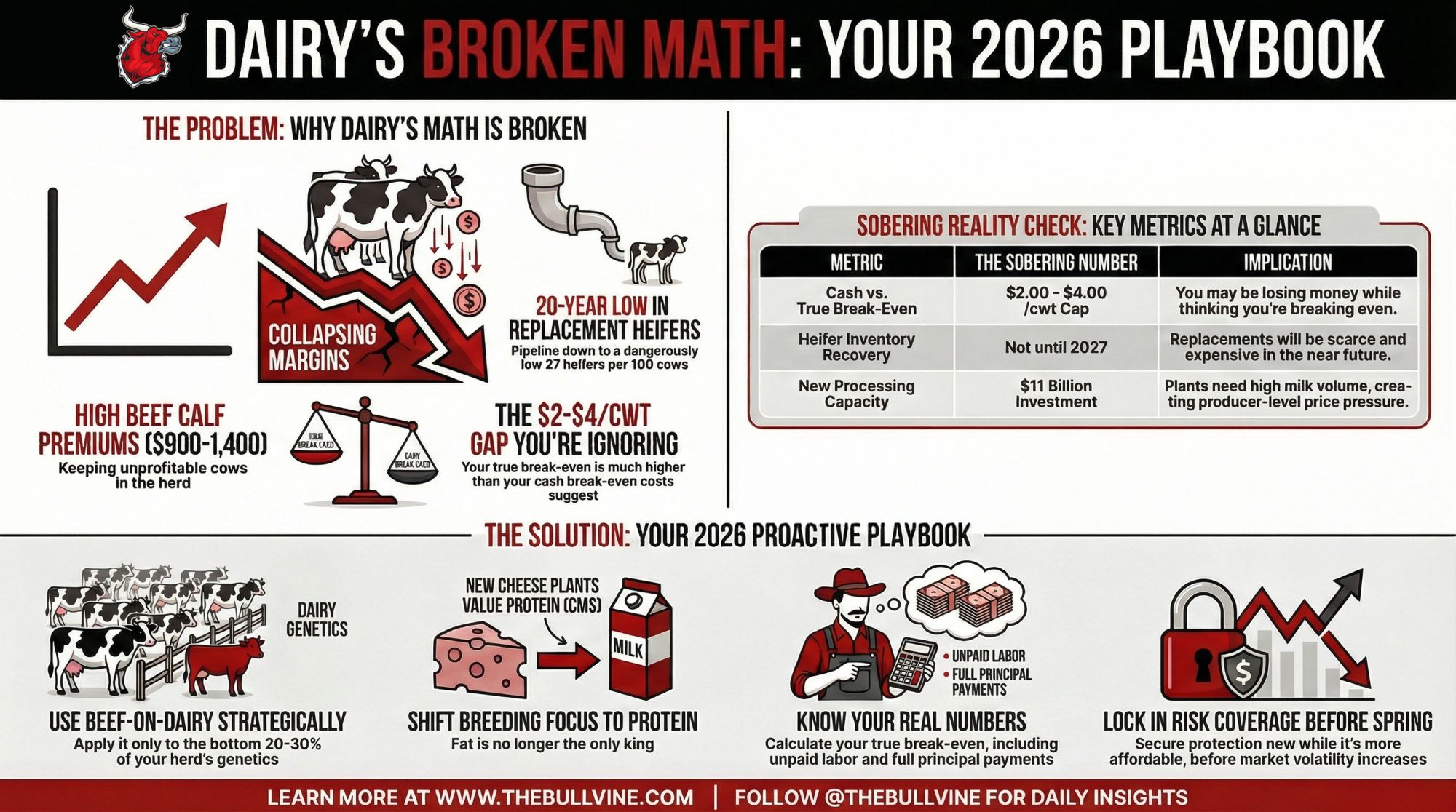
EXECUTIVE SUMMARY: Something’s broken in dairy economics. The U.S. herd grew by 211,000 cows in 2025—while margins collapsed. The culprit: beef-on-dairy premiums ($900-$1,400/calf) are keeping genetically weaker cows in barns that should be empty, starving the replacement pipeline to a 20-year low of just 27 heifers per 100 cows. Add $11 billion in new processing capacity hungry for volume, a component shift from fat toward protein, and producers underestimating their true break-even by $2-4/cwt—and this stops looking like a cycle. It’s a structural reset. With $17-18 milk projected through 2026 and heifer supplies not recovering until 2027, the next six months are a decision window, not a waiting period. The playbook: know your real costs, deploy beef-on-dairy only on your bottom 20-30% of genetics, and lock risk coverage before spring. Producers who act on this will shape their future. The rest will have it shaped for them.

Think about what that means for a moment. Milk prices are sliding. Margins compressing. Every traditional economic signal is screaming that producers should be culling hard and contracting supply. That’s what happened in 2015. That’s what happened in 2018. It’s what the textbooks say should happen when prices drop.

Instead, the national herd keeps expanding.

USDA’s November milk production report confirmed what many of us already sensed: production in the 24 major dairy states is running 4.7 percent above year-ago levels, with total U.S. milk up about 4.5 percent.

I’ve been watching dairy markets for over a decade now, and what’s unfolding feels meaningfully different from the cyclical downturns we’ve navigated before. The mechanisms that usually bring supply and demand back into balance… they’re just not functioning the way they used to, understanding why that’s happening matters to anyone trying to figure out their path forward.

The Numbers That Matter

Before diving deeper, here’s the data that should frame every strategic conversation you’re having right now:

MetricFigureSource
Dairy cow increase (YoY)+211,000 headUSDA November 2025
Fewer replacement heifers (2025 vs 2024)-357,490 headCoBank modeling
Replacement ratio27 heifers per 100 cowsUSDA January 2025 Cattle Inventory
Cash break-even vs. true break-even gap$2.00–$4.00/cwtCornell DFBS analysis
Butter price decline (May–December)~35%Global Dairy Trade
Heifer inventory recovery expected2027 at the earliestCoBank forecast

The Beef-on-Dairy Equation Changed the Calculus

Let’s start with what’s driving that herd expansion, because it explains a lot about the current situation—and raises some serious questions about where we’re headed genetically.

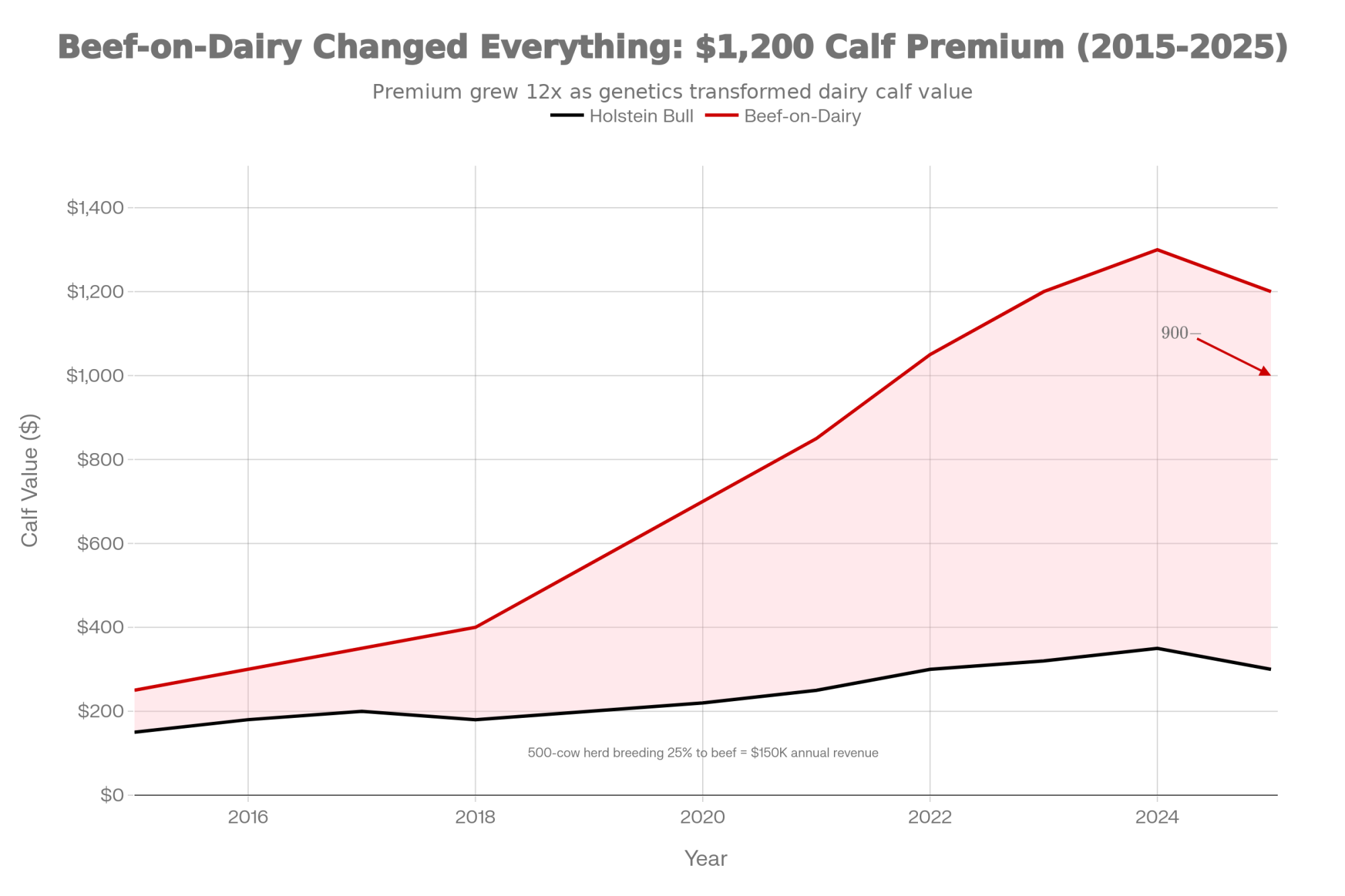
Beef-cross calves are commanding strong premiums right now. Reports from Purina, and various auction summaries show day-old beef-on-dairy calves commonly bringing $900 to $1,400, depending on genetics and region. Laurence Williams, over at Purina’s dairy-beef cross program, has been tracking averages right around $1,400 for quality calves.

Compare that to straight Holstein bull calves, which in many sale barns are still bringing only a few hundred dollars—often in the $200 to $400 range. The math is just too compelling to ignore.

Industry breeding data and semen sales trends show that beef-on-dairy has gone from a niche to the mainstream. Many herds are now using beef semen on a sizable share of lower-index cows. A 500-cow operation breeding a quarter of its herd to beef generates somewhere around $150,000 to $175,000 in additional annual revenue from calf sales alone.

But here’s what’s keeping me up at night: we’re creating a crisis of replacement heifers.

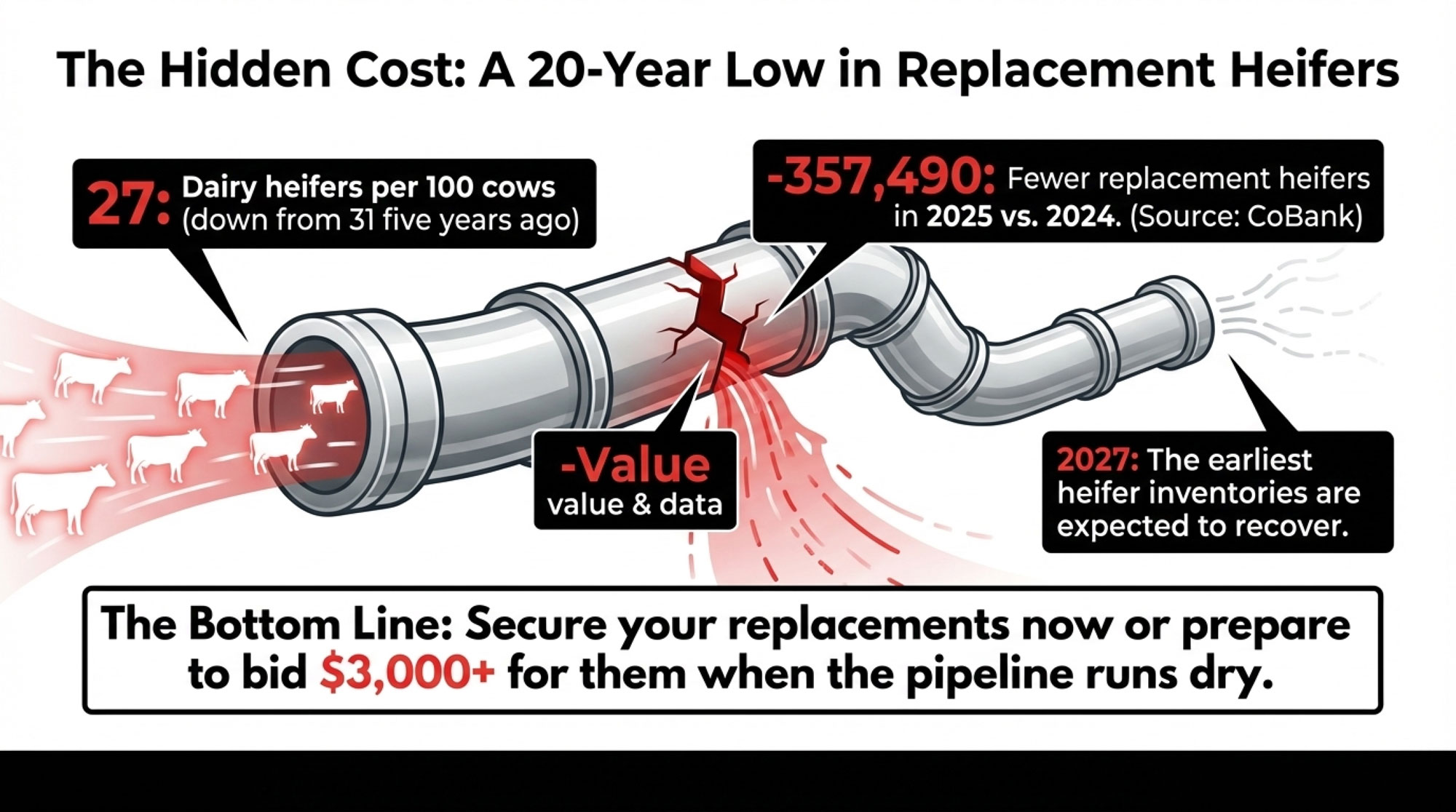
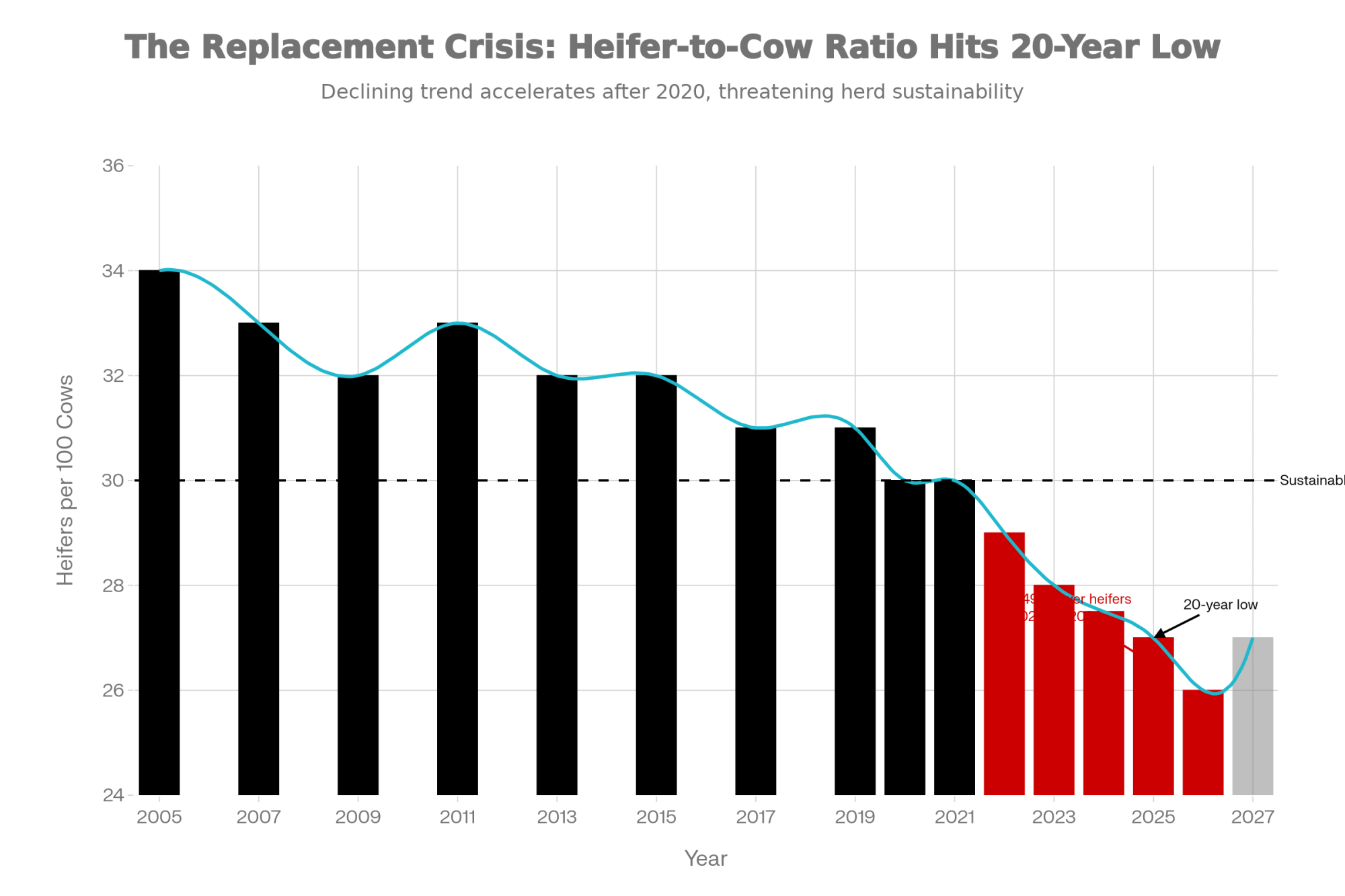
CoBank’s analysis is sobering. Their model predicted 357,490 fewer dairy heifers for 2025 compared to the prior year—driven by more beef-on-dairy calves, fewer conventional dairy semen sales, and only modest gains from sexed semen. Replacement heifer inventories are at a 20-year low and aren’t expected to rebound until 2027 at the earliest.

According to analysis of USDA’s January 2025 Cattle Inventory Report, the dairy herd’s replacement ratio has dropped to just 27 dairy heifers expected to calve for every 100 cows—down from 31 heifers per 100 cows just five years ago. That’s a dangerously thin pipeline.

And there’s a genetic dimension here that doesn’t get enough attention. When we keep older, less efficient cows in the herd because they’re carrying a valuable beef calf, we’re slowing genetic progress for milk production. Every lactation we add to a genetically inferior cow is a lactation we’re not getting from her higher-merit replacement. Research published in the Journal of Dairy Science has documented that herds with high availability of potential replacement heifers have substantially better longevity management options—and faster genetic turnover.

Industry geneticists estimate that every year of delayed genetic turnover costs dairy operations approximately $50 to $75 per cow, due to foregone production improvements, health trait gains, and feed efficiency advances. That’s not nothing—especially compounded across a herd over multiple years.

One Wisconsin producer I spoke with recently—running about 280 cows in the central part of the state—put the dilemma this way:

“I’ve got cows that aren’t really paying their way on milk. Maybe they’re giving me 55 pounds a day, but the components are just okay. Three years ago, she’s on the truck without question. But now she’s carrying a beef calf worth $1,300. How do I justify selling her?”

— Central Wisconsin dairy producer, 280 cows

He’s asking a reasonable question. But multiply that decision across thousands of operations, and you get a national herd that keeps growing even when milk economics alone would suggest contraction—while simultaneously starving the replacement pipeline and slowing genetic progress.

Traditional culling response to low milk prices has been significantly muted. Beef-on-dairy revenue is keeping cows in the herd that would otherwise have been on the truck months ago.

The strategic takeaway: Use beef-on-dairy on your verified bottom 20-30 percent of genetic performers—not random animals, and definitely not your genetic core. Genomic testing matters more than ever when you’re making these decisions.

A Global Situation Worth Understanding

What makes the current environment particularly complex is that this isn’t just a U.S. story.

USDA and international analysts expect global milk production to edge higher in 2025, led by strong U.S. growth and recovering production in Oceania, even as EU output slips slightly. The European Union is actually forecasting a small decline due to environmental and cost pressures, but that’s being more than offset by what’s happening elsewhere.

Normally, when one region overproduces, somewhere else contracts. That’s been the pattern for decades. Research published in the Journal of Dairy Science has documented these offsetting regional cycles going back years—they’ve been a defining feature of how global dairy trade finds equilibrium.

This season looks different.

The Global Dairy Trade auction platform—where about $3 billion worth of dairy products trade annually—has seen prices decline for nine consecutive sessions as of mid-December. That 4.4 percent drop in the most recent auction marked the ninth straight decline in the index. Whole milk powder, butter, cheese… all softening as supply growth outpaces demand.

What this suggests for U.S. producers is that we may not be able to count on export markets to absorb domestic oversupply the way they have in past cycles. International buyers have more options now. Multiple suppliers competing for their business means everyone’s offering competitive prices.

For Canadian producers operating under supply management, the dynamics play out differently—but they’re not immune. P5 quota holders watching U.S. oversupply should recognize that cross-border price pressure affects ingredient markets, and the component value shifts happening south of the border tend to ripple through eventually. The fundamentals around protein versus fat valuation are worth watching regardless of which side of the border you’re milking on.

That said—and I want to be fair here—trade dynamics can shift quickly. Strong demand from Southeast Asia or supply disruptions elsewhere could change the picture. But for planning purposes, it’s worth understanding the current global context.

The Processing Paradox

Here’s something that seems counterintuitive at first but makes more sense once you understand the underlying economics: all the new processing capacity coming online might actually be contributing to the challenge rather than solving it.

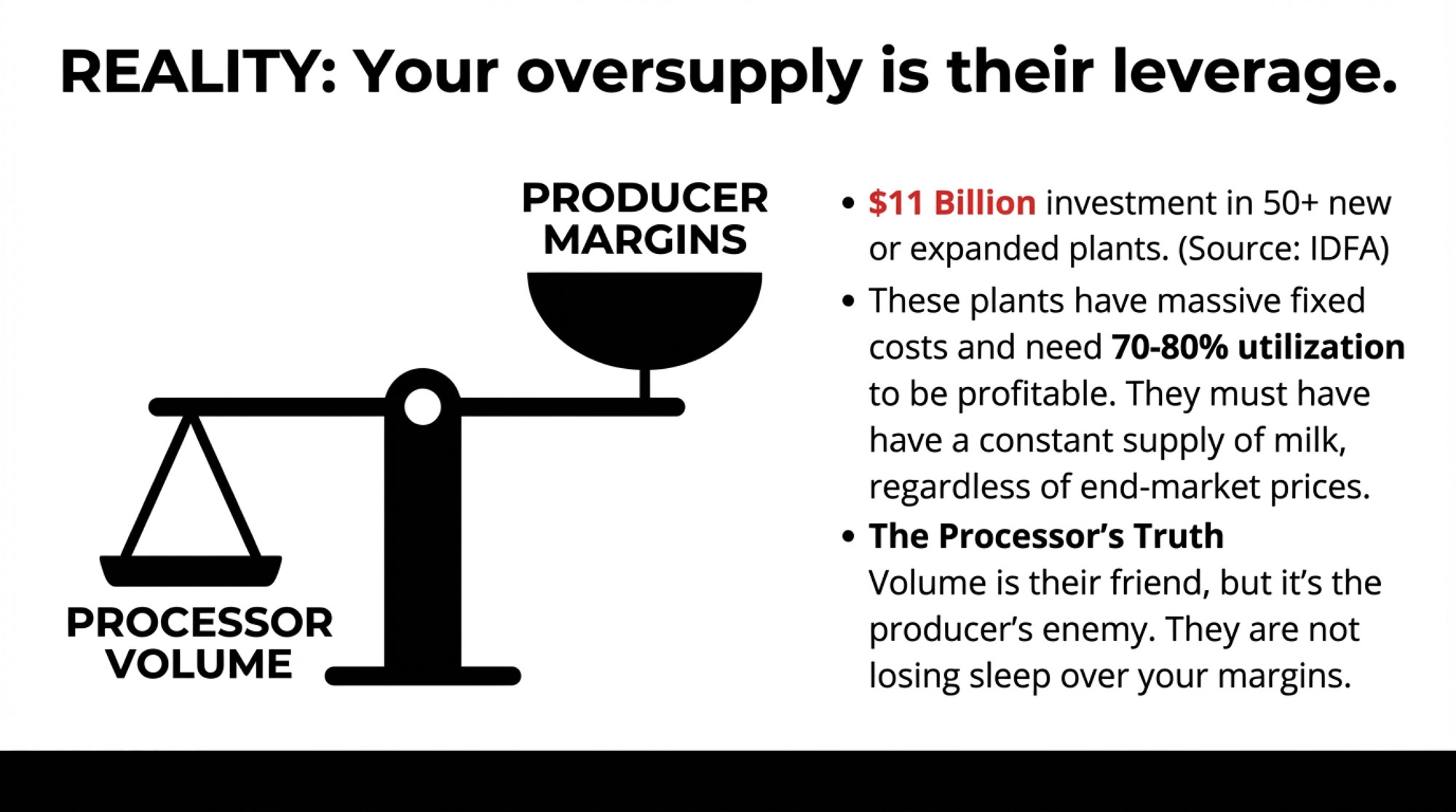
The International Dairy Foods Association released some eye-opening numbers back in October. Between 2025 and early 2028, more than $11 billion is being invested in over 50 new or expanded dairy processing facilities across 19 states. We’re talking major expansions by companies like Leprino Foods in Texas, Valley Queen in South Dakota, and Darigold out in Washington—substantial capacity additions for cheese, butter, and powder.

On the surface, more processing capacity should help absorb milk supply and support prices. In practice, it’s a bit more complicated than that.

These plants were planned and financed three to five years ago, when milk was running $20 to $24 per hundredweight, and the outlook was considerably more optimistic. The facilities incur substantial fixed costs—debt service, equipment depreciation, utilities, staffing—that don’t change much whether they’re operating at 50 percent capacity or at full utilization.

To cover those fixed costs, the plants need to operate at 70 to 80 percent utilization or better. That means they need milk. Consistently. Regardless of what’s happening in end markets.

Here’s the uncomfortable truth: volume is the processor’s friend, but it’s the producer’s enemy.

When processors compete for milk to fill their vats, it’s helpful to nearby producers. But all that processing creates output—cheese, butter, powder—that still needs buyers. So while a Wisconsin producer might see premiums from regional processor competition, they’re also seeing more cheese hitting markets that were already well-supplied. USDA Economic Research Service data shows domestic cheese consumption growing by maybe 1 to 2 percent annually. New capacity is adding somewhat more to production. Without proportional growth in exports or domestic demand, inventories build, and prices stay under pressure.

Mike North, who leads dairy market intelligence at Ever.ag, addressed this at the 2025 Dairy Strong Conference in Madison. What he said kind of surprised me: “We don’t have enough animals to make all the milk to supply all the plants in the U.S.”

That sounds puzzling, given everything about herd expansion, right?

The explanation lies in geography. The new capacity isn’t always located where the milk is. So you get regional competition for supply, with processors paying premiums to secure the milk they need to run efficiently.

“With all of this cheese potentially coming online, we have a real need for exports,” North noted. “Because we are going to be creating a lot of additional products.”

What’s Happening With Component Values

For nearly a decade, the consistent message to producers was straightforward: push butterfat. And you know what? Producers delivered impressively.

CoBank’s analysis shows U.S. butterfat levels grew from the mid-3.7s in 2015 to just above 4.2 percent by 2024, with some months hitting 4.26 percent according to University of Wisconsin Extension data. That’s remarkable progress driven by Jersey crossbreeding, thoughtful genetic selection, and nutrition programs. Processors rewarded high-component milk with meaningful premiums.

That dynamic appears to be shifting.

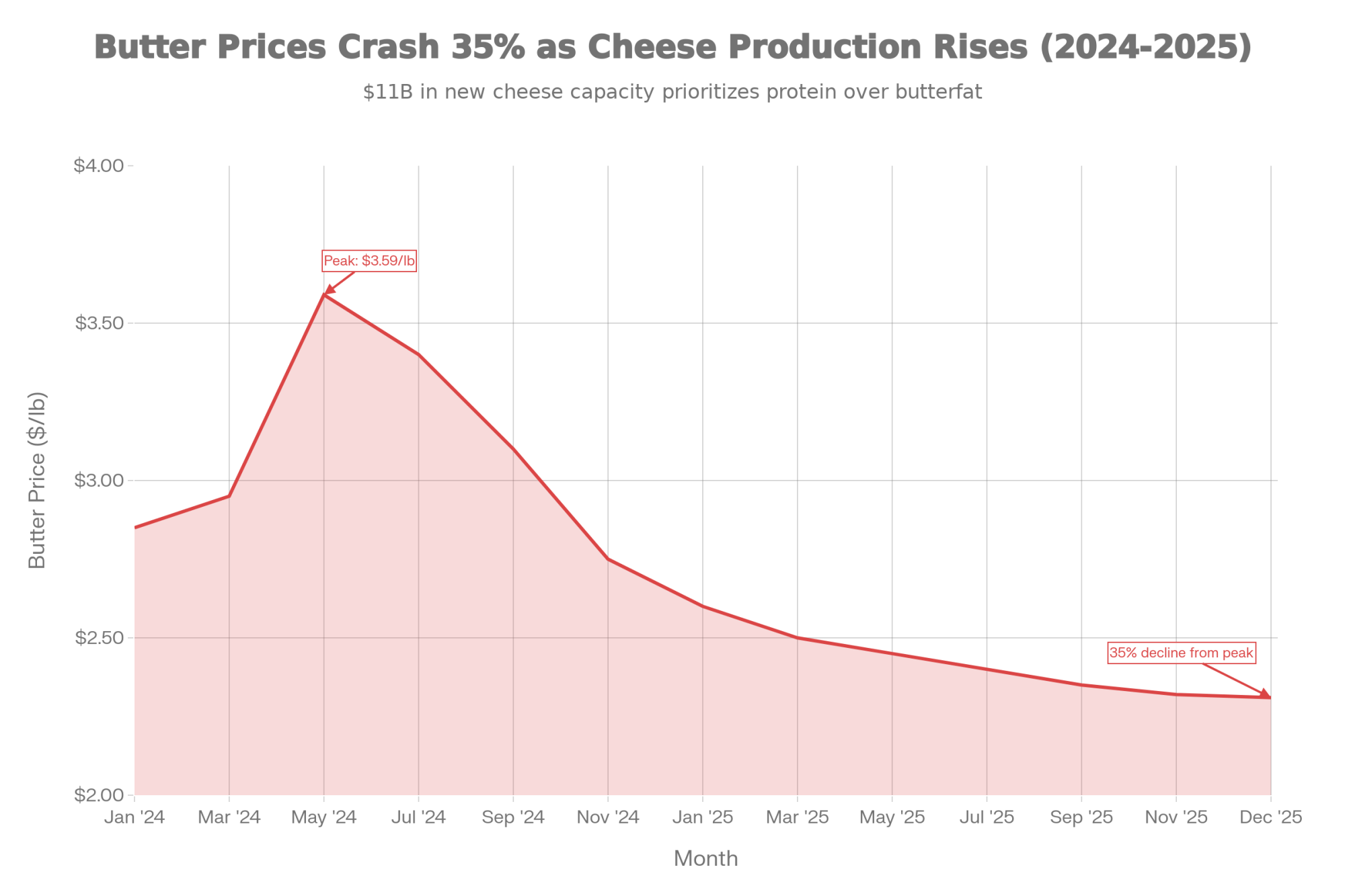
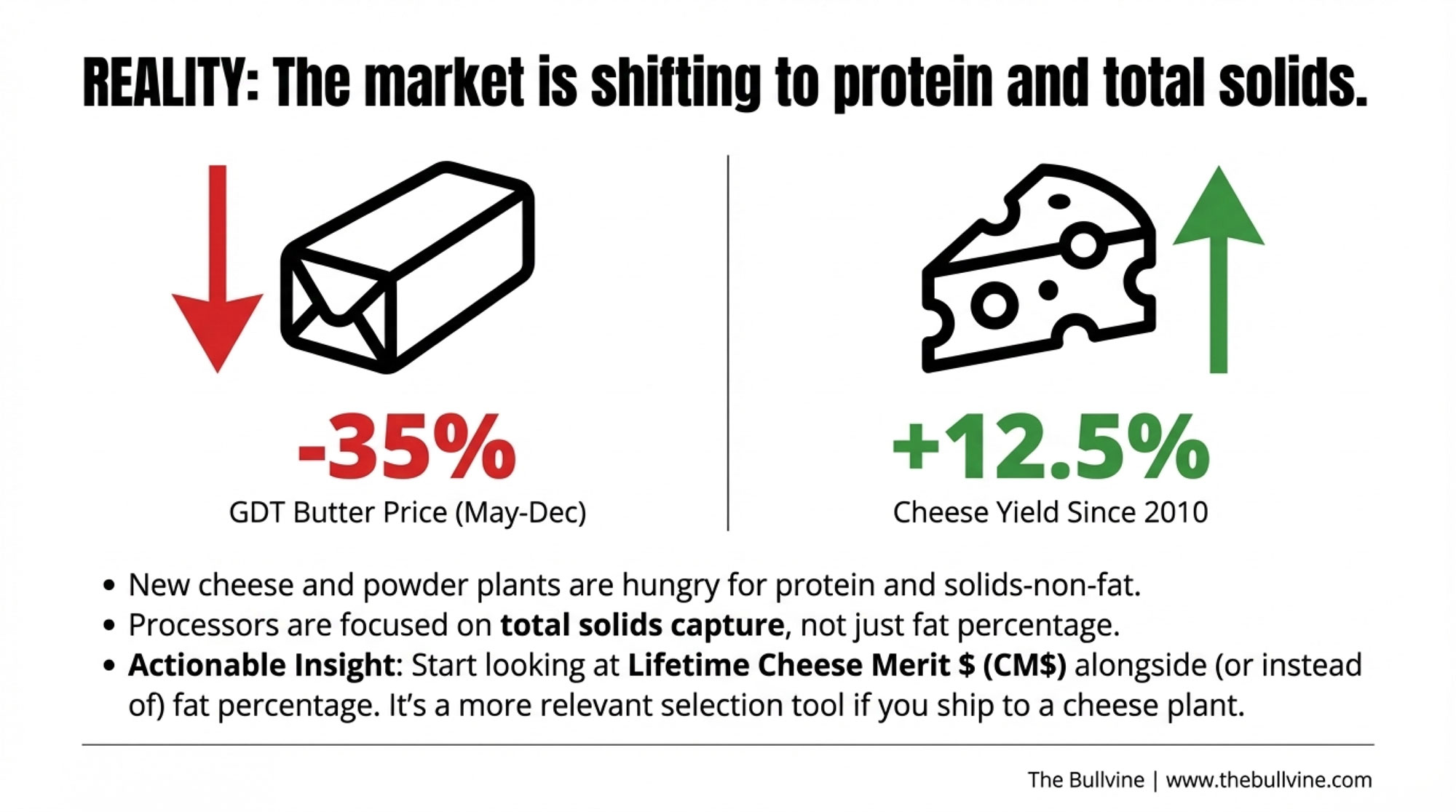
USDA Cold Storage data shows butter inventories running above prior-year levels for much of 2025. And spot butter values have trended lower from earlier highs—GDT butter prices dropped from about $3.59 per pound back in May down to roughly $2.31 at December auctions. That’s around a 35 percent decline.

Here’s what I think is really driving the shift: while fat was the “golden child” of the 2010s, these new processing plants—mostly cheese and powder-focused—are hungry for protein and solids-non-fat.

Analysis from earlier this year really drove this home. Cheese yields have climbed to historic highs—100 pounds of milk now yields 11.41 pounds of cheese, up a whopping 12.5 percent from 2010, when yields sat at 10.14 pounds. And what’s driving that improvement? Butterfat and protein together. The processors I’ve talked with are increasingly focused on total solids capture, not just fat percentage.

The Federal Milk Marketing Order pricing adjustments taking effect are affecting how component values translate into producer checks, and the effects are still sorting themselves out.

Practical suggestion: If you’re not already looking at your Lifetime Cheese Merit $ (CM$)—published by the Council on Dairy Cattle Breeding—alongside or even instead of straight fat percentage, now’s the time to start. CM$ places more weight on traits valued in herds selling milk into cheese markets, including greater emphasis on protein. For operations shipping to cheese plants, it may be a more relevant selection tool than traditional indexes.

This really comes back to the breeding decisions you’re making right now. Operations that built genetic programs around butterfat maximization may want to evaluate whether some shift toward protein emphasis makes sense for their situation. That kind of genetic transition, as you probably know, takes three to five years to implement fully.

Of course, component values will keep fluctuating, and every operation’s situation is different. The point isn’t that fat is suddenly worthless—it’s that the economics have become more nuanced than the simple “more fat equals more money” equation that held for most of the past decade.

The Cost Calculation That Deserves Your Attention

This might be the most practically important topic to address, because it directly affects how you evaluate your situation and think through strategic decisions.

Most operations track what I’d call “cash costs”—feed, hired labor, vet bills, utilities, supplies. When producers mention their break-even point, they’re usually referencing this number.

But cash costs don’t capture the complete picture. Not by a long shot.

When you add in unpaid family labor—and Cornell’s Dairy Farm Business Summary work values this at meaningful dollar amounts per full-time equivalent—the numbers shift noticeably. A farm with the operator and spouse both working full-time represents substantial labor value that may not appear in your break-even calculation.

Then there’s the gap between tax depreciation and actual principal payments on debt. Your tax return might show $75,000 in depreciation on facilities. But if you’re actually paying $180,000 in principal annually on those loans, your real cost is quite different. Cornell’s DFBS work shows that when you factor in actual principal payments instead of just tax depreciation, total cost can easily rise by $1 to $2 per hundredweight compared to cash-cost estimates.

Add family living expenses that come from farm income but don’t show up on Schedule F. Add what economists call the opportunity cost of having capital tied up in the dairy rather than invested elsewhere.

Recent Cornell Dairy Farm Business Summary reports show operating costs for many New York farms in the high teens per hundredweight, with total economic costs—including unpaid labor, capital costs, and family living—often running into the low twenties.

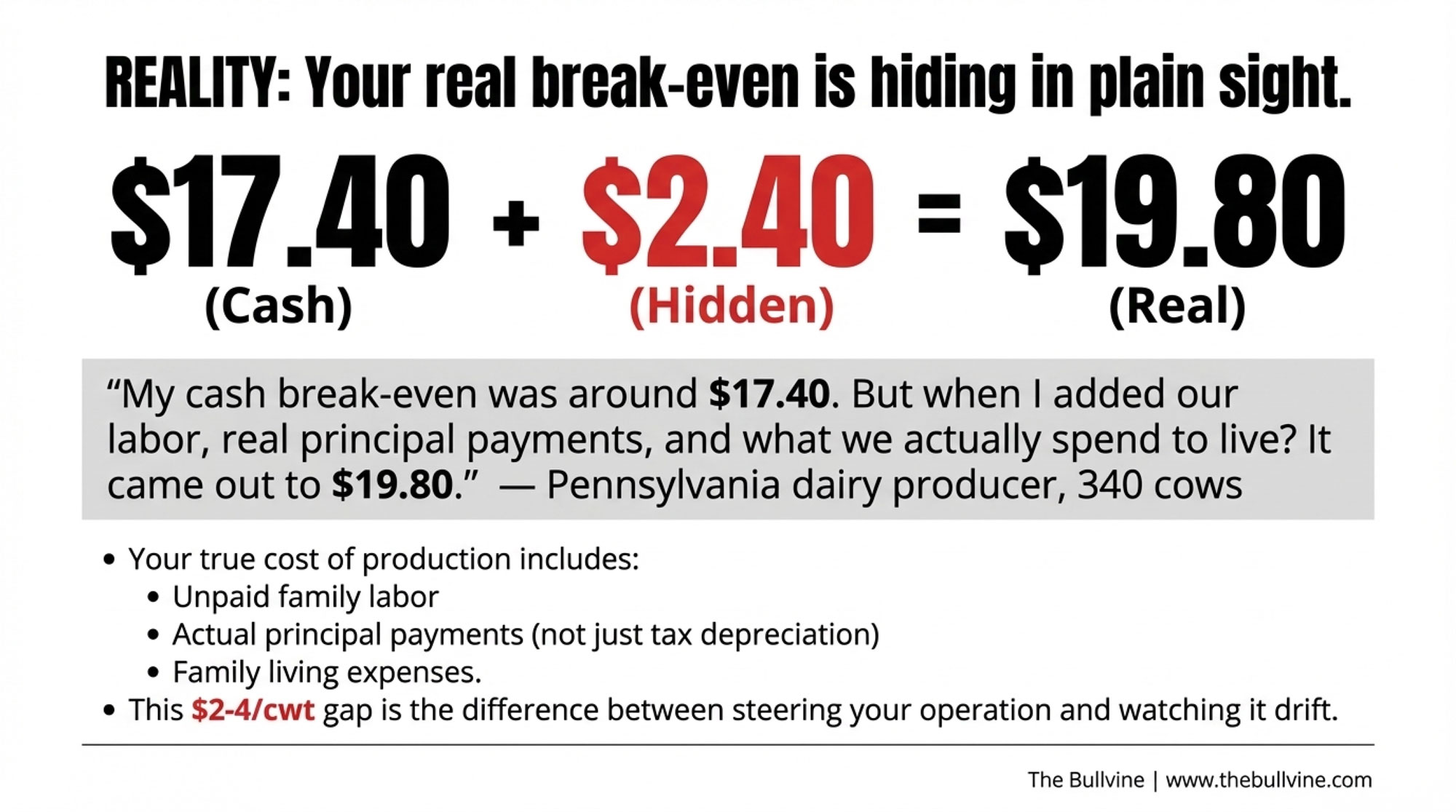
“I ran the numbers three times because I couldn’t believe them. My cash break-even was around $17.40. But when I added our labor, real principal payments, and what we actually spend to live? It came out to $19.80. That was a hard conversation to have with my wife.”

— Pennsylvania dairy producer, 340 cows

Cost CategoryCash Break-Even ($/cwt)Real Break-Even ($/cwt)
Feed & Purchased Inputs$8.50$8.50
Hired Labor$2.80$2.80
Veterinary & Breeding$1.20$1.20
Utilities & Fuel$1.10$1.10
Supplies & Maintenance$1.50$1.50
Interest Paid$1.20$1.20
Tax Depreciation$1.10
Unpaid Family Labor$1.85
Actual Principal Payments$2.40
Family Living Expenses$1.05
Opportunity Cost of Capital$0.20
TOTAL BREAK-EVEN$17.40$19.80
Hidden Cost You’re Ignoring+$2.40/cwt

That gap matters when you’re looking at USDA projections suggesting extended periods of $17 to $18 milk in 2026. Operations that believe they’re “close to break-even” based on cash costs may actually be losing $2 to $4 per hundredweight when everything is honestly accounted for.

This isn’t meant to be discouraging—it’s meant to help you see clearly. You can’t make good strategic decisions without understanding your real numbers.

Risk Management Tools Worth Your Consideration

For producers who’ve worked through their cost calculation and recognize potential exposure, several risk management tools deserve a closer look. Each has strengths and limitations worth understanding.

  • Dairy Margin Coverage enrollment typically runs from late winter to early spring—check with your local FSA office for exact dates, as they can vary year to year. Historically, the top coverage level has come with a relatively low per-hundredweight premium after federal subsidy, making it inexpensive catastrophic protection for the first 5 million pounds. Here’s a consideration worth noting: with feed costs currently moderate—corn projected in the $ 4 range—DMC margins may stay above trigger levels even with softer milk prices. Generally speaking, corn would need to push above $5.50 before DMC payments become likely under current milk price projections. It’s probably not wise to count on meaningful payments, but the coverage is cheap enough that enrollment makes sense for most operations.
  • Dairy Revenue Protection offers quarterly revenue coverage with federally subsidized premiums. One detail that catches some producers off guard: coverage typically starts about 5 percent below current market prices. On $17 milk, that means your floor is around $16.15 before protection kicks in. Robin Schmahl has noted this limitation in his market commentary—put options may offer better protection for producers whose break-evens sit meaningfully above projected prices.
  • Put options through the CME require a higher upfront premium but allow you to select strike prices based on your actual situation rather than accepting a built-in discount. For operations facing real exposure, the math sometimes favors options despite the higher initial cost.
  • Feed forward contracts represent an opportunity worth evaluating this season. Many risk-management advisers suggest locking in a portion—often 40 to 60 percent—of projected feed needs when forward prices look favorable, while leaving some flexibility to take advantage of future dips.

Key Risk Management Considerations for 2026

ToolCoverage Level / StrikePremium CostBest ForKey Limitation2026 Action Timing
Dairy Margin Coverage (DMC)Top tier: Margin above feed costLow(~$0.15/cwt after subsidy for 5M lbs)Catastrophic protection; tight-margin operationsUnlikely to trigger unless corn >$5.50 with $17 milk; covers margin, not priceEnroll late Feb-early Mar (check local FSA)
Dairy Revenue Protection (DRP)~5% below current marketModerate(federally subsidized)Operations within 10-15% of break-evenCoverage starts 5% below market—$17 milk = $16.15 floorEarly Feb for Q2 (Apr-Jun coverage)
CME Put OptionsCustom strike at/above break-evenHigher (full premium, not subsidized)Operations with break-even >$19; need specific floorUpfront cost; requires market knowledgeQ1 2026before volatility increases
Feed Forward ContractsLock corn/soybean pricesVaries by basis, timingSecuring input costs when forwards favorableLose flexibility if cash market drops; typically lock 40-60%Q1 2026 for growing season
LGM-DairyGross margin protectionModerate-High (some subsidy)Comprehensive margin coverageComplex; 27-hour weekly enrollment windowsWeekly Fri-Sat windows

The timing element matters here. Options and insurance products tend to become more expensive as market volatility increases. Producers who secure protection earlier—before first-quarter results confirm or deny margin pressure—typically access better pricing than those who wait until the situation becomes clearer.

Strategic Considerations for Different Operations

The segment facing perhaps the most complex decisions right now is the 200- to 400-cow operation. Large enough to have meaningful capital at risk. But potentially facing questions about whether the scale economics work if milk settles into the $19 to $20 range that many analysts suggest as a reasonable baseline.

Looking at the options realistically, there are three general paths producers are considering:

  • Scaling up to 700 to 1,000-plus cows can achieve cost structures that work better at projected price levels. The requirements are substantial, though—$3 to $5 million for facilities, equipment, and livestock based on current costs. And then there’s labor. Finding and retaining quality employees has become increasingly challenging across dairy regions, and larger operations require more sophisticated workforce management. This path tends to make sense for operations with strong balance sheets, favorable regional positioning, clear next-generation commitment, and confidence in building a reliable team.
  • Optimizing at the current size while managing costs aggressively remains viable for operations that can get their numbers to work. University of Wisconsin Extension analysis suggests realistic reductions of $0.75 to $1.20 per hundredweight are achievable through improved feed efficiency, labor optimization, and purchasing improvements. Whether that’s sufficient depends entirely on where your true break-even point sits relative to projected prices—and on your broader goals for the operation.
  • Strategic transition while equity remains strong represents a financially rational consideration for some, particularly producers approaching retirement age without clear succession or those in regions where cost structures have become especially challenging. The reality—uncomfortable as it may be to discuss—is that producers who make this decision while they’re choosing rather than being forced generally achieve better outcomes than those who wait.

Now, I want to be fair here. There’s a different perspective worth acknowledging. Not everyone sees the outlook the same way. Some analysts point to potential supply response as beef-on-dairy calf values moderate, or unexpected demand growth from food service channels. Keith Woodford, an agricultural economist who’s studied dairy markets extensively, has cautioned against assuming current trends continue in a straight line. Markets have surprised observers before, and they’ll do it again.

Even the more optimistic scenarios, though, tend to suggest $19 to $20 milk as a reasonable baseline—not the $22 to $24 levels of 2022. The question isn’t really whether an adjustment is happening; it’s how significant and how prolonged it is.

Regional Factors That Shape Your Decision

Geography matters considerably in how these dynamics play out for individual operations.

In Wisconsin, Michigan, Idaho, South Dakota, and parts of Texas, producers often benefit from proximity to new processing capacity, relatively moderate cost structures, and continued infrastructure investment. Expansion strategies tend to pencil out more favorably in these regions, and break-evens generally run lower due to feed costs and regulatory environments.

The Northeast faces different arithmetic. Higher land costs, higher labor costs, and limited expansion opportunities make large-scale operations harder to justify economically. Many of the successful operations I’ve encountered in New York, Pennsylvania, and Vermont have differentiated themselves through organic certification, grass-fed programs, or direct-to-consumer relationships rather than competing primarily on volume.

California still leads the nation in total milk production, but its share of U.S. output has slipped as growth has shifted inland to states like Texas, Idaho, South Dakota, and Kansas. Higher labor and compliance costs, along with water constraints, are part of that story—and the trend seems likely to continue, though California will certainly remain a major dairy state.

Practical Considerations for the Year Ahead

After working through all of this, what actually matters for producers making decisions right now?

  • Understanding your real numbers. The true cost of production—including unpaid labor, actual principal payments, family living, and capital costs—often runs several dollars per hundredweight above cash costs alone. Strategic decisions work better when they’re based on complete information.
  • Recognizing this environment may be different. The mechanisms that normally bring markets back into balance—culling in response to low prices, regional production adjustments, export market absorption—don’t appear to be functioning quite the way they have historically. Planning for eventual recovery to $22-$24 milk may be optimistic.
  • Using beef-on-dairy strategically, not reflexively. Genomically test everything. Target your verified bottom 20-30 percent of genetic performers for beef crosses—not random animals, and definitely not your genetic core. The calf premium matters, but having quality replacements available in 2027-2028 matters more.
  • Rethinking component selection. Look at the Lifetime Cheese Merit $ (CM$) if you’re shipping to cheese markets. Protein is gaining importance relative to fat as new cheese capacity comes online.
  • Considering risk management earlier rather than later. Check with your local FSA office about the timing of DMC enrollment. Feed contracts secured in the first quarter protect against potential price increases. Protection tools are generally most cost-effective before volatility increases.
  • Making decisions proactively. The first half of 2026 is a window during which most producers still have options. Waiting to see how things develop sometimes means accepting whatever options remain.

The Bottom Line

Over the next few years, the U.S. dairy industry will likely produce roughly the same total milk volume—but with fewer operations, greater geographic concentration in lower-cost regions, and generally larger scale.

The adjustment period won’t be comfortable for everyone. But it also creates opportunity for those who recognize what’s happening and position accordingly—whether that means building an operation optimized for current market realities, or thoughtfully transitioning capital and energy elsewhere.

The producers who navigate this period successfully won’t necessarily be those who love dairy the most—though that passion certainly helps sustain the effort through difficult stretches. They’ll tend to be the ones who understood their numbers, made decisions based on realistic assumptions, and built for the emerging market rather than the one that existed five years ago.

I don’t pretend to know exactly how the next few years will unfold. Markets have surprised me before, and they’ll do it again. But the patterns in the data—herd expansion despite margin pressure, a replacement heifer crisis building in the background, global supply dynamics, processing capacity hungry for volume, component value shifts—suggest this is a period that rewards clear thinking and early action rather than hopeful waiting.

Based on CoBank’s modeling, we likely won’t see heifer inventories stabilize until 2027 at the earliest—which means the decisions you make in the next six months will determine your position when that inflection point arrives.

For those of you reading this, the first part of 2026 offers a window for decisions that will shape outcomes for years to come. They’re not easy decisions. They’re not comfortable. But they’re worth making deliberately rather than letting circumstances make them for you.

KEY TAKEAWAYS 

  • 211,000 more cows while margins collapse — Beef-on-dairy premiums ($900-$1,400/calf) are keeping genetically weaker cows in herds, breaking the culling math that normally corrects oversupply
  • 27 heifers per 100 cows — Down from 31 five years ago. A 20-year low that won’t recover until 2027. Secure your replacements now or bid $3,000+ for them later
  • $17.40 cash break-even vs. $19.80 real — That $2-4/cwt gap you’re ignoring? It’s the difference between steering your operation and watching it drift
  • $11B in new plants need your milk — Processors cover fixed costs with volume. Your oversupply is their leverage. They’re not losing sleep over your margins
  • The 2026 playbook — Beef-on-dairy on the bottom 20-30% of genetics only. Breed for protein (CM$), not just fat. Lock risk coverage before spring. Decide now or react later

Complete references and supporting documentation are available upon request by contacting the editorial team at editor@thebullvine.com.

Learn More

The Sunday Read Dairy Professionals Don’t Skip.

Every week, thousands of producers, breeders, and industry insiders open Bullvine Weekly for genetics insights, market shifts, and profit strategies they won’t find anywhere else. One email. Five minutes. Smarter decisions all week.
NewsSubscribe
First
Last
Consent

The Heifer Shortage: Crisis and Opportunity

What if I told you every beef breeding is stealing milk from 2027? Time to rethink your replacement strategy.

replacement heifer shortage, dairy farm profitability, sexed semen technology, beef-on-dairy strategy, heifer retention costs

EXECUTIVE SUMMARY: You know that sick feeling when you see $4,000 heifer prices at auction? Well, buckle up – we’re sitting on the worst replacement shortage in 47 years, and it’s about to reshape how profitable operations manage their herds. Here’s the reality: we’ve got just 3.914 million replacement heifers nationwide, with only 2.5 million expected to freshen in 2025. That’s not just tight supply – that’s a fundamental shift that’s already forcing Wisconsin producers to swallow $860 per head increases year-over-year.

The beef-on-dairy trend that’s been padding cash flow with $1,000 crossbred calves? It’s creating the very shortage that’s now costing us thousands per replacement. But here’s what the smart operators are figuring out: retention programs are delivering 54% cost savings versus market purchases, and strategic sexed semen deployment is becoming the difference between profit and survival. You need to start treating this like the crisis it is – not next month, not next season, but right now.

KEY TAKEAWAYS

  • Slash replacement costs by 54% immediately – Implement heifer retention programs now instead of buying $3,000+ market animals. Start with your top genetic quartile and build management systems that can handle 25-27% replacement rates.
  • Lock in female calves with sexed semen strategy – Deploy on your best 25% of cows achieving 80-90% conception rates. With replacement values this high, the extra $20-30 per dose pays for itself in one successful breeding.
  • Recalibrate your beef-on-dairy exposure – Limit to 40% maximum of total breedings to maintain adequate replacement generation. Those $1,000 crossbred calves won’t help if you can’t find replacements at any price.
  • Stress-test your operation at $4,000 replacement costs – Build these numbers into 2025-2026 cash flow projections and secure financing before you need it. The farms that survive this crisis will be those that planned for it.
  • Upgrade calf management protocols immediately – With heifer calves worth $3,000+ each, failure of passive transfer and preventable losses become financially devastating. Target less than 10% passive transfer failure rates.

Let me tell you something that’s been keeping me up at night… and it should probably be bothering you too. We’re sitting in the middle of the worst replacement heifer shortage I’ve seen in my career, and if you think those $4,000 heifers showing up at auctions are just a temporary spike… well, grab a coffee because we need to talk.

I’ve been watching these numbers for years, and what’s happening right now? It’s not just a market correction – it’s a fundamental shift in how we think about building and maintaining dairy herds. The January 2025 USDA cattle inventory data tells a story that’s frankly pretty sobering: 3.914 million dairy replacement heifers across the entire country. That’s the lowest figure since Jimmy Carter was in the White House, and the trend line isn’t exactly encouraging.

Here’s what really gets me – Statistics Canada’s showing the same pattern up north. Their cattle inventories dropped 0.7% to 10.9 million head by January, marking three straight years of decline. When both sides of the border are dealing with shrinking replacement pools… well, that’s when you know we’re looking at something bigger than just a regional hiccup.

What’s Really Happening in the Field

The thing about spending decades in this business is that you start recognizing patterns that others might miss. And this pattern? It’s different from anything we’ve dealt with before. I was chatting with a Wisconsin producer just last week – been in business for thirty years, runs about 800 head – and he put it perfectly: “three years ago I budgeted $1,500 for a replacement. Today I’m looking at $3,000… if I can even find one.”

What strikes me about this whole situation is the velocity of change. We’re not talking about a gradual price increase here. Recent auction reports are showing premium pregnant heifers selling for upward of $4,000 per head. That’s not a typo, that’s the new reality hitting operations from coast to coast.

And here’s something that really caught my attention – USDA’s projecting only 2.5 million heifers will enter the milking herd in 2025. Think about that for a minute. That’s the lowest level since they started tracking this metric systematically. Makes you wonder what other trends we’re missing while we’re focused on milk prices and feed costs, doesn’t it?

What’s particularly concerning is how we’re adapting to this shortage. Industry observers are noting that operations are keeping older cows in the barn longer just to maintain herd size. The efficiency drag from that decision? It’s showing up in components, cell counts, and ultimately in milk checks across multiple regions.

The Market Reality Nobody Wants to Face

You know what really drives this home for me? I’ve been to auctions recently where quality springer heifers are selling for more than what some producers paid for their first tractors. The numbers are just staggering when you step back and look at them.

Wisconsin’s been a bellwether for replacement pricing, and producers there have watched values nearly double compared to five years ago. That’s not inflation – that’s fundamental supply and demand economics hitting the reset button on how we value replacement animals.

Transportation has become another pressure point that’s easy to overlook. Moving heifers between regions can easily add $200 to $500 per head, depending on distance and current fuel costs. So if you’re not located near traditional heifer-producing areas, you’re getting squeezed from multiple directions.

The geographic implications are fascinating… and a little concerning. Proximity to heifer sources is becoming a real competitive advantage in ways we haven’t seen before. Operations in traditional dairy regions are finding themselves with leverage they didn’t know they had, while farms in newer dairy areas are scrambling to secure reliable replacement sources.

What’s particularly noteworthy is how seasonal patterns are playing out differently this year:

Spring markets have traditionally been when we’d see peak heifer availability, but that predictable pattern is breaking down. The Upper Midwest still has the highest concentration of available animals, but even there, you’re looking at premium pricing that would’ve been unthinkable just a few seasons ago.

Summer breeding efficiency has become even more critical when every successful pregnancy represents such significant value. Heat stress management isn’t just about milk production anymore – it’s about protecting potentially $3,000+ investments in genetic progress.

Technology That’s Gone from Nice-to-Have to Essential

Here’s where the conversation gets really interesting… and expensive. Recent research is confirming that modern sexed semen technology is achieving conception rates that are 80% to 90% of conventional semen. Five years ago, those numbers would’ve seemed optimistic. Today, they’re becoming the baseline expectation.

The economics have completely flipped on reproductive technology adoption. When a replacement heifer represents a $3,000+ investment, spending an extra $20 to $30 per breeding to guarantee female offspring isn’t just smart management – it’s basic math.

What’s particularly fascinating is how environmental conditions are affecting these technologies differently than we expected. Some operations are reporting that sexed semen conception rates actually hold up better during heat stress periods than conventional AI. That’s counter to what many of us assumed would happen.

Here’s what I’m seeing work consistently across different operation types:

Strategic deployment of sexed semen on the top genetic quartile of animals – you’re maximizing both replacement quality and quantity where it matters most. The middle tier gets conventional semen for backup protection, because you still need some insurance against breeding failures. The bottom quartile? That’s where beef semen makes sense for immediate cash flow, but we’ll get to that challenge in a minute.

The embryo transfer conversation is evolving rapidly, too. Research is showing fresh embryo transfer achieving conception rates of 35.4% compared to 21.4% for conventional AI during heat stress periods. For operations dealing with brutal summer conditions – and that’s a lot more of us than it used to be – those numbers represent real opportunities to maintain replacement generation even when natural breeding efficiency drops.

The Beef-on-Dairy Phenomenon… and Its Consequences

This is where we get into some unintended consequences that I don’t think the industry fully anticipated. National Association of Animal Breeders data shows beef semen sales to dairy operations hit 7.9 million units in 2023. That represents adoption levels that caught even the most optimistic projections off guard.

The immediate economics are pretty compelling, I’ll give you that. Recent market reports show newborn beef-cross calves bringing $800 to $1,000+ per head at just days old. Compare that to conventional dairy bull calves that were barely worth hauling to market just a few years ago, and you can see why so many operations jumped in with both feet.

But here’s the catch that I think we’re just starting to fully understand – every beef breeding represents a replacement heifer you’re not producing. The short-term cash flow boost is real, but the long-term capacity implications are becoming clearer every month.

What’s really interesting is watching how different regions are adapting to this dynamic. Operations in areas with reliable heifer sources can probably afford to run higher percentages of beef semen. But what about farms in regions where replacement acquisition is already challenging? They’re having to recalibrate those breeding strategies pretty quickly.

The global perspective on this trend is also worth considering. Different regulatory environments and market structures are creating varying adoption patterns. What works in the Upper Midwest may not translate directly to operations dealing with different seasonal patterns or regulatory constraints.

Making Smart Moves in a Tight Market

The retention game has fundamentally changed, and I’m not sure everyone has fully absorbed what that means yet. Research from bovine specialists is showing that well-managed heifer retention programs can deliver up to 54% cost savings compared to market acquisition. When you’re looking at $2,500+ acquisition costs – and we’re clearly past that threshold – the math strongly favors keeping more of your own replacements.

Here’s what I’m seeing work consistently in real operations:

The replacement rate conversation has gotten a lot more sophisticated. Most operations need somewhere between 25% and 35% replacement rates when you factor in normal mortality and culling patterns. The smart operators I know are targeting the lower end of that range – maybe 25% to 27% – to give themselves flexibility for selective culling and market timing opportunities.

What’s often overlooked in these discussions is calf management. Pre-weaning studies are showing costs ranging from $258 to $583 per calf, with feed representing nearly half of total expense. When every heifer calf represents potential $3,000+ value, losing animals to preventable management failures isn’t just disappointing – it’s financially devastating.

The colostrum management piece has become absolutely critical. While industry-wide data on passive transfer failure varies, getting those rates down to 10% or less isn’t just good animal husbandry anymore – it’s basic economics when individual animals represent such significant investments.

Regional Realities and Strategic Implications

The geographic shifts happening in dairy production are creating some interesting dynamics that I think deserve more attention. Major dairy regions continue expanding processing infrastructure – we’re talking about billions in investment that requires sustained milk supplies to justify.

What concerns me about the concentration trends is disease vulnerability. When you’ve got large percentages of national production concentrated in specific regions, any disruption – whether it’s disease pressure, extreme weather, or regulatory changes – can have outsized impacts on replacement availability.

Let me break down what I’m seeing by region, because the challenges are definitely not uniform:

Southwest Operations: Water scarcity is becoming a genuine constraint on expansion, which affects replacement planning in ways that aren’t always obvious. Heat stress management is requiring more sophisticated cooling systems, and that’s affecting the economics of heifer raising. Feed cost volatility from drought conditions is making budgeting more challenging than it used to be.

Upper Midwest: Seasonal breeding patterns are creating more pronounced availability clusters than we’ve seen historically. Weather volatility is affecting feed quality and storage in ways that ripple through heifer development programs. Labor constraints in rural areas are limiting expansion opportunities for some operations.

Canadian Operations: The currency fluctuation aspect adds another layer of complexity to replacement acquisition decisions. Provincial regulatory differences are affecting breeding strategies in ways that U.S. producers might not fully appreciate. The seasonal patterns are different enough that timing becomes even more critical for successful heifer development.

Climate projections aren’t particularly encouraging for any region. Heat stress impacts could significantly affect milk production by 2030, and that’s going to create additional pressure on replacement strategies across the board.

Global Context and Market Dynamics

What’s happening internationally adds another dimension to this story that I think we need to pay attention to. EU operations are dealing with similar heifer shortages, but their regulatory environment creates different constraints and opportunities. New Zealand’s seasonal system generates entirely different dynamics around replacement timing and availability.

The international genetics trade is shifting in response to these supply constraints. Traditional exporters are facing their own production pressures, while demand for superior genetics continues growing globally. This creates opportunities for operations that can produce high-quality replacements, but it also means more competition for the best genetic material.

Export data shows U.S. bovine semen exports reaching new highs, but the flow of that genetic material is increasingly going to dairy operations rather than traditional beef producers. That shift has implications for domestic availability that might not be immediately obvious.

What This Means for Your Operation Right Now

Look, I’ve been around this industry long enough to recognize when we’re at a genuine inflection point. This isn’t a temporary market disruption that’s going to resolve itself in six months. The operations that adapt their strategies first are positioning themselves for significant competitive advantages.

If you’re serious about maintaining or growing your operation, here’s what needs to happen:

Financial Planning – Start Here:

  • Recalculate your replacement budgets using current market pricing
  • Build heifer acquisition costs into cash flow projections for the next 18 to 24 months
  • Explore financing options before you actually need them
  • Factor transportation and acquisition costs into your planning process
  • Stress-test your operation’s financials at even higher replacement costs

Breeding Strategy Overhaul:

  • Strategic sexed semen deployment on your top genetic tier
  • Limit beef-on-dairy exposure to maintain an adequate replacement generation
  • Consider embryo transfer for multiplying elite genetics
  • Implement genomic testing to optimize breeding decisions
  • Adjust seasonal timing for maximum reproductive efficiency

Operational Changes:

  • Develop intensive heifer retention programs
  • Upgrade calf management protocols
  • Focus on reproductive efficiency improvements
  • Explore cooperative agreements with neighboring operations
  • Accelerate technology adoption for precision breeding

Risk Management:

  • Increase insurance coverage for high-value animals
  • Diversify heifer sources across multiple regions
  • Develop contingency plans for disease outbreaks
  • Implement financial stress testing for market volatility
  • Plan for seasonal weather disruptions

The thing that strikes me most about this whole situation is that it’s simultaneously a crisis and an opportunity. Operations that figure out how to navigate these challenges effectively won’t just survive the current market conditions – they’ll establish competitive advantages that compound over time.

Better reproductive efficiency, superior genetic progress, optimized replacement strategies… these aren’t just operational improvements anymore. They’re becoming the fundamental differentiators between operations that thrive and those that struggle to maintain viability.

So here’s my question for you: What’s your move going to be? Because standing still isn’t really an option when the fundamentals of replacement economics have shifted this dramatically. The heifer shortage is real, the pricing pressure isn’t going away, and the seasonal patterns are becoming more pronounced every year.

But for producers willing to adapt their strategies and embrace new approaches to herd management, there are genuine opportunities to build sustainable advantages. The question isn’t whether these changes will continue – it’s whether your operation will lead the adaptation or get left behind trying to manage with outdated assumptions.

The choice is yours, but the clock’s ticking.

Complete references and supporting documentation are available upon request by contacting the editorial team at editor@thebullvine.com.

Learn More:

  • dairy heifer management – The Bullvine – Reveals science-based selection methods for maximizing replacement heifer quality, including genetic ranking systems and critical health factors that determine which animals become profitable long-term producers in your herd.
  • Why Dairy Farmers Are Struggling Despite Soaring Milk Prices – Demonstrates how strategic breeding decisions impact long-term profitability, showing why maintaining proper heifer headcounts delivers better returns than chasing short-term crossbred calf revenue in volatile markets.
  • 5 Technologies That Will Make or Break Your Dairy Farm in 2025 – Practical strategies for leveraging smart calf sensors, AI-driven analytics, and precision feeding systems to reduce mortality by 40% and optimize heifer development efficiency in the current shortage environment.

The Sunday Read Dairy Professionals Don’t Skip.

Every week, thousands of producers, breeders, and industry insiders open Bullvine Weekly for genetics insights, market shifts, and profit strategies they won’t find anywhere else. One email. Five minutes. Smarter decisions all week.
NewsSubscribe
First
Last
Consent

Dairy’s Rollercoaster: Navigating 2025’s Peaks and Valleys

As February 2025 unfolds, dairy farmers face a perfect storm of challenges. With milk prices hovering around $23.05/cwt, replacement heifer numbers at a 47-year low, and H5N1 disrupting California’s production, the industry demands resilience and innovation to weather these turbulent times.

One month into 2025, dairy farmers face unprecedented market volatility that demands immediate attention. With milk prices swinging between $20.40 and $25.50 per hundredweight in recent months, replacement heifer numbers plummeting to a 47-year low, and H5N1 disrupting production across 75% of California’s dairies, the industry stands at a critical crossroads. These challenges, combined with new FDA labeling restrictions taking effect February 25th and shifting consumer preferences, create a perfect storm that requires urgent action. Understanding these market dynamics isn’t just important—it’s essential for survival in today’s dairy industry. 

Bumpy Market Ahead 

The dairy market is still hard to guess. Experts weren’t sure if milk would reach $25 per hundred pounds (cwt) in early February, as some had hoped. On January 10th, the USDA projected an average milk price of $23.05 per cwt for 2025, but they could change their minds again. Milk is more complex as growth in demand for skim-solids, nonfat dry milk, dry whey, and whey protein continues while supply becomes ever more restricted. Fluid milk sales in November 2024 have rebounded and are expected to exceed sales from 2023, marking a notable recovery not witnessed since 2009. 

Product2025 Price Forecast (USD/pound)Change from Previous Forecast
Cheddar Cheese1.865+$0.065
Dry Whey0.640+$0.045
Butter2.695+$0.010
Nonfat Dry Milk1.340+$0.040

What to do:  Getting advice tailored to your farm is essential. To locate agriculture extension officers who understand your farm’s needs, use USDA’s online directory or contact your state’s agriculture department. Manage risk using forward contracts or Dairy Revenue Protection (DRP) tools. No matter the price, DRP can cover up to 95% of your expected milk earnings. September 2024 had the highest DMC margin on record, at $15.57 per cwt. By the end of the year, those profit margins are expected to decrease to around $14.50. Review available financial tools and market insights through email and newsletters for more in-depth money management insights. 

While we’re selling a lot of cheese and butter, increasing our dry whey sales, and potentially seeing fluid milk come back as demand for dairy products increases, there’s less milk available. The USDA estimates that prices will increase by around 5% compared to last year. To remain competitive, such as developing artisanal cheeses or organic dairy products to differentiate themselves in the market. 

Not Enough Young Cows 

One big worry is that we don’t have enough young cows to replace the older ones. As of January 1, 2025, there were 3.91 million dairy replacement heifers in the US[4]. According to a USDA report released in February 2025, that’s down 0.9% from last year and the lowest since 1978. The trend started a decade ago with 31 heifers for every 100 cows. As of January 2025, this ratio has dropped to just 27. California dairies may be underrepresented due to disruptions caused by H5N1 and limited accessibility. 

Class20242025% of Prev. Year
All cows and heifers that have calved37,359.837,212.8100
Beef cows28,013.027,863.599
Milk cows9,346.89,349.3100
For milk cow replacement3,951.23,914.399
Expected to calve2,508.92,499.8100

What to Do: Acting now is essential to ensure those young cows can enter the milking string when they age. Help your cows live longer and produce more, improve the management of transition cows, and focus on what makes them healthy and good milkers. With the cost of good replacement animals so high (near $2,700), you’ll want to make each cow count. Focus on genetic traits that improve the production of milk components such as fat and protein, as you are typically paid on at the plant. Some traits to focus on include: Profitable Lifetime Index (PLI), Net Merit (NM$), Estimated Breeding Value (EBV), Expected Progeny Difference (EPD), Daughter Pregnancy Rate (DPR), Feed Conversion Efficiency (FCE), and Beta Casein Variants (A1/A2)

Farms Moving Around, Getting Bigger 

Dairy farms are changing locations and consolidating. Looking back from late 2024, we see significant shifts. Many farms are grappling with uncertainty, both those increasing output and those decreasing. One report found that the loss in dairy farms increased by 1% since 2023 to 4.8% in 2024, but there was little change in dairy output, with the average farm generating 21,500 pounds of production. At the state level, 2024 witnessed the western region adding 78,000 more milk cows than the previous year, with California being an exception due to production factors. The East and Upper Midwest recorded a decline, collectively losing over 75,000 head year-over-year. Texas (+35,000) and Idaho (+17,000) saw the most significant increases. However, three of the top 24 milk production states fall under the ‘other states’ category and do not disclose cow and heifer numbers for proprietary reasons. 

StateHerd Size Change 2024
Texas+35,000
Idaho+17,000
Minnesota-10,000
New Mexico-10,000
Oregon-9,000
Arizona-8,000

These significant shifts affect local communities that rely on dairy. We’re seeing supply chain problems like trucking delays, rising prices for shoppers, and less money for local governments. These numbers highlight a significant shift, showing that 65% of milk production 2022 came from regions with 2,500 or more cows. It reflects stark losses when we consider the 648,000 dairy farms that existed in the 1970s and that by 2022, the number dwindled to a mere 24,470 operational farms. Smaller farms are working around this by going direct to consumers so products are fresh and don’t require as much additional transportation efforts. 

What to Do:  If you find yourself in an area where farms are retreating, it’s crucial to consider alternative strategies—smaller farms can benefit from aligning with local businesses and producing distinct products. Establishing systems to generate revenue from sustainability efforts is vital, as consumers increasingly value “sustainable dairy” offerings. 

New Rules and What They Mean 

Dairy farmers are facing some significant changes coming from Washington: 

  1. Dietary Guidelines are Pushing Plants: The dietary guidelines advisory committee (DGAC) advocates for the 2025-2030 Dietary Guidelines to include more nutrient-dense meal options and prioritize plant-based protein over animal protein. Despite acknowledging the nutritional benefits of whole and 2% milk for kids and older adults, DGAC wants to maintain restrictions on higher-fat milk in schools and daycares.
  2. FDA Says Whole Milk Isn’t “Healthy”: The FDA’s new classification for “healthy” foods excludes whole milk and full-fat cheese. To achieve the “healthy” label, dairy products must meet stringent low-fat, sugar, and salt criteria. The International Dairy Foods Association (IDFA) argues that these rules do not recognize dairy’s nutritional benefits.
  3. Laws to Help Farmers are Stuck: Key legislation such as the Whole Milk for Healthy Kids Act and the new Farm Bill remain stalled in Congress. Although the House passed the Whole Milk for Healthy Kids Act, it has yet to clear the Senate. Progress is still anticipated through continued advocacy efforts by agriculture committee leaders.

What to do: Join advocacy groups that champion dairy farmers’ interests and lobby for balanced regulations, especially as lab-created foods become more prevalent. 

New Tech on the Farm 

Farmers do it digitally these days

Dairy farmers are leveraging technology to enhance efficiency and sustainability: 

  • Robots that Milk Cows: Robotic Milking Systems (RMS) are revolutionizing the industry by allowing cows to be milked up to four times daily, reducing labor, and letting cows choose milking times. Studies indicate RMS can increase milk production by five pounds per cow daily. These systems also provide data on production and feed intake.
  • Computer Programs to Manage Cows: Dairy Herd Management Software (DHMS) aids in breeding decisions and health tracking, thus improving yield and welfare. Tools like DairyComp integrate with farm systems to manage data on production, health, genetics, and more.
  • Sensors that Watch the Farm: IoT sensors provide precision water and feed management monitoring, enhancing resource efficiency and herd health. These systems monitor cattle 24/7 and alert farmers to issues like lameness or calving difficulties.

Taking Care of the Earth 

Canadian dairy farmers are leading the way with sustainable practices, including renewable energy adoption, as part of the industry’s commitment to reaching net-zero emissions by 2050.

Dairy farmers need to take care of the earth and conserve resources now more than ever:

  • Save Water: Due to increasing scarcity and cost of water, particularly in the West, farmers are exploring methods to reduce usage. Recycled water systems can treat wastewater from cleaning and cooling so it can be used again for irrigation or flushing. Also, growing drought-resistant crops like particular alfalfa or alternative forages can help.
  • Cut Down on Pollution: The dairy industry has a goal to reach net-zero greenhouse gas emissions by 2050, and farmers can take steps to help. Manure digesters, which capture methane from manure and turn it into energy, are becoming more popular. Other options include precision feeding, improving nitrogen use efficiency, and reduced tillage farming.
  • Follow the Rules: Dairy farms must follow state and federal rules about water quality, air emissions, and manure management. For instance, in Wisconsin, farmers are striving to comply with the state’s nitrogen reduction strategy, which targets the reduction of phosphorus runoff. Know what is required for your farm and then adjust manure management practices to meet regulatory standards.

New Ways to Make Money 

Dairy farmers are finding new ways to increase their income and stay competitive in the changing market:

  • High-Protein Products: There’s a growing demand for dairy products with extra protein, from athletes to people just trying to eat healthier. By the end of 2025, the high-protein industry is expected to increase by 9.3% to be a 5-billion-dollar industry. You can make milk and yogurt with more protein by adding whey protein or using special processing techniques. Market these products to health-conscious consumers with attractive labels indicating protein content. The milk beverage market is projected to increase from 385.8 billion in 2024 to 493 billion by 2029.
  • Organic and Special Products: More and more people want organic and sustainable foods. You can switch to organic farming practices or focus on niche markets like A2 milk, which is easier for some people to digest, to get better product prices. Organic milk is projected to increase by 5.28% by 2033. Promote these products with labels highlighting their unique qualities and benefits, and look for local and community opportunities to improve your sales volume.
  • Farm Tours: Agritourism isn’t just fun; it creates a relationship with the community while you host special events and educate and promote your operations to visitors. You can offer tours, hayrides, pumpkin patches, corn mazes, or farm-to-table dinners. These operations also create opportunities for sponsored content campaigns.

Finding Workers 

H-2A Program RequirementsDetails
DurationTemporary/seasonal only
HousingMust be provided
WagesMust meet AEWR rates
RecruitmentMust first seek US workers
TransportationMust provide or reimburse

It’s hard to find good workers, and dairy farmers are working hard to overcome this gap for both the short and long term, as you can’t milk cows without people: 

  • H-2A Visa Program: This program lets farmers temporarily hire workers legally from other countries. It involves a lot of paperwork and has specific rules about wages and housing, but it can be a reliable way to find help. To utilize this program correctly, you must work alongside legal experts, immigration attorneys, and local law enforcement. If workers are coming from Mexico, there are concerns about their families being affected by organized crime.
  • Automation: Investing in robots and other machines can help reduce the need for manual labor and lower labor costs over time. While technology and automation can help generate more income and sustainable business practices in the interim, there is concern among the farming community about the long-term impact.
  • Treat Workers Well: The best way to keep good workers is to treat them well with the labor practices used at your organization. Offer competitive pay, health insurance, housing, and training opportunities. Also, create a positive work environment where employees feel valued and respected, which can help keep your farm running smoothly. Staying aware of how the younger generation works and treats relationships is essential.

What Shoppers Want 

It’s important to know what shoppers are looking for in 2025 because they have more choices than ever: 

  • Tell Them You’re Sustainable: More than ever, consumers are making shopping choices that combine health and sustainability. They want to support farms that are taking care of the earth. By integrating climate-forward messaging, dairy producers can build stronger consumer trust and loyalty and are more likely to purchase dairy products. You can emphasize your dedication to protecting the environment by highlighting practices like water conservation, reduced emissions, and responsible land management. Farmers can also use third-party resources like Certified Humane to achieve marketing recognition. Around 55% of consumers are more likely to buy from dairy farms that promote environmental sustainability.
  • Use Social Media: Social media for your marketing campaigns is essential in 2025. Many young consumers use social media more than ever and are likelier to trust what influencers say about your practices. Share stories about your farm, introduce your cows, and show how you make your products on platforms like Facebook and Instagram. Also, focus on video content, which is more engaging for younger audiences. By utilizing digital marketing strategies, dairy farmers can potentially increase social media engagement by up to 40%.
  • Team Up with Local Businesses: Collaborating with local restaurants, cheese makers, and stores can help you reach new customers and build community support. Team up with local chefs and food retailers to promote your dairy products in the community. New for 2025 is participation with local communities in implementing the Free Nutritious Meal Program (MBG), implemented by the government and officially started on January 6, 2025. The MBG program relies on local production in each region as raw materials for food processed into food menus, providing a key opportunity for sustainable revenue and increased visibility in the community.

Bird Flu 

Bird flu has been a new and challenging problem for dairy farmers, especially in California. While the numbers of infected herds have declined in recent months, the impacts of H5N1 can range from mild to substantial. The USDA has confirmed two different genotypes in 2025, D1.1 and B3.13, which require different solutions and management strategies. If a herd is exposed to the virus, it might see a 30-40% milk loss that can take 6-8 weeks to recover. Since October 2024, the California Department of Food and Agriculture (CDFA) has confirmed H5N1 bird flu on over 55 dairies. However, this number had previously been as high as 708, or nearly 75%, of the state’s dairies. 

Month 2024CA Dairy Herds Affected% of State Total
October10515%
November45045%
December70875%

What to Do: Be proactive: 

  • Limit Visitors to only essential personnel.
  • Have Employees Wear dedicated clothing and footwear and frequently wash their hands.
  • Clean and Disinfect high-risk areas regularly, such as milking parlors, calving pens, and equipment.
  • Test Lactating Cattle: The USDA requires testing lactating cattle before moving across state lines, and they recommend isolating new cattle.
  • Isolate Sick Cows: If cows show symptoms like decreased milk production, fever, or thick milk, separate them from the rest of the herd.
  • Keep Different Species Separate: Keep poultry away from your dairy cattle to help reduce the risk of transmitting the virus to your herd.
  • Practice Good Biosecurity Measures as outlined by federal and state-specific guidance, and implement CDC-recommended biosecurity practices.

Trading with Other Countries 

We’re buying and selling dairy products worldwide, but things could change if we start having trade disputes with other countries. 

Trade Imbalance and Rising Imports: While the U.S. typically exports more dairy products than it imports, these numbers have shifted to require increased trade with other countries. The U.S. imported more cheese, butterfat, and whole milk powder during the first 11 months of 2024 than the year before. In January 2025, some analysts suggest there might be a trade war, with tariffs and counter-tariffs leading to significant trade disruption and volatility within the market. 

Canada: A 25% tax on dairy products crossing the U.S.-Canada border began on February 1, 2025. Canada quickly imposed a 25% tax on almost $40 billion of U.S. goods imported, with a final response expected this month. These new taxes and policies could halt exports. On the other hand, U.S. dairy prices are mostly lagging global prices, and there is potential for increased milk production, which could enhance dairy demand. 

What to Do: Now, you’ll need to pay even closer attention to the changing prices, watch what other countries are doing, and advocate for policies that support fair trade. 

The Bottom Line

The dairy industry stands at a pivotal moment as we move through 2025. With replacement heifer numbers at a 47-year low of 3.91 million head and milk prices projected at $23.05 per hundredweight, the industry faces both challenges and opportunities. The geographic redistribution of dairy operations, marked by the West adding 78,000 cows while the East lost 75,000, signals a fundamental shift in production patterns.

Production Planning
The current 27:100 heifer-to-cow ratio, down from 31:100 a decade ago, demands immediate attention to herd replacement strategies. With average replacement costs reaching $2,650 per head, producers must carefully weigh their expansion plans against limited heifer availability.

The emergence of high-protein dairy products and specialty markets offers new revenue streams for innovative producers. Rather than competing solely on volume, successful operations must focus on component yields and targeted market opportunities.
Risk Management
With H5N1 impacts still reverberating through California’s dairy industry and uncertain trade conditions, producers must implement robust biosecurity measures and diversify their market exposure.

The path forward requires a balanced approach: maintaining production efficiency while adapting to market demands and managing risk. Success in 2025’s dairy landscape will belong to those who can effectively navigate these challenges while capitalizing on emerging opportunities in specialty markets and value-added products.

Key Takeaways:

  • USDA projects 2025 milk production at 227.2 billion pounds, down 0.8 billion pounds from earlier forecasts, with an estimated all-milk price of $23.05 per hundredweight.
  • Dairy replacement heifer numbers have hit a 47-year low, with only 3.91 million head as of January 2025, down 0.9% from 2024, signaling potential future production constraints.
  • Geographic shifts show the West adding 78,000 milk cows in 2024, while the East and Upper Midwest lost over 75,000 heads collectively, with Texas (+35,000) and Idaho (+17,000) seeing the most significant gains.
  • H5N1 bird flu has significantly impacted the dairy industry, with two different genotypes (D1.1 and B3.13) now confirmed in U.S. dairy cattle, affecting milk production and requiring enhanced biosecurity measures.
  • The average auction value of ‘average’ milking cows has increased by nearly $800 per head to $2,650 for 2024 versus $1,890 for 2023, reflecting tight supplies.
  • Labor shortages continue to challenge the industry, with farms increasingly turning to H-2A visa programs and automation solutions while facing concerns about long-term impacts.
  • New FDA “healthy” labeling rules exclude whole milk and full-fat dairy products, while the 2025-30 Dietary Guidelines Advisory Committee continues to push plant-based alternatives.
  • Global dairy trade faces uncertainty with new tariffs, including a 25% tax on U.S.-Canada dairy trade beginning February 1, 2025.
  • Consumer demand is shifting toward high-protein dairy products, with the segment expected to grow 9.3% in 2025, creating new market opportunities.
  • Environmental regulations and sustainability initiatives are becoming increasingly important, with the industry working toward net-zero greenhouse gas emissions by 2050.

Summary:

The dairy industry 2025 faces several challenges, including fluctuating milk prices, lower numbers of young cows, and changes in where cows are raised. A new flu outbreak affected many farms in California, and trade issues with Canada are hurting U.S. exports. Despite these problems, farmers can find opportunities by using the latest technologies, focusing on sustainable practices, and expanding into high-protein and specialty dairy products. To succeed, dairy farmers must adapt to these changes by improving their operations and seeking support from local businesses and policy advocates.

Learn more:

Join the Revolution!

Bullvine Daily is your essential e-zine for staying ahead in the dairy industry. With over 30,000 subscribers, we bring you the week’s top news, helping you manage tasks efficiently. Stay informed about milk production, tech adoption, and more, so you can concentrate on your dairy operations. 

NewsSubscribe
First
Last
Consent
Send this to a friend