







Four of nine Weber County dairies are down. ELAP’s formula assumes 28 days. The quarantine can run 90.
Executive Summary: Weber County declared a local state of emergency over H5N1 on July 21, with four of its nine dairies impacted — and the federal milk-loss payment behind that declaration assumes 28 days of lost production while the resolution says clearing an infected herd can take 90. On a 1,000-cow herd shipping 70 pounds at USDA’s July all-milk forecast of $20.00/cwt, that’s roughly $929 a head you finance yourself, and the ELAP column doesn’t move whether you’re locked down 30 days or 90. The reason sits in FSA’s own fact sheet: the per-head rate is calculated on national milk production per head, so the better your cows milk, the smaller the share of your real loss the check covers. Cornell’s Ohio data puts the severe end at $950 per clinically affected cow — $367 even on the ones that recover — while Box Elder County’s own guidance runs milder, and the honest answer is you should model both. What the declaration actually unlocks is low-interest loan access, not relief money, and it runs 30 days against a quarantine that can run 90. Utah producers have one genuine advantage: UDAF’s mandatory weekly surveillance in Cache County is federally funded at no cost to the producer, and the voluntary program outside those counties is one email. Meanwhile Idaho logged 40 dairy herd cases in a single 30-day window and hasn’t declared anything.
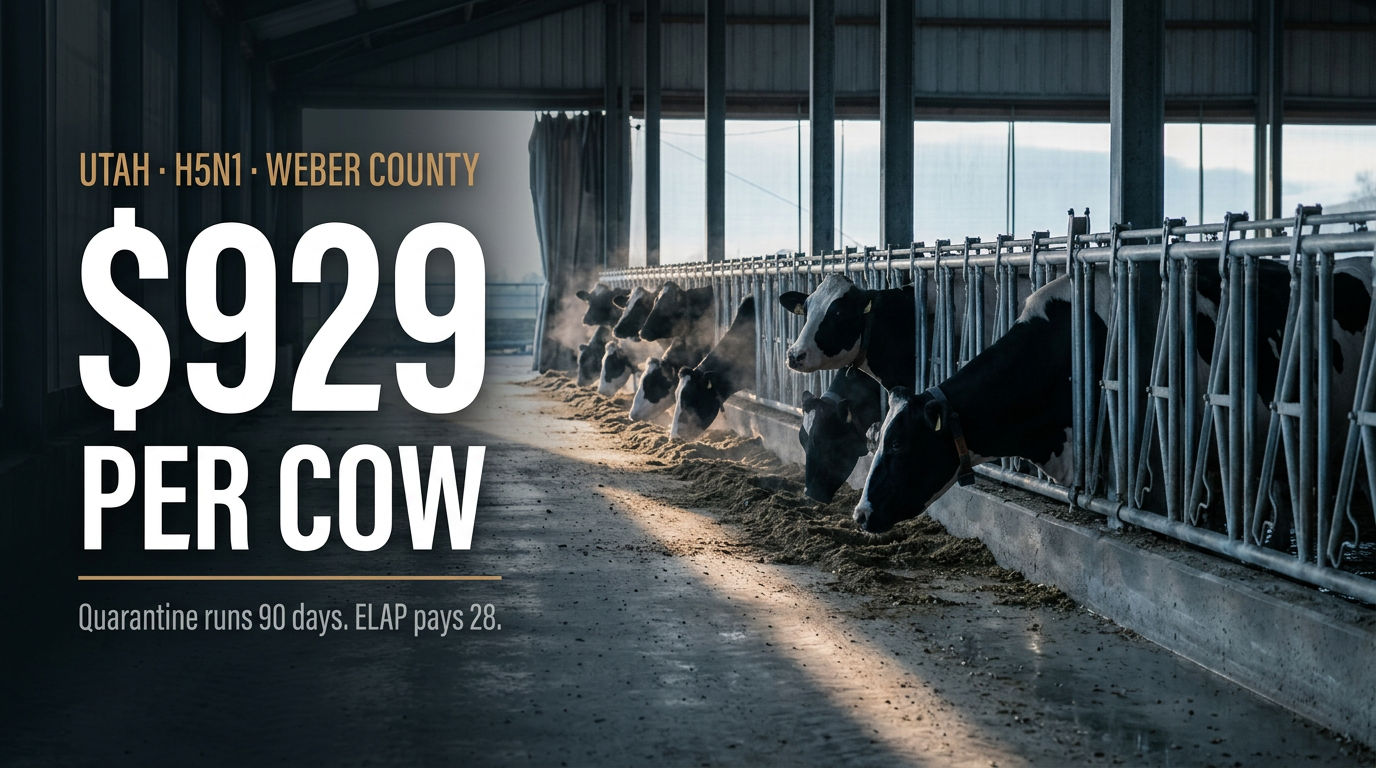
A Cache County dairy shipped milk like any other morning at the start of June. Then the bulk-tank test came back hot, and the Utah Department of Agriculture and Food confirmed H5N1 on June 1 — the first detection of the dairy strain in Utah since January 2025. Quarantine, diverted milk, and an owner working the phones to figure out where it came from.
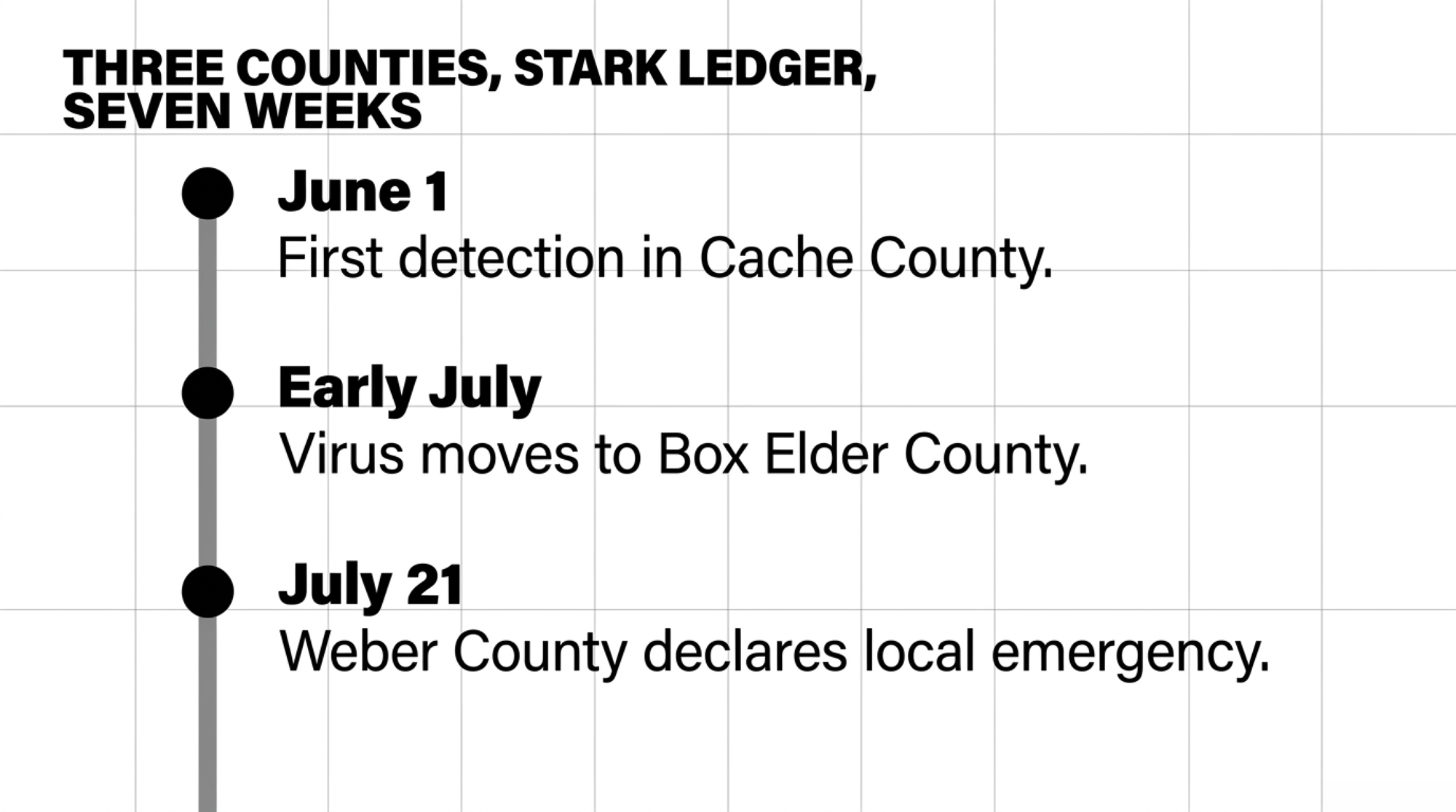
Seven weeks later, the virus was two counties south. On July 7, the State Veterinarian’s office notified Weber County of a positive sample. Commission Chair Gage Froerer’s board declared a local state of emergency Tuesday, July 21, under Utah Code 53-2a-208, with Clerk Ricky Hatch attesting.
Bren Edwards, who runs the Weber County Farm Bureau, told KSL’s Tim Vandenack the affected operations are losing up to 10,000 pounds of milk a day each, and that two or three more of the county’s nine dairies will likely test positive before it’s done. Ten thousand pounds is 100 cwt — about $2,000 of milk down the drain daily, per farm.
Milk is the visible part. The resolution names cattle illness and mortality right alongside production loss, and somebody in Weber County is walking a barn this week deciding which cows aren’t coming back. Those animals don’t return when the quarantine lifts.
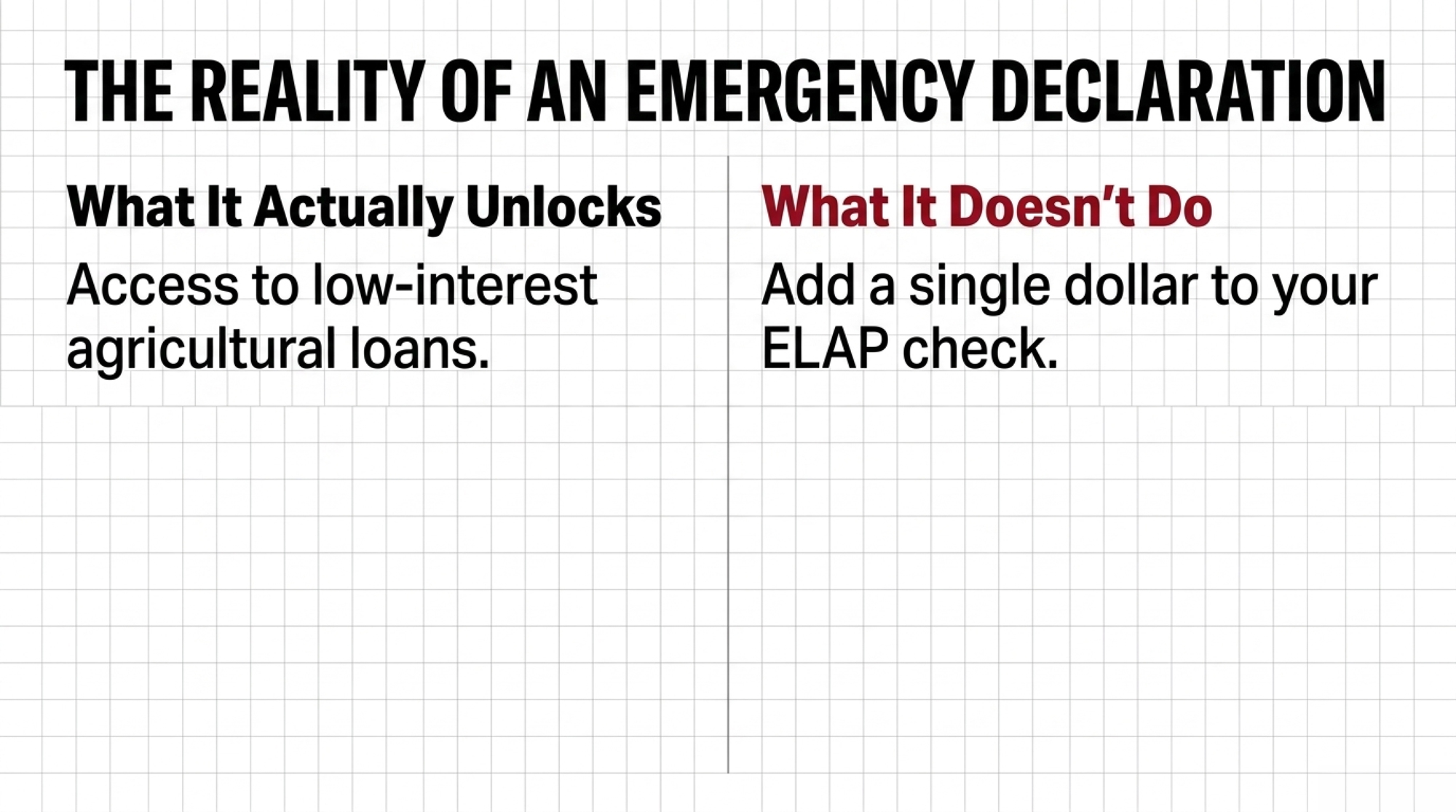
Here’s what the declaration does. It paves the way for state and federal assistance, including access to low-interest loans, and opens Utah’s Agricultural Resource Development Loan program. Credit and mutual aid.
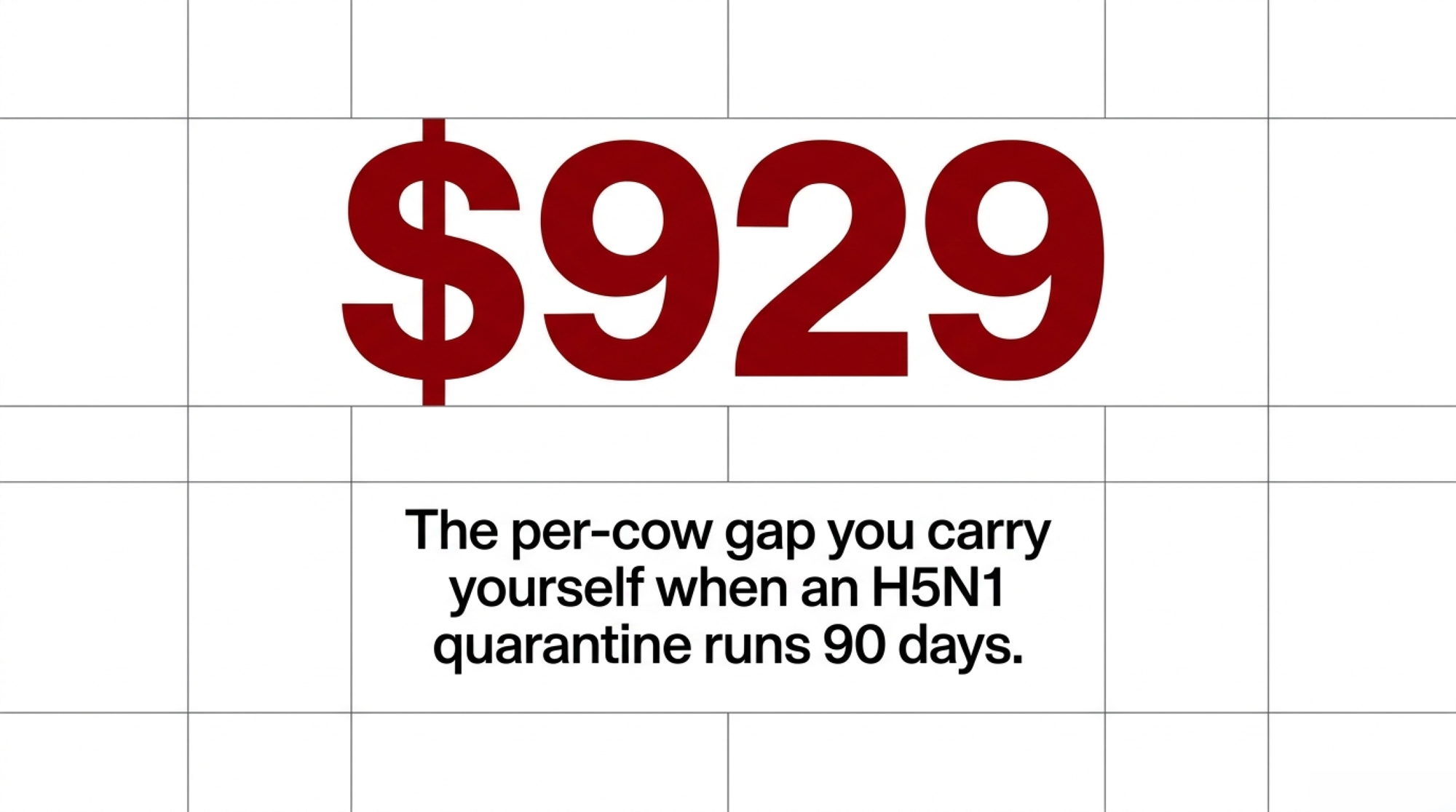
What it doesn’t do is add a dollar to the federal milk-loss payment. On a quarantine running the full 90 days — and the resolution says impacted cows can face quarantine and monitoring that long — the gap between that payment and your dumped milk lands near $929 per cow.
Four of Nine, and Three Institutions Asking
The request didn’t come from the farms alone. The State Veterinarian’s office, USU Agricultural Extension’s Weber County specialist, and the county Farm Bureau all asked the commission to declare. Three institutions signing the same conclusion — which is the point of a declaration.
The resolution puts it at four of nine dairies impacted. Box Elder County declared on July 8, citing “severe production loss” among its dairy producers, and told the Salt Lake Tribune the virus had hit at least half its dairy cows. Edwards traces the strain back to the Cache Valley around May before it moved to Box Elder and then Weber. Three counties, marching south.
Before you quote any county number, including ours: UDAF maintains a page titled Current Number of UT Dairies Affected by County, last updated July 23, 2026, alongside its Dairy Cattle Testing for Avian Influenza document. That’s the state’s own count, it moves, and it’s the one worth bookmarking.
Box Elder also issued a raw-milk warning with its declaration — worth noting for anyone running a herdshare or retail raw program in an affected county, and a different set of exposures than we covered in the raw-milk permit math.
And it didn’t stop when the paperwork started. APHIS confirmed three Utah dairy herds on July 2, at least eight Utah dairy cows were confirmed infected in the two weeks to July 8, and another Utah herd was confirmed July 17 — four days before Weber’s commission met.
Cache County also lost 1.2 million hens at a commercial egg operation in early July — the same county where the dairy detection surfaced five weeks earlier, and Utah’s first commercial poultry detection since October 8, 2025. In 2024, genetic sequencing confirmed the virus in a Cache County poultry facility was the same one hitting dairy cattle nearby.
Nationally, APHIS has tracked 72 confirmed H5N1 cattle detections so far in 2026, against 171 for all of last year. The dashboard updates daily and separates cattle from herds — a distinction plenty of coverage blurs, including some of ours.
Weber’s declaration lasts up to 30 days. Set that against a quarantine that can run 90. The county’s relief window closes two months before the cows are back on the truck.
What Does the ELAP Formula Actually Pay on a 90-Day Quarantine?
USDA’s Farm Service Agency covers H5N1 milk loss through ELAP — Emergency Assistance for Livestock, Honey Bees, and Farm-Raised Fish. The payment assumes 21 days of no production followed by seven days at 50%, then pays 90% of that, per FSA’s H5N1 fact sheet. Twenty-eight days of assumed loss, however long your cows are actually out.
Now the part that gets skipped, and it sits in FSA’s own document. ELAP pays a flat per-head rate built on the monthly all-milk price and NASS national milk production per head. Not your rolling herd average. Not your DHIA sheet. The national number — chosen deliberately, APHIS says, to minimize what producers have to track and report.
APHIS publishes the worked example. A dairy pulls 50 lactating cows; the April payment rate per head is $367.55; the math runs $367.55 × 50 cows × 100% share × 90% = $16,539.75. That’s $330.80 a cow. The rate floats every month with the all-milk price, so April’s figure is an illustration, not a promise.
Run it on a 1,000-cow herd shipping 70 pounds. That’s 700 cwt a day, and at USDA ERS’s July 2026 all-milk forecast of $20.00/cwt — revised down 70 cents from June — you’re dumping $14,000 of milk daily.
The Gap, at 30, 60, and 90 Days
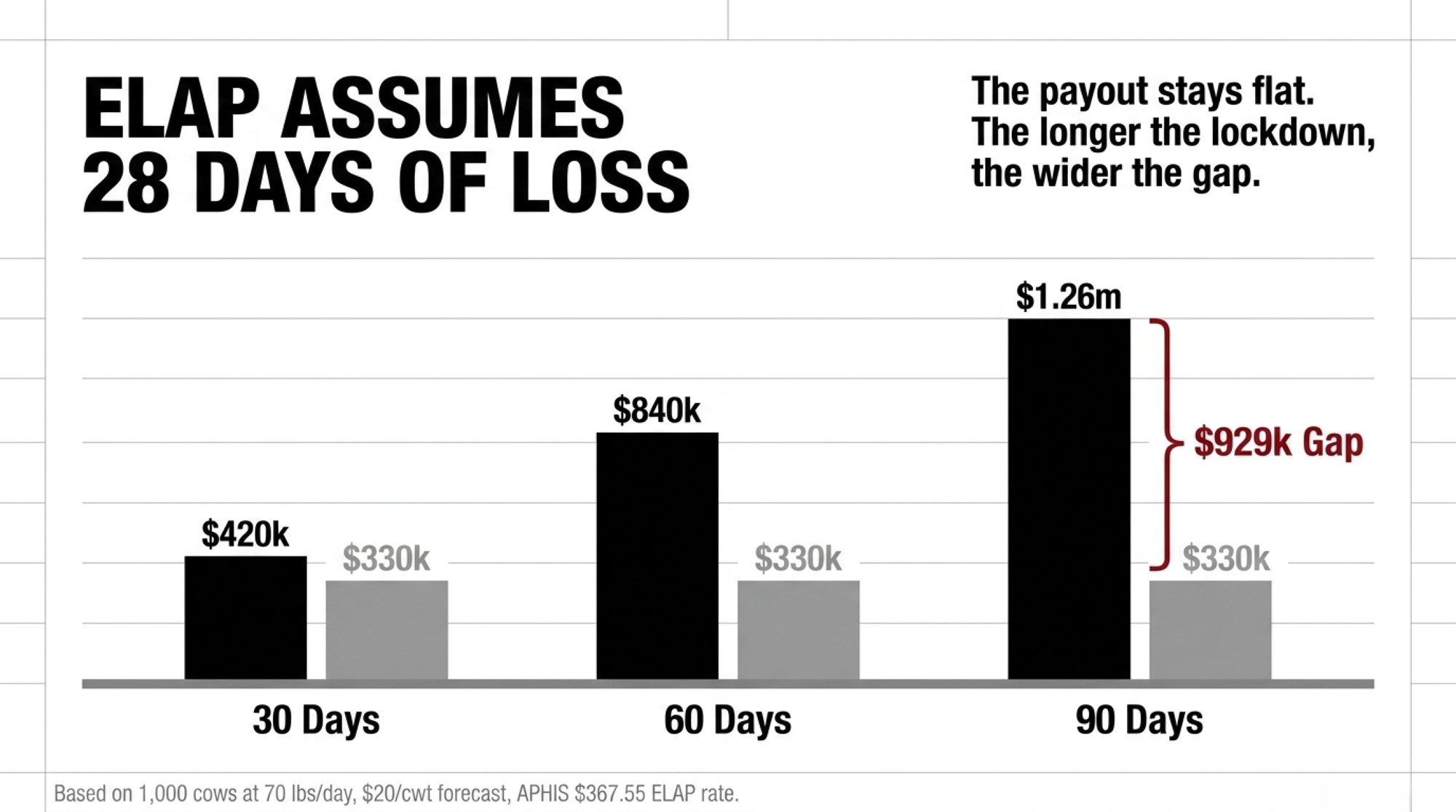
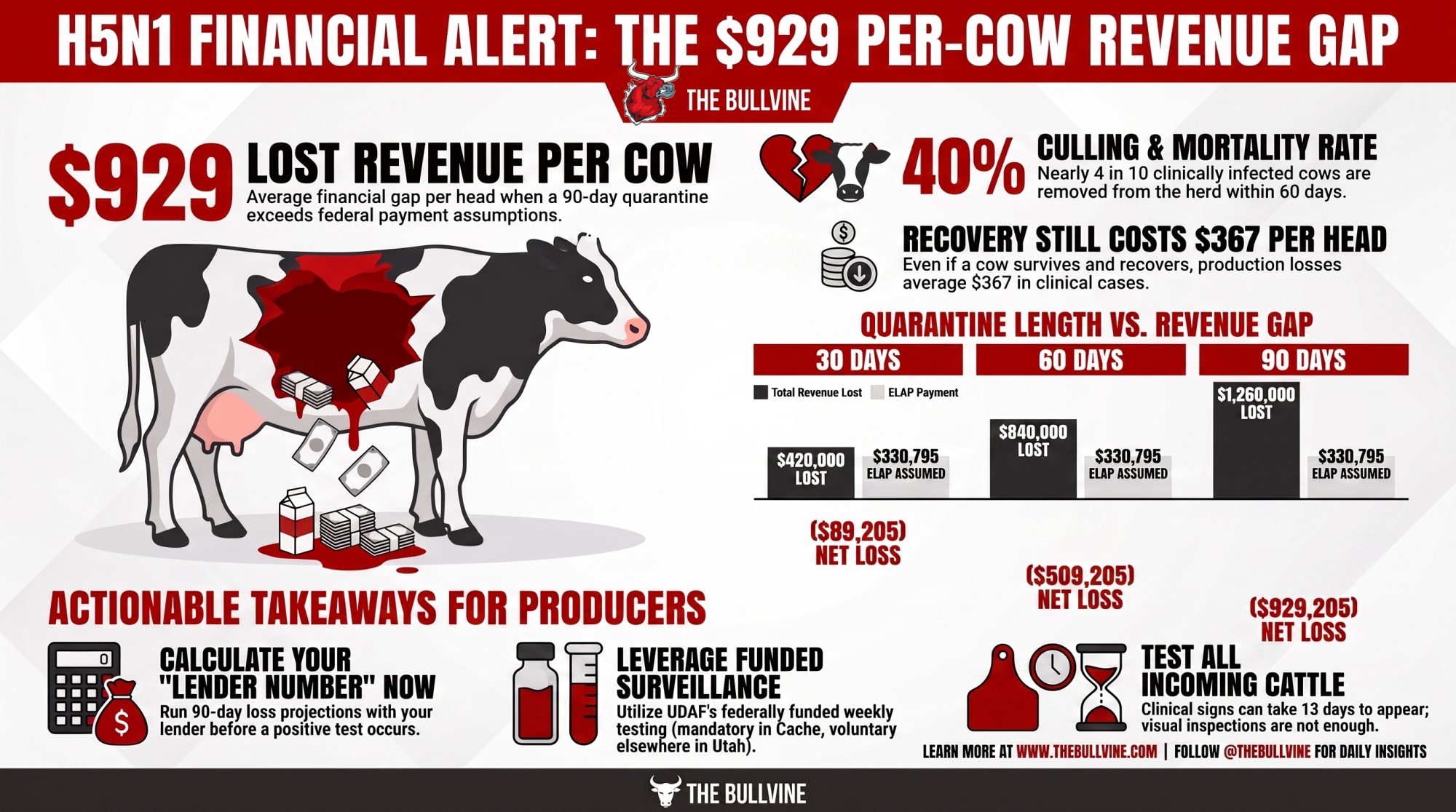
| Quarantine Length | Milk Revenue Lost | ELAP Payment | Total Revenue Gap | Gap Per Cow |
| 30 days | $420,000 | $330,795 | $89,205 | ~$89 |
| 60 days | $840,000 | $330,795 | $509,205 | ~$509 |
| 90 days | $1,260,000 | $330,795 | $929,205 | ~$929 |
Model assumptions: 1,000 cows at 70 lbs/cow/day, valued at $20.00/cwt — USDA ERS’s July 2026 all-milk forecast, not a mailbox price. Illustrative only; not drawn from any specific dairy’s records. The ELAP column uses APHIS’s published example rate of $367.55 per head at a 100% production share and the 90% payment rate. Because that rate is built on national milk production per head, a herd milking above the national average recovers a smaller share of its real loss than this table implies.
Reconciliation note: our July 12 analysis put the same 1,000-cow gap at about $939,000. Same herd, same 70 lbs. That version used $20.70/cwt and a derived ELAP ceiling; this one uses ERS’s July revision to $20.00 and APHIS’s published per-head rate. The gap moved $10,000 on a $1.26 million loss. Neither number is the point — the flat ELAP column is.
The ELAP column never changes across those three rows. That’s the argument.
So run yours. Cow count × daily pounds ÷ 100 × your mailbox price × 90 days. Then subtract your cow count × the current per-head rate × 90%. The model above uses USDA’s all-milk price — your mailbox sits lower after hauling and marketing deductions, so expect a smaller revenue column and a somewhat smaller gap on your own numbers.
That difference is what you’re carrying, and it belongs in front of your lender this week, not after a positive test.
Two things work in your favor, worth knowing before you need them. Cows qualify if they’re pulled for even a single milking cycle — they don’t have to be out the full 28 days — and you can claim animals removed from 14 days before the sample date through 120 days after. ELAP also carries no payment limitation; the payments aren’t capped. The claim window is generous. The rate is what it is.
What Does One Infected Cow Actually Cost You?
Here’s where you need two numbers, not one, because the published sources don’t agree on severity.
Felipe Peña-Mosca and colleagues at Cornell followed a 3,876-cow Ohio herd through a 67-day outbreak in spring 2024, using the farm’s own animal-level records. That herd got infected after 42 healthy-looking lactating cows arrived from a Texas farm — 42 cows that passed a visual inspection, with the first clinical case following 13 days later. Clinical disease eventually hit 777 cows, about 20% of the herd, alongside extensive asymptomatic infections in cows that never showed a sign.
Clinically infected cows dropped from roughly 77 pounds a day to about 24. Two weeks, and three-quarters of the milk was gone.
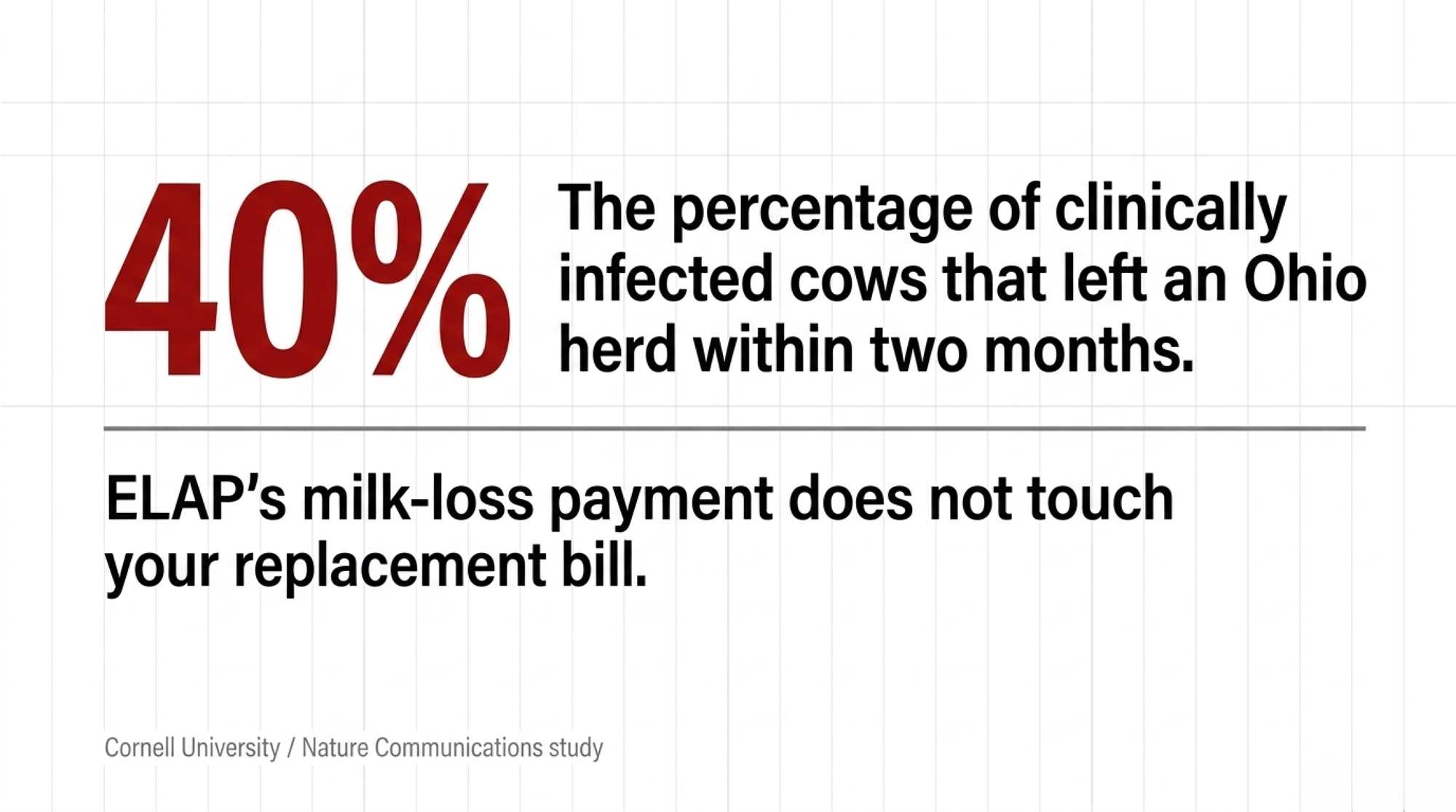
The milk didn’t come back. Over the 60 days after diagnosis, affected cows lost about 900 kg each — near 2,000 pounds — and production never fully recovered. Of those 777 clinical cows, almost 40% — 298 head — left the herd within two months, either dead or culled because diminished yield made them unprofitable.
The team put economic losses from decreased milk production, mortality, and early herd removal at $950 per clinically affected cow, for roughly $737,500 across the one herd over the 67-day window. That figure excludes ongoing herd dynamics and reproductive losses.
“For a clinically diagnosed cow, we found an average of $950 in costs, which includes the milk you expect to lose over 60 days and the possible cost of removing them from dairy production,” said co-author Matthew MacLachlan, an assistant professor at Cornell. “Even if they recover, that’s going to cost a dairy farmer $367 on average in milk losses.”
Box Elder County Publishes Milder Numbers Than Ohio’s
Now the counterweight, and it comes from a Utah county government rather than a journal. Box Elder’s guidance with its declaration says most affected herds see less than 10 to 20% of cows get sick, death rates usually under 2%, and approximately 10% of affected cows not returning to previous production.
Set that against Ohio: 20% clinical, nearly 40% gone inside two months. Same virus, materially different outcomes, and the gap is real — the Cornell authors say plainly that farm style, region, and management could push losses either direction.
So don’t treat Ohio as your forecast. Treat it as the severe end and Box Elder’s figures as the moderate end, and run your gap on both. On a 1,000-cow herd, 20% clinical at $950 is $190,000 in cow-level losses. At Box Elder’s 10% not returning to previous production, the number is a fraction of that. Both sit on top of the milk-check gap, and ELAP’s milk-loss payment doesn’t touch either one.
In an Affected Utah County, the Testing Is Already Paid For
Now price the alternative, and this is where Utah producers have an advantage most states don’t. When Cache County went positive, UDAF enacted mandatory weekly HPAI surveillance for county dairies and said it plainly: federal funding covers the cost, with no additional cost to producers. Free weekly bulk-tank testing inside the affected county.
Outside a mandatory-surveillance county, you’re paying. Bulk-tank PCR runs $30 to $50 a test at 40 to 50 tests a year — call it $1,200 to $2,500 — inside a total H5N1 biosecurity bill of $7,200 to $12,500 on a 1,000-cow herd, or roughly 2.5 to 4.3 cents per cwt. USDA also reimburses shipping to NAHLN labs, up to $50 a shipment for two shipments a month per premises, provides up to $1,500 per premises for biosecurity planning, and covers veterinary sample-collection fees up to $2,000 per premises. UDAF runs a voluntary surveillance program for producers outside the affected counties — sign-up is an email to their animal health office.
$1,200 in tests against $950 a cow isn’t a close call at either end of the severity range. Free tests against $950 a cow isn’t a decision.
Action Steps for Dairy Operators
Do This Within 30 Days
Run your ELAP gap with your lender. An afternoon and a milk statement. Bring herd size, daily production, current mailbox price, and a 90-day assumption to your FSA office and your ag lender before you have a reason to. It doesn’t shrink the gap — it means you aren’t discovering it on day 29 with cows locked down and a loan officer hearing about it cold.
Ask FSA for this month’s per-head rate, not the formula. The rate resets monthly against the all-milk price, and it can’t be finalized until the all-milk price for the month of removal posts. ERS has already cut its 2026 all-milk forecast twice this year, most recently to $20.00/cwt in July — which is why the printed example is worth less to you than a phone call.
Confirm your filing deadline while you’re there. FSA’s H5N1 fact sheet sets the final date to file a notice of loss and application for payment at 30 days after the end of the prior calendar year. Older Bullvine coverage cited a 7-day filing window, which does not match FSA’s current fact sheet — get the deadline from your county office in writing rather than from anyone’s archive, including ours.
If you milk in Utah, get on a surveillance list today. Inside Cache County it’s mandatory and already funded. Outside it, UDAF’s voluntary program is one email. While you’re on their site, pull the current affected-dairies-by-county table and the testing document.
Testing and Biosecurity
Test incoming lactating cows yourself. Ohio’s 42 index cows looked healthy stepping off the trailer. If you’re receiving lactating cattle out of Utah, Idaho, or Texas, a visual inspection is not a test, and 13 days of not knowing is what it cost that herd.
Hold bulk-tank testing to a fixed cadence and take the reimbursements. Two shipments a month at up to $50 each, plus $1,500 for biosecurity planning and $2,000 for veterinary sample collection per premises. Here’s the honest trade: a hot bulk tank starts your own quarantine clock. You’re paying to find the thing that costs you 90 days — still better than a neighbor’s vet finding it first. And don’t assume federal surveillance capacity is what it was: USDA’s own Inspector General counted 20,306 departures between January 12 and June 14, 2025, with federal personnel data putting the workforce down nearly 27% from September 2024 to December 2025.
Know what a positive test triggers before it happens. In Utah, a positive puts the dairy under quarantine with no movement of lactating cattle on or off the facility, except cows going directly to slaughter. UDAF publishes the full testing protocol. That’s the rule that turns a lab result into a 90-day cash-flow problem, and it’s worth reading before you’re living it.
Plan for the cows that don’t come back. Somewhere between Box Elder’s 10% not returning to previous production and Ohio’s 40% leaving the herd entirely. Either way it’s a replacement bill and a herd-structure problem landing on top of the milk loss.
County and Regional Watch Items
Map the declaration path before your county needs it. Weber’s timeline is public — notification July 7, commission action July 21. If you sit on a county board or hold a Farm Bureau office, knowing that low-interest loan access sits behind a local declaration is worth more before an outbreak than during one. What it won’t do is change ELAP’s rate or its timeline.
Watch Idaho — it’s already well past Utah. APHIS confirmed 40 dairy herd cases in Idaho in the 30 days ending June 29, and three more Idaho herds on July 14. In a mid-June 30-day window, Idaho had 33 cattle affected on dairy milking facilities against Utah’s three detections. Utah declared three county emergencies. Idaho, running several times the case count, has declared nothing. Pull the current figures off the APHIS dashboard before you quote any of this — it moves daily.
Budget for the lag, not just the gap. California’s ELAP program paid $231 million across 644 payments to 359 dairies between November 2024 and June 2025, with individual payments ranging from $2,058 to $4.4 million. Some waits stretched past seven months. Producers whose 120-day window crosses a calendar year file twice, once for each year’s days. Whatever your gap is, it’s a cash-flow problem before it’s an indemnity problem.
Key Takeaways
- If your quarantine runs past day 28, everything after that is yours. On 1,000 cows at 70 lbs and $20 milk, roughly $929 a head by day 90.
- If your herd milks above the national average, the per-head rate won’t capture your actual loss. It’s built on NASS national milk production per head, by design.
- If you’re modeling cow-level losses, use a range, not a number. Ohio’s severe end: 20% clinical, $950 a head, nearly 40% gone in two months. Box Elder’s guidance: under 10-20% sick, mortality under 2%, roughly 10% not returning to previous production.
- If you farm in an affected Utah county, your surveillance testing is already federally funded. Cost isn’t a reason to skip it.
- If you’re receiving lactating cows from an affected state, assume they can look healthy and still be carrying. Ohio’s 42 arrivals did, and the first clinical case followed 13 days later.
- If you’re in Idaho, you’re in the state APHIS is logging hardest — 40 dairy herd cases in one 30-day window. Utah’s counties declared at a fraction of that. Yours haven’t.
- If you’re relying on a filing deadline you read somewhere, verify it with your county FSA office.
- If half your county’s dairies test positive, a declaration gets you a loan. Plan as though that’s all it gets you, because that’s all it gets you.

So What’s Your Number?
Weber County didn’t get a warning shot. Cache County was the warning shot, seven weeks and two counties up the road — and APHIS confirmed another Utah herd on July 17, four days before the commission met. Every Utah county that’s declared so far did it after the virus arrived.
Drop your own cow count and your own mailbox price into that table and see whether the number is one your operation could carry without selling something. If it isn’t, that’s a conversation for this month, not next quarter. The full 90-day model — California’s payment-lag data, the per-cow indemnity breakdown — sits in our earlier compensation-gap piece, and the testing-cost side runs in the 4¢/cwt analysis. We’re also tracking whether any Weber County dairy actually draws that loan money, and how long its first ELAP check takes. That one goes to Bullvine Weekly subscribers first.
Learn More
- Silent Killer: Managing Asymptomatic H5N1 in Dairy Herds — Delivers practical protocols for catching asymptomatic spread before it triggers a quarantine, leveraging rumination sensors to spot infections five days early and offering step-by-step methods to secure $28,000 in federal biosecurity funding.
- H5N1 Crisis One Year Later: What Dairy Farmers Need to Know — Exposes how dual viral genotypes are shifting risk westward across migratory flyways, giving producers a multi-year roadmap to navigate persistent 90-day production drops and evaluate long-term herd immunity dynamics.
- Bivalve Dairy Did Everything Right. The H5N1 Air Data Just Added $0.04/cwt to Dairy 2026. — Dismantles traditional contact-only biosecurity models by revealing live airborne virus in milking parlors, adding a concrete $0.04/cwt margin penalty to 2026 herd budgets and enforcing mandatory PPE compliance.




