






One swab put half of Box Elder County under a 90-day quarantine. ELAP pays on 28. On a 1,000-cow herd, that’s a $939K hole—and the check trails by the better part of a year.
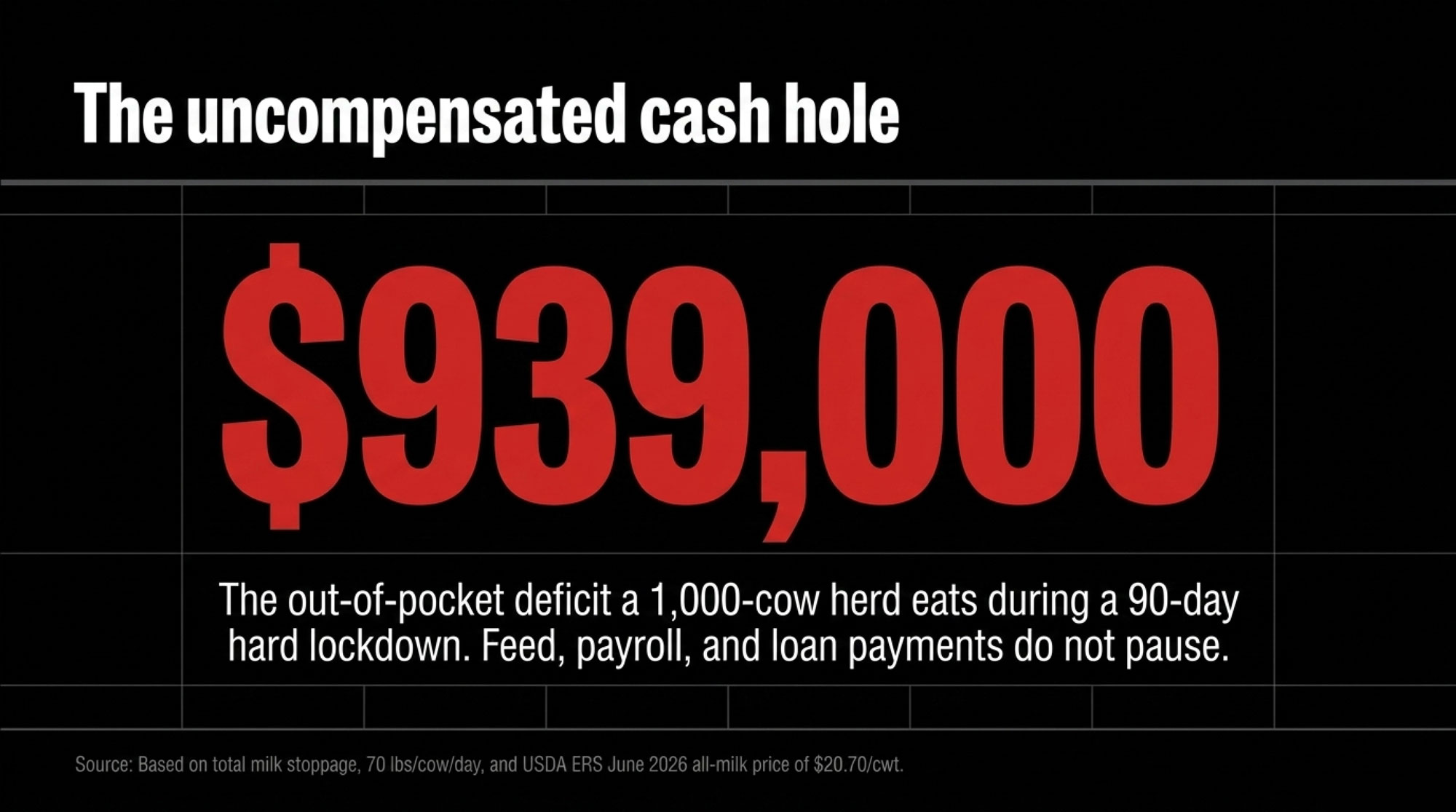
Executive Summary: When a Box Elder County, Utah dairy tested positive for H5N1 in late June, one swab put half the county’s cows under a 90-day quarantine—but ELAP, the federal program meant to make those farms whole, pays on a 28-day formula. Do the math on a 1,000-cow herd shipping 70 lbs/cow/day at USDA’s $20.70/cwt: that’s roughly $14,490 a day walking out the door, about $1.3 million over the full lockdown, and ELAP covers maybe $365K of it. That leaves a ~$939,000 hole you carry yourself—and the check trails badly, with USDA records showing California’s $231 million in payouts to 359 dairies stretched from November 2024 clear into June 2025. So even “full” compensation doesn’t fix a solvency-timing problem: you burn cash now, the money shows up the better part of a year later, and whether you survive depends on your balance sheet, not the eventual payment. If you’re anywhere near poultry, a flyway, or heavy cattle traffic, the move this month is to run your own gap number and stress-test 60 days with no milk check before a state vet does it for you. Because the next positive test could reset your milk-movement rules too—and whether your neighbor reported his is suddenly your problem.
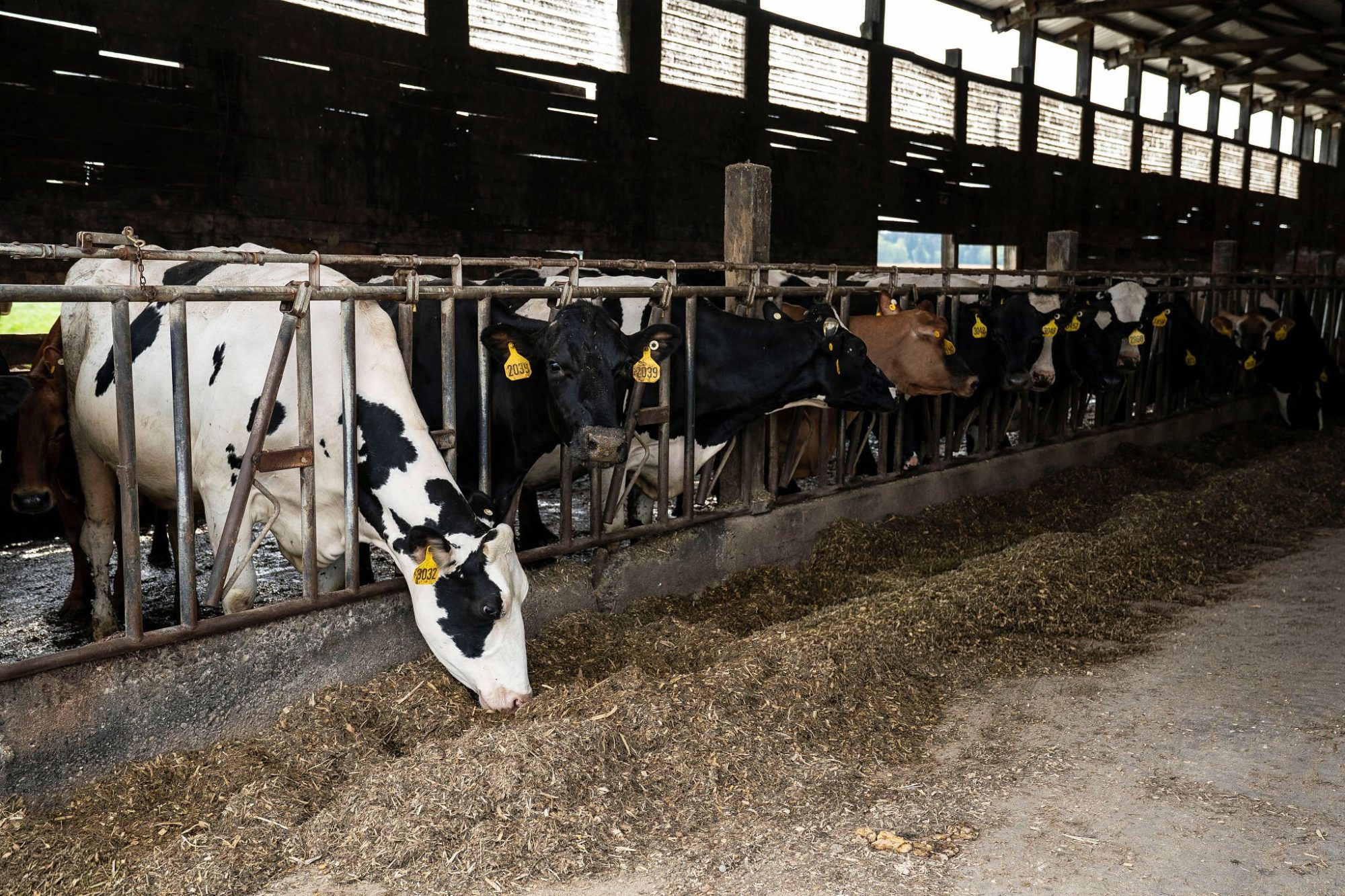
The vote didn’t take long. On July 9, 2026, in a county commission room in Brigham City, Box Elder’s commissioners put their names to a sentence county governments almost never write down: this one was too big to handle alone. Two weeks earlier — around June 25 — a routine sample from a county dairy had come back positive for H5N1, and by the time the gavel came down the virus had already torn through better than half the county’s dairy cows and nearly half its dairy farms. Every one of those herds was now locked down for up to 90 days, milk going nowhere. The declaration called the losses “far in excess of Box Elder County’s available resources.” Translation: the checkbook that’s supposed to catch these farms isn’t big enough or fast enough, and the county knew it before the state did.
Here’s why that matters whether you milk in northern Utah or nowhere near it. The federal program those quarantined farms lean on — ELAP — pays on a 28-day formula. The quarantine runs 90. Do the subtraction, and you’ve got roughly two months of milk revenue that no program is coming to replace. That’s not a Utah problem. That’s the math waiting behind any positive swab, in any county, anywhere.
What a Positive Test Actually Sets in Motion
ELAP stands for Emergency Assistance for Livestock, Honey Bees, and Farm-raised Fish. When H5N1 pulls cows out of your string, USDA bases the payment on an expected 21 days of zero production, plus 7 more days at 50% as the cow comes back. Twenty-eight days, full stop. USDA has confirmed the cap holds even when a cow stays out longer. And here’s the part that gets lost: ELAP replaces milk only. It doesn’t touch the feed bill, the payroll, the loan payment, or the power bill — all of which keep running full speed while the tank sits empty.
| Cost Category | Does ELAP Cover It? | Notes |
|---|---|---|
| Lost milk revenue (28 days) | ✅ Yes — up to 90% | Capped at 28-day formula regardless of quarantine length |
| Lost milk revenue (days 29–90) | ❌ No | ~$897K uncompensated on 1,000-cow herd |
| Feed & TMR costs | ❌ No | Continue at full rate throughout lockdown |
| Payroll / labor | ❌ No | No relief mechanism; farm operator burden |
| Debt service (loans, operating lines) | ❌ No | Banks don’t pause on a quarantine order |
| Power, utilities, equipment | ❌ No | Fixed costs run regardless of milk movement |
| Milk Loss Program (MLP) — if enrolled | Partial | Separate program; requires pre-enrollment and dumped-milk log |
But Box Elder’s quarantine can run more than three times that 28-day window. The clock that says when your milk can ship, and the clock ELAP was built around, were never set to the same time. And in the two months between them, you’re carrying the farm on your own dime.
Nobody sat down and designed ELAP to fail a 90-day quarantine. The 28-day formula was drawn around what one sick cow’s production dip usually looks like — not how long a state animal-health order keeps your whole operation shut in. When those two numbers drift apart, the farm eats the spread.
The Kitchen-Table Math
Picture the morning after that call. Yesterday you shipped milk. This morning you’ve got a quarantine order, a 90-day clock, and a program built for month one.
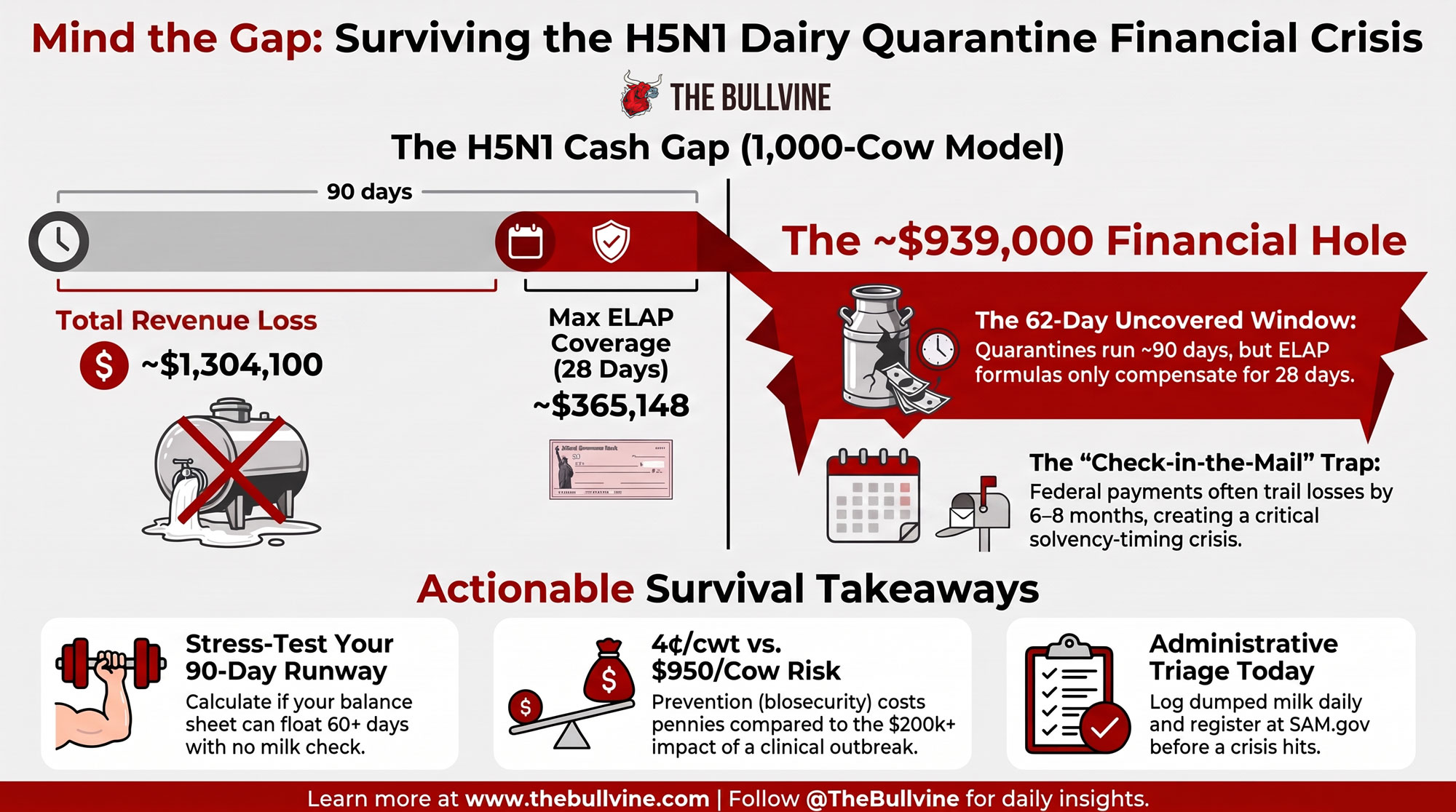
Run it on a 1,000-cow herd — big enough to matter in Box Elder, familiar to plenty of Western operators. At about 70 lbs per cow per day, that’s 70,000 lbs leaving the tank every morning. USDA ERS pegged the 2026 all-milk price at $20.70/cwt in its June outlook. So that herd is pulling in roughly $14,490 a day. Then the truck stops coming.
💰 The H5N1 Cash Gap at a Glance (1,000-Cow Model)
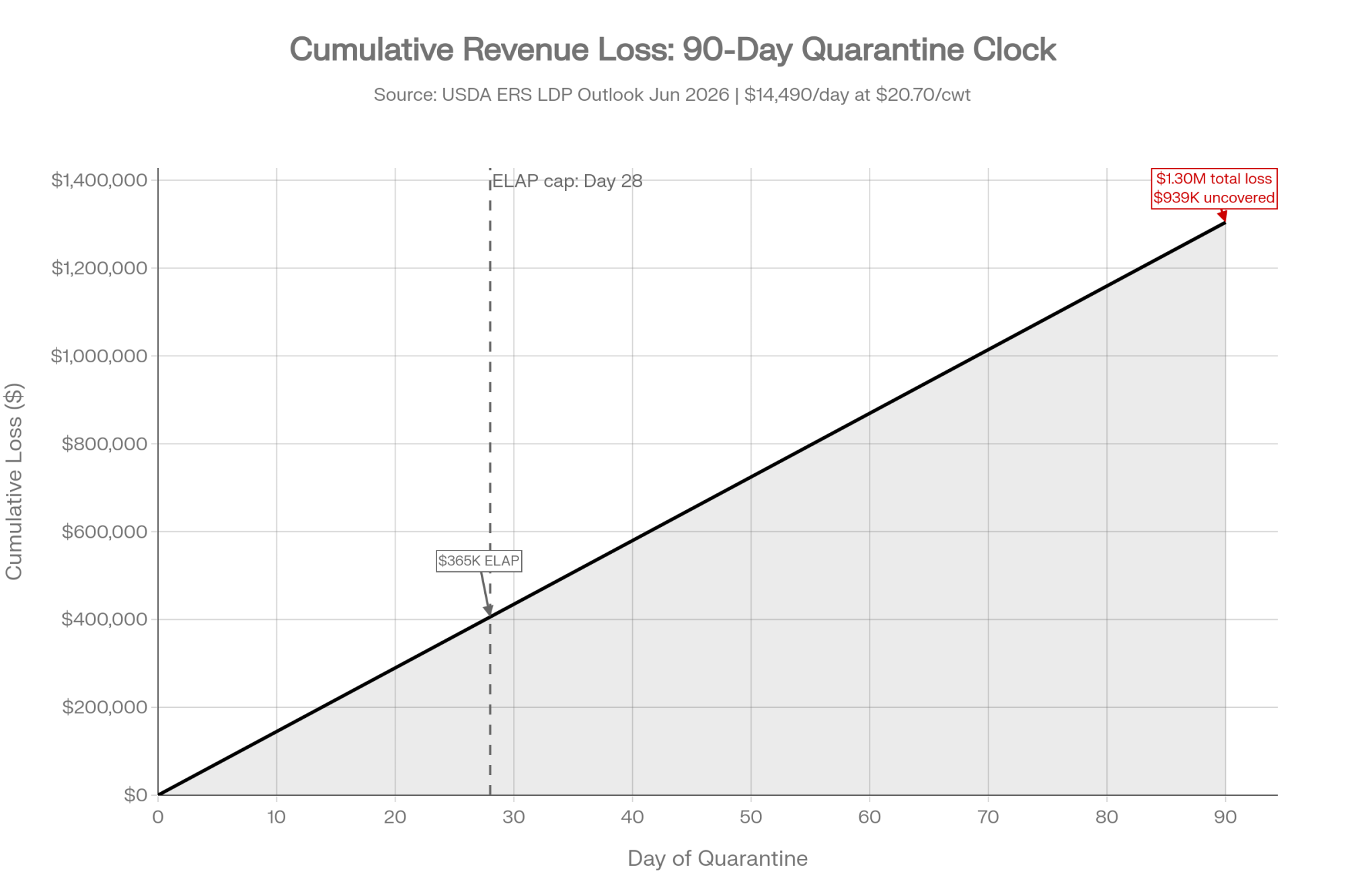
| Daily revenue loss | ~$14,490 (70 lbs/cow/day at $20.70/cwt) |
| Total 90-day quarantine loss | ~$1,304,100 |
| Maximum ELAP coverage (28 days at 90%) | ~$365,148 |
| The uncompensated producer deficit | ~$939,000 |
Model assumes total milk stoppage across the full 90-day quarantine — a worst-case, hard-quarantine scenario. Your real deficit softens if cows keep milking partway through. Price: USDA ERS Livestock, Dairy, and Poultry Outlook, June 2026. ELAP mechanics and 28-day cap: USDA FSA.
Most of that revenue was already spoken for. Bullvine’s own 2026 cost work made the point plainly — for a lot of herds, full costs are sitting right on top of the milk price, with ERS putting average 2,000-plus-cow operations near $19.14/cwt against sub-$19 milk earlier this year. And the bills don’t stop when the milk does. Feed, payroll, the loan payment, the power bill — they all roll on whether a truck pulls in the yard or not.
The farmers who ride it out quietly aren’t reckless. They’re doing math. Keith Poulsen, director of the Wisconsin Veterinary Diagnostic Laboratory, told Reuters back in August 2024: “It’s still cheaper to just go through a herd outbreak, recover, and move on down the road.”
How much does it cost you to wait for the check?
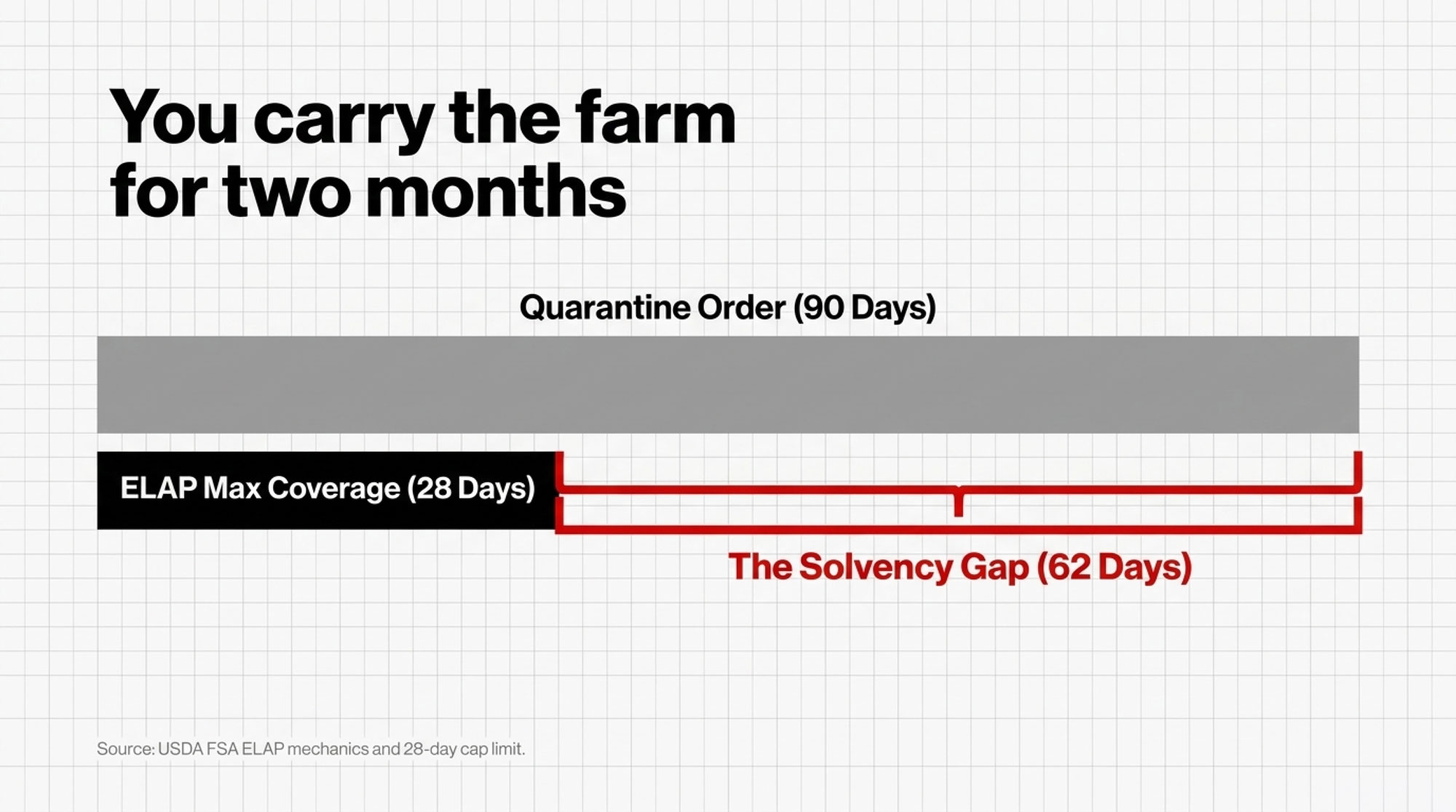
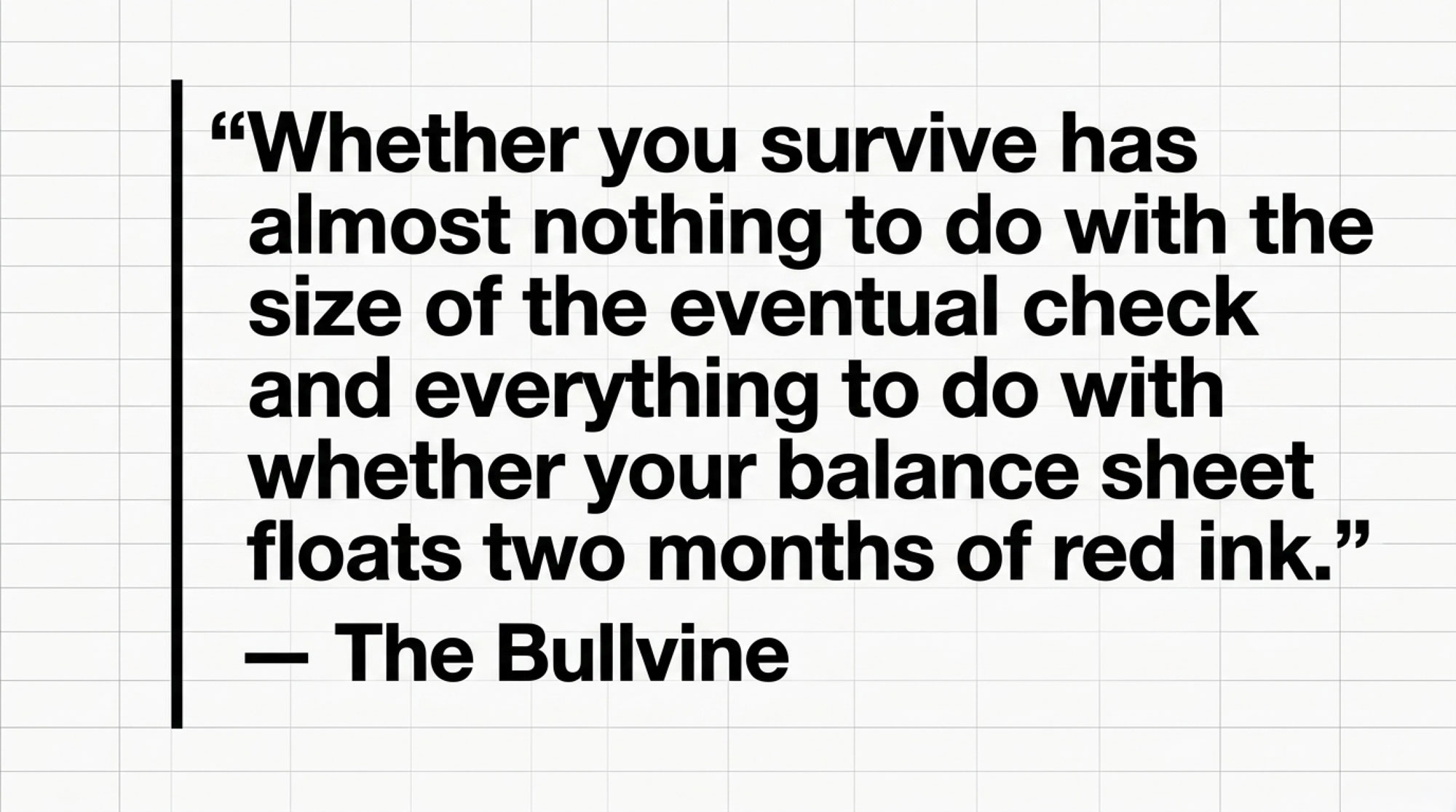
Start with the gap. If ELAP covers the first 28 days and your quarantine runs 90, you’re carrying roughly 62 uncovered days. On the 1,000-cow model — and this is the full-stoppage number, so your real figure softens if the herd keeps milking through it — that’s the bulk of a ~$939,000 hole between what you lose and what the program pays back. Whether you survive it has almost nothing to do with the size of the eventual check and everything to do with whether your balance sheet floats two months of red ink.
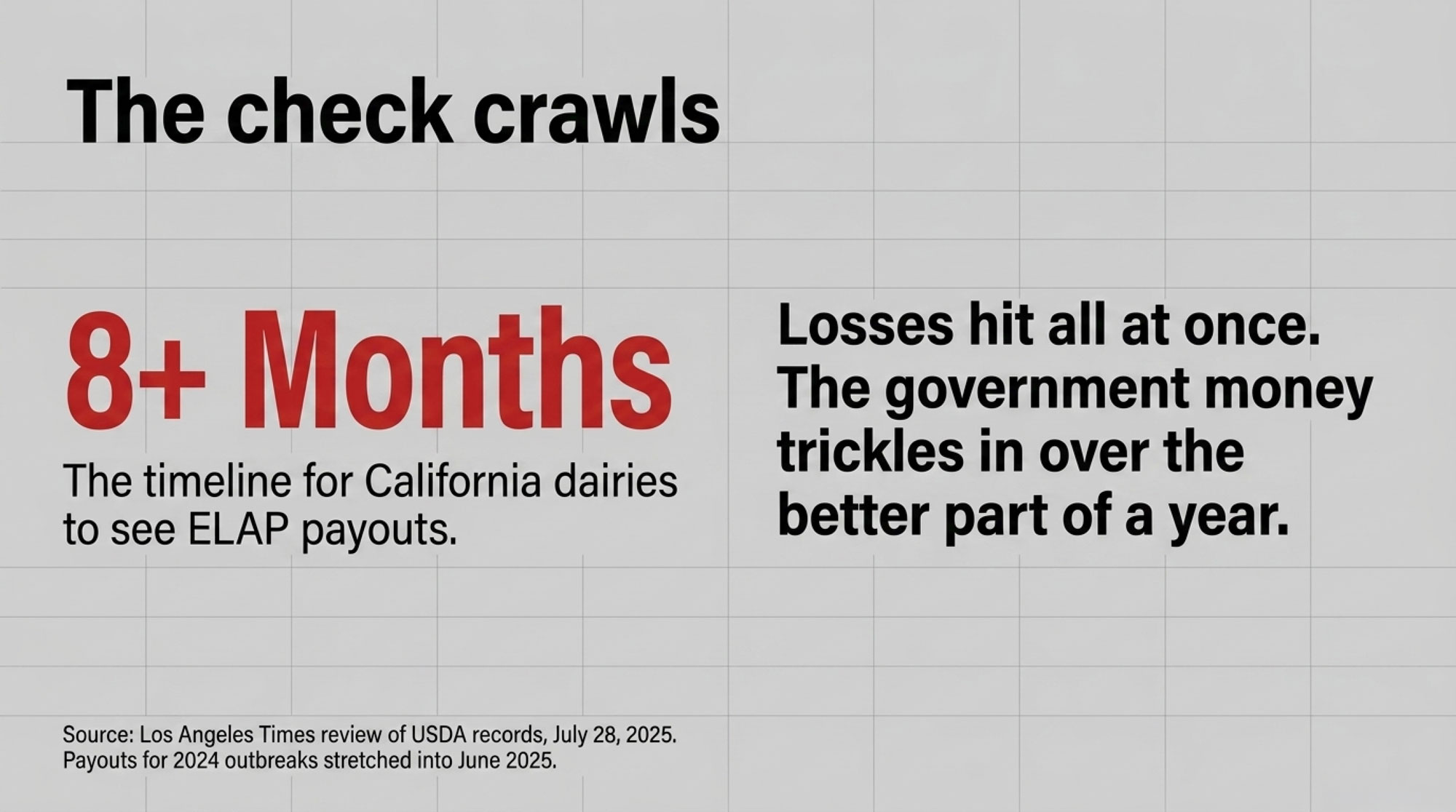
And the check isn’t fast. USDA advertises that poultry producers get their H5N1 indemnity by direct deposit “in about 2–3 weeks.” There’s no equivalent published timeline for dairy ELAP. We know it can crawl, because California already ran the experiment. According to a July 28, 2025 Los Angeles Times review of USDA records, the government made 644 payments to 359 California dairies between November 2024 and June 2025, totaling $231 million — an average of about $645,000 a farm, ranging from a single check as small as $2,058 to one as large as $4.4 million. The tell is in the timing: the Times reported many payments issued in May and June 2025 were still covering outbreaks from 2024. Losses hit all at once. The money trickles in over the better part of a year.
| Metric | California ELAP Data | Implication |
|---|---|---|
| Total paid out | $231 million | Sounds substantial — until you see the timeline |
| Number of dairies paid | 359 | Avg. $645K per farm |
| Smallest single payment | $2,058 | Some farms nearly left behind |
| Largest single payment | $4.4 million | Concentrated at large-herd operators |
| Payment window | Nov 2024 – Jun 2025 | 7+ months to clear 2024 outbreak losses |
| Outbreak trigger date | Mid-2024 | Farms carried losses for the better part of a year |
| Poultry direct deposit timeline | ~2–3 weeks (USDA stated) | No equivalent published dairy timeline exists |
Why are some producers choosing not to test?
On one farm’s spreadsheet, staying off the radar can pencil out. That’s the trap. By late 2024, only 366 herds — about 1% of the roughly 36,000 licensed U.S. dairy operations — had enrolled in USDA’s H5N1 support programs, and Reuters found most confirmed-positive herds hadn’t even applied.
| Factor | “Don’t Test” Logic | Why It Breaks at the Farm Gate |
|---|---|---|
| Short-term cash | Avoids 90-day quarantine and milk stoppage | One neighbor’s positive test can still trigger your movement restrictions |
| Program uptake | ~1% of U.S. herds enrolled in ELAP support by late 2024 | Most positive herds never applied — but losses hit regardless |
| Surveillance risk | Individual farm avoids being flagged | Thins county-wide surveillance; raises neighbor’s exposure |
| Outbreak cost avoided | Skip ELAP paperwork and vet visits | Cornell puts clinical outbreak cost at $950/affected cow |
| Biosecurity cost | Skipping saves $7,200–$12,500/yr | One outbreak on 1,000 cows = up to $200,000 |
| Movement rules | Unlocked herd ships freely | Next positive test in county can reset rules for everyone |
| Quote from field | “Don’t take a temperature, you’re not positive” — Ohio vet Mark Hardesty | Confirmed-positive herds that didn’t apply still ate the full loss |
When reporters asked producers directly, the answers were blunt. Some didn’t buy the virus as a real threat. Others looked at what a positive triggers — movement restrictions, milk-sale headaches, weeks of paperwork — and figured the help wasn’t worth the hit. Ohio vet Mark Hardesty put it about as plainly as anyone: “The longstanding adage is that the cure for fever is don’t take a temperature. So, if we don’t test, then we’re not positive.”
But that logic stops at your fence line. Every untested herd blurs the surveillance picture and raises the odds the virus reaches the next barn before anyone sees it coming. What saves one operator a short-term hit makes the whole county harder — and more expensive — to protect. Which is the real reason this should matter to you even if H5N1 is nowhere near your zip code: the next positive test could be the one that changes your milk-movement rules, and whether your neighbor reported his is now your problem too.
Options and Trade-Offs for Farmers
You can’t rewrite ELAP from your kitchen table. But you can decide what kind of operation you’ll be when the call comes. The farms that sort this out in the quiet season are the ones that get to pick their next move instead of having it picked for them.
1. Build a 90-day outage plan — within 30 days. Time cost: one afternoon. Sit down with your lender, your vet, and your co-op field rep. Map exactly what a 60-to-90-day milk stoppage does to your cash flow. If you’re carrying debt, this isn’t optional. The only real risk is finding out you’re more exposed than you thought — which is precisely what you want to know before a quarantine, not during one. Want the fill-in-the-blanks version? Our Storm Math runway guide walks the numbers step by step.
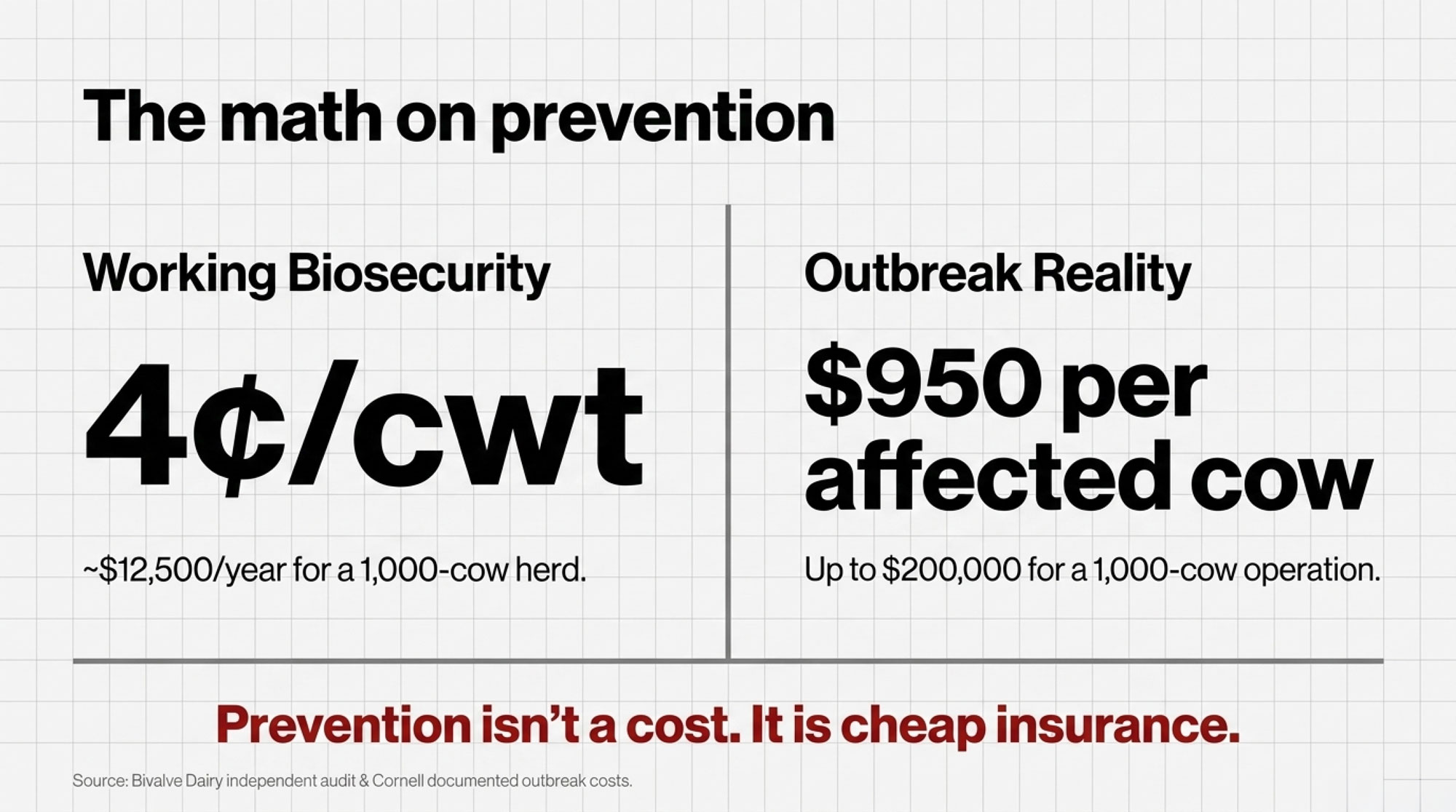
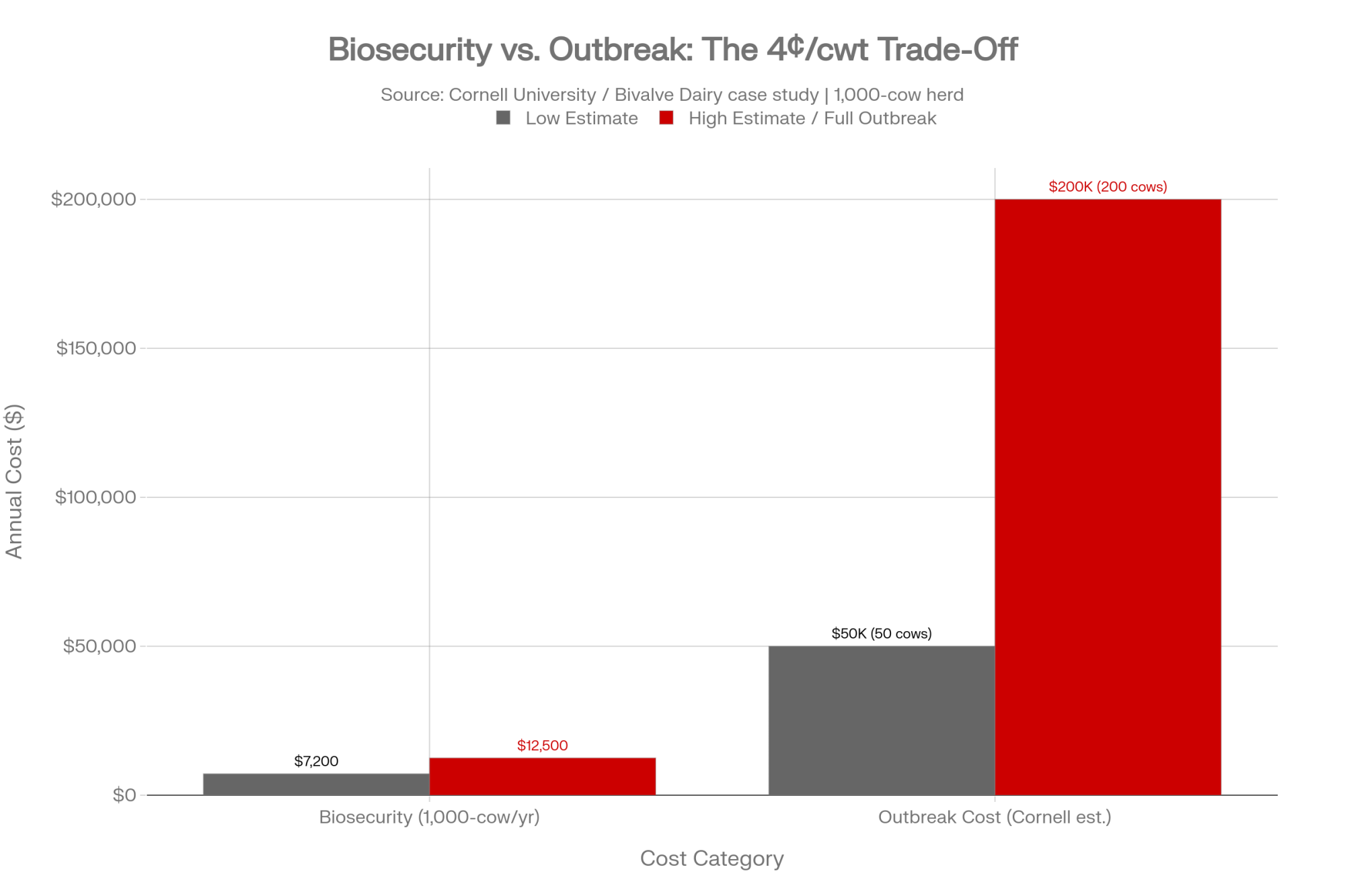
2. Weigh prevention against the outbreak hit. Cost: roughly 4¢/cwt on a 1,000-cow herd shipping ~26,600 cwt/year.An independent look at the Bivalve Dairy case put a working H5N1 biosecurity package at $7,200 to $12,500 a year on that size of herd — boot changes, visitor control, tighter bird management, waste-milk treatment. Set that against Cornell’s documented outbreak cost of $950 per clinically affected cow, up to $200,000 on a 1,000-cow operation. It makes the most sense near poultry, a flyway, or heavy cattle traffic. Prevention isn’t a cost. It’s insurance — and we ran the full $737K in 60 days vs. 4¢/cwt biosecurity math on exactly why.
3. Get the paperwork done cold. Administrative triage. Keep a same-day log of any dumped milk — dates, times, volumes, reasons. That log is your ticket into ELAP and the Milk Loss Program (MLP) when you file. Spend 15 minutes with your local FSA office learning the workflow before you need it. And get your SAM.gov registration done now — USDA can’t deposit a dime of federal relief without it.
Which way the bigger picture breaks comes down to those choices, farm by farm. If enough operators pre-enroll and the payment side speeds up, voluntary reporting holds. If the gap keeps landing on herds with no plan, more go quiet — and the surveillance net thins right when it matters most.
Key Takeaways
- If a 60-day milk stoppage would break your cash position, your solvency plan is this month’s job — not next winter’s.
- Run your own gap number: quarantine days, minus about 28 covered days, times your daily milk revenue at today’s all-milk price. If that figure keeps you up at night, you have your answer.
- If you’re near poultry, a flyway, or heavy cattle movement, weigh 4¢/cwt against a $950-per-cow hit. That’s not a close call.
- If you’d ever want federal help, the dumped-milk log, the FSA phone call, and SAM.gov registration are all easier as chores now than as triage later.
- If your lender or co-op can’t answer “how would we bridge six weeks with no milk cheque?” — that conversation is your first project, not your last.
Box Elder is one county’s stress test. But the arithmetic travels — to Idaho, to the Central Valley, to any dairy sitting one positive swab away from a lockdown. So here’s the question worth carrying into your next farm meeting: if that call hit your barn tomorrow, do you know — down to the dollar — how long you could hold out before the check landed?
Most producers can’t answer that yet. The ones who work it out early are the ones still milking on the other side. We’re building that answer next: a full cost-per-cwt outbreak model broken out for 500-, 1,000-, and 1,500-cow herds, with the payment-gap timing and runway math done step by step. Watch for it — and in the meantime, bookmark The Bullvine’s HPAI coverage, because it’s where the heavy numbers live.
Run Your Numbers
Dairy Profit Projector — This piece argues that “made whole” only counts if it lands before your cash runs out. Run your herd through the Dairy Profit Projector to see your breakeven milk price, IOFC, and whole-herd margin — so you know exactly how many weeks of lost milk your operation can absorb before a delayed payment stops being a paperwork problem and starts being a solvency one.
Complete references and supporting documentation are available upon request by contacting the editorial team at editor@thebullvine.com.
Learn More
- H5N1 Rages Through U.S. Dairy Industry While Canadian Farms Remain Virus-Free — Exposes the broader macro-economic toll of the outbreak, highlighting California’s 9.2% drop in milk production that triggered a $400 million loss while tracking the expansion of mandatory bulk tank surveillance rules.
- Texas Study Reveals H5N1 Bird Flu Mutations: Implications for Dairy Herds and Human Safety — Delivers critical genomic surveillance warnings by charting the virus’s rapid adaptation into a more dangerous mammalian strain, showing why implementing strict pasteurization protocols protects your workforce from transmission risks.
- How Canada Keeps Its Dairy Cows Free from Bird Flu — Arms you with five defensive management strategies used across the border—ranging from wild bird tracking to winter herd isolation—to help your operation maintain a zero-infection record against localized transmission threats.
 The Sunday Read Dairy Professionals Don’t Skip.
 The Sunday Read Dairy Professionals Don’t Skip.
Every week, thousands of producers, breeders, and industry insiders open Bullvine Weekly for genetics insights, market shifts, and profit strategies they won’t find anywhere else. One email. Five minutes. Smarter decisions all week.




