








John Taylor put boot‑baths outside every barn. Then a PLOS Biology study found live H5N1 in 11% of California parlor air samples — and $7,200–$12,500/year in your 2026 budget.
Executive Summary: A May 2026 PLOS Biology study from Emory and Colorado State sampled 14 H5N1‑positive California dairies and found 60% of milking‑parlor air samples PCR‑positive — with more than 11% carrying live, replication‑competent virus capable of infecting cells. That single data point reframes H5N1 from a contact‑and‑milk problem into an airborne and waterborne one, and pushes a baseline biosecurity adder of $7,200–$12,500/year onto a 1,000‑cow herd before any wastewater capital — roughly $0.025–$0.043/cwt of new margin‑over‑feed pressure stacked on a 2024 DMC year that left some regions at –$1.05/cwt. On one study farm, about 60% of clinically normal cows already carried H5N1 antibodies in milk and 7 cows shed live virus with no clinical signs, so a sick‑cow trigger is the wrong trigger. Operations like Bivalve Dairy in Marin County did what 2024 guidance asked — boot‑washes, fomite control — but standard parlor SOPs don’t address what crews are breathing or what’s cycling through reused flush water and lagoons. The real cost is documentation: PPE schedules, water‑flow maps, monthly bulk‑tank PCR, and a written trigger that flips your parlor from voluntary to required N95 use before a positive bulk tank, a Cal/OSHA inspector, or a 2027 DRP underwriter forces the conversation. Read the full piece for the herd‑by‑herd cost table (500/1,000/2,000 cows) and a 30/90/365‑day playbook that protects your worker‑safety position and your insurance terms whether H5N1 hits your postal code or not.
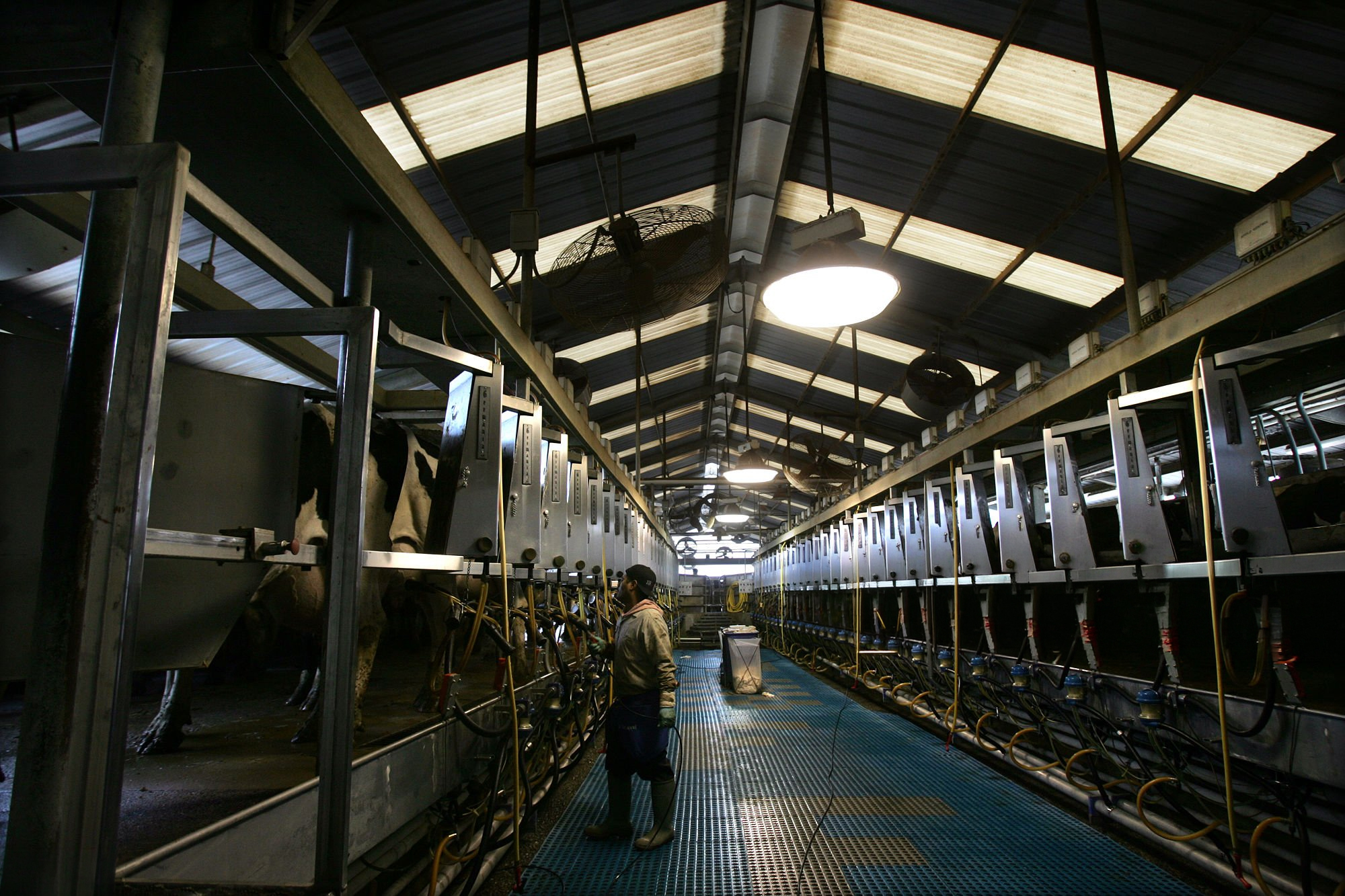
A new Emory/Colorado State study published in PLOS Biology (May 2026) found live, replication‑competent H5N1 in the air of California milking parlors, in reclaimed flush water, and in manure lagoons — and for U.S. dairies building 2026–27 budgets, that translates into roughly $7,200–$12,500/year of new H5N1 dairy biosecurity cost 2026 on a 1,000‑cow herd before anyone touches wastewater capital. On a herd shipping about 80 lb/cow/day, that’s roughly $0.025–$0.043/cwt of extra margin‑over‑feed pressure for dairy 2026 — stacking on top of a year when DMC didn’t come close to covering the real gap for many herds.
That gap is already visible at operations like Bivalve Dairy in Marin County, California, where owner John Taylor told Peninsula Press he installed boot‑washing stations outside every barn after H5N1 swept through the state’s herds in late 2024. Taylor told the publication he isn’t taking any chances — “We’re disinfecting our boots, we’re being extra careful, washing things down extra,” he said, even as he kept the farm running on its normal milking rhythm. By every standard dairy biosecurity playbook at the time, that contact‑and‑fomite control was the right move. The standard playbook was looking in the wrong place.
What 14 California Dairies and 71 Air Samples Just Changed About Dairy Biosecurity in 2026
For most of 2024 and 2025, H5N1 on dairies was framed as a contact‑and‑milk problem. Keep sick cows off the line. Scrub the units. Pasteurize. Keep the virus off boots and out of the milkline.
Taylor’s response at Bivalve Dairy followed that playbook to the letter. Peninsula Press reports he installed boot‑washing stations outside every barn after H5N1 spread through California herds in late 2024. Across the border, Canadian surveillance bodies like WeCAHN have been tracking the same U.S. dairy outbreak through 2024–2025 to inform Canadian farm biosecurity.
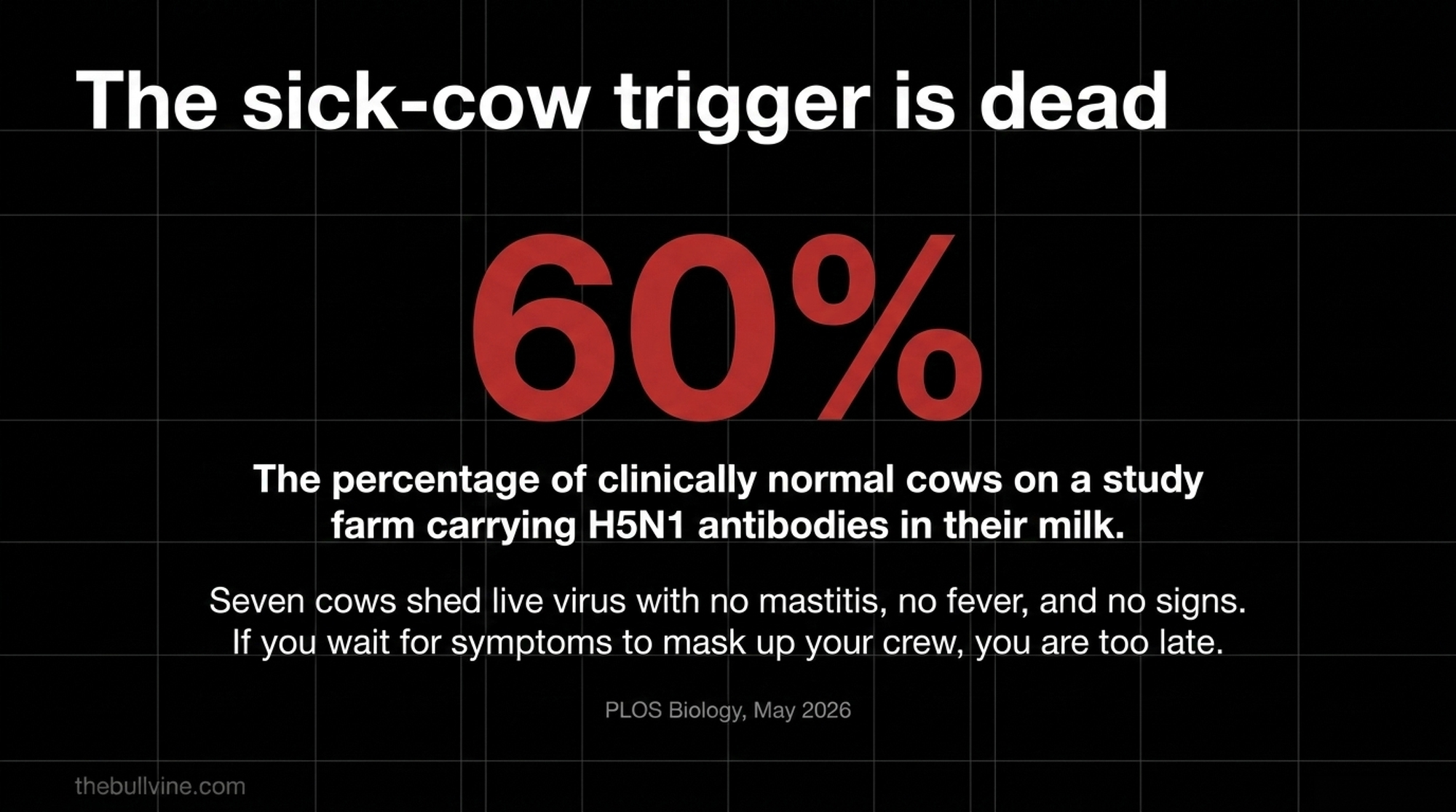
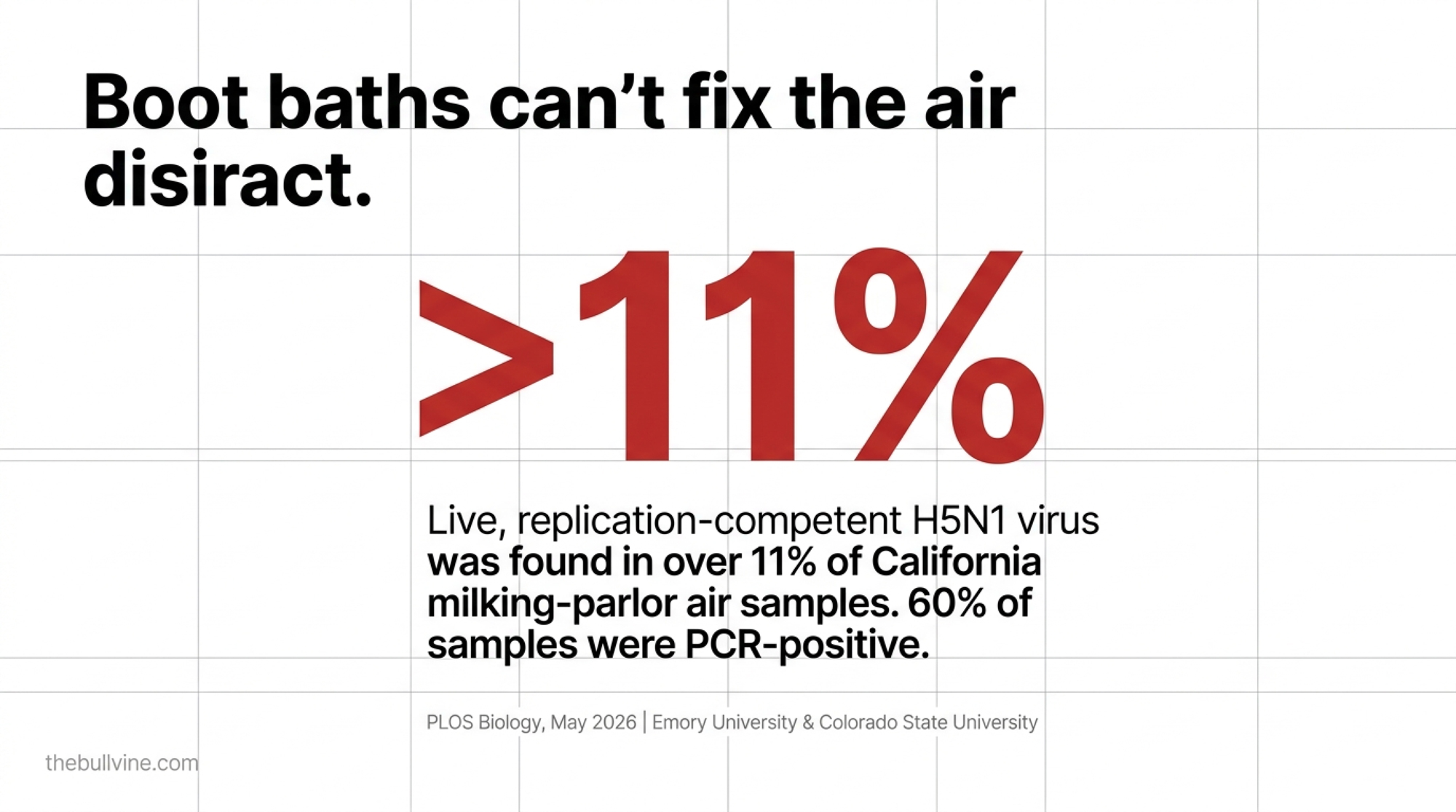
A research team led by Dr. Seema Lakdawala at Emory University and Dr. Jason Lombard at Colorado State went further. They sampled 14 H5N1‑positive California dairies across two regions between October 2024 and January 2025, pulling air, wastewater, and milk samples to map how the virus actually moves. In the first phase, 71 air sampleswere collected from parlors, barns, and outdoor areas; multiple parlor and cow‑breath samples tested positive for H5N1 RNA. In a focused second phase across three Southern California farms, 21 of 35 milking‑parlor air samples (60%) tested PCR‑positive, and 4 of 35 (more than 11%) contained live, replication‑competent virus — not fragments, but virus capable of infecting cells.
The 2026 Reality Check: In the milking parlor — where workers spend hours at flank level — 60% of air samples tested PCR‑positive, and more than 11% contained live, replication‑competent virus (PLOS Biology, May 2026). Standard boot‑baths do not protect against what your crew is breathing in the pit.
In a statement on Emory’s release of the study, Dr. Lakdawala said: “Our data confirm the presence of infectious H5N1 virus in the air and reclaimed farm wastewater sites.” The authors went further: “Dairy parlors, which are often enclosed spaces and where aerosolization of milk occurs, pose the greatest threat from inhalation of the virus to dairy farm workers.”
Sequencing pinned the same clade 2.3.4.4b B3.13 subclade circulating in U.S. cattle, with an N189D mutation in the HA protein linked to increased binding to human‑type receptors. California, under State Veterinarian Dr. Annette Jones, remains the leading state for H5N1 detections in dairy herds.
Emory/CSU Study at a Glance
| Metric | Result |
| Study dairies sampled (H5N1‑positive) | 14 across two California regions |
| Sampling window | Oct 2024 – Jan 2025 |
| Total air samples (Phase 1) | 71 |
| Parlor air samples PCR‑positive (Phase 2) | 21 of 35 (60%) |
| Parlor air samples with live, replication‑competent virus | 4 of 35 (>11%) |
| Peak viral load in parlor air | Up to 10⁴ genome copies/L |
| Subclade identified | 2.3.4.4b B3.13, N189D mutation in HA |
| Clinically normal cows seropositive (one farm) | ~60% |
| Cows shedding live virus with no clinical signs | 7 on one farm |
Why “Healthy” Cows Might Be Your Most Expensive Number
Here’s the line every herd manager should sit with: on one study farm, about 60% of cows that appeared clinically normal had H5N1 antibodies in their milk — already infected, already recovered, never flagged. On another, seven cows were actively shedding live virus in their milk, with no mastitis, no fever, and no obvious clinical signs. The team described “high viral loads and H5 antibodies in the milk of cows, including those without clinical signs, suggesting that multiple modes of H5N1 transmission likely exist on farms.”
If your herd‑health protocol relies on a sick cow as the trigger, you’re triggering on the wrong signal.
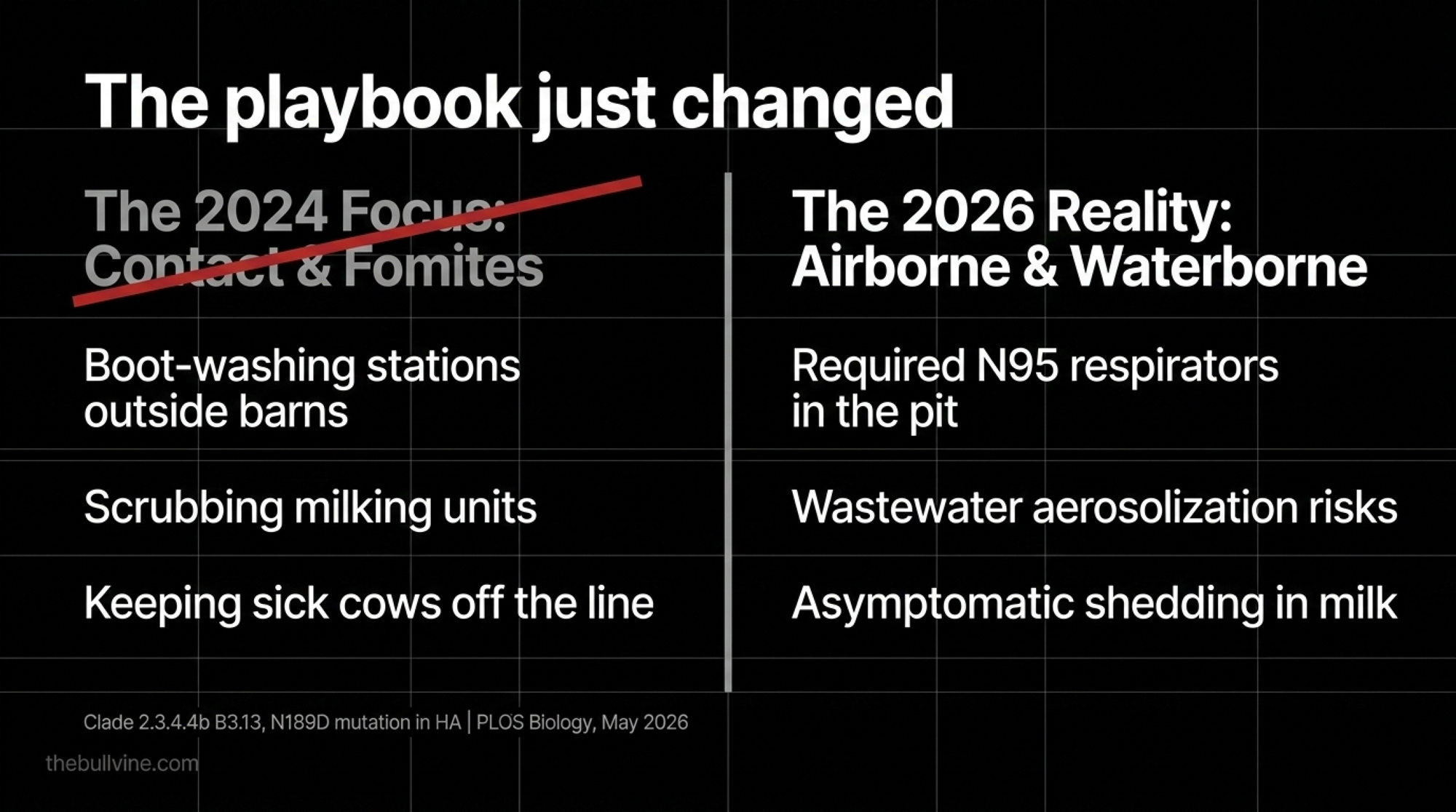
Put workers back in the picture. CDC lists dairy workers handling potentially infected cattle or raw milk as higher‑risk for novel influenza A and recommends NIOSH‑approved particulate respirators (N95 or better), eye protection, and protective clothing. California’s Department of Industrial Relations states directly that “workers who have job‑related contact with birds or dairy cows infected with the H5N1 virus are at risk of becoming infected with bird flu,” including those “handling or otherwise being exposed to animals that are infected but not showing symptoms.” Cal/OSHA treats that exposure as a General Duty Clause obligation for employers.
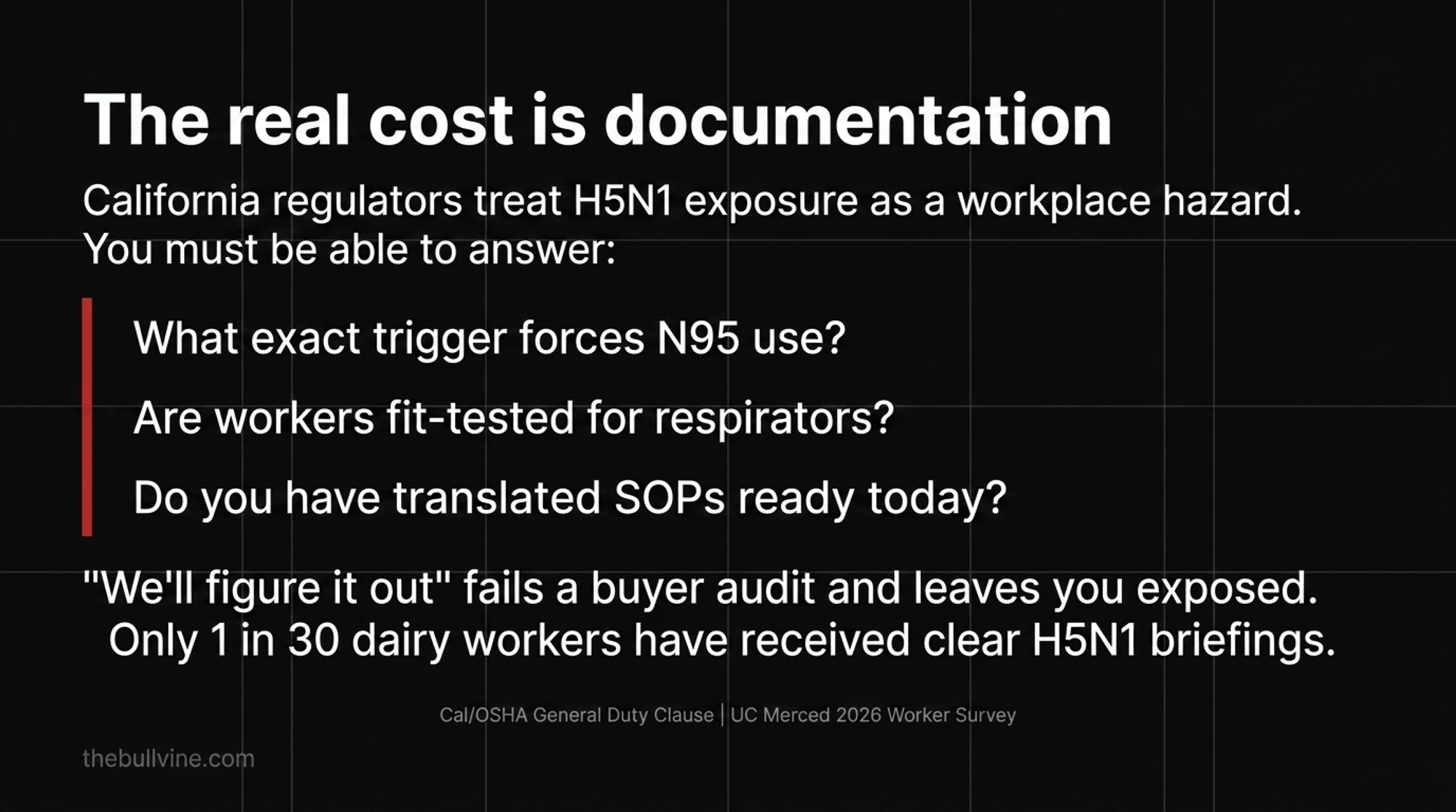
The Hidden Cost Few Operators Budget: A UC Merced survey of 30 dairy workers across 8 Central Valley citiesfound only 1 in 30 had received a clear H5N1 briefing tied to their job. Training time, translated SOPs, and fit‑testing don’t live in the “supplies” column on most 2026 budgets.
Running the Numbers: H5N1 Biosecurity on a 1,000‑Cow California Dairy
Cheap on paper. Add it up across two shifts and 365 days, and it stops being cheap.
Operation profile: 1,000 milking cows, double‑X parlor, 3 milkers per shift, 2 shifts daily — 6 parlor workers per day, 365 days/year.
PPE unit‑cost assumptions (NIOSH‑approved disposables; non‑vendor public procurement ranges, 2024–25):
| PPE / Test Item | Unit Cost | Use Rate (1,000 cows, 6 workers/day, 2 shifts) | Annual Cost (Low–High) |
|---|---|---|---|
| N95 Respirator | $0.75–$1.25 each | 1 per worker per shift | $3,285–$5,475 |
| Nitrile Gloves | $0.10–$0.20/pair | 3 pairs per worker per shift | $1,314–$2,628 |
| Reusable Goggles / Targeted Coveralls | $6–$10/worker, 2–3×/year | Replacement for parlor crew | $1,400–$2,000 |
| Bulk-Tank PCR Testing | $30–$50/test | 40–50 tests/year | $1,200–$2,500 |
| TOTAL — 1,000-Cow Herd | $7,200–$12,500/year |
Annual PPE math (1,000‑cow model, both shifts):
- N95s: 6 workers × 365 days × 2 shifts × $0.75–$1.25 → $3,285–$5,475/year
- Gloves: 6 workers × 365 days × 2 shifts × 3 pairs × $0.10–$0.20 → $1,314–$2,628/year
- Goggles + targeted coveralls (2–3 per worker/year + replacement) → $1,400–$2,000/year
- Total milking‑parlor PPE: ~$6,000–$10,000/year
Bulk‑tank PCR layer: 40–50 tests/year at $30–$50/test → $1,200–$2,500/year.
All‑in baseline biosecurity adder (PPE + bulk‑tank PCR), before wastewater capital: $7,200–$12,500/year. A 1,000‑cow herd at ~80 lb/cow/day produces about 292,000 cwt/year, so that adds $0.025–$0.043/cwt.
Annual H5N1 Biosecurity Cost by Herd Size
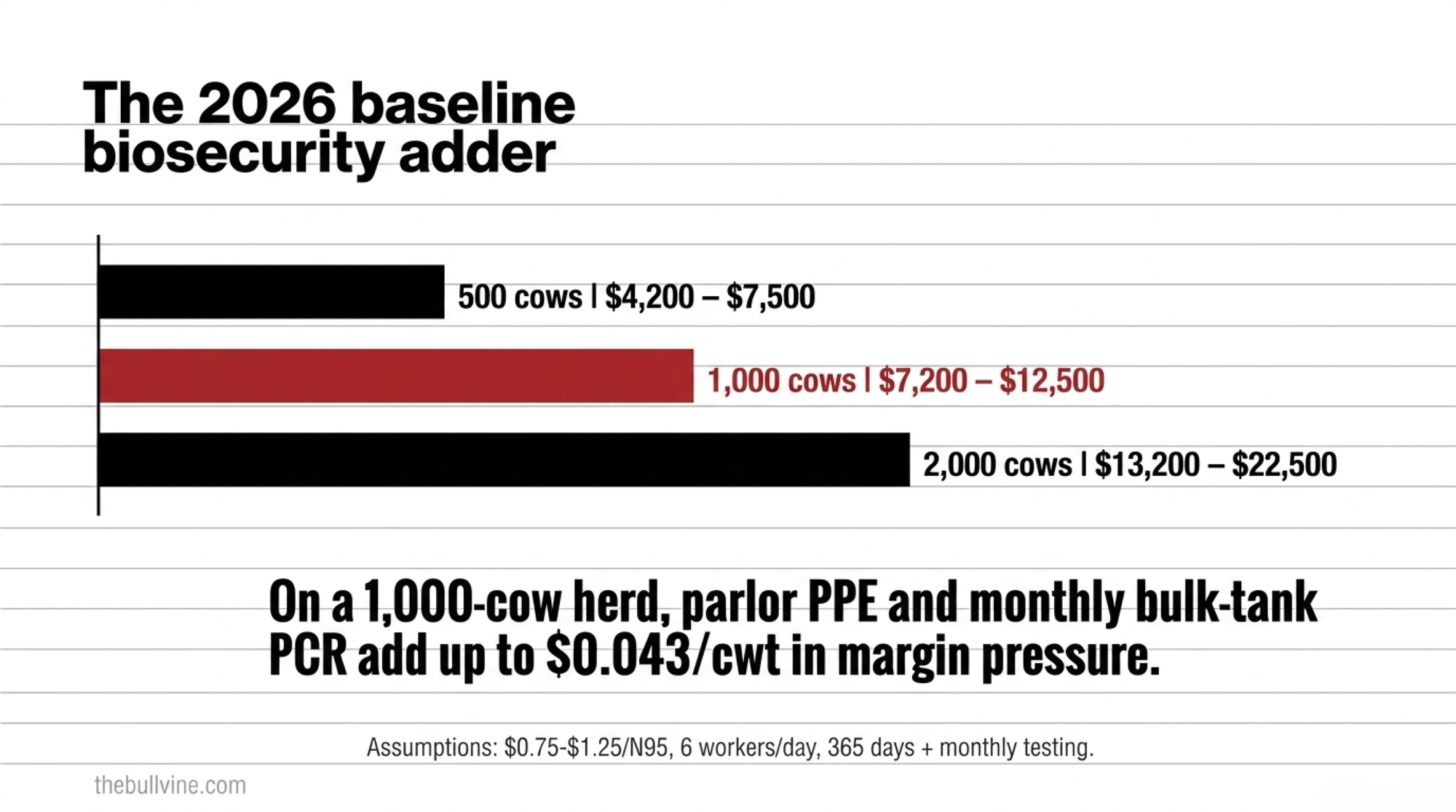
| Herd Size | Annual Parlor PPE (Low–High) | Annual Bulk‑Tank PCR | Total Annual Biosecurity Adder | Margin Pressure (per cwt) |
| 500 cows | $3,000–$5,000 | $1,200–$2,500 | $4,200–$7,500 | $0.029–$0.051/cwt |
| 1,000 cows | $6,000–$10,000 | $1,200–$2,500 | $7,200–$12,500 | $0.025–$0.043/cwt |
| 2,000 cows | $12,000–$20,000 | $1,200–$2,500 | $13,200–$22,500 | $0.023–$0.039/cwt |
Per‑cwt assumes ~80 lb/cow/day, 365 days. PPE scales with parlor headcount and shifts; bulk‑tank PCR scales with tanks/loads, which is why mid‑size and large herds often stay in the same testing band.
For context, the 2024 federal Dairy Margin Coverage program calculated a national average margin of $11.98/cwt and never triggered payments at the popular $9.50/cwt coverage level — even as some regions saw real production costs closer to $23.65/cwt and on‑farm margin running roughly –$1.05/cwt. On a 200‑cow Northeast herd shipping 75 lb/cow/day, that’s about $57,500 of negative margin DMC didn’t touch.
Stack PPE, testing, and (eventually) wastewater on top of that. Each line looks manageable alone. They don’t arrive alone.
The Loop From Your Parlor Drain to Your Workers’ Lungs
Walk the water through your dairy. Parlor floors drain into collection pits. Pits pump to lagoons. Lagoon water comes back through flush lines to clean alleys, scrape lanes, or irrigate forage.
The Emory/CSU team found a live virus throughout that loop. H5N1 viral RNA was detected “throughout the wastewater stream, including in manure lagoons used by migratory birds and in fields with grazing cows.”
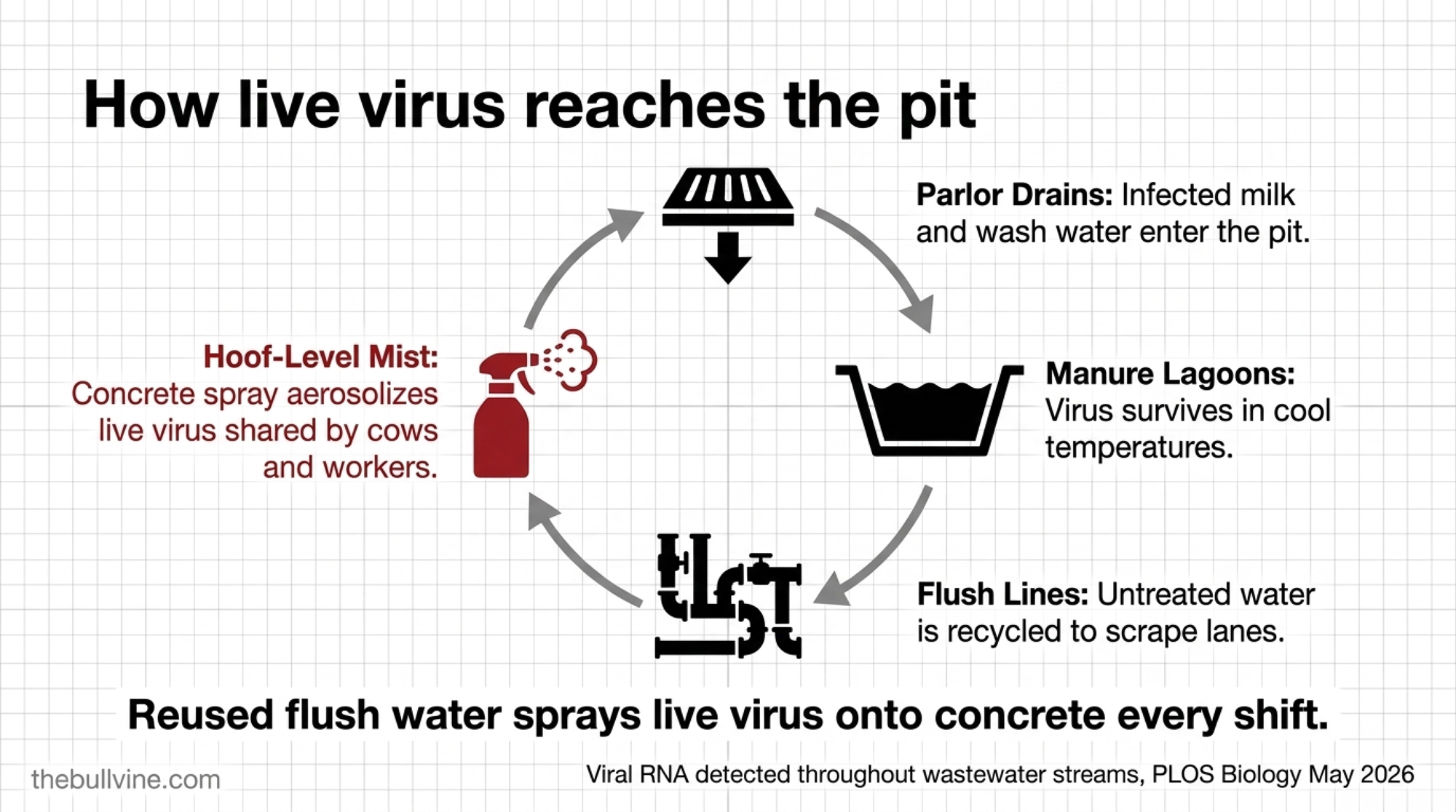
The Risk Vector Nobody Drew on the Whiteboard: Drain → lagoon → flush line → mist at hoof level → parlor air → next cow → worker at her flank. The authors describe “extensive environmental contamination of H5N1 on affected dairy farms” that “identifies additional sources of viral exposure for cows, peridomestic wildlife, and humans.”
When a recycled flush hits concrete under pressure, it throws a fine mist at hoof level. That’s air your cows and your people share. Open lagoons attract wild birds, which is how this whole thing landed in commercial cattle in the first place. Lab and wastewater modeling studies suggest influenza A virus carries a half‑life on the order of half a day at room temperature, with extended survival in cooler conditions. If lagoon water cycles back through flush lines on a shorter loop than that decay curve — without chlorination, UV, or deliberate holding time — you’re spraying live virus on concrete every shift.
Put the “healthy” cows back on that path. Up to 60% of clinically normal cows on some study farms had already been exposed. A handful were actively shedding into the parlor drain. Drain feeds the lagoon. Lagoon feeds flush. Flush feeds the air. Air feeds the next cow — and the worker at her flank.
Once you can draw that loop on your own dairy, the priorities shift.
Is Your 2026 Parlor SOP Built for an Airborne Pathogen?
Most parlor SOPs were written for mastitis. Gloves. Dips. Water temperature. Residue protocol. Almost none mention respirators, goggles, or exposure to airborne pathogens in the pit.
The PLOS Biology paper documented influenza virus in the parlor air at concentrations up to 10⁴ genome copies per liter of air sampled. At that level, “wear gloves and wash up” stops being a defensible protocol if a worker‑comp claim, a buyer audit, or a plaintiff’s attorney shows up. California’s Department of Industrial Relations already treats H5N1 dairy exposure as an actionable workplace hazard, including from asymptomatic animals.
Three questions you should be able to answer this month without hedging:
- At what trigger — county‑level detection, suspicious tank drop, positive bulk tank — do parlor workers move from voluntary to required N95 use?
- Has anyone on your crew been fit‑tested for an N95, or are you guessing on sizes?
- If your bulk tank comes back positive next week, do you have a one‑page worker briefing ready in the languages your crew actually speaks?
If any of those answers is “we’ll figure it out,” that’s where the real cost lives. Not in the PPE invoice. In the day, you have to figure it out under a microphone.
Let’s Sit Down at the Kitchen Table: The 30/90/365‑Day Playbook for Herds Like Bivalve Dairy’s
None of these moves requires new capital this week. They do require you to write things down — because in 2026, “we talked about it” is not a documented program.
30‑Day Actions: Get These Done Before Your Next Milk Check
Price your parlor PPE for your real headcount. Pull your shift schedule. Multiply parlor positions × 365 days × 2 shifts × your local N95 and glove prices. Know what the year looks like at $6,000 versus $10,000, then put that number in the 2026 operating budget — not “miscellaneous.”
Map your water on one page. Draw every parlor drain, hospital‑pen sump, lagoon cell, flush line, and irrigation lateral. Circle every place where sick milk or wash water enters the system. One evening, a herd manager and a marker — the only way to see the real risk path on your dairy.
Write the trigger. One paragraph that names the local conditions — county‑level detection, an unexplained tank drop, a positive bulk tank — that flips your parlor from voluntary masking to required. If you can’t write it down, your team can’t follow it on a Sunday night.
Red‑flag trigger. If your DSCR has been below 1.2 for three consecutive months on your lender’s worksheet, don’t take on new biosecurity capital this cycle without first renegotiating the term. Treat that as urgent.
90‑Day Actions: Structural Moves That Require Planning
Set a testing cadence. Monthly bulk‑tank PCR is the working baseline most state programs reference; weekly during local flare‑ups or after suspicious clinical patterns. At $30–$50/test, you’re committing roughly $1,200–$2,500/year. Cheap insurance — but only if a positive triggers actual isolation, not a meeting about isolation.
Get an engineer on the wastewater question. If you reuse flush water, you have three real options: separate cells for high‑risk streams, extended holding time before reuse to ride the virus’s decay curve, or targeted disinfection on the hottest branch. Published general water‑sanitation work (municipal and non‑dairy settings) suggests ballpark operating cost for practical chlorination or UV often lands around $0.50–$1.00 per 1,000 gallons, depending on dose and energy. This is not a dairy‑specific number — have your engineer and state regulator validate any design and cost for your system before committing capital.
Where it backfires, disinfection chemistry can corrode equipment, alter nutrient handling, and trigger permit issues. Not a back‑of‑the‑envelope decision.
365‑Day Moves: Position for 2027
Start the insurance conversation now. Heading into 2027, Dairy Revenue Protection or your liability renewal, ask your agent three plain questions:
- How are you treating H5N1 parlor exposure in the 2027 underwriting?
- Does a documented PPE and wastewater program reduce my liability or workers’ comp exposure?
- What biosecurity baseline are you assuming for my current coverage?
Insurers will likely look more favorably on operations that can show a documented program, but specific premium impact depends on your carrier, your policy, and your claims history. Have that conversation now, not after a claim. A 2026 DRP guidance already advises producers to “incorporate DRP into your broader business plan and strategy for 2026… including budgeting, investment plans and risk management strategies.”
Build the one‑folder defense. PPE invoices. Training logs. Water‑flow map. Testing cadence and results. One binder. That’s what an inspector, buyer, auditor, or plaintiff’s attorney asks for first.
Watch for the opportunity signal. If H5N1 detections in your state begin to fall and your bulk‑tank tests stay clean, that could be a useful moment to talk with your agent about 2027 coverage before carriers fully build this exposure into pricing.
The Trade‑Off at the Heart of H5N1 Dairy Economics in 2026
The instinct is to wait. Wait for a confirmed case in your county. Wait for a buyer audit to ask. Wait for the renewal packet that forces the conversation.
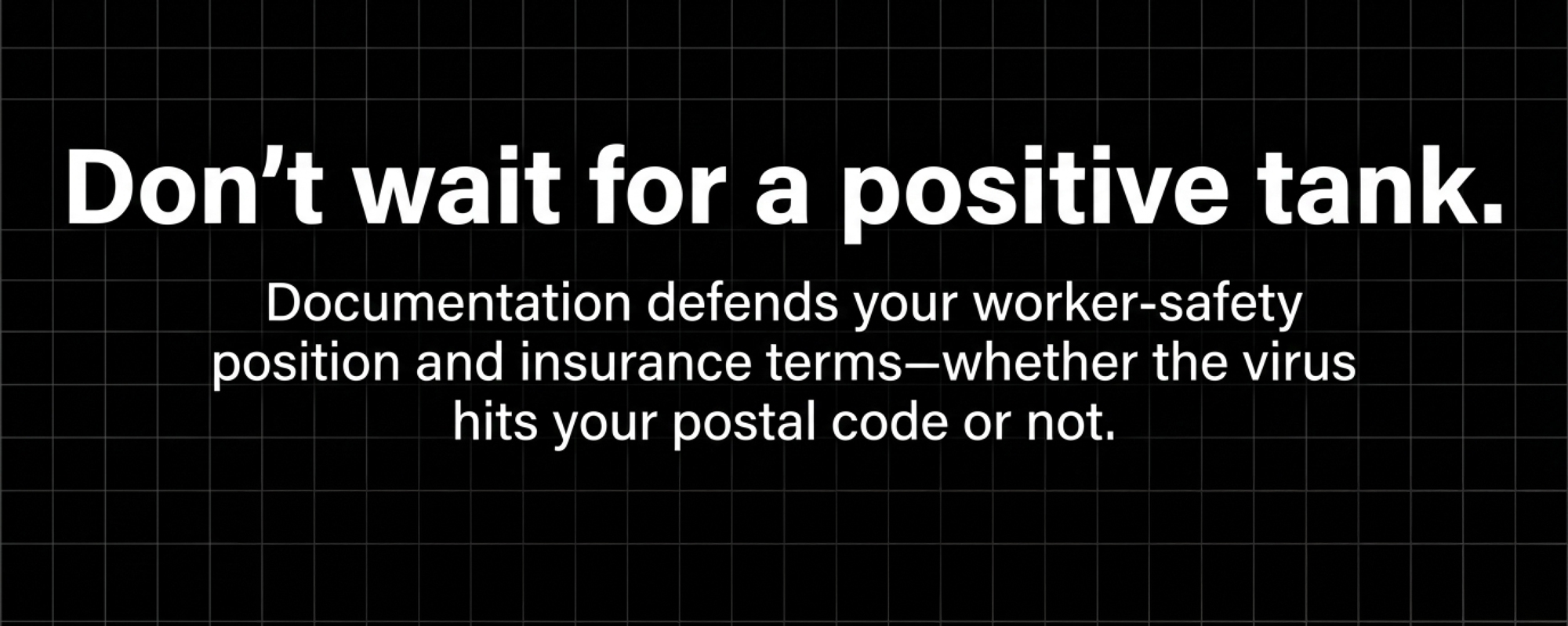
The PLOS Biology data argue hard against that. By the time clinical signs appear, the air has already been carrying the virus, and a meaningful share of the herd may have seroconverted. Documentation built reactively under pressure costs more, holds up worse in litigation, and lands when operating cash is already strained.
The trade is simple. You spend $7,200–$12,500/year on a risk you didn’t budget for, and it may never hit your postal code. You buy documentation that defends your worker‑safety position, your insurance terms, your buyer audit, and your liability exposure across the next 24 months — whether the virus shows up in your herd or not.
Operations like Bivalve Dairy installed boot‑station and fomite controls before the air data was published — exactly what the guidance said at the time. The new science doesn’t make that work wrong. It adds an airborne and waterborne layer that the previous playbook didn’t address.
Take this back to your own books. What does your current parlor SOP actually say about respirator use on the day a positive bulk tank comes back? And what’s your real margin‑over‑feed dairy 2026 cost per cwt — at $0.025, $0.043, or higher — of finding out you don’t know?
Key Takeaways
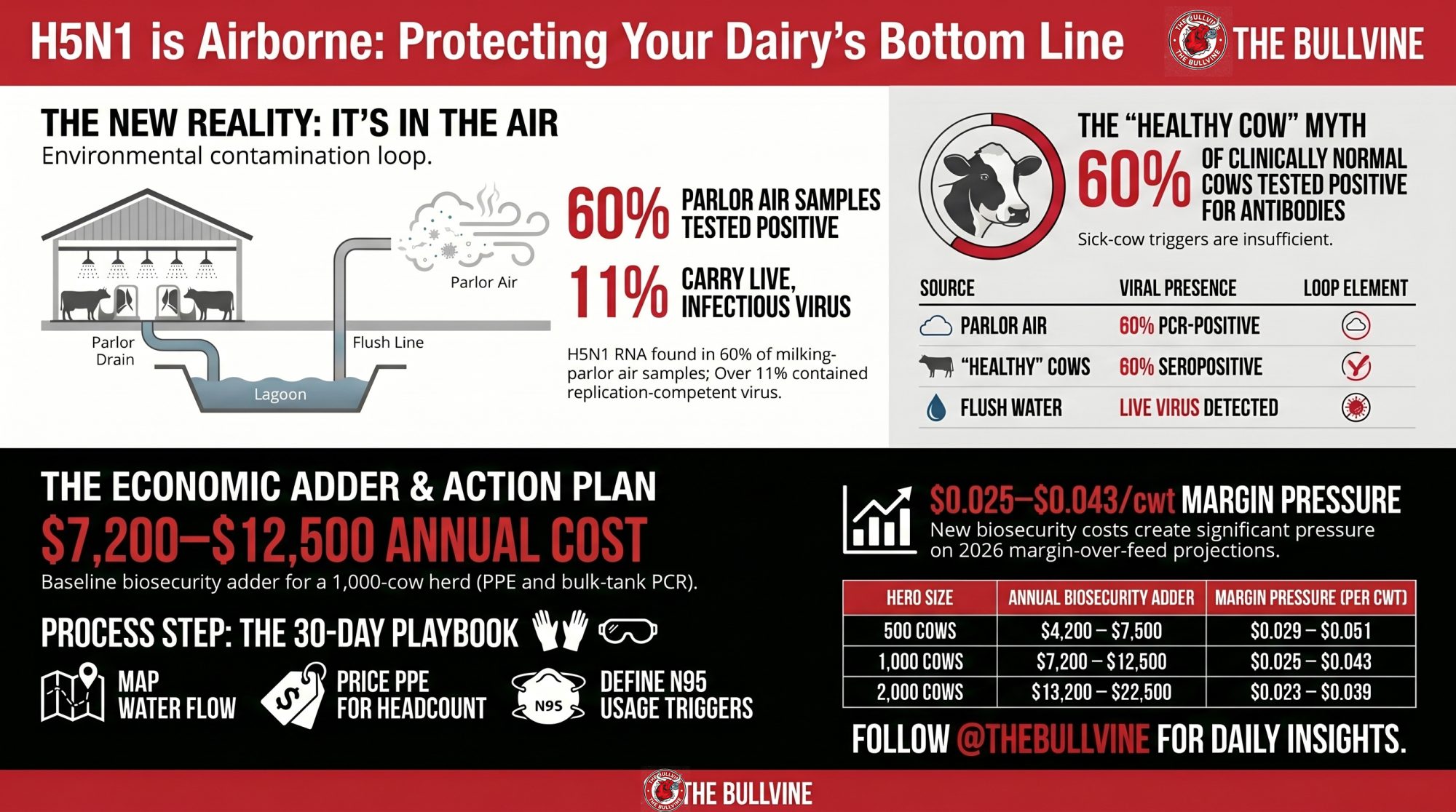
- The Emory/CSU PLOS Biology study (May 2026) puts live H5N1 in 11% of California parlor air samples and 60% PCR‑positive — your sick‑cow trigger is the wrong trigger when ~60% of clinically normal cows on one study farm already had antibodies in milk.
- Budget $7,200–$12,500/year ($0.025–$0.043/cwt on 1,000 cows) for PPE + monthly bulk‑tank PCR before any wastewater capital, and scale it for your real headcount using the 500/1,000/2,000‑cow table — not “miscellaneous.”
- In the next 30 days, map every drain, lagoon, and flush line on one page and write the trigger that flips your parlor from voluntary to required N95 use; if your DSCR’s been under 1.2 for three months, renegotiate term before you add biosecurity capital.
- Start the 2027 DRP, liability, and workers’ comp conversation now — a documented PPE, water, and testing program is what defends your number when an inspector, buyer auditor, or underwriter shows up, whether or not H5N1 ever hits your postal code.
Complete references and supporting documentation are available upon request by contacting the editorial team at editor@thebullvine.com.
Learn More
- US-India dairy standoff: why American producers face a brick wall in the world’s largest milk market — Reveals the geopolitical and trade policy barriers restricting global milk access, arming operators with structural market realities needed to gauge long-term supply volatility and domestic margin risks.
- As California Farmers are Pressed, Dairy Cows Flee for Texas and Arizona — Follows the money behind regional dairy migration patterns, exposing how high operational friction, regulatory mandates, and rising compliance overhead drive western herds out of historic milksheds.
 The Sunday Read Dairy Professionals Don’t Skip.
 The Sunday Read Dairy Professionals Don’t Skip.
Every week, thousands of producers, breeders, and industry insiders open Bullvine Weekly for genetics insights, market shifts, and profit strategies they won’t find anywhere else. One email. Five minutes. Smarter decisions all week.




