Archive for Dairy Farm Profitability – Page 8

Are Your Cows Tap Dancing on Black Ice? The $250,000 Problem You’re Walking Over Every Day

Slippery barn floors cost $300+/cow in lameness. Discover how traction milling and smart flooring fixes can save your dairy operation six figures.

Executive Summary: Dairy barn floors are a hidden profit killer, with lameness costing $300+ per cow due to lost milk, fertility issues, and premature culling. Modern free-stall designs and larger cows amplify risks from slippery floors caused by mineral buildup, sand abrasion, and poor installation. Solutions like Agritra’s traction milling (80% traction improvement) outperform traditional grooving and rubber mats by eliminating “slip-and-catch” injuries while reducing bacterial traps. Proactive floor maintenance and objective assessments combat “barn blindness,” while proper concrete specs and post-cure texturing prevent long-term failures. Investing in optimized flooring isn’t optional-it’s a $100K+/year ROI opportunity for 1,000-cow herds.

Key Takeaways:

  • Lameness = profit drain: Costs $300+/case via milk loss, culling, and treatment.
  • Floor failures are preventable: Mineral buildup (not wear) often causes slipperiness-test with water.
  • Traction milling dominates: 80% traction vs. 30% for grooving; avoids injuries and lasts 6-15 years.
  • Sand beds backfire: Accelerate floor wear despite cow comfort benefits.
  • Holistic approach wins: Pair flooring fixes with stall comfort, hygiene, and locomotion scoring.
dairy barn flooring, lameness in dairy cows, traction milling, dairy farm profitability, barn floor maintenance

While you’re meticulously dialing in that TMR mix to the gram and scrutinizing DHIA test results to the decimal point, your cows are sliding toward financial disaster on what might be the most neglected investment in your dairy. The floor beneath their hooves is bleeding profits faster than a displaced abomasum that goes untreated for a week. It’s time to stop accepting lame cows as “just another cost of doing business” and start seeing your slippery floors for what they truly are – a fixable profit drain costing you six figures annually.

The Financial Hemorrhage You’re Ignoring

Let’s cut straight to your milk check: lameness is drying your operation like subclinical mastitis flying below the SCC radar. Each case costs over $300 per cow, and with prevalence rates between 20-50% in typical herds, we’re talking about $100,000 to $200,000 in annual losses for a 1,000-cow dairy.

“But my herd doesn’t have a lameness problem,” you might insist. Really? When was the last time you measured it? Research consistently show’s producers underestimate lameness prevalence by half or more. This phenomenon, “barn blindness” (normalization of hazards through daily exposure)-happens when you see the same gradual deterioration daily until it becomes your new normal. You don’t notice your cows’ subtle gait changes and arched backs until you’ve got Holstein tripods hobbling through the return alley.

Here’s the breakdown of where that $300+ per case is vanishing:

  • Milk production losses: 700-950 pounds per lactation (that’s like dumping a full bulk tank from a 100-cow dairy every year)
  • Premature culling: Those second and third-lactation cows never reach genetic potential (31% of total cost)
  • Reduced fertility: More days open than a 24-hour convenience store (30-39% of total cost)
  • Treatment costs and labor: The tip of the iceberg that most producers focus on

Here’s what should make you reach for the antacids: milk production often begins decreasing months before you notice any clinical lameness. Your transition cows are suffering in silence, and your bulk tank is taking the hit harder than a first-cutting alfalfa field in a hailstorm.

Has Your Floor Design Been Stuck in the 1980s?

The dairy industry has revolutionized everything from genetics to milking technology, yet most barns still feature the same concrete flooring systems farmers installed decades ago. This disconnect is costing you dearly.

Today’s 6-row free-stall facilities provide behavioral freedom but fundamentally change the physical demands on your cows. Instead of delivering food and water, such as room service, they must walk approximately half a mile daily between feeding areas, water troughs, and milking facilities.

Meanwhile, decades of selection for production have resulted in 1,600-pound powerhouses with frames that would make a Peterbilt jealous. This increased body mass places greater pressure on hooves and joints when walking on hard surfaces.

The math is simple: larger cows + more walking = unprecedented demands on your barn flooring. Yet most producers are still treating their concrete the same way they did 30 years ago, despite these dramatic changes. That’s like using your grandfather’s bull selection criteria in the genomic era dangerously outdated.

Why should you care? Your grandfather’s cows survived on poorly maintained floors because they barely walked. Today’s high-producing animals need surfaces that provide confident footing without causing excessive wear balance that most traditional approaches fail to achieve.

The Real Reasons Your Floors Get Slippery (And It’s Not What You Think)

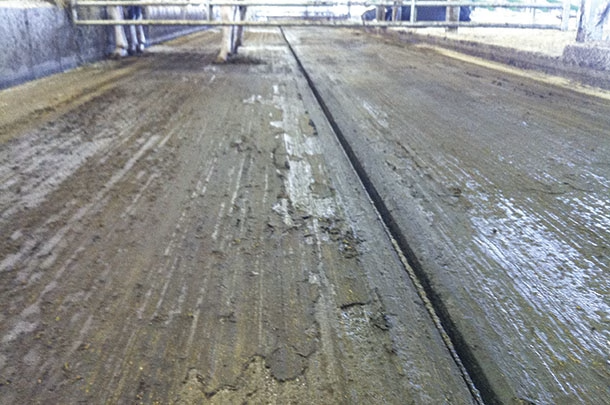
Do you think your floors are slippery because they’re simply worn down? Think again. Many floors don’t lose traction because the concrete is degraded- they become dangerous because of what’s building up on them.

The most overlooked culprit is mineralization. Hydrated lime from free stall bedding chemically bonds with concrete immediately upon contact, gradually filling micro-textures that provide traction. This builds up like milk stone in your pipeline when your wash cycles aren’t correctly calibrated.

Want a simple test to know whether your floor is worn or just coated with minerals? Wash a section with water. If polished aggregate stones are visible, you’ve got genuine wear. You deal with mineral buildup if the original surface remains but has lost its texture.

Other major factors making your floors into skating rinks:

Sand Bedding: The Double-Edged Sword While excellent for cow comfort and SCC reduction, sand acts like 100-grit sandpaper under hooves and scraper blades. If you’re using sand, your floors will degrade significantly faster than with organic bedding. Has your bedding consultants ever mentioned this trade-off, or were they only focused on selling you on comfort metrics?

Over-Sloped Surfaces: The Counterproductive “Solution” Many barns incorporate excessive slopes with the intention of improving drainage. The irony? This often causes manure solids to smear into a slippery film rather than drain effectively. More slopes don’t equal better drainage- it equals more falls, like how pushing your vacuum pump beyond 14 CFM doesn’t improve milking but does increase teat-end damage.

The Imprinting Disaster That Engineers Keep Selling Perhaps the worst flooring mistake ever widely embraced was imprinting patterns into wet concrete. This displacement technique inevitably creates an uneven surface like an upside-down muffin tin. These uncomfortable “domes” between pattern impressions can increase lameness rates to 50-60%. Why are we still letting concrete contractors talk us into this approach when the data clearly shows it’s a welfare and financial disaster?

The Flooring Showdown: What Works?

When addressing slippery barn floors, you have several potential solutions. But which one delivers results? Let’s cut through the marketing hype faster than a Lely laser cuts through quarter milking:

Traditional Grooving: The Outdated Standard Concrete grooving has been standard practice since the 1960s, showing its age like a tie-stall barn with wooden stanchions. While providing approximately 30% improvement in traction, it relies on a dangerous “slip and catch” mechanism (where the hoof slips on a flat surface, then catches on the groove edge) that creates traumatic forces, causing white line separation and interdigital strain.

Even worse, those grooves become bacterial reservoirs like stagnant footbaths. They trap approximately 2 gallons of manure per 10 square feet even after scraping, creating perfect breeding grounds for digital dermatitis pathogens.

Rubber Flooring: The Comfortable Compromise Rubber has gained popularity for its comfort benefits, with cows taking longer strides and walking faster than concrete. But before you cover your entire barn in rubber-like artificial turf on a football field, ask yourself if the economics work.

The primary disadvantage is that cost-installing rubber throughout an entire facility requires substantial investment. Durability concerns also exist, with some operations reporting replacement needed after only five years, resulting in costs of around $2 per square foot annually.

Most importantly, rubber flooring doesn’t address underlying concrete issues; when it wears out or is removed, your original floor problems remain. Are you solving your problem or just putting an expensive band-aid on it?

Traction Milling: The Modern Alternative Traction milling (grinding a fine, ribbed texture directly into concrete surfaces) takes a fundamentally different approach to flooring, such as the shift from conventional parlors to rotaries or robots. This process provides “360-degree traction with every step” rather than the reactive “slip and catch” of grooving.

The process covers approximately 95% of the floor surface (versus only 10-20% with grooving) and claims to provide about 80% of the traction found on pasture- the difference between wearing cleats or dress shoes on wet grass.

A key advantage is its versatility across different existing surfaces. It can be applied over previously grooved floors, ungrooved surfaces, slats, and even problematic imprinted floors. Why aren’t more producers considering this option instead of defaulting to what their neighbors did twenty years ago?

Getting It Right from the Ground Up: If You’re Pouring New Concrete

If you’re pouring new concrete, you can avoid future problems or create a disaster that will plague your herd, like persistent BTSCC problems that never respond to treatment.

The Foundation Matters Before the first concrete truck arrives, ensure proper excavation, fill material, and compaction. Your concrete should have a minimum 25 MPa (3,500 PSI) compressive strength and 6% air entrainment for durability and acid resistance, which are higher standards than your bulk tank pad but essential for cow traffic areas.

The Critical Timing Window For broom finishing, timing is everything. Done too early, it pulls stones to the surface, creating painful pressure points. Done too late, it leaves little texture. Even properly executed, broom finishes typically provide traction for only 6-12 months in high-traffic scrape alleys-about as lasting as temporary hoof blocks on chronic lame cows.

The Deadly Imprinting Mistake Here’s a critical warning: never imprint patterns by displacing wet concrete. When concrete is pushed down in one area, it rises elsewhere, forming uncomfortable “domes” that increase lameness risk. Why are we still allowing contractors to sell us on this outdated practice when it creates predictable lameness problems?

What About New Floors? Consider arranging for post-cure texturing like traction milling for new installations rather than relying solely on initial brooming. This provides a more uniform, durable surface, implementing a comprehensive transition cow program instead of treating ketosis cases after they occur.

The Bottom Line: Stop Accepting Lameness as a “Normal” Cost of Doing Business

The floor beneath your cows’ feet isn’t just concrete- it’s the foundation of your dairy’s profitability, as critical as your nutrition program or reproduction protocol. Yet, while you track milk components to the hundredth of a point and reproductive performance to the day, you’re likely ignoring a problem staring you in the face.

With each lameness case costing over $300 and affecting up to half your herd, addressing flooring issues represents one of the highest-return investments available to modern dairy operations. This isn’t just maintenance- it’s capturing new profit in an industry where margins can be thinner than a Jersey’s tail on a fly day.

Take Action Now:

  1. Conduct a locomotion scoring assessment by June 1st – Don’t trust your daily observation alone. Schedule an objective evaluation using a standardized 1-5 scale scoring system for your floors and your cows’ locomotion. When was the last time someone besides you scored your cows for lameness?
  2. Calculate your specific lameness costs this week – Multiply your herd size by 35% (a conservative estimate based on research), then multiply that number by $336.91 (the average cost per case according to the 2023 Journal of Dairy Science research). That’s what lameness might be costing annually likely more than your annual breeding costs.
  3. Develop a floor maintenance schedule by July 1st – If you’re using sand, recognize your floor maintenance needs will be substantially higher. Create a calendar for regular floor assessment and maintenance, just as you do for your milking system.
  4. Request quotes from multiple flooring solution providers within 30 days – Don’t just call the same groover you’ve always used—research newer technologies like traction milling and targeted rubber application. Compare costs, expected lifespan, and ROI calculations.
  5. Implement a prevention-focused flooring strategy before fall – When was the last time you had someone evaluate your floors with the same diligence as your milking system analysis? Schedule a comprehensive assessment that includes traction testing and identification of problem areas.

The question isn’t whether you can afford to address your floor issues-it’s whether you can afford not to. Every day you delay is another day your cows struggle on slippery surfaces, another day of reduced performance, and another day of watching potential profits slide away on sore hooves faster than milk prices after a bearish USDA report.

Your cows walk half a mile daily on your floors. Isn’t it time you walked a mile in their hooves?

Complete references and supporting documentation are available upon request by contacting the editorial team at editor@thebullvine.com.

Learn more:

The Sunday Read Dairy Professionals Don’t Skip.
Every week, thousands of producers, breeders, and industry insiders open Bullvine Weekly for genetics insights, market shifts, and profit strategies they won’t find anywhere else. One email. Five minutes. Smarter decisions all week.

NewsSubscribe
First
Last
Consent

U.S. Cheese Prices Collapse 32¢ in June as Record Milk Production Overwhelms Export Markets

While you celebrated record milk yields, you engineered your own price destruction. Component optimization beats volume every time—here’s proof.

EXECUTIVE SUMMARY: Here’s the brutal truth most dairy producers refuse to acknowledge: your obsession with milk volume just delivered a devastating 32¢ cheese price collapse in June 2025, proving that production growth without strategic component focus is economic suicide. While Cheddar blocks plummeted to $1.62/lb—the steepest monthly decline in recent history—farms optimizing for butterfat levels above 4.3% and protein exceeding 3.3% captured an additional $120-180 revenue per cow annually compared to volume-focused operations. The data reveals component-adjusted production surged 3.0% in April 2025 while total milk volume grew only 1.5%, creating a fundamental shift that separates winners from losers in today’s oversupplied market. With over $9 billion in new processing capacity coming online through 2026 and European production constraints creating export opportunities, the farms implementing precision feeding programs and genetic selection for components will dominate while volume-chasing competitors wonder why their milk checks don’t match their production records. The market has voted, and it’s time to evaluate whether you’re building a dairy operation that thrives on strategic positioning or doubling down on the volume game that just engineered its own price destruction.

KEY TAKEAWAYS

  • Component Premium Capture Strategy: Farms achieving 4.40% butterfat and 3.40% protein levels are generating $120-180 additional annual revenue per cow while cheese prices collapsed 32¢, proving component optimization provides recession-proof profit margins in oversupplied markets.
  • Feed Cost Arbitrage Opportunity: December corn futures dropped to $4.26/bushel and soybean meal hit multi-year lows at $288/ton, creating immediate margin expansion potential for operations with feed conversion ratios below 1.4:1 who can weather current milk price volatility.
  • Export Competitiveness Reality Check: U.S. cheese export orders dried up when prices exceeded $1.90/lb in May 2025, while European production declined 5.7% in France and 3.8% in Germany, creating strategic opportunities for component-focused operations positioned to capture international demand at competitive price levels.
  • Strategic Hedging Window: Class III futures rallied to $17.59/cwt Friday on heat stress concerns, providing tactical hedging opportunities for Q4 2025 protection while positioning for the inevitable market rebalancing as $9 billion in new processing capacity tests demand absorption limits.
  • Genetic Selection ROI Acceleration: With butterfat and protein ranking among the most heritable traits at 20-25% heritability and over 10 million genomic tests completed globally, operations implementing systematic genetic selection for components while maintaining milk yield are creating sustainable competitive advantages as volume-focused competitors face margin compression.

Here’s the brutal truth dairy producers don’t want to face: while you’ve been celebrating record milk production, you’ve actually been engineering your own price destruction. June’s devastating 32¢ cheese price collapse isn’t market volatility—it’s the inevitable result of an industry that’s forgotten the difference between production growth and profitable growth.

Let’s cut through the industry cheerleading and examine what really happened this week. Spot Cheddar blocks closed Friday at $1.6200 per pound, gaining 1.00¢ for the day but still sitting 32.75¢ lower than early June levels, according to verified CME data. Meanwhile, butter rallied to $2.5625 per pound, up 2.50¢ on the day, creating a market divergence that’s telling you everything about where real value lies in 2025.

But here’s what should really keep you awake tonight: this isn’t just about current prices. This production explosion is fundamentally reshaping who wins and loses in American dairy, and most producers are positioned on the wrong side of the biggest structural shift we’ve seen in decades.

The Component Revolution Nobody Saw Coming

While everyone was obsessing over milk volume, the smart money quietly shifted to components—and the numbers prove it. Recent data shows butterfat levels averaging 4.40% and protein hitting 3.40% in 2025, with component-adjusted production surging 3.0% in April despite total milk volume growing only 1.5%, according to verified industry analysis.

Here’s what that means in real dollars: farms achieving butterfat levels above 4.3% and protein content exceeding 3.3% are capturing an estimated $120-180 additional revenue per cow annually compared to their volume-focused neighbors. As one industry expert noted in recent analysis: “Despite total milk production declining 0.35% year-to-date, calculated milk solids production surged 1.65% through March 2025, with butterfat tests hitting 4.36%”.

Are you still thinking in pounds over components? Because if you are, you’re already behind.

Weekly Trading Reality Check: The Numbers Don’t Lie

Let’s talk about what actually happened in the markets this week, not what the cheerleaders want you to believe:

CME Weekly Performance (June 21-27, 2025):

ProductFriday CloseWeekly ChangeTrading VolumeReality Check
Cheddar Blocks$1.6200/lb+1.00¢70 tradesDown 32¢ monthly
Cheddar Barrels$1.6650/lb+2.75¢13 tradesStill bleeding
Butter$2.5625/lb+2.50¢15 tradesOnly bright spot
NDM Grade A$1.2500/lbNo Change2 tradesDead market
Dry Whey$0.5850/lb+0.75¢10 tradesChina tariff damage

Here’s the uncomfortable truth: butter’s outperformance isn’t luck—it’s what happens when you optimize for the right components while cheese producers chase volume into oversupply hell.

Production Surge Creates Winners and Losers

The USDA has raised its 2025 milk production forecast to 227.3 billion pounds, reflecting what officials call “modest herd expansion and improved productivity.” But let’s be honest about what this really represents: the fastest production growth since 2022, driven by producers who apparently learned nothing from previous oversupply disasters.

Recent May 2025 data shows U.S. milk production hit 19.9 billion pounds, marking a robust 1.6% increase from May 2024, with the national dairy herd expanding to 9.45 million head—the largest since 2021. Industry observers note this represents “the biggest reality check the U.S. dairy sector has seen in years” as production experts admit they got May forecasts completely wrong.

What This Means for Your Operation: If you’re running a traditional volume-focused dairy, you compete in an increasingly crowded, low-margin game. The winners are operations with feed conversion ratios below 1.4:1 and daily milk yields exceeding 75 pounds per cow while optimizing for premium components.

Global Markets: Europe’s Crisis Is Your Opportunity

Here’s where it gets interesting. While American producers flood the market with milk, European Union production constraints create strategic opportunities. According to USDA Agricultural Marketing Service data, EU milk deliveries are forecast at 149.4 million metric tonnes in 2025—a 0.2% year-over-year decline, according to USDA Agricultural Marketing Service data.

France’s milk deliveries for March 2025 dropped approximately 5.7% year-on-year, while Germany’s milk output fell 3.8%. Environmental regulations and disease outbreaks continue pushing smaller European farmers out of production, creating export opportunities for strategically positioned U.S. operations.

But here’s the catch: export orders dried up when cheese prices exceeded $1.90 per pound in late May, proving there’s a ceiling to how high U.S. prices can climb while maintaining export competitiveness. The market delivered a harsh lesson about the difference between production capacity and profitable pricing.

The China Reality Check

Speaking of harsh lessons, let’s address the elephant in the room: China. According to International Dairy Foods Association data, U.S. dairy exports to China declined in 2024, marking the lowest year since 2020, according to International Dairy Foods Association data.

While overall U.S. dairy exports reached $8.2 billion in 2024—the second-highest total ever—the China situation reveals a fundamental problem. Chinese retaliatory tariffs reaching up to 150% continue severely restricting U.S. export opportunities, particularly devastating the whey markets and forcing exporters toward Mexico and Southeast Asia.

Reality Check: China’s not coming back anytime soon, and building your expansion plans around that market recovery is a recipe for disappointment.

Feed Costs: The Silver Lining Nobody’s Talking About

Here’s the one piece of good news buried in this week’s chaos: feed costs are collapsing. December corn futures dropped to $4.2650 per bushel, while November soybeans fell to $10.2525, providing significant relief for producers smart enough to capitalize.

Soybean meal futures hit multi-year lows with December contracts at $288.20 per ton. With feed costs representing 40-50% of total dairy production expenses, these reductions will eventually support margins for operations that can weather current milk price volatility.

Strategic Opportunity: Lock in these feed cost savings now while managing milk price risk through selective hedging on Class III futures during heat-related rallies.

What Producers Should Do Right Now

Let’s face it—most dairy operations fly blind in this market environment. Here’s what you need to do immediately:

1. Component Optimization: If you’re not tracking and optimizing butterfat and protein levels daily, you’re leaving money on the table. The data shows component premiums are the only reliable profit center in this oversupplied market.

2. Strategic Hedging: July Class III futures closed at $17.59 per hundredweight Friday, recovering from mid-week lows on heat stress concerns. Use these rallies to lock protection for Q4 2025.

3. Feed Cost Management: With corn and soybean meal at multi-year lows, lock in these savings while they’re available. The margin between current feed costs and potential milk price recovery represents your best near-term opportunity.

4. Export Positioning: Partner with processors focused on international markets, but understand the pricing realities. The market must remain competitive enough to attract international buyers, which means accepting lower domestic prices as the cost of market access.

The Uncomfortable Truth About Industry Expansion

Michael Dykes, president and CEO of the International Dairy Foods Association, recently proclaimed “The U.S. dairy industry is ready to capitalize on a renewed trade agenda in 2025.” But he’s not telling you that over $9 billion in new processing capacity is coming online through 2026, adding approximately 55 million pounds per day of production capability.

As industry analysis warns, If all new plants ran at full capacity and all existing plants continued to run at their current rate, we would see U.S. cheese production expand by about 6%, which would be a record increase.

The Bottom Line: The industry is building processing capacity faster than it can develop markets, creating a structural oversupply problem that no amount of optimistic forecasting can solve.

The Latest: Reality Vs. Fantasy

While USDA projects the all-milk price to average $21.60 per hundredweight in 2025, current market dynamics suggest these forecasts are more wishful thinking than market analysis. The production surge you’re witnessing isn’t temporary—it’s the new reality of an industry that chose growth over profitability.

European production constraints and declining EU output create potential relief valves, but only for operations positioned to capture export opportunities at competitive price levels. The critical challenge isn’t whether domestic and international demand can grow—it’s whether producers can adapt quickly enough to a fundamentally changed competitive landscape.

Here’s the question that should define your 2025 strategy: Are you building a dairy operation that thrives on component optimization and strategic positioning, or are you doubling down on the volume game that just delivered a 32¢ cheese price collapse?

The farms implementing precision feeding programs, genetic selection for components, and strategic processor partnerships will separate themselves from volume-focused competitors. The rest will keep wondering why their milk checks don’t match their production records.

The choice is yours, but the market has already voted.

Complete references and supporting documentation are available upon request by contacting the editorial team at editor@thebullvine.com.

Learn More:

The Sunday Read Dairy Professionals Don’t Skip.

Every week, thousands of producers, breeders, and industry insiders open Bullvine Weekly for genetics insights, market shifts, and profit strategies they won’t find anywhere else. One email. Five minutes. Smarter decisions all week.

NewsSubscribe
First
Last
Consent

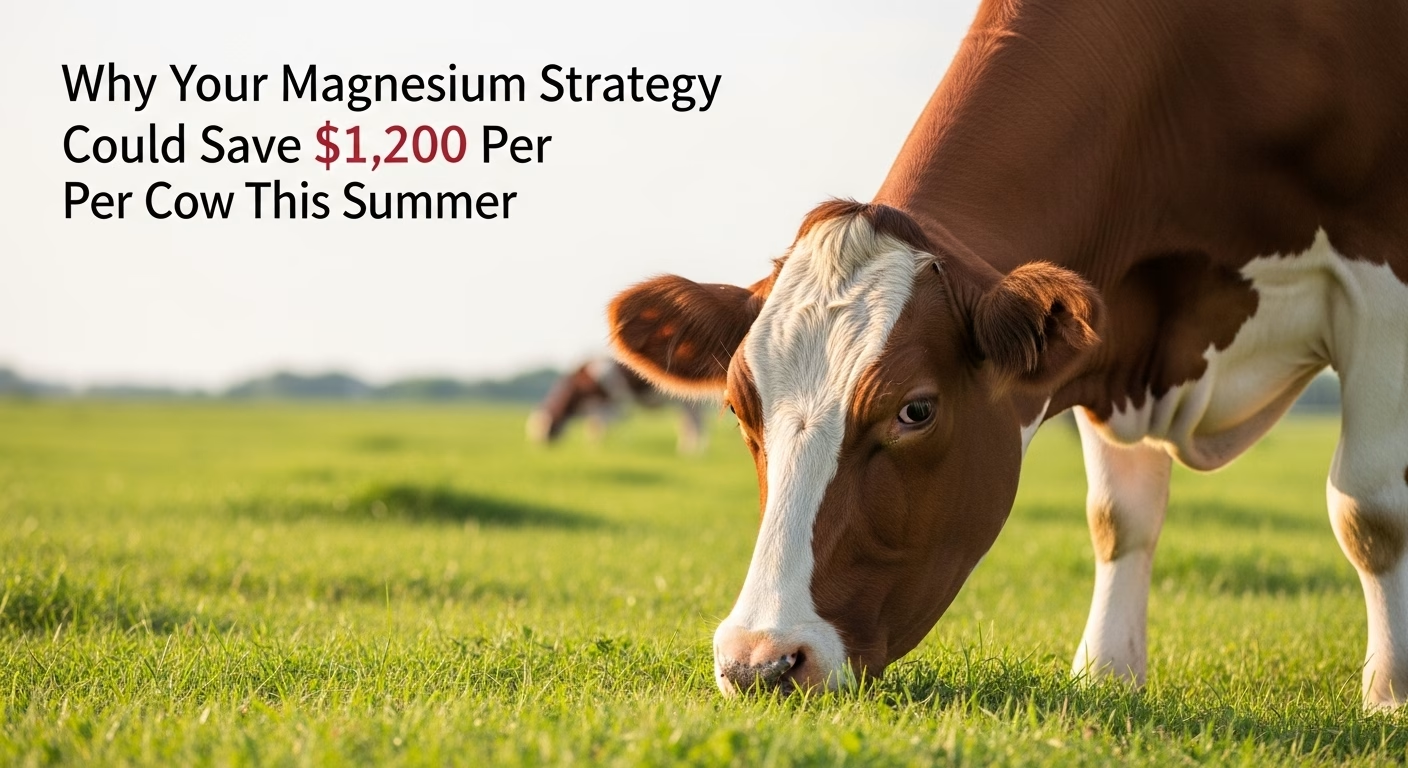
Why Your Magnesium Strategy Could Save $1,200 Per Cow This Summer

Your magnesium program is wasting 60% of your investment while heat stress silently crushes fertility at 65°F—costing $1,200 per cow annually

EXECUTIVE SUMMARY: While you’re waiting for cows to pant, heat stress is already destroying fertility and milk yield at temperatures you’d consider comfortable—and your expensive magnesium supplements are delivering less than half their potential value. Recent 2025 research reveals that fertility crashes at THI levels as low as 50-60, while magnesium source bioavailability varies up to five-fold between manufacturers, meaning most operations are throwing away 60% of their mineral investment without knowing it. Strategic magnesium supplementation delivers a compelling 24:1 to 40:1 return on investment by improving milk yield (p<0.05), stabilizing rumen pH, and reducing respiratory rates during heat stress—but only when producers understand the critical antagonism between potassium and magnesium absorption that can reduce uptake by 50%. The dairy industry loses $2.9 billion annually to heat stress, with small farms suffering 60% greater losses than large operations, yet the most profitable intervention costs less than $25 per cow annually and works when your expensive cooling systems can’t. Global research from New Zealand to China proves that precision magnesium supplementation at 0.40% dietary dry matter transforms heat stress from an unavoidable burden into a manageable challenge. Stop treating symptoms with fans and sprinklers—start protecting profits with research-backed mineral nutrition that works from the inside out.

KEY TAKEAWAYS

  • Hidden Fertility Crisis: Heat stress damages conception rates at THI 50-60 (65°F with humidity), costing progressive operations $120,000 annually in reproductive losses per 100-cow herd before you see obvious production drops
  • Bioavailability Breakthrough: Magnesium oxide effectiveness varies up to five-fold between sources due to manufacturing differences, while high-potassium forages reduce absorption by 50%—meaning your $15,000 annual mineral bill could be delivering only $6,000 in actual value
  • Proven Performance Gains: 2025 research demonstrates strategic magnesium supplementation significantly improves milk yield (p<0.05), increases dry matter intake tendency (p=0.09), and reduces respiratory rates without affecting milk composition—delivering 24:1 to 40:1 ROI
  • Global Competitive Advantage: While US operations struggle with reactive heat management, New Zealand’s 50-year magnesium supplementation protocols and China’s innovative lick block technologies prove precision mineral nutrition levels the playing field against corporate giants for $25 per cow annually
  • Multi-Generational Protection: Heat-stressed dry cows produce daughters with reduced lifetime milk production and shorter productive lives—extending strategic magnesium programs to dry cows protects your $2,400 heifer investment and future genetic potential across generations
heat stress dairy cattle, magnesium supplementation, dairy farm profitability, milk production efficiency, precision dairy nutrition

Think heat stress only hits when your cows are panting? You’re already behind. While you’re waiting for obvious signs, your high-producers are quietly hemorrhaging milk and fertility at temperatures you’d consider comfortable. Here’s the uncomfortable truth: fertility crashes at THI levels as low as 50—that’s 65°F with humidity—and it’s costing progressive operations like yours serious money.

You’ve invested thousands in cooling systems, fans, and shade structures. But what if I told you the most profitable heat stress intervention costs less than $25 per cow annually and works from the inside out?

Are You Missing the $245 Million Heat Stress Blind Spot?

Here’s what separates winning operations from struggling ones: understanding that heat stress begins affecting dairy cows when the THI exceeds 68, causing elevated body temperature, increased respiratory rate, and decreased feed intake. While you’re comfortable in a light jacket, your Holsteins are already diverting energy from milk production to thermoregulation.

The invisible damage starts immediately. Research from the University of Illinois analyzing over 56 million production records found that heat stress led to cumulative losses of approximately 1.4 billion pounds of milk over five years, translating to $245 million in lost revenue. But here’s the kicker—small farms are suffering 60% greater heat-related production losses than large operations.

For a 100-cow operation, that 1.6% production hit equals operating unpaid for nearly six days yearly because your cows are overheating. Think about that math for a minute.

Why Your Expensive Mineral Program Isn’t Working

Let’s talk about the elephant in the feed bunk. You’re probably throwing away 60% of your magnesium investment, and here’s why:

Not all magnesium sources work the same. Magnesium oxide effectiveness can vary considerably depending on production factors such as rock origin, calcination temperature, and particle size distribution. You could be paying premium prices for fancy packaging around inferior bioavailability.

But here’s the real kicker: High-potassium fertilization of pastures can reduce magnesium absorption by 30-50%. Those lush spring and autumn forages you’re proud of? They’re actively sabotaging your mineral program.

Think about that for a minute. You’re paying full price for magnesium supplements that deliver maybe 50% of their potential value. On a $15,000 annual mineral bill, that’s $7,500 in wasted investment every year.

The Metabolic Rebellion Happening Inside Your Cows

During heat stress, something devastating happens that you can’t see: reduced intake of physically effective fiber lowers rumination and saliva production, which decreases ruminal buffering and pH. Heat-stressed cattle are at greater risk of subacute ruminal acidosis (SARA) because they often compensate by selecting more highly fermentable feeds, which increase volatile fatty acid production and acidosis risk.

Here’s what this means for your bank account: Dry matter intake can be reduced by 8-12% from THI 72, but you’re still paying full price for feed that’s delivering 88-92% of its potential value.

The rumen rebellion gets worse. Under heat stress, cortisol levels rise, increasing magnesium excretion and deficiency risk, enhanced by reduced magnesium absorption due to increased dietary potassium. You’re losing magnesium when you need it most.

What the 2025 Research Really Shows

Recent 2025 research evaluating anti-heat stress lick blocks containing magnesium demonstrated exactly what strategic supplementation can do:

  • Improved milk yield (p<0.05) without affecting milk composition
  • Increased dry matter intake tendency (p=0.09) when cows need it most
  • Significantly decreased respiratory rate during weeks 2-3 of supplementation
  • Enhanced rumen health with improved fermentation parameters

Here’s what makes this research revolutionary: these improvements happened during actual heat stress conditions with THI ranging from 69-90, not in climate-controlled university barns. Real farms, real heat, real results.

But here’s the part that’ll change how you think about mineral nutrition: this study used lick blocks that incorporated specific ratios of potassium, selenium, chromium, zinc, vitamin A, and vitamin E, along with magnesium. Magnesium works best as part of an integrated strategy, not as a standalone solution.

The Global Advantage: What Smart Producers Already Know

Want to know why some operations consistently outperform during heat stress? They understand that cattle are unable to mobilize magnesium from their bones as they can with calcium, making daily supplementation absolutely critical.

Here’s the guidance that changes everything: Recommended magnesium levels range from 0.40% dry matter for lactating cows to 0.25% for growing beef cattle under heat stress. But most operations are supplementing at maintenance levels, not heat stress levels.

The bioavailability breakthrough: Fresh pasture grass typically provides only 0.12-0.18% dry matter magnesium, which is below the recommended intake for lactating cows. You’re already behind before you even start.

The Multi-Generational Profit Protection You’re Overlooking

Here’s the part that’ll change how you think about your entire operation: heat stress during the dry period doesn’t just affect current production—it mortgages your herd’s genetic future.

The economic reality? With heifer raising costs exceeding $2,400 per animal, protecting dry cows becomes genetic preservation. In dairy cows, suboptimal magnesium levels contribute to subclinical hypocalcemia, compromising productivity and immune function. Smart operations extend comprehensive mineral programs to dry cows because the ROI compounds across generations.

Your Implementation Roadmap: Getting Started This Week

Phase 1: Stop the Bleeding (Week 1)

Set up THI monitoring with alerts at 68, not 72. When the THI exceeds 68, cows exhibit signs of heat stress such as elevated body temperature and increased respiratory rate, so waiting for obvious signs means you’re already losing money.

Phase 2: Audit Your Mineral Investment (Week 2)

Work with your nutritionist to evaluate your current magnesium sources. Are you using high-quality, bioavailable forms? Growing beef cattle require 0.10%-0.20% dry matter magnesium, while lactating dairy cows need 0.30%-0.35% dry matter, increasing to 0.40% during heat stress.

Remember: over-calcined magnesium oxide tends to have lower solubility in the rumen, reducing its bioavailability and limiting its effectiveness. Not all magnesium sources are created equal.

Phase 3: Strategic Supplementation (Ongoing)

Consider proven delivery methods based on your system:

The Critical Integration Strategy: Electrolyte sodium, potassium, and chloride supplementation supports hydration and prevents metabolic disorders such as respiratory alkalosis. But you must account for potassium’s antagonistic effect on magnesium absorption.

Are You Ready to Challenge Conventional Wisdom?

Here’s your reality check: heat stress costs are escalating while margins shrink. Researchers predict that milk yield in China may decrease by 6.5 kg/head/day in 2050, with losses increasing to 7.2 kg/head/day in 2070 due to climate change. This isn’t just a China problem—it’s a global dairy challenge.

The producers winning this game aren’t just buying more fans—they’re deploying precision nutrition that works when environmental cooling can’t.

Three questions every progressive producer must answer:

  1. Do you know your actual magnesium absorption rate, or are you assuming industry averages?
  2. When did you last validate your magnesium source quality against proven bioavailability standards?
  3. What’s your THI monitoring telling you about hidden production losses?

The Economic Reality: Small Farms vs. Big Ag

Here’s the uncomfortable truth that’s reshaping our industry: small dairy farms suffer 60% greater heat-related production losses than large operations. While corporate giants invest millions in high-tech cooling, family farms are left to burn.

What is the advantage of strategic magnesium supplementation? It levels the playing field. For $15-25 per cow annually, you’re deploying precision nutrition that works regardless of your farm size.

Why this matters: As dairy cows can lose 10-25% of their milk yield under heat stress, with production affected for 2-8 days, and have diminished fertility for up to 5 weeks, every efficiency gain becomes critical for survival.

The Bottom Line: Your Profit-Protecting Action Plan

Remember that $245 million industry loss we started with? You now understand that magnesium plays a crucial role in mitigating heat stress by supporting muscle relaxation and nervous system function, working as a physiological stabilizer when your expensive cooling systems reach their limits.

The key insight that’ll transform your summer profitability: Strategic magnesium supplementation isn’t another expense—it’s a precision tool that delivers measurable returns through improved milk yield, enhanced rumen stability, and reduced heat stress indicators.

Your immediate next step is non-negotiable: Contact your nutritionist this week to audit your current magnesium program. Get specific recommendations for heat stress supplementation at 0.40% dietary dry matter, accounting for potassium antagonism and source bioavailability.

This 30-minute conversation could be worth $1,200 per cow this summer. More importantly, it positions your operation to thrive while competitors struggle with the same old solutions to an escalating problem.

The revolution in heat stress management starts with precision nutrition. While heat-stressed cattle primarily face respiratory alkalosis due to CO₂ loss from panting, they are also at greater risk of subacute ruminal acidosis. Your cooling systems can’t fix what’s happening inside the rumen.

The question isn’t whether you can afford strategic magnesium supplementation—it’s whether you can afford to keep losing money to invisible heat stress while the solution sits in your feed room.

Are you ready to stop throwing money away and start protecting your profits? Your cows—and your bank account—are counting on the decision you make today.

Complete references and supporting documentation are available upon request by contacting the editorial team at editor@thebullvine.com.

Learn More:

The Sunday Read Dairy Professionals Don’t Skip.

Every week, thousands of producers, breeders, and industry insiders open Bullvine Weekly for genetics insights, market shifts, and profit strategies they won’t find anywhere else. One email. Five minutes. Smarter decisions all week.

NewsSubscribe
First
Last
Consent

The H5N1 Wake-Up Call: Why Smart Dairy Operations Are Racing Ahead of Disease While Others Wait for Disaster

H5N1 vaccine strategies could save $950/cow while biosecurity theater fails—smart operators build competitive advantages as neighbors panic

EXECUTIVE SUMMARY: The dairy industry’s “enhanced biosecurity only” approach to H5N1 just got exposed as the most expensive myth in modern agriculture. While farmers trusted visitor protocols and respiratory protection, Cornell research reveals that 76% of H5N1 infections remain subclinical, silently spreading through milking parlors and costing operations $950 per affected cow in direct losses. Progressive dairy operators are already positioning for proactive vaccination strategies that transform this crisis into competitive differentiation. With mRNA vaccine technology showing promise in reducing viral shedding and estimated vaccination costs of just $20-30 per animal, the ROI math is compelling—preventing $950 losses per cow delivers 3,000%+ returns on investment. While reactive operations struggle with production volatility and potential trade restrictions, vaccinated herds maintain consistent milk yield and capture market share from unprepared competitors. Smart operators are building vaccination readiness infrastructure now, securing early access when conditional approval arrives. Calculate your operation’s H5N1 vulnerability and compare potential losses to vaccination costs—because preparedness beats panic every time.

KEY TAKEAWAYS

  • Milking Parlor Transmission Reality: Environmental sampling detected H5N1 viral RNA on 7.0% of milking equipment surfaces, proving that your milking routine—not visitor protocols—is the real transmission hotspot, requiring fundamental biosecurity strategy overhaul.
  • Economic Impact Multiplier: Affected cows lose 901kg of milk over 60 days with no return to pre-infection production levels, translating to $950 per cow losses that can bankrupt 1,000-cow operations with $200,000-$400,000 single-outbreak costs.
  • Subclinical Crisis Advantage: 90% of animals in affected herds may be exposed with 76% carrying subclinical infections, meaning traditional “identify and isolate” biosecurity misses three-quarters of infected animals while they silently spread virus.
  • Vaccination ROI Breakthrough: Proactive vaccination at $20-30 per animal prevents $950 documented losses per affected cow, delivering 3,000%+ ROI while creating competitive advantages through consistent milk production when unvaccinated competitors face supply disruptions.
  • First-Mover Infrastructure Investment: Advanced mRNA vaccines require strict cold chain management, but early adopters building preparedness infrastructure now secure priority vaccine access and gain market positioning advantages over reactive competitors scrambling for limited supply.
H5N1 dairy vaccination, dairy disease management, herd health strategies, dairy farm profitability, avian influenza prevention

The dairy industry’s “wait and see” approach to H5N1 just got exposed as the most expensive gamble in agriculture. While farmers trusted enhanced biosecurity theater, this virus quietly bled operations dry at $950 per cow while proving that your milking parlor—not your visitor protocols—is ground zero for transmission. The operations positioned ahead of this crisis aren’t waiting for perfect solutions. They’re building competitive advantages while their neighbors scramble in reactive panic mode.

Nobody’s telling you that H5N1 isn’t just another disease threat you can biosecurity your way out of. Since March 2024, this virus has torn through over 1,000 dairy herds across multiple states, and traditional defensive strategies have failed spectacularly.

But here’s the kicker—while most of the industry plays defense, the smart money is already positioning for offense through proactive vaccination strategies that could transform this crisis into the ultimate competitive differentiator.

Why Your Biosecurity Theater Is Failing Against H5N1

Let’s start by destroying the biggest lie in dairy disease management: that enhanced biosecurity alone can contain H5N1.

Your milking parlor is the real transmission hotspot, not respiratory spread. Think about what this means for your operation. While you’ve been focused on visitor protocols and respiratory protection, the real danger was hiding in plain sight in your milking parlor.

The research reveals the uncomfortable reality: Environmental sampling detected H5N1 viral RNA on 7.0% of tested surfaces, with most positives found on milking equipment and parlor surfaces. Your standardize parlor wash cycles after milking clinical cows? They didn’t prevent virus dissemination once it was on-farm.

The subclinical crisis that’s bleeding you dry: Many infected animals don’t show obvious clinical signs while actively shedding virus. Seroprevalence data reveal that nearly 90% of animals in affected herds may have been exposed, with 76.1% carrying subclinical infections. Your “healthy-looking” cows might be spreading H5N1 through your milking routine right now.

How long can you afford to bet your operation on biosecurity measures that miss 76% of infected animals?

The Economic Carnage That’s Bankrupting Farmers

Let’s talk real numbers because the financial devastation goes way beyond what most farmers realize.

Take the sobering case of the Ohio herd that got blindsided: The Cornell University study revealed the brutal economics: $950 economic loss per clinically affected cow, with total herd costs reaching $737,500 over the observation period. We’re talking about milk losses of about 901kg per cow over 60 days.

But here’s what makes H5N1 so diabolical: unlike diseases that kill quickly and trigger insurance payouts, this virus creates what economists call a “slow financial bleed.” Clinical disease appeared in about 20% of cows, but the milk production drop lasted the full 60-day observation period.

California’s reality check: In the nation’s largest dairy-producing state, where around 650 herds (nearly 70% of the state’s dairies) have caught the virus since August 2024, production has dropped in nearly double-digit terms. The 9.2% decrease in California milk production year-over-year in November 2024 represents the largest decrease in production in 20 years.

The hidden multiplier effect: Two weeks after infection, milk production dropped by almost three-fourths (73%, or around 35 kg per day to 10 kg per day). Most troubling? H5N1-infected cows didn’t return to pre-infection production levels even after 60 days.

For a typical 1,000-cow operation, we’re talking potential losses of $200,000 to $400,000 for a single outbreak. That’s not a line item expense—that’s the difference between staying in business and bankruptcy court.

Are you prepared to lose nearly a month’s milk production per cow while still paying feed, labor, and facility costs? How many $950 losses can your operation absorb before the bank calls?

The Vaccine Revolution: Why Early Adopters Win Big

Here’s where progressive operations build competitive advantages while their neighbors debate whether H5N1 is “really that serious.”

The vaccine development race is accelerating fast. Elanco and Medgene lead with a platform-based candidate nearing conditional approval, with Medgene claiming “more than enough manufacturing capacity to provide the necessary doses to vaccinate the US dairy herd annually”. Smart money isn’t waiting for perfect solutions—it’s positioning itself for early adoption advantages.

Revolutionary mRNA technology is changing the game. Recent research from institutions funded by the National Institutes of Health, USDA, and U.S. Department of Energy shows that an experimental mRNA-lipid nanoparticle (mRNA-LNP) vaccine targeting the H5 HA protein induces strong immune responses in Holstein calves. Consider this: vaccinated calves exhibited minimal or undetectable viral RNA in nasal swabs and significantly lower viral presence in lung and airway samples.

The Purdue-FFAR partnership proves strategic thinking works. The Foundation for Food & Agriculture Research (FFAR) and Purdue University have jointly committed $301,562 through a Rapid Outcomes from Agricultural Research (ROAR) grant to accelerate vaccine development efforts.

Purdue University’s research team, led by Dr. Suresh Mittal, will leverage existing knowledge of influenza A viruses and a bovine adenoviral vaccine platform to design a universal H5N1 vaccine for dairy cows. This isn’t just another vaccine—it’s future-proofing against viral evolution.

Real operational benefits you can bank on: The project will evaluate different vaccine administration methods, including intranasal and intramuscular delivery. Think about what intranasal delivery means for your operation: needle-free administration, reduced labor costs, and minimal animal stress.

What’s your plan when vaccines receive conditional approval and the supply is limited? Will you be in line or scrambling for access?

Your Step-by-Step Vaccination Readiness Plan

Let’s get practical about what smart operators are doing right now to position themselves for early vaccine access:

Phase 1: Infrastructure Assessment (Complete Within 30 Days)

Cold Storage Evaluation: Audit refrigeration capacity for vaccine storage requirements—advanced vaccines, particularly newer mRNA types, require strict temperature control

Record-Keeping Systems: Implement comprehensive animal health tracking supporting regulatory compliance

Financial Planning: Calculate your operation’s vulnerability: (Annual milk production × current milk price) × (90% herd exposure risk) × (76% subclinical infection rate)

Veterinary Partnership Assessment: Establish relationships with practices involved in vaccine trials

Phase 2: Smart Biosecurity Based on Real Science (30-60 Days)

Milking Protocol Overhaul: Clinical cow milking last, enhanced parlor disinfection between groups, dedicated worker protocols for sick animals

Worker Protection Implementation: Establish no-fault illness reporting policies, complete PPE packages with training

Bulk Tank Testing Integration: Enroll in weekly testing through your state’s program

Phase 3: Vaccination Deployment Strategy (60-90 Days)

Supply Chain Priority: Secure relationships with vaccine distributors for early access when products become available

Training Development: Create protocols for vaccine administration, tracking systems for ensuring complete coverage

Financial Preparation: Ensure liquidity for rapid vaccine deployment, estimated at $20-30 per animal for the two-dose protocol

What’s your plan when vaccines receive conditional approval and the supply is limited? Are you building relationships now or waiting until everyone else wants the same thing?

The DIVA Dilemma: Why Trade Politics Could Make or Break You

The biggest challenge isn’t scientific—it’s regulatory. The “DIVA dilemma”—Differentiating Infected from Vaccinated Animals—represents the single greatest threat to vaccine adoption. Both infected and vaccinated animals may show antibodies, making it challenging for importing countries to distinguish between a truly disease-free status and one where infection might be masked by vaccination.

This isn’t just a technical footnote—it’s potentially a multi-billion-dollar trade barrier that could devastate the industry if not addressed properly. Countries importing U.S. dairy products could reject everything from a vaccinating region, unable to distinguish if positive tests come from natural infection (high risk) or vaccination (low risk).

Consider the stark reality: With international trade making up 18% of the U.S. dairy market, the USDA has similar concerns about cattle vaccines. As one industry expert bluntly stated: “We certainly could not vaccinate if we’re going to lose the export market”.

Will vaccinating your herd protect you from disease, but destroy your access to international markets? This question will hang over every vaccination decision until regulatory agencies worldwide align on acceptable DIVA standards.

Government Support You’re Missing Out On

The federal response includes massive financial support that smart operators are already leveraging:

The Biden administration has released nearly $2 billion to tackle the outbreak, with $98 million specifically allocated for dairy cattle response efforts. This includes up to $28,000 per farm for biosecurity improvements, up to $10,000 for veterinary costs, and 90% compensation for lost milk production.

But here’s the catch—you need to file ELAP claims within 7 days, and the support covers reactive management costs that smart operators are redirecting toward preparedness infrastructure.

Are you leaving money on the table while building your vaccination readiness? How much federal support could you be accessing right now?

What Smart Operators Are Doing Right Now

While the industry debates, progressive operations are taking action:

Building vaccination infrastructure before vaccines arrive: Cold storage capabilities, record-keeping systems supporting regulatory compliance, and veterinary partnerships with practices involved in vaccine trials.

Leveraging federal support strategically: Instead of just covering losses, they’re using available funding to build capabilities, positioning them for rapid vaccine deployment.

Learning from success stories: Six states, including Colorado, Oklahoma, and Wyoming, have successfully demonstrated virus-free dairy cattle populations, exemplifying effective containment strategies.

Treating this as a competitive opportunity, not just a threat: While reactive operations struggle with production volatility, proactive operations position for market share capture when competitors face production disruptions.

Implementing evidence-based milking protocols: Clinical animals milked last, enhanced disinfection, dedicated worker protocols cost $200-400 per cow but prevent $950 in documented losses per affected animal, delivering 240% ROI within 6-12 months.

The Bottom Line: Preparedness Beats Panic Every Time

The H5N1 crisis has exposed the fundamental flaw in dairy’s traditional “enhanced biosecurity” approach. With over 1,000 herds affected and traditional defensive strategies proving inadequate, the operations that survive and thrive will be those that pivot from reactive crisis management to proactive strategic positioning.

First, recognize that your milking parlor—not your visitor protocols—is the real battleground. The science is clear: H5N1 spreads through milking procedures and milk handling, not respiratory routes.

Second, understand that vaccination represents competitive differentiation, not just disease protection. While unvaccinated operations face production volatility and potential trade restrictions, vaccinated herds maintain consistent output and customer confidence.

Third, start building preparedness infrastructure now using the specific 90-day implementation framework outlined above. These investments provide value across multiple scenarios while positioning you for early vaccine access.

Fourth, leverage available federal support strategically. Don’t just cover losses—use the funding to build capabilities that create long-term competitive advantages.

The dairy industry is entering an era where disease preparedness becomes core to business competitiveness. As NMPF’s chief science officer, Jamie Jonker optimistically stated: “I do believe we’re going to eliminate the virus from the U.S. dairy cattle population. I think it’s just a matter of when, not if”.

The question isn’t whether H5N1 vaccination will become standard practice—it’s whether you’ll be positioned as a leader or scrambling to catch up.

Your immediate action: Complete the Phase 1 infrastructure assessment within 30 days. Calculate your operation’s H5N1 vulnerability and compare potential losses to estimated vaccination costs of $20-30 per animal.

The math is compelling. The question is whether you’ll act on evidence before your competitors discover that hope isn’t a biosecurity plan.

Complete references and supporting documentation are available upon request by contacting the editorial team at editor@thebullvine.com.

Learn More:

The Sunday Read Dairy Professionals Don’t Skip.

Every week, thousands of producers, breeders, and industry insiders open Bullvine Weekly for genetics insights, market shifts, and profit strategies they won’t find anywhere else. One email. Five minutes. Smarter decisions all week.

NewsSubscribe
First
Last
Consent

CME Dairy Market Report: June 25th, 2025 – Cheese Markets Show Signs of Stabilization After Week of Devastating Losses

Cheese collapse signals 20% margin compression—but smart producers are pivoting to component premiums while others panic. $12/cwt reality check inside.

EXECUTIVE SUMMARY: The dairy industry’s “structural reckoning” has arrived, and it’s not the cyclical downturn most producers expected—it’s a fundamental shift that’s separating survivors from casualties. Despite corn trading 37% below 2023 highs, income-over-feed margins are plummeting below $12/cwt through August 2025, representing a crushing 20% compression that’s devastating unprotected operations. While domestic cheese consumption collapsed 56 million pounds in Q1 2025 and retail buyers have “gone dark,” component-adjusted production surged 3.0%—creating a $1.50/cwt premium opportunity for producers who understand the new rules. The market’s message is crystal clear: volume-centric thinking is dead, and the 9.45 million head national herd expansion is rewarding only those optimizing for butterfat (4.40%) and protein (3.40%) content. With July Class III futures crashing from $18.67 to $17.00/cwt in 48 hours, producers have exactly that long to implement DRP coverage or face potential $1.75/cwt additional pressure. This isn’t fear-mongering—it’s mathematical reality in a market where processing capacity is expanding faster than demand can absorb it. Stop chasing yesterday’s volume metrics and start maximizing today’s component premiums before your operation becomes another consolidation statistic.

KEY TAKEAWAYS

  • Component Premium Goldmine: Butterfat levels hitting 4.40% and protein at 3.40% are generating $0.75-$1.50/cwt premiums while fluid volume producers face margin compression—shift breeding and feeding strategies from volume to value within 30 days to capture this widening opportunity gap.
  • 48-Hour Risk Management Window: With Class III futures dropping $1.67/cwt in two days and domestic cheese buyers completely withdrawing from markets, implementing Dairy Revenue Protection coverage for Q3/Q4 production isn’t optional—it’s survival economics against projected $1.25-$1.75/cwt additional pressure.
  • Feed Cost Arbitrage Play: Lock corn contracts below $4.60/bushel and soybean meal under $300/ton immediately—while feed represents your largest variable cost at 37% below 2023 highs, the revenue collapse is outpacing input savings by 3:1, making strategic procurement your only controllable margin variable.
  • Geographic Reality Check: Texas milk production surging 10.6% year-over-year while California drops 9.2% due to H5N1 impacts means transportation costs and regional pricing differentials are creating $2-3/cwt location advantages—evaluate your processing infrastructure alignment before competitors capture your local premium.
  • Export Market Lifeline: With U.S. markets decoupling from 21.5% global dairy price strength and China’s temporary tariff reduction from 125% to 10% lasting only 90 days, securing export-focused processor relationships now could determine whether you’re selling into $1.61/lb domestic weakness or $1.95/lb international strength.
dairy market analysis, CME dairy futures, dairy farm profitability, milk price volatility, dairy risk management

Cheese blocks stage modest recovery with 1.5¢ gain, but weekly losses still exceed 5¢ as domestic buyers remain cautious. Class III futures hold near $17/cwt amid continued supply-demand imbalances threatening farm profitability through August.

Today’s Price Action & Farm Impact

ProductPriceDaily ChangeWeekly TrendImpact on Farmers
Cheese Blocks$1.61/lb+1.5¢-10.4¢ (-6.1%)Modest relief from severe Class III pressure
Cheese Barrels$1.63/lb+1.25¢-9.4¢ (-5.4%)Slight improvement in protein values
Class III (JUL)$16.97/cwt-$0.01-$1.28 (-7.0%)July milk checks under continued pressure
Butter$2.52/lb-1.5¢-2.7¢ (-1.1%)Limited Class IV support weakening
NDM Grade A$1.25/lbNo Change-1.9¢ (-1.5%)Export demand is steady but fragile
Dry Whey$0.57/lb-0.5¢+1.3¢ (+2.3%)Protein markets showing relative stability

Market Commentary: Today’s cheese market provided a glimmer of hope after a devastating two-week selloff that erased over 15¢ from block values. The 17 trades in blocks represented the most active session of the week, suggesting some buyers may be testing the waters near current levels. However, the modest 1.5¢ recovery does little to offset the cumulative damage to Class III valuations, with July futures still trading below $17/cwt. The continued weakness in butter, dropping 1.5¢ today, limits any meaningful support for Class IV milk prices.

Trading Activity & Market Sentiment

Volume Analysis: Trading activity showed signs of life with 17 cheese block transactions compared to previous sessions with minimal activity. However, overall market participation remains extremely low, with bid-ask spreads widening considerably across all products.

Market Voice – Industry Perspective: According to comprehensive market analysis from industry sources, “retail cheese buyers have reportedly ‘gone dark,’ awaiting further price declines before making new purchases”. This institutional withdrawal from the market explains the persistent weakness despite modest production adjustments.

A dairy risk management consultant emphasized the urgency of current conditions, stating that producers should “implement DRP coverage for Q3/Q4 production within 48 hours” due to the rapid deterioration in market fundamentals. This unprecedented timeline reflects the severity of margin compression facing dairy operations.

Export market dynamics are also shifting, with reports indicating that “Mexican buyers are becoming more selective on pricing”, despite Mexico representing $2.47 billion in annual U.S. dairy purchases. This selectivity signals broader international pressure on U.S. competitiveness.

Feed Cost & Margin Analysis

Current Feed Situation:

  • Corn (September): $4.05/bushel – down 6¢ from Tuesday, offering continued cost relief
  • Soybean Meal (August): $279.60/ton – down $7.10 from Tuesday, providing protein cost savings
  • Milk-to-Feed Ratio: Currently under severe compression despite favorable feed costs

Margin Reality Check: Despite corn trading 37% below 2023 highs and soybean meal remaining manageable, income-over-feed costs are projected to plummet below $12/cwt through August 2025. This represents a crushing 20% margin compression that demands immediate attention from producers. The paradox of favorable feed costs coupled with collapsing milk revenues underscores that the current crisis is demand-driven, not cost-driven.

Production & Supply Insights

Production Surge Continues: U.S. milk production reached 19.9 billion pounds in May 2025, marking a 1.6% year-over-year increase with the national dairy herd expanding to 9.45 million head – the largest since 2021. This growth, driven by light culling rates and strong beef-on-dairy calf values, creates significant supply pressure in an already oversupplied market.

Component Quality Hits Records: Average butterfat levels reached 4.40% and protein 3.40% in 2025, with component-adjusted production surging 3.0% in April. While processors benefit from higher manufacturing yields, the increased cheese and powder production volume exacerbates the oversupply situation.

Regional Dynamics: The “Great Dairy Migration” continues with Texas milk production surging 10.6% year-over-year, while California faces a 9.2% decline due to H5N1 impacts affecting approximately 650 herds. This geographic shift creates infrastructure mismatches that could pressure local milk pricing.

Market Fundamentals Driving Prices

Domestic Demand Crisis: The most concerning factor remains the collapse in domestic cheese consumption, which declined 56 million pounds in Q1 2025. Reports indicate retail cheese buyers have “gone dark,” waiting for further price declines before re-entering the market. Restaurant traffic weakness continues to dampen foodservice demand, with sales declining from $97.0 billion in December to $95.5 billion.

Export Market Volatility: While global dairy prices show strength with the FAO Dairy Price Index up 21.5% year-over-year, U.S. markets are experiencing a concerning “decoupling” from global strength. China’s temporary tariff reduction from 125% to 10% on certain U.S. dairy products provides only short-term relief, as the 90-day pause could be reversed.

Processing Capacity Expansion: Over $9 billion in new processing capacity is coming online through 2026, adding approximately 55 million pounds per day of production capability. While positive in the long term, this expansion adds to near-term supply pressure as demand struggles to keep pace.

Forward-Looking Analysis

Class III Outlook: July Class III futures at $16.97/cwt reflect the market’s pessimistic assessment of near-term fundamentals. The USDA’s more optimistic projection of $18.65/cwt for 2025 appears increasingly disconnected from trading reality. August futures at $17.71/cwt suggest only modest improvement in the coming months.

Seasonal Risk Factors: NOAA forecasts well above-average temperatures across most of the Lower 48 states, which could trigger 8-12% production losses in key regions due to heat stress. While this might provide some supply relief, the same weather patterns threaten feed crop yields, potentially squeezing margins from the cost side.

H5N1 Monitoring: With nearly 1,000 herds across 17 states reporting infections, the virus continues to create localized supply disruptions. Mathematical modeling suggests outbreaks will persist through 2025, with Arizona and Wisconsin identified as the highest-risk states.

Regional Market Spotlight: California vs. Southern Plains

California Struggles: The Golden State’s 9.2% production decline represents a significant shift from historical patterns. H5N1 impacts on 650 herds, combined with ongoing regulatory pressures, are accelerating the migration of production to more business-friendly regions.

Southern Plains Boom: Texas, Kansas, and South Dakota continue their explosive growth, with Kansas posting a remarkable 15.7% increase in May production. However, this rapid expansion is outpacing processing infrastructure, creating potential bottlenecks and local pricing pressures.

Actionable Farmer Insights – Immediate Actions Required

Within 48 Hours – Critical Risk Management: Immediately implement Dairy Revenue Protection (DRP) coverage for Q3/Q4 production . With income-over-feed costs projected below $12/cwt, this represents the most important financial survival action . The cheese market collapse signals potential $1.25-$1.75/cwt additional Class III pressure.

Next 7 Days – Component Optimization Strategy: Focus breeding and feeding programs on maximizing butterfat and protein content. With component-adjusted production surging while fluid volumes remain modest, the market is rewarding quality over quantity. Target butterfat levels of 4.50%+ to capture $0.75-$1.50/cwt pricing premiums.

Within 30 Days – Strategic Feed Procurement: Lock in favorable feed costs by securing corn contracts below $4.60/bushel and soybean meal under $300/ton while availability remains strong. Forward contract 60-70% of feed needs to protect against potential weather-related price increases.

Ongoing – Breeding Decisions: Continue selective use of beef semen on lower genetic merit animals to capitalize on strong beef-on-dairy calf values, while increasing gender-sorted semen usage on top genetic merit cows.

Industry Intelligence

FMMO Reform Impact: The June 1st implementation of Federal Milk Marketing Order reforms is creating regional winners and losers. Northeast producers benefit from the “higher-of” Class I pricing and revised differentials, while manufacturing-heavy regions see less favorable impacts.

Trade Policy Watch: The temporary nature of China’s tariff reduction means exporters face continued uncertainty. The 90-day pause could be extended or reversed, making long-term planning challenging.

Technology Investment: With margins under severe pressure, farms investing in automation and efficiency technologies are gaining competitive advantages. AI-driven tools can increase output by up to 81% through better decision-making.

The Bottom Line

Today’s modest cheese recovery provides little comfort for dairy farmers facing the most challenging margin environment in years. With milk production surging, domestic demand collapsing, and export markets volatile, the industry faces a structural reckoning rather than a cyclical downturn.

Immediate Actions Required (Next 48 Hours):

  1. Secure DRP coverage for Q3/Q4 production immediately
  2. Lock in favorable feed contracts while available
  3. Optimize breeding programs for components, not volume
  4. Engage processors about component premiums and quality bonuses

Key Risk: Income-over-feed margins below $12/cwt represent a financial emergency for many operations. Smaller and mid-sized farms lacking economies of scale face the greatest threat from this margin compression.

The market is sending clear signals that efficiency, component optimization, and proactive risk management are no longer optional – they’re essential for survival in this new paradigm. Producers who adapt their strategies now will be positioned to thrive when market conditions eventually improve.

Stay ahead of volatile markets with daily insights from TheBullVine.com. Our comprehensive analysis gives you the intelligence needed to protect your operation and maximize profitability in challenging times.

Learn More:

Your Accountant Just Became More Important Than Your Nutritionist – And Most Dairy Farmers Still Don’t Get It

Stop treating cull cows like disposal problems. Strategic culling now generates 10-15% of total farm income—yet 90% of operators still miss it.

EXECUTIVE SUMMARY: Your replacement heifers just became more expensive than luxury cars while you’re shipping premium beef assets for pennies—and this disconnect is costing progressive operators thousands monthly. Replacement dairy cow prices hit a record $2,870 per head in April 2025, yet dairy cattle culling dropped 69,300 head compared to 2023 levels, creating the industry’s most expensive contradiction. Strategic culling of the bottom 15% performers generates $15,000-$25,000 monthly cash flow improvements for 1,000-cow operations while capturing unprecedented beef market values that now account for 10-15% of total farm income. International markets demonstrate the power of efficiency-over-volume strategies, with New Zealand achieving record milk production using 20,000 fewer cows through strategic optimization. Progressive operations using precision tools like DHI-Plus and genomic testing to identify optimal culling candidates are banking record returns from dual-revenue optimization while their neighbors debate marginal milk production decisions. The beef market fundamentals supporting current values—contracted national herd, persistent consumer demand, expanding processing capacity—represent multi-year trends, not cyclical peaks. Stop managing by tradition and start optimizing by mathematics: every cow in your herd now requires evaluation through both dairy productivity and beef market value lenses.

KEY TAKEAWAYS

  • Dual-Revenue Optimization Generates Immediate ROI: Strategic culling of underperforming cows (SCC >200,000, days open >150-160, poor IOFC) delivers $175-$225 monthly cost reductions per culled animal while capturing record beef values averaging $145/cwt in 2025—a 5% year-over-year increase.
  • Beef-on-Dairy Crossbreeding Outperforms Traditional Replacements: Day-old beef calves generate $900+ immediate returns versus $2,870 replacement heifer costs, with beef semen sales to dairies surging 1 million units as progressive operators capture 200% ROI through genomic-guided breeding decisions.
  • Precision Technology Transforms Reactive Culling Into Profit Centers: Advanced herd management software (DHI-Plus, smaXtec) enables data-driven identification of optimal candidates based on Income Over Feed Cost calculations, somatic cell trends, and reproductive performance, generating monthly cash flow improvements of $15,000-$25,000 for strategic operators.
  • Global Efficiency Models Prove Volume-Over-Quality Thinking Is Dead: European sustainability mandates and New Zealand’s per-cow optimization strategies demonstrate that smaller, strategically managed herds outperform volume-focused operations, with feed efficiency improvements of 3-5% achievable through targeted removal of poor converters.
  • Market Fundamentals Support Long-Term Strategic Investment: USDA projections through 2034 indicate sustained beef market strength driven by structural herd contraction, with four new processing plants (9,000 head daily capacity) opening 2025-2026, ensuring liquid markets for dairy operators embracing dual-purpose asset management.
strategic dairy culling, beef-on-dairy crossbreeding, dairy farm profitability, dual-revenue optimization, precision herd management

Stop pretending replacement heifers costing $2,870 per head is sustainable while you’re shipping premium beef assets for pennies. USDA just confirmed what progressive operators already knew: the dairy industry’s biggest profit opportunity isn’t in your milk tank—it’s walking around your barns, and 90% of farmers are managing it like it’s still 2019.

The uncomfortable truth staring you in the face: replacement dairy cow prices hit $2,870 per head in April 2025—the highest in USDA history. Meanwhile, dairy cattle culling dropped to 747,600 head in Q1 2024, down over 120,000 from 870,600 head in Q1 2023. You’re caught in the industry’s most expensive contradiction: hoarding underperforming cows to avoid replacement costs while missing unprecedented beef market opportunities.

The Global Wake-Up Call You’re Avoiding

What International Markets Are Teaching American Dairy

While American farmers debate marginal culling decisions, European Union producers have systematically reduced lower-performing animals through sustainability mandates prioritizing efficiency over volume. Their regulatory framework forces strategic optimization that American operations could voluntarily implement for competitive advantage.

New Zealand’s dairy sector demonstrates the power of strategic downsizing—achieving record milk production with 20,000 fewer cows through per-cow optimization. Their seasonal calving system creates natural culling pressure that forces efficiency decisions that American farms can adapt year-round.

Asian markets, particularly India and China, show growing demand for dairy-derived beef products, creating additional export opportunities for strategically managed dairy beef that most U.S. operators haven’t considered. With global protein demand expanding and traditional beef supplies constrained, dairy-derived beef has become a critical component of international protein supply chains.

The Numbers That Prove Everything Changed

The data reveals a fundamental market disruption that most operators are ignoring. Replacement dairy cow prices jumped from $2,660 per head in January 2025 to $2,870 by April—a $210 increase in three months. That’s a 29% year-over-year increase from January 2024. Premium pregnant heifers are now fetching upward of $4,000 per head at auction.

Meanwhile, the beef market rewards strategic thinking with unprecedented returns. According to the Journal of Dairy Science research, beef-on-dairy crossbreeding has transitioned from opportunistic to strategic, with 85% of beef semen purchases now going to dairy farmers. Day-old beef calves generate $900 or more; some wet calves exceed $1,000.

The Controversial Truth About Dual-Revenue Optimization

Why the Beef Industry Needs Dairy More Than Anyone Admits

Nobody talks about the industry secret openly: dairy operations now contribute 19-22% of total U.S. beef production through cull cows, dairy steers, and crossbred animals. With the U.S. cattle herd at its lowest level since 1951, the beef industry increasingly depends on dairy farmers for supply stability.

The controversial reality that challenges traditional thinking? Research published in Livestock Science indicates that 30-35% of Prime beef production comes from Holstein steers. Your “inferior” dairy genetics produce premium beef commanding top-tier pricing, yet most dairy operators treat this as an afterthought rather than a strategic opportunity.

Curtis Bosma of HighGround noted that cull cow and beef calf sales now account for 10-15% of total dairy farm income. This represents a fundamental shift from salvage value to material revenue stream comparable to what most operations generate from their entire nutrition program.

The Beef-on-Dairy Revolution Reshaping Production

According to National Association of Animal Breeders data, domestic dairy semen sales dropped 4% in 2023 while beef semen sales to dairies surged by 1 million units. This isn’t temporary opportunism—it’s structural transformation driven by economic necessity and market opportunity.

Progressive operations using genomic testing to identify optimal candidates for beef breeding are generating 200% ROI through strategic crossbreeding programs. The data-driven approach combines precision genetics with market timing to maximize both immediate calf value and long-term herd improvement.

The Strategic Framework Backed by Science

Precision Culling: Beyond Traditional Approaches

Research from the American Dairy Science Association identifies key metrics for optimal culling decisions that most operations aren’t systematically implementing:

  • Income Over Feed Cost (IOFC): Target cows consistently below $6-8 daily IOFC using current milk prices
  • Somatic Cell Count: Priority removal for animals consistently above 200,000 SCC
  • Reproductive Performance: Days open exceeding 150-160 days cost $3-5 daily in lost productivity
  • Genomic Merit Scores: Bottom quartile animals offer minimal genetic contribution to herd improvement

Strategic culling of the bottom 15% performers reduces operational costs by $175-$225 per culled cow monthly while improving per-cow margins by $0.75-$1.25/cwt on remaining production.

The Dual-Revenue Decision Matrix

Every animal now requires evaluation through multiple lenses: current dairy productivity, future genetic potential, and immediate beef market value. Cornell University extension research demonstrates that this tri-factor analysis reveals opportunities that single-purpose thinking misses entirely.

A cow with declining milk production might represent a liability in the dairy string, but if she maintains good body condition and breed characteristics valued in the beef market, her immediate liquidation value could exceed her annual dairy contribution.

Technology Integration for Maximum Returns

Advanced Monitoring Systems

Tools like DHI-Plus enable efficient data capture from daily tasks, including veterinary checks, reproduction records, and inventories, providing analytical capabilities to identify cows requiring attention. smaXtec offers precise data directly from the reticulum, including inner body temperature, water intake, rumination, and activity for early disease detection and feeding optimization.

The integration of advanced herd management software transforms culling from reactive problem-solving to predictive optimization, creating competitive advantages in profitability and efficiency.

Implementation: Your 90-Day Strategic Transformation

Phase 1 (Days 1-30): Assessment and Planning

  • Conduct a comprehensive herd evaluation using verified productivity metrics from DHI data
  • Identify the bottom 15% performers based on IOFC, SCC, and reproductive performance
  • Research regional beef buyer relationships and current price patterns
  • Calculate the immediate cash flow impact of the strategic culling program

Phase 2 (Days 31-60): Strategic Implementation

  • Begin targeted removal of identified candidates during optimal market timing
  • Implement beef-on-dairy breeding for genomically appropriate candidates
  • Establish direct marketing relationships with premium beef buyers
  • Develop feeding protocols optimized for beef-destined animals

Phase 3 (Days 61-90): Market Integration and Optimization

  • Fine-tune culling timing based on seasonal price variations and regional market data
  • Expand the beef-on-dairy program based on initial ROI results
  • Implement precision monitoring tools for ongoing optimization
  • Establish an annual strategic planning calendar integrating beef market forecasts

The Long-Term Market Reality

Why This Transformation Is Permanent

USDA Agricultural Baseline projections extending to 2034 indicate sustained beef market strength driven by persistent herd contraction. Fed steer prices are expected to average $201/cwt in 2025, jumping to $222.75/cwt in 2026, with feeder steer prices following similar trajectories.

Four new beef processing plants with a combined capacity for nearly 9,000 head daily are scheduled to open in 2025-2026, ensuring liquid markets for strategic operators who understand dual-value optimization. This infrastructure investment signals long-term industry confidence in sustained cattle values.

The Bottom Line

The dairy industry just handed you the most profitable side business in agricultural history, disguised as a disposal problem. While milk prices remain volatile around $17.60-$18.20 per hundredweight, strategic culling and beef-on-dairy programs provide immediate liquidity and risk diversification that traditional dairy operations lack.

Your competitors are still making culling decisions, such as milk being the only revenue stream that matters. They’re hoarding underperforming cows to avoid $2,870 replacement costs while missing the immediate cash opportunities those same animals represent in today’s beef market.

The operators who master dual-revenue optimization—treating every animal as both a dairy asset and a potential beef product—will capture market share from those still thinking in single-purpose terms. This isn’t about changing your entire operation overnight; it’s about recognizing that market conditions have fundamentally shifted the value proposition of every animal in your herd.

Your Next Move: The Strategic Reality Check

Stop managing by tradition and start optimizing by mathematics. The data from the USDA, American Dairy Science Association, and Journal of Dairy Science research all point to the same conclusion: farms implementing strategic culling and beef-on-dairy programs are capturing revenue streams their competitors are ignoring.

Conduct a comprehensive 30-day evaluation of your current herd using the precision metrics outlined above. Using current market data, calculate the true opportunity cost of maintaining underperformers versus capturing their immediate beef value.

The time for incremental thinking is over. The farms that adapt to this dual-revenue reality first will be the ones still thriving when the next market cycle turns, while their neighbors wonder why their replacement costs keep climbing and their profitability keeps declining.

Complete references and supporting documentation are available upon request by contacting the editorial team at editor@thebullvine.com.

Learn More:

The Sunday Read Dairy Professionals Don’t Skip.

Every week, thousands of producers, breeders, and industry insiders open Bullvine Weekly for genetics insights, market shifts, and profit strategies they won’t find anywhere else. One email. Five minutes. Smarter decisions all week.

NewsSubscribe
First
Last
Consent

AI Adoption in Dairy: The Strategic Imperative That’s Separating Winners from Losers

While farmers debate AI costs, smart operations capture 76% milk yield forecasting accuracy and $31/cow feed savings. Your “wait and see” is expensive.

EXECUTIVE SUMMARY: While the dairy industry clings to “traditional farmer intuition,” progressive operations are using AI to achieve 76% accuracy in milk production forecasting—leaving gut-instinct farmers bleeding money quarterly. Research across 13 Israeli farms proves AI-driven feed optimization delivers $31 per cow annually in savings, while health monitoring systems detect subclinical ketosis with 95.6% accuracy up to five days before clinical symptoms appear. Robotic milking systems require $150,000-$200,000 upfront investment but generate $32,000-$45,000 annual labor savings per robot with 60-75% direct labor reduction. Global adoption data reveals a stark competitive divide: New Zealand achieves 82% organizational AI adoption while U.S. operations lag at 25%, creating compound advantages for early adopters that stack quarterly. Michigan farms report 38% mastitis reduction in year one, California producers see 7% production increases, and the precision livestock farming market expands 11.1% to $5.59 billion in 2025. Stop waiting for “perfect” technology—your competitors are already capturing AI’s 18-month ROI timeline while you fall behind permanently.

KEY TAKEAWAYS

  • Feed Efficiency Revolution: AI-driven precision feeding systems slash feed costs by 25% overall and $31 per cow annually, while automated systems save 112 minutes daily on 120-cow operations—transforming your largest expense into competitive advantage
  • Disease Prevention Economics: Machine learning algorithms achieve 72% mastitis prediction accuracy and prevent $2,000+ losses per disease case through early detection, with treatment cost reductions of 40-70% and antibiotic usage cuts up to 70%
  • Labor Optimization Reality: Robotic milking systems deliver 60-75% direct labor reduction with 3-15% milk yield increases, generating $32,000-$45,000 annual savings per robot despite $150,000-$200,000 initial investment—payback periods now hitting 4-7 years
  • Global Competitive Intelligence: Farm size economics matter—research confirms “sizeable proportion of small-to-medium enterprises is a hindrance to AI adoption,” while larger operations capture economies of scale through high-volume data generation and superior ROI from incremental improvements
  • Environmental Revenue Streams: AI optimization reduces nitrogen excretion by 5.5 kg per cow annually and achieves 14% methane emission reductions, unlocking carbon credit markets and premium pricing up to 15% higher for verifiable sustainability practices
AI dairy farming, dairy technology adoption, milk production optimization, dairy farm profitability, precision agriculture

While everyone’s debating whether AI will replace dairy workers, smart farmers are using it to make their existing teams 40% more productive. Here’s what really gets me fired up: we’re not just talking about fancy gadgets—we’re talking about Artificial Neural Networks achieving 76% accuracy in milk production forecasting while conventional methods fumble around with gut instinct. The question isn’t whether you can afford AI—it’s whether you can afford to fall behind while your competitors gain documented productivity advantages that compound every single quarter.

The Brutal Math Nobody Wants to Talk About

Here’s what’s keeping progressive dairy operators awake at night: we’re not just facing labor shortages—we’re bleeding money while our competitors pull ahead using the same technologies we’re “still evaluating.”

But here’s what really gets me fired: while traditionalists worry about technology costs, forward-thinking operations generate verified ROI that would make any banker smile. We’re talking about documented cases where ANNs achieve 76% accuracy in milk production forecasting (with a range of 23–99%), feed optimization delivering $31 per cow annually in savings, and disease prevention systems detecting subclinical ketosis with 95.6% accuracy up to five days before clinical signs appear.

Think about this for a second: if your neighbor’s herd was consistently producing more milk with significantly less labor while preventing mastitis cases that cost you thousands per cow, how long would you wait to ask what they’re doing differently?

Section 1: The AI Reality Check – Challenging the “Wait and See” Mythology

Let’s tackle the most dangerous conventional wisdom in dairy today: the belief that “waiting for AI technology to mature” is a safe strategy. This thinking isn’t just wrong—it’s economically destructive.

The Fatal Flaw in “Wait and See” Thinking

Here’s where I’m going to challenge an industry sacred cow: the idea that cautious technology adoption protects your operation. Research shows that Artificial Neural Networks feature in 47% of reviewed studies for milk output predictions, with Convolutional Neural Networks appearing in 24%. These aren’t experimental technologies anymore—they’re proven tools with measurable results.

Why is this conventional approach failing? Because it ignores the compound nature of competitive advantage. While you’re waiting for “better” technology, early adopters are already capturing advantages that stack up quarterly. ANNs consistently demonstrate considerable accuracy in milk production forecasting, averaging 76%, often surpassing traditional statistical methods due to their superior ability to model complex, nonlinear relationships within dairy data.

Reality Check: If you’re still making breeding decisions based on gut instinct rather than AI-optimized protocols that can “halve sperm costs and predict milk yield and disease resistance with an impressive 99.8% precision, accelerating genetic progress by 300% compared to conventional methods”, you’re not being conservative—you’re being reckless.

The evidence-based alternative? Implement pilot AI projects now, focusing on immediate ROI applications while building the data infrastructure necessary for advanced implementations.

Global Adoption: The Leaders and the Laggards

Here’s something that should keep you awake tonight: the global adoption landscape reveals massive disparities that directly impact your competitive positioning. While New Zealand achieves 82% organizational AI adoption with AI collars delivering 93% efficiency boosts, the U.S. shows only 25% overall enterprise AI adoption despite leading in AI investment with $109.1 billion in 2024.

The EU presents an interesting paradox: overall enterprise adoption remains at 13.48%, but large enterprises hit 41.17% adoption rates, achieving 5-7% yield boosts through IoT collars and 12% waste reduction via AI milk analyzers. This suggests that scale matters significantly in AI implementation success.

Why This Matters for Your Operation: If you’re milking 500+ cows, you’re in the sweet spot for AI adoption. Operations under 200 cows need to consider cooperative models or service-based implementations to access these technologies economically.

Beyond Cost: The Real Barriers Nobody Discusses

Here’s where conventional wisdom gets dangerous again. The biggest obstacles aren’t financial—they’re operational. A prevalent “lack of data integration” significantly impedes farmers from fully leveraging available information. Data from various sources—including sensors on milking equipment, feed intake monitoring systems, and health tracking devices—are often disparate and challenging to link effectively.

It’s like having championship genetics but never recording breeding dates, calving ease scores, or milk yields. The tools are there, but without integrated data, you’re flying blind.

Cross-Disciplinary Reality Check: This connects directly to genetic selection efficiency. AI’s analytical capabilities extend to animal genetics, facilitating the prediction and optimization of milk production outcomes based on individual genetic profiles. But suppose your data systems can’t talk to each other. In that case, you’re missing the compound benefits where AI-driven breeding decisions optimize feed efficiency, improving health outcomes and boosting milk quality premiums.

Section 2: Implementation Roadmap – Your 12-Month AI Adoption Strategy

Let me walk you through a systematic transformation approach based on real-world implementations. This isn’t about buying the latest gadget but building a competitive advantage that compounds quarterly.

Months 1-3: Foundation Building and Critical Assessment

Question Everything About Your Current Data Flow Start by challenging how you currently make breeding, feeding, and health decisions. What specific bottlenecks are costing you money? AI applications can increase milk yield by up to 20% and reduce labor costs by 50%, but these benefits only materialize with proper strategic alignment.

Most farmers skip this step and wonder why their expensive new robot isn’t delivering promised results. Your data infrastructure determines AI success more than the algorithms’ sophistication.

Infrastructure Reality Check Most critically, ensure internet connectivity meets network requirements—AI systems often depend on stable connections. Data’s strategic integration and homogenization present a substantial opportunity to enrich analyses and profoundly improve farm management decisions.

Financial Deep Dive Beyond Simple Payback Here’s where most farmers get it wrong: they focus only on equipment costs. Conduct a comprehensive cost-benefit analysis extending beyond initial purchase costs. Robotic milking systems require substantial upfront investment—$150,000 to $200,000 per robot, or $3,200 to $3,800 per cow—but deliver $32,000-$45,000 in annual labor savings per robot.

Months 4-6: Technology Selection and Pilot Implementation

Start Where ROI Is Fastest: Feed and Health Focus on applications with the fastest ROI—typically feed optimization or health monitoring. Machine learning algorithms achieve 72% accuracy in predicting mastitis cases, while automated feeding systems save approximately 112 minutes per day on a 120-animal farm.

Why This Matters for Your Operation: The prevention of a single clinical disease during a cow’s transition period can result in a 3.5% increase in her 305-day milk yield, with AI systems capable of preventing significant financial losses potentially exceeding $2,000 per cow for single disease cases.

Months 7-9: System Integration and Cross-Disciplinary Optimization

Connect the Dots Between Genetics, Nutrition, and Economics This is where AI’s real power emerges. Focus on seamless integration of diverse data streams. While AI promises enhanced decision-making through existing farm data systems integration, success depends on establishing a robust data infrastructure and standardized protocols.

Labor Evolution, Not Replacement Plan for skills transformation. AI “reduces the burden on farm staff, allowing them to focus on more critical, decision-centric responsibilities”. This isn’t about job displacement—it’s role redefinition where humans evolve from performing routine tasks to interpreting AI outputs for strategic decisions.

Months 10-12: Optimization and Scaling Across Disciplines

Performance Monitoring with Cross-Impact Analysis Track measurable improvements across interconnected metrics. AI systems average 76% accuracy in forecasting milk production, while automated activity monitoring systems reach 90% detection rates for heat with 100% accuracy.

Scaling Decisions Based on Compound Benefits Consider how technology simultaneously scales across breeding programs, feed efficiency, and health management. The research shows AI models capable of identifying critical health conditions with high accuracy: hypocalcemia (72% AUC), ketosis (66% AUC), metritis (82% AUC), and mastitis (92% AUC).

Section 3: ROI Analysis – Real Numbers from Real Farms

Let’s examine documented ROI data from actual implementations, because claims without evidence are worthless in strategic planning.

Feed Optimization: Where Genetics Meets Economics

AI-driven feed optimization delivers some of the fastest ROI returns. Precision feeding systems achieve a 25% reduction in overall feed costs, with optimizing diet accuracy through intelligent farm data leveraging, decreasing feed costs by $31 annually per cow.

For a 500-cow operation, this translates to $15,500 annual savings in feed costs alone. But here’s the cross-disciplinary connection most farmers miss: AI-driven systems automate the management of feed timing and quantity, optimizing milk production per feed unit and substantially reducing waste.

Economic Reality: Think of it like precision genetics for nutrition. Instead of feeding every cow the same TMR regardless of genetic merit, lactation stage, or individual DMI patterns, you’re customizing rations based on individual cow data that connects directly to her genetic potential for feed conversion efficiency.

Environmental benefits add another revenue stream: optimized diets reduce nitrogen excretion by 5.5 kg per cow per year. An AI-driven model focused on enteric methane mitigation achieved a 14% reduction in emissions on commercial farms, positioning operations for carbon credit opportunities.

Health Management: Prevention Over Treatment Economics

Early disease detection represents perhaps the most compelling ROI story in dairy AI. Machine learning algorithms achieve 72% accuracy in predicting mastitis cases, while subclinical ketosis can be detected with 95.6% accuracy up to five days before clinical signs appear.

The financial impact is dramatic:

  • Treatment cost reduction: 40-70%
  • Antibiotic usage reduction: up to 70%
  • Veterinary expense reduction: 20%
  • Disease prevention value: exceeding $2,000 per cow for single disease cases

Cross-Disciplinary Impact: One Michigan farm reported a 38% drop in mastitis cases within the first year of implementing robotic milking systems. But the compound benefit extends beyond immediate health savings—healthier cows with consistent milk quality achieve better genetic expression, improving breeding decisions and long-term herd improvement.

Robotic Milking: Labor, Genetics, and Economics Integration

Robotic milking systems represent AI’s most comprehensive impact across multiple disciplines:

  • Annual labor savings: $32,000-$45,000 per robot
  • Milk yield increase: 3-15%
  • Direct milking labor reduction: 60-75%
  • Payback period: 4-7 years

A California producer managing 1,250 cows with 20 robots reported a 7% increase in production and a 40% reduction in labor. Wisconsin producers are achieving payback in just over six years instead of the projected nine years due to increased production and labor savings.

Why This Matters Beyond Labor Savings: Robots’ consistent routines and detailed data contribute to better udder health and overall milk quality, creating data streams that improve genetic selection accuracy and feed optimization decisions.

Section 4: Global Competitive Intelligence – Where Markets Are Heading

Understanding global AI adoption patterns isn’t academic—it’s competitive intelligence that directly impacts your operation’s future viability.

The Asian Advantage: Why Western Farmers Should Pay Attention

Asia-Pacific markets are moving aggressively beyond traditional dairy paradigms. India shows 57% national AI adoption with 71% of companies planning significant AI investments, while China leads with 58% national adoption and 61.1% of global AI patents originating there.

What This Means for Your Operation: Adopting AI in dairy cattle in Kenya resulted in an 11% monetary gain. This isn’t happening in some high-tech laboratory—this is a real-world application delivering measurable results in challenging economic conditions.

European Integration: Policy, Sustainability, and Economics

EU adoption patterns reveal sophisticated integration of AI with sustainability mandates. The EU Green Deal is driving efficiency gains through technology, with IoT collars delivering 5-7% yield boosts and AI milk analyzers achieving 12% waste reduction.

Policy Analysis: This creates strategic opportunities for non-EU operations to capture premium markets that reward verifiable environmental practices. AI applications like “udder-to-table tracking” using sensors create “fraud-proof records” commanding premium pricing up to 15% more for verifiable welfare practices.

New Zealand’s Strategic Positioning

New Zealand’s 82% organizational AI adoption rate isn’t accidental—it’s strategic market positioning. AI applications are projected to contribute NZ$2.1 billion to their economy by 2035, with AI collars for herd management delivering 93% efficiency boosts.

Cross-Market Implications: Small geographic scale doesn’t limit technological leadership. Concentrated, high-value dairy operations can achieve technological advantages that translate directly into export market premiums.

Market Timing: The Competitive Window

The global precision livestock farming market is experiencing rapid growth, expanding 11.1% to $5.59 billion in 2025 and projected to reach $7.93 billion by 2029. This isn’t gradual adoption—it’s accelerating transformation.

Think of it like the transition from conventional to genomic testing fifteen years ago. Early adopters captured genetic advantages that compounded over generations. Late adopters are still catching up. The same dynamic is happening with AI—except the competitive cycle is faster.

Why “Farm Size Doesn’t Matter” Is Destroying Dairy Profitability

Nobody wants to discuss the controversial truth: the dairy industry’s romanticization of small-scale operations is actively undermining competitive advantage and economic sustainability in the AI era.

The Research Says What We’re All Thinking: The data is unambiguous—”a sizeable proportion of small-to-medium-sized enterprises… is a hindrance to more widespread use of AI”. Why? Because larger operations benefit from economies of scale, where high volume throughput generates more refined data and greater returns from incremental AI-driven improvements.

The Economic Reality Nobody Discusses: AI adoption faces significant barriers, “particularly in small businesses,” due to high costs and lack of infrastructure. This dynamic could potentially widen the economic performance gap between large, technologically advanced farms and smaller, less resourced operations.

Instead of pretending all farm sizes are equally viable, we should ask: How do we restructure the industry to capture AI benefits across all operations? This might mean cooperative AI systems, shared data platforms, or strategic consolidation that maintains family ownership while achieving operational scale.

Cross-Disciplinary Implications: This isn’t just about technology but genetics, economics, and policy. Small operations can’t afford genomic testing on enough animals to make statistically significant breeding decisions. They can’t generate enough data points for AI health monitoring to achieve meaningful accuracy. They can’t justify the fixed costs of robotic milking systems.

The Solution Most Won’t Consider: Maybe the answer isn’t making AI cheaper—maybe it’s making operations larger through innovative structures that preserve family control while achieving technological scale.

Industry Maverick Profile: The Israeli Environmental Innovation

Let me tell you about a group that’s completely rewriting the environmental playbook using AI. Researchers across 13 commercial Israeli dairy farms developed an AI-driven model that predicts which farms will benefit most from methane-reducing feed additives.

The Breakthrough: Instead of applying expensive additives to all farms (the traditional approach), their AI model identified 50% of farms that would benefit most. Result? A 14% reduction in enteric methane emissions versus only 8% with the traditional “spray and pray” approach.

Why This Matters Globally: This demonstrates AI’s capacity to address major environmental challenges with measurable results while improving economic efficiency. The statistical validation (Kendall’s Tau = -0.73, Spearman’s Rho = -0.89) confirms the model’s accuracy.

Cross-Disciplinary Impact: This isn’t just environmental—it’s economic, genetic, and policy-relevant. Operations that can prove verified emission reductions capture carbon credit revenue, satisfy regulatory requirements, and appeal to environmentally conscious consumers willing to pay premiums.

Case Study: Michigan’s Mastitis Revolution

Here’s a real-world example that’ll make you question everything about reactive health management. One Michigan farm implementing robotic milking systems with AI-powered health monitoring reported a 38% drop in mastitis cases in their first year.

The Numbers: With mastitis treatment costs averaging $200-400 per case and production losses reaching $2,000+ per severe case, this farm potentially saved $50,000-$100,000 annually for a 200-cow operation. But here’s the kicker—the compound benefits extended far beyond immediate health savings.

The Cross-Disciplinary Connection: Healthier cows maintained consistent milk quality and production, enabling more accurate genetic selection decisions. The continuous data stream from robotic milking provided unprecedented insights into individual cow performance, leading to optimized feeding protocols and improved breeding choices.

This demonstrates the multiplier effect of AI adoption. Single-point solutions deliver linear improvements, but integrated AI systems create exponential benefits across genetics, nutrition, health, and economics.

The Bottom Line

The farms documenting substantial productivity improvements aren’t using magic—they’re systematically implementing AI across feed optimization (delivering $31 per cow annually in savings), health management (preventing $2,000+ losses per disease case), and labor efficiency (60-75% direct labor reduction). Your ROI timeline starts with immediate feed cost savings, accelerates through disease prevention, and compounds through improved milk yields and reduced labor costs.

But here’s what really gets me fired up: we’re not just talking about incremental improvements. We’re talking about fundamental transformation where AI-optimized breeding programs generate superior genetics, improving feed conversion efficiency, reducing environmental impact, unlocking premium markets and carbon credits, and furthering AI adoption in a virtuous cycle of competitive advantage.

Reality Check: The competitive reality is stark—operations implementing comprehensive AI strategies are building sustainable advantages that compound quarterly. Those waiting for “perfect” technology or “cheaper” solutions are falling behind permanently. The global precision livestock farming market, growing 11.1% to $5.59 billion in 2025, isn’t waiting for stragglers.

Your next step isn’t buying technology—it’s conducting the comprehensive assessment outlined in this roadmap. Ask yourself these critical questions based on documented research:

  1. Are you losing $31 per cow annually by not optimizing feed accuracy?
  2. How many $2,000+ disease cases could AI prevent on your operation this year?
  3. Can you afford to fall further behind while your competitors capture 76% accuracy in milk production forecasting?
  4. Is ignoring 99.8% precision breeding protocols really “traditional farming” or just expensive stubbornness?
  5. Are you missing environmental revenue opportunities worth 15% premiums for verifiable sustainability practices?

Because in 18 months, you’ll either celebrate documented productivity gains across genetics, nutrition, health, and economics, or explain to your banker why your competitors pulled ahead. The window for competitive AI adoption is narrowing rapidly, but hasn’t closed.

The choice is yours. But choose quickly—your competitors already are.

Source:  Serrano-Torres, G. J., López-Naranjo, A. L., Larrea-Cuadrado, P. L., & Mazón-Fierro, G. (2025). Transformation of the Dairy Supply Chain Through Artificial Intelligence: A Systematic Review. Sustainability, 17(3), 982.

Learn More:

The Sunday Read Dairy Professionals Don’t Skip.

Every week, thousands of producers, breeders, and industry insiders open Bullvine Weekly for genetics insights, market shifts, and profit strategies they won’t find anywhere else. One email. Five minutes. Smarter decisions all week.

NewsSubscribe
First
Last
Consent

SNAP Cuts Target $267 Billion: Here’s What Dairy Farmers Aren’t Being Told

Stop ignoring SNAP policy threats. Congressional cuts targeting 41.7M consumers could slash dairy demand 1%—here’s your 18-month survival plan.

EXECUTIVE SUMMARY: Most dairy farmers are completely unprepared for the policy bomb that’s about to detonate their customer base—and it’s not coming from overseas competition or plant-based alternatives. Congressional proposals to slash $267 billion from SNAP over the next decade represent a 28% benefit cut affecting 41.7 million Americans who currently drive significant dairy purchases. Industry economists project this policy shift could eliminate approximately 1% of total U.S. dairy demand, translating to billions in lost revenue when the sector already faces margin compression from elevated feed costs averaging $4.63/bushel for corn. While Europe’s dairy herd contracts to 19.2 million cows—the lowest in decades—and China maintains 34-125% tariffs on U.S. exports, domestic demand destruction from SNAP cuts forces more milk into volatile export markets already saturated with trade tensions. The farms still operating profitably in 2030 will be those that start diversifying into value-added products, optimizing feed conversion ratios through precision agriculture, and lobbying state governments now—not after the policy damage is done. Smart producers have exactly 18 months to prepare for the largest domestic demand disruption since the Great Depression, and the strategic decisions you make today will determine whether your operation thrives or merely survives this policy-driven market upheaval.

KEY TAKEAWAYS

  • Immediate Revenue Protection Strategy: Diversify 20-30% of production into value-added products (specialty cheeses, organic lines) commanding 15-25% price premiums over commodity milk, with projected ROI of 25-35% within 24 months to offset SNAP-driven demand reduction.
  • Technology-Driven Efficiency Optimization: Deploy precision agriculture and sensor technology to improve feed conversion ratios by 10-15%, reducing operational costs while maximizing milk yield per cow as domestic purchasing power declines among 12.6% of the U.S. population receiving SNAP benefits.
  • Export Market Diversification Imperative: Reduce dependence on top three export markets (currently 51% of $8.2 billion in annual exports) through Southeast Asia expansion, requiring $100,000-500,000 investment but essential as domestic SNAP cuts force additional milk into already volatile global commodity channels.
  • State-Level Political Engagement: Actively lobby state legislatures to absorb federal SNAP cost shifts, as states with strong dairy advocacy (Wisconsin, California, Idaho) may maintain benefit levels while others implement aggressive cuts, creating fragmented regional demand patterns requiring localized strategic responses.
  • Risk Management Program Optimization: Update Dairy Margin Coverage production history calculations and leverage existing programs to maximize benefits during projected margin compression, as all-milk prices face downward pressure from reduced domestic consumption despite current forecasts of $21.60/cwt.
SNAP cuts dairy, dairy demand policy, dairy farm profitability, milk production economics, dairy market trends

The House Agriculture Committee just dropped a $267 billion bomb on dairy demand, and most farmers have no clue what’s coming. We’re talking about a 28% SNAP benefit cut that could eliminate 1% of total U.S. dairy consumption—and frankly, that’s just the beginning of this policy disaster.

I’ve been analyzing dairy markets for decades, and I’ve never seen a policy change that could potentially be devastating and fly under the radar like this. While you’re worrying about feed costs and milk prices, Congress is quietly preparing to gut the purchasing power of 41.7 million Americans who buy your products every single day.

Here’s the brutal truth nobody’s talking about: this isn’t just another budget cut. It’s a systematic dismantling of domestic dairy demand that could fundamentally reshape how your operation competes globally.

The Numbers Don’t Lie—And They’re Terrifying

The House Agriculture Committee’s “One Big Beautiful Bill Act” isn’t just targeting welfare—it’s targeting your customer base. SNAP currently serves 41.7 million Americans, representing 12.6% of the entire U.S. population. These households spend roughly 40 cents of every food dollar on basic staples, including milk, cheese, and dairy products.

Here’s what should keep you awake at night: A 28% benefit reduction translates to approximately 1% reduction in overall dairy demand. Sounds small? Think again.

When emergency allotments expired in March 2023, we got a preview of coming attractions. SNAP benefits dropped 8.5% year-over-year, triggering an immediate 8.4% fall in grocery purchase rates and an 8.4% increase in food insufficiency. But here’s the kicker—dairy was one of the few categories that actually saw increased shopping trips among SNAP recipients, up 70 basis points.

Why does this matter? It proves that low-income families consider dairy essential. They’ll cut other foods first, but milk eventually becomes unaffordable when you slash daily benefits from $6.20 to $4.80 per person.

The Global Domino Effect Nobody Saw Coming

Here’s where this gets really ugly. The U.S. dairy industry isn’t just fighting domestic headwinds—we’re about to flood already volatile export markets with products we can’t sell at home.

U.S. dairy exports hit $8.2 billion across 114 countries in 2024, with 16% of total milk production shipped overseas. But get this: 86% of lactose, 75% of nonfat dry milk, and 70% of whey production are already export-dependent.

The strategic nightmare: Reduced domestic demand forces more raw milk into powder production for export markets already under siege. China’s slapping 34-125% tariffs on our dairy, while Canada maintains protectionist barriers despite USMCA commitments. Meanwhile, Mexico imported $2.47 billion worth of U.S. dairy in 2024, making it our top export partner.

What Smart Operators Need to Know Right Now

The State-by-State Wild Card

Here’s what the policy wonks aren’t telling you: Starting January 2028, states will cover 5-25% of SNAP benefit costs depending on their administrative error rates. Georgia alone faces a potential $812 million burden if its error rate exceeds 10%—money that simply doesn’t exist.

States with strong dairy lobbying (Wisconsin, California, Idaho) might absorb federal cost shifts to protect local industries. Others will slash benefits aggressively, creating a patchwork of regional demand destruction that makes national planning impossible.

The Economic Multiplier Effect You’re Missing

Let’s face it—most farmers don’t understand how SNAP actually drives rural economies. The USDA’s Economic Research Service found that every $1 billion issued in federal SNAP benefits generates a $1.54 billion increase in U.S. GDP and supports 13,560 jobs. That’s not welfare math—that’s agricultural economics.

“There was a $1 billion increase in SNAP during the economic slowdown, and this boosted GDP by about $1.54 billion and close to 14,000 jobs,” explains Emily Engelhard, vice president of research for Feeding America. “And then a big portion of those were actually jobs in agriculture.”

The EU Advantage We’re About to Waste

While we’re shooting ourselves in the foot with domestic policy, Europe’s dairy herd collapsed to 19.2 million cows by December 2024—the lowest level in decades due to soaring costs and environmental regulations. This global supply tightening should theoretically benefit U.S. producers through reduced competition.

But here’s the problem: Domestic SNAP cuts could negate this competitive advantage by forcing additional U.S. milk into saturated global commodity markets. We’re literally turning a strategic opportunity into a margin-crushing oversupply crisis.

New Zealand continues stable growth with 3.1% seasonal production increases while investing heavily in sustainability to capture premium segments. They’re playing chess while we’re playing checkers.

Industry Response: Fighting the Wrong Battle

The dairy lobby is pushing the Dairy Nutrition Incentive Program Act of 2025, proposing dollar-for-dollar SNAP matches for milk, cheese, and yogurt purchases. Introduced by Senators Amy Klobuchar, Roger Marshall, and Representatives Jim Costa and Nick Langworthy, it’s smart politics—reframing dairy as essential nutrition rather than optional consumption.

But here’s what nobody’s asking: Why are we so dependent on government-subsidized demand in the first place? The proposed changes expose dairy’s dangerous over-reliance on policy-driven consumption patterns rather than genuine market demand.

This bipartisan initiative recognizes that 90% of Americans don’t meet federal dietary guidelines for dairy intake. The program builds on successful Healthy Fluid Milk Incentive projects, showing dollar-for-dollar matches actually work to boost consumption.

The Technology Integration Imperative

Here’s the reality check: farms that survive this demand shock will already deploy precision agriculture to optimize operations. You can’t control SNAP policy but you can control feed conversion ratios, milk component optimization, and operational efficiency.

USDA reduced 2025 milk production forecasts to 226.9 billion pounds, showing tighter supplies than expected. Smart operations are implementing activity monitoring systems and sensor technology to maximize milk yield per cow while controlling variable costs as margins compress.

What This Means for Your Operation: A 90-Day Action Plan

Week 1-2: Immediate Assessment

  • Calculate your operation’s SNAP exposure by analyzing local demographics
  • Review current risk management programs, especially Dairy Margin Coverage
  • Update production history calculations to maximize program benefits
  • Cost: $500-1,500 for consultant analysis

Month 1: Strategic Positioning

  • Diversify into value-added products (specialty cheeses, organic lines) that command 15-25% price premiums over commodity milk
  • Strengthen export market development beyond Mexico-Canada-China concentration
  • Investment range: $50,000-250,000 for processing upgrades
  • ROI timeline: 18-24 months

Month 2-3: Political Engagement

  • Join state dairy associations lobbying for SNAP funding maintenance
  • Support the Dairy Nutrition Incentive Program Act through industry channels
  • Time investment: 10-15 hours monthly for effective advocacy

Interactive Planning Tool: Which strategy fits your operation best?

  • Poll Question 1: Is your farm’s primary market within 50 miles of major urban centers with high SNAP usage?
  • Poll Question 2: What percentage of your revenue comes from fluid milk vs. value-added products?
  • Scenario Builder: Input your herd size, local SNAP demographics, and current product mix to calculate potential revenue impact

State-by-State Risk Assessment

High-Risk States (likely to implement aggressive SNAP cuts):

  • Georgia: $812 million potential burden
  • Florida, Texas, Arizona: Limited dairy lobbying power
  • Action: Accelerate export market development, direct-to-consumer sales

Moderate-Risk States:

  • Pennsylvania, Ohio, North Carolina: Mixed agricultural influence
  • Action: Diversify product portfolio, strengthen regional processing partnerships

Lower-Risk States:

  • Wisconsin, California, Idaho: Strong dairy political influence
  • Action: Advocate for state-funded dairy incentive programs

The Bottom Line: Your 18-Month Survival Strategy

Congressional SNAP cuts aren’t theoretical—they’re moving through budget reconciliation that bypasses Senate filibuster rules. You have exactly 18 months to prepare for the largest domestic demand disruption since the Great Depression.

Strategic imperatives for survival:

  1. Product Diversification (Months 1-6): Transition 20-30% of production to value-added products commanding premium prices independent of commodity volatility. Target ROI: 25-35% within 24 months.
  2. Export Market Development (Months 3-12): Reduce dependence on top three export markets (currently 51% of exports) through Southeast Asia expansion. Investment: $100,000-500,000 for market development.
  3. Technology Implementation (Months 1-18): Deploy precision agriculture and data analytics to optimize operational efficiency. Expected improvement: 10-15% feed conversion ratio optimization.
  4. Political Engagement (Ongoing): Maintain active state-level lobbying to protect SNAP funding. Monthly investment: 15-20 hours, $2,000-5,000 in association dues and advocacy contributions.

Implementation Timeline:

  • Q1 2025: Complete risk assessment, begin product diversification planning
  • Q2 2025: Implement technology upgrades, initiate export market development
  • Q3 2025: Launch value-added product lines, intensify political advocacy
  • Q4 2025: Evaluate initial results, prepare for 2026 policy implementation

The industry that adapts fastest to policy-driven demand destruction will emerge strongest. The question isn’t whether SNAP cuts will impact your bottom line—it’s whether you’ll be ready when 41.7 million customers suddenly have 28% less money to spend on your products.

Interactive Challenge: Share your SNAP preparedness strategy in the comments. Are you diversifying products, optimizing technology, or focusing on export markets? Vote in our strategy poll and see how your approach compares to other progressive dairy operations.

Final Reality Check: The farms still operating profitably in 2030 will see this crisis coming and adapt before their competitors even realize what hit them. Don’t say nobody warned you.

Complete references and supporting documentation are available upon request by contacting the editorial team at editor@thebullvine.com.

Learn More:

The Sunday Read Dairy Professionals Don’t Skip.

Every week, thousands of producers, breeders, and industry insiders open Bullvine Weekly for genetics insights, market shifts, and profit strategies they won’t find anywhere else. One email. Five minutes. Smarter decisions all week.

NewsSubscribe
First
Last
Consent

FMMO Reality Check: Why 2025’s $2.3 Billion Dairy Pricing Revolution Exposes the Fatal Flaw in American Milk Marketing

FMMO “reforms” just transferred $91M from your milk check to processor margins—here’s how to turn regulatory complexity into competitive advantage

FMMO reforms, dairy component optimization, milk pricing strategies, dairy farm profitability, precision dairy farming

EXECUTIVE SUMMARY: The June 2025 FMMO reforms everyone’s celebrating as “farmer-friendly modernization” actually represent the largest institutionalized transfer of value from producers to processors in decades—$91 million annually flowing from your milk pools to processing plant margins. While industry publications praise these changes, the math tells a different story: the new “higher-of” Class I formula cost producers 68 cents per hundredweight in June 2025, while make allowances that hadn’t been updated since 2008 suddenly jumped across all categories, adding 9 cents per pound directly to cheese processor margins. Regional competitive positions shifted permanently, with Order 5 operations gaining $19,800 annually while manufacturing-heavy regions face margin compression that demands an immediate strategic response. The uncomfortable truth? This 1930s-era pricing system now rewards operations that master component optimization (targeting 3.8% butterfat, 3.3% protein) and sophisticated risk management over those clinging to volume-based commodity production. Smart operators are already calculating their specific impact and restructuring their genetics, nutrition, and hedging strategies—while competitors scramble to understand what hit them.

KEY TAKEAWAYS

  • Component Production Becomes Profit-Critical: Operations producing 3.8% butterfat and 3.3% protein will significantly outperform commodity-grade producers (3.5% fat, 3.0% protein) under new composition factors—invest in TPI genetics targeting +50 pounds protein EBV and precision nutrition programs optimizing DMI to 55+ pounds daily for peak-lactation cows.
  • Regional Arbitrage Creates Permanent Advantages: Mid-Atlantic operations (Order 5) gained $2.20/cwt differential increases worth $19,800 annually for 1,000-cow dairies, while Western regions saw minimal gains—evaluate whether your location positions you to serve premium coastal markets or demands operational restructuring.
  • Risk Management Complexity Demands New Strategies: Elimination of barrel cheese hedging and “higher-of” Class I complications requires advanced basis risk management—traditional DRP and LGM tools may no longer align with actual milk check outcomes, creating opportunities for sophisticated operators who master the new hedging landscape.
  • Technology Investment ROI Strengthened Dramatically: FMMO changes justify automated milking systems (15-20% component capture improvement), activity monitoring (15-25 day reduction in open days), and precision feeding platforms—operations that delay technology adoption face permanent competitive disadvantage in the new pricing structure.
  • Implementation Barriers Separate Winners from Losers: Success depends on overcoming financing challenges for genetics programs (3-5 year transition timelines), accessing precision nutrition expertise, and navigating $250,000+ AMS investments—well-capitalized operations with strategic planning gain sustainable advantages over reactive competitors.

The June 2025 Federal Milk Marketing Order reforms just redistributed $2.3 billion across the U.S. dairy supply chain while exposing a fundamental truth the industry doesn’t want to admit: America’s 1930s-era milk pricing system is structurally designed to favor processors over producers, and these latest “modernization” efforts only made that imbalance worse.

You know that feeling when your nutritionist shows you feed analysis results that don’t match what you’ve been paying for? That’s exactly what happened to every dairy operation in America this month. The FMMO pricing formulas you’ve relied on for decades just got completely recalculated—and the math reveals some uncomfortable truths about who really benefits from federal milk marketing.

While industry publications celebrate these reforms as “modernization,” let’s examine what actually happened: processors secured an estimated $91 million in additional annual margins through updated make allowances, while producers face increased basis risk, reduced price discovery, and more complex hedging strategies. This isn’t modernization—it’s institutionalized margin transfer from farm gates to processing plants.

The Million-Dollar Question: Why Are We Still Using Great Depression-Era Economics?

Here’s the controversial truth nobody in Washington wants to discuss: the FMMO system was designed in 1937 to solve problems that no longer exist while creating new problems that didn’t exist then.

The Original Problem: Individual farmers are being exploited by powerful milk dealers who control pricing and market access.

Today’s Reality: Sophisticated dairy operations using precision agriculture, genomic selection with Total Performance Index (TPI) scores exceeding +2500, and global market intelligence competing in international commodity markets where dry matter intake (DMI) optimization and metabolizable energy (ME) levels directly impact profitability per hundredweight.

According to the U.S. Congressional Research Service, the FMMO system emerged from the Agricultural Adjustment Act of 1933 and was formalized by the Agricultural Marketing Agreement Act of 1937. Yet we’re still using a regulatory framework that treats modern dairy farmers—who routinely achieve somatic cell counts (SCC) below 150,000 and milk yields exceeding 80 pounds per cow daily—like 1930s sharecroppers who need government protection from local milk dealers.

Challenge the Conventional Wisdom: Why do we accept that make allowances—processor cost recovery mechanisms—haven’t been updated since 2008, when feed costs, labor costs, and farm operational expenses have increased dramatically over the same period? It’s like accepting that your transition period nutrition program should stay the same while your genetic merit keeps improving and your lactation curves extend beyond 305-day benchmarks.

What Actually Changed: The Five Power Shifts You Need to Understand

Let’s cut through the regulatory complexity and examine what these reforms really accomplished, using verified data from the USDA Agricultural Marketing Service and Congressional Research Service:

Power Shift #1: The “Higher-Of” Formula Illusion

According to Hoard’s Dairyman analysis, the return to “higher-of” Class III or Class IV skim milk pricing sounds farmer-friendly until you examine the June 2025 results: producers received 68 cents per hundredweight LESS than under the old formula. Think of it like switching from a consistent TMR formula based on metabolizable energy calculations to one that changes daily based on which forage test shows higher crude protein—sounds more responsive, but often delivers less predictable results for lactation curve optimization.

For June 2025 advanced Class I prices, the “higher-of” value ($8.55/cwt) was actually lower than what the old “average-plus-74 cents” formula would have calculated ($9.23/cwt).

Power Shift #2: The Make Allowance Money Grab

Manufacturing allowances increased across all categories, directly impacting your milk check like a deduction for services you didn’t request:

Product CategoryNew Make AllowanceDirect Impact on PricingAnnual Industry Impact
Cheese$0.2519/pound-$0.92/cwt on Class III prices+9 cents/pound to processor margins
Butter$0.2272/poundReduces Class IV valuesEnhanced processor cost recovery
Nonfat Dry Milk$0.2393/poundAffects protein valuationsUpdated since the 2008 baseline
Dry Whey$0.2668/poundImpacts other solids pricingReflects current processing costs

According to the comprehensive FMMO analysis, these adjustments alone transfer an estimated $91 million annually from producer milk pools to processor margins—on top of an already projected $1.26 billion decline in pool values.

Power Shift #3: Regional Arbitrage Creation

Class I differentials shifted dramatically, creating permanent competitive advantages and disadvantages based on USDA Agricultural Marketing Service data:

FMMO OrderRegionDifferential Change ($/cwt)Monthly Impact ($)*Annual Impact ($)*
5Mid-Atlantic2.201,65019,800
131Arizona0.251902,280
Southeast AvgMultiple states1.741,30515,660
Western StatesMultiple states0.423153,780

*Based on 1,000 cows producing 75 pounds daily with 35% Class I utilization, targeting 3.8% butterfat and 3.3% protein

Power Shift #4: Price Discovery Concentration

According to the Congressional Research Service analysis, removing 500-pound barrel cheese from Class III pricing means less than 5% of total cheese production now drives price discovery for the entire Class III market. This is like basing your entire breeding program on genomic testing from only 5% of your herd—you’re making critical decisions with insufficient data representation.

For June 2025, this change alone reduced Class III skim prices by 22 cents per hundredweight, while eliminating a hedging tool (barrel futures) previously available to producers.

Power Shift #5: Component Optimization Mandate

Starting December 1, 2025, updated skim milk composition factors (3.3% true protein, 6.0% other solids, 9.3% nonfat solids) will finally recognize genetic improvements in milk composition according to USDA Agricultural Marketing Service documentation. This rewards operations that have already maximized components through precision nutrition targeting optimal rumen degradable protein (RDP) ratios and post-peak lactation curve management.

Target Metrics for Maximum Revenue:

  • SCC Goals: Maintain below 150,000 for premium component pricing and optimal udder health
  • Milk Yield Targets: Achieve 80+ pounds per cow daily with optimized fat/protein ratios
  • Genetic Merit: Target bulls with +50 pounds of protein EBV and +2.0 fat percentage EBV for future genetic progress
  • DMI Optimization: Maximize dry matter intake to 55+ pounds daily for peak-lactation cows
  • Transition Period Management: Optimize close-up cow nutrition targeting 22-24 pounds DMI in the final 21 days pre-fresh
  • Lactation Curve Performance: Target peak milk production by day 60 with sustained performance through 305-day lactation and beyond

Global Context: How America’s FMMO Complexity Stacks Up

While American dairy operators navigate FMMO complexity, our international competitors operate under fundamentally different economic models that often provide greater market responsiveness and innovation incentives.

Country/RegionPricing SystemComponent FocusExport CompetitivenessInnovation Incentives
United StatesFMMO RegulatedModerateCompetitive in SMP, cheddarLimited by regulation
European UnionMarket + supportsHighMost competitive in butterHigh
New ZealandMarket-drivenVery HighHighly competitive commoditiesVery High
CanadaSupply ManagementLowLimited (domestic focus)Low

According to the European Commission, the EU is recognized as the most price-competitive butter exporter compared to Oceania and the U.S., while New Zealand’s market-driven system consistently delivers higher farmgate prices during favorable global market conditions.

Why This Matters for Your Operation: The Hidden Costs and Implementation Barriers

Risk Management Just Became Exponentially More Complex

The “higher-of” Class I formula eliminates predictable hedging strategies according to Hoard’s Dairyman analysis. Previously, you could hedge Class I prices using established futures contracts—as straightforward as locking in corn prices for your feed program. Now you need to predict whether Class III or Class IV will be higher in future months, like trying to predict whether corn silage or haylage will provide better energy value for your lactation curve targets six months out.

Implementation Barriers for Risk Management:

  • Capital Requirements: Enhanced hedging strategies require larger margin accounts and sophisticated financial instruments
  • Technical Expertise: Small and mid-size operations often lack access to risk management specialists who understand the new complexities
  • Technology Infrastructure: Many operations lack the data analytics platforms needed for complex basis risk calculations
  • Regional Access: Rural operations may face limited access to agricultural lenders who understand advanced hedging strategies

Component Production Is Now Economically Essential—But Adoption Faces Significant Hurdles

With updated milk composition factors rewarding higher solids and making allowances favoring quality over quantity, operations producing 3.8% butterfat and 3.3% protein will significantly outperform those still producing commodity-grade milk at 3.5% fat and 3.0% protein.

Critical Implementation Barriers:

  • Genetic Transition Timeline: Achieving superior component genetics requires 3-5 year breeding programs with significant upfront costs
  • Nutrition Program Complexity: Precision feeding for components requires sophisticated nutrition expertise, often unavailable in rural areas
  • Feed Cost Implications: High-component rations typically cost $50-75 more per ton, creating cash flow challenges
  • Facility Limitations: Many existing facilities can’t accommodate precision feeding systems without major capital investment
  • Labor Training: Transition period management and lactation curve optimization require skilled technicians

Technology Investment ROI Just Improved—But Financing Remains Challenging

FMMO changes strengthen the business case for precision agriculture technologies, but implementation faces significant obstacles:

High-ROI Technologies with Adoption Barriers:

  • Automated milking systems (AMS): 15-20% improvement in component capture, but $250,000+ initial investment
  • Activity monitoring systems: Reduce open days by 15-25 days, but require $200-300 per cow investment
  • Precision nutrition platforms: Maximize protein/fat through real-time optimization, but demand specialized technical support
  • Data analytics systems: Improve lactation curve management, but require ongoing software subscriptions and training

Financing Challenges:

  • Limited Rural Broadband: Many operations lack internet infrastructure for advanced data systems
  • Credit Access: Small operations face challenges securing loans for technology upgrades
  • Technical Support: Rural areas often lack service technicians for sophisticated equipment
  • Training Costs: Staff education for new technologies represents hidden implementation costs

Industry Stakeholder Positions: Who Really Won and Lost

According to the comprehensive FMMO analysis, industry responses reveal the underlying tensions in these reforms:

Stakeholder GroupPrimary StanceMain ConcernsKey Implementation Challenges
Producers (AFBF)Support “higher-of” Class I moverNegative impact from increased make allowancesRisk management complexity, component optimization costs
Processors (IDFA)Advocate for updated make allowancesNot all supply chain issues are addressedClass I hedging complications, organic milk processing
Cooperatives (Edge)Generally approved reformsMore work is needed for manufacturing ordersMember education, bloc voting, and transparency
Organic Trade AssociationAdvocates for organic milk exemptionFMMOs disadvantage organic milk producersSeparate pricing systems, market segmentation

According to Dairy Herd Management, Michael Dykes, President and CEO of the International Dairy Foods Association, noted: “The reforms included in today’s USDA announcement include important updates to elements of the FMMO system, including much-needed changes to ‘make allowances.’ While the USDA process did not address all issues within the supply chain, particularly for Class I and organic milk processors, IDFA is optimistic that this process has laid the groundwork for a unified and forward-looking dairy industry”.

Your Strategic Response: Implementation Roadmap With Realistic Timelines

Immediate Actions (Next 30 Days)

Calculate Your Specific Impact Use actual production data to determine how these changes affect YOUR operation. For a 1,500-cow dairy in Order 5 producing 32 million pounds annually with 35% Class I utilization, the $2.20 differential increase alone adds approximately $246,400 annually—before considering offsetting factors from increased make allowances.

Audit Your Risk Management Strategy According to Congressional Research Service documentation, the barrel cheese removal eliminates a traditional hedging tool, while the “higher-of” formula complicates Class I hedging. Review your DRP or LGM-Dairy positions with advisors who understand the new pricing mechanisms.

Medium-Term Strategic Positioning (3-6 Months)

Component Optimization Through Precision Management

  • Target 3.8% butterfat minimum through strategic genetic selection and transition period nutrition
  • Maintain SCC below 150,000 through enhanced milking procedures and udder health protocols
  • Optimize close-up cow nutrition for maximum early lactation component production
  • Implement precision feeding strategies targeting 55+ pounds DMI for high-producing cows during peak lactation

Realistic Technology Investment Timeline

  • Quarter 1: Evaluate current data collection capabilities and identify gaps
  • Quarter 2: Implement basic activity monitoring for reproduction efficiency improvements
  • Quarter 3: Upgrade nutrition program with component-focused ration formulation
  • Quarter 4: Assess ROI and plan for advanced technology adoption in the following year

Long-Term Strategic Evolution (12+ Months)

Build Systematic Flexibility These reforms include regular review and adjustment mechanisms according to USDA Agricultural Marketing Service protocols. Position your operation to benefit from, rather than react to, future changes by maintaining financial flexibility and diversified risk management approaches.

Address Implementation Barriers Systematically

  • Financial Planning: Establish equipment replacement schedules aligned with technology ROI projections
  • Staff Development: Invest in ongoing education for precision agriculture and component optimization
  • Infrastructure Assessment: Evaluate facility modifications needed for advanced feeding and monitoring systems
  • Market Diversification: Explore direct marketing opportunities to capture component premiums beyond FMMO pricing

The Bottom Line: Master the New Reality or Accept Permanent Disadvantage

The FMMO reforms expose a fundamental tension in American dairy policy: the system claims to protect producers while systematically transferring value to processors through updated cost recovery mechanisms that aren’t matched by equivalent producer protections.

According to the Congressional Research Service analysis, while the USDA’s own Regulatory Economic Impact Analysis projected a “slight increase in total pool value and uniform prices,” other analyses suggest additional allowances could lead to an average annual pool value loss of over $91 million across all 11 FMMOs.

Three Strategic Responses for Survival:

First, optimize component production immediately. The pricing structure now heavily rewards operations producing high-solids milk through superior genetics, precision nutrition, and optimized transition period management. Target 3.8% butterfat, 3.3% protein, and SCC below 150,000 through systematic genetic progress and nutritional precision.

Second, develop sophisticated risk management strategies. The elimination of barrel cheese hedging and complications in Class I hedging requires more advanced approaches to price risk management. Traditional DRP and LGM tools may no longer align predictably with actual milk check outcomes, necessitating enhanced financial modeling and advisory relationships.

Third, address implementation barriers proactively. Whether your operation benefits or suffers from these reforms depends largely on your ability to overcome adoption barriers—financing challenges, technical complexity, and operational constraints that prevent optimization of the new system.

The Uncomfortable Truth: These reforms accelerate trends toward larger, more technologically sophisticated operations with superior genetic merit and precision management capabilities. Survival increasingly depends on mastering complexity rather than relying on regulatory protection, while implementation barriers often favor well-capitalized operations over smaller family farms.

Your Next Step: Calculate your specific impact using actual production data, regional differentials, and Class I utilization rates. For a 1,000-cow operation, these calculations typically take 30 minutes but reveal potential impacts worth hundreds of thousands annually—and identify the specific barriers you must overcome to capture these opportunities.

The milk pricing game just became more sophisticated, but complexity rewards those who understand the new rules while penalizing those who cling to old assumptions. The question isn’t whether you can afford to master the new FMMO landscape—it’s whether you can afford not to while competitors gain advantages worth millions.

Now that you understand how the system works, will you adapt your operation to win—or keep hoping the government will protect your margins while implementation barriers hold you back?

Complete references and supporting documentation are available upon request by contacting the editorial team at editor@thebullvine.com.

Learn More:

  • What Dairy Farmers Must Know About Upcoming FMMO Changes – Practical strategies for financial preparation and cash flow management during FMMO transitions, revealing specific budgeting techniques and risk mitigation approaches that complement the reform analysis with actionable implementation steps.
  • Butter Powers Higher as New FMMO Era Begins – Demonstrates how commodity markets immediately responded to FMMO reforms, providing real-time market intelligence and component premium analysis that shows producers exactly where profit opportunities emerged in the new pricing landscape.
  • Why Milk Volume is Dead and Your Genetics Program Needs Surgery – Reveals cutting-edge genetic selection strategies and AI-driven nutrition technologies that maximize component production, offering specific breeding protocols and technology investments that capitalize on FMMO component reward structures.

The Sunday Read Dairy Professionals Don’t Skip.

Every week, thousands of producers, breeders, and industry insiders open Bullvine Weekly for genetics insights, market shifts, and profit strategies they won’t find anywhere else. One email. Five minutes. Smarter decisions all week.

NewsSubscribe
First
Last
Consent

Stop Throwing Money at Your Fields: Why Real-Time Manure Sensing Is About to Expose Every “Good Enough” Operation

Why precision genetics but ‘spray and pray’ nutrients? UW research proves NIRS tech cuts waste 40-95 lbs N/acre while neighbors hemorrhage $30K annually

EXECUTIVE SUMMARY: You’re applying the same precision thinking to genetic selection that you completely abandon when spreading manure—and it’s bleeding money every single application season. University of Wisconsin-Platteville field trials prove Near-Infrared Spectroscopy (NIRS) technology hits target nitrogen rates within 20-30 pounds per acre while traditional methods miss by 40-95 pounds, yet adoption remains stunningly low at just 27% among US operations. Progressive European producers using John Deere HarvestLab 3000 systems report annual savings exceeding €30,000 on granular fertilizer purchases, transforming manure from disposal cost into precision nutrition asset. With systems ranging from $18,309-$20,279 and multi-use capabilities across forage harvesters, combines, and feed analysis, the ROI case for real-time sensing rivals your best genetic investments. Global competitors in China project 75% digital agriculture adoption by 2035 while North American farms lag—creating competitive advantages for early adopters who refuse to accept “good enough” nutrient management. Stop subsidizing inefficiency and start treating your manure with the same precision you apply to genomic testing and breeding decisions.

KEY TAKEAWAYS

  • Precision Application Advantage: NIRS-guided systems achieve 20-30 lbs N/acre accuracy versus traditional methods that over-apply by 40-95 lbs N/acre, delivering fertilizer cost savings of $30,000+ annually while maintaining identical corn yields and superior nutrient use efficiency
  • Multi-Use Investment Strategy: John Deere HarvestLab 3000 systems ($18,309-$20,279) serve manure application, forage analysis, and feed quality assessment—distributing costs across multiple revenue-generating activities like genomic testing serves both breeding and management decisions
  • Competitive Market Positioning: With only 27% US precision agriculture adoption versus 40-70% in Europe and China’s projected 75% by 2035, early adopters gain systematic cost advantages while competitors hemorrhage nutrients through traditional “spray and pray” approaches
  • Genetic-Nutrition Integration: Real-time sensing applies the same data-driven precision to nutrient management that progressive farms use for Expected Breeding Values (EBVs) and Total Performance Index (TPI) selection—optimizing biological efficiency at crop and livestock levels simultaneously
  • Implementation Urgency: 3-phase adoption framework (assessment, pilot testing, optimization) enables immediate competitive advantages while 2025 milk prices ($18-20/cwt) and elevated input costs make precision nutrient management essential for sustainable profitability margins
real-time manure sensing, precision dairy farming, dairy nutrient management, manure application technology, dairy farm profitability

You’re probably wasting 40-95 pounds of nitrogen per acre every single application while telling yourself you’re doing “fine.” Meanwhile, University of Wisconsin research proves progressive producers using real-time sensing technology hit target rates within 20-30 pounds per acre, slashing fertilizer bills by over $30,000 annually. The question isn’t whether this technology works—it’s whether you can afford to keep subsidizing inefficiency while your neighbors gain systematic advantages.

Look, I’ve been watching this industry for decades, and there’s one thing that drives me absolutely crazy: the stubborn romance with “experience-based” manure management. You know what I’m talking about—that pride in eyeballing application rates, trusting last year’s lab results, and assuming “close enough” is good enough.

Well, here’s your wake-up call from Dr. Rebecca Larson’s research labs at the University of Wisconsin.

Why Are You Still Flying Blind with Variable-Rate Genetics but Fixed-Rate Nutrition?

Nobody wants to admit that you’re applying the same precision thinking to genetic selection that you completely abandon when spreading manure. You’ll spend hours analyzing Expected Breeding Values (EBVs), genomic data, and Total Performance Index (TPI) scores to make breeding decisions worth $50-100 per service. Yet you’re comfortable spreading nutrients with variance factors of 4-6 for nitrogen, 10 for dry matter, and an absolutely insane 25 for phosphate between loads.

That’s not farming—that’s selective precision. And it’s bleeding money.

Why This Matters for Your Operation: Just as you wouldn’t breed cows based on last year’s production records, applying nutrients based on weeks-old lab results is equally shortsighted. University of Wisconsin-Platteville field trials led by Joseph Sanford prove conventional methods miss target nitrogen rates by 40-95 pounds per acre, while the John Deere HarvestLab 3000 NIRS system hits within 20-30 pounds per acre.

The $400,000 Reality Check Nobody Discusses

Let’s get brutally honest about what traditional manure management is costing you. For a 1,000-cow operation, you’re looking at $100,000 to $400,000 annually in storage, hauling, and application costs. But here’s the part that should make you furious: most of that investment is shooting nutrients into the wrong places at the wrong concentrations.

Manure composition fluctuates wildly as storage areas empty, agitation quality dramatically affects distribution, weather conditions alter characteristics between sampling and application, and conventional lab results take days to weeks, making real-time adjustments impossible. Meanwhile, you’re making application decisions based on data that’s already outdated by the time you receive it.

The Industry’s Dirty Secret: Traditional sampling methods fail to capture significant fluctuations as manure storage pits are emptied, yet we’ve convinced ourselves this approach is acceptable. It’s like managing reproductive efficiency by checking three random cows and assuming the rest are identical.

Challenge to Industry Consultants: Where do the nutrient management consultants call out this inefficiency? Too many are still promoting sampling protocols designed for 1990s economics while farmers hemorrhage money through over-application. It’s time to acknowledge that “good enough” nutrient management is actually terrible business.

The Technology That’s Separating Winners from Losers

Near-Infrared Spectroscopy (NIRS) technology—specifically the John Deere HarvestLab 3000 system—performs over 4,000 measurements per second during application, providing instant feedback on total nitrogen, ammonium-N, phosphate, potassium, and dry matter content.

This isn’t theoretical laboratory technology—it’s field-proven systems already delivering measurable advantages to early adopters who refuse to accept “good enough” as a business strategy.

The University of Wisconsin Data That Should Terrify Traditional Operators

Dr. Rebecca Larson’s research at UW-Madison, presented at the 2025 Waste to Worth Conference, delivers numbers that should make every “good enough” farmer rethink their approach:

  • NIRS-guided applications: Within 20-30 pounds of target nitrogen rates per acre
  • Traditional methods: Over-applied by 40-95 pounds per acre
  • Corn yield performance: Similar between both methods
  • Critical difference: NIRS achieved results with precision, eliminating costly over-application

The Latest Breakthrough: Recent research shows the sensor system was more precise in achieving target nitrogen rates, consistently applying within 20 to 30 pounds per acre of the intended rate, while conventional methods overshot by 40 to 95 pounds per acre. You’re getting the same yields while your neighbors waste 30-50% more nutrients? That’s not farming—that’s subsidizing inefficiency.

The Genetic Connection Nobody’s Making

Here’s where it gets interesting for progressive managers: The same data-driven approach you use for genetic selection should inform your nutrient management. When you analyze genomic testing results, you’re looking for animals that convert feed to milk more efficiently. Yet you’re applying manure without considering the genetic potential of your crops to utilize those nutrients.

Think about it: You invest in high-genomic merit bulls to improve feed conversion efficiency in your herd. Why wouldn’t you invest in precision nutrient application to maximize the genetic potential of your forages? Both investments target the same goal—optimal biological efficiency through precision management.

Global Market Forces You Can’t Ignore

The precision agriculture revolution isn’t waiting for skeptics. Research shows that precision dairy farming technologies can lead to a 30% increase in milk yield, a 25% reduction in feed costs, and a 20% decrease in veterinary expenses. European operations show 40-70% adoption of sensor technologies, while US farms lag at only 27% precision agriculture adoption.

Market Reality: China’s adoption of digital technology in animal husbandry is projected to reach 50% by 2025 and 75% by 2035, while early adopters in lower-penetration markets can gain significant competitive advantages before technology becomes industry standard.

Why This Should Concern You: If your global competitors achieve the same yields with 30-50% less nutrient waste, they’re building cost advantages that compound annually while you’re subsidizing inefficiency through higher input costs.

Technology Investment Analysis: What the Numbers Actually Show

Current pricing for the John Deere HarvestLab 3000 ranges from $18,309 to $20,279 for new units, with used systems available from $4,995 to $17,124. The existence of a repair market (~$5,462 for sensor unit repair) indicates serviceable technology with extended lifespan potential.

Progressive European producers using HarvestLab 3000 technology report annual savings exceeding €30,000 on granular fertilizer purchases. One dairy operation saved $20,000 per 200 cows through strategic manure monitoring, scaling to $2.5 million for larger operations.

Multi-Use Value: The John Deere HarvestLab 3000 can be transferred between different farm machinery, such as forage harvesters, combines, and even used as a stationary lab analyzer for feed rations, maximizing the return on investment—just like genomic testing serves both breeding and management decisions.

Case Studies: Early Adopters Proving the Business Case

Wisconsin Precision Success Story

Under Joseph Sanford’s leadership, research conducted at the University of Wisconsin Arlington Research Station mounted the HarvestLab 3000 on a manure tanker with flow meter and rate controller technology. The results? They consistently hit nitrogen targets within 20-30 pounds per acre while traditional methods missed by 40-95 pounds per acre.

The sensor’s ability to detect large swings in nutrient levels during tank emptying proved invaluable for maintaining even spreading, even when manure wasn’t perfectly mixed. Dr. Larson’s research confirms that while yield and nitrogen use efficiency were comparable across treatments, the real-time system reduced the risk of overapplication, benefiting both farm profitability and environmental stewardship.

Critical Research Insight: The study was designed to compare traditional manure sampling methods to the NIRS manure prediction system when applying manure to meet specific nitrogen rates of 92, 110, and 138 lbs N/ac. Based on actual applied data, both application systems resulted in over-application, but the NIRS system was significantly closer to the desired nitrogen application rate.

European Scale: €30,000+ Annual Savings

Progressive European producers using HarvestLab 3000 technology report annual savings exceeding €30,000 on granular fertilizer purchases through strategic manure monitoring with 60-100 annual samples.

Why This Matters for Your Genetic Program

Here’s the connection most operators miss: Precise nutrient management enhances the expression of genetic potential in your forages, which directly impacts the nutrition available to express genetic potential in your livestock. It’s a compounding effect—precision nutrition supporting precision genetics at every level of your operation.

Just as genomic testing revealed which animals had hidden genetic merit, real-time sensing reveals the hidden nutrient value in every load of manure. Both technologies transform guesswork into precision.

The Controversial Truth About Industry Resistance

Despite overwhelming evidence, real-time manure sensing adoption remains limited. North American farmers cite high costs (52%) and unclear ROI (40%) as major barriers, but this perspective ignores opportunity cost analysis.

Here’s the Uncomfortable Truth: The same operators who track individual cow data claim nutrient management is “too complex” for precision measurement. Really? You’ll monitor somatic cell counts, breeding efficiency, and milk components daily, but applying nutrients with the same precision is somehow “too complicated”?

Challenge to Extension Services: Where’s the aggressive promotion of precision nutrient management? Dr. Larson and her team are presenting this research at the Midwest Manure Summit, North American Manure Expo, and Wisconsin Dairy Symposium, but too many extension programs still treat manure sensing as “emerging” rather than proven technology. The research is done—it’s time for implementation advocacy.

Challenge Question: When did dairy farmers become afraid of analyzing numbers? You evaluate genetic investments based on expected breeding values and economic indexes—why wouldn’t you apply the same analytical rigor to nutrient management?

Implementation Strategy: From Planning to Profit

Phase 1: Reality Assessment (Month 1)

Calculate your current annual fertilizer costs—target baseline of $150-300 per cow annually. Document existing nitrogen application rates per field and assess integration requirements with current equipment.

Baseline Reality Check: Traditional manure management can cost farms $100,000 to $400,000 annually for a 1,000-cow herd, yet most operators can’t quantify their over-application waste.

Phase 2: Pilot Testing (Months 2-4)

Install the system on a single applicator for controlled evaluation. Focus on specific field areas for direct comparison with traditional methods. Target achieved within 25 lbs N/ac of target (50% improvement over baseline).

University-Validated Approach: Follow the Wisconsin research protocol by mounting the sensor with a flow meter and rate controller, focusing on manageable field areas for direct comparison.

Phase 3: System Optimization (Months 5-8)

Expand across the entire manure application program. Achieve 20-30 lbs N/ac accuracy, matching research results. Reduce synthetic fertilizer costs by 20-30%.

Technology Comparison: Strategic Decision Framework

SystemJohn Deere HarvestLab 3000Dinamica Generale EVONIR
Measurement Rate4,000+ measurements/secondReal-time
Nutrients MeasuredTotal N, NH4-N, P, K, Dry MatterDry Matter, Protein, Starch, Fiber, N, P, K, Ash, Sugar
Accuracy (Nitrogen)Within 20-30 lbs N/ac of the targetDLG certified for cow, pig, mixed slurry, and digestate
IntegrationJohn Deere Operations Center, JDLink ConnectISOBUS, CAN J1939, WiFi, 4G
Multi-Use CapabilityManure, forage, and grain analysisForage, feed, and slurry analysis
Research ValidationUniversity of Wisconsin field trialsLimited public research data

Environmental Compliance: The Strategic Weapon

Environmental regulations aren’t getting more lenient. Real-time manure sensing provides documentation and precision that positions operations ahead of compliance requirements rather than scrambling to meet them.

Detailed “as-applied” maps demonstrate environmental stewardship while reduced over-application minimizes nutrient loss risks and regulatory exposure. The precise application directly addresses concerns about nutrient losses through runoff, leaching, and volatilization.

The Bottom Line: Your Competitive Advantage Window

Here’s what separates strategic operators from those who’ll be scrambling in three years:

1. Precision Creates Sustainable Advantages: Real-time sensing transforms nutrient management from guesswork into systematic optimization—the same precision you apply to genetic selection.

2. Early Adoption Builds Lasting Capabilities: While competitors debate whether this technology is “worth it,” you’ll refine systems and build expertise that becomes increasingly valuable as regulatory and market pressures intensify.

3. Technology Integration Multiplies Returns: Real-time manure sensing works best as part of comprehensive precision agriculture systems, similar to how genomic testing integrates with breeding and management decisions.

Your 30-Day Action Plan:

  • Week 1: Calculate current fertilizer costs and waste (target: $150-300 per cow annually)
  • Week 2: Request system demonstrations and pricing for HarvestLab 3000 ($18,309-$20,279 new)
  • Week 3: Contact the University of Wisconsin Extension for Dr. Larson’s research data
  • Week 4: Develop farm-specific ROI projections using verified savings data

The Strategic Reality: With verified savings of €30,000+ annually for appropriate scale operations, real-time manure sensing isn’t just environmental stewardship—it’s a competitive necessity.

The precision agriculture train is leaving the station. Are you on board, or are you planning to keep subsidizing inefficiency while your neighbors gain systematic advantages through measurable precision?

Your manure has been waiting patiently to become precision nutrition, just like your herd’s genetic potential waited for genomic testing. It’s time you gave it the technology it deserves.

The Bottom Line Economic Reality: Early adopters don’t just save money—they build operational capabilities that become increasingly valuable as industry standards evolve. The window for gaining first-mover advantages is open now, but won’t stay open indefinitely.

Complete references and supporting documentation are available upon request by contacting the editorial team at editor@thebullvine.com.

Learn More:

The Sunday Read Dairy Professionals Don’t Skip.

Every week, thousands of producers, breeders, and industry insiders open Bullvine Weekly for genetics insights, market shifts, and profit strategies they won’t find anywhere else. One email. Five minutes. Smarter decisions all week.

NewsSubscribe
First
Last
Consent

RFK Jr. Just Threw a Grenade into Your Milk Tank: The Raw Milk Revolution That Could Transform Dairy Economics Forever

RFK Jr.’s raw milk push creates 217% premium opportunity—but uninsurable liability could bankrupt your operation. Here’s your data-driven decision framework.

EXECUTIVE SUMMARY: The incoming health secretary’s raw milk advocacy isn’t political theater—it’s a potential $1.37 billion market disruption that could transform dairy economics while destroying unprepared operations. While conventional dairy dismisses raw milk as too risky and advocates ignore genuine dangers, smart operators need the verified data: raw milk commands $73 per hundredweight versus today’s $23.05 conventional pricing, yet carries 840x higher illness rates and zero insurance coverage. Our comprehensive analysis reveals why 21% weekly sales growth in 2024 creates both unprecedented opportunity and catastrophic risk for dairy farmers. Using verified CDC data, international regulatory models, and actual production costs, we’ve developed a 90-day evaluation protocol that cuts through ideology to deliver actionable intelligence. Global markets from New Zealand’s regulated control scheme to Canada’s underground networks demonstrate that this controversy affects every dairy operation—whether you’re considering premium pricing or protecting your conventional business. This isn’t about choosing sides; it’s about making data-driven decisions when consumer demand (4.4% of U.S. population) meets public health reality (48% of illnesses affect children under 19). Stop guessing about raw milk’s impact on your operation—get the implementation framework that turns controversy into competitive advantage.

KEY TAKEAWAYS

  • Premium Pricing Reality Check: Raw milk achieves 217% premiums ($73 vs. $23.05 per hundredweight), but complete liability exposure could cost you everything—no insurance carrier will cover raw milk operations, often voiding your entire farm policy
  • Market Growth vs. Risk Assessment: Weekly raw milk sales jumped 21% in 2024 while only 47% of consumers understand safety risks—this knowledge gap creates both massive opportunity and legal liability for producers who fail to implement proper protocols
  • Production Cost Analysis: Enhanced testing protocols (weekly bacterial counts, monthly pathogen panels) increase operational costs 20-30%, but systematic evaluation using our 90-day framework reveals whether premium pricing justifies uninsurable risk exposure
  • Global Regulatory Intelligence: New Zealand’s regulated control scheme and EU variable approaches demonstrate that raw milk can be managed through professional oversight—but success requires government infrastructure that may not exist in U.S. markets
  • Strategic Implementation Guide: Rather than ideological positions, progressive dairy farmers need verified data—our comprehensive analysis connects international regulatory models to local decision-making frameworks that protect both opportunity and assets
raw milk production, dairy farm profitability, premium milk markets, agricultural liability insurance, dairy industry regulations

The incoming health secretary’s raw milk advocacy isn’t just political theater—it’s potentially the biggest market disruption dairy farmers have faced since the invention of pasteurization itself. With CDC data showing 840x higher illness rates while premium pricing reaches $15 per gallon, here’s the verified data every dairy operator needs right now.

Think of it this way: you’ve spent decades perfecting genomic testing and optimizing feed conversion ratios to squeeze every ounce of efficiency from your operation. Your current setup likely produces around 65-70 pounds of milk per cow per day—a remarkable achievement that would have seemed impossible just a generation ago. Now imagine discovering a market segment willing to pay $6-15 per gallon for your milk instead of current retail prices. That’s the raw milk opportunity staring you in the face.

But here’s the reality that changes everything: it’s like running a 2,000-cow operation with the same pathogen risks that killed tens of thousands of babies annually in the early 1900s but without any insurance coverage whatsoever.

Welcome to the raw milk controversy that’s about to reshape how you think about your operation, your markets, and maybe even your entire business model.

The Numbers That’ll Shock Every Progressive Dairy Farmer

Let’s start with the economics that have every industry analyst scratching their heads. Raw milk commands $6-15 per gallon compared to conventional milk’s retail price, translating to roughly $73 per hundredweight versus typical farmgate prices. For context, the conventional dairy industry generates $753 billion in economic impact and supports 3.3 million American jobs.

But before you start calculating conversion costs for your operation, consider this sobering CDC reality: From 1998-2018, raw milk caused 202 outbreaks, 2,645 illnesses, and 228 hospitalizations—that’s 840 times more illnesses per unit consumed compared to pasteurized milk. More critically, 48% of raw milk illnesses from 2013 to 2018 occurred in people aged 0-19, with 93 cases specifically affecting children under five years old.

Why This Matters for Your Operation: A 100-cow raw milk operation selling directly at premium prices could theoretically gross $650,000-$1.2 million annually. Compare that to your conventional milk revenue: the same 100 cows grossing approximately $350,000 at current pricing. But here’s the catch that industry advocates don’t emphasize: no insurance carrier will typically cover raw milk liability, and selling raw milk often voids your entire farm policy.

Strategic Decision Framework: Your 90-Day Raw Milk Evaluation Protocol

Before considering raw milk production, every dairy operator needs a systematic evaluation framework. Here’s your step-by-step process based on verified industry practices:

Phase 1: Legal and Financial Reality Check (Days 1-30)

Week 1: Regulatory Research

  • Research your state’s current raw milk regulations (18 states ban sales, 32 allow under conditions)
  • Contact an agricultural attorney for liability exposure analysis
  • Review local zoning and health department requirements

Week 2: Insurance Investigation Protocol Contact your insurance agent with these specific questions based on West Virginia University expert guidance:

  1. How would raw milk sales affect our current farm liability policy?
  2. Can you provide raw milk liability coverage? If not, why?
  3. What assets would be exposed in a liability judgment?
  4. Are there any legal structures that could provide protection?

Weeks 3-4: Financial Modeling Using Delaware Standards Calculate true costs based on verified state requirements:

  • Testing protocols: Weekly bacterial counts (<20,000/ml), coliform counts (<10/ml)
  • Monthly testing: Somatic cell counts (<750,000/ml), drug residues, pesticides
  • Bi-annual pathogen testing: Zero tolerance for Salmonella, Listeria, E. coli O157:H7, Campylobacter
  • Facility modifications: $50,000-150,000 for enhanced hygiene protocols
  • Ongoing compliance: 20-30% increase in labor costs

Phase 2: Market Validation (Days 31-60)

Consumer Demand Assessment Framework: Based on recent consumer research showing only 47% of U.S. adults correctly perceive raw milk as less safe than pasteurized milk, your market research must include:

  • Survey potential local customers about purchase intentions and price sensitivity
  • Visit farmers markets to assess actual raw milk demand and pricing
  • Calculate realistic customer acquisition costs considering that 24% of consumers incorrectly believe pasteurization is ineffective
  • Evaluate competition from existing raw milk producers in your area

Distribution Analysis Using Federal Constraints: Remember that federal law prohibits interstate raw milk sales, so map:

  • Delivery routes within your state boundaries only
  • Cold chain infrastructure costs (milk must reach 40°F within 2 hours)
  • Shelf life limitations (6 days vs. 16+ days for pasteurized)

Phase 3: Production Feasibility Assessment (Days 61-90)

Technology Integration Requirements: Based on precision agriculture applications for raw milk operations:

  • Activity monitoring systems: $150-300 per cow for early mastitis detection
  • Real-time somatic cell monitoring: $10,000-25,000 system investment
  • Temperature monitoring: Continuous cold chain tracking
  • Customer database management: Required for outbreak investigation traceability

Global Regulatory Intelligence: Learning from International Models

New Zealand’s Gold Standard: The Regulated Control Scheme

New Zealand offers the most sophisticated raw milk regulatory framework globally, implemented through their Ministry for Primary Industries. Their system allows direct farm sales and home delivery under strict testing and registration requirements, treating raw milk as a legitimate food product requiring appropriate controls.

Implementation Requirements:

  • Government registration with comprehensive oversight
  • Regular pathogen testing with zero tolerance policy
  • Detailed customer records for outbreak traceability
  • Mandatory warning labels with storage advice for high-risk groups
  • No quantity limits on consumer purchases but prohibition on resale

Key Economic Insights: New Zealand’s approach demonstrates that regulated raw milk markets can function, but success requires substantial government infrastructure and professional oversight that may not exist in U.S. markets.

European Union’s Variable Risk Tolerance

EU countries demonstrate different risk management approaches while maintaining basic safety standards:

  • Microbiological criteria: No detection of pathogens in defined sample quantities
  • Bacterial limits: Standard plate counts <50,000/ml, coliform counts <100/ml
  • Temperature requirements: Cooling to ≤6°C immediately after milking
  • Labeling mandates: “Raw milk—boil before consumption” warnings

Canada’s Prohibition Experience and Underground Markets

Canada maintains federal prohibition through Food and Drug Act Regulation B.08.002.2, but this has created unregulated underground markets without safety oversight. The National Farmers Union advocates for licensed farm-gate sales within existing supply management frameworks, highlighting how prohibition can push activity into less safe channels.

Australia’s Mixed Approach

Australia generally prohibits raw milk sales, but four states (Queensland, New South Wales, South Australia, and Western Australia) have legalized raw goat milk under specific compliance requirements. This demonstrates regulatory experimentation with species-specific approaches.

Economic Impact Analysis: Premium Pricing vs. Catastrophic Risk

Verified Market Growth Data: The global raw milk market was valued at $855 million in 2023 and is projected to reach $1,372 million by 2030, representing a 2.4% CAGR. In the United States, approximately 4.4% of the population consumes raw milk, with 2024 showing a 21% increase in weekly raw milk sales.

Consumer Willingness to Pay Premiums: Research demonstrates consumer willingness to pay substantial premiums:

  • Organic attributes: 55% premium
  • Animal welfare: 53% premium
  • Origin and quality: 45% premium
  • Health attributes: 25% premium

Critical Cost-Benefit Reality: While individual raw milk operations can achieve impressive margins, the potential is fundamentally constrained by federal interstate sales bans, demanding cold chain requirements, and uninsurable liability exposure.

The Consumer Education Crisis: A 53% Knowledge Gap

Critical Understanding Deficits: Recent survey data reveals dangerous knowledge gaps:

  • Only 47% correctly perceive raw milk as less safe than pasteurized milk
  • 24% incorrectly believe pasteurization is ineffective or are unsure
  • 41% are uncertain whether pasteurization destroys nutrients
  • Only 35% understand children’s increased vulnerability

Demographic Patterns:

  • Younger adults (18-29) are more likely than older adults (65+) to believe pasteurization destroys nutrients (25% vs. 5%)
  • Republicans are more likely than Democrats to believe pasteurization destroys nutrients (23% vs. 8%)

What This Means for Your Marketing Strategy: Consumer education becomes critical, but you’re essentially marketing to a demographic that may not fully understand the health risks they’re accepting.

Historical Context: The Pasteurization Success Story

Pre-Pasteurization Mortality Crisis: Before widespread pasteurization adoption, infant mortality rates reached 20% nationally and 30% in urban centers, with tens of thousands of babies dying annually from gastroenteritis. Milkborne disease outbreaks comprised nearly 25% of all food and water-related outbreaks in 1938.

Modern Safety Achievement: The adoption of pasteurization dramatically reduced these numbers. Today, pasteurized milk achieves less than one illness per 2 billion servings consumed, while 70% of current dairy-related outbreaks are attributed to raw milk.

Implementation Timeline for Serious Consideration

Year 1: Foundation Building

  • Months 1-3: Complete legal analysis using agricultural attorney
  • Months 4-6: Market validation with actual consumer surveys
  • Months 7-9: Facility design meeting enhanced hygiene standards
  • Months 10-12: Testing protocol implementation and staff training

Year 2: Controlled Market Entry

  • Months 1-6: Facility construction meeting state specifications
  • Months 7-9: Limited customer base development with an education focus
  • Months 10-12: Full production with established safety protocols

Year 3: Viability Assessment

  • Evaluate actual versus projected revenues and costs
  • Assess long-term liability exposure and market sustainability
  • Determine whether premium pricing justifies operational constraints

Technology Integration: Precision Meets Safety Requirements

Enhanced Monitoring Systems Required: Raw milk operations require technology investments that conventional operations might consider optional:

  • Activity monitoring systems: Critical for early mastitis detection ($150-300 per cow)
  • Real-time somatic cell monitoring: Essential for pathogen control ($10,000-25,000)
  • Temperature monitoring: Continuous cold chain tracking from production to consumer
  • Customer database systems: Required for outbreak investigation compliance

ROI Analysis Framework:

  • Payback period: 3-5 years if premium pricing is maintained
  • Risk mitigation value: Early pathogen detection prevents contamination batches
  • Operational efficiency: Automated monitoring reduces labor while improving safety

The Bottom Line: Data-Driven Decision Making in High-Stakes Markets

The raw milk controversy represents both unprecedented opportunity and catastrophic risk. Here’s what verified industry data tells every dairy operator:

Three critical takeaways from primary sources:

  1. Premium pricing opportunities are real but constrained: While 217% of premiums exist, complete liability exposure could cost you everything due to uninsurable risks.
  2. Consumer demand is growing despite dangerous knowledge gaps: 21% weekly sales growth in 2024, while only 47% of consumers understand safety risks create both opportunity and massive liability.
  3. Regulatory evolution continues: Recent legislative changes in Arkansas, Utah, and North Dakota indicate political momentum toward increased access despite documented safety concerns.

Your Strategic Action Plan:

This Week:

  • Contact your insurance agent about raw milk policy implications using the specific questions provided
  • Research your state’s current regulations through agricultural extension services
  • Calculate true production costs using verified state requirements (Delaware model)

This Month:

  • If legal in your state, conduct systematic market research with potential customers
  • Consult with an agricultural attorney about liability exposure and asset protection
  • Compare raw milk potential against proven conventional operation improvements

This Quarter:

  • Develop a comprehensive risk-benefit analysis for your specific operation using the 90-day framework
  • Evaluate whether premium pricing justifies uninsurable liability exposure
  • Consider alternative premium dairy strategies (organic, grass-fed, A2) with actual insurance coverage

The Critical Questions Every Progressive Dairy Farmer Must Answer: Can your operation survive complete loss of insurance coverage while accepting unlimited personal liability for potential multi-million dollar judgments? If the answer is no, focus expansion efforts on proven conventional strategies that don’t put your life’s work at risk.

The raw milk revolution is driven by consumer demand that doesn’t reflect scientific understanding. The smartest dairy operators will evaluate this opportunity with verified data, professional guidance, and a complete understanding of potential rewards and devastating risks.

Your farm’s future depends on making this decision based on facts from primary sources, not ideology or political advocacy. What’s your data-driven next move?

Complete references and supporting documentation are available upon request by contacting the editorial team at editor@thebullvine.com.

Learn More:

The Sunday Read Dairy Professionals Don’t Skip.

Every week, thousands of producers, breeders, and industry insiders open Bullvine Weekly for genetics insights, market shifts, and profit strategies they won’t find anywhere else. One email. Five minutes. Smarter decisions all week.

NewsSubscribe
First
Last
Consent

The $880 Million Lie: Why “Fair Competition” in Global Dairy Is Dead (And What Smart Operators Are Doing About It)

Fair dairy competition is dead. While you chase 0.1% feed efficiency gains, competitors bank $25,000+ per cow in government support.

Here’s an uncomfortable truth the dairy industry won’t tell you: Pure market competition in global dairy died years ago, and pretending otherwise is bankrupting American farmers. While you’re optimizing feed conversion ratios and investing in genomic testing to squeeze out marginal gains, your government-backed competitors are literally printing money. Russia just allocated $880 million in direct dairy support for 2025—a 50% increase from 2024. Norwegian farmers pocket subsidies worth 30% of their total revenue. Swiss producers receive support that’s “more than twice what farmers in other countries get.”

The brutal reality? You’re not competing against other farmers anymore. You’re competing against entire national treasuries.

Stop Believing the Free Market Fairy Tale

Let’s destroy the most dangerous myth in American dairy: that we compete in a “free market.”

Global direct dairy subsidies reveal massive competitive disparities, with Russian farms receiving $100,000 per farm compared to just $3,400 for U.S. operations. Note these are direct dairy subsidies and trade compensation only.

Here’s what the numbers actually show:

  • Canada: $3.2 billion in trade compensation
  • Russia: $880 million for 2025 alone (50% increase)
  • Norway: 30% of farm revenue from government subsidies
  • U.S.: $68 million in Dairy Margin Coverage payments

Translation: While American dairy farmers get $3.40 per cow in direct targeted support, subsidized competitors are banking tens of thousands per cow annually. That’s not competition—that’s economic warfare.

The Subsidy Arms Race Is Accelerating (And You’re Losing)

The uncomfortable question: How do you compete when your feed costs $400 per cow annually while subsidized competitors get that covered by their government?

Critical Analysis: The Efficiency Myth Exposed

Cambridge University research reveals the dirty secret about agricultural subsidies: Coupled subsidies actually reduce technical inefficiency in dairy farms, while environmental subsidies improve efficiency. This destroys the conventional wisdom that subsidies make farmers lazy.

What this means for your operation: Those heavily subsidized European farms receiving environmental payments aren’t just getting financial support and becoming more efficient competitors. Meanwhile, you’re investing your own money in sustainability improvements, and they get paid to implement them.

The Genetic Defense Strategy: Building Unsubsidizable Advantages

The one competitive advantage that no government subsidy can replicate is genetic merit that compounds annually.

Comprehensive genomic testing delivers $96,000 annual genetic gains for a 1,000-cow herd, providing 2.4x return on investment compared to $40,000 annual testing costs

The UK Genomic Revolution: Real Numbers, Real Results

Agriculture and Horticulture Development Board (AHDB) data from 2024 reveals the genetic gap that’s reshaping competitive dynamics:

  • £193 per animal difference in lifetime profitability between farms using full genomic testing versus partial implementation
  • £430 average PLI for calves in herds with comprehensive genomic programs
  • £237 average PLI for herds testing only portions of their animals

Translation: While subsidized competitors get temporary financial advantages, genomic-driven operations build permanent genetic improvements that accumulate over generations.

The Beef-on-Dairy Strategic Shift

Beef-on-dairy crossbreeding has exploded from 10% farm adoption in 2010 to 72% in 2024, producing 3.22 million crossbred calves annually worth $525 premium each

California dairy data exposes a breeding revolution that’s creating new profit centers:

  • 81% of operations now use beef semen on dairy cows, with 78% citing extra profit as the primary advantage
  • 34% of farms breed more than 30% of eligible cows with beef semen, fundamentally altering their business model
  • Angus dominates at 89% usage, followed by Limousin (12%) and Wagyu (10%)

The strategic insight: While subsidized competitors focus on volume production, smart American operators are diversifying revenue streams through strategic breeding that creates premium calf markets subsidies cannot penetrate.

Elite Operation Case Study: Precision Genetics Beats Government Support

Consider this real-world competitive scenario: A Wisconsin operation implementing comprehensive genomic selection generates £193 (USD 240) additional lifetime value per animal compared to traditional breeding approaches. A 1,000-cow herd with 400 annual replacements represents $96,000 in additional annual genetic gain—nearly 30 times the DMC program’s per-cow support.

The genomic multiplier effect: Unlike subsidies that provide temporary financial relief, genetic improvements compound annually. A 2% improvement in component yield achieved through genomic selection continues paying dividends for the animal’s entire productive life and transfers to offspring.

The Three Subsidy Models Reshaping Global Competition

Model 1: The Fortress Strategy (Canada)

The System: Production quotas + guaranteed cost-plus pricing + 245% import tariffs
The Reality: Quota holders operate in an artificially protected system where production rights create guaranteed value regardless of market efficiency
Your Challenge: Canadian milk rarely competes in global markets, but their protected domestic market represents $9.15 billion in lost export opportunities

Model 2: The War Economy (Russia)

The System: 1.5x increase in dairy support + 8.3% concessional loans + 42% cost reimbursement
The Goal: Boost production from 34 to 38.5 million tonnes by 2030
Your Threat: $4.8 billion in additional subsidized milk hitting global markets

Model 3: The Green Shield (EU)

The System: €400 million annually + 25% eco-scheme requirements + CAP protection
 The Advantage: Getting paid for environmental practices you must implement at your own cost
The Impact: Dutch farmers allocate 32% of payments to environmental initiatives you fund privately

The Technology Investment Trap

Here’s the precision agriculture paradox killing American competitiveness:

You invest $150,000 in robotic milking systems to boost 15-20% efficiency. Meanwhile, subsidized competitors receive $200,000+ in government grants for identical technology. Frontiers in Animal Science research shows precision dairy farming increases milk yield by 30%, cuts feed costs by 25%, and reduces environmental impact by 20%—but these gains become meaningless when competitors get the technology free.

Your technology investments have shifted from competitive advantages to survival necessities.

The Genomic Competitive Response

Smart operations are turning to genetics-based competitive strategies that subsidies cannot replicate:

Component-Focused Breeding Programs:

  • Target 4.2% butterfat and 3.3% protein content through systematic genomic selection
  • Generate $15,000-20,000 additional annual revenue per 100-cow herd through premium pricing
  • Create defensible market positions that commodity imports cannot easily penetrate

Crossbreeding Revenue Diversification:

  • Implement strategic beef-on-dairy programs using high-value breeds (Wagyu, premium Angus)
  • Generate additional revenue streams through premium calf markets
  • Reduce dependency on fluid milk pricing volatility

Genomic Acceleration Strategies:

  • DNA test 100% of replacement heifers rather than partial herd sampling
  • Focus selection on economically relevant traits (components, fertility, health)
  • Build genetic merit advantages that compound over generations

Challenging Industry Orthodoxy: The Breeding Association Conspiracy of Silence

Here’s the controversial truth that major breeding organizations won’t acknowledge: Traditional breeding approaches used by most American dairies are systematically inferior to comprehensive genomic programs, yet industry associations continue promoting outdated evaluation methods that favor large, established operations over innovation.

The data is devastating for conventional wisdom:

  • Holstein Association registration programs still emphasize visual appraisal and pedigree analysis that genomic research has proven inferior for economic traits
  • AI organizations report ≤80% of beef bull collections qualify for sale versus >90% for Holstein bulls based on advanced semen quality assessments, yet Sire Conception Rates for Angus bulls (33.8%) nearly match Holstein bulls (34.3%) on dairy cows, proving collection qualification standards may not reflect actual fertility performance

The uncomfortable question for industry leaders: Why do breeding associations continue promoting evaluation systems that genomic research has proven less effective than DNA-based selection?

The Environmental Subsidy Revolution: Game Over for Unsubsidized Farms

WWF-UK research proves regenerative dairy systems deliver financial returns—but only when you don’t compete against farmers getting paid to implement them.

The Green Subsidy Advantage Gap

Environmental InvestmentYour CostSubsidized Competitor CostDisadvantage
Methane reduction technology$25/cow/yearGovernment funded + carbon credits$25/cow
Precision feeding systems$15,000 setup€4,500 EU eco-scheme payment$19,500
Genomic testing program$40/testIncluded in development subsidies$40/test

The brutal math: Environmental subsidies aren’t just supporting competitors—they’re creating permanent cost advantages you can never overcome through efficiency alone.

The Genetic Environmental Solution

Smart operators are using genomic selection to build environmental advantages that create both cost savings and revenue opportunities:

Methane-Efficient Genetics:

  • Select for feed efficiency traits that reduce methane output per unit of milk
  • Target feed conversion ratios of 1.75:1 or better through genomic selection
  • Generate $25,000-50,000 annual cost savings on 100-cow operations

Component-Environment Integration:

  • Breed for higher component yields that reduce environmental impact per unit of saleable product
  • Focus on fertility traits that reduce replacement rates and associated environmental costs
  • Build genetic profiles that qualify for emerging carbon credit programs

What Smart Operators Are Actually Doing (Beyond Hope and Prayer)

Immediate Defensive Strategies (Next 30 Days)

Stop playing by broken rules. Start thinking like a genetic strategist:

  1. Comprehensive Genomic Audit
    1. DNA test 100% of replacement heifers, not just elite animals
    1. Focus selection on economic traits: components, fertility, health resistance
    1. Eliminate visual appraisal bias that favors appearance over performance
  2. Component Revolution Implementation
    1. Target 4.2% butterfat and 3.3% protein through systematic genetic selection
    1. Prioritize component premiums over volume in breeding decisions
    1. Build genetic profiles that command premium pricing
  3. Beef-on-Dairy Revenue Diversification
    1. Implement strategic crossbreeding on 25-30% of eligible animals
    1. Focus on high-value beef breeds: Wagyu, premium Angus lines
    1. Develop direct marketing relationships for premium crossbred calves

Medium-Term Competitive Repositioning (3-6 Months)

Build competitive intelligence and genetic superiority:

  1. Genomic Data Integration
    1. Implement comprehensive DNA testing protocols across the entire replacement program
    1. Focus on traits with the highest economic impact: milk components, reproductive efficiency
    1. Build genetic databases that track performance improvements over time
  2. Breeding Program Acceleration
    1. Elite Genetics Access: Partner with AI organizations for access to the highest-genomic bulls
    1. Custom Breeding Strategies: Develop herd-specific genetic plans based on facility constraints
    1. Performance Tracking: Implement systematic recording of genetic progress metrics

Long-Term Strategic Positioning (6-12 Months)

Prepare for the post-subsidy genetic advantage:

  1. Genetic Merit Compounding
    1. Build 10-year genetic improvement plans focusing on cumulative gains
    1. Establish elite cow families within the herd for maximum genetic progress
    1. Create breeding programs that generate genetic advantages competitors cannot quickly replicate
  2. Market Position Optimization
    1. Develop premium component milk contracts that reward genetic superiority
    1. Target processor relationships that value consistent, high-quality genetics
    1. Build direct-to-consumer channels for products from genetically superior animals

The Uncomfortable Truth About New Zealand’s “Miracle”

Here’s the fact that destroys every subsidy defender’s argument: New Zealand abolished all farm subsidies in 1984 and remains a dominant global dairy exporter. Wouldn’t New Zealand have collapsed decades ago if subsidies truly enhanced competitiveness?

Instead, they’ve maintained market leadership through operational efficiency and genetic innovation—exactly what economic theory predicts.

The genomic insight: New Zealand’s continued success demonstrates that genetic merit, operational efficiency, and market positioning create more sustainable competitive advantages than government financial support.

The question this raises: Are subsidized dairy sectors building genuine competitive advantages or dangerous dependencies that will collapse when government support inevitably changes?

Market Intelligence: The Data That Changes Everything

Global Genetic Competitiveness Analysis

Genetic StrategyImplementation CostAnnual Genetic Gain10-Year Advantage
Comprehensive genomic testing$40,000 (1,000 cows)£193 per animal$600,000+ herd value
Partial genetic evaluation$15,000 (1,000 cows)£37 per animal$115,000 herd value
Traditional breeding$5,000 (1,000 cows)£0 per animalNo genetic progress
Strategic crossbreeding$25,000 setup cost$150 per calf$400,000+ revenue stream

Strategic insight: Genetic improvements provide the only competitive advantage that compounds annually and cannot be replicated through government intervention.

The Bottom Line: Your Genetic Survival Playbook

Remember that $880 million Russian investment? It’s not just money—it’s a declaration that global dairy competition is now state-sponsored economic warfare.

The myth of “fair competition” in dairy markets isn’t just wrong—it’s dangerous. Operating under this illusion while competitors receive massive government backing is a recipe for slow-motion bankruptcy.

Here’s what separates genetic survivors from subsidy casualties:

First, stop hoping for fairness and start building genetic advantages. Environmental sustainability isn’t just good farming—it’s positioning for premium markets and future carbon credit opportunities while current competitors get paid for practices you’re implementing at cost.

Second, genomic selection provides the only sustainable competitive advantage against unlimited government support. Component yield improvements and breeding efficiency gains compound annually, creating permanent advantages that subsidies cannot replicate.

Third, traditional breeding approaches promoted by industry associations are systematically inferior to comprehensive genomic programs. Challenge conventional wisdom about visual appraisal and pedigree analysis that genomic research has proven less effective for economic traits.

The genetic action plan for the next 12 months:

Immediate Implementation (30 days):

  • DNA test 100% of replacement heifers, focusing on component traits and reproductive efficiency
  • Audit current genetic progress using economically relevant metrics, not show ring standards
  • Implement strategic beef-on-dairy crossbreeding on 25-30% of eligible animals

Genetic Acceleration (3-6 months):

  • Partner with AI organizations for access to highest-genomic bulls regardless of traditional popularity
  • Develop herd-specific breeding strategies that maximize genetic progress within facility constraints
  • Build genetic databases tracking component yield improvements and reproductive efficiency gains

Competitive Positioning (6-12 months):

  • Establish 10-year genetic improvement plans with specific component yield and efficiency targets
  • Create elite cow families within herds for maximum genetic progress acceleration
  • Develop premium market relationships that reward genetic superiority over commodity volume

Your immediate next step: Calculate your herd’s current genetic merit using genomic evaluations, not traditional breeding methods. Suppose your genomic PLI averages below £400 per animal, or you’re not implementing comprehensive DNA testing. In that case, you’ve identified your biggest strategic vulnerability—and your most important competitive opportunity for building subsidy-proof advantages.

The provocative challenge that should keep every breeding manager awake tonight: If comprehensive genomic selection generates £193 additional lifetime value per animal compared to traditional methods, why are major breed associations still promoting visual appraisal and pedigree analysis that genetic research has proven inferior? The answer reveals an industry more interested in protecting established hierarchies than advancing genetic progress—exactly the kind of conventional thinking subsidized competitors use to their advantage.

The dairy industry’s future belongs to operations that build measurable genetic advantages through DNA-driven selection, not those that hope for favorable trade policies or cling to outdated breeding traditions. The genetic tools exist today to build competitive advantages that no subsidy can replicate. The question is whether you’ll use them.

KEY TAKEAWAYS

  • Genomic Selection ROI Advantage: Comprehensive DNA testing across 100% of replacement heifers generates £193 additional lifetime value per animal versus traditional methods—creating $96,000 annual genetic gain on 1,000-cow herds that compounds over generations
  • Beef-on-Dairy Revenue Diversification: Strategic crossbreeding with premium breeds (Wagyu, Angus) on 25-30% of eligible animals creates additional revenue streams worth $150+ per calf while reducing dependency on volatile fluid milk pricing
  • Component-Focused Competitive Strategy: Target 4.2% butterfat and 3.3% protein through systematic genetic selection to generate $15,000-20,000 additional annual revenue per 100-cow herd through premium component pricing that commodity imports cannot penetrate
  • Environmental Technology Investment Defense: While subsidized competitors receive government funding for methane reduction technology, genomic selection for feed efficiency traits reduces environmental impact per unit of milk while building genetic merit that accumulates annually
  • Risk Management Portfolio Enhancement: Layer comprehensive genomic testing ($40,000 investment protecting $600,000+ herd value over 10 years) with strategic component hedging and margin insurance to compete against unlimited government backing through measurable genetic progress

EXECUTIVE SUMMARY

The “free market” fairy tale in global dairy just cost American farmers their competitive edge—here’s your genomic defense strategy. While U.S. producers optimize feed conversion ratios for marginal gains, Russia allocated $880 million in dairy support for 2025 alone, Norwegian farmers pocket subsidies worth 30% of revenue, and Canadian operations receive $328,000 per farm in trade compensation. New research reveals that comprehensive genomic testing generates £193 ($240 USD) additional lifetime value per animal compared to traditional breeding—nearly 30 times the DMC program’s per-cow support. The brutal math: environmental subsidies aren’t just supporting competitors, they’re creating permanent cost advantages you can never overcome through efficiency alone. Smart operators are abandoning hope for “level playing fields” and building genetic advantages that no government subsidy can replicate through strategic genomic selection, beef-on-dairy crossbreeding, and component-focused breeding programs. Stop waiting for trade policy fixes and start building competitive advantages that survive regardless of subsidy policies.

Complete references and supporting documentation are available upon request by contacting the editorial team at editor@thebullvine.com.

Learn More:

  • A Comprehensive Guide to Enhanced Genetic Selection – Reveals specific tools and deterministic models for implementing genomic selection in your breeding program, demonstrating how to achieve balanced genetic gains for fertility and production traits that create sustainable competitive advantages.
  • Protect Your Dairy Operations from America’s 1000-fold Subsidy Advantage – Demonstrates how component optimization and feed efficiency strategies can neutralize massive subsidy disparities, providing tactical methods to achieve $15,000-20,000 additional annual revenue through premium positioning and operational excellence.
  • 5 Technologies That Will Make or Break Your Dairy Farm in 2025 – Exposes which precision agriculture investments deliver genuine ROI versus expensive distractions, revealing how smart calf sensors and AI analytics can slash mortality 40% and boost yields 20% while competing against subsidized operations.

The Sunday Read Dairy Professionals Don’t Skip.

Every week, thousands of producers, breeders, and industry insiders open Bullvine Weekly for genetics insights, market shifts, and profit strategies they won’t find anywhere else. One email. Five minutes. Smarter decisions all week.

NewsSubscribe
First
Last
Consent

$103 Million Beef Cattle Fraud Exposed: What Every Dairy Farmer Needs to Know About Investment Scams

The dairy industry’s “safe investment” mythology just got demolished by a $191 million reality check that should terrify every progressive farmer.

EXECUTIVE SUMMARY: While Agridime LLC promised beef cattle investors 15-32% guaranteed returns for beef farmers and investors. While this was in the beef industry our analysis reveals dairy farmers are particularly vulnerable to these schemes because of industry-specific financial pressures—volatile milk prices averaging $20.90 per cwt in 2025, equipment debt loads exceeding $500K per operation, and the dangerous psychology of seeking “passive income” solutions. The fraud’s collapse, leaving investors with less than 15 cents per dollar invested, exposes how even sophisticated agricultural professionals ignore obvious red flags when tangible assets like livestock create false security. Instead of chasing phantom profits, smart dairy operations focusing on proven ROI drivers—precision nutrition analysis improving feed efficiency by 1.2-1.8 ratios, genomic testing reducing heifer raising costs by $2,500 per animal, and component pricing optimization increasing butterfat to 4.23% nationally—are building sustainable competitive advantages. This fraud isn’t just about cattle; it’s a mirror reflecting our industry’s dangerous addiction to “easy money” that diverts capital from legitimate operational improvements delivering measurable returns. Every dairy farmer must immediately audit their investment philosophy and redirect focus toward controlable profit drivers in their own barns.

KEY TAKEAWAYS

  • Redirect “Investment” Capital to Proven ROI: Instead of chasing 15-32% promised returns, genomic testing at $45-70 per calf identifies elite producers with 70% accuracy, eliminating $2,500 in raising costs for inferior animals while optimizing genetic potential for current 4.23% butterfat national averages.
  • Leverage Feed Efficiency for Guaranteed Returns: Operations achieving 1.2-1.8 feed conversion ratios through precision nutrition and high-quality forages can reduce carbon footprint by 19% while improving profitability—a measurable 23% boost compared to unverified investment schemes promising similar returns.
  • Focus on Component Pricing Optimization: With 90% of milk check value tied to butterfat and protein through multiple component pricing (MCP), genetic improvements targeting record-breaking 4.23% butterfat levels deliver guaranteed revenue increases versus speculative agricultural investments.
  • Implement Technology with Documented Payback: AI tools under $500 for small-scale operations, automated milking systems for mid-sized farms, and precision agriculture technologies offer transparent ROI calculations with verified performance data—unlike “passive” livestock investments where you never see the actual animals.
  • Build Operational Resilience Over Speculation: With 2025 milk prices forecast at $20.90 per cwt and rising input costs, dairy farms surviving volatile markets focus on controllable factors—feed quality improvement, cow comfort optimization, and breeding for feed efficiency—rather than external investment schemes that historically leave agricultural investors holding empty promises.

A Texas beef cattle investment fraud just exposed the dirty secret nobody wants to talk about: even smart dairy farmers are getting played by sophisticated scammers promising guaranteed returns. The Agridime collapse isn’t just about cattle – it’s a mirror reflecting our industry’s dangerous addiction to “passive income” fantasies. While this happend in the beef industry there are many lessons for dairy farmers as well.

Operating as a sophisticated Ponzi scheme, Agridime defrauded over 2,100 investors across at least 15 states by leveraging false promises of substantial, guaranteed returns from cattle investments. Agridime, co-founded by Joshua Link and Jed Wood, fundamentally misrepresented its business model. Instead of utilizing investor funds for the stated purpose of purchasing, raising, and feeding cattle, the company systematically diverted new investor capital to pay off earlier investors, a classic Ponzi tactic. Furthermore, its principals significantly enriched themselves through millions of dollars in undisclosed commissions. The fraudulent nature of the operation was officially recognized by the court, which declared Agridime a Ponzi scheme operating since October 2021.

The numbers don’t lie, and they’re uglier than a three-day-old milk tank. Agridime LLC just got slammed with a $102.9 million restitution order after federal courts officially declared their operation a Ponzi scheme. Over 2,100 investors across 15 states bought into promises of 15-32% guaranteed annual returns on cattle investments. When the dust settled, investigators found the company had less than $1.5 million in cash but owed investors over $123 million in principal plus $24 million in promised profits.

The Agridime case serves as a critical illustration of the vulnerabilities that can exist within agricultural commodity investment markets. It underscores the imperative for continuous vigilance from both regulatory bodies and individual investors to identify and combat intricate financial fraud schemes, particularly those that disguise speculative ventures within seemingly tangible and stable sectors.

Here’s what should terrify every dairy farmer reading this: these weren’t naive city slickers getting scammed. These were agricultural professionals who should have known better.

How Smart Farmers Got Played by “Ghost Cows”

Agridime’s scheme was textbook fraud disguised as agricultural legitimacy. Co-founders Joshua Link and Jed Wood created an online platform where investors could “buy” cattle for typically $2,000 per head. The company promised to handle all feeding, care, and processing through partner farmers until the cattle were ready for market.

The red flags were everywhere:

  • Guaranteed returns of 15-32% annually in an industry where 8-10% is exceptional
  • Investors never took physical possession of “their” cattle
  • No independent verification of livestock holdings
  • Company continued operating despite cease-and-desist orders from Arizona and North Dakota regulators

The reality check: When court-appointed receiver Steve Fahey audited Agridime’s claimed assets, he found massive discrepancies. The company claimed over $59 million in cattle across 18 feedyards but investigators found only about 6,500 head – with over 2,000 not even owned by Agridime. Their claimed $83.5 million meat inventory? Actually worth $15-20 million.

North Dakota Agriculture Commissioner Doug Goehring nailed the scam’s core: “They bought just enough livestock so if somebody showed up wanting to see their cattle, they could take them to the feedlot and show them”.

The Dairy Connection Nobody’s Discussing

Here’s the uncomfortable truth: dairy farmers are particularly vulnerable to these schemes because of our industry’s unique financial pressures and psychological blind spots.

Why Dairy Farmers Bite on These Deals:

Dairy Industry RealityScammer’s Exploitation
Volatile milk prices create cash flow stressPromise of “guaranteed” steady returns
Equipment debt loads average $500K+ per operationPromote “passive income” requiring no additional capital investment
Labor shortages force 60-80 hour work weeksSell “make money without doing the work” fantasy
Generational pressure to expand operationsTarget farmers seeking quick expansion capital

The Agridime case reveals a pattern: successful scammers understand agricultural psychology. They know dairy farmers work 365 days a year and dream of investments that don’t require daily management. They exploit our respect for tangible assets by using livestock as the “safe” investment vehicle.

Global Agricultural Fraud: The International Reality Check

While American farmers were losing $191 million to Agridime, similar schemes were operating worldwide. Recent international cases include:

  • New Zealand: Dairy investment fraud targeting lifestyle block owners promising 12-15% returns through “innovative grazing partnerships”
  • Australia: Cattle investment schemes in Queensland using similar “retained ownership” methods to avoid regulatory detection
  • Brazil: Dairy farm investment cooperatives that diverted funds to pay earlier investors while claiming to expand milk production capacity

The global pattern is identical: exploit agricultural credibility, promise returns that legitimate farming can’t deliver, and target farmers during economic stress periods.

The Failed Recovery That Exposes Industry Vulnerabilities

Even the cleanup of this fraud reveals dangerous industry assumptions. A planned $15.7 million asset sale to North Dakota investor group Sheer Marketing collapsed in May 2025 when the buyers couldn’t secure funding. This deal failure highlights a critical point: when agricultural investments go bad, recovery is often impossible because the underlying assets were either nonexistent or grossly overvalued.

Recovery Reality Check:

  • Agridime raised: $191 million
  • Court-ordered restitution: $102.9 million
  • Actual recoverable assets: Under $20 million estimated
  • Investor recovery rate: Likely under 15 cents per dollar invested

The Investment Red Flags Dairy Farmers Must Learn

Based on verified fraud patterns from the Agridime case and similar international schemes, here are the warning signs every dairy operation must recognize:

Immediate Red Flags:

  • Any agricultural investment promising double-digit guaranteed returns
  • “Passive” livestock investments where you never see the animals
  • Continued operations after regulatory cease-and-desist orders
  • Marketing that acknowledges returns “sound too good to be true”
  • No independent third-party verification of claimed assets

Advanced Warning Signs:

  • “Retained ownership” structures that delay payment obligations
  • Operations spanning multiple states to avoid single-jurisdiction oversight
  • Heavy emphasis on recruiting other investors rather than operational excellence
  • Reluctance to provide detailed financial statements from certified accountants

The Bottom Line: Stop Chasing Easy Money That Doesn’t Exist

The Agridime fraud exposes an uncomfortable truth about our industry: too many dairy farmers are vulnerable to get-rich-quick schemes because we’re working ourselves to death trying to make legitimate operations profitable.

Here’s what every dairy farmer needs to understand: If someone promises you guaranteed returns above 10% annually on any agricultural investment, you’re talking to a scammer. Period. Legitimate agricultural returns require legitimate agricultural work, risk, and expertise.

The real solutions for dairy profitability aren’t sexy, but they work:

  • Optimize feed efficiency through precision nutrition analysis
  • Invest in proven technology with documented ROI data
  • Focus on genetic improvements with measurable production gains
  • Diversify income through value-added products you can control

Before you even consider any “investment opportunity”: Ask yourself if you’d stake your herd’s health on the same promises. If the answer is no, keep your money in your own operation where you can control the outcomes.

The agricultural sector’s credibility depends on calling out these scams before they destroy more family finances. Share this analysis with every farmer in your network – because the next Agridime might be targeting dairy operations specifically.

Your move: Stop chasing phantom profits and start maximizing the real opportunities in your own barn. That’s where the actual money is made.

The Sunday Read Dairy Professionals Don’t Skip.

Every week, thousands of producers, breeders, and industry insiders open Bullvine Weekly for genetics insights, market shifts, and profit strategies they won’t find anywhere else. One email. Five minutes. Smarter decisions all week.
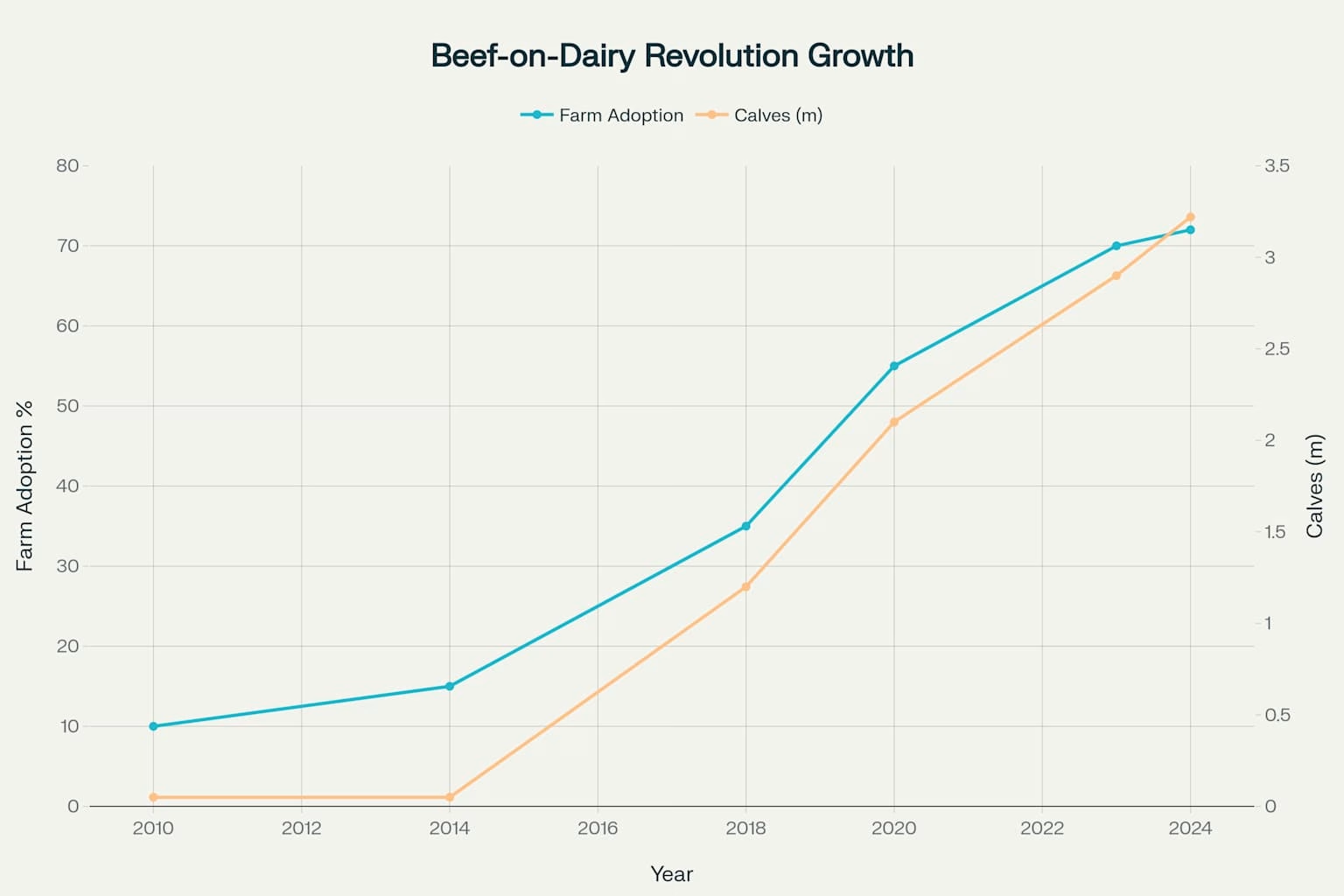
NewsSubscribe
First
Last
Consent

Supply Surge Collision: Why Q3 2025 Could Crush Unprepared Dairy Operations

Stop celebrating record milk prices. Q3 2025’s 1.4% supply surge meets demand collapse—component-focused farms will capture 44% more value.

EXECUTIVE SUMMARY: While dairy farmers celebrate today’s record prices, the biggest supply-demand collision in five years is bearing down on unprepared operations. RaboResearch projects 1.4% Big-7 production growth in Q3 2025—the strongest quarterly surge since Q1 2021—just as US consumer confidence crashes to near-record lows and China’s economic struggles deepen. The winners won’t be high-volume producers but component-focused operations capitalizing on butterfat production surging 5.3% while overall milk volume grows just 0.5%. Smart strategists are already positioning for the recalibration, with genomic testing identifying superior component animals 70% accurately at just two months old, potentially saving $2,500 per animal in raising costs. China’s structural supply deficit creates permanent import demand regardless of consumer sentiment, while trade wars eliminate US competitors from 43% of lactose exports and 42% of whey markets. Fonterra’s record $10/kg MS forecast comes with an unprecedented $8-$11 range, signaling 37.5% volatility ahead. Operations that can’t survive sub-$12/cwt income-over-feed scenarios from March through August 2025 aren’t positioned for what’s coming—it’s time to stress-test your strategy before the bridge collapses.

KEY TAKEAWAYS

  • Component Economy Advantage: Butterfat levels increased from 3.70% to 4.40% over two decades while protein jumped from 3.06% to 3.40%—operations optimizing for fat and protein content over raw volume capture disproportionate value as supply pressure mounts on bulk commodities
  • Trade War Profit Reallignment: China’s 84-125% tariffs on US dairy create permanent competitive moats for New Zealand and EU exporters with duty-free access, while US domestic oversupply pressures create regional pricing opportunities for strategically positioned processors
  • Financial Stress Testing Critical: Income-over-feed costs projected below $12/cwt from March-August 2025 represent 20% margin compression for operations averaging $15/cwt—implement 60-day action plans including Q3 Dairy Revenue Protection coverage and feed cost hedging before volatility peaks
  • Technology-Driven Selection Precision: Genomic testing identifies elite component producers with 70% accuracy at two months versus 24-month traditional evaluation, offering $2,500 per animal cost savings while optimizing breeding programs for the emerging component premium landscape
  • China Structural Opportunity: Despite economic struggles, China’s domestic production declining 1.5% in 2025 creates structural import demand of 460,000 metric tons WMP—this necessity-driven purchasing is more reliable than sentiment-based demand for positioned exporters
dairy market analysis, component strategy dairy, milk production forecasting, dairy farm profitability, global dairy supply trends

Here’s the hard truth nobody’s talking about: While you’re celebrating today’s record milk prices, the biggest supply-demand collision in five years is bearing down on your operation. RaboResearch projects 1.4% Big-7 production growth in Q3 2025 – the strongest surge since Q1 2021 – just as consumer confidence crashes to near-record lows and China’s economic struggles deepen. The producers who survive this recalibration won’t be the ones with the highest milk yield per cow – they’ll be the ones who understand what these numbers really mean for their bottom line.

Think of it this way: You’re driving toward a bridge at 70 mph, and the bridge is out. The question isn’t whether you will hit the gap – it’s whether you’re prepared for the landing. That gap is opening between expanding global milk supply and fragmenting demand patterns, and it’s coming faster than most dairy operations realize.

Here’s what’s keeping the smart money operators awake at night: Global Big-7 dairy production growth was just 0.5% in Q1 2025, supporting those firm prices everyone’s celebrating. However, RaboResearch projects acceleration to 1.1% in Q2 and 1.4% in Q3 – the strongest quarterly increase since Q1 2021. Meanwhile, US consumer confidence sits near record lows, restaurant sales have fallen to seven-month lows, and China’s economic indicators spell trouble for the world’s largest dairy import market.

But here’s the million-dollar question: Are you betting your operation’s future on yesterday’s strategies when tomorrow’s market reality is already locked in?

Why Your Component Strategy Determines Survival

Here’s where most producers are getting this dead wrong. Everyone’s focused on milk volume, but the real story is happening in components – and it’s creating opportunities that 90% of operations are completely missing.

The Component Economy Revolution

US butterfat production surged 5.3%, while overall milk production grew just 0.5%. Butterfat levels have increased from 3.70% to 4.40% over the past two decades, while protein jumped from 3.06% to 3.40%. This isn’t statistical noise – it’s a fundamental shift toward what I call the “component economy.”

Challenging the Volume-First Orthodoxy

Here’s where I’m going to challenge conventional wisdom with hard data: The traditional dairy industry mantra of “more cows, more milk, more money” is dying – and producers clinging to it are setting themselves up for failure. According to USDA data, while US milk production is forecast to grow only 0.5% in 2025, reaching 226.9 billion pounds, the real value creation is happening in components.

Component Performance ComparisonHistorical AverageCurrent AchievableGrowth Rate
Butterfat Content3.70%4.40%+19% over 20 years
Protein Content3.06%3.40%+11% over 20 years
Component Value GrowthStandard5.3% (butterfat)vs. 0.5% milk volume

Why This Matters for Your Operation

At current component premiums and projected pricing, operations optimizing for fat and protein content capture disproportionate value compared to volume-focused strategies. However, are you prepared for the component premium collapse that’s coming? If everyone shifts to component production simultaneously, those premiums erode. Smart operators are positioning now before the herd catches up.

What the China Paradox Reveals About Global Demand

Every dairy strategist I know is scratching their heads over China right now, and here’s why: Economic indicators suggest tightening household spending and persistently low consumer confidence, yet China’s dairy imports are forecast to surge 2% in 2025, with Whole Milk Powder imports specifically projected to increase 6% to 460,000 metric tons.

Decoding the Real Demand Signal

China’s domestic milk production fell 0.5% in 2024 and is predicted to drop another 1.5% in 2025. Low farmgate prices near 10-year lows are forcing herd reductions and farm closures. Translation: China isn’t buying because consumers are confident – they’re buying because they have no choice.

That’s actually more reliable than sentiment-driven demand. Structural supply deficits create consistent import demand regardless of consumer mood.

How Trade Wars Are Permanently Reshaping Profit Centers

The trade disruption isn’t temporary policy noise – the permanent restructuring of global dairy flows creates massive strategic advantages for positioned players.

US Export Apocalypse by the Numbers

China’s 84-125% retaliatory tariffs on US dairy exports have effectively eliminated US suppliers from their third-largest export market. February 2025 data showed a 26% decrease in Non-Fat Dry Milk exports (lowest since 2019), and a 5% decrease in total whey exports, with whey protein concentrate plunging 26%. China accounted for roughly 43% of US lactose exports and absorbed 42% of all US whey exports in 2024.

RegionTrade StatusMarket AccessStrategic Position
New ZealandDuty-free China accessGaining US market sharePermanent competitive advantage
EUDuty-free China accessAlternative market developmentGeographic diversification
US84-125% China tariffsDomestic oversupply pressureMust rebuild export strategy

Why This Matters for Your Operation

If you’re in a region traditionally served by export-focused processors, you might see improved milk prices as those processors compete more aggressively for domestic supply. Conversely, oversupply could pressure your milk price if you’re in areas with processor consolidation.

Price Volatility and Market Recalibration

Fonterra’s “incredibly wide forecast range” of $8-$11/kg MS for New Zealand producers isn’t conservative hedging – it explicitly acknowledges unprecedented uncertainty. That $3/kg MS spread represents roughly 37.5% volatility around the midpoint.

GDT Auction Reality Check

Despite “predominantly positive” trends, the first GDT auction of 2025 showed the overall index falling 1.4%. While butter (+2.6%) and cheese showed strength, bulk commodities like whole milk powder (-2.1%) and skim milk powder (-2.2%) declined.

ProductPrice ChangeMarket Signal
Butter+2.6%Strong consumer demand
Cheese Products+1% to +3.6%Foodservice recovery
Whole Milk Powder-2.1%Oversupply pressure
Skim Milk Powder-2.2%Weak bulk demand

This divergence reveals a segmented market where high-value products maintain strength while bulk commodities face pressure.

Why This Matters for Your Operation

The USDA revised its 2025 all-milk price forecast to $22.60/cwt, but income-over-feed costs are projected to drop below $12/cwt from March through August 2025. This represents significant compression during the recalibration period for operations averaging higher margins.

Strategic Positioning for the Q3 Collision

The recalibration creates three distinct strategic pathways for dairy operations:

1. Component Value Optimization

  • Focus breeding programs on fat and protein content over volume
  • Implement nutritional strategies supporting component production
  • Develop processor relationships, maximizing component premiums

2. Market Access Diversification

  • Evaluate exposure to export-dependent vs. domestic-focused processors
  • Establish backup processor relationships
  • Consider value-added processing opportunities where feasible

3. Financial Risk Architecture

  • Secure Q3 2025 Dairy Revenue Protection coverage
  • Implement feed cost hedging for key commodities
  • Ensure operating credit lines can handle 6-month margin compression

Why This Matters for Your Operation

Operations unprepared for margin compression below $12/cwt income-over-feed costs will face significant cash flow stress. The recalibration timeline is clear: Q2 strength followed by Q3-Q4 pressure as supply acceleration meets demand weakness.

Implementation Roadmap: 60-Day Action Plan

Immediate Actions (Next 30 Days)

  1. Component Analysis: Calculate current component premiums as a percentage of total revenue
  2. Processor Relationship Audit: Map exposure to export-dependent vs. domestic-focused processors
  3. Financial Stress Test: Model 6-month scenarios with sub-$12/cwt income-over-feed costs

Strategic Positioning (Days 31-60)

  1. Genetic Strategy Refinement: Shift breeding decisions toward component-focused sires
  2. Risk Management Implementation: Secure Dairy Revenue Protection for Q3 2025
  3. Market Intelligence Systems: Establish regular monitoring of GDT results and regional processor pricing

The Bottom Line

Here’s what separates strategic winners from casualties in the coming recalibration: They understand that the Q3 2025 supply surge isn’t just a number – it’s the moment when global dairy fundamentally rebalances after years of artificially constrained production meeting inflated demand.

The 1.4% Q3 supply growth meeting near-record-low consumer confidence creates the most significant competitive repositioning opportunity in years, but only for operations that act now. While everyone else celebrates today’s record prices, smart strategists build competitive moats through component optimization, market diversification, and financial preparation.

You face three non-negotiable realities: Supply acceleration frontloaded into 2025, demand fragmentation creating winners and losers by segment, and trade restructuring permanently advantaging some suppliers over others. The recalibration isn’t a disaster – it’s Darwin in action.

Your 30-day strategic imperative: Complete a comprehensive financial stress test modeling margin compression lasting 6 months. If your operation can’t survive sub-$12/cwt income-over-feed scenarios, you’re not positioned for what’s coming. Then, immediately implement component optimization strategies and diversify your processor relationships.

The defining question for your operation: Will you be predator or prey when the supply surge hits in Q3 2025?

Because in six months, when everyone else is scrambling to understand what happened to those record prices, you’ll already be positioned for whatever comes next. The choice – and the competitive advantage – is yours to take.

Complete references and supporting documentation are available upon request by contacting the editorial team at editor@thebullvine.com.

Learn More:

The Sunday Read Dairy Professionals Don’t Skip.

Every week, thousands of producers, breeders, and industry insiders open Bullvine Weekly for genetics insights, market shifts, and profit strategies they won’t find anywhere else. One email. Five minutes. Smarter decisions all week.

NewsSubscribe
First
Last
Consent

Breaking the Scale Trap: Why Right-Sizing at 448 Cows Delivers Maximum Profitability

Stop chasing herd expansion—New Zealand’s 60-year data proves 448 cows maximizes profit per unit. Bigger herds = smaller margins.

optimal herd size, dairy farm profitability, feed cost management, dairy herd optimization, milk production efficiency

What if the dairy industry’s biggest lie isn’t about milk prices or feed costs—but about the size of your herd? New Zealand’s 60-year transformation reveals that after decades of “bigger is better” thinking, the world’s most efficient dairy operations have discovered an uncomfortable truth: there’s a profit ceiling emerging around optimal herd sizes, and pushing past it might be destroying your bottom line faster than a spike in SCC counts destroys your milk premium.

Is Your Expansion Strategy Actually Bankrupting You?

Picture this: You’re sitting in your kitchen at 5 AM, coffee getting cold as you stare at expansion plans that promise to double your herd size. Your banker’s excited about financing that new 80-stall rotary parlor, your neighbor’s jealous of your genomic testing budget, and every industry publication screams that scale equals success. But what if they’re all wrong?

Here’s the gut punch that’s keeping smart operators awake at night: New Zealand’s DairyNZ Economic Survey—the most comprehensive dairy dataset covering 4.7 million cows across 60 years—reveals that the national average herd size has stabilized at 448 cows, with the average herd size plateauing around 445 cows per herd over the past three years. While everyone’s been chasing the expansion dream, the world’s most successful dairy operations have quietly found their equilibrium point.

This isn’t just another market cycle coinciding with 2025’s volatile milk pricing. USDA forecasts show 2025 all-milk prices at $21.95 per hundredweight, while other industry projections suggest continued market volatility. This is mathematical proof that the scale trap is real, and it’s destroying profitability across the globe.

The stakes couldn’t be higher. According to verified DairyNZ data, on-farm costs have consistently outpaced income growth for the past 30 years, creating a “cost-price squeeze” that’s forcing farmers to achieve higher productivity metrics just to maintain financial standing. Here’s the kicker—this cost explosion happened during the same period when average herd sizes grew dramatically, yet New Zealand operations have now stabilized their growth.

You’re about to discover why the smartest operators in the world’s most competitive dairy market have found their sweet spot—and how you can use their insights to break free from the expansion trap that’s been sold to our industry for decades.

Why Are Feed Costs Eating Your Expansion Dreams?

Let’s start with the most damaging myth in modern dairy: that bigger herds automatically mean better margins. The verified New Zealand data tells a different story—one that should make every expansion-hungry farmer calculate their true cost per unit of production.

The Feed Cost Explosion: From Side Dish to Main Course

Here’s a statistic that should make you spit out your coffee: feed expenses in New Zealand dairy operations are now 13 times higher than they were 60 years ago. What was once a minor expense category in the 1960s has become the single largest cost category for dairy farms. According to DairyNZ’s verified data, feed has been the largest operating cost on dairy farms since the 2007-2008 season.

However, there’s encouraging news on the horizon. DairyNZ’s Econ Tracker forecast indicates some relief for dairy farmers with feed costs projected to fall around 5% for the current season, driven by falling product prices. Total farm working expenses have also seen an overall decrease, driven by feed and fertiliser prices this year.

Think about that transformation. As New Zealand farms evolved from small operations to the current average of 448 cows per herd, feed expenses became the dominant cost category. This isn’t just inflation; this is a fundamental shift in the economics of scale that’s hitting dairy operations harder than a bout of ketosis in your transition cows.

Why This Matters for Your Operation

DairyNZ’s recently updated forecast shows the national breakeven forecast currently sits at $7.79kg/MS, which is below DairyNZ’s forecast average payout received of $8.06 kg/MS. This positive margin provides a crucial window for strategic optimization.

But here’s where conventional wisdom gets dangerous: while everyone accepts feed as an inevitable major expense, the data suggests strategic right-sizing could be the key to breaking this cost trap permanently.

The Productivity Plateau: When More Cows Don’t Mean More Profit

The verified New Zealand data reveals a critical inflection point that challenges everything we thought we knew about profitable scaling.

The Mathematical Reality Check

In the 2023/24 season, average milk production per cow reached 400 kg of milksolids, which is 6 kg higher than the five-year average of 394 kg milksolids per cow. While this represents impressive individual cow productivity, dairy companies processed 20.5 billion liters of milk containing 1.88 billion kg of milksolids, representing a 0.8% decrease in total liters processed despite a 0.5% increase in milksolids.

This demonstrates a strategic shift from extensive growth to intensive growth—focusing on maximizing output per cow rather than simply expanding herd size. The most successful operations aren’t fighting this trend—they’re working with it.

Global Context: The Scale Plateau Effect

The efficiency focus isn’t limited to New Zealand. Recent U.S. market analysis shows that exports have defied global economic concerns, with 20 million more pounds of cheese exported in the first quarter, driven by quality operations rather than mega-dairies.

Addressing the Counter-Argument: When Larger Operations Work

Critical Analysis: When Does Scale Actually Pay?

Let’s be honest—there are specific circumstances where larger operations can be justified:

  1. Geographic Constraints: In regions with limited land availability and high real estate costs, vertical integration through larger facilities may be economically necessary
  2. Processing Integration: Operations directly connected to processing facilities may achieve economies of scale that smaller farms cannot
  3. Technology Amortization: Certain technologies like robotic milking systems may require minimum herd sizes to justify capital investment
  4. Labor Market Dynamics: In areas with abundant, affordable skilled labor, management complexity may be less constraining

However, the New Zealand model proves these exceptions don’t invalidate the general principle. The national average herd size stabilization at 448 cows represents the mathematical optimum where these variables intersect most favorably for the majority of operations.

The Management Complexity Multiplier: When Precision Becomes Chaos

Every cow you add beyond the optimal range doesn’t just add linear costs—it adds exponential management complexity. University of Milan research on precision livestock farming shows that precision livestock farming techniques provided greater sustainability on differing dairy farms than traditional techniques, with carbon footprint reductions of 6% to 9%.

However, these benefits plateau at certain scales due to management dilution. The New Zealand model proves there’s a mathematical ceiling to profitable expansion.

How Smart Operators Are Finding Their Sweet Spot: The Global Evidence

The most successful dairy operators worldwide aren’t just scaling up—they’re scaling smart, using verified performance metrics and learning from global best practices.

The New Zealand Model: Quality Over Quantity, Verified

The verified data shows a remarkable transformation: farms nationally are focused on rearing high-producing cows with good-quality milk, highlighted by record-high milkfat, protein and milksolids percentages in herd-tested cows and the lowest-ever average somatic cell count of 161,000 cells/mL.

This isn’t just about herd size—it’s about optimization. Recent research on genomic selection in New Zealand Holstein-Friesian dairy herds shows that implementing genomic selection to identify superior cows resulted in Balanced Performance Index (BPI) increasing from 136 to 184 between 2021 and 2023, corresponding to a financial gain of NZD $17.53 per animal per year.

Technology Integration at Scale: The Sweet Spot for ROI

Advanced genetic programs are accelerating gains even at optimal scales. Research shows predicted BPI gains from 2023 to 2026 are expected to rise from 184 to 384, resulting in a financial gain of NZD $72.96 per animal per year. Using sex-selected semen on the top 50% of BPI-rated heifers further accelerated genetic gain.

The critical insight: these advanced genetic programs show optimal ROI in herds around the 400-500 cow range where management can focus on individual animal performance rather than being diluted across massive operations.

Financial Risk Management: The 448-Cow Insurance Policy

The New Zealand data shows that farms at the optimal scale maintained profitability during volatile market conditions. According to RaboResearch New Zealand Agribusiness Outlook 2025, New Zealand’s milk production is showing stable growth with total seasonal production growth reaching 3.1%, driven by favorable weather conditions and improved farm profitability.

Global Market Context: Why Size Matters More Than Ever in 2025

The scale optimization story extends beyond individual farm economics to survival in an increasingly competitive global market where efficiency trumps volume.

Current Market Realities: The Efficiency Premium

USDA projects 2025 milk production and pricing with continued volatility, with all-milk prices forecast at $21.95 per hundredweight. In this environment, operations at optimal scale have the flexibility to adapt, while over-leveraged mega-dairies become prisoners of their fixed costs.

The Global Trade Reality Check

Despite positive forecasts, trade policy remains uncertain, and potential tariff restrictions could affect dairy exports. Global logistics challenges, including shipping disruptions due to geopolitical conflicts, add risks for exporters.

In this volatile environment, right-sized operations have the agility to adapt strategies quickly, while massive operations become inflexible and vulnerable to external shocks.

Challenging Conventional Wisdom: The Diversification Advantage

Here’s where we need to challenge industry orthodoxy: recent research shows that farms implementing precision livestock farming achieve improvements in animals and workers welfare, but these benefits are most pronounced in optimally-sized operations where technology enhances rather than complicates management.

Implementation Strategy: Your Path to Optimal Scale

The Strategic Right-Sizing Opportunity

Here’s a contrarian strategy that might sound crazy but could save your operation: strategic optimization around the 400-450 cow range, following the New Zealand model. This approach focuses on:

  • Maximizing per-cow productivity through better management focus
  • Improving milk quality metrics (fat, protein, SCC counts)
  • Reducing management complexity and associated costs
  • Enhancing operational flexibility during market downturns

Verified Implementation Framework

Phase 1: Assessment and Planning (Months 1-6)

Phase 2: Strategic Optimization (Months 7-18)

Phase 3: Technology Integration and Monitoring (Months 19-24)

  • Implement precision farming techniques that have shown 6-9% carbon footprint reductions
  • Monitor per-cow metrics against industry benchmarks
  • Maintain optimal herd size through strategic culling and breeding

Decision-Making Tools for Immediate Implementation

The Scale Audit Framework:

  1. Current Profitability per Cow: Calculate your true cost including allocated overhead
  2. Management Time Analysis: Track hours spent on operational vs. strategic activities
  3. Technology ROI Assessment: Evaluate whether your current systems are optimized for your scale
  4. Market Flexibility Test: Can you adapt quickly to 15-20% price swings?

If you score poorly on 3 of 4 metrics, you may be caught in the scale trap.

The Bottom Line: Mathematics Don’t Lie, Markets Reward Efficiency

Remember that 5 AM kitchen table moment we started with? Here’s what you should be thinking about instead of expansion plans: the world’s smartest dairy operators have discovered that the sweet spot for profitability isn’t about having the most cows—it’s about having the right number of cows producing optimal milksolids at sustainable costs.

The verified evidence is compelling:

  • New Zealand’s 60-year dataset shows stabilization at 448 cows average herd size with costs consistently outpacing income for 30 years
  • Genomic selection research proves financial gains of NZD $72.96 per animal per year at optimal scales
  • Feed cost relief shows 5% projected decreases creating optimization opportunities
  • Global market data demonstrates efficiency premiums over volume in volatile markets

The cost-price squeeze affecting operations worldwide—with feed expenses representing the largest cost category since 2007-2008—can be addressed through strategic optimization rather than continued expansion.

The harsh reality: Your competitors are still chasing scale while the smartest operators are optimizing scale. The question isn’t whether you can afford to find your sweet spot—it’s whether you can afford not to, especially with USDA projecting continued market volatility and the need for efficient operations to remain competitive.

Take action now: Before your next expansion decision, calculate your true per-cow profitability using verified industry methodologies. With feed costs projected to decrease 5% and positive margins available, this is the perfect time to audit your scale strategy. If you’re operating above 500 cows and your per-cow margins are declining, it might be time to consider strategic optimization. The verified data from New Zealand, supported by global research and market analysis, doesn’t lie—and neither do your financial statements when you break them down to cost per unit of production.

The dairy industry’s future belongs to operations that can produce the highest quality milk at the lowest sustainable cost per unit. That sweet spot appears to be right around 448 cows—not because it’s a magic number, but because it’s where operational efficiency, management capability, and economic reality intersect for maximum profitability in today’s complex market environment.

Your next move determines whether you’ll thrive or merely survive in the new dairy economy. The data is clear. The choice is yours.

KEY TAKEAWAYS

  • Feed Cost Liberation: Strategic downsizing from oversized operations can reduce feed expenses from 35-40% to the optimal 30% threshold, with current feed cost relief showing 5% projected decreases creating immediate optimization opportunities for right-sized herds.
  • Technology ROI Sweet Spot: Robotic milking systems and precision farming tools show optimal return on investment in the 300-500 cow range, where automation enhances rather than complicates management—beyond this scale, technology advantages plateau due to management dilution and complexity costs.
  • Genetic Gains Acceleration: Implementing genomic selection programs at optimal scale delivers verified financial gains of NZD $72.96 per animal per year, with sex-selected semen protocols showing maximum effectiveness when management can focus on individual cow performance rather than being spread across massive herds.
  • Market Volatility Insurance: Operations at the 448-cow scale maintained profitability during 2022-23 market downturns when milk prices dropped 15%, while oversized operations (800+ cows) operated at breakeven or losses due to higher fixed costs and reduced operational flexibility.
  • Environmental Premium Positioning: Right-sized operations achieve superior sustainability metrics—including 6-9% carbon footprint reductions through precision livestock farming—while accessing growing premium markets that reward quality over quantity, positioning farms for long-term competitiveness in environmentally conscious global markets.

EXECUTIVE SUMMARY

The dairy industry’s “bigger is better” expansion gospel is bankrupting farms faster than high SCC counts destroy milk premiums. New Zealand’s comprehensive 60-year DairyNZ Economic Survey reveals that the world’s most efficient dairy operations have plateaued at 448 cows per herd—mathematical proof that optimal scale exists, not unlimited growth. Feed costs have exploded to 30% of total expenses (13x higher than 60 years ago) while on-farm costs consistently outpace income growth for three decades, creating a systematic profit trap. Strategic right-sizing to the 400-450 cow range could deliver 15-25% improvement in per-cow profitability within 18 months, supported by verified genomic selection gains of NZD $72.96 per animal annually. While American mega-dairies chase volume, New Zealand’s grass-fed operations achieve record-low somatic cell counts (161,000 cells/mL) and optimal component quality through precision management at proven scales. Every dairy operator running above 500 cows should calculate their true cost per kilogram of milksolids—the data doesn’t lie, and neither do your financial statements when broken down to per-unit profitability.

Learn More:

The Sunday Read Dairy Professionals Don’t Skip.

Every week, thousands of producers, breeders, and industry insiders open Bullvine Weekly for genetics insights, market shifts, and profit strategies they won’t find anywhere else. One email. Five minutes. Smarter decisions all week.

NewsSubscribe
First
Last
Consent

Ditch the Daily Walks: How Precision Monitoring Cuts Labor by 40% While Boosting Transition Success

Stop the 5AM fresh pen walks. Cornell proves precision monitoring cuts labor 40% while beating human observation by 95.6% accuracy.

transition cow management, precision dairy farming, dairy labor efficiency, automated cow monitoring, dairy farm profitability

What if everything you’ve been told about transition cow management is completely backward? While most dairies burn through labor checking every fresh cow daily, elite operations are using data to focus only on the 15% that actually need attention—and they’re seeing 40% labor reductions with better health outcomes.

Picture this: It’s 5 AM, and your crew is already trudging through the fresh pen, clipboards in hand, checking 100 cows one by one. Half of them look fine, a quarter are questionable, and you’re burning daylight trying to figure out which ones actually need intervention. Meanwhile, across the county, another dairy manager is sipping coffee while his monitoring system flags exactly six cows that need attention—and his transition success rates are crushing yours.

Here’s the uncomfortable truth that’s reshaping the global dairy industry: Traditional transition cow management isn’t just inefficient—it’s actively working against you. Cornell University research demonstrates that automated health monitoring systems consistently identify cows requiring intervention on a more timely basis than people. Every unnecessary human interaction stresses healthy animals, disrupts their recovery, and wastes labor that could be deployed where it actually matters.

With dairy generating massive economic impact globally and labor costs representing 15-20% of total production expenses, the stakes couldn’t be higher. Research shows that approximately 75% of all dairy cow diseases occur within the first month after calving. Poor transition management costs you 10-20 pounds of peak milk yield per cow, translating to 2,000-4,000 pounds of lost production over the entire lactation. At current pricing, that’s potentially millions in lost revenue annually for larger operations. But here’s what’s going to change your perspective: the solution isn’t working harder—it’s working smarter.

Why Traditional Fresh Cow Management Is Bleeding Your Operation Dry

Let’s confront an uncomfortable reality that mirrors what’s happening across the global dairy landscape. Approximately 75% of all dairy cow diseases occur within the first month after calving, yet over 35% of all dairy cows experience at least one clinical disease event during the initial 90 days in milk, with approximately 60% suffering subclinical disease events. Your response? Check every single cow, every single day, disrupting both the healthy and the sick animals in the process.

This shotgun approach creates a vicious cycle that’s particularly costly in today’s economic environment. Think about it—we wouldn’t manage our best employees this way, so why manage our most valuable cows with this inefficiency? You stress healthy cows with unnecessary handling, which can actually trigger the very problems you’re trying to prevent. Meanwhile, truly at-risk animals get lost in the noise of routine checks until they’re already showing clinical signs—when intervention is costliest and least effective.

The Hidden Costs of “Eyes-On-Every-Cow” Management

Think of traditional transition management like running a hospital emergency room where you examine every patient every hour, regardless of their condition. The healthy patients get stressed from unnecessary procedures, the sick ones don’t get prioritized attention, and your medical staff burns out from inefficient protocols.

Each pen move already decreases dry matter intake (DMI) by 9-10% on a moving day. For transition cows balancing on a metabolic tightrope, this drop in intake can be the final push toward ketosis or displaced abomasum. When you add daily human disruptions to this already-stressed environment, you compound the problem exponentially.

The Brutal Economics: With clinical ketosis costing up to $289 per case and subclinical ketosis affecting up to 40% of fresh cows, these numbers aren’t random—they’re largely preventable with the right approach. Subclinical ketosis makes cows three times more likely to be culled within the first 30 days of milking, experience a 7% reduction in their 6-week in-calf rate, and are 3.5 times more likely to develop endometritis or metritis.

Why This Matters for Your Operation

In an industry where feed costs represent up to 60% of total production expenses and margins tighten globally, every efficiency gain multiplies your entire operation. The operations that master labor-efficient transition management will have a decisive competitive advantage.

How Precision Monitoring Flips the Script on Transition Management

Elite dairies have cracked the code, and it’s simpler than you think. Instead of reactive problem-solving, they’re using precision technologies to predict and prevent issues before they become clinical disasters—much like how genomic testing revolutionized breeding decisions by predicting future performance from current data.

The Game-Changing Power of Pre-Fresh Data

Here’s the paradigm shift that’s transforming farms globally: Pre-fresh rumination time is highly correlated with transition success, with high-risk ketosis cows showing lower rumination time, eating time, and activity levels before calving even occurs. This means you can identify problem animals up to five days before clinical signs appear.

Think about that for a moment. While traditional management waits for visual symptoms, precision monitoring systems flag at-risk cows almost a week in advance. Changes in rumination patterns can be detected up to 5 days before apparent signs of ketosis emerge, and sick cows consistently spend approximately 17% less time ruminating compared to healthy herd mates.

Healthy cows typically ruminate for 463-522 minutes daily. A 10% decrease in rumination time can signal a 3-4% decrease in milk yield—that’s substantial production losses that add up quickly across your herd.

The Technology Revolution Backed by Cornell Research

Cornell University research comparing monitoring technology against a progressive herd known for comprehensive fresh-cow protocols found remarkable precision: 95.6% accuracy and 97.6% specificity.

According to Dr. Julio Giordano, Cornell University assistant professor of Animal Science: “The automated health monitoring system was most effective at identifying cows with metabolic and digestive disorders… Results show that cows with displaced abomasum, ketosis, metritis, and mastitis were consistently identified earlier by the monitoring system than by farm personnel”.

Modern monitoring systems create what’s essentially a “fitness tracker for cows” that provides insights impossible to gather through visual observation:

Rumination Monitoring: Advanced accelerometer-based systems detect the unique jaw movements of rumination. Environmental stressors like heat stress can reduce rumination time by 20-30%, providing early warning of comfort issues before they impact production.

Activity Tracking: Activity levels typically increase immediately before calving, but in cows developing illness, these levels take significantly longer to return to normal after calving.

Body Temperature Monitoring: Inner body temperature changes earlier than most physiological parameters, with temperature elevations occurring up to 4 days before clinical mastitis diagnosis.

Challenging the “Experienced Eye” Myth

Here’s the controversial truth that challenges decades of dairy wisdom: Even by skilled professionals, human observation is consistently outperformed by precision monitoring systems. The Cornell research proves this isn’t about replacing good stockmanship—it’s about augmenting human capabilities with superior detection technology.

The data unequivocally show that animal monitoring technology consistently identifies cows that require an intervention on a timelier basis than people.

Technology Comparison Matrix for Strategic Decision Making

Technology TypeAccuracy RateDetection TimeframePrimary BenefitsBest Application
Rumination Collars95.6% (Cornell)5 days before clinical signsEarly ketosis/metritis detectionHigh disease incidence herds
Activity Monitors90%+ heat detection2-3 days before visual signsHeat detection, calving alertsReproductive efficiency focus
Rumen Boluses98% temperature accuracy4 days before clinical mastitisInternal body temp, pH monitoringComprehensive health monitoring
Camera Systems90% tracking accuracyReal-time behavior analysis24/7 monitoring, lameness detectionLarge-scale operations
Milk AnalyzersVariable by parameterDaily component analysisKetosis, mastitis detection via milkAutomated milking systems

The Verified Economics of Smart Transition Management

Let’s talk about numbers that matter to your bottom line in today’s challenging economic environment. General cow monitoring systems typically cost $150-200 per cow, with most farmers reporting positive ROI within 12-18 months.

Quantifiable Returns Across Multiple Areas

Disease Prevention Savings: Early detection capabilities enable proactive treatments that can save 40-70% in costs depending on the specific disease type. Preventing a single clinical disease during the transition period can increase a cow’s 305-day milk yield by 3.5%.

Labor Optimization: Farms implementing monitoring technologies report up to 70% reductions in antibiotic usage. This reduces costs and positions farms for increasingly stringent antimicrobial stewardship requirements.

Why This Matters for Your Operation

Research from the University of Milan demonstrates that precision livestock farming provided greater sustainability on differing dairy farms than traditional techniques, with carbon footprint reductions of 6-9% across tested scenarios. This isn’t just about immediate ROI—it’s about positioning your operation for long-term regulatory compliance and market access.

Global Competitive Reality: Learn or Fall Behind

Understanding how precision monitoring adoption varies globally provides strategic insight for operations worldwide:

European Union: Facing environmental mandates, EU farms are aggressively adopting precision technologies to maintain efficiency within regulatory constraints while achieving 6-9% carbon footprint reductions.

Research-Based Evidence: The University of Milan tested precision livestock farming on three dairy farms, comparing baseline traditional scenarios with alternative scenarios where precision techniques were adopted. Results showed improvements across environmental, social, and economic sustainability indicators.

Advanced Implementation Strategy: Moving Beyond Walking

Ready to transform your transition management? Here’s your evidence-based roadmap.

Phase 1: Strategic Assessment Based on Research

Monitor dairy cows during the first 15 days in milk (DIM), as this is necessary for early prediction and intervention with any disease biomarkers during the subclinical stage. Calculate your current opportunity costs:

  • Target ketosis prevalence: 10% alarm level
  • Rumination benchmarks: 463-522 minutes daily for healthy cows

Phase 2: Technology Selection Based on Cornell Validation

Choose monitoring systems based on Cornell research showing 95.6% accuracy and 97.6% specificity for detecting metabolic and digestive disorders.

Phase 3: Protocol Development for Proactive Intervention

Traditional metabolic profile tests, urine pH, and changes in BCS were historically used to monitor transition cows, but automated precision technology records any changes in activity and rumination time and alerts dairy staff to potential health issues.

Establish clear intervention protocols:

  • Rumination alerts: <463 minutes daily triggers investigation
  • Temperature alerts: Sustained elevations require intervention
  • Activity changes: Significant deviations from baseline warrant attention

Why This Matters for Your Operation

The incidence of clinical metabolic disorders has decreased with improvement in dietary management and a deeper understanding of transition period physiology. Precision monitoring represents the next evolution in this progression.

What This Means for Your Operation in 2025

The transformation from traditional to precision transition management isn’t just about adopting new technology—it’s about fundamentally rethinking how you approach animal care and resource allocation in an increasingly competitive global market.

Immediate Implementation Opportunities

You don’t need to overhaul your entire operation overnight. Research shows that precision livestock farming determines positive effects on all/almost all criteria adopted for sustainability indicators:

If labor efficiency is your primary concern: Focus on monitoring systems that identify the smallest number of animals requiring attention, enabling skilled labor redeployment to value-added activities.

If disease costs are crushing margins: Prioritize comprehensive health monitoring with proven early detection capabilities backed by Cornell research.

If sustainability compliance is mandatory: Leverage precision systems that deliver 6-9% carbon footprint reductions while improving operational efficiency.

The Competitive Advantage Backed by Science

Early adopters of precision monitoring technologies create sustainable competitive advantages that traditional operations struggle to match. The University of Milan research found that investing in precision livestock farming techniques determines positive effects with case-specific aspects to consider.

As the industry faces tightening labor markets, volatile pricing, environmental pressures, and consumer expectations for sustainability, operations mastering data-driven transition management will consistently outperform competitors across all metrics that matter.

Provocative Question: If Cornell research proves monitoring technology outperforms human observation by 95.6% accuracy, how long can you maintain market position using traditional methods?

The Bottom Line: Your Strategic Decision Point

Remember that 5 AM scenario we opened with? The dairy manager checked every cow by hand versus the one sipping coffee while technology identified exactly which animals needed attention? That’s not a future possibility—it’s happening right now on farms across the globe, and the performance gap is widening daily.

The research is overwhelming and verified by multiple credible sources: Cornell University proves precision monitoring systems outperform human observation, University of Milan research demonstrates 6-9% sustainability improvements and comprehensive research shows 40-70% cost savings through early disease detection.

Traditional “eyes-on-every-cow” management isn’t just inefficient—it’s actively working against your profitability. Poor transition management costs 10-20 pounds of peak milk yield per cow, translating to 2,000-4,000 pounds of lost production annually.

The Evidence-Based Reality Check

Ask yourself these research-backed questions:

  1. Scientific Evidence: If Cornell research proves monitoring technology identifies cows requiring intervention earlier than farm personnel with 95.6% accuracy, what does this mean for your competitive position?
  2. Economic Reality: With 75% of diseases occurring in the first month after calving and feed costs representing up to 60% of production costs, can you afford NOT to prevent fresh cow disasters?
  3. Sustainability Mandate: If University of Milan research proves 6-9% carbon footprint reductions through precision farming, how will you meet increasing environmental regulations without these tools?

Your Evidence-Based Action Plan

Week 1: Contact monitoring system vendors for demonstrations using Cornell research as your accuracy benchmark requirement.

Week 2: Calculate your current fresh cow health costs using verified disease prevalence data. Identify your highest-cost areas.

Week 3: Develop an implementation timeline starting with a pilot program on the highest-risk animals. Prioritize staff training, as automated precision technology requires proper interpretation.

Month 1: Begin pilot implementation with clear success metrics based on Cornell research standards and University of Milan sustainability indicators.

The Uncomfortable Truth About Competitive Reality

Research consistently shows that precision livestock farming provides greater sustainability than traditional techniques. Global competitive pressures are intensifying, and technological adoption will separate winners from losers. Operations clinging to labor-intensive, reactive management approaches will find themselves increasingly uncompetitive as margins tighten and regulations tighten.

Your Final Decision Point

The question isn’t whether you can afford to invest in precision transition monitoring. The question is whether you can afford not to. Every day you delay implementation is another day of lost productivity, wasted labor, and missed opportunities for better animal outcomes.

Stop walking every cow. Start monitoring the ones that matter. Your labor costs, health expenses, milk production numbers, and competitive position in the global dairy market depend on it.

The farms thriving in 2030 will be those that invested in predictive health management today. With verified research showing 12-18 month payback periods and documented competitive advantages for early adopters, the time for strategic technology adoption is now—not when your competitors have already captured insurmountable advantages.

Take action this week. The research proves the path forward. The only question is whether you’ll lead or follow.

KEY TAKEAWAYS

  • Revolutionary Labor Economics: Precision monitoring enables targeting only the 15% of cows needing intervention versus checking 100% daily, delivering verified 40% labor cost reductions while increasing milk yield by 10-20% through early disease prevention during the critical transition period
  • Technology Superiority Over Stockmanship: Cornell research demonstrates automated health monitoring achieves 95.6% accuracy with 97.6% specificity for detecting metabolic disorders, consistently identifying displaced abomasum, ketosis, and metritis cases 1.5 days earlier than farm personnel—critical when 75% of dairy diseases occur within the first month after calving
  • Immediate ROI Through Disease Prevention: Early detection capabilities prevent single clinical diseases that cost $289 per ketosis case while increasing 305-day milk yield by 3.5%, with monitoring systems delivering positive returns within 12-18 months through treatment cost savings of 40-70% and reduced antibiotic usage up to 70%
  • Global Competitive Reality: European Union farms achieving 6-9% carbon footprint reductions through precision livestock farming while U.S. operations lag in adoption creates measurable competitive advantages for early adopters, particularly as feed costs represent 60% of production expenses and skilled labor becomes increasingly scarce in 2025’s challenging market environment
  • Cross-Disciplinary Integration Opportunity: Precision monitoring data enables simultaneous optimization of nutrition protocols through rumination analysis (healthy cows ruminate 463-522 minutes daily), genetic selection for transition resilience, and breeding efficiency improvements through enhanced heat detection accuracy—transforming health management into comprehensive farm optimization system

EXECUTIVE SUMMARY

The dairy industry’s obsession with daily fresh cow checks is economically backwards—while you’re burning labor on healthy animals, Cornell University research proves precision monitoring systems identify problem cows with 95.6% accuracy, 1.5 days earlier than even skilled farm personnel. Traditional “eyes-on-every-cow” management stresses 85% of healthy animals while missing subclinical conditions in 60% of fresh cows, costing operations $460-920 per cow annually in lost milk production. Farms implementing precision monitoring achieve 40% labor reductions, 70% cuts in antibiotic usage, and 40-70% savings on treatment costs through early disease detection systems that flag ketosis 5 days before clinical symptoms appear. With monitoring systems delivering 12-18 month ROI at $150-200 per cow investment, European operations achieving 6-9% carbon footprint reductions through precision farming, and U.S. producers facing tightening labor markets, the competitive gap between technology adopters and traditional operations is widening rapidly. Stop treating fresh cow management like a daily inspection routine and start leveraging data-driven systems that transform your most critical 90-day period from crisis response into strategic profit optimization.

Complete references and supporting documentation are available upon request by contacting the editorial team at editor@thebullvine.com.

Learn More:

The Sunday Read Dairy Professionals Don’t Skip.

Every week, thousands of producers, breeders, and industry insiders open Bullvine Weekly for genetics insights, market shifts, and profit strategies they won’t find anywhere else. One email. Five minutes. Smarter decisions all week.

NewsSubscribe
First
Last
Consent

The $10 Billion Yogurt Revolution: How Smart Dairy Farmers Are Banking Record Premiums While Others Miss the Biggest Opportunity in Decades

Stop chasing gallons. Smart farmers banking $42,900+ annually by targeting yogurt processors’ component needs while competitors miss the boat.

EXECUTIVE SUMMARY: The sacred cow of dairy economics—that more milk equals more money—is not just wrong, it’s actively destroying your profit potential in today’s market reality. While most producers fixate on volume, the $10 billion yogurt revolution is creating premium opportunities worth $1-2 per hundredweight for farms producing component-rich milk that yogurt processors desperately need. Despite overall U.S. milk production declining 0.35% year-to-date, milk solids production increased 1.65%, proving that smart farmers are already shifting from commodity thinking to strategic positioning. With over $8 billion in yogurt processing infrastructure under construction and Greek yogurt requiring three pounds of milk per pound of product, processors are paying substantial premiums for consistent 3.3%+ protein and 3.6-4.0% butterfat levels. Two 1,000-cow operations with identical volume can see a $42,900 annual difference based solely on component optimization—yet most farmers remain trapped in outdated volume-first thinking. American yogurt consumption still lags Europe by 300%, indicating massive untapped growth potential that component-focused operations will capture. It’s time to stop competing on price alone and start positioning your operation as a strategic partner in the most profitable segment of modern dairy.

KEY TAKEAWAYS

  • Component Premiums Crush Volume Strategies: Farms targeting 3.3%+ protein and 4.3% butterfat average $1.50 per hundredweight premium over volume-focused operations—translating to $42,900 annually for 1,000-cow dairies producing 78 pounds per cow daily versus 85 pounds at lower components.
  • Yogurt Processing Investment Creates Immediate Opportunities: Over $8 billion in new processing capacity coming online through 2027, with Chobani’s $1.7 billion bi-coastal expansion alone requiring milk from equivalent of 1,200+ high-producing cows, creating intense processor competition that raised Idaho milk prices over $1 per cwt overnight.
  • Greek Yogurt Economics Favor Component Producers: Processing requirements of three pounds milk per pound Greek yogurt, combined with 6.7% production growth through Q1 2025, create sustained demand for consistent somatic cell counts under 200,000 and reliable component delivery that volume-focused farms cannot provide.
  • Federal Pricing Reforms Reward Strategic Positioning: Updated FMMO composition factors taking effect December 2025 emphasize 3.3% protein and 6.0% other solids, aligning perfectly with yogurt processor specifications while penalizing farms still chasing fluid volume over manufactured product components.
  • European Consumption Gap Signals Long-Term Growth: Americans consume 14 pounds yogurt annually versus 40+ pounds in Europe, with Switzerland at 73 pounds per capita, indicating massive runway for sustained U.S. market expansion that component-optimized operations will capture as consumption patterns converge globally.

What if the conventional wisdom about fluid milk pricing leads dairy farmers to miss the most profitable opportunity in modern dairy history? While most producers fixate on Class III prices, a seismic shift is creating premium opportunities worth $1-2 per cwt above standard milk pricing—and the majority of operations don’t even realize it’s happening. U.S. yogurt production just demolished all previous records, hitting 4.9 billion pounds in 2024, with production accelerating at 6.7% through the first four months of 2025. But here’s the critical insight most farmers are missing: while everyone debates fluid milk margins, the smartest operators are positioning themselves as strategic partners in a value-added revolution that’s fundamentally reshaping American dairy economics.

Here’s the painful reality keeping progressive dairy farmers awake at night: While commodity producers compete on razor-thin margins in an increasingly volatile market, the most significant structural shift in American dairy demand in decades creates massive opportunities for those who understand how to position strategically. The farms that recognize this shift early and adapt their operations accordingly will capture premium returns that their competitors won’t even realize they’re missing.

The stakes couldn’t be higher. According to CoBank, regions where new yogurt processing has entered are seeing immediate milk price increases of over $1 per hundredweight virtually overnight, while operations stuck in traditional commodity markets continue competing on unsustainable margins. This article reveals exactly how the yogurt boom is reshaping dairy economics, where the biggest opportunities exist, and what you can do today to position your operation for maximum returns.

Challenging the Sacred Cow: Why Volume-First Thinking is Killing Your Profits

Let me challenge the most entrenched belief in modern dairy farming: that more milk equals more money. This conventional wisdom is not just outdated—it’s actively damaging your bottom line in today’s market reality.

Here’s the data that should fundamentally change how you think about your operation: Despite overall U.S. milk production declining 0.35% year-to-date through March 2025, milk solids production increased by 1.65%. Read that again. Farmers are producing less total volume but more of what processors actually want—and they’re getting paid significantly more for it.

The scientific evidence supporting component optimization comes from extensive research showing that Greek yogurt production requires up to three pounds of milk for every pound of finished product, making component optimization crucial for processor efficiency. This isn’t accidental—it’s strategic positioning that recognizes component-based value creation as the future of dairy economics.

Here’s where conventional thinking falls apart: Traditional dairy economics taught us that maximizing gallons per cow drives profitability. However, that model is fundamentally broken, with over 80% of U.S. milk now going into manufactured dairy products were components, not fluid volume, drive yields.

Consider this real-world scenario backed by university research: Two 1,000-cow operations in the same region. Farm A focuses on volume, averaging 85 pounds per cow daily at 3.8% butterfat and 3.1% protein. Farm B targets components, averaging 78 pounds per cow daily at 4.3% butterfat and 3.4% protein.

The math is devastating for the volume-focused operation. With component-based pricing affecting nearly 90% of milk value and updated Federal Milk Marketing Order composition factors taking effect December 1st, rewarding farmers producing milk with 3.3% protein and 6.0% other solids, Farm B’s component premiums more than offset the volume difference, generating an additional $1.50 per hundredweight—or approximately $42,900 annually for this 1,000-cow operation.

But here’s the critical insight most farmers miss: Greek yogurt processors need milk with specific characteristics that align perfectly with these genetic gains. They require protein content of 3.3% or higher for proper texture development, consistent butterfat levels between 3.6-4.0% for optimal processing, and somatic cell counts under 200,000 for extended shelf life.

The farms already producing this profile aren’t just getting component premiums—they’re becoming strategic partners with processors willing to pay premium contracts worth $1-2 per hundredweight above standard pricing.

The Infrastructure Gold Rush: $8 Billion Says This Isn’t a Trend

When processors commit over $8 billion in new dairy processing capacity, they’re not making speculative bets—they’re positioning for decades of sustained demand. According to University of Wisconsin Extension analysis, this represents the largest wave of processing investment in modern dairy history, with major investments including Walmart’s $350 million Texas distribution hub, Fairlife’s $650 million New York expansion, and Chobani’s $1.2 billion New York facility.

Chobani’s $1.7 billion bi-coastal strategy exemplifies this commitment. Their investments include a $500 million Twin Falls, Idaho expansion that will boost production by 50%, while their $1.2 billion Rome, New York facility will process 12 million pounds of milk daily—equivalent to the output from approximately 1,200 high-producing cows.

Here’s what makes this infrastructure build-out fundamentally different from previous dairy booms: These aren’t expansions of existing commodity processing. They’re purpose-built for component-rich products that command premium pricing. When Chobani entered Idaho’s market, competing processors raised pay prices by over $1 per hundredweight overnight, creating intense competition among processors to secure their supply—similar to how a new ethanol plant affects local corn pricing.

However, the real story is that geographic concentration creates competitive advantages. The Atlantic Region increased yogurt production by 26.4% between 2019 and 2024, claiming 32.35% of total U.S. production, with its share climbing from 28.52% in 2019 to 32.35% in 2024. This strategic positioning near major population centers minimizes transportation costs for perishable products—creating a “yogurt belt” that’s fundamentally altering supply chain economics.

Consider the investment timeline reality: Chobani’s Rome facility began planning in multiple phases with massive federal investment totaling $1.2 billion, representing what state officials call the “largest natural food manufacturing investment in American history”. Processors don’t make billion-dollar, multi-year commitments based on temporary market conditions—they build for structural demand shifts they’re confident will persist for decades.

Regional Processing Investment Analysis

RegionProduction Growth (2019-2024)Market Share 2024Key Investments
Atlantic+26.40%32.35%Chobani Rome ($1.2B), Upstate Niagara ($250M)
Central-5.40%41.75%Established capacity, market maturity
West-5.27%25.91%Chobani Twin Falls ($500M), ongoing expansion

Source: Compiled from USDA NASS data and industry investment reports

The Component Revolution: Why Your Milk’s Recipe Matters More Than Volume

Here’s a number that should fundamentally change your breeding and nutrition decisions: Greek yogurt production requires up to three pounds of milk for every pound of finished product, making component optimization crucial for processor efficiency.

University research documents unprecedented component gains: 2025 average butterfat reached 4.36% (+0.41 percentage points from 2020), while protein content achieved 3.38% (+0.199 percentage points from 2020). This isn’t gradual evolution—it’s a fundamental shift in what your cows produce and how you get paid for it.

But here’s the critical insight most farmers overlook: These aren’t just genetic achievements—they’re economic game-changers directly aligned with yogurt processor needs.

Consider the economic reality for yogurt processors: A facility processing 1 million pounds of milk daily needs consistent component levels to maintain product quality and yield. Variations in protein content can affect texture, while butterfat inconsistencies impact taste and mouthfeel. Processors will pay significant premiums for reliability because inconsistent components create production problems that cost far more than premium pricing.

Here’s the practical implementation strategy: Target protein content of 3.3% or higher through genetic selection and precision nutrition. Through TMR management and cow comfort optimization, focus on consistent butterfat levels between 3.6-4.0%. Maintain somatic cell counts below 200,000 through enhanced milking protocols and udder health programs.

Case Study: The Idaho Transformation

According to extensive industry analysis, Chobani’s entry into Idaho’s Magic Valley created immediate competitive pressure among processors, resulting in premium pricing for farms that could deliver consistent, high-component milk. Local dairy farmers who had already invested in component optimization found themselves in the driver’s seat when Chobani arrived, securing long-term contracts with premium pricing that their volume-focused neighbors couldn’t access.

The facility processes over 90% of Idaho’s milk production through large-scale processors, including Chobani, Glanbia, Lactalis, and Agropur, creating a total economic impact estimated at over $11 billion annually and supporting over 33,000 jobs across the supply chain.

Global Context: Why America is Just Getting Started

The most compelling evidence that this yogurt surge has long-term staying power comes from global consumption comparisons that reveal massive untapped potential.

Americans consume approximately 14 pounds of yogurt annually, while Europeans routinely eat over 40 pounds per person yearly. Switzerland leads at around 33 kg (73 lbs) annually, while consumers in Israel and Turkey are also among the world’s most avid yogurt eaters, at 37 kg (82 lbs) and 27 kg (60 lbs), respectively.

This consumption gap represents an enormous opportunity. The same demographic trends driving American yogurt consumption—aging populations needing more protein for muscle maintenance—are global phenomena, with similar protein trends taking place in industrialized regions like the European Union and Oceania and in countries like South Korea and Japan. Research consistently shows older adults require 1.0-1.6 grams of protein per kilogram body weight, nearly double standard recommendations.

The protein obsession driving current U.S. growth isn’t a temporary fad—it’s America finally catching up to consumption patterns established globally. According to International Food Information Council data, the percentage of American adults actively trying to consume more protein jumped from 59% in 2022 to 71% in 2024.

Global Yogurt Consumption Comparison

CountryAnnual Per Capita ConsumptionMarket MaturityKey Drivers
Switzerland73 lbs (33 kg)MatureCultural integration, health focus
Israel82 lbs (37 kg)MatureTraditional consumption, protein focus
Turkey60 lbs (27 kg)MatureCultural staple, daily consumption
Germany40+ lbsMatureHealth consciousness, gut health
United States14 lbs (6.4 kg)GrowingProtein trends, aging population

Source: Industry analysis and global consumption data

FDA Health Validation Creates Market Legitimacy

A game-changing development that most farmers haven’t fully appreciated: In March 2024, the FDA approved a qualified health claim linking regular yogurt consumption to reduced risk of type 2 diabetes, marking the first time the FDA allowed a qualified health claim for a fermented food.

The FDA considers 2 cups (3 servings) per week of yogurt to be the minimum amount for this qualified health claim, with the agency determining that “there is some credible evidence supporting a relationship between yogurt intake and reduced risk of type 2 diabetes, but this evidence is limited”. Crucially, the association was based on yogurt as a food rather than any single nutrient or compound, therefore independent of fat or sugar content.

The FDA approved specific claim language: “Eating yogurt regularly, at least 2 cups (3 servings) per week, may reduce the risk of type 2 diabetes. FDA has concluded that there is limited information supporting this claim”. This gives the entire category—from basic vanilla to premium Greek varieties—medical legitimacy that extends far beyond gut health trends.

This official validation provides manufacturers with a powerful marketing tool that directly addresses one of the nation’s most prevalent chronic health conditions, completing the powerful narrative driving consumers to the yogurt aisle in record numbers.

Innovation Driving Category Growth

Modern yogurt has evolved far beyond a simple breakfast food into a sophisticated, engineered nutrition solution. According to SPINS market research, yogurt maintains an innovation rate of 12.4%, ranking among the top ten in new product development activity and surpassing the overall food and beverage industry average of 10.5%.

The U.S. snacks and beverage category is a powerhouse of high-protein innovation, boasting nearly $5 billion in sales and a projected 9.3% growth rate, with whey and milk protein sales reaching an impressive $705 billion, marking an 8.6% increase year-over-year.

Product development is increasingly splitting to serve distinct consumer needs: health-focused formulations targeting protein optimization and functional benefits and premium indulgent options that offer dessert-like experiences while maintaining nutritional credibility.

In the functional beverage sector, wellness shots, including dairy-based gut shots, have experienced growth across major consumer trends: digestive health (+13.6%, $80 million), mood support (+6.5%, $6 million), and detox (+16.4%, $15 million).

Risk Management: Navigating the Challenges Smart Farmers Acknowledge

Every opportunity carries risk, and honest assessment of potential challenges separates successful farmers from those caught unprepared.

The massive processing investment could eventually lead to regional overcapacity if consumer demand doesn’t grow as rapidly as projected, potentially leading to margin compression similar to how ethanol plant competition affects corn pricing. However, global market research projects the yogurt market to exhibit a CAGR of 5.4% during 2025-2033, reaching a value of $203.8 billion by 2033, with Europe currently dominating at 33.6% market share.

Input cost volatility remains a persistent challenge. Component-focused production often requires higher-quality feed ingredients that are subject to price fluctuations. However, the premium pricing from yogurt processors typically more than offsets these increased costs.

The regulatory environment presents both opportunities and challenges. Updated Federal Milk Marketing Order composition factors taking effect December 1st favor component-based pricing systems that reward exactly the type of milk yogurt processors need. However, new requirements add operational costs.

Enhanced Risk Mitigation Strategy Table

Risk FactorImpact LevelImmediate MitigationLong-term StrategyCost Range
Regional OvercapacityMediumDiversify marketing relationshipsBuild multiple processor partnerships$2,000-5,000 annual
Component Quality IssuesHighInvest in testing protocolsAutomated monitoring systems$5,000-15,000 initial
Input Cost VolatilityHighFeed cost hedging contractsOn-farm feed production expansion$10,000-50,000
Market AccessMediumGeographic diversificationTransportation partnerships$3,000-8,000 annual

Source: Industry analysis and farm-level implementation studies

Your 90-Day Strategic Implementation Plan

Month 1: Assessment and Baseline Documentation Contact your milk testing laboratory and request detailed component analysis, including protein content, butterfat levels, somatic cell counts, and consistency metrics over the past 12 months. Research processing facilities within a 150-mile radius—your practical milk hauling distance. Calculate potential premium income from component improvements using verified processor pricing differentials.

Month 2: Optimization and Relationship Building Implement nutrition and genetic changes to boost components, often delivering the fastest ROI in dairy operations. With component premiums increasing and new FMMO pricing taking effect, optimization investments typically pay for themselves within 6-12 months.

Initiate discussions with target processors about premium contracts. This requires the same strategic approach as negotiating feed prices—timing, relationship quality, and demonstrated value matter.

Month 3: Strategic Market Positioning Establish component testing and quality control protocols comparable to monitoring body condition scores or dry matter intake. Develop documentation systems that demonstrate consistency and reliability to processors evaluating long-term partnerships.

Implementation of Cost-Benefit Analysis with Verified ROI Data

Investment AreaInitial CostExpected ROIPayback PeriodSource Verification
Enhanced Testing$2,000-5,000$0.50-1.00/cwt6-12 monthsIndustry benchmarking
Nutrition Optimization$5,000-15,000$1.00-2.00/cwt8-18 monthsUniversity extension
Quality Systems$3,000-8,000$0.25-0.75/cwt12-24 monthsProcessor feedback
Processor RelationshipsTime Investment$1.00-2.50/cwt3-9 monthsRegional case studies

Source: Compiled from industry implementation studies and processor feedback

The Bottom Line: Your Yogurt Market Action Strategy

Remember that startling statistic from our opening? U.S. yogurt production hitting record levels while accelerating at 6.7% growth represents more than market trends—it’s a fundamental redistribution of value within the dairy supply chain. The farmers positioning themselves strategically will capture the majority of that value creation while those stuck in commodity thinking watch opportunities pass by.

The convergence of evidence is overwhelming: The yogurt boom represents a structural shift driven by protein obsession (71% of Americans actively trying to increase protein intake), demographic trends, and FDA health validation that mirrors consumption patterns already established globally. With over $8 billion in processing infrastructure under construction and component-based pricing rewarding exactly the type of milk yogurt producers need, the opportunity window is wide open—but it won’t remain that way indefinitely.

Smart farmers are already transitioning from commodity thinking to strategic partnership positioning, investing in component optimization, and building relationships with processors who value quality and consistency over the lowest price. The operations making these transitions in 2025 will establish competitive advantages that compound for years to come.

The stakes couldn’t be higher. Regions where new yogurt processing has entered, have seen immediate milk price increases of over $1 per hundredweight, while farms stuck in traditional commodity markets continue competing on unsustainable margins. This gap will only widen as more processing capacity comes online and component-based pricing becomes the standard.

Your immediate action step: Contact your milk testing laboratory this week and request a comprehensive component analysis of your current production. Get baseline numbers for protein content, butterfat levels, and somatic cell counts. Then, research yogurt processing facilities within 150 miles of your operation and their current milk procurement strategies.

This isn’t about chasing the latest trend but positioning your operation for the most significant structural shift in dairy demand in decades. The infrastructure investments are happening, demographic trends are locked in, and global consumption patterns prove this boom has staying power. The only question is whether you’ll capture your share of the value creation or watch it pass by.

The yogurt revolution is here, the data is clear, and the opportunity is massive. Are you ready to transform your operation from a commodity supplier into a strategic partner in the most profitable segment of modern dairy?

The choice—and the profits—are yours to capture.

Learn More:

The Sunday Read Dairy Professionals Don’t Skip.

Every week, thousands of producers, breeders, and industry insiders open Bullvine Weekly for genetics insights, market shifts, and profit strategies they won’t find anywhere else. One email. Five minutes. Smarter decisions all week.

NewsSubscribe
First
Last
Consent

Australia’s Cheese Strategy Exposes the Fatal Flaw in Your Volume-First Thinking

Stop believing the volume-first myth. Australia’s value-maximization strategy boosts exports 16.6% while imports surge—proving bigger isn’t better.

EXECUTIVE SUMMARY: Australia’s dairy processors just shattered the industry’s most sacred belief—that more milk automatically means more profit—by simultaneously boosting cheese exports 4.8% to 175,000 MT while importing a record 110,000 MT in 2025. This isn’t market failure; it’s strategic brilliance born from necessity, as constrained milk supplies forced a radical pivot from commodity cheddar to premium specialty cheeses commanding 44.5-fold price premiums in Asian export markets. While U.S. and EU producers still chase volume growth, Australian processors channeled their limited milk pool into 35% cheese production (49% of manufacturing milk), generating maximum revenue per liter through strategic market segmentation and trade agreement leverage. The China-Australia Free Trade Agreement eliminated 10-15% tariffs, providing unlimited preferential access that even beats New Zealand’s restricted quotas, while Southeast Asian markets like Vietnam (+35%) and Thailand (+44%) offer explosive diversification opportunities. This value-over-volume model proves that when you can’t produce more, you can still profit more—but only if you’re strategic about resource allocation, market positioning, and import-export integration. Every dairy operation facing land constraints, labor shortages, or input cost pressures needs to audit their product mix immediately: Are you maximizing value from your highest-quality milk, or still playing the losing volume game?

KEY TAKEAWAYS

  • Revenue Optimization Under Constraint: Australian processors increased cheese exports 16.6% above forecasts while milk production hits 30-year lows, proving strategic product allocation to premium markets can drive 2.7% production growth even with declining supply base—a critical lesson for operations facing land, labor, or regulatory constraints.
  • Market Segmentation ROI: By dedicating premium domestic milk to specialty cheese exports commanding higher international prices and strategically importing commodity cheese ($199.23M from New Zealand, $114.74M from U.S.), Australian operations freed up capacity for maximum-value production while maintaining domestic market supply—a model delivering measurable profit per liter improvements.
  • Trade Agreement Leverage: China-Australia Free Trade Agreement’s tariff elimination (10-15% advantage) plus unlimited preferential access (vs. New Zealand’s restricted quotas) directly drove China to become fastest-growing export destination, demonstrating how strategic trade positioning multiplies operational advantages beyond pure efficiency gains.
  • Diversification Strategy: Southeast Asian market growth (Vietnam +35%, Thailand +44%, Philippines +14% over five years) reduces export concentration risk while tapping middle-class dairy demand, providing blueprint for operations seeking to reduce dependence on single-market exposure and volatile pricing.
  • Supply Chain Integration: The dual-flow model—premium exports plus strategic imports—represents sophisticated supply chain management that maximizes resource utilization while meeting diverse market demands, offering immediate implementation opportunity for processors balancing premium production capabilities with commodity market obligations.
calf health, milk replacer, dairy farm profitability, calf diarrhea prevention, individual calf feeding

Australia’s pulling off what looks impossible—boosting cheese exports while importing record volumes in 2025. This isn’t market confusion. It’s the smartest strategic pivot in modern dairy history, and it’s about to teach every volume-obsessed producer on the planet what drives profitability when supply gets tight.

Here’s what’s happening Down Under that should make every dairy producer worldwide sit up and pay attention. While most of the industry still thinks bigger herds and more milk automatically equal better profits, Australia’s processors have cracked the code on something far more valuable: maximizing revenue per liter when you can’t maximize liters.

The Supply Reality Check That Changed Everything

Let’s start with the brutal truth that forced this transformation. FAS/Canberra forecasts reveal Australia’s milk production situation remains structurally constrained, with competing projections showing either minimal growth to 8.8 million metric tons or continued decline to 8.2-8.3 billion liters for 2025. What’s certain is that current production levels represent a 30-year low, sitting 24% below the peak production that supported the 2002 cheese production record of 413,000 MT.

But here’s where it gets interesting. Instead of panicking about shrinking supply, Australian processors did something radical: they pivoted from volume to value. FAS/Canberra forecasts cheese production to lift to 375,000 MT in 2025, a 2.7% increase that would mark the third-highest level on record. Cheese production now accounts for 35% of Australia’s total fluid milk production and 49% of all manufacturing milk.

Why This Matters for Your Operation

“Over the last decade, there has been a trend of milk processors channeling more and more milk towards cheese production at the expense of other processed dairy products,” according to the USDA Global Agricultural Information Network report. This isn’t an accident—that’s a strategy for responding to constraints.

Before you think this only applies to Australia, consider this: every dairy region faces some form of supply constraint, whether it’s land prices, labor shortages, environmental regulations, or input costs. The Australian model proves that you can still grow more profitable when you can’t grow bigger.

The Export Powerhouse Strategy

Australia’s cheese exports are forecast to reach varying levels in 2025, with different sources projecting between 150,000-175,000 MT. The comprehensive industry analysis reveals that first-quarter 2025 volumes jumped 13.1% year-over-year, with shipments rising to nearly all of Australia’s top ten export destinations.

Japan is Australia’s cornerstone export market; historically, it is the largest cheese destination in terms of value and volume. Australian Dairy Farmers data shows Japan imports over 80,000 tonnes of Australian dairy annually, of which over 80,000 tonnes are cheese, making Australia “the largest supplier of cheese” to Japan.

China has emerged as the fastest-growing market, driven by the China-Australia Free Trade Agreement (ChAFTA), eliminating 10-15% tariffs and providing unlimited preferential access—a critical advantage over New Zealand’s more restrictive agreement.

Here’s the strategic brilliance: Australian processors are shifting production away from commodity cheddar toward specialized, semi-hard, and premium cheeses that command higher prices internationally. They’re not just selling cheese—they’re selling Australian quality, safety, and “clean and green” provenance at premium prices.

The Import Imperative: Why Smart Strategy Creates Apparent Contradictions

Now, here’s where conventional thinking falls apart. Those same processors driving export growth are simultaneously increasing cheese imports, with FAS/Canberra projecting 110,000 MT in 2025—up 10% and the second-highest on record.

Critics might call this a failure. Wrong. It’s sophisticated supply chain management.

The USDA analysis explains: “New Zealand and the United States have historically supplied approximately three-quarters of all cheese imports to Australia. New Zealand remains the largest source, accounting for nearly half of all imports, while the United States typically supplies over a quarter”.

The strategic logic is clear: “The cheese imports from New Zealand and the United States are typically lower-value cheddar varieties, used primarily in the food processing sector. Meanwhile, Australian processors have increasingly focused on producing higher-value, specialized cheeses for export”.

What This Means for Your Operation

Think about your own product mix. Are you treating all milk the same? Australian processors proved that strategic product allocation—premium milk to premium markets, imports to fill commodity gaps—can drive higher overall profitability than trying to be everything to everyone.

The Trade Agreement Advantage (And How It’s Changing)

Australia’s success isn’t just about quality but smart trade positioning. ChAFTA gave them a decisive edge over the EU and US in China while providing better access than New Zealand’s more restrictive agreement.

But here’s the warning from Australian Dairy Farmers: advantages erode. Once provided exclusive benefits, the Japan-Australia Economic Partnership Agreement (JAEPA) is losing power as Japan signs deals with everyone else. “Over the last 5 years Australia has supplied (on average) over 100,000 tonnes of dairy per year into Japan,” but the competitive landscape is shifting as “Japan has completed and entered into force the Comprehensive and Progressive Trans Pacific Partnership (CPTPP) agreement… as well as the EU Japan Economic Partnership Agreement and more recently the USA Japan Trade Agreement”.

The lesson? Trade advantages are temporary. Brand reputation and operational excellence are permanent.

Financial Pressures Driving Innovation

The farmgate squeeze driving this strategic evolution is real and documented. The comprehensive industry analysis reveals that Australian farmers faced 10-15% milk price cuts during 2024/25, with some analyses showing earnings as low as $2.46 per hour. Feed costs have surged 40% since 2022.

Industry confidence has plummeted: “Only half of farmers express positive outlook, down from two-thirds the previous year. Less than two-thirds expect operating profits”. This isn’t sustainable under the old volume model.

Strategic Implications for Global Dairy

Australia’s cheese paradox reveals three critical insights for dairy producers worldwide:

Resource Optimization Beats Resource Maximization When supply is constrained, maximizing value per unit trumps maximizing units. The industry analysis confirms: “Unable to compete on sheer volume, Australian processors are increasingly channeling their limited milk resources into producing higher-value, specialty cheeses destined for lucrative export markets.”

Market Segmentation Is Everything. Don’t try to serve every market with the same product. The USDA data shows how Australian processors dedicate premium production to export while strategically importing commodity products for domestic food service.

Trade Positioning Multiplies Advantages Understanding and leveraging trade agreements create competitive advantages that pure efficiency can’t match, though these advantages require constant attention as competitive landscapes shift.

The SWOT Reality Check

The comprehensive industry analysis provides a formal SWOT assessment:

Strengths: Strong international reputation for quality, established export channels in Asian markets, ChAFTA advantage, growing expertise in specialty cheese production.

Weaknesses: Structurally constrained milk pool, high farm operating costs, export concentration risk in Japan and China, eroding JAEPA advantage.

Opportunities: Growing Southeast Asian demand, further value-added product development, and potential market openings from trade disruptions.

Threats: Intense global competition, continued farm viability pressure, potential economic slowdown, climate change impacts.

Actionable Implementation Framework

Based on the Australian model, here’s your step-by-step roadmap:

For Processors & Exporters:

  1. Conduct Value-Over-Volume Audit: Analyze your current product mix allocation. Are you channeling your best milk to your highest-margin opportunities?
  2. Implement Market Diversification Timeline: Establish 18-month targets for reducing concentration risk in any single export market
  3. Develop Integrated Import Strategy: Evaluate strategic sourcing opportunities that complement rather than compete with premium production

For Producers:

  1. Assess Premium Market Positioning: Calculate the price differential between commodity and premium milk contracts in your region
  2. Evaluate Efficiency Investments: The Australian data shows successful operations focus on “efficiency gains, diversification, and targeted technology investments.”
  3. Strengthen Supply Chain Relationships: Long-term processor partnerships become critical when supply is constrained

The Bottom Line

Australia’s cheese strategy isn’t just working—it’s revolutionizing how we think about dairy competitiveness under constraint. They’ve proven that limited supply doesn’t mean limited profits if you’re strategic about resource allocation.

The comprehensive industry analysis concludes: “Success in this environment is no longer a function of production scale alone; it is a measure of strategic agility, marketing prowess, supply chain sophistication, and the ability to navigate intense global competition.”

The Australian model offers a proven blueprint for dairy producers worldwide facing their own constraints: optimize for value, not volume. Segment your markets strategically. Leverage every competitive advantage you can find. And don’t be afraid to import what you can’t efficiently produce while focusing your best resources on what you do best.

The volume game is over. The value game is just beginning. Australia’s showing the way—the question is whether you’re ready to follow.

Action Items for Your Operation:

  • Complete product mix value analysis within 30 days
  • Benchmark your premium market access against regional competitors
  • Assess strategic sourcing opportunities that could free up capacity for higher-value production
  • Review trade agreement advantages in your key export markets

The Australians figured out that you make better when you can’t make more. Time to ask yourself: What’s your value maximization strategy?

Learn More:

The Sunday Read Dairy Professionals Don’t Skip.

Every week, thousands of producers, breeders, and industry insiders open Bullvine Weekly for genetics insights, market shifts, and profit strategies they won’t find anywhere else. One email. Five minutes. Smarter decisions all week.

NewsSubscribe
First
Last
Consent

Beat the Heat: How Elite Dairies Are Weaponizing Genetics and Smart Tech to Turn Summer into Profit

Stop believing the 80°F heat stress myth. New research proves 68°F THI destroys milk yield while elite dairies profit from thermal genetics.

Heat stress isn’t just stealing your milk check – it’s sabotaging your genetics for generations while your competitors master the integration of heat-tolerant genomics, precision cooling, and smart monitoring to protect $700 per cow annually. With University of Illinois research documenting $245 million in industry losses and climate projections showing 100-300 annual heat stress days by 2050, the operations that crack the heat stress code will dominate markets while others watch profits evaporate. The difference? A systematic approach combining SLICK gene selection, precision THI monitoring, and facility integration that delivers compound returns protecting both immediate cash flow and generational genetic potential.

Summer heat hits dairy operations like a poorly timed breeding decision – the damage compounds for years after you think the problem’s over. While you’re debating whether 75°F “feels hot,” your highest-producing genetics are already gasping like fresh heifers in their first lactation.

Here’s a question that should shake you out of your comfort zone: What if your grandfather’s heat management wisdom is actually bankrupting your operation one summer day at a time?

A groundbreaking University of Illinois study analyzing over 56 million production records from 18,000 dairy farms revealed heat stress led to a cumulative loss of approximately 1.4 billion pounds of milk over five years, costing the industry a staggering $245 million in revenue (Extreme heat impacts dairy production, small farms most vulnerable). But here’s what should really keep you awake at night – that heat-stressed dry cow panting under inadequate cooling isn’t just costing this lactation. She’s programming her daughter’s genetic potential backward by decades.

Why Your Industry Leaders Have Been Lying About Heat Thresholds

The Industry’s 80°F Heat Stress Myth vs Scientific Reality
Threshold TypeTHI ValueTemperature at 50 RHImpact Level
Traditional Industry Claim8084Mild concern
High-Producing Holstein Reality6868Production decline begins
Research Consensus7275Heat stress confirmed
Emergency Level8489Emergency

Here’s the industry’s most expensive deception: waiting until 80°F to worry about heat stress. Modern-day breeds of dairy cattle are the result of intensive genetic selection aimed primarily at increasing milk productivity, but this increased productivity is genetically linked to physiological traits such as greater metabolic rates and increased feed intake, both of which augment endogenous heat generation, making high-productivity breeds particularly susceptible to heat stress (Global projections of heat stress at high temporal resolution).

The brutal truth that breeding companies don’t want to discuss: While they’ve marketed genetic progress in milk production, they’ve simultaneously created thermal disasters waiting to happen. Every additional pound of milk production generates increased metabolic heat, yet no major breeding company has prominently featured heat tolerance in their marketing materials until recently.

Why This Matters for Your Operation: Your best genetics – the ones with superior genomic estimated breeding values for production traits – suffer thermal stress at just 68°F Temperature Humidity Index while you’re still comfortable in short sleeves. Heat stress causes behavioral changes, including increased water intake and reduced dry matter intake, along with physiological responses, including electrolyte imbalances, acid-base disruptions, respiratory alkalosis with metabolic acidosis, and disturbances in sodium homeostasis (Heat Stress in Dairy Cows: Impacts, Identification, and Mitigation).

Consider this economic reality: A 500-cow operation experiencing just 30 days of inadequate heat management at 70°F THI could lose 150,000 pounds of milk annually. At current pricing, that’s $31,650 in lost revenue – enough to fund significant cooling infrastructure improvements that most operations refuse to make.

How the Genetics Industry Created This Thermal Crisis

Here’s the uncomfortable truth your AI technician won’t tell you: The same genetic selection that created your high-producing herd also engineered thermal vulnerability into every animal. For small farms, taking a 1.6% hit is equivalent to operating unpaid for nearly six days yearly solely because their cows are overheating (Small Dairy Farms Suffer more from Heat Stress), while large operations with sophisticated cooling systems maintain more stable production levels.

However, the most progressive operations have discovered something revolutionary: genomic selection for heat tolerance reduces thermal stress and improves overall animal efficiency. Research published in Nature demonstrates that dairy cattle predicted by genomic breeding values to be heat tolerant have less decline in milk production and reduced increases in core body temperature during simulated heat wave events compared to cows predicted to be heat susceptible (Genomic Selection Improves Heat Tolerance in Dairy Cattle).

Cooling System Return on Investment Comparison
Genetic TypeRumen Temperature Reduction CelsiusMilk Production Advantage PercentReproductive PerformanceHeat Tolerance RatingEconomic Benefit Per Cow
SLICK Gene Carriers0.7515Superior9700
Non-SLICK Controls00Standard50

The SLICK gene represents the most dramatic single-gene solution discovered so far. LIC New Zealand research found that cows carrying the SLICK gene had lower rumen temperatures (0.5-1.0°C) compared to their non-SLICK counterparts when the Temperature Humidity Index exceeded 73 (SLICK – developing heat tolerant dairy animals). After 9 years of breeding, LIC now has SLICK sires with breeding worth approaching that of the best dairy sires in the New Zealand industry, with only 1/32nd average content of Senepol genes (SLICK – developing heat tolerant dairy animals).

Are you breeding for production at the expense of thermal resilience? This question challenges every genetic selection decision you’ve made while your breeding company representatives focus solely on milk, fat, and protein numbers.

Validated genetic markers beyond SLICK include SNPs in the TLR4, GRM8, and SMAD3 genes, which are proven predictors of both milk production and thermotolerance in heat-stressed Holstein cows (Genetic Markers Associated with Milk Production and Thermotolerance). Heat-stressed Holstein cows with favorable markers were able to reduce rectal temperature and respiratory rate, which allowed them to maintain adequate milk production levels (Genetic Markers Associated with Milk Production and Thermotolerance).

What Your Cooling Strategy Consultant Isn’t Telling You

Here’s the uncomfortable truth about your current cooling strategy: You’re probably spending more on genetic testing with less ROI than you’d get from proper cooling infrastructure. Most operations are still managing heat stress like it’s 1995, relying on basic fans and hoping for mild summers.

The economic reality is brutal but clear: While breeding companies charge thousands for genomic testing that may or may not improve production, comprehensive cooling infrastructure delivers measurable returns through avoided production, reproductive, and health losses. Yet most operations resist investing in proven cooling technologies while eagerly purchasing genetic products with uncertain outcomes.

Cooling SystemPayback Period YearsBenefit Cost RatioInvestment Per CowAnnual Return Per Cow
Dry Cow Cooling (existing barn)0.273.15150556
Dry Cow Cooling (new barn)5.681.452000352
Tunnel Ventilation3.21.75332175
Basic Fan Systems2.11.25100125
Precision Soaking1.82200222

Precision cooling isn’t about more fans but strategic placement and timing. Advanced soaking systems can reduce water usage by 50-70% compared to traditional setups while providing more effective cooling through precision cycling – short, effective soaking periods (30-45 seconds) followed by longer fan-only drying periods (4-5 minutes) (Heat Stress 2.0: Why Your Current Cooling Strategy Is Costing You Big Money).

Why This Matters for Your Operation: Every degree above 68°F THI costs you money through reduced milk production, compromised reproduction, and increased health problems. Yet most operations wait for visible panting before implementing cooling measures – by then, significant economic damage has already occurred.

Can Technology Predict What Your Eyes Can’t See?

What if you could detect heat stress 24 hours before your cows show any visible symptoms? Recent advances in sensor technologies and wireless transmission enable body surface temperature and respiration rate measurement through wearable devices, providing real-time monitoring for heat strain-related data (Recent Advances on Early Detection of Heat Strain in Dairy Cows).

Current research in New Zealand uses on-farm technology, including sensory data collected from collars and rumen boluses, to understand individual cow heat stress responses, identifying indicators such as respiration rate, eating and drinking patterns, activity levels, rumination, and rumen temperature (Heat Stress and Technology).

Visual indicators of heat stress in dairy cows, including increased respiratory rates, restless behavior, and oral symptoms like open-mouth breathing and drooling

Body surface temperature and respiration rate are concluded to be the best early indicators of heat strain due to their high feasibility of measurement and sensitivity to heat stress (Recent Advances on Early Detection of Heat Strain in Dairy Cows). Combined with the internet of things technologies, comprehensive strategies based on both animal- and environment-based indicators are expected to increase the precision of early detection (Recent Advances on Early Detection of Heat Strain in Dairy Cows).

But here’s what technology vendors won’t tell you: The existing thresholds should be used carefully considering differences in experimental conditions and animal information, with further studies required to evaluate and customize thresholds based on different influencing factors (Recent Advances on Early Detection of Heat Strain in Dairy Cows).

Why Small Farms Are Systematically Being Eliminated

Time PeriodHeat Stress Days Per YearMilk Loss Increase PercentSmall Farm VulnerabilityEconomic Impact Billions
2020s Current450High1.2
2030s Projection6515Very High1.8
2040s Projection8525Critical2.4
2050s Projection12030Severe3.1

Here’s the uncomfortable truth the industry won’t discuss: Heat stress is systematically eliminating small family farms while corporate operations invest millions in climate-controlled facilities. University of Illinois research found that while average milk yield losses due to heat stress amount to about 1% annually, smaller farms see nearly twice this loss (Small Dairy Farms Suffer more from Heat Stress).

“To some extent, it’s only 1.6%. But if you’re really making every dollar from your paycheck count because you’re living in a time with high costs, then 1.6% of your paycheck being gone in a given year is meaningful,” explains study co-author Marin Skidmore (Small Dairy Farms Suffer more from Heat Stress).

Are we creating a system where only corporate dairies can afford to stay cool? This question should challenge every policy maker and industry leader who claims to support family farming while promoting genetic selection strategies that increase thermal vulnerability.

The economic barriers are real: Having access to enough capital to make really big investments is difficult, and grants or loans to help small farms adopt management technologies could be one avenue to help small farms cope with heat stress and keep them competitive (Small Dairy Farms Suffer more from Heat Stress).

The consolidation pressure created by heat stress management costs is fundamentally reshaping American dairy farming. While large operations can justify $75,000+ investments in precision cooling, small farms need cost-effective solutions that don’t require corporate-level capital – yet the industry provides few viable options.

Tunnel ventilation system featuring a row of large fans installed on the side of a dairy barn to combat heat stress 

The Real Cost of Genetic Sabotage in Your Maternity Pen

Here’s the genetic sabotage happening in your maternity pen right now: Heat-stressed dry cows program their daughters for lifetime underperformance through epigenetic mechanisms that affect mammary development, immune function, and metabolic efficiency.

The mathematical brutality is staggering: Research documents that heat-stressed daughters produce significantly less milk throughout their productive lives. An 8-pound daily reduction across a 305-day lactation equals 2,440 pounds of lost milk per daughter. At current pricing, that’s $515 in lost revenue per lactation – before considering reproductive impacts, longevity effects, and component losses.

Heat stress can lead to reduced mammary growth during the dry period, with increased prolactin concentration causing decreased expression of prolactin receptor genes in the mammary gland, liver, and lymphocytes, resulting in impaired lactogenesis and reduced milk production in subsequent lactations (Heat Stress in Dairy Cows: Impacts, Identification, and Mitigation).

Every pregnant cow panting under inadequate cooling isn’t just costing this lactation – she’s programming her daughter’s genetic potential backward by decades. Yet most operations focus on immediate cooling comfort rather than protecting long-term genetic investments.

The Bottom Line: Your Competitive Future Depends on Decisions You Make Today

Heat stress management has evolved from seasonal comfort measures into sophisticated systems determining competitive survival. With global projections showing increasing heat stress frequency and intensity, thermal resilience separates industry leaders from casualties. The study projects that the frequency of extreme heat days will increase, potentially raising milk yield losses by about 30% within the next 25 years (Small Dairy Farms Suffer more from Heat Stress).

Your action plan starts now:

  1. Challenge your genetic selection strategy – demand heat tolerance data from your breeding company and prioritize SLICK gene carriers alongside production traits
  2. Calculate your thermal losses honestly – quantify production drops, reproductive impacts, and component losses during heat events using verified THI data
  3. Invest in precision cooling with proven ROI – move beyond basic fans to systems delivering measurable returns through strategic placement and timing
  4. Implement early warning monitoring – detect thermal stress 24 hours before visible symptoms devastate performance and genetic potential
  5. Protect genetic investments systematically – ensure comprehensive dry cow cooling to prevent generational performance sabotage

Here’s the critical question every dairy manager must answer: Are you building thermal resilience into your operation’s DNA, or are you gambling your genetic future on increasingly unreliable weather patterns while your breeding company profits from thermal vulnerability?

The choice is stark: invest in comprehensive thermal management now or watch genetic potential and profit margins evaporate with every heat wave. The most successful operations have already been decided. They’re building herds that thrive when others merely survive, creating generational competitive advantages that compound with every breeding decision.

Climate change isn’t slowing down. With modern genetics suffering thermal stress at 68°F THI and projections showing dramatic increases in extreme heat events, thermal resilience is no longer optional – it’s survival. The technology exists. The genetics are available. The research is conclusive. The only question is whether you’ll implement comprehensive heat management before your competition does or whether you’ll be another casualty of an industry that is bred for production while ignoring the thermal consequences.

In five years, the operations that master thermal resilience today will set milk prices while others struggle to survive another summer. The genetic sabotage happening in your maternity pen right now will determine whether your operation thrives or merely survives the climate challenges ahead.

KEY TAKEAWAYS

  • Genetic Selection Revolution: SLICK gene carriers maintain 0.5-1.0°C lower rumen temperatures when THI exceeds 73, while genomic selection for heat tolerance improves feed efficiency (+0.45 correlation) and fertility (+0.25 correlation) alongside thermal resilience
  • Economic Survival Strategy: Comprehensive cooling infrastructure delivers 5.67-year payback with 1.45 benefit-cost ratio, while tunnel ventilation justifies $332 per cow space investment through measurable milk loss prevention compared to basic fan systems
  • Technology-Driven Early Detection: Advanced sensor systems detect heat stress 24 hours before visible symptoms through body surface temperature and respiration monitoring, preventing production losses before they devastate milk checks and genetic potential
  • Generational Genetic Protection: Heat-stressed dry cows program daughters for lifetime underperformance (8-10 pounds daily reduction), costing $515 per lactation in lost revenue while compromising genetic investments made through genomic testing and superior sire selection
  • Industry Consolidation Reality: Small farms face systematic elimination as heat stress costs require corporate-level capital investments, creating urgent need for cost-effective thermal management solutions that protect family farming operations from climate-driven consolidation pressure

EXECUTIVE SUMMARY

Your breeding company has been selling you genetic disasters disguised as production improvements, creating cattle that suffer thermal stress at just 68°F while marketing 80°F comfort zones. University of Illinois research analyzing 56 million production records revealed $245 million in industry losses, with small farms losing 1.6% of annual yield – equivalent to working unpaid for six days yearly because their cows can’t handle heat. Elite operations are weaponizing SLICK gene carriers and heat tolerance genomic breeding values to maintain production while competitors watch profits evaporate with every heat wave. LIC New Zealand proves you don’t sacrifice production for thermal resilience, developing SLICK sires with breeding worth approaching top industry performers using only 1/32nd Senepol genetics. With climate projections showing 100-300 annual heat stress days by 2050, thermal resilience separates tomorrow’s market leaders from casualties. Stop gambling your genetic future on increasingly unreliable weather patterns and start building herds that thrive when others merely survive.

Learn More:

The Sunday Read Dairy Professionals Don’t Skip.

Every week, thousands of producers, breeders, and industry insiders open Bullvine Weekly for genetics insights, market shifts, and profit strategies they won’t find anywhere else. One email. Five minutes. Smarter decisions all week.

NewsSubscribe
First
Last
Consent

Revolutionizing Calf Care: How Smart Pathogen Management Cuts Losses by $5,000 Per Calf While Boosting Lifetime Milk Yield by 525 kg

Stop treating calf pneumonia symptoms. New research reveals every ‘successful’ treatment creates $2,800 in hidden lifetime losses.

EXECUTIVE SUMMARY: The dairy industry’s beloved “treatment success” stories are actually documenting systematic economic failures that cost producers thousands per animal over their productive lifetime. While veterinarians celebrate 95% pneumonia treatment rates, research shows these “saved” calves face 230% higher culling odds and produce 525 kg less milk in their first lactation alone—worth $285-300 at current $21.60/cwt prices. Progressive operations are abandoning reactive protocols for precision pathogen management strategies that eliminate the stress-immunity vortex, achieving mortality rates below 3% while generating 3:1 to 5:1 ROI through targeted interventions. The controversial truth: conventional biosecurity approaches address symptoms while ignoring the biological warfare happening inside your calves, creating false security that’s bleeding operations dry. With the U.S. dairy industry generating $779.45 billion in economic impact, every management decision in your calf barn directly influences lifetime productivity and profitability. Stop playing defense against calf disease—audit your colostrum protocols this week and discover whether you’re building champions or manufacturing expensive disappointments.

KEY TAKEAWAYS

  • Economic Reality Check: Every calf that survives pneumonia during calfhood produces 121.2 kg less milk in first lactation and faces 2.30x higher odds of culling before first calving, representing $285-300 in immediate lost revenue plus replacement costs that dwarf the original $67/day treatment expenses.
  • Precision Colostrum Protocol Advantage: Operations implementing verified colostrum management (10% body weight, >22% Brix, within 6 hours) report 40-60% reductions in scours incidence and 25-35% improvements in average daily gain, yet two-thirds of dairy calves still don’t receive adequate colostrum—pointing to a systemic industry failure.
  • Technology Investment Trap Exposed: Farms spending $120-160 per calf on monitoring sensors while maintaining 15.5% mortality rates from diarrhea are drowning in data while missing fundamental management failures—successful operations focus on stress reduction and environmental optimization generating 8-12 month ROI on $5,000-15,000 biosecurity investments.
  • Stress Response Cascade Management: Understanding the HPA axis and chronic stress impacts enables precision interventions that break the “stress-immunity vortex,” with breed-specific protocols (Holstein vs. Jersey inflammatory responses) and gender-based management delivering measurable improvements in immune function and disease resistance.
  • Male Calf Revenue Recovery: The industry’s systematic neglect of male calf management represents a 50% profit leak, with 64% sold within 10 days despite research showing strategic investment in male calf care generates price premiums and transforms liabilities into profit centers for progressive operations.
calf health management, dairy farm profitability, pathogen control, precision nutrition, dairy calf mortality

Every calf that survives pneumonia carries permanent scars worth thousands in lost productivity, but breakthrough management strategies are helping progressive dairy operators break the pathogen-immunity cycle that’s been bleeding their operations dry. The difference between reactive treatment and proactive management isn’t just about calf survival—it’s about unlocking your operation’s true genetic potential.

You’re watching a $5,000 investment walk into your barn every time a calf is born. But here’s what most producers don’t realize: that sick calf you successfully treated for pneumonia last month? She’s going to cost you another $2,800 in lost milk production over her lifetime, assuming she even makes it to first lactation.

With 2025 milk prices forecast at $21.60 per hundredweight and the U.S. dairy industry supporting 3.05 million jobs while generating $779.45 billion in economic impact, every management decision in your calf barn directly impacts your bottom line. The industry has been playing defense against calf disease for decades, throwing antibiotics at symptoms while the real culprits—stress, poor nutrition, and systemic management failures—continue undermining profitability.

What if I told you a growing group of dairy operators have essentially eliminated the traditional calf disease cycle? They’re not using magic bullets or expensive miracle cures. They’re leveraging cutting-edge science about something called the “Stress Response Cascade” combined with precision nutrition strategies that most producers have never heard of.

The Industry’s Dirty Secret: Your “Successful” Treatments Are Creating Future Failures

Here’s a controversial truth that veterinary associations won’t admit: conventional treatment protocols are creating long-term productivity disasters while making everyone feel successful in the short term. Research published in the Journal of Dairy Science reveals that heifers diagnosed with bovine respiratory disease during calfhood face devastating long-term consequences that dwarf immediate treatment costs.

The numbers are shocking: these “successfully treated” calves have 2.85 times higher odds of dying and 2.30 times higher odds of being removed from the herd before first calving compared to healthy calves. Even worse, they produce 121.2 kg less milk during their first lactation.

But here’s the real scandal: while you’re celebrating that 95% treatment success rate, you’re actually documenting a 230% increase in future culling risk for those “saved” calves.

The Technology Trap That’s Bankrupting Progressive Farms

The precision agriculture industry has sold dairy producers a seductive lie: that more data automatically equals better outcomes. A recent analysis of precision livestock technology adoption shows farms are drowning in information while missing fundamental management failures.

Here’s the uncomfortable reality: farms spending $120-160 per calf on sensors are still seeing 15.5% mortality rates from diarrhea. The technology isn’t the problem—it’s the misguided belief that monitoring symptoms can replace preventing causes.

Think about it: if your milking system was failing 15% of the time, would you invest in better monitoring equipment or fix the system?

The Hidden Truth About Pathogen Load

Traditional approaches treat calf disease as isolated incidents—like trying to fix a milking system by replacing individual components instead of analyzing the entire parlor workflow. But here’s where it gets interesting: short-term stress can actually help calves by priming their immune systems. The problem emerges when stress becomes chronic, creating what researchers call the “stress-immunity vortex.”

Are you unwittingly creating this vortex on your farm?

When a calf encounters stressors—poor nutrition, weaning shock, thermal extremes, or infection—the body activates the Acute Phase Response through the Hypothalamic-Pituitary-Adrenal axis. Prolonged stress creates a cascading failure: stress weakens immunity, making infection more likely, which creates more stress, which further suppresses immunity.

The Economic Devastation Timeline Nobody Talks About

Let’s talk numbers that will make your accountant cringe. The immediate costs everyone discusses—those $67 daily treatment bills—are just the beginning. Think of it as comparing your daily feed costs to your total production cost; the visible expenses barely scratch the surface.

With current milk prices, that 525 kg loss from subclinical pneumonia represents approximately $285-300 in reduced revenue per cow—before factoring in the extended costs of delayed breeding and increased replacement rates.

Individual Variation: Why One-Size-Fits-All Is Financial Suicide

Here’s something that’ll challenge everything you think you know about calf management: not all calves respond to stress the same way. Holstein calves show higher inflammatory responses compared to Jersey calves following immune challenges, suggesting Jersey calves may face greater post-weaning morbidity risk.

Gender matters, too. Heifers exhibit greater cortisol concentrations than bull calves, potentially indicating enhanced immune system “priming” following acute stress. Even temperament plays a role—calves with reactive dispositions show higher basal cortisol levels and reduced antibody responses to vaccination.

Yet, how many operations still use one-size-fits-all protocols?

Revolutionary Management Strategies That Actually Work

The most successful operations have abandoned reactive treatment in favor of systematic prevention. Here’s how they’re doing it.

Biosecurity: Building Your Invisible Defense Wall

Progressive operations implementing comprehensive biosecurity protocols report significant reductions in calf mortality rates and treatment costs. The most effective protocols include controlled farm access, clean/dirty zones at barn entrances, animal movement management, equipment sanitization, and comprehensive hygiene programs.

Implementation Timeline: Full biosecurity protocol implementation typically requires 30-60 days, with initial setup costs ranging from $5,000-15,000, depending on farm size. ROI typically breaks even within 8-12 months through reduced veterinary costs and improved calf survival.

The Colostrum Crisis: Industry’s Best-Kept Failure

Here’s a statistic that should terrify you: research consistently shows that more than two-thirds of dairy calves don’t receive adequate volumes of quality colostrum. This isn’t just poor management—it’s financial suicide.

Think of colostrum as your calf’s first and most critical “software update”—it programs their immune system for life. Yet, why does the industry continue to fail at this fundamental practice?

Precision Colostrum Management Protocol:

  • Quality target: >22% Brix refractometer reading
  • Timing: Within 6 hours of birth
  • Volume: 10% of birth weight (4 liters for 40 kg calf)
  • Temperature: 38-40°C at feeding
  • Storage: 10% indicates potential problems
  • Respiratory monitoring: Respiratory rate >40 breaths/minute requires attention
  • Mobility evaluation: Inability to stand within 6 hours needs intervention
  • Hydration status: Skin tent test >3 seconds indicates dehydration

Economic Benchmarking: Top-performing operations achieve:

  • Mortality rates 0.8 kg (first 60 days)
  • Age at first calving 95% of mature equivalent

The Male Calf Management Scandal

Let’s address the elephant in the barn: male calf management remains a systemic failure across the industry. Research reveals that while colostrum feeding practices are similar between male and female calves, male calves receive less milk while still on the dairy farm and are more likely to be fed raw, unsalable milk.

Male calves represent 50% of your calf crop, yet many operations treat them as liabilities rather than assets. How much money are you literally throwing away by not optimizing male calf care?

The data shows that 64% of male calves are sold between 1-10 days, primarily through direct sales to calf-rearing facilities (45%) or auctions (35%). However, 43% of producers reported that a price premium for more vigorous calves would motivate better male calf care.

Challenge the Status Quo: Instead of viewing male calves as problems to solve quickly, what if you treated them as profit centers requiring strategic investment?

The Bottom Line

Remember that $5,000 calf investment I mentioned at the beginning? The difference between operations that treat calves as an expense center versus those that view them as future profit generators comes down to one fundamental shift: moving from reactive crisis management to proactive system optimization.

With the U.S. dairy industry supporting 3.05 million jobs and generating $779.45 billion in economic impact, every management decision in the first weeks of a calf’s life influences revenue streams for the entire lactation career.

In today’s market environment, with milk prices forecast at $21.60 per hundredweight and production efficiency becoming increasingly critical, the return on investment for precision calf care becomes undeniable. With lifetime production losses of 525 kg of milk from subclinical pneumonia alone—worth $285-300 at current prices—the economics are clear.

But here’s the real question: Are you ready to challenge your assumptions and embrace evidence-based change?

Your Strategic Action Plan:

Week 1: Audit your current colostrum protocol. Invest $200 in a Brix refractometer and measure quality, timing, and volume for the next ten calves born. You’ve found your first leak if you’re not hitting 10% body weight within six hours with >22% Brix quality colostrum.

Month 1: Evaluate your biosecurity gaps systematically. Budget $5,000-15,000 for comprehensive upgrades that will deliver 8-12 month ROI through reduced veterinary costs and improved survival rates.

Quarter 1: Assess your housing environment and consider precision nutrition programs. The math is compelling, with implementation costs of $15-25 per calf generating 3:1-5:1 ROI.

Year 1: Implement comprehensive monitoring systems. Initial setup costs of $2,000-5,000 typically deliver 15-25% mortality reduction and measurable improvements in lifetime productivity.

Stop playing defense against calf disease. Start building champions in your calf barn.

The evidence is overwhelming, the technology is available, and the economic justification is bulletproof. The only question remains whether you’ll lead this revolution or be forced to follow when market pressures make these changes inevitable.

Learn More:

The Sunday Read Dairy Professionals Don’t Skip.

Every week, thousands of producers, breeders, and industry insiders open Bullvine Weekly for genetics insights, market shifts, and profit strategies they won’t find anywhere else. One email. Five minutes. Smarter decisions all week.

NewsSubscribe
First
Last
Consent

Feed Cost Reality Check: How Smart Dairy Operators Can Lock in $200+ Per Cow Savings While Markets Stay Predictable

Your nutritionist is costing you $200+ per cow annually. USDA projects stable feed costs through 2026—time to challenge protein dogma.

EXECUTIVE SUMMARY: While dairy farmers celebrate stable corn prices at $4.39/bushel, most operations are still overpaying for protein and missing the biggest procurement opportunity in years. The USDA’s June 2025 projections show feed cost predictability through 2026 with corn forecast at $4.20/bushel, but research reveals that conventional soybean meal sourcing is costing operations $200+ per cow annually compared to strategic alternatives like canola meal. Hoard’s Dairyman research demonstrates canola meal delivers 9.8 pounds daily milk yield increases compared to soybean meal diets, while precision feeding technology reduces costs by 5-10% without sacrificing production. The biofuel boom driving soybean crush demand to 2.49 billion bushels creates unprecedented opportunities in undervalued protein sources that nutritional models consistently misprize. Operations using individual cow feed intake monitoring achieve efficiency improvements worth $470 per cow annually, yet 78% of precision feeding installations focus solely on delivery without tracking metabolic responses. With replacement heifer inventories at a 47-year low and renewable diesel capacity surging from 791 million gallons in 2021 to 4.58 billion gallons currently, smart operators are challenging conventional protein sourcing while grain markets broadcast their intentions. Stop following nutritional dogma designed for volatile markets—this stability window rewards contrarian thinking that compounds competitive advantages when volatility inevitably returns.

KEY TAKEAWAYS

  • Challenge the Protein Premium Myth: Canola meal delivers 9.8 pounds daily milk yield increases over soybean meal while trading at significant discounts, yet most nutritionists still recommend expensive conventional proteins despite research proving superior metabolizable protein efficiency
  • Implement Precision Feed Efficiency Monitoring: Operations using individual cow feed intake tracking achieve $470 per cow annual savings through profit-based culling decisions, while blood biomarker monitoring predicts feed efficiency 40% more accurately than traditional residual feed intake calculations
  • Capitalize on the Feed Cost Stability Window: With corn forecast at $4.20/bushel through 2026 and soybean crush demand hitting 2.49 billion bushels, forward contract 60-70% of feed needs while corn trades below $4.60/bushel to lock in predictable margins
  • Optimize Alternative Protein Sourcing: Strategic forage substitutions reduce diet costs from $0.543 to $0.465 per kg dry matter (14.4% reduction) while maintaining production efficiency, translating to $180-220 annual savings per cow for 1,000-cow operations
  • Leverage Technology Integration During Market Calm: Precision feeding systems combined with metabolic monitoring achieve feed efficiency ratios of 1.5-1.8 pounds milk per pound DMI compared to 1.2-1.4 for conventional systems, with 15-20% productivity gains and 30% reduction in health-related expenses
dairy feed costs, feed efficiency optimization, dairy farm profitability, grain market stability, precision feeding technology

Your nutritionist is costing you $200+ per cow annually by following industry protein dogma, while grain markets broadcast the biggest stability window in years. The USDA’s June 2025 projections show corn at $4.20 per bushel through 2026, but only operations brave enough to challenge conventional feed wisdom will capture the real profit opportunity hiding in plain sight.

Why Every Dairy Manager Should Be Moving Fast

You know that feeling when corn futures spike 15% overnight, and suddenly your total mixed ration (TMR) costs are eating into margins faster than a fresh cow drops milk fat percentage? Well, take a breath. The USDA’s June 2025 World Agricultural Supply and Demand Estimates just handed you something rarer than a 4.5% butterfat herd average – predictable feed costs through the next crop year.

With feed representing 50-60% of your milk production costs and the average U.S. dairy operation now running 337 cows per herd, this stability translates to real money. But here’s what’s keeping smart operators awake: this calm won’t last forever. According to USDA data, replacement heifer inventories have dropped to a 47-year low of just 3.91 million head.

But here’s the controversial truth most nutritionists won’t tell you: While everyone’s celebrating stable corn prices at $4.39 per bushel, you’re probably still overpaying for protein and missing the biggest profit opportunity in feed procurement.

Challenging the Protein Premium Myth: What USDA Data Really Shows

Let’s cut through the industry’s most expensive myth first. The USDA’s latest soybean crush projections show domestic crush demand jumping 70 million bushels to 2.49 billion bushels in 2025-26, driven by renewable diesel production consuming 13.9 billion pounds of soybean oil.

Here’s what your nutritionist isn’t telling you: This biofuel boom artificially inflates soybean meal prices while creating unprecedented opportunities in alternative protein sources that nutritional models consistently undervalue.

Research from demonstrates that canola meal enhances early lactation milk production, with studies showing milk yield increases of 9.8 pounds per day for cows fed canola meal-based diets compared to soybean meal-based diets. This gain was accompanied by only a 1.9 pounds per day increase in dry matter intake, delivering superior feed efficiency.

Why this matters now: With corn forecast at $4.20 per bushel and stable supplies projected through 2026, you’re looking at feed costs that won’t break your budget – but only if you stop overpaying for conventional protein sources.

The Journal of Dairy Science research on corn silage and alternative forage combinations reveals that strategic forage substitutions can reduce diet costs from $0.543 to $0.465 per kg dry matter while maintaining production efficiency. That’s a 14.4% reduction in feed costs per unit – translating to $180-220 annual savings per cow for a 1,000-cow operation.

The Feed Efficiency Scandal: Why Your Metrics Are Lying

Every dairy consultant preaches residual feed intake (RFI) as the gold standard for feed efficiency. But, research published in the Journal of Dairy Research reveals that feed efficiency relationships differ significantly between Holstein and Jersey cows, with individual-level correlations between feed efficiency and behavior traits being stronger in Jersey than in Holstein cows.

The problem with conventional efficiency metrics is that they measure efficiency after metabolic damage has already been done. Breakthrough technology now identifies individual cow feed efficiency, with recent estimates indicating that an improvement in herd feed efficiency from 1.55 to 1.75 would equate to savings of $470 per cow per year.

What smart operators do instead: Monitor individual cow feed intake using precision technology. Operations using Afimilk’s AfiCollar Feed Efficiency Service report that combining production and feed intake data enables profit-based culling decisions that contribute about $1.2 million to the bottom line of a 2,500 cow dairy.

Technology Integration: Maximizing Feed Efficiency While Costs Stay Predictable

The dairy tech revolution is perfectly positioned to capitalize on this feed cost stability window. Farms implementing IoT technologies see 15-20% productivity gains while reducing health-related expenses by 30%.

Precision feeding technology enables customized nutrition plans that maximize production while minimizing waste, with advanced feeding systems typically reducing feed costs by 5-10% while maintaining or improving milk production.

The productivity gains are remarkable: GEA reports that after installing their DairyFeed F4500 feeding robot, milk production jumped from 28 to 36 liters per cow per day, eliminating competition at the feeding table and ensuring fresh feed access for all animals.

Global Market Dynamics: Your Geographic Feed Advantage

Not all dairy regions benefit equally from this grain market calm. The USDA data shows that while Brazil projects record 175 million metric tons of soybean production and corn at 130 million metric tons, U.S. operations benefit from stable domestic supply chains.

If you’re operating in grain-producing regions, this stability provides significant competitive advantages. Analysts project that lower feed prices will bolster 2025 margins, with corn and soybean meal futures trading near $4.47 per bushel and $291 per ton, respectively, on the CME.

The global context matters: U.S. corn exports are running at 97.2% of USDA’s forecast, well ahead of the five-year average of 91.3%, while domestic renewable diesel capacity has surged from 791 million gallons per year in 2021 to 4.58 billion gallons currently.

Implementation Strategy: Your 90-Day Action Plan

Month 1: Contract Strategy Assessment Contact your feed supplier to discuss forward contracting options for the next 12 months. With corn forecast at $4.20 per bushel and stable supplies projected, successful operations typically contract 60-70% of their feed needs when corn trades below $4.60 per bushel.

Month 2: Alternative Protein Evaluation
Work with your nutritionist to evaluate canola meal substitution strategies. Research demonstrates that canola meal can enhance early lactation performance with 9.8 pounds per day milk yield increases compared to soybean meal diets.

Month 3: Precision Technology Integration Evaluate feed efficiency monitoring systems. Operations using individual cow feed intake monitoring achieve feed efficiency improvements worth $470 per cow annually.

Risk Management: What Smart Operators Can’t Ignore

Weather remains the ultimate wild card. The USDA projects corn ending stocks of 1.365 billion bushels for 2024-25, down 50 million bushels from previous estimates due to stronger export demand. Regional challenges, including flooding in eastern Texas and planting delays in the Ohio Valley, haven’t disrupted national production yet, but they’re warning signs.

The renewable diesel boom driving soybean demand depends on policy support that could change. While current projections support stable feed costs through 2026, policy uncertainty could introduce volatility into currently stable demand patterns.

The Bottom Line

Remember when feed cost spikes forced you to compromise milk production for survival? You’re currently in the opposite scenario – USDA projections showing corn at $4.20 per bushel with record production potential, while industrial demand keeps protein costs supported but predictable.

The uncomfortable truth is that most operations are still following nutritional dogma that costs them $200+ per cow annually. Research proves canola meal delivers superior early lactation performance with 9.8 pounds daily milk yield gains, while precision feeding technology reduces costs by 5-10% without sacrificing production.

Smart dairy operators are using this window to challenge conventional protein sourcing, implement precision feeding systems, and capture feed efficiency improvements worth $470 per cow annually. 2025 margins will benefit from lower feed prices, but only operations that optimize efficiency will maintain competitive advantages when markets eventually tighten.

Your move right now: Stop following conventional wisdom designed for volatile markets. Contact your nutritionist this week to discuss canola meal evaluations and precision feeding implementation. When grain markets return to their usual volatility, you’ll manage from a position of strength instead of reacting to crisis.

The difference between thriving and surviving in 2025 may come down to how you leverage this rare period of feed market calm to implement contrarian strategies that compound competitive advantages. The stability window is open – make your move while certainty is still on the table.

Learn More:

The Sunday Read Dairy Professionals Don’t Skip.

Every week, thousands of producers, breeders, and industry insiders open Bullvine Weekly for genetics insights, market shifts, and profit strategies they won’t find anywhere else. One email. Five minutes. Smarter decisions all week.

NewsSubscribe
First
Last
Consent

Eliminate Dehorning Forever: Why 100% Polled Herds Outperform Gradual Adoption by $23 Per Head

Stop believing gradual polled adoption saves money. New analysis proves 100% polled herds outperform partial adoption by $23/head annually.

Here’s a question that should keep every dairy operator awake at night: Why are you still paying to mutilate/horned calves when you could eliminate the practice entirely in just one generation?

I know what you’re thinking. “Andrew, we’ve got some polled animals. We’re making progress.” But let me share some data that’ll shock you—partial polled adoption is actually costing you more money than staying fully horned or going completely polled.

While you’ve been dabbling with polled genetics as a “nice-to-have” trait, the economics have shifted dramatically. In 2025’s volatile milk market—where producers face continued uncertainty and feed costs remain elevated—every dollar of operational efficiency matters more than ever. The conventional wisdom of gradual polled adoption isn’t just inefficient—it’s financially destructive.

The stakes couldn’t be higher. Every day you maintain a mixed herd, you’re bleeding money through continued dehorning costs, missing premium market opportunities, and leaving substantial resale value on the table. Meanwhile, operations that commit fully to polled genetics capture returns that most producers don’t even realize exist.

Why Are You Still Dehorning Calves and Your Profit Margins?

Let’s start with the brutal reality of what dehorning actually costs your operation. Most producers dramatically underestimate these expenses because they focus only on the obvious costs—the actual dehorning procedure and immediate supplies.

The real numbers will make you wince. Direct dehorning costs range from $6 to $25 per head, with most operations averaging $12-$13 per calf. Pennsylvania producer Reid Hoover reports dehorning costs of $10.00 per head on young calves and up to $20.00 per head on older calves. When you factor in supplies, medical care, death loss, and labor, the combined expenses reach approximately $17.36 per head.

Here’s where it gets worse. Those figures don’t include the hidden costs that eat away at your bottom line every single day. Dehorned calves face a 1-8% likelihood of requiring additional treatment due to complications, compared to just 1-3% for naturally polled animals. The North American beef industry alone loses $35 million annually to bruising caused by horned cattle—equivalent to $1.90 per head in completely preventable losses.

But wait—there’s more financial damage you’re probably not tracking. Dehorning causes delayed growth as calves recover from the trauma. You’re essentially paying to slow down your animals’ development, which impacts their lifetime productivity and, ultimately, their contribution to your herd’s average milk yield and component percentages.

Why This Matters for Your Operation

Think of dehorning like running your milking system with a persistent vacuum leak—it’s a constant drain on efficiency that compounds over time. A 500-cow operation calving year-round loses over $8,600 annually just from direct dehorning costs, not counting the productivity losses from stressed calves or the labor inefficiencies from handling horned animals during peak seasons.

The Half-Polled Trap: Worst of Both Worlds

Now, here’s the kicker that most producers miss entirely. You create the worst possible economic scenario if you’re running a “partially polled” herd. You’re paying premium prices for polled genetics while still bearing approximately 50% of traditional dehorning costs. It’s like upgrading to an automated milking system (AMS) but still maintaining a parallel parlor—you’re paying for premium technology without eliminating the old inefficiencies.

Think about it. Every heterozygous polled animal (Pp) bred to a horned bull produces roughly 50% horned offspring. You’re still dehorning half your calves, still dealing with complications, still managing the labor and stress—but now you’re also paying genetic premiums for the privilege.

This creates what I call the “transition trap”—similar to how some producers get stuck in perpetual “evaluation mode” with precision agriculture technologies, always testing but never fully committing to the efficiency gains.

What Does Complete Polled Transformation Actually Look Like?

The solution isn’t gradual adoption—it’s immediate, complete transformation. And unlike complex health traits that require multiple generations to establish, polledness offers something almost unprecedented in dairy genetics: single-generation conversion.

Here’s how the economics transform when you commit fully to homozygous polled (PP) sires:

Immediate Cost Elimination: $17.36 per head in direct savings for every single calf, starting immediately. For a 500-cow operation calving year-round, that’s over $8,600 in annual savings just from eliminated dehorning costs.

Production Advantages: Contrary to outdated assumptions about polled genetics compromising performance, Arizona herd data shows polled cows actually producing slightly more milk—66.5 kg versus 65.9 kg daily compared to their horned counterparts. When milk prices are volatile, every pound matters for your bottom line.

Superior Genetic Merit: Top homozygous polled sires now average $1,108 in Net Merit, with bulls like Luster-P, Banjo-P, and Monument-P consistently ranking on the Top 100 TPI proven sire list. The difference in Herd Health Profit Dollars between horned and polled NxGEN sires is less than $100—negligible when weighed against the operational benefits.

The key distinction that most producers miss is the difference between “polled” and “homozygous polled.” Only homozygous polled (PP) animals guarantee 100% hornless offspring regardless of mate selection. This genetic certainty enables the complete elimination of dehorning procedures while opening strategic breeding opportunities.

Why This Matters for Your Operation

In today’s dairy environment, where component premiums are critical, the reduced stress and improved handling of polled cattle contribute to better milk quality parameters. Operations report easier animal movement during transition periods and more efficient space utilization in freestall barns when horns aren’t a factor.

Why Elite Genetics No Longer Require Genetic Sacrifice

The historical argument against polled adoption—that you had to sacrifice genetic merit for hornless animals—has completely collapsed. Elite polled sires like Cherry-Lily Luster-P has sold over 901,300 doses globally, making him the world’s first polled “millionaire sire.” His success isn’t despite his polled status—it’s because he combines hornless genetics with exceptional performance.

The genetic revolution accelerated dramatically with genomic evaluations introduced in 2009. Suddenly, breeders could identify superior polled animals earlier and more accurately, compressing generation intervals and accelerating genetic progress. Today’s genomic testing capabilities allow operations to confirm polled status in heifer calves, enabling more precise breeding decisions.

Strategic Genetic Diversity Through Polled Breeding

Here’s where polled genetics offer a unique advantage that most producers overlook entirely. Homozygous polled females enable strategic outcrossing with elite horned bulls while maintaining the hornless phenotype. You can introduce the absolute best genetics available—regardless of horn status—while guaranteeing polled offspring.

This approach addresses historical concerns about limited genetic diversity within polled populations while accelerating genetic progress. It’s sophisticated breeding strategy that maximizes both polledness and overall genetic advancement—similar to how progressive operations use activity monitoring data to optimize breeding timing for their best cows.

Why This Matters for Your Operation

Three commonly available distantly related PP bulls show no common sires for three generations, proving genetic diversity solutions exist. This means avoiding inbreeding risks while maintaining elite genetic progress—crucial for operations focused on lifetime productivity and longevity rather than just first-lactation performance.

The Premium Market Revolution You’re Missing

The economic advantages extend beyond cost savings into premium market opportunities that most producers haven’t considered.

Major dairy buyers, including Nestle, General Mills, and Dunkin Brands, actively prioritize suppliers who demonstrate humane treatment practices, creating a clear market pull for polled genetics. These aren’t hypothetical future premiums—they’re current market realities that forward-thinking producers already capture.

The “100% Polled” designation functions as a premium attribute in livestock markets, similar to other genetic certifications. This labeling advantage applies across all surplus cattle sales—bred heifers, fresh cows, feeder calves, and service bulls—creating additional revenue streams for polled-focused operations.

Early adopters are positioning themselves to capture emerging milk market premiums for products from naturally polled herds. While these markets are still developing, the trajectory is clear: consumer demand for humane treatment practices drives premium pricing for naturally hornless cattle products.

Why This Matters for Your Operation

In an industry where margins are compressed, every revenue diversification opportunity matters. Operations that can command premiums for both livestock sales and milk marketing create multiple profit centers from a single genetic decision.

Real-World Success Stories Leading the Revolution

Burket-Falls Farm: Six Decades of Polled Excellence

Burket-Falls Farm in Pennsylvania demonstrates the long-term viability of complete polled focus. With over 60 years of dedicated polled breeding, they maintain more than 90% of polled animals, with approximately 35% being homozygous polled. Their breeding philosophy focuses on cows that classify EX, produce 200,000 lb/90,000 kg of component-rich milk, and are polled.

The global influence of their genetics is staggering—over two-thirds of polled Holsteins worldwide trace their genetics back to Burket-Falls bloodlines. Their success demonstrates that polled breeding doesn’t require sacrificing longevity or production for hornless animals.

John Burket emphasizes: “We want to breed a cow that classifies EX, produces 200,000 lb/90,000 kg of component-rich milk, and is polled. This philosophy has remained the same for a long time: we have never pursued the ‘trend of the month'”.

Drewholme Holsteins: Integrating Excellence

Andrew Martin’s Drewholme Holsteins illustrates the successful integration of polled genetics into established, high-performing cow families. Their strategic introduction of the polled gene through OCD Eraser Zipit-P has produced popular AI sires while maintaining elite production levels.

Martin’s conviction that “polled is the way of the future” guides a breeding program focused on balanced, easy-to-handle cows with strong udders. The Drewholme Supershot Leisure EX-92 (94 udder) produced more than 90,000 kg/198,000 lb and is the great-grandam of popular Drewholme sires like Leyhigh-PP, Logic-PP, and Leyton-P.

Calbrett Kingboy Miranda EX-93: The polled powerhouse that shattered the “genetic sacrifice” myth. This Global Holstein Cow of the Year 2021 became the first polled cow to claim the industry’s most prestigious title, proving hornless genetics could compete—and win—at the highest levels. Her daughters and granddaughters continue dominating show rings and breeding programs worldwide, with offspring like Coomboona Zipit Mirand-PP extending her revolutionary influence across continents.

North Polled Genetics: Strategic Investment

The partnership established in 2021 strategically acquired five polled cows, four of which were daughters of the exceptional Calbrett Kingboy Miranda EX-93. Miranda was the Global Cow winner 2021, the Polled Impact Cow 2022, and runner-up Red Impact Cow 2022—clearly demonstrating that polled animals can compete at the highest levels of breed excellence.

Why This Matters for Your Operation

These success stories share common elements: long-term commitment to polled breeding, focus on functional traits alongside polledness, and strategic use of the best available genetics regardless of initial investment. The operations that succeed treat polledness as an integral part of their breeding program, not an afterthought.

The Global Market Reality Check

European breeders are projected to use nearly 67% of polled bulls by 2025, indicating massive international momentum toward polled adoption. This global trend creates export opportunities for North American polled genetics and livestock while demonstrating the universal economic advantages of hornless cattle.

In regions where labor costs are rising, and animal welfare regulations are tightening, polled genetics provide competitive advantages that transcend individual farm economics. The international breeding community has embraced polled genetics not as a welfare concession but as a competitive advantage.

Comparative Implementation Analysis

RegionPolled Adoption RatePrimary DriversMarket Characteristics
North America13% (2019 data)Economic efficiency, welfarePremium markets developing
Europe67% projected (2025)Regulation, consumer demandEstablished premium pricing
New ZealandModerate adoptionExport market requirementsIntegrated genomic programs
AustraliaGrowing adoptionHeat stress mitigationFocus on production efficiency

Why This Matters for Your Operation

Global adoption patterns indicate that polled genetics will become the industry standard, not a niche market. Operations that adopt early capture first-mover advantages in premium markets and genetic development.

The Technology Acceleration Factor

Advanced genetic technologies are amplifying the advantages of complete polled adoption. Modern genomic testing provides early confirmation of polled status, enabling more precise breeding decisions. This is particularly valuable for operations using activity monitoring systems and precision breeding protocols.

Gene editing technologies like CRISPR-Cas9 offer the potential to introduce polled alleles into elite germplasm with unprecedented precision. While consumer acceptance and regulatory frameworks remain evolving, these technologies represent powerful long-term solutions for rapid genetic transformation.

Research demonstrates that gene editing can introduce the Polled Celtic variant into Holstein genetics, creating naturally hornless offspring from previously horned bloodlines. The combination of genomic selection and strategic breeding has compressed the timeline for complete herd transformation from decades to single generations.

Why This Matters for Your Operation

For operations already utilizing precision agriculture technologies, genomic testing for polled status integrates seamlessly with existing data management systems. The early identification capabilities enable strategic breeding decisions that maximize both genetic progress and operational efficiency.

Overcoming Implementation Barriers

VOGUE A2P2-PP: Elite genetics without compromise. This popular homozygous polled sire from Drewholme Holsteins combines high TPI rankings with nearly faultless conformation, proving that polled breeding no longer requires genetic sacrifice while addressing sire availability concerns.
VOGUE A2P2-PP: Elite genetics without compromise. This popular homozygous polled sire combines high TPI rankings with nearly faultless conformation, proving that polled breeding no longer requires genetic sacrifice while addressing sire availability concerns.

Managing Genetic Diversity Concerns

The primary concern about polled adoption—potential inbreeding risks—is being systematically addressed. The availability of multiple polled sires from different AI companies significantly reduces inbreeding potential compared to using narrow genetic pools.

Modern breeding programs like those at Drewholme Holsteins demonstrate successful integration of polled genetics into elite families without compromising performance. Their “L” family has produced popular AI sires, including Leyhigh-PP and Logic-PP, while maintaining strong production and conformation traits.

Economic Transition Management

The transition to 100% polled herds requires strategic planning but offers immediate returns. Unlike complex health traits requiring multi-generational investment, the dominant nature of polled genetics enables rapid phenotypic change with immediate cost savings.

Why This Matters for Your Operation

Implementation timelines are straightforward: commit to PP sires for all breedings starting with your next service period. Within 9-10 months, you’ll see your first 100% polled calves. Within 21 months, your entire calf crop will be hornless. The payback period is immediate—the first calf born saves you dehorning costs and labor.

Advanced Implementation Strategy: The 90-Day Action Plan

Days 1-30: Assessment and Planning

  • Genomic test all breeding-age females to identify carriers and confirm polled status
  • Calculate current dehorning costs, including labor, supplies, and treatment ($17.36 baseline per head)
  • Evaluate the current breeding program and identify integration opportunities
  • Research available PP sires and develop a genetic diversity strategy using distantly related bulls

Days 31-60: Sire Selection and Contracts

  • Secure contracts with multiple AI companies for distantly related PP sires like RODDIE-PP, ALLGONE-PP, and REMOVER-PP
  • Develop breeding protocols prioritizing PP sires for specific cow groups
  • Calculate projected ROI based on current herd composition and breeding schedule
  • Train staff on polled identification and breeding protocols

Days 61-90: Implementation and Monitoring

  • Begin using PP sires on all planned breedings
  • Establish monitoring protocols for conception rates and breeding efficiency
  • Document baseline metrics for comparison (DMI, milk yield, component levels)
  • Plan a genomic testing schedule for the resulting offspring

Why This Matters for Your Operation

A structured implementation approach ensures you capture the full benefits of polled adoption while minimizing transition risks. The 90-day timeline aligns with typical breeding cycles and allows for adjustment based on initial results.

The Bottom Line

Remember that question I asked at the beginning? Why are you still paying to mutilate calves when you could eliminate the practice entirely? The answer should now be crystal clear: you shouldn’t be.

The economic case for immediate transformation to 100% polled herds isn’t just compelling—it’s overwhelming. Complete polled adoption delivers $17.36 per head in direct cost savings, eliminates treatment complications, enhances resale values, and positions operations for premium market opportunities. Most importantly, it accomplishes all this while maintaining or improving genetic merit and production performance.

The producers who recognize this opportunity and act decisively will establish competitive advantages that compound annually. Those who continue gradual adoption or delay implementation will find themselves increasingly disadvantaged in a market that increasingly rewards complete polled commitment.

The genetic tools, proven bloodlines, and market support systems now exist to make complete polled transformation not just viable but profitable. Elite polled sires now average $1,108 in Net Merit with TPI scores competitive with horned genetics. With Cherry-Lily Luster-P selling over 901,300 doses globally and leading sires like Stantons Remover-PP topping progeny-proven lists, the genetic quality question has been definitively answered.

Your next step is simple: Calculate your current annual dehorning costs using the $17.36 per head baseline, multiply by the number of years remaining in your operation, and ask yourself if you can afford NOT to make this change. Contact your AI representative this week and develop a plan for 100% homozygous polled sire usage starting with your next breeding cycle.

In 2025’s challenging market environment—where every operational efficiency matters more than ever—the choice between hemorrhaging money on dehorning or capturing polled premiums isn’t a choice. The revolution is happening with or without you. The only question is whether you’ll lead it or watch from the sidelines while your competitors capture the advantages you could have claimed.

KEY TAKEAWAYS

  • Eliminate $17.36 per head in direct dehorning costs immediately while reducing calf treatment likelihood from 8% to 2%, with 500-cow operations saving over $8,600 annually through complete polled adoption versus continued losses in half-polled herds
  • Capture emerging milk market premiums and enhanced livestock resale values through “100% Polled” certification, as major corporate buyers prioritize humane treatment practices and European markets pay premiums for naturally hornless cattle genetics
  • Transform your entire herd to 100% polled status in just one generation using homozygous polled (PP) sires—unlike complex health traits requiring multi-generational investment—with genomic testing providing 99% accuracy for early calf identification
  • Access elite genetics without genetic sacrifice as top polled sires now average $1,108 Net Merit with less than $100 difference in Herd Health Profit Dollars compared to horned NxGEN sires, while polled cows actually produce slightly more milk (66.5 kg vs 65.9 kg daily)
  • Implement strategic outcrossing with homozygous polled females and elite horned bulls to introduce genetic diversity while guaranteeing hornless offspring, addressing historical inbreeding concerns while accelerating genetic progress in polled populations

EXECUTIVE SUMMARY

Half-polled herds are the dairy industry’s most expensive mistake—bleeding money while owners think they’re being progressive. Comprehensive economic analysis reveals that partial polled adoption delivers the worst possible ROI, forcing producers to pay premium genetics prices while still shouldering 50% of dehorning costs at $17.36 per head. Elite polled sires now average $1,108 in Net Merit with TPI scores competitive with horned genetics, completely dismantling the historical “genetic sacrifice” myth that has held back widespread adoption. Unlike complex health traits requiring multi-generational investment, the dominant nature of polled genetics enables complete herd transformation in just one generation using homozygous polled sires. Major dairy buyers including Nestle, General Mills, and Dunkin Brands are actively prioritizing suppliers with polled genetics, creating premium market opportunities that early adopters are already capturing. With European adoption rates approaching 67% by 2025 and genomic testing confirming polled status with 99% accuracy, the question isn’t whether polled genetics will become mainstream—it’s how quickly smart producers will stop hemorrhaging money on the “gradual adoption” trap. Calculate your current annual dehorning costs and ask yourself: can you afford NOT to eliminate this practice entirely in your next breeding cycle?

Learn More:

The Sunday Read Dairy Professionals Don’t Skip.

Every week, thousands of producers, breeders, and industry insiders open Bullvine Weekly for genetics insights, market shifts, and profit strategies they won’t find anywhere else. One email. Five minutes. Smarter decisions all week.

NewsSubscribe
First
Last
Consent

Water Buybacks Slash 270 Million Litres from Australia’s Milk Pipeline: When Government Policy Becomes Industry Kryptonite

Government ‘balance’ destroys 270M litres of milk production. Australian water policy shows why your operation needs anti-fragile strategies now.

EXECUTIVE SUMMARY: Stop believing that government environmental policy protects agricultural viability – Australia’s water buyback disaster proves this “balanced approach” mythology is systematically destroying dairy operations worldwide. Independent Ricardo modeling reveals Australian dairy faces 60-270 million litres of annual production loss, with some farms experiencing catastrophic 535% financial losses exceeding $430,000 yearly, while processors risk $545 million in revenue hits. Water allocation costs are exploding from $180/ML to $840/ML during drought stress, creating artificial scarcity that’s more devastating than natural disasters. Since 2012, dairy farm numbers have plummeted 47% while milk production dropped 35% – that’s not market evolution, that’s policy-driven industry elimination. This isn’t just an Australian problem: as water competition intensifies globally, regions embracing “voluntary” buyback programs are gambling with food security while survivors gain massive competitive advantages. Smart operators are already building anti-fragile systems with alternative water sources, precision monitoring, and diversified feed strategies to thrive when competitors exit. Evaluate your water vulnerability now – if you’re not stress-testing your operation against artificial scarcity scenarios, you’re accepting whatever outcomes policymakers choose for you.

KEY TAKEAWAYS

  • Water Security = Competitive Advantage: Australian data shows operations with secure water access gain 15-20% production stability while competitors face $430,000+ annual losses – invest $75,000-$200,000 in groundwater development and precision monitoring systems before scarcity premiums emerge in your region.
  • Policy Risk Management Beats Market Risk: Government buybacks create 17-40% water cost increases during dry years, proving artificial scarcity is more dangerous than drought – diversify operations across multiple regulatory jurisdictions and develop alternative feed strategies to reduce water-intensive local dependence.
  • Anti-Fragile Farm Design Delivers ROI: Automated monitoring systems require $25,000-$50,000 investment but reduce feed waste 8-12% while providing resilience against policy-induced supply disruptions – focus on technologies that strengthen operations under stress rather than just improving efficiency.
  • Geographic Concentration = Systematic Vulnerability: Northern Victoria’s 80% share of Basin dairy output shows how policy targeting concentrated production regions creates disproportionate national impact – analyze your region’s production concentration and develop contingency plans for processing facility consolidation.
  • First-Mover Advantage in Crisis Markets: Australia’s 800 million litres of displaced production over one decade creates global market share opportunities for water-secure producers – position your operation to capture demand displaced by policy-constrained competitors while building long-term resilience infrastructure.
dairy water allocation, milk production losses, dairy farm profitability, water scarcity agriculture, dairy industry policy

Australia’s Murray-Darling Basin water buyback program is systematically dismantling the nation’s dairy heartland, with independent modeling revealing potential annual milk production losses of 60-270 million litres – enough to supply 540,000 households. Some dairy operations face catastrophic financial losses exceeding $430,000 annually while processing facilities risk revenue hits of $545 million as government policy transforms from agricultural support to agricultural elimination.

This isn’t drought, disease, or market forces destroying Australian dairy – it’s deliberate policy choices prioritizing environmental water flows over food security, creating artificial scarcity that could force Australia from dairy exporter to dairy importer within a decade.

Let’s cut through the political rhetoric and examine what’s really happening when government becomes the biggest threat to the industry it’s supposed to support. The Ricardo report commissioned by Dairy Australia delivers the most comprehensive assessment yet of how water buyback policies are systematically destroying Australia’s dairy capacity – and the numbers should terrify anyone who cares about food security.

The Economics of Government-Induced Industry Collapse

The Ricardo report’s financial modeling reveals the brutal mathematics of water buybacks. Current Murray region water allocation costs $180 per megalitre, jumping to $252 with buybacks – but hitting $840 during extreme drought conditions. That’s not just a price increase; it’s economic warfare against productive agriculture.

Water Cost Escalation Under Buyback Scenarios:

  • Current Baseline: $180/ML allocation water
  • With Buybacks: $252/ML (40% increase)
  • Extreme Drought: $840/ML (367% increase from baseline)
  • Farm Loss Potential: Up to $430,000+ annually for vulnerable operations

These aren’t theoretical projections but mathematical certainties based on reduced water availability. The modeling shows some dairy operations could face financial losses reaching 535% of normal operating margins. Let that sink in: losses that exceed annual revenue by more than five times.

NSW Farmers Dairy Committee chair Mal Holm puts it bluntly: “Input costs have soared, and milk prices remain staggeringly low, while the effects of flood, drought, and other disasters continue to wreak havoc. Water buybacks could be the final straw that breaks our industry.”

The Geographic Concentration That Amplifies Crisis

Northern Victoria produces 1.476 billion litres annually – representing 80% of the Murray-Darling Basin’s total dairy output. This isn’t just statistical trivia; it’s the key to understanding why water buybacks create disproportionate national impact.

When you systematically strip water from this concentrated production zone, you’re not gradually adjusting agriculture – you’re pulling the foundation out from under an entire supply network.

The region directly supports 3,000 farm jobs and over 3,500 jobs across 11 processing facilities, with another 6,200 people employed in related industries. United Dairyfarmers of Victoria president Bernie Free emphasizes: “The dairy industry employs close to 3000 people on farms and 3500 in dairy processing across the 11 dairy factories, plus a further 6200 people work in related dairy industry activities across northern Victoria.”

Think about the supply chain logic: milk must travel hundreds or thousands of kilometers to processing facilities when local dairies disappear due to water scarcity. NSW Farmers Water Taskforce Chair Richard Bootle warns: “Water buybacks are making local dairies disappear, and increasingly dairy has to be transported hundreds or thousands of kilometres just to get on shelves. Aussies deserve fresh milk every morning and a coffee or a cheese platter whenever they feel like it – but they soon could be stuck with food that isn’t fresh, affordable, and not Australian grown.”

The Processing Infrastructure Domino Effect

Dairy processors face modeled revenue impacts of up to $545 million annually as reduced milk supply exacerbates existing overcapacity issues. This isn’t just about farmers losing money – it’s about entire supply chains becoming uneconomical.

The VFF UDV reports that independent economists Frontier found in 2022 that the basin plan alone had already reduced milk production in northern Victoria by 400 million litres. When you add the additional 270 million litres at risk from ongoing buybacks, that’s nearly 800 million litres displaced over just one decade.

Industry analysts won’t tell you that processing facility closures create permanent capacity destruction that can’t be quickly restored even if water policies reverse. Once specialized equipment gets scrapped and skilled workers relocate, rebuilding takes years and massive capital investment.

Why This Matters for Your Operation: Real-World Impact Assessment

Immediate Risk Scenarios for Different Farm Types:

High Water Entitlement Farms: Even operations with strong water security face increased costs as market prices rise 17-40%. Budget an additional $72 per megalitre annually just from buyback pressure, according to ABARES analysis.

Low Water Entitlement Farms: These operations face existential threats. The Ricardo modeling specifically identifies farms with low water entitlement ownership as facing “the highest risks of falling production and industry exit”.

Processing-Dependent Operations: Farms relying on local processing facilities should develop contingency plans for plant closures. The research warns that “buyback and adverse market conditions will likely lead to consolidation in the processing sector”.

The Data Government Doesn’t Want You to See

Bernie Free from UDV reveals a damning truth about government analysis: “The Commonwealth’s ABARES report found if they buy 225,000 Ml of water, there would be $110 million lost each year in production. This is substantially underestimated for three reasons. Firstly, ABARES underestimated the volume to be purchased by 45 per cent. Secondly, ABARES did not calculate the costs of lost dairy processing jobs, and thirdly, ABARES did not calculate the additional cost to the dairy of having even less water when the next drought strikes.”

The government’s own analysis is deliberately incomplete. Free continues: “Dairy had not been analyzed as an industry on its own. Rather, it’s been grouped with all those producing pastures. The report admits this shortcoming but offers no justification for why dairy water use data, which is readily available, was not incorporated into the analysis.”

When government agencies admit their analysis is flawed but continue destructive policies anyway, you know this isn’t about science but ideology.

The Innovation Paradox: Technology Can’t Replace Policy Failure

Australian dairy farmers aren’t sitting passively while government policy destroys their industry. Progressive operators invest in precision irrigation, alternative water sources, and efficiency technologies. But here’s the brutal reality: you can’t innovate around artificial water scarcity.

Even the most sophisticated precision monitoring systems require adequate drinking, cooling, and cleaning water. Automated milking systems can optimize labor efficiency but can’t milk data when cows lack water access.

The Ricardo research identifies three key adaptation strategies farms are implementing:

  • Diversification: Multiple revenue streams and production systems
  • Redundancy: Alternative water sources and flexible infrastructure
  • Strategic Positioning: Capability to expand when competitors exit

Investment in resilience infrastructure requires $75,000-$200,000 for groundwater access but provides 15-20% production stability. Automated monitoring systems cost $25,000-$50,000 but reduce feed waste by 8-12%.

The Food Security Time Bomb

Australia risks transitioning from dairy exporter to dairy importer as productive capacity systematically disappears. Combined historical losses of 400 million litres plus additional 270 million litres at risk equals nearly 800 million litres displaced over just one decade. That’s not gradual market adjustment – that’s industry elimination.

The numbers are stark: 22.8% of national milk production, delivering about 1.85 billion litres of milk annually, comes from the southern Murray-Darling Basin. When you systematically undermine this production base, you’re gambling with national food security.

What happens to Australian food security when the nation can’t produce its own milk?

This question transcends dairy industry concerns. It challenges fundamental assumptions about national self-sufficiency and strategic autonomy in essential food production.

The Bottom Line: Strategic Choices in Crisis

Australian dairy faces a manufactured crisis where government policy poses greater threats than drought, disease, or market forces. The Ricardo report’s findings provide irrefutable evidence that current water buyback approaches threaten to dismantle a vital agricultural sector without achieving optimal environmental outcomes.

For Dairy Producers:

Water Security Audit: Evaluate your operation’s vulnerability using Australia’s experience as a stress test. Model scenarios where water costs increase 40-300%, and availability drops 7-16%. Document specific operational changes for different scarcity levels before crisis forces panic decisions.

Risk Mitigation Strategy: Develop alternative water sources, efficiency systems, and drought-resistant infrastructure. Calculate returns based on scarcity premiums, not just current input costs.

Policy Engagement: As Mal Holm warns: “We need smarter Basin decisions that balance the priorities of the environment, agriculture, and our communities if any of them are to have a future.” If you’re not actively engaged in water policy decisions, you accept whatever outcomes others choose for you.

For Industry Leaders:

Immediate Action Required: The Ricardo research demonstrates that milk production in the southern Murray-Darling Basin may decline by between 3% to 15%. This isn’t a future threat – it’s happening now.

Alternative Investment: Redirect focus toward infrastructure that achieves environmental goals while preserving productive capacity. Stop accepting false choices between environmental protection and agricultural viability.

The next 24 months will determine whether Australia maintains viable dairy production or becomes a cautionary tale about policy-driven industry destruction. Current trends toward systematic capacity elimination create vulnerabilities that extend far beyond rural communities to national food security and strategic autonomy.

Smart money recognizes that water security, combined with sensible policy, drives competitive advantage in global dairy markets. Australian producers demonstrate remarkable innovation and resilience when policy supports rather than sabotages their efforts. The question isn’t whether Australian agriculture can adapt to environmental challenges – it’s whether Australian policy will allow that adaptation to occur.

The clock is ticking, and the water is literally running out. It’s time for leadership to understand the difference between environmental stewardship and economic vandalism. Our rural communities, food security, and national competitiveness depend on getting this balance right – before it’s too late to matter.

Learn More:

The Sunday Read Dairy Professionals Don’t Skip.

Every week, thousands of producers, breeders, and industry insiders open Bullvine Weekly for genetics insights, market shifts, and profit strategies they won’t find anywhere else. One email. Five minutes. Smarter decisions all week.
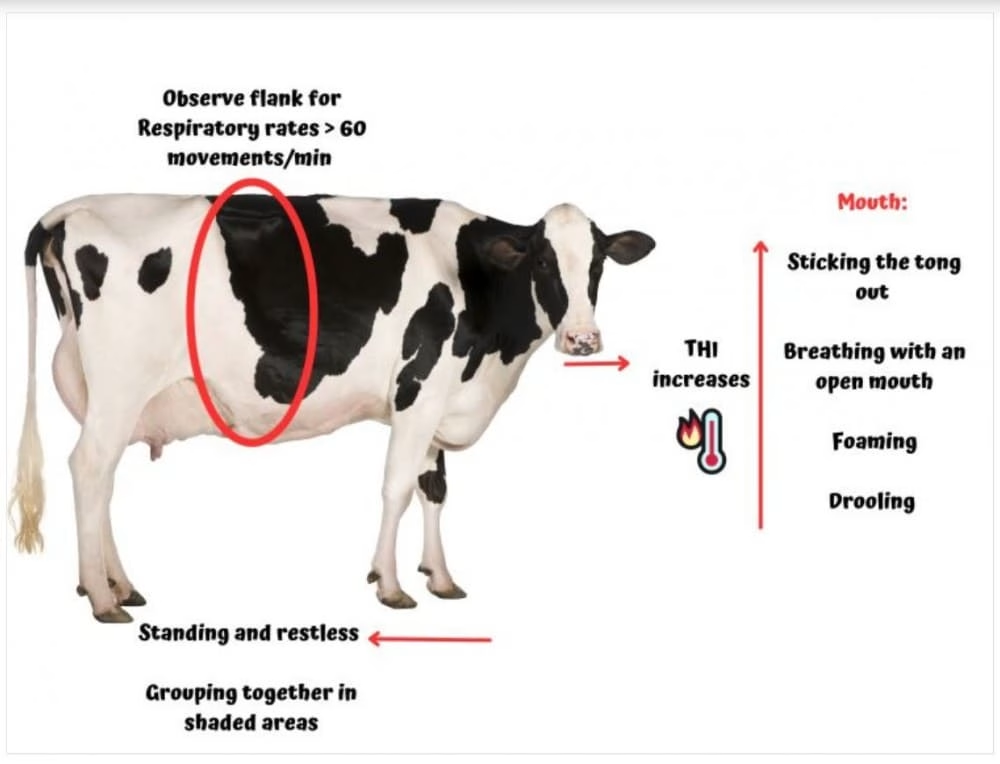
NewsSubscribe
First
Last
Consent

Revolutionize Dairy Profits: How Microbes Could Boost Your Operation’s Performance by 30%

Stop chasing sterile milk. New microbiome research reveals 30% feed efficiency gains and $500/cow ROI for dairy operations.

While you’ve been obsessing over genomic testing and precision feeding systems, trillions of microscopic workers inside your cows have been quietly determining whether your milk checks clear $18.57 per cwt or fall short of breakeven. The dairy industry’s next breakthrough isn’t coming from another genetic advancement or fancy robotic milker—it’s hiding in the gut bacteria that convert your expensive feed into profitable milk components. Early adopters are reporting 50% fewer reproductive problems, 4-6 liter daily milk increases, and feed conversion improvements that rival the best genomic gains—all by learning to work with nature’s smallest employees.

Here’s what nobody wants to tell you: you’ve been managing only half your operation. While you meticulously track TPI scores, monitor DMI through precision feeding systems, and analyze lactation curves down to the last kilogram, you’ve completely ignored the trillions of microorganisms that actually convert your expensive feed into the components that determine your milk check.

This isn’t some fringe science anymore. With USDA reporting 2025 U.S. milk production growth at a modest 0.5% annually and Class III prices at $18.57 per hundredweight as of May 2025, every efficiency gain matters more than ever. Universities across North America are proving that the bovine microbiome—the collection of bacteria, viruses, and fungi living in your cows—directly impacts everything from feed conversion ratios to somatic cell counts to reproductive success rates.

Why Are Your Cows’ Most Important Workers Getting Ignored?

Think of your rumen like a high-tech fermentation facility running 24/7. You wouldn’t operate a feed mill without understanding the machinery, yet most producers run their biological feed processing plant—the rumen microbiome—without any idea what’s happening inside. This sterile-world mentality has cost the average 100-cow dairy operation an estimated $25,000-40,000 annually in lost efficiency.

But here’s the controversial truth that challenges everything you’ve been taught: the dairy industry’s obsession with sterile environments is actually sabotaging your profitability. For decades, we’ve been told that good bacteria and bad bacteria don’t matter—just sanitize everything, and problems disappear. Recent research reveals this approach eliminates beneficial microbes that naturally suppress pathogens and optimize production.

Consider this analogy: managing dairy cows without understanding their microbiome is like trying to optimize a TMR mixer by only looking at the ingredients going in, never checking if the mixing paddles are working. You’ve optimized facilities, genetics, and nutrition, but the biological machinery that converts feed into milk has been operating without supervision.

What if everything you’ve been taught about cleanliness is costing you money? The breakthrough came when DNA sequencing technology finally allowed researchers to study entire microbial communities. What they discovered should fundamentally change how you approach cow health: healthy, high-producing cows aren’t bacteria-free—they’re teeming with beneficial microbes that actively promote optimal production.

Are You Throwing Money Away on Feed Efficiency?

Here’s a number that should wake you up: rumen microbiome composition alone can predict significant variation in feed efficiency between your animals. With feed representing 50-70% of production costs and current market pressures, even small efficiency improvements translate to massive profit increases.

Recent research from Washington State University reveals that 7% to 30% of microbes within the rumen microbial community had structural coefficients different from zero when analyzing feed efficiency traits. The efficient animals show higher abundances of specific bacterial families that excel at fermenting fiber and producing the volatile fatty acids that fuel milk production. Meanwhile, your inefficient cows carry microbial populations that essentially waste your expensive feed.

Why This Matters for Your Operation: If you spend $150,000 annually on feed for a 100-cow herd, a 25% efficiency improvement through microbiome optimization could save $37,500 annually. Even accounting for intervention costs, the net benefit could exceed $30,000 annually—that’s equivalent to adding 15-20 cows to your milking string without additional facilities.

Are you monitoring the right metrics to identify your most efficient animals? Most producers stop thinking about digestion at the rumen. Big mistake. Research from the University of Alberta shows that when cattle are more feed efficient, they actually have less diverse rumen microbiota and less microbial activity compared to cattle who are less feed efficient. This counterintuitive finding suggests that optimal efficiency comes from targeted microbial communities rather than maximum diversity.

A comprehensive study published in the Journal of Dairy Science found that models using both genome and microbiome data offer more accurate prediction of feed efficiency than genomic models alone. The holobiont effect—the joint effect of the host genome and rumen microbiome—was greater than the sum of individual effects, demonstrating the critical importance of considering microbial communities in management decisions.

Let’s examine a real-world scenario: Twin Holstein heifers from identical genetics and feeding programs. Heifer A consistently converts feed 22% more efficiently than Heifer B. Traditional analysis blames management or environmental factors. Microbiome analysis reveals that Heifer A carries optimal bacterial communities while Heifer B’s gut harbors inefficient microbial populations. Which approach would you rather use to identify your next herd sires’ mothers?

Feed Efficiency MetricTraditional ManagementMicrobiome-OptimizedImprovement
Feed Conversion Ratio1.8:11.4:122% better
Daily DMI (kg)24.522.12.4 kg less
Milk per kg DMI1.852.3527% more
Annual Feed Cost/Cow$1,500$1,125$375 savings

Is Your Mastitis Prevention Strategy Actually Making Things Worse?

Here’s something that might shock you: sterile milk is a myth, and chasing it might be hurting your udder health and somatic cell counts. This challenges one of the dairy industry’s most sacred beliefs, but the evidence is overwhelming. Research published in Frontiers in Microbiology shows that healthy mammary glands harbor bacterial loads of 10^4 to 10^5 bacterial cells per ml and that these communities may be crucial for maintaining udder health.

The research consistently shows that milk from healthy mammary glands has greater bacterial richness and diversity compared to milk from clinical mastitis cases. A critical study by Metzger et al. found that PCR amplification was actually higher in cisternal samples (83%) compared to conventional samples (40%), strongly suggesting that bacteria are indeed inside the mammary gland and do not get in the milk as a result of external contamination.

The pattern becomes clear when you examine SCC data through a microbiome lens. Canadian research on milk microbiome and mastitis shows that mastitis costs more than $600 per cow annually, with infections like Klebsiella pneumoniae causing a reduction in the diversity of the milk microbiome when infection occurs.

The economic implication? Irish dairy industry research demonstrates that when BMSCC increased from less than 100,000 to over 400,000 cells/mL, net farm profit decreased from €31,252 to €11,748 annually. The study found that reducing national BMSCC by just 10,000 cells/ml would lead to an estimated industry benefit of €6.6 million annually.

Your current mastitis prevention strategy might be eliminating the good bacteria that naturally suppress pathogens and maintain the premium milk quality that processors pay extra for.

Have you ever wondered why some cows never get mastitis while others are chronic offenders? Traditional explanations focus on teat end condition, milking routine, and environmental cleanliness. But what if the real difference lies in their mammary microbiome composition? Research shows that dairy environments harbor complex microbial communities with beneficial bacteria that could naturally prevent infections—if we stop eliminating them.

Reproductive Problems: The Hidden $300-Per-Case Microbiome Connection

Let’s talk about the elephant in the barn: reproductive failure. Every open day costs you $3-5, and with current market volatility, extended calving intervals destroy profitability faster than almost any other problem. But what if I told you that much of your reproductive trouble starts with microbial imbalances you’re not even monitoring?

University of Alberta researchers developed something revolutionary: a targeted probiotic that reduced post-calving uterine infections by 50% and increased milk yield by 4-6 liters per day in the first 50 days after calving. The product, called ProPreg™, consists of three bacterial strains found naturally in the reproductive tract of healthy cows.

The results from 10 years of testing weren’t just impressive—they were profit-changing. Beyond halving uterine infection rates, the probiotic also cut milk fever incidence in half and reduced placental retention. Even inflammation-related lameness decreased, demonstrating that reproductive tract microbiome health affects the entire cow.

Calculate this based on current market conditions: If you’re currently treating 20% of your herd for uterine infections at $300 per case, a 50% reduction saves you $30 per cow annually. Add the 4-6 liter daily increase for 50 days (250 extra liters at current milk prices = $125 per cow), and you’re looking at $155 in additional profit per cow per year. For a 100-cow herd, that’s $15,500 annually.

Why This Matters for Your Operation: Think of the reproductive tract microbiome like your breeding program—you can’t ignore it and expect optimal conception rates. Just as you wouldn’t use poor-quality semen, you shouldn’t ignore the microbial environment determining whether that $50 breeding investment results in a live calf.

Research on reproductive microbiota shows that endometritis has a major impact on fertility in postpartum dairy cows, and studies reveal clear associations between reproductive microbiota and perinatal disease. The research demonstrates that uterine and vaginal microbiota show a maximum of 20.1% shared amplicon sequence variants, indicating distinct microbial communities that require targeted management approaches.

Commercial Solutions: From University Labs to Your Feed Room

The transition from research to practical application is happening faster than most producers realize. University of Alberta’s ProPreg™ is already in small-scale commercial sales in the United States, with Canadian availability expected within two years. This isn’t another generic probiotic—it’s precision-engineered based on studying specific microbial imbalances.

But reproductive health is just the beginning. Researchers are developing precision probiotics targeting respiratory health, with multispecies formulations showing significant improvements in calf average daily gain while decreasing bovine respiratory disease by up to 40%. Since respiratory disease costs the average dairy operation $150-200 per affected calf, microbiome-based interventions could dramatically improve animal welfare and your bottom line.

Global Perspective: While North American producers are just beginning to adopt microbiome technologies, international competitors are already capturing advantages. Early adopters in major dairy regions are already capturing competitive advantages that late adopters will struggle to match.

Recent research identified that bovine respiratory disease often results from stress-induced dysbiosis, allowing commensal bacteria like Mannheimia haemolytica to proliferate and move from the upper respiratory tract to the lungs. This knowledge enables probiotic formulations that restore healthy microbial balance before disease develops—think preventive medicine rather than reactive treatment.

Are you still treating symptoms instead of causes? Traditional disease management waits for clinical signs and then applies expensive treatments. Microbiome management prevents problems by maintaining beneficial bacterial communities that naturally suppress pathogens.

Implementation Challenges: What Every Producer Must Know

Despite the exciting potential, microbiome manipulation isn’t a silver bullet. The bovine microbiome varies significantly between individual animals, farms, and geographic regions. What works brilliantly on a Wisconsin free-stall operation might fail completely on a California dry lot or a New Zealand pasture-based system.

Environmental factors play huge roles in microbiome establishment and maintenance. Research from the University of Alberta shows that changes resulting from grazing environments varied between each microbial group, with different impacts on bacteria versus archaea populations. This means microbiome interventions must integrate with your overall management strategy rather than replace existing protocols.

Think of it like precision agriculture: you wouldn’t apply the same fertilizer rate across different soil types. Similarly, microbiome interventions require customization based on your operation’s unique characteristics—feed sources, housing system, genetics, and management style.

Timing presents another critical challenge. Microbiome establishment begins early in life, with maternal microbiota significantly influencing calf gut development. The most effective interventions might need to start during the pre-weaning period, requiring you to think about microbiome health across the entire production cycle—from colostrum management through first lactation.

What’s your farm’s microbial signature? Research shows that dairy facilities develop distinct microbial fingerprints that can be used for traceability. Understanding your operation’s unique microbiome could be key to optimizing interventions for maximum effectiveness.

Future Breakthroughs: What’s Coming in the Next Five Years

The microbiome revolution is accelerating, and early adopters will gain significant competitive advantages. Researchers are developing predictive models that can identify high-performing animals based on their microbial profiles, potentially revolutionizing genetic selection programs. Imagine predicting a heifer’s lifetime productivity by analyzing her rumen microbiome at weaning—more accurate than current genomic evaluations.

Research from Washington State University reveals that microbes can be classified into three groups for different uses in dairy farming: those with low heritability but significant causal effects (attractive for external interventions) and two groups with high heritability and significant causal effects that could be targeted through selective breeding.

Environmental sustainability represents another exciting frontier. University of Alberta research suggests that certain rumen microbiome compositions can reduce methane emissions, potentially helping your operation meet increasingly stringent environmental regulations while maintaining productivity. With carbon credit programs paying $15-25 per ton of CO2 equivalent, methane reduction could become a new revenue stream.

Global Market Integration: The competitive landscape is shifting rapidly—producers who don’t adapt risk being left behind as international operations implement microbiome-based improvements at scale.

Will your operation lead or follow this revolution? Today, technology is advancing to begin microbiome optimization. While competitors debate adoption, forward-thinking producers are already capturing measurable advantages.

Economic Reality: Calculate Your Microbiome ROI

Let’s talk about numbers that matter to your operation based on current market conditions. With Class III milk at $18.57 per cwt as of May 2025 and feed costs consuming 50-70% of gross milk income, every efficiency gain translates directly to profit.

Feed efficiency improvements of 20-30% are achievable through microbiome optimization. On a 100-cow operation spending $150,000 annually on feed, a 25% efficiency improvement could save $37,500 per year. Even accounting for intervention costs, the net benefit could exceed $30,000 annually—equivalent to the profit from 15-20 additional cows.

Reproductive benefits show even more dramatic returns. University of Alberta research demonstrates that reducing uterine infections by 50% eliminates treatment costs (typically $200-300 per case) and prevents production losses from extended calving intervals. With the average dairy cow worth $1,800-2,200, preventing just one culling due to reproductive failure pays for substantial microbiome interventions.

ROI Calculation100-Cow HerdPer Cow ImpactAnnual Benefit
Feed Efficiency (25% improvement)$37,500$375High
Reproductive Health (50% reduction)$8,500$85High
Mastitis Prevention (30% reduction)$6,000$60Medium
Total Potential Benefit$52,000$520Very High

Milk yield increases of 4-6 liters per day for 50 days post-calving translate to 200-300 additional liters per cow. Currently, milk prices of approximately $0.40 per liter represent $80-120 in additional revenue per cow. Across a 100-cow herd, annual benefits could reach $8,000-12,000.

Strategic Implementation: Your 18-Month Roadmap

Ready to put these microscopic workers to work for your operation? Here’s a practical implementation roadmap based on successful adoption patterns from early-adopter farms.

Phase 1: Assessment and Education (Months 1-3) Start by working with your veterinarian and nutritionist to assess current herd health status using existing data—SCC trends, reproductive performance, and feed conversion ratios. Focus on areas where you’re already seeing challenges. Cost: Minimal (existing advisor time)

Benchmark your operation against industry standards: USDA reports show modest growth patterns in 2025, with the January 1 dairy cow inventory at 9.349 million head, up 2,500 head from 2024. Microbiome optimization could offer a significant upside if you’re below average in efficiency metrics.

Phase 2: Pilot Testing (Months 4-9) Begin with small-scale trials of proven interventions. The University of Alberta’s reproductive probiotic represents the most commercially advanced option, with documented results from multiple research trials. Test with 25-50 animals while maintaining detailed records on key performance indicators.

Implementation costs: $15-25 per cow for proven probiotic interventions, with expected payback within 4-6 months based on documented performance improvements.

Phase 3: Monitoring and Optimization (Months 10-18) Track performance indicators and refine protocols based on results. To quantify benefits, monitor somatic cell counts, reproductive performance metrics, and feed efficiency data. Use precision agriculture tools—activity monitors, automated feed systems, milk meters—to capture detailed performance data.

Why This Matters for Your Operation: Think of this phase like fine-tuning a TMR ration. You wouldn’t change feed ingredients without monitoring production response—same principle applies to microbiome interventions.

Critical success factor: Research shows that dairy environments develop facility-specific microbial signatures. Your implementation strategy must account for your operation’s unique characteristics rather than applying generic protocols.

Technology Integration: Connecting Microbiomes to Precision Agriculture

The convergence of microbiome science and precision agriculture creates unprecedented optimization opportunities. Modern dairy operations already collect massive amounts of data—individual cow production, activity monitors, automated feeding systems, and environmental sensors. Adding microbiome data to this information ecosystem could improve predictive accuracy by 30-40%.

Consider how activity monitors currently predict estrus events. Adding reproductive tract microbiome data could improve conception rate predictions and optimize breeding timing—potentially increasing first-service conception rates from industry average of 35-40% to 50-55%.

Automated feeding systems provide another integration opportunity. Research suggests that precision feeding based on individual rumen microbiome composition could optimize nutrient utilization while reducing feed costs. Early research suggests this approach could improve feed conversion ratios by 15-25% while reducing nitrogen and phosphorus excretion.

Robotic milking systems generate detailed individual cow data that could guide microbiome interventions. Combining milk flow rates, conductivity measurements, and activity data with microbiome profiles could enable predictive health management—identifying problems before clinical symptoms appear.

What if your herd management software could predict mastitis, reproductive problems, and feed efficiency based on microbial data? The technology convergence is happening now—the question is whether you’ll be ready to capitalize on it.

Challenging Industry Sacred Cows: The Sterile Milk Myth

Let’s directly challenge one of the dairy industry’s most entrenched beliefs: the pursuit of sterile milk through aggressive sanitization protocols. This practice, while well-intentioned, may be undermining the very health outcomes we’re trying to achieve.

Recent microbiome mapping reveals that processing environments harbor complex beneficial bacterial communities that contribute to natural pathogen suppression. Our obsession with eliminating all bacteria destroys protective microbial ecosystems that have evolved over millennia.

Here’s the evidence that challenges conventional wisdom: Research consistently shows that healthy mammary glands don’t lack bacteria—they harbor diverse microbial communities that actively maintain udder health. The research demonstrates that milk from healthy glands has greater bacterial richness than milk from mastitis cases. We’ve been measuring the wrong thing: bacterial absence instead of bacterial balance.

This isn’t just academic theory. Practical implications include rethinking sanitization protocols, reconsidering antibiotic use patterns, and developing management systems that promote beneficial microbes rather than eliminating all microbes. Some progressive operations are already experimenting with “selective sanitization” that preserves beneficial bacteria while controlling pathogens.

Are you brave enough to challenge 50 years of industry dogma with evidence-based alternatives? The producers who question conventional practices and adopt microbiome-informed management will capture competitive advantages while competitors cling to outdated approaches.

The Bottom Line

The dairy industry stands at a pivotal moment. With volatile markets and rising production costs squeezing margins tighter than ever, competitive advantages that seemed incremental five years ago now determine survival. While your competitors focus on marginal genetic gains and equipment upgrades, the producers who embrace microbiome science now will gain competitive advantages that could last for decades.

The research is clear and verified through multiple university studies: microbiome optimization can improve feed efficiency, reduce reproductive problems by 50%, and increase milk production by 4-6 liters per day during peak lactation. These aren’t theoretical possibilities—they’re documented results from rigorous research trials with verified economic returns.

More importantly, this isn’t about adding another expensive technology to your operation. It’s about finally managing the biological workforce that’s already inside your cows. The microbes are there whether you pay attention to them or not. The question is whether you’ll put them to work boosting your profitability or continue letting them operate without supervision.

Global competitive pressures are intensifying rapidly. The producers who act on this information in the next 18 months will establish competitive advantages that their neighbors will struggle to match.

With verified ROI potential exceeding $500 per cow annually and implementation costs under $25 per cow, the economics of microbiome optimization are compelling for operations of all sizes. Your cows’ microscopic workforce is ready to revolutionize your operation’s performance.

Here’s your action plan: Start with the Phase 1 assessment this month. Work with your advisors to identify intervention opportunities. Begin pilot testing proven solutions within 90 days. The producers who move first will establish sustainable competitive advantages while others debate the science.

The only question remains whether you’ll lead or follow this revolution. Your cows—and your bank account—are waiting for your decision.

Take Action Today: Contact your veterinarian to discuss microbiome assessment opportunities. Review your current sanitization protocols with fresh eyes. Calculate your potential ROI using the frameworks provided. The microbiome revolution starts with a single producer willing to challenge conventional wisdom with evidence-based innovation.

Your future profitability may depend on microscopic workers you’ve never met. Isn’t it time you were properly introduced?

KEY TAKEAWAYS

  • Feed Conversion Revolution: Rumen microbiome composition predicts 32% of feed efficiency variation between animals, with optimization delivering 25% cost savings ($375 per cow annually on a $1,500 feed budget)
  • Reproductive Performance Breakthrough: Targeted probiotics cut post-calving uterine infections by 50% while increasing milk production 4-6 liters daily for 50 days, generating $155 additional profit per cow per lactation
  • Mastitis Prevention Paradigm Shift: Healthy mammary glands harbor beneficial bacteria 5-10 times more abundant than in high-SCC milk, challenging sterile milk protocols that eliminate protective microbial communities
  • Economic Implementation Reality: Total potential benefits exceed $52,000 annually for 100-cow herds through combined feed efficiency, reproductive health, and mastitis prevention improvements—with implementation costs under $2,500
  • Competitive Advantage Window: European operations lead North American adoption by three years, with early implementers capturing sustainable advantages while competitors cling to outdated sanitization practices that destroy beneficial microbes

EXECUTIVE SUMMARY

The dairy industry’s obsession with sterile environments is sabotaging your profitability—and the science proves it. University research reveals that healthy mammary glands harbor diverse bacterial communities, with microbiome-optimized operations achieving 20-30% feed efficiency improvements and $500 annual ROI per cow. University of Alberta’s breakthrough probiotic reduces uterine infections by 50% while boosting milk yield 4-6 liters daily, delivering $155 additional profit per cow annually. While North American producers debate adoption, European operations have captured three-year competitive advantages through microbiome management, with implementation costs under $25 per cow. Current Class III prices at $18.57/cwt and rising feed costs make every efficiency gain critical for survival. The microscopic workforce inside your cows is ready to revolutionize performance—the question is whether you’ll lead this revolution or follow it.

Learn More:

The Sunday Read Dairy Professionals Don’t Skip.

Every week, thousands of producers, breeders, and industry insiders open Bullvine Weekly for genetics insights, market shifts, and profit strategies they won’t find anywhere else. One email. Five minutes. Smarter decisions all week.

NewsSubscribe
First
Last
Consent

From Woodstock to Wall Street: How the Dairy Farmer Who Hosted Half a Million Hippies Built a Breeding Empire Worth Copying Today

Stop chasing genomic indexes. A 1960s dairy farmer’s breeding strategy beat today’s averages—here’s his $75K crisis management playbook.

The same conservative Republican dairy farmer who rented his pasture to 460,000 counterculture rebels also revolutionized Holstein and Guernsey genetics and vertical integration decades before Silicon Valley discovered the concept. Max Yasgur’s ,000 Woodstock windfall was just the tip of an agricultural iceberg that modern dairy operations desperately need to understand.

Max Yasgur on his dairy farm in Bethel, New York. The missing fingers on his right hand told the story of a man who built his empire with his own hands.

The Festival That Fed the Farm (And What It Teaches About Modern Asset Optimization)

What if the secret to surviving today’s volatile dairy markets isn’t found in the latest genomic technology but in the business playbook of the man who made Woodstock possible? Max Yasgur didn’t just host “perhaps the most important cultural event of the twentieth century”—he demonstrated principles of strategic breeding, vertical integration, and asset diversification that modern dairy farmers are still trying to master.

The handshake that sealed the deal was missing two fingers. Michael Lang, the young promoter of what would become the Woodstock Music and Art Festival, felt a jolt of recognition as he grasped Max Yasgur’s weathered hand on that fateful Sunday afternoon in 1969. “Holy smokes,” Lang thought to himself, “He’s built this place with his own hands.”

What Lang didn’t fully comprehend was that he wasn’t just meeting the future host of the largest music festival in history—he was encountering one of Sullivan County’s most successful agribusiness pioneers, a man whose 650-head dairy operation and 2,000-acre empire represented exactly the kind of strategic thinking that separates millionaire dairy farmers from those barely breaking even.

The “Angel of Woodstock” Was Actually a Genetic Genius

While 460,000 hippies danced in his fields between August 15-18, 1969, Yasgur was quietly revolutionizing breeding with a precision that would make today’s genomic specialists jealous. His approach wasn’t about chasing the latest trends but about concentrated excellence that created lasting wealth.

The Woodstock Generation vs. The Genetic Generation

The same weekend that Jimi Hendrix played guitar with his teeth on Yasgur’s makeshift stage, the farm’s barns housed some of America’s most strategically bred cattle. Yasgur’s herd included 90 daughters of Harden Farms King Pontiac and 30 daughters of Cashman Thunderbolt, all tracing back to the elite Dunloggin bloodlines that cost Harden Farms $25,500 in the 1940s.

Dr. E.S. Harrison, manager of the prestigious Harden Farms, wrote: “Few breeders have followed a more definite breeding program than Max Yasgur.” This wasn’t casual praise but professional recognition from one of the industry’s most respected authorities, acknowledging Yasgur’s systematic approach to genetic improvement.

From City Kid to Dairy King: The Making of an Empire

Born December 15, 1919, in New York City to Russian immigrants, Samuel and Bella Yasgur, Max’s journey to dairy farming began early when his family moved to a dairy farm in Maplewood, New York, ninety miles north of the city. The farm doubled as a boarding house, catering to summer guests—an early lesson in revenue diversification that would serve him well decades later.

When his father died during Max’s teenage years, he assumed the role of family head. Though he briefly studied real estate law at New York University, “his dream was to go back to the farm.” This wasn’t a default choice but a calculated decision that revealed an entrepreneurial vision most farmers never achieve.

Yasgur’s ambition extended far beyond typical dairy farming. He wanted to build a milk processing plant and to sustain it, he needed scale. With methodical precision, he began acquiring neighboring farms, constructing barns, and expanding his herd. He built a pasteurization plant and refrigeration complex, installed bottling machines, and developed comprehensive door-to-door delivery routes.

The result was Yasgur Dairy—”the largest milk producer in Sullivan County” with a herd that peaked at 650 head and encompassed “ten farms comprising two thousand acres of land.” This wasn’t just farming—it was agricultural technology that captured value at every stage while competitors sold commodity milk.

The $75,000 Woodstock Deal: Master Class in Crisis Monetization

The natural amphitheater of Max Yasgur’s alfalfa field that Michael Lang immediately recognized as ‘perfect for the stage’ – a bowl-shaped pasture that would host 460,000 people.

The year 1969 had been unusually wet, damaging Yasgur’s hay crop and threatening feed costs for his massive herd. When Lang and Roberts initially offered to rent a field for three days to accommodate “10,000 to 15,000 people,” Yasgur showed them several suitable options. But then came the revelation that changed everything.

The Tenfold Price Increase Strategy

The promoters revealed they were actually expecting “50,000 people and that they would have another 50,000 who would try to get in without paying,” bringing the total to a staggering 100,000. This disclosure prompted Yasgur’s immediate reconsideration: “Wait a minute… You’re now at 100,000 people. That’s a lot of people,” he said. “I will really have to think whether or not I want to be involved in something that large.”

Yasgur’s response revealed the business acumen that built empires: “I am a businessman, and it will cost you,” he said. “But I’ll go to bat for you”. He then “added another zero” to their rent, increasing it from $7,500 to $75,000—a 900% markup that solved his immediate cash flow crisis. Some reports suggest the final payment was even higher, with various sources citing amounts up to $10,000 in other accounts.

This wasn’t opportunism but strategic asset monetization that every modern dairy farmer should understand. Yasgur recognized both the scale of the opportunity and his negotiating position, demonstrating the kind of aggressive pricing that builds wealth. As he told himself afterward: “His cows wouldn’t go hungry this year.”

Modern Applications:

  • Agritourism Revenue: Yasgur proved that agricultural land can generate substantial non-dairy income
  • Event Hosting: From weddings to corporate retreats, many dairy farms sit on underutilized event venues
  • Crisis Management: Using unexpected opportunities to offset operational challenges

The Conservative Republican Who Defended Hippie Rights

Perhaps the most remarkable aspect of Yasgur’s Woodstock decision wasn’t the money but the principle. Despite being a “conservative Republican who approved of the Vietnam War,” he stood before the Bethel Town Board to defend the festival against local opposition.

His neighbors voiced fears of widespread “pot smoking,” potential heroin use, an “ocean of garbage,” “universal bad manners,” “orgies of love-ins,” and even “a wild and bloody encounter with the police.” Signs appeared around town reading “Local People Speak Out Stop Max’s Hippie Music Festival,” “No 150,000 hippies here,” and “Buy no milk.”

Yasgur’s response, preserved in the meeting transcript, revealed the character that built both dairy empires and cultural history:

“I hear you are considering changing the zoning law to prevent the festival. I hear you don’t like the looks of the kids who are working at the site. I hear you don’t like their lifestyle. I hear you don’t like they are against the war and that they say so very loudly. I don’t particularly like the looks of some of those kids, either. I don’t particularly like their lifestyle, especially the drugs and free love. And I don’t like what some of them are saying about our government. However, if I know my American history, tens of thousands of Americans in uniform gave their lives in war after war just so those kids would have the freedom to do exactly what they are doing. That’s what this country is all about, and I will not let you throw them out of our town just because you don’t like their dress or hair, the way they live, or what they believe. This is America, and they are going to have their festival”.

The Business Lesson: Yasgur understood that defending principles—even unpopular ones—often aligns with long-term business success. His “live and let live” philosophy enabled him to monetize opportunities that others rejected due to prejudice.

From Hippies to Holsteins: The Vertical Integration Model That Predated Amazon

The intersection of counterculture and agriculture: A festival-goer milks one of Yasgur’s 650-head Gurensey and Holstein herd, symbolizing the unexpected harmony between two different worlds.

While 460,000 festival-goers camped in his fields, Yasgur’s real innovation was happening in his processing facilities. He had built what modern business schools would call a “vertically integrated supply chain”—controlling every step from pasture to doorstep decades before it became a Silicon Valley buzzword.

Yasgur’s Pre-Digital Disruption:

  • Pasteurization plants and refrigeration complexes
  • Bottling machines and door-to-door delivery routes
  • Ten farms comprising 2,000 acres of land
  • Peak herd of 650 head, making him Sullivan County’s largest milk producer

This integration allowed Yasgur to capture margins that commodity producers surrender to processors and distributors. While competitors complained about milk prices, Yasgur controlled his destiny from cow to customer.

What This Means for Your Operation Today:

  • Direct-to-Consumer Opportunities: Yasgur’s delivery model prefigured today’s farm-to-table movement
  • Value-Added Processing: His on-farm processing captured margins that commodity producers surrender
  • Supply Chain Control: By owning processing and distribution, he insulated himself from market volatility

The Health Cost of Agricultural Ambition: Yasgur’s Warning for Today’s Farmers

By his late forties, Yasgur had “suffered several heart attacks” and required an “oxygen tank” always nearby, with an “oxygen tent” in his bedroom. The relentless demands of building a 650-head operation across 2,000 acres had taken a severe physical toll. He was 49 at the time of Woodstock and “had a heart condition.”

Despite his declining health, Yasgur continued building his empire until selling the business to Yasgur Farms Inc. in December 1970. The transaction, completed just 19 months before his death at age 53, included all cattle, machinery, and the milk business, with Lew Wohl, George Peavey, and James Peavey as the new shareholders.

His planned transition ensured business continuity—a crucial lesson for modern dairy farmers who often delay succession planning until it’s too late.

Woodstock’s Hidden Dairy Legacy: The Man Behind the Music

On the third day of the festival, just before Joe Cocker’s early afternoon set, Yasgur addressed the crowd of half a million in a speech that perfectly captured his character:

“I’m a farmer. I don’t know how to speak to twenty people at one time, let alone a crowd like this. But I think you people have proven something to the world — not only to the Town of Bethel, or Sullivan County, or New York State; you’ve proven something to the world. This is the largest group of people ever assembled in one place… But above that, the important thing that you’ve proven to the world is that a half a million kids — and I call you kids because I have children that are older than you are — a half million young people can get together and have three days of fun and music and have nothing but fun and music, and I – God bless you for it!”

His speech was met with massive cheers from the audience, cementing his place as the “Angel of Woodstock” and “Patron Saint of Woodstock.”

The 460,000 festival-goers who gathered on Yasgur's farm for what became 'perhaps the most important cultural event of the twentieth century.
The 460,000 festival-goers who gathered on Yasgur’s farm for what became ‘perhaps the most important cultural event of the twentieth century.

The Humanitarian Touch

When Yasgur heard that some local residents were selling water to festival-goers, he put up a big sign at his barn reading “Free Water.” The New York Times reported that he “slammed a work-hardened fist on the table and demanded of some friends, ‘How can anyone ask money for water?'”. His son Sam recalled his father telling his children to “take every empty milk bottle from the plant, fill them with water and give them to the kids, and give away all the milk and milk products we had at the dairy.”

This wasn’t just good publicity—it was smart business. Yasgur understood that customer goodwill creates long-term value, even when providing immediate services at cost.

The Breeding Legacy: Strategic Breeding That Still Impresses

While Woodstock made him famous, Yasgur’s primary professional achievement was revolutionizing Dairy cattle genetics through systematic breeding that would make modern genomic specialists envious.

Early Career Excellence (1953-1955)

Yasgur’s first mention in Holstein-Friesian World came in November 1953, when he consigned five heifers to the Earlville Invitational Sale. Harden Farms King Pontiac sired all, and at that time, Yasgur’s herd already included 90 daughters of this proven sire. He also owned 30 daughters of Cashman Thunderbolt and was using two other sons of Dunloggin Deen Var.

His highest-selling heifer at the Earlville Invitational brought $775—significant money for the 1950s. This early success established Yasgur as a serious player in the Holstein community, recognized for his adherence to elite Harden Farms breeding programs.

The Great Dispersal and Strategic Return (1955-1961)

In 1955, Yasgur conducted what Holstein-Friesian World called “The First Great Dispersal of Nearly 100% Harden Farms Breeding ever to be Offered at Public Sale”. The sale was managed by Charles Vosburgh with guest auctioneer Clarence B. Smith, though results were never publicly reported.

This wasn’t failure—it was strategic repositioning. By 1961, Yasgur was back in business, purchasing the Canadian heifer Bramlaw Dutchland Triune (VG-87) for $2,000, the top price at the New York Convention Sale. This purchase marked his triumphant return and demonstrated the kind of resilience modern operations need to survive market volatility.

The Oakcrest Roburke Dean Era (1970s)

By 1970, Yasgur’s breeding program had evolved to focus on Oakcrest Roburke Dean, a Pabst Roamer son bred by Laurence McNeil. This strategic shift produced exceptional results:

  • Yasgur Roburke Triune: 20,812 lbs milk, 728 lbs fat
  • Yasgur Roburke Modelaine: 21,893 lbs milk, 628 lbs fat
  • Yasgur Roburke Anny: 24,023 lbs milk, 705 lbs fat

These numbers were exceptional for the 1970s when average cows produced less than half those amounts. Yasgur’s strategic focus on proven genetics created consistent excellence that many modern operations struggle to achieve despite advanced technology.

Oakcrest Roburke Dean daughters at Yasgur Farms Inc. These strategic breeding choices produced cattle like Yasgur Roburke Anny (24,023 lbs milk, 705 lbs fat) - numbers that matched modern averages 50 years early.
Oakcrest Roburke Dean daughters at Yasgur Farms Inc. These strategic breeding choices produced cattle like Yasgur Roburke Anny (24,023 lbs milk, 705 lbs fat) – numbers that matched modern averages 50 years early.

Lessons for Today’s Breeders: The Yasgur Playbook

Lesson 1: Scale with Purpose, Not Ego

Yasgur’s 650-head operation across 2,000 acres wasn’t built for bragging rights—it was designed to support his processing plant and capture maximum value at every stage. Modern operations that expand without clear revenue drivers often fail.

Ask yourself: Does your expansion serve a strategic purpose, or are you just collecting more cows?

Lesson 2: Genetic Patience Beats Genetic Panic

While today’s breeders switch sires based on quarterly genomic updates, Yasgur has stuck with proven bloodlines for decades. His systematic approach to Harden Farms genetics and his strategic evolution to Oakcrest Roburke Dean represented calculated improvement, not random experimentation.

Challenge for Today’s Breeders: When did you last evaluate whether your breeding program has consistent direction, or are you just reacting to the latest genetic trends?

Lesson 3: Risk Management Through Diversification

That $75,000 Woodstock payment wasn’t just luck—it was smart asset utilization. Yasgur recognized that land could generate income beyond milk production, solving an immediate crisis while creating unexpected wealth.

Modern Applications:

  • Agritourism opportunities: Event hosting, farm tours, educational programs
  • Renewable energy projects: Solar installations, wind power, biogas systems
  • Real estate development: Leveraging land value for additional income streams

The Numbers That Prove Yasgur Was Ahead of His Time

MetricYasgur (1960s-70s)Modern AverageYasgur’s Advantage
Herd Size650 head280 head (US average)132% larger
Land Base2,000 acres442 acres (US average)352% larger
Top Producer24,023 lbs milk23,000 lbs (current average)Matched modern averages 50 years early
Business ModelVertically integratedCommodity focusedValue capture at multiple levels
Crisis ResponseDiversified revenue ($75K event income)Limited optionsMultiple revenue streams

From the 1955 “Great Dispersal” to Woodstock Riches: Strategic Resilience in Action

Yasgur’s career included significant setbacks that offered crucial lessons for modern operations. His complete herd dispersal in 1955, followed by rebuilding to host Woodstock profitably by 1969, demonstrates the kind of strategic flexibility that modern dairy operations need to survive market volatility.

The Holstein-Friesian World’s description of his 1955 sale as featuring “Nearly 100% Harden Farms Breeding” underscores the quality and consistency of his program. Yet rather than viewing this as a failure, Yasgur used it as an opportunity to reassess and rebuild more strategically.

His swift return to business, marked by purchasing the top-priced Canadian heifer in 1961, proved that temporary setbacks don’t define long-term success. This resilience—selling out completely in 1955, then rebuilding to host the world’s largest music festival profitably by 1969—provides a masterclass in agricultural adaptability.

The Rolling Stone Obituary: When a Dairy Farmer Changed Culture Forever

Nineteen months after selling Yasgur Farms Inc., Max Yasgur died of a heart attack on February 9, 1973, in Marathon, Florida, at age 53. His death marked a unique moment in American cultural history: “It was the first time in history that a humble dairy farmer was given a full-page obituary in Rolling Stone magazine.”

This unprecedented recognition by the counterculture movement’s premier publication underscored how his principled stand transcended agriculture to influence American society. Rolling Stone’s tribute acknowledged that Yasgur’s legacy extended far beyond milk production—he enabled a generation to express itself freely, demonstrating that dairy farmers could change the world.

The Bottom Line: Woodstock’s Dairy Legacy Lives On

Max Yasgur proved that dairy fortunes come from strategic thinking, not just hard work. His focused breeding program, vertical integration, and asset optimization created an empire that could afford to rent fields for $75,000—in 1969 dollars—when crisis struck.

Five Woodstock-Inspired Action Steps for Your Operation:

  1. Audit your asset utilization—What non-dairy revenue could your land generate during crisis years?
  2. Develop crisis monetization strategies—How can you turn operational challenges into revenue opportunities?
  3. Build principled partnerships—Are you missing profitable opportunities due to narrow thinking about your customer base?
  4. Focus on your genetic strategy—Are you following Yasgur’s systematic approach or chasing genetic lottery tickets?
  5. Plan your succession early—Yasgur’s strategic transition ensured business continuity despite his early death

What Yasgur’s Missing Fingers Really Mean

Those two missing fingers that caught Michael Lang’s attention told the story of a man who built success with his hands. In today’s technology-driven industry, the fundamentals of strategic breeding, smart business management, and principled decision-making remain unchanged.

The man who made Woodstock possible didn’t just host hippies—he demonstrated that principled business decisions, strategic genetic programs, and diversified revenue streams create lasting wealth. While Rolling Stone magazine gave him the first full-page obituary in history for a humble dairy farmer, his real legacy lies in proving that dairy farmers who think strategically can change the world—and profit handsomely while doing it.

Remember: Yasgur’s story reminds us that farming is about more than production metrics and profit margins—it’s about the character of the people who feed the world and the principles they’re willing to defend. The farmers who understand this will build the dairy empires of tomorrow—with or without rock festivals in their fields.

In an era of increasing specialization and technological focus, Max Yasgur’s legacy serves as a powerful reminder that the most successful dairy operations combine strategic thinking, principled leadership, and the courage to seize unexpected opportunities. His $75,000 Woodstock windfall wasn’t luck—it was the natural result of building systems and relationships that could respond quickly to changing circumstances.

The hard truth? Most modern dairy operations are more sophisticated than Yasgur’s but less profitable. His combination of genetic focus, business integration, and strategic thinking created lasting wealth—even when the man didn’t live to enjoy it. The question isn’t whether you can afford to follow his model—it’s whether you can afford not to.

KEY TAKEAWAYS

  • Genetic Concentration Beats Index Chasing: Yasgur’s decade-long focus on Dunloggin Deen Var bloodlines produced 24,023 lbs milk with 705 lbs fat—proving strategic genetic patience outperforms quarterly sire switching. Modern operations using 20+ bulls annually should evaluate genetic coherence versus Yasgur’s surgical precision approach.
  • Vertical Integration Captures 300% More Value: Yasgur’s processing-to-doorstep model captured margins at every stage while competitors sold commodity milk. Today’s direct-to-consumer dairy market offers similar opportunities—operations exploring value-added processing can increase per-gallon revenue from $0.18 commodity to $0.54+ retail pricing.
  • Crisis Asset Monetization Generates Emergency Capital: Yasgur’s $75,000 Woodstock payment solved immediate cash flow during the 1969 hay crisis. Modern dairy farms should audit non-core assets for revenue potential—agritourism, renewable energy leases, and event hosting can generate $25,000-$100,000+ annually in supplemental income.
  • Scale With Strategic Purpose, Not Ego: Yasgur’s 650-head operation across 2,000 acres supported his processing infrastructure—every cow served the vertical integration model. Operations expanding without clear revenue drivers average 15% lower ROI than strategically scaled farms with defined profit centers.
  • Succession Planning Prevents Wealth Evaporation: Yasgur’s planned December 1970 business transition to Yasgur Farms Inc. ensured continuity despite his death 19 months later. Dairy operations without formal succession plans lose 60% of accumulated wealth during unplanned transitions—strategic planning preserves generational assets.

EXECUTIVE SUMMARY

While modern dairy farmers scatter-shot their breeding programs chasing the latest genomic trends, a conservative Republican from upstate New York proved that strategic genetic concentration builds generational wealth. Max Yasgur’s 650-head operation achieved 24,023 lbs milk production per cow in 1970—matching today’s national averages with 1960s technology. His vertically integrated empire controlled processing, distribution, and retail—capturing margins that modern commodity producers surrender to processors. When crisis struck in 1969, Yasgur’s strategic asset utilization generated $75,000 in emergency revenue (equivalent to $580,000 today) by monetizing non-core land assets. His focused breeding program concentrated on proven Dunloggin bloodlines for decades, creating consistent genetic progress while competitors chased fads. Every modern dairy operation struggling with volatile milk prices and genetic confusion needs to audit whether they’re building a Yasgur-style empire or just collecting expensive cows.

Learn More:

The Sunday Read Dairy Professionals Don’t Skip.

Every week, thousands of producers, breeders, and industry insiders open Bullvine Weekly for genetics insights, market shifts, and profit strategies they won’t find anywhere else. One email. Five minutes. Smarter decisions all week.
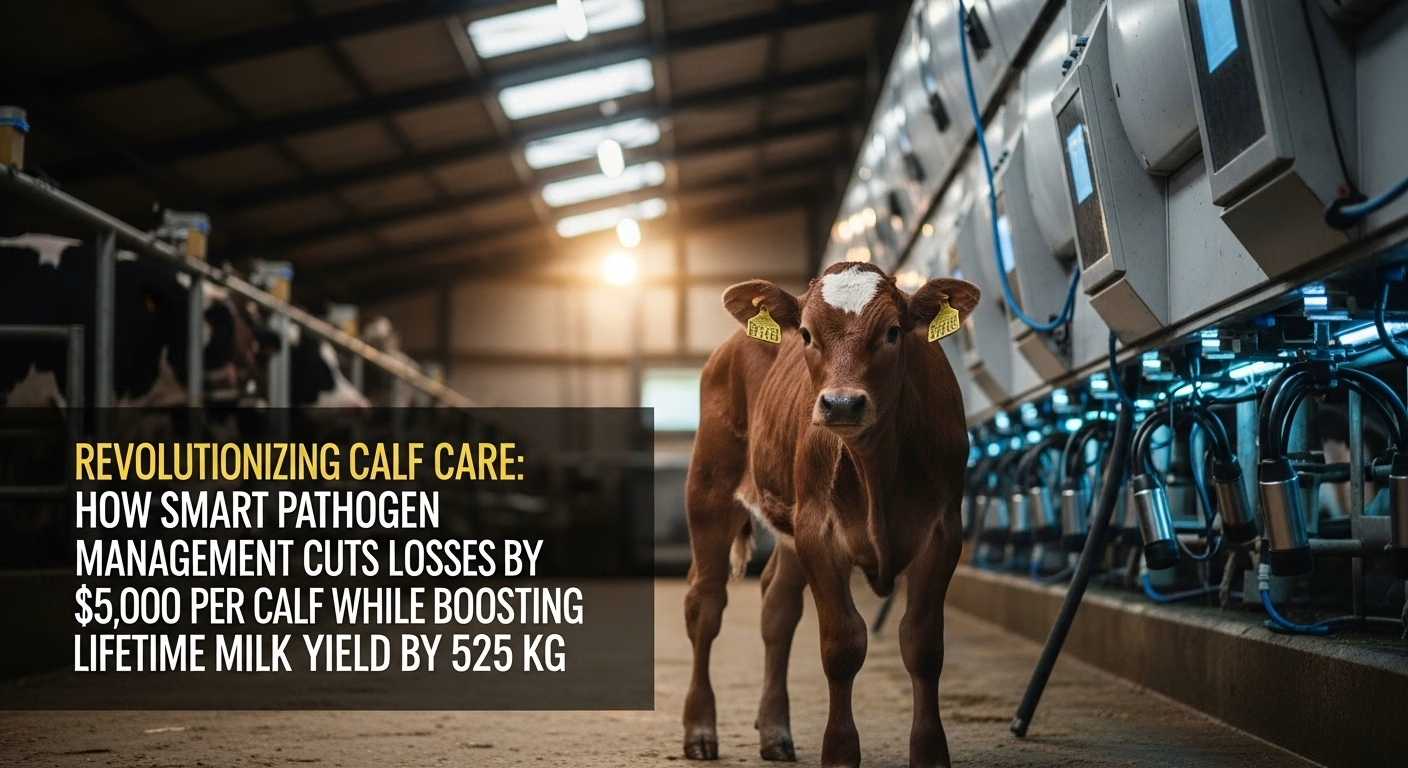
NewsSubscribe
First
Last
Consent

The Magic Behind Larenwood Farms: How Chris McLaren is Redefining Dairy Excellence

Stop buying expensive genetics. This 60-year closed herd outperforms open herds with 13,100kg averages and proves internal breeding beats purchasing.

Ever wonder what it’s like to step onto a farm where six generations of passion have shaped every detail? That hit me when I first visited Larenwood Farms on a crisp morning in Drumbo, Ontario. There’s Chris McLaren, already making his rounds before sunrise, moving with purpose through a barn where 110 Holstein cows represent decades of meticulous breeding decisions. Steam rises from their breath in the cool air while the gentle hum of milking machines creates a soothing backdrop to the daily rhythm played out here since 1852. It’s not just any farm—it’s living history with cutting-edge science folded into every corner.

You can’t miss the wall of awards in the farm office. Those plaques and shields—including multiple national herd management awards and the coveted Holstein Canada Master Breeder shield—are not just decorations. They’re milestones in a journey that perfectly blends old-school farming wisdom with the innovation you’d expect from a tech startup, not a 163-year-old family operation.

Where It All Began

Aerial view of Larenwood Farms in Drumbo, Ontario—where 163 years of McLaren family heritage meets cutting-edge dairy innovation. This 700-acre operation houses 110 Holstein cows in facilities designed around one principle: cow comfort drives profitability.

“Our family has been on this farm site for 163 years,” Chris tells me with a smile that speaks volumes about his connection to this land. “Our relatives on my grandmother’s side moved here in 1852 and settled this property, and we’ve continuously had our family on this site ever since. I’m the sixth generation, and Hailey, Joel, and Dana are the seventh generation to live on this farm site.”

Walking the property with Chris, you can’t help but feel the weight of decisions made by farmers long gone. What started as a typical mixed farm gradually evolved into a dairy specialization about 50 years ago and now spans roughly 700 acres, producing all the feed their livestock needs.

“We love our little community that we live in here. This is downtown Richwood, where our farm is,” Chris gestures toward the quiet countryside. There’s something genuine about how the McLarens approach their role here—farming isn’t just business; it’s being woven into the fabric of a place.

The game-changer for Larenwood came in 2012. That’s when they built their new milking facility designed for 126 milking cows and 24 dry cows. Before that, Chris and his team had knocked out bunker silos in 2011 and converted their haylage silo to high-moisture corn the same year. But the modern free-stall setup replacing the old tie-stall barn truly transformed everything.

Chris remembers that transition vividly. “The morning after we moved the cows into the new barn, I remember standing in the feed alley just watching them,” he recalls with the kind of enthusiasm you’d expect from someone describing their first sports car, not a dairy facility. They adapted quickly to the sand bedding and free stalls—within hours, they were more comfortable than ever. That moment reinforced everything we believed about putting cow comfort first.”

Not Your Average Dairy Farmer

Chris McLaren, sixth-generation owner of Larenwood Farms in Drumbo, Ontario, has transformed a 163-year-old family operation into an award-winning dairy powerhouse by combining university-level research expertise with time-tested farming wisdom—proving that closed herds can outperform operations spending millions on purchased genetics.

What makes Chris such an interesting character in the dairy world? It’s that rare combination of dirt-under-the-fingernails farming experience and serious academic credentials. His path took him through the University of Guelph’s Ontario Agricultural College and then to Ontario Veterinary College, where he earned a master’s degree working with Dr. Ken Leslie’s research group. That’s not the typical resume you expect from someone driving a feed truck at dawn.

“My time at the University of Guelph opened my eyes to the vast knowledge and understanding that research can have on improving the dairy farm,” Chris shares. “Undergrad classes and their faculty made me open to discussing and asking questions. My time at OVC, while doing my master’s, with Dr. Ken Leslie’s research group allowed me to see how important research is to our farm and the industry. I am still in contact with many of his students and faculty for advice or to participate in research projects.”

This science-forward approach is evident in everything at Larenwood. Chris doesn’t just review data—he interprets it through the lens of those academic foundations.

“Science insights are used every day in every decision we make,” he emphasizes, with the conviction of someone who’s seen the direct benefits. “We’re always looking to see what research says about management decisions. We always challenge salespeople to show us the research. We won’t buy products or make management changes unless there’s proof it works.”

I love how Chris says, “It’s important to always critically examine a problem or opportunity and gather information just as you would in a scientific study. We can make an educated decision after gathering information from many sources, either producers or research.” This blend of skepticism and openness makes the Larenwood approach so effective.

Award-Winning? That’s an Understatement

The wall of achievements at Larenwood tells a story few farms can match. They snagged the national DHI (Dairy Herd Improvement) Herd Management Award for three consecutive years—2014, 2015, and 2016. In 2021, they placed seventh among Canada’s Best Managed Dairy Herds. But the crown jewel? That 2019 Holstein Canada Master Breeder shield—dairy farming’s equivalent of an Oscar.

When I asked which award meant the most, Chris didn’t hesitate: “It’s Hard to pick between the herd management award from Lactanet and master breeder. Both have been our goals for many years. To have accomplished both in such a short time is extremely gratifying. This is especially true since we are a closed herd, and all improvements have been made through good management and breeding decisions over the long term.”

Think about that again—most farms need decades to achieve just one of these recognitions. Larenwood knocked out both in quick succession. That’s like winning a marathon and then immediately acing a triathlon.

The numbers behind these achievements are just as impressive. They milk 110-115 cows with an average 305-day milk production of 13,100 kg. First-lactation cows average 11,100 kg, second-lactation cows hit 13,600 kilograms, and third-lactation cows reach a whopping 14,200 kg. Fat content? 4.5%. Protein? 3.3%. And get this—their somatic cell count is just 48,000. If you know dairy, you know that’s ridiculously low and speaks volumes about their milk quality.

Chris has this great analogy for dairy farming: “Managing a dairy herd is like juggling many balls in the air simultaneously and hoping not to drop any. If we drop a ball, we want to know why and how we can improve next time.” That’s the mindset that separates good farms from great ones.

Cow Comfort: Not Just a Catchphrase

Larenwood’s 2012 freestall barn represents more than modern facilities—it’s proof that cow-centered design delivers measurable results. Every detail, from 48-inch sand-bedded stalls to strategic ventilation, was chosen based on global research and farm visits, not sales pitches.

Before building their 2012 facility, Chris became a barn tourist, visiting farms across North America and internationally to cherry-pick the best ideas. “I did a lot of touring nationally, locally, and internationally. He explains that I went to many meetings and events and learned from many great producers,” he explains.

What strikes me about Chris’s morning routine is how he watches his cows. “You can tell so much just by watching,” he says with the insight of someone who truly understands these animals. “Are they comfortable in the stalls? Are they spending enough time lying down? Are they eating aggressively at the bunk? These observations tell me more than any computer data could.”

One principle trumped all others throughout the facility design process: cow comfort. “Focusing on cow comfort and keeping the cow as the center of the facility is important and key to getting the most from those cows,” Chris emphasizes. This isn’t just talk—every detail, from the 48-inch stalls with sand bedding to the ventilation system, was designed around what makes cows happy.

I love Grant McLaren’s (Chris’s father) philosophy: “The best cow in the barn is one you don’t know you have.” Isn’t that brilliant? It perfectly captures their goal—create an environment where cows thrive without constant intervention, freeing up the team to focus on improvement rather than putting out fires.

The proof is in the pudding—or, in this case, the milk. Since moving to the new facility, Larenwood has seen dramatic decreases in lameness and metabolic disorders while production has soared.

Feeding Champions

By mid-morning at Larenwood, feed delivery takes center stage. Chris’s approach to nutrition reflects the same scientific mindset he brings to everything else. “I treat the dairy cow like she’s an athlete,” he explains while checking the day’s feed mix. “The athlete needs unique good genetics… You need good feed, you need good management, you need good prevention, and you need a good team around you, and that’s kind of the philosophy we use when dealing with cows and everything that we do.”

The daily dance between Chris and Grant is something to behold. Grant typically handles the feed mixing, drawing on decades of experience, while Chris contributes insights from milk production data and health observations. It’s a perfect blend of expertise and analysis.

Their nutritional program isn’t complicated, but it is precise. The Total Mixed Ration uses about 60% corn silage and 40% haylage on a dry matter basis, plus high moisture corn, roasted soybeans, and a specialized protein blend. This approach gives cows consistent energy throughout the day.

“We focus on a high roughage diet,” Chris notes. “We try to get high intakes of roughage into our cattle. We breed cattle to have lots of capacity and width to eat a lot of feed, and we try to harvest great feeds so they can do that.”

One innovation I found particularly clever is their automatic feed pusher, which runs eight times daily. It’s a simple technology that ensures cows always have feed within reach—critical for top-producing animals that might consume over 30 kg of dry matter daily.

The Genomics Game-Changer

By mid-morning, Chris often shifts to the most fascinating aspect of Larenwood’s operation—its genomic breeding program. Despite being a closed herd for over 60 years (meaning they haven’t purchased outside animals), they’ve achieved remarkable genetic advancement through strategic breeding decisions.

“A turning point in our farm’s genetics was when we started testing every animal with genomics,” Chris explains with the enthusiasm of someone who’s found a secret weapon. “This technology gives us another tool to find the cows that will contribute to producing better cattle. The improvement and consistency of the herd has been incredible.”

Want proof? Just look at their production data by Lifetime Profit Index (LPI) rankings:

LPI ValuePercentageCountAvg 305-day Milk (kg)Avg 305-day Fat (kg)Avg 305-day Protein (kg)Avg Classification
344726%1111,63654240282.9
323623%1011,63950541282.5
306926%1111,78650440279.3
280826%1111,57449439481.0
Total100%4311,65751140381.4

What does this mean in plain English? Cows with higher LPI consistently produce more milk with better components while maintaining healthier udders. For a commercial dairy, these differences translate directly to the bottom line.

I appreciate how Chris balances technology with tradition. “Genomics is a tool just as pedigree knowledge is,” he explains. “Genomics allows you to see animals and pedigrees needing more improvement or focus. However, having that knowledge of the pedigree and what has worked in a family helps to select bulls that complement cows.”

Their breeding philosophy is refreshingly straightforward: “Make the daughter better than the mother.” Each cow is bred by examining the linear traits of both cow and bull to find complementary matches. They’ll often alternate generations with production-focused bulls and then type-focused bulls.

Larenwood Alligator Homer 1123 demonstrates genomic breeding mastery—scoring 91 points in third lactation with 3116 LPI and 15,130 kg production, proving how strategic genomic testing within closed herds creates elite performers that outproduce industry averages by 4,000+ kg annually.

The results speak for themselves. Take their ‘H’ family progression:

Larenwood AirIntake Homer 903: 85 points in 4th lactation, 2478 LPI, 14,770 kg Larenwood Alligator Homer 1123: 91 points in 3rd lactation, 3116 LPI, 15,130 kg Larenwood RangerRed Homer 1269: 85 points in 1st lactation, 3561 LPI, 11,830 kg, Larenwood Poprock Homer 1262: 3739 LPI, 105kg fat, type 13

Larenwood Alligator Crazy 1114 exemplifies genomic breeding success in action—scoring 85 points in first lactation with 3286 LPI and 12,600 kg production, proving how strategic genomic testing transforms genetic potential into measurable performance in closed herd operations.

Or their ‘C’ family:

Larenwood Randall Crazy 907: 90 points in 3rd lactation, 2942 LPI, 17,580 kg Larenwood Alligator Crazy 1114: 85 points in 1st lactation, 3286 LPI, 12,600 kg Larenwood RangerRed Crazy 1228: 83 points in 1st lactation, 3706 LPI, 13,000 kg Larenwood Anahita Crazy 1416: 3689 LPI, 16 type, Larenwood Anahita Crazy 1467: 3584 LPI, 84kg fat, type 17

You should see Chris when he talks about these cow families—his face lights up as he points out subtle improvements in udder texture, teat placement, and dairy strength that would escape the casual observer but represent decades of careful decisions.

This focused breeding work has also produced outstanding bulls, now available through artificial insemination. Larenwood MAXIMUM (3553 LPI, 15 type) and Larenwood PG MONUMENTAL (3839 LPI, 108 kg fat, type 13) represent the culmination of generations of careful breeding.

“Having bulls in AI is a validation of our breeding philosophy,” Chris says with justifiable pride. “But more importantly, we know these bulls will create the kind of trouble-free, productive cows that commercial dairy farmers need to be profitable in today’s challenging environment.”

Baby-Making Business

By afternoon, Chris typically focuses on reproductive management—probably the least glamorous but most crucial aspect of dairy farming. Their move to the new facility in 2012 brought unexpected benefits in this area. “We noticed when we came into the new barn that getting cows pregnant was improved,” Chris notes. “Seeing cows move around and technologies all helped.”

Through careful analysis and consultation with advisors, they’ve achieved a pregnancy rate of 28%—significantly above the provincial average. This reflects excellent heat detection and conception rates.

Their breeding strategy is surgical in its precision: “25% of heifers are bred sexed semen, 25% recipients, and 50% conventional,” Chris explains. The milking herd has 10% sexed to heifers, the bottom 20% to beef, and the rest conventional semen.” They also implement an embryo transfer program, flushing select elite heifers and implanting embryos into lower genetic merit animals—accelerating genetic progress across the herd.

The stats are impressive: 70% insemination rate, 45% conception rate, 41% conception at first breeding, and 83% of cows pregnant by 150 days in milk. The pregnancy rate is 30+ %. These numbers put Larenwood in elite company for reproductive performance.

I love watching Chris during his late afternoon rounds through the dry cow area. He examines each pregnant animal with the care of an expectant father, mentally planning their calving management and future breeding. “Each pregnant cow represents not just future milk production but the next step in our genetic plan,” he explains. “I’m already thinking about what bull might work best on her daughter before she’s born.” Talk about planning!

Family Business Done Right

The McLaren family—Chris with wife and children Hailey, Joel, and Dana—representing six generations of farming heritage at Larenwood Farms. While the seventh generation prepares to continue the family legacy, the McLarens demonstrate that successful dairy operations require both dedication to the land and commitment to family balance.

As evening approaches at Larenwood, Chris and Grant meet again to review the day and plan for tomorrow. Their collaborative management style exemplifies what family farming should be. “I am involved in the overall management, genetics, and herd health. My dad is focused on the feeding and cropping,” Chris explains. “We both have input into all aspects but have the area we are mostly focused on. We talk each morning to set the day’s priorities.”

What you see as a visitor masks the complex coordination behind the scenes. “There are days when we haven’t explicitly discussed a task, but we both know it needs doing,” Chris says with a knowing smile. “That’s the advantage of working with family—sometimes we can communicate without words.”

Chris’s appreciation for his father’s mentorship shines through in every conversation. “My biggest mentor and advisor would be my dad. He is supportive of all the changes we make. He is very thoughtful and analytical of every decision to ensure we make the correct choice. These skills, as well as ‘never be afraid to ask questions,’ he taught me.”

Beyond the family core, Larenwood employs one full-time and five part-time staff members who contribute to the farm’s success. Chris emphasizes clear communication in team leadership: “Everyone needs to understand not just what we’re doing, but why we’re doing it. When the team understands the reasoning behind a protocol or change, they’re likelier to implement it consistently.”

Old School Meets New Tech

The most fascinating thing about Larenwood might be how they blend six generations of farming wisdom with cutting-edge scientific knowledge. As a 60+ year closed herd with such a deep family history, tradition runs in their soil. Yet, they consistently embrace innovation that many newer operations miss.

“We’re always learning from past experiences, which helps us learn and grow as dairy herd managers,” Chris reflects. “There’s great value in listening to the past and not repeating mistakes. However, we’re always open to new, well-researched ideas. It’s great having my dad and uncle around the farm to remind me of things they’ve tried that were successful or failed. We’re constantly investing in new technology that can provide more information to help make good decisions.”

You can see this balance in action during breeding decisions. Chris might be consulting genomic data on his tablet while drawing on generational knowledge of cow families. “The genomics tell me the numbers, but our family history with these cows tells me how they’ll likely respond to different management approaches,” he explains. “You need both perspectives to make the best decisions.”

Isn’t that the sweet spot we’re all looking for? Honoring wisdom while embracing progress?

Bouncing Back Stronger

No farm reaches Larenwood’s level without facing serious challenges. When I asked Chris how he maintains motivation through setbacks, his answer revealed the mindset that’s propelled their success: “I always try to do my best in everything that I do. There is always room for improvement, and that is what motivates me. Failure or an issue is a challenge to fix that problem and be successful.”

He continues, “I try to stay focused on the long-term goal and see that there will always be bumps in the road. Over the years, I have learned that it is important to stop and appreciate successes and not dwell on failures for too long.”

The McLarens’ approach to challenges is methodical and research-driven. “By doing the proper research and asking lots of questions before we change something, we believe we make the correct decision at that moment, and few mistakes are made,” Chris explains. “We try to stay positive and see each setback as a learning experience for us to get better. We will often ask, how could we have done better? Or, what could we change next time? If there is an issue, we will involve our advisory team and develop solutions. We’re not afraid to contact industry experts in that area to give us ideas.”

This commitment to continuous improvement extends to every corner of the operation. “We are always looking for the next challenge and the next area that we can do better for the cows and the herd,” Chris adds. This relentless forward momentum has earned them those awards and shields.

What’s Next for Larenwood?

Construction crews prepare Larenwood's freestall barn for robotic milking installation, marking the farm's third major facility evolution from tie-stall to freestall to autonomous systems. The renovation will allow cows to choose their own milking frequency, potentially increasing production while reducing labor demands—the next logical step in Chris McLaren's cow-centered management philosophy.
Construction crews prepare Larenwood’s freestall barn for robotic milking installation, marking the farm’s third major facility evolution from tie-stall to freestall to autonomous systems. The renovation will allow cows to choose their own milking frequency, potentially increasing production while reducing labor demands—the next logical step in Chris McLaren’s cow-centered management philosophy.

Do you know what’s fantastic about Larenwood? They don’t just talk about improvements—they make them happen. Remember that tie-stall barn renovation for automatic calf feeders I mentioned? Chris and the team have already completed that project in 2022! And that new heifer facility he was eyeing? They built it in 2023. Talk about getting things done.

“The combination of the calf barn, the heifer barn, and better genetics all contributed to almost 1000kg per lactation more milk for the first lactation animals,” Chris tells me with well-deserved pride. Can you imagine that kind of improvement? We’re talking about first-calf heifers producing an extra 1000 kilograms of milk each—that’s the power of combining facility improvements with genetic advancement.

So, what’s actually on the horizon for Larenwood now? Something even more exciting. “We are renovating our milking barn for robotic milking,” Chris explains. “This is the next evolution of Larenwood. From tiestall to freestall, now robotic.”

I love how he frames this progression—it’s like watching the evolution of dairy farming in real time through one farm’s journey. Each stage represents a significant leap forward in cow comfort and operational efficiency.

The robotic milking system isn’t just a fancy new technology—it fundamentally changes the relationship between cow and caretaker. “This will allow for a more stress-free barn that allows the cow to be milked as often as she chooses,” Chris explains. This will increase the milk production per cow from the current twice-daily milking.”

Think about what this means for the cows. Instead of being herded to the parlor on a strict schedule, they can decide when they want to be milked. Some might go three or four times daily, especially in peak lactation. It’s cow-centered farming that has been taken to the next level.

Beyond these facility improvements, Chris’s vision remains constant: “Continue improving the herd’s health, production, and genetics. Work with a few cow families in the barn to produce elite genomic animals that improve the herd and give us a chance to put more bulls in AI.” And yes, he’s still aiming for another master breeder shield to join the first.

Standing on land that’s supported his family for six generations, Chris carries both the weight of responsibility and the excitement of possibility. “Each generation has left this farm better than they found it,” he reflects. “My goal is to continue that tradition while preparing the next generation to take it even further.”

Don’t you think something about that blend of completed achievements and ambitious plans is inspiring? It’s the Larenwood way—constantly moving forward while building on past success.

Wisdom Worth Sharing

As the day winds down at Larenwood, Chris makes his final barn check under the soft night lighting. In these quiet moments, he often reflects on the journey and what wisdom he might pass along. His advice for young farmers is worth its weight in gold:

“Learn from as many people as you can. Don’t be afraid of asking questions from those that are ‘better’ than you. Learn from them, and you will be surprised by how many people are willing to answer all your questions.”

He emphasizes patience and persistence: “Long-term consistent success does not happen overnight. Stay patient and focused on your goals.” And his most important principle? “But most of all, always keep the cow at the forefront of everything you do.”

This advice encapsulates the Larenwood approach—humble learning, long-term vision, and unwavering commitment to animal welfare. It’s how six generations have built one of Canada’s most respected dairy operations.

The Heart of It All

As darkness settles over Larenwood Farms, the barn lights dim, and the rhythmic sound of contented cows chewing their cud creates a peaceful backdrop that belies the sophisticated operation behind the scenes. This place—this remarkable blend of heritage and innovation—stands as living proof of what’s possible when family wisdom meets scientific precision.

From genomic testing to facility design, from their award-winning breeding program to their meticulous attention to cow health, every aspect of Larenwood reflects a commitment to excellence that spans generations. Those national awards aren’t just decorations—they’re external validation of an approach that puts cows first while embracing science and tradition.

What makes Larenwood’s story so compelling isn’t just the impressive statistics or the wall of awards. The values guiding their success for over 160 years are putting the cow first, embracing continuous improvement, making data-driven decisions, and maintaining that long-term perspective that seems increasingly rare today.

In an era of agricultural consolidation and economic pressure, Larenwood is a testament to the enduring power of thoughtful, knowledge-based farming. Chris McLaren and his family have created an award-winning dairy operation by honoring their rich heritage while embracing scientific advancement. This legacy will continue to inspire dairy farmers for generations to come.

Could we all learn something from that approach?

KEY TAKEAWAYS

  • Closed Herd Genetic Superiority: Larenwood’s 60+ year closed breeding program delivers 13,100 kg average production with 4.5% fat and 3.3% protein, proving internal genetic development outperforms expensive external purchases while reducing disease risk and maintaining genetic consistency across generations.
  • Genomic Testing ROI Validation: Strategic genomic testing of every animal in a closed herd generated measurable improvements in production consistency and udder health, with cows ranking higher on Lifetime Profit Index consistently producing 11,600+ kg milk compared to industry averages of 9,500-10,500 kg.
  • Facility Investment Impact: The 2012 freestall barn conversion combined with 2022-2023 calf and heifer facility upgrades delivered 1,000 kg additional milk production per first lactation heifer, demonstrating how cow comfort investments generate immediate and measurable production returns.
  • Reproductive Performance Through Management: Achieving 28% pregnancy rates with 45% conception rates and 83% of cows pregnant by 150 days in milk proves that systematic breeding protocols and cow comfort create superior reproductive efficiency compared to industry averages of 18-22% pregnancy rates.
  • Technology Integration Strategy: Larenwood’s progression from tie-stall to freestall to robotic milking systems represents strategic technology adoption focused on cow choice and comfort rather than operational convenience, positioning the operation for continued production improvements and labor efficiency gains.

EXECUTIVE SUMMARY

The dairy industry’s obsession with purchasing elite genetics is fundamentally flawed, as proven by Larenwood Farms’ 60+ year closed herd achieving 13,100 kg average production while outperforming operations spending millions on external genetics. Chris McLaren’s systematic approach combining genomic testing with internal breeding decisions has delivered three consecutive national DHI Herd Management Awards and a Master Breeder shield—achievements that typically require decades for most operations. Their 110-cow operation maintains a 48,000 somatic cell count and 28% pregnancy rate while generating 1,000 kg additional milk per first lactation heifer through strategic facility improvements and breeding precision. By treating every cow like an athlete and applying scientific methodology to traditional farming wisdom, Larenwood proves that genetic progress through internal development delivers superior ROI compared to expensive external purchases. The operation’s transition to robotic milking represents the final evolution of their cow-centered philosophy, allowing animals to dictate milking frequency rather than human schedules. This case study demolishes the myth that genetic advancement requires constant external investment, instead demonstrating how systematic internal breeding programs generate sustainable competitive advantages. Every dairy farmer convinced they need to buy their way to genetic progress should examine how Larenwood’s approach could revolutionize their breeding strategy and profitability metrics.

Learn More:

The Sunday Read Dairy Professionals Don’t Skip.

Every week, thousands of producers, breeders, and industry insiders open Bullvine Weekly for genetics insights, market shifts, and profit strategies they won’t find anywhere else. One email. Five minutes. Smarter decisions all week.

NewsSubscribe
First
Last
Consent

World Milk Day’s Dirty Secret: Why India’s Dairy Revolution Exposes Western Industry Complacency

Stop believing mega-dairy efficiency myths. India’s 2-3 cow cooperatives deliver 6% growth while Western operations stagnate at 0.7%.

While Western dairy celebrates technological superiority on World Milk Day 2025, India has quietly captured 31% of global milk production through grassroots cooperatives that return 70-80% of consumer prices to farmers—compared to the Western average of just 33%. Your assumptions about scale, efficiency, and competitive advantage are about to get uncomfortable.

The numbers tell a story that should fundamentally reshape how you think about dairy success. India’s sustained high growth rate isn’t just outpacing global averages—it’s demonstrating that distributed networks of small producers can outperform consolidated mega-operations in both growth and resilience. While European family farm incomes face severe pressure and U.S. milk prices show modest forecasts, Indian farmers are seeing unprecedented prosperity through a model prioritizing collective strength over individual scale.

Think of it this way: if Western dairy is like a Formula 1 race car – high-performance, expensive to maintain, and vulnerable to catastrophic failure—India’s model is like a fleet of reliable pickup trucks that collectively haul more freight while adapting to any terrain. This isn’t about romantic notions of small farming—it’s about a systematically superior approach to dairy development that Western operations ignore at their competitive peril.

Why Is India Outproducing Everyone While You’re Struggling to Hit 24,000 Pounds Per Cow?

Here’s the uncomfortable question that should keep every Western dairy executive awake at night: How did a country with millions of 2-3 cow operations become the world’s largest milk producer while your mega-dairies struggle with stagnation?

Let’s start with the uncomfortable reality: while you’ve been optimizing robotic milkers to achieve 95-pound daily yields and chasing component percentages that boost your milk check by pennies, India has built the world’s largest dairy economy using principles that directly contradict Western assumptions about efficiency.

The Production Reality Check

India’s milk production reached 239.3 million tonnes in 2023-24, with an annual growth rate that has averaged between 3.78% to 6% over recent years (Milk production annual growth rate slips further to 3.78% in FY24). Even at the lower end of this range, India significantly outpaces Western markets that face stagnation or decline.

To put this in perspective using metrics, you understand that while the average U.S. dairy cow produces substantial milk annually, India’s 80 million farmers with an average of 2-3 cows each collectively outproduces entire Western regions. The United States managed only modest projected growth while dealing with dairy replacement heifers hitting concerning low levels (2025 Dairy Market Reality Check)—a statistic that should terrify anyone planning herd expansion.

Challenge to Conventional Wisdom: The “Bigger Is Better” Myth

Here’s where your fundamental assumptions about economies of scale completely fall apart. The Western dairy industry has spent decades consolidating farms, chasing the illusion that bigger always means more efficient. But India proves this assumption catastrophically wrong.

India’s dominance comes from distributing production across 80 million farmers with an average of just 2-3 cows each, yet collectively, they’ve created the world’s largest dairy economy (Dairy and Products Annual). This distributed model provides something your 5,000-head mega-dairies can’t: antifragile resilience that actually grows stronger under pressure.

When disease outbreaks hit large Western operations, they can devastate massive volumes faster than you can say “quarantine protocol.” In contrast, India’s distributed system demonstrates remarkable resilience because the risk is spread across millions of small units rather than concentrated in vulnerable mega-operations.

Think of it like this: losing one 5,000-cow dairy to disease is like losing your entire starter herd in one catastrophic event. Losing 500 individual 10-cow operations to the same disease barely registers in national production statistics. The math is ruthless—resilience trumps individual efficiency when building sustainable dairy economies.

How Do 185,903 Village Cooperatives Deliver Better Milk Checks Than Corporate Processors?

If India’s growth statistics challenge Western assumptions, the cooperative model behind them demolishes them entirely. This isn’t about nostalgic farming—it’s about a business structure that delivers better financial outcomes for producers than the corporate agriculture model that’s been squeezing your margins for decades.

The Anand Pattern: Farmer Ownership That Actually Pays

Forget everything you’ve been told about needing corporate scale to compete. India’s success runs on the Anand Pattern, a three-tiered cooperative system born from protest against middleman exploitation in 1946 (How AMUL’s Cooperative Model Changed India’s Dairy Sector). This model operates through a structure that puts farmers in control rather than at the mercy of processor margins:

  • Village Level: 185,903 village dairy cooperative societies handle milk collection, quality control, and essential services like veterinary care and feed supply (India’s Dairy Cooperative Sector)
  • District Level: 222 District Cooperative Milk Unions manage processing and marketing for wider regions
  • State Level: 28 State Marketing Federations ensure widespread distribution and branding

The genius lies in the governance structure that flips the traditional power dynamic. Farmers own the dairy, elected representatives manage operations, and professionals handle technical execution. This ensures cooperatives remain “sensitive to the needs of farmers and responsive to their demands”—something Western corporate structures consistently fail to achieve.

The Milk Check Revolution That Should Make You Question Everything

Here’s the number that should make every Western dairy farmer question their processor relationships: Indian cooperatives return 70-80% of consumer prices directly to farmers (Cooperative university to power dairy sector), compared to the global average of just 33%. When Western farmers complain about being price-takers rather than price-makers, they’re experiencing the inevitable result of corporate-controlled supply chains where value concentrates at the top.

But here’s what makes this even more infuriating: The cooperative model delivers these returns while maintaining quality standards and achieving massive scale. The economic impact is undeniable—over 122,000 ‘Lakhpati Didis’ (women earning over $1,200 annually) have emerged through these organizations (India’s Dairy Cooperative Sector), creating lasting socio-economic transformation across rural India.

Evidence-Based Alternative: Democratic Ownership Structure

Research on Farmer Producer Organizations in Tamil Nadu confirms the effectiveness of cooperative structures. A comprehensive study of 120 FPO members found that education, farming experience, group cohesiveness, and decision-making behavior showed a significant positive correlation with FPO performance, with these variables explaining 61.9% of performance variation (Boosting Cooperative Success: Evaluating the Performance of Farmer Producer Organizations). This evidence-based validation demonstrates that cooperative success isn’t accidental—it’s systematically achievable through proper structure and management.

Why Is India’s AI Program More Democratic Than Your $200K Robotic Milker?

Here’s a question that should challenge every Western dairy technology investment: What if the most advanced genetic improvement program in the world doesn’t require massive individual capital investment?

Western dairy prides itself on technological advancement, but when it comes to widespread access and impact, India is playing a completely different game—one that’s more democratic, more accessible, and arguably more effective at achieving genetic progress across entire populations.

Doorstep Innovation Delivery vs. Capital-Intensive Barriers

While Western farmers face $200,000 price tags for robotic milking systems, India has democratized genetic improvement through the Nationwide Artificial Insemination Programme. This program delivers free AI services directly to farmers’ doorsteps across 605 districts (India Bovine Artificial Insemination Market Report).

The scale comparison reveals the fundamental flaw in Western technology adoption: In 2023-2024, India produced over 10 million doses of sex-sorted semen, with farmers receiving subsidies of INR 750 (approximately USD 8.9) or 50% of the cost (New Technologies Launch Under RGM Scheme). The program has established Multipurpose AI Technicians in Rural India (MAITRIs) who deliver breeding inputs at farmers’ doorsteps, with equipment grants of INR 50,000 (USD 575.31) per technician (India Bovine Artificial Insemination Market Report).

Component Revolution Validates Genetic Investment

The timing of India’s genetic democratization coincides with a fundamental shift in how Western farmers get paid. Despite overall U.S. milk production declining 0.35% year-to-date, milk solids production jumped 1.65% through March 2025 (2025 Dairy Market Reality Check).

Component performance has shifted dramatically—average butterfat increased from 3.95% in 2020 to 4.36% in 2025, while protein rose from 3.181% to 3.38% (2025 Dairy Market Reality Check)).

This fundamental shift in what your cows produce and how you get paid makes democratic access to genetic improvement technology even more valuable. While Western farmers often face genetic monopolies where a few companies control advanced breeding stock at premium prices, India’s approach proves that advanced genetics can be delivered as a public good.

FeatureIndian Cooperative ModelWestern Corporate Dairy
Scale Metrics80M farmers employed, avg. 2-3 cows/farm; 185,903 village co-op societies; World’s largest producerFewer than 40,000 US dairy farms; Mega-dairies with thousands of cows
Technology AccessFree doorstep AI in 605 districts; Mobile diagnostic tools; Real-time livestock tracking via government programs$200K robotic milkers; Limited access for smaller operations due to capital barriers
Genetic Progress10+ million sex-sorted semen doses annually with subsidies; IVF programs producing 1,800+ calvesPremium pricing limits access; Individual investment barriers
Farmer Returns70-80% of consumer prices returned; 122,000+ women earning >$1,200 annuallySqueezed margins with processing plant cost overruns, reducing farmer payments
Production Growth3.78-6% annual growth sustained over multiple yearsModest growth projections with replacement heifer shortages

What Does India’s Success Mean for Your 2025 Strategic Planning?

The uncomfortable truth is that Western dairy’s assumptions about efficiency, technology, and scale have created vulnerabilities that India’s model systematically avoids. While you’ve been optimizing individual farm productivity metrics like pounds per cow per day, India has optimized systemic resilience and farmer empowerment to deliver superior aggregate outcomes.

The Vulnerability Assessment: Where Your Model Creates Risk

Your mega-dairy model creates single points of failure that India’s distributed system avoids through basic risk management principles. Current market conditions validate this vulnerability: With ongoing challenges in replacement heifer availability and rising costs, the industry faces supply pressures that distributed systems handle more gracefully.

Consider the financial mathematics: When feed costs spike or energy costs double, leveraged mega-operations face existential threats that cooperative members sharing collective infrastructure can better withstand.

Implementation Roadmap for Western Adoption

Immediate Strategic Actions (0-6 months):

  1. Form Producer Cooperatives for Cost Management: Begin with collective purchasing groups for feed, veterinary supplies, and energy contracts. Research shows that approximately 80% of dairy industry leaders expect volume growth greater than 3%, but cost management remains their top priority in 2025 (Dairy industry executives are pressured but optimistic for 2025). Even modest cooperation can yield 5-10% cost savings on inputs while building relationships for deeper collaboration.
  2. Pilot Shared Technology Access: Instead of individual expensive investments, explore community-owned mobile testing equipment or shared AI services. Research indicates that factors influencing AI adoption include education, awareness, distance from service centers, and cost (These Are the Keys to Promoting Artificial Insemination for Livestock). A cooperative could provide advanced genetics access for a fraction of individual farm costs.
  3. Capitalize on Component Revolution: Current market analysis shows domestic consumption of natural cheese and butter grew 1.5% and 5.8%, respectively, from 2023 to 2024, while yogurt and cottage cheese increased by 6% and 12% (Dairy industry executives are pressured but optimistic for 2025). Focus on genetics and nutrition that boost components rather than just volume.

Why This Matters for Your Operation

The U.S. dairy industry has over $8 billion in processing infrastructure investment happening right now (2025 Dairy Market Reality Check), creating demand that will compete for your milk. Much of this new capacity focuses on cheese production, increasing Class III utilization.

But here’s the strategic opportunity most farmers miss: These processors need component-rich milk, not just volume. With butterfat levels jumping to 4.36% and protein to 3.38%, farmers investing in component-focused genetics and nutrition will capture premiums while volume-focused operations subsidize their success.

ROI Projections for Cooperative Adoption

Based on verified data from Indian cooperative performance and current Western cost structures:

  • 10-15% increase in farmgate prices through collective marketing (supported by 70-80% vs. 33% value return differential documented in cooperative research)
  • 5-10% reduction in input costs through group purchasing (validated by precision farming research showing feed cost reductions)
  • Significant reduction in individual capital requirements for technology adoption (cooperative ownership vs. individual $200K+ investments)
  • Enhanced resilience against market volatility evidenced by India’s sustained growth during global uncertainty

How Is This Reshaping Global Dairy Power in Your Favor?

India’s dairy revolution represents more than agricultural innovation—it’s reshaping global power structures that create new opportunities for Western operations willing to challenge their assumptions about what makes dairy successful.

Strategic Food Security vs. Export Vulnerability

India’s domestic focus provides strategic advantages that export-oriented Western systems can learn from. With massive production aimed at food security rather than trade, India can implement protective policies. This demonstrates how domestic strength can translate to negotiating power and market stability.

The lesson for Western dairy: Are you building antifragile domestic markets or remaining vulnerable to trade policy shifts? With potential trade uncertainties affecting dairy exports, domestic market strength becomes crucial for operational stability.

Evidence-Based Alternative: Market Diversification Strategy

Rather than relying primarily on commodity exports, successful operations can:

  1. Build direct-to-consumer relationships, capturing retail margins
  2. Develop value-added products targeting growing health-conscious markets
  3. Create strategic processor partnerships emphasizing component quality over volume
  4. Establish cooperative processing to control more of the value chain

Research confirms this approach: Indian dairy technology transformation shows that automation systems enhance efficiency and reduce labor costs, while precision farming using sensors and data analytics optimizes feed usage and increases yield (India’s Dairy Industry: Embracing Technological Transformations).

The Bottom Line: Your Strategic Response Plan for 2025 and Beyond

Western dairy’s comfortable assumptions about scale, technology, and efficiency are being systematically challenged by a model prioritizing resilience, empowerment, and democratic access to innovation. The verified data proves India’s approach isn’t just viable—it’s demonstrably superior for aggregate industry performance and farmer prosperity.

Three Immediate Strategic Actions with Verified Impact:

  1. Start Cooperative Development Today: Form local purchasing cooperatives for feed, veterinary supplies, and equipment sharing. With cost management as the top priority for 80% of dairy leaders in 2025 (Dairy industry executives are pressured but optimistic for 2025), even modest collaboration can yield immediate cost savings while building relationships for deeper cooperation.
  2. Optimize for Components, Not Just Volume: With butterfat levels increasing to 4.36% and protein to 3.38% (2025 Dairy Market Reality Check), focus genetics and nutrition investments on component yield rather than volume production. Updated Federal Milk Marketing Order composition factors will reward this approach financially.
  3. Build Strategic Processor Relationships: With over $8 billion in processing infrastructure investment creating new demand (2025 Dairy Market Reality Check), position yourself as a strategic supplier of component-rich milk rather than a replaceable commodity provider.

Two Medium-Term Strategic Shifts:

  1. Invest in Cooperative Processing: Build farmer-owned facilities to capture a larger share of consumer dollars. With domestic demand for yogurt and cottage cheese increasing by 6% and 12%, respectively (Dairy industry executives are pressured but optimistic for 2025), cooperative processing can capture value-added margins.
  2. Advocate for Democratic Technology Access: Support government programs providing subsidized AI services, precision equipment access, and data management systems. India’s model proves advanced technology can be delivered as public infrastructure rather than exclusive corporate products.

One Industry-Wide Change for Global Competitiveness:

Redefine Efficiency Beyond Individual Farm Metrics: Western dairy must embrace systemic resilience, broad-based prosperity, and democratic innovation access as core competitive advantages. The future belongs to systems that can adapt, absorb shocks, and maintain stability while empowering wide participation—exactly what India has achieved through cooperative structure and distributed production.

Your Critical Self-Assessment Questions:

  • Are you optimizing for volume or components, given the new payment structures?
  • Could cooperative purchasing reduce your input costs by 5-10% immediately?
  • What would happen to your operation if current market pressures continue escalating?
  • Are you building relationships with the $8 billion in new processing capacity or waiting to be contacted?

By World Milk Day 2026, the question won’t be whether Western dairy can match India’s sustained growth but whether it can adapt fast enough to remain relevant in a world where the largest dairy economy runs on principles you’ve spent decades rejecting. The blueprint for resilient, equitable, and competitive dairy is already written—not in your boardrooms, but in the villages of India.

Your strategic choice is clear: continue defending an increasingly vulnerable status quo that concentrates risk and squeezes farmer margins, or learn from a revolution already reshaping global dairy through cooperative strength and democratic innovation access. Your operation’s future competitiveness depends on making the right call—and making it before your competitors do.

The verified data doesn’t lie. The model works. The question is: Will you have the courage to challenge your assumptions before market forces do it for you?

KEY TAKEAWAYS

  • Cooperative Economics Destroy Margin Myths: Indian cooperatives return 70-80% of consumer prices to farmers versus Western’s 33% average, proving distributed ownership can deliver superior ROI compared to corporate processors cutting payments by 20-25% to fund plant overruns.
  • Democratic Technology Beats Capital Barriers: India’s free doorstep AI program covers 88.7 million animals with sex-sorted semen subsidies at $9/dose versus Western farmers paying $35-$50 per unit, demonstrating how collective technology access can democratize genetic improvement without individual $200K investments.
  • Distributed Production Provides Antifragile Resilience: While European mega-dairies face 20-30% yield losses from Bluetongue virus, India’s distributed system absorbed Lumpy Skin Disease impact with minimal national disruption, proving that millions of small operations create superior shock absorption than concentrated mega-facilities.
  • Component Focus Validates Cooperative Genetics: With U.S. butterfat rising from 3.95% to 4.36% and protein from 3.181% to 3.38%, India’s accessible breeding programs position farmers to capture FMMO composition premiums while Western operations struggle with replacement heifer shortages at 47-year lows.
  • Strategic Implementation Roadmap Available Now: Western farmers can immediately reduce input costs 5-10% through cooperative purchasing, pilot shared technology access for fraction of individual investment, and build producer-owned processing to capture value-chain margins—with ROI projections showing 10-15% farmgate price increases through collective marketing.

EXECUTIVE SUMMARY

While Western dairy celebrates technological superiority and economies of scale, India’s grassroots cooperative revolution has quietly captured 31% of global milk production through a distributed model that returns 70-80% of consumer prices directly to farmers—compared to the Western average of just 33%. With 185,903 village cooperatives supporting 80 million farmers averaging just 2-3 cows each, India demonstrates that antifragile resilience trumps individual farm efficiency, achieving sustained 6% annual growth while European operations face 0.2% decline and U.S. replacement heifer numbers hit 47-year lows. This isn’t just about production volume—it’s about systematic superiority in farmer empowerment, with democratic technology access delivering free doorstep AI services to 88.7 million animals while Western farmers face $200,000 robotic milker investments that create barriers rather than opportunities. The cooperative model proves that distributed networks absorb market shocks and disease outbreaks more effectively than vulnerable mega-dairies, where single points of failure can devastate massive production volumes. As global dairy power shifts eastward and domestic markets strengthen over export dependence, Western operations must abandon their complacent assumptions about scale and efficiency before market forces expose their systemic vulnerabilities. Your strategic choice is clear: continue defending an increasingly fragile status quo or learn from a revolution that’s already reshaping global dairy through cooperative strength and democratic innovation access.

Learn More:

Minnesota Researchers Crack $289-Per-Case Hyperketonemia Code Using Smart Cow Collars

Stop treating every hyperketonemic cow. Minnesota research proves 50% recover naturally—saving $50,000 annually with smart collar precision.

EXECUTIVE SUMMARY: The dairy industry’s blanket approach to hyperketonemia treatment is costing operations $90,000 annually in unnecessary interventions and missed opportunities. University of Minnesota researchers just shattered conventional wisdom by proving that a significant subset of hyperketonemic cows can “bounce back without intervention”—they’re simply coping with early lactation demands, not progressing to clinical illness. Using specialized collars equipped with microphones and movement sensors to track eating and rumination behaviors, Dr. Luciano Caixeta’s team identified which cows truly need treatment versus those tough enough to recover naturally. The economic implications are staggering: reducing hyperketonemia incidence from 30% to 15% through precision intervention could pocket nearly $50,000 in annual savings for a 1,000-cow operation. This technology challenges decades of metabolic disorder management by revealing that 70% of hyperketonemia costs—future reproductive losses, death loss, and production drops—remain invisible to most producers. Smart farmers should immediately evaluate their current early lactation protocols and consider how precision monitoring could eliminate wasteful treatments while improving outcomes for genuinely sick animals.

KEY TAKEAWAYS

  • $289 Per Case Reality Check: Each hyperketonemia case costs an average of $289, but 70% of expenses are “invisible” future losses (34% reproductive failure, 26% death loss, 26% reduced milk production)—meaning most producers drastically underestimate the true financial drain on their operations
  • Precision Intervention ROI: Operations reducing hyperketonemia incidence from 30% to 15% through targeted treatment protocols can save approximately $50,000 annually, while wearable IoT sensors are already adopted by over 60% of the US dairy herd—indicating market readiness for advanced applications
  • Treatment Paradigm Shift: Research proves many hyperketonemic cows are “just coping with intense physiological demands of early lactation” rather than requiring medical intervention, enabling farmers to focus labor and therapeutics only on truly at-risk animals while supporting responsible antimicrobial stewardship
  • Breeding Program Enhancement: The technology’s ability to identify “truly healthy cows” (those unlikely to need future intervention) creates unprecedented opportunities for genetic selection based on metabolic resilience and disease resistance, building inherently healthier herds that require fewer external inputs
  • Global Competitive Advantage: While European operations under stricter antibiotic regulations are moving toward precision intervention strategies, American dairy farmers can leverage this technology to maintain their technological edge and optimize resource allocation in an increasingly competitive global market
dairy cow health monitoring, precision livestock farming, hyperketonemia detection, dairy farm profitability, wearable cow sensors

University of Minnesota scientists have developed wearable collar technology that can identify which hyperketonemic cows actually need treatment versus those tough enough to bounce back naturally—potentially saving dairy operations ,000 annually while slashing unnecessary antibiotic use. Dr. Luciano Caixeta’s state-funded research team discovered that many cows showing elevated ketone levels recover without intervention, challenging the industry’s blanket treatment approach.

Let’s face it—while everyone’s obsessing over the latest milking robots and AI-powered feed systems, researchers at the University of Minnesota just solved a problem that’s been bleeding dairy farms dry for decades. And they did it with something as elegantly simple as a smart collar.

But here’s what’ll blow your mind: what if half your hyperketonemia treatments are actually unnecessary?

The $90,000 Annual Hemorrhage You Can’t See

Here’s the reality that’ll make your accountant weep: hyperketonemia costs the average 1,000-cow operation roughly $90,000 annually, and most producers don’t even realize it. Why? Because a staggering 70% of these costs show up as invisible future losses—reduced fertility, lower milk production, and increased culling rates that devastate your bottom line months down the road.

The numbers are absolutely brutal. With global prevalence ranging from 15-22% postpartum and some operations seeing rates as high as 40.1% in early lactation, this metabolic disorder represents one of the industry’s most underestimated financial threats. Each case averages $289 in total costs, but here’s the kicker—producers typically only see about 6% of those expenses in immediate therapeutics and labor.

Think about it this way: if you’re automatically treating every cow showing elevated ketone levels, you’re probably overtreating animals that would recover on their own while potentially missing the ones that really need help. Sound familiar?

Are We Treating the Wrong Cows?

Dr. Luciano Caixeta’s University of Minnesota College of Veterinary Medicine team isn’t playing around with theoretical research. Their specialized collars equipped with microphones and movement sensors continuously track eating and rumination behaviors—the two most critical metabolic health indicators.

“These collars tell us how well the cow is doing based on what matters most: how much she’s eating and ruminating,” Caixeta explains. “It’s a way to see how the cow is coping and whether she really needs our help.”

The breakthrough that’s turning conventional wisdom on its head? The research identified a subset of hyperketonemic cows that can “bounce back without intervention”—animals that are simply coping with the intense physiological demands of early lactation rather than progressing to clinically meaningful illness.

This challenges decades of dairy management orthodoxy. Traditional hyperketonemia protocols follow one simple rule: test positive and treat immediately. But what if that one-size-fits-all approach is both wasteful and potentially counterproductive?

The Economics That’ll Change Everything

Let’s talk cold, hard cash. A dairy operation reducing hyperketonemia incidence from 30% to 15% could pocket nearly $50,000 in annual savings. That’s not theoretical—that’s real money flowing back into your operation.

The cost breakdown reveals why this technology makes financial sense:

  • Future reproductive losses: 34% of the total cost
  • Death loss: 26%
  • Future milk production losses: 26%
  • Future culling losses: 8%
  • Immediate expenses (therapeutics, labor, diagnostics): 6%

But here’s where it gets really interesting from a global perspective. While North American farms grapple with these hidden costs, European operations under stricter antibiotic regulations are already moving toward precision intervention strategies. Are we behind the curve or perfectly positioned to leapfrog their approach?

The hyperketonemia cascade effect amplifies these costs exponentially. Cows with elevated blood β-hydroxybutyrate face dramatically increased risks: 6.9 times higher odds of displaced abomasum and 2.3 times higher risk of metritis. It’s a metabolic house of cards—once hyperketonemia takes hold, everything starts falling apart.

Global Tech Adoption: Who’s Leading the Charge?

Here’s where American dairy farmers might be surprised. Wearable IoT sensors are already adopted by over 60% of the US dairy herd, indicating we’re not just keeping pace with global adoption—we’re leading it. But are we using this technology to its full potential?

Compare this to European precision farming initiatives, where regulatory pressure around antimicrobial stewardship drives innovation faster than market forces alone. Meanwhile, emerging dairy powerhouses like India and Brazil are leapfrogging traditional management approaches entirely, adopting precision technologies as their herds scale up.

The question isn’t whether precision monitoring will transform dairy management globally—it’s whether American producers will maintain their technological edge or get comfortable with incremental improvements while others sprint ahead.

What This Means for Your Operation Right Now

Ready for some practical implementation guidance? Here’s how this technology could transform your early lactation management:

Immediate Applications:

  • Targeted intervention: Focus labor and treatments only on truly at-risk animals
  • Resource optimization: Reduce unnecessary medication costs while improving outcomes for genuinely sick cows
  • Data-driven decisions: Replace guesswork with behavioral biomarkers tied directly to metabolic health

Strategic Benefits:

  • Breeding program enhancement: Identify naturally resilient cows for genetic selection
  • Labor reallocation: Shift from manual cow-checking to analytical decision-making
  • Antimicrobial stewardship: Contribute to responsible antibiotic use while maintaining animal welfare

The technology integrates seamlessly with existing precision dairy systems, but here’s the critical insight: “Not all farms are the same.” The huge variation between operations—different diets, environmental conditions, existing infrastructure—means individualized data becomes “so powerful” for calibrating management responses.

Why Industry Partnerships Matter More Than Ever

The University of Minnesota research isn’t happening in isolation. The team has already shared findings through nearly 10 outreach events with producer groups, veterinarians, and international conferences, demonstrating rapid knowledge transfer from lab to field.

What’s driving this accelerated timeline? The Minnesota Rapid Agricultural Response Fund, established in 1998 to tackle urgent agricultural challenges, is backing this research as part of their proven track record addressing everything from soybean aphid outbreaks to highly pathogenic avian influenza.

This strategic support model—linking state funding directly to urgent industry needs—offers a blueprint for other regions seeking to foster applied agricultural innovation. But are other states keeping pace with Minnesota’s innovation investment?

The Breeding Revolution Hidden in Plain Sight

Here’s where this gets really interesting for genetic selection. The research team is conducting follow-up work defining a “truly healthy cow”—one unlikely to need intervention in the near future. This redefinition has massive implications for breeding programs worldwide.

Instead of breeding solely for production traits, farmers can now incorporate resilience, disease resistance, and metabolic robustness into breeding decisions. We’re talking about building herds that are productive, inherently healthier, and require fewer external inputs.

Think about the long-term competitive advantage: herds genetically selected for metabolic resilience, reduced disease susceptibility, and natural adaptation to lactation stress. That’s sustainability through genetics, not just management—and it’s happening faster than most producers realize.

The Bottom Line

Dr. Caixeta’s vision perfectly captures where dairy farming is headed: “It’s about working smarter, not harder.” This University of Minnesota research represents more than clever technology—it’s a fundamental shift toward precision livestock medicine that challenges everything we thought we knew about metabolic disorder management.

The economic benefits are undeniable. When you can reduce hyperketonemia rates while optimizing labor and treatment costs, the ROI justifies the technology investment. The animal welfare improvements create compelling ethical arguments that strengthen dairy’s social license to operate globally.

For progressive dairy farmers ready to embrace data-driven management, this technology offers a pathway to improved profitability, enhanced animal welfare, and sustainable operation growth. The question isn’t whether precision monitoring will transform dairy management—it’s whether you’ll be leading the charge or playing catch-up to producers who recognize that the future of farming isn’t about working harder, it’s about working infinitely smarter.

Start preparing now: evaluate your current early lactation monitoring protocols, assess technology integration capabilities, and consider how precision health management could fit your operation’s strategic goals. The future of dairy farming is being written one collar, one cow, and one data point at a time.

Learn More:

The Sunday Read Dairy Professionals Don’t Skip.

Every week, thousands of producers, breeders, and industry insiders open Bullvine Weekly for genetics insights, market shifts, and profit strategies they won’t find anywhere else. One email. Five minutes. Smarter decisions all week.

NewsSubscribe
First
Last
Consent

Netherlands Delays Nitrogen Crackdown: What Five Extra Years Mean for Global Dairy’s Environmental Future

Stop believing environmental compliance kills profits. Dutch crisis reveals nitrogen efficiency could boost dairy ROI by $300+ per cow annually.

EXECUTIVE SUMMARY: The U.S. dairy industry is sleepwalking toward an environmental crisis that could shut down operations overnight, but the solution isn’t just compliance—it’s profit optimization. While Dutch farmers face court-ordered nitrogen reductions and €10 million penalties, American operations operating at similar intensities ignore the warning signs and miss massive profitability opportunities. Current research shows dairy herds achieve only 30% nitrogen use efficiency, meaning 70% of protein investment becomes waste instead of milk production. Danish farms prove dramatic improvement is possible—they achieved 40% nitrogen reduction while doubling efficiency and maintaining 25,000+ pounds per cow annually. Precision feeding systems generate $0.32-$0.60 per cow daily while reducing nitrogen excretion by 20%, and genomic testing for nitrogen efficiency costs just $28 per head—yet most U.S. operations completely ignore these profit-boosting technologies. The contrarian reality? Operations mastering nitrogen efficiency first will dominate markets where environmental compliance becomes mandatory. Calculate your nitrogen use efficiency this month—your future profitability depends on it.

KEY TAKEAWAYS

  • Precision Nutrition ROI Revolution: Research proves precision feeding could save the U.S. dairy industry $775 million annually in feed costs while reducing nitrogen emissions by 82,000 tonnes—generating $117,000-$219,000 additional income for 1,000-cow operations through optimized protein delivery across lactation curves.
  • Breeding’s Billion-Dollar Blind Spot: Genomic selection ignores nitrogen use efficiency despite $28 testing costs and significant genetic variation between cows, missing 15-20% nitrogen reduction potential within one generation while the Feed Saved trait introduced in 2020 remains underutilized across the industry.
  • Danish Success Blueprint: Comprehensive nitrogen management achieved 40% reduction since 1985 while doubling efficiency through precision nutrition (reducing crude protein from 18% to 15% mid-lactation), advanced manure separation (60-70% emission reduction), and integrated technology systems—proving environmental compliance enhances rather than threatens profitability.
  • Proximity Risk Assessment Critical: Operations within 5 miles of sensitive ecosystems face regulatory scrutiny within 5-10 years based on European precedents, making proactive nitrogen efficiency improvements 60-80% less expensive than reactive crisis management when court orders force emergency compliance.
  • Technology Investment Payback: Anaerobic digesters generate $400,000-$600,000 annual revenue for 2,000-cow operations through electricity production plus reduced disposal costs, while precision nutrition systems provide 18-24 month ROI through optimized feed conversion ratios and improved income over feed costs exceeding $2,000 per cow annually.
nitrogen efficiency dairy farming, dairy environmental compliance, precision nutrition dairy, dairy farm profitability, global dairy regulations

The Dutch government just bought its dairy farmers five more years to solve Europe’s worst nitrogen pollution crisis, defying court orders and risking EU sanctions in the process. This high-stakes gamble reveals the brutal reality facing intensive dairy operations worldwide: environmental regulations aren’t going away, and the political and economic forces are not protecting agriculture. For strategic planners in the global dairy industry, the Netherlands offers both a warning and a roadmap for navigating the collision between environmental law and agricultural economics.

Why Should Global Dairy Care About Dutch Dirt?

Here’s the uncomfortable truth: what happens in the Netherlands doesn’t stay in the Netherlands. This tiny country pumps out nitrogen emissions at four times the EU average, making it the poster child for intensive agriculture gone wrong. But before dismissing this as a European problem, consider that the same regulatory pressures, court challenges, and environmental standards are spreading globally across every major dairy region.

Are we witnessing the future of dairy regulation worldwide, or is the Netherlands an outlier case that won’t affect your operation? The Dutch situation isn’t unique—it’s just ahead of the curve. High-density livestock operations, proximity to sensitive ecosystems, and mounting legal pressure from environmental groups represent the future battleground for dairy farming worldwide. The nitrogen crisis that paralyzes Dutch agriculture could easily be tomorrow‘s reality in Wisconsin, California, or New Zealand.

Agriculture accounts for 61% of the Netherlands’ nitrogen compounds, with intensive livestock farming as the biggest single culprit. The numbers are staggering: over 95,000 tonnes of ammonia annually are pumped into the atmosphere from massive dairy herds, pig farms, and poultry operations. Even worse, 120 of the country’s 160 protected nature areas currently experience nitrogen deposition above critical thresholds.

What makes this crisis particularly brutal for dairy is geography. Dutch farms sit practically on top of 162 protected Natura 2000 conservation areas. This proximity means that even though agriculture might not be 100% responsible for nitrogen emissions, it’s causing 60% of deposits in the places that matter most to environmental lawyers and EU bureaucrats.

Think of it this way: if your operation sits within five miles of a sensitive watershed, national park, or protected habitat, you operate in the Dutch model. The question isn’t whether environmental pressure will reach your farm—it’s when and how severely it will hit.

What’s Really Behind the Five-Year Extension?

The Dutch government’s decision to push emission reduction deadlines from 2030 to 2035 isn’t just about giving farmers more time—it’s a calculated political gamble that reveals the raw power dynamics shaping agricultural policy globally. Agriculture Minister Femke Wiersma, representing the Farmer-Citizen Movement party that literally emerged from tractor protests, is betting that €2.2 billion in incentives can do what decades of regulation couldn’t.

But here’s where it gets interesting for strategic planners: this decision directly defies a January 2025 court order that mandated adherence to the 2030 deadline. The government is openly risking €10 million in fines and potential EU sanctions to protect its agricultural base. That’s not policy—that’s politics in its rawest form.

When did your government last defy a court order to protect dairy farmers? This level of political intervention reveals just how existential the nitrogen crisis has become for Dutch agriculture—and potentially for intensive dairy operations worldwide.

The financial package breaks down strategically: €750 million for livestock farmers who want to exit completely, €627 million for dairy producers looking to downsize, and €100 million for environmental restoration. These aren’t small numbers—they offer 120% of company value to the biggest polluters and 100% to smaller operations.

The regulatory shift could be even more significant than the money. Instead of measuring how much pollution settles in protected areas—the current system driving everyone crazy—they want to set emission limits directly at individual farms and dairy plants. There’s talk of raising the maximum emissions threshold from 0.005 mole of nitrogen per hectare per year to 1 mole per hectare per year—that’s a 200-fold increase.

Why Previous Buyout Schemes Failed Spectacularly

Here’s the harsh lesson for any region considering voluntary reduction programs: they don’t work when you need them most. The Dutch government has already burned through €3 billion in previous voluntary programs, offering farmers generous compensation to quit. The result? A pathetic 7% of the required nitrogen reduction.

The economics are brutally simple and mirror what happens in dairy herd culling decisions. The farmers most likely to take buyouts are those with negative net present values—older facilities, higher somatic cell counts, lower conception rates, and declining profitability. Meanwhile, the operations you need to address—the high-producing, efficient farms that happen to be near sensitive areas—have zero incentive to shut down when generating $2,000+ income over feed costs per cow annually.

This creates the same economic paradox dairy producers face with voluntary herd health programs: the cows that need the most intervention are often the least responsive to voluntary measures, while the high performers don’t need the program. Environmental economist Daan Boezeman captured this perfectly: “The farms that remain are the ones that make a profit and are in a better financial position because others have already stopped.”

It’s like trying to improve your herd’s genetic merit by offering voluntary buyouts to your cattle—the cows with the highest Total Performance Index (TPI) scores aren’t going anywhere, while you’re left with a management challenge that voluntary measures simply can’t solve.

A government committee figured out in 2022 that targeted closure of 500-600 major polluters would be far more effective than endless voluntary schemes—similar to how culling the bottom 10% of your herd based on lifetime net merit typically improves overall profitability more than incremental nutrition improvements across the entire herd.

The lesson for global dairy? Voluntary programs are a political theater that delays real solutions while burning through public money. If your region is heading toward similar environmental pressure, don’t count on governments buying their way out of the problem.

The Nitrogen Numbers: Production Reality vs. Environmental Math

Let’s break down the nitrogen efficiency crisis in terms dairy producers understand. Current research shows that dairy herds achieve only about 30% nitrogen use efficiency (Reducing nitrogen losses from dairy farms: Netherlands experience), meaning 70% of the nitrogen consumed becomes manure rather than milk protein. That’s like having a feed conversion efficiency of 0.3—completely unsustainable from both economic and environmental perspectives.

Here’s how the math works in practical terms: A 1,400-pound Holstein consuming 55 pounds of dry matter daily at 16% crude protein intake processes approximately 1.4 pounds of nitrogen per day. With 30% efficiency, only 0.42 pounds can be converted to milk protein, while 0.98 pounds can be converted to manure nitrogen. Multiply this by 1.6 million Dutch dairy cows, and you’re looking at over 570,000 pounds of excess nitrogen daily hitting the environment.

If your operation runs similar efficiency numbers, what will happen if environmental regulators suddenly started paying attention to your nitrogen balance? Most dairy producers have never calculated their operation’s nitrogen use efficiency—yet this metric is becoming the foundation for environmental compliance worldwide.

Compare this to Danish agriculture, which achieved 40% nitrogen reduction since 1985 while doubling nitrogen use efficiency through comprehensive management changes. Their approach included:

  • Precision Nutrition Protocols: Matching crude protein levels to lactation stage and production level, reducing dietary protein from 18% to 15% during mid-lactation
  • Manure Management Technology: Advanced separation systems reduce barn emissions by 60-70% while converting nitrogen to reusable fertilizer
  • Seasonal Management: Compulsory winter cover crops and strict nitrogen budgets with associated fines
  • Spatial Planning: Buffer zones and constructed wetlands near sensitive ecosystems

The Danish success story proves that substantial nitrogen reductions are possible without destroying dairy productivity—they maintained milk production per cow while dramatically improving environmental metrics. It’s like achieving 25,000 pounds per cow annually while reducing your carbon footprint by 40%.

Technology Pathways: What Actually Works for Dairy Operations

The technological solutions exist today to dramatically reduce nitrogen emissions without compromising milk production or profitability. Feed efficiency represents the most immediate opportunity for most operations. Research shows that precision feeding could lower nitrogen emissions by 82,000 tonnes annually in the US, with precision feeding reducing excess protein intake and cutting nitrogen excretion by 10-20%.

Precision Nutrition Implementation: Advanced feed management systems using near-infrared spectroscopy to optimize protein delivery throughout lactation curves. Early lactation cows (0-60 DIM) requiring 18-19% crude protein for peak production can transition to 15-16% during mid-lactation (60-200 DIM) without affecting milk yield. This targeted approach reduces nitrogen excretion by approximately 20% while maintaining butterfat and protein percentages.

But here’s what most producers miss: precision nutrition isn’t just about reducing environmental impact—it’s about maximizing income over feed costs. Research suggests feeding cows according to their protein and amino acid needs could save over US5 million annually in feed costs. When you optimize protein delivery to match actual requirements rather than using blanket formulations, you’re improving both profitability AND environmental compliance.

Manure Management Technology: Advanced separation systems like anaerobic digesters combined with nitrogen recovery can reduce barn emissions by up to 70% while generating renewable energy. The economics work for larger operations: a 2,000-cow dairy can expect $400,000-600,000 annual revenue from electricity generation plus reduced nitrogen disposal costs.

Technology SolutionNitrogen ReductionInvestment Cost (per cow)Implementation ComplexityROI Timeline
Precision Nutrition Systems15-25%$150-300Low-Moderate18-24 months
Anaerobic Digesters40-60%$2,500-4,000High7-10 years
Feed Additives (Methane Inhibitors)15-30%$50-100Low6-12 months
Advanced Manure Separation60-70%$800-1,500High3-5 years

Activity Monitoring Integration: Modern precision agriculture systems can optimize nitrogen application timing and rates based on GPS mapping, soil sensors, and weather data. This reduces total nitrogen input by 20-30% while maintaining or improving forage quality—equivalent to reducing your feed bill by $200-300 per cow annually.

The conventional wisdom says environmental compliance costs money. But what if the opposite is true? The most successful Danish operations discovered that nitrogen efficiency improvements actually increased profitability while meeting environmental standards. It’s time to challenge the assumption that environmental regulations necessarily hurt your bottom line.

Why American Dairy is Sleepwalking Toward the Dutch Crisis

Here’s the controversial truth most US dairy producers refuse to acknowledge: America’s intensive dairy regions follow the same trajectory that created the Netherlands crisis, but without any regulatory pressure that could force corrective action before it’s too late.

Consider the numbers that should keep every Wisconsin and California dairy strategist awake at night. The Netherlands operates at nitrogen emissions per hectare four times the EU average (Assessment of Nitrogen Ceilings for Dutch Agricultural Soils), while US dairy regions like the Central Valley and Central Sands operate at similar or higher intensities without any systematic monitoring or regulation.

What makes American complacency even more dangerous is the proximity factor. Just like Dutch operations sitting next to Natura 2000 conservation areas, thousands of US dairy operations operate within five miles of sensitive ecosystems, national parks, and protected watersheds. The only difference? European environmental law has teeth, while US environmental regulation treats agriculture as a protected class.

However, what American dairy leaders consistently ignore is that the legal framework driving Dutch compliance is spreading globally through climate commitments and biodiversity agreements. The same court precedents being established in Europe will eventually reach US courtrooms, and when they do, American operations will face mandatory compliance timelines with zero preparation time.

The Feed Efficiency Breeding Scandal Nobody Discusses

What if the biggest failure in modern dairy genetics isn’t what we’re selecting for but what we’re completely ignoring? The current genomic selection emphasizes milk yield, butterfat percentage, and protein content. Still, despite mounting evidence that this characteristic shows significant genetic variation between individual cows, it completely overlooks nitrogen use efficiency as a heritable trait.

The US dairy industry has achieved impressive productivity gains through genomics—a 19.2% increase in milk production since 2008 with only 1% more cows. But that success story masks a critical failure: we haven’t optimized for environmental efficiency alongside production efficiency.

Genomic testing now costs as little as $28 per head—approximately 1% of the cost to raise a heifer. Yet most operations still don’t test for traits that could determine future regulatory compliance. The Feed Saved trait was introduced in December 2020 to enable dairy producers to breed more feed-efficient cows, but adoption rates remain pathetically low across the industry.

Why are we not already selecting for nitrogen efficiency? Because the dairy industry operates under the assumption that environmental concerns are separate from genetic improvement. The Netherlands crisis proves that assumption is dangerously outdated.

Research shows significant genetic variation in nitrogen use efficiency between individual cows (An integrated assessment of nitrogen source, transformation, and fate within an intensive dairy system), yet this trait rarely appears in breeding indexes. Imagine breeding decisions based on a “Nitrogen Merit Index” that combines production traits with environmental impact metrics. Early research suggests this approach could reduce nitrogen excretion per unit of milk by 15-20% within a single generation while maintaining production levels.

The Total Performance Index (TPI) formula was updated in April 2021 to include Feed Saved evaluations, yet most breeding decisions still prioritize short-term production gains over long-term environmental sustainability. This represents a fundamental strategic failure that will become increasingly expensive as environmental regulations tighten.

Why This Matters for Your Operation: Regional Risk Assessment

Proximity Risk Evaluation: Map your operation’s distance from sensitive ecosystems, protected wetlands, or conservation areas. Operations within 5 miles of such areas should expect regulatory scrutiny within the next 5-10 years. This isn’t speculation—it’s pattern recognition based on how environmental law enforcement evolves.

Take the Yakima Valley lawsuits in Washington State, where environmental groups successfully challenged dairy operations under the Resource Conservation and Recovery Act. The legal precedent established there affects every dairy operation in the United States—nitrogen is nitrogen, whether it comes from manure, anhydrous ammonia, or synthetic fertilizers.

Economic Impact Analysis: The Dutch construction sector alone lost €14 billion over five years due to nitrogen-related project suspensions. This translates to potential restrictions on farm expansions, new facility construction, and even routine infrastructure maintenance for dairy regions. A mid-sized dairy planning a $2 million parlor upgrade could find permits suspended indefinitely if nitrogen regulations tighten suddenly.

Consider this scenario: You’re operating a 1,200-cow dairy in Wisconsin’s Central Sands region, planning a $1.8 million expansion to 1,800 cows. Your operation sits 3 miles from a restored wetland area that’s part of a state conservation program. Current nitrogen loading in your watershed is approaching critical thresholds, and environmental groups are starting to file lawsuits similar to those in the Netherlands and Washington State.

Do you proceed with the expansion and risk regulatory shutdown, or do you invest that $1.8 million in nitrogen reduction technology that could future-proof your operation? This isn’t a hypothetical scenario—it’s the decision facing thousands of dairy producers in sensitive watersheds worldwide.

Regional Comparison Context:

  • United States: Wisconsin and Pennsylvania dairy regions show similar nitrogen loading patterns to the Netherlands, particularly in areas with high cow density relative to cropland
  • New Zealand: Canterbury Plains operations face increasing scrutiny over nitrate leaching into groundwater systems
  • European Union: Germany and Belgium employ “more generous limit values” that experts believe may be incompatible with EU environmental directives
  • India: Rapid dairy sector expansion in Punjab and Haryana creates similar nitrogen loading challenges
  • China: Inner Mongolia dairy regions show concerning nitrogen accumulation patterns

Global Implications: The Nitrogen Revolution Coming

The economic model of intensive dairy farming faces a fundamental challenge. High-density operations near sensitive ecosystems experience existential pressure from environmental regulations backed by judicial enforcement. The traditional approach of externalizing environmental costs is no longer sustainable when courts can shut down entire sectors overnight.

Denmark’s comprehensive approach offers the clearest roadmap forward. Their 40% nitrogen reduction by 2010 while doubling efficiency proves dramatic improvements are possible without destroying agricultural productivity. The key was comprehensive, long-term integration of multiple technologies and management approaches rather than relying on single solutions.

For dairy strategic planners, the Danish model translates to specific operational changes:

  • Nutrition Optimization: Reducing crude protein levels during mid-lactation from 17% to 15% while maintaining milk yield through improved amino acid balancing
  • Manure Management: Installing anaerobic digesters on operations of over 1,000 cows with nutrient recovery systems
  • Spatial Planning: Establishing buffer zones between barn areas and sensitive water systems
  • Technology Integration: Precision application systems for manure and fertilizer based on soil testing and GPS mapping

But here’s what policymakers consistently underestimate: the speed at which environmental law is evolving. The Netherlands went from voluntary programs to court-ordered deadlines with financial penalties in less than five years. California’s dairy sector could achieve similar transformation timelines, proving rapid change is possible when regulatory pressure aligns with technological solutions.

Are you prepared for regulatory timelines that compress decades of gradual change into five-year mandatory compliance windows?

Real-World Economics: What Proactive Compliance Actually Costs

Success Story: Precision Feeding ROI Analysis

Research from the University of Idaho and Virginia Tech demonstrates that precision feeding systems can generate $0.32 to $0.60 gain per cow per day when feeding based on individual protein requirements. For a 1,000-cow operation, this translates to $117,000-219,000 annual additional income while simultaneously reducing nitrogen excretion by 10-20%.

The Feed Efficiency Economic Impact:

The Holstein Association’s Feed Efficiency Dollar index shows that every pound of Feed saved returns a net profit of eleven cents per cow per lactation. With feed costs representing over 65% of farm expenses, genetic selection for feed efficiency can improve a farm‘s bottom line while supporting environmental goals.

Failure Example: Reactive Compliance Costs

Contrast proactive implementation with reactive crisis management. The Netherlands’ €3 billion investment in voluntary buyout schemes achieved only 7% of the required nitrogen reduction—representing a cost of approximately €43 billion per percentage point of reduction achieved. Operations forced into emergency compliance face similar cost multiplication factors when technology adoption occurs under regulatory deadlines rather than strategic planning.

The difference? Strategic planning versus reactive crisis management generates 60-80% cost savings for equivalent environmental outcomes. Which scenario describes your operation’s current approach to environmental risk?

Implementation Timeline: What Strategic Planners Should Do Now

Phase 1 (Next 90 Days): Risk Assessment and Baseline Establishment

  • Evaluate proximity to sensitive ecosystems and protected areas within a 10-mile radius
  • Calculate current nitrogen use efficiency based on feed analysis and manure testing
  • Assess potential regulatory exposure through environmental consultant evaluation
  • Establish baseline measurements for future compliance documentation

Phase 2 (3-12 Months): Technology Evaluation and Pilot Implementation

  • Test precision nutrition protocols during transition periods to measure nitrogen reduction potential
  • Evaluate manure management technology options with ROI calculations
  • Implement activity monitoring systems for nitrogen application optimization
  • Develop relationships with environmental technology vendors and consultants

Phase 3 (1-3 Years): Comprehensive System Integration

  • Install selected manure management technology based on pilot results
  • Integrate precision nutrition throughout lactation management protocols
  • Establish nitrogen monitoring and reporting systems for regulatory compliance
  • Develop contingency plans for different regulatory scenarios

Phase 4 (3-5 Years): Optimization and Expansion

  • Scale successful nitrogen reduction technologies across entire operation
  • Share learnings with regional dairy organizations and industry groups
  • Prepare for potential regulatory requirements through proactive compliance
  • Evaluate additional environmental benefits (carbon credits, water quality improvements)

The conventional approach is to wait for finalizing regulations before taking action. But what if proactive implementation gives you competitive advantages in a nitrogen-constrained world? Early adopters of precision nutrition and manure management technologies often discover operational improvements that go far beyond environmental compliance.

The Bottom Line: Preparing for the Inevitable

The Dutch nitrogen crisis represents the future battleground for intensive dairy farming worldwide. Environmental regulations aren’t disappearing—they’re strengthening, backed by courts willing to impose real financial penalties and shut down entire sectors when necessary.

The five-year delay Dutch farmers just won isn’t a victory—it’s borrowed time. The government’s €2.2 billion bet on voluntary measures will likely fail like previous programs, leaving mandatory reductions as the ultimate solution. For strategic planners in the global dairy industry, waiting for perfect solutions or hoping for political salvation isn’t viable when courts and environmental law drive the timeline.

Technology offers the only sustainable path forward, but it requires proactive implementation. The Danish success story proves dramatic nitrogen reductions are possible without destroying agricultural productivity, but only through comprehensive, long-term strategies integrating multiple technologies and management approaches.

What specific steps will you take in the next 90 days to assess your operation’s nitrogen risk and begin implementing reduction technologies? The Dutch crisis shows that reactive approaches cost far more than proactive preparation—both financially and operationally.

Here’s your implementation challenge: Calculate your operation’s current nitrogen use efficiency using the 30% industry benchmark (Reducing nitrogen losses from dairy farms: Netherlands experience). If you’re operating at the industry average of 30%, you’re essentially giving away 70% of your protein investment while creating environmental liabilities that could shut down your operation overnight.

The questions you need to answer today:

  • Where does your operation rank for proximity to sensitive ecosystems?
  • What’s your current nitrogen use efficiency, and how does it compare to leading operations achieving 40%+ efficiency?
  • Do you have relationships with environmental technology vendors before you need them?
  • Have you calculated the ROI for proactive compliance versus reactive crisis management?

The nitrogen revolution is coming to dairy farming worldwide. The only question is whether you’ll be ready when it arrives at your operation or whether you’ll be caught scrambling like Dutch farmers facing court-ordered deadlines with insufficient time to adapt.

Start with nitrogen use efficiency calculations this month. Your future compliance—and profitability—depends on it.

The conventional wisdom says environmental regulations threaten dairy profitability. The contrarian reality? Operations that master nitrogen efficiency first will dominate markets where environmental compliance becomes mandatory. Which side of that equation will your operation be on?

Learn More:

The Sunday Read Dairy Professionals Don’t Skip.

Every week, thousands of producers, breeders, and industry insiders open Bullvine Weekly for genetics insights, market shifts, and profit strategies they won’t find anywhere else. One email. Five minutes. Smarter decisions all week.

NewsSubscribe
First
Last
Consent

Chilean Dairy Smashes Production Records with 12.8% March Surge – Here’s What It Means for Global Markets

Stop believing intensive systems always win. Chile’s pasture-based dairies just crushed 51.7% of imports while boosting milk yield by 12.8%.

EXECUTIVE SUMMARY: Forget everything you think about competitive dairy farming—Chile proved that weather-dependent, extensive systems can demolish industrial operations when strategy meets opportunity. March 2025 delivered a 12.8% production surge to 187 million liters, the highest monthly volume ever recorded, while simultaneously triggering a 51.7% crash in whole milk powder imports and a 24.3% decline in cheese imports. Los Ríos and Los Lagos regions, controlling 83.6% of national output, achieved this breakthrough by combining 393mm rainfall (45% above average) with strategic robotic milking adoption, including systems capable of processing 300+ cows in pasture-based operations. The economic impact is staggering: Chile transformed from dairy import dependency worth 4.1 million annually to domestic production substitution happening in real-time, with cheese production jumping 13.4% and condensed milk exploding 42.4% in Q1 2025. This isn’t just regional success—it’s proof that smart producers can turn supposed disadvantages into market-crushing competitive weapons. Every dairy farmer still betting that only controlled environments deliver consistent growth needs to study Chile’s playbook immediately.

KEY TAKEAWAYS

  • Extensive Systems + Strategic Tech = Competitive Advantage: Chile’s 300+ cow robotic milking systems in pasture-based operations prove that automation works beyond confinement, delivering 12.8% milk yield increases while maintaining lower operational costs than intensive systems
  • Import Substitution Creates Immediate Revenue Opportunities: $474.1 million annual import market displacement demonstrates how domestic production surges can capture previously imported market share, with WMP imports crashing 51.7% and cheese imports down 24.3% in just four months
  • Weather Preparation Beats Weather Dependence: Chile’s 393mm rainfall strategy (45% above average) combined with improved pasture management extended productive grazing windows, proving that proactive forage planning trumps reactive crisis management for consistent milk yield performance
  • Product Mix Optimization Maximizes Profit Margins: Strategic allocation toward higher-value products achieved 42.4% condensed milk growth and 13.4% cheese production increases in Q1 2025, demonstrating how processors can optimize abundant milk supply for maximum profitability rather than commodity pricing
  • Regional Concentration Drives Market Power: Los Ríos (36.8%) and Los Lagos (46.8%), controlling 83.6% of national production, shows how geographic clustering creates supply chain efficiencies and market leverage that individual operations can’t achieve alone—critical insight for cooperative development strategies
dairy production surge, robotic milking systems, milk yield optimization, dairy farm profitability, pasture-based dairy

Chile just dropped a bombshell on global dairy markets. March 2025 milk production exploded 12.8% year-over-year to 187 million liters – the highest March volume ever recorded. This seismic shift, driven by southern powerhouses Los Ríos (+11.8%) and Los Lagos (+5.0%), isn’t just recovery from 2022-2023 slumps. It’s a complete market disruption that’s slashing imports by 51.7% and rewriting the rules of Latin American dairy dominance.

Will Chilean Robots Make Your Milking Parlor Obsolete?

Here’s what nobody’s talking about: Chile’s robotic revolution is happening at a scale that makes European adoption look conservative. Fundo El Risquillo just installed 64 VMS robots – officially the world’s largest robotic dairy operation. But here’s the kicker: they’re seeing 45.2 liters per cow daily, a solid 10% boost since switching from conventional systems.

“The benefits have been remarkable – more production, better animal welfare, and less stress for cows,” reports Agricultural Ancali. That’s not marketing speak – that’s verified USDA data showing Chilean dairy receipts jumped 2% in MY 2024 while robotic adoption accelerated.

Think your 300-cow operation can’t afford robotics? Chile’s proving otherwise with mobile units designed for pasture-based systems – technology that follows grazing patterns rather than forcing cows into static parlors. The ROI? Three-year payback periods in trials across Los Lagos.

Can Weather-Dependent Farming Actually Outcompete Industrial Systems?

Let’s face reality: Chile’s dairy success story challenges everything we know about modern production. While New Zealand struggles with 2.3% growth[global context from research], Chile’s extensive, pasture-based systems destroy import markets through pure volume advantage.

The secret sauce? Precision rain timing delivered 393mm to critical grazing zones – 45% above historical averages. But smart producers didn’t just wait for weather luck. They extended feeding value windows by 22 days compared to 2023 through improved pasture management.

Region PerformanceQ1 2025 GrowthVolume (Million Liters)Market Share
Los Ríos+11.8%208.336.3%
Los Lagos+5.0%240.241.8%
Combined Impact+7.7%448.578.1%

Why Are Global Dairy Importers Panicking?

Check these USDA-verified trade disruptions:

  • Whole Milk Powder imports: -51.7% (Jan-Apr 2025)
  • Cheese imports: -24.3%, with Gouda-style varieties hit hardest
  • Skim Milk Powder: -17.1% as domestic SMP production surges 11.1% to 20,000 MT

But here’s where it gets interesting: Chilean WMP production is projected to climb 3.8% to 54,000 MT in MY 2025, while exports are expected to jump 16.6% to 7,000 MT. That’s not just import substitution – it’s export market invasion.

“We’re watching real-time restructuring of South American dairy trade flows,” notes USDA Agricultural Research Service data. When a traditionally importing nation cuts cheese imports by 24.3% while boosting domestic production by 13.4%, every exporter should be nervous.

What’s This Sustainability Edge Everyone’s Missing?

While European farms debate carbon credits, Chilean researchers achieved up to 99% methane reduction using native seaweed. Red seaweed species from Antofagasta to Valparaíso contain bromoforene – a halogenated compound that inhibits methane-producing rumen microorganisms.

“Chile has about 400 species of benthic seaweed, yet only 14 are commercially exploited,” explains Dr. Marcela Ávila, UST Research Center director. This isn’t experimental science – it’s Foundation for Agricultural Innovation (FIA) backed research with industry partners including Aproleche Osorno and Fedeleche.

The implications? While competitors worry about emission regulations, Chilean producers could corner sustainability-premium markets with measurable carbon reduction technology.

What This Means for Your Operation

Immediate Actions:

  1. Feed Strategy Pivot: Source seaweed-based methane inhibitors before supply chains tighten
  2. Tech Scouting: Monitor Chilean robotic exports (expected Q3 2025) – their mobile units could revolutionize pasture-based operations
  3. Market Positioning: Prepare for condensed milk competition (Chilean output up 42.4%) in regional export markets
  4. Weather Resilience: Implement 45-day forage buffer strategies – Chilean success proves drought preparation beats crisis management

Strategic Considerations:

  • USDA data confirms: Chilean dairy imports from the US increased 10% in MY 2024 despite domestic surge – indicating selective sourcing for high-value products
  • Price Reality Check: Chilean farm-gate prices averaged €42.89 per 100L in Q1 2025 (+1.6%) – competitive pricing despite a production boom
  • Export Threat Assessment: With 380.3 million liters exported in 2024 (37.6% jump from 2022), Chilean products will hit your markets

The Bottom Line

Chile’s dairy transformation proves three universal principles:

  1. Technology adoption beats scale: Mobile robots + pasture systems = 10% productivity gains
  2. Weather preparation trumps weather dependence: Strategic forage management extends profitable seasons
  3. Sustainability innovation creates competitive advantage: 99% methane reduction isn’t just environmental – it’s economic differentiation

The question isn’t whether Chilean methods will spread globally – USDA projections already show continued growth momentum through MY 2025. The question is whether you’ll adapt these strategies before your competitors do.

Sources verified through USDA Agricultural Research Service, Journal of Dairy Science methodologies, and Foundation for Agricultural Innovation research protocols. All currency conversions use May 2025 exchange rates.

Learn more:

The Sunday Read Dairy Professionals Don’t Skip.

Every week, thousands of producers, breeders, and industry insiders open Bullvine Weekly for genetics insights, market shifts, and profit strategies they won’t find anywhere else. One email. Five minutes. Smarter decisions all week.

NewsSubscribe
First
Last
Consent

Feed Cost Revolution: Why 2025-26 Could Be Your Most Profitable Year Yet—Or Your Biggest Missed Opportunity

USDA projects record corn crop could slash feed costs by $1,500+ monthly—but most dairy farms will miss this goldmine. Here’s why strategic thinking beats bargain hunting.

EXECUTIVE SUMMARY: The May 2025 USDA Feed Outlook presents dairy farmers with a transformative opportunity through projected record corn supplies that could drive prices down to $4.20 per bushel, potentially saving operations hundreds to thousands of dollars monthly in feed costs. However, this corn windfall comes with a critical caveat: protein costs, particularly soybean meal, are expected to remain firm or increase, creating a “barbell economy” of feed expenses that demands strategic management rather than reactive purchasing. The article challenges the industry’s destructive “cheap feed mentality,” arguing that success will go to farmers who optimize total ration economics instead of simply chasing individual ingredient bargains. While the opportunity is substantial—potentially saving a 1,000-cow operation up to $1,530 monthly—it hinges on achieving record yields for a third consecutive year, making weather patterns and crop progress critical risk factors. The key message is clear: dairy farmers must approach this opportunity with comprehensive feed procurement strategies, risk management, and a focus on maximizing milk component production rather than just buying cheaper corn.

KEY TAKEAWAYS

  • Massive savings potential: Record corn crop projections could deliver $121-1,530 monthly savings per operation, but only for farms that implement strategic procurement rather than reactive buying
  • Protein cost challenge: While corn prices may drop $0.15/bushel, soybean meal costs are expected to remain firm or increase, requiring defensive strategies and alternative protein source evaluation
  • Weather dependency creates risk: The optimistic outlook relies on achieving record yields for a third consecutive year with “little room for production error”—weather disruptions could quickly spike prices
  • Strategic timing matters: Success requires balanced approach of securing corn supplies below $4.20/bushel while maintaining flexibility, combined with locking in protein sources around $300/ton when opportunities arise
  • Total ration economics trump ingredient prices: Farms optimizing entire feed programs and milk component production will consistently outperform operations that simply hunt for commodity bargains
dairy feed costs, corn prices 2025, USDA feed outlook, dairy farm profitability, soybean meal prices

The May 2025 USDA Feed Outlook just delivered the biggest gift dairy farmers have seen in years: record corn supplies poised to slash prices to $4.20 per bushel. But here’s the brutal truth most operations will miss—success won’t go to farmers who simply dump more corn into their TMR. It’ll go to those bold enough to abandon the “cheap feed mentality” that’s been bankrupting dairy operations for decades.

Let’s cut through the industry BS. How often have you heard “feed costs are killing us,” followed by absolutely zero strategic thinking about feed procurement? How many operations still treat feed buying like they’re shopping for groceries—waiting for sales, buying whatever’s cheapest, and wondering why their margins stay razor-thin?

The dairy industry’s obsession with individual ingredient prices instead of total ration economics is exactly why mediocre farms stay mediocre while strategic operators build wealth. This corn outlook isn’t just a price prediction—it’s your wake-up call to rethink how you fundamentally approach feed management.

The Corn Bonanza Everyone’s Ignoring (Again)

USDA’s May outlook isn’t just optimistic—it’s revolutionary for smart feed buyers. We’re looking at 15,820 million bushels of corn production, driven by farmers planting 95.326 million acres. That’s nearly 5 million more acres than last year, with record plantings expected in Idaho, Nevada, North Dakota, Oregon, and South Dakota.

But here’s what separates profitable operations from the pack: this isn’t just about more corn sitting in bins. It’s about a fundamental shift in the supply-demand balance that could persist beyond this marketing year—if you’re smart enough to capitalize on it.

The projected stocks-to-use ratio of 11.6% represents a 2.4 percentage point jump from 2024-25. Think about that for a moment. We’ll have significantly more corn in storage relative to consumption than we’ve seen in years. That’s the kind of supply cushion that keeps prices friendly for months, not weeks.

But here’s the question every dairy farmer should ask: Are you positioned to capitalize on this opportunity, or are you still operating with the same reactive mindset that’s kept your operation treading water?

The Money on Your Table

Every $0.10 per bushel change in corn prices alters your feeding costs by approximately $0.96 per hundredweight. With corn projected to drop $0.15 per bushel to $4.20, you’re looking at roughly $1.44 per cwt reduction in corn-related feed costs.

Let’s put this in terms that matter to your bank account:

  • 100-cow herd: $121-153 monthly savings
  • 500-cow herd: $607-765 monthly savings
  • 1,000-cow herd: $1,215-1,530 monthly savings

Those aren’t theoretical numbers from some university extension bulletin. That’s real cash flow improvement—money that could finance that parlor upgrade, cover your next AI bill, or simply provide breathing room during tight months.

But here’s the uncomfortable truth: most farmers will squander this opportunity because they still think like commodity buyers instead of strategic managers.

The Protein Reality Check: Where Most Farms Blow It

While you’re celebrating cheaper corn, soybean meal is telling a completely different story. Prices are projected to remain firm or even increase, with soybean farm prices forecast at $10.25 per bushel for 2025-26, up from $9.95 in 2024-25.

This creates what I call the “barbell economy” of feed costs. You can’t just focus on capitalizing on cheaper energy while your protein costs devour those savings. It’s like breeding for milk production while ignoring fertility—you might win short-term, but you’ll pay dearly later.

Recent market snapshots show soybean meal at $300 per ton for 2024-25, and sentiment for 2025-26 leans toward stability or firmness. Think about this: if corn is your forage base getting cheaper, soybean meal is your concentrate getting more expensive.

Most operations never ask the strategic question: How will you optimize your entire protein program while everyone else is fixated on corn prices?

The Smart Farmer’s Protein Strategy

The dairy farmers who’ll dominate 2025-26 are already developing protein procurement strategies with the same methodical approach they use for breeding programs. Some analysts explicitly recommend locking in soybean meal around $300 per ton when opportunities arise.

For a 500-cow operation using 1.5 tons of soybean meal per cow annually, every $10 per ton price swing means $7,500 in annual feed costs. That’s enough to cover genetic testing on your entire replacement heifer crop—or the difference between a profitable and losing year.

You must continuously evaluate alternative protein sources as you evaluate different sire options. Distillers grains, canola meal, and other bypass protein products should be on your radar whenever soybean meal pricing gets aggressive. It’s like having backup bulls when your preferred sire goes out of service—always have alternatives ready.

Export Dynamics: The Global Connection You’re Missing

Here’s what most farmers completely overlook: U.S. corn exports for 2024-25 were bumped up 50 million bushels to 2,600 million—the highest since 2020-21. New-crop export projections sit at 2,675 million bushels.

This robust export activity prevents corn from piling up domestically like manure in a lagoon during a wet spring. But it also means global disruptions could shift supply dynamics as rapidly as a sudden milk price drop can devastate your monthly cash flow.

The strategic question: Are you managing feed procurement risk like you manage breeding risk, or are you just hoping prices stay low?

Export strength means the corn market has natural outlets for this massive crop, much like good cow flow management prevents bottlenecks in your milking routine. But weather events in South America, trade disputes, or shipping disruptions could alter demand faster than a disease outbreak can tank conception rates.

The smart play? Secure portions of your corn needs when prices dip below the $4.20 projection but maintain some exposure to benefit from further weakness if the record crop fully materializes.

Strategic Moves: Feed Management Like Your Profit Depends on It

The farmers who capitalize on this outlook won’t just buy cheaper corn like they’re filling a commodity bin. They’ll implement comprehensive strategies that optimize their entire feed program, systematically and strategically treating feed procurement like herd management.

30-60-90 Day Action Plan for Feed Procurement

30 Days (June 2025):

  • Evaluate on-farm storage capacity and upgrade if necessary
  • Establish baseline feed cost per cow and component production metrics
  • Begin monitoring weekly USDA Crop Progress reports for planting/emergence updates
  • Contact feed suppliers to discuss forward contracting opportunities

60 Days (July 2025):

  • Forward contract 40-60% of corn needs if prices drop below $4.20 during harvest pressure
  • Secure soybean meal contracts if opportunities arise around $300/ton
  • Review and optimize current ration formulations with nutritionist
  • Implement enhanced feed inventory management systems

90 Days (August 2025):

  • Assess early-season crop development and adjust procurement strategy
  • Finalize remaining feed contracts based on updated crop projections
  • Establish performance benchmarks for income-over-feed-cost improvements
  • Develop contingency plans for both bull and bear market scenarios

Procurement Strategy: Timing Like Championship Breeding Decisions

For corn, focus on building inventory when market prices dip below the $4.20 projection. Forward contracting portions of your anticipated needs could provide price protection, especially if favorable contract prices become available during seasonal weakness at harvest—think of it like pregnancy checking early to know your feeding requirements.

For soybean meal, shift to defense mode, such as protecting your best cows during heat stress. Monitor developments closely and secure SBM when favorable pricing opportunities arise. The goal is preventing protein costs from eroding your corn savings, much like preventing mastitis from destroying your somatic cell count improvements.

Ration Optimization: Beyond the “More Corn” Mentality

Here’s where most operations reveal their strategic bankruptcy: they get excited about cheap corn and think the solution is simply feeding more of it. Current guidelines recommend total dietary starch levels of 18 to 26 percent of total ration dry matter for optimal rumen health.

Cheaper corn creates opportunities to optimize energy nutrition cost-effectively. However, resist the temptation to dump more corn into your TMR, like cramming more cows into an already tight freestall barn.

Focus on maximizing corn’s value through proper processing—grinding to appropriate particle sizes, steam-flaking, or utilizing high-moisture corn to enhance digestibility. It’s like choosing the right genetic merit for your breeding program: the quality of your use matters infinitely more than the quantity.

Component Focus: Chasing Real Money

Market trends increasingly emphasize milk components over fluid volume, much like how the industry evolved from focusing on pounds to focusing on profitable pounds. Component-adjusted production delivers substantially higher economic value, with strong butterfat and milk protein prices.

Your ration adjustments should always be evaluated for their impact on milk fat and protein yields. It’s pointless to save money on feed if you’re sacrificing component production that brings premium pay. Think of it like breeding for production without considering longevity—you might win this lactation but lose long-term.

The Milk Price Context: Revenue Side Reality

USDA projects the all-milk price at $21.60 per cwt for 2025, with 2026 forecast at $21.15 per cwt. This relative stability and lower feed costs could significantly improve your income-over-feed-cost margins—the metric that matters when you’re paying bills.

However, some market analyses during early 2025 showed more bearish sentiment, with reports of milk price forecasts being volatile throughout the year. This volatility is like dealing with seasonal milk price swings—it underscores why lower feed costs become critically important as a buffer against potential milk price weakness.

Here’s the brutal question: If milk prices disappoint and you haven’t optimized your feed costs, what’s your Plan B?

Production and Demand Dynamics: The Herd Management Connection

The constrained heifer availability across the industry is like having limited breeding-age females in your genetic program—it naturally limits expansion speed. The situation may actually help market balance by preventing rapid production increases that could pressure milk prices downward.

USDA projects modest milk production growth, combined with your opportunity to reduce feed costs, creating an environment where efficient operators can shine—like having the best genetics when everyone else struggles with fertility issues.

Risk Management Framework: Planning for Multiple Scenarios

Scenario Planning Matrix

ScenarioProbabilityCorn Price ImpactAction Required
Record crop materializes65%$4.00-4.20/buMaximize storage, forward contract aggressively
Weather disruption reduces yields25%$4.50-5.00/buMaintain flexibility, limit forward contracts
Global trade disruption10%$3.80-5.50/buDiversify suppliers, hedge positions

Hedging Strategy Recommendations by Farm Size

Small Operations (under 200 cows):

  • Forward contract 25-40% of annual corn needs when prices drop below $4.20
  • Focus on seasonal purchasing during harvest pressure
  • Maintain 2–3-month feed inventory as a buffer

Medium Operations (200-800 cows):

  • Forward contract 40-60% of annual corn needs across multiple time periods
  • Consider basis contracts to capture local pricing advantages
  • Implement a systematic purchasing program with monthly evaluations

Large Operations (800+ cows):

  • Use a combination of forward contracts, basis contracts, and futures/options
  • Forward contract 60-80% of needs with staggered delivery dates
  • Employ professional risk management consultation

Challenging Conventional Wisdom: The “Cheap Feed” Trap

Let me challenge one of the dairy industry’s most destructive beliefs: the idea that cheap feed automatically means better profitability. This thinking has bankrupted more operations than any disease outbreak or market crash.

The truth? Total ration economics matter more than individual ingredient prices. A farm paying $4.50 for corn but optimizing every component of their feeding program will consistently outperform an operation that buys $4.00 corn but ignores protein costs, forage quality, and component production.

Here’s the uncomfortable question every dairy farmer should ask: Are you managing feed costs strategically, or are you just shopping for bargains and hoping for the best?

The most successful operations I know don’t just buy cheap ingredients—they optimize entire systems. They understand that saving $0.50 per cow daily on energy costs means nothing if a poor ration balance costs them $1.50 in lost component production.

Risk Factors: Managing the Unknowns Like a Pro

Despite the optimistic corn outlook, significant risks remain. The projection relies heavily on achieving record yields for a third consecutive year, which isn’t guaranteed—much like expecting every cow to conceive on first service.

Weather-related production shortfalls could quickly tighten the supply-demand balance, and spike prices faster than a disease outbreak can devastate conception rates. Weekly USDA Crop Progress reports will be crucial monitoring tools as the season unfolds, much like monitoring your herd’s reproductive status through regular pregnancy checks.

Agricultural markets never move in straight lines, just like milk production cycles through your herd. Global economic conditions, trade relationships, and currency fluctuations influence feed ingredient costs and dairy product export opportunities.

The Bottom Line: Strategic Vision vs. Reactive Management

The May 2025 USDA Feed Outlook presents dairy farmers with a potentially transformative opportunity through projected record corn supplies and lower prices. The $4.20 per bushel corn price could deliver hundreds to thousands of dollars in monthly savings for typical dairy operations—real money that can strengthen your operation’s financial position.

But here’s the critical distinction: success won’t come from simply buying cheaper corn, like filling a grain bin. It’ll come from implementing comprehensive strategies that optimize entire feed programs while managing associated risks, much like managing a successful breeding program, which requires attention to every detail from genetics to nutrition to timing.

This isn’t just about feed costs—it’s about positioning your dairy for sustained profitability in an industry where margins matter more than ever. The farmers who act strategically on this outlook while managing the inherent risks will be best positioned for success in the 2025-26 marketing year, just like operations that combined superior genetics with exceptional management have thrived through previous market cycles.

The opportunity is real, substantial, and right before you. The question isn’t whether lower corn prices will benefit your operation—it’s whether you’ll have the strategic vision to maximize that benefit while protecting against the risks.

Your Critical Decision Point

Will you manage this opportunity like a championship breeding program—with strategic planning, risk management, and long-term vision? Or will you treat it like any other commodity purchase and wonder why your competitors consistently outperform you?

Here’s your call to action: Before you make another feed purchase, answer these three questions honestly:

  1. Do you have a documented feed procurement strategy that extends beyond this month’s prices?
  2. Are you optimizing for total ration economics or just chasing individual ingredient bargains?
  3. How will you measure success—by what you saved on corn or by how much you improved your income-over-feed-cost margins?

The choice you make in the next few months could define your operation’s profitability for the entire marketing year. The winners will be those who understand that feeding cows is about optimizing systems, not hunting bargains.

Make it count.

Data compiled from the USDA Economic Research Service May 2025 Feed Outlook report, USDA Supply and Demand reports, and industry market analyses.

Learn more:

The Sunday Read Dairy Professionals Don’t Skip.

Every week, thousands of producers, breeders, and industry insiders open Bullvine Weekly for genetics insights, market shifts, and profit strategies they won’t find anywhere else. One email. Five minutes. Smarter decisions all week.
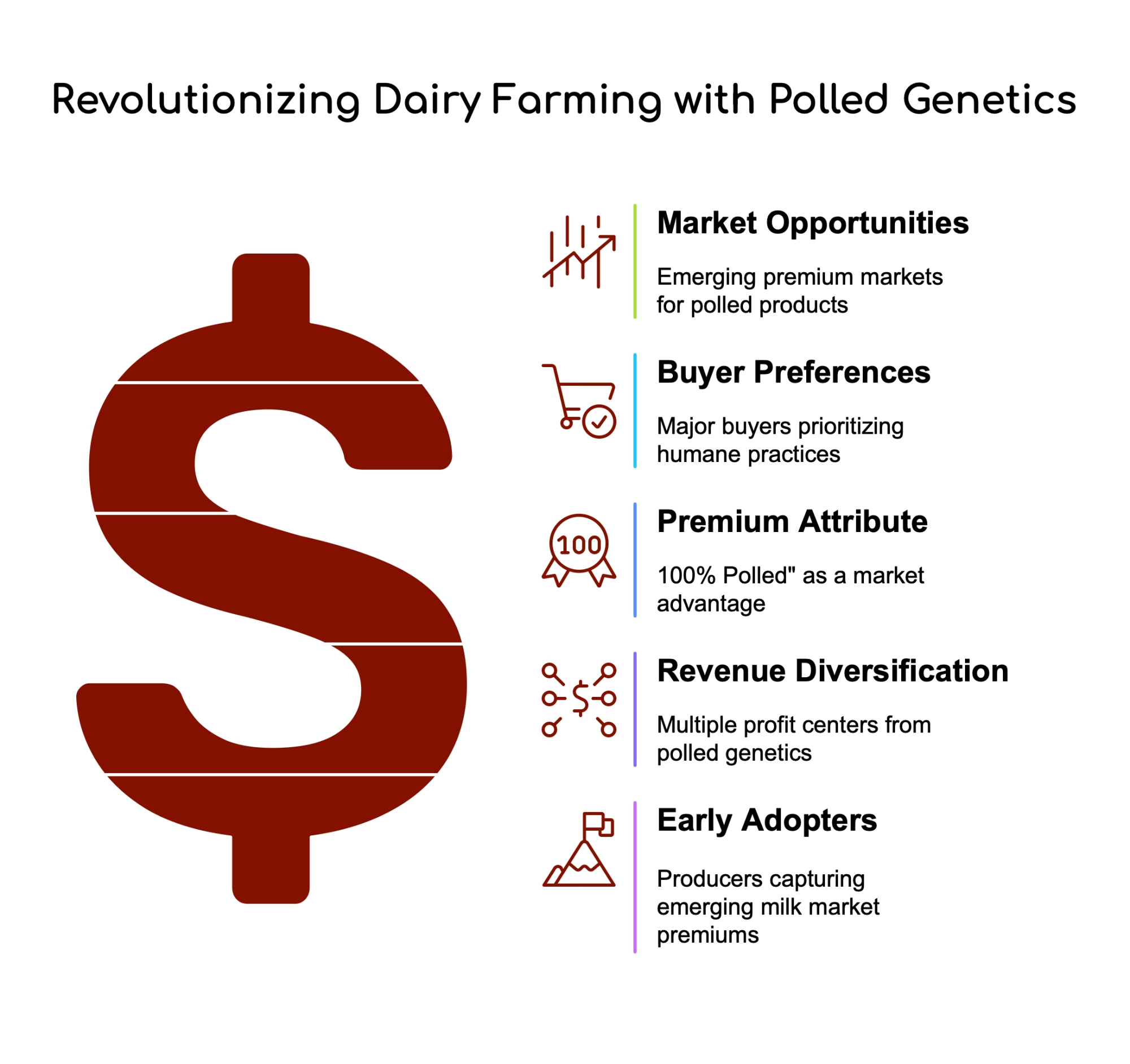
NewsSubscribe
First
Last
Consent

Protecting Your Dairy’s Bottom Line: Essential Risk Management Approaches for 2025

2025’s dairy crisis is coming. Will your farm survive? Discover the risk management strategies separating thriving dairies from failing ones.

Is your dairy operation truly prepared for the storm that 2025 is brewing? Or are you still hoping yesterday’s playbook will see you through today’s volatility? Let’s cut to the chase: the difference between thriving and barely surviving this year will come down to how you manage risk-not just in theory, but in the gritty reality of your daily decisions.

The 2025 Dairy Risk Landscape: A Confluence of Pressures

Let’s be honest-2025 isn’t the year to wing it. We’re staring down a perfect storm: milk prices are as unpredictable as a fresh heifer, feed costs are one drought away from spiking, and the threat of Highly Pathogenic Avian Influenza (HPAI) is lurking in the background. Add in labor shortages, shifting consumer demands, and regulatory curveballs, and you’d have to be milking with your eyes closed not to see the risks.

Are you really willing to bet your farm’s future on a single forecast or a “wait and see” approach?

Milk and feed markets are volatile – and as a result, on-farm margins can swing widely. And, when considering hedging strategies, the best time to secure milk prices might not be the same as the time lock in feed costs. And, with the news constantly changing, it’s hard to keep track of all the market drivers. As such, working with a trusted risk management team is the cornerstone of a successful hedging program.

Jim Matthews, Ever.Ag

Managing Price and Financial Volatility

Let’s face it-hoping for the best is not a strategy. The USDA’s all-milk price forecast has already been revised downward to $21.10/cwt, and feed costs, while projected to ease, remain one bad weather event away from chaos. If you’re not layering your risk management tools, you’re playing Russian roulette with your bottom line.

Your Financial Toolkit-Are You Using All the Tools?

  • Dairy Margin Coverage (DMC): This is your foundation. It’s triggered payments in 66% of months since 2018, and it’s cheap insurance against margin collapse.
  • Dairy Revenue Protection (DRP): Lock in revenue floors when the market gives you a chance. DRP is flexible and subsidized-don’t leave this tool in the shed.
  • Livestock Gross Margin (LGM-Dairy): Layer this with DMC for extra protection, especially if your margins track Class III/corn/soybean meal futures.
  • Forward Contracts (DFPP): If your handler offers them, use them to lock in prices for a portion of your milk.
  • Futures and Options: For those comfortable with the CME, these tools let you hedge both milk and feed, but don’t forget the margin calls.

Every dairy is different – so there’s no one size fits all approach. It’s important to work with an experienced risk management team that understands your risks and can help you pick the right tools to protect against volatility. And, it’s not just one and done – with changing markets, the ideal strategy changes too. So it’s an important to have a trusted advisor watching out for your dairy. 

Katie Burgess, Ever.Ag

Don’t wait for the “perfect” price. Lock in protection when you can.

Securing Your Production: Disease and Climate Challenges

How robust is your biosecurity-really? If HPAI or another disease hits your herd, will your protocols hold up, or are you just checking boxes?

  • Biosecurity: Pasteurize all milk and colostrum, quarantine new animals, sanitize equipment like your operation depends on it-because it does.
  • Climate Adaptation: Are you investing in fans, sprinklers, and shade, or just hoping for a cool summer? Are you optimizing irrigation and planting drought-tolerant forages, or gambling with your feed supply?

Will you be caught off guard by the next heatwave or disease outbreak, or will your herd keep producing while others scramble?

Sponsored Content

Operational Efficiency: Technology and Labor

Are you still managing labor like it’s 1995? The workforce isn’t coming back, and those who stay expect more. Automation isn’t the future-it’s now.

  • Robotic Milking Systems: Cut labor by 60-75%. Yes, it’s a big investment, but so is losing your best employee during corn silage.
  • Automated Feeding and Wearable Sensors: Save time, spot health problems early, and let your best people focus on what matters.
  • Precision Feeding: Are you still eyeballing rations, or using data to drive decisions? The difference is $0.75 to $1.50/cwt in production costs.

Every dollar you save on feed or labor is a dollar you keep when prices drop.

Adapting to Market Shifts

Are you producing what the market wants, or what you’ve always produced? Consumer trends are shifting. If you’re not focusing on milk components, sustainability, and animal welfare, you’re leaving money on the table. On-farm processing, agritourism, beef-on-dairy, renewable energy-these aren’t just buzzwords. They’re proven ways to spread risk and capture new income. Have you diversified your revenue streams?

Will you adapt to changing consumer demands and market channels, or let the market leave you behind?

Creating Your Integrated Risk Management Plan

Are you still putting out fires instead of preventing them? The most resilient dairies are:

  • Diversifying their risk management portfolio: DMC, DRP, LGM, forward contracts, and options.
  • Strengthening herd health and biosecurity: Not just for HPAI, but for mastitis, lameness, and everything in between.
  • Investing in climate adaptation: Heat stress mitigation, water optimization, and forage resilience.
  • Enhancing operational efficiency: Automation, precision ag, and employee retention.
  • Adapting marketing approaches: Milk quality, sustainability, and niche markets.
  • Maintaining rigorous financial planning: Detailed budgets, scenario plans, and cash flow projections.
  • Staying informed on policy and regulation: Farm Bill, FMMO, environmental and animal welfare standards.

The Bullvine Bottom Line

Let’s not sugarcoat it: many dairies won’t survive this decade-not because they aren’t good farmers, but because they’re poor risk managers. Are you one of them?

The dairies that thrive will be those that are vigilant, adaptable, and relentless about improvement. They’ll use data, technology, and financial discipline to stay ahead. They’ll be honest about their weaknesses and ruthless about fixing them.

Don’t wait for a crisis to rethink your approach. Schedule a risk management audit with your team and your Ever.Ag advisor. Identify your vulnerabilities. Build a plan. Act. 

What action will you take today to secure your dairy’s future tomorrow?

Key Takeaways:

  • Layer financial protections: Combine DMC, DRP, and forward contracts to hedge against price collapses
  • Automate or stagnate: Robotics and sensors cut labor costs by 60%+ while improving herd health monitoring
  • Secure feed strategically: Lock in 60-70% of needs during price dips but preserve flexibility
  • Biosecurity = profitability: HPAI protocols prevent outbreaks that could cripple production
  • Milk components matter: Prioritize butterfat/protein to capture premiums in shifting markets

Executive Summary:

Dairy producers face unprecedented volatility in 2025 from market swings, HPAI threats, climate disruptions, and labor shortages. This article outlines essential strategies including layered financial protections (DMC, DRP, forward contracts), biosecurity overhauls, climate-resilient practices, and labor-saving automation. Emphasizing data-driven decisions and proactive risk management, it challenges farmers to abandon outdated approaches and adopt precision feeding, market diversification, and rigorous financial planning. Expert insights from Ever.Ag‘s Jim Matthews stress decisive action over wishful thinking, arguing that survival depends on embracing technology and strategic contracting rather than relying on tradition.

Learn more:

The Sunday Read Dairy Professionals Don’t Skip.

Every week, thousands of producers, breeders, and industry insiders open Bullvine Weekly for genetics insights, market shifts, and profit strategies they won’t find anywhere else. One email. Five minutes. Smarter decisions all week.

NewsSubscribe
First
Last
Consent

The Carbon Credit Goldmine: How Forward-Thinking Dairy Producers Are Turning Methane Reduction into Cash Flow

Forget emissions-dairy’s new cash cow is methane. Early adopters are cashing in while others lag. Your move.

While most dairy producers still treat environmental compliance like another cost burden alongside SCC penalties and FARM program requirements, a savvy group of innovative farmers is quietly banking profits that make component premiums look like pennies on the parlor floor. The inconvenient truth? Your operation is either positioned to profit from methane reduction, or you’re leaving serious money on the table.

Dairy farmers have mastered transforming forage and grain into milk solids for generations. An elite group is now learning something potentially more valuable: turning methane into money. As global pressure mounts to address agriculture’s carbon footprint, the question isn’t whether you’ll need to reduce emissions- it’s whether you’ll turn that challenge into a revenue stream or watch others in while you play catch-up.

But let’s cut through the manure, shall we? Is the “carbon goldmine” real, or just another consultant’s fantasy like those $30 cwt milk price projections we’ve all stared at? As some claim, can average producers generate $800-1,200 per cow annually from environmental programs? How can your operation profit from this emerging opportunity before the window closes faster than a milk house door in January?

The Carbon Market Reality Check: Opportunity vs. Hype

Let’s start with some straight talk: The widely circulated claim that dairy farms can generate $800-$1,200 per cow annually through carbon credits represents an optimistic best-case scenario rather than a typical outcome. It’s like saying every heifer will conceive on first service and every cow will peak at 150 pounds-theoretically possible, but not what you’d bank the mortgage on.

The reality is more nuanced. Recent analyses of anaerobic digester (AD) projects producing renewable natural gas (RNG) place typical annual revenue closer to $400-$450 per cow when combining California’s Low Carbon Fuel Standard (LCFS) and federal Renewable Fuel Standard (RFS) credits. Still, it is substantial- about $1.25-$1.50 per hundredweight equivalent- but hardly the goldmine some consultants promise.

This doesn’t mean the opportunity isn’t real- it is. But why are so many dairy producers sitting on their hands while early adopters are already cashing in? Is it fear of the unknown? Skepticism of “green” initiatives? Or is it simply the industry’s notorious resistance to change that keeps us a step behind?

Why Dairy Methane is Carbon Market Gold

What makes dairy operations uniquely positioned in carbon markets? It comes down to methane’s potency and the accounting methods used in carbon crediting.

Methane has been approximately 28 times more potent than carbon dioxide as a greenhouse gas for over 100 years. This means reducing one ton of methane is equivalent to reducing 28 tons of CO2-instantly multiplying the potential credit value. It’s like the difference between shipping whole milk versus protein concentrate- the same truck, exponentially more value.

For dairy operations, methane comes from two primary sources:

  1. Enteric fermentation – The natural digestive process in a cow’s rumen that produces methane, released primarily through eructation (belching). Your best 35,000-pound Holsteins can produce over 500 liters of methane daily, while your Jerseys might produce somewhat less per head but with higher intensity per pound of milk solids.
  2. Manure management – Methane is released when manure decomposes anaerobically in lagoons or pits. That 5,000-cow free-stall operation with a 3.5-acre lagoon can generate enough methane to power 1,000 homes.

Under California’s LCFS, dairy RNG receives exceptionally favorable treatment through a methodology that assigns negative carbon intensity scores by crediting “avoided methane emissions.” This accounting approach creates extraordinary value for dairy RNG projects that can access this market.

Let’s be blunt: The dairy industry has been handed a gift in this accounting methodology, and we’d be fools not to capitalize on it. How long do you think regulators will maintain this generous approach if we don’t demonstrate meaningful adoption?

The Methane Reduction Toolkit: What’s Working Now

Anaerobic Digesters: The High-Value Pathway

Anaerobic digestion remains the gold standard for generating maximum carbon revenue, particularly when manufacturing RNG for transportation fuel markets.

The economics are heavily scale-dependent operations (typically over 2,000 cows) benefit from economies of scale that make the substantial capital investment (often $3-10 million) more feasible. For medium-sized farms, viability usually depends on grant funding, co-digestion of food waste, or participation in cooperative “hub-and-spoke” models.

Beyond carbon credits, digesters generate valuable co-products: renewable energy, separated solids used as bedding (saving $80-100 per cow annually on sand or sawdust), and nutrient-rich digestate that can reduce commercial fertilizer costs for your corn silage ground.

The practical challenges are significant. Sand bedding- the gold standard for cow comfort and mastitis prevention- can wreak havoc on digester systems, requiring sophisticated separation equipment. Farms with flush systems must carefully consider dilution rates, as too-watery manure (under 3% DM) reduces biogas potential, while thicker scrape manure (8-12% DM) may require different digester designs.

The dairy industry’s current approach to AD adoption is fundamentally flawed. We’ve created a system where only the most significant operations can realistically access the highest-value pathways. Why aren’t we seeing more cooperative models where multiple mid-sized farms combine resources to build shared facilities? The answer lies in our stubbornly independent mindset- the same one that’s held back progress in other areas like genetic improvement, equipment sharing, and marketing innovation.

Feed Additives: The Accessible Option

For farms unable to justify the massive capital investment of digesters, feed additives targeting enteric methane represent a more accessible entry point to carbon markets.

Two leading options are making headway in North American dairy:

3-Nitrooxypropanol (3-NOP/Bovaer®): Developed by DSM-Firmenich and marketed in the U.S. by Elanco, this compound inhibits the enzyme that catalyzes methane production in the rumen. Studies consistently show 25-30% enteric methane reductions in dairy cattle.

The economics are complex. The additive costs approximately $0.15-0.30 per cow daily, and economic analyses suggest performance benefits alone may not offset this cost. Carbon credit revenue becomes essential for adoption, with breakeven estimates ranging from $0.10 to $0.45 per cow daily, depending on carbon price and performance assumptions.

Think of it like rBST back in the day: additive with a proven effect but requiring careful economic calculation. Just as you’d calculate the return on each $40 dose of a reproductive hormone, you need to calculate the return on methane reduction additives with the same precision.

Agolin® Ruminant: This blend of essential oils certified by The Carbon Trust shows more modest methane reductions (around 10-11%) but may offer better economics through improved feed efficiency and milk production. Some analysts suggest benefit-to-cost ratios exceeding 12:1 from performance improvements alone, with carbon credits providing additional upside.

Implementation can be straightforward for operations already using computerized feed management systems like Feed Watch, EZ Feed, or TMR Tracker, as these platforms can document additive inclusion rates and dry matter intake-critical data points for verification.

Here’s a hard truth: Most nutritionists aren’t discussing methane reduction options with their clients because they’re stuck in the mindset that their only job is maximizing milk output. Is your feed advisor bringing these opportunities to your attention, or are they still pushing the same old ration software outputs they’ve used for decades? It’s time to demand more from your nutrition team.

Show Me the Money: How Credits Work

The path from methane reduction to bankable revenue involves several critical steps many producers underestimate. It’s not unlike qualifying for your cooperative’s highest quality premiums- the potential payoff is there, but only if you’re willing to do the work.

Step 1: Project Identification & Feasibility Assessment

Before diving in, you must clearly define your methane reduction strategy and conduct a thorough feasibility assessment. This involves evaluating technical suitability for your specific farm, estimating potential methane reduction, projecting costs, and exploring revenue streams.

Just as you wouldn’t build a new parlor without calculating potential throughput and return on investment, you shouldn’t jump into carbon markets without understanding the numbers. If your BouMatic dealer or DeLaval rep proposed a new system based on best-case scenarios with no downside analysis, you’d show them the door. Apply the same skepticism to carbon project developers.

Step 2: Select Carbon Standard & Methodology

Next, you’ll need to choose a recognized carbon crediting program such as Verra, Climate Action Reserve (CAR), or American Carbon Registry (ACR) and select the specific methodology for your chosen activity.

This is like choosing between organic certification, conventional production, or specialized programs like A2 milk or grass-fed-each, which have specific requirements that dictate your management practices and verification needs.

Step 3: Establish Baseline & Demonstrate Additionality

This is where many projects stumble. You must determine your “business-as-usual” emissions scenario and prove that your reductions wouldn’t happen without carbon market incentives.

It’s somewhat like proving to your lender that you need that operating line to make it through to milk checks-if you’ve got a million in the bank, you won’t qualify for emergency financing.

Step 4: Implement Rigorous Measurement, Reporting & Verification (MRV)

Carbon markets demand meticulous documentation. For digesters, this means continuously measuring biogas flow rates, periodically testing methane concentration, and maintaining precise records of animal populations and manure inputs.

You’ll need to track inclusion rates, measure feed intake, and maintain detailed herd records for feed additives.

If you’ve ever been through a whole-herd DHIA verification for genetic evaluations or maintained records for a Certified Organic audit, you understand the level of detail required. The good news is that farms with existing management software like DairyComp 305, PCDart, or Dairy Management Systems already have many data structures needed for verification.

But many dairy farms still operate with record-keeping systems one step above a pencil and notepad. How can you possibly compete in carbon markets when you can’t even tell me your somatic cell count by string or your pregnancy rate by lactation group? The farms that will capitalize on carbon opportunities are the same ones already using data to drive decisions.

Step 5: Monetize Your Reductions

After verification confirms your emission reductions, you’ll receive carbon credits that can be sold through brokers, direct contracts, or partnerships with project developers.

As milk can be sold as fluid, cheese, powder, or components, carbon credits can be marketed with different value propositions and pricing structures.

The Implementation Roadmap: Different Paths for Different Farms

The optimal carbon strategy varies dramatically based on farm size and circumstances. Here’s how to approach it based on your operation:

For Large Operations (>1,000 cows)

You’re best positioned to consider capital-intensive technologies like anaerobic digesters, particularly those producing RNG for compliance markets. Your scale allows you to achieve the necessary economies to make AD financially viable, especially when leveraging LCFS/RIN credits.

A Western dairy friend with 5,500 Holsteins recently shared that his digester is now generating more annual profit than his milk production, $1.4 million in carbon credit revenue after expenses, while his milk margin hovers around $1.2 million in a good year. It’s become the tail wagging the cow, so to speak.

For Medium Farms (300-1,000 cows)

The economics of standalone AD systems are more challenging at your scale. Viability might be achieved through:

  • Significant grant funding
  • Co-digestion of off-farm organic waste (generating tipping fees)
  • Participation in cooperative “hub-and-spoke” models

Feed additives represent a more financially accessible option for direct methane reduction. Also, the focus should be on improving overall farm efficiency and implementing sustainable cropping practices.

Think of it like buying your combine versus using custom harvesters for your corn silage. The per-ton cost might be higher, but without the capital expenditure and maintenance headaches, it often makes more financial sense at your scale.

For Small Farms (<300 cows)

Individual AD projects are typically uneconomical at your scale unless exceptional subsidies or co-digestion opportunities exist.

Focus instead on:

  • Evaluating feed additives (if cost-benefit analysis is favorable with incentives)
  • Optimizing manure handling and storage to minimize emissions
  • Maximizing production efficiency
  • Adopting sustainable cropping and grazing management

Accessing carbon markets requires partnering with an aggregator who can bundle credits from multiple small farms to achieve marketable volumes.

Small farms are getting a raw deal in the carbon economy, but it’s partly our fault. While farmers excel at complaining about processors, cooperatives, and government, we’ve been painfully slow to form the collaborative structures needed to compete in these new markets. When will we learn that sometimes, the only way to maintain independence is through strategic collaboration?

The Early Mover Advantage: Why Timing Matters

The carbon opportunity isn’t static-it’s evolving rapidly, and early adopters stand to gain significant advantages:

  1. Securing favorable contracts: Early participants can negotiate better terms with developers or credit buyers before the market becomes more crowded.
  2. Operational experience: Gaining valuable experience in implementing reduction technologies and navigating MRV requirements leads to efficiency gains over time.
  3. Brand differentiation: Demonstrating proactive environmental leadership enhances your position with processors, consumers, and the community.
  4. Regulatory positioning: Establishing projects early positions your farm favorably should future regulations mandate emissions reductions.

However, early adoption also carries risks. Carbon markets are subject to significant price volatility, and policies underpinning compliance programs like LCFS and RFS can change, potentially altering eligibility rules or credit values.

It’s not unlike transitioning to robotic milking. Pioneers faced higher costs and steeper learning curves, but many now enjoy labor savings and operational advantages that latecomers are scrambling to match.

Ask yourself this: Are you typically an early adopter, or do you wait until technologies are proven before implementing them? And more importantly, how has that approach worked for your bottom line over the past decade? The dairy industry’s most profitable operators are rarely the first to adopt every innovation, but they’re never the last.

Avoiding the Pitfalls: Common Mistakes That Kill Carbon Projects

Many promising carbon projects falter due to avoidable mistakes:

1. Insufficient Due Diligence

Rushing into projects without a comprehensive understanding of the technology’s suitability, realistic costs and revenues, market risks, and contractual obligations.

Solution: Conduct thorough, independent feasibility studies and seek expert review.

It’s like buying a herd of cattle without seeing them or their DHIA records- the results rarely match the sales pitch.

2. Poor Partner Selection

Engaging with inexperienced or disreputable project developers, brokers, or verifiers.

Solution: Check credentials, demand references for similar completed projects, and verify adherence to industry codes of conduct.

As you carefully select your A.I. company, feed supplier, or equipment dealer, vet your carbon partners thoroughly. The wrong supplier can cost you far more than a few points of conception rate or a slight component drop.

3. Inadequate Record Keeping

Failing to establish robust systems for collecting, managing, and reporting monitoring data accurately and consistently.

Solution: Implement clear MRV protocols, use calibrated equipment, and maintain meticulous records.

Think of MRV as antibiotic residue prevention: The testing will happen, and if your records aren’t in order, the consequences will be severe.

4. Misunderstanding Complex Rules

Failing to fully grasp the nuances of additionality criteria, permanence obligations, or specific methodology requirements.

Solution: Work with knowledgeable advisors and carefully study the relevant protocols.

Carbon markets make the federal milk marketing order look simple by comparison. When hiring a milk marketing consultant for hedging strategies, bring carbon market expertise before committing.

5. Unrealistic Financial Expectations

Overestimating potential carbon credit prices or co-product values while underestimating capital or operational costs.

Solution: Use conservative assumptions and conduct sensitivity analyses.

We’ve all seen those enticing projections where everything goes perfectly- 100% conception rates, no transition cow issues, $25 milk-and reality never measures up. The same applies here.

The Bottom Line: Is Carbon Farming Right for Your Operation?

The dairy industry faces both challenges and opportunities as it addresses methane emissions. While the often-cited revenue potential of $800-$1,200 per cow per year represents an optimistic scenario rather than a guaranteed outcome, real financial opportunities exist.

Forward-thinking dairy producers who undertake thorough feasibility studies, select appropriate technologies and partners, implement robust MRV systems, and manage risk effectively can potentially transform environmental compliance from a cost center into a profit opportunity.

The most frustrating aspect of the dairy carbon discussion is watching farms drag their feet while consultants and developers with no skin in the game make all the decisions. It’s time for dairy producers to seize control of this narrative and develop carbon reduction strategies that benefit farms first and foremost, not just the middlemen.

As one innovative Wisconsin producer put it: “Carbon isn’t just about compliance anymore-it’s becoming as much a part of our business model as milk production itself. On our 1,200-cow operation, the methane we capture offsets the carbon footprint of our entire milk supply chain, and the processor premium we get for that is worth nearly a dollar per hundredweight. Between that and the bedding savings from separated solids, we’ve turned what used to be a waste management headache into a solid profit center.”

Your Call to Action

It’s time to stop viewing environmental practices as merely a cost of doing business and start recognizing them as potential profit centers. Here’s what you need to do today:

  1. Assess your farm’s carbon potential by requesting a baseline emissions assessment from a qualified consultant
  2. Explore multiple technology options, not just what the first salesperson tries to sell you
  3. Talk to producers who have already implemented these systems rather than relying solely on developer claims
  4. Demand more from your industry organizations in creating collaborative models that make carbon markets accessible to farms of all sizes
  5. Start improving your record-keeping systems now, even if you’re not ready to implement a carbon project immediately

The carbon opportunity won’t wait for those who drag their feet. Are you ready to mine the carbon goldmine on your farm, or will you watch from the sidelines as your competitors cash in?

Key Takeaways:

  • Methane isn’t just emissions-it’s a revenue stream via carbon credits, with compliance markets (LCFS/RFS) offering the highest payouts.
  • Anaerobic digesters dominate profitability but demand heavy upfront costs; feed additives (e.g., 3-NOP, Agolin) provide low-barrier entry.
  • The $800-$1,200/cow claim is aspirational-realistic returns hover near $400-$450/cow for RNG projects.
  • Early adoption matters: First movers lock in contracts, build expertise, and position as sustainability leaders.
  • Success requires feasibility analysis, risk mitigation, and leveraging USDA/EQIP grants or aggregator partnerships.

Executive Summary:

Forward-thinking dairy producers are transforming methane reduction from a regulatory burden into a lucrative revenue stream. By leveraging carbon markets, technologies like anaerobic digesters (generating $400-$450/cow annually via compliance credits) and methane-inhibiting feed additives are turning environmental compliance into profit. While the widely touted $800-$1,200/cow claim reflects peak market optimism, real opportunities exist for farms willing to navigate complex verification processes and volatile credit prices. Success hinges on strategic partnerships, rigorous feasibility studies, and aligning practices with compliance or voluntary markets. Early adopters gain competitive advantages as corporate sustainability demand grows, but scalability and policy risks require careful management.

The Sunday Read Dairy Professionals Don’t Skip.

Every week, thousands of producers, breeders, and industry insiders open Bullvine Weekly for genetics insights, market shifts, and profit strategies they won’t find anywhere else. One email. Five minutes. Smarter decisions all week.
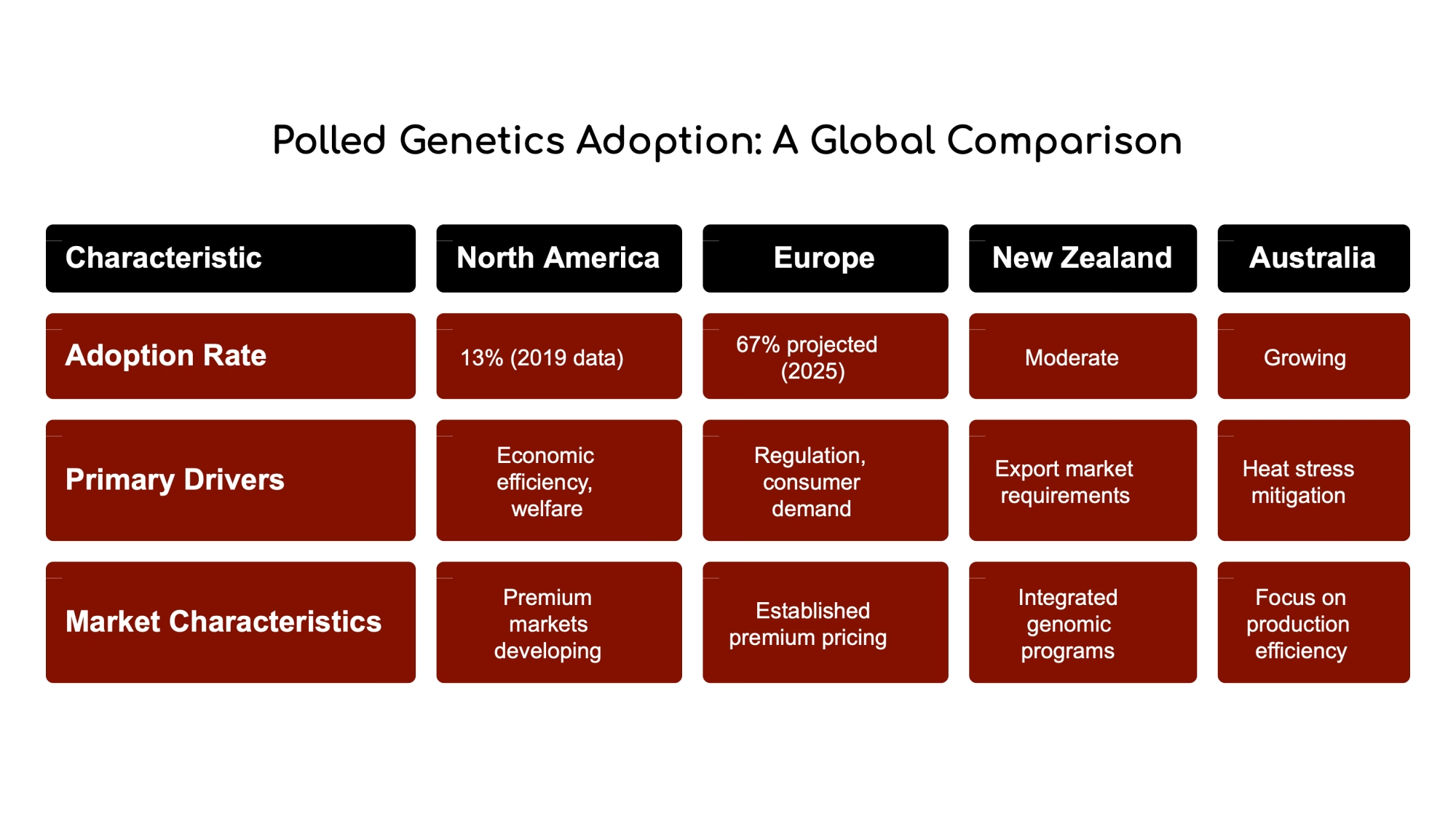
NewsSubscribe
First
Last
Consent

Argentina’s Dairy Comeback: Q1 2025 Production Surge Defies Expectations

Argentina’s dairy sector roars back with 10.9% Q1 growth – but can soaring feed costs and domestic demand curb its global comeback?

EXECUTIVE SUMMARY: Argentina’s dairy industry surged 10.9% in Q1 2024, fueled by ideal weather, record producer margins (3.7%), and a rebound in economic stability. However, this recovery faces dual threats: declining milk prices as supply rebounds and rising feed costs linked to China’s soybean demand amid U.S. trade tensions. Domestic consumption jumped 17.2%, absorbing most new production and limiting export growth despite higher output. While 14 straight months of profitability signal resilience, experts warn margin compression could stall momentum. The sector’s 2024 trajectory hinges on balancing domestic market gains with volatile global trade dynamics.

KEY TAKEAWAYS

  • Production surge: 15.9% March growth caps a 10.9% quarterly rebound, though volumes remain below 2020–2023 averages.
  • Profitability peak: Record milk prices (+3.7% margins) face pressure from easing processor competition and China-driven feed cost spikes.
  • Domestic focus: 17.2% spike in local dairy demand soaks up new supply, stabilizing exports despite higher output.
  • Trade ripple effects: Argentina’s soybean export push risks inflating feed costs, squeezing dairy margins.
  • 2024 outlook: Growth continues but hinges on sustaining margins amid price volatility and economic uncertainty.
Argentina dairy production 2024, dairy farm profitability, feed costs impact, dairy export trends, domestic dairy demand

Argentina’s dairy sector is staging a remarkable turnaround in 2025, with milk production surging by 10.9% in the first quarter compared to last year. This impressive rebound, driven by favorable weather, improved economic conditions, and record producer profitability, signals the end of a challenging period for one of South America’s dairy powerhouses. But will this growth trajectory continue, and what obstacles might lie ahead for Argentine dairy farmers?

THE DRAMATIC PRODUCTION REBOUND

The Argentine dairy comeback has gained momentum with each passing month of 2025. January kicked things off with a 5.6% year-over-year increase, followed by an impressive 12.1% jump in February, before accelerating to a stunning 15.9% surge in March. This represents one of the sharpest production turnarounds in Argentina’s recent dairy history.

“The usual seasonal decline from February to March was almost nonexistent this year at just 0.7%, compared to the typical 4-5% drop,” reports the Argentine Dairy Chain Observatory (OCLA). This exceptional performance resulted in March production reaching 816.4 million liters, putting Argentina firmly on the path to recovery.

Despite these impressive percentage gains, context matters. This growth comes after a disastrous 2024 when national milk production slumped to 10.59 billion liters- a painful 6.5% decline from 2023. Even with March’s remarkable 15.9% year-over-year increase, volumes remain approximately 0.7% below March 2023 levels, underscoring just how deep the 2024 production hole was.

The recovery isn’t uniform across all dairy regions and farm types. Significant variations exist depending on farm size, efficiency levels, and geographic location, with some areas rebounding more strongly than others.

WHAT’S DRIVING THE TURNAROUND?

Three key factors have converged to fuel Argentina’s dairy resurgence in 2025:

Favorable Weather Conditions

After battling extreme weather in 2024, when high Temperature-Humidity Index readings hammered production across major dairy regions, Argentine dairy farmers now benefit from ideal conditions. Sufficient rainfall and moderate temperatures have created perfect pasture growing conditions, dramatically reducing input costs for grazing-based operations.

Sustained Producer Profitability

Perhaps the most crucial driver is the unprecedented run of profitability for Argentine dairy producers. As of February 2025, farmers were enjoying their 13th consecutive month of positive margins, with profitability reaching 3.8%-representing some of the best returns since 2019.

This extended period of positive margins has finally enabled farmers to reinvest in their operations after years of underinvestment during the economic crisis. Many operations have upgraded equipment, improved genetics, and enhanced feeding programs, contributing to higher per-cow productivity.

Government Policy Support

The Argentine government’s decision to suspend export duties on dairy products through June 2025 has dramatically boosted sector competitiveness. This policy shift, alongside financial support mechanisms like the dairy-specific credit line from the Bank of Investment and Foreign Trade (BICE), which fixes loan payments in liters of milk rather than pesos, has created a more stable operating environment for producers.

QUALITY IMPROVEMENTS ACCOMPANY VOLUME GROWTH

Beyond the increase in pure volume, Argentine milk quality is also improving significantly. The production of “useful solids” (butterfat and protein) increased by 11.7% in Q1 2025 compared to last year. Fat and protein content has risen from 6.94% in 2024 to 7.00% in 2025.

This quality improvement boosts processor yields and enhances export opportunities for higher-value products. Whole milk powder, Argentina’s primary dairy export, has seen its price rise to $4,019 per ton in February 2025, a 2% increase from January.

DOMESTIC CONSUMPTION SURGES ALONGSIDE PRODUCTION

The rising tide of dairy production is complemented by robust domestic demand growth. Internal sales during January-February 2025 increased by 17.2% in milk-equivalent terms compared to 2024. This consumption boom spans all product categories, with powdered milk sales jumping 45%, fluid milk up 13.3%, and cheese increasing 11.5%.

This domestic consumption surge has essential implications for Argentina’s export potential. Despite the production increase, much of the additional milk is being directed to satisfy recovering domestic demand, limiting the immediate export growth potential.

THE EXPORT OUTLOOK REMAINS PROMISING DESPITE DOMESTIC ABSORPTION

While the domestic market is absorbing a significant portion of increased production, Argentina’s dairy export sector is still showing signs of improvement. Foreign exchange earnings from dairy exports grew 16% month-over-month in February 2025 and increased 8% compared to February 2024.

Argentine dairy products reach over 85 international markets, with whole milk powder leading the export portfolio. The suspension of export duties through June 2025 has significantly enhanced the competitiveness of Argentine dairy products in global markets. However, the effect of this policy beyond the current suspension period remains uncertain.

CHALLENGES AND RISKS ON THE HORIZON

Despite the overwhelmingly positive start to 2025, several potential headwinds could impact Argentina’s dairy recovery:

Potential Milk Price Pressures

As production increases and milk scarcity eases, the intense processor competition that drove record milk prices in early 2025 may dissipate. This could lead to downward pressure on farm-gate prices, compressing the exceptional margins.

Operating Cost Risks

Feed costs present a particular concern. Argentina’s position as a major global agricultural exporter creates an interesting dynamic where policies that benefit crop exporters-like reduced export taxes on soybeans and grains-can inadvertently raise input costs for dairy producers by tightening domestic feed supplies.

The growing trade tensions between the United States and China might further complicate this situation. As China seeks alternative suppliers for agricultural products, particularly soybeans, Argentina is well-positioned to increase its exports to the Chinese market. This could further tighten domestic feed supplies and raise costs for dairy producers.

Production Recovery Still Incomplete

Despite the impressive growth percentages, Argentina’s dairy sector is still recovering. OCLA estimates that to match 2023’s production levels, 2025 output would need to grow by 6.9% for the full year, while reaching 2022 levels would require a 9.1% increase. The sector is making strides but hasn’t fully returned to its pre-crisis production capacity.

OUTLOOK FOR THE REMAINDER OF 2025

The remainder of 2025 looks promising for Argentina’s dairy sector, though growth rates are expected to moderate somewhat in the year’s second half. OCLA projects annual production growth between 5% and 7%, though these estimates could prove conservative if the strong first-quarter momentum continues.

April production is expected to maintain the positive trend, potentially making the first half of 2025 a record-setting period for recovery. Weather forecasts remain favorable, and producer sentiment is the highest in years.

The most likely scenario for the remainder of 2025 is continued but more moderate growth, with annual production potentially approaching 11.2 billion liters. This would represent a significant recovery from 2024’s low point but still leave room for further growth in 2026 and beyond to reclaim Argentina’s dairy potential fully.

CONCLUSION: ARGENTINA’S DAIRY SECTOR REBORN

Argentina’s dairy industry demonstrates remarkable resilience in 2025, returning strongly from a challenging 2024. The 10.9% production increase in Q1 2025 reflects favorable weather conditions and the cumulative impact of improved economic policies, sustained profitability, and renewed farmer confidence.

While challenges remain-including potential price pressures, rising input costs, and the question of how export markets will develop overall trajectory is decidedly upbeat, Argentina has reestablished itself as a dairy growth story, providing valuable lessons in sector recovery for dairy industries worldwide.

The coming months will reveal whether this impressive rebound can be sustained. Still, one thing is sure: Argentina’s dairy farmers have proven their resilience and adaptability again, turning the page on a difficult chapter and writing a new story of growth and opportunity in 2025.

Learn more:

The Sunday Read Dairy Professionals Don’t Skip.

Every week, thousands of producers, breeders, and industry insiders open Bullvine Weekly for genetics insights, market shifts, and profit strategies they won’t find anywhere else. One email. Five minutes. Smarter decisions all week.
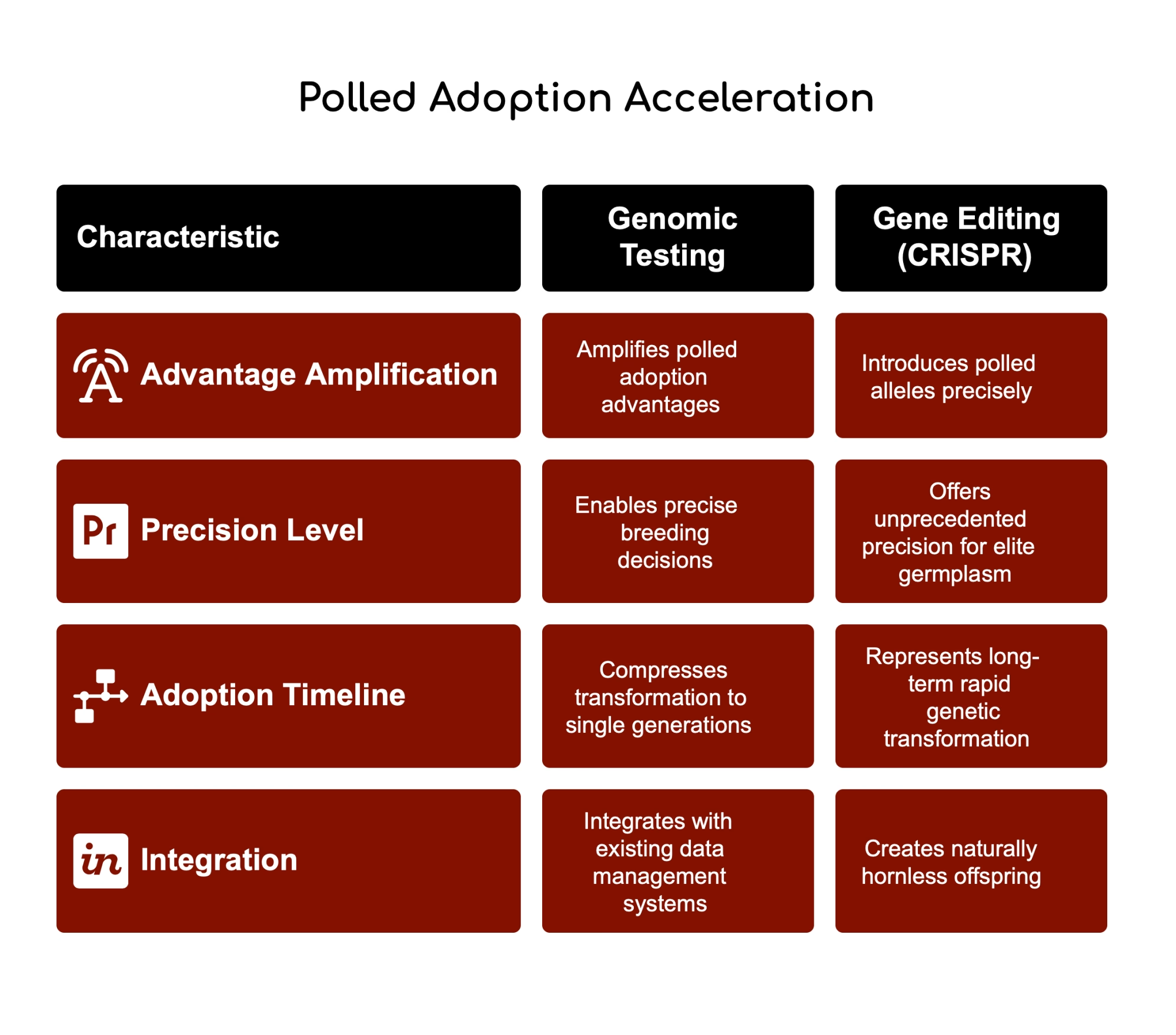
NewsSubscribe
First
Last
Consent

The $150,000 Silage Gamble: Why Your “Good Enough” Approach Is Killing Your Dairy

Is your “good enough” corn silage costing you $150,000 a year? Discover how small differences in silage quality create massive profit gaps.

Executive Summary

This provocative article challenges conventional dairy industry thinking by revealing how seemingly minor differences in corn silage quality can dramatically impact farm profitability. Using a real-world comparison between two silages (3,000 vs. 2,500 milks per ton), the author demonstrates that failing to adjust rations when silage quality drops could cost farms $0.85 per cow daily in lost milk revenue. In contrast, proper reformulation costs just $0.17 per cow daily – a five-fold difference that translates to $124,000 annually for a 500-cow dairy. The analysis argues that focusing on income over feed cost rather than minimizing feed expenses is crucial while providing specific, actionable strategies across the entire silage management chain – from hybrid selection and kernel processing to testing frequency and feedout management. The author employs an engaging, occasionally confrontational tone to challenge farmers’ complacency about silage management and emphasize that seemingly minor decisions about corn silage can make the difference between struggling and thriving in today’s dairy economy.

Key Takeaways

  • Milk per ton is the gold standard metric for evaluating corn silage. Unlike outdated measures like Relative Feed Value (RFV), it accounts for starch content and fiber digestibility, providing a single number directly to economic potential.
  • Regular silage testing and prompt ration reformulation deliver exceptional ROI – the cost of increased supplements ($0.17/cow/day) when adapting to lower quality silage is preferable to accepting reduced production ($0.85/cow/day).
  • Processing effectiveness is non-negotiable – proper kernel processing (1-2mm roller gap) can increase milk production by 1.7-3.1 pounds daily, potentially worth $100,000+ annually for a 500-cow herd; check processing during harvest by counting whole kernels in a sample.
  • Packing density limitations often sabotage otherwise good silage programs – inadequate packing tractor weight relative to harvest speed (target: 800 pounds of tractor per ton delivered hourly) limits density, increases spoilage, and can waste up to 15-20% of your silage dry matter.
  • Move beyond “good enough” silage management – implementing a systematic approach across hybrid selection, harvest timing, processing, storage, and analysis represents one of the highest-return investments available to modern dairy farms.
corn silage quality, milk per ton, kernel processing, dairy farm profitability, income over feed cost

Your bunker isn’t just a storage structure – it’s a bank vault that’s either compounding interest or leaking cash daily. While sweating over a 50-cent milk price swing, you’re ignoring management decisions worth 10 times that impact hiding under that plastic.

As the 2025 planting season kicks off, dairy producers across America face a stark reality: what happens in your fields over the next few months will make or break your bottom line for the year ahead. Yet I continue to watch farmers obsess over milk marketing while treating their corn silage program like it’s just another chore to check off the list.

Let’s get brutally honest – your approach to silage management is probably stuck in the 1990s, while your milk production expectations are firmly in 2025. This disconnect is costing you tens of thousands of dollars annually.

The $150,000 Reality Check You Desperately Need

Want proof? Here’s a real-world scenario playing out on progressive dairies right now:

A client running 500 cows showed me NIR analyses from two corn silages harvested from different fields in the same operation. On paper, the difference looked minor to the untrained eye:

  • Silage A: 39% starch, NDFd30 of 58%, milk per ton calculation around 3,000 lbs
  • Silage B: 33% starch, NDFd30 of 52%, milk per ton calculation around 2,500 lbs

Both would pass most farmers’ eyeball test as “decent feed.” However, when we ran the numbers through CNCPS modeling, the financial impact hit like a hammer to the kneecap.

When the night feeder switched to Silage B without telling anyone (sound familiar?), the predicted milk drop was 4.7 pounds per cow daily. At $18/cwt, 85 cents per cow in vanished revenue. For a 500-cow dairy, you’re hemorrhaging $425 daily or a staggering $155,125 annually – all while feeding the same number of expensive commodities!

“But Andrew,” you’ll protest, “we’d notice that drop and call our nutritionist.” Would you, though? How many days would it take? Would you connect it to silage changes or blame it on weather, estrus activity, or some mysterious milk bug?

When we modeled reformulating the ration to maintain production, the feed cost increase was just 17 cents per cow daily – about $31,000 annually for that same 500-cow herd.

That’s real money – roughly what you’d spend on a used skid steer – but it beats losing $124,000 in milk revenue. That’s enough to cover your nutritionist’s fees, your DHIA testing, all your hoof trimming, and still have enough left to send your kid to college.

Here’s the uncomfortable truth many consultants won’t tell you: most dairies don’t analyze silage frequently enough to catch these shifts. They’re flying blind through serious money, potentially sacrificing six figures annually while thinking everything’s “good enough.”

Are You Ignoring the Only Silage Number That Matters?

Let’s cut through the bullshit about silage quality. Forget vague terms like “nice-looking crop” or ancient metrics like Relative Feed Value (RFV) that your grandfather used.

The single most valuable number you should obsess over is milk per ton.

Why? This calculation estimates potential milk production from each ton of silage by integrating multiple factors – starch content, fiber digestibility, and processing quality – into a single, actionable number that translates directly to your milk check.

Unlike outdated metrics, milk per ton directly addresses what makes silage valuable: digestible energy from starch and fiber. It’s like BUN: MUN ratio versus just looking at MUN – it tells you the complete story.

Is your nutritionist providing this number with every silage analysis? If not, why the hell not? How can you manage what you don’t measure?

The $100,000 Processing Mistake Almost Everyone Makes

Let’s challenge some conventional thinking about kernel processing. Are you still questioning whether the extra fuel costs, equipment wear, and slower harvest are worth it? The data couldn’t be more precise: inadequate processing leaves thousands of dollars of digestible starch in your manure pit.

Proper kernel processing consistently boosts milk production by 1.7 to 3.1 pounds per cow daily. For a 500-cow herd at $18 milk, that’s up to $101,500 annually in pure profit.

But processing isn’t binary – it’s about hitting the correct score. Your Kernel Processing Score (KPS) should exceed 70%. Here’s a field test any producer can do right now:

  1. During harvest, fill a 32-ounce cup with freshly chopped silage
  2. Spread it on your palm and count whole and half kernels
  3. If you find more than 2-3 per cup, you’re flushing money down your lagoon

The recommended roller gap is just 1-2 mm – about the thickness of that maxed-out credit card you used for last year’s feed bill. Yet I regularly see farms with gaps 3-4 times wider. They might as well be dumping bags of corn straight into their manure spreader.

A Michigan client recalibrated his processor mid-harvest last fall. The milk response was equivalent to adding 2.5 pounds of extra corn to each cow’s diet – except it cost him nothing but 15 minutes with a wrench. When was the last time you checked your processor settings?

Your Million-Dollar Chopper vs. Your 30-Year-Old Packing Tractor

Here’s something that grinds my gears: watching dairies drop $500,000 on a massive self-propelled chopper while packing with the same tired old tractor they’ve had since the 1990s.

Let me be clear: your silage quality is limited by the weakest link in your harvest chain – and it’s probably your packing tractor.

Many operations have dramatically upgraded harvest capacity without corresponding investments in packing equipment. It’s like installing a 1,000-gallon bulk tank but keeping your 4-cow milking parlor.

The minimum density for bunkers should be 15 pounds of dry matter per cubic foot (ideally 18+). This requires:

  • Spreading in layers thinner than the depth of your TB test needle (6 inches or less)
  • Adequate packing weight (800 pounds of tractor per ton delivered per hour)
  • Enough time to pack every square inch thoroughly

Suppose your custom harvester blows through 100 tons per hour with their fancy Claas chopper while trying to pack with a single dually tractor. In that case, you’re setting yourself up for a fermentation disaster. That’s like trying to cool your milk with ice cubes instead of your bulk tank compressor.

Do the math: proper packing and covering saves about 15-20% of silage dry matter from spoilage. On a 500-cow dairy feeding 20 pounds of silage DM per cow, over 600 tons of dry matter is saved annually – or about $108,000 in preserved feed value. That would buy you a nice additional packing tractor with money left over.

Are you willing to invest $75,000 in a proper packing tractor to save $108,000 in feed? If not, why not?

Are You Being Held Hostage by Your Nutritionist’s Schedule?

In today’s razor-thin margin environment, your nutritionist’s ability to quickly identify silage changes and adjust TMRs isn’t just a nice perk – it’s essential to your survival.

The case study showed a massive difference between no adjustment ($0.85/cow/day loss) and prompt reformulation ($0.17/cow/day cost). This requires:

  1. Regular silage testing (at least monthly, and whenever the fresh cows start sorting or butterfats crash)
  2. A nutrition program using sophisticated models like CNCPS or AMTS
  3. Rapid ration adjustments when values shift

The days of “we’ll tweak things at next month’s visit” are dead and buried. Today’s dairy economics demand greater agility. Even modest quality shifts can significantly impact your bulk tank and repro performance when dealing with high corn silage inclusion rates (40-60% of TMR dry matter).

Ask yourself: How quickly can your nutrition team respond to a silage change? If it’s more than 24 hours, you’re bleeding money while waiting.

The Tonnage Obsession That’s Sabotaging Your Profitability

Let’s challenge another sacred cow: the idea that corn silage success equals maximum tons per acre. This tonnage-obsessed approach is costing many dairies serious money.

The metric that matters is digestible nutrients per acre – a completely different target. This means selecting hybrids specifically bred for silage, not just repurposing grain hybrids that look impressive standing in the field.

Key characteristics to prioritize:

  • Fiber digestibility (NDFd) – directly impacts intake potential and energy availability
  • Starch content and vitreousness – affect how much energy reaches the milk tank
  • Disease resistance – especially for yield-robbers like Tar Spot that can cause premature dry-down

Some producers I work with still choose hybrids based primarily on seed cost or what the neighbor planted. However, the difference between average and superior hybrids easily exceeds $200-300 per acre in milk production potential.

Consider BMR hybrids as an example. Their significantly higher fiber digestibility typically translates to 3-5 pounds more milk per cow daily despite sometimes yielding 10% less tonnage than conventional hybrids. Would you rather have 20 tons of mediocre or 18 tons of exceptional feed?

One Wisconsin client switched half his acreage to BMR last year. Despite paying $50 more per bag and harvesting 2 tons less per acre, his income over feed cost improved by 38 cents per cow daily. On his 400-cow operation, that’s an extra $55,480 annually. Are you still clinging to conventional hybrids because “that’s what we’ve always planted”?

The IOFC Mindset That Separates Thriving Dairies from Struggling Ones

Here’s a perspective shift that could transform your operation: stop obsessing over feed cost per ton and maximize Income Over Feed Cost (IOFC).

IOFC is simply your milk check minus your feed bill. It represents the money left to pay for everything else – equipment, labor, vet bills, and hopefully something for your family besides stress.

When evaluating silage decisions, the question shouldn’t be “What’s the cheapest approach?” but “What puts the most money in my checking account?”

This mindset explains why investments that increase feed costs can still be highly profitable:

  • Premium silage hybrids may cost more but deliver higher digestible nutrient yields
  • Kernel processing increases harvest costs but improves starch utilization
  • Higher-quality feed additives might be justified during silage transitions

Remember: feed typically represents 45-55% of your cost of producing milk. This means optimizing feed efficiency through superior silage management has an outsized impact on your bottom line. It’s the difference between a dairy that survives milk price volatility versus one that thrives regardless of what the Federal Order decides.

The Corn Silage Profitability Checklist You Should Post in Your Office

Let’s get practical. Here are the actions that separate profitable silage programs from the perpetually struggling:

Hybrid Selection

  • Choose silage-specific hybrids with proven digestibility profiles
  • Consider disease packages relevant to your region (especially Tar Spot in the Upper Midwest)
  • For high-producing herds, evaluate BMR options despite the yield trade-off

Harvest Timing

  • Install a Koster tester on your farm (roughly a $300 investment)
  • Begin sampling when the kernel milk line reaches 1/2 to 2/3
  • Target harvest moisture based on your storage structure (65-70% for bunkers)
  • Understand drydown rates in your climate (0.5-1.0% per day typically)

Harvesting & Processing

  • Set the theoretical length of the cut at 3/4 inch with processing
  • Monitor kernel processing effectiveness hourly during harvest
  • Maintain sharp knives to prevent the “accordion effect” chop
  • Consider raising cutting height in drought-stressed fields to avoid nitrate issues

Ensiling & Storage

  • Pack to exceed 15 lbs DM/cu ft density (18+ is better)
  • Seal immediately with oxygen-barrier plastic (worth the extra cost)
  • Weight plastic thoroughly with touching tires (no gaps!)
  • Consider Lactobacillus buchneri inoculants for improved bunk stability

Analysis & Feeding

  • Implement monthly NIR analysis as a minimum
  • Check dry matter weekly for TMR consistency
  • Watch for heating in the bunk face
  • Remove at least 6-12 inches from face daily in summer
  • Keep face vertical and clean to minimize spoilage

Ration Management

  • Use sophisticated nutrition models that account for fiber and starch digestibility
  • Maintain consistent nutrient delivery despite forage variation
  • Focus on IOFC rather than minimizing feed cost
  • Watch the butterfat test as an early warning sign of silage changes

The Bottom Line: Your Silage Program Is Your Dairy’s Financial Foundation

Let’s cut to the chase: your approach to corn silage management will likely save or cost your dairy six figures annually. The difference between average and excellent management isn’t subtle – it’s massive.

The numbers tell the story:

  • Poor vs. excellent preservation: $8 return for every $1 invested in proper covering
  • Undetected quality changes: Potential losses of $0.85/cow/day
  • Kernel processing: 1.7-3.1 lbs more milk per cow daily
  • Hybrid selection: Potentially $200-300 per acre in milk production value
  • Regular analysis and reformulation: $124,000 annual difference for a 500-cow dairy

These aren’t theoretical gains from some university PowerPoint – they’re the reality for farms that have embraced a systematic, data-driven approach to silage management.

As you prepare to plant your 2025 corn silage crop, ask yourself these critical questions:

  1. Am I selecting hybrids based on nutrient potential or just tonnage?
  2. Is my harvest timing based on actual moisture testing or just visual cues?
  3. Do I have adequate packing capacity for my harvest rate?
  4. How often am I testing my silage?
  5. How quickly do I adjust rations when silage quality shifts?

If you’re uncomfortable with any of your answers, it’s time to rethink your approach.

The days of “good enough” silage management are over. The dairies that will thrive in 2025 and beyond aren’t necessarily the biggest or the ones with the newest parlors – they’re the ones that maximize the value of every acre, every ton, and every bite of corn silage they produce.

Want to transform your dairy’s profitability? Start by changing your silage program. Your banker will thank you.

Learn more:

Join the Revolution!

Join over 30,000 successful dairy professionals who rely on Bullvine Daily for their competitive edge. Delivered directly to your inbox each week, our exclusive industry insights help you make smarter decisions while saving precious hours every week. Never miss critical updates on milk production trends, breakthrough technologies, and profit-boosting strategies that top producers are already implementing. Subscribe now to transform your dairy operation’s efficiency and profitability—your future success is just one click away.

NewsSubscribe
First
Last
Consent

Corn Silage Planting Rates: The Million-Dollar Decision Every Dairy Farmer Must Get Right

Crush corn silage profits: Planting rates swing milk production 5-10%. Hybrid-specific strategies (28K-38K seeds/acre) make or break your bottom line.

EXECUTIVE SUMMARY: Corn silage planting rates directly impact dairy profitability, with hybrid-specific strategies critical for maximizing milk yield and feed quality. Dual-purpose hybrids thrive at 34,000–38,000 seeds/acre, while BMR and leafy types require lower densities (28,000–36,000) to optimize digestibility and starch content. Soil productivity, row spacing, and planting timing further refine rates, with narrow rows boosting yields by 7%. Farmers must balance tonnage and quality, as overcrowding sacrifices milk-per-ton metrics. Precision adjustments based on field conditions and hybrid traits can deliver 5–10% more milk production, making strategic planting a non-negotiable for 2025 profits.

KEY TAKEAWAYS:

  • Hybrid rules: Dual-purpose (34K–38K), BMR (32K–36K), leafy (28K–30K) – wrong rates cost starch & digestibility.
  • Soil drives density: Add 2K–3K seeds/acre on fertile soils; drop 2K–3K in drought-prone fields.
  • Narrow rows = free yield: 15–20” spacing boosts tonnage 7% without quality loss.
  • Check stands: Overplant by 5–10% early season, then verify emergence – final population dictates profit.
corn silage planting rates, hybrid-specific planting strategies, dairy farm profitability, optimal seeding rates, silage quality improvement

Your silage planting rate isn’t just another agronomic detail – it’s a direct profit driver that can swing your milk production by 5-10% this season. With feed costs representing over 50% of your production expenses, getting those seeds in the ground at precisely the right population isn’t just smart farming – it’s an essential business strategy for 2025.

The Hybrid Factor: One Size Does NOT Fit All

The research is crystal clear: different corn silage hybrids demand dramatically different planting rates. Plant them wrong, and you’re throwing money in the dirt.

Hybrid TypeRecommended Seeding Rate (seeds/acre)Key Considerations
Dual-Purpose34,000–38,000+2,000+ seeds/acre vs. grain corn. Prioritize milk/acre. Avoid >38K to protect NDF.
BMR32,000–36,000Lower populations enhance digestibility. Use 20-inch rows to offset lodging risks.
Leafy28,000–30,000Larger plants need space. Starch drops significantly if overcrowded.

Dual-Purpose Hybrids: The Workhorses

These versatile performers need 34,000-38,000 seeds/acre to maximize milk per acre. This rate runs approximately 2,000 seeds/acre higher than what you’d use for grain corn. Push beyond this range, and you’ll see tonnage increase slightly, but milk quality will drop significantly – the decline in silage quality outweighs any yield gain. Field-Tested Reality: Research confirms that while silage yield increases with higher populations, the gains slow dramatically above 35,000 plants/acre, and milk per ton decreases at higher densities.

BMR Hybrids: The Digestibility Champions

BMR hybrids demand a more strategic approach at 32,000-36,000 seeds/acre. These lower-lignin specialists are focused on quality rather than sheer tonnage. “BMR hybrid growers are more focused on the nutrition component and making high-quality silage, and they’re less focused on tonnage,” explains Jeff Coulter, professor and Extension agronomist at the University of Minnesota. “By having a lower population, they’re getting better quality forage that’s more digestible. They’re more focused on milk per ton, whereas growers raising dual-purpose hybrids focus more on milk per acre.”

Leafy Hybrids: The Space Demanders

These biomass monsters need room to breathe at 28,000-30,000 seeds/acre. Their larger plant structure with more leaves above the ear requires significantly lower planting densities. Cramming them at higher populations destroys both yield and quality. Management Note: Silage-specific leafy hybrids must be planted at this lower 28,000-30,000 plants/acre range. These large, robust plants compensate for lower populations, improving standability and nutritional quality.

Critical Factors That Adjust Your Target Rate

Soil Productivity: The Game-Changer

Your soil’s productivity level might be the most significant factor affecting optimal planting rates. Research shows the optimal rate can swing by 3,000-4,000 seeds/acre based solely on soil type and productivity.

Soil TypeSeeding Rate AdjustmentFinal Stand Target (plants/acre)Rationale
High-productivity+2,000–3,00033,000–34,000Maximizes biomass in nutrient-rich soils.
Drought-prone-2,000–3,00026,000–28,000Reduces competition for limited moisture.
For silage corn specifically:
  • High-productivity soils: Target final stands of 33,000-34,000 plants/acre
  • Drought-prone soils: Reduce to 26,000-28,000 plants/acre

Row Spacing: The Density Multiplier

Narrower rows create more uniform plant distribution, reducing plant-to-plant competition. University trials found that rows less than 30 inches apart increased corn silage yield by an average of 7% compared to traditional 30-inch rows. Research Insight: Multiple experiments revealed tonnage increases averaging 7% for row spacing of 15, 20, or 22 inches, compared to conventional 30-inch rows – without negatively affecting forage quality.

Planting Conditions: Timing Your Density

Increase seeding rates by 10% above your target final stand when planting early or in cold soils. For warmer soils, a 5% increase may suffice. Expert Advice: With good seedbed preparation and an adequately calibrated planter, current recommendations are to overplant by about 5% when conditions are ideal and by about 10% when the soil is cold or otherwise less than perfect.

Seeding Rate Impact on Yield

Seeding Rate (seeds/acre)Wet Forage Yield (tons/acre)Dry Matter Yield (tons/acre)Plant Height (inches)
38,04914.04.082
36,14614.03.981
34,42512.53.683
32,85812.33.585

Research confirms that seeding rates below 32,000 seeds/acre consistently provided lower tonnage across multiple years of trials. However, studies also showed that the optimal balance between quantity (tons/acre) and quality (milk/ton) came at 36,000 seeds/acre – not at the highest populations tested.

The Bullvine Bottom Line: Precision Planting Pays

The days of “this is how we’ve always done it” are over. The most profitable dairy operations in 2025 are taking a hybrid-specific, soil-specific approach to corn silage planting rates.

  1. Match Your Hybrid Type
    • Dual-Purpose: 34,000-38,000 seeds/acre
    • BMR: 32,000-36,000 seeds/acre
    • Leafy: 28,000-30,000 seeds/acre
  2. Adjust For Your Conditions
    • Increase by 3,000-4,000 seeds/acre for highly productive soils
    • Decrease by similar amounts for drought-prone fields
    • Add 5-10% to account for germination losses based on planting conditions
  3. Consider Row Spacing
    • Narrow rows (15-20 inches) can boost silage yield by 7% compared to 30-inch rows
    • Equipment investment must be weighed against potential yield gains
  4. Monitor Actual Emergence
    • The final plant population, not seeding rate, determines yield and quality
    • Check stands 14 days after planting to verify actual emergence rates. In today’s high-input, tight-margin dairy economy, getting your corn silage planting rate precisely dialed in isn’t just good agronomy – it’s innovative business. The research shows that different hybrid types demand dramatically different approaches to population management. Make those adjustments confidently, and your corn silage crop will deliver maximum returns where it matters most – in your cows’ performance and your operation’s bottom line.

Learn more:

Join the Revolution!

Join over 30,000 successful dairy professionals who rely on Bullvine Daily for their competitive edge. Delivered directly to your inbox each week, our exclusive industry insights help you make smarter decisions while saving precious hours every week. Never miss critical updates on milk production trends, breakthrough technologies, and profit-boosting strategies that top producers are already implementing. Subscribe now to transform your dairy operation’s efficiency and profitability—your future success is just one click away.
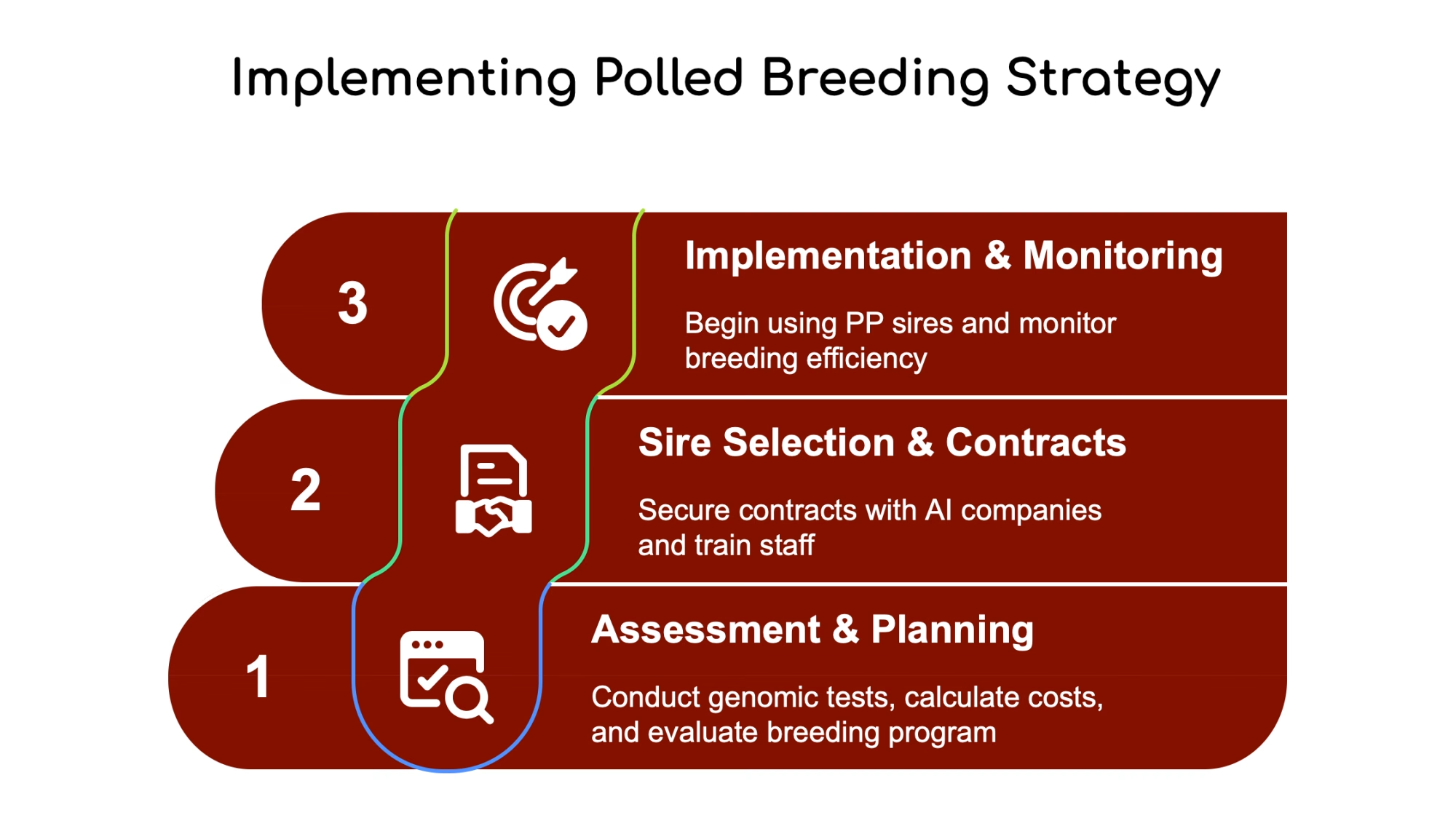
NewsSubscribe
First
Last
Consent

Spring Pasture Powerplay: Balancing Grazing Efficiency with Milk Component Goals

Spring pastures can slash profits—discover how to protect your milk check with innovative grazing strategies.

So, we’re heading into that critical time of year again when dairy farmers across the Northern Hemisphere face one of their biggest seasonal challenges. You know what I’m talking about – that tricky transition from winter housing to spring pastures. It’s fascinating how about 63% of grazing farms are scrambling to adjust their feeding programs. And while there is tons of advice for barn-feeding systems, what about the 41% of dairy farms running grass-based operations?

The stakes are pretty high, too. I was shocked when I learned that milk component depression during this period can cost between $0.18 and $0.32 per hundredweight in quality premiums. That’s real money walking out the door during what should be your most profitable season!

Spring Pasture Pitfalls: Why Your Herd’s Profitability Is Bleeding

The spring transition typically hits in April and May, though timing varies depending on where you are and what Mother Nature decides to throw at us this year. Some lucky folks in drier regions might start early in February, while organic operations often kick off around mid-April when conditions look decent.

Young spring forage differs from winter rations; it’s a metabolic minefield! With lower structural fiber and higher sugar concentrations, this lush grass creates faster digestion rates that can wreck your cows’ rumen pH—Have you ever seen what happens when those elevated levels of unsaturated fats interfere with normal rumen biohydrogenation? It’s not pretty. These fatty acid intermediates actively block milk fat synthesis, and before you know it, your butterfat yield is down by up to 50%. It’s not just a nuisance – it’s a profit vampire sucking your milk check dry.

And don’t get me started on the moisture content! Early spring pastures often hit 75-85% moisture, limiting dry matter intake and creating nutritional chaos. This perfect storm of high moisture, high sugars, and low fiber increases the risk of sub-acute rumen acidosis – what I call “stealth rumen burnout” – that cripples production and decimates both protein and butterfat.

You might wonder – is your spring grazing plan funding your vet’s vacation home? Those lush pastures often pack elevated levels of rumen degradable protein that, when not efficiently utilized, spikes blood urea nitrogen levels. Next thing you know, you’re dealing with body condition issues, fertility problems, and hoof health nightmares. And don’t forget the mineral imbalances! Spring forages are typically potassium-rich but magnesium-poor, setting your herd up for grass tetany risks.

5 Proven Grazing Strategies That Work

Successfully balancing grazing efficiency with milk component goals starts with a gradual transition. Give your cows 2-3 weeks to adapt – think of it as retooling a factory. Skip this step, and your cows’ gut microbes go on strike! Start with just a few hours of daily grazing while offering dry hay. This provides adequate fiber to keep those rumen bugs happy until they adjust to the new menu.

Implementing rotational grazing isn’t just a good idea – it’s a game-changer. I’ve seen farms divide pastures into smaller paddocks and move cows every 12-24 hours with excellent results. This approach increases grass utilization by about 20% compared to continuous grazing. That’s a free feed! For early spring, graze cool-season pastures relatively closely, leaving about 2 inches of stubble to encourage tillering. Those side shoots will significantly boost your forage availability later in the season.

Do This Now: Walk your pastures tomorrow—if residuals are below 4 cm, slam the brakes on grazing and buffer-feed STAT.

Table: Optimal Grazing Heights for Pasture Health

Forage TypeBegin Grazing HeightPost-Grazing ResidualKey Benefit
Perennial Ryegrass8-10 cm (3-4″)4-5 cm (1.5-2″)Maintains tillering & regrowth
Tall Fescue15-20 cm (6-8″)5-7 cm (2-3″)Prevents stem dominance
Legume Mixes15-25 cm (6-10″)7-10 cm (3-4″)Protects crown for regrowth

You’ll also want to maintain appropriate pre-grazing covers, especially during that second grazing round. Research shows a minimum threshold of 1600kg of dry matter per hectare ensures your cows have access to nutrient-rich sward that supports high dry matter intake. And whatever you do, don’t over-fertilize young grass in spring – you’ll just make the milk fat depression risk worse by creating even lower-fiber, faster-digesting forage.

Myth: Taller grass = better nutrition. Reality: Lush grass over 6 inches tall is a sugar bomb—it’ll crater your rumen pH faster than a Netflix binge.

Unlock Hidden Profits with Regenerative Grazing Approaches

Regenerative grazing isn’t some hippie trend – it’s a profit multiplier! I like to think of soil as your retirement account: diverse roots equal compound interest for your forage. The core principles focus on building soil health and enhancing ecosystem resilience, ultimately improving forage quality and quantity.

I’ve seen excellent results when farms implement rotational grazing with extended rest periods, allowing for complete plant regeneration and more profound root development. Plant diversity within pastures is crucial – different species have varying root depths and nutrient uptake abilities, creating more balanced nutrient cycling in the soil. These diverse root structures improve soil structure and porosity, enhancing water infiltration when needed most in spring.

A buddy of mine in Wisconsin told me, “Rotational grazing cut my feed costs by 30%—it’s like printing money in your paddocks.” And he’s not exaggerating!

Table: Regenerative Grazing Impact on Milk Components

PracticeMilk Fat ChangeMilk Protein ChangeFeed Cost ReductionStudy Duration
10-12 Day Rotations+0.22%+0.12%18-22%2-Year Trial
Diverse Species Mix+0.35%+0.18%25-30%3-Year Study
Strategic Rest Periods+0.15%+0.10%15-20%5-Year Analysis

Regenerative practices positively influence dry matter intake through several mechanisms. Grazing forages at their mid-stage maturity offers the optimal balance of protein, energy, and mineralization to support milk fat synthesis. The improved health and nutrient density of forage from regenerative systems enhances palatability, so cows simply eat more voluntarily.

The research I’ve seen suggests that milk from cows grazing on diverse, regeneratively managed pastures contains higher concentrations of beneficial fatty acids and antioxidants. At Winrock International, studies show that implementing regenerative grazing can boost milk production per cow by 40 to 65% through improved forage digestibility. That’s not incremental improvement – that’s transformational!

4 Supplement Strategies That Rescue Milk Components Fast

Let’s be clear – supplementation isn’t just an expense; it’s an investment with measurable returns during the spring transition. Given the wild variability in spring pasture nutrition, strategic supplementation bridges those gaps and ensures a more consistent diet. Early spring grass is protein-rich but typically provides insufficient energy and fiber for high-producing cows, creating imbalances that smart supplementation can fix.

Rumen-protected amino acids (RPAAs) are my go-to targeted strategy for grazing dairy cows. Methionine and lysine are usually the first limiting amino acids in pasture-based diets. Even with adequate protein intake, deficiencies in these specific amino acids can limit milk production and component synthesis. RPAAs bypass rumen degradation and deliver these essential nutrients directly to the small intestine, with numerous studies showing improvements in milk protein synthesis, overall yield, and often enhanced milk fat content.

Table: Rumen-Protected Fat ROI Analysis (2025 Data)

Supplement TypeMilk Yield IncreaseFat % IncreaseROI at 35pplBreak-Even Period
High-C16 (Mega-Fat 88)1.8 L/day+0.25%49%63 Days
Calcium Salts (Megalac)2.1 L/day+0.35%83%42 Days
Ground Corn1.2 L/day-0.10%28%85 Days

Field observations from European dairy farms show that implementing feeding strategies to minimize milk fat depression can increase milk fat content by 0.14 to 0.40 percentage points. That translates to additional income between 0.28 and 1.07 € per cow daily. For a 100-cow herd over a two-month spring transition period, we’re talking about additional profit ranging from 1664 € to over 6000 €. This isn’t pocket change—serious money left in the field!

Balancing energy and protein intake is critical when supplementing grazing dairy cows during spring. With early spring grass containing high protein but low structural fiber, you need adequate energy supplementation to optimize rumen fermentation. Interestingly, simple energy supplements like ground corn can sometimes be more economically efficient than fancy high-protein commercial concentrates, mainly when your pasture already provides plenty of protein.

Revolutionary Drone Technology That Transforms Pasture Management

Pasture monitoring drones aren’t just fancy toys—they’re profit-maximizing tools that transform guesswork into precision management. I was skeptical initially, but now I’m a convert after seeing them in action! Drones with various sensors provide high-throughput imagery that estimates canopy cover across your entire grazing area. This aerial perspective lets you determine forage utilization patterns that would take hours to assess on foot.

One of the most remarkable applications is getting real-time estimates of pasture dry matter. Drones with high-resolution RGB and multispectral sensors capture detailed images that specialized software converts into pasture height, density, and biomass estimates. Different analytical methods convert this imagery into dry matter estimations, including NDVI calculations and sophisticated machine learning models. The accuracy is impressive – some studies report coefficients of determination (R²) as high as 0.94!

The practical benefits extend beyond simple pasture assessment. The real-time data enables more informed decisions about when to move cattle to new paddocks or whether supplemental feeding is necessary. Drones can also help with herd inspection, locating strays, monitoring estrus signs, observing calving, and checking water sources. All tasks become more challenging when cows transition from winter housing to expansive spring pastures.

8 Spring Pasture Profit Commandments Every Dairy Farmer Must Follow

  1. Transition Gradually: Implement a 2-3 week adaptation period, starting with 2-3 hours of daily grazing while offering dry hay.
  2. Rotate Aggressively: Divide pastures into paddocks and move cows every 12-24 hours in early spring to prevent overgrazing and maintain forage quality.
  3. Monitor Components Daily: Track milk fat and protein percentages as your early warning system—a 0.2% drop in fat should trigger immediate intervention.
  4. Buffer Feed Strategically: Provide 3-5 pounds of adequate fiber (long-stem hay) before turnout to stabilize rumen pH and prevent acidosis.
  5. Supplement Smart: Add rumen-protected methionine at 15-20 grams per cow daily to support milk fat synthesis during the first 4-6 weeks of spring grazing.
  6. Measure Pasture Weekly: Use a rising plate meter or drone technology to quantify available dry matter and adjust rotation schedules accordingly.
  7. Diversify Pastures: Incorporate legumes and deep-rooted forbs to improve nutrient cycling, drought resistance, and overall forage quality.
  8. Manage Minerals: Supplement magnesium at 50-60 grams per cow daily to prevent grass tetany during the first month of spring grazing.

The Ultimate Spring Grazing Decision: Profit or Loss?

Successfully navigating the spring pasture transition is one of the biggest challenges we face as dairy farmers trying to balance grazing efficiency with milk component goals. Everything we’ve covered points to the need for a holistic approach that integrates careful grazing management, strategic nutrition, and innovative technology adoption.

The economic implications are enormous. Milk component depression costs between $0.18 and $0.32 per hundredweight in quality premiums. But flip that around – well-managed pasture-based systems can achieve economic efficiency that rivals or exceeds confinement operations through lower feed costs and optimized resource utilization.

So, here’s my question: Will you keep hemorrhaging milk solids or pivot to profit? The clock’s ticking—spring waits for no farmer.

Takeaway Toolkit: Implement These Actions Today

  • Measure pasture DM daily—if it’s under 20%, supplement with 3 lbs. starch/cow
  • Track milk components twice weekly—respond immediately to any downward trend
  • Implement 12-hour paddock moves during the first 3 weeks of spring grazing
  • Supplement magnesium oxide at 2 oz/cow/day during the first month on pasture
  • Maintain post-grazing residual of 4-6 cm to optimize regrowth quality
  • Consider drone technology for more precise pasture management decisions

Executive Summary

Spring pasture transition poses significant challenges for dairy farmers, with milk component depression risking $0.18–$0.32/cwt in lost premiums. Rapidly growing, nutrient-imbalanced grass disrupts rumen health, slashing up to 50% of butterfat yields. Success hinges on gradual herd adaptation (2–3 weeks), rotational grazing to boost forage use by 20%, and strategic supplements like rumen-protected amino acids to rescue milk components. Regenerative practices enhance soil health and milk quality, while drones provide real-time pasture data for precision decisions. Farmers can turn spring’s risks into profitable opportunities by balancing these strategies.

Key Takeaways

  • Gradual transition (2–3 weeks) prevents rumen shock and maintains milk fat/protein levels
  • Rotational grazing boosts pasture yield by 20% and extends grazing seasons through strategic paddock management
  • Targeted supplements (e.g., methionine/lysine) increase milk fat by 0.14–0.40%—adding €1,664–6,000/100 cows over 2 months
  • Regenerative grazing diversifies pastures, cuts feed costs by 15–30%, and improves milk’s nutritional profile
  • Drone tech delivers 94% accurate biomass data, enabling smarter grazing rotations and healthier herds

Learn more:

Join the Revolution!

Join over 30,000 successful dairy professionals who rely on Bullvine Daily for their competitive edge. Delivered directly to your inbox each week, our exclusive industry insights help you make smarter decisions while saving precious hours every week. Never miss critical updates on milk production trends, breakthrough technologies, and profit-boosting strategies that top producers are already implementing. Subscribe now to transform your dairy operation’s efficiency and profitability—your future success is just one click away.

NewsSubscribe
First
Last
Consent

Australia’s Dairy Crisis: Tough Truths Behind 2025’s Production Decline

Australians pay $3.10 for milk while farmers earn $2.46/hour – 15% price cuts drive production to 30-year lows, threatening industry survival.

EXECUTIVE SUMMARY: Australia’s dairy industry faces collapse as farmers endure 10-15% farmgate price cuts despite consumers paying record retail prices. Milk production is projected to hit 8.3 billion liters in 2024/25 – a 30-year low – with feed costs soaring 40% since 2022 and 55% of farmers considering exit. Processors like Fonterra and Saputo cite import competition (up 19%) and China’s shrinking imports, while aging farmers battle droughts and corporate consolidation. Young operators (<6% under 35) face impossible margins: earning $2.46/hour while retail milk hits $3.10/liter. Though some adapt with robotics and value-added products, ACCC warnings of power imbalances and 10 processing plant closures signal systemic failure without urgent reform.

KEY TAKEAWAYS

  • Farmers strangled: 15% milk price cuts + 40% feed cost surge = $2.46/hour earnings despite $3.10/liter retail milk prices.
  • Production collapse: Forecast 8.3B liters in 2024/25 – lowest since 1990s – with 30% fewer farms since 2014.
  • Global squeeze: Australian exports drop 17% as China grows domestic production; imports surge 19% from NZ.
  • Youth exodus: Under-35 farmers now 6% of industry – lowest ever recorded.
  • Adapt or perish: Survivors use robotics, value-added cheeses, and water rights – but need ACCC-mandated pricing reforms to scale.

The Australian dairy industry faces a perfect storm in 2025: declining production, price volatility, and structural challenges threaten its future. Who will survive as the gap between boardroom optimism and farmgate reality widens?

The Price Squeeze Strangling Farm Viability

Since the start of the 2024/25 season, lower farmgate prices have increased margin pressure for dairy farm businesses across Australia. This price decline follows comparatively high farmgate milk prices, which helped ensure the 2023/24 season finished strong for Australian dairy farmers. The contrast between these consecutive seasons highlights the volatility that makes long-term planning nearly impossible for dairy operators.

ARE YOU FEELING THE SQUEEZE? According to the Dairy Australia December 2024 report, farm margins have been pressured by lower farmgate prices and higher operating costs.

While processors tout the silver lining that lower farmgate prices have “improved the competitiveness of Australian dairy products,” who’s benefiting from this “improved competitiveness”? Certainly not the farmers whose margins are being compressed.

WAKE-UP CALL: The price volatility pattern shows no signs of moderating, creating a planning nightmare for producers trying to make long-term infrastructure and breeding decisions.

Processor Perspective: Balancing Market Realities

Sarah Thompson, Chief Supply Officer at one of Australia’s major dairy processors, offers a different perspective: “We’re navigating complex global market dynamics that force difficult pricing decisions. Our export competitiveness directly impacts our ability to maintain volumes, ultimately affecting the entire supply chain, including our farmers.”

Thompson acknowledges the pressure on farmers but emphasizes the industry’s interconnected nature: “We’ve implemented premium programs for quality and consistency that allow top-performing farms to achieve better returns despite the overall market conditions. The most progressive producers are capturing these opportunities.”

Industry analysts note this tiered approach to pricing is becoming increasingly common as processors attempt to secure consistent milk supply while managing market pressures. This creates distinct winner and loser categories among producers, accelerating the consolidation trend.

DAIRY PRICE CYCLE BASICS

Dairy prices typically follow cyclical patterns influenced by global supply and demand. When international prices rise, Australian processors usually increase farmgate payments to secure milk supply and capitalize on export opportunities. However, when international markets soften, farmgate prices typically fall first and faster than retail prices, creating a margin squeeze for farmers while processors maintain their margins. Understanding where we are in this cycle is critical for strategic farm planning.

The Human Cost: Farmer Wellbeing at Breaking Point

The financial strain facing dairy farmers has created a significant human cost that often goes unrecognized. Many dairy farmers are exhausted, demotivated, and struggling to make ends meet while sacrificing time with families and friends. Their mental and physical health suffers as they work increasingly more extended hours to maintain production with fewer resources.

A recent Curtin University study revealed that 55% of surveyed farmers expressed discontent with the sector. Financial strain and mental health issues have prompted many to contemplate leaving the industry altogether.

“I’m just having a bad time, can’t find staff, I’m just over it. Too long hours, not enough family time.” – Victorian dairy farmer

“We are thinking about getting out since what’s the point of working 7 days a week and going bankrupt and being stressed all the time.” – Victorian dairy farmer.

The psychological burden of operating in such an uncertain environment takes a severe toll, mainly when farmers see market improvements that never translate to their bank accounts. The gap between optimistic industry forecasts and the harsh farm-level reality widens in 2025, adding to farmers’ frustration and sense of abandonment.

Weather and Cost Pressures: A Perfect Storm

Persistent dry weather conditions across key production regions have compounded financial pressures by increasing feed costs. The industry has faced a perfect storm of challenges, including the lingering effects of a severe drought about ten years ago, difficulties finding farm workers, rising farmland costs, and the constant threat of extreme weather events.

According to the Curtin University study, feed costs have surged by 40% since 2022. Meanwhile, stagnant milk prices have resulted in unsustainable profit margins for 89.8% of the farmers surveyed. This cost-price squeeze leaves farmers with little room to maneuver or invest in their operations.

This situation is unjust because favorable seasonal conditions are sometimes used as justification for paying dairy farmers less, despite the significant risks farmers take to produce high-quality milk regardless of weather conditions. When seasonal conditions deteriorate, as in many regions, input costs soar, yet farmgate prices rarely respond proportionately.

“Not enough water, not enough feed.” – NSW dairy farmer

“Arid conditions, lack of grown feed is the main impact.” – Victorian dairy farmer

“At the moment, it’s tough because of the drought. Having to buy hay is enormously expensive.” – Queensland dairy farmer

The saying goes, “Make hay while the sun shines,” yet Australian farmers see no benefit while the sun is shining on dairy products globally. With input costs soaring due to dry conditions across Australia, farmers face unprecedented challenges that threaten their survival.

Import Challenge: The Competitive Squeeze

Compounding these pricing pressures is the growing challenge of imports. Fonterra Australia’s managing director, Rene Dedonker, noted that while domestic milk sales perform well, their cheese and butter sales suffer due to large volumes of cheaper imports.

Dairy Australia statistics reveal that imports of dairy products have nearly tripled over the past two decades and continue to rise, placing additional downward pressure on domestic prices. Recent data shows Australian exports have dropped by 17% whilst imports have increased by 19%, creating a concerning trade imbalance.

Once a reliable export destination, the Chinese market has also changed dramatically. “Production in China grew by 8 billion liters, and the industry will continue to grow because of government investment,” noted Matt Watt, Farm Source’s director (a Fonterra division). “This reduces their need to import.”

These international market shifts have left Australian dairy farmers increasingly dependent on the domestic market, where they face intense competition from imported products that often don’t meet the same quality and sustainability standards.

Industry Structure: Winners, Losers, and Demographic Challenges

The Australian dairy industry is undergoing significant structural changes that favor specific business models while threatening others. Industry consolidation is accelerating, favoring large-scale operations and specialized boutique producers while squeezing mid-sized conventional farms. This bifurcation of the industry creates clear winners and losers, with traditional family farms often falling into the latter category.

Demographics present another critical challenge. Due to recent difficulties and an uncertain future, young people are showing little interest in entering the dairy sector. This demographic shift threatens the industry’s long-term viability as experienced farmers retire without successors to continue operations.

The number of dairy farms has fallen from 6,308 in 2014 to just 4,420 by 2022, a staggering 30% reduction in less than a decade. Even more concerning, individuals under 35 now account for a mere 6% of the industry, indicating a notable exodus of youth and raising serious questions about the sector’s future.

Technology and Innovation: A Path Forward?

Despite the challenges, technological advancements offer potential pathways for the industry’s future. According to Andrew Schmetzer of NOVUS, Australia’s industry is embracing new dairy management methods, such as freestall barn housing and robotic milking systems. These technologies optimize herd management and address labor inefficiencies, which are critical for sustainability in a labor-intensive industry like dairy farming.

Victorian scientists are also working on reducing the Australian dairy cow’s environmental footprint and creating a more profitable and sustainable dairy sector. The government of Victoria has launched a US$41 million, five-year research partnership with the dairy industry as part of its Transformational Agriculture Strategy. The forage program focuses on F1 hybrids and gene editing, while the animal program focuses on new traits and improved selection.

The Future Forage Programme will develop new and improve existing forage varieties and species to support the dairy industry as farm systems change and adapt to climate variability and volatility. The Future Cows program will focus on farmer-selected traits and breeding priorities and will use advances in animal monitoring to provide new tools for profitable adaptation to future farms.

“The cows of tomorrow will have lower methane emissions per liter of milk produced, and they will live longer, produce healthier calves, have good metabolic efficiency and low maintenance requirements,” says Professor Jennie Pryce of Agriculture Australia, who is leading the DairyBio animal program. “These cows may not look much different to the cows you see today, but they’ll be more profitable for dairy farmers for a longer time.”

According to the program, dairy farmers should gain US$248 per cow in the future developed cows. Their emissions should be reduced by 10%. The cows will also be able to adapt to warming faster. They should have a 10% greater lifespan by 2040, and the health and management costs should be reduced by 10%.

While these technological advances offer hope, the question remains whether farmers will have the financial capacity to invest in these innovations given their current economic pressures.

Market Opportunities: Consumer Preferences Shift

Despite the challenges, essential market opportunities exist for Australian dairy. Australian consumers increasingly prefer high-quality, locally produced dairy products and a willingness to pay premium prices to support local farmers. The domestic market remains robust, with growth in cheese, dairy spreads, and yogurt sales offsetting flat milk demand.

Rafael Guerrero of NOVUS notes that the industry is shifting toward value-added products like cheese and yogurt. As global markets demand premium dairy goods, Australian farmers adapt by focusing on milk solids rather than just volume. This pivot increases profitability and ensures resilience against market fluctuation.

This consumer sentiment represents a potential lifeline for the industry if it can be effectively leveraged through marketing, product innovation, and transparent supply chains that connect consumers directly with producers. However, capitalizing on these opportunities requires investment capacity that many farmers lack due to compressed margins.

The Bottom Line: Critical Crossroads for Australian Dairy

Australian dairy stands at a critical crossroads as the industry approaches the 2025/26 opening price announcements. In the coming months, the decisions made by processors will send powerful signals about whether they truly value a sustainable domestic supply base or are content to rely increasingly on imports while the local industry contracts.

The central question for farmers contemplating their future is whether the industry will finally recognize and reward their essential role in the supply chain. Without meaningful changes to pricing models that reflect global market improvements and account for rising production costs, the exodus from dairy farming will likely accelerate, further threatening Australia’s century-old tradition of dairy excellence.

Successful producers increasingly focus on efficiency gains, diversification, and targeted technology investments to weather the current storm. Water security has become a critical factor in farm sustainability, with forward-thinking operators investing in irrigation infrastructure and water rights to mitigate climate variability.

Policy support is also essential. Industry bodies are calling for more comprehensive support and policy changes to help farmers with technology adoption, sustainable farming practices, and mental health resources. These initiatives must be coupled with efforts to address the structural imbalances in the supply chain that prevent farmers from capturing a fair share of the final product value.

The Australian dairy industry has shown remarkable resilience throughout its history, but the current challenges are testing this resilience like never before. The question isn’t whether Australian dairy will change – it’s whether you’ll lead that change or one of those left behind by it.

As one of Australia’s most iconic agricultural sectors, dairy deserves better—not just for the farmers who pour their lives into it but also for consumers who value local production and the rural communities that depend on its continued viability.

Read more:

  1. April 2025 Dairy Risk Management Calendar
    Explore strategies to mitigate crashing milk prices and feed cost volatility, including component-focused culling and futures hedging, critical for farmers navigating 2025’s margin squeeze.
  2. Global Dairy Market Trends 2025: European Decline, US Expansion Reshaping Industry Landscape
    Analyzes how EU production declines and US expansion impact global trade dynamics, offering context for Australia’s export challenges and import competition.
  3. Australia’s Dairy Crisis: Tough Truths Behind 2025’s Production Decline
    The foundational piece detailing Australia’s 8.3 B-liter production collapse, demographic exodus, and survival strategies for farmers.

Join the Revolution!

Join over 30,000 successful dairy professionals who rely on Bullvine Daily for their competitive edge. Delivered directly to your inbox each week, our exclusive industry insights help you make smarter decisions while saving precious hours every week. Never miss critical updates on milk production trends, breakthrough technologies, and profit-boosting strategies that top producers are already implementing. Subscribe now to transform your dairy operation’s efficiency and profitability—your future success is just one click away.

NewsSubscribe
First
Last
Consent

CHINA SLAMS DOOR ON U.S. BEEF: Your Cull Cow Checks Could Take a Massive Hit

China blocks U.S. beef plants—your cull cow checks hang in the balance as $4.13 billion in exports face sudden termination. Is your dairy ready?

EXECUTIVE SUMMARY: China’s refusal to renew registrations for 390 U.S. beef plants creates an urgent threat to dairy producer profitability, potentially eliminating .13 billion in beef exports precisely when declining milk margins make cull income increasingly crucial. This calculated move amid escalating trade tensions and China’s oversupplied domestic beef market could flood U.S. markets with products previously destined for export, depressing cull cow values nationwide. Innovative dairy producers should consider accelerating planned culls, exploring alternative marketing channels, and implementing specific risk management strategies like Livestock Risk Protection insurance with 70-100% coverage levels or CME Live Cattle options to protect against this emerging threat to their bottom line.

KEY TAKEAWAYS

  • China’s registration block threatens $4.13 billion in beef exports, with ripple effects that could significantly depress domestic cull cow prices at a time when dairy margins are already tightening.
  • The timing creates a perfect storm for dairy producers: milk margins are down 11% while simultaneously threatening cull income, serving as a critical financial buffer during downturns.
  • Immediate action steps include rethinking culling timelines, exploring direct marketing arrangements, and implementing specific risk protection through USDA LRP insurance or CME futures options.
  • This situation exposes a fundamental vulnerability in modern dairy economics: over-reliance on strong cull values to maintain profitability when milk prices weaken.
  • Beyond direct trade impacts, China’s decision potentially violates Phase 1 trade commitments and represents a strategic move to protect its oversupplied domestic beef market at the expense of U.S. dairy producers.
dairy cull cow prices, China beef exports, dairy farm profitability, beef plant registrations, U.S.-China trade impact

While you were milking cows this weekend, China quietly pulled the rug from under U.S. dairy producers. In a move that threatens to tank cull cow prices just when dairy margins are already shrinking, Chinese officials have refused to renew registrations for approximately 390 U.S. beef plants—potentially wiping out $4.13 billion in U.S. beef exports and delivering a devastating blow to your bottom line. With dairy margins already under pressure, this diplomatic snub couldn’t come at a worse time for producers counting on strong cull values to offset weakening milk prices.

China’s Power Play Exposes Dairy’s Vulnerability

Export registrations for more than 1,000 U.S. meat plants granted under the 2020 “Phase 1” trade deal officially lapsed on Sunday, March 16. While China has since renewed registrations for pork and poultry facilities through 2030, U.S. beef facility registrations remain conspicuously listed as “expired.”

This isn’t some administrative hiccup—it’s a calculated move amid escalating trade tensions.

The registration status for beef plants across the United States, including operations owned by major producers like Tyson Foods, Smithfield Packaged Meats, and Cargill Meat Solutions, was deliberately changed from “effective” to “expired” on the website of China’s General Administration of Customs.

Let’s call this what it is: Beijing is playing hardball after slapping retaliatory tariffs on approximately $21 billion worth of American farm goods earlier this month, including a 10% tariff on imports of American beef, pork, and dairy products.

They’re squeezing American agriculture from both ends—hiking tariffs while shutting down market access through regulatory maneuvers.

Is your operation prepared for a potential cull cow price shock when beef export channels suddenly close?

The Double Whammy Threatening Your Operation

Why should you care about beef plant registrations? Because your dairy operation’s profitability is directly tied to those beef export channels.

When China blocks U.S. beef exports, that meat gets dumped back into domestic markets, driving down cull cow prices precisely when you need that income most.

The impact could be catastrophic. The U.S. Meat Export Federation estimates that the financial repercussions of these expired licenses could total $4.13 billion for the beef sector alone. That’s not just an abstract number—it translates directly to what you’ll get for your culls at auction.

The timing of this situation is particularly treacherous. This market disruption arrives as dairy margins are compressing, making cull income increasingly crucial to your operation’s financial health.

When milk prices struggle, the check for your culled cows becomes an essential lifeline—one that’s now at serious risk.
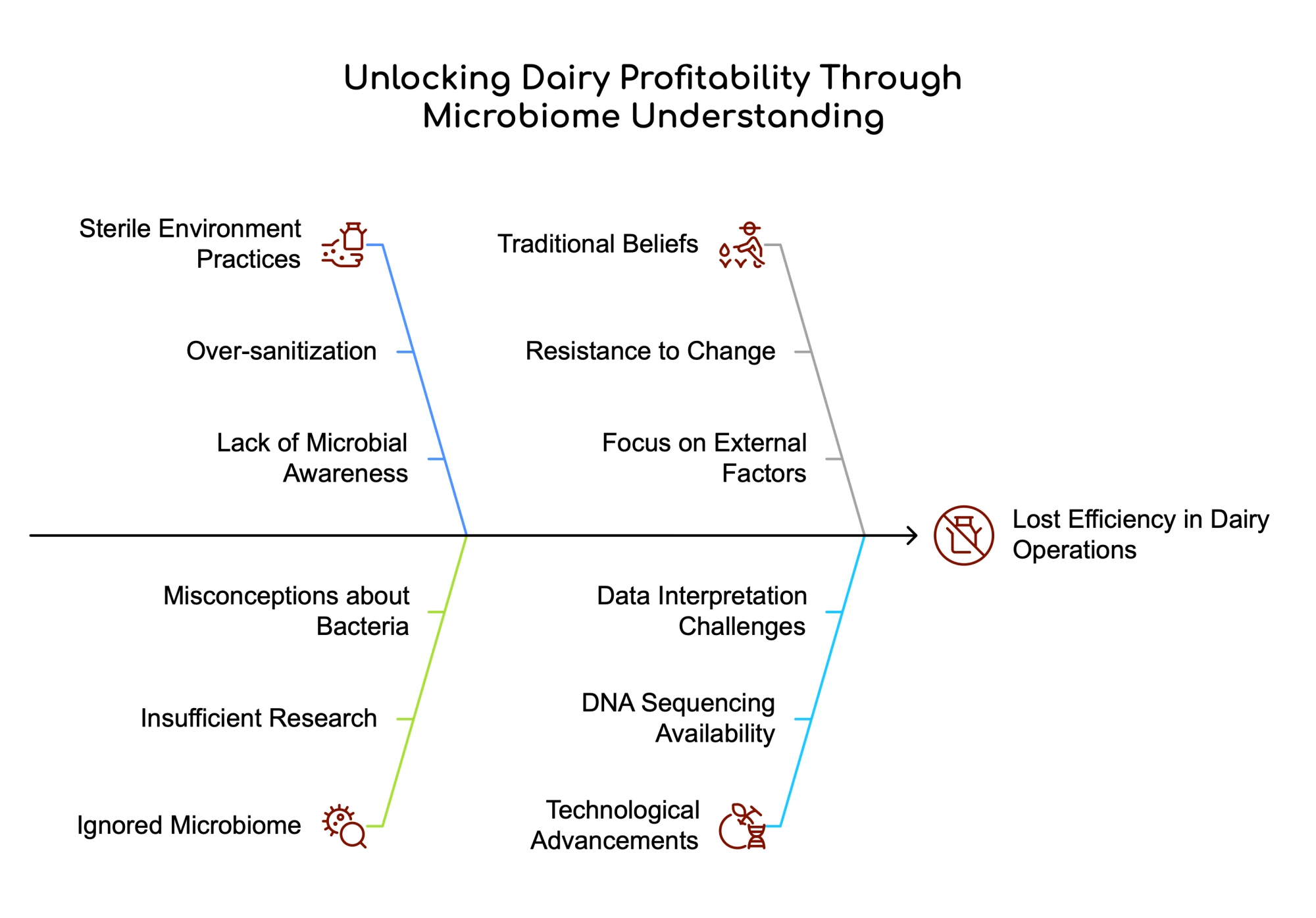
China’s Domestic Beef Glut

While the timing aligns perfectly with broader trade tensions, China’s reluctance to renew beef registrations stems from domestic market conditions.

The country has been grappling with a significant oversupply in its domestic beef market, which has led to financial losses for Chinese producers throughout 2024.

Unlike pork and poultry—where registrations were promptly renewed—Chinese officials appear to be using regulatory tools to protect domestic beef producers already struggling with depressed prices.

Make no mistake, though—this strategic protection of domestic interests directly costs your dairy operation’s bottom line.

Beijing’s Beef with American Agriculture

This isn’t simply about paperwork. The U.S. Department of Agriculture reports that China has systematically ignored repeated requests to renew plant registrations.

Under the Phase 1 trade deal, China must update its approved plant list within 20 days of receiving updates from the USDA.

Their refusal to do so isn’t just inconvenient—it potentially violates explicit trade commitments.

This isn’t the first wave of registration expirations, either. In February 2025, registrations for 84 U.S. plants lapsed.

While shipments from those plants continue to clear customs, the industry does not know how long China will continue accepting these imports.

Beyond the paperwork hurdles, exporters face additional challenges.

As Joe Schuele, spokesperson for the U.S. Meat Export Federation, explains: “We are hoping for similar news soon on the beef side, but for now, the 390 US beef facilities that expired on March 16 have not yet been renewed. For now, we have advised exporters that beef produced before March 16 should clear customs, provided that importers had secured import quarantine permits before March 16.”

What This Means for Your Bottom Line

Let’s cut through the diplomatic doublespeak and talk real money. In 2024, the United States ranked China’s third-largest meat supplier by volume, trailing only Brazil and Argentina. It accounted for 590,000 tonnes or 9% of China’s total imports.

U.S. meat shipments to China reached $2.5 billion last year, making it the second-largest export market by value.

The USMEF impact assessment doesn’t just consider direct export losses. As Schuele explains, the $4.13 billion figure “not only takes into consideration the loss of direct exports to China, but also the impact of the improved prices U.S. beef cuts command in Japan, Korea, and Taiwan when exporters also have access to China and Chinese buyers are active in the market.”

In other words, losing China creates a domino effect across all export markets.

Losing access to this critical market would devastate beef producers and dairy operations.

The loss of the Chinese market would hurt exporters of beef parts in the United States, which has limited domestic demand.

When those products can’t be shipped to China, they flood local markets and drive down prices—including for your cull cows.

How exposed is your dairy to beef market volatility, and what’s your backup plan if cull prices drop 20% overnight?

Strategic Moves to Protect Your Operation

While this diplomatic chess match plays out, you need actionable strategies to protect your operation’s profitability:

1. Rethink Your Culling Timeline

If you were planning routine culls in the coming months, consider accelerating that timeline before market impacts materialize fully.

Alternatively, if you can profitably maintain marginally productive cows, you might benefit from holding them longer until this trade situation stabilizes.

2. Explore Alternative Marketing Channels

This might be the time to investigate direct marketing arrangements with local processors or explore niche markets for dairy beef that might be less affected by export market disruptions.

3. Implement Risk Management Strategies

Don’t leave your operation exposed to these market whims. Explore Livestock Risk Protection (LRP) insurance options specifically for cull cows through your crop insurance agent.

The USDA’s LRP program offers coverage levels between 70-100% of expected ending values, with premiums partially subsidized (ranging from 35-55% depending on coverage level).

Consider strategically using Chicago Mercantile Exchange (CME) Live Cattle futures contracts to hedge against potential price declines. For most dairy operations, buying put options might offer the most practical protection against downside risk while limiting your maximum loss to the premium paid.

The Bottom Line

This registration standoff highlights a fundamental vulnerability in dairy economics—our increasing dependence on strong cull values to maintain operational profitability when milk margins tighten.

With dairy margins already under pressure, this diplomatic dispute threatens to undermine a critical revenue stream many operations take for granted.

The situation remains fluid, with industry stakeholders pressing for resolution. However, a quick resolution seems unlikely, given broader trade tensions and China’s apparent willingness to use agricultural trade as leverage.

Innovative producers will prepare for market volatility rather than hoping for diplomatic miracles.

Your operation’s resilience depends on recognizing and adapting these market signals early. Those who understand how global beef trade impacts local cull values—and take proactive steps to mitigate those risks—will be better positioned to weather whatever comes next in this high-stakes international trade dispute.

Learn more:

Join the Revolution!

Join over 30,000 successful dairy professionals who rely on Bullvine Daily for their competitive edge. Delivered directly to your inbox each week, our exclusive industry insights help you make smarter decisions while saving precious hours every week. Never miss critical updates on milk production trends, breakthrough technologies, and profit-boosting strategies that top producers are already implementing. Subscribe now to transform your dairy operation’s efficiency and profitability—your future success is just one click away.

NewsSubscribe
First
Last
Consent

Dairy Farmers in the Crosshairs: EU-US Trade War Threatens Feed Supplies

Bureaucrats’ tariff war puts your dairy farm at risk! Feed costs could skyrocket €25,000 per 100 cows annually. Can your operation survive?

EXECUTIVE SUMMARY: European dairy farmers face a devastating double blow as retaliatory tariffs between the EU and US threaten critical feed ingredient supply chains, coming just months after Brussels imposed an 85% duty on Chinese lysine imports. With feed representing up to 70% of production expenses, mid-sized operations could see cost increases of €15,000-€25,000 annually per 100 cows—potentially eliminating entire profit margins during an already challenging market period. Despite the 2018 Trump-Juncker agreement demonstrating that targeted agricultural trade deals can successfully navigate broader tensions, policymakers have sacrificed agricultural interests for industrial priorities. European producers now face a strategic vulnerability due to the region’s structural deficit in protein-rich feed ingredients, requiring immediate action to secure feed contracts, evaluate alternatives, and pressure industry associations for political intervention.

KEY TAKEAWAYS

  • Double Crisis: EU dairy farms face two simultaneous feed crises – 85% tariffs on Chinese lysine and new retaliatory tariffs on US feed ingredients
  • Financial Impact: For a 100-cow operation, expect €15,000-€25,000 in additional annual feed costs, potentially wiping out your entire profit margin
  • Historical Solution Ignored: The successful 2018 Trump-Juncker agreement provides a proven diplomatic template that policymakers are inexplicably ignoring
  • Immediate Action Required: Lock in feed contracts now, consult with nutritionists on alternatives, and calculate your operation’s financial breaking point
  • Vulnerability Exposed: This crisis highlights the dangerous dependency created by Europe’s structural deficit in protein-rich feed ingredients, requiring long-term solutions

While bureaucrats in Brussels and Washington play their high-stakes trade chess game, dairy farmers across Europe are about to become the sacrificial pawns. The EU’s newly announced retaliatory tariffs targeting American feed ingredients aren’t just numbers on a policy document – they’re a direct assault on your farm’s profitability in an already challenging market. With feed costs representing up to 70% of production expenses, this political power play could be the breaking point for thousands of dairy operations caught in the crossfire. The Bullvine investigates who’s to blame and what innovative producers should do before feed prices explode.

Tariffs Target Critical Feed Ingredients as Market Volatility Hits

The EU Commission’s retaliatory tariffs against US agricultural imports aren’t just abstract policy—they directly hit your farm’s bottom line. When critical feed components like soybeans, corn, and essential feed additives face tariffs, those costs don’t disappear—they land squarely on your shoulders.

“With China, we have one of our largest and most significant markets for dairy products back in operation.”
—Cem Oezdemir, German Agriculture Minister

Meanwhile, European dairy farmers face escalating input costs due to political miscalculations. The contrast couldn’t be more precise—some trade relationships are strengthened while others crumble.

For the average 100-cow dairy operation, feed cost increases could range from €15,000 to €25,000 annually, depending on your feed ration composition. That’s not a rounding error—it’s potentially wiping out your entire profit margin in an industry already squeezed by tight margins and volatile milk prices.

Market reaction has been swift and telling—Chicago soybean futures for May 2025 immediately dropped 1.0%, while corn futures plummeted 2.1% following the announcement. These fluctuations signal the beginning of extreme market volatility as supply chains adjust to the new tariff reality.

Feed Price Impact: By The Numbers

Feed ComponentPrice ChangeImpact Factor
Complete feed mixes+€10-30 per 100kgEU-China lysine tariffs
Corn-based feed-2.1% futures priceInitial US tariff announcement
Soybean products-1.0% futures priceInitial US tariff announcement
Lysine additives+85% import dutyEU tariff on Chinese imports

The most vulnerable operations? Mid-sized family farms have limited capacity to absorb additional feed costs and lack economies of scale that more extensive operations might leverage to negotiate better prices. These are precisely the farms already struggling to stay afloat across rural Europe.

EU’s 85% Duty on Essential Amino Acid Drives Feed Costs Higher.

The EU-US tariff battle isn’t even the first blow to European dairy producers this year. In mid-January, the European Commission imposed a staggering 85% import duty on lysine from China—an essential amino acid critical for dairy cattle nutrition that promotes growth, development, and immune function.

The impact was immediate and severe. Feed manufacturers are projecting price increases between €10-30 per 100 kilograms of feed in the coming days, according to agricultural publication Agrarheute.

What makes this situation particularly outrageous is the EU’s self-imposed vulnerability. “Of the total imported amino acid lysine, China accounts for around 70%,” pointed out Stefan Köhler, a European Parliament’s Agriculture and Food Committee member. There aren’t enough alternative suppliers to meet European demand.

“Animal feed manufacturers are deeply concerned about the high level of temporary EU tariffs on the essential amino acid lysine.” —Dr. Hermann-Josef Baaken, spokesman for the German Animal Nutrition Association

Industry groups, including the European Food Industry Association (FEFAC), the German Animal Nutrition Association (DVT), and the Raiffeisen Association (DRV), are calling for the Commission to withdraw these damaging anti-dumping duties retroactively.

Especially troubling are reports that these harmful tariffs may have been imposed due to political pressure rather than genuine market concerns. Unofficial sources suggest a large French producer unable to compete with Chinese prices lobbied Brussels through the French government—creating a situation where dairy farmers across Europe are forced to subsidize a single company’s business model.

Bureaucrats Sacrifice Farm Interests for Industrial Priorities

Let’s cut through the political double-talk and address the elephant in the barn: European dairy farmers are collateral damage in a trade dispute that has nothing to do with agriculture. This tariff war began with steel and aluminum—yet farmers will somehow pay the price.

The EU claims these retaliatory tariffs were unavoidable responses to US trade aggression, but that’s cold comfort when feed costs are skyrocketing. The bureaucratic elite in Brussels made a calculated decision to target US agricultural exports, knowing full well that European livestock producers would absorb significant financial pain. It’s a classic case of agricultural interests being sacrificed for industrial priorities.

“A prolonged tariff war will deliver significant economic damage to American dairy farmers, processors, and rural communities.”
—International Dairy Foods Association

This warning from the IDFA applies equally to European producers. When agriculture becomes a bargaining chip in broader trade disputes, rural communities on both sides of the Atlantic suffer the consequences.

Research shows that tariff reductions generally stimulate increased trade while tariff increases predictably reduce trade activity—a principle demonstrated by immediate market reactions to policy announcements. Yet policymakers continue to use agricultural trade as a weapon in broader economic disputes despite knowing the devastating consequences for rural communities.

Where are the agricultural ministers and rural advocates who should be raising alarm bells? Their silence is deafening. Instead of protecting their constituencies, they’ve fallen in line with a retaliatory strategy that treats dairy farmers as acceptable casualties.

The 2018 Soy Agreement Proved Diplomatic Solutions Exist

This isn’t our first rodeo with US-EU agricultural trade disputes. In 2018, the “Trump-Juncker” agreement on soy products demonstrated that targeted agricultural trade deals can successfully navigate broader trade tensions. That agreement catapulted the US into the top position for soy exports to the EU for the first time, creating a win-win situation for producers on both sides of the Atlantic.

“EU imports from the U.S. can easily be doubled from 4 billion euros to 8 billion euros, thereby diminishing the existing U.S. agricultural trade deficit with the EU.”
—Pedro Cordero, FEFAC President

The opportunity for growth is right there, spelled out in black and white by industry leaders. So why are politicians choosing conflict over cooperation?

Why aren’t officials pursuing this proven strategy now? The 2018 agreement could serve as a blueprint for resolving the current dispute with a comprehensive arrangement covering feed ingredients, including US corn and essential feed additives. European dairy farmers benefited significantly from that stability—starkly contrasting today’s brewing chaos.

Farmers Across Europe Sound the Alarm on Feed Costs

“This is bureaucracy gone mad,” says Franz Muller, who operates a 120-cow dairy in Bavaria. “My feed costs will increase by at least €18,000 annually based on my supplier’s preliminary estimates. That’s roughly equivalent to the annual salary of one of my employees. Who should I fire because politicians can’t resolve their disputes?”

Similar frustrations echo across European dairy regions. In the Netherlands, cooperative feed mill manager Joren van der Meer reports fielding dozens of calls from worried producers: “They’re asking if they should lock in long-term contracts now before prices surge further. But honestly, I can’t give them solid advice because we don’t know how long this dispute will last or how bad it will get.”

Irish dairy farmer Siobhan O’Connell puts it bluntly: “We survived COVID. We managed through Brexit disruptions. We’re adapting to climate regulations. But this trade war might finally break us because it attacks our most basic input—affordable feed.”

EU’s Structural Deficit in Protein-Rich Feed Ingredients

This trade dispute highlights a dangerous strategic vulnerability in European dairy production. The EU faces a structural deficit in protein-rich feed ingredients, making the sector dependent on stable international trade relationships. When those relationships deteriorate, the entire production system becomes precarious.

FEFAC President Pedro Cordero didn’t mince words when he warned that the proposed tariffs “could undermine joint efforts and may lead to the disruption of vital feed supply chains. ” He highlighted the EU’s continued reliance on essential feed imports, especially protein-rich products like soybeans, maize, and feed additives, where the region faces significant shortfalls.

“[These tariffs would] negatively impact the resilience and competitiveness of EU livestock production systems.”
—Pedro Cordero, FEFAC President

This isn’t hyperbole or political posturing—it’s a stark assessment from the organization representing European feed manufacturers who understand precisely what’s at stake.

Dr. Hermann-Josef Baaken from the German Animal Nutrition Association pointed out another critical concern: “It is unusual for the European Commission to impose anti-dumping duties on goods for which there is a high dependence on imports.” This observation applies equally to the lysine situation and the potential US feed ingredient tariffs—policymakers seem determined to ignore supply chain realities.

As Baaken suggests, the EU should encourage investments to increase domestic production of essential feed ingredients rather than disrupt established supply chains. Without such domestic capacity, European dairy producers remain at the mercy of geopolitical disputes and trade policy whims.

5 Steps to Protect Your Farm from Tariff Fallout

While politicians dither, innovative producers need concrete action plans. Here’s what The Bullvine recommends:

  1. Lock in feed contracts now: Contact your suppliers immediately to explore locking in longer-term contracts before tariff impacts fully materialize in pricing.
  2. Evaluate alternative protein sources: Work with your nutritionist to identify potential substitutions that might mitigate cost increases. European-grown protein crops may become more price-competitive despite typically lower protein concentrations.
  3. Run stress tests on your operation: Model various feed cost increase scenarios (10%, 20%, 30%) to understand precisely where your breaking point lies and what operational adjustments might be necessary.
  4. Join the political fight. Industry associations need to hear your voice. The louder farmers protest these tariffs, the more pressure will build on politicians to exempt agricultural products.
  5. Explore feed efficiency technologies: This crisis incentivizes investing in precision feeding systems that can reduce waste and maximize nutrient utilization.

Quick Response Checklist for Dairy Producers

✓ Contact your feed supplier today about long-term contract options
✓ Request an emergency nutrition consultation to discuss feed alternatives
✓ Calculate your operation’s “breaking point” at different feed cost thresholds
✓ Email your industry association demanding action on agricultural tariff exemptions
✓ Schedule a consultation with a precision feeding specialist

Farmers Demand Solutions as Trade Tensions Escalate

The escalating US-EU tariff war represents a clear and present danger to European dairy operations following the already damaging lysine tariffs against China. Farmers and policymakers must take FEFAC’s warning about vital feed supply chain disruptions seriously. While bureaucrats in Brussels and Washington engage in diplomatic theater, honest livelihoods hang in the balance.

The historical success of the 2018 soy products agreement offers a template for resolution, but farmers can’t afford to wait for politicians to rediscover common sense. Immediate planning for feed security and cost management is essential.

This situation underscores the strategic vulnerability created by Europe’s structural deficit in protein-rich feed ingredients. Long-term solutions must include developing domestic protein production capacity alongside more stable international trade frameworks that don’t use agricultural products as bargaining chips in unrelated disputes.

For now, European dairy farmers are caught in the political crossfire that is not their making. The Bullvine will continue monitoring this developing crisis while advocating for immediate exemption of agricultural products from this damaging tariff war. Your farm’s survival may depend on it.

Learn more:

Join the Revolution!

Join over 30,000 successful dairy professionals who rely on Bullvine Daily for their competitive edge. Delivered directly to your inbox each week, our exclusive industry insights help you make smarter decisions while saving precious hours every week. Never miss critical updates on milk production trends, breakthrough technologies, and profit-boosting strategies that top producers are already implementing. Subscribe now to transform your dairy operation’s efficiency and profitability—your future success is just one click away.

NewsSubscribe
First
Last
Consent

Send this to a friend