



Archive for dairy subsidies

When the Government Checks Stop: What U.S. and New Zealand Dairies Are Teaching Us About Competing Post-Subsidy

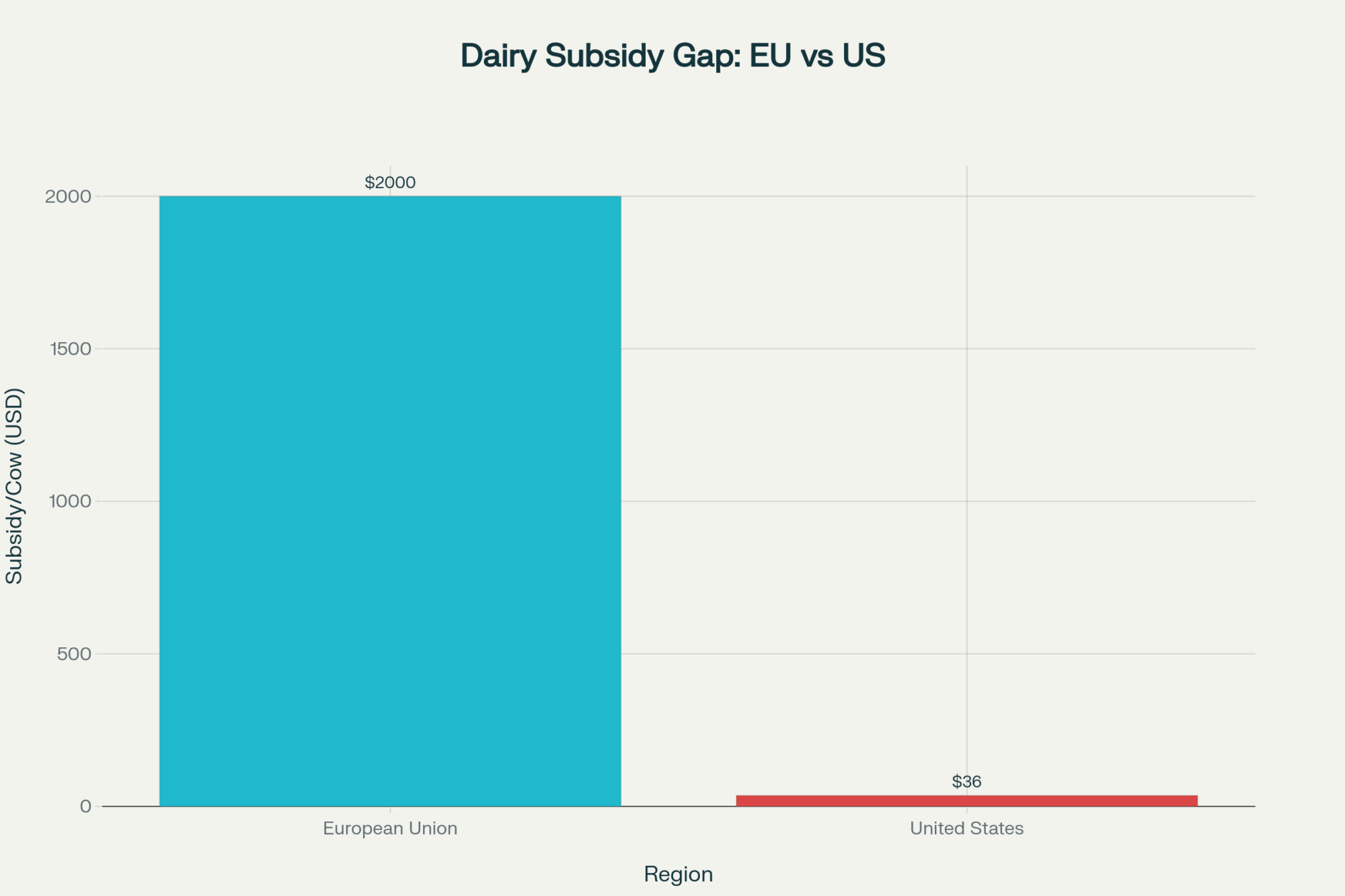
€1,800 vs $36 per cow—guess which country’s getting the better deal? Here’s what this subsidy gap means for your milk check.

EXECUTIVE SUMMARY: Look, here’s something that’ll make you spit out your morning coffee: New Zealand dairy farmers get zero subsidies and still dominate global powder markets, while European producers rake in €1,800 per cow annually—that’s roughly $240,000 per average farm! Meanwhile, we’re getting about $36 per cow through Dairy Margin Coverage, and that’s insurance you pay into, not free money. The kicker? Our average herd size hit 377 cows in 2024, up from 357 just five years back, giving us scale advantages those smaller European operations don’t have. China just cut dairy imports 12% as their domestic production ramps up, tightening the global squeeze. Bottom line—your survival depends on efficiency, not handouts. Smart producers are already tracking carbon footprints, investing in precision tech, and building premium brands. Don’t wait for the market to separate the wheat from the chaff.

KEY TAKEAWAYS:

  • The Subsidy Reality Check: European farms get 50x more government support per cow than we do—use that DMC insurance smartly and focus on what you can control: feed efficiency and margin management (OECD, USDA data).
  • Size Does Matter: U.S. herds averaging 377 cows now means better economies of scale—time to seriously look at robotic milking or precision feeding systems that boost your per-cow productivity by 15-20% (Progressive Publishing, Penn State Extension).
  • Carbon = Cash: New Zealand’s carbon footprint runs 46% below Europe’s, proving sustainability isn’t just feel-good nonsense—it opens premium market doors and better pricing power (AgResearch study).
  • Global Game Changer: China’s 12% import drop means less competition for their market, but also signals you better diversify your customer base and product mix fast (AHDB reports).
  • Cash Flow Is King: Without that steady subsidy cushion, managing seasonal swings—spring freshening costs, summer feed spikes, fall breeding expenses—becomes make-or-break territory (USDA Economic Research Service).

I was talking with a Holstein producer the other day—runs about 280 cows up near Marshfield, Wisconsin. He shook his head and said what a lot of us are thinking: “How do those Kiwi farmers keep flooding our powder market with zero government help? Meanwhile, European cheeses sit on store shelves priced so low that it makes you wonder how any of us stay in business.”

That conversation’s been sticking with me because it hits on something we all feel but don’t always put into words.
The Subsidy Gap: What the Numbers Actually Show

Here’s the reality: New Zealand dairy farmers get zero direct subsidies—haven’t since their industry went through that radical deregulation back in the 1980s. Across the Atlantic, European producers collect about €1,800 per cow annually through the EU’s Common Agricultural Policy, which works out to roughly €243,000 per farm when you figure their average herd runs around 132 cows (OECD Agricultural Policy Monitoring, 2024).

Here in the States, farms average 377 cows now—up from about 357 just five years ago—and our main support comes through the Dairy Margin Coverage program. But here’s the thing: DMC isn’t welfare. It’s insurance you pay into, and it only pays out when the margin between your milk price and feed costs drops below specific triggers (USDA Economic Research Service, 2024; Government Accountability Office, 2025).

Working the math, that’s about $36 per cow annually. Not exactly what you’d call substantial compared to Europe’s numbers. According to Wisconsin Extension’s producer surveys, import competition consistently ranks as a top concern among Midwest dairy operators, with many citing the challenge of competing against subsidized products.

ProgramHow It WorksBenefitsReality Check
Dairy Margin Coverage (DMC)Producer-paid insurance; margin-triggered payoutsProtects during tight margin periodsPayments only when market conditions trigger
EU Common Agricultural Policy (CAP)Direct payments per cowSteady income and rural community supportCan distort markets and create dependency

How This Plays Out Across Regions

Down in Pennsylvania, smaller operations—mostly under 100 cows—have been carving out success with artisan cheeses and specialty yogurts. It’s not about volume but about quality and storytelling that command premium prices. Individual farms like Manning Farm Dairy’s on-farm ice cream operation show how specialty positioning can work.

Wisconsin’s nearly 6,000 dairies, predominantly Holstein herds averaging 142 cows, form America’s cheese heartland. But they’re battling subsidized European imports daily. As one processor buyer put it: “When European gouda hits my dock at ‘X’ price, that sets my baseline for negotiating with local producers. Nobody likes it long-term, but the math is the math.”

Out West, California’s mega-dairies double down on technology—robotic milking, precision feeding, real-time analytics—to maintain profitability under tough environmental regulations.

The New Zealand Efficiency Model

Meanwhile, New Zealand’s Canterbury farmers have achieved efficiency through the use of sophisticated rotational grazing and precision irrigation systems. AgResearch’s peer-reviewed research shows that their carbon footprint clocks in at about 0.74 kg CO₂-equivalent per kg of fat-and-protein-corrected milk, compared to Europe’s 1.37 kg—nearly 50% better (AgResearch, 2024). In today’s sustainability-focused markets, that’s a real competitive advantage.

Trade Dynamics Are Evolving

U.S. dairy organizations continue advocating for improved European market access through ongoing trade discussions, though EU geographical indication protections for names like “Parmesan” remain significant barriers. The National Milk Producers Federation calls this “abuse of the GI system to maintain trade barriers.”

More importantly, Chinese dairy imports dropped roughly 12% in 2024 as domestic production expanded (AHDB, 2024). Industry observers note that Chinese buyers are increasingly valuing pricing transparency and sustainability documentation—a trend worth watching closely.

This shift means what’s in your tank and your genetics program matter more than ever.

Breed Strategy in a Post-Subsidy World

Holstein operations, which dominate the Midwest, excel at volume but depend on high-energy feeding systems and face greater commodity price volatility. Jersey operations, more common in the Northeast and South, produce milk with higher butterfat (4.8%) and protein (3.9%) content, often commanding premium prices while showing better heat tolerance (Holstein USA, 2025; American Jersey Cattle Association, 2025).

Why Cash Flow Management Is Critical

Here’s what European producers don’t have to worry about: seasonal cash flow swings. Spring freshening drives peak feed demands. Summer heat stress reduces intake while requiring energy-dense rations. Fall breeding involves upfront costs that won’t show returns until next lactation.

European dairies have steady CAP payments buffering these swings. We manage without them—which means cash flow planning becomes absolutely critical.

The Government Accountability Office notes DMC participation actually declined from 69% of eligible farms in 2019 to 63% in 2024, suggesting growing producer confidence in market-driven management rather than government support.

What’s Coming: Efficiency Over Entitlements

Current trends point toward fundamental change. European subsidy programs face unprecedented budget pressure from defense spending, reconstruction costs, and competing priorities. Success won’t come from hoping subsidies return—it comes from building competitive advantages that work regardless of politics.

This transition isn’t a threat; it’s clarification. For producers prepared to compete on efficiency and quality, it’s an opportunity. Your competitive edge depends on three things: how efficiently you produce milk, how effectively you differentiate your product, and how quickly you adapt to market signals.

The tide of government support is receding, revealing who has been building on solid operational foundations versus who has been relying on artificial supports.

Don’t wait for the market to expose weaknesses. The playbook is already written by those who’ve been swimming on their own merit for decades.

Position yourself accordingly.

Complete references and supporting documentation are available upon request by contacting the editorial team at editor@thebullvine.com.

Learn More

  • Know Your Cost of Production: The Key to Dairy Profitability – This article breaks down the essential steps to calculate your true cost of production. It provides a practical framework for identifying financial leaks and making data-driven decisions that directly improve margin management and overall farm profitability.
  • Navigating the Tides: A Deep Dive into Global Dairy Market Trends – This piece explores the key economic drivers shaping global supply and demand. Understanding these long-term trends allows you to anticipate market shifts, manage risk more effectively, and make strategic decisions about growth and market positioning.
  • Genomics: The Unseen Herd Hand That’s Reshaping Dairy Profitability – This deep dive demonstrates how to leverage genomic data to make smarter breeding decisions. It reveals practical strategies for accelerating genetic progress in health, efficiency, and production traits, offering a clear path to building a more profitable, resilient herd.

The Sunday Read Dairy Professionals Don’t Skip.

Every week, thousands of producers, breeders, and industry insiders open Bullvine Weekly for genetics insights, market shifts, and profit strategies they won’t find anywhere else. One email. Five minutes. Smarter decisions all week.

NewsSubscribe
First
Last
Consent

The $880 Million Lie: Why “Fair Competition” in Global Dairy Is Dead (And What Smart Operators Are Doing About It)

Fair dairy competition is dead. While you chase 0.1% feed efficiency gains, competitors bank $25,000+ per cow in government support.

Here’s an uncomfortable truth the dairy industry won’t tell you: Pure market competition in global dairy died years ago, and pretending otherwise is bankrupting American farmers. While you’re optimizing feed conversion ratios and investing in genomic testing to squeeze out marginal gains, your government-backed competitors are literally printing money. Russia just allocated $880 million in direct dairy support for 2025—a 50% increase from 2024. Norwegian farmers pocket subsidies worth 30% of their total revenue. Swiss producers receive support that’s “more than twice what farmers in other countries get.”

The brutal reality? You’re not competing against other farmers anymore. You’re competing against entire national treasuries.

Stop Believing the Free Market Fairy Tale

Let’s destroy the most dangerous myth in American dairy: that we compete in a “free market.”

Global direct dairy subsidies reveal massive competitive disparities, with Russian farms receiving $100,000 per farm compared to just $3,400 for U.S. operations. Note these are direct dairy subsidies and trade compensation only.

Here’s what the numbers actually show:

  • Canada: $3.2 billion in trade compensation
  • Russia: $880 million for 2025 alone (50% increase)
  • Norway: 30% of farm revenue from government subsidies
  • U.S.: $68 million in Dairy Margin Coverage payments

Translation: While American dairy farmers get $3.40 per cow in direct targeted support, subsidized competitors are banking tens of thousands per cow annually. That’s not competition—that’s economic warfare.

The Subsidy Arms Race Is Accelerating (And You’re Losing)

The uncomfortable question: How do you compete when your feed costs $400 per cow annually while subsidized competitors get that covered by their government?

Critical Analysis: The Efficiency Myth Exposed

Cambridge University research reveals the dirty secret about agricultural subsidies: Coupled subsidies actually reduce technical inefficiency in dairy farms, while environmental subsidies improve efficiency. This destroys the conventional wisdom that subsidies make farmers lazy.

What this means for your operation: Those heavily subsidized European farms receiving environmental payments aren’t just getting financial support and becoming more efficient competitors. Meanwhile, you’re investing your own money in sustainability improvements, and they get paid to implement them.

The Genetic Defense Strategy: Building Unsubsidizable Advantages

The one competitive advantage that no government subsidy can replicate is genetic merit that compounds annually.

Comprehensive genomic testing delivers $96,000 annual genetic gains for a 1,000-cow herd, providing 2.4x return on investment compared to $40,000 annual testing costs

The UK Genomic Revolution: Real Numbers, Real Results

Agriculture and Horticulture Development Board (AHDB) data from 2024 reveals the genetic gap that’s reshaping competitive dynamics:

  • £193 per animal difference in lifetime profitability between farms using full genomic testing versus partial implementation
  • £430 average PLI for calves in herds with comprehensive genomic programs
  • £237 average PLI for herds testing only portions of their animals

Translation: While subsidized competitors get temporary financial advantages, genomic-driven operations build permanent genetic improvements that accumulate over generations.

The Beef-on-Dairy Strategic Shift

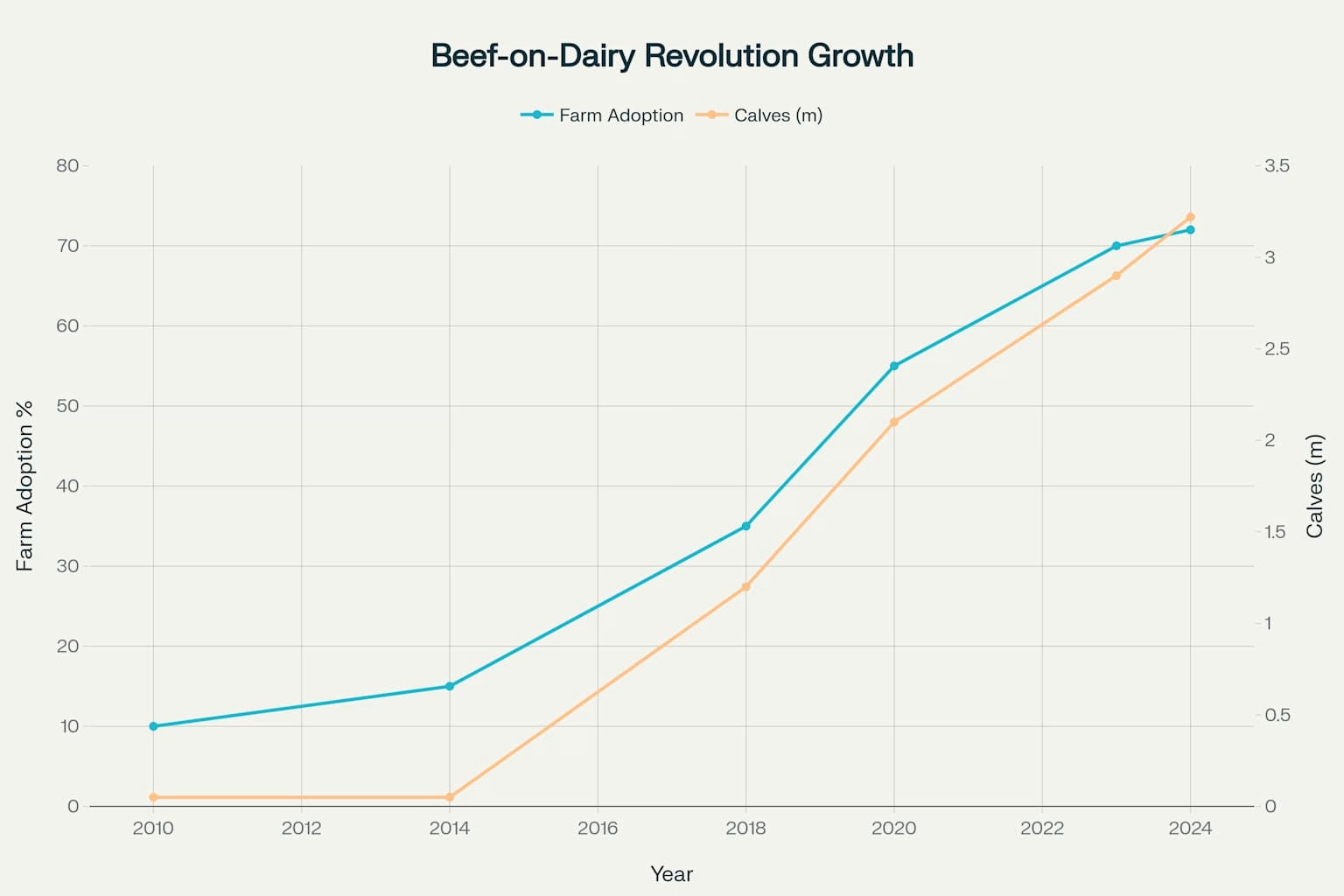
Beef-on-dairy crossbreeding has exploded from 10% farm adoption in 2010 to 72% in 2024, producing 3.22 million crossbred calves annually worth $525 premium each

California dairy data exposes a breeding revolution that’s creating new profit centers:

  • 81% of operations now use beef semen on dairy cows, with 78% citing extra profit as the primary advantage
  • 34% of farms breed more than 30% of eligible cows with beef semen, fundamentally altering their business model
  • Angus dominates at 89% usage, followed by Limousin (12%) and Wagyu (10%)

The strategic insight: While subsidized competitors focus on volume production, smart American operators are diversifying revenue streams through strategic breeding that creates premium calf markets subsidies cannot penetrate.

Elite Operation Case Study: Precision Genetics Beats Government Support

Consider this real-world competitive scenario: A Wisconsin operation implementing comprehensive genomic selection generates £193 (USD 240) additional lifetime value per animal compared to traditional breeding approaches. A 1,000-cow herd with 400 annual replacements represents $96,000 in additional annual genetic gain—nearly 30 times the DMC program’s per-cow support.

The genomic multiplier effect: Unlike subsidies that provide temporary financial relief, genetic improvements compound annually. A 2% improvement in component yield achieved through genomic selection continues paying dividends for the animal’s entire productive life and transfers to offspring.

The Three Subsidy Models Reshaping Global Competition

Model 1: The Fortress Strategy (Canada)

The System: Production quotas + guaranteed cost-plus pricing + 245% import tariffs
The Reality: Quota holders operate in an artificially protected system where production rights create guaranteed value regardless of market efficiency
Your Challenge: Canadian milk rarely competes in global markets, but their protected domestic market represents $9.15 billion in lost export opportunities

Model 2: The War Economy (Russia)

The System: 1.5x increase in dairy support + 8.3% concessional loans + 42% cost reimbursement
The Goal: Boost production from 34 to 38.5 million tonnes by 2030
Your Threat: $4.8 billion in additional subsidized milk hitting global markets

Model 3: The Green Shield (EU)

The System: €400 million annually + 25% eco-scheme requirements + CAP protection
 The Advantage: Getting paid for environmental practices you must implement at your own cost
The Impact: Dutch farmers allocate 32% of payments to environmental initiatives you fund privately

The Technology Investment Trap

Here’s the precision agriculture paradox killing American competitiveness:

You invest $150,000 in robotic milking systems to boost 15-20% efficiency. Meanwhile, subsidized competitors receive $200,000+ in government grants for identical technology. Frontiers in Animal Science research shows precision dairy farming increases milk yield by 30%, cuts feed costs by 25%, and reduces environmental impact by 20%—but these gains become meaningless when competitors get the technology free.

Your technology investments have shifted from competitive advantages to survival necessities.

The Genomic Competitive Response

Smart operations are turning to genetics-based competitive strategies that subsidies cannot replicate:

Component-Focused Breeding Programs:

  • Target 4.2% butterfat and 3.3% protein content through systematic genomic selection
  • Generate $15,000-20,000 additional annual revenue per 100-cow herd through premium pricing
  • Create defensible market positions that commodity imports cannot easily penetrate

Crossbreeding Revenue Diversification:

  • Implement strategic beef-on-dairy programs using high-value breeds (Wagyu, premium Angus)
  • Generate additional revenue streams through premium calf markets
  • Reduce dependency on fluid milk pricing volatility

Genomic Acceleration Strategies:

  • DNA test 100% of replacement heifers rather than partial herd sampling
  • Focus selection on economically relevant traits (components, fertility, health)
  • Build genetic merit advantages that compound over generations

Challenging Industry Orthodoxy: The Breeding Association Conspiracy of Silence

Here’s the controversial truth that major breeding organizations won’t acknowledge: Traditional breeding approaches used by most American dairies are systematically inferior to comprehensive genomic programs, yet industry associations continue promoting outdated evaluation methods that favor large, established operations over innovation.

The data is devastating for conventional wisdom:

  • Holstein Association registration programs still emphasize visual appraisal and pedigree analysis that genomic research has proven inferior for economic traits
  • AI organizations report ≤80% of beef bull collections qualify for sale versus >90% for Holstein bulls based on advanced semen quality assessments, yet Sire Conception Rates for Angus bulls (33.8%) nearly match Holstein bulls (34.3%) on dairy cows, proving collection qualification standards may not reflect actual fertility performance

The uncomfortable question for industry leaders: Why do breeding associations continue promoting evaluation systems that genomic research has proven less effective than DNA-based selection?

The Environmental Subsidy Revolution: Game Over for Unsubsidized Farms

WWF-UK research proves regenerative dairy systems deliver financial returns—but only when you don’t compete against farmers getting paid to implement them.

The Green Subsidy Advantage Gap

Environmental InvestmentYour CostSubsidized Competitor CostDisadvantage
Methane reduction technology$25/cow/yearGovernment funded + carbon credits$25/cow
Precision feeding systems$15,000 setup€4,500 EU eco-scheme payment$19,500
Genomic testing program$40/testIncluded in development subsidies$40/test

The brutal math: Environmental subsidies aren’t just supporting competitors—they’re creating permanent cost advantages you can never overcome through efficiency alone.

The Genetic Environmental Solution

Smart operators are using genomic selection to build environmental advantages that create both cost savings and revenue opportunities:

Methane-Efficient Genetics:

  • Select for feed efficiency traits that reduce methane output per unit of milk
  • Target feed conversion ratios of 1.75:1 or better through genomic selection
  • Generate $25,000-50,000 annual cost savings on 100-cow operations

Component-Environment Integration:

  • Breed for higher component yields that reduce environmental impact per unit of saleable product
  • Focus on fertility traits that reduce replacement rates and associated environmental costs
  • Build genetic profiles that qualify for emerging carbon credit programs

What Smart Operators Are Actually Doing (Beyond Hope and Prayer)

Immediate Defensive Strategies (Next 30 Days)

Stop playing by broken rules. Start thinking like a genetic strategist:

  1. Comprehensive Genomic Audit
    1. DNA test 100% of replacement heifers, not just elite animals
    1. Focus selection on economic traits: components, fertility, health resistance
    1. Eliminate visual appraisal bias that favors appearance over performance
  2. Component Revolution Implementation
    1. Target 4.2% butterfat and 3.3% protein through systematic genetic selection
    1. Prioritize component premiums over volume in breeding decisions
    1. Build genetic profiles that command premium pricing
  3. Beef-on-Dairy Revenue Diversification
    1. Implement strategic crossbreeding on 25-30% of eligible animals
    1. Focus on high-value beef breeds: Wagyu, premium Angus lines
    1. Develop direct marketing relationships for premium crossbred calves

Medium-Term Competitive Repositioning (3-6 Months)

Build competitive intelligence and genetic superiority:

  1. Genomic Data Integration
    1. Implement comprehensive DNA testing protocols across the entire replacement program
    1. Focus on traits with the highest economic impact: milk components, reproductive efficiency
    1. Build genetic databases that track performance improvements over time
  2. Breeding Program Acceleration
    1. Elite Genetics Access: Partner with AI organizations for access to the highest-genomic bulls
    1. Custom Breeding Strategies: Develop herd-specific genetic plans based on facility constraints
    1. Performance Tracking: Implement systematic recording of genetic progress metrics

Long-Term Strategic Positioning (6-12 Months)

Prepare for the post-subsidy genetic advantage:

  1. Genetic Merit Compounding
    1. Build 10-year genetic improvement plans focusing on cumulative gains
    1. Establish elite cow families within the herd for maximum genetic progress
    1. Create breeding programs that generate genetic advantages competitors cannot quickly replicate
  2. Market Position Optimization
    1. Develop premium component milk contracts that reward genetic superiority
    1. Target processor relationships that value consistent, high-quality genetics
    1. Build direct-to-consumer channels for products from genetically superior animals

The Uncomfortable Truth About New Zealand’s “Miracle”

Here’s the fact that destroys every subsidy defender’s argument: New Zealand abolished all farm subsidies in 1984 and remains a dominant global dairy exporter. Wouldn’t New Zealand have collapsed decades ago if subsidies truly enhanced competitiveness?

Instead, they’ve maintained market leadership through operational efficiency and genetic innovation—exactly what economic theory predicts.

The genomic insight: New Zealand’s continued success demonstrates that genetic merit, operational efficiency, and market positioning create more sustainable competitive advantages than government financial support.

The question this raises: Are subsidized dairy sectors building genuine competitive advantages or dangerous dependencies that will collapse when government support inevitably changes?

Market Intelligence: The Data That Changes Everything

Global Genetic Competitiveness Analysis

Genetic StrategyImplementation CostAnnual Genetic Gain10-Year Advantage
Comprehensive genomic testing$40,000 (1,000 cows)£193 per animal$600,000+ herd value
Partial genetic evaluation$15,000 (1,000 cows)£37 per animal$115,000 herd value
Traditional breeding$5,000 (1,000 cows)£0 per animalNo genetic progress
Strategic crossbreeding$25,000 setup cost$150 per calf$400,000+ revenue stream

Strategic insight: Genetic improvements provide the only competitive advantage that compounds annually and cannot be replicated through government intervention.

The Bottom Line: Your Genetic Survival Playbook

Remember that $880 million Russian investment? It’s not just money—it’s a declaration that global dairy competition is now state-sponsored economic warfare.

The myth of “fair competition” in dairy markets isn’t just wrong—it’s dangerous. Operating under this illusion while competitors receive massive government backing is a recipe for slow-motion bankruptcy.

Here’s what separates genetic survivors from subsidy casualties:

First, stop hoping for fairness and start building genetic advantages. Environmental sustainability isn’t just good farming—it’s positioning for premium markets and future carbon credit opportunities while current competitors get paid for practices you’re implementing at cost.

Second, genomic selection provides the only sustainable competitive advantage against unlimited government support. Component yield improvements and breeding efficiency gains compound annually, creating permanent advantages that subsidies cannot replicate.

Third, traditional breeding approaches promoted by industry associations are systematically inferior to comprehensive genomic programs. Challenge conventional wisdom about visual appraisal and pedigree analysis that genomic research has proven less effective for economic traits.

The genetic action plan for the next 12 months:

Immediate Implementation (30 days):

  • DNA test 100% of replacement heifers, focusing on component traits and reproductive efficiency
  • Audit current genetic progress using economically relevant metrics, not show ring standards
  • Implement strategic beef-on-dairy crossbreeding on 25-30% of eligible animals

Genetic Acceleration (3-6 months):

  • Partner with AI organizations for access to highest-genomic bulls regardless of traditional popularity
  • Develop herd-specific breeding strategies that maximize genetic progress within facility constraints
  • Build genetic databases tracking component yield improvements and reproductive efficiency gains

Competitive Positioning (6-12 months):

  • Establish 10-year genetic improvement plans with specific component yield and efficiency targets
  • Create elite cow families within herds for maximum genetic progress acceleration
  • Develop premium market relationships that reward genetic superiority over commodity volume

Your immediate next step: Calculate your herd’s current genetic merit using genomic evaluations, not traditional breeding methods. Suppose your genomic PLI averages below £400 per animal, or you’re not implementing comprehensive DNA testing. In that case, you’ve identified your biggest strategic vulnerability—and your most important competitive opportunity for building subsidy-proof advantages.

The provocative challenge that should keep every breeding manager awake tonight: If comprehensive genomic selection generates £193 additional lifetime value per animal compared to traditional methods, why are major breed associations still promoting visual appraisal and pedigree analysis that genetic research has proven inferior? The answer reveals an industry more interested in protecting established hierarchies than advancing genetic progress—exactly the kind of conventional thinking subsidized competitors use to their advantage.

The dairy industry’s future belongs to operations that build measurable genetic advantages through DNA-driven selection, not those that hope for favorable trade policies or cling to outdated breeding traditions. The genetic tools exist today to build competitive advantages that no subsidy can replicate. The question is whether you’ll use them.

KEY TAKEAWAYS

  • Genomic Selection ROI Advantage: Comprehensive DNA testing across 100% of replacement heifers generates £193 additional lifetime value per animal versus traditional methods—creating $96,000 annual genetic gain on 1,000-cow herds that compounds over generations
  • Beef-on-Dairy Revenue Diversification: Strategic crossbreeding with premium breeds (Wagyu, Angus) on 25-30% of eligible animals creates additional revenue streams worth $150+ per calf while reducing dependency on volatile fluid milk pricing
  • Component-Focused Competitive Strategy: Target 4.2% butterfat and 3.3% protein through systematic genetic selection to generate $15,000-20,000 additional annual revenue per 100-cow herd through premium component pricing that commodity imports cannot penetrate
  • Environmental Technology Investment Defense: While subsidized competitors receive government funding for methane reduction technology, genomic selection for feed efficiency traits reduces environmental impact per unit of milk while building genetic merit that accumulates annually
  • Risk Management Portfolio Enhancement: Layer comprehensive genomic testing ($40,000 investment protecting $600,000+ herd value over 10 years) with strategic component hedging and margin insurance to compete against unlimited government backing through measurable genetic progress

EXECUTIVE SUMMARY

The “free market” fairy tale in global dairy just cost American farmers their competitive edge—here’s your genomic defense strategy. While U.S. producers optimize feed conversion ratios for marginal gains, Russia allocated $880 million in dairy support for 2025 alone, Norwegian farmers pocket subsidies worth 30% of revenue, and Canadian operations receive $328,000 per farm in trade compensation. New research reveals that comprehensive genomic testing generates £193 ($240 USD) additional lifetime value per animal compared to traditional breeding—nearly 30 times the DMC program’s per-cow support. The brutal math: environmental subsidies aren’t just supporting competitors, they’re creating permanent cost advantages you can never overcome through efficiency alone. Smart operators are abandoning hope for “level playing fields” and building genetic advantages that no government subsidy can replicate through strategic genomic selection, beef-on-dairy crossbreeding, and component-focused breeding programs. Stop waiting for trade policy fixes and start building competitive advantages that survive regardless of subsidy policies.

Complete references and supporting documentation are available upon request by contacting the editorial team at editor@thebullvine.com.

Learn More:

  • A Comprehensive Guide to Enhanced Genetic Selection – Reveals specific tools and deterministic models for implementing genomic selection in your breeding program, demonstrating how to achieve balanced genetic gains for fertility and production traits that create sustainable competitive advantages.
  • Protect Your Dairy Operations from America’s 1000-fold Subsidy Advantage – Demonstrates how component optimization and feed efficiency strategies can neutralize massive subsidy disparities, providing tactical methods to achieve $15,000-20,000 additional annual revenue through premium positioning and operational excellence.
  • 5 Technologies That Will Make or Break Your Dairy Farm in 2025 – Exposes which precision agriculture investments deliver genuine ROI versus expensive distractions, revealing how smart calf sensors and AI analytics can slash mortality 40% and boost yields 20% while competing against subsidized operations.

The Sunday Read Dairy Professionals Don’t Skip.

Every week, thousands of producers, breeders, and industry insiders open Bullvine Weekly for genetics insights, market shifts, and profit strategies they won’t find anywhere else. One email. Five minutes. Smarter decisions all week.
NewsSubscribe
First
Last
Consent

Global Dairy Trade Update: October 15 2024 Auction Sees Slight Price Declines and Market Shifts

Discover the recent changes in global dairy prices. How will the 0.3% dip affect your business? Get the latest insights and market analysis.

Summary:

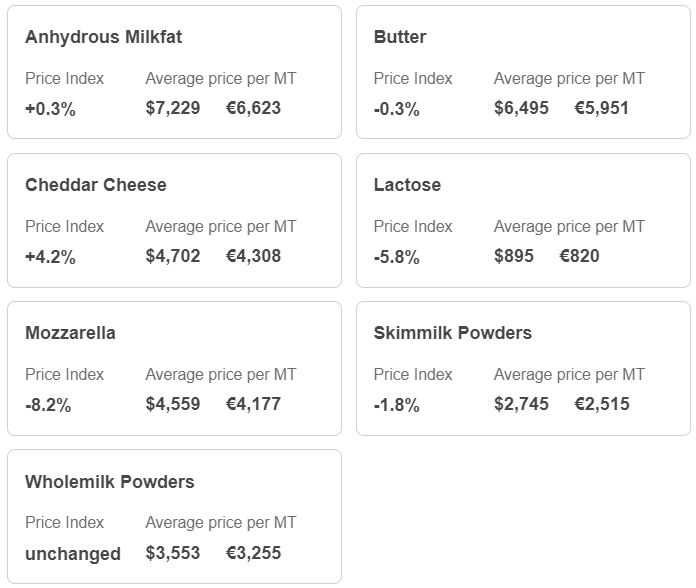
The October 15th Global Dairy Trade auction highlighted a nuanced downturn in the dairy market with a slight 0.3% dip in the overall index. Whole milk powder remained constant, while mozzarella and lactose significantly declined, contrasting with cheddar’s 4.2% rise. These fluctuations reflect the challenges and strategic responses required from industry professionals. The European Union’s decision to impose tariffs on Chinese electric vehicles due to unfair subsidies has spurred China to retaliate by investigating European dairy subsidies, potentially reshaping the global market. This move, amidst the EU’s plans to export substantial amounts of milk and cream to China, indicates shifting dynamics that may lead to increased dairy costs for Chinese consumers and compel European exporters to adapt and innovate in their approaches.

Key Takeaways:

  • Global Dairy Trade price index decreased by 0.3%, with total sales reaching 38,956 metric tonnes.
  • Whole milk powder prices held steady, while cheddar saw the largest increase at 4.2%.
  • Significant price drops were observed in mozzarella and lactose, falling by 8.2% and 5.8%, respectively.
  • The New Zealand dairy industry remains robust despite slight global price fluctuations.
  • Market analysts note a lack of price volatility, suggesting stable buyer behavior within the dairy sector.
  • The Ornua Monthly Purchase Price Index rose in September, indicating improved market returns.
  • Lakeland Dairies announced an increase in base milk prices and supplier incentives, reflecting favorable market conditions.

Recent moves have highlighted the dairy industry as the economic chess match between the European Union and China heats up. With the EU imposing vital duties on Chinese electric vehicle imports, the ground is set for China to launch retaliatory investigations into European dairy subsidies, ushering in a new chapter in their simmering trade war. As the world’s biggest dairy exporter, Europe will sell 24% of its milk and 39% of its cream to China in the first half of 2024 alone. This is more than just a conflict of geopolitical superpowers; it is a scenario with far-reaching consequences for global dairy markets. Why should this matter to you as a dairy industry stakeholder? This trade friction might restructure the market landscape. Still, it also allows European farmers and exporters to diversify their methods, driving Chinese consumers to pay higher dairy costs. The stakes are higher than ever as these international alliances face unprecedented challenges, putting the strength and adaptability of dairy markets worldwide to the test.

ProductPrice ChangeAverage Price (US$/MT)
Whole Milk Powder0.0%3,553
Skim Milk Powder-1.8%2,754
Cheddar+4.2%4,702
Butter-0.3%6,495
Anhydrous Milk Fat+0.3%7,229
Lactose-5.8%895
Mozzarella-8.2%4,559

Retaliatory Games: EU’s Tariff Move and China’s Dairy Dilemma

The European Union’s decision to levy tariffs on Chinese electric vehicles represents a significant shift in the intensifying trade war between these global powerhouses. The EU justified its decision by citing the Chinese government’s subsidies to the electric vehicle market, which created an unequal playing field that harmed European producers. With 7.8% to 35.3% tariffs, the EU seeks to defend its automobile industry from unfair competition.

In reaction, China attacked the European dairy industry, an economic segment in which Europe wields considerable power as the world’s leading exporter. China’s investigation into over twenty subsidy programs purportedly aiding Europe’s dairy sector attempts to unearth any preferential treatment that could provide European dairy goods an advantage in the global market.

The countries backing the EU’s tariffs are a group of big dairy-producing countries—France, the Netherlands, Italy, and Poland—that see these measures as critical to protecting their industrial interests. Germany and Belgium, on the other hand, dissented, citing concerns about the potential consequences and strain on their export-led economies, particularly their automobile industry.

This trade dispute exemplifies the complex dynamics at work, in which economic protectionism collides with goals for market supremacy. It raises complex considerations about global trade ethics and the long-term viability of such policies, allowing the dairy and car businesses to navigate these geopolitical waters.

EU-China trade war, dairy subsidies, electric vehicle tariffs, global dairy markets, European dairy exports, retaliatory investigations, market diversification, dairy industry protection, trade friction consequences, Chinese consumer dairy costs

A Storm in a Milk Churn: How EU-China Trade Tensions Threaten Dairy Stability

The current spat between China and the EU over dairy subsidies is more than another chapter in their trade story; it is a potential interruption. China’s recent decision to investigate European dairy subsidies may shake up the business in ways we’re only beginning to understand. How does this impact dairy farmers and firms like yours?

Let’s examine the possible consequences. First, there is the risk that trading patterns will shift. With China investigating European dairy subsidies, it may levy tariffs on imports. This could prompt European dairy processors to turn and seek new markets. Are countries like Japan and South Korea ready to absorb the surplus? This move may eventually impact global dairy trade dynamics. If China were to impose tariffs on European dairy imports, it could significantly reduce the demand for European dairy products in China, leading to a surplus in the European market. This surplus could drive down prices and force European dairy processors to find new markets, disrupting the global dairy trade dynamics.

Pricing pressures also loom huge. If Europe fills other markets with dairy products that it cannot sell to China, we may see a global drop in pricing. While this sounds wonderful for customers, dairy farmers may suffer. Lower prices may reduce margins, adding financial stress to farmers already on a tightrope.

Furthermore, organizations that provide critical services and products to dairy producers should prepare for change. Farmers may tighten their belts with anticipated declines in dairy income, reducing demand for farm equipment, feed, and technological solutions. Could your business adapt to the new reality?

Finally, while dismissing these trade disputes as distant and abstract is tempting, they directly impact the ground. Staying informed, adaptive, and ready to pivot will be critical for dairy professionals navigating these turbulent waters. The ability to adapt to changing market conditions will be a critical factor in determining the success of dairy businesses in the face of these challenges.

New Horizons in Dairy: Navigating the Shift in Global Trade Winds

With the intensifying trade war between the EU and China, one must question where European dairy products will find new homes. As China shifts its focus on dairy imports, Asian, African, and Middle Eastern countries emerge as potential alternatives to Europe’s dairy heavyweights. This tectonic shift in trade networks might have a global impact, changing market dynamics. If Europe shifted its focus to new markets, it could disrupt the current global dairy trade dynamics. New competitors entering these sectors with competitive pricing may pressure global dairy prices. Remember, Europe’s share of the global dairy pie is not tiny; any change here has serious consequences.

Why does this matter? Breaking new ground in undeveloped markets brings opportunities and competition. These shifting trade channels have the potential to ripple world prices. New competitors entering these sectors with competitive pricing may pressure global dairy prices. Remember, Europe’s share of the global dairy pie is not tiny; any change here has serious consequences.

On the one hand, a greater market reach could reduce Europe’s reliance on China. Still, it may also increase competition for countries such as New Zealand and the United States. Furthermore, nations rich in natural resources but lacking in dairy production may see a leveling of the playing field as they get easier access to European dairy products. This redirection may provide a short-term boost with low-cost imports but raises long-term concerns regarding self-sufficiency and local industry development.

Will European dairy’s global expansion bring prosperity or risk? That remains the golden question. The dairy trade is on the verge of a revolutionary moment when maps may be unexpectedly rewritten. As this situation continues, dairy experts must keep their eyes open and their strategies flexible, ready to react to the shifting sands of today’s global market.

Taste Shift or Temporary Turmoil: The Future of European Dairy in China’s Cart

As the EU and China engage in this rising trade war, we must consider how it may affect Chinese consumer preferences. Rising pricing and limited availability may cause Chinese customers to reconsider purchasing European dairy. Are the days of plentiful French cheese and luscious Italian milk over?

Tariffs and trade restrictions inevitably lead to price hikes. European dairy goods, formerly considered premium imports in China, may now be priced beyond the reach of the typical customer. This fiscal pressure may prompt buyers to seek different suppliers or stop consumption entirely. Asian-local dairy farmers should leverage this chance to increase market share by positioning their goods as cost-effective alternatives. Could this cause a taste change away from Europe?

Another unknown factor in this trade war is availability. Chinese importing companies may find difficulties getting European dairy, resulting in shortages. Are these customers ready for such disruptions? While luxury food enthusiasts may continue to seek out their favorite European brands, the general public may shift to domestic products, enticed by price and accessibility. This trend may result in long-term shifts in consumption patterns, even if tariffs finally drop.

Finally, the unpredictability of this trade war forces us to assess the strength of European dairy’s market presence in China. Will loyalty to traditional flavors endure price increases and scarcity? Or will the Asian market adapt and seek satisfaction in closer-to-home, maybe less expensive dairy delights?

Charting New Courses: European Dairy’s Quest in Turbulent Trade Seas

As the EU and China dispute, European dairy exporters face rough trade conditions. Quick adaptation to these obstacles is essential. Market diversification is one of the most prominent strategies. Can European exporters expand their reach beyond China? Absolutely! Exploring new markets such as Southeast Asia, the Middle East, and Africa may mitigate the impact of lower Chinese demand. These locations have significant expansion potential due to growing middle classes and changing food trends.

However, diversification is only part of the picture. Another important aspect is cost management. Reducing overheads without sacrificing quality may help European businesses remain competitive. Could improving production methods, investing in energy-efficient technologies, or renegotiating supplier contracts make a difference? These solutions may lessen the immediate effects while fortifying the industry against future market instability.

Furthermore, increasing brand strength could open up new opportunities. By emphasizing the unique attributes of European dairy, such as heritage, quality, and sustainability, exporters can capture consumer loyalty in unexplored countries. Building solid and recognizable brands is not a defensive strategy but a proactive method of gaining a footing in the global market.

The volatile nature of the trade war catalyzes dairy industry innovation and resiliency. By focusing efforts on broadening markets, effectively managing expenses, and strengthening brand presence, European dairy experts can weather these challenges while potentially becoming more relevant than ever.

Echoes from the Past: How EU-China Trade History Frames Today’s Cheese Clash

Understanding the present EU-China trade crisis necessitates revisiting their long history of economic disagreements and diplomatic agreements. Trade between the European Union and China has increased dramatically since China’s economic reform in the late twentieth century, resulting in a partnership oscillating between collaboration and confrontation.

Trade conflicts have become commonplace in recent decades. A noteworthy chapter occurred in 2013 when the EU placed tariffs on Chinese solar panels. Beijing responded by investigating European wine imports. While these difficulties may appear unconnected to dairy, they signaled a pattern in which conflicts in one industry reverberated throughout others. This disagreement was eventually resolved after lengthy negotiations, with a price agreement on solar panels demonstrating the potential for de-escalation.

While only sometimes at the forefront, dairy commerce has had its share of tension. In 2015, disagreements emerged over EU-origin milk powder as alleged illicit subsidies were investigated under WTO guidelines. Critical to many European economies, the sector was hit hard when excess caused prices to fall. These skirmishes highlighted dairy’s fragility in the broader economic crossfire, warning stakeholders that global demand fluctuations can have a knock-on effect at farm gates.

History reminds us that, despite their intricacies, these trade disputes frequently occur in cycles. A combination of negotiation, strategy shifts, and, in some cases, lasting patience resolves them. Whether the present dairy conflict between two economic behemoths follows this script remains to be seen. However, based on previous experience, it is apparent that dairy producers will need to be vigilant, adaptable, and make strategic decisions as they navigate this geopolitical scenario.

The Bottom Line

In short, the EU-China trade war is rapidly expanding, with both sides engaged in a tug-of-war that has now included the critical dairy industry. As the European Union imposes tariffs on Chinese electric vehicles, China responds by inspecting European dairy imports. These measures jeopardize the stability of the global dairy trade, posing risks and problems for both exporters and importers. The rivalry between Europe and China over dairy exports and imports can impact prices and market share.

Consider the far-reaching ramifications of these trade decisions: How will they affect your company and the overall market dynamics? As a dairy farmer or industry professional, remaining informed and adaptive is critical in these uncertain times. Finally, this circumstance raises an important question: May the conclusion of this trade dispute change the face of international trade relations, affecting agricultural trade policies and practices worldwide?

Learn more:

Join the Revolution!

Bullvine Daily is your essential e-zine for staying ahead in the dairy industry. With over 30,000 subscribers, we bring you the week’s top news, helping you manage tasks efficiently. Stay informed about milk production, tech adoption, and more, so you can concentrate on your dairy operations. 

NewsSubscribe
First
Last
Consent
Send this to a friend