







Written SOP on the wall? A 2024 study found that herds with SOPs but no training actually had higher SCC than herds with no SOP at all.
Executive Summary: Most dairies already have written milking SOPs, but Rodriguez’s 16-herd study in Michigan and Ohio showed the people in the pit only averaged 49.3% on a basic routine quiz — and that gap was costing money. One bilingual training session per farm moved knowledge scores to 67.6%, cut inadequate prep from 69% to 48%, reduced missed post-dip coverage, and shaved 25–43 seconds off milking time per cow while stabilizing SCC trends. When you put those shifts beside real-farm results — like an 850‑cow Wisconsin dairy turning a $12,500 training spend into roughly $78,000 in first‑year return while dropping SCC from 245,000 to 175,000 — training stops looking like a “soft” expense and starts penciling out as a $55–$73‑per‑cow‑per‑year opportunity on a 300‑cow herd. The article also leans into the uncomfortable finding that herds with written SOPs but no training actually had higher SCC than herds with no SOP at all, and it ties that to a 38.8% annual turnover rate that constantly erodes protocol compliance. Using national SCC premium grids, mastitis cost data, and regional wage benchmarks, it walks readers through barn math they can plug their own numbers into instead of guessing at training ROI. The piece closes with a four‑path playbook — from UW’s MQUW train‑the‑trainer program to free bilingual online modules and a 30‑day parlor audit — so producers can decide how far to go in formalizing milker training and what kind of return they should expect in their own parlor.
The average score on a basic milking-routine knowledge quiz across 112 parlor workers? 49.3%. That’s what Zelmar Rodriguez — a dairy veterinarian and assistant professor at Michigan State University’s College of Veterinary Medicine — found when he evaluated 16 Michigan and Ohio dairies totaling 17,205 cows between April and September 2023. Half the people touching udders twice a day couldn’t explain why they do what they do. And Rodriguez’s data shows that the gap has a price tag — in SCC premiums lost, mastitis cases missed, and parlor minutes wasted on every shift.
Not a failure rate, either — a group average. Plenty of milkers scored well below that line. “It’s incredible the difference among employees and their learning process. The gap is huge,” Rodriguez said on the Dairy Science Digest podcast in December 2024. These weren’t small pasture herds. Median herd size was 1,101 cows, ranging from 280 to 2,330 lactating, with an average of 15 employees per farm. Study participants were 82% male and 74% Spanish-speaking. Rodriguez told Dairy Global: “People need to know why they have to do what they have been told to do”. His data says roughly half the people in the pit don’t.
Your Written SOP Might Be Making Things Worse
Here’s the part that should make you look at your own parlor wall a little differently.
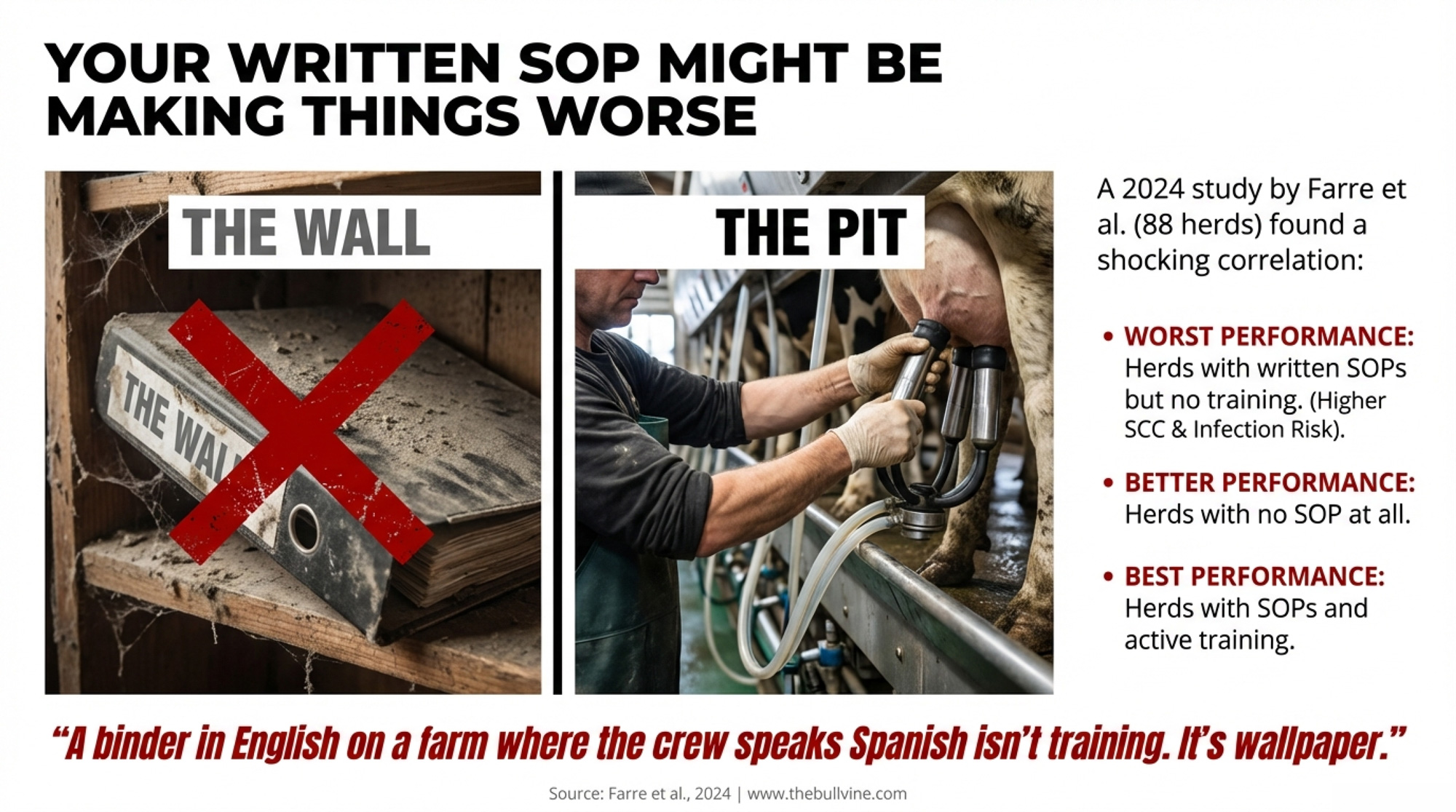
A 2024 study by Farre and colleagues — published in Veterinary Sciences by researchers from SEGES Innovation in Denmark, the University of Copenhagen, and Wageningen University — surveyed 88 Danish dairy herds with hired employees and parlor or rotary systems. They split farms into three groups: no written milking SOP, a written SOP with no structured training, and a written SOP actively used in training. The results flipped expectations. Herds with a written SOP and no training performed worse than herds with no SOP at all — BTSCC was 21,600 cells/mL higher,and new infection risk was 0.15 percentage points higher. Only herds that actually trained milkers on their SOP saw improvement: a 0.16 percentage-point drop in new infection risk.
| Herd Type | Bulk Tank SCC Change | New Infection Risk Change |
| No written SOP | Baseline | Baseline |
| Written SOP, No Training | +21,600 cells/mL | +0.15 percentage points |
| Written SOP + Active Training | Improved | −0.16 percentage points |
A binder in English on a farm where most of the crew speaks Spanish isn’t training. It’s wallpaper. New hires figure out within a week which rules on the wall are “real” and which ones everyone ignores. Then they follow the veteran milker, not the laminated sheet.
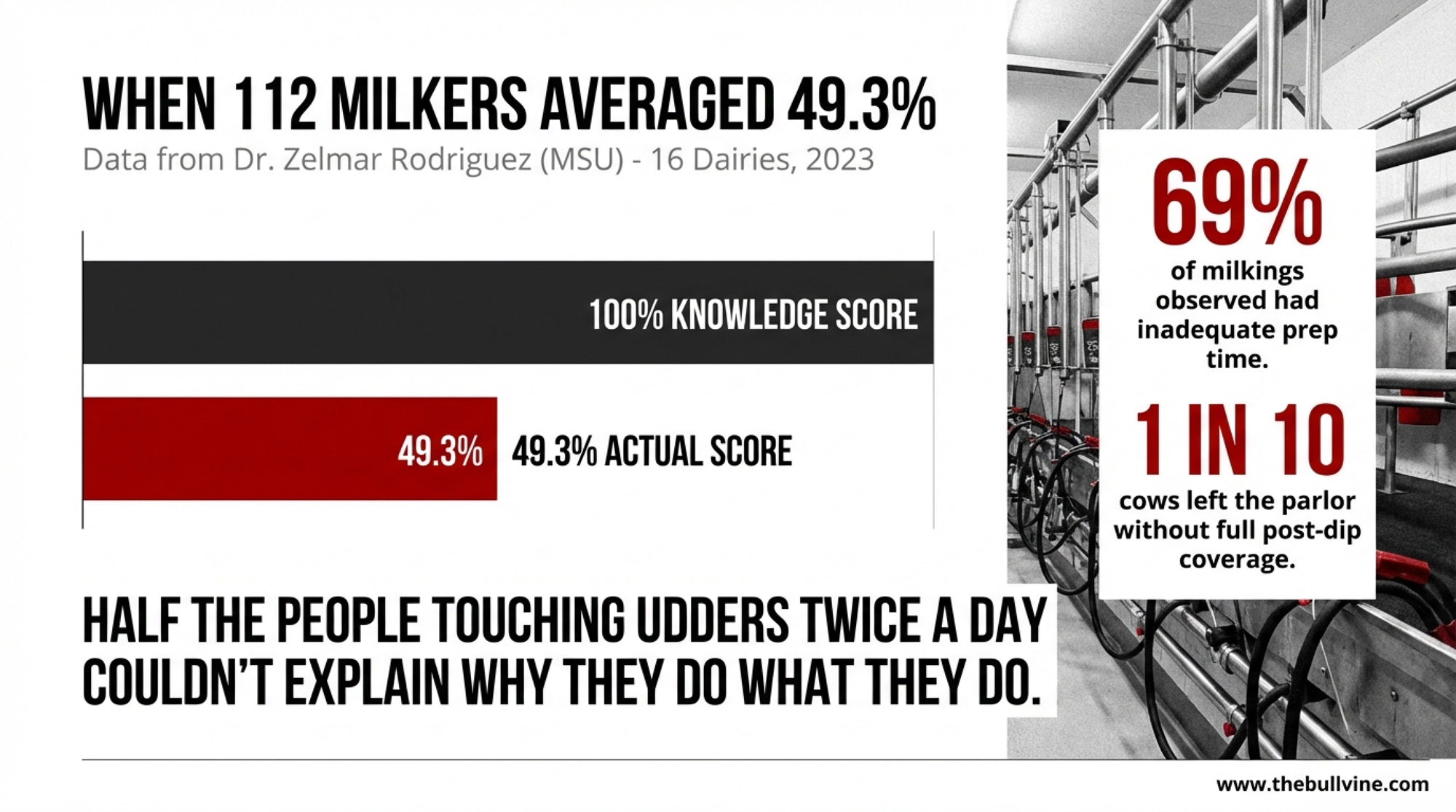
Rodriguez’s 16 herds fit that pattern. SOPs were posted. Equipment functioned. But when he timed what actually happened in the pit, 69% of milkings fell short on preparation time, and about 1 in 10 cows left the parlor without full post-dip coverage. The routine changed with the crew, not the cow.
One Session. One Day. Here’s What Moved.
Getting farms to sign up was its own challenge. “It wasn’t as easy to get study participants as I thought it would be,” Rodriguez admitted. “They all would say, ‘We just don’t have time'”. Owners came around once they learned the training would only take about an hour.
Each farm got one structured training session — bilingual, practical, and built around explaining the biology behind each step of that farm’s milking routine. Rodriguez used the National Mastitis Council’s free online resources to draft a curriculum focused on mastitis identification, risk factors, and proper milking procedures. During the pre-assessment, researchers captured photographs of the parlor being worked on — this helped participants visualize their own farm and better relate to the concepts. Workers and managers reviewed the parlor evaluation together and agreed on adjustments based on Rodriguez’s observations during his first visit.
The crews responded. Employees rated the training 4.5 out of 5 for practical use on their farm. Most were milking technicians (61.1%), and 70% had been on the job for less than 1 year, with a median tenure of just 9 months. “We can’t expect employees to come in with this knowledge,” Rodriguez said. These weren’t lifers. They were the people you’re usually hoping will just “pick it up” from watching.
One practical lesson surfaced everywhere. “Confusion around how to handle abnormal milk was one question that bubbled to the surface on every farm enrolled,” Rodriguez reported. “It is critical that owners or parlor management are present at the training to answer questions just like these that are a bit subjective and vary from farm to farm”.
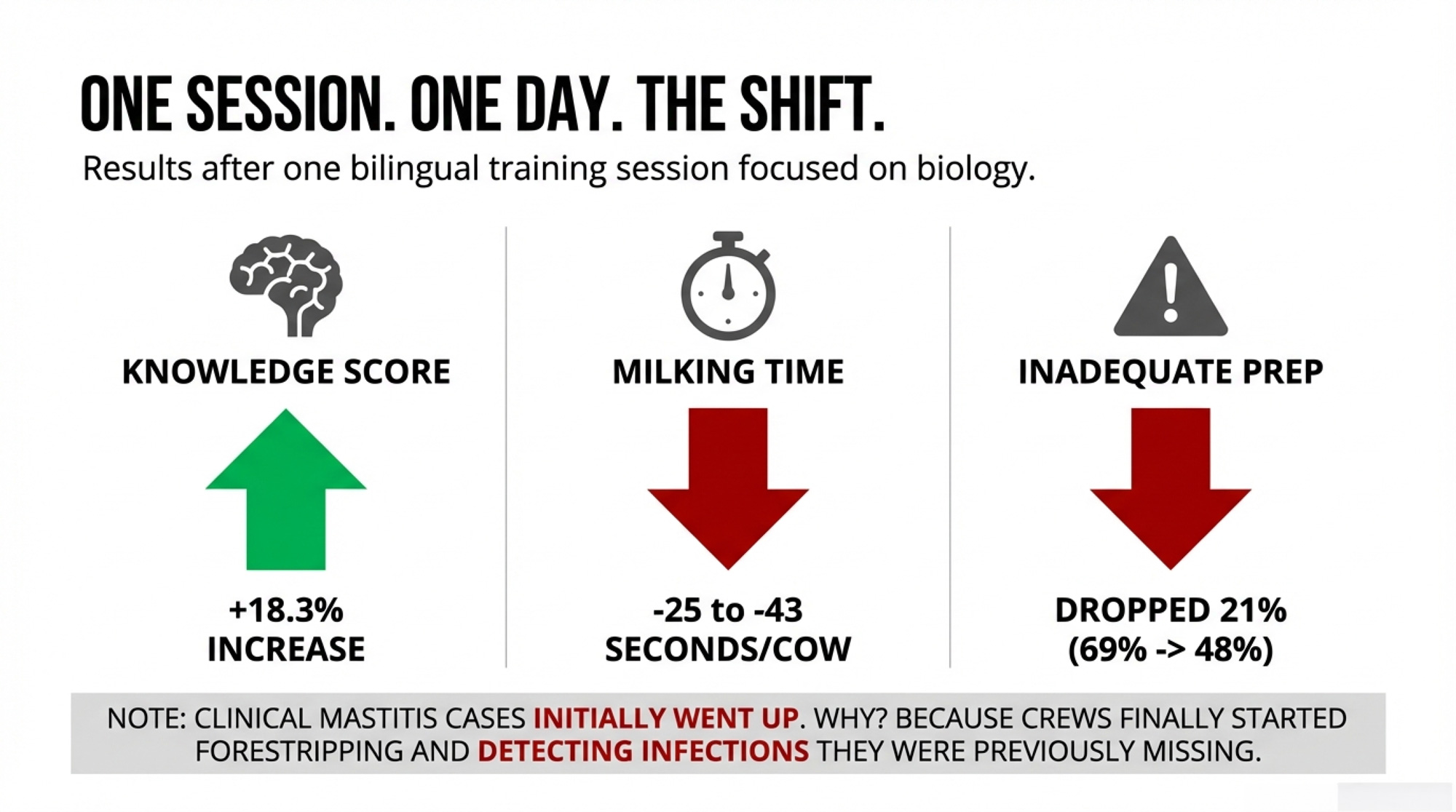
On the follow-up visit, Rodriguez ran the same checks again:
| Metric | Before | After | Change |
| Knowledge quiz score | 49.3% | 67.6% | +18.3 points |
| Milkings with inadequate prep | 69% | 48% | −21 points |
| Insufficient post-dip coverage | 9.8% | 5.9% | −3.9 points |
| Pre-dip contact time | Below target | +9 sec/cow | Toward 30s target |
| Proper lag time (60–120 sec) | Baseline | +20% compliance | Improved |
| Milking time per cow | Baseline | −25 to −43 sec | Fewer re-attachments |
One thing caught attention: clinical mastitis cases went up after training. Sounds like bad news — until you think about forestripping. Once milkers actually started stripping out and looking, they caught abnormal milk that had been going straight into the tank.
Two Farms That Actually Ran the Numbers
Before you dig into per-cow math, it helps to see what actual farms saw when they swapped “watch and learn” for real training.
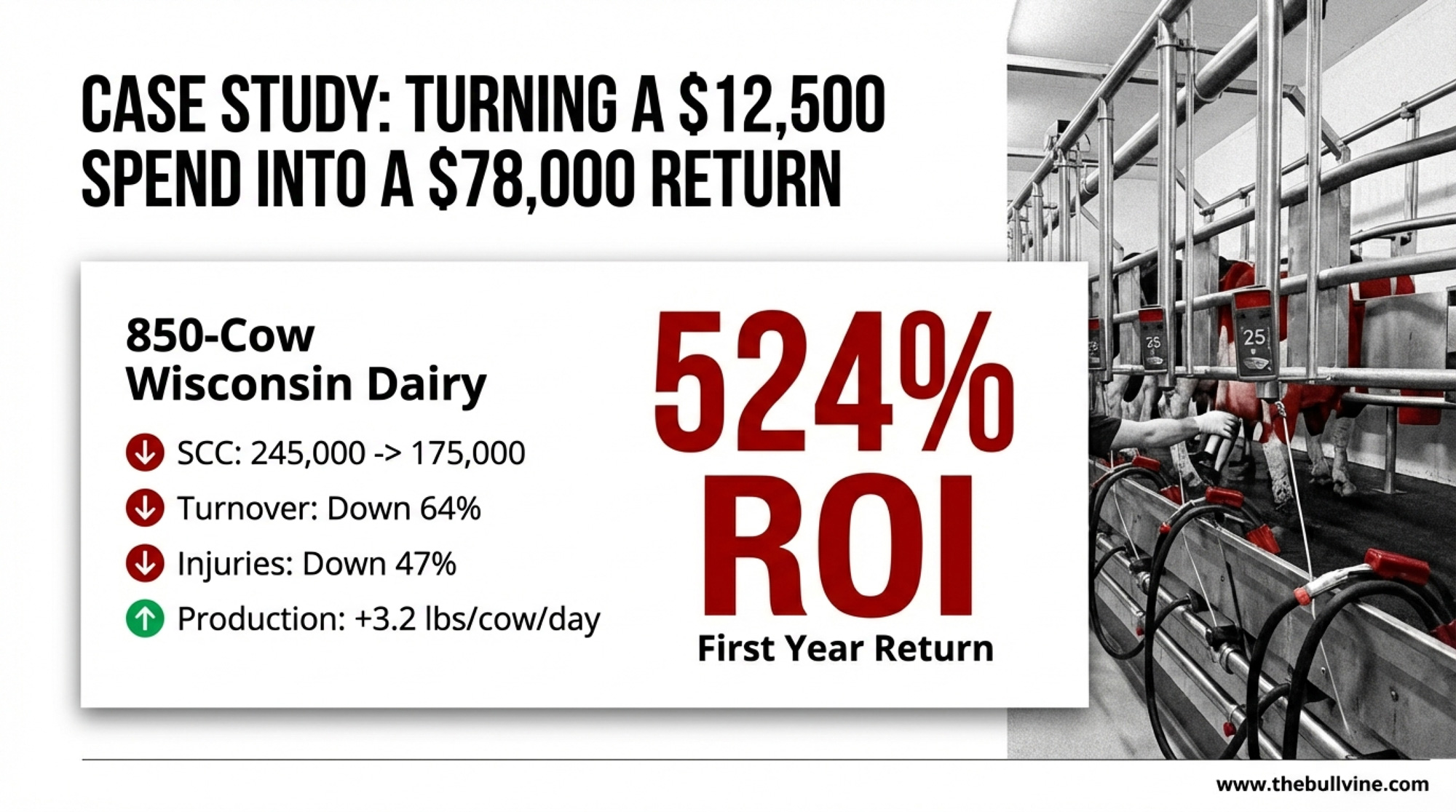
In 2022, an 850-cow Wisconsin dairy invested $12,500 in a bilingual training overhaul — agricultural Spanish classes for management, bilingual signage and SOPs, and monthly bilingual safety meetings with a professional translator.
| Metric | Result |
| SCC | 245,000 → 175,000 |
| Employee turnover | Down 64% |
| Workplace injuries | Down 47% |
| Production | Up 3.2 lb/cow/day |
| First-year return | ~$78,000 (524% ROI on $12,500) |
A second Midwest dairy worked with a Hispanic employee training service. Over nine months, SCC dropped from 325,000–350,000 into the sub-200,000 range. Employee turnover fell from one to two departures a month down to one departure in six months on a 20-person crew.
| Farm | Investment | First-Year Return | SCC Change | Turnover Change |
|---|---|---|---|---|
| Wisconsin 850-Cow | $12,500 | $78,000 (524% ROI) | 245K → 175K | Down 64% |
| Midwest Dairy | Not disclosed | Not disclosed | 325K → <200K | 2/month → 1/6 months |
Neither farm saw a magic overnight turnaround. But once milkers understood why they were doing what they’d always been told to do, protocol drift slowed. And the numbers moved.
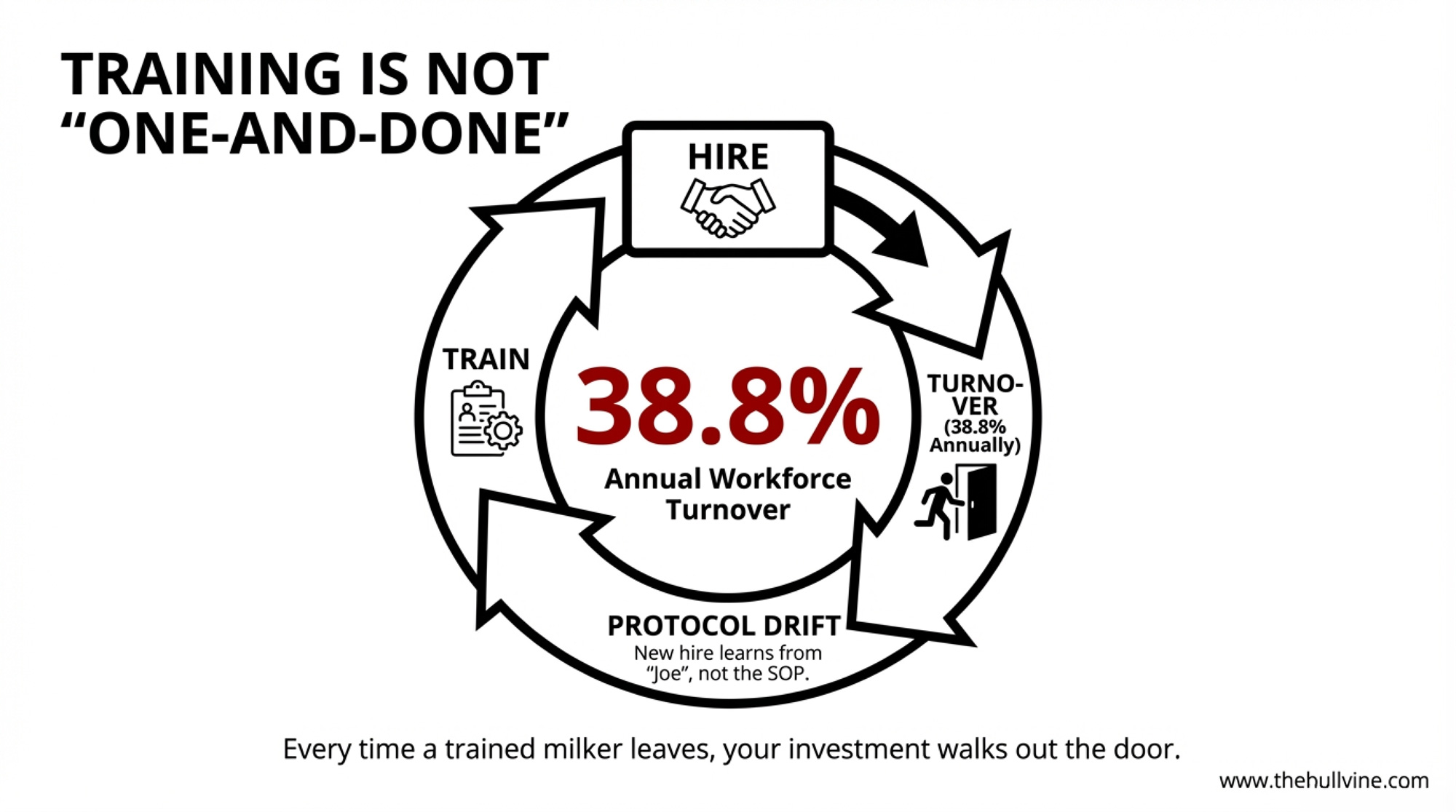
Here’s the part that makes training a rolling cost, not a one-time fix. Nationally, dairy operations turn over 38.8% of their workforce every year. Nearly 4 out of 10 parlor positions are refilled annually.
Every time a trained milker leaves, your investment walks out the door — and whoever fills that spot learns more from the coworker beside them than from anything posted on the wall. Think about that next time someone frames dairy’s labor problem as a matter of finding “better” workers. It’s not. It’s about training the workforce you actually have. Immigrant labor provides 51% of all U.S. dairy workers, and dairies employing immigrant labor produce 79% of the milk supply. Jorge Delgado, the on-farm dairy specialist who oversees Alltech’s Training, Talent Development, and Retention Program, said in a February 2024 statement: “Better education and training not only bolster the workforce’s efficiency but also safeguard milk markets and assure consumers that the industry prioritizes animal welfare through rigorous worker training”.
How Much Does Milking Training Actually Save Per Cow?
Rodriguez charted bulk tank SCC over time and saw the trend flatten after training — the seasonal upward creep in BTSCC stopped. Not the dramatic plunge that wins a plaque. But enough to keep herds inside their quality premium range rather than sliding out.
Nationally, the average DHI test-day herd SCC was 181,000 cells/mL in 2024 — the same as in 2023, according to CDCB. Genetics on somatic cell score keep improving. If the national average isn’t budging, the bottleneck isn’t in the semen tank. It’s in the parlor.
Here’s the barn math on a 300-cow herd shipping 75 lb/cow/day. Swap your own numbers into any line.
Line 1: SCC Premium Protection
Four Federal Milk Marketing Orders adjust milk payments for SCC using a per-1,000-cells/mL variation from a 350,000 baseline tied to monthly cheese prices. Co-ops and processors stack their own quality premiums on top. Herds consistently shipping sub-200,000 SCC milk see premiums in roughly the $0.40–$1.00/cwt range, depending on processor and region.
Your math (conservative, $0.40/cwt): 300 cows × 75 lb/day × 365 days = 8,212,500 lb = 82,125 cwt 82,125 cwt × $0.40 = $32,850/year ≈ $109/cow/year in premium income kept or lost
If your co-op’s grid pays closer to $1.00/cwt for sub-150K milk, triple that line.
Line 2: Mastitis Cost Reduction
In a separate study, Pamela Ruegg’s group at MSU examined the actual costs of clinical mastitis cases on 37 commercial dairy farms in Wisconsin. Average direct cost: $192 per case, with a range of roughly $120 to $350depending on the farm. Discarded milk accounted for 53–80% of those direct costs. USDA’s NAHMS Dairy 2014 study — the most recent nationally representative data — found clinical mastitis in 24.8% of cows.
Your math (300-cow herd at national average): 300 cows × 24.8% = ~75 cases/year. If improved compliance trims incidence from 20% to 15%, 15 fewer cases × $192 = $2,880. Total: ~$2,880/year ≈ $10/cow/year
A note on that 20%: Rodriguez’s study actually showed clinical mastitis cases going up after training — because crews were finally detecting them through forestripping. The case-reduction math is a projection of what should happen over 6–12 months as better detection leads to earlier treatment and fewer chronic infections. Track your own before-and-after numbers rather than assuming this figure.
Separately, Ruegg found that each unnecessary treatment day costs about $65 in discarded milk and drugs. If you and your vet tighten treatment protocols alongside parlor training — a different conversation, but one that pairs well with what we covered in our mastitis overtreatment piece — the savings stack.
Line 3: Labor Efficiency
Two sources report different figures for the milking time reduction Rodriguez measured, and both are credible. MSU’s own summary and the Dairy Global report both show a 25-second reduction per cow — attributed specifically to fewer re-attachments. Hoard’s Dairyman, reporting on Rodriguez’s December 2024 appearance on the Dairy Science Digest podcast, cites an average reduction of 43 seconds per cow, with no change in employee performance. The broader figure may reflect total milking time savings, including prep efficiency gains alongside re-attachment reduction.
Your math (300-cow, 2× herd — conservative, using 25 sec): 25 sec × 300 cows × 2 milkings = 250 min = 4.17 hours/day 4.17 hrs × 365 = 1,521 hours/year 1,521 hrs × $19.70/hr (USDA Lake Region livestock wage, May 2025) = $29,960 ≈ $100/cow/year in time-value
If the 43-second figure applies to your operation: 43 sec × 300 cows × 2 milkings = 430 min = 7.17 hours/day 7.17 hrs × 365 = 2,617 hours/year 2,617 hrs × $19.70/hr = $51,555 ≈ $172/cow/year in time-value
Honest catch: “time-value” doesn’t automatically land in your checking account. Crews get paid for the shift, not by the minute. That time becomes real money when you can milk more cows with the same hours, cut overtime, or eventually trim scheduled labor. A 2022 Cornell-led study by Alanis, Virkler, and colleagues — published in JDS Communications— evaluated milking training across 15 farms in northern New York and found equipment-related problems that milkers should have detected and reported on 14 of 15 farms, with inadequate milking routines flagged on 13 of 15. That’s the kind of inefficiency where saved seconds start converting to real dollars once the crew knows what to watch for.
If you’re weighing parlor training against the milking-speed genetics route, the answer is probably both — but training pays back in months, not generations.
Add It Up
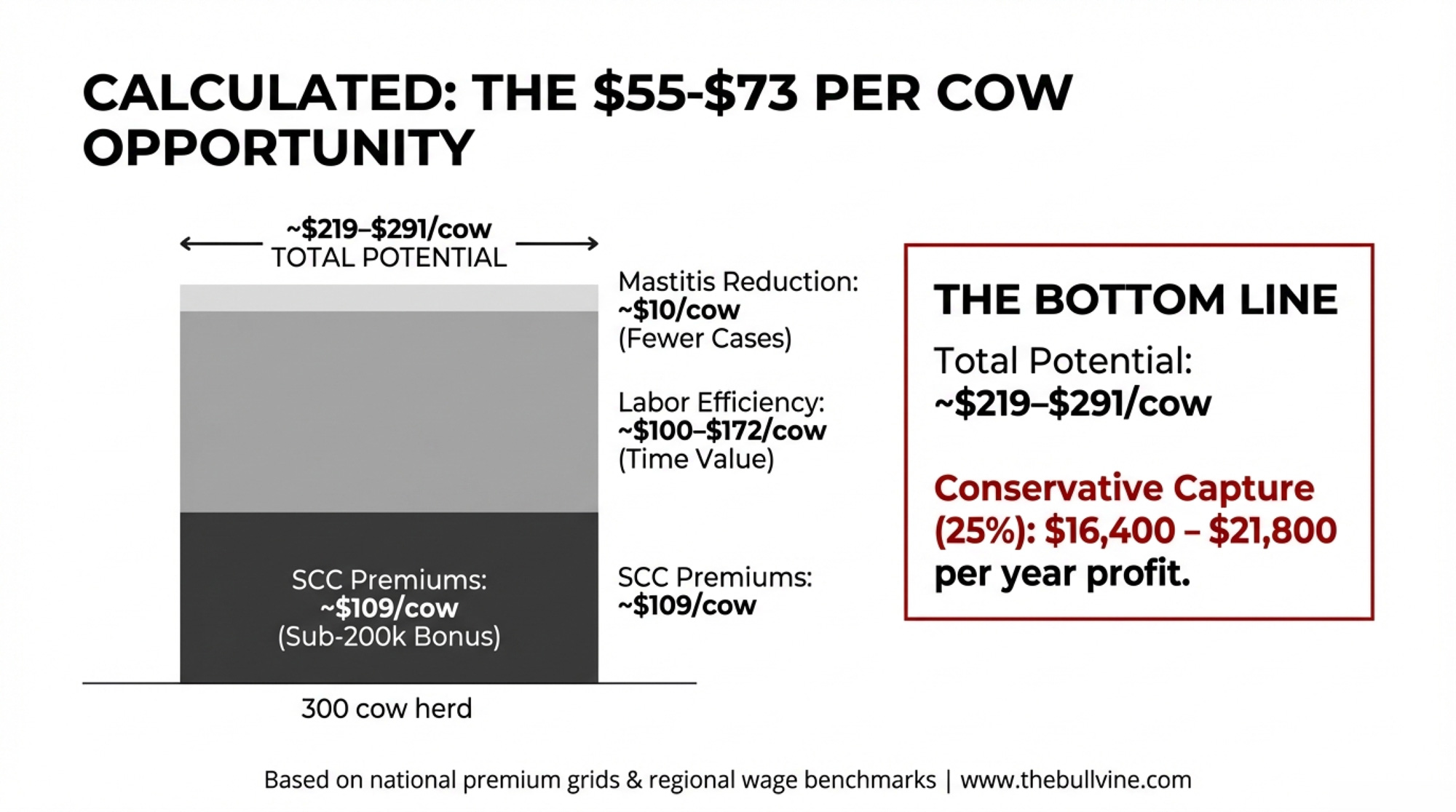
| Revenue Line | Per Cow/Year (Conservative) | Per Cow/Year (Upper Range) | 300-Cow Herd (Conservative) |
| SCC premium protection | ~$109 | ~$109 | $32,850 |
| Mastitis cost reduction | ~$10 | ~$10 | $2,880 |
| Labor efficiency | ~$100 (at 25 sec) | ~$172 (at 43 sec) | $29,960–$51,555 |
| Total potential value | ~$219 | ~$291 | $65,690–$87,285 |
| Realistic capture (25%) | ~$55 | ~$73 | $16,400–$21,820 |
Nobody captures every dollar. But even a quarter — $55 to $73/cow, or $16,400 to $21,800/year on 300 cows — comes in against a training spend that tops out around $6,000. The 25% figure is editorial judgment, not a study finding. Your actual capture depends on how consistently you maintain the new routine through turnover cycles.
What Does a Structured Milking Training Protocol Look Like?
UW–Madison’s Milk Quality from the Udder World (MQUW) trainer certification program runs $95 per person. That covers a self-paced online course (about 2 hours across five modules), a one-day in-person workshop, lunch, laminated parlor training materials with QR codes linking to short educational videos, and certification. Sessions run in English one day and Spanish the next.
| Location | Spring 2026 Dates |
| Luxemburg | Feb 18–19 |
| Madison | Mar 18–19 |
| Abbotsford | Apr 1–2 |
| Fond du Lac | Apr 7–8 |
| De Soto | Apr 29–30 |
(The Luxemburg session begins February 18 — check dairy.extension.wisc.edu for remaining seats. Four more sessions run through April 30.)
It’s a train-the-trainer model. You send your parlor manager, a bilingual lead, or maybe yourself—and they bring the knowledge home to coach everyone else. Rodriguez himself used the NMC’s free online resources to build his curriculum. On-farm, the pattern is simple: explain the biology, demonstrate on actual cows in your setup, then stand in the pit and coach real-time until the new routine holds.
Realistic annual training budget (300-cow herd, 15 milkers)
| Item | Cost |
| MQUW fees — 3 trainers × $95 | $285 |
| Wages + travel for trainer attendance | $1,000–$1,500 |
| On-farm rollout (trainer time + milker hours during coaching) | $2,000–$3,000 |
| Quarterly refreshers (fight turnover drift) | $1,000–$2,000/yr |
| Total | $2,000–$6,000 |
Most of that is your own payroll, not program fees.
Can’t get to Wisconsin? Iowa State University Extension and the University of Nebraska–Lincoln Dairy Extensionbuilt a free online milker training program in English and Spanish at go.iastate.edu/milkertraining. Each module has Spanish-language videos with English subtitles and quizzes in both languages with Spanish audio. The Alltech–FARM Program also launched bilingual cow-handling modules in 2024 that cover stockmanship fundamentals. Neither replaces someone standing beside a new milker in your pit — but both are a massive step up from “follow Joe.”
| Training Path | Cost | Time Investment | What You Get | Best For |
| UW MQUW Train-the-Trainer | $95/person | 2-hour online course + 1-day in-person workshop | Certification, laminated materials, QR-coded videos, train-your-crew toolkit | Farms with 3+ milkers, bilingual crews, need for repeatable internal training |
| Free Bilingual Online Modules (Iowa State/UNL) | $0 | Self-paced (videos + quizzes in English/Spanish) | Step-by-step videos, quizzes, certificates | Bridge option for farms that can’t attend in-person training this year |
| DIY 30-Day Parlor Audit | $0 | 3 milkings across shifts (stopwatch + notepad) | Baseline data: lag time, post-dip coverage, re-attachments, forestrip compliance | Immediate baseline before committing to training spend—start here |
| On-Farm Custom Training (Rodriguez Model) | $2,000–$6,000/year | 1-hour initial session + quarterly refreshers | Bilingual, farm-specific, coached in your parlor, ongoing reinforcement | Farms ready to formalize training as a rolling annual investment |
What This Means for Your Operation
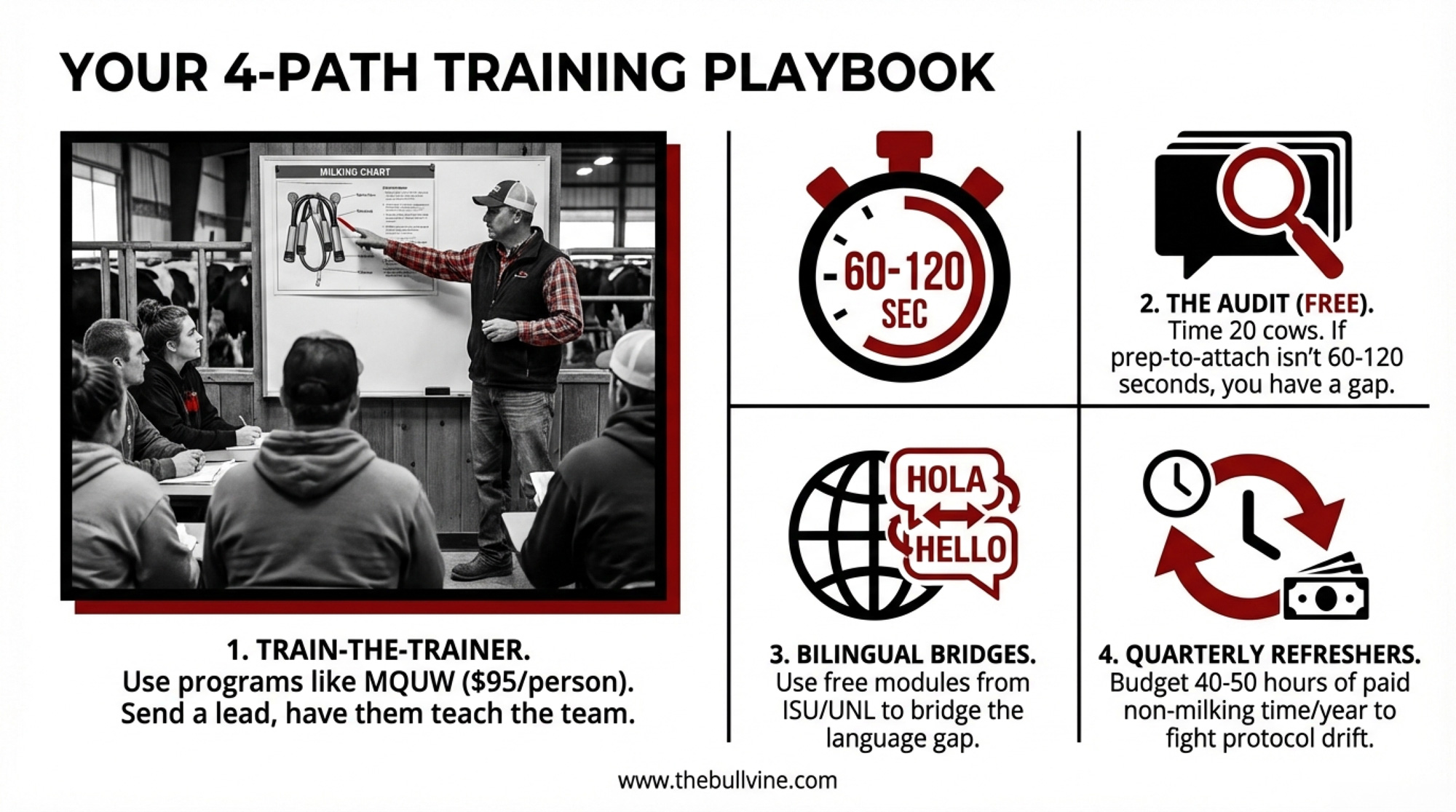
Path 1: Enroll in a train-the-trainer program like MQUW — the $285 path. Makes the most sense if you’ve got more than one person milking and you want the routine done the same way on every shift. At $95 per person for a full day, it’s one of the lowest-cost ways to address parlor consistency. The catch: if your only certified trainer quits, your training program walks out the door. Send at least two people — three if you can — so you’re not starting from zero when turnover hits. And don’t assume robotic milking gets you off the hook. It just shifts the training need from unit attachment to software, alerts, and cow management.
Path 2: Start with a parlor audit this month — no cost, immediate baseline. Grab a stopwatch and a notepad. Spend three consecutive milkings in the parlor across different shifts. Time at least 20 cows per milking from first touch to unit attachment. Score post-dip coverage: full, partial, or missed. Count how many cows aren’t forestripped at all. By the end of that week, you’ll know whether lag time falls within the 60 to 120 seconds that NMC, University of Minnesota Extension, and Penn State Extension all recommend from first tactile stimulation to unit attachment. Frame it for your crew as “we’re checking our system, not checking up on you”—or you’ll create pushback before you even talk about training.
Path 3: Use free bilingual resources as a bridge. If MQUW is out of reach this year, the Iowa State/UNL online milker training gives you step-by-step videos and quizzes in both languages. Neither replaces farm-specific coaching in your parlor. But they’re a real step up from dropping a translated SOP on the breakroom table and hoping it sticks.
Path 4: Post micro-metrics and run quarterly refreshers. Training isn’t one-and-done — especially with 38.8% annual turnover. After your initial push, pick a few visible numbers: prep-time compliance rate, average lag time, dip coverage percentage, and re-attachments per 100 cows. Post them where your crew sees them. Plan a 30–45-minute refresher for each crew every quarter. Maybe 40–50 hours of paid, non-milking time per year across your whole milking staff to keep everyone aligned. Skip the refreshers? Within a couple of turnover cycles, your crew looks a lot like Rodriguez’s study group did on day one.
Key Takeaways
- If your herd SCC has stayed flat or crept up while your SCS genetics have improved, the gap is probably in the parlor, not the semen tank. The national DHI average has remained at 181,000 cells/mL over the past 2 years. Pull your last three DHIA tests and see if your trend is any different.
- If you’ve got a written milking SOP that nobody has formally trained on in the past 12 months, the Farre et al. (2024) research says you might actually be worse off than having no SOP at all. A binder nobody understands teaches your crew that written rules don’t matter.
- Within the next 30 days, run your own stopwatch test. Time 20 cows’ prep-to-attachment intervals on two different shifts. The NMC-recommended target is 60 to 120 seconds from first stimulation to unit attachment. If a significant share of your cows fall outside that window, training — not equipment — is probably where your next dollar should go.
- Budget $2,000 to $6,000 per year for structured milking training on a 300-cow herd and compare that to what you spend on genetics, nutrition, and facilities that all depend on consistent milking to pay off.
The Bottom Line
When’s the last time you stood through a full milking in your own parlor and didn’t touch a unit — just watched what actually happens, step by step, across shifts?
Rodriguez did that on 16 farms, scored 112 workers, and measured the gap between what farms thought their milking routine looked like and what was actually happening in the pit. Your bulk tank already knows how consistent your milking routine really is. The question is whether you’re ready to stand in the pit, run the stopwatch, and find out what it would take to close that gap on your operation.
Complete references and supporting documentation are available upon request by contacting the editorial team at editor@thebullvine.com.
Learn More
- The 90-Second Milking Window That’s Paying $126,000 – and Beating Every Robot – You’ll gain a surgical method for auditing pit efficiency and capturing six figures in “lost” milk without buying a single robot. This breakdown delivers the exact protocols and ROI math to turn parlor drift into measurable profit.
- 79% of U.S. Milk Runs on Immigrant Labor. If Yours Vanishes, You Have 72 Hours. – This reveals the brutal reality of our industry’s workforce dependence and arms you with a 72-hour survival strategy for labor shocks. You’ll position your operation to weather policy storms while protecting the milk volume currently at risk.
- Robotic Milking Pays 13% More – After 7 Years of Red Ink – This exposes the gap between trade-show promises and actual barn-floor returns on robotic milking. It delivers verified payback periods and management thresholds, helping you decide if automation is a survival tool or an expensive mistake for your herd.
 The Sunday Read Dairy Professionals Don’t Skip.
 The Sunday Read Dairy Professionals Don’t Skip.
Every week, thousands of producers, breeders, and industry insiders open Bullvine Weekly for genetics insights, market shifts, and profit strategies they won’t find anywhere else. One email. Five minutes. Smarter decisions all week.






