Archive for dairy employee retention

490 PA Dairies Gone in 2025. Two Spent $40,500 to Not Be Next.

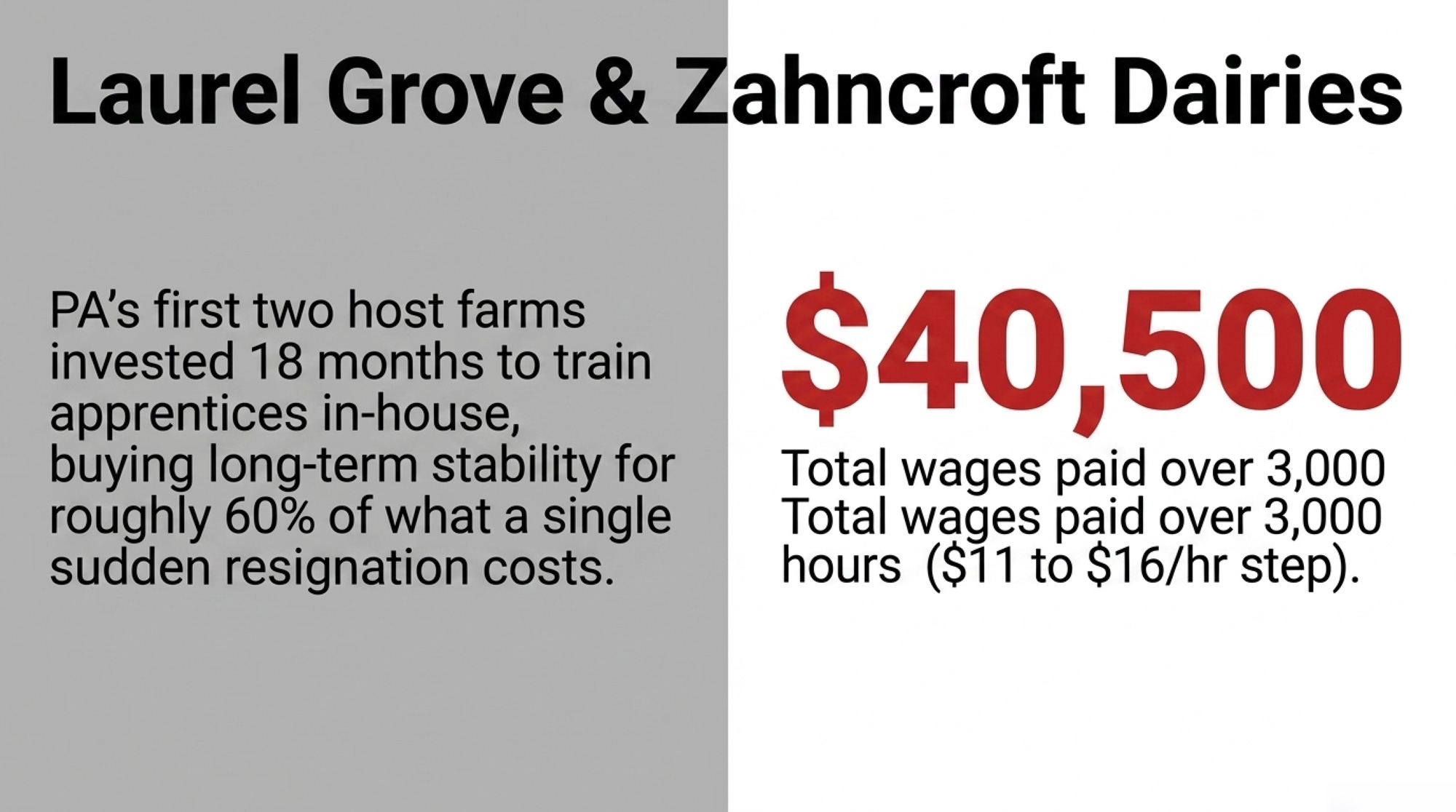
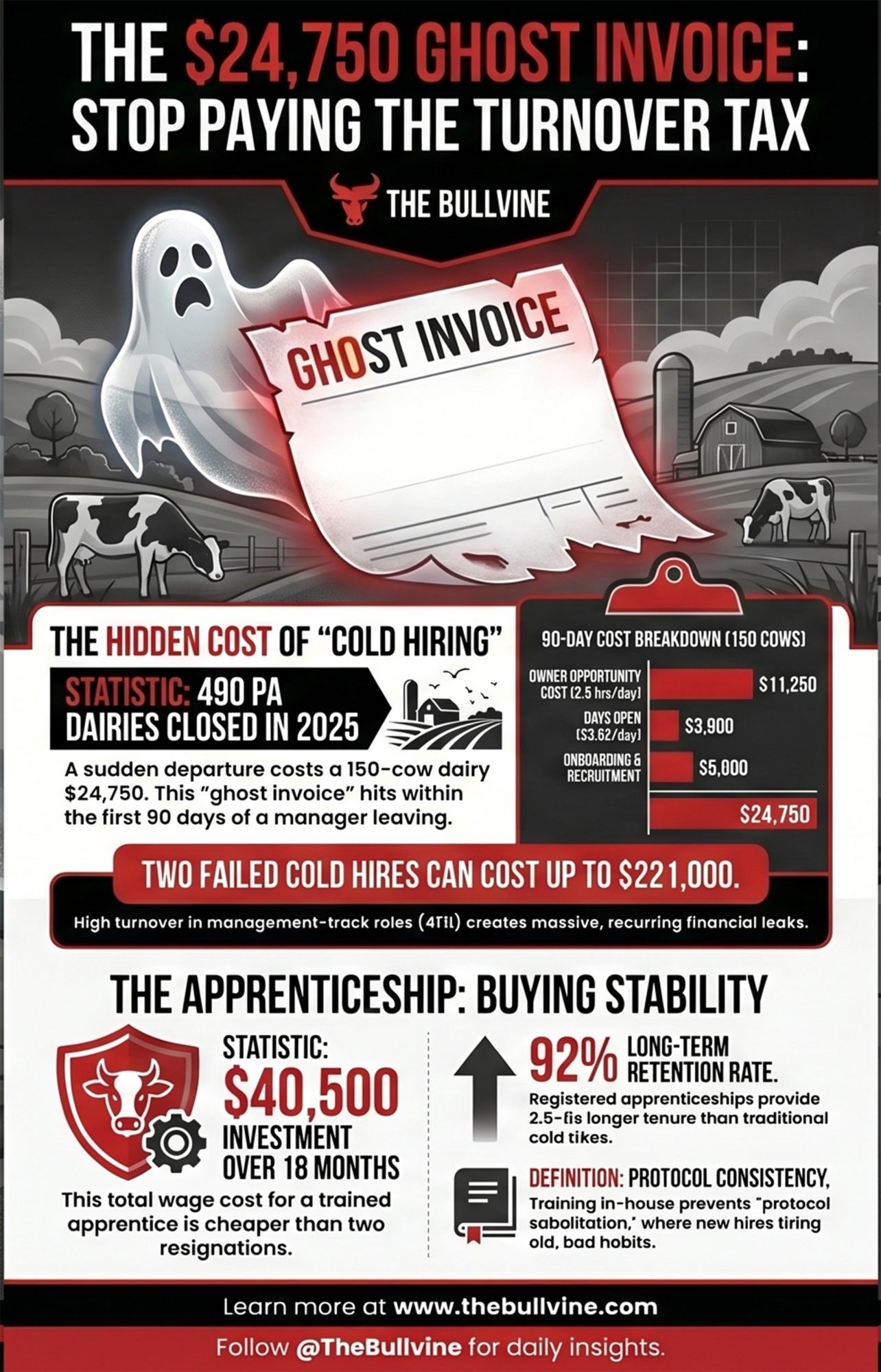
Rylee Fuller and Kristina Quinn each logged 3,000 paid hours as PA’s first Dairy Herd Manager apprentices. $40,500 over 18 months. One resignation costs a 150-cow dairy $24,750 in 90 days.

Executive Summary: Pennsylvania just graduated its first two Dairy Herd Manager Registered Apprentices — Rylee Fuller at Laurel Grove Farm (Perry County) and Kristina Quinn at Zahncroft Dairy (Berks County) — for a total labor investment of $40,500 over 18 months across 3,000 paid hours stepping from $11 to $16/hour plus 216 hours of technical instruction. That matters because PA lost 490 dairies in 2025, roughly 41% of all U.S. exits, and 28% of producers weighing their own exit cited no available successor. The ghost invoice nobody runs: one sudden herd manager departure costs a 150-cow PA dairy about $24,750 in the first 90 days — $11,250 of that is owner time pulled back into the barn, plus repro slippage, days open at $3.63/day, fresh cow detection misses, and onboarding friction, all hitting harder at the Q1 2026 PA all-milk price of $19.40/cwt. Two failed cold hires in 18 months can run $132,000–$221,000 all-in on MSU Extension’s turnover benchmarks, especially with Northeast management-track turnover at 41% per the 2024 FARM Workforce Year-in-Review. If you’ve cycled through a herd-level employee more than once in the last five years, the ,500 apprenticeship isn’t sentimental — it’s cheaper than your next resignation. Farms that can’t name a daily trainer other than the owner, or can’t block 90 minutes a week for review, aren’t ready to host — fix that first, then enroll.
Dairy Herd Manager Apprenticeship

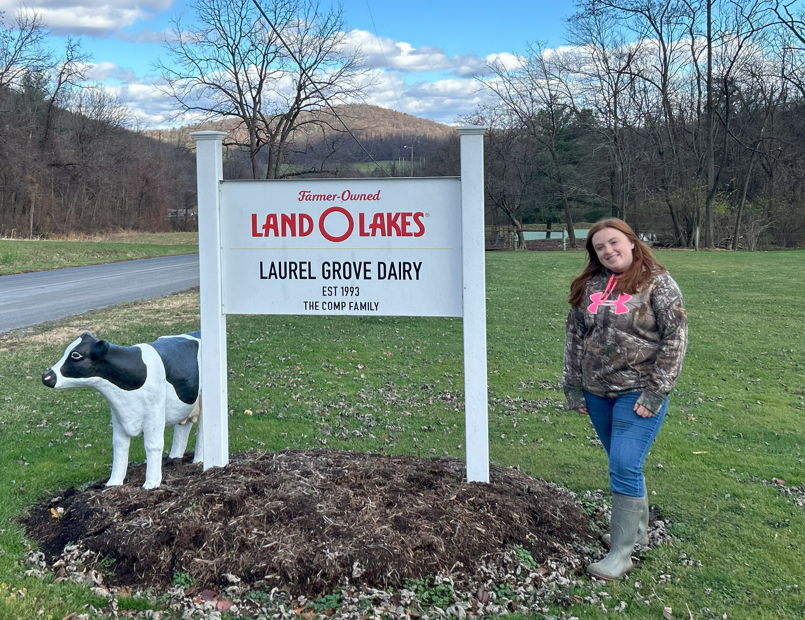
Rylee Fuller logged her 3,000th paid hour at Laurel Grove Farm in Perry County. Kristina Quinn logged hers at Zahncroft Dairy in Berks County, the Sattazahn family’s Holstein and Brown Swiss operation that’s been milking in Womelsdorf since the 1930s. They’re the first two people in Pennsylvania to complete the Dairy Herd Manager Registered Apprenticeship, a credential the Center for Dairy Excellence is spotlighting during National Apprenticeship Week starting April 26. And the number behind their 18 months? Roughly ,000 — what the next sudden herd manager departure will cost a 150-cow Pennsylvania dairy in the first 90 days, with the line-by-line math below landing closer to ,750. Which invoice is your farm writing?
Why Pennsylvania Just Lost 490 Farms — And Why Two Dairies Bet Differently

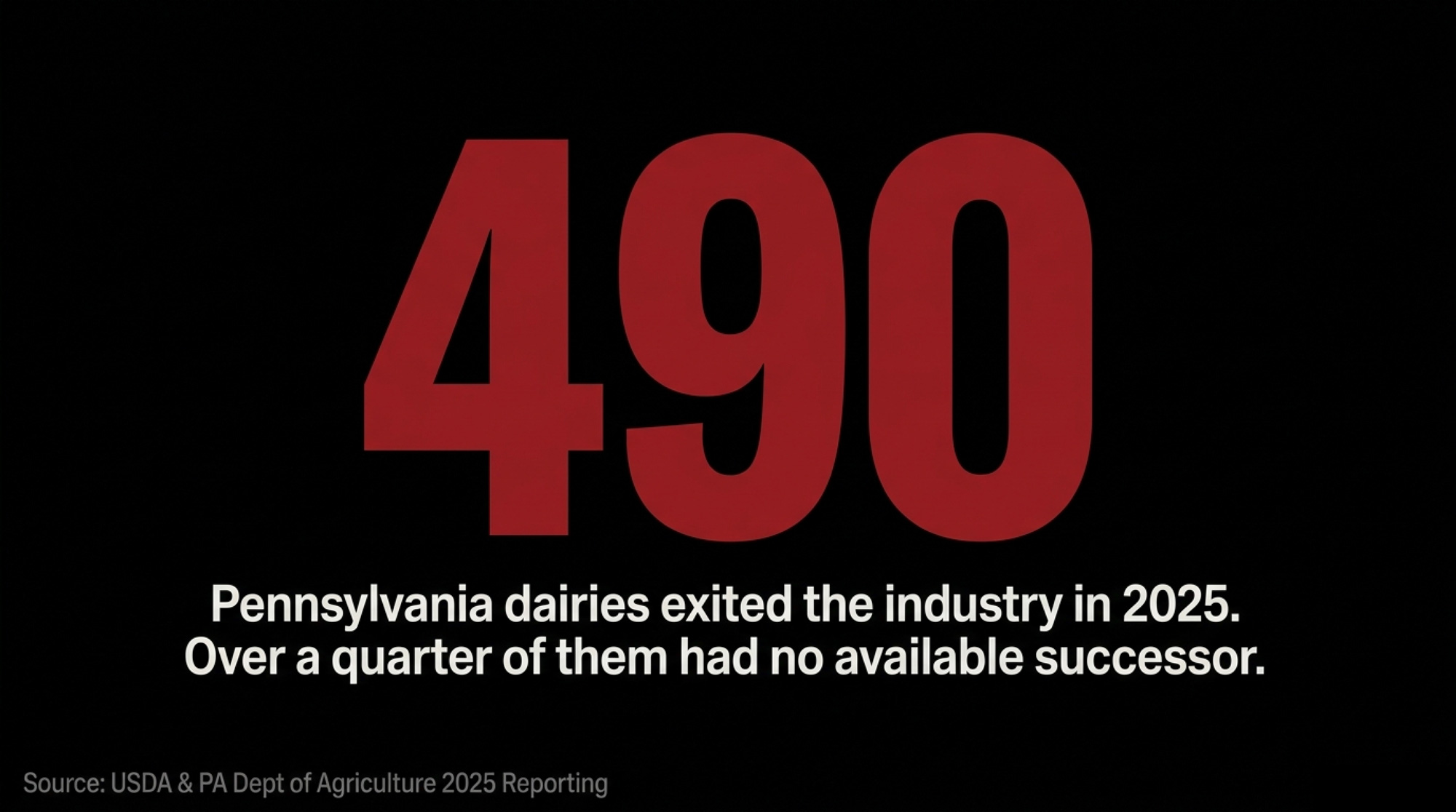
Pennsylvania lost 490 dairy farms in 2025, accounting for roughly 41% of all U.S. dairy exits that year, according to figures tracked through USDA and Pennsylvania Department of Agriculture reporting. The 2025 Pennsylvania Dairy Producer Survey found 27% of producers planning a generational transition within three to five years. And 28% of the farms weighing an exit cited no available successor. That’s not just a labor shortage. It’s a succession collapse with a labor shortage stacked on top.

Two completers is a small sample. But the cost math doesn’t need a cohort to hold — it needs one resignation you didn’t see coming, on a Tuesday, with nobody trained up behind the door.

The Center for Dairy Excellence built the apprenticeship to address both at once. Eighteen months. 3,000 paid hours of on-the-job training. 216 hours of technical instruction. A wage that steps from $11/hour to $16 over the program. Host farms commit to exposing the apprentice to the four competency areas — reproduction, calf care, herd health, and records — with monthly review visits from Workforce Development Manager Michelle Shearer.

Laurel Grove and Zahncroft bet first because their owners did the math most farms don’t run until after somebody walks. Cindy Comp’s Laurel Grove operation hosted Fuller through the full 3,000 hours. Katie Sattazahn’s Zahncroft carried Quinn through hers. Two farms. One question worth answering for every mid-size operation watching: did they just buy stability cheaper than everyone else?

The 90-Day Cost Clock When Your Herd Manager Walks

Picture a 150-cow Pennsylvania dairy rolling 26,000 pounds per cow, milk priced at .40/cwt — the Q1 2026 Pennsylvania all-milk average per USDA NASS. Your herd manager gives two weeks’ notice on a Monday. Or doesn’t show up at all.

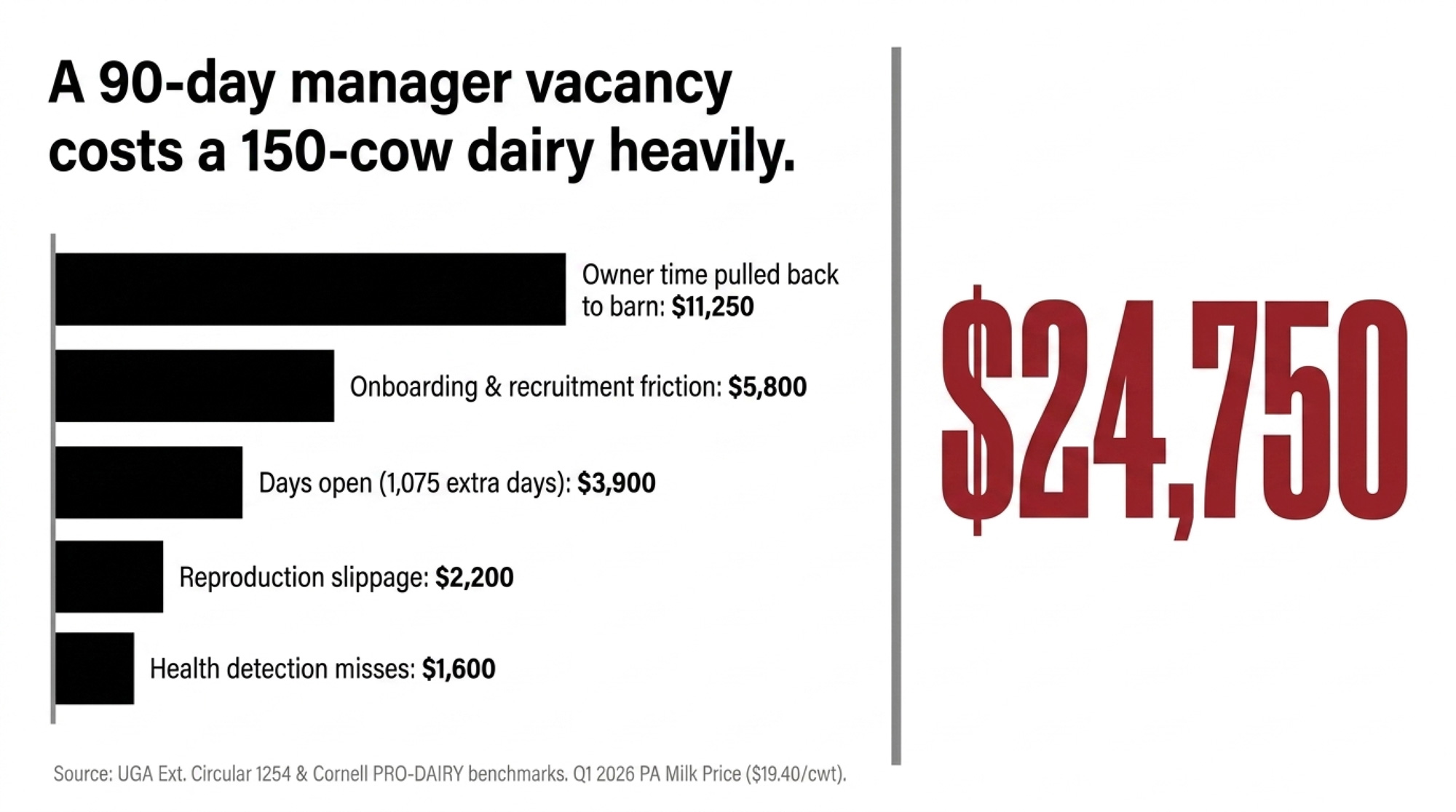
The job ad is the cheapest line item. Here’s the 90-day invoice, built from published extension and peer-reviewed data. Actual numbers vary based on herd structure, processor schedule, and replacement timing. This is a midpoint scenario, not a prediction.
Expense CategoryImpact Detail90-Day Cost (150 Cows)
Owner Opportunity Cost2.5 hrs/day @ $50/hr$11,250
Reproduction Slippage3-pt pregnancy rate drop$2,200
Days Open1,075 days @ $3.63/day$3,900
Health Detection7–8 extra clinical cases$1,600
Onboarding FrictionRecruitment & training$5,800
TOTAL INVOICE $24,750

Sources: University of Georgia Extension Circular 1254, “Economic Impact of Days Open” (2023), for the $3.63/day midpoint. Owner-time opportunity cost and onboarding friction built from Cornell PRO-DAIRY onboarding-labor benchmarks. The reproduction and health-detection figures apply standard extension per-cow economics to a 90-day window and a 150-cow herd.

A separate line the table doesn’t show: milk-quality slippage. A 20,000-cell SCC creep on roughly 9,600 cwt across 90 days, at a $0.05/cwt premium, adds about $480. At the $19.40/cwt Q1 2026 milk price, any production drop from detection misses hits harder than it did a year ago. The ghost invoice in 2026 is meaner than the one in 2024.

Conservative 90-day total: about $24,750. Before a single replacement cow. Before the first extra vet call. Before the SCC climbs past the 20K drift.
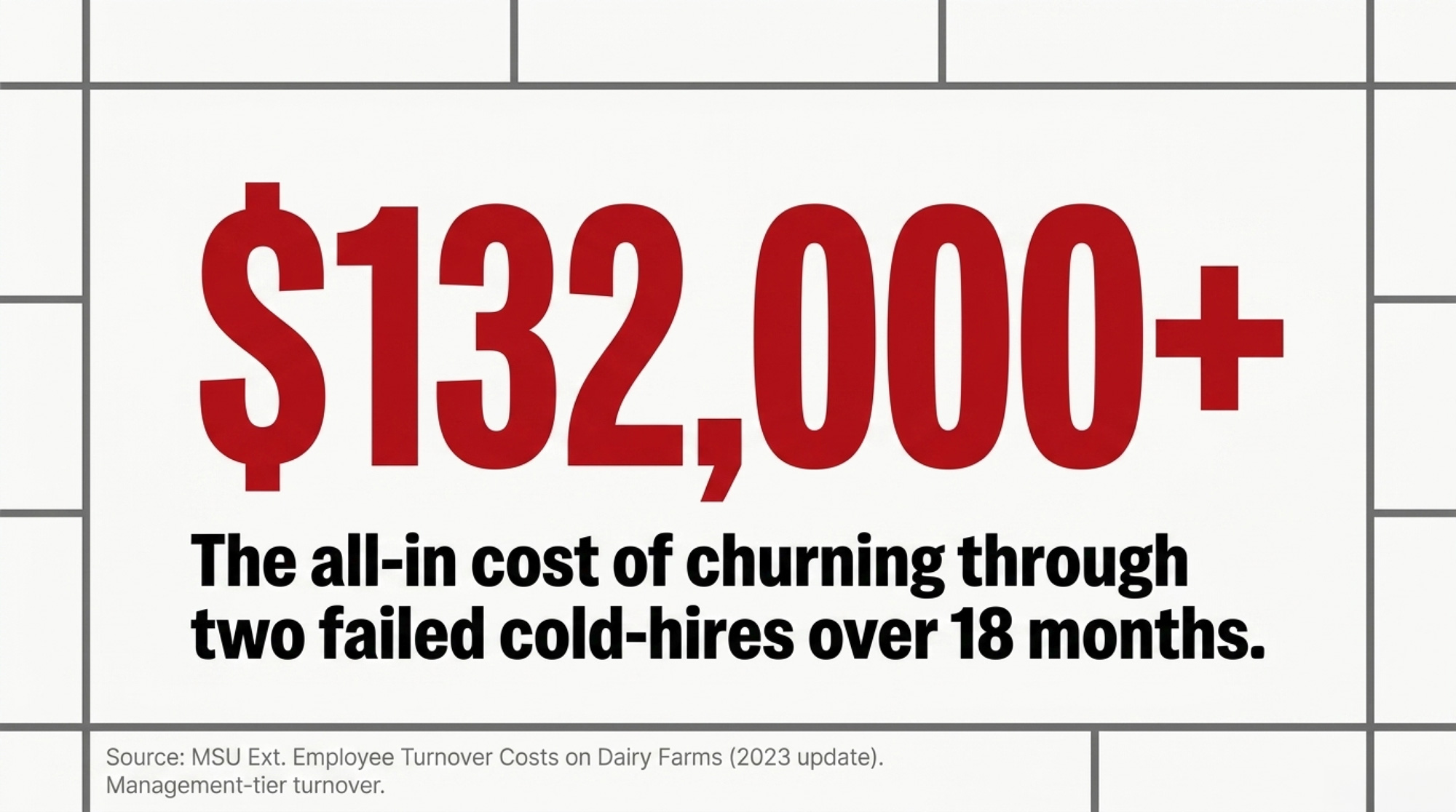
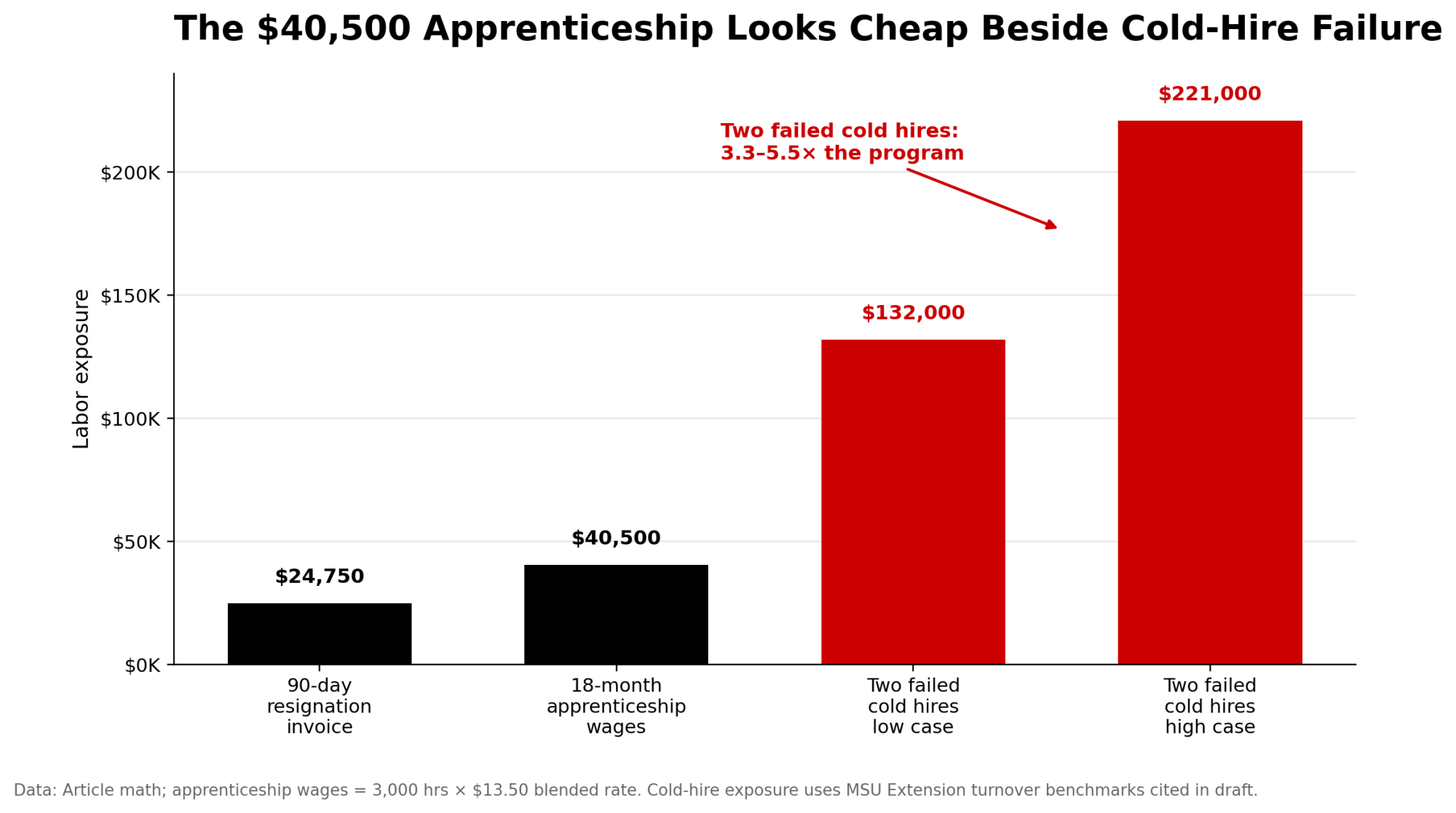
Now line it up against the apprenticeship. Eighteen months of wages progressing linearly from $11 to $16 across 3,000 paid hours works out to a $13.50/hour blended rate. That’s $40,500 — total. One sudden departure pays more than 60% of the entire program. Two failed cold hires in 18 months — realistic in a Northeast dairy environment where management-track turnover hit 41% per the 2024 FARM Workforce Year-in-Review — runs $132,000 to $221,000 all-in. That range applies Michigan State Extension’s hourly turnover benchmark of 100–150% replacement cost on the low end (roughly $132,000 across two cycles) and its management-tier benchmark of 200–250% on the high end (roughly $221,000 if the role carries salary-grade compensation), drawn from MSU Extension’s “Employee Turnover Costs on Dairy Farms” bulletin by Stan Moore (2019, updated 2023).
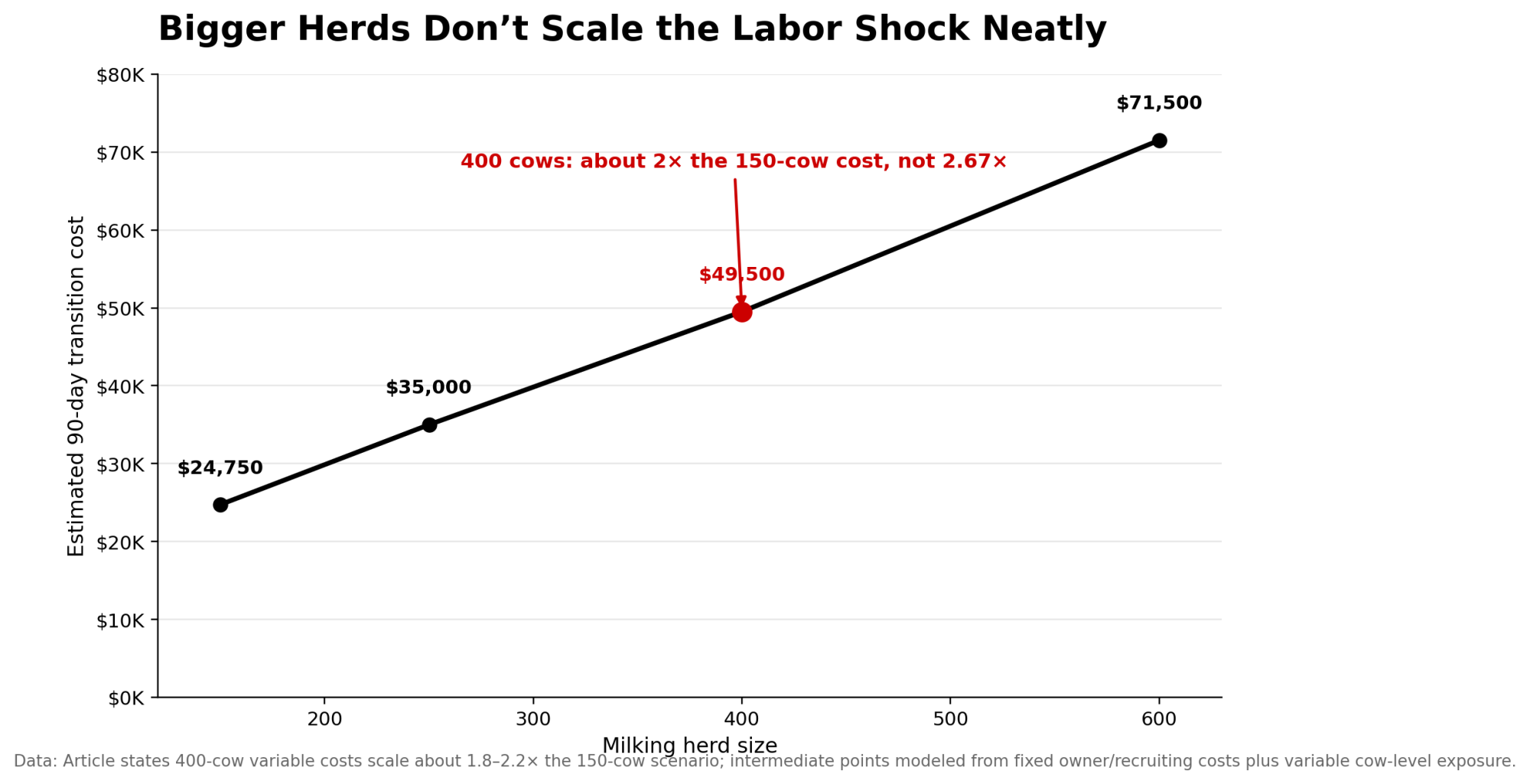
Running 400 cows instead of 150? The variable costs — repro slippage, fresh cow misses — scale close to linearly. Owner time and recruitment friction don’t. Plan on roughly 1.8–2.2x the 150-cow numbers, not 2.67x cow count.
Why Trained-In-House Beats Experienced-Cold

The reason the math works isn’t sentimental. It’s structural.
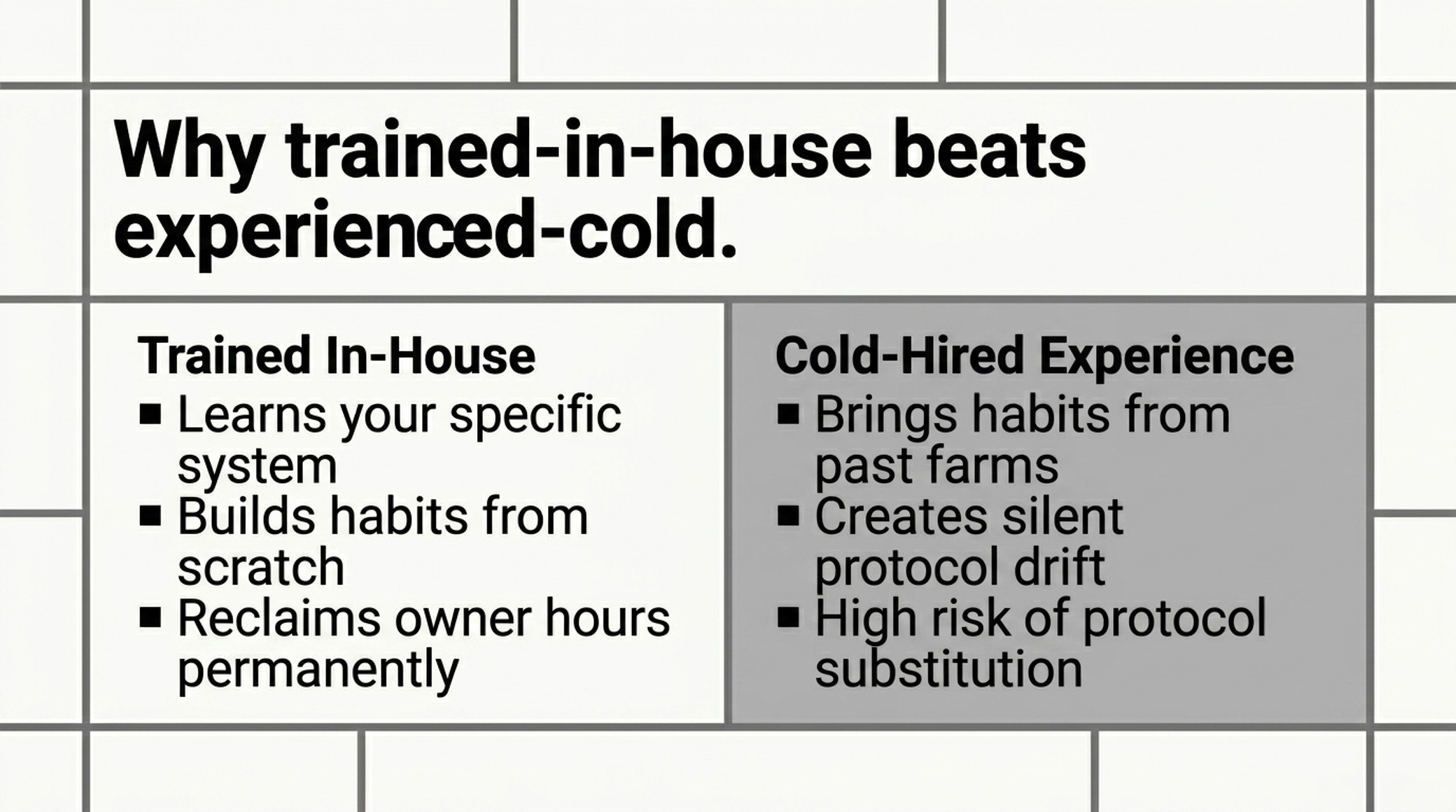
A manager trained on your farm, in your protocols, under monthly review, doesn’t arrive carrying habits from another operation. “Management factors associated with milk quality on high-performing dairies,” published in Journal of Dairy Science 108:1422–1435, found that managers who invested more than average time in animal monitoring posted measurably lower somatic cell counts and better overall performance outcomes. Protocol consistency shows up in the tank, the repro report, and the calf barn. It doesn’t show up on a resume line.

The apprenticeship is structured so completers take on defined competency areas — reproduction checks, calf-barn protocols, herd-health records — that previously pulled the owner or a senior employee out of whatever else was in front of them. That’s the mechanic. Free owner hours. Tighter protocol ownership. A person whose competency was built on your system, not grafted onto it.

“The biggest shift wasn’t the hours; it was moving from ‘doing tasks’ to ‘owning outcomes,'” said Michelle Shearer, the Center for Dairy Excellence’s Workforce Development Manager who runs the monthly review visits. “In an apprenticeship, you aren’t just milking; you’re monitoring the heartbeat of the business.”

Cold hiring runs into a failure mode extension specialists call protocol substitution — experienced workers pattern-match your system to one they already know and fill in the gaps with prior habits. Penn State Extension and Michigan State’s dairy veterinary-school onboarding materials flag the same pattern. A 2025 Progressive Dairy analysis by Matt Lange, “When ‘Yes’ Actually Means ‘No’: Why Experienced Hires Drift From Your Protocols” (September 2025), walks through it on real farms. The fix is harder than unwinding a trainee’s drift, because confident habits are more durable than new ones.

And there’s the retention piece. Registered Apprenticeship programs broadly show a 92% post-program employment retention rate and 2.5–3x longer tenure than traditional hires, per the Jobs for the Future Policy Blueprint “Apprenticeship as Workforce Infrastructure” (April 2025), drawing on U.S. Department of Labor completion data. The apprentice chose your farm. Developed on your farm. Earned the credential on your farm. When someone offers them a dollar more across the county line, the switching cost is real.

How Much Does One Sudden Departure Actually Cost You?

The $11,250 owner-time line item is the one owners consistently underprice, because it’s time they’re already used to giving. On a 150-cow Pennsylvania dairy, that alone is bigger than most farms’ annual training budget. The other four line items add another $13,500 on top — repro slippage, fresh cow misses, days open, and onboarding friction — bringing the 90-day total to $24,750.

Those costs compofund if the first replacement doesn’t stick. Two failed cold hires in 18 months can run $132,000–$221,000 all-in. Worth writing on the whiteboard next to your current labor budget. If you’ve cycled through a herd-level employee more than once in the last five years, the math’s already been run on your operation. The invoice just didn’t land in your inbox.

Is Your Farm Actually a Teaching Operation — Or Just a Host With Paperwork?

That distinction matters. A teaching operation has four things in place before day one: written SOPs for reproduction, calf care, herd health, and records; a designated daily trainer who isn’t the owner; one carved-out management domain assigned to the apprentice within the first three to six months; and a protected 60–90 minute weekly review block that doesn’t get eaten by whatever’s on fire. The weekly review and phased domain assignment follow the CDE Host Farm Guide’s program expectations for sponsors; the specific review length and domain timeline reflect common practice among apprenticeship host farms rather than a rigid CDE mandate.

Farms that skip the weekly review and still pay the wages don’t get a slower version of the same outcome. They get protocol drift — the apprentice practicing a version of your system that’s 80% right and 20% quietly wrong, reinforced through 12 months of repetition. The correction cost at month 18 is higher than at month three.

Cornell PRO-DAIRY’s onboarding framework lands in the same place as Penn State Extension and the dairy vet-school guidance: written SOPs plus scheduled feedback prevent drift. Nothing else does.

Readiness TestReady Farm StandardNot-Ready WarningWhy It Matters
Written SOPsSOPs exist for reproduction, calf care, herd health, and recordsOnly verbal instructions or “ask the owner”Without written standards, the apprentice learns a moving target
Daily trainerNamed trainer other than the ownerOwner is the only person qualified to teachThe program collapses into shadowing, not management development
Weekly review blockProtected 60–90 minutes every weekReview happens only when something goes wrongFeedback after drift is correction; feedback before drift is training
Early ownership domainApprentice owns one competency area within 3–6 monthsApprentice stays in task mode for the full programRetention comes from responsibility, not just hours
Protocol monitoringRecords, repro, health events, and calf outcomes are checked regularly“We’ll know if something’s off”By the time the tank or preg-check report shows the problem, the habit is already baked in

Options and Trade-Offs for Farmers

PathBest FitUpfront Cash ExposureManagement RequirementBiggest Risk
Registered apprenticeFarm has a trainable employee or candidate and can commit weekly review time$40,500 over 18 monthsWritten SOPs, daily trainer, monthly review, real domain ownershipCompletion risk; national registered apprenticeship completion runs around 59%
Informal internal developmentFarm has a trusted employee but wants less paperwork$30,000–$45,000 in wages/training timeSame SOP and feedback discipline, minus outside accountabilityProtocol drift hides until repro, SCC, or calf outcomes slip
Cold hireFarm has strong management depth and can absorb a failed transition$66,000–$110,000 per failed management-tier hireHeavy onboarding, protocol correction, owner supervisionExperienced habits override farm protocols
Do nothingOwner keeps absorbing the gap$11,250 owner-time hit in first 90 days aloneOwner becomes the default trainer, manager, and firefighterThe labor problem becomes succession risk

Path 1 — Host a registered apprentice

When it makes sense: You already have a strong employee or family member who could develop into a management role, or you’re one resignation away from being back in the barn full-time.

What it requires: Written SOPs in the four competency areas. A daily trainer who isn’t the owner. Ninety minutes of protected review time each week. Willingness to hand the apprentice a real management domain within the first few months.

Risks and limits: National Registered Apprenticeship completion rate runs around 59%. Dairy-specific completion data doesn’t exist yet — Pennsylvania’s program has two completers as of April 2026. Selection and farm readiness matter more than the credential itself.

Path 2 — Develop an existing employee informally

When it makes sense: You’ve got a person on staff, limited bandwidth for formal program paperwork, and a relationship that already works.

What it requires: Everything the apprenticeship requires — SOPs, scheduled review time, progressive responsibility — minus the external accountability of monthly CDE visits. That external piece matters more than it sounds.

Risks and limits: No credential at the end, so retention leverage is weaker. Without an outside set of eyes on a schedule, protocol drift is easier to miss until it surfaces in the tank or the repro report.

Path 3 — Keep cold-hiring and absorb the turnover tax

When it makes sense: You’ve got real management depth already — a son, daughter, partner, or senior employee who’s bulletproof and isn’t going anywhere.

What it requires: Acceptance that each cycle costs what it costs, and a financial cushion to ride out the 90-day transition windows.

Risks and limits: The math above is the risk. One failed management-tier hire on a 150-cow operation can clip roughly $66,000–$110,000 on MSU’s 150–250% turnover benchmark alone, applied to an assumed $44,000 annual management salary. Layer in the 90-day cost clock, and total exposure lands closer to $90,000–$135,000 before broader production losses.

The 30-day action — regardless of path

Name one person, on your payroll or in your known network, who could develop into a herd management role over 18 months. Run the replacement-cost math for your current situation: take your key person’s rough annual cost, apply 150–200%, compare it to ,500. That one calculation usually answers the question.

By day 90: one SOP drafted in one of the four competency areas, with the designated daily trainer identified by name. By day 365: the apprentice (or internal trainee) should own one full competency area end-to-end, with documented owner hours reclaimed per week.
Key Takeaways

  • If you’ve cycled through a herd-level employee more than once in the last five years, run the $40,500 apprenticeship cost against your realistic replacement exposure before the next resignation. One failed management-tier hire typically costs more than the entire 18-month program.
  • If you can block 90 minutes a week for apprentice review AND you already have two or more written SOPs in the competency areas, the formal apprenticeship ROI outperforms informal training. If either condition fails, spend 90 days building SOPs before enrolling.
  • If no one on your farm besides the owner can function as daily trainer, the apprenticeship is likely to collapse into “follow me around and hope.” Fix that first.
  • If you’re treating the apprenticeship as a succession solution, build the equity entry pathway before the candidate starts — not at year four. Non-family succession, where it works, typically requires five or more years of senior management experience plus a deliberately designed ownership-transfer structure, per Land For Good’s “Farm Succession and Transfer: A Guide for Non-Family Transitions” (2023) and Penn State Extension’s Farm Transition Planning program.
  • If your owner-time-in-the-barn has been creeping up for two quarters straight, that’s the leading indicator your current labor situation is already costing you. The invoice just hasn’t arrived yet.
The Question Pennsylvania’s First Two Apprentices Already Answered

Fuller and Quinn chose dairy careers in a year when 490 Pennsylvania farms chose to exit. Two farms figured out something worth figuring out: the apprenticeship isn’t an upgrade decision for a stable operation. It’s an insurance decision for an unstable one. Every owner reading this already knows which category their operation falls into. They just haven’t said it out loud yet.

What would it take for yours to be the one that attracts — and keeps — the next apprentice looking for a real career in this industry?

Complete references and supporting documentation are available upon request by contacting the editorial team at editor@thebullvine.com.

Learn More

The Sunday Read Dairy Professionals Don’t Skip.
Every week, thousands of producers, breeders, and industry insiders open Bullvine Weekly for genetics insights, market shifts, and profit strategies they won’t find anywhere else. One email. Five minutes. Smarter decisions all week.
NewsSubscribe
First
Last
Consent

When 112 Milkers Averaged 49%: What Rodriguez’s Training Study Says You’re Leaving Per Cow in the Parlor.

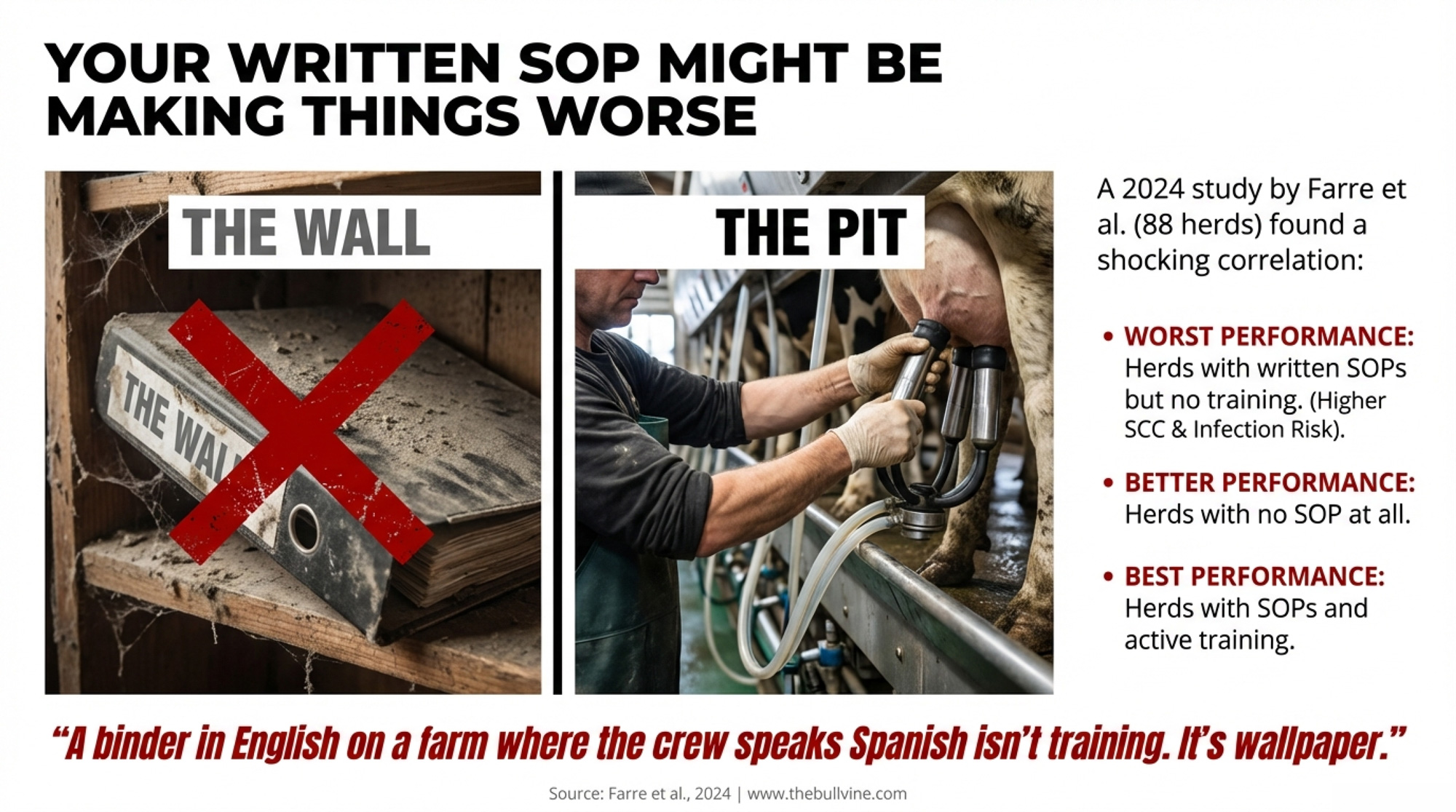
Written SOP on the wall? A 2024 study found that herds with SOPs but no training actually had higher SCC than herds with no SOP at all.

Executive Summary: Most dairies already have written milking SOPs, but Rodriguez’s 16-herd study in Michigan and Ohio showed the people in the pit only averaged 49.3% on a basic routine quiz — and that gap was costing money. One bilingual training session per farm moved knowledge scores to 67.6%, cut inadequate prep from 69% to 48%, reduced missed post-dip coverage, and shaved 25–43 seconds off milking time per cow while stabilizing SCC trends. When you put those shifts beside real-farm results — like an 850‑cow Wisconsin dairy turning a $12,500 training spend into roughly $78,000 in first‑year return while dropping SCC from 245,000 to 175,000 — training stops looking like a “soft” expense and starts penciling out as a $55–$73‑per‑cow‑per‑year opportunity on a 300‑cow herd. The article also leans into the uncomfortable finding that herds with written SOPs but no training actually had higher SCC than herds with no SOP at all, and it ties that to a 38.8% annual turnover rate that constantly erodes protocol compliance. Using national SCC premium grids, mastitis cost data, and regional wage benchmarks, it walks readers through barn math they can plug their own numbers into instead of guessing at training ROI. The piece closes with a four‑path playbook — from UW’s MQUW train‑the‑trainer program to free bilingual online modules and a 30‑day parlor audit — so producers can decide how far to go in formalizing milker training and what kind of return they should expect in their own parlor.

Dairy Milker Training

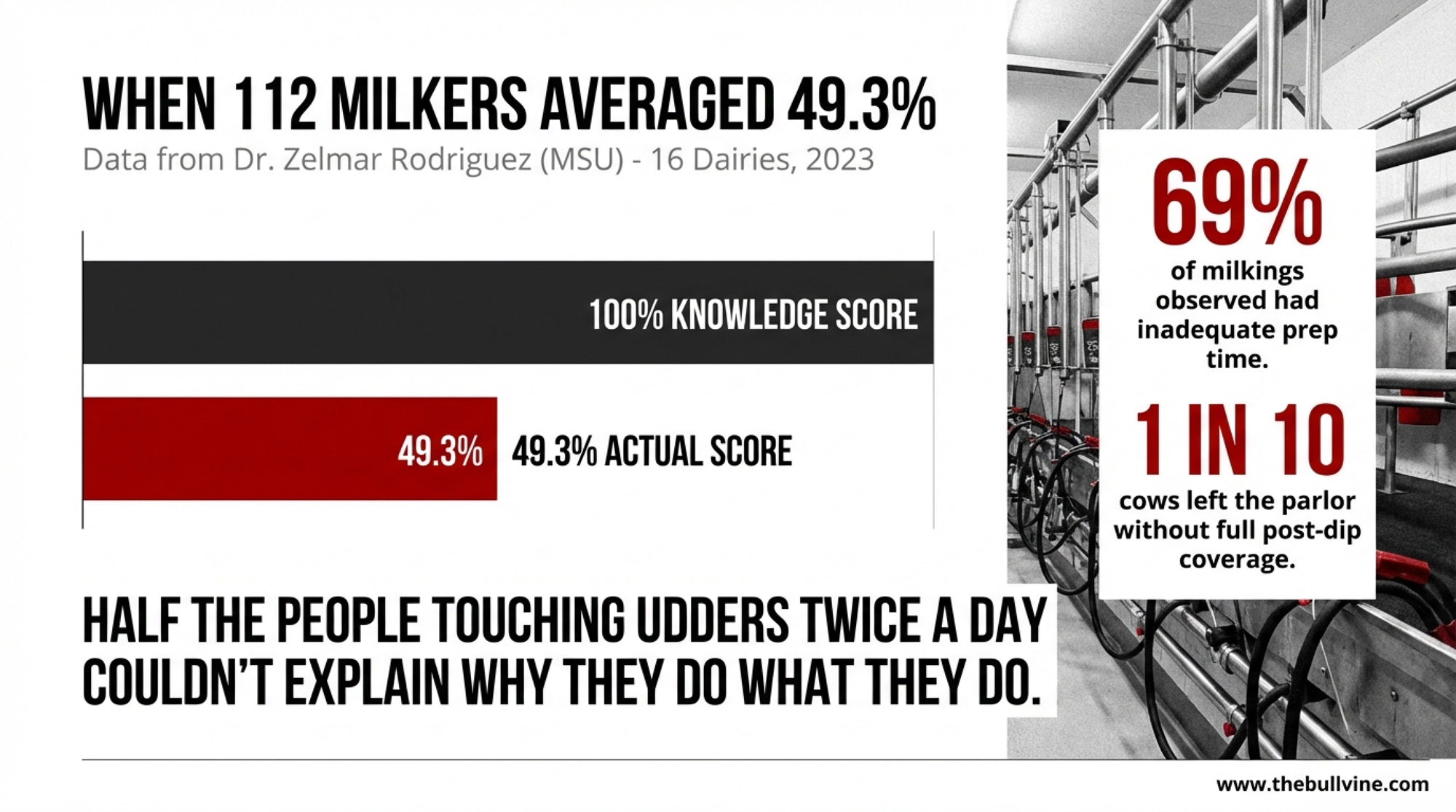
The average score on a basic milking-routine knowledge quiz across 112 parlor workers? 49.3%. That’s what Zelmar Rodriguez — a dairy veterinarian and assistant professor at Michigan State University’s College of Veterinary Medicine — found when he evaluated 16 Michigan and Ohio dairies totaling 17,205 cows between April and September 2023. Half the people touching udders twice a day couldn’t explain why they do what they do. And Rodriguez’s data shows that the gap has a price tag — in SCC premiums lost, mastitis cases missed, and parlor minutes wasted on every shift. 

Not a failure rate, either — a group average. Plenty of milkers scored well below that line. “It’s incredible the difference among employees and their learning process. The gap is huge,” Rodriguez said on the Dairy Science Digest podcast in December 2024. These weren’t small pasture herds. Median herd size was 1,101 cows, ranging from 280 to 2,330 lactating, with an average of 15 employees per farm. Study participants were 82% male and 74% Spanish-speaking. Rodriguez told Dairy Global: “People need to know why they have to do what they have been told to do”. His data says roughly half the people in the pit don’t. 

Your Written SOP Might Be Making Things Worse

Here’s the part that should make you look at your own parlor wall a little differently.

A 2024 study by Farre and colleagues — published in Veterinary Sciences by researchers from SEGES Innovation in Denmark, the University of Copenhagen, and Wageningen University — surveyed 88 Danish dairy herds with hired employees and parlor or rotary systems. They split farms into three groups: no written milking SOP, a written SOP with no structured training, and a written SOP actively used in training. The results flipped expectations. Herds with a written SOP and no training performed worse than herds with no SOP at all — BTSCC was 21,600 cells/mL higher,and new infection risk was 0.15 percentage points higher. Only herds that actually trained milkers on their SOP saw improvement: a 0.16 percentage-point drop in new infection risk. 

Herd TypeBulk Tank SCC ChangeNew Infection Risk Change
No written SOPBaselineBaseline
Written SOP, No Training+21,600 cells/mL+0.15 percentage points
Written SOP + Active TrainingImproved−0.16 percentage points

A binder in English on a farm where most of the crew speaks Spanish isn’t training. It’s wallpaper. New hires figure out within a week which rules on the wall are “real” and which ones everyone ignores. Then they follow the veteran milker, not the laminated sheet.

Rodriguez’s 16 herds fit that pattern. SOPs were posted. Equipment functioned. But when he timed what actually happened in the pit, 69% of milkings fell short on preparation time, and about 1 in 10 cows left the parlor without full post-dip coverage. The routine changed with the crew, not the cow. 

One Session. One Day. Here’s What Moved.

Getting farms to sign up was its own challenge. “It wasn’t as easy to get study participants as I thought it would be,” Rodriguez admitted. “They all would say, ‘We just don’t have time'”. Owners came around once they learned the training would only take about an hour. 

Each farm got one structured training session — bilingual, practical, and built around explaining the biology behind each step of that farm’s milking routine. Rodriguez used the National Mastitis Council’s free online resources to draft a curriculum focused on mastitis identification, risk factors, and proper milking procedures. During the pre-assessment, researchers captured photographs of the parlor being worked on — this helped participants visualize their own farm and better relate to the concepts. Workers and managers reviewed the parlor evaluation together and agreed on adjustments based on Rodriguez’s observations during his first visit.

The crews responded. Employees rated the training 4.5 out of 5 for practical use on their farm. Most were milking technicians (61.1%), and 70% had been on the job for less than 1 year, with a median tenure of just 9 months. “We can’t expect employees to come in with this knowledge,” Rodriguez said. These weren’t lifers. They were the people you’re usually hoping will just “pick it up” from watching. 

One practical lesson surfaced everywhere. “Confusion around how to handle abnormal milk was one question that bubbled to the surface on every farm enrolled,” Rodriguez reported. “It is critical that owners or parlor management are present at the training to answer questions just like these that are a bit subjective and vary from farm to farm”. 

On the follow-up visit, Rodriguez ran the same checks again:

MetricBeforeAfterChange
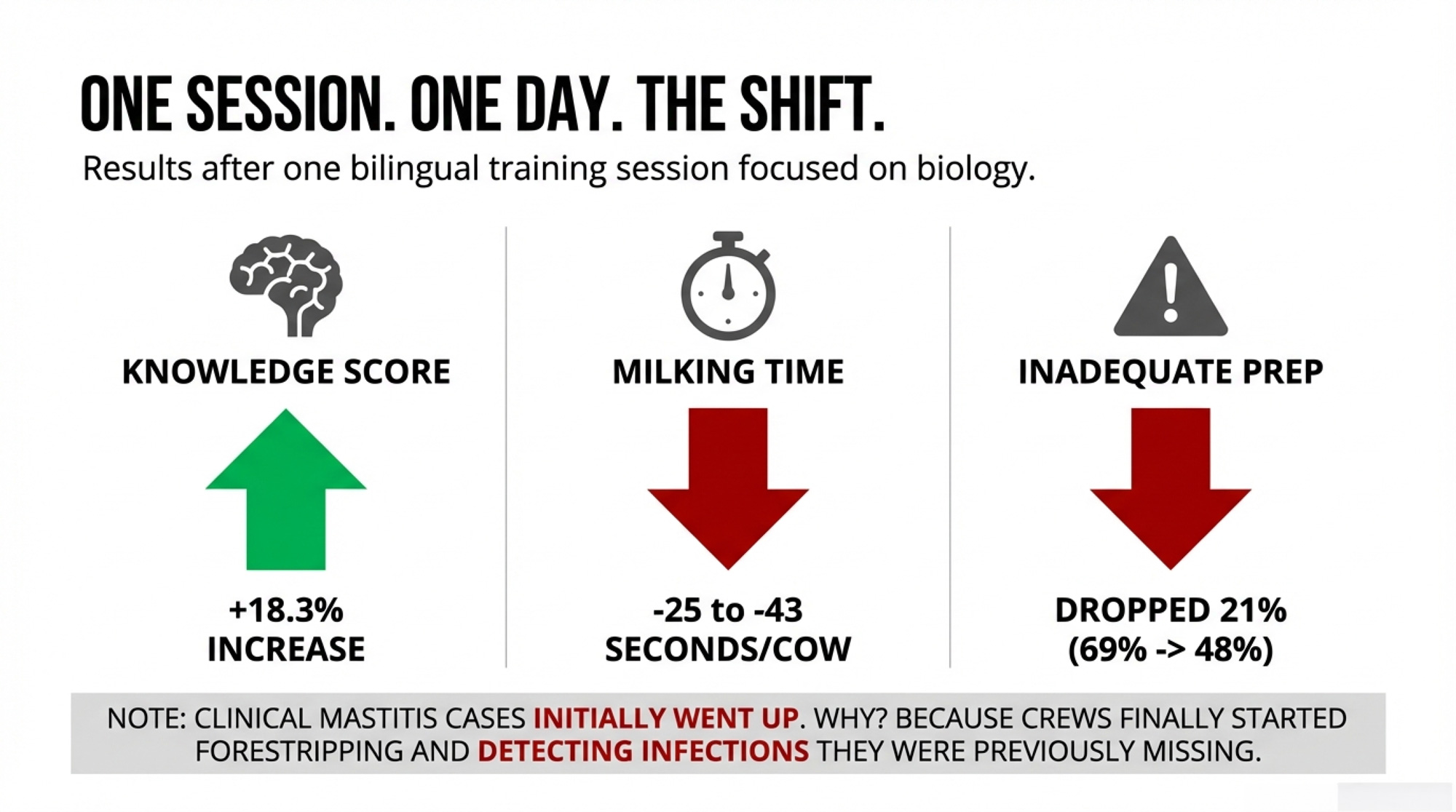
Knowledge quiz score 49.3%67.6%+18.3 points
Milkings with inadequate prep  69%48%−21 points
Insufficient post-dip coverage  9.8%5.9%−3.9 points
Pre-dip contact time Below target+9 sec/cowToward 30s target
Proper lag time (60–120 sec)  Baseline+20% complianceImproved
Milking time per cow Baseline−25 to −43 secFewer re-attachments

One thing caught attention: clinical mastitis cases went up after training. Sounds like bad news — until you think about forestripping. Once milkers actually started stripping out and looking, they caught abnormal milk that had been going straight into the tank. 

Two Farms That Actually Ran the Numbers

Before you dig into per-cow math, it helps to see what actual farms saw when they swapped “watch and learn” for real training.

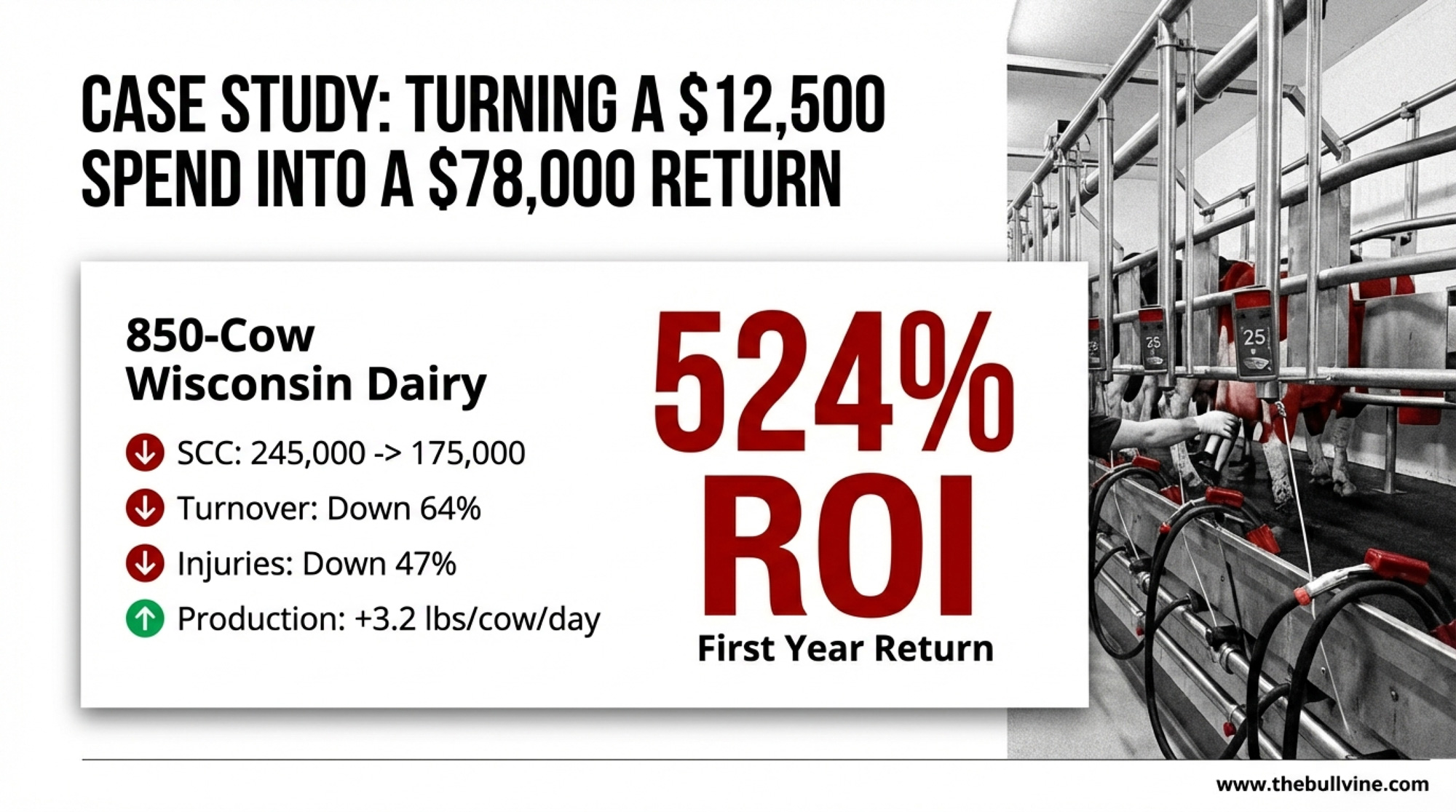
In 2022, an 850-cow Wisconsin dairy invested $12,500 in a bilingual training overhaul — agricultural Spanish classes for management, bilingual signage and SOPs, and monthly bilingual safety meetings with a professional translator. 

MetricResult
SCC  245,000 → 175,000
Employee turnover  Down 64%
Workplace injuries  Down 47%
Production  Up 3.2 lb/cow/day
First-year return ~$78,000 (524% ROI on $12,500)

A second Midwest dairy worked with a Hispanic employee training service. Over nine months, SCC dropped from 325,000–350,000 into the sub-200,000 range. Employee turnover fell from one to two departures a month down to one departure in six months on a 20-person crew. 

FarmInvestmentFirst-Year ReturnSCC ChangeTurnover Change
Wisconsin 850-Cow$12,500$78,000 (524% ROI)245K → 175KDown 64%
Midwest DairyNot disclosedNot disclosed325K → <200K2/month → 1/6 months

Neither farm saw a magic overnight turnaround. But once milkers understood why they were doing what they’d always been told to do, protocol drift slowed. And the numbers moved.

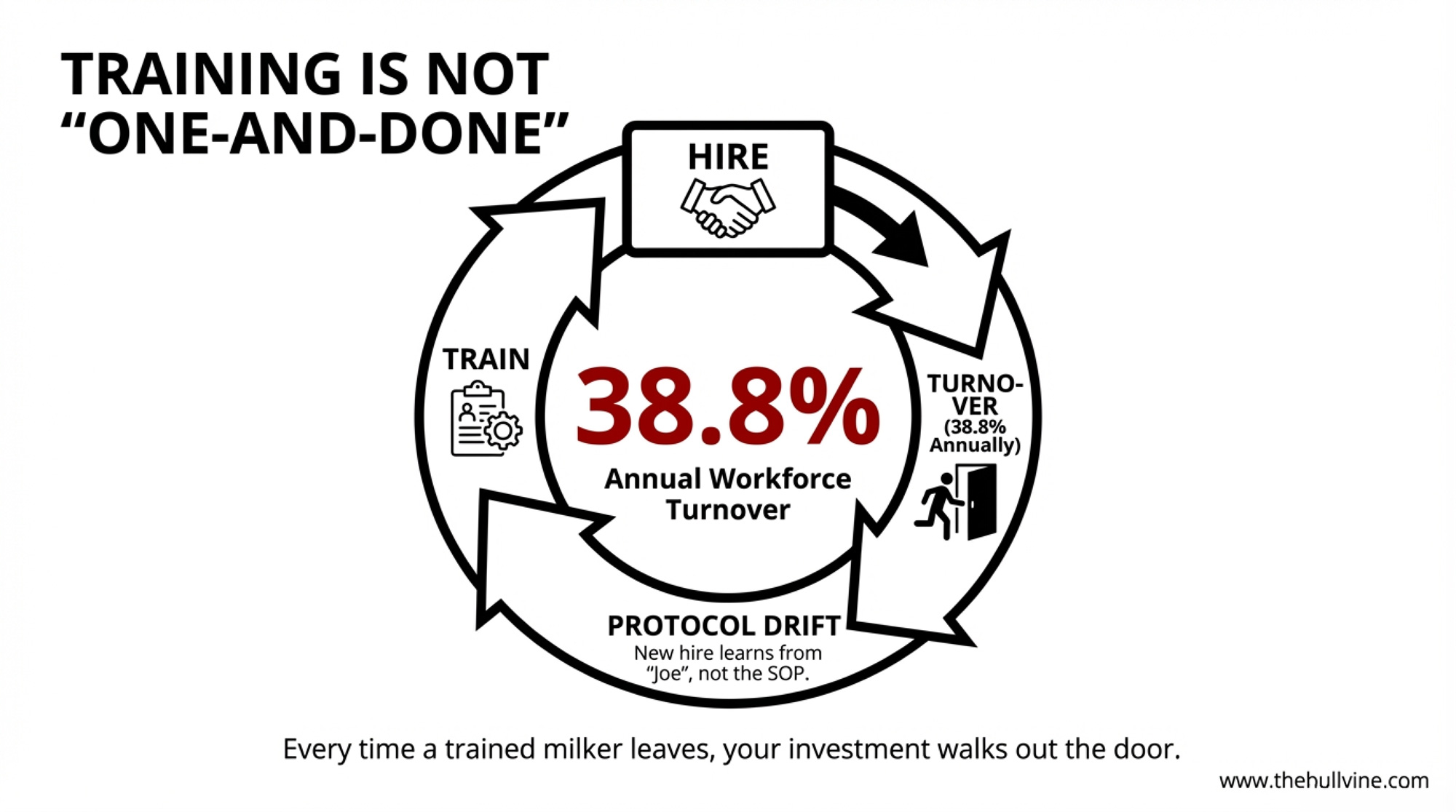
Here’s the part that makes training a rolling cost, not a one-time fix. Nationally, dairy operations turn over 38.8% of their workforce every year. Nearly 4 out of 10 parlor positions are refilled annually. 

Every time a trained milker leaves, your investment walks out the door — and whoever fills that spot learns more from the coworker beside them than from anything posted on the wall. Think about that next time someone frames dairy’s labor problem as a matter of finding “better” workers. It’s not. It’s about training the workforce you actually have. Immigrant labor provides 51% of all U.S. dairy workers, and dairies employing immigrant labor produce 79% of the milk supplyJorge Delgado, the on-farm dairy specialist who oversees Alltech’s Training, Talent Development, and Retention Program, said in a February 2024 statement: “Better education and training not only bolster the workforce’s efficiency but also safeguard milk markets and assure consumers that the industry prioritizes animal welfare through rigorous worker training”. 

How Much Does Milking Training Actually Save Per Cow?

Rodriguez charted bulk tank SCC over time and saw the trend flatten after training — the seasonal upward creep in BTSCC stopped. Not the dramatic plunge that wins a plaque. But enough to keep herds inside their quality premium range rather than sliding out. 

Nationally, the average DHI test-day herd SCC was 181,000 cells/mL in 2024 — the same as in 2023, according to CDCB. Genetics on somatic cell score keep improving. If the national average isn’t budging, the bottleneck isn’t in the semen tank. It’s in the parlor. 

Here’s the barn math on a 300-cow herd shipping 75 lb/cow/day. Swap your own numbers into any line.

Line 1: SCC Premium Protection

Four Federal Milk Marketing Orders adjust milk payments for SCC using a per-1,000-cells/mL variation from a 350,000 baseline tied to monthly cheese prices. Co-ops and processors stack their own quality premiums on top. Herds consistently shipping sub-200,000 SCC milk see premiums in roughly the $0.40–$1.00/cwt range, depending on processor and region. 

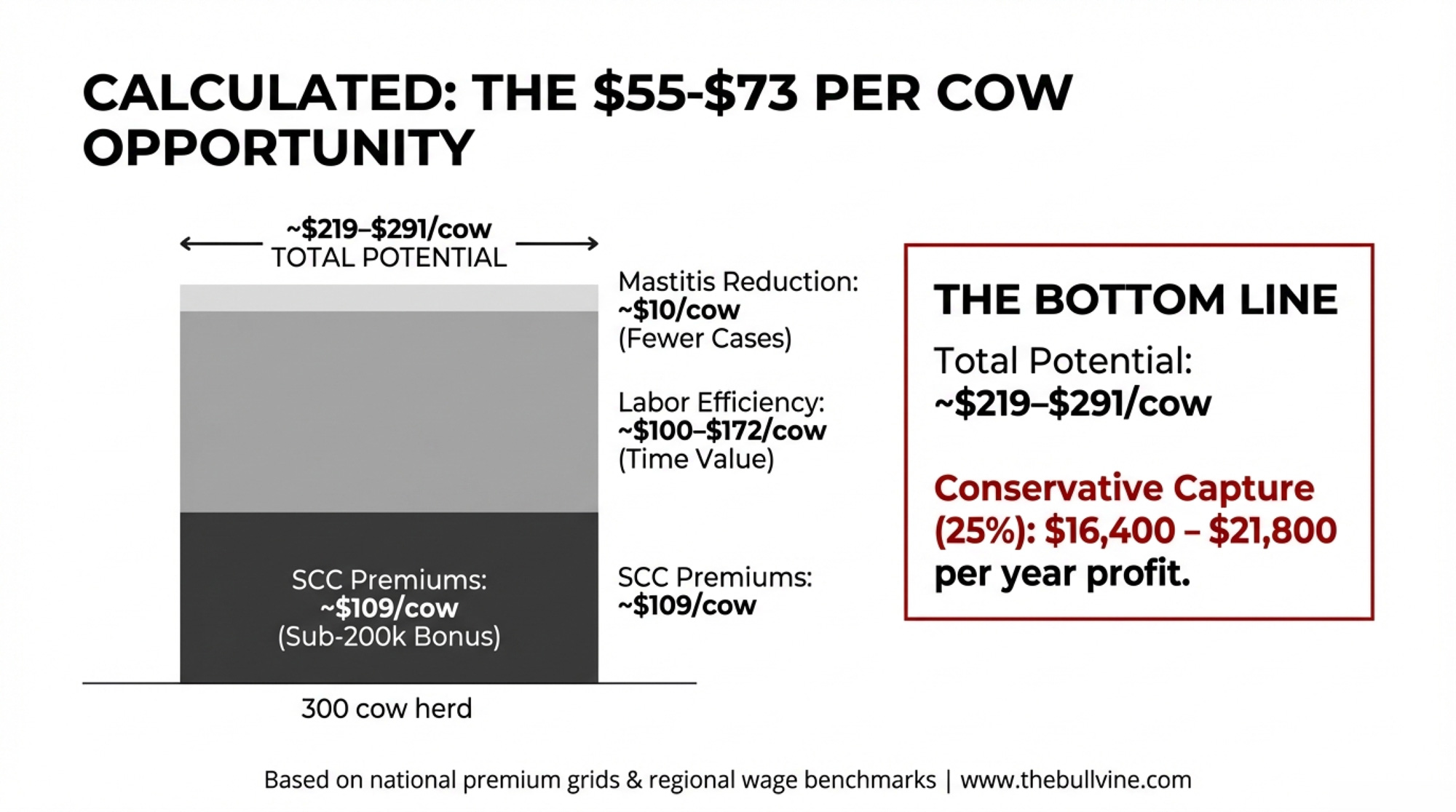
Your math (conservative, $0.40/cwt): 300 cows × 75 lb/day × 365 days = 8,212,500 lb = 82,125 cwt 82,125 cwt × $0.40 = $32,850/year ≈ $109/cow/year in premium income kept or lost

If your co-op’s grid pays closer to $1.00/cwt for sub-150K milk, triple that line.

Line 2: Mastitis Cost Reduction

In a separate study, Pamela Ruegg’s group at MSU examined the actual costs of clinical mastitis cases on 37 commercial dairy farms in Wisconsin. Average direct cost: $192 per case, with a range of roughly $120 to $350depending on the farm. Discarded milk accounted for 53–80% of those direct costs. USDA’s NAHMS Dairy 2014 study — the most recent nationally representative data — found clinical mastitis in 24.8% of cows

Your math (300-cow herd at national average): 300 cows × 24.8% = ~75 cases/year. If improved compliance trims incidence from 20% to 15%, 15 fewer cases × $192 = $2,880. Total: ~$2,880/year ≈ $10/cow/year

A note on that 20%: Rodriguez’s study actually showed clinical mastitis cases going up after training — because crews were finally detecting them through forestripping. The case-reduction math is a projection of what should happen over 6–12 months as better detection leads to earlier treatment and fewer chronic infections. Track your own before-and-after numbers rather than assuming this figure. 

Separately, Ruegg found that each unnecessary treatment day costs about $65 in discarded milk and drugs. If you and your vet tighten treatment protocols alongside parlor training — a different conversation, but one that pairs well with what we covered in our mastitis overtreatment piece — the savings stack. 

Line 3: Labor Efficiency

Two sources report different figures for the milking time reduction Rodriguez measured, and both are credible. MSU’s own summary and the Dairy Global report both show a 25-second reduction per cow — attributed specifically to fewer re-attachments. Hoard’s Dairyman, reporting on Rodriguez’s December 2024 appearance on the Dairy Science Digest podcast, cites an average reduction of 43 seconds per cow, with no change in employee performance. The broader figure may reflect total milking time savings, including prep efficiency gains alongside re-attachment reduction. 

Your math (300-cow, 2× herd — conservative, using 25 sec): 25 sec × 300 cows × 2 milkings = 250 min = 4.17 hours/day 4.17 hrs × 365 = 1,521 hours/year 1,521 hrs × $19.70/hr (USDA Lake Region livestock wage, May 2025) = $29,960 ≈ $100/cow/year in time-value 

If the 43-second figure applies to your operation: 43 sec × 300 cows × 2 milkings = 430 min = 7.17 hours/day 7.17 hrs × 365 = 2,617 hours/year 2,617 hrs × $19.70/hr = $51,555 ≈ $172/cow/year in time-value 

Honest catch: “time-value” doesn’t automatically land in your checking account. Crews get paid for the shift, not by the minute. That time becomes real money when you can milk more cows with the same hours, cut overtime, or eventually trim scheduled labor. A 2022 Cornell-led study by Alanis, Virkler, and colleagues — published in JDS Communications— evaluated milking training across 15 farms in northern New York and found equipment-related problems that milkers should have detected and reported on 14 of 15 farms, with inadequate milking routines flagged on 13 of 15. That’s the kind of inefficiency where saved seconds start converting to real dollars once the crew knows what to watch for. 

If you’re weighing parlor training against the milking-speed genetics route, the answer is probably both — but training pays back in months, not generations.

Add It Up

Revenue LinePer Cow/Year (Conservative)Per Cow/Year (Upper Range)300-Cow Herd (Conservative)
SCC premium protection ~$109~$109$32,850
Mastitis cost reduction ~$10~$10$2,880
Labor efficiency  ~$100 (at 25 sec)~$172 (at 43 sec)$29,960–$51,555
Total potential value~$219~$291$65,690–$87,285
Realistic capture (25%)~$55~$73$16,400–$21,820

Nobody captures every dollar. But even a quarter — $55 to $73/cow, or $16,400 to $21,800/year on 300 cows — comes in against a training spend that tops out around $6,000. The 25% figure is editorial judgment, not a study finding. Your actual capture depends on how consistently you maintain the new routine through turnover cycles.

What Does a Structured Milking Training Protocol Look Like?

UW–Madison’s Milk Quality from the Udder World (MQUW) trainer certification program runs $95 per person. That covers a self-paced online course (about 2 hours across five modules), a one-day in-person workshop, lunch, laminated parlor training materials with QR codes linking to short educational videos, and certification. Sessions run in English one day and Spanish the next. 

LocationSpring 2026 Dates  
LuxemburgFeb 18–19
MadisonMar 18–19
AbbotsfordApr 1–2
Fond du LacApr 7–8
De SotoApr 29–30

(The Luxemburg session begins February 18 — check dairy.extension.wisc.edu for remaining seats. Four more sessions run through April 30.)

It’s a train-the-trainer model. You send your parlor manager, a bilingual lead, or maybe yourself—and they bring the knowledge home to coach everyone else. Rodriguez himself used the NMC’s free online resources to build his curriculum. On-farm, the pattern is simple: explain the biology, demonstrate on actual cows in your setup, then stand in the pit and coach real-time until the new routine holds. 

Realistic annual training budget (300-cow herd, 15 milkers)

ItemCost
MQUW fees — 3 trainers × $95  $285
Wages + travel for trainer attendance$1,000–$1,500
On-farm rollout (trainer time + milker hours during coaching)$2,000–$3,000
Quarterly refreshers (fight turnover drift)$1,000–$2,000/yr
Total$2,000–$6,000

Most of that is your own payroll, not program fees.

Can’t get to Wisconsin? Iowa State University Extension and the University of Nebraska–Lincoln Dairy Extensionbuilt a free online milker training program in English and Spanish at go.iastate.edu/milkertraining. Each module has Spanish-language videos with English subtitles and quizzes in both languages with Spanish audio. The Alltech–FARM Program also launched bilingual cow-handling modules in 2024 that cover stockmanship fundamentals. Neither replaces someone standing beside a new milker in your pit — but both are a massive step up from “follow Joe.” 

Training PathCostTime InvestmentWhat You GetBest For
UW MQUW Train-the-Trainer$95/person2-hour online course + 1-day in-person workshopCertification, laminated materials, QR-coded videos, train-your-crew toolkitFarms with 3+ milkers, bilingual crews, need for repeatable internal training
Free Bilingual Online Modules (Iowa State/UNL)$0Self-paced (videos + quizzes in English/Spanish)Step-by-step videos, quizzes, certificatesBridge option for farms that can’t attend in-person training this year
DIY 30-Day Parlor Audit$03 milkings across shifts (stopwatch + notepad)Baseline data: lag time, post-dip coverage, re-attachments, forestrip complianceImmediate baseline before committing to training spend—start here
On-Farm Custom Training (Rodriguez Model)$2,000–$6,000/year1-hour initial session + quarterly refreshersBilingual, farm-specific, coached in your parlor, ongoing reinforcementFarms ready to formalize training as a rolling annual investment

What This Means for Your Operation

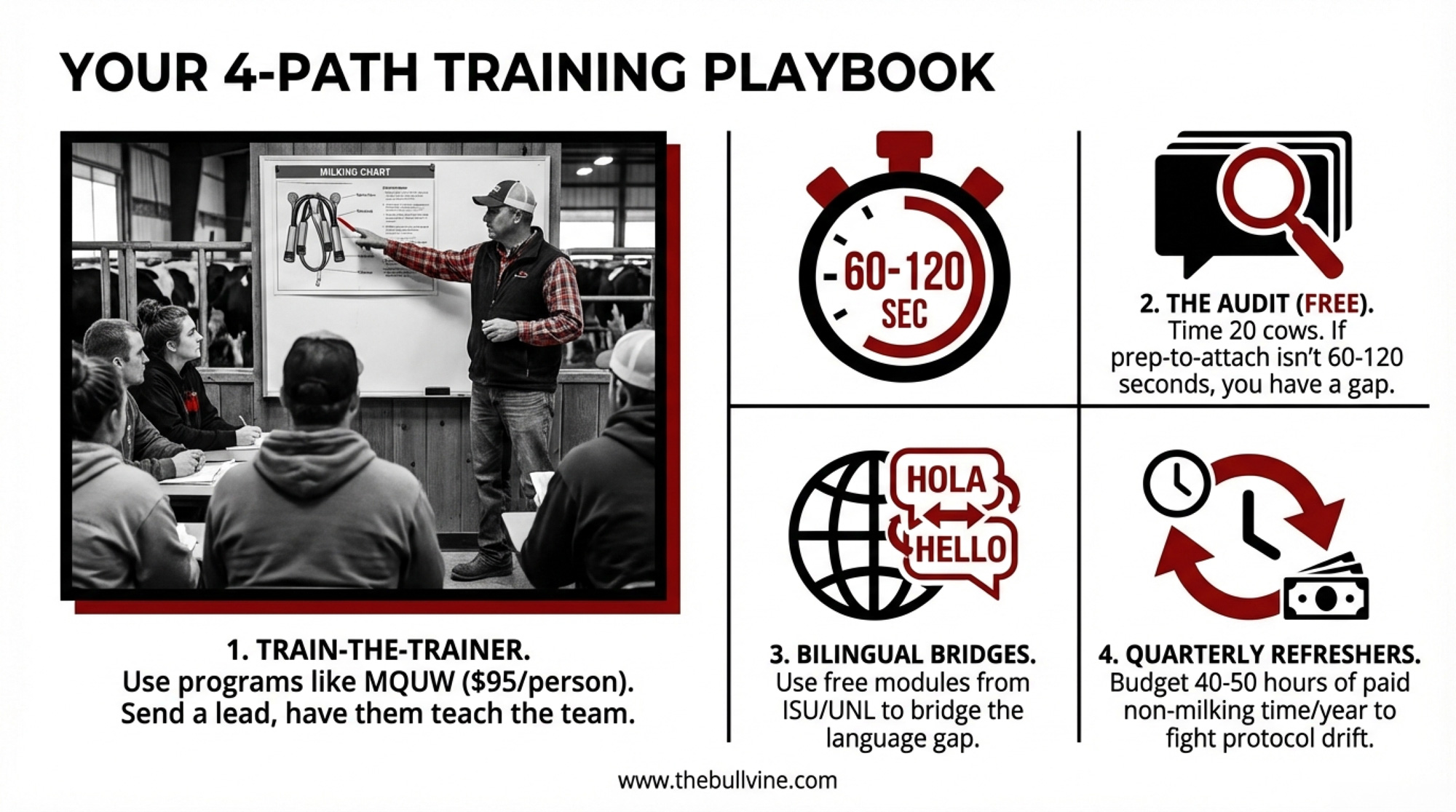
Path 1: Enroll in a train-the-trainer program like MQUW — the $285 path. Makes the most sense if you’ve got more than one person milking and you want the routine done the same way on every shift. At $95 per person for a full day, it’s one of the lowest-cost ways to address parlor consistency. The catch: if your only certified trainer quits, your training program walks out the door. Send at least two people — three if you can — so you’re not starting from zero when turnover hits. And don’t assume robotic milking gets you off the hook. It just shifts the training need from unit attachment to software, alerts, and cow management.

Path 2: Start with a parlor audit this month — no cost, immediate baseline. Grab a stopwatch and a notepad. Spend three consecutive milkings in the parlor across different shifts. Time at least 20 cows per milking from first touch to unit attachment. Score post-dip coverage: full, partial, or missed. Count how many cows aren’t forestripped at all. By the end of that week, you’ll know whether lag time falls within the 60 to 120 seconds that NMC, University of Minnesota Extension, and Penn State Extension all recommend from first tactile stimulation to unit attachment. Frame it for your crew as “we’re checking our system, not checking up on you”—or you’ll create pushback before you even talk about training. 

Path 3: Use free bilingual resources as a bridge. If MQUW is out of reach this year, the Iowa State/UNL online milker training gives you step-by-step videos and quizzes in both languages. Neither replaces farm-specific coaching in your parlor. But they’re a real step up from dropping a translated SOP on the breakroom table and hoping it sticks. 

Path 4: Post micro-metrics and run quarterly refreshers. Training isn’t one-and-done — especially with 38.8% annual turnover. After your initial push, pick a few visible numbers: prep-time compliance rate, average lag time, dip coverage percentage, and re-attachments per 100 cows. Post them where your crew sees them. Plan a 30–45-minute refresher for each crew every quarter. Maybe 40–50 hours of paid, non-milking time per year across your whole milking staff to keep everyone aligned. Skip the refreshers? Within a couple of turnover cycles, your crew looks a lot like Rodriguez’s study group did on day one. 

Key Takeaways

  • If your herd SCC has stayed flat or crept up while your SCS genetics have improved, the gap is probably in the parlor, not the semen tank. The national DHI average has remained at 181,000 cells/mL over the past 2 years. Pull your last three DHIA tests and see if your trend is any different. 
  • If you’ve got a written milking SOP that nobody has formally trained on in the past 12 months, the Farre et al. (2024) research says you might actually be worse off than having no SOP at all. A binder nobody understands teaches your crew that written rules don’t matter. 
  • Within the next 30 days, run your own stopwatch test. Time 20 cows’ prep-to-attachment intervals on two different shifts. The NMC-recommended target is 60 to 120 seconds from first stimulation to unit attachment. If a significant share of your cows fall outside that window, training — not equipment — is probably where your next dollar should go. 
  • Budget $2,000 to $6,000 per year for structured milking training on a 300-cow herd and compare that to what you spend on genetics, nutrition, and facilities that all depend on consistent milking to pay off.

The Bottom Line

When’s the last time you stood through a full milking in your own parlor and didn’t touch a unit — just watched what actually happens, step by step, across shifts?

Rodriguez did that on 16 farms, scored 112 workers, and measured the gap between what farms thought their milking routine looked like and what was actually happening in the pit. Your bulk tank already knows how consistent your milking routine really is. The question is whether you’re ready to stand in the pit, run the stopwatch, and find out what it would take to close that gap on your operation. 

Complete references and supporting documentation are available upon request by contacting the editorial team at editor@thebullvine.com.

Learn More

  • The 90-Second Milking Window That’s Paying $126,000 – and Beating Every Robot – You’ll gain a surgical method for auditing pit efficiency and capturing six figures in “lost” milk without buying a single robot. This breakdown delivers the exact protocols and ROI math to turn parlor drift into measurable profit.
  • 79% of U.S. Milk Runs on Immigrant Labor. If Yours Vanishes, You Have 72 Hours. – This reveals the brutal reality of our industry’s workforce dependence and arms you with a 72-hour survival strategy for labor shocks. You’ll position your operation to weather policy storms while protecting the milk volume currently at risk.
  • Robotic Milking Pays 13% More – After 7 Years of Red Ink – This exposes the gap between trade-show promises and actual barn-floor returns on robotic milking. It delivers verified payback periods and management thresholds, helping you decide if automation is a survival tool or an expensive mistake for your herd.

The Sunday Read Dairy Professionals Don’t Skip.

Every week, thousands of producers, breeders, and industry insiders open Bullvine Weekly for genetics insights, market shifts, and profit strategies they won’t find anywhere else. One email. Five minutes. Smarter decisions all week.
NewsSubscribe
First
Last
Consent

Crushing the Labor Crisis: How Smart Dairies Transform Recruiting into a $50K+ Annual Advantage

Stop throwing money at the labor crisis. Smart dairies transform recruiting into a $50K+ competitive advantage while competitors scramble.

EXECUTIVE SUMMARY

The dairy industry’s obsession with wages as the primary recruitment solution is not only financially unsustainable—it’s strategically flawed, and the farms that recognize this are dominating their competition. While most operations burn through $11,000+ per employee replacement and scramble for warm bodies, progressive dairies are flipping the script entirely, treating recruitment like the high-stakes marketing campaign it actually is. With 2.4 million farm workers in short supply and policy changes threatening 20% wage increases, the farms implementing strategic recruitment frameworks are achieving 40% faster time-to-hire, 50% better 90-day retention, and $50,000+ annual savings for 500+ cow operations. European dairies already prove this works—achieving 92% employee retention by marketing themselves as “environmental stewardship” companies rather than traditional agriculture, while Canadian operations prepare for a 10% labor gap increase through systematic workplace culture investments. The labor market has changed permanently, and the question isn’t whether you can afford to invest in strategic recruiting—it’s whether you can afford not to when your competition is already building championship teams that drive milk quality, improve SCC counts, and create sustainable competitive advantage.

KEY TAKEAWAYS

  • Technology-Enabled Recruitment Delivers Immediate ROI: Farms showcasing robotic milking systems and precision agriculture in job descriptions report 40% faster time-to-hire and 25% higher retention rates, with one Wisconsin dairy seeing 30% turnover reduction after positioning staff as “cow care specialists” rather than manual laborers.
  • Skills-Based Hiring Expands Your Talent Pool by 300%: Targeting non-traditional candidates (mechanics, restaurant managers, military veterans) with transferable skills and comprehensive onboarding programs reduces the $11,000+ replacement cost while accessing previously untapped labor markets that rigid agricultural-only requirements lock out.
  • Performance-Based Total Rewards Beat Wage Wars: Strategic farms implementing milk quality bonuses ($0.10/cwt for SCC below 150,000), calf survival incentives ($50/calf for 95%+ weaning rates), and quality housing programs achieve 65% turnover reduction with $2,000 annual investment versus $33,000+ in replacement costs.
  • 90-Day Onboarding Framework Transforms Hiring Success: Structured integration programs covering compliance, role clarification, farm culture, and safety training boost new hire productivity by 50% and engagement by 54%, directly impacting milk production efficiency and herd health management during critical transition periods.
  • Global Strategies Prove Domestic Viability: New Zealand’s “pastoral technology company” positioning and European sustainability-focused employer branding demonstrate how modern dairy operations can attract tech-savvy workers by marketing data analytics, precision feeding systems, and automated monitoring roles rather than traditional farm labor positions.
dairy farm recruiting, dairy labor shortage, farm workforce management, dairy employee retention, agricultural labor solutions

The 2025 dairy labor shortage isn’t just a hiring problem—it’s a strategic opportunity that’s separating industry leaders from the struggling masses. While most farms burn through $11,000+ per employee replacement and scramble for warm bodies, the smartest operations are flipping the script entirely, treating recruitment like the high-stakes marketing campaign it actually is. Here’s the playbook that’s turning desperate dairy farms into talent magnets.

The numbers don’t lie, and they’re brutal. We’re staring down a 2.4 million farm worker shortage that’s hitting dairy operations like a freight train. While 3.05 million people work across the entire dairy sector, the year-round nature of our operations means we can’t tap into seasonal programs like crop farmers. Meanwhile, policy uncertainty threatens to spike labor costs by 20% while slashing productivity by 10%.

But here’s what the doom-and-gloom headlines miss: the farms that crack this code aren’t just surviving—they’re absolutely dominating their competition.

Think about it this way: if you wouldn’t breed your best cow to a bull with unknown genetics, why would you hire employees using outdated methods? Just as genetic merit determines your herd’s future productivity, your recruitment strategy determines your workforce’s capability to drive profitability.

The Uncomfortable Truth: Most Farms Are Still Recruiting Like Amateurs

Walk into most dairy operations, and you’ll find owners who can tell you the exact genomic testing results and TPI scores of every bull in their breeding program but couldn’t explain their employee value proposition if their life depended on it. We’ve got farmers spending thousands on precision feeding systems that optimize DMI and ME levels while posting job ads that read like they were written during the Carter administration.

Here’s the reality check that should wake everyone up: agricultural employers are experiencing recruitment difficulties across the board, yet most still treat recruitment as an afterthought rather than a strategic priority. The average U.S. farmer is pushing 60, and young people aren’t exactly lining up to replace them.

Why This Matters for Your Operation: Labor typically represents around 25% of your total operating costs—potentially rising another 20% due to policy changes. That’s like watching your feed costs jump from $4.50 to $5.40 per hundredweight of milk. For a 1,000-cow operation producing 24,000 pounds per cow annually, we’re talking about an additional $432,000 in annual labor costs.

But here’s where conventional wisdom gets dangerous: most farms assume higher wages automatically solve recruitment problems. This is fundamentally wrong. Just as you track milk yield, butterfat percentage, and protein content to optimize your herd’s performance, you need to track time-to-hire, cost-per-hire, and retention rates to optimize your workforce strategy.

The Global Reality Check: What International Leaders Are Getting Right

While U.S. farms struggle with basic recruitment, international dairy powerhouses are schooling us on workforce strategy. According to recent industry analysis, European dairy farms achieve 92% employee retention by emphasizing sustainability, work-life balance, and continuous education. They position dairy work as “environmental stewardship” rather than traditional agriculture.

New Zealand operations market themselves as “pastoral technology companies,” attracting urban workers with tech backgrounds. They emphasize data analytics, precision agriculture, and environmental monitoring—positioning their farms as innovation centers rather than traditional agriculture businesses.

The Canadian dairy sector provides another sobering perspective: the peak domestic labour gap in the dairy industry will increase by nearly 10% over the next 8 years, from 4,550 in 2022 to 5,000 by 2030. Their response? Systematic investment in workplace culture, technology training, and community partnerships.

The Immigration Reality: Numbers That Will Shock You

Let’s address the elephant in the barn with hard data. Immigrants make up around half of dairy labor, and farms responsible for almost 80% of US milk production employ immigrants. Here’s where it gets scary: eliminating immigrant labor would reduce the US dairy herd by 2.1 million cows and milk production by almost 50 billion pounds.

The economic impact? Milk prices could increase by 90.4%. Think about that—your customers paying nearly double for milk because we couldn’t figure out workforce strategy.

Current workforce statistics paint a stark picture: 105,376 workers across 6,930 dairy farms in 2022, down from over 150,000 workers eight years prior. Meanwhile, workers earned around $850 per week on average in 2022, higher than crop production workers but still below what’s needed to attract domestic talent.

The Employer Brand Revolution: Making Your Farm Irresistible

The farms crushing it in 2025 understand a fundamental truth: recruitment is marketing, period. You’re not posting a job—you’re advertising your farm as a place where talented people want to build careers.

Think of your employer brand like your herd’s genetic merit. Just as you select for traits that improve milk production and longevity, you need to cultivate workplace characteristics that attract and retain top talent. Quality housing isn’t just a nice-to-have—it’s your “best retention strategy” because well-maintained housing signals respect. It’s the workplace equivalent of providing comfortable stalls and proper ventilation for your cows.

Technology Integration: Smart farms are showcasing their precision agriculture capabilities in recruitment materials. After installing Automatic Milking Systems (AMS), one Wisconsin dairy saw a 30% drop in employee turnover because “staff now focus on cow care, not just milking.” Modern sensor technology enables calf crews to manage 30% more animals with the same level of care.

Farm TechnologyEmployee Appeal FactorRecruitment Messaging
Robotic Milking SystemsReduces repetitive tasks, focus on animal care“Work with cutting-edge robotics, not just manual labor”
Activity Monitoring SystemsData-driven decision making“Be a herd health data specialist using real-time analytics”
Precision Feeding SystemsTechnical oversight vs. manual labor“Manage smart nutrition systems for optimal animal performance”
Automated Calf FeedersEfficiency and animal welfare focus“Utilize technology to enhance calf care and development”

Here’s where most farms get it wrong: they hide their technology instead of showcasing it. Are you really going to let your $200,000 robotic milking system sit in the background while competitors with basic parlors attract tech-savvy workers? That’s like having championship genetics and never promoting them.

Flexibility costs almost nothing but delivers massive value. With robotic milking systems becoming more common, farms can offer scheduling that works around school drop-offs and family obligations. Suddenly, you’re accessing talent pools—working parents, people with side businesses—that rigid traditional schedules lock out completely.

Strategic Sourcing: Fishing in Bigger Ponds

While your competitors are fighting over the same shrinking pool of traditional farm workers, smart operators are casting wider nets. Employee referrals consistently rank as the most successful recruitment method in agriculture. Why? Because satisfied employees only recommend your farm if they genuinely believe it’s a good place to work.

Implementation Timeline: Implement a formal referral program with real incentives within 30 days. Make it easy and rewarding for current staff to bring in their networks. The math is simple: pay a $1,000 referral bonus and you’re still saving $10,000+ compared to the $11,000+ cost of traditional recruitment and replacement for a 200-cow dairy.

Don’t overlook non-traditional candidates. That mechanic switching careers might be perfect for your maintenance crew—they understand hydraulics, engines, and problem-solving. The former restaurant manager could excel at workflow optimization and staff coordination. Military veterans bring discipline and leadership that translates beautifully to farm operations.

Skills-Based Hiring: Focus on work ethic, problem-solving ability, and willingness to learn rather than specific agricultural background. Just as you might breed a Holstein to a Jersey for specific traits, you’re selecting for transferable skills that enhance your operation’s genetic diversity.

But here’s the critical question most farms never ask: What pools are you NOT fishing in? When did you last recruit at a community college? Visit a job fair outside agriculture? Post on industry-specific boards like AgCareers.com?

Challenging the Wage-First Mentality: Total Rewards That Actually Work

Here’s where I’m going to challenge conventional wisdom head-on. The industry’s obsession with wages as the primary recruitment tool is not only financially unsustainable—it’s strategically flawed.

Competitive wages remain foundational—you can’t build productive lactation curves on poor nutrition. Research your regional market and know what comparable positions pay. The 2025 H-2A Adverse Effect Wage Rates provide benchmarks: $18.15 in Wisconsin, $19.97 in California, $18.83 in New York.

But once you’ve got competitive base pay sorted, the real differentiation comes from your total package. Health insurance access is huge—77% of undocumented agricultural workers and 41% of documented workers lack health insurance. That’s like having 77% of your herd without proper vaccinations.

Performance Incentives That Work: Tie bonuses to metrics employees can actually control—just like how you measure genetic progress through daughter performance rather than pedigree alone.

  • Milk Quality Bonuses: $0.10 per hundredweight for maintaining SCC below 150,000
  • Calf Performance: $50 bonus per calf for achieving 95%+ survival rates through weaning
  • Reproduction Efficiency: Quarterly bonuses for maintaining pregnancy rates above farm targets
  • Safety Records: Annual bonuses for zero-incident teams

Cost-Benefit Analysis: A $2,000 annual performance bonus program costs less than replacing one employee. For a 500-cow operation, investing $10,000 annually in performance bonuses could save $33,000+ in turnover costs while improving key performance indicators.

Are you tracking these metrics anyway? Then why aren’t you monetizing them as recruitment and retention tools?

Technology: Your Secret Recruiting Weapon

Here’s where forward-thinking farms really separate themselves from the pack. Modern dairy farming resembles precision manufacturing more than traditional agriculture. Market this reality aggressively.

Create job titles that reflect modern reality: “Robot Operator,” “Herd Health Data Specialist,” “Automation Technician.” These positions appeal to people who might never consider traditional farm work but get excited about technology and innovation.

ROI on Technology Marketing: Farms emphasizing technology in job descriptions report 40% faster time-to-hire and attract candidates with 25% higher retention rates. The investment in upgraded job descriptions and marketing materials pays for itself within the first successful hire.

Why This Matters for Your Operation: You’re not just offering a job—you’re offering a career in a high-tech industry that happens to involve cows. Position your farm as a data-driven operation that uses cutting-edge technology to optimize animal welfare, milk production, and operational efficiency.

But here’s the uncomfortable question: If your operation still relies primarily on manual labor and basic systems, are you really prepared for the future workforce? The gap between tech-enabled farms and traditional operations will only widen.

The First 90 Days: Where Recruitment Success Lives or Dies

Here’s a statistic that should wake everyone up: employees who feel well-integrated during onboarding are 50% more productive and 54% more engaged. Conversely, a huge chunk of turnover happens in the first 45-120 days.

Just as you wouldn’t put a fresh heifer directly into the milking herd without proper transition period preparation, you can’t throw new employees into complex operations without structured onboarding.

Onboarding Framework: Your program should cover four critical components:

  • Compliance: All legal requirements (I-9 forms, safety training)
  • Clarification: Role expectations and performance metrics
  • Culture: Farm values and operational norms
  • Connection: Relationships with managers and coworkers

Safety Integration: Dairy farming involves significant hazards—animal handling, machinery, chemicals, confined spaces. OSHA requires training in languages workers understand. Use visual SOPs, hands-on demonstrations, and peer training systems with bilingual workers when possible.

Implementation Costs vs. Benefits: A comprehensive 90-day onboarding program costs approximately $2,000 per employee but reduces turnover by 65%. For operations struggling with 50%+ annual turnover, this investment pays for itself within six months.

Measuring What Matters: The ROI of Strategic Recruitment

Smart farms track recruitment metrics like they track milk production and breeding efficiency. Time-to-hire, cost-per-hire, employee retention rates, and productivity measures during the first 90 days all matter.

Key Performance Indicators:

  • Time-to-hire: Target 30 days or less for critical positions
  • Cost-per-hire: Benchmark against the $11,000+ replacement cost
  • 90-day retention: Aim for 90%+ retention through initial period
  • Productivity ramp-up: Track time to full productivity (typically 60-90 days)

Economic Impact: Consider a 1,000-cow operation losing 10 employees annually:

  • Traditional approach: $110,000+ in replacement costs
  • Strategic recruitment approach: $30,000 investment in systems and training
  • Net savings: $80,000+ annually, plus improved productivity and milk quality

Agricultural employers need people, and keeping those they already have in place is a top priority. Are you tracking these metrics, or just hoping your recruitment efforts work?

Policy Realities: The Immigration Maze You Can’t Ignore

Let’s address the elephant in the barn. Potential policy changes could increase farm wage costs by 20% and reduce productivity by 10% due to recruitment and training challenges. More stringent immigration enforcement could elevate farm wages by as much as 42% in agricultural regions and potentially lead to declining domestic production.

The H-2A program offers legal access to foreign agricultural labor, but it’s increasingly complex. Recent updates include stricter enforcement, with USCIS able to deny petitions based on past labor law violations. The program involves considerable administrative burden and specific requirements for wages and housing.

According to Jaime Castaneda, executive vice-president for policy & strategy at the National Milk Producers Federation, “We have written to the Department of Labor a number of different times and actually even pointed to the fact that the sheep herding industry… [has] access to H-2A, and it’s a very similar industry to dairy.”

Strategic Response: Build a diverse, stable domestic workforce that reduces reliance on any single labor source. This isn’t just about compliance—it’s about operational resilience.

But here’s the critical question: How prepared is your operation for sudden policy changes? Do you have contingency plans, or are you hoping politics stays stable?

The Bottom Line: Your Competitive Advantage Starts Now

The 2025 dairy labor crisis isn’t going away. But it’s creating a massive competitive advantage for farms smart enough to treat recruitment strategically. While your competitors scramble for any warm body, you can build a championship team that drives productivity, improves animal care, and creates sustainable competitive advantage.

Just as genetic progress compounds over generations, strategic recruitment investments compound over time. The farms that start building their employer brand, implementing structured recruitment processes, and investing in employee development today will dominate their markets tomorrow.

Your 90-Day Action Plan:

  1. Month 1: Define your unique value proposition and competitive compensation package
    1. Audit your current technology and workplace culture
    1. Research regional wage benchmarks using H-2A AEWR data
    1. Develop referral program with $1,000+ incentives
  2. Month 2: Implement employee referral programs and diversify sourcing channels
    1. Partner with local community colleges and trade schools
    1. Create social media presence showcasing technology and culture
    1. Launch skills-based hiring for non-traditional candidates
  3. Month 3: Launch structured onboarding program and performance metrics tracking
    1. Implement 90-day onboarding framework with safety integration
    1. Start tracking time-to-hire, cost-per-hire, and retention metrics
    1. Develop performance bonus structure tied to measurable outcomes

Expected ROI: Farms implementing comprehensive recruitment strategies typically see:

  • 40% reduction in time-to-hire
  • 50% improvement in 90-day retention
  • 25% increase in employee productivity within six months
  • $50,000+ annual savings for operations with 500+ cows

The dairy operations that thrive in 2025 and beyond will be those that treat recruiting as a core strategic function—marketing their workplaces authentically, investing in their people genuinely, and building teams excited about the work they’re doing.

The Critical Questions You Must Answer:

  • Are you marketing your farm as effectively as you market your milk?
  • Do your recruitment efforts reflect the same strategic thinking you apply to genetics and nutrition?
  • Can you quantify the ROI of your current hiring practices?
  • Are you prepared for the workforce challenges of the next decade?

The labor market has changed permanently. The question isn’t whether you can afford to invest in strategic recruiting—it’s whether you can afford not to. Your competition is already making their choice.

What’s yours going to be?

The farms that start implementing these strategies today will be the ones still standing strong when the dust settles. Don’t let another day pass wondering where your next great employee will come from. Start building your talent magnet now.

Learn More:

The Sunday Read Dairy Professionals Don’t Skip.

Every week, thousands of producers, breeders, and industry insiders open Bullvine Weekly for genetics insights, market shifts, and profit strategies they won’t find anywhere else. One email. Five minutes. Smarter decisions all week.
NewsSubscribe
First
Last
Consent
Send this to a friend