






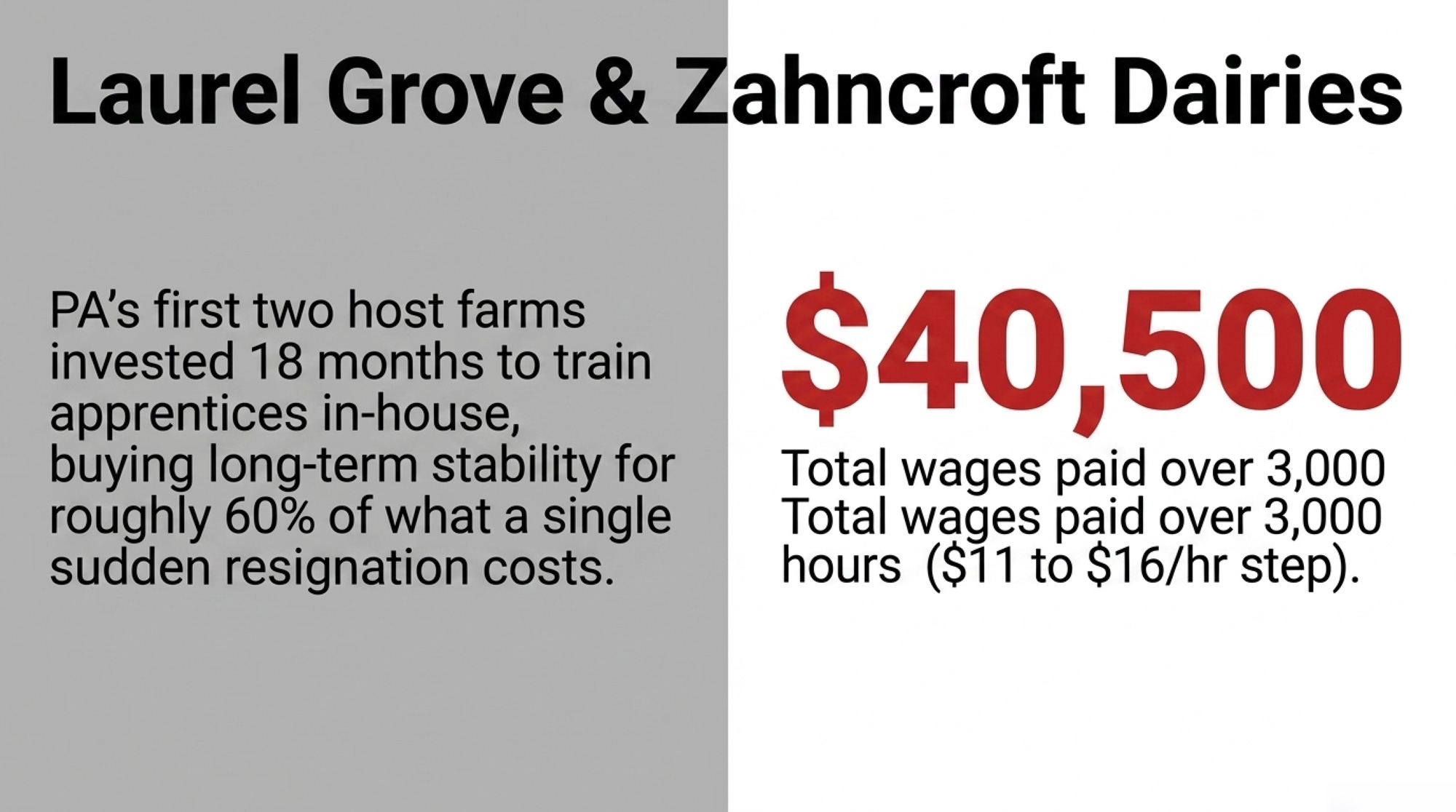
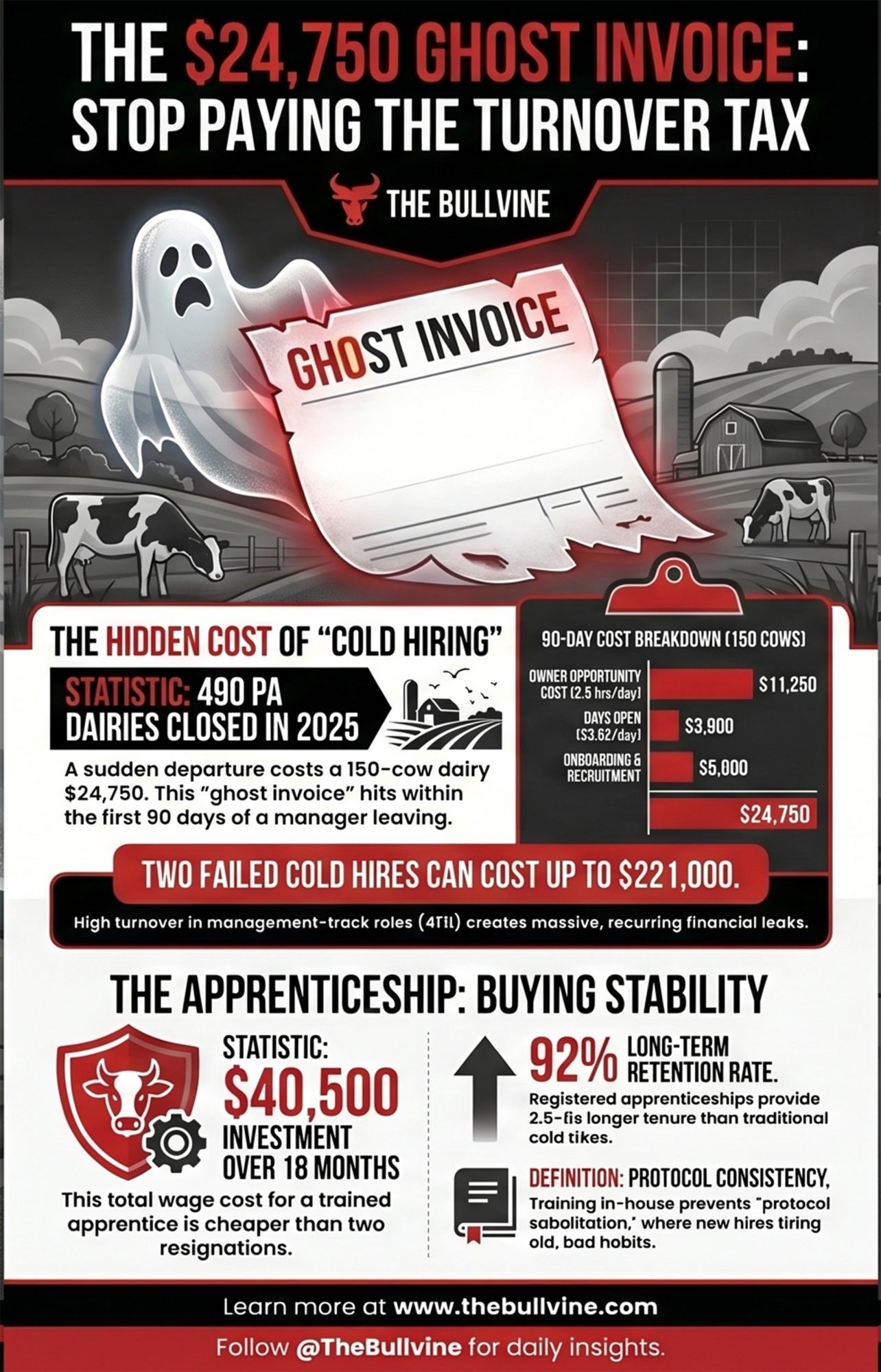
Rylee Fuller and Kristina Quinn each logged 3,000 paid hours as PA’s first Dairy Herd Manager apprentices. $40,500 over 18 months. One resignation costs a 150-cow dairy $24,750 in 90 days.
Executive Summary: Pennsylvania just graduated its first two Dairy Herd Manager Registered Apprentices — Rylee Fuller at Laurel Grove Farm (Perry County) and Kristina Quinn at Zahncroft Dairy (Berks County) — for a total labor investment of $40,500 over 18 months across 3,000 paid hours stepping from $11 to $16/hour plus 216 hours of technical instruction. That matters because PA lost 490 dairies in 2025, roughly 41% of all U.S. exits, and 28% of producers weighing their own exit cited no available successor. The ghost invoice nobody runs: one sudden herd manager departure costs a 150-cow PA dairy about $24,750 in the first 90 days — $11,250 of that is owner time pulled back into the barn, plus repro slippage, days open at $3.63/day, fresh cow detection misses, and onboarding friction, all hitting harder at the Q1 2026 PA all-milk price of $19.40/cwt. Two failed cold hires in 18 months can run $132,000–$221,000 all-in on MSU Extension’s turnover benchmarks, especially with Northeast management-track turnover at 41% per the 2024 FARM Workforce Year-in-Review. If you’ve cycled through a herd-level employee more than once in the last five years, the ,500 apprenticeship isn’t sentimental — it’s cheaper than your next resignation. Farms that can’t name a daily trainer other than the owner, or can’t block 90 minutes a week for review, aren’t ready to host — fix that first, then enroll.
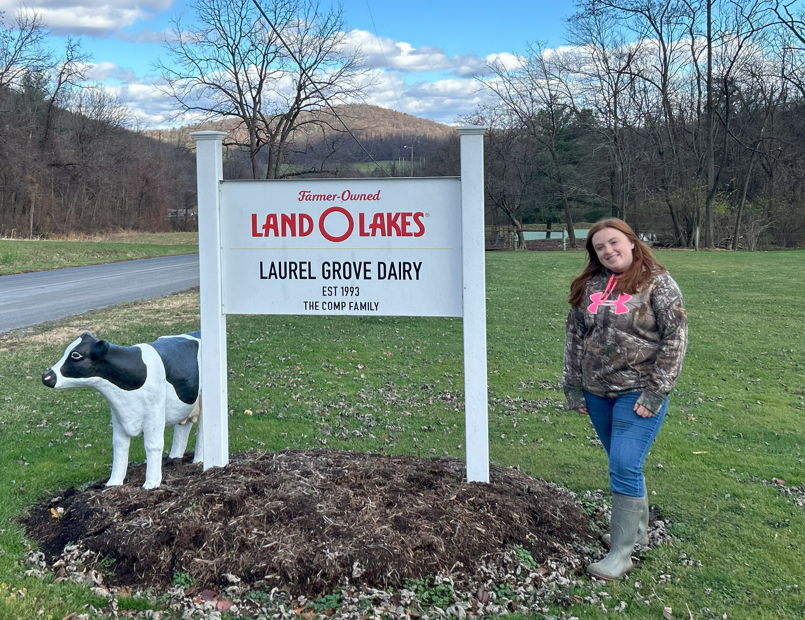
Rylee Fuller logged her 3,000th paid hour at Laurel Grove Farm in Perry County. Kristina Quinn logged hers at Zahncroft Dairy in Berks County, the Sattazahn family’s Holstein and Brown Swiss operation that’s been milking in Womelsdorf since the 1930s. They’re the first two people in Pennsylvania to complete the Dairy Herd Manager Registered Apprenticeship, a credential the Center for Dairy Excellence is spotlighting during National Apprenticeship Week starting April 26. And the number behind their 18 months? Roughly ,000 — what the next sudden herd manager departure will cost a 150-cow Pennsylvania dairy in the first 90 days, with the line-by-line math below landing closer to ,750. Which invoice is your farm writing?
Why Pennsylvania Just Lost 490 Farms — And Why Two Dairies Bet Differently
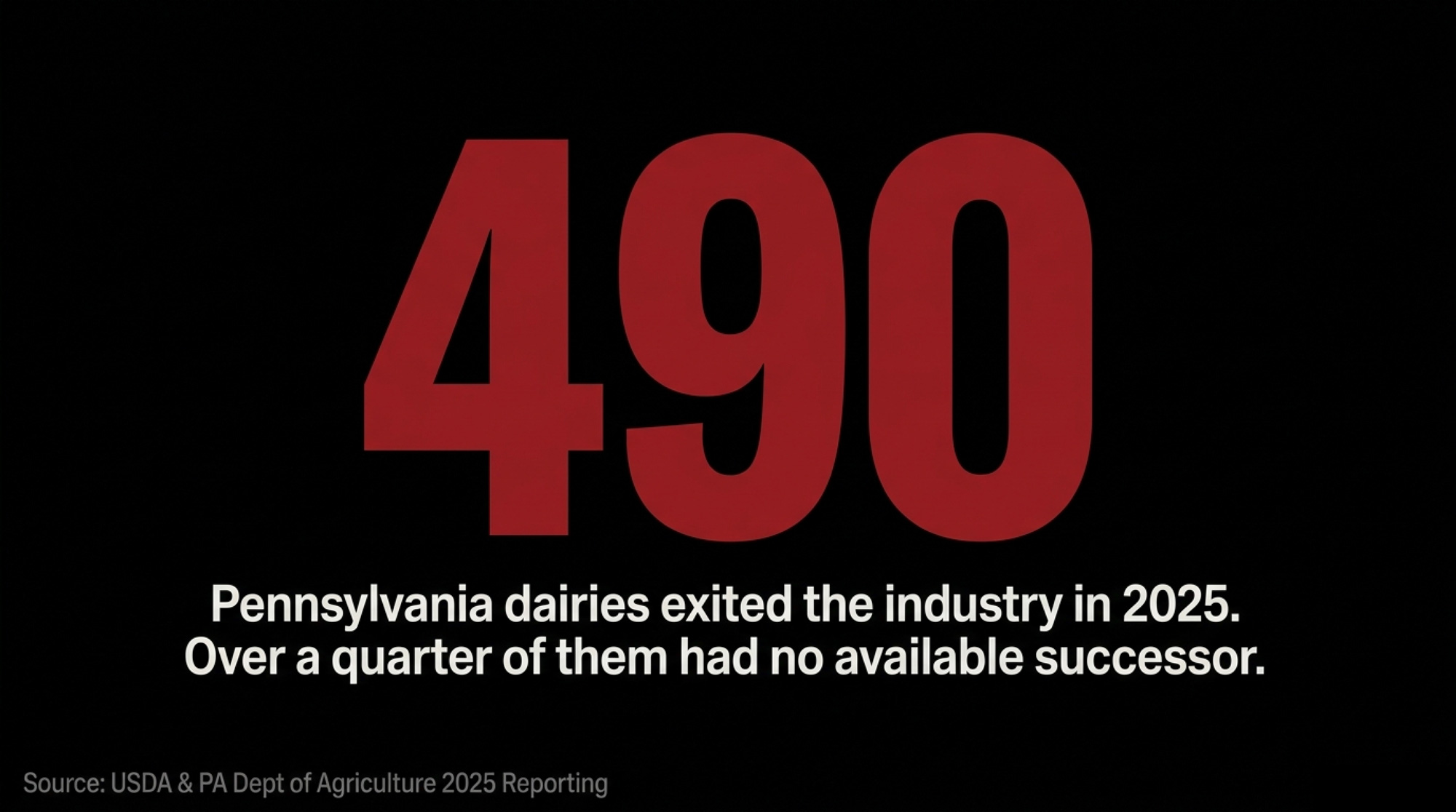
Pennsylvania lost 490 dairy farms in 2025, accounting for roughly 41% of all U.S. dairy exits that year, according to figures tracked through USDA and Pennsylvania Department of Agriculture reporting. The 2025 Pennsylvania Dairy Producer Survey found 27% of producers planning a generational transition within three to five years. And 28% of the farms weighing an exit cited no available successor. That’s not just a labor shortage. It’s a succession collapse with a labor shortage stacked on top.
Two completers is a small sample. But the cost math doesn’t need a cohort to hold — it needs one resignation you didn’t see coming, on a Tuesday, with nobody trained up behind the door.
The Center for Dairy Excellence built the apprenticeship to address both at once. Eighteen months. 3,000 paid hours of on-the-job training. 216 hours of technical instruction. A wage that steps from $11/hour to $16 over the program. Host farms commit to exposing the apprentice to the four competency areas — reproduction, calf care, herd health, and records — with monthly review visits from Workforce Development Manager Michelle Shearer.
Laurel Grove and Zahncroft bet first because their owners did the math most farms don’t run until after somebody walks. Cindy Comp’s Laurel Grove operation hosted Fuller through the full 3,000 hours. Katie Sattazahn’s Zahncroft carried Quinn through hers. Two farms. One question worth answering for every mid-size operation watching: did they just buy stability cheaper than everyone else?
The 90-Day Cost Clock When Your Herd Manager Walks
Picture a 150-cow Pennsylvania dairy rolling 26,000 pounds per cow, milk priced at .40/cwt — the Q1 2026 Pennsylvania all-milk average per USDA NASS. Your herd manager gives two weeks’ notice on a Monday. Or doesn’t show up at all.
The job ad is the cheapest line item. Here’s the 90-day invoice, built from published extension and peer-reviewed data. Actual numbers vary based on herd structure, processor schedule, and replacement timing. This is a midpoint scenario, not a prediction.
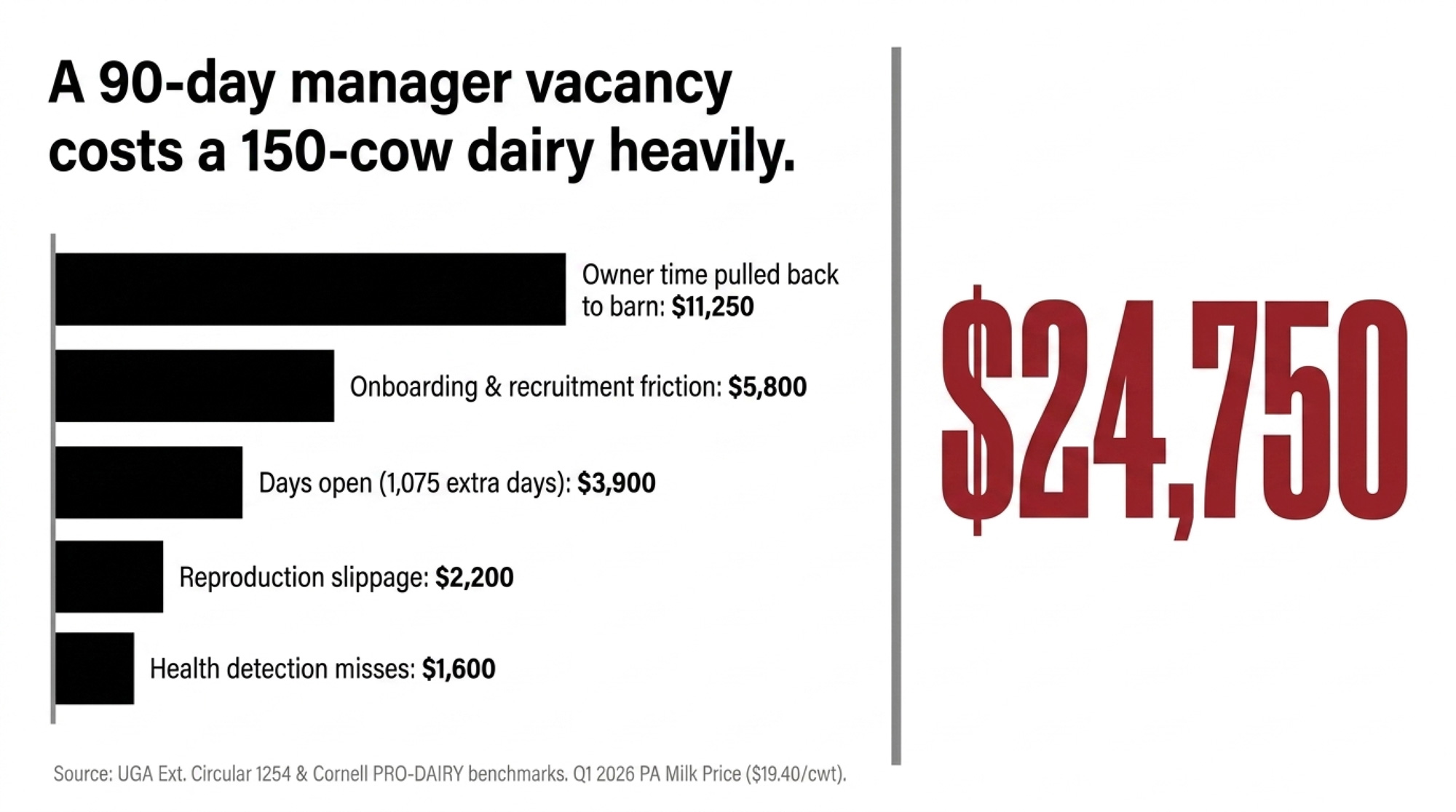
| Expense Category | Impact Detail | 90-Day Cost (150 Cows) |
| Owner Opportunity Cost | 2.5 hrs/day @ $50/hr | $11,250 |
| Reproduction Slippage | 3-pt pregnancy rate drop | $2,200 |
| Days Open | 1,075 days @ $3.63/day | $3,900 |
| Health Detection | 7–8 extra clinical cases | $1,600 |
| Onboarding Friction | Recruitment & training | $5,800 |
| TOTAL INVOICE | $24,750 |
Sources: University of Georgia Extension Circular 1254, “Economic Impact of Days Open” (2023), for the $3.63/day midpoint. Owner-time opportunity cost and onboarding friction built from Cornell PRO-DAIRY onboarding-labor benchmarks. The reproduction and health-detection figures apply standard extension per-cow economics to a 90-day window and a 150-cow herd.
A separate line the table doesn’t show: milk-quality slippage. A 20,000-cell SCC creep on roughly 9,600 cwt across 90 days, at a $0.05/cwt premium, adds about $480. At the $19.40/cwt Q1 2026 milk price, any production drop from detection misses hits harder than it did a year ago. The ghost invoice in 2026 is meaner than the one in 2024.
Conservative 90-day total: about $24,750. Before a single replacement cow. Before the first extra vet call. Before the SCC climbs past the 20K drift.
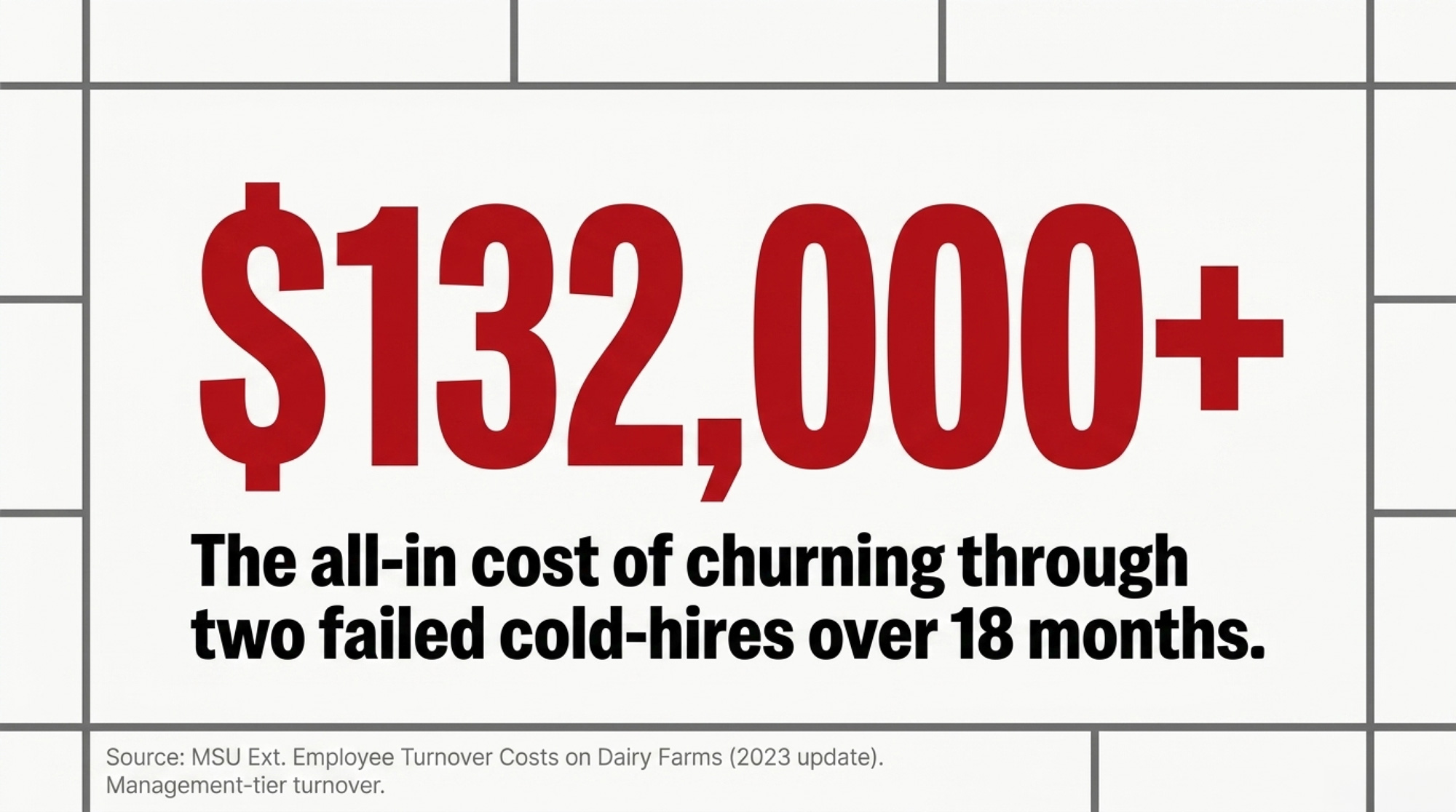
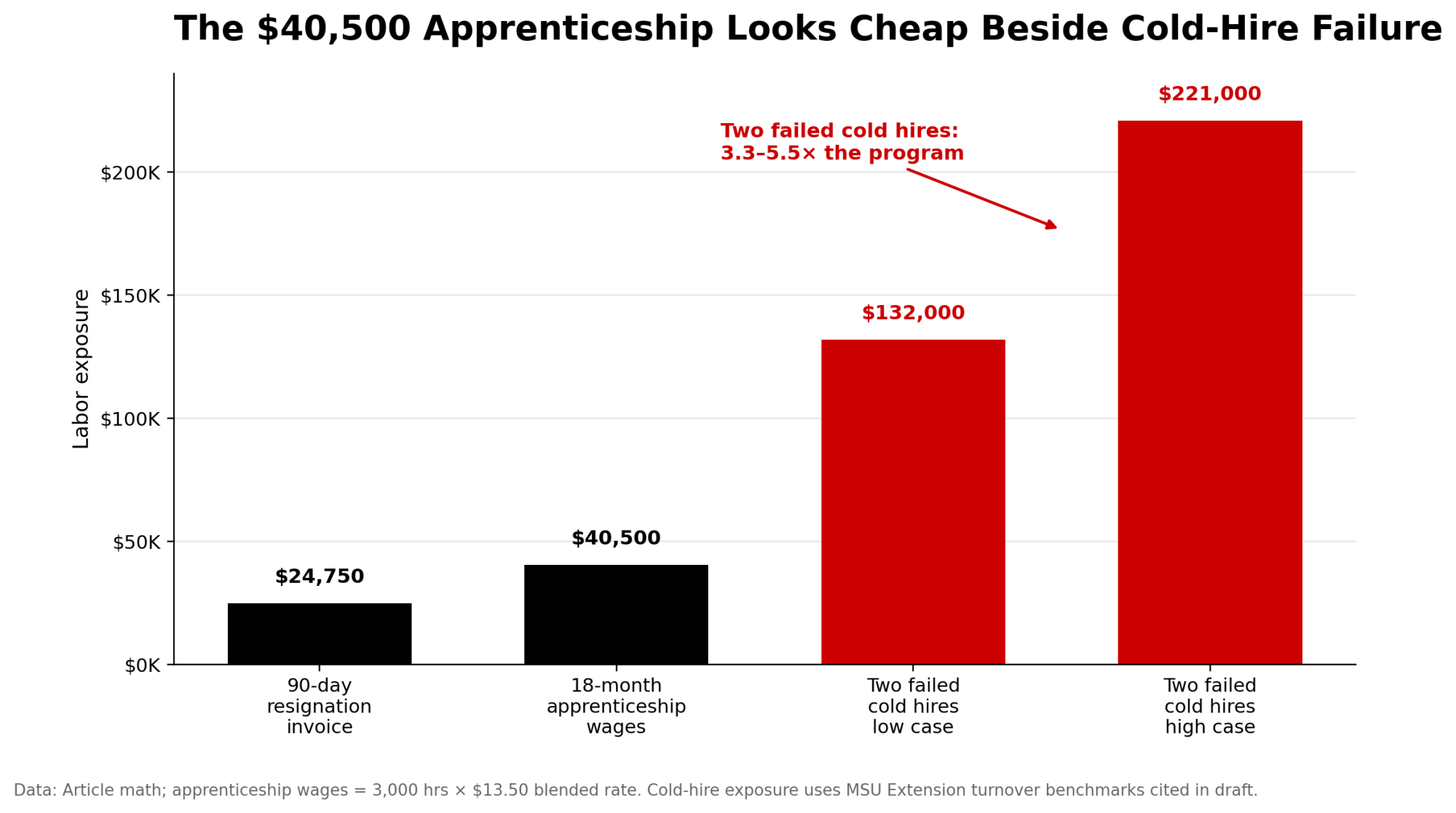
Now line it up against the apprenticeship. Eighteen months of wages progressing linearly from $11 to $16 across 3,000 paid hours works out to a $13.50/hour blended rate. That’s $40,500 — total. One sudden departure pays more than 60% of the entire program. Two failed cold hires in 18 months — realistic in a Northeast dairy environment where management-track turnover hit 41% per the 2024 FARM Workforce Year-in-Review — runs $132,000 to $221,000 all-in. That range applies Michigan State Extension’s hourly turnover benchmark of 100–150% replacement cost on the low end (roughly $132,000 across two cycles) and its management-tier benchmark of 200–250% on the high end (roughly $221,000 if the role carries salary-grade compensation), drawn from MSU Extension’s “Employee Turnover Costs on Dairy Farms” bulletin by Stan Moore (2019, updated 2023).
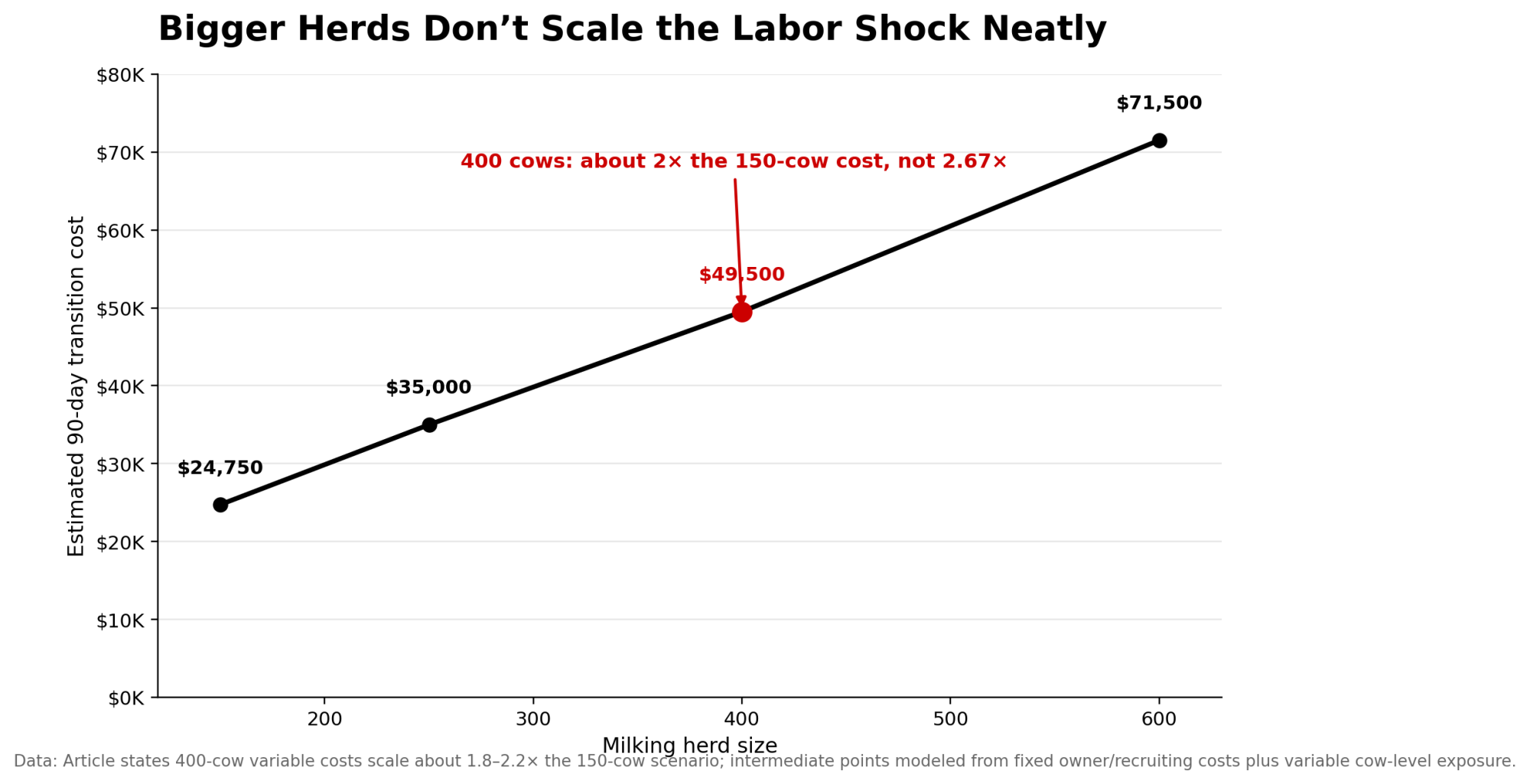
Running 400 cows instead of 150? The variable costs — repro slippage, fresh cow misses — scale close to linearly. Owner time and recruitment friction don’t. Plan on roughly 1.8–2.2x the 150-cow numbers, not 2.67x cow count.
Why Trained-In-House Beats Experienced-Cold
The reason the math works isn’t sentimental. It’s structural.
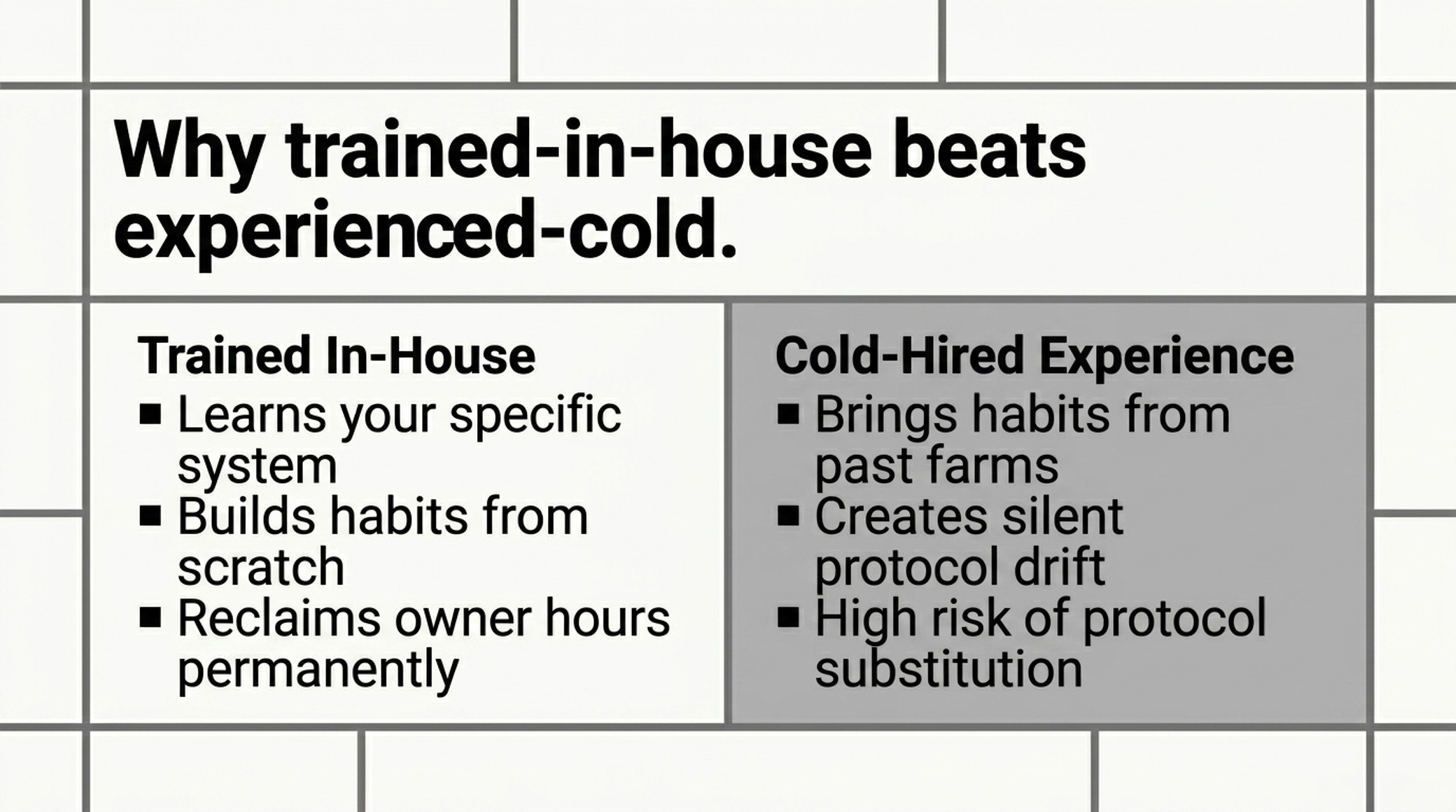
A manager trained on your farm, in your protocols, under monthly review, doesn’t arrive carrying habits from another operation. “Management factors associated with milk quality on high-performing dairies,” published in Journal of Dairy Science 108:1422–1435, found that managers who invested more than average time in animal monitoring posted measurably lower somatic cell counts and better overall performance outcomes. Protocol consistency shows up in the tank, the repro report, and the calf barn. It doesn’t show up on a resume line.
The apprenticeship is structured so completers take on defined competency areas — reproduction checks, calf-barn protocols, herd-health records — that previously pulled the owner or a senior employee out of whatever else was in front of them. That’s the mechanic. Free owner hours. Tighter protocol ownership. A person whose competency was built on your system, not grafted onto it.
“The biggest shift wasn’t the hours; it was moving from ‘doing tasks’ to ‘owning outcomes,'” said Michelle Shearer, the Center for Dairy Excellence’s Workforce Development Manager who runs the monthly review visits. “In an apprenticeship, you aren’t just milking; you’re monitoring the heartbeat of the business.”
Cold hiring runs into a failure mode extension specialists call protocol substitution — experienced workers pattern-match your system to one they already know and fill in the gaps with prior habits. Penn State Extension and Michigan State’s dairy veterinary-school onboarding materials flag the same pattern. A 2025 Progressive Dairy analysis by Matt Lange, “When ‘Yes’ Actually Means ‘No’: Why Experienced Hires Drift From Your Protocols” (September 2025), walks through it on real farms. The fix is harder than unwinding a trainee’s drift, because confident habits are more durable than new ones.
And there’s the retention piece. Registered Apprenticeship programs broadly show a 92% post-program employment retention rate and 2.5–3x longer tenure than traditional hires, per the Jobs for the Future Policy Blueprint “Apprenticeship as Workforce Infrastructure” (April 2025), drawing on U.S. Department of Labor completion data. The apprentice chose your farm. Developed on your farm. Earned the credential on your farm. When someone offers them a dollar more across the county line, the switching cost is real.
How Much Does One Sudden Departure Actually Cost You?
The $11,250 owner-time line item is the one owners consistently underprice, because it’s time they’re already used to giving. On a 150-cow Pennsylvania dairy, that alone is bigger than most farms’ annual training budget. The other four line items add another $13,500 on top — repro slippage, fresh cow misses, days open, and onboarding friction — bringing the 90-day total to $24,750.
Those costs compofund if the first replacement doesn’t stick. Two failed cold hires in 18 months can run $132,000–$221,000 all-in. Worth writing on the whiteboard next to your current labor budget. If you’ve cycled through a herd-level employee more than once in the last five years, the math’s already been run on your operation. The invoice just didn’t land in your inbox.
Is Your Farm Actually a Teaching Operation — Or Just a Host With Paperwork?
That distinction matters. A teaching operation has four things in place before day one: written SOPs for reproduction, calf care, herd health, and records; a designated daily trainer who isn’t the owner; one carved-out management domain assigned to the apprentice within the first three to six months; and a protected 60–90 minute weekly review block that doesn’t get eaten by whatever’s on fire. The weekly review and phased domain assignment follow the CDE Host Farm Guide’s program expectations for sponsors; the specific review length and domain timeline reflect common practice among apprenticeship host farms rather than a rigid CDE mandate.
Farms that skip the weekly review and still pay the wages don’t get a slower version of the same outcome. They get protocol drift — the apprentice practicing a version of your system that’s 80% right and 20% quietly wrong, reinforced through 12 months of repetition. The correction cost at month 18 is higher than at month three.
Cornell PRO-DAIRY’s onboarding framework lands in the same place as Penn State Extension and the dairy vet-school guidance: written SOPs plus scheduled feedback prevent drift. Nothing else does.
| Readiness Test | Ready Farm Standard | Not-Ready Warning | Why It Matters |
|---|---|---|---|
| Written SOPs | SOPs exist for reproduction, calf care, herd health, and records | Only verbal instructions or “ask the owner” | Without written standards, the apprentice learns a moving target |
| Daily trainer | Named trainer other than the owner | Owner is the only person qualified to teach | The program collapses into shadowing, not management development |
| Weekly review block | Protected 60–90 minutes every week | Review happens only when something goes wrong | Feedback after drift is correction; feedback before drift is training |
| Early ownership domain | Apprentice owns one competency area within 3–6 months | Apprentice stays in task mode for the full program | Retention comes from responsibility, not just hours |
| Protocol monitoring | Records, repro, health events, and calf outcomes are checked regularly | “We’ll know if something’s off” | By the time the tank or preg-check report shows the problem, the habit is already baked in |
Options and Trade-Offs for Farmers
| Path | Best Fit | Upfront Cash Exposure | Management Requirement | Biggest Risk |
|---|---|---|---|---|
| Registered apprentice | Farm has a trainable employee or candidate and can commit weekly review time | $40,500 over 18 months | Written SOPs, daily trainer, monthly review, real domain ownership | Completion risk; national registered apprenticeship completion runs around 59% |
| Informal internal development | Farm has a trusted employee but wants less paperwork | $30,000–$45,000 in wages/training time | Same SOP and feedback discipline, minus outside accountability | Protocol drift hides until repro, SCC, or calf outcomes slip |
| Cold hire | Farm has strong management depth and can absorb a failed transition | $66,000–$110,000 per failed management-tier hire | Heavy onboarding, protocol correction, owner supervision | Experienced habits override farm protocols |
| Do nothing | Owner keeps absorbing the gap | $11,250 owner-time hit in first 90 days alone | Owner becomes the default trainer, manager, and firefighter | The labor problem becomes succession risk |
Path 1 — Host a registered apprentice
When it makes sense: You already have a strong employee or family member who could develop into a management role, or you’re one resignation away from being back in the barn full-time.
What it requires: Written SOPs in the four competency areas. A daily trainer who isn’t the owner. Ninety minutes of protected review time each week. Willingness to hand the apprentice a real management domain within the first few months.
Risks and limits: National Registered Apprenticeship completion rate runs around 59%. Dairy-specific completion data doesn’t exist yet — Pennsylvania’s program has two completers as of April 2026. Selection and farm readiness matter more than the credential itself.
Path 2 — Develop an existing employee informally
When it makes sense: You’ve got a person on staff, limited bandwidth for formal program paperwork, and a relationship that already works.
What it requires: Everything the apprenticeship requires — SOPs, scheduled review time, progressive responsibility — minus the external accountability of monthly CDE visits. That external piece matters more than it sounds.
Risks and limits: No credential at the end, so retention leverage is weaker. Without an outside set of eyes on a schedule, protocol drift is easier to miss until it surfaces in the tank or the repro report.
Path 3 — Keep cold-hiring and absorb the turnover tax
When it makes sense: You’ve got real management depth already — a son, daughter, partner, or senior employee who’s bulletproof and isn’t going anywhere.
What it requires: Acceptance that each cycle costs what it costs, and a financial cushion to ride out the 90-day transition windows.
Risks and limits: The math above is the risk. One failed management-tier hire on a 150-cow operation can clip roughly $66,000–$110,000 on MSU’s 150–250% turnover benchmark alone, applied to an assumed $44,000 annual management salary. Layer in the 90-day cost clock, and total exposure lands closer to $90,000–$135,000 before broader production losses.
The 30-day action — regardless of path
Name one person, on your payroll or in your known network, who could develop into a herd management role over 18 months. Run the replacement-cost math for your current situation: take your key person’s rough annual cost, apply 150–200%, compare it to ,500. That one calculation usually answers the question.
By day 90: one SOP drafted in one of the four competency areas, with the designated daily trainer identified by name. By day 365: the apprentice (or internal trainee) should own one full competency area end-to-end, with documented owner hours reclaimed per week.
Key Takeaways
- If you’ve cycled through a herd-level employee more than once in the last five years, run the $40,500 apprenticeship cost against your realistic replacement exposure before the next resignation. One failed management-tier hire typically costs more than the entire 18-month program.
- If you can block 90 minutes a week for apprentice review AND you already have two or more written SOPs in the competency areas, the formal apprenticeship ROI outperforms informal training. If either condition fails, spend 90 days building SOPs before enrolling.
- If no one on your farm besides the owner can function as daily trainer, the apprenticeship is likely to collapse into “follow me around and hope.” Fix that first.
- If you’re treating the apprenticeship as a succession solution, build the equity entry pathway before the candidate starts — not at year four. Non-family succession, where it works, typically requires five or more years of senior management experience plus a deliberately designed ownership-transfer structure, per Land For Good’s “Farm Succession and Transfer: A Guide for Non-Family Transitions” (2023) and Penn State Extension’s Farm Transition Planning program.
- If your owner-time-in-the-barn has been creeping up for two quarters straight, that’s the leading indicator your current labor situation is already costing you. The invoice just hasn’t arrived yet.
The Question Pennsylvania’s First Two Apprentices Already Answered
Fuller and Quinn chose dairy careers in a year when 490 Pennsylvania farms chose to exit. Two farms figured out something worth figuring out: the apprenticeship isn’t an upgrade decision for a stable operation. It’s an insurance decision for an unstable one. Every owner reading this already knows which category their operation falls into. They just haven’t said it out loud yet.
What would it take for yours to be the one that attracts — and keeps — the next apprentice looking for a real career in this industry?
Complete references and supporting documentation are available upon request by contacting the editorial team at editor@thebullvine.com.
Learn More
- Stop Blaming Your Robots: The Million-Dollar Management Mistakes Killing Your Dairy’s Profitability — Eliminate hidden management leaks eroding your automation ROI. Transitioning to specific milking protocols can lift yields by 28.5%, proving that success depends on management consistency rather than the hardware itself.
- Only 12% of Dairy Farms Reach Generation Three – A 2025 Court Ruling Exposes Why Succession Fails and How to Fix It — Avoid the $31,700 “handshake tax” that sinks family successions by formalizing your multi-million-dollar transfer. This analysis exposes why verbal promises fail in court and delivers a 90-day roadmap to build bank-vetted equity agreements.
- The Labor Crisis Hidden in Plain Sight: How Dairy’s Worker Shortage Will Reshape Your Farm by 2030 — Model your competitive moat against a $32.1 billion industry labor crisis. This strategic forecast arms you with a five-year positioning plan to replace high-turnover manual labor with robots that recoup in 18-24 months.
 The Sunday Read Dairy Professionals Don’t Skip.
 The Sunday Read Dairy Professionals Don’t Skip.
Every week, thousands of producers, breeders, and industry insiders open Bullvine Weekly for genetics insights, market shifts, and profit strategies they won’t find anywhere else. One email. Five minutes. Smarter decisions all week.




