





One I-9 audit resulted in the dismissal of 38 workers at Drumgoon Dairy. If ICE knocked tomorrow, how long could your parlor run?
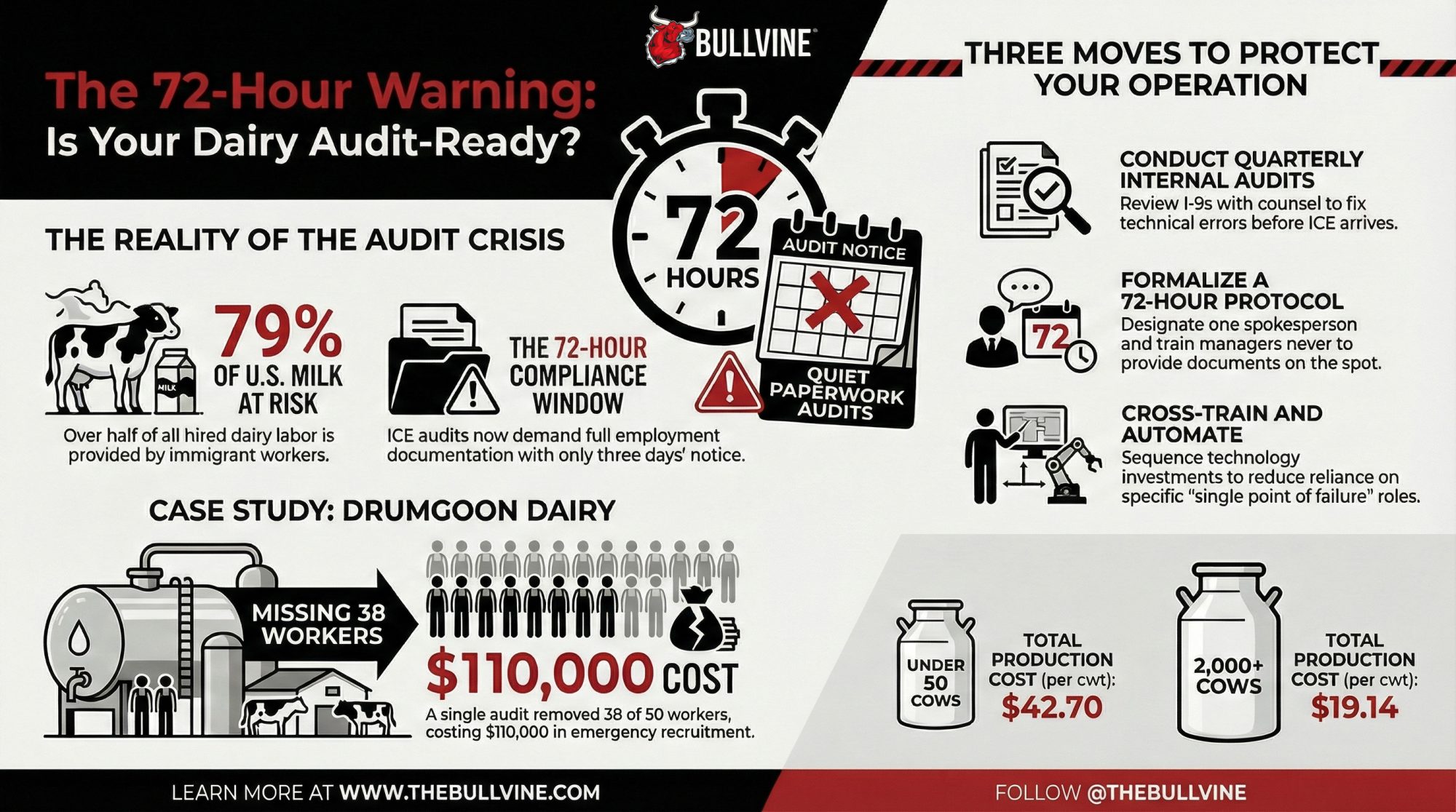
Executive Summary: Immigrant workers provide 51% of hired dairy labor and help produce 79% of U.S. milk, but there’s still no visa designed for year‑round dairy work. One I‑9 audit at Drumgoon Dairy in South Dakota removed 38 employees — about 70% of its crew — in a matter of days, showing how fast a paperwork review can turn into a production and animal‑care emergency. USDA’s latest cost‑of‑production data puts small herds under 50 cows at $42.70/cwt versus $19.14/cwt for 2,000‑plus‑cow herds, so the farms least able to absorb a labor shock are already on the wrong side of the cost curve. The Farm Workforce Modernization Act and the Dignity Act of 2025 would legalize some existing workers and modestly expand year‑round visas, but together they still cover only a fraction of dairy’s foreign‑born workforce. That’s why more operators are treating immigration enforcement like any other major business risk: they’re auditing I‑9s with counsel, training managers for a 72‑hour response, cross‑training crews, and modeling what happens if they lose 25%, 50%, or even 70% of their people. The operations that come through this period will be the ones that can show good‑faith compliance on paper, keep their parlors running when the crew changes overnight, and use automation and legal visas where they lower their true cost per cwt.
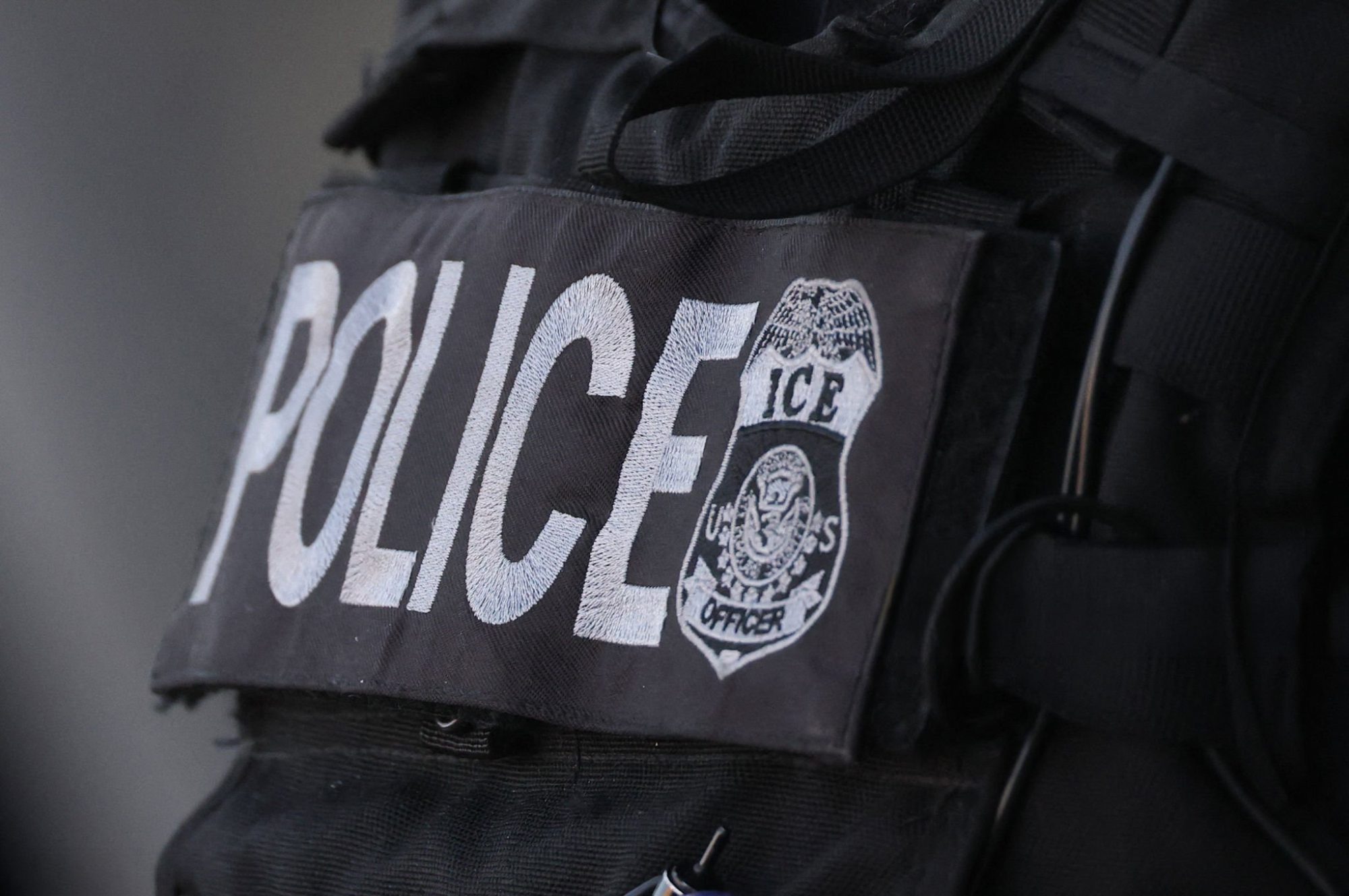
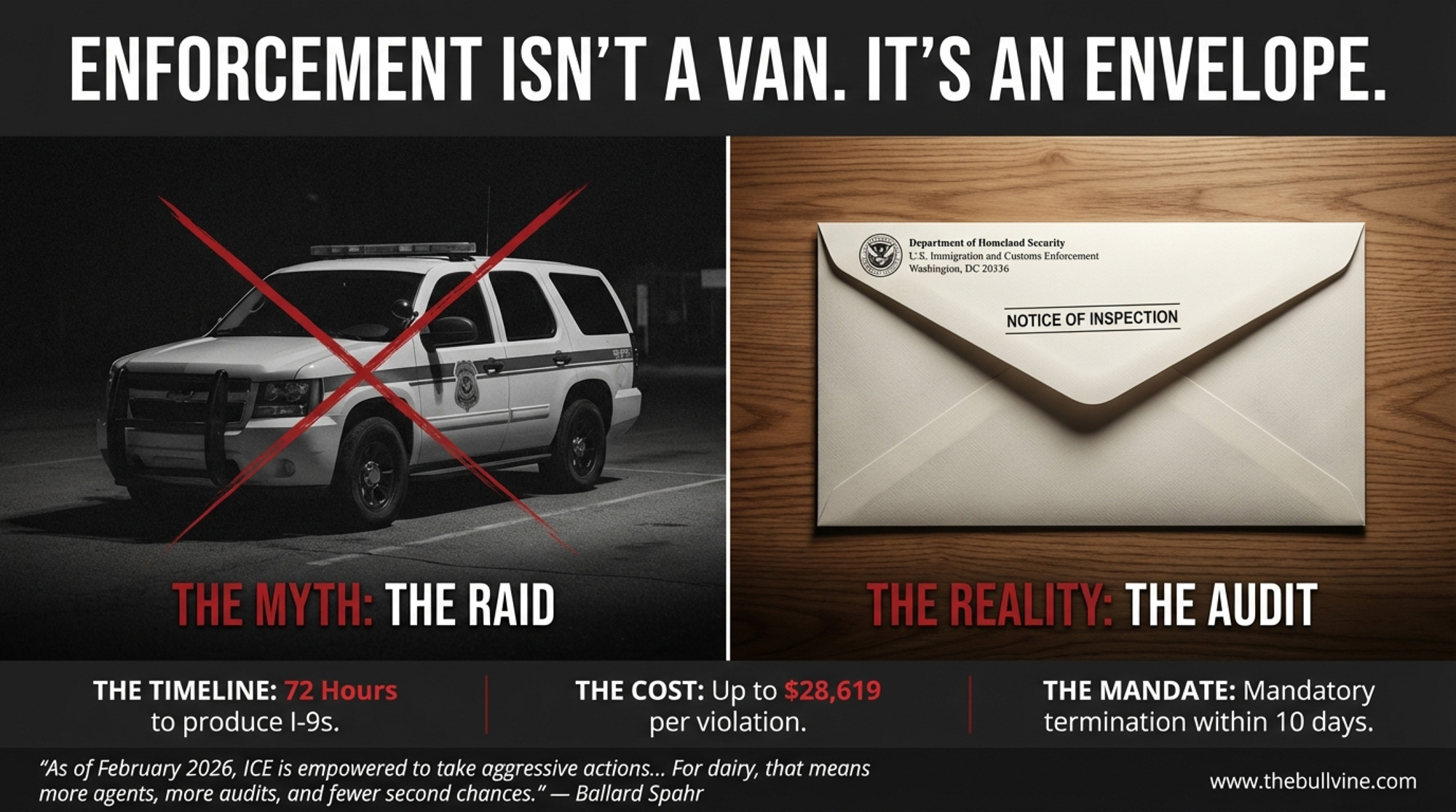
Dairy immigration enforcement doesn’t look like what you think it does. The ICE van at the farm gate makes the news. But the real damage in 2025 and into 2026 arrives in envelopes — formal I-9 audits that give operators 72 hours to produce employment documentation for every worker on the payroll, with fines up to $28,619 per violation and mandatory termination of employees whose paperwork doesn’t hold up. As of February 2026, law firm Ballard Spahr confirms ICE continues to be “empowered to take aggressive actions to enforce immigration laws,” with major enforcement events expanding beyond agriculture into manufacturing, education, and healthcare (Ballard Spahr, February 3, 2026). For dairy, that means more agents, more audit experience, and fewer second chances.
According to a NMPF-commissioned study conducted by Texas A&M AgriLife Research — the most recent comprehensive national dairy workforce survey available, based on 2014 data from 1,223 U.S. dairy farms and published in September 2015 — immigrant workers make up 51% of all hired dairy labor, and dairies employing them produce 79% of the total U.S. milk supply.
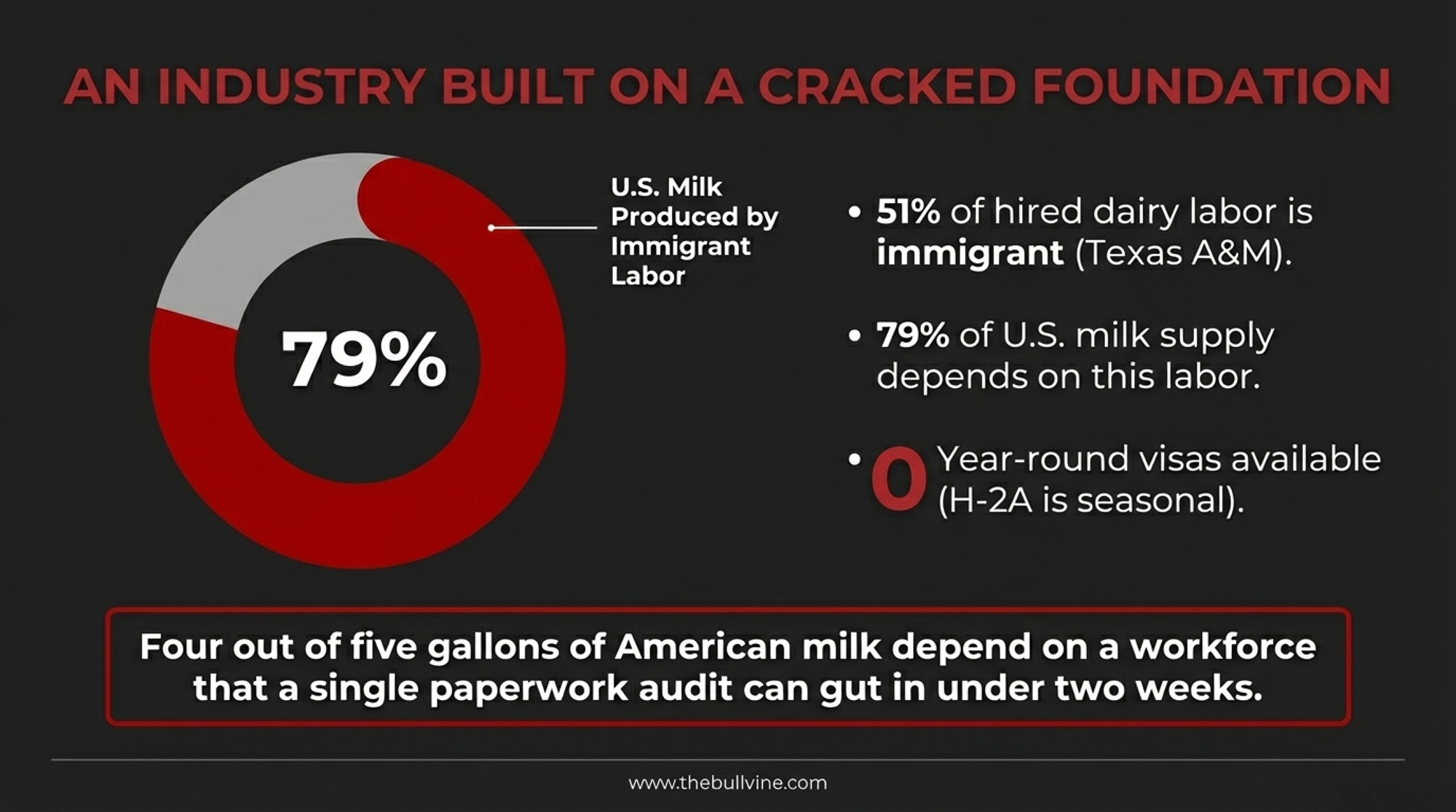
An NMPF comparison released in December 2018 found that immigrant workers on dairy farms increased 35% between 2009 and 2015, suggesting the current share is likely higher still. Dr. Robert Hagevoort of New Mexico State University, speaking at the Dairy Cattle Reproduction Council Annual Meetings in Arlington, Texas, in November 2024, said he believes the true percentage has continued to grow as herd sizes and employee counts have expanded. Four out of five gallons of American milk depend on a workforce with no dedicated legal visa channel — and one that a single paperwork audit can gut in under two weeks.
The Enforcement Shift: I-9 Audits, Staffing Sweeps, and Transportation Choke Points
The visible workplace raid still happens. Homeland Security agents hit a New Mexico dairy near Lovington in mid-2025, arresting nearly a dozen workers and forcing the immediate termination of two dozen more. But that kind of action is now the minority of enforcement events reaching dairy.
Three quieter channels do most of the damage.
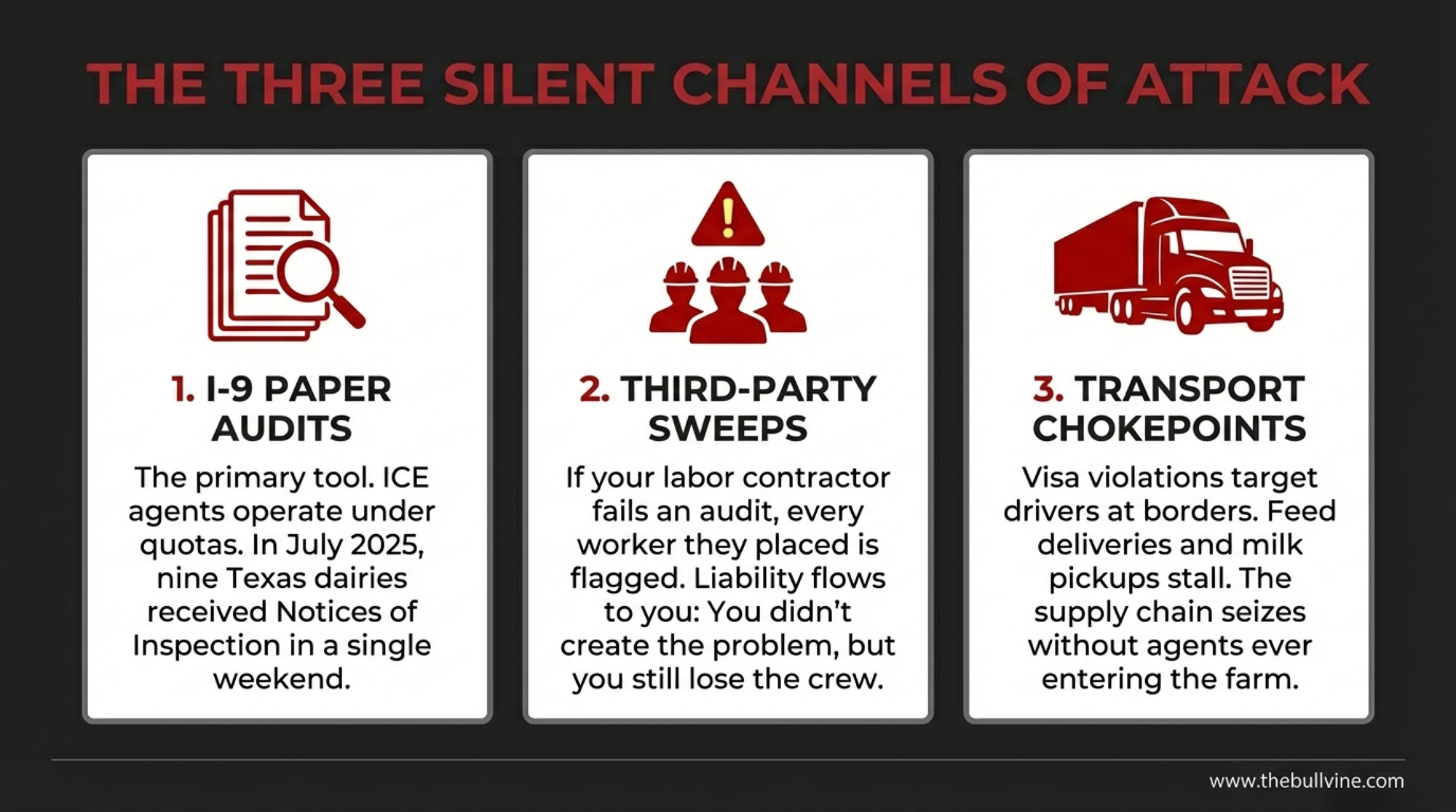
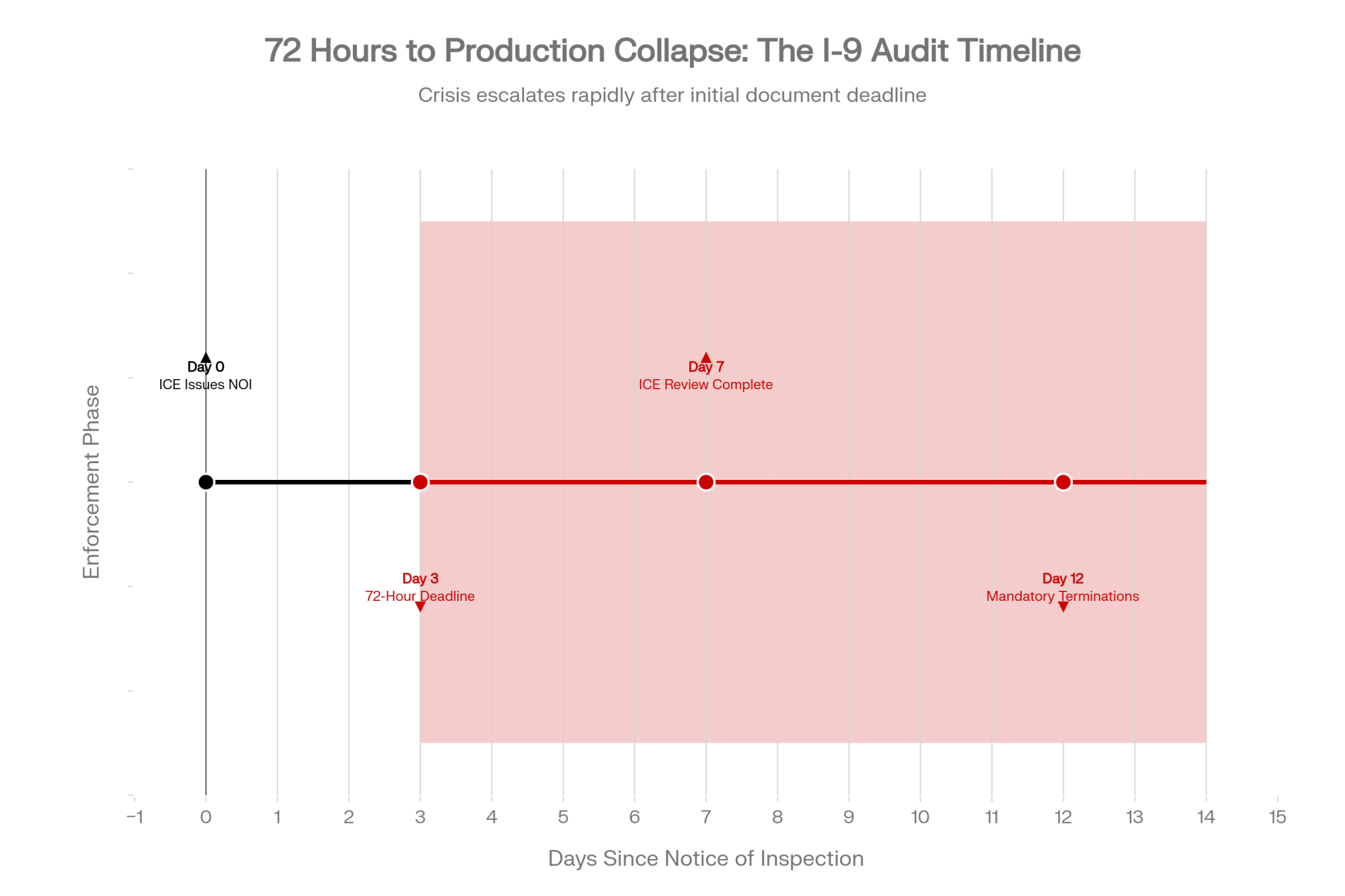
I-9 paper audits have become the primary tool. ICE issues a Notice of Inspection demanding that every I-9 on file be produced, with a 72-hour compliance window. According to compliance-tracking firm I-9 Intelligence (August 2025), field agents now operate under quarterly worksite inspection quotas, with agriculture designated as a priority sector. In July 2025, at least nine Texas dairies received NOIs over a single weekend, as reported by Dairy Herd Management’s Tyne Morgan on July 15, 2025. Employees with deficient documentation must be terminated within 10 business days.
Third-party staffing audits blindside operators who use labor contractors. When the staffing company fails an audit, every worker they placed on your farm gets flagged — even though you never completed their paperwork. You didn’t create the problem. You still lose the crew.
Transportation enforcement targets visa violations among truck drivers at border crossings. When haulers get sidelined, feed deliveries, bulk milk pickup, and livestock transport all stall. No one sets foot on your dairy, but your supply chain seizes up anyway.
Drumgoon Dairy: 38 Workers Gone in Days
If you want to understand what this enforcement shift actually does to a working dairy, look at Drumgoon Dairy near Lake Norden, South Dakota.
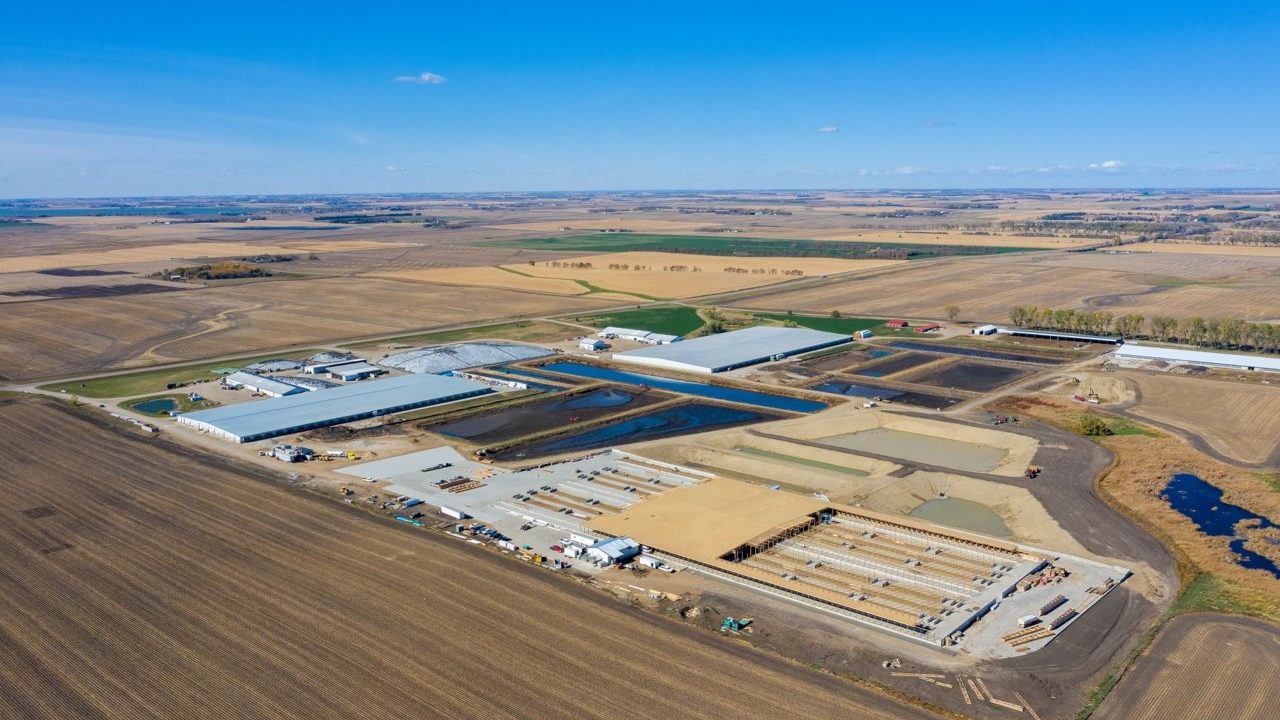
Rodney and Dorothy Elliott moved from Northern Ireland to South Dakota in 2006 and built Drumgoon Dairy — named after their home townland in Co. Fermanagh — into a 6,500-cow enterprise with more than 50 employees over nearly two decades. Some staff had been with the operation since its earliest years. As Elliott told the South Dakota Searchlight (October 2025), she reviewed applicants’ documents personally and turned candidates away “a dozen times over the years” when IDs looked questionable — the standard the law sets for employers. Drumgoon had never been audited before.
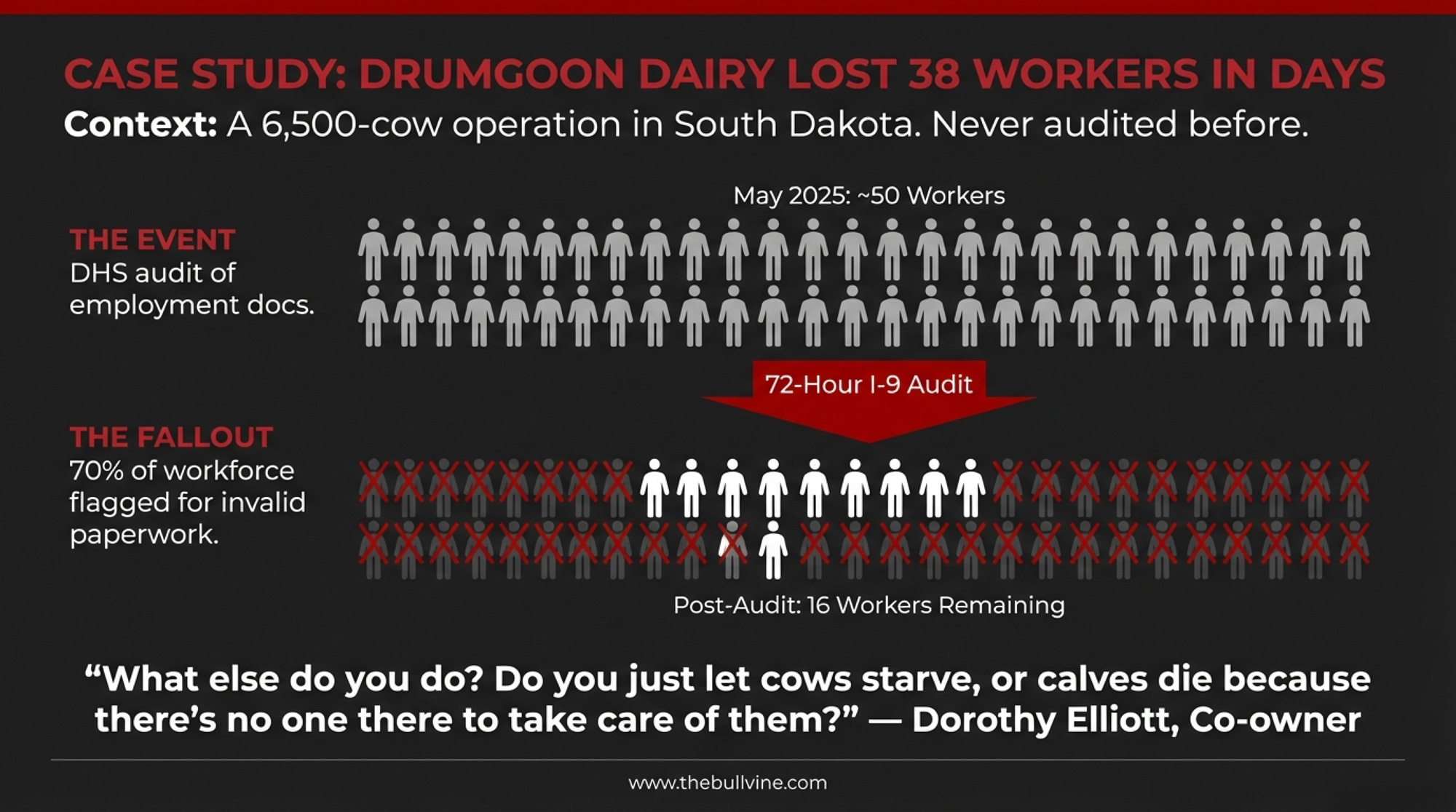
In late May 2025, DHS audited Drumgoon’s employment documentation and determined that 38 workers had inaccurate, outdated, or incomplete proof of work authorization. Elliott asked them to provide updated documents. Most couldn’t. The workforce dropped from over 50 to 16.
The aftermath tested the operation’s limits. Elliott told the South Dakota Searchlight that remaining employees were making mistakes from the long hours — including reversing a payloader into a manure pond — or because they were new to farm work. Some got just one or two days off in a 15-day stretch. Nearby farms sent workers to help for a couple of days at a time over the summer. Elliott and her husband spent over $110,000 on recruiters and transportation to hire 22 visa workers from Mexico — but the visas came with restrictions on the types of jobs those workers could do, so the Elliotts still needed to hire a dozen more locally and wanted another 10 to 15 beyond that.
“What else do you do? Do you just let cows starve, or calves die because there’s no one there to take care of them?” — Dorothy Elliott, co-owner, Drumgoon Dairy (South Dakota Searchlight, October 2025)
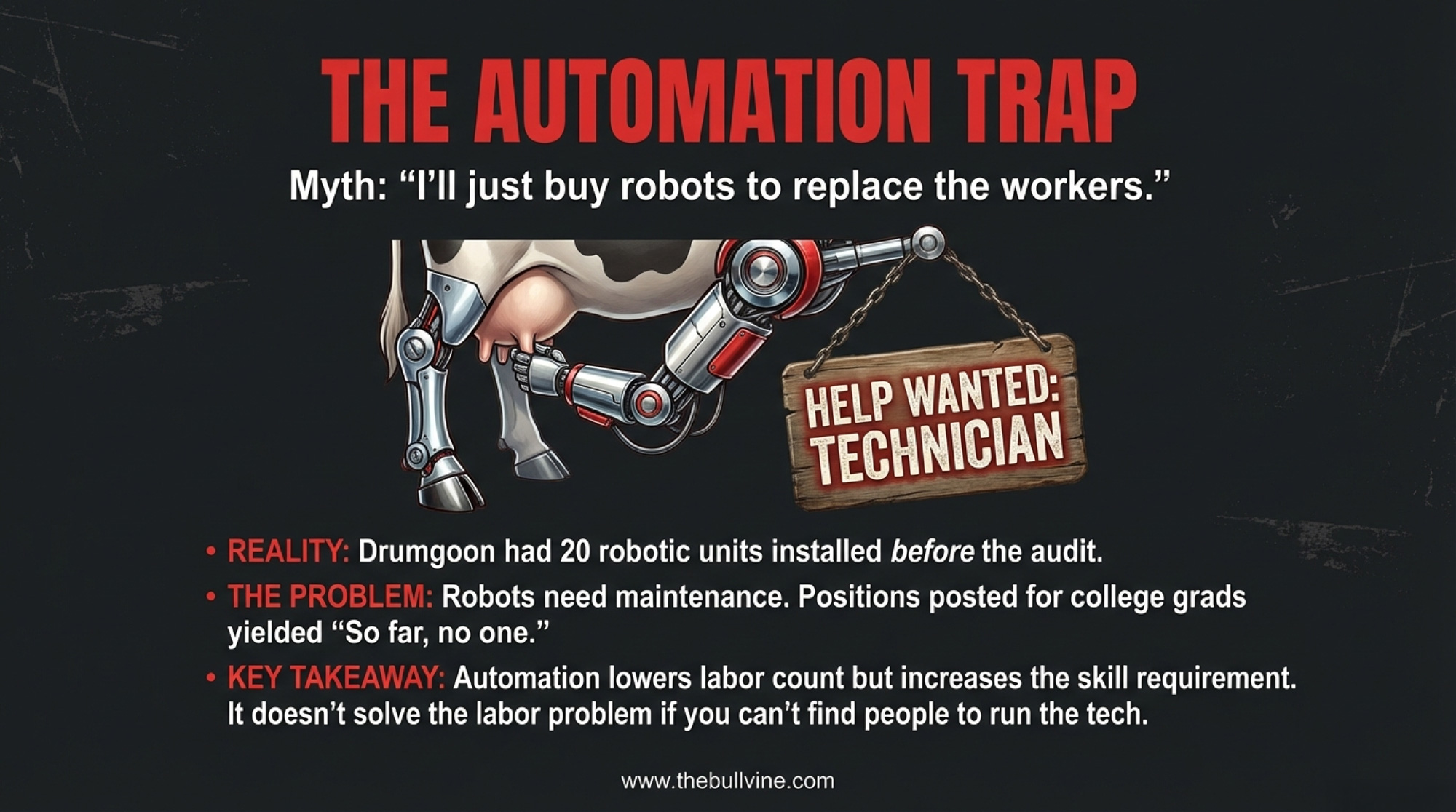
Elliott had already invested in automation before the audit hit. Drumgoon installed 20 robotic units and posted maintenance positions to attract graduates from the Lake Area College program. The response, as she told reporters: “So far, no one.” Automation helps. It doesn’t solve the labor problem by itself when you can’t find people to maintain the technology.
South Dakota Farm Bureau president Scott VanderWal confirmed that dairy audits in the state have increased significantly compared to prior years. Texas Association of Dairymen executive director Darren Turley has called the audits “without a doubt the biggest issue today for the Texas dairy industry.” Drumgoon isn’t an outlier. It’s a preview.
| Metric | Before I-9 Audit (May 2025) | After Audit + Recovery Effort (Oct 2025) |
| Total Workforce | 50+ employees | 16 workers remaining → rebuilt to ~38 (22 H-2A visa, 16 local/temp) |
| Herd Size | 6,500 cows | 6,500 cows (unchanged) |
| Robotic Milking Units | 20 units installed | 20 units (but no qualified maintenance staff hired) |
| Recruitment & Visa Costs | Normal payroll operations | $110,000+ spent on recruiters, transport, visa processing |
| Operational Status | Stable, 20-year operation | Employees working 13-15 day stretches; mistakes from fatigue (payloader into manure pond); neighbors sending temporary help |
Why the $23/cwt Cost Spread Makes Smaller Farms Most Exposed
The enforcement risk isn’t distributed evenly. It concentrates on the operations least equipped to absorb it.
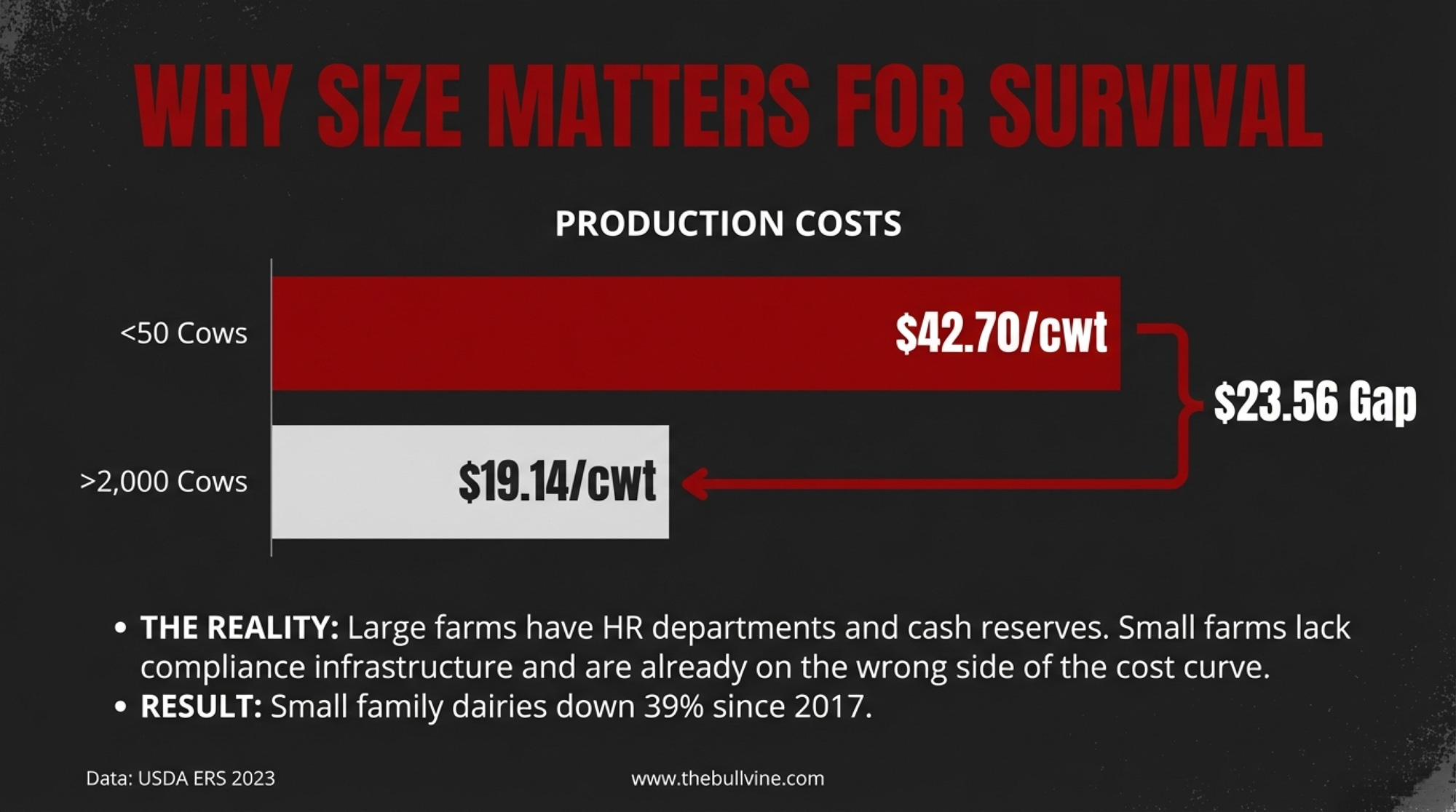
USDA’s Economic Research Service, using its 2021 Agricultural Resource Management Survey (the most recent available, published in 2023), reports total production cost per hundredweight of $42.70 for herds under 50 cows versus $19.14 for herds of 2,000 or more. That $23 spread isn’t primarily about feed. Operations above 2,000 cows posted cash costs $1.50/cwt below the all-size average, with the majority of the savings coming from lower nonfeed costs — including labor.
When an audit hits, the 5,000-cow dairy with an HR department, immigration counsel on retainer, and reserves to absorb a two-week disruption survives. It’s damaged, but it has institutional resources. The 200-cow family dairy that loses six of eight employees, with no HR infrastructure and no capital to automate, often doesn’t recover.
The 2022 Census of Agriculture recorded 24,082 dairy operations, down 39% from 39,303 in 2017, while total milk production increased 5% (USDA NASS, 2024). Farms with 1,000-plus head — just 8% of operations — now produce approximately 67-68% of U.S. milk by volume. Enforcement that disproportionately hits smaller operations with fewer compliance resources accelerates that consolidation. Rabobank senior dairy analyst Lucas Fuess projects that small dairies will remain numerically, but their production share will keep shrinking.
The Compliance Trap You Can’t Solve Under Current Law
Here’s the bind every dairy operator is sitting in, whether they’ve named it or not.
| Requirement | What H-2A Visa Offers | What Dairy Operations Need |
| Job Duration | Seasonal/Temporary work ONLY | Year-round, permanent labor (cows need milking 365 days/year) |
| Application Timeline | 75-day minimum before start date; 30-day certification lead time; 4+ months in practice | Workers needed immediately when audit removes crew |
| Housing Requirement | Employer must provide compliant housing at no cost to worker | Many mid-size operations lack capital for housing infrastructure |
| Annual Cap for Dairy | FWMA proposes 10,000 dairy-specific visas (if passed) | Estimated 150,000+ immigrant dairy workers currently employed |
| Current Coverage | ~8-9% of workforce (if FWMA passes) | 51% of hired dairy labor is foreign-born |
Federal law requires you to accept documents that “reasonably appear genuine” during the I-9 process. You can’t demand extra documentation beyond what the form specifies — that could constitute discrimination. But when those same documents fail under audit scrutiny years later, you’re liable for having accepted them. Exposure runs in both directions.
The H-2A visa program — the only agricultural worker visa — is limited to seasonal and temporary labor. NMPF’s Jaime Castaneda has confirmed: “Dairy farmers largely have not been able to use H-2A visas because the current program is limited only to the temporary and seasonal labor needs of agricultural employers” (Hoard’s Dairyman, July 2021). Ohio State’s Margaret Jodlowski backs this up at the farm level: “If they are trying to get workers through the H-2A program, their applications are often turned down. Their labor needs are constant.”
Even where H-2A technically applies to seasonal dairy tasks, the timeline is brutal. DOL regulations require applications filed at least 75 days before the start date of need, and certification must be issued 30 days before workers arrive (DOL Office of Foreign Labor Certification, flag.dol.gov). In practice, Sarah Black of Great Lakes Ag Labor Services told Brownfield Ag News (December 2024) that farmers should “plan ahead at least four months before you want the guys to arrive, because you’ve got to figure out housing and get it inspected, and there are a lot of pieces that have to be in place before you even file.” When the federal government shut down in late 2025, Black reported a 40-plus-day processing blackout during which no applications were filed at all (Brownfield Ag News, November 18, 2025).
Elliott’s experience at Drumgoon proves the point. She spent $110,000 to bring in 22 visa workers from Mexico — and still couldn’t fill every role because the visas restricted what jobs they could do. That’s the system working as designed. It just wasn’t designed for dairy.
Your lender expects regulatory compliance. Your processor needs a consistent volume. Federal law mandates I-9 verification. And the labor market delivers a workforce where roughly half carry documentation that won’t survive scrutiny. You can’t satisfy all four simultaneously. The system doesn’t work. It can’t — not as long as the visa program ignores the way dairy actually operates.
What the FWMA and the Dignity Act Fix — and What They Don’t
Two legislative vehicles are attempting to close this gap, and both may have a better shot in 2026 than in any prior session.
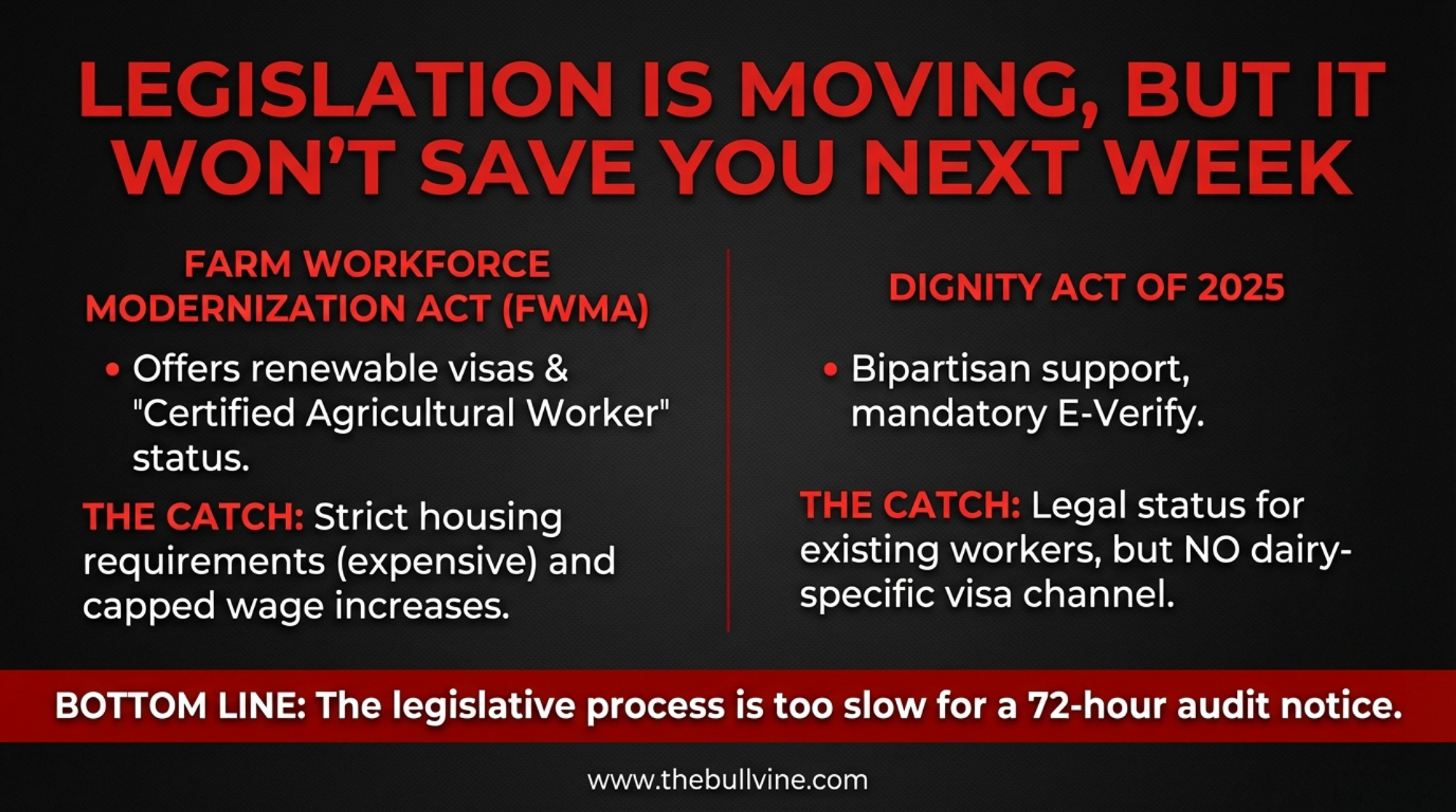
The Farm Workforce Modernization Act (H.R. 3227, 119th Congress, introduced May 2025) is the industry’s most direct ask. Title I creates Certified Agricultural Worker (CAW) status for undocumented farmworkers who can prove 180 days of agricultural labor in the prior two years, with a path to permanent residency after 8-10 years. Had this existed, the 38 workers Drumgoon lost could have applied based on their years of documented service. Title II opens H-2A to year-round operations, with a cap of 20,000 workers — half designated for dairy — on visas extendable for up to 3 years, with electronic filing and wage rate increases capped at 3.25% annually through 2030.
The Dignity Act of 2025 (H.R. 4393), introduced July 14, 2025, by Reps. María Elvira Salazar (R-FL) and Veronica Escobar (D-TX) takes a broader approach — mandatory E-Verify for all employers, an earned legal status program for long-term undocumented residents with clean records, and asylum system reforms. As of January 27, 2026, it had secured 35 bipartisan cosponsors and 60 national stakeholder endorsements, support spanning from Florida to Washington state — up from 25 cosponsors in early December 2025 — making it the fastest-growing immigration reform proposal in Congress.
Both are meaningful but incomplete for dairy. The FWMA’s 10,000 dairy-specific visas cover roughly 8-9% of the foreign-born dairy workforce. The housing requirement — employers must provide compliant housing at no cost — adds a real estate obligation many mid-size operations will struggle to absorb. The Dignity Act would stabilize existing workers, but doesn’t create a dairy-specific visa channel.
The political ground, though, is shifting faster than it has in a decade. A Pew Research Center survey published April 15, 2025 (5,123 adults, February 24–March 2) found that 42% of Americans — including 41% of independents — expect deportations to increase food prices in their area. On June 17, 2025, Rep. Andy Harris (R-MD), chair of the House Freedom Caucus and the House Appropriations Subcommittee on Agriculture, joined an American Business Immigration Coalition call and said: “We need to revise and expand visa categories like H-2A and H-2B, or create a new visa program to meet economic demands.” In September 2025, the Trump administration reversed its own July directive and streamlined H-2A visa renewals, allowing returning workers to skip in-person consulate interviews.
Mike Stranz, Vice President of Advocacy for the National Farmers Union, put the 2026 outlook this way in December 2025: “With the seeming improvements to border security concerns, paired with the greater emphasis we’ve all had on the need for a secure and reliable farm workforce, that adds up to a better shot for the Farm Workforce Modernization Act to move forward. I think that reaches across both parties, and it could be an opportunity to make some real headway in 2026” (AgInfo, December 7, 2025). Whether the window stays open long enough for legislation actually to pass is another question entirely.
Five Risk Reduction Moves You Can Start This Week
No strategy eliminates the underlying risk while the legal framework stays broken. But several approaches measurably reduce your exposure.
- Conduct an internal I-9 audit with legal counsel this quarter. Pull every form. Correct technical errors with a single line-through, initial, and date — never white-out. Identify substantive gaps before ICE does. Ballard Spahr’s February 2026 compliance guidance confirms that “internal audits demonstrate good faith compliance in the event of an I-9 government audit.” Operations with 15-plus employees should have immigration counsel on retainer; smaller operations should budget for at least an annual external review — agricultural attorneys typically charge $150-$500 per hour (Farmland Access Legal Toolkit), so a focused I-9 audit for a small dairy may run a few thousand dollars.
- Build a one-page enforcement response protocol and train every manager on it. Designate one person to interact with agents. Exercise the 72-hour window — you’re not required to produce documents on the spot. ICE agents don’t have an automatic right to enter nonpublic areas of your facilities without a judicial warrant signed by a judge, not an administrative warrant (Ballard Spahr, February 2026). Penn State agricultural law attorney Brook Duer put it this way: “You should have people whose roles on your payroll are already established in terms of what they are going to do — who’s going to handle the auditors directly. That person should be well-rehearsed” (Dairy Reporter, June 2025). Post the protocol in the farm office. Run it once out loud, like a fire drill.
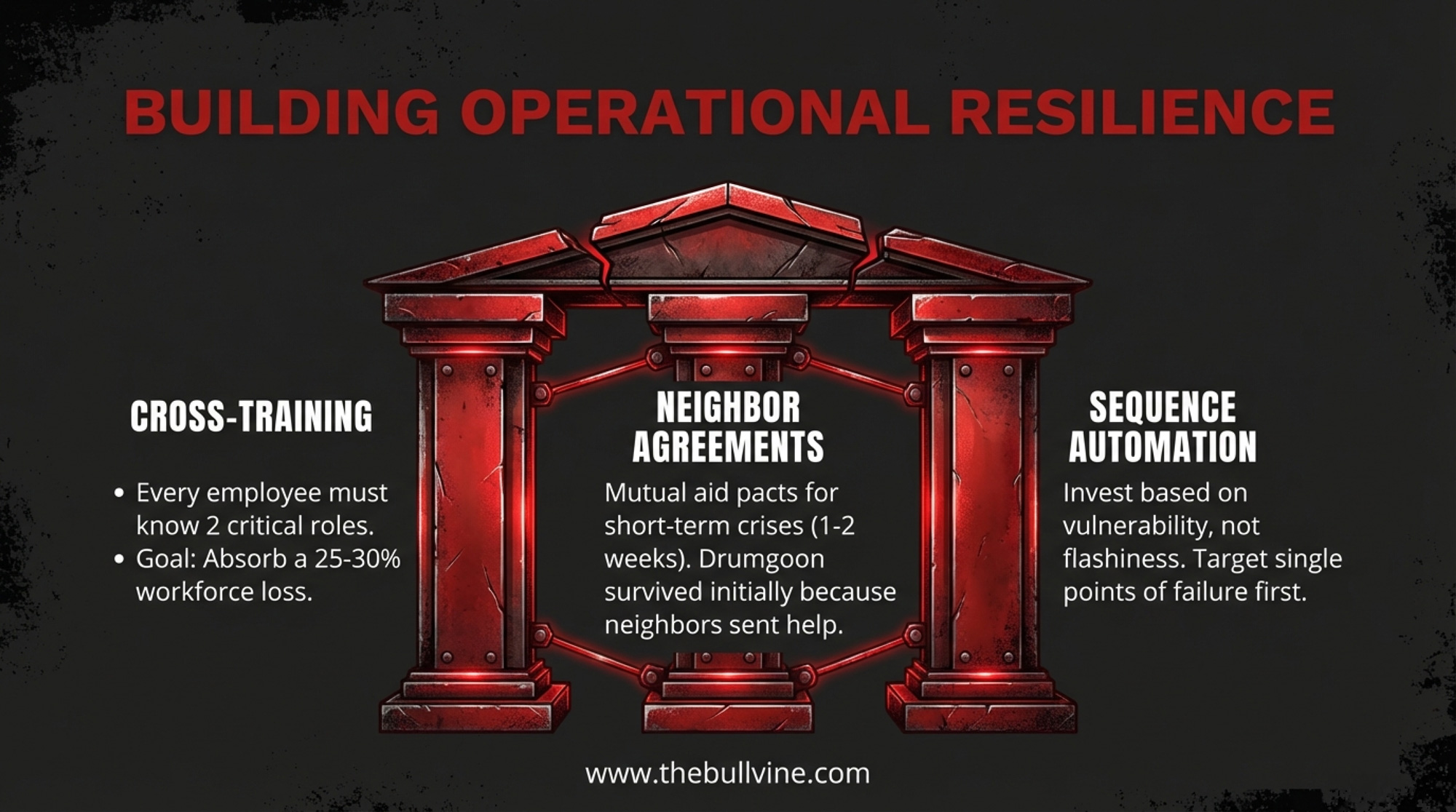
- Cross-train every employee on at least two critical functions. Document SOPs for milking, feeding, calf care, and manure handling. You’re not making everyone an expert at everything—you’re building a minimum viable operation that can absorb a 25-30% workforce loss without immediate animal welfare collapse. Drumgoon’s actual loss was roughly 70%. Run the scenario for your operation honestly.
- Establish emergency labor-sharing agreements with 2-3 neighboring dairies. Drumgoon’s neighbors sent workers over for a couple of days at a time during summer 2025 — it helped, but it wasn’t a permanent fix. Mutual aid works for short disruptions of one to two weeks. For longer recovery, identify staffing agencies with verified E-Verify compliance before you need them, not the morning after the NOI lands. Build that network when nobody’s in crisis.
- Sequence automation investment by vulnerability, not by flashiness. Robotic milking systems reduce direct milking labor by approximately 60% while typically increasing production 15-20%. Capital runs $430,000-$740,000 for two units serving 100-120 cows, with breakeven at five to seven years under optimized management. With the 2025 all-milk price forecast at $22.25/cwt (USDA ERS, July 2024 outlook), breakeven sits toward the middle of that range. But Drumgoon’s experience is a reality check: Elliott installed 20 robots and posted maintenance positions targeting Lake Area College graduates. “So far, no one,” she told reporters. Automation lowers your labor count. You still need people who can keep the technology running.
What This Means for Your Operation
Every item below can be started this month with no capital expenditure except the attorney review.
- Start with one honest question: what percentage of your crew is foreign-born? If it’s more than a third, enforcement preparation isn’t a someday project — it belongs in your top three management priorities right now.
- Know your I-9 exposure before ICE does. If you haven’t audited your files in the last 12 months, you’re running blind on your single largest operational risk.
- Audit your staffing agencies. Ask for their E-Verify compliance paperwork. If they can’t produce it, you need a different agency before their problem becomes yours.
- Map your single points of failure. If losing four specific people would shut down your operation, those four represent an existential risk you need to mitigate by cross-training, documenting, or automating their roles.
- Model the enforcement scenario. What happens to your milk volume if you lose 25% of your workforce in a week? What about 50%? Drumgoon lost roughly 70%. Run the numbers for your herd size and your crew.
- Tell your story to your legislators — now, while the window is open. Contact your representative and both senators—not a form letter. A specific, numbers-driven account of your operation, your workforce, and what an enforcement event would mean for your production and your community. Idaho Dairymen’s Association CEO Rick Naerebout says there’s more traction than ever: “We’ve not had this kind of traction with an administration ever on this issue… but we’re cautiously optimistic.”
- Engage any available visa pathway. USDA began accepting H-2A applications for dairy operations on a pilot basis in select states in late 2025. Sarah Black of Great Lakes Ag Labor Services warns that the process takes a minimum of 4 months from the first filing to the worker’s arrival (Brownfield Ag News, December 2024). Each legal visa worker is permanently audit-proof — and the housing cost, which could run six figures, still compares favorably to the $110,000 the Elliotts spent on recruiters and transport just to fill the gap partially.
Key Takeaways
- The dominant enforcement channel hitting dairy has shifted from visible raids to I-9 paper audits, staffing company sweeps, and transportation documentation checks — all operating below the headlines but producing the same workforce losses. As of February 2026, ICE enforcement continues to expand.
- Drumgoon Dairy lost 38 of roughly 50 employees to a single documentation audit, then spent over $110,000 on recruiters and transportation to partially rebuild — and still couldn’t fill every position. The “never been audited” era is over.
- The $23.56/cwt cost-of-production spread between the smallest and largest herds (USDA ERS, 2021 ARMS data) means enforcement pressure concentrates on the operations least able to absorb it — accelerating consolidation that’s already taken 39% of U.S. dairy farms off the map since 2017.
- Two legislative vehicles — the FWMA (dairy-specific visas) and the Dignity Act (35 bipartisan cosponsors as of January 2026) — are advancing with more momentum than at any point in the past decade, but neither has reached a floor vote.
- Every dairy that hasn’t conducted an internal I-9 audit, verified staffing agency compliance, and built a workforce disruption contingency plan is carrying unquantified risk on its balance sheet.
The Bottom Line
Rodney and Dorothy Elliott moved from a 140-cow farm in Fermanagh to build something bigger in South Dakota. Twenty years, 6,500 cows, 20 robots, and more than 50 employees later, a federal audit removed roughly 70% of that workforce in days.
“All the time, money, effort, investment, and hard work that has gone into it will be null and void if there isn’t a workforce,” she told reporters.
Every morning, 9.4 million dairy cows need milking. The question for your operation isn’t whether Congress will eventually act. It’s whether you’ll have the crew — and the plan — to keep milking if the envelope arrives before they do.
Complete references and supporting documentation are available upon request by contacting the editorial team at editor@thebullvine.com.
Learn More
- Texas I-9 Raids Are Spreading—Here’s How to Keep Your Dairy Out of the Crosshairs – Arms you with a “fire drill” protocol for I-9 audits, revealing how a small investment in compliance software neutralizes six-figure liabilities. It delivers immediate action steps to protect your payroll before the next surprise NOI lands.
- Why Dairy Markets Can’t Self-Correct Anymore: The Hidden Forces Reshaping the Dairy Industry’s Future – Mega-dairies are thriving at $12 milk by leveraging multi-revenue streams—this piece exposes why. It reveals the 2026 consolidation playbook and helps you position your operation to survive a permanent structural reset of the industry.
- AI and Precision Tech: What’s Actually Changing the Game for Dairy Farms in 2025? – AI and virtual fencing aren’t just toys; they’re your best defense against a disappearing workforce. This breakdown shows you how to slash input costs by 25% and catch health issues 48 hours before they impact your tank.
 The Sunday Read Dairy Professionals Don’t Skip.
 The Sunday Read Dairy Professionals Don’t Skip.
Every week, thousands of producers, breeders, and industry insiders open Bullvine Weekly for genetics insights, market shifts, and profit strategies they won’t find anywhere else. One email. Five minutes. Smarter decisions all week.