Archive for H5N1 in dairy cattle

When H5N1 Hits Close to Home: What That $950-Per-Cow Reality Check Means for Your Operation

Cornell just dropped a bombshell: $950 lost per sick cow from H5N1—and 75% show zero symptoms.

EXECUTIVE SUMMARY: Look, I’ve been digging into this H5N1 mess, and honestly… it’s worse than most of us thought. Cornell’s latest research shows we’re losing nearly $950 per clinically sick cow, but here’s the kicker—that Ohio operation had 89.4% of their herd test positive while three-quarters never looked sick. Do the math on a 500-cow dairy: if 20% get clinical symptoms, you’re staring at $40,000 in lost milk revenue alone at today’s $19.75/cwt prices. Those sick cows? Six times more likely to die early. Meanwhile, European dairies are playing prevention while we’re playing catch-up—and guess who’s winning? Time to get serious about tightening up your biosecurity game before fall migration kicks into high gear.

KEY TAKEAWAYS:

  • Save $40K per outbreak by upgrading quarantine facilities now—subclinical spread is your biggest blind spot this season
  • Pasteurize all waste milk immediately or drop pH below 5.0 to protect calves—it’s the cheapest insurance policy you’ll buy
  • Lock down wildlife access points before September migration peaks—models show Arizona and Wisconsin farms at highest risk
  • Train staff on H5N1-specific PPE protocols today—multiple worker infections prove this isn’t just a cow problem anymore
  • Track your bulk tank SCC trends weekly as an early warning system—viral RNA shows up before clinical signs do
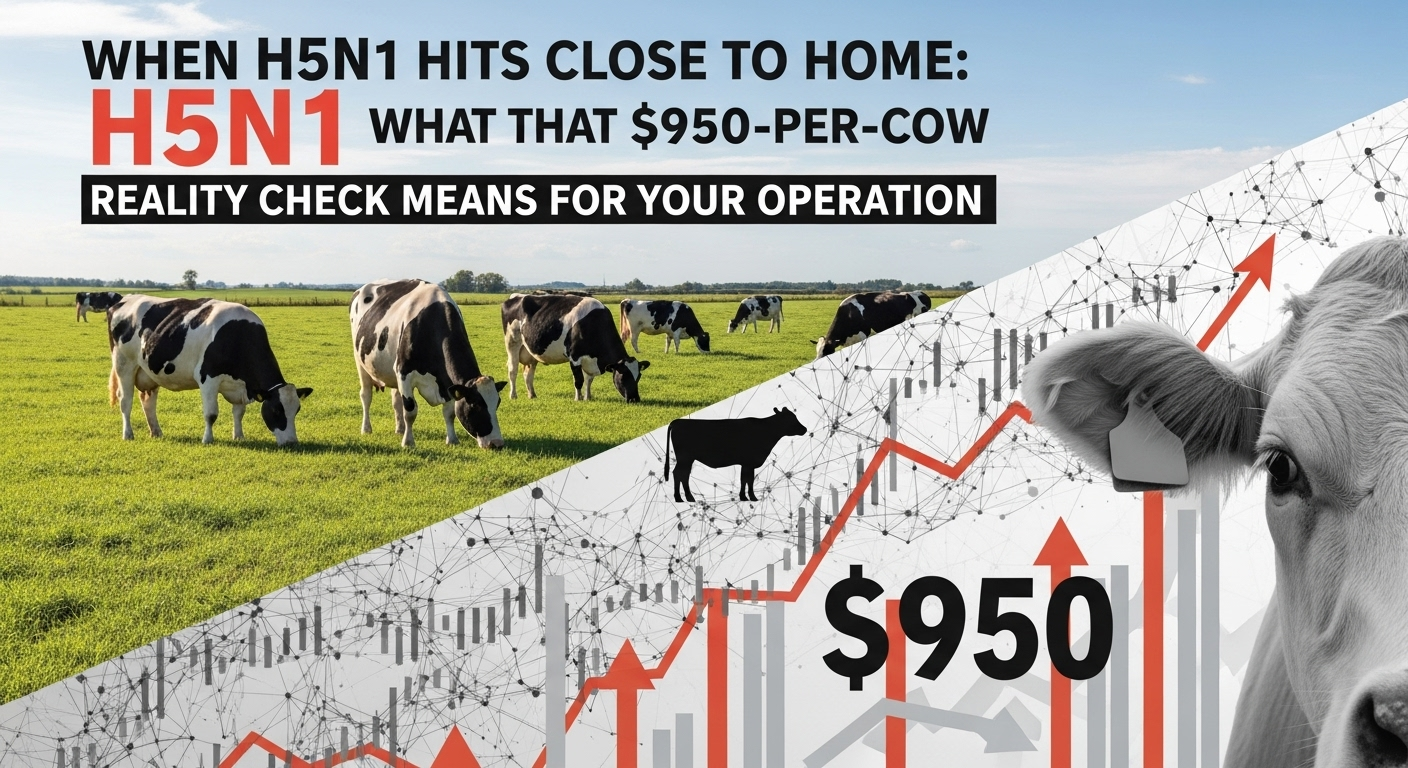
Look, I’ve been following this H5N1 situation closely, and the latest numbers from Cornell are a gut punch. A July 2025 study published in Nature pegs direct losses at $950 for every clinically sick cow, and that’s before you consider all the other ways this virus hits your bottom line.

This isn’t happening to someone else anymore. As of mid-August, USDA APHIS data shows over 1,000 confirmed cases across 17 states, including Texas, Michigan, and Wisconsin. With Class III futures bouncing around $19.75/cwt, none of us can afford to ignore the risk.

What’s Really Happening in the Field

I spoke with a producer in Ohio whose experience mirrors what the Cornell study found. He asked to remain anonymous—and you can understand why. Out of his 850-cow herd, 759 tested positive for H5N1. That’s 89.4% if you’re counting. But here’s the kicker: three-quarters of those positive cows never showed clinical signs.

The H5N1 Snapshot: By the Numbers

  • 89.4% of the herd tested positive.
  • 75% of positive cows were asymptomatic.
  • Milk production in sick cows dropped from 35 kg/day to 10 kg/day.
  • Clinically ill cows face a 6x higher risk of death.

Think about that: animals looking perfectly normal, silently spreading this virus through your entire operation.

The sick cows’ drop was brutal to watch. High-producing animals lost roughly 900 kilograms of milk over the outbreak.

For a typical 500-cow Midwestern operation, 20% showing clinical signs means losing 90,000 kilograms of milk, which at a Class III milk price of $19.75/cwt, equates to over $39,000 in lost revenue alone. We haven’t even touched on fertility setbacks, extra veterinary bills, or early culling.

Those sick cows face six times the risk of dying and 3.6 times the chance of premature culling compared to healthy herdmates.

Why Everything We’re Doing Feels Like Playing Catch-Up

Despite federal mandates and surveillance efforts, a 2025 Cornell study modeling outbreak control indicates that we’ve only prevented approximately 175 outbreaks nationwide. That isn’t containment—it’s barely a speed bump.

The same biosecurity gaps continue to appear. A 2025 survey by the University of Vermont Extension found 14% of farms introduce unquarantined heifers, 76% lack adequate quarantine facilities, and 86% keep barn cats—major pathways for virus spread.

The USDA’s National Milk Testing Strategy has helped detect cases before symptoms appear; however, it remains fundamentally reactive because viral RNA often appears in bulk tanks after internal spread has begun.

Models flag Arizona and Wisconsin as high-risk states, underscoring the urgency for biosecurity upgrades if you’re farming there.

What Europe’s Doing Right (And We’re Not)

Across the Atlantic, the European Food Safety Authority has identified migratory birds as the primary threat and is focusing on prevention, rather than reaction.

The European Commission’s June guidelines establish clear triggers for escalating measures—like mandatory quarantines, intensified surveillance during bird migrations, and preemptive culls near vulnerable zones—well before positive cases appear.

It’s proactive thinking that begs the question: What might have been different if U.S. regulators focused on prevention instead of reaction?

The Real Costs Run Well Beyond $950

That Cornell figure only covers immediate losses; total impacts include reproductive problems, labor spikes, veterinary care, and infrastructure changes.

A 500-cow dairy experiencing a 20% clinical infection rate may incur total costs of approximately $190,000. And with feed running between $9.50 and $10.80/cwt, the pressure’s only building.

What Actually Works (Based on Real Experience)

Good news: pasteurization kills H5N1, making it essential for all waste milk fed to calves.

If pasteurization isn’t an option, acidifying milk to a pH of 5.0 or below is also effective. Producers who’ve tried it say consistency is key.

Wildlife management requires more than bird-scaring tape. This virus lingers in contaminated water and feed areas, so you need proper fencing and habitat control.

Multiple farm worker infections underscore the importance of not overlooking PPE, health checks, and staff training.

Costing Out Biosecurity: What Producers Are Spending

Farm SizeNumber of CowsTypical Upgrade Cost (USD)Key Biosecurity Measures
Small< 300$18,000 – $28,000Visitor controls, milk pasteurization, basic quarantine facilities
Medium300 – 1,000$45,000 – $80,000Dedicated quarantine, ventilation upgrades, wildlife fencing, staff protocols
Large> 1,000> $125,000Surveillance systems, multiple quarantine zones, professional disinfection

Small dairies with fewer than 300 cows typically spend $18,000–$28,000 upgrading basics like visitor controls, pasteurization, and quarantine areas.

Mid-sized farms (300–1,000 cows) may spend $45,000–$80,000 on dedicated quarantine spaces, ventilation, wildlife fencing, and staff protocols.

Large operations often budget $125K+ for surveillance, multiple quarantine zones, and thorough disinfection systems.

Investments certainly appear reasonable when weighed against the six-figure losses from outbreaks.

What’s Next?

The CDC ended its emergency response in July, but USDA testing will continue through September.

With fall migration about to ramp up, the risk window opens again for new outbreaks in areas that thought they’d dodged it.

Your Monday Morning Reality Check

This disease isn’t theoretical. The $950-per-cow loss is a documented fact. Here’s your immediate action plan before fall migration kicks into gear:

REVIEW: Your quarantine protocols against USDA guidelines.

AUDIT: Your bulk tank somatic cell trends for early detection.

TRAIN: Staff on proper PPE use and biosecurity.

VALIDATE: Waste milk treatment (pasteurization or acidification).

SCHEDULE: A vet consultation for an H5N1-specific herd plan.

It’s not a question of if H5N1 comes to your farm. It’s whether you’ll be ready when it does.

Complete references and supporting documentation are available upon request by contacting the editorial team at editor@thebullvine.com.

Learn More:

  • Biosecurity on Dairy Farms: The Ultimate Guide – This guide provides a comprehensive, farm-wide biosecurity checklist. It reveals practical strategies for controlling traffic, managing new arrivals, and protecting your herd from more than just H5N1, reducing overall disease risk and future treatment costs.
  • Navigating the Twists and Turns of the 2024-2025 Dairy Markets – This analysis breaks down the key economic drivers impacting your milk check. It offers strategic insights into managing risk and navigating market volatility, helping you protect your operation’s financial health during uncertain times like the H5N1 outbreak.
  • The Genomic Revolution: Breeding for Health, Not Just Production – Explore how to leverage genomic data to build a more resilient herd. This article demonstrates methods for selecting health and immunity traits, creating a long-term strategy to reduce disease incidence, lower vet costs, and improve your farm’s future profitability.

Join the Revolution!

Join over 30,000 successful dairy professionals who rely on Bullvine Weekly for their competitive edge. Delivered directly to your inbox each week, our exclusive industry insights help you make smarter decisions while saving precious hours every week. Never miss critical updates on milk production trends, breakthrough technologies, and profit-boosting strategies that top producers are already implementing. Subscribe now to transform your dairy operation’s efficiency and profitability—your future success is just one click away.

NewsSubscribe
First
Last
Consent

H5N1 Crisis One Year Later: What Dairy Farmers Need to Know

H5N1 invades US dairy: 1 year later, the virus adapts, spreads, and challenges farmers. Key insights inside.

EXECUTIVE SUMMARY: The HPAI H5N1 virus has caused unprecedented outbreaks in U.S. dairy cattle since March 2024, driven by two distinct genotypes (B3.13 and D1.1) with mutations signaling mammalian adaptation. Transmission occurs primarily through contaminated milk, with high viral loads in mammary glands enabling rapid spread during milking. Economic losses exceed $700,000 per outbreak, impacting milk production and requiring costly biosecurity measures. While pasteurization ensures milk safety, raw milk poses zoonotic risks, with 70 human cases linked to dairy exposure. National surveillance and pre-movement testing aim to curb spread, but viral evolution in wild birds and cattle demands sustained vigilance.

KEY TAKEAWAYS:

  • Dual Viral Threats: Two genotypes (B3.13 and D1.1) emerged via separate bird-to-cow spillovers, with mutations (PB2 E627K/D701N) hinting at mammalian adaptation.
  • Milk as Super-Spreader: Virus concentrates in mammary tissue, turning milking equipment into transmission vectors—biosecurity must target parlors.
  • $700K+ Herd Losses: Infected cows lose 901kg milk over 60 days; recovery includes prolonged yield drops and ELAP compensation limits.
  • Zoonotic Wildcard: 41 dairy workers infected (mild cases), but no human-to-human spread—PPE and raw milk bans critical.
    National Milk Testing: Surveillance via bulk tank/silo samples detected Nevada’s D1.1 outbreak early, proving its strategic value.
H5N1 in dairy cattle, avian influenza outbreak, dairy biosecurity measures, milk safety and H5N1, viral adaptation in livestock
Dairy cow and black bird.

The battle against highly pathogenic H5N1 bird flu in U.S. dairy herds has reached a critical turning point. One year after the first case was confirmed in Texas, we now face a virus that’s smarter, more persistent, and more economically devastating than first anticipated. With over $700,000 in losses per outbreak and a virus demonstrating unprecedented mammary tropism, producers need immediate action plans—not just wishful thinking.

One year after Texas confirmed the first case of Highly Pathogenic Avian Influenza (HPAI) H5N1 in dairy cattle, the virus has transformed from a curious anomaly into a persistent industry-wide challenge. What experts initially dismissed as a fluke—a curious spillover from wild birds that would quickly burn itself out—has instead established itself as a formidable adversary across America’s dairy heartland.

THE BATTLEFIELD STATUS: WHO’S WINNING, WHO’S LOSING

“There hasn’t been a positive case of Influenza A in Texas since December,” reports Texas State Veterinarian Dr. Bud Dinges, providing a cautiously optimistic update from the outbreak’s ground zero. This indicates early containment efforts may be working in some regions, though the virus has shifted its focus westward.

“The virus is still affecting dairy herds in California, Nevada and Idaho,” Dinges adds, highlighting the virus’s westward migration pattern.

Kansas presents an even more encouraging picture. State Veterinarian Dr. Justin Smith credits aggressive testing and developing herd immunity for their improving situation: “Frankly, our dairies are clean and so, we don’t have the viral load out there pushing the virus into new dairies and susceptible species.”

This geographic shift follows scientific predictions. The virus tracks wild bird migratory pathways—nature’s perfect delivery system for an evolving pathogen.

“We’ve got four migratory fly-ways in the United States. They had the spillovers of the new genotype in Nevada and Arizona cattle. The virus is mutating and changing,” warns Dinges.

StateConfirmed Herds (April 2025)Peak Milk LossKey Risk Factors
California7599.2% (Nov ’24)High herd density, equipment sharing
Texas127.3% recoveryEarly undetected spread
Nevada118.5%New D1.1 genotype
Kansas40% (3mo clean)Aggressive testing

WHY THIS MATTERS FOR YOUR OPERATION: Your risk isn’t determined by national averages, but by your proximity to migratory pathways and regional dairy density. California operations face exponentially higher risk than those in the Midwest or Southeast based on current spread patterns.

THE ECONOMIC KNOCKOUT: REAL-WORLD COST TO YOUR DAIRY

“We lost almost $190,000 in 90 days from milk production drops alone,” reports Tom Hildebrandt, manager of a 950-cow California operation hit in October 2024. “That doesn’t include treatment costs, extra labor, or the cows we lost. And our bulk tank still hasn’t returned to pre-outbreak levels six months later.”

The comprehensive economic damage is staggering, with new research from Cornell University quantifying the devastation:

Per Cow Losses:

  • 901 kg: Milk production lost per infected cow over 60 days
  • 73%: Peak reduction in daily yield (from 35kg to just 10kg)
  • $950: Estimated cost per infected animal

A study examining an Ohio herd of 3,900 milking cows found the 67-day outbreak cost over $737,500 in losses—and that’s without accounting for “reproductive adjustments, disruptions to milking time and other important labor considerations.”

Most troubling was the persistence of production losses. Unlike typical mastitis where recovery often means a return to normal, H5N1-infected cows didn’t bounce back to pre-infection yields even after 60 days of monitoring.

MetricAverage Per CowCalifornia (759 herds)ELAP Compensation
Milk Loss (60 days)901 kg683M kg total$28,000 max
Treatment Costs$950$721K/herd80% coverage
Culling Rate2%15,180 cows$1,800/head

WHAT THIS MEANS FOR YOUR BOTTOM LINE: The true cost extends beyond immediate milk loss. Plan for at least 90 days of production impact, with up to 25% of your affected cows never returning to their previous production levels. Budget accordingly.

TWO ENEMIES, ONE CRISIS: VIRAL GENOTYPES EXPLAINED

The dairy industry isn’t battling just one virus—it’s fighting an evolving enemy with multiple variants. Scientific detective work has identified two distinct genotypes:

B3.13: The original villain, first detected in March 2024 in Texas dairy herds. This genotype resulted from reassortment of HPAI H5N1 with North American wild bird viruses.

D1.1: The new troublemaker, detected in January 2025 in Nevada through routine milk testing. This represents a completely separate spillover event from wild birds and contains the concerning PB2 D701N mutation, suggesting the virus is actively adapting to its bovine hosts.

“The emergence of D1.1 is a game-changer,” explains Dr. Mary Lakefield, veterinary virologist at Colorado State University. “It’s like we started fighting one opponent, and suddenly their bigger, stronger brother jumped into the ring.”

CharacteristicB3.13 (Original)D1.1 (Nevada)
OriginTX/NM spilloverWild bird reinfection
Key MutationPB2 E627K (rare)PB2 D701N (consistent)
Milk Viral Load10^4.8 TCID50/mL10^5.2 TCID50/mL
Human Cases Linked383

THE BULLVINE BOTTOM LINE: These aren’t random mutations—they represent the virus actively adapting to cattle. Each new genotype presents potential for greater transmissibility, higher viral shedding, or even increased human risk.

THE MAMMARY CONNECTION: WHY YOUR MILKING PARLOR IS GROUND ZERO

What makes H5N1 in dairy cattle so unique—and challenging—is its extraordinary affinity for mammary tissue. This isn’t just another respiratory disease like IBR or BRSV.

“I think there’s still a lot we don’t know. The respiratory spread, I don’t think that component was there and the virus can be in urine, but mainly it has an affinity for milk,” explains Dr. Dinges.

Unlike typical influenza viruses that primarily target respiratory tissue, H5N1 in cattle demonstrates a strong preference for mammary tissue, resulting in extraordinarily high viral concentrations in milk. This creates a perfect storm for transmission during the milking process, with equipment, collection lines, and personnel acting as viral highways between animals.

“In our operation, we pinpointed the spread to our parlor equipment,” reports Dave Reynolds, herd manager for a 1,200-cow operation in Idaho. “Even with pre- and post-dipping, the virus moved through our herd in less than 72 hours once the first cow showed symptoms.”

WHAT THIS MEANS FOR YOUR OPERATION: Your milking parlor—not your hospital pen—may be the most dangerous area for viral spread. Traditional respiratory disease protocols won’t cut it against a pathogen that travels through milk lines. This requires completely different biosecurity strategies than other cattle diseases.

NATIONAL SURVEILLANCE: THE MILK TESTING STRATEGY

Both Texas and Kansas have now joined the National Milk Testing Strategy (NMTS), with Texas beginning this week and Kansas reporting three months of testing with zero positive results.

This systematic approach represents a sophisticated five-stage testing framework:

Stage 1: Silo testing at processing facilities
Stage 2: Bulk tank sampling to identify infected herds
Stage 3: Rapid response in affected states
Stage 4: Ongoing surveillance to demonstrate absence of virus
Stage 5: National freedom from H5N1

This system proved its worth dramatically in Nevada, where routine silo sampling detected the new D1.1 genotype before clinical signs appeared, triggering rapid response.

“Monthly testing of our bulk tank has become as routine as our SCC testing,” notes Maria Sanchez, California dairy producer. “It’s another cost, but it’s better than being blindsided by a full-blown outbreak.”

THE BULLVINE BOTTOM LINE: Participation in milk testing isn’t just a regulatory box to check—it’s an early warning system that could save your operation hundreds of thousands in losses. The cost of regular testing pales in comparison to an undetected outbreak.

BIOSECURITY BATTLE PLAN: PROTECTING YOUR HERD

Don’t wait for vaccines—implement these critical protective measures immediately:

STOP MOVEMENT

  • Test lactating cattle prior to movement following federal requirements
  • Isolate new or returning cattle for at least 30 days

MILK PROTECTION PROTOCOLS

  • Implement strict milking hygiene including pre/post teat disinfection
  • Thoroughly sanitize milking equipment between groups
  • Heat-treat waste milk before feeding to calves

PROTECT YOUR PEOPLE

  • Provide appropriate PPE for workers (N95 masks, eye protection, gloves)
  • Establish clear protocols for monitoring worker symptoms
  • Create specific procedures for handling potentially infected animals

WILD BIRD DEFENSE

  • Secure feed storage from wild bird access
  • Protect water sources from contamination
  • Implement aggressive bird deterrent strategies around facilities
MeasureReduction in RiskImplementation CostROI per 1,000 cows
Milk Heat Treatment99.9%$4,200$950,000
Pre-Movement Testing78%$12/test$741,000
Worker PPE67%$1,800/mo$636,500
Bird Deterrents54%$6,500$513,000

THE REAL-WORLD IMPACT: “We spent $38,000 retrofitting our facilities after seeing what happened to our neighbor’s herd,” says Jeff Carlson, Wisconsin dairy producer. “It seemed excessive until six farms around us got hit. We stayed clean through the whole outbreak, and that’s money well spent.”

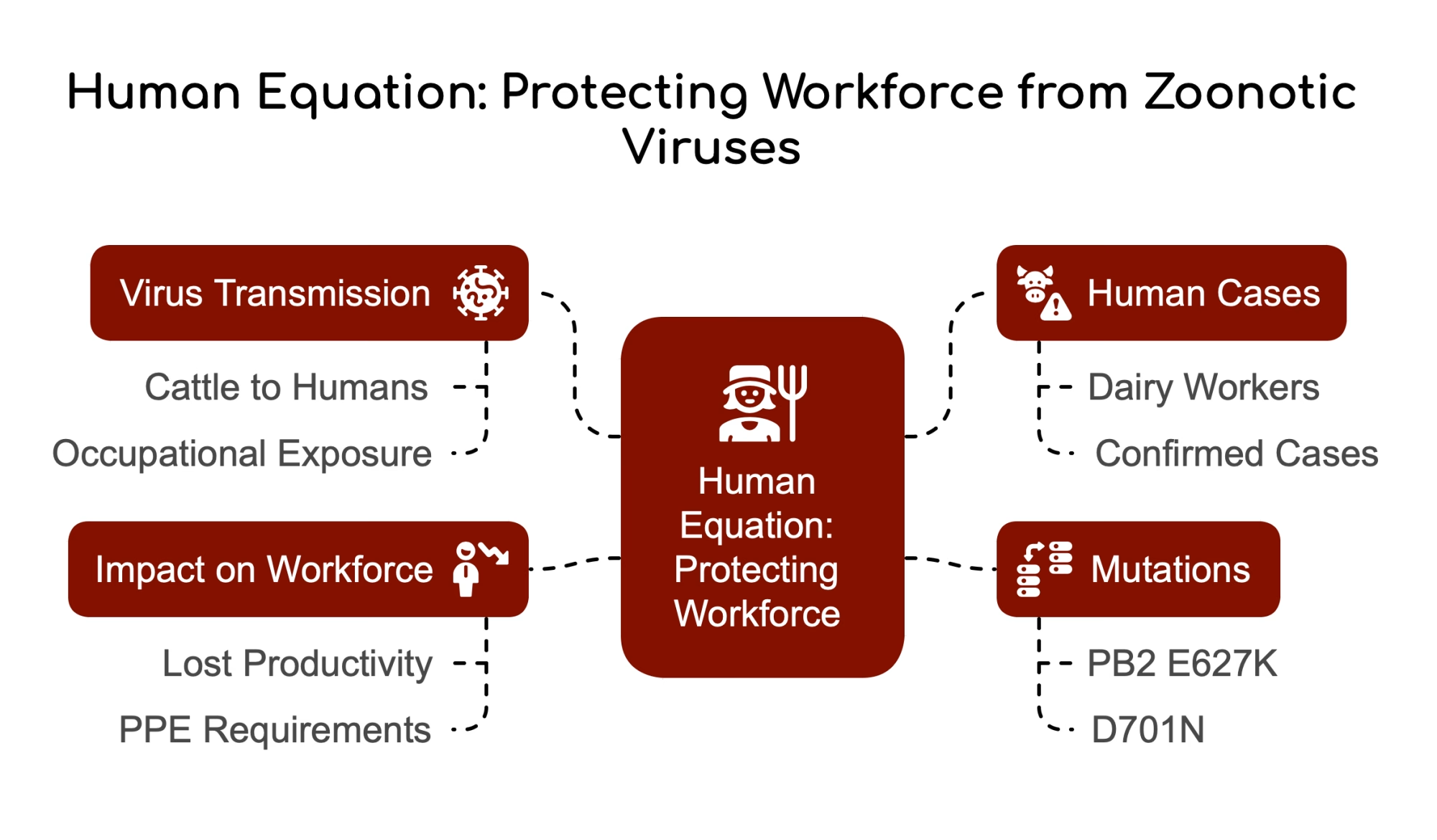
THE HUMAN EQUATION: PROTECTING YOUR WORKFORCE

While cattle experience relatively mild disease, the virus has demonstrated the ability to jump to humans—particularly dairy workers with close contact to infected animals. Approximately 70 human cases have been confirmed in the United States, with about 41 in dairy farm workers across multiple states.

The risk to the general public remains LOW according to CDC assessment, but for those with occupational exposure, it ranges from MODERATE to HIGH. Most notably, specific mutations associated with mammalian adaptation (PB2 E627K and D701N) have been detected in some isolates from both cattle and humans—a concerning sign of potential viral evolution.

“We had two employees test positive after our outbreak,” reports a California dairy manager who requested anonymity. “Both had mild symptoms, mainly eye irritation, but one was out for two weeks. That’s when we got serious about PPE requirements.”

WHY THIS MATTERS: Beyond the obvious concern for worker health, an outbreak among your staff could leave you critically shorthanded during a time when your herd needs the most attention. Every employee infection represents lost productivity during a crisis.

REAL BARN, REAL IMPACT: LEARNING FROM THE FRONTLINES

“When I first saw milk yields tank 20% overnight, I thought my nutritionist screwed up. Turns out we had bird flu before most vets even knew what to look for,” reports Miguel Fernandez, a Texas dairy manager who experienced one of the early outbreak farms.

The most telling clinical indicators reported by producers include:

  • Sudden drops in feed intake and rumination
  • Dramatic milk production declines
  • Abnormal milk consistency (thicker, discolored)
  • Relatively mild external symptoms that might be missed without production monitoring

Cornell research confirms these observations, noting that “both parameters [rumination and milk production] begin to decline approximately 5 days before clinical diagnosis,” highlighting the critical importance of production monitoring systems that can catch early warning signs.

THE BULLVINE’S ACTIONABLE INSIGHT: Set up automated alerts in your herd management software for any cow showing a >8% overnight drop in production or >15% reduction in rumination minutes. This could give you a critical 3-5 day head start on isolation and containment.

THE BOTTOM LINE: HARD TRUTHS ABOUT H5N1

The H5N1 saga has exposed critical vulnerabilities in our industry’s biosecurity infrastructure. One year in, we’ve learned the virus is far more adaptive and persistent than initially thought. It’s leveraging dairy’s interconnected structure—the very efficiency that makes modern production possible—to spread rapidly through animal movement and milk handling channels.

WHY ARE WE STILL ALLOWING INTERSTATE HEIFER SALES WITHOUT COMPREHENSIVE HEALTH GUARANTEES? It’s time to rethink “cheap trucking” economics against the backdrop of catastrophic disease costs.

As Dr. Justin Smith soberly observes, “The virus is likely here to stay.” But that doesn’t mean surrender. The operations that survive and thrive will be those that adapt faster than the virus itself through:

  1. Immediate implementation of enhanced biosecurity
  2. Aggressive participation in surveillance programs
  3. Investment in early detection technology
  4. Preparation for vaccination once approved
  5. Serious consideration of genetic selection for disease resistance

Dr. Dinges notes, “it will take more time to know all ways the virus is being spread.” But producers can’t afford to wait for perfect information. The time to act is now—before H5N1 rewrites your farm’s financial future.

Learn more:

Join the Revolution!

Join over 30,000 successful dairy professionals who rely on Bullvine Daily for their competitive edge. Delivered directly to your inbox each week, our exclusive industry insights help you make smarter decisions while saving precious hours every week. Never miss critical updates on milk production trends, breakthrough technologies, and profit-boosting strategies that top producers are already implementing. Subscribe now to transform your dairy operation’s efficiency and profitability—your future success is just one click away.

NewsSubscribe
First
Last
Consent

Silent Killer: Managing Asymptomatic H5N1 in Dairy Herds

Silent Killer: 76% of cows spread H5N1 without symptoms. Protect your herd & profits now!

EXECUTIVE SUMMARY: H5N1 poses a unique threat to dairy herds: 76% of infected cows show no symptoms while shedding the virus, driving silent transmission and economic devastation. Affected cows lose 901.2 kg of milk over 60 days, costing $950 per cow. Early detection via PCR testing and real-time monitoring systems like CowManager can flag infections 5 days before symptoms appear. Federal programs offer up to $28,000 for biosecurity upgrades, while proactive protocols (movement restrictions, milk handling safeguards) are critical. With outbreaks already costing farms millions, immediate action is essential to protect herds and livelihoods.

KEY TAKEAWAYS:

  • Silent spread: 76% of H5N1-infected cows show no symptoms but shed virus-laden milk.
  • Economic carnage: $950/cow losses from milk production drops; outbreaks can exceed $700k/herd.
  • Tech edge: Sensors detect infections 5 days pre-symptoms via rumination/temperature changes.
  • Biosecurity non-negotiables: Isolate new cattle 30 days, milk sick cows last, and heat-treat waste milk.
  • Federal aid: USDA offers $28,000/farm for prevention; ELAP covers milk loss compensation.
H5N1 in dairy cattle, asymptomatic bird flu transmission, dairy herd biosecurity, milk production losses, early detection systems

The silent spread of bird flu through dairy herds is changing how we think about herd health management. With 76% of infected cows showing zero symptoms while still spreading the virus, traditional “wait until they look sick” approaches don’t cut it anymore. The hit to your bottom line is brutal – affected cows drop milk production by 901.2 kg over two months, costing you roughly 0 per animal. That’s not even counting the genetic losses when you’re forced to cull outstanding breeding stock.

This report cuts through the noise to give you practical strategies for catching H5N1 before it wrecks your operation. We’re talking early detection tricks that spot infections 5 days before visual symptoms, battle-tested biosecurity protocols, and financial tools to protect your investment.

Understanding the Silent Threat: Why Bird Flu Isn’t Like Other Dairy Diseases

Why This Matters

Let’s face it – dairy farmers are used to sick cows. But H5N1 plays by different rules. When three-quarters of your infected animals show no symptoms yet keep pumping out virus-laden milk, you have a recipe for disaster.

Just ask the Ohio producer who watched H5N1 tear through his 3,900-cow dairy, eventually costing him $737,500 in losses. One asymptomatic cow from Texas was all it took to bring his operation to its knees. In California, affected herds saw milk yields plummet by 6-10% for months after infection. For your average 200-cow dairy, even a 20% infection rate means kissing goodbye to $20,000 over 60 days.

Worse yet, your high-performing cows face the toughest fight. Research shows clinically affected animals are 6 times more likely to die and 3.6 times more likely to need culling. That’s not just lost milk – years of genetic progress down the drain.

Detection Revolution: Catching What Your Eyes Can’t See

Early Detection Techniques

Skip the guesswork. Digital PCR testing is catching infections days earlier than traditional methods, giving you precious time to isolate carriers before they infect your whole barn. Cornell University researchers found that dPCR picks up lower viral loads than regular qPCR, meaning you’ll catch infections sooner.

Massachusetts dairies are showing how it’s done. Their statewide bulk tank surveillance program tests every dairy farm’s milk monthly. Result? Not a single H5N1 case in their herds to date.

Real-Time Monitoring Systems

Your best defense? Technology that never sleeps. CowManager ear tags have saved countless California dairies by flagging suspicious rumination and activity patterns before visible symptoms appear:

  • Rumination drops typically show up 1-2 days before cows look sick
  • Temperature spikes happen 24-48 hours before clinical signs
  • Activity level crashes can give you a 3-day head start on treatment

One California dairyman bluntly said, “The sensors caught what my best herdsmen missed. We isolated five suspect cows based on rumination alerts, and four tested positive two days later – before they showed a single symptom.”

Biosecurity Battleplan: Your Defense Against the Invisible Threat

Core Biosecurity Measures

  1. Lockdown Your Cattle Movement: The April 2024 federal order requiring pre-movement testing isn’t just red tape – it’s your lifeline. Any new cattle or show animals returning to your farm need 30 days of isolation, with no exceptions.
  2. Control Traffic Flow: Keep milk trucks and feed deliveries on dedicated routes that never cross cow lanes. Power wash and disinfect any equipment moving between clean and dirty areas.
  3. Visitor Protocols: If they don’t need to be near your cows, they don’t get near them. Period.

Milk Handling Protocols

You know the drill – sick cows get milked last. But with H5N1, you need to go further. Use separate equipment for suspect animals if possible, and never feed waste milk to calves unless it’s been properly heat-treated.

Recent University of Wisconsin research found H5N1 surviving in refrigerated raw milk for five weeks. Over a month of infection risk sitting in your bulk tank if you’re not testing regularly.

The Bottom Line: Financial Implications and Preventative Investments

Economic Impact Assessment

Impact CategoryEstimated ValueNotes
Milk Production Loss901.2 kg/cow over 60 daysNo recovery was observed after this period
Financial Impact per Cow$950Direct revenue loss
Total Outbreak Cost$737,500Ohio herd study (3,900 cows)
Biosecurity Upgrades$500-$5,000+Depends on your current setup
Real-Time Monitoring Systems$50-$200/cowIt pays for itself by preventing one outbreak

As the American Association of Bovine Practitioners plainly states, H5N1 costs $100-$200 per cow in the short term, with potentially much steeper losses down the road.

Federal Support Programs

Don’t leave money on the table. The USDA offers up to $28,000 per farm for biosecurity upgrades through the Secure Milk Supply Plan. With nearly $2 billion in federal funding committed to fighting this outbreak, innovative producers are tapping into these resources to upgrade monitoring systems, improve sick pens, and train personnel.

Navigating an Outbreak: Recovery Strategies That Work

Immediate Response Protocols

When H5N1 hits, don’t panic – but don’t drag your feet. Your first 48 hours will make or break your recovery. Isolate suspicious animals immediately, call your vet, and implement your biosecurity plan.

The good news? Contrary to early fears, most infected dairy cows do recover. A key USDA report states, “While dairy cows infected with H5N1 generally recover well, it does dramatically limit milk production.” Your outbreak typically peaks around days 4-6, with most animals recovering within 30-45 days.

Worker Safety Measures

Don’t cut corners on worker protection. A 2024 survey of dairy farms with confirmed H5N1 found that only 26% of workers used proper N95 respirators when handling sick cows. After detection, PPE use jumped by 28% – but why wait for a crisis? Protect your people now.

Conclusion: Your Action Plan Starts Today

H5N1 isn’t just another dairy disease – it’s a silent profit-killer that demands a new approach to herd health. With 76% of carriers showing no symptoms while shedding the virus, traditional visual checking isn’t enough anymore.

The choice is simple: invest in prevention now or watch your margins disappear later. Early detection technology, enhanced biosecurity protocols, and worker protection measures aren’t just nice-to-haves – they’re essential insurance policies against a threat that’s already cost U.S. dairies millions.

The tools exist. The funding is available. It’s time to deploy them before H5N1 silently infiltrates your herd.

Learn more:

Join the Revolution!

Join over 30,000 successful dairy professionals who rely on Bullvine Daily for their competitive edge. Delivered directly to your inbox each week, our exclusive industry insights help you make smarter decisions while saving precious hours every week. Never miss critical updates on milk production trends, breakthrough technologies, and profit-boosting strategies that top producers are already implementing. Subscribe now to transform your dairy operation’s efficiency and profitability—your future success is just one click away.

NewsSubscribe
First
Last
Consent

Send this to a friend