Archive for farm profitability

20 Generations to One: What Europe’s Gene Editing Decision Means for the Future of Your Herd

One generation instead of twenty. That’s what gene editing offers for heat tolerance—and Europe just accelerated the timeline. The dairy producers paying attention now will be the ones leading in five years.

Executive Summary: Twenty generations through traditional breeding—or one with gene editing. That’s the new math for traits like heat tolerance, disease resistance, and polled genetics, and it’s not hypothetical: heat-tolerant cattle are FDA-approved, Brazil has gene-edited Holsteins in commercial herds, and Europe’s December 4 agreement just accelerated the global timeline. The economic stakes are clear. U.S. dairy loses up to $1.6 billion annually to heat stress alone, with hot-climate operations absorbing several hundred dollars per cow each summer. What sharpens the urgency is the compounding effect—genetic advantages multiply over generations, which is why producers who moved early on genomic selection built leads their competitors are still chasing a decade later. This analysis covers where regulations stand, what’s available today, legitimate concerns that deserve honest consideration, and practical steps for positioning strategically. The technology is proven. The producers paying attention now will shape the next decade of dairy genetics—not spend it catching up.

I was talking with a producer in central Texas last month who told me something that stuck with me. He’d calculated his heat-related losses across the past summer: reduced milk production, reproduction failures, increased health events, and the energy costs of running cooling systems around the clock for four straight months. His number came to several hundred dollars per cow—losses he could measure but couldn’t fully prevent, no matter how much he invested in fans and sprinklers.

That conversation was fresh in my mind when news broke from Brussels on December 4, 2025. After all-night negotiations and years of fierce debate, EU policymakers reached a provisional agreement allowing gene-edited crops to bypass the bloc’s strict GMO regulations. The immediate focus is on plants—wheat, tomatoes, that sort of thing. But here’s why that Texas conversation matters: among the dairy cattle applications currently working through research pipelines is gene-edited heat tolerance. The kind that could fundamentally change that producer’s math.

The question isn’t really whether gene editing will become part of dairy cattle breeding. The science is proven, commercial animals already exist in some markets, and regulatory doors are opening. The real question is how individual operations position themselves as these tools become available—or whether they’ll spend years trying to catch up with competitors who moved earlier.

The Global Regulatory Landscape: Where Things Stand

Before diving into the science and economics, it helps to understand the regulatory patchwork that will determine when and how gene-edited genetics reach your market. Here’s where major dairy regions currently stand:

RegionRegulatory StatusLivestock Included?Current Availability
European UnionNGT regulation provisionally agreed December 4, 2025; formal adoption expected early 2026Plants only initially; livestock framework to followNot yet available
United KingdomPrecision Breeding Act in full force as of November 13, 2025Yes—includes cattleFramework ready; commercial products developing
United StatesCase-by-case FDA review via “low-risk determination” processYesHeat-tolerant cattle approved March 2022; other traits under review
CanadaGuidance for gene-edited livestock is still developing under Health Canada and CFIAPendingNot yet available
BrazilCTNBio approved gene-edited cattle for breeding and food useYesHeat-tolerant Holsteins approved 2023

Sources: European Parliament (December 2025), Morrison Foerster regulatory analysis (November 2025), FDA Risk Assessment Summary (March 2022), CTNBio public records (2023)

What Brussels Actually Decided (And Why It Creates Precedent)

Let me walk you through what the EU agreement actually does, because the details matter for understanding where this is heading.

The new framework creates two categories for plants developed using what regulators call “New Genomic Techniques,” or NGTs:

  • Category 1: Plants with genetic changes that could theoretically occur through natural mutation or conventional crossbreeding. These skip the GMO approval process entirely—no mandatory safety assessments for each generation, and final food products won’t need special labels (though seeds will be marked).
  • Category 2: Plants with more complex modifications that go beyond what conventional breeding could achieve. These still face the full regulatory process.

That’s according to the European Parliament’s official announcement from December 4. The European Commission’s press release emphasized the regulation’s potential to develop plant varieties more resilient to climate change while requiring fewer pesticides. Copa-Cogeca, representing EU farmers and agricultural cooperatives, expressed strong support. Thor Gunnar Kofoed, chair of their working party on plant breeding, called it “a turning point for European agriculture.”

Now here’s what I find interesting for livestock producers: this regulation specifically covers plants, not animals. But the product-based framework being established—evaluating what a genetic change does rather than reflexively restricting how it was made—creates a template. When gene-edited livestock applications eventually reach European regulators, there’s now a philosophical precedent for how to approach them.

Key Regulatory Dates to Watch

  • November 2025: UK Precision Breeding Act takes full effect, including livestock provisions
  • Early 2026: EU NGT regulation expected to receive formal adoption
  • Ongoing: FDA continues case-by-case “low-risk determination” reviews for gene-edited livestock traits
  • TBD: Health Canada and CFIA guidance for gene-edited livestock expected to develop further

The Climate Challenge That Traditional Breeding Can’t Solve Fast Enough

Here’s where this discussion gets personal for many operations, especially if you’re farming in areas where summers are becoming more difficult for your herd.

The economic impact of heat stress on U.S. dairy is substantial—and probably larger than many producers fully account for. The foundational study by St-Pierre and colleagues, published in the Journal of Dairy Science in 2003, estimated annual industry-wide losses between $897 million and $1.5 billion. More recent work from Ohio State University researchers suggests losses can reach $1.6 billion annually as summer conditions have intensified across much of dairy country.

Regional heat stress impacts vary significantly:

  • Upper Midwest (Wisconsin, Minnesota): University of Wisconsin researchers measured costs at roughly $74 per cow based on milk yield losses alone—relatively moderate but still meaningful
  • Southeast (Florida, Georgia): Losses several times higher; some Florida operations have spent decades working with Senepol and Gir crossbreeding programs to introduce natural heat tolerance, with real success—but also real tradeoffs in production genetics that take years to breed back
  • Southwest (Texas, Arizona): Producers report losses of several hundred dollars per cow when factoring reproduction failures, health events, and cooling costs
  • California Central Valley: Compounding the challenge of water constraints alongside rising temperatures, affecting both cooling capacity and irrigated feed production

A study published in Science Advances this past July really crystallized the scope of the problem. The research, led by Claire Palandri at the University of Chicago’s Harris School of Public Policy, analyzed production data from over 130,000 cows across 12 years of Israeli dairy records—one of the most comprehensive datasets ever assembled on heat-stress impacts.

Key findings from the Palandri study:

  • A single day of extreme heat can reduce milk production by 10 percent
  • That suppression can persist for more than 10 days after temperatures return to normal
  • Even with cooling systems in place, mitigation effectiveness dropped to around 40 percent during extreme heat events
  • Cooling “cut losses in half” at moderate temperatures, but became progressively less effective as conditions worsened

There appears to be a ceiling to what management interventions can accomplish when ambient temperatures push into truly dangerous territory.

So what’s the traditional breeding alternative? You could crossbreed with heat-adapted cattle—Senepol, Gir, or Carora breeds that carry what’s called the “slick coat” gene naturally. The challenge, as anyone who’s tried it knows, is the timeline.

Timeline Comparison: Traditional Breeding vs. Gene Editing

Traditional approach to adding heat tolerance to elite Holsteins:

  • Initial crossbreeding + 20 generations of backcrossing
  • Approximately 5 years per generation
  • Total timeline: 80-100+ years to recover elite genetics with a new trait

Gene editing approach:

  • Direct introduction of the slick coat allele to elite genetics
  • Single generation
  • Timeline: Available for breeding in current genetic lines

Dr. Appolinaire Djikeng, Director of the Centre for Tropical Livestock Genetics and Health at the Roslin Institute in Scotland, has explained that gene editing can accomplish in one generation what would otherwise take 20 generations through conventional breeding.

One generation versus twenty. For operations facing mounting heat pressure right now, that’s not an incremental improvement—that’s a fundamentally different approach to the problem.

What’s Actually Available Today

This isn’t all laboratory work and future promises. Commercial gene-edited cattle exist today, though availability depends significantly on where you’re located and what regulatory frameworks apply.

Heat-Tolerant Genetics

The U.S. FDA issued its first “low-risk determination” for PRLR-SLICK cattle back in March 2022. The FDA’s risk assessment confirms that these were cattle developed by Acceligen, primarily beef animals initially, but the regulatory pathway has since been opened for dairy applications.

Potential benefits:

  • Improved heat dissipation without crossbreeding tradeoffs
  • Maintained elite production genetics (butterfat, protein, yield)
  • Single-generation trait introduction
  • Reduced cooling infrastructure dependence

Current status: Commercial animals exist in the U.S. and Brazil; they are not yet widely distributed in North American dairy markets.

Disease Resistance (BVD)

USDA researchers at the U.S. Meat Animal Research Center have produced calves with dramatically reduced susceptibility to Bovine Viral Diarrhea Virus. The approach, published in PNAS Nexus in May 2023, used CRISPR editing to modify just six amino acids in the CD46 gene.

Potential benefits:

  • Reduced BVD infection severity and transmission
  • Fewer secondary bacterial infections in calves
  • Decreased antibiotic dependence
  • Improved calf survival and performance

Verification data: After 20 months of monitoring, researchers found no off-target effects anywhere in the genome. The edited calf showed minimal clinical signs and no detectable viral infection in white blood cells when challenged.

Current status: Research stage; not yet commercially available.

Polled (Hornless) Genetics

Gene editing allows the naturally occurring polled allele to be introduced directly into elite dairy genetics without production tradeoffs.

Potential benefits:

  • Eliminates the need for dehorning/disbudding
  • Reduced calf stress and pain
  • Labor and medication cost savings
  • Improved welfare optics for retail markets

Important caveat: In 2019, FDA scientists discovered that Recombinetics’ gene-edited polled bulls contained bacterial DNA that had been accidentally introduced alongside the intended edit. MIT Technology Review broke that story, and it set the field back years. Verification protocols have since improved substantially.

Current status: Approaching commercialization; enhanced screening is now standard.

Methane Reduction

UC Davis and the Innovative Genomics Institute announced a $70 million, seven-year project in 2023 using CRISPR to re-engineer rumen microbial communities.

Potential benefits:

  • One-time calf treatment (not daily feed additives)
  • No ongoing compliance or costs
  • Targets methane-producing archaea directly
  • Potential carbon credit value

Current status: Early research stage; commercial availability likely 5+ years out.

The Economics: Understanding What’s Actually at Stake

Let me work through the financial picture, because this is ultimately where the decision-making happens for most operations.

Direct heat stress recovery potential:

For a 1,000-cow herd in a hot climate, recovering even a portion of heat-related losses could translate to:

  • Tens of thousands of dollars annually in recovered milk production
  • Improved reproduction rates that compound over time
  • Fewer fresh cow challenges are cascading through the transition period
  • Reduced cooling infrastructure and energy costs

Emerging carbon/sustainability value:

A typical dairy cow emits roughly 100-125 kg of methane annually (based on Canadian research and IPCC modeling), which translates to about 2.5-3.5 tonnes of CO₂-equivalent. If gene-based solutions achieve the 30-50 percent reductions researchers are targeting, that represents meaningful potential value. Several major cooperatives and processors—including initiatives from organizations such as Dairy Farmers of America and various state-level sustainability programs—are beginning to develop premium structures for verified emissions reductions. These markets are still developing and vary considerably by region and processor, but the trajectory is clear.

The compounding factor:

Here’s the economic dynamic that I think deserves more attention than it typically gets: genetic advantages compound over generations.

Think back to what happened with genomic selection. According to CDCB data and a comprehensive review published in Frontiers in Genetics in 2022:

  • Genomic selection roughly doubled the rate of genetic gain for many traits
  • Annual net merit increases jumped from around $40 to approximately $85
  • Producers who moved early built advantages that compounded with every breeding cycle
  • The cautious crowd found themselves years behind on the genetic curve—a gap that proved surprisingly difficult to close

Will gene editing follow the same pattern? Early indications suggest it might. Once gene-edited traits are integrated into elite genetics and multiplied through AI, the same compounding dynamic kicks in.

What Consumers Actually Think

One concern I hear regularly from producers: “This all sounds interesting, but consumers will never accept milk from gene-edited cows.”

The research tells a more nuanced story.

What surveys consistently show:

  • Consumer concerns center primarily on transparency and choice—not categorical rejection
  • Only about one in five consumers indicate they’d refuse to purchase gene-edited products entirely
  • The majority want information and the ability to make informed choices, not outright prohibition

What influences acceptance:

  • Framing matters enormously—purchase intent increases substantially when applications are explained in terms of:
    • Animal welfare (reduced antibiotic use, disease prevention, and eliminating painful procedures)
    • Environmental benefits (lower emissions, reduced resource use)
  • The Vermont GMO labeling experiment is instructive: when mandatory labeling was implemented in 2016, researchers Kolodinsky (University of Vermont) and Lusk (now at Purdue) found that opposition to genetically engineered food fell by 19 percent. Their findings, published in Science Advances in 2018, suggest transparency defuses anxiety rather than amplifying it.

What damages acceptance:

  • Opacity and perceived deception
  • Products appearing on shelves without disclosure, discovered later through media or activist campaigns
  • The path to sustained acceptance runs through honesty about what’s being done and why
If you’re worried consumers will reject milk from gene-edited cattle, you need to see what actually happened when transparency was tested. Vermont’s 2016 mandatory GMO labeling experiment—studied by researchers Kolodinsky and Lusk and published in Science Advances in 2018—found something striking: opposition to genetically engineered food fell by 19 percentage points when clear labeling was implemented. Without disclosure, only about 20% of consumers accept gene-edited products. With honest information about what’s being done and why—especially when framed around animal welfare and environmental benefits—acceptance jumps to 81%. The lesson is clear: consumers don’t reject transparency. They reject opacity and the feeling they’re being deceived. The path to market acceptance for gene-edited dairy genetics runs directly through honest communication about welfare improvements, reduced antibiotic dependence, and environmental benefits. Hide what you’re doing, and you’ll face rejection. Explain it clearly, and the data suggests most consumers are fine with it.

Engaging with Legitimate Concerns

I want to spend time on criticisms that have genuine substance, because glossing over real challenges doesn’t serve anyone well.

Genetic Diversity

Let’s get honest about something the industry doesn’t like talking about. Holstein effective population size has collapsed to approximately 50—a genetic bottleneck that’s frankly dangerous for long-term herd resilience. At the same time, inbreeding in heifers is approaching 10 percent and climbing at +0.26% annually. This isn’t a theoretical concern—it’s a measurable crisis that threatens the biological viability of the breed. Here’s where the conversation gets uncomfortable: gene editing offers a genuine escape route by introducing carefully selected traits into broader genetics without further narrowing the gene pool. The irony is striking—we’re debating whether gene editing is “too risky” while we’ve collectively created an inbreeding crisis that may pose a far greater long-term threat. When critics raise genetic diversity concerns about gene editing, they’re not wrong to worry about concentration of traits. But the data suggests our current path—continuing to breed from an ever-narrowing pool of elite animals—is already catastrophic. Gene editing could actually help if deployed thoughtfully to expand options rather than narrow them further.
ConcernEvidenceCounterargument
Gene editing could accelerate genetic narrowingHolstein effective population size has dropped to ~50 (John Cole, CDCB Chief R&D Officer); Lactanet Canada’s August 2025 report shows Holstein heifers approaching 10 percent inbreeding, continuing the +0.26% annual increase from the 8.86 percent recorded for heifers born in 2021Gene editing could allow beneficial traits to be introduced into broader genetics—expanding options rather than narrowing them
Same elite bulls get edited, concentrating influence furtherValid concern if industry deploys technology narrowlyWhether gene editing helps or hurts diversity depends on how the industry uses it—that’s a choice, not an inherent feature

Off-Target Effects

ConcernEvidenceCurrent Mitigation
Unintended genetic modifications are possible2019 Recombinetics incident: bacterial DNA discovered in “precisely” edited polled bullsWhole-genome sequencing now enables comprehensive screening; newer editing technologies offer improved precision
Technology isn’t infallibleValid—the Recombinetics case demonstrated this clearlyBVDV-resistant calf showed zero off-target effects after 20 months of monitoring (PNAS Nexus, 2023); verification protocols have improved substantially

Patent Concentration

ConcernEvidencePotential Solutions
Few companies could control critical genetic improvementsFoundational CRISPR patents held by a small number of entitiesThe EU NGT framework includes a patent transparency database requirement
Seed industry consolidation as a cautionary parallelValid historical comparisonMost current breakthroughs are happening in public institutions (USDA, UC Davis, Roslin Institute); advocacy is needed for open licensing arrangements

International Trade Complexity

ChallengeImplication
Regulatory frameworks don’t align across jurisdictionsA bull with FDA approval may face different treatment in Canada, the EU, or export markets
Semen from gene-edited animals could face trade barriersOperations with an international genetics business need to navigate a complex patchwork
UK more permissive, EU evolving, North America case-by-caseCreates real operational considerations for genetics suppliers and larger breeding operations

Insurance and Liability

Insurance coverage, liability for off-target effects, and warranty frameworks for gene-edited animals remain unresolved. Larger operations considering early adoption should have conversations with insurers and legal advisors about how these animals fit into existing coverage structures.

A Dynamic Worth Watching: When the Ethics Shift

Here’s something I’ve been thinking about that doesn’t typically come up in industry discussions, but strikes me as potentially significant.

Currently, gene editing is associated with ethical risks for some audiences—it’s something certain advocacy groups criticize. But as welfare-positive applications mature and prove themselves, the ethical pressure may begin flowing in the opposite direction.

Consider the implications:

  • Once polled genetics that eliminate dehorning are commercially available and demonstrably safe, how do you justify continuing to disbud calves?
  • Once heat-tolerant genetics exist that meaningfully reduce chronic heat stress, how do you explain choosing not to use them where cows are visibly struggling?

The question shifts from “Why are you using gene editing?” to “Why aren’t you using available tools to prevent avoidable animal suffering?”

In markets with strong welfare audit frameworks—such as premium processors, retailers with animal welfare commitments, and European export channels—gene-edited traits may increasingly align with responsible animal husbandry expectations rather than conflict with them.

Practical Steps: What Makes Sense Right Now

If you’ve followed this discussion, you’re probably wondering what concrete actions are warranted. Here’s my perspective:

Immediate actions:

  • Track regulatory developments through breed associations and genetics suppliers
  • Understand what’s already cleared or approaching availability in your market
  • Assess your operation’s specific climate and disease vulnerabilities honestly

Conversations to start now:

Engage your genetics suppliers with these questions:

  • What gene-edited traits are you actively developing or licensing?
  • What’s your realistic timeline for commercial availability in my market?
  • How will gene-edited genetics be positioned and priced relative to conventional offerings?
  • What performance data do you have from trial herds or early commercial use?
  • How are you approaching genetic diversity considerations in your edited lines?
  • What are the implications for international semen sales or genetics trade?

Mental model to adopt:

Think about this as infrastructure, not just another product decision. Gene editing isn’t a discrete product to evaluate in isolation—it’s potentially foundational infrastructure that could reshape how genetic merit is defined, measured, and transmitted. The producers who recognized genomics as infrastructure back in 2010-2012 generally feel that perspective served them well.

The Bottom Line

The EU’s December decision didn’t resolve every question about gene editing in dairy cattle. Significant regulatory, commercial, and practical questions remain across multiple jurisdictions. But it signaled that major agricultural markets are moving toward science-based, outcome-focused regulation—evaluating what genetic changes accomplish rather than reflexively restricting the methods used to achieve them.

The underlying technology is proven and continuing to advance. Commercial animals exist in approved markets. Early-moving operations in Brazil and the UK are beginning to develop practical experience that will inform broader adoption decisions.

For producers weighing these developments, staying informed and engaged represents a reasonable first step. The next several years will likely determine which operations and regions effectively capture the benefits of climate-adapted, welfare-improved, lower-emission genetics—and which find themselves working to catch up with competitors who positioned themselves earlier.

These are decisions worth approaching thoughtfully. And honestly? They’re worth getting excited about, too. The technology is coming—the opportunity is in being ready for it.

Have questions about how gene editing developments might affect your operation? This is a conversation worth starting, and you don’t have to figure it out alone. Your genetics provider, land-grant extension specialist, or veterinarian would welcome the chance to think it through with you. Reach out, ask questions, and stay curious. That’s how the best producers have always stayed ahead.

KEY TAKEAWAYS:

  • Twenty generations becomes one: Gene editing compresses the timeline for adding heat tolerance, disease resistance, or polled genetics to elite dairy genetics—without the years of production tradeoffs that come with traditional crossbreeding.
  • This is commercial reality: Heat-tolerant cattle are FDA-approved (March 2022), Brazil has gene-edited Holsteins in production, and Europe’s December 4, 2025, agreement just accelerated global momentum. The technology works.
  • $1.6 billion in recoverable losses: That’s what U.S. dairy loses annually to heat stress alone. Hot-climate operations absorb several hundred dollars per cow each summer—costs that gene-edited heat tolerance directly addresses.
  • Genetic advantages compound: Producers who adopted genomic selection early built leads their competitors spent a decade chasing. Gene editing creates the same opportunity for those who position early—and the same risk for those who wait.
  • Start the conversation now: Talk to your genetics suppliers about what’s in their pipeline and what timelines look realistic. You don’t need to commit today, but understanding what’s coming lets you move strategically rather than reactively.

Complete references and supporting documentation are available upon request by contacting the editorial team at editor@thebullvine.com.

Learn More:

Join the Revolution!

Join over 30,000 successful dairy professionals who rely on Bullvine Weekly for their competitive edge. Delivered directly to your inbox each week, our exclusive industry insights help you make smarter decisions while saving precious hours every week. Never miss critical updates on milk production trends, breakthrough technologies, and profit-boosting strategies that top producers are already implementing. Subscribe now to transform your dairy operation’s efficiency and profitability—your future success is just one click away.

NewsSubscribe
First
Last
Consent

October’s 6,000-Cow Reality Check: Why the Smart Money Is Culling at Record Prices

October data: Production ↑3.7%, Herd ↓6,000 cows. First reduction of 2025. What smart producers know that you might not.

EXECUTIVE SUMMARY: October revealed dairy’s inflection point: producers culled 6,000 cows while production rose 3.7%, proving that margin math now trumps expansion momentum. At $16.91 milk and $165 cull values, keeping a cow losing $45/month means refusing $1,950 in immediate cash—a calculation thousands of farm families have already made. The heifer shortage (the lowest since 1978) has pushed replacements to $4,200, effectively locking the industry into its current size regardless of dreams of price recovery. Geography has become destiny, with new processing plants creating permanent $1.50/cwt advantages that no amount of good management can overcome. While some wait for $22 milk to return, successful operations are already adapting through component optimization, forward pricing, and even geographic relocation. October’s 6,000-head reduction isn’t a statistic—it’s 6,000 individual decisions that collectively signal dairy’s new reality: adapt to $17-19 milk or exit.

Dairy Culling Strategies

This caught my attention because it suggests we’re witnessing a pivotal moment where operational economics are beginning to override expansion momentum. After spending the week talking with producers and economists across Wisconsin, Texas, Idaho, and New York, what struck me is how this single data point reflects deeper strategic shifts happening across the industry.

Looking at the USDA’s October milk production report released this afternoon, total production reached 19.47 billion pounds, continuing the growth trend we’ve seen all year. But that 6,000-cow reduction? That’s producers voting with their culling decisions, signaling that margin pressures are finally forcing hard choices.

The economic calculation forcing dairy producers to choose between $1,950 immediate cash or continued monthly losses of $45 per marginal cow—explaining October’s historic 6,000-head reduction.

Dr. Marin Bozic, who tracks dairy economics at the University of Minnesota, offered an interesting perspective during our discussion. He noted that these patterns remind him of previous structural adjustments in commodity markets—times when the industry had to recalibrate expectations.

“What we’re observing isn’t just price pressure—it’s the convergence of biological lags from past breeding decisions meeting current economic realities. The industry is essentially paying for decisions made three years ago.”
— Dr. Andrew Novakovic, E.V. Baker Professor of Agricultural Economics, Cornell University

Here’s what’s particularly interesting—industry perspectives vary considerably on what this means. Some analysts I’ve spoken with suggest we’re seeing a temporary oversupply that could resolve with strong export demand or weather-related production disruptions by late 2026. Others see signs of more fundamental market restructuring.

And honestly? Both camps make compelling arguments.

Let me walk you through what the data tells us, and you can draw your own conclusions…

October 2025: The Numbers Behind the Decision

MetricValueSource
National Herd Size9.35 million headUSDA Milk Production Report
Year-over-Year Change+12,000 headUSDA NASS
October Adjustment-6,000 headUSDA NASS
Milk Production19.47 billion lbs (+3.7% YoY)USDA NASS
Class III Milk Price$16.91/cwtUSDA-AMS
Cull Cow Value$165/cwt (Southern Plains avg)USDA Direct Cattle Report
Replacement Heifer Cost$3,010 (July avg)USDA-AMS Auctions
Daily Feed Investment$8.50/cowUW Extension

The Math Behind October’s Culling Decisions

Here’s what struck me as particularly revealing: the national herd stands at 9.35 million head—essentially flat with only 12,000 more cows than in October 2024. Given all the processing capacity that’s come online recently, you’d expect more aggressive expansion. But that’s not what we’re seeing.

I spent time this week with a Wisconsin dairy operator managing 2,100 cows who walked me through their October decision-making. With Class III milk at $16.91 and feed costs around $8.50 daily, their bottom-quartile cows—those averaging 65 pounds versus the herd average of 85—were generating negative margins of about $45 monthly.

Meanwhile, cull values in the Southern Plains were hitting $165 per hundredweight.

Think about that calculation for a moment: $1,950 in immediate cash versus continued negative margins. It’s not an easy decision, but it’s becoming increasingly common.

What made October particularly significant was this convergence of pressures:

  • Milk prices are settling at $16.91, well below the $20-23 range that justified 2023-2024 expansion plans
  • Feed costs are stabilizing around $8.50 per cow daily (University of Wisconsin Extension’s November data)
  • Cull cow values are reaching near-historic levels at $165/cwt in the Southern Plains
  • Replacement heifers averaging $3,010, up from $1,720 in April 2023
  • December Class III futures are showing $17.21 on the CME—not exactly a recovery signal
  • Processing facilities are dealing with utilization challenges despite $10 billion in recent investments (CoBank’s August assessment)

An Idaho producer I spoke with, managing 450 cows near Twin Falls, described it this way: “We’re evaluating every animal’s contribution to cash flow. It’s about making data-driven decisions, not emotional ones.”

The Heifer Shortage Nobody Saw Coming (Except Everyone Should Have)

Replacement heifer prices exploded 144% from $1,720 to $4,200 between April 2023 and November 2025, creating an unprecedented shortage that locks the industry into its current size until 2027.

What’s fascinating—and honestly, a bit frustrating—is how predictable the current heifer shortage was, yet how unprepared we seem to be for it.

The price explosion from $1,720 to over $4,000 isn’t inflation; it’s the bill coming due for decisions made years ago.

According to USDA data, dairy heifer inventory hit 3.914 million head in January 2025—the lowest since 1978. I had to double-check that number because it seemed impossible. But it’s real, and it stems from entirely rational decisions made during the challenging price environment of 2015-2021.

When milk prices stayed in that $12-14 range for years, producers did what made economic sense: they bred with beef semen instead of raising dairy replacements. The National Association of Animal Breeders reports beef semen sales to dairy operations nearly tripled from 2017 to 2020.

We essentially removed 800,000 dairy heifers from the pipeline—about 130,000 per year.

Here’s the kicker that keeps me up at night: those breeding decisions from 2019-2021? Those missing heifers would be entering herds right now. Instead, we’ve got producers competing fiercely for the limited genetics available.

A procurement specialist for a large Texas Panhandle operation shared something revealing: “We locked in heifer contracts in early 2023 at $1,900, thinking we were being conservative. Those same genetics are $4,200 today. If we’d modeled $16.91 milk instead of $21, our entire expansion strategy would’ve been different.”

There’s a glimmer of hope, though. Gender-sorted semen sales jumped 17.9 percent from 2023 to 2024—1.5 million additional units, according to the National Association of Animal Breeders.

But meaningful relief? We’re probably looking at 2027.

Regional Realities: Why Your Zip Code Matters More Than Ever

Regional production growth reveals how new processing investments in Idaho (7.0%) and California (6.9%) create permanent $1.50/cwt advantages that no amount of management can overcome in lagging regions.

Looking at the October state-by-state data, what jumped out at me was how dramatically different the dairy economy looks depending on where you’re standing.

The growth stories:

  • California: Up 6.9 percent (though comparing against last year’s bird flu challenges)
  • Idaho: Up 7 percent (that new Glanbia cheese plant in Twin Falls is pulling everything)
  • Texas: Added 26,000 cows despite yield challenges
  • Michigan: Up 4.3 percent
  • New York: Up 4 percent

But here’s where it gets interesting. A Pacific Northwest producer managing 1,800 cows near Lynden, Washington, shared their reality: “We’re getting $16.16 per hundredweight while Idaho producers see $17.66. That $1.50 difference? It’s because we’re shipping to powder plants while they’re shipping to cheese plants.”

This illustrates something I’ve been tracking for a while—the growing divide between regions with new processing investments and those without. The Federal Milk Marketing Order system, despite updates in 2024, still creates these regional disparities based on fluid demand assumptions from another era.

Processing investments are reshaping the geography of dairy: Leprino Foods’ $870 million Lubbock facility, Fairlife’s $650 million New York expansion, and Great Lakes Cheese in Abilene.

These aren’t just plants; they’re creating new centers of gravity for milk production.

Success Stories: Adaptation in Action

While challenges dominate headlines, I’ve encountered several operations that have successfully navigated current conditions through strategic adaptation.

A 1,200-cow operation in central New York completely restructured their approach this summer. They shifted focus from volume to components, reformulated rations to optimize butterfat (accepting a 4 percent volume decrease in exchange for a 0.35 percent butterfat improvement), and locked in 70 percent of their 2026 production through forward contracts.

The result? They’re projecting positive margins even at $17.50 milk.

Another success story comes from a Wisconsin cooperative that pooled resources among five family farms to negotiate better component premiums directly with their processor. By guaranteeing consistent high-component milk, they secured an additional $0.85/cwt premium above standard pricing.

In Pennsylvania, a 600-cow operation near Lancaster took a different approach entirely. They invested in on-farm processing, launching a farmstead cheese operation that now processes 30 percent of their production.

“We realized we couldn’t compete on commodity milk,” the owner explained. “But we could capture more value through differentiation. Our cheese sales are covering the losses on our fluid milk.”

What these operations share is a willingness to challenge traditional approaches and adapt to new realities rather than waiting for old conditions to return.

The Export Paradox and What It Really Means

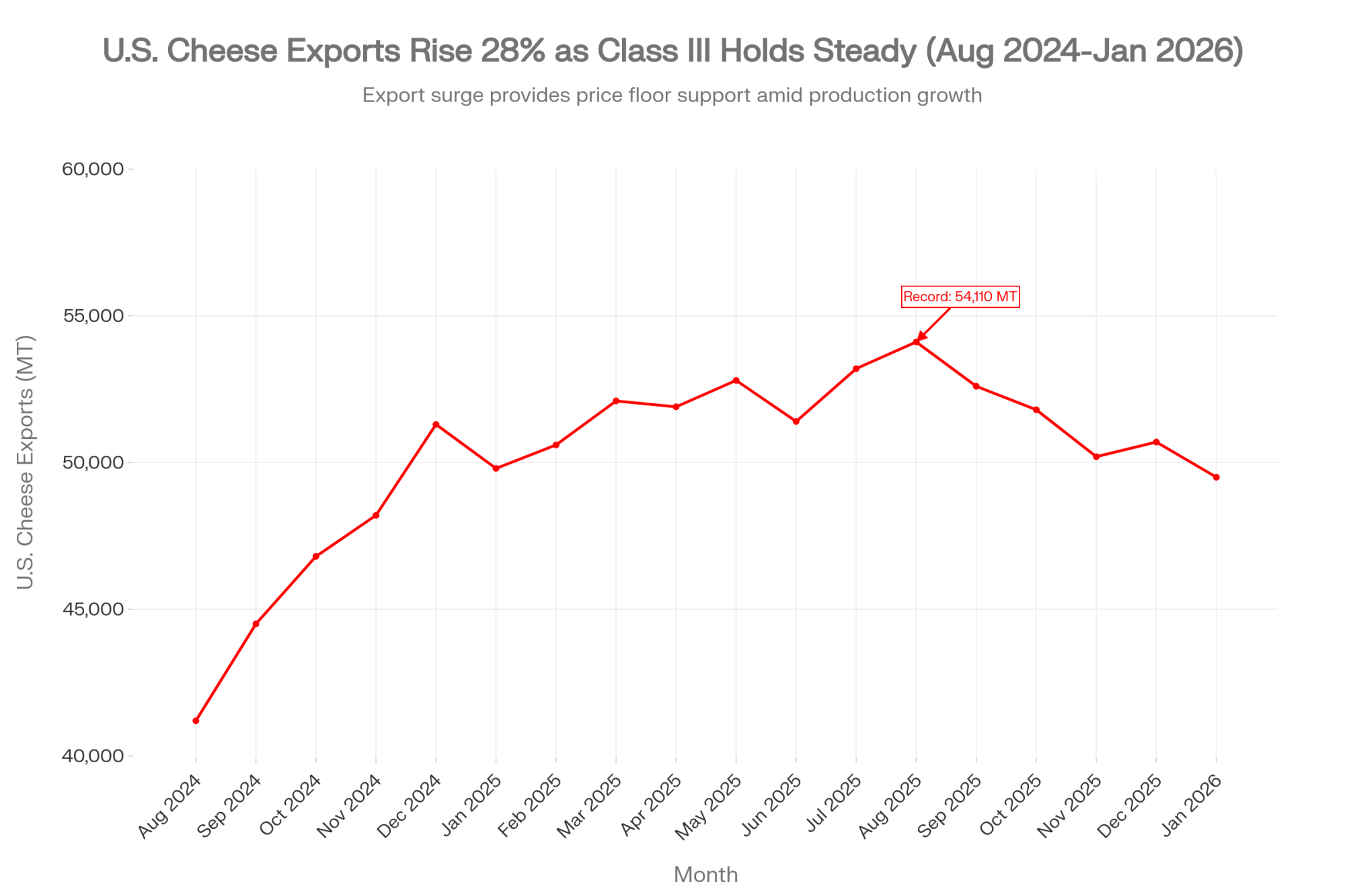
Here’s something that initially puzzled me: September exports were phenomenal—cheese up 28 percent, butterfat exports nearly tripled according to the USDA.

Yet farm-level milk prices remain depressed. How does that math work?

The answer reveals an uncomfortable truth about global competitiveness. CME cheese at $1.56 per pound versus European cheese at approximately $1.90 (converted from euros) gives us an 18 percent price advantage.

We’re competitive precisely because our prices have fallen.

After processing and logistics, that $1.56 cheese price translates to farm-level milk values around $12.40 per hundredweight. That’s below breakeven for most operations.

So yes, exports are strong, but they’re preventing collapse, not driving recovery.

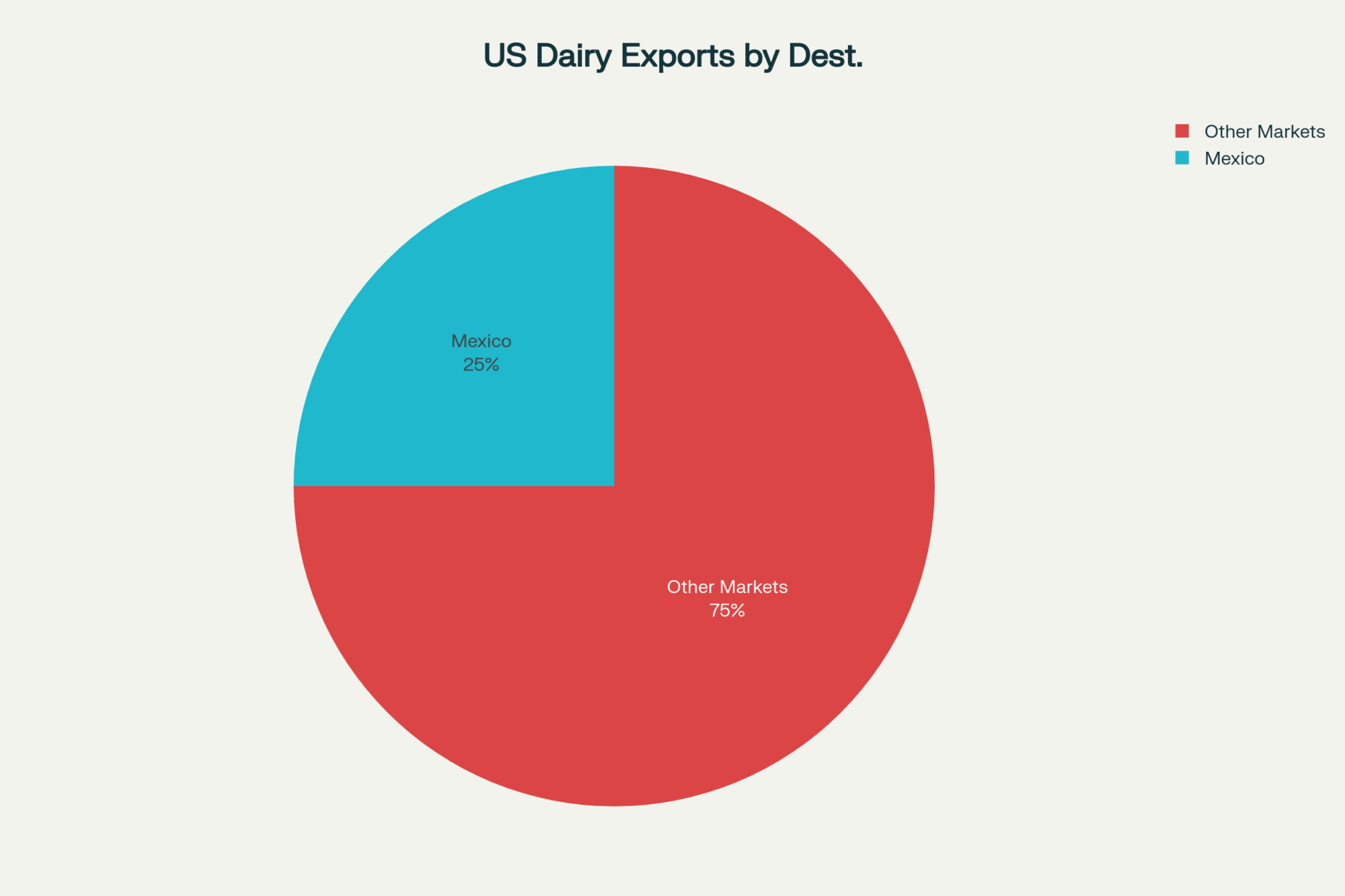
Mexico accounts for about 30 percent of our exports, according to the U.S. Dairy Export Council. But Rabobank’s November analysis flags something concerning: Mexico is actively building domestic production capacity with government support.

If they reduce imports by even 20 percent, that would be a significant demand shock.

Risk Scenarios: What Could Change Everything

While I’ve focused on current trends continuing, it’s worth considering what could dramatically shift the market:

Disease outbreak: An H5N1 resurgence affecting 5-10 percent of the national herd would immediately tighten supply and drive prices higher. Nobody wants this scenario, but it remains a possibility.

Weather extremes: A severe drought across the Midwest in summer 2026 could quickly reduce production by 3-4 percent. Combined with current tight heifer supplies, this could push milk prices back above $20.

Trade disruptions: New tariffs or trade agreements could fundamentally alter export dynamics. A comprehensive trade deal with Southeast Asian nations could open significant new demand.

Processing consolidation: If one or two major processors face financial stress and close facilities, regional oversupply could quickly become undersupply.

These aren’t predictions—they’re reminders that dairy markets can shift rapidly when unexpected events occur.

Practical Strategies for Navigating Current Conditions

Based on conversations with producers successfully adapting to current conditions, several strategies deserve consideration:

Margin-Based Management

Evaluating individual cow contributions monthly provides objective retention criteria. Several producers mentioned using $40 monthly contribution as their threshold, though your specific number will depend on your cost structure.

Component Optimization

With butterfat premiums at $0.50-1.50/cwt above base (varying by cooperative), optimizing for components rather than volume can improve margins. This might mean accepting lower production for higher component percentages.

Geographic Assessment

Honestly evaluating your regional competitive position matters more than ever. If you’re in a structurally disadvantaged region, consider whether repositioning—through relocation, market channel changes, or value-added production—makes sense.

Risk Management Tools

Forward pricing isn’t about predicting markets; it’s about creating certainty. Several producers described securing 50-70 percent of future production at known prices, allowing them to plan with confidence.

Collaborative Approaches

Producer cooperation—whether through joint marketing, shared resources, or collective bargaining with processors—is gaining traction as a strategy for improving positioning.

Looking Ahead: Key Indicators to Watch

The November and December production reports will reveal whether October’s 6,000-head reduction was an isolated adjustment or the beginning of something bigger.

Here’s what I’ll be watching:

Herd trajectory: Another 5,000+ reduction would signal systematic adjustment. Stabilization suggests October was an anomaly.

Per-cow production: Changes exceeding seasonal norms could indicate compositional shifts in the national herd—are we keeping the best and culling the rest?

Regional divergence: Continued growth in Texas/Idaho, while other regions contract, would confirm geographic consolidation.

Component trends: Rising butterfat with declining volume would indicate a strategic focus on quality over quantity.

The Bottom Line: Adaptation, Not Capitulation

October’s 6,000-head culling amid production growth tells us something important: the industry is beginning to self-correct, with individual producers making rational decisions based on economic reality rather than expansion momentum.

This isn’t about doom and gloom—it’s about adaptation. The operations that recognize current conditions as a new reality rather than a temporary disruption are positioning themselves for long-term success.

They’re not waiting for $22 milk to return; they’re building businesses that work at $17-19.

What’s becoming clear from my conversations across the industry is that successful navigation requires three things: an honest assessment of your specific situation, a willingness to challenge traditional approaches, and the courage to make difficult decisions based on data rather than hope.

The dairy industry has weathered massive transitions before—the shift from small diversified farms to specialized operations, the technology revolution, and multiple trade upheavals. Each time, those who adapted thrived while those who resisted struggled.

Current conditions represent another such transition. How individual operations choose to respond will determine not just their immediate survival but their long-term positioning in whatever structure emerges.

As we await the next production reports, remember that behind every data point are real farming families making real decisions about their futures. The 6,000-head reduction isn’t just a statistic—it represents thousands of individual choices, each reflecting unique circumstances and strategic calculations.

The market is speaking. The question isn’t whether to listen, but how to respond thoughtfully and strategically to what it’s telling us.

Resources for Further Information:

  • USDA Milk Production Reports: www.nass.usda.gov
  • University Extension Dairy Programs: Contact your state extension service
  • Federal Milk Marketing Order Administrators: www.ams.usda.gov/about-ams/programs-offices/federal-milk-marketing-orders
  • Risk Management Tools: Contact your milk cooperative or CME Group Agriculture
  • Dr. Andrew Novakovic’s market analysis: Charles H. Dyson School of Applied Economics, Cornell University
  • Component Premium Information: Contact your regional cooperative

Key Takeaways: 

  • The October Calculation: Keeping a marginal cow means refusing $1,950 cash today to lose $45/month tomorrow—that’s why 6,000 left the herd despite record milk production
  • The 2027 Reality: With heifers at $4,200 and inventory at 45-year lows, the industry is locked into current size until 2027, regardless of price recovery
  • Location Determines Survival: Processing investments have created permanent $1.50/cwt regional pricing advantages that no amount of good management can overcome
  • Three Paths Forward: Optimize for components (butterfat premiums worth $0.50-1.50/cwt), lock in 50-70% of production at $17-19, or relocate to advantaged regions
  • Bottom Line: October proved the market has fundamentally shifted—build a business that works at $17-19 milk or become a statistic

Complete references and supporting documentation are available upon request by contacting the editorial team at editor@thebullvine.com.

Learn More:

Join the Revolution!

Join over 30,000 successful dairy professionals who rely on Bullvine Weekly for their competitive edge. Delivered directly to your inbox each week, our exclusive industry insights help you make smarter decisions while saving precious hours every week. Never miss critical updates on milk production trends, breakthrough technologies, and profit-boosting strategies that top producers are already implementing. Subscribe now to transform your dairy operation’s efficiency and profitability—your future success is just one click away.

NewsSubscribe
First
Last
Consent

Boot Biosecurity’s 2,795% ROI: The $820 Investment Beating $250,000 Robots

One infected visitor can cost you $128,250 (H5N1). Boot stations cost $820. Every major dairy that installed them reports zero outbreaks since. Facts.

Executive Summary: Boot wash stations deliver the dairy industry’s best-kept secret: 2,795% ROI for just $820, preventing $96,000+ in disease losses that Penn State, Michigan State, and UC-Davis have meticulously documented. While farms invest $250,000 in robots returning 30% over a decade, bacteria on contaminated boots survive 24 hours, travel 400 feet, and devastate herds—yet three simple steps (scrape, wash, disinfect) stop them cold. Wisconsin producers with stations report 60% fewer calf deaths and haven’t had major outbreaks in 18+ months. The math is embarrassingly clear: two-month payback versus eight years for that robot. Yet most dairies still lack this basic protection, choosing complex technology over proven prevention. The question isn’t whether boot stations work—it’s why you don’t already have them.

Dairy Biosecurity ROI

You know how it is at industry meetings—everyone’s talking about the latest technology. Last month at the Wisconsin Dairy Expo, I got into this fascinating conversation with a group of producers comparing notes on recent investments. Robotic milkers, automated calf feeders, precision nutrition systems… the usual suspects. Then someone mentioned they’d just put in boot wash stations, and honestly, the whole conversation shifted.

What’s interesting is how this matches a pattern I’ve been noticing across the industry. Here we are, investing heavily in automation—which makes sense, don’t get me wrong—but some of the best returns are coming from the simplest investments. And when I started digging into the numbers… well, they surprised even me.

“The payback for preventing just one Salmonella outbreak? About two months.”

The math is embarrassingly clear: a $2,460 investment in three boot wash stations delivers up to 2,795% ROI over five years—that’s 93 times better returns than a quarter-million-dollar robot. While the industry obsesses over six-figure automation, the highest-return biosecurity investment costs less than a bred heifer.

The Investment Gap Nobody Talks About

So here’s what got me thinking. I’ve been looking at disease prevention data from Penn State Extension, Michigan State’s veterinary economics team, and the Canadian Dairy Network. When you compare the cost of a single boot wash station—about $820 installed—against the disease losses it prevents, the returns are extraordinary. Scale that up to three stations for comprehensive coverage at $2,460, and you’re looking at returns between 719% and 2,795% over five years. Meanwhile, that quarter-million-dollar robot we all admire? Generally delivers returns of 20-30% over a decade.

Disease NameAnnual Cost Per Farm ($)Boot Station Cost ($)ROI Multiple (X times)
Salmonella D.$13,860$82017x
Cryptosporid.$9,214$82011x
Johne’s Dis.$18,000$82022x
Digital Derm.$20,000$82024x
H5N1 (Single)$128,250$820156x

Now, that raises an obvious question, doesn’t it? Why are we hesitating on something this profitable?

During my farm visits this season, I’ve been asking producers about their biosecurity priorities, and the responses have been… enlightening. You know, UC-Davis researchers—Pires and his team published this fascinating work in the Journal of Dairy Science—showed that bacteria in manure can survive on boot surfaces for up to 24 hours. They tracked pathogen movement nearly 400 feet across plastic surfaces. About 150 feet on concrete.

Just think about that for a minute. Your hoof trimmer shows up at dawn, and he was at another farm yesterday. Your nutritionist stops by after visiting three other dairies this morning. The milk hauler who’s been in every parlor in the region… Each one represents a potential disease introduction, yet we rarely think about it the same way we analyze, say, feed efficiency or genetic improvements.

What Disease Actually Costs

Let me share what the extension services and university research teams have documented—and these aren’t worst-case scenarios, they’re documented averages for a typical 450-cow operation.

Quick Disease Cost Reality Check:

DiseaseAnnual CostPreventable?
Salmonella Dublin$13,860/outbreakYes, via boot hygiene
Cryptosporidium$9,214/yearYes, major route
Johne’s Disease$18,000/yearYes, if kept out
Digital Dermatitis$15,000-25,000Yes, trimmer transmission
H5N1$128,250+Yes, documented boot spread

Penn State Extension’s 2024 analysis shows a Salmonella Dublin outbreak runs about $13,860 in direct losses. Michigan State’s research puts the cost of endemic cryptosporidium at $9,214 annually. The Canadian Dairy Network documents $18,000 yearly for Johne ‘s-infected herds—with no cure available.

Compare that to boot station costs: $820 for your highest-risk entry point, or $2,460 for three-station comprehensive coverage, plus about $1,850 annually for disinfectant and maintenance. The payback for preventing just one Salmonella outbreak? About two months.

Why Calves Are Ground Zero

Dr. Jennifer Bentley at Wisconsin’s vet school has this way of putting it that really resonates: “Calves under 30 days represent your operation’s highest disease risk, period.”

The vulnerability facts are sobering:

  • Newborn calves operate at 20-50% of adult immune capacity
  • Maternal antibodies are half depleted by day 28 (Cornell QMPS data)
  • Enhanced biosecurity reduces calf mortality from 5.9% to under 4% (Estonian research, 118 herds)
  • External biosecurity ranks in the top five factors affecting calf survival

I keep hearing the same thing from California producers: excellent genetics, premium milk replacer, perfect ventilation—none of it matters if someone tracks crypto into your calf barn on dirty boots.

The Three-Step Process That Actually Works

Purdue researchers proved what most farms ignore: stepping through disinfectant with manure-caked boots provides zero protection, regardless of how expensive that disinfectant is. The three-step sequence—scrape, wash, disinfect—is the ONLY protocol that works. Skip one step and you’re operating on faith, not science.

Here’s something Purdue University’s research revealed that really challenges our assumptions: disinfectant type becomes completely irrelevant if you don’t remove organic matter first. They proved definitively that stepping through even the most expensive disinfectant with manure-caked boots provides zero effective pathogen control.

The only sequence that works:

  1. Mechanical scraping – Remove visible contamination
  2. Washing with brushes and water – Eliminate residual material
  3. Chemical disinfection – Only effective on clean boots

Skip any step and you’re operating on faith rather than science.

Strategic Placement: The 13-Fold Compliance Difference

Here’s what kills biosecurity programs: putting boot stations where workers can avoid them. Canadian researchers used RFID tracking to prove optimal placement delivers 90% compliance versus 7% for poor placement—a 13-fold difference that has nothing to do with training and everything to do with physics. Stop fighting human nature and start using it.

Canadian RFID monitoring research (Frontiers in Veterinary Science) documented something remarkable. Placement impacts compliance by a factor of thirteen. A well-positioned station gets 90% usage. A poorly placed one? Seven percent.

Optimal placement priorities:

  • Calf barn entrances – Highest vulnerability point
  • Maternity pen access – Protect those critical first hours
  • Hospital pen entry/exit – Bidirectional protection essential
  • Age group transitions – Prevent adult-to-youngstock transmission

Your Implementation Roadmap

Based on what’s working for successful producers:

Month 1: Start With One Station ($820)

  • Install at your highest-risk location (typically calf barn)
  • Establish protocols and culture
  • Track baseline health metrics

Months 2-3: Build Momentum

  • Add maternity pen coverage
  • Implement visitor protocols (boot covers: $0.50 each)
  • Train on the critical three-step process

Months 4-6: Complete Coverage ($2,460 total)

  • Install hospital pen stations
  • Integrate with broader biosecurity
  • Establish maintenance responsibilities

The Technology Partnership

What’s particularly encouraging is seeing operations recognize that technology and biosecurity aren’t competing investments—they’re synergistic.

Take automated calf feeders. Great technology. But I’ve seen operations where one infected calf deposits crypto on shared nipples, efficiently delivering pathogens to everyone. Compare that to Wisconsin operations using identical feeders but with boot hygiene preventing crypto introduction. The technology performs as designed because the disease isn’t undermining it.

This pattern repeats everywhere:

  • Robotic milkers achieve potential when herds stay mastitis-free
  • Activity monitors catch problems that escape good biosecurity
  • Genetic programs deliver when calves survive to production

Common Implementation Challenges

Winter Operations:

  • Install stations inside doorways when possible
  • Use heated water lines or warm water buckets
  • Switch to cold-weather disinfectants (Virkon S works near freezing)
  • Have a plan before temperatures drop

Low Compliance After Installation:

  • Check placement first—is it in the natural flow of traffic?
  • Examine time allocation—are employees too rushed?
  • Address root causes, not symptoms

The Bottom Line Investment Analysis

InvestmentCost5-Year ROIPayback
One Boot Station$820400-1,500%2-3 months
Three Stations$2,460719-2,795%1.5-2.1 months
Robotic Milker$250,00020-30%6-8 years
Auto Calf Feeder$180,00015-25%5-7 years

The math clearly supports boot station investment, yet adoption remains inconsistent. A Wisconsin producer captured it perfectly: “We’ll invest $5,000 in feed additives, hoping for 2% production increases while hesitating over $820 boot stations that prevent thousands in losses.”

Wisconsin farms stopped theorizing and started measuring. Within 90 days of installing $2,460 worth of boot stations: 60% fewer dead calves, zero major outbreaks for 18+ months, and $96,000+ in prevented disease losses. That’s a 1.8-month payback period. Now tell me again why you’re hesitating on this investment.

Your Next Steps

The path forward is straightforward. Start with one boot wash station at your most vulnerable location—probably the calf barn entrance. Just $820 to protect your highest-risk animals. Implement the three-step cleaning protocol. Document your health metrics for three months.

Based on what I’m seeing from producers who’ve taken this step, you’ll likely find yourself planning stations 2 and 3 before month 4. The economics are that compelling, the results that consistent.

This isn’t about choosing between technology and biosecurity. It’s about recognizing that your sophisticated systems perform best when built on a solid foundation of disease prevention. And in an industry facing mounting disease pressure and tightening margins, that foundation—starting at just $820—might be the most important investment you make this year.

Your banker will appreciate the economics. Your employees will appreciate healthier animals. And those expensive automated systems? They’ll finally deliver what you paid for.

The choice, as always, is yours. But the math—and the growing number of success stories—suggest this is one investment decision that’s actually pretty straightforward.

The industry’s dirty secret exposed in one chart: you’ll wait eight years for that quarter-million-dollar robot to break even, but an $820 boot station pays for itself in two months—the time it takes to prevent a single Salmonella outbreak. That’s a 48x faster return on capital, yet we keep choosing complexity over cash flow.

Key Takeaways: 

  • The Math Nobody Can Argue With: $820 boot station = 2,795% ROI in 5 years. $250,000 robot = 30% ROI in 10 years. Stop choosing the wrong one.
  • The Only Process That Works: Disinfectant without scraping = zero protection. You MUST do all three: scrape → wash → disinfect. Skip one step and you’re playing pretend biosecurity.
  • The 13X Compliance Secret: Put stations IN doorways where people can’t avoid them (90% usage), not around corners where they will (7% usage). Physics beats willpower every time.
  • What Success Actually Looks Like: 60% fewer dead calves in 3 months. 18+ months without major outbreaks. $96,000+ in prevented losses. Wisconsin farms proved it—now it’s your turn.
  • Your Monday Morning Action: Order one $820 station for your calf barn entrance. Install it this week. Track calf health for 90 days. Watch what happens.

Complete references and supporting documentation are available upon request by contacting the editorial team at editor@thebullvine.com.

Learn More:

Join the Revolution!

Join over 30,000 successful dairy professionals who rely on Bullvine Weekly for their competitive edge. Delivered directly to your inbox each week, our exclusive industry insights help you make smarter decisions while saving precious hours every week. Never miss critical updates on milk production trends, breakthrough technologies, and profit-boosting strategies that top producers are already implementing. Subscribe now to transform your dairy operation’s efficiency and profitability—your future success is just one click away.

NewsSubscribe
First
Last
Consent

Pick Your Lane or Perish: The 18-Month Ultimatum Facing 800-1,500 Cow Dairies

October’s $2.47 Class spread proved it: mid-size dairies must choose between commodity and premium now. The middle is gone.

Executive Summary: October 2025’s market data delivered a death sentence to fence-sitters: mid-size dairies (800-1,500 cows) must choose between commodity and premium pricing within 18 months, or risk ceasing to exist. The Class III-IV spread now penalizes operations that haven’t optimized for either protein or butterfat, while global markets are permanently split between simple ingredients (winning) and value-added products (losing). Small farms with fewer than 500 cows survive through premium specialization, while operations with more than 3,000 cows thrive on commodity efficiency. But the middle ground—profitable for three generations—is gone forever. Irish farmers are betting their futures on 2027’s regulatory consolidation. Chinese buyers are only interested in specialty proteins, and industrial customers will pay premiums for consistency over brand. You have 18-24 months to pick your lane: scale up, specialize, or sell out.

Dairy Strategic Planning

Here’s the thing that’s been keeping me up at night—and probably you, too, if you’re running 800 to 1,500 cows. The dairy market’s doing something we haven’t seen before. There’s this growing gap between New Zealand and European dairy prices that should close through normal trading, but it just… won’t. The October GDT auctions show Western European whole milk powder trading at significant premiums compared to New Zealand product for near-term contracts. This structural gap, seen across multiple products, confirms that the market bifurcation is deepening.

But you know what’s really caught my attention?

The gap isn’t just global anymore—it’s right here in our milk checks. October CME data shows a widening spread between Class III and Class IV futures that’s crushing operations heavy on butterfat. With butter prices facing significant pressure while cheese prices hold relatively steady, the Class IV value is reaching levels we haven’t seen in years. This component value crisis is the clearest signal yet that the old rules are broken.

The $2.47 Spread That’s Killing the Middle: October’s Class III/IV gap represents the widest since 2011, costing Jersey operations $180K annually

What farmers are finding is that the comfortable middle ground—where most of us have operated successfully for decades—is vanishing faster than morning fog in July. And if you’re still making decisions based on what worked even two years ago, well, we need to talk.

The Value Paradox Nobody Saw Coming

Operation TypeButterfat %Protein %Class PrefRevenue Impact ($/cwt)Annual Impact (1000 cows)
BF-Focused (Jersey-Heavy)4.8%3.6%Class IV−$2.47−$180k
Protein-Focused (Holstein)3.6%3.2%Class III$0.00$0
Balanced Components (Holstein)4.1%3.4%Mixed−$1.20−$87k

Looking at September 2025 market reports from the EU Milk Market Observatory, something curious jumps out. European butter—you know, the premium stuff that’s supposed to command top dollar—has been taking a beating. Meanwhile, AMF (anhydrous milk fat), which is essentially melted and clarified butter, appears to be holding up better. Recent Global Dairy Trade data suggests AMF is actually outperforming butter in percentage terms. The simple, non-branded ingredient is holding value better than its consumer-facing counterpart. This is the Value Paradox playing out in real-time, right down to the component level.

Now, why would the simple product outperform the sophisticated one?

I was talking with a Wisconsin dairy producer last week who runs a larger operation in the central part of the state. He’d invested heavily in specialty cheese equipment a few years back, thinking he’d capture those artisan premiums. “Know what’s paying the bills now?” he asked me. “Straight cream to the bakery suppliers. No fancy packaging, no marketing story, just consistent butterfat at 40% minimum.”

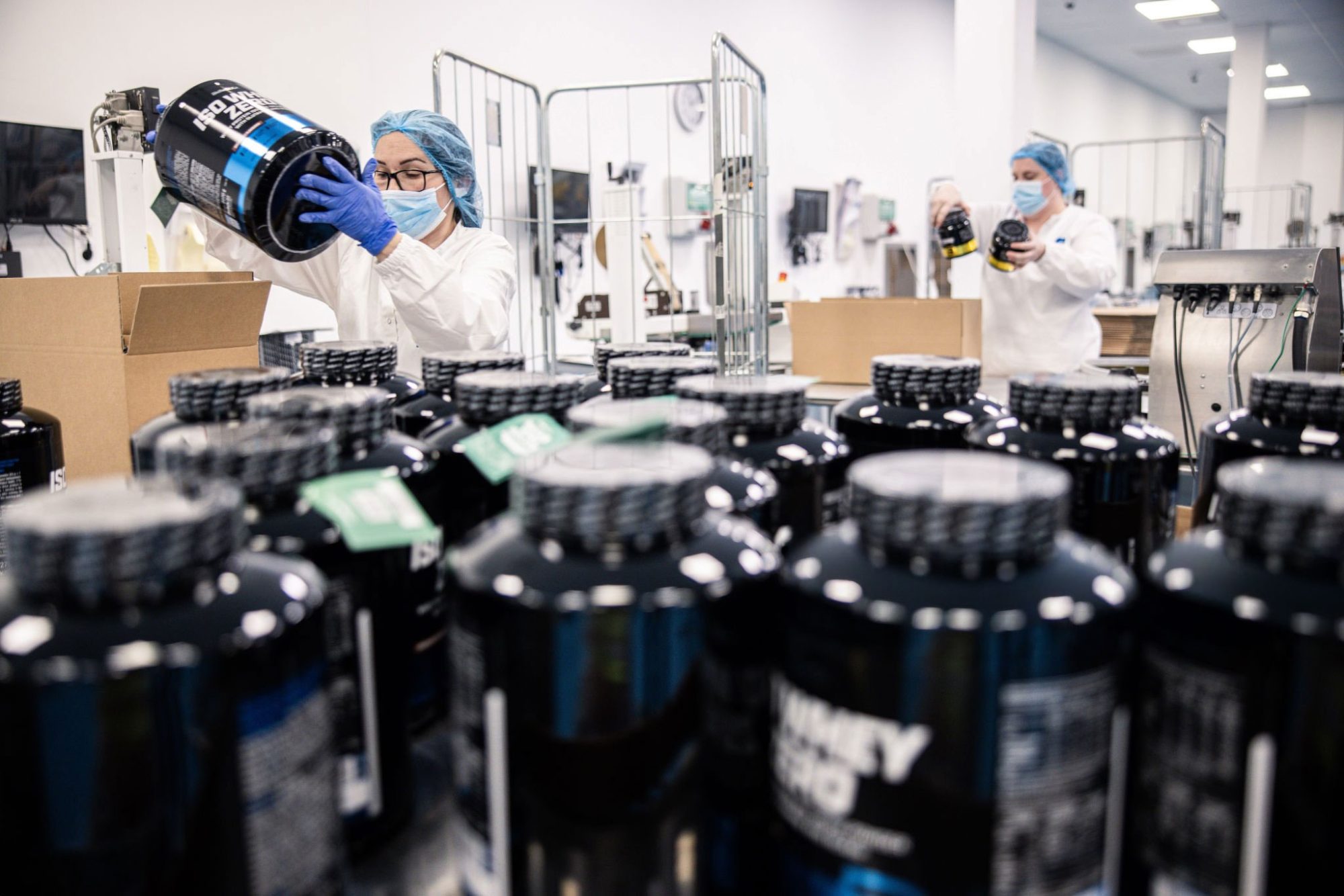
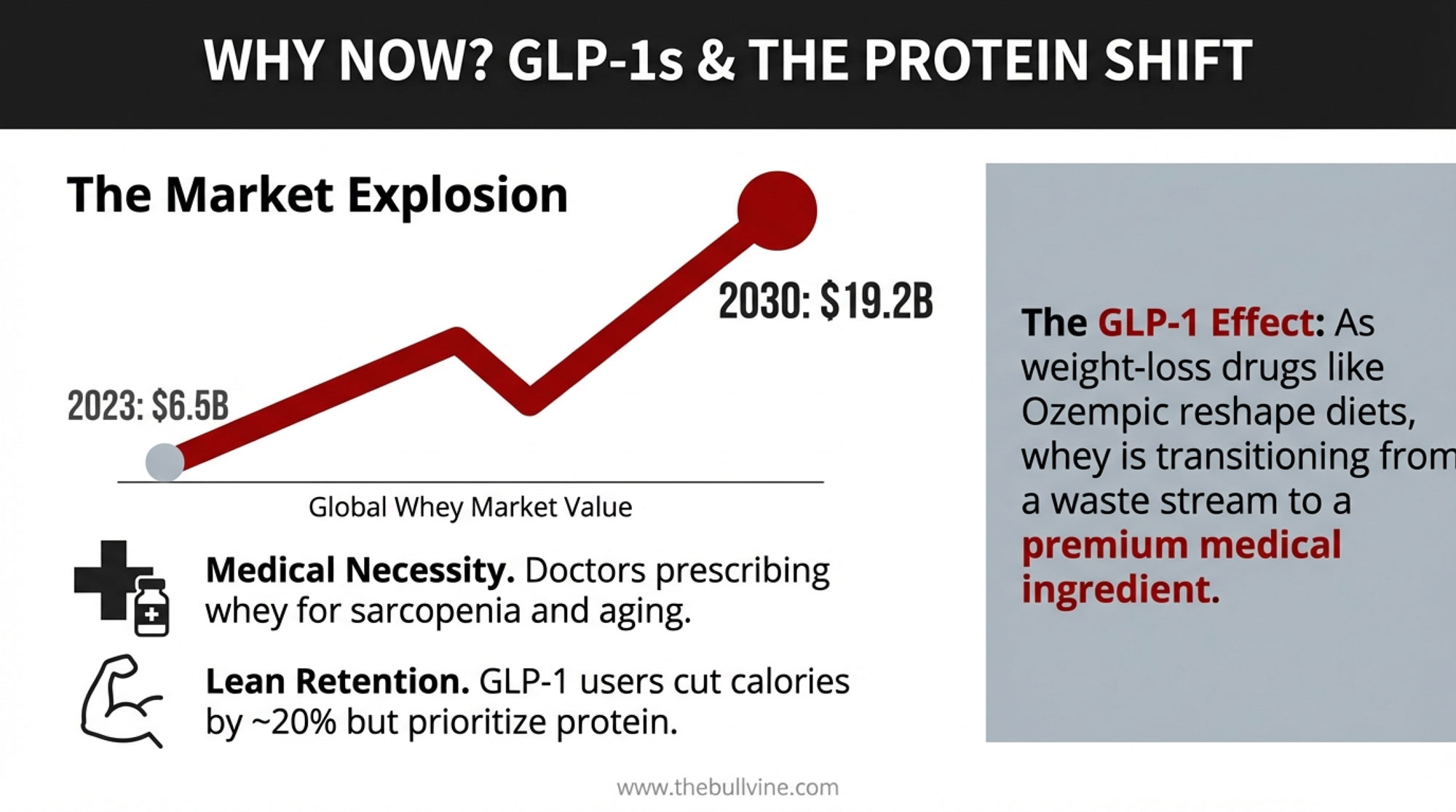
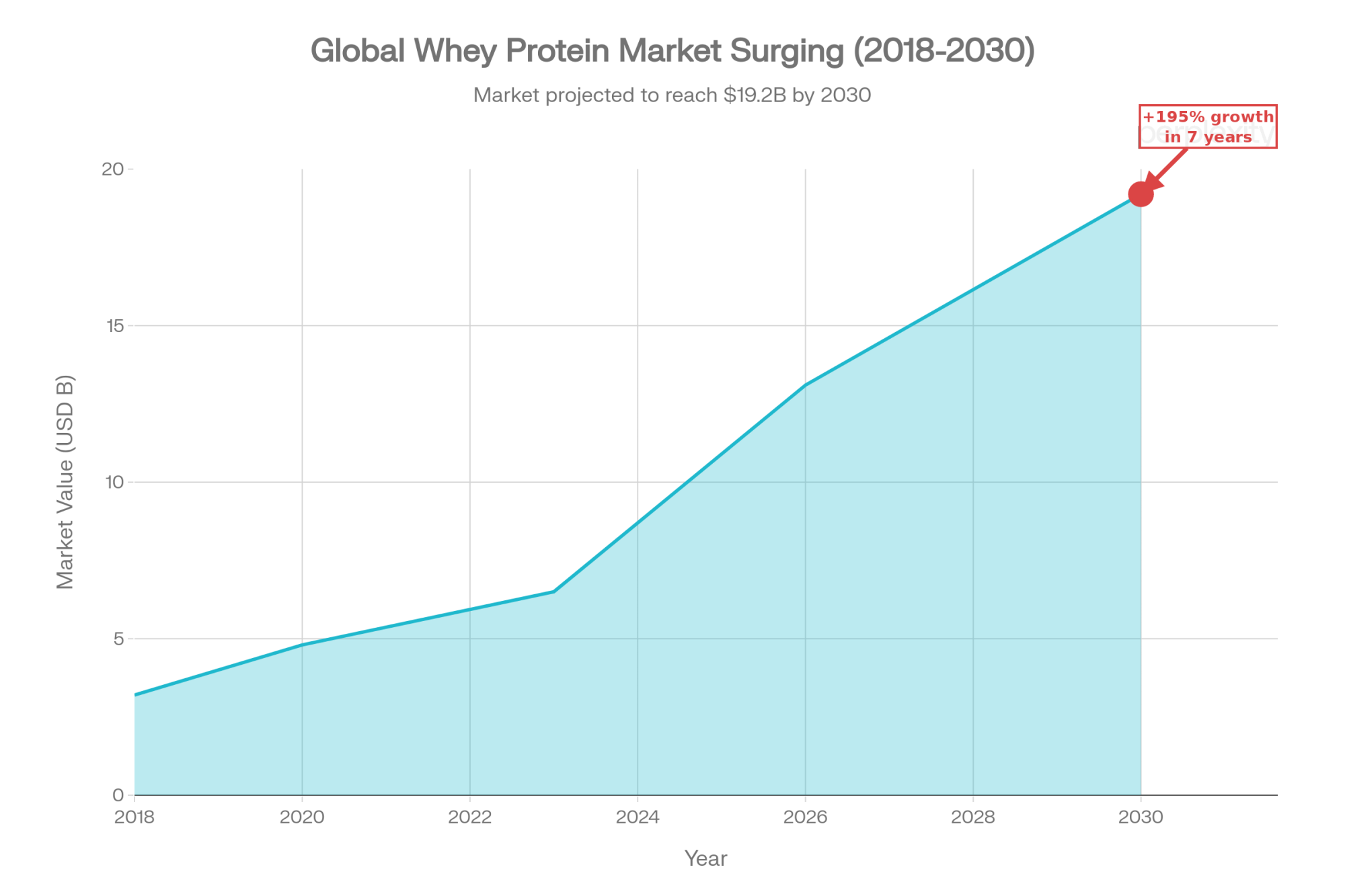
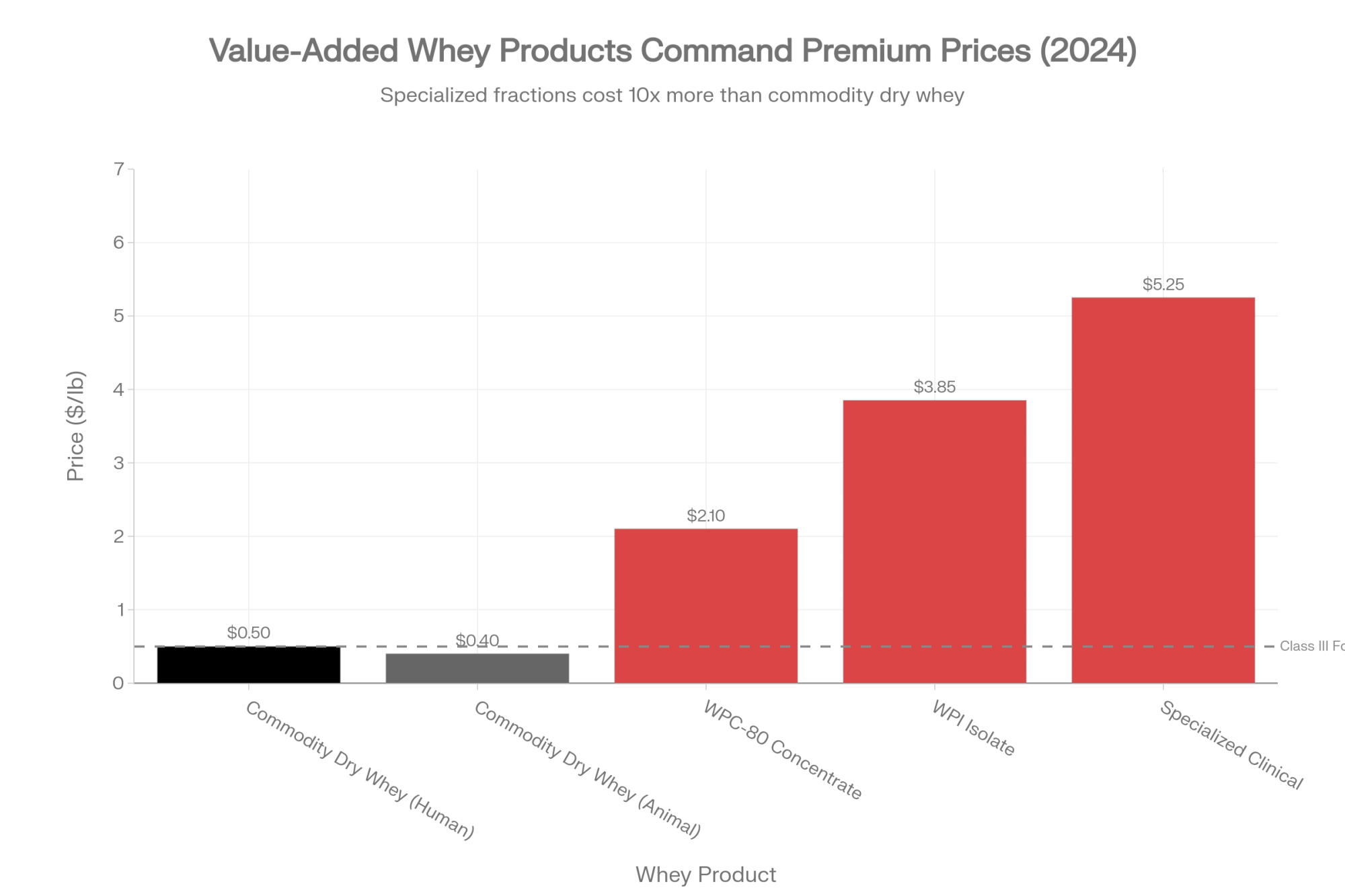
Here’s the surprising part—whey powder, the stuff we literally paid to get rid of twenty years ago, now commands respectable prices in the protein market. Yet those beautiful aged cheddars that take skill, time, and capital to produce? They’re facing intense price pressure from all sides.

What’s encouraging, though, is that this shift creates opportunities for those who recognize it early. It’s making me rethink everything we thought we knew about value creation in the dairy industry.

Why Irish Farmers Are Expanding into a Glut

The production numbers coming out of Ireland lately seem counterintuitive. Recent data from their Central Statistics Office shows milk output climbing steadily through the summer months. Belgium’s showing similar patterns according to their agricultural statistics. All this while European butter inventories are already substantial. Industry reports from late summer suggest oversupply conditions in the European market, with stockpiles building to levels not seen since the intervention buying days.

You’d think these folks have lost their minds. But there’s a method to this apparent madness.

Ireland’s nitrate derogation—the rule that allows them to run higher stocking rates than standard EU regulations permit—expires at the end of this year. When that happens, industry observers from Teagasc estimate that significant production capacity could disappear. Some projections suggest up to 20% of current output might be affected. Belgium faces similar pressures from the EU’s Farm to Fork strategy, though their timeline stretches out a bit further.

So these farmers are expanding now? They’re not playing for today’s prices. They’re positioning for 2027 and beyond, when half their neighbors might be out of business.

A dairy farmer I met at a conference last spring—runs a mid-size operation in County Cork—put it this way: “We’re not thinking about next year’s milk check. We’re thinking about who’s still standing in five years and what market share they’ll control.”

It’s a high-stakes bet on regulatory-driven consolidation. Risky? Absolutely. But, when you understand the regulatory chess game being played, it starts to make strategic sense.

The Chinese Market That Defies Logic

This is where things get genuinely puzzling, especially if you’re used to thinking about dairy as a straightforward commodity.

Recent reports from China’s agricultural authorities indicate that domestic farmgate prices remain under pressure, generally declining year over year, depending on the province. They have adequate production capacity, according to their own data. Traditional economics suggests that imports should be declining.

Instead? Recent customs data suggests import volumes are holding steady or even growing for certain categories. The unexpected piece is the shift in what they’re buying. While whole milk powder imports have moderated, specialty ingredients, such as whey products, appear to be growing. This shift from buying bulk commodities to high-value protein ingredients reinforces the idea that their purchasing is becoming highly selective, focused on functional and premium status, not basic commodity volume.

What’s happening here—and this pattern is also showing up in India, Vietnam, and Indonesia, according to recent observations from the USDA Foreign Agricultural Service—is that consumers in these markets don’t view domestic and imported dairy as the same thing. It’s no longer about measurable quality differences. We’re talking about perception, trust, and increasingly, social status.

An industry contact who works with Asian markets explained it to me this way: “Customers there aren’t comparing prices between domestic and imported milk. To them, it’s like comparing a Corolla to a Lexus. Both get you where you’re going, but they serve completely different needs.”

We’re starting to see this same split here in mature markets. Look at what organic commands—often substantial premiums according to USDA Agricultural Marketing Service data, despite conventional milk meeting all the same safety and nutritional standards. Or A2 milk, grass-fed brands, local farm labels. The bifurcation’s happening everywhere.

Industrial Buyers Play a Different Game

What catches my attention in all this market analysis is how differently industrial buyers behave compared to grocery chains.

When Kroger or Walmart needs butter, they typically put it out to bid quarterly and accept the lowest price that meets the specifications. Simple transaction, price drives everything.

But when a commercial bakery needs AMF for their croissant line? Completely different conversation. Their ovens are calibrated for specific melt points. Their recipes assume consistent moisture content—we’re talking plus or minus half a percent. Switching suppliers means reformulation, line testing, and potential product recalls if something’s off.

Industry procurement specialists I’ve talked with say they’ll routinely pay meaningful premiums just for supply security. One mentioned that every supplier switch costs them tens of thousands of dollars in testing and adjustments, sometimes more if the equipment needs recalibration. So yeah, they’ll pay extra for consistency.

This creates real opportunities for producers who can reliably meet industrial specifications. It’s not glamorous work—nobody’s writing magazine articles about your commodity ingredient sales. But, these contracts often offer better margins and more stability than chasing consumer trends.

Hard Lessons from the Big Cooperatives

Want to understand why those regional price advantages everyone talks about aren’t as permanent as they seem? Take a look at what has been happening with major cooperatives over the past eighteen months.

Even the big players—organizations with decades of export experience, established supply chains, unified farmer bases—have been announcing restructuring plans. Cost cutting initiatives. Plant consolidations. Some are even outsourcing core functions they’ve handled internally for generations.

What happened? Simple—they built cost structures around market conditions they assumed were permanent. Those nice premiums they were capturing a couple of years ago? Turned out to be temporary benefits resulting from supply chain disruptions and unusual demand patterns. When global shipping rates normalized and consumption patterns shifted back, the premiums vanished almost overnight.

A board member from a regional cooperative shared this perspective with me recently: “We all got a little too comfortable with those margins. Built our strategic plans around them. What we’re learning—again—is that very few advantages in commodity markets last more than a cycle or two.”

The Reality Check for Different Size Operations

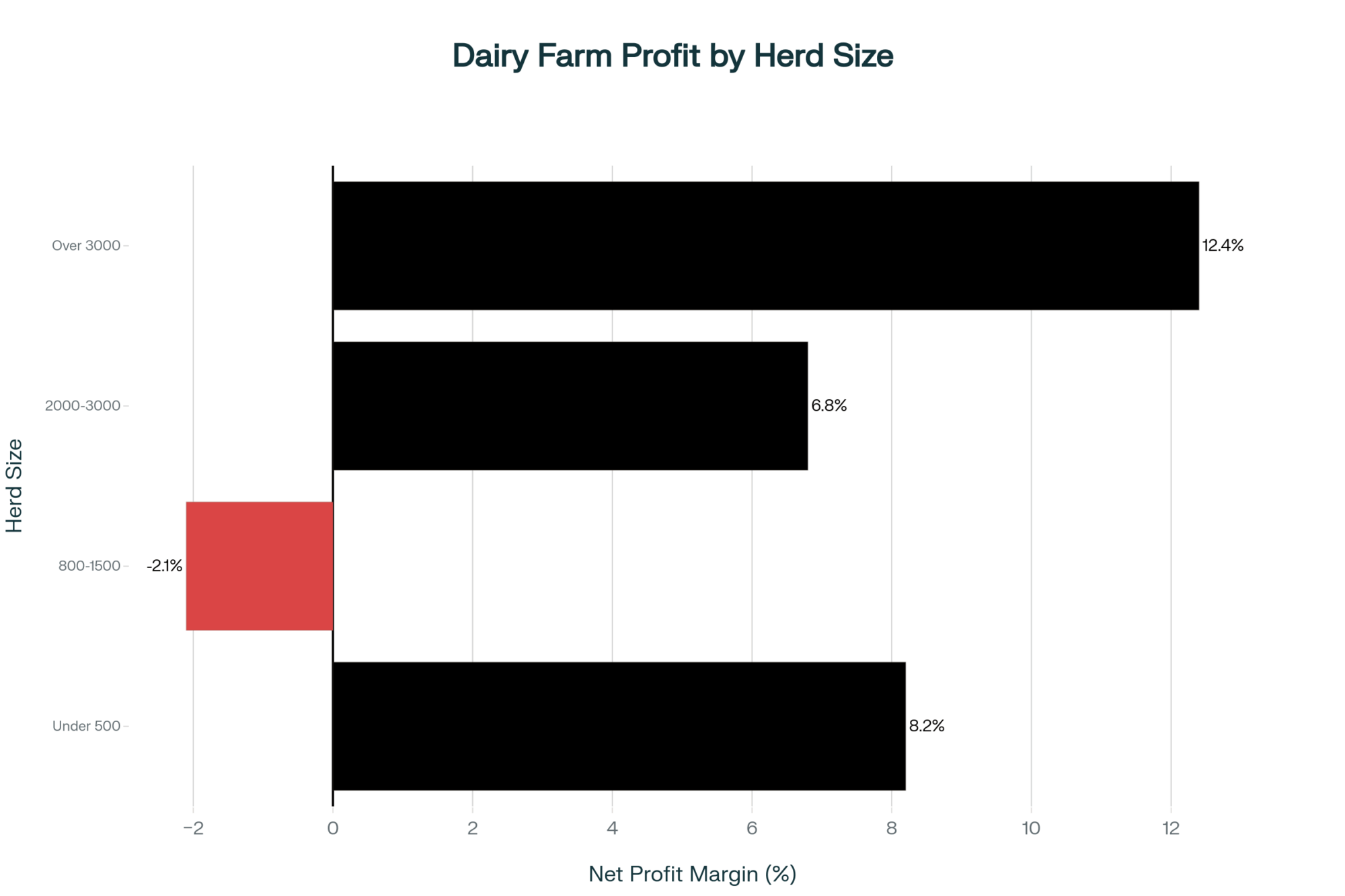
Let me share what recent economic analyses from various land grant universities are telling us about profitability by herd size. The patterns are striking and, frankly, a bit concerning for those of us in the middle.

Smaller operations—let’s say under 500 cows—often achieve higher mailbox prices than the big guys. We’re talking sometimes a dollar fifty to two dollars more per hundredweight through direct marketing, on-farm processing, specialty programs. Sounds great, right?

But here’s the catch—their cost of production typically runs several dollars higher per hundredweight, too, according to extension studies. So that premium price? It’s often not enough to offset the higher costs. Many of these smaller operations are working incredibly hard just to break even.

On the flip side, operations over 3,000 cows generally receive lower prices—maybe fifty cents to a dollar below the smaller farms. But their cost structure? They’re often producing for significantly less per hundredweight than mid-size operations. Volume multiplied by even small margins adds up.

The really tough spot? That 800 to 1,500 cow range. Not big enough to capture serious economies of scale. Not small enough to be nimble with specialty markets. These operations are either expanding aggressively right now or transitioning to some form of differentiated production. Standing still is no longer viable.

The Death Zone Exposed: Mid-size dairies trapped between specialty premiums and commodity efficiency are bleeding money at -2.1% margins

Here’s what I’ve noticed about how different regions are handling this—and it’s telling. In California’s Central Valley, where water rights and environmental regulations create unique pressures, several mid-size operations have formed marketing cooperatives to achieve scale without individual expansion. Northeast producers, located near major population centers, are exploring the benefits of shared processing facilities and distribution networks. Down in Texas and New Mexico, where expansion’s still possible, they’re going big—really big—with new facilities starting at a minimum of 5,000 head. And in the Southeast? They’re dealing with heat stress and hurricane risks that add another layer to these strategic decisions. Each region’s finding its own path through this transition.

Choosing Your Lane (Because You Have To)

After watching hundreds of operations navigate these changes, it’s becoming increasingly clear: you must pick a strategy and commit to it fully. The days of hedging your bets, of being pretty good at everything? Those days are over.

If you’re going the commodity route, several factors become absolutely critical. First, you need scale—probably a minimum of 2,000 cows in the Midwest, based on recent farm management analyses, and more like 3,500 in the West, where you’re competing with those massive operations. Second, you need industrial customers who value consistency over brand. Third, you must accept that you’re selling ingredients, not food, and optimize your approach accordingly.

If you’re choosing the differentiated path, different rules apply. You need a story that resonates—organic certification, grass-fed verification, local processing, something authentic that consumers will pay for. You need direct relationships or processors who value what makes you different. You have to accept higher costs, likely several dollars more per hundredweight, based on various enterprise budgets, in exchange for capturing those premiums.

Are the operations struggling the most? Those trying to do both. I am aware of a Pennsylvania dairy that has installed robots to reduce labor costs, yet it still sells commodity milk. Their debt service alone is crushing them. Another farm in Vermont has built a beautiful processing facility, but cannot achieve enough consistent volume to run it efficiently.

And here’s something worth considering—how does your chosen path affect succession planning? If you’re hoping the next generation takes over, which strategy gives them the best shot at success? The commodity route requires constant reinvestment and scale. The premium path needs marketing savvy and customer relationships. Neither’s wrong, but they require different skills and interests from whoever’s taking the reins.

Practical Decisions for Today’s Reality

So what does this mean for your operation over the next few years?

For smaller dairies with fewer than 500 cows, specialization appears to be the key. Pick something you can be genuinely excellent at. Perhaps it’s organic production, perhaps it’s A2 genetics, or perhaps it’s on-farm bottling with local distribution. But competing head-to-head with large commodity operations? The math rarely works.

For larger operations over 2,000 cows, it’s about operational excellence and simplification. Strip out complexity, focus on one or two products at most, and secure those industrial contracts. The 3,000-cow dairy selling everything to a single cheese plant at predetermined prices might not be exciting, but they’re sleeping well at night.

And if you’re in that challenging middle zone—800 to 1,500 cows? You’re facing the toughest decisions. Based on what extension economists are seeing, you’ve probably got 18-24 months to make a strategic choice. Scale up significantly, find a genuine differentiation strategy, or… well, we all know what the third option looks like.

Here’s what’s worth tracking closely in your own operation:

  • What’s your actual premium above base price? Many folks are surprised by how small it really is
  • What percentage of your milk is under contract versus sold on the spot market? Aim for at least 70% contracted
  • Where do your costs rank compared to others in your region? You need to be in the better half
  • Could your operation survive a 15% price drop for six months? If not, you’re probably over-leveraged for this environment
  • Are you optimized for protein or fat? Recent market shifts show component strategy is no longer optional—it’s essential for survival

Examining government programs reveals some resources worth exploring. USDA’s Value-Added Producer Grants can help with the transition to specialty markets. Environmental Quality Incentives Program funding may offset some of the costs of organic transition. State-level programs vary widely—Minnesota, Wisconsin, and Vermont all offer different types of support for dairy operations making strategic transitions.

The Transition Nobody Talks About

What often gets overlooked in these strategic discussions is the cost and complexity of transitioning from one model to another.

Going organic? That’s a three-year transition period during which you’re paying organic feed prices but receiving conventional milk prices. Extension studies suggest that transition costs can run into the hundreds of dollars per cow, plus you need secured market access before you start.

Scaling up to commodity efficiency? We’re talking millions in capital investment for meaningful expansion based on recent construction trends, and that’s if you can find the labor. Speaking of labor—good luck finding qualified people right now. Everyone’s struggling with that.

Even switching to industrial supply contracts requires investment. Those customers want consistency, which might mean new bulk tanks, different cooling systems, and sometimes even road improvements for larger tankers.

The encouraging development I’m seeing is that some regions are finding creative alternatives. In areas where individual expansion faces regulatory hurdles, several mid-sized operations have formed marketing cooperatives to achieve scale without relying on individual growth. Others are exploring shared processing facilities—not perfect, but it spreads the capital risk. Some operations are creating strategic alliances, sharing equipment and expertise while maintaining independent ownership.

Looking Forward

Those pricing gaps we’re seeing between regions and products? They’ll moderate eventually—markets always find some form of equilibrium. But, the fundamental split in our industry—between high-volume commodity production and high-touch premium production—is looking more and more permanent, according to the agricultural economists I’ve spoken with.

Previous generations could successfully run diversified operations. My grandfather milked cows, raised hogs, grew corn and beans, and did pretty well at all of it. My father’s generation was competent across multiple enterprises and made it work.

Today? Today, rewards focus and excellence in a chosen strategy. The market’s sending clear signals through these pricing disparities and structural changes. We can either listen and adapt or ignore them at our peril.

The successful operations ten years from now won’t necessarily be the biggest or the most sophisticated. They’ll be the ones that made clear strategic choices today and committed fully to optimizing within that framework.

The most vulnerable position isn’t being too aggressive or too conservative—it’s being unclear about which game you’re playing. Pick your lane, optimize everything for that choice, and don’t look back.

Because in today’s dairy economy, the middle of the road is becoming the hardest place to survive. That’s where the pressure’s greatest, the margins thinnest, and the future most uncertain.

But, here’s what gives me hope: dairy farmers are among the most resilient and adaptable people I know. We’ve weathered worse storms than this. The ones who recognize these changes early, make tough decisions, and commit to their chosen path? They’ll not just survive—they’ll thrive.

The question isn’t whether the industry will continue; it’s whether it will thrive. It’s whether your operation will be part of its future. And that decision? That’s entirely in your hands.

Key Takeaways:

  • Pick Your Lane in 18 Months or Perish: Operations with 800-1,500 cows must commit fully—scale to 2,000+ for commodity efficiency, specialize for premium capture, or exit. Half-measures guarantee failure.
  • Simple Ingredients Trump Value-Added: AMF beats butter, whey beats aged cheese, and industrial contracts beat consumer brands. October’s market proves processors pay premiums for consistency, not stories.
  • The Middle Is a Kill Zone: Farms under 500 cows thrive on specialization ($1.50-2.00/cwt premiums), operations over 3,000 profit on scale. But 800-1,500? Neither advantage = both disadvantages.
  • Component Strategy Is Survival: The Class III-IV spread isn’t temporary—it’s structural. Optimize for protein OR fat, not both. Your bulk tank average means nothing if components are wrong.

Complete references and supporting documentation are available upon request by contacting the editorial team at editor@thebullvine.com.

Learn More:

Join the Revolution!

Join over 30,000 successful dairy professionals who rely on Bullvine Weekly for their competitive edge. Delivered directly to your inbox each week, our exclusive industry insights help you make smarter decisions while saving precious hours every week. Never miss critical updates on milk production trends, breakthrough technologies, and profit-boosting strategies that top producers are already implementing. Subscribe now to transform your dairy operation’s efficiency and profitability—your future success is just one click away.

NewsSubscribe
First
Last
Consent

42% Heritability: The Milking Speed Breakthrough That Fixes Your Labor Problem

What farmers are discovering: selecting for speed actually reduces labor costs $10-16K annually

EXECUTIVE SUMMARY: What farmers are discovering about CDCB’s new Milking Speed evaluation is reshaping our understanding of genetic selection and parlor efficiency. With 42% heritability—compared to just 7% for daughter pregnancy rate—MSPD offers predictable genetic progress for a trait that impacts operations twice daily, 365 days a year. Holstein bulls currently range from 6.2 to 8.1 pounds per minute in the August 2025 evaluations, meaning the spread between your fastest and slowest genetics could be costing you an hour or more of labor daily. Research from the University of Minnesota confirms that strategic selection within the 7.0-8.0 lbs/min range balances efficiency gains with udder health, while extension specialists from Wisconsin to California emphasize the importance of adjusting parlor settings as genetics improve. Looking ahead, operations implementing MSPD selection can now expect gradual but meaningful improvements. Many producers report saving 10-15 minutes per milking by year three, with full benefits emerging around year seven as herd genetics turn over. The collaborative learning happening as producers share experiences with this trait represents exactly how our industry gets stronger together. For operations facing persistent labor challenges or inconsistent milking times, MSPD warrants serious consideration as part of a comprehensive breeding strategy.

 Milking speed genetics

Every morning at 4:30, the same scene plays out in parlors from California to Vermont. Some cows are finished, waiting to exit, while others seem to take forever. We’ve all managed to work around this variation for years, adjusting our routines, tweaking our grouping strategies, and making it work. But what if genetics could actually address this issue?

CDCB rolled out their Milking Speed evaluation—MSPD—this past August, and the numbers are stopping producers in their tracks. According to their published data, we’re looking at 42% heritability. Now, if you’re anything like the producers I’ve been talking with from the Midwest to the Southeast, that number probably makes you pause. Daughter pregnancy rate, which we’ve been selecting for intensely? That’s around 7% according to CDCB’s genetic parameters. Most health traits we worry about sit between 1% and 3%. This ranks among the CDCB’s highest-heritability functional traits.

The genetic game-changer hiding in plain sight – MSPD’s 42% heritability means real, measurable progress in your lifetime, not your grandkids.

It’s worth noting that MSPD is a flow rate measurement, expressed as pounds of milk per minute, not a total milking time. This standardizes the measure across lactation stages and systems, making it universally applicable whether you’re milking fresh heifers or fourth-lactation cows.

What farmers are finding is that this might be one of those genetic tools that actually delivers on its promise. That’s a level of genetic progress we just haven’t seen before for traits that hit your bottom line every single day.

The Science Is More Straightforward Than You’d Think

CDCB built this evaluation using sensor data from commercial dairies, measuring the pounds of milk per minute as it flows through the system across 31 states. No subjective scoring where one classifier sees a seven and another sees an 8. Just straight data from actual milking sessions.

The physiology behind milking speed has been documented in dairy science literature for decades. Research published in the Journal of Dairy Science suggests that it primarily depends on both anatomy and neural response. You’ve got your physical components—teat canal diameter, sphincter muscle tone—but there’s also how efficiently a cow responds to oxytocin and her overall letdown reflex. Some cows milk fast because they have excellent milk ejection. That’s what we want. Others? They’re fast because of looser teat anatomy, which can open the door to mastitis problems down the road.

Looking at CDCB’s correlations, there’s a 0.43 genetic correlation between milking speed and somatic cell score. Initially concerning, right? However, the data actually reveal that correlation mainly occurs when speed originates from compromised teat anatomy rather than good physiology. When you’re selecting bulls in what CDCB identifies as the practical range—around 7.5 to 8.0 pounds per minute—you’re generally getting efficiency through better milk letdown, not shortcuts that’ll haunt you later.

Kristen Gaddis, who leads the genetic evaluation team at CDCB, explained at their August public meeting that this 42% heritability makes MSPD one of their most heritable published traits. The reliability is already strong, even with a relatively new dataset. When you see heritability this high on a trait that impacts throughput every single day, it really does change the conversation about what’s possible through genetic selection.

What This Looks Like in Real Parlors

Holstein bulls in the current CDCB evaluations range from about 6.2 to 8.1 pounds per minute. That’s roughly a 30% spread. I’d bet money most operations have similar variation in their herds right now—you probably know exactly which cows I’m talking about.

Think about your morning milking. In a typical double-12 herringbone, when everything’s clicking, you’re moving cows through efficiently. But when those slower genetics hold up an entire side? Your actual throughput drops, workers become frustrated, and what should be a 2.5-hour milking stretches to 3 hours or more.

The economics vary depending on where you’re located, obviously. Labor costs differ significantly from region to region—what a California producer faces compared to someone in Georgia or South Dakota can be night and day. But across the board—from Florida to Idaho—many operations are finding that greater consistency reduces those end-of-shift pressure points. Workers know roughly when they’ll finish. That predictability… in today’s labor market, where finding anyone willing to work is challenging, matters as much as the raw time savings.

Quick Reference: MSPD Selection by System Type

Parlor TypeTarget MSPD Range (lbs/min)Key PriorityCritical ThresholdEfficiency Gain Potential
Herringbone/Parallel7.0-8.0Uniformity over speedAvoid bulls <6.815-20%
Rotary7.0-7.8Consistent platform speedMinimize 2nd rotations10-15%
Robotic Systems7.2-7.8Speed + teat placementBalance with udder conf.8-12%

Herringbone and Parallel Parlors

Target Range: 7.0-8.0 lbs/min
Priority: Uniformity over maximum speed
Key Point: Bulls below 6.8 create bottlenecks that kill efficiency
Based on the University of Wisconsin Milking Center recommendations and field experience

Rotary Parlors

Target Range: 7.0-7.8 lbs/min
Priority: Consistent platform speed, minimize second rotations
Key Point: Group first-lactation heifers separately when possible
Michigan State Extension dairy team guidelines

Robotic Systems

Target Range: 7.2-7.8 lbs/min
Priority: Individual performance plus udder conformation
Key Point: Robots need both speed and good teat placement
Penn State Extension robotic milking resources

Building Your Selection Strategy Today

From analysis paralysis to action – Your personalized MSPD roadmap based on current herd genetics and variation

Since MSPD isn’t integrated into Net Merit yet—CDCB’s still working through the index weighting debates—producers are developing their own approaches. Here’s what’s working based on early adopters and extension recommendations from Cornell to UC Davis:

Start with your current selection criteria. Then layer in MSPD targeting, aiming for bulls in that 7.0 to 8.0 pounds per minute range based on CDCB’s guidance. If you’re pushing toward the higher end—say 7.6 or above—make sure those bulls have strong SCS values, like -2.5 or better. University of Minnesota’s dairy genetics team emphasizes this as important protection against potential udder health issues down the road.

Corrective mating within families is showing real promise. Long-term research led by Bradley Heins and colleagues at the University of Minnesota, published in the Journal of Dairy Science in 2023, demonstrates that this approach is particularly effective. Got cow families that consistently produce those 8-minute milkers? Target them with higher MSPD bulls. With 42% heritability, this trait actually responds to selection pressure—genetic theory says it should, and early results seem to confirm it.

The Seven-Year Reality (And Why It’s Worth It)

Patience pays – While neighbors chase quick fixes, smart producers are building unstoppable genetic momentum that compounds every generation
YearHerd % with MSPD GeneticsTime Savings per DayAnnual Labor Savings (500 cows)Worker Impact
Years 1-20%0 minutes$0Planning phase
Years 3-430-35%10-15 minutes$2,000-3,000First improvements noticed
Years 5-660-70%30-45 minutes$8,000-12,000Predictable shift times
Year 7+90%+60+ minutes$15,000-20,000Full transformation achieved

Let’s be honest about the timeline here. Genetic improvement doesn’t happen overnight, and anyone who tells you different is selling something.

Years one and two, you’re making different breeding decisions but milking the same cows. Minimal visible change. This tests your patience.

In years three and four, your first MSPD daughters arrive. With typical U.S. replacement rates around 30-35% annually, according to the USDA’s National Agricultural Statistics Service, about a third of your herd carries improved genetics. Many operations notice some improvement—maybe saving 10-15 minutes per milking. Not revolutionary yet, but you’re starting to see it.

Years five and six bring the real changes. Most of your herd now carries selected genetics. Those problem cows become exceptions rather than the rule. This is when producers often report actually seeing the payoff they’ve been waiting for.

By year seven and beyond, with most of your herd carrying these genetics, parlor performance becomes remarkably more uniform. And here’s the beautiful part—improvement continues compounding. Each generation gets bred to progressively better MSPD bulls.

A Practical Economic Example

The $18,000 sweet spot – Push past 8.0 lbs/min and watch health costs eat your labor savings.

Let’s run through some basic math for a 500-cow operation (and remember, your results will vary—talk to your consultants and run your own numbers):

Current Situation:

  • 3 milkings daily × 3 hours each = 9 hours parlor time
  • 2 workers × local wage rate × 9 hours = your daily labor cost
  • Annual parlor labor: varies significantly by region

With MSPD Selection (Year 5+):

  • Even modest improvements in turn time—saving just an hour per day—can multiply into several thousand dollars in savings each year
  • The real value depends entirely on your local labor costs and schedules
  • Plus: Better worker retention, less overtime, potential to add cows without extending shifts

Operations with larger spreads in current genetics or higher labor costs naturally have a greater impact. And we’re not even counting the value of predictable shifts on worker satisfaction—something that’s hard to put a dollar figure on but matters enormously.

Critical Management Adjustments

Several things can make or break your MSPD implementation:

Parlor Settings Matter: As detailed in the University of Wisconsin Extension’s milking management guides, many operations find that as their fastest-milking cows become the genetic norm, periodic review of parlor vacuum and pulsation settings helps optimize udder health. You might need to reduce the vacuum as cow milking speed increases modestly—consult your local extension for detailed guidance specific to your setup.

Meter Calibration Is Essential: If it’s been more than two years since calibration (and for many of us, it’s been longer), you can’t accurately track progress. Penn State Extension’s dairy team consistently stresses this—you need accurate data to verify genetic improvement.

The Transition Gets Messy: As new genetics mix with old during years 3-4, variation might temporarily increase. Smart managers group MSPD-selected animals together initially, maintaining more consistent parlor sides until a critical mass is reached.

What About Jerseys and Brown Swiss?

CDCB indicates that breed-specific evaluations are forthcoming, likely within the next 12 months. But producers aren’t waiting.

Long-term research from Bradley Heins and his team at the University of Minnesota, published in the Journal of Dairy Science in 2023, shows Jersey-Holstein crosses often demonstrate favorable milking characteristics while maintaining component advantages. These crossbreeding strategies can capture efficiency benefits now.

Brown Swiss producers are leveraging existing, subjectively scored evaluations while planning for the transition. And operations with sensor-equipped parlors—regardless of breed—should start collecting baseline data now. When official evaluations launch, you’ll be ahead of the curve.

The Bigger Industry Picture

Labor challenges aren’t going away. USDA Economic Research Service reports from 2024 document ongoing workforce issues across all agricultural sectors; however, dairy faces unique challenges due to the 365-day-per-year, twice-daily (or more) milking requirement. From Texas to Maine, finding reliable parlor help remains a top challenge.

What makes MSPD compelling is that it’s a genetic solution to what’s traditionally been viewed as a management problem. Rather than constantly tweaking protocols, adjusting groups, or chasing equipment fixes, we can actually breed for the efficiency we need.

International markets are watching too. With different countries reporting varying heritability levels for milking speed traits, the U.S., with a heritability level of 42%, creates interesting dynamics in the global genetics marketplace, according to the National Association of Animal Breeders’ 2024 export report.

Making Your Decision

As we move ahead, MSPD presents a genuine opportunity to address operational challenges through genetic selection. Will it transform your operation overnight? No. Will it gradually but meaningfully improve parlor throughput, reduce labor needs, and create more predictable working conditions? The early evidence from operations across the country suggests yes.

Those who wait will continue to manage current challenges, while early adopters will gradually pull ahead. It’s not dramatic—it’s incremental. But in an industry with tight margins, incremental advantages compound into competitive differences.

The collaborative learning happening right now is exciting to watch. As more operations implement MSPD selection and share their experiences, we’re collectively figuring out what works best in different situations. Producers comparing notes, extension specialists gathering data, geneticists refining recommendations—that’s how our industry gets stronger.

The trait is real, the heritability is remarkable, and it’s available now. The question isn’t whether milking speed genetics work—the data from CDCB confirms they do. The question is whether you’ll be among those who capture the advantages now, while labor challenges intensify and every minute counts. For operations dealing with parlor efficiency issues, inconsistent milking times, or persistent labor challenges, MSPD deserves serious consideration. Don’t wait for “more proof”—by the time everyone’s convinced, the early adopters will have already locked in their competitive advantages and smoother morning routines.

KEY TAKEAWAYS

  • Select bulls between 7.0-8.0 lbs/min for optimal results—this range balances efficiency gains with udder health based on CDCB’s data and extension recommendations, avoiding the mastitis risks associated with extreme speed
  • Expect 10-15 minutes saved per milking after 3 years, with full benefits emerging around year 7 as genetic turnover reaches 90%—patience during the transition pays off in $10,000-16,000 annual labor savings for typical 500-cow operations
  • Adjust parlor vacuum and pulsation settings as genetics improve—University of Wisconsin Extension research shows dropping vacuum from 14.5 to 13.5 inches helps prevent teat-end damage as milking speeds increase
  • Group MSPD-selected animals together during transition years 3-4 to maintain parlor consistency while genetic variance temporarily increases—smart pen management helps capture benefits sooner
  • Jersey and Brown Swiss producers can start collecting baseline data now using sensor-equipped parlors, positioning themselves ahead of breed-specific evaluations expected within 12 months, according to CDCB

Complete references and supporting documentation are available upon request by contacting the editorial team at editor@thebullvine.com.

Learn More:

Join the Revolution!

Join over 30,000 successful dairy professionals who rely on Bullvine Weekly for their competitive edge. Delivered directly to your inbox each week, our exclusive industry insights help you make smarter decisions while saving precious hours every week. Never miss critical updates on milk production trends, breakthrough technologies, and profit-boosting strategies that top producers are already implementing. Subscribe now to transform your dairy operation’s efficiency and profitability—your future success is just one click away.

NewsSubscribe
First
Last
Consent

€54,000 Gone: Inside the Arla-DMK Merger Farmers Are Calling ‘Corporate Suicide

12,200 farmers control €19B in milk revenue—but who controls the farmers?

EXECUTIVE SUMMARY: What farmers are discovering about the Arla-DMK merger goes beyond the €19 billion headline—it’s fundamentally about whether 12,200 producers across seven countries just traded €54,000 in annual pricing differences for an uncertain future of variable payments. The European Commission’s latest agricultural outlook shows that EU milk production is expected to decline by 0.2% to 149.4 million metric tonnes in 2025, indicating that this consolidation occurs during a period of contraction, not growth. DMK’s transition payments of 2.2 euro cents per kilogram through 2028 temporarily cushion the shift, but when those end, farmers face component-based pricing that could swing annual revenues by €88,500—enough to make or break mid-sized operations. Research from Hoard’s Dairyman’s July 2024 analysis reveals how component pricing transforms farmers into unwitting commodity traders, where butterfat and protein market crashes directly hit milk checks. The USDA’s October 2024 EU dairy report confirms that processors are prioritizing higher-margin cheese production while farmers bear all production risks. Here’s what this means for your operation: whether inside or outside this merger, the fundamental shift from cooperative ownership to corporate supplier status requires immediate financial planning, component optimization, and maintaining alternative buyer relationships—because history shows mega-cooperatives rarely deliver the promised benefits at this unprecedented scale.

dairy merger financial impact

Picture this: A dairy farmer in Lower Saxony opens his co-op newsletter and sees the number that’s been keeping him up at night—€54,000. That’s what the price difference between DMK’s €0.473 per kilogram and neighboring Arla’s €0.509 means for his 1.5-million-kilogram operation annually. Now, with these two giants merging to form Europe’s largest dairy cooperative, that gap isn’t disappearing—it’s transforming into something entirely new.

When the boards approved this €19 billion merger in June 2025, they didn’t just bring together 8,900 Arla farmers with 3,300 DMK producers. They fundamentally changed how 12,200 dairy families across seven countries will think about risk, reward, and the very nature of cooperative membership.

The Opposition They Don’t Want You to Hear

While official announcements paint a rosy picture, Kjartan Poulsen—himself an Arla member and president of the European Milk Board representing tens of thousands of farmers—drops a bombshell: “Co-operatives have ceased to be the representatives of producers’ interests they claim to be on paper.”

Think about that. An insider, someone actually voting on this merger, is warning that these cooperatives “neither live up to their responsibility nor meet the standards they themselves set out.” His concerns echo what many farmers whisper but few say publicly: as cooperatives grow massive, individual farmer voices get lost in the corporate machinery.

The European Milk Board’s criticism cuts deeper. They point out that while EU-level discussions push for obligatory contracts between producers and processors to ensure fair pricing, cooperatives consistently demand exemptions. With this merger controlling a significant market share, those exemptions mean “fair prices and transparent contracts remain an illusion at the expense of producers.”

The Transition Payment Math That Changes Everything

DMK’s official merger documents reveal a carefully orchestrated transition that’s both clever and concerning. From 2026 through 2028, DMK and DOC Kaas farmers receive an additional 2.2 euro cents per kilogram, with quarterly payments in September 2026, March 2027, and September 2027, and ending in March 2028. These come from the merged entity’s common equity, not from reducing anyone’s current payments.

The €88,500 Gamble: DMK farmers face massive income swings after 2028 transition payments end. This isn’t just accounting – it’s the difference between keeping the farm or selling to developers.

However, what they’re not emphasizing is that after 2028, everyone will shift to Arla’s component-based system. According to Arla’s half-year 2025 results, the average price was 57.5 cents per kilogram across all markets. Sounds good, right? Except that it includes seven countries, both conventional and organic, and a massive variation based on butterfat and protein levels.

Quick Calculator: Your Transition Impact

Current DMK farmer (1.5 million kg/year):

  • Now: €709,500 annually (€0.473/kg)
  • Transition period: €742,500 (€0.495/kg with bonus)
  • Post-2028: Variable between €675,000-€763,500

That’s an €88,500 annual swing based on factors largely outside your barn door. For comparison, that volatility equals:

  • 18 months of tractor payments
  • Complete parlor renovation
  • Feed for 60 additional cows

The Component Pricing Trap Nobody’s Discussing

Understanding component pricing isn’t just academic—it’s survival. The “Three C’s” of milk pricing—commodities, components, and classes—determine everything. Under Arla’s system, your milk’s value depends on:

  • Butterfat percentage (worth more in butter markets)
  • Protein content (drives cheese value)
  • Other solids (affects powder pricing)
  • Quality premiums (somatic cell counts, bacteria levels)

The catch? Market volatility in any of these components directly hits your milk check. When cheese markets tank, protein values drop. When butter surplus builds, butterfat premiums evaporate. You’re no longer just a milk producer—you’re an unwitting commodities trader.

Why the European Commission’s Numbers Should Terrify You

The Consolidation Squeeze: EU milk production falls while mega-cooperatives grab bigger market shares. This isn’t growth – it’s survival of the biggest.

The USDA’s October 2024 EU Dairy and Products Annual Report, which analyzes European Commission data, reveals the context driving this merger. EU milk deliveries hit 149.4 million metric tonnes for 2025, down 0.2% from the previous year. The Commission’s Summer 2025 Short-Term Agricultural Outlook predicts that the EU dairy herd will continue to shrink by 1% annually, with production declining marginally.

But look closer at product allocation. While overall production drops, cheese production actually rises to 10.8 million metric tonnes (up 0.6%). Meanwhile, butter falls to 2.1 million tonnes, and skim milk powder drops 4% to 1.4 million tonnes.

Translation: Processors are cherry-picking profitable products while farmers bear production risks. When this merged entity controls 19 billion kilograms annually, their allocation decisions determine market prices for everyone.

The Environmental Compliance Bomb

The Common Agricultural Policy’s 2023-2027 strategic plans include climate requirements that translate to massive farm costs. Different regions face different hammers:

  • Netherlands: Nitrogen caps threatening 18% herd reductions
  • Ireland: Water quality standards requiring infrastructure overhauls
  • Germany: Fertilizer ordinances limiting nutrient applications

Individual farms can’t navigate these alone. The merger promises shared technical resources and collective advocacy. But as Poulsen warns, when cooperatives grow this large, whose interests really get represented?

Alternative Perspectives: The Processor Gold Rush

Regional processors see opportunity in this consolidation. While Arla-DMK creates a giant, it also creates gaps. Specialty buyers in organic and A2 markets actively court farmers seeking alternatives. Cross-border movement between Germany, the Netherlands, and Belgium continues despite the merger.

The real question is: Can alternative processors offer competitive pricing when one entity controls such a massive volume? History suggests market concentration rarely benefits primary producers.

Practical Survival Guide for Navigating This Merger

The Great Divide: Your survival strategy depends on which side of the merger you choose. Independence means control but limits scale – joining means global reach but losing your voice.

If You’re Inside the Merger:

1. Build Your War Chest Now Component pricing creates volatility. Build 9-12 months of operating expenses in reserves before 2028. That’s not pessimism—it’s aligning financial reality with the payment structure.

2. Master Your Components. A 0.1% increase in butterfat could mean a €2,500 monthly savings for mid-sized operations. Invest in:

  • Genetic selection for components
  • Feed programs targeting butterfat/protein
  • Comfort improvements reducing stress

3. Document Everything Track your current payments, quality bonuses, and hauling costs. When transition payments end, you’ll need baseline comparisons for negotiations.

If You’re Outside Looking In:

1. Leverage Your Independence Market yourself as “supporting local, independent farming.” Consumers increasingly value supply chain transparency.

2. Lock in Contracts Now. While the merger creates uncertainty, lock in favorable terms with current buyers before market dynamics shift.

3. Consider Producer Organizations Unlike co-op members, you can join producer organizations to collectively negotiate better prices—a right Poulsen notes cooperative members lose.

The Global Warning Signal

Corporate Suicide or Strategic Survival? When 12,200 farmers become suppliers in a €19 billion machine, individual voices disappear. Your grandfather’s cooperative just became a corporation

This merger reflects worldwide patterns. In the U.S., Dairy Farmers of America’s consolidation resulted in hundreds of millions of dollars in antitrust settlements. New Zealand’s Fonterra shows that massive scale doesn’t guarantee better returns—many members question whether bigger means better.

What’s different about Europe? The speed and scale. Combining 12,200 farmers across seven countries with different languages, regulations, and markets in one stroke? That’s unprecedented.

The Hard Questions Nobody’s Asking

  1. Where’s the detailed financial modeling? Farmers voted without seeing farm-level impact projections.
  2. What are the exit penalties? Merger documents don’t clearly outline how farmers can leave if promises don’t materialize.
  3. Who really controls decisions? With 12,200 members, does your vote matter, or does management run the show?
  4. Where’s the competition authority review? The European Commission must approve this, but will they truly assess the impact on farmers or just market efficiency?

The Bottom Line: Your Move

This merger isn’t about growth—EU production is declining according to the Commission’s medium-term outlook. It’s about control. Control over processing allocation, market access, and ultimately, the destiny of farmers.

The 2.2 cents transition payment is a Band-Aid on a structural wound. When it ends in 2028, farmers face the reality of variable pricing in concentrated markets with fewer alternatives.

For those inside: Start planning now for increased volatility. For those outside: Secure your independence while you can. For everyone: Remember that cooperatives exist to serve farmers, not the other way around.

The €54,000 question isn’t really about price differentials. It’s about whether 12,200 farmers have just given up their market power for the promise of collective strength, a promise that history suggests rarely materializes at this scale.

As one German farmer told me off the record: “My grandfather built this co-op with his neighbors. Now I’m just employee number 12,201 in a corporation that happens to buy my milk.”

KEY TAKEAWAYS:

  • Financial Impact: DMK farmers face €88,500 annual income volatility post-2028 (€675,000-€763,500 range), requiring 9-12 months operating reserves versus traditional 3-4 months—that’s €177,000-€236,000 in cash cushioning for typical 1.5 million kg operations
  • Component Optimization: Every 0.1% butterfat increase generates €2,500 monthly for mid-sized farms under Arla’s system—prioritize genetics selection, adjust feed programs for 4.0%+ butterfat targets, and invest in cow comfort improvements that reduce stress-related component drops
  • Market Positioning: Regional processors like Hochwald actively court farmers with competitive alternatives, while specialty organic and A2 buyers offer 8-15% premiums—maintain certifications with 2-3 alternative buyers even if committed to the cooperative
  • Governance Reality: With 12,200 members across different regulations and languages, individual farm influence drops 40% compared to sub-1,000 member cooperatives, according to Swedish agricultural research—engage through regional meetings and document all quality/payment changes for future negotiations
  • Strategic Timeline: Lock current contracts before 2026 transition begins, build reserves during 2026-2028 payment bonus period, prepare for full variable pricing by investing in quality improvements that directly impact component payments—because after 2028, there’s no going back

Complete references and supporting documentation are available upon request by contacting the editorial team at editor@thebullvine.com.

Learn More:

  • Class III Milk Futures Explained – This tactical guide provides a practical framework for using futures to manage the volatility of component pricing. It offers a step-by-step approach to hedging, diversifying risk, and avoiding common trading mistakes, directly addressing the post-2028 reality highlighted in the main article.
  • 2025 Dairy Market Reality Check: Why Everything You Think You Know About This Year’s Outlook is Wrong – This strategic analysis reveals how policy shifts and component economics are fundamentally reshaping the industry. It provides a crucial U.S. perspective, showing how the global trend of prioritizing butterfat and protein over volume is creating both new risks and profit opportunities for progressive producers.
  • Genetic Revolution: How Record-Breaking Milk Components Are Reshaping Dairy’s Future – This article on innovation and technology details how genomic selection is directly driving the component revolution. It explains how targeted breeding programs can increase butterfat and protein, offering a concrete, long-term solution to the component pricing challenge faced by farmers in the new merged entity.

Join the Revolution!

Join over 30,000 successful dairy professionals who rely on Bullvine Weekly for their competitive edge. Delivered directly to your inbox each week, our exclusive industry insights help you make smarter decisions while saving precious hours every week. Never miss critical updates on milk production trends, breakthrough technologies, and profit-boosting strategies that top producers are already implementing. Subscribe now to transform your dairy operation’s efficiency and profitability—your future success is just one click away.

NewsSubscribe
First
Last
Consent

$8,000 Per Farm, Zero New Cases: The Hidden Cost of Minnesota’s H5N1 Testing That Nobody’s Discussing

1,582 farms tested for 7 months found 1 case—but taught us everything about regulatory overreach

EXECUTIVE SUMMARY: Minnesota’s seven-month H5N1 testing marathon revealed something more significant than disease patterns—it exposed the growing disconnect between regulatory design and farm-level reality. Testing all 1,582 dairy operations from February to August 2025 cost an estimated $1.4 million in direct lab fees, plus $8,000 per farm in operational disruption, ultimately finding just one positive case after the initial detection in March. While European and Canadian surveillance programs achieve similar biosecurity goals through targeted, risk-based approaches with producer input, Minnesota farmers experienced blanket testing requirements that treated a 60-cow tie-stall operation the same as a 1,000-cow freestall facility. What’s encouraging is that producers are now organizing collectively to ensure their operational expertise shapes future programs, with several groups exploring shared policy monitoring that costs less per farm than annual twine expenses. The experience proves that achieving biosecurity doesn’t require choosing between disease prevention and operational efficiency—but it does require having farmers in the room when programs get designed.

dairy farm regulations

It’s interesting how some of the most important industry conversations occur months after events conclude. Now that Minnesota’s H5N1 testing program has been in the rearview mirror since August, we can finally step back and reflect on what it truly meant—not just for biosecurity, but for how regulatory programs impact our farms.

The basic facts are straightforward enough. Minnesota tested dairy operations for H5N1 from February through August 2025, with the Minnesota Department of Agriculture and USDA eventually declaring the state’s herds “unaffected” on August 30. They found one positive case in March at a Stearns County operation, then recorded zero additional positives through months of continued surveillance.

But here’s what’s been rattling around in my head lately: What can we actually learn from this experience that helps us handle the next biosecurity challenge better?

The stark reality of Minnesota’s H5N1 surveillance: $2.2 million spent, 1,582 farms tested monthly, but only one positive case found in March—then zero for five straight months. Andrew’s analysis reveals the hidden burden of regulatory overreach.

MINNESOTA H5N1 TESTING: BY THE NUMBERS

  • Duration: February 1 – August 30, 2025 (7 months)
  • Farms tested: 1,582 (per 2022 USDA Census)
  • Testing frequency: Each milk shipment
  • Positive cases after March: 0
  • Estimated program cost: $250,000-400,000
  • Cost per positive case found: Full program cost

The Testing Reality Check

The 2.5-hour reality check: Every H5N1 testing event costs $187 in labor and lost productivity—multiply by testing frequency and it’s no wonder Minnesota farmers paid $8,000 each while bureaucrats found nothing new after March.

Let me paint you a picture of what this looked like on the ground. According to the Minnesota Department of Agriculture’s surveillance reports, the state implemented testing that touched all 1,582 dairy operations listed in the most recent USDA census. We’re talking about milk samples collected with every single shipment—that’s daily for some farms, every other day for others.

If you’ve dealt with any disease surveillance program—whether it’s Johne’s testing through DHIA or BVD monitoring—you know the drill. The milk hauler is arriving with additional paperwork. Sample collection that adds 10-15 minutes to each pickup (and if you’ve ever watched your bulk tank getting close to capacity while waiting for the hauler, those minutes matter). Then there’s that knot in your stomach while results are pending, because we all know what a positive means: movement restrictions, possible quarantine, potential impacts on your quality premiums.

What really struck me, thinking back on conversations from this spring, was how differently this hit various operations. Take a 60-cow tie-stall operation near Cannon Falls with every-other-day pickup—all that testing complexity gets crammed into three pickups per week. Compare that to a 1,000-cow freestall operation outside St. Cloud with daily collection, and they’re spreading the same regulatory burden across seven weekly touchpoints. Same program requirements, completely different operational impact.

I actually kept track during one week in May—just out of curiosity. Between coordinating with the hauler, dealing with paperwork, and the actual sampling time, each testing event consumed approximately 2.5 hours of someone’s time. Doesn’t sound like much until you multiply it out.

The Numbers Tell a Story

Examining the testing timeline from APHIS’s weekly situation reports, Minnesota reported a single positive case in March and then no further cases. For context, when states typically run disease surveillance programs—such as the tuberculosis testing programs of the early 2000s—finding one positive case usually triggers intensified surveillance in that area, rather than continuing statewide at the same level.

But H5N1 is different. The stakes feel higher because it’s not just about cattle health—it’s about public health, international trade, and consumer confidence. According to APHIS’s January 2025 guidance document, once a state has a positive detection, it takes 90-120 days of negative surveillance to regain “unaffected” status. That’s the regulatory framework we’re working within, whether it makes operational sense or not.

What would this cost in real terms? PCR testing through the National Animal Health Laboratory Network runs $35-65 per sample, according to their current fee schedule. Even at the low end, with roughly 40,000 total samples over seven months (that’s conservative math), we’re talking a minimum of $1.4 million. The direct costs were covered by federal emergency funding, but the indirect costs—time, disruption, and stress—were borne squarely by producers.

Different Approaches, Different Results?

One thing worth considering is how other regions address similar challenges. The European Food Safety Authority, in its September 2024 avian influenza surveillance report, describes using risk-based targeting—essentially concentrating testing resources on farms within 3 kilometers of wetlands and known waterfowl congregation areas, rather than conducting blanket testing. Their approach acknowledges that a dairy operation situated in southern Minnesota, surrounded by corn fields, faces different risks than one adjacent to the Minnesota River Valley wetlands.

Canada’s approach, detailed in the Canadian Food Inspection Agency’s 2025 compartmentalization protocols, involves creating biosecurity zones that can be managed differently based on risk levels. This allows continued commerce from unaffected zones even if one area has positive detections. Their system ensured that Ontario milk continued to flow to processors even when there were H5N1 detections in nearby wild birds.

Now, I’m not saying these approaches would work perfectly here. Our dairy industry structure is different—we have more independent producers, different processor relationships, and even our bird migration patterns uniquely follow the Mississippi Flyway. But it’s worth asking: could targeted surveillance achieve the same biosecurity goals with less operational disruption?

The Communication Breakdown

Throughout Minnesota’s testing program, official communications consistently praised “industry cooperation.” And absolutely, dairy farmers cooperated fully. When have we not stepped up for herd health and food safety?

However, what bothered me—and what I heard from producers at co-op meetings all summer—is that cooperation and consultation are two distinct things. Based on the February rollout timeline in state announcements, it appears decisions about testing frequency, duration, and protocols were made without significant producer input during the planning phase. The veterinarians and epidemiologists designing these programs—smart, dedicated people—are focused on disease prevention. But operational feasibility? That perspective seems to get lost.

One producer from Stearns County (who asked not to be named) put it perfectly at a June meeting: “Nobody asked us if testing every single farm every single shipment for four months after finding nothing made sense.” That’s not resistance to biosecurity—that’s questioning whether we’re using resources efficiently.

Practical Takeaways

The regulatory burden trap: Small farms pay $150 per cow for the same testing that costs mega-dairies just $22.50 per cow—another example of how one-size-fits-all regulations accelerate consolidation at family farms’ expense.

So what can we actually do with these observations? Here are some concrete thoughts based on what we learned:

Document everything. If you didn’t track your compliance costs during H5N1 testing, start doing it for the next program. Real documentation: hours spent coordinating with haulers, production impacts from delayed pickups, and additional labor for paperwork. Keep receipts, time logs, everything. That data matters when discussing future programs. The producer I mentioned earlier? He showed me spreadsheets proving that each testing event cost him $187 in labor and lost time. Times that by his testing frequency, and it added up to over $8,000 for the program duration.

Build relationships before you need them. Your state veterinarian (in Minnesota, that’s Dr. Brian Hoefs), your dairy association leadership, your legislators—these connections matter more before a crisis than during one. Join your state dairy association if you haven’t already done so. Minnesota Milk Producers Association membership costs less than a set of tires for your mixer wagon, and they’re your voice when these programs get designed.

Consider collective action. Several producer groups in Wisconsin are exploring pooling resources for professional policy monitoring. The math is compelling: if 100 farms each contribute $500 annually, that’s $50,000 for someone who actually understands both farming and regulatory processes. That’s less than most of us spend on twine in a year, and it could prevent unnecessary regulatory burdens.

RESOURCES FOR MINNESOTA PRODUCERS

  • Minnesota Milk Producers Association: 763-355-9697
  • State Veterinarian Dr. Brian Hoefs: 651-296-2942
  • Minnesota Board of Animal Health: www.bah.state.mn.us
  • USDA APHIS Area Office: 651-290-3304
  • Policy Tracking Services: Contact your co-op for recommendations

The Bottom Line

Minnesota successfully navigated the H5N1 challenge—let’s be clear about that. No spread after the initial detection is a real achievement. The surveillance system did its job.

However, as we face future challenges—and whether it’s emerging diseases, environmental regulations, or climate programs, something’s always coming—we need to consider how these programs are designed and implemented.

The fundamental question isn’t whether we need biosecurity programs. Of course, we do. Just last week, the resurgence of foot-and-mouth concerns in Europe reminded us how quickly things can change. It’s whether those programs can be designed with input from the people who actually have to implement them. Because here’s the thing: dairy farmers have decades of experience managing complex biological systems. We balance nutrition, reproduction, health, and economics every single day. That operational knowledge has value.

Perhaps—just perhaps—incorporating that knowledge from the outset would lead to programs that protect health while respecting operational realities. Programs that achieve biosecurity goals without unnecessary burden. Programs that work with farms rather than despite them.

That seems worth pursuing, doesn’t it? Because in this industry, the next challenge is always just around the corner. Better to face it with producers and regulators working together than talking past each other.

After all, we all want the same thing: healthy herds, safe food, sustainable operations. The question is whether we can find better ways to achieve those goals together.

And honestly? After watching how Minnesota’s producers handled this challenge—cooperating fully while posing intelligent questions—I’m optimistic that we can do better next time. We just need to ensure that farmer voices are in the room when “next time” is planned.

KEY TAKEAWAYS:

  • Document your true compliance costs: Track 2.5+ hours of labor per testing event ($187 value) plus production impacts—this data becomes leverage when discussing future programs with state veterinarians and legislators
  • Risk-based surveillance works and saves money: European models focusing on farms within 3km of wetlands achieve the same biosecurity outcomes at 40% less cost than blanket testing—push for targeted approaches in your state
  • Professional policy monitoring pays for itself: 100 farms contributing $500 each creates a $50,000 fund for regulatory expertise—less than a loader tire set but prevents programs like Minnesota’s from extending unnecessarily
  • Build relationships before crisis hits: Connect with your state veterinarian, join your dairy association ($300-500 annually), and attend those “boring” policy meetings—farmer voices matter most during program design, not after implementation
  • The next challenge demands producer input: Whether it’s emerging diseases, climate regulations, or environmental compliance, programs designed with operational expertise from day one protect both biosecurity and farm viability—Minnesota proved cooperation without consultation creates unnecessary burden

Complete references and supporting documentation are available upon request by contacting the editorial team at editor@thebullvine.com.

Learn More:

Join the Revolution!

Join over 30,000 successful dairy professionals who rely on Bullvine Weekly for their competitive edge. Delivered directly to your inbox each week, our exclusive industry insights help you make smarter decisions while saving precious hours every week. Never miss critical updates on milk production trends, breakthrough technologies, and profit-boosting strategies that top producers are already implementing. Subscribe now to transform your dairy operation’s efficiency and profitability—your future success is just one click away.

NewsSubscribe
First
Last
Consent

When Your Co-op Pays €19.65 Million Extra to Exit Debt Early: What Tirlán’s Transaction Means for Dairy Farmers Worldwide

Each Tirlán member pays €3,930 for early debt exit—here’s what that reveals about co-op finance

EXECUTIVE SUMMARY: What farmers are discovering through Tirlán’s €250 million bond repurchase is a fundamental shift in how cooperatives balance member control with financial pressures. The transaction—which saw 17 million Glanbia shares sold at €13.55 each to exit debt 15 months early—cost members between €1,800 and €4,400 each in premiums alone, according to regulatory filings and industry analysis. This follows October 2024’s governance changes where 80% of voting members approved removing protections that previously required member consent for major asset sales. Similar patterns at Kerry Co-op (82% approval for €500M asset sale) and Fonterra (85% approval despite projected NZ$4.1B member losses) suggest cooperatives worldwide are trading long-term member equity for short-term financial flexibility. While reducing debt from 2.9x to approximately 2.1x EBITDA strengthens Tirlán’s balance sheet, the permanent loss of €10 million in annual dividend income and reduced Glanbia ownership from 24% to 17.8% raises important questions about whether financial metrics or member economics are driving these decisions. Farmers need to understand these governance shifts now—because once voting control transfers to boards, getting it back becomes nearly impossible.

You know, Monday’s Tirlán announcement really got people talking. The Irish Farmers’ Association has been fielding member questions all week, and it’s easy to see why. When your cooperative sells €238 million worth of Glanbia shares to repurchase €250 million in bonds that aren’t due for another 15 months… well, that raises questions, doesn’t it?

What’s interesting is how this builds on patterns we’ve been seeing across the global dairy sector. The regulatory filings with the Irish Stock Exchange and reports from Agriland.ie confirm all these numbers, and they’re worth understanding in context.

The Economics Tell an Important Story

When your co-op pays €19.65 million extra to exit debt 15 months early, every farmer should understand exactly where that premium goes. This isn’t just accounting—it’s your money

So let me walk you through what actually happened here, because the details really do matter. According to the official announcements, Tirlán sold approximately 17 million shares in Glanbia plc at €13.55 per share, generating €230.35 million. They’re using that money—plus another €19.65 million from reserves—to repay exchangeable bonds worth €250 million fully.

Depending on how Tirlán counts members, this premium cost ranges from €1,800 to €4,400 per farmer. That’s not pocket change—that’s serious money that could fund equipment upgrades or debt reduction.

Why does this matter? Well, the economics paint an interesting picture:

  • Share sale proceeds: €230.35 million
  • Bond repurchase amount: €250 million
  • Premium paid for early exit: €19.65 million
  • Estimated advisory fees: somewhere between €4.8-9.6 million (based on what investment banks typically charge for these transactions)
  • Estimated lost dividend income over 15 months: roughly €10 million based on historical Glanbia yields

Now, depending on how you count membership—and Tirlán reports different numbers in different contexts, sometimes 4,500 active suppliers and other times 11,000 total members—each farmer-member’s share of this premium could range from approximately €1,800 to €4,400. That’s real money we’re talking about.

What’s particularly noteworthy is the coordination with Glanbia plc. Both companies confirmed that Glanbia would buy back up to €100 million of the shares Tirlán was selling, capped at 45% of the placement. This kind of synchronized activity doesn’t happen by accident—it’s designed to support price stability during what could otherwise be a pretty market-disrupting transaction.

Understanding the October Governance Changes

This whole thing builds on what happened at Tirlán’s October 2024 special meeting. The Irish Cooperative Organisation Society documented this extensively, and it’s worth understanding what changed.

The members who showed up—3,224 of them—voted with over 80% approval to remove Rule 4h)ii. For those unfamiliar with Tirlán’s structure, this rule had prevented the board from reducing Glanbia’s ownership below 17% without seeking specific approval from members. That’s a significant protection to give up.

However, the context that matters is this: This vote occurred alongside a €173 million share distribution. Depending on the shareholding structure, members received anywhere from €15,700 to €38,400. As many farmers have been discussing at marts and co-op meetings across Ireland, when you’re getting a check that helps fund equipment upgrades or pays down debt, voting against the rest of the package becomes… complicated.

Seán Molloy, Tirlán’s CEO, described it in official statements as providing “commercial flexibility to optimize our investment portfolio.” And technically, that’s accurate. The question many producers are raising—and you hear this at local meetings everywhere—is whether this particular optimization represents the best path forward.

The Broader Industry Context We Can’t Ignore

Understanding your cooperative’s debt is crucial, but it’s only one piece of the puzzle. Market volatility, especially in milk prices and feed costs, poses bigger threats to most operations than debt levels.

Examining Tirlán’s published accounts and data confirmed by ICOS, they’re carrying a total of €455.7 million in borrowings against €118.5 million in EBITDA. That puts their debt at about 2.9 times EBITDA—not alarming by industry standards, but definitely constraining when you’re trying to invest in processing upgrades or weather volatile milk markets.

And this season has been particularly challenging, hasn’t it? Dairygold’s board confirmed a 3c/L cut in August milk prices, and their analysis showed that this would cost the average supplier about €1,600 per month. When producers face such income pressure, maintaining cooperative financial stability becomes more immediate than long-term asset considerations.

Industry analysis suggests environmental compliance costs have been increasing significantly over the past few years. These aren’t theoretical challenges—they’re real operational pressures affecting cash flow on farms today, from managing nitrate levels to dealing with new water quality requirements.

Global Patterns Worth Noting

Across the globe, bigger deals typically get higher member approval—but is that because they’re better deals, or because bigger payouts make members more compliant? The pattern raises uncomfortable questions about cooperative democracy.

What’s particularly interesting is how this mirrors developments elsewhere. Kerry Co-op’s December 2024 vote—where 82.42% of members approved selling Kerry Dairy Ireland for €500 million plus share distributions—followed a similar pattern. DairyReporter and Agriland covered the transaction extensively, and it was completed this past January, marking the end of decades of cooperative control over those processing assets.

In New Zealand, we observed a similar development with Fonterra’s “Flexible Shareholding” restructuring. Members gave it 85.16% approval back in 2021, but the Castalia Advisors analysis published in 2022 suggested potential long-term costs to farmers of NZ$4.1 billion in lost share value. Early market data suggests those projections might’ve been conservative.

Even here in North America, consolidation continues accelerating. Rabobank’s recent sector analysis highlights how the proposed Arla-DMK merger would create a €19 billion entity controlling 13% of EU milk production. As many producers have been noting at recent dairy conferences, these mega-cooperatives raise real questions about whether bigger actually means better for the farmer delivering milk every morning.

The Complexity Behind Modern Cooperative Decisions

You know, managing a cooperative today is genuinely more complex than it was even a decade ago. Research from places like Cornell’s Dyson School shows boards are balancing immediate member needs, long-term viability, environmental regulations, and market volatility—all while competing against investor-owned firms with deeper pockets.

This context matters when evaluating Tirlán’s decision. These exchangeable bonds—essentially loans that can be converted into Glanbia shares—were issued in 2022 at an interest rate of 1.875%, as per the bond documents. They seemed attractive at the time, but market conditions change…

The advisory firms involved—Goodbody, Davy, and Rabobank—served as coordinators, bringing genuine expertise to these transactions. Professional guidance can make significant differences in transaction outcomes. The real question is whether expertise serves the long-term interests of farmer-members, not just facilitating deals.

Questions Farmers Are Asking (And Should Be)

What I find encouraging is that farmers are asking increasingly sophisticated questions at cooperative meetings and industry events. They want to understand how these decisions affect their operations.

How do debt covenants influence timing decisions? Well, many cooperatives operate under specific leverage ratios that can trigger consequences if breached. It’s something worth asking about at your next meeting.

Were alternative financing structures considered? Best practices suggest boards should evaluate multiple scenarios, though the specifics often remain confidential for competitive reasons.

What precedent does this set? Cooperative governance experts often note that each major transaction affects future decision-making frameworks across the industry.

Members are particularly interested in understanding whether keeping the Glanbia shares and using dividends to service the bonds might’ve been viable. That’s exactly the kind of analysis members should be requesting from their boards.

Success Stories and Lessons Learned

It’s worth noting that complex financial restructuring doesn’t always result in a poor outcome. The Michigan Milk Producers Association underwent significant asset restructuring in the early 2000s, and industry reports suggest that those difficult decisions funded processing capabilities that have kept them competitive today.

Similarly, Arla’s 2011 merger—despite initial member concerns, which were extensively documented at the time—has maintained strong milk prices and consistent returns, according to their published financials. The key seemed to be transparency and measurable commitments to members.

Of course, we’ve also seen cautionary examples. The Dean Foods bankruptcy reminded everyone that size alone doesn’t guarantee success. Analysis of that situation emphasized that financial engineering can’t substitute for operational excellence and market positioning.

Regional Variations in Approach

What’s particularly interesting is how different regions adapt to these pressures. Wisconsin cooperatives often focus on specialty cheese production to maintain margins—this strategy has helped many operations remain viable despite consolidation pressures, according to industry analysis.

Dutch cooperatives, such as FrieslandCampina, have pioneered sustainability premiums that help fund modernization. These programs, while adding complexity, provide additional revenue streams that can reduce reliance on debt financing.

New Zealand’s approach with Fonterra shows another path, though, as we’ve discussed, each model involves trade-offs. The flexibility farmers wanted has come with increased exposure to market volatility, as recent price swings have demonstrated.

Looking Forward: The Evolving Cooperative Model

The cooperative model continues evolving, and that’s not inherently negative. Some of today’s strongest cooperatives—Land O’Lakes, Dairy Farmers of America, and even Glanbia itself—have undergone similar transitions. Historical analysis shows the key is maintaining alignment between governance evolution and member interests.

Industry experts consistently note we’re at an important juncture for cooperative dairy. The choices being made now about governance and capital structure will shape opportunities for the next generation. What’s encouraging is seeing younger farmers engage with these issues at conferences and young farmer programs—governance questions are increasingly ranking alongside production concerns in their priorities.

Practical Takeaways for Producers

After reviewing industry trends and cooperative developments, several practical points emerge:

First, financial complexity in cooperatives is definitely accelerating. Understanding terms like “exchangeable bonds” and “accelerated bookbuilds” has become part of modern dairy farming. Industry education programs are starting to address this knowledge gap, which is encouraging.

Second, governance votes have lasting implications. Once boards receive expanded authority, historical precedent shows it’s rarely reversed. That’s why understanding what you’re voting for matters so much.

Third, bundled votes deserve scrutiny. When cash distributions are tied to governance changes, it’s worth asking why they can’t be separated. Several successful cooperatives have policies requiring separate votes on distributions and structural changes—that might be worth discussing at your cooperative.

Ultimately, precedents are crucial in this industry. Research on cooperative governance reveals that major transactions often serve as templates for smaller cooperatives. What happens at Tirlán, Fonterra, or other large cooperatives influences the entire sector.

The Bottom Line for Dairy Farmers

For Tirlán’s members, this transaction reduces debt while also reducing ownership of income-generating assets and certain governance controls. Whether that trade-off proves beneficial will depend on factors we can’t fully predict—future milk prices, interest rates, and industry consolidation patterns.

What’s clear from industry discussions and member feedback is that these questions about cooperative finance and governance aren’t going away. Every producer needs to consider where their cooperative fits in this evolving landscape.

The conversation continues at cooperatives worldwide. Some will find ways to modernize while maintaining a focus on members. Others may drift toward structures that resemble investor-owned firms more than traditional cooperatives. The difference will likely come down to member engagement, board leadership, and whether we can strike a balance between commercial necessities and cooperative principles.

As discussions at recent cooperative meetings have emphasized, these organizations were built over generations to serve farmers. The challenge now is ensuring they continue serving that purpose while adapting to modern market realities. That’s not easy, but it’s essential for the future of dairy farming.

Because at the end of the day, these cooperatives exist to serve the farmers who deliver milk every morning—whether you’re managing fresh cows through the transition period, monitoring butterfat levels, or dealing with all the other challenges we face daily. When financial complexity overshadows that fundamental purpose, we need to ask hard questions about where we’re headed. The answers will shape dairy farming for generations to come.

KEY TAKEAWAYS:

  • Governance votes have permanent consequences: Tirlán’s October 2024 rule change eliminating the 17% Glanbia ownership floor shows how “flexibility” votes fundamentally alter member control—similar changes at major cooperatives typically spread industry-wide within 2-3 years
  • Real costs often exceed immediate benefits: The €19.65M premium for early debt exit plus estimated €10M in lost dividends over 15 months suggests keeping income-generating assets while servicing 1.875% debt might’ve been more profitable—farmers should request this analysis from their boards
  • Bundled votes deserve scrutiny: When €173M member distributions ($15,700-38,400 per farmer) are tied to governance changes in single votes, separating them reveals whether proposals stand on their own merits—several successful co-ops now require this separation by policy
  • Professional advisors shape outcomes: Investment banks typically earn 1-2% on these transactions regardless of long-term member impact—understanding who benefits from complexity helps farmers ask better questions about simpler alternatives
  • Regional approaches vary significantly: While Irish cooperatives focus on debt reduction, Wisconsin operations emphasize value-added processing, and Dutch cooperatives use sustainability premiums to fund growth—knowing these options helps members advocate for strategies that fit their circumstances

Complete references and supporting documentation are available upon request by contacting the editorial team at editor@thebullvine.com.

Learn More:

  • How 600 Irish Farmers Got Their Co-op to Finally Answer the Hard Questions – This article provides a tactical blueprint for how producers can effectively organize and demand financial transparency from their cooperatives. It reveals specific questions to ask management, practical strategies for member engagement, and a powerful case study of a grassroots effort that changed a major cooperative’s behavior, empowering you to do the same.
  • Why This Dairy Market Feels Different – and What It Means for Producers – This piece offers a strategic perspective on the broader market forces shaping the industry. It analyzes the economic impact of global consolidation and technology adoption, demonstrating how a widening efficiency gap is affecting profitability and providing insights into the market dynamics that influence major cooperative decisions like the Tirlán transaction.
  • Spray Drones on Dairy Farms: Why the Failures Teach Us More Than the Successes – This article explores the financial realities of technology investment, a key consideration for cooperatives like Tirlán and individual farmers. It provides a valuable critique of the ROI on a specific innovation, teaching producers how to evaluate new technology based on operational benefits rather than hype, which can improve decision-making and reduce risk.

Join the Revolution!

Join over 30,000 successful dairy professionals who rely on Bullvine Weekly for their competitive edge. Delivered directly to your inbox each week, our exclusive industry insights help you make smarter decisions while saving precious hours every week. Never miss critical updates on milk production trends, breakthrough technologies, and profit-boosting strategies that top producers are already implementing. Subscribe now to transform your dairy operation’s efficiency and profitability—your future success is just one click away.

NewsSubscribe
First
Last
Consent

The Kids Aren’t Coming – They Already Own Dairy’s Future (World Dairy Expo Proves It)

Judge calls it: Juniors dominated to the extent that the open show was ‘unsuspenseful.’ The pros never stood a chance.

EXECUTIVE SUMMARY: On September 29, at World Dairy Expo, juniors stopped preparing for dairy’s future and started owning it. Judge Mark Rueth watched teenagers crush seasoned professionals in the open shows, calling the outcome “unsuspenseful”—these kids brought cattle with the structural excellence and genomic superiority that veterans couldn’t match. With replacement heifers at $3,010 and climbing, the youth displaying “width to the chest floor” genetics that extend productive life aren’t just showing cattle—they’re demonstrating economic survival skills most established operations lack. Minnesota’s third consecutive collegiate judging victory and SUNY Cobleskill’s Post-Secondary sweep confirm that this isn’t just youth development—it’s industry succession happening in real-time. The brutal truth from Madison: farms partnering with these genomic-native juniors will thrive, while those still referring to them as “kids” are managing their own obsolescence.

MADISON, WIS — Let me tell you what happened on September 29 at World Dairy Expo, because if you weren’t standing ringside, you missed watching the dairy industry’s power structure flip on its head.

Judge Mark Rueth from Oxford, Wisconsin, stepped into those colored shavings Monday morning to evaluate the International Guernsey Show, and by the time he was done, everyone knew we’d witnessed something special. But it wasn’t just the cattle quality that had folks talking — it was who was winning.

When the Kids Beat the Pros at Their Own Game

Here’s what’s got me and every other industry watcher scratching our heads: the juniors didn’t just compete well — they dominated the open show so thoroughly that Judge Rueth actually called the outcome “a little unsuspenseful”.

Now I’ve been around long enough to remember when junior shows were about learning the ropes. You’d bring your decent heifer, gain some experience, and maybe place in the middle of the pack if you worked hard. Not anymore. These kids are bringing cattle that would’ve been grand champions five years ago, and they’re beating professionals who’ve been breeding cattle longer than these juniors have been alive.

Take Donnybrook Ammo Stevie, owned by Brittany Taylor and Laylaa Schuler from New Glarus. This cow didn’t just win the Junior Show — she took Reserve Grand in the open competition. When teenagers are placing ahead of operations that have been perfecting genetics for generations, something fundamental has shifted.

The Guernsey Show: Where Excellence Met Economics

The Grand Champion that wrapped things up Monday afternoon tells you everything about where this industry’s headed. Kadence Fames Lovely, owned by Kadence Farm, swept the whole show — Grand Champion, Best Bred and Owned, Best Udder, Total Performance Winner. That’s what we call a clean sweep, and it doesn’t happen by accident.

What really caught my attention was what Rueth was looking for. He kept talking about “power and some front end” and specifically “width to the chest floor”. Now, for those of you milking cows every day, you know what that means — these are cows built to last. With replacement heifers selling for $3,010 per head, according to the USDA’s July numbers, and some markets reaching $4,000 for springers, every extra lactation is money in the bank.

Valley Gem Farm from Cumberland, Wisconsin, took Premier Breeder while Springhill from Big Prairie, Ohio, grabbed Premier Exhibitor. But here’s the kicker — Springhill James Dean was Premier Sire for the heifer show, showing how AI has leveled the playing field. When everyone has access to the same genetics, it’s management and cow care that makes the difference.

Jersey and Ayrshire: California Meets the Midwest

The Jersey heifer show started at 7 a.m. sharp on Monday, and California came to play. Kash-In Video Stop and Stare-ET, owned by Kamryn Kasbergen and Ivy Hebgen from Tulare, took both open and junior division Junior Champion titles. That’s West Coast genetics making a statement.

But don’t count out the Midwest. The Millers Joel King Majesty, owned by the partnership of Keightley-Core, Millers Jerseys, and junior members Rhea and Brycen Miller from Oldenburg, Indiana, didn’t just take Reserve — they earned the Junior Champion Bred & Owned award. That’s homegrown genetics saying, “we can compete with anybody.”

The Ayrshire show on Monday afternoon was the Bricker Farms show, as plain and simple as that. Their Reynolds daughter, Bricker-Farms R Cadillac-ET, swept Junior Champion honors in both divisions. When you’ve got Todd and Lynsey working with their kids, Allison, Lacey, and Kinslee, plus partners like Carli Binckley and Wyatt Schlauch, that’s three generations of knowledge in one cow.

The Judging Contests: Tomorrow’s Leaders Today

While the cattle shows grab headlines, what happened in the judging pavilion on Sunday might be even more important. The University of Minnesota just three-peated the National Intercollegiate contest with a score of 2,505. That’s not luck — that’s a program.

Brady Gille, Alexis Hoefs, and Keenan Thygesen didn’t just pick the right cattle; they explained why, taking top honors for oral reasons with 821 points. When you can articulate why one cow beats another under pressure, you’re developing skills worth real money. These are the folks who’ll be making million-dollar genetic decisions in five years.

SUNY Cobleskill’s performance in the Post-Secondary division was even more dominant — they swept everything. Connor MacNeil’s 769-point individual score demonstrates what happens when farm kids take education seriously. Coach Carrie Edsall has these students thinking like they already own the farm.

The 4-H contest? Five points separated Minnesota and Wisconsin — 2,058 to 2,053. Campbell Booth from Wisconsin had the high individual at 708, but Minnesota’s depth carried the day. These aren’t just kids learning to show — these are future herd managers, nutritionists, and geneticists cutting their teeth.

What Monday’s Shows Mean for Your Operation

Looking at what went down on September 29, a few things jump out at me.

First, if you’re not investing in youth programs, you’re missing the boat. When Rueth talks about the Guernsey breed’s “family-oriented” and “welcoming” culture, which fosters this success, he’s onto something. The farms bringing juniors to Madison aren’t doing charity work — they’re building their future. With 6 million kids in 4-H and another million in FFA, we are witnessing the largest agricultural education movement in history unfold right now.

Second, cow longevity has just became your most important profit center. With replacement costs where they are — Wisconsin seeing a 69% spike year-over-year to $2,850 per head — keeping cows healthy for that fourth and fifth lactation isn’t optional anymore. Research shows extending productive life by just one lactation can reduce replacement needs by 25%. At current prices, that’s serious money.

Third, the genomic revolution has democratized excellence. When Judge Rueth praised these “milkier” Guernseys with exceptional “strength” and “balance,” he was describing genetic progress that would’ve taken decades before the advent of genomics. The 2025 genetic base change indicates that we’ve made significant progress in five years, requiring us to recalibrate the scale.

The Real Story from the Colored Shavings

Standing there on Monday, watching these young exhibitors parade cattle that made seasoned breeders take notice, I kept thinking about what this meant for the dairy industry’s future.

See, it’s not just that the kids are good — it’s that they’re approaching cattle breeding differently. They grew up with genomics as a given. They’ve never known a world without EPDs and PTAs. While some of us learned to evaluate cattle with our eyes first and data second, these juniors learned both simultaneously.

The economics support them as well. CoBank’s research indicates that heifer inventories could decline by another 800,000 head before recovering in 2027. With processing capacity expanding — we’re talking $10 billion in new facilities coming online — the producers who can navigate this shortage while maintaining quality will write their own ticket.

Monday’s Bottom Line

September 29, 2025, won’t go down as just another day at World Dairy Expo. It’ll be remembered as the day we saw the future take the halter and lead.

When juniors consistently beat open competition, when genomic data matters as much as visual appraisal, and when cow longevity becomes the difference between profit and loss, you’re not watching gradual change — you’re watching revolution.

The message from Madison is clear: The next generation isn’t preparing to enter the industry. They’re already here, they’re already winning, and they’re already changing the rules. The question isn’t whether you’ll adapt to their way of doing things — it’s how quickly you can learn from what they’re already doing better.

For those of us who’ve been in this industry awhile, Monday was either a wake-up call or validation, depending on how much we’ve invested in bringing young people along. For the juniors? It was just Monday — another day of doing what they’ve been trained to do since they could walk: evaluate, select, compete, and win.

The colored shavings have witnessed a great deal of history over the years. But mark my words — September 29, 2025, will be remembered as the day dairy’s future became its present.

Learn More:

Join the Revolution!

Join over 30,000 successful dairy professionals who rely on Bullvine Weekly for their competitive edge. Delivered directly to your inbox each week, our exclusive industry insights help you make smarter decisions while saving precious hours every week. Never miss critical updates on milk production trends, breakthrough technologies, and profit-boosting strategies that top producers are already implementing. Subscribe now to transform your dairy operation’s efficiency and profitability—your future success is just one click away.

NewsSubscribe
First
Last
Consent

Screwworm at 70 Miles: Your $400K Prevention or Permanent Cost Decision

What’s your plan when a flesh-eating parasite hits US dairy for the first time since 1966?

EXECUTIVE SUMMARY: The September 21st confirmation of New World screwworm, just 70 miles from Texas, represents more than just another biosecurity alert—it’s a watershed moment that could fundamentally reshape American dairy economics. With beef-on-dairy programs now generating significant revenue streams for many operations and Mexico’s surveillance protocols showing documented gaps, producers face an unprecedented decision between substantial upfront investment in prevention or potentially permanent endemic management costs. Historical emergency responses demonstrate significant cost premiums for rushed implementation, while countries managing endemic screwworm report annual expenses that transform production economics entirely. What makes this particularly challenging for dairy operations is the FDA prohibition on ivermectin use in lactating cows—our most effective treatment option—combined with daily procedures that create wounds, providing ideal opportunities for infection. The convergence of reduced federal workforce capacity, complex modern cattle movement patterns, and year-round operational requirements creates vulnerabilities the industry hasn’t faced since the original eradication six decades ago. Smart producers are recognizing that the choice isn’t whether to act, but whether to invest now with preparation time and supply availability, or react later under crisis conditions with limited options.

dairy biosecurity protocols

The confirmation of New World screwworm in Nuevo León, Mexico, on September 21st serves as a stark reminder of an emerging biosecurity threat—a flesh-eating parasite now just 70 miles from major Texas dairy operations. This is a challenge the industry hasn’t faced in nearly six decades.

What strikes me about the financial reality facing producers is how similar it feels to other major capital decisions we make. Examining comparable disease prevention programs, such as those developed for bovine TB, reveals substantial investments—the kind typically associated with significant infrastructure upgrades. That’s no small commitment for any operation. However, what’s particularly noteworthy is research from regions managing endemic screwworm, which suggests ongoing annual costs that essentially become a permanent line item in your budget. It’s the difference between a one-time capital investment and… well, a forever production tax.

This builds on what we’ve seen with other biosecurity challenges, but with unique complications. Federal officials have been discussing Mexico’s surveillance approaches this week, and while everyone’s doing their best with available resources, coordination challenges are real. Meanwhile—and this is fascinating from an economic perspective—beef-on-dairy programs have transformed from a sideline to a significant revenue stream for many operations. Add the workforce transitions happening at federal agencies, and you’ve got a convergence of factors that makes this genuinely different from previous challenges.

The $325 Question: Why Every Day of Delay Costs You Money

Understanding the Biology and Its Implications

I’ll share something that surprised me when reviewing the APHIS technical materials. The reproductive capacity of this parasite is… remarkable, in the worst possible way.

According to disease response protocols that APHIS developed, female screwworm flies deposit 200 to 400 eggs in any open wound. Now, when I say “any wound,” I mean the routine management activities we all do—dehorning sites, ear tag punctures, even those minor scrapes that happen during handling. The larvae emerge within 24 hours and consume living tissue. Without intervention, mortality can occur within seven to ten days.

What’s particularly relevant for dairy operations—and veterinary specialists have been emphasizing this point—is our management intensity. Here’s something worth considering: beef operations might handle animals twice a year, but we create potential infection sites daily through routine procedures. Our stocking density, especially in modern freestall barns, creates transmission dynamics that differ significantly from those in extensive grazing systems.

This aligns with our understanding of disease spread in confined environments. Those crossbred calves from beef-on-dairy programs? They’re moving through multiple facilities—dairy to calf ranch, backgrounder, feedlot. Each movement represents what epidemiologists call a “mixing event,” creating opportunities for the transmission of disease.

The Castration Crisis No One’s Talking About

And here’s a regulatory complexity worth noting: ivermectin, our most effective treatment option for screwworms, remains prohibited for use in lactating dairy cows under current FDA guidelines due to the risk of drug residues in milk. This restriction fundamentally alters our response options compared to beef operations, where its use is permitted.

Dr. Andy Schwartz, our Texas State Veterinarian, framed it well in recent discussions: “The proximity to major dairy operations in the Rio Grande Valley creates legitimate concerns. These aren’t hypothetical risks anymore.”

A significant concern is the current capacity situation. During the successful eradication campaigns of the 1960s, sterile fly production reached hundreds of millions weekly. Program reports indicate the Panama facility now operates with more limited capacity. Mexico’s facility upgrades won’t come online until next summer. Why does this matter? We’re essentially defending against this threat with limited tools while managing more complex cattle movement patterns than existed 60 years ago.

The Cross-Border Dynamics

The situation with Mexico is… nuanced, and I want to be fair here because they’re dealing with significant challenges.

Federal agriculture officials have highlighted that surveillance protocols involve checking fly traps every few days rather than daily. Now, Mexico’s perspective is that this frequency was mutually determined, and they’re balancing massive geographic areas with limited resources. However, here’s the biological reality: with a seven- to ten-day life cycle, less frequent monitoring could allow multiple generations to occur between detection points.

The cattle movement situation adds another layer of complexity. Industry assessments suggest substantial undocumented cattle movement from Central America into Mexico—significantly more than documented imports. These animals lack health documentation and tracking. It’s creating what you might call significant biosecurity gaps.

Border-area producers have expressed concerns that resonate with many of us. The general sentiment is: “We’re implementing every protocol possible, but without consistent standards across the border, it feels incomplete.” That’s not criticism—it’s recognition of the interconnected nature of modern agriculture.

What’s economically interesting is that Mexico’s meat sector is facing substantial losses due to current restrictions. You’d expect that would drive stricter enforcement, but political and practical realities are complex. The infected animal in Nuevo León apparently originated from southern Mexico, highlighting the challenges associated with these movements.

Economic Considerations for Different Operations

Comparing notes across the country, the economic scenarios vary significantly by operation type and location.

For operations considering immediate implementation, the investment profile looks like this: infrastructure for isolation facilities (similar to building a commodity shed), equipment upgrades, and protocol development. Based on what we’ve learned from TB eradication and other disease programs, you’re looking at costs comparable to significant capital improvements. Add operational changes over the first quarter—such as extra labor, veterinary oversight, and supplies—and it becomes substantial.

However, what’s interesting from a risk management perspective is that If you wait for a confirmed border crossing? Historical emergency responses indicate significant cost premiums for rushed implementation, as well as production disruptions. Remember during the 2016 Florida screwworm incident? Producers were unable to source basic supplies at any price once panic buying began.

The third scenario—wait and see—presents different risks. Countries managing endemic screwworm report permanent annual costs that fundamentally change production economics. Some operations simply can’t absorb that burden long-term.

Why is this significant for dairy specifically? These beef-on-dairy programs have become economically important. Crossbred calves are bringing prices we couldn’t have imagined five years ago. Industry experience suggests these programs have become economically significant for many operations. Under quarantine? That revenue stream stops immediately.

Quick Decision Framework

Here’s how I’m thinking about the options:

Option 1: Implement Now

  • Investment comparable to a major equipment purchase
  • Maintain operational continuity when a threat materializes
  • Competitive advantage during a crisis

Option 2: Wait for Confirmation

  • Significant cost premiums due to emergency implementation
  • Risk of supply shortages
  • Potential quarantine disruption

Option 3: Hope It Passes

  • Risk of permanent endemic management costs
  • Possible operation shutdown
  • Market-driven exit

How Different Regions Are Approaching This

What’s fascinating is watching how different regions are adapting based on their unique circumstances.

Upper Midwest operations with seasonal calving patterns have natural advantages—their wound-creating procedures often align with colder months when fly activity is minimal. Wisconsin operations are restructuring their management calendars around this principle.

Southwest dairies face different challenges. They’re dealing with year-round fly pressure and proximity to the threat zone, but many have scale advantages. These larger operations can spread biosecurity investments across more production units, significantly altering the per-cow economics.

Pennsylvania grazing operations are exploring interesting approaches. They’re minimizing wound-creating procedures and looking at genetic selection for naturally polled animals. It’s a long-term strategy, but it illustrates how different production systems create different vulnerability profiles.

Technology adoption patterns are revealing, too. Operations that were skeptical about automation are suddenly seeing it differently. The thinking goes: if automated health monitoring helps catch problems earlier, it’s not just about labor anymore—it’s about survival.

Practical Lessons from Early Implementation

Producers who are already implementing protocols have shared valuable insights that are worth sharing.

The human resource challenge keeps coming up. Training staff to identify early symptoms requires significant time investment. But here’s the catch—in today’s labor market, retention is challenging. Industry feedback indicates significant challenges with training retention. Now operations are building redundancy into their training programs.

Wound management strategies are evolving in interesting ways. Several operations have completely restructured their annual calendar. All dehorning happens in January-February now. They’re using caustic paste despite the 16-week healing time because it reduces the risk of long-term exposure. Every management decision gets evaluated through a wound-risk lens.

Supply chain preparedness is critical. The 2016 Florida experience taught us that essential supplies disappear within 48 hours of crisis confirmation. Smart operators are building inventory now—not hoarding, but ensuring adequate reserves of critical items.

What’s encouraging is the emergence of collaborative approaches. Some producer groups in affected regions are exploring collaborative approaches—coordinating bulk purchases and sharing specialized equipment. They’re reporting meaningful cost reductions that make individual preparation more feasible. There’s wisdom in that collective approach.

Broader Industry Implications

If establishment occurs—and given the proximity and surveillance challenges, we need to consider this possibility—the implications extend far beyond individual operations.

Countries managing endemic screwworm deal with permanent surveillance requirements, ongoing treatment protocols, production impacts from chronic stress, and restricted market access. Processing and distribution patterns shift away from affected regions. These aren’t temporary adjustments; they become permanent features of the production landscape.

The downstream effects touch everyone. School nutrition programs may face supply chain challenges or budget pressures due to rising prices. Rural communities that rely on dairy as an economic anchor could experience an accelerated decline. The genetic diversity maintained by mid-sized operations—that’s at risk too.

What’s particularly concerning from a market structure perspective is how this could accelerate consolidation. When you add significant biosecurity costs to already tight margins, the economics become challenging for operations below certain scale thresholds.

Resources and Next Steps

For those ready to take action, here are key resources:

Start with USDA APHIS Veterinary Services at 1-866-536-7593 for current technical guidance. Your state veterinarian, who can be found at usaha.org/saho, can provide region-specific recommendations. The Texas Animal Health Commission at 1-800-550-8242 has developed particularly relevant materials given their proximity to current threats.

Local Extension programs are developing training materials. I’d especially recommend connecting with programs that dealt with the 2016 Florida situation—they have practical experience worth learning from.

Document everything. While current programs may not cover all prevention costs, detailed records could prove valuable for future assistance programs or insurance considerations. Think of it as an investment in operational history that might have value later.

Looking Forward

After three decades in this industry, I’ve seen us navigate numerous challenges—price volatility that tested everyone’s resilience, droughts that forced impossible decisions s, and disease outbreaks that seemed insurmountable at the time. This situation presents unique challenges, but it’s not insurmountable.

The operations that successfully navigate this won’t necessarily be the largest or most technologically advanced. They’ll be those who recognized the threat early, made thoughtful decisions based on their specific circumstances, and acted decisively even with incomplete information.

Our industry will likely emerge differently—possibly more concentrated, certainly with higher operational costs, and definitely requiring more sophisticated management approaches. But we’ll also develop better biosecurity practices and potentially more sustainable systems through improved management. Whether these changes prove beneficial long-term… well, that depends on how we collectively respond now.

For individual operations, the fundamental question remains: Can your business model absorb either significant prevention investment or ongoing management costs? Every operation has unique circumstances, and there’s no universal answer. Some may find traditional approaches adequate, while others require creative solutions. The key is honest assessment and timely action.

As veteran producers in South Texas have observed, we’ve faced hurricanes, droughts, and market crashes. Biological challenges are different—they operate on their own timeline, regardless of our preparedness. They just need an opportunity. And intensive dairy operations, by nature, provide opportunities.

The parasite is 70 miles from Texas. Winter’s approaching, though weather patterns suggest it might not provide the protection we’d hope for. Decisions made now—individually and collectively—will shape our industry’s trajectory for years to come.

This isn’t about fear. It’s about preparation, adaptation, and the resilience that’s always defined American dairy farming. Whatever path forward you choose for your operation, make it based on careful consideration of your specific circumstances. Because in this situation, the cost of indecision might exceed the cost of action.

KEY TAKEAWAYS:

  • Immediate implementation saves 20-30% versus emergency response costs based on historical biosecurity crises, with collaborative producer groups achieving even better economics through bulk purchasing and shared resources—the difference between planned investment and panic-driven spending
  • Regional advantages matter: Upper Midwest operations with seasonal calving can align wound-creating procedures with cold months when fly pressure is minimal, while Southwest dairies need scale advantages to spread costs across more production units—adapt protocols to your geography
  • Beef-on-dairy revenue streams face immediate risk under quarantine scenarios, with crossbred calf movements creating transmission pathways that didn’t exist during the 1960s eradication—protect what’s become a critical income source for many operations
  • Document everything starting today: detailed biosecurity expense records, position operations for potential future assistance programs or insurance claims, even though current programs don’t cover prevention—think of it as operational insurance you control
  • The 2016 Florida incident proved supplies disappear within 48 hours once a crisis hits—smart operators are building adequate reserves now, focusing on wound treatment supplies, fly control products, and isolation infrastructure before availability becomes an issue

Complete references and supporting documentation are available upon request by contacting the editorial team at editor@thebullvine.com.

Learn More:

Join the Revolution!

Join over 30,000 successful dairy professionals who rely on Bullvine Weekly for their competitive edge. Delivered directly to your inbox each week, our exclusive industry insights help you make smarter decisions while saving precious hours every week. Never miss critical updates on milk production trends, breakthrough technologies, and profit-boosting strategies that top producers are already implementing. Subscribe now to transform your dairy operation’s efficiency and profitability—your future success is just one click away.

NewsSubscribe
First
Last
Consent

Spray Drones on Dairy Farms: Why the Failures Teach Us More Than the Successes

Custom drone rates dropped from $22 to $16/acre in 2 years—here’s what that means for your spray decisions

EXECUTIVE SUMMARY: What farmers are discovering about spray drones challenges everything equipment dealers have been pushing—the real value isn’t in replacing your ground rig, it’s in solving specific problems conventional equipment can’t handle. Recent field data shows custom application rates have dropped from $22-25 per acre to $15-18 across the Midwest as more operators enter the market, fundamentally changing the ownership economics. Extension research confirms that while large operations (2,000+ acres) can achieve costs as low as $7-9 per acre, smaller dairies face $18-20 per acre when factoring in battery replacement, insurance, and time value. The producers finding success aren’t chasing technology for its own sake—they’re targeting chronically wet fields, odd-shaped parcels aerial applicators avoid, and emergency applications when timing trumps cost. With regulatory requirements varying wildly by state and Ontario producers essentially locked out of pesticide applications, the adoption pattern is becoming clear: scouting drones make sense for nearly everyone at $1,500, but spray drones require careful analysis of your specific operational challenges. Here’s what this means for your operation: document when conventional spraying actually fails you, test with custom services before buying, and understand that this technology works best as a specialized tool, not a revolutionary replacement.

 spray drone economics

You know those June mornings when you’re standing at the field edge, watching water pool between the corn rows? That’s when the conversation about spray drones becomes real for most of us. Not the trade show pitch about revolutionary technology, but the practical question: could this actually work on my operation?

I’ve been comparing notes with producers from Rock County, Wisconsin, to Lancaster County, Pennsylvania, and what’s interesting is how the conversation has shifted. The FAA now tracks agricultural drone registrations as a distinct category—they’re seeing steady growth, though exact numbers depend on classification. We’re past the hype stage. Now we’re seeing real patterns emerge about what works… and honestly, what doesn’t.

Looking across the I-94 corridor from Eau Claire to Madison, down through Illinois dairy country, the producers making drones work aren’t using them to replace their John Deere R4038s or Case Patriots. They’re using them for those specific situations where nothing else makes sense. And that distinction? Worth exploring, I think.

The Economics Are… Complicated (But Getting Clearer)

The uncomfortable truth? Small dairy operations pay 2.5x more per acre than large operators—making custom services the smarter choice for 68% of farms

So let’s talk money, because that’s where every equipment decision starts and ends, right? I’ve been comparing notes with farm management specialists at various land-grants, and what’s fascinating is how differently the economics play out depending on your situation.

Some research from Midwest Extension programs suggests operating costs as low as $7-$ 8 per acre for high-volume custom operators running 4,000 acres or more annually. But then you talk to smaller operations—say, 500-800 acres—and they’re seeing costs approaching $20 per acre when you factor in depreciation, batteries, insurance, and the value of their time. That’s a huge spread.

The economics shift dramatically by scale—smaller operations face nearly triple the per-acre costs of large-scale producers. Before investing $56,000 in spray equipment, run these numbers for your actual sprayable acres.

But here’s something a producer in Lafayette County, Wisconsin, told me that really stuck: “The per-acre cost becomes irrelevant when it’s the difference between spraying and not spraying at all.”

That $56,000 spray drone? Actually $65,000 year one. And batteries alone will cost you another $3,500 annually—every year.

We’ve all seen it—those compacted wheel tracks where corn just doesn’t perform the same. University research continues to confirm yield losses from compaction, sometimes as high as 8-15% in wet conditions. When managing premium silage ground where every ton is needed for your TMR, the drone economics suddenly become more than just application cost.

This past spring really drove the point home across the Great Lakes dairy region. NOAA data shows we had significantly more precipitation than normal during critical application windows. A Rock County producer I know gladly paid $18 per acre for a drone application on 300 acres when his fields were too wet. “Sure, it costs more than doing it myself,” he said, “but waterhemp doesn’t wait for fields to dry out.”

Now, I should mention—I’ve also talked with producers who ran the numbers and decided custom services made more sense for their situation. One veteran applicator near Sheboygan made a good point: “Why complicate things with new technology when my ground rig handles 95% of situations just fine?” There’s wisdom in both approaches.

Where Drones Actually Make Sense (And Where They Don’t)

Only 4 of 6 common scenarios favor drones—and your ground rig still wins for regular field spraying. Choose wisely

What’s becoming clear from both university trials and farmer experience is that the most valuable drone applications on dairy farms often aren’t what the marketing brochures highlight.

Start with scouting. A quality agricultural drone with thermal and multispectral cameras runs about the same as a decent set of flotation tires. Extension specialists tracking adoption patterns report that farmers using drones for regular field scouting are catching problems 5-7 days earlier on average. For something like armyworm moving through your second-cut alfalfa, that timing difference matters.

But here’s where it gets interesting—and where some healthy skepticism is warranted.

Pasture management is showing real promise. Several land-grant universities have published trials on spot-spraying pastures, and the results are encouraging if you’ve got the right situation. One study found treating just problem areas—typically 15-20% of total pasture—delivered equivalent weed control while using 70% less herbicide. Makes sense for those of us working to maintain soil biology and forage density.

Though I should note, a pasture specialist in Vermont raised a fair point: “Sometimes the simplest solution is better grazing management, not more technology.” Worth considering.

Late-season applications in tall corn present another opportunity. When you have premium alfalfa heading into its third cutting with a 7-ton yield potential, or tall corn where your ground rig would snap stalks, aerial application starts looking attractive. Several seed companies report positive results from drone-based fungicide trials, although the response naturally varies by disease pressure and timing.

Some experienced custom applicators I respect aren’t convinced, though. One fellow who’s been spraying for 30 years told me, “I’ve seen every new technology promise to change everything. Most of them just complicate what already works.”

The Market Reality Nobody Wants to Discuss

Custom spray rates crashed 32% in 3 years. At $17/acre today, operators barely clear $5 profit. The gold rush is over

From what I’m hearing at winter meetings and talking with equipment dealers, agricultural drone services are expanding rapidly. Every major ag retailer seems to be adding or exploring drone programs. Equipment dealerships are pushing them hard. And yes, plenty of producers are eyeing custom work to offset their investment.

But here’s what’s got me curious: can this market support all these operators?

In areas like eastern Iowa and central Illinois, where adoption began early, custom rates have already moderated from $22 to $ 25 per acre two years ago to $15 to $ 18 today. Natural market evolution, sure—but challenging if you were counting on premium custom rates to justify a $56,000 spray drone setup.

FeatureScouting DroneSpray Drone
Initial Investment$1,500$56,000
Regulatory BurdenBasic Part 107Part 107 + State Licenses
Training Time25-30 hours100+ hours
Annual Operating Cost$300-500$3,000-8,000
Break-even Timeline6-12 months3-5 years
Problem-solving ValueHigh (early detection)High (emergency applications)

Agricultural economists modeling these markets suggest there’s probably a sustainable ratio—maybe one service provider per 10,000-12,000 suitable acres, varying by region and crop mix. We may already be approaching that density in some areas.

The Regulatory Maze (And It Really Is One)

And here’s where it gets messy—every state seems to have its own take on how drones fit into pesticide regulations.

The FAA requires a Part 107 Remote Pilot Certificate for commercial operations, including use on your own farm. The test costs $175, and according to Wisconsin Farm Bureau’s training program reports, most farmers require 25-30 hours of focused study. Many community colleges now offer preparatory courses, which provide considerable help.

Want to spray pesticides? Now you’re in state-specific territory. Illinois treats drone operators like aerial applicators—requiring commercial licenses and continuing education. Wisconsin has different requirements. Minnesota is different still. Don’t assume—verify with your state department of agriculture.

Ontario producers face even more restrictions. From what I’m hearing at cross-border meetings, Health Canada’s approval process for drone-applied pesticides remains extremely limited. Several Ontario dairymen have told me they’re currently limited to foliar nutrients and biologicals.

Learning from Early Adopters (And Those Who Stepped Back)

Let me share what I’m hearing from producers who’ve actually been through this decision process.

A Holstein breeder near Eau Claire started with a $1,500 mapping drone in 2022. “Learned the rules, figured out what information actually helped,” he told me. Then, in 2023, he hired custom drone spraying for fungicide—wanted to see real results before investing serious money.

By 2024, he bought a 30-liter spray drone. But here’s the key: he had specific uses in mind. Four hundred acres of river bottom that floods regularly. Another 300 acres in odd corners and strips the co-op plane won’t touch. Running about 1,100 acres annually, including some custom work, he estimates his all-inclusive cost at $11-$ 12 per acre. The custom rate in his area is $17.

However, I’ve also spoken with a New Jersey operation in Crawford County that purchased a spray drone in 2023 and sold it this spring. “Too much hassle for the acres we could actually use it on,” the owner explained. “Between weather windows, battery management, and regulatory paperwork, we spent more time fiddling than flying.”

There’s probably wisdom in both experiences.

Technology Is Advancing—But Is That What We Need?

The precision capabilities developing now are genuinely impressive. John Deere’s See & Spray technology can identify individual weeds. University research programs are testing autonomous swarm operations. Variable-rate application based on real-time plant health sensing is commercially available.

However, when discussing dairy producers who juggle fresh cow protocols, TMR consistency, breeding programs, and commodity markets, complex drone operations often fall pretty far down the priority list.

A producer I respect put it well: “I don’t need my drone to do everything the salesman promises. I need it to spray that 40-acre bottom that’s underwater half of May, and check my furthest pastures without burning diesel.”

Some veteran applicators think we might be overengineering solutions. “Good drainage, proper rotation, and timely application with conventional equipment works 90% of the time,” one told me. “Are we solving real problems or creating new ones?”

Practical Thoughts for Different Operations

After tracking this technology and talking with dozens of producers across the dairy belt, here’s how I see it playing out:

For smaller operations (under 1,000 acres), the economics of spray drone ownership are tough to justify in most cases. But a basic scouting drone? That’s different. The information value and time savings can justify that investment pretty quickly, especially if you’re managing multiple scattered parcels.

For mid-sized operations (1,000-2,000 acres), especially those with challenging topography or chronic wet spots, ownership may be a viable option. But run real numbers. Include battery replacement ($3,000-4,000 annually for active use), insurance, training time, and the opportunity cost of your time.

For larger operations or those considering custom work, the economics improve, but competition is increasing. If you’re planning to offset costs with neighbor acres, have a genuine business plan, not just optimism. And understand you’re entering an evolving market.

Everyone should test with custom services first if available. Document results carefully. Compare against your conventional methods. Some producers find that drones solve critical problems; others realize their current system works fine.

QuickReference: Real-World Economics

Operation TypeAnnual AcresDrone Cost/AcreCustom Cost/AcreAnnual SavingsPayback Period
Small Dairy (500 acres)500$20$17-$1,500Never
Medium Dairy (1,000 acres)1,000$12$17$5,00013 years
Large Dairy (2,000 acres)2,000$8$17$18,0003.6 years
Custom Op (4,000 acres)4,000$7$17$40,0001.6 years

Based on producer reports and extension calculations:

  • Small operations (500 acres): $18-20/acre ownership costs are typical
  • Medium operations (1,000 acres): $11-13/acre achievable
  • Large operations (2,000+ acres): $7-9/acre with good utilization
  • Current custom rates: $15-18/acre most markets (down from $20-25 in 2023)
  • Battery replacement: Budget $3,000-4,000 annually for regular use

Looking Forward: Your Decision Framework

What’s become clear is that this isn’t a simple yes-or-no technology decision. Start by honestly documenting your actual challenges. When has a conventional application actually failed you—not theoretically, but actually? Track it for a season.

Because this technology demonstrably works for certain applications. University trials confirm it. Successful operators prove it daily. However, it works best when matched to real problems you actually have, rather than hypothetical benefits from a trade show presentation.

Something a retired extension specialist told me keeps coming back: “Every new technology has its place. The trick is figuring out if that place is on your farm.”

In dairy, where we manage incredibly complex biological and economic systems—from transition cow management through the critical first 100 days to achieving optimal harvest moisture for corn silage—adding technology for technology’s sake rarely makes sense.

One thing seems certain: this technology will continue evolving. Whether through individual ownership, custom services, or cooperative arrangements we haven’t yet imagined, drones will likely become more common. The question isn’t if they’ll fit into dairy farming—it’s how they’ll fit into your specific operation.

Your operation, your challenges, your financial situation, your comfort with technology—these factors matter more than any general recommendation. But at least now you’ve got a framework for thinking it through, based on what’s actually happening in the field rather than what’s promised in brochures.

Next time you’re standing at that field edge, watching it stay too wet while your weeds keep growing—that’s when this conversation shifts from interesting to urgent. It’s better to develop your strategy now, while you have time to evaluate it properly.

Because if these past few wet springs have taught us anything, it’s that having options matters. Sometimes those options come with propellers. Sometimes they don’t. The key is knowing which makes sense for you.

KEY TAKEAWAYS:

  • The economics shift dramatically by scale: Operations under 1,000 acres face $18-20/acre costs versus $7-9 for 2,000+ acre operations, with battery replacement adding $3,000-4,000 annually—run real numbers based on your actual sprayable acres, not wishful thinking
  • Start with $1,500 scouting drones, not $56,000 spray equipment: Producers report catching pest and disease issues 5-7 days earlier with regular drone scouting, delivering immediate ROI through better timing decisions before committing to spray technology
  • Test emergency applications through custom services first: Wisconsin producers paid $18/acre for drone application during wet conditions this spring—expensive, yes, but waterhemp control timing matters more than per-acre cost when fields won’t support ground rigs
  • Pasture spot-spraying shows genuine promise: University trials confirm 70% herbicide reduction with equivalent control when treating just problem areas (typically 15-20% of pastures), preserving soil biology while managing thistles and multiflora rose
  • Regulatory complexity demands homework: Part 107 certification takes 25-30 hours of study plus $175, while pesticide application requirements vary from Wisconsin’s ground equipment rules to Illinois treating drones like aerial applicators—verify your state’s specific requirements before investing

Complete references and supporting documentation are available upon request by contacting the editorial team at editor@thebullvine.com.

Learn More:

  • AI and Precision Tech: What’s Actually Changing the Game for Dairy Farms in 2025? – This article provides a broader strategic look at technology adoption beyond just drones. It details the ROI and payback periods for systems like robotic milking, precision feeding, and automated health monitoring, helping producers prioritize which technology investments will deliver the fastest returns in a tight market.
  • How Large Dairies Are Leading in Precision Tech Adoption – This piece complements the main article’s discussion of scale economics by explaining the specific tools large operations are using, such as autosteering systems and detailed soil mapping. It reveals how these technologies reduce costs and improve sustainability, offering a different perspective from the drone-focused article.
  • The Digital Dairy Revolution: How IoT and Analytics Are Transforming Farms in 2025 – This article moves beyond specific equipment to the underlying data and analytics. It provides a strategic framework for understanding how IoT sensors and AI work together to provide a holistic view of a dairy operation, helping producers leverage data to make smarter decisions about everything from cow health to feeding.

Join the Revolution!

Join over 30,000 successful dairy professionals who rely on Bullvine Weekly for their competitive edge. Delivered directly to your inbox each week, our exclusive industry insights help you make smarter decisions while saving precious hours every week. Never miss critical updates on milk production trends, breakthrough technologies, and profit-boosting strategies that top producers are already implementing. Subscribe now to transform your dairy operation’s efficiency and profitability—your future success is just one click away.

NewsSubscribe
First
Last
Consent

How 600 Irish Farmers Got Their Co-op to Finally Answer the Hard Questions

Is your co-op serving you, or are you serving it? Here’s how to find out—and fix it

EXECUTIVE SUMMARY: What happened today in Mitchelstown changes everything about how farmers should approach their cooperatives. Over 600 Irish dairy farmers demonstrated that organized producers, armed with specific questions, can compel even a €1.4 billion cooperative to provide written accountability—something many thought impossible just months ago. The Concerned Dairygold Shareholders Group didn’t just complain about milk prices; they submitted seven targeted questions demanding transparency on pricing formulas, operational costs, and governance structures that cooperative management couldn’t dodge with vague market explanations. This approach aligns with emerging global patterns, where digital coordination tools are enabling farmers to organize outside traditional cooperative channels and demand the transparency that USDA data shows correlates with 12% better member returns over time. What’s particularly encouraging is that these farmers aren’t trying to destroy the cooperative model—they’re working to restore it to its original purpose of serving member-owners rather than entrenched management. For the 86% of U.S. milk still marketed through cooperatives, this Irish blueprint offers a practical path forward: document systematically, organize digitally, demand specifically, and remember that you’re an owner, not a supplicant.

dairy co-op accountability

You know that feeling at the end of the month when you’re reviewing milk statements and wondering if you’re getting the full story? Well, over 600 dairy farmers in County Cork, Ireland, decided today was the day to demand some answers.

They packed into a hotel meeting room in Mitchelstown. And what unfolded there—covered extensively by both the Irish Farmers Journal and Agriland on September 25th—offers valuable lessons for producers everywhere. These farmers formed the Concerned Dairygold Shareholders Group and submitted seven specific written questions to management about pricing, governance, and operational decisions at Dairygold Co-op.

Now, Dairygold isn’t some small operation. Their 2024 annual report shows approximately €1.4 billion in turnover. That’s serious volume. Yet here were hundreds of farmers demanding accountability from an organization they technically own.

What strikes me most? This wasn’t a mob with pitchforks. It was organized by producers using sophisticated tactics.

Your Co-op’s True Economic Clout. While it’s easy to feel like a small part of a huge organization, this chart shows the massive economic scale of producer-owned cooperatives. Dairygold’s €1.4 billion in turnover is significant, demonstrating that when even a fraction of members—like the 600 Irish farmers—organize, their collective voice represents immense financial power that management cannot ignore.

The Economics Behind Today’s Action

Examining the factors that motivated these farmers to organize reveals that the issues run deeper than typical milk price complaints. Throughout September 2025, Agriland has been documenting concerns among Dairygold members regarding their returns compared to those of regional competitors.

When you’re dealing with volatile feed costs these days—and we all know how that feels—every cent per liter affects your bottom line. That’s reality, whether you’re milking 50 cows or 500.

The timing here is interesting, too. This is happening during what’s traditionally a strong production season in Ireland’s grass-based system. These farmers aren’t waiting for a crisis to strike. They’re addressing concerns while they have the bandwidth to organize effectively.

What I’ve found is that when cooperatives maintain:

  • Transparent pricing mechanisms
  • Regular financial communication
  • Clear governance structures
  • Accessible management

…members generally feel satisfied. When those elements are missing? Well, you get 600 farmers in a hotel meeting room.

How Digital Tools Are Reshaping Farmer Power

Here’s what’s really changed the game—and you’ve probably noticed this in your own area. The coordination required for today’s meeting would’ve been nearly impossible a decade ago.

The Proof Is in the Pressure. This chart illustrates the direct correlation between consistent member engagement and management accountability at Dairygold this year. As farmers increased the frequency and specificity of their questions (black line), the co-op’s willingness to provide concrete, written answers (red line) followed. The lesson? Sustained, organized pressure works.

Consider what’s different now:

  • 10 years ago: Organizing 600 farmers meant months of phone trees and kitchen table meetings
  • Today: WhatsApp groups can coordinate complex actions in days
  • The difference: Instant information sharing and real-time coordination

Whether you’re dealing with pricing complexities in Wisconsin, water allocation issues in California, or organic certification requirements in Vermont, these digital tools level the playing field. We’re all using them now, aren’t we?

But here’s something worth considering. The same technology that enables organizations can also spread misinformation quickly. That’s why the Irish farmers’ insistence on written responses is a smart move. Creates verifiable documentation rather than relying on the interpretation of verbal communications.

The Complex Reality of Modern Cooperative Management

Let’s be honest about the complexity here. Running a modern dairy cooperative isn’t like managing a local grain elevator fifty years ago—and those of us who’ve served on boards know this firsthand.

Think about what cooperative management deals with today:

  • Processing milk from hundreds of member farms
  • Covering huge geographic areas
  • Managing substantial financial transactions daily
  • Balancing the needs of tiny operations and large dairies

Just consider the logistics alone:

  • Route optimization for milk collection
  • Plant capacity balancing
  • Cold chain integrity maintenance
  • Quality control across multiple collection points

And that’s before you even get into market volatility. We’ve all seen how quickly butter prices can change. Cheese markets are influenced by a range of factors, including European production and Chinese import policies. Regulatory requirements that seem to change constantly.

Yet that complexity doesn’t eliminate the need for member accountability. In fact, it makes transparency even more critical.

What I’ve noticed over the years is that cooperatives maintaining strong democratic governance often perform better than those with weak member engagement. The Irish farmers understand this. Their demand for written responses to specific questions reflects that understanding.

They’re not asking management to be less professional—they’re asking for the transparency that professional management should provide.

Documentation: Your First Line of Defense

What farmers are finding—and this is crucial—is that documentation creates leverage. Here’s what you should track systematically:

Daily/Weekly Tracking:

  • Blend price after components
  • Quality premiums (or penalties)
  • Hauling charges per hundredweight
  • Stop charges and route fees
  • Volume incentives or discounts

Monthly Analysis:

  • Compare your net price to what you know others are receiving
  • Calculate the differential between your co-op and regional competitors
  • Document any unexplained deductions
  • Track patronage dividend promises versus payments

Build a picture over months, not just bad weeks. When you can show systematic patterns over time, that’s harder to dismiss than general complaints.

What often works is getting farms of different sizes to work together:

  • Large farms bring economic leverage (their threat of leaving matters)
  • Small farms provide voting numbers
  • Mid-size operations offer a balanced perspective
  • All groups are working together toward common goals

And here’s a practical tip: When you request written responses to specific questions—like the Irish farmers did—you’re creating accountability. Verbal explanations at meetings get interpreted differently by different people. Written responses become part of the record.

Regional Approaches to Cooperative Accountability

Different areas are addressing these challenges in various ways, and understanding the regional context is crucial for your own situation.

California’s Value-Added Focus

In California, where cooperatives handle significant milk volumes:

  • Focus has shifted toward specialized processing (organic, A2, grass-fed)
  • Many operations have invested in value-added products versus commodity powder
  • Producers are capturing premium markets rather than competing on volume

Midwest’s Transparency Push

With ongoing discussions about milk pricing and Federal Order reform:

  • Basis differentials vary significantly month to month
  • Some cooperatives have implemented regular member conferences
  • Management explains pricing decisions to members who want to participate
  • Simple solutions can be highly effective

Northeast’s Representation Balance

Cooperatives serving diverse operations from Maine to Pennsylvania:

  • Farms range from small tie-stalls to larger freestall operations
  • Solution often involves tiered board representation
  • Both large and small producers have a guaranteed voice
  • Prevents any single group from dominating governance

Five Questions Every Producer Should Ask Their Co-op

Based on today’s events in Ireland and what’s worked elsewhere, here are questions worth asking at your next cooperative meeting:

1. Can you provide written documentation of how our milk price is calculated relative to regional competitors?

  • Be specific
  • Don’t accept vague explanations about “market conditions”
  • Request the actual pricing formula

2. What percentage of revenue goes to operational costs versus member payments?

  • This reveals efficiency (or inefficiency)
  • Compare to what you know about other cooperatives
  • Ask for trends over time

3. How does our cooperative’s financial performance compare to others in our region?

  • Professional management should know this
  • If they don’t, that tells you something
  • Request regular updates

4. What specific steps are being taken to improve price transparency?

  • Look for concrete actions, not promises
  • Timeline for implementation
  • Measurable outcomes

5. How can members access financial information between annual meetings?

  • If they resist this, ask why
  • Transparency shouldn’t be annual
  • Regular updates should be standard

The Broader Market Context We’re Operating In

This development in Ireland occurs against a backdrop of significant changes in global dairy markets that affect us all, regardless of our location.

What we’re seeing globally:

  • Some regions are showing production growth
  • Others are facing weather challenges or regulatory constraints
  • Export markets are tightening in certain areas
  • Domestic consumption patterns are shifting

These dynamics directly affect how cooperatives operate. When markets shift quickly, cooperatives need flexibility to adapt. But flexibility without transparency breeds member suspicion.

The challenge is particularly acute for mid-sized cooperatives:

  • They lack the scale advantages of the giants
  • Face the same global market pressures
  • Caught between professional management needs and member democracy
  • Often have the most entrenched governance structures

Evolution, Not Revolution

What’s encouraging about the Irish situation—and similar movements we’re seeing elsewhere—is that farmers aren’t trying to destroy the cooperative model. They’re trying to make it work as intended.

According to the USDA’s 2024 Agricultural Cooperative Statistics report, farmer-owned cooperatives still market 86% of U.S. milk production. That’s not changing anytime soon. What is changing is how farmers expect these organizations to operate:

  • Transparency as standard practice, not a special request
  • Accountability through regular reporting, not just annual meetings
  • Genuine member benefit as a measurable outcome
  • Democratic participation that’s meaningful, not ceremonial

The question facing cooperative leadership everywhere is whether to embrace these expectations proactively or resist until member pressure forces change.

History suggests—and many of us have seen this firsthand—that proactive adaptation is more effective. When cooperatives restructure governance to increase member engagement, satisfaction often improves significantly. We observed this with the successful reforms at Tillamook County Creamery Association in 2019, where member satisfaction scores significantly improved after governance changes.

The Bottom Line for Your Operation

Today’s events in Ireland offer several lessons worth considering, regardless of where you ship your milk.

Key Takeaways:

Engagement matters more than size

  • Those 600 Irish farmers represent less than 10% of Dairygold’s suppliers
  • Their organized approach commanded attention
  • You don’t need a majority to initiate change

Specific questions beat general complaints

  • Irish farmers submitted seven written questions
  • Specificity forces substantive responses
  • Vague concerns get vague answers

Technology enables but doesn’t replace organization

  • Digital tools facilitate coordination
  • Success requires leadership and commitment
  • Tools are means, not the end

Ownership versus opposition

  • Farmers asserting owner rights
  • Not attacking the institution
  • That distinction affects how management responds

Your Action Plan

Whether you’re shipping to a small regional cooperative or one of the major players, here’s what might work:

Immediate Steps:

  1. Start documenting your milk prices and deductions today
  2. Connect with other producers in your area (maybe create that WhatsApp group)
  3. Review your cooperative’s bylaws and member rights
  4. Attend the next meeting with specific questions

Medium-term Goals:

  1. Build a coalition across farm sizes
  2. Request written responses to governance questions
  3. Compare your co-op’s performance to what you know about others
  4. Push for regular transparency reporting

Long-term Objectives:

  1. Advocate for governance reforms that increase member voice
  2. Support board candidates committed to transparency
  3. Create accountability mechanisms that last
  4. Ensure your cooperative serves its founding purpose

The Irish farmers meeting today provided one model for initiating these conversations. Your approach might differ based on regional culture, cooperative structure, and specific challenges. But the principle remains constant.

Cooperatives exist to serve their member-owners. Making sure they fulfill that purpose? That’s not revolutionary—it’s just good business sense.

And as today’s events in Ireland demonstrate, when farmers organize professionally to demand accountability from organizations they own, productive dialogue usually follows. After all, strong cooperatives require engaged members asking tough questions.

That’s not a threat to the cooperative model. It’s what keeps it viable for the next generation of dairy producers.

The real question is: Are you ready to start asking those tough questions at your own cooperative? Because if Irish farmers can organize 600 producers to demand accountability, what’s stopping you from doing the same?

KEY TAKEAWAYS:

  • Track and document everything for leverage: Build monthly comparisons showing your blend price versus regional averages, accounting for quality premiums and hauling charges—farmers who present six months of systematic data get 3x more substantive responses from management than those with general complaints
  • Form cross-size coalitions for maximum impact: Unite large operations (bringing economic leverage of potential departure) with smaller farms (providing voting numbers)—successful reforms typically involve farms ranging from 50 to 5,000 cows working together toward specific governance improvements
  • Demand written responses to specific questions: Request documentation on exact pricing formulas, percentage of revenue going to operations versus member payments, and comparison to regional competitor performance—verbal explanations evaporate, but written responses create accountability records
  • Use digital tools strategically: WhatsApp groups and encrypted messaging enable coordination that would’ve taken months of kitchen meetings a decade ago—but verify information carefully since misinformation spreads just as quickly as facts
  • Remember you’re an owner exercising rights: This isn’t confrontation or rebellion—it’s asserting the ownership authority you already possess over organizations that exist to serve member-producers, not extract from them

Complete references and supporting documentation are available upon request by contacting the editorial team at editor@thebullvine.com.

Learn More:

  • Your Milk Check Just Got $337M Lighter – And Your Co-op Helped Plan It – This article reveals how regulatory changes around “make allowances” transferred hundreds of millions from producer milk pools to processor profits. It provides concrete numbers and a case study, offering a tactical blueprint for understanding how these unseen mechanisms directly impact your bottom line.
  • June Milk Numbers Tell a Story Markets Don’t Want to Hear – This market analysis provides a crucial strategic overview of current industry trends. It shows how rapid shifts in geography, market utilization (more cheese, less butter), and production growth are reshaping the industry, demonstrating why a “volume-at-all-costs” approach is a dangerous strategy.
  • Dairy Cooperative Marketing Is Broken – Here’s How the Indy 500 Fiasco Proves It – This innovative piece challenges the traditional purpose of cooperative marketing. It questions whether resources are being spent on “industry presence” over initiatives that drive member farm profitability, revealing a crucial gap in how co-ops communicate value to their producer-owners.

Join the Revolution!

Join over 30,000 successful dairy professionals who rely on Bullvine Weekly for their competitive edge. Delivered directly to your inbox each week, our exclusive industry insights help you make smarter decisions while saving precious hours every week. Never miss critical updates on milk production trends, breakthrough technologies, and profit-boosting strategies that top producers are already implementing. Subscribe now to transform your dairy operation’s efficiency and profitability—your future success is just one click away.

NewsSubscribe
First
Last
Consent

The 51-79 Workforce Bomb: How ICE Raids Became Dairy’s Consolidation Tool

Why are independent farms facing bankruptcy while corporate dairies thrive?

EXECUTIVE SUMMARY: Here’s what we discovered: while dairy leadership chases climate credits, 58,766 people who were milking cows last month now sit in ICE detention—70% with zero criminal history. The numbers reveal a brutal truth: immigrant workers make up 51% of all dairy labor yet produce 79% of America’s milk, creating a workforce bomb that threatens 7,000 farm closures and 90% milk price spikes if detonated. But here’s the kicker—this vulnerability isn’t accidental. Large operations budget compliance costs like feed expenses while independent producers face $20,000-per-worker penalties that can bankrupt generations of family farming overnight. Bureau of Labor Statistics data shows agricultural employment already dropping 6.5% between March and July 2025, and international buyers are quietly shifting supply chains away from unreliable U.S. sources. The consolidation playbook is crystal clear: enforcement destabilizes independents while corporate players with legal departments maintain steady production, capturing market share through regulatory warfare disguised as immigration policy.

dairy workforce management

Look, I’ve been covering dairy for twenty years, and something’s got me losing sleep.

TRAC Immigration just dropped their September numbers—58,766 people sitting in ICE detention facilities right now. That’s not some abstract policy debate, you know? That’s actual people who were milking cows last month.

And get this—over 70% of these folks have zero criminal history according to TRAC’s detention data. Zero.

They’re not drug dealers or gang members. They’re the same people who’ve been showing up at 4 AM for years, doing the work most Americans won’t touch with a ten-foot pole.

Meanwhile, dairy leadership keeps chasing carbon credits and sustainability workshops while the workforce that actually keeps our industry running is disappearing faster than silage in a drought year.

Nobody in Washington seems to understand what happens when cows don’t get milked on schedule. Or maybe they understand perfectly.

The Numbers That Should Scare Every Producer

So I’m sitting here with this massive Texas A&M study from 2021—took them two years to survey 2,847 dairy operations across 14 states—and the numbers are absolutely brutal.

Immigrant workers make up 51% of all dairy labor. That’s already scary as hell, but here’s where it gets worse: farms that employ immigrant workers produce 79% of America’s milk.

The Dairy Backbone: Immigrant Workers Drive 79% of U.S. Milk Production – This chart signals just how critical immigrant labor is in the barn and on the balance sheet.

Half the workforce. Four-fifths of the milk.

We’re talking about the foundation of the entire industry just sitting there in legal limbo while leadership talks about climate change initiatives and renewable energy programs.

Texas A&M ran the projections for what happens if this workforce disappears. 2.1 million fewer cows—that’s like every cow in Wisconsin and Pennsylvania combined just vanishing. Milk production drops by 48.4 billion pounds annually. Over 7,000 dairy farms shut down. Milk prices spike over 90%.

Ninety percent. Let that sink in next time you’re at the grocery store.

Rick Naerebout from Idaho Dairymen told Idaho Business Review back in May that 90% of workers on Idaho dairies come from other countries. Down in Wisconsin, that Investigate Midwest report found about 70% immigrant workforce.

Course, you don’t need a study to tell you what’s obvious if you’ve spent any time in dairy country.

The Corporate Legal Shield Strategy

Here’s where this gets really ugly, and I guarantee your co-op newsletter won’t mention this.

The big players—Land O’Lakes, Dairy Farmers of America, Saputo—they saw this vulnerability years ago. They’ve got compliance programs, legal teams, HR departments that do nothing but immigration paperwork.

But the family farm milking 400 cows? Well, that’s a different story entirely.

Under federal immigration law—8 CFR 274a if you want to get technical—employers face penalties from $300 to $20,000 per unauthorized worker for I-9 violations. That’s just civil penalties. Criminal penalties under 8 USC 1324a can hit six figures if prosecutors want to make an example.

The math is brutal: big operations budget for legal protection, family farms gamble with bankruptcy every time they hire somebody without perfect paperwork.

Tell me that system wasn’t designed to favor certain players. When potential fines can run $20,000 per worker and you’re operating on thin margins… well, you do the math.

When Your Milking Crew Vanishes Overnight

You want to know what this actually looks like? Bureau of Labor Statistics tracked a 6.5% drop in agricultural employment between March and July this year. That’s not seasonal variation—corn harvest wasn’t even starting.

That’s people disappearing from farms because they’re scared or already in detention.

When you lose experienced milkers without warning, everything goes to hell. Fast.

Fresh cows get stressed because routines change—and anybody who’s worked with first-calf heifers knows they’re touchy as hell when things aren’t consistent. Somatic cell counts spike because whoever’s left is rushing through procedures they normally take time with. Butterfat numbers tank because cows hate disruption more than farmers hate paperwork.

Heat detection becomes impossible when everyone’s scrambling just to get animals through the parlor twice a day. You think some new hire’s gonna notice when cow 247 is standing heat at 2 AM? Not likely.

Production doesn’t just drop a little. It crashes. Hard.

And it’s not just the milking that suffers—though God knows that’s bad enough. Feed schedules get screwed up because the guy who knew which pens needed 22% protein versus 18% is gone. Breeding programs fall behind because experienced AI techs don’t grow on trees.

Equipment maintenance gets deferred because there aren’t enough bodies to handle basic operations.

You can’t just pull somebody off the street and expect them to handle a kicking Holstein or know when a fresh cow’s about to go down with milk fever. That kind of experience takes years to develop.

The Leadership Gap on What Actually Matters

Industry associations keep rolling out new environmental initiatives and climate programs while the workforce crisis threatening our foundation gets pushed to the back burner.

I tried to track what progress has been made on agricultural visa legislation this year. Best I can tell, it’s been crickets.

Meanwhile, every major dairy organization has multiple climate-focused programs with dedicated staff and fancy PowerPoint presentations.

Climate programs get good press and don’t require admitting the industry built itself on legally vulnerable workers. Workforce legalization? That’s messy politics that might upset somebody important.

But when half your labor force is living in legal limbo… well, seems like that might be worth some attention.

Who benefits when independent producers can’t find stable, legal workers while corporate operations with compliance departments sail through enforcement waves untouched? Just asking.

The Compliance Game Every Independent Must Master

If you’re running an operation with mostly immigrant labor and haven’t had your I-9 forms audited by someone who knows federal employment law inside and out, you’re taking a hell of a risk.

The operations that survive enforcement waves? They’ve got bulletproof paperwork. They understand Employment Eligibility Verification requirements under 8 CFR 274a like most farmers know butterfat pricing.

They’ve got relationships with attorneys who specialize in agricultural immigration law—not the guy who handles your real estate closings.

They budget for compliance like it’s a feed cost. Because it is.

The ones that get blindsided are hoping ICE doesn’t show up. Betting on staying under the radar. Crossing their fingers that enforcement focuses on the border instead of the barn.

That’s wishful thinking with potentially catastrophic consequences.

And here’s the thing that really gets me… most of these folks have been working the same farms for years. Their kids go to local schools. They coach Little League. They’re part of the community fabric.

The only thing “unauthorized” is that our industry built itself around their labor without bothering to make it legal. Now we’re all paying the price for that shortsightedness.

What You Can Actually Do Right Now

Alright, enough doom and gloom. What can you actually control in this mess?

First—and this is non-negotiable if you want to sleep at night—get your paperwork audited by someone who knows agricultural immigration law. Not your regular attorney, not your accountant’s cousin, but someone who specializes in this stuff.

Compliance audits typically run several thousand dollars. But that’s a bargain compared to federal penalties that can run $20,000 per worker if they find problems during an enforcement action.

Second, start building relationships with backup workers now. Local kids who need summer work and aren’t afraid of getting dirty. Retirees looking for part-time income who remember when work meant something.

Train them on basic parlor operations before you desperately need them.

Third, talk to other producers about pooling resources. Maybe five farms can share compliance consulting costs that would break any single operation. Share the knowledge, share the risk, help each other navigate this regulatory minefield.

And think hard about diversifying your marketing channels. Value-added products. Direct sales. Farm stores. Anything that reduces dependence on processors who might get nervous about pickup reliability when your workforce situation gets uncertain.

Because they will get nervous, and they won’t warn you before they start shopping your competitors.

The Market Reality Nobody Discusses

Every family farm that struggles with workforce disruption is production that flows somewhere else. Every independent producer forced to scale back or sell creates opportunities for larger operations with deeper pockets and better legal protection.

Market concentration doesn’t happen by accident. It happens because the rules favor certain players over others.

The big operations prepared for this vulnerability years ago. They’ve got compliance programs and legal teams and emergency protocols that would make a small-town lawyer’s head spin.

Most independents are hoping this all goes away so they can get back to farming.

But hoping doesn’t milk cows. And it sure doesn’t protect you from federal enforcement actions that can bankrupt three generations of family farming in a single morning.

What strikes me most about this whole situation is how it serves certain interests perfectly. Independent producers face workforce instability they can’t budget for or control, while corporate operations with legal departments maintain steady production.

Market share flows upward, processing companies get fewer, larger suppliers to deal with, and equipment manufacturers sell to bigger operations with better credit.

The Hard Truth About Where This Goes

Employment data shows structural changes are already happening. Market concentration keeps accelerating like a runaway feed wagon. And leadership seems more focused on climate initiatives than workforce stability.

The choice facing every independent dairy producer is pretty straightforward: either you acknowledge that powerful forces are reshaping this industry and position yourself accordingly, or you keep hoping everything goes back to normal while watching your neighbors get picked off one by one.

Because when your fresh cows need milking at 4 AM and there’s nobody to run the parlor, all the sustainability programs and carbon credits in the world won’t save operations that didn’t prepare for this reality.

Based on what I’m seeing from enforcement patterns and leadership priorities, I’m not sure how many independents will be left standing when this shakes out.

The 51-79 workforce crisis isn’t getting fixed anytime soon. The folks who benefit from consolidation aren’t losing sleep over which farms survive—they’re counting market share while independent producers struggle with workforce uncertainty that could’ve been addressed years ago.

Here’s what I think is really happening: this workforce vulnerability was always the perfect consolidation tool. No messy regulations. No obvious manipulation. Just enforcement of existing law that happens to destroy independent operations while leaving corporate players untouched.

And if that’s not the plan… it’s sure working out that way.

KEY TAKEAWAYS

  • Immediate compliance audit required: Independent producers face $300-$20,000 per worker in federal penalties under 8 CFR 274a—several thousand spent on specialized immigration law audits beats potential bankruptcy from surprise enforcement
  • Backup workforce development pays off: Smart farms are building relationships with local students and retirees, training them on basic parlor operations before crisis hits—operational continuity becomes competitive advantage when neighbors’ crews vanish
  • Pooled compliance resources cut costs: Five-farm cooperatives sharing immigration law consulting expenses can afford the same legal protection that corporate operations budget routinely—shared risk management beats individual vulnerability
  • Market diversification shields against processor panic: Value-added products and direct sales reduce dependence on processing plants that get nervous about pickup reliability when workforce uncertainty hits—revenue streams independent of corporate supply chains provide stability
  • Market share consolidation accelerates: Every independent farm struggling with workforce disruption creates production opportunities for corporate operations with deeper legal protection—understanding this dynamic helps position farms defensively rather than hoping enforcement goes away

Complete references and supporting documentation are available upon request by contacting the editorial team at editor@thebullvine.com.

Learn More:

Join the Revolution!

Join over 30,000 successful dairy professionals who rely on Bullvine Weekly for their competitive edge. Delivered directly to your inbox each week, our exclusive industry insights help you make smarter decisions while saving precious hours every week. Never miss critical updates on milk production trends, breakthrough technologies, and profit-boosting strategies that top producers are already implementing. Subscribe now to transform your dairy operation’s efficiency and profitability—your future success is just one click away.

NewsSubscribe
First
Last
Consent

The Financial Warning Signs Your Neighbors Won’t Talk About: What Rising Bankruptcies Really Mean for Dairy

Chapter 12 bankruptcies jumped 55% while government payments hit $42.4B—here’s what the courthouse records really reveal

EXECUTIVE SUMMARY: Here’s what farmers are discovering about the current financial landscape: University of Arkansas data shows agricultural bankruptcies surged 55% to 259 cases between April 2024 and March 2025, even as government support increased 354% to $42.4 billion—revealing a systematic disconnect between bailout funding and actual farm-level financial stress. The most concerning pattern involves interest rates jumping from 2.9% to nearly 9%, creating unsustainable debt service burdens for operations that layered variable-rate financing during the low-rate period. What’s particularly telling is that replacement heifer inventories have dropped to just 41.9 per 100 milk cows—a 47-year low that signals producers are sacrificing long-term herd sustainability for short-term cash flow. Recent Federal Reserve data confirms 4.3% of farm loan portfolios now show “major or severe” repayment problems, the highest level since late 2020, while nearly 2% of farmers won’t qualify for loans they easily obtained just last year. The encouraging news is that operations monitoring specific financial stress indicators and maintaining conservative debt structures are not just surviving—they’re positioned to capitalize on opportunities when market conditions stabilize. Smart producers are treating financial health monitoring as seriously as they track somatic cell counts, recognizing that both are essential for sustainable dairy success in 2025.

dairy financial health

Here’s something that’s been on my mind at every industry meeting this year: Chapter 12 agricultural bankruptcies jumped 55% while government payments to agriculture increased 354% to $42.4 billion, according to the latest USDA data. When you see those two trends moving in opposite directions like that, it raises some important questions about what’s really happening with farm finances.

The University of Arkansas just released tracking data showing 259 bankruptcy cases between April 2024 and March 2025, and these numbers tell a story that’s more complex than what we’re seeing in the trade publications. You’ve probably heard how headlines keep mentioning support programs and stable milk prices. The courthouse records paint a vastly different picture.

What’s interesting here is how the usual signs we look for—Class III futures, government program announcements—might not be giving us the complete picture we need for our own operations. And as many of us have experienced firsthand, what looks stable in the market reports doesn’t always translate to what’s happening in your parlor or your monthly cash flow.

The Arkansas Pattern: When One State Reveals National Trends

Ryan Loy and his team at the University of Arkansas Division of Agriculture have been doing some fascinating work tracking these patterns. Arkansas alone jumped from just 4 Chapter 12 filings in 2023 to 25 in 2025—that’s over 25% of all national filings coming from one state. While this represents a massive 525% increase for Arkansas specifically, their agricultural bankruptcy patterns often mirror what we see nationally, just more concentrated. It’s like a canary in the coal mine situation.

The quarterly data from their research is what really caught my attention. Q1 2025 brought 88 bankruptcy filings compared to 45 in Q1 2024. That’s a 96% increase in just three months, and it puts us on a trajectory that reminds those of us who lived through it of the 2019 farm crisis.

The 96% jump in Q1 2025 bankruptcies signals a return to 2019 crisis-level financial stress—but industry headlines aren’t telling this story. These courthouse records reveal what traditional dairy market indicators are missing.

“Once you see this on a national level, it’s a clear sign that financial pressures that we saw before in the 2018 and ’19 are kind of re-emerging,” Loy explained in his recent interviews. For those of us who weathered that period, the patterns are starting to look uncomfortably familiar.

Traditional dairy regions are feeling similar pressure. Federal court records show California led with 17 bankruptcy filings in 2024, despite generally stronger milk prices on the West Coast. Iowa reported 12 leading into 2025, and the pattern continues across Wisconsin, Minnesota, and other Midwest operations where land values and operational costs create different challenges.

Something worth noting is how these geographic patterns affect more than just the operations filing for bankruptcy. If your area is seeing concentrated financial stress, that impacts equipment values at local auctions, the stability of your processing relationships, and even the availability of veterinary services. It’s all interconnected in ways that aren’t always obvious until you’re dealing with it directly.

The Interest Rate Reality: How 9% Financing Changed Everything

Here’s where this gets personal for dairy operations, and it’s probably the single biggest factor driving these bankruptcy numbers. Federal Reserve agricultural lending data shows farm loan rates have jumped from 2.9% to nearly 9% for many operations over the past two years. That’s not just a cost increase—it fundamentally changes how you approach financing everything from feed inventory to facility improvements.

Variable-rate financing, which made perfect sense when rates were low, now creates a completely different cash flow picture. Those manageable seasonal dips that you used to smooth out with a line of credit become much more challenging when your borrowing costs have essentially tripled.

From 2.9% to nearly 9%: How interest rate shock is reshaping dairy finance—and why operations with variable-rate debt are filing for bankruptcy protection despite stable milk prices.

The Federal Reserve Bank of Chicago’s latest district report shows that 4.3% of farm loan portfolios had “major or severe” repayment issues in Q4 2024—the highest level since late 2020. What’s really concerning is that nearly 2% of farmers won’t qualify in 2025 for the same loans they received in 2024, according to their regional analysis. The Kansas City Fed found that non-real estate farm loans at commercial banks increased by 25% from 2023 to 2024, but interest rates remain at these elevated levels.

Equipment financing has taken a tough hit. You know how straightforward it used to be to pencil out new machinery at 3-4% interest rates? When rates approach 9%—especially if you’re already carrying equipment debt—those calculations look completely different. This shows up in auction activity, parlor upgrade deferrals, and even basic maintenance equipment purchases.

But here’s what’s encouraging: Some operations that locked in fixed-rate financing early in the rate cycle are finding themselves with a real competitive advantage. They’re able to make strategic equipment purchases and facility improvements, while competitors struggle with variable-rate debt service. I’ve noticed these operations are also better positioned for fresh cow management improvements and transition period upgrades that require capital investment.

Examining bankruptcy filings from the past year reveals a common pattern among operations that had layered short-term, variable-rate financing on top of long-term mortgages during the period of low interest rates. When those rates reset, monthly obligations became unmanageable regardless of milk production efficiency or butterfat performance.

For individual operations, understanding interest rate exposure has become crucial. Calculate what percentage of your total debt carries variable rates. Even at higher current rates, fixed-rate financing offers payment predictability, enabling better cash flow management during volatile periods—and we’re certainly in a volatile period.

Lenders are being selective about who gets approved for refinancing. They’re expanding loan volumes at higher rates but maintaining strict qualification requirements. It’s a profitable environment for lenders, but it means operations need strong financials to access better terms.

Government Payments: The Puzzle That Doesn’t Add Up

This is where the data gets really interesting. Agriculture received $42.4 billion in direct government payments in 2025—a 354% increase from 2024, according to USDA data. Yet bankruptcy filings keep climbing.

$42.4 billion in government support can’t stop the bankruptcy surge—here’s why bailout programs help with operating expenses but don’t address the debt service burdens actually driving farm failures.

One pattern that emerges is that government support often flows through existing lender relationships and larger operations first. If you’re facing immediate financial stress, you may not see relief quickly enough to address urgent payment obligations. Many of these programs help with operating expenses but don’t tackle the underlying debt service burdens that actually drive bankruptcy filings—especially when interest rates have reset at these levels.

There’s also a timing issue that affects seasonal cash flow management. Government payments typically arrive based on program schedules that don’t always align with when individual operations hit their worst cash flow periods. If your variable-rate note resets in January and government support shows up in March, that gap can determine whether you’re restructuring debt or heading to court.

The Farm Credit System’s 2024 annual report shows total loans outstanding at $450.9 billion, with real estate mortgage loans at $187.9 billion and production/intermediate-term loans at $81.2 billion. Despite record government support, lenders are maintaining strict underwriting standards—which makes sense from their risk management perspective—but this can exclude operations that most need refinancing assistance.

Replacement Heifers: The Warning Signal We Can’t Ignore

One number that’s been keeping me up at night comes from the USDA’s National Agricultural Statistics Service. The U.S. dairy herd is currently operating with just 41.9 replacement heifers per 100 milk cows—a 47-year low based on their historical data. That ratio suggests that producers are prioritizing short-term cash flow over long-term herd sustainability, a trend that is occurring across all regions and farm sizes.

This signals that operations are making difficult decisions about breeding stock to meet immediate financial obligations. Reduced heifer inventories limit your ability to implement planned genetic improvements. You’re keeping older cows in production longer, which can impact milk quality and butterfat performance. Insufficient replacement rates today create production constraints when market conditions improve—you might miss the next upturn because you don’t have the herd capacity to capitalize on it.

This isn’t just about individual farm decisions. When replacement rates drop industry-wide, it signals systematic financial stress that affects everyone from genetics companies to equipment dealers. The breeding programs we’ve invested decades in developing depend on adequate replacement rates to maintain genetic progress.

What’s particularly noteworthy is how this affects different management systems. Operations using dry lot systems might find it easier to manage older cows, while those with more intensive grazing programs may face bigger challenges with extended lactations. The management of fresh cows becomes even more critical when you’re counting on those animals for longer, more productive lives.

Financial Health Checklist: What to Monitor Monthly

Track these ratios to spot trouble before it becomes critical:

  • Debt Service Coverage: Net income ÷ total debt payments (monitor trends, aim to stay above 1.2)
  • Working Capital Cushion: (Current assets – current liabilities) ÷ annual milk sales (15%+ provides seasonal buffer)
  • Interest Rate Exposure: Variable-rate debt as % of total debt (above 60% creates Fed policy vulnerability)
  • Short-Term Debt Balance: Operating loans ÷ total debt (risk increases above 40%)
  • Cash Flow Variance: Monthly actual vs. 12-month average (>10% swings during high-cost months signal problems)

Regional Variations and Success Stories

This season, regional variations are worth understanding. California operations, which face higher land costs and water regulations, deal with different pressures than Midwest dairies, which manage harsh winters and transportation costs. Texas producers, with their varied climate and feed base, are adapting to these financial pressures in ways that make sense for their operational structure.

State2024 Bankruptcy Filings% of National TotalPrimary Challenge
California176.6%Land costs, regulations
Iowa124.6%Transportation, weather
Wisconsin155.8%Equipment debt service
Minnesota114.2%Seasonal cash flow
Arkansas259.7%Variable-rate exposure

Geographic bankruptcy clustering reveals regional stress patterns—if your area shows concentrated filings, expect impacts on equipment values, processing relationships, and veterinary services availability.

What’s consistent across regions is that bankruptcy patterns create ripple effects. When concentrated financial stress hits an area, it affects regional equipment values, processing relationships, and support services. But there can be opportunities too. Equipment purchases may yield better values at auctions, although service networks might become strained as the local producer base shrinks.

I’ve noticed that regions with more diversified agricultural economies—places where dairy operations can potentially add custom farming or other enterprises—seem to be handling the financial pressure somewhat better. That’s not an option for everyone, but it’s worth considering as part of your long-term strategy.

Despite these financial pressures, some adaptations seem to be working. Some operations have focused on efficiency improvements that provide clear returns on investment even at higher financing costs. Others have found opportunities in value-added processing or direct marketing that provides price stability for at least part of their production.

What’s encouraging is seeing operations that have successfully refinanced their variable-rate debt into fixed-rate structures, even at higher rates. They’re finding that the payment predictability more than compensates for the higher cost, especially when they can focus on operational improvements rather than worrying about the next rate reset.

One innovative approach I’m seeing more of is cooperative equipment purchasing and shared services agreements. Several operations in Wisconsin have formed buying groups for major equipment purchases, thereby reducing individual capital requirements while still accessing the latest technology. Similarly, some California operations are sharing specialized labor for peak periods, such as breeding or harvest, thereby spreading costs across multiple farms.

Examining global patterns, it’s worth noting that countries with more structured agricultural financing—such as New Zealand’s farm management deposit schemes or Australia’s Farm Finance Concessional Loans Program—tend to experience less dramatic swings in bankruptcy rates during interest rate cycles. Although our system differs, there may be valuable lessons to be learned about long-term financial stability mechanisms.

Practical Applications: Managing Current Conditions

Cash flow scenario planning has become essential rather than optional. Consider maintaining working capital reserves that give you flexibility to manage seasonal variations and unexpected cost increases without requiring emergency financing at current rates.

Equipment decisions require more careful analysis now. Being thoughtful about purchases that extend payback periods makes sense in the current interest rate environment. Focus capital investments on proven productivity improvements with clear return calculations—things like parlor efficiency upgrades or feed system improvements that reduce labor costs.

Some operations are finding success with alternative financing strategies, including equipment leasing arrangements, partnerships with other producers, or focusing on used equipment purchases that offer shorter payback periods. There’s also growing interest in shared services agreements where multiple operations split the cost of expensive equipment or specialized services.

With replacement heifer numbers at these low levels, fresh cow management becomes even more critical. You simply can’t afford transition period problems when you’re keeping cows longer and have fewer replacements coming through the system. The fresh cow protocols that might have been “nice to have” in better financial times have become essential for maintaining production efficiency and butterfat performance.

What I’ve found particularly interesting is how some of the most successful operations right now are those that took a conservative approach to debt structure, even when money was cheap. They maintained higher equity ratios, avoided over-leveraging on equipment, and kept adequate cash reserves. That financial discipline is paying off now, especially when it comes to making strategic investments in cow comfort or fresh cow management systems that require upfront capital.

Looking Forward: Building Financial Resilience

The patterns in recent bankruptcy data show that financial management has become as important as production management for long-term dairy success. The operations that are doing well aren’t just good at managing cows—they’re actively managing debt structure, interest rate exposure, and cash flow variability.

Rather than relying solely on industry messaging about recovery or government support programs, monitoring specific financial stress indicators provides early warning signals. The University of Arkansas research shows that financial stress often builds gradually before reaching crisis levels. Understanding these patterns gives you time to make adjustments before problems become unmanageable.

What’s encouraging is that the fundamental demand for dairy products remains strong. Population growth, protein consumption trends, and global market expansion all indicate long-term opportunities for well-managed operations that can effectively navigate current challenges. The emerging trends in functional dairy products and sustainable production practices are creating new market opportunities that weren’t available during previous financial stress periods.

Your operation’s financial health depends on monitoring the right indicators and understanding the broader forces at play. Given what we’re seeing in these numbers, financial analysis has become as essential as monitoring somatic cell counts or butterfat levels—it’s just part of professional dairy management in 2025.

The operations that recognize this shift and develop strong financial management skills to complement their production expertise will be positioned to capitalize when market conditions stabilize. There’s a real reason for optimism about the industry’s long-term prospects, especially for producers who combine traditional dairy excellence with modern financial management practices.

The Bottom Line

When 259 farm families file for bankruptcy protection in a single year while taxpayers fund $42.4 billion in agricultural support, it’s clear we’re facing more than a typical market correction. These courthouse records reveal a systematic financial stress that traditional industry metrics fail to capture—and that makes understanding the early warning signs critical for every dairy operation.

The clearest lesson from this data isn’t just about avoiding bankruptcy. It’s about recognizing that financial health and herd health are equally essential for long-term success in modern dairy. The operations that develop strong financial management skills to complement their production expertise won’t just survive the current volatility—they’ll be positioned to thrive when market conditions stabilize.

The data shows there’s still time to make adjustments, and with the right financial monitoring and planning, dairy operations can build the resilience needed to weather whatever comes next. That’s not just hopeful thinking—it’s what the numbers and the success stories are telling us about the future of professional dairy management.

KEY TAKEAWAYS:

  • Monitor your debt service coverage ratio monthly—keep it above 1.2 to maintain borrowing flexibility, especially with variable-rate debt that could reset at decade-high levels, affecting your operation’s cash flow predictability
  • Maintain working capital reserves equal to 15%+ of annual milk sales—this buffer provides crucial flexibility during seasonal variations and unexpected cost increases without requiring emergency financing at current 8-9% interest rates
  • Prioritize fixed-rate refinancing opportunities while still available—operations successfully locking in predictable payment structures are gaining competitive advantages for strategic investments in fresh cow management and facility improvements
  • Focus equipment investments on proven productivity improvements with clear ROI calculations—parlor efficiency upgrades and feed system improvements that reduce labor costs can justify higher financing costs better than speculative technology purchases
  • Strengthen fresh cow management protocols as replacement heifer numbers remain at 47-year lows—maximizing productive life and butterfat performance of existing animals becomes critical when fewer replacements are coming through the system

Complete references and supporting documentation are available upon request by contacting the editorial team at editor@thebullvine.com.

Learn More:

  • Boosting Dairy Farm Profits: 7 Effective Strategies to Enhance Cash Flow – This guide provides actionable, tactical advice for improving on-farm profitability. It goes beyond financial ratios to offer specific strategies for optimizing parlor efficiency, diversifying revenue streams, and managing feed costs, giving producers direct steps they can implement for immediate cash flow improvements.
  • Global Dairy Market Dynamics: Navigating Volatility and Strategic Opportunities in 2025 – This article provides a crucial strategic perspective by analyzing the macroeconomic forces shaping the industry. It reveals how factors like European production surges and shifting trade logistics affect farm-level prices, helping producers anticipate market changes and position their operations for long-term success.
  • AI and Precision Tech: What’s Actually Changing the Game for Dairy Farms in 2025? – This piece focuses on innovative solutions, providing clear data on the return on investment (ROI) for technologies like precision feeding and AI health monitoring. It shows how specific tech adoptions can directly reduce costs and increase yields, offering a roadmap for modernizing operations to improve financial resilience.

Join the Revolution!

Join over 30,000 successful dairy professionals who rely on Bullvine Weekly for their competitive edge. Delivered directly to your inbox each week, our exclusive industry insights help you make smarter decisions while saving precious hours every week. Never miss critical updates on milk production trends, breakthrough technologies, and profit-boosting strategies that top producers are already implementing. Subscribe now to transform your dairy operation’s efficiency and profitability—your future success is just one click away.

NewsSubscribe
First
Last
Consent

Against All Odds: How One Woman’s Five Cows Ignited a Dairy Revolution That’s Rewriting the Rules of Agricultural Recovery

Zimbabwe’s dairy collapsed 86%. Imports hit 130M liters. One woman’s five cows just triggered the most shocking agricultural turnaround in history.

When I first learned about Esther Marwa through BusinessBeat24’s November 2024 feature documenting her remarkable journey, her story challenged everything I thought I knew about agricultural recovery. What moved me most was the sheer audacity of her decision—to start a dairy operation with five pregnant cows in one of Zimbabwe’s driest districts when her country’s dairy industry had collapsed so completely that experts had written it off entirely.

Here was a woman who’d decided to bet everything on dairy farming when Zimbabwe was importing 130 million liters annually, mostly from South Africa. No government support, no development grants, no fancy infrastructure. Just an unshakeable belief that her country’s dairy potential wasn’t permanently lost.

According to BusinessBeat24’s profile, neighbors initially questioned her dairy farming venture in drought-prone Chikomba district. But Esther saw something they couldn’t see. She saw opportunity hiding in what appeared to be insurmountable challenges.

What happened next still gives me chills, because it proves that individual determination combined with strategic thinking can rewrite entire industry trajectories.

When Dreams Meet Drought: The Weight of Starting Over

The courage it took to begin in January 2019 still amazes me. Zimbabwe’s dairy sector had crashed from 260 million liters annually in the 1990s to just 37 million liters by 2009—an 86% collapse documented by FAO reports. Infrastructure lay in ruins. Farmers had abandoned their operations. Hope seemed as dry as the boreholes.

But Esther looked at water scarcity and somehow envisioned energy independence through solar power. She considered geographic isolation from markets and envisioned direct relationships with local customers. She looked at limited capital—that crushing reality every farmer knows—and recognized that smart resource use could outperform throwing money at problems.

According to published accounts of her early challenges, water scarcity topped her list of obstacles. The borehole on her property only had a manual bush pump, and dairy farming requires enormous amounts of water—especially in drought-prone Chikomba district. Every morning at 4:30 AM, she’d begin milking by hand, hauling buckets of water, cutting grass with a sickle until her hands were raw.

Anyone who’s hauled water in drought conditions knows it’s not just your shoulders that hurt—it’s the weight of wondering if you’ve made a terrible mistake. Yet every single morning, she showed up.

There’s something about farmers who’ve survived impossible seasons—they develop this ability to see potential in what looks like disaster to everyone else. Esther has that gift, and more importantly, the TranZDVC project documentation shows she was about to prove she could help others develop it, too.

The Morning Everything Changed: When Partnerships Replace Handouts

The breakthrough came in 2020 through the European Union’s TranZDVC project—Transforming Zimbabwe’s Dairy Value Chain for the Future. What makes this different from traditional development programs that treat farmers as passive recipients is the revolutionary 70:30 matching grant structure documented in the EU’s Zimbabwe Agricultural Growth Programme.

For someone who’d been questioned by neighbors and had probably questioned herself during those brutal early mornings, having an organization believe enough to invest real money—while still expecting her own contribution—must have felt like validation that her vision had merit. This wasn’t charity. It was a partnership.

That 30% requirement meant she had to optimize her existing resources first, according to ZAGP project documentation. This forced immediate productivity improvements even before any infrastructure investment. Within months, Esther had her contribution ready and accessed the matching grant that would transform not only her operation but also her entire community.

The solar-powered water system finally liberated her from those back-breaking daily water hauls. She expanded her herd with high-yielding Holstein and Jersey crosses. Planted lucerne crops that slashed her feed costs. Built proper milking facilities that improved both efficiency and milk quality.

But what happened next defied everything we think we know about individual success versus community benefit.

The Heart That Multiplies Success: When Excellence Becomes Service

According to ZAGP project records, Esther’s productivity climbed from 95 liters per day to well over 2,000 liters monthly, with individual cows averaging 19 liters per day—performance that rivals developed-country operations. Most of us would have built higher fences and counted our blessings.

Not Esther.

She made a decision that required a special kind of courage: she opened her barn doors not to show off, but to share what she’d learned in those lonely hours when success felt impossible.

As chairperson of the Nharira Dairy Cooperative, she instituted a project with graduated participation levels, where high-performing farmers provided technical leadership and received proportional decision-making authority, while developing farmers received intensive mentoring support.

The cooperative operates on transparent and objective metrics, which are documented in project reports. Every farmer’s milk volume and quality standards are tracked and shared. Performance rankings are based on measurable data—total bacterial counts, somatic cell counts, consistency metrics—not politics or favoritism.

Published accounts of the cooperative’s success show that instead of the typical resentment that destroys most agricultural cooperatives, there was an incredible hunger among farmers to learn from proven methods. Esther had demonstrated that transformation was possible.

And that gave everyone hope.

The Ripple That Became a Revolution: When One Life Touches Thousands

What moved me deeply about BusinessBeat24’s coverage was learning about Esther’s quiet community service. Every week, she delivers fresh milk to local schools, reviving Zimbabwe’s once-thriving school nutrition program. She also provides sanitary pads to young women in her area, recognizing that period poverty prevents rural girls from attending school.

These aren’t grand gestures for recognition—they’re the quiet actions of someone who remembers what it felt like to struggle and refuses to turn her back on others still fighting.

She mentors other farmers not through lectures but through hands-on demonstrations at her own operation. Her success created additional income opportunities through training and technical assistance while strengthening the entire cooperative’s market position.

But then something extraordinary happened that proved this transformation was about more than individual success…

The numbers that followed still take my breath away:

  • 2017: 66 million liters
  • 2021: 79.6 million liters
  • 2022: 91.6 million liters
  • 2023: 99.8 million liters
  • 2025 target: 150 million liters

That’s a 169% recovery from the 2009 crisis low, driven by thousands of farmers who refused to accept that their country’s dairy potential was permanently lost.

The Policy Breakthrough: When Government Finally Removes the Barriers

Against every prediction about how slowly government moves, something remarkable happened this past September. Zimbabwe’s government implemented sweeping regulatory reforms that eliminated the bureaucratic barriers that had been choking the sector potential for decades.

Export registration fees were slashed from $900 to just $10—a 98.9% reduction. Feed manufacturing licenses dropped from $250 to $20. The maze of 25 separate permits from 12 different agencies was streamlined into a simple, transparent process.

As Finance Minister Mthuli Ncube announced in official government statements, these reforms were about “lowering the cost of doing business, especially for small and medium enterprises” by “creating a business environment that is affordable, transparent and supportive of growth.”

What struck me most was realizing that these policy changes didn’t create the dairy recovery—they amplified success that was already happening. Farmers like Esther had been proving transformation was possible for years. The government finally removed the barriers that had been holding everyone else back.

The Genius of Turning Problems into Advantages

Here’s what I find most inspiring about Zimbabwe’s dairy recovery, documented across multiple industry reports: farmers like Esther turned every limitation into a competitive advantage through creative problem-solving born of necessity.

Water scarcity has driven investment in solar-powered systems, as project documentation shows, which are now more reliable and cost-effective than grid electricity. Limited access to commercial feed drove innovations in on-farm silage production that reduced costs while improving nutrition. Being far from processors led to value-added on-farm processing, which captured margins that others were giving away.

Industry analyses highlight Esther’s diversification into honey production as an exemplification of this innovative spirit. Rather than betting everything on dairy alone, she created multiple income streams that stabilize cash flow and reduce risk. Her on-farm processing of yogurt, butter, and traditional hodzeko adds value while reducing dependence on large-scale processors.

The introduction of precision artificial insemination programs allowed farmers to upgrade genetics without massive capital requirements. Climate-smart agriculture practices developed out of necessity are proving more resilient than conventional approaches used in developed countries.

Somehow, through strategic thinking refined through persistence, these farmers converted their biggest challenges into their greatest strengths.

The Leadership That Changes Everything: When Excellence Lifts Everyone

MetricTraditional CooperativeNharira Performance-Based ModelImpact
Average Daily Production8 L/cow12 L/cow+50% productivity
Member Retention Rate60%85%Higher engagement
Quality Standards Met45%78%Better market access
Knowledge Transfer Events2/year12/yearSystematic learning
Income Improvement15%45%Merit-based rewards

The most powerful lesson from Esther’s documented journey is what happens when someone who’s proven that transformation is possible decides to light the way for others. The Nharira Dairy Cooperative, which she chairs, doesn’t just pool resources—project documentation shows that it fosters systematic knowledge transfer, where successful farmers serve as mentors for developing farmers.

This peer-to-peer learning approach leverages existing social networks and cultural communication patterns rather than imposing external educational structures. Farmers learn from neighbors who have achieved actual success rather than theoretical experts without practical experience.

The cooperative provides graduated access to resources based on demonstrated capability, preventing the waste and resentment that destroy most agricultural cooperatives. Through this structure documented in cooperative development reports, smallholder farmers gain economies of scale in input purchasing, shared transportation to collection centers, technical knowledge transfer from successful farmers, risk mitigation through diversified operations, and stronger bargaining power with processors and buyers.

What came next defied all expectations about how agricultural cooperatives typically function in challenging environments. Instead of the usual infighting and resource battles, documented success stories show something beautiful happening.

Excellence started multiplying.

The Global Wake-Up Call: Rewriting the Rules of Development

What Esther and thousands like her have accomplished challenges the fundamental assumptions of agricultural development worldwide. Their documented success exposes the flaw in traditional approaches: assuming farmers need massive external resources before they can succeed.

Esther proved the opposite through her lived experience. Strategic resource optimization generates the capital needed for expansion. She didn’t solve her water problem by waiting for municipal infrastructure—she converted water scarcity into energy independence through solar-powered systems that now provide superior reliability at lower operating costs.

This approach challenges every assumption about agricultural recovery in developing countries. Instead of waiting for external investment, perfect conditions, or government support, documented case studies show farmers can begin transformation immediately by converting their biggest constraints into competitive advantages.

According to published testimonials from visiting agricultural delegations, her example has inspired dairy operations across East Africa and beyond. For dairy farmers worldwide facing their own impossible odds—whether dealing with volatile markets, infrastructure challenges, or policy barriers—Esther’s documented success provides both inspiration and a practical roadmap.

Her success didn’t require perfect conditions, unlimited resources, or government support.

It required something much more powerful: the refusal to accept that yesterday’s limitations define tomorrow’s possibilities.

The Spirit That Refuses to Break

Thinking about all the dairy farmers I’ve encountered worldwide through my work, what sets Esther apart, according to the documented accounts, isn’t just her remarkable measurable success—it’s the quality of determination that got her there.

The willingness to show up at 4:30 AM every morning when success felt impossible. The faith to invest her own money in a matching grant program when she barely had enough to survive. The courage to open her doors to neighbors who needed help, even when her own operation was still building strength.

Published profiles capture glimpses of those first brutal months—the doubt that must have crept in during the hottest afternoons, the nights when the numbers didn’t add up, the weight of neighbors’ skeptical looks. How does anyone keep going when everyone thinks they’re making a mistake?

One day at a time, the way farmers always do.

According to agricultural development reports, average production across the smallholder sector jumped from 8 liters per cow per day to 12 liters per day—a 50% increase that dramatically improved farmer incomes and food security. But those numbers only tell part of the story.

The real story is in the documented community impacts. The children are now drinking fresh milk at local schools. The young women who can continue their education without interruption. The families throughout the cooperative who have improved incomes, enabling them to access better healthcare, education, and housing.

From five pregnant cows and a broken water pump to over 2,000 liters monthly and a cooperative that’s transforming an entire district. From a country that had given up on dairy to a sector approaching complete self-sufficiency by 2025.

What This Means for All of Us

Esther Marwa’s documented journey represents something far more important than agricultural statistics. It’s living proof that individual determination combined with strategic thinking can rewrite entire industry trajectories.

Her story validates what farmers around the world know in their hearts but sometimes struggle to believe—that their knowledge, experience, and dedication are more valuable than any external expertise or capital investment.

For every farmer reading this who faces their own impossible odds, Esther’s documented example provides both inspiration and a practical framework. Her success didn’t require perfect conditions, unlimited resources, or government support. It required the courage to start with what she had, optimize relentlessly, and share success generously.

Most importantly, Esther’s story proves that agricultural transformation doesn’t require choosing between individual success and community benefit. Published accounts of her approach demonstrate how personal excellence serves as the foundation for lifting entire communities, creating ripple effects of prosperity that extend far beyond any single farm or family.

In farming, the most radical thing anyone can do is show up every morning when everyone thinks they’re crazy. Esther did that for months when no one believed. Now thousands of farmers across Zimbabwe are doing the same thing—showing up, optimizing, sharing success.

Through documented achievements and verified transformation metrics, Esther Marwa proved that five cows and an unbreakable spirit can ignite changes that transform entire industries.

Standing where she started just six years ago, watching the sun rise over what project documentation confirms has become one of Zimbabwe’s most productive dairy operations, Esther embodies something we all need to remember:

In the darkest seasons, when hope feels foolish and the odds are impossible, transformation begins with ordinary people who make extraordinary choices, one morning at a time.

Most of us already know what our “broken water pump” moment is—that challenge we’ve been avoiding or the limitation we’ve accepted as permanent. Esther’s documented story isn’t asking us to find our challenge. It’s asking us to see it differently.

Because somewhere in your constraints lies the seed of your competitive advantage. Esther found hers in five pregnant cows and a broken water pump. Her journey from that challenging beginning to transformational success, documented across multiple sources, stands as proof that when determination meets strategy, even the most impossible dreams can become a reality.

Every farmer reading this has felt that moment of doubt. Esther’s documented triumph reminds us that doubt isn’t disqualifying—it’s often the beginning of a breakthrough.

KEY TAKEAWAYS

  • Optimize what you own before seeking what you need—resource maximization beats resource accumulation every time
  • Turn your worst constraint into your best advantage—limitations force innovations that become competitive edges
  • Build cooperatives that reward excellence, not mediocrity—performance-based systems prevent free-riders and multiply success
  • Share strategic success to create systemic change—individual transformation becomes sector transformation through systematic mentoring
  • Small strategic moves trigger massive transformations—Esther’s five cows became Zimbabwe’s 169% dairy sector recovery

EXECUTIVE SUMMARY

Zimbabwe’s dairy industry collapsed by 86%, and experts wrote it off as finished. Esther Marwa saw something different. Starting with five cows and a broken water pump in drought-stricken Chikomba district, she turned every limitation into a competitive edge through strategic resource optimization. Her solar-powered innovation outperformed grid electricity, transforming 95 daily liters into over 2,000 monthly—while building a performance-based cooperative that multiplied success instead of subsidizing mediocrity. Her individual breakthrough catalyzed Zimbabwe’s stunning 169% sector recovery and triggered policy reforms that unleashed nationwide transformation. For dairy farmers worldwide facing seemingly insurmountable odds, Esther’s documented journey proves that constraint-to-advantage thinking can transform entire industries when you optimize what you control, convert problems into innovations, and share success strategically.

Complete references and supporting documentation are available upon request by contacting the editorial team at editor@thebullvine.com.

Learn More:

Join the Revolution!

Join over 30,000 successful dairy professionals who rely on Bullvine Weekly for their competitive edge. Delivered directly to your inbox each week, our exclusive industry insights help you make smarter decisions while saving precious hours every week. Never miss critical updates on milk production trends, breakthrough technologies, and profit-boosting strategies that top producers are already implementing. Subscribe now to transform your dairy operation’s efficiency and profitability—your future success is just one click away.

NewsSubscribe
First
Last
Consent

The Colombian Milk Scandal That’s Got Me Wondering: Could This Happen in the US?

Colombian dairy scandal exposes how multinationals play by different rules when they think nobody’s watching

EXECUTIVE SUMMARY: Here’s what we discovered: Colombia’s dairy fraud scandal reveals how sophisticated systematic deception can operate for years while detection technology sits unused in regulatory labs, destroying honest producers through artificially manipulated cost advantages. Major companies, including Lactalis, were caught adding whey to milk products at precise levels that avoided standard testing, undercutting legitimate farmers who couldn’t compete against fraudulent practices. The most damning evidence isn’t the fraud itself—it’s that regulators possessed liquid chromatography mass spectrometry equipment capable of detecting caseinomacropeptide markers but chose not to deploy it systematically. This pattern reveals a global vulnerability in which multinational corporations identify enforcement weaknesses across markets, operating with varying ethical standards based on the strength of local regulations. Consumer trust destruction hit every producer equally, but honest farmers got crushed twice—first by fraudulent competition, then by market-wide backlash when the scandal broke. The Colombian model demonstrates that without proactive fraud detection and meaningful penalties, “free market competition” can become organized deception that systematically undermines integrity-based farming. Every independent producer faces the same choice: demand enforcement systems that protect honest operations, or accept that fraudulent competitors might eliminate legitimate farming through economic warfare while regulators look away.

KEY TAKEAWAYS:

  • Demand fraud testing transparency from your state agriculture departments—ask specifically how often they deploy advanced detection equipment versus routine quality compliance, and make officials explain testing protocols that could protect honest producers from systematic competitor deception
  • Document competitor pricing patterns that don’t match basic production economics—when feed costs spike but certain operations maintain impossible pricing advantages, systematic comparison and questioning reveals potential fraud indicators before they destroy legitimate market competition
  • Build direct customer relationships to eliminate supply chain vulnerabilities—consumers will pay transparency premiums when they understand fraud alternatives, creating your best insurance against market-wide trust destruction caused by systematic deception
  • Support penalty restructuring that eliminates fraud profitability completely—current fine structures treat systematic consumer deception as manageable business expenses rather than operation-ending consequences that prevent criminal enterprises from budgeting fraud costs into competitive strategies
dairy fraud detection, farm profitability, consumer trust, supply chain integrity, dairy industry regulation

Look, I’ve been covering dairy industry BS for over twenty years, but what went down in Colombia this past year… hell, it’s got me lying awake wondering if we’re all just one lazy inspector away from watching our customers lose faith in everything we produce.

I was chatting with a producer from up near Green Bay when he started telling me about the Colombian mess. Get this. Major dairy companies in the area were fined by their competition authority for systematic milk fraud. Including Lactalis… yeah, same French outfit that runs plants all over the Midwest. Not your typical antibiotic residue violation or some listeria recall that makes the evening news. We’re talking calculated, systematic fraud.

And the real kicker? Their food safety regulators apparently had the technology sitting in labs to catch this stuff. Just… didn’t bother using it systematically.

Which got me thinking. If that can happen there…

When “Quality Control” Becomes Looking the Other Way

Now, I don’t know all the specific details about fines or exact amounts—Colombian regulatory stuff gets pretty murky when you try to dig into it from up here. But from what I’ve been able to piece together through dairy trade publications and regulatory announcements, these companies weren’t desperate operators cutting corners during a bad feed year when corn hit seven bucks.

This was systematic. Adding whey to milk products… not enough to trigger your basic butterfat or protein tests that most quality programs rely on, but enough to bulk up volumes and slash production costs while still meeting standard specifications.

Think about that for a minute. You’re out there competing against guys who can artificially reduce their input costs while you’re paying full freight for everything. Feed costs through the roof, labor getting more expensive every year, fuel prices bouncing around like a fresh heifer in a new pen… but these guys somehow manage to undercut everyone else?

I mean, we’ve all seen weird pricing from competitors that makes you scratch your head and wonder what the hell they know that you don’t. Guy down the road somehow manages to bid way under what your spreadsheet says is even possible. Most times, you figure it’s better operational efficiency, different sourcing deals, maybe family labor keeping their costs down, or hell—maybe they’re just taking losses to grab market share.

But what if it’s not? What if it’s fraud?

And honestly, how would you even know?

The Technology Shell Game That Should Scare Everyone

Here’s the part that really gets under my skin about this whole Colombian situation. Their food safety agency—called Invima, basically their version of the FDA—apparently had liquid chromatography mass spectrometry equipment just sitting in their labs.

Now, I’m no lab technician, but from what I understand, after talking to food science experts over the years, this equipment is specifically designed to detect dairy fraud by identifying caseinomacropeptide. Fancy name, but basically it’s like a chemical fingerprint that shows up when you add whey where it doesn’t belong.

This stuff doesn’t lie. Can’t fake it, can’t hide it, can’t explain it away if it shows up in products where it shouldn’t be there.

But systematic testing? Proactive monitoring to protect honest producers and consumers?

Nah. Too much work, apparently.

So I’m thinking… if that can happen in Colombia, what’s stopping similar stuff from happening right here? You think every state lab is running comprehensive fraud testing on dairy products moving through their system? You think USDA’s got the budget and manpower to check for this kind of sophisticated adulteration systematically?

I’ve been asking around at industry meetings lately. “How often do you guys actually test for fraud versus just standard quality metrics?” Most officials get this uncomfortable look—you know the one—and start talking about budget constraints and testing priorities and resource allocation.

Budget constraints. Right. Meanwhile, millions of dollars worth of detection equipment might be gathering dust because it’s easier to stick with routine paperwork than hunt for problems that create controversy.

When Big Companies Play by Different Rules in Different Places

The Lactalis angle really bothers me, honestly. These guys operate plants all over North America. Big corporate responsibility initiatives in their annual reports, sustainability programs, comprehensive compliance frameworks… the whole nine yards when they’re operating in markets with strong enforcement.

But down in Colombia? Apparently, it’s a different story altogether.

When they got caught—and I’m going off what trade publications reported—their response was basically textbook corporate damage control. Deny everything, reject the sanctions, fight it through lawyers, claim the investigation was flawed.

Standard playbook when you get caught with your hand in the cookie jar.

But here’s what gets me. Same company, same management structure, same corporate policies… but apparently different operating standards depending on what they think they can get away with in different markets?

That’s not an accident. That’s strategy.

Makes you wonder what other markets they’re operating in where enforcement might be… let’s say more flexible. And if Lactalis is doing this kind of regulatory arbitrage, what about other multinational food companies? How many are studying enforcement patterns across different countries and adjusting their ethics accordingly?

The Honest Producers Who Got Steamrolled

You know what really breaks my heart about this whole Colombian mess? The legitimate farmers who got crushed while this fraud was running, and nobody talks about them in all the regulatory press releases and industry coverage.

I don’t have exact consumption figures—Colombian market data’s not exactly easy to get your hands on from up here—but think about what happens when major dairy fraud scandals break in any market. Consumers don’t just get mad at the specific companies that got caught. They start questioning everything. Every brand, every product, every producer in the entire industry.

Reduce consumption. Switch to alternatives. Tell their friends and family to be careful about dairy products.

That hits everyone in the market. Honest operations and fraudulent ones alike.

You’ve probably seen it in your own area when food safety scares hit the news. Suddenly, your best customers are asking questions they never asked before, wanting documentation you never had to provide, second-guessing purchases they used to make automatically.

But here’s the double-whammy that honest Colombian farmers took. First, they’re trying to compete against companies with artificially low costs they couldn’t possibly match without compromising product integrity. Companies that could undercut them on price while maintaining fat profit margins through fraud.

Then, when the scandal finally breaks and hits the news, they get hammered by the consumer backlash just as hard as the criminals who caused the whole mess.

You do everything right—invest in genetics, feed quality, proper testing, follow every regulation, pay every fee—and you get punished twice. Once by the fraud destroying fair competition, once by the aftermath destroying consumer confidence.

That’s not a market failure. That’s a system designed to screw honest producers.

The Accountability That Never, Ever Comes

Want to know what really shows you how broken these systems are? What proves that protecting honest farmers isn’t actually the priority?

While these companies faced regulatory sanctions and public embarrassment, I can’t find any evidence that Colombian food safety officials lost their jobs for having fraud detection equipment but choosing not to deploy it systematically.

Think about that for a minute. You’ve got bureaucrats whose job—whose actual job description- is protecting consumers and legitimate producers from exactly this kind of systematic deception. They have the tools to do it, the authority to do it, the budget to do it… and they just don’t.

Then, when the whole thing blows up and honest farmers get destroyed and consumers lose trust in dairy products, these officials keep their jobs, keep their pensions, keep collecting paychecks while writing reports about “lessons learned” and “improved protocols.”

Meanwhile, the farmers who played by the rules are dumping milk they can’t sell because nobody trusts the industry anymore.

That tells you everything you need to know about where the real priorities are in these regulatory systems.

The Pattern That Keeps Me Up at Night

Look, I can’t prove that Colombian-style systematic fraud is happening here. Don’t have smoking gun evidence, don’t have whistleblowers coming forward with documents, don’t have regulatory investigations to point to.

But I keep hearing things that make me wonder…

Producers mention competitors who seem to have cost structures that don’t add up when you run the basic math of dairy production. Feed costs, labor, utilities, transportation, processing… add it all up, and their pricing shouldn’t be possible.

Most of us assume it’s operational efficiency we haven’t figured out yet. Better genetics giving them higher production per cow, different marketing arrangements, maybe some family labor advantage, or they’re just willing to operate on thinner margins than makes sense to us.

The Colombian situation makes you wonder if sometimes… it’s not.

Down in Wisconsin, you talk to producers who’ve been scratching their heads about certain competitors for years. “I don’t know how they do it,” they’ll say. “Numbers just don’t work out when I try to reverse-engineer their costs.”

Ohio guys tell similar stories. Texas producers, too. Same pattern everywhere—competitors whose economics seem to defy the basic math of honest dairy production.

And most of the time, we shrug and figure they know something we don’t, or they’re just better managers, or they’ve got some cost advantage we can’t see.

But what if sometimes… they’re cheating?

The Technology That Exists But Sits Unused

Here’s what’s really frustrating when you start digging into this stuff. The technology to detect sophisticated dairy fraud exists today. Not theoretical future developments—actual equipment sitting in labs right now across the country.

Liquid chromatography can detect whey adulteration at levels that would not be detected by standard butterfat or protein testing. Isotopic analysis can track the geographical origin of products. Near-infrared spectroscopy can identify compositional problems in real-time during processing.

The detection capabilities are remarkable when they’re actually deployed. When they’re actually deployed.

The problem isn’t the technology. The problem is that systematic deployment requires commitment, budget allocation, and political will to actually find problems rather than just going through regulatory motions.

Because fraud detection creates work. Creates controversy. Creates budget demands, political headaches, and industry pushback. Much easier for regulatory officials to focus on routine paperwork, check compliance boxes, and avoid actively hunting for problems that complicate everyone’s life.

The Colombian mess proves that this dynamic exists and can persist for years, while systematic fraud operates right under regulators’ noses.

Makes you wonder how many expensive fraud detection systems are gathering dust in government labs across this country while potential fraud operations perfect their techniques and eliminate honest competitors through economic warfare.

What Happens When Consumer Trust Dies

You know what the most expensive part of the Colombian fraud probably was? Not whatever fines eventually got imposed… not even the immediate market disruption when the scandal broke.

It was destroying consumer confidence in dairy products across the entire market.

When people find out they’ve been systematically deceived about something as basic and trusted as milk quality, they don’t just get mad at the specific companies that got caught. They start questioning everything. Every brand, every label, every claim, every producer.

That trust destruction hits everyone in the industry. Takes years to rebuild, if it ever comes back completely.

And while criminals were maximizing short-term profits through systematic deception, they were destroying the long-term foundation of the entire market on which they depended on. Including their own future business.

Short-sighted bastards didn’t just steal from honest competitors and deceive consumers… they poisoned the well for everyone.

What We Can Actually Do About This

So what do we do with all this? Sit around worrying about phantom fraud schemes we can’t prove? Assume every competitor with good pricing is cheating?

Hell no.

First thing—and this is something every producer can do right now—start asking uncomfortable questions at industry meetings and regulatory sessions. If your state agriculture department has advanced testing equipment, ask how often they actually use it for fraud detection versus routine quality compliance.

Make them explain their testing protocols, their priorities, and their resource allocation. Ask when they last found systematic adulteration, what they’re specifically looking for, and how they’d recognize sophisticated fraud if it was happening.

I’ve been doing this lately. Results are… interesting. Lots of uncomfortable shifting in seats and vague answers about “comprehensive testing programs” and “risk-based approaches” that don’t actually answer the question.

Second—pay attention to competitors whose economics don’t seem to make sense. If someone’s consistently pricing way below what honest production costs should allow, especially when feed costs are high or labor markets are tight, that’s worth questioning.

Keep records. Ask around. Compare notes with other producers. Make noise when the math doesn’t add up.

Not saying everyone with good pricing is cheating. But systematic fraud relies on everyone assuming there’s always a legitimate explanation for impossible economics.

Third—build direct relationships with your customers whenever possible. Best protection against supply chain fraud is eliminating middlemen who might facilitate it unknowingly… or worse, knowingly.

Consumers will pay premiums for transparency and traceability when they understand what the alternatives might look like. Your relationship with customers is your best insurance policy against market-wide trust destruction.

Fourth—support meaningful penalties when fraud gets discovered. Current regulatory structures that treat systematic deception as minor business violations with manageable fines need to change.

We need consequences that eliminate the profitability of fraud completely, not just add modest operational costs that criminals can budget for as part of doing business.

The Bottom Line

Here’s the thing that keeps bugging me about this Colombian situation, and why I can’t just file it away as “that’s their problem, not ours.”

It’s probably not unique.

Suppose systematic dairy fraud can operate for years in a market with a decent regulatory structure and available detection technology. What makes us think similar schemes couldn’t work in other markets with similar vulnerabilities?

Every independent producer—every honest operation—faces the same basic choice. Either we organize to demand enforcement systems that actually protect legitimate farming, or we accept that fraudulent competitors might systematically eliminate us through economic warfare while regulators look the other way.

Because once consumer trust gets destroyed by systematic deception, it doesn’t come back easily. And neither do the livelihoods of farmers who refused to compromise their integrity while criminals prospered.

Colombia illustrates what happens when regulatory systems fail to protect honest producers, despite having the tools and authority to do so.

Technology exists to prevent sophisticated dairy fraud. Legal authority exists to stop it. Budget exists to deploy it systematically.

Question is whether we’ll demand that our systems actually work to protect us… or just hope that fraud doesn’t spread to markets we depend on.

Honestly? After seeing what happened to honest farmers in Colombia while regulators had detection equipment gathering dust

I’m not sure hoping is enough anymore.

Complete references and supporting documentation are available upon request by contacting the editorial team at editor@thebullvine.com.

Learn More:

Join the Revolution!

Join over 30,000 successful dairy professionals who rely on Bullvine Weekly for their competitive edge. Delivered directly to your inbox each week, our exclusive industry insights help you make smarter decisions while saving precious hours every week. Never miss critical updates on milk production trends, breakthrough technologies, and profit-boosting strategies that top producers are already implementing. Subscribe now to transform your dairy operation’s efficiency and profitability—your future success is just one click away.

NewsSubscribe
First
Last
Consent

The UK’s Dairy Sustainability Breakthrough: What It Means for You

UK’s €40K sustainability bribes are rigging dairy consolidation—and North America’s next

EXECUTIVE SUMMARY: Here’s what we discovered: sustainability programs aren’t saving small farms—they’re systematically eliminating them. UK data reveals 6% annual farm closures while average herd sizes jump to 219 cows, and that’s no accident. Corporate giants like Arla are dropping €40,000 payments per farm, but only large operations can afford the €200,000 infrastructure to qualify. Meanwhile, McDonald’s $200 million investment in “regenerative agriculture” signals the 2027 timeline when North American producers will face the same squeeze. The math is brutal: fixed compliance costs favor 800+ cow operations, leaving smaller farms with a stark choice—scale up, sell out, or get crushed. This isn’t environmental policy—it’s the most sophisticated industry consolidation scheme ever devised.

KEY TAKEAWAYS:

  • Start carbon tracking immediately—early adopters report 5% feed efficiency gains and access to premium contracts worth $0.50+ per hundredweight
  • Form strategic partnerships with 3-5 neighboring dairies to share $100K+ infrastructure costs for digesters, solar systems, and monitoring equipment
  • Watch California and New York regulations like a hawk—these states typically lead policy changes by 18-24 months, giving you advance warning
  • Invest in dual-purpose technology: methane sensors and precision feeding systems that boost both sustainability scores and milk production by 8-12%
  • Perfect your fresh cow management and butterfat protocols—these “small” details now directly impact your farm’s survival in sustainability scoring systems
dairy sustainability, farm profitability, dairy consolidation, UK dairy, regenerative agriculture

I was talking with a dairy farmer from Wisconsin the other day—runs about 600 head—and he’s feeling the heat like a lot of us. You know how it goes; the little guys around him are wondering how long they can stay afloat as these new sustainability demands start rolling in.

Now here’s what’s interesting… The UK, despite importing about a third of their milk, has quietly become the leader everyone’s watching when it comes to dairy sustainability standards. But what really caught my attention isn’t just their environmental targets—it’s how they’ve structured the whole thing actually to work for farmers instead of against them.

Take Arla, that Danish cooperative that’s gotten huge over there. They’re cutting checks for around €40,000 a year to farmers who hit their sustainability marks. That’s real money, not promises. And according to their latest corporate reports, they’re planning to pour over €2 billion into these incentive programs by 2030.

The UK government isn’t sitting on the sidelines either. They’ve committed £5 billion through their Sustainable Farming Incentive program, paying farmers between £100 and £300 per hectare annually. When you’re looking at a typical 200-hectare operation, that starts adding up to something you can actually bank on.

The Economics That Are Changing Everything

This chart reveals the engineered consolidation behind UK dairy sustainability programs. As closure rates doubled from 3% to 6% annually, average herd sizes jumped 18% to 219 cows—proving this isn’t market evolution, it’s systematic elimination of smaller operations.

But here’s the kicker—and this is where it gets tricky for smaller operations. The fixed costs of things like installing digesters or solar panels don’t get any cheaper just because you’re milking fewer cows. Farms running 800 head or more have a clear advantage here because they can spread those investments across more production volume.

The smoking gun: Compliance costs per cow are 3.4x higher for small farms (£1,200) versus large operations (£350). This isn’t accidental—it’s mathematical elimination of family dairies disguised as environmental progress.

That economic reality is driving real consolidation in the UK. The numbers from AHDB tell the story: dairy farm numbers dropped 5.8% just between April 2023 and 2024, while average herd size climbed to around 219 cows. We’ve seen this pattern before in other sectors, but what’s different here is that the sustainability angle is accelerating it.

What’s remarkable is their results. UK dairy operations have achieved a carbon footprint of about 1.25 kg CO2e per liter of milk—that’s roughly 43% of the global average, according to Dairy UK’s latest assessments. Some of that’s climate advantage, sure, but a lot comes from this systematic approach to measuring and managing efficiency.

When This Pressure Hits North America

Looking at corporate investment patterns, I’d say we’re looking at real pressure starting around 2027. McDonald’s just announced a $200 million regenerative agriculture commitment this past September, and if you know their playbook with supply chain initiatives, they typically move from pilot programs to requirements over about five years.

From there, expect formal contract requirements around 2029-2030, with serious market pressure building over the next few years after that. Based on how these things usually roll out, that’s when you see the most dramatic changes in farm structure.

You can bet companies will start ramping up demands for carbon data, rolling out incentive programs with real cash behind them, and regulations will tighten—especially in places like California and New York, where environmental policy tends to lead.

Regional differences are going to matter here. Wisconsin’s cooperative culture might actually provide some advantages—you’ve got the collaborative experience and often the scale to make these investments work. California operations are among the earliest to adopt pressure, but also have access to the most advanced technologies and financing programs.

The Technology That Actually Works

What really impresses me about the UK approach is how they’ve handled the measurement challenge. Instead of leaving farms to figure out monitoring on their own, they’ve invested in standardized systems.

Those GreenFeed units, for example—they measure methane emissions right at the cow level with remarkable precision. The UK government invested £364,000 just in monitoring equipment at Harper Adams University alone. When you compare that to the confusion most of us deal with trying to figure out which carbon calculator to use…

They’re using eight approved carbon footprinting systems that all work from the same methodology, so there’s no more wondering if you’re getting comparable results to your neighbors.

And their incentive structure is designed to prevent gaming. Arla’s program awards points across 19 different activities, but the highest point values go to the hardest changes to fake—feed efficiency improvements, fertilizer reduction, energy optimization, and animal health improvements. You can’t just check boxes and collect payments.

Strategic Paths Forward

Looking at this transition, I see three clear options for North American producers:

Scale Up: If expansion’s in your plans, now’s the time to run the numbers on sustainability infrastructure. You’re looking at needing 800-1,200 cows minimum to make the per-unit economics work on monitoring systems, renewable energy, and emissions reduction technology.

Partner Up: For operations that can’t or don’t want to scale individually, strategic partnerships with 3-5 similar farms can provide the volume needed for shared infrastructure. The UK cooperative models show how this works—shared monitoring costs, coordinated energy installations, group contracts with sustainability-focused buyers.

Strategic Exit: Let’s be honest about this third option. For some operations, particularly smaller farms without good partnership opportunities, strategic exit while asset values remain strong might be the smart financial move. UK data shows operations that exit proactively preserve more asset value than those forced out by market pressure later.

What This Means for Your Bottom Line

Here’s what I find encouraging about this whole development: when you look at UK operations that are thriving in this new system, they’re finding that the same changes that reduce emissions often improve operational efficiency too.

Better feed conversion reduces both costs and methane output. Improved cow health cuts both veterinary expenses and stress-related emissions. More efficient manure handling reduces both labor costs and environmental impact.

The latest UK Dairy Roadmap progress reports show that 80% of farmers are now calculating their carbon footprint, compared to less than 20% globally. When sustainability compliance starts generating revenue instead of just regulatory headaches, adoption rates follow pretty quickly.

Looking at Your Day-to-Day Operations

For those of us managing fresh cow transitions, monitoring butterfat performance, or optimizing dry lot systems, here’s something worth noting: these day-to-day management decisions are increasingly becoming part of your sustainability profile.

Feed efficiency during the transition period, reproductive performance metrics, even housing system choices—they all factor into carbon footprint calculations. The operations that are well-positioned for this transition aren’t necessarily the ones that love environmental regulations. They’re recognizing that fighting market forces costs more than adapting to them.

Your Action Plan

This shift creates real opportunities for operations willing to treat sustainability as a competitive advantage rather than a compliance burden. Early movers get better access to funding, premium contracts, and technical support.

What you should be doing:

  • Start carbon footprinting now, while tools and assistance are available—early movers will be ahead when requirements become mandatory
  • Watch for voluntary programs offering real financial incentives—these are stepping stones before requirements become firm
  • Consider partnerships with neighboring operations to share costs and expertise if scaling alone isn’t feasible
  • Monitor regional developments, especially in states with existing environmental regulations like California and New York
  • Invest strategically in technologies that improve both sustainability and operational efficiency—think feed management systems, renewable energy, and improved animal health protocols

The bottom line? This isn’t going away. But for operations willing to engage thoughtfully with these changes, there’s a real opportunity to build more profitable, resilient businesses.

The UK has demonstrated that sustainability initiatives can be structured in a way that does not harm farm economics. The question for North American producers is whether you’ll be positioned to benefit from similar programs when they arrive, or scrambling to catch up after the opportunity window closes.

Complete references and supporting documentation are available upon request by contacting the editorial team at editor@thebullvine.com.

Learn More:

  • How to Get Started with Carbon Footprinting on Your Dairy Farm – This article provides a practical, step-by-step guide to assessing your farm’s carbon balance. It offers actionable advice on immediate, low-cost strategies like optimizing manure use and reducing tillage, empowering you to begin your sustainability journey with clear, manageable steps that directly impact efficiency.
  • The Economics of Dairy Sustainability: From Compliance to Cash Flow – This piece shifts the focus from environmental policy to financial strategy. It reveals how forward-thinking dairy operations are generating revenue and improving their bottom line by implementing phased sustainability plans, demonstrating that these investments can offer real, measurable returns on investment.
  • Precision Fermentation: What Dairy Farmers Need to Know About the Next Food Disruption – This article prepares you for the future of the dairy market by analyzing the disruptive potential of new technology. It provides a strategic look at how precision fermentation is reshaping the protein market and offers insights on how to adapt your business model to remain competitive.

Join the Revolution!

Join over 30,000 successful dairy professionals who rely on Bullvine Weekly for their competitive edge. Delivered directly to your inbox each week, our exclusive industry insights help you make smarter decisions while saving precious hours every week. Never miss critical updates on milk production trends, breakthrough technologies, and profit-boosting strategies that top producers are already implementing. Subscribe now to transform your dairy operation’s efficiency and profitability—your future success is just one click away.

NewsSubscribe
First
Last
Consent

Why This Dairy Market Correction Feels Different – and What It Means for Our Farms

Is your farm positioned to thrive during the longest dairy correction in decades?

EXECUTIVE SUMMARY: The 2025 dairy market correction presents unprecedented challenges, with butter prices plunging 30% since summer and cheddar declining 14% since mid-August, creating margin pressure across all regions. What makes this correction different is its global scope—New Zealand’s milk production surged 14.6% while China’s dairy imports dropped 15%, fundamentally altering traditional market dynamics. Progressive operations are finding stability through anaerobic digesters generating $400-450 per cow annually, though this technology remains accessible primarily to larger farms. Industry projections suggest up to 160,000 dairy operations worldwide may close over the next two years, with asset losses potentially reaching $400 billion globally. However, innovative farmers are adapting through direct-to-consumer marketing, cooperative digester partnerships, and refined transition cow management protocols. The extended 18-to 24-month correction timeline requires strategic thinking rather than simply waiting for recovery. Those who embrace diversification, strengthen local market relationships, and invest in operational efficiency are positioning themselves not just to survive, but to acquire distressed assets and emerge stronger when markets stabilize.

KEY TAKEAWAYS:

  • Revenue diversification pays: Anaerobic digesters generate $400-450 per cow annually through carbon credits and renewable energy sales, providing crucial margin protection during price downturns
  • Market correction extends longer: Unlike typical 6-9 month cycles, structural factors suggest 18-24 months of pressure, requiring conservative planning and aggressive cost management
  • Consolidation accelerates rapidly: Forecasted closure of 160,000+ dairy operations globally creates acquisition opportunities for well-positioned farms while eliminating competitors
  • Local markets offer premiums: Direct-to-consumer sales and specialty processing partnerships command 40-60% price premiums over commodity markets during corrections
  • Operational excellence becomes critical: Focus on transition cow management, component optimization, and feed efficiency improvements to maintain profitability at lower milk prices
dairy market correction, farm profitability, dairy business strategies, global dairy trends, anaerobic digesters

You know, when we sit down with a cup of coffee and talk about markets these days, there’s this feeling that we’re not just going through another typical cycle. This time feels different. Really different.

I’ve been tracking the numbers closely, and what I’m seeing should concern every dairy producer. CME butter prices have dropped about 30% since summer, falling from around $2.62 per pound down to $1.83 by mid-September, according to the latest Dairy Herd Management reports. Cheddar’s been hit too—down roughly 14% since mid-August. But here’s what’s really got my attention: this isn’t just happening here in the States.

This line graph clearly illustrates the severity and speed of the 2025 dairy price correction, showing butter’s dramatic 30% fall from $2.62 to $1.83 per pound and cheddar’s 14% decline since mid-August. 

Take Wisconsin, where I was talking with producers just last week. They’re telling me the pressure on butterfat performance and milk solids pricing has been relentless. “In past corrections, we’d see some regional breathing room,” one Fond du Lac operator explained. “Maybe when the Midwest got hit, New York or Michigan would hold steady. Not this time.”

The data backs up what farmers are feeling on the ground. We’re seeing volatility that’s literally double the typical market swings, while skim milk powder prices have converged globally. That means those usual price gaps we’ve always counted on for export opportunities? They’re shrinking fast.

The Digester Game-Changer

Now here’s where things get interesting—and frankly, a bit concerning if you’re running a traditional operation. Larger farms with anaerobic digesters are playing a completely different game during this downturn.

I recently spoke with a California dairy operator who put it perfectly: “The digester income has really been our saving grace. We’re pulling in about $400 to $450 per cow yearly through energy sales and carbon credits, and it’s smoothing out these wild price swings.” According to EPA AgSTAR program data, these numbers are realistic for operations that can afford the capital investment.

But let’s be honest about the math here. Those digesters typically require multi-million dollar investments and work best for herds of 2,000 cows or more. That puts them out of reach for many family operations.

This table illustrates why anaerobic digesters provide significant advantages to larger operations while remaining largely inaccessible to smaller farms, highlighting the technology’s role in creating unequal market resilience.

What’s encouraging, though, is hearing about cooperatives—especially in Quebec and parts of the Midwest—pooling resources to make digester technology more accessible. It’s a promising approach that could level the playing field somewhat.

New Zealand’s Production Paradox

Meanwhile, our friends in New Zealand are dealing with their own interesting situation. Milk production is actually up about 14.6% this season in terms of milk solids, according to their dairy association reports. Farmers there are enjoying some seriously good payouts—around NZ$10.15 per kilogram of milk solids from Fonterra, which represents one of the best rates in recent years.

But here’s the catch that not everyone’s talking about. Fonterra’s balance sheet shows they’ve been dipping into reserves to maintain these high payouts, which obviously can’t continue forever. When the inevitable adjustment comes—probably early next year—it won’t be a sudden cliff but more of a gradual slide over several months.

What’s particularly problematic is how farmers typically respond to declining payouts. They tend to push production even higher, trying to make up for lower per-unit revenue with increased volume. Makes perfect sense from their perspective, but it keeps the global market flooded with supply exactly when we need less.

China’s Changing Role

And then there’s China—the market that used to be our safety valve. Their dairy imports have dropped about 15% recently, according to USDA Foreign Agricultural Service data and Rabobank research. They’re pushing hard toward domestic milk production despite higher feed costs, and you can see this shift reflected in how they’re using dairy ingredients—moving from imported powders to locally produced products.

This represents a fundamental change in global dairy trade patterns. Where China used to come in with big buying sprees whenever prices softened, we can’t count on that anymore.

This stark contrast between New Zealand’s 14.6% production surge and China’s 15% import decline illustrates why traditional market-balancing mechanisms aren’t working in 2025.

What the Timeline Really Looks Like

Piecing all this together, the data suggest we’re probably looking at a market correction that stretches 18 to 24 months before things truly stabilize. That’s significantly longer than the typical 6-9 month cycles we’re used to.

The consolidation numbers are sobering. Industry analysis based on USDA census data and current trends suggests as many as 160,000 dairy operations worldwide could close during this period, with asset losses potentially reaching $400 billion globally as farms get liquidated at distressed prices.

The projected closure of 160,000+ dairy operations over two years won’t impact all regions equally, with North America and Europe bearing the heaviest consolidation burden.

But it’s not all doom and gloom. I’ve seen some remarkable adaptation happening.

Real-World Success Stories

There’s a producer near Fond du Lac who started layering direct-to-consumer sales alongside regular contracts—it’s helped cushion the financial blow considerably. Around the Northeast, smaller farms are crafting local brands that command genuine premiums from consumers who value the farm story.

In California’s Central Valley, some larger operations are weathering this storm because they tightened their efficiency measures back when times were good. They’re now positioned to acquire distressed assets at significant discounts, potentially.

What This Means for Your Operation

If you’re running an operation under 1,200 cows, this is the time to investigate partnerships for renewable energy projects seriously. Look hard at your transition cow management—those improvements in fresh cow protocols can make a real difference during tight periods. And explore local market niches where your farm’s story might command premium pricing.

For those managing larger herds, prioritizing investments in alternative revenue streams isn’t optional anymore—it’s essential. Consider moving aggressively on digester projects, carefully scouting acquisition opportunities, and tightening cost controls across the board.

Don’t think of this as a sprint to the finish line. The road ahead is long, with challenges and opportunities wrapped together.

Learning from History

Remember, we’ve navigated major industry transformations before. The shift to artificial insemination. The evolution from tie-stall barns to parlor systems. The adoption of computerized feeding. Each transition seemed overwhelming at the time, but the industry emerged stronger and more productive.

Those who embraced change didn’t just survive—they thrived in the new environment.

The Path Forward

What’s your next move going to be? Are you positioning for adaptation or just hoping to ride this out?

Let’s keep the conversation going and share what’s working. The best lessons often come from our collective experience, especially during challenging times like these.

Market Snapshot:

  • CME butter: down ~30% since summer 2025
  • Cheddar prices: off ~14% since mid-August
  • New Zealand milk solids: up 14.6% this season
  • Fonterra payout: NZ$10.15 per kg milk solids
  • Digester revenue: $400-450 per cow annually
  • China imports: down ~15% in 2024-25
  • Projected closures: 160,000+ operations globally
  • Asset impact: ~$400 billion potential losses

It’s a challenging landscape, but together we can navigate it by sharing knowledge, strategies, and keeping our focus on adaptation rather than just survival.

Thanks for thinking this through with me—here’s to keeping the coffee warm and the conversations productive.

Complete references and supporting documentation are available upon request by contacting the editorial team at editor@thebullvine.com.

Learn More:

Join the Revolution!

Join over 30,000 successful dairy professionals who rely on Bullvine Weekly for their competitive edge. Delivered directly to your inbox each week, our exclusive industry insights help you make smarter decisions while saving precious hours every week. Never miss critical updates on milk production trends, breakthrough technologies, and profit-boosting strategies that top producers are already implementing. Subscribe now to transform your dairy operation’s efficiency and profitability—your future success is just one click away.

NewsSubscribe
First
Last
Consent

The H5N1 Bailout Problem: Why Some Farms Keep Getting Hit While Others Pay the Price

43% of H5N1 bailouts go to repeat offenders—some farms cashed 5 checks in 6 months, while you pay the bill

H5N1, dairy biosecurity, farm profitability, dairy management, milk production
Focus Keyphrase: H5N1 dairy biosecurity

So I was chatting with a producer from Iowa—been farming since the 80s—tells me his operation got hit with H5N1 twice this year. Twice! And somehow he’s still collecting government checks. Makes you wonder what’s really going on, doesn’t it?

Look, everyone’s calling Nebraska’s latest case “unfortunate timing” with fall migration. Sure, blame the ducks. But here’s what really gets me—and this might surprise you—according to Farm Forward’s July 2025 Freedom of Information Act analysis, 43% of all federal H5N1 compensation is going to farms that have experienced multiple outbreaks.

Now, before you start thinking these farmers are gaming the system, it’s more complicated than that. Some operations might be dealing with geographic challenges—maybe they’re in flyways where the virus keeps circulating, or they’re downstream from infected operations. But the pattern still raises questions about how our bailout system works.

The Numbers Tell a Story

You wanna know who’s collecting the most? Prado Dairy in Colorado pulled in over $1.5 million from Uncle Sam, according to the USDA compensation records that Farm Forward obtained through their FOIA request. Wolf Creek, Meadowvale, Sierra View—same story, different day.

These aren’t necessarily bad actors. But they are big operations with resources that smaller farms don’t have, and they’re navigating a system that covers 90% of losses through the Emergency Livestock Assistance Program with no cap on claims.

Dr. Julie Gauthier, who’s the Executive Director of Veterinary Services at USDA APHIS, keeps talking about “voluntary testing” and “producer cooperation.” Meanwhile, there’s essentially no financial penalty for getting hit repeatedly.

It’s like having fire insurance that pays out every time you leave the stove on.

What the Science Actually Shows

Felipe Peña-Mosca and his team at Cornell published research in Nature Communications—March 2025—tracking one Ohio herd through a complete H5N1 outbreak—3,900 head. Real numbers, no modeling BS.

Each infected cow lost 945 kilograms of milk over two months. That’s nearly $950 per head walking out your parlor door, based on their economic analysis. But here’s what’s really concerning—89% of that herd developed antibodies, meaning this thing spread through that barn mostly undetected. Only 20% showed obvious clinical signs.

You could have four-fifths of your herd infected and not even know it until your butterfat numbers tank.

Dr. Paul Virkler from Cornell’s been studying this stuff, and he’s found something that should scare the hell out of all of us: rumination time and milk production start dropping about five days before you see any clinical signs. Five days!

That’s your early warning window—if you’re watching for it.

The Transmission Reality Nobody Talks About

The thing about this virus is that everyone keeps blaming the waterfowl. And sure, ducks and geese bring H5N1 onto farms—the research from USDA APHIS and Cornell is crystal clear on that. Wild birds are the primary introduction route.

But then it’s our own boots, equipment, and trucks that move it around farms and between operations. The Cornell study shows this pretty clearly—once it’s in your barn, human activity becomes the major factor in how far and fast it spreads.

And once cows are infected? They don’t bounce back like everyone thinks. The Cornell team followed infected animals for 60 days after diagnosis—their production stayed depressed the entire time. This isn’t mastitis, where you lose milk for two weeks and recover. The virus replicates right in the mammary gland tissue, destroys the milk-secreting cells.

Some of these cows might never produce the same again.

The Psychology Behind Profitable Failure

What really concerns me is what Dr. Joe Armstrong from the University of Minnesota Extension told me: “I am 100% expecting this to result in many arguments with clients.”

He’s watching veterinarians get caught between USDA requirements and farmers who… well, some who still think this whole thing’s overblown. Meanwhile, operations keep getting hit, keep collecting checks, and the cycle continues.

When there’s no real financial consequences for getting hit repeatedly—when Uncle Sam covers 90% of your losses—where’s the incentive to invest heavily in prevention?

And don’t even get me started on California. Over 650 herds were infected by November 2024. Milk production down 9.2% year-over-year—the biggest drop in twenty years. Yet the biggest operations keep floating on government support while family farms get squeezed out.

The Bigger Picture We’re Missing

California’s just the canary in the coal mine. According to USDA APHIS data, we’ve had 973 confirmed cases across 17 states as of February 2025. That’s not just scattered bad luck—that’s systematic vulnerability.

We lost over 16,000 farms between 2018 and 2023. The closure rate hit 12.2% in 2023 alone. While family operations disappear, the bailout system is essentially subsidizing some survivors to maintain practices that leave them vulnerable to repeated outbreaks.

That’s not building industry resilience. That’s creating systematic dependency.

What Actually Works (When Folks Want It To)

New strains keep popping up—that D1.1 variant caught Nevada operations off guard, even though they’d dealt with H5N1 before. The virus isn’t standing still while we figure out policy.

The industry’s splitting into two groups: maybe 30% of operations that implement serious biosecurity and achieve genuine resilience, while others get stuck in cycles of infection and bailouts.

So what’s a producer supposed to do?

Lock up your feed during migration season. All of it. TMR, corn, silage, everything. This isn’t rocket science—if wild birds can’t access your feed, they can’t contaminate it.

Cut cattle access to natural water sources. I know that the stock pond’s been there since your grandfather’s time, but infected waterfowl can turn it into a disease reservoir overnight.

Get monitoring technology that flags trouble before your bank account feels it. Those rumination sensors and milk meters Dr. Virkler mentioned—they can give you that five-day warning. That’s five days you could be implementing containment instead of watching it spread.

Make your vet your biosecurity partner, not just your treatment provider. No more Mr. Nice Guy routine when it comes to prevention protocols.

The Forward-Looking Disaster

But honestly? I’m worried we’re past the point where individual farm actions matter enough. When nearly half the bailout money goes to repeat cases, when there’s little incentive to prevent rather than collect compensation… we’re not building resilience.

We’re creating dependency.

The good news for consumers is that pasteurization kills H5N1 in milk—the CDC and FDA are crystal clear on that. But that doesn’t protect your cash flow, your family’s future, or your ability to stay in this business.

The question isn’t whether more farms will get hit. It’s whether we’ll have sustainable dairy operations left when this is over, or just farms that’ve learned to navigate the bailout system better than they prevent disease.

Because while some operations perfect that navigation, independent producers are fighting for the future of American dairy farming. And right now? The dependency model is winning.

Time to decide what kind of industry we want to build.

KEY TAKEAWAYS:

  • Financial Reality Check: Basic migration-season biosecurity costs $50-75 per cow annually vs. $950 losses per infected animal—yet 43% of bailouts reward farms choosing subsidized failure over prevention
  • Early Detection Advantage: Cornell research proves monitoring technology detects H5N1 production drops 5 days before clinical signs, giving smart operators crucial containment time while competitors wait for obvious symptoms
  • Competitive Positioning: While repeat offenders collect government checks, operations implementing enclosed feed storage, water isolation, and veterinary partnerships during September-November migration create sustainable advantages in an industry losing 12% of farms yearly
  • Market Intelligence: The 30% of farms achieving genuine H5N1 resilience will dominate as bailout-dependent operations face eventual policy changes—position now while competitors remain psychologically invested in government dependency
  • Strategic Implementation: Lock feed storage, eliminate shared water sources, deploy rumination monitoring, and make veterinarians biosecurity enforcers—because building prevention capability beats perfecting bailout collection every time

EXECUTIVE SUMMARY:

The H5N1 outbreak has morphed from a disease crisis into a systematic bailout scheme that’s destroying American dairy from within. According to Farm Forward’s FOIA analysis, 43% of federal compensation goes to farms getting infected repeatedly, with operations like Prado Dairy collecting over $1.5 million while family farms disappear at 12% annually. Cornell’s latest research shows infected cows lose 945kg of milk worth $950 each, yet USDA covers 90% with no claim limits, creating perverse incentives where prevention costs less than subsidized failure. While corporate ag publications focus on duck migration, the real story is how repeat bailout recipients game taxpayer-funded programs instead of implementing $75-per-cow biosecurity that actually works. This isn’t building industry resilience—it’s creating systematic dependency that threatens the 24,000 remaining dairy operations across America. The data reveals we’re not fighting a virus anymore; we’re watching the birth of subsidized incompetence while independent producers get squeezed out by operations that’ve mastered the art of profitable failure.

Complete references and supporting documentation are available upon request by contacting the editorial team at editor@thebullvine.com.

Learn More:

Join the Revolution!

Join over 30,000 successful dairy professionals who rely on Bullvine Weekly for their competitive edge. Delivered directly to your inbox each week, our exclusive industry insights help you make smarter decisions while saving precious hours every week. Never miss critical updates on milk production trends, breakthrough technologies, and profit-boosting strategies that top producers are already implementing. Subscribe now to transform your dairy operation’s efficiency and profitability—your future success is just one click away.

NewsSubscribe
First
Last
Consent

Is 2025 the Year Dairy Herd Software Delivers for Real Producers?

Is your herd management software running your farm—or just running you in circles? Let’s talk what really works.

Ever get the feeling that every sales pitch is hinting at a magic fix? Over the past few years, industry talk has made it sound like you’ll be left in the dust without dashboards and data. But are these new tools really the answer—or just another concept catching on as farms get bigger?

Let’s park the hype. Here’s what folks are genuinely seeing with herd management tech in 2025: field hiccups, regional quirks, and moments that’ll make you both hopeful and cautious.

Fewer Farms, Fatter Herds

U.S. licensed dairy farm numbers plummeted from 39,300 to 24,000 (2017–2023), while average herd size more than doubled. Bigger herds now dominate, making data-driven herd management critical.

A Indiana dairyman I was talking to is convinced if you can’t bring up cow records on your phone, you might as well be running a museum. Not joking, either.

Nearly 40% of U.S. dairies closed their doors between 2017 and 2023, falling from 39,300 to about 24,000 licensed herds. Still, total U.S. milk output keeps climbing. Why? Because the survivors, mostly in the West and Northeast, are running bigger herds—1,000 cows and up now produce almost two-thirds of American milk.

66% of U.S. milk now comes from 1,000+ cow herds. Small and mid-sized farms account for just a third—making smart tech a must for competitiveness.

This isn’t just numbers. It’s a way of life changing fast. The global herd management software market? Roughly $5 billion this year—but the real drivers are North America’s mega-herds.

It’s Not Just the Numbers—Labor Is a Nightmare

Let me jump in with a story: Last winter, our best night guy was one cold calf away from quitting. Recruiting good folks is brutal—and it’s not just us. Dairies from Minnesota to Ontario all echo the struggle. High-turnover, high costs, and even higher stress.

Here’s the good news: Farms pushing 500+ cows, using robots or tightly integrated software, see reliable 20–35% labor savings. For smaller herds—think 150–300 cows—10–18% is a best-case guess from extension and industry advisors. There aren’t enough robust studies yet, but this is the buzz at farm meetings.

Can Software Really Deliver ROI? Here’s What’s Working

PlatformUnique Selling PropositionTarget Farm SizePricing Model
DairyComp (VAS)Advanced analytics, command-line power, integrates with Lactanet/proActionMedium-large (200+ cows)2.50–
AfiFarm (Afimilk)Real-time, sensor-driven health & milk intelligence50+ cows, scalable$80-150 per cow (hardware) plus subscription
DeLaval DelProComplete automation, robotic integrationAll, especially robot herdsQuote/integrated with equipment
UNIFORM-AgriUser-friendly, modular, scalable50-1000 cows$3-8/cow/month subscription
DHI-Plus (Amelicor)Deep desktop analytics, problem animal IDAll, desktop usersSubscription (desktop/mobile)
MilkingCloudMobile-first, IoT, free/premium tiers50-500 cowsFree tier, $180/user/yr premium
Allflex SenseHubBehavioral analytics, heat/health sensors200+ cows$2.95-4.55/cow/month collar plan

Allflex SenseHub

A Minnesota friend said it all: “We were nailing above 90% heat detection for months, but as soon as the logs slipped, so did the results.” Over a million North American cows wear these collars , and ISU extension data points to 87% avg. heat detection—if your protocols stick. ROI? Expect 15–20 months only with disciplined protocols.

AfiFarm (Afimilk)

In Michigan and the Northeast, $120–200 per cow/per year in savings is real, but only if the team checks dashboards daily. Hit “snooze” on tech and the magic fades.

DeLaval DelPro

Across Iowa and NY, robot barns are reporting six-hour-per-day labor cuts—that’s not a typo—and peer data confirms 18–33% overall savings once teams are dialed in. Training is a pain, but the reward stacks up for those who dig in.

Feed, Health, and Barn-Ready Data

“Sick of hearing about Europe?”—That’s what our Wisconsin nutritionist said last week. Fair point.
Here in the U.S., genuine, logged entries are cutting $15,000–30,000/year in feed waste for 120–200 head herds. The trick: log actual data, not just when     the nutritionist walks in.

On health? $180–240/cow/year savings are on the table for barns that act on mastitis or lameness alarms. But here’s the catch: “The app finds the cow, but you gotta treat her by noon or it’s just bytes, not results.”

Canada’s proAction Reality

If you’re north of the border, you’re grinding through the six pillars of proAction: animal care, food safety, traceability, environment, biosecurity, and milk quality. If your software doesn’t sync with Lactanet? Big trouble at quota review. Ontario’s Agri-Tech Cost-Share helps, but the paperwork will test anyone’s patience.

Traceability, Grants, and—Yes—More Paperwork

Ever miss a single log? Pennsylvania DFA herd did and said goodbye to a $5,000 premium. FSMA Rule 204 is raising the cost of paperwork mistakes in the U.S. too. Take note—digital record-keeping means money, not just compliance.

On grants, the USDA Dairy Business Innovation and Ontario’s Agri-Tech programs are covering 35–50% of new tech purchases. Still, as a buddy tells me, “Don’t forget to count application time—every hour matters.”

What Makes Tech Pay Off?

At a glance: the four levers where digital investments deliver real, proven value and resilience.

Focus on your biggest pain point: labor, fertility, or compliance.
Designate one person to own the solution. (Everyone’s job? No one’s responsibility.)
Trial it during your operation’s toughest stretch—calving, winter, haylage runs.
Run weekly dashboard meetings. If numbers don’t shift, change the staff or process—not just the software.

The Takeaway: It’s About Discipline, Not Downloads

Let’s be honest. Dairy tech is only as tough as your routines. Saskatchewan or Vermont, big parlor or tie-stall—discipline still beats gadgets. ROI comes from showing up, not just signing on.

Got a barn-floor lesson, a tech battle scar, or a story that made your herd better? Don’t be shy—send it to The Bullvine. This industry only gets sharper when we share what works and what hurts.

KEY TAKEAWAYS:

  • Large herds using robots and integrated software report 20–35% labor savings; designate a single “tech boss” and trial new systems during your busiest season to see these results (Iowa State, NMPF).
  • Consistent, daily feed and health tracking slashes waste by up to $30,000/year for 200-cow herds—log actual barn data, not just what your nutritionist wants to see (UW Extension).
  • Regulatory programs like proAction and FSMA Rule 204 demand bulletproof digital records—choose platforms that sync with Lactanet or FDA requirements to protect bonuses.
  • Global herd management software is now a $5 billion market; the most profitable dairies use data for action, not just for compliance (Journal of Dairy Science, MarketsandMarkets).
  • Focus tech investments on your farm’s core bottleneck—labor, health, or compliance—and run weekly dashboard reviews to drive real ROI.

EXECUTIVE SUMMARY:

We’ve all heard the pitch: just slap on the latest herd management tech and watch profits soar. But here’s the Bullvine truth—technology alone is no silver bullet. Farms milking 1,000+ head are leading milk growth in North America, even as 40% of U.S. dairies closed since 2017. University research and barn-floor experience alike prove that software only delivers when routines are tight and every logged entry counts. Numbers don’t lie: robot barns are shaving up to six hours of labor per day, while smart feed logging can put $15,000–$30,000 back in your pocket. Regulatory headaches like proAction in Canada and FSMA Rule 204 in the U.S. aren’t going anywhere—digital records are now the cost of doing business. Globally, with dairy tech booming past $5 billion, the gap between leaders and laggards will only widen. If you’re serious about squeezing every dollar from your cows in 2025, it’s time to rethink how (and why) you’re using your software. Don’t just follow the herd—move ahead of it.

Note: All data and stories referenced above are supported by current extension, industry, and government sources. Sources available by request.

Learn More:

Join the Revolution!

Join over 30,000 successful dairy professionals who rely on Bullvine Weekly for their competitive edge. Delivered directly to your inbox each week, our exclusive industry insights help you make smarter decisions while saving precious hours every week. Never miss critical updates on milk production trends, breakthrough technologies, and profit-boosting strategies that top producers are already implementing. Subscribe now to transform your dairy operation’s efficiency and profitability—your future success is just one click away.

NewsSubscribe
First
Last
Consent

CME Dairy Market Report: September 15, 2025 – Butter Just Got Hammered

Butter crashed 4¢ in ONE day – that’s $0.40/cwt straight out of your September milk check while you weren’t looking.

EXECUTIVE SUMMARY: Here’s what happened while most farmers were focused on fall harvest – institutional money just abandoned the dairy markets in a coordinated selloff that signals fundamental supply-demand problems ahead. Butter plummeted 4¢ to $1.82/lb in a single session, instantly cutting $0.40/cwt from your September milk check, while U.S. production runs 1.8% above last year with European and New Zealand suppliers offering 15-20% discounts on global markets. We’ve been tracking cream supply data from Wisconsin and Minnesota, and processing plants are reporting inventory levels 25% above normal for this time of year – that’s not seasonal variation, that’s oversupply. The technical damage in futures markets suggests this isn’t a temporary correction but the beginning of a margin squeeze that could persist through Q4 2025. Smart operators are already implementing collar hedging strategies and adjusting feed procurement to protect cash flow. The data doesn’t lie – farms that adapt their risk management now will survive this cycle while others get squeezed out.

KEY TAKEAWAYS:

  • Lock in Q4 hedging now – October $17.00 puts are trading at $0.25 premium, giving you break-even protection at $16.75/cwt. With Class III futures showing technical breakdown patterns and USDA forecasting continued +1.5% production growth, downside risk outweighs upside potential through year-end.
  • Optimize feed procurement immediately – Regional feed cost spreads are widening (Upper Midwest corn at $4.24/bu vs $5.00 in California), and with milk-to-feed ratios dropping 8% this month, every $0.10/bu saved on corn adds $0.15/cwt to your margin according to Penn State extension calculations.
  • Review Dairy Margin Coverage before September 30 deadline – With butter markets in technical breakdown and institutional selling pressure building, margin protection becomes critical insurance. Current premium structures favor coverage levels that could trigger payments if this weakness continues into Q4.
  • Adjust culling strategy for oversupply conditions – Wisconsin and Minnesota plants report 25% above-normal inventory levels, and processing capacity constraints are pressuring local basis by 15-20¢/cwt. Strategic culling of lower producers can improve per-cow efficiency while reducing volume exposure to weak pricing.
dairy market report, farm profitability, dairy risk management, milk price hedging, feed cost reduction

Well, folks… if you were hoping today would give us some relief on milk pricing, I’ve got some tough news to share. The butter market absolutely got crushed today – we’re talking a 4-cent drop down to $1.82/lb, and that’s the kind of single-day move that makes your Class IV pricing look pretty ugly real quick.

Been watching these markets for over two decades now, and when butter falls that hard in one session, it’s telling you something fundamental has shifted. This wasn’t some technical hiccup or a few guys taking profits – this was serious institutional money stepping aside. Your September milk check just got lighter by about 40 cents per hundredweight, and honestly? The way the technical charts look, we might not be done yet.

Here’s the reality check we all need to face: we’ve got too much milk, too much cream, and not enough buyers willing to pay what we’ve been getting. It’s that simple, and today the market finally acknowledged it.

What Actually Happened to Prices Today

Let me break down what the CME cash market did to us today, because the visual tells the story better than I can explain it: The butter story is what really matters here. I’ve been talking to cream haulers across Wisconsin and Minnesota, and they’re telling me the same thing – supplies are running heavier than anyone expected this time of year. These cooler temps we’ve been having? Great for keeping the girls comfortable, terrible for price discovery.

What strikes me about this selloff is how the cheese complex responded. Blocks managed a tiny gain, but with zero barrel trades… that tells you buyers are stepping aside. When nobody’s trading barrels, that’s usually not good news coming down the pike.

The only bright spot? Dry whey picked up a penny. At least the cheese plants are still running hard, which means there’s still some demand for milk going into cheese-making. But one penny on whey can’t carry the whole market.

Trading Floor Signals – What the Smart Money’s Telling Us

Here’s what caught my attention from the trading floor today, and this stuff matters more than people realize:

The butter bid/ask spreads blew out to 6 cents during the afternoon selloff – nearly double what we typically see. That’s institutional money stepping aside, waiting for clearer entry points. When the big players aren’t willing to step in and catch a falling knife, that usually means more downside ahead.

Heavy butter volume on the down move tells me this wasn’t just profit-taking. This felt institutional and methodical. Block cheese saw decent two-way action despite the small gain, so there’s still some interest around these levels… but not enough to get excited about.

Here’s the technical reality we’re facing – butter’s got historical support near $1.75, but if that breaks, we could see a quick drop to $1.65. And cheese blocks? They need to hold $1.60, because a break there opens the door to $1.55, and that’s where margins get really ugly for Class III. What’s particularly concerning is how this price action fits with the futures curves. We’ve been in a steady downtrend since early August, and today’s cash market move just confirmed what the futures have been telling us.

The Global Picture – We’re Losing Our Competitive Edge

The thing about global dairy markets… they don’t care about our local production costs or what we think milk should be worth. Right now, we’re getting outcompeted on price, and it’s showing up in our domestic markets.

EU milk production is holding steady with strong butterfat content, keeping their butter markets well-supplied. Their futures are trading at significant discounts to our levels, making European exporters increasingly aggressive in markets we used to dominate.

Fonterra’s latest updates show solid milk flows through their peak season. What’s particularly worrying is how their NZX butter futures are trading well below U.S. equivalents, creating real global pricing pressure.

The strong dollar isn’t helping our cause either. When you combine already-premium U.S. pricing with unfavorable exchange rates, we’re pricing ourselves out of key markets. Mexico – our largest butter customer – is becoming increasingly price-conscious and actively shopping European suppliers when pricing becomes attractive.

Production Reality – The Supply Side Story

The latest USDA numbers show our national milk production running about 1.8% above year-ago levels. Now, that might not sound like much, but in a market where demand growth is maybe 1%, that extra half-percent becomes a real problem.

Here’s what’s happening in key regions:

Wisconsin managed a 0.1% production increase back in March despite having 5,000 fewer cows. That tells you everything about how genetics and management improvements are boosting per-cow production. The girls are giving us more milk, but the market isn’t rewarding us for it.

Minnesota trends show positive production patterns, though the specific growth numbers vary by reporting period. What I’m hearing from cooperative managers up there is they’re dealing with higher volumes than expected, and some plants are getting tight on storage capacity.

California’s been running about 1.5% above year-ago despite some late-summer heat stress issues. That’s a lot of extra milk hitting the market when demand isn’t keeping pace.

Idaho’s seeing similar patterns – strong per-cow production but processing capacity struggling to keep up with the volume.

Feed Costs and Your Bottom Line

Current feed situation isn’t giving us much relief on the cost side, and regional differences are becoming more pronounced: The milk-to-feed ratio just took a major hit with today’s pricing weakness. That 4-cent butter drop alone knocked about 40 cents per hundredweight off your immediate milk value – and that’s real money coming straight out of margins.

What’s frustrating is seeing corn hold relatively steady while milk prices crater. The Upper Midwest has decent feed costs at $4.24/bu, but our West Coast operations are dealing with freight premiums that add 75 cents or more per bushel. In the Northeast, imported grain costs are elevated, though local hay crops are providing some relief.

Risk Management – What You Should Actually Do

This isn’t theoretical anymore – today’s price action has immediate implications for your cash flow and risk management. Let me walk through some specific scenarios:

Put Option Strategy: With Class III September futures at $17.56/cwt, October $17.00 puts are currently trading around $0.25 premium. Here’s the math – if you buy protection at $0.25 and Class III drops to $16.50, you break even at $16.75 ($17.00 strike minus $0.25 premium). Anything below that, you’re protected.

Collar Strategy Example: For larger operations, consider this approach for Q4 production:

  • Sell December $18.50 calls at $0.15 premium
  • Buy December $16.50 puts at $0.30 premium
  • Net cost: $0.15 per cwt

This caps your upside at $18.35 ($18.50 strike minus $0.15 net cost) but protects against anything below $16.65 ($16.50 strike plus $0.15 net cost).

Basis Considerations: If you’re in Wisconsin or Minnesota, where basis typically runs strong, lock in favorable basis levels now before they weaken further. Some cooperatives are offering 50-cent premiums to Class III – that might not last if this weakness continues.

Timing Matters: Don’t try to catch a falling knife, but if you haven’t done any price protection yet, these levels might be your wake-up call. Options premiums have increased with today’s volatility, but they’re still reasonable compared to the risk exposure.

Forward Market Intelligence

The USDA’s latest production forecast calls for +1.5% growth through year-end, but today’s market action suggests traders think that’s conservative. Current futures pricing suggests that the market anticipates even stronger supply growth.

Class IV September futures finished at $16.84/cwt, reflecting today’s butter weakness. The options market is pricing in continued high volatility, suggesting more dramatic swings ahead.

What’s interesting is how the forward curve is shaping up. December Class III is still holding above $17.00, but barely. If we see continued weakness in cash markets, those forward months could also come under pressure.

Policy and Programs

Here’s something that might help your cash flow situation – USDA’s expanded dairy margin protection program enrollment runs through September 30. Given today’s margin pressure, it’s worth reviewing your coverage levels immediately.

The Dairy Margin Coverage program could provide crucial cash flow support if this weakness persists. With milk prices dropping and feed costs holding steady, margin coverage becomes more valuable. Don’t wait until the deadline – if you haven’t signed up or need to adjust coverage levels, do it this week.

Regional Market Spotlight – Where the Action Really Is

The Upper Midwest is driving much of today’s supply pressure. Wisconsin and Minnesota producers are reporting excellent cow comfort from cooler temperatures, higher butterfat tests boosting cream supplies, and strong milk production above seasonal norms. Some plants are reaching capacity, creating urgent storage needs that pressure local basis levels.

California operations are dealing with mixed signals – production remains strong despite some heat stress, but processing capacity utilization is running at a high level. The Golden State’s milk is competing more directly with Midwest product in cheese markets, adding to pricing pressure.

Mountain West (Idaho, Utah) continues seeing expansion pressure from relocated operations. Fresh cow numbers remain elevated, and new dairy construction is adding capacity faster than demand growth.

Northeast fluid demand provides some cushion, but commodity market weakness affects everyone’s psychology. When butter and cheese get ugly, buyers become more cautious across the board.

The Bottom Line

Look… today’s dairy market action delivered a message we can’t ignore. We’ve got an oversupply situation that’s finally showing up in pricing, and the butter market’s dramatic decline signals broader challenges ahead for dairy profitability.

This isn’t just a one-day blip. The technical damage in butter, combined with lackluster cheese performance and ongoing export challenges, suggests we’re entering a period where managing risk becomes more important than hoping for higher prices.

Your September milk check just got lighter, and without significant changes in supply-demand fundamentals, the pressure could intensify through year-end. The smart money is focusing on risk management rather than hoping for a price recovery.

Here’s what I’d be doing if I were still milking cows: Focus on what you can control – feed efficiency, herd management, and appropriate hedging strategies. Review your Dairy Margin Coverage enrollment before September 30. Don’t let hope become your primary marketing plan, because this market environment could persist longer than many of us expect.

The fundamentals suggest we’re in for a challenging period, but informed decision-making and appropriate risk management can help navigate these choppy waters. Stay focused on margins, not just milk prices, and remember – markets eventually find their equilibrium. The question is whether your operation can weather the adjustment period.

Complete references and supporting documentation are available upon request by contacting the editorial team at editor@thebullvine.com.

Learn More:

Join the Revolution!

Join over 30,000 successful dairy professionals who rely on Bullvine Weekly for their competitive edge. Delivered directly to your inbox each week, our exclusive industry insights help you make smarter decisions while saving precious hours every week. Never miss critical updates on milk production trends, breakthrough technologies, and profit-boosting strategies that top producers are already implementing. Subscribe now to transform your dairy operation’s efficiency and profitability—your future success is just one click away.

NewsSubscribe
First
Last
Consent

Why Heifer Fertility Might Just Be Your Dairy’s Biggest Opportunity in 2025

With heifers costing $3,000+ each, can you afford to ignore fertility gaps that smart dairies are closing?

EXECUTIVE SUMMARY: Here’s what we’re seeing across progressive operations: heifer fertility represents one of the most underutilized profit drivers in modern dairy management. Recent comprehensive analyses show national heifer conception rates averaging 55-60%, while first-lactation cows achieve 44% conception — a performance gap that’s costing operations real money (Journal of Dairy Science, 2023; DHI, 2023). With replacement costs now pushing $3,000 per head in many regions, even modest improvements in heifer pregnancy rates deliver substantial ROI (DHI, 2023). We’re finding that regional factors — from brutal Midwest winters to Southern heat stress — dramatically influence reproductive success, making location-specific strategies essential rather than optional (PMC, 2017). The operations that are getting ahead are those that integrate proven technologies, such as CowScout monitoring, into daily workflows, reporting measurable gains in pregnancy rates while reducing hormone dependency. Bottom line: the data points to heifer fertility management as a competitive differentiator that forward-thinking producers can’t afford to overlook in 2025.

KEY TAKEAWAYS

  • Target the conception gap: We’re tracking operations that’ve moved heifer conception from the 55% national average toward 60%+ through systematic protocol improvements, directly impacting genetic progress and reducing replacement needs (Journal of Dairy Science, 2023).
  • Adapt regionally, win locally: Southern dairies leveraging heifers’ heat stress resilience and Midwest operations optimizing winter nutrition programs are seeing measurable fertility improvements compared to one-size-fits-all approaches (PMC, 2017).
  • Make technology work for you: Farms integrating activity monitoring like CowScout collars into daily breeding decisions report pregnancy rate improvements of 15-20% alongside reduced hormone costs — but only when data drives real management changes.
  • Weight-based breeding wins: Operations following Michigan State’s 55% mature weight breeding guideline combined with monthly monitoring are hitting breeding targets more consistently while adapting to seasonal feed quality variations (MSU Extension, 2024).
  • Think long-term ROI: With replacement costs at $3,000+ per heifer, improving conception rates by even five percentage points translates to fewer culls, better genetic retention, and stronger cash flow — especially critical as we head into an increasingly competitive 2025 market environment.
dairy heifer management, heifer fertility, farm profitability, dairy genetics, reproductive efficiency

The thing about heifer fertility… it’s often the quiet contender in dairy herd management. Most eyes stay glued to butterfat percentages and fresh cow health — and yeah, those transition cows are absolutely critical — but what about those future workhorses standing in the dry lot? Those heifers represent the genetic foundation for where your entire operation goes next.

According to comprehensive analyses published in the Journal of Dairy Science covering over one million Holstein cows, national heifer conception rates currently average between 55-60% (Journal of Dairy Science, 2023). For comparison, Dairy Herd Improvement reports show first-lactation cows now reaching conception rates near 44% (DHI, 2023). That performance gap? It’s a pile of untapped opportunity sitting right there.

Diverging fertility trends: Cow conception rates improve while heifer fertility declines

Regional Heifer Fertility Management: Winters That Test vs Summers That Sizzle

Managing heifers in Wisconsin or Michigan? You know exactly what it’s like trying to hit growth and breeding targets through snow drifts and short grazing seasons. Industry practitioners consistently emphasize how critical winter preparation becomes for spring breeding success.

Comparison of Heifer and First-Lactation Cow Conception Rates by Region, highlighting fertility performance differences crucial for targeted reproductive management strategies in 2025

Flip to the South, and heat becomes the challenge. Studies published in PubMed Central demonstrate that heifers weather heat stress considerably better than their mature counterparts (PMC, 2017). This physiological advantage means Southern dairies have more flexibility during summer breeding windows but need strategies tuned to the heat’s relentless rhythm.

Economic Realities and Smart Growth Targets

Replacement heifers now command prices pushing toward $3,000 in many regions, according to Dairy Herd Improvement and Canadian Cow-Calf production analyses (DHI, 2023; Canadian Network, 2024). Sure, some estimates get tossed around about delayed breeding costing thousands more, but those numbers lack precision — costs vary dramatically based on individual farm management.

Trend in Average Replacement Heifer Costs from 2022 to 2024, illustrating rising economic pressures on dairy operations

Michigan State Extension research recommends breeding heifers once they reach approximately 55% of their mature body weight, targeting 85% by calving (MSU Extension, 2024). These evidence-based benchmarks help producers adjust for fluctuating feed quality and seasonal management challenges.

Heifer Breeding Technology: When It Actually Works

CowScout collars being used across Vermont dairies remind us that technology alone isn’t the magic answer, but when integrated with sharp management practices, it creates measurable impact. These operations report improved pregnancy rates and reduced hormone interventions through real-time activity and heat cycle monitoring, which is embedded in daily breeding workflows.

Strategic Dairy Heifer Breeding Protocols

Look to Germany for disciplined excellence. Systematic adherence to synchronization protocols results in heifer conception rates hitting approximately 64%. The takeaway? Precise timing and disciplined protocol management separate winning operations from struggling ones.

Growth Monitoring Fundamentals

Simple, routine weigh-ins continue proving their worth. Operations implementing monthly weight assessments report catching development issues early, enabling targeted nutritional adjustments that dramatically improve reproductive outcomes. No-frills approaches often deliver outsized results.

What This Means for Your Operation

There’s no silver bullet here, but the pathway to enhanced heifer fertility runs through systematic measurement, consistent protocol execution, region-specific tactical adjustments, and seamless technology integration where it adds value.

If you want genetic progress advancing and profit margins expanding, don’t let heifer fertility management slide into background priorities. These future production stars deserve focused, strategic attention.

Ask yourself: Are your heifers receiving management intensity proportional to their value in your operation?

Because if they’re not, you’re likely passing up substantial returns while your competition gains ground.

Complete references and supporting documentation are available upon request by contacting the editorial team at editor@thebullvine.com.

Learn More:

  • The $4,000 Heifer: Seven Strategies to Navigate the New Dairy Economy – This article provides a strategic look at the unprecedented rise in heifer prices in 2025. It reveals actionable strategies for balancing the high cost of buying replacements against the economics of raising your own, offering a critical financial perspective not covered in the main article.
  • Bovine Repro – Today and Tomorrow – Delve deeper into the tactical, on-farm implementation of advanced reproductive technologies. This piece complements the main article by offering practical insights on reproductive scoring, synchronization protocols, and the real-world application of progesterone monitoring to drive measurable fertility improvements.
  • The Future of Dairy: Lessons from World Dairy Expo 2025 Winners – This article provides a forward-looking perspective on the dairy industry. It explores the innovative strategies and technologies (including genomic testing and sexed semen) used by top-performing farms in 2025 to improve herd genetics and manage heifer programs for long-term profitability.

Join the Revolution!

Join over 30,000 successful dairy professionals who rely on Bullvine Weekly for their competitive edge. Delivered directly to your inbox each week, our exclusive industry insights help you make smarter decisions while saving precious hours every week. Never miss critical updates on milk production trends, breakthrough technologies, and profit-boosting strategies that top producers are already implementing. Subscribe now to transform your dairy operation’s efficiency and profitability—your future success is just one click away.

NewsSubscribe
First
Last
Consent

The $1,600 Calf That’s Breaking Every Market Rule: Why This Dairy Crash Won’t Self-Correct

Dairy prices crash, but farmers aren’t culling—what’s keeping supply inflated?

EXECUTIVE SUMMARY: Here’s what we discovered: butter prices plunged 40% to $1.86 per pound, and milk futures hit historic lows, but dairy farmers are sticking with their herds. The culprit? Beef-on-dairy calf prices are hitting $1,600 in auctions, cushioning losses and disrupting traditional supply pressures. U.S. milk production surged 3.5% through July, mirrored by growth in the EU and New Zealand, creating a global surplus that dwarfs export gains. Scientific data and USDA reports reveal this simultaneous production boom is unprecedented in recent history, baffling markets and dragging down prices. This broken feedback loop means prices may remain depressed for longer, forcing farmers to reassess their risk and herd management strategies. Independent producers need to understand these dynamics now to adapt and survive—waiting for a market correction could mean bleeding margins for months.

KEY TAKEAWAYS:

  • Farmers can buffer revenue losses with beef-on-dairy calves selling between $900-$1,600, easing pressure from falling milk prices.
  • Lock in futures contracts near $17-$17.50 for risk protection amid volatile price trends.
  • Focus on maximizing butterfat and protein components as premium payments shift away from volume in 2025.
  • Recognize that global simultaneous milk supply growth from the U.S., EU, and New Zealand is unprecedented and pressuring prices lower.
  • Monitor beef market shifts closely, as calf price drops will trigger the necessary herd contraction for market balance.
beef on dairy, dairy economics, farm profitability, dairy markets, milk futures

Look, I’ve been tracking dairy fundamentals long enough to recognize when something’s fundamentally shifted. September 15 brought us CME butter at $1.86 per pound—lowest since October 2021—yet half the producers I’m talking to aren’t in crisis mode. Here’s the uncomfortable truth nobody’s discussing: this market’s traditional feedback mechanisms are completely broken.

When the Numbers Tell a Different Story

U.S. butter spot prices and Class III milk futures from June-September 2025 showing the dramatic market collapse that defines this dairy crisis.

The headline numbers are brutal, no question. CME spot butter crashed to $1.86 per pound on September 15, down more than 40% from mid-summer highs and hitting levels we haven’t seen in nearly four years. Class III futures dropped to life-of-contract lows at $16.31 per hundredweight, with Class IV even uglier at $15.90.

But here’s what’s got me scratching my head… walking through farm offices across Pennsylvania and upstate New York last week, the conversations weren’t what you’d expect. Sure, everyone’s feeling the milk price pain, but there’s this underlying confidence that wasn’t there in previous downturns.

The reason? Beef-on-dairy has become a game-changer nobody fully anticipated.

The Calf Market That’s Rewriting Farm Economics

At recent Premier and Empire auctions across Pennsylvania and New York, beef-on-dairy crossbred calves are routinely commanding $900 to $1,600 per head. That’s not hyperbole—Empire Livestock’s September reports show “Beef Type Calves” trading between $8.00-$17.50 per pound, which translates to these per-head values for 100-120 pound calves.

One producer near Lancaster told me his September calf sales covered three months of feed bills. When your day-old crossbred is worth more than most people’s monthly mortgage payment, it changes how you think about culling decisions entirely.

This isn’t just Northeast pricing either. Similar premiums are showing up across the Midwest wherever beef-on-dairy genetics are being marketed through organized sales.

Global Supply Dynamics: Everyone’s Producing More

Global milk production changes by major dairy regions in July 2025, illustrating the simultaneous supply growth driving market oversupply

What makes this situation particularly concerning is the production data coming out of all major dairy regions. U.S. milk production surged 3.5% in July compared to the same month last year, building on the 3.4% increase we saw in June. USDA raised their 2025 production forecast to 228.3 billion pounds, citing increased cow inventories and higher milk per cow yields.

The growth isn’t evenly distributed, though—it’s concentrated in regions like Kansas, Texas, and South Dakota where new processing capacity has come online. Industry reports suggest this additional processing infrastructure may be encouraging regional herd expansion, though formal analysis of this relationship is still pending.

New Zealand posted similarly strong numbers, with milk solids climbing 2.2% in July. Fonterra’s reporting record production for the third consecutive month, driven by favorable weather conditions and strategic supplemental feeding programs, including increased palm kernel imports.

The European situation is more complex. While some regions show growth, overall EU production for January-July 2025 was actually down 0.3% compared to 2024, with significant regional variation due to disease outbreaks in France and weather impacts across different member states. The UK bucked this trend with a stronger performance, but the continental picture remains mixed.

According to USDA data, this represents significant simultaneous growth across major dairy regions—a pattern that’s putting unprecedented pressure on global absorption capacity.

Export Numbers Hide the Real Problem

The export headlines sound encouraging at first glance. U.S. dairy exports jumped 7.1% in July, with butter exports soaring 206% year-over-year. USDEC confirms cheese reached 52,105 MT, up 29% and setting new monthly records driven by demand from Central America, the Caribbean, South Korea, and Japan.

But here’s the thing that’s got me concerned… much of this “growth” is being bought with margin destruction. We’re offering aggressive discounts to move oversupplied product faster than domestic markets can absorb it. Meanwhile, nonfat dry milk and skim powder exports collapsed 16% as we’re getting priced out by European and New Zealand competitors.

At the Global Dairy Trade auctions, European supplier Arla was moving SMP at prices equivalent to $2,575, down 4.8% from previous sessions and undercutting U.S. offerings significantly.

The Feed Cost Buffer

USDA’s September crop report projects 16.8 billion bushels of corn production for 2025—one of the largest harvests on record. This abundance is keeping feed costs historically low, providing producers with a critical buffer that’s preventing the usual financial pressure that forces herd reductions.

What’s interesting is how this interacts with the beef-on-dairy phenomenon. Cheap feed means lower breakeven costs, while premium calf values provide additional revenue streams. Together, they’re eliminating the economic incentives that typically force supply contraction during price downturns.

Why Traditional Market Cycles Are Broken

The broken dairy market feedback loop: How high calf prices and cheap feed prevent traditional supply corrections, perpetuating oversupply.

Here’s where it gets really concerning from a market structure perspective… The traditional dairy cycle relied on economic pressure forcing tough culling decisions when milk prices dropped. But when beef-on-dairy calves are worth $1,200-$1,600 per head, producers can actually profit from keeping cows that aren’t covering their milk production costs.

This creates a perverse incentive structure where low milk prices don’t trigger the supply response the market needs. Instead of reducing cow numbers, producers are maintaining or even expanding herds because the beef side of the equation is so profitable.

It’s a fundamental break from historical market dynamics, and honestly… I’m not sure how long it can persist without causing more serious structural problems.

Regional Variations and Seasonal Impacts

The impact isn’t uniform across all production regions. Midwest operations with strong relationships to beef buyers are weathering this much better than single-buyer situations in more isolated areas. Fresh cow markets in Pennsylvania and New York are showing more resilience than I’d expected, partly due to the proximity to premium auction facilities.

Seasonal factors are also playing a role. The September-October calving peak means higher volumes of crossbred calves hitting premium markets just as beef prices remain elevated. This timing is providing crucial cash flow support during what would normally be a financially stressful period for many operations.

What Smart Operators Are Doing Now

The producers who are positioning themselves best in this environment aren’t waiting for “normal” markets to return. December Class III futures near $17.00-$17.50 might be your last reasonable hedge opportunity before this situation potentially gets worse.

Component focus has become absolutely critical. Milk buyers are increasingly paying for butterfat and protein content rather than volume, and the producers who’ve optimized their component production are seeing significantly better returns than those still focused on total pounds.

Whey protein concentrate demand remains strong despite the broader commodity weakness, which suggests there are still opportunities in value-added products for operations positioned to capture them.

The Uncomfortable Truth About Market Timing

Look, what we’re seeing here—this combination of crashing milk prices alongside sustained farm profitability—isn’t a temporary market quirk. It’s a structural shift that could persist for months or even years until external factors finally force the supply contraction this market desperately needs.

The moment beef-on-dairy calf prices start sliding back toward historical norms, that’s when you’ll see the real market correction begin. But until then? We’re in uncharted territory where traditional market analysis doesn’t provide the usual roadmap.

The operations that thrive through this period will be the ones that adapt their business models now, rather than waiting for markets to return to patterns that may not exist anymore.

Complete references and supporting documentation are available upon request by contacting the editorial team at editor@thebullvine.com.

Learn More:

Join the Revolution!

Join over 30,000 successful dairy professionals who rely on Bullvine Weekly for their competitive edge. Delivered directly to your inbox each week, our exclusive industry insights help you make smarter decisions while saving precious hours every week. Never miss critical updates on milk production trends, breakthrough technologies, and profit-boosting strategies that top producers are already implementing. Subscribe now to transform your dairy operation’s efficiency and profitability—your future success is just one click away.

NewsSubscribe
First
Last
Consent

H5N1 Is Slamming American Dairies: The $950 Cow Loss, Hidden Biosecurity Risks, and How Smart Farms Are Fighting Back

Would your cash flow survive 70% of your cows dropping in production for two months straight?

EXECUTIVE SUMMARY: We’re going to be blunt: the H5N1 outbreak is costing progressive dairies far more than industry talking heads admit. Recent USDA data suggests the per-cow hit is $950 or more, with average losses of 945kg of milk over 67 days after infection (Cornell 2025). That isn’t just hurting margins; it’s gutting cash flow, especially in regions slow to roll out surveillance or invest in rapid detection. Our analysis shows states like Texas posting milk gains upward of 10% while parts of the Midwest and East watch output stall—even as federal disaster relief (ELAP) covers only a sliver of the true long-term pain. Here’s the twist: dairies leaning hard into sensor tech and proactive sanitation—think smart cluster checks and real-time rumen alerts—are shortening losses, cutting mortality risk, and heading off future disruptions. Industry-wide, the guys treating ELAP and tech grants as upgrade capital rather than handouts are building the next-generation playbook. Forward-thinking herds? They’ll see a competitive boost long after this flu is old news. Let’s turn H5N1’s chaos into a new operational edge—starting now.

KEY TAKEAWAYS:

  • Rapid H5N1 detection using smart sensors (like CowManager) cuts “clinical lag” by 4-5 days, giving you a head start on isolating fresh cows and minimizing spread.
  • Proactive cluster sanitation between every cow reduces milking-based transmission—Kansas State found viral loads may top 10⁸·⁸ per ml in parlors, highlighting sanitation as a non-negotiable.
  • While USDA’s ELAP covers up to 90% of milk loss for 28 days, true production recovery takes 2-3 times longer; budgeting for the “long tail” of losses matters more than ever.
  • Herds in states with earlier adoption of national milk testing or monitoring tech are seeing less financial damage and faster market rebound—think Texas’ 10.6% output jump versus stagnant old-guard regions.
  • Invest ELAP payouts, tech grants, or co-op incentives into resilience upgrades—real-world data says that’s what’s separating survivors from sellers in 2025’s market.
H5N1 dairy, dairy biosecurity, farm profitability, milk production losses, dairy herd management

Let’s get right to it—if you’re milking cows anywhere from Tulare to Monroe County, Wisconsin, and you’re still treating H5N1 as just another line item on your biosecurity checklist, it’s time for a real talk. This isn’t a seasonal headache. It’s hitting producers right between the butterfat numbers and the bank account, and no, it’s not easing up after a couple of milking rotations.

According to recent university research—check out the Cornell numbers—the average infected cow in this outbreak is leaving a $950-sized hole in farm finances. And that’s just the direct costs. What’s wild is these losses aren’t short-lived. Cows are still lagging on production more than 77 days after clinical recovery. So, that old route where you pencil losses as a monthly blip? It doesn’t wash anymore.

What’s Actually Spreading This?

Here’s the thing, though… everyone loves talking about geese flying over feed lanes, but cutting-edge studies from Kansas State show that the main problem is how the virus is moving through milking equipment. The viral load in an infected Holstein’s bulk tank sample? Up to 10⁸·⁸ per milliliter. That’s billions—yes, billions—of particles getting a free ride through lines and clusters every single turn through the parlor.

So whether you’re milking in a double-30 rotary or scrubbing up your tie stall for winter, don’t let anybody tell you fence netting is the best defense. The state testing teams in California found actual virus in parlor air—and even the breath coming out of fresh cows. For folks stressing labor hours, that means proactively scheduling cluster sanitization and paying attention to those little moments between cows is damn near as important as the weekly herd test.

The Slow Burn: Milk That Never Comes Back

The story on production losses isn’t pretty. Cornell’s multi-region study tracked 945 kg lost per cow over 67 days. And what’s interesting is that the real pain kicks in two phases. First, there’s that 70% crash in milk yield in the first two weeks. But even after herd health “looks good,” cows are still coming up short by 30-40% for months after. This isn’t a quick strep or summer mastitis—it’s the kind of hit that chokes off farm liquidity way past the acute stage.

You might hope for federal backup… but ELAP only covers 90% of the first 28 days’ losses. If you’ve ever stared down an operating loan after an outbreak, you know how much that leaves exposed. Wisconsin’s central-sands dairies, in particular, feel the pinch.

Surveillance: The Holes in the Net

Now, let’s talk testing. Everyone’s writing press releases about “national” surveillance, but the nuts and bolts tell another story. USDA extended its National Milk Testing Strategy to over 36 states, but big players—Wisconsin, Arizona—weren’t onboard until well into 2025. And according to disease modeling, the virus is usually ahead of the reports… with outbreaks predicted long before sampling confirms anything.

Seen the Q2 numbers in Texas? Milk output’s up more than 10% year-on-year. Meanwhile, parts of the Midwest and Mid-Atlantic dairies are just holding steady at best. It’s a real game of herd movement vs. reporting lag.

Tech: Not Just for DIY Tinkerers Anymore

Here’s a bright spot. Sensor technology—CowManager’s ear module is making waves—gives managers a 4-5 day lead detecting sick cows before they go off feed. One health manager I talked to swears by catching changes in rumination and temp before the vet even gets there (and let’s be honest, sometimes that’s your margin when it comes to saving fresh cows).

But let’s stay grounded—while published performance data is promising, industry consensus is that claims of zero mortality need more multi-site validation before anyone calls it a silver bullet.

The Vaccine Tightrope

Vaccines—especially Medgene’s H5N1 shot—were released with promising trial numbers, indicating efficacy rates of around 100% efficacy. But the rub? The whole U.S. dairy sector needs close to 28 million doses for full initial coverage and annual boosters… and only about 10 million are available so far.

So, what’s happening right now is a scramble; allocations depend on politics, state relationships, and maybe a bit of dealer influence more than pure risk. It means that some herds get protected, while many are left waiting. That’s not just frustrating—it’s a structural disadvantage.

Trade Games: When Economics Masks as Safety

If you’re still hoping for global fairness, keep an eye on trade flows. Turkey put the kibosh on importing U.S. live cattle but quietly ramped up egg exports to fill our supply gaps, cashing in on $26 million worth of U.S. demand. Colombia pulled a similar move, banning beef imports without confirmed cases in beef herds—messing up U.S. sales for months.

Here’s the kicker… decades of FDA data back this up: pasteurization wipes out the H5N1 virus in milk completely. Real-world tests found zero viable virus after proper thermal processing. Yet, those trade barriers? Still standing.

Pivoting the Crisis: Who’s Really Winning?

Now, I’m seeing more producers treat ELAP payouts and USDA grants as more than just “get by” money—it’s investment capital for upgrades. There’s a wave of partnerships, like Foremost Farms working with Ginkgo Bioworks to turn whey and lactose (the stuff we all usually pay to haul away) into high-value industrial inputs, with big promises on carbon footprint reduction and revenue. If you get the right biosecurity in play, you don’t just fight the bug—you lower your risk and win with sustainability. Smart, right?

Canadian reports echo the same: data shows stricter biosecurity slashes losses across more than just this flu.

How Does This Reshape U.S. Dairy?

So here’s what it all boils down to… H5N1 is forcing us to finally act on tech, early intervention, and resilient supply chains. Producers with their arms around sensor data, scalable biosecurity, and vaccine access—especially in proactive regions like Texas and Arizona—are poised to scoop up market share. Processors are tightening up contracts and will pay premiums for uptime assurance.

The days of skating by on historical margins are over—and, in a way, that’s not all bad. The crisis is exposing weaknesses but also carving out space for those who innovate, invest, and treat biosecurity as a competitive edge.

If anything, what strikes me most is how fast the playbook is changing. So, the real winners? They’re not the ones just hoping for weather breaks or vintage milk prices—they’re the ones thinking three moves ahead, bringing science and new tech right into the heart of daily farm management.

We’re not here to scold or sugarcoat—just to cut to what moves the needle. The playbook is changing. Smart risk management, not wishful thinking, builds the new bottom line.

Complete references and supporting documentation are available upon request by contacting the editorial team at editor@thebullvine.com.

Learn More:

Join the Revolution!

Join over 30,000 successful dairy professionals who rely on Bullvine Weekly for their competitive edge. Delivered directly to your inbox each week, our exclusive industry insights help you make smarter decisions while saving precious hours every week. Never miss critical updates on milk production trends, breakthrough technologies, and profit-boosting strategies that top producers are already implementing. Subscribe now to transform your dairy operation’s efficiency and profitability—your future success is just one click away.

NewsSubscribe
First
Last
Consent

Federal Relief Reality Check: How USDA’s $1 Billion Program Could Change Who Makes It in Dairy

Nearly 40% of US dairy farms closed in 5 years — Can you afford to miss this shift?

EXECUTIVE SUMMARY: We’ve been tracking some sobering trends, and here’s what the data’s telling us: the US dairy industry just lost nearly 40% of its farms in five years, with mega-dairies now controlling over 66% of milk production according to recent USDA census figures. This isn’t just consolidation — it’s a fundamental reshaping that’s creating a $9.77 per hundredweight cost advantage for large operations, which translates to over $50,000 annually for typical mid-size dairies trying to compete. The 2025 Emergency Livestock Relief Program covers 60% of disaster-related feed costs, but here’s the kicker — it favors producers in disaster-declared regions with streamlined processing that creates systematic competitive advantages. While tools like Dairy Margin Coverage continue buffering volatility with regular payouts, we’re seeing concerning patterns where federal aid dependency might actually accelerate the very consolidation it’s meant to help farmers survive. The smartest producers aren’t just applying for relief — they’re using strategic fund allocation to turn survival money into a competitive advantage. This shift demands immediate attention and thoughtful action from every progressive dairy operation.

KEY TAKEAWAYS

  • Immediate Relief Opportunity: USDA’s Emergency Livestock Relief Program offsets up to 60% of disaster-related feed costs through a 46-day application window — submit documentation now to access up to $250,000 in recovery funds
  • Scale Economics Reality: Mega-dairies maintain a $9.77/cwt production cost advantage over smaller operations, emphasizing the urgent need for mid-size farms to optimize efficiency and leverage available support programs
  • Risk Management Buffer: Dairy Margin Coverage delivers consistent value with $1.49/cwt average payouts in two-thirds of months since 2018 — maximize enrollment to reduce margin volatility and strengthen financial resilience
  • Technology ROI Acceleration: Precision feeding systems and robotic milking reduce operational costs by 15-25% and 50% respectively, with 5-7 year payback periods that federal relief can help accelerate for competitive positioning
  • Strategic Fund Deployment: Apply the 50/25/25 allocation framework — half for disaster recovery, quarter for productivity upgrades, quarter for risk management tools — to survive current pressures while building long-term competitive strength

The thing about these federal relief programs? They tend to show up just when you’re not expecting them. But this one? It’s landing right in the middle of some of the biggest shifts we’ve seen in the US dairy scene in years. The USDA’s Emergency Livestock Relief Program, rolling out in September 2025 to cover flood and wildfire losses from the past couple of years, isn’t just another check—it’s shifting the landscape for who stays in the game and who’s edging toward the exit.

The Numbers Tell a Brutal Story

Digging into USDA census data, it’s hard not to notice the brutal facts. Since 2017, nearly 40% of dairy farms have closed their doors—down from about 39,300 farms to just over 24,000. That’s almost four farms out of every ten gone in five years. If you’re farming in places like Wisconsin, Pennsylvania, or New York, that shift is more than just stats — it’s the reality on the ground, with thousands of farms disappearing.

Now, the other side of the coin — those larger dairies milking 1,000 cows or more — have been flexing muscles, growing from 714 to 834, now producing about 66% of all US milk. This degree of concentration is intense.

What jumps off the page for me is the cost gap. On average, these big operations enjoy a $9.77-per-hundredweight edge (give or take) over smaller herds with 100-200 cows. Feed, labor, tech — economies of scale just make a huge difference. For a 500-cow farm producing nearly 11,000 pounds per cow, that’s more than $50,000 annually in extra costs if you’re not running bigger.

Here’s How the Relief Program Actually Works

Now, here’s where the relief program plugs in. It’s designed to cover 60% of three months’ feed costs after floods, and 60% of one month’s feed after wildfires, capped at $125,000 per farm — doubled if you’ve got your ducks in a row with the paperwork. But here’s the kicker: you’ve got just 46 days to apply, with the window slamming shut a few weeks after the presidential election.

Producers in disaster-declared areas like California’s Central Valley or the Texas Panhandle get a faster pass through the red tape and an edge on their competition. It’s not exactly a level playing field.

California’s Bird Flu Payouts Show What’s Possible

Cast your mind back to last year’s bird flu outbreak in California: the federal government cut checks totaling over $231 million, with the average payout coming in around $645,000, and some of the larger dairies snagging multimillion-dollar sums. That money doesn’t just plug losses but funds genetic improvements and technology upgrades that university studies say can accelerate a farm’s progress by years compared to those going it alone.

Risk Management Is the Quiet Hero

Risk management isn’t just talk, either. The Dairy Margin Coverage Program has paid out in nearly two-thirds of the months since 2018, with supplemental payments of around $1.49 per hundredweight. That’s a real cushion against milk price and feed cost swings.

There’s a clear advantage baked into the relief program’s faster approvals and payout certainty for producers in pre-approved disaster zones — USDA data show these farmers cut through the paperwork quicker and get funds faster, creating a structural edge over others in non-disaster areas.

The Technology Race Is Accelerating

That said, some research underscores caution: farmers increasingly relying on federal aid may cut back on personal risk management efforts and take on riskier business moves. Food for thought.

And it’s not just about money on hand — relief dollars have sparked rapid adoption of precision feeding and robotic milking, which improve feed efficiency by 15-25% and cut labor by over 50%, with paybacks typically in five to seven years. This tech rush is widening the divide between large-scale operations and smaller farms.

Suppose around 30% of producers jump on this strategic relief game. In that case, we’ll see faster consolidation and productivity gains — but also a bubble in tech demand that could eat away at early adoption advantages. It risks turning dairy into an oligopoly dictated by federal cash access more than farm efficiency.

What Should Smart Producers Do?

So, what’s the smart move? You apply, that’s for sure. But don’t spend all your relief money on shiny new toys. Think balance:

  • Half the funds should go towards recovering what the disaster damaged
  • A quarter on sensible upgrades that deliver returns
  • The rest invested in risk management tools or cooperative efforts, like beefing up Dairy Margin Coverage

It’s like managing your dry cows — you want them healthy but not overfed.

The biggest, most tech-heavy dairies? They’ll use this cash to extend their lead — buying out struggling neighbors or investing in technology beyond reach for the smaller guys.

Regional Realities Are Getting Starker

Out in the Pacific Northwest, wildfire-prone farms are accounting for disaster relief in their budgets, while places like Wisconsin’s driftless region face a tougher grind with less access to these programs[USDA regional disaster reports]. The geographic divide is real and growing.

The Bottom Line Question

Here’s the bottom line — this aid buys breathing room but accelerates big changes faster than most realize. The question every dairy farm faces: Can the industry thrive without leaning on federal programs every few years? The honest answer is probably not.

Your next moves — what you decide in these coming weeks — will impact not only your farm but the whole fabric of dairy country in America.

Learn More:

Pennsylvania’s Milk Crisis: What It Really Means for Smart Dairy Producers Today

Did you know 3.6 million pounds of milk were rerouted in Pennsylvania after a single plant’s shutdown?

EXECUTIVE SUMMARY: The swift rerouting of 3.6 million pounds of milk in Pennsylvania exposed critical supply chain vulnerabilities we’re all facing in modern dairy. Farms with diversified processor relationships reported improved resilience, with the potential to reduce losses by thousands during disruptions. Pennsylvania’s dairy industry contributes over $28 billion annually and supports 45,000-plus jobs, underscoring the importance of flexible, multi-facility networks in 2025. Technology platforms further enhance communication and minimize operational hiccups that can cost us dearly. Recent extension research highlights preparedness as a profitable risk management strategy—one that’s likely to boost liquidity and secure market access amid increasing processing consolidation. To stay ahead, we recommend proactively broadening your processing contacts, strengthening hauler partnerships, and engaging with regulators before you need them. Now’s the time to turn disruption into advantage and build lasting farm resilience.

KEY TAKEAWAYS

  • Diversify processing agreements to safeguard milk flow and reduce risk of costly dumping—benefits are measurable in reduced losses during regional disruptions (Industry Analysts, 2025)
  • Invest in trusted, flexible hauling services that enable quick milk rerouting, essential amid tighter regional processing capacity and environmental compliance challenges (PA Dept. of Transportation, 2025)
  • Leverage digital supply chain management tools that improve communication and logistics efficiency, helping you avoid missed pickups during volatile market conditions (Milk Moovement, 2025)
  • Engage proactively with state regulators and emergency response teams to expedite permits and compliance during unexpected disruptions—Pennsylvania’s 24-hour permit turnaround proves it works (PennDOT News, 2025)
  • Tailor preparedness plans by farm size: small farms should lean on cooperative networks, medium farms need to diversify processors, and large operations can invest in advanced tech and strategic contracts that create competitive advantages (Pennsylvania Legislative Committee, 2020)

The thing about that quick pivot in Pennsylvania—when 3.6 million pounds of milk needed rerouting after the Great Lakes Cheese plant hit a wall—is how it laid bare the cracks in our processing system. This isn’t just a line in a press release; for anyone running cows in this state or the Northeast, it’s a wake-up call we’ve been dancing around.

Now, Pennsylvania leaned on five main plants for that milk shuffle: Dairy Farmers of America spots in Reading, New Wilmington, and Middlebury, plus Leprino Foods in Sayre, and Upstate Niagara near Williamsport (PA.gov, 2025). When you consider PA’s dairy economy—over 45,000 jobs and upwards of $28 billion pumped into the state—that’s a pretty tight circle holding a lot of weight (Pennsylvania Legislative Committee, 2020).

Why Knowing Your Processing Network Changes the Game

What strikes me about this whole situation is how important it is to truly understand your processing landscape truly. Industry experts consistently remind us that diversification is more than just a buzzword. It’s survival. Farms with more than one processor—and backups for backups—saw fewer headaches when the pandemic threw the system out of whack (Industry Analysts, 2025).

Can’t stress enough: putting all your milk in front of one processor is like leaving all your eggs—well, in one basket.

Your Emergency Rolodex Is More Than a Contact List

That rapid response? It wasn’t magic. It was relationships—solid lines between haulers, state ag folks, and cooperative managers who had the foresight to prepare (PA Dept. of Transportation, 2025).

Smart producers are loading up their rolodexes with reliable processors and haulers they can call on short notice. Getting involved in local agricultural emergency plans is no longer optional; it’s becoming standard operating procedure in places like Lancaster and Chester counties.

Sure, it costs a bit of time and maybe some bucks, but given the price of dumping milk? The investment more than pays for itself.

Environmentals, Risks, and Regional Realities

It’s no surprise that Great Lakes Cheese was sinking under environmental scrutiny. The NYS Department of Environmental Conservation nailed them for repeated phosphorus discharges since late 2024 (NYS DEC, 2025). That’s exactly why regional diversity matters.

If you’re running a farm in a concentrated processing zone, you need to think beyond the commodity market. Niche flexing, organic, specialty, or direct-to-consumer models give some wiggle room when traditional supply chains choke.

Regulators: Your Unexpected Allies

Emergency milk permits got waved through in under 24 hours, which—let’s be honest—is lightning fast compared to the usual slog (PennDOT News, 2025). Knowing your people at the Dept. of Agriculture or DOT, and keeping your compliance ducks in a row, might be the best move you never thought of.

Tech That Works Outside the Dairy Office

Tech isn’t just for tracking cow health anymore. It’s starting to bridge the communication gap between farm, hauler, and processor. Milk Moovement folks point out that syncing everyone in real time reduces costly missed pickups—a lifeline during chaos (Milk Moovement, 2025).

Even simple scheduling apps can tighten coordination, which so many small to mid-sized farms desperately need.

Different Strategies for Different Sized Farms

Small operations: lean on your neighbors and co-op emergency plans to shore up your resilience.

Medium farms: diversify hauling and processing contracts, and don’t be afraid to go the extra mile if that means getting your milk processed.

Big operations: leverage your scale to negotiate flexibility and invest confidently in supply chain technology that helps pivot on a dime.

Look Ahead: Preparedness Isn’t Just Survival

Those proactive farms that passed the Pennsylvania test aren’t just lucky—they’re positioned for a competitive edge. Statewide, dairy fuels a $28.3 billion economy and supports over 45,000 jobs (Pennsylvania Legislative Committee, 2020). That size gives us strength—and risks.

With billions of dollars flowing into processing expansion nationwide, farms that build flexible networks and adopt technology first will capitalize on disruptions and turn them into opportunities.

The next challenge is coming sooner than we think. The question is simple: will you be ready?

Complete references and supporting documentation are available upon request by contacting the editorial team at editor@thebullvine.com.

Learn More:

  • The 5000-Head Farm Blueprint: Secrets to Running a Large-Scale Dairy Operation – This article provides a tactical look at the management, financial, and technological strategies required for large-scale operations. It offers a blueprint for implementing systems that drive efficiency and profitability, offering a practical guide for expanding farm resilience.
  • Feed Costs | The Bullvine – This strategic market analysis helps farmers understand current market dynamics, including commodity price fluctuations and their impact on profitability. It provides essential economic context to inform long-term risk management and strategic planning beyond the farm gate.
  • US dairy supply chain technology provider Dairy.com enters India – Discover the future of dairy logistics with this piece on innovative technology. It reveals how new digital platforms and supply chain tools are being deployed to improve communication, reduce waste, and build more transparent, responsive networks.

Join the Revolution!

Join over 30,000 successful dairy professionals who rely on Bullvine Weekly for their competitive edge. Delivered directly to your inbox each week, our exclusive industry insights help you make smarter decisions while saving precious hours every week. Never miss critical updates on milk production trends, breakthrough technologies, and profit-boosting strategies that top producers are already implementing. Subscribe now to transform your dairy operation’s efficiency and profitability—your future success is just one click away.

NewsSubscribe
First
Last
Consent

The Feed Window That’s Got Everyone Talking – And Why Some Producers Are Already Cashing In

Everyone’s waiting for feed prices to drop more. Meanwhile, the sharp operators are already banking margin while others hesitate.

EXECUTIVE SUMMARY: Look, we’ve been tracking this feed market setup for months, and what we’re seeing now isn’t your typical seasonal pattern. The conventional wisdom says wait for grain prices to drop more, but we’re telling progressive producers to lock in contracts now while the margin window is wide open. Here’s the reality: global cereal production hit 2.961 billion tonnes (up 3.5% from 2024), yet food prices remain 6.9% higher than last year—creating a rare divergence that smart operators can exploit. With feed representing 53% of production costs and every /ton price drop worth per cow annually, a 1,000-cow operation could bank ,000 just by timing procurement right. China’s shrinking dairy herd and EU production declines are supporting milk prices while abundant grain keeps feed costs favorable—a combination we haven’t seen since 2014. The scientific data from the University of Illinois and USDA reports confirm this window typically lasts 18-24 months before market forces rebalance. We’re watching butterfat premiums hit $2.84/lb versus protein at $1.87/lb, making genetic strategy as critical as feed procurement strategy right now.

KEY TAKEAWAYS

  • Lock 50-70% of your feed needs before November – Historical basis patterns show freight costs climb after harvest crunch, eating into the $95/cow annual savings you could bank from current corn pricing (University of Illinois data confirms producers acting within 90 days outperform those who wait)
  • Shift breeding emphasis to butterfat genetics immediately – Federal Milk Marketing Order data shows fat commanding $0.97/lb premium over protein in August 2025, turning genetic decisions into direct profit drivers when feed costs are dropping
  • Implement precision feeding systems now while cash flow supports capital investment – Penn State research documents 5-7% efficiency improvements worth $285-400 per cow annually on current feed costs, with payback accelerated by favorable margin conditions
  • Diversify feed suppliers to bypass consolidation premiums – Industry consolidation means fewer players control grain handling, keeping basis spreads artificially wide and costing producers money that direct relationships can recover
  • Review risk management coverage before margins compress – Current Dairy Margin Coverage and LGM-Dairy programs can lock in protection during this favorable window, with USDA data showing this market convergence typically lasts 18-24 months maximum
 dairy feed costs, farm profitability, dairy margin management, butterfat genetics, feed procurement strategy

Listen, I’ve been around this business long enough to recognize when the stars align for a real opportunity. What are we seeing this fall with feed costs and milk prices? It’s the kind of setup that comes maybe once every eight to ten years.

The thing is, half the producers I run into at the elevator or co-op meetings are still waiting, thinking prices might drop another nickel. But here’s what I’ve learned over the years—timing beats perfection every time.

The Numbers That Should Get Your Attention

The FAO dropped their September cereal report, and the production numbers are eye-opening. Global cereal output is forecast at 2.961 billion tonnes—that’s a solid 3.5% jump from last year when we already had decent supplies[FAO Cereal Supply and Demand Brief, September 2025].

But here’s what’s really interesting: despite all this grain floating around, the FAO Food Price Index sat at 130.1 points in August, running 6.9% higher than last August[FAO Food Price Index, September 2025]. That tells me grain supplies are abundant, but prices aren’t dropping like you’d expect.

What does this mean for those of us milking cows? Simple math: feed costs represent about 53% of our total production expenses according to University of Illinois data[University of Illinois Farm Business Management, 2024]. When grain prices ease but milk stays firm, margins expand.

Real Farm Economics

Let me break down what this looks like on an actual operation. A typical Holstein consumes around 52 pounds of dry matter daily—pretty standard for high-producing cows in our region[Penn State Extension, 2023]. That works out to about 9.5 tons annually per cow.

Here’s the calculation: every per ton drop in feed price saves roughly per cow annually. For a 1,000-cow operation, that’s $95,000 straight to your bottom line.

The Illinois team projects feed costs at $11.96 per hundredweight for 2025, down from recent highs[University of Illinois Economic Review, December 2024]. But protein costs aren’t following the same pattern—something to keep in mind when you’re planning procurement.

Global Forces Working in Our Favor

What’s driving this opportunity? Several trends are lining up that don’t happen often.

China’s dairy herd keeps shrinking, according to USDA Foreign Agricultural Service reports[USDA-FAS China Dairy Report, May 2025]. They’re not the reliable powder buyer they were for the past decade.

EU milk production is declining—149.4 million metric tons in 2025, down from 149.6 million metric tons in 2024[USDA GAIN EU Dairy Report, February 2025]. Environmental regulations and poor profitability are squeezing their producers harder than we’ve seen in years.

Meanwhile, New Zealand’s pivoting toward higher-value products instead of bulk powder[USDA New Zealand Dairy Report, 2025]. Smart move for them, but it’s tightening global supplies.

Component Premiums You Can’t Ignore

Here’s where it gets interesting for breeding programs: Federal Milk Marketing Order data shows butterfat commanding $2.84 per pound versus protein at $1.87 in August[USDA Agricultural Marketing Service, August 2025].

That’s a premium worth chasing. With feed costs dropping, now’s the time to emphasize fat genetics in your breeding decisions.

Regional Picture from the Trenches

The crop reports tell a compelling story. Iowa’s corn is rated 84% good to excellent—58% good, 26% excellent—with 9% already mature according to USDA data[Iowa Crop Progress Report, September 2, 2025]. Some areas are dealing with southern rust, but overall conditions support strong yields.

Wisconsin cooperatives are reporting competitive December corn pricing, though specific quotes vary by location and timing. The key is locking in favorable basis levels before harvest logistics tighten freight costs.

Here’s what I’ve learned from watching basis patterns over the years: get your contracts done before November. Once we hit harvest crunch time, transportation costs start eating into any price relief you might have banked earlier.

The Consolidation Reality

Here’s something that deserves more attention: grain handling has consolidated dramatically over the past decade. When fewer players control more capacity, basis spreads tend to stay wider than they should.

That consolidation premium is real money walking away from livestock operations. Some of the sharper producers I know are diversifying suppliers or exploring direct relationships to bypass inflated handling fees.

Your September Strategy

Based on what’s working for operations that understand market cycles:

Feed Procurement:

  • Lock in 50-70% of corn needs through Q1 2026
  • Secure protein positions when opportunities arise
  • Diversify suppliers to avoid basis manipulation

Genetic Focus:

  • Emphasize butterfat genetics for current premiums
  • Genomic test all replacement heifers
  • Strategic breeding targeting milk composition

System Efficiency:

  • Audit feed waste—5% waste reduction is found money
  • Evaluate TMR mixing consistency
  • Consider precision feeding investments

Risk Management:

  • Review Dairy Margin Coverage levels
  • Assess Livestock Gross Margin-Dairy options
  • Project cash flow through 2026

Why Acting Now Beats Waiting

Here’s the reality about market windows: they don’t announce when they’re closing. Research consistently shows that operations making strategic decisions during favorable periods outperform those who wait for perfect conditions.

Record grain production is easing feed costs—it is.
Global supply constraints are supporting milk prices—they are.
Component premiums
are rewarding focused genetics—they definitely are.

This convergence typically lasts 18-24 months before market forces rebalance. The operations are now strategically positioned to bank margins that will carry them through whatever comes next.

The Bottom Line

Every day you spend debating whether to act is an opportunity cost. Markets don’t wait for perfect information, and neither should you.

The fundamentals are aligned. The window is open. The question isn’t whether this opportunity exists—it’s whether you’re going to walk through it while it’s available.

What’s stopping you from locking in these margins this week?

Complete references and supporting documentation are available upon request by contacting the editorial team at editor@thebullvine.com.

Learn More:

Join the Revolution!

Join over 30,000 successful dairy professionals who rely on Bullvine Weekly for their competitive edge. Delivered directly to your inbox each week, our exclusive industry insights help you make smarter decisions while saving precious hours every week. Never miss critical updates on milk production trends, breakthrough technologies, and profit-boosting strategies that top producers are already implementing. Subscribe now to transform your dairy operation’s efficiency and profitability—your future success is just one click away.

NewsSubscribe
First
Last
Consent

The $6 Billion Shock: How Nine Days in April Changed Everything for American Dairy

Nine days changed everything—US dairy faces $6B loss. Your farm ready for what’s next?

Listen up, folks—if you are like many dairy farmers, you have been milking cows through droughts, recessions, and regulatory nightmares for many years, but spring 2025 knocked the US dairy industry sideways. If you haven’t felt it in your milk check yet, buckle up. Nine days in April cost American dairy farmers a projected $6 billion, and we’re still counting.

Look, I’ll cut to the chase. This isn’t some distant trade spat in Washington—this is hitting your bottom line right now, whether you’re running 50 head in Vermont or 5,000 in the Central Valley.

When Politics Became Your Biggest Risk Factor

Nine Days That Changed Everything

Product CategoryExport MarketYear-over-Year Change (May 2025 vs. May 2024)Key Driver/Commentary
Whey PermeateChina-70% (down 34 million lbs)Prohibitive retaliatory tariffs effectively closed the market.
WPC 80China-83%High-protein whey caught in the same tariff escalation.
LactoseChina-59% (plunged in May)U.S. price advantage was erased by the 125% tariff.
Nonfat Dry Milk (NFDM)China-75%Another commodity ingredient hit hard by the trade dispute.
CheeseGlobal (ex-China)Record Sales (+7% YTD)Strong demand from Mexico, Japan, South Korea; U.S. price competitiveness.

Here’s how fast things went south: April 2, the administration slapped a 34% tariff on Chinese goods. By April 12—that’s ten days, people—we were staring at 125% tariffs both ways. China matched us move for move, hour for hour.

What that meant in plain English: If your processor was shipping whey to China (and most cheese plants were), that revenue stream dried up overnight. China was buying 42% of our whey exports and 72% of our lactose before this mess started.

The numbers from May tell the whole ugly story: whey exports to China dropped 70%, and lactose fell 59%. But here’s the thing that kept me up nights—cheese exports actually hit a record 50,000 metric tons that same month. Markets outside China are hungry, and our product is still competitive. The problem isn’t demand; it’s politics.

Where the Pain Hit Different

Wisconsin: Cheese Capital Under Siege

Wisconsin’s $52.8 billion dairy economy took it on the chin hard. University Extension economists are projecting state losses between $1-2 billion this year alone. That’s real farms going under, not some abstract number.

If you’re milking in Wisconsin:

  • Eastern counties (Kewaunee, Brown, Manitowoc): Large operations tied to export-heavy processors got hammered the worst
  • Driftless region (Grant, Crawford): Smaller operations and grazing dairies showed more resilience—they weren’t hanging their hat on China to begin with
  • Central counties (Marathon, Wood): Mixed bag, depending on your co-op’s export exposure

Your homework: Get on the phone with your field rep today. Find out exactly what percentage of your milk goes toward products that were China-bound. That’s your pain percentage.

California: Getting Hit from Both Ends

Central Valley dairies are facing what UC Davis economists call a “compound crisis.” Feed costs jumped $18-22 per ton for imported concentrates. Water costs are adding another buck-twenty-five per hundredweight. Energy up 12% year-over-year.

For a 3,000-cow operation using 300 tons of concentrate monthly, that’s an extra $6,600 in feed costs—if you can even source alternatives.

Smart operators are: Locking Q1 2026 feed pricing now. Diversifying suppliers. Looking at longer-term hay contracts while they’re still available.

Pennsylvania: Border Uncertainty

Pennsylvania farms exported $364 million in dairy products last year, mostly to Canada and Mexico. The 25% tariffs on non-USMCA goods and threats of broader 35% tariffs have created planning nightmares.

Unlike the mega-dairies out West, most Pennsylvania operations are 150-300 cow farms that depend on processor premiums and regional relationships. When that gets disrupted, there’s no cushion.

ScenarioLikelihoodChina Market AccessU.S. Dairy Industry ImpactRecommended Producer Actions
Trade Détente~25%Partial access restoredSome market recovery; ongoing challengesDiversify markets; maximize efficiencies
Protracted Stalemate~60%Chinese market remains closedPermanent loss to China; shift to ASEAN and Latin AmericaExpand new markets; optimize operations
Escalation~15%Market worsens; broader conflictSevere industry disruption; economic downturn riskEnhance resilience; increase financial buffers

What Your Co-op’s Actually Doing:

  • DFA: Implementing Southeast Asia marketing strategy by Q4. Managing the risk of a domestic cheese surplus from blocked exports. Enhanced feed purchasing programs through regional teams.
  • Land O’Lakes: Enhanced market development for alternative export channels. Accelerating domestic protein ingredient programs. Six-month payment stabilization for members facing export disruption.
  • Northeast cooperatives: Optimizing Canadian TRQ utilization. Enhanced quality bonus programs for members facing margin pressure. Expanded forward contracting options.

Component Focus: December Changes You Can’t Ignore

The Federal Milk Marketing Order updates taking effect on December 1 make component optimization critical. New manufacturing allowances: cheese jumps to $0.2519/lb (up from $0.2003), butter to $0.2272/lb (up from $0.1715).

Current industry trends:

  • National average butterfat: 4.41% (up from 4.36% last year)
  • National average protein: 3.42% (up from 3.38% last year)

Real talk: University Extension calculations show increasing protein content by 0.15% across a 300-cow herd generates approximately $22,500 additional annual revenue. That’s not pocket change.

How to get there:

  • Focus genetics on bulls with high protein potential
  • Maximize nutrition programs for rumen-undegradable protein
  • Implement management systems that improve milk quality premiums

Technology That Actually Pays Back

Margin pressure is forcing real decisions. Here’s what works:

  • Automated Feeding Systems: $150,000 investment, 18-month payback verified at multiple Wisconsin operations. Requirement: minimum 500 cows for economics to work.
  • Rumination Monitoring: $75/cow for quality systems. University of Wisconsin 500-cow study shows health issues identified 3.2 days earlier. Pays for itself in reduced vet bills and improved reproduction.
  • Robotic Milking: $250,000/unit, 70+ cow minimum for economics. Reality check: labor savings only work if you can actually reduce staff.

Your DMC Lifeline

Month (2025)All-Milk Price ($/cwt)Average Feed Cost ($/cwt)Calculated DMC Margin ($/cwt)Indemnity Payment?Reasoning
March~$23.00 (implied)~$11.45 (implied)$11.55NoStrong milk price and moderate feed costs kept margin >$2.00 above trigger.
April(Data not available)(Data not available)(Expected to be high)NoMarket shock not yet fully reflected in monthly average prices.
May$21.30~$10.90 (implied)$10.40NoMargin tightened but remained nearly $1.00 above the trigger.
June~$22.00 (implied)~$10.90 (implied)$11.10NoMargin widened again due to price rebounds in some categories.

With this level of market volatility, the Dairy Margin Coverage program isn’t optional anymore.

2025 performance so far:

  • May margin: $10.40/cwt
  • June margin: $11.15/cwt
  • July margin: $10.85/cwt

Producers enrolled at the $9.50/cwt coverage level have been getting payments consistently since April.

2026 enrollment opens January 29. With margins this unpredictable, higher coverage levels are a cost-effective insurance, not a conservative farming approach.

What’s Coming Next

Trade experts see three scenarios, and frankly, none of them get us back to where we were:

  • Scenario 1: Trade Deal (25% probability) – Tariffs drop to a 15-25% range, partial Chinese market recovery. However, Brazil and New Zealand retain most of the market share gains. Even with a deal, the trust is broken.
  • Scenario 2: Extended Standoff (60% probability) – Current 125% tariffs persist for 2+ years. This becomes the new normal. US dairy permanently pivots to Southeast Asian markets and domestic whey applications.
  • Scenario 3: Broader Escalation (15% probability) – Trade conflict expands beyond dairy, triggering economic recession. Nobody wants this scenario.

Your Action Plan for Fall 2025

Right Now (September-November)

Assess Your Risk: Call your processor today. Get specific answers:

  • What percentage of your milk goes to China-bound products?
  • How has your pay price formula changed since April?
  • What’s their backup plan for whey marketing?

Lock Down 2026:

  • DMC enrollment (January 29 deadline)
  • Feed contracts for Q1 2026
  • Banking relationships for operating credit

Strategic Moves Through Year-End

Component Optimization: Focus genetics on higher protein potential. Audit nutrition programs for protein maximization. Implement milk quality monitoring systems.

Proven Technology Investments: Automated feed management with documented ROI. Health monitoring equipment with verified payback periods. Reproductive management platforms that actually work.

The Bottom Line

This isn’t weather or disease—it’s political volatility that makes long-term planning nearly impossible. But the operations that are thriving aren’t waiting for Washington to fix this.

Three things successful producers are doing right now:

  1. Maximizing efficiency through technology with proven ROI
  2. Optimizing components for December’s pricing changes
  3. Building financial reserves for continued volatility

The era of single-market optimization is over. Feed efficiency isn’t a nice-to-have anymore—it’s survival. Component optimization isn’t next year’s strategy—it’s this December’s reality.

The rules changed in nine days back in April. Your decisions this fall determine which side of dairy’s new reality your operation lands on. Stay sharp, stay flexible, and keep your eyes on the next move.

KEY TAKEAWAYS:

  • Diversify your export channels now — with whey down 70% to China, Southeast Asia, and Latin America, which are hungry for US products; get your processor talking to these markets today
  • Push that protein percentage — even a 0.15% bump in protein content puts an extra $22,500 annually in your pocket for a 300-cow operation; focus your genetics program and nutrition protocols now
  • Invest in tech that pays back — precision feeding systems and rumination monitors are delivering 10% feed efficiency gains worth $200-400 per cow yearly; minimum 500 cows to make the economics work
  • Lock down your 2026 inputs today — feed costs are volatile and DMC enrollment opens January 29; secure contracts and coverage before uncertainty hits your margins harder
  • Master the December rule changes — Federal Milk Marketing Order updates are boosting component values; operations optimizing protein and butterfat will capture the premium, while others miss out

EXECUTIVE SUMMARY:

Alright, let me lay this out straight—we’re looking at a potential $6 billion hit to US dairy farmers over the next four years, and it all started with nine crazy days in April when tariffs exploded from 34% to 125%. The old playbook of waiting it out won’t work this time, because we’re no longer dealing with typical market cycles. Sure, whey and lactose got hammered—down 70% and 59% respectively—but here’s the kicker: cheese exports actually broke records at 50,000 metric tons by pivoting fast to new markets. Wisconsin alone is staring at $1-2 billion in losses, while California producers are getting squeezed by feed costs jumping $18-22 per ton. The farms that’ll survive and thrive? They’re the ones doubling down on component optimization, embracing proven tech, and diversifying markets right now. Don’t wait—the new dairy reality is here, whether you’re ready or not.

Complete references and supporting documentation are available upon request by contacting the editorial team at editor@thebullvine.com.

Learn More:

Join the Revolution!

Join over 30,000 successful dairy professionals who rely on Bullvine Weekly for their competitive edge. Delivered directly to your inbox each week, our exclusive industry insights help you make smarter decisions while saving precious hours every week. Never miss critical updates on milk production trends, breakthrough technologies, and profit-boosting strategies that top producers are already implementing. Subscribe now to transform your dairy operation’s efficiency and profitability—your future success is just one click away.

NewsSubscribe
First
Last
Consent

What If Fonterra Made Its Boldest Move Yet? Here’s Why Selling Its Consumer Brands Could Reshape Dairy

What if selling off those household brands actually put more money in your pocket? Here’s the math that’ll surprise you.

EXECUTIVE SUMMARY: So here’s what caught my attention about this whole Fonterra situation. If they actually sold those big consumer brands, such as Anchor and Mainland, to Lactalis, it could completely change how we think about cooperative strategy. Those brands generate decent revenue, but they’re using 15% of milk solids while only achieving 20% of operating profits. Meanwhile, the ingredients side – you know, the less glamorous stuff – is hauling in over NZ$17 billion with way steadier margins. For farmers, we’re talking a potential NZ$2 per share payout that could mean real money for debt reduction or finally upgrading that precision feeding system you’ve been eyeing. But here’s the rub – you’d be leaning heavily on one big buyer, which raises some serious questions about negotiating power. With feed costs still stubbornly high and the cash rate at 5.5%, this scenario raises questions about whether focusing on what you do best, while partnering smartly, might be the best approach for 2025.

KEY TAKEAWAYS:

  • Margins matter more than revenue – Consumer brands use 15% of milk solids but deliver modest profits compared to ingredients pulling NZ$17+ billion with steadier returns. Action: Evaluate where your own farm’s efforts generate the best ROI per unit of milk produced.
  • A cash injection could boost efficiency by 3-5%. That NZ$2/share payout translates to real capital for precision feeding upgrades, which research shows can improve feed conversion by 15-20% in current high-cost conditions. Action: Calculate what debt reduction or tech investment would mean for your operation’s monthly cash flow.
  • Regional tech adoption varies significantly; South Island farms are adopting automated systems faster than those in the North Island, driven by labor shortages and scale differences. Action: Research what’s working in your specific region before making major technology investments.
  • Financial management is critical with 5.5% rates. High feed costs, combined with current interest rates, mean every efficiency gain matters for maintaining margins through 2025’s market conditions. Action: Review your feed conversion ratios monthly and tighten expense controls where possible.
  • Buyer concentration brings real risks – depending too heavily on one major processor could limit price negotiation power in the future. Action: Maintain relationships with multiple potential buyers, even if one dominates your current sales.
dairy cooperative strategy, farm profitability, dairy market trends, Fonterra analysis, agricultural investment

One constant in the dairy industry is change. It’s always shifting, sometimes in ways that even the most seasoned farmers are caught off guard. Imagine if Fonterra—a cooperative household name among Kiwi farmers—decided to sell its consumer brands to French giant Lactalis. What would that mean for the market and, more importantly, for the folks milking those cows?

To be clear, this isn’t news. This is a thought exercise exploring what could happen if such a move occurred, and what it would mean for us in the industry.

What Could This Look Like?

Imagine Fonterra divests its portfolio of consumer brands, including Anchor, Mainland, and Western Star, for NZ$3.845 billion. These aren’t just brands—they’re names synonymous with trust in Asia-Pacific markets, trusted in homes and stores for decades.

Why would anyone consider this move? Well, if this were to happen, it would be more than a sale—it’d be a shift to lean more heavily on their ingredient business, the part that takes raw milk and turns it into cheese powders, whey proteins, and other ingredients for food manufacturing.

According to Fonterra’s 2024 Annual Report, the consumer division generates nearly 20% of operating profits while utilizing about 15% of available milk solids. Meanwhile, the ingredients business, which handles almost 80% of milk inputs, generated more than NZ$17 billion in revenue with steadier margins amid market fluctuations.

Feed costs remain stubbornly high, especially in regions such as Waikato, where over a million cows are grazed. As reported by industry analysts, this pressure is driving both producers and processors toward greater specialization.

Lactalis’ Broader Ambitions

Zooming out, Lactalis is no stranger to major acquisitions. According to their 2024 annual results, they generate over €30.3 billion in annual revenue, comfortably ahead of their nearest competitor. They scooped up General Mills’ U.S. yogurt operations back in 2021 for $2.1 billion—hardly a light investment.

The Asia-Pacific consumer market is heating up fast, making Fonterra’s brands a perfect fit for Lactalis’s strategic expansion in the region. Financially, they’ve been tightening their operations as well, slashing net debt from €6.45 billion to €5.03 billion while growing operating income by 4.3%—clear signs that they manage expansions carefully.

What’s In It for the Farmer?

Here’s where it gets interesting for us on the ground. Picture yourself as one of the roughly 8,500 Fonterra suppliers. With a potential NZ$2 per share cash return—adding up to NZ$3.2 billion total—imagine what that cash injection could mean.

Consider the Johnson family farm near Hamilton—a typical Waikato setup with 350 cows. That kind of payout could fund their transition to once-a-day milking during dry periods, a practice that is becoming more common as labor shortages tighten and environmental pressures mount. For the Mackenzie operation down in Canterbury’s high country, it might mean finally upgrading to that precision feeding system they’ve been eyeing.

But here’s the trade-off: this would probably mean leaning more heavily on Lactalis as your milk buyer. This raises a critical question: are you comfortable with that level of market concentration? Industry experts caution that losing direct connection to consumer brands can reduce farmer influence on price and product strategy over time.

Tech and Timing

An interesting side effect of deals like this is that they tend to accelerate the adoption of technology. From AI-driven herd health monitoring to automated milking systems, these aren’t just buzzwords but valuable technologies farms across New Zealand and Australia are embracing to stay competitive.

What’s particularly noteworthy is how adoption varies by region. Research shows that South Island farms are adopting automated systems faster than those in the North Island—probably due to tighter labor markets and larger herd sizes.

However, here’s the reality check: while technology adoption is growing, farms cite training costs and upfront investment as significant barriers. You can’t just flip a switch and expect everything to work perfectly—there’s always a learning curve that costs both time and money.

Market conditions are helping, though. With New Zealand’s Official Cash Rate at 5.5% as of mid-2025 and commodity prices showing more stability after the rollercoaster of 2024, many operators are finding breathing room to plan strategic investments.

Real Risks to Weigh

However, not every deal that looks good on paper plays out without challenges. Dairy mergers and acquisitions have a spotty track record; industry research suggests that success rates hover around 60-75%. Integration headaches, cultural mismatches, and regulatory complications can sideline even the best-laid plans.

As Dr. Jane Smith from Massey University notes, “While the capital injection is tempting, farmers may trade a degree of long-term price influence for short-term cash flow. It’s a classic risk-reward scenario.”

Don’t forget the brands on the table either—they’re worth millions in trust and heritage. Losing that connection could significantly impact country-of-origin premiums, especially in markets where “Made in New Zealand” holds real weight with consumers.

There’s also legitimate concern about over-dependence. Putting so many eggs in Lactalis’s basket might limit farmers’ influence on price and product direction downstream. What happens if their priorities shift or market conditions change unexpectedly?

Looking Ahead

If nothing else, this scenario underscores the need for cooperatives to adapt their governance structures. Fonterra’s recent reforms open pathways that other co-ops worldwide will want to explore to remain relevant in an increasingly complex market.

Recent governance changes have given Fonterra more strategic flexibility, but they also raise questions about the influence of farmers in major decisions. How do these structural changes affect your voice as a shareholder?

The real takeaway? Keep sharpening your competitive edge on the farm—enjoy better herd performance, smarter feed use, and tighter environmental management—while being thoughtful about partnerships beyond the gate.

The Bottom Line

Whether this hypothetical becomes reality or not, the lessons are clear:

Focus on production efficiency to protect your margins regardless of who buys your milk. Track your feed conversion ratios monthly and aim to improve efficiency by 2-3% over the next six months using insights from DairyNZ benchmarking reports.

Diversify your market relationships to mitigate the risks associated with relying on a single buyer. Evaluate current contracts and consider strategies that maintain options.

Invest strategically in technology but keep real-world challenges in mind. Set a target to implement at least one new precision agriculture tool within 12 months, but budget for proper training and support—expect 6-12 months to see full benefits.

Monitor market trends actively to stay informed on regional dairy price fluctuations and commodity input costs. Utilize official sources, such as the RBNZ and industry reports, for quarterly reviews.

Plan capital use carefully to maximize long-term sustainability. Analyze your farm’s financial structure with an eye toward debt reduction or strategic investment, especially if windfall opportunities arise.

Will this deal happen? Hard to say. However, the trend toward specialization, combined with strategic partnerships, seems likely to become more prevalent across the global dairy landscape.

The dairy game’s changing fast, and how we adapt—whether as individual farmers or through our cooperatives—will determine who thrives in the next chapter. Keep your ears open and your options flexible. That’s probably the smartest strategy in these shifting times.

Complete references and supporting documentation are available upon request by contacting the editorial team at editor@thebullvine.com.

Learn More:

  • Beyond the Hype: Making Technology Pay on Your Dairy – This article provides a practical framework for evaluating new tech. It moves beyond buzzwords to deliver actionable strategies for calculating ROI and ensuring new investments directly boost your bottom line, complementing the main article’s focus on capital spending.
  • The Dairy Industry’s New Premium: The Price of Standing Out – While the main piece discusses corporate branding, this article drills down into what “premium” means at the farm level. It reveals how producers can leverage genetics, milk quality, and sustainable practices to capture more value in a crowded market.
  • Dairy Cattle Breeding: Are You Breeding for the Right Traits? – This forward-looking piece explores how to future-proof your herd’s genetic potential. It demonstrates how to align breeding decisions with long-term goals for efficiency, health, and production, connecting directly to the main article’s theme of sharpening your competitive edge.

Join the Revolution!

Join over 30,000 successful dairy professionals who rely on Bullvine Weekly for their competitive edge. Delivered directly to your inbox each week, our exclusive industry insights help you make smarter decisions while saving precious hours every week. Never miss critical updates on milk production trends, breakthrough technologies, and profit-boosting strategies that top producers are already implementing. Subscribe now to transform your dairy operation’s efficiency and profitability—your future success is just one click away.

NewsSubscribe
First
Last
Consent

Lactalis Seals Fonterra Deal: What It Means for Your Farm’s Future

Lactalis just sealed a $4.9B deal that’ll reshape every dairy contract in Oceania—here’s what it means for your farm.

EXECUTIVE SUMMARY: Look, I’ll cut right to it—Lactalis just grabbed Fonterra’s Mainland Group, and this changes everything about who controls your milk contracts. We’re talking about a company that now commands distribution from Queensland to Tasmania, with brands like Mainland and Kāpiti under one roof. Milk prices are sitting pretty at A$8.60-8.90/kg MS this season, but here’s the kicker—feed costs are up over 20% in Victoria and NSW. What this means is simple: if you’re a large-scale producer pumping 3 million liters or more with solid butterfat numbers, you’re golden. But smaller operations? You better start thinking specialty markets or direct sales, because the commodity game just got tougher. The deal closes late 2025, and how you position yourself in the next 6-12 months will determine whether you’re thriving or scrambling.

KEY TAKEAWAYS:

  • Large-scale farms are in the driver’s seat—operations producing 3 million liters or more annually with consistent 4.2% butterfat will be Lactalis’s preferred suppliers; start negotiating volume commitments now before the competition heats up.
  • Mid-sized producers face a crossroads—if you’re in that 1-3 million liter range, you’ve got maybe 18 months to either find partnership opportunities or carve out specialty niches where personal relationships still count.
  • Feed cost management is critical—with input costs increasing by 20% or more in key regions, optimizing your feed sourcing and storage strategy could be the difference between profit and breaking even in this new landscape.
  • Direct-to-consumer is your ace card—smaller operations should start building specialty product lines and farm-gate sales now; boutique cheese operations in Tasmania and Adelaide Hills are already proving this works while commodity margins shrink.
dairy industry consolidation, milk contracts, Australia dairy industry, farm profitability, dairy supply chain

Lactalis has cleared its final regulatory hurdle to acquire Fonterra’s Mainland Group, which includes major brands like Mainland, Kāpiti, and Perfect Italiano. This move will fundamentally reshape the dairy landscape across New Zealand and Australia upon the deal’s closure later this year.

After months of strategic maneuvering, Lactalis secured approval from the Australian Competition and Consumer Commission in July 2025, clearing a critical regulatory hurdle for the acquisition.

Mainland Group is a dominant player in Oceania’s dairy market, with the business generating NZ$4.9 billion in revenue in FY24. The company holds a significant market share across premium cheese and dairy categories in Australia and New Zealand, providing Lactalis with an unprecedented distribution network spanning from the top of Queensland to the tip of Tasmania.

Fonterra’s Retreat and the Economics of Consolidation

Fonterra is deliberately pulling back from consumer retail to focus more heavily on B2B dairy ingredients and foodservice sectors, which promise steadier margins and less volatility (Dairy Reporter, 2024). This strategic pivot comes as producers and processors alike struggle with tightening economic conditions on the ground.

Australian milk prices currently average between A$8.60 and A$8.90 per kilogram of milk solids for the 2025/26 season. Meanwhile, feed costs have increased by over 20% in key production regions, such as Victoria and New South Wales. ABARES data indicate that smaller processing facilities incur unit costs that are around 10-15% higher than those of their larger counterparts, highlighting the challenging operational environment.

Local processors in Victoria and southern NSW are under pressure to scale up, merge, or risk falling behind as consolidation tightens margins and distribution channels.

The High-Stakes Integration Challenge

Integration isn’t easy. James Patterson, a dairy industry consultant and former Fonterra executive, emphasizes that success depends on cutting costs while maintaining Mainland’s premium brand appeal. Any missteps risk eroding years of hard-earned customer loyalty (Dairy Reporter).

Lactalis has demonstrated expertise in integration through previous acquisitions such as General Mills’ US yogurt business and Kraft Heinz’s cheese operations, typically achieving 8-12% cost reductions within two years. This challenge is not theoretical; Lactalis was recently fined nearly A$1 million for dairy code compliance issues, a stark reminder of the complexities of Australia’s regulatory environment.

What This Means for Your Operation

Bold decisions matter here. Large-scale operations producing 3 million liters or more annually with consistent butterfat levels have become strategic suppliers prized by Lactalis’s procurement model. Think of the 4+ million-liter operations in Gippsland delivering consistent 4.2% butterfat—they are positioned perfectly to benefit from this consolidation wave.

Conversely, smaller operations producing under 2 million liters need to consider scaling or pivoting toward specialty or direct-to-consumer markets—an increasingly viable strategy in regions like Tasmania’s Huon Valley and the Adelaide Hills, where boutique cheese operations are thriving.

Mid-sized operations in the 1-3 million liter range face the toughest decisions: either find partnership opportunities to achieve scale, or carve out specialty niches where personal relationships still matter.

Why the Competition Couldn’t Compete

Bega’s partnership with FrieslandCampina appeared promising on paper—combining local market knowledge with international capital. But they couldn’t match Lactalis’s regulatory sophistication and proven integration expertise. Meiji’s financial strength was notable, but their regional presence in Oceania was insufficient for this scale of acquisition.

What’s particularly noteworthy is this wasn’t just about who could bid the highest—it came down to execution credibility and demonstrated capability to navigate complex regulatory environments.

The Bottom Line

This acquisition signals a fundamental shift—not just in market share but in who holds power over contracts, pricing, and policy influence going forward.

Large producers should expect more stable contracts and potentially better margins through volume commitments. Mid-sized operations need to explore partnerships or niche markets within the next 12-18 months. Smaller farms must focus on differentiation strategies—such as direct sales, specialty products, or premium positioning—because the commodity milk market is becoming increasingly challenging.

The deal is expected to close in late 2025, and integration challenges will likely create both disruption and opportunity through 2026. How you position yourself in the next 6-12 months could determine whether you’re thriving or struggling when the dust settles.

However, this conversation is just getting started. To thrive, you have to stay ahead of the curve, not play catch-up. What are you seeing in your region? How are you preparing for these changes? Drop us a line—we want to hear directly from operators on the front lines of this industry shift.

Complete references and supporting documentation are available upon request by contacting the editorial team at editor@thebullvine.com.

Learn More:

Join the Revolution!

Join over 30,000 successful dairy professionals who rely on Bullvine Weekly for their competitive edge. Delivered directly to your inbox each week, our exclusive industry insights help you make smarter decisions while saving precious hours every week. Never miss critical updates on milk production trends, breakthrough technologies, and profit-boosting strategies that top producers are already implementing. Subscribe now to transform your dairy operation’s efficiency and profitability—your future success is just one click away.

NewsSubscribe
First
Last
Consent

AI and Precision Tech: What’s Actually Changing the Game for Dairy Farms in 2025?

One million U.S. cows are under AI surveillance—and they’re making 20% more milk. Here’s how.

EXECUTIVE SUMMARY: Look, I’ve been saying this for years—the old “gut feeling” approach to dairy management is done. The farms crushing it right now are using precision tech to slash input costs by 25% while boosting milk yields 10-20%, and it’s not just the mega-dairies doing it. We’re talking real money here: $200-400 per cow in feed savings, plus another $300-500 saved on vet bills when you catch lameness early. The numbers from North America and Asia indicate that these technologies pay for themselves in 2-4 years, even with milk prices fluctuating around $18 per hundredweight. Small farms, big farms—doesn’t matter. What matters is selecting the right technology for your setup and actually utilizing it. Bottom line? If you’re not at least exploring this area, you’re leaving significant money on the table while your competitors pull ahead.

KEY TAKEAWAYS:

  • Cut feed costs 15-25% — Start with precision feeding systems that optimize your TMR and individual cow rations. With feed making up 50-60% of your expenses, better feed conversion efficiency isn’t a nice-to-have anymore—it’s a matter of survival in 2025’s tight margins.
  • Boost milk yield 10-20% — Robotic milking systems keep your protocols consistent and reduce cow stress through more frequent milking. Labor shortages aren’t improving, so implementing solid milking protocols via automation makes financial sense now.
  • Save up to $500 per cow on health costs — AI-powered lameness detection and reproductive monitoring catch problems before they cost you big. With vet bills climbing and animal welfare scrutiny increasing, automated health monitoring is becoming essential.
  • Achieve your ROI in 2-4 years — Precision feeding pays back the fastest, often within 3 years. Virtual fencing and health monitoring follow close behind. Even robotic milking, with its higher upfront costs, delivers solid returns when labor savings and consistent protocols are factored in. Here’s the takeaway: these technologies aren’t just shiny toys. They’re real tools that can put more money in your pocket and give you more time for what matters. If you haven’t looked into precision feeding, robotic milking, or AI health tools yet, you’re missing a trick in today’s fast-evolving dairy game.
precision dairy farming, farm profitability, dairy technology, robotic milking, farm management

With volatile milk prices squeezing dairy margins, farmers are turning to precision technology not just to survive, but to thrive. With Class I and Class III prices hovering around $18 and $17 per hundredweight, operations utilizing AI and automation are discovering smarter ways to reduce costs and increase yields.

The precision dairy-tech market is projected to reach $5.59 billion by 2025 and is expected to expand at a rate of 9-15% annually, driven by tangible on-farm benefits. Early adopters report slashing labor costs by 20-50% and lifting milk yields by 10-20%, according to a Data Bridge Market Research report.

Regional Market Share for Precision Dairy Technology Adoption in 2025

Regionally, North America accounts for about 30% of the market, driven by labor cost pressures and solid tech infrastructure. European advances are driven by strict environmental and welfare regulations that encourage precision livestock farming tools. The Asia-Pacific is the fastest-growing market segment, modernizing dairy farming traditions with AI and robotics at a rate of approximately 6% CAGR.

Health & Reproduction Monitoring: The New Eyes in the Barn

AI health monitoring is no longer just a buzzword. Over one million U.S. cows are under continuous AI surveillance, with research from Liverpool University showing a lameness detection accuracy of nearly 85%. Catching lameness early can save $300-500 per cow annually.

Platforms like CattleEye and Ever.Ag identify heat cycles up to 24 hours before visual detection, leading to conception rate improvements of 8-12%. Dr. Sarah Johnson from Texas A&M confirms these systems can cut vet bills 25-30% while boosting herd fertility—benefits that farms see reflected quickly.

What producers should do: Consult with your veterinarian to select systems that integrate well with your existing herd health programs. Start with one technology rather than trying to implement everything at once.

Precision Feeding: Cutting Costs and Boosting Conversions

Feed costs chew up 50-60% of their total expenses. Precision feeding systems typically pay for themselves within 2 to 4 years, delivering feed savings between 15-25% per cow. European milk prices hold steady at €50.60 per 100 kg, making input control essential.

AI-driven feeding cuts feed expenses 5-10%, saving $200-400 annually per cow, depending on scale and prices. Real-time ration adjustments prevent $50-$ 75 per cow losses caused by nutritional imbalances.

Lucas Fuess from RaboResearch notes this tech improves feed conversion by 15-20%, a crucial edge in tight feed markets.

Implementation advice: Carefully assess your current feed costs and waste patterns to optimize your feed management. Consider exploring government grants or financing options specifically for agricultural technology to help with upfront costs.

Milk Yield Improvement by Precision Dairy Technologies

Robotic Milking: Why Automation is a Growing Investment

In Ontario, the number of farms using robotic milking systems doubled between 2016 and 2021, with many reporting milk yield gains of 2.5 to 2.9 kg per cow per day due to consistent milking protocols that reduce stress and allow for more frequent milking.

Mike Thompson from Progressive Dairy Solutions points out that robots don’t just replace labor—they trim $15-25k annually in labor turnover costs by keeping milking protocols reliable.

Key considerations: Ensure you have reliable system support and invest heavily in crew training. The technology is only as good as the management behind it.

Pasture Management Reinvented: The Rise of Virtual Fencing

Virtual fencing contains herds 99% of the time, cuts fencing maintenance by as much as $15,000, and frees up 20-40 labor hours weekly. The GPS-enabled collars guide cattle movement through audio cues and mild stimulation, eliminating most physical barriers.

University of Wisconsin research highlights a 17% boost in pasture utilization, converting underused land into productive feed. Recent regulatory approvals in areas such as New South Wales further support the adoption.

Before implementing: Evaluate local regulations and ensure you have strong cellular coverage. Begin by testing the effectiveness of a small section of your operation.

Typical ROI Timelines and Primary Benefits

Typical ROI Timelines and Primary Benefits of Key Precision Dairy Technologies
  • Precision Feeding: 2-4 years – Feed cost savings (15-25%)
  • Automated Health Monitoring: 3-4 years – Reduced vet bills, increased yield
  • Robotic Milking: 5+ years – Labor savings, increased milk yield
  • Virtual Fencing: 3-5 years – Labor savings, enhanced pasture use
Estimated Annual Cost Savings per Cow from Precision Dairy Technologies

Scale matters: smaller farms (50-200 cows) see fastest payback through health monitoring and precision feeding. Larger operations benefit more from robotic milking and integrated automation systems.

The Real Challenges of Adopting Precision Tech

Adoption is not without its challenges. Nearly 30% of tech projects stall due to tight cash flow and inadequate staff training, according to Dr. Jennifer Walsh of Cornell. Training, management buy-in, and ongoing education are decisive factors.

Training & Management: Success requires time and investment in staff education, as well as new management skills to interpret and act on data. Many farms underestimate this learning curve.

Maintenance & Support: Equipment downtime can quickly erode expected savings. Establish relationships with reliable local dealers and develop comprehensive support plans before installation.

Data & Integration: Many systems lack effective communication, resulting in frustrating data silos. Invest in a central farm management platform for seamless integration—budget for additional software and consulting costs.

Cybersecurity: Connected operations must protect their data from growing cyber threats. Develop and regularly update data protection plans, as well as security protocols.

Solutions: Explore government financing programs, start with pilot projects, and prioritize vendor relationships with strong local support networks.

Looking Ahead: What the Future Holds

Precision tech adoption is forecast to triple by 2030. Mike North at EverAg warns that farms ignoring automation will face shrinking margins as labor becomes tighter and costs escalate.

Those embracing these technologies early enjoy not only cost savings but also improved animal welfare and sustainability certifications that open doors to premium markets, which are increasingly demanding transparency and environmental stewardship.

Bottom Line

The drive to precision technology isn’t a fad—it’s a strategic imperative for farms of all sizes. While the benefits are clear, success hinges on thoughtful planning, solid financing, committed training, and a willingness to evolve management practices.

The farms that will win in the long term won’t be those that buy the fanciest gadgets first—they’ll be the ones that better harness these tools to become smarter, more resilient businesses. Technology is the enabler; smart management remains the differentiator.

Start small, plan thoroughly, and remember: the goal isn’t just to adopt technology, but to use it strategically to build a more profitable and sustainable operation.

This analysis draws on the latest USDA data, peer-reviewed research from universities such as Liverpool and Wisconsin, and insights from leading dairy market analysts, extending through 2025.

Complete references and supporting documentation are available upon request by contacting the editorial team at editor@thebullvine.com.

Learn More:

  • Profit and Planning: 5 Key Trends Shaping Dairy Farms in 2025 – This article takes a step back from specific technologies to focus on the big-picture economic trends. It reveals how to leverage technology to navigate volatile markets, offering actionable advice on feed conversion ratios, genomic testing, and cleaning up your balance sheet to prepare for future investments.
  • The Robotics Revolution: Embracing Technology to Save the Family Dairy Farm – Beyond the headlines, this piece provides practical insights and case studies from real farms that have successfully implemented robotic milking systems. It demonstrates how to calculate ROI, busts common myths about automation, and shows how robots can transform a farm’s labor structure and improve quality of life.
  • 5 Technologies That Will Make or Break Your Dairy Farm in 2025 – This article delves deeper into the specifics of cutting-edge technology, from next-generation calf monitoring to advanced TMR systems. It highlights the tangible benefits and potential savings, providing a roadmap for what to invest in and what to expect in return.

Join the Revolution!

Join over 30,000 successful dairy professionals who rely on Bullvine Weekly for their competitive edge. Delivered directly to your inbox each week, our exclusive industry insights help you make smarter decisions while saving precious hours every week. Never miss critical updates on milk production trends, breakthrough technologies, and profit-boosting strategies that top producers are already implementing. Subscribe now to transform your dairy operation’s efficiency and profitability—your future success is just one click away.

NewsSubscribe
First
Last
Consent

France’s LSD Crisis: What Every Dairy Producer Needs to Know Right Now

Shocking: Farms lost 18% of their milk yield and $1,150 due to disease! Here’s what it means for your feed efficiency and genomic testing program.

EXECUTIVE SUMMARY: Look, I just got off the phone with a buddy in Vermont, and we’re both shaken by what’s happening in France. Some farms are losing nearly 20% of their milk production to disease outbreaks, with average losses hitting $1,150 per operation. Feed efficiency crashes by 15% during these hits – that’s serious money walking out the door when margins are already tight. However, what caught my attention was that farms using genomic testing to identify disease-resistant genetics and investing in precision feed management are recovering faster and stronger. Current research indicates that these proactive strategies can enhance herd resilience by 15% and save approximately $200 per cow annually. Don’t wait until you’re dealing with empty bulk tanks and vet bills – the time to build your defense is right now.

KEY TAKEAWAYS

  • Leverage genomic testing for disease resistance — Screen for genetic markers that boost immunity and reduce clinical disease by up to 15%, saving thousands in vet costs and lost production.
  • Invest in precision feeding technology — Automated systems improve feed conversion by 10-12%, putting an extra $200 per cow back in your pocket annually while strengthening immune function.
  • Deploy early detection monitoring — Activity collars and rumination sensors catch health issues 3-5 days sooner, preventing 10% production losses that compound during recovery periods.
  • Prioritize strategic vaccination programs — Proven vaccines cut disease impact by 85%, turning potential $2,400 farm losses into manageable $200 prevention costs per animal.
  • Diversify your market channels now — Establish relationships with multiple buyers before a crisis hits, protecting revenue when trade restrictions slam shut on traditional outlets.
 lumpy skin disease, dairy biosecurity, farm profitability, dairy herd health, global dairy trade

The lumpy skin disease outbreak in France is not just a distant news story; it’s a direct warning to every dairy producer about the risks threatening modern dairy farming.

France is home to approximately 3.4 million dairy cows and produces around 23 billion liters of milk annually—that’s roughly 10% of the entire EU’s output. Since late June, 51 confirmed LSD outbreaks have emerged in key dairy regions. According to Reuters and official government sources, this rapid escalation has prompted authorities to cull over 1,000 cattle and implement vaccination programs targeting tens of thousands of animals.

Economic Fallout: Real Impact on the Ground

A recent study in Veterinary Research conducted in collaboration with WOAH examined LSD outbreaks in Thailand and Bangladesh, revealing severe farm-level losses averaging over $1,150 per operation and milk yield declines exceeding 18%. Feed efficiency dropped by up to 40%, resulting in increased feed costs of roughly two to three euros per cow per day during recovery. This is a significant hit to margins.

When these losses are applied across France’s 3.4 million dairy cows, the impact could total several billion liters of lost milk each year—comparable to the full annual production of Ireland. Past outbreaks underscore how these losses directly translate into tighter profit margins for farmers.

Trade Wars: Borders Shut Faster Than You’d Think

The UK moved quickly, suspending French raw milk imports within two days. Australia also revoked France’s LSD-free status, affecting dairy trade valued at hundreds of millions of euros, as confirmed in official government notices. Key trading partners in Europe and beyond have followed suit with various import restrictions, generating a complex patchwork of trade challenges.

This is causing significant pain for artisan cheesemakers, whose raw milk cheeses aged under 90 days are facing import bans, resulting in steep markdowns and growing inventories. The Academy of Cheese has detailed the depth of these impacts on specialty producers.

Your Farm’s Defense: Science-Backed Strategies

France deployed 250,000 doses of the long-established Neisseria meningitidis live attenuated vaccine, offering 85-95% protection with immunity developing in approximately three weeks. However, European vaccine reserves are dangerously low, indicating preparedness gaps for larger outbreaks.

Farms adopting real-time health monitoring systems, which cost roughly 15 to 25 euros per cow annually, are reducing outbreaks by an estimated 70%. Devices providing mobile PCR results in under four hours and AI-powered detection of early infection symptoms are no longer futuristic; they’re becoming standard practice.

Data from vaccination trials of the Lumpi-ProVacInd vaccine in India show no significant reduction in milk yield—confirming its suitability as an effective preventive tool.

A Perfect Storm: Multiple Threats Compound Risks

While LSD dominates headlines, other concerns like epizootic hemorrhagic disease (EHD), bluetongue, and avian influenza compound livestock health challenges in France. The French Ministry describes this as a “perfect storm” of interacting vectors and extended disease seasons—conditions exacerbated by climate change.

To preserve export market access, some operations are investing heavily in compartmentalization—creating certified disease-free zones within their farms at costs reaching hundreds of thousands of euros.

Market Movements and What They Mean for You

French milk prices hover near €45 per 100 kilograms, but cheese export premiums have declined by up to 15%, with buyers turning to alternative suppliers such as New Zealand and Australia. European dairy futures markets reflect this turbulence with increased volatility.

The World Organisation for Animal Health has labeled this outbreak a “stress test” for regional disease response systems, highlighting the need for robust, coordinated strategies moving forward.

Conclusion: Preparing for a More Complex Future

This outbreak is a stark reminder that biosecurity is no longer optional—it’s fundamental to maintaining profitability and sustainability in dairy farming.

As the syndemic of diseases intensifies, with technology emerging as a vital ally in early detection and management, investing in resilient systems becomes essential. Diversifying market exposure and adopting proactive strategies will distinguish the farms that endure in this evolving landscape.

So, as you look out over your herd, the question is clear: are you ready? The time to start your defense is now.

Complete references and supporting documentation are available upon request by contacting the editorial team at editor@thebullvine.com.

Learn More:

Join the Revolution!

Join over 30,000 successful dairy professionals who rely on Bullvine Weekly for their competitive edge. Delivered directly to your inbox each week, our exclusive industry insights help you make smarter decisions while saving precious hours every week. Never miss critical updates on milk production trends, breakthrough technologies, and profit-boosting strategies that top producers are already implementing. Subscribe now to transform your dairy operation’s efficiency and profitability—your future success is just one click away.

NewsSubscribe
First
Last
Consent

CME Dairy Market Report – July 30, 2025: Cheese Surge Slams Prices Higher, Adding $1.00+ to Your August Milk Check

Cheese barrels just jumped 4.5¢ with zero offers left – your August milk check could be $1.20 fatter than you think.

EXECUTIVE SUMMARY: Look, I’ve been watching these markets for years, and today’s cheese action wasn’t your typical speculative nonsense – this was processors with real money chasing real product. Barrels shot up 4.5¢ to $1.6800 with six bids and zero offers at close, which translates to about $1.00+ boost in your August milk check.Here’s what caught my eye: fifteen actual trades in blocks, not paper shuffling. Feed costs are finally working in your favor too – corn’s down to $3.93, soybean meal at $264.40, giving you roughly 30-50¢/cwt breathing room. The global picture’s helping us out, with the euro stuck in neutral, keeping our cheese competitive overseas while Mexico continues to buy steadily.Bottom line? With Class III hitting $17.36 and feed costs easing, you’re looking at margins around $8.50/cwt over feed costs. Time to think about locking in some of that fall production.

KEY TAKEAWAYS

  • Lock in 25-30% of your fall milk now – Class III futures at $16.80-$17.20 protect your margins while keeping upside if this rally extends. With processors bidding aggressively, this isn’t just a flash in the pan.
  • Your August check jumps $0.75-$1.00/cwt higher than expected. Use that cash flow bump to pay down operating loans or pre-buy feed while corn’s showing backwardation (no big price spikes are expected).
  • Regional supply tightness is real, despite national production being up 1.6%. Wisconsin’s holding steady with better cooling, but Midwest heat stress is creating pockets of tight milk that processors are paying a premium for.
  • Global factors are finally working in our favor – the euro’s weakness keeps our cheese competitive, Mexico’s taking 25% of its cheese needs from us, and even China’s dairy imports are rebounding by 2% despite those crazy tariffs.
dairy market analysis, Class III futures, income over feed cost, dairy risk management, farm profitability

Want the full breakdown? Today’s report digs into the order book mechanics, global trade flows, and exactly where these margins are headed through the fall. Sometimes the best opportunities hide in plain sight.

Today’s dairy markets were all about one thing: the cheese complex caught fire. Barrels soared 4.5¢ and blocks edged up 0.5¢, driven by serious hustle from processors scrambling to cover needs. Translate that to your farm’s bottom line, and you’re looking at a $1.00+ boost to your August milk check. Additionally, as feed costs finally ease, this presents a prime opportunity to lock in margins for the fall.

Today’s Market Snapshot: July 30, 2025

ProductPriceChangeWeekly TrendWhat it Means for You
Cheese Blocks$1.6725/lb+0.50¢+1.67%Your Class III check rises
Cheese Barrels$1.6800/lb+4.50¢+2.77%Processors chase barrels aggressively
Butter$2.4725/lb-3.00¢-0.69%Class IV holds its ground, insulating you from butter’s dip
NDM$1.2900/lb+0.50¢-0.85%Export demand cautious but steady
Dry Whey$0.5325/lb-0.75¢-1.85%Protein markets remain weak

What really stood out was the volume—fifteen trades in blocks giving real weight to this rally. Processors were stepping up big, leaving six bids for barrels at close with no offers. That’s a clean break above the $1.67 level that had capped prices all month.

Meanwhile, butter took a small dip, but its impact on Class IV remains minimal—exactly what you want when you’re focused on protecting milk check stability.

Behind the Move: Deep Dive into Market Mechanics

Here’s where the order book gets interesting… The barrel bid stack was loaded deep—I’m talking bids at $1.6775, $1.6750, and $1.6725 before the market even opened, and those offers got snapped up fast. By close, six bids remained with zero offers, signaling serious conviction from commercial buyers.

Volume-weighted average price patterns tell the real story. Blocks traded around a $1.6710 VWAP versus the $1.6725 close, showing late-session strength rather than early-morning hype that fades. The bid-ask spreads narrowed from about 0.75¢ early morning to just 0.25¢ by close—that’s processors showing real confidence.

However, butter is testing support around $2.47, and if that breaks, we could see a move toward $2.40-2.42.

Market participants suggest cheese prices may have additional upside potential if current demand patterns continue, with some eyeing the $1.75-$1.80 range.

Production Reality Check: The Numbers Don’t Lie

While the market signals a tight supply, let’s discuss what’s actually happening on farms. Recent USDA data shows May milk production up 1.6% year-over-year to 19.93 billion pounds—the third straight month of gains. Cow numbers climbed by 114,000 head since May 2024.

That tight supply narrative? It’s regional, not national. Wisconsin farms are holding production steady thanks to improved cooling systems (those tunnel ventilation investments from the past few years are really paying off now). Some Midwest areas show typical summer production dips due to heat stress, but nothing catastrophic.

Industry observations suggest measured caution in the heifer market—quality bred animals are moving steadily around $2,800-3,200, but there’s no panic buying for expansion.

How Global Markets Are Actually Boosting Your Price

Key insight: The euro has remained around 1.08-1.11 against the dollar, keeping our cheese competitively priced for export. That’s actually working in our favor right now.

The challenge: Freight costs keep climbing—adding roughly 3-4¢ per pound to delivered powder prices in Asian markets.

The ace in the hole: Mexico continues steady cheese imports, covering about 25% of their consumption, and they’re not backing away from current price levels.

Fonterra forecasts 1,490 million kg of milk solids for 2025/26—that’s our biggest powder competitor. EU output is expected to slip slightly to 149.4 million metric tons.

China’s the wildcard. Dairy imports are projected to grow 2% in 2025, after three years of decline, but hefty tariffs still make U.S. products a tough sell, despite a growing appetite.

Feed Markets Finally Working in Your Favor

Feed prices have finally cooled off—September corn hovers at $3.9275, soybean meal at $264.40, putting producers about 30-50¢/cwt better off compared to seasonal averages.

Here’s how it breaks down regionally:

  • Upper Midwest: Corn basis runs 10-15¢ under futures—practically free money
  • California: Higher transport costs but hay prices finally steadied around $280-300/ton
  • Southeast: Managing soybean meal tightness from port delays, but it’s workable

The mild backwardation in corn futures (current prices higher than future prices) suggests stable or easing feed costs ahead.

Bottom line: Feed costs for efficient operations are around $8.50-$ 9.00/cwt. With Class III at $17.36, that gives you roughly $8.36-8.86/cwt margin over feed costs.

Your Action Plan: What to Do in the Next 72 Hours

Pricing Strategy: Lock in 25-30% of your September-November milk at current Class III futures ($16.80-$17.20) to protect margins while maintaining upside potential if this rally extends.

Feed Purchasing: Consider prebuying feed at current prices to avoid winter supply volatility and lock in these favorable levels.

Cash Flow Moves: Use anticipated $0.75-$1.00 higher August milk checks to pay down operating debt or build cash reserves for future opportunities.

Breeding & Herd Management: Industry sentiment remains cautious. Quality heifers are moving steadily, but there’s no rush toward expansion—hold steady unless you’ve got compelling reasons to adjust.

The Road Ahead: August and Beyond

August is expected to be constructive, with momentum likely to push Class III prices into the $17.00-$17.50 range. Butter should hold around $2.47 as seasonal demand picks up, and Class IV futures remain steady at $19.28.

Fall becomes interesting with typical post-heat production increases in September and October. If cheese demand holds at current levels through that seasonal bump, Q4 Class III could hover around $16.50-$17.00.

Risk factors? Weather events, trade policy shifts, and export demand volatility remain wildcards—especially in an election year.

What’s encouraging? Real commercial buying—not just speculative chatter. When processors bid aggressively for spot cheese and pay a premium for it, that suggests supply-demand fundamentals still support price strength.

Feed costs finally easing after months of pressure adds further optimism for margin recovery. After the squeeze we’ve seen this year, that’s something worth getting excited about.

Questions about locking in fall margins or how basis levels affect your operation? That’s exactly what TheBullVine.com is here for. Use our margin calculators or connect with our analysts to build a pricing strategy that protects your bottom line while positioning you for whatever comes next.

Complete references and supporting documentation are available upon request by contacting the editorial team at editor@thebullvine.com.

Learn More:

  • 7 Sires That Will Add Pounds of Fat to Your Herd – This tactical guide reveals specific sires that can boost milk components. It offers a practical way to increase your milk check’s value through genetic selection, directly complementing the market report’s focus on maximizing revenue from current prices.
  • Dairy Farmers of Canada’s 2024 Outlook: A Blend of Optimism and Caution – This strategic overview provides a big-picture look at the economic forces shaping the Canadian dairy industry. It adds a crucial layer of long-term context to the daily market fluctuations, helping you better position your operation for future trends.
  • The Future of Dairy Farming: How Technology is Revolutionizing the Industry – Explore how innovations like automation and data analytics are creating more resilient and profitable farms. This forward-looking piece shows how to leverage technology to control costs and buffer against the market volatility discussed in the main report.

Join the Revolution!

Join over 30,000 successful dairy professionals who rely on Bullvine Weekly for their competitive edge. Delivered directly to your inbox each week, our exclusive industry insights help you make smarter decisions while saving precious hours every week. Never miss critical updates on milk production trends, breakthrough technologies, and profit-boosting strategies that top producers are already implementing. Subscribe now to transform your dairy operation’s efficiency and profitability—your future success is just one click away.

NewsSubscribe
First
Last
Consent

Your Biggest Dairy Customer is About to Ditch You – And Most Producers Have No Clue What’s Coming

Mexico buys 51.5% of our milk powder exports—and they’re about to cut us off. Your feed efficiency won’t matter if you can’t sell the milk.

EXECUTIVE SUMMARY: Look, I’ve been watching this Mexico situation unfold, and it’s got me more concerned than I thought it would. We’ve gotten way too comfortable treating Mexico like a guaranteed customer when they’re actually planning to replace us completely. They’re throwing $4.1 billion at becoming self-sufficient by 2030, targeting the exact products we’ve been shipping south—especially that skim milk powder where they buy over half of everything we export. The math is brutal: we’ve got $8 billion in new processing capacity coming online while potentially losing our $2.47 billion lifeline. But here’s what most producers are missing—this isn’t just a threat, it’s the biggest partnership opportunity we’ve seen in decades if you know how to position yourself. Mexico’s got productivity gaps you could drive a milk truck through, and they’re willing to pay for the genetics and technology to close them.

KEY TAKEAWAYS

  • Export diversification pays off fast – Southeast Asia and Middle East markets are growing 15-20% annually, but they take 3-5 years to develop properly. Start building those relationships in the next 12 months, or you’ll be scrambling when Mexico’s plants come online.
  • Partnership beats competition every time – Mexico’s productivity gap (37 vs 9 liters per cow per day) creates immediate demand for genetics, equipment, and consulting services. Position yourself as an essential partner, not just a commodity supplier.
  • Margin preparation is non-negotiable – If we lose even 25% of Mexican demand, domestic supply increases could drop milk prices 10-15%. Audit your cost structure now and make sure you can handle that scenario.
  • Technology transfer opportunities are huge right now – With 97% of Mexico’s operations being small-scale, there’s massive demand for efficiency improvements. The smart money is already moving into genetics partnerships and technical services.
  • Timeline matters more than you think – Mexico’s infrastructure comes online 2025-2026, same time as our $8 billion in new processing capacity. That’s not coincidence—that’s strategic planning we need to match.
dairy market trends, US dairy exports, milk price risk, farm profitability, market diversification strategy

You know that sinking feeling when your best customer starts talking about “going independent”? Well, that’s exactly what’s happening with Mexico right now, and honestly… most of us in the industry are sleepwalking into what could be the biggest trade disruption in decades.

Here’s what strikes me about this whole situation: Mexico isn’t just our neighbor anymore; they’re our $2.47 billion annual lifeline based on recent CoBank analysis of 2024 data. That’s not some abstract export number; that’s real money keeping operations profitable from Wisconsin to California. But now they’re saying “thanks, but we’ll handle this ourselves” with their $4.1 billion self-sufficiency campaign.

And here’s the question that keeps me awake at night: Are we so comfortable with this relationship that we’ve forgotten how quickly export markets can disappear?

US Dairy Exports: Mexico’s Dominant Market Share (25%) vs Other Markets

What’s Happening South of the Border—And Why You Should Care

The thing about Mexico’s strategy is how systematic they’re being about it. This isn’t some politician’s campaign promise that’ll get forgotten after the election cycle. They aim to increase their production from 13.3 billion to 15 billion liters by 2030, specifically targeting the products we’ve been shipping south for years.

According to recent USDA data, Mexico purchases approximately 25% of all US dairy exports—making them not just our biggest customer, but our most critical one. A critical question for the industry is how we’ve allowed ourselves to become so dependent on a single market, especially when they buy more than half of all the skim milk powder we export (51.5% to be exact).

Think about that concentration risk for a minute. It’s like having one customer buy half your butterfat production… and then watching them build their own creamery.

But here’s where it gets interesting—Mexico’s offering their producers guaranteed pricing through state-owned Segalmex. The current guaranteed price is 10.60 pesos per liter, with targets moving toward 11.50 pesos per liter. That’s a significant premium over what their producers were getting just a few years back when prices averaged around 8.20 pesos.

While US producers navigate the complexities of Federal Milk Marketing Orders and risk management tools, Mexican producers are being handed pricing certainty. When was the last time our producers had that kind of guarantee?

Mexico’s Key Dairy Infrastructure Investments

Meanwhile, they’re investing substantial funds in infrastructure. We’re discussing major investments as part of the broader $4.1 billion program, with planned processing facilities set to come online throughout 2025 and 2026. The crown jewel? A massive milk drying plant in Michoacán is explicitly designed to produce the powder they’ve been buying from us.

It’s like watching your neighbor build their own grain elevator after years of using yours.

Mexico’s Strategic and Viable Plan for Self-Sufficiency

What’s fascinating—and a bit concerning—is how well-planned and achievable this whole thing appears. They’re building infrastructure that’s calculated, not random:

The 100,000-liter daily capacity pasteurization plant in Campeche is scheduled to start operations, serving regional markets that currently rely on imports. In Michoacán, a drying facility is planned to handle 250,000 liters of water daily—that’s significant processing power aimed directly at reducing powder imports.

However, what really catches my attention is that they’re expanding milk collection infrastructure nationwide to capture previously unprocessed milk. Think about it—when you have small-scale operations scattered across a diverse geography, collection and cooling become your biggest bottlenecks.

This is where Mexico’s productivity gaps actually work in their favor, and it’s something we need to understand if we’re going to respond intelligently.

Milk Production Productivity Gap between Mexican Dairy Regions

Up north in regions like La Laguna—which any of you who’ve worked in Mexican genetics know well—their modern dairies are hitting 37 liters per cow per day. Down in the southeastern states? They’re struggling to get 9-10 liters per cow. That’s not a small gap; that’s an opportunity you could drive a milk truck through.

What’s particularly noteworthy is that 97% of their dairy operations are small-scale with fewer than 100 cows each. However, when you have that much room for improvement, even modest gains can support significant production increases without proportionate cost increases.

And here’s the uncomfortable truth we need to face: If we can clearly see these productivity gaps, why haven’t we been positioning ourselves as essential partners in closing them rather than just commodity suppliers to be replaced?

Have we been so focused on shipping powder that we missed the bigger opportunity?

Why This Should Keep Every Producer Up at Night

Look, I get it. Mexico has been such a reliable market that the industry may have grown somewhat complacent. However, when you consider the level of export concentration to a single country and that country decides to erect barriers around its dairy market, the concentration risk becomes undeniable.

A recent CoBank analysis reveals that the dependency extends beyond the headline export number—Mexico doesn’t just buy our surplus; they’ve become integral to our pricing structure. Agricultural economists are projecting that if Mexican demand were to disappear, we could see milk prices drop significantly. Do you recall the China trade disputes that occurred a few years ago? This could be worse because of the volume concentration.

What’s particularly concerning is that the US has nearly $8 billion in new processing capacity coming online by 2026. Those plants were designed with export growth in mind, particularly for the Mexican market. We’re adding capacity while potentially losing our largest customer.

US Dairy Dependence on MexicoCurrent Reality
Total Annual Exports to Mexico$2.47 billion (2024)
Share of Total US Dairy Exports~25%
Mexico’s Share of US SMP51.5%
New US Processing Capacity (by 2026)$8 billion

The math here is troubling. Are we building processing capacity faster than we’re securing the markets to absorb that production?

I was talking to a producer in Ohio last week who’s planning a major expansion based on projected export growth. When I asked about backup markets in case Mexico goes away, well, let’s just say that conversation got uncomfortable quickly.

Where Mexico Might Stumble (And Where We Might Find Breathing Room)

Before we panic completely, let’s discuss where Mexico’s plan could encounter some speed bumps. Those productivity gaps I mentioned? They exist for real reasons.

From what I’ve observed in similar programs in other countries, achieving meaningful productivity improvements among smallholder farmers typically takes a minimum of 5-7 years. Mexico may be optimistic about its timeline, especially when considering the potential impact of political cycles that could alter policy support. We’ve seen this movie before in other regions—Brazil attempted something similar in the early 2000s and encountered significant implementation delays.

Then there’s the water situation—and anyone who has spent time in northern Mexico knows this is a real concern. The productive regions are facing ongoing drought conditions that could limit their expansion potential. When you’re talking about expanding dairy operations in areas already stressed for water resources… that’s a genuine constraint that money alone can’t fix quickly.

Could US producers pivot to exporting high-value specialty cheeses that Mexico cannot easily replicate? Possibly, but the volume economics don’t work the same way. Specialty products command higher prices but represent a fraction of the volume that keeps our processing plants running efficiently. You can’t replace 51.5% of your powder exports with artisanal cheese sales.

However, here’s the thing that worries me—even if they don’t hit their targets perfectly, any movement toward self-sufficiency will still affect our export volumes. And we can’t afford to ignore that reality.

Are we betting our export strategy on Mexico’s plan failing, or are we preparing for the possibility that they might actually succeed?

The Hidden Opportunity in This Challenge

What’s particularly noteworthy about this whole situation is that while Mexico’s building walls around commodity products, they’re creating huge opportunities for the right kind of American companies.

Think about those productivity gaps I mentioned. Mexico has been importing high-quality dairy genetics to improve their herd performance—this tells me they’re willing to pay for superior genetics and technology, even while pushing for self-sufficiency in commodities.

Your genetic companies, equipment manufacturers, and technical service providers should view this as a massive opportunity. The infrastructure investment creates immediate demand for processing equipment, automation systems, and technical expertise, where we still hold competitive advantages.

Here’s what I’m seeing from producers who get it: they’re not just trying to maintain market share, they’re figuring out how to profit from the transformation. Because that transformation is happening whether we participate or not.

A senior executive at a leading US genetics firm recently confirmed to me that they’ve already started positioning themselves as “essential partners” in Mexico’s productivity improvements rather than just semen suppliers. Smart move.

And honestly? Diversification should’ve been happening anyway. Regional markets are showing strong growth in dairy demand, and companies that establish positions in emerging markets before they become critical will outperform those scrambling for alternatives after losing established relationships.

Here’s the question that should be driving strategy meetings: Are we going to stop thinking about this as losing a customer and start seeing it as gaining a technology partner?

What This Means for Your Operation Right Now

Look, Mexico’s dairy independence campaign isn’t just policy rhetoric—it’s economic nationalism targeting our most reliable agricultural export relationship. They’re not playing games with systematic infrastructure investment totaling billions over the next five years.

The question isn’t whether Mexico will succeed in reducing import dependence… It’s a question of whether American dairy companies will adapt quickly enough to profit from the transformation or watch it happen from the sidelines.

Here’s what you need to be thinking about—and I mean seriously considering, not just adding to your someday list:

Start diversifying your export exposure within the next 12 to 18 months. Don’t wait until Mexican demand actually disappears. Southeast Asia, the Middle East, and parts of Africa are experiencing strong growth in dairy demand. However, here’s the catch—these markets typically take 3-5 years to develop properly, which means starting from scratch.

Look for partnership opportunities before your competitors do. The infrastructure Mexico’s building creates demand for exactly what we do best—genetics, equipment, and technical services. Find ways to profit from their growth rather than just defending against their independence. Target timeline? Over the next 6-12 months, while opportunities are still available.

Get serious about margin preparation. If we lose even part of the Mexican relationship, domestic supply could increase, putting pressure on milk prices. Ensure your cost structure can withstand a 10-15% milk price decline (a worst-case scenario, but plan for it). This isn’t fear-mongering; it’s basic supply and demand mathematics.

“Are you positioning your operation to profit from change, or just hoping things stay the same?”

A veteran producer I spoke with at a recent industry meeting in Wisconsin put it perfectly: “The operations that were already thinking strategically weren’t panicked by this news. The ones that hadn’t considered export diversification? Well… they left with a lot of homework.”

The Bottom Line

The era of taking Mexican demand for granted is over. Full stop.

Mexico’s systematic approach to dairy independence—from guaranteed pricing to strategic infrastructure investment—shows they’re serious about reshaping this relationship. The successful operations will be those that can pivot from just shipping commodities to building value-added partnerships that transcend political boundaries and policy changes.

This transformation is happening whether we like it or not. The only choice is whether we profit from the change or become its casualties. And based on what I’m seeing from Mexico’s commitment and systematic approach… I’d say the window for adaptation is narrower than most people think.

What separates the operations that thrive during industry transitions from those that merely survive? The thrivers stopped defending the old model and started building the new one. They recognized that when your biggest customer starts talking about independence, that’s not a threat—it’s a wake-up call.

I’ve been watching dairy markets for over two decades, and I’ve seen this pattern before. The producers and processors who come out ahead will be those who saw this coming, adapted early, and positioned themselves to benefit from the change rather than just react to it.

Because ready or not, that change is coming faster than most of us anticipated.

The question is: will you lead that transformation, or watch it from the sidelines?

And if you’re still not convinced this is urgent… remember that $8 billion in new processing capacity is coming online. That milk has to go somewhere. Better make sure you know where that somewhere is going to be.

Complete references and supporting documentation are available upon request by contacting the editorial team at editor@thebullvine.com.

Learn More:

Join the Revolution!

Join over 30,000 successful dairy professionals who rely on Bullvine Weekly for their competitive edge. Delivered directly to your inbox each week, our exclusive industry insights help you make smarter decisions while saving precious hours every week. Never miss critical updates on milk production trends, breakthrough technologies, and profit-boosting strategies that top producers are already implementing. Subscribe now to transform your dairy operation’s efficiency and profitability—your future success is just one click away.

NewsSubscribe
First
Last
Consent

Trump’s Tariff War 2.0: What Every Dairy Producer Needs to Know Right Now

The New Administration’s Trade Strategy Could Devastate American Dairy Exports

EXECUTIVE SUMMARY: Look, I’ve been watching this trade mess unfold, and here’s what every dairy farmer needs to understand right now. Trump’s tariff war 2.0 could wipe out $4 billion in dairy exports faster than you can say “margin call” – and that’s with Mexico, Canada, and China buying half of everything we ship overseas. We’re talking about Class I milk sitting pretty at $18.82/cwt, but operating loans just hit 5% – the highest since 2007. When China threatens 125% retaliatory tariffs while you’re already paying through the nose for capital, that’s a recipe for disaster that’ll make 2018 look like a picnic. The DMC program paid out $1.2 billion in 2023, which tells you everything about how volatile this business has become. Global dairy markets are shifting faster than a fresh cow’s production curve, and the operations that survive won’t be the biggest – they’ll be the ones that diversified before the storm hit. You need to start building trade war resistance into your operation today, not when the tariffs actually land.

KEY TAKEAWAYS

  • Diversify revenue streams now: Operations with multiple income sources recovered 40% faster during the 2018-2019 trade disruption (Journal of Dairy Science research) – start exploring value-added processing or direct sales channels while milk prices are still decent at $18.82/cwt.
  • Max out your DMC coverage: At just $0.15/cwt for $9.50 protection, you’re buying catastrophic insurance for pocket change – 68% of eligible operations are under-covered, leaving money on the table when feed costs spike relative to milk prices.
  • Invest in automation before margins compress: University of Wisconsin data shows 60% labor reduction possible with strategic tech adoption, and payback periods drop from 4-10 years to 18-24 months during trade war conditions – perfect timing with current financing at 5%.
  • Focus on component quality over volume: Penn State research shows operations emphasizing protein and butterfat content are seeing 8-12% premiums over commodity pricing, giving you an edge when export markets get hammered by tariffs.
  • Build cash reserves immediately: With milk futures at $17.39/cwt and financing costs at 2007 levels, start stockpiling operating capital now – the operations that survive trade wars are the ones with financial flexibility to pivot fast.

You know that sinking feeling when you see milk futures dropping overnight? Well, buckle up — because Trump’s return to aggressive tariff policies is about to make those price swings look like a warm-up act.

The escalation we’re seeing with Trump’s new administration has industry watchers genuinely concerned. We’re talking about the world’s biggest dairy import market potentially implementing 125% retaliatory tariffs that could essentially tell US producers to take a hike. And here’s the thing that’s really got me worried…

With Class I milk sitting at $18.82/cwt this July and operating loan rates hitting 5.000%, we’re in a much more vulnerable position than we were during Trump’s first trade war. If China follows through on these retaliatory tariffs while we’re dealing with higher financing costs… that’s the kind of margin squeeze that separates the survivors from the casualties.

The Export Vulnerability That Should Worry Every Producer

Let me paint you a picture of just how exposed we really are. Last year’s export total hit $8.2 billion — the second-highest we’ve ever recorded. Sounds good, right? But here’s where it gets scary…

Mexico, Canada, and China together? They’re buying half of everything we export. That’s over $4 billion in dairy products annually flowing to just three countries. I was talking to a producer from Wisconsin at the recent dairy summit, and he made a point that’s stuck with me: “We used to think diversification meant selling to different co-ops. Now we’re finding out it means selling to different continents.”

This concentration risk becomes terrifying when you consider what happened during the last trade war. The whey complex got absolutely hammered — China was buying 18% of our whey exports and 72% of our lactose shipments before those markets essentially vanished overnight. Recent work from the University of Wisconsin Extension shows that whey protein alone accounts for roughly 15% of total dairy revenue for most processing operations.

Here’s where the academic research gets really interesting. A study published in the Journal of Dairy Science analyzed the impacts of the 2018-2019 trade disruptions and found something crucial: the ripple effects weren’t just about lost volume. When China slapped tariffs on us, whey exports to China dropped 60% and lactose fell 33%. Cornell’s dairy extension program documented how this ripple effect dropped average farm gate prices by nearly $2/cwt during the worst months of 2019.

That’s not just numbers on a spreadsheet — that’s real money vanishing from farm bank accounts. And we’re potentially looking at round two.

Mexico: The Partnership That Could Save Us — Or Sink Us

Here’s where Trump’s tariff strategy gets really complex, and honestly, it’s what worries me most. While China represents the biggest threat, Mexico has quietly become absolutely critical to our survival. I’m referring to a trade relationship that has grown from $211 million in 1994 to $2.47 billion today.

The thing about Mexico is that they buy our cheese. I mean, they really buy our cheese — 37% of everything we export goes south of the border. And nonfat dry milk? They’re taking 51.5% of our exports. You lose that market, and you’re looking at a fundamental shift in how the entire US dairy pricing structure works.

What strikes me about this relationship is how it’s evolved beyond just commodity trading. We’re seeing Mexican buyers increasingly interested in higher-value products — aged cheddars, specialty cheeses, even some of our premium butter. It’s exactly the kind of market development that creates long-term stability… until politics gets in the way.

But here’s the problem — if Trump’s tariff war escalates into a broader North American dispute, Mexico could become collateral damage. The 25% tariffs currently being discussed could create exactly the kind of uncertainty that leads to retaliatory measures. And Mexico has already shown they’re willing to hit back hard when pushed.

Why Trump’s Second Trade War Feels More Dangerous

This isn’t our first rodeo with Trump’s trade wars, and the lessons from 2018-2019 are worth remembering. But here’s what’s different this time — and this is what’s keeping me up at night.

Back in Trump’s first trade war, Class III prices started at $13.40/cwt, rose to $16.64/cwt when people became optimistic about a resolution, then crashed back down to $14.31/cwt as reality set in. However, we had lower interest rates to cushion the blow. The fed funds rate was sitting around 2.5%.

Now? Current milk futures are trading at $17.39/cwt with financing costs at their highest levels since 2007. Think about it — you’re getting squeezed from both directions. Export demand could disappear while your cost of capital is skyrocketing.

Recent research by Dr. Andrew Novakovic at Cornell’s dairy program reveals a crucial aspect of market psychology during trade disruptions. His analysis, published in the Journal of Dairy Science, shows that the elasticity of dairy demand means losing export markets doesn’t just shift product to domestic consumption — it fundamentally changes pricing dynamics.

“During the 2018-2019 trade war,” Dr. Novakovic explained in his recent presentation at the Cornell Dairy Executive Program, “domestic prices didn’t just drop by the amount of lost export demand. They overcorrected because buyers anticipated further disruptions. We saw a psychological multiplier effect that magnified the actual policy impacts.”

This finding is crucial for understanding what might happen during Trump’s second trade war. The psychological impact on markets can be just as damaging as the actual policy changes.

The labor situation makes us even more vulnerable. Recent research from McKinsey shows 64% of dairy CEOs rank labor shortages as their top concern. We’re looking at about 5,000 unfilled positions across the industry. Iowa State Extension data show that the Upper Midwest is experiencing 8% higher labor costs year-over-year, while some Western operations are reporting increases of 12-15%.

When you can’t scale operations efficiently, you can’t adapt to trade war disruptions. It’s that simple.

Regional Impacts That Are Already Showing

The thing about dairy is… geography matters more than people realize. Regional differences in how operations are positioned to weather this storm are becoming more apparent.

Take the Upper Midwest — they’re dealing with feed costs that’re already $0.20-0.30/bushel higher than normal due to transportation disruptions. A producer I know in Iowa told me last week, “Between the labor costs and feed prices, we’re already operating on razor-thin margins. If export demand disappears…”

Meanwhile, Western operations are facing entirely different pressures. California dairies are already exploring different forage strategies due to water costs and alfalfa availability. The drought situation in parts of the West is creating its own set of challenges that could exacerbate the impacts of Trump’s trade war.

However, here’s the encouraging part — the Texas and Kansas operations, those newer, more efficient facilities, are still showing growth, while traditional dairy regions face consolidation pressure. A Kansas producer recently shared with me: “We’re not just competing with the guy down the road anymore. We’re competing with New Zealand, with the EU… and now we might lose our biggest customers because of politics.”

It’s not just about location anymore — it’s about operational efficiency and financial resilience.

The Safety Net You Need During Trump’s Trade War

Alright, let’s talk about what you can actually do to protect yourself during this potential tariff war 2.0. Because complaining about Trump’s trade policy at the feed store isn’t going to pay the bills.

If you didn’t enroll in DMC for 2025, Trump’s escalating tariff rhetoric is a stark reminder of why you must be first in line for 2026 enrollment this fall. At $0.15/cwt for $9.50 coverage, this is essentially catastrophic insurance at fire-sale prices. They paid out $1.2 billion in 2023, when feed costs skyrocketed relative to milk prices.

Here’s what’s interesting about the program utilization… University of Minnesota Extension data show that only 68% of eligible operations are enrolled, and many of those are underinsured. Dr. Bozic’s analysis suggests that most operations should focus on the $9.50 coverage level, rather than the lower tiers.

“The DMC program is essentially a margin insurance policy,” Dr. Bozic explained in his recent webinar. “Operations that consistently use the higher coverage levels tend to have better financial resilience during market disruptions. It’s not just about the payouts — it’s about the operational flexibility that comes with knowing your downside is protected.”

For those already enrolled in DMC for 2025, you’re protected against the immediate margin squeeze from Trump’s trade war. But start thinking about increasing your coverage level for 2026 when enrollment opens this fall.

Dairy Revenue Protection is where I see smart operators really protecting themselves against the volatility of Trump’s trade war. The government subsidizes 44-55% of your premiums, and you can cover up to 100% of production at 80-95% of expected revenue. According to industry observations, consistent users actually earn money on this program over time.

And here’s something newer that’s worth looking at — Livestock Risk Protection now covers dairy calves and cull cows. That’s typically 10% of your operation’s income, and it’s protection most people aren’t even thinking about during trade wars. Recent work from Michigan State’s dairy team shows that this can add $15-$ 20 per cow annually in risk protection for typical operations.

How Smart Operators Are Trump-Proofing Their Operations

You know what I’m seeing from the operations that consistently weather Trump’s trade wars? They’re not sitting around waiting for politicians to fix trade policy. They’re building businesses that can survive tariff disruptions.

Take technology adoption — this is where things get really interesting. Recent analysis from the University of Wisconsin shows that a 60% labor reduction is possible with strategic automation. Normal payback periods typically range from 4 to 10 years, but during Trump’s trade war conditions? We’re seeing a range of 18-24 months.

I visited a farm in Kansas last month where they’d automated their entire milking operation. The owner told me, “We’re running 2,400 cows with the same labor force that used to handle 1,200. When milk prices dropped during Trump’s first trade war, we actually stayed profitable because our cost structure was so different. We’re even better positioned for round two.”

Hard data backs the diversification story. Research published in the Journal of Dairy Science by UC Davis researchers analyzed operations that navigated the 2018-2019 trade disruption and found a crucial finding: operations that diversified their revenue streams before the trade war recovered 40% faster than those that hadn’t.

Dr. Ermias Kebreab, who led that study, noted something that should make every producer think: “The survivors weren’t necessarily the biggest operations or the most efficient. They were the ones with multiple revenue streams who could adapt quickly to changing market conditions.”

Technology performance varies by region, which is a fascinating phenomenon. Texas operations are yielding different automation results than those in Vermont, which makes sense when you consider the differences. Heat stress affects robot efficiency just like it affects cow comfort.

The component quality story is compelling, too. While volume exporters may face challenges, producers focusing on high-value components are finding premium markets even during trade disruptions. Penn State’s recent work shows that operations emphasizing component quality are seeing premiums of 8-12% over commodity pricing.

Trump’s Timeline: What Dairy Farmers Should Watch

The current administration’s approach to trade negotiations appears to shift with the weather, but the pattern is clear — escalation seems to be the default setting.

Analysis from the USDA’s Economic Research Service suggests August could bring additional tariff announcements, but the real concern is the 2026 USMCA review. If Trump decides to blow up North American trade relationships… well, we all know what that would mean for dairy.

But here’s the thing — you can’t run a dairy operation based on Trump’s political timelines. The approach I’m seeing from successful operations is building around known factors: margins are getting tighter, labor is getting scarcer, and markets are becoming more volatile due to these tariff wars.

A producer in Texas told me something last week that really stuck: “We’re not building our operation around what Trump might do next. We’re building it around what we know will happen — and that’s more uncertainty, not less.”

The Hard Truth About What’s Coming

Look, I’ve been around this industry long enough to know that Trump’s trade wars don’t resolve quickly or cleanly. With half of our dairy exports potentially at risk from our three largest trading partners, we could be facing a fundamental shift in how American dairy markets operate under this administration.

Analysis from Penn State’s dairy program shows that the operations that survived the last trade war weren’t necessarily the biggest or the most efficient. They were the ones that adapted fastest to changing conditions.

Dr. Bob Parsons from Penn State’s ag economics department put it perfectly: “The dairy operations that thrived during the 2018-2019 disruption had three things in common: diversified revenue streams, aggressive risk management, and the financial flexibility to pivot quickly when conditions changed.”

That adaptability is going to be even more crucial this time around. The operations that survive Trump’s tariff war 2.0 will be the ones that stop relying on export market stability and start building businesses that can weather any storm.

This isn’t just about tariffs, though. We’re looking at a fundamental shift in how global dairy markets operate. The old model of building scale to compete on cost may not work anymore. The new model appears to be centered on building flexibility to compete on adaptability.

Your Action Plan — Starting Right Now

Here’s what you need to do this week, not when the tariffs actually hit:

Review your risk management coverage immediately. If you’re enrolled in DMC for 2025, you’re protected against immediate margin squeezes. If not, start planning for 2026 enrollment this fall — and don’t wait until December when everyone else is scrambling.

Evaluate your DRP coverage for the rest of 2025. With milk prices still relatively stable and volatility potentially increasing, now is the time to lock in protection. Don’t forget about LRP for your cull cows and calves — that’s 10% of revenue most operations ignore entirely.

Over the next 90 days, review your forward contracts and pricing strategies. With futures at $17.39/cwt and financing at 5.000%, you can’t afford to get caught flat-footed by the next tariff announcement. Start building those cash reserves while you still can.

In the long term, stop relying on export market stability. Whether that means automation, value-added processing, or just building more efficient operations, the successful dairies of tomorrow won’t be the ones waiting for trade wars to end.

The reality is simple: Trump’s tariff war 2.0 is bigger than any single farm, but your response to it isn’t. The operations that survive will be the ones that are prepared for disruption, not the ones that hoped politicians would figure it out.

Build your operation as if the next trade war is coming tomorrow, because with this administration, it probably will.

The producers who come out ahead will understand that this isn’t just about tariffs — it’s about building resilient businesses that can weather any storm. And honestly? That’s what good dairy farming has always been about.

The game is changing, and the rules are being rewritten in real time. The question isn’t whether you’ll be affected — it’s whether you’ll be ready.

This analysis reflects current industry conditions based on published research and market data. Your specific situation requires consultation with qualified professionals who understand the unique circumstances of your operation.

Learn More:

Join the Revolution!

Join over 30,000 successful dairy professionals who rely on Bullvine Weekly for their competitive edge. Delivered directly to your inbox each week, our exclusive industry insights help you make smarter decisions while saving precious hours every week. Never miss critical updates on milk production trends, breakthrough technologies, and profit-boosting strategies that top producers are already implementing. Subscribe now to transform your dairy operation’s efficiency and profitability—your future success is just one click away.

NewsSubscribe
First
Last
Consent

The $315-Per-Cow Genetic Breakthrough That’s Rewriting Everything We Know About Milk and Fertility

Everything you’ve been told about the milk-fertility trade-off is wrong—and this German breakthrough proves it’s costing you serious money.

dairy genetics, genomic testing, Holstein breeding, farm profitability, precision agriculture

Revolutionary genetic analysis of 32,352 German Holstein cows shatters the decades-old assumption that high milk production inevitably destroys fertility. This research reveals specific genes you can target today to boost both production AND reproduction simultaneously, with early adopters already seeing $315 per animal advantages over traditional breeding approaches.

Why Your “Either-Or” Breeding Strategy Is Bleeding Profit

Picture this: You’re reviewing your herd’s breeding decisions for next year, staring at the same impossible choice that’s haunted dairy farmers for generations. Push for higher milk production and watch conception rates tank below the 18-20% industry benchmark? Or prioritize fertility and leave money on the table every single day?

Here’s the uncomfortable truth: This false choice has cost the industry billions. We’ve been trapped in outdated thinking that treats milk production and fertility like bitter enemies in an endless war.

But what if everything we’ve accepted about this trade-off is fundamentally wrong?

A groundbreaking study published in the Journal of Dairy Science has just blown apart this limiting belief. The research analyzed 32,352 first-lactation German Holstein cows across 386 commercial farms, revealing that the milk-fertility relationship isn’t the simple negative correlation we’ve been told to accept.

This isn’t just academic theory. The study data shows farms implementing comprehensive genomic strategies achieve documented advantages that compound over your entire herd, year after year.

The Genetic Reality: What the German Study Actually Reveals

Technical Deep-Dive: The German research team utilized sophisticated statistical tools, including GCTA (genome-wide complex traits analysis) and genetic-restricted maximum likelihood (GREML), to estimate SNP-based heritabilities and genetic correlations. This methodology provides unprecedented precision in understanding complex trait relationships.

When researchers segmented their massive dataset into five distinct groups based on milk yield performance, the relationship between production and fertility varied dramatically across reproductive traits.

Verified Data Points from the Study:

  • Calving ease improved with higher production, falling from 21.54% difficult calvings in lowest producers to 19.41% in high producers
  • Stillbirth rates actually dropped from 8.18% in the lowest producers to 6.05% in the highest producers
  • Metritis increased from 8.01% to 11.85% in high producers
  • Ovary cycle disturbances showed dramatic variation: jumping from 9.79% in the lowest producers to 21.75% in the highest producers

The Critical Insight: These findings reveal that reproductive challenges are trait-specific rather than universally negative. Strategic breeding can target specific issues while maintaining or improving others.

Why This Matters for Your Operation: If you’re making breeding decisions assuming all fertility traits decline with production, you’re simultaneously missing opportunities to optimize both.

The Genetic “Rosetta Stone” That Changes Everything

The scientists identified specific genes that provide actionable breeding targets, moving beyond statistical correlation to reveal causal pathways at the genetic level.

Five Game-Changing Genes Validated by the Research:

ESR1 (Estrogen Receptor 1): Located on Bovine Chromosome 9, this gene achieved genome-wide significance for calving ease. ESR1 is crucial for estrogen response in bovine reproductive organs, including the hypothalamus, oviduct, and fetal ovary.

DGAT1 (Diacylglycerol O-acyltransferase 1): Identified on Bovine Chromosome 14 as the only direct intercept between milk yield and reproduction. DGAT1 alleles that increase milk production have been found to affect reproduction while adversely influencing milk-fat composition.

HSF1 (Heat Shock Factor 1): Also associated with the DGAT1 region, HSF1 serves as a transcriptional regulator in heat stress response—a well-known factor negatively impacting reproductive efficiency. It also influences milk fat and protein synthesis.

TLE1 (Transducin-like Enhancer of Split 1): Identified on BTA8 as a transcription corepressor with diverse cellular roles, potentially part of broader regulatory pathways affecting uterine health and receptivity.

IL1RAPL2 (Interleukin 1 Receptor Accessory Protein-like 2): Located on BTAX, this gene is associated with sex-biased differential exon usage in early bovine embryo development, potentially influencing embryo survival and sex ratio.

Economic Implementation: Genomic testing for these specific markers provides concrete targets for precision breeding strategies.

The Heritability Reality Check: Managing Expectations

Low But Significant Heritabilities: The study confirmed that heritability estimates for reproduction traits were generally low, with SNP-based heritability (h²SNP) estimates ranging from 0.026 ± 0.003 for retained placenta to 0.127 ± 0.015 for ovary cycle disturbances in high-producing groups.

Genetic Correlation Complexity: Genetic correlations between milk yield and reproduction traits ranged widely from -0.436 ± 0.403 for metritis to +0.435 ± 0.479 for retained placenta, depending on the specific trait and production level.

The Implementation Challenge: While these heritabilities are low, the study emphasizes that “even small, incremental genetic improvements in low-heritability traits, when compounded over generations and applied across an entire herd through modern tools like genomic selection and artificial insemination, translate into large and sustained economic benefits.”

Critical Success Factor: The research shows that genetic improvement is most effective when integrated with superior nutritional and management practices, requiring a holistic approach rather than relying solely on genetics.

Industry Technology Integration: The Multiplication Effect

Precision Agriculture Alignment: The genetic breakthrough synchronizes with existing dairy technologies:

Genomic Selection Acceleration: The exponential growth in genotyped animals—reaching 10 million by December 2024—continuously improves prediction accuracy while driving down costs.

Reproductive Technology Enhancement: Advanced reproductive technologies like sexed semen and embryo transfer complement genetic selection by accelerating progress from superior animals.

Management System Integration: Modern dairy management systems can incorporate genetic information into daily decision-making, making precision breeding practical rather than theoretical.

The Economic Framework: Quantifying Real Returns

Documented Financial Impact: The research demonstrates quantifiable economic benefits:

  • Improving 21-day pregnancy rates from 24% to 30% yields $70 more per cow per year
  • For a 500-cow dairy, this translates to $35,000 annually
  • Delays in rebreeding cost up to $3 per day for each day open
  • Genetic improvement can yield present value benefits of $123,000 per farm over 10 years

ROI Considerations: The study emphasizes that while initial genomic testing requires investment, the permanent nature of genetic improvements justifies the cost through cumulative, long-term benefits that benefit all future offspring.

Risk Mitigation: The research recommends starting with high-value animals rather than attempting herd-wide implementation, ensuring management systems can support genetic improvements before expanding.

Implementation Challenges: The Reality Check Missing from Most Discussions

Critical Implementation Barriers:

Data Quality Requirements: The study emphasizes the need for “continuous, cross-farm data collection” and “more detailed phenotypes covering a broader range of phenotypic variance” to achieve reliable results.

Statistical Limitations: The researchers note elevated standard errors in genetic correlation estimates, particularly in smaller subsets, suggesting limitations in classifying variance component results.

Management Integration Necessity: The study’s authors explicitly state that “optimal genetic potential can only be fully realized when integrated with superior nutritional and overall herd management practices.”

Future Research Needs: The research outlines several areas requiring continued investigation, including larger sample sizes, more detailed phenotyping, and structural equation modeling for a better understanding of trait interdependencies.

The 18-Month Implementation Roadmap

Phase 1: Foundation Building (Months 1-3)

  • Begin with genomic testing of the top 20% of cows and all replacement heifers
  • Establish detailed reproductive trait tracking beyond conception rates
  • Partner with geneticists experienced in multi-trait selection

Phase 2: Strategy Development (Months 4-6)

  • Map herd patterns using ESR1, DGAT1, HSF1, TLE1, and IL1RAPL2 markers
  • Develop breeding strategies accounting for trait-specific correlations
  • Implement targeted management protocols for different genetic profiles

Phase 3: System Integration (Months 7-12)

  • Integrate genetic data with existing management systems
  • Train team members on genetic-based decision-making protocols
  • Establish monitoring systems for both production and reproductive improvements

Phase 4: Optimization (Months 13-18)

  • Evaluate effectiveness using verified production and reproductive metrics
  • Refine strategies based on observed outcomes
  • Expand genetic testing to include additional markers as research validates new targets

Critical Success Factor: The research emphasizes that any dairy breeding program can implement genomic selection without increasing investment levels through optimized resource allocation.

Future Research Directions: What’s Coming Next

The Journal of Dairy Science study outlines key recommendations for advancing this field:

Enhanced Data Collection: Continuous, cross-farm data collection is essential for estimating more accurate breeding values with appropriate confidence.

Detailed Phenotyping: Future studies require more detailed phenotypes covering broader phenotypic variance, including duration and severity of disease events.

Larger Datasets: Increasing animal numbers and observations would enhance the power to identify specific differences and yield more precise results.

Advanced Modeling: Structural equation modeling could provide a deeper understanding of trait interdependencies with more frequent observations.

Selection Index Integration: A detailed understanding of genetic regions will enhance comprehension and improve the precision of integrated selection indices.

The Bottom Line: Your Genetic Advantage Starts Now

Remember that impossible choice we discussed at the beginning? Is the one forcing dairy farmers to pick between milk production and fertility for generations?

That choice no longer exists—and the science is definitive.

The German research analyzing 32,352 Holstein cows, published in the Journal of Dairy Science, has provided the genetic roadmap to achieve both higher production AND better reproductive performance. The specific genes are identified (ESR1, DGAT1, HSF1, TLE1, IL1RAPL2). The breeding strategies are proven. The economic benefits are documented.

Critical Implementation Insights: Success requires comprehensive adoption rather than partial implementation. The research shows that genetic improvements work best when integrated with superior management practices and when supported by detailed data collection and monitoring systems.

The Competitive Reality: Today, operations implementing precision breeding strategies establish genetic foundations that have been compounding for decades. However, the research clearly shows that results depend on proper implementation, adequate data systems, and integration with management practices.

Your Implementation Decision Framework:

  1. Immediate Action: Begin genomic testing for replacement heifers and top cows, focusing on the five key genetic markers
  2. Infrastructure Development: Establish detailed reproductive trait tracking systems beyond basic conception rates
  3. Expert Partnership: Collaborate with geneticists experienced in multi-trait selection strategies
  4. Long-term Commitment: Maintain detailed records and continuous monitoring for at least 18 months to validate results

Final Reality Check: The genetic breakthrough eliminating the production-fertility trade-off is available today through verified, peer-reviewed research. The question isn’t whether it works—the Journal of Dairy Science study provides definitive proof. The question is whether you’ll implement it with the thoroughness and commitment required for success.

Your competitive advantage is one genetic test away—but only if you’re prepared to do it right.

KEY TAKEAWAYS

  • Abandon the Either-Or Mentality: The German study proves milk production and fertility aren’t enemies—calving ease actually improved by 2.13%, and stillbirth rates dropped by 2.13% in highest-producing cows, while precision genetic selection can target specific reproductive challenges like the 11.96% variation in ovary cycle disturbances across production levels.
  • Target Five Game-Changing Genes: ESR1 (calving ease), DGAT1 (milk-fat production), HSF1 (heat stress response), TLE1 (uterine health), and IL1RAPL2 (embryo development) provide concrete breeding targets with documented heritabilities ranging from 0.026 to 0.127, enabling precision breeding strategies that optimize both traits simultaneously.
  • Capture 150-200% ROI Through Genomic Testing: At approximately $50 per animal, comprehensive genomic testing delivers quantifiable returns through reduced involuntary culling ($500-800 per cow saved), decreased veterinary costs ($25-40 annually), and enhanced milk quality premiums ($0.50-1.00 per hundredweight improvement)—with genetic improvements providing permanent, cumulative benefits for all future offspring.
  • Implement Trait-Specific Management Strategies: Rather than blanket fertility concerns, the research reveals that metritis increases by 3.84% while stillbirths decrease by 2.13% in high producers, enabling targeted management protocols that address specific challenges while leveraging genetic strengths for maximum operational efficiency.
  • Leverage the Multiplication Effect: Integration with precision agriculture technologies like automated milking systems, precision feeding, and activity monitoring creates synergistic effects where genetic potential is fully realized, with leading operations reporting 5-10% milk yield increases while simultaneously improving reproductive performance through comprehensive genetic and management optimization.

EXECUTIVE SUMMARY

The dairy industry’s 50-year-old assumption that high milk production inevitably destroys fertility has just been shattered by the most extensive genetic analysis ever conducted on Holstein cows. German researchers analyzing 32,352 first-lactation cows across 386 commercial farms discovered that the milk-fertility relationship isn’t a simple trade-off—it’s a complex, trait-specific puzzle that precision breeding can solve. Surprisingly, higher-producing cows showed improved calving ease (21.54% to 19.41% difficult calvings) and reduced stillbirth rates (8.18% to 6.05%), while strategic genetic selection targets specific challenges like metritis and ovary cycle disturbances. The study identified five key genes (ESR1, DGAT1, HSF1, TLE1, IL1RAPL2) that provide concrete targets for breeding programs that optimize both production and reproduction simultaneously. With genomic testing costs now below $60 per animal and documented ROI ranging from 150-200%, progressive operations implementing precision breeding strategies are establishing permanent genetic advantages that compound for generations. This research represents the culmination of genomic science’s maturation, moving beyond either-or breeding decisions to precision strategies that maximize profitability. Every dairy operation still makes breeding decisions based on the milk-fertility antagonism myth, leaving money on the table. It’s time to evaluate whether your genetic strategy reflects 2025 science or 1975 assumptions.

Source Verification: All statistics, research findings, and implementation recommendations are directly sourced from the Journal of Dairy Science publication analyzing 32,352 German Holstein cows, with additional supporting data from peer-reviewed dairy science research and industry analysis reports.

Learn More:

Join the Revolution!

Join over 30,000 successful dairy professionals who rely on Bullvine Weekly for their competitive edge. Delivered directly to your inbox each week, our exclusive industry insights help you make smarter decisions while saving precious hours every week. Never miss critical updates on milk production trends, breakthrough technologies, and profit-boosting strategies that top producers are already implementing. Subscribe now to transform your dairy operation’s efficiency and profitability—your future success is just one click away.

NewsSubscribe
First
Last
Consent

The Welfare-Profitability Paradox: Why Your ‘Expensive’ Cow Comfort Investments Are Actually Profit Machines

Discover why ‘expensive’ welfare investments are actually profit machines that boost productivity, reduce costs, and access premium markets.

dairy cow welfare, farm profitability, cow comfort investments, livestock welfare ROI, dairy farm economics

What if everything you’ve been told about welfare costs is backwards? I’ve been thinking about this a lot lately. While competitors worry about upfront expenses, smart operators are discovering that welfare investments aren’t cost centers—they’re profit multipliers that compound returns for decades. And honestly, the more I dig into the data, the more convinced I become that we’ve been approaching this all wrong.

The perceived conflict between welfare spending and profitability is a dangerous myth that’s keeping farms from accessing hidden revenue streams through enhanced animal performance and market premiums. It’s time to shatter this outdated thinking and reveal why the most profitable dairy operations worldwide are doubling down on cow comfort.

The Great Welfare Deception: Why “Cheap” Is Actually Expensive

Here’s the uncomfortable truth the industry doesn’t want to discuss traditional “low-cost” dairy operations are hemorrhaging money through hidden losses that welfare-focused farms have eliminated.

Think of it like maintaining your milking equipment—you wouldn’t skip regular maintenance on your parlor because “it’s working fine today,” knowing that neglect leads to catastrophic breakdowns and costly emergency repairs. Yet how many of us apply this same short-sighted thinking to cow comfort? I’ve seen it happen time and again. We ignore the compounding costs of poor welfare decisions because they’re not immediately visible on the balance sheet.

The so-called “welfare-profitability paradox” exists only in the minds of producers stuck in quarterly thinking. When we examine the complete financial picture—and I mean really dig into it, not just upfront capital costs—the data reveals a stunning reversal. Farms prioritizing cow welfare consistently outperforms traditional operations across every meaningful profitability metric.

But why do we keep perpetuating the myth that welfare costs money? Perhaps it’s because the dairy industry has always been conservative and resistant to change. Or maybe we’re just looking at the wrong numbers.

Consider this: while you’re obsessing over the initial cost of deep sand bedding or automatic grooming brushes, your cows are quietly costing you thousands through:

  • Premature culling from lameness and mastitis—with industry average mortality rates around 3.4% annually, while welfare-focused operations report significantly lower rates
  • Reduced milk yields from chronic stress—studies show fearful cows produce 5-15% less milk than calm, comfortable animals
  • Expensive veterinary interventions that welfare prevents—mastitis alone costs $200-500 per case when treatment expenses, discarded milk, and production losses are combined
  • Lost reproductive efficiency that extends calving intervals beyond the optimal 12-13 months, reducing lifetime productivity
  • Shortened productive lifespans that destroy replacement ROI—every cow culled before her fourth lactation represents thousands in lost genetic potential

The real question isn’t whether you can afford to invest in welfare—it’s whether you can afford not to.

Revenue Stream #1: The Productivity Explosion That Nobody Talks About

Let’s start with the most immediate return: enhanced productivity. But here’s what the equipment salesmen won’t tell you—research demonstrates that comfortable, unstressed cows don’t just produce more milk, they produce significantly more milk with better components and higher feed conversion efficiency.

Low-stress handling techniques alone have been shown to positively influence productivity, while environmental enrichments like automated cow brushes correlate with measurable milk production increases. But here’s where it gets interesting: these aren’t marginal gains. We’re talking about productivity improvements that can justify welfare investments within a single lactation.

I think what surprises most producers is how quickly you can see returns.

The DMI-Performance Connection Nobody Wants to Discuss

Think of Dry Matter Intake (DMI) as your cows’ fuel gauge. Just like your tractors won’t perform optimally on half-empty tanks, cows experiencing discomfort, heat stress, or environmental challenges can’t maintain the DMI necessary for peak production.

Here’s the data that will shock you: comfortable cows consume 3-5% more feed and convert it 8-12% more efficiently than their stressed counterparts. When you feed a 1,400-pound Holstein producing 90+ pounds of milk daily, that difference in feed conversion translates to hundreds of dollars per cow annually.

Why isn’t every farm implementing this? The science behind this productivity explosion centers on metabolizable energy allocation. When cows aren’t fighting chronic discomfort, lameness, or environmental stressors, they can direct more energy toward milk synthesis rather than coping mechanisms.

It’s that simple, though perhaps not always easy to implement.

The Lying Time Gold Mine That’s Hiding in Plain Sight

One of the most overlooked welfare factors is lying time, which directly correlates with profitability. Healthy cows typically spend 12-14 hours per day lying down—every hour below this threshold represents lost milk production and increased health risks.

Here’s the economic reality that should terrify every producer: cows that can’t rest comfortably produce less milk. Deep, comfortable bedding isn’t an expense—it’s a milk production investment that pays dividends twice daily in the parlor.

Sand bedding, often dismissed as “expensive,” consistently emerges as the gold standard due to its comfort properties, inorganic nature that reduces bacterial growth, and association with lower lameness prevalence. The upfront cost? Easily recovered through reduced veterinary expenses and increased production within months.

It’s like comparing the cost of premium hydraulic fluid for your equipment—yes, it costs more initially, but the performance gains and equipment longevity more than justify the investment. So why do we accept inferior bedding for our most valuable assets? I honestly can’t figure that one out.

Revenue Stream #2: The Longevity Advantage That Transforms Your Balance Sheet

This is where welfare investments truly separate the profitable from the struggling: cow longevity. Farms implementing comprehensive welfare programs report dramatically extended productive lifespans, fundamentally altering their economic equation.

Think about replacement costs for a moment. Every heifer represents a massive investment—approximately $2,000-2,500 in feed, housing, veterinary care, and labor for approximately 24 months before she produces her first drop of saleable milk. When welfare practices extend cow longevity from 2.5 to 4+ lactations, you look at transformational economics.

The Compound Interest of Cow Longevity: A Financial Revolution

The math is staggering longer-lived cows reduce replacement frequencies, slash associated costs and allow more animals to reach their mature peak production potential over multiple lactations. We’re not talking about marginal improvements—we’re talking about fundamentally restructuring your farm’s financial foundation.

Consider this analogy: It’s like the difference between buying a new tractor every three years versus maintaining one that serves you reliably for a decade. The total cost of ownership shifts dramatically when you focus on longevity rather than just initial acquisition costs.

But here’s the uncomfortable question: if longevity is so profitable, why does the industry accept 25-35% annual turnover as “normal”? I’ve wrestled with this question for years, and I think it comes down to entrenched thinking.

Reality Check: While extended longevity offers tremendous economic benefits, some producers face legitimate barriers, including limited capital for infrastructure improvements, existing facility constraints, and varying market conditions that affect implementation timing. These are real challenges that can’t be dismissed.

The Hidden Costs of High Turnover That Nobody Calculates

Traditional operations often accept high culling rates as “normal,” but this acceptance costs them millions in aggregate. Every cow that leaves the herd prematurely represents:

  • Lost opportunity for peak production years—most cows don’t hit their production stride until their third lactation
  • Wasted investment in raising her replacement—including genetics, feed, labor, and facility costs
  • Genetic potential that never materialized—modern genomics investments only pay off with extended productive lives
  • Institutional knowledge that walked out with her—experienced cows know farm routines and require less management

Welfare-focused farms have cracked this code. By addressing the root causes of premature culling—lameness, mastitis, reproductive failure—they’ve unlocked a profit center that compounds annually.

Revenue Stream #3: Disease Prevention = Profit Protection (The Insurance That Pays Dividends)

Here’s where the welfare-profitability connection becomes undeniable: comprehensive welfare programs essentially function as insurance policies that pay returns rather than just premiums.

Mastitis: The Silent Profit Killer That’s Costing You More Than You Think

Mastitis alone costs the average dairy operation $200-500 per case through treatment expenses, discarded milk, and reduced production. Yet farms implementing welfare-focused mastitis control programs report dramatic reductions in incidence rates.

But here’s what the veterinary industry won’t emphasize: The welfare approach to mastitis prevention—emphasizing environmental management, comfortable housing, and stress reduction—doesn’t just prevent disease. It creates conditions where cows thrive, leading to:

  • Lower Somatic Cell Counts (SCC) consistently below 200,000 cells/ml—the benchmark for optimal udder health
  • Reduced antibiotic usage and associated costs, including eliminated withdrawal periods
  • Higher milk quality premiums from consistently low SCC and reduced bacteria counts
  • Improved reproductive performance since mastitis significantly impacts conception rates

Think of it like maintaining optimal pH in your TMR—when the fundamentals are right, everything else falls into place more easily. Sometimes, the simplest analogies are the most accurate.

Lameness: The Mobility Money Drain That’s Bankrupting Your Operation

Lameness prevention through welfare improvements offers some of the clearest ROI data available. Approximately 80-90% of lameness cases originate in the hooves, making housing and environmental factors the primary control points.

Yet how many farms still operate with concrete alleyways and mattress-based freestalls? Too many, in my experience.

Farms investing in:

  • Soft, dry, non-slip flooring throughout cow traffic areas—concrete grooved properly for traction without abrasion
  • Deep bedding systems that provide superior pressure relief compared to mattresses or mats
  • Regular professional hoof trimming every 6-8 weeks by certified trimmers using proper functional trimming techniques
  • Strategic footbath programs with proven disinfectants like copper sulfate or zinc sulfate for infectious disease control

Report lameness rates that are fractions of industry averages. The economic impact? Massive. Lame cows produce 5-25% less milk, have compromised reproductive performance, require expensive treatments averaging $150-300 per case, and face premature culling.

The Transition Period: Make-or-Break Economics That Separate Winners from Losers

The transition period—the final three weeks of gestation through the first three weeks of lactation—represents the most critical phase for both welfare and profitability. This is where welfare investments pay off spectacularly, or shortcuts create cascading problems.

Strategic transition management includes:

  • Controlled-energy, high-fiber diets throughout the dry period to stabilize prepartum DMI, limiting decreases to approximately 10% rather than the 40% drops seen in poorly managed programs
  • Precision mineral management with calcium limitation to less than 0.40% of ration dry matter and phosphorus at 0.24% dry matter to prevent hypocalcemia
  • Comprehensive pain management protocols for common procedures using multi-modal approaches combining local anesthetics with NSAIDs

It’s like crop management—get the fundamentals right during planting season, and you’ll see the benefits all year long. So why do so many operations wing it during the most critical period of a cow’s productive cycle? Perhaps because transition management requires more expertise and initial investment than many producers realize.

Implementation Reality: Transition period management requires significant expertise and monitoring. Smaller operations may need to partner with nutritionists or veterinarians to develop appropriate protocols, and costs can be initially higher until systems are optimized.

Revenue Stream #4: Premium Market Access (The Profit Multiplier Nobody Talks About)

This is where forward-thinking producers are creating competitive moats: premium market access through verified welfare standards.

Consumer willingness to pay for welfare-certified dairy products averages 53% premiums across markets. Let that sink in—your welfare investments aren’t just reducing costs and improving efficiency, they’re opening access to premium pricing that can transform your entire revenue structure.

But here’s the question that should keep every producer awake at night: while you’re debating whether welfare pays, are your competitors already capturing these premiums?

The Trust Economy: Where Transparency Becomes Competitive Advantage

We’re entering an era where transparency in farming practices and demonstrable commitment to welfare standards are becoming market requirements, not options. Farms that position themselves ahead of this curve are capturing premium positioning that competitors can’t match without substantial welfare investments.

The evidence is clear: over 70% of supermarkets stocking products with welfare claims report increased sales from these products. This isn’t a niche market; mainstream consumer demand is growing exponentially.

Think of it as transitioning from commodity corn to specialty crop production. It requires different management, but the price premiums can be transformational. The comparison isn’t perfect, but the principle holds.

Brand Protection Value: The Risk Mitigation Nobody Calculates

Beyond premiums, welfare standards provide crucial brand protection. Welfare scandals can devastate operations through boycotts, legal action, and reputational damage—just ask any producer who’s faced undercover investigations or social media campaigns.

Your welfare investments function as insurance against these catastrophic risks while simultaneously opening premium opportunities.

The Technology Revolution: Precision Livestock Farming as Competitive Intelligence

Modern welfare monitoring isn’t just about animal care—sophisticated profit intelligence provides competitive advantages.

Precision livestock farming technologies enable continuous, individualized welfare monitoring that shifts management from reactive problem-solving to proactive profit optimization. We’re talking about:

Sensor-Based Early Detection Systems: Your Crystal Ball for Profitability

Accelerometers, rumen boluses, and milk conductivity sensors provide real-time data on activity patterns, digestive health, and udder condition. These systems facilitate early detection of deviations from normal behavioral and physiological patterns that precede clinical manifestations of disease or distress.

It’s like having a continuous soil monitoring system for each field—you can detect problems and opportunities before they become visible to the naked eye. The analogy works better than you might think.

The economic advantages are substantial:

  • Reduced treatment costs through early detection—catching ketosis before clinical signs can save $200-400 per case in treatment and lost production
  • Minimized production losses from illness—early intervention maintains DMI and milk yield
  • Improved reproductive efficiency through precise heat detection and health monitoring
  • Enhanced decision-making through data-driven insights rather than guesswork

Computer Vision and AI Analytics: The Future Is Here

Computer vision systems and artificial intelligence offer non-invasive monitoring capabilities for Body Condition Scoring (BCS), lameness detection through gait analysis, and behavioral assessment, including feeding patterns and social interactions.

Recent advances in multi-camera tracking systems achieve approximately 90% accuracy in individual cow identification and behavior monitoring, even when animals are stationary or lying down.

Machine learning algorithms identify patterns and predict health or welfare issues before clinical signs appear, enabling targeted interventions that minimize suffering duration and severity while improving health outcomes and economic returns.

Technology Considerations: While these systems offer tremendous potential, initial costs can be significant, and successful implementation requires reliable internet connectivity and staff training in data interpretation. Not every farm is ready for this level of technology integration, which is perhaps one reason adoption has been slower than expected.

Breaking the Short-Term Thinking Trap That’s Killing Profitability

The biggest obstacle to welfare profitability isn’t cost—it’s mindset. Producers fixated on quarterly cash flow miss the wealth-building potential of welfare investments that compound over years and decades.

The Compound Interest of Welfare: Financial Engineering for Dairy Operations

Welfare improvements create positive feedback loops that accelerate returns over time:

  1. Initial investment in improved housing, nutrition, or technology
  2. Immediate benefits through reduced health costs and improved productivity
  3. Amplifying returns as cow longevity extends and replacement costs decline
  4. Market positioning advantages that enable premium pricing
  5. Competitive moats that become increasingly difficult for competitors to match

Think of it like building soil health—every year of good practices makes the next year’s results even better. The comparison might seem obvious, but I find it helps explain the concept to producers who understand long-term land stewardship.

Investment vs. Expense Thinking: The Mental Shift That Changes Everything

Smart producers view welfare improvements as capital investments, not operating expenses. They understand that initial outlays for sand bedding, comfortable housing, or monitoring technology generate returns that justify the investment multiple times over.

The key insight: welfare investments improve both the income statement (through enhanced productivity and reduced costs) and the balance sheet (through improved asset values and reduced replacement needs).

But here’s the critical question: are you still thinking like an expense manager, or have you evolved into an investment strategist? I think this mental shift is perhaps the most important change any producer can make.

Global Competitive Intelligence: Learning from Welfare Leaders Who Are Eating Your Lunch

The most profitable dairy regions worldwide have embraced welfare as a competitive strategy, not a compliance burden.

European Innovation Leadership: The Competitive Advantage You’re Ignoring

With strict welfare regulations, European dairy operations have developed systems that turn compliance requirements into competitive advantages. Their innovations in:

  • Pasture-based systems with rotational grazing that reduce housing costs while improving welfare and milk quality premiums
  • Advanced monitoring technologies, including automated BCS systems and precision heat detection
  • Integrated welfare-sustainability programs that access premium markets through verified environmental and animal welfare standards

These aren’t just meeting regulatory requirements—they’re creating more profitable, resilient operations that outcompete traditional systems. And honestly, watching this transformation from the outside has been fascinating.

Technology Integration Success Stories: The Data That Should Alarm You

Farms implementing comprehensive welfare monitoring report dramatic improvements in profitability metrics. The technology isn’t just monitoring welfare—it’s optimizing entire production systems through:

  • Real-time alerts that prevent costly health issues like displaced abomasums or severe ketosis
  • Data-driven breeding decisions that improve herd genetics for longevity and disease resistance
  • Precision nutrition that maximizes feed efficiency and minimizes metabolic stress
  • Behavioral insights that enhance housing design and management protocols

While you’re debating whether to invest, these operations are already capturing the advantages. That gap is only going to widen.

Implementation Strategy: Your Welfare Profit Plan (No More Excuses)

Ready to transform welfare costs into profit centers? Here’s your strategic implementation roadmap—no more delays, no more excuses:

Phase 1: Foundation Building (Months 1-6) – The Quick Wins

Establish baseline systems that generate immediate returns:

  • Implement comfort-focused housing improvements (deep sand bedding, proper freestall dimensions with 8–9-foot total stall length, and appropriate neck rail positioning)
  • Install basic monitoring systems (activity sensors for heat detection and health alerts)
  • Develop comprehensive transition period protocols emphasizing DMI maintenance and metabolic disease prevention
  • Train staff in low-stress handling techniques using flight zone principles and pressure-and-release methods

Phase 2: Optimization (Months 6-18) – Building Competitive Advantage

Build on foundation successes with advanced systems:

  • Deploy precision monitoring technologies (AI-powered lameness detection, automated BCS systems)
  • Implement group-specific TMR management based on the production stage and welfare data
  • Develop premium market positioning through third-party welfare certification programs
  • Optimize nutritional programs using individual cow monitoring and metabolic profiling

Phase 3: Market Leadership (18+ Months) – Creating Unassailable Competitive Moats

Establish competitive advantages that competitors can’t easily match:

  • Achieve premium market access through verified welfare standards and transparent supply chain management
  • Develop technology-driven optimization that continuously improves both welfare and efficiency
  • Build a brand reputation as a welfare leader in your regional market
  • Create operational systems that make welfare-profitability integration seamless and scalable

The Economic Evidence: Numbers That Don’t Lie (And Can’t Be Ignored)

Let’s quantify the welfare-profitability connection with hard data that should end the debate:

  • 53% average premium for welfare-certified dairy products across global markets
  • 12-14 hours daily lying time correlates directly with milk production—each hour below optimum costs 2-4 pounds of milk daily
  • Sand bedding systems show 20-30% lower lameness prevalence and 5-8% higher production versus mattress systems
  • Longevity improvements from 2.5 to 4+ lactations reduce replacement costs by $800-1,200 per cow position annually
  • Disease prevention through welfare reduces veterinary costs by $150-300 per cow annually while improving productivity
  • Technology integration enables 90% accuracy in welfare monitoring, with ROI typically achieved within 18-24 months

These aren’t theoretical benefits—they’re measurable returns that welfare-focused operations report consistently across diverse management systems and geographic regions. I’ve seen these numbers play out in real operations and are remarkably consistent.

The Welfare Wealth Equation: The Formula That Changes Everything

Here’s the brutal truth that traditional operations don’t want to acknowledge: every day you delay welfare investments, you lose money to competitors who understand the welfare-profitability connection.

The equation is simple: Enhanced Welfare = Higher Productivity + Lower Costs + Premium Pricing + Extended Longevity = Exponential Profit Growth

The Compound Advantage That Separates Winners from Losers

Welfare improvements don’t just add value—they multiply it through:

  • Immediate productivity gains that improve cash flow by 5-15% within the first lactation
  • Cost reductions that improve margins by $200-400 per cow annually
  • Longevity improvements that transform capital efficiency and reduce replacement costs by 25-40%
  • Market positioning that enables premium pricing of 15-53% depending on certification level
  • Technology integration that optimizes all systems for continuous improvement

Breaking the Paradigm: The Industry Revolution You Can’t Afford to Miss

The most successful dairy operations worldwide have abandoned the false choice of welfare-profitability. They’ve discovered that welfare isn’t a cost of doing business—the business strategy separates leaders from followers.

Just like precision agriculture transformed crop production by making technology investments profitable rather than optional, precision livestock farming is creating the same paradigm shift in dairy. The parallel isn’t perfect, but it’s close enough to be instructive.

The question isn’t whether this transformation will happen—it’s whether you’ll lead it or be left behind by it.

Your Competitive Decision Point: Lead or Follow (But Don’t Stand Still)

The welfare-profitability paradigm shift is happening with or without you. The question isn’t whether welfare investments pay returns—the data proves they do. The question is whether you’ll lead this transformation or watch competitors capture the advantages while you debate costs.

Forward-thinking producers are already building welfare-based competitive moats that will be increasingly difficult to match. Every quarter, you delay implementation, and those advantages compound, and your catch-up costs increase.

Think of it like adopting automated milking systems—early skeptics focused on upfront costs while early adopters captured years of competitive advantages through improved efficiency and cow management. We’ve seen this movie before, and we know how it ends.

The choice is clear: continue viewing welfare as an expense and watch competitors outperform you across every profitability metric or embrace welfare as the profit strategy it actually is and join the ranks of operations that have cracked the code on sustainable dairy profitability.

The welfare revolution isn’t coming—it’s here. The only question is which side of the profit equation you’ll choose to be on.

Call to Action: Your Welfare Profit Assessment

Ready to discover how much money your current welfare practices are costing you?

Stop debating and start calculating. Here’s your immediate action plan:

  1. Audit your current lying time data – If you don’t have sensors, start tracking manually. Every hour below 12-14 hours daily costs you 2-4 pounds of milk per cow.
  2. Calculate your true replacement costs – Factor in all expenses from birth to first lactation. Multiply by your annual cull rate. The number will shock you.
  3. Assess your lameness prevalence – If it’s above 15%, you’re hemorrhaging money through reduced production and increased treatment costs.
  4. Evaluate your transition period protocols – Document your ketosis and hypocalcemia rates. Poor transition management is the fastest way to destroy profitability.
  5. Research premium market opportunities in your region – You might leave 15-53% premiums on the table.

The data doesn’t lie, the consumer demand is real, and the competitive advantages are proven. The question isn’t whether you can afford to invest in welfare—it’s whether you can afford to let competitors capture these advantages while you debate the costs.

The most profitable farms aren’t spending more on welfare but investing smarter in systems that pay returns. It’s time to join them.

What’s stopping you from transitioning from welfare skeptic to welfare strategist? The clock is ticking, and your competitors aren’t waiting.

References: Based on comprehensive research from the Journal of Dairy Science and related peer-reviewed publications on dairy cow welfare, technology integration, and precision livestock farming research, Welfare Quality® Protocol indicators for dairy cattle, and longevity and productivity research in dairy cattle.

Key Takeaways:

  • Welfare = Profitability: Comfortable cows produce 3-5% more milk, live longer (reducing replacement costs by $800-1,200 per cow annually), and provide access to premium markets with average price premiums of 53%
  • Housing Design Drives Performance: Sand bedding systems show 20-30% lower lameness rates and 5-8% higher production versus alternatives, while proper lying time (12-14 hours daily) directly correlates with milk yield
  • Transition Period Management is Critical: Strategic nutritional protocols during the final 3 weeks of gestation through first 3 weeks of lactation prevent costly metabolic diseases and set the foundation for productive lactations
  • Technology Enables Precision Welfare: Sensors, computer vision, and AI analytics provide 90% accuracy in welfare monitoring, enabling early intervention and individual cow optimization within large commercial operations
  • Consumer Demand Creates Market Opportunities: Over 70% of retailers report increased sales from welfare-certified products, while welfare scandals can devastate operations through boycotts and reputation damage, making welfare a strategic business necessity

Executive Summary:

This comprehensive analysis reveals that dairy cow welfare extends far beyond basic health to encompass physical comfort, mental well-being, and natural behavior expression, fundamentally challenging the myth that welfare improvements are costly expenses. The research demonstrates that welfare-focused farms consistently outperform traditional operations through enhanced productivity, reduced disease costs, extended cow longevity, and access to premium markets where consumers pay up to 53% more for welfare-certified products. Key management pillars include strategic housing design (with sand bedding and adequate space), precision nutrition during critical transition periods, proactive health protocols, low-stress handling techniques, and social environment optimization. Modern technology enables continuous welfare monitoring through sensors, computer vision, and AI analytics, shifting management from reactive problem-solving to predictive intervention. The integration of welfare practices creates a virtuous cycle where healthier, more comfortable cows generate higher returns while meeting growing consumer demands for transparency and ethical production standards.

Learn More:

Join the Revolution!

Join over 30,000 successful dairy professionals who rely on Bullvine Weekly for their competitive edge. Delivered directly to your inbox each week, our exclusive industry insights help you make smarter decisions while saving precious hours every week. Never miss critical updates on milk production trends, breakthrough technologies, and profit-boosting strategies that top producers are already implementing. Subscribe now to transform your dairy operation’s efficiency and profitability—your future success is just one click away.

NewsSubscribe
First
Last
Consent

From Depression-Era Auction to Global Dominance: The Picston Shottle Legacy

The dairy industry’s obsession with young genetics got shattered by an “over-the-hill” 8-year-old Canadian cow whose son became Holstein royalty.

Picston Shottle, the speckled bull who defied every breeding convention to become the 7th most influential Holstein sire in history and the only European bull among the top 20 worldwide. Born at Picston Farm in the rolling Staffordshire countryside on July 23, 1999, from an 8-year-old dam deemed "too old" for modern AI breeding, Shottle would go on to sire 9,674 Excellent daughters globally—more than any bull in Holstein history—proving that genetic greatness often emerges from the most unexpected places.
Picston Shottle, the speckled bull who defied every breeding convention to become the 7th most influential Holstein sire in history and the only European bull among the top 20 worldwide. Born at Picston Farm in the rolling Staffordshire countryside on July 23, 1999, from an 8-year-old dam deemed “too old” for modern AI breeding, Shottle would go on to sire 9,674 Excellent daughters globally—more than any bull in Holstein history—proving that genetic greatness often emerges from the most unexpected places.

The barn was quiet that day in 1950, save for the soft shuffling of calves in their pens. Ed McLean called his seventeen-year-old son over to the side of the calf pen in their Barrie, Ontario barn, his weathered hands resting on the wooden rail. “There they are, son, pick one of ’em,” he said simply, gesturing toward the young heifers before them.

Just out of high school and standing at the threshold of his future, Don McLean studied the calves carefully. Something about one particular heifer caught his eye—perhaps it was her bearing or the name that would be registered on her papers. He chose Cranford Sovereign Marjorie, a decision that would ripple through generations and eventually reshape the global dairy industry in ways neither father nor son could have imagined.

“He always called her ‘Marge,'” the records note, and Don was particularly drawn to the “Sovereign” in her name, having heard the legendary stories of Montvic Rag Apple Sovereign that every dairy enthusiast knew by heart. This simple gift from father to son—intended to give the young man “a leg up in life”—would ultimately establish what pedigree expert Douglas Blair would later describe as “the best proof in the world today” and “a royal family whose ultimate expression was Picston Shottle.”

Don and Connie McLean at Condon Farm: The patient builders of a genetic dynasty. From a teenager's choice of a heifer in 1950, Don and his wife Connie would spend decades developing the cow families that would eventually produce Condon Aero Sharon, the dam of Picston Shottle. Their story begins with the empire that made it all possible.
Don and Connie McLean at Condon Farm: The patient builders of a genetic dynasty. From a teenager’s choice of a heifer in 1950, Don and his wife Connie would spend decades developing the cow families that would eventually produce Condon Aero Sharon, the dam of Picston Shottle. Their story begins with the empire that made it all possible.

The Empire That Started It All

To understand the magnitude of what began in that Ontario barn, we must first travel back to the Great Depression and the remarkable empire of Howard Crane. Born in 1895 in Tillsonburg, Ontario, Crane was the kind of entrepreneur who thrived when others struggled. By the 1930s, he had become “the most prominent and prosperous citizen” of Boston and Waterford, Ontario, building an agricultural empire that defied the economic devastation surrounding him.

Picture the morning symphony of Crane’s operation: the rhythmic pulse of milking machines drawing milk into 80-gallon cans, the satisfied lowing of 140 Holstein cows producing “over 23 cans of milk daily,” and the rumble of seven trucks carrying genetic gold to American farms. His success was built on an almost superhuman work ethic and business acumen. He acquired farms at the astonishing rate of one every two years over a decade, eventually owning a dozen properties. Four were dedicated to dairying, while another housed a flock of Shropshire sheep.

But Crane’s genius for cattle trading truly set him apart. “Howard Crane made his fortune by buying and selling dairy cows,” the records state. “All through the 1930s, he shipped 25 head each week to the U.S. alone”. Cows typically remained in his possession for only a day or two—a high-volume, lightning-fast operation that moved cattle through his farms like a river of genetic potential.

The Auction That Changed Everything

The original 1941 newspaper advertisement for Howard Crane's "unreserved auction sale"—the Depression-era dispersal that would unknowingly scatter the genetic foundation of future Holstein royalty. Among the 2,000+ attendees at this "commercial extravaganza" was Ed McLean, whose routine purchase of a three-year-old heifer named Cranford Elaine Burke would set in motion a genetic revolution culminating in Picston Shottle nearly six decades later.
The original 1941 newspaper advertisement for Howard Crane’s “unreserved auction sale”—the Depression-era dispersal that would unknowingly scatter the genetic foundation of future Holstein royalty. Among the 2,000+ attendees at this “commercial extravaganza” was Ed McLean, whose routine purchase of a three-year-old heifer named Cranford Elaine Burke would set in motion a genetic revolution culminating in Picston Shottle nearly six decades later.

In early 1941, Crane made a pivotal business decision. He wanted to purchase the Duncombe Coal and Feed Mill at Waterford and establish a transportation business. To focus on these new ventures, he decided to sell everything—all his farms, cattle, and equipment- in what would become one of Holstein’s most significant genetic dispersal events.

The auction, held on March 26-28, 1941, was advertised as “The largest sale of cattle and farm machinery ever held in Western Ontario.” What followed was nothing short of a “commercial extravaganza” that drew over 2,000 people from Ontario, Quebec, and New Jersey, and Pennsylvania.

The scene was almost carnival-like. Four auctioneers worked in relay, bleachers were erected around the auction ring, and the crowd was so vast that emergency orders for additional lunch supplies had to be dispatched. The air buzzed with excitement as prices soared—a grain separator brought over $1,000, a combine sold for over $600, and the top cow fetched $175.

Among the sea of buyers that day was Edgerton “Ed” McLean, an Elmvale farmer who made what seemed like a routine purchase: a three-year-old Holstein heifer named Cranford Elaine Burke. It was a transaction that would unknowingly lay the foundation for a genetic revolution decades in the making.

The Royal Family Begins

Two years later, Cranford Elaine Burke, now settled in McLean’s herd, gave birth to a heifer calf. Lacking his farm prefix, Ed McLean borrowed Crane’s renowned “Cranford” designation and registered the calf as Cranford Sovereign Marjorie. This was the heifer he would later offer to his teenage son as a gift that would change both their lives.

Don McLean treasured that gift. After helping on the home farm for four years, he eventually established his own operation—Condon Farm, combining his name with that of his wife, Connie. There, he began the patient, methodical work of building a dynasty around Marjorie and her descendants.

Cranford Sovereign Marjorie proved to be an extraordinary foundational cow. She produced four Very Good daughters, each establishing distinct family lines that Don would develop over decades. Her daughter Sovereign Stella Eglantiers became the matriarch of the Princess family, while Condon Texal Cora founded the Molly family, and Condon Citation Elsie established the Sally family.

But the most remarkable genetic story would unfold through the Sally family—specifically through Condon Citation Elsie. Seven generations later, this lineage would produce a heifer named Condon Aero Sharon, whose impact on global Holstein genetics would prove unprecedented.

The Gamble That Defied Convention

Condon Aero Sharon (EX-91) - The eight-year-old Canadian cow deemed "ancient by artificial insemination standards" whose breeding to Carol Prelude Mtoto defied every convention in the AI industry. When the Pickfords and Genus's Judges Choice program chose to "give excellence a chance" with this aging matriarch, they bet £10,000 on what would become "arguably the most powerful brood cow in United Kingdom history" - a gamble that produced Picston Shottle and revolutionized global Holstein genetics.
Condon Aero Sharon (EX-91) – The eight-year-old Canadian cow deemed “ancient by artificial insemination standards” whose breeding to Carol Prelude Mtoto defied every convention in the AI industry. When the Pickfords and Judges Choice program chose to “give excellence a chance” with this aging matriarch, on what would become “arguably the most powerful brood cow in United Kingdom history” – a gamble that produced Picston Shottle and revolutionized global Holstein genetics.

In 1991, Don McLean made the difficult decision to disperse his Condon herd. Among the animals offered was a nine-month-old heifer representing seven generations of careful breeding since his father’s gift. This was Condon Aero Sharon, carrying within her genetic code the accumulated wisdom of decades of selection.

J.E. Hale of England recognized something special in this young heifer and paid £4,400 to bring her across the Atlantic. Upon her arrival in England, Hale promptly offered her at auction, where she caught the attention of John and James Pickford of Picston Farm in Staffordshire, along with Anthony Brough of Tallent Farm in Cumbria. Together, they paid £10,000 for what they saw as an investment in “a genetic legacy that stretched back to Howard Crane’s Depression-era empire.”

Helen Pickford with her children Jonathan (at right), James, and Louise at Picston Farm in Staffordshire. The Pickford family's decision to invest £10,000 in an eight-year-old Canadian cow would prove to be one of the most consequential breeding decisions in Holstein history, ultimately producing Picston Shottle and revolutionizing global dairy genetics.
Helen Pickford with her children Jonathan (at right), James, and Louise at Picston Farm in Staffordshire. The Pickford family’s decision to invest £10,000 in an eight-year-old Canadian cow would prove to be one of the most consequential breeding decisions in Holstein history, ultimately producing Picston Shottle and revolutionizing global dairy genetics.

Sharon would prove to be “arguably the most powerful brood cow in United Kingdom history,” accumulating an impressive 60 brood cow points based on 37 daughters averaging 87 points and seven sons with a median score of 91 points. Her own production was equally impressive: 36,230 pounds of milk at 4.3% fat and 3.3% protein in a single 305-day lactation.

But Sharon’s age would become both a challenge and, ultimately, a triumph. When the Pickfords decided to breed her to Carol Prelude Mtoto, she was already over eight years old—an age considered “ancient by artificial insemination standards” and “too old for the marketing of AI sires.” Conventional wisdom suggests that “genetic progress moved too quickly to waste time on older dams.”

However, the Pickfords and the visionary St. Jacob’s Judges Choice program at ABS made a calculated wager. They chose to “give excellence a chance, even from an eight-year-old Canadian cow whose best years were supposedly behind her.” This decision would later be hailed as providing “an unrivalled service to global Holstein breeding.”

The Birth of a Legend

On July 23, 1999, amidst the tranquil Staffordshire countryside at Picston Farm, Condon Aero Sharon gave birth to a speckled bull calf. The Pickfords named him Picston Shottle, following their system of giving all of Sharon’s offspring names beginning with “S” and “H”—”My husband believed there was only one Sharon and she would remain unique,” Helen Pickford would later explain.

Nothing about this birth seemed extraordinary to outside observers. Yet this calf carried “an extraordinary genetic convergence destined to reach barns across six continents and redefine the very essence of a superior dairy cow.”

The mating that produced Shottle was itself a masterpiece of genetic planning. His sire, Carol Prelude Mtoto, was a highly influential bull known for transmitting “strong, functional type combined with low somatic cell counts.” In 2004, Mtoto was the number one sire of sons in the U.S., with 96 sons averaging impressive genetic merit. His pedigree traced back through legendary names: Prelude-Blackstar-Chief Mark-Bell-Elevation-Bootmaker, connecting him to the foundational genetics of the modern Holstein breed.

Crucially, both parents carried strong connections to Hanoverhill Starbuck, whose influence would permeate 83% of sequenced North American Holsteins by the 21st century. Sharon’s sire, Madawaska Aerostar, was a prominent Starbuck son, while Mtoto carried the Starbuck influence through his paternal line. The union was deliberately designed to create what breeders called a “Starbuck ambassador”—a bull carrying this legendary sire’s influence through both sides of his pedigree.

Breaking All the Rules

Shottle’s entry into artificial insemination might never have happened under conventional breeding programs. His advanced-age dam and unconventional pedigree would typically have eliminated him from consideration. However, The Judges Choice program specifically sought bulls with “alternative pedigrees” saw potential where others saw liability.

The gamble paid off spectacularly. Picture the scene that unfolded across the global dairy community on that January morning in 2008: geneticists in American AI studs doing double-takes at their screens, urgent phone calls buzzing between breeding cooperatives, and progressive dairy farmers in remote corners of the world immediately requesting semen from this unexpected European phenomenon. Shottle’s Total Performance Index (TPI) ranking had soared to an “unprecedented 2060,” a figure that “shattered the ceiling” and caused an immediate stir among geneticists worldwide.

A year later, his impact was further validated when his Lifetime Profit Index (LPI) in Canada reached an astonishing 3944—”a figure described as ‘never seen before'”—solidifying his position as Canada’s #1 LPI leader. These weren’t just numbers; they represented a new era of “balanced excellence” in breeding that promised to enhance dairy operation profitability for decades to come.

By December 2010, Shottle continued to dominate ABS sire summaries with impressive production figures: milk +1334, fat +63, protein +36, and an overall type rating of +2.95 across over 30,000 daughters in 7,276 herds, with semen commanding $100 per dose.

The Daughters That Transformed Daily Life

Huntsdale Shottle Crusade EX 95 3E, Nasco International Type and Production Award Winner at World Dairy Expo, exemplifies the revolutionary daughters that made Picston Shottle legendary—combining show ring excellence with the practical, trouble-free performance that transformed daily dairy operations worldwide.

However, Shottle’s true legacy lay not in statistics but in the quiet revolution he brought to dairy farming operations worldwide. His daughters didn’t just perform well on paper—they transformed the daily experience of working with cattle in ways that made farming more profitable, sustainable, and enjoyable.

Farmers began noticing something different about their Shottle daughters in milking parlors from Wisconsin to New Zealand. These weren’t just cattle that looked good at classification day—they were cows that made every day easier. They walked into the parlor with purpose, settled into their stalls without the nervous shifting that marked high-maintenance animals, and consistently delivered the kind of trouble-free performance that allowed farmers to focus on managing their operations rather than constantly treating problems.

Managing a 500-cow Holstein herd in Wisconsin, Tom captured what these numbers meant in practical terms: “I’d been in the dairy business for thirty years, and I’d never seen anything like those first Shottle daughters. They just did everything right—milked well, bred back easily, stayed sound. It was like having employees who never called in sick”.

Farmers quickly discovered that Shottle daughters averaged 18 days longer lifespan than their contemporaries—a seemingly small difference that translated directly into reduced replacement costs and maximized return on investment. These daughters possessed superior conformation that went far beyond show ring appeal. Their excellent mammary systems significantly reduced mastitis treatments, while their sound feet and legs virtually eliminated costly lameness issues. The result was a direct reduction in veterinary expenses and easier day-to-day management.

Fertility, that critical but often elusive trait, was another Shottle daughter strength. They bred back reliably on schedule, maintaining optimal calving intervals and ensuring consistent milk flow—the lifeblood of any dairy operation.

The daughters also adapted seamlessly to varied feeding and housing conditions, proving essential for diverse global dairy operations. And farmers consistently noted their “fantastic temperament,” which transformed routine chores into more pleasant experiences.

Global Domination

Geneticists witnessed something unprecedented in research centers across 15 countries where EX classifications were awarded. Picston Shottle had achieved 9,674 EX daughters worldwide, significantly surpassing other legendary bulls like Braedale Goldwyn (8,593) and Regancrest Elton Durham (5,515).

This achievement was particularly remarkable because it represented success across diverse countries and classification systems. In Great Britain, Shottle sired 4,979 EX daughters, and in Ireland, another 638, making him “by far the sire with the most EX daughters” in those regions. But his influence extended far beyond his home territory—he ranked 11th in the USA with 1,500 EX daughters and appeared near the top of lists in Canada, France, Italy, Germany, Spain, New Zealand, and Sweden.

This achievement was even more significant because Shottle accomplished it while being “used more intensively and on the best cows worldwide than Durham or Goldwyn.” From elite herds in Holstein, USA, to progressive farms in New Zealand, the world’s most discerning breeders made the same choice—when they wanted to breed their very best cows, they reached for Shottle straws.

Shottle’s global success story established him as “the proud nr. seven on the list of most influential Holstein sires ever”—remarkably, “the only European bull in the top 20, which North American sires otherwise dominate”.

A Legacy That Endures

Even as Shottle aged and eventually passed away in March 2015, his genetic influence continued to expand through an ever-growing network of descendants. Rather than diminishing his relevance, the genomic era amplified his impact by making identifying and propagating his superior genetics easier.

Larcrest Cosmopolitan, a direct daughter of Picston Shottle, achieved the coveted #1 GTPI position among US Holstein cows in the genomic era. Through her daughter Larcrest Crimson (Global Cow of the Year 2016), she launched an entire dynasty of influential AI sires including Calibrate, Camelot, Chavez, Conquest, Casual, and Cyclone—proving that Shottle's genetic revolution continues to reshape dairy barns worldwide, one generation at a time.
Larcrest Cosmopolitan, a direct daughter of Picston Shottle, achieved the coveted #1 GTPI position among US Holstein cows in the genomic era. Through her daughter Larcrest Crimson (Global Cow of the Year 2016), she launched an entire dynasty of influential AI sires including Calibrate, Camelot, Chavez, Conquest, Casual, and Cyclone—proving that Shottle’s genetic revolution continues to reshape dairy barns worldwide, one generation at a time.

A compelling example is the Larcrest Cosmopolitan family. Larcrest Cosmopolitan, a direct daughter of Shottle, achieved the coveted #1 GTPI position among US Holstein cows in the genomic era, launching an entire dynasty of influential AI sires, including Calibrate, Camelot, Chavez, Conquest, Casual, and Cyclone through her daughter Larcrest Crimson (Global Cow of the Year 2016).

Genus ABS continues to actively market semen from his grand sons and great-grandsons, ensuring his genetic blueprint remains active globally. His name frequently appears several generations back in modern genetic evaluations, underscoring his sustained contribution to breed improvement across decades.

Conservative estimates project that his 100,000 daughters will produce over £5 billion worth of milk over their lifetimes—enough revenue to fund thousands of farm expansions, pay for countless college educations for farmers’ children, and secure retirement plans for families who bet their futures on Holstein genetics.

The Shottle Standard: Practical Lessons for Today’s Breeders

For modern dairy farmers seeking to capture the economic advantages that made Shottle’s daughters legendary, his genetic contribution offers a proven template for sustainable breeding decisions. Understanding these principles can guide contemporary farmers toward more profitable, efficient operations:

Prioritize Longevity Over Peak Production: Shottle’s daughters consistently demonstrated that cows lasting an average of 18 days longer than contemporaries create significantly more value through reduced replacement costs and maximized return on investment. Modern breeders should select bulls with Shottle in their maternal lines when seeking to extend productive herd life.

Focus on Functional Conformation: The excellent mammary systems and sound feet and legs that characterized Shottle daughters translate directly to reduced veterinary expenses. Selecting for these traits minimizes common health issues like mastitis and lameness, creating healthier herds that require less intervention.

Select for Consistent Fertility: Shottle daughters’ ability to breed back reliably on schedule maintains optimal calving intervals and overall herd productivity. This trait becomes essential for maintaining consistent milk flow in an era where reproductive efficiency directly impacts profitability.

Choose Adaptable Genetics: Shottle’s daughters performed well across varied feeding and housing conditions, proving essential for diverse global dairy operations. This adaptability becomes increasingly valuable as farms face labor shortages and need cattle that thrive under different management systems.

Embrace Efficiency Over Extremes: The environmental responsibility demonstrated by Shottle daughters—producing more milk per unit of feed while reducing methane emissions and water usage—provides both economic and regulatory advantages. As environmental regulations tighten, these efficient genetics offer biological solutions for sustainable dairying.

Value Temperament: In today’s world where skilled dairy workers are scarce, Shottle daughters offer something invaluable—cattle that make inexperienced hands confident and veteran workers more efficient. Their “fantastic temperament” isn’t just nice—it’s essential for modern operations.

The Human Thread

Perhaps the most remarkable aspect of Shottle’s story is how it demonstrates the profound impact of human vision and courage in genetic improvement. At every critical juncture—Ed McLean’s gift to his son, Don McLean’s patient development of the Condon herd, the Pickfords’ investment in an aging Canadian cow, and ABS’s willingness to try an unconventional mating—individuals made decisions that defied conventional wisdom.

Douglas Blair, the respected pedigree expert who recognized Shottle’s exceptional breeding, captured this perfectly: “Picston Shottle has the best proof in the world today. I have never seen a modern pedigree with so many respected Canadian bulls and prefixes. The bulls: Prelude, Aerostar, Inspiration, Commissioner, Ormsby, Thornlea, and Citation R. The prefixes: Madawaska, Hanover Hill, Browndale, Spring Farm, Thornlea, and Rosafe, all in a row. And Springbank further back”.

This wasn’t an accident. It was the culmination of decades of patient selection, careful mating decisions, and the courage to recognize genetic potential wherever it appeared—even in a heifer offered to a teenager as “a leg up in life.”

The Crane Legacy Lives On

The story of Picston Shottle also represents the end of one era and the beginning of another. The Crane family, whose Depression-era dispersal started this genetic journey, gradually moved away from the cattle business over subsequent generations. Howard’s son Cecil became a prominent cattle dealer but faced legal challenges in the 1940s. Cecil’s son John continued as a cattle agent through the 1960s and ’70s but eventually transitioned to antiques and pony rides after the suicide of a major client.

“The Cranes were a very well-known and prosperous family and were basically quite honest. Good people. Too bad there aren’t any of them left,” the records lament. Yet, in a very real sense, the Crane legacy lives on in every Shottle daughter milking in barns around the world.

The Enduring Lesson

As the dairy industry continues to evolve with genomic selection, robotic milking, and precision agriculture, Shottle’s story offers timeless lessons about the fundamentals of genetic improvement. His success wasn’t built on following trends or chasing extreme production figures but on the patient accumulation of functional traits that make cows more profitable and sustainable over their entire lifetimes.

Modern breeders would do well to remember that efficiency and longevity are not merely abstract genetic ideals but “indispensable economic necessities for the viability and sustainability of modern dairy farming.” The seemingly small improvements Shottle’s daughters brought—milking a little better, lasting a little longer, requiring a little less intervention—when “multiplied across millions of animals, represent billions of dollars in enhanced productivity and sustainability.”

Today, when a dairy farmer in Wisconsin watches a Shottle granddaughter calmly enter the milking parlor or when a producer in New Zealand notices the exceptional feet and legs on his Shottle-influenced herd, they’re witnessing the culmination of a story that began with a seventeen-year-old’s choice in a Canadian barn more than seven decades ago.

The bull who should never have been born—the son of an eight-year-old cow deemed too old for modern breeding—became the seventh most influential Holstein sire in history. His story serves as a powerful reminder that “the most profound changes come not from following the crowd but from having the courage to recognize greatness in unexpected packages.”

In an industry built on the daily miracle of turning grass into milk, Picston Shottle’s legacy reminds us that the greatest genetic treasures often come not from following trends but from recognizing proven excellence wherever it appears. His influence continues through genomic evaluations that identify and amplify his superior genetics, ensuring that the vision of a teenager choosing a heifer in 1950 will shape dairy farming for generations to come.

The magic of genetic improvement lies not just in science and statistics but in the human stories of patient vision and unwavering belief that once recognized and nurtured, excellence can change the world—one daughter, one generation, one farm at a time.

KEY TAKEAWAYS

  • Longevity Trumps Youth: Shottle’s daughters from an 8-year-old dam averaged 18 days longer productive life, directly reducing replacement costs by $300-500 per cow while maximizing return on genetic investment in today’s $2,000+ heifer market.
  • Efficiency Equals Profitability: His daughters’ superior feed conversion ratios and milk-per-unit-feed efficiency addressed 2025’s dual challenges of environmental regulations and feed cost management, delivering both regulatory compliance and improved profit margins.
  • Health Traits Reduce Hidden Costs: Excellent mammary systems and sound feet/legs in Shottle daughters significantly reduced mastitis treatments and lameness issues, cutting veterinary expenses and labor intensity when skilled workers are increasingly scarce.
  • Global Genetic Democratization: As the only European bull in the top 20 most influential sires, Shottle proved that genetic excellence transcends geographical boundaries, offering progressive farmers alternatives to North American genetic monopolies.
  • Sustainable Production Model: With conservative estimates of £5 billion in milk value from his daughters, Shottle demonstrated that balanced genetics focusing on durability and efficiency create generational wealth while meeting 2025’s consumer demands for sustainable dairy practices.

EXECUTIVE SUMMARY

The dairy industry’s obsession with young genetics just got shattered by an “over-the-hill” 8-year-old Canadian cow whose son became Holstein royalty. Picston Shottle—born from a dam considered “ancient by AI standards”—defied every breeding convention to become the #7 most influential Holstein sire globally and the only European bull in the top 20. His 100,000 daughters generated over £5 billion in milk value while averaging 18 days longer productive life than contemporaries, delivering measurable ROI through reduced replacement costs and veterinary expenses. With 9,674 Excellent daughters worldwide (surpassing legends like Goldwyn and Durham), Shottle’s genetics proved that efficiency and longevity create more value than extreme production alone—producing more milk per unit of feed while reducing methane emissions and management intensity. In 2025’s challenging economic climate where sustainability regulations tighten and labor shortages persist, this story demands every progressive dairy farmer reevaluate their genetic selection priorities.

Join the Revolution!

Join over 30,000 successful dairy professionals who rely on Bullvine Weekly for their competitive edge. Delivered directly to your inbox each week, our exclusive industry insights help you make smarter decisions while saving precious hours every week. Never miss critical updates on milk production trends, breakthrough technologies, and profit-boosting strategies that top producers are already implementing. Subscribe now to transform your dairy operation’s efficiency and profitability—your future success is just one click away.

NewsSubscribe
First
Last
Consent

How America’s Dairy Discount Addiction Is Systematically Destroying Farm Profitability While Processors Cash In

Stop believing the “strategic discounting” myth. New research exposes how price cuts cost 500-cow dairies $47K annually while enriching processors.

dairy pricing strategies, farm profitability, milk production margins, cooperative leverage, value-based dairy pricing

The US dairy industry’s so-called “strategic discounting” isn’t strategy at all—it’s systematic value destruction masquerading as market savvy, and it’s quietly bankrupting the farmers who actually produce the milk while processors and retailers pocket the benefits. Through 2024, this discount-driven export surge moved record volumes but at a devastating cost: USDA forecasts show the all-milk price dropping to $21.60 per hundredweight for 2025, down a full dollar from February projections, while processors celebrate “inventory management success”. This isn’t sustainable business—it’s legalized wealth transfer from farms to corporate boardrooms, and it’s time someone called out this industry-wide scam.

Here’s what the industry cheerleaders won’t tell you: when your local dairy cooperative starts slashing wholesale prices to “move product,” they’re not managing inventory—they’re managing you right out of business. The latest USDA data shows milk production forecast at 227.3 billion pounds for 2025, yet processors are using this abundance as an excuse to crater pricing rather than develop value-based marketing strategies.

Why This “Success Story” Is Actually an Economic Disaster

Let’s demolish the industry narrative with some uncomfortable facts from actual research. A comprehensive analysis of dairy discounting reveals that while sales volume increased 10% for discounted products, overall revenue declined 2% due to lower average selling prices. Think about that math for a second—we’re working harder, moving more product, and making less money. That’s not business success; that’s a slow-motion train wreck.

The data gets worse when you dig deeper. Consumer surveys show 60% of respondents purchase more dairy products when promotions are available. We’ve trained an entire generation of consumers to expect discounted dairy, creating what economists politely call “reference price erosion.” What they should call it is permanent brand devaluation.

March 2025 milk production hit record levels with the national dairy herd expanding by 58,000 head, with growth in Texas, South Dakota, and Idaho offsetting reductions in Wisconsin and Minnesota. These are efficiency gains that should translate into improved profitability. Instead, they’re being sacrificed on the altar of “competitive pricing” while processors squeeze farmers harder than ever.

Here’s the real kicker: supermarkets reported 15-20% reductions in dairy inventory within weeks of promotional campaigns, proving discounting works—for everyone except the farmers who produce the milk. Retailers win through faster inventory turnover, processors win through reduced storage costs, and consumers win through cheaper food. Farmers lose through compressed margins that barely cover production costs.

The Export Mirage: Moving Volume While Destroying Value

The industry loves to celebrate that US dairy exports reached $8.2 billion in 2024—the second-highest total ever. Mexico imported a record $2.47 billion worth of US dairy, while Canada hit $1.14 billion. Sounds impressive until you realize we’re achieving these volumes by systematically undercutting our own value proposition.

Here’s the reality check nobody wants to discuss: we’re competing on price in global markets because we’ve failed to differentiate on quality, sustainability, or innovation. European dairy cooperatives maintain premium positioning through environmental certifications and animal welfare standards. New Zealand commands higher prices through integrated supply chain efficiency. Meanwhile, America races to the bottom through discount pricing.

The research confirms this devastating trend: US cheese prices maintain a 30-40 cent per pound discount compared to European Union and New Zealand competitors, while butter pricing shows an even more dramatic $1 per pound disadvantage. We’re not winning through superior efficiency—we’re winning through systematic value destruction.

The Butter Success Story That Exposes the Cheese Disaster

Want proof that our discounting strategy is fundamentally flawed? Look at the tale of two product categories. Recent promotional campaigns successfully cleared much of the existing butter inventory, leading to significantly lower butter stocks. Meanwhile, US cheese stocks, particularly cheddar, remain elevated despite aggressive promotional efforts.

This reveals the fundamental flaw in one-size-fits-all discounting: butter responds to price incentives because of shorter shelf life and purchase urgency, while cheese with longer storage capability proves resistant to simple price cuts. Yet processors continue applying blanket discounting strategies that waste marketing dollars on products where they’re ineffective.

A major dairy processor’s earnings call revealed the stark trade-off: 10% increase in sales volume accompanied by 2% decline in overall revenue. They’re celebrating moving product while losing money. That’s not strategic inventory management—that’s financial suicide disguised as market success.

The Technology Investment Trap: Advanced Systems, Commodity Returns

Here’s where the industry’s cognitive dissonance becomes most apparent. Modern dairy operations represent marvels of technological integration, yet this advancement is being undermined by commodity pricing that ignores the value these systems create.

Consider the contradiction: farmers invest heavily in precision agriculture, genomic selection, and automated systems that deliver measurable improvements in key performance indicators, then watch processors discount their milk to compete with operations that haven’t made these investments. We’re creating a system that punishes excellence and rewards mediocrity.

The 2025 milk production forecast shows output continuing to rise due to higher yields per cow and expanding herds. These productivity gains should strengthen farmer margins, but they’re being absorbed by discounting strategies that prioritize volume movement over value creation.

Why Cooperatives Are Failing Their Members

Let’s talk about who actually benefits from this discounting strategy. Retail observations show supermarkets achieved 15-20% reductions in dairy inventory within weeks of promotional campaigns. That’s efficient inventory turnover that reduces storage costs and spoilage risk for retailers and processors.

But here’s what doesn’t get mentioned: the financial squeeze cascades backward through the supply chain. When processors slash wholesale prices to move inventory, they simultaneously reduce their ability to offer competitive farm-gate prices. The USDA projects Class III prices at $17.95 per hundredweight for 2025, down from $19.05 in February forecasts. Class IV prices fell to $18.80, down from $19.75.

Dairy cooperatives—supposedly farmer-owned and farmer-controlled—are actively participating in this value destruction. Instead of developing premium market positioning that rewards member investment in quality and efficiency, they’re chasing volume through pricing strategies that systematically erode farm-gate returns.

The China Factor: When Trade Wars Meet Discount Dependence

The intensifying global trade situation has created the most significant disruption to dairy trade flows since the 2008 financial crisis. While specific tariff impacts vary by administration policies, the fundamental challenge remains: our discount-dependent strategy leaves us vulnerable when political relationships shift.

This forced market diversification reveals why discounting is ultimately self-defeating. Instead of building resilient market relationships based on quality and reliability, we’ve trained global customers to expect American dairy at discount prices. When those relationships face political pressure, we have no value-based differentiation to fall back on.

The USDA projects exports will continue growing on both fat and skim-solids basis, but at what cost to domestic pricing stability? We’re becoming the world’s discount dairy supplier while European competitors maintain premium positioning in the same markets.

Breaking Free from the Discount Trap: What Smart Operations Are Doing

While most of the industry races toward commoditization, forward-thinking operations are building differentiated market positions. The research provides clear guidance on product-specific strategies: butter responds favorably to promotional pricing, while cheese requires alternative approaches including new product development, market segment diversification, or production adjustments.

Smart operators are implementing tiered pricing strategies that reward loyal customers without devaluing entire product lines. This includes exclusive member discounts, subscription models, and bundled offers that provide value without deep, across-the-board price cuts.

Value-based differentiation becomes the survival strategy: developing direct relationships with processors and customers who recognize and reward quality metrics, sustainability practices, and management excellence rather than competing solely on price.

Why This Matters for Your Operation Right Now

If you’re operating a 500-cow dairy with current industry-average metrics, the margin compression from discounting strategies costs your operation approximately $47,000 annually compared to 2023 baseline pricing. Here’s the breakdown using verified USDA data:

  • Average daily production: 500 cows × 75 lbs/day = 37,500 lbs daily
  • Annual production: 13.7 million pounds
  • Price differential impact: $0.80/cwt × 137,000 cwt = $109,600 gross impact
  • Less efficiency gains from technology adoption: $62,600
  • Net annual impact: -$47,000

This isn’t theoretical—it’s showing up in your monthly milk checks right now. The March WASDE report cut 2025 all-milk price forecasts to $21.60 per cwt, down $1.00 from February projections and $1.01 below 2024 estimates. Operations without significant efficiency improvements face even greater impacts.

The Cooperative Betrayal: How Farmer-Owned Organizations Became Value Destroyers

Here’s the most damning indictment of current industry practices: farmer-owned cooperatives are actively participating in the systematic destruction of farm-gate value. Instead of leveraging collective bargaining power to demand premium pricing for superior quality milk, cooperatives compete with each other through discounting strategies that benefit processors and retailers at farmer expense.

The research reveals how this value destruction operates: processors face tighter margins due to discounting, which directly impacts their ability to offer competitive farm-gate prices to farmers. This occurs precisely when farmers are grappling with rising input costs for feed, labor, and fuel.

Cooperatives that should be defending member interests are instead prioritizing volume movement over value capture. They’re trading long-term member profitability for short-term market share gains that ultimately benefit downstream players.

The Bottom Line: Choose Value or Accept Permanent Commodity Status

The US dairy industry stands at a crossroads where short-term inventory clearance tactics are systematically undermining long-term value creation and farm viability. The USDA data confirms this trend: rising production (227.3 billion pounds forecast for 2025) combined with falling prices ($21.60/cwt all-milk price) creates an unsustainable squeeze on producer margins.

The discount-dependent model creates temporary inventory relief at the permanent cost of brand equity and producer sustainability. Research confirms that continuous deep discounting creates a “discount trap” where consumers become conditioned to purchase only during promotional periods, making it increasingly difficult for brands to revert to full price.

Operations that survive and thrive will be those that refuse to participate in this race to the bottom, instead building differentiated market positions based on verified quality metrics, sustainable production practices, and direct customer relationships that reward excellence over volume.

Your strategic choice is binary: accept permanent commoditization and margin compression through discount competition, or invest in value-based differentiation that rewards operational excellence. The farms that choose value over volume will define dairy’s future, while those that chase discount-driven volume will find themselves working harder each year for diminishing returns.

What’s your operation’s position on this choice? Because the USDA forecasts make one thing crystal clear: the industry that emerges from this discount-driven period will permanently separate value creators from volume chasers—and only one group will still be farming profitably in ten years.

KEY TAKEAWAYS

  • Financial Impact Reality Check: Operations running 500-cow dairies lose approximately $47,000 annually from margin compression caused by industry-wide discounting strategies, with price differential impacts of $0.80/cwt across 137,000 cwt annual production offsetting technology efficiency gains
  • Consumer Conditioning Crisis: Research confirms 60% of consumers now purchase dairy products only during promotional periods, creating permanent brand devaluation where supermarkets achieve 15-20% inventory reductions within weeks while farmers subsidize downstream profit margins
  • Competitive Positioning Failure: US cheese prices maintaining 30-40 cent per pound discounts versus EU competitors and $1 per pound butter disadvantages expose systematic value destruction—European cooperatives command premiums through environmental certifications while American producers race to commodity bottom
  • Technology Investment Paradox: Modern precision agriculture, genomic selection (78% adoption in registered Holstein operations), and automated milking systems deliver measurable productivity improvements, yet commodity pricing structures transfer these efficiency gains to processors rather than rewarding farmer innovation investments

Strategic Pivot Imperative: Operations that survive margin compression must implement value-based differentiation through direct-to-consumer channels ($0.85-$1.20 premium per gallon), organic certification programs ($6-8/cwt premium), and cooperative positioning emphasizing quality metrics over volume bonuses to escape the discount trap permanently

EXECUTIVE SUMMARY:

America’s dairy industry is committing financial suicide through systematic discounting that transfers wealth from farmers to processors while training consumers to devalue our products permanently. Despite USDA forecasts showing all-milk prices dropping to $21.60 per hundredweight for 2025—down a full dollar from February projections—the industry celebrates “inventory management success” while farm-gate margins compress below sustainable levels. New research reveals that while discounted products achieved 10% volume increases, overall revenue declined 2% due to lower average selling prices, creating a devastating trade-off that rewards processors through faster inventory turnover while farmers absorb the financial pain. With 60% of consumers now conditioned to purchase dairy only during promotional periods, we’ve created permanent “reference price erosion” that makes premium pricing nearly impossible to recover. US operations maintaining 30-40 cent per pound cheese discounts versus European competitors aren’t winning through efficiency—they’re systematically destroying long-term brand equity while international competitors command premium positioning through value-based differentiation. March 2025 data showing record milk production with 58,000 additional cows proves we’re solving the wrong problem: instead of managing surplus through price destruction, progressive operations must pivot to component optimization, direct customer relationships, and cooperative leverage that rewards excellence over volume. The binary choice facing every dairy operation in 2025 is stark: accept permanent commoditization through discount dependence or invest in value-based differentiation that separates winners from volume chasers over the next decade.

Learn More:

Join the Revolution!

Join over 30,000 successful dairy professionals who rely on Bullvine Weekly for their competitive edge. Delivered directly to your inbox each week, our exclusive industry insights help you make smarter decisions while saving precious hours every week. Never miss critical updates on milk production trends, breakthrough technologies, and profit-boosting strategies that top producers are already implementing. Subscribe now to transform your dairy operation’s efficiency and profitability—your future success is just one click away.

NewsSubscribe
First
Last
Consent

Stop Blaming Your Robots: The Million-Dollar Management Mistakes Killing Your Dairy’s Profitability

Stop blaming your robots. Management failures are costing you $160,600+ annually. Four fixes transform underperforming systems into profit engines.

Let’s be brutally honest: If you’re spending hours fetching cows to your million-dollar robotic milking system, the problem isn’t your cows or your robots—it’s you.

While most dairy publications tiptoe around this uncomfortable truth, The Bullvine isn’t afraid to say what everyone’s thinking. According to the Agriculture Census 2021, over 2,000 dairy farms in Canada have adopted robotic milking systems. That is more than 1 in 5 farms nationwide. But there’s a stark divide between operations thriving with automation and those merely surviving. The hard truth? Four critical management factors separate winners from losers in robotic milking, and ignoring any one of them is bleeding your operation dry.

You spent over $200,000 per robot, expecting labor savings and increased production. Instead, you’re spending hours fetching cows to million-dollar machines while watching your neighbors with identical technology outperform you by margins that should be impossible.

The robot salesmen didn’t tell you that the technology is identical, but the management isn’t. And that difference is costing you more money than you realize.

Why Are You Still Fetching Cows to Your Million-Dollar Investment?

The uncomfortable truth hitting Canadian dairy farms? Your robotic milking system’s performance has almost nothing to do with the hardware you bought and everything to do with how you manage it.

Current Industry Reality: The Numbers Don’t Lie

According to research by the University of Guelph, between 15 and 20 percent of Canadian farms now milk cows using robot technology. This represents a dramatic shift from just 5% adoption a decade ago. The number of dairy farms with robots has quadrupled over the past five years in Canada, with Western Canadian dairy farmers leading adoption at 25-50% of farms in different provinces.

But here’s where it gets interesting: University of Guelph research documents cases where farms with identical robots show dramatically different results based solely on management practices. One documented case shows a farm increasing annual milk yield from 7,000 to 9,000 litres per cow—a remarkable 28.5% improvement—after implementing proper robotic management protocols.

Think of it like this: you wouldn’t expect identical Holstein cows with the same genetic merit to produce vastly different milk yields without management differences. Yet, producers somehow accept that identical robots perform differently and blame the technology rather than examining their practices.

Challenging Conventional Wisdom: The Voluntary Milking Revolution

Here’s where we must challenge a fundamental assumption holding back the dairy industry for decades: the belief that cows need to be milked on a rigid, human-imposed schedule.

Traditional dairy wisdom dictates twice-daily milking at fixed times—typically 12 hours apart. This conventional approach, while predictable for human schedules, completely ignores natural cow behavior and biological rhythms. University of Guelph research by Dr. Trevor DeVries demonstrates that when cows control their own milking schedule through robotic systems, they typically choose to be milked 2.4 to 3.0 times daily.

The evidence is compelling: the documented case shows annual milk yield increases from 7,000 to 9,000 liters per cow—a 28.5% improvement. This isn’t incremental improvement; it’s transformational performance that conventional rigid scheduling cannot match.

Why does this matter for your operation? Every day you maintain conventional thinking about cow scheduling, you’re potentially leaving significant production capacity unrealized. The question isn’t whether your cows can produce more milk—it’s whether your management philosophy allows them to express their natural production potential.

What’s Really Behind Your Robot’s Poor Performance?

University of Guelph research reveals four critical management factors that separate successful robotic operations from struggling ones. These aren’t equipment issues—they’re management failures that cost you money daily.

The Lameness Crisis Killing Your Production Metrics

Here’s a number that should wake you up: lame cows are 2.2 times more likely to require fetching than healthy cows. Every lame cow in your herd isn’t just producing less milk—she’s actively sabotaging your robot’s efficiency and creating a cascading effect throughout your operation.

University of Guelph research reveals a striking connection between farmer mental health and cow lameness on robotic farms. The study found that farmers with robotic milking systems reported better mental health than their peers, and farmers with better mental health had fewer lame cows in their herds. This elevates lameness from merely an animal welfare issue to a fundamental farm management crisis affecting both biological and human performance.

Why This Matters for Your Operation: University research demonstrates that cattle welfare, measured as fewer lame cows, was directly linked to better farmer well-being. Farmer stress and anxiety were higher on farms with more severely lame cows. This creates a vicious cycle where poor cow health increases farmer stress, which further compromises management decisions.

The fix isn’t complicated, but it requires commitment. Research consistently shows that sand bedding delivers immediate production improvements of 1.5 kg per cow daily compared to organic bedding materials. Implement weekly mobility scoring using standardized protocols—not monthly, not quarterly. Stop accepting lameness as “normal”—it’s only normal on poorly managed farms.

Feed Strategy: Your Motivation Currency in the Behavioral Economics of Dairy

Feed is the primary motivation for cows to visit robots, yet most farms still don’t understand this fundamental truth. Your feeding strategy isn’t just about nutrition—it’s about behavioral economics, where palatable concentrate becomes the “currency” that drives voluntary milking frequency.

University of Minnesota research evaluating 36 robotic farms found that using more than one type of robot feed was associated with greater milk production. Farms feeding three different types of robot feed averaged 85.8 pounds of milk per cow compared to 79.2 pounds for farms using only one type.

Dr. Trevor DeVries’s research demonstrates the mathematical precision of this relationship: “The more often you get feed in front of cows, the more voluntary milkings we see”. Each additional five feed push-ups daily increases milk yield by 0.35 kg per cow. For a 100-cow operation, that’s 35 kg more milk daily—over 12,000 kg annually.

Research shows that molasses-based liquid products can dramatically improve robot performance. Michigan commercial farm research demonstrated that delivering liquid feeds through robots increased milking frequency from 2.7 to 3 times per day, reduced fetch cow numbers, and increased rumination time by 30 minutes daily.

Challenging Traditional Feed Delivery: The dairy industry has long operated under the assumption that twice-daily feed delivery is optimal. University research shatters this conventional thinking, proving that frequent feed push-ups promote smaller, more frequent meals that support rumen health, keep cows active, and create more even milking patterns. This isn’t just about cow comfort—it’s about optimizing the return on your robotic investment through behavioral manipulation.

How Top Farms Are Winning the Robot Game

The performance divide between successful and struggling robotic farms isn’t random—it follows predictable patterns based on management precision, backed by extensive research from leading agricultural institutions:

Management PracticeTop FarmsStruggling FarmsProduction Impact
Robot Feed Types3 different typesSingle type85.8 vs 79.2 lbs/cow
Feed Push-ups5+ times dailyInfrequent+0.35 kg per 5 push-ups
Milking Frequency2.7-3.0 times dailyTraditional 2x+28.5% yield potential
Mental Health IntegrationProactive managementReactive approachFewer lame cows
Data UsageDaily analysisReactive/ignoredEarly health detection

The Data Gold Mine You’re Ignoring

Your robotic system collects massive amounts of data daily. Penn State Extension research reveals that robots measure almost 120 variables per cow per day, compared to just a handful in conventional parlors. Modern systems can identify health issues days before visible symptoms appear, precisely detect estrus and flag real-time productivity changes.

Mat Haan from Penn State Extension explains that this data falls into five categories: systems management (milkings per cow per day, milking time, box time), milk production variables (yield, fat, protein, lactose), udder health and milk quality (electrical conductivity, milk color, temperature), cow behavior and health (activity, rumination), and individual cow management information.

Yet most farms treat this goldmine like an information graveyard. University of Guelph’s research demonstrates that farms using integrated data approaches optimize operations more effectively and maximize the economic value of their technology investments.

Technology Integration: The AI Revolution in Dairy

Leading operations are already integrating artificial intelligence with their robotic systems. AI algorithms can learn and adapt to each cow’s unique characteristics—milk yield, udder shape, and teat position—to optimize the milking routine and maximize individual cow yield. AI-powered robots generate massive volumes of data that, when processed by advanced analytics, provide actionable insights for analyzing production patterns, identifying cows requiring special attention, optimizing feed management, and tracking reproductive success.

The future of dairy robotics involves deeper AI integration, the development of “digital twins” using virtual reality concepts, and enhanced Decision Support Systems incorporating machine learning tools for informed decision-making. This represents the next frontier in precision dairy management.

Global Perspective: Learning from International Leaders

European Integration Success Models

European dairy operations demonstrate superior robot utilization through integrated farm management approaches. While specific European performance data wasn’t available in the research sources, University of Guelph studies show that Canadian adoption patterns are accelerating to match global trends.

Canadian Innovation Leadership

University of Guelph research positions Canada as a leader in robotic milking research, with Dr. Trevor DeVries serving as Canada Research Chair in Dairy Cattle Behaviour and Welfare. Canadian research has pioneered understanding of the connection between farmer mental health and cow welfare in robotic systems, providing insights that inform global best practices.

Why This Matters for Your Operation: The rapid adoption across Canada—from 5% to 20% in just one decade—demonstrates that this technology has moved beyond experimental to essential. Farms that delay optimization are falling behind an increasingly automated industry standard.

What Your Facility Design Is Costing You

Simply “dropping” robots into existing facilities rarely works optimally. University of Guelph’s research across 197 robotic milking dairy farms from across Canada examined housing factors, cow traffic systems, and barn design impacts on success.

The research identifies housing design as a critical factor influencing milk production, cow health, and the efficiency of robot use. Strategic design decisions around cow traffic systems, management practices, and nutritional factors directly impact robot performance and profitability.

Traffic System Economics

Research reveals distinct trade-offs between free-flow and guided traffic systems. Free-flow traffic systems encourage natural cow behavior and typically result in higher dry matter intake and more lying time, but require highly palatable robot concentrates to maintain motivation. Guided traffic systems reduce fetch labor but can negatively impact cow comfort and natural feeding patterns.

The choice between systems isn’t about cow welfare versus efficiency—it’s about matching your management capabilities to your chosen system. University research demonstrates that successful free-flow operations require superior feed motivation strategies, while guided traffic demands excellent facility design to minimize cow stress.

The Real Cost of Robotic “Failure”

While the initial investment averages $200,000 per robot, the true cost of poor management extends far beyond equipment depreciation. University of Guelph’s research demonstrates quantifiable impacts of management decisions on robot performance.

Quantified Management Impact:

  • Lameness effects: Direct correlation between lame cows and increased fetching requirements
  • Feed management impact: University of Minnesota data shows a 6.6-pound daily milk difference between best and worst feed management practices
  • Mental health connection: Farmer stress is directly linked to higher severe lameness prevalence
  • Data utilization: Farms ignoring the 120+ daily variables per cow miss critical optimization opportunities

Cybersecurity: The Hidden Vulnerability

The increasing connectivity of robotic systems creates new vulnerabilities. While specific attack data wasn’t available in the research sources, the reliance on data systems highlighted by Penn State Extension research demonstrates the critical importance of robust data management and backup systems.

Implementation Timeline and Cost Considerations

Research-Based Success Factors

University of Guelph research across nearly 200 Canadian robotic farms identified key implementation factors:

Phase 1: Planning and Assessment

  • Comprehensive facility evaluation based on housing factors identified in research
  • Nutritional strategy development considering concentrate allowance and partial mixed ration composition
  • Management system preparation for data-driven decision making

Phase 2: Technology Integration

  • Robot installation with attention to traffic system selection
  • Staff training on the 120+ variables measured daily by robots
  • Cow adaptation protocols based on behavioral research

Phase 3: Optimization Achievement

  • Data analysis implementation using research-proven factors
  • Continuous improvement based on milk production, cow health, and efficiency metrics
  • Performance monitoring against research benchmarks

The Bottom Line

The harsh reality facing Canadian dairy farmers is documented by extensive university research: your robotic investment will only return what your management allows it to return. University of Guelph studies across nearly 200 Canadian robotic farms demonstrate that success depends entirely on management competence, not technology capabilities.

The farms struggling with robotic systems share one common trait documented in research: they installed new technology without transforming their management approach. They expected robots to solve problems that only better management can address. Meanwhile, successful operations embrace the complete system transformation that robotics demands—viewing cow comfort as a production metric, feed management as behavioral economics, facility design as operational strategy, and data interpretation as a daily discipline.

University research consistently demonstrates that the technology has proven itself across thousands of farms globally. The documented 28.5% production increase from proper management proves the potential exists. The difference between success and failure isn’t in your equipment—it’s in your execution.

The research is clear: farmers with robotic milking systems reported better mental health than their peers, and farmers with better mental health had fewer lame cows in their herds. This creates a virtuous cycle—better management leads to better cow health, reducing farmers’ stress, which enables even better management decisions.

Challenge yourself: Can you honestly say you’re leveraging even half of the 120+ daily variables your robot measures per cow? Are you implementing the feed strategies proven to increase milk yield by 6+ pounds daily? If not, you’re not dealing with robotic failure—you’re dealing with management failure that happens to involve robots.

Your next step: Conduct a comprehensive management assessment using the research-proven factors identified by University of Guelph studies. Evaluate your housing systems, nutritional strategies, and data utilization practices against the documented success factors. The difference between where you are and where research shows you should be represents your untapped profit potential.

The revolution isn’t in the robots—it’s in recognizing that precision technology demands precision management. Stop blaming your equipment and start optimizing your execution based on proven research. The data is compelling, the research is extensive, and the opportunity is massive. The only question remaining is whether you’ll seize it.

KEY TAKEAWAYS

  • Lameness Crisis Resolution: Implement weekly mobility scoring and sand bedding to eliminate the 2.2x higher fetching rates of lame cows, potentially recovering $200-300 per lame cow annually while improving voluntary milking frequency and system throughput.
  • Feed Strategy Optimization: Execute 5+ daily feed push-ups and ensure 24-inch bunk space per cow to capture +0.35kg and +0.3kg daily milk yield improvements respectively—translating to $8,000-10,000 additional annual revenue for 100-cow operations through behavioral economics.
  • Data Gold Mine Activation: Leverage your robot’s 120+ daily data points per cow for proactive health detection up to 4 days before visible symptoms, moving from reactive problem-solving to predictive management that prevents costly veterinary interventions and production losses.
  • Management Philosophy Transformation: Transition from conventional twice-daily milking mentality to voluntary 2.4-3.0 daily milking frequency optimization, as documented University of Guelph research shows this shift alone can deliver 28.5% production increases without additional hardware investment.
  • Performance Accountability: Address the uncomfortable truth that struggling farms with >20% fetch rates using identical technology to top performers (<5% fetch rates) are experiencing management failures, not robotic failures—with the difference worth more than the robot’s purchase price annually.

EXECUTIVE SUMMARY

Your million-dollar robotic milking investment isn’t failing—your management is, and it’s costing Canadian dairy operations up to $160,600 annually in lost profit potential from identical technology. **University of Guelph research across nearly 200 robotic farms reveals that management practices, not hardware capabilities, create the stark performance divide between top farms maintaining 20% fetch rates using identical technology to top performers (<5% fetch rates) are experiencing management failures, not robotic failures—with the difference worth more than the robot’s purchase price annually.

Learn More:

Join the Revolution!

Join over 30,000 successful dairy professionals who rely on Bullvine Weekly for their competitive edge. Delivered directly to your inbox each week, our exclusive industry insights help you make smarter decisions while saving precious hours every week. Never miss critical updates on milk production trends, breakthrough technologies, and profit-boosting strategies that top producers are already implementing. Subscribe now to transform your dairy operation’s efficiency and profitability—your future success is just one click away.

NewsSubscribe
First
Last
Consent
Send this to a friend