






What if you could boost your payout without boosting volume? Let’s talk butterfat.
EXECUTIVE SUMMARY: Here’s the real deal: The dairy business has shifted completely. It’s no longer about how many gallons you pump out, but the value packed into your milk’s protein and butterfat. Picture this — a typical 850-cow herd producing 59,500 lbs daily can earn an extra $2,200 every single day just by pushing better components! Nationwide, we’re seeing butterfat average 4.23% and protein hit 3.29%, driving real increases in farmgate value. But it’s not the same everywhere — Texas is absolutely booming with +6% growth thanks to new cheese plants, while California’s getting squeezed by heat and water constraints. Global markets matter too — Mexico’s spending $2.47 billion on our dairy, keeping demand strong. Bottom line? If you haven’t shifted your focus to milk components and smart risk management, you’re leaving serious money on the table in 2025.
KEY TAKEAWAYS:
- Component quality pays big — even bumping butterfat and protein by a tenth of a percent adds thousands to your daily revenue across the whole herd.
- Genomic testing isn’t optional anymore — spending $40 per calf on testing and using high PTA bulls for fat/protein is proven ROI in today’s market.
- Hedge your bets early — use Class III and IV futures plus Dairy Revenue Protection to lock in these strong margins before they disappear.
- Watch global demand closely — Mexico and Southeast Asia are driving U.S. dairy prices, so track those export numbers and GDT auction results.
- Don’t skimp on biosecurity or heifer strategy — with HPAI hitting 1000+ herds and replacement costs at $3000+ per head, protection is profit.
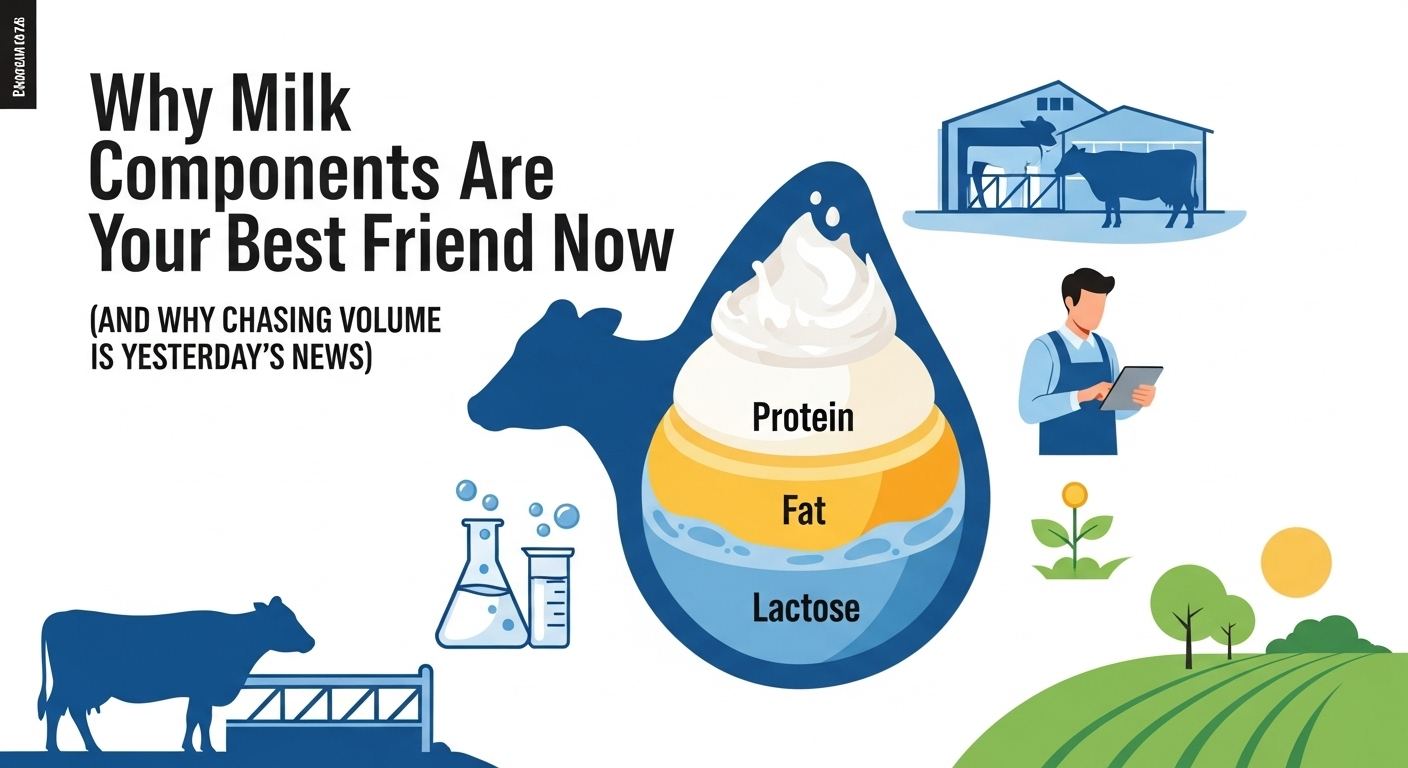
Look, if you’re still measuring success by how many gallons roll out of your bulk tank, you’re fighting yesterday’s war. The real money these days — what I call the game-changer — is swimming inside that milk: butterfat and protein. And honestly? It’s not even close anymore.
I was shooting the breeze with Jim last week. Third-generation guy up in Marathon County, Wisconsin, runs about 850 head — mostly Holsteins with some Jersey crosses thrown in for good measure. “Ten years ago, I was all about pounds per cow,” he told me, leaning against his parlor rail after evening milking. “Now? I’m laser-focused on hitting those component numbers.”
Jim’s got the goods: his milk’s testing 4.2% butterfat and 3.3% protein these days. That bump is putting serious money in his pocket every single day.

Here’s what’s really happening with production…
According to the latest USDA numbers, we’ve been on a losing streak — milk volumes dropping for 13 straight months through July 2024. Sounds scary, right? But here’s the thing that’s got everyone talking: the milk we are producing is richer than it’s ever been.
Recent data from CoBank shows butterfat levels hit 4.23% nationally in 2024, up from barely scraping 4% just a few years back. Protein’s climbing too — 3.29% average now, compared to around 3.04% back in 2004. (That’s genetic progress you can bank on, literally.)
And it’s not playing out the same everywhere…

Down in Texas, they’re singing a completely different tune. Milk production jumped 6% last year, thanks to massive cheese plant expansions in places like Amarillo and Lubbock. I’m talking facilities that are pulling milk from counties that never mattered much before — trucks running extra miles just to feed these operations.
Meanwhile, California is grappling with significant headwinds — heat stress and water restrictions that are putting a real squeeze on yields. Up here in the traditional dairy belt — Wisconsin, Minnesota, New York — we’re seeing herd contraction and flat production.
What strikes me about this shift is how it’s forcing everyone to think differently about what matters.
Let’s talk money, because that’s what pays the bills…
Here’s where the math gets really interesting. An 850-cow herd averaging 70 pounds produces 59,500 pounds of milk daily — that’s 595 hundredweight (cwt). Using current Federal Milk Marketing Order pricing, the value difference between average components and top-tier is $3.70 per cwt ($23.85 – $20.15).
Here’s the kicker: 595 cwt × $3.70 = $2,201.50 per day. Scale that over a month, and you’re looking at an additional $66,000 in revenue — a figure that changes the entire financial picture of an operation.
Take Sarah up in St. Lawrence County, New York. She’s running 280 registered Holsteins and dropping about $40 per calf on genomic testing, specifically targeting bulls with killer PTA scores for fat and protein. “Every extra tenth of a percent pays for that test ten times over,” she says. “I can’t afford not to do this anymore.”
Now, about those market moves…
As of early September, October Class III CME futures have been dancing around $20.85, with Class IV trading near $21.75. (These are approximate numbers — market prices change daily, so check with your broker for current quotes.) When Class IV trades above Class III like that, it’s the market telling you butter and powder are worth more than cheese right now.
This creates opportunities if you know how to read it. Danny, down in Green County, learned this lesson the expensive way. “I got burned waiting for better prices back in 2020,” he admits, standing in his feed alley watching the mixer wagon load up. “Now, when the spread looks good, I lock in margins with DRP. Sleep better at night.”
But let’s be real about the painful stuff too…
Replacement heifers are absolutely crushing budgets right now. The USDA reports national averages around $2,660 per head, but that’s conservative. Premium Holstein replacements are routinely hitting $3,000-plus at auctions, with some California and Minnesota sales pushing over $4,000.
Why? The beef-on-dairy trend. Using beef semen on your lower-tier cows creates a nice revenue stream from those crossbred calves, sure. But it’s also squeezed purebred heifer supplies to a 20-year low. There’s your unintended consequence.
Then there’s bird flu hanging over everything. Over 1,000 dairy herds across 17 states have dealt with HPAI this year. The farms that invested early in biosecurity — limiting visitors, boot washes, bird-proofing feed areas — they’re seeing the payoff in fewer disruptions and healthier herds.
Where’s your milk actually going?
This might surprise you, but when that semi pulls away from your farm, there’s a good chance it’s headed south of the border. Mexico bought $2.47 billion worth of U.S. dairy in 2024, making them our biggest customer by far. That’s not just a statistic — it’s cash flow that directly supports your milk price.
“I’ve completely changed how I think about our market,” says Maria, whose 650-cow operation outside Modesto produces high-component milk primarily destined for export. “We’re feeding families in Mexico City now, not just the local fluid plant. That global connection makes me more focused on consistency than ever.”
Asia’s more complicated. China’s tightening its imports as it builds domestic production, but Southeast Asian countries continue to buy steadily. Don’t sleep on those twice-monthly Global Dairy Trade auction results either — they move our futures markets more than some domestic reports.
So what’s your game plan?
From conversations I’m having with producers across the country, here’s what’s working:
- Focus your genetics on PTA Fat, PTA Protein, and Net Merit when selecting sires. The extra genomic testing cost pays for itself in the first lactation — ask your AI tech about proven component transmitters.
- Get serious about risk management. Work with your farm advisor to understand how futures and Dairy Revenue Protection can lock in margins when favorable spreads appear. Don’t wait for perfect conditions — they rarely come.
- Start budgeting for $3,000+ heifer costs or develop internal breeding programs. The cost advantage of raising your own has never been clearer.
- Double down on biosecurity. Those protocols aren’t optional anymore — simple steps like visitor logs, clean boots, and bird-proof feed storage consistently beat the cost of dealing with disease outbreaks.
- Track global demand shifts, especially in Mexico and Southeast Asia. These purchases directly impact your farm’s profitability, whether you realize it or not.
Regional reality check:
| Region | Production Trend | What’s Driving It |
| Traditional Dairy Belt | Down ~1.5% | Aging herds, flat yields, and higher costs |
| Texas | Up 6% | New cheese plants are creating a demand vacuum |
| California | Down ~2% | Heat stress, water restrictions |
The bottom line?
Volume-focused dairying is becoming yesterday’s business model. Today’s winners are mastering components, managing market risks, and protecting herd health with the same intensity they once devoted to increasing pounds per cow.
The farms that understand this shift fastest are separating themselves from the competition. Jim’s already adjusting his breeding program and marketing strategy. Danny’s hedging aggressively. Sarah’s investing in genomics, just as her operation depends on it — because it does.
What’s particularly fascinating about this transition is how it’s forcing the entire industry to get smarter. The old days of just maximizing volume and hoping for the best? Those are gone.
The question isn’t whether this new reality is fair — it’s how fast you’ll adapt to stay competitive. Because in 2025, your survival depends on understanding that every tenth of a percent of butterfat and protein matters more than the extra gallon you used to chase.
The industry’s changing fast, and honestly? That’s what makes this business so interesting.
Complete references and supporting documentation are available upon request by contacting the editorial team at editor@thebullvine.com.
Learn More:
- Seizing the Moment: Maximizing Milk Solids Output Through Strategic Nutrition and Genetics – This article provides practical nutritional and genetic strategies you can implement immediately to boost butterfat and protein percentages, directly impacting your daily milk check and increasing overall herd profitability.
- U.S. Dairy Industry Trends and 2025 Outlook – Get the big picture on the economic forces shaping 2025. This market analysis reveals the USDA’s price forecasts for Class III and IV milk and explores how feed costs and global trade dynamics will influence your farm’s bottom line.
- Genetic Revolution: How Record-Breaking Milk Components Are Reshaping Dairy’s Future – Look beyond today’s numbers and see where the industry is headed. This piece breaks down the massive impact of genomics and the 2025 genetic reset, revealing how new breeding technologies will define the high-component cow of the future.
The Sunday Read Dairy Professionals Don’t Skip.

Every week, thousands of producers, breeders, and industry insiders open Bullvine Weekly for genetics insights, market shifts, and profit strategies they won’t find anywhere else. One email. Five minutes. Smarter decisions all week.




