

Archive for dairy cooperative governance

Fonterra Owners Found Out 2 Years Late. Your Co-op Bylaws Might Hide the Same Gap.

Fonterra’s lawyers reached the PM’s adviser through a personal email. Its 8,300 owners learned it from the news, two years on. Does your bylaw even require the board to tell you?

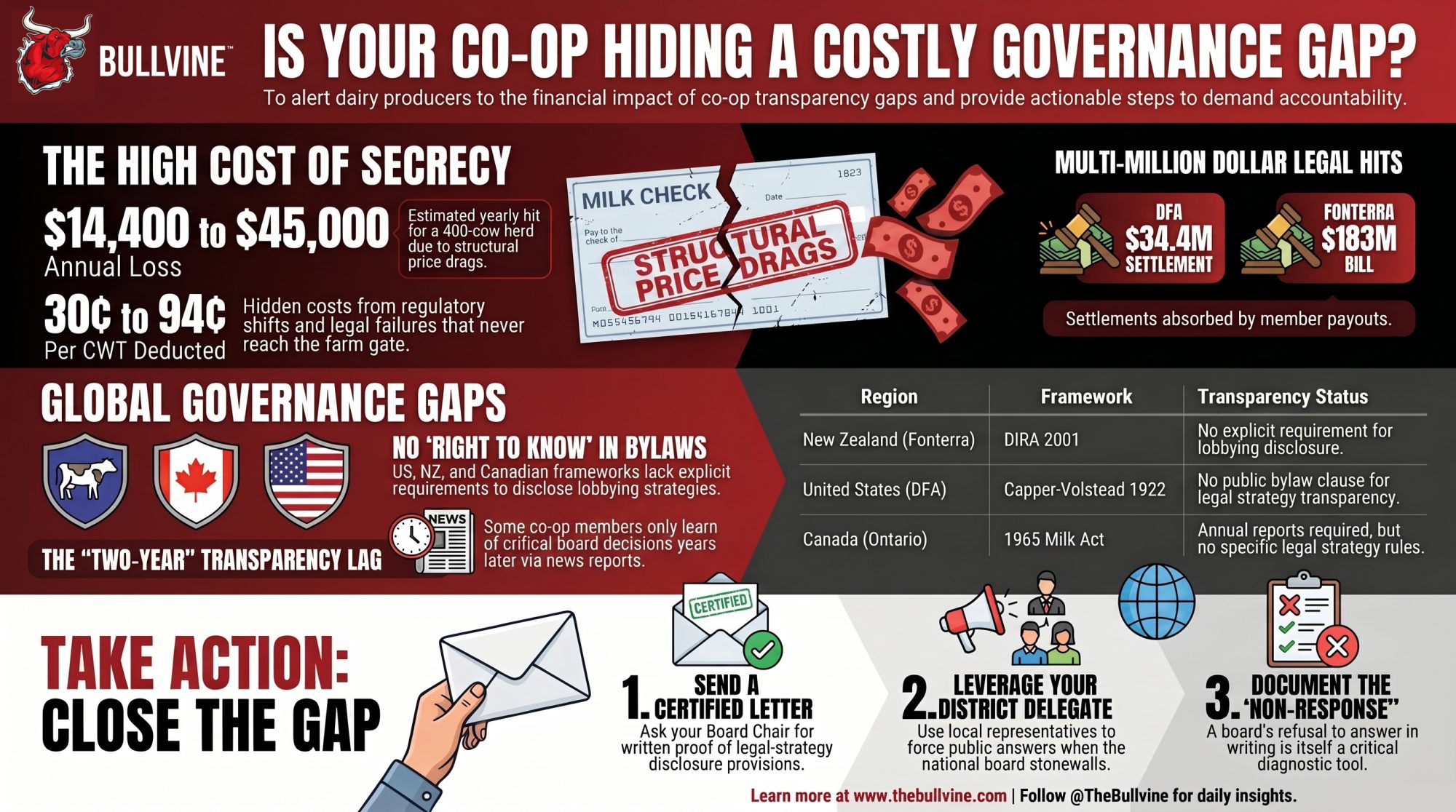
Executive Summary: Fonterra sent a confidential briefing — its legal strategy to kill the Smith v Fonterra climate case, complete with draft statutory wording — to the Prime Minister’s chief policy adviser through his personal email in mid-2024, and the co-op’s 8,300 farmer-owners didn’t find out until RNZ reported it two years later. New Zealand’s Ombudsman and Department of Internal Affairs are both investigating; nobody’s been found to have broken the law, and Fonterra concedes the private-email route wasn’t “consistent with its own policies”. But the real story isn’t NZ politics — it’s that no co-op bylaw, in NZ, the U.S., or Canada, forces a board to tell members about legal strategy before it lands on their milk check. That gap has a price: the 2025 FMMO make-allowance hike (cheddar up 25.8%) trimmed roughly $0.30/cwt off the all-milk price, and on a 400-cow herd shipping 48,000 cwt, even a 30¢ drag runs $14,400 a year — closer to $45,000 at the documented 94¢ total. Add co-op legal exposure like DFA’s $34.4M Othart settlement or Fonterra’s NZD $183M Danone bill, and you’re looking at owner money that quietly never reaches the farm gate. If you ship to a processing co-op, the move this week is a signed, dated letter to your board chair asking — in writing — for the exact bylaw provision covering legal-strategy disclosure.

co-op bylaw transparency

The news broke this month. What it revealed happened in secret two years ago. In mid-2026, RNZ reported — and Prime Minister Christopher Luxon’s office confirmed — that back on or around June 26, 2024, a member of Fonterra’s government affairs team printed a briefing note and handed it to Luxon’s then chief policy adviser, Matt Burgess, and also sent it to his personal email account. Burgess himself hasn’t been accused of wrongdoing; the open questions concern disclosure and record-keeping, and the investigations are still ongoing. The document wasn’t a milk price update or a sustainability report. It was a briefing on Smith v Fonterra — the climate tort case the NZ Supreme Court had cleared for trial in February 2024 —, and it proposed a two-sentence amendment to the Climate Change Response Act that would shut the case down.

For two years, Fonterra’s farmer-owners had no idea. They weren’t in that room. They didn’t get a memo. They found out the way everyone else did — off a news report, in 2026. And here’s the detail that should stop any co-op member cold: that personal inbox sat outside the official systems an Official Information Act request would normally search. When the Environmental Law Initiative asked the PM’s office in March 2025 for records tied to the case, the reply — released in May 2025 — never mentioned the briefing note.

This reads like a New Zealand political story. It isn’t. Strip away the Beehive and the climate case, and you’re left with one question that lands on every farmer who’s ever signed a milk contract with a processing co-op: Does your bylaw give you the right to know what your board is doing before it shows up on your check?

What’s Actually Confirmed — and What Isn’t Yet

Let’s be careful here, because this is an accountability story and the details matter. Fonterra told RNZ the document was sent to the personal address “at the staff member’s request” and acknowledged that this was “not appropriate, nor consistent with its own policies”. Luxon said it “has definitely not met the high standard that I have of staffers in the Beehive” and that communicating through private email “doesn’t help build transparency or public trust”. Mike Smith, the iwi leader who won the right to sue in 2024, has accused the government of “a coordinated campaign of secret lobbying”.

One thing worth stating plainly: nobody’s been found to have broken the law. The Ombudsman is investigating the “apparent withholding” of official information, and the Department of Internal Affairs is reviewing the former staffer’s accounts to capture anything that should’ve been on the public record. Neither has reported back. We’re not getting ahead of it.

But here’s what doesn’t need a verdict to be true. The co-op’s own structure let this happen. No bylaw stopped it, and no member-disclosure rule flagged it. Fonterra has roughly 8,300 farmer-shareholders who own the co-op and elect its board. It also runs an elected Co-operative Council whose published job is to keep members informed about the co-op’s performance and strategy and to hold the board to account. None of that machinery surfaced in the lobbying before a reporter did.

What’s Changing and Why

The shift here isn’t Fonterra’s behavior. It’s visibility. Most farmers have never read the fine print on what their board can do without telling them — and this case dragged that gap into daylight for the whole industry.

The pattern shows up across continents and across completely different legal systems, which tells you it’s structural, not a one-off. The U.S. Capper-Volstead Act of 1922 handed dairy cooperatives an antitrust exemption so farmers — the little guys — could band together against powerful processors. New Zealand’s Dairy Industry Restructuring Act of 2001 put guardrails on Fonterra, preventing a dominant company from squeezing its suppliers. Good architecture for its moment. Both were built to protect the farmer from outside power.
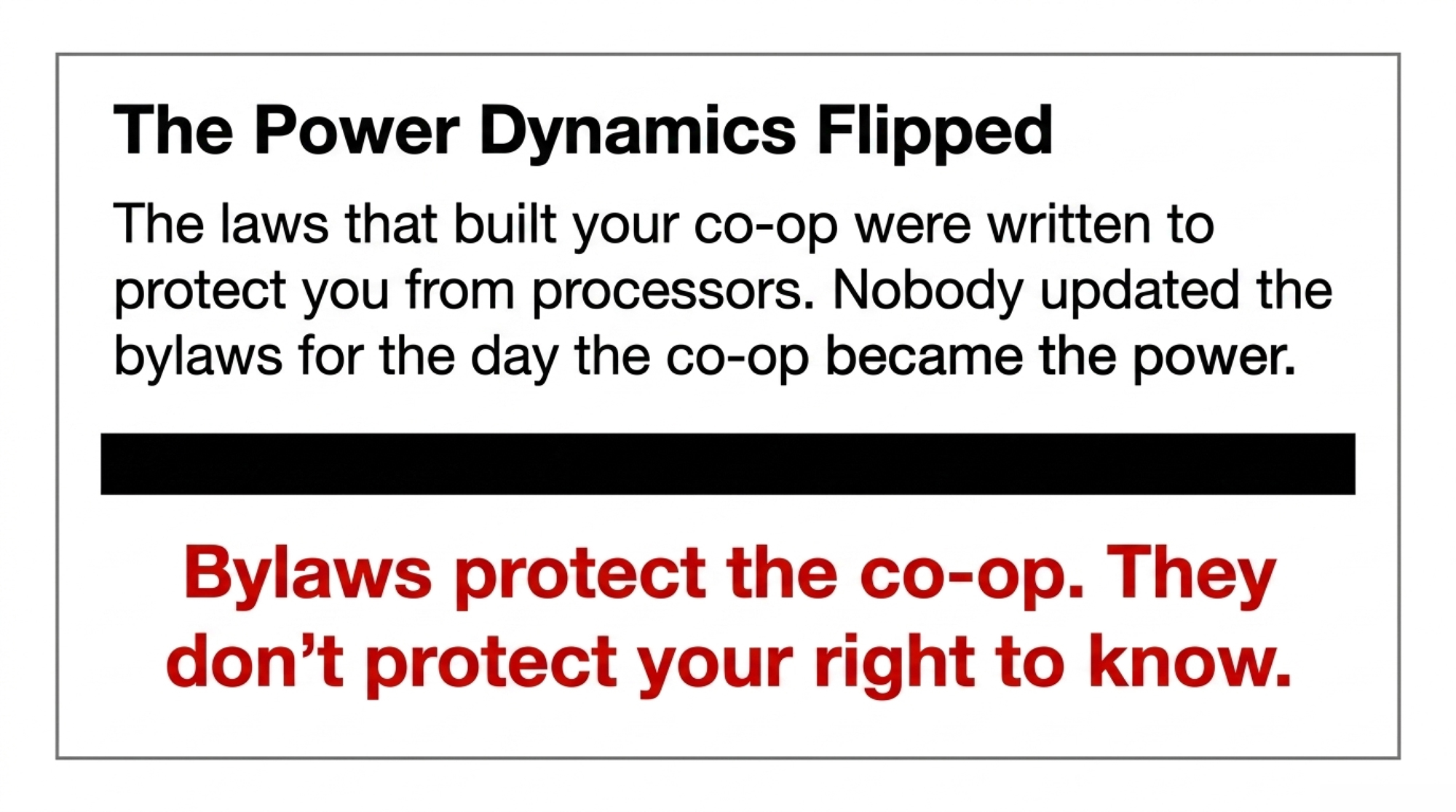
Nobody rewrote those rules for the day the co-op became the power. And that’s not hypothetical. In April 2022, a group of New Mexico producers led by Othart Dairy Farms sued Dairy Farmers of America and Select Milk Producers, alleging that the two used a joint agency to underpay farmers for raw milk across New Mexico, Texas, and parts of three other states. A federal judge allowed the case to proceed in March 2024 — a procedural step, not a finding of wrongdoing — and the cooperatives later settled in 2025 for $34.4 million without admitting liability. That figure split $24.5 million from DFA and $9.9 million from Select, under a deal that dissolved the joint marketing agency at the center of the case. The loyalty scaled up. The accountability rules didn’t.

How This Plays Out on Real Farms

A governance gap doesn’t show up as a scandal on your farm. It shows up as a smaller number on your milk check, and you usually can’t trace it back to the room where the decision got made.
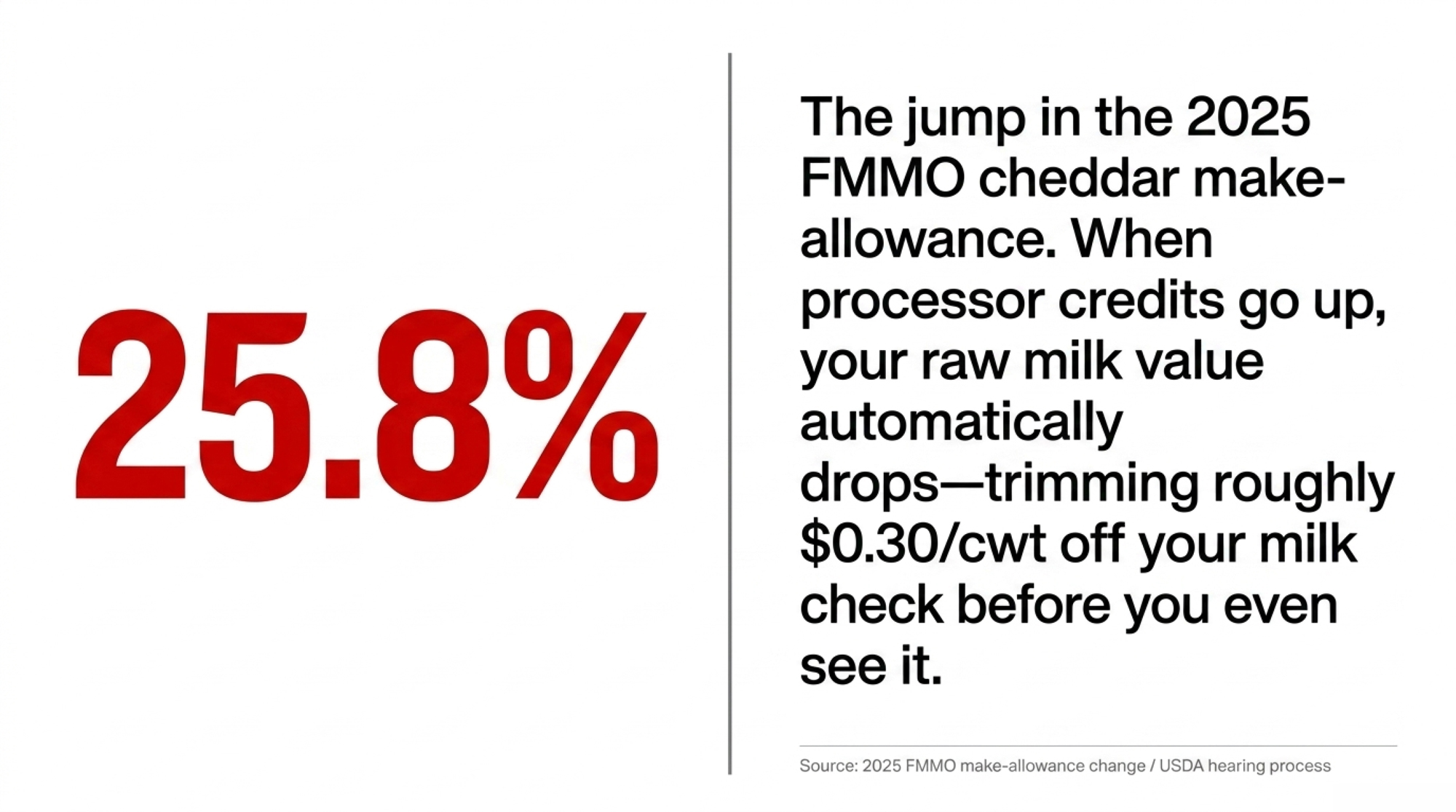
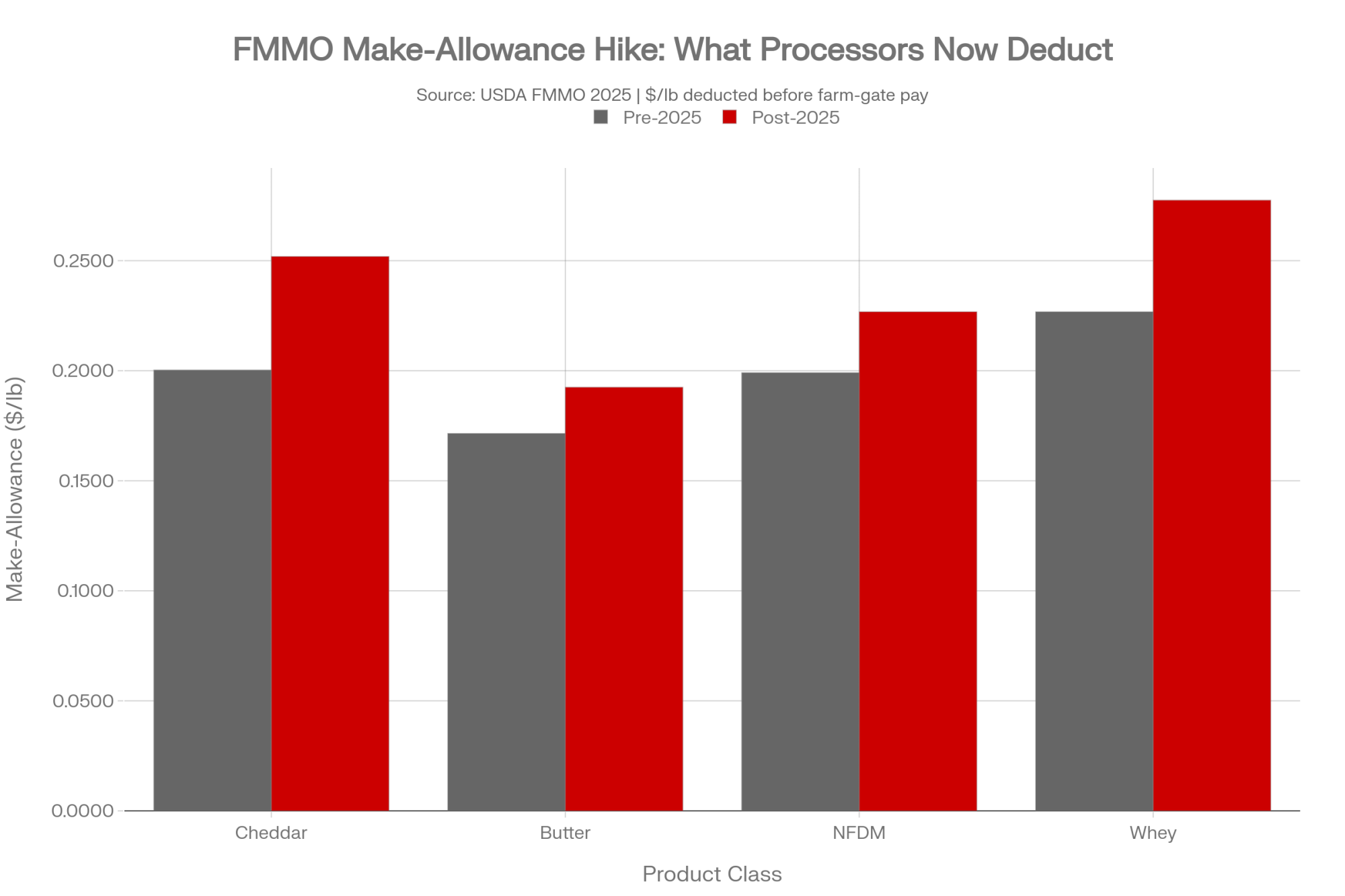
Look at the 2025 Federal Milk Marketing Order make-allowance change — the cost credits processors deduct before they calculate your pay. The cheddar make-allowance jumped from $0.2003 to $0.2519 a pound, a 25.8% increase. Here’s why that lands directly on you: Federal Order end-product pricing formulas calculate the raw milk component values by subtracting the manufacturing make allowance from wholesale commodity prices. So when the processor’s credit goes up, the raw milk value the formula spits out goes down — automatically, before anyone touches your contract. A higher make allowance is a direct deduction from your base pay. The adjustment had a real basis; processing costs had genuinely climbed. But the reforms cut the U.S. all-milk price by roughly $0.30/cwt at the outset, before later component updates clawed some of it back for high-component herds. The rulemaking played out in Washington, shaped by industry input through USDA’s hearing process. The farmers who paid for it found out at the mailbox.
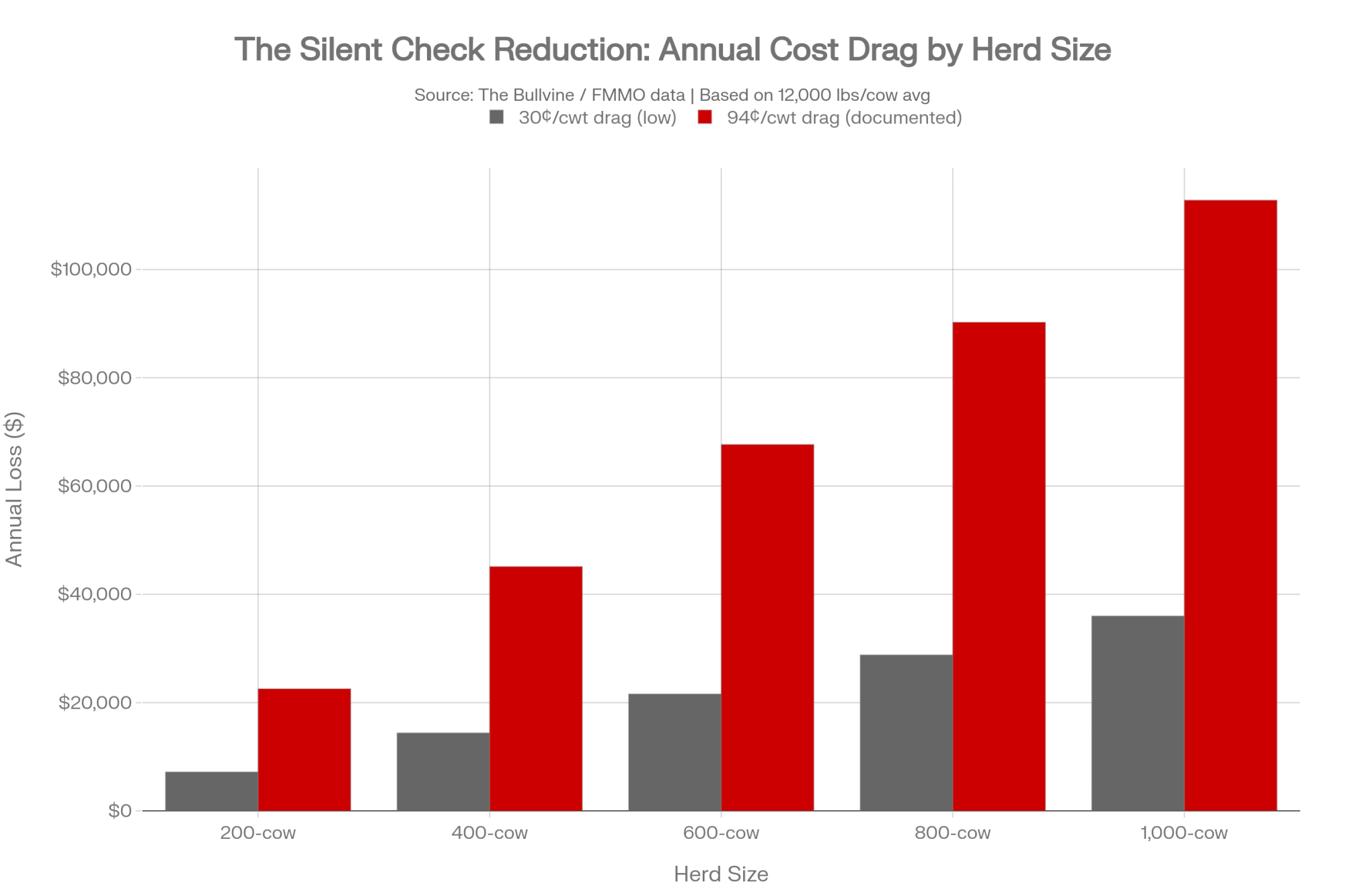
Here’s the math you can run against your own operation. Take a 400-cow herd shipping about 48,000 hundredweight a year — that’s a deliberately conservative 12,000 lbs per cow, and a higher-producing herd would roughly double the numbers below. Hit that herd with even a 30-cent-per-cwt structural drag, the low end of what the FMMO change delivered, and you’re looking at about $14,400 a year. Push it to the 94-cent total drag. The Bullvine has documented after premiums and class moves, and it’s closer to $45,000 a year. That’s not a basis move you can hedge. So run your own version: your annual CWT times whatever shift you think is realistic, against your current pay price.
And this isn’t a U.S.-only problem. Fonterra’s 2013 contamination scare — later confirmed a false alarm — triggered the Danone arbitration. In November 2017, the Singapore tribunal ordered Fonterra to pay Danone NZD $183 million — about €105 million, or US$125 million at the time. Money that never reached the farm gate. No member voted on that legal exposure. They just absorbed it, one season’s payout at a time.

How Much Does Staying Silent Actually Cost You?
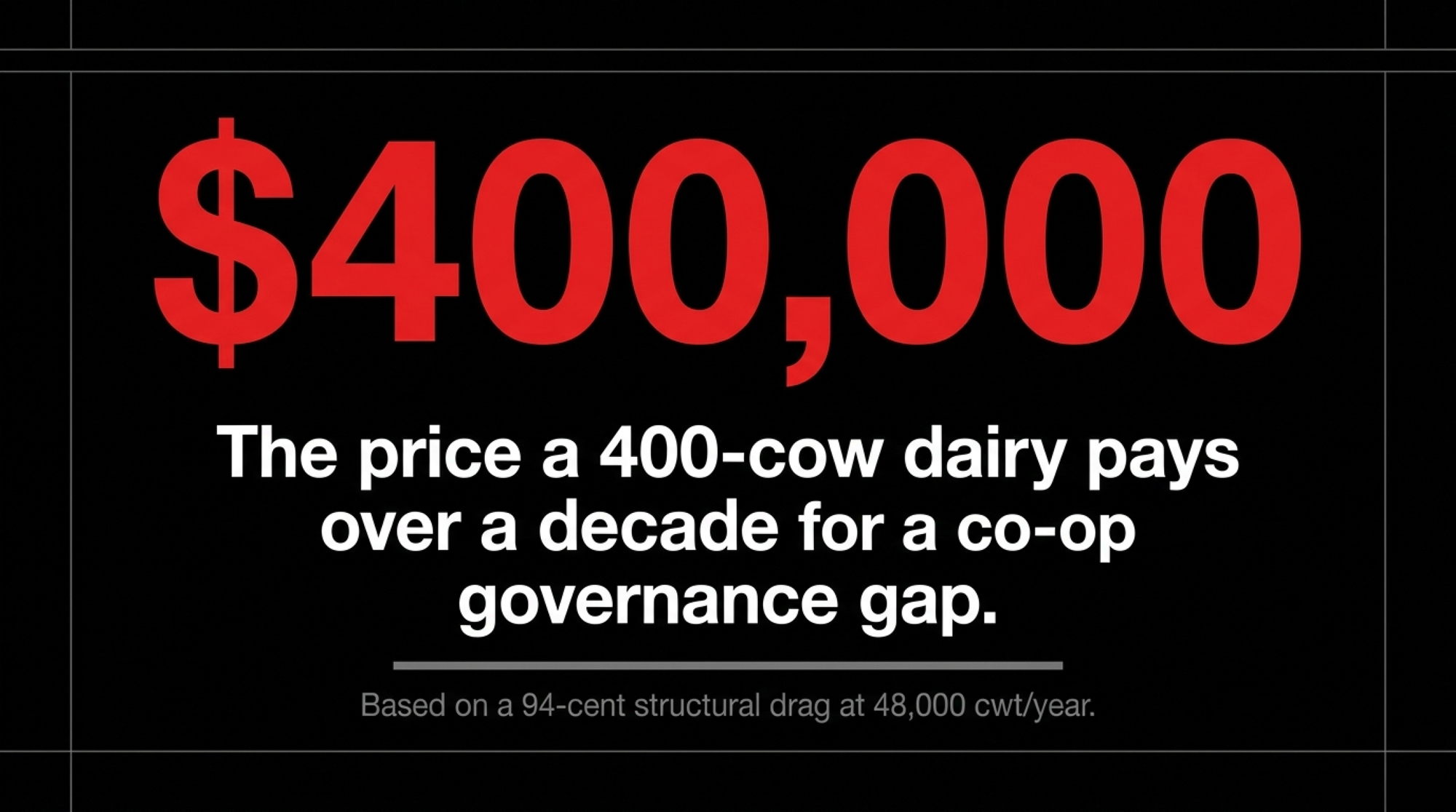
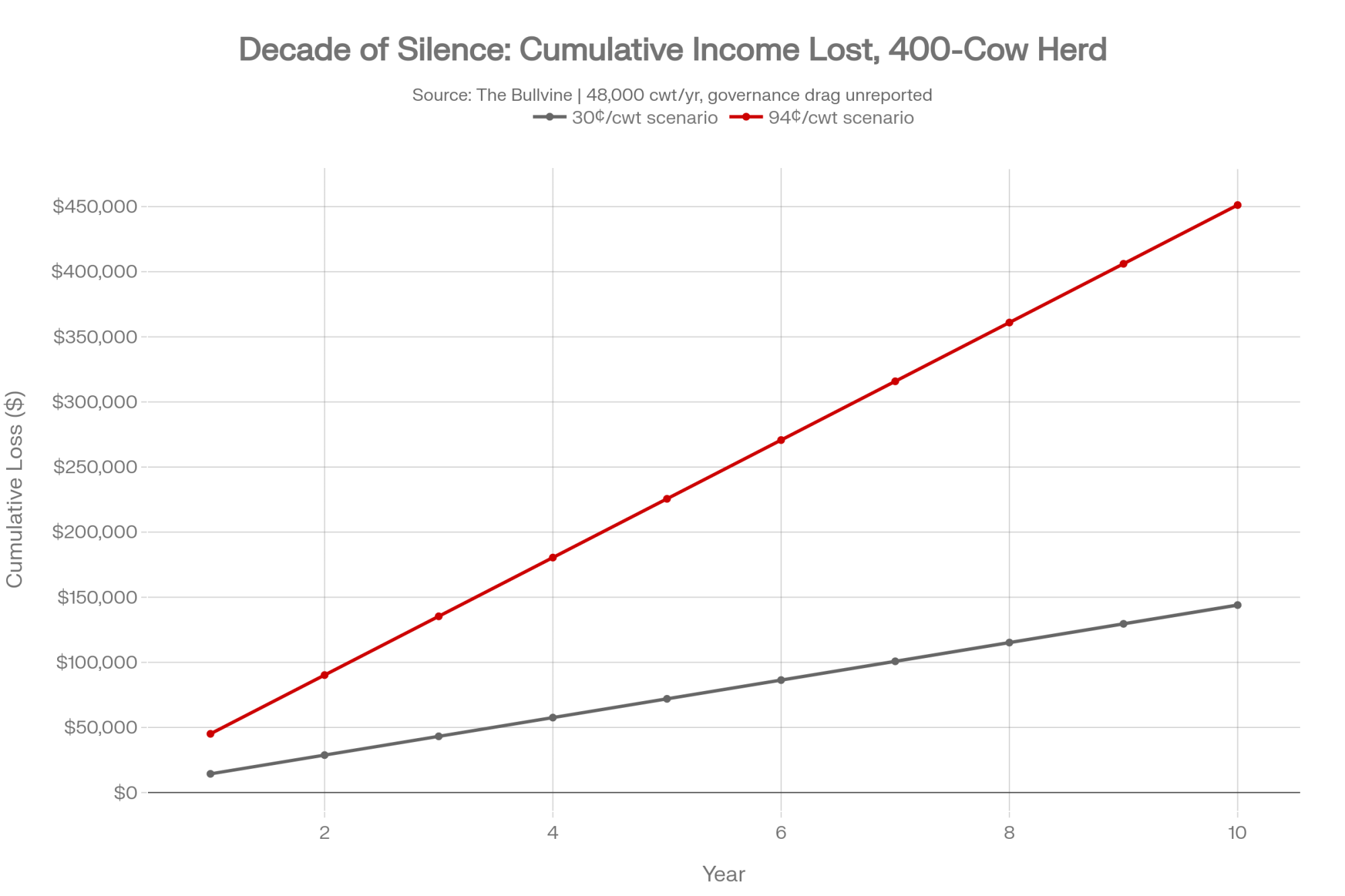
Stack it across a decade, and the picture sharpens fast. A 30-to-94-cent structural drag, held over ten years, runs from roughly $140,000 to well over $400,000 on that same 400-cow herd — and that’s only if you assume the pressure holds, which is a big if. Add a co-op legal failure on top, like the Danone bill or a $34.4 million settlement split across members, and you’re looking at earnings that quietly never make it to your account. Each hit is survivable. The compounding is what gets you.
But there’s a cost here that isn’t a number, and it’s the one worth sitting with. The farmer who never asks loses the standing to complain when the next failure surfaces. Three or four years from now, someone’s going to ask, “Did you send the letter?” Did you raise it at the annual meeting? If the answer’s no, then the co-op’s failure becomes partly a story about owners who didn’t act like owners — and you’ll know it. That’s harder to carry than a check reduction.
The Mechanics Behind the Outcomes

So why does the gap survive in co-op after co-op? Because the rulebooks were written when the co-op was the underdog, and nobody went back to update them when it stopped being one.

Dig into the statutes, and the pattern’s the same across three countries. Plenty about milk pricing transparency, financial reporting, and antitrust standing — almost nothing requiring the board to tell members about legal strategy or government lobbying before it lands on their payout. Here’s how the three big frameworks stack up side by side:

Governance LeverFonterra — New ZealandDairy Farmers of America — U.S.Dairy Farmers of Ontario — Canada
Founding frameworkDairy Industry Restructuring Act 2001Capper-Volstead Act 1922; FMMO system1965 Ontario Milk Act; O. Reg. 209/99
Financial disclosure to membersAnnual report to shareholdersBylaws subordinate farmer payments to debt serviceAudited annual statement within 4 months of year-end
Disclosure of legal strategy / lobbyingNo explicit bylaw requirementNo public bylaw clause; separately enjoined from sharing sensitive dataNo explicit rule beyond annual operations report
Accountability bodyElected Co-operative CouncilElected delegate / board structureLocal producer committees + DFO board
Recent flashpointRNZ lobbying disclosure case, 2024–26$34.4M Othart settlement, 2025Glengarry committee resigned in protest, 2020

The takeaway isn’t that one co-op is the villain. It’s that across three completely different systems, the disclosure rule that would’ve caught the Fonterra briefing doesn’t exist in any of them. Ontario at least forces an audited annual report into producers’ hands within four months — more than Fonterra’s or DFA’s documents promise on legal strategy. And the DFA settlement hints at where this is heading: the deal required the cooperatives to dissolve the joint agency and stop sharing certain non-public pricing information. Courts are starting to bolt on the disclosure rules that the bylaws never contained.

Options and Trade-Offs for Farmers

You can’t rewrite your bylaws by Friday. But you’re not stuck waiting for the next failure, either. Here’s what farmers are actually using.

  • Send one written question this week — the 30-day move. Not an email. A signed letter, certified or hand-delivered with a date stamp, to your board chair or CEO, asking one thing: show me, in writing, the bylaw provision that gives me the right to know about material legal strategy or government lobbying before it affects my milk price. When it makes sense: always, any co-op, any herd size. What it takes: 20 minutes and about $6 for certified mail. The risk: you get a non-response — but a documented non-response is itself information, and it’s the start of your paper trail.
  • Work with your district delegate. Big co-ops route governance through elected district or regional reps who answer to local members in a way the national board doesn’t. When the Glengarry County producer committee in Ontario hit a program it couldn’t stomach in 2020, the whole committee resigned in protest — and made the board answer for it publicly. When it makes sense: when you want leverage beyond one voice. What it takes: knowing who your delegate is. The limit: delegates vary a lot in how engaged they actually are.
  • Push accountability to the body, not just the board. If your co-op has a Co-operative Council or equivalent, holding the board accountable is literally its job. When it makes sense: when the board stonewalls. What it takes:knowing the body’s real mandate. The risk: some of these look stronger on paper than they are in the room.
  • Read what you actually signed. Pull your member agreement and bylaws and hunt for three things: any disclosure obligation on the board, the process for filing an annual-meeting question that requires a written response, and the threshold to propose a bylaw amendment. The catch: DFA’s bylaws aren’t posted publicly in full — outsiders mostly learn their terms through credit ratings and court filings — so if yours aren’t public either, document that fact and raise it in your letter.

The forward-looking signal sits inside that first path. The DFA settlement already forced new pricing-conduct obligations through the courts, and the Fonterra disclosure question is now out in the open in New Zealand. The pressure’s moving in one direction. Getting your question on record now means you’re ahead of it, not chasing it after the fact.

Is Asking Hard Questions Worth the Social Cost?

Let’s be honest about what really stops a farmer with a hand half-raised at the annual meeting. It’s rarely the bylaws. It’s the room. Your father shipped to this co-op. Your neighbor sits on the district committee. The field rep who walked you through that mastitis problem last February is standing by the coffee urn. You don’t interrogate the people who show up for you, and that loyalty is real and earned.
Here’s the reframe. A written governance question isn’t disloyalty — it’s the harder version of the same loyalty. It says you believe in the institution enough to make it work the way it promised. The Glengarry committee that walked out in 2020 wasn’t disloyal to Ontario dairy — they were the most invested people in the room. And if a board gets cagey when a member asks for a written disclosure policy? That discomfort is diagnostic. It’s telling you something the bylaws won’t.
Key Takeaways

  • If you can’t find your co-op’s full bylaws posted publicly — and DFA members can’t — treat that as a flag worth documenting, then ask for them in writing.
  • If your board hasn’t put a legal-strategy disclosure policy in front of its members, send a signed, dated letter this month requesting the exact provision. Verbal answers don’t count — get it in writing.
  • If your next annual meeting is more than 60 days out, find your district delegate or committee rep now, before the agenda deadline closes.
  • If you want your real exposure, take your annual CWT times a 30- to 94-cent drag against your current pay price — that’s your cost from regulatory and legal decisions you didn’t vote on.
  • If the board answers verbally rather than in writing, send a follow-up letter noting that you asked for a written response. Build the paper trail before you need it, not after.
  • If you’re the only one asking, find two or three other members in your district doing the same. Not a coalition — a conversation. It changes what a board can quietly manage.

The Fonterra matter will run its course, and New Zealand will sort out who knew what and when. But that’s not the question that should keep you up. The closer one is this: if your board made a decision tomorrow that reshaped your contract or your regulatory environment, would you hear about it before it hit your check, or two years later, off a news report?

You can start answering that this week, for the price of a certified letter. The deeper work — how a governance gap converts into real cost-per-cwt by herd size, and what enforceable disclosure language actually looks like inside a co-op bylaw — is where this gets operational. 

Complete references and supporting documentation are available upon request by contacting the editorial team at editor@thebullvine.com.

Learn More

The Sunday Read Dairy Professionals Don’t Skip.
Every week, thousands of producers, breeders, and industry insiders open Bullvine Weekly for genetics insights, market shifts, and profit strategies they won’t find anywhere else. One email. Five minutes. Smarter decisions all week.
NewsSubscribe
First
Last
Consent

$51,000 a Day in Silence: AMPI’s Paynesville Plant Went Dark, and Nobody Told You

AMPI’s Paynesville plant is dark. Its biggest member sells milk to five other processors. You sell to one. Same co-op. Guess who has a backup plan.

Executive Summary: At 10 a.m. Saturday, 18-year AMPI lab tech Heidi Barg walked out of the Paynesville, Minnesota cheese plant — and a $51,000-a-day clock started ticking for 685 farmer-owners who got zero warning. Teamsters Local 471 declared a formal Unfair Labor Practice strike after nearly a year of rejected demands for better wages, health-care flexibility, and a guarantee that jobs survive if AMPI sells the plant. With the facility processing 1.7 million pounds of milk daily and Midwest spot running $3-under, a 30-day shutdown burns through $1.53 million in co-op revenue — on top of margins that were already negative before a single picket sign went up. AMPI’s largest member, Riverview LLP, ships to five processors and is building its own 4-million-lb/day powder plant 90 miles away; most family-scale members ship to one plant and have no backup. Under Minnesota cooperative law, the board may have no legal obligation to warn you — a governance blind spot that seven Ontario farmers cracked open in 2020, when a single public letter forced province-wide reform. Below: the per-herd loss math, the statutory rights most co-op members don’t know they have, and the one action you can take before your next district meeting.

AMPI dairy strike

Just before 10 a.m. on Saturday, March 21, Heidi Barg hung up her lab coat at the AMPI cheese plant on West Railroad Street in Paynesville, Minnesota, and walked out to the picket line. She’s spent 18 years in that lab, testing the milk that 685 farm families ship into the cooperative every day. A few minutes later, the rest of her co-workers in Teamsters Local 471 — more than 60 employees in all — followed her out, and AMPI’s highest-capacity cheese plant went dark. 

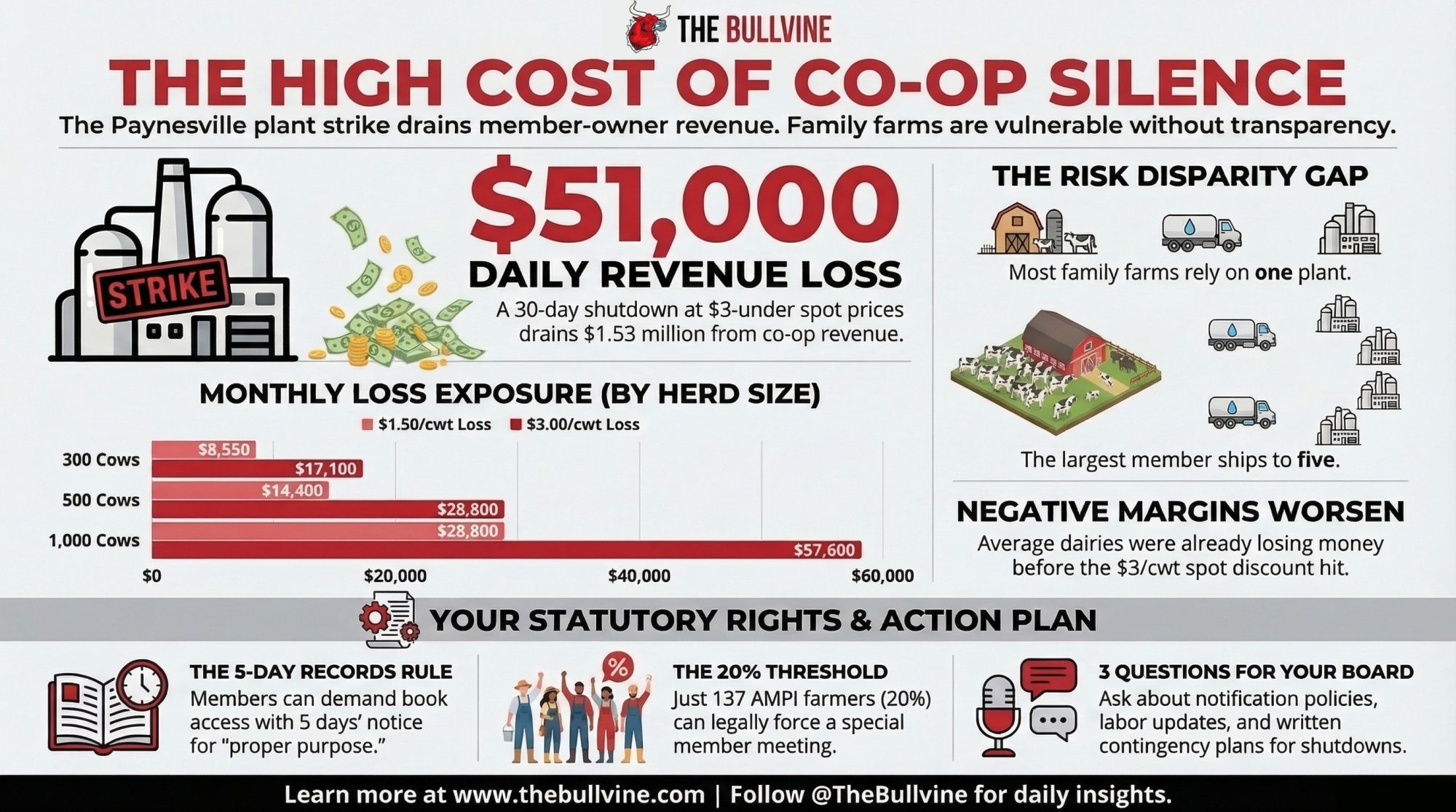
While the lab coats hit the pavement, the clock started ticking — $51,000 a day in lost milk value at the March 19 spot floor, and up to $1.53 million if $3-under conditions persist for a month. That’s a hole your milk check is expected to fill.

“When I started at AMPI 18 years ago, this was a place where people built successful careers in a small town to support their families,” Barg said. “Too many now see it as just a job, and that has been tough for me to watch”. 

Eighteen years of institutional knowledge about milk quality, cheese yields, and production standards — gone from the plant floor in a single morning. And there’s no sign that any of AMPI’s 685 farmer-owners received a real warning that their plant was one step from going dark.

How Did a 12-Month Standoff Turn Into a Surprise Shutdown?

This didn’t start with a one-day blow-up. It started in April 2025, when Paynesville workers — who’d spent 50 years under an independent union — voted 71 to 1 to affiliate with Teamsters Local 471. They believed the Teamsters would give them “the leverage, resources, and collective power necessary to bargain the best contract possible”. 

Since then, it’s been a long, slow grind. Workers came to the table asking for a meaningful wage increase after more than a year without a raise, more flexibility in health care coverage, and a guarantee that, if AMPI sells the plant, their jobs and union contract will go with it. AMPI said no on all three. 

“AMPI has had more than enough time to do right by these workers, but instead they’ve dragged their feet,” said Lyndon Johnson, Secretary-Treasurer of Local 471. “Our members are united in demanding the wages, health care, and job protections they deserve. We’re prepared to stay out as long as it takes”. 

Local 471 has called this a formal Unfair Labor Practice strike — meaning they believe they can prove AMPI hasn’t been bargaining in good faith. That’s a legal accusation that builds over months of bargaining records, not one bad meeting. And the dairy labor crisis driving these negotiations isn’t unique to Paynesville

Three Facilities, One Pattern

FacilityProductWhat HappenedWorkers AffectedTimelineMember Impact
Paynesville, MNCheeseULP strike — plant went dark60+ Teamsters Local 471March 21, 2026685 farmer-owners lose outlet for 1.7M+ lb/day
Blair, WICheddar → Cottage CheeseConversion retool — temporary layoffs86 employeesLayoffs start March 31, 2026; reopen early 2027Milk rerouted during 9–12 month gap
New Ulm, MNButterSold to Grassland Dairy Products185 employees transferredLate 2025AMPI exits butter; “focuses on core business = cheese”

Paynesville isn’t AMPI’s only moving piece. In Blair, Wisconsin, AMPI is converting its cheddar plant into a cottage cheese facility — temporarily laying off 86 workers starting March 31, with a reopening planned for early 2027. In New Ulm, Minnesota, AMPI sold its butter plant to Grassland Dairy Products in late 2025. AMPI Marketing VP Sarah Schmidt confirmed that 185 employees had transferred, saying the sale would allow AMPI “focus on its core business, which is cheese.”

If you’re a Paynesville worker watching AMPI shut one plant and retool another, you’re going to ask for a guarantee that your facility won’t be sold next. Workers asked for exactly that. Management refused.

AMPI did not respond to a request for comment regarding the strike.

What Does It Actually Cost When Your Co-op Plant Goes Dark?

When a plant shuts down, your cows don’t. Milk has to move. And in late March 2026, it’s moving into one of the ugliest spot markets in recent memory.

USDA’s Agricultural Marketing Service reported Midwest Class III spot milk trading at $ 3 under to flat the week of March 19. One week earlier, the Central region spot was $ 5 under to flat, and cheesemakers were “unable to take on additional volumes of milk, as they are already running full schedules.” A March 17 snowstorm across the Upper Midwest made hauling even messier.

Teamsters say the plant was running about 1.7 million pounds of milk per day — roughly 17,000 cwt. AMPI’s own 2025 summer tour materials claim Paynesville can process up to 4 million pounds daily — though the plant’s last publicly documented capacity upgrade, reported by Farm Progress in January 2023, put the figure at 3 million pounds. However you measure it, a lot of milk just got orphaned.

At the co-op level: 17,000 cwt/day × $3.00 spot discount = $51,000 per day in lost value. Thirty days at $3-under is $1.53 million in cooperative revenue that isn’t coming back.

Herd SizeDaily Milk (cwt)Monthly Loss ($1.50/cwt)Monthly Loss ($3.00/cwt)
300 Cows190$8,550$17,100
500 Cows320$14,400$28,800
1,000 Cows640$28,800$57,600

Note: Spot discount losses only. Additional hauling costs (estimated at 20¢/cwt for diversions over 200 miles) would add roughly $1,100–$3,800/month, depending on herd size.

Why the Timing Couldn’t Be Worse

Those dollars land on a base market that’s already bleeding. February’s WASDE put the 2026 all-milk price at $18.95/cwt. ERS estimates the average total cost of production at $19.14/cwt — meaning the average dairy started 2026 losing money before the first truck left the yard. January’s actual Class III came in at $14.59/cwt, the lowest since July 2023. FarmDoc Daily’s December 2025 analysis projected that “economic costs are projected to be above total returns in 2026.”

You’re already underwater. Stack a $3-under spot discount on top of that, and this stops being an academic conversation.

The Member Who Doesn’t Have to Worry — And Why That Should Worry You

Now ask a harder question: who in this cooperative can actually ride out a plant shutdown?

MetricSmall/Mid Family DairyRiverview LLP
Approximate herd size280–1,000 cows135,000+ cows (16 MN feedlots)
Milk processors used15
Own processing capacityNone4M lb/day powder plant under construction (Morris, MN; startup Nov 2027)
Strike/shutdown backup planNone — diverts to spot market at $3-underRoutes volume to 4 other buyers same day
Est. 30-day loss if Paynesville dark$17,100–$57,600 (spot discount only)Near zero — volume absorbed elsewhere
Hauling cost exposure+$1,100–$3,800/month at $0.20/cwtNegligible — contracts with multiple plants
Co-op governance influenceAttends district meetingAMPI featured Riverview on summer tour brochure
Long-term co-op dependencyHigh — one plant, one checkDeclining — exit ramp under construction

Riverview LLP, based in Morris, Minnesota, is the state’s largest milk producer — and it’s not close. According to state feedlot records cited by the Star Tribune on March 16, 2026, Riverview now owns 16 permitted dairy feedlots in Minnesota, housing more than 135,000 cows. The company is also permitted for two North Dakota mega-dairies currently under international environmental review after Manitoba flagged potential nutrient impacts on the Red River watershed.

Riverview is an AMPI member. In 2025, AMPI’s own “Future Focused” summer tour bused visitors to the Paynesville cheese plant, then to Louriston Dairy, a 9,500-cow Riverview operation near Murdock. The co-op literally put Riverview on the brochure.

But Riverview doesn’t need AMPI. As of a late-2024 Red River Farm Network tour, Riverview was selling milk to five different cheese processors. If Paynesville goes dark for a month, Riverview shifts volume to four other buyers before your truck has figured out where to go. And in July 2025, Riverview broke ground on the Stevens Milk Plant — a 148,000-square-foot powder facility in Morris that will process 4 million pounds of milk per day. Startup: November 2027. That’s at or above what AMPI says Paynesville can handle.

Nobody’s saying Riverview shouldn’t build its own plant — they’re managing their own risk, same as you should be managing yours. The question is what it means for the members who can’t. You’re subsidizing the overhead on a plant that Riverview is building an exit ramp from. We broke down the full math on what Riverview’s expansion means for Upper Midwest pricing last week — and this strike makes that analysis hit different.

Two realities under the same “farmer-owned” banner:

  • A 280-cow Stearns County family dairy with one truck, one plant, one milk check.
  • A 135,000-cow-plus member with milk going to five processors and its own powder plant under construction.

Same co-op. Wildly different risk universe. And the consolidation dynamics reshaping cooperative processing aren’t slowing down.

Why Your Co-op Board May Be Legally Required to Keep You in the Dark

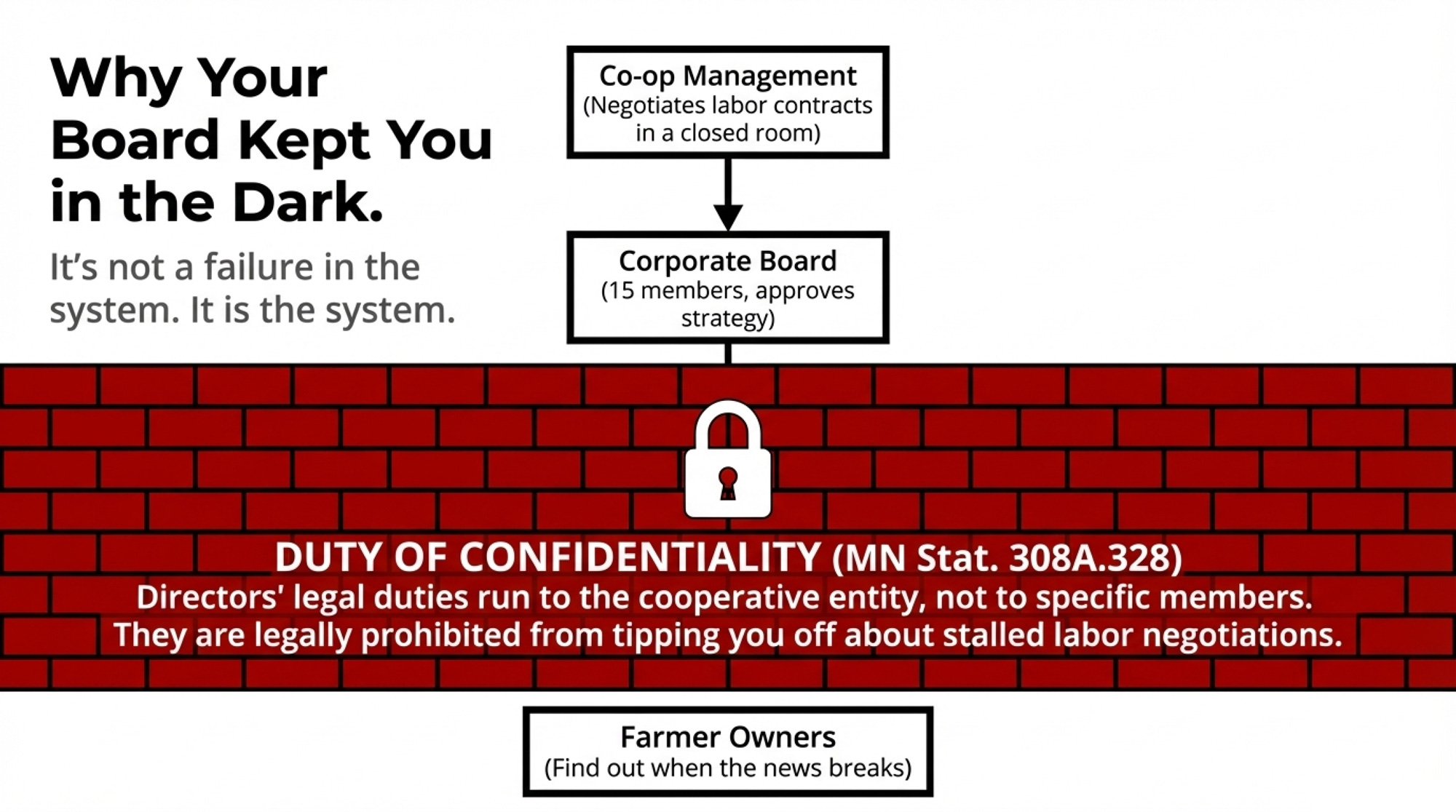
AMPI runs a three-tier governance system. You go to district meetings. District reps go to division meetings. Division reps elect a 15-member corporate board on three-year terms. The board oversees management. Management negotiates labor contracts.

There’s no standing labor relations committee you elect. No bylaw trigger that says “if a negotiation drags past 180 days, members get notified.” Nothing.

Minnesota Statute 308A.328 says directors must act “in good faith, in a manner the director reasonably believes to be in the best interests of the cooperative.” Those duties run to the cooperative as a legal entity — not to specific members. Directors can rely on management reports they “reasonably believe to be reliable and competent.” On top of that, directors carry a duty of confidentiality on labor and legal strategy that may actually prohibit them from tipping you off at a district meeting.

Management runs it. The board approves it in a closed room. You find out when the news breaks. That’s not a failure in the system. That’s the system.

What Happened When Seven Ontario Farmers Said “Enough”?

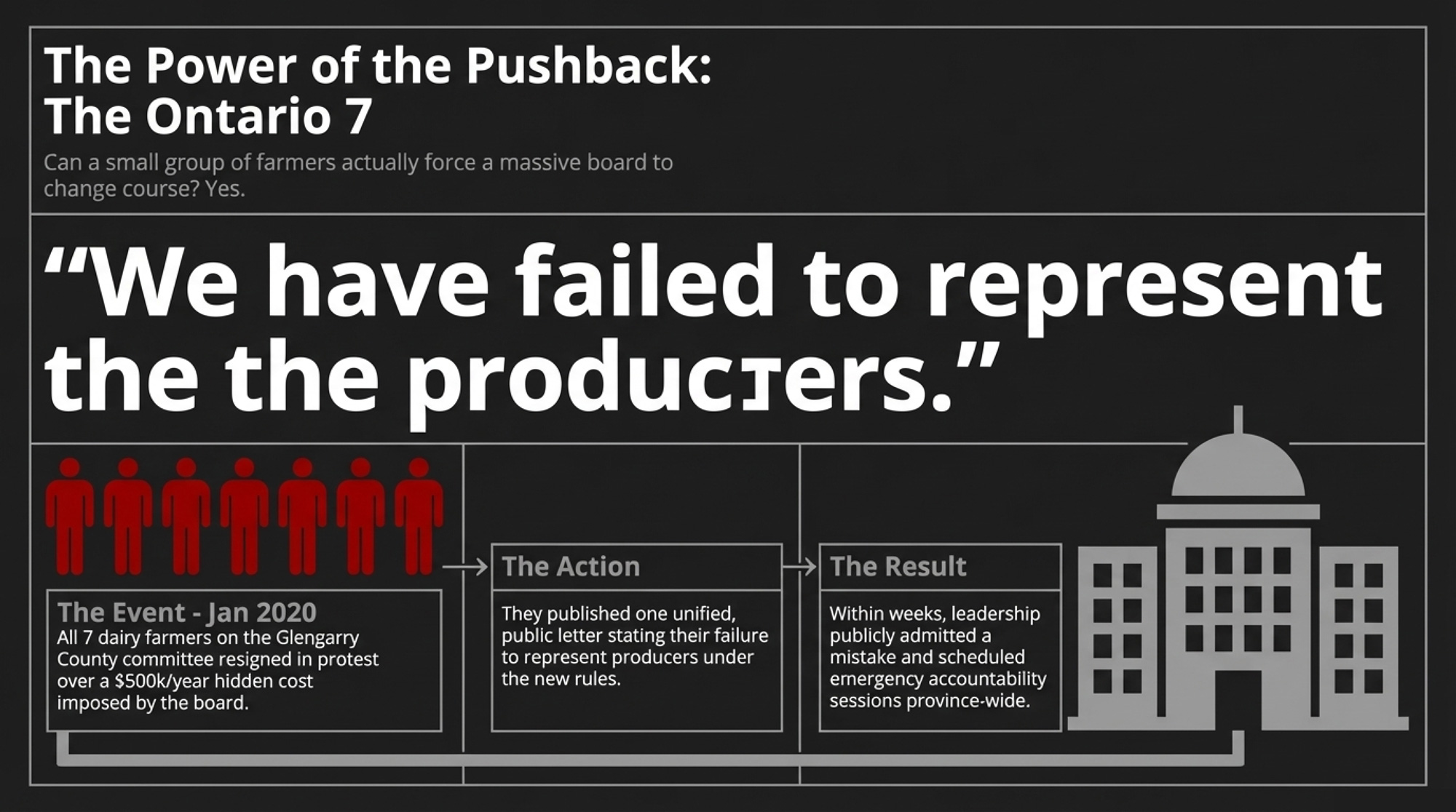
In January 2020, all seven dairy farmers on the Glengarry County milk producer committee in eastern Ontario resigned at once. Their target: Dairy Farmers of Ontario, which had unilaterally switched to third-party verification for its proAction quality program without consulting any of the province’s 48 local committees.

Their letter didn’t mince words: “We have failed as a committee to represent the producers that have elected us.” They estimated the switch would cost Ontario producers at least $500,000 a year on top of what they called “millions and millions” already spent, with absolutely zero to show for it.

Seven farmers. One public letter. Within weeks, DFO board member Bart Rijke told the farm press, “Maybe we made a mistake.” Leadership reached out to committee chair Melanie Trottier. DFO scheduled emergency sessions with all 48 committees. Trottier and six neighbors changed the conversation province-wide. You don’t have to resign from anything. But Glengarry proves that coordinated, specific pushback from a small number of members can move organizations that usually feel untouchable. And when cooperative accountability actually works, it changes what’s possible for the whole community

Does Your Co-op Have the Same Blind Spot?

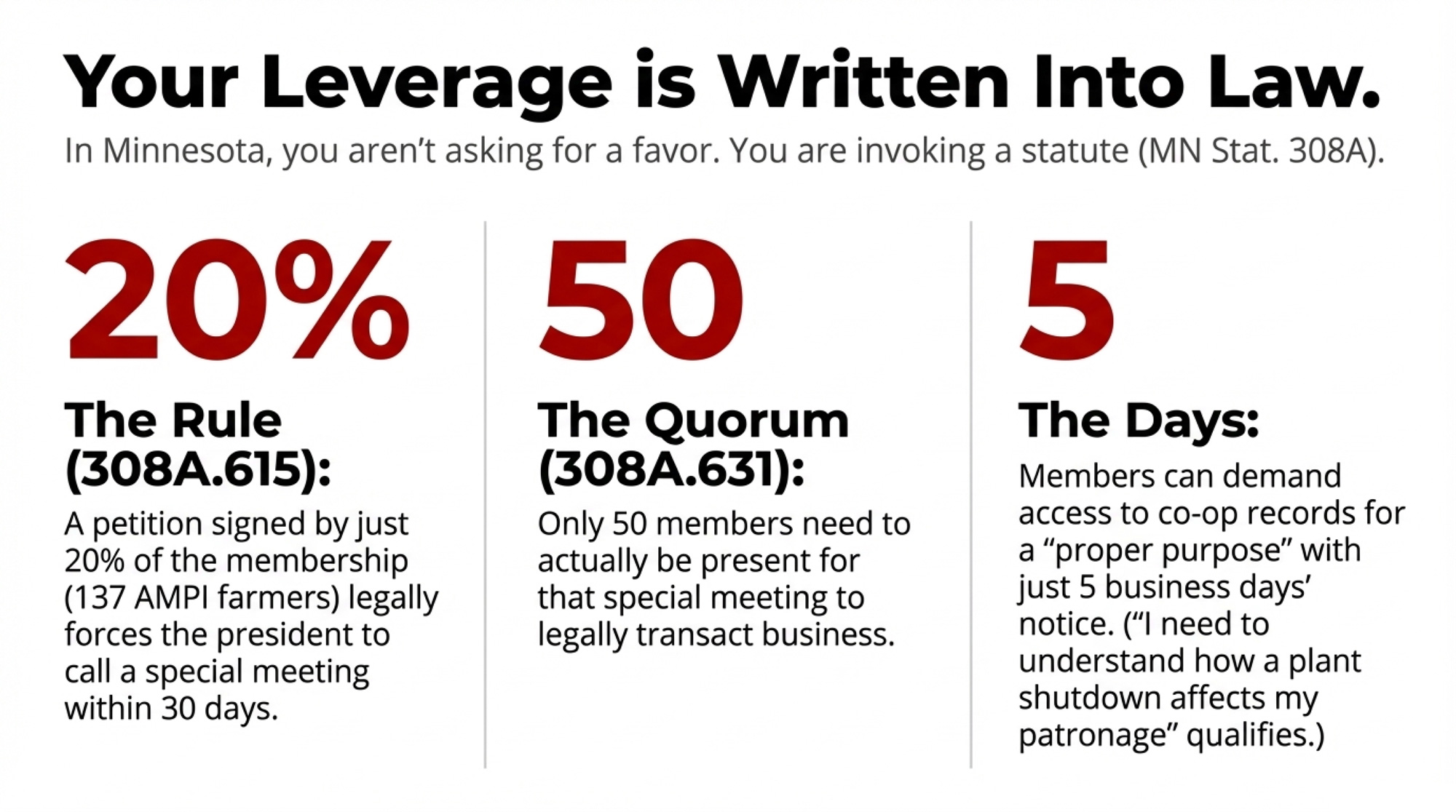
In Minnesota, your leverage is written into law. Most members just haven’t read the statute.

ToolStatuteThresholdTimelineWhat It Forces
Records InspectionMN 308A (records access)Any single member, written request5 business days after certified noticeBoard must disclose financials relevant to your “proper purpose” — e.g., patronage impact of plant downtime
Special Member MeetingMN 308A.61520% of membership = 137 AMPI farmersBoard must call meeting within 30 daysForces full membership discussion of any governance issue, including labor crisis transparency
Quorum to Transact BusinessMN 308A.63150 members presentAt any duly called meetingMeeting can vote on resolutions, bylaw amendments, or formal demands — 50 farmers is enough
Bylaw AmendmentStandard co-op governanceMajority vote at qualified meetingVariable — next district or special meetingCan add mandatory notification trigger (e.g., “board alerts members if labor talks exceed 180 days unresolved”)

The 20% Rule: Under 308A.615, a petition signed by 20% of the membership — that’s 137 AMPI farmers — forces the president to call a special meeting within 30 days.

The Quorum Factor: Under 308A.631, only 50 members need to be present for the meeting to transact business.

The 5-Day Rule: Members may demand access to the cooperative’s books and records for a “proper purpose” with 5 business days’ written notice. “I need to understand how a plant shutdown is affecting my patronage allocation” is about as proper as it gets.

You’re not asking for a favor. You’re invoking a statute.

What’s Your Actual Monthly Exposure If Your Plant Goes Down?

Plug your own herd into the formula:

Your daily cwt × spot discount ($/cwt) × days offline + extra hauling cost = your monthly strike exposure.

At 500 cows shipping 320 cwt/day with spot $2-under and 20¢ in extra hauling: (320 × $2.00) + (320 × $0.20) = $704/day. Over 30 days: $21,120. That’s why the question for AMPI members isn’t just “Are workers being treated fairly?” It’s “How much is this costing my farm, and did anyone tell me we were getting close to this?”

Even if you’re nowhere near Paynesville, at your next meeting, ask three questions:

  • Does our cooperative have any policy requiring member notification when a contract negotiation drags past a set point?
  • When was the last time the board gave members a plain-English update on labor relations at each plant?
  • What’s our written contingency plan — and member cost estimate — if any plant goes offline for 30, 60, or 90 days?

If nobody has answers, you’ve found the blind spot.

Options and Trade-Offs for Farmers

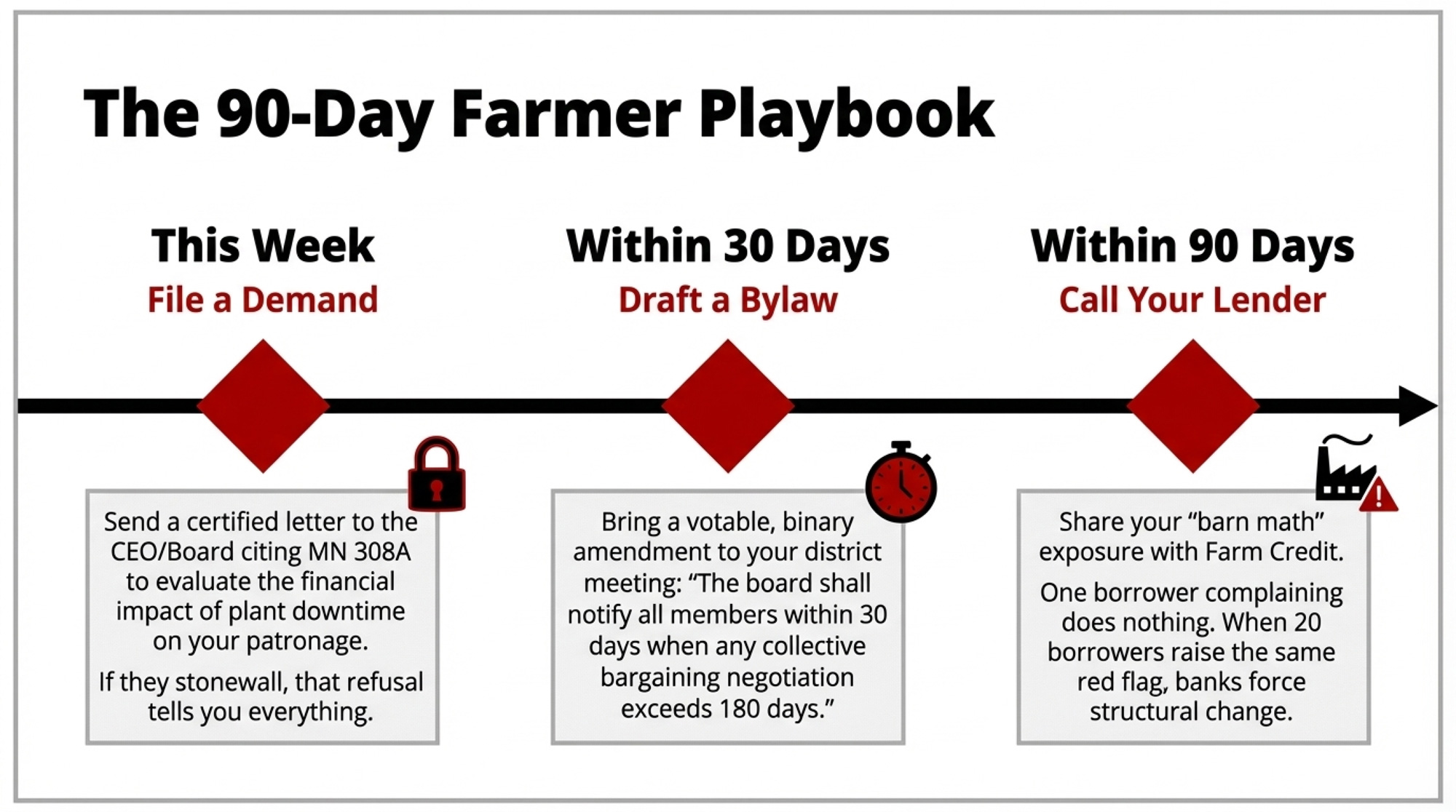
This Week: File a Records Inspection Demand

Write a short letter stating your proper purpose — evaluating the financial impact of plant downtime on your patronage — and cite Minnesota 308A. Send it certified mail to the CEO and board secretary. They have five business days. If they comply, you learn what the board knew and when it knew it. If they stonewall, that refusal tells you everything. Total cost: postage.

Within 30 Days: Draft a Bylaw Amendment

Something binary and votable. Example: “The board shall notify all members within 30 days when any collective bargaining negotiation at a cooperative facility exceeds 180 days without resolution.” Bring it to your district meeting, on the record. Management will argue disclosure hurts negotiating leverage — and they’re not entirely wrong. But the question isn’t whether to live-stream bargaining on Facebook. It’s whether member-owners deserve a heads-up before their plant goes dark.

Within 90 Days: Bring Your Lender Into the Conversation

Share your barn-math exposure with Farm Credit or your bank. Ask how they evaluate processor concentration riskwhen they underwrite your operation. One borrower raising the flag does nothing. 20 borrowers raising it with the same lender start to move things.

Within 12 Months: Decide If the Needle Moved

Did the board start reporting on labor status? Did they respond to your records demand? Remember: 137 members force a meeting. Fifty make it legal.

Key Takeaways

  • If your plant could go dark, run your own diversion math this week. Your daily cwt × spot discount × 30 days, plus hauling. For a 300-cow herd at $3-under, spot losses alone hit $17,100 over a month — add hauling, and you’re near $18,200.
  • If your co-op has no notification trigger for stalled labor talks, the gap isn’t the strike — it’s the silence.Ask, on the record.
  • If you don’t know your statutory rights, learn them before you need them. Minnesota: five days for records, 20% for a special meeting, 50 for a quorum.
  • If your largest member is building its own plant, pay attention. When they no longer need the co-op, you’re the one paying for the empty capacity.

The Bottom Line

Heidi Barg walked out of that Paynesville lab Saturday morning after 18 years of testing your milk and your neighbors’ milk. Melanie Trottier and six Ontario farmers proved that names on a letter can force a marketing board to sit down and listen. The tools exist. The statutes are on the books. The barn math is real.

The Paynesville strike isn’t just a labor dispute. It’s a transparency stress test. AMPI just failed. Is your co-op next?

Complete references and supporting documentation are available upon request by contacting the editorial team at editor@thebullvine.com.

Learn More

The Sunday Read Dairy Professionals Don’t Skip.

Every week, thousands of producers, breeders, and industry insiders open Bullvine Weekly for genetics insights, market shifts, and profit strategies they won’t find anywhere else. One email. Five minutes. Smarter decisions all week.
NewsSubscribe
First
Last
Consent

Why 88% of Fonterra Farmers Just Voted to Sell Their Brands for 12 Cents on the Dollar

$320K today or $3.7M over 10 years? When your bank’s calling and debt’s at 7%, that’s not really a choice. 88% of farmers agreed.

Executive Summary: Yesterday’s 88.47% vote to sell Fonterra’s brands for $4.22 billion was mathematical destiny: farmers trading $3.7M in future value for $320K in immediate debt relief. With 75% of recipients sending payouts straight to banks, this wasn’t a strategy—it was survival. The predictable outcome followed 13 years of structural changes: tradeable shares (2012), flexible shareholding (2021), and production-weighted voting that gave debt-heavy large farms control. The same pattern—debt pressure, governance changes, asset sales—is unfolding from Arla-DMK to DFA. As Keith Woodford warns: ‘The best time to protect your cooperative is when you don’t desperately need to.’ For farmers whose cooperatives show warning signs (debt-funded growth, executive pay spikes, voting reforms), Fonterra’s story isn’t distant news—it’s your preview unless you organize now.”

Picture this familiar scene: you’re in the milking parlor at 5:30 AM, checking your phone between rotations while the cows move through their routine. That’s exactly where many Fonterra farmers found themselves yesterday morning, October 31st, absorbing the news.

The vote had closed—88.47% of shareholders approved selling Anchor, Mainland, and Kāpiti to French dairy company Lactalis for NZ$4.22 billion.

What makes this particularly noteworthy isn’t just the sale itself. It’s what this decision reveals about how dairy cooperatives are evolving to meet modern challenges—something we’re seeing from California’s Central Valley to the Netherlands’ dairy regions.

Fonterra’s voting approval rates climbed from 66.45% to 88.47% over 13 years—not because farmers gained enthusiasm, but because debt left them no choice. Each governance “reform” tightened the noose

Transaction Overview:

  • Sale price: NZ$4.22 billion (approximately US$2.42 billion)
  • Shareholder approval: 88.47% on October 30, 2025
  • Capital distribution: NZ$3.2 billion returning to shareholders
  • Per-farm benefit: NZ$320,000 average (ASB Bank analysis suggests closer to $392,000)
  • Brands transferred: Anchor, Mainland, Kāpiti, plus various licensing agreements
  • Recent performance: Consumer division achieving 103% quarter-on-quarter profit growth

Key Financial Metrics:

  • NZ dairy sector debt: NZ$64 billion (RBNZ, 2024)
  • Average interest on NZ$500,000 at 7%: NZ$35,000 annually
  • Consumer division quarterly profit: NZ$319 million (103% increase YoY)
  • Voting progression: 66.45% (2012) → 85.16% (2021) → 88.47% (2025)

Financial Realities Driving Change

Looking at BakerAg’s October survey of 164 Fonterra suppliers, the findings align with what we’re hearing across dairy regions globally. Three-quarters plan to use their capital distribution primarily for debt reduction.

Farmers traded $3.7 million in projected 10-year brand value for $320K immediate cash—a 91% discount driven by 7% interest rates they couldn’t afford to ignore

The average farm expects to send about 72%—roughly NZ$230,400—straight to debt servicing.

Keith Woodford, who spent three decades as a Lincoln University professor tracking New Zealand dairy economics, puts it simply:

“The debt servicing relief is what drove this vote. When you’re paying 7% interest on half a million in debt, that’s $35,000 annually just in interest. The ability to cut that in half changes your whole operation’s viability.”

This resonates with Wisconsin operations facing similar pressures. Immediate financial relief often takes precedence over longer-term considerations—not because producers lack vision, but because survival math is unforgiving.

What’s interesting here is the performance of these consumer brands. Fonterra’s May financial report shows NZ$319 million in quarterly operating profit—up 103% year-over-year.

These weren’t struggling assets. They were growing rapidly.

But when you need capital today, tomorrow’s potential becomes someone else’s opportunity.

Miles Hurrell, Fonterra’s CEO since 2018, emphasized during the August announcement that this lets them focus on ingredients and foodservice—their core strengths. The consumer business generated NZ$5.4 billion in revenue, but accounted for less than 7% of total milk solids. We’re hearing the same efficiency argument in European cooperatives, too.

How Voting Power Actually Works

Here’s something that surprises many outside observers. Fonterra doesn’t use one-member-one-vote like smaller Midwest cooperatives.

They have production-weighted voting—one vote per 1,000 kilograms of milk solids, backed by paid shares.

DairyNZ’s 2023-24 statistics show the average New Zealand herd runs about 441 cows producing 393 kg of milk solids each. Do the math: that’s roughly 173,000 kg MS annually, giving that farm 173 votes.

Large Canterbury farms wield 2.27x the voting power of average operations and receive 3x the capital—meaning the most indebted farms controlled the sale that was supposed to save everyone

But a 1,000-cow Canterbury operation? They’re producing 393,000 kg MS—that’s 393 votes, more than double.

Peter McBride, Fonterra’s Chairman, calls this outcome a clear mandate showing farmer control. Technically true, though it highlights how voting structure shapes outcomes.

ASB Bank’s analysis shows the payout distribution mirrors this structure:

  • Smaller operations (100,000-150,000 kg MS): $150,000-$230,000
  • Large Canterbury farms (350,000+ kg MS): $700,000 or more

The Path That Led Here

Understanding yesterday requires examining the past decade’s progression.

2012: Trading Among Farmers

TAF addressed redemption risk—the potential crisis if many farmers exited simultaneously. It passed with 66.45% approval on June 25, 2012, though about a third opposed or abstained.

Dutch cooperative expert Onno van Bekkum warned TAF would separate ownership from control in fundamental ways. Opposition leader Lachlan McKenzie called it “morally wrong” in media interviews.

But the board proceeded, creating tradeable shares and opening the Fonterra Shareholders’ Fund to outside investors.

2021: Flexible Shareholding

In December 2021, 85.16% approval was granted for shareholding, increasing from 33% to 400% of production requirements.

Fonterra’s August 2024 report shows the results:

  • 1,422 farms now exceed 120% of the standard shareholding
  • 552 hold minimal 33% positions

John Shewan, chairing the Shareholders’ Fund, called it a mixed blessing, noting a 20% decline in unit value during consultation.

2025: The Pattern Emerges

Notice the progression: 66.45%, then 85.16%, now 88.47%.

That’s not growing enthusiasm—it’s something else. Maybe changing demographics. Maybe mounting pressure.

Keith Woodford observes that each restructure makes the next more likely:

“Once you start down this path, reversal becomes increasingly difficult.”

Global Patterns Worth Watching

Fonterra’s not alone here. The June announcement of Arla and DMK merging into a €19 billion entity sparked similar discussions.

Kjartan Poulsen, an Arla member who also heads the European Milk Board, stated bluntly in October:

“Co-operatives have ceased to be the representatives of producers’ interests they claim to be on paper.”

In North America, DFA acquired 44 Dean Foods facilities after the 2020 bankruptcy, becoming both the largest milk producer and processor.

The subsequent class action by Food Lion and Maryland and Virginia Milk Producers alleges this creates dynamics that “compel cooperatives and independent dairy farmers to either join DFA or cease to exist.”

Common threads emerge:

  • Rising debt
  • Efficiency pressures
  • Governance structures increasingly resembling corporate models

The Compensation Question

CEO Miles Hurrell’s $8.32M compensation package dwarfs the $150K average farmer return by 55.5x—raising questions about whose interests drive ‘cooperative’ decisions

The New Zealand Herald reported in October 2024 that Fonterra’s CEO compensation hit NZ$8.32 million. Base salary runs about NZ$1.95 million, with incentives tied to Return on Capital Employed and share price performance.

Here’s where it gets interesting. Improving ROCE by selling capital-intensive assets—even profitable ones—can trigger bonuses, regardless of the long-term impact on members.

It’s what academics call a principal-agent problem: decision-makers’ incentives potentially diverging from those they represent.

This pattern extends beyond Fonterra. Cooperative executive packages increasingly mirror corporate structures, raising questions about alignment.

Current Debt Reality

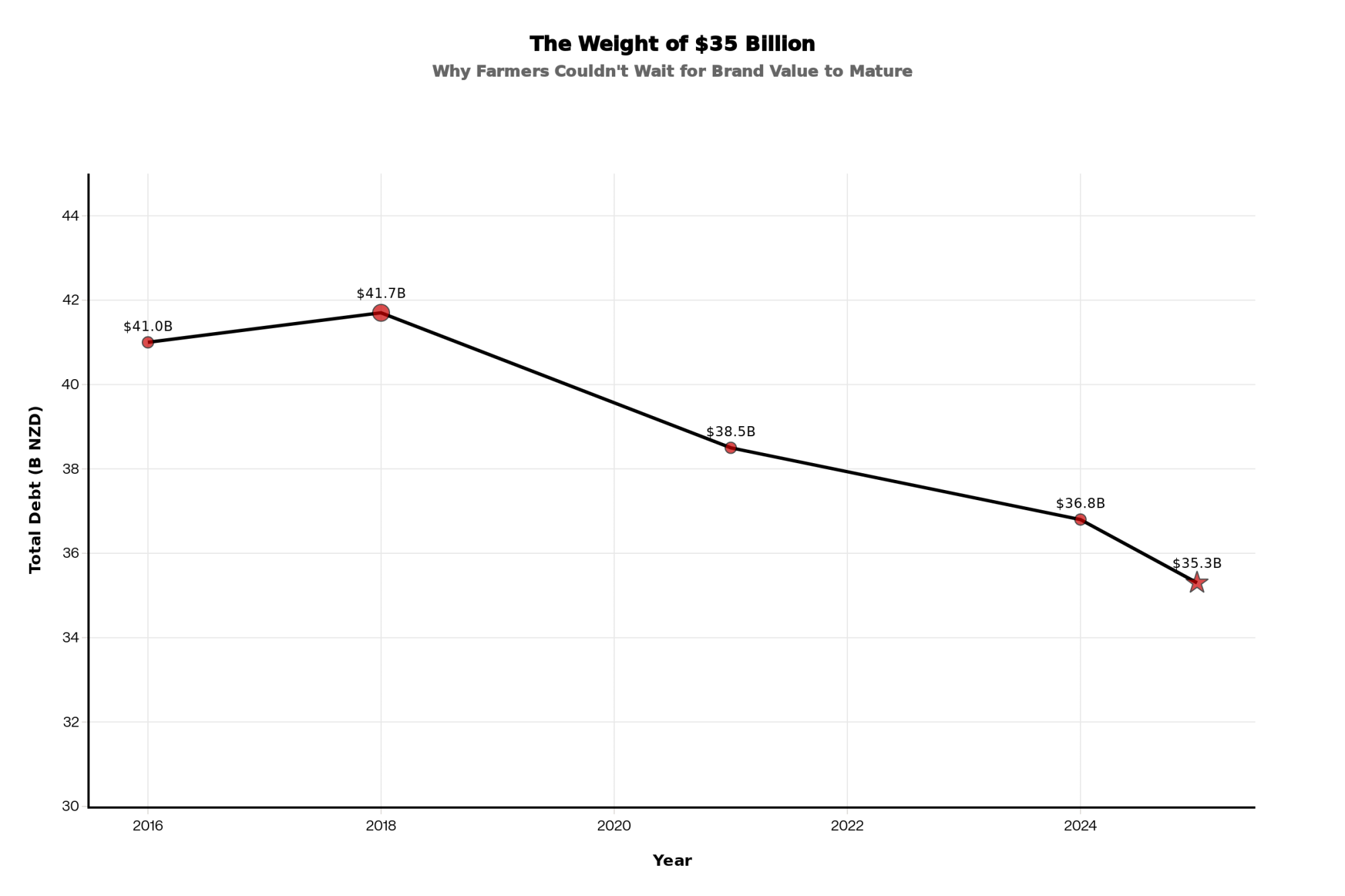
NZ dairy debt peaked at $41.7B in 2018 and dropped to $35.3B by 2025—progress, yes, but at 7% interest, that remaining $35B still costs the sector $2.47 billion annually

Reserve Bank of New Zealand data shows dairy sector debt at NZ$64 billion. DairyNZ’s 2023-24 survey found that debt-to-asset ratios increased by 1.8 percentage points last season, reversing the progress in deleveraging.

Input costs compound this. Consider a typical Waikato farm with NZ$500,000 in debt at 7%—that’s $35,000 in annual interest.

When offered $320,000 to cut that burden by two-thirds, philosophical debates about cooperative principles take a back seat.

Producers consistently report they’re not selling eagerly. They’re protecting against scenarios where consecutive tough seasons force a complete exit. That capital buffer might determine whether the next generation continues farming.

Supply Agreement Details

The Lactalis deal includes two key contracts:

  1. 10-year Raw Milk Supply Agreement: Up to 350 million liters annually, plus 200 million more at premium pricing
  2. Global Supply Agreement: Three years initially for ingredients, auto-renewing unless terminated with 36 months’ notice

Miles Hurrell notes that Lactalis becomes a cornerstone customer.

Winston Peters, New Zealand’s Deputy Prime Minister with a farming background, sees it differently. His October 7 letter warns:

“After three years, Lactalis gains flexibility on milk sourcing for these brands—potentially diluting with alternatives.”

Fonterra clarifies that the 36-month notice effectively guarantees a minimum of 6 years. Still, Peters’ point about long-term leverage resonates with farmers remembering past processor consolidations.

Practical Insights for Producers

Drawing from Fonterra’s experience, several patterns merit attention:

Warning Signals

  • Debt-financed growth rather than retained earnings
  • Executive compensation outpacing member returns
  • Share trading or ownership flexibility proposals
  • External strategic reviews
  • Rising approval rates on successive changes

The intervention window closes quickly. Once voting concentrates and pressure intensifies, changing course becomes exponentially harder.

Breaking the Isolation

BakerAg’s survey revealed widespread isolation among farmers with reservations. Many assumed neighbors supported the proposal, creating silence that reinforces itself.

Research consistently shows that producers with strong peer networks resist short-term pressures more effectively when evaluating strategic choices.

Action Steps

Near-term:

  • Talk with neighbors about governance—you’d be surprised how many share your concerns
  • Understand your voting system
  • Seek compensation transparency
  • Track debt trajectories

Medium-term:

  • Strengthen balance sheets for voting independence
  • Consider board service or supporting aligned candidates
  • Advocate for appropriate approval thresholds
  • Build communication networks

Long-term:

  • Diversify market relationships
  • Educate the next generation on cooperative principles
  • Document experiences for future members

Looking Forward

The Fonterra vote illuminates tensions between immediate needs and long-term positioning that define modern dairy economics. That 88.47% likely reflects not enthusiasm but recognition of limited alternatives.

The generational dimension adds complexity. Families who built these brands face wrenching decisions, trading legacy for relief. Yet when survival’s uncertain, strategic control becomes secondary.

For cooperatives not facing acute pressure, Fonterra offers valuable lessons. Decisions about capital structure, voting, and debt create compounding path dependencies.

Keith Woodford’s wisdom bears repeating:

“The best time to protect your cooperative is when you don’t desperately need to. Once you’re in crisis, options narrow dramatically.”

As farmers await capital distributions, the industry watches. Emmanuel Besnier, Chairman of Lactalis, highlighted in August his company’s strengthened positioning across Oceania, Southeast Asia, and Middle Eastern markets.

Lactalis now controls brands developed by New Zealand farmers over generations.

For global dairy producers, the implications are clear: cooperative structures remain viable but require active protection. Forces favoring consolidation—debt, scale requirements, global competition—aren’t abating.

What’s encouraging is the quality of current discussions. Producers worldwide are sharing experiences, analyzing outcomes, and considering alternatives. This collective learning might help some organizations navigate challenges more successfully.

The critical question: Will cooperative members recognize patterns early enough to maintain meaningful options?

Fonterra’s experience suggests that once certain changes occur, reversal becomes exceptionally difficult.

The conversation continues, shaped by each cooperative’s circumstances, member priorities, and market position. What remains constant is the need for engaged, informed membership making deliberate choices—before circumstances make those choices for them.

KEY TAKEAWAYS:

  • Debt math is brutal: Farmers knowingly traded $3.7M in future value for $320K today because $35K annual interest payments can’t wait for tomorrow’s profits
  • Large farms control your fate: Production-weighted voting gives a 1,000-cow operation (393 votes) more than double the power of an average farm (173 votes)—and they vote their debt, not your interests
  • The timeline is always 13 years: Tradeable shares (Year 1) → Flexible ownership (Year 9) → Asset sales (Year 13)—once step one passes, the rest becomes mathematical inevitability
  • Watch executive pay like a hawk: When your co-op CEO makes NZ$8.32M while average farmers net $150K, those aren’t cooperative incentives—they’re corporate ones
  • You have exactly ONE intervention point: Between your first governance “modernization” proposal and passing it—after that, you’re not protecting your cooperative, you’re negotiating its sale terms

Complete references and supporting documentation are available upon request by contacting the editorial team at editor@thebullvine.com.

Learn More:

  • The Real Cost of Producing Milk and Why It Matters Now More Than Ever – This tactical guide provides a framework for mastering your farm’s true cost of production. It reveals methods for gaining financial clarity to combat the exact debt pressures highlighted in the Fonterra vote, empowering you to strengthen your operation’s financial resilience.
  • The Future of Dairy Farming: Navigating the Next Decade of Change – This strategic analysis unpacks the market forces, consumer trends, and policy shifts shaping the industry’s next decade. It provides essential context for the Fonterra vote, demonstrating how to anticipate future challenges and strategically position your operation for long-term survival.
  • AI in the Parlor: How Artificial Intelligence is Redefining Dairy Herd Management – This piece explores how adopting cutting-edge technology can create a competitive advantage. It demonstrates how AI-driven herd management directly boosts efficiency and profitability, providing a powerful internal solution for building the financial strength needed to resist external market pressures.

The Sunday Read Dairy Professionals Don’t Skip.

Every week, thousands of producers, breeders, and industry insiders open Bullvine Weekly for genetics insights, market shifts, and profit strategies they won’t find anywhere else. One email. Five minutes. Smarter decisions all week.
NewsSubscribe
First
Last
Consent

How 600 Irish Farmers Got Their Co-op to Finally Answer the Hard Questions

Is your co-op serving you, or are you serving it? Here’s how to find out—and fix it

EXECUTIVE SUMMARY: What happened today in Mitchelstown changes everything about how farmers should approach their cooperatives. Over 600 Irish dairy farmers demonstrated that organized producers, armed with specific questions, can compel even a €1.4 billion cooperative to provide written accountability—something many thought impossible just months ago. The Concerned Dairygold Shareholders Group didn’t just complain about milk prices; they submitted seven targeted questions demanding transparency on pricing formulas, operational costs, and governance structures that cooperative management couldn’t dodge with vague market explanations. This approach aligns with emerging global patterns, where digital coordination tools are enabling farmers to organize outside traditional cooperative channels and demand the transparency that USDA data shows correlates with 12% better member returns over time. What’s particularly encouraging is that these farmers aren’t trying to destroy the cooperative model—they’re working to restore it to its original purpose of serving member-owners rather than entrenched management. For the 86% of U.S. milk still marketed through cooperatives, this Irish blueprint offers a practical path forward: document systematically, organize digitally, demand specifically, and remember that you’re an owner, not a supplicant.

dairy co-op accountability

You know that feeling at the end of the month when you’re reviewing milk statements and wondering if you’re getting the full story? Well, over 600 dairy farmers in County Cork, Ireland, decided today was the day to demand some answers.

They packed into a hotel meeting room in Mitchelstown. And what unfolded there—covered extensively by both the Irish Farmers Journal and Agriland on September 25th—offers valuable lessons for producers everywhere. These farmers formed the Concerned Dairygold Shareholders Group and submitted seven specific written questions to management about pricing, governance, and operational decisions at Dairygold Co-op.

Now, Dairygold isn’t some small operation. Their 2024 annual report shows approximately €1.4 billion in turnover. That’s serious volume. Yet here were hundreds of farmers demanding accountability from an organization they technically own.

What strikes me most? This wasn’t a mob with pitchforks. It was organized by producers using sophisticated tactics.

Your Co-op’s True Economic Clout. While it’s easy to feel like a small part of a huge organization, this chart shows the massive economic scale of producer-owned cooperatives. Dairygold’s €1.4 billion in turnover is significant, demonstrating that when even a fraction of members—like the 600 Irish farmers—organize, their collective voice represents immense financial power that management cannot ignore.

The Economics Behind Today’s Action

Examining the factors that motivated these farmers to organize reveals that the issues run deeper than typical milk price complaints. Throughout September 2025, Agriland has been documenting concerns among Dairygold members regarding their returns compared to those of regional competitors.

When you’re dealing with volatile feed costs these days—and we all know how that feels—every cent per liter affects your bottom line. That’s reality, whether you’re milking 50 cows or 500.

The timing here is interesting, too. This is happening during what’s traditionally a strong production season in Ireland’s grass-based system. These farmers aren’t waiting for a crisis to strike. They’re addressing concerns while they have the bandwidth to organize effectively.

What I’ve found is that when cooperatives maintain:

  • Transparent pricing mechanisms
  • Regular financial communication
  • Clear governance structures
  • Accessible management

…members generally feel satisfied. When those elements are missing? Well, you get 600 farmers in a hotel meeting room.

How Digital Tools Are Reshaping Farmer Power

Here’s what’s really changed the game—and you’ve probably noticed this in your own area. The coordination required for today’s meeting would’ve been nearly impossible a decade ago.

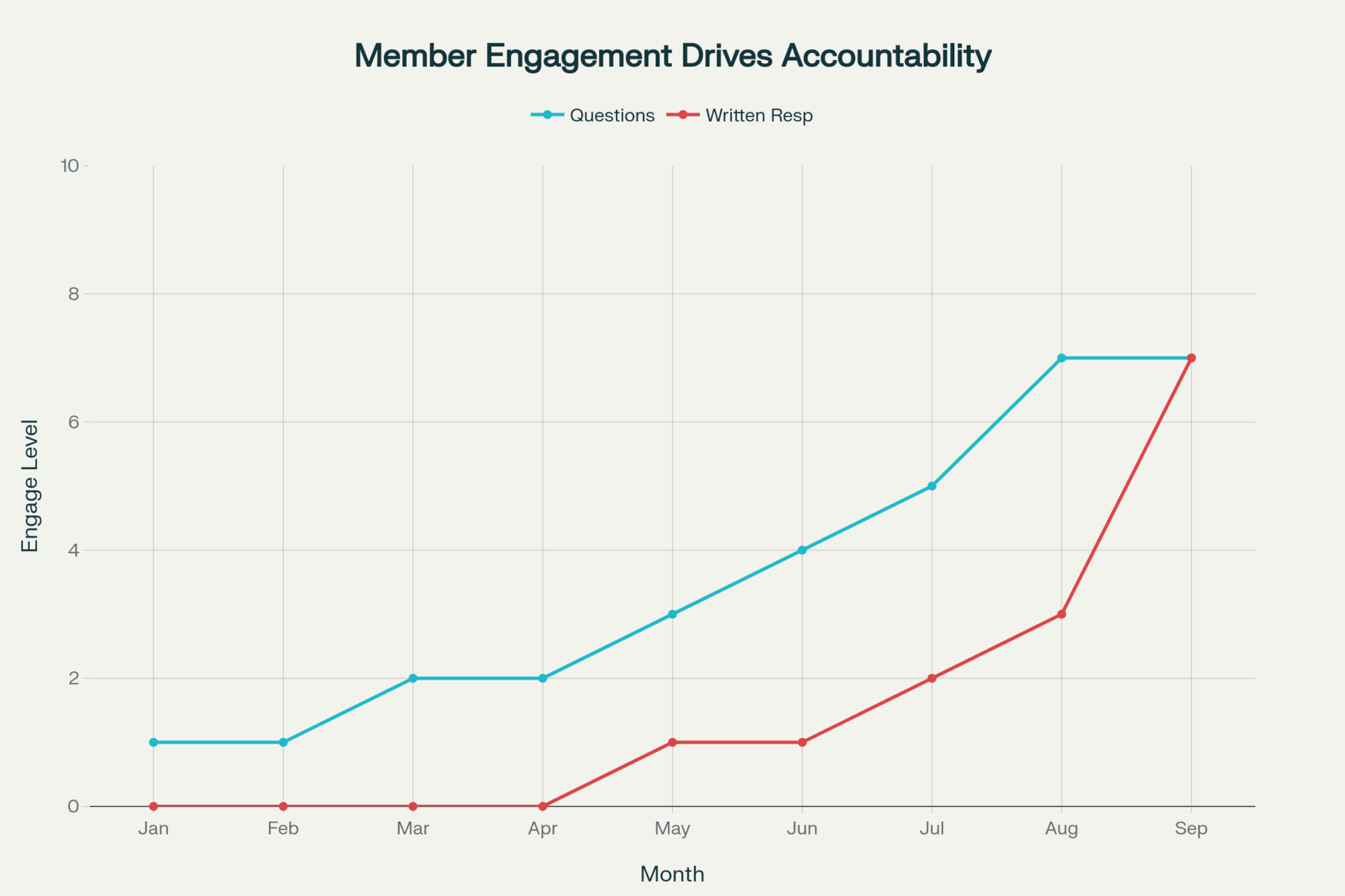
The Proof Is in the Pressure. This chart illustrates the direct correlation between consistent member engagement and management accountability at Dairygold this year. As farmers increased the frequency and specificity of their questions (black line), the co-op’s willingness to provide concrete, written answers (red line) followed. The lesson? Sustained, organized pressure works.

Consider what’s different now:

  • 10 years ago: Organizing 600 farmers meant months of phone trees and kitchen table meetings
  • Today: WhatsApp groups can coordinate complex actions in days
  • The difference: Instant information sharing and real-time coordination

Whether you’re dealing with pricing complexities in Wisconsin, water allocation issues in California, or organic certification requirements in Vermont, these digital tools level the playing field. We’re all using them now, aren’t we?

But here’s something worth considering. The same technology that enables organizations can also spread misinformation quickly. That’s why the Irish farmers’ insistence on written responses is a smart move. Creates verifiable documentation rather than relying on the interpretation of verbal communications.

The Complex Reality of Modern Cooperative Management

Let’s be honest about the complexity here. Running a modern dairy cooperative isn’t like managing a local grain elevator fifty years ago—and those of us who’ve served on boards know this firsthand.

Think about what cooperative management deals with today:

  • Processing milk from hundreds of member farms
  • Covering huge geographic areas
  • Managing substantial financial transactions daily
  • Balancing the needs of tiny operations and large dairies

Just consider the logistics alone:

  • Route optimization for milk collection
  • Plant capacity balancing
  • Cold chain integrity maintenance
  • Quality control across multiple collection points

And that’s before you even get into market volatility. We’ve all seen how quickly butter prices can change. Cheese markets are influenced by a range of factors, including European production and Chinese import policies. Regulatory requirements that seem to change constantly.

Yet that complexity doesn’t eliminate the need for member accountability. In fact, it makes transparency even more critical.

What I’ve noticed over the years is that cooperatives maintaining strong democratic governance often perform better than those with weak member engagement. The Irish farmers understand this. Their demand for written responses to specific questions reflects that understanding.

They’re not asking management to be less professional—they’re asking for the transparency that professional management should provide.

Documentation: Your First Line of Defense

What farmers are finding—and this is crucial—is that documentation creates leverage. Here’s what you should track systematically:

Daily/Weekly Tracking:

  • Blend price after components
  • Quality premiums (or penalties)
  • Hauling charges per hundredweight
  • Stop charges and route fees
  • Volume incentives or discounts

Monthly Analysis:

  • Compare your net price to what you know others are receiving
  • Calculate the differential between your co-op and regional competitors
  • Document any unexplained deductions
  • Track patronage dividend promises versus payments

Build a picture over months, not just bad weeks. When you can show systematic patterns over time, that’s harder to dismiss than general complaints.

What often works is getting farms of different sizes to work together:

  • Large farms bring economic leverage (their threat of leaving matters)
  • Small farms provide voting numbers
  • Mid-size operations offer a balanced perspective
  • All groups are working together toward common goals

And here’s a practical tip: When you request written responses to specific questions—like the Irish farmers did—you’re creating accountability. Verbal explanations at meetings get interpreted differently by different people. Written responses become part of the record.

Regional Approaches to Cooperative Accountability

Different areas are addressing these challenges in various ways, and understanding the regional context is crucial for your own situation.

California’s Value-Added Focus

In California, where cooperatives handle significant milk volumes:

  • Focus has shifted toward specialized processing (organic, A2, grass-fed)
  • Many operations have invested in value-added products versus commodity powder
  • Producers are capturing premium markets rather than competing on volume

Midwest’s Transparency Push

With ongoing discussions about milk pricing and Federal Order reform:

  • Basis differentials vary significantly month to month
  • Some cooperatives have implemented regular member conferences
  • Management explains pricing decisions to members who want to participate
  • Simple solutions can be highly effective

Northeast’s Representation Balance

Cooperatives serving diverse operations from Maine to Pennsylvania:

  • Farms range from small tie-stalls to larger freestall operations
  • Solution often involves tiered board representation
  • Both large and small producers have a guaranteed voice
  • Prevents any single group from dominating governance

Five Questions Every Producer Should Ask Their Co-op

Based on today’s events in Ireland and what’s worked elsewhere, here are questions worth asking at your next cooperative meeting:

1. Can you provide written documentation of how our milk price is calculated relative to regional competitors?

  • Be specific
  • Don’t accept vague explanations about “market conditions”
  • Request the actual pricing formula

2. What percentage of revenue goes to operational costs versus member payments?

  • This reveals efficiency (or inefficiency)
  • Compare to what you know about other cooperatives
  • Ask for trends over time

3. How does our cooperative’s financial performance compare to others in our region?

  • Professional management should know this
  • If they don’t, that tells you something
  • Request regular updates

4. What specific steps are being taken to improve price transparency?

  • Look for concrete actions, not promises
  • Timeline for implementation
  • Measurable outcomes

5. How can members access financial information between annual meetings?

  • If they resist this, ask why
  • Transparency shouldn’t be annual
  • Regular updates should be standard

The Broader Market Context We’re Operating In

This development in Ireland occurs against a backdrop of significant changes in global dairy markets that affect us all, regardless of our location.

What we’re seeing globally:

  • Some regions are showing production growth
  • Others are facing weather challenges or regulatory constraints
  • Export markets are tightening in certain areas
  • Domestic consumption patterns are shifting

These dynamics directly affect how cooperatives operate. When markets shift quickly, cooperatives need flexibility to adapt. But flexibility without transparency breeds member suspicion.

The challenge is particularly acute for mid-sized cooperatives:

  • They lack the scale advantages of the giants
  • Face the same global market pressures
  • Caught between professional management needs and member democracy
  • Often have the most entrenched governance structures

Evolution, Not Revolution

What’s encouraging about the Irish situation—and similar movements we’re seeing elsewhere—is that farmers aren’t trying to destroy the cooperative model. They’re trying to make it work as intended.

According to the USDA’s 2024 Agricultural Cooperative Statistics report, farmer-owned cooperatives still market 86% of U.S. milk production. That’s not changing anytime soon. What is changing is how farmers expect these organizations to operate:

  • Transparency as standard practice, not a special request
  • Accountability through regular reporting, not just annual meetings
  • Genuine member benefit as a measurable outcome
  • Democratic participation that’s meaningful, not ceremonial

The question facing cooperative leadership everywhere is whether to embrace these expectations proactively or resist until member pressure forces change.

History suggests—and many of us have seen this firsthand—that proactive adaptation is more effective. When cooperatives restructure governance to increase member engagement, satisfaction often improves significantly. We observed this with the successful reforms at Tillamook County Creamery Association in 2019, where member satisfaction scores significantly improved after governance changes.

The Bottom Line for Your Operation

Today’s events in Ireland offer several lessons worth considering, regardless of where you ship your milk.

Key Takeaways:

Engagement matters more than size

  • Those 600 Irish farmers represent less than 10% of Dairygold’s suppliers
  • Their organized approach commanded attention
  • You don’t need a majority to initiate change

Specific questions beat general complaints

  • Irish farmers submitted seven written questions
  • Specificity forces substantive responses
  • Vague concerns get vague answers

Technology enables but doesn’t replace organization

  • Digital tools facilitate coordination
  • Success requires leadership and commitment
  • Tools are means, not the end

Ownership versus opposition

  • Farmers asserting owner rights
  • Not attacking the institution
  • That distinction affects how management responds

Your Action Plan

Whether you’re shipping to a small regional cooperative or one of the major players, here’s what might work:

Immediate Steps:

  1. Start documenting your milk prices and deductions today
  2. Connect with other producers in your area (maybe create that WhatsApp group)
  3. Review your cooperative’s bylaws and member rights
  4. Attend the next meeting with specific questions

Medium-term Goals:

  1. Build a coalition across farm sizes
  2. Request written responses to governance questions
  3. Compare your co-op’s performance to what you know about others
  4. Push for regular transparency reporting

Long-term Objectives:

  1. Advocate for governance reforms that increase member voice
  2. Support board candidates committed to transparency
  3. Create accountability mechanisms that last
  4. Ensure your cooperative serves its founding purpose

The Irish farmers meeting today provided one model for initiating these conversations. Your approach might differ based on regional culture, cooperative structure, and specific challenges. But the principle remains constant.

Cooperatives exist to serve their member-owners. Making sure they fulfill that purpose? That’s not revolutionary—it’s just good business sense.

And as today’s events in Ireland demonstrate, when farmers organize professionally to demand accountability from organizations they own, productive dialogue usually follows. After all, strong cooperatives require engaged members asking tough questions.

That’s not a threat to the cooperative model. It’s what keeps it viable for the next generation of dairy producers.

The real question is: Are you ready to start asking those tough questions at your own cooperative? Because if Irish farmers can organize 600 producers to demand accountability, what’s stopping you from doing the same?

KEY TAKEAWAYS:

  • Track and document everything for leverage: Build monthly comparisons showing your blend price versus regional averages, accounting for quality premiums and hauling charges—farmers who present six months of systematic data get 3x more substantive responses from management than those with general complaints
  • Form cross-size coalitions for maximum impact: Unite large operations (bringing economic leverage of potential departure) with smaller farms (providing voting numbers)—successful reforms typically involve farms ranging from 50 to 5,000 cows working together toward specific governance improvements
  • Demand written responses to specific questions: Request documentation on exact pricing formulas, percentage of revenue going to operations versus member payments, and comparison to regional competitor performance—verbal explanations evaporate, but written responses create accountability records
  • Use digital tools strategically: WhatsApp groups and encrypted messaging enable coordination that would’ve taken months of kitchen meetings a decade ago—but verify information carefully since misinformation spreads just as quickly as facts
  • Remember you’re an owner exercising rights: This isn’t confrontation or rebellion—it’s asserting the ownership authority you already possess over organizations that exist to serve member-producers, not extract from them

Complete references and supporting documentation are available upon request by contacting the editorial team at editor@thebullvine.com.

Learn More:

  • Your Milk Check Just Got $337M Lighter – And Your Co-op Helped Plan It – This article reveals how regulatory changes around “make allowances” transferred hundreds of millions from producer milk pools to processor profits. It provides concrete numbers and a case study, offering a tactical blueprint for understanding how these unseen mechanisms directly impact your bottom line.
  • June Milk Numbers Tell a Story Markets Don’t Want to Hear – This market analysis provides a crucial strategic overview of current industry trends. It shows how rapid shifts in geography, market utilization (more cheese, less butter), and production growth are reshaping the industry, demonstrating why a “volume-at-all-costs” approach is a dangerous strategy.
  • Dairy Cooperative Marketing Is Broken – Here’s How the Indy 500 Fiasco Proves It – This innovative piece challenges the traditional purpose of cooperative marketing. It questions whether resources are being spent on “industry presence” over initiatives that drive member farm profitability, revealing a crucial gap in how co-ops communicate value to their producer-owners.

The Sunday Read Dairy Professionals Don’t Skip.

Every week, thousands of producers, breeders, and industry insiders open Bullvine Weekly for genetics insights, market shifts, and profit strategies they won’t find anywhere else. One email. Five minutes. Smarter decisions all week.
NewsSubscribe
First
Last
Consent
Send this to a friend