




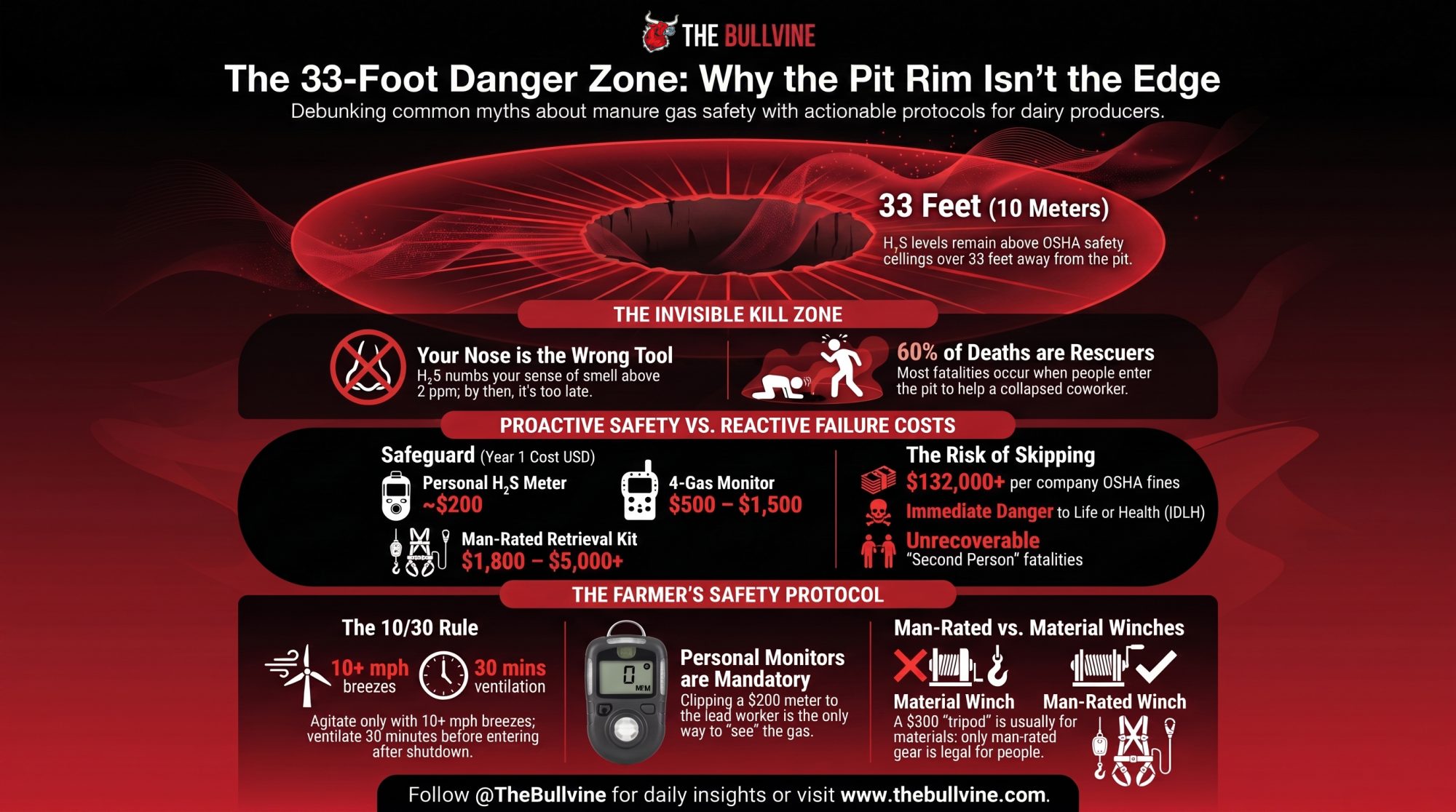
Penn State measured over 20 ppm ten meters back from gypsum-bedded storage during agitation. That’s 33 feet from the opening — and still over OSHA’s ceiling. The pit rim isn’t the edge.
EXECUTIVE SUMMARY: Penn State and USDA-ARS researchers measured hydrogen sulfide above 20 ppm — OSHA’s general-industry ceiling — a full 10 meters back from gypsum-bedded manure storage during agitation, which means the pit rim isn’t the edge of the hazard most of us assume it is. That finding lands the same week families of four workers killed in a Weld County, Colorado pump pit filed a wrongful-death complaint alleging the dairy had no gas monitors, no ventilation, no signage, and no rescue equipment on site; six men died there on August 20, 2025, and OSHA proposed $246,609 across three companies, with the largest single penalty at $132,406. The reason OSHA couldn’t cite the confined-space standard itself sits in one sentence of 29 CFR 1910.146, which has excluded agriculture by name since 1993 — so every decision about testing the air around your pit is a protocol you write, not one you’re handed. Detection runs about $200 for a single-gas personal H₂S meter or $500 to $1,500 for a four-gas unit; on a 400-cow dairy with two below-grade entry points, monitors plus training for the three people who actually go in comes to roughly $2,150 in year one. Watch the retrieval line, though: verified 2026 pricing puts man-rated tripod-and-winch systems at $1,800 to $5,000-plus, and that $300 “confined space tripod” you found is probably a material-handling winch that isn’t rated to lift a person. Purdue counted four livestock-waste incidents nationally in 2025 that killed ten people — six of them in that single Colorado event — and Colorado ranked second in the country for confined-space cases. If you bed with gypsum, know your agitation schedule, work upwind with at least a 10-mph breeze, and ventilate the room for 30 minutes after shutdown before anyone walks in.
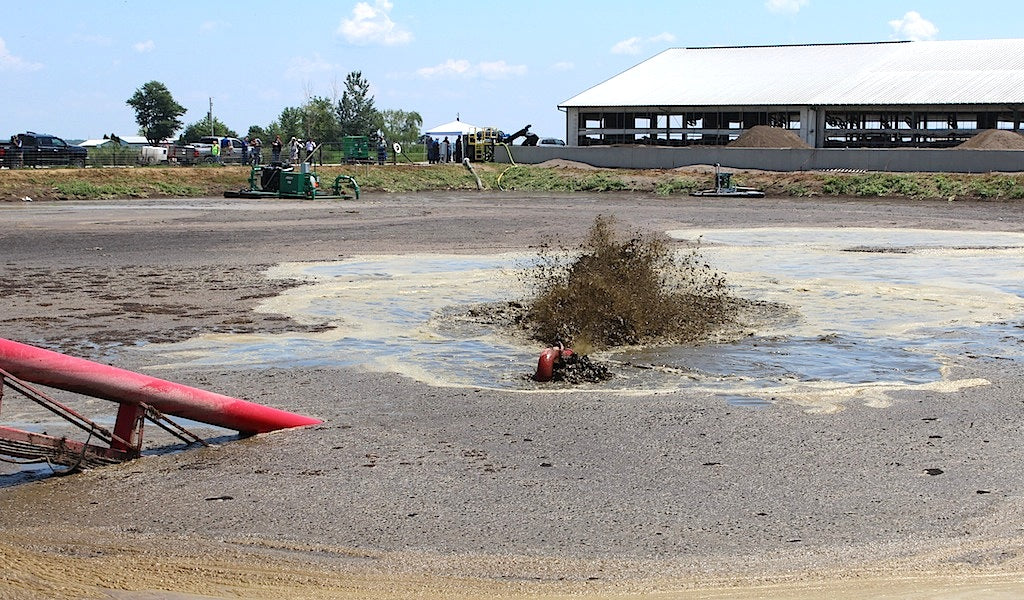
This article is based on the complaint as reported by the Colorado Sun, Denver7, and AgDaily, and on public records available as of August 21, 2026. The allegations described have not been tested in court.
Jorge Sanchez Peña had just finished changing a flat tire. According to the wrongful-death complaint his family filed in Weld County District Court on Wednesday, August 19, 2026, he and two other men were packing up to leave when, the complaint alleges, the manure-management system was reactivated remotely by phone. A pipe joint let go under pressure. The suit alleges that the joint had been secured with straps rather than repaired, and that the filing includes photographs the plaintiffs say were taken months earlier showing the same arrangement.
Manure water poured into an underground pump pit. Hydrogen sulfide is heavier than air, so in a below-grade space it doesn’t blow off — it settles and builds. Sanchez Peña went in to help close a valve and collapsed, according to the complaint. Alejandro Espinoza, 50, followed him in. Then Espinoza’s two sons, Carlos Espinoza Prado, 29, and Oscar, 17.
Four of those men are named in the lawsuit. Six died that day, August 20, 2025. Among the failures the complaint alleges: no gas monitors, no ventilation, no warning signage, and no rescue procedure or equipment in place at the time. Each allegation remains unproven, and the defendants have not yet filed a response. The Colorado Sun reported that a voicemail left at the number listed for the operation went unreturned.
Three Companies, Three Citations, Same Three Gaps
In February 2026, OSHA proposed $246,609 across three companies. Prospect Ranch LLC took $132,406. Fiske Inc. — doing business as High Plains Robotics, the direct employer of the four men in the suit — took $99,306. HD Builders LLC took $14,897.
Read the violations side by side and the pattern is hard to miss. Failure to protect workers from atmospheric hazards. No written hazard communication program. No training on hazardous-gas detection. Three separate companies. Three separate safety programs. And in OSHA’s account, the same three gaps in each one.
| Company | Proposed Penalty | Role in Case | Cited Violation Gaps |
|---|---|---|---|
| Prospect Ranch LLC | $132,406 | Named defendant, civil suit | No atmospheric hazard protection, no hazard comm program, no gas-detection training |
| Fiske Inc. (High Plains Robotics) | $99,306 | Direct employer, not civil defendant | Same three gaps as above |
| HD Builders LLC | $14,897 | OSHA-cited only, not civil defendant | Same three gaps as above |
All three penalties remain proposed rather than final. Each company kept the right to contest before the Occupational Safety and Health Review Commission, and this article reflects the status OSHA announced in February 2026. Note also that Fiske and HD Builders aren’t defendants in the civil suit; they appear here only because OSHA cited them.
The Weld County Coroner’s Office determined the cause of death was hydrogen sulfide exposure, describing the incident only as an industrial accident in a confined space.
The One Sentence in the Standard That Explains the Rest
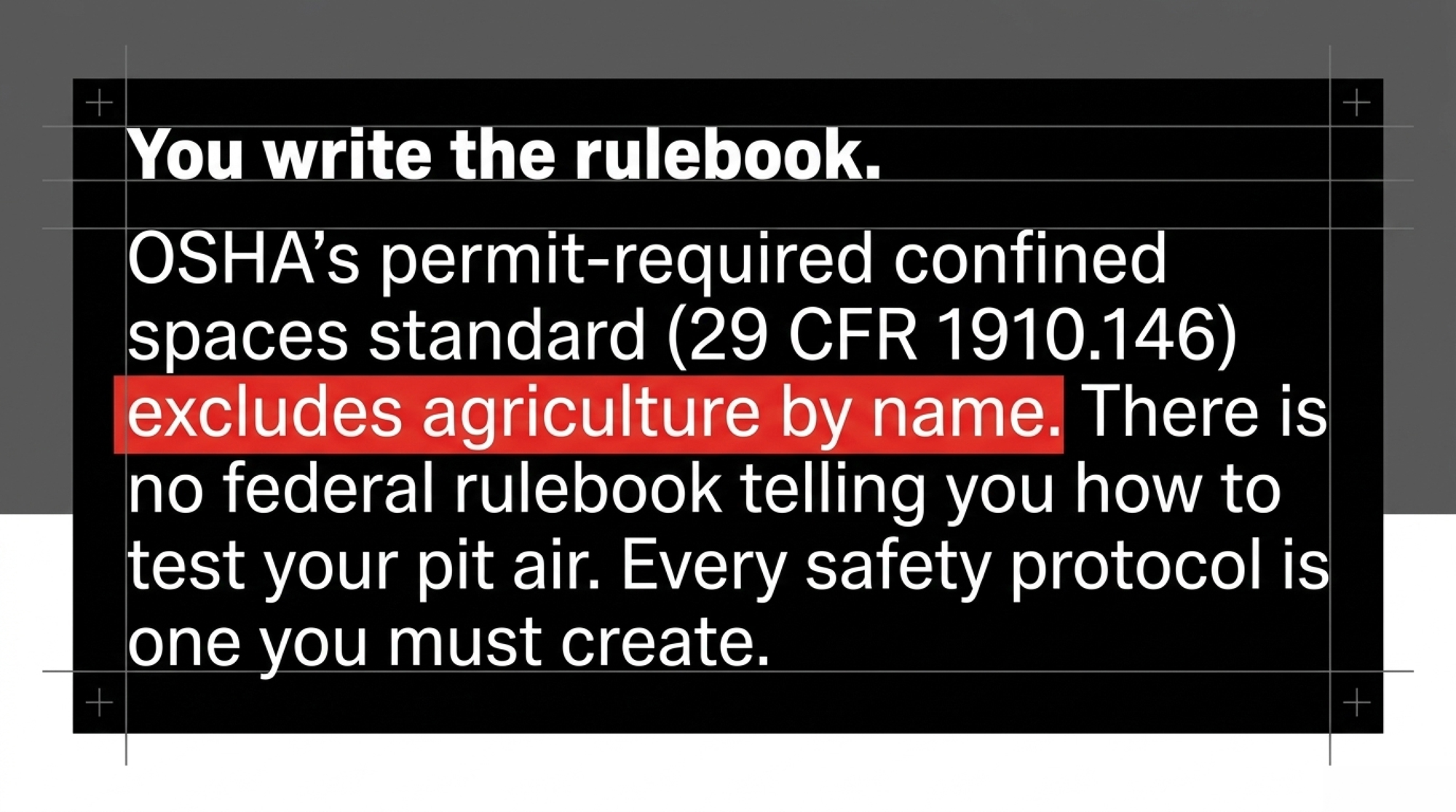
OSHA’s permit-required confined spaces standard — 29 CFR 1910.146 — was written for exactly this hazard. It also contains this line: “This section does not apply to agriculture, to construction, or to shipyard employment.”
The standard took effect in 1993. Agriculture was excluded by name from day one. That’s why OSHA had to build the Weld County case on general-duty and hazard-communication provisions instead of confined-space violations. The rule most precisely designed for a manure pit doesn’t reach a manure pit.
This applies whether you milk 80 cows or 8,000. It’s a categorical industry exclusion, not the separate small-farm appropriations rider that’s kept OSHA from enforcing on operations with ten or fewer non-family employees every year since 1976. Two different mechanisms, and worth keeping straight — a defense attorney certainly will.
Here’s what that exclusion means in practice: there’s no federal rulebook telling you how to test the air around your pit. Every decision about when it’s safe to be near that space is a farm-level protocol you write yourself — which makes it worth knowing what the air actually does when manure gets stirred.
Standing Back Isn’t the Safeguard You Think It Is
USDA-ARS and Penn State researchers led by Eileen Fabian-Wheeler measured hydrogen sulfide during agitation at 18 dairy operations. On farms using gypsum bedding, concentrations during agitation exceeded 100 ppm — NIOSH’s IDLH threshold, the point at which the atmosphere is immediately dangerous to life or health.
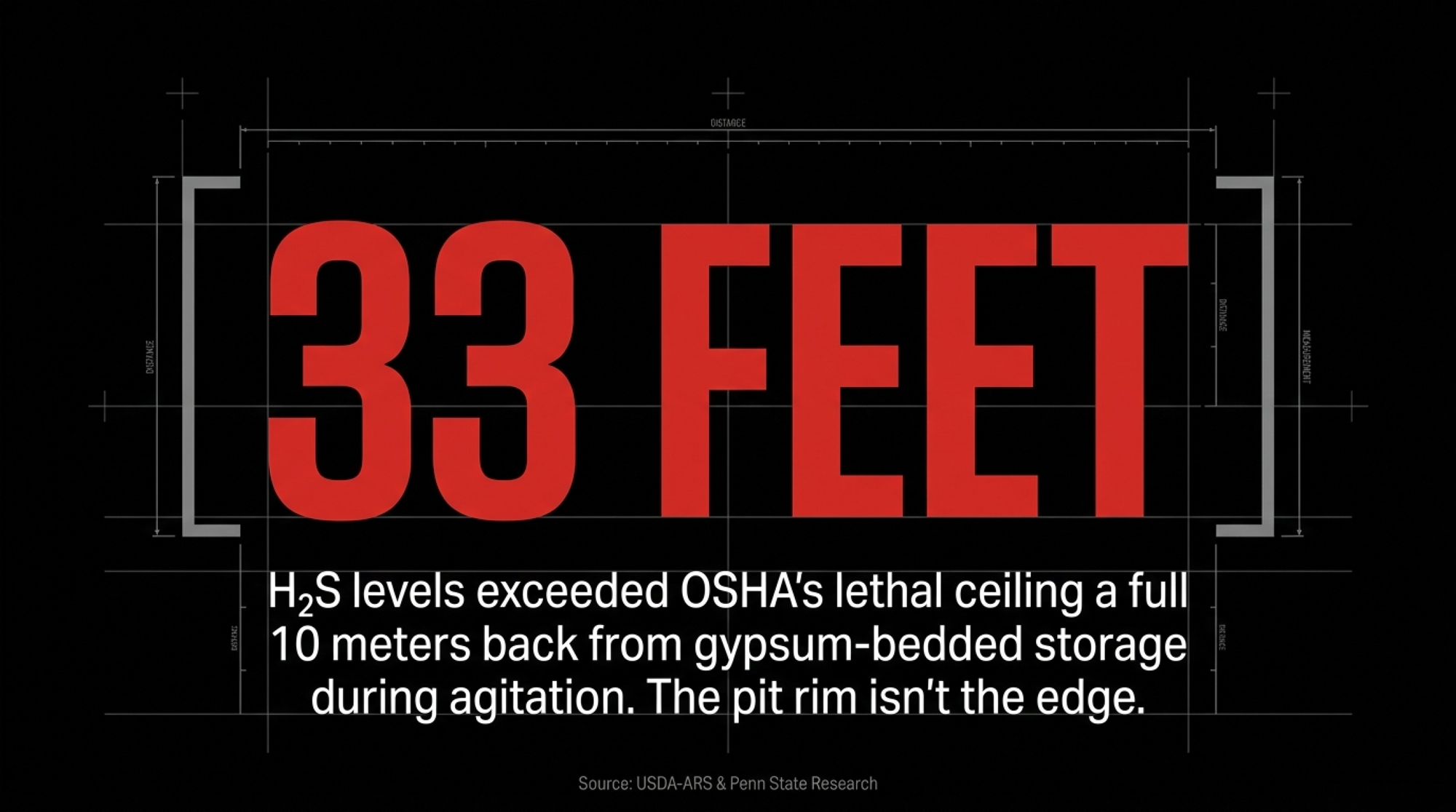
And on some of those gypsum farms, readings taken 10 meters from the storage still came in above 20 ppm. That’s roughly 33 feet. Away from the opening. Still over OSHA’s general-industry ceiling limit.
Most of us have a mental model where the danger lives inside the pit, and the air gets safe somewhere around the lip. That data says otherwise, at least when high-sulfur manure is being stirred. Farms that combined gypsum bedding with additional manure treatment saw significantly lower H₂S than those without — so the bedding choice isn’t a dead end; it’s a variable you can manage.
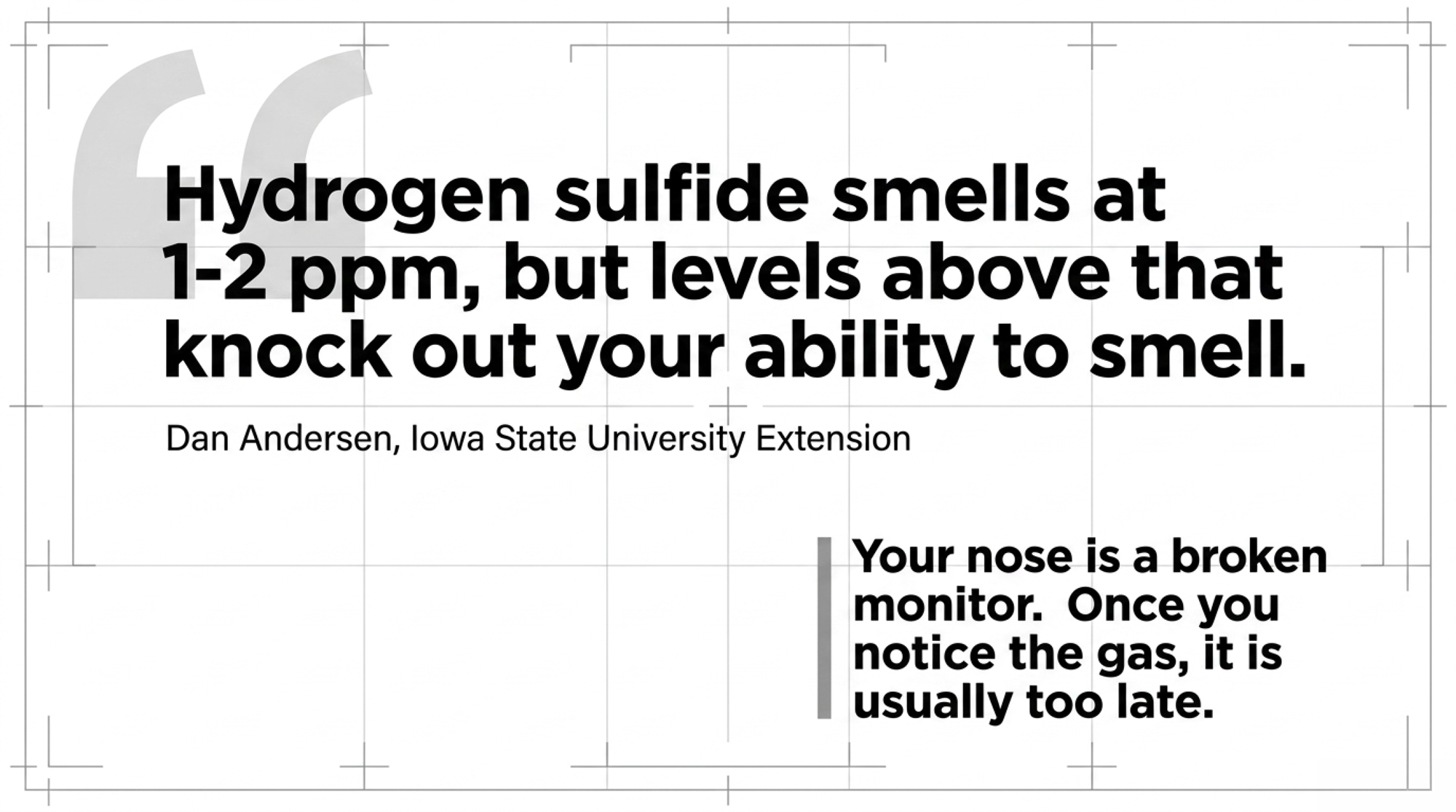
Dan Andersen, agricultural engineering specialist with Iowa State University Extension and Outreach, explains why your nose is the wrong instrument for this job: “Hydrogen sulfide gas smells at 1-2 ppm, but levels above that knock out your ability to smell, so our natural detection system goes away.” Then the line that should end every argument about whether a monitor is worth the money: “Once you realize the gas is a problem it’s usually too late.”
Why the Second Person Goes In
NIOSH had this failure mode on paper before 1910.146 was even finalized. A 1990 Fatality Assessment and Control Evaluation report describes five family members dying in one Wisconsin manure pit, entering one after another to help each other. A 2014 FACE report documents a farmer and his employee dying the same way during a rescue attempt.
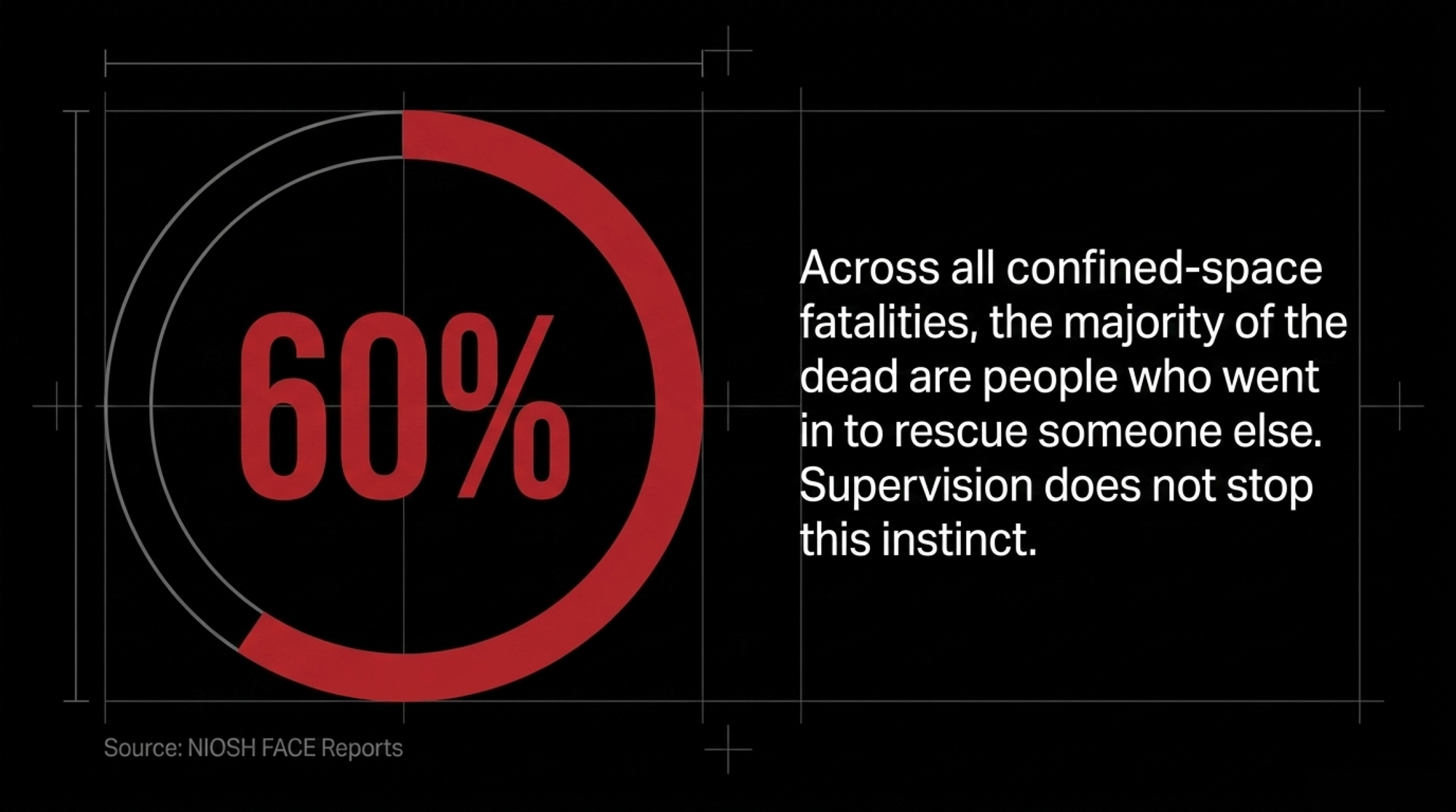
Across confined-space fatalities generally — all industries, not just agriculture — roughly 60% of the dead are people who went in to help. About 85% of those incidents had a supervisor on scene.
Read that second number again. Supervision wasn’t the missing piece.
What’s missing in every one of these sequences is a moment where the danger becomes visible before someone crosses the threshold. Someone collapses. Someone else goes in. That’s not so much a training failure as a human one — and it’s why the fix has to be a device and a rule, not a reminder to be careful.
What Does the Cheap Version Actually Cost?
| Safeguard | Year-1 cost (USD) | Ongoing | Where it fails |
| Single-gas personal H₂S meter | ~$200 | Sensor life 2–3 yrs | Reads one gas only — no O₂ or methane |
| Portable 4-gas monitor (H₂S, O₂, CO, CH₄) | $500–$1,500 | ~$100–$200/yr bump gas; sensors every 2–3 yrs | Left in the shop drawer; weekly bump test skipped |
| Man-rated retrieval tripod, winch and harness | $1,800–$5,000+ | Annual inspection/recertification | Nobody top-side trained to run the winch |
| Online confined-space entry training | $80–$180/worker | Refresher every 1–3 yrs | Treated as a checkbox instead of a drill |
| Written hazard and entry protocol | ~$0 (4–8 hrs labor) | Routine updates | Lives in a binder nobody opens under pressure |
Andersen is blunt about the cheapest line: “Personal protection meters are a low-cost investment, usually around $200, that will notify you if gas is present. These instruments can be taken anywhere and are always monitoring the air.” Iowa State Extension keeps several models on hand so producers can try before buying — worth a call before you order anything.
Retrieval-system pricing is the line most likely to catch you out. A verified 2026 spot check shows man-rated confined-space kits — tripod, self-retracting lifeline, winch — running from roughly $1,870 for entry-level packages to $4,565 and beyond for full ANSI/OSHA-compliant systems, with individual man-rated winches alone at $3,900 to $4,900. If you find a $300 “confined space tripod,” check whether it’s man-rated or a material-handling winch. Those are different tools and only one of them is legal to hang a person from.
Now run the monitor math on a 400-cow dairy with two below-grade entry points. Two mid-range four-gas monitors at $750 each is $1,500. Train the three people who actually go in at $150 apiece: $450. Bump-test gas, two cylinders a year at $100: $200. That’s roughly $2,150 in year one, before retrieval gear, against the $132,406 OSHA proposed for a single operation in this case. Tight on cash? Two personal H₂S meters at $200 get you detection at both openings for $400.
That comparison isn’t quite the one you’re really making, though. The honest version is a couple thousand dollars a year, indefinitely, against a low-probability event most operations will never see. That’s the hardest kind of risk for anyone to price — it’s why underwriting exists as a profession. But flip it around: of every number on this page, the monitor is the only one you control. Penalty amounts run on statutory ceilings you don’t influence. Damages are contingent and years out. The monitor is this week.
Is This Still Happening, or Is It History?
It’s current, and Colorado is now in the data. Purdue University’s Agricultural Safety and Health Program documented 48 agricultural confined-space cases nationally in 2025 — 22 fatal, 26 non-fatal. That’s down 5.9% from 51 cases in 2024 and below the ten-year average of roughly 60.
But look at the livestock-waste line specifically. Four incidents involving manure pits or lagoons produced ten fatalities in 2025, including six in a single event. That single event is the one in this story. Colorado ranked second nationally for confined-space cases last year with seven, behind Minnesota’s eight.
Purdue’s database now holds 2,477 cases going back to 1962, and grain entrapment dominates it at 58.6%. So manure gas is the smaller category. It’s also the one where a single incident took six men, which tells you something about how these events behave when they go wrong.
One honest gap: nobody has tracked gas-monitor adoption or confined-space training uptake across dairy operations from 1990 to now. So the tempting line — that the industry ignored this for 35 years — isn’t something the data supports. What it does support is three incidents, in 1990, 2014, and 2025, where investigators found or alleged the same missing safeguard. The information was published and findable twice before. The absence of an adoption trend line is its own kind of finding.
Options and Trade-Offs for Farmers
Path 1 — Deploy gas detection and set the entry rule. Do this within 30 days.
- Cost: $500–$1,500 per four-gas unit, plus roughly $200/year for bump gas and calibration. A single-gas personal H₂S meter runs about $200 if budget is the barrier.
- Implementation: One monitor per entry point. Set the alarm against a published limit rather than judgment — NIOSH’s recommended 10-minute ceiling is 10 ppm, and OSHA’s general-industry ceiling is 20 ppm, so set it at or below the lower of those and treat any alarm as a stop, not a data point.
- Fails when: the device stays in the truck instead of being clipped to the lead worker.
Path 2 — Put man-rated retrieval systems at fixed entry points.
- Cost: $1,800–$5,000+ for an ANSI/OSHA-compliant tripod, self-retracting lifeline, and harness.
- Implementation: Permanent or quick-mount brackets at pump-station access points.
- Fails when: the gear is on site, but nobody top-side is trained to operate the winch — or when a material-handling winch gets substituted for a man-rated one.
Path 3 — Write the entry procedure and post it.
- Cost: four to eight hours a year at your labor rate.
- Implementation: Written, posted at every identified space, read aloud before entry. Michigan State Extension recommends lock-out tags during agitation and pumping so everyone on the place knows what’s running — the National Pork Board supplies them free to pork producers.
- Fails when: it becomes paper. Roughly 31% of confined-space fatality sites across all industries had written procedures nobody used.
Path 4 — If you bed with gypsum, treat agitation as its own hazard window.
- Cost: operational management, plus optional manure treatment additives.
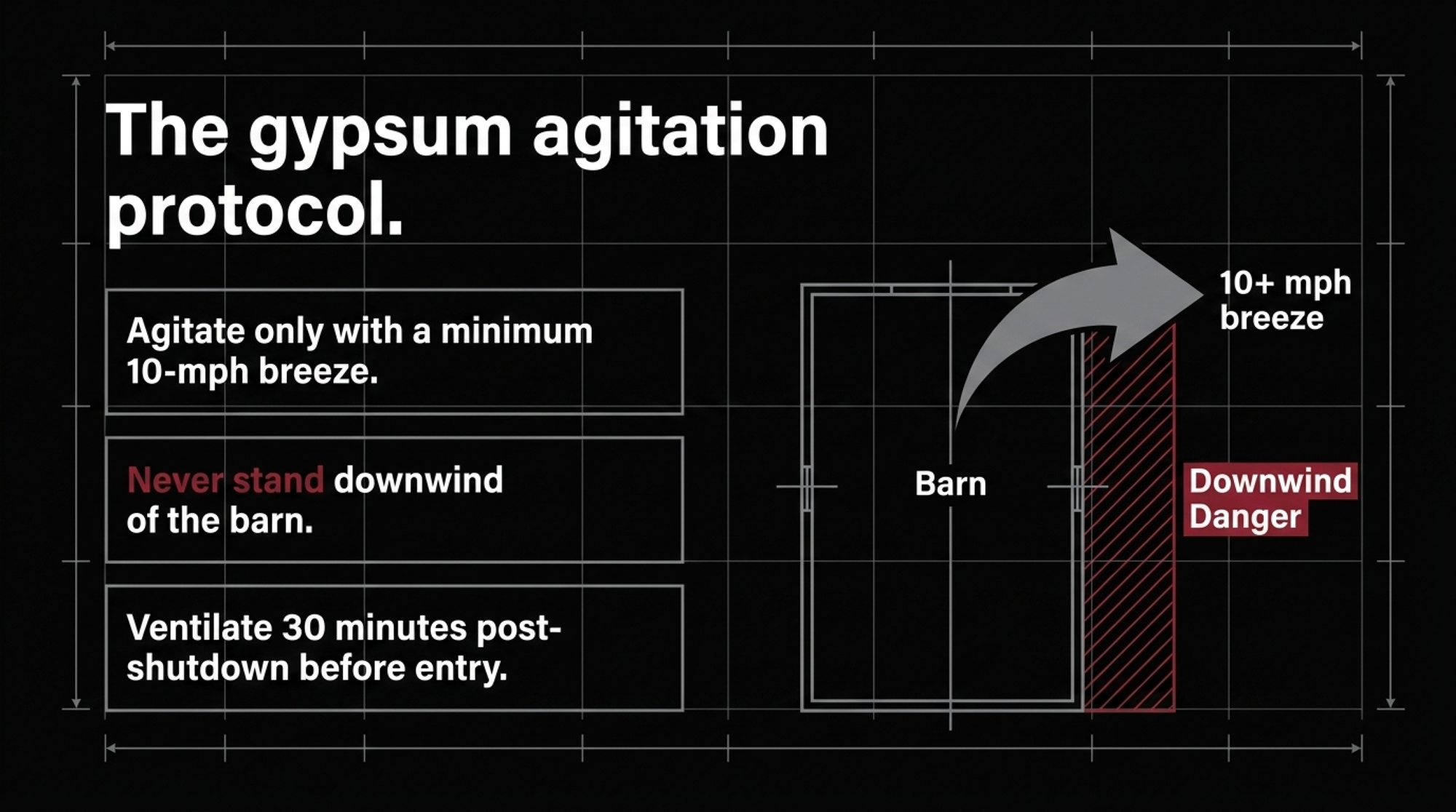
- Implementation: Know your agitation schedule and work upwind. Andersen’s guidance: agitate only when there’s at least a 10-mile-per-hour breeze, set fans to bring in additional air, and “don’t stand downwind from the barn if at all possible.” Michigan State Extension advises never entering a barn while manure is being agitated below — and if you must go in, shut the agitator down and allow a minimum of thirty minutes for ventilation to clear lingering gases first.
- Fails when: you assume the pit rim is the edge of the hazard. The Penn State data says it isn’t, and a closed cab is mitigation rather than protection for anyone on foot.
Key Takeaways
- If anyone on your operation enters a pit, pump station, or below-grade manure structure, price a monitor this week. A four-gas unit runs $500 to $1,500; a personal H₂S meter about $200. Either way, it’s the only line item here you fully control.
- If you’re relying on smell to tell you the air’s bad, you’re relying on a sense that shuts off above 2 ppm. Andersen’s warning is the whole argument: once you notice, it’s usually too late.
- If a retrieval kit is quoted under about $1,800, ask whether the winch is man-rated before you buy. Material-handling winches are not rated to lift people.
- If you bed with gypsum, assume readings above 20 ppm as far as 10 meters from storage during agitation — treat that as a work-zone question, not just an entry question.
- If you shut down an agitator and walk into that room within thirty minutes, you’re ahead of MSU Extension’s clearance window. Wait it out.
- If you’re agitating without at least a 10-mph breeze, or you’re set up downwind of the barn, you’ve made the air a variable instead of a controlled condition.
- If your written hazard-communication program doesn’t exist on paper, you share the exact gap OSHA cited in all three Weld County companies. Fix the document before you buy anything else.
- If you haven’t asked your local fire department whether they train for confined-space rescue, make the call this month. Many volunteer departments don’t, and finding out during an incident is finding out too late.
- If your manure system has a repair you’ve been living with — a patch, a strap, a workaround — the hazard isn’t just the repair. It’s the next time something reactivates that line under pressure.
- If nobody on your place can say the entry rule out loud without checking a binder, you don’t have an entry rule yet.

What Would Your Sequence Look Like?
Walk it through honestly. Somebody goes down in a pit on your operation at four o’clock on a Tuesday afternoon. Who’s the second person on scene, and what stops them from going in after him? If the answer is “their own judgment,” that’s the same answer that was in place in Wisconsin in 1990 and in Weld County in 2025. If the answer is “the monitor at the opening is in alarm and the rule says nobody enters,” you’ve built something different.
Complete references and supporting documentation are available upon request by contacting the editorial team at editor@thebullvine.com.
Learn More
- Manure Gas Killed a Father and His Two Sons in Minutes. A $200 Monitor Could Have Stopped It. — Arms you with an operational five-step safety checklist, detailing the exact multi-gas and retrieval equipment needed to eliminate fatal entry mistakes.
- The Ultimate Guide to Contingency Planning for Dairy Farms: Why Paranoia is Your Best Friend — Breaks down long-term operational resilience, showing how cross-training protocols, emergency leadership redundancies, and liquid reserves protect equity from sudden farm crises.
- The Digital Dairy Barn: Inside Cornell’s CAST and Its Technological Innovations — Reveals how automated environmental monitoring and integrated sensor networks replace blind spots with autonomous, real-time data tracking across modern facilities.
 The Sunday Read Dairy Professionals Don’t Skip.
 The Sunday Read Dairy Professionals Don’t Skip.
Every week, thousands of producers, breeders, and industry insiders open Bullvine Weekly for genetics insights, market shifts, and profit strategies they won’t find anywhere else. One email. Five minutes. Smarter decisions all week.