





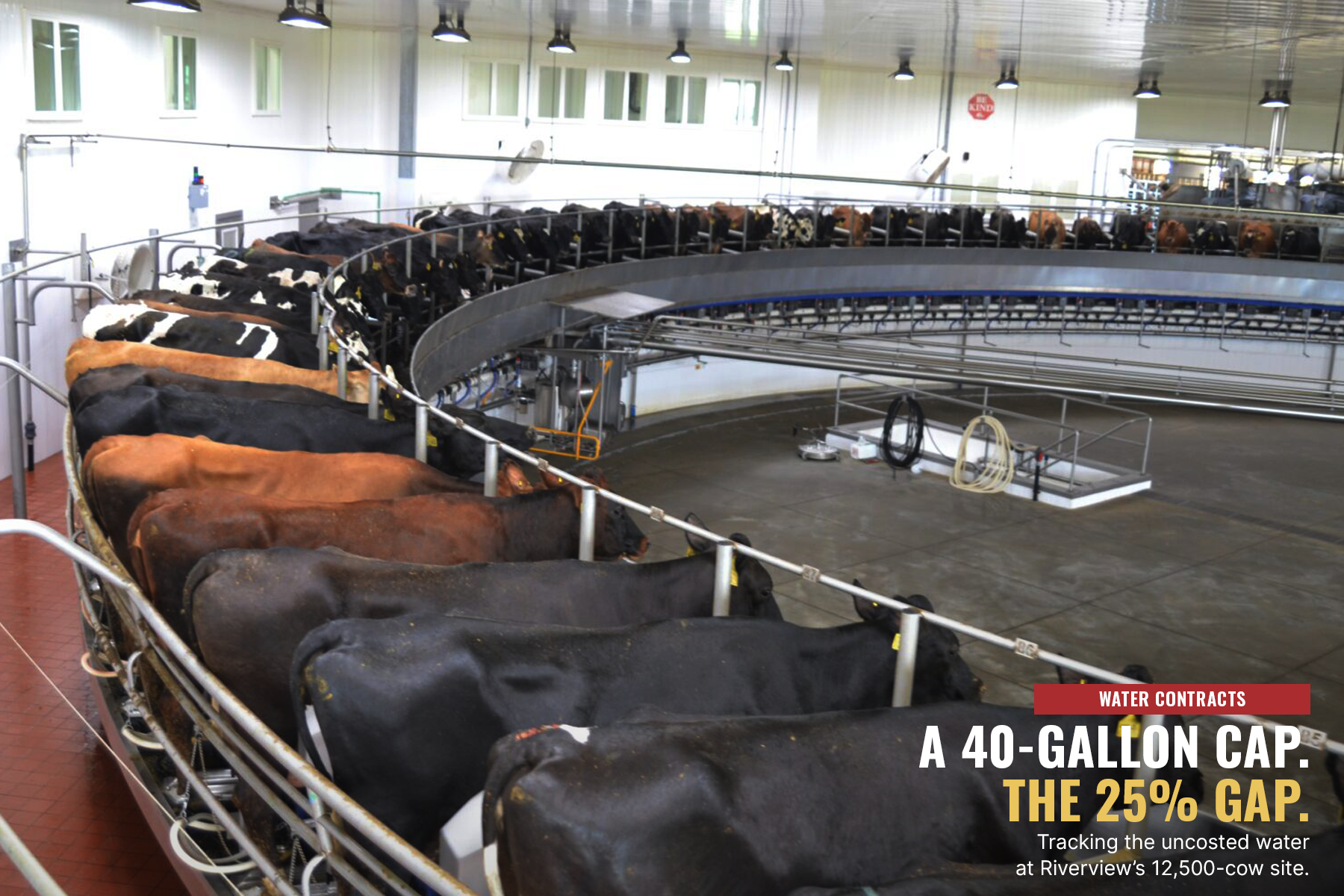
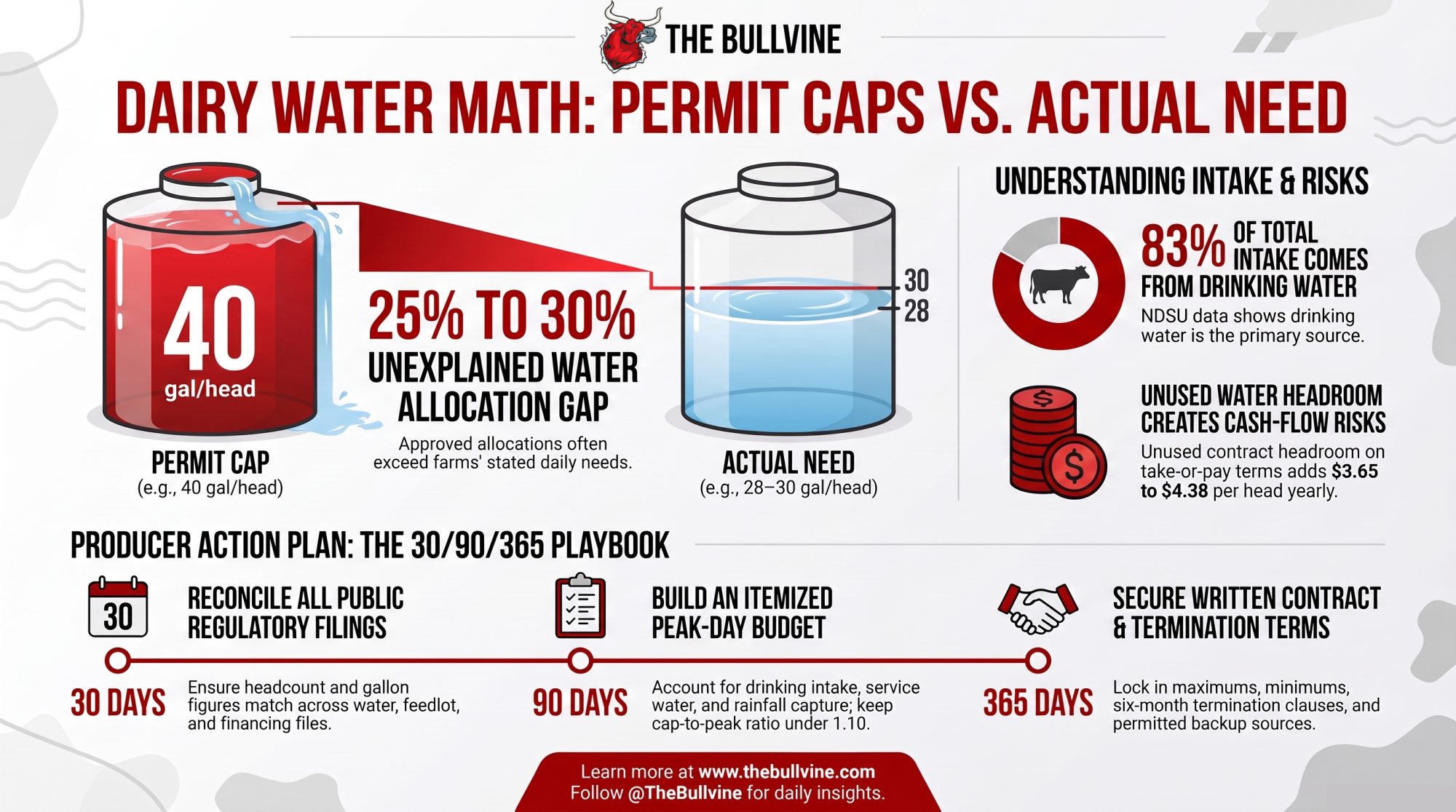
Divide 500,000 by 12,500 cows, and you get 40 gallons a head. Riverview says 28 to 30. No public record we’ve read explains the other 125,000 to 150,000 gallons a day.
EXECUTIVE SUMMARY: Eight landowners and the Dakota Resource Council asked a Burleigh County judge Sept. 25 to vacate DWR’s approval of Wahpeton’s 500,000-gallon-a-day water sale for Riverview’s 12,500-cow Abercrombie Dairy. The appeal argues standing and permitted use but never tests per-cow need, so we did. NDSU’s livestock water table, weighted to Abercrombie’s herd, puts total intake at 26.9–32.6 gallons a head at 80 lb. At NDSU’s 83% drinking share, that leaves Riverview’s stated 28–30 roughly 1–8 gallons a head for parlor, cooling and wash water. Our three-site Riverview ledger finds West River’s 226-million-gallon request 6.6% short at 35 gallons a head. And the appeal says Wahpeton’s deal can be terminated on six months’ notice.
North Dakota’s Department of Water Resources approved Wahpeton’s sale of up to 500,000 gallons a day to Southeast Water Users District. That water is one of several sources for Riverview ND LLP’s planned 12,500-cow Abercrombie Dairy in Richland County.
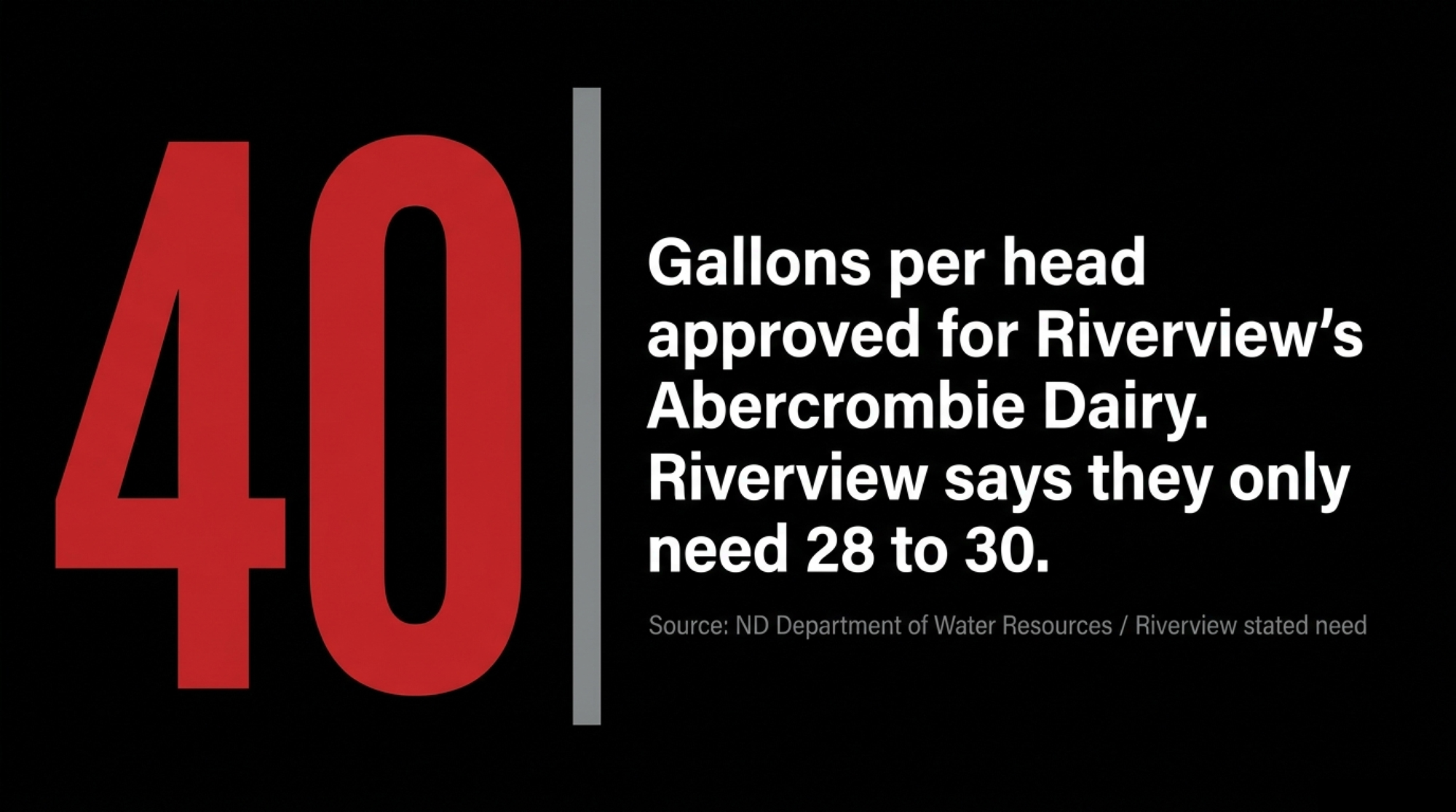
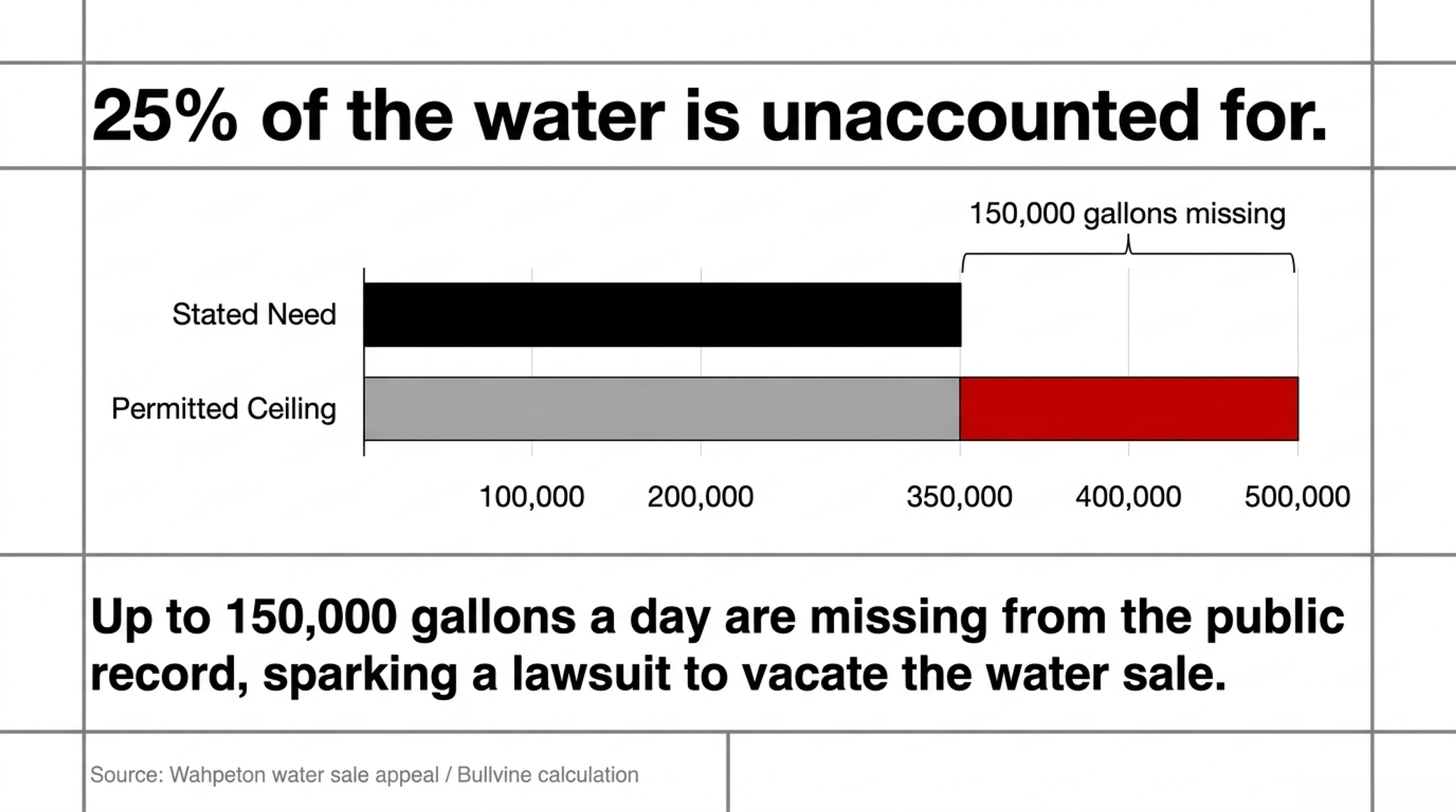
Riverview puts its own need at 28 to 30 gallons a cow, according to North Dakota Monitor’s September report. At 12,500 head, that’s 350,000 to 375,000 gallons a day. The remaining 125,000 to 150,000 gallons, 25 to 30% of the sale, isn’t explained anywhere in the appeal or the public reporting we’ve reviewed. Three documents could explain it:
- The city–Southeast agreement, which Wahpeton has posted on its website.
- DWR’s August 2025 approval memo.
- A feasibility study the city submitted to DWR for sign-off, according to Wahpeton Public Works Director Dennis Miranowski.
What’s been reported as the Riverview Abercrombie Dairy water lawsuit is an administrative appeal, case 08-2026-CV-02615, and it doesn’t argue the gap. If a city or rural-water district stands between your expansion and the aquifer, the open question is the one your lender will ask next: show me your itemized gallons.
The Wahpeton water sale appeal in Burleigh County court
Caitlin Johns, Dylan Johnson, Merrill and Stephanie Miranowski, Mary and David Sahl, Cindy and Michael Zick, and the Dakota Resource Council filed in Burleigh County District Court on Sept. 25, 2026. The landowners are from Richland County, North Dakota, and Wilkin County, Minnesota. DWR is the only appellee; Riverview, Wahpeton and Southeast aren’t parties. The Environmental Law & Policy Center and Farmers’ Legal Action Group represent the landowners.
On July 30, an administrative law judge recommended dismissing the challenge, and DWR adopted the recommendation the same day, according to the appeal. That cancelled an evidentiary hearing set for Aug. 12–13 at the State Capitol. The state had argued the landowners lacked standing because they weren’t Wahpeton residents and hadn’t yet been harmed. According to the petitioners, the state also argued that Wahpeton, not DWR, was responsible for the sale. The landowners asked for reconsideration on Aug. 12, and DWR denied it Aug. 28 without discussion, according to the appeal.
The landowners now want a judge to reverse the dismissal and vacate the approval itself. FLAG executive director Scott Carlson told Agweek the group is “asking the judge to reverse DWR’s decision about the water sale and to vacate that.” For now, the appeal doesn’t seek a stay. The landowners’ attorneys said they understand the dairy remains under construction and that increased withdrawals aren’t imminent. They reserved the right to seek a stay if that changes. Public reporting we reviewed through Oct. 7 shows no hearing date.
Construction is moving ahead. Miranowski said in August that Southeast had installed a transmission line from the city’s booster station to the dairy site. On Oct. 5, the city council was told the booster station building is due by mid-October.
This appeal is separate from the Dakota Resource Council’s challenge to DEQ’s Abercrombie environmental permit. A judge dismissed that suit after ruling DEQ wasn’t properly served, not on the merits.
Where the 40-gallon number comes from
The math is ours, on DWR’s approved figure: 500,000 ÷ 12,500 = 40.0 gallons per cow per day. At Riverview’s 28 gallons, the herd needs 350,000 a day; at 30, it needs 375,000. Over a year, the gap comes to 45.6 million to 54.8 million gallons.
Riverview’s reported figure has shifted:
- 2025: North Dakota Monitor reporting carried by Y94 and the Bismarck Tribune put Riverview’s cows at 20 to 30 gallons a day.
- 2026: The same outlet reported 28 to 30, “according to Riverview.”
- Both years: The volumes work only at 28 gallons. That’s a 700,000-gallon minimum for the 25,000-head Herberg site in 2025, and at least 350,000 for Abercrombie in 2026.
We use 28 to 30 because it produces the smallest gap. At 20 gallons, the headroom would be 250,000 gallons a day, half the sale.
The landowners’ side reads the number differently. Katie Garvey, a senior attorney at ELPC, which represents the landowners, said in July that the operation will require a minimum of 500,000 gallons a day, the Minot Daily News reported. That reading and Riverview’s 28–30 can’t both describe the same herd.
Feed moisture complicates both readings. NDSU’s figures are total intake, and only part of that comes from the well. Counted that way, the 500,000 ceiling covers a 100-lb herd’s estimated drinking water with about 9.5 gallons a head left for service water. That’s a defensible engineering number, not obvious padding. No itemized budget in the public record we reviewed shows which production level the sale assumes.
The Riverview water ledger: three sites, three regulatory stages
This is the first time these three sites’ public records have been joined in one table. Each one is at a different regulatory stage.
| Site | County, state | Head | Water on record | Gal/head/day | Riverview figure, applied by Bullvine | Headroom or gap |
| Abercrombie | Richland, ND | 12,500 | Municipal sale of up to 500,000 gal/day (561.6 acre-ft/yr), approved by DWR Aug. 20, 2025; one of several sources | 40.0 (sale alone) | 28–30: 350,000–375,000/day | 125,000–150,000/day (25–30%) |
| West River | Stevens, MN | 18,855 | 226M gal/yr groundwater requestedunder Minnesota DNR application 2025-1502; pending as of Sept. 29 | 32.8 | 28–30: 527,940–565,650/day | 53,528–91,238/day (8.6–14.7%) |
| Herberg | Traill, ND | 25,000 | No water permit found. The appeal says Riverview holds no ND appropriation permits. As of April 2025, Riverview was working with East Central Rural Water District | n/a | 28–30: 700,000–750,000/day (500,000–750,000 at 2025’s 20–30) | Can’t calculate |
Riverview’s 28–30 is a North Dakota figure. Applying it to West River is a Bullvine comparison, not a company statement. More on the Herberg site: does Herberg’s “no discharge” permit hold up near the Red River.
How much water does a dairy cow use per day?
NDSU Extension’s Livestock Water Requirements (AS1763) gives total daily water intake by production level:
- Milking cows: 18 to 22 gallons at 30 lb of milk, 30 to 36 at 80 lb, and 35 to 41 at 100 lb.
- Dry cows: 9 to 13 gallons.
Those are intake figures, not drinking figures. NDSU says about 83% of a cow’s water comes from drinking and the rest from feed. Penn State Extension says lactating cows drink 30 to 50 gallons a day if water is available, and heat-stressed cows may drink double that.
We weighted NDSU’s ranges by Abercrombie’s permitted herd: 10,625 milking and 1,875 dry, per DEQ’s final permit decision.
| NDSU production level | Herd water intake, gal/day | Intake, gal/head | Est. drinking from supply (83%), gal/head |
| 80 lb milk | 335,625–406,875 | 26.9–32.6 | 22.3–27.0 |
| 100 lb milk | 388,750–460,000 | 31.1–36.8 | 25.8–30.5 |
Bullvine calculation: (milking cows × NDSU milking range) + (dry cows × NDSU dry range), ÷ 12,500. Total intake includes feed moisture. Drinking is estimated at NDSU’s 83% average share; wetter rations lower it. Excludes heifers, calves, parlor, cooling and wash water.
At 80 lb, Riverview’s 28 to 30 covers estimated drinking with about 1 to 8 gallons a head left for parlor wash, plate cooling, cow cooling and cleaning. At 100 lb, drinking alone runs 25.8 to 30.5, so the stated figure leaves somewhere between 2.5 gallons short and 4.2 gallons spare. The 28–30 holds if one of three things is true:
- reuse or captured rain covers most of the service water;
- the figure counts drinking water only;
- the herd runs near 80 lb, not 100.
Riverview hasn’t said which it is.
The ceiling side reads differently. At 100 lb, estimated herd drinking tops out near 381,800 gallons a day. That leaves 118,200 under the 500,000 ceiling, about 9.5 gallons a head for service water. If the city’s feasibility study sized the sale to a high-producing herd plus service water, the number holds. The study’s production and service-water assumptions are the figures that settle it.
Riverview says rooftop rainwater supplies about half the water at its 10,000-cow Campbell Dairy in Wilkin County, Minnesota, and it plans similar systems in North Dakota. We haven’t independently checked that claim.
What the appellants allege, and what DWR, Wahpeton and Riverview say
The appellants’ allegations. No court has found any of them. The appeal argues that Wahpeton’s permits authorize municipal use, while Riverview’s planned uses are industrial. It says the full 500,000 gallons is reserved exclusively for Riverview rather than Southeast’s other customers. It also argues that the landowners’ private wells draw on the same groundwater system, which gives them standing.
According to the appeal, a DWR hydrologist testified in an April 2026 deposition that the aquifer has declined for decades and that DWR doesn’t know its recharge rate. Hydrogeologist BJ Bonin of Midwest Geological prepared a July 27 report for ELPC. It said the area’s aquifers are interconnected, that the 2021 pumping test didn’t monitor wells north of the new well field, and that aquifer levels at the Zick property dropped 11 feet between 1975 and 2011. “The evidence — including the agency’s own documents — shows that this water sale puts groundwater resources at risk,” Carlson said in an Aug. 12 release.
Stephanie Miranowski, a Minnesota resident and one of the appellants, said her replacement well is about 336 feet deep. “We are not against agriculture,” she told Forum News Service. “We are farmers ourselves.”
DWR’s position. As quoted in the appeal, DWR’s approval found that Wahpeton has enough water within its allotment to keep serving residents, and that the sale serves “rural water system regional needs.” DWR’s 2021 recommended decision on relocating the city’s well field found that historical aquifer declines had flattened. It suggested the aquifer was sustainable at the then-current level of development and concluded the move wouldn’t adversely affect other appropriators. DWR has declined to comment, citing ongoing litigation.
Wahpeton’s position. “There is no new water or additional water that has been applied for,” city attorney Brittany Hatting told the council on Oct. 5. She said the appropriation remains the city’s, and that the agreement is void if the city can’t supply water for domestic use. The city isn’t a party, but it’s monitoring the case because the outcome could affect the city’s perfected permits. Miranowski said the city has four wells it can cycle and is studying the Red River Valley Water Supply Project and the Brightwood and Colfax aquifers. “We don’t foresee that ever having to happen,” he said of cycling the wells.
Riverview’s position. Riverview says it recycles as much water as possible and that Abercrombie will draw on more than one source, Southeast among them. The appeal says Riverview holds no North Dakota water appropriation permits. It says Riverview’s separate Red River surface-water application, permit 7397, was still under DWR review as of Sept. 22.
What happens if a dairy water contract is terminated?
An operation planning or financing around a 500,000-gallon ceiling while stating a 350,000-to-375,000 need is carrying 45.6 million to 54.8 million gallons a year. No public document we’ve read puts a price on that water. A lender stress-testing cash flow will want to know which kind of water it is.
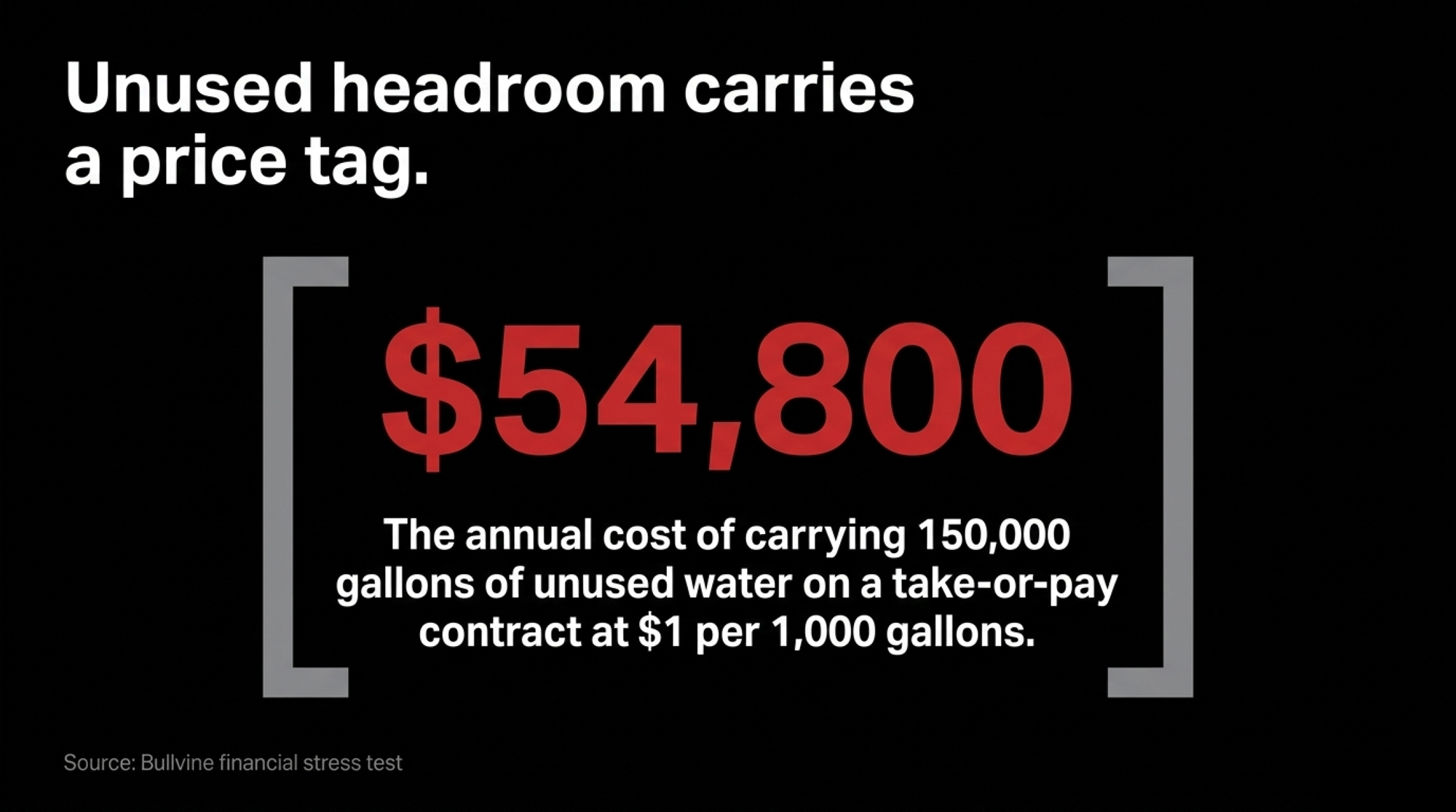
If the contract is take-or-pay, it’s a cost line. Every $1 per 1,000 gallons charged on that headroom costs $45,600 to $54,800 a year, or $3.65 to $4.38 per head. At 80 lb of milk a day (292 cwt per cow per year), that’s 1.25 to 1.5¢/cwt for each dollar of rate. Southeast’s industrial rate and minimum-purchase terms aren’t in any document we’ve reviewed, so the size of that drag depends on what the posted agreement says.
If it isn’t take-or-pay, the headroom costs little to carry, but the supply itself is at risk. The record shows five ways the water could be lost or have to be re-justified:
- Domestic-supply failure: The agreement is void if Wahpeton can’t supply water for domestic use, according to the city attorney.
- Termination: The appeal says the agreement can be terminated on six months’ notice.
- Vacatur: The landowners are asking the court to vacate the approval.
- Supply limits: The appeal cites a 2025 DWR statement that further approvals from the aquifer would be difficult.
- Low-flow limits in Minnesota: DNR’s review of West River application 2025-1502 anticipates pumping limitsduring low streamflow.
Our read: unless the agreement’s rate is high, losing that supply and having to replace it is a bigger risk than paying for unused water.
Abercrombie, 500,000 gal/day sale
| Gal/head/day | Basis | Daily use | Headroom | % of sale |
| 28 | Riverview, low | 350,000 | 150,000 | 30.0% |
| 30 | Riverview, high | 375,000 | 125,000 | 25.0% |
| 35 | Stress test: above NDSU’s estimated 100-lb drinking range (25.8–30.5), so it includes service water | 437,500 | 62,500 | 12.5% |
West River, 226M gal/yr requested (619,178 gal/day)
| Gal/head/day | Daily use | Headroom | % of volume |
| 28 | 527,940 | 91,238 | 14.7% |
| 30 | 565,650 | 53,528 | 8.6% |
| 35 | 659,925 | −40,747 | −6.6% (short) |
At 35 gallons a head, West River’s groundwater request falls 6.6% short unless stormwater, reuse or other permitted water covers the difference. More on West River: our earlier look at its 200-cow math.
Running the numbers: a 2,500-cow water budget
The same approval gaps hit expansions well short of Abercrombie’s size, so here’s the math for a 2,500-head operation. This is a Bullvine model, not any farm’s books.
Published evidence. NDSU AS1763: at 80 lb, milking cows take in 30 to 36 gal/day, and dry cows take in 9 to 13. About 83% of that comes from drinking. Penn State: heat-stressed cows may drink double.
Stated assumptions. 2,500 head, split 2,125 milking and 375 dry (Abercrombie’s permitted 85/15 split). 80 lb of milk. Total intake, with drinking estimated at NDSU’s 83%.
Bullvine math:
- Milking intake: 2,125 × 30–36 = 63,750–76,500 gal/day.
- Dry intake: 375 × 9–13 = 3,375–4,875 gal/day.
- Intake total: 67,125–81,375 gal/day, or 26.9–32.6 gal/head.
- Drinking from supply (83%): About 55,700–67,500 gal/day, or 22.3–27.0 gal/head.
- Cap at Abercrombie’s ratio: A contract written at 40 gal/head would cap at 100,000 gal/day, or 36.5M gal/yr. That’s 1.23 times peak intake and 1.48 times estimated drinking, before any service water.
- Headroom: Against a stated 28–30, that cap leaves 25,000–30,000 gal/day, or 9.1M–11.0M gal/yr. On take-or-pay terms at $1 per 1,000 gallons, that’s $9,125–$10,950 a year.
- Your test: Take estimated drinking, add your itemized parlor, cooling and wash gallons, then divide the cap by your peak-day total. If the result is still above 1.10, call the excess contingency and say what it covers.

The 1.10 line is a Bullvine rule, not a regulation. What matters is your peak day, and Penn State says heat stress can double what a cow drinks.
How much of Wahpeton’s aquifer allocation does the dairy sale use?
Wahpeton has held two perfected permits from the Wahpeton Buried Valley Aquifer since 1973. Permits 1822 and 1898 total 2,130 acre-feet a year. An acre-foot is about 325,851 gallons, enough to cover an acre a foot deep. DWR data puts the city’s current use at about 873 acre-feet, roughly 41% of its permitted total. The city agreed to sell up to 561.6 acre-feet a year to Southeast.
By Bullvine math, 561.6 acre-feet equals 500,000 gallons a day over a 366-day year. That takes:
- 44.7% of the 1,257 acre-feet the city isn’t currently pumping;
- the city’s combined use to 1,434.6 acre-feet, 67.4% of the permitted total.
DWR’s 2021 analysis modelled two levels: the city’s then-recent average of 919 acre-feet and its full 2,130. It projected about 6.7 feet of added drawdown at the new well field at recent use, and about 40.5 feet at full allocation. Forum News Service noted that the Bonin report and the 2021 DWR analysis “offer differing perspectives” on pumping effects. Nothing in the record we reviewed finds that the dairy has harmed any well. According to the landowners’ own attorneys, increased withdrawals aren’t imminent.
What changed since August
- Reconsideration: Our Aug. 21 ceiling-versus-floor analysis called it pending and dated the filing Aug. 11. The appeal dates the request Aug. 12, and DWR denied it Aug. 28.
- Who dismissed the case: In August, we wrote that the ALJ “threw the case out.” The appeal says the ALJ recommended dismissal and DWR adopted it.
- Court: Case 08-2026-CV-02615 was filed Sept. 25.
- Relief: The landowners now also want the approval vacated.
- City position: No new water, the agreement is void if domestic supply fails, and the city is monitoring the case.
- City use: About 873 acre-feet, down from the 919 in our August math. The sale’s share of unused allocation drops from 46% to 44.7%.
- Riverview’s figure: In August, we put company estimates at 300,000–350,000 gallons a day. The 2026 figureof 28–30 gal/head equals 350,000–375,000.
- Correction on NDSU’s numbers: Earlier Bullvine coverage treated NDSU’s water table as drinking water. It’s total intake, and about 83% of it comes from drinking. For Abercrombie, that puts intake at 26.9–36.8 gal/head and estimated drinking at about 22.3–30.5, depending on production.
- New document leads: The posted agreement and the city’s feasibility study.
- Herberg: In our coverage of North Dakota’s largest dairy permit, the 700,000-gallon figure was an estimate. It still is, and no water permit has been found.
Your 30/90/365 water-file playbook
30 days: reconcile what you’ve already filed.
- Do: Lay the head count and gallons-per-head figure from every filing side by side: water, feedlot, nutrient management and financing.
- Requires: Copies of each filing, and one person who owns the reconciliation.
- Urgent when: Any two filings differ by more than 10% on head count or gallons.
- Backfires if: You fix one filing and leave the others. The mismatch just moves to a different file.
90 days: build the itemized budget.
- Do: Apply NDSU’s production-based intake table to each animal class and adjust for the drinking share. Add metered or designed service water. List each reuse loop and rain source with the gallons it covers. Show average-day, peak-day and annual totals.
- Requires: Meter data or an engineering design, your herd plan by class, and about a month of your nutritionist’s and engineer’s time.
- Urgent when: Your cap divided by your itemized peak day comes out above 1.10. For comparison, Abercrombie’s sale is 1.33 to 1.43 times Riverview’s stated need. That’s stated need, not peak day, because no peak-day figure is public.
- Backfires if: Your reuse credits count loops you haven’t built yet. It also backfires if you budget straight from intake tables and count feed moisture as well water. A regulator will test the gross number.
365 days: secure the contract terms.
- Do: Get the maximum, minimum, contract length, curtailment and termination terms in writing, plus a backup source.
- Requires: Your supplier’s recent use against its permitted volume, its feasibility study if one exists, and legal review.
- Urgent when: Your supplier can cut you off before you could permit a backup. Wahpeton’s agreement is void if domestic supply fails, per the city attorney, and terminable on six months’ notice, per the appeal. Know which clause in your contract does the same job.
- Opportunity: A documented reuse and rain-capture budget is evidence a regulator can test. That makes a stronger file than the one before the Burleigh County judge, where the hearing that would have tested it never happened.
The Burleigh County court will review whether DWR followed the law, not how much water a cow needs. Pull your own water contract and divide the cap by your itemized peak day. Can you show your lender where every gallon above 1.10 goes?
We’ll update this story when the court sets a briefing schedule or a stay motion is filed. Based on court filings and public records available as of Oct. 7, 2026. The appeal is pending, and no court has ruled on the merits.
Complete references and supporting documentation are available upon request by contacting the editorial team at editor@thebullvine.com.
Learn More
- California dairy manure order: 100 cows need up to 64 acres — Delivers the exact financial math for expanding your herd under the California Water Board’s new environmental thresholds. Incoming manure regulations will trigger a $16,400 to $30,100 gross annual land cost jump for every 100 added cows.
- $20.11 Under Water on Every Hundredweight – Before the Bad Month — Arms you with an 18-month exit timeline to preserve up to $480,000 in capital before a lender forces liquidation. By following the money on the hidden equity drain, we expose what quietly squeezes licensed herds.
- 95% Methane Reduction: The Feed Additive Revolution That Could Transform Dairy’s Climate Image — Dismantles the hype around synthetic bromoform additives so you can critically evaluate a promised 95.2% methane reduction. Missing feed efficiency gains and residue risks provide a hard reality check on dairy’s heaviest regulatory target.
 The Sunday Read Dairy Professionals Don’t Skip.
 The Sunday Read Dairy Professionals Don’t Skip.
Every week, thousands of producers, breeders, and industry insiders open Bullvine Weekly for genetics insights, market shifts, and profit strategies they won’t find anywhere else. One email. Five minutes. Smarter decisions all week.