






Wahpeton’s deal allows “up to” 500,000 gallons a day. The petitioners’ attorney calls it a minimum. One number, two meanings — and your supply agreement uses one of those words too.
Executive Summary: North Dakota approved up to 500,000 gallons a day of Wahpeton municipal water for Riverview’s planned 12,500-cow Abercrombie Dairy, and when eight rural landowners challenged it, an administrative law judge threw the case out on July 30, 2026 — on standing, not on the water. Wahpeton holds 2,130 acre-feet a year across two permits and has recently drawn about 919, so the dairy’s 560 acre-feet takes 46% of the headroom between actual use and the ceiling, and that’s Bullvine’s math off the city’s own published figures. Here’s the fight worth watching: Public Works Director Dennis Miranowski told Agweek the deal “allows up to” 500,000 gallons a day, while ELPC attorney Katie Garvey calls it a minimum — same number, one a cap and the other a growth curve, and nobody’s published the use-category breakdown that would settle it. The hydrology’s contested too, with DWR’s 2021 modeling showing 6.7 feet of added drawdown at recent use versus 40.5 at full allocation, against the petitioners’ hydrogeologist documenting 11 feet already lost at one property between 1975 and 2011. If you’re buying utility water instead of drilling, the two numbers to get in writing before you sign are your supplier’s permitted allocation and its recent actual draw — plus which of those two words your contract uses.
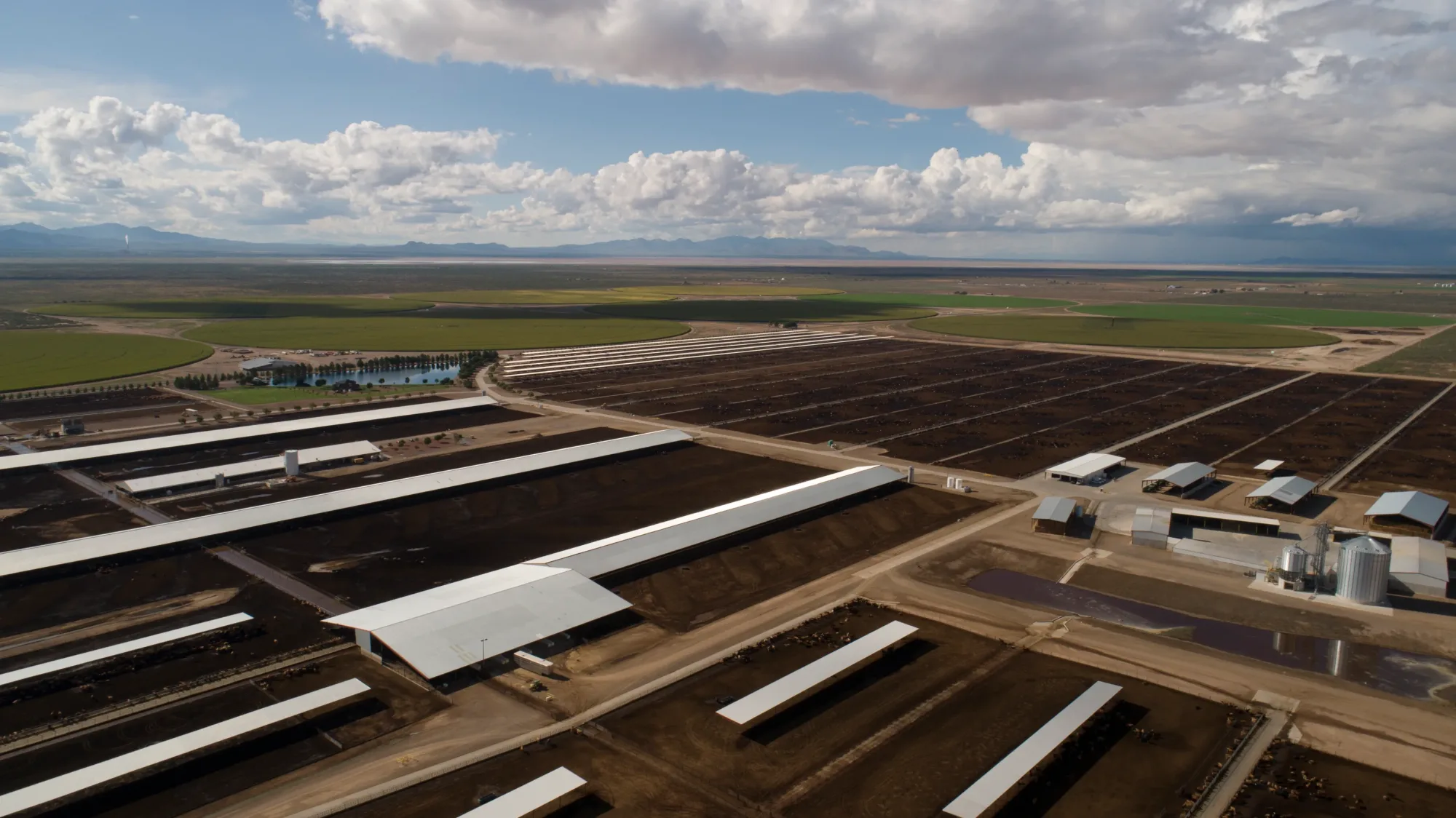
Mary Sahl’s family well went down 70 feet in 1962, and for a while it flowed on its own. No pump. By the mid-1970s, according to the well’s owner, it had stopped flowing altogether. That was five decades before this dairy was proposed, and nobody has suggested the two are connected. But the aquifer under Sahl’s well — the Wahpeton Buried Valley, in southeastern North Dakota — is the same one that will supply Riverview ND, LLP’s planned Abercrombie Dairy in Richland County.
Sahl was one of eight rural landowners whose challenge was dismissed alongside the Dakota Resource Council’s. You may never build within 500 miles of Richland County. The numbers both sides filed are still worth a look, because your own project will have to answer the same three questions this one did.

What Actually Got Decided
North Dakota’s Department of Water Resources approved the arrangement on August 20, 2025. An evidentiary hearing was set for August 12–13, 2026, at the State Capitol. The dismissal canceled it. The Dakota Resource Council and eight members from Richland County, North Dakota, and Wilkin County, Minnesota, filed for reconsideration on August 11, 2026, and that request is still open.
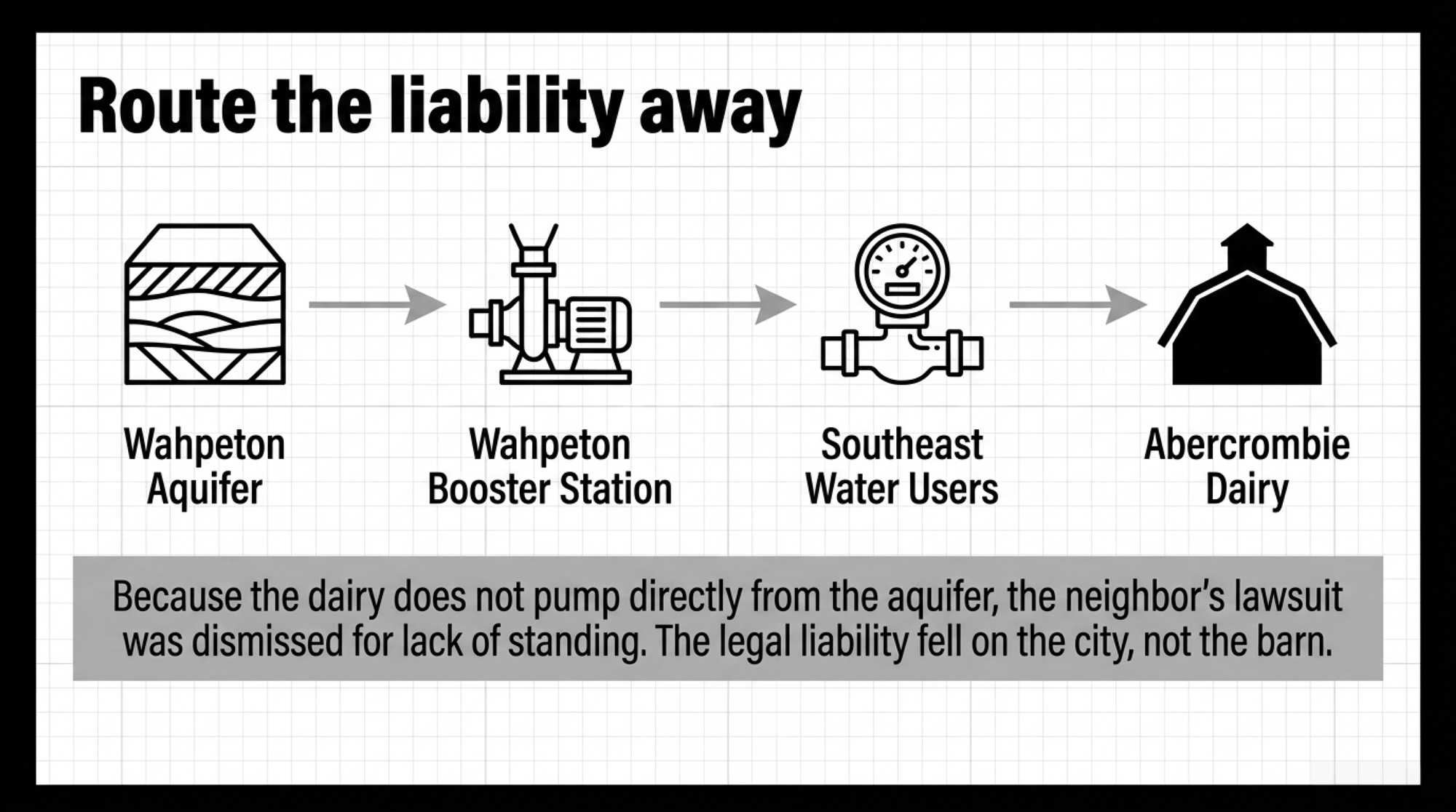
The routing matters more than the headline number. Riverview isn’t pumping from the aquifer under its own permit. Wahpeton draws from the aquifer, pushes water through a new well field and booster station to Southeast Water Users, and Southeast delivers it to the dairy — a chain confirmed by Wahpeton Public Works Director Dennis Miranowski. Two handoffs between the aquifer and the barn. According to the petitioners’ account, the state argued on that basis that Wahpeton bore responsibility for the sale rather than the agency.
And this is a $90 million facility, permitted by the North Dakota Department of Environmental Quality in January 2025, sitting above an aquifer that supplies drinking water to nearly 30 wells, per DTN’s January 2025 reporting. Construction was active as of October 2, 2025, when Inforum reported harvest traffic colliding with dairy construction traffic on rural Richland County roads. No public reporting since then confirms current progress or a commissioning date.
The Allocation Math, Now on the Record
Here’s the part that wasn’t public until a reporter asked for it.
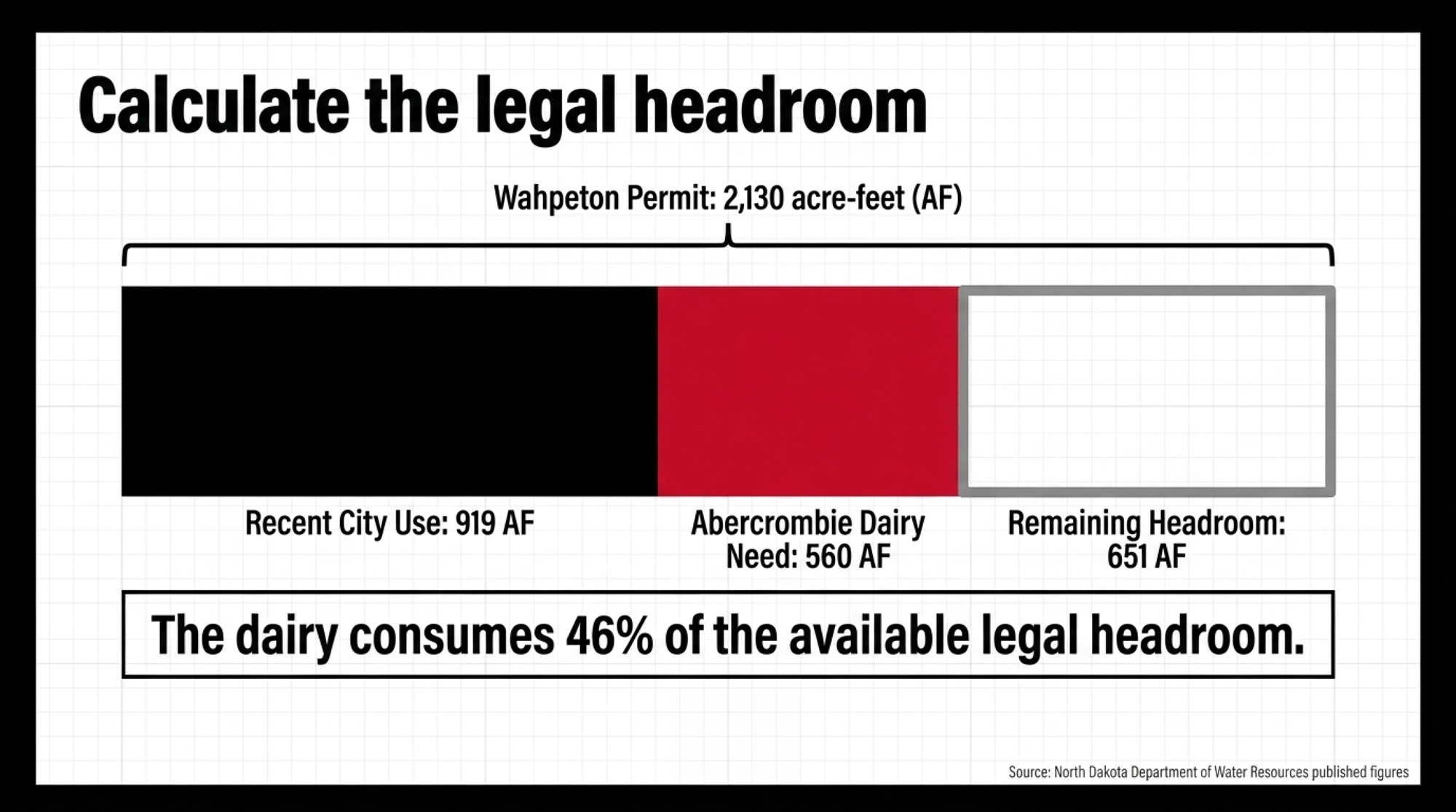
Wahpeton holds 2,130 acre-feet per year across two state permits — roughly 693 million gallons. The city’s recent average use has run about 919 acre-feet. Miranowski says supplying Southeast keeps Wahpeton inside that ceiling: “We have an allocation under two permits. And we get 2,130 acre-feet in a year. So we are within that limit by supplying to the Southeast.”

Now the dairy’s share. At 500,000 gallons a day every day, that’s 182.5 million gallons a year, or about 560 acre-feet. Run the subtraction: Wahpeton’s permit allows 1,211 acre-feet more than the city’s recent average, and the dairy’s 560 would take 46% of that difference. Those are Bullvine’s calculations from the city’s own published figures, and Wahpeton hasn’t characterized the arrangement in those terms.
Per cow, the arithmetic is simple. Penn State Extension and the University of Nebraska both put lactating cow intake at 30 to 50 gallons a day. A Michigan State University Extension summary from 2011 measured on-farm use at 29.9 gallons per cow per day — 23.6 drinking plus 6.3 wash. Older data, and worth treating as a floor rather than a current benchmark.
Divide the permit by the herd: 500,000 ÷ 12,500 = 40.0 gallons per cow per day.
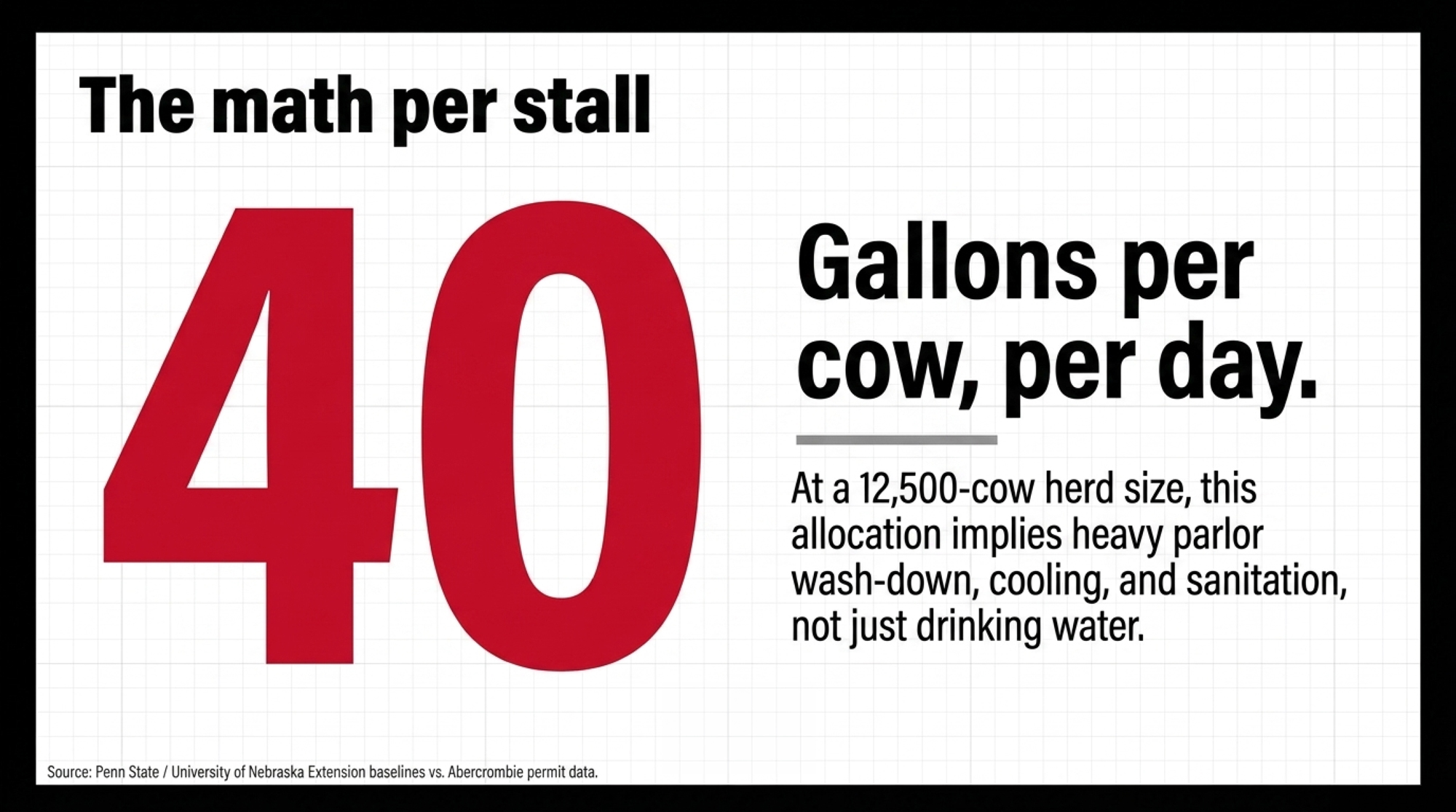
That lands at the upper end of the extension range, which tells you the number almost certainly covers parlor wash-down, cooling, and sanitation on top of drinking water. Nobody has published a use-category breakdown, so that’s a read, not a confirmed fact.
Ceiling or Minimum? Same Number, Opposite Argument
This is the disagreement worth watching, because it decides what the 500,000 figure actually means.
Miranowski told Agweek on August 19, 2026 that the city’s agreement with Southeast Water Users “allows Wahpeton to provide up to 500,000 gallons of water per day.” Up to. A ceiling the dairy may never reach, and one the city says keeps it comfortably inside its state permit.
Katie Garvey, senior attorney at the Environmental Law and Policy Center representing the petitioners, describes the same figure differently: the operation will require a minimum of 500,000 gallons a day. Not a cap — a floor.
One number, two readings, and the gap between them is the whole permitting question. If it’s a ceiling with real slack, Wahpeton’s headroom math holds. If it’s a floor, the dairy’s draw grows from there, and the 46% figure is a starting point, not an outcome. Nobody has published the use-category breakdown that would settle it, and the hearing that could have compelled one got canceled.
Riverview hasn’t addressed the ceiling-versus-floor question directly. Brady Janzen, a Riverview partner, told Inside Climate News in an emailed statement published August 7, 2026: “These projects were subject to extensive environmental and regulatory review, including detailed technical analysis and evaluation by the appropriate agencies. The permits reflect the conclusion of that review that the projects satisfy the standards required by law.” Janzen has also said publicly that the dairies draw on a mix of sources — rooftop rainwater runoff, surface water, and groundwater — rather than groundwater alone. Inside Climate News reported the company did not answer its questions directly, replying with the written statement instead.
How Much Water Is That Against Your Own Barn?
Run it at your scale. A 500-cow herd at 40 gallons per cow per day uses 20,000 gallons daily — about 7.3 million gallons a year, or roughly 22 acre-feet. Abercrombie’s ceiling is 25 times that.
If you think in million gallons rather than acre-feet — and most Eastern and Great Lakes producers do — here’s the same math both ways:
| Herd size | Daily use (40 gal/cow) | Annual million gallons | Annual acre-feet |
| 500 cows | 20,000 gal | 7.3 MG | ~22.4 AF |
| 2,500 cows | 100,000 gal | 36.5 MG | ~112.0 AF |
| 12,500 cows (Abercrombie ceiling) | 500,000 gal | 182.5 MG | ~560.1 AF |
| Wahpeton total permit cap | ~1,899,000 gal | 693.1 MG | 2,130.0 AF |
Conversions at 325,851 gallons per acre-foot. Herd figures assume 40 gal/cow/day every day — a ceiling, not a projection.
Riverview’s own earlier figures for this site ran lower. North Dakota Monitor reported in April 2025 that large dairies need roughly 20 to 30 gallons per cow per day, putting the Richland County site at about 350,000 gallons — with company figures reported in 2024 and 2025 landing in a 300,000 to 350,000 range. So the approved ceiling sits roughly 43% to 67% above the operating estimate. The two don’t quite reconcile, either: 28 to 30 gallons across 12,500 head works out closer to 350,000–375,000 gallons a day, so the 300,000 low end implies a smaller starting herd or a tighter per-cow assumption than the company stated.
| Source | Gal/cow/day assumed | Daily volume (12,500 cows) | Status |
|---|---|---|---|
| Penn State/Nebraska Extension range | 30–50 gal | 375,000–625,000 gal | Industry benchmark |
| Riverview company figures (2024–2025) | ~24–28 gal | 300,000–350,000 gal | Company-reported estimate |
| ND Monitor reported industry range | 20–30 gal | 250,000–375,000 gal | Trade press estimate |
| Approved Abercrombie ceiling | 40.0 gal | 500,000 gal | State-approved permit |
Two Reports, One Aquifer, Different Conclusions
Both technical analyses are public now, which makes this case unusually useful.
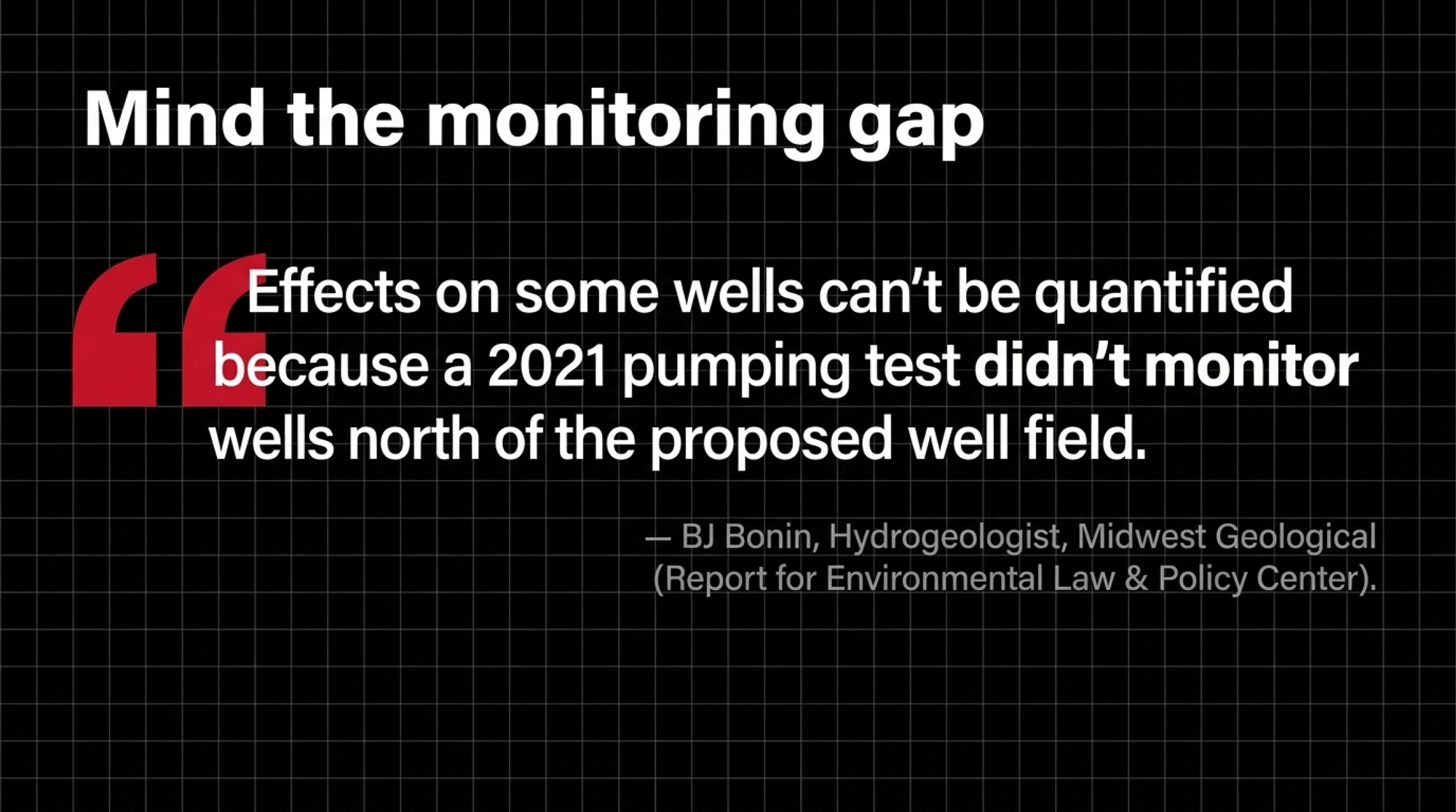
The petitioners hired hydrogeologist BJ Bonin of Midwest Geological, whose July 27, 2026 report for the Environmental Law & Policy Center reviewed well records for four properties near Wahpeton and Breckenridge, pulled from ND DWR and the Minnesota Department of Health. Bonin’s findings, as reported: the Wahpeton Buried Valley Aquifer is interconnected with nearby aquifers, so pumping in one affects the broader system; water levels at the Zick property dropped 11 feet between 1975 and 2011; and effects on some wells can’t be quantified because a 2021 pumping test didn’t monitor wells north of the proposed well field. Those are the petitioners’ expert’s conclusions, filed in support of their case.
The agency’s own 2021 recommended decision on Wahpeton’s municipal permits found substantial historical declines — then concluded those declines had flattened and the aquifer was sustainable at then-current development. That same analysis modeled the new well field two ways: at full 2,130 acre-foot use, net drawdown could reach about 40.5 feet; at the city’s recent 919 acre-foot average, roughly 6.7 feet. DWR found the change in diversion points wouldn’t adversely affect other appropriators, and recommended approval.
Both reports agree the water goes down. They fight about how far down is fine, and whether a model built without monitoring the northern wells can tell you. That’s the question an evidentiary hearing exists to settle. This one didn’t get one.
What the Permit Process Already Changed
Residents didn’t wait for litigation to bring in technical help. During the DEQ comment period, David J. Erickson, a principal hydrogeologist with Water and Environmental Technologies, studied the proposal on behalf of area residents and filed public comments. He raised concerns that the 106.7 million gallons of manure the dairy would handle annually could result in spills at the facility and on nearby roads, odors over a large area, and increased flies and insects. Those were predictions submitted during the comment process, not findings. DEQ addressed several of them in its permit decision, and Riverview has said its farms are designed to prevent discharges to surface waters.
DEQ’s response, released January 3, 2025, documents three changes it made after public feedback. The agency reevaluated the permit given the facility’s proximity to a proposed well-head protection area and added new groundwater monitoring well requirements. It revisited the 100-year floodplain analysis and removed three fields from the nutrient management plan while keeping the minimum required acres. It also noted that the three wastewater ponds are designed with synthetic covers to reduce vector concerns.
The agency also put its own groundwater data on the record. DEQ’s 2021 sampling report covered 129 wells across 15 aquifers: pesticides turned up in 8 of them, all below prevention action levels, and the nitrate maximum contaminant level wasn’t exceeded in any well sampled. DEQ also said plainly that it does not continually monitor the Wahpeton aquifer, though it monitors surficial aquifers statewide that carry elevated contamination risk.
That’s a regulator responding to comment on three specifics, and declining jurisdiction over water source and siting. Both halves of that are the story.
What Standing Rule Applied Here?
North Dakota’s water-appropriation statute, N.D.C.C. chapter 61-04, gives a “party of record” who filed written comments 30 days from service of a recommended decision to request an adjudicative proceeding — an appeal under chapter 28-32 — and requires stating “with particularity” how the person would be aggrieved. Separately, North Dakota Administrative Code 89-03-01-01.2 requires an interest in overlying lands to seek a water permit.
The state’s argument, per the petitioners’ account: Wahpeton bore responsibility for the sale rather than DWR, and the petitioners lacked standing as non-residents who hadn’t yet suffered harm. Their counter is that they draw on the same groundwater system as both the city and the dairy. DRC organizer Sam Wagner put the ask plainly: “We’re not asking them to rule in favor of our case, but we are asking them to listen to us. Or have a day in court.”
Why that matters outside North Dakota: a residency-based standing test means the objector risk on your project may depend less on hydrology than on where the property lines fall. Two identical projects on the same aquifer can face very different challenge exposure if one draws from a municipality and the other pumps directly. DWR declined to comment on the case, citing ongoing litigation.
Which Permit Fight Are You Actually Preparing For?
Three Riverview-related matters are active at once, and each turns on a different legal question. Two produced procedural dismissals; the third is still before an appeals court. Read them as one story, and you’ll prepare for the wrong one.
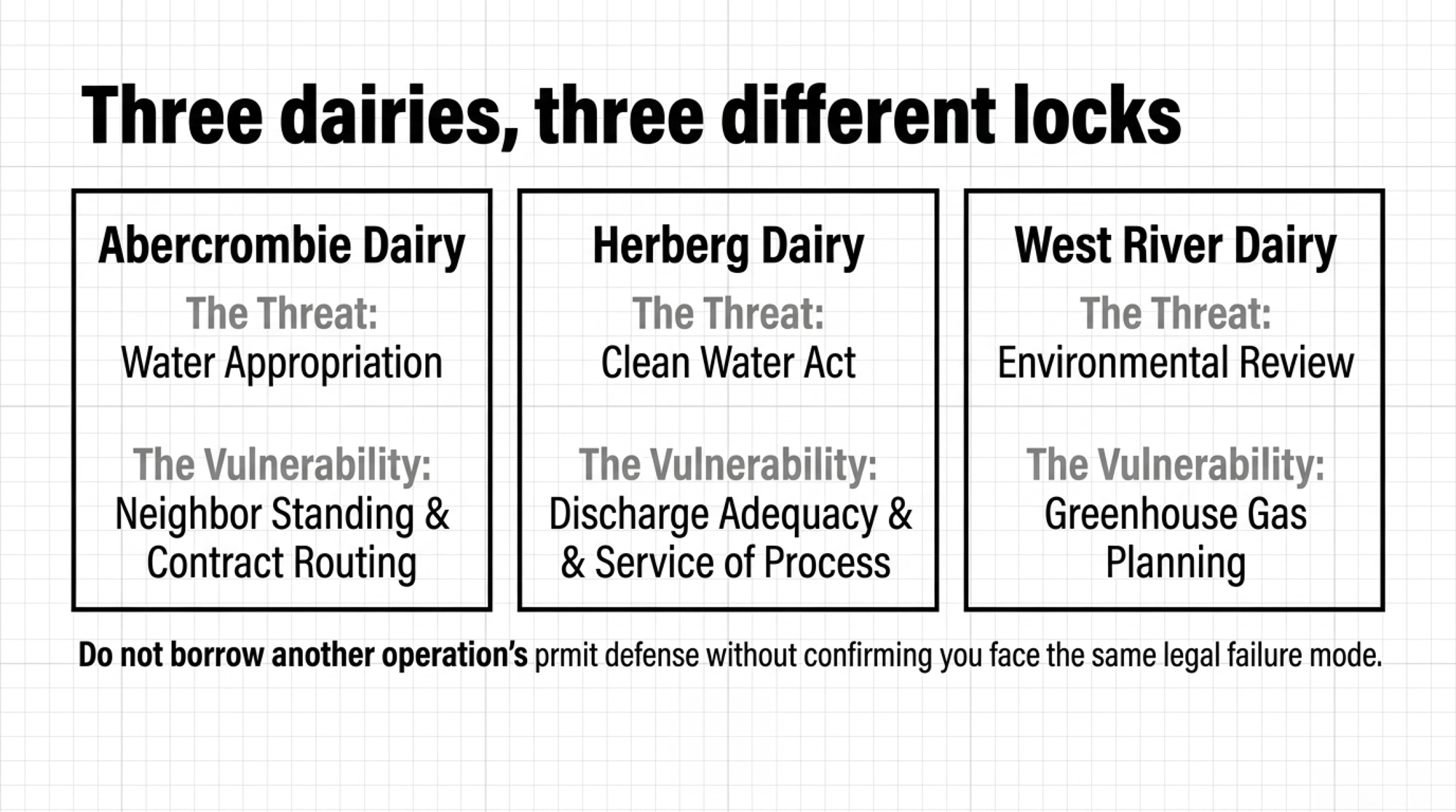
Abercrombie/Wahpeton was dismissed on petitioner standing in a water-appropriation proceeding. The separate Herberg Dairy matter in Traill County — a 25,000-cow permit issued September 24, 2025 — saw an earlier suit dismissed because the agency wasn’t properly served, a service-of-process defect, while the pending appeal concerns Clean Water Act discharge adequacy. West River Dairy near Morris, Minnesota, an 18,855-cow expansion, involves neither: that fight is over environmental review adequacy and greenhouse-gas planning, filed in the Minnesota Court of Appeals on July 22, 2026.
Three doors, three different locks. And note what DEQ said when it permitted Abercrombie: while many issues raised in the comment period were addressed, “certain concerns, such as the facility’s water source and the operation’s location, fall outside the NDDEQ’s jurisdiction and are not subject to review under the permit process.” That jurisdictional line is the one worth noting. Different agency, different question — and if your exposure is environmental-review completeness, better neighbor meetings won’t close it.
| Project | Location | Herd size | Legal issue | Outcome status |
|---|---|---|---|---|
| Abercrombie Dairy (Riverview/Wahpeton) | Richland Co., ND | 12,500 cows | Petitioner standing, water appropriation | Dismissed on standing; reconsideration pending |
| Herberg Dairy | Traill Co., ND | 25,000 cows | Service of process (dismissed suit); CWA discharge adequacy (pending) | Prior suit dismissed; appeal active |
| West River Dairy | Morris, MN | 18,855 cows | Environmental review adequacy, GHG planning | Filed with MN Court of Appeals, July 22, 2026 |
Options and Trade-Offs for Farmers
Path 1: End-to-End Water Routing Audit — do this within 30 days
- Trigger: Buying municipal or rural water utility capacity instead of drilling on-site.
- Execution: Map every meter, booster, and intermediary entity between the aquifer and the parlor. Abercrombie’s chain runs aquifer → Wahpeton well field and booster → Southeast Water Users → dairy.
- Cost: One call to your utility, one to your engineer.
- Core vulnerability: The Abercrombie standing ruling is a single decision with reconsideration pending. A narrow standing bar today isn’t a permanent feature you can plan around, and an intermediary arrangement doesn’t eliminate neighbor opposition — it just changes who gets sued.
Path 2: Allocation vs. Actual Use Calculation
- Trigger: Pre-lease or pre-purchase due diligence on an expansion site.
- Execution: Secure both the supplier’s total state-permitted volume and its recent actual draw, in writing. Wahpeton’s 2,130 and 919 are the pair — you need both to see the headroom.
- Cost: One request; most municipalities have both figures at hand.
- Core vulnerability: A legal permit cushion doesn’t prevent localized cone-of-depression drawdown. DWR’s own modeling put net drawdown at 40.5 feet if Wahpeton ever used its full 2,130 acre-feet. And get your supply agreement’s language in writing — “up to” and “minimum of” are the difference between a cap and a floor.
Path 3: Pull the Agency’s Modeling, Not Just Its Decision
- Trigger: Any expansion where a neighbor could plausibly object.
- Execution: File a written records request with your state water agency — in North Dakota, the Department of Water Resources in Bismarck — asking specifically for the recommended decision and any pumping-test or drawdown modeling tied to your source’s permits, by permit number.
- Cost: A records request and patience.
- Core vulnerability: The modeling may not support the comfort you were hoping for. DWR’s 2021 decision held the drawdown estimates, the flattening-decline finding, and the sustainability conclusion — the decision letter was the headline; the analysis underneath is what a challenger reads.
Path 4: Price the Regulatory Delay Before Financing Closes
- Trigger: Before you sign construction financing.
- Execution: Add a delay-cost line. The Bullvine’s earlier work on Riverview’s West River expansion put a twelve-month permit delay at roughly $1.56 per hundredweight on a 600-cow expansion. The interest-rate and per-stall assumptions are laid out in that piece — pull them and swap in your own.
- Cost: Your actual rate and draw schedule.
- Core vulnerability: Riverview hasn’t disclosed Abercrombie’s financing, so every project-level dollar figure here is an assumption someone owns. Make sure it’s you.
Key Takeaways
- Audit supplier headroom before you sign. If you’re buying water rather than pumping it, get permitted allocation and recent actual use in writing. Wahpeton’s gap between 919 and 2,130 acre-feet is where the dairy’s 560 fits.
- Nail down ceiling versus floor. If your agreement says “up to,” you have a cap. If anyone describes your draw as a “minimum,” you have a growth curve. Miranowski and Garvey use the same 500,000 figure to mean opposite things.
- Treat a thin cushion as a queue position. If the gap between your supplier’s permit and its current use is smaller than your project’s annual draw, you don’t have a water plan yet.
- Expect modeling scrutiny. If your source has a monitoring gap, assume it surfaces during a challenge. Bonin’s report flagged that the 2021 pumping test skipped wells north of the proposed field.
- Confirm jurisdiction in writing. Ask each agency which of your project’s questions it will and won’t review. Abercrombie’s DEQ permit added monitoring wells and cut three floodplain fields — and still left water source and siting outside its jurisdiction.
- Request the analysis, not the letter. If your state agency has issued a recommended decision on your source, pull the underlying modeling.
- Price regulatory delay. If your financing model has no delay-cost line, add one before closing — the West River frame put twelve months at roughly $1.56/cwt on 600 cows.
- Match the playbook to the mechanism. Before borrowing another operation’s permit defense, confirm both projects face the same failure mode. Standing, service of process, and environmental review are three different problems.
Closing
The reconsideration request is still pending, which means the standing question isn’t settled — and neither is whether that 500,000 figure is a ceiling or a floor. So here’s the one to take to your own kitchen table: if somebody applied for a large withdrawal on your aquifer next month, could you name your supplier’s permitted allocation, its actual use, and the drawdown your state has already modeled?
Those three numbers sat in Wahpeton’s records the whole time. The reconsideration filing and the reporting that followed are what brought them into the public record. We’re building out the delay-cost model by herd size and a state-by-state comparison of appropriation thresholds and objector-standing rules for Bullvine Weekly — that’s where the carrying-cost math gets laid out, with every assumption shown.
This article is based on public filings, agency records, and published reporting available as of August 21, 2026. The petitioners’ reconsideration request remains pending, and no ruling has been issued on the merits of the withdrawal itself.
Complete references and supporting documentation are available upon request by contacting the editorial team at editor@thebullvine.com.
Learn More
- The $1.56/cwt Permit Trap Hiding in Your Next Dairy Expansion: Riverview’s 18855‑Cow Minnesota Fight — Arms you with a concrete formula to calculate time-risk drag when environmental appeals stall builds, showing how commercial interest burn quietly adds $1.56/cwt before the first cow enters the parlor.
- Riverview’s 18855‑Cow Bet: The $0.60/cwt Drain That Won’t Show Up on Your Milk Check — Breaks down how regional mega-expansions erode base pricing, delivering a 30/90/365-day defensive framework to protect your milk check from hauling penalties and hidden balancing adjustments before your shed tips long.
- Why In-Season Manure Application Will Transform Your Dairy’s Bottom Line — Disrupts conventional waste handling by deploying precision dragline and high-clearance delivery, capturing a 10–15% crop yield bump while eliminating runoff flashpoints that trigger regulatory scrutiny and permit appeals.
 The Sunday Read Dairy Professionals Don’t Skip.
 The Sunday Read Dairy Professionals Don’t Skip.
Every week, thousands of producers, breeders, and industry insiders open Bullvine Weekly for genetics insights, market shifts, and profit strategies they won’t find anywhere else. One email. Five minutes. Smarter decisions all week.