










Sept. 15 set your existing herd. Add 100 cows now, and their manure must clear 1.4 A/R before they arrive: 35 to 64 acres, or a hauler who beats $0.87 a pound of N.
Executive Summary
- The baseline: Order WQ 2026-0028 makes Sept. 15, 2026 the dividing line for “existing” herds in the Central Valley. The final groundwater-loading formula doesn’t arrive until 2030.
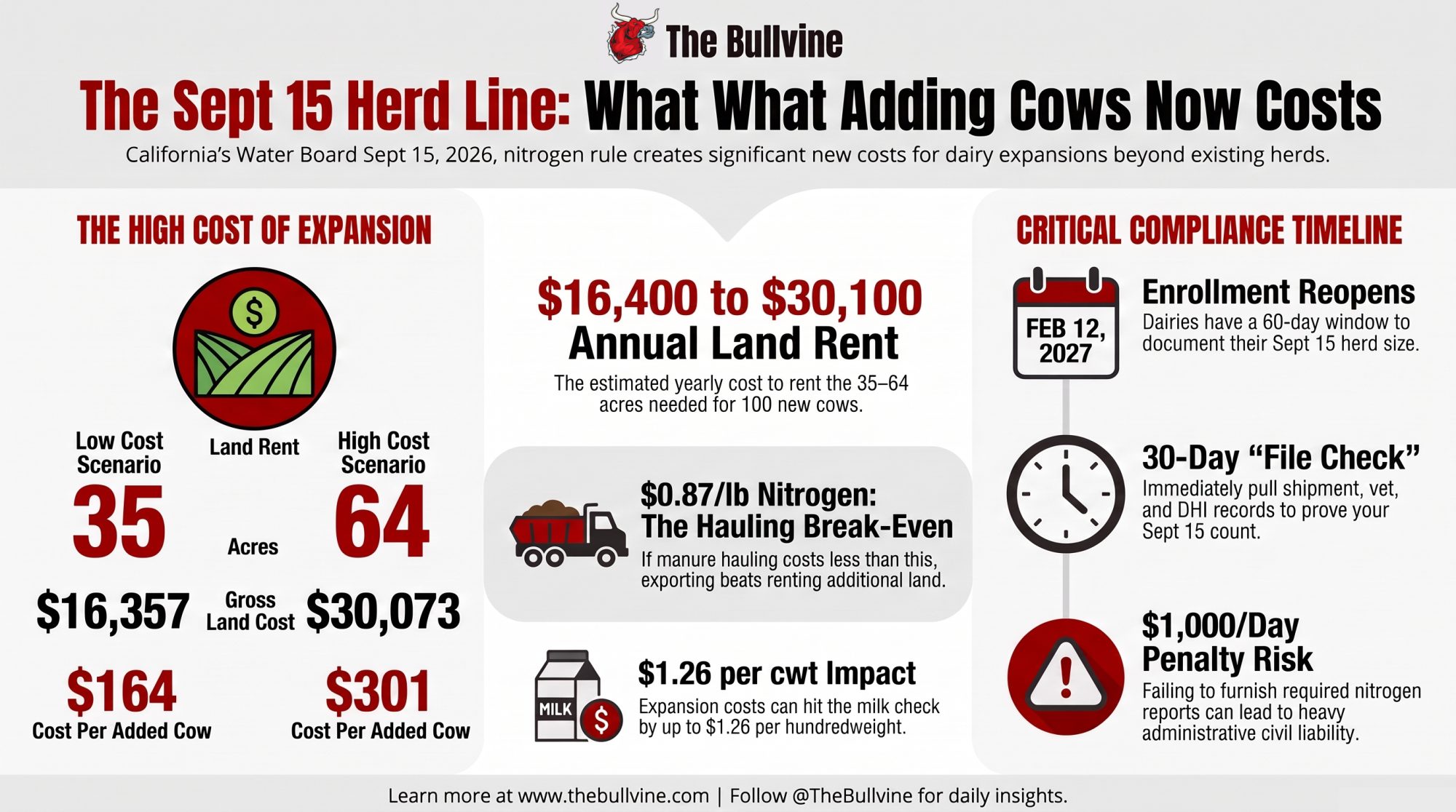
- The cost: In a Bullvine stress test, 100 cows added after Sept. 15 must clear the 1.4 A/R test before coverage. That takes 35 to 64 more acres, or $16,400 to $30,100 a year in gross land rent (68 cents to $1.26 per cwt on their milk).
- The deadline: Herd capacity left undocumented when enrollment reopens, around Feb. 12, 2027, risks being treated as new.
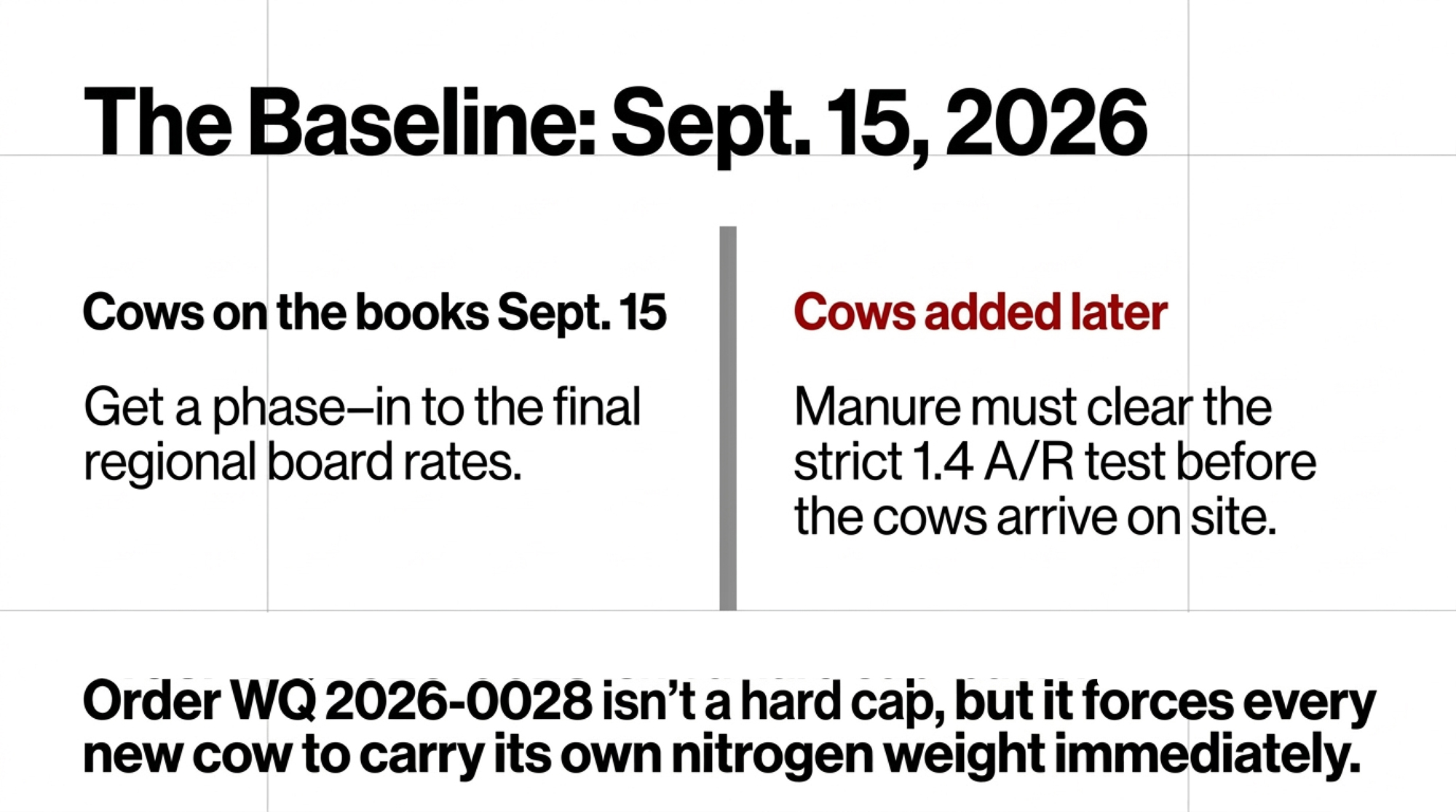
On Sept. 15, the State Water Resources Control Board adopted Order WQ 2026-0028. It sends the Central Valley’s 2013 dairy permit back to the regional board and sets out a new nitrogen framework for every dairy under that board’s authority. The biggest immediate change isn’t a new limit. It’s a date. Cows milking on Sept. 15 count as the “existing” herd. It’s not a cap: dairies can still expand. But until the revised permit is adopted, the added cows’ manure has to clear the 1.4 A/R test before the expansion gets coverage.
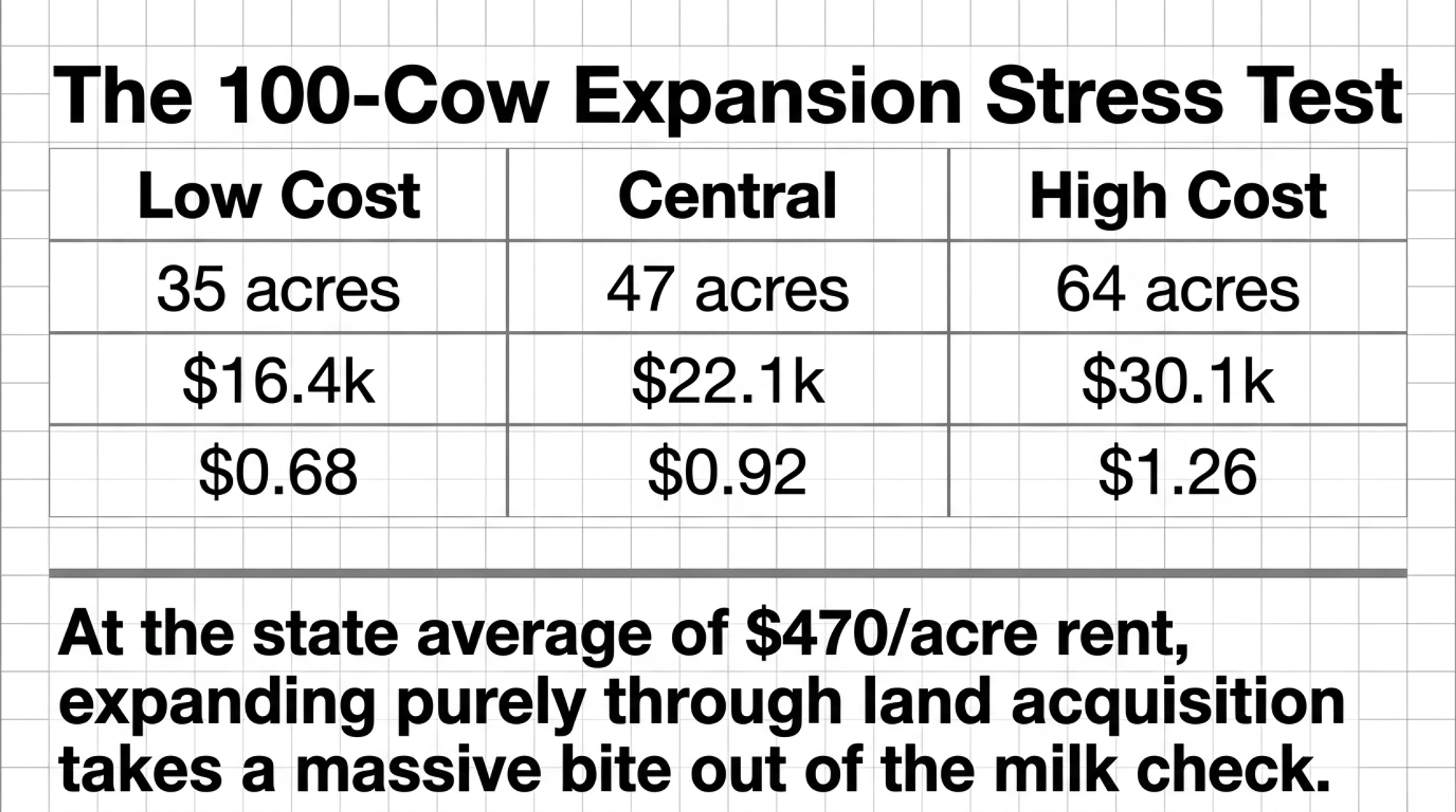
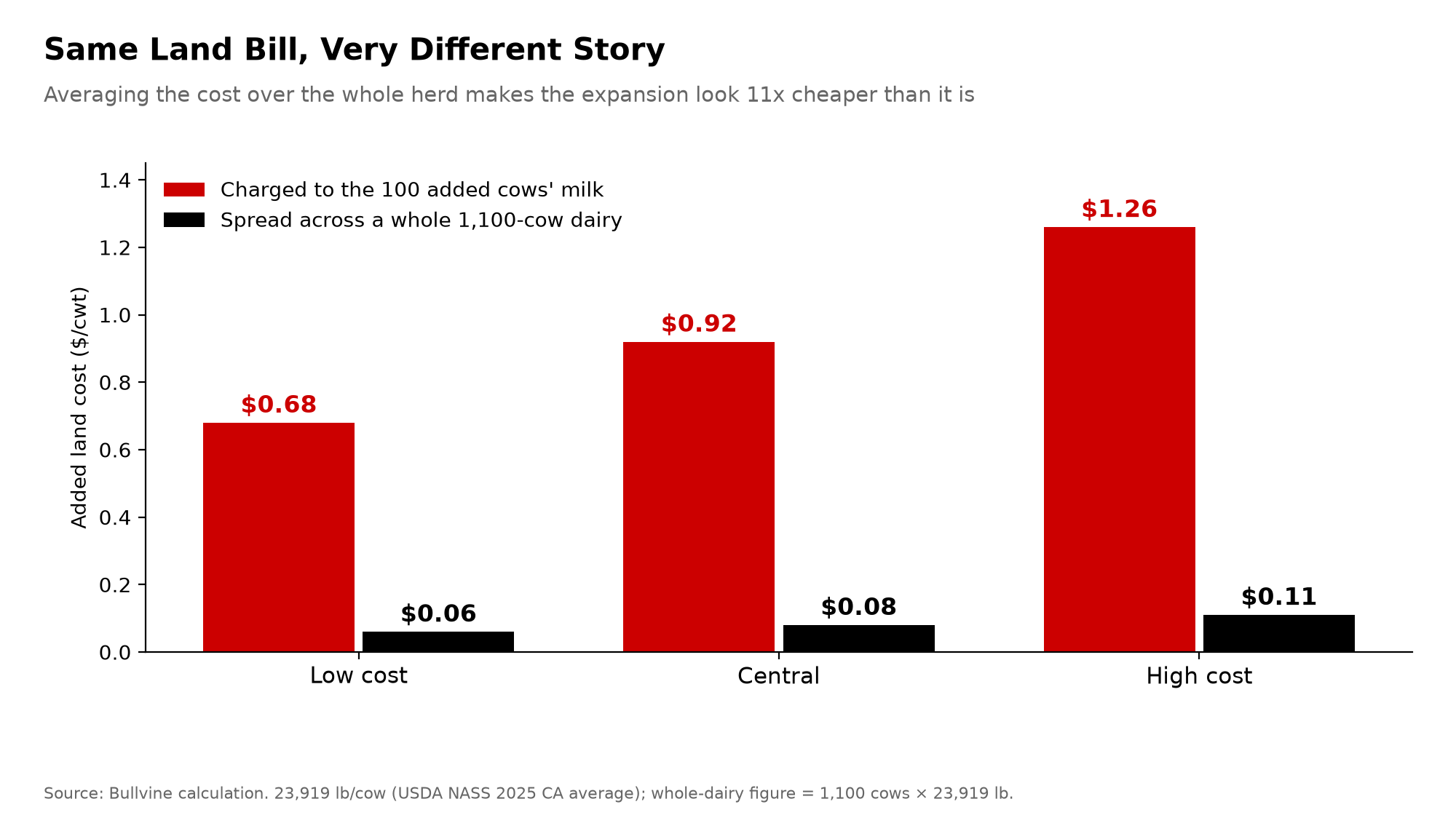
Here’s what that costs. In a Bullvine stress test, 100 cows added to a Central Valley dairy need 35 to 64 more acres. At California’s 2026 statewide irrigated rent of $470 an acre, that’s $16,400 to $30,100 a year in gross land cost. On the added cows’ milk alone, it’s 68 cents to $1.26 per cwt.
That’s a Bullvine calculation, not a Water Board estimate. Every input is listed below.
What the order did — and didn’t
The board didn’t adopt a final land-application rate. It told the Central Valley Water Board to build a groundwater-loading limit and a land-application formula within four years, and to adopt a revised dairy permit within five. That limit has to keep nitrogen leaving the root zone under the 10 mg/L nitrate drinking-water objective, with a safety margin. The order mentions 8 mg/L as an example, not as a limit it has adopted.
The 1.4 test carries over from the 2013 permit. Total nitrogen applied to a field can’t exceed 1.4 times the nitrogen removed in the harvested crop. Existing dairies already live under that test. The order keeps it but orders more accurate measurement of both sides, and it adds whole-farm nitrogen accounting that could eventually sit alongside the field method or replace it.
All data the order requires is public, and it has to go into GeoTracker in a format people can analyze. The order specifically says PDF uploads don’t count as usable. A dairy’s nitrogen balance is going to become something neighbours, lenders and advocates can download.
The Sept. 15 line
Under the 2013 permit, an existing dairy could run the herd size in its original report plus 15%. An increase of more than 15% in mature cows made it an “expanded” dairy. The new order adds its own baseline on top: the mature cows operating on Sept. 15, 2026. The Water Board hasn’t said how the two fit together.
The deadlines follow from that date. The regional board has 150 days, until about Feb. 12, 2027, to reopen enrollment. Dairies then get a 60-day window to document their Sept. 15 herd. The board has until about March 14, 2027 to finish its inventory of operating dairies. Herd capacity that goes undocumented risks being treated as new.
To keep existing-dairy treatment, a pre-permit expansion needs four things: a complete report of waste discharge, documented compliance with the California Environmental Quality Act, proof that the added cows’ manure meets 1.4 A/R right away, and coverage in hand before the cows arrive. Once the revised permit is adopted, expansion manure faces the final rates immediately, with no phase-in.
Why it comes down to land
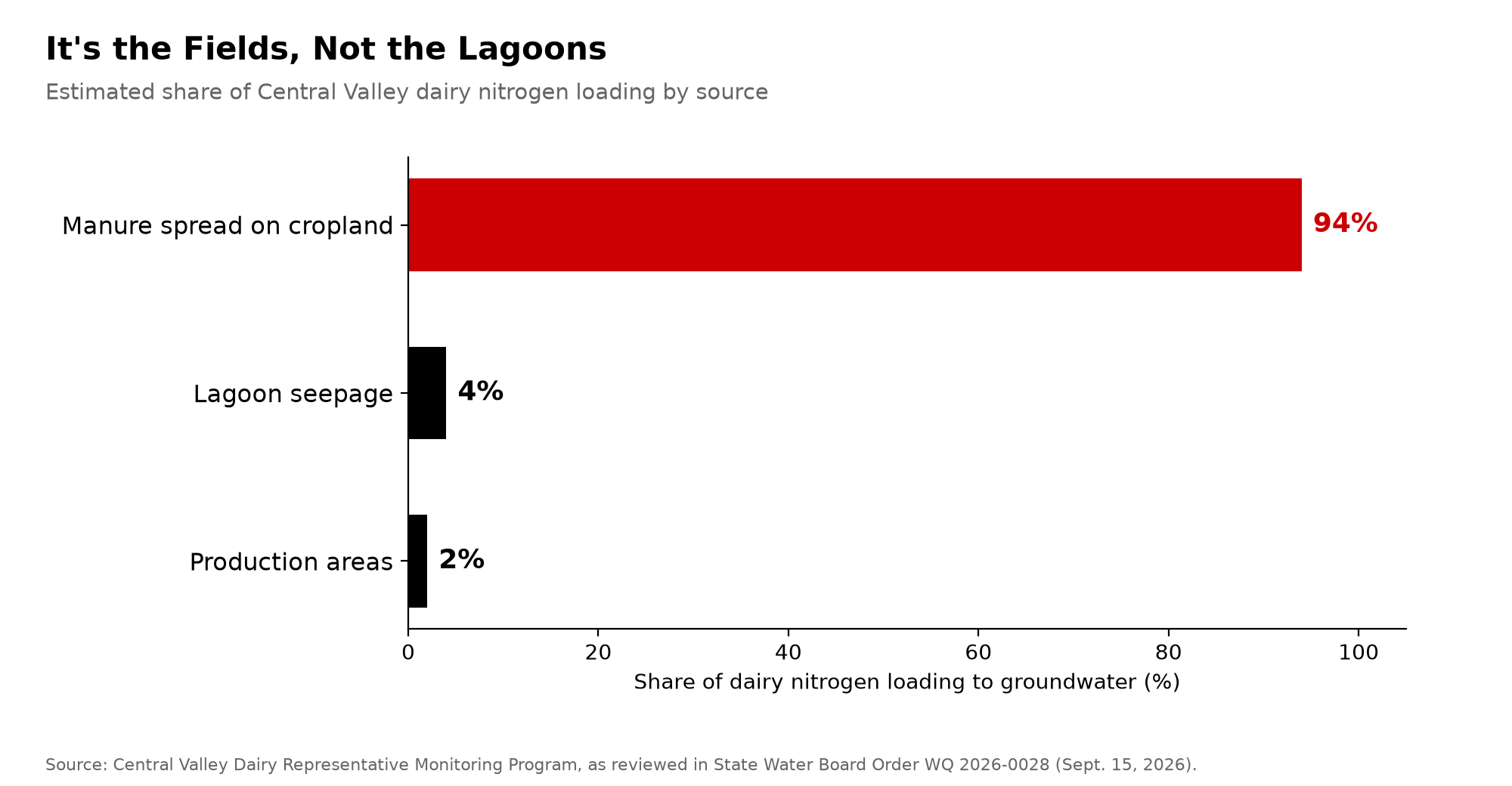
The Central Valley Dairy Representative Monitoring Program estimated that about 94% of dairy nitrogen loading comes from spreading manure on cropland. Lagoon seepage accounts for 4% and production areas for 2%. The Water Board reviewed that data and wrote that it generally agrees.
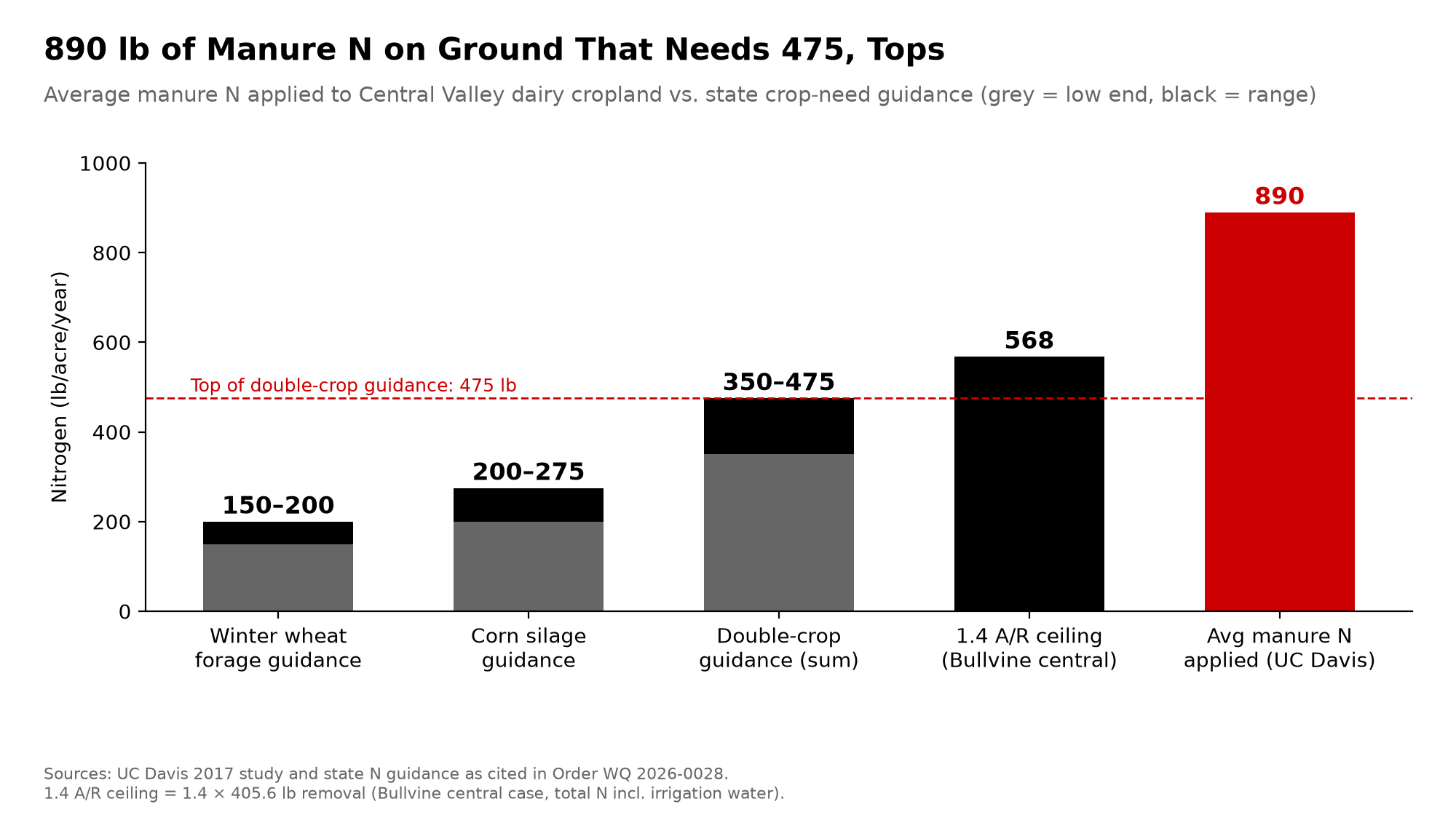
The UC Davis 2017 study the order relies on puts average manure nitrogen on Central Valley dairy cropland at 890 lb per acre a year. The order sets that against state guidance of 200–275 lb for corn silage and 150–200 lb for winter wheat forage. The board’s written finding is that “extensive over-application” treated land application largely as disposal.
The order also concedes that government pricing mechanisms stop dairies from simply raising their prices to cover manure-management costs. Whatever this costs comes out of the milk cheque.
The Bullvine math
The scenario: 100 mature cows added to a Central Valley dairy after Sept. 15, managed under the current 1.4 A/R test, double-cropped with corn silage and a winter forage.
| Input | Low cost | Central | High cost | Basis |
| Nitrogen excreted, lb/cow/yr | 365 | 365 | 365 | Order WQ 2026-0028: ~1 lb/cow/day |
| Storage and air losses | 40% | 30% | 20% | Assumption; central matches UCCE’s 30% ammonia-loss figure |
| Managed nitrogen, 100 cows (lb) | 21,900 | 25,550 | 29,200 | Calculated |
| Corn silage yield (t/ac) | 33 | 30.5 | 28 | Yield range cited in the order |
| Corn silage N removed (lb/ac) | 249.5 | 230.6 | 211.7 | Yield × 7.56 lb N/ton (CDFA/FREP) |
| Winter forage N (lb/ac) | 200 | 175 | 150 | Proxy: state N-requirement guidance, not measured removal |
| Total removal R (lb/ac) | 449.5 | 405.6 | 361.7 | Calculated |
| Irrigation-water N (lb/ac) | 0 | 25 | 50 | Assumption; ≈0, 3.6 and 7.2 ppm nitrate-N at 30 in. applied (UCCE conversion) |
| Manure capacity (lb N/ac) | 629.3 | 542.8 | 456.4 | 1.4 × R − irrigation N |
| Added acres needed | 34.8 | 47.1 | 64.0 | Managed N ÷ capacity |
| Rent | $470 | $470 | $470 | USDA NASS 2026, California statewide irrigated average |
| Gross annual land cost | $16,357 | $22,123 | $30,073 | Acres × rent |
| Per added cow | $164 | $221 | $301 | ÷ 100 |
| Per cwt, added milk | $0.68 | $0.92 | $1.26 | ÷ 23,919 cwt |
What this model leaves out cuts both ways. There’s no delivery cost: rented acres only work if the manure gets there by pipe or truck, so the model understates cost on ground that isn’t contiguous with the dairy. There’s also no forage credit: the rented acres grow feed, and if the dairy would otherwise buy that feed, the net cost is lower. The rent is a statewide average. Central Valley forage ground may rent above or below it, and county NASS figures are the next check.
Milk uses 23,919 lb per cow, California’s 2025 NASS average. The Federal Order market administrator puts California’s January–June 2026 mailbox price at $17.81/cwt, so those 100 cows gross about $426,000. The central land cost takes 5.2% of that before any feed, labour or capital. Spread across a whole 1,100-cow dairy, it’s 6 to 11 cents per cwt. That’s accurate, but it’s the wrong way to judge an expansion.
The threshold
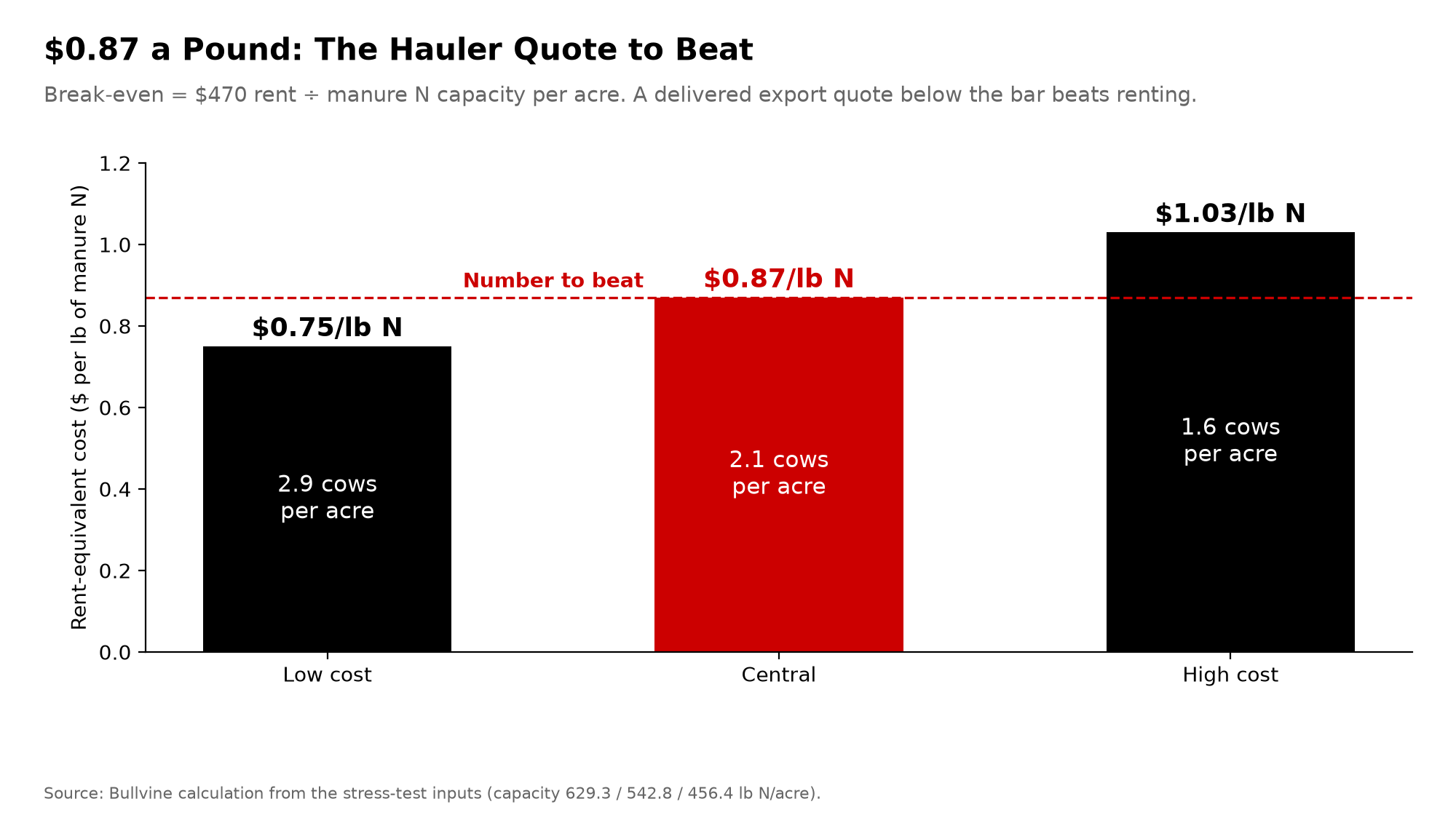
In the central case, one acre handles the nitrogen from 2.1 mature cows. The low case handles 2.9 and the high case 1.6. If a dairy already runs more cows per controlled forage acre than its own crop-removal records support, the next cow needs a new outlet: rented land, export or treatment.
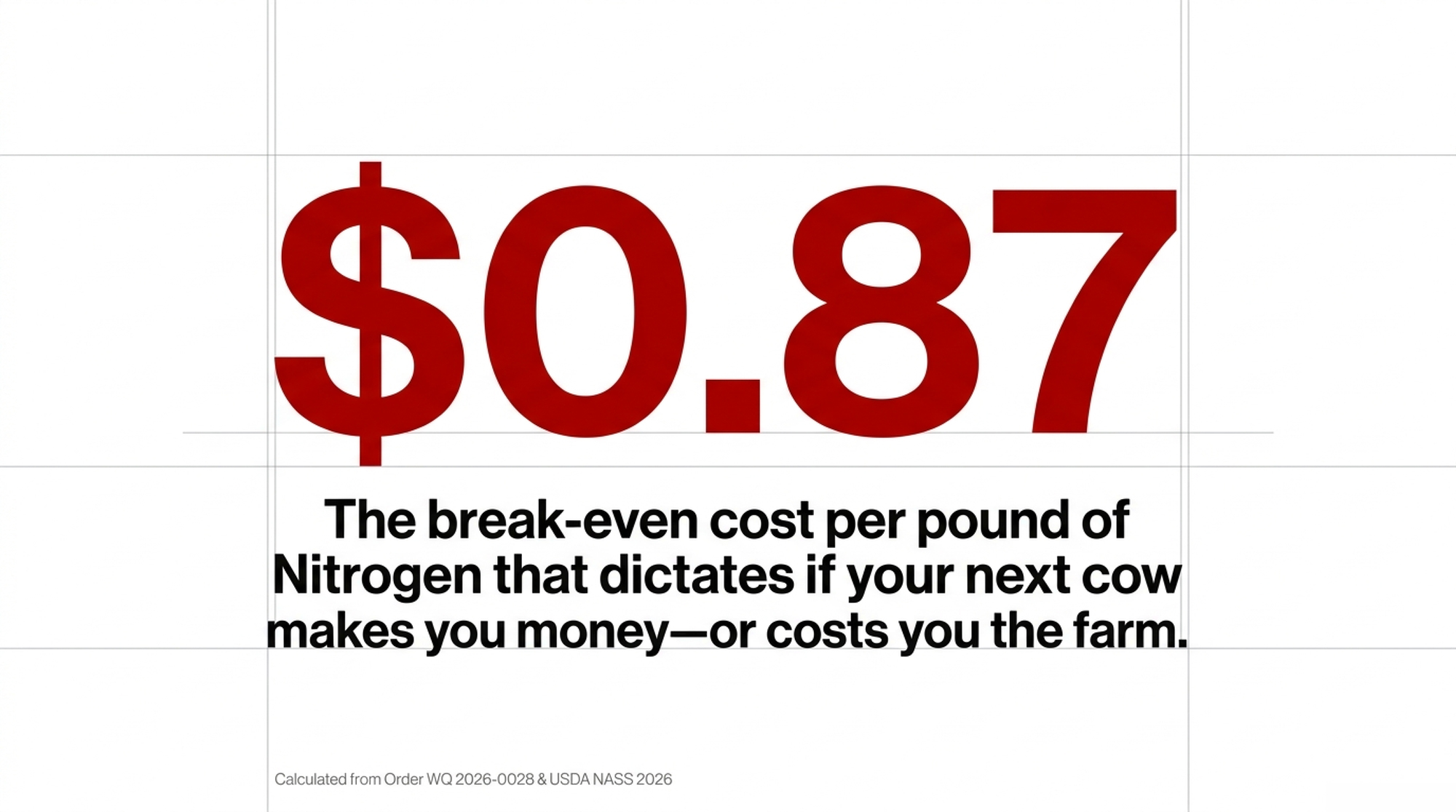
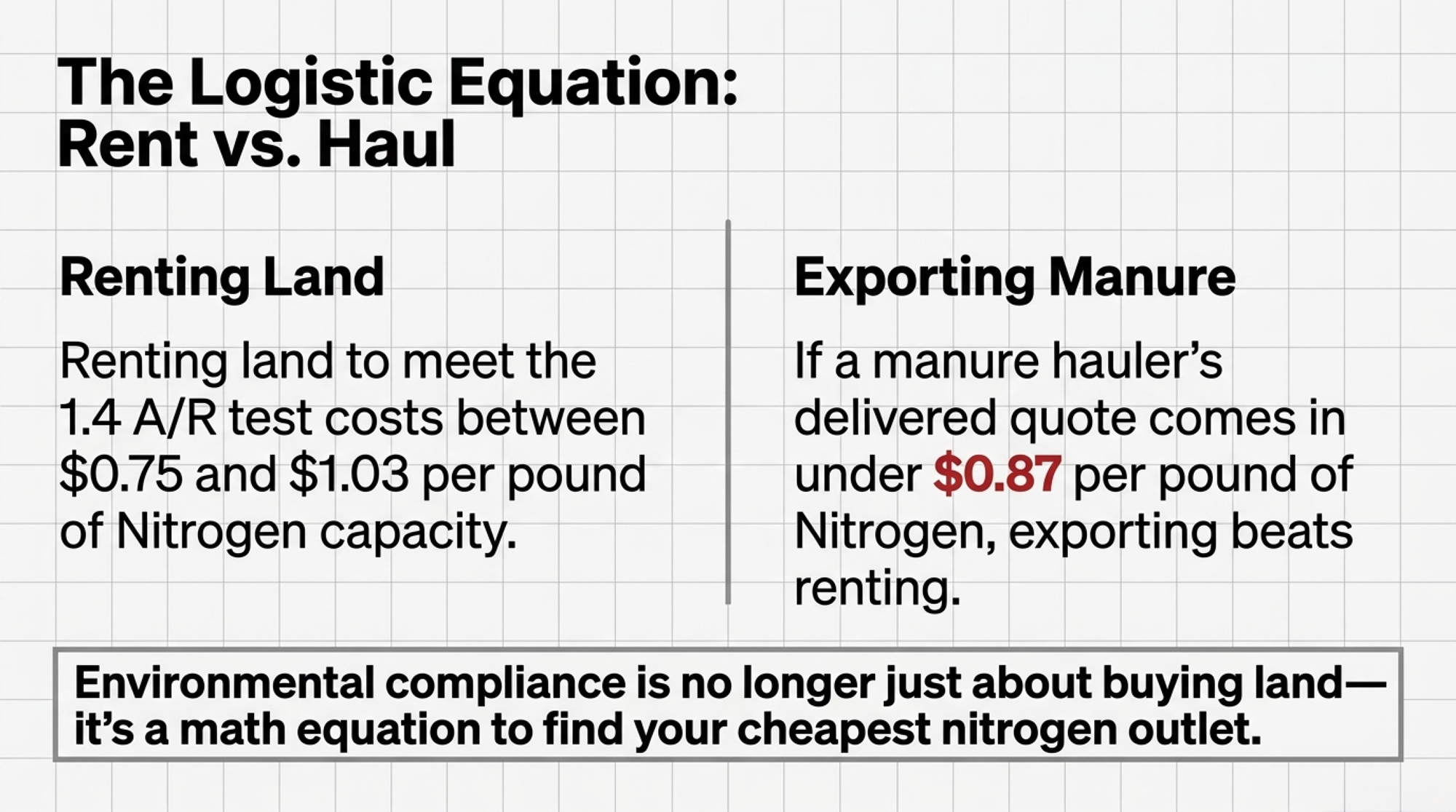
Here’s the break-even an operator can use. Renting costs $470 divided by the manure capacity per acre: $0.75, $0.87 and $1.03 per lb of nitrogen across the three cases. Take a hauler’s delivered quote and turn it into dollars per pound of nitrogen using a lab test of the manure. If it comes in under that number, exporting beats renting. Judge treatment the same way, on pounds of nitrogen actually removed, not on lower concentration.
The paperwork floor
| Obligation | Cost | Frequency | What it means |
|---|---|---|---|
| Expanded nutrient plan + whole-farm reporting | $165–$1,070 | Per year | About 0.4¢/cwt at the top end on 1,100 cows |
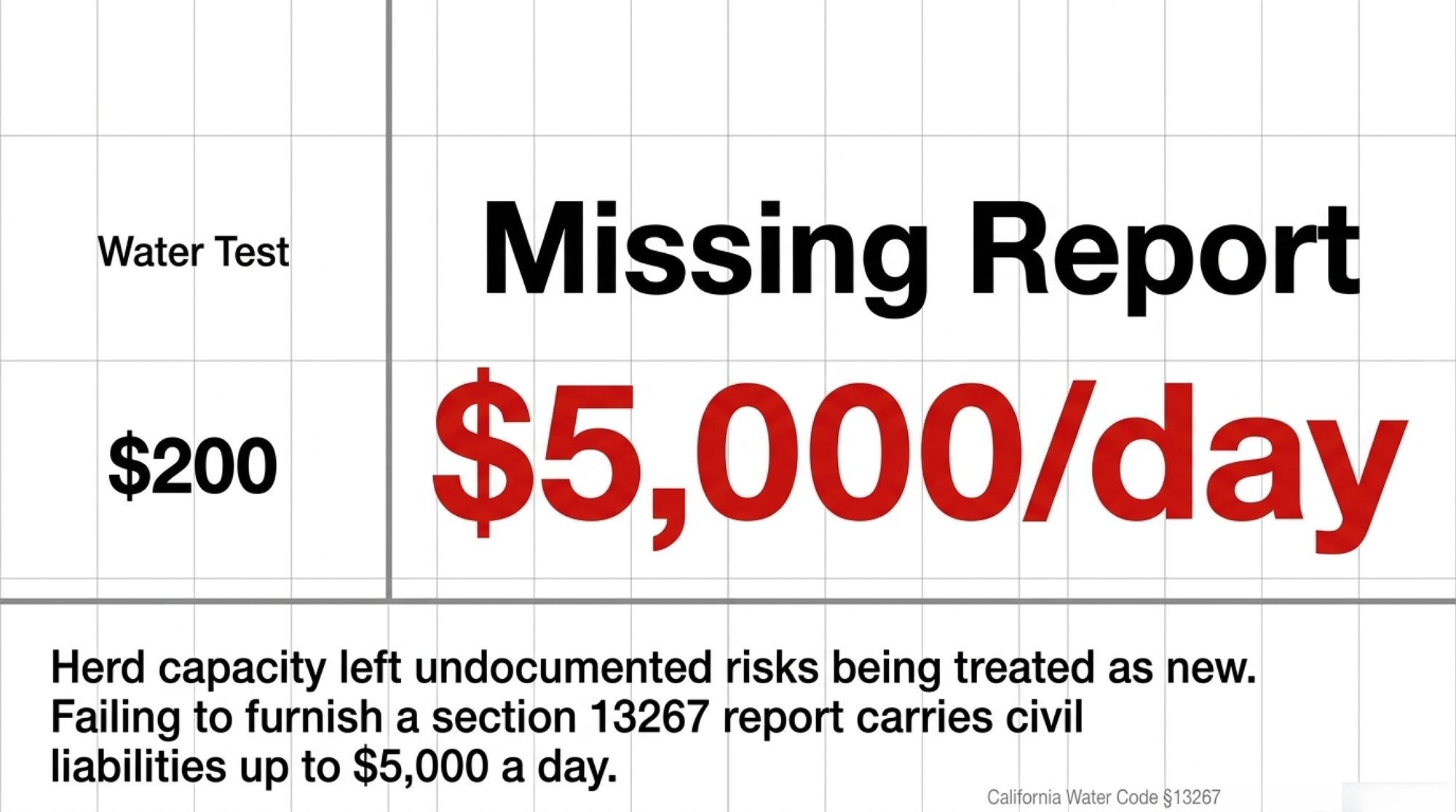
| Drinking-water well sampling | $200–$400 | Per sample | Annual nitrate test to start |
| Pond hydraulic-continuity report | $2,000–$15,000 | One time | Only if ordered (from Sept. 2027) |
| Missing §13267 report (administrative) | Up to $1,000 | Per day | $30,000 after one month |
| Missing §13267 report (superior court) | Up to $5,000 | Per day | $150,000 after one month |
The order’s own estimates for the new reporting are small. Expanded nutrient-plan and whole-farm reporting runs $165–$1,070 a year per dairy. Drinking-water sampling runs $200–$400 a sample. A pond hydraulic-continuity report, for dairies ordered to do one, costs $2,000–$15,000 once. Failing to furnish a report required under Water Code section 13267 is different. It can bring civil liability of up to $1,000 a day administratively, or up to $5,000 a day through the superior court. The Central Valley board has applied the $1,000-a-day cap to a missing dairy annual report before. Iowa shows how the bill can run past the penalty itself: in four consent orders there, restitution ran 6.7 times the penalty.
Dairies with on-farm drinking-water wells start with annual nitrate sampling. A result over 10 mg/L means users must be notified within 10 days. Where the operator doesn’t own the property, the operator can pass the result to the owner within 24 hours. The owner then has the rest of the notice period to tell users and copy the regional board.
What isn’t settled
- Losses: how much storage and air loss the whole-farm accounting will credit. The monitoring program found that volatilization doesn’t fully explain the “unaccounted-for” nitrogen.
- Support stock: whether the order’s 1-lb-a-day figure covers dry cows and heifers.
- The two baselines: how the Sept. 15 herd count fits with the 2013 permit’s 15% allowance.
- Removal definitions: the order points the revised permit to the removal definitions it endorsed in Order WQ 2018-0002.
- The final formula: the groundwater-loading limit and land-application formula, due in 2030.
Implementation calendar
| Deadline the order sets (calculated from Sept. 15) | Directed action |
| ~Feb. 12, 2027 | Regional board to reopen 2013 permit enrollment; 60-day documentation window follows |
| ~March 14, 2027 | Inventory of operating dairies and herd sizes due |
| Sept. 2027 | Regional board to begin issuing section 13267 pond-continuity orders |
| Sept. 2028 | Improved A/R measurement orders and drinking-water well monitoring due |
| Sept. 2029 | Draft revised permit and environmental impact report due |
| Sept. 2030 | Groundwater-loading limit and land-application formula due |
| Sept. 2031 | Revised dairy permit due for adoption |
The file check
- 30 days: Pull the proof of your Sept. 15 mature-cow count: shipment, vet and DHI records. Check it against your enrolled herd plus 15%.
- 90 days: Get fresh lab tests on your manure and irrigation water. Work out crop removal from actual tonnage, and get one hauling quote converted to dollars per pound of nitrogen.
- 365 days: Before adding cows, decide which outlet their nitrogen goes to — land, export or treatment — and put it in writing.
The order doesn’t send anyone a bill yet. What it does is sort the herd. Cows on the books Sept. 15 get a phase-in to the final rates. Cows added later have to clear the test before they arrive. For a dairy weighing expansion, $0.87 a pound is the number to beat.
Complete references and supporting documentation are available upon request by contacting the editorial team at editor@thebullvine.com.
Learn More
- Iowa’s Manure Penalty Never Left $5,000. The Restitution Ran 6.7 Times Higher. — Protects your operation from personal criminal exposure over a single unverified pump line. Arms you with a four-role transfer protocol to safeguard margins and managers before state inspectors ever arrive.
- Water Excellence Is Table Stakes – Market Position Is the Game — Prepares your dairy for the $2.2 billion feed cost impact coming as California’s SGMA eliminates one million irrigated acres. Outlines how scale economics and genetic feed efficiency will dictate who survives.
- $80M on Her Land, $0 in Carbon Credits: Inside Curtis Creek’s RNG Trade — Reveals the hidden fine print costing producers millions in anaerobic digester agreements. Follows the money on a 2,000-cow operation where the developer, not the farm, captured the lucrative carbon credit stack.
 The Sunday Read Dairy Professionals Don’t Skip.
 The Sunday Read Dairy Professionals Don’t Skip.
Every week, thousands of producers, breeders, and industry insiders open Bullvine Weekly for genetics insights, market shifts, and profit strategies they won’t find anywhere else. One email. Five minutes. Smarter decisions all week.




