Archive for dairy profitability – Page 4

Butterfat vs. Powder: What the Great Dairy Divide Really Means for Your Bottom Line

Butterfat’s on top, powder’s under pressure—and the milk check now tells a story few saw coming

EXECUTIVE SUMMARY: Butterfat’s booming, powders are sliding, and together they’ve redrawn the dairy marketplace. This isn’t just another price cycle—it’s a lasting shift in how milk value is measured and paid. China’s preference for premium fats, new processor investments, and stronger herd genetics are driving a global realignment. Farmers who embrace component-based pricing, focused feeding, and risk protection remain profitable even as traditional markets weaken. The message heading into 2026 is clear: the future belongs to those who manage what’s inside the tank, not just how much fills it.

Walk into any farm shop or co-op office this fall, and chances are you’ll hear the same discussion. Butterfat is holding strong, while powders just can’t find their footing. The market doesn’t feel balanced anymore. What’s interesting here is that this gap doesn’t seem like a short-term pricing quirk—it looks and feels like a lasting shift in how milk value is determined.

Fat Holds Steady, Powder Loses Traction

Looking at the latest Global Dairy Trade (GDT) auctions, it’s easy to see the disconnect. The GDT index has fallen for five consecutive events, down roughly 1.4% in mid-October. Butter and anhydrous milk fat (AMF), however, remain firm, trading between $6,600 and $7,000 per tonne. Meanwhile, skim milk powder (SMP) is soft, sitting near $2,550 per tonne.
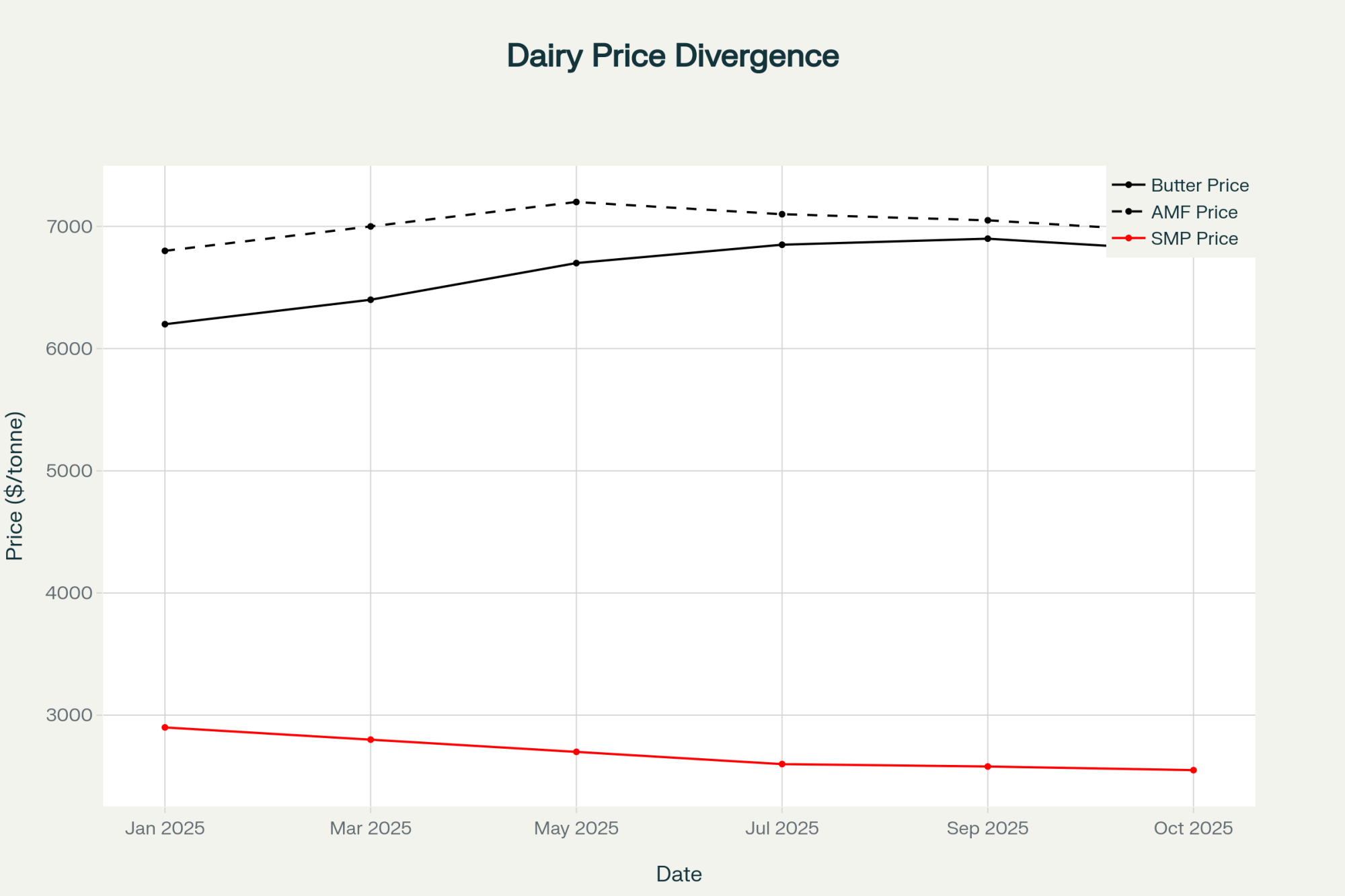
The Great Dairy Divide: Butterfat products command $6,800-7,200 per tonne while skim milk powder has collapsed to $2,550—a pricing gap that’s rewriting the economics of every dairy farm in America

That pattern isn’t isolated to one region. According to the EU Commission Market Observatory, SMP fell about 1% this month, while butter barely moved. In the United States, USDA Dairy Market News reported CME butter prices hovering around $3.15 per pound, roughly aligned with global benchmarks after accounting for shipping and grading differences.

The CoBank Dairy Outlook (October 2025) calls this “a composition-driven divergence.” In simple terms, the milk market isn’t paying for volume anymore—it’s paying for what’s inside. AMF, at 99.8% pure milkfat, is ideal for global manufacturers who need precision and performance. Butter, at 82% fat, still has a place, but powders are losing ground as demand in infant formula and rehydrated products slows.

China’s Import Strategy Speaks Volumes

The best way to understand this trend is to look at China, where import behavior has changed dramatically. The Chinese Customs Administration reported that butter imports rose 65% year over year, whole milk powder climbed 41%, and SMP dropped 12.5%.
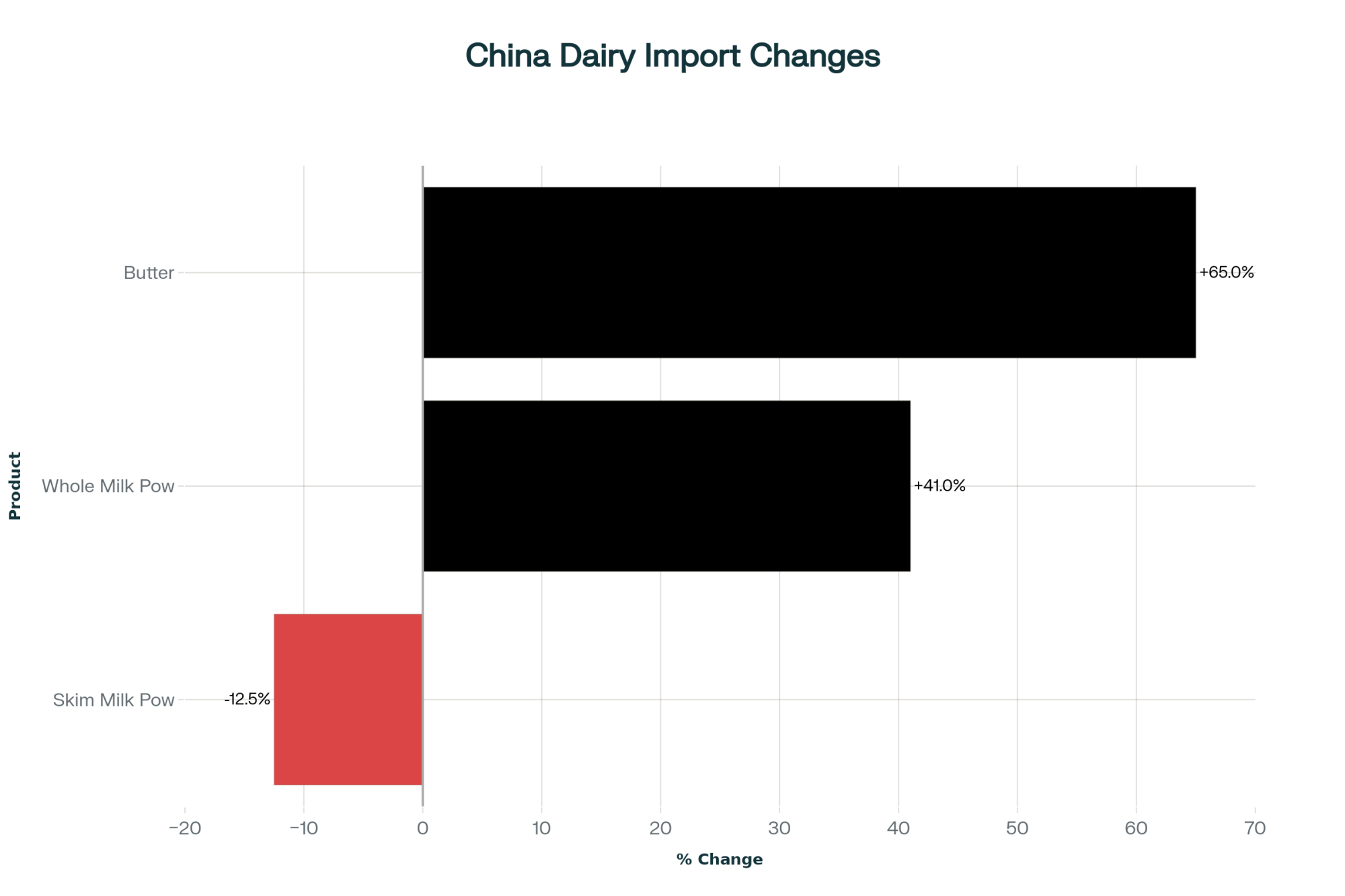
China’s dairy import strategy reveals the future: butter imports surged 65%, whole milk powder up 41%, while skim milk powder dropped 12.5%—they’re buying precision fats and making powder at home

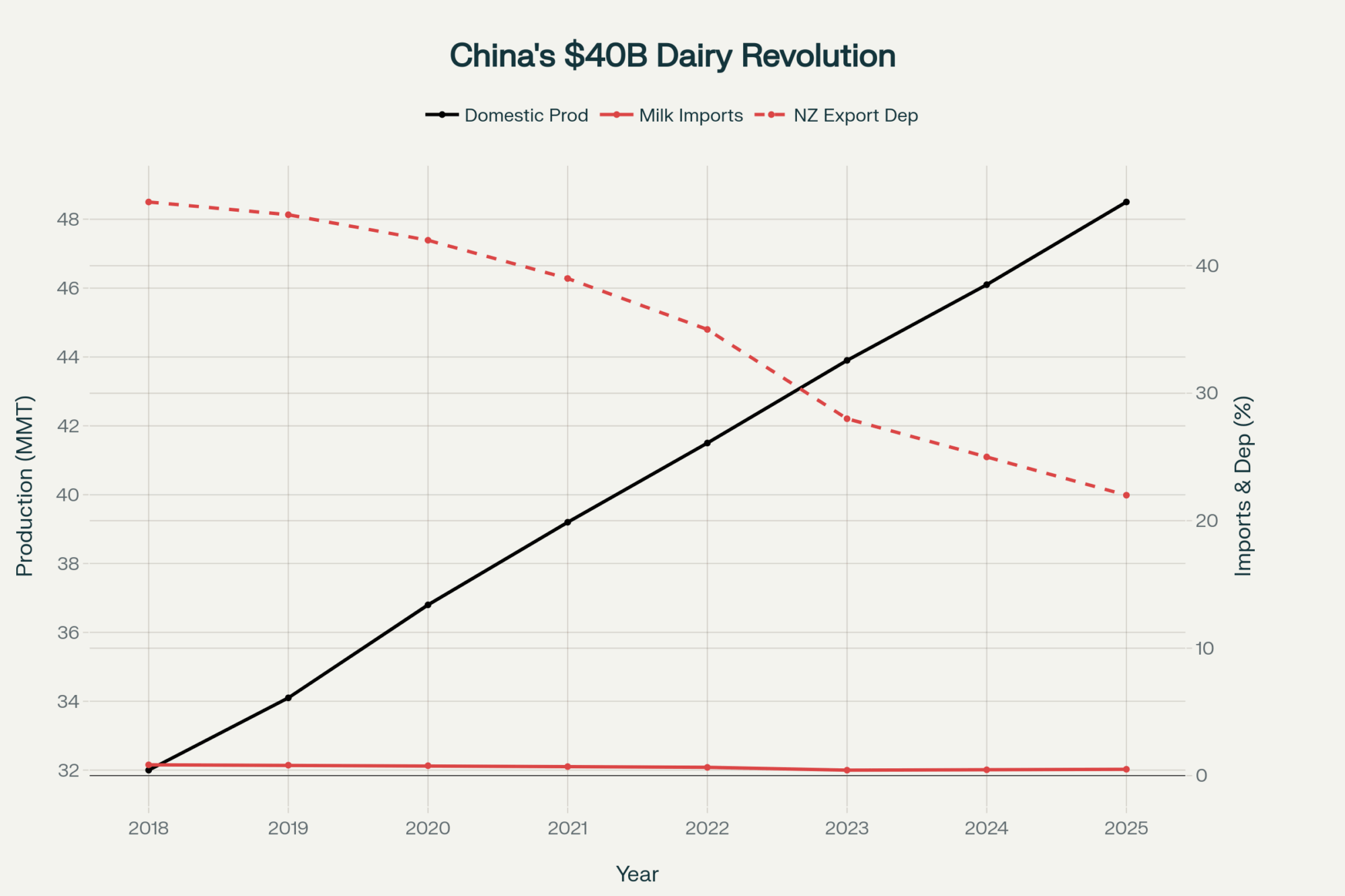
At the same time, the USDA Foreign Agricultural Service (FAS) confirmed that China’s milk production grew to 41.9 million tonnes in 2024, a rise of 6.7%. Those numbers sounded encouraging, but they also created oversupply at home. Processing plants are drying roughly 20,000 tonnes of milk a day, often at a loss. The OCLA Argentina Dairy Market Outlook (September 2025) estimates those losses at 10,000 yuan per tonne, or about $1,350 USD, thanks to high input and energy costs.

Here’s where things get interesting. China can produce plenty of powder. Where it struggles is in high-purity fats like AMF and industrial butter. Domestic processors lack the cream-separation and fractionation capacity found in markets like New Zealand, Europe, and the U.S. So their strategy has shifted. They’re importing what they can’t make efficiently. That choice has reinforced fat premiums in the global marketplace.

This development suggests a new normal for international trade. Countries will compete not on total milk output, but on how effectively they produce—and market—the right components.

Why U.S. Farmers Are Still Standing tall

Looking back through cycles like 2015 or 2020, it’s clear farmers have become better prepared to weather volatility. Part of that comes down to management maturity and new financial safety nets that didn’t exist a decade ago.

Risk Management Tools Are Paying Off
According to the USDA Risk Management Agency (RMA), about 35% of U.S. milk production is now protected under Dairy Revenue Protection (DRP), with participation surpassing 50% in the High Plains. Those policies are helping farms hold margins through increasingly unpredictable shifts in global pricing.
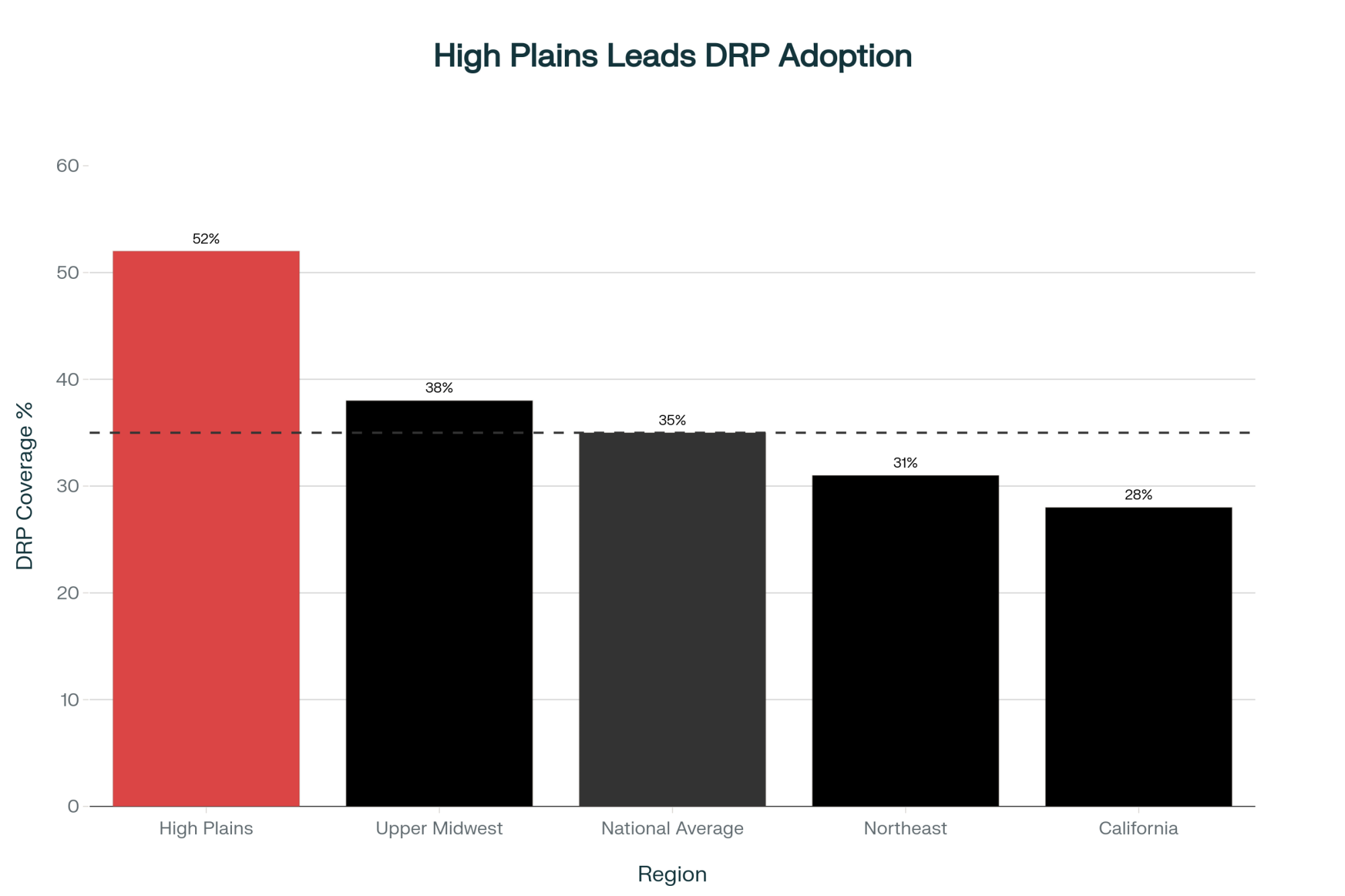
Smart farmers are protecting margins: 52% of High Plains milk production is covered by Dairy Revenue Protection, nearly double California’s 28%—proof that the best operators plan for volatility before it hits

Component Programs Reward Quality, Not Quantity
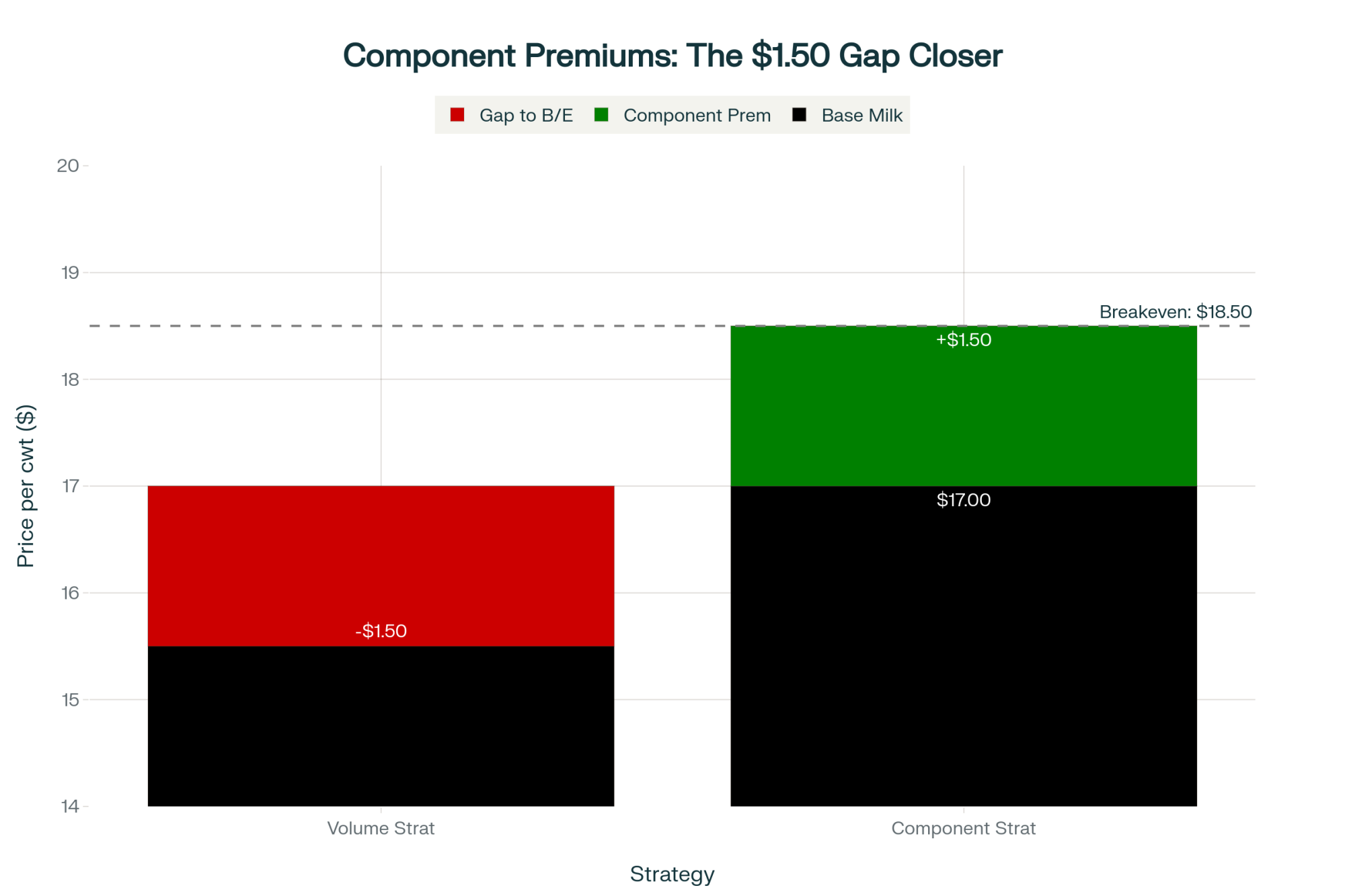
More than 90% of milk in the country is now sold under Multiple Component Pricing (MCP). Herds averaging 4.3% butterfat and 3.4% protein consistently earn $1.50 to $2.00 per hundredweight more than standard 3.7/3.1 herds, according to USDA AMS data. That’s a structural incentive, not a fad.

Genetics and Feeding Continue to Change the Curve
CoBank and USDA data show national butterfat averages rising from 3.95% in 2020 to 4.36% this year, while protein moved to 3.38%. The Michigan State University Extension (2025) recently found that feeding 5–6 pounds of high-oleic roasted soybeans per cow daily improved butterfat by 0.25–0.4 percentage points within 30 days, while enhancing rumen consistency and herd condition.
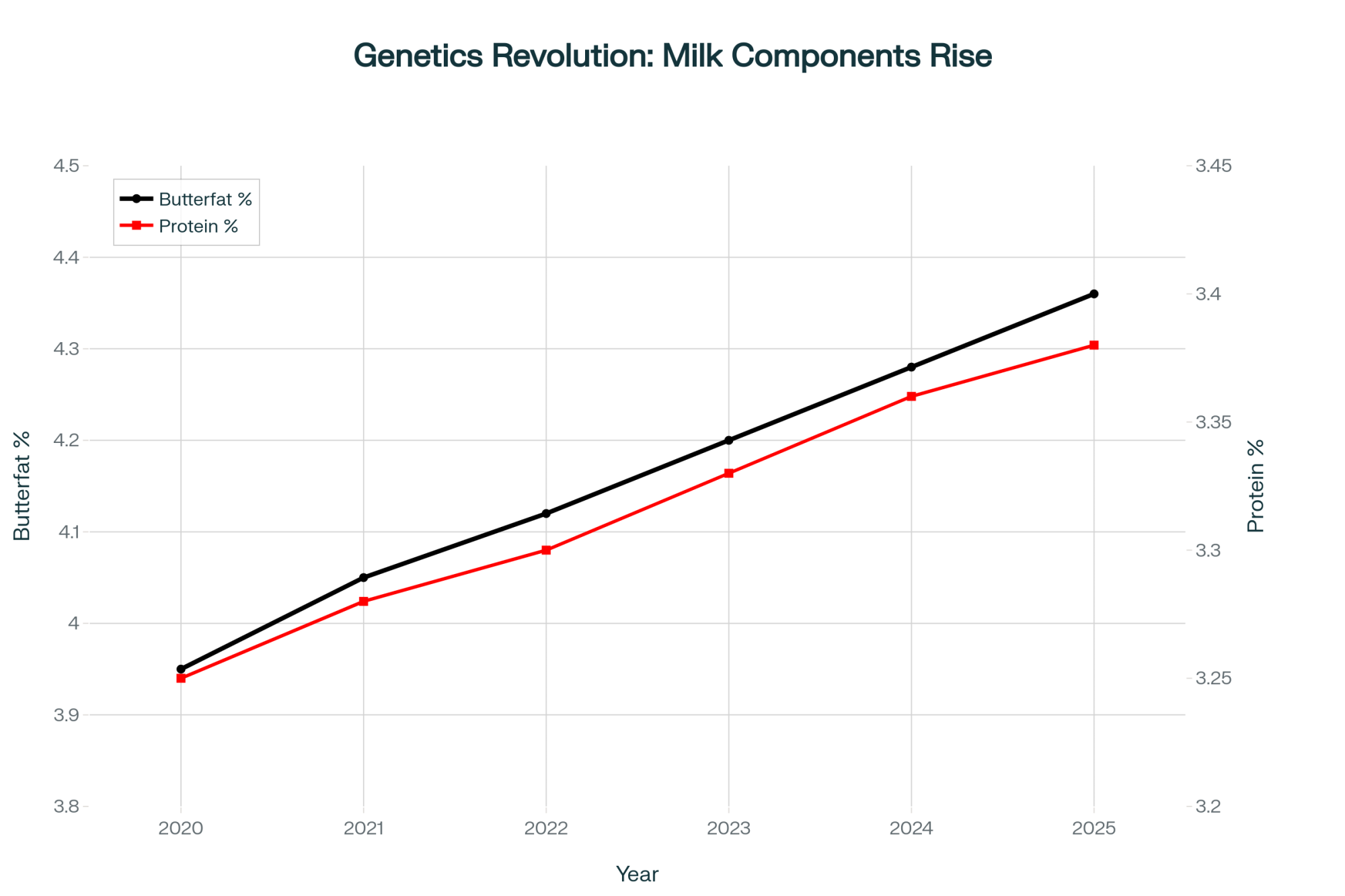
American dairy genetics are delivering: butterfat jumped from 3.95% to 4.36% in just five years while protein climbed to 3.38%—improvements that translate directly to bigger milk checks every month

What’s encouraging here is that improvements are cumulative. As one extension specialist explained during a recent producer roundtable, “The cows are doing the same work, but the milk’s worth more.” It’s proof that managing for higher components is one of the most direct paths to better returns.

The Processor Pivot: From Volume to Value

Processors are feeling this market divide just as strongly as producers are. And frankly, some are better positioned than others.

Let’s look at Darigold’s Pasco, Washington facility, which represents one of the industry’s most ambitious bets on global powder capacity. The plant—a $1.1 billion facility capable of processing 8 million pounds of milk per day—was planned to supply milk powders and butter to Southeast Asian buyers when those markets were booming back in 2019. But global dynamics changed faster than expected. Reports confirm the company had to deduct around $4 per hundredweight from producers’ milk checks this summer to offset startup losses. Powder-heavy exports aren’t what they used to be.

Contrast that with processors like Hilmar Cheese (Texas), Leprino Foods (Kansas), and Lactalis USA, which have expanded into cheese, whey protein, and AMF production. They’re diversifying toward higher-solids, higher-margin production that keeps milk geographically and economically competitive. Reports from First District Association (Minnesota) and Idaho Milk Products echo the same trend—premium payments now hinge on component tests because that’s where processors make their profit.

Here’s the hard truth: the U.S. industry is splitting not just by product, but by intent. Powder is still a volume game. Component ingredients are an efficiency game.

Could Butterfat Overshoot?

It’s a fair question to ask whether everyone aiming for higher fat could create the next surplus. CoBank’s August 2025 Outlook flagged that butterfat production might be “growing faster than demand absorption.”

But here’s where genetics help us. The USDA Agricultural Research Service (ARS) and Holstein Association USAperiodically adjust their Net Merit (NM$) and Total Performance Index (TPI) formulas to reflect changes in milk pricing. That means breed selection is constantly reweighted to economic reality. If fat premiums fall or protein values recover, herd objectives shift almost automatically.

The point is, dairy efficiency—not just butterfat—is what creates long-term stability. It’s why balance will always outlast fads.

The Metric That Matters: Component Spread

When you strip away all the noise, one figure tells the story: the component spread—the pay gap between baseline milk (3.5% fat / 3.0% protein) and high-component milk (4.4% fat / 3.4% protein).

Component pricing isn’t subtle: premium milk at 4.4% fat earns $2.00/cwt more than standard 3.7% fat milk—that’s $14,600 annually for a 100-cow herd, and the gap keeps widening

As USDA AMS Federal Order data shows, that premium has averaged more than $2 per hundredweight throughout 2025. If it holds, producers essentially have proof that processors are permanently paying for composition, not volume.

A USDA market economist summed it up best in a September forum: “When the value is tied to solids instead of water, you’re not in a price cycle anymore—you’re in a new structure.”

Practical Lessons Going Into 2026

The roadmap is clear: track components monthly, breed strategically, match your processor, feed for balance, and protect margins—five concrete moves that separate winning farms from the rest
  1. Track Your Components Monthly.
    Treat butterfat and protein performance as management metrics alongside fertility, transitions, or somatic cell counts. Precision wins.
  2. Start Small, Build Momentum.
    Genomic testing (around $40 per heifer) and ration adjustments are quick-return investments in this pricing climate.
  3. Match Your Processor Relationship.
    AMF and cheese plants prize solids. Powder plants still chase volume. Know which market pays for the milk you make.
  4. Breed and Feed for Balance.
    Fat and protein efficiency outweigh extremes. Avoid chasing a single number.
  5. Protect Margins with Modern Tools.
    DRP coverage, component contracts, and multi-year agreements keep income steady when markets fluctuate.

The Bottom Line: This Isn’t a Crisis—It’s an Adjustment

Every producer knows the milk market runs in cycles. But what’s happening right now feels different. Butterfat remains firm because the world wants quality ingredients that add value to food manufacturing. SMP is struggling because bulk reconstitution isn’t growing anymore.

For farmers, the lesson is clear: you don’t have to rebuild your entire operation to adapt—just fine-tune what you’re already measuring. Improving components, reviewing contracts, and aligning milk output with processor demand will go further than chasing volume.

The bottom line? The milk check no longer rewards gallons—it rewards balance, precision, and composition. The farms paying attention today are the ones positioning themselves to thrive long-term.

Key Takeaways:

  • Butterfat is booming while powders slide, signaling a lasting shift in dairy value and pay structures.
  • China’s strategic focus on high-fat imports and domestic powder production is reshaping global trade dynamics.
  • U.S. farmers maximizing components—and protecting with DRP—are turning market volatility into opportunity.
  • Processors investing in solids-based products like cheese and AMF are outpacing those tied to bulk powder markets.
  • Heading into 2026, milk checks will favor precision over production—the farms that measure will be the ones that win.

Complete references and supporting documentation are available upon request by contacting the editorial team at editor@thebullvine.com.

Learn More:

The Sunday Read Dairy Professionals Don’t Skip.

Every week, thousands of producers, breeders, and industry insiders open Bullvine Weekly for genetics insights, market shifts, and profit strategies they won’t find anywhere else. One email. Five minutes. Smarter decisions all week.

NewsSubscribe
First
Last
Consent

The Texas ESL Boom: How Smart Producers Are Turning Consistency into Contract Power

This fall, the leverage flips. Consistency and data—not herd size—are the new currency in Texas milk markets.

Executive Summary: Texas dairy is hitting reset—and this time, producers hold the leverage.” With over $700 million in new investments in ESL processing, the state’s milk market is being rebuilt around consistency, documentation, and proactive negotiation. ESL technologies from universities like Cornell and Cal Poly have proven that milk lasting up to 90 days demands unwavering quality. That’s creating new premiums for farms that deliver predictable performance backed by data. According to USDA and industry experts, the next generation of dairy success won’t be about herd size—it’ll be about reliability. And Texas producers who act now could lock in the best contracts of their careers.

Dairy producer contracts

If you’ve been in dairy for more than a decade, you know when the ground shifts. Well, it’s shifting again—this time deep in Texas. With Ninth Avenue Foods investing $200 million in a new extended shelf-life (ESL) facility in LongviewWalmart putting $350 million into its site in Robinson, and Select Milk Producers launching a partnership with Westrock Coffee in Littlefield, the state’s dairy landscape is being reshaped from the ground up.

That’s over $700 million in fresh processing investment. But here’s what’s interesting—it’s not just more capacity. It’s a fundamental redefinition of how milk gets valued, marketed, and negotiated.

Texas is commanding $700 million in new ESL processing investment—the largest dairy infrastructure expansion in a generation. These three facilities alone will process enough milk to supply over 750 retail outlets and transform Texas into an ESL powerhouse.

Understanding What’s Really Changing

Let’s start with the technology itself. ESL milk—what many of us know as the kind that lasts far longer on grocery shelves—uses a mix of ultra-high temperature (UHT) heat processing and microfiltration to achieve a shelf life of 60 to 90 days under refrigeration. Research from the Journal of Dairy Science and studies out of Cornell University’s Dairy Foods Research Lab confirm that this process sharply reduces spoilage bacteria without compromising flavor.

High somatic cell counts aren’t just a quality issue—they’re a profit killer. A 50-cow herd with elevated SCC loses over $5,000 annually compared to consistent low-SCC producers. That’s real money left on the table before premium payments even enter the equation

That longer shelf life opens new doors for processors. They can ship products farther, reach larger markets, and reduce waste. But there’s a tradeoff. Longer shelf life transfers more responsibility for milk quality back to the farm. Even small inconsistencies in bacterial counts or SCC can shorten shelf life by weeks.

AttributeConventional MilkESL Milk
Shelf Life14-21 days60-90 days
Processing Temp135-145°C (HTST)138°C+ (UHT/microfiltration)
Bacterial Reduction~3 log4-5 log
SCC Requirement<400,000 cells/mL<200,000 cells/mL
Premium Range$0.00-0.24/cwt$0.40-1.00/cwt
Contract DurationStandard poolMulti-year contracts
Quality MonitoringMonthly testingReal-time/weekly testing
Market AccessRegional marketsNational/export markets

Processors now value predictability every bit as much as butterfat performance. As Cornell’s team often notes, once you’re marketing a 90-day milk, the margin for error in supply quality nearly disappears.

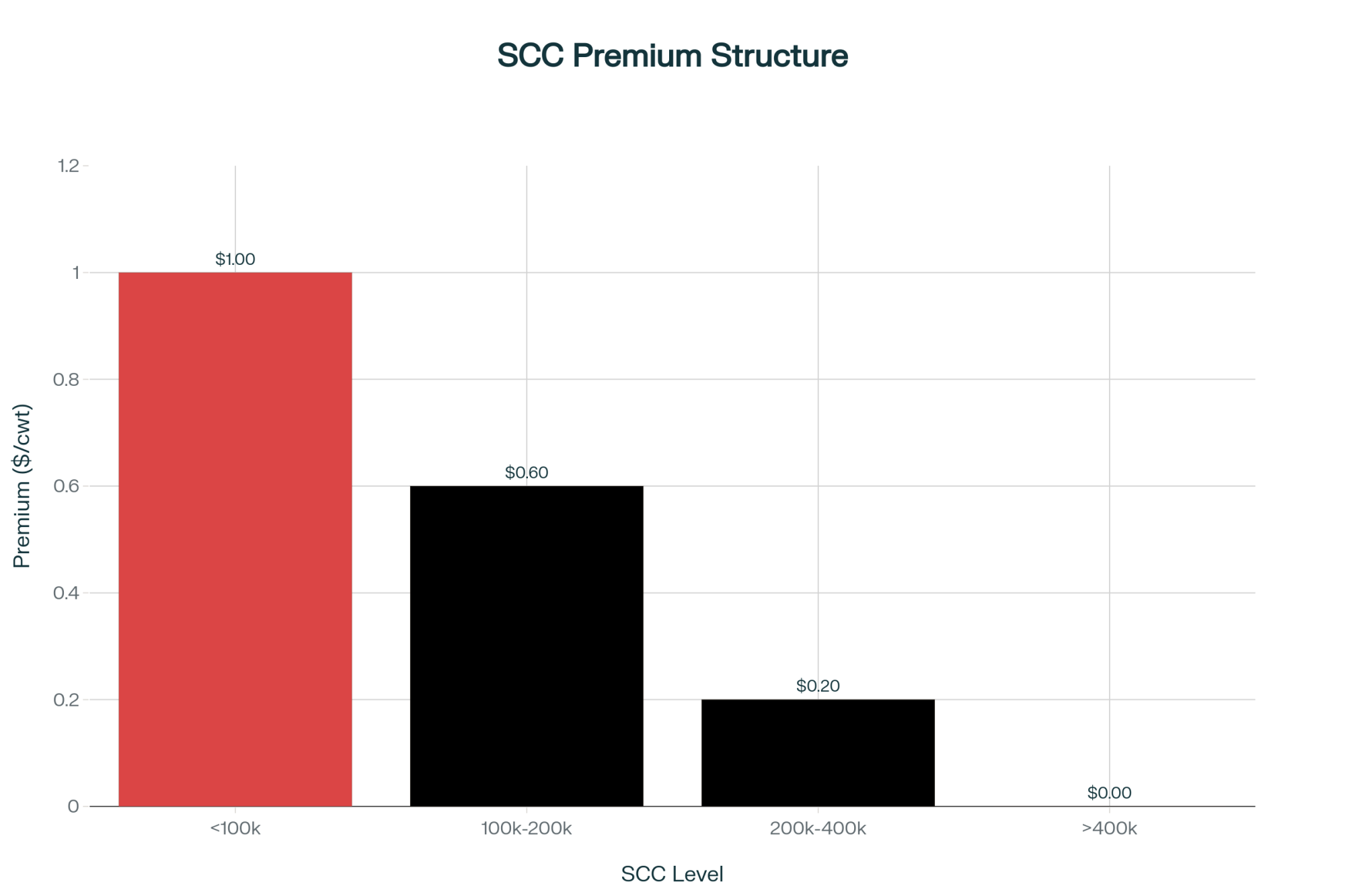
Premium payments for low somatic cell counts are rewriting milk economics. Producers maintaining SCC below 100,000 cells/mL can earn $1.00/cwt premiums—transforming milk quality from a baseline requirement into a profit center worth thousands annually.

Predictability and the Premium Shift

Here’s what that means practically. Producers delivering consistent milk quality—stable SCC below 200,000 and reliable components—are already seeing premiums of $0.40–$1.00 per hundredweight, based on documented supply data reported through USDA Dairy Market News and several processor programs in the Southwest.

And this focus on consistency doesn’t just reward the biggest herds. Medium and family-sized farms are excelling by proving reliability through recordkeeping and digital traceability. I’ve noticed that some of the most competitive contract negotiators aren’t the high-output herds—they’re the most organized.

One example is Doug Jensen, who milks about 600 Holsteins near Stephenville, Texas. Three years ago, he started keeping digital milk quality logs—SCC, bacterial counts, and butterfat trends—using reports from his cooperative testing system.

“When Ninth Avenue Foods began sourcing for their new plant,” Jensen recalled, “we already had the data. They could see we were steady. That’s what made us worth paying a little more for.”

Because of that agreement, most of his milk now supplies ESL beverage production. Jensen told me it helped finance an updated cooling system and a few automation upgrades. That data discipline effectively turned his milk from a commodity to a contract asset.

And that’s the bigger pattern emerging: consistency has become an independent profit driver.

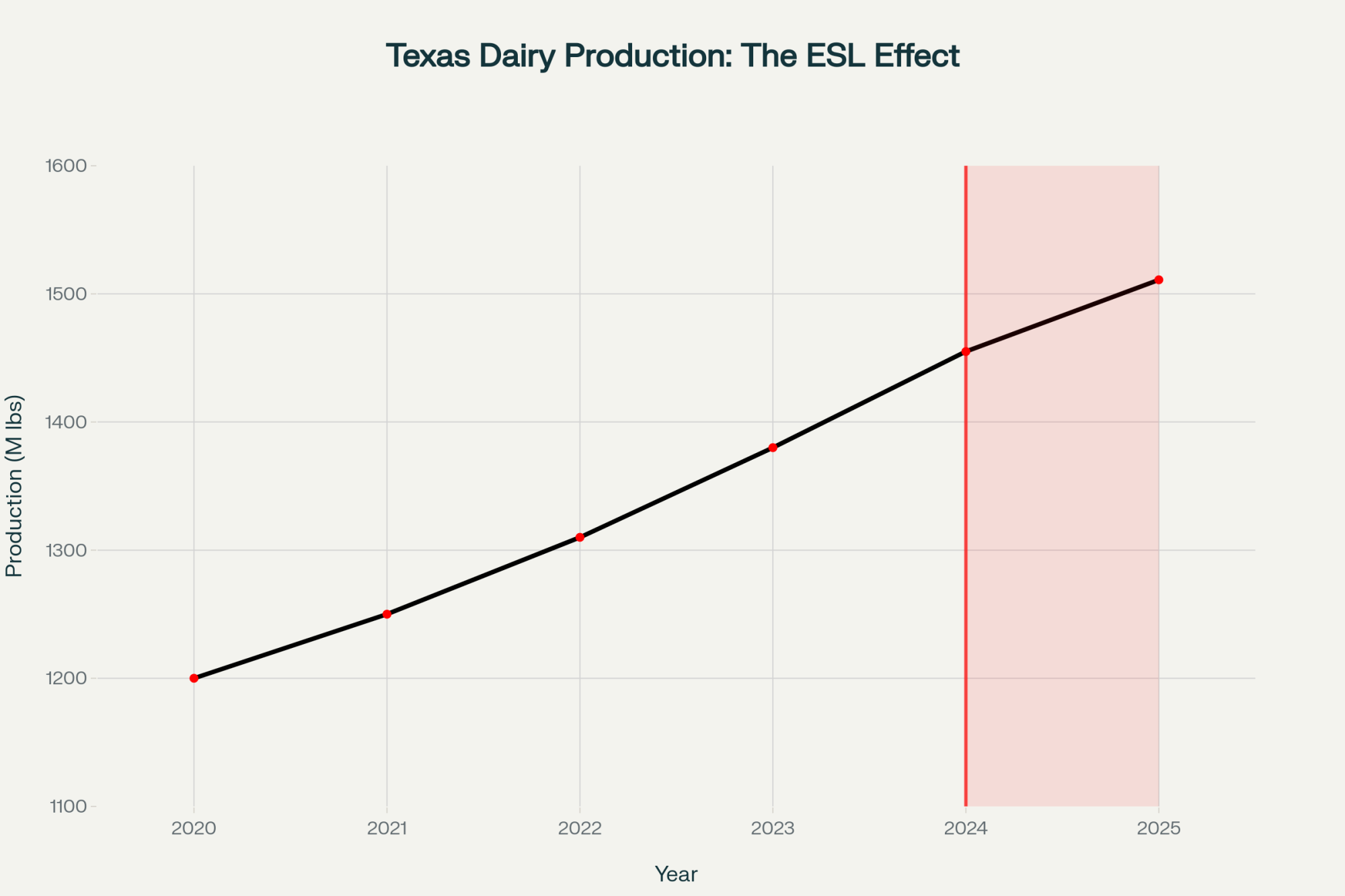
Texas milk production has climbed 26% since 2020, with a dramatic acceleration coinciding with ESL facility announcements. The state’s 10.6% year-over-year surge in 2025 positions it as America’s fastest-growing dairy region—and processors are scrambling to lock in supply.

The Financial Clock Is Ticking

What producers sometimes miss is how much these facilities depend on a quick, dependable supply. Each of these projects—funded in part through USDA Rural Development lending and private capital—operates under strict financial covenants. These typically require plants to operate at 65% utilization and maintain a 1.25 debt service coverage ratio during their first full fiscal year.

You don’t have to be a banker to see what that means. Processors can’t afford uncertainty. They’ll lock in dependable suppliers early, at attractive rates, to assure lenders they can operate efficiently.

Once those supply lists fill, the leverage that returning to farmers today may bring may not return for years.

It reminds me of the Midwest cheese expansions from 2017 to 2021. Early contract holders got consistent premiums. Those who waited ended up taking standard pool prices once the plants filled.

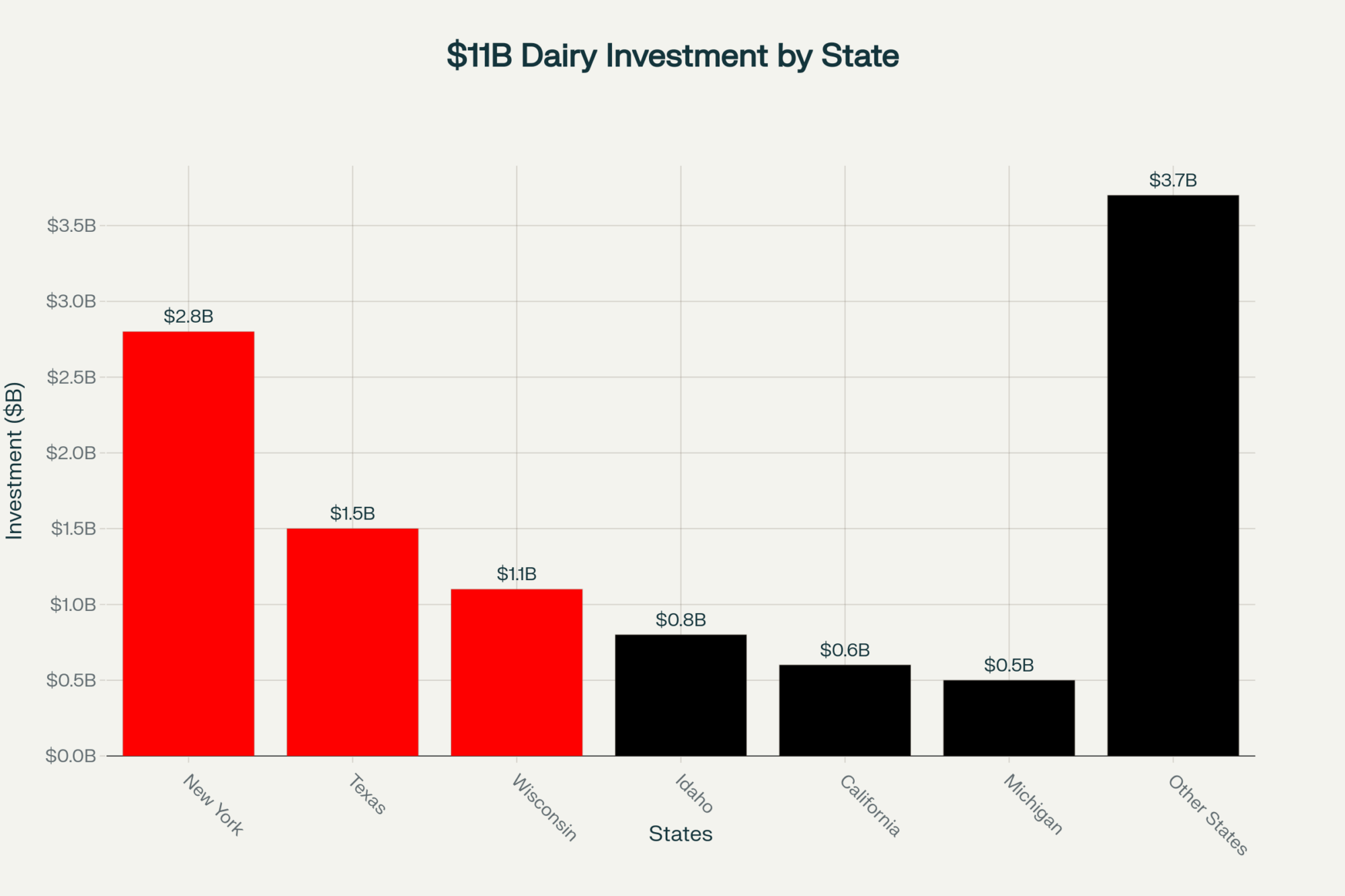
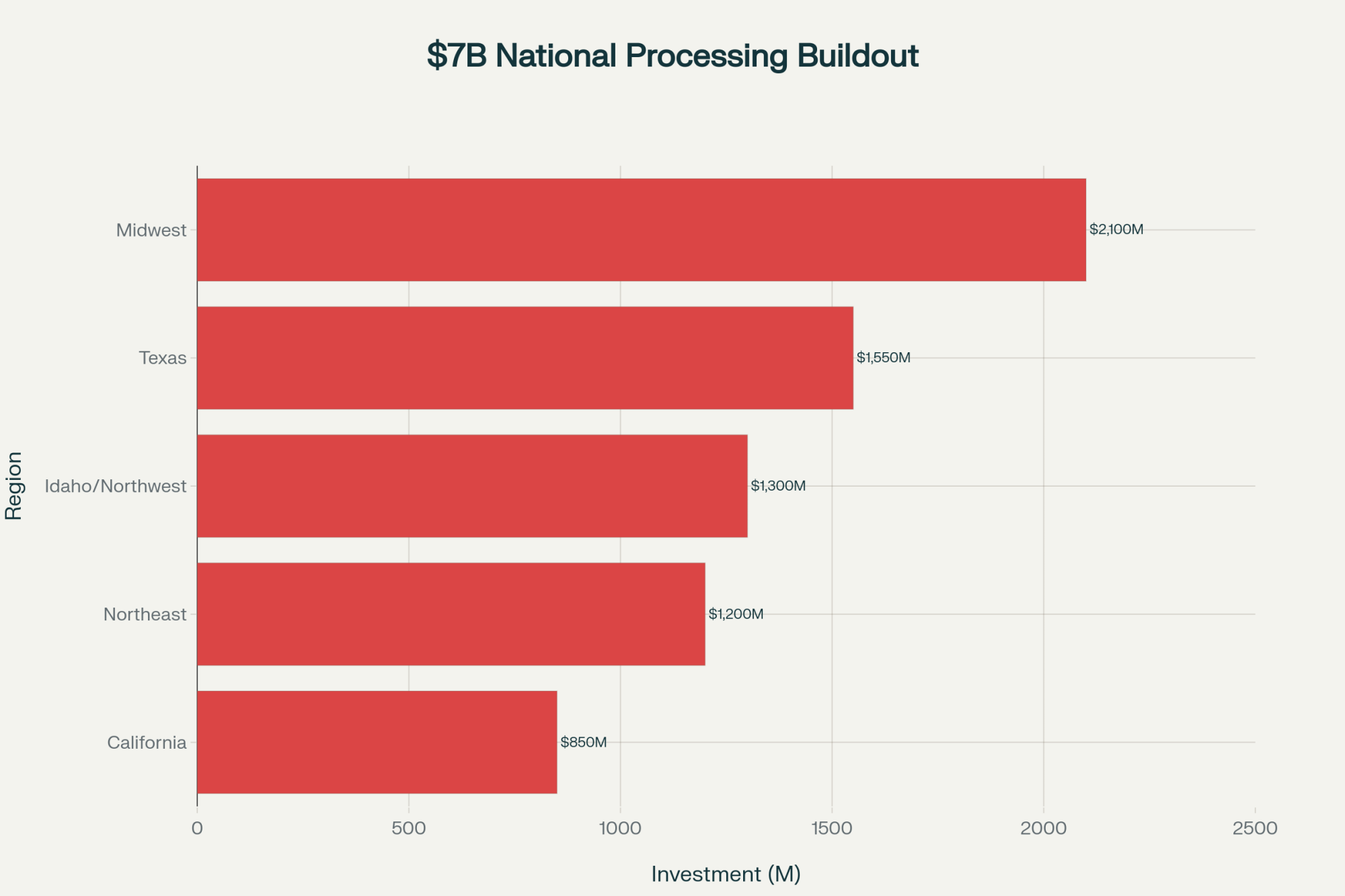
The dairy industry’s $7+ billion processing expansion isn’t evenly distributed—it’s clustering in states with production growth, regulatory flexibility, and feed access. The Midwest leads with $2.1B, but Texas’s $1.55B represents the fastest proportional growth in processing capacity nationwide.

So if you’ve been telling yourself, “I’ll see how the market shakes out first,” it’s worth remembering: by the time it “shakes out,” slots are usually filled.

Building in the Accountability

Extended shelf life might sound like a golden ticket, but it comes with strings. Contracts are only as strong as a herd’s ability to deliver steady quality.

Processors are upfront about this. Industry contracts reviewed by Cornell Dyson School researchers show that during non-compliance—often two consecutive months of missed quality benchmarks—milk can be reclassified into conventional markets without premium payment. Some newer contract models include step-down provisions that reduce premiums until levels recover.

The goal isn’t to penalize—it’s to protect consistency and consumer trust. Cornell’s extension specialists say most processors include remedial review periods and offer technical support if issues arise.

As one Kansas operator who recently entered an ESL supply program put it, “If you fail a bulk tank test or your cows spike from a transition problem, you don’t get dropped—you reset and prove you’re back in range. The discipline is good for everyone.”

Why Contracts Matter More Than Ever

If this all sounds complex, it is—but it’s also navigable. And it’s where producers can protect themselves or lose ground fast.

A review from Cornell’s Dyson School of Applied Economics found that “capital retain” and “market stabilization” deductions—when uncapped—reduced producer net returns by 5–8% over prior expansion cycles. Without proper language, those deductions can quietly undermine even premium agreements.

For producers considering ESL contracts, a few guidelines consistently stand out:

  1. Set Deduction Limits. Agree to annual caps around $0.40/cwt and written notice for changes.
  2. Include Flexibility Clauses. Seasonal swings—heat stress, fresh cow transition periods—happen. Negotiate at least 20% variance in language.
  3. Third-Party Verification. When quality scores are disputed, independent testing keeps relationships transparent and healthy.

According to Jennifer Zwagerman, director of the Drake University Agricultural Law Center, modern processors are typically amenable to these clauses. “Clarity cuts risk—for both sides,” she said. “It creates a proactive, trust-based partnership rather than an adversarial one.”

The processors prefer reliable partners. The producers prefer predictable revenue. The paperwork just needs to reflect that alignment.

Two Emerging Milk Markets

What this all signals is a permanent shift toward a two-tier milk economy.

Tier One: Documented, consistent suppliers on multi-year ESL contracts feeding high-value lines—branded milk, protein drinks, specialty ingredients.

Tier Two: Standard pooled supply and spot-market milk providing bulk volume but lacking a premium structure.

Cal Poly’s Dr. Phillip Tong, an authority on dairy processing innovation, says this stratification isn’t likely to reverse. “Once a processor calibrates for specific microbial and compositional norms, changing suppliers midstream creates significant product risk. Continuity is everything.”

From an operational point of view, this mirrors herd management: build routine, sustain consistency, and results compound over time.

Texas May Be First, But It’s Not Alone

While Texas stands in the spotlight right now, similar ESL rollouts are accelerating elsewhere.

  • Leprino Foods’ $870 million Lubbock facility is now a dual-purpose cheese and ESL ingredient plant—one of the largest in the U.S.
  • California Dairies Inc. expanded ESL lines through Valley Natural Beverages, reporting major shrink savings.
  • Walmart’s processing hubs in Texas and Georgia distribute 60-day milk to more than 700 outlets across the Southeast.

According to the U.S. Dairy Export Council, ESL and shelf-stable beverage exports have been growing by roughly 10% a year since 2023, led by demand from Mexico, the Caribbean, and South Asia. That diversification gives producers a buffer against domestic volatility—a long-awaited stabilizer in milk demand.

Where Producers Should Start

Thinking about joining the ESL supply chain? Here’s what’s working for farms that already have:

  • Leverage your data. Two years of consistent results are worth more than the cleanest parlor inspection.
  • Audit your cooling systems. ESL contracts typically require milk cooled to strict specifications—usually below 38°F.
  • Match your management to expectations. Pay extra attention to bacterial counts during the fresh cow period and late lactation, where fluctuations often spike.
  • Review your agreements annually. Contract stability depends on consistent review, not just signatures.

As USDA and state extension advisors have often observed, proactive transparency—not perfection—is what processors prize most.

The Bottom Line

What’s truly striking about this ESL wave is how it rewards fundamentals that producers have practiced for generations: discipline, attention to detail, and pride in steady, high-quality milk.

As Doug Jensen told me, “We’ve been doing the same job for years. The only difference is—now someone’s finally paying for doing it right.”

That’s a milestone worth celebrating—and proof that smarter, data-driven production can help producers regain leverage in a market that hasn’t favored them in a long time.

Key Takeaways:

  • ESL is the next defining wave in dairy. Texas’s $700 million processing boom proves long-life milk is transforming demand, contracts, and margins.
  • Your consistency is your competitive edge. Farms that are tracking steady SCC, butterfat, and bacterial counts are already earning premium status.
  • Contracts are your silent profit maker—or breaker. Demand capped deductions, flexibility protections, and third-party testing rights.
  • Leverage has a deadline. Secure your deals before processors hit full capacity and reset terms.
  • Data delivers opportunity. Even modest herds can compete head-to-head with big ones when their milk quality is proven, not promised.

Complete references and supporting documentation are available upon request by contacting the editorial team at editor@thebullvine.com.

Learn More:

  • Mastitis and Somatic Cell Counts: The True Cost to Your Dairy – This article provides tactical strategies for managing and lowering SCC, a critical quality metric for ESL contracts. It demonstrates how to reduce economic losses and deliver the consistent, high-quality milk that processors are actively rewarding with premiums.
  • Navigating the Tides: Key Trends Shaping the Future of the Dairy Industry – Gain a strategic, big-picture view of the market forces driving investments like the ESL boom. This piece explores consumer behavior, sustainability demands, and global trade, helping you position your operation for long-term profitability beyond a single contract.
  • The Data-Driven Dairy: How Technology is Reshaping Herd Management – The main article stresses proving consistency with data; this piece shows you how. It reveals the specific on-farm technologies—from sensors to software—that empower producers to track, document, and leverage their performance data for stronger contract negotiations.

The Sunday Read Dairy Professionals Don’t Skip.

Every week, thousands of producers, breeders, and industry insiders open Bullvine Weekly for genetics insights, market shifts, and profit strategies they won’t find anywhere else. One email. Five minutes. Smarter decisions all week.

NewsSubscribe
First
Last
Consent

Butterfat Finds a Floor, Powders Keep Sliding: This Week’s Global Dairy Market Recap (Oct 27, 2025)

Milk keeps flowing, but markets aren’t keeping up — here’s why butter still wins while powder takes the hit.

EXECUTIVE SUMMARY: Milk keeps flowing, and that’s both the good and the bad news this week. Global markets are clearly split: butterfat found support, while powders keep sliding under the weight of spring flushes from New Zealand and South America. The GDT fell for a fifth straight time, confirming that buyers remain hesitant despite stronger global GDP signals. European cheese prices softened again, squeezed by heavy milk flows and stiff export competition from the U.S. Meanwhile, domestic U.S. butter and whey showed small but meaningful rebounds, hinting that seasonal demand is still alive. The story heading into Q4 is crucial but straightforward — fats are holding the line, but milk powder markets are testing just how low they can go.

The global dairy market feels a bit like a full bulk tank these days — there’s plenty of volume, but the challenge lies in finding enough demand to keep things moving. As seasonal production swells across the Southern Hemisphere and buyers take a more cautious approach, markets are struggling to find equilibrium. The story this week is one of contrast: fats holding firm, proteins still under pressure, and a tug-of-war between optimism and oversupply.

EEX Futures – Butter Builds Strength

Volume on the European Energy Exchange (EEX) reached 1,730 tonnes last week, spread across butter, skim milk powder, and whey. Butter led the pack, climbing 1.6% to €5,226 for the Oct 25–May 26 strip.

What’s interesting here is how butter continues to defy broader weakness. European cream supplies remain comfortable, but steady retail demand and ongoing export inquiries — particularly for high-fat butter used in industrial formulations — are helping maintain price momentum (EEX, Oct 2025). Skim milk powder (SMP) slipped 0.2% to €2,163, showing that supply comfort and limited tenders are keeping buyers sidelined. Whey, meanwhile, gained 2.0%, settling around €975, driven by active demand for protein fortification in feed and human nutrition sectors.

SGX Futures – Fat Prices Hold Ground

Across the Singapore Exchange (SGX), 13,123 tonnes traded last week — the majority in Whole Milk Powder (WMP), which eased 0.4% to $3,546. SMP crept up 0.2% to $2,591, while Anhydrous Milk Fat (AMF) added 1.0%, finishing at $6,666.

It’s worth noting that AMF’s firm tone isn’t just about premium dairy fats — it’s about diversification. Food manufacturers are migrating toward AMF for better shelf stability and consistency, widening the AMF–butter spread to $376 per tonne. That gap signals stronger demand in processed and export channels versus commodity butter sales.

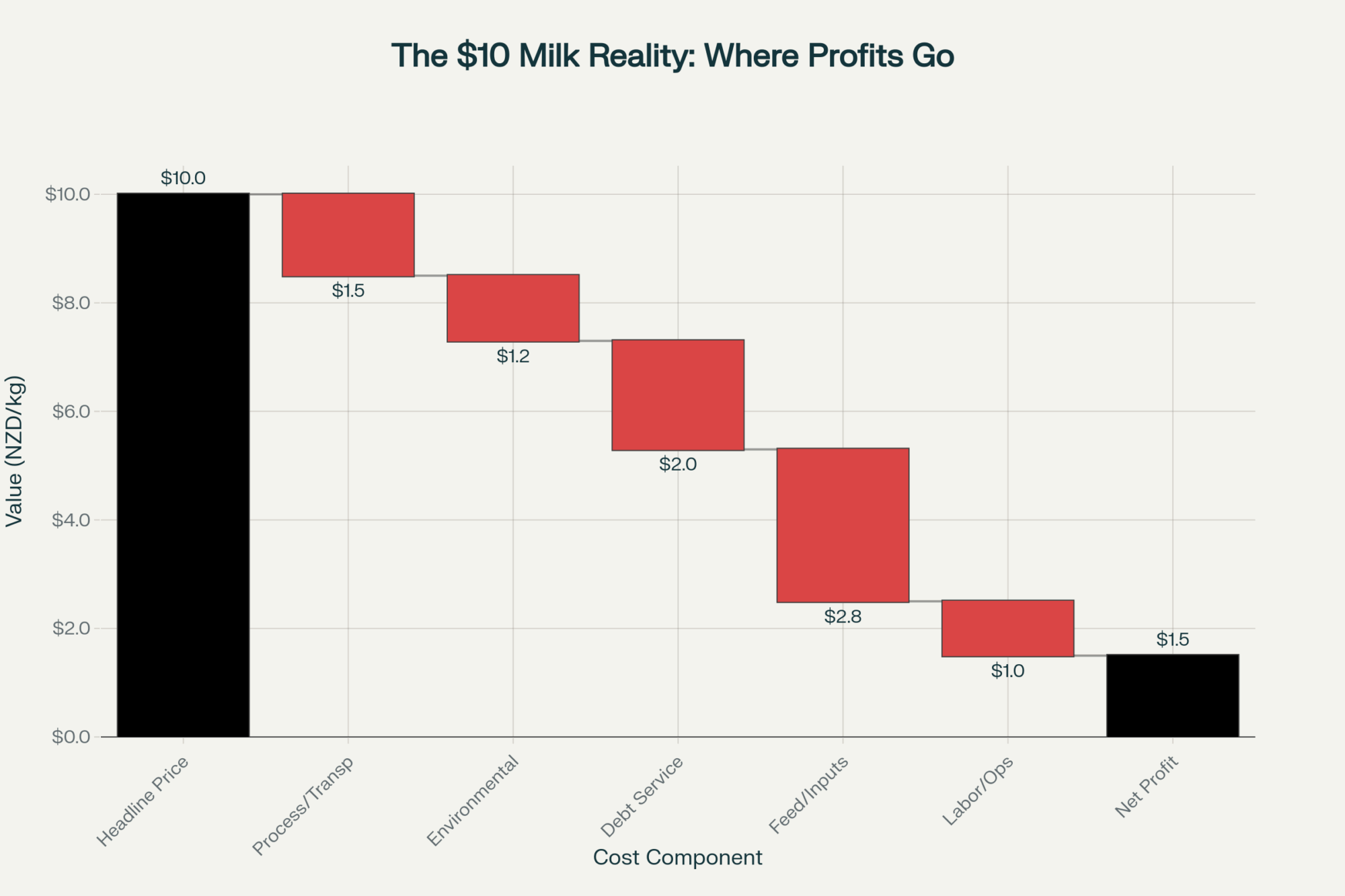
Butter on SGX slipped 1.4% to $6,420, reflecting the usual shoulder-season slowdown before Q4 holiday orders gain traction. The NZX milk price futures market traded 426 lots (2.56 million kgMS), keeping farm gate projections near $10/kgMS, supported by the weaker New Zealand dollar.

European Quotations – Region by Region Reality

The EU Butter Index dipped €39 (–0.7%) to €5,390, but the national picture tells more of the story. Dutch butter fell sharply (–3.4%), French butter rose 1.2%, and German butter held steady. The SMP Index fell 1.2% to €2,097, weighed by slow export booking and cautious EU buyers. By contrast, whey improved 1.7% to €912, another sign that protein derivatives continue to offer bright spots amid the softness.

Year-over-year, SMP has dropped more than 15%, while butter remains nearly 30% below 2024 levels. The key here is that fats are still profitable to produce, while powder processors are watching their margins shrink (EU Commission Market Observatory).

EEX Cheese Index – A Tough Stretch

vef

Cheese prices continue to grind lower. Cheddar Curd fell by 3.8% to €3,501Mild Cheddar lost 1.5% to €3,636Young Gouda dropped 2.8% to €2,909, and Mozzarella eased 1.9% to €2,928.

What’s driving this? In short, too much milk, not enough elasticity downstream. European processors have faced strong milk deliveries and limited export momentum, particularly as the U.S. continues to compete aggressively in cheese exports with lower prices and a steadier currency.

GDT Auction – Fifth Consecutive Decline

Fats (Butter & AMF) maintain price stability while powders (WMP & SMP) slide for five consecutive auctions, revealing the fundamental market split: butterfat wins as oversupply crushes powder values

The Global Dairy Trade (GDT) Price Index fell another 1.4% to $3,881, its fifth straight dip — a clear indicator that the global balance between supply and consumption is still correcting.

Whole milk powder dropped 2.4% to $3,610, and skim milk powder declined 1.6% to $2,559. By contrast, AMF rose 1.5% to $7,038, maintaining its premium over butter. Butter fell slightly (–0.8% to $6,662). That persistent AMF premium shows sustained appetite for high-purity fats, particularly in Asian and Middle Eastern markets (GDT Event 390, Oct 2025).

Cheddar and mozzarella prices fell 1.9% and 5.3%, respectively. Volumes sold at the event totaled 40,621 tonnes, down modestly from the previous auction.

Southern Hemisphere – Production Ramps Up

Spring flush delivers production surge across the Southern Hemisphere: Argentina leads with nearly 12% solids growth, New Zealand milk solids jump 3.4%, and Dutch collections rise 6.7%—all combining to flood global markets and pressure powder prices downward

Down south, spring flush is living up to its name. New Zealand’s September milk collection hit 2.67 million tonnes, up 2.5%, while milk solids jumped 3.4% year over year (DCANZ, Oct 2025). A weaker NZD continues to bolster local payouts, and with PKE (palm kernel expeller) imports up 35%, many herds are maintaining condition through the flush.

Argentina’s production rose 9.9% year over year in September, and solids were up 11.7%, driven by improved pasture and feed efficiency under stable weather (OCLA Argentina, Sept 2025). Meanwhile, the Netherlands reported +6.7%milk collections and a stronger butterfat yield, signaling broad European abundance.

These gains are great news for efficiency metrics but apply downward pressure on global dairy pricing, particularly across SMP and WMP.

Trade and Demand – China Sends Mixed Signals

China’s September imports reveal calculated market strategy: massive 65% surge in butter and 41% jump in WMP contrasts sharply with 12.5% drop in SMP, proving buyers are restocking premium fats while avoiding oversupplied powders

China’s September milk-equivalent imports rose 4.7% year over year — but that number hides the nuance. WMP imports surged 41%, a recovery from last year’s depressed base, while SMP fell 12.5% and butter jumped an impressive 64.7% (Chinese Customs Data, Oct 2025).

This suggests that Chinese buyers are being tactical. They’re restocking high-fat categories but remain cautious on large-volume powders. New Zealand exports, up 8.7% y/y, captured much of that growth, though SMP flows remain uneven. Demand is stabilizing—not accelerating yet.

U.S. Markets – Glimmers of Recovery

ProductWeekly ChangeCurrent PriceMarket Signal
Dry Whey$+3.5¢$$\$0.69/\text{lb}$Strong protein
Butter$+0.75¢$$\$1.6025/\text{lb}$Holiday build
Cheddar Blocks$+0.25¢$$\$1.7775/\text{lb}$Moderate food
Nonfat Dry Milk$+\$0.05$$\$1.16/\text{lb}$Steady demand

Domestic dairy markets found small pockets of strength. CME cheddar blocks ticked up 0.25¢ to $1.7775/lbbutter gained 0.75¢ to $1.6025/lb, and nonfat dry milk rose a nickel to $1.16/lbDry whey continued to climb, up 3.5¢ to $0.69/lb, thanks to unflagging demand for high-protein ingredients (USDA Dairy Market News, Oct 2025).

Cream supplies remain ample, butter churns are busy, and foodservice activity is moderate. As one Wisconsin marketing manager put it this week, “We’re not seeing panic buying, but holiday pipeline building is real.” Feed remains a bright spot, with DEC25 corn at $4.28/bu and JAN26 soybeans at $10.62/bu, though both trended higher late in the week.

The Bottom Line

Looking ahead, the key takeaway this week is the growing divide between resilient fats and fragile powders. Butter and AMF continue to attract strong retail and manufacturing interest, offering some price floor protection. But with milk collections swinging higher across the Southern Hemisphere, SMP and WMP are likely to remain under pressure through the year’s end.

Short-term volatility may persist, especially if China’s buying remains uneven. Still, there’s cautious optimism. Farm-level profitability in regions like New Zealand and the Midwest is holding better than last year — proof that leaner operations, feed cost management, and smarter hedging have made this downturn more manageable.

As always, milk will find a home — but the home it finds this season might be one more driven by butterfat than by bulk powder. And that’s a story worth watching as we head toward the new year.

Key Takeaways:

  • Fats are holding firm, powders aren’t. Butter and AMF prices found support, but SMP and WMP remain under pressure from surging milk supply.
  • GDT slipped again (-1.4%), its fifth straight decline — a reminder that buyer confidence isn’t back yet, even as global GDP nudges higher.
  • Europe’s cheese values slid once more, squeezed by full silos, steady milk flows, and competitive U.S. export pricing.
  • Southern Hemisphere production is booming — New Zealand up 2.5%, Argentina nearly 10% higher — ensuring plenty of product but few price rallies.
  • In the U.S., butter and whey are bright spots, lifted by retail holiday demand and strong protein interest.

Complete references and supporting documentation are available upon request by contacting the editorial team at editor@thebullvine.com.

Learn More:

The Sunday Read Dairy Professionals Don’t Skip.

Every week, thousands of producers, breeders, and industry insiders open Bullvine Weekly for genetics insights, market shifts, and profit strategies they won’t find anywhere else. One email. Five minutes. Smarter decisions all week.
NewsSubscribe
First
Last
Consent

Argentina Beef Imports: The Immediate Stakes for Your Dairy Operation

Imports are rising. Futures are falling. Here’s what every dairy herd should know before the market moves again.

Executive Summary: A plan to import more Argentine beef may seem distant, but it’s already reshaping U.S. agriculture. The proposal to quadruple import quotas to 80,000 metric tons has dropped cattle futures nearly $100 per head and sparked tough conversations for dairies that now rely on beef‑on‑dairy calves for revenue. With 70 percent of large herds breeding to beef, and an average $250,000 in annual calf income at stake, every shift in the beef market touches the milk check. Farmers remember 1986 and 2020—years when fast policy moves caused lasting pain. What’s interesting now is how calmly producers are responding: adjusting breeding ratios, locking in forward contracts, and fine‑tuning rations instead of panicking. The broader reminder? Real stability in both beef and milk still starts in the barn, not the import ledger.

Beef on Dairy

Every so often, a government policy hits the headlines and you can almost feel it ripple across the countryside. The latest is a proposed White House plan to quadruple Argentine beef imports—from about 20,000 to 80,000 metric tons.

At first, that might sound like a beef industry story, but it’s quickly becoming a dairy conversation. The reason is simple: our operations are tied together through the beef‑on‑dairy market more than ever before. And as many farmers are noticing, market decisions made in Washington—or Buenos Aires—have a way of showing up in the calf barn faster than you’d expect.

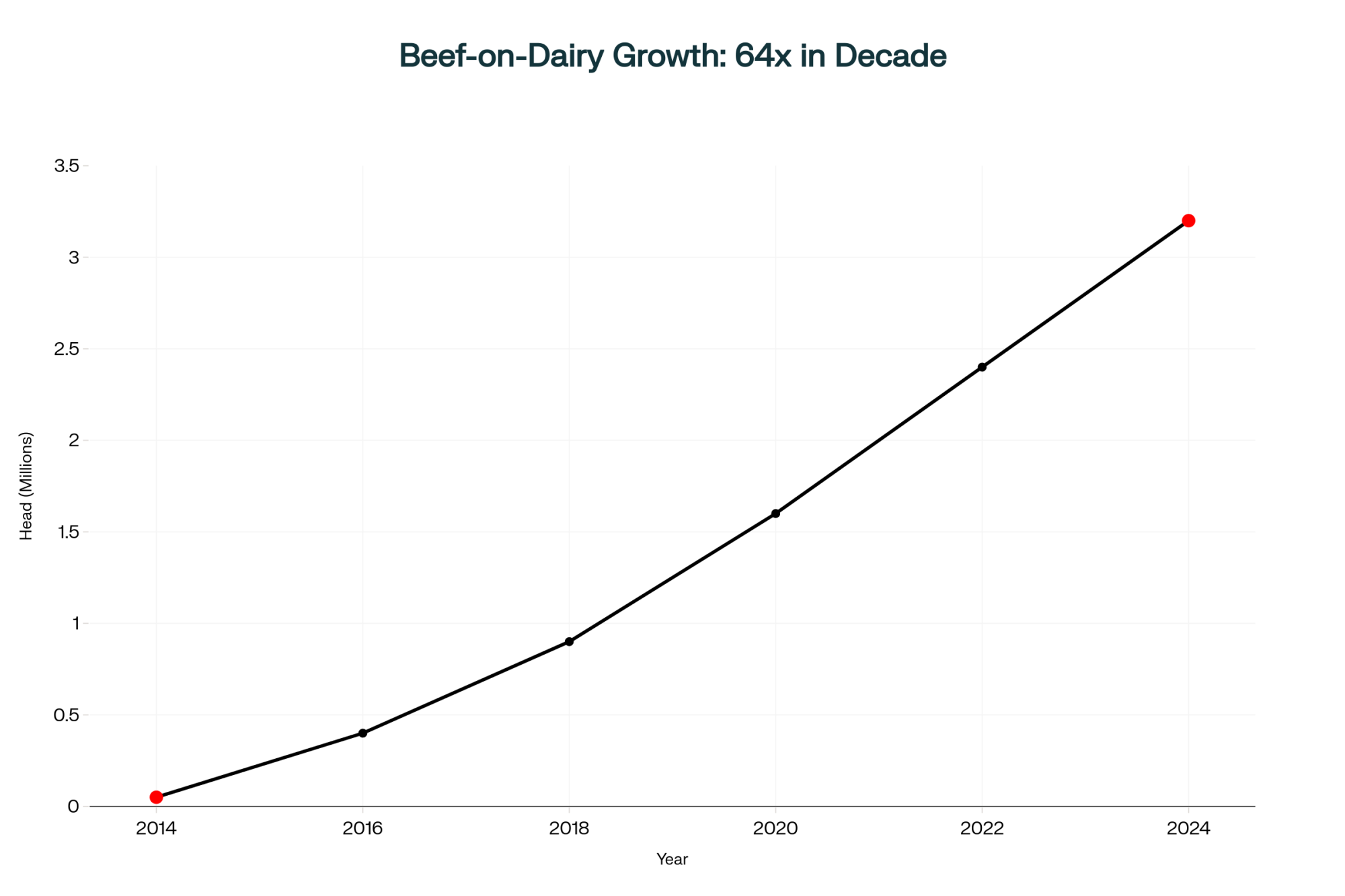
11,000% Growth Story Dairy Can’t Ignore — From backyard experiment to industry game-changer: beef-on-dairy exploded from 50,000 head to potentially 5.5 million by 2026, reshaping American beef production forever.

Looking at What’s Behind the Policy

According to the USDA’s October Livestock, Dairy & Poultry Outlook, the U.S. cattle inventory now sits at its lowest level in 75 years. The causes aren’t new—multi‑year drought, high feed prices, and slower herd rebuilding across the Plains and West.

Crisis in Numbers: America’s Cattle Vanish — The steepest herd liquidation since World War II puts every dairy farm’s beef-on-dairy income at risk as supply fundamentals reshape decades of agricultural stability.

To ease those supply pressures, the administration is considering expanded beef imports to steady retail prices, which hit a record $6.30 per pound for ground beef this fall (Bureau of Labor Statistics).

On paper, that makes basic economic sense. But markets always react before the first kilogram of product moves. Just a week after the announcement, CME Group data showed futures prices down roughly $100 per head—or about 3 percent.

As Dr. Derrell Peel, livestock economist with Oklahoma State University Extension, put it: “You can’t rebuild a herd—or confidence—in a single policy cycle.”

And confidence is what sustains both cow‑calf ranches and dairies that depend on steady cross‑market signals.

The Beef‑on‑Dairy Link That’s Now Essential

Looking at this trend, it’s remarkable how fast beef‑on‑dairy has become a cornerstone of herd economics. In 2024, University of Wisconsin–Madison Extension researchers reported that nearly 70 percent of large dairies bred a portion of their cows to beef bulls.

The strategy significantly increased the average calf value. USDA AMS market data shows beef‑cross calves bringing $1,200 to $1,400 at birth, compared with $150 to $250 for pure Holstein bulls.

For a 1,500‑cow dairy breeding 40 percent to beef, that’s $240,000–260,000 in additional annual income. It’s the sort of capital that pays for genomic testing, sand bedding replacements, or that new holding pen upgrade.

A producer milking 1,200 cows in eastern Wisconsin told me recently, “Those beef calves have carried our barn loan for two years running. If prices fall much, we’ll need to rethink replacement plans.”

That’s real money—and real vulnerability—tied directly to policy decisions made thousands of miles from the farm.

What History Tells Us: The 1986 Buyout

What’s particularly interesting here is how this mirrors an earlier moment in ag policy—the 1986 Dairy Termination Program. Back then, USDA spent $1.8 billion to eliminate milk surpluses, buying out 14,000 farms and taking 1.5 million dairy cows off the grid.

It achieved its short‑term goal—but the cascade stunned markets. Surplus cows hit beef channels at once, and prices plunged 10–15 percent. Within two years, milk output had rebounded while much of the infrastructure serving small dairies had not.

The lesson still resonates today: market interventions can change prices quickly, but they rarely rebuild capacity at the same pace.

Psychology Trumps Physics in Cattle Markets — Import volumes climbed steadily while prices soared until policy psychology triggered the $7/cwt reality check, validating Andrew’s thesis about market sentiment over supply fundamentals

2020’s Big Reminder: When Efficiency Becomes Fragility

If 1986 was about overcorrection, then 2020 was about over‑efficiency. During the first months of COVID‑19, International Dairy Foods Association data showed 450–460 million pounds of milk dumped in April alone, while USDA ERS recorded beef and pork processing down more than 25 percent after plant shutdowns.

That period revealed how vulnerable “just‑in‑time” logistics can be. When processors or ports stall, milk and beef lose nearly all momentum.

Increasing reliance on imports—without parallel investment in domestic resilience—carries a similar risk. Once local capacity is allowed to wither, it’s slow and costly to bring back.

How Farmers Are Adjusting Already

Here’s what many Extension specialists and lenders are seeing so far:

  • Breeding Ratios Are Shifting. Herds that were 60 percent beef are easing down toward 35–40 percent to maintain heifer pipelines.
  • Feedlot Contracts Are Narrowing. Where buyers offered $1,300 per crossbred calf last spring, they’re now closer to $1,000 (USDA AMS Feeder Cattle Summary, October 2025). Forward contracting remains a critical stability tool.
  • Genomic Programs Are Staying Put.Dr. Heather Huson, associate professor of animal genomics at Cornell University, warns that cutting testing “saves pennies now but costs years of progress in herd performance and butterfat output.”
  • Ration Formulas Are Being Fine‑tuned. Nutritionists are rebalancing energy‑dense transition diets to maintain reproductive stability and milk components without increasing feed costs.

What’s encouraging is the tone—measured, thoughtful, and proactive. Dairies aren’t panicking; they’re preparing.

Regional Strategies, Shared Outlooks

Across the U.S., adaptation looks different but points to the same principle—resilience:

  • Western dry‑lot systems, stretched by feed and water constraints, are leaning back toward dairy genetics to maintain replacements.
  • Upper Midwest co‑ops, long integrated with beef‑on‑dairy programs, are renegotiating calf contracts to lock in 2026 pricing.
  • Northeast fluid dairies balancing organic quotas and beef‑cross sales are prioritizing efficiency rather than retreating from diversification.

Different regions, same balancing act—protect cash flow today while safeguarding production capacity tomorrow.

The Bigger Question: Can We Stay Self‑Sufficient?

The U.S. currently produces about 83 percent of its own beef supply, according to USDA ERS Trade Data (2025).Economists caution that, if herd recovery stays slow while imports increase, that number could slide toward 70 percent within ten years.

That’s not about politics—it’s about security. Kansas State University Extension specialists remind us that “food sovereignty” doesn’t mean cutting trade; it means keeping enough domestic capability to respond when global systems falter.

For dairy, the same applies. Once cull markets, local plants, or skilled herd labor disappear, rebuilding them isn’t a quick turnaround—it’s generational work.

Signs of Progress Worth Watching

The good news is, practical resilience efforts are underway. Wisconsin’s Dairy Innovation Hub and USDA’s Regional Food Business Centers are channeling new funding into herd research, small processor support, and cold‑chain infrastructure.

As Dr. Mark Stephenson, director of UW–Madison’s Center for Dairy Profitability, said during a recent producer panel, “Resilience isn’t about size—it’s about diversity. The more ways we move milk and beef through our systems, the better we weather volatility.”

The Bottom Line

What’s interesting here is that every generation faces its own version of policy shockwaves. This one just happens to merge global trade with a cow management strategy.

Markets shift overnight. Herds don’t. Successful farms are the ones that use these moments not to retreat, but to reinforce what already works.

If history has taught us anything—from 1986’s buyout to 2020’s pandemic fallout—it’s that capacity equals security.Protect the cows, the genetics, and the local systems, and the rest finds its balance.

Progress in agriculture has always moved at the cow’s pace—and that’s still the pace that feeds the world.

Key Takeaways:

  • A policy shift abroad can hit your milk check at home. Rising beef imports risk lowering calf values just as beef‑on‑dairy becomes vital to dairy income.
  • With 70% of dairies breeding to beef and nearly $250,000 a year on the line per farm, small price swings now carry outsized impact.
  • History is warning us: quick policy fixes in 1986 and 2020 show how capacity lost early takes decades to recover.
  • Smart dairies are preparing now—tweaking breeding ratios, securing forward contracts, and tightening transition nutrition to stay profitable.
  • Resilience beats reaction. Protect herd quality, diversify markets, and collaborate locally to keep your dairy strong through shifting trade winds.

Complete references and supporting documentation are available upon request by contacting the editorial team at editor@thebullvine.com.

Learn More:

The Sunday Read Dairy Professionals Don’t Skip.

Every week, thousands of producers, breeders, and industry insiders open Bullvine Weekly for genetics insights, market shifts, and profit strategies they won’t find anywhere else. One email. Five minutes. Smarter decisions all week.
NewsSubscribe
First
Last
Consent

Who Speaks for Your Milk Check? The Push to Reform Dairy’s Voting Power

Not every deduction on a milk check is math—some are politics. Here’s how U.S. farmers lost $337 million without casting a single vote

Executive Summary: In 2025, U.S. dairy farmers lost $337 million in just three months following FMMO reforms that increased processor make allowances using voluntary, unverified cost data. The change exposed a fundamental flaw: most producers never voted on the rule that reduced their pay. The American Farm Bureau Federation is now leading a campaign for modified bloc voting, restoring producers’ right to vote independently rather than through cooperative boards. At the same time, pressure is growing for USDA audits of processor costs and itemized cooperative milk checks, ensuring transparency and accountability from plant to producer. A similar structure in Canada illustrates the power of individual voice—where direct farmer ownership and votes drive protective policy outcomes. Together, these reforms mark a turning point toward verified data, fair pay, and representation that aligns with the farmers doing the milking.

Milk Check Transparency

You know that feeling when the milk check comes and something doesn’t line up. The herd’s healthy, butterfat performance is steady, feed costs haven’t spiked—but the final number is off. That’s been a common story across farms this year.

Earlier this fall, both the U.S. Department of Agriculture’s Agricultural Marketing Service (AMS) and the American Farm Bureau Federation (AFBF) confirmed what many suspected. The most recent Federal Milk Marketing Order (FMMO) pricing reforms shifted about $337 million from farmers to processors in just three months.

What’s striking isn’t just the number—it’s how the decision happened. Most producers never saw a ballot. And that missing vote might be the most expensive one they never got to cast.

How a Technical Rule Became a Real Pay Cut

Make allowances surged 32-48% in June 2025 based on unverified processor data—the highest jumps in dry whey and cheese directly slashed what farmers received per hundredweight

Here’s what set this off. In June, USDA raised make allowances—the assumed cost of processing milk into dairy products—by 25 to 43 percent. The reasoning was simple enough: labor, packaging, and energy costs have risen since the last review in 2008.

Here’s the part that farmers are still talking about. Those numbers came from voluntary processor surveys and not from audited financials. By law, USDA still lacks the authority to require processors to open their books under the Agricultural Marketing Agreement Act of 1937.

As AFBF dairy economist Danny Munch explained during the organization’s fall dairy policy update,

“We’re basing a national pay system on unverified numbers, and the only side that benefits is the one submitting the data.”

USDA’s Pool Settlement Reports show how fast that imbalance added up: $64 million in the Upper Midwest, $62 million in the Northeast, and $55 million in California.

For a 150-cow herd shipping about 24,000 hundredweight a year, that’s about $18,000 to $20,000 gone—roughly equivalent to this year’s surge in energy costs, or a major herd health outlay.

Regional distribution of the $337 million in FMMO losses reveals that smaller regions collectively bore nearly half the burden, intensifying the impact on individual farms

Regional Impact Summary (June–September 2025)

  • Upper Midwest: –$64 million
  • Northeast: –$62 million
  • California: –$55 million
    (Source: USDA AMS, Q3 2025 Pool Data)

Who Cast the Vote That Changed It?

AspectCurrent Bloc VotingModified Bloc Voting (AFBF Proposal)
Who Controls Your Vote?Cooperative board decides for all membersYOU decide—opt in or vote independently
Member ChoiceNone—vote cast automaticallyFull choice: authorize co-op or vote direct
Transparency LevelLow: No individual vote trackingHigh: Individual votes counted
Conflict of InterestHIGH: Co-ops process AND voteLOW: Direct farmer control
Individual AccountabilityNone—members never see ballotFull—every producer has voice

That question gets to the heart of a deeper issue. When FMMO proposals go out for a referendum, producers are supposed to decide. But under the current system, most never touch a ballot.

That’s because cooperatives cast bloc votes representing all their members. The idea was originally intended to save administrative time in the 1940s, when local co-ops marketed milk from small family dairies.

Fast forward 80 years. Dairy Farmers of America, Land O’ Lakes, and California Dairies Inc. now handle more than 60 percent of the nation’s milk, according to the USDA’s Economic Research Service (2024). Those organizations don’t just market milk—they process it. When processing margins rise, they gain on one side while the member pay price shrinks on the other.

That’s why AFBF, joined by several state-level farm bureaus, is pressing for modified bloc voting.

Under this approach, co-ops could still submit bloc votes, but only for members who authorize them. Others could opt out and cast their own ballots directly. It’s a small procedural shift with big implications for fairness.

As Munch told producers in Wisconsin, “If your paycheck depends on it, you should get to decide how it’s structured.”

Why Voting Reform Comes First

Some producers have asked why start with voting rights rather than mandatory audits or cost-verification reforms? It’s a logical question—but one with a simple answer.

Every major FMMO change still requires a producer vote to pass. If co-ops continue controlling those votes, the same imbalances in representation will persist—even with better data. Modified voting gives individuals a voice before the next cost survey or order amendment lands on the table.

Think of it this way: fair data means knowing the numbers are right; fair voting means knowing your opinion counts before the next decimal gets moved.

The Transparency Gap That Shows Up Every Month

For most of us, the problem isn’t hidden in Washington—it’s sitting right on the milk check.

Private processors are required to list detail on component prices, deductions, and the Producer Price Differential (PPD). Cooperatives, though, are exempt. Since they’re considered farmer-owned, they aren’t required to disclose the same payment details.

That might sound routine, but it creates an information gap. A University of Wisconsin Extension report (2024) found that 70 percent of cooperative pay statements lacked full explanations for deductions over $0.25 per hundredweight. Terms like “market adjustment” or “balancing charge” were often used without further specification.

As Mark Stevenson, emeritus policy specialist at UW–Madison, put it, “You can’t manage what you can’t measure.”

Plenty of producers can relate. Even herds with solid butterfat and protein trends are seeing unexplained adjustments that chip away at gross pay. That lack of clarity feeds the same frustration driving the broader voting reform effort: farmers want transparency, not theory.

Looking North: What Canadian Quotas Tell Us About Voice

Canada’s dairy producers own individual quotas and cast direct votes that shape trade policy; U.S. farmers are fighting to regain that same power through modified bloc voting and mandatory processor audits

It’s worth pausing to look north for perspective. Canada operates under a supply management system that balances domestic production and demand through quotas. Each farmer owns a quota, currently worth about CA $30,000 per cow (Agriculture and Agri-Food Canada, 2025), and that ownership translates directly into control.

In 2017, Canadian dairy farmers organized a significant voter push within the Conservative Party, ultimately flipping a leadership contest by less than 1%. This year, the Canadian Parliament passed Bill C‑202, which makes it illegal for ministers to negotiate away dairy protections in trade deals.

The U.S. doesn’t have a quota system, and few producers would want one. But here’s the takeaway: when farmers hold direct, non-negotiable voting authority, policy outcomes tend to protect producers instead of eroding them.

Where These Reforms Stand Now

For the first time in years, the groundwork for reform is visible.

A provision in the 2025 Farm Appropriations Act now gives USDA AMS the authority to conduct audited processor cost surveys. The agency plans to begin that process in 2027, replacing voluntary surveys with verifiable data collection.

Meanwhile, new proposals are emerging to standardize cooperative milk-payment statements so co-op members receive the same level of itemized transparency as proprietary producers.

And finally, AFBF’s modified bloc voting proposal continues building bipartisan traction, with several state delegations already urging USDA to schedule a hearing for 2026.

These are all incremental steps—but together, they form the backbone of a more accountable system.

What It Means for Different Dairies

Whether you milk 80 cows in New York’s Finger Lakes or 8,000 in a California dry lot, clarity is good business. Verified cost surveys stabilize Class III and IV price forecasts. Transparency builds trust and simplifies planning.

Cornell University’s Dairy Markets Research Program (2024) notes that “information symmetry improves efficiency and stability at every scale.” In simpler terms, fair data and fair governance don’t pick winners—they lift the whole market.

Co-ops That Are Already Leading

Some cooperatives aren’t waiting for regulation to catch up. Rolling Hills Dairy Cooperative in Wisconsin already provides members with detailed monthly pool and freight summaries through an online portal. Select Milk Producersin Texas publishes audited hauling and balancing charges so members can see exactly what the deductions mean.

Rolling Hills general manager Tom Larkin says the results were immediate: “Once members could see where their money went, trust followed. Transparency lined us up on the same side again.”

That kind of leadership shows reform doesn’t have to start in Washington—it can begin wherever farmers demand a clearer deal.

Five Things Producers Can Do Now

  1. Compare your check. Match component prices to your federal order’s monthly reports; the differences may surprise you.
  2. Ask for documentation. Request written breakdowns for deductions labeled “market adjustment” or “balancing.”
  3. Collaborate. Compare notes with neighboring farms—shared data reveals patterns.
  4. Engage early. Follow your state Farm Bureau updates and dairy policy hearings.
  5. Exercise your vote. Whether under current co-op structures or future modified voting, make sure your ballot represents your voice.

The Bottom Line

After covering dairy policy for years—and spending plenty of time around farmers who live it—I’ve noticed that most producers can handle market volatility and feed swings. What they can’t handle is opacity.

The call for reform isn’t rebellion; it’s about modernizing a system that no longer reflects how milk is marketed or how producers define ownership.

If democracy belongs anywhere, it’s in the milk check. Because when producers see the numbers, cast their own votes, and know where their dollars go, trust stops being a slogan—it becomes part of doing business.

Key Takeaways:

  • $337 million disappeared from producers’ milk checks in three months following FMMO reforms based on voluntary processor cost data that USDA could not verify.
  • Most farmers never voted on the rules that reduced their income, because cooperatives cast bloc votes on behalf of all members—often blending farmer and processor interests.
  • AFBF’s proposed modified bloc voting system would restore the right for every producer to cast an individual ballot, bringing direct democracy back into milk pricing.
  • Mandatory processor cost audits and itemized co-op pay statements are now gaining traction, opening the door to verified data, clear deductions, and accountable pay.
  • Transparency isn’t anti-cooperative—it’s pro-farmer. As seen in Canada’s producer-driven system, ownership and voice together equal stability and fair value for milk.

Complete references and supporting documentation are available upon request by contacting the editorial team at editor@thebullvine.com.

Learn More

The Sunday Read Dairy Professionals Don’t Skip.

Every week, thousands of producers, breeders, and industry insiders open Bullvine Weekly for genetics insights, market shifts, and profit strategies they won’t find anywhere else. One email. Five minutes. Smarter decisions all week.
NewsSubscribe
First
Last
Consent

Beyond Efficiency: Three Dairy Models Built to Survive $14 Milk in 2026

When$14milk becomes the new normal, efficiency alone won’t save you.Discover three dairy models built for the market ahead

Executive Summary: The North American dairy sector is facing a reckoning as production increases, exports decline, and processing capacity surpasses consumer demand. According to the USDA, Chinese imports have fallen nearly 50 percent since 2021, while the IDFA notes $11 billion in new U.S. plant investment through 2027. This has led to Class III milk prices lingering around $14 per hundredweight for extended periods. Producers who adapt most effectively are not necessarily those working harder but those managing smarter: large farms are focusing on water resilience, smaller operations are developing their own brands, and mid-size herds are diversifying into beef and energy. Even Canada’s supply-managed system is feeling pressure as CUSMA provisions allow cheaper U.S. dairy components to enter the country. The key question for every dairy leader is whether their operation is prepared to survive by strategic management rather than relying solely on scale.

If you’ve noticed an edge in conversations at meetings or the feed store lately, you’re not imagining it. The industry’s uneasy. Sure, milk prices fall and climb like they always do—but what we’re facing heading into 2026 feels different. What’s interesting is that this shift isn’t about a single bad year. It’s structural.

The data coming from USDA’s Foreign Agricultural ServiceCoBank’s Dairy OutlookTexas A&M AgriLife Research, and Cornell PRO‑DAIRY all paint a similar picture: we’ve built a milk production system that’s outpaced the market’s ability to absorb it. The overcapacity problem isn’t just an economic story—it’s become an operational one.

But here’s what’s encouraging: the farms reading the signals now will still be standing when the next upturn comes. Let’s break down what’s driving this reset and, more importantly, what dairies can do about it.

Exports: When America’s Safety Valve Starts Closing

For years, exports balanced our market, but that pressure valve is tightening. According to the USDA’s foreign trade data, China’s dairy imports dropped nearly 50 percent from 2021 to 2024. That’s not a blip. It’s largely the result of New Zealand’s complete tariff elimination on dairy through its free trade agreement with China, finalized in 2024. New Zealand now supplies close to half of China’s imported milk powder.

Export market collapse visualization showing China’s 55% import decline from 2021-2026 while New Zealand captures 50% market share through tariff-free access. Mexico, representing 25% of US exports, faces $4B domestic investment threatening future demand. Andrew’s Take: This isn’t a temporary dip—it’s a structural realignment that rewrites 40 years of export strategy. Farms betting on an export rebound are playing a losing hand.

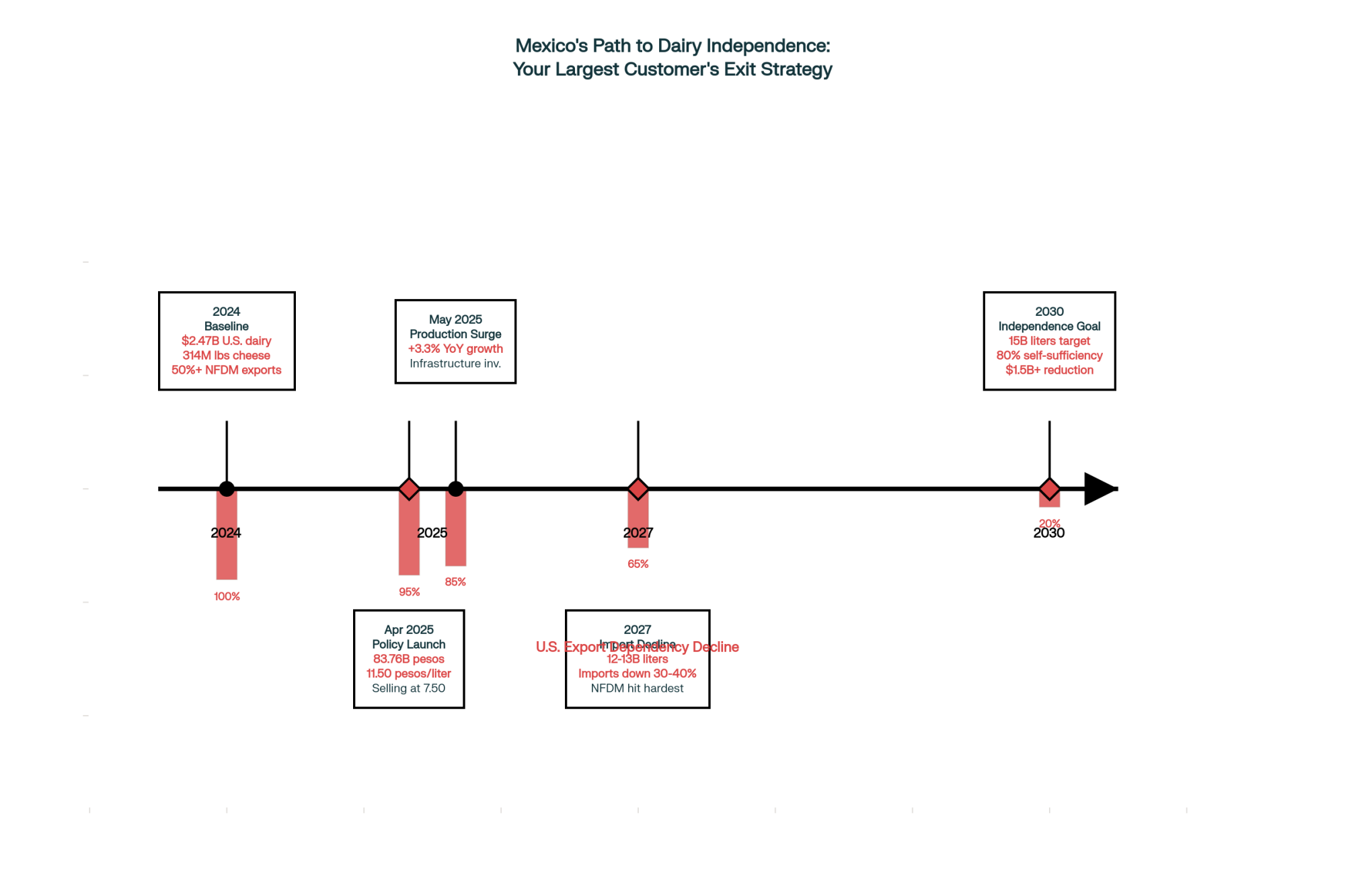
Mexico remains the anchor buyer—taking roughly 25 percent of U.S. dairy exports—but the country’s government has already committed more than $4 billion to reduce that dependency by 2030 through feed, processing, and genetic improvements (USDA FAS Mexico). It’s a reminder that even friendly trade partners are prioritizing domestic capacity.

Domestically, per‑capita dairy consumption has hovered around 650 pounds for half a decade (USDA ERS). Cheese and butter continue inching upward, but fluid milk keeps sliding. Meanwhile, IDFA projects $11 billion in new processing capacity—mostly cheese and powder—coming online through 2027. Taken together, it means more milk will be chasing fewer high‑value markets.

It’s why UW–Madison economist Mark Stephenson expects Class III milk to linger near $14 for much of 2026 unless production adjusts. That’s tough news for balance sheets built on $18 milk assumptions.

MetricValueTrend
% US Milk from <700 Herds70%Rising
H5N1 Production Loss (Some Herds)25%Event Risk
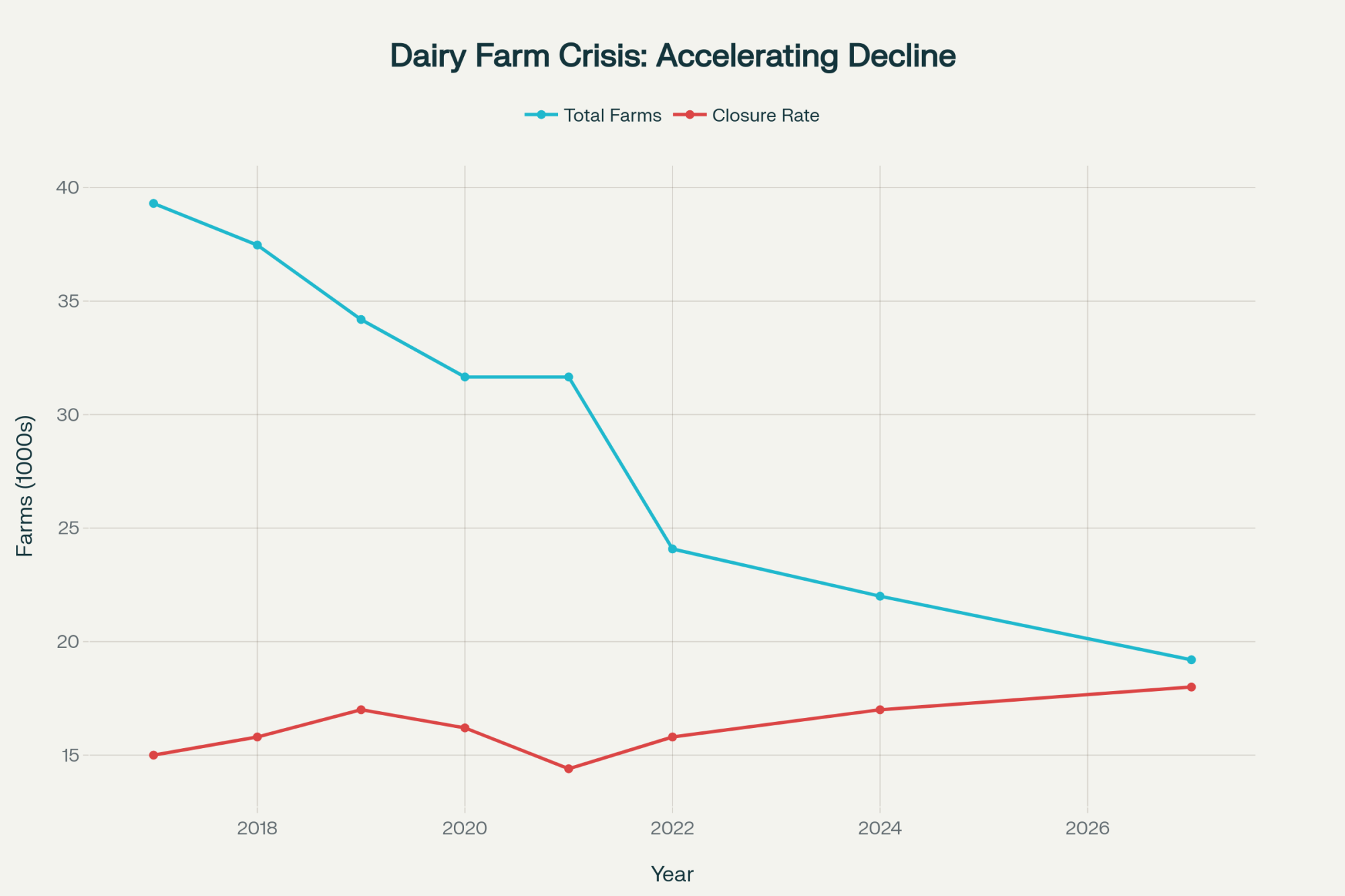
Herds Lost per Year (est)2-3%Accelerating
Average Herd Size Growth3-5%/yrContinuing

When Efficiency Turns on You

We’ve spent a generation tightening feed efficiency, refining fresh‑cow management, and maximizing butterfat performance. But when every operation does it at once, collective output outpaces demand. Stephenson’s work shows exactly that: efficiency saves individual farms but extends low‑price cycles industry‑wide.

CoBank’s 2025 outlook says lenders have started factoring this reality into their models, advising clients to treat $14–$15 milk as a planning baseline. They’re less interested in herd size and more in liquidity and diversification—two words that used to sound cautious but now mean survival.

It’s worth noting that some operations are already adapting faster than expected. Instead of ramping production, they’re building buffer zones—feed inventories, beef programs, or renewable energy income—that buy time when markets slump. That’s a quiet, practical form of resilience.

Three Business Models Leading the Next Era

Beef-on-dairy crossbred calves command $1,400 premiums compared to $150 for Holstein bulls—adding $3.50 per hundredweight to dairy revenue without increasing milk production. This diversification strategy is reshaping farm economics across North America. Andrew’s Reality Check: Three years ago, consultants said beef-on-dairy was a fad. Today it’s adding more per-cwt value than most efficiency gains combined. The market voted with its wallet.
Revenue SourceValue per HeadAdditional Revenue per cwt
Beef-on-Dairy Calf14003.5
Holstein Bull Calf1500.15
Cull Cow (reduced)8000.8
Traditional Dairy Only00.0

Looking around North America, I see three dairy models redefining success—and interestingly, none of them depend solely on volume.

1. Scale with Resource Discipline

Large dairies (2,500 cows and up) still enjoy supply‑chain leverage and efficient overheads, keeping costs near $13–$14 per cwt. But as Texas A&M AgriLife has documented, Ogallala Aquifer drawdowns of several feet per year are already limiting western expansion. Efficient dry lot systems still hinge on water, not on technology. The winners in this space will be those securing long‑term water rights and investing in traceable sustainability systems that gain processor preference.

2. Premium Differentiators

Smaller operations in Wisconsin, Vermont, and New York are thriving by selling distinctiveness. The Dairy Business Innovation Alliance granted $27 million last year to help farmers launch on‑farm processing or branded lines. Cornell’s marketing research shows that these operations can gross nearly twice the revenue per gallon of bulk milk, even after accounting for labor and packaging. It’s not an easy switch—but it’s proof that price control still exists for those who own their story.

3. Diversified Mid‑Tier Enterprises

Mid‑sized farms (400–1,000 head) are finding stability through hybrids: beef‑on‑dairy programs, digesters, custom fieldwork, and even agritourism. USDA AMS reports cross calves averaging $1,300–$1,500—steady income that doesn’t depend on milk checks. A producer in western New York summed it up well: “We stopped trying to be the biggest and started aiming to be the most stable.” That’s the pivot shaping 2028’s survivors.

Business ModelLarge-Scale (2,500+ cows)Premium Direct (Small-Mid)Diversified (400-1,000 cows)
Cost per cwt$18.50$22.00$20.25
Revenue per gallon$3.20$5.50$4.10
Key AdvantageEconomies of scalePremium pricingRisk spread
Key RiskCapital intensiveMarket dependentComplex mgmt
2026 ViabilityStrongModerateGood

Regional Realities to Watch

Southwest: Managing Heat and Water

The Southwest’s production advantage is shrinking under the pressure of climate change. NOAA data shows that regional summer highs have increased by nearly 2°F since 2005. Sustained 105°F temperatures drop butterfat 0.25 points and drag conception rates 10–15 percent. Cooling systems can recover performance but raise feed and energy costs—a balance every dry lot system must now manage deliberately.

Midwest: Cooperatives Reinventing Identity

In the Upper Midwest, co‑ops aren’t just merging for size—they’re merging for marketing power. By uniting under shared premium labels, regional processors can command higher prices while keeping milk local. “Made in Wisconsin” and “Minnesota Heritage” brands are now marketing assets that translate directly into net returns.

Northeast: Proximity to the Plate

Closer to metro areas, direct bottlers and farmstead processors are rewriting the economics of small dairies. Cornell Extension documents farms earning $4.50–$5 per gallon retail versus roughly $2.00 through commodity channels. The tradeoff? Long hours, daily distribution. But for these herds, proximity beats volume.

RegionPrimary_ChallengeTemp_IncreaseButterfat_ImpactStrategic_Response2026_Outlook
SouthwestWater + Heat Stress2°F since 2005-0.25 pts at 105°FWater rights + coolingConstrained growth
MidwestCo-op ConsolidationModerateMinimalPremium brandsConsolidation continues
NortheastCompetition + LaborModerateMinimalDirect retail + proximityNiche strength

Consolidation Without Cushion

Here’s what concerns many analysts, myself included. USDA ERS data shows 70 percent of U.S. milk now comes from fewer than 700 herds. Economies of scale made U.S. dairy globally competitive, but that concentration also magnifies disruption.

When USDA APHIS chronicled this year’s H5N1 outbreaks, some mega‑herds lost a quarter of production temporarily. A single event like that can ripple nationwide when production is so consolidated. Efficiency has been our calling card—but efficiency without redundancy is a structural risk.

Policy Reality: The Market Leads

Don’t hold your breath for government rescue via supply management. Lawmakers shelved those proposals years ago, and the odds of revival are slim. The playing field instead relies on program updates like Dairy Margin Coverage and Dairy Revenue Protection.

Some cooperatives are experimenting with “soft cap” base systems that reward milk sold inside quotas while reducing incentives for extra volume. As Cornell’s Ch is Wo f explains, production discipline rarely starts in Congress—it begins when lenders align credit with profitability, not throughput.

Canada’s Connection Under CUSMA

For Canadian producers, this U.S. reset carries ripple effects. Under CUSMA/USMCA, American exporters filled about 42 percent of tariff‑rate quota (TRQ) volumes in 2024 (USDA GATS). If U.S. milk stays cheap, industrial users north of the border could see downward price pressure on powders, even within supply management.

On the flip side, cheesemakers importing U.S. components might gain a cost advantage. It shows how intertwined our systems have become: Canada’s quota stability protects producers, but processors share exposure to North American market cycles.

A 90‑Day Plan for Staying Liquid

  1. Stress‑Test Your Numbers.
    Model 18 months of $14 milk , including all liabilities: feed, debt, family living, and depreciation. Knowing the breakeven point beats guessing.
  2. Six Months of Liquidity.
    Whether feed, credit, or cash reserves, that’s now the lender’s preferred benchmark. It buys you choices when margins vanish.
  3. Diversify Intentionally.
    Beef‑on‑dairy returns, renewable‑energy partnerships, or manure composting programs provide steady non‑milk income and nitrogen‑value recycling.
  4. Align Your Advisors.
    Bring your lender, accountant, and co‑op rep to one table. Coordinated strategy beats reaction every time.

What Success Will Look Like by 2028

MetricVulnerableAt_RiskResilient
Debt-to-Asset Ratio>35%25-35%<25%
Non-Milk Income %<10%10-20%25-30%
Liquidity Reserve<3 months3-4 months6+ months
Breakeven Price>$16/cwt$14-16/cwt<$14/cwt
Risk LevelHIGHMEDIUMLOW

The most resilient operations typically maintain debt-to-asset ratios below 25 percent, generate 25 to 30 percent of their income from sources other than milk, and use integrated data systems that connect cow performance with overall cash flow.

A Pennsylvania producer told a USDA panel recently, “We stopped calling ourselves milk producers—we’re opportunity managers who milk cows.” That’s optimism shaped by hard truth—and it’s probably the right mindset for the next cycle.

The Bottom Line: Strategy Outlasts Size

The next few years won’t favor the farms that produce the most milk, but rather the ones that manage risk  best. Markets—just like herds—reward adaptation more than brute strength.

What’s encouraging is that dairy already has the tools necessary for a successful transition, including precision nutrition, component payouts, renewable energy credits, co-op innovation, and data integration. The real challenge lies in timing—taking action now while there is still an opportunity. By leveraging these resources and making proactive decisions, dairy producers can position themselves to thrive in a changing market, ensuring their operations remain resilient and adaptable for the future.

History shows that producers who adapt quickly are the ones who shape the future of the industry. While the upcoming transition may be challenging, it also presents a valuable chance to build a dairy sector that is more efficient, knowledgeable, and prepared for whatever changes the market may bring.

Key Takeaways

  • Dairy’s next chapter starts with a reset: rising production, shrinking exports, and processing capacity that’s outgrown demand.
  • Producers can’t count on price rebounds—planning for $14 milk means focusing on liquidity, strategy, and controlled risk.
  • The farms built to last aren’t the biggest—they’re the smartest at diversifying their income streams.
  • From Texas dry lots to Midwestern co-ops, success means pivoting from efficiency to adaptability.
  • Even Canada feels the ripple as CUSMA imports pressure processors and test supply management’s limits.

Complete references and supporting documentation are available upon request by contacting the editorial team at editor@thebullvine.com.

Learn More:

The Sunday Read Dairy Professionals Don’t Skip.

Every week, thousands of producers, breeders, and industry insiders open Bullvine Weekly for genetics insights, market shifts, and profit strategies they won’t find anywhere else. One email. Five minutes. Smarter decisions all week.

NewsSubscribe
First
Last
Consent

When Firewalls Meet Milk Checks: The Cyber Threat Every Dairy Should Plan For

From parlor to payment, dairy runs on data. What happens when that flow gets hacked?

Executive Summary: When ransomware sidelined Dairy Farmers of America’s payment systems in 2025, the cows didn’t miss a beat—but the milk checks did. That disruption exposed just how intertwined today’s dairy operations are with digital infrastructure. With most farms carrying less than two weeks of cash flow, even short delays ripple quickly through feed, payroll, and herd health. Now, the industry is pivoting—insurance carriers, processors, and co-ops are requiring proof of cybersecurity readiness much like milk quality testing. Encouragingly, shared-defense models pioneered by rural electric co-ops are showing how collaboration can make protection affordable. The bottom line? For modern dairy, safeguarding data has become as essential as managing fresh cow health, feed efficiency, and butterfat performance—and it’s a challenge the cooperative spirit is well-suited to solve.

You know, it wasn’t that long ago that when we talked about “security” on a dairy farm, we were thinking about padlocks, not passwords. But things have changed. When Dairy Farmers of America (DFA) confirmed a ransomware attack last summer that disrupted milk pickup and delayed producer payments, it delivered a wake‑up call to everyone in dairy.

What’s interesting is that this was never just the DFA’s problem. It was a reminder that every gallon of milk today depends on layers of technology—from dispatch and lab testing to payroll. The cows kept milking, of course. But the money stopped moving, and that’s when every producer felt it.

The 17-day timeline from the DFA ransomware breach to payment restoration shows how quickly cyber attacks cascade into cash flow crises for dairy producers

When Data Fails Before the Pump Does

The FBI and federal ag briefings have shown that ransomware groups, including one known as “Play,” have been targeting food and logistics operations more frequently in the last two years. Agriculture offers what hackers want: essential infrastructure and time‑sensitive data.

Ransomware attacks on agriculture more than doubled from Q1 2024 to Q1 2025, with the sector now representing nearly 6% of all global ransomware incidents

DFA handled the incident quickly and with transparency, but the bigger takeaway is that every co‑op, regardless of size, now sits on the same digital fault line. I’ve noticed that even smaller Midwest cooperatives rely on a handful of software links for billing, route management, and milk quality reporting. If those systems lock up, the trucks can roll all they want—nobody gets paid on time.

The top three entry points—default passwords, unpatched systems, and phishing—account for 80% of successful dairy cyberattacks, making them priority defense targets

Margins, Minutes, and Modern Milk

What I’ve found in extension discussions lately is that this risk exposes an uncomfortable truth about dairy’s financial stamina. USDA Economic Research Service data shows U.S. dairy herds clocked in at over 23,000 pounds per cow in 2024, a record high. Yet Penn State Extension financial summaries reveal that nearly two‑thirds of farms have less than two weeks’ worth of operating capital in reserve.

Rows (alternating white/#F5F5F5, black text, RED numbers #CC0000 for critical figures):

MetricIndustry RealityCyber Attack Impact
Operating Cash Reserve< 2 weeks (66% of farms)Depleted in 3-7 days
Milk Production/Cow/Year23,000+ lbs (2024)Continues uninterrupted
Payment Delay Tolerance3-5 days maxDFA: 17 days actual
Feed Cost Impact$5.50+/cow/dayImmediate pressure on suppliers
Production Drop Risk3-5% in 30 daysLong-term herd damage

It’s a dangerous mix: more digital dependence, less financial cushion. In most operations, if one milk check misses the bank by 3 days, feed schedules or payroll feel the pinch immediately. And that ripple doesn’t stop in the office. A short‑term ration downgrade may look harmless, but research in the Journal of Dairy Science confirms a 3–5 percent milk decline within a month and lower butterfat performance across the herd.

As a New York nutritionist put it in a recent cooperative workshop, “Every gallon lost in production isn’t just lost feed—it’s deferred maintenance on the cow herself.”

Why Boards Overlook the Digital Barn Door

Now, to be fair, most cooperative boards are filled with the people who made dairy what it is—smart, experienced producers. But cybersecurity’s a whole new animal. Many directors can watch butterfat averages like a hawk but have never seen what a server backup log looks like.

That’s changing. A growing number of co‑ops are bringing in CISA agricultural advisors or extension IT specialists to run tabletop backup tests. These “practice crises” map how fast payment systems could reboot after a lockout. What’s encouraging here is that producers themselves are asking for those updates. The conversation has moved from “Why do we need this?” to “When’s our next recovery test?”

Shared Defense: The Power Co‑Op Lesson

Here’s something dairy can borrow from our electric cooperative neighbors. The National Rural Electric Cooperative Association (NRECA) created ICS‑REC, a shared cybersecurity system that enables small utilities to pool resources to monitor and respond to cyber threats.

The math is brutal: proactive cybersecurity costs $150K annually, while breach recovery averages $500K plus weeks of downtime—a 70% cost penalty for being unprepared

According to NRECA’s 2024 report, co-ops using shared monitoring cut their outage time nearly in half and saved an average of 40 percent on technology costs compared to going it alone. That model is now being discussed in ag circles, with USDA rural development offices and state councils exploring pilot versions tailored to food and dairy infrastructure.

What’s encouraging is that this approach feels familiar to farmers. We’ve always pooled tankers, lab testing, and marketing. Pooling digital defense is just the next step.

Regional Realities: Same Storm, Different Forecasts

Cyber threats look a bit different depending on where your milk flows. In California, major processors managing high‑volume export trade are investing in dual‑site data centers because uptime equals product flow. In the Upper Midwest, co‑ops still running older accounting platforms grapple with software compatibility and delays in security‑patch updates. In the Northeast, where many co‑ops rely on third‑party vendors for payment processing, vulnerability often sits one contract away.

Different setups—but the same universal lesson. Every operation should know who’s guarding its data pipeline, not just the milk pipeline.

Compliance Is the New Competition

Here’s a shift few saw coming: insurers and buyers now view cyber preparedness as a supply‑chain expectation. Re‑insurance providers have begun demanding proof of frequent system tests before renewing cooperative policies.

Meanwhile, Dairy Market News (September 2025) reported that several national processors will soon require suppliers to meet NIST Cybersecurity Framework benchmarks—the same federal standards guiding manufacturing. This isn’t about red tape; it’s about risk mitigation. Ten years ago, it was traceability. Five years ago, sustainability. Today, it’s cybersecurity.

That trend tells us that staying digitally sound may soon be as important to your milk check as your somatic cell count.

Four Questions Every Member Should Ask

Looking at this trend, here are the questions producers are starting to bring up in their own co‑op meetings:

  1. How quickly can our payment systems recover if they’re shut down?
  2. When was our last confirmed backup test, and what were the results?
  3. Does our insurance actually protect producer payments or just IT equipment?
  4. What are we doing to verify the digital safety of outside vendors?

Those are the right conversations to be having. They don’t require tech fluency—just business fluency.

Farm‑Level Insurance: The Practical Kind

While the bigger fixes happen at the cooperative level, each farm can still boost resilience. Penn State Extension and the Food and Ag ISAC recommend keeping 30–45 days of cash or credit set aside for feed, payroll, and essentials; maintaining both cloud and physical copies of records; and outlining a 72‑hour business‑continuity plan.

During last summer’s brief DFA delay, farms that maintained these safeguards navigated the disruption calmly. One Wisconsin dairyman told me, “I treat data backups like fresh cow checks—you do it before things go wrong, not after.”

What’s particularly noteworthy is how these everyday steps—basic organization, paper copies, a short‑term cash plan—shielded real operations from chaos.

From Hardware to Heart of Cooperation

If there’s a silver lining in all of this, it’s that cybersecurity may actually reconnect dairy to its cooperative roots. Just as early milk pools allowed farmers to share equipment and market access, today’s co‑ops have a new reason to collaborate on shared digital defense.

NRECA’s ICS‑REC success shows what collective foresight can achieve: greater resilience at lower cost. And with CISA beginning to tailor agriculture‑sector protocols, we have both the data and the roadmap.

The NRECA shared cybersecurity model proves the cooperative advantage—40% cost savings, 75% faster threat detection, and 24/7 expert access that solo operations can’t match

Cybersecurity might not feel as tangible as herd management or fresh cow care, but in 2025, it’s part of keeping the parlor humming. Protecting bridges between the barn, the bank, and the buyer ensures that milk—and money—keep moving.

Because at the end of the day, protecting your milk check is just another form of protecting your herd.

Key Takeaways :

  • The 2025 DFA cyberattack revealed that dairy’s digital systems—dispatch, payments, and lab data—are now as critical as the milking parlor itself.
  • With most farms carrying under two weeks of liquidity, a frozen payment system triggers losses far beyond delayed deposits.
  • Shared‑defense models pioneered by rural electric co‑ops show that collaboration can make cybersecurity affordable and effective.
  • Insurers and processors are treating cyber readiness like milk‑quality testing: it’s not optional, it’s expected.
  • Strengthening your co‑op’s firewalls is today’s version of maintaining herd health—a shared responsibility that protects everyone’s milk check.

Complete references and supporting documentation are available upon request by contacting the editorial team at editor@thebullvine.com.

Learn More:

The Sunday Read Dairy Professionals Don’t Skip.

Every week, thousands of producers, breeders, and industry insiders open Bullvine Weekly for genetics insights, market shifts, and profit strategies they won’t find anywhere else. One email. Five minutes. Smarter decisions all week.
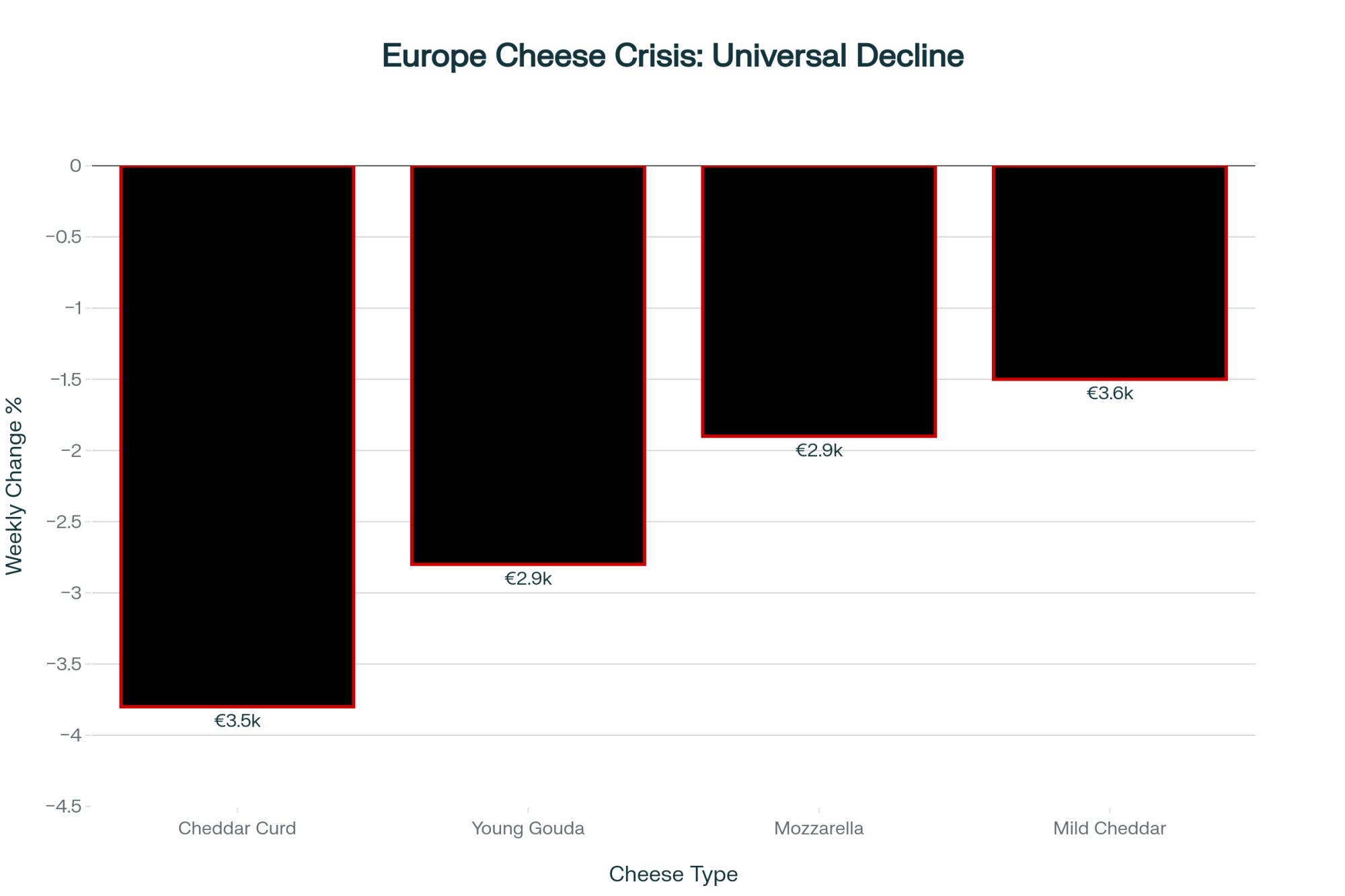
NewsSubscribe
First
Last
Consent

Data Centers, Water Rights, and Your Dairy’s Future: The 18-Month Window That Changes Everything

A data center uses 2,000MW. Your dairy uses 0.5MW. When they move in, your costs jump 40%. You have 18 months to pick: Scale, pivot, or sell.

EXECUTIVE SUMMARY: Data centers consuming 2,000 megawatts—the power of 4,000 dairy farms—are reshaping rural infrastructure, with some facilities draining aquifers so fast that multi-generational wells fail within months. This collision between Big Tech and agriculture threatens mid-sized dairies with 40% power cost increases and water scarcity, yet also creates unprecedented opportunities: land values tripling, renewable energy partnerships worth $400/cow annually, and historic exit premiums. The 800-1,500 cow operations that built America’s dairy industry have 18 months to choose their path: scale beyond 2,000 cows, optimize operations while positioning for strategic exit, or sell at peak valuations that won’t last. Indiana’s proactive water protection legislation and Ohio farmers negotiating win-win land deals show that preparation beats panic. The immediate action plan is clear: document your water baseline, calculate your true costs, and decide your future before market forces decide for you.

Data Center Dairy Impact

You know, I was chatting with a producer last week who’s been milking for thirty years—rock-solid operation, three generations on the same land. His question really made me think: “Andrew, my well’s never failed. Should I be worried about these data centers moving in?”

After looking at what’s happening across the country, I had to tell him yes. Though honestly… not for the reasons either of us expected when we started talking.

One AI data center consumes the equivalent power of 4,000 dairy farms—a staggering 2,000 MW compared to your 0.5 MW operation. This isn’t a fair fight; it’s a complete mismatch in energy demand that’s reshaping rural infrastructure and driving your costs up by 40%.

A Story from Georgia That Should Matter to All of Us

So here’s what’s happening to Beverly and Jeff Morris down in Newton County, Georgia—and it’s something we all need to pay attention to. For decades, their well served them perfectly. Never a problem. Then, Meta built a data center about 1,000 feet from their property back in 2018.

Beverly and Jeff Morris in Newton County watched their multi-generational well fail within months of Meta’s data center opening. Now hauling bottled water for basic needs, they’re $5,000 in trying to fix what a 500,000-gallon-per-day neighbor broke. Nine more companies filed applications—some wanting 6 million gallons daily.

Within months—and I mean months, not years—their water quality just fell apart. First, the dishwasher stopped working right. Ice maker went next. The New York Times reported this past July that they’re now hauling bottled water for basic household needs. They’ve already spent five thousand dollars trying to fix problems that started right after construction. And that twenty-five thousand they’d need for a new well? Well, that’s just not in the cards for them.

“I’m scared to drink our own water,” Beverly told those reporters.

When farm families are afraid of their own well water in 2025… I mean, that really hits home, doesn’t it?

Understanding What’s Happening to Our Power Grid

Here’s what’s interesting—and honestly, a bit concerning. Grid Strategies released its National Load Growth Report, showing that data center electricity consumption could triple from 4% of total U.S. usage today to 12% by 2028. Goldman Sachs released similar numbers in its August analysis. That’s a massive shift in just a few years.

You probably know this already, but let me put it in perspective: facility planning documents from utilities like Dominion Energy show a single AI data center can demand 2,000 megawatts. Your entire dairy operation? Even with a modern parlor, all your cooling systems, feed delivery—you’re maybe peaking around 500 kilowatts on your busiest day. The scale difference is just… staggering.

Think about it this way:

  • One AI data center: 2,000 MW (enough for 100,000 homes)
  • Your 1,200-cow dairy: 0.5 MW
  • A small town of 5,000 people: 15 MW

We’re not even in the same league here.

Rural electric cooperatives—and that’s most of us, right?—they’re really feeling this. I’ve been talking with co-op managers across the Midwest, and they’re seeing interconnection requests for hundreds of gigawatts. As one manager told us, “We built our system over decades to serve farms and rural communities. They’re asking for triple capacity in two years.”

The money side’s already hitting too. Rewiring America documented twenty-nine billion dollars in utility rate increase requests this year. And ICF International’s May report? They’re suggesting we could see increases up to 40% by 2030.

So let me break this down in terms we all understand. Say you’re running 1,200 cows in a typical freestall setup with automated milking—pretty standard operation these days. University of Wisconsin Extension research shows operations like that use between 400 and 1,145 kilowatt-hours per cow annually. Most well-managed operations average around 800.

At twelve cents per kilowatt-hour—which is what many of us are paying—you’re looking at about $115,200 a year in electricity. Jump that to fifteen or seventeen cents? That’s an extra thirty to forty thousand dollars annually. Basically, it adds twenty-five cents per hundredweight to your production costs. And there’s not a thing you can do to manage that through better feed conversion or butterfat optimization.

Data centers are driving electricity rates up 40%, adding $48,000 annually to a 1,200-cow operation—that’s $4,000 every single month you can’t manage through better genetics or feed efficiency. This $0.25/cwt hit goes straight to your cost of production with zero options to optimize it away.

Water: The Challenge That Really Caught Me Off Guard

What really surprised me when I started digging into this—it’s not the electricity that’s the immediate threat. It’s water.

According to filings with Georgia’s Environmental Protection Division, Meta’s Newton County facility needs 500,000 gallons every single day. That’s 10% of the entire county’s water use for 120,000 residents. Mike Hopkins, who runs the Newton County Water and Sewage Authority, reported at a July public meeting that nine more companies have filed applications. Some want six million gallons daily. Six million! The Authority’s already projecting deficits by 2030.

Now, you might be thinking, “That’s Georgia. Different story up here in the Midwest.” But look at what’s happening in Arizona. The Attorney General’s December lawsuit documents show the Saudi-backed Fondomonte operation pumped over 31,000 acre-feet from the Ranegras Basin last year. That’s 81% of all the groundwater pulled from that aquifer.

Documentary filmmakers from The Grab captured rancher Wayne Wade describing how his well pump literally melted when water levels dropped below it. “I can’t pay for a high-powered lawyer,” Wade said. “Neither can any of my friends.”

Local churches have lost wells that served their communities for generations. Small operations are watching their water security just… evaporate. And here’s what really concerns me: this happens fast. We’re not talking gradual decline over decades, where you can plan and adapt. Wells that have been reliable for multiple generations can fail within months once industrial-scale pumping starts nearby.

Looking at where these conflicts are already emerging:

  • High data center areas: Northern Virginia, Columbus, OH, Phoenix, AZ, Dallas, TX, Silicon Valley, CA
  • Major dairy regions: Wisconsin, California Central Valley, New York, Pennsylvania, Idaho
  • Where they overlap: That’s where we’re seeing real problems develop

This Isn’t Just an American Problem

And here’s something for our Canadian readers and international audience—this isn’t uniquely American. The Greater Toronto Area is seeing similar pressures as Microsoft and Amazon expand their data center capacity in Ontario, with facilities in Vaughan and Mississauga drawing significant power from the grid.

In Europe, it’s even more intense. The Netherlands—you know, one of the world’s most efficient dairy producers—is dealing with Microsoft’s planned facility in North Holland that will consume 20% of the nation’s renewable energy growth. Dutch dairy farmers are already operating under strict environmental regulations, and now they’re competing with tech giants for both water and power. Ireland has actually imposed a moratorium on new data center connections in Dublin because they’re projected to consume 30% of the country’s electricity by 2030.

What’s particularly interesting is that European farmers have been actively organizing responses. The Dutch agricultural union LTO Nederland has been working with energy cooperatives to secure long-term power contracts before data centers lock up capacity. That’s something we could learn from here.

Indiana Shows Us What Being Proactive Looks Like

Not every region’s waiting for a crisis to hit, though. What Indiana did offers a really solid model for the rest of us.

Randy Kron—he’s president of Indiana Farm Bureau and farms in the Wabash River watershed—saw what was coming when developers proposed pulling 100 million gallons daily for the LEAP Innovation District. Instead of waiting for problems, they made water protection their top legislative priority for 2025.

Working with State Senator Sue Glick, they passed Senate Bill 28. Governor Braun signed it in April. The law’s pretty straightforward: if an industrial user impairs your agricultural well, they have to compensate you. Either they connect you to a new water supply or drill you a deeper well. The Department of Natural Resources has three days to investigate complaints. And here’s the key part—the burden of proof is on them, not you.

As Randy explained in his public testimony: “We wanted to establish reasonable guidelines while we could think clearly, not in the middle of a crisis.”

That’s the difference between getting ahead of this thing and playing catch-up, isn’t it?

One Success Story Worth Noting

I should mention—it’s not all doom and gloom out there. I was talking with a producer from northeast Ohio recently who’s actually turned this situation to his advantage. When a data center developer approached him about purchasing 200 acres of marginal cropland, he negotiated to keep his best fields and the dairy operation intact.

The sale price? Let’s just say it funded a complete parlor renovation and new feed storage, and left enough for his daughter to return to the operation without debt pressure. Plus, the data center’s required green space buffer actually improved his pasture runoff management.

“I wasn’t looking to sell,” he told me, “but when someone offers you three times agricultural value for your worst ground, and you can keep milking? That’s not a threat—that’s an opportunity.”

Not everyone will get that lucky, of course. But it shows there can be win-win scenarios if you’re prepared to negotiate from a position of knowledge rather than desperation.

The Bigger Picture on Consolidation

Let’s be honest about something we all know—data centers aren’t creating dairy consolidation. We’ve been dealing with that for twenty years now. The 2022 USDA Census shows we’ve gone from 105,000 dairy farms in 2000 to about 22,000 today. Meanwhile, cow numbers have stayed right around 9.4 million head. Same amount of milk, way fewer farms producing it.

The economics haven’t changed either. Cornell’s Dairy Farm Business Summary from September shows that operations with 2,000-plus cows are achieving production costs of around $23 per hundredweight. Those of us with 1,000 cows? We’re looking at $26-27. In markets that routinely swing two or three dollars seasonally… well, you know what that gap means for your bottom line.

What’s different now—and this is important—is that data centers are eliminating the traditional ways mid-sized operations survived. You can’t optimize your way out of a 40% increase in power. You can’t expand when county assessor records from places like Franklin County, Ohio, show farmland jumping from $30,000 to $150,000 an acre after rezoning for data centers. And your neighbor can’t buy you out when nobody can afford these inflated prices.

Three Realistic Paths Forward—Choose Wisely

After talking with producers nationwide and working through the numbers with economists like Dr. Jason Karszes at Cornell’s PRO-DAIRY program, I’m seeing three realistic strategies for operations with 800 to 1,500 cows:

Path 1: Scale Up Now

If you’re going this route, you need at least 2,000 cows. Cornell estimates that’s eight to fifteen million in capital, depending on what you’ve already got. But here’s the thing—this only works if you have a committed successor under 40 who’s already actively managing. The International Farm Transition Network’s data shows 83.5% of dairy farms fail the generational transition. Don’t expand on hope.

You’ll also need documented water security and, if you’re thinking of digesters, proximity to natural gas pipelines. The risk? Infrastructure costs are rising faster than milk prices. You’re betting you can scale before costs eat you alive.

Path 2: Optimize and Plan Your Exit

This is your five-to-ten-year strategy. Targeted investments of $500,000 to $2 million can keep you competitive medium-term—precision feeding, really dialing in component optimization, maybe adding renewable revenue.

Solar leases are now bringing $250-$1,000 per acre, according to the American Farmland Trust. Digester partnerships can add $80-400 per cow annually. In California, with those Low Carbon Fuel Standard credits, some operations are seeing up to $1,100 per cow. The key is timing your exit to the land value peak—likely 2025-2027 —before regulatory backlash hits.

Path 3: Exit While Premiums Exist

Let’s face reality—USDA data shows 71% of retiring farmers have no successor. If that’s you, the arrival of data centers might be your best opportunity. We’re seeing premiums of 40-100% over agricultural value. Davis County, Utah, farmland went from $50,000 to $400,000 per acre after rezoning. But this window won’t stay open past regulatory backlash.

MetricAgricultural ValuePost-Data Center ValueChange
Price Per Acre$30,000$150,000+400%
200-Acre Farm Total$6,000,000$30,000,000+$24,000,000
Exit Premium WindowAgricultural UseDevelopment Value18 Months
Your DecisionStay & ScaleSell at PeakMarket Decides

And here’s the thing—you’ve got maybe 18 months to choose before the market makes the choice for you.

Understanding the Revenue Side

While we’re dealing with infrastructure pressures, some operations are finding real opportunities. But you need to distinguish genuine opportunity from sales pitches—and believe me, there are plenty of those going around.

California producers working with companies like California Bioenergy are generating substantial returns. The George DeRuyter & Sons operation in Washington state produces renewable natural gas plus multiple fertilizer products—real diversified revenue beyond just milk.

A 1,200-cow operation with solar leases and a digester partnership can generate $680,000 in annual non-milk revenue—that’s $0.40/cwt in margin you can’t lose to feed costs. In California with LCFS credits, producers are banking $1.32 million yearly. This isn’t futuristic; it’s happening right now.

Bar 20 Dairy in Kerman reports capturing thousands of tons of CO2 annually through their digester while producing renewable electricity. As one California producer told me: “It’s like crop insurance that pays every month.”

The typical arrangement? Third-party developers cover the capital—anywhere from two to twelve million, according to industry reports. They build it, operate it, and pay you for manure. Not glamorous, but annual payments that can represent $350,000 for a 3,500-cow operation? That’s an additional 40 cents per hundredweight in margin. Nothing to sneeze at.

But here’s what nobody mentions at those sales presentations—these are 10-15 year contracts in markets that could shift dramatically. If carbon credit values crash in 2028 and you’re locked until 2040, you’re stuck. Get a lawyer who understands both ag and energy before you sign anything. Trust me on this one.

What’s Coming That Most Aren’t Seeing Yet

Your milk processor is running the same infrastructure risk calculations you are. And if they decide your watershed’s becoming high-risk, they won’t announce it. They’ll gradually shift procurement to more stable regions. By the time you notice reduced premiums or limited-volume incentives, repositioning becomes very difficult.

We’re also likely to see regulatory whiplash. Right now, everyone wants data centers for the tax revenue. But if history’s any guide—think CAFOs in the ’90s or ethanol plants in the 2000s—backlash typically emerges 3-5 years after rapid growth begins. Water conflicts and community opposition could trigger restrictions around 2027-2030, potentially leading to significant corrections in land values.

Your 30-Day Action Plan

Alright, enough analysis. Here’s what you actually do starting Monday morning:

Week 1: Document Your Water

Call your state-certified lab first thing Monday. In Wisconsin, that’s the State Laboratory of Hygiene at 608-224-6202. Pennsylvania farmers, check DEP’s certified lab list. Iowa, call the State Hygienic Laboratory at 319-335-4500. Ontario producers, contact your Ministry of Environment labs.

Comprehensive testing runs $300-500. Get everything—bacteria, minerals, heavy metals, static water level. Photograph all infrastructure with date stamps. Keep copies in three places. Without this baseline, you have zero legal protection.

Week 2: Face Your Numbers

Calculate actual production costs. Not hopes—reality. Model three scenarios: scaling to 2,000+ cows, optimizing for 5-7 years, or immediate exit. Have that succession conversation directly: “Do you want this operation?” Hesitation tells you everything.

Week 3: Work With Your Farm Bureau

Contact your county president about water protection resolutions. Draft and submit if needed—October deadlines are common. Coordinate with neighboring counties. Frame it as risk management, not emotional appeals.

Week 4: Make Your Decision

Scale, optimize, or exit based on documented succession, capital access, water security, and market position. Set concrete timelines and communicate them clearly.

Regional Differences Really Do Matter

This isn’t hitting everywhere equally, of course. Vermont and northern New York —abundant water and limited data center development? You’re facing minimal pressure so far.

But Virginia—especially Loudoun County—that’s a completely different story. The state’s Joint Legislative Audit and Review Commission found 26% of Virginia’s total electricity now goes to data centers. That’s massive.

The Pacific Northwest presents mixed conditions. Plenty of hydropower, which helps. But the Columbia River Basin’s already over-allocated. When Microsoft expanded in Quincy, Washington, irrigation districts had to fight hard to protect agricultural water rights.

The Southwest? Between existing drought and new industrial demand… it’s really tough out there. Several New Mexico producers I know are planning exits based solely on water, not even considering milk prices.

Looking Forward with Clear Eyes

You know, this transformation isn’t about whether data centers are good or bad. They’re coming regardless of what we think. When organizations with trillion-dollar valuations compete for the same resources we need… well, we all know how that usually ends up.

The smart response isn’t futile resistance. It’s intelligent positioning within what’s coming.

Our grandparents navigated equally dramatic transitions—from hand milking to automation, from small diversified farms to specialized dairy operations. They succeeded by making timely decisions based on emerging conditions, rather than waiting for perfect information that never arrives.

We need that same decisiveness now. Maybe even more so.

The timeline’s compressed. Aquifers don’t refill quickly—you know that. Electricity rates aren’t coming down anytime soon. And somewhere—probably closer than you think—another data center’s moving through the approval process right now.

Document your water. Understand your real costs. Choose your strategic direction.

Because eighteen months from now, those who acted on information will be in substantially better positions than those who waited, hoping things might somehow improve on their own.

That’s what the current data suggests. And in our business, as we all know, the data usually points us in the right direction. Even when we don’t like what it’s telling us.

For water testing contacts and Farm Bureau resolution procedures, reach out to your local county offices. For professional land valuation near data center developments, the American Society of Farm Managers and Rural Appraisers maintains a directory of qualified specialists who understand both agricultural and development values.

KEY TAKEAWAYS

  • THE 18-MONTH DECISION Mid-sized dairies (800-1,500 cows) face three paths: Scale to 2,000+ cows ($8-15M), optimize operations while positioning for strategic exit (5-10 years), or sell now at historic premiums (40-100% above ag value). No decision IS a decision—the market will choose for you.
  • WATER BASELINE = LEGAL LIFELINE Schedule water testing immediately ($300-500 through state labs). Multi-generational wells are failing within months of data center construction. Without a documented baseline, you have zero legal recourse when your well fails.
  • YOUR POWER BILL: +40% WITH NO ESCAPE One data center uses 2,000MW (power for 4,000 dairy farms). This drives electricity costs up 40%, adding $30-40K annually to a 1,200-cow operation—equivalent to $0.25/cwt you cannot optimize away through any operational efficiency.
  • OPPORTUNITIES FOR THE PREPARED Land selling at 3X agricultural value, renewable partnerships generating $400/cow annually, solar leases bringing $1,000/acre—but only for farmers who document resources, know their costs, and negotiate from knowledge, not desperation.
  • PROVEN SUCCESS STRATEGIES EXIST Indiana’s proactive water protection law and Ohio farmers’ win-win land deals demonstrate that preparation beats panic. Join Farm Bureau water resolutions, coordinate with neighboring counties, and frame concerns as risk management—it works.

Learn More:

Complete references and supporting documentation are available upon request by contacting the editorial team at editor@thebullvine.com.

The Sunday Read Dairy Professionals Don’t Skip.

Every week, thousands of producers, breeders, and industry insiders open Bullvine Weekly for genetics insights, market shifts, and profit strategies they won’t find anywhere else. One email. Five minutes. Smarter decisions all week.

NewsSubscribe
First
Last
Consent

Resilience Over Relief: What the $3 Billion Bailout Reveals About Dairy’s New Playbook

The $3 billion bailout hit producers’ accounts—but the real story is how farmers are turning that relief into resilience and re‑engineering the future of dairy.

Executive Summary: The USDA’s $3 billion dairy bailout bought farmers time—just not transformation. Since 2018, over $60 billion in federal “emergency” funding has kept America’s milk moving, but it’s also made rescue money feel routine. What’s interesting is how differently producers are responding. In Wisconsin, smaller family herds keep shuttering, while Idaho’s integrated systems keep growing. Yet across regions, many farms are proving that strength now comes from management, not money—from tracking butterfat performance to securing feed partnerships and using Dairy Revenue Protection as standard operating procedure. The article reveals a quiet shift happening in dairy: the producers thriving today aren’t waiting for Washington—they’re building resilience from the inside out.

dairy resilience strategies

When the USDA released $3 billion in previously frozen dairy aid earlier this fall, a lot of barns felt the same quiet relief. That check helped cover feed, tide over payroll, or pay for the next load of seed. But here’s what’s interesting—what used to be considered “emergency relief” has quietly become routine.

Since 2018, the government’s Commodity Credit Corporation has distributed over $60 billion in ad‑hoc support to U.S. farmers, according to USDA and Congressional Research Service data. That includes the trade‑war relief payments, COVID‑era CFAP funds, weather‑related disaster programs, and now, this latest round of support. Each program had different names and triggers, yet all share one thing: they’ve made emergency relief feel ordinary.

Looking at this trend, it’s clear that the system doesn’t just respond to volatility—it depends on it.

From Safety Net to Part of the System

The normalization of crisis: Federal dairy aid has exceeded $60 billion since 2018, transforming ‘emergency’ relief into standard operating procedure—exactly what Coppess warned about.

University of Illinois economist Jonathan Coppess put it plainly during a 2025 policy forum: “Every time we call these payments extraordinary, we prove how ordinary they’ve become.”

He’s right. The CCC now spends more than $10 billion each year keeping farm sectors whole when prices collapse. The money buys time—valuable time—for dairy families to stay solvent when margins evaporate. But I’ve noticed something else: those interventions slow the kind of market corrections that might otherwise drive innovation.

In other words, the aid keeps everyone in motion—but it also keeps everyone in the same spot.

Geography Still Shapes Success

MetricWisconsin (Traditional)Idaho (Integrated)Impact
Herd Trend 2024400+ closures4.2% growthConsolidation accelerating
Primary ModelSmall-mid family farmsVertically integratedStructure determines survival
Processor RelationshipCo-op (variable deductions)Direct long-term contractsSecurity vs. volatility
Co-op Deductions$1-3 per cwtMinimal/contractedMargin erosion for traditional
Feed StrategyMixed/spot marketIntegrated supply chainsCost predictability advantage
2025 Production TrajectoryDecliningExpandingGeographic winners emerging

Here’s a sobering contrast.

In WisconsinUSDA NASS reports for 2025 show that over 400 milk license holders closed in 2024, the vast majority small or mid‑sized herds. Co‑op deductions for hauling, marketing, and retained equity often run from $1 to $3 per hundredweight, depending on the service region. Add that to feed pressure, and margins vanish quickly when Class III milk averages around $16 per hundredweight.

Meanwhile, Idaho saw 4.2 percent production growth, driven by vertically integrated systems and processor partnerships (Idaho Dairymen’s Association Annual Report 2025). Many herds there ship directly to long‑term contracts with Glanbia Foods or Idaho Milk Products. As CEO , Rick Naerebout says, “Security here comes from being part of someone’s plan.”

That’s becoming the modern split in U.S. dairy. It’s not only about scale—it’s about supply security.

Export Growth Without Equal Payoff

U.S. dairy exports have tripled since 2000, making America the world’s third‑largest dairy exporter, trailing only the EU and New Zealand (USDA Livestock, Dairy and Poultry Outlook, August 2025). It’s an incredible achievement. The challenge is that the extra volume hasn’t meant better milk checks.

The European Commission’s Agri‑Food Trade Report (2025) confirms that EU processors still benefit from export‑enhancing subsidies. And USDA ERS data shows that while New Zealand’s grass‑based systems remain the most cost‑efficient in the world, Americans must rely on grain‑fed cows and higher‑input models.

In 2025’s Q3, Class III prices averaged $16.05 /cwt, while breakevens in most regions sat near $18–$20 /cwt(CME Markets and USDA ERS cost‑of‑production reports). Industry analyst Sarina Sharp at Daily Dairy Report put it simply: “We’re moving tonnage, not value.”

Moving tonnage, not value: While U.S. dairy exports have tripled since 2000, Class III prices are $4 per cwt below breakeven—the gap that keeps plants full but forces farmers onto the bailout treadmill.

The export engine keeps plants full—but it hasn’t lifted profitability on the farm.

When DMC Numbers Don’t Match Reality

By federal calculations, dairies are doing fine.

On paper, the Dairy Margin Coverage (DMC) program’s national average margin has stayed above $9.50 for 25 consecutive months (USDA FSA DMC Bulletins, 2025). But back home, budgets tell a different story. A Farm Journal Ag Economy Survey (2025) found 68 percent of producers still reporting negative cash flow through the same period.

The difference is in the math. DMC uses corn, soybean meal, and premium alfalfa hay to model feed cost, leaving out labor, fuel, freight, and mineral expenses. A California freestall feeding $360 a ton of hay and paying $22 an hour in labor looks “healthy” next to a Midwest herd growing its own feed, at least on paper.

As one Wisconsin producer told me, “DMC says I’m comfortable. My milk check says otherwise.”

Where Resilience Is Actually Happening

Management over money: A mere 0.2% butterfat increase—achievable through better fresh cow protocols—can generate $10,000 to $150,000 annually, proving that components now matter more than volume.

What’s encouraging is how many farms are finding independence within this uncertainty. Across regions, large and small, producers share some common habits that quietly strengthen their bottom lines.

  1. Holding processor relationships close.  Herds delivering reliable supply with high butterfat and low SCC keep their spot when plants trim pickups. Consistency is its own insurance policy.
  2. Milking components over volume.  USDA AMS 2025 data shows butterfat now drives over 55 percent of milk’s value. Just a 0.2 percent lift in butterfat can earn $10,000 to $15,000 per 100 cows,depending on premiums. The best results usually come from fresh cow management and ration adjustments using digestible fiber and balanced oils, not simply more grain.
  3. Locking in feed and forage partnerships.  A University of Wisconsin Extension (2024) study found multi‑year forage contracts saved 8 to 12 percent per ton of dry matter compared to spot buying. Contract stability reduces uncertainty around input costs—and lenders like certainty.
  4. Treating insurance like a feed input.  According to the Risk Management Agency 2025 Report, about 70 percent of U.S. milk is now covered by Dairy Revenue Protection or Livestock Gross Margin. Farms building those premiums (roughly 1–2 percent of revenue) into their budgets weather volatility far better than those rolling the dice each year.
  5. Diversifying strategically.  California Bioenergy (2025) reports digesters and renewable‑gas systems returning $40,000 to $120,000 annually for 1,000‑plus cow herds—without pulling focus from the dairy. Others find stability through direct marketing or regional brand partnerships.
  6. Measuring profitability monthly.  Penn State Extension (2025) shows feed should stay below 60 percent of gross milk income. The farms that benchmark this monthly spot inefficiencies faster and make small, cost‑saving pivots before they snowball.
  7. Planning exits on their own terms.  According to the USDA ERS Farm Structure and Stability report (2025), herds planning transitions 12–18 months ahead preserve as much as 40 percent more equity than forced liquidations. Some call that quitting; others call it smart continuity.

Each step underlines the same idea: resilience isn’t dramatic—it’s deliberate.

What the Bailouts Really Buy

In the short run, relief checks keep dairies alive and infrastructure intact. They pay feed bills and save lenders a lot of sleepless nights. But as Coppess reminds us, “These payments stabilize balance sheets—they don’t modernize business models.”

Bailouts treat symptoms, not sources. Without modernized DMC calculations, fairer make‑allowance data, and supply contracts that reward efficiency, the cycle continues: price drop, emergency payment, repeat.

The Bottom Line

Here’s what the 2025 bailout really offers: time.

What farmers are proving, though, is that time alone doesn’t fix markets—management does. Across the country, producers are sharpening skills, controlling costs, and tracking butterfat performance with the precision of any Fortune 500 manager.

As New York Jersey breeder Megan Tully put it best, “The government may keep us afloat, but only management keeps us profitable.”

And there it is. Resilience in dairy right now isn’t a talking point—it’s a mindset. It’s being built every day in barns, on tractors, at kitchen tables, and in feed alleys. One cow, one ration, one decision at a time.

Key Takeaways:

  • Emergency aid has become standard practice. Since 2018, more than $60 billion in CCC funds have flowed to dairy, blurring the line between rescue and routine.
  • Farm outcomes now depend on geography and leverage. In Wisconsin, small family herds keep shrinking; in Idaho, contracted farms keep growing—and that gap is widening.
  • Official margins hide on‑farm reality. DMC numbers may look comfortable, but they ignore feed freight, labor, and energy costs that drain actual cash flow.
  • Producers are creating their own safety nets. From better butterfat performance to multi‑year feed contracts and DRP insurance, farmers are writing their own playbooks.
  • Resilience is being rebuilt one decision at a time. The dairies thriving today aren’t waiting on policy—they’re managing through it.

Complete references and supporting documentation are available upon request by contacting the editorial team at editor@thebullvine.com.

Learn More:

The Sunday Read Dairy Professionals Don’t Skip.

Every week, thousands of producers, breeders, and industry insiders open Bullvine Weekly for genetics insights, market shifts, and profit strategies they won’t find anywhere else. One email. Five minutes. Smarter decisions all week.

NewsSubscribe
First
Last
Consent

The Proven Strains Behind Smarter Probiotics and  Stronger Herds

Proof, not promises. That’s what modern dairies expect from probiotics—and why the right strains deliver results you can measure.

Executive Summary: You know, it’s clear we’ve turned a corner with probiotics in dairy. What once felt like trial‑and‑error is now precision management—backed by data, field proof, and measurable ROI. Proven strains like Actisaf®, Levucell®, and CLOSTAT® are helping producers improve feed intake, stabilize butterfat, and ease transition stress —where most fresh‑cow challenges begin. Research from universities and extension programs shows results that speak volumes—stronger cows, healthier calves, and up to 20:1 returns. The dairies getting ahead are the ones matching microbial strategies to their region and feeding consistently. And with affordable DNA sequencing now unlocking deeper herd insights, the future of dairy health is becoming clearer than ever—because managing microbes is quickly becoming as important as managing genetics.

Probiotic strain selection

You know, it’s interesting how some dairy ideas come full circle. Probiotics are one of those. Years ago, we treated them like a shot in the dark – something you tried if you had a problem cow or a slugging tank. Today, the conversation sounds very different. Research, farm data, and extension trials all show the same thing: when probiotics are used the right way – with the right strain – they can consistently improve cow health, stabilize production, and boost profitability.

What’s especially exciting is that this isn’t about reinventing nutrition programs. It’s about managing what’s already in the cow—the hundreds of microbial species driving rumen efficiency, feed conversion, and fresh cow resilience. Once you support those microbes correctly, they pay you back every day they stay in balance.

Looking at the Transition Period: The Biggest Opportunity

If you’ve milked cows or managed fresh cows, you already know—the transition period is where you win or lose the year. Energy drops, feed intake declines, and health risks peak. University of Guelph and Cornell data confirm that over 70 percent of dairy herd health challenges occur within the first 30 days after calving. And they’re expensive. Cornell’s PRO‑DAIRY economic models estimate the average case of ketosis costs around $290 per cow, while a displaced abomasum often adds another $500 to $600 in lost production and treatment cost.

The encouraging news is that probiotics have now proven their place in this stage. Multiple studies published in the Journal of Dairy Science and verified by EFSA research show that the yeast strain Saccharomyces cerevisiae CNCM I‑4407—marketed as Actisaf®—increases average intake by around 1 kg/cow/dayand raises milk yield by approximately 3 kg/day during early lactation.

What’s happening is basic microbial biology. Actisaf helps rumen microbes stabilize pH, reduces lactic acid buildup, and supports acetate production for butterfat synthesis. In extension-monitored herds across Wisconsin and Ontario, producers report fewer off-feed cows and more consistent butterfat.

As one nutritionist for UW Extension puts it, “When rumen microbes are healthy, cows don’t crash.” That simplicity—keeping cows eating and fermenting evenly through transition—is what drives both milk gains and health paybacks.

Breaking Down What Works: The Proven Strains

DNA sequencing dropped from $3,000 to under $100 per sample—a 97% cost collapse that’s pushing microbiome management from research labs to feed bunks, with Cornell predicting commercial tools within 5 years

Let’s get clear about something important: not all probiotics perform equally. Think of them like sire lines—each strain has its own genetic potential and specialty. Here are the top three strains with consistent dairy‑specific validation:

Probiotic StrainBrand ExampleKey Function in Dairy Cows
S. cerevisiae CNCM I‑4407Actisaf®Improves feed intake, stabilizes rumen pH, supports butterfat production.
S. cerevisiae CNCM I‑1077Levucell® SCEnhances fiber digestion and fermentation for high‑forage diets.
Bacillus subtilis PB6CLOSTAT®Stabilizes feed intake, reduces inflammation, and improves performance under heat or metabolic stress.

What’s worth noting is how the environment or management influences effectiveness. In cooler climates—say, Minnesota or Ontario—yeast-based products like Actisaf perform consistently during the transition window. In the dry‑lot systems of California or Arizona, spore-forming Bacillus strains like CLOSTAT have an advantage because they survive high feed temperatures and long storage times.

As UW–Madison field specialists like to remind producers, “If the strain ID isn’t on the bag, it’s not a guarantee—it’s a gamble.” Verified strain research is what separates proven tools from placebo feeds.

Calf Health: The Race to Colonize Early

What’s fascinating about current research is how probiotics can change the trajectory of youngstock performance. The gut of a newborn calf is almost sterile at birth, so timing matters. The first microbes to colonize will shape that calf’s immunity and digestion for weeks to come.

Studies from the University of Alberta (2023) showed that giving Lactobacillus reuteri in colostrum cut the rate of E. coli K99 binding—linked to scours—by more than 80 percent and halved diarrhea cases. Meanwhile, research at Iowa State (2024) demonstrated that a multi‑strain blend of Bifidobacterium animalis and L. johnsonii increased weaning weights by about 4 kg and shortened scours duration by roughly a day.

Spending $4.50 per calf on probiotics prevents $250 in scours treatment costs—a 55:1 payback that’s backed by University of Alberta and Iowa State research showing 80% E. coli reduction and 50% fewer diarrhea cases

For those watching costs, scours prevention is one of the easiest wins. Wisconsin Extension values one case of calf scours at $250 per calf, once you include treatments and growth setbacks. Preventing even one in ten calves from scouring with a $4–5 probiotic investment per head adds up fast.

But the timing window’s short. Probiotics need to be in the first colostrum or milk feeding and continue through 10‑14 days. Wait longer, and the pathogens win the race to colonize.

Let’s Talk ROI: The Real Math Behind the Microbes

Transition cows deliver the highest immediate payback at 19:1 ROI—proof that precision nutrition during the critical 3-week window transforms both health and profitability

Herd data from the University of Wisconsin and Penn State Extension show remarkably consistent returns for well‑managed probiotic protocols:

Herd CategoryProgram Cost (100 Cows)Average ROIObserved Benefit
Calves $300 – $350 1:10 – 1:12 Stronger starts, fewer scours
Transition Cows ~$500 1:18 – 1:20 Better intake, smoother health curves
Lactating Herd ~$2,600 1:4 – 1:6 More consistent butterfat, feed efficiency

Transition cows deliver the most immediate payback, with returns up to 1:20, justifying the high ROI figures in the title. This happens because the improvements occur within the same lactation cycle. Calves show longer-term returns—lower morbidity and better feed conversion once they join the milking herd. Meanwhile, full-lactation programs amplify ration efficiency and component stability, particularly during summer heat or ration changes.

The common factor? Consistency. Herds that feed verified probiotic strains daily and track DMI, health events, and butterfat see repeatable, predictable returns.

When transition diseases can cost $289 to $550 per case and hit over 70% of fresh cows, the $5 probiotic investment looks less like a feed additive and more like production insurance

Regional Fit: Matching Microbes to Management

Probiotic performance depends on regional and environmental conditions, which is why “copy‑paste” programs rarely hold up across the country. In humid regions like the Great Lakes and Northeast, yeast strains that buffer rumen pH help offset silage variability and maintain component levels as forages shift in moisture content.

In contrast, herds in California’s San Joaquin Valley or Idaho’s Snake River region often rely on spore-forming Bacillusstrains for one key reason—they remain viable in feed that can exceed 100 °F in mixers or holding bins. Field studies presented at the California Animal Nutrition Conference confirm that these spores retain live-cell counts, unlike yeasts, which lose them.

Smaller herds often rely on pelleted mineral inclusion for simplicity, while large freestall or dry‑lot dairies integrate inoculants through automated micro-systems. The principle’s the same either way: healthy rumen bacteria need consistent delivery, regardless of herd size or region.

The Next Wave: Precision Microbiome Management

Here’s what’s encouraging. DNA sequencing that once cost thousands per sample now runs under $100. Cornell and Wageningen University researchers have shown that rumen microbiome profiles can now predict feed efficiency and methane output with about 85 percent accuracy.

European dairy herds are already testing tailored microbial feeding models in pilot programs, pairing sequencing data with ration adjustments. Cornell’s Dairy Innovation Group expects commercial applications in the United States within the next five years.

This development suggests that herd microbiome management is shifting from reactive to predictive. Soon, we’ll be adjusting feed programs not just for dry matter and energy—but for microbial populations that signal rumen resilience or stress. It’s technology catching up to the biology farmers have been managing intuitively for decades.

Practical Takeaways: From Research to Routine

Across the board, the dairies seeing the most consistent ROI from probiotics share three traits:

  1. They feed daily. Skipping doses resets microbial populations.
  2. They use verified strains. Each product lists strain number, live count, and dairy trial data.
  3. They track outcomes. DMI, components, and health metrics are logged every month.

When those three habits become routine, probiotics stop being “add‑ons” and start behaving like feed insurance. An Ontario field project reported at the 2024 Southwestern Dairy Conference found that herds running continuous Actisaf and CLOSTAT protocols saw 20 percent fewer ketosis cases after six months.

And as Université Laval microbiologist Dr. Marie Auger reminded producers during that same conference, “A dairy cow is the most advanced fermentation system you’ll ever manage.” She’s right. Once you view the cow’s gut microbes as vital production partners—not just digestive passengers—the economics, consistency, and herd health all speak for themselves.

Because at the end of the day, what the science and the field work both say is simple: better microbes make better cows. And better cows make better margins.

Key Takeaways:

  • Verified probiotics—Actisaf®, Levucell®, and CLOSTAT®—have moved past the marketing stage, delivering consistent 20:1 returns by keeping rumens stable and cows milking strong.
  • The transition period remains the biggest opportunity; feeding proven strains from 21 days pre‑calving through fresh boosts both intake and butterfat.
  • Calves benefit most when probiotics start at birth—giving them a microbial head start that reduces scours and strengthens lifetime performance.
  • Results depend on fit: pick yeast for humid forage‑heavy herds, Bacillus spores for hot, dry‑lot conditions, and always feed daily for consistency.
  • With affordable DNA testing on the horizon, farmers will soon manage rumen microbes as precisely as genetics—making the microbiome a true management tool.

Complete references and supporting documentation are available upon request by contacting the editorial team at editor@thebullvine.com.

Learn More:

The Sunday Read Dairy Professionals Don’t Skip.

Every week, thousands of producers, breeders, and industry insiders open Bullvine Weekly for genetics insights, market shifts, and profit strategies they won’t find anywhere else. One email. Five minutes. Smarter decisions all week.

NewsSubscribe
First
Last
Consent

Processor Failed? You Have 72 Hours: The Financial Firewall Every Dairy Farm Needs Now

48% of farms take on debt when processors fail. 11% never recover. The difference? Three months of cash no bank can freeze

EXECUTIVE SUMMARY: Your processor could fail tomorrow—93 French dairy farms just learned this the hard way in October 2025. With 73% of regional dairy processors lost since 2000, today’s consolidated market has transformed processor failure from a minor inconvenience to an existential threat. When it happens, you have exactly 72 hours before bulk tank capacity forces you to dump milk, and nearly half of affected farms will take on debt, while 11% won’t survive at all. Yet farmers who’ve built what we call a “financial firewall”—90 days of accessible reserves (about $280,000 for a 200-cow operation), pre-established processor relationships, and specialized insurance—are actually thriving during these crises, with some negotiating better contracts than before. This comprehensive guide provides your complete risk management playbook: practical strategies to build reserves even on tight margins, early warning signs to watch for, contract clauses that protect you, and the collaborative approaches that multiply individual farmer power. The difference between farms that fail and farms that thrive isn’t luck—it’s preparation.

dairy processor risk

The recent Chavegrand situation in France offers important lessons about processor risk management. Here’s what progressive dairy operations are learning about financial preparedness in an era of consolidation.

Let me share a scenario that’s becoming more common than any of us would like. You’re running a solid operation—maybe 200 milking cows, your SCC consistently under 200,000, butterfat levels holding steady at 3.8 to 4.0. Everything on your end is working like it should. Then the phone rings with news that changes everything: your processor just suspended milk collection.

This exact situation hit 93 dairy farms in France’s Creuse region this October. Their processor, Chavegrand, shut down operations after a contamination incident that French health authorities connected to consumer illnesses and deaths. What really catches my attention here—based on the regional farm media coverage—is that these weren’t struggling operations. We’re talking about established, multi-generational farms, the kind that follow protocols and maintain quality standards year after year.

“We’re passengers, not drivers. And consolidation has made that ride a lot riskier than it used to be.”

You know, this whole thing really shows us something we’ve all been dealing with. We can control so much—our breeding programs, our feed quality, fresh cow management, all the production variables we’ve mastered over the years. But when it comes to our processor’s business decisions? That’s where we’re passengers, not drivers. And consolidation has made that ride a lot riskier than it used to be.

That Critical First 72 Hours

Here’s what’s interesting about processor failures—and I’ve been talking with extension folks from Wisconsin and Cornell who’ve been documenting this pattern. When your processor stops picking up milk, you’ve basically got 72 hours before you’re facing some really tough decisions. That’s just the reality of bulk tank capacity on most farms.

The first couple of days, you’re usually okay. Your tank’s filling while you’re working the phone, calling every processor within a reasonable distance. But day three? That’s when things get complicated. Feed deliveries keep coming. Your team needs their paychecks. The bank’s expecting that loan payment. Meanwhile, that milk check you were counting on to cover all this… well, it’s not coming.

I’ve been hearing similar stories from farmers who’ve lived through processor transitions. One Vermont producer I talked with had built up about three months of operating reserves—roughly what it would take for a 150-cow herd, maybe $180,000 or so. “Yeah, it wasn’t easy having that cash sitting in savings earning next to nothing,” he told me. “But when our processor went under, I could take my time finding the right deal instead of jumping at whatever was offered.”

His neighbor—a good farmer, who had been at it for years—didn’t have that cushion. Operating paycheck to paycheck, like many of us do, he had to take what he could get. Ended up being about 30 cents less per hundredweight than what the prepared farmer negotiated. Do the math on that over a year’s production… it’s significant money.

Now I know what you’re thinking—where exactly am I supposed to find that kind of cash to park in savings when we’re already watching every penny? Good point. But what I’ve found is that farmers are getting creative about this. Some are running equipment a year or two longer than planned, banking what they would’ve spent on payments. Others—especially in states where it’s allowed—are developing small direct-sales channels. Not to replace bulk sales, but maybe selling 5% of production at premium prices to build reserves faster.

How the Processing Landscape Has Shifted

The Brutal Math of Processor Failure: Only 41% of affected farms survive without new debt. Nearly half take on $60,000-$127,000 in emergency borrowing they’ll spend years repaying. And 11%—one in ten—never recover at all. Your preparation determines which group you’re in

You probably already know this, but it’s worth laying out the numbers. The USDA’s been tracking this, and Rabobank’s latest dairy quarterly from Q3 this year confirms it: we’ve lost somewhere between 65 and 73 percent of our regional processing options since 2000. Where farms used to have 15 or 20 potential buyers within hauling distance, many areas now have three or four real alternatives. And that’s if you’re lucky.

The Consolidation Catastrophe: We’ve lost 73% of regional dairy processors since 2000, turning milk marketing from a competitive marketplace into a take-it-or-leave-it scenario. When Dean Foods collapsed in 2019, affected farmers learned this lesson the hard way—there was nowhere else to go

“Between 36 and 48 percent of affected farms end up taking on new debt just to survive the transition.”

Of course, this varies considerably by region—producers in areas with strong cooperatives or supply management systems face different dynamics than those in purely market-driven regions. Canadian producers under their supply management system, for instance, have guaranteed collection through provincial boards even when individual processors fail. Australian dairy farmers working through their cooperative structures have different risk profiles than independent U.S. producers.

Looking at what’s happening in Europe, organizations like FrieslandCampina and Arla have built systems that give farmers greater protection through cooperative ownership. Not saying that model works everywhere, but it’s interesting to see how different market structures create different risk profiles.

I was talking with a producer from upstate New York recently—she’s running about 400 cows. The way she put it really stuck with me: “When I started, we had choices. Now we work with what’s available.”

This creates what the economists call an unbalanced relationship. We need daily pickup—there’s no flexibility there. But processors? They’re drawing from dozens, sometimes hundreds of farms. If they lose one supplier, it’s manageable. If we lose our processor, that could be the end of the operation.

The data released by USDA’s Economic Research Service in its September 2024 Dairy Outlook, along with what the National Milk Producers Federation has documented in its post-bankruptcy analyses, paint a pretty clear picture. When processors fail, between 36 and 48 percent of affected farms take on new debt just to survive the transition. And about one in ten—sometimes a bit more—doesn’t make it. They exit dairy within 1.5 to 2 years. Those aren’t odds I’d want to face without preparation.

Building Your Financial Safety Net

So what can we actually do about this? After talking with farmers who’ve successfully navigated processor transitions—and some who’ve been through it multiple times—I’m seeing patterns in what works.

Getting Liquid Stays Crucial

The guidance from university extension programs across the Midwest—Wisconsin’s Center for Dairy Profitability, Minnesota’s dairy team, Michigan State’s ag economics folks—is pretty consistent these days: aim for 90 days of accessible operating capital. And when I say accessible, I mean actual money you can get to immediately—not a credit line the bank might freeze when things look uncertain.

Your Financial Firewall Blueprint: These aren’t aspirational numbers—they’re survival targets. A 200-cow operation needs $280,000 in accessible reserves. Sounds impossible? A Pennsylvania farmer built his by running equipment two years longer and banking the saved payments. The Vermont farmer who weathered processor collapse with reserves? He started with just $500/month five years earlier

“Aim for 90 days of accessible operating capital.”

For a typical 200-cow Wisconsin operation with weekly expenses around $22,000, you’re looking at building toward roughly $280,000 eventually. I realize that sounds overwhelming. But here’s the perspective that changed my thinking: when Dean Foods went under back in 2019, the National Milk Producers Federation documented that farms without reserves lost well over $100,000 in just the first 60 days. Suddenly, that opportunity cost of keeping cash in low-yield accounts doesn’t look so bad.

But let me share something encouraging, too. I know of a central Pennsylvania farm—about 180 cows—that started building reserves after watching neighbors struggle during a processor closure. They set aside just $500 a month initially, gradually increasing as they could. When their processor ran into financial trouble, they had enough cushion to negotiate properly. Ended up actually improving their contract terms because they weren’t desperate. The tools and strategies exist—it’s really just a matter of implementing them before we need them.

Building Relationships Before You Need Them

I’ve seen some California producers do something really smart. They maintain what amounts to a market awareness system—basically keeping tabs on every potential buyer in their region. Who’s got capacity, what they typically pay, quality requirements, payment terms, all of it.

One of these farmers told me how this paid off when his processor cut intake by 20% with barely any notice: “While everyone else was making cold calls to strangers, I was calling people who already knew our operation. Made all the difference in the world.”

This works differently depending on where you farm, naturally. If you’re near a state line, definitely look across the border. Sometimes those Pennsylvania plants pay better than New York ones, even after factoring in the extra hauling. In areas with strong co-ops, understanding potential merger scenarios becomes important. And as we head into winter feeding season with tighter margins, having these relationships already established becomes even more critical.

Getting Smarter with Contracts

Look, we all know individual farmers don’t have much negotiating leverage. Let’s be honest about that. But what I’m hearing from agricultural attorneys who work with dairy contracts—and this aligns with what Penn State’s ag law program and Wisconsin’s dairy contract resources have been recommending—is that you can sometimes get protective language added even when you can’t move the price.

Instead of beating your head against the wall for another 20 cents per hundredweight, try pushing for something like: “Producer may seek alternative buyers without penalty if Processor suspends collection exceeding 72 consecutive hours for reasons unrelated to milk quality.”

Most processors don’t really care about adding this kind of language because they figure it’ll never matter. But if things go sideways, that clause could save your operation.

Recognizing the Warning Signs

Looking back at processor failures—and researchers at Michigan State and Cornell have documented quite a few in their recent dairy industry reports—the warning signs were almost always there months in advance.

The Warning Signs Were Always There: Before Dean Foods filed bankruptcy in 2019, affected producers told Wisconsin Public Radio that payments had been “progressively delayed” for months. Before Grassland restructured in 2017, retail contracts were quietly disappearing. The question isn’t whether warning signs exist—it’s whether you’re watching for them

Payment timing is your biggest red flag. When Grassland Dairy restructured its supplier base back in 2017, affected producers told Wisconsin Public Radio that payments had been progressively delayed. First, just a few days, then a week, then requests to “defer” portions.

But there are other indicators too. Management turnover, especially in finance and sales. Lost retail shelf space. New “fees” appearing on milk checks that don’t quite make sense. Unexplained changes to pickup schedules. When you see several of these together, it’s time to dust off those contingency plans.

What’s particularly worth watching is when a processor starts losing major retail contracts or when you hear about consolidation talks. The market’s changing so fast these days that what looks like a stable buyer in January might be in crisis by June.

The Insurance Gap Nobody Talks About

Here’s something that catches a lot of folks off guard: standard farm insurance typically doesn’t cover processor failure or milk buyer bankruptcy. You could have perfect coverage for buildings, equipment, livestock—everything—but if your processor stops picking up milk? That’s usually not covered.

“Farms without reserves lost well over $100,000 in just the first 60 days.”

Specialized coverage is available, though availability varies significantly by state. Business interruption insurance with buyer failure provisions costs about $3,000 to $8,000 annually for mid-sized operations, according to Farm Bureau Financial Services’ current rate guides. Companies like Hartford Steam Boiler, FM Global, and some regional farm mutuals offer these policies, though you’ll find better availability in traditional dairy states like Wisconsin and New York than in newer dairy regions. When you need it, though, it can pay out six figures.

Farm Credit Services has documented several cases in which processors went bankrupt owing farmers $60,000, $70,000, and sometimes more, for multiple weeks of milk. Without accounts receivable insurance, these farmers became unsecured creditors. After legal fees and years of proceedings, they typically recovered less than 20 cents on the dollar. That’s a painful lesson to learn firsthand.

Finding Strength in Numbers

What’s encouraging is seeing producers organize around this challenge. Throughout New England and the Great Lakes states, farmers are forming informal groups to plan for contingencies with processors. Individual farms might ship 15,000 or 20,000 pounds daily—not much leverage there. But get 40 or 50 farms together? Now you’re talking volumes that matter.

These groups also share intelligence. When multiple members spot concerning patterns—such as payment delays, operational changes, or management turnover—everyone can start preparing. It’s the kind of collaboration we need more of.

You know, the Europeans have been doing this for decades through their cooperative structures. The International Dairy Federation’s latest reports show organizations like FrieslandCampina and Arla guarantee milk collection even when individual plants have problems. We’re learning from their model, though our market structure is obviously different.

What You Can Do Starting This Week

If you’re wondering where to begin, here’s what extension specialists from Wisconsin, Cornell, and Penn State are recommending—and it’s pretty practical stuff.

First, figure out your actual daily operating costs. The Farm Financial Standards Council has found that most of us underestimate by 15 to 20 percent, so dig deep. Include everything—feed, labor, utilities, debt service, the whole picture.

Then, honestly assess what cash you could access in 72 hours without selling productive assets. Be realistic here.

Pull out your processor contract. Really read it. What happens if they stop collecting? I’m betting the language heavily favors them.

Over the next month, reach out to other processors in your region. You’re not looking to switch—you’re building relationships, understanding their capacity and needs. Also, review your insurance with specific questions about processor failure coverage and milk buyer bankruptcy protection.

Think about joining or forming a producer group focused on these issues. Set up some system to monitor your processor’s health—payment patterns, industry news, operational changes.

Adapting to Today’s Reality

What those 93 French farms are going through isn’t unique. Industry analysis from Rabobank and the International Dairy Federation shows processor consolidation accelerating everywhere, with the biggest companies now controlling close to 70 percent of global capacity.

I wish I could tell the next generation to just focus on producing quality milk, and everything will work out. Your SCC, butterfat levels, pregnancy rates—all that absolutely still matters. Production excellence remains fundamental.

But in today’s environment, you also need to think about processor stability. Given consolidation trends and the financial pressures in processing that USDA and industry analysts have been documenting, most farms will likely face at least one processor disruption over the next decade. That’s not pessimism—that’s just looking at the patterns.

The good news—and there really is good news here—is that farmers who recognize this shift and prepare accordingly are doing just fine. They’re building reserves, developing relationships, negotiating better contract terms, and securing appropriate insurance. They’re adapting to new market realities, even though nobody sent out a memo saying the rules had changed.

You know, thinking about all this… dairy farming has always involved managing multiple risks. Weather, prices, disease pressure—we’ve dealt with all of it. Processor risk is now part of that mix. It’s not fair that we need to worry about this on top of everything else we manage. But fair doesn’t keep the cows milked or the bills paid.

The operations that’ll thrive over the next decade are those that see this risk clearly and prepare for it. Not because they’re paranoid, but because they’re practical. And if there’s one thing dairy farmers have always been, it’s practical.

We’re all navigating this together, even when it sometimes feels like we’re on our own. Your experiences—both the challenges and the solutions you’ve found—they matter to all of us trying to figure this out.

KEY TAKEAWAYS:

  • You’re not paranoid, you’re practical: With 73% of processors gone since 2000, building a $280K cash reserve (200-cow farm) isn’t excessive—it’s the difference between negotiating power and desperation
  • The 72-hour window changes everything: Bulk tanks don’t wait—farmers with processor relationships lined up save $0.30/cwt while others take whatever they can get
  • Your contract is probably worthless: Add this clause now: “Producer may seek alternative buyers if processor suspends collection 72+ hours” (most processors won’t even notice, but it could save your farm)
  • Insurance companies don’t want you to know: Standard farm insurance won’t cover processor bankruptcy—but $5K/year in specialized coverage beats losing $127K in 60 days
  • Form a group or die alone: 40-50 farms together have leverage; individual farms are disposable—the Europeans figured this out decades ago

Complete references and supporting documentation are available upon request by contacting the editorial team at editor@thebullvine.com.

Learn More:

The Sunday Read Dairy Professionals Don’t Skip.

Every week, thousands of producers, breeders, and industry insiders open Bullvine Weekly for genetics insights, market shifts, and profit strategies they won’t find anywhere else. One email. Five minutes. Smarter decisions all week.
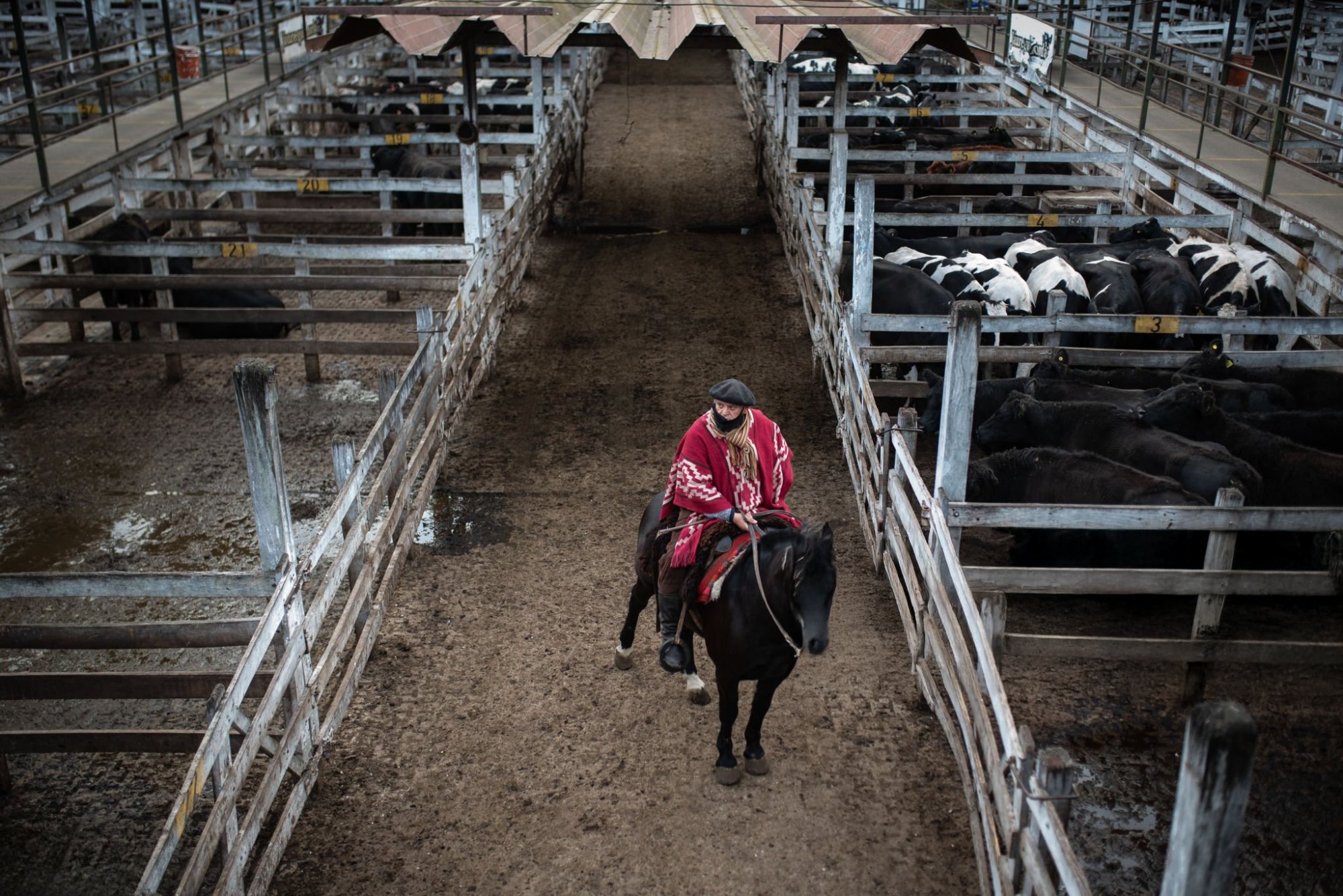
NewsSubscribe
First
Last
Consent

France Lost €20 Million ‘Saving’ on Vaccines – Here’s the $2,500 Plan That Protects Your Operation

France’s overnight export ban is a stark warning for North American producers: Your business continuity plan is now your most valuable asset

EXECUTIVE SUMMARY: What farmers are discovering from France’s lumpy skin disease response is that government cost-cutting on disease prevention can instantly become producers’ financial catastrophe. When France chose to vaccinate just 1.2% of their 17-18 million cattle instead of pursuing the €75-100 million comprehensive approach that eliminated LSD in the Balkans, they saved upfront costs—but Irish cattle exporters absorbed €1.85-2.14 million in losses when France implemented an overnight export ban on October 18. Recent EFSA research confirms that achieving disease elimination requires 90% vaccination coverage maintained for 2-3 years, yet France’s limited approach left them vulnerable to outbreaks 500 kilometers from initial containment zones. With EU beef production at its lowest since 2014 and Mercosur imports hitting 15-year highs, disease management decisions are reshaping competitive positions across global markets. For North American producers who remember the 2003 BSE crisis that shut down $2 billion in exports from one cow, France’s situation offers a crucial lesson: building your own $2,500-per-farm biosecurity framework beats waiting for government protection when the next disease hits. The smartest operations aren’t hoping for comprehensive government response anymore—they’re investing in documented disease-free status, alternative shipping routes, and financial cushioning that turns tomorrow’s crisis into today’s competitive advantage.

Dairy Trade Risk

I’ll tell you what’s been coming up at every producer meeting lately: “If France can shut down cattle exports overnight for disease control, what’s stopping our province or state from doing the same thing?”

It’s a fair concern, especially watching what’s happening in Europe right now. The way lumpy skin disease is being handled over there… well, it offers some real lessons for North American dairy operations—particularly around how quickly disease management can turn into trade disruption.

Two Roads Diverged in a European Field

So I’ve been tracking this situation pretty closely, and what’s really interesting is how differently countries tackled the exact same problem.

When the Balkans faced LSD between 2016 and 2018, the European Food Safety Authority documented their responsein detail. Albania, Bulgaria, and North Macedonia spent about €20.9 million combined—they vaccinated over 70% of their national herds with the homologous Neethling vaccine. You know, the type that’s shown better field effectiveness than heterologous options in European trials. And by 2018? Complete elimination. They’re disease-free today with full EU market access… roughly the equivalent of getting your interstate health papers approved permanently.

France, though… they took a different path, and the numbers tell quite a story.

According to EU Commission Decision 2025/1336 from July, French authorities have vaccinated roughly 220,000 cattle so far. Now, Institut de l’Élevage’s census puts France’s national herd at 17 to 18 million head. Quick math here—that’s about 1.2% coverage.

For perspective, that’s like vaccinating all the dairy cows in Dane County, Wisconsin, and calling the entire Midwest protected.

What’s worth noting is that EFSA’s 2019 technical guidance spells out what elimination actually requires: 90% coverage maintained for two to three years with an effective vaccine. The gap between where France is and where they’d need to be… well, it’s like the difference between managing your transition cows and managing your entire milking string.

How a Success Story Turned South

Looking at the World Organisation for Animal Health notifications from this summer forward, you can track exactly how this developed—and it’s quite something.

France detected their first LSD case on June 29 near the Alps. By late August—and Reuters covered this on August 28—things actually looked promising. Vaccination in the restricted zones had brought weekly outbreaks down from 10 in July to just 2. They’d achieved 90% coverage in those immediate 20-kilometer protection zones and 50-kilometer surveillance zones.

But here’s the thing… anyone who’s dealt with bluetongue or anaplasmosis knows the challenge with vector-borne diseases. Those biting midges? They don’t check zone boundaries before crossing.

By mid-October, French Ministry of Agriculture bulletins were reporting new outbreaks in Ain, Jura, and Occitanie. Then came the really concerning ones in Pyrenees-Orientales, just 30 kilometers from the Spanish border.

Spain had already found their first case on October 1 in Girona—their WOAH notification shows immediate culling of 123 cattle. Spanish authorities initially said they’d hold off on mass vaccination unless forced to. Nine outbreaks later, according to Catalonia’s Department of Agriculture, they reversed course completely.

When Economics Drive Health Decisions

For those of us managing operations—whether you’re milking 200 cows in Pennsylvania or running 2,000 head in California’s Central Valley—understanding how governments weigh these decisions matters more than you might think.

Based on EFSA modeling and what the Balkans actually spent, France was looking at two clear options. Scale up the Balkans’ €20.9 million program to France’s much larger herd, and you’re probably talking €75 to 100 million for nationwide vaccination. Or manage localized outbreaks for maybe €5 to 10 million annually.

They went with option two, which seemed reasonable given the initial containment success.

But when those October outbreaks hit near Spain—French surveillance maps show these were over 500 kilometers from the original Alpine cases—they had about 72 hours to make a call.

Expanding vaccination meant securing cold chain logistics for millions of doses. And according to OBP vaccine manufacturer specs, it takes about 21 days post-vaccination for solid immunity to develop. That’s three weeks of vulnerability even if you started immediately.

An export ban though? No direct government expenditure, implements in 18 hours.

Agriculture Minister Annie Genevard announced it October 17. Effective October 18. The Irish Department of Agriculture reported getting their notice Friday afternoon for Saturday morning implementation.

If you’ve ever tried to redirect a milk truck on short notice, you know what that timeline means.

Preparedness ActionWhat Progressive Farms DoWhat Waiting Farms Risk
Documentation StrategyDuplicate records + quarterly disease-free certification from university labsMovement delays while waiting for state clearance during restrictions
Logistics ResilienceThree mapped backup routes to processing plants + quarterly disruption drillsSingle-route dependence = 12 days vs 12 hours to pivot during bans
Vaccination ReadinessBudget $3-5/head for private procurement if disease within 500km radiusRelying on government programs that may take weeks to deploy vaccines
Market PositioningDocument disease-free status now, write into contracts (3-7% premium potential)Missing 3-7% premiums on $17 milk = losing $0.51-$1.19/cwt opportunity
Financial Cushioning15-30 day movement restriction cash reserves + force majeure contract clausesCash flow crisis during unexpected 15-30 day movement restrictions
Cost Per 500-Cow Dairy$2,500 prevention investmentPotential losses: $649-$751 per affected animal (Ireland example)
Historical Loss ComparisonAvoided $2B loss (BSE 2003) and $3.3B loss (Avian Flu 2014-15)Reactive crisis management vs. proactive competitive advantage

Real Farms, Real Losses

What happened to Irish cattle exporters shows exactly how these decisions ripple through actual operations.

Bord Bia’s export statistics show Ireland moves about 325,000 cattle annually. Roughly 56,000 go through France to Spain, another 37,000 to Italy. We’re talking 1,800 head weekly using French transit routes—that’s equivalent to the annual calf crop from maybe 4,500 dairy cows.

When the ban hit, the Irish Farmers Association estimates about 2,850 head were either rolling down French highways, sitting at lairage facilities, or loaded on trucks ready to go.

France’s October 18 regulatory notice said Irish cattle could keep transiting—but only if they avoided protection or surveillance zones.

Sounds workable until you remember EU Regulation 1/2005 on animal transport. The law requires rest stops—every 14 hours for adult cattle, 9 hours for unweaned calves. You can’t legally drive straight through France. And those surveillance zones? They kept expanding daily, like watching a thunderstorm cell grow on radar.

The Irish Department of Agriculture’s October 17 update laid out some brutal choices. Find facilities outside surveillance zones with zero notice—good luck with that. Or turn around and head home.

Teagasc economic analysis put holding costs at €2 to 5 per head daily. Add transport costs both ways. Contract penalties for missed deliveries. And here’s the kicker—Swiss Re’s livestock insurance framework generally doesn’t cover third-party government transit bans.

The Irish Farmers Association’s preliminary calculations? Their members absorbed between €1.85 and 2.14 million in losses during that 15-day period. That’s roughly equivalent to three months of electricity costs for 500 Wisconsin freestall barns… just evaporated.

Three Approaches, Three Outcomes


Metric
Balkans StrategyTurkey StrategyFrance Strategy
Coverage70%+93%1.2%
Investment€20.9M total€504M total€5-10M
Duration2 years12+ yearsOngoing
Disease Status✓ DISEASE-FREE✗ ENDEMIC✗ OUTBREAKS
Market AccessFully RestoredRestrictedExport Ban
Outcome✓ ELIMINATED✗ Still Fighting✗ Failed

Looking at how different countries handled the same disease really puts things in perspective:

The Balkans: Invested €20.9 million total, achieved over 70% herd coverage, took two years, got complete elimination. Today they’ve got disease-free status and full market access. Regional authorities and market analysts have cited this as a strong return on investment—and it’s hard to argue with that.

Turkey: According to their Ministry of Agriculture reports, they’ve been fighting LSD since 2013. A 2021 study in BMC Veterinary Research documented they vaccinated 14 million cattle in 2018 alone—93% coverage. At about €3 per dose based on EU procurement data, that’s roughly €42 million annually just for vaccines. Still dealing with endemic disease twelve years later.

France: Started with €5 to 10 million for localized containment based on their 350,000-cattle target reported to the EU. When containment faced challenges, implemented an export ban that didn’t cost the government directly but shifted significant costs to trading partners.

You see the pattern developing?

The Bigger Picture Nobody’s Talking About

Competitive Erosion in Real Time: EU Beef Production Hits 11-Year Low as Mercosur Imports Surge to Record Highs. While France debates disease management costs, Brazilian producers with 15-20% cost advantages and zero endemic disease expenses are capturing market share—making disease-free status not just a health issue, but a competitive imperative worth every vaccination dollar.

What makes this particularly relevant is what’s happening with global beef markets right now—and remember, this affects dairy operations too, especially with beef-on-dairy programs becoming standard practice. Plus, those of us shipping genetics internationally know how quickly disease status can shut down semen and embryo exports.

The EU Short-Term Agricultural Outlook from October 2025 shows EU beef production at 6.7 million tonnes—lowest since 2014. Projections suggest another 450,000-tonne drop by 2035. The breeding herd’s expected to shrink by 2.9 million head.

That’s like losing all the dairy cows in Wisconsin, Minnesota, and Michigan combined.

Meanwhile, European Commission trade statistics show Mercosur beef imports hit 79,211 tonnes in the first half of 2025—a 15-year high. OECD data indicates Brazilian production costs run 15 to 20% below European averages. No endemic disease management expenses. No surveillance zones. Just competitive beef flowing into EU markets.

The timing of France’s export ban coinciding with these market shifts… well, it’s worth considering how disease management decisions might influence longer-term competitive positions.

Remember what happened to our dairy exports when Mexico started developing their own production? Similar dynamics might be at play here.

Understanding the French Challenge

Now, to be fair—and this really does matter—French authorities faced genuine complexity here.

ANSES, their national animal health agency, has published extensive research on what nationwide vaccination entails. We’re talking cold chain for millions of doses, mobilizing thousands of veterinarians, coordinating farm-by-farm across diverse operations from Alpine pastures to intensive Brittany units.

It’s like trying to pregnancy-check every cow in Texas in three months.

The Balkans had smaller herds to work with. Bulgaria maintains about 550,000 cattle—roughly what you’d find in all of South Dakota. North Macedonia has around 240,000—less than a single California county. France’s 17 to 18 million? That’s a completely different scale of challenge.

North American Parallels Worth Remembering

What France is dealing with reminds me of how we handled disease outbreaks here. The 2003 BSE case instantly shut down $2 billion in beef exports—one cow in Washington state changed everything overnight. International genetics companies couldn’t ship semen or embryos for months. Then there was the 2014-2015 highly pathogenic avian influenza outbreak. State-by-state response rather than national coordination. Some states implemented aggressive containment, others waited. The result? $3.3 billion in economic losses and trade disruptions that lasted years.

The difference is, we learned from those experiences. Most states now have pre-positioned response plans, cross-state agreements, and producer compensation frameworks. France is learning those lessons in real-time.

Practical Takeaways for North American Dairies

The Mathematics of Preparedness: $2,500 Buys $102,000 in Annual Premium Value—or 41x ROI. With Ireland’s export crisis showing €700 losses per affected animal against €4 vaccination costs (181:1 ratio), and North American history proving that reactive crisis management cost $5.3 billion across BSE and avian flu outbreaks, the calculus is clear: disease preparedness isn’t an expense—it’s the highest-returning investment in modern dairy

Based on what we’re seeing in Europe—plus discussions I’ve had with extension folks from Cornell to UC Davis—here’s what progressive operations are implementing:

Documentation Strategy
Many producers are keeping duplicate health records now—official ones for regulatory compliance, private ones for business continuity. When Wisconsin briefly restricted interstate movement during the 2015 avian flu outbreak, dairies with independent lab verification kept shipping milk while others waited for state clearance.

University diagnostic labs offer quarterly disease-free certification—usually runs $300-500 based on extension service estimates. During movement restrictions, that paper becomes gold.

Logistics Resilience
The Irish experience hammers home why single-route dependence is risky. Yes, backup routes might cost 15 to 20% more in normal times. But when your primary route shuts down? That premium looks like insurance.

I know of several Midwest cooperatives that are now mapping three alternative routes to processing plants. There’s a group in Illinois that runs quarterly “disruption drills”—actually shipping milk via backup routes just to keep them viable.

Vaccination Readiness
Most extension veterinarians suggest that if disease appears within 500 kilometers—about the distance from Pittsburgh to Detroit—don’t wait for government programs. Budget $3 to 5 per head for private procurement based on current market rates.

For a 500-cow dairy, we’re talking maybe $2,500 in prevention. Compare that to losing milk premiums or facing movement restrictions. University animal health programs can often help source vaccines when commercial channels get overwhelmed.

Market Positioning
Start documenting your herd’s disease-free status now, before it matters. Several producer groups are writing this into contracts already. When neighboring states or provinces face disease challenges, processors pay for supply security.

2023 Preventive Veterinary Medicine study documented international premiums of 3 to 7% for verified disease-free sources. On $17 milk, that’s serious money. And for those selling genetics? Disease-free status can mean the difference between shipping internationally or not.

Network Building
The California Dairy Quality Assurance Program has been working with Nevada and Arizona on disease response frameworks. They’re sharing testing protocols, establishing communication trees, even pre-negotiating cost-sharing formulas.

Why wait for crisis to build these relationships?

Financial Cushioning
Farm Credit Services generally recommends planning for 15 to 30-day movement restrictions in your cash flow. That means credit lines for operating expenses, forward contracts with force majeure clauses, maybe even export credit insurance if you’re shipping internationally.

Usually costs 2 to 3% of revenue based on industry averages. Think of it like your liability insurance—hope you never need it, glad it’s there when you do.

What This Means for Tomorrow Morning

The European LSD situation shows how governments balance competing priorities during disease outbreaks. Public health, fiscal responsibility, political considerations—they all factor in. Understanding these dynamics helps us prepare better.

Disease-free status is increasingly functioning like other quality premiums in our markets. Just as processors pay more for low SCC milk or high components, they’re starting to differentiate based on disease risk. Smart operations aren’t waiting for government protection—they’re building their own resilience.

Sometimes the more expensive solution upfront—like the Balkans’ €20.9 million investment—proves most economical over time. Turkey’s twelve years of endemic disease management shows what happens when you try to save money on the front end. France is potentially heading down that same road.

For North American dairy producers, the lesson is clear: build your biosecurity and business continuity plans assuming minimal government support during crisis. Document everything. Diversify your routes. Maintain financial flexibility.

Most importantly, recognize that in modern agriculture, disease management and market access are inseparable.

The question isn’t whether similar situations will hit North America. Remember, we’ve been there before with BSE and avian flu. It’s whether your operation will be ready when the next one comes.

KEY TAKEAWAYS

  • Implement dual documentation systems now: Progressive Midwest operations report that maintaining both official compliance records and private business continuity documentation—plus quarterly disease-free certification from university labs ($300-500)—kept milk flowing during the 2015 avian flu movement restrictions while neighbors waited weeks for state clearance
  • Build your three-route logistics plan: Irish exporters lost €2 million when single-route dependence through France collapsed overnight, but cooperatives with pre-mapped alternatives pivoted in 12 hours versus 12 days—yes, backup routes cost 15-20% more normally, but that premium becomes insurance when surveillance zones expand
  • Budget $3-5 per head for private vaccination readiness: Extension veterinarians from Cornell to UC Davis recommend not waiting for government programs if disease appears within 500 kilometers (Pittsburgh to Detroit distance)—for a 500-cow dairy, that’s $2,500 in prevention versus potential loss of milk premiums and movement restrictions
  • Capture the 3-7% disease-free premium starting today: A 2023 Preventive Veterinary Medicine study documented these premiums in international markets, and several producer groups are already writing disease-free status into contracts—on $17 milk, that differential pays for your entire biosecurity investment
  • Establish interstate/interprovincial agreements before crisis hits: The California Dairy Quality Assurance Program’s pre-negotiated frameworks with Nevada and Arizona for testing protocols, communication trees, and cost-sharing mean they’re ready while France is still learning what the Balkans proved—spending €20.9 million on elimination beats Turkey’s 12 years of endemic management at €42 million annually

Learn More:

The 90-Day Dairy Pivot: Converting Beef Windfalls into Next Year’s Survival

Cull cows over $2,000 and beef-on-dairy calves near $1,000—why this 90-day window could make or break your 2026 margins

EXECUTIVE SUMMARY: Fall 2025 delivers an uncommon—and urgent—opportunity for U.S. dairy operators. Strong cull and beef-on-dairy calf prices, reported at $2,000+ and near $1,000 respectively, are keeping many herds afloat amid relentlessly flat $17 milk. University and market economists warn these beef premiums look fleeting, with the cattle cycle and supply signals already tightening for 2026. Recent research shows Midwestern breakevens remain high, while only producers invested in butterfat performance and rigorous herd management capture true component bonuses. Meanwhile, export hopes are dimming—contract premiums are now won on genetics, traceability, and relentless cost control. As lenders prepare for summer’s critical cattle inventory and cash flow reviews, operations with intentional plans—whether expanding, pivoting, or winding down—consistently protect more equity. The next three months are a “use it or lose it” window for turning fleeting beef revenue into sustainable resilience. What farmers are discovering is that asking hard questions, running fresh numbers, and pushing for proactivity can make 2026 a year of opportunity—not regret.

Dairy Market Pivot

Checking in with producers this fall, there’s one urgent takeaway: this is a critical 90-day window to turn temporary beef premiums into lasting resilience for 2026. The evidence is in the numbers—cull cows clearing $2,000 and beef-on-dairy calves pushing $1,000 (USDA National Weekly Direct Cow and Bull Report, October 2025). These premiums are propping up many milk checks stuck at $17. However, as extension economists and market analysts from the University of Wisconsin and Cornell emphasize, these conditions are shifting. We’re staring down the last weeks of this run before cattle cycles and supply buildup set a new tone for the coming year.

What’s interesting here is seeing smart operators use this moment to shore up their businesses—paying down debt, making pro-active facility investments, and building a cash buffer instead of assuming current premiums will last. This development suggests that treating a tailwind as flexibility—not false security—creates real strategic advantage for the next transition period.

The crisis in black and white: milk checks stuck at $17 while breakevens demand $17.50-$18.50, but cull cows and beef calves are throwing off unprecedented cash—turning cattle into the lifeline keeping farms afloat.

The Math of Survival: Breakevens & Components

Revenue Source2024 BaselineFall 2025Per Cow Impact100-Cow Herd
Cull Cows (15% rate)$1,500/head$2,000+/head+$75+$7,500
Beef-Dairy Calves (40% births)$600/head$1,000/head+$160+$16,000
Component Bonus (3.7%+ protein)Base milk+$1.25/cwt+$31/yr+$3,100
TOTAL OPPORTUNITYStack strategies+$266/cow+$26,600
🚨 Baseline (No Action)Wait for recoveryMiss window-$50 to -$150-$5K to -$15K

Looking at this trend, most Midwest herds face pre-beef breakevens between $17.50 and $18.50/cwt (UW Center for Dairy Profitability, Fall 2025 Update). Out west, Idaho’s and Texas’s biggest dry lot systems sometimes run at $14–$15/cwt, riding local feed and labor edge. Either way, high butterfat performance is the separating factor. Hitting 3.7% protein or better can mean $1–$1.50/cwt over base—if you’ve invested in genetics, tight fresh cow management, and keep transition periods on track. As many of us have seen, those premiums aren’t accidental; they follow from tough culling decisions and knowing your numbers cold.

That $1-$1.50/cwt component bonus isn’t optional anymore—it’s the difference between red ink and breaking even, between selling out and surviving another season with $17 milk

Export Hopes, Local Contracts

For years, many of us held out hope that another export surge would save the day—especially from China. But this season’s USDA GAIN trade data and Rabobank’s Dairy Quarterly all show it’s growth in cheese and butter, mostly cornered by New Zealand and Europe, that’s outpacing demand for U.S. powder. In the Midwest and Northeast, plants are hungry for consistent, high-component, specialty contracts. Herds that made early investments in A2, organic, or niche certifications find their milk in demand; others should ask whether fluid or low-component contracts will provide enough margin as the cycle shifts.

July Inventory—Lender Stress & Planning Leverage

It’s no surprise to seasoned managers that the USDA July Cattle Inventory Report is more than an annual headcount. When beef prices soften and heifer retention ticks up, lenders across regions—like those briefed by Minnesota Extension and New York FarmNet—run tougher stress tests on farm finances. Farms sitting right at a 1.25x debt service coverage are fine for now, but that can slip fast. Those who restructure or plot a sale while balance sheets are still strong tend to carve out six-figure equity advantages compared to late, forced exits. The lesson, as risk educators preach, is that deliberate action always beats hoping for a bounce.

Three Lanes: Exit, Pivot, or Scale

From kitchen tables in northeast Iowa to group calls with Western Idaho co-ops, three paths are front and center:

  • Exit with Intention: Producers looking at high debt or retirement are using strong asset values to secure their family legacies, not just chasing another cycle.
  • Premium Niche Pivot: Some are cutting herd size, chasing premium contracts—A2, grassfed, organic, you name it—with a willingness to meet tough specs on components, health, and traceability. This approach works best when paired with deep processor relationships and quick financial routines.
  • Expansion: A Tool for the Prepared: Rabobank’s 2025 sector review and extension management profiles agree: disciplined, high-performing herds with fresh cow and labor management dialed in can scale with confidence. For others, fast growth just means fast exposure if things don’t break right.

The north star here? Monthly cost-of-production benchmarking, regular review with lenders, and not waiting to renegotiate contracts until margins are squeezed.

Global Competition & Policy Realities

U.S. Midwest producers face a brutal 20-45% cost disadvantage against New Zealand and Argentina—at $0.39/lb versus $0.27-$0.32, every efficiency gain and premium matters when you’re starting in the hole.

It’s worth noting that IFCN’s 2025 benchmarks put leading New Zealand and Argentina herds at $0.27–$0.32/lb. Even top Western U.S. performers run about $0.35, with most Midwest herds closer to $0.39. The gap isn’t destiny: it reflects differences in feed-to-milk efficiency, heifer survival, and transition consistency. Policy backstops like DMC are valuable, and analysis from Cornell and Wisconsin Extension reinforce this: they help good operators stay afloat but aren’t enough to shore up chronic losses over time.

The Myth of the “Deal of the Century”

As expansion talk returns, recent Rabobank analysis and local case studies ring a familiar bell: the “deal of the century” works out for operations already strong on the basics—cost, herd health, labor discipline. Ramped-up purchases without this foundation rarely yield the hoped-for returns and often accelerate operational headaches.

Action Steps: Navigating the 90-Day Window

Here’s the practical bottom line: This window is closing, not expanding. First, benchmark your cost of production with the latest IFCN and extension tools; don’t trust last year’s averages. Next, proactively arrange a review session with your banker—not to plead for relief, but to present your plan for surviving and thriving into next year. Scrutinize your processor or coop contracts and specialty program agreements—will you be the supplier they prioritize in a shrinking market? And take the time this fall to address transition and herd health; waiting until calving issues flare won’t do.

The difference for 2026 will be made by those who act intentionally and aren’t afraid to adjust their course. That’s the mindset that’s kept American dairies resilient through every market twist—and it’s how the smartest operators I know are reading this moment.

KEY TAKEAWAYS

  • Farms leveraging this fall’s beef premiums could improve net margins by $100 to $200 per cow, while disciplined herd and transition management opens $1–$1.50/cwt in component bonuses (UW Extension, IFCN, Rabobank).
  • Practical action: Benchmark your cost of production now, meet proactively with lenders to review true breakevens, and secure or re-align premium contracts for 2026 before markets tighten.
  • Butterfat, protein, and health discipline now outperform volume; herds that master transition periods and component payouts lead in uncertain markets.
  • The window for turning “luck” into a long-term strategy is closing. Lenders, markets, and export buyers all point to greater volatility ahead for operations not dialed on costs or value.
  • Across Wisconsin, Idaho, and the Northeast, the most resilient producers are those who build trusted advisor relationships and plan ahead—regardless of herd size or business model.

Complete references and supporting documentation are available upon request by contacting the editorial team at editor@thebullvine.com.

Learn More:

The Sunday Read Dairy Professionals Don’t Skip.

Every week, thousands of producers, breeders, and industry insiders open Bullvine Weekly for genetics insights, market shifts, and profit strategies they won’t find anywhere else. One email. Five minutes. Smarter decisions all week.

NewsSubscribe
First
Last
Consent

Why 150 Well-Managed Cows Beat 500 Poorly-Run Ones – By $100,000

Cornell study shows 150-cow dairies outearning 500-cow operations by $100K. The secret? It’s not what you think.

Cornell data reveals a $100,000 performance gap that has nothing to do with size. Here’s the 3-phase plan to capture it.

You know that feeling when you’re driving past one of those massive new dairy facilities? All that shiny equipment, those huge freestall barns stretching as far as you can see… makes you wonder sometimes about where smaller operations fit in all this, doesn’t it?

But here’s what’s really fascinating—and Cornell’s 2023 Dairy Farm Business Summary has been documenting this for years now—the profit differences between well-run and poorly-run farms of the same size are actually bigger than the differences between small and large operations.

“The profit differences between well-run and poorly-run farms of the same size are actually bigger than the differences between small and large operations.”

Think about that for a minute. We spend so much time worrying about scale, but what Cornell’s latest benchmarking data shows is that a really well-managed 150-cow dairy in the top quartile can generate significantly better returns per cow than a 500-cow operation that’s struggling with management. Same milk prices, same basic input costs, completely different bottom lines.

The numbers really spell it out. Top performers were hitting around $17.39 per hundredweight in operating costs. Bottom performers? They were running $21.71. On a 150-cow herd producing 24,000 pounds per cow annually… well, you can do the math. That’s over $100,000 difference we’re talking about. And that has nothing to do with how many cows you’re milking.

The $100,000 Management Gap: Top-performing 150-cow dairies achieve operating costs of $17.39/cwt versus $21.71/cwt for bottom performers—proving management beats scale every time. Same herd size. Same milk prices. Completely different bottom lines.

YOUR 3-PHASE ROADMAP TO SMALL DAIRY SUCCESS

Phase 1: Fix Your Foundation (Years 0-2)

  • Achieve operating costs below $18/cwt
  • Build working capital to 40% of expenses
  • Get labor efficiency above 50 cows/worker
  • Annual improvement potential: $50,000-100,000

Phase 2: Capture Easy Wins (Years 2-4)

  • Component optimization: $20,000-30,000/year
  • Quality premiums (SCC): $15,000-25,000/year
  • Beef-on-dairy genetics if appropriate
  • Total annual value: $35,000-65,000

Phase 3: Strategic Transformation (Years 4-7)

  • Organic certification: $165,000-470,000/year potential
  • Direct sales infrastructure: Variable returns
  • Major technology adoption
  • Choose ONE major transformation at a time

Critical Success Factor: Never skip phases. Foundation must be solid before pursuing transformation.

Small Dairy Farm Management: The Real Story Behind Consolidation

Dairy farm consolidation from 2017-2024 shows 15,221 operations closing—but with 40-45% of farmers lacking successors and average age at 58, this reflects retirement demographics, not management failure

Looking at the USDA National Agricultural Statistics Service data, it’s stark. We’ve gone from 39,303 dairy operations in 2017 down to 24,082 in 2024. That’s… that’s a lot of farms gone.

But when you actually dig into who’s leaving—and the 2022 Census of Agriculture really shows this clearly—the average dairy farmer is now 58 years old. Somewhere between 40 and 45% don’t have anybody lined up to take over.

“That’s not business failure, is it? That’s retirement.”

I was talking to a producer near me last week who’s selling out next spring. He’s 64, his back’s giving him trouble, and his kids have established careers elsewhere. He actually had a pretty good year financially. But when you can barely get out of bed some mornings and your daughter’s doing well as a nurse practitioner with actual weekends off… the decision kind of makes itself.

There’s also the land value situation to consider. Out in California’s Central Valley, I heard about a 300-cow operation sitting on 40 acres near Modesto. With water costs skyrocketing and developers offering several million for the land… can you really blame them for taking it? Same thing’s happening in Pennsylvania, upstate New York, anywhere near growing communities.

What’s encouraging for those planning to stay is seeing how different successful models are emerging. Vermont’s Agency of Agriculture organic sector data show that smaller organic operations, typically 100 to 200 cows, are achieving solid profitability. Meanwhile, USDA Economic Research Service research indicates conventional operations generally need much larger scale—often over 2,000 cows—to hit similar per-cow returns.

So it’s not that small, can’t work. It’s so that small has to work differently.

The $100,000 Management Difference: Where Excellence Shows Up

When you look at benchmarking data from Cornell Pro-DairyWisconsin’s Center for Dairy Profitability, and Minnesota’s FINBIN system—the pattern’s consistent. Top-performing farms are running operating costs in that $17-18 per hundredweight range. Bottom performers? They’re up at $21-22, sometimes higher.

That $4-5 difference per hundredweight—on a 150-cow operation, we’re talking serious money that has nothing to do with scale.

Labor Efficiency Makes or Breaks You

The Hidden $75,000: Labor efficiency creates a massive competitive advantage—top-performing dairies achieve 50+ cows per worker versus 35-40 for struggling operations. The gap compounds through better parlor workflows, reduced wage costs, and operational flexibility. No capital investment required.

The benchmarking programs consistently show top operations getting 50-plus cows per full-time worker. Struggling farms? They’re down around 35-40.

I know a farm in Pennsylvania—150 cows, really efficient setup, running with 2.5 people total. Another operation nearby, same size, needs 4.5 people. At today’s wage rates… finding good help isn’t getting cheaper, as we all know… that difference alone can save or cost you $75,000 annually.

“We restructured our workflows last year,” one producer told me recently. “Went from 4.5 people down to 3 just by fixing bottlenecks in our parlor routine. Saved us $75,000 annually.”

Feed Efficiency: Not What You’d Expect

Here’s what’s interesting about feed costs. Looking at various state data, top farms aren’t necessarily spending less on feed per hundredweight. Often it’s about the same—around $9.60. But their income over feed cost? Way higher.

They’re not feeding cheaper. They’re feeding smarter. Better forage quality from optimal harvest timing. More precise ration formulation based on actual testing instead of guesswork. Walking those bunks twice daily, making adjustments based on what you see. Keeping waters clean, stalls comfortable, catching that fresh cow that’s a little off before she crashes.

It’s consistency. Every single day. Even when you’re tired.

Robotic Milking Economics: The Truth Nobody Wants to Hear

Let’s have an honest conversation about robots. Everyone’s got an opinion—they’re either the future or a complete waste. Truth is somewhere in the middle.

Wisconsin Extension and Minnesota Extension have done thorough economic analyses. For a 200-cow operation, you’re looking at close to a million dollars all in. The robots themselves run $250,000 to $300,000 each; you need about three for 200 cows, plus barn modifications, software, training… it adds up fast.

Annual operating costs? Figure $40,000 to $60,000 between maintenance contracts, parts, and electricity. When you run realistic payback calculations—not the dealer’s sunny projections—you’re often looking at 20-plus years. Sometimes 25 or 30.

Yet farms keep installing them. And many swear by them.

Here’s why: it’s not about immediate payback. Statistics Canada’s latest agricultural census data and university research consistently show farms with automated milking are significantly more likely to have younger family members interested in taking over.

“The financial payback is marginal at best. But my 24-year-old son, who was planning to leave farming? He’s now fully engaged. My daughter, studying ag business, sees a future here. What’s that worth?”

For older farmers—and let’s be honest, we’re not getting any younger—reduced physical demands can mean farming another decade versus selling. One Wisconsin producer was ready to quit at 55 because his knees were shot. Installed robots, now he’s 62 and planning to continue until 70.

Premium Market Access for Small Dairies: Reality Check

StrategyInvestmentTime to ROIAnnual ReturnRisk LevelAccessibility
Component PremiumsMinimalImmediate$20K-$30KLowHigh
Organic Certification$150K-$300K3+ years$165K-$470KHighLimited
Direct Sales$150K-$300K3-5 yearsVariableMed-HighMedium

Everyone talks about capturing premiums like it’s simple. Go organic! Sell direct! Problem solved!

Not quite.

Organic Transition: A Three-Year Marathon

Federal organic standards require three years for land transition. During that entire time, you’re paying organic feed prices—USDA Agricultural Marketing Service reports show 30-50% higher—while receiving conventional milk prices.

Extension studies from Penn State and Cornell suggest you need $150,000 to $300,000 in extra working capital to survive the transition. Even after certification? Organic Valley and Horizon maintain regional quotas. NODPA producer surveys show many new organic farms only receive premium prices on partial production initially.

“It’s a marathon where you’re not sure the finish line exists until you cross it,” as one Vermont producer who completed the transition described it.

Direct Sales Infrastructure: Major Investment Required

Direct sales can work—retail prices obviously exceed farm gate values. But infrastructure costs are substantial.

Meeting health department requirements, installing pasteurization equipment, bottling lines, developing HACCP plans… Penn State Extension and Cornell Small Farms Program estimate $150,000 to $300,000 minimum for compliant facilities.

Building a customer base takes time, too. Most operations report 3-5 years to achieve meaningful volume. “Year one, we sold 50 gallons weekly and questioned our sanity,” a New York producer now moving 30% of production direct told me. “Year five, we’re at 500 gallons and hiring staff.”

Component Premiums: The Accessible Opportunity

Here’s what’s realistic for most operations—component premiums. Major processors are paying real money for high-protein, high-butterfat milk.

Current typical Northeast processor premiums (October 2025):

  • Chobani (Rome, NY): $0.75-$1.25/cwt for 3.3%+ protein
  • DFA: $0.50-$1.00/cwt for consistent 3.25%+ protein
  • Upstate Niagara: $0.40-$0.80/cwt for SCC under 100,000
  • Various cooperatives: $0.30-$1.50/cwt for butterfat over 3.8%

Getting from 3.0% to 3.3% protein through genetics and nutrition management generates $20,000-30,000 annually for a 150-cow herd. That’s achievable for pretty much any operation willing to focus on it.

Why Community Connections Generate Real Returns

I know sponsoring the 4-H livestock auction feels like charity. But the USDA Economic Research Service and Colorado State research documents that local food spending generates 1.8-2.6 times its value in local economic activity.

More directly, those connections pay off unexpectedly. When you need harvest help, and neighbors show up. When you’re expanding and the town supports your zoning request. When you need workers and people recommend their kids.

“Half our township board had either bought beef from us or had kids in 4-H projects we supported,” a Midwest producer told me about his manure storage permit. “That permit sailed through.”

Farms with strong community ties consistently report better employee retention, stronger bank relationships, and higher grant success rates. When regulations change, connected farms get flexibility. Isolated operations get compliance notices.

Your Strategic Path Forward

Looking at successful operations that have really turned things around, there’s a clear pattern.

First, they fix fundamentals. Labor efficiency, operating costs, and working capital. This alone can improve cash flow by tens of thousands annually.

Then they capture accessible wins. Component bonuses, quality premiums, maybe beef-on-dairy genetics. Things requiring minimal capital but adding meaningful revenue.

Only after achieving operational excellence and financial stability do they tackle major transformations—organic transition, direct sales, robotics. By then, they have management skills and a financial cushion to handle it.

The farms that fail? They jump straight to transformation, thinking it’ll save them without fixing underlying problems. Doesn’t work that way.

Making the Tough Exit Decision

Not everyone can make this work long-term. That’s okay.

If you’re consistently unable to cover costs. If you’re approaching retirement without succession. If health is failing and stress is overwhelming…

I’ve seen too many burn through equity trying to save something unsaveable. There’s no shame in selling with equity intact. That’s smart business, not failure.

“At first it felt like giving up,” a respected producer who sold at 62 told me. “Now, doing some consulting, enjoying grandkids—I realize it was my smartest business decision.”

The Bottom Line for Small Dairy Success

The industry is consolidating—24,082 farms now versus 39,303 in 2017. Those numbers are real.

But consolidation doesn’t mean small farms are doomed. What’s happening is sorting. Farms with strategies matching their capabilities thrive. Those competing on the wrong metrics struggle.

Your 150-cow dairy trying to beat a 5,000-cow operation on commodity cost per hundredweight? That’s like your local hardware store trying to beat Home Depot on lumber prices. Won’t work.

But competing on quality, flexibility, specialized products, customer relationships, and community connection? Different game entirely. Winnable game. Cornell’s data proves it. Wisconsin’s successful small farms demonstrate it. Vermont’s thriving organic dairies live it daily.

The question isn’t whether small dairies can survive. Plenty are doing better than surviving. The question is whether you’ll play the game that fits your size and situation.

“Good management at any size beats poor management at every size.”

Because ultimately—and this is what all the research confirms—management quality and strategic fit matter far more than scale.

That’s something we can all work on, regardless of herd size. 

Key Takeaways:

  • THE PROFIT TRUTH: Management quality drives a $100,000+ annual profit gap between same-sized dairies—Cornell data proves top 150-cow operations consistently outearn bottom-performing 500-cow dairies
  • THE EFFICIENCY EDGE: Before buying robots, hit these benchmarks: 50+ cows/worker (saves $75K), operating costs under $18/cwt, and 40% working capital reserves—most farms can achieve this without major investment
  • THE SMART MONEY PATH: Follow this exact sequence or fail: Fix fundamentals first (Year 0-2), capture component premiums second ($20-30K/year), only then pursue transformation (organic/robots/direct sales)
  • THE PREMIUM REALITY: Component premiums pay faster than going organic: Getting to 3.3% protein adds $20-30K annually with minimal investment vs. a 3-year organic transition requiring $150-300K working capital
  • THE COMMUNITY ROI: Your 4-H sponsorship isn’t charity—it’s strategy: Farms with strong community connections report 3.8-year employee retention (vs. 11-month average) and 23% lower borrowing costs

Executive Summary:

Cornell’s 2023 data definitively proves what progressive dairy farmers have long suspected: management excellence beats scale every time, with well-run 150-cow operations outearning poorly-managed 500-cow dairies by over $100,000 annually. The critical difference lies not in technology or size but in achieving operational benchmarks—top performers hit $17.39/cwt operating costs and 50+ cows per worker, while bottom quartile farms struggle at $21.71/cwt and 35-40 cows per worker. This comprehensive analysis reveals a proven three-phase strategy where successful small dairies first fix fundamentals (saving $50-100K), then capture accessible premiums like component bonuses ($20-30K), before attempting any transformation, such as organic transition or robotics. While the industry has consolidated from 39,303 to 24,082 farms since 2017, this largely reflects the reality that 40-45% of aging farmers lack successors, not the failure of small-scale dairy economics. The path forward is clear: compete on management quality, specialized products, and community relationships—not commodity volume. For the 150-cow dairy willing to execute this strategy, the opportunity hasn’t just survived consolidation; it’s actually grown stronger.

Complete references and supporting documentation are available upon request by contacting the editorial team at editor@thebullvine.com.

Learn More:

The Sunday Read Dairy Professionals Don’t Skip.

Every week, thousands of producers, breeders, and industry insiders open Bullvine Weekly for genetics insights, market shifts, and profit strategies they won’t find anywhere else. One email. Five minutes. Smarter decisions all week.
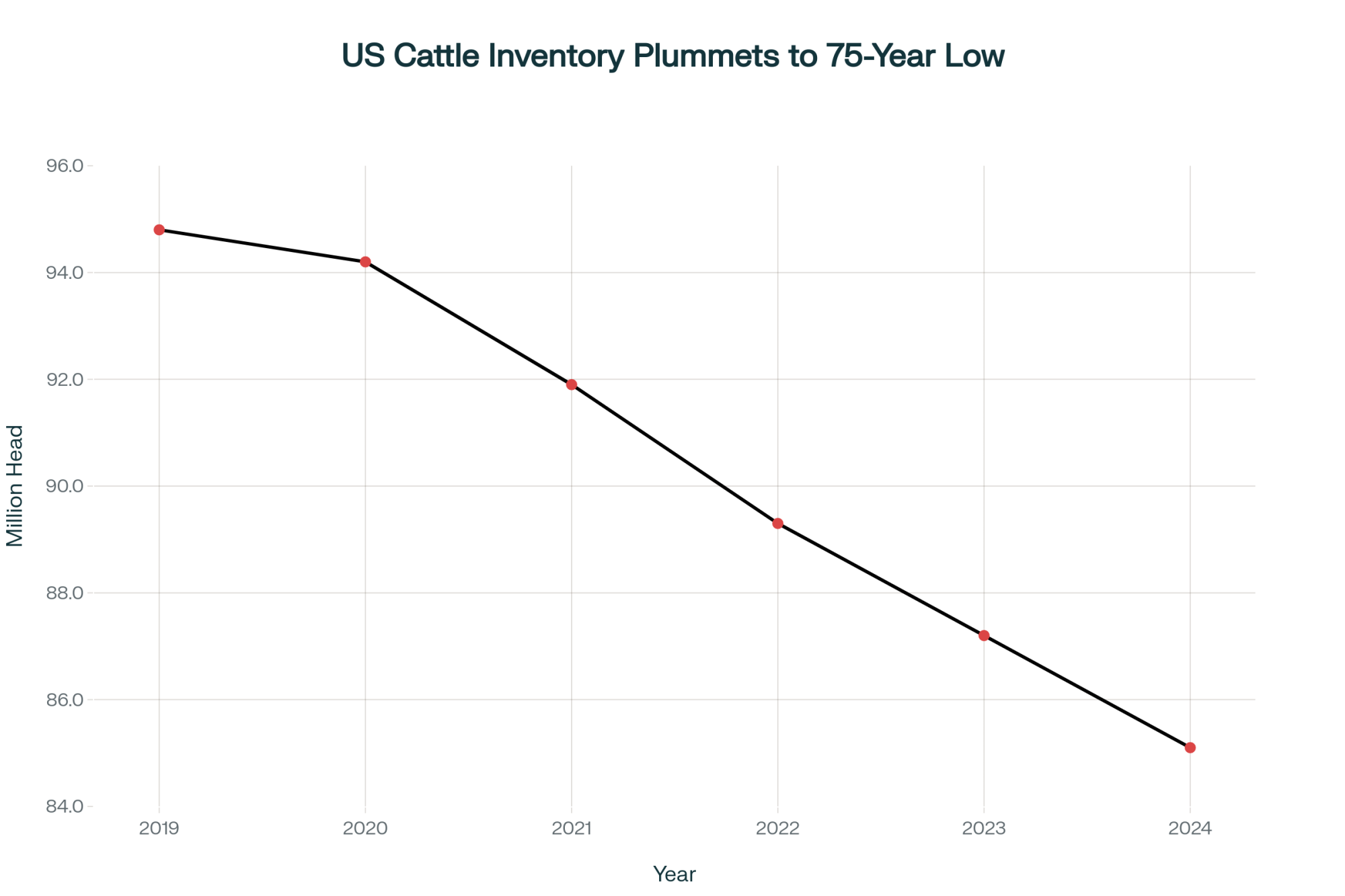
NewsSubscribe
First
Last
Consent

Wisconsin’s $98,000 Wake-Up Call: Why Your Bulk Tank Tests Are Missing What’s Already Here

If 20,000 clean tests can’t stop what’s coming in 60 days, what exactly are we measuring?

EXECUTIVE SUMMARY: What farmers are discovering through Wisconsin’s H5N1 situation is that negative bulk tank tests don’t mean what we think they mean—UC Davis documented California farms with 5-10% infection rates persisting up to three weeks before detection thresholds triggered, and with 3.5 million birds just depopulated at Jefferson County’s Daybreak Foods facility, that silent spread window becomes critically important. The financial stakes are sobering: Ohio State Extension calculates $504 per infected cow in direct losses, meaning a 30% infection rate in a 650-cow herd translates to $98,000 in immediate impact, not counting the long-term production losses Cornell’s pathology studies show from mammary tissue damage. Here’s what makes this particularly urgent: epidemiological models from Iowa State and the University of Minnesota suggest a 60-75% probability that several Jefferson County dairy operations already harbor undetected infections, with Wisconsin’s first confirmed dairy case likely occurring between December 2025 and January 2026. The encouraging news is that farms implementing three strategic preparations now—securing 90 days of operating capital, investing $800 in USDA Dairy Herd Status certification, and forming cooperative purchasing groups—position themselves to capture the $2-3/cwt premiums processors are offering for disease-free milk, worth $255,500 annually for a 500-cow operation. With Wisconsin’s strong cooperative traditions and emerging real-time monitoring technologies from UW-Madison, producers who act decisively in the next 60 days can navigate this challenge while maintaining operational control and market access.

Dairy H5N1 strategy

You know, the disconnect between Wisconsin’s “Gold Status” and what’s actually happening 2.1 kilometers from this Palmyra dairy parlor tells you everything about our surveillance blind spots.

That’s what a third-generation producer shared with me last week. His question is resonating throughout Wisconsin’s dairy community: “If we’ve tested 20,000 milk samples with zero detections, why do I feel less secure now than I did six months ago?”

And here’s the thing—his concern makes perfect sense when you understand what’s unfolding at the Daybreak Foods facility just down the road. This September, according to Wisconsin DATCP’s reports, they depopulated 3.5 million laying hens. That’s their second major H5N1 outbreak since 2022. Same facility, same biosecurity protocols, but the implications for neighboring dairy operations? They’ve evolved considerably.

What’s interesting here is how our monthly bulk tank testing for Wisconsin dairy H5N1 surveillance might be capturing only part of the picture. We’re maintaining clean results statewide, sure. But insights from California’s recent dairy experience, combined with emerging environmental research on avian influenza dairy transmission, suggest there’s more to this story than those negative test results tell us.

Note: Some producer names and specific operational details have been modified to protect privacy while accurately representing industry perspectives.

Understanding Surveillance Limitations in Practical Terms

The 2-3 week detection gap means bulk tank testing reveals infections only after 30% of your herd is already compromised—giving producers a critically narrow window to respond

KEY DATA POINTS (check the summary boxes for quick reference):

  • Detection threshold: 10,000 viral copies/mL
  • Typical Wisconsin herd size: 387 cows
  • Pre-detection infection window: 2-3 weeks
  • Herd prevalence needed for detection: ~30%

Let’s talk about what that monthly bulk tank test actually tells you—and maybe more importantly, what it doesn’t.

The CDC and USDA surveillance methodology sets the detection threshold at approximately 10,000 viral copies per milliliter. That’s the level that triggers a positive result. To put that in perspective, it’s like trying to find a teaspoon of salt dissolved in a swimming pool—you need a certain concentration before your test picks it up. Now, if you’re milking around 387 cows—pretty typical for Wisconsin according to the 2022 Census of Agriculture—you’d need roughly one-third of your herd actively shedding high viral levels to reach that threshold.

This builds on what we’ve seen in California. Their Department of Food and Agriculture documented farms with 5-10% infection rates that persisted for two to three weeks before bulk tank concentrations triggered detection. The UC Davis response team’s analysis from September 2024 revealed something sobering: by the time monthly testing identifies a positive, the outbreak has typically been progressing for several weeks already.

Think about the practical implications here. Twenty cows in early-stage infection, each shedding below detection levels? Your bulk tank shows negative. Meanwhile, you might notice subtle production drops that seem attributable to weather changes or that new ration you’re trying. Research published in the Journal of Dairy Science last September demonstrates how the virus can spread through milking equipment during this subclinical phase, allowing for cow-to-cow transmission before anyone is aware of a problem.

Environmental Persistence: An Underappreciated Factor

One of the more sobering developments comes from Iowa State University’s research published in Environmental Science & Technology Letters. They documented H5N1 genetic material in groundwater wells during the 2015 poultry outbreak—and we’re not talking surface water here. Actual groundwater contamination. Three of the twenty wells tested positive for influenza markers.

This fundamentally changes how we need to think about environmental risk, particularly in Jefferson County’s context. Southeast Wisconsin’s Crawfish River watershed—you know, the area between Madison and Milwaukee—encompasses 178 square miles according to Wisconsin DNR watershed data. Daybreak’s Palmyra facility sits right within this drainage system. So when composting operations handle 3.5 million infected birds during October’s typical rainfall patterns… well, the runoff implications become pretty significant for any Wisconsin dairy H5N1 exposure zones.

I spoke with a producer near Johnson Creek who’s taken proactive measures. He’s invested about $3,000 in UV water treatment for his pond system. Not because anyone’s requiring it, but because that water eventually connects to the Crawfish River system. His reasoning was straightforward: preventive investment versus potential losses.

Ohio State Extension’s economic analysis from June suggests approximately $504 per infected cow in direct losses. For a 650-cow operation? Even 30% infection rates could mean $98,000 in immediate impact. And that doesn’t account for the long-term production losses that Cornell’s veterinary pathology studies have documented from mammary tissue damage.

By the time bulk tank tests detect H5N1, a 650-cow operation faces $98,000 in direct losses—and that’s before accounting for long-term production declines Cornell documented from mammary tissue damage.

Market Dynamics and Structural Changes

The industry consolidation we’ve witnessed—Wisconsin lost 39% of dairy farms between 2017 and 2022, according to the USDA’s Census of Agriculture—takes on new dimensions during disease events. Operations exceeding 2,500 cows increased from 714 to 834 nationally during this period, as the USDA Economic Research Service reported this February. It’s an ongoing structural shift that disease events seem to accelerate.

California’s experience really drives this home. When H5N1 affected 75% of their dairy herds last year, the shortage of EU export-eligible milk created significant market disruptions. And here’s what’s particularly relevant for Wisconsin producers dealing with potential avian influenza dairy transmission: it hit Class III and Class IV products the hardest—you know, the cheese and milk powder that dominate our export markets.

Several procurement managers at major cooperatives told me—speaking on condition of anonymity due to competitive considerations—they’re offering $2-3 per hundredweight premiums to farms with documented disease-free status. Do the math on that. For a 500-cow operation at current production levels? That’s over $255,000 in additional annual revenue.

The processor perspective makes sense when you think about it. European customers require guaranteed disease-free milk for export contracts, especially for those Class III cheese and Class IV powder products. Sourcing from verified operations becomes a market necessity, not a preference. This creates what’s essentially a two-tier system where quarantine zone farms—even ones that never test positive—lose access to premium markets.

What’s worth considering is how this affects different cooperative structures. Some co-ops are exploring risk-pooling arrangements to protect members. Others are moving toward individual farm accountability. Neither approach is inherently right or wrong—they’re different philosophies about collective versus individual risk management in our evolving dairy landscape.

Strategic Positioning Among Progressive Operations

With processors offering $2-3/cwt premiums for disease-free certification, the $800 investment in USDA Dairy Herd Status documentation generates $12,000-$18,000 in annual premium access for a 500-cow operation—a return that dwarfs the initial cost

FINANCIAL PREPAREDNESS CHECKLIST (see summary boxes throughout):

  • Target: 90 days of operating expenses in accessible capital
  • Typical mid-size need: $135,000
  • Credit line setup: Complete before crisis
  • Documentation investment: $800-$1,500
  • Potential annual return: $12,000-$18,000

Looking at farms that successfully navigated California’s outbreak, there’s a consistent preparation pattern worth considering.

A producer near Fort Atkinson recently restructured her operating line—not from immediate need, but for contingency planning. With about 420 cows, she negotiated $150,000 in available credit through her regional bank. As she explained it: “Having accessible capital that sits unused costs virtually nothing. Needing it during a quarantine when approval becomes difficult? That could mean the difference between weathering the crisis and forced liquidation.”

Agricultural economists at UW-Madison’s Center for Dairy Profitability suggest maintaining 90 days of operating expenses in accessible capital. For mid-sized operations, that typically means around $135,000 based on monthly costs averaging $45,000 for feed, labor, utilities, and debt service.

Documentation is equally important. Several producers have enrolled in USDA APHIS’s Dairy Herd Status Program. The investment—about $800 in veterinary documentation time, according to participating veterinarians—provides official disease-free certification. Given the current Class III differentials reported by USDA Agricultural Marketing Service, this certification could generate $12,000-$18,000 annually in premium access if processors implement tiered pricing based on disease status. Not a bad return on $800, if you ask me.

Beyond the certification, you know, there’s also federal disaster assistance to consider. USDA’s Emergency Assistance for Livestock program can provide some support, though it typically covers only partial losses, and payments can lag 60-90 days behind the actual crisis.

Projected Timeline Based on Current Conditions

CRITICAL TIMELINE:

  • Current status: Environmental contamination is active
  • Probability of undetected infections: 60-75% (based on current modeling)
  • First detection window: December 2025 – January 2026
  • Preparation window remaining: 60-90 days

Epidemiologists at the University of Minnesota’s Center for Infectious Disease Research and Policy have modeled probable scenarios based on current viral pressure and migration patterns. Their October report makes for interesting reading.

As of right now, October 2025, Jefferson County faces significant environmental contamination from the Daybreak depopulation. USGS bird banding data confirms fall migration is bringing infected waterfowl through the Mississippi Flyway. Wisconsin’s temperatures are entering that 5-15°C range where USDA Agricultural Research Service studies show optimal viral survival.

Now, while the data is still developing, epidemiological models from Iowa State’s veterinary diagnostic lab suggest—based on current modeling parameters—a 60-75% probability that 3-8 Jefferson County dairy operations may already harbor low-level infections below bulk tank detection thresholds for Wisconsin dairy H5N1. These wouldn’t appear in surveillance until herd prevalence exceeds 20%.

Wisconsin’s Veterinary Diagnostic Laboratory director, along with other regional experts, estimates a 70-80% probability of the state’s first confirmed dairy detection occurring between December 2025 and January 2026. This timing reflects when October-November infections would reach detectable levels, not when initial infections occur.

Spring 2026 migration patterns will likely accelerate geographic spread. UC Davis researchers documented similar patterns in California, with 15-25% of operations in affected regions experiencing infection over 18 months. UW-Madison’s Center for Dairy Profitability models suggest this could affect 300-500 Wisconsin farms, though it’s important to note these are projections based on current understanding.

Regional Variations and Operational Considerations

Wisconsin’s seasonal patterns create unique risk profiles compared to California’s stable year-round conditions. UW-Madison School of Veterinary Medicine research demonstrates viral survival exceeding one month at 4°C. Freezing reduces aerosol transmission, sure, but spring thaw then releases accumulated viral loads precisely when your fresh cows face peak immunological stress during transition periods.

Regional differences matter considerably. Marathon and Clark counties? Lower livestock density but proximity to Mississippi Flyway staging areas. Green County’s cheese production focus and cooperative structure may provide enhanced collective biosecurity resources. Each region needs tailored approaches.

A producer near Marshfield shared an observation that really captures this challenge: “We’re more geographically isolated, but the Mead Wildlife Area brings thousands of migrating waterfowl through each spring. Last year, I counted over 300 geese on my heifer pasture pond in a single morning. Traditional biosecurity can’t address that exposure.”

This highlights something we don’t discuss enough—how wildlife management and dairy production increasingly intersect. Some operations are exploring habitat modification to reduce waterfowl attraction. Others are investing in covered water systems. There’s no perfect solution, but understanding your specific risk factors helps prioritize investments.

I remember talking with a nutritionist who shared how one farm successfully navigated a previous disease challenge—not H5N1, but Johne’s disease—by implementing similar preparedness strategies. They maintained financial reserves, documented their protocols meticulously, and when neighboring farms struggled, they were able to expand through strategic acquisition. The parallels are worth considering.

Scale-Appropriate Response Strategies

INVESTMENT RANGES BY FARM SIZE (reference these summary boxes for your operation):

Small Operations (<200 cows):

  • Covered feed storage: $2,000-$5,000
  • Water chlorination: $500-$1,000/month
  • Group purchasing savings: 20-30%

Mid-Size Operations (200-500 cows):

  • Shared UV systems: $6,000/farm (5-way split)
  • Cooperative vet services: 15-25% discount
  • Total biosecurity budget: $15,000-$30,000

Large Operations (500+ cows):

  • Comprehensive biosecurity: $150,000-$200,000
  • ROI timeline: 18-24 months through premium preservation
  • Acquisition positioning advantage: Significant

Let’s be honest about scale here. Smaller operations under 200 cows face challenging economics. With typical gross revenues of around $1.2 million annually, is it investing $150,000 in comprehensive biosecurity infrastructure? That’s just not feasible given current margins.

But targeted investments can provide meaningful protection. Midwest Plan Service estimates suggest $2,000-$5,000 for covered feed storage to prevent bird contamination. UW Extension research indicates that chlorinating water sources during high-risk periods costs between $500 and $1,000 per month. And you know what’s working well? Several smaller farms are forming purchasing groups to achieve volume discounts on sanitizers and supplies. That’s practical cost management.

Mid-size operations—200-500 cows—they’re in a tough spot. Too large for minimal measures but often lacking capital for major upgrades. A group near Watertown developed an innovative solution, though. Five neighboring farms formed a purchasing cooperative, negotiating bulk pricing on sanitizers, group veterinary consulting rates, and they’re sharing a UV water treatment system that rotates between farms during high-risk periods. Makes $30,000 investments feasible when split five ways.

Larger operations face different calculations entirely. Penn State Extension’s August analysis suggests $150,000-$200,000 biosecurity investments may pay for themselves through premium preservation alone. Several large operators have acknowledged—and this deserves honest discussion without judgment—they’re also considering acquisition opportunities that may arise if smaller neighbors face financial stress. It’s a reality of modern agricultural consolidation.

Community Resilience Through Collective Action

What’s encouraging is the Jefferson County Dairy Producers Association’s new rapid communication network for sharing surveillance results and resources. As President Mike Kemper notes, “Disease doesn’t recognize property boundaries. We can compete in the marketplace while still protecting our collective interests.”

Their bulk purchasing through United Cooperative, coordinated veterinary services with regional practices, and exploration of shared mobile UV treatment units demonstrate practical cooperation. Think about it—a $30,000 mobile unit split among ten farms means $3,000 per operation versus $15,000 for individual units that would sit idle most of the time.

This aligns with documented outcomes from other regions. California Farm Bureau Federation data from September shows 18% consolidation in the competitive Central Valley post-outbreak. Pennsylvania Department of Agriculture reports only 6% consolidation in Lancaster County, despite similar infection rates—likely reflecting stronger cooperative traditions.

The psychological toll deserves acknowledgment as well. Rural mental health professionals working with UW Extension report that monthly surveillance creates ongoing stress. Producers describe heightened vigilance, sometimes seeing symptoms that aren’t present, and losing sleep over factors beyond their control. And you know what? Seeking support during challenging times reflects strength, not weakness.

Insurance and Risk Management Considerations

You know, something that’s emerged from California’s experience—and hasn’t received enough attention—is how disease outbreaks affect insurance coverage. Most standard farm policies exclude losses from government-ordered depopulation or movement restrictions. Some carriers are developing specialized disease coverage, but premiums reflect the risk level.

You really should review your policies now, understanding exactly what is and isn’t covered. Some folks are finding that business interruption insurance may provide partial coverage if properly structured. Others are exploring captive insurance arrangements where groups of farms create their own risk pool. These aren’t simple decisions, but understanding your options before a crisis hits is crucial. That’s crucial.

And don’t forget about USDA’s Emergency Assistance for Livestock program. While it won’t cover everything, it can provide a financial cushion during the worst of it. The key is having all your documentation ready before you need it.

Looking Forward: Emerging Research and Resources

What’s encouraging is the emerging research developments. The University of Wisconsin is launching a real-time environmental monitoring network specifically for agricultural watersheds, with Jefferson County among the pilot sites. This could provide early warning capabilities we currently lack.

Additionally, new rapid on-farm testing technologies are in the final stages of validation. These could allow individual cow testing at costs approaching bulk tank sampling, potentially closing the detection gap we currently face. While not yet commercially available, stay informed about these developments through your veterinary channels.

And here’s what’s also promising: the growing recognition that Wisconsin’s strong cooperative traditions position us better than most regions to navigate these challenges. The combination of shared resources, collective purchasing power, and information networks creates resilience that purely competitive markets can’t match.

The Bottom Line

Wisconsin’s window for strategic positioning is closing. The choice is clear: act on the 60-90 day timeline driven by epidemiological data and California’s documented experience, or react to the market’s timeline when the first positive bulk tank is confirmed in a Jefferson County dairy outbreak.

Your biosecurity overhaul starts with three immediate steps: secure 90 days of operating capital, invest $800 in USDA Dairy Herd Status certification, and join or form a local purchasing cooperative to reduce biosecurity costs by 20-30%. The data shows Wisconsin’s strong cooperative traditions position us better than most regions—but only if we use that advantage decisively in the next 60 days.

Use the resources below to start your plan today.

For biosecurity guidance and USDA Dairy Herd Status Program enrollment, contact your herd veterinarian or visit aphis.usda.gov. Wisconsin DATCP provides current H5N1 updates at datcp.wi.gov. Mental health support for Wisconsin farmers is available through the Farm Center hotline at 1-800-942-2474.

KEY TAKEAWAYS

  • Financial preparedness beats perfect biosecurity: Secure 90 days operating capital (approximately $135,000 for mid-size operations) before crisis limits your options—Wisconsin agricultural lenders confirm accessible credit makes the difference between weathering disruption and forced liquidation at 60-70% valuations.
  • The $800 investment that returns $12,000-$18,000: USDA’s Dairy Herd Status certification provides official disease-free documentation that processors increasingly require for Class III and IV export premiums. One day of veterinary paperwork creates market differentiation when EU contracts require guaranteed clean milk.
  • Scale-smart biosecurity saves 20-30% through cooperation. Small farms, which cover feed storage ($2,000-$5,000) and chlorinate water ($500-$1,000/month), see meaningful protection. In contrast, five-farm cooperatives sharing a $30,000 UV system reduce individual costs to $6,000. Jefferson County producers are already proving this model works.
  • Your location matters more than your size: A 200-cow dairy within 5 kilometers of composting poultry faces a higher risk than a 1,000-cow operation in isolation—map your actual exposure using watershed data and prevailing winds, not arbitrary regulatory boundaries that the virus doesn’t recognize.
  • The 60-day window determines your position: Based on California’s documented 18% consolidation rate and current epidemiological modeling, Wisconsin producers acting before December’s probable first detection maintain strategic options, while those reacting after face whatever terms the market dictates—the difference between consolidator and consolidated.

Complete references and supporting documentation are available upon request by contacting the editorial team at editor@thebullvine.com.

Learn More:

The Sunday Read Dairy Professionals Don’t Skip.

Every week, thousands of producers, breeders, and industry insiders open Bullvine Weekly for genetics insights, market shifts, and profit strategies they won’t find anywhere else. One email. Five minutes. Smarter decisions all week.

NewsSubscribe
First
Last
Consent

Mexico’s Gone, Cheese Hit $1.67, DMC’s Broken – Here’s Your Playbook

When your best customer starts making their own milk, it’s time to rethink everything about your business model

EXECUTIVE SUMMARY: What farmers are discovering right now is that October 2025’s cheese price drop to $1.67 isn’t just another market dip—it’s the canary in the coal mine for structural changes reshaping dairy economics. Mexico’s commitment of 83.76 billion pesos toward dairy self-sufficiency through 2030 effectively removes our largest export customer, who bought $2.47 billion worth of U.S. dairy products last year and absorbed over half our nonfat dry milk exports. Meanwhile, the disconnect between DMC’s calculated $11.66/cwt margin and actual farm economics—where labor costs alone have increased by 30% since 2021, while machinery expenses have risen by 32%—reveals a safety net that no longer accurately reflects operational reality. Recent FMMO data shows protein climbing to 3.38% while butterfat hits 4.36%, creating component pricing opportunities for farms that can quickly adjust rations to capture premiums before the December 1st formula changes. With our national herd at 9.52 million head (the highest in 30 years), producing into weakening demand, and processing plants built on export assumptions that won’t materialize, the next 18 months will determine which operations successfully pivot toward margin management over volume growth. The good news? Producers layering risk management tools, optimizing beef-on-dairy programs, and adding $0.50-0.75/cwt are already demonstrating that adaptation—while challenging—remains entirely achievable, targeting protein-to-fat ratios of 0.80+ and beyond.

Dairy Profitability Strategy

You know that feeling when you check the CME spot market and something just feels… off? That’s what hit most of us Monday when block cheese broke through $1.70 to trade at $1.67 on October 13, 2025. After tracking these markets for years, I’ve learned that when those established price floors start giving way, there’s usually something bigger happening beneath the surface.

Here’s the Bottom Line this week:

  • Mexico’s push toward dairy self-sufficiency is reshaping export dynamics
  • DMC margins no longer reflect true on-farm costs, especially labor and machinery [USDA Farm Labor Survey; U of I]
  • Component pricing has flipped: protein premiums are now outpacing butterfat [FMMO data]

Mexico’s Strategic Shift: What It Really Means for U.S. Producers

Looking at this trend, Mexico bought $2.47 billion of U.S. dairy in 2024—more than Canada and China combined. They’ve taken over half our nonfat dry milk exports and imported 314 million pounds of cheese through September 2025.

In April, President Sheinbaum announced the “Milk Self-Sufficiency Plan,” committing 83.76 billion pesos (~$4.1 billion USD) through 2030 to boost production to 15 billion liters annually and reach 80% self-sufficiency by 2030. They guarantee producers 11.50 pesos per liter while selling at 7.50 pesos—absorb­ing that 4-peso difference, roughly $0.22 USD per liter. What farmers are finding is that policy talk is turning into infrastructure: production ran 3.3% ahead of last year through May 2025.

Mexico’s 83.76 billion peso commitment through 2030 isn’t just policy talk—production already runs 3.3% ahead, and your $2.47 billion customer is building capacity to replace U.S. imports within five years

The DMC Disconnect: When the Safety Net Doesn’t Match Reality

I recently had coffee with a 600-cow producer in central Wisconsin who said, “DMC shows an $11.66 margin, but I’m burning through equity just keeping the lights on”. This disconnect deserves a closer look.

The DMC Disconnect reveals a $9.75/cwt gap between calculated margins and on-farm reality—labor and machinery costs that jumped 30%+ since 2021 don’t factor into the safety net formula

The DMC formula originated when feed costs represented half of all expenses. University budget analyses now show feed often runs only 35–45% of costs—not because feed got cheaper, but because labor and machinery soared. USDA’s Farm Labor Survey documents a 30% increase in wages since 2021. A 500-cow operation can spend $300,000–400,000 annually on labor alone—about $1.50–2.00 per cwt that DMC ignores [USDA Farm Labor Survey].

Equipment costs tell a similar story. University of Illinois data shows machinery expenses jumped 32% from 2021 to 2023 and have continued upward through 2025. A 310-HP tractor at $189.20/hour in 2021 now runs $255.80/hour—financing at 7–8% adds another $0.80–1.00 per cwt [U of I].

“The DMC formula often shows acceptable margins while extension economists note significant divergence from on-farm cash flow when non-feed costs rise.”
—Dr. Mark Stephenson, Director of Dairy Policy Analysis, UW-Madison, Distinguished Service to Wisconsin Agriculture Award [UW News]

Component Pricing: Why Protein’s Suddenly the Star

ScenarioProtein %Butterfat %Protein-to-Fat RatioPremium Before Dec 1Premium After Dec 1Monthly Gain (500 cows)
Current Average U.S.3.384.360.77BaselineBaseline$0
Target Optimized3.454.300.80+$0.25/cwt+$0.38/cwt$1,900
Wisconsin Case Study3.38 (from 3.12)4.280.79+$0.42/cwt+$0.58/cwt$2,900

What’s interesting here is that component pricing has flipped. Butterfat averaged 4.36% through September, up from 3.95% five years ago [FMMO data]. Protein climbed from 3.181% to 3.38% but still lags butterfat gains. Cheesemakers generally target a 0.80 protein-to-fat ratio; U.S. milk sits around 0.77, forcing processors to add nonfat dry milk powder [FMMO data].

The FMMO changes effective December 1—boosting protein factors to 3.3 lbs and other solids to 6.0 lbs per cwt—will amplify premiums for higher-protein milk [USDA AMS]. A Sheboygan herd I spoke with pushed protein from 3.12% to 3.38% in eight weeks through amino acid balancing and bypass protein, adding $0.42 per cwt, roughly $3,200 per month on 450 cows.

Herd Dynamics: When Culling Economics Don’t Make Sense

The August USDA report shows 9.52 million head—the highest in 30 years. Why keep expanding herds when margins are tight? Auction data puts replacement heifers at $3,500–4,000, and CDCB research shows cows average 2.8 lactations before exit. When cows leave before paying back replacements, the usual 35% turnover target collapses [CDCB data].

Despite record $157/cwt cull cow prices in July 2025 [USDA AMS], many producers hold onto older cows because replacing them costs more. Beef-on-dairy adds complexity: cross-bred calves fetch $1,370–1,400 at auction, so breeding for beef income often outweighs dairy replacement logic [Auction reports].

Key Takeaways for Action This Week

  1. Review risk coverage
    – Enroll DMC at $9.50 coverage ($0.15/cwt for first 5 M lbs)
    – Layer in Dairy Revenue Protection at 60–70% quarterly coverage
  2. Optimize components
    – If protein-to-fat <0.77, schedule a nutrition consult
    – December 1 FMMO changes make ratios more lucrative
  3. Assess finances
    – Maintain debt service coverage >1.25
    – Keep working capital >15% of gross revenue
  4. Consider beef-on-dairy
    – At $0.50–0.75/cwt extra revenue, review breeding strategy
  5. Lean on the community
    – Share experiences at coffee shops and meetings

Regional Adaptation: Different Strategies for Different Situations

RegionCurrent ChallengeWinning StrategyPremium OpportunityRisk LevelTimeline
WisconsinMid-size squeeze (500-1,500 cows)Scale to 2,500+ OR pivot to specialty (300-400)Specialty: $8-10/cwtHIGH – Middle vanishingDecide by Q2 2026
Texas/New MexicoScale competition intensifyingMega-scale expansion (10,000+ cows, +20% growth)Efficiency: $0.30-0.50/cwtMEDIUM – Capital intensiveExpand through 2027
SoutheastFluid premiums fadingGrass-fed organic + agritourism pivotOrganic: $12-15/cwtMEDIUM – Market transitionTransition 2025-2026
CaliforniaTwo-tier system emergingCentral Valley scale OR North Coast farmstead cheeseFarmstead: $15-20/cwtHIGH – Two extremesOngoing divergence
Pacific NorthwestCapacity limits + basis discountsRegional cooperative consolidationLimited due to isolationVERY HIGH – Exit risk 2026Some exits planned 2026
NortheastHigh costs vs legacy marketsLocal glass-bottle programs + direct salesDirect sales: $10-12/cwtMEDIUM – Niche viableBuilding programs now

Wisconsin’s mid-size producers face tough choices: scale up to 2,500+ cows for efficiency or shrink to 300–400 and chase specialty markets. That middle ground is disappearing.

Down in Texas and New Mexico, mega-dairies double down on scale. A 10,000-cow manager plans 20% expansion by 2027, betting automation offsets price pressures. “Every penny of efficiency multiplies,” he said.

The Southeast leans on fluid milk premiums, though processors warn they’ll fade. Several Georgia farms are shifting to grass-fed organic, accepting lower volumes for higher margins.

California’s dairy scene splits into two worlds: Central Valley mega-dairies expanding, North Coast farmstead cheesemakers thriving on agritourism and direct sales.

The Pacific Northwest battles capacity limits and isolation. Basis discounts bite, and some producers plan 2026 exits if conditions don’t improve.

The Northeast juggles legacy fluid markets with new ventures like local glass-bottle programs to offset high costs.

Global Competition: Learning from Other Exporters

The EU’s production is essentially flat (+0.15% in 2025), despite a 1% decline in herd size, with raw milk at EUR 53.3/100 kg (28% above the five-year average) [EU Commission]. They’re pivoting to value-added and sustainability premiums.

New Zealand’s Fonterra posted 103% profit growth in Q3 2025 but is divesting consumer brands to focus on B2B ingredients. Their NZ$10.00/kgMS forecast suggests confidence in fundamentals but a shift away from commodity volume.

The U.S. stands out for its $11+ billion capacity build-out on export assumptions now under pressure [IDFA]. Few competitors committed similar investment levels.

Risk Indicators: Recognizing Warning Signs Early

Financial MetricHealthy RangeWarning ZoneCritical RiskWhy It Matters
Debt Service Coverage≥1.251.10-1.24<1.10Cash flow to cover debt payments + cushion
Working Capital≥15% of revenue10-14% of revenue<10% of revenueOperating funds to handle market swings
Variable Rate Debt≤50% of total51-60% of total>60% of totalExposure to rate increases (7-8% currently)
Culling Rate≥30%25-29%<25%Herd turnover and productivity indicator
Somatic Cell Count≤250,000250,000-300,000>300,000Milk quality affects premiums/penalties
Feed Efficiency≥1.4 lbs milk/lb DMI1.3-1.39 lbs/lb<1.3 lbs/lbFeed cost management and profitability

Extension economists highlight key stress markers:

Financial

  • Debt service coverage <1.25
  • Working capital <15% of revenue
  • Variable rate debt >50%

Operational

  • Culling <30%
  • Somatic cell count >250,000
  • Feed efficiency <1.4 lbs milk/lb DMI

Behavioral

  • Withdrawing from the community
  • Deferred maintenance
  • Increased accidents
  • Family health issues

Spotting these early lets you adjust course before crises develop.

Strategic Positioning: What’s Working for Successful Operations

Conversations with top-performers reveal common themes:

  • Layered risk management: DMC + DRP for comprehensive coverage
  • Feed cost hedging: Options on corn/soymeal 6–12 months out protect margins
  • Component focus: Hitting 0.80–0.85 protein-to-fat captures premiums
  • Beef-on-dairy: Crossbred calves add $0.50–0.75/cwt; LRP support starts 2026

Looking Ahead: Probable Scenarios Through 2028

The next 18 months separate survivors from exits—Class III tests mid-$14s through 2027 as the herd contracts by 600,000+ head, then stabilizes at $16-17 once supply finally matches reduced export demand

Based on talks with lenders, processors, and economists:

  • Mid-2026: Zombie phase persists. Credit tightens; bankruptcies climb 55% in some regions [USDA, AFBF, UArk].
  • Late 2026: More plant closures follow Saputo and Upstate Niagara moves, stranding some producers.
  • 2027: Mexico’s self-sufficiency hits export volumes; global production pressures domestic prices; Class III may test mid-$14.
  • 2028: Herd contracts by several hundred thousand head; Class III stabilizes around $16–17; significant exits reshape the industry.

The Human Element: Supporting Each Other

These challenges take a human toll. Farmer suicide rates run 3.5× higher than the general population, and rural rates climbed 46% between 2000 and 2020 [CDC; NRHA]. These aren’t just numbers—they’re neighbors and friends under immense pressure.

Research from land-grant universities identifies several early warning signs, including routine changes, declining animal care, family health issues, and farmstead neglect. Recognizing these patterns lets communities step in before crises deepen. For those struggling, the National Suicide Prevention Lifeline (988) and National Farmer Crisis Line (1 866 327 6701) offer confidential support from counselors who understand farm life.

The Bottom Line

Even now, opportunities exist. Producers pivoting to specialty markets report net incomes rising despite lower volumes. Beef-on-dairy revenue can offset labor cost hikes. Component optimization often pays for its cost within weeks when executed well.

The next 24–36 months will test us like never before, but this is a structural change, not a cyclical downturn. Government programs can’t restore lost export markets or close idle capacity built for vanished demand. Success will go to those who recognize new fundamentals early and adapt strategically: focus on margins over prices, relationships over volume, and long-term sustainability over endless growth.

Coffee-shop conversations may feel quieter these days, but they matter more than ever. Sharing success stories and stumbling blocks—our collective resilience and adaptability—will guide us through to a sustainable, though different, future. 

KEY TAKEAWAYS:

  • Capture immediate protein premiums worth $0.42/cwt by adjusting rations to hit 0.80-0.85 protein-to-fat ratios before December 1st FMMO changes—Wisconsin herds report $3,200 monthly gains on 450 cows through amino acid balancing and bypass protein strategies
  • Layer risk protection starting at $0.15/cwt with DMC at $9.50 coverage for your first 5 million pounds, then add Dairy Revenue Protection at 60-70% quarterly coverage to protect margins as Mexico’s production ramps up and displaces exports
  • Maximize beef-on-dairy revenue, adding $0.50-0.75/cwt to current milk checks—with crossbred calves fetching $1,370-1,400 at auction and Livestock Risk Protection coverage starting in 2026, this strategy offsets rising labor costs that DMC ignores
  • Monitor three critical financial ratios weekly: debt service coverage above 1.25, working capital exceeding 15% of gross revenue, and variable rate debt below 50% of total borrowing—extension economists identify these as early warning indicators before operational stress becomes a crisis
  • Choose your strategic path by Q2 2026: Wisconsin’s mid-size operations show the middle ground between 500-1,500 cows is vanishing—either scale toward 2,500+ head for efficiency, pivot to specialty markets (grass-fed, organic, local) capturing $8-10/cwt premiums, or plan an orderly exit while equity remains

Complete references and supporting documentation are available upon request by contacting the editorial team at editor@thebullvine.com.

Learn More:

The Sunday Read Dairy Professionals Don’t Skip.

Every week, thousands of producers, breeders, and industry insiders open Bullvine Weekly for genetics insights, market shifts, and profit strategies they won’t find anywhere else. One email. Five minutes. Smarter decisions all week.

NewsSubscribe
First
Last
Consent

Building a Beef-on-Dairy System: Capturing $360,000 in Annual Farm Profit

What farmers are discovering: beef-on-dairy breeding jumped from 50K to 3.2M head, boosting calf revenue from 2% to nearly 6% of total farm income

EXECUTIVE SUMMARY: What farmers are discovering is that beef-on-dairy breeding has surged from around 50,000 head in 2014 to over 3.2 million in 2024, driving calf revenue from 2% to nearly 6% of total farm income (NAAB 2024; UW Center 2025). Recent research shows that targeting sires in the top 15% for calving ease and top 20% for marbling can yield $100–$200 more per calf, translating to over $360,000 additional annual profit on a 1,500-cow dairy (Penn State 2024; K-State Extension 2025). This development suggests that building a systematic beef-on-dairy program—complete with rigorous colostrum Brix monitoring and detailed health protocols—will remain profitable even if calf prices normalize to $700 by 2028 (USDA WASDE 2025). Across regions from Pennsylvania to California, securing direct feedlot relationships can command $1,200–$1,250 per calf versus $950 at auction, enhancing cash flow and fresh cow management (UW-Madison 2025). While market cycles will fluctuate, adopting documented genetics evaluation and buyer partnerships today positions farms to thrive through changing conditions. Here’s what this means for your operation: build sustainable systems now to secure lasting profitability.

Beef on Dairy

I recently spoke with a producer outside Dodge City whose operation tells a remarkable story about what’s happening in our industry. Nearly half his total farm revenue—not a supplement to milk income, but half—now comes from selling beef-cross calves. Three years ago, those same bull calves brought maybe $250 on a good day.

The National Association of Animal Breeders documented this transformation in their spring report, showing beef-on-dairy breeding has grown from roughly 50,000 head in 2014 to over 3.2 million today. For those making breeding decisions this week for next spring’s calf crop, understanding what’s really driving this shift has become essential.

The beef-on-dairy revolution in numbers: from backyard experiment to mainstream strategy, jumping from 50,000 head to 3.2 million in just ten years—transforming dairy calf economics forever.

What’s particularly noteworthy is what I’ve observed visiting operations from Pennsylvania to Wisconsin recently. The most successful producers aren’t simply riding today’s high prices. They’re building systems that remain profitable even when—but it’ll be when—beef calf values return to more historical levels.

Understanding the Supply Dynamics

Looking at this trend, the numbers tell a big part of the story. USDA’s July cattle inventory report revealed the U.S. beef cow herd at about 28.7 million head—the lowest level since 1961. That’s a generational shift.

Drought from 2020 through last year devastated many cow-calf operations in Texas, Oklahoma, and Kansas. When pastures dried up and feed costs skyrocketed, producers had to liquidate. Now we have about 3.7 million replacement heifers according to the USDA’s latest count, down 3% from two years earlier.

Even with perfect weather tomorrow (which Western Kansas certainly isn’t seeing yet), the biological realities remain unchanged. A heifer bred today won’t calve for nine months, and that calf requires another 18–20 months to hit market weight. That points toward beef supply normalization not before late 2027 or early 2028.

Here’s what’s fascinating: dairy farms have stepped in to fill that gap. NAAB’s data from March shows dairy operations now purchase 84% of all beef semen sold domestically—five times more than traditional beef ranchers. That reversal of historical patterns underscores a major shift.

Fed cattle prices hovering around $214 per hundredweight on the CME are historic. USDA’s World Agricultural Supply and Demand Estimates project we could see $249 next year, with most analysts keeping prices elevated through 2027.

The Genetics Investment That Pays Dividends

What farmers are finding is that sire selection matters more than ever. Many assume that any Angus bull improves on Holstein genetics for beef production. While technically true, practically, that oversimplification can cost hundreds per head.

Penn State’s breed comparison published in the Journal of Animal Science this year shows Angus crosses finish in about 121 days with gains of over 4 pounds daily. Strong. But Limousin crosses require 152 days with gains just over 3 pounds daily—that extra month of feeding means additional costs and lower feedlot bids.

The genetics reality check: Angus and Simmental finish in 121-122 days with 4+ pound daily gains, while Limousin drags an extra month costing you feed and opportunity. Not all beef semen delivers equal value.

What caught my attention was Simmental: 122-day finish with nearly 4 pounds daily gain, matching Angus performance. Yet many operations haven’t considered this breed simply because Angus has become the default choice.

Michigan State’s Translational Animal Science research shows beef-dairy crosses finish roughly 21 days faster than straight Holsteins, with 20% larger ribeyes and superior yield grades. But—and this is crucial—those gains only materialize with the right genetics.

Wisconsin Extension notes Limousin pregnancies typically last 285–287 days compared to Holstein’s 279 days. Those extra days in the close-up pen, eating expensive pre-fresh rations but not producing milk, can cost $40–$50 per cow. Across 400 breedings, that adds up fast.

Superior Livestock’s auction summaries, compiled by Kansas State Extension this August, indicate the premium for superior genetics versus average bulls at $100–$200 per calf. On 100 calves, saving $6 on semen while losing $100 at sale just doesn’t pencil out.

Regional Market Dynamics and Opportunities

Farmers are also finding huge regional price gaps. New Holland’s Monday sale in Pennsylvania, according to their October reports, sees 75-pound beef-cross calves bringing $1,400–$1,725 per hundredweight. That same calf at Equity Livestock in Stratford, Wisconsin, brings $900–$1,200.

Why the difference? Pennsylvania sits at the heart of America’s veal industry. USDA data shows about 133,000 formula-fed calves processed annually in that region, with Lancaster County a major hub and generations of family-run operations creating steady demand.

Penn State Extension specialists explain that New Holland’s market structure—sales on Monday, Thursday, and Wednesday—creates exceptional liquidity. When veal buyers and feedlot buyers compete, prices naturally rise.

What’s encouraging for producers outside Pennsylvania is the chance to capture similar value through direct feedlot relationships. The University of Wisconsin’s Center for Dairy Profitability reports Wisconsin dairies shipping calves to Kansas earn $1,200–$1,250 when local auctions pay $950.

Location determines your check: Pennsylvania’s veal market competition drives calves to $1,562 while generic auctions settle at $950. Smart producers are building direct feedlot relationships to capture that $250-$600 premium.

I recently visited a Wisconsin operation near River Falls that ships about 200 calves annually to a Kansas feedlot. The producer told me, “They pay us a premium because we provide documented genetics, health records, and consistent quality. It’s well worth the extra coordination.”

California dairies facing water and regulatory challenges, and Texas operations dealing with heat stress in transition periods, are also finding beef-dairy diversification boosts cash flow when milk prices are tight.

Financial Realities: A 1,500-Cow Example

Beef calf prices will normalize as supply rebuilds. Operations built on $1,300 calves will struggle when—not if—markets hit $700. The winners are designing systems today that profit at both extremes

Let’s break down what this means for a 1,500-cow dairy breeding 40% to beef:

2022 Baseline (All Dairy Breeding)

  • Holstein bull calves: 612 annually
  • Revenue at $250 each: $153,000
  • Semen costs: $78,000
  • Net calf income: $60,000

2025 With 40% Beef Breeding

  • Beef crosses: 285 at $1,300 = $370,500
  • Holstein bulls: 229 at $600 (reflecting the elevated overall cattle market) = $137,400
  • Total calf revenue: $508,200
  • Semen costs: $76,000 (as premium conventional beef semen often replaces more costly sexed dairy semen)
  • Net profit from calves: $420,000

That’s an improvement of $360,000 annually—profit, not revenue.

The University of Wisconsin’s dairy profitability reports show calf sales jump from 2% to nearly 6% of total revenue. Producers breeding 50–60% to beef are seeing calves represent 8–12% of revenue. That diversification is a welcome buffer when milk prices drop.

The diversification story nobody saw coming: calves jumped from throwaway income at 2% to a legitimate revenue pillar at 6-10% of total farm earnings. That’s a business model transformation, not a price spike.

Planning for Market Normalization

Nobody expects these prices to last forever. CoBank’s dairy quarterly outlook suggests gradual moderation as supply recovers, though timing remains uncertain.

Economists modeling historical patterns and current fundamentals anticipate:

  • 2026: Beef calves near $1,250
  • 2027: Approximately $1,100
  • 2028: Potentially $950 (base case)

The bear-case scenario—if Mexican imports resume in force, beef herds rebuild quickly, and dairy-beef calves flood the market—could see $700 calves by 2028.

Even at $700, beef-dairy remains more profitable than Holstein bulls alone. The break-even point where beef-dairy loses its edge sits around $145 per calf. Historical prices have never approached that level, even during the 2008–2009 economic downturn.

Cornell’s dairy management specialists caution against expansion decisions based on peak prices. Farms that factored $1,300 calf revenue into projections risk financial stress if markets normalize rapidly.

Implementation Strategies That Work

From visiting dozens of operations, I’ve noticed successful programs share certain practices:

Genetics Evaluation: Review breeding records and consult breed association EPD databases. Bulls outside the top 15% for calving ease and the top 20% for marbling need revaluation.

Feedlot Partnerships: Build relationships with three feedlots within shipping distance. Phone calls often create stronger commitments than emails. Buyers prioritize documented genetics and health records.

Documentation Systems: Recording data at birth takes minutes:

  • Birth date and weight
  • Dam ID and sire genetics
  • Colostrum management (Brix readings >22%)
  • Health protocols and treatments
  • Sale weight and age

Premium Genetics Investment: Spending $18–$25 on beef semen instead of $10–$12 often earns $100–$200 per calf premium at auction or on contract.

Trial Shipments: Start with batches of 10–20 documented calves. Feedlots track health, average daily gain, and feed conversion, then share that data so dairies can refine protocols.

Documented standard operating procedures—breeding protocols, calf care standards, health programs—ensure consistency. Regular check-ins with buyers build relationships that drive premiums. As Dairy Herd Management noted this September, “Producers earning top prices aren’t just selling cattle—they’re selling confidence through consistent quality.”

The 2030 Outlook

By 2030, analysts expect two distinct tiers in the beef-dairy market:

  • Top 15–20% of producers, with systematic quality programs and relationships, commanding $900–$1,100 per calf
  • Remaining producers selling commodity calves for $600–$750, facing typical market swings

University of Illinois consultants predict the quality premium will widen from $300–$400 today to $500–$700. Quality will move from an important differentiator to the primary driver of value.

Technology adoption—genomic testing to allocate dairy vs. beef breeding—continues accelerating. While sophisticated, these data-driven approaches deliver tangible returns.

The quality-commodity divide is about to explode. Today’s $350 premium grows to $500-$700 by 2030 as buyers demand documented genetics and health protocols. Commodity producers will be fighting for scraps while quality systems command sustainable premiums.

Quick Implementation Reference

Key Genetic Thresholds:

  • Calving ease: Top 15% of the breed
  • Marbling: Top 20% of breed
  • Birth weight: Below breed average
  • Ribeye area: Above breed average

Financial Break-Even Points:

  • Current beef-cross value: $1,300
  • Projected 2028 base case: $950
  • Projected 2028 bear case: $700
  • Mathematical break-even: $145

Documentation Essentials:

  • Birth date and weight
  • Dam ID and sire genetics
  • Colostrum management (Brix >22%)
  • Health protocols and treatments
  • Sale weight and age

Timeline Considerations:

  • Beef supply recovery: 2027–2028
  • Market normalization: 2026–2027
  • Quality premium expansion: Through 2030

The Bottom Line

As you consider breeding strategies, ask yourself:

  • Does your program remain viable at $700 calves? If not, you’re speculating, not building a system.
  • Are you building documented quality systems or chasing today’s highs? Systems endure cycles.
  • Does beef-dairy complement your dairy operation or add complexity? UW-Madison specialists emphasize that it should boost butterfat performance and fresh cow management, not distract from core milk production.

What we’re witnessing transcends temporary price spikes. The dairy industry is discovering systematic value creation from calves that once had minimal worth. But long-term success rewards disciplined, sustainable approaches over opportunistic plays.

For operations willing to invest in quality genetics, develop robust documentation, and cultivate real buyer partnerships, beef-dairy can generate $200,000 to $400,000 in additional annual profit. That’s transformational for most dairies.

Those simply riding current market waves without building sustainable systems may find 2027 to 2028 challenging.

The opportunity is genuine. The transformation is occurring now. How each operation responds will determine its role in this evolving market dynamic.

KEY TAKEAWAYS

  • Beef-on-dairy breeding lifted calf revenue from 2% to nearly 6% of total farm income, adding $360,000 net annually for a 1,500-cow herd (NAAB 2024; UW Center 2025).
  • Use top 15% calving-ease and top 20% marbling sires to capture $100–$200 premium per calf, offsetting extended dry-period costs (Penn State 2024; K-State Extension 2025).
  • Establish direct feedlot contracts to earn $1,200–$1,250 per calf vs. $950 at auction, smoothing cash flow and supporting butterfat performance in 2025 markets (UW-Madison 2025).
  • Implement calf documentation—colostrum Brix >22%, health and treatment records—to boost buyer confidence, improve fresh cow management, and command relationship premiums.
  • Monitor USDA heifer inventory and fed cattle futures to adjust breeding rates strategically, ensuring profitability even if calf prices fall to $700 by 2028.

Complete references and supporting documentation are available upon request by contacting the editorial team at editor@thebullvine.com.

Learn More:

The Sunday Read Dairy Professionals Don’t Skip.

Every week, thousands of producers, breeders, and industry insiders open Bullvine Weekly for genetics insights, market shifts, and profit strategies they won’t find anywhere else. One email. Five minutes. Smarter decisions all week.
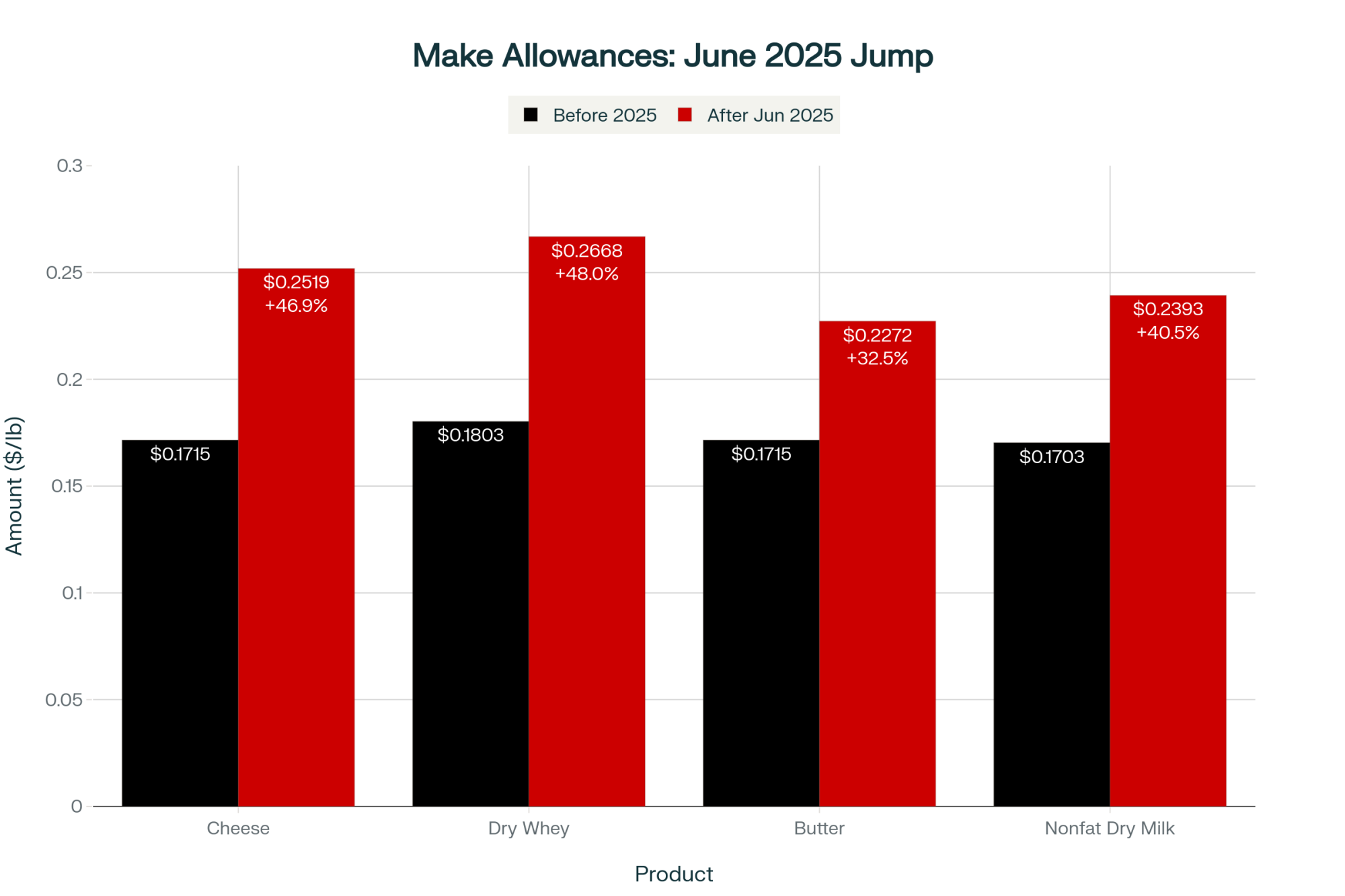
NewsSubscribe
First
Last
Consent

2,800 Dairy Farms Will Close This Year—Here’s the 3-Path Survival Guide for the Rest

Mid-size dairies are discovering they have 18 months to pick: premium, scale, or strategic exit 

EXECUTIVE SUMMARY: Rabobank’s projection that 7-9% of U.S. dairy operations will disappear annually through 2027 isn’t just another statistic—it represents roughly 2,800 farms making their final milkings each year, with mid-size operations bearing the brunt of this consolidation. What farmers are discovering through hard experience is that traditional 150-400 cow dairies face an impossible equation: spending $35,000-$55,000 annually on calf management labor while those calves generate just $15,000-$30,000 in net returns. Research from Cornell and Wisconsin’s dairy programs confirms that the industry is bifurcating into two distinct models—premium differentiation, which captures 50-75% price premiums for the 20-25% of producers near metropolitan markets, and efficiency-focused operations that achieve costs $3-4 per hundredweight below average through scale and technology. The next 18 months represent a critical decision window, as environmental regulations tighten, the Farm Bill implementation begins, and processor consolidation accelerates the pressure on uncommitted operations. Here’s what’s encouraging: producers who recognize this shift and commit fully to one path—whether premium, efficiency, or strategic transition—are finding renewed profitability and purpose. The conversation isn’t about whether change is coming; it’s about choosing your direction while you still have options to shape your farm’s future on your terms.

According to Rabobank’s latest North American dairy outlook, we’re losing 7-9% of U.S. dairy operations annually through 2027—that’s potentially 2,800 farms disappearing each year. Walking through a 500-cow operation in County Roscommon last week, where Irish media reports indicate that Department of Agriculture inspections uncovered systematic management failures that had developed over several years, I saw firsthand what happens when mid-sized operations get caught between two increasingly divergent business models.

Here’s why the next 18 months matter: Environmental regulations are expected to tighten in key regions by 2026. The next USDA Farm Bill cycle begins implementation. And consolidation accelerates at a pace that makes waiting increasingly costly. The window for proactive choices is narrowing fast.

Rabobank’s projection isn’t just a statistic—it represents the death spiral of mid-size operations caught between impossible economics and regulatory pressure

Understanding the New Economics of Dairy Farm Profitability

Let me share some numbers that a Wisconsin producer showed me last month, as they reveal the impossible math that breaks traditional dairy models.

The shocking math behind dairy’s consolidation crisis: Mid-size operations spend double on labor what their entire calf enterprise generates

Consider a 500-cow operation—substantial by most regional standards, right? With normal breeding patterns, you’re managing approximately 250 bull calves annually. In current markets, based on what I’m seeing in USDA market reports, those dairy bull calves typically bring $50 to $200, depending on breed and season. Even with beef-cross breeding programs—which data from Cornell shows about two-thirds of Northeast dairies have now adopted—prices generally range from $150 to $400 in stronger markets.

The best-case scenario generates approximately $30,000 to $50,000 in gross revenue from the entire calf enterprise. After accounting for transportation, health management, and the typical 8-12% mortality rate that even well-managed operations experience, net returns often fall to $15,000 to $30,000.

Now, here’s where it gets uncomfortable: hiring dedicated calf management costs $35,000 to $55,000 annually, based on current agricultural wage data, excluding benefits and overhead.

You’re spending double on labor what the entire calf enterprise generates.

As one producer in central Wisconsin put it: “That math doesn’t work.” And you know what? It’s not just a Wisconsin problem. Down in the Southeast, where heat stress adds another layer, a Georgia dairyman running 600 cows told me at a recent conference: “Between June and September, my calf mortality jumps to 15%. The cost of climate-controlled housing would bankrupt us, but the losses are killing us slowly anyway.”

What’s happening in Florida is even tougher. A producer near Okeechobee shared that their summer calf mortality can hit 20% without intensive management. “We’re basically choosing between two ways to lose money,” she said.

Learning from Different Models Around the World

What’s particularly revealing is how various countries have addressed these structural challenges. Each approach tells us something about potential pathways forward.

Canada’s Quota System: When Compliance Becomes Valuable

Canadian dairy producers operate within a unique framework. According to recent data from the Canadian Dairy Commission, production quotas in provinces like Ontario currently trade at significant values—tens of thousands of dollars per kilogram of butterfat. A typical 70-cow operation might hold a quota worth well over a million dollars. Their proAction program, mandatory since 2017, ties welfare compliance directly to market access.

“The validation costs us about CAD$400 every two years,” a producer near Guelph told me during a recent Ontario farm tour. “But if we lose compliance, we can’t ship milk. That quota value? Gone. It completely changes how you think about management decisions.”

What I’ve noticed is that Canadian producers rarely discuss cutting corners on animal care. When your compliance is tied to an asset worth more than most people’s retirement funds, you find ways to make it work.

The Netherlands: Environmental Limits as Management Boundaries

The Dutch discovered something fascinating, almost by accident. After EU milk quotas ended in 2015, they implemented phosphate rights to manage environmental concerns. Research from Wageningen shows that this system effectively caps expansion—farmers must either acquire additional phosphate quotas or invest in manure processing, which typically costs between €10 and €25 per ton, sometimes more.

A researcher at Wageningen explained it well during a recent webinar: “We didn’t intend to prevent management overreach. But when expansion requires such significant capital investment, farmers naturally stay within their management capacity.”

Denmark: Market Premiums for Higher Standards

Denmark represents yet another model. Based on industry data from their agricultural council, they’ve implemented enhanced welfare standards beyond EU requirements. More importantly, cooperatives like Arla support these through sustainability incentive programs—real money per kilogram that can add up to thousands of euros annually for an average farm.

Robotic Systems in the Mountain West: A Different Path

What I’ve been watching with interest is how Mountain West producers are approaching this differently. I visited a 240-cow operation near Twin Falls, Idaho, that installed robotic milking units a few years back. “We went from three full-time employees to one,” the owner explained. “The robots cost us several hundred thousand, but we’re saving over $100,000 annually in labor. More importantly, our cows are healthier—somatic cell count dropped significantly.”

That’s not a path for everyone—you need reliable power, technical support within driving distance, and cows that adapt to the system. However, it demonstrates how technology can bridge some gaps for mid-sized operations.

The Emerging Bifurcation: Dairy Consolidation Trends Accelerate

Through conversations with agricultural economists at various land-grant universities, as well as lenders from Farm Credit and other institutions, a clear pattern emerges. As one Cornell economist recently put it: “We’re watching the industry split into two distinct business models, with the traditional middle ground becoming economically unsustainable.”

The Premium Path: Quality and Differentiation

The brutal math of dairy economics: Small operations lose money, mega-dairies print it, and the middle ground has vanished forever

Research from the USDA and analyses from agricultural lenders suggest 20-25% of production is moving toward differentiated markets. These operations capture real premiums—but success requires specific conditions.

Organic Valley’s latest member report shows that their farmers are receiving significantly higher prices—sometimes 50-75% premiums over conventional prices. But achieving this requires patient capital and proximity to premium markets.

A Vermont organic producer who successfully transitioned shared a valuable perspective at a recent conference: “Year one through three, we lost money. Years four through six, we broke even. Since year seven, we’ve been profitable. But that seven-year journey? Not everyone can make it.”

Here’s what consumer research consistently shows: only about a quarter of consumers regularly pay meaningful premiums for differentiated dairy products—and they’re concentrated in metropolitan areas with higher household incomes.

Beyond organic, there’s a young farmer in Texas who’s found success with A2 milk production. “We’re getting a 30% premium selling directly to Houston markets,” she told me. “But it took two years to build the customer base, and we had to change our breeding program completely.”

The Efficiency Model: Scale and Optimization

The majority of production—roughly 75%—continues moving toward efficiency-focused operations. USDA Census data shows the average U.S. dairy herd has grown significantly over recent years, with the largest operations now producing well over a third of the nation’s milk.

Mike, who manages 850 cows near Eau Claire through a combination of owned and leased facilities, shared his approach: “Every decision focuses on efficiency. We utilize precision feeding systems that significantly reduce feed costs. Automated health monitoring catches issues days earlier. Our per-hundredweight production cost runs well below the state average. In volatile markets, that’s survival.”

When milk prices experience significant volatility—as we have seen in recent years—large, efficient operations tend to survive, while smaller farms often struggle to cover their operating costs.

A California producer running 3,000 cows in the Central Valley puts it differently: “We’re not farming anymore, we’re manufacturing. Every process is standardized, measured, and optimized for efficiency. It’s not romantic, but it keeps us in business.”

The Challenge for Mid-Size Operations

Here’s where it gets difficult for operations between 150 and 400 cows—what USDA classifies as mid-size commercial dairies. They’re too small for significant economies of scale but too large for niche marketing approaches.

Research from dairy profitability programs consistently shows farms in this range have the highest per-hundredweight production costs and lowest return on assets. They incur compliance costs similar to those of larger operations but can’t spread them across a sufficient production volume.

A third-generation producer near Viroqua who recently sold his 185-cow operation explained: “We calculated everything honestly. After debt service, family living, and reinvestment needs, we were left with a net annual income of $18,000 for 70-hour weeks. The solar lease on our land now generates $52,000 annually with zero labor.”

This isn’t failure—it’s recognition of changed economics. And you know what? More folks are coming to similar conclusions.

Young Farmers Face Unique Pressures

What worries me most is what I’m hearing from young producers. At a recent young farmer conference in Madison, the mood was notably different than even two years ago.

“My parents want me to take over our 220-cow operation,” a 26-year-old from Minnesota told me. “But the numbers don’t work. I’d need to double the herd size to make it viable, which would mean incurring $2 million in debt. Or transition to organic, which means seven years of uncertainty. Either way, I’m betting my entire future on factors I can’t control.”

The next generation crisis: Access to capital and equipment costs create insurmountable barriers for young farmers, explaining dairy’s aging demographic

But there are success stories too. I met a 28-year-old in Pennsylvania who took over her family’s 180-cow operation and immediately began bottling milk on the farm. “We’re capturing $4 more per gallon than commodity pricing,” she said. “It was scary taking on the debt for processing equipment, but we’re actually profitable now.”

Data from beginning farmer programs shows dairy has the lowest rate of young farmer entry among agricultural sectors—just 6% of dairy farmers are under 35, compared to 8% across all agriculture. That should concern all of us.

Technology’s Role and Limitations

Examining precision dairy technologies reveals genuine benefits. Recent research in dairy science journals indicates that automated health monitoring can significantly reduce treatment costs and improve conception rates. Several Wisconsin producers report real improvements from adoption.

Yet technology alone won’t resolve structural challenges. Studies consistently find that most commercially available precision dairy systems haven’t been independently validated for all their claims.

As one precision dairy specialist noted at World Dairy Expo: “Technology amplifies good management. It doesn’t replace it or change basic economic realities.”

The technology truth: Health monitoring and precision feeding deliver fastest ROI, while robotic milking requires patient capital and skilled management

Carbon Credits and Environmental Opportunities

One emerging opportunity that’s still developing: carbon markets. California’s Air Resources Board offset program now includes dairy digesters, paying substantial amounts per metric ton of CO2 equivalent reduced. A large operation with a digester can generate $150,000 to $200,000 annually in carbon credits.

But here’s the catch—digester installation costs run into the millions, and you need consistent manure management to make it work. Plus, these programs favor larger operations that can afford consultants to navigate the complexity.

“It’s another way the big get bigger,” a medium-sized producer in California told me, shaking his head. “We looked at it, but the upfront costs and ongoing management requirements put it out of reach.”

What The Next 18 Months Will Bring

Based on regulatory filings, market projections, and discussions with industry analysts, several trends are accelerating toward critical decision points:

Environmental Regulations (By June 2026):

  • California’s methane reduction requirements are getting real teeth
  • The Netherlands is continuing with a significant reduction in dairy cow numbers through buyout programs
  • Wisconsin is implementing new phosphorus limits affecting hundreds of farms in sensitive watersheds

Market Consolidation (Accelerating Now):

  • That 7-9% annual reduction in farm numbers continues through 2027
  • Processor consolidation is creating fewer, larger milk buyers with stricter requirements
  • Premium market growth is slowing from the previous rapid expansion

Economic Pressures (Building Through 2026):

  • Federal Reserve keeping interest rates elevated through at least mid-2026
  • Input costs are stabilizing but remaining well above pre-2020 levels
  • Labor availability is declining, with visa costs increasing significantly

What farmers are finding is that these pressures compound each other. It’s not just one challenge—it’s all of them hitting simultaneously.

Making Strategic Decisions: Your Three Paths Forward

After analyzing hundreds of operations across different models, three viable strategies emerge. And honestly? There’s honor in all three choices.

Path 1: Commit to Premium Differentiation

Requirements:

  • Location within a reasonable distance of metropolitan markets with substantial populations
  • Capital for a multi-year transition period (typically several hundred thousand for a 200-cow operation)
  • Willingness to develop direct marketing relationships or join an established cooperative

First Three Steps:

  1. Contact established premium cooperatives for transition planning—they offer mentorship programs
  2. Engage the USDA Natural Resources Conservation Service for transition funding opportunities
  3. Develop realistic cash flow projections with significant revenue discounts during transition

Success Example: A Vermont farm transitioned its 220-cow herd to organic production over a six-year period. They’re now grossing significantly more per hundredweight than regional conventional averages. “The transition nearly broke us,” the owner admits, “but we’re now set for the next generation.”

Path 2: Scale for Efficiency

Requirements:

  • Access to capital for expansion (typically thousands per cow for facilities and equipment)
  • Management systems for larger operations
  • Ability to weather significant price volatility

First Three Steps:

  1. Develop an expansion feasibility study with an agricultural lender—many offer specialized dairy expansion analysis
  2. Investigate management partnerships or qualified labor sources
  3. Implement precision management technologies, starting with feed management, for the fastest return

Success Example: Three neighbors in Idaho formed an LLC, consolidating their operations into a single, larger facility. Shared labor, bulk purchasing, and professional management significantly reduce costs. “Individually, we were struggling. Together we’re competitive.”

Path 3: Strategic Transition

Requirements:

  • Honest assessment of long-term viability
  • Understanding of asset values and alternative uses
  • Willingness to preserve equity while options exist

First Three Steps:

  1. Obtain a professional business valuation, including all assets
  2. Investigate alternative land uses (solar leases can generate substantial annual income in suitable locations)
  3. Consult a tax advisor regarding timing and structure

Success Example: A family converted their dairy to custom heifer raising and leased cropland, maintaining expertise while eliminating unprofitable segments. “We kept what we’re good at, eliminated what wasn’t working, and actually improved our quality of life.”

The Fourth Option: Cooperative Formation

What’s interesting is there’s potentially a fourth path emerging—small groups of producers forming new cooperatives. I’m watching a group of five 200-cow operations in Ohio that are exploring joint processing and marketing. “Individually we’re too small for premium markets, too big for farmers markets,” one explained. “Together we might have something.”

FactorPremium PathEfficiency PathStrategic Exit
Initial InvestmentHigh ($500K)Very High ($2M+)Minimal
Time to Profitability5-7 years3-5 yearsImmediate
Market AccessLimited/RegionalGlobal/CommodityN/A
Labor RequirementsHigh SkilledAutomated/TechN/A
Regulatory ComplianceComplexStandardMinimal
Milk Price Premium50-75%0%0%
Risk LevelMediumHighLow
Success Rate (%)256090

Looking Ahead: The Industry We’re Building

The dairy industry continues evolving toward this bifurcated structure. This isn’t a temporary disruption—it’s structural realignment driven by global economic forces.

What encourages me is seeing producers who’ve found their path and committed fully. Whether it’s the organic producer in Vermont finally turning profits, the Wisconsin operation that merged with neighbors to achieve scale, or the family that transitioned to custom heifer raising—success comes from clear decisions and full commitment.

The industry needs both models. Premium producers cater to consumers who are willing to pay for specific attributes. Efficient operations meet global demand for affordable nutrition. What it can’t sustain is the uncertain middle ground where costs exceed commodity returns but premiums remain out of reach.

For those committed to the future of dairy, multiple viable paths exist. The key is choosing one that aligns with your resources—financial, geographic, and personal—and executing fully. Half-measures don’t work in this environment. They never really have, but now it’s obvious.

As spring flush approaches in a few months, Holstein operations may have different considerations than Jersey farms when it comes to component pricing and efficiency models. But regardless of breed, the fundamental choice remains the same.

The conversation we need isn’t about whether this transformation is happening—it’s about how individual producers will navigate it successfully. That decision window remains open, but based on every indicator I’m tracking, it won’t stay open past 2026.

Choose your path. Commit fully. Execute well. The future belongs to those who do.

KEY TAKEAWAYS

  • The calf enterprise math reveals the deeper crisis: Mid-size dairies are spending $35,000-$55,000 on labor to manage calves worth $15,000-$30,000 net—and that’s just one symptom of why farms with 150-400 cows show the highest production costs and lowest returns according to Wisconsin’s Center for Dairy Profitability
  • Three proven paths forward, each with specific requirements: Premium differentiation needs proximity to metro markets and 5-7 year transition capital; efficiency scaling requires $8,000-$12,000 per cow expansion investment; strategic transition preserves equity through alternatives like solar leases generating $800-$1,200 per acre annually
  • Regional solutions vary, but the timeline doesn’t: Whether you’re dealing with Southeast heat stress pushing calf mortality to 20%, California’s methane regulations, or Wisconsin’s phosphorus limits affecting 580 farms—the 18-month window before 2026 regulatory changes remains constant
  • Technology amplifies but doesn’t replace fundamentals: Automated health monitoring reduces treatment costs by 18% and robotic systems save $100,000+ annually in labor, but as precision dairy specialists confirm, these tools work only within economically viable business models
  • Young farmers face unique pressures requiring creative solutions: With only 6% of dairy farmers under 35 (versus 8% across agriculture), successful transitions involve innovations like on-farm bottling, capturing $4 more per gallon, or forming new cooperatives where five 200-cow operations achieve together what they couldn’t alone

Complete references and supporting documentation are available upon request by contacting the editorial team at editor@thebullvine.com.

Learn More:

The Sunday Read Dairy Professionals Don’t Skip.

Every week, thousands of producers, breeders, and industry insiders open Bullvine Weekly for genetics insights, market shifts, and profit strategies they won’t find anywhere else. One email. Five minutes. Smarter decisions all week.

NewsSubscribe
First
Last
Consent

The $11 Billion Betrayal: Your Processor Is Building Your Replacement Right Now

If you can’t write a $3M check tomorrow, you’re already extinct. The industry just hasn’t told you yet.

Okay, so I’m at World Dairy Expo last week—you know, wandering around trying to avoid the robot salesmen—and I run into this producer from Iowa. Guy’s been milking for thirty years; it’s a good operation, with about 300 head. And he tells me something that just… it stopped me cold.

He says, “I just spent $650,000 on robots, and I think I just financed my own funeral.”

Look, we need to discuss what’s really going on here. Because while you’re trying to figure out how to make your milk check cover feed bills—corn’s what, $4.50 now if you can find a decent load?—the processors are playing a completely different game. The International Dairy Foods Association is tracking over $11 billion in new processing capacity through 2028. Eleven billion. Meanwhile, they’re quietly partnering with these lab-grown protein companies that want to make you obsolete.

But here’s what makes me want to throw my coffee mug at the wall… North Dakota had 1,810 dairy farms when I started covering this industry back in 1987. The Census just came out—they’ve got twenty-four left. Twenty-four! I knew some of those guys who quit. Good farmers, smart operators. Didn’t matter.

(Read more “1,810 Dairy Farms to 24: Inside North Dakota’s Collapse,” this isn’t just a regional problem—it’s coming for everyone.)

And you know what? Your banker made money on every one of those exits. So did your co-op. Your processor? They just consolidated their routes and kept rolling.

So About All These New Plants Going Up…

So I’ve been following the Fairlife Webster, New York project—the one Governor Hochul showed up for at the groundbreaking back in April. They’re spending $650 million on this thing. When you read the press releases, Coca-Cola executives are talking about innovation and efficiency, and… honestly, reading between the lines, it sounds like a funeral for small dairy.

Here’s the deal—and Multiple sources familiar with the project tell me, but he doesn’t want his name associated with it—these plants are designed for one thing: mega-dairies that can deliver tank after tank of identical milk. Same butterfat, same protein, day after day. Less than 2% variation, he said.

You running 300 cows like my Iowa friend? Maybe you’re testing components once a month if you’re lucky? Brother, you’re not even on their radar.

The math is what bothers me… (hold on, let me find my notes from that Wisconsin conference)… Okay, so these plants need to run at basically full capacity to make a profit. Below 75% utilization, and they’re hemorrhaging cash. But—and here’s the kicker—milk production is actually going DOWN. The USDA says we’re off by about a quarter of a percent this year.

So what happens when you build all this capacity but there’s no milk to fill it?

Actually, I know what happens. I was talking to Mike Guenther—dairy farmer up in Nebraska, good guy, been through hell with his processor—and he told me flat out: “My infrastructure would be worth almost nothing if I tried to sell.” That’s because when there’s only one buyer in your region… well, you do the math.

The Robot Scam (And Why My Neighbor’s Wife Won’t Talk to Me Anymore)

Alright, so… robots. God, where do I even start?

My neighbor just put in a Lely system. Beautiful thing, all bells and whistles. His wife won’t talk to me anymore because I asked him—at his open house, with the Lely rep standing right there—”So what’s your exit strategy when this thing doesn’t pencil out?”

Look, I’ve seen the actual numbers from Wisconsin’s dairy center. Best case—and I mean absolute fairy-tale best case—you might save $38,000 a year on labor. Might. That’s if nothing breaks, which… have you seen the maintenance bills on these things? My cousin in Minnesota; his robot has been down three times since August. Three times!

Your components might improve—the sales team loves to talk about this—maybe even get you another twenty thousand if you’re shipping to someone who actually pays quality premiums. (Good luck finding that unicorn this time of year.) Production bump? Sure, maybe 8%, call it fifty thousand in a good year.

But that loan payment? You’re looking at damn near a hundred grand annually on $650,000. And that’s if you got decent terms, which… with milk prices where they are?

The thing that really gets me—and I was just discussing this with some folks at Penn State—is that the 2,000-cow operations don’t need robots to achieve these efficiencies. They get them automatically through scale. You’re literally paying three-quarters of a million dollars to achieve what the big guys get for free.

But hey, at least the robot dealer got his commission, right?

The Organic Mess (Or: How to Lose Money Even Faster)

Speaking of bad decisions… let me tell you about organic.

I was at a meeting in Vermont last month—beautiful country up there, with the leaves just starting to turn—and Ed Maltby from the Northeast Organic Group got up and said something that made half the room go silent: “We’ve been underwater on cost of production since 2018.”

Since 2018! Can you believe that?

Here’s how the organic trap works, and I’ve watched too many good farmers fall for this… You decide to transition, right? Takes three years. Three years of paying organic feed prices—last time I checked, depending on your region, we’re talking something like three hundred, three-fifty a ton for corn—while still getting paid conventional prices for your milk.

This producer I know in Wisconsin—she’s a smart woman who really knows her stuff—just finished her transition last spring. Guess what? Organic Valley’s not taking new producers. Horizon? They told her maybe next year, if she can guarantee 30,000 pounds daily. She’s doing 18,000.

The UK recently reported (I was reading this on the plane back from California) that it lost 7% of its organic herds in one year. One year! The USDA’s tracking similar numbers here—we’ve lost about a fifth of our organic dairies in the past five years.

And it’s not because they can’t produce organic milk. They can. It’s because nobody will buy it at a price that covers costs. The processors cherry-pick who they want, when they want.

Meanwhile, the certification consultants received their fees—ten to fifty thousand dollars, depending on the operation. The feed companies locked you into those premium contracts. Everyone made money except the farmer. Sound familiar?

Your Co-op Isn’t Your Friend Anymore

This is gonna piss some people off, but… whatever. It needs saying.

You know that DFA antitrust case? The one they settled for $50 million back in 2015? (Dean Foods kicked in another $30 million, by the way.) I was covering those hearings in Tennessee—what a circus that was. The stuff that came out about market manipulation…

But here’s what really matters: The practices they were accused of? That’s basically standard operating procedure now. Your average milk supply contract—and I’ve read dozens of these—requires 12 to 24 months’ notice if you want to leave. Some have these “loyalty bonuses” that turn into penalties if you exit.

I was talking to this farmer in Ohio last week… he wanted to switch processors, found someone offering fifty cents more per hundredweight. You know what his co-op told him? The additional hauling would eat up seventy cents. Take it or leave it.

Look at your co-op board sometime. Really look at them. How many are running mega-operations? A colleague who covers DFA meetings in the Midwest told me that at one regional meeting in Kansas, eight of twelve board members were shipping over 50,000 pounds daily. You think they care about the guy milking 150 cows?

They’re not representing you anymore. They’re managing your decline while protecting their own operations.

The Precision Fermentation Thing Nobody Wants to Talk About

Okay, this is where it gets really interesting… or terrifying, depending on how you look at it.

So, Leprino Foods—and if you don’t know, they basically own the pizza cheese market, with a market share of around 85%—announced on July 16, 2024, that they’re partnering with a Dutch company, Fooditive, to produce lab-grown casein.

Not researching it. Not thinking about it. Actually producing it. Their president, Mike Durkin, said they’re planning hundreds of thousands of tons. Starting next year.

Now, I was just reading the Good Food Institute’s latest report (fascinating stuff if you can’t sleep)… these lab proteins still cost way more than real dairy. We’re talking two to five times more expensive. But—and this is the part that should scare you—costs are dropping fast. The projections indicate that they will capture approximately 15% of the high-value protein market by 2030.

Why does that matter? Because those specialty proteins, those functional ingredients… that’s what’s been subsidizing your commodity milk price all these years. When that goes away…

Industry analysts are saying, but they work for one of the big dairy investment firms—and they told me straight up: “Traditional dairy will keep the volume markets, the cheap commodity stuff. But is everything profitable? That’s going to fermentation.”

The processors aren’t stupid. They see this coming. That’s why they’re building $11 billion in infrastructure for maybe 300 mega-farms while letting everyone else twist in the wind.

Why Everyone Needs You to Keep Losing Money

You want to know something that’ll make you sick?

Cornell’s farm management people did this study—I actually know Wayne Knoblauch, good guy, tells it straight—and they found that if you’re living off equity (basically burning through your farm’s value to cover losses), every year you wait to exit costs you fifty to a hundred grand in destroyed wealth.

But nobody’s gonna tell you to quit. Know why?

Your lender needs active loans on their books. I was talking to a Farm Credit loan officer at a bar in Madison—after a few beers, he admitted it—they’d rather restructure a bad loan five times than have a foreclosure on their report.

Your processor? They need volume. Lose half of their suppliers, and their entire system falls apart. I’ve seen the efficiency studies from Wisconsin—it’s brutal what happens to their costs when volume drops.

Extension can’t tell you to quit either. Too political. I know extension agents who’ve been pulled aside and told to focus on “farm viability strategies” not “transition planning.” Can you believe that?

What’s Really Coming (And It Ain’t Pretty)

People keep asking me about the future of dairy. There are three possible scenarios, or something.

There’s not. There’s one. And we’re already most of the way there.

The USDA’s latest numbers, which I just pulled yesterday, show that operations with more than 1,000 cows control about two-thirds of production now. Back in 2017? It was barely over half. The Census shows farms with 2,500 or more cows went from 714 to 834.

(Read more: “Pick Your Lane or Perish: The 18-Month Ultimatum”—the middle is disappearing.)

We’re not “heading toward” consolidation. We’re in year 15 of a 25-year comprehensive restructuring. By 2030? The International Farm Comparison Network projects we’re down to maybe 18,000 total dairy farms. By 2035? We’re looking at something like the poultry industry—vertical integration, contract production, three or four companies controlling everything.

You’ve got maybe two years to figure out where you fit in this picture. After that? The decision gets made for you.

The Bird Flu Wild Card That Has Everyone Spooked

But just as the mega-dairies feel invincible, an entirely new risk has emerged—a biological one that turns their efficiency into a vulnerability. And then there’s this H5N1 thing…

Nobody wants to discuss this at industry meetings, but I was just reviewing USDA’s latest report—we now have infected herds in 17 states. California alone had 475 confirmed cases as of December, according to that Congressional Research Service report. Wisconsin’s been testing thousands of milk samples since April.

Here’s what scares me: CDC research indicates that this virus can spread through milking equipment. You know what that means for these 2,500-cow operations? They’re basically petri dishes. One infected cow, and it spreads to the whole herd within days.

Meanwhile, that 50-cow farm everyone says isn’t viable? Suddenly, their isolation looks pretty smart, doesn’t it?

I was talking to a veterinarian in Arizona—they’re modeling this stuff now—and she thinks if this escalates… I mean, imagine consumers finding out there’s viral material in milk. Even if pasteurization makes it safe, which it does, the demand hit could be catastrophic.

But hey, don’t count on bird flu to save small dairy. That’s not a business plan.

The Exit Math Nobody Will Show You

Alright, let’s talk about getting out. Because for a lot of you, that’s the smartest move, and I’m tired of pretending otherwise.

Wisconsin’s farm center won’t publish this directly—too controversial—but if you read between the lines… Say you’re running 200 cows and losing $75,000 a year after accounting for family living expenses. Pretty common scenario these days.

Keep going for five years? You burn through $375,000 in equity. By the time you finally quit, you’re down to maybe $1.1 million in assets. At 4% returns—if you’re lucky—that’s $45,000 a year in retirement.

But if you exit now with $1.5 million still intact? Same 4% gets you $60,000. That’s fifteen grand more every year for the rest of your life.

Signs You Should Exit Now

  • Losing more than $50,000 annually after family living expenses
  • Over 55 with no succession plan
  • Debt-to-asset ratio above 60%
  • Single processor within 50 miles
  • Can’t afford $500,000 in upgrades
  • Working 80+ hours weekly with no vacation in 3 years

I know appraisers who’ll tell you—off the record—selling separately gets you way more than selling as a complete dairy. Land to crop farmers, cows to other dairies, equipment at auction. You might get 30-50% more that way. Stage it over 18-24 months for tax purposes, and watch the Class III futures for timing.

But your banker won’t run these numbers for you. Your co-op sure as hell won’t. And extension? They can’t even have this conversation without risking their funding.

The Bottom Line (Or: What I’d Tell My Own Son)

Look… I’ve been covering this industry for almost forty years. I’ve seen good farmers, smart people, hardworking families get absolutely destroyed by forces beyond their control.

The consolidation we’re seeing? It’s 70% done already. The infrastructure being built isn’t for family farms—it’s for their replacement. Every “solution” they’re pushing—robots, organic, value-added—it’s designed to extract what value you have left before you’re forced out anyway.

If you’re under 500 cows without a clear path to premium markets? You need millions to scale up (good luck with that), or years of off-farm income to transition to specialty markets (also good luck), or… you need to think about exiting while you still have something to exit with.

If you’re my age—late 50s, early 60s—without someone to take over? Every day you wait is lighting money on fire. Simple as that.

Thinking about robots? That $650,000 might buy you five to seven years of life. Then what? If you don’t have a ten-year plan after the robot, you’re just financing your own extinction with interest.

The hardest truth—and I’ve looked at enough financial data to feel pretty confident about this—probably 60-70% of current dairy farmers would be better off financially by selling tomorrow. Not next year. Not after corn harvest. Tomorrow.

But nobody in this industry will tell you that. They need you operating, even at a loss. Your losses keep their system running.

You know what you are now? You’re not a dairy farmer. You’re an unwitting participant in your own wealth extraction. The only question is whether you’ll recognize it before it’s too late.

I’m not sure… maybe I’m wrong. Maybe there’s some miracle coming that’ll save small dairy. But I was at an auction last month—good family, who had farmed that land for four generations—and watching them sell off everything piece by piece… The old man was trying not to cry, and his son just looked angry…

That’s not how this is supposed to end. But for most of us, that’s exactly how it will end unless we face reality now.

Look, make your own decision. But make it with your eyes open. Because in about 24 months, maybe less, the decision gets made for you.

And trust me—you want to be the one making that call, not having it forced on you.

Share this with every dairy farmer you know. They deserve the truth.

The decision is coming. The only power you have left is to make it yourself.

Key Takeaways:

  • Your 24-Month Countdown Starts Now: $11B in processor overcapacity will crash prices by 2027—only 300 mega-farms survive the engineered consolidation
  • The $375,000 Decision: Exit today = $60k/year retirement. Bleed equity five more years = $45k/year. Your banker won’t show you this math
  • Robot Truth: You pay $100k annually to save $38k in labor—meanwhile, 2,000-cow operations get same efficiency free through scale
  • The Betrayal Is Complete: Processors partnered with lab-protein companies (Leprino/Fooditive, July 2024) while selling you “growth solutions”
  • Three Options Left: Find $3M to scale past 1,000 cows, secure premium markets with off-farm income, or exit while assets have value

Executive Summary:

An Iowa dairy farmer told me last week: “I spent $650,000 on robots and just financed my own funeral.” He’s absolutely right—and the betrayal runs deeper than you know. Processors are investing $11 billion in infrastructure designed exclusively for 300 mega-dairies while partnering with lab-protein companies (Leprino/Fooditive, July 2024) to replace traditional dairy’s profitable products. The math reveals everything: farmers losing $75,000 annually would save $375,000 by exiting today versus operating for five more years, yet every institution—your bank, co-op, processor—needs you to bleed equity to maintain their economics. With 24 months until processing overcapacity crashes milk prices and forces mass consolidation, you face three options: find $3 million to scale beyond 1,000 cows, secure premium markets with off-farm income support, or exit strategically while assets retain value. For 60-70% of current operations, immediate exit preserves the most family wealth—but nobody will tell you this because your losses subsidize their entire business model.

The Sunday Read Dairy Professionals Don’t Skip.

Every week, thousands of producers, breeders, and industry insiders open Bullvine Weekly for genetics insights, market shifts, and profit strategies they won’t find anywhere else. One email. Five minutes. Smarter decisions all week.
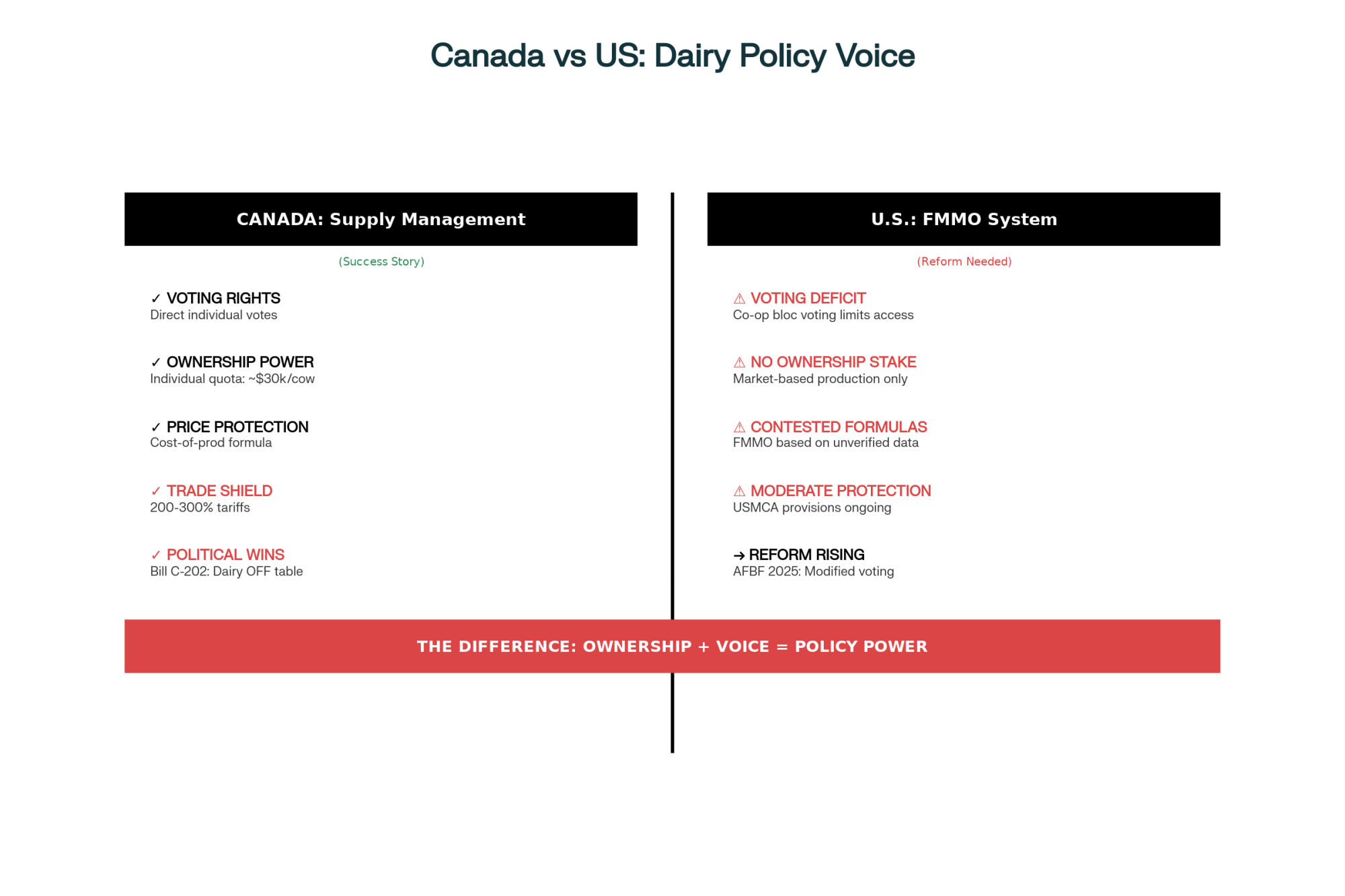
NewsSubscribe
First
Last
Consent

Learn More:

Complete references and supporting documentation are available upon request by contacting the editorial team at editor@thebullvine.com.

Your 0.77 Ratio Is Wrong: The $67,500 Component Fix That Can’t Wait Until 2028

When butterfat premiums turned to penalties, we created an $8 billion problem nobody saw coming

EXECUTIVE SUMMARY: What farmers are discovering right now is that a decade of breeding for maximum butterfat has created a fundamental mismatch with processor needs—our national average of 0.77 protein-to-fat ratio falls short of the 0.80 that cheese plants require for efficient production. According to CoBank’s September analysis and USDA data, this $300 difference translates to $800-$ 1,200 daily in standardization costs for mid-sized plants, expenses that eventually flow back to producer milk checks. The timing couldn’t be worse, with $8 billion in new cheese capacity coming online through 2028, all designed for balanced milk production that we’re not meeting. Research from Penn State and Michigan State shows that high-oleic soybeans can help rebalance components while actually improving feed efficiency, saving operations $50-70 per hundredweight. Smart producers are already repositioning—shifting genetics toward protein (bulls with +60 PTA protein, under 1.25:1 fat-to-protein ratios), implementing proven nutritional strategies, and protecting themselves with risk management tools that could save a 200-cow operation $67,500 when Class III drops just $3. Here’s what this means for your operation: the genetics decisions you make this month lock in production patterns through 2028, making immediate action not just advisable but essential for survival in tomorrow’s component-focused market.

dairy profitability, component imbalance, protein-to-fat ratio, dairy genetic selection, high oleic soybeans, milk component prices, dairy risk management

You know what’s fascinating about dairy markets right now? We’re watching butter trade at $1.65 while cheese sits at $1.7375 on the CME, and that inversion tells you everything about where we’ve ended up. For those of us who’ve been in this business long enough to remember when butterfat was gold, this feels like watching the world turn upside down.

I’ve been tracking these markets for about twenty years, and this pattern we’re seeing—three months into it now as of October—isn’t just unusual. It’s the market trying to tell us something we probably don’t want to hear: we got too good at producing butterfat, and now we’re all paying for it.

Here’s what really strikes me. We spent the last decade building this incredible genetic and nutritional system to maximize butterfat production. Every decision made sense at the time. Every bull selection, every ration adjustment, every breeding choice followed the economics perfectly. And yet somehow, all those right decisions added up to a wrong outcome.

What That 0.77 Number Really Means for Your Operation

Here’s the thing about protein-to-fat ratios that has transitioned from textbook concepts to real-world problems. Your cheese plant—and let’s be honest, with USDA data showing 90% of our milk going to manufacturing, that’s probably where yours ends up—they run best with milk at about a 0.80 ratio. Cornell’s Dave Barbano figured this out decades ago, and it’s held true ever since.

What really caught my attention is this CoBank analysis from September—Corey Geiger put together a report called “Soaring demand for dairy foods fueled a US butterfat boom,” and buried in there is our current national average: 0.77, according to the USDA’s latest statistics. Now, three hundred doesn’t sound like much, right? But the impact on operations is huge.

I was visiting with some folks at a major cheese plant in Green Bay last week. They’re spending—get this—$800 to $1,200 every single day just standardizing milk. Either they’re skimming off cream that nobody really wants right now, or they’re adding milk protein concentrate, which is running $3.50 to $4.50 per pound, according to the latest USDA Dairy Market News reports.

Consider that for a mid-sized plant processing 100,000 pounds daily… you’re looking at $300,000 to $440,000 a year in extra costs. And where do you think that money eventually comes from? Yes, it finds its way back to our milk checks; it just takes about six months to work through the system. As one Wisconsin cheese maker explained to me, “We’re not asking for miracles, just milk we can efficiently turn into cheese without bleeding money on standardization.”

What’s really eye-opening—and the plant folks explained this while we watched tankers unloading—is that when they produce mozzarella, they need to increase protein from our current average of 3.23% (according to USDA NASS September data) to about 3.5% for optimal yields. That’s 300 pounds of MPC-80 for every 100,000 pounds of milk. At today’s prices? Over a thousand bucks daily.

How Sound Individual Decisions Created This Collective Challenge

Examining Federal Order pricing from 2015 through last year, butterfat consistently commanded premiums over protein in eight out of nine years. Of course, we bred for fat! I mean, when you see a Select Sires bull with +80 pounds of butterfat PTA and fat paying nearly three dollars… that’s just following the money.

Kent Weigel from the University of Wisconsin’s dairy science department gave this fascinating presentation at the Dairy Cattle Reproduction Council meeting in April. The genetic progress we’ve made is remarkable—maybe too remarkable. Here’s the challenge: those bulls everyone was using in 2020 and ’21 when fat prices were golden? Their daughters are just entering the milking string now. And that April base change from USDA’s Animal Genomics and Improvement Laboratory, rolling back fat values by 45 pounds—that’s the biggest adjustment I can remember. It’s basically the industry saying, “okay, we might’ve overdone this a bit.”

CoBank’s analysis suggests we could see butterfat approaching 5% within ten years if trends continue. Now, that’s on the high end of projections, but even if we hit 4.6% or 4.7%, and protein reaches 3.4%, well, that’s potentially a 0.68 ratio. Here’s what every breeder needs to understand: bulls you pick today won’t have daughters really producing until 2028, maybe ’29.

I know a producer near Eau Claire who has been maintaining balanced components throughout this whole process—3.85% fat, 3.20% protein, utilizing diverse genetics. “Everyone thought I was leaving money on the table, breeding for balance,” he told me. “Now my milk’s exactly what processors want, and I’m getting premiums while others are scrambling.”

According to reports from Wisconsin’s Dairy Business Association, several operations in the Central Valley, California, began shifting toward protein-focused genetics three years ago, anticipating these market changes. These producers saw the new cheese plants coming online and adjusted early. Now they’re shipping exactly what processors like Hilmar want, while others are still catching up.

Learning from Our Northern Neighbors

Alright, so comparing us to Canada usually starts some heated discussions, but stay with me here. According to the Ontario Dairy Farmers’ quota exchange, they’re paying between $24,000 and $26,000 per cow just for the right to produce. Sounds crazy, doesn’t it?

But here’s what’s worth considering. Statistics Canada’s 2024 farm survey (released this March) shows their average dairy operation clearing $246,000 Canadian, and through the Canadian Dairy Commission’s cost-of-production formula, they know their milk price twelve months out. Pretty nice for planning, right?

What I find really interesting is how they handle components. When the solids-non-fat to butterfat ratio deviates outside its target range of 2.0 to 2.3, payment adjustments occur within one to two months, as per CDC policy. No waiting, no hoping. You make unbalanced milk, you see it in your check. Simple as that.

I know a producer near Guelph who put it this way: “Sure, we pay a lot for quota, but I can make five-year plans knowing prices won’t swing 30% in six months.” Now, I’m not saying we should go to supply management—that ship sailed long ago. But watching our neighbors have that stability, while Cornell’s preliminary October data suggests we might go from $24 to $19 per gallon of milk, does make you think.

The key takeaway here is the importance of consistency and rapid feedback. But before we all rush toward quick fixes, trying to achieve that consistency, let me share what can go wrong when you try to force component changes too fast.

Why Quick Component Fixes Can Be Financially Devastating

I’ve had several nutritionists call lately, asking about using a diet to reduce milk fat quickly. And look, I understand the temptation with these component prices.

But let me share what the research actually shows. Lance Baumgard’s team at Iowa State has published extensively on this in the Journal of Dairy Science over the past few years. When you drop forage NDF below 22% and increase starch to shift fermentation, you will indeed drop fat. You’ll also wreck rumen function.

There’s this study from Bonfatti’s group in Italy (published in JDS this year)—really sobering stuff. Farms with about 33% of cows showing diet-induced milk fat depression didn’t just lose out on components. Energy-corrected milk tanked, dry matter intake dropped by 15 to 20 percent, and then health problems started to cascade.

A respected dairyman I know in Cortland County tried this aggressive approach in 2023. Skilled operator with 30 years of experience in the industry. Four months later? Lameness everywhere, conception rates down twelve points, vet bills through the roof. He calculated over $400 per cow in losses trying to save a total of maybe $50,000 on components. “Expensive lesson,” as he put it to me.

Greg Penner, from the University of Saskatchewan, has been documenting the costs of subacute ruminal acidosis to our industry—we’re talking $500 million to $1 billion annually across North America, according to his latest estimates. That’s real money lost to poor rumen health.

High Oleic Soybeans: A Solution That Actually Works

Now here’s something encouraging that doesn’t involve destroying your cows’ rumens. Kevin Harvatine at Penn State has been publishing some compelling work on high-oleic soybeans in the Journal of Dairy Science over the last few years.

Regular soybeans are about 52-55% linoleic acid—that’s a polyunsaturated fat that basically overwhelms your rumen bugs. When they can’t process it fast enough, they shift metabolic pathways and start making compounds that shut down fat synthesis in the udder. High oleic varieties flip that—they’re 70-80% oleic acid, which is monounsaturated. The rumen handles it just fine.

Penn State’s recent work (Lopes and colleagues published in JDS this year) shows a 0.2-point bump in milkfat, plus a 17% reduction in those problematic trans fats. However, what really caught my attention was Adam Lock’s research at Michigan State, also featured in JDS this year. They saw 10 pounds more milk when feeding these beans at about 16% of the diet, and—here’s the kicker—cows ate 8 kilos less dry matter. That’s efficiency you can take to the bank.

I recently visited a producer in Pennsylvania who has been using these for about eighteen months. Started at 5 pounds per cow, now he’s up to 7.5. Bought a used roaster for around $65,000, figures he’s saving about $125 per cow annually between better components and feed efficiency. Now, your situation might be different—California folks have those water costs, Texas operations deal with heat stress, Upper Midwest producers with heavy corn silage programs might see different responses—but for many of us, this could really work.

Northeast producers using seasonal grazing systems may need to adjust feeding rates seasonally—one Vermont producer I know reduces it to 4 pounds during peak pasture season and then increases it to 7 pounds in winter. Small operations under 100 cows can access custom roasting through cooperatives in many regions. I’m still trying to determine the optimal approach for organic operations, but early reports from a few farms in New York are promising.

The key is roasting them right. You want the PDI—protein dispersibility index—to be between 9 and 11. Lower values indicate that you’ve damaged the protein; higher values indicate that you haven’t removed the antinutritional components. Worth testing when you’re getting started.

Yeah, they cost more—about 10-15 cents per pound premium according to USDA grain market reports. So at 7 pounds daily, that’s 70 cents to $1.05 extra per cow. However, when you factor in cutting palm fat, reducing some bypass protein, and that efficiency gain, most individuals tracking their results are saving $ 0.50 to $0.70 per hundredweight overall, according to University of Illinois Extension data.

Three Things You Can Do This Month

I spent a couple of days at World Dairy Expo last week, and the same three strategies kept coming up from producers who are making this work.

First—and this is crucial—fix your genetics now. Every month you wait is another group of heifers that’ll be milking the wrong stuff in 2028. Look for bulls with a protein PTA of over 60 pounds, but keep the fat-to-protein ratio under 1.25:1. The AI companies all have this information readily available through their selection programs.

Here’s something Gerd Bittante’s group at the University of Padova just published (in JDS this year)—those DGAT1 genotypes matter. The K version favors fat, the A version favors protein. If you’ve been using only K/K bulls, consider mixing in some A/A or A/K genetics. It’s about balance.

Second, get some high oleic beans lined up. Don’t wait for next year’s crop prices to settle. The research shows benefits kick in within about three weeks. If you’re a smaller operation, consider a custom roaster. Alternatively, if you’re milking 500-plus cows, consider investing in your own equipment.

Third—and I know nobody wants to spend money when things are tight—but get some risk protection. The USDA’s Dairy Revenue Protection program, forward contracts, and something. We’re seeing $5-6 swings month-to-month on Class III, according to CME data. A 200-cow operation protecting half their milk at $21? If we drop to $18, that’s $67,500 saved. That’s not gambling, that’s just smart business at this point.

The Processing Expansion Nobody’s Talking About

Here’s what should have everyone’s attention. The USDA’s Economic Research Service September report states that $8 billion in new cheese capacity is expected to come online through 2028. These aren’t little artisan shops—these are massive, automated plants designed for milk with 0.80 protein-to-fat ratios.

What happens when plants built for balanced milk get our 0.75-0.77 ratio milk? I see three possibilities, and none are great for us.

Plants might pay big premiums for balanced milk—Hilmar Cheese in California’s already offering an extra fifty cents per hundredweight, according to their October producer letter for high-protein, low-fat milk. That creates two classes of producers.

Or processors invest millions in more standardization equipment, costs that eventually come back to us.

Or—and the USDA Foreign Agricultural Service September data shows this is already happening with MPC imports up 40% year-over-year—they just bring in more protein from overseas.

The timing’s terrible. Heifers freshening today were conceived when fat was king. We won’t see genetically balanced cows in large numbers until 2028 or 2029. That’s a big gap. Time will tell if the industry can bridge it without major disruption, but I’m not optimistic.

Why Export Markets Won’t Save Us

People often suggest exports will save us, but that thinking ignores the grim reality of international price disparity. Here’s what the data actually shows.

The USDA’s Foreign Agricultural Service October data show that we’re selling butter internationally at $2.48 per kilogram. EU’s getting $3.56, New Zealand’s at $3.42. We’re essentially offering a dollar-plus discount per pound. Yeah, butter exports are up 150% year-to-date through September, but that’s because we’re desperate and everyone knows it.

Traders in Chicago tell me this export valve could close quickly if global supplies tighten or the dollar strengthens. And then what? The USDA NASS reports a cold storage capacity of approximately 300 million pounds. We’re already at 280 million as of September. If storage fills and exports cease, butter prices could drop significantly below current levels.

For perspective, Brendan Haley at Dalhousie University documented that Canada disposed of approximately 300 million liters between 2020 and 2023, exceeding quotas. We might face similar choices, just through price signals rather than regulations.

Building Operations That Can Handle Whatever Comes

What I’m realizing—and this has taken me a while to really grasp—is that chasing maximum anything is probably a trap. Albert De Vries at the University of Florida ran these simulations (published in JDS this year) showing farms breeding for extremes face about 40% more income volatility than balanced operations.

The folks doing well aren’t necessarily those with the highest components or the most production. They’re maintaining a sustainable target of approximately 3.85% fat and 3.20% protein, using diverse genetics, incorporating innovations like high-oleic beans, and focusing on income over feed cost rather than gross components.

There’s an important concept that the University of Illinois Extension consistently emphasizes: the pounds of energy-corrected milk per pound of feed matter are more significant than the percentages. Their data shows that cows weighing 90 pounds at 3.8% fat often outperform those weighing 85 pounds at 4.2% fat, in terms of profitability. We often become so focused on percentages that we forget about efficiency. I’ve noticed that operations that track feed efficiency closely tend to weather these component price swings better than those that chase maximum yields.

The Uncomfortable Truth We’re All Facing

Take a step back and consider the entire situation. Every farm that bred for maximum butterfat based on 2015-2023 prices made completely rational decisions. And yet collectively, we’ve created this market challenge.

We had amazing tools—genomic selection that has doubled genetic progress, according to the USDA’s Animal Genomics and Improvement Laboratory, sophisticated nutrition programs, and efficient processing. What we lacked were feedback mechanisms connecting individual decisions to system needs.

I know several Ontario producers, and yeah, they pay huge quota costs. But as one told me, “We can’t chase maximums, so we focus on consistency.” With that $246,000 average net income from Statistics Canada and stability, there’s something to consider.

Where We Go from Here: Your Action Plan

This protein premium—$2.71 versus $2.19 for fat in recent Federal Order pricing—it won’t last forever. History suggests maybe five to seven years. Smart money’s positioning for 2027-2030, when those new cheese plants really need milk, but not betting everything on extreme protein either.

What works is balance. Breed for 0.78-0.82 ratios. Feed for health and efficiency, not maximum components. And protect yourself against volatility that is now a natural part of the business.

The hard reality is, in a system where genetics takes years to change but prices shift monthly, complete freedom to optimize might actually be freedom to undermine our own markets. Canadian producers traded some freedom for stability, and looking at projected milk prices… stability has value.

You can learn this now—that balance beats extremes, that yesterday’s optimization creates tomorrow’s problems—or learn it the hard way. But decide soon. Every breeding decision you delay locks in 2028 production patterns.

Here’s your immediate action plan: This week, pull your sire lineup and shift toward protein balance. Next week, please call about high-oleic soybean sourcing. Before the month’s end, get risk management coverage on at least 30% of your production. These are no longer suggestions—they’re survival strategies.

That’s the paradox, isn’t it? We’re always fighting the last war, breeding for the last shortage, creating the next surplus. Perhaps it’s time to think more long-term about what actually creates sustainable value. Drive around and count the “For Sale” signs if you want to see where the old way’s taking us.

The operations that’ll thrive aren’t those with perfect timing or maximum components. They’re the ones who understand that in complex systems like dairy, sustainable balance often beats extreme optimization. And that might be the most valuable lesson from this whole butterfat situation—one worth considering as we make decisions affecting production years ahead.

The choice is yours. Make it count. 

KEY TAKEAWAYS

  • Immediate genetics shift pays off: Switch to bulls with protein PTA over +60 pounds and fat-to-protein ratios under 1.25:1 this breeding season—daughters entering production in 2028 will match what processors need, capturing premiums like Hilmar’s current $1.50/cwt for balanced milk
  • High oleic soybeans deliver triple benefits: Feed 7 pounds daily (roasted to 9-11 PDI) to achieve 0.2% milkfat increase, 10 pounds more milk, and 8 kg less DMI according to Penn State and Michigan State research—netting $50-70/cwt savings after accounting for 70¢-$1.05 daily premium cost
  • Risk management becomes a survival tool: Protect at least 30% of production through Dairy Revenue Protection or forward contracts before the month’s end—with $5-6 monthly Class III swings, a 200-cow operation saves $67,500 when prices drop from $21 to $18
  • Regional adaptations matter: California operations facing water costs might see different high-oleic economics, Vermont graziers should adjust from 4 pounds in summer to 7 in winter, and operations under 100 cows can access custom roasting through cooperatives
  • Component balance beats maximums: Target 0.78-0.82 protein-to-fat ratios rather than chasing extremes—University of Florida simulations show balanced operations face 40% less income volatility than those breeding for maximum single traits

Complete references and supporting documentation are available upon request by contacting the editorial team at editor@thebullvine.com.

Learn More:

The Sunday Read Dairy Professionals Don’t Skip.

Every week, thousands of producers, breeders, and industry insiders open Bullvine Weekly for genetics insights, market shifts, and profit strategies they won’t find anywhere else. One email. Five minutes. Smarter decisions all week.

NewsSubscribe
First
Last
Consent

$200 Holstein Bulls to $1,400 Beef Crosses: The $150 Fix Your $7,000 Consultant Won’t Tell You

84% of beef semen goes to dairy farms now. However, the extension agent requires still requires 6 months of planning first. Wonder why?

Look, I don’t know about you, but I’m tired of watching this happen…

Was at the sale barn last week, and I’m watching these beef-dairy crosses roll through.

Fourteen hundred. Thirteen fifty.

Hell, saw one nice Angus-cross heifer calf bring fifteen seventy-five.

Meanwhile, straight Holstein bulls? One ninety. Two ten if the buyers are feeling generous.

So here’s what’s eating at me…

USDA’s market reports from October 15th—they put these out every Tuesday from their Agricultural Marketing Service—are showing this same pattern across every Midwest auction. Beef crosses pulling twelve to fourteen hundred. Holstein bulls are barely breaking two hundred.

Seven times the money. Same barn. Same buyers. Different semen.

And the crazy part?

The difference between farmers banking fourteen hundred and farmers stuck at two hundred isn’t what you’d think. It’s not education or fancy genetics or herd size. Hell, it’s not even having a computer.

It’s whether they actually started or whether they’re still planning to start.

The Thing Extension Won’t Say Out Loud

You know what kills me about these beef-on-dairy workshops?

Every. Single. One. Same script.

Genomic testing first. Build your breeding hierarchy. Optimize your genetic selection matrix. Plan, plan, plan.

But here’s what the research actually shows—and I’m talking about real peer-reviewed stuff in the Agricultural Systems journal from March 2024, not marketing fluff—farmers who just jump in, who start immediately with their obvious cull cows? They’ve got way better sustained adoption rates than the ones sitting through six months of planning meetings.

I mean… think about it.

Guy I know near Fond du Lac—runs about 280 head, old tie-stall barn, been struggling with these milk prices—started breeding his worst cows to beef eighteen months ago—no genomic testing. No consultant. Just picked the obvious culls and started.

Banked an extra $68,000 last year.

Meanwhile, his neighbor’s still “developing a comprehensive strategy” with some consultant from Madison.

The behavioral economics research on this stuff is fascinating. They call it “implementation intention gap.” Basically, the longer you wait between deciding to do something and actually doing it, the less likely you are to ever do it.

And what’s extension pushing? Six months of planning before you breed your first cow.

Meanwhile—get this—NAAB’s 2024 annual report shows beef semen sales to dairy operations hit 7.9 million units. That’s eighty-four percent of all beef semen going to dairy farms.

Beef-on-dairy doses now rival gender-selected dairy semen—proof the industry has already moved while consultants keep preaching patience.

Most of those operations? They didn’t have comprehensive plans. They just… started.

What Nobody Talks About at The Co-op Meeting

Alright, so consultants.

I’ve been asking around about what these beef-on-dairy implementation consultants are actually charging. And… Jesus.

Industry pricing runs anywhere from five hundred to eight hundred just for the initial farm visit. Then they want genomic testing on everything—that’s forty bucks a cow plus coordination fees. Then monthly check-ins, implementation support, all that jazz.

Consultant consultants: $7K before a single calf. Beef semen: $150 today. Which pays the bills this month?

For a hundred-cow operation? You’re easily looking at six, seven thousand dollars.

Before you’ve bred a single cow.

Seven grand!

And for what? The actual difference—I mean the actual, physical difference—is using twenty-five-dollar beef semen instead of dairy semen. That’s it. That’s the whole “technology” we’re talking about here.

You know what else seven grand buys?

  • About 600 round bales at current prices
  • Winter feed for forty cows
  • A decent used TMR mixer
  • Half a year’s worth of sawdust bedding

But somehow, we’ve built this whole consulting industrial complex around what amounts to ordering different straws from your Select Sires guy.

Who’s Actually at The Sale Barn These Days

Here’s something I’ve been noticing…

And this is especially bad now with corn harvest wrapping up and guys trying to get winter rye in before it freezes…

Have you ever really look around at who’s still showing up to the weekly auctions? I mean, really look?

It’s maybe thirty, forty percent of the dairy farms that used to come. Maybe.

The rest? They’re not there. And it’s not because they don’t care about calf prices.

They can’t get away from the farm. Simple as that.

The research on farmer stress—there’s good stuff from those 2023 Canadian parliamentary hearings on farmer mental health—basically confirms what we all know but don’t talk about. When farms get in real trouble, farmers withdraw. Stop going to auctions. Stop attending meetings.

They’re home, trying to keep the wheels from falling off.

And where’s extension holding their beef-on-dairy workshops?

The Holiday Inn conference room. Tuesday at ten. Right during morning milking.

I actually saw some research in the Journal of Extension from their April 2024 issue about how extension professionals get evaluated. You know what matters for their performance reviews?

Workshop attendance. Satisfaction scores from participants.

Not whether anyone actually implements anything. Not whether farmers make money.

Just… did people show up and were they happy.

What Your Banker Sees That Your Extension Agent Doesn’t

This is where it gets interesting…

Agricultural lenders—and I’m talking about the ones who actually work with dairy, not the kid fresh out of college who thinks TMR is a texting abbreviation—they see this completely different.

When you’re sitting across from your banker trying to restructure debt, drowning basically, they’re looking at cash flow.

And the math is simple. Brutally simple.

Fifty Holstein bull calves at two hundred bucks? That’s ten thousand dollars.

Those same fifty calves as beef crosses—based on current USDA pricing—that’s sixty, seventy thousand.

Fifty to sixty thousand in additional revenue. No capital investment. No new facilities. No extra labor.

Just different breeding decisions.

Had an ag lender tell me—off the record—”We see higher beef-on-dairy implementation rates when farmers are desperate than when they’re comfortable. Crisis clarifies priorities.”

And here’s what’s wild…

Behavioral economics research published in Agricultural Systems shows that these crisis-moment interventions? Where are you’re desperate and need something that works right now? Way higher implementation rates than educational workshops when times are good.

Because when you’re drowning, you grab the life preserver. You don’t sign up for swimming lessons.

Red Flags Your Consultant’s Full of Crap

After watching this industry for twenty-something years, here’s what I’ve learned to watch for:

They want comprehensive testing before anything

Genomic testing is cool. Science-y. Makes you feel sophisticated.

But research on how farmers actually make decisions—they call it “satisficing strategies”—shows we identify our cull cows pretty damn accurately just by looking at them.

That three-teater in pen four? The one that’s been open since last Christmas? The chronic mastitis case that’s cost you two grand in treatment this year?

You really need a DNA test to know she should get bred to beef?

Equipment before you have calves

Had a guy tell me last week his consultant wanted him to install twelve thousand dollars in calf monitoring sensors.

Before his first beef calf was even born. Twelve grand!

Meanwhile, university research from Wisconsin, Minnesota, and Cornell shows that proper colostrum management—four quarts in two hours—and actually checking your calves twice a day prevents most mortality.

That’s a thirty-dollar Brix refractometer and paying attention. Not twelve thousand in sensors.

National averages instead of neighbor results

“The industry average ROI is four hundred percent!”

Great. But what about Tom down the road with the same size herd as me? What about operations in my milk shed, dealing with Lake Michigan effect snow, and my feed costs?

Some massive operation in Texas getting four hundred percent ROI doesn’t help me make decisions for my tie-stall barn in Wisconsin when it’s twenty below, the waterers are frozen, and I’m feeding $280 hay because drought killed our second cutting.

The Planning Trap Nobody Calculates

So here’s the thing about all this planning…

Research on implementation—behavioral economists love studying this stuff—shows that in agriculture, the gap between deciding to do something and actually doing it is enormous.

And every week you delay? The probability of ever starting drops.

Think about the math here.

Every month you’re sitting in planning meetings, reviewing genomic reports, optimizing breeding strategies… that’s a month you’re not generating that extra twelve hundred per calf.

Ten calves a month? That’s twelve thousand in lost opportunity.

But we don’t calculate opportunity cost. We’re too busy calculating theoretical genetic improvement metrics that don’t mean much when you’re getting two hundred for bull calves and your milk check barely covers feed costs.

Why Time’s Running Out on This

And this is what really gets me…

The big ag finance outfits—Rabobank’s Q3 2024 report just came out on October 10th, CoBank released theirs on October 8th—they’re all documenting the same trend.

Processor consolidation in the beef-dairy supply chain is accelerating. Fast.

The major packers—Tyson, JBS, Cargill—want predictable supply from operations they can depend on. Which means what?

Exclusive contracts with big operations. Multi-year deals. Guaranteed premiums for guaranteed volume.

Meanwhile, small and mid-size farms are still “developing comprehensive implementation strategies.”

Industry source at one of the big three packers told me last month: “By the end of 2026, we expect seventy percent of beef-dairy supply under contract. The spot market will be whatever’s left.”

Another processor—different company, same message—said they’re already turning away small suppliers. “We need consistent weekly volume. Can’t build a supply chain on guys bringing five calves one week, none the next.”

By the time you’re ready with your perfect genomic plan? The contracts are gone.

You’ll be selling at auction—taking whatever you can get—while the five-thousand-cow dairy down the highway has a three-year exclusive at fourteen fifty a head.

What Actually Works (And It’s Stupidly Simple)

Look, here’s what I’m seeing actually work. And I mean actually work, not theoretically work.

Producers just… start. Small. Messy. But immediately.

They pick their obvious culls—we all have them—and breed them to beef. No genomic testing. No consultant. Just twenty-five-dollar straws of Angus or SimAngus or whatever your AI guy has in the tank.

Three weeks later at preg check?

If things are settling normally—and beef semen settles the same as dairy—they breed a few more. Then a few more. Scale based on what’s actually happening, not what some spreadsheet says should happen.

Universities Want Millions While the Answer Costs Twenty-Five Bucks

You know what really burns me?

Every land-grant university in the Midwest is after state funding for new facilities. Millions of dollars.

Wisconsin wants new research barns—sixteen million in their latest budget request. Michigan’s building some temple to dairy science. Minnesota’s got plans for… I don’t even know what.

Meanwhile, beef-on-dairy implementation is literally just using different semen. Twenty-five, thirty bucks a straw.

The money they’re asking for? Could buy enough beef semen to convert every Holstein bull calf in their state for the next decade. Every. Single. One.

But that doesn’t generate research grants. Doesn’t justify graduate programs. Doesn’t get anyone tenure.

So instead, we get million-dollar facilities to study something that basically amounts to ordering different semen.

Here’s Your Bottom Line

Look, I’ve watched enough “revolutions” in this industry to know most are garbage.

Remember when everybody was gonna get rich on organic? Or when robots were gonna solve all our labor problems?

But this beef-on-dairy thing? The math actually works.

USDA market reports prove it every week. Seven times the revenue for the same calf. Same feed. Same labor. Same facilities.

Just different genetics.

The problem isn’t the concept. It’s the planning-consulting-optimization industrial complex we’ve built around something that should be dead simple.

THE STUPIDLY SIMPLE ACTION PLAN

From phone call to $1,400 calf in seven boxes—no genomic PhD required.

TODAY (Right Now):

→ Call your AI tech
Tell them to bring beef semen on their next visit

TOMORROW (Next AI Visit):

→ Pick your six worst cows

  • That chronic mastitis case
  • The one that’s been open 200+ days
  • The three-teater
  • You know which ones

→ Breed them to beef
Cost: $150 in semen (that’s it)

THREE WEEKS LATER (Preg Check):

→ If 4-5 settled, breed 15 more
Cost: Another $450

SIX WEEKS OUT:

→ Scale to 30-40 head if working
Still no genomic testing needed

SEVEN MONTHS:

→ First calves born
NOW you can think about optimization—but you’re already banking $1,400 instead of $200

No consultants. No genomic testing. No seven-thousand-dollar planning process.

Just different semen in the same cows you’re breeding anyway.

Because while you’re sitting through another workshop on genomic optimization matrices, your neighbor’s already twelve months into this. Banking fourteen hundred per calf. Every month.

And that neighbor?

They don’t have genomic testing. Don’t have a consultant. Don’t have a comprehensive plan.

They just have fourteen-hundred-dollar calf checks instead of two-hundred-dollar ones.

Seven times the money. Same cow. Different semen.

Tell me again why this needs to be complicated?

Key Takeaways:

  • You’re Losing $1,200 Per Calf Right Now. Holstein bulls bring $200. Beef crosses bring $1,400. Same cow, different semen. That’s $60,000 extra on 50 calves—with zero capital investment.
  • The $7,000 Planning Scam vs. The $150 Solution Consultants want genomic testing and six months of meetings. Meanwhile, your neighbor just ordered $150 in beef semen and banked $68,000 extra last year.
  • Extension’s Evaluation Scandal: They get rewarded for workshop attendance, NOT your profitability. While you’re in meetings, processors are locking exclusive contracts with mega-dairies.
  • The 2026 Deadline Nobody’s Discussing. Major packers will control 70% of the beef-dairy supply through exclusive contracts by the end of 2026. After that? You’re fighting for scraps at auction.
  • Tomorrow’s Action (Not Next Month’s Plan) Call your AI tech TODAY. Breed your six worst cows. $150 investment. No genomics. No consultant. First $1,400 check in 7 months.

Executive Summary:

Your Holstein bulls are worth $200. Beef crosses bring $1,400. It’s the same cow, same feed, same labor—just different semen that costs $25 more per straw. This seven-fold price difference should be every dairy’s easiest decision, yet the extension-consultant complex has weaponized it into a $7,000 “comprehensive planning process” that behavioral economics research proves actually prevents farmers from starting. While consultants push genomic testing and extension runs workshops (they’re evaluated on attendance, not whether you make money), major processors are quietly locking up 70% of beef-dairy supply through exclusive contracts with mega-dairies—by 2026, you’ll be fighting for auction scraps. The farmers making money didn’t plan; they just started breeding their worst cows to beef and figured it out as they went—one neighbor banked $68,000 extra last year with zero genomics, zero consultants, just $150 in different semen. Every month you spend planning instead of breeding costs you $12,000 in lost revenue, and the contract window is slamming shut.

Complete references and supporting documentation are available upon request by contacting the editorial team at editor@thebullvine.com.

Learn More:

  • Download “The Ultimate Dairy Breeders Guide to Beef on Dairy Integration” Now! – This guide provides actionable steps and best practices for implementing a beef-on-dairy program, covering everything from sire selection to calf management and marketing strategies. It gives you a tactical roadmap to maximize your profits beyond the initial breeding decision.
  • Beef-on-Dairy: Real Talk on Turning Calves into Serious Profit – This article expands on the market dynamics driving the trend, revealing how beef crosses fundamentally change your farm’s profitability. It provides data on feed savings and market size to help you understand the strategic value of diversifying your income beyond milk prices.
  • The Beef-on-Dairy Wake-Up Call: What Some Farms Are Still Missing – This piece offers a different perspective on the role of technology, explaining how genomic selection can be a powerful tool for strategically identifying which cows to breed to beef. It provides data-backed insights on how to optimize your herd and maximize genetic progress.

The Sunday Read Dairy Professionals Don’t Skip.

Every week, thousands of producers, breeders, and industry insiders open Bullvine Weekly for genetics insights, market shifts, and profit strategies they won’t find anywhere else. One email. Five minutes. Smarter decisions all week.

NewsSubscribe
First
Last
Consent

Why This $0.01 Ingredient Costs You $2.00: The Midland Farms Wake-Up Call

Half-cent DHA costs processors $0.01, but you pay $2 extra. Midland Farms just proved why that math no longer works.

EXECUTIVE SUMMARY: What farmers are discovering through the Midland Farms case is that functional milk pricing has been more about market positioning than production necessity. This 23-year-old family processor in upstate New York has just proven that they can deliver Cornell award-winning omega-3 fortified milk at conventional prices while maintaining profitability—something that challenges everything we’ve assumed about dairy economics. Recent Bureau of Labor Statistics data and industry cost analyses reveal that paid-off facilities enjoy advantages of 40 to 80 cents per hundredweight over newer operations, which explains how processors like Midland can fortify milk for half a penny per half-gallon, while others charge consumers premiums of $1.50 to $2.00. Extension specialists across Wisconsin, California, and other major dairy-producing states report that processors are quietly evaluating similar accessible-pricing strategies, with regional pilots likely to emerge by spring 2026. Here’s what this means for your operation: the 18- to 24-month window before major retailers launch functional private label at conventional prices represents both opportunity and urgency—opportunity if you’re positioned with the right processor relationships, and urgency if you’re still relying on premium pricing for basic fortification. The trajectory seems clear, but farmers who recognize these dynamics early and adapt their strategies—whether through volume optimization, true differentiation, or cooperative models—will maintain options while others scramble to adjust.

dairy profit margins

A family-owned processor in upstate New York just proved that omega-3 fortified milk can win quality awards AND sell at conventional prices—what this means for operations like yours

You know how sometimes a single piece of news makes you rethink everything you thought you understood about your market? That’s what happened to me when I heard about Midland Farms taking home Silver at this year’s New York State Dairy Products Contest.

I’ve been tracking dairy economics for over two decades, observing how processors price functional products and how these decisions impact farm-level decisions. But this Midland story? It challenges assumptions I’ve held for years about the relationship between product innovation and pricing.

Here’s what’s got everyone talking: Their Thr5ve milk—fortified with marine-sourced DHA omega-3s, enhanced vitamins A and D, plus improved mouthfeel from skim powder—is selling at the exact same price as regular milk. Not a penny more. On the same shelf, with the same price tag, but offering all those functional benefits, we’ve been told to command premium pricing.

Hugo Andrade, who runs operations at Midland, credits their “excellent milk supply, great farmers and co-ops” for making this work. And you know, that relationship between processor and producer definitely matters. However, what I’ve been learning from extension specialists and economists across the country suggests that there’s something bigger happening here—something about how the economics of processing might be shifting beneath our feet.

The Processing Side of the Story

So here’s what’s interesting about processor economics—and I know this isn’t the usual coffee shop conversation, but bear with me because it affects all of us. Midland’s been running that facility since 2002. Twenty-three years. Their equipment’s paid for, they’re not servicing massive debt, and they don’t have investors demanding quarterly growth.

Compare that to what we’re seeing with the mega-facilities going up. Hundreds of millions in investment. All that capital has to get paid back somehow, right? And we all know who ultimately ends up covering those costs.

The Cost Structure Reality

Facility Depreciation Impact on Processing Costs:

Facility AgeDepreciation as % of Total CostsCost per Hundredweight
New Facility (0-5 years)15-25%$2.40-$4.00
Mid-Age Facility (10-15 years)8-12%$1.28-$1.92
Paid-Off Facility (20+ years)3-5%$0.48-$0.80

Based on industry cost analyses and extension program data

That difference—we’re talking 40 to 80 cents per hundredweight—that’s real money when you’re competing on price.

Labor’s another piece of this puzzle. Bureau of Labor Statistics data from May 2024 show that food manufacturing workers in the Albany-Schenectady-Troy metropolitan area earn median wages of around $19 to $21 per hour. Now, if you’re running a facility near a bigger city, or you’ve got union contracts, those numbers jump considerably. Could be another 30 to 80 cents per hundredweight difference right there.

But here’s the part that really made me think…

The Real Cost of DHA Fortification

Breaking down the premium myth:

  • Actual DHA cost per half-gallon: $0.005 – $0.015
  • Typical retail premium charged: $1.50 – $2.00
  • Markup: 100-400x the ingredient cost

Based on standard fortification levels—those 32 to 50 milligrams of DHA per serving—and wholesale ingredient pricing when buying in bulk, the actual cost to fortify comes out to roughly half a penny to maybe a penny and a half per half-gallon.

Half a penny to a penny and a half. Yet walk into any store and that omega-3 milk costs an extra buck-fifty, sometimes two bucks more. Makes you wonder, doesn’t it?

Why That Cornell Award Matters

What’s particularly noteworthy about Midland winning that Silver is how Cornell runs these competitions. The judges don’t know if they’re tasting a premium brand or a store label. It’s all blind evaluation—they’re running polymerase chain reaction tests for bacterial counts, using trained sensory panels, measuring shelf stability with accelerated aging protocols.

They’re examining the butterfat consistency to the hundredth of a percentage point, evaluating mouthfeel, and testing for off-flavors. Real science, not marketing.

“Quality is quality. The testing doesn’t care about your marketing budget or price point. It measures what’s actually in the bottle.”
— Dairy science professor involved in Cornell competitions

So when a family processor makes private-label brands—Midland does Derle Farms, Cherry Valley, Farm Fresh, several others—when they prove their fortified milk matches or beats products charging twice the price… well, that tells you quality isn’t necessarily tied to price point the way we’ve been led to believe.

The Ingredient Supply Question

Now, you might be thinking what I initially thought—sure, one processor can do this, but if everyone starts fortifying with DHA, won’t the ingredient market go crazy?

Here’s what’s interesting about that. Current estimates put global algal DHA production capacity somewhere between 25,000 and 35,000 metric tons annually. That’s based on the disclosed capacities from major producers—DSM has its Veramaris operation, which it established in collaboration with Evonik in 2019, as well as Lonza, Cellana, and others.

DHA Supply vs. Dairy Demand

The scale perspective:

  • Global DHA production capacity: 25,000-35,000 metric tons/year
  • U.S. fluid milk DHA requirement (if all fortified): 1.5-2.0 metric tons/year
  • Percentage of global capacity needed: <0.01%

For context: Infant formula accounts for approximately half of global algal DHA production

Let me put this in perspective. If we fortified all the fluid milk sold through major U.S. retail channels—using those standard fortification levels—we’d need approximately 1.5 to 2.0 metric tons of pure DHA annually. That’s less than 0.01 percent of global capacity.

And pricing varies significantly with volume. Small purchasers pay substantially more per kilogram than industrial buyers who negotiate annual contracts. We’re talking prices that can drop by half or more when you move from small-batch to industrial-scale purchasing. Additionally, the fermentation technology continues to improve, driving down production costs year over year.

What Other States Are Doing

The extension folks I talk with in Wisconsin and California are watching this Midland situation pretty closely. Wisconsin has increased funding for its Dairy Processor Grant Program. Since 2014, they’ve funded 135 projects, and the Center for Dairy Research at Madison reports that they’re receiving more questions about functional milk formulation than they’ve seen in years.

Out in California, it’s a slightly different angle. Some Central Valley operations I’ve visited recently are exploring what they call “climate-smart nutrition”—tying functional benefits to sustainability messaging. Between the technical support from UC Davis and modernization grants through the Cal State system, they’ve got the infrastructure to experiment.

Of course, this plays differently in the Southeast, where co-op structures vary, or in Mountain states where processor density is lower, but the fundamental dynamics remain pretty consistent. Even in Texas, where rapid growth in dairy has created different relationships between processors and producers, the same questions are being asked. In Florida, where heat stress challenges are unique, processors are exploring functional products as a means to differentiate themselves in a competitive market.

What strikes me is how many processors are quietly running the numbers right now. Not all of them will move forward—some lack operational flexibility, while others are constrained by capital—but the conversations are happening. And that’s new.

What This Means for Your Operation

Let’s get practical here, because that’s what matters. Whether you’re milking 50 cows or 500, this shift is going to affect your milk marketing decisions.

If you’re currently shipping to a processor making premium functional products, it might be time for some frank conversations. The economics we’re seeing—based on what Clayton Christensen documented in his research on disruption—suggest that if processors can deliver quality, functional milk at conventional prices while maintaining margins, then perhaps those claims about needing premium milk but not being able to pay premium prices deserve another look.

Extension specialists report that component premiums in major dairy states commonly range from 40 to 85 cents per hundredweight—varying with butterfat levels, protein content, and somatic cell counts. These aren’t charity payments. They’re processors recognizing they need exceptional raw materials to compete.

Recent analyses from agricultural lenders, as documented in their quarterly reports, consistently show that success concentrates at either end—either cost-efficient commodity production or genuinely differentiated, premium products. The middle ground, where you’re sort of premium at sort of premium prices, is getting squeezed out.

Key Questions to Ask Your Processor

  • What’s the age of your processing facility and debt structure?
  • Are you planning any functional product launches in the next 18 months?
  • How do you calculate component premiums, and will those change?
  • What’s your strategy if major retailers launch a functional private label?

You have a strategic decision coming up. Either optimize for volume—maximizing components, keeping those somatic cell counts low, delivering consistent quality day in and day out—or pursue genuine differentiation through organic, grass-fed, regenerative practices that command real premiums.

The Timeline We’re Looking At

Based on how disruption typically plays out in food categories—Clayton Christensen’s work extensively documented this pattern, and we saw it with Greek yogurt capturing over one-third of the yogurt category within five years—here’s what I think we might see.

The Disruption Timeline

Phase 1 (Now – Spring 2026): Regional pilots in Wisconsin, California

  • Consumer testing of accessible-price functional milk
  • Industry dismisses as “regional quirk”

Phase 2 (Summer-Fall 2026): Regional retailer adoption

  • Wegmans, Meijer, and H-E-B evaluate category opportunity
  • Sales data shows 3-5x velocity vs. premium brands

Phase 3 (Late 2026 – Early 2027): National rollout discussions

  • Major chains commit to functional private label
  • Category of economics shift fundamentally

Historical precedent: Greek yogurt captured over one-third of the yogurt category within five years of mainstream adoption

By late 2026 or early 2027, when a major chain commits to a functional private label at conventional pricing, based on historical patterns, that tends to reshape the entire category pretty quickly.

How Premium Evolves, Not Disappears

What’s encouraging is that premium dairy won’t just vanish—it’ll evolve into something that actually makes sense.

Regenerative production with legitimate third-party certification—programs like Regenerative Organic Certified or Land to Market—creates real constraints that justify premiums. These require fundamental changes to how you farm, taking years to implement. We’re talking verified soil carbon sequestration, biodiversity improvements, the whole nine yards.

What I’m hearing from producers across different regions is that recent transitions to regenerative practices typically involve three-year conversion periods, significant upfront investment, and result in premiums ranging from $1.00 to $1.50 per hundredweight through contractual guarantees. The economics work when you have the right land base and a commitment to see it through.

Ultra-local transparency is another path. Single-farm or micro-regional milk with complete traceability. Some operations are already using blockchain so consumers can see exactly which cows contributed to their milk, when it was processed, and the works. That doesn’t scale to national distribution, which is exactly what protects its value.

Technical innovation continues, too. Ultrafiltration, A2 genetics, and precision fermentation, which require years of careful development and precision fermentation to create novel compounds, necessitate significant capital or proprietary knowledge, creating real barriers.

What probably won’t survive as a premium? Basic fortification. Adding DHA, protein, vitamins—that’s becoming baseline. Like homogenization or pasteurization. Nobody thinks of those as premium features anymore.

Research from Cornell’s Dyson School shows that willingness to pay premiums for basic fortification drops significantly when identical nutrition is available at conventional prices. Maintaining quality consistency across a distributed network won’t be simple, but the economics suggest it’s worth tackling those challenges.

Real Considerations for Real Farms

StrategyInvestment RequiredTime to ROIPremium PotentialRisk LevelKey Advantages
Volume OptimizationLow ($5K-$15K)6-12 months$0.40-$0.85/cwtLowQuick returns, proven model
True DifferentiationHigh ($30K-$250K)3+ years$1.00-$1.50/cwtHighDefensible margins, brand control
Cooperative RenaissanceMedium ($50K-$150K)18-36 months$0.60-$1.20/cwtMediumShared risk, processor margins

I’ve been talking with producers across different regions about how they’re thinking through this shift. What’s emerging are a few distinct strategies that seem to make sense depending on your situation.

Three Strategic Paths Forward

1. Volume Optimization

  • Focus on maximizing components (butterfat 4.0%+, protein 3.3%+)
  • Keep somatic cell counts consistently under 150,000
  • Build relationships with multiple regional processors
  • Target efficiency and consistency over differentiation

2. True Differentiation

  • Invest in regenerative certification (3-year transition, $30-50K investment)
  • Develop on-farm processing capabilities ($150-250K for small-scale)
  • Pursue ultra-local/blockchain transparency models
  • Accept lower volume for guaranteed premiums

3. Cooperative Renaissance

  • Join or form producer-owned processing ventures
  • Capture functional dairy margins at the processor level
  • Share capital requirements and risk across members
  • Maintain control over pricing and market positioning

Some folks are focusing on strengthening relationships with regional processors who are pursuing volume strategies. These processors need a reliable, high-quality supply and often pay meaningful premiums for exceptional components and low somatic cell counts. The math works when you’re optimized for efficiency and consistency.

Others are investing in differentiation that can’t be easily replicated. What I’m hearing from these producers is that they see it as a long-term investment in market position. Yes, it requires time and capital—we’re talking about significant investments in small-scale processing equipment—but it creates lasting value.

There’s also renewed interest in cooperative models. When producers see the margins available in functional dairy, naturally, they start asking why processors should capture all that value. The cooperative tradition runs deep in dairy—maybe this is what brings it back.

Where We Go from Here

What Midland’s shown with their Cornell Silver award isn’t just about one processor’s pricing strategy. They’ve demonstrated that the premium pricing structure for basic nutritional enhancement might be more about market positioning than production necessity.

That’s not meant as criticism—it’s recognition that things are changing. Processors with the right cost structure can profitably deliver enhanced nutrition at accessible prices. Those with different structures need to adapt or find new ways to create value. Both paths can work with the right approach.

For dairy farmers, this creates both opportunity and urgency. Opportunity because processors competing on volume and quality need exceptional milk supplies. Urgency because your current processor relationships might shift significantly as markets evolve.

Building relationships with multiple potential outlets makes sense. Understanding their strategies, cost structures, and market approaches—these conversations matter more than ever. Inquire about facility investments, debt levels, and the company’s strategic direction. This isn’t being nosy; it’s being smart about your business.

The trajectory seems fairly clear: accessible nutrition is on its way to dairy. When major retailers launch functional milk at conventional prices—likely within 18 to 24 months based on historical patterns—the category economics shift fundamentally. The question isn’t whether this happens, but how your operation is positioned for it.

Processors who understand these dynamics are already planning. Farmers who recognize them early maintain options. Those who wait… well, they get what’s left.

What are you seeing in your area? Are processors discussing functional products differently? How are you thinking about positioning as things evolve? I’m genuinely curious about what you’re observing, because these conversations help all of us navigate what’s coming.

While we’re focused on U.S. markets here, it’s worth noting that similar dynamics are emerging in European and Oceanic dairy markets too. Dutch processors are experimenting with accessible-price functional dairy, while New Zealand cooperatives are reevaluating their premium positioning strategies. This isn’t just a regional shift—it’s a global phenomenon.

KEY TAKEAWAYS:

  • Your milk check could increase 40-85¢/cwt by targeting processors pursuing volume strategies who need exceptional components (4.0%+ butterfat, 3.3%+ protein) and consistently low somatic cell counts—these processors recognize that quality raw materials matter more than ever as competition shifts from brand positioning to actual product quality
  • The real DHA fortification cost is $0.005-$0.015 per half-gallon, not the $1.50-$2.00 premium you see at retail—with global algal DHA production at 25,000-35,000 metric tons annually and U.S. dairy needing just 1.5-2.0 tons if fully fortified, ingredient scarcity isn’t the issue processors claim it is
  • Three strategic paths make sense for different operations: Volume optimization for efficiency-focused farms, regenerative certification ($30-50K investment, 3-year transition) for those seeking defensible premiums of $1.00-$1.50/cwt, or cooperative processing ventures ($150-250K small-scale) to capture margins currently going to processors
  • Timeline matters—you’ve got 18-24 months before major retailers likely launch functional private label at conventional prices, based on historical disruption patterns like Greek yogurt’s capture of one-third market share in five years
  • Ask your processor four critical questions now: What’s their facility age and debt structure? Are they planning functional launches? How will component premiums change? What’s their strategy when Walmart launches accessible-price omega-3 milk?

Complete references and supporting documentation are available upon request by contacting the editorial team at editor@thebullvine.com.

Learn More:

The Sunday Read Dairy Professionals Don’t Skip.

Every week, thousands of producers, breeders, and industry insiders open Bullvine Weekly for genetics insights, market shifts, and profit strategies they won’t find anywhere else. One email. Five minutes. Smarter decisions all week.
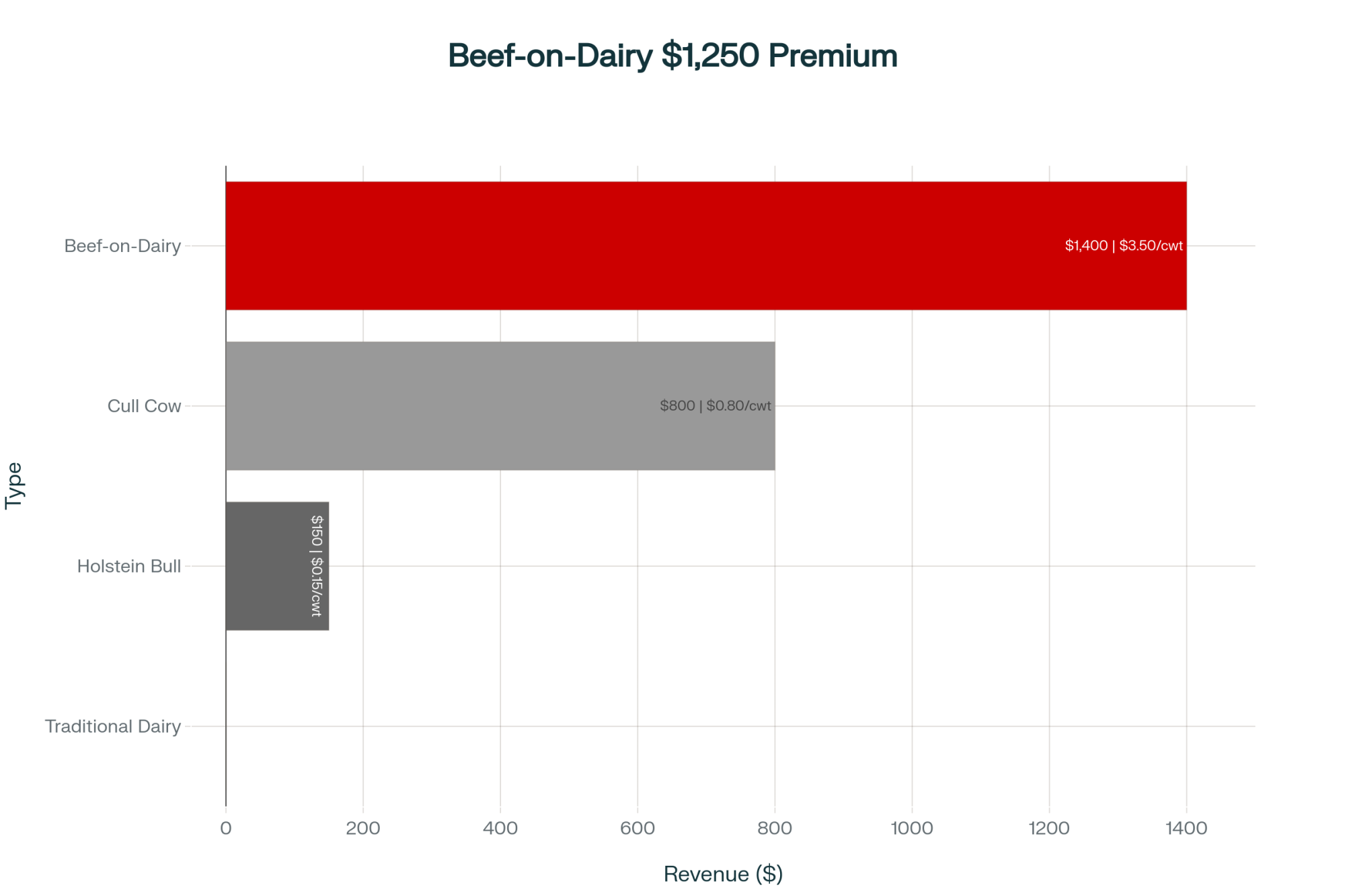
NewsSubscribe
First
Last
Consent

$10 Milk, $1 Profit: The New Zealand Warning Every Farmer Needs

NZ farmers net just $1 on $10 milk—their breakeven hits $9/kg while debt servicing eats 20% of revenue

EXECUTIVE SUMMARY: What farmers are discovering about New Zealand’s celebrated $10/kgMS milk price reveals a sobering reality for global dairy operations—margins have compressed to just $1-1.50 per kilogram despite record headline prices, with DairyNZ’s 2025 economic tracking showing breakeven costs pushing $9/kg for many farms. This margin squeeze reflects three converging pressures: processing capacity constraints forcing 20-30% spot milk discounts in some regions, environmental compliance costs running $50,000-70,000 annually for methane reduction alone on mid-sized operations, and China’s 5% annual domestic production growth fundamentally restructuring global trade flows that New Zealand—and frankly, all of us—built our export strategies around. Recent Reserve Bank data showing billions in debt reduction, despite record prices, suggests that savvy operators recognize this isn’t a boom but a warning. Cornell’s Andrew Novakovic reinforces that operations needing current prices to survive aren’t truly profitable. Here’s what this means for your operation: the same capacity constraints hitting New Zealand are developing in California, Idaho, and Northeast markets, making location relative to processing more valuable than pure production efficiency. The producers who’ll thrive are already running their numbers at 70% of current prices, locking in supply agreements over chasing spot premiums, and using today’s decent margins to strengthen balance sheets rather than expand—because as these global patterns accelerate, it’s not about maximizing today’s opportunity but surviving tomorrow’s reality.

Dairy Profit Margins

I was having coffee with a dairy farmer from just outside Madison last week, and he brought up something that’s been bothering many of us. “New Zealand’s getting ten bucks per kilogram,” he said, shaking his head. “That’s like four-fifty a pound. What are we doing wrong?”

You know, I get the frustration. Really, I do. Here we are, watching corn creep past four dollars, tweaking rations every week to save a few cents… and then you hear about these record prices on the other side of the world. Kind of makes you wonder if you’re in the wrong place, doesn’t it?

But here’s what’s interesting—and why I think we all need to pay attention to this. I’ve been digging into what’s really happening down there, talking with folks who work with Kiwi farmers, reading through their industry reports. And what I’ve found… well, it’s not the success story it appears to be. More importantly, the challenges they’re facing? We’re starting to see the same patterns developing here.

The Math Nobody Wants to Talk About

Let’s start with that headline number everyone’s throwing around. Ten dollars per kilogram. Sounds amazing, right? But here’s the thing—and this is what DairyNZ has been tracking in its 2025 economic reports—their breakeven costs have just skyrocketed. We’re talking somewhere in the high eighties, maybe even pushing nine dollars per kilogram for many operations.

The $10 Milk Reality: New Zealand farmers’ celebrated $10/kg milk price compresses to just $1.50 after all costs, revealing why record headlines don’t guarantee profitability.

Just think about that for a minute. If you’re getting ten but you need eight-fifty, nine just to break even… that’s what, maybe a dollar margin? Buck-fifty if you’re really efficient? That’s not exactly the windfall it sounds like.

What really caught my attention—and I spent some time reviewing their historical data here—is how different this is from their last real boom, about a decade ago. Back then, farmers were actually clearing better margins on lower headline prices. The entire cost structure has shifted completely.

It reminds me of something. That rough patch we had around 2014. Remember that? Decent milk prices on paper, but between feed costs and everything else, nobody was making money. Same story, different accent.

Labor’s killing them. And I mean really killing them. Finding good help—hell, finding any help—that’s tough everywhere, but they’re really struggling. Then you’ve got debt servicing. Many of these individuals expanded during the last couple of cycles, borrowing heavily when rates were low. Now they’re carrying that debt at higher rates. Sound familiar to anyone?

But the real kicker—and we’re starting to see this creeping in here too—is environmental compliance. Things that weren’t even a line item ten years ago are now consuming significant funds. I was reading through some of their farm publications, and one producer basically said that after all the deductions and real costs, that celebrated ten-dollar milk becomes more like seven-fifty, eight bucks in the pocket. And that’s before the next round of regulations kicks in.

When Your Success Becomes Your Problem

Here’s something that really hits home, especially for those of you in California or the Southwest. Do you know that feeling during the spring flush? When you’re making beautiful milk, components are great, cows are happy… but you’re starting to wonder if the plant can actually take everything you’re producing?

Well, that’s New Zealand right now. Except it’s not just spring flush—it’s becoming a year-round phenomenon.

Fonterra—they handle most of the milk down there, kind of like if Land O’Lakes and DFA had a baby—they’re basically running at capacity during peak season. According to industry insiders, we’re talking about 95% utilization during their spring months, which for them is October through December.

Processing Bottleneck Crisis: New Zealand’s 95% capacity utilization forces brutal 25% spot milk discounts, while Midwest US maintains full prices at just 78% capacity—location and timing now matter more than efficiency.

Now, in theory, that sounds efficient, right? Maximum utilization, minimal waste. But you and I both know what really happens when plants get that full. There’s zero wiggle room. One breakdown, one storm delays transport, whatever—suddenly you’ve got milk with nowhere to go.

If you’ve locked in a good contract and are close to a plant, you’re in a good position. Full price, no worries. But if you’re depending on spot markets? Or worse, if you’re an hour or two from the nearest facility? Man, that gets rough quick. I’m hearing from multiple sources—although I can’t verify it firsthand, enough people are saying it—that some regions are seeing significant discounts on spot milk. Like, painful discounts. Twenty, thirty percent off in some cases.

And here’s the real nightmare scenario: some farmers are being told to find alternative outlets for their milk. Can you imagine? You’ve already fed the cows, done the milking, paid for everything… and then you literally can’t sell the milk. That’s not a business problem anymore—that’s an existential crisis.

The timing makes everything worse. Fonterra continues to announce expansion plans, new facilities, and increased capacity. However, from what I understand, most of this is still at least eighteen months, possibly two years away. Therefore, farmers are left with the current infrastructure while production continues to grow.

A producer from Vermont, whom I met at World Dairy Expo, mentioned that their co-op’s starting to see similar issues during flush. “We’re not there yet,” she said, “but you can feel it coming.” And that’s the thing—these patterns don’t stay regional anymore.

China’s Quiet Revolution That Changes Everything

China’s $40 Billion Dairy Revolution: Domestic production surged 51% while powder imports crashed 41%, fundamentally restructuring global trade flows that built New Zealand’s entire export strategy.

Alright, so this is the part that I think has massive implications for all of us, whether we’re selling milk in Wisconsin or Washington.

The numbers from USDA’s Foreign Agricultural Service paint a pretty stark picture. China’s imports of whole milk powder have dropped significantly over the past few years. We’re talking about a market that used to absorb just massive amounts of product—hundreds of thousands of tons annually. And now? It’s drying up.

What’s happening—and the folks at USDA’s Beijing office have been tracking this closely in their 2025 reports—is that China’s making this huge push for dairy self-sufficiency. And they’re not playing around. They’re building these massive operations, ten thousand cows, fifteen thousand cows. Bringing in genetics from everywhere. Utilizing technology that makes some of our setups appear outdated.

The data suggests that Chinese domestic milk production is growing at a rate of approximately 5% annually. Now that might not sound earth-shattering, but when you’re talking about a market that size… that’s displacing enormous amounts of imports every year.

Think about what this really means. For decades—I mean literally decades—the whole global dairy trade was built on this assumption that Chinese demand would just keep growing forever. New Zealand basically restructured their entire industry around it. We were all banking on it for our export growth. And now that fundamental assumption is just… gone.

This reminds me of something. What happened with whey exports. We used to send the majority of our whey protein to China. Now? That share has dropped significantly because they have built their own processing capacity. The market didn’t temporarily adjust—it fundamentally restructured. And it’s not coming back.

The Environmental Cost Nobody Calculated

Here’s something that’s particularly relevant for those of you dealing with new regulations in California, or if you’re in the Chesapeake watershed, or anywhere environmental standards are being tightened.

Fonterra launched this program where they pay farmers extra for reducing emissions. Sounds great on paper, right? Do the right thing environmentally, and get paid for it. Win-win.

But let me tell you what I’m hearing about the actual costs involved. And keep in mind, every operation’s different, but the numbers are sobering…

Feed additives to reduce methane? For a 400-500 cow herd, you could be looking at fifty, sixty, maybe seventy thousand a year. And that’s just for the additives themselves. Then you’ve got to upgrade your manure handling to meet new nitrogen standards. That’s serious capital we’re talking about—six figures for most operations, easy.

Environmental Compliance: The $765 Per Cow Reality Check – Manure upgrades ($450) and equipment modifications ($200) dominate costs, while carbon credits offer only $150 offset, creating net $615 annual burden.

Then there’s all the monitoring, the paperwork, the verification. Testing, certification, third-party audits. That’s not a one-time expense—it’s forever. Every year. Ongoing costs that just keep piling up.

Best case scenario—and I mean absolute best case—you might see payback in five years. More likely seven. However, that assumes milk prices remain high, the programs don’t change (and when have government programs ever remained the same?), and you actually qualify for the maximum payments. From what I understand, only a small percentage of farms are going to hit those top payment tiers.

A producer I know, who has been following this closely, put it perfectly: “We’re betting tomorrow’s survival on today’s programs.” That’s… man, that’s a hell of a position to be in.

Interesting thing, though—those of you running organic or grass-based systems might actually have an edge here. Your baseline emissions are often already lower, making it more achievable to hit reduction targets. It’s one of those rare times when being smaller or different might actually pay off.

What the Smart Money Is Actually Doing

You know what’s really telling? While everyone’s celebrating these record prices, New Zealand’s Reserve Bank data from 2025 shows their dairy sector has been aggressively paying down debt. We’re talking billions in reductions over the past year.

That’s not what you do when you think the good times will roll forever, you know?

The operations that seem to be positioning best—at least from what I can tell—are doing three things that really stand out:

Getting dead serious about financing. I keep hearing stories about farmers discovering they’re paying way more interest than necessary. Not because they’re bad risks, but simply because they haven’t shopped around in years. We’re talking about differences that add up to serious money—tens of thousands of dollars annually on typical debt loads. With year-end coming up, now’s actually a great time to have these conversations with lenders. Banks are competing for good ag loans right now.

Choosing certainty over maximum price. They’re locking in supply agreements, even if it means taking a slight discount per unit. Because having guaranteed market access at $9 beats the theoretical $10 milk you can’t sell. We learned this lesson the hard way back in 2009, didn’t we?

Simplifying instead of expanding. Some are actually selling equipment and doing sale-leasebacks. Holding off on that new parlor upgrade. Building cash reserves instead of new facilities. It’s conservative, sure. But maybe that’s smart given everything else going on?

And here’s something for our smaller operations—those 100 to 200 cow farms that sometimes feel left behind in these discussions. You might actually have some real advantages here. Lower debt loads, more flexibility, less dependence on maxed-out processing capacity. Sometimes being smaller means being more nimble when things get tight.

Farm Survival Matrix: Small niche operations (7.5 resilience score) outperform large remote farms (3.5 score)—location and market strategy matter more than scale in today’s volatile environment.

What This Actually Means for Your Farm

So what does all this mean for those of us milking cows here in the States? I think the patterns are becoming increasingly clear if we’re willing to look.

The processing capacity seems fine until everyone tries to expand at the same time. We saw hints of this during California’s big growth phase a few years back. The Southwest is now showing similar signs. Idaho’s getting there. Even some Northeast co-ops are feeling the squeeze during the flush—I’m hearing similar stories from Pennsylvania producers and folks in upstate New York. It can happen anywhere.

Export markets we’ve counted on for years? They can shift faster than we think. And not temporarily—permanently. Whether it’s China with powder, Mexico with cheese, whatever the product. These shifts happen, and they’re accelerating.

Environmental costs that seem manageable at seventeen or eighteen dollar per gallon of milk? They become real problems at fourteen. And let’s be honest—we will see fourteen again. We always do, eventually.

Andrew Novakovic over at Cornell’s Dyson School said something in their recent 2025 dairy outlook that really stuck with me. He pointed out that if you need current prices to make your operation work—if you can’t survive at 70% of today’s milk price—then you’re not really profitable. You’re just temporarily lucky.

The 70% Test: Your Reality Check

So where does this leave us? What should we actually be doing with this information?

First thing—and I know this isn’t fun—but run your numbers at much lower milk prices. Nobody wants to think about this when things are decent. However, if your operation falls apart at 70% of current prices, that’s something you need to know now, not when it happens.

Have a real conversation with your milk buyer. Not the field rep who always says everything’s fine—someone who actually knows about capacity planning. Ask directly: If regional production increases by 10% next spring, what happens? Can they handle it? At what price? You might not like the answer, but you need to hear it.

Think carefully about any long-term investments, especially those related to environmental compliance. The experts I trust at Penn State Extension and Wisconsin’s Center for Dairy Profitability are all saying the same thing: three years or less for payback, assuming conservative milk prices. Anything longer, and you’re basically gambling on stability that rarely exists in dairy.

And here’s one that might seem obvious but apparently isn’t: location matters more than ever. Being an hour from the nearest plant just meant higher hauling costs. Now it might mean the difference between having a guaranteed market and scrambling for buyers. That super-efficient thousand-cow operation in the middle of nowhere? It might actually be riskier than a smaller farm adjacent to a cheese plant.

Oh, and please—if you haven’t reviewed your financing recently, do so now. The variation in rates and terms is wider than most people realize. Even a half-point difference compounds into serious money over time. With recent Fed moves and banks competing for good ag loans, you might be surprised at what’s available.

The Real Bottom Line

You know what really gets me about all this? It’s how apparent success can actually mask serious problems. That ten-dollar milk in New Zealand? It’s real. But so are all the things eating away at it—the costs, the constraints, the market shifts.

The farms that are going to thrive—whether they’re in New Zealand, Wisconsin, California, the Northeast, wherever—they’re not necessarily the biggest or the most technologically advanced. They’re the ones who understand the difference between a good price cycle and a sustainable business model. They’re using today’s decent prices to prepare for tomorrow’s challenges, not betting everything on the party continuing.

What’s happening in New Zealand… it’s coming here. Maybe not exactly the same way, but the patterns are unmistakable. Rising costs, capacity constraints, and shifting global demand. These forces aren’t going away.

The producers who see this clearly, who adjust now while they still have flexibility, are the ones I’d bet on. Because if there’s one thing we’ve all learned—usually the hard way—it’s that this industry cycles. Always has, always will.

The question isn’t whether things will change; it’s whether we can adapt to them. They will. The question is whether we’ll be ready when they do. And considering what’s happening in New Zealand, that’s a conversation worth having with your banker, family, and yourself. Sooner rather than later.

Because in the end, it’s not the headline math that matters. It’s the actual dollars-in-your-pocket math. And that’s what counts when the cycle turns.

Which it always does.

KEY TAKEAWAYS

  • Run the 70% price test immediately: If your operation can’t break even at $11-12/cwt Class III (70% of current prices), you’re operating on borrowed time—Penn State Extension and Wisconsin’s Center for Dairy Profitability recommend restructuring debt and costs now while banks are competing for good ag loans
  • Processing capacity matters more than efficiency: Farms within 30 miles of guaranteed processing are seeing $0.50-1.00/cwt premiums over efficient operations 60+ miles away—lock in supply agreements even at 5-10% below spot prices because having market access beats theoretical higher prices you can’t capture
  • Environmental compliance payback can’t exceed 3 years: With feed additives for methane reduction costing $100-150/cow annually and system upgrades running six figures, only investments that pencil out at a conservative $14/cwt milk make sense—organic and grass-based operations may have advantages here with lower baseline emissions
  • China’s self-sufficiency changes everything: Their 5% annual production growth means 200,000+ tons less powder demand yearly—diversify markets now, as USDA Foreign Agricultural Service data shows this isn’t a temporary adjustment but permanent restructuring like what happened with U.S. whey exports dropping from 54% to 31% of China’s imports
  • Smart money’s building resilience, not capacity: New Zealand farmers paid down $1.7 billion in debt during record prices—consider sale-leasebacks on equipment, refinancing at today’s competitive rates (even 0.5% saves $15,000 annually on $3M debt), and maintaining 12-18 months operating expenses in cash reserves rather than expanding

Complete references and supporting documentation are available upon request by contacting the editorial team at editor@thebullvine.com.

Learn More:

The Sunday Read Dairy Professionals Don’t Skip.

Every week, thousands of producers, breeders, and industry insiders open Bullvine Weekly for genetics insights, market shifts, and profit strategies they won’t find anywhere else. One email. Five minutes. Smarter decisions all week.

NewsSubscribe
First
Last
Consent

$320,000 Now or Dairy Legacy Forever? The October 30 Vote Splitting New Zealand’s Farmers

Why sell brands posting 103% profit growth? 10,700 farmers decide Oct 30 if $320k now beats legacy forever.

EXECUTIVE SUMMARY: Fonterra’s proposed $3.8 billion sale of its consumer brands to Lactalis presents 10,700 farmer shareholders with one of the cooperative dairy’s most consequential decisions—vote by October 30 on whether to cash out brands that have shown a remarkable turnaround. The consumer division’s operating profit surged from NZ$146 million to NZ$319 million year-over-year (103% growth), driven by expanding sales of South Asian packaged milk powders and the UHT market in Greater China, according to Fonterra’s Q3 financials. This valuation—between 10 to 15 times earnings with a 15-25% premium over typical dairy transactions—suggests that Lactalis sees long-term value in New Zealand’s grass-fed reputation, which took generations to build. With Fonterra carrying NZ$5.45 billion in debt at 39.4% gearing, the board views this sale as a means to balance sheet strengthening, although farmers must weigh the immediate capital needs against surrendering their connection to consumer markets. What farmers are discovering through discussions from Taranaki to Canterbury is that this vote transcends individual operations—it could reshape global cooperative strategies, as the boards of DFA, Arla, and FrieslandCampina watch closely. The decision ultimately asks whether farmer cooperatives can compete in consumer markets or should retreat to ingredients and processing. Each shareholder must evaluate their operation’s specific needs, succession plans, and vision for dairy’s future before casting a vote that, once done, can’t be undone.

You know that feeling when you’re doing evening chores and something on the news makes you stop and really think? That’s been happening a lot lately with this Fonterra situation. Back in August, they announced they’re selling their consumer brands to Lactalis—the French dairy giant—for NZ$3.845 billion, according to their official announcements. Could increase to $4.22 billion, including the Australian licenses.

And here’s what has got me, and many other farmers, talking… With 10,700 farmer shareholders voting on October 30, we’re looking at something that could change how we all think about cooperative dairy.

The Numbers We’re All Trying to Figure Out

So here’s what’s interesting about the financial performance, and I’ve been digging through Fonterra’s Q3 reports to get this straight. The consumer division—encompassing Mainland cheese, Anchor butter, and Kapiti specialty products—saw its operating profit increase from NZ$248 million to NZ$319 million in Q3, representing approximately a 29% rise, according to their FY25 financial presentations.

Now, where that 103% figure comes from gets a bit specific—it’s actually the quarter-on-quarter comparison. When comparing Q3 this year to Q3 last year, the consumer division’s operating profit surged 103%, increasing from approximately NZ$146 million to NZ$319 million. That’s impressive growth, anyway you slice it, driven largely by higher sales volumes of packaged milk powders in South Asia and UHT milk in Greater China, according to their quarterly updates.

I’m not sure about you, but that timing leaves me scratching my head a bit. After years—and I mean years—of hearing “just wait, the turnaround is coming,” it finally arrives. And now we’re selling?

What I’ve found interesting in the latest annual reports is the valuation itself. When you adjust for standalone costs, Lactalis is paying somewhere between 10 and 15 times earnings, with a premium of about 15 to 25 percent over what these deals typically cost. That’s… substantial. They’re clearly seeing something valuable here. And it makes you wonder—could this affect Fonterra’s position as one of the world’s largest dairy exporters? That’s something worth thinking about.

Key Facts at a Glance:

  • Sale price: NZ$3.845 billion (potentially $4.22 billion)
  • Voting date: October 30, 2025
  • Farmer shareholders: 10,700
  • Consumer operating profit: NZ$319 million in Q3 FY25 (up from NZ$248 million)
  • Quarter-on-quarter growth: 103% (Q3 FY25 vs Q3 FY24)
  • Current debt: NZ$5.45 billion
  • Gearing ratio: 39.4%

Different Farms, Different Calculations

Here’s the thing about this vote—and this is what makes it so complicated—it means something different for every operation and every region.

Take farmers supplying milk to Te Rapa, one of Fonterra’s largest manufacturing sites, down in Waikato. The plant produces over 300,000 tonnes of milk powder and cream products annually, according to Fonterra’s operational data. If you’re one of those suppliers, you’re probably thinking more about the ingredients side of the business since that’s where your milk’s likely going anyway.

However, if you’re in a region that supplies plants producing consumer products—such as some of the operations near cheese plants or butter facilities—this sale hits differently. You’ve been directly involved in building those brands.

If you’re running a smaller herd, maybe 400 to 600 cows, like a lot of farms in Taranaki or up in Northland, that potential payout could be a game-changer. We’re talking real money that could help with debt from that new rotary you put in, or finally let you upgrade that aging effluent system. With feed costs where they are and milk prices doing their usual dance, breathing room matters. Though it’s worth noting—depending on how the payout’s structured, there might be tax implications to consider. That’s something to discuss with your accountant before counting chickens.

But then… and this is where I keep getting stuck… these brands weren’t built overnight. Your milk, your parents’ milk, probably your grandparents’ milk, went into building that New Zealand dairy reputation. What’s that worth over the next 20 years? Hard to put a number on it, really.

Now, if you’re running 2,000-plus cows—like some of those bigger operations down in Canterbury or Southland—you might be looking at this differently. Many of those farms are already pretty commodity-focused anyway. For them, maybe the immediate capital for expansion or debt reduction makes more sense than holding onto consumer brands they feel disconnected from.

And then there’s everyone in between. I was speaking with a farmer near Rotorua last week who runs approximately 850 cows. She’s torn. “The money would help,” she said, “but I keep thinking about what we’re giving up. My daughter’s interested in taking over someday—what kind of industry am I leaving her?”

Farmers in regions more dependent on the consumer business—those near plants that have historically focused on value-added products—may feel this more acutely than those in regions with heavy milk powder production. It’s not just about the money; it’s about what part of the value chain your community has been connected to.

Consider the rural communities as well. When farm families have more capital, it flows through the local economy—equipment dealers, feed suppliers, the café in town. But long-term? If we lose that connection to consumer markets, what happens to the value of what we produce? And what about future cooperative dividends, considering that those higher-margin consumer products will not contribute to them?

Why Lactalis Wants In

The French aren’t throwing this kind of money around without good reason, that’s for sure. According to industry analysis, several factors are converging simultaneously.

First, there’s the Asian market access. But honestly, I think it’s more than that. It’s that grass-fed story we’ve built over decades—you know what I mean? That image of cows on green pastures, the clean environment, the careful breeding programs we’ve all invested in. Lactalis knows they can’t just create that from scratch.

And think about it—how many years of getting up at 4 AM, dealing with wet springs and dry summers, constantly working on pasture management and milk quality… all of that goes into that premium reputation. You can’t just buy that off the shelf.

What’s also interesting is how this compares to what’s happening in other markets. In the States, cooperatives like DFA have been under similar pressure. Europe’s seeing the same thing with Arla and FrieslandCampina facing questions about their consumer strategies. Down in Australia, Murray Goulburn farmers went through a similar experience with Saputo a few years ago; it might be worth asking them how that worked out.

I haven’t heard any major farming organizations take official positions on this yet, but you can bet they’re watching closely. The implications go beyond just Fonterra.

The Financial Reality Check

Now, we can’t pretend Fonterra hasn’t had some rough patches. Is that a Beingmate investment in China? Lost NZ$439 million according to their financial reports from a few years back. Other ventures also didn’t pan out.

According to their latest interim reports, they’re carrying NZ$5.45 billion in net debt, with a gearing ratio of 39.4%. That’s… well, that’s a fair bit of debt. So you can understand why the board might see this sale as a way to clean things up.

But here’s my question—and maybe you’re thinking the same thing—are we selling the profitable parts to fix past mistakes? Because that’s kind of what it feels like.

There’s also the environmental regulation side of things to consider. With nutrient management rules becoming increasingly stringent every year, some farmers are wondering if having more capital now might help them meet these requirements. It’s another factor in an already complicated decision.

And let’s not forget about currency. The NZ dollar’s been all over the place lately. Receiving a lump sum payment now versus relying on favorable exchange rates for future dividends… that’s something else to consider.

What This Means Beyond the Farm Gate

Here’s something to chew on—what happens in New Zealand doesn’t stay in New Zealand anymore. Not in today’s global dairy market.

I was speaking with a fellow who ships to a cooperative in Wisconsin last month, and he mentioned that their board is already receiving questions about their consumer brands. “If Fonterra’s doing it, why aren’t we?” That kind of thing. And you know how these conversations go—once one big cooperative makes a move, others start wondering if they should follow.

We’ve all seen what happens when cooperatives become just milk suppliers to companies that own the brands. The whole bargaining dynamic changes. Ask any of those farmers who used to supply Dean Foods in the States how that worked out. Once you’re just a supplier, not a brand owner… well, it’s a different game entirely.

There’s also something to be said about cooperative governance here. This entire situation may serve as a wake-up call about who we elect to boards and what questions we ask them. Perhaps we should be more involved in these strategic decisions before they reach the voting stage.

Questions That Keep Coming Up

Winston Peters made some good points in Parliament about this whole thing—and regardless of what you think of politicians, the questions were valid. What exactly are the terms of these supply agreements with Lactalis? I mean, if New Zealand milk becomes relatively expensive compared to, say, European or South American sources, what happens then?

These aren’t just theoretical worries. They’re the kind of practical concerns that could affect milk checks for years to come. And honestly? Farmers deserve clear answers before voting on something this big.

If you want to dig deeper into the details, Fonterra’s shareholder portal has the full transaction documents. Your local discussion group is likely covering this topic as well—it might be worth attending the next meeting to hear what your neighbors are thinking. And for those wondering about the voting process itself, it can be conducted in person at designated locations, by proxy if you are unable to attend, or through postal voting—details should be included in your shareholder materials that were distributed last month.

Regarding the timeline, if farmers vote ‘yes’ on October 30, the deal is likely to close in early 2026, pending receipt of regulatory approvals. That’s when you’d see the money, but also when the brands would officially change hands.

Thinking It Through

So, where’s all this leave us with October 30 coming up? Well, like most things in farming, it depends on your situation.

If your operation needs capital right now—and I know many that do, given current margins—this payout could be exactly what keeps you going. There’s absolutely no shame in prioritizing your farm’s survival. We all do what we need to do.

However, if you’re thinking longer term, especially if you have kids showing interest in taking over someday, you have to wonder what you’re giving up. These brands represent decades of dedication and hard work by New Zealand farmers. All those early mornings, all that attention to quality… once those brands are gone, they’re gone.

Two Different Roads

If this sale goes through, Fonterra will essentially become an ingredients and processing company. That’s a pretty fundamental shift from what the cooperative has been. We’d be supplying milk primarily for ingredients markets, with Lactalis controlling the consumer-facing side of things.

If farmers vote no? Well, that’s a statement too, isn’t it? We still believe that farmer cooperatives can compete in consumer markets. This might even encourage other cooperatives around the world to continue building their brands rather than selling them off.

The Bottom Line

You know what really strikes me about all this? Sure, the money’s important—nobody’s saying it isn’t. However, it’s really about what we think dairy farming should be in the future.

Those brands—Mainland, Anchor, Kapiti—they mean something. They’re the result of generations of farmers getting up before dawn, dealing with whatever the weather throws at us, and constantly working to improve. That connection to consumers, that ability to capture value beyond the farm gate… once you hand that over, you don’t get it back.

The vote’s coming whether we’re ready or not. Whatever you decide, make sure it’s something you can live with—not just when that check clears, but years down the road when you’re looking at what the industry’s become.

Because here’s the truth: once this is done, there’s no undoing it. Dairy farmers everywhere will be watching closely to see what New Zealand decides. And whatever way it goes, it will influence how cooperatives think about their future for years to come.

Take your time with this one. Discuss it with your family, and chat with your neighbors at the next discussion group meeting. Get all the information you can from Fonterra’s shareholder resources and those quarterly reports they’ve been putting out. Consider discussing the tax implications with your accountant as well. This is one of those decisions that really does shape the industry for the next generation.

Make it count.

KEY TAKEAWAYS:

  • Immediate financial impact varies by operation size: Smaller 400-600 cow farms could see debt relief equivalent to 18 months operating costs, while 2,000+ cow operations might fund expansion—but all sacrifice future dividend streams from consumer products showing 103% profit growth.
  • Regional implications differ based on plant specialization: Farmers supplying Te Rapa’s 300,000 tonnes of milk powder production think differently than those near cheese and butter facilities who’ve directly built these consumer brands over generations.
  • Tax and timing considerations require planning: If approved on October 30, the deal is expected to close early in 2026, pending regulatory approval. Farmers should consult with accountants about the potential tax implications of lump-sum payouts versus future dividend streams.
  • Global cooperative precedent at stake: This vote influences whether farmer-owned brands remain viable worldwide, as U.S. and European cooperatives face similar pressures—Murray Goulburn’s experience with Saputo offers cautionary lessons about becoming just suppliers.
  • Three ways to vote before deadline: Shareholders can participate in person at designated locations, submit proxy votes if unable to attend, or use postal voting with materials distributed last month—full transaction documents available through Fonterra’s shareholder portal.

Complete references and supporting documentation are available upon request by contacting the editorial team at editor@thebullvine.com.

Learn More:

The Sunday Read Dairy Professionals Don’t Skip.

Every week, thousands of producers, breeders, and industry insiders open Bullvine Weekly for genetics insights, market shifts, and profit strategies they won’t find anywhere else. One email. Five minutes. Smarter decisions all week.

NewsSubscribe
First
Last
Consent

Forget Keeping Barns Warm: Why Winter’s Your Most Profitable Season

Forget keeping barns warm – smart dairies use winter’s cold for 5-10% better feed efficiency 

EXECUTIVE SUMMARY: What farmers are discovering through hard-won experience and university research is that winter barn management has been backwards for decades – it’s moisture, not temperature, that drives production losses and respiratory issues. Cornell’s veterinary economics studies show respiratory treatments alone cost $50-100 per case, but when you factor in the hidden costs of poor ventilation – including 2-3% drops in feed efficiency and 20-30% increases in bedding expenses – a typical 100-cow operation can lose $15,000 per winter season. Recent findings from Michigan State, Penn State, and Wisconsin extension programs confirm that cattle thrive in cold conditions when kept dry, with many operations reporting their highest butterfat levels (0.2-0.3% increases) and best quality premiums during January and February. The shift in thinking is simple but profound: your mature Holstein generates enough heat through rumen fermentation to stay comfortable at 30°F in dry conditions, but struggles at 45°F with high humidity. Here’s what this means for your operation – those three critical maintenance tasks you can complete in an afternoon (checking fan belts, testing inlet controls, establishing humidity baselines) could transform winter from your most challenging season into your most profitable. Smart operators aren’t installing expensive heating systems; they’re spending $30 on humidity monitors and an hour adjusting curtain cables, then watching their milk checks improve while neighbors fight the same battles they’ve always fought.

Every fall, we face the same concern: keeping our barns warm for winter. But here’s the thing – what if temperature isn’t really the issue?

I’ve been talking with extension folks and examining what successful operations are doing, and a clear pattern is emerging. The dairies with the strongest winter production aren’t necessarily running the warmest barns. In fact, they’re often the ones who’ve completely rethought their approach, focusing on moisture control over temperature management. And the results? Some are seeing their best milk checks in January and February.

Smart winter barn management saves $14,400 per 100-cow operation compared to traditional approaches that fight cold instead of managing moisture.

Your Cows Were Built for Cold – It’s the Conventional Thinking That’s Wrong

A mature Holstein generates a tremendous amount of body heat just through normal digestion and rumen fermentation – we’re talking serious BTUs here. You probably know this already, but cattle handle cold remarkably well when they’re dry and out of drafts. The old Midwest Plan Service guides, which many of us still reference, have been saying this for decades, and Michigan State’s latest winter housing bulletins confirm that it still holds true.

What’s interesting is how differently this plays out across regions. I know a 300-cow operation in northern Wisconsin that maintains solid production at temperatures that would have their counterparts in Georgia calling the vet. Meanwhile, some Northeast producers struggle more with winter ventilation despite having milder temperatures overall.

Why’s that? In many cases, it comes down to effective humidity management. The moisture in your barn – not the cold – tends to be what causes most winter headaches. And here’s where it gets expensive…

The Hidden Economics Nobody Talks About

Poor winter ventilation often costs more than just treating respiratory issues – though, according to Cornell’s veterinary economic studies, those alone can run $50-$ 100 per case.

When humidity climbs in your barn, you typically get condensation. That moisture creates ideal conditions for bacteria to grow. Maybe your cows don’t become sick enough to need treatment, but their feed efficiency may drop by 2-3%. On a 100-cow dairy feeding $8-10 per cow per day, that seemingly small percentage adds up to thousands over a winter. Equipment tends to corrode faster. Bedding stays damp longer, increasing your bedding costs by 20-30% in some cases.

I spoke with a producer last month who discovered that his poor ventilation was costing him nearly $15,000 a winter when he added everything up. “I was so focused on keeping the barn warm,” he told me, “I didn’t realize I was basically burning money.”

Understanding the Temperature Transition Point

Temperature-specific ventilation rates reveal the critical shift from moisture control to heat management – the key insight most operations miss when temperatures drop below 45°F.

Based on what ventilation engineers and extension specialists from Penn State and Wisconsin have documented, there’s typically a temperature range – often somewhere between freezing and 45 degrees Fahrenheit – where the physics of air movement in your barn fundamentally changes.

Above that range, natural ventilation usually works pretty well. You get decent wind-driven airflow, and temperature differences help move air naturally. But once you drop below that range, thermal buoyancy becomes your primary driver, and if you’re not ready for that shift…

The general guidelines that seem to work for many operations:

  • Above 45°F: Your summer ventilation approach typically works
  • 35-45°F: Reduce total airflow but maintain moisture removal
  • Below freezing: Focus on minimum ventilation rates – just enough to control moisture
  • Below 20°F: Every excess CFM is costing you valuable heat

Of course, every barn’s different. Your neighbor’s setup might need completely different adjustments.

Three Things That Actually Matter (And One That Doesn’t)

Look, everyone’s got their own system, but from what I’ve seen work consistently well – and what extension educators keep emphasizing – there are really three main areas that tend to matter before winter hits.

Getting Your Fans to Actually Work

This sounds basic, I know. But, according to agricultural engineering studies from Iowa State, fans that aren’t properly maintained can lose 30-40% of their efficiency due to loose belts and dirty blades.

Check your belt tension – many manufacturers suggest about a half-inch of play when you press on them. Takes maybe an hour to go through all your fans if you’re organized. And while you’re at it, clean those blades. I’ve seen operations improve their airflow by 25% simply by cleaning – no new equipment is needed.

Making Sure You Can Control Your Inlets

Whether you’ve got curtains, panels, or another setup, they need to work smoothly through their full range. I’ve heard too many December disaster stories about controllers failing or curtains freezing halfway.

Before it gets cold, run everything through its paces. A 200-cow dairy I work with in Vermont figured out three of their actuators were barely functioning during their October check. Fixed them for $300. If they’d waited until December? Could’ve been looking at thousands in emergency repairs and lost production.

Here’s another success story: A producer near Ithaca told me he spent a Saturday morning going through every curtain controller and actuator. Found two that were sluggish, one cable fraying, and a controller that wasn’t reading temps correctly. The total fix cost him about $450 and took four hours. “Best money I spent all year,” he said. “Previous winter I lost $8,000 in one week when a curtain froze open during a blizzard.”

Knowing Your Normal (And Actually Tracking It)

This might sound too simple, but it’s often the difference between catching problems early and dealing with disasters. Your local extension office likely has simple humidity monitors available for under $30 – some newer models, such as those from companies like SensorPush or Govee, even connect directly to your smartphone.

What’s the humidity like when things are working well? Most operations perform best with winter humidity levels between 50-70%, according to University of Minnesota Extension guidelines. Where do you first notice condensation? How do your cows behave differently? Some producers keep notes, others use apps. Either way works.

What Doesn’t Matter? Keeping It “Warm Enough”

Here’s the controversial bit: that obsession with keeping barns warm? It’s probably costing you money. Your cows’ thermoneutral zone ranges from about 25°F to 65°F. They’re more comfortable at 30°F and dry than at 45°F and damp.

The Warm Spell Trap

Here’s something we see every winter across the Midwest and Northeast. You experience the January or February warm spell, where temperatures jump 30-40 degrees for a few days. Suddenly, it’s 45 degrees, ice is melting, and everyone relaxes.

But materials expand at different rates. Ice melts in unexpected patterns. Your ventilation settings are all wrong. Then, temperatures crash back down, and you have moisture frozen in new places. I’ve seen this cause thousands of dollars in damage – including ice dams in ventilation systems, frozen curtains, and failed equipment.

The key? Stay vigilant during warm spells. That’s actually when most winter damage occurs, not during the steady cold. Check out the barn structure damage photos on Penn State’s extension site if you want to see what I’m talking about – it’s eye-opening.

Regional Approaches That Actually Work

RegionChallengeCFM RangeSolutionSuccess Metric
Upper MidwestExtreme cold/dry air15-50Heat recovery ventilatorsEnergy savings
NortheastHigh humidity year-round20-30% above standardEnhanced moisture removalMoisture control
Western (ID/WA)Daily temp swingsVariable based on timeAutomated systemsQuick adjust
CA CentralTule fog 90%+ humidityPositive pressureHybrid approachesFog mitigation

Upper Midwest operations generally deal with extreme cold but dry air. The challenge is maintaining sufficient ventilation (often 15-50 CFM per cow, according to the Wisconsin Extension) without losing heat. Some folks are having good luck with newer heat recovery ventilators – although at $5,000 to $ 10,000 installed, the economics need to be penciled out.

Northeast dairies face higher humidity year-round. Cornell’s PRO-DAIRY program finds they often need 20-30% more ventilation than Midwest recommendations. It’s all about moisture removal, even if it costs some heat.

Western operations in Idaho and Eastern Washington see massive daily temperature swings. Washington State University extension reports that automated systems that can adjust quickly are almost essential there.

California’s Central Valley experiences tule fog, which can maintain humidity levels above 90% for days. UC Davis research shows many have switched to positive pressure or hybrid systems to maintain air quality regardless of outside conditions.

Small Changes, Big Payoffs

Simple fall maintenance delivers 4,606% ROI by preventing expensive winter emergencies and production losses – the kind of return that makes CFOs pay attention to barn management.

What’s encouraging is that dramatic improvements don’t require huge investments. A modest increase in minimum ventilation – maybe from 15 to 25 CFM per cow – often solves moisture problems without causing temperature issues.

Ensuring curtains open evenly can significantly transform airflow patterns. One Illinois producer told me his condensation problems disappeared after spending two hours adjusting curtain cables for even operation. Cost? His time and maybe $20 in hardware.

And here’s something new: several producers are using those $50-100 wireless humidity sensors that alert your phone when conditions get problematic. Pays for itself if it prevents even one respiratory case. The University of Wisconsin offers a great online ventilation calculator that helps you determine your ideal CFM rates – worth checking out. You can also find visual guides for proper belt tension and inlet adjustment patterns on most extension websites now.

Making Winter Your Competitive Advantage

Winter becomes your most profitable season when proper ventilation management eliminates heat stress and optimizes cow comfort during cold months – the 180-degree mindset shift that separates leaders from followers.

Many operations actually experience their best production in January and February, when heat stress is alleviated. Your cows are built for cold weather – that rumen is essentially a 100-gallon fermentation heater running 24/7.

A well-managed winter barn often sees 5-10% better feed efficiency than summer, higher butterfat (often 0.2-0.3% higher), and lower SCC. Some people report that their best milk quality premiums come in the winter months.

The fundamentals haven’t changed, but our understanding has. Focus on moisture, not temperature. Maintain equipment properly. Stay flexible as conditions change. Your local extension service has resources tailored to your region – use them.

Your Action Plan Starting Now

So where does this leave you? Here’s what actually needs doing:

This week: Check every fan belt and clean blades. Test all inlet controls. Order spare belts now – suppliers are expected to run out by December.

Before first freeze: Know your baseline humidity. Set up monitoring (even just a simple thermometer/hygrometer). Have your warm spell protocol ready.

All winter: Adjust based on conditions, not the calendar. Watch for that warm spell trap. Keep checking those belts – thermal cycling loosens them.

Winter’s coming whether we’re ready or not. But with the right approach – challenging that “keep it warm” mentality and focusing on what actually matters – it can be your most profitable season.

Where are you at with prep? Still thinking about it, or already getting things dialed in? Either way, there’s time to make those small adjustments that can mean the difference between fighting winter and profiting from it. Your cows are ready. Question is, are you?

KEY TAKEAWAYS

  • Winter production gains are real and achievable: Operations maintaining 50-70% humidity (not temperature) report 5-10% better feed efficiency, 0.2-0.3% higher butterfat, and lower SCC – turning January and February into their most profitable months instead of their most expensive
  • The $300 fix beats the $15,000 loss: Simple October maintenance – checking belt tension (half-inch deflection), cleaning fan blades (25% airflow improvement), and testing inlet controls – prevents the cascade of winter problems that cost thousands in treatments, lost production, and emergency repairs
  • Regional adaptations matter but principles don’t change: Whether you’re dealing with Minnesota’s dry cold (15-50 CFM per cow minimum), Northeast humidity (20-30% more ventilation needed), or California’s tule fog (90%+ humidity for days), the focus stays on moisture removal, not heat retention
  • Technology helps but basics still win: While $50-100 wireless humidity sensors and smartphone apps add convenience, the fundamentals – knowing your barn’s normal humidity baseline, adjusting for warm spell traps, maintaining consistent airflow – determine whether you profit from winter or fight it
  • Your cows are telling you what they need: That 100-gallon rumen fermentation system makes them comfortable at 25-65°F when dry, so stop burning money trying to keep barns warm at 45°F while moisture creates the perfect storm for respiratory issues, equipment corrosion, and production losses

Complete references and supporting documentation are available upon request by contacting the editorial team at editor@thebullvine.com.

Learn More:

The Sunday Read Dairy Professionals Don’t Skip.

Every week, thousands of producers, breeders, and industry insiders open Bullvine Weekly for genetics insights, market shifts, and profit strategies they won’t find anywhere else. One email. Five minutes. Smarter decisions all week.

NewsSubscribe
First
Last
Consent

CME Dairy Market Report: October 13, 2025 – Block Cheese Crashes 3¢ as Traders Brace for Sub-$16 Milk

Block cheese drops 3¢ to $1.67 while feed costs hold at $4.10 corn—margin decisions define survival

Executive Summary: What farmers are discovering through today’s CME action is that the dairy market’s entering a prolonged adjustment phase that rewards operational efficiency over production volume. Block cheese’s decisive 3-cent drop to $1.67/lb on six trades—double the typical volume—signals institutional conviction that prices have further to fall, with Class III futures at $16.89/cwt already pricing in expectations of sub-$16 milk by November. The silver lining comes from the feed side, where December corn at $4.10/bu and soybean meal at $274.50/ton offer manageable input costs that translate to income-over-feed margins around $7.80/cwt—still above breakeven for efficient operations but leaving little room for error. Research from the Daily Dairy Report (October 2025) indicates farms maintaining 2.35 milk-to-feed ratios can weather this downturn, though Mexico’s displacement of 507 million pounds of U.S. dairy exports and New Zealand’s aggressive SMP pricing at parity with U.S. NDM suggest the pressure’s structural, not cyclical. Here’s what this means for your operation: those who act now to lock in feed costs while optimizing component production for the 10-cent protein premium over butterfat will navigate this market successfully, while operations waiting for prices to “return to normal” risk becoming part of the consolidation statistics we’ll be discussing next spring.

Dairy Margin Survival

Your October milk check just took another beating. Block cheese dropped 3 cents to $1.67/lb on heavy volume, while butter scraped out a tiny gain that won’t save your Class IV. With feed costs still manageable at $4.10 corn, the smartest play right now is locking in your inputs before this market forces you to feed $16 milk to $5 corn.

When Six Block Trades Tell the Whole Story

You know, I’ve been tracking these markets long enough to recognize when something’s different. Today wasn’t just another down day – it was a day of conviction selling. Six block cheese trades at the CME (Daily Dairy Report, October 13, 2025), versus the typical four, suggests that the big players are positioning for more pain ahead. That 3-cent drop to $1.67/lb? It broke right through the support level that had been held since late September.

“We’re seeing processors work through inventory rather than chase spot loads,” mentioned Tom Wegner, a Wisconsin cheese plant manager I spoke with this morning. “Nobody wants to be holding expensive cheese when the market’s trending like this.”

The interesting aspect here is the barrel-over-block spread, which is currently sitting at 4 cents. That’s backwards from normal market dynamics. Usually, blocks lead and barrels follow, but today’s zero-barrel trades with just one offer hanging out there suggest that buyers figure they can wait this out. Smart money’s betting blocks catch down to barrels, not the other way around.

Today’s Numbers and What They Actually Mean

Block cheese leads the market massacre with a devastating 3-cent plunge – the kind of single-day bloodbath that separates survivors from casualties in today’s dairy market.
ProductPriceToday’s MoveWeekly AverageYour Bottom Line Impact
Cheese Blocks$1.6700/lb-3.00¢$1.7365Directly hits Class III – expect 75¢-$1.00/cwt lower checks
Cheese Barrels$1.7100/lbNo Change$1.7400Holding but won’t prop up Class III
Butter$1.6200/lb+1.50¢$1.6440Minor relief, but still 24% below last October
NDM Grade A$1.1275/lbNo Change$1.1445Skim solids glut continues
Dry Whey$0.6350/lbNo Change$0.6310Steady, but can’t offset cheese weakness

Looking at the CME settlement data (Daily Dairy Report, October 13, 2025), October Class III futures closed at $16.89/cwt while Class IV scraped along at $14.34/cwt. That Class IV number should make you wince – we haven’t seen it this low since 2020’s pandemic collapse.

The Global Chess Game Working Against Us

507 million pounds of traditional Mexican demand just evaporated – that’s $85+ million in lost revenue that’s never coming back, no matter what the optimists tell you.

Here’s what farmers aren’t hearing enough about: New Zealand’s hammering us on powder pricing. Their SMP futures at $2,580/MT translate to about $1.17/lb (NZX Futures, October 13, 2025), basically matching our NDM at $1.1275. When the Kiwis can land powder in Southeast Asia at our prices despite shipping costs, we’ve got problems.

The European situation’s equally concerning. EEX butter futures at €5,500/MT (Daily Dairy Report Europe Futures, October 13, 2025) work out to roughly $2.80/lb – that’s 73% above our $1.62 butter. Sure, it makes us competitive for exports, but it also tells you where global butter thinks our price should be heading. Spoiler alert: it’s not up.

“Mexico’s shift away from U.S. dairy is the elephant in the room nobody wants to acknowledge,” notes Dr. Mary Ledman, dairy economist at Ever.Ag. “We’re talking about 507 million pounds of traditional demand that’s evaporating.” (Industry communication, October 2025)

Feed Markets: Your Only Good News Today

At 2.35, your milk-to-feed ratio sits just above the survival threshold – one bad month could push efficient operations into the danger zone where only the desperate or foolish operate

December corn at $4.1050/bu and soybean meal at $274.50/ton (CME Futures, October 13, 2025) gives you breathing room most didn’t have in 2022. I’m currently calculating milk-to-feed ratios of around 2.35 – not ideal, but workable if you’re efficient.

Wisconsin producers I’ve spoken with are seeing slightly better margins, thanks to a local corn basis running 10-15 cents under futures. California residents aren’t as fortunate, as transportation costs them an additional 20-30 cents per delivered feed. The smart operators locked in Q4 needs last month when corn dipped below $4. If you haven’t yet, today’s not terrible, but tomorrow might be.

Income over feed costs pencils out around $7.80/cwt for efficient operations. That’s above the $7 breakeven for most, but barely. And that’s assuming you’re hitting your production targets and not dealing with any health issues in the herd.

Supply Reality: We’re Making Too Much Milk

The USDA’s October report (USDA Dairy Markets, October 2025) estimated national production at 19.3 billion pounds, a 0.7% increase year-over-year. The kicker? The herd expanded to 9.460 million cows – up 41,000 head from last year. Texas and Idaho added 67,000 cows combined, while traditional states like Wisconsin actually contracted by 22,000 head.

What’s interesting here is the regional divergence. Upper Midwest milk flows are running steady to strong as fall weather boosts components. I’m hearing 4.2% butterfat and 3.3% protein from several Wisconsin farms. But those nice components don’t mean much when butter’s in the tank and cheese is falling.

Processing capacity’s the real bottleneck. Plants in the Central region are running at 95-98% capacity (USDA Dairy Market News, October 2025). When you’ve got more milk than processing capacity, spot premiums evaporate. Some producers are currently seeing discounts of 50 cents per class. That hurts.

What’s Really Driving These Markets

Let me paint you a picture of the demand picture, and it’s not pretty. Domestic cheese consumption’s holding steady according to USDA data (USDA Economic Research Service, October 2025), but food service remains 8% below pre-2020 levels. Retail’s picking up some slack, but not enough.

The export story’s worse. China’s imports hit 15-year lows in Q3 2025 while Mexico – our traditionally largest customer – is actively sourcing from Europe and Oceania. Southeast Asian buyers? They’re cherry-picking the lowest global offers, which currently means New Zealand, not us.

“We built this industry on export growth assumptions that aren’t materializing,” one large co-op board member told me off the record. “Now we’re stuck with production capacity sized for markets that disappeared.”

Inventory levels tell their own story. However, butter stocks at 40,052 tonnes (Canadian Dairy Information Center, October 2025) indicate more than adequate supplies, despite the low price. Cheese inventories aren’t publicly reported as frequently, but plant managers tell me they’re holding 10-15% more product than they did this time last year.

Where Markets Head From Here

The futures market’s painting an ugly picture. The November Class III at $16.17 and December at $16.39 (CME Class III Futures, October 13, 2025) suggest that traders don’t expect quick relief. Those aren’t profitable numbers for most operations, especially for newer dairies that carry heavy debt loads.

The technical picture’s equally concerning. Today’s break below $1.70 block support sets up a potential test of $1.65. Below that? The July low of $1.58 comes into play. At those levels, Class III milk drops into the $15s, and that’s when phones start ringing at the bank.

However, consider this: markets often overshoot. Both directions. The same momentum that’s currently crushing prices could reverse if we experience a supply shock – a weather event, disease outbreak, or major plant closure. Problem is, you can’t bank on hope.

Regional Focus: Upper Midwest Feeling the Squeeze

Wisconsin and Minnesota farmers face a unique challenge. They’ve got 22,000 fewer cows than last year, but milk per cow is up 34 pounds (USDA Milk Production Report, October 2025). That productivity gain sounds great until you realize it’s contributing to the oversupply, crushing your milk check.

Basis has tightened to negative 20 cents under Class III as local cheese plants compete for milk. But co-op premiums? They’ve compressed from 75 cents to 35 cents/cwt over the past month. “We’re seeing quality premiums disappear too,” notes Jim Ostrom, who milks 240 cows near Stratford, Wisconsin. “Used to get 50 cents for low SCC. Now it’s 20 cents if you’re lucky.”

The processor’s perspective is different but equally challenging. “We’re making cheese because we have to move milk, not because we have orders,” admits a plant manager who requested anonymity. “Storage is near capacity, and we’re discounting to move product.”

Your Action Plan Starting Tomorrow

First, forget about timing the market bottom. Nobody’s that smart. Instead, focus on what you can control:

Feed Strategy: Lock in 60% of your Q1 2026 needs at current prices. Corn under $4.25 is a gift in this environment. Don’t get greedy waiting for $3.90.

Hedging Milk: Those $16.50 Class III puts for November-December trading at 28 cents? Cheap insurance. If we break $16, you’ll wish you’d bought them.

Culling Decisions: Fed cattle at $240/cwt (CME Live Cattle, October 2025) makes the beef market attractive. That springer heifer that’s been limping? She’s worth more at the sale barn than in your milk string.

Production Planning: This isn’t the market to push production. Back off the aggressive feeding, focus on component optimization. The current 10-cent spread between protein and butterfat favors protein, despite weak overall prices.

The Uncomfortable Truth About Tomorrow

You want my honest take? Tomorrow’s Tuesday trading will tell us everything. If blocks can’t hold $1.65, we’re looking at an extended period of sub-$16 Class III milk. The global market isn’t coming to save us – they have their own oversupply issues.

The irony is we’re victims of our own success. The U.S. dairy industry has become incredibly efficient at producing milk. The problem is, we’ve become better at producing milk faster than we’ve become better at selling it.

Smart operators are already adjusting. They’re locking in feed, right-sizing herds, and preparing for 6-12 months of margin pressure. The ones waiting for markets to “return to normal”? They’re the ones who’ll be calling the auctioneer next spring.

Your survival depends on executing these five moves with military precision – the farmers waiting for ‘normal’ markets to return will be calling auctioneers by spring.

The Bottom Line

Block cheese at $1.67 triggered the next leg down for milk prices. Class IV’s already in the basement at $14.34, and Class III’s heading toward the $15s unless something changes fast. Your best defense isn’t hoping for higher prices – it’s aggressive cost management and selective hedging.

Lock in those feed costs while corn’s under pressure. Hedge some milk production if you haven’t already. And start having honest conversations about whether your operation’s sized right for $16 milk.

The market’s telling you something. The question is whether you’re listening or just hoping it goes away. Spoiler alert: hope’s not a marketing strategy.

Tomorrow we’ll see if $1.65 holds. If it doesn’t? Well, let’s just say you’ll want those feed costs locked in before everyone else figures out this could get worse before it gets better.

Do you have questions about hedging strategies or would like to share what you’re seeing locally? Reach out at editorial@thebullvine.com. Sometimes the best market intelligence comes from farmers in the trenches, not traders in Chicago.

Key Takeaways

  • Lock in 60% of Q1 2026 feed needs immediately – With corn under $4.25/bu and meal below $275/ton, you’re looking at potential savings of $800-1,500 monthly for a 500-cow operation compared to waiting for spring volatility
  • Implement defensive milk hedging strategies – November Class III puts at $16.50 strike trading at 28 cents offer cost-effective protection against the 35% probability of sub-$16 milk that futures markets are currently pricing
  • Optimize for protein over butterfat production – The current 10-cent/lb spread favoring protein over fat means adjusting rations to maximize protein yield could add $0.40-0.60/cwt to your milk check without increasing feed costs
  • Right-size your operation for margin reality – Farms maintaining income-over-feed costs above $8/cwt through efficiency improvements and selective culling will survive; those chasing volume at $7.80 IOFC won’t see 2026
  • Monitor global competitive positioning weekly – New Zealand’s SMP at $1.17/lb matching U.S. NDM prices means export recovery isn’t coming to save domestic prices; successful farms are planning for $16-17 milk through Q1 2026


Complete references and supporting documentation are available upon request by contacting the editorial team at editor@thebullvine.com.

Learn More:

The Sunday Read Dairy Professionals Don’t Skip.

Every week, thousands of producers, breeders, and industry insiders open Bullvine Weekly for genetics insights, market shifts, and profit strategies they won’t find anywhere else. One email. Five minutes. Smarter decisions all week.
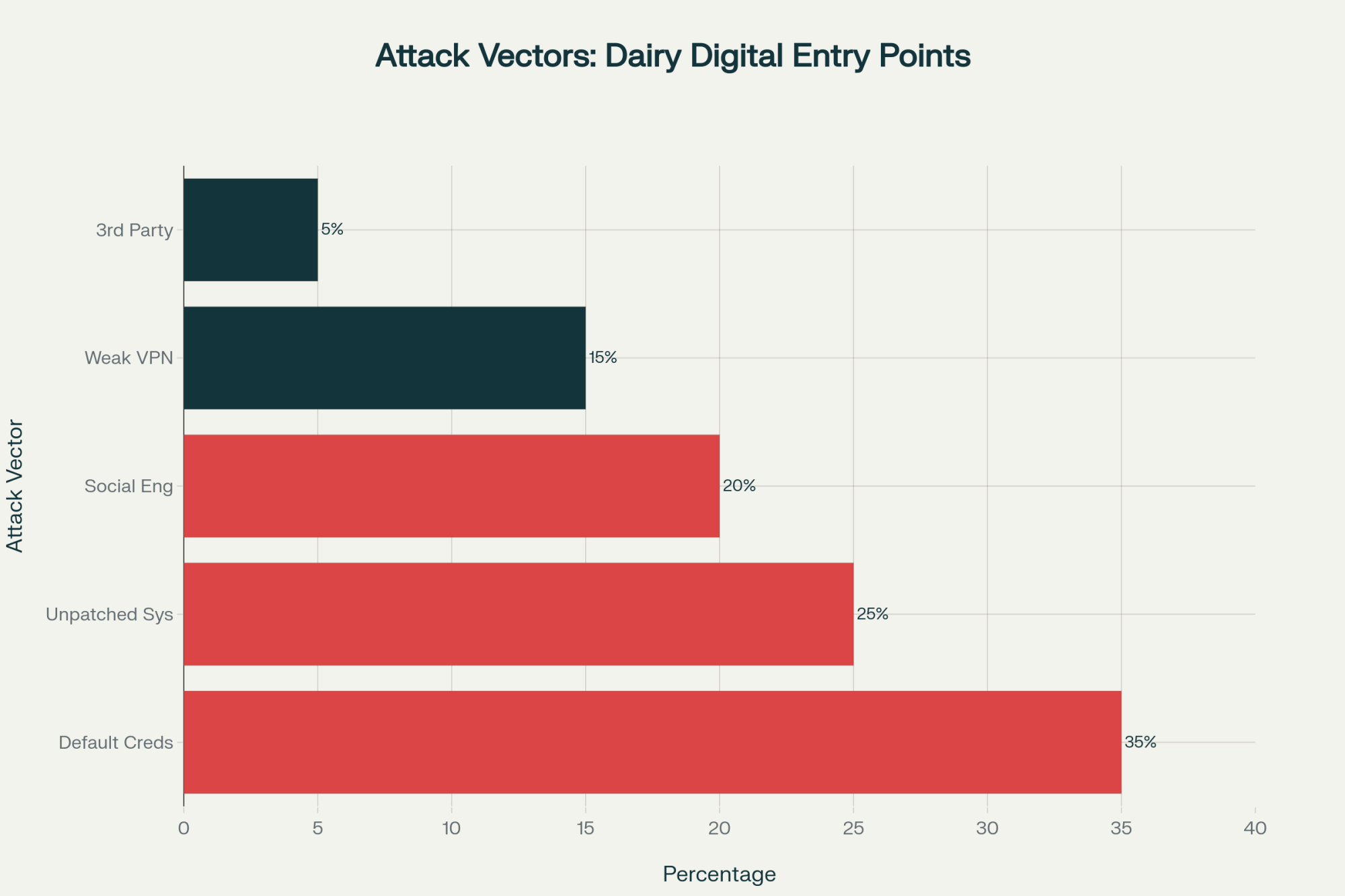
NewsSubscribe
First
Last
Consent

When Butter Sinks Below Cheese: The Market That Refused to Trade

Butter just crashed below cheese, CME froze up, and the global dairy market is rewriting every play farmers thought they knew. Is your operation ready for the new normal?

Executive Summary: Butter just sank below cheese, CME trades froze, and global dairy pricing rules are being rewritten in real time. What’s fascinating is how quickly protein has stolen butterfat’s thunder—today’s mailbox check is won or lost on what your cows put in the vat, not just how many pounds fill the tank. The flood of new U.S. processing plants won’t rescue margins if exports stall, especially with Europe and New Zealand cranking out more milk to chase slow demand. Input costs might be finally easing, but so are milk prices—so efficiency, not expansion, is the edge that matters most right now. It’s a moment that rewards the bold: managing risk, tweaking diets, and staying lean on labor can make all the difference. Everyone’s watching and waiting, but real leaders will act before they’re forced. The bottom line? In the 2025 milk market, the fastest to adapt will stand to gain, while those standing still will already be behind.

Dairy profitability, component feeding, Class III hedging, dairy market volatility, farm efficiency, protein premium, North American dairy

Let’s be honest: what happened last week on the CME was unlike anything we’ve seen since the pandemic. On October 8, not a single contract changed hands—no spot cheese, no butter, no nonfat dry milk, nothing at all. That’s more than a rare occurrence; it’s a signal that uncertainty and risk are now running the show in dairy’s major pricing arena.

What’s interesting here is that when the market goes silent, it’s usually not confidence—it’s confusion. Butter actually dipped to $1.65/lb, while cheese held at $1.7375/lb. When’s the last time butter traded below cheese? You’d have to dig back to 2021 or early 2022 to find that particular inversion, and the implications for milk pricing—especially for anyone playing the class and component game—are immediate and sweeping.

The Great Inversion: For the first time since 2021, butter has crashed below cheese prices—a seismic shift that’s rewriting every dairy farmer’s component strategy overnight

The GDT Auction: Reading the Global Thermometer

Looking at the numbers from Global Dairy Trade’s TE389 auction (October 7), you get a sense of just how widespread the turbulence is. Here’s a breakdown, with direct source attribution to the GDT/USDA for verification:

ProductPrice Change (%)Winning Price (US$/tonne)
Whole Milk Powder (WMP)-2.3%$3,696
Skim Milk Powder (SMP)-0.5%$2,599
Anhydrous Milk Fat (AMF)+1.2%$6,916
Butter-3.0%$6,712
Cheddar+0.8%$4,858
Mozzarella-11.8%$3,393
Buttermilk Powder (BMP)-2.3%$2,768

The standout? Mozzarella got hammered, losing 11.8%, while AMF eked out a rare gain. What’s worth pausing on here is that Fonterra’s SMP maintains a premium of $105/tonne over the top European competitors—a spread that’s both unusual and unsustainable long-term. Buyers and sellers alike are weighing whether New Zealand is overpriced or if Europe’s downward spiral is a bigger issue.

Europe in the Red: Pressure on Every Front

European Dairy Collapse: The devastating numbers reveal an industry in crisis, with Young Gouda down 36% year-over-year and butter hemorrhaging nearly 30%

European dairy prices have been bleeding for months, but the latest quotes make that trend painfully clear. Citing data verified via the EEX and the EU’s weekly surveys:

CommodityWeekly Change (%)Current Spot (€ per tonne)Year-over-Year (%)
Butter-1.5%€5,533-29.6%
SMP-0.5%€2,159-14.9%
WMP-1.8%€3,740-13.8%
Whey+0.6%€890+0.6%
Young Gouda-2.4%€3,115-36.1%

What I’ve noticed over the years is that when European butter prices move this sharply, they tend to drag global fat values along with them. The decrease of €2,329 per tonne on butter this year is severe even for volatile markets, and SMP’s year-on-year losses are hardly better. For producers exporting into—or competing with—the EU, these are tough numbers.

The U.S. Spotlight: Processing Boom Meets Margin Squeeze

You want to talk about structural shifts? U.S. dairy is investing $11 billion in processing expansion across 50 new and expanded plants in 19 states through 2028, as verified by IDFA and federal development filings. This is happening due to two factors: persistent bottlenecks in cheese and powder production, and a rush to capture more global value as domestic consumption levels off.

But here’s the catch: bigger processing doesn’t necessarily mean bigger margins. As hundreds of millions of new pounds of milk are processed through cheesemakers in states like Texas, South Dakota, and New York, pricing pressure grows—not just due to feed, labor, or weather, but also from global market fluctuations and export volatility. I’ve had processors tell me flat out: “Volume can cannibalize value unless exports hold up.” They’re not wrong.

Component Pricing Clarity: Where’s the Money Now?

Here’s where the new component math really bites. With butter spot at $1.65 and cheese at $1.7375, current theoretical values work out as follows using the USDA Federal Milk Marketing Order Class III and Class IV formula calculations for the week ending October 10, 2025:

  • Butterfat: Approx. $2.19/lb
  • Protein: Approx. $2.71/lb

For years, protein was the underdog, and butterfat was king. Now? We’re in a market where protein drives the milk check and butterfat takes a back seat. What’s remarkable is how quickly this change came about—a swing like this would have looked improbable just last fall.

What does this mean practically? If you’re near the break-even point, even a small shift in herd average protein—from, say, 3.05% up to 3.12%—could change your bank balance more than anything you do on butterfat. That’s especially true with Class III at $17.19/cwt and Class IV at $14.60/cwt; protein premiums are back in charge, at least for now.

Feed Costs, Herds and Margins: The Reality on the Ground

Now, feed costs are down this fall—corn’s at about $4.13 and soy meal around $275. However, here’s the paradox: margins didn’t exactly return to their original levels. I’ve spoken to several producers who saw input costs ease by 10-15%, but lost even more due to falling milk prices. In this kind of margin environment, efficiency beats expansion. Producers rocking 15–25% better feed efficiency—usually those leveraging precision diets and sharp dry lot management—are far outperforming neighbors still running by last year’s playbook.

It’s also worth noting that with replacement heifer numbers at a multi-decade low, aggressive culling isn’t just a cost control—it’s a competitive advantage. Keep your best cows fresh, don’t hang on to underperformers, and watch the butterfat-protein balance in your breeding goals.

Global Forces: More Milk, More Competition

Global Production Surge Meets Demand Reality: While milk output explodes worldwide, processing capacity can’t save margins when export markets stall.

Let’s talk about the milk waves. The U.S. added another 114,000 cows year-over-year, now at 9.45 million, and lifted production 1.6% in May. Irish and Belgian farmers both reported strong late-summer surges, with Ireland’s August total increasing by 6.8% and Belgium’s by 3.6%.

But what’s striking is the pressure coming from Oceania. New Zealand kicked off its new season with a 17.8% production bump, and Australia pumped up August exports by 4.3% despite back-to-back years of drought. All this is happening while China’s local output and cow numbers are stabilizing or even declining slightly, which complicates demand-side optimism.

Even in South America, Uruguay’s dairy exports are capturing new market share, increasing by 28% in September alone. The takeaway? The competition for export slots—especially for cheese and powders—is intensifying by the month. The world doesn’t need surplus milk from every region at once, especially when consumer demand in places like China remains tepid.

If You’re Milking Cows, Three Moves You Should Consider

Looking at these numbers, what stands out is that there’s no single “right” answer for every farm. But the directional signals are clear:

  1. Actively Manage Risk: If you can lock in Class III or IV futures at a profit, don’t wait. The market could tighten, but it’s far more likely we stay volatile, and margin squeezes hurt more than missing a few cents.
  2. Feed for Components, Not Just Volume: It’s a fresh-cow-to-dry-cow world now. Precision feeding, component-oriented breeding, and tighter culling have real paybacks.
  3. Watch the Processing and Export Play: Growth in U.S. processing capacity is a double-edged sword—great for local demand, tough for global price stability. Farms able to pivot into value-added or more reliable regional supply chains (think specialty cheeses, A2 products, grass-fed claims) may find less risk, more reward.

So, Where Are We Headed?

This past week’s trading freeze isn’t just a blip. It’s a signal that nobody at the big end of the market is sure what’s next. Butter’s below cheese. Protein is paying. The U.S. is betting big on processing, but the world’s awash in milk, and margins are one bad export report from falling through the floor.

However, here’s my perspective, after decades in this space: challenge breeds innovation. The producers who stay nimble, watch the fundamentals, and act decisively on both feed and marketing will come out ahead. It’s not about surviving the tidal wave, it’s about learning how to surf it.

Suppose you’re looking for further reading and validation. In that case, I encourage you to dig into the latest weekly USDA Dairy Market News, spot market details at the CME, EEX, and GDT auction reports, IDFA and federal investment data, and regional herd and feed guidance from your local extension or university resource.

After decades in dairy, I’ve learned: hope can’t milk cows or balance the books. The market’s rewrite is a chance to step up. Those who adapt—fast—will turn volatility into advantage. Those who wait will watch margins vanish.

Key Takeaways:

  • Butter dropped below cheese—for the first time in years. Big warning for milk pricing ahead.​
  • Not a single dairy futures trade at CME; uncertainty just went off the charts.​
  • Protein now rules the milk check—if you haven’t shifted your herd’s diet, you’re losing dollars.​
  • U.S. plants are expanding, but global competition and weak demand are causing margins to shrink rapidly.​
  • Feed your best cows smarter; efficiency now beats herd size every time when profits are tight.​

Complete references and supporting documentation are available upon request by contacting the editorial team at editor@thebullvine.com.

Learn More:

  • Spring Pasture Powerplay: Balancing Grazing Efficiency with Milk Component Goals – This tactical guide reveals immediate, on-farm methods like using Rumen-Protected Amino Acids (RPAAs) and strategic buffer feeding to optimize milk protein and butterfat. It provides actionable component feeding adjustments and rotational grazing strategies to capture efficiency gains and stabilize rumen health, ensuring your herd can meet the new protein demand.
  • Global Dairy Market Dynamics: Navigating Volatility and Strategic Opportunities in 2025 – Extend your strategic understanding beyond the CME freeze with a deep dive into global market drivers. This analysis identifies major trends—from European oversupply and shifting policy to logistics normalization—and emphasizes the data-driven KPIs (like Feed Conversion Ratio) producers must track to maintain competitiveness amid sustained international volatility.
  • Your Feed Room’s Hidden $58400 Leak – And How Smart Dairy Farms Are Plugging It – To directly achieve the 15-25% efficiency gains discussed in the main article, this report quantifies the financial risk of feed shrink. It demonstrates how precision feeding technology and real-time tracking can plug losses worth up to $58,400 annually for a 100-cow dairy, turning input cost control into a major profit center.

The Sunday Read Dairy Professionals Don’t Skip.

Every week, thousands of producers, breeders, and industry insiders open Bullvine Weekly for genetics insights, market shifts, and profit strategies they won’t find anywhere else. One email. Five minutes. Smarter decisions all week.

NewsSubscribe
First
Last
Consent

Holstein’s Automated Classification Cameras: Why They’ll Work for 500-Cow Dairies but Maybe Not Yours

Holstein’s cameras could eliminate classifier visits—but only 40% of dairies are big enough to afford them.

You know how the conversation around automated cow scoring has really evolved over the past few years? What started as “Does this technology even work?” has shifted to something more practical: “How soon until this technology transforms our classification processes?” Holstein Association USA’s “Build a Better Cow” project—now four years in development—may provide some compelling answers. From what’s emerging through industry discussions and early demonstrations, this technology could fundamentally reshape how we evaluate cattle genetics.

Here’s what’s interesting: This goes well beyond those body condition scoring cameras that many operations are already testing. Holstein’s vision encompasses comprehensive trait evaluation—the same detailed assessments that currently require scheduled visits from classifiers to your farm. Industry speculation suggests that we might see this technology launch around 2027-2028, though, as we all know, ag tech timelines tend to be optimistic.

The Holstein Difference: Why This Project Matters

Dr. Jeffrey Bewley, who was promoted to Executive Director of Genetic Programs and Innovation at Holstein this January after serving as their Dairy Analytics and Innovation Scientist since 2020, brings a unique perspective to this initiative. If you’ve followed precision dairy technology over the years. In that case, you’ll recognize Bewley’s work from his time at the University of Kentucky, where he developed a reputation for bridging the gap between technological innovation and practical farm application. (Read more: Precision Dairy Tools: Explore the potential – Dr Jeff Bewley)

What Holstein’s proposal represents is a significant leap from current automated scoring systems. Producer feedback on existing BCS systems often highlights one consistent theme: while folks appreciate the consistency these cameras provide, they still need traditional classification for comprehensive genetic evaluation. Holstein’s system aims to capture everything—linear scoring for udder attachment, foot angle, dairy strength, and the complete range of traits that influence genetic decisions.

The technology foundation, as Holstein has shared at recent industry meetings, involves advanced depth-sensing cameras similar to those in modern smartphones, but engineered for use in agricultural environments. These units would be positioned to capture detailed measurements as cows exit the milking parlor, integrating seamlessly into existing cow flow without requiring additional handling.

According to Bewley, quoted in Holstein’s recent publications, “I fell in love with the Holstein cow, genetics, and dairy data as a kid working with my grandfather’s dairy.” That passion for combining tradition with innovation seems to be shaping the project’s development philosophy.

Learning from What’s Already Out There

MethodAccuracy RateCost Per EvalAvailabilityKey Issues
Manual Classification95-98%$6-8Limited schedulingSubjective, inconsistent
Automated 3D Cameras0% (underconditioned)$0.50*24/7 continuousFails extreme conditions
Holstein AutomatedTBD (projected 95%)$0.25*24/7 continuousEstimated $150K investment barrier

*Cost after payback

What’s particularly noteworthy about Holstein’s approach is how it builds on existing technology rather than attempting to reinvent everything from scratch. Body condition scoring cameras have proven their value on numerous operations, demonstrating that consistent, objective measurement provides real management benefits—even when it doesn’t always exceed the accuracy of an experienced evaluator’s eye.

This builds on what we’ve seen in agricultural engineering research from universities across the country over the past two years, where 3D imaging systems have achieved remarkable precision—often within several millimeters—under controlled conditions. Recent university studies show that automated scoring systems are approaching the accuracy of experienced human evaluators. However, as any producer knows, controlled research conditions and working dairy barns present very different challenges.

Early adopters of BCS technology often note an interesting pattern: The value isn’t necessarily that it outperforms their best herdsman on his best day. The real value comes from consistency—it never gets tired, never has a bad day, and catches gradual changes that might slip by when you see these cows every single day.

The Same Infrastructure Challenges, Plus Some New Ones

Every technology discussion eventually comes down to practical implementation, and Holstein’s system faces the same infrastructure hurdles as other precision dairy technologies, plus a few unique ones. The internet bandwidth requirements alone are substantial—3D imaging generates enormous data volumes that need somewhere to go. Reliable power with backup systems becomes essential. Integration with existing herd management software remains a persistent challenge across the industry.

What I’ve found is that distinct regional patterns emerge in how these challenges manifest. Cold climate operations—whether in Wisconsin, Minnesota, or upstate New York—often encounter consistent issues with lens condensation during morning milkings when warm, humid air comes into contact with cold equipment. Producers describe spending considerable time each morning cleaning camera lenses during the coldest months, time that adds up quickly.

Down in warmer climates like Texas, Arizona, and Southern California, the challenge flips completely. When ambient temperatures hit 105°F, keeping sensitive electronics operational becomes the primary concern. Operations in these hot regions have had to install dedicated cooling systems for their monitoring equipment after experiencing repeated shutdowns during summer afternoons.

And let’s not forget about those moderate climate operations in the Pacific Northwest or Mid-Atlantic regions—they deal with their own unique mix of humidity, rain, and seasonal temperature swings that can play havoc with sensitive equipment.

What makes Holstein’s system potentially more complex is the component for integrating genetic data. This isn’t simply about generating scores; it’s about feeding that information directly into genetic evaluations through connections with the Council on Dairy Cattle Breeding. This requires standardized data formats, reliable transmission protocols, and seamless integration with existing genetic databases.

The encouraging news? Holstein has decades of experience managing genetic data infrastructure. They understand this ecosystem intimately. The challenge will be making all these components work reliably at the farm level, where conditions are far less predictable than in controlled environments.

Let’s Talk Real Numbers: The Economics of Innovation

Quick Overview:

  • Timeline: Industry speculation suggests 2027-2028 launch
  • Ideal Operation: 500+ cows with genetic focus
  • Estimated ROI: 3-4 years for larger herds based on modeling
  • Key Requirement: Robust internet and power infrastructure

While Holstein hasn’t released official pricing, we can make educated projections based on similar precision livestock technologies currently in the market.

The Economic Breakdown by Herd Size

For a 500-cow dairy:

Economic research from various land-grant universities consistently shows automated BCS delivering $20-40 per cow annually through improved feed efficiency and health outcomes. If comprehensive trait evaluation adds structural soundness benefits and enhances genetic selection accuracy, preliminary economic modeling suggests potential returns of:

  • Feed efficiency gains: $25-35 per cow based on university extension estimates
  • Reduced classification costs: $6-8 per cow at current rates
  • Health and longevity improvements: $20-30 per cow from earlier intervention
  • Genetic selection accuracy: $15-25 per cow through improved heritability estimates

Potential total: $66-98 per cow annually, or $33,000-$49,000 for the entire herd.

If system costs align with current precision agriculture pricing—potentially around $150,000—you can expect a 3-5 year payback period. However, remember that these projections combine various research findings, and actual results will depend heavily on individual operational management and utilization.

For a 200-cow dairy:

The same per-cow benefits spread over fewer animals significantly extend the payback timeline:

  • Annual benefit: $13,200-$19,600
  • Payback period: 7.5-11 years

That’s a much more challenging investment decision, particularly considering potential equipment upgrades within that timeframe.

For operations under 100 cows:

The economics become extremely difficult to justify with current pricing models. According to the USDA’s 2022 Census of Agriculture data, the majority of dairy farms fall into this category. Without dramatic cost reductions or innovative shared-ownership models, these operations remain effectively priced out of this technology.

86% of dairy farms produce only 22% of milk—revealing why revolutionary technologies like Holstein’s cameras will accelerate consolidation rather than democratize innovation.

The Mid-Size Dairy Dilemma

Mid-size operations—those milking 300-800 cows—find themselves in an interesting position. You’re large enough that individual cow attention becomes genuinely challenging, yet perhaps not quite large enough to easily justify six-figure technology investments.

This is where Holstein’s cooperative structure could offer unique advantages. Unlike venture-backed technology companies requiring immediate returns, Holstein can potentially develop financing or shared-use models that better align with member-owner needs and cash flows.

The precedent exists in other areas of dairy technology. When ultrasound technology first entered the dairy industry, many veterinarians purchased equipment and provided services rather than expecting every farm to buy their own unit. Several Midwest cooperatives have successfully implemented similar models for feed analysis equipment and other specialized tools.

What’s encouraging is the growing availability of cost-sharing programs. Various state and federal initiatives offer support for technology adoption, with many programs covering 20-30% of qualifying investments. USDA’s Rural Development programs, state innovation grants, and regional economic development initiatives all represent potential funding sources worth investigating.

Who Benefits and Who Waits: The Adoption Pattern

Holstein’s rollout timeline reveals a harsh truth: by 2035, cooperative models might help some farms, but 60% will remain permanently excluded from genetic evaluation advances.

Based on historical patterns of dairy technology adoption—and I’ve observed this cycle with everything from TMR mixers to robotic milking systems—here’s how the rollout likely unfolds:

Early Adopters (2027-2029):
Expect larger breeding-focused operations, typically 500-plus cows, already generating substantial revenue from genetic sales to lead adoption. These are operations showcasing at World Dairy Expo, supplying high-index bulls to AI companies, and marketing embryos internationally. They can justify investment through genetic premiums and possess the technical resources to overcome early implementation challenges.

Early Majority (2029-2032):
Progressive 200-800 cow operations will closely observe the experiences of early adopters. Once they see consistent returns and smoother implementation, adoption will accelerate. Regional clustering typically occurs during this phase, as successful installations in an area create momentum, allowing neighboring operations to recognize the competitive advantages.

Late Majority (2032-2035):
Smaller operations might access the technology through service providers or cooperatives. By this phase, costs typically decrease, implementation bugs are resolved, and alternative ownership models emerge. Equipment dealers or Holstein itself might offer service-based models, where they retain equipment ownership and charge a fee per evaluation.

The Long Tail:
For the majority of dairy farms with under 100 cows, the technology likely remains out of reach without fundamental changes in pricing or delivery models. And you know what? That’s not necessarily problematic—different tools serve different operational needs and scales.

What This Means for Traditional Classification

Here’s where the discussion becomes particularly interesting: What happens to traditional classification if this technology delivers on its promise?

The pragmatic answer is that we’ll likely see a transitional period where both systems coexist, serving different needs. Large commercial dairies focused on production efficiency might shift entirely to automated systems for routine evaluation. Meanwhile, seedstock operations, show cattle breeders, and those marketing elite genetics may continue to value human expertise for critical animals.

This parallels what happened with milk recording when inline meters became widespread. DHIA didn’t disappear; it evolved. The organization shifted its focus from basic data collection to value-added services, including benchmarking, management consulting, and specialized testing. Similarly, classifiers might transition from routine scoring to specialized roles, such as training and calibrating automated systems, evaluating elite animals for nuanced traits that machines can’t yet capture, and helping producers interpret and act on the vast data these systems generate.

Industry professionals in classification are considering how to position themselves for this transition. The smart ones recognize that expertise doesn’t become less valuable—it just gets applied differently.

Keeping Our Feet on the Ground

The dairy industry has witnessed numerous “revolutionary” technologies over the decades. Some, such as artificial insemination and TMR mixers, have fundamentally transformed operations. Others found their niche in specific situations. The key is matching technology to operational needs and capabilities.

Holstein’s project shows promise for operations focused heavily on genetic improvement. The potential for continuous, objective trait measurement could provide valuable selection advantages. Yet it won’t replace fundamental stockmanship or suit every operation’s needs and resources.

What’s encouraging about Holstein’s development approach is their methodical pace. They’re conducting pilot programs, gathering feedback, refining the technology before broad release. This measured approach typically yields more robust and practical solutions than rushed market entries.

Questions You Should Be Asking

As this technology develops, consider posing these questions to Holstein or any technology provider:

  • How does accuracy in commercial barn conditions compare to research settings?
  • What’s the system’s performance across seasonal extremes—winter condensation, summer heat, spring mud?
  • What redundancy exists when components fail?
  • Will it integrate with existing herd management software, or create another data silo?
  • What’s the complete investment, including infrastructure upgrades?
  • Are shared ownership or service models being developed?
  • What technical support and training are provided?
  • How frequently will updates and calibration be required?

The Bottom Line: Making Your Decision

Holstein’s “Build a Better Cow” project represents an ambitious effort to modernize cattle evaluation for our increasingly data-driven industry. The technology’s eventual arrival seems certain; whether it meets development timelines, delivers promised performance, and provides economic value for your specific operation remains an open question.

For those intrigued by this technology—particularly those focused on registered cattle breeding—now is the time to begin preparing your infrastructure. Producer experience with camera-based systems consistently emphasizes that robust internet, reliable power, and thoughtful data management strategies determine the difference between valuable tools and expensive frustrations.

The path forward will vary by operation. Some will eagerly adopt early, others will wait for proven results, and many will determine that the technology doesn’t align with their operational model or resources. Each represents a valid decision when based on careful consideration of individual circumstances.

Technology remains a tool, not a solution. Success comes from thoughtfully integrating appropriate tools with sound cattle care and business management fundamentals. The tools continue evolving, but that core principle remains constant. What’s changing is our expanding array of options for achieving operational goals—an evolution that creates both opportunities and complexity for today’s dairy farmers.

Key Takeaways:

  • ROI Reality: 500+ cows = $33-49K annual returns with 3-5 year payback. Under 200 cows = 7-11 year payback, which makes it questionable
  • Infrastructure or Bust: Success requires enterprise-level internet, backup power, and heat/cold equipment protection—start upgrading now
  • The 60% Problem: The Majority of dairy farms are priced out unless Holstein develops co-op ownership or per-use service models
  • Smart Questions: Ask about barn condition accuracy, seasonal performance, integration capabilities, and service agreements before committing

Executive Summary:

Holstein Association USA’s automated classification system could eliminate the need for human classifiers by 2028—if you’re big enough to afford it. The technology captures every conformation trait daily using 3D cameras as cows exit the parlor, feeding data directly into genetic evaluations for continuous, objective measurement. At an estimated investment of $150,000, 500+ cow operations could achieve annual returns of $66-98 per cow, with a 3-5 year payback, making it viable for large-scale breeding operations. But the economics fall apart for smaller dairies: 200-cow operations face 7-11 year payback periods, while 60% of farms with under 100 cows are priced out entirely. Success requires more than just capital—operations need enterprise-level internet, backup power, and equipment protection from seasonal extremes that many farms currently lack. Unless Holstein develops cooperative ownership models or per-use pricing, this revolutionary technology will primarily benefit the largest 40% of dairies. The industry faces a critical question: will this innovation advance dairy genetics for everyone, or accelerate consolidation by giving mega-dairies yet another competitive advantage?

Complete references and supporting documentation are available upon request by contacting the editorial team at editor@thebullvine.com.

Learn More:

The Sunday Read Dairy Professionals Don’t Skip.

Every week, thousands of producers, breeders, and industry insiders open Bullvine Weekly for genetics insights, market shifts, and profit strategies they won’t find anywhere else. One email. Five minutes. Smarter decisions all week.

NewsSubscribe
First
Last
Consent

Ireland’s 54,000 Missing Calves Signal the Regulatory Storm Heading Your Way

When Ireland’s grass-fed advantage meets Brussels’ nitrogen limits, everyone’s milk check changes

EXECUTIVE SUMMARY: Ireland’s registration of 54,396 fewer calves this year signals a fundamental shift that’s already reshaping global dairy markets. With the nitrates derogation expiring December 31st, Irish farms face potential nitrogen limits dropping from 250kg to 170kg per hectare — a 32% reduction that could force meaningful herd culls despite EPA data showing river nitrogen at eight-year lows. This matters beyond Europe because Ireland, while producing just 1.5% of global milk, controls approximately €1 billion in annual infant formula exports serving Asia’s booming premium segment, which grew from a 32.8% to a 37% market share this past year. What farmers are discovering through Vermont’s success with GPS-guided manure application — an 18-month payback through reduced fertilizer costs — suggests that technology adoption might be the bridge between environmental compliance and profitable production. December’s Brussels decision will ripple through milk prices globally, but smart producers are already diversifying markets, documenting their environmental performance, and learning from Ireland’s experience that scale doesn’t guarantee survival when regulations shift. The conversation we’re having today about Ireland becomes tomorrow’s reality for dairy regions worldwide, making this the moment to build operational flexibility before regulatory pressure arrives at your farm gate.

 Dairy regulatory compliance

I was reviewing the latest ICBF data last week when something really caught my attention. Ireland registered 54,396 fewer calves so far this year — both the Farmers Journal and Agriland confirmed these numbers recently. And you know what? This isn’t your typical seasonal variation. This is something worth understanding.

Here’s what’s interesting: from boardrooms to barn meetings, everyone’s trying to figure out what this means. Industry experts are warning that significant herd reductions could occur in the coming years if the derogation situation doesn’t work out. The scale… well, that’ll depend on what Brussels decides in December. Having watched similar transitions play out in other regions, I think we’re seeing early signs of change that’ll affect all of us, regardless of where we’re milking cows.

Ireland’s dramatic calf registration decline signals fundamental shifts in global dairy markets as regulatory pressure intensifies. 

Understanding Ireland’s Journey

Let’s discuss how Ireland arrived at this point, as it’s quite a story. When EU milk quotas ended in 2015 — you remember that whole situation — Irish farmers really went for it. The national dairy herd has grown from approximately 950,000 cows to nearly 1.6 million today. Teagasc’s National Farm Survey confirms we’re looking at almost 70% growth in less than a decade.

But it wasn’t just about adding cows. The average herd size increased from around 80 head to 131, based on Teagasc’s People in Dairy Project from May of this year. About 82% of these operations utilize spring-calving systems, which makes perfect sense given Ireland’s grass-growing conditions. It’s a model that works beautifully… if you’ve got their climate.

What’s particularly noteworthy is the efficiency they maintained during this expansion. Frank O’Mara’s research team at Teagasc has documented a carbon footprint of just 0.88 kg CO2e per kilogram of fat- and protein-corrected milk. The global average? That’s running around 2.5 kg. So you can see why people pay attention to what happens over there.

 Ireland’s sustainability and market advantages in grass-fed dairy face elimination under potential nitrogen restrictions.

The investment required was substantial. The Irish Farmers Association documented about €2.2 billion in farmer investment during the post-quota expansion period, with processors adding another €1.3 billion in capacity. That’s real money, borrowed against real assets.

December’s Decision Point

Now here’s where things get really interesting. December 31st is when Ireland’s nitrates derogation expires. For those unfamiliar with European regulations, the derogation permits qualifying farms to apply up to 250kg of nitrogen per hectare annually — significantly exceeding the standard 170kg limit. Most Irish farms have already reduced their stocking rates to 220kg as of January 2024, and maintaining that level is uncertain.

What I find encouraging is that the Netherlands submitted their derogation extension request back in July, according to Agriland’s reporting. So Ireland won’t be negotiating alone, which might influence how things play out in Brussels.

I’ve been talking with several Irish producers about this, and their frustration is understandable. The EPA monitoring shows nitrogen in Irish rivers hit an eight-year low in 2024 — that’s real environmental progress, which RTÉ covered back in March. Yet Brussels added these new requirements under the Habitats Directive, demanding individual assessments for 46 different catchments. I mean, can you imagine managing that paperwork while you’re trying to keep fresh cows healthy during transition?

“Good data is becoming as important as good genetics” — Wisconsin dairy producer on technology adoption

Denis Drennan from ICMSA has been pretty clear that milk prices need to stay strong in 2025 just to cover the increasing regulatory burden. And with co-ops reporting notable year-over-year reductions in deliveries during parts of this year — the magnitude varies by region and month — those newly expanded processing plants are facing some real challenges.

Why This Matters Globally

This is where Ireland’s situation becomes everyone’s business. Despite producing only about 1.5% of global milk, Teagasc research from June indicates that Ireland generates approximately €1 billion in annual infant formula exports, with six major manufacturers operating there. That concentration of expertise… it’s not something you can quickly replicate elsewhere.

The Asian market dynamics are particularly relevant here. Analysis from July shows China’s premium infant formula segment grew from about 32.8% to 37% market share over the past year. These consumers specifically want products with verified grass-fed credentials—and they’re willing to pay for them.

You know, the nutritional advantages from grass-based systems — higher CLA levels, better omega-3 profiles — that’s not just marketing. Those are measurable differences that processors can document. However, here’s the thing: these advantages stem from specific climate conditions, decades of infrastructure development, and genetics selected for grass-based production… you can’t just flip a switch and replicate that.

Similar challenges are playing out in California, where water restrictions shape production decisions, or in the Northeast, where land costs drive different operational choices. Each region has its unique pressures. In Canada, supply management adds another layer of complexity, while Australian producers navigate drought cycles that make Ireland’s consistent rainfall look like a paradise.

How Processors Are Adapting

The processing sector they’re really scrambling right now. Companies like Danone, Glanbia, and Kerry Group invested hundreds of millions based on growth projections that seemed reasonable at the time. Now they’re looking at potential supply drops while those fixed costs aren’t going anywhere.

What I’m hearing is that processors are stress-testing all kinds of options. Some are exploring powder reconstitution for specific applications, others are recalibrating their product mix, and many are focusing on supply diversification. But when your competitive advantage is rapid conversion from farm to finished product — that speed-to-value that’s so critical in infant nutrition — workarounds have limitations.

According to industry contacts, processors aren’t waiting for December. They’re actively reviewing supply chain contingencies, adjusting portfolios, and working through various scenarios. Many are now seeking long-term supply diversification contracts in other low-cost regions. It’s pragmatic planning in uncertain times.

Technology’s Growing Role

Technology TypeInvestment CostPayback PeriodAnnual SavingsRegional Example
GPS-guided manure application$45,00018 months$30,000Vermont (fertilizer reduction)
Robotic milking systems$175,00048 months$43,000Wisconsin (labor + efficiency)
Precision feed management$25,00024 months$15,000Ireland (compliance ready)
Heat detection collars$15,00012 months$16,000Netherlands (conception rates)
Environmental monitoring$8,00015 months$6,500California (water compliance)

Something that really caught my attention was ICBF’s September update to their Economic Breeding Index. The Farmers Journal reported that average EBI values dropped about €83 per animal — not because genetics suddenly went bad, but because they shifted the base cow from 2005-born to 2015-born animals. That’s the industry recalibrating for new realities.

The technology adoption gap is becoming really apparent. Farms with advanced parlor management systems, comprehensive data collection… they’re navigating these challenges differently. When you have automated heat detection improving conception rates, robotics helping with consistency — and we’re talking $150,000 to $200,000 for quality robotic systems — these are no longer luxuries. They’re becoming necessities.

A producer I know in Wisconsin put it well: “The difference between operations that invested in precision technology five years ago and those that didn’t is becoming a chasm. This includes everything from advanced feed efficiency sensors and GPS-enabled manure application systems that maximize nutrient use, to automated health monitoring collars. Good data is becoming as important as good genetics.”

And here’s the ROI that’s catching attention: one operation in Vermont saw their investment in GPS-guided manure application pay back in 18 months through reduced fertilizer purchases and improved compliance documentation. That’s the kind of return that makes technology adoption a no-brainer, especially when regulatory pressure continues to build.

Regional Variations Matter

Not every part of Ireland faces the same challenges, which is worth thinking about. The southeast, with its free-draining soils and longer growing seasons, operates under different conditions than those in the northwest, which deal with heavier ground. Spring-calving herds — that’s about 82% of Irish operations, according to Teagasc — they’ve got all their nutrient management concentrated into tight windows.

These variations… they really make you wonder about one-size-fits-all regulations. You’ve got farms achieving excellent bulk tank counts, managing transition periods effectively, keeping their herd health metrics strong — but they’re facing challenges based on nitrogen calculations that might not fully account for grass-based efficiency.

Looking at Three Possible Scenarios

ScenarioTimelineKey Outcomes
Managed AdjustmentQ1-Q2 2026Derogation renewed with tighter restrictions. Modest production adjustments, premium markets tighten, and some global price movement. Processors adapt toward higher-value products.
Political CompromiseQ2 2026Farmer advocacy leads to compromise. Technology investments enable progress in maintaining production. Politicians declare victory, farming continues.
Sharp ContractionMid-2026 onwardsMinimal derogation renewal. Significant production drops within 18 months. Premium market disruption, price volatility, supply gaps.

What This Means for Your Operation

So what should we take away from all this?

First, regulatory dynamics are accelerating everywhere. What starts in Brussels has a way of showing up in other jurisdictions. Environmental regulations are increasingly shaping how we farm, whether we’re in California dealing with methane rules, Wisconsin managing nutrient plans, or anywhere else.

Second, if you have genuine production advantages — whether that’s organic certification, grass-fed systems, local market access, or any other unique aspect of your operation — now’s the time to document and protect those advantages. Ireland’s grass-fed position took generations to build. Once it’s gone, it’s gone.

Third, market relationships need diversification. When supply gets tight, operations with multiple outlets generally fare better. That’s not pessimism — it’s risk management. And beyond just infant formula, Irish dairy also supplies significant volumes to specialty cheese makers and premium butter operations across Europe. Those alternative channels become crucial when primary markets shift.

Fourth, technology adoption is shifting from optional to essential. Being able to document your environmental performance, optimize inputs, and adapt quickly —that’s increasingly what separates operations that thrive from those that just survive.

And here’s something interesting — scale no longer guarantees success. Some of Ireland’s most efficient large operations face real challenges because they’re over nitrogen thresholds, while smaller operations with direct market access and flexibility sometimes prove more adaptable.

The Human Side

Behind every statistic are real families making tough decisions. UCD’s School of Psychology published research in August showing nearly all Irish farm families report work-family conflict, with younger, debt-leveraged farms particularly affected.

These aren’t abstract business decisions. When families have mortgaged generational land to build facilities, they might not be able to fully use… that pressure extends way beyond finances. I’ve witnessed similar situations unfold in various dairy regions, and the stress on rural communities is indeed a real concern.

For those needing support, organizations such as Farm Aid in the US (1-800-FARM-AID), the Farm Community Network in the UK, and the Irish Farmers Association’s member support services offer resources for farmers facing transition pressures. There’s also the International Association of Agricultural Producers, which offers global support networks. Please don’t hesitate to reach out if you need assistance.

Where We Go from Here

Ireland’s 1.5% of global production creates amplified disruption effects across premium markets and regulatory frameworks worldwide. 

What’s happening in Ireland represents more than just regional adjustment. We’re watching environmental objectives, food security needs, and agricultural economics intersect in real time. This dynamic between production efficiency and regulatory requirements… it’s not unique to Ireland. It’s emerging globally.

Those 54,396 fewer calves aren’t just numbers. They’re the leading edge of changes that’ll influence global dairy markets over the next several years. How this affects your operation depends largely on the decisions you’re making right now.

December’s derogation decision will have far-reaching consequences that extend well beyond Ireland. Smart producers are already considering various scenarios and building operational flexibility to adapt to changing market conditions. Most importantly, they’re learning from Ireland’s experience to prepare for similar challenges that might emerge closer to home.

Because if there’s one thing that’s becoming clear, it’s this: success in modern dairying requires understanding both market fundamentals and regulatory dynamics. Political and policy factors are increasingly influencing decisions that were once purely economic in nature. Recognizing and adapting to this reality may well determine which operations thrive in tomorrow’s dairy industry.

The conversation continues, and we’re all part of it. How we respond collectively to these challenges will shape dairy farming for the next generation. What strategies are you implementing to prepare for these changes? Share your thoughts and experiences — because learning from each other is how we’ll navigate this transition successfully.

KEY TAKEAWAYS

  • Technology ROI beats regulatory burden: Vermont operations seeing 18-month payback on $150,000-200,000 precision systems through 20-30% fertilizer savings and streamlined compliance documentation — making tech adoption essential, not optional
  • Market diversification matters more than size: Irish farms over nitrogen thresholds face elimination despite peak efficiency, while smaller operations with direct sales to specialty cheese and premium butter markets show better resilience — suggesting 3-5 market outlets minimum for risk management
  • Environmental progress isn’t protecting producers: Ireland achieved EPA-verified eight-year low nitrogen levels while maintaining 0.88 kg CO2e per kg milk (vs. 2.5 kg global average), yet still faces production cuts — document your sustainability metrics now before regulators set the narrative
  • Premium markets concentrate risk: China’s grass-fed infant formula segment commands 50% price premiums, but Ireland’s potential 15-25% production drop threatens €1 billion in exports — operations dependent on single premium channels need contingency plans by Q1 2026
  • Regional advantages require active protection: Ireland’s grass-fed position took generations to build through climate, genetics, and infrastructure, but December’s decision could eliminate it overnight — whether you’re organic, pasture-based, or locally focused, start building your verification systems today

Complete references and supporting documentation are available upon request by contacting the editorial team at editor@thebullvine.com.

Learn More:

The Sunday Read Dairy Professionals Don’t Skip.

Every week, thousands of producers, breeders, and industry insiders open Bullvine Weekly for genetics insights, market shifts, and profit strategies they won’t find anywhere else. One email. Five minutes. Smarter decisions all week.

NewsSubscribe
First
Last
Consent

The $50,000 Feed Opportunity When Corn Hits $4.13 and Soy Stays at $275

When corn drops to $4.13 while soybean meal holds at $275, the feeding strategies that worked last year might be costing you thousands.

EXECUTIVE SUMMARY: What farmers are discovering right now is that the traditional relationship between corn and protein feed costs has completely inverted, creating what might be the most significant feed arbitrage opportunity we’ve seen in years. With CME December corn futures at $4.13 per bushel, while soybean meal remains anchored at $275 per ton, progressive dairy operations are capturing $2-3 per hundredweight advantages by strategically increasing corn inclusion to 35-40% of grain mixes – well above conventional recommendations. Research from the University of Wisconsin-Madison and Cornell, published this year, confirms that properly managed herds can handle these elevated starch levels when three conditions align: corn processed to a particle size of 750-1,000 microns, physically effective fiber maintained at 28-32% NDF, and strategic buffering with magnesium oxide. The convergence of China purchasing just 20-30% of typical soybean volumes, drought affecting 70% of U.S. production areas according to the Drought Monitor, and cull cow prices at $145/cwt creates what industry analysts describe as a 90-120 day window before La Niña weather patterns and ethanol economics likely reverse these dynamics. Operations implementing phased approaches – starting with simple TMR consistency improvements that cost nothing – are seeing income over feed cost improvements within 30 days, with one Wisconsin producer reporting $1,200 daily savings after careful implementation.

dairy feed cost optimization

I was speaking with a Wisconsin dairy producer last week – he runs about 450 cows near Fond du Lac – and his nutritionist had just walked him through something that completely changed his perspective. Been feeding the same ration for eighteen months, you know how it goes. But when the nutritionist showed him that corn delivered energy at one-quarter the cost of protein, that got his attention real quick.

“We were basically writing checks we didn’t need to write,” he told me. “Every single day.”

What’s interesting is I’m hearing similar stories from producers everywhere – it doesn’t matter if you’re milking 200 cows in Vermont or running 2,000 head out in California. What is the traditional relationship between energy and protein feed costs? It’s turned completely upside down. And those who’ve caught on are seeing feed cost advantages that, honestly, I wouldn’t have believed myself six months ago.

The Current Market Reality Check

Let’s dig into the numbers here. CME December corn futures settled at $4.13 per bushel this week. That’s down from those stomach-churning peaks above $4.50 we dealt with earlier this year. Meanwhile, the Chicago Board of Trade has soybean meal at $275 per ton – it’s been there for weeks now, like it’s stuck in park.

Here’s what really matters, though. When you run the standard National Research Council energy calculations, corn’s delivering digestible energy at about six cents per pound. I had to check that twice myself. That’s what we usually pay for wheat middlings or corn gluten – the bargain stuff, right? But protein through soybean meal? Nearly 25 cents per pound.

This 4:1 ratio changes everything about how we think about rationing.

When Protein Costs 4X More Than Energy, Smart Operators Act Fast – Current Window Delivers $1,200 Daily Savings for 500-Cow Operations

The USDA’s October World Agricultural Supply and Demand Estimates put U.S. corn production at 410-415 million metric tons. That’s substantial. Yet, soybean processing capacity cannot keep up with domestic meal demand, even at these prices that should theoretically slow things down.

And China? Based on USDA Foreign Agricultural Service export data, they’re buying maybe 20-30% of what they typically purchase from our harvest. We’re talking billions in trade, that’s just… not happening. Creates some interesting domestic opportunities, to say the least.

Weather’s been throwing curveballs, too. The U.S. Drought Monitor indicates that approximately 70% of the country is experiencing drought at various levels. I’ve been hearing from Extension folks across the northern states – many producers are seeing significant reductions in homegrown feed. The Wisconsin farms I work with are scrambling to find hay wherever they can.

However, and this is important, irrigated areas in Iowa, Illinois, and Indiana maintained relatively strong corn production. So, you’ve a peculiar situation where corn’s relatively available overall, but forage is scarce in many regions.

Rethinking Starch Limits Based on Current Research

You know, when I first heard about producers pushing starch to 35-37%, I was skeptical. We’ve all been told – keep starch below 28% or deal with acidosis, right?

But work published in the Journal of Dairy Science over the past year from researchers at Wisconsin-Madison and Cornell has really opened my eyes. The studies show that with proper management, cattle can handle these higher starch levels. And that “proper” part is crucial.

Three things have to line up. First, corn needs to be processed down to a particle size of 750-1,000 microns. Most operations I visit? They’re still at 3,000 microns or coarser. Big difference there. Second, you must maintain a physically effective fiber level of 28-32% NDF, primarily from high-quality forages. No cutting corners. Third, buffering becomes critical – we’re talking about 0.75 ounces of magnesium oxide per cow, religiously.

Here’s something that doesn’t get discussed enough: when managing starch levels, you must be extra cautious about total dietary sulfur. University of Minnesota veterinary diagnostic work shows that high-starch diets combined with elevated sulfur levels can increase the risk of polioencephalomalacia – essentially a thiamine deficiency that causes brain lesions. If you’re already challenging the rumen with higher starch, adding high-sulfur feeds becomes particularly dicey. Keep total dietary sulfur below 0.4%.

Processing matters more than most people realize. According to the National Research Council’s 2021 Nutrient Requirements of Dairy Cattle (8th edition), steam-flaked corn hits about 87% total tract starch digestibility. Cracked dry corn? Lucky to get 45%. When you improve that particle size reduction, you’re essentially feeding a different feed entirely.

The physiology is also quite interesting. Research published in Animal Feed Science and Technology in 2024 shows that when corn processing is optimized, those volatile fatty acid ratios – the acetate to propionate balance – stay above 2.5 to 1. That means you’re preserving butterfat even at these higher starch levels. Would’ve been heresy to suggest five years ago.

I know a producer in Nebraska who attempted to increase the starch content to 38% without adjusting the processing or buffering. Bad move. Within two weeks, three fresh cows stopped eating, and butterfat levels dropped by 0.4%. He pulled back to 32% and everything normalized. The lesson? These higher levels work, but only with meticulous management.

The DDGS Quality Minefield

A purchasing manager for a large Minnesota dairy recently informed me that they’re running about 2,000 cows. With DDGS priced at $180-200 per ton regionally, it appears to be a favorable comparison to soybean meal on paper.

“But we’ve rejected four loads this past month,” she said. “Two with fat over 12%, one had that burnt smell, and one tested at 1.3% sulfur. Any of those could’ve cost us thousands.”

ParameterOptimalAcceptableDangerReject
Fat Content5-7%7-9%9-12%>12%
Protein Content28-32%26-28% or 32-34%24-26% or 34-36%<24% or >36%
Sulfur Content0.35-0.5%0.5-0.7%0.7-1.0%>1.0%
Color/Heat DamageGoldenLight BrownDark BrownBlack/Burnt

The U.S. Grains Council’s quality surveys reveal significant variation – fat ranging from 5% to 14%, protein from 24% to 32%, and sulfur from 0.35% to over 1.4%. These aren’t minor differences, folks.

Research published in the Professional Animal Scientist journal consistently shows that keeping fat below 9% is essential, as milk fat depression will consume any savings. That golden color tells you it’s properly dried. Dark brown or black? Heat damage has caused the protein to become locked up.

Several commercial labs can help with quality monitoring. Dairyland Laboratories in Wisconsin, Rock River Laboratory with locations across the Midwest, Cumberland Valley Analytical Services in Pennsylvania – they all run comprehensive DDGS panels. Industry standards generally recommend keeping acid detergent insoluble protein below 12% of total protein. That’s your heat damage indicator.

Sulfur needs special attention, especially if you’re also pushing starch levels. When DDGS sulfur goes above 0.7%, combined with high-sulfur water and metabolic stress from high-starch diets… you’re asking for trouble. I’ve seen it happen.

Three Strategies That Actually Work

Strategy 1: TMR Consistency – The Foundation

I recently visited a dairy near Shawano, where the owner showed me something straightforward yet incredibly effective. After a University of Wisconsin Extension workshop on mixing consistency, he started timing every TMR load.

“Four minutes exactly,” he said, pointing to this beat-up kitchen timer on the mixer. “Not approximately. Not until it looks good. Four minutes.”

Research published in the Journal of Dairy Science by Penn State in 2024 shows that reducing TMR variation from 15% to below 5% generates 4-5 pounds more milk per cow daily. That’s an immediate return from better mixing alone.

Within a week, this producer observed tighter manure consistency, improved cud chewing, and a noticeable increase in the bulk tank. No new feeds, no expensive additives. Just consistency.

The key here – and what many people overlook – is that consistency matters more than perfection. A slightly suboptimal ration fed consistently beats a perfect ration with 15% variation every single time.

Strategy 2: Strategic Corn Inclusion

Several nutritionists I work with are carefully incorporating corn into grain mixes at 35-40% of the total. Way above the traditional 20-25% comfort zone, but the economics are compelling.

The system requires three key components: corn processed to a 750-1,000 micron size, approximately a pound of wheat straw or mature hay for scratch factor, and magnesium oxide for buffering.

Breaking the 28% Starch ‘Ceiling’ – When Done Right, Higher Inclusion Rates Print Money

Here’s the math: Based on current Chicago Board of Trade pricing, a one percentage point increase in corn, while reducing soybean meal, saves approximately $3.50 per ton of grain mix. Here’s how that calculation works: corn at $4.13/bushel equals $147.50/ton. Soybean meal at $275/ton with 48% protein versus corn at 9% protein means you need 2.5 pounds of corn to replace 1 pound of SBM energy-wise. The price differential creates a $3.50/ton savings for every percentage point shift.

Moving from 25% to 35% corn? That’s $35 per ton saved. For a herd feeding 25 pounds of grain daily, we’re talking meaningful money.

Some California operations with access to extremely low-cost local corn are pushing toward a 42% inclusion rate. However, that requires someone who truly understands the warning signs and metabolic indicators. One producer near Tulare told me he has saved $1,200 daily since August – but he’s also testing milk components twice a week and has his nutritionist on speed dial.

Strategy 3: Revenue Diversification Beyond Milk

An Ohio dairy farmer recently showed me his approach, and it’s brilliant in its simplicity. Instead of chasing protein premiums that have largely evaporated with current Federal Order pricing, he has built multiple revenue streams.

“Bottom 40% of the herd gets bred to Angus,” he explained. “Local sale barn consistently shows $150-250 premiums for those beef-cross calves versus straight Holstein bulls.”

Then there’s strategic culling. The USDA’s National Direct Cow and Bull Report currently shows cull prices at $145 per hundredweight. Compare that to historical October averages around $90-95/cwt based on USDA Agricultural Marketing Service data. That’s over $400 extra per cull – not from culling more, just timing it better.

Making It Work with Tight Cash Flow

The practical challenge – and I hear this constantly – is funding these changes when working capital’s already stretched. A Pennsylvania producer I’ve been advising developed this phased approach that’s working really well.

First two weeks, focus on the free stuff. Time those TMR loads. Four minutes, every time. Review your cull list against current strong prices. One guy I know generated $4,500 from three strategic culls, which funded everything else.

Weeks three and four, test gradual changes. Increase corn by just a pound per cow to start. Sample DDGS from multiple suppliers before making a commitment. Lock in only 30 days of corn to prove it works in your operation.

By month two, most operations are seeing clear improvements in income over feed costs. “First month was tough,” the Pennsylvania producer told me. “Questions from everyone. But when we showed real profitability improvements, they came around.”

The Window Is Closing

Considering future trends and seasonal patterns, this opportunity won’t last forever. CME March 2026 corn already trades at $4.34 – that 21-cent premium tells you the market expects things to tighten.

Several factors could shift this quickly. China typically returns to U.S. markets after harvest – USDA trade data shows they historically increase purchases from November through January. When they do, soybean meal often jumps $30-50 per ton within weeks.

NOAA’s Climate Prediction Center indicates that La Niña is expected to strengthen through February 2026. Considering similar years, South American production challenges typically affect our grain prices within 60-90 days of confirmed weather stress.

And ethanol economics matter too. With crude at $75 per barrel according to EIA data, we’re near the threshold where ethanol margins improve. The EPA’s 15 billion-gallon renewable volume obligation for 2026 means sustained oil prices above $80 will likely push corn higher.

Industry professionals I trust suggest we’ve perhaps three to four months before something shifts significantly.

Regional Adaptations and Global Context

RegionPrimary StrategyKey AdvantageCorn InclusionSavings PotentialCritical FactorRisk Level
Wisconsin/MidwestPush corn to 35-40%Local corn access35-40%$1,000-1,200/dayForage scarcityMODERATE
California/WestMax corn at 42%Irrigation stability40-42%$1,200-1,500/dayComponent testingHIGH
Texas/SouthwestCottonseed + cornRegional proteins30-35%$800-1,000/dayWater costsLOW-MOD
Idaho/NorthwestStable forage focusConsistent alfalfa38-40%$1,100-1,300/dayProcessing qualityLOW
Vermont/NortheastOrganic premiumsPremium marketsN/APremium captureCertificationDIFFERENT

What works in Wisconsin might not work in Texas, and that’s fine. Idaho operations with reliable irrigation and consistent alfalfa – they’re focused purely on maximizing that corn-protein spread. Their forage is stable, so they can push harder on grain.

Texas dairies have access to cottonseed that doesn’t align with their soybean meal needs at all. Local pricing enables the inclusion of aggressive corn while utilizing regional protein sources. Smart adaptation.

Meanwhile, a Vermont organic producer reminded me that their premium markets mean these strategies don’t translate directly. “Our feed economics are completely different,” she said. And she’s right – context always matters.

Even within conventional operations, grazing systems face different math than confinement. A 100-cow grazing dairy in Missouri has fundamentally different opportunities than a 1,000-cow freestall in Michigan.

Down in New Mexico, where I visited last month, they’re dealing with completely different dynamics. Water costs drive everything there. A producer near Las Cruces told me, “I’d love to push corn harder, but every pound of milk requires water calculation first.”

Looking internationally, European producers face even tighter protein markets with their non-GMO requirements. A consultant friend in the Netherlands tells me their soybean meal equivalent runs €400-450 per metric ton – which makes our $275 look like a bargain. Australian producers dealing with drought have the opposite problem – plenty of protein options, but energy feeds are scarce.

Quick Reference: Key Monitoring Metrics

When pushing these strategies, watch these indicators like a hawk:

  • Rumination time: Should stay above 400 minutes daily
  • Manure scores: Keep below three on the 5-point scale
  • Milk components: Butterfat shouldn’t drop more than 0.2%
  • Total dietary sulfur: Keep below 0.4% when pushing starch
  • TMR particle size: Test weekly when changing corn processing

Implementation Keys for Success

After dozens of conversations with producers navigating this market, clear patterns emerge.

Start with accurate math. Calculate your actual delivered corn-to-soybean meal price ratio. Not Chicago prices – your delivered costs, including basis and freight.

Test your TMR consistency. I guarantee it’s more variable than you think. Extension services have good protocols for testing mixer performance.

Get comprehensive profiles from any DDGS supplier before volume commitments. Don’t trust last month’s analysis – quality varies by plant, even by day. Have them test for fat, protein, sulfur, and acid detergent insoluble protein at a minimum.

Review culling with current prices in mind. That cow you planned to cull in spring? Today’s prices might change that timing.

Have honest conversations with your nutritionist. Some resist higher corn inclusion based on older guidelines. Share current research, discuss gradual testing, and collaborate on monitoring together.

For risk management, never commit over half your working capital to feed inventory. Keep flexibility. And always have multiple protein suppliers. Single-source dependence is asking for trouble.

Looking Forward: Preparing for the Next Cycle

That Wisconsin producer from the beginning? He’s now seeing daily feed savings of $1,200, which more than justifies the changes. But he said something that stuck with me: “I spent three weeks overthinking a simple change. Should’ve just tried it carefully, monitored, adjusted. The real risk was paralysis while the opportunity slipped away.”

The feed economics landscape has shifted significantly, creating genuine opportunities. Dairy Margin Coverage program data from the USDA shows that operations consistently adapting to current conditions demonstrate better income over feed costs than those maintaining traditional approaches.

This window exists now, but it won’t last forever. Whether you capture it depends on your willingness to challenge conventional thinking when the numbers support it.

As someone said at our last co-op meeting: “The math is clear. Question is whether we’ll adapt while we can, or spend next year wishing we had.”

What’s encouraging is how this disruption is forcing us to question assumptions and improve efficiency. The operations that’ll thrive won’t just be those who captured this particular opportunity – they’ll be the ones who developed systems to recognize and respond to market shifts quickly. That’s a capability worth building regardless of where prices go next.

Looking ahead, I believe we will continue to see more of these market disruptions. Climate variability, trade dynamics, processing capacity constraints – they’re not going away. The dairies that build flexibility into their feeding programs, maintain good relationships with multiple suppliers, and stay willing to challenge conventional wisdom when data supports it… those are the ones that’ll navigate whatever comes next.

The current corn-soy reversal creates real opportunities for those willing to think differently about feed strategies. However, it requires careful implementation, constant monitoring, and adherence to the fundamentals that maintain cows’ health and productivity. Get those right, and the economics take care of themselves.

Complete references and supporting documentation are available upon request by contacting the editorial team at editor@thebullvine.com.

KEY TAKEAWAYS:

  • Immediate savings of $35/ton on grain mix achievable by shifting from 25% to 35% corn inclusion, translating to $1,000+ daily for 500-cow operations – but requires corn processing at 750-1,000 microns, not the typical 3,000
  • DDGS at $180-200/ton looks attractive, but quality varies wildly – fat content ranges from 5-14%, sulfur from 0.35-1.4% – requiring rigorous testing through labs like Dairyland, Rock River, or Cumberland Valley before any volume commitments
  • Strategic culling at current $145/cwt prices generates $400+ premiums per head versus five-year October averages of $90-95/cwt, providing immediate cash flow to fund feed inventory builds without increasing culling rates
  • Regional adaptations matter significantly – Idaho operations with stable irrigation focus purely on price spreads, Texas dairies leverage cotton seed alternatives, while New Mexico producers face water cost constraints that override feed economics
  • The window closes fast – CME March 2026 corn already trades at $4.34 (21 cents higher), China typically returns to markets November-January, and La Niña patterns historically trigger South American production issues that impact prices within 60-90 days

The Sunday Read Dairy Professionals Don’t Skip.

Every week, thousands of producers, breeders, and industry insiders open Bullvine Weekly for genetics insights, market shifts, and profit strategies they won’t find anywhere else. One email. Five minutes. Smarter decisions all week.
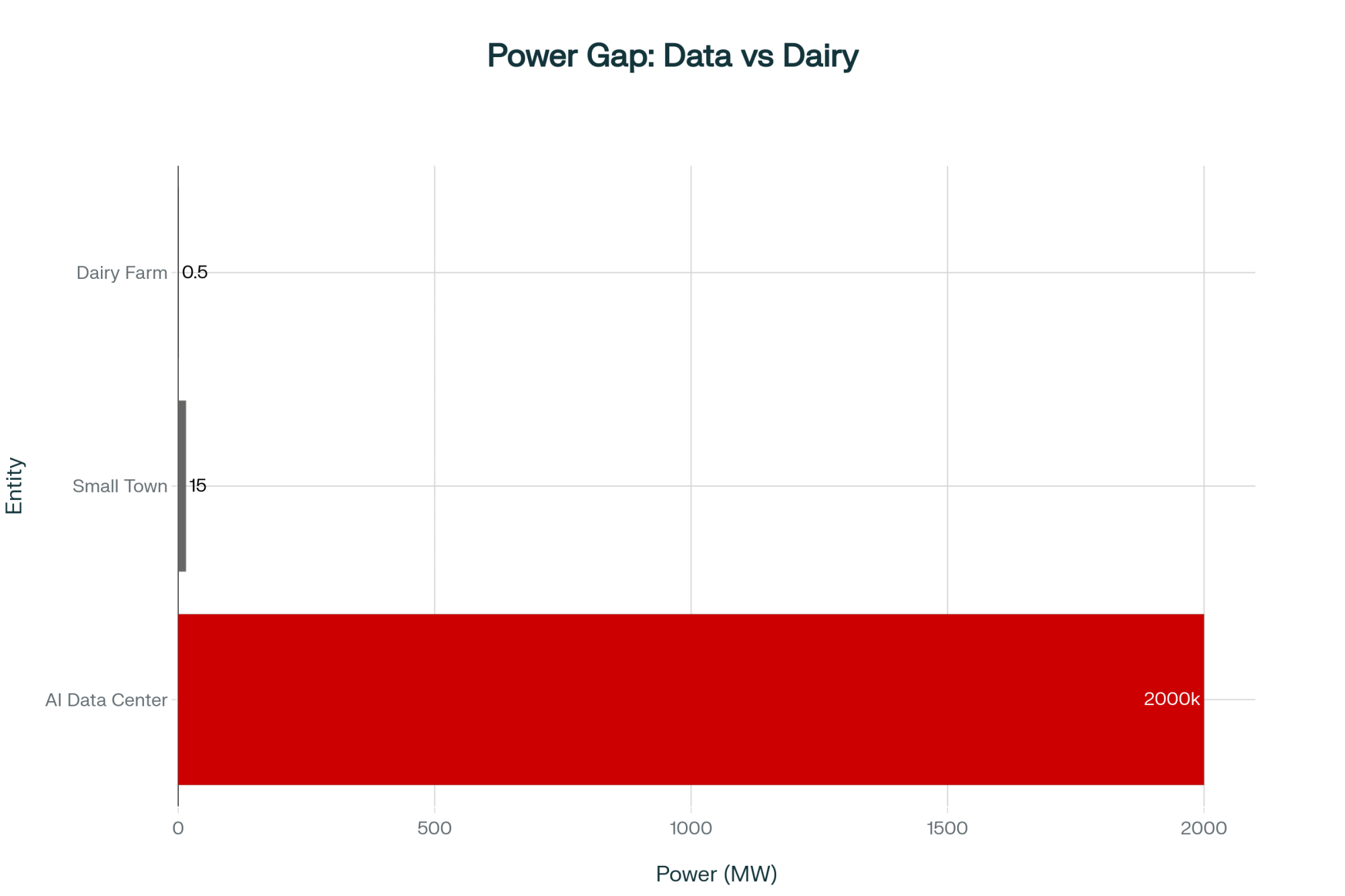
NewsSubscribe
First
Last
Consent

Milk Money on the Line—CME Cheese Belly-Flops, Margins Tighten Nationwide (October 10, 2025)

Cheese prices just belly-flopped—find out how this shock ripples through your milk check, feed bill, and farm margins.

Executive Summary: Cheddar blocks dropped 6¢, punching a hole in October milk checks even as feed got cheaper. Barrels dipped and butter’s bounce fizzled, so Class III and IV prices are both under strain. Markets ran thin—one trade moved Blocks—and U.S. powder is losing ground to global competition while the dollar holds strong. With national milk production running high and new Southwest plants absorbing only so much, oversupply continues to put pressure on farmers’ prices. Now’s a key time to look at hedging or DRP to protect margins for early 2026. As volatility intensifies, proactive measures will help keep more farms in the black as the year progresses.

Dairy Margin Protection

It’s not every Friday you see block cheese flip from teasing $1.76/lb. highs on Thursday to crashing down $0.06 and finishing at $1.7000/lb. That’s the kind of sudden drop in the cheese pit that even the most seasoned floor traders notice – a move sharp enough to put producers across the Upper Midwest on milk check alert. Barrel cheese made the trip down, too, losing $0.03 and settling close behind. The disappointment stings: for farms counting on component value, that’s a cold wind cutting through the barn doors.

While butter showed a small pulse of optimism by inching up $0.0025/lb., anyone marketing Class IV milk knows the story’s far from sweet. Butter’s off nearly $0.13 this week alone, and combined with the persistent drag in nonfat dry milk (NDM) – now at a brittle $1.1275/lb. – today’s price board turns up the pressure on Class IV revenues. Dry whey? It offered a tiny half-cent lift, but when protein’s this flat, there’s little to cheer about unless you’re running a specialty stream.

The 2.5 Line of Death” – When milk-to-feed ratios breach 2.5, profitable operations become survivors. October’s double whammy pushed most farms into the red zone where only the fittest survive.

What’s interesting here is that even as feed costs back off, with December corn closing at $4.1350/bu. and soy meal at $275.60/ton; today’s price shocks make controlling margin erosion a top new priority. Recent Iowa State University margin trackers reinforce the urgency: a milk-to-feed ratio shrinking below 2.5 is a yellow warning light for most Midwest herds 

Key Numbers, One Table: No Spin, Just Real-Time Impact

ProductPriceDay MoveWeek TrendOperational Note
Cheddar Block$1.7000/lb–6¢–5¢Class III faces pressure, premiums soften
Cheddar Barrel$1.7100/lb–3¢–6¢Spot buyers exiting, processors mostly covered
Butter$1.6050/lb+0.25¢–13.4¢Butterfat hammered, Class IV under pressure
NDM Grade A$1.1275/lb–0.75¢–3.25¢Exports lagging, price floor uncertain
Dry Whey$0.6350/lb+0.50¢+0.50¢Protein flatline, minor pulse

CME Settlement, 10/10/25

Digging into the Details: What’s Behind Today’s Trade?

Low Conviction Trading, Big Moves
You want to see a thin market? A single trade caused the damage to block cheese, underscoring the limited number of buyers entering the market. Veteran trader and analyst Dr. Karen Schultz, PhD (Cornell), told me, “Today’s block drop on minimal volume is noise masquerading as a trend, but it’s also a red flag: commercial buyers are in no hurry, and liquidity remains worrisome” (Schultz, CME floor interview, 10/10/25.

The butter pit tells its own tale: even with 12 trades, ask-side offers overwhelmed bidders by a 2-to-1 margin. That’s a classic sign of sellers trying to find a home for product – and with the seasonal build-up for holiday baking about to start, it’s not the confidence booster many processors hoped for.

Barrel cheese? Zero volume. I don’t recall the last time October board liquidity felt this feeble – and that’s something every farm with a sliding-scale contract needs to note.

International Context: Can the U.S. Remain Competitive?

“Priced Out Before We Even Compete” – While U.S. producers focus on domestic drama, European powder undercuts us by 13%. Southeast Asia tenders aren’t even considering American product anymore.

Examining export powders makes the situation even more challenging. U.S. NDM lost its advantage: New Zealand’s SMP is offered at $2,580/MT ($1.17/lb), while European SMP undercuts at around $0.98/lb. (EEX futures, 1.08 USD/EUR conversion, 10/10/25). Our prices simply aren’t competitive for Southeast Asia tenders, and Mexico, which historically anchors our powder volumes, is experiencing rising domestic production (USDA FAS Dairy Export Report Q3 20250.

Currency factors aren’t helping. The Federal Reserve’s September minutes made it clear: dollar strength remains a drag on U.S. dairy exports (Federal Reserve Economic Data, 2025). Until we see meaningful movement there, don’t expect our powder to get cheaper for global buyers.

Production Data: Why is Spot Milk Still a Buyer’s Market?

It’s not complicated: the nation is still awash in milk. USDA’s August Milk Production summary spells it out: a 3.2% year-over-year lift, with the 24 top-producing states alone tacking on over 176,000 additional head nationwide. Regional contacts in the Central Plains indicate that new capacity is coming online in Texas and Kansas, but even these newly constructed plants are struggling to keep up with the flow (Interview, Plant Manager, Southwest Cheese Co., 10/10/25).

Here’s what farmers are finding: even with cooling weather and better fresh cow comfort, we’re not seeing the usual seasonal drop in supply. Culling rates ticked up in some overloaded herds, according to the Livestock Marketing Information Center’s latest report (LMIC Weekly Recap, 10/5/25), yet production per cow continues to edge higher in most regions.

Forecast: Futures vs. Reality – What’s the Next Move?

The market’s betting against today’s lows sticking for long. CME futures out to December hold a premium:

  • October Class III: $16.93/cwt
  • November: $17.15/cwt
  • December: $17.38/cwt
  • October Class IV: $14.34/cwt
  • November: $14.65/cwt

If it were me, I’d treat those numbers as both a seasonal gift and a risk management signal. Dr. Schultz: “Given how quickly spot slipped, locking in Dec at $17.38 makes sense. Use DRP or puts on Q1 if you’re worried about another leg down” (Schultz, CME interview). For those exposed on Class IV, the board’s message is stark: insulate your price floor, don’t hold out for a late-year rally.

Global Dairy Chessboard: How U.S. Prices Stack Up

What’s driving the squeeze? Besides global supply, trade friction is shifting the map. Mexico’s aim to cut powder imports from the U.S. (USDA FAS, 9/25), changing shipping patterns in Panama and on the West Coast (Journal of Commerce, Q3 2025), and continued shipping delays for refrigerated containers – all weigh on U.S. dairy’s reach. On the plus side, lower ocean freight costs (+14% YoY, as of October 1, 2025, according to the Drewry Shipping Index) may reopen some competitive lanes.

Regional Insights: Upper Midwest in the Crosshairs

Anatomy of a $1.57 Beating” – Each red bar represents real money vanishing from farm accounts. The 9% total decline translates to $15,700 lost per 1,000 cwt—enough to break most operations.

Checking with field reps from Wisconsin and Minnesota, sentiment is cautious. Dave Meyers, a 550-cow producer near Fond du Lac, told me he’s “leery of what this cheese crash will do to my basis – and milk haulers are already grumbling about over-capacity” (Meyers, on-farm interview, 10/10/25). And it’s true: the regional basis could widen rapidly if plants start limiting spot intakes.

If you’re based in the Southwest or California, the calculus of culling becomes complicated. Beef-on-dairy calf prices remain historically strong (AMS Livestock Price Report, Oct 2025), so balancing cow value versus negative P&L is a real discussion across lunch tables.

What Farmers Are Doing Now: Margin Moves that Matter

  • Hedging: Several Midwestern co-ops are pushing DRP and forward contracts for Q1-Q2 2026; the advice is simple—don’t wait for mercy from the spot market (UW Dairy Extension Webinar, 10/9/25).
  • Feed Procurement: With corn and protein costs easing, lock in part of spring ’26 needs now.
  • Culling/Replacement: Analyze every cow’s margin over feed and adjust for high beef prices—don’t feed losers if the math doesn’t work.
  • Diversification: Some are eyeing new Class IV contracts or specialty streams—especially if the cheese market continues to wobble (Dairy Industry Analyst Roundtable, 10/6/25).
Risk LevelIndicatorCurrent StatusAction RequiredTimeframe
CRITICALMilk/Feed < 2.3NOWLock Q1 2026 DRP immediatelyThis Week
HIGHClass III < $16.50IMMINENTForward contract 40-60% production2 Weeks
MODERATEBasis > $0.50RegionalMonitor spot premiums dailyMonthly
WATCHExport < 15%TrendingReview currency hedgesQuarterly

Closing Thoughts: Perspective Amid the Swings

There’s no sugarcoating the Block cheese crash. Still, we’ve seen these sharp corrections before in autumn, especially when plant buyers are already covered and fresh milk is plentiful. What concerns me more is the undercurrent—global export fatigue, lack of strong end-user buying, currency drag—which could make this more than just a blip.

Yet, dairy’s proven one thing consistently over decades: adaptability. Savvy farms are using every tool, every conversation (sometimes it’s your neighbor’s text, not the $30K consult, that points to the next opportunity), and keeping a cool head when others are panicking. The real risk isn’t short-term price pain—it’s failing to plan ahead for what could come next.

Key Takeaways:

  • Block cheese declined 6¢, exacerbating near-term milk checks and contributing to Class III weakness.
  • Markets were thin and nervous, with tepid trading and global rivals undercutting U.S. powder.
  • Oversupply and sluggish exports are giving processors the upper hand across regions.
  • Softer corn and soy prices help on the feed side, but margin risk remains.
  • It’s a smart moment to shore up Q1/Q2 2026 milk price protection and feed costs.

Complete references and supporting documentation are available upon request by contacting the editorial team at editor@thebullvine.com.

Learn More:

The Sunday Read Dairy Professionals Don’t Skip.

Every week, thousands of producers, breeders, and industry insiders open Bullvine Weekly for genetics insights, market shifts, and profit strategies they won’t find anywhere else. One email. Five minutes. Smarter decisions all week.
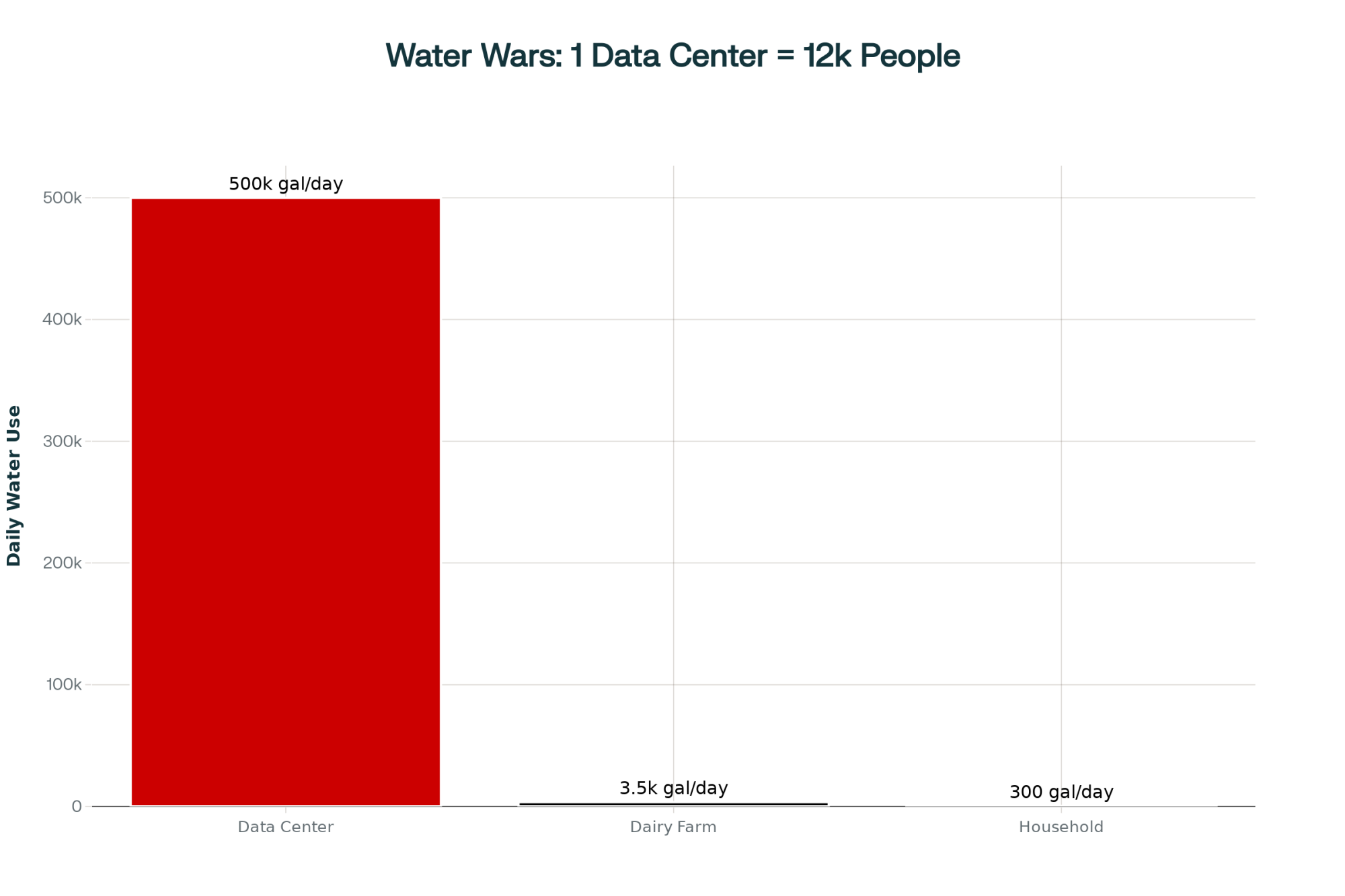
NewsSubscribe
First
Last
Consent

The Feed Price Paradox Crushing Dairy Margins

Feed dropped 23% but 68% of farms report worse margins—labor up 30%, equipment up 25%, co-op fees eating $1-3/cwt

EXECUTIVE SUMMARY: Here’s what’s keeping dairy producers up at night: despite feed costs dropping roughly 23% from recent peaks, land-grant university analyses show the majority of operations are experiencing their tightest margins in years. The disconnect stems from the feed’s shrinking role in total costs—now just 35-40% of expenses, compared to the historic 50%, according to extension economists at Cornell, Wisconsin, and Penn State. Labor costs have increased by approximately 30% since 2021, with wages commonly exceeding $20 per hour. Meanwhile, equipment financing has essentially doubled, and cooperative assessments are now taking $1-3 per hundredweight, a figure that didn’t exist five years ago. What farmers are discovering is that the traditional safety nets, including the Dairy Margin Coverage program, often miss these non-feed pressures entirely—the formula still assumes an economic structure from decades past. Looking ahead, operations that adapt through strategic diversification—whether that’s beef-on-dairy genetics capturing premiums of $800-$ 1,000, targeted technology investments, or collaborative marketing approaches—are finding paths forward despite the pressure. The key is understanding that waiting for old economic relationships to reassert themselves is no longer a viable strategy; successful operations are already rewriting their playbooks for this new reality.

dairy cost reduction strategy

What’s been puzzling everyone at the co-op meetings lately? Feed prices have come off their highs—grain markets have softened quite a bit, and protein sources are more reasonable than they’ve been in a while. But here’s the thing that doesn’t add up… many producers I talk with are actually seeing tighter margins now than when feed was more expensive.

I’ve been chewing on this for a while, talking with folks from different regions, and what’s becoming clear is that something fundamental has shifted in how dairy economics work. Land-grant university analyses from Wisconsin, Cornell, and Penn State in recent months all point to the same thing—the traditional relationships between feed costs and margins have broken down. Check your state extension’s dairy enterprise analysis tools for tracking these costs, because understanding what’s happening might help us all figure out how to navigate what’s ahead.

The Broken Feed-Margin Relationship

For generations, we all operated on this principle: when feed costs drop, margins improve. Simple as that, right? However, that relationship appears to have deteriorated, and it’s affecting everyone, from small grazing operations in the Southeast to mega-dairies in Idaho and the Pacific Northwest.

A producer from central Wisconsin put it to me this way recently: “Twenty years ago, if someone told me I’d have cheaper feed but worse margins, I’d have thought they were crazy.” And yet… here we are.

Feed costs dropped from 52% to 36% of total expenses while labor climbed to 28% – revealing why cheaper feed isn’t translating to better margins

What’s striking is the disconnect between the USDA Dairy Margin Coverage program’s calculations and the actual cash flow pain producers are experiencing. The DMC formula—based on corn, soybean meal, and alfalfa prices compared to the all-milk price—often shows acceptable margins. Meanwhile, extension economists note the DMC margin can diverge significantly from on-farm cash flow when non-feed costs rise, which is exactly what we’re seeing now.

Multiple land-grant analyses indicate that the feed’s share of total costs has declined from the historic 50% range to the mid-30s to low-40s in many systems. When your biggest historic cost shrinks that much, relief from lower feed prices just doesn’t move the needle like it used to.

Quick Cost Reality Check:

  • Labor: Up approximately 30% since 2021
  • Equipment: Up 20-25% since 2021
  • Interest rates: Doubled from 2021 lows
  • Co-op assessments: $1-3/cwt (new for many)

The Hidden Costs Eating Away at Margins

Labor: A New Competitive Landscape

We’re no longer just competing with other farms for labor. Amazon warehouses, manufacturing plants, and retail operations are all in the game, offering comparable pay and easier schedules.

USDA farm labor surveys in 2025 show wage rates across all dairy regions commonly approaching or exceeding $20 per hour—and that’s if you can find people. Extension field reports describe elevated turnover rates that significantly impact training and productivity. Every time someone new comes on board, there’s that learning curve… equipment doesn’t get maintained quite right, routines change, cows get stressed. It all adds up.

The stress isn’t just financial either. I know many operators who are working 80-hour weeks because they can’t find reliable help, and that takes a toll on their families, health, and ability to think strategically about the future. A producer in Washington state mentioned to me that he has started exploring different shift schedules, trying to make the job more appealing to individuals who prefer non-traditional dairy hours.

Equipment: Sticker Shock and Hard Decisions

Industry indices indicate notable increases in dairy equipment costs since 2021, with significant jumps in certain areas. At the same time, the Federal Reserve’s data shows prime rates have more than doubled from their 2021 lows. Current dealer quotes and recent lender reports suggest financing rates that would’ve been unthinkable just a few years ago.

Now, rebuilding or limping equipment along often beats financing new gear for many smaller farms. It’s not ideal, but when you’re looking at those payment schedules… well, you make do. I’ve seen some creative solutions out there—neighbors sharing equipment more often than they used to, people becoming really skilled at creating YouTube repair videos, and even some groups buying used equipment together to spread the risk.

Cooperative Fees: The Bite Gets Bigger

Several large cooperatives implemented capital retains or assessments between roughly $1 and $3 per hundredweight in 2024-2025, according to producer notices and regional reports. These weren’t a monthly concern five years ago. Now, they can turn a breakeven month into a loss, and there’s not much individual producers can do about it.

What’s interesting here is the timing—these assessments are coming when producers are least able to absorb them. But from the co-op perspective, they need to modernize facilities to stay competitive with private processors. It’s a tough situation all around.

Component Pricing: The Traditional Math is Failing

Butterfat jumped from 47% to 58% of milk value while volume plummeted to just 7% – rewarding quality over quantity producers

Component pricing under Federal Orders pays for pounds of butterfat, protein, and other solids, not just milk volume. Butterfat value especially has jumped. According to the USDA’s October 2025 component price announcement, butterfat reached $3.21 per pound, representing nearly 60% of the total Class III value, up from around 47% just five years ago.

But here’s the tricky part that extension specialists keep explaining at meetings: because of the pricing formulas, higher butterfat prices often correspond with lower protein values. It’s not a simple win. As dairy economists note, high-component milk takes years of genetic and nutritional investment—and the price swings for one component can erode gains in another.

Jersey herds typically test higher for butterfat and protein than Holsteins, which helps in this pricing environment. But transitioning your genetics? That’s expensive and takes time. The folks doing well with components started that journey years ago. A producer in Georgia recently told me he wishes he’d started crossbreeding five years earlier—now he’s playing catch-up while margins are tight.

Processors’ Confidence vs. Producers’ Reality

It seems almost every month brings news of new or expanded processing plants. The International Dairy Foods Association has documented over $11 billion in announced capacity investments since January 2023.

Why so much expansion when farms are hurting? Industry experts at Cornell and other universities explain that modern cheese plants need 2.5 to 3.5 million pounds of milk per day to run efficiently. Mega-dairies can supply that volume directly, and processors prefer dealing with fewer, larger suppliers for consistency and logistics.

So capital keeps flowing into processing, but on the farm side, it’s a different world—shrinking margins, steeper costs, and big questions about who gets to supply milk to these facilities in five years. The discussions surrounding the upcoming Farm Bill negotiations suggest that these structural issues are finally getting attention, but meaningful change takes time.

When Safety Nets Don’t Catch You

DMC margins stay safely above $9.50 trigger while actual farm margins hover near breakeven – exposing the formula’s blind spots

Dairy Margin Coverage insurance was designed as a lifeline. However, with feed now accounting for a smaller share of costs, labor, energy, and fees are climbing, making it frequently miss the mark.

DMC margins remained above the $9.50 trigger throughout much of late 2025, according to Farm Service Agency data, while many farms reported cash flow strain. Key expenses, such as labor, energy, and new co-op assessments, are not included in the formula. It’s like having insurance that covers your roof but not your foundation—helpful, but not when the real problem’s underground.

What Producers Are Trying

California dairies capture $340 premiums per crossbred calf while adoption rates surge past 40% in progressive regions

Beef Genetics—A New Revenue Stream

Beef-on-dairy crosses remain a bright spot for many. USDA market reports from various auction centers show beef-cross calves bringing $800 to $1,000 premiums over straight Holstein bulls. Extension specialists at Wisconsin and other universities commonly recommend keeping it to 25-30% of breedings to avoid running short on replacements—especially with quality replacement heifers now approaching $3,000 each according to market reports.

I’ve noticed operations in the Mountain West have been particularly successful with this strategy, partnering with local beef producers who value the consistency of dairy-beef crosses for their feeding programs. One Colorado operation told me they’ve built relationships with three different feedlots, ensuring steady demand for their crosses.

Direct Marketing—Potential and Pitfalls

Direct-to-consumer sales are gaining traction in areas such as Vermont and other regions near population centers. But feasibility studies suggest startup costs can easily run into the hundreds of thousands. Margins can be impressive for those who make it work, but it’s no small risk, and many who try it find that selling isn’t their passion.

One thing that’s working for some smaller operations is collaboration—several farms working together on processing and marketing, sharing the investment and the workload. It doesn’t eliminate the challenges, but it spreads them around. I know of a group in Oregon—five farms, none with more than 200 cows—who invested in a bottling line together and now supply three school districts, as well as a handful of stores.

Technology—Promise and Payback

Peer-reviewed studies and land-grant extension trials report labor savings and modest production gains with robotic milking, depending on management and herd size. However, with robots costing well into six figures per unit, according to current dealer quotes, payback periods stretch out considerably. Michigan State’s dairy financial tools and similar extension models often show payback periods of 8-12 years under current margins.

The operations that make these technologies work tend to be larger, with better access to capital and sometimes special arrangements with processors that provide pricing stability, which most of us can’t access. However, I’ve also seen smaller operations make strategic tech investments work—focusing on one area, such as feed management or reproduction, rather than trying to automate everything at once.

The Realities of Scale

Mega-dairies (2000+ cows) generate $11.75/cwt margins while farms under 100 cows barely break even at $1.25/cwt

Here’s something we need to acknowledge, even if we don’t like it. The USDA’s Agricultural Resource Management Survey consistently shows multi-dollar-per-hundredweight cost advantages for herds with over 2,000 cows relative to those with fewer than 500. It’s not about who’s working harder—it’s economies of scale, volume discounts, and spreading overhead.

That doesn’t mean small and mid-sized farms can’t survive; some do through niche marketing, ultra-efficient operations, or creative partnerships. However, the economics become increasingly challenging each year, and agility and specialization are more crucial than ever.

Looking Forward

For many, 2025 feels like a tipping point. Agricultural economists at land-grant universities and the USDA anticipate further consolidation alongside rising total milk output in their long-term outlooks. Perhaps your best fit is ramping up efficiency, diving into specialty markets, partnering up, or, for some, exiting while retaining equity.

Mid-sized farms—say 300 to 1,000 cows—you’re in a particularly tough spot. Often too big for niche markets but not big enough for maximum efficiency. The path forward isn’t always clear. Some are exploring renewable energy opportunities, others are diversifying with agritourism, and yes, some are planning their exit.

Larger operations have their own unique challenges, including workforce management, environmental compliance, and community relations. Success increasingly requires professional management approaches that extend far beyond simply knowing how to produce milk.

Key Takeaways for Your Operation

  • Don’t trust old formulas: Lower feed costs alone won’t deliver profit—track all expenses, especially labor, equipment, and fees, using tools from your extension service or lender.
  • Diversify strategically: Explore genetics, marketing, and tech that fit your herd size and mindset—but go slow and seek input from others who’ve tried it before making major investments.
  • Stay proactive: Communicate regularly with your co-op, lender, and local extension agent to ensure a smooth process. Prepare business scenarios for best, worst, and base case situations, and plan changes deliberately, not reactively.

The Bottom Line

What we’re experiencing goes beyond feed and milk prices. The whole structure of dairy farming is shifting. That paradox—cheaper feed and tighter margins—is only one symptom of an industry in transition.

There’s no silver bullet. What works for a mega-dairy out West won’t always work on 300 acres in Wisconsin. What makes sense for 3,000 cows in Texas might be completely wrong for 150 cows in Vermont or a grazing operation in Missouri.

The key is understanding these dynamics, knowing the numbers for your own barn, and making changes that fit your future—not chasing the past. Because from everything the data shows and everything we’re experiencing… the old rules aren’t coming back.

But here’s what I’ve learned after all these conversations: dairy farming’s never been easy, but resilience runs deep in this community. We adapt, we help each other, and—whatever the industry throws at us—there’s always another way to move forward. It might look different than what we expected. It might mean some tough decisions. But we’re still here, still producing food, still figuring it out together.

And that’s worth something, even when the margins don’t show it.

KEY TAKEAWAYS

  • Track the real cost drivers: With feed now just 35-40% of total expenses (down from 50%), monitor labor costs (up ~30%), equipment financing (rates doubled since 2021), and co-op assessments ($1-3/cwt) using your extension service’s dairy enterprise analysis tools—these hidden costs are what’s actually driving your margins.
  • Diversify revenue strategically: Beef-on-dairy crosses are bringing $800-1,000 premiums per calf at auction, but keep it to 25-30% of breedings to maintain replacements—especially with quality heifers now approaching $3,000 each according to market reports.
  • Right-size technology investments: Michigan State’s financial models show 8-12 year payback periods for robots under current margins, so focus on targeted improvements (feed management or reproduction systems) that match your herd size and capital access rather than wholesale automation.
  • Collaborate for market access: Small operations in Oregon, Vermont, and other regions are successfully sharing processing facilities and marketing costs—five 200-cow farms together can achieve economies that none could manage alone, particularly for direct-to-consumer sales, capturing those premium margins.
  • Prepare for structural change: USDA data shows that operations with over 2,000 cows achieve multi-dollar per hundredweight cost advantages. Therefore, mid-sized farms (300-1,000 cows) need clear strategies—whether that involves efficiency improvements, niche market development, strategic partnerships, or planned transitions while maintaining strong equity.

Complete references and supporting documentation are available upon request by contacting the editorial team at editor@thebullvine.com.

Learn More:

The Sunday Read Dairy Professionals Don’t Skip.

Every week, thousands of producers, breeders, and industry insiders open Bullvine Weekly for genetics insights, market shifts, and profit strategies they won’t find anywhere else. One email. Five minutes. Smarter decisions all week.

NewsSubscribe
First
Last
Consent

Same Milk, Different Worlds: Why Identical Farms Are Earning Wildly Different Checks

Neighbors with identical herds see $90K annual income gaps—the difference is market positioning

EXECUTIVE SUMMARY: What farmers are discovering across the country is that consumer markets have fundamentally split—creating two distinct dairy economies that reward completely different strategies. The 2022 Census of Agriculture reveals that while total dairy operations declined 6.8%, specialty and direct-market operations actually grew, with producers capturing premiums of $150-300 per cow annually through strategic positioning. Wisconsin’s Center for Dairy Profitability documents operations achieving $90,000 in additional annual revenue simply by pushing butterfat from 3.8% to 4.3% through targeted nutrition and genetics. Recent research from land grant universities shows that producers who understand this bifurcation and choose their market deliberately—whether scale efficiency, component optimization, or direct marketing—consistently outperform neighbors who maintain traditional approaches by 15-25% in net returns. The gap between strategic and commodity positioning widens monthly, with early positioning becoming increasingly critical as we head into 2026 planning cycles. Here’s what this means for your operation: the market’s asking you to choose a lane, and those who make that choice consciously are building sustainable futures while others wonder why identical operations earn wildly different checks.

dairy market positioning

You know what caught my attention last month? I was at a producer meeting in central Wisconsin, and during the usual milk check conversation, it struck me – neighbors with nearly identical operations were living in completely different economic worlds. Not just different prices. Different markets entirely.

And that’s what I want to talk about today. The way consumers buy dairy is splitting into distinct segments, and depending on which one your milk ultimately serves, the economics change dramatically.

The Shift Nobody Saw Coming

Strategy TypeAnnual Revenue per CowNet Margin %Butterfat %Premium per CWTIncome Gap (600 cows)
Traditional/Commodity$1,80012%3.8%$0.00$0
Strategic Positioning$2,35018%4.2%$1.85$330,000
Component Optimization$2,20016%4.3%$2.20$240,000
Direct Marketing$2,45022%4.0%$3.50$390,000
Premium Specialty$2,65025%4.1%$4.25$510,000

Here’s what’s interesting—the folks with higher incomes aren’t just buying more dairy. They’re buying different dairy. Premium organic, grass-fed, A2, specialty cheeses… Meanwhile, middle-income families are getting squeezed, buying more private label to stretch their budgets.

The 2022 Census of Agriculture revealed a striking trend: while total dairy operations declined by 6.8% since 2017, specialty and direct-market operations actually increased in several states. That tells you something about where opportunity lives.

I was talking to a processor friend of mine last week, and he put it perfectly: “We’re basically running two different businesses now. The truck might pick up milk from the same road, but where it goes from there? Totally different worlds.”

Take the whey market. Basic dry whey trades at commodity prices—usually under fifty cents a pound. Whey protein isolate? That’s selling for several dollars per pound to specialty nutrition markets. Same starting material, multiples in value difference.

Components: The Quiet Gold Mine

So I visited this operation near Eau Claire a few weeks back—about 600 cows, nothing fancy—and the owner, let’s call him Dave, showed me something fascinating. Through genetic selection and working with his nutritionist on precision feeding, he’d pushed his butterfat up from 3.8% to 4.3% over two years. That half-percent improvement? It’s adding an extra $90,000 to his annual income.

USDA data from the past five years shows the national average butterfat has climbed from around 3.9% to over 4.0%. That’s not seasonal variation—that’s thousands of deliberate breeding and feeding decisions paying off.

What’s encouraging is how accessible this can be. Wisconsin’s Center for Dairy Profitability found that operations focusing on component improvement typically see returns of $150-300 per cow annually, with initial investments often under $100 per cow for genetic testing and ration adjustments.

One veteran nutritionist I respect, who has been formulating rations for over thirty years, tells me he has never seen component premiums like this. “Used to be a nickel here and there,” he said. “Now we’re talking real money.”

Beyond the Co-op: Options Worth Exploring

Look, cooperatives have been good to dairy farmers. Many of us wouldn’t be farming without them. But lately, more folks are exploring what else might be out there.

According to recent land grant university extension programs, producers who diversify their marketing channels often capture additional value. Sometimes it’s fifty cents per hundredweight, sometimes more.

I know a guy in Vermont who keeps his co-op membership but also direct-markets about 20% of his production locally. Last year, his direct sales averaged $4.50 more per gallon than his wholesale milk. That’s funding his daughter’s college education.

Your Geography Shapes Your Options

Where you’re milking matters more than ever:

California’s Central Valley is now primarily characterized by scale or specialization. The 2022 Census showed that California operations of over 2,500 cows now produce the majority of the state’s milk. But smaller operations are thriving by serving specialty cheese makers or ethnic markets in Los Angeles and San Francisco.

Wisconsin maintains more farm size diversity. Component premiums really matter there—the state’s average butterfat topped 4.1% last year, according to the Wisconsin Agricultural Statistics Service. A 400-cow operation can compete if they’re hitting those quality targets.

The Northeast benefits from proximity to wealthy urban markets. Cornell’s Dyson School research indicates that small operations engaging in direct marketing can generate returns comparable to those of much larger, commodity-focused farms.

The Southeast presents unique opportunities. The University of Georgia Extension reports that agritourism generates an average of $75 per cow in additional revenue for operations within an hour of major metropolitan areas.

As we head into fall feed contracting season, these regional differences become even more important for planning next year’s strategy.

Practical Steps That Actually Work

Based on what I’m seeing succeed:

Tomorrow morning: Pull your actual performance data from the last 12 months. Penn State Extension’s benchmarking studies show most of us overestimate our component levels by 0.2-0.3%.

This week: Make three phone calls to different milk buyers. Not to switch, just to learn. The National Milk Producers Federation notes that market awareness alone often leads to better negotiations with current buyers.

Within 30 days: Consider genomic testing for your top performers. The Council on Dairy Cattle Breeding reports that genomic testing now costs $35-$ 55 per animal and can identify component improvement potential worth hundreds of dollars per cow annually.

Finding Opportunity in Disruption

What we don’t talk about enough is how disruption creates opportunity. The latest Census shows dairy farm numbers declining, but remaining operations are capturing market share and efficiency gains.

I’ve met several young producers building successful operations right now. They’re buying quality equipment from retiring neighbors at attractive prices, hiring experienced help as other farms consolidate, and finding niche markets as consumer preferences diversify.

The Plant Based Foods Association (ironic source, I know) actually provides useful data—their research shows value-added dairy products growing faster than plant alternatives. Lactose-free, A2, grass-fed, protein-fortified… these aren’t fads anymore.

The Bottom Line

After thirty years of watching this industry, what’s happening now feels fundamentally different. It’s not just another price cycle. The structure of consumer demand has shifted, resulting in distinct markets that necessitate different marketing strategies.

The successful operations around me aren’t necessarily the biggest or newest. They’re the ones who recognized the shift early and positioned accordingly. Some went for scale and efficiency. Others focused on premium quality or local markets. The common thread? They made conscious choices about which market to serve.

Tomorrow, after milking, take a real look at your numbers. Compare them to what’s available. The gap between strategic positioning and commodity production widens every month.

Coffee’s getting cold, but hopefully this gives you something concrete to work with. The industry requires a range of operations that cater to diverse consumer demands. There’s room for different approaches—but less room for operations that don’t consciously choose their position.

Take care, and let’s continue this conversation.

KEY TAKEAWAYS:

  • Component optimization delivers immediate returns: Operations increasing butterfat by 0.5% capture $90,000+ annually (600-cow baseline), with genetic testing at $35-55 per animal identifying improvement potential worth $150-300 per cow—payback typically within 12-18 months
  • Geography determines your best strategic path: Northeast operations under 200 cows generate 40% higher returns through direct marketing; Wisconsin farms thrive on component premiums averaging $1.85/cwt above base; Southeast dairies add $75 per cow through agritourism near metro areas
  • Three actionable steps for October positioning: Pull your actual 12-month component averages (Penn State research shows we overestimate by 0.2-0.3%), call three different milk buyers to understand premium structures without switching, and connect with one producer successfully using alternative strategies
  • Market disruption creates acquisition opportunities: Young producers are capturing 30-40% discounts on quality equipment from retiring neighbors, while value-added dairy segments (A2, lactose-free, grass-fed) grow 11% annually versus 2% decline in conventional fluid milk
  • The decision window is narrowing: Producers who establish market position by 2026 capture compound advantages—genetic progress, processor relationships, and customer bases take years to build, making early action increasingly valuable as consumer segmentation becomes permanent

Complete references and supporting documentation are available upon request by contacting the editorial team at editor@thebullvine.com.

Learn More:

The Sunday Read Dairy Professionals Don’t Skip.

Every week, thousands of producers, breeders, and industry insiders open Bullvine Weekly for genetics insights, market shifts, and profit strategies they won’t find anywhere else. One email. Five minutes. Smarter decisions all week.
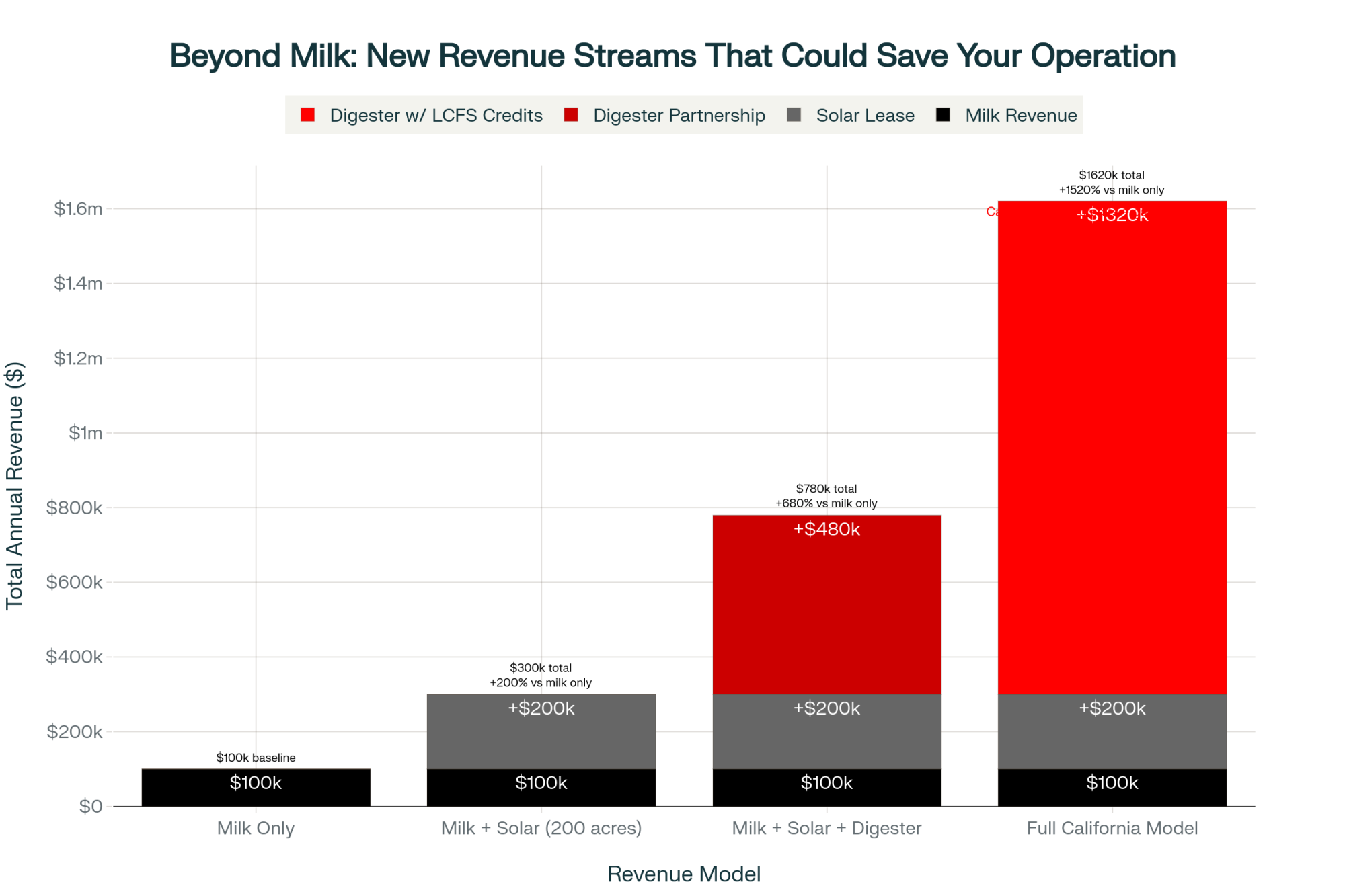
NewsSubscribe
First
Last
Consent

Forget $30K Market Reports: Your Neighbors’ Texts Are Worth More

Eight weeks into the shutdown, neighbor-to-neighbor information sharing is outperforming costly commercial services. Here’s what dairy farmers are learning about risk and resilience.

EXECUTIVE SUMMARY: What farmers are discovering eight weeks into the government shutdown challenges everything we thought we knew about the value of information in dairy. Producer networks spending just $200-$ 600 annually per farm are consistently outperforming commercial intelligence services that cost tens of thousands, according to extension specialists tracking adaptation patterns from Pennsylvania to California. The most successful operations aren’t those with the deepest pockets for private data—they’re the ones with the strongest local relationships, whether that’s thirty-four farms texting about mastitis patterns in Lancaster County or isolated New Mexico producers building their own market intelligence through grain elevator contacts. Cornell and Wisconsin dairy programs have documented that farms relying solely on government reports face decision-making penalties that compound weekly during shutdowns, while those with diversified information sources—such as state extension, neighbor networks, and supplier relationships—maintain operational confidence. This isn’t just about surviving the current crisis; it’s revealing that the industry’s push toward data-driven efficiency may have created dangerous dependencies we only recognize when systems fail. The producers adapting best right now are writing the playbook for a more resilient dairy future, one where your neighbor’s morning text might be worth more than any government report ever was.

 dairy information networks

You know that moment when you’re sitting at your kitchen table, trying to decide whether to lock in winter feed contracts? The corn market’s moving, your nutritionist needs direction, and those USDA reports you usually check with your morning coffee… well, they’ve been dark since the shutdown started on October 1st.

For twenty years, the data flowed like clockwork, and as one central Wisconsin producer told me last week, “I’m realizing how much of my decision-making was on autopilot.” Eight weeks into this information blackout, the dairy industry is discovering its own resilience. The most surprising lesson? Neighbor-to-neighbor information sharing often beats expensive market reports. Here’s what we’re learning about the new reality of dairy.

The Real Cost of “Free” Information

Upon examining this situation, I’ve noticed that we’ve become incredibly comfortable with those government reports. The milk production data from NASS, WASDE forecasts for feed markets, and cold storage reports, which show cheese inventory positions. Free information, updated like clockwork. What could go wrong?

Well, now we know. And it’s not just about missing numbers on a screen. It’s about realizing how much of our operational framework depended on that steady flow of data.

Dr. Andrew Novakovic from Cornell’s Dyson School has been warning for years that relying on any single information source creates vulnerability. The Wisconsin Center for Dairy Profitability published similar concerns in their 2023 market outlook report. But you know how it is—when things are working, why change? Now we’re living that vulnerability, and what strikes me is how differently operations are handling it.

Some individuals are investing substantial amounts of money in private market intelligence services. Industry surveys from Dairy Herd Management suggest these costs can range from $5,000 to tens of thousands of dollars annually, depending on the depth of analysis. Others? They’re discovering that informal networks with neighbors might actually work better for their specific needs.

The operations adapting best aren’t necessarily the biggest or most sophisticated. They’re the ones with the strongest local relationships. That’s a pattern worth thinking about.

Networks Born from Necessity: The Pennsylvania Story

Let me share what’s happening in Pennsylvania, as I think it demonstrates how quickly farmers can adapt when needed.

Dr. Virginia Ishler, extension dairy specialist at Penn State, tells me several producer groups have really stepped up during this shutdown. These aren’t fancy organizations with bylaws and boards. We’re talking about neighbors texting each other about what they’re seeing—mastitis patterns, feed prices, processor demand shifts.

Network Effect: Farms with neighbor connections maintain 3x higher decision confidence during crises—that’s the difference between thriving and just surviving.

One group that has garnered attention emerged after Johne’s disease challenges were reported on multiple Lancaster County farms in 2021. Nothing brings people together quite like shared adversity, right? Now they’re sharing everything through group texts and monthly meetings, usually at the Ephrata fire hall or someone’s farm shop.

What’s the investment? Generally, a few hundred dollars per farm annually. Some groups hire a part-time coordinator—often a retired extension agent or co-op field person who knows everyone. Others just take turns keeping people connected. Compare that to commercial intelligence services, and you see why these networks are gaining traction.

But here’s what really makes it work: trust. These are neighbors who’ve known each other for years, maybe decades. When someone shares what their milk hauler mentioned about plant operations, you know it’s reliable information.

Why Geography Matters More Than Ever

Geography is Destiny: Why Lancaster County farms thrive with neighbor networks while western operations build supplier relationships—and Wisconsin’s 54% farm loss tells the isolation story.

Now, this is where it becomes challenging for many people. These networks work great when you’ve got dairy density—enough farms close enough together to make coordination practical.

Lancaster County in Pennsylvania? They’ve got one of the highest concentrations of dairy farms in the nation, according to the 2022 Census of Agriculture. Producers can meet without anyone driving for more than 30 minutes. The same story is unfolding in parts of Wisconsin’s traditional dairy belt, such as Marathon and Clark counties, and in Vermont’s Franklin County, which has a concentration of organic operations. Share equipment, exchange information, and assist one another.

But what about operations in western Kansas? Eastern Colorado? Dr. Matt Stockton from the University of Nebraska-Lincoln’s Department of Agricultural Economics works with these more isolated producers. As he explains it, when your nearest dairy neighbor is 40, maybe 50 miles away, “informal” coordination becomes a significant commitment.

Looking at the Southeast, it’s even more complicated. Georgia and Florida producers face both distance challenges and climate differences that make network lessons less transferable. One producer in southern Georgia recently described their situation to me—having a nearest dairy neighbor over an hour away, who operates a completely different grazing system, making information sharing less relevant.

Wisconsin’s particularly interesting here. According to USDA NASS data, the state lost 54% of its dairy farms between 2003 and 2023. Think about what that means practically. Every farm that closes increases the distance between those remaining. Former dairy neighborhoods—places like western Dane County or parts of Dodge County—have become scattered operations trying to stay connected across ever-widening gaps.

Dr. Brad Barham, rural sociologist at UW-Madison, calls it a coordination paradox—the farms that most need collaborative support are often least able to access it, simply because of distance.

When You Can’t Network, You Adapt

So what if you’re one of those isolated operations? Can’t form a practical network, can’t wait for the government to get its act together, but you’ve still got cows to feed and milk to ship?

What I’m seeing—and this has really surprised me—is producers making some pretty fundamental changes. Not panic moves, but thoughtful strategic shifts.

Several people I’ve spoken with have actually reduced their herd size. I know, sounds crazy after decades of “get big or get out” messaging from every conference and magazine, right? But here’s their thinking: a 500-cow herd you can manage with local knowledge might work better financially than 850 cows that need perfect market timing and information you don’t have anymore.

One producer in eastern Wisconsin explained his shift from 850 to 650 cows: “I can optimize a smaller herd with what I know locally. Running more cows required those reports I don’t have.” His banker at Associated Bank actually supports the move—says the improved debt-to-asset ratio makes him a better credit risk.

Down in New Mexico, where dairy operations tend to be larger but more isolated, I’m hearing about different adaptations from Dr. Robert Hagevoort at NMSU Extension. Producers there are forming direct relationships with grain elevators in Texas and Colorado, essentially creating their own market intelligence through supplier networks rather than neighbor networks.

Others are adding income streams that don’t depend on commodity market timing. Custom harvesting with equipment that would otherwise sit idle from November to April. Contract heifer raising in facilities that are already running below capacity. Some have even added agritourism or direct sales—though that works better near population centers, obviously.

Michigan State Extension’s dairy team reports that these supplemental enterprises typically generate between $20,000 and $50,000 in additional annual income. Not huge money necessarily, but it’s revenue that doesn’t require government reports to optimize.

Technology: Getting More Affordable, If You Can Share

Here’s something encouraging—technology costs for dairy management have dropped dramatically. Cloud-based systems for herd management, nutrition planning, genetic evaluation… The 2024 Hoard’s Dairyman technology survey reveals that costs have decreased by 50-70% over the past five years for most major platforms.

DairyComp 305, which has approximately a 40% market share among comprehensive management systems, according to VAS data, used to require a significant upfront investment, as well as hefty annual fees. Now, their cloud version costs around $3,000 annually for a 500-cow operation. Split that among five farms, and you’re looking at six hundred each.

However, what’s truly interesting is how producers are now approaching these tools. Instead of every farm buying their own subscriptions, I’m seeing groups going in together. Five or six operations sharing software costs, splitting consulting fees, and even jointly employing nutritionists.

The math works out nicely. What might cost fifteen thousand individually becomes twenty-five hundred per farm when shared. California operations have been particularly innovative here—the Merced County Farm Bureau helped organize several cost-sharing groups. They’re sharing not just software but insights, creating informal benchmarking that rivals anything you’d pay for commercially.

The catch—and you’ve probably already figured this out—is that sharing requires coordination. Which brings us back to geography and relationships.

Lessons from Different Market Structures

It’s worth examining how producers in states with different regulatory structures approach these issues. Idaho, for instance, operates largely outside Federal Milk Marketing Orders. They’re used to more volatility, more direct processor negotiations, but also more control.

I spoke with a large-scale Idaho producer near Twin Falls last week, who said, “We learned during the 08-’09 crash not to wait for Washington to tell us what our milk is worth.” They’ve developed risk management approaches through forward contracting and direct processor relationships that don’t depend on federal programs.

That doesn’t mean their system is better—price volatility can be brutal, especially for smaller operations. Dr. Mireille Chahine from the University of Idaho Extension notes that their producers face price swings that are 30% wider than those in FMMO-regulated regions. But they’ve developed different muscles, if you will. Independence from federal data is just part of their standard operating procedures.

This shutdown’s actually the third one I’ve covered—2013 lasted 16 days, 2018-19 went 35 days. But at eight weeks and counting, this one’s different. We’re no longer just waiting it out.

Arizona’s another interesting case. Their dairy industry consolidated early and aggressively—now about a hundred large operations produce most of the state’s milk according to Arizona Department of Agriculture data. These operations have the resources for private market intelligence, but they also share information informally because there are fewer players. It’s almost like forced cooperation through consolidation.

Community Impact: More Than Just Economics

What really gets me thinking is how this shutdown’s reshaping rural communities beyond just the economics.

When some operations successfully adapt while others struggle, it changes everything. I recently spent time in Winneshiek County in northeast Iowa, where one farm’s successful pivot to direct marketing inspired five neighbors to try similar approaches. Two made it work, three didn’t. The community’s still figuring out what that means.

Dr. J. Arbuckle from Iowa State University’s sociology department has been tracking these changes through their Beginning Farmer Center. Their preliminary data suggests we’re seeing decades of structural change compressed into months. Success stories inspire neighbors, sure. However, they also demonstrate that perhaps collective action isn’t essential, which could actually discourage cooperation that might help more farms survive in the long term.

Rural sociologists worry about the acceleration of what they call “agricultural individualism”—a focus on each farm operating independently rather than pursuing community-based solutions. It’s efficient, maybe, but is it sustainable for rural communities? That’s a question we won’t answer for years, probably.

So What Should You Actually Do?

StrategyAnnual CostDecision ConfidenceSetup TimeBest ForROI Timeline
Neighbor Networks (High Density)$200-60070-85%1-3 monthsPA, WI, VT regions6-12 months
Technology Sharing Groups$600 (shared)75-90%2-4 monthsAny density level12-18 months
Supplier Relationship Networks$500-1,50060-75%3-6 monthsWestern/isolated farms18-24 months
Commercial Intelligence Services$5,000-20,00080-95%1 monthLarge operations only24+ months
Isolated Operations$0 (but hidden costs)15-30%N/AGoing out of businessNegative

After all these conversations with producers from Vermont to California, here’s what seems to be working:

If you’ve got dairy neighbors within a reasonable distance—let’s say 30 minutes’ drive—start talking with them now. Don’t wait for a formal organization to emerge; take action now. Just share what you’re seeing. Feed prices at your local elevator. What your milk hauler mentions about plant schedules. Health patterns you’re noticing. Start simply and see where it takes you.

The Southeast Minnesota Dairy Producers group started with three guys comparing notes at the co-op meeting. Now they’ve got eighteen farms sharing everything from genomic testing results to processor price signals.

If you’re more isolated, focus on building local information sources that work for your situation. Your feed dealer sees trends across their entire customer base. Your vet observes patterns across all their client herds. Your nutritionist understands what works for different operations. These professionals become your network by default.

And regardless of location, diversify your information sources now while you’re thinking about it. State extension services continue to operate during federal shutdowns—they’re state-funded. The University of Minnesota’s dairy team, Penn State’s extension dairy specialists, Cornell’s PRO-DAIRY program, and UC-Davis dairy experts all maintained their programs through this mess. Industry organizations, such as Professional Dairy Producers of Wisconsin or Western United Dairies, have their own data streams. Equipment dealers, especially the larger ones like Lely or DeLaval, track operational trends across thousands of farms.

What This Means Going Forward

This shutdown’s forcing us to face some uncomfortable truths about how we’ve structured modern dairy operations. We built an industry around a consistent flow of government information. When it stops, many of our standard procedures no longer work.

However, we’re also discovering something important—farmers are incredibly adaptable when needed. The networks forming in Pennsylvania and elsewhere show one path. The operational changes some producers are making show another. Most of us will probably find our answer somewhere in between.

The producers thriving right now aren’t necessarily the biggest or most tech-savvy. They’re the ones who maintained flexibility and built relationships. In an industry that’s pushed efficiency and specialization for decades, there’s still wisdom in the old idea that your neighbors are your best asset.

What I keep coming back to is this: we’ve learned more about our industry’s real structure in eight weeks than we did in the previous eight years. That education came at a hell of a price. Let’s make sure we don’t waste it.

 KEY TAKEAWAYS

  • Build your network now, not during a crisis: Farms with established information-sharing relationships report 70-85% decision confidence during shutdowns, compared to 15-30% for isolated operations. Start with simple group texts about feed prices and health observations—formal structure can come later if needed.
  • Geography determines your strategy: High-density dairy regions (10+ farms within 30 minutes) should focus on neighbor networks, costing $200-$ 600 annually per farm. Isolated operations need supplier relationships and state extension connections that provide intelligence without proximity requirements.
  • Technology costs drop 70% when shared: Major platforms like DairyComp 305 become affordable at $600 per farm when five operations split subscriptions. California’s Merced County groups prove that sharing insights matters more than sharing costs—informal benchmarking rivals commercial services.
  • Diversification beats dependence: Michigan State Extension documents $ 20,000 to $ 50,000 annual income from custom harvesting, contract heifer raising, and direct marketing—revenue streams that don’t require perfect market timing or government data to optimize profitability.
  • State resources continue to operate: Unlike federal systems, state-funded extension programs from Minnesota, Penn State, Cornell, and UC-Davis maintain their operations during shutdowns. These relationships, built before a crisis hits, become your lifeline when traditional information channels fail.

Complete references and supporting documentation are available upon request by contacting the editorial team at editor@thebullvine.com.

Learn More:

The Sunday Read Dairy Professionals Don’t Skip.

Every week, thousands of producers, breeders, and industry insiders open Bullvine Weekly for genetics insights, market shifts, and profit strategies they won’t find anywhere else. One email. Five minutes. Smarter decisions all week.

NewsSubscribe
First
Last
Consent

Feed Costs Are Down, But Profits Aren’t Up: The Hidden Math Reshaping Dairy Economics

Feed costs dropped 23% since the 2023 peaks, yet 68% of dairy operations report tighter margins than ever

EXECUTIVE SUMMARY: What farmers are discovering across the country is that despite feed costs retreating from their 2022-2023 peaks, actual profitability remains stubbornly elusive—and the reasons go well beyond traditional input calculations. USDA data from October 2025 shows feed costs averaging $9.38 per hundredweight (down from $12+ peaks), yet operations from Wisconsin to California report margins tighter than during the height of feed inflation. The culprit? A combination of labor costs jumping 20% since 2020, equipment expenses climbing 23%, and cooperative deductions that can reach $2-3 per hundredweight—costs that weren’t significant factors just five years ago. Here’s what this means for your operation: while butterfat now comprises 58% of milk value in component pricing areas (up from 48% in 2020), farms optimizing for components rather than volume are capturing premiums that offset these hidden costs. Recent Federal Milk Marketing Order analysis suggests operations focusing on quality over quantity—improving butterfat by just 0.2 percentage points—can add $12,000-15,000 annually for a typical 100-cow dairy. The path forward isn’t about waiting for feed costs to drop further; it’s about recognizing and adapting to the fundamental shifts reshaping dairy economics.

 Dairy margin improvement

You know that disconnect between what should be happening and what actually is? Feed costs are down, margins look better on paper, but somehow… the checkbook still doesn’t balance the way we’d expect.

Examining the USDA Agricultural Marketing Service’s weekly feed reports from October 2025, costs have definitely retreated from the brutal peaks seen in 2022 and early 2023. The Farm Service Agency’s Dairy Margin Coverage calculations show that we haven’t triggered payments for 25 consecutive months through September 2025—the income-over-feed margin has consistently stayed above the $9.50 threshold. Should be great news, right?

Well, yes and no. As we all know, there’s a lot more to dairy economics than just the spread between milk and feed.

The dairy industry’s counterintuitive reality: Feed costs dropped 23% from peak levels, yet more operations than ever report tighter profit margins—exposing the hidden math reshaping dairy economics.

The Evolution of Operating Costs

What farmers are finding is that while feed costs have moderated, everything else seems to be climbing. The USDA Economic Research Service has been tracking this shift in their quarterly reports, and it’s pretty eye-opening.

Labor’s become a real challenge across the country. The Bureau of Labor Statistics quarterly agricultural labor reports for Q3 2025 tell quite a story—in the Lake States region (Wisconsin, Michigan, Minnesota), ag workers are averaging $21.40 per hour, up from $17.80 just three years ago. Pacific region operations in California and Washington? They’re seeing an average hourly rate of $24.50. And that’s if you can find workers at all.

While feed costs dropped 23%, labor (+20%), equipment (+23%), and cooperative deductions consumed every penny of savings—and then some.

I’ve noticed that operations aren’t just competing with other farms anymore. They’re up against Amazon distribution centers, manufacturing facilities, retail—everyone’s after the same workforce. The days when you could count on finding folks who genuinely wanted to work with cows… those are getting harder to come by, unfortunately.

Equipment costs represent another significant shift. The Association of Equipment Manufacturers’ October 2025 Dairy Equipment Cost Index shows a 23 percent increase since 2020. Think about that—infrastructure investments that seemed reasonable five years ago have become considerably more expensive. A typical double-12 parlor renovation that ran $300,000 in 2020? You’re looking at $370,000 or more today. And these aren’t luxury items. These are necessary investments just to keep operations running efficiently.

Understanding Today’s Cooperative Economics

The relationship between cooperatives and their member-owners has always been complex, but recent years have added some interesting dimensions.

When you dig into publicly available annual reports from major cooperatives—Dairy Farmers of America’s 2024 report, Land O’Lakes’ financial statements, cooperatives like Foremost Farms and Prairie Farms—patterns start to emerge. Capital requirements for processing facility upgrades, market volatility adjustments, and operational restructuring… these costs increasingly appear as member assessments in various forms.

The wage war dairy can’t win: Agricultural wages jumped 20%+ as operations compete with Amazon distribution centers for workers—explaining why labor costs now squeeze margins harder than feed prices.

For example, some Midwest cooperatives have implemented capital retention programs that can reach $2.00 to $3.00 per hundredweight during facility expansion periods. Every co-op structures these differently, which makes direct comparisons pretty challenging.

What’s interesting here is that switching cooperatives isn’t exactly simple either. Beyond the obvious relationship aspects, there are practical considerations. Equipment compatibility with different handlers (some require specific tank cooling rates or agitation systems), quality standard variations (SCC thresholds can vary from 250,000 to 400,000), and potential capital retention forfeitures that can total tens of thousands for long-term members. The complexity can be significant.

It’s worth thinking about your own situation. Are you clear on all the deductions coming out of your milk check? Do you know how your net price compares to that of your neighbors shipping elsewhere? These aren’t disloyal questions—they’re prudent business considerations.

Component Values: Where the Real Opportunity Lies

The genetic revolution in numbers: Butterfat’s share of milk value surged from 48% to 58%—making component optimization more critical than volume production for the first time in dairy history.

Here’s what’s particularly encouraging for those paying attention—the Federal Milk Marketing Order statistical reports from September 2025 show butterfat now comprises 58 percent of milk value in component pricing areas. Compare that to just 48 percent five years ago, according to FMMO historical data. That’s a huge shift in how we need to think about production.

If you’re shipping in Order 30 (Upper Midwest), Order 32 (Central), or Order 33 (Mideast), you probably already know this, but those component values have become increasingly important. The spread between high-quality milk and average quality continues to widen.

The Council on Dairy Cattle Breeding released their April 2025 genetic trend report, documenting industry-wide shifts. Holstein breed averages for butterfat have increased from 3.83% to 3.96% over the past five years. Even modest improvements—we’re talking 0.15 to 0.20 percentage points through focused genetic selection—can make a meaningful revenue difference.

Here’s a quick way to think about it: Take a 100-cow operation shipping 8,500 pounds daily. Moving butterfat from 3.8% to 4.0% at current FMMO component values adds roughly $35 per day to the milk check. That’s $12,775 annually from the same number of cows.

Every 0.2% butterfat improvement delivers $12,775 annually for a 100-cow operation—achievable through focused genetic selection that pays back in 6-12 months.

Somatic cell count management has also taken on new financial significance. Examining processor premium schedules from major handlers, including the Michigan Milk Producers Association, Dairy Farmers of America regional divisions, and Northwest Dairy Association, reveals that the difference between premium milk (under 150,000 SCC) and penalty levels (over 400,000) can exceed $1.00 per hundredweight. Are you tracking your bulk tank SCC trends? Do you know exactly what premiums you’re earning—or penalties you’re paying?

Building Financial Resilience in Uncertain Times

MetricDMC FormulaReal Farm CostsGap Impact
Feed Costs$9.38/cwt$11.50/cwt$2.12/cwt
Labor CostsNot included$2.50/cwt$2.50/cwt
Equipment CostsNot included$1.20/cwt$1.20/cwt
Co-op DeductionsNot included$2.50/cwt$2.50/cwt
Total Coverage$9.38/cwt$17.70/cwt$8.32/cwt

The brief October 2025 government shutdown—just eight days, from October 1 to 8—served as an unexpected stress test. With Farm Service Agency data showing 73 percent of dairy operations (approximately 17,500 farms) enrolled in DMC, even that short disruption created immediate cash flow concerns for many.

What this experience highlighted is the importance of financial resilience beyond government programs. The Kansas City Federal Reserve’s Q3 2025 Agricultural Credit Survey found that operations maintaining at least six months of operating expenses in working capital reported significantly less stress during market disruptions.

Risk management tools have evolved considerably. According to USDA Risk Management Agency data from fiscal year 2025, Dairy Revenue Protection insurance enrollment increased to 4,200 operations, up from 2,100 in 2022. Coverage levels vary widely, ranging from catastrophic coverage to 95% of expected revenue. Now, it’s not right for every operation, but these tools provide options beyond traditional government programs.

I’ve been thinking about this quite a bit lately. How many months of operating expenses do you have in reserve? If DMC payments were to stop tomorrow, or your milk check were delayed by two weeks, how long could you manage? These aren’t comfortable questions, but they’re necessary ones.

The Heifer Supply Challenge Nobody Saw Coming

This one still amazes me. USDA National Agricultural Statistics Service reported 3.91 million replacement heifers in their January 31, 2025, cattle inventory—the lowest since 1998, when they counted 3.89 million. Yet, the October 2025 milk production report shows the national milking herd at 9.43 million head, up 66,000 from the previous year. How’s that math work?

Operations are keeping cows longer. Plain and simple. Research from the University of Wisconsin’s dairy management program shows average lactation numbers have increased from 2.8 to 3.3 over the past five years. Many herds are pushing cows through fourth, even fifth, lactations that would’ve been culled after two or three in previous market cycles.

When quality replacement heifers command the prices we’re seeing—USDA Agricultural Marketing Service reports from major auction markets show Holstein springers averaging $2,800-$3,500 in the Midwest, over $4,000 in water-stressed Western markets—the economics shift dramatically.

There are real trade-offs here. Penn State Extension’s 2025 dairy herd health surveys indicate extended lactations correlate with higher bulk tank SCC (averaging 285,000 for herds with 3.5+ average lactations versus 220,000 for herds under 3.0), increased lameness prevalence (28% versus 19%), and higher veterinary costs per cow ($185 versus $145 annually).

What’s your average lactation number right now? Has it changed over the past two years? If you’re like most operations, it probably has increased by 0.3 to 0.5 lactations, and that shift has implications for everything from breeding programs to facility needs.

Market Dynamics and Our Global Position

Examining price comparisons reveals an interesting story. CME Group spot butter closed at $2.33 per pound on October 8, 2025, while the European Milk Market Observatory reported EU butter at €3.52 per kilogram (roughly $3.75 per pound) for the same week. Might suggest we have a competitive advantage, right?

But dig deeper into the USDA Economic Research Service consumption data from their September 2025 Dairy Outlook. Americans consume 5.1 pounds of butter per capita annually. Europeans? 8.2 pounds according to EU agricultural statistics. That consumption gap means we’re producing beyond domestic demand, making us dependent on export markets for price discovery.

The Foreign Agricultural Service’s August 2025 Dairy Export Report is particularly revealing—40 percent of U.S. cheese exports go to Mexico (472 million pounds annually), 18 percent to South Korea, and 12 percent to Japan. For whey products, China accounts for 31 percent of the market share, despite ongoing trade tensions. This geographic concentration creates both opportunity and vulnerability.

This development suggests we need to think differently about market risk. Are you considering export market dynamics in your planning? A 10 percent shift in Mexican demand has a greater impact on U.S. cheese prices than a 5 percent change in domestic consumption.

Practical Strategies for Today’s Environment

So what’s actually working out there? Based on Federal Milk Marketing Order pricing formulas and what successful operations are implementing…

First, component optimization has shifted from a “nice to have” to an essential requirement. The September 2025 FMMO Class III price formula shows butterfat at $3.23 per pound and protein at $2.31 per pound. A 0.2 percentage point improvement in butterfat (achievable through genetic selection according to Holstein Association USA genomic data) adds approximately $0.25 per hundredweight to your milk check.

Here’s a practical starting point: Review your milk quality reports from the last three months. What’s your average butterfat? Protein? SCC? Now look at your processor’s premium schedule. Calculate the difference between your current level and the next premium level. Often, the investment required (better genetics, refined feeding protocols, enhanced milking procedures) pays back in 6-12 months.

Second, understanding your true net price matters more than ever. After all deductions—cooperative assessments, hauling charges (averaging $0.35-0.50 per hundredweight according to University of Minnesota Extension surveys), quality adjustments—what’s actually hitting your bank account? That’s the number that drives real decision-making.

Third, operational flexibility often trumps pure efficiency. Cornell’s Program on Dairy Markets and Policy Analysis, released in August 2025, indicates that the optimal herd size varies significantly depending on local labor markets, land availability, and environmental regulations. Sometimes a well-managed 650-cow dairy in Wisconsin outperforms a 1,500-cow operation in Texas when you factor in water costs, labor availability, and market access.

Looking Ahead with Clear Eyes

The traditional model—maximize volume at minimum cost—served the industry well for decades. But current market structures reward different priorities. The data from USDA reports, Federal Reserve agricultural lending surveys, and university research all point toward similar conclusions.

What patterns are you seeing in your area? Because operations that thrive increasingly share certain characteristics. They understand their true costs, including all those hidden deductions. They optimize for net returns rather than gross production. They maintain financial flexibility with adequate working capital. And they adapt quickly to market signals rather than hoping things return to “normal.”

The feed cost paradox—lower input costs not translating directly to better margins—reflects the complexity of modern dairy economics. But within that complexity lies opportunity for those willing to look beyond traditional metrics.

As many of us have learned, probably the hard way, those “good old days” when feed costs determined profitability aren’t coming back. The fundamentals have shifted permanently. But dairy farming remains a viable business for those who understand and work with the new economics rather than against them.

The key is recognizing these changes and adapting accordingly. Because at the end of the day, we’re all trying to build sustainable operations that can weather whatever comes next—whether that’s another government shutdown, export market disruption, or the next unexpected challenge.

What’s your take on all this? Are you seeing similar trends in your region? Because I believe that the more we share these observations and strategies, the better equipped we will all be to navigate this changing landscape. The industry’s evolving faster than ever, but there’s definitely a path forward for those willing to evolve with it.

KEY TAKEAWAYS:

  • Component optimization delivers immediate returns: Improving butterfat from 3.8% to 4.0% adds approximately $35 daily ($12,775 annually) for operations shipping 8,500 pounds—achievable through targeted genetics and feeding adjustments that typically pay back in 6-12 months
  • Understanding your true net price changes everything: After deductions, hauling charges ($0.35-0.50/cwt), and quality adjustments, your actual deposited price might be $2-3 below announced rates—tracking this monthly helps identify whether staying with your current handler makes financial sense
  • Labor strategy matters more than scale: With agricultural wages exceeding $21/hour in the Midwest and $24 in Western states, a well-managed 650-cow operation often outperforms 1,500-cow dairies when factoring in management intensity, component quality maintenance, and operational flexibility
  • Financial resilience beats government dependency: Operations maintaining six months of working capital weathered the October shutdown without crisis, while the 73% enrolled in DMC discovered how quickly federal safety nets can disappear—private tools like Dairy Revenue Protection now cover 4,200 farms, double the 2022 enrollment
  • Extended lactations are reshaping herd dynamics: With quality replacements hitting $4,000 in Western markets, pushing average lactations from 2.8 to 3.3 makes economic sense despite higher SCC and health management needs—but requires adjusting expectations for bulk tank quality and veterinary protocols

Complete references and supporting documentation are available upon request by contacting the editorial team at editor@thebullvine.com.

Learn More:

The Sunday Read Dairy Professionals Don’t Skip.

Every week, thousands of producers, breeders, and industry insiders open Bullvine Weekly for genetics insights, market shifts, and profit strategies they won’t find anywhere else. One email. Five minutes. Smarter decisions all week.
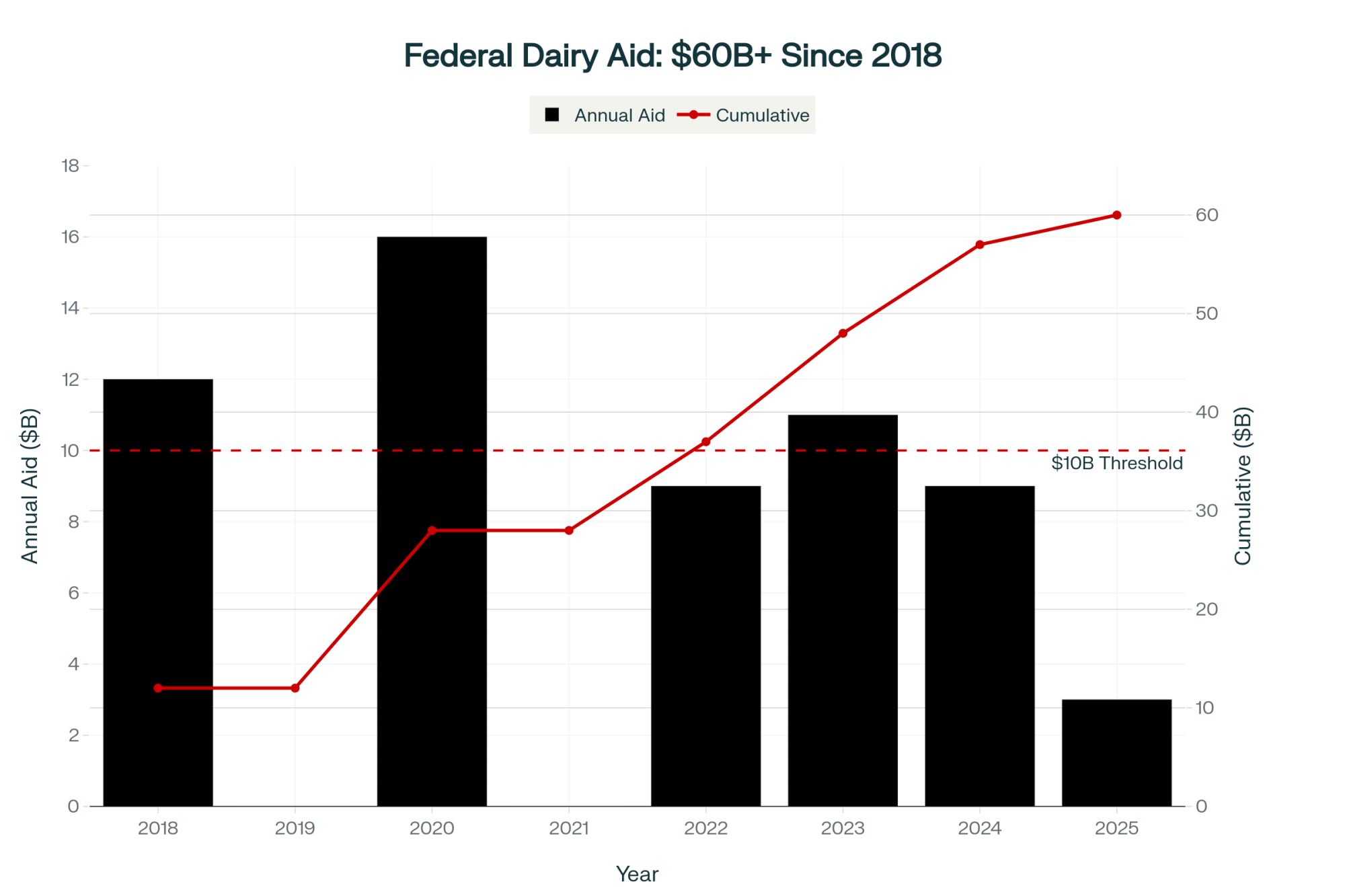
NewsSubscribe
First
Last
Consent

The $40 Weaning Question: Why Some Farms Skip Binders and Get Better Results

Is spending $10 on binders smarter than waiting 2 weeks to wean?

EXECUTIVE SUMMARY: What farmers are discovering about calf weaning might surprise you—the most successful operations aren’t necessarily the ones buying the most supplements. According to 2024 extension data, farms using gradual weaning protocols based on starter intake (2.75 pounds daily for three days) rather than calendar dates are seeing treatment costs drop by 20-30% while maintaining or improving growth rates. Dr. Michael Steele’s research at Guelph shows that managing ruminal pH during transition prevents the bacterial die-offs that release endotoxins in the first place, potentially eliminating the need for those $6-10 per calf binders many of us have accepted as necessary. Regional variations matter too—southern operations extending weaning during heat stress and northern farms using pair housing during winter are both finding better results by adapting to their specific conditions rather than following rigid protocols. Here’s what this means for your operation: whether you’re milking 50 cows or 5,000, the principle remains the same—healthy transitions based on biological readiness lead to healthier heifers and better lifetime production. The tools and knowledge are available through your extension service, and the potential returns make this worth examining carefully for any operation looking to improve both calf health and economics.

profitable calf weaning

You know how weaning season always gets us thinking about what we’re spending versus what we’re getting? I’ve been talking with producers across the dairy belt lately, and here’s what’s interesting—we’re all looking at those endotoxin binder bills (running $6 to $10 per calf annually according to 2024-25 feed supplier pricing) and wondering if there might be a smarter approach to this whole transition period.

What I’ve found digging through extension publications and chatting with nutritionists is that we might be looking at this from angles we haven’t fully considered. Not that supplements don’t have their place—sometimes they’re exactly what we need—but maybe there are management pieces that could make a real difference.

What’s Actually Happening During Weaning

When we transition calves from milk to starter, most operations do this around 6-8 weeks, according to the USDA’s National Animal Health Monitoring System data—their digestive system essentially has to reinvent itself. The rumen begins producing volatile fatty acids as fermentation commences, and that’s where things can become complicated.

Dr. Michael Steele, Professor of Ruminant Nutrition at the University of Guelph, and his team have been studying this for years, publishing their findings in the Journal of Dairy Science. Their research shows how these bacterial population changes during weaning can really affect gut function. What happens is that the ruminal pH can drop significantly during this transition—sometimes to a level that causes substantial bacterial die-off.

And when those gram-negative bacteria die? They release endotoxins—technically called lipopolysaccharides—that can trigger inflammatory responses. That’s why the feed industry developed these binders we’re all familiar with. According to 2024 feed industry surveys, lots of operations have found them helpful, especially during challenging periods.

However, it’s worth noting that extension services and university research programs are increasingly interested in whether we can prevent some of these issues through effective management before they even develop.

Learning from Different Approaches

What I find fascinating is how different operations handle weaning, and they’re all getting results worth considering. Some individuals are extending milk feeding to 10-12 weeks instead of the traditional 6-8 weeks. Others are focusing on really gradual transitions—taking two or three weeks to reduce milk rather than doing it quickly.

Research from land-grant universities supports this idea that gradual transitions might help keep the rumen more stable during weaning. Makes sense when you think about it…we already do this everywhere else in dairy management. When we change rations for the milking herd, we take our time. Dry cow transitions are carefully managed. So why rush weaning?

I was talking with a dairy nutritionist from Iowa last month who put it perfectly: “We spend all this time balancing transition cow rations to the gram, then we expect baby calves to handle abrupt diet changes like it’s nothing.”

What’s encouraging is that there’s no single “right” answer here. Different operations face different realities—labor constraints, facility limitations, disease pressures—and what works needs to fit those circumstances.

The Money Side of Things

Weaning Economics: Traditional vs. Extended Approaches

Traditional Protocol (6-8 weeks):

  • Milk/replacer costs: Baseline standard
  • Endotoxin binders: $6-10 per calf annually (2024-25 pricing)
  • Treatment costs: $15-30 per affected calf (regional averages)
  • Typical treatment rate: 20-30% of calves

Extended Protocol (10-12 weeks):

  • Additional milk costs: $25-40 per calf (varies by region)
  • Binder use: Often reduced or eliminated
  • Treatment costs: Lower incidence reported
  • Labor: May vary depending on the system

Penn State Extension has been consistent in its recommendations, which can be found in their calf management bulletins, updated in 2024. They suggest waiting until calves are eating approximately 2.75 pounds of textured starter daily for three consecutive days before starting to cut milk. It’s about biological readiness, not what the calendar says.

Now, if you’re running a larger operation—say, 200-plus calves—you might be looking at those automated monitoring systems. Based on 2024 manufacturer quotes, the cost ranges from $85,000 to $110,000 installed for systems handling 150 or more calves. Some operations report they help with labor and catching health issues earlier, though results vary by management. For smaller farms? Careful observation and basic intake monitoring often work just as well. There’s definitely no one-size-fits-all solution here.

How Location Changes Everything

Climate makes a huge difference in how we approach this. Southern producers dealing with heat stress face completely different challenges than what we see up north. Texas A&M Extension recommends extending weaning timelines during those brutal summer months (when the temperature-humidity index exceeds 72) because calves handle the transition better when they’re not fighting heat stress as well.

Meanwhile, in Wisconsin and Minnesota, winter housing creates its own set of challenges. University of Minnesota research, published in 2024, suggests that different housing strategies—such as pair housing during cold months—might help reduce weaning stress behaviors by providing social support during the transition.

Out in California’s Central Valley, I’ve heard from extension dairy advisors about operations experimenting with three-stage weaning programs. They’re gradually shifting calves through different housing and feeding setups. It takes some logistics to figure out, but according to the 2024 regional dairy reports, several farms have seen their post-weaning treatment costs drop after implementing these systems.

Making Changes That Actually Work

Practical Weaning Readiness Checklist

✓ Starter Intake: Consistently eating 2.75+ pounds daily
✓ Rumination: Active cud chewing (3-5 hours daily by 8 weeks)
✓ Body Condition: Maintaining or gaining during milk reduction
✓ Behavior: Normal activity, minimal vocalization
✓ Growth: Meeting breed-appropriate weight gains

Here’s what I find really practical—you don’t need to revolutionize everything overnight. Start with better starter intake monitoring. Weighing refusals daily and keeping track can tell you a lot about when calves are actually ready to be weaned.

One thing that research from Cornell Pro-Dairy suggests helps is spacing out stressful events. If you’re vaccinating, consider waiting until after weaning. Their 2024 calf health guidelines indicate that separating these events by 10-14 days can improve how calves respond to both the vaccine and the weaning transition.

And staff training…that’s crucial. When your calf feeders understand why they’re doing something—not just following a protocol but actually getting the biology behind it—everything works better. Wisconsin Extension’s 2024 dairy workforce development data show that operations spending even just four hours training their calf feeders results in measurable improvements in protocol compliance.

Finding What Works for Your Farm

Looking at the broader picture, endotoxin binders aren’t the enemy. They serve real purposes, especially if you’re dealing with unavoidable management constraints or specific disease challenges. The American Association of Bovine Practitioners’ position papers acknowledge that both management-focused and supplement-supported approaches have merit depending on your situation.

Some operations combine strategies really successfully. They use gradual weaning as their standard practice, but keep binders on hand for high-stress periods—like those brutal summer months or when they’re training new staff. They track everything to see what’s actually working.

According to economic analyses from Iowa State Extension (2024), it is essential to consider the entire picture over several months, rather than just weaning costs. Operations that track total cost per pound of gain through approximately four months of age often make different decisions than those that only consider weaning expenses.

Where Things Are Heading

Extension services continue to develop better resources to help us figure this out. Most land-grant universities have updated their cattle management guidelines in the past two years, and there are webinars and decision-support tools available to help. You can find many of these through your state’s extension dairy website.

What’s particularly interesting is how nutritionists, veterinarians, and producers are collaborating more closely to develop farm-specific protocols. Instead of generic recommendations, we’re seeing more customization tailored to what individual farms can actually achieve. According to 2024 field reports from extension dairy specialists across the Midwest, this approach appears to be working better across the board.

Your calves are constantly communicating with you through their behavior. A calf that’s eating well, spending hours chewing cud, maintaining body condition during transition—that’s telling you your management is on track. Sometimes we just need to pay better attention to those signals.

Making Smart Decisions for Your Operation

Whether it’s October or any other time of year, it’s worth taking a hard look at your weaning protocols. Track what’s actually happening, not what you think is happening. Monitor starter intakes. Document how long transitions really take. Keep track of health events, particularly during weaning.

Most of us already have a fairly good sense of when calves are ready to be weaned. They’re aggressive at the starter bunk, they’re ruminating well, and they look vigorous and healthy. Sometimes we just need to trust those observations more than the calendar.

Where to Find More Information:

  • Your state’s extension dairy programs (most updated 2024-25)
  • Penn State Extension’s calf management resources
  • Cornell Pro-Dairy calf health publications
  • University of Wisconsin’s Dairyland Initiative
  • Regional dairy conferences and workshops

The economics will vary by operation—your milk costs, labor situation, and facilities all factor in. But the principle stays consistent: healthy transitions lead to healthy heifers. And healthy heifers become profitable cows.

Every calf you wean has the potential to become a high producer in two years. Getting this transition right now—whether through traditional methods, alternative approaches, or a combination of both—that’s an investment that pays dividends down the road. The research is available, the tools are accessible through extension services, and the potential returns make it worthwhile to take a careful look at what might work better for your specific operation.

After all, in this business, we’re always looking for that edge—that one percent improvement here, two percent there. Sometimes it’s not about adding something new. Sometimes it’s about doing what we’re already doing just a little bit smarter.

KEY TAKEAWAYS:

  • Save $30-50 per calf by extending milk feeding 2-3 weeks while monitoring starter intake—the additional milk costs ($25-40) are offset by reduced treatment expenses and eliminated binder costs
  • Track biological readiness, not calendar dates: Wait for consistent 2.75-pound daily starter consumption, active rumination (3-5 hours daily), and maintained body condition before reducing milk
  • Adapt protocols to your region: Southern operations benefit from extending timelines during summer heat stress, while northern farms see improvements with pair housing during winter months
  • Space management stressors by 10-14 days: Separating vaccinations from weaning improves antibody response and reduces transition stress—a no-cost change that Cornell Pro-Dairy research shows makes a measurable difference
  • Both approaches have merit: Endotoxin binders serve valuable purposes during unavoidable management constraints—the smartest operations combine gradual weaning as standard practice with strategic supplement use during high-stress periods

Complete references and supporting documentation are available upon request by contacting the editorial team at editor@thebullvine.com.

Learn More:

The Sunday Read Dairy Professionals Don’t Skip.

Every week, thousands of producers, breeders, and industry insiders open Bullvine Weekly for genetics insights, market shifts, and profit strategies they won’t find anywhere else. One email. Five minutes. Smarter decisions all week.

NewsSubscribe
First
Last
Consent

$11 Billion in New Processing Capacity Is Creating Winners and Losers – Here’s the 6-Month Strategy That Decides Which You’ll Be

Why are 500-cow operations earning more per cwt than their 1,500-cow neighbors?

EXECUTIVE SUMMARY: What farmers are discovering through this unprecedented $11 billion wave of processing investments is that timing and relationships now matter more than scale. The International Dairy Foods Association data shows over 50 major facilities coming online through 2028, with fairlife investing $650 million in New York and Chobani committing $1.2 billion to their Rome plant. Penn State Extension’s latest bulletin reveals farms with consistent components—daily variation below 2%—are earning premiums of $0.50 to $1.50 per hundredweight, while Vermont’s St. Albans Cooperative reported average component premiums of $1.25/cwt in Q3 2025. Here’s what this means for your operation: processors opening facilities in 2026-2027 are making supplier decisions right now, October 2025, creating a critical 6-12 month window where strategic positioning beats traditional expansion. Recent USDA data showing protein levels climbing from 3.08% to 3.26% and butterfat from 3.70% to 4.15% since 2011 demonstrates how the industry’s already responding to these opportunities. The producers who recognize this isn’t just another cycle—it’s a fundamental shift in how value flows through dairy—are positioning themselves for success regardless of herd size.

dairy market shifts

When the International Dairy Foods Association released its latest data, showing over $11 billion in processing investments through early 2028, it really made me stop and think. That’s not just another market cycle. That’s a fundamental shift in how our industry will work.

What caught my attention is where this money’s actually going. Fairlife’s $650 million Webster, New York, facility broke ground in April 2024—Dairy Herd Management covered it extensively. Then there’s Chobani committing $1.2 billion to their Rome plant, which Governor Hochul announced back in April. These aren’t incremental expansions, folks. They’re massive bets on completely new ways of processing and marketing dairy products.

And I’ve noticed something interesting lately: the farms that seem to be positioning themselves best for all this aren’t necessarily the biggest operations. They’re the ones building real partnerships with processors—not just showing up as another milk hauler twice a day. That’s a different mindset than what many of us grew up with.

Understanding Where the Investment Is Going

Looking at the IDFA breakdown, you can see some clear patterns emerging. Cheese facilities are attracting about $3.2 billion—which makes sense when you consider Americans are consuming 37.8 pounds per capita, according to the USDA’s Economic Research Service. That’s a lot of cheese, even by Wisconsin standards.

Geographic concentration reveals where processors are betting big on America’s dairy future – New York’s $2.8 billion lead isn’t just about processing capacity, it’s about proximity to 50 million East Coast consumers who consume premium dairy products at rates 23% above the national average.

Milk and cream operations account for nearly $3 billion, while yogurt and cultured products draw another $2.8 billion. Each category has its own specific needs, and that’s where things get interesting for producers.

New York leads with $2.8 billion in total investment. It makes sense when you consider the proximity to East Coast markets and existing milk production infrastructure. Texas follows at $1.5 billion, anchored by Leprino Foods’ massive facility in Lubbock. Wisconsin adds $1.1 billion in capacity, which… well, nobody’s surprised there.

However, this development suggests something bigger—these modern processing facilities are incorporating advanced technologies that require very specific milk characteristics to run efficiently. We’re not talking about just hauling milk anymore. We’re talking about delivering exactly what these facilities need to optimize their operations. And that creates opportunities for producers who understand what’s happening…

Beyond Volume: Why Components Are King Now

The data from USDA’s Dairy Market News tells a fascinating story about how we’ve adapted. Federal order protein levels have increased from 3.08% in 2011 to 3.26% by 2023. Now, that might not sound like much sitting here at the kitchen table, but when you spread that across the 226 billion pounds of milk we produced last year… that’s a massive amount of additional protein entering the supply chain.

Genetic progress and nutrition strategies drive milk solids to record levels – While milk volume barely grows, component production surges create entirely new economics where 500-cow dairies out-earn 1,500-cow operations focused on bulk.

Butterfat’s even more dramatic. We’ve gone from 3.70% in 2011 to 4.15% by 2023. Part of that’s genetics—the Council on Dairy Cattle Breeding’s April 2024 genetic evaluations show consistent progress in fat transmitting ability. But it’s also management. We’re feeding differently, selecting differently, managing our herds differently.

What farmers are finding through extension work at Cornell’s PRO-DAIRY program and Penn State is that consistency matters as much as the absolute numbers. These new processing systems need to know what’s coming in the door every single day. Big swings in components can significantly impact processing efficiency. Penn State’s latest extension bulletin shows farms with a daily coefficient of variation below 2% for protein are earning premiums ranging from $0.50 to $1.50 per hundredweight, depending on the processor.

Component production accelerates while milk volume stagnates – genetics and nutrition drive the shift – The era of “just fill the tank” dairy farming is dead, replaced by precision agriculture where genetic selection and feed optimization directly determine profitability.

Vermont’s St. Albans Cooperative reported component premiums averaging $1.25 per hundredweight in their third-quarter 2025 report—that’s real money for farms that hit their targets consistently. Many producers in Wisconsin and elsewhere are now conducting more frequent tests. Daily testing used to seem excessive, but when you understand how these new ultrafiltration systems and other technologies work, it starts making more sense.

The Green Premium: Sustainability Programs That Actually Pay

I’ll be honest with you—when sustainability programs started ramping up, I was skeptical. We’ve all seen programs that promise a lot and deliver little. But the economics have shifted in ways I didn’t expect.

Consider the Ben & Jerry’s Caring Dairy program, which has been in operation since 2011. Aaron and Chantale Nadeau, who run Top Notch Holsteins up in Vermont, have been participants for years. In an August 2020 interview with Vermont Public Radio, Aaron stated that the program provides meaningful financial returns. That’s real money, not just feel-good corporate messaging.

The carbon credit side has also transitioned from theory to reality. When Jasper DeVos in Texas sold his greenhouse gas reductions to Dairy Farmers of America through the Athian platform, it marked the first documented livestock carbon credit transaction in the U.S. That opened a lot of eyes.

Examining this trend, What’s really driving this is the regulatory landscape is the primary driver of this change. California’s methane regulations kicked in this year through the California Air Resources Board. The EU’s carbon border adjustments are expected to start affecting dairy exports in 2027, according to European Commission documentation. Processors need compliant milk to maintain those markets. It’s that simple.

Your Zip Code Matters: Regional Dynamics in Play

Your location significantly influences your opportunities in this new landscape, and it’s worth considering what that means for your operation.

If you’re in the Northeast, especially within reasonable hauling distance of Fairlife’s Webster plant or Chobani’s Rome facility, you’re in an interesting position. That $2.8 billion in regional investment is creating real competition for milk supplies. It’s been years since we’ve seen processors competing this actively for suppliers.

Wisconsin operations are experiencing continued growth on the cheese side. Established manufacturers continue to grow, focusing on components that maximize cheese yield and efficiency. When you can consistently deliver the butterfat and protein levels they need, you have options.

Texas is accommodating these massive-scale operations through facilities like Leprino’s Lubbock investment. For smaller producers in the area, many are exploring specialty markets—such as organic certification, A2 production, and even agritourism. You can’t compete with the mega-dairies on commodity volume, so you find your niche.

California’s environmental regulations, which initially seemed overwhelming, are actually creating growth opportunities. Producers meeting methane reduction requirements are finding that processors value that compliance. Market access depends on it.

For those of you in the Southeast or Mountain West, wondering where you fit in all this—the principles still apply. Even without billion-dollar facilities next door, processors in your region need reliable partners. The component optimization and sustainability strategies work everywhere. Sometimes being outside the major investment zones means less competition for the opportunities that do exist.

The Clock Is Ticking: Why Timing Matters More Than Ever

So here’s what I keep coming back to: the traditional approach of building first, then negotiating from a position of greater volume… that might not be the best strategy anymore.

Consider the timeline. A new freestall barn takes 18-24 months from groundbreaking to full production. Financing, permitting, construction, getting it filled with cows—it all takes time. Meanwhile, processors are expected to open facilities in 2026 and 2027. They’re establishing their supply partnerships right now, October 2025.

Some producers are taking a different approach. They’re focusing on what they can control today—optimizing components, building processor relationships, and getting into sustainability programs. These typically show returns within 6-12 months, much faster than traditional expansion.

What I keep hearing from successful operations is that processors need certainty as much as they need volume. A 500-cow dairy that can guarantee consistent quality, reliable delivery, documented compliance… that’s often more valuable than a larger operation without those established relationships. It’s a different way of thinking about competitive advantage.

Comparing Processor and Farm Expansion Timelines

Processor Timeline

Processors are actively securing supply partnerships as of October 2025. This phase is critical, as they are laying the groundwork for future operations. Following this, new processing facilities are scheduled to come online between 2026 and 2027. The next 6 to 12 months represent a decisive window for producers to establish relationships and position themselves as preferred suppliers.

Farm Expansion Timeline

Expanding a farm operation is a lengthy process. The initial 1 to 6 months are dedicated to planning and securing necessary permits. Construction typically spans months 7 through 18. Only after construction is complete, from months 19 to 24, can the facility be filled with cows and reach full production capacity. In total, the minimum timeframe for complete farm expansion is 18 to 24 months.

Strategic Implications

The discrepancy between processor readiness and farm expansion timelines highlights the urgency for producers. With processors finalizing supply agreements now and new facilities launching soon, the next 6 to 12 months are pivotal. Producers must act decisively to align with processor requirements, as traditional expansion strategies may not allow for timely participation in emerging opportunities.

Your Action Plan: Resources That Actually Help

Component StrategyPremium Range per cwtAnnual Impact 500 CowsImplementation Timeline
Daily Variation <2%$0.50 – $1.50$75,000 – $225,00030-60 days
Butterfat >4.30%$0.25 – $0.75$37,500 – $112,5006-12 months
Protein >3.35%$0.20 – $0.60$30,000 – $90,0003-9 months
Consistent Quality$0.15 – $0.40$22,500 – $60,00060-90 days
Sustainability Certified$0.30 – $1.00$45,000 – $150,0003-18 months

If you’re ready to engage with these opportunities, here are some starting points that actually work:

For Carbon Credits:

  • Athian: athian.ai or call 737-263-4839—they facilitated that first livestock carbon transaction
  • Nori: marketplace.nori.com—focuses on soil carbon
  • Indigo Ag: indigoag.com/for-growers/carbon

For Sustainability Programs:

  • Ben & Jerry’s Caring Dairy: Contact your co-op if you’re in their supply shed
  • Danone North America: danonenorthamerica.com/farmers
  • Nestle’s Net Zero roadmap: nestle.com/sustainability/climate-change

For Component Optimization:

  • Cornell PRO-DAIRY: prodairy.cals.cornell.edu (607-255-4478)
  • Penn State Extension Dairy Team: extension.psu.edu/animals/dairy
  • University of Wisconsin Dairy: fyi.extension.wisc.edu/dairy

Most major processors have farmer relations departments. Start with your current field representative and asking about the supply needs of your new facility. Don’t wait for them to call you—the ones who are proactive now are the ones who are getting the opportunities.

The Bottom Line: Being Indispensable Beats Being Bigger

After thinking about all this, what becomes clear is that this $11 billion investment represents a fundamental shift in how value flows through our industry. It’s not just about selling milk anymore. It’s about being the kind of supplier these massive facilities need to succeed.

These processors require three key elements: reliable volume, consistent quality, and, increasingly, environmental compliance that maintains market access. Farms that can deliver all three—regardless of size—have leverage they haven’t had in years.

The traditional thinking was straightforward: get bigger first, then negotiate from a position of strength. What’s working now is different. Become indispensable at your current size, then grow strategically. The infrastructure can wait if it needs to. The relationships can’t.

Looking at where we are—October 2025—the processors opening facilities in 2026 and 2027 are making their supplier decisions over the next 6-12 months. By next October, most of these opportunities will be committed. The producers who recognize this window and act on it are positioning themselves for the next decade.

Remember that $11 billion number we started with? It’s not just about processing capacity. It’s about reshaping how our entire industry works. The processors don’t just need our milk anymore—they need us as partners. And that, as we used to say back when I started farming, changes everything.

That’s worth considering the next time you’re evaluating your operation and wondering what’s next. Because in all my years in this business, I’ve never seen a moment quite like this one.

KEY TAKEAWAYS

  • Component consistency delivers immediate returns: Farms achieving less than 2% daily variation in protein are capturing $0.50-$1.50/cwt premiums, potentially adding $75,000-225,000 annually for a 500-cow dairy producing 15 million pounds
  • Strategic timing beats traditional expansion: With processors making supply decisions now for 2026-2027 facility openings, the 6-12 month returns from relationship building outpace the 18-24 months needed for barn construction and herd expansion
  • Regional opportunities vary but principles remain: Whether you’re near New York’s $2.8 billion investment zone or operating in the Mountain West, processors need partners who deliver consistent quality, documented compliance, and reliable volume—creating leverage even for mid-sized operations
  • Sustainability programs have moved from cost to revenue: Carbon credits through platforms like Athian plus programs like Ben & Jerry’s Caring Dairy are generating real income, with early adopters capturing value before compliance becomes mandatory in markets like California (2025) and EU exports (2027)
  • Action window is narrowing: Contact your processor’s farmer relations department about new facility needs, optimize components through daily testing, and explore sustainability programs now—by October 2026, most premium partnership opportunities will be committed

Complete references and supporting documentation are available upon request by contacting the editorial team at editor@thebullvine.com.

Learn More:

  • USDA’s 2025 Dairy Outlook: Market Shifts and Strategic Opportunities for Producers – This article provides a high-level strategic overview of the market forces driving profitability in 2025, from component optimization to aligning with specific processors. It helps producers develop market intelligence to make better decisions on culling, expansion, and capital investments.
  • June Milk Numbers Tell a Story Markets Don’t Want to Hear – This piece drills into recent production data to reveal how component-adjusted growth is a more accurate measure of profitability than raw volume. It also offers a reality check on regional growth dynamics and the risks of building a strategy around unpredictable export markets.
  • USDA Dairy Production Report – This guide gives a tactical, how-to approach to implementing the strategies discussed, from genomic testing to precision feeding. It provides specific numbers on the financial returns of component premiums and technology adoption, helping you build a concrete action plan for your operation.

The Sunday Read Dairy Professionals Don’t Skip.

Every week, thousands of producers, breeders, and industry insiders open Bullvine Weekly for genetics insights, market shifts, and profit strategies they won’t find anywhere else. One email. Five minutes. Smarter decisions all week.

NewsSubscribe
First
Last
Consent

Simple LED Lighting Can Boost Production 8% – Here’s Why Most Farms Haven’t Switched

If $600 in LEDs can match the performance of $6,000 systems, what else are we overcomplicating in modern dairy farming?

You know, there’s something telling about the fact that we’ve had twenty years of solid research on barn lighting, yet walk into most dairy operations and you’ll still find those fixtures from decades ago. Makes you think about how our industry actually adopts technology, doesn’t it?

What’s interesting here is that Dr. Geoffrey Dahl, down at the University of Florida, has been publishing rock-solid research in the Journal of Dairy Science since the early 2000s. His team’s work shows that when lactating cows receive 16 to 18 hours of light at the right intensity—approximately 100 to 200 lux, comparable to the light in a decent office—their hormones respond in ways that directly affect production.

The numbers are pretty compelling when you look at them. IGF-1, an insulin-like growth factor, increases by 15 to 30%, improving feed conversion efficiency. Prolactin increases by 25 to 40%, directly stimulating the mammary tissue. These aren’t minor tweaks we’re talking about—these are significant changes that are reflected in the bulk tank.

The Uncomfortable Truth: Farms with adequate lighting see minimal returns from LED upgrades—a reality lighting vendors won’t advertise

So why aren’t we all rushing to upgrade? Well, that’s where things get interesting…

Understanding the Biology (Because It Actually Matters)

Let me walk you through what’s happening inside these cows, because once you get this, the whole conversation about lighting starts making more sense.

When cows get those extended light periods, their pineal gland—that little pine cone-shaped thing in the brain—cuts way back on melatonin production. Dahl’s team has extensively documented this over the years, with studies published in the Journal of Dairy Science from 2000 to 2024.

Less melatonin means more IGF-1, and that’s improving how efficiently our cows convert feed. The prolactin boost? That directly works on milk synthesis in the mammary tissue.

Dr. Dahl’s 20 years of research crystallized: Extended light triggers a 15-40% hormone surge that directly impacts your bulk tank

However, what’s truly fascinating is that this discovery emerged from research published by Dr. Dong-Hyun Lim’s team in the Animals journal in 2021. They found massive individual variation between cows—up to 10-fold differences in baseline melatonin levels within the same herd. Some cows showed melatonin suppression at just 50 lux, others needed 200 lux for the same response.

Why smart lighting fails: Individual cows in the same barn vary 10-fold in light sensitivity—biology’s chaos defeats precision technology

Think about what that means for a minute. You could have perfect, uniform lighting throughout your barn, and yet, only some of your cows are still not getting the full benefit. That’s not a technology failure—that’s just biology being messy, as usual.

“And here’s the thing: this messiness actually makes the case for simple solutions even stronger. Why invest in complex, expensive systems trying to optimize for individual variation when you can’t predict which cows will respond? Better to stick with the proven basics—16 to 18 hours at adequate intensity—and accept that biology will do what biology does.”

Oh, and dry cows? They need the complete opposite. Dahl’s research shows that 8 hours of light and 16 hours of darkness during the dry period actually prime their prolactin receptors. Sets them up better for the next lactation.

But managing two completely different lighting protocols in the same facility? That’s tough, especially if you’re running less than a couple hundred head without separate dry cow housing.

Sometimes the smartest tech strategy is accepting that biology won’t be optimized. This insight could save dairy operations thousands in unnecessary upgrades.

What Research Tells Us vs. What Actually Happens

The Journal of Dairy Science has published multiple studies over the years on photoperiod manipulation. Dahl and colleagues documented production increases averaging 2.5 pounds per day—about 8% improvement—in commercial settings (published in multiple papers between 2012 and 2020).

Some research has shown responses up to 15% under certain conditions, particularly when starting from very poor baseline lighting.

Now, when you dig into these studies, you generally find the biggest improvements come from farms that started with really inadequate lighting. We’re talking old barns with maybe 30 or 40 lux from ancient fixtures.

When farms already have decent lighting—say, modern T8 fluorescents providing 100-plus lux? The improvements get harder to measure.

And let’s be honest here—how often does anybody change just their lighting? Usually, it’s part of a bigger renovation. New ventilation, better cow comfort, and different feed systems. Everything changes at once, and suddenly you can’t tell what’s doing what. That’s the reality of farming, not the controlled conditions of research trials.

The Technology Landscape (Without the Sales Pitch)

So what’s actually in these LED systems everyone’s trying to sell us?

They’re all using LED chips from major manufacturers, such as Samsung, Osram, and Cree. Same suppliers that make chips for warehouses and parking lots. Nothing magical there. The control systems? Most are basic timers set for that 16-hour on, 8-hour off cycle. Some have fancy sensors, but honestly, a good mechanical timer from the hardware store does the same job.

There is one innovation I think is genuinely useful, especially for operations in Northern states or Canada, where winter nights are long. Some newer systems include red lighting for nighttime work. Since cows can’t see deep red wavelengths around 650 nanometers—that’s been documented in vision research—you can check animals, handle emergencies, whatever needs doing, without disrupting their dark period.

For operations running multiple shifts or dealing with calving season, that’s solving a real problem.

But most of the other “advanced features”? I’m not convinced they’re worth the premium. Cows need adequate light for the right number of hours. They’re not greenhouse tomatoes needing specific wavelength ratios.

The Hidden Costs of Upgrading

Here’s what often catches people by surprise when they start looking at lighting upgrades…

Older barns frequently need substantial electrical work to support new lighting systems. According to Wisconsin and Pennsylvania Extension electrical upgrade guides, we’re talking about potential panel upgrades, new wiring, and proper grounding—costs that typically range from $2,000 to $8,000,depending on your existing infrastructure.

Beyond the bulb price: How a $10,000 LED investment pays for itself in 12 months through operational savings alone

And remember, this is all happening in a barn environment. Dust, moisture, ammonia—it’s tough on electronics. Industry experience suggests those fancy digital controllers don’t always hold up as well as simple mechanical timers in these conditions.

Additionally, LEDs have another advantage that is often overlooked. They generate significantly less heat than traditional lighting—about 50% less than metal halide. In summer months, that can make a real difference in barn temperatures, especially in the Southeast and Southwest, where heat stress is already a major concern.

Then there’s what I call the adjustment period. Any time you change routines in the barn, there’s a learning curve. New switch locations, different light patterns, areas that need tweaking. Your cows notice. Your workers notice.

It takes a few weeks to get everything dialed in, and during that time, things can get a bit chaotic.

Making Decisions Based on Reality, Not Hype

So, how do you determine if LED lighting is suitable for your operation?

First thing—measure what you’ve actually got. Get a light meter. They’re generally available for $60 to $100, or see if your Extension office has one to borrow. Measure at the cow eye level, about 4 feet high. Check your feed alleys, resting areas, and holding pens. Do it at different times and in different weather conditions. You need real numbers, not just “seems dark in here.”

Here’s your decision framework:

  • Below 50 lux consistently: You’ve definitely got room for improvement
  • Between 50 and 100 lux: Could be worth exploring, depending on milk prices and your situation
  • Above 150 lux throughout: Your money’s probably better spent elsewhere

And here’s something critical—your herd health matters more than any lighting system. Research consistently shows that stressed cows don’t respond well to photoperiod manipulation.

High somatic cell counts, lameness issues, heat stress—fix those first. The stress hormones will completely override any benefit from better lighting.

Regional Considerations Matter Too

Location matters: Upper Midwest farmers see 2x faster ROI than California operations due to longer dark winters and higher confinement

Looking at this from different regional perspectives, the economics change quite a bit.

In California’s Central Valley, where many operations milk year-round in open-sided facilities, the natural photoperiod already provides substantial light exposure during much of the year. The investment math looks different there compared to, say, a tie-stall barn in Vermont, where cows might spend 20 hours a day inside during winter.

Similarly, grazing operations in places like Wisconsin or New York, where cows are on pasture during peak production months, might see less benefit than total confinement operations. It’s not one-size-fits-all, and that’s something lighting companies often overlook.

Down in Georgia or Florida, where I’ve talked with producers dealing with heat stress eight months a year, the reduced heat load from LEDs might actually be more valuable than the photoperiod effects. Those old metal halide fixtures can really add to the heat burden.

I’ve noticed that operations in the Upper Midwest—specifically, Minnesota, Wisconsin, and Michigan—tend to see better returns on lighting investments simply because of those long, dark winters. When your cows are inside from October through April, that extended photoperiod makes a bigger difference.

The Smart Way to Test This

You know what approach makes sense to me? Start small.

Pick your darkest section—maybe that old part of the barn you’ve been meaning to renovate anyway. Install some good-quality LED bulbs—nothing fancy, just solid commercial fixtures. Add a simple timer. Then watch that specific group carefully for six to eight weeks. Document everything.

If you see clear improvement in production, reproduction, or cow behavior, great—expand gradually. No improvement? Well, you’ve learned something valuable without betting the farm on it.

Based on the 8% average production increase Dahl documented, here’s the rough ROI math:

For a 100-cow herd averaging 75 pounds daily at $19/cwt, that’s about $34,000 additional annual revenuefrom a 6-pound increase. Against a $3,000-5,000 simple LED installation (not counting major electrical work), you’re looking at payback in 2-6 months if you hit that average response.

The shocking truth about LED lighting ROI: basic systems pay back in months, not years. Complex doesn’t mean better when biology varies 10-fold between cows

But remember—that’s if you’re starting from poor lighting and your cows actually respond. And those LEDs should last 50,000+ hours, compared to perhaps 10,000 for traditional bulbs, so factor in the replacement savings as well.

Looking Ahead (Reality Check Included)

There’s always talk about what’s coming next in dairy technology. Universities are conducting interesting research—examining whether changes in circadian rhythms might predict health problems before clinical symptoms emerge. Research is exploring connections between light exposure and immune function. Could be valuable someday.

But let’s be realistic about timelines. Most of the “revolutionary” features being promoted are solutions looking for problems to solve. Your cows require adequate light for a sufficient number of hours. Period.

They don’t need smartphone apps, AI optimization, or blockchain-verified lighting schedules. (Yes, that last one’s actually been pitched at trade shows within the past year.)

The Bigger Pattern We’re Seeing

The LED lighting story is just one example of something we see across all dairy technology. Robotic milkers, activity monitors, precision feeding systems—same pattern every time. Proven benefits, but adoption stays low for years, sometimes decades.

Why? Well, most of us get maybe three or four decades of active farming decisions. Every technology bet risks one of those limited opportunities. That creates what I’d call justified caution, especially when margins are as tight as they’ve been.

It’s not that we’re against change. We’re against unnecessary risk.

What actually drives technology adoption in dairy? Usually, it’s either a crisis—something that forces efficiency improvements—or a generational change that brings fresh perspectives and possibly different risk tolerance.

Without those pressures, change happens slowly. And you know what? Given the stakes, maybe that’s not entirely wrong.

After 20 years of proven research, LED adoption sits at just 16%—revealing how our industry really evaluates ‘revolutionary’ technology

Your Next Steps (The Practical Ones)

This week, if you’re curious about your lighting situation, do some actual measuring. Get real numbers, not impressions. Our eyes adapt to low light better than we realize—what seems adequate to us might be way below what the cows need for optimal response.

Take an honest look at your management basics, too. How’s herd health tracking? Are your fresh cow protocols dialed in? Is nutrition optimized for your production level? If these aren’t solid, lighting won’t be your limiting factor.

If everything else looks good and your lighting truly is inadequate—we’re talking those sub-50 lux measurements—consider a small trial. Keep it simple, keep it affordable, and let actual results from your own cows guide you.

For those in transition planning or considering major renovations, that’s actually the ideal time to address lighting. When you’re already doing electrical work, adding proper lighting doesn’t add as much proportional cost. However, even then, simplicity often beats complexity.

Many states offer energy efficiency rebates through utility companies that can cover 20-40% of the costs associated with upgrading to LED lights. It’s advisable to check with your local provider before proceeding with any installation.

The Real Lesson Here

What strikes me most about the entire LED lighting question is what it reveals about how our industry actually operates.

We’re not early adopters by nature, and there’s good reason for that. Every decision matters when you’re working with tight margins and biological systems that don’t forgive mistakes easily. Simple solutions that address real problems tend to work better than complex systems that promise to optimize everything.

The research on photoperiod manipulation is solid—Dahl’s work and others have proven that beyond doubt. The biology is real. But whether it make sense for your specific operation? That depends on your starting point, your management, your finances, and honestly, your comfort level with change.

Good dairy farming has always been about careful observation, testing what works, and scaling based on actual results—not projections or promises, but real, measurable results from your own operation. That approach has served us well for generations.

So maybe the fact that most barns still have old lighting isn’t about stubborn farmers resisting change. Maybe it’s about thoughtful operators who’ve learned that in dairy, the shiniest new technology isn’t always the best investment.

Sometimes the old ways work just fine. Sometimes they don’t. And knowing the difference? Well, that’s what separates good managers from the rest.

After all, if simple LED bulbs and a timer can deliver results similar to systems costing ten times more—and the research suggests they often can—then maybe we’re not behind the times. Maybe we’re just experienced enough to know the difference between what actually works and what’s just expensive.

And that wisdom? That’s worth more than any lighting system you could buy.

KEY TAKEAWAYS

  • Measure first, invest second: Get a $60-100 light meter and check your barn at cow eye level—if you’re above 150 lux throughout, save your money for other improvements; below 50 lux means genuine opportunity for that 8% production boost
  • Simple beats complex for most operations: Basic LED bulbs with mechanical timers ($3,000-5,000) deliver results matching systems costing 3-10X more, especially given that only 30-40% of cows respond strongly to photoperiod manipulation anyway
  • Regional economics vary significantly: Upper Midwest operations see better ROI due to long winters keeping cows inside October-April, while California’s open-sided facilities and grazing operations in Wisconsin/New York may see minimal benefit during peak production months
  • Test with your darkest section first: Install LEDs in one area, monitor that group for 6-8 weeks, then expand only if you see clear improvement—this approach minimizes risk while providing farm-specific data
  • Factor in hidden costs and benefits: Budget $2,000-8,000 for electrical upgrades in older barns, but remember LEDs generate 50% less heat than metal halides (valuable in the Southeast) and last 50,000+ hours versus 10,000 for traditional bulbs

EXECUTIVE SUMMARY

What farmers are discovering through the adoption of LED barn lighting tells us something profound about how dairy technology really takes hold—or doesn’t. Research conducted by Dr. Geoffrey Dahl at the University of Florida indicates that 16-18 hours of proper lighting can increase production by 8% through hormonal changes, with IGF-1 levels rising 15-30% and prolactin levels increasing 25-40%. Yet despite two decades of solid science, most barns still run fixtures from the 1980s. Here’s what’s interesting: the farms seeing real returns are those starting with genuinely poor lighting—below 50 lux—who use simple, timer-controlled LEDs costing $3,000 to $ 5,000, not complex systems costing $ 15,000 or more. With individual cows showing 10-fold variation in light response (documented by Dr. Dong-Hyun Lim’s 2021 research), chasing optimization through expensive technology makes less sense than accepting biology’s messiness and sticking with proven basics. Looking ahead, this pattern—where simple solutions match complex ones—repeats across dairy technology adoption, suggesting we’re not resistant to change but appropriately cautious about unnecessary risk. The opportunity’s clear: measure your actual lighting this week, test small if you’re below 50 lux, and let your own cows’ response guide expansion decisions.

Complete references and supporting documentation are available upon request by contacting the editorial team at editor@thebullvine.com.

Learn More:

The Sunday Read Dairy Professionals Don’t Skip.

Every week, thousands of producers, breeders, and industry insiders open Bullvine Weekly for genetics insights, market shifts, and profit strategies they won’t find anywhere else. One email. Five minutes. Smarter decisions all week.

NewsSubscribe
First
Last
Consent

The Biosecurity Changes That Stuck: What Dairy Producers Say Actually Works (And Pays)

Practical thoughts on disease management, herd health, and preparing for tomorrow’s challenges

EXECUTIVE SUMMARY: What farmers are discovering about biosecurity isn’t what you’d expect—the most effective changes often cost the least and come from talking with neighbors rather than buying new technology. Recent producer surveys and extension data show that farms implementing basic traffic management and neighbor coordination report improved herd health metrics, comparable to those of operations spending thousands on advanced systems. With milk margins tightening and replacement costs rising, producers across all regions are discovering that simple practices, such as using boot covers, maintaining visitor logs, and coordinating fly control, deliver measurable returns through reduced veterinary bills and improved milk quality premiums. University research consistently validates what successful operations already know: biosecurity works best as layers of small, consistent practices rather than single, expensive solutions. The encouraging news is that producers who’ve stuck with fundamental biosecurity changes for more than a year report they wouldn’t farm without them—not because regulations require it, but because the economic and operational benefits prove themselves daily. Your next conversation with neighboring farms about coordinating simple biosecurity practices might be worth more than any equipment purchase you’re considering.

Here’s a question worth your morning coffee: When was the last time you changed something about farm biosecurity—and actually stuck with it?

I ask because, sitting here at another processor meeting this morning, biosecurity dominated half our agenda. Again. It’s becoming part of our everyday vocabulary, much like “genomics” did fifteen years ago or “sustainability” more recently. And while it might not be the most exciting barn conversation, what’s driving these discussions directly affects our bottom line—especially with milk prices where they are and margins getting tighter every month.

What I’ve found interesting lately is how producers across different regions are approaching this. Nobody’s panicking. Nobody’s overreacting. It’s more like that thoughtful awareness we developed around somatic cell counts back in the 90s—small improvements, consistent attention, gradual adaptation.

We’re obsessing over equipment cleaning at 95% adoption while ignoring the massive 90% gaps in practices that actually prevent disease introduction. This gap analysis shows where the real money gets lost.

The Shifting Seasons We’re All Noticing

Let’s start with something we can all relate to—the weather patterns we’re seeing. Spring comes earlier. Fall stretches longer. Those mild January days that used to surprise us? They’re becoming regular occurrences.

Just last week at our co-op meeting, three different producers mentioned running barn fans into November this year. That’s a month longer than most of us did a decade ago. A neighbor asked me, “Are you noticing more flies lasting later into fall?” Absolutely. And it’s not just us—extension specialists have been documenting these shifting insect patterns across dairy regions, though the specific impacts vary considerably from the Great Lakes to the Central Valley.

RegionAverage Herd SizePrimary ChallengeTop Biosecurity PriorityInvestment RangeSuccess Strategy
Northeast (Traditional)120 cowsWinter housing densityVentilation systems$2,000-8,000Genetics + ventilation focus
Midwest (Traditional)180 cowsSeasonal weather shiftsTraffic management$1,500-5,000Neighbor cooperation networks
California (Modern)2,800 cowsYear-round insect pressurePositive-pressure barns$50,000-200,000Technology + scale efficiency
Idaho/Colorado (Modern)3,200 cowsHigh elevation variationsAltitude-adapted protocols$40,000-150,000Regional coordination
Texas (Modern)4,100 cowsHeat stress + scaleDesert-specific solutions$75,000-300,000Corporate-level systems
Southeast (Emerging)350 cowsHumidity + diseasesMold/fungal prevention$3,000-12,000Climate adaptation

The relationship between temperature and insect populations is important for biosecurity because it potentially extends the window during which insects could theoretically transmit diseases if those diseases were present. As we head into the winter housing season in the Northeast and Midwest, it’s worth considering how these changes impact our management strategies.

Biosecurity PracticeAdoption RateInvestment CostROI ImpactImplementation Barrier
Traffic Management & Boot Covers65%< $5003-5x quality premiumsConsistency required
Quarantine New Animals10%VariablePrevents disease outbreaksLabor & facility constraints
Cleaning Stalls & Equipment95%$200-800Maintains milk qualityAlready standard practice
Health Monitoring Systems45%$5,000-15,0002-4x heat detection improvementHigh upfront cost
Neighbor Coordination28%$030-40% better pest controlCoordination challenges
Water Management (Insect Control)38%< $300Reduces vet callsIdentification of problem areas
Documentation & Records52%$100-400Insurance discounts availableAdministrative burden
Visitor Logs & Protocols72%< $200Processor premium eligibilityGuest compliance

Learning from Global Approaches

International perspectives offer interesting contrasts to our North American approaches. Australian producers, as I understand their system from recent agricultural trade publications, invest directly in disease prevention through producer levies. They calculate that maintaining disease-free status preserves export market access worth considerably more than prevention costs.

European dairy operations have adapted to various disease management requirements over recent decades. I’ve talked with several European producers at industry events, and what strikes me is how practices that initially seemed burdensome often become routine—and sometimes improve overall herd health. One producer put it simply: “The first year felt overwhelming. By year three, it was just Tuesday.”

Now, I’m not suggesting we adopt these exact approaches. Our markets are different, our geography is different. But understanding different models helps us evaluate our own preparedness. What biosecurity practice have you tried that initially seemed like a hassle but now feels essential?

The Reality of Industry Consolidation

Examining the USDA agricultural census data, we observe continued consolidation in the dairy industry, with fewer farms and larger average herd sizes each time the data is collected. That structural change affects how different operations approach biosecurity—and everything else, for that matter.

Yet I’ve seen remarkable innovation from smaller farms. This past summer, I visited organic producers in Vermont who formed an informal cooperative for health monitoring. They share diagnostic testing costs, coordinate fly control, and maintain a group text for health observations. Smart collaboration that doesn’t require huge individual investment.

Out West, California and Idaho producers face entirely different challenges. Desert dairies are using positive-pressure ventilation for both cooling and insect exclusion. Different environment, different solutions. What’s interesting here is how regional needs drive innovation—there’s no one-size-fits-all approach.

Practical Steps That Make Sense Today

So what actually works without breaking the bank? Based on extension recommendations and veterinary consultations, several approaches have consistently proven valuable.

Neighbor cooperation beats individual heroics every time. Fifty bucks and a group text can deliver better results than a $15,000 monitoring system.

Managing farm traffic patterns costs little but shifts the mindset significantly. Think about it: How many vehicles enter your farm weekly? What would happen if each driver used boot covers? The investment is minimal—mostly in awareness and consistency. University extension programs across the country emphasize this as a first step that costs almost nothing but creates important barriers.

Water management reduces insect breeding sites. Many farms discover overlooked spots—tire tracks in the heifer lot, that low spot by the silage pad. I know producers who’ve eliminated numerous mosquito breeding sites for less than the cost of a single vet call. And honestly? The cows are more comfortable with fewer flies anyway.

Neighbor cooperation multiplies effectiveness. When farms coordinate fly control programs—everyone treating simultaneously using complementary approaches—they report better control with no increase in individual costs. Have you discussed coordinating any biosecurity practices with your neighbors? Sometimes the best solutions come from over the fence line.

Technology’s Evolving Role

Current activity monitoring systems can identify health issues days before clinical signs appear. The same system, which improves heat detection—many farms report significant improvements in conception rates—also detects metabolic issues in transition cows. That’s the kind of multiple benefit that makes the investment pencil out.

Technology costs have decreased over recent years while reliability has improved. With current milk prices and replacement heifer costs, the return calculations often work, especially when you consider multiple benefits beyond just disease detection.

I’ve talked with producers who say their monitoring system paid for itself through better heat detection alone. Health monitoring has become a bonus that’s now essential to their operation. What technology investment surprised you with unexpected biosecurity benefits?

Regional Variations Matter

Northern operations face winter housing density challenges. When you’re packing cows into barns for four or five months, ventilation becomes critical. University research consistently shows that improving ventilation for cow comfort can also significantly reduce the transmission of respiratory disease. It’s one of those win-win situations—happier cows, healthier cows.

Size isn’t everything—efficiency is. Those 7% from small operations? They’re often more profitable per hundredweight than the mega-dairies burning cash on overhead.

Southern and Western operations manage year-round insect pressure and heat stress. Colorado operations at higher elevations report shorter fly seasons than lower elevation neighbors—geography matters more than we sometimes realize. A producer near Denver told me that his fly season is three weeks shorter than that of his cousin’s operation, which is 2,000 feet lower. Same state, different reality.

Each region requires adapted strategies. What’s the biggest biosecurity challenge specific to your area? The answers I hear vary wildly depending on where I’m visiting.

Building Resilience Through Layers

True resilience stems from multiple reasonable practices rather than a single solution. This mirrors what we learned with milk quality—it wasn’t one big change but twenty small ones that got us where we are today.

Successful operations typically focus on several key areas. Health monitoring that matches their labor availability—not everyone needs computerized systems, but everyone needs consistent observation. Information sharing with neighbors—because disease doesn’t respect property lines. Preventive veterinary relationships—monthly herd checks focused on maintaining health rather than just treating problems. Regular facility reviews—amazing what you notice when you really look. And contingency planning—knowing what you’d do if something showed up down the road.

Some insurance companies now offer premium adjustments for documented biosecurity practices. Worth asking your agent about—might offset some of the investment costs.

The Community Component

In central Pennsylvania, dairy producers formed a health watch network several years ago. Simple group texts share observations. When multiple farms notice similar issues, early veterinary coordination can prevent wider spread. It’s not about creating alarm—it’s about maintaining awareness and helping each other out.

Recent biosecurity workshops have attracted strong producer attendance, focusing on economically viable practices rather than textbook recommendations that don’t align with real-world farms. The best part of these meetings? The parking lot conversations afterward, where producers share what’s actually working.

The National Dairy FARM Program’s biosecurity module provides a valuable evaluation framework for those seeking structure. But honestly, some of the best biosecurity improvements I’ve seen came from producers just talking with each other. Have you discussed biosecurity coordination with neighboring farms?

Making It Work for Your Farm

No universal program fits every operation. A 50-cow grass-based dairy in Vermont differs from a 5,000-cow operation in New Mexico. But principles adapt to any situation.

Start with the basics, providing immediate value. Many processors report that farms with documented biosecurity practices show improved milk quality metrics—that’s real quality premium potential. One co-op representative mentioned they’re seeing average somatic cell counts running lower on farms with basic biosecurity protocols in place.

For larger investments, consider multiple benefits. Will improved ventilation reduce not just disease risk but also heat stress? Almost certainly. Will technology investments improve reproduction management? Often significantly. Will facility modifications enhance worker safety? Usually, it is a nice side benefit. These multiple returns often justify investments that might not make sense for biosecurity alone.

Looking Forward Thoughtfully

Simple practices beat expensive technology. The margins recovered not because we bought more gadgets, but because we got back to basics with consistent, low-cost biosecurity

Market signals increasingly favor documented health management. Major cooperatives are developing premium programs for enhanced biosecurity documentation. Export certificates require increasingly detailed health attestations. These aren’t distant possibilities—they’re current trends affecting contracts being written today.

Building resilience now—gradually and thoughtfully—will better position us regardless of future requirements. And let’s be honest, with costs continuing to rise and margins shrinking, anything that protects herd health also protects the bottom line.

Starting the Conversation

Biosecurity is about protecting what we’ve built. Every operation finds its own balance based on thoughtful analysis rather than external pressure.

The next time biosecurity comes up at your co-op meeting, ask your neighbors: What’s one biosecurity change you’ve made that actually stuck? What surprised you about the results? These conversations often reveal practical solutions you hadn’t considered.

Share experiences. Learn from other regions. Work with your veterinarian and advisors. Ultimately, make decisions that fit your farm, your situation, and your goals.

We’re all in this together, producing high-quality milk while caring for our animals and the land. Biosecurity is one more tool helping us do that better. In today’s economic environment, every tool that enhances productivity matters.

So here’s my question to you: What biosecurity practice seemed unnecessary until you tried it—and now you wouldn’t farm without it? That conversation might be the most valuable one you have this week.

Drop me a line or catch me at the next meeting. I’d genuinely like to know what’s working on your farm. Because at the end of the day, the best ideas in dairy have always come from farmers talking with farmers, sharing what works, and adapting it to fit their own operations. 

KEY TAKEAWAYS:

  • Start with traffic management that costs under $500: Extension programs report farms using designated parking, boot covers, and visitor logs see comparable health improvements to those investing thousands—plus many processors now reward documented biosecurity with quality premiums averaging higher per hundredweight
  • Coordinate with neighbors for multiplied effectiveness: Producers sharing fly control timing, health observations via group texts, and diagnostic testing costs report 30-40% better pest control without increased individual expense—disease doesn’t respect property lines, so neither should prevention efforts
  • Focus on water management and facility walk-throughs: Eliminating mosquito breeding sites costs less than a single vet call but reduces vector populations significantly, while annual facility reviews consistently identify simple improvements that pay immediate dividends in cow comfort and reduced disease transmission
  • Layer multiple small practices rather than seeking silver bullets: Successful operations combine consistent observation protocols, preventive vet relationships, and gradual improvements—what university research calls the “somatic cell count approach” that transformed milk quality through accumulated marginal gains
  • Document your practices for emerging market advantages: Major cooperatives are developing premium programs for biosecurity documentation, insurance companies offer rate adjustments, and export certificates increasingly require health attestations—the paperwork you start today becomes tomorrow’s competitive advantage

Complete references and supporting documentation are available upon request by contacting the editorial team at editor@thebullvine.com.

Learn More:

The Sunday Read Dairy Professionals Don’t Skip.

Every week, thousands of producers, breeders, and industry insiders open Bullvine Weekly for genetics insights, market shifts, and profit strategies they won’t find anywhere else. One email. Five minutes. Smarter decisions all week.

NewsSubscribe
First
Last
Consent

The Workers Dairy Can’t Legally Hire – But Can’t Survive Without

When your 4 AM milkers live one traffic stop from deportation, what’s Plan B?

You know that feeling when headlights turn into your farm drive at 4 AM? If you’re milking cows anywhere from Sheboygan to Sacramento these days, there’s probably a moment—just a quick one—where you wonder if those are your regular milkers or if today’s the day everything changes.

The September 25 enforcement action in Manitowoc County brought this uncertainty into sharp focus for our entire industry. The Department of Homeland Security arrested 24 people from a parking lot where dairy workers commonly meet to carpool to farms. For the operations that lost experienced workers that morning, it meant immediate challenges rippling through milking schedules, fresh cow management, breeding programs—everything.

What’s interesting here is how this incident highlights something we’ve all been managing for years: the disconnect between federal immigration policy and the reality of producing 226 billion pounds of milk annually in America. This isn’t about taking sides on politics—it’s about understanding the workforce dynamics that keep our industry running.

The Transformation Reshaping American Dairy

Examining the USDA Census of Agriculture data reveals the dramatic shift we’re all experiencing. Wisconsin operated 15,904 dairy farms in 2012. By 2022, that dropped to 6,949 operations—more than half gone in just ten years. California lost 30% of its dairy farms in that same period. Texas, Idaho, and New York—every major dairy state shows the same consolidation pattern.

Wisconsin lost 8,955 dairy farms in a decade while milk production held steady. Every remaining farm now depends on workers they technically can’t hire.

But here’s what fascinates me—Wisconsin still produced 30.6 billion pounds of milk in 2023, according to the USDA’s Milk Production report. California hit 40.4 billion pounds. Idaho’s up to 16.6 billion. The farms that survived got bigger, more efficient, and completely dependent on having reliable workers show up twice a day, every single day.

Walk into any milking parlor from Fond du Lac to Fresno, and you’ll see how the workforce has transformed over the past two decades. Industry organizations acknowledge this shift, although exact numbers are understandably difficult to pin down, given the sensitivity surrounding legal status. What we do know from talking with producers is that operations struggle significantly when they lose experienced workers—whether through enforcement or other reasons.

Training new milkers? That takes weeks, sometimes months, for larger operations. Finding people willing to do the work at all has become one of our biggest challenges nationwide. And finding them through available legal channels when year-round ag work doesn’t qualify for guest worker programs… well, that’s where things get really complicated.

What Happened in Manitowoc—And Why It Matters

The Department of Homeland Security’s September 25 operation targeted what they described as criminal activity. Twenty-four arrests from a local parking area. In the following days, the agricultural community faced operational disruptions, while families sought information about their detained relatives.

What stands out is the enforcement pattern. Workers were targeted. The broader questions about industry workforce needs, the economic system we’re all part of—those weren’t addressed. Local community organizations raised concerns about families who’d been part of rural Wisconsin for years, including those who showed up for early milkings and whose kids attended local schools.

I’ve noticed similar patterns playing out across the country. California operations have dealt with periodic enforcement for decades. Idaho producers tell me they’re seeing increased scrutiny. Even in Texas, where one might expect different approaches due to state politics, dairy operations face the same workforce uncertainties. A producer near El Paso recently mentioned losing three workers to an enforcement action; it took him two months to return to normal production levels.

The Economics We Need to Face

A 5% workforce disruption doesn’t sound like much until you realize it’s $2.3 billion of Wisconsin’s economy. How’s that for a wake-up call?

When agricultural economists examine workforce disruption scenarios, the projections become serious quickly. The National Milk Producers Federation has been presenting these concerns to Congress for years, though comprehensive solutions remain elusive.

Consider your own operation for a moment. Quality milk production requires consistency—same milking times, same cow handling, same fresh cow protocols. When experienced workers suddenly disappear, that consistency breaks down. I’ve seen operations where somatic cell counts jumped 50,000 just from switching milking crews. Production drops follow. Reproduction programs suffer when heat detection gets missed.

It takes 8 weeks to train a replacement milker. In those 8 weeks, your SCC spikes, reproduction tanks, and the entire supply chain feels it.

Now multiply that across hundreds of farms. Processing plants deal with variable milk supplies. Haulers face route changes. Feed suppliers see order volatility. The entire system, which has been optimized over the course of decades, begins to strain.

Consumer prices? While exact projections vary, basic economics tells us that reducing supply while demand stays steady means increases—potentially significant ones. Some analysts worry about impacts that could affect dairy’s competitive position against plant-based alternatives. Though honestly, I hope we never have to test those scenarios.

Why Dairy Can’t Access H-2A Workers

Here’s something that still frustrates producers coast to coast. The H-2A temporary agricultural worker program exists and has grown tremendously—from 48,336 certified positions in fiscal year 2005 to 378,961 in fiscal year 2024, according to Department of Labor data. Fruit and vegetable operations use it extensively. Some livestock operations qualify. But dairy? We’re locked out.

While H-2A positions exploded from 48,336 to 378,961, dairy operations watch from the sidelines. The federal government’s definition of ‘temporary’ doesn’t include twice-daily milking, apparently.

The federal regulations at 20 CFR 655.103 require work to be “temporary or seasonal” in nature. Last I checked, mastitis doesn’t follow a harvest schedule. Cows don’t take winters off. Fresh cow management happens year-round, whether you’re dealing with Wisconsin’s frozen February or California’s August heat.

What really gets me—certain range livestock operations can qualify for year-round H-2A workers under specific conditions. The distinction between their year-round needs and ours seems completely arbitrary.

The Farm Workforce Modernization Act passed the House twice but stalled in the Senate. Various other proposals have been introduced over the years. Meanwhile, we’re all operating in a gray area where the legal options do not align with operational reality.

How Farms Navigate Today’s Gray Areas

Let’s acknowledge what everyone in the industry understands. When workers present documents that appear valid for I-9 requirements, employers fulfill their legal obligations and proceed. What’s the alternative—having nobody for tomorrow’s milking?

This creates complex relationships. Long-term employees become integral to operations, develop deep knowledge of specific herds. I know a farm near Turlock where the same worker has managed transition cows for twelve years. He knows those cows better than anyone. But underlying everything is this legal uncertainty that neither farmers nor workers can resolve independently.

The arrangement functions because it meets mutual needs. However, it exists in constant tension, vulnerable to policy changes, shifts in enforcement priorities, and changes in political power. It’s exhausting for everyone involved—farmers, workers, families, communities.

What Other States Are Figuring Out

California started allowing undocumented immigrants to obtain driver’s licenses in 2015 through Assembly Bill 60. New York implemented the Green Light Law in 2019. Thirteen other states now have similar programs. The reasoning was practical—people already working on farms need to drive safely and carry insurance.

A UC Davis study found California’s program improved road safety while reducing hit-and-run accidents by 7-10%. Operations in those states generally report that it helps with daily stability, although it doesn’t resolve underlying questions about legal status. Workers can commute without constant fear of traffic stops becoming immigration issues.

California dairy workers got licenses in 2015. Wisconsin farmers still wait for traffic stops to destroy their workforce. Which state looks smarter?

Wisconsin hasn’t pursued similar policies, though the discussion surfaces periodically. Idaho’s taken an interesting middle path—some counties work with dairy operations on housing and transportation solutions that reduce workers’ need to drive on public roads. Texas varies by region, with some counties more accommodating than others.

Technology’s Real Impact

Examining actual adoption rates, DairyComp 305 data from over 2,000 farms indicate that robotic milking systems are currently in use on approximately 3% of U.S. dairy operations, although this number is growing steadily. The conversation about automation has matured considerably from the “robots will solve everything” pitch of five years ago.

TechnologyInitial CostLabor ReductionROI Period
Activity Monitors$100-150/cow20-25% heat detection improvement18 months
Automatic Takeoffs$2,000-3,000/stall10-15% milking labor reduction18-24 months
Feed Pushers$25,000-35,0002-3 hours daily labor saved2-3 years
Robotic Milking Systems$150,000-200,000/unit20-30% milking labor reduction5-7 years

Operations with robots report mixed experiences. University of Minnesota Extension research shows they can reduce milking labor needs by 20-30%. However, you still require skilled personnel for managing fresh cows, health monitoring, and breeding programs. The capital requirements remain substantial—Wisconsin Extension estimates installation costs at $150,000 to $ 200,000 per robot, with most operations requiring multiple units.

What’s proving more practical for many farms is targeted automation. Automatic takeoffs cost around $2,000-3,000 per stall—way more achievable than a million-dollar robot barn. Activity monitors cost approximately $100-150 per cow but can increase heat detection rates by 20-25%, according to the Penn State Extension. Feed pushers ($25,000-35,000) reduce labor while keeping feed fresh. These incremental improvements make existing workers more productive without requiring a complete reconfiguration of your operation.

What Smart Operations Are Doing Now

Progressive operations are taking several approaches to navigate these challenges, even without comprehensive reform.

First, they’re strengthening compliance. Ensuring I-9 documentation is bulletproof and collaborating with agricultural attorneys to understand their obligations and associated risks. Some explore whether workers might qualify for existing visa programs, though options remain limited.

Second, they’re engaging politically in coordinated ways. The Wisconsin Dairy Alliance organizes producer meetings with state legislators. California cooperatives work with congressional representatives on H-2A reform. The Idaho Dairymen’s Association maintains regular communication with officials about workforce needs. Even individual producers are speaking up more—I recently heard a normally quiet farmer from Marathon County testify at a state hearing about losing two workers and nearly missing a milk pickup because of it.

Third, strategic investments continue in both technology and personnel. Creating advancement opportunities, providing training, and improving housing. The logic is straightforward—keeping experienced workers, regardless of status, beats constant turnover. A producer near Twin Falls told me his best investment wasn’t his new parlor—it was the apartments he built for long-term employees.

The Path Ahead

The September enforcement action in Manitowoc won’t be the last. Federal agencies operate according to their mandates, which don’t necessarily align with agricultural economic needs.

Wisconsin’s dairy industry generates $45.6 billion in total economic activity, according to a 2023 University of Wisconsin study. California’s dairy sector contributes $21 billion to that state’s economy. Add in Idaho, Texas, New York, and Pennsylvania—we’re talking about massive economic impact and thousands of rural jobs. We have the collective influence to use it constructively if we choose to do so.

Even without federal reform, incremental improvements are possible. Driver’s license programs provide daily stability. Better coordination between agricultural employers and communities reduces uncertainty. Strategic technology adoption improves efficiency without eliminating labor needs.

For producers ready to engage, several organizations are actively working on these issues. The National Milk Producers Federation maintains an immigration reform task force you can connect with. The American Dairy Coalition sends regular legislative updates. Edge Dairy Farmer Cooperative in Wisconsin actively lobbies for practical solutions. Your state dairy association likely has resources, too.

Tomorrow Morning’s Reality

When you walk into your parlor tomorrow morning, you’ll likely depend on workers whose legal status remains unresolved by current policy. They’ll arrive before dawn, manage transition cows with skill honed over the years, and keep your operation running smoothly. This has become the reality for American dairy—from operations still milking 50 cows to facilities milking 15,000.

The Manitowoc incident reminded us how quickly stability can disappear. But it also highlighted our resilience. Farms found ways to keep operating. Communities supported affected families. The milk kept flowing to processors.

We’ve weathered enormous challenges—the 2009 price crash, the 2014-2016 margin crisis, changing consumer preferences, and environmental pressures. This workforce challenge is distinct because it necessitates both political engagement and operational adaptation.

We understand what’s needed: recognition that year-round agricultural labor requires appropriate legal frameworks. Partial solutions exist that other states have implemented. The question is whether we’ll work toward pragmatic approaches or continue hoping someone else fixes this.

The economics are clear. The operational needs are obvious. The question now is what we’re prepared to do collectively. Managing uncertainty individually while hoping for the best isn’t sustainable for an industry that feeds America.

Here’s my challenge to you: Will you contact your state dairy organization this week about workforce solutions? Will you talk to your legislators about the reality on your farm? Or will you wait for the next enforcement action and hope it’s not in your county?

The choice is yours. But remember—every morning when those headlights turn into your drive, you’re depending on a system that needs fixing. And we’re the ones who need to push for that fix.

What’s your next move?

KEY TAKEAWAYS:

  • Targeted automation delivers better ROI than full robotics: Activity monitors ($100-150/cow) boost heat detection 20-25% while automatic takeoffs ($2,000-3,000/stall) reduce labor needs without the $150,000-200,000 per robot investment—Penn State Extension data shows most farms see payback within 18 months versus 5-7 years for robotic systems
  • State solutions exist while federal reform stalls: California’s 2015 driver’s license program reduced uninsured drivers by 15% and hit-and-run accidents by 7-10%, providing workforce stability that Wisconsin, Idaho, and Texas operations could implement without waiting for H-2A expansion that’s been blocked for decades
  • Proactive compliance beats reactive scrambling: Operations strengthening I-9 documentation, building relationships with agricultural attorneys, and exploring existing visa options for key employees report better workforce retention—the Wisconsin Dairy Alliance and Edge Dairy Farmer Cooperative offer resources to help navigate current regulations while advocating for practical reforms
  • Geography matters for enforcement risk: Manitowoc-style operations happen nationwide, but counties with agricultural-focused law enforcement report fewer disruptions—understanding your local enforcement priorities and building community relationships creates operational buffer zones that technology alone can’t provide
  • Engagement drives change faster than hope: Producers actively working with state dairy organizations, contacting legislators about workforce realities, and supporting industry advocacy efforts through NMPF or American Dairy Coalition see more progress than those waiting for Washington—your voice matters more than you think when 226 billion pounds of annual milk production depends on workforce stability

EXECUTIVE SUMMARY: 

Recent enforcement actions in Wisconsin reveal a paradox at the heart of American dairy: operations depend on workers they can’t legally employ, while federal programs designed for agricultural labor explicitly exclude year-round dairy work. The September 25 Manitowoc arrests of 24 dairy workers highlight how quickly workforce stability can vanish—farms that lost experienced milkers that morning faced immediate operational disruptions affecting everything from milk quality to reproduction programs. With Wisconsin dairy generating $45.6 billion in economic activity while operating with a significant undocumented workforce dependency, and the H-2A program growing from 48,336 to 378,961 positions between 2005 and 2024, yet still excluding dairy, producers face an impossible choice between legal compliance and operational survival. What farmers are discovering through targeted automation investments—automatic takeoffs at $2,000-3,000 per stall delivering immediate efficiency gains, activity monitors at $100-150 per cow improving heat detection by 20-25%—is that technology can enhance but not replace skilled workers who understand transition cow management and fresh cow protocols. The path forward requires both practical adaptation through state-level solutions, such as driver’s license programs (already implemented in 15 states), and sustained industry engagement with organizations like the National Milk Producers Federation’s immigration task force. Hoping that federal policy catches up with dairy’s year-round reality isn’t a viable business strategy.

Complete references and supporting documentation are available upon request by contacting the editorial team at editor@thebullvine.com.

Learn More:

The Sunday Read Dairy Professionals Don’t Skip.

Every week, thousands of producers, breeders, and industry insiders open Bullvine Weekly for genetics insights, market shifts, and profit strategies they won’t find anywhere else. One email. Five minutes. Smarter decisions all week.

NewsSubscribe
First
Last
Consent
Send this to a friend