




When your 4 AM milkers live one traffic stop from deportation, what’s Plan B?
You know that feeling when headlights turn into your farm drive at 4 AM? If you’re milking cows anywhere from Sheboygan to Sacramento these days, there’s probably a moment—just a quick one—where you wonder if those are your regular milkers or if today’s the day everything changes.
The September 25 enforcement action in Manitowoc County brought this uncertainty into sharp focus for our entire industry. The Department of Homeland Security arrested 24 people from a parking lot where dairy workers commonly meet to carpool to farms. For the operations that lost experienced workers that morning, it meant immediate challenges rippling through milking schedules, fresh cow management, breeding programs—everything.
What’s interesting here is how this incident highlights something we’ve all been managing for years: the disconnect between federal immigration policy and the reality of producing 226 billion pounds of milk annually in America. This isn’t about taking sides on politics—it’s about understanding the workforce dynamics that keep our industry running.
The Transformation Reshaping American Dairy
Examining the USDA Census of Agriculture data reveals the dramatic shift we’re all experiencing. Wisconsin operated 15,904 dairy farms in 2012. By 2022, that dropped to 6,949 operations—more than half gone in just ten years. California lost 30% of its dairy farms in that same period. Texas, Idaho, and New York—every major dairy state shows the same consolidation pattern.

But here’s what fascinates me—Wisconsin still produced 30.6 billion pounds of milk in 2023, according to the USDA’s Milk Production report. California hit 40.4 billion pounds. Idaho’s up to 16.6 billion. The farms that survived got bigger, more efficient, and completely dependent on having reliable workers show up twice a day, every single day.
Walk into any milking parlor from Fond du Lac to Fresno, and you’ll see how the workforce has transformed over the past two decades. Industry organizations acknowledge this shift, although exact numbers are understandably difficult to pin down, given the sensitivity surrounding legal status. What we do know from talking with producers is that operations struggle significantly when they lose experienced workers—whether through enforcement or other reasons.
Training new milkers? That takes weeks, sometimes months, for larger operations. Finding people willing to do the work at all has become one of our biggest challenges nationwide. And finding them through available legal channels when year-round ag work doesn’t qualify for guest worker programs… well, that’s where things get really complicated.
What Happened in Manitowoc—And Why It Matters
The Department of Homeland Security’s September 25 operation targeted what they described as criminal activity. Twenty-four arrests from a local parking area. In the following days, the agricultural community faced operational disruptions, while families sought information about their detained relatives.
What stands out is the enforcement pattern. Workers were targeted. The broader questions about industry workforce needs, the economic system we’re all part of—those weren’t addressed. Local community organizations raised concerns about families who’d been part of rural Wisconsin for years, including those who showed up for early milkings and whose kids attended local schools.
I’ve noticed similar patterns playing out across the country. California operations have dealt with periodic enforcement for decades. Idaho producers tell me they’re seeing increased scrutiny. Even in Texas, where one might expect different approaches due to state politics, dairy operations face the same workforce uncertainties. A producer near El Paso recently mentioned losing three workers to an enforcement action; it took him two months to return to normal production levels.
The Economics We Need to Face

When agricultural economists examine workforce disruption scenarios, the projections become serious quickly. The National Milk Producers Federation has been presenting these concerns to Congress for years, though comprehensive solutions remain elusive.
Consider your own operation for a moment. Quality milk production requires consistency—same milking times, same cow handling, same fresh cow protocols. When experienced workers suddenly disappear, that consistency breaks down. I’ve seen operations where somatic cell counts jumped 50,000 just from switching milking crews. Production drops follow. Reproduction programs suffer when heat detection gets missed.
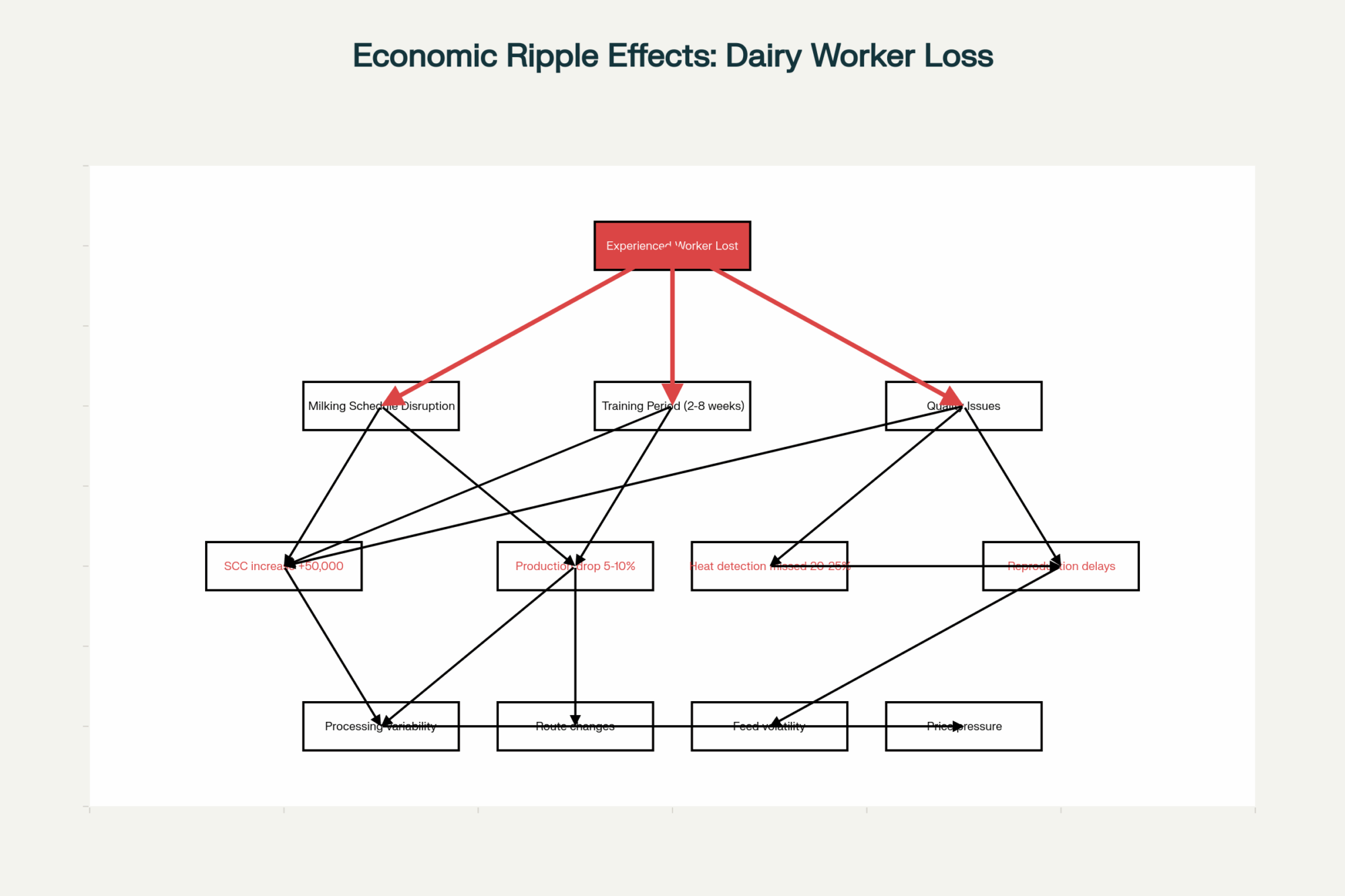
Now multiply that across hundreds of farms. Processing plants deal with variable milk supplies. Haulers face route changes. Feed suppliers see order volatility. The entire system, which has been optimized over the course of decades, begins to strain.
Consumer prices? While exact projections vary, basic economics tells us that reducing supply while demand stays steady means increases—potentially significant ones. Some analysts worry about impacts that could affect dairy’s competitive position against plant-based alternatives. Though honestly, I hope we never have to test those scenarios.
Why Dairy Can’t Access H-2A Workers
Here’s something that still frustrates producers coast to coast. The H-2A temporary agricultural worker program exists and has grown tremendously—from 48,336 certified positions in fiscal year 2005 to 378,961 in fiscal year 2024, according to Department of Labor data. Fruit and vegetable operations use it extensively. Some livestock operations qualify. But dairy? We’re locked out.

The federal regulations at 20 CFR 655.103 require work to be “temporary or seasonal” in nature. Last I checked, mastitis doesn’t follow a harvest schedule. Cows don’t take winters off. Fresh cow management happens year-round, whether you’re dealing with Wisconsin’s frozen February or California’s August heat.
What really gets me—certain range livestock operations can qualify for year-round H-2A workers under specific conditions. The distinction between their year-round needs and ours seems completely arbitrary.
The Farm Workforce Modernization Act passed the House twice but stalled in the Senate. Various other proposals have been introduced over the years. Meanwhile, we’re all operating in a gray area where the legal options do not align with operational reality.
How Farms Navigate Today’s Gray Areas
Let’s acknowledge what everyone in the industry understands. When workers present documents that appear valid for I-9 requirements, employers fulfill their legal obligations and proceed. What’s the alternative—having nobody for tomorrow’s milking?
This creates complex relationships. Long-term employees become integral to operations, develop deep knowledge of specific herds. I know a farm near Turlock where the same worker has managed transition cows for twelve years. He knows those cows better than anyone. But underlying everything is this legal uncertainty that neither farmers nor workers can resolve independently.
The arrangement functions because it meets mutual needs. However, it exists in constant tension, vulnerable to policy changes, shifts in enforcement priorities, and changes in political power. It’s exhausting for everyone involved—farmers, workers, families, communities.
What Other States Are Figuring Out
California started allowing undocumented immigrants to obtain driver’s licenses in 2015 through Assembly Bill 60. New York implemented the Green Light Law in 2019. Thirteen other states now have similar programs. The reasoning was practical—people already working on farms need to drive safely and carry insurance.
A UC Davis study found California’s program improved road safety while reducing hit-and-run accidents by 7-10%. Operations in those states generally report that it helps with daily stability, although it doesn’t resolve underlying questions about legal status. Workers can commute without constant fear of traffic stops becoming immigration issues.

Wisconsin hasn’t pursued similar policies, though the discussion surfaces periodically. Idaho’s taken an interesting middle path—some counties work with dairy operations on housing and transportation solutions that reduce workers’ need to drive on public roads. Texas varies by region, with some counties more accommodating than others.
Technology’s Real Impact
Examining actual adoption rates, DairyComp 305 data from over 2,000 farms indicate that robotic milking systems are currently in use on approximately 3% of U.S. dairy operations, although this number is growing steadily. The conversation about automation has matured considerably from the “robots will solve everything” pitch of five years ago.
| Technology | Initial Cost | Labor Reduction | ROI Period |
| Activity Monitors | $100-150/cow | 20-25% heat detection improvement | 18 months |
| Automatic Takeoffs | $2,000-3,000/stall | 10-15% milking labor reduction | 18-24 months |
| Feed Pushers | $25,000-35,000 | 2-3 hours daily labor saved | 2-3 years |
| Robotic Milking Systems | $150,000-200,000/unit | 20-30% milking labor reduction | 5-7 years |
Operations with robots report mixed experiences. University of Minnesota Extension research shows they can reduce milking labor needs by 20-30%. However, you still require skilled personnel for managing fresh cows, health monitoring, and breeding programs. The capital requirements remain substantial—Wisconsin Extension estimates installation costs at $150,000 to $ 200,000 per robot, with most operations requiring multiple units.
What’s proving more practical for many farms is targeted automation. Automatic takeoffs cost around $2,000-3,000 per stall—way more achievable than a million-dollar robot barn. Activity monitors cost approximately $100-150 per cow but can increase heat detection rates by 20-25%, according to the Penn State Extension. Feed pushers ($25,000-35,000) reduce labor while keeping feed fresh. These incremental improvements make existing workers more productive without requiring a complete reconfiguration of your operation.
What Smart Operations Are Doing Now
Progressive operations are taking several approaches to navigate these challenges, even without comprehensive reform.
First, they’re strengthening compliance. Ensuring I-9 documentation is bulletproof and collaborating with agricultural attorneys to understand their obligations and associated risks. Some explore whether workers might qualify for existing visa programs, though options remain limited.
Second, they’re engaging politically in coordinated ways. The Wisconsin Dairy Alliance organizes producer meetings with state legislators. California cooperatives work with congressional representatives on H-2A reform. The Idaho Dairymen’s Association maintains regular communication with officials about workforce needs. Even individual producers are speaking up more—I recently heard a normally quiet farmer from Marathon County testify at a state hearing about losing two workers and nearly missing a milk pickup because of it.
Third, strategic investments continue in both technology and personnel. Creating advancement opportunities, providing training, and improving housing. The logic is straightforward—keeping experienced workers, regardless of status, beats constant turnover. A producer near Twin Falls told me his best investment wasn’t his new parlor—it was the apartments he built for long-term employees.
The Path Ahead
The September enforcement action in Manitowoc won’t be the last. Federal agencies operate according to their mandates, which don’t necessarily align with agricultural economic needs.
Wisconsin’s dairy industry generates $45.6 billion in total economic activity, according to a 2023 University of Wisconsin study. California’s dairy sector contributes $21 billion to that state’s economy. Add in Idaho, Texas, New York, and Pennsylvania—we’re talking about massive economic impact and thousands of rural jobs. We have the collective influence to use it constructively if we choose to do so.
Even without federal reform, incremental improvements are possible. Driver’s license programs provide daily stability. Better coordination between agricultural employers and communities reduces uncertainty. Strategic technology adoption improves efficiency without eliminating labor needs.
For producers ready to engage, several organizations are actively working on these issues. The National Milk Producers Federation maintains an immigration reform task force you can connect with. The American Dairy Coalition sends regular legislative updates. Edge Dairy Farmer Cooperative in Wisconsin actively lobbies for practical solutions. Your state dairy association likely has resources, too.
Tomorrow Morning’s Reality
When you walk into your parlor tomorrow morning, you’ll likely depend on workers whose legal status remains unresolved by current policy. They’ll arrive before dawn, manage transition cows with skill honed over the years, and keep your operation running smoothly. This has become the reality for American dairy—from operations still milking 50 cows to facilities milking 15,000.
The Manitowoc incident reminded us how quickly stability can disappear. But it also highlighted our resilience. Farms found ways to keep operating. Communities supported affected families. The milk kept flowing to processors.
We’ve weathered enormous challenges—the 2009 price crash, the 2014-2016 margin crisis, changing consumer preferences, and environmental pressures. This workforce challenge is distinct because it necessitates both political engagement and operational adaptation.
We understand what’s needed: recognition that year-round agricultural labor requires appropriate legal frameworks. Partial solutions exist that other states have implemented. The question is whether we’ll work toward pragmatic approaches or continue hoping someone else fixes this.
The economics are clear. The operational needs are obvious. The question now is what we’re prepared to do collectively. Managing uncertainty individually while hoping for the best isn’t sustainable for an industry that feeds America.
Here’s my challenge to you: Will you contact your state dairy organization this week about workforce solutions? Will you talk to your legislators about the reality on your farm? Or will you wait for the next enforcement action and hope it’s not in your county?
The choice is yours. But remember—every morning when those headlights turn into your drive, you’re depending on a system that needs fixing. And we’re the ones who need to push for that fix.
What’s your next move?
KEY TAKEAWAYS:
- Targeted automation delivers better ROI than full robotics: Activity monitors ($100-150/cow) boost heat detection 20-25% while automatic takeoffs ($2,000-3,000/stall) reduce labor needs without the $150,000-200,000 per robot investment—Penn State Extension data shows most farms see payback within 18 months versus 5-7 years for robotic systems
- State solutions exist while federal reform stalls: California’s 2015 driver’s license program reduced uninsured drivers by 15% and hit-and-run accidents by 7-10%, providing workforce stability that Wisconsin, Idaho, and Texas operations could implement without waiting for H-2A expansion that’s been blocked for decades
- Proactive compliance beats reactive scrambling: Operations strengthening I-9 documentation, building relationships with agricultural attorneys, and exploring existing visa options for key employees report better workforce retention—the Wisconsin Dairy Alliance and Edge Dairy Farmer Cooperative offer resources to help navigate current regulations while advocating for practical reforms
- Geography matters for enforcement risk: Manitowoc-style operations happen nationwide, but counties with agricultural-focused law enforcement report fewer disruptions—understanding your local enforcement priorities and building community relationships creates operational buffer zones that technology alone can’t provide
- Engagement drives change faster than hope: Producers actively working with state dairy organizations, contacting legislators about workforce realities, and supporting industry advocacy efforts through NMPF or American Dairy Coalition see more progress than those waiting for Washington—your voice matters more than you think when 226 billion pounds of annual milk production depends on workforce stability
EXECUTIVE SUMMARY:
Recent enforcement actions in Wisconsin reveal a paradox at the heart of American dairy: operations depend on workers they can’t legally employ, while federal programs designed for agricultural labor explicitly exclude year-round dairy work. The September 25 Manitowoc arrests of 24 dairy workers highlight how quickly workforce stability can vanish—farms that lost experienced milkers that morning faced immediate operational disruptions affecting everything from milk quality to reproduction programs. With Wisconsin dairy generating $45.6 billion in economic activity while operating with a significant undocumented workforce dependency, and the H-2A program growing from 48,336 to 378,961 positions between 2005 and 2024, yet still excluding dairy, producers face an impossible choice between legal compliance and operational survival. What farmers are discovering through targeted automation investments—automatic takeoffs at $2,000-3,000 per stall delivering immediate efficiency gains, activity monitors at $100-150 per cow improving heat detection by 20-25%—is that technology can enhance but not replace skilled workers who understand transition cow management and fresh cow protocols. The path forward requires both practical adaptation through state-level solutions, such as driver’s license programs (already implemented in 15 states), and sustained industry engagement with organizations like the National Milk Producers Federation’s immigration task force. Hoping that federal policy catches up with dairy’s year-round reality isn’t a viable business strategy.
Complete references and supporting documentation are available upon request by contacting the editorial team at editor@thebullvine.com.
Learn More:
- How to Attract and Retain Exceptional Labor for Your Dairy Farm – This tactical guide reveals actionable strategies for building a better team, providing insights on implementing benefits, mentorship, and technology to boost employee retention and morale, directly complementing the main article’s focus on workforce instability.
- Labor Crisis Reality Check: How Immigration Crackdowns Could Increase Milk Prices by 90% and Crash Profits – This article provides a stark, data-driven analysis of the broader market and economic impacts of the labor crisis, detailing specific financial projections and strategic risks that progressive producers must understand to prepare for future policy changes.
- Robot Revolution: Why Smart Dairy Farmers Are Winning with Automated Milking – This innovation-focused piece offers a deeper dive into the economics and implementation of robotic milking systems. It demonstrates how to achieve significant labor savings and increased profits, providing a concrete example of technology’s role in addressing the workforce challenge.
The Sunday Read Dairy Professionals Don’t Skip.

Every week, thousands of producers, breeders, and industry insiders open Bullvine Weekly for genetics insights, market shifts, and profit strategies they won’t find anywhere else. One email. Five minutes. Smarter decisions all week.