




Private processors must itemize your deductions. Co-ops don’t have to — and the exemption is one line of federal code. Two co-ops just paid $34.4M. The rule didn’t budge.
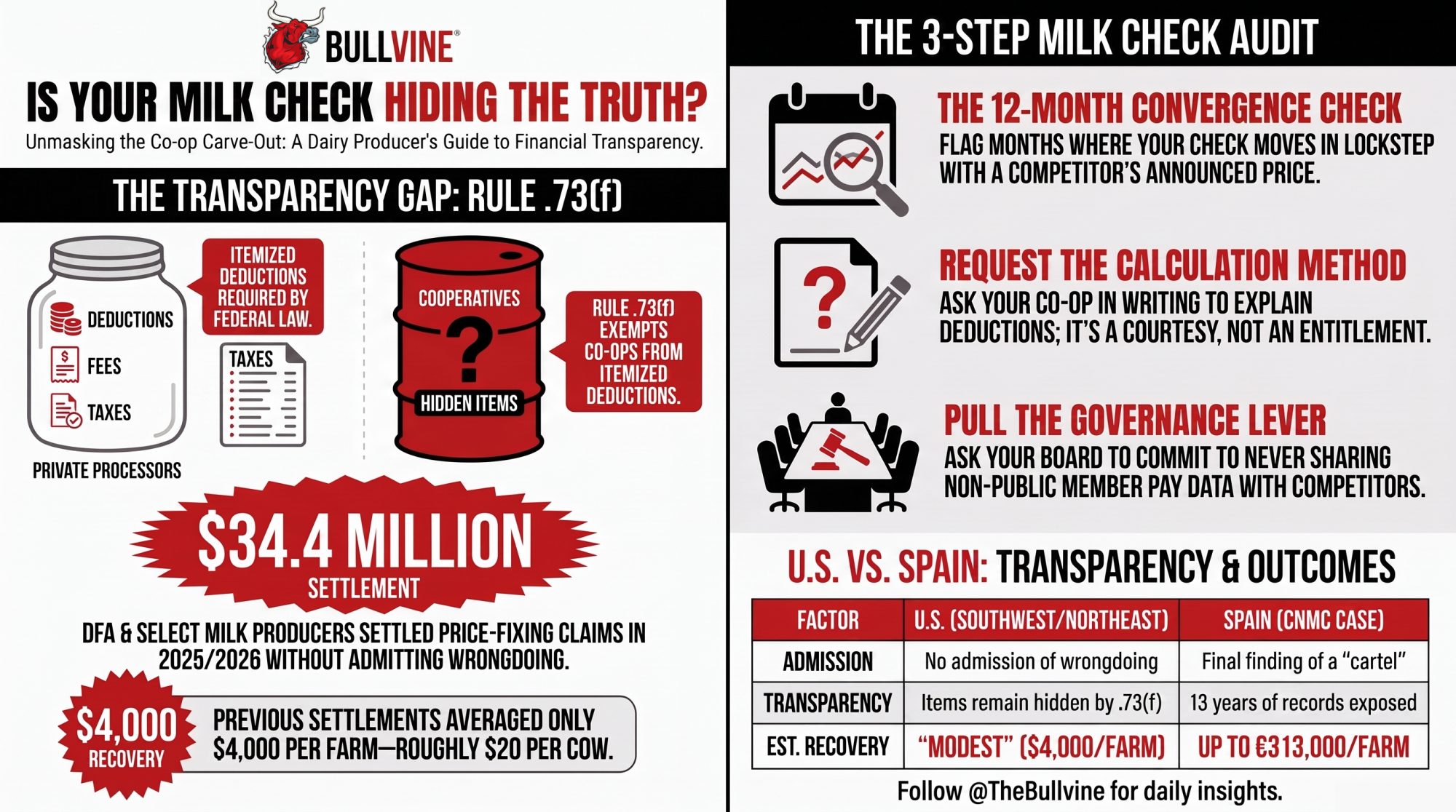
The short version: Two of the biggest co-ops in the country paid $34.4 million to settle price-fixing claims from a handful of New Mexico dairies, and part of the deal was agreeing to stop sharing member pay-price data — DFA at $24.5 million, Select Milk Producers at $9.9 million, neither admitting a thing. The farmers who filed said they couldn’t prove what they suspected from their own paperwork, and the reason is a carve-out in the federal milk marketing orders: the itemization rule that forces private handlers to break down your deductions applies to every producer except one whose milk came through a cooperative association handler. That exemption sits in the .73(f) provision of every federal order — the section number changes with your region, the exemption doesn’t — which means your co-op can provide a detailed statement, but no federal rule says it has to. History says don’t count on the recovery either: the last Northeast case put roughly $4,000 into the average farm’s hands, about $20 a cow on a 200-cow herd, after seven years of litigation and $16.7 million in attorney fees. The judge who approved it wrote that $4,000 “could reasonably be perceived as a modest recovery.” The practical move costs you an afternoon: pull twelve months of pay statements, line them against your state’s Mailbox Milk Price from AMS, and flag any month your check moved in lockstep with a competing buyer’s announced price. One month is noise. Twelve is a document — and if you can’t reconcile a deduction, asking your co-op in writing for the calculation method is a courtesy request, not an entitlement.
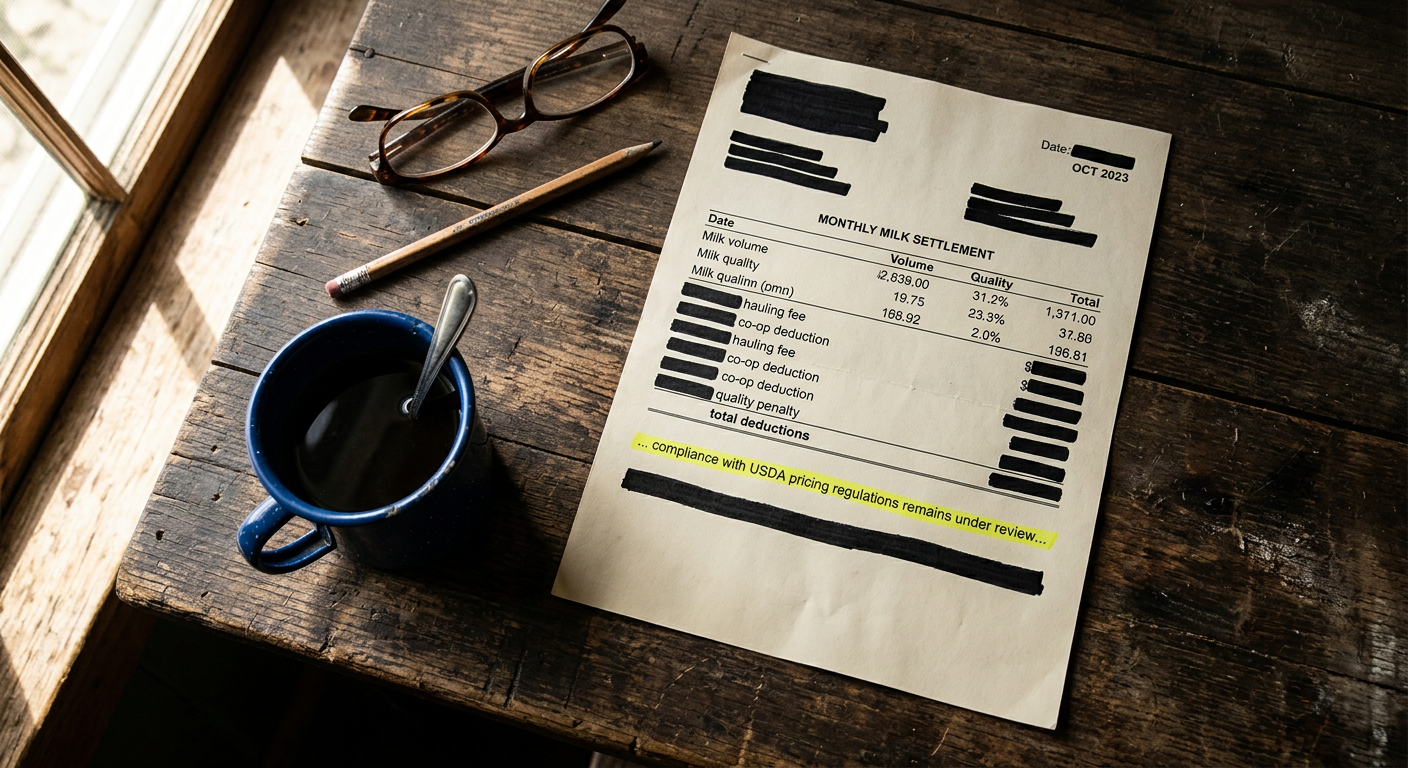
A group of New Mexico dairies said their milk checks were being held down, and they couldn’t prove it from their own paperwork. Four years later, two of the biggest co-ops in the country paid $34.4 million to make the case go away — and agreed to stop sharing member pay-price data with each other. Neither admitted a thing.
Here’s the part that should stop you: the reason those farmers couldn’t check their own statements isn’t an oversight. It’s a carve-out in the federal milk marketing order rules, and if you ship through a co-op, it covers you too.
In March 2024, Judge Margaret Strickland of the U.S. District Court for the District of New Mexico summarized what those farmers were alleging. Her ruling puts their complaint this way: “The price paid to a member-farmer need not match the FMMO or the Mailbox Milk Price, nor does the algorithm to calculate actual payment need to be disclosed.” That’s an allegation, not a judicial finding about the industry. But it describes the rulebook accurately.
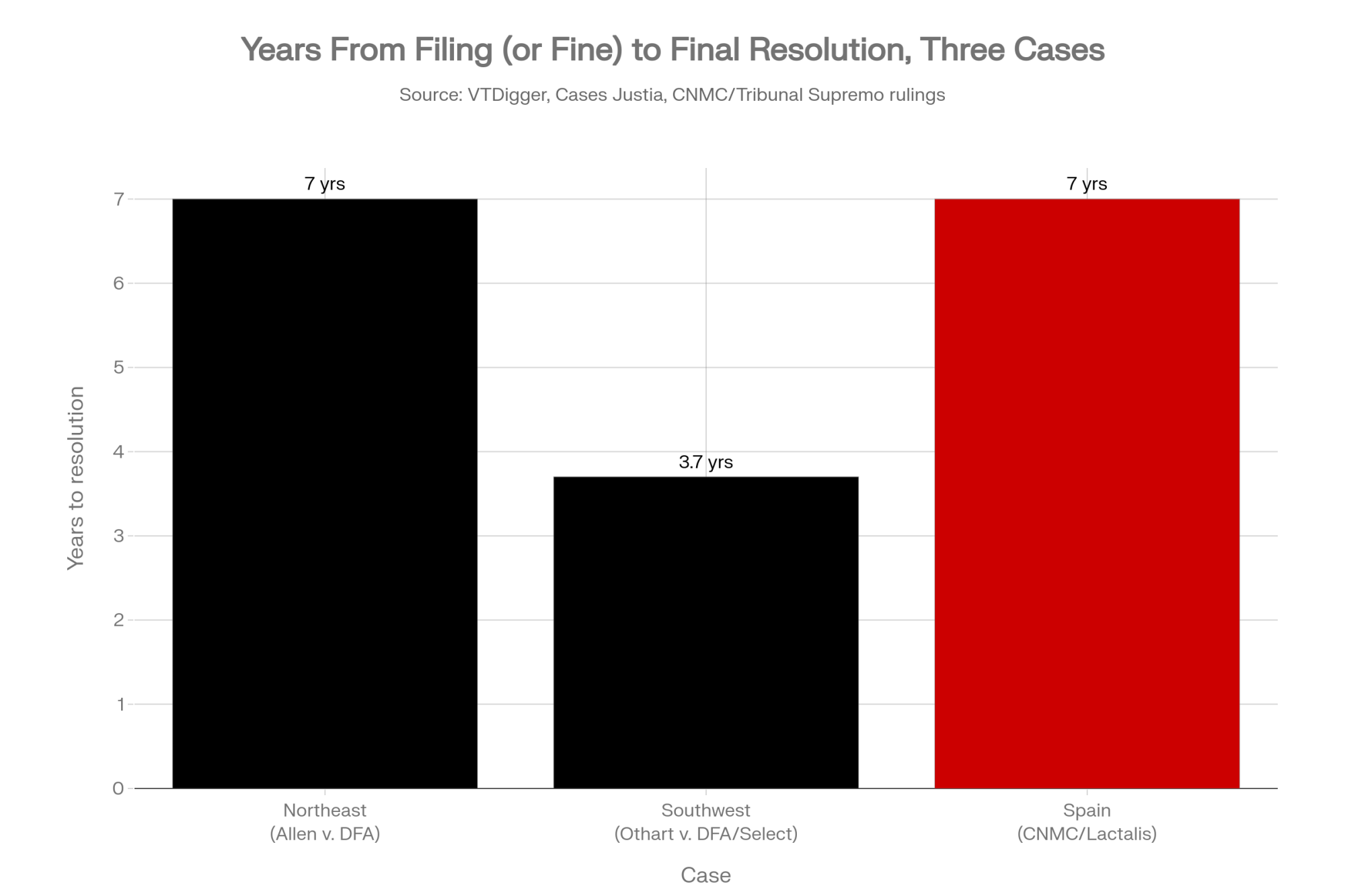
The plaintiffs included Othart Dairy Farms in Belen, Pareo Farm in Socorro County, Desertland Dairy in Vado, Del Oro Dairy in Anthony, and Bright Star Dairy and Sunset Dairy, both in Mesquite. They alleged DFA and Select Milk Producers coordinated to suppress Southwest Grade A milk pay. Strickland let the case proceed. On December 8, 2025, the court granted final approval of the settlement — $24.5 million from DFA and $9.9 million from Select. Payments started going out June 2, 2026.
The non-monetary terms are worth reading. Both co-ops agreed to dissolve their jointly-owned marketing agency, run antitrust training for marketing staff, and provide better pay transparency and milk check education for members. Neither accepted that any of the alleged conduct occurred, and settlements like this routinely include forward-looking terms without any finding that the practice took place. Still, it’s fair to ask why those particular terms — and not others — were the ones on the table.
The European Warning: What Real Price-Fixing Actually Costs a Herd
Here’s why this article takes you to Spain. American dairy antitrust cases settle. They settle with no admission of wrongdoing, no finding of fact, and no number attached to what the conduct actually cost a farm. You get a fund size and a denial. That’s it.
Spain doesn’t work that way. Its competition regulator ran the investigation to conclusion, named the companies, named the behaviors, and its courts are now putting euro figures on the damage — farm by farm, in public rulings you can read. If you want to know what hidden pay-price coordination costs a dairy, Europe is the only place that has shown its arithmetic.
The CNMC found that eight dairy companies and two trade associations ran a single continuous infringement from 2000 to 2013 — thirteen years — and fined them a combined €80.66 million in July 2019. Lactalis Iberia’s share was €11,692,998. On June 29, 2026, Spain’s Tribunal Supremo dismissed Lactalis’s final appeal in ruling 808/2026. Reporting at the time noted that Lactalis could still explore an appeal to the EU Court of Justice, but that path wouldn’t reopen the Spanish factual record.
Keep the three cases in this article straight as you read. One company was found liable. Two paid and admitted nothing. One man pleaded guilty. Those are not the same thing, and the difference decides what a producer can do with any of it.
CNMC didn’t issue a vague finding of unfairness. It named four behaviors: buyers exchanging current and future raw milk purchase prices, sharing purchase volumes and supplier lists, agreeing on coordinated price reductions, and effectively allocating which farmers belonged to which buyer.
That fourth one is the one that stings. Where buyers divide up the supply base, a farmer doesn’t have a market. He has an assignment.
The €313,000 Question: How Much Money Are We Actually Talking About?
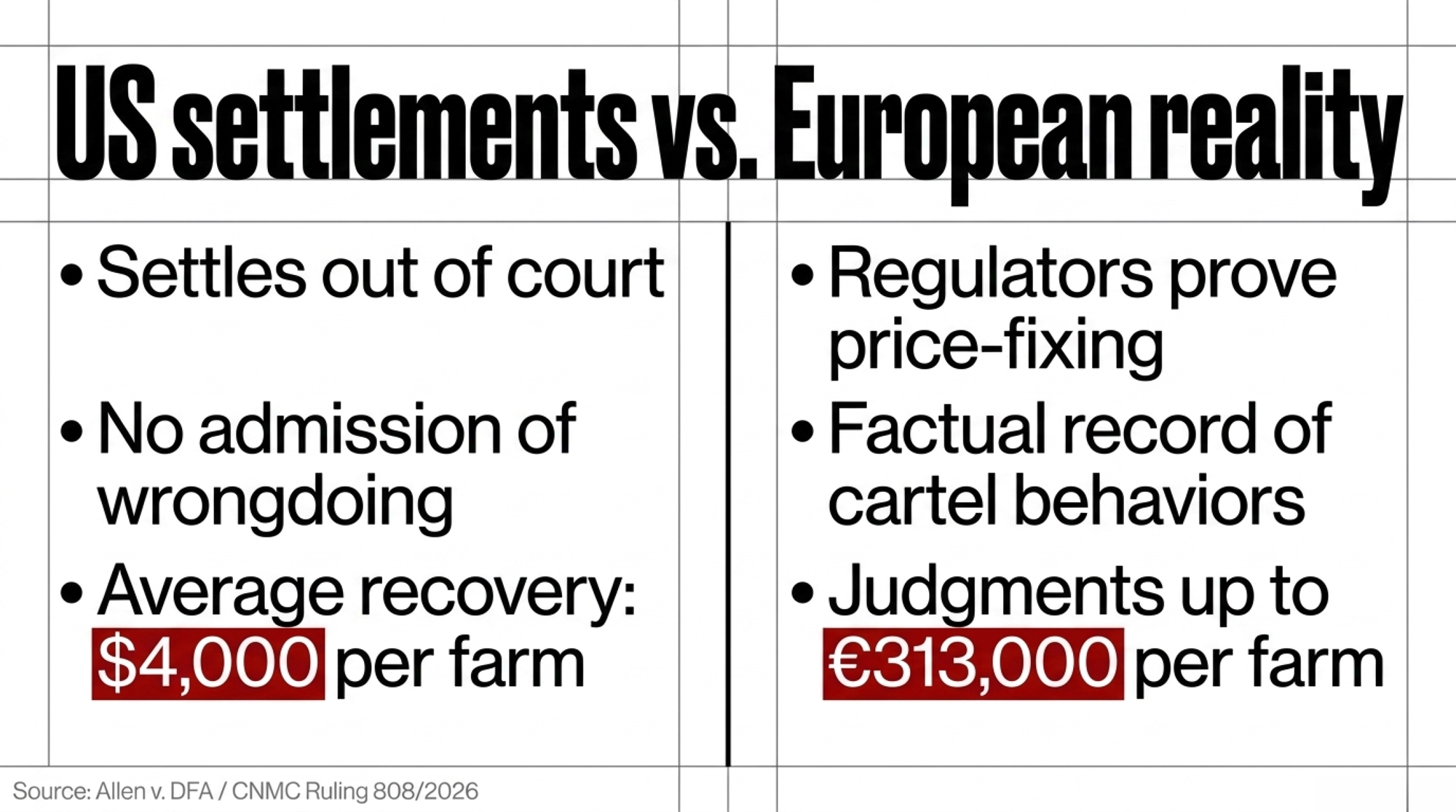
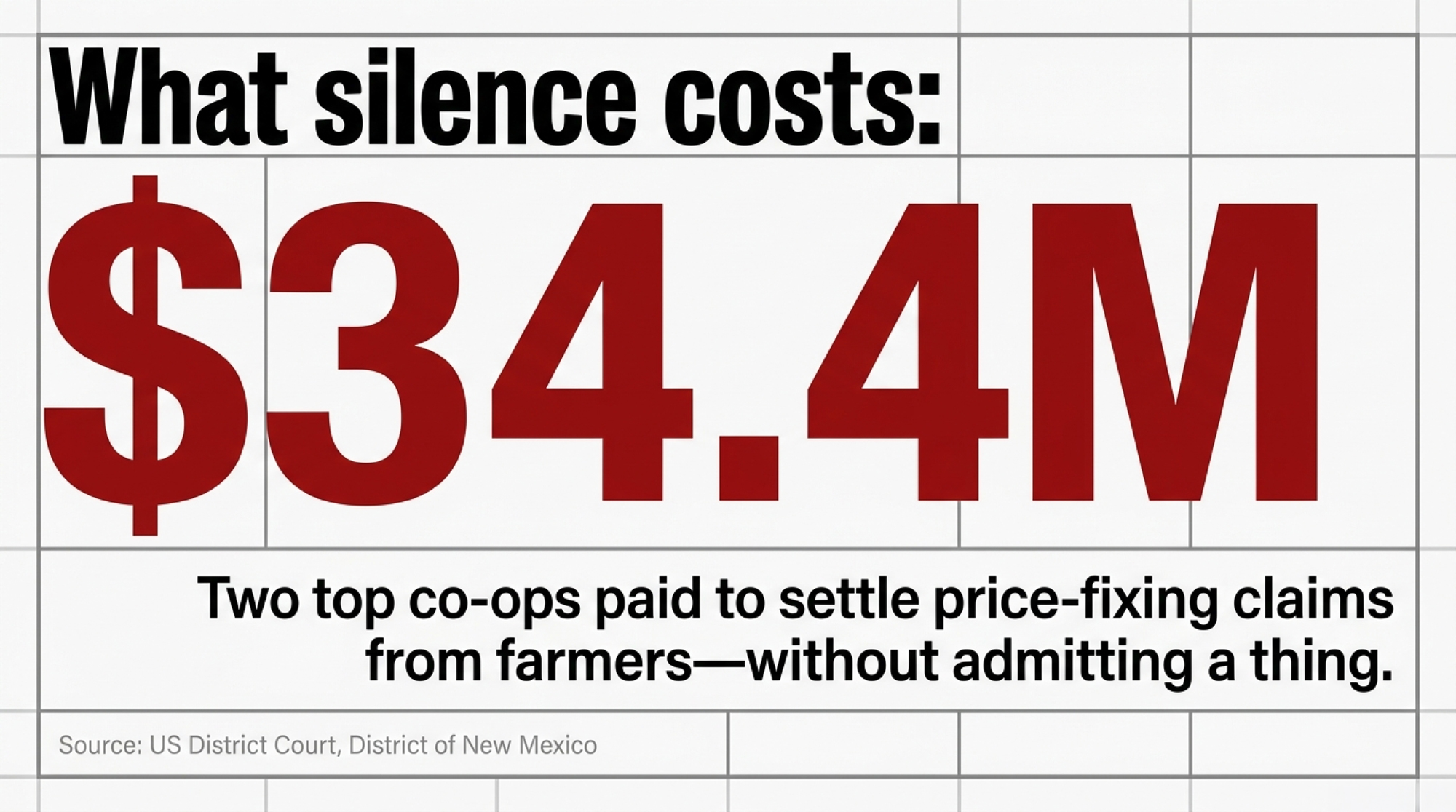
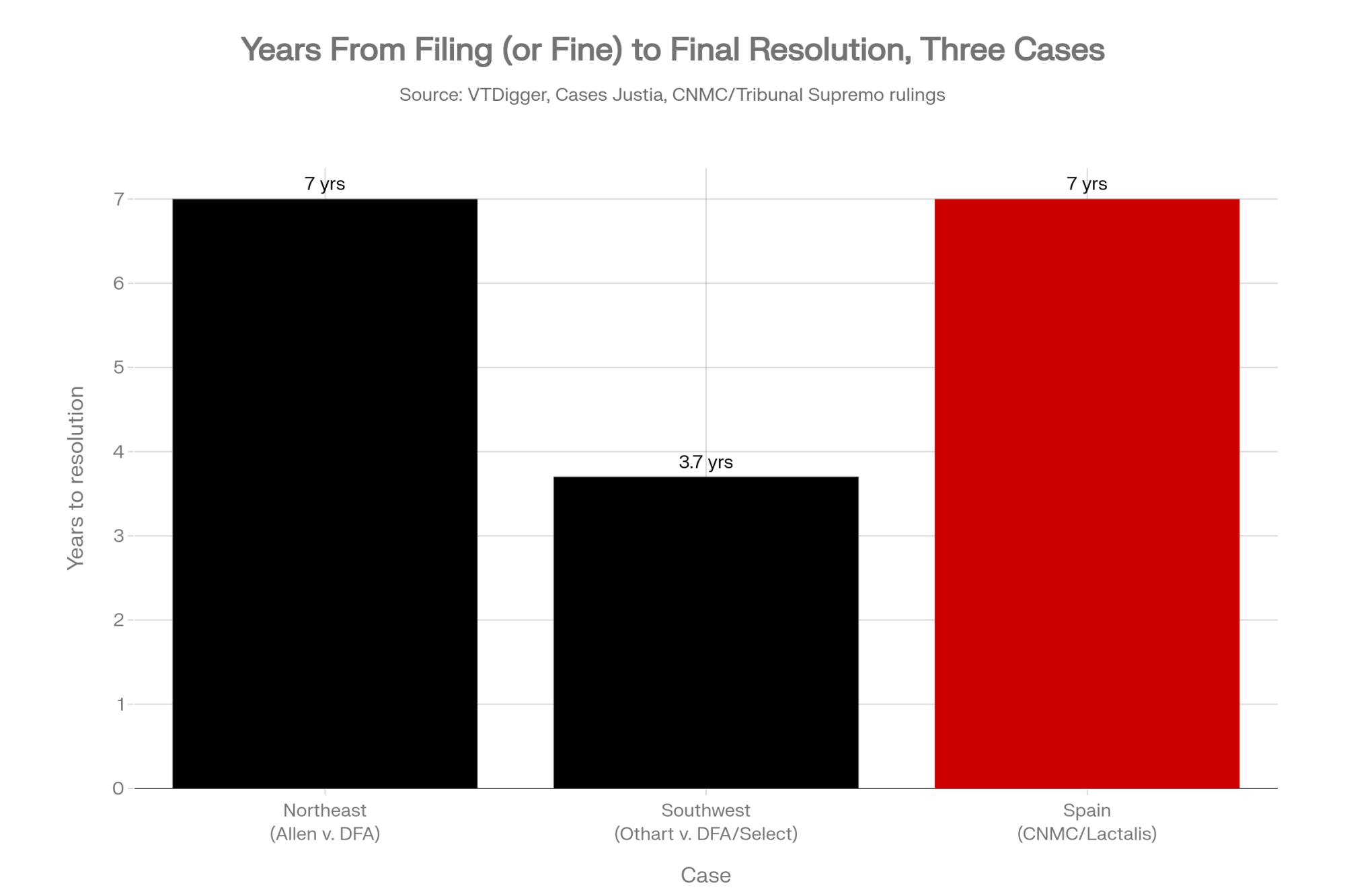
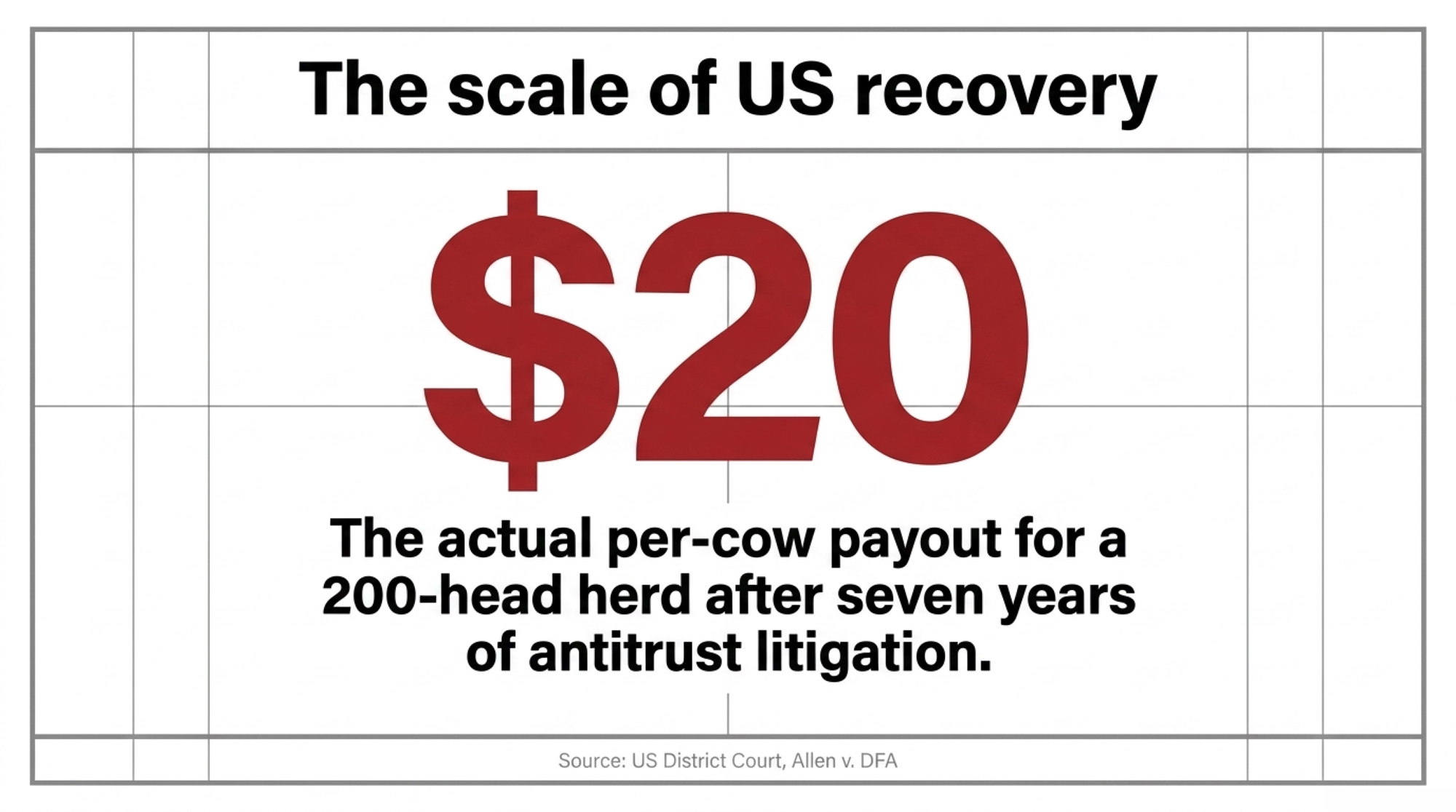
Start with the American number, because it’s the one you can hold against your own operation. In Allen v. Dairy Farmers of America, roughly 9,000 Northeast farms split a $50 million settlement — an average of about $4,000 per farm. On 200 cows, that’s $20 a head. Once, after seven years of litigation.
Now the Spanish side, where the numbers run larger, and the courts can’t agree on how large. CNMC estimated the cartel held farmgate prices down by more than 10 percent. Spanish civil courts are now deciding what that’s worth in cash, and they’ve split into two camps.
Madrid’s Commercial Court No. 14, in its October 16, 2025 ruling, accepted a 9.4 percent undercharge on the price farmers actually received, working from an economic report by Compass Lexecon and rejecting the defendants’ alternative methodology as not solid enough. Three Ávila-area dairies brought that case against Lactalis Iberia and Industrias Lácteas de Granada (Puleva). Their combined award came to roughly €500,000.
Barcelona’s Provincial Court, Section 15, went a different way. Rather than building from an economic model, it worked from price reductions documented in CNMC’s own administrative file — generally one to three pesetas per liter, which the court reasoned represented somewhere between 2 and 6 percent of the milk price. It settled on the low end and fixed the undercharge at 2 percent of affected sales value. That reasoning appears in Sentencia 1437/2025 (December 15, 2025) and again in Sentencia 140/2026. In March 2026, the same section applied it against Lactalis, Nestlé and Pascual in a claim brought by nearly a hundred Galician farmers, co-ops and agrarian societies.
Both of those courts compound the interest. Madrid’s Court No. 14 and Toledo’s Commercial Court No. 1 each ordered the undercharge updated at compound interest, following the Supreme Court’s approach in Spain’s earlier Envelope Cartel damages cases.
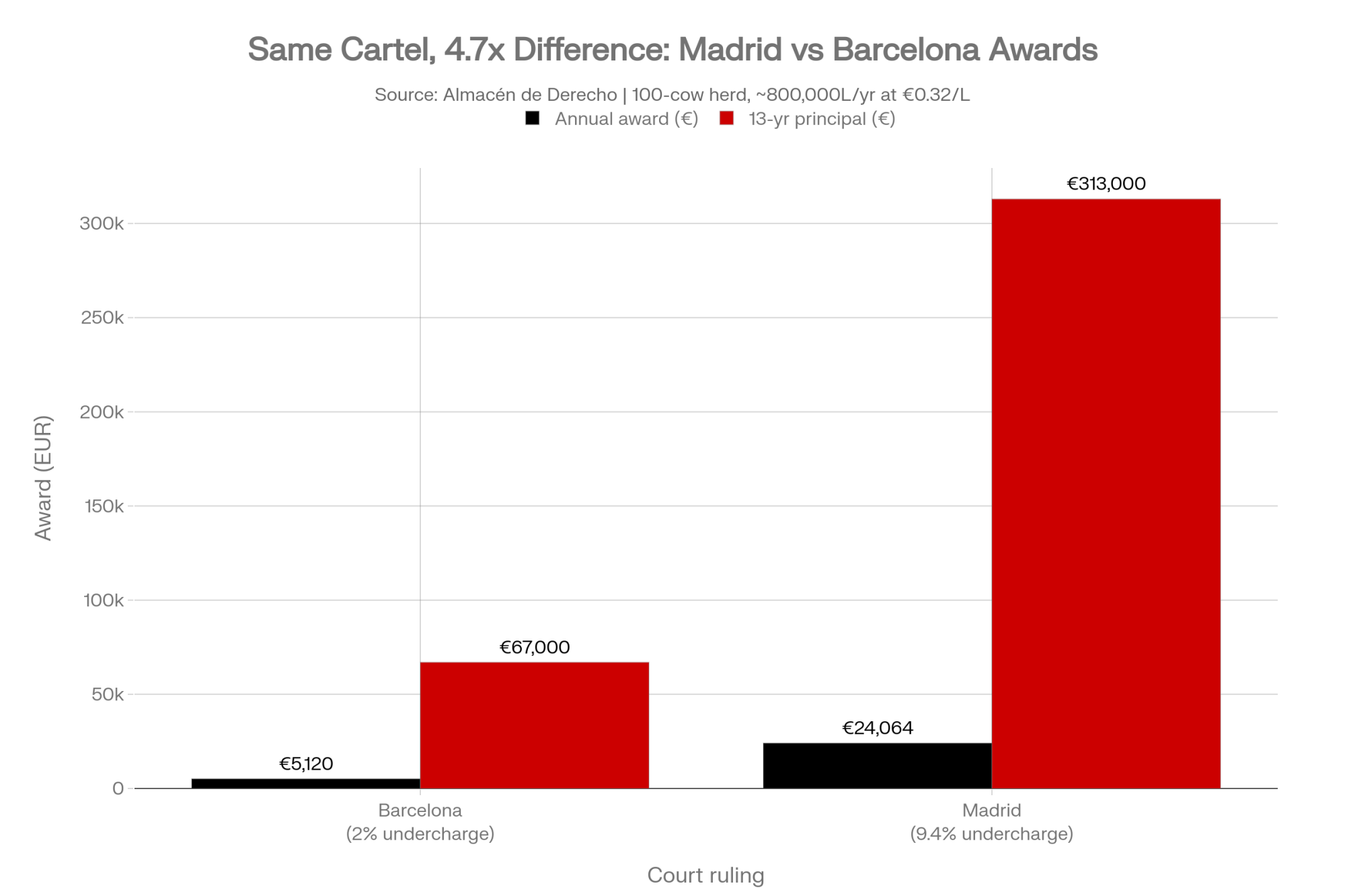
Run it through a barn. Take a 100-cow herd shipping roughly 800,000 liters a year at about €0.32/L — call it €256,000 in annual milk revenue. At Barcelona’s 2 percent, that’s about €5,120 a year, or roughly €67,000 across the 13-year window before interest. At Madrid’s 9.4 percent, it’s about €24,064 a year. Roughly €313,000 in principal. A quarter-million-euro gap on one mid-size farm, decided by which court you land in and whose economist the judge finds more persuasive.
| Case | Herd Size Used | Time in Litigation/Appeals | Recovery |
|---|---|---|---|
| Northeast (Allen v. DFA) | 200 cows | 7 years | $4,000/farm (~$20/head) — called “modest” by the judge |
| Southwest (Othart v. DFA/Select) | Class-wide, all herd sizes | ~3.7 years (filed 2022–approved Dec 2025) | $34.4M fund; per-farm share not yet public |
| Spain — Barcelona standard | 100 cows | 13 yrs conduct + 7 yrs appeals | ~€67,000 principal (2% undercharge) |
| Spain — Madrid standard | 100 cows | 13 yrs conduct + 7 yrs appeals | ~€313,000 principal (9.4% undercharge) |
One caveat on those totals: applying a single flat price across thirteen years smooths out real variation in Spanish farmgate prices, so treat the figures as illustrative scale rather than a claim calculation.
Madrid firm Eskariam represents more than 7,800 Spanish farmers with claims topping €1.2 billion — roughly €153,846 per claimant on average. Treat that average as arithmetic, not an entitlement. Individual recoveries will swing hard on herd size, which court hears the claim, and how many of the thirteen years a farm actually shipped.
Eskariam CEO David Fernández, whose firm represents claimants in those proceedings, put it this way after the ruling: “This ruling puts an end to years of appeals and definitively closes any avenue for Lactalis to reverse the facts of the cartel. The sanction is final, the facts are unassailable, and no appeal remains.” If you want the per-farmer arithmetic laid out claim by claim, we broke that down in the full per-farmer breakdown of the Spanish ruling.
| CNMC-Documented Behavior | Visible in Your Pay Records? | What a Farmer Would Actually See |
|---|---|---|
| Buyers exchanging pay prices | Partially | Your price tracking a neighbor’s, different buyer, same month |
| Coordinated price reductions | Partially | Multiple processors cutting the same amount, same window |
| Sharing volume/supplier data | No | Nothing — surfaced only via CNMC’s own file review |
| Allocating farmers between buyers | No | Can document being told there’s nowhere else to ship, not intent |
What Spain Proved That US Courts Settled
Back to that $4,000. Chief Judge Christina Reiss of the U.S. District Court for Vermont approved the Allen settlement on June 7, 2016, after seven years of antitrust litigation. Attorneys were awarded $16.7 million of the fund. The settlement came on top of a separate $30 million Dean Foods paid in 2011 to settle out. And DFA admitted no wrongdoing.
Reiss approved it as not inadequate or unreasonable on its face. She also wrote that “the receipt of approximately $4,000 per dairy farm could reasonably be perceived as a modest recovery.”
Now scale the Southwest case against what was at stake. Plaintiffs’ counsel put the Southwest Grade A raw milk market at more than $3.5 billion annually and alleged DFA paid member-farmers $46 million over the class period. Those figures measure different things — total market value versus payments to one co-op’s members — and DFA disputes the characterization. But the order-of-magnitude difference is why plaintiffs argued a $34.4 million fund was worth taking rather than litigating further.
The class covered farmers selling to DFA and Select across all of New Mexico, most of Texas, eastern Arizona, the Oklahoma panhandle and southwestern Kansas, from January 1, 2015 through June 30, 2025 — ten and a half years. The pattern holds across both continents: recovery arrives years late and lands thin against the length of the conduct.
Why Your Co-op Milk Check Leaves You in the Dark
Here’s the regulatory answer, and it’s sitting in the Code of Federal Regulations. FMMO rules require handlers to give each producer a supporting statement itemizing pounds received, butterfat, protein, and other solids, the minimum rate or rates of payment, and deductions. Then comes the carve-out.
THE CARVE-OUT
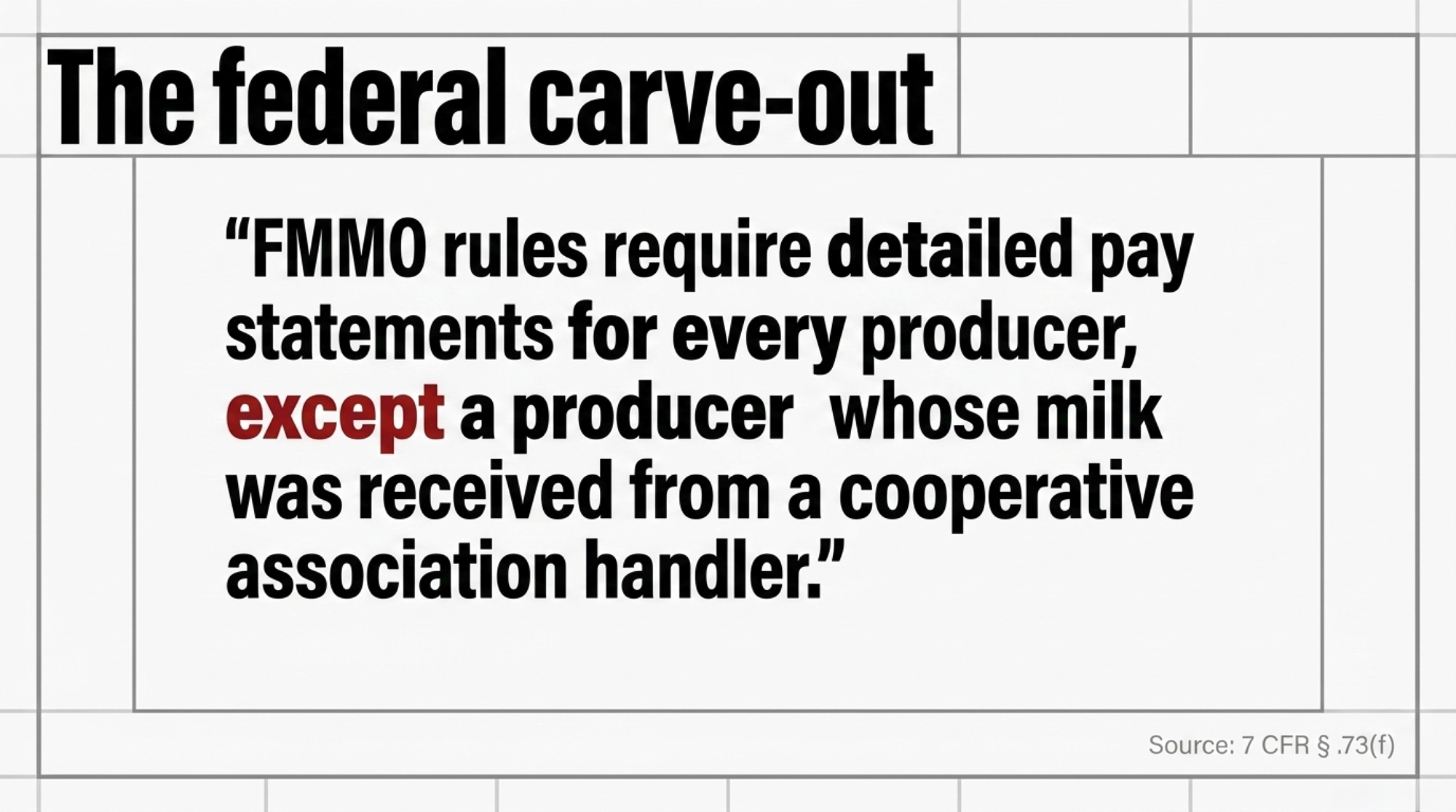
The FMMO itemization requirement applies to “each producer, except a producer whose milk was received from a cooperative association handler.”
What it means: Ship through a co-op and the federal rule requiring a detailed pay statement doesn’t reach you. Your co-op may provide one anyway. It isn’t federally required to.
Source: 7 CFR § [order number].73(f), “Producer payment record” — parallel provisions across all Federal Milk Marketing Orders. Upper Midwest is § 1030.73(f); Northeast is § 1001.73(f); California is § 1051.73(f).
| Requirement | Private Processor Handler | Cooperative Association Handler |
|---|---|---|
| Itemized pay statement required by federal rule | Yes | No — exempt under .73(f) |
| Must disclose deduction breakdown (hauling, dues, etc.) | Yes | Voluntary only |
| Must match FMMO/Mailbox Milk Price | Not required either way | Not required |
| Reports payroll data to market administrator | Yes | Yes (to regulator, not to farmer) |
| 2026 enforcement cost of hidden pay-price coordination | — | $34.4M (DFA $24.5M + Select $9.9M) |
The provision appears in every federal order. The section number changes with your region. The exemption doesn’t.
The Four Things Nobody Has to Explain to You
Ask anyone who reads these statements for a living, and you get the same list of problems. A milk-check reading guide published by Jacoby — a dairy brokerage and consulting firm, so read it with that in mind — names four specific ones: producer prices shown on the check don’t match prices announced by the Federal Order; deductions for co-op operations or hauling get spread vaguely across multiple lines, potentially masking their full impact; statements don’t clearly say whether deductions apply monthly or bi-weekly as part of advance payments; and some reductions in farmer pay never appear in the “deductions” section at all. Its advice for producers who can’t reconcile the numbers is blunt: start by asking questions.
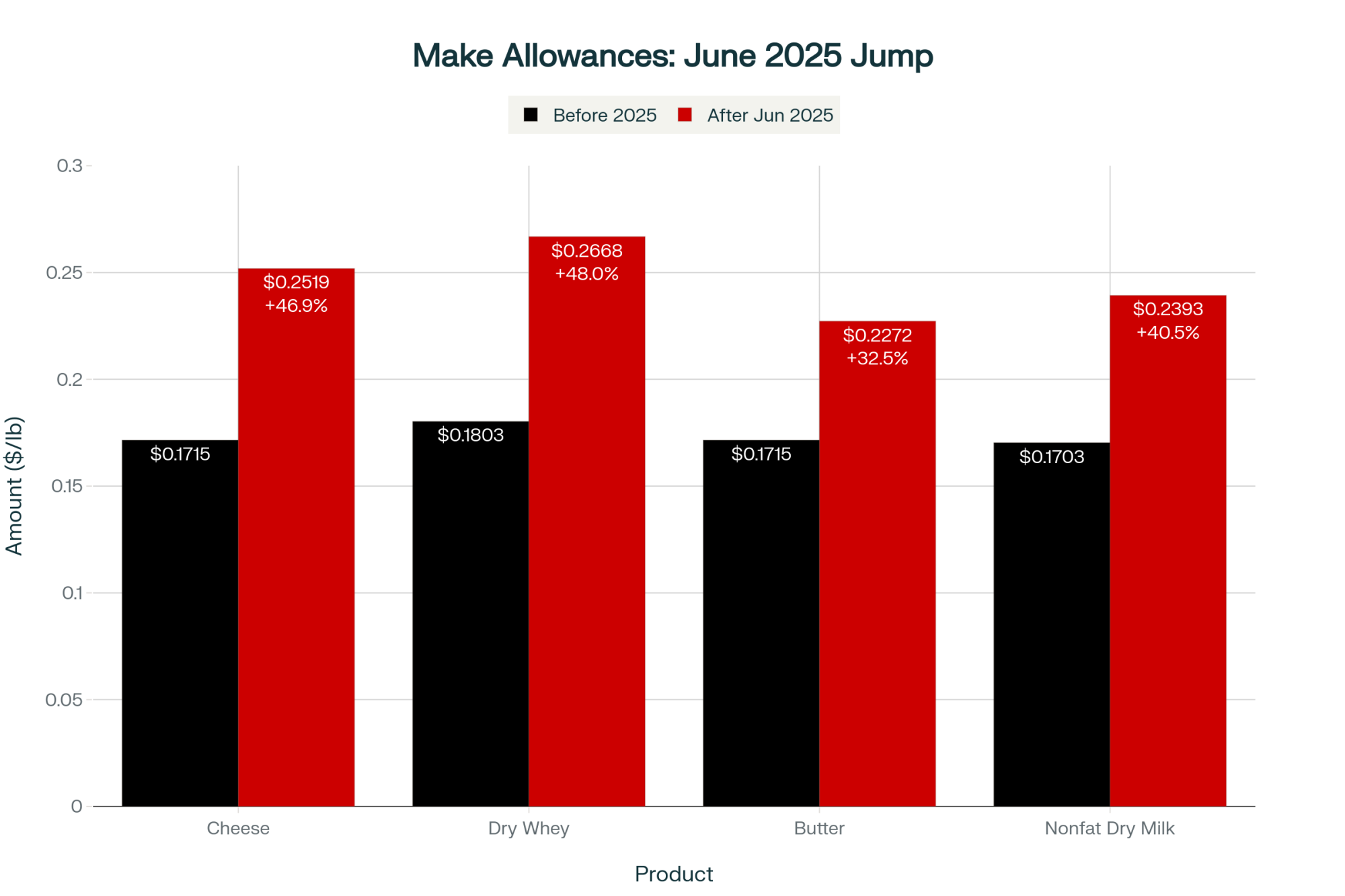
The problem isn’t going away either. The new FMMO pricing rules make milk pricing more complicated, and milk checks less transparent, and co-ops are not required to pay pooled members the FMMO minimum blend; they may re-blend with deductions. Higher make allowances get subtracted from the four commodity prices that feed the class formulas — they never show up as a line item on your statement at all.
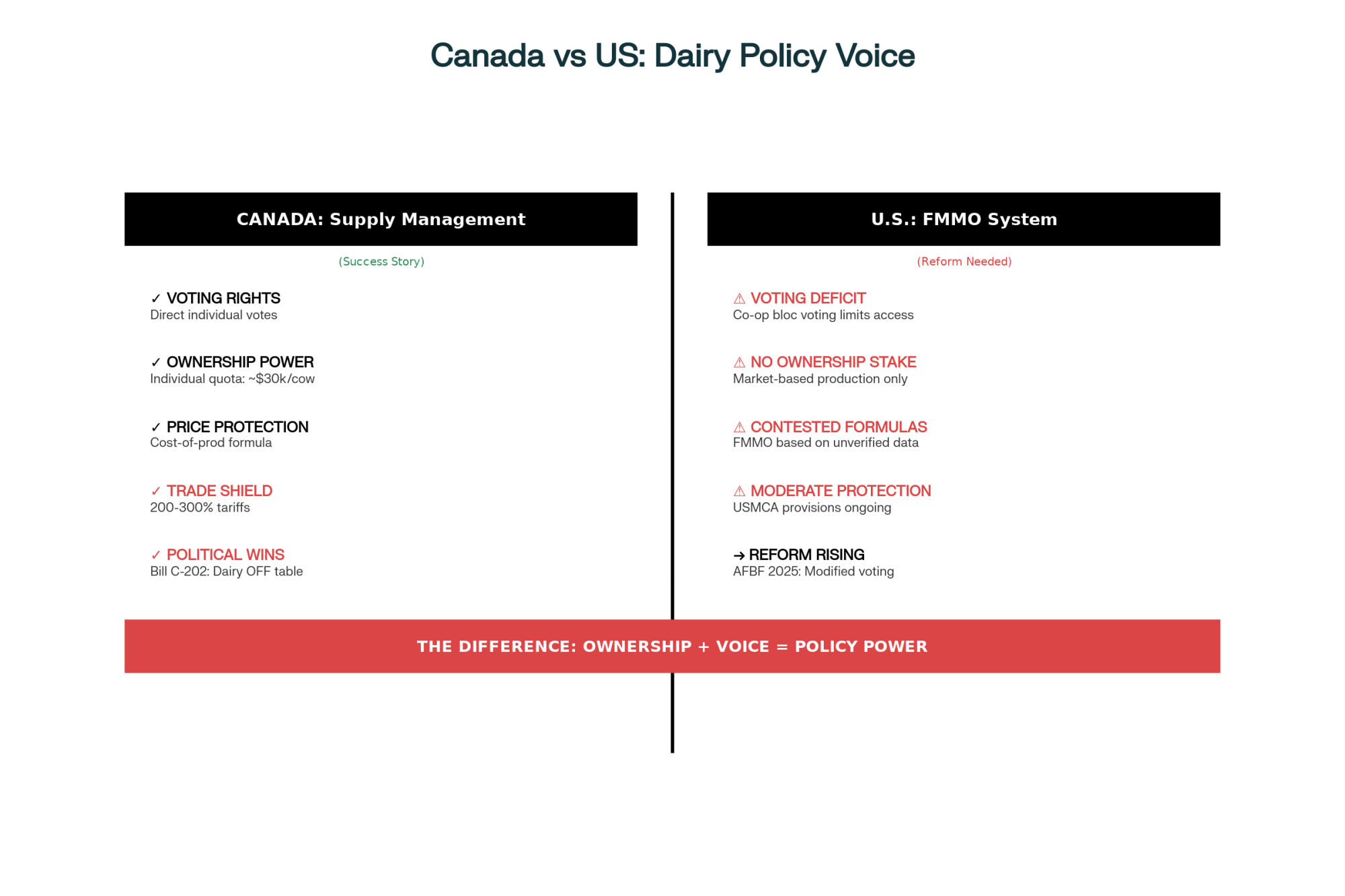
Handlers do have to report producer payroll to the market administrator, including “the amount and nature of any deductions and the disbursement of money so deducted.” But that’s a filing to a regulator in an office somewhere. Not a statement to you. If you want the governance side of this, how co-op voting power shapes what shows up on your statement covers who sets those rules.
Layer on how the FMMO functions. It sets a minimum price handlers must pay — a floor, not a target. USDA doesn’t set what a cooperative pays its own members, and real prices can and do land above or below that minimum. The Mailbox Milk Price, published monthly by USDA AMS, is a weighted state average of what farmers actually received net of costs. Useful as a benchmark. Not a promise about your account.
What Your Records Can Prove — And What They Can’t
The Southwest case never reached trial, so nothing was proven. But it survived a motion to dismiss in full, and Strickland’s reasoning is the part worth your time. She found the plaintiffs “plausibly allege[d] a continuing conspiracy to violate the antitrust laws,” “sufficiently plead[ed] each part of their horizontal price-fixing claim,” and alleged “parallel conduct alongside other factors that when taken together ‘tend to exclude the possibility of independent action.'”
That last phrase is the legal test, and it tells you exactly what your own records can and can’t do. Parallel pricing by itself won’t clear it — courts understand that feed, fuel, and freight move for everybody at the same time. What pushed this case past dismissal was parallel conduct plus structure: the co-owned Greater Southwest Agency, joint processing ventures, and allegations of selective non-pooling of milk. Your pay statements are the parallel-conduct half. You can’t supply the structural half from your farm office.
Now line CNMC’s four behaviors against what you can actually document.
| CNMC behavior | Shows up on your records? | What you’d be looking for |
| Buyers exchanging pay prices | Yes — partially | Your price and a neighbor’s, different buyers, matching month after month. Southwest plaintiffs alleged DFA and Select paid “nearly identical rates” |
| Coordinated price reductions | Yes — partially | Multiple processors cutting the same amount in the same window, repeatedly, with no shared cost story |
| Sharing your volume and supplier data | No | Nothing. In Spain, this surfaced through CNMC’s own investigation of company records — not through anything a farmer could see |
| Allocating farmers between buyers | No | You can document being told there’s nowhere else to ship. You can’t distinguish an agreement from ordinary hauling logistics |
Barcelona’s Section 15 shows what the structural half looks like when it surfaces. That court built its 2 percent figure from price reductions documented in CNMC’s administrative file — one to three pesetas per liter — rather than from an economic model. Those records came out of a regulator’s investigation. Not anyone’s milk check.
So set your expectations accordingly. A farmer can build a pattern. Building a case has taken regulatory or court powers every time — CNMC’s investigation in Spain, discovery in Othart.
4 Actionable Steps to Audit Your Own Milk Check Today
Step 1: Know where your legal protection ends, because it sets the boundary for everything else. Capper-Volstead gives agricultural cooperatives limited antitrust immunity to market their members’ output collectively. Courts have held that immunity doesn’t stretch to cover conspiracies with non-cooperative entities, predatory conduct, or price enhancement beyond legitimate marketing. It was written in 1922 to protect farmers pricing together. Not two co-ops coordinating in ways that touch their own members’ pay. Knowing where the protection ends tells you which questions are fair to put to your board — and co-op liability isn’t theoretical if you need the reminder.
Step 2: Run the 12-month convergence check — do this within 30 days. Pull your last 12 months of pay statements and line them against your state’s Mailbox Milk Price from USDA AMS. Flag any month where your check moved in near-lockstep with a competing buyer’s announced price. One month is noise. Twelve is a document. Costs you an afternoon and needs nothing but paper you already have. The limit worth naming: you may find a perfectly boring explanation, and that’s a good outcome.
Step 3: Document before you escalate. If a pattern holds up, keep the records and talk to an antitrust attorney before you raise it with your processor. Going direct first means a hard conversation with your only buyer. Worth knowing on timing: DOJ’s antitrust whistleblower rewards program pays individual informants 15 to 30 percent of resulting criminal fines or recoveries of $1 million or more, and it only took effect in July 2025.
Step 4: Push the governance lever at your co-op. Ask your board to commit in writing to never sharing non-public member pay-price data with any entity that also buys your milk, and to provide the payment calculation method on request. Not a radical ask — the Allen settlement required DFA and DMS to disclose certain financial information, fund an independent advisory council for four years, and seat a farmer ombudsperson for five. It requires board appetite you may not have, and one member rarely moves a board alone. Works better as a signed resolution with names behind it, which is the governance lever most members never pull.
It’s Not Just Raw Milk — DOJ Guns for AI Genetics
Everything above is civil litigation. Spain’s case and the Southwest settlement both ran on a preponderance of evidence, resolved with money, and on the American side, no admission of liability. Civil cases end in checks.
Criminal cases end differently — and cattle purchasing is now in scope.
On August 6, 2026, Herbert D. Lutz, 56, of Chester, South Carolina, pleaded guilty in U.S. District Court in Columbus, Ohio, to conspiring to rig bids in violation of Section 1 of the Sherman Act. The conduct ran from at least October 2018 to at least May 2024. DOJ described the mechanics plainly: “In advance of cattle auctions, Lutz and his co-conspirators agreed which company would win the bid. During the sales, the agreed-upon losing firm would either not bid or would submit an intentionally-losing bid before bowing out to permit the agreed-upon winner to prevail.” His employer picked up cattle worth over $1.6 million through those rigged sales.
Court filings identify Lutz as the Jersey development manager for “Company A,” bidding against an unnamed “Company B.” Neither company has been publicly named, and other corporations and individuals appear as co-conspirators without being charged. Individuals face up to 10 years in prison and a $1 million fine; corporations face up to $100 million, or twice the gain or twice the loss, whichever is greater. The Antitrust Division’s Chicago Office is prosecuting, with help from the USDA Office of Inspector General.
DOJ called Lutz “the first defendant to be charged and to plead guilty in the ongoing investigation into bid rigging in the bovine artificial insemination industry.” First, and ongoing. Put that next to the milk pricing cases and a question worth asking emerges: from genetics purchasing to raw milk procurement, who’s talking to whom before the price gets set? No source connects these investigations. But the enforcement attention is landing in more than one place at once. We covered the full breakdown of the Columbus plea when it landed.
Key Takeaways
- If your pay price has tracked a competing buyer’s within pennies for 12 straight months, pull the statements and benchmark them against your state’s Mailbox Milk Price before you do anything else.
- If your statement’s producer price doesn’t match the Federal Order announcement, or hauling and co-op deductions are spread across multiple lines you can’t reconcile, ask in writing for the calculation method. The federal itemization rule exempts co-op members, so this is a courtesy, not an entitlement.
- If you find a pattern, call an antitrust attorney before you call your field rep. Order of operations matters when your buyer is also your only market.
- Ask your board two direct questions: does the co-op share non-public member pay-price data with any other milk buyer, and does it participate in a marketing agency in common with one?
- If you shipped to DFA or Select in the Southwest region between January 1, 2015 and June 30, 2025, check your claim status. Payments started June 2, 2026.
- If you’re pursuing a Spanish claim, ask your counsel which court and which precedent they’re arguing from. Madrid’s 9.4 percent and Barcelona’s 2 percent are a 4.7-fold difference on identical conduct.
- If you buy cattle through a bovine AI company, understand that DOJ has named its first defendant in an investigation it describes as ongoing.
So here’s the question. A decade of alleged pay-price coordination in the Southwest took a federal class action to surface. Thirteen years of it in Spain took a national regulator, then another seven years of appeals to make final — and Judge Reiss called $4,000 a farm a modest recovery back in 2016. What would it take for you to spot the same pattern in your own region, working only from what lands in your mailbox each month?
That’s a records question, not a rhetorical one. And for most producers, the honest answer is they’d notice something and have nowhere to take it — which is exactly why the paperwork matters more than the outcome of any single case.
We’re building the full per-hundredweight claim model next: how the 2-versus-9.4-percent split maps across herd sizes and shipping histories, with a Mailbox Price benchmarking worksheet you can run against your own statements. That’s going out in an upcoming Bullvine Weekly. If you want the math instead of the headline, that’s where it’ll be.
This article is based on court records, regulatory filings, and Department of Justice releases available as of August 14, 2026.
Run Your Numbers
Dairy Farm Corridor Score Calculator — The exemption hides what’s coming out of your cheque. This one puts a number on it: your state’s structural position, your hauling cost per cwt, and the FMMO make-allowance drag, expressed as a share of gross milk revenue. Run it before your next co-op meeting.
Learn More
- You Only Get 15.9¢ of the Food Dollar: A Dairy Farmer’s Playbook for Hauling, Co-ops, and Premium Milk — Arms you with a practical, step-by-step framework to map your regional milk intake, negotiate clearer written contracts, and organize collective bargaining leverage when your individual milk check lacks transparency or competitive pay terms.
- Fonterra Owners Found Out 2 Years Late. Your Co-op Bylaws Might Hide the Same Gap. — Exposes how legacy governance structures in major global cooperatives prioritize management’s strategic secrecy over member accountability, leaving you blind to high-stakes lobbying and legal risks that directly erode your annual per-hundredweight payout.
- FMMO Pays $1.71/lb for Butterfat Worth $2.95: What USDA’s December Report Tells You About Your Milk Check in 2026 — Breaks down the $1.24/lb value gap between market-clearing export prices and FMMO formulas, showing how updated make allowances effectively transfer ~$221 per tanker from your producer margin directly to processor bottom lines.
 The Sunday Read Dairy Professionals Don’t Skip.
 The Sunday Read Dairy Professionals Don’t Skip.
Every week, thousands of producers, breeders, and industry insiders open Bullvine Weekly for genetics insights, market shifts, and profit strategies they won’t find anywhere else. One email. Five minutes. Smarter decisions all week.