










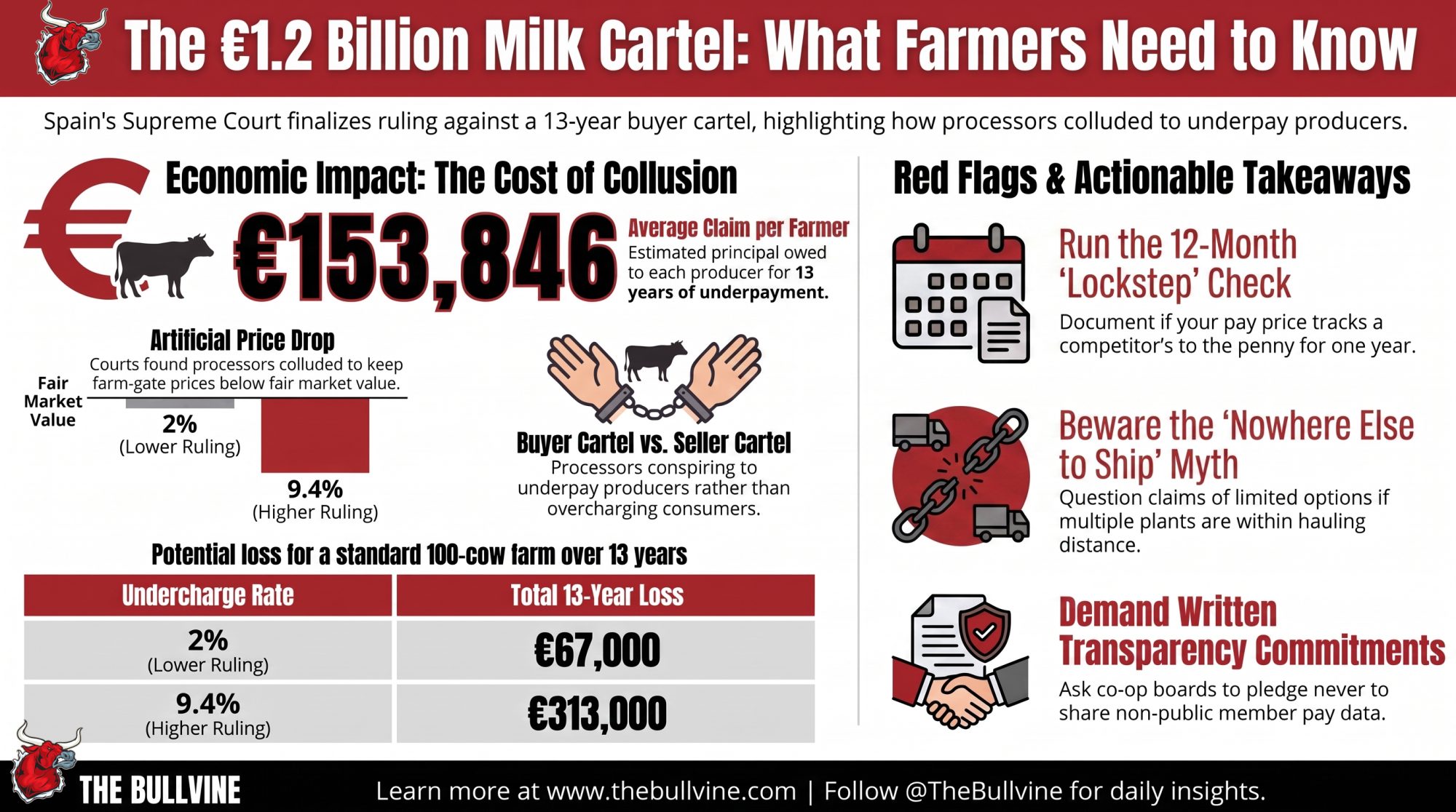
€11.7M was just the fine. The real number is €153,846 — the average claim per farmer now that Spain’s top court made the milk cartel final and unappealable. Here’s the barn math.
Executive Summary: Spain’s Tribunal Supremo just made the milk cartel a permanent, unappealable fact — ruling 808/2026 slammed the door on Lactalis’s last appeal on June 29, 2026, confirming a €11.7M fine and clearing the way for 7,800 farmers to pursue civil claims worth more than €1.2 billion. That pencils out to roughly €153,846 per farmer before interest, and it’s for the kind of cartel that gets ignored: buyers colluding to underpay producers between 2000 and 2013, not sellers gouging shoppers. Courts have already put the farm-gate undercharge somewhere between 2% and 9.4% — on an illustrative 100-cow farm shipping 800,000 liters, that’s a spread of about €67,000 to €313,000 in principal over 13 years, before a cent of compound interest. The cartel finding is now settled, so civil judges only decide how much and for whom, and a fresh five-year claims window is open. The obvious question for North American suppliers: could the same collusion-detection logic apply to your co-op check, given the $300M-plus Southeast settlements and last year’s $34.4M DFA/Select deal, which started paying farmers on June 2, 2026? None of those admitted liability — but the transparency terms they agreed to mean a supplier should ask what their own co-op shares are and with whom. If your milk price tracks a competitor’s price to the penny for 12 straight months, this story explains why that’s worth a second look.
Based on court records, regulatory filings, and settlements available as of July 2026.
In March, Galician farmers dumped 15,000 liters of milk in the street to protest what they get paid for it — the raw nerve of a fight that’s run for a generation. For nearly 15 years, those farmers said their milk cheques were rigged. Regulators finally proved them right — and as the Basque farmer union ENBA put it after the rulings landed, what they “denounced almost 15 years ago as illegal practices by the dairy industry has now been fully demonstrated.” Two dairy farms in Ávila already have court orders in hand telling Lactalis to pay up.
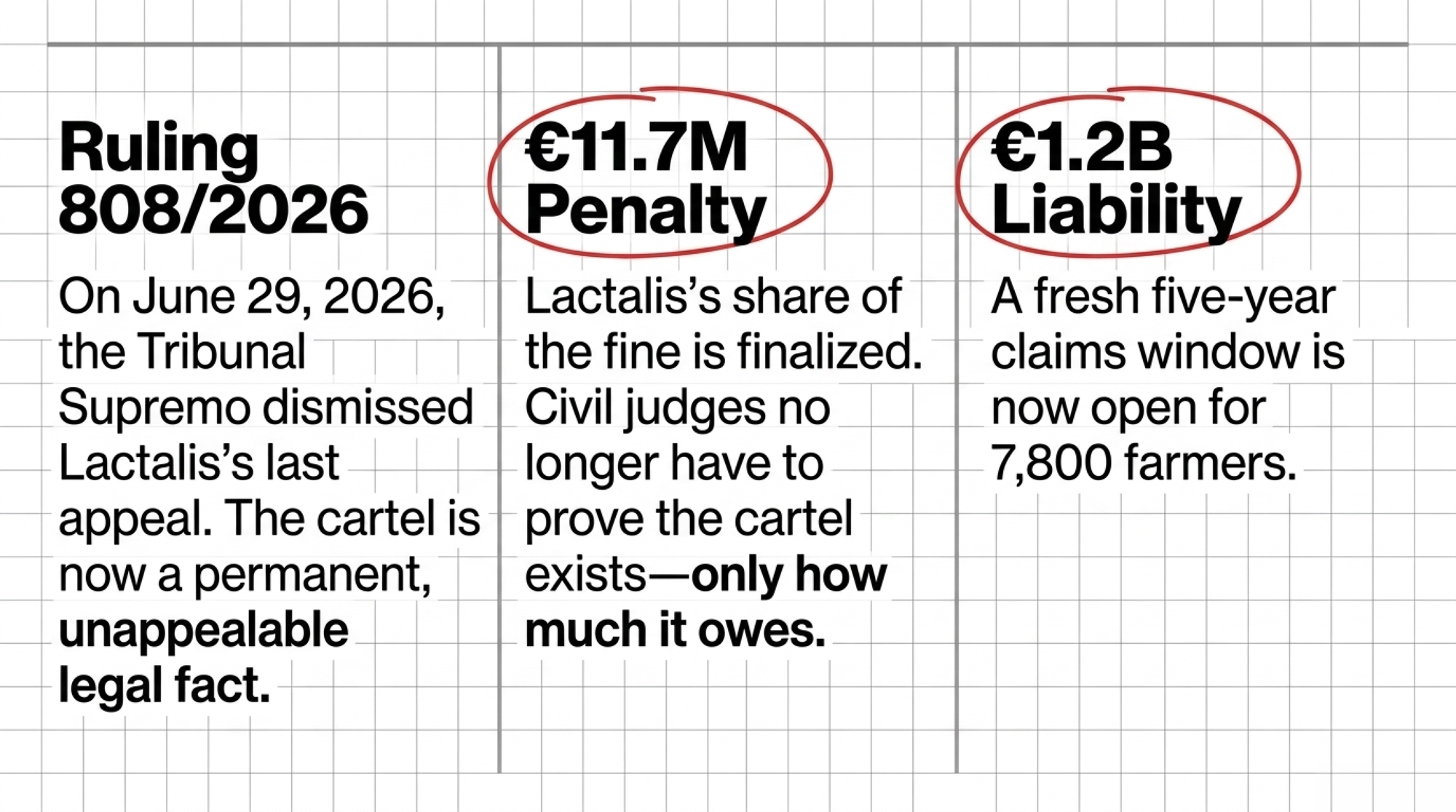
That’s not a grievance anymore. It’s a number. On June 29, 2026, Spain’s Tribunal Supremo issued ruling 808/2026, thereby making a milk price-fixing cartel a final, unappealable legal fact. The fine on Lactalis is €11.7M. The farmer claims that just got their green light run north of €1.2 billion.
What Did the Supreme Court Actually Decide?
The Contentious-Administrative Chamber dismissed Grupo Lactalis Iberia’s cassation appeal in full and confirmed both the CNMC’s July 11, 2019 sanction and the National Court’s February 12, 2024 judgment. Confilegal called the decision definitiva e inapelable — final and un-appealable. The facts about Lactalis’s role in the cartel are now settled and beyond challenge.
The Court only agreed to hear one narrow question: whether the CNMC had to spell out the exact fine in its draft resolution. It ruled no — defense rights don’t require that, as long as the criteria are explained. This means Lactalis’s attempt to challenge the process failed, and the core facts about the cartel — the collusion, the 13 years, the harm to farmers — are now beyond challenge in Spain.
Lactalis has floated a trip to the EU Court of Justice in Luxembourg. But that’s not a normal appeal, and it doesn’t reopen the Spanish facts. For the farmers, those facts are the whole ballgame.
The Cartel: Buyers, Not Sellers
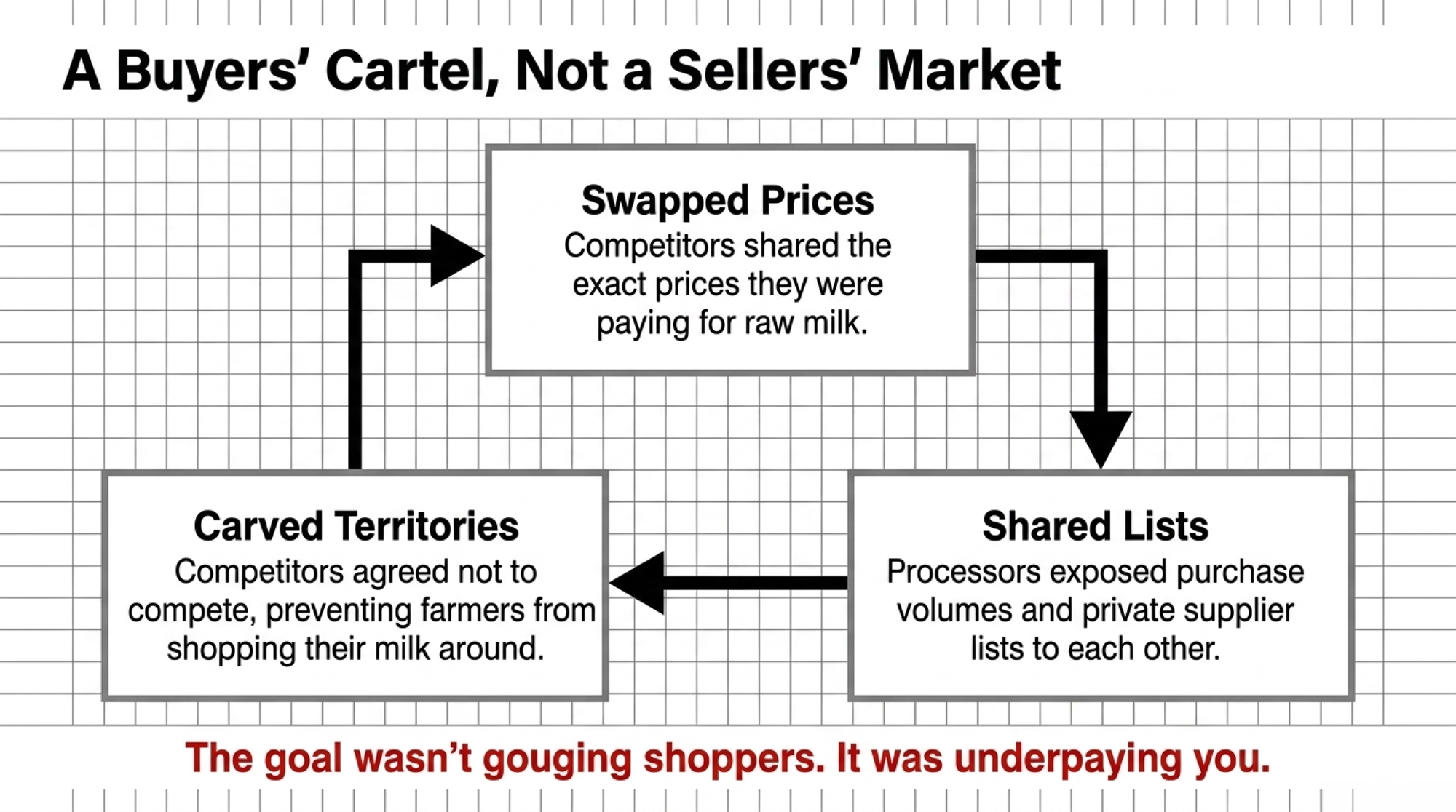
Here’s what makes this case different. This wasn’t companies conspiring to overcharge supermarkets. It was companies conspiring to underpay farmers — a buyers’ cartel.
The CNMC’s 2019 resolution, S/0425/12, laid out how it worked between 2000 and 2013. Companies swapped the prices they were paying for raw milk. They shared purchase volumes and supplier lists. They agreed on when to push prices down. And they carved up farmers between them so that a producer couldn’t shop his milk to a competitor.
David Fernández, CEO of the Madrid class-action firm Eskariam that’s led these claims, has described it as an illegal agreement among the big processors to buy raw milk cheaply — one that kept farmers from negotiating their own price.
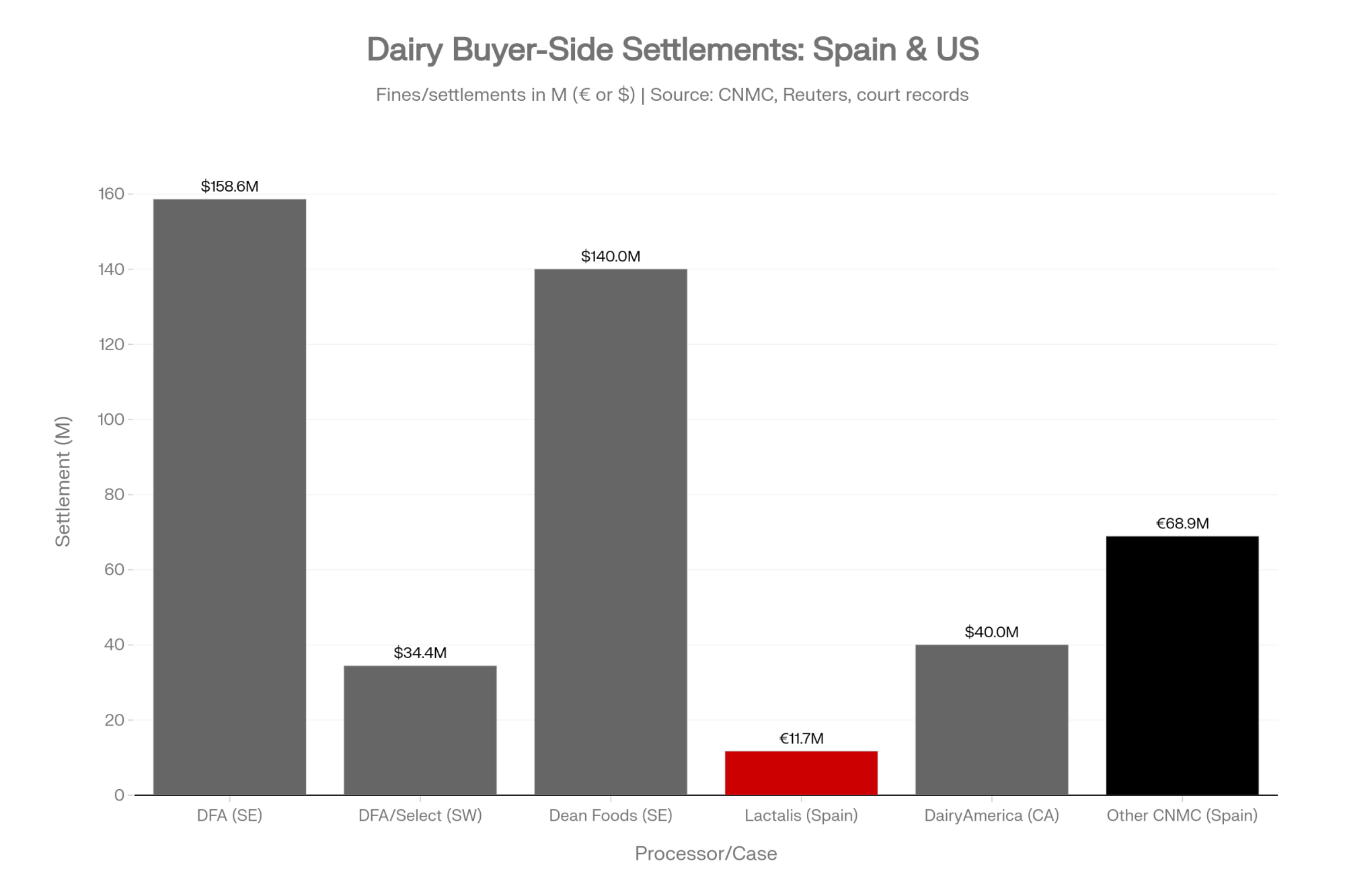
The names on the CNMC’s list aren’t small. Danone. Nestlé España. Calidad Pascual. CAPSA/Central Lechera Asturiana. Puleva. Schreiber. Celega. Two industry associations. And Grupo Lactalis Iberia. Total fines: €80.6M. Lactalis’s share: €11.7M. Keep one thing straight, though: Lactalis’s liability is now final, while appeals by other sanctioned firms are still working through the courts — for them, this remains a sanction under challenge, not a closed book.
How Much Did It Cost a Farm?
CNMC didn’t just yell “cartel” and walk off. It put a number on the damage: an artificial price decrease of more than 10%, and it said each farmer could claim at least 10% of turnover during the cartel years plus interest.
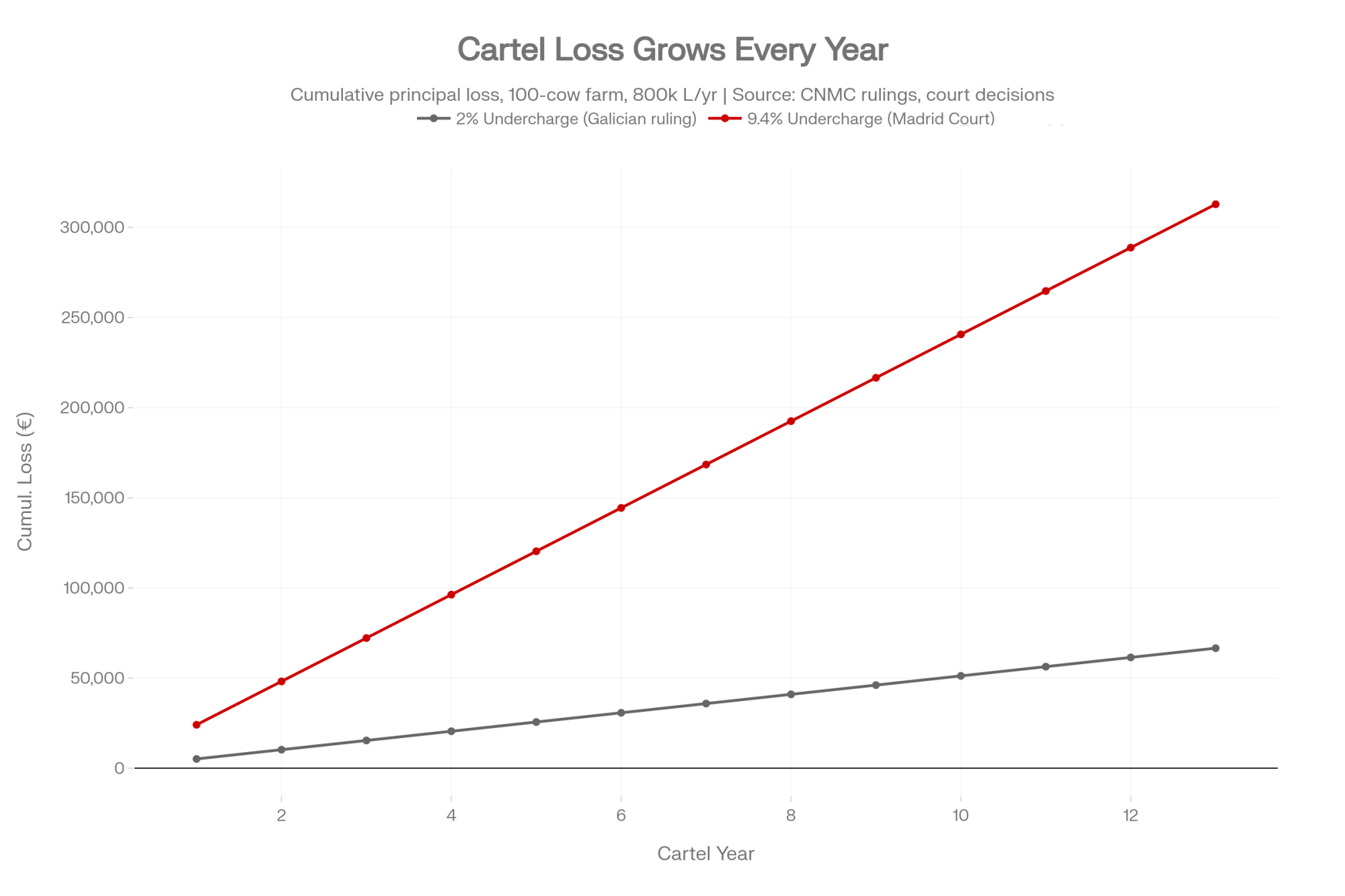
Then the courts started sharpening it — and they haven’t settled on a single figure. Two rulings have set very different underprice marks, and your claim size swings hard depending on which one a court applies:
| Court / ruling | Undercharge applied | Interest | Loss on the illustrative 100-cow farm* |
| Madrid Commercial Court No. 14 (Oct 16, 2025) | 9.4% | Compound, from harm date | ~€24,064/yr → ~€313,000 over 13 yrs |
| Galician ruling | ~2% | Per ruling | ~€5,120/yr → ~€67,000 over 13 yrs |
*Illustration only — a 100-cow Galician-style farm shipping 800,000 liters a year at roughly €0.32/L (about €256,000 in annual milk revenue). During the cartel period, Spanish and EU farmgate prices generally ranged from €0.28 to €0.35/L.
| Factor | Madrid Commercial Court No. 14 | Galician Ruling |
|---|---|---|
| Undercharge rate applied | 9.4% | ~2% |
| Interest type | Compound (from harm date) | Per ruling terms |
| Annual loss — 100-cow farm, 800k L | ~€24,064 | ~€5,120 |
| 13-year principal | ~€313,000 | ~€67,000 |
| Est. with compound interest | €500,000+ | ~€80,000–90,000 |
| Status | Precedent-setting; basis for Eskariam floor | Lower bound; applied in some provincial courts |
| Key risk for farmers | May not be universally adopted by civil courts | Significantly undervalues the cartel harm |
So the principal alone ranges from roughly €67,000 to €313,000 over 13 years — before a cent of interest. Add compound interest from every underpaid cheque, and the top of that range climbs fast — potentially past €500,000 on the 9.4% path, depending on the rate a court applies.
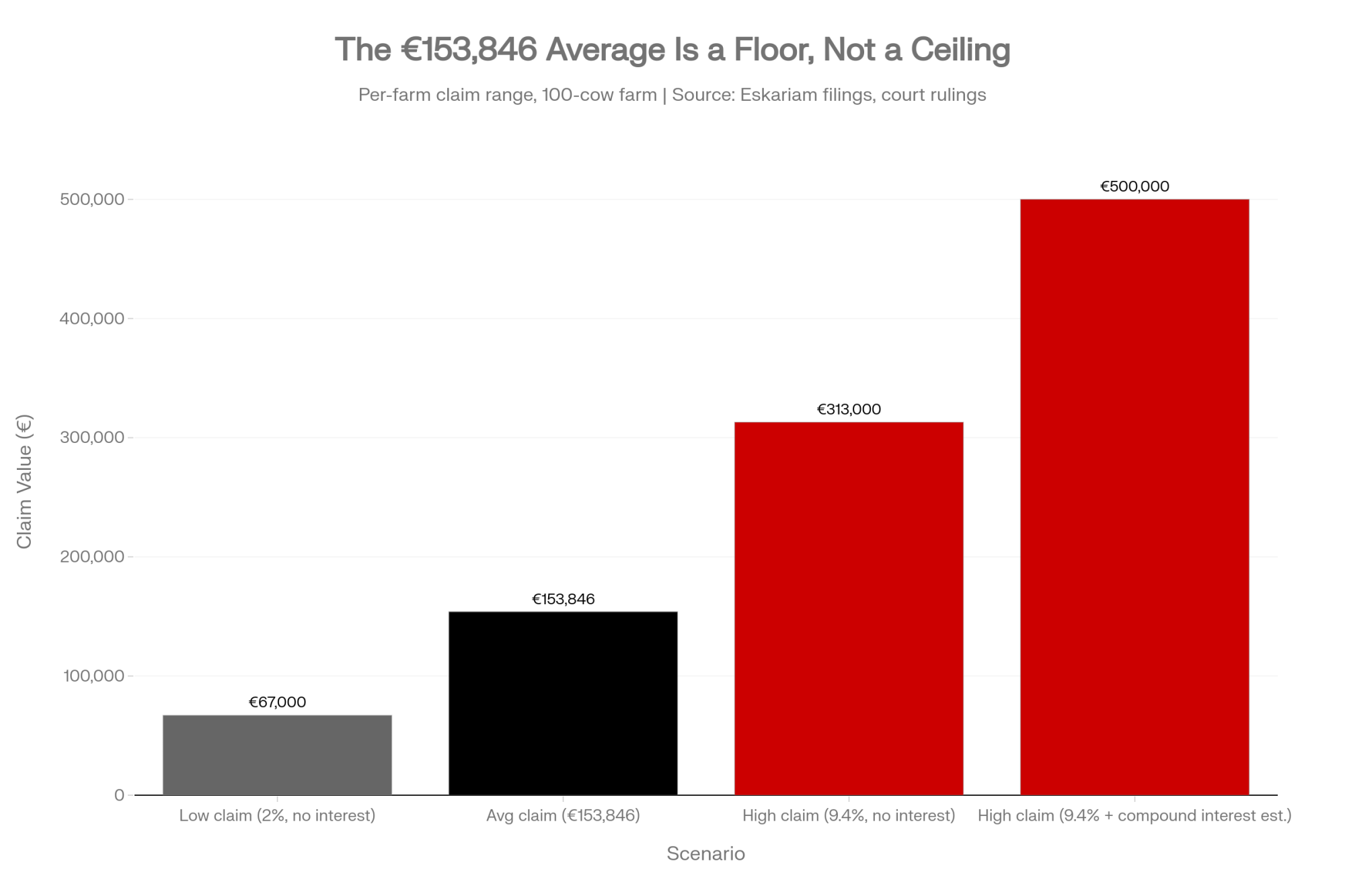
Two honest caveats. That €0.32/L is a period average for illustration — actual prices swung year-to-year. And which percentage sticks is still being fought farm by farm. This is barn math to show the size of the hole, not a cheque anyone’s cashed.
Does the €1.2 Billion Number Hold Up?
Divide Eskariam’s aggregate claim by its client count, and you get a blunt average: €1.2 billion ÷ 7,800 farmers ≈ €153,846 per farmer in principal, before interest. Individual amounts will vary with each farmer’s milk volume and how many of the 13 years they shipped.
Now the reconciliation, because at first glance the numbers seem too big. Run all 7,800 farmers at 800,000 liters × 13 full years × 9.4% × €0.32/L, and you’d clear €2 billion. So why is the claim “only” €1.2B? Because that back-of-the-envelope math assumes every farm was large and caught for the full stretch. Most weren’t — many are smaller, and plenty didn’t ship all 13 years. Some courts are also applying the lower 2% figure, which pulls the average down. The €1.2B reads as a disciplined floor for one firm’s cohort, not a ceiling — and an earlier estimate put the universe of affected farmers near 50,000, with sector-wide harm of €1 billion or more.
Why the Ruling Changes Everything for These Farmers
The Supreme Court didn’t discover the cartel. CNMC did that in 2019; the National Court confirmed it in 2024. What June 29 did was clear the last roadblocks between those findings and farmers’ bank accounts.
Three things flipped. The facts are now permanent for Lactalis — no relitigating. The statute-of-limitations clock, which under recent EU case law doesn’t start until the decision is final, gives farmers a fresh five-year window from here rather than a closed door. And civil judges no longer have to prove the cartel from scratch. They decide how much, and for whom.
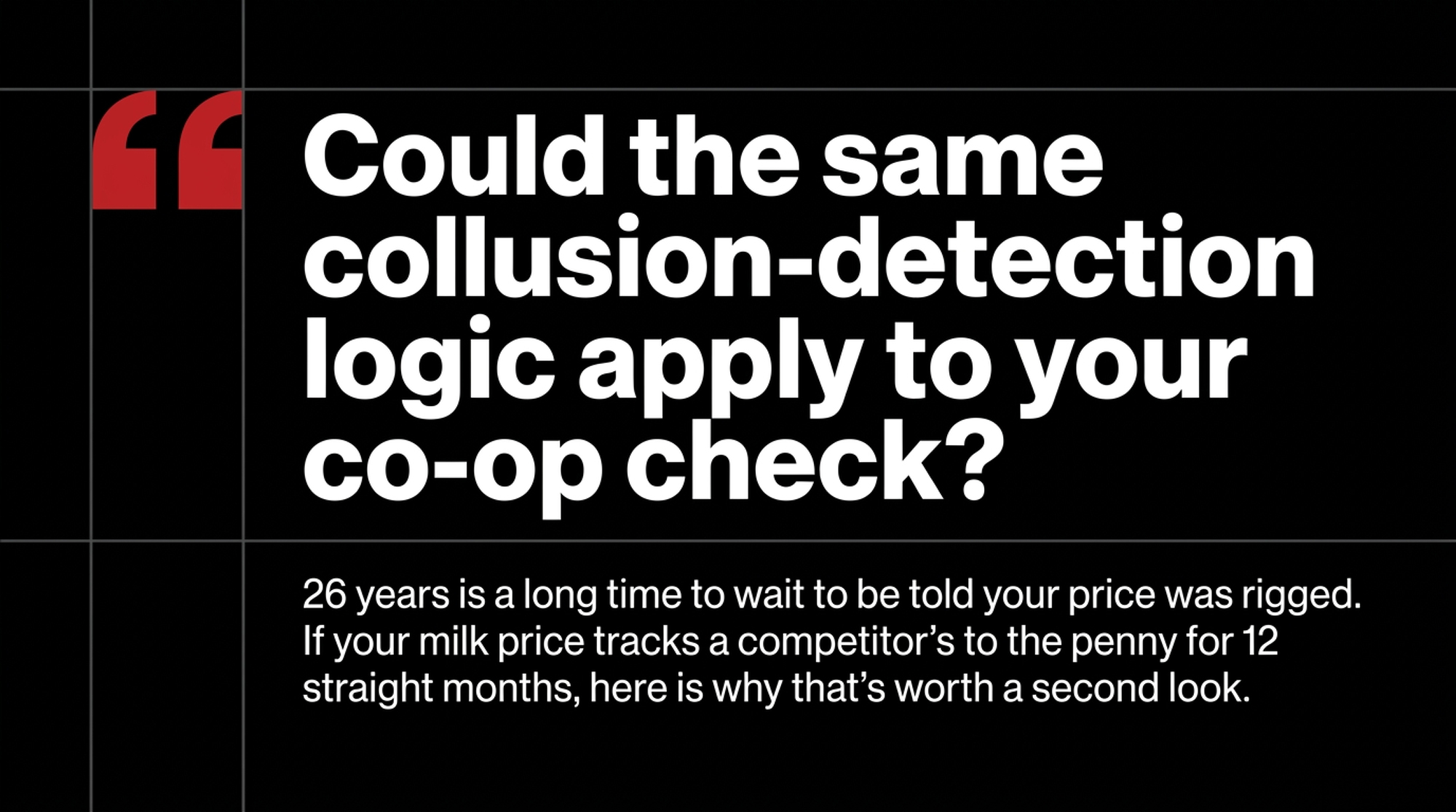
That’s 26 years from the cartel’s start in 2000 to this ruling in 2026. A long time to wait to be told your price was rigged.
Could the Same Thing Happen to Your Co-op Check?
Careful here — there’s no Spanish-style final ruling that any North American processor ran a 13-year buyer cartel, and nothing below should be read as saying one did. But the U.S. record isn’t exactly quiet.
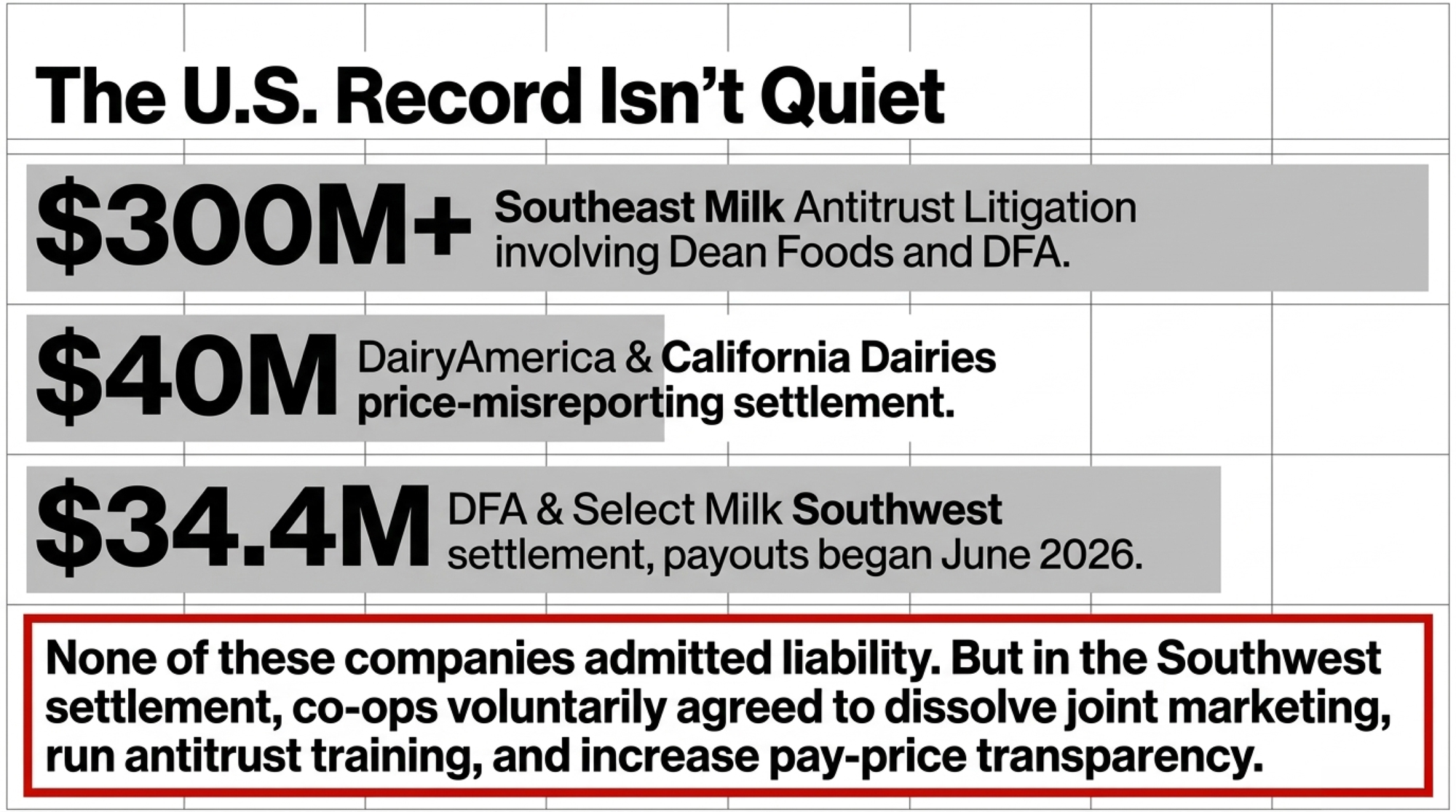
The Southeast Milk Antitrust Litigation alone brought the dairy farmers there more than $300 million — Dean Foods settled for $140M and DFA for $158.6M, both without admitting wrongdoing. In a separate case, DairyAmerica and California Dairies settled a nonfat-dry-milk price-misreporting suit for $40M, finally approved in 2019 for roughly 26,000 farmers; the companies denied wrongdoing, and the court made no finding of liability. And just last year, DFA and Select Milk settled a Southwest case covering Texas, New Mexico, Arizona, Oklahoma, and Kansas, in which farmers alleged the co-ops “stabilized and depressed” Grade A pay through shared pricing data — $34.4 million total, DFA $24.5M and Select $9.9M, agreed without admitting liability. That Southwest settlement received final court approval on December 8, 2025, and payouts to farmers began on June 2, 2026.
The detail worth your attention? As part of it, DFA and Select agreed to dissolve their joint marketing arm, run antitrust training, and give members better pay-price transparency. Both admitted no liability. But in our view, co-ops voluntarily agreeing to those terms is at least worth a supplier asking what their own co-op shares, and with whom. reuters
What Should a Supplier Actually Watch For?
Farmers in Spain didn’t get a memo. They saw symptoms, and regulators turned symptoms into findings. The same signals travel.
Watch for suspiciously identical prices across supposed competitors — multiple processors moving the same amount on the same schedule, all sitting below what the formula suggests. The bigger tell is an information-sharing structure like a joint venture that quietly becomes a pricing channel, the kind of arrangement farmers challenged in the DFA/Select case. Then there’s the oldest one in the book: being told there’s nowhere else to ship while two plants sit within hauling distance. That’s the soft version of Spain’s farmer-allocation game.
One more thing worth knowing. Capper-Volstead — the 1922 law giving U.S. agricultural co-ops a limited antitrust exemption to market their members’ milk collectively — does give co-ops real cover. But courts have said that cover doesn’t protect conduct aimed at suppressing what members get paid. That’s the exact line Spain spent 13 years crossing.
| Red Flag | How It Appeared in Spain | North American Parallel | Risk Level |
|---|---|---|---|
| Price lockstep | Multiple processors moved farm-gate price same amount, same date, 2000–2013 | Co-op pay price tracks competitor to the penny for 12+ months | 🔴 HIGH |
| Information sharing | Processors swapped purchase volumes & supplier lists via CNMC-documented exchanges | Joint marketing arms sharing non-public member pricing data (DFA/Select cited) | 🔴 HIGH |
| Farmer allocation | Producers told they couldn’t switch — cartel carved up supply catchment areas | Told “there’s nowhere else to ship” while 2+ plants sit within hauling distance | 🟡 MODERATE |
| Formula vs. actual gap | Farm-gate ran 2%–9.4% below competitive price for 13 years | Monthly pay below FMMO blend price with no published explanation | 🟡 MODERATE |
| Settlement terms | CNMC €80.6M total fines; Lactalis €11.7M confirmed final | DFA/Select $34.4M + transparency mandates, no liability admission | 🔴 NOTE |
| Transparency commitment | Post-ruling: civil judges mandate disclosure of pricing methodology | Post-settlement: DFA/Select agreed to member pay-price transparency | ✅ WATCH |
Options and Trade-Offs for Farmers
Run the 30-day check. Pull your last 12 months of pay statements and lay them side by side with the announced FMMO blend price. Flag any month your co-op moved in near-perfect lockstep with a competitor. This costs you an evening and tells you whether you’ve got a pattern worth watching. The limit: one month of alignment is noise, not evidence — you’re hunting a persistent trend, not a single coincidence.
Document before you escalate. If a 12-month pattern emerges, keep the records and talk to an antitrust attorney before speaking with anyone else. That makes sense when the gap is consistent and unexplained. The risk: pattern isn’t proof, and a lawyer will tell you fast whether you’ve got smoke or fire — which beats torching a processor relationship on a hunch.
Push your co-op on the data. Ask your board to commit, in writing, to never sharing non-public member pay prices with anyone who also buys your milk — the same kind of transparency term the DFA/Select settlement put in place. Works best with allies on the floor. The trade-off: it’s a governance fight, and you spend some goodwill to gain transparency.
The forward signal to watch: Spain’s other sanctioned firms still have appeals in play. If those fall the way Lactalis’s did, the €1.2B claim widens, and the precedent for buyer-side cartels hardens across the EU. That’s the case North American regulators will be reading.
Key Takeaways
- If your co-op’s monthly pay price tracks a competitor’s to the penny for 12 straight months, that’s a pattern to document — not a coincidence to shrug off.
- If a court in Spain can put the undercharge somewhere between 2% and 9.4%, assume your own gap versus the FMMO blend is knowable too — so measure it before you assume the market’s fair.
- If you’re told “there’s nowhere else to ship” while multiple plants sit within hauling range, treat that as a red flag worth a second opinion, not a fact.
- If you sit on a co-op board, a written pay-price-transparency commitment is cheap insurance — Spain shows what 13 years of the alternative costs.
So — Where Does Your Price Actually Sit?
Spanish farmers waited 26 years for a court to confirm what their gut told them in 2000. You don’t have to wait for a courtroom to check your own numbers this month. Pull the statements. Run the comparison. See if your price tells a clean story.
If you want the full model — the per-farm loss math, the 2%-vs-9.4% methodology fight, and how the FMMO blend comparison actually works on your herd size — that’s the deeper dive we’re building next, and it’ll land in Bullvine Weekly before Spain’s remaining appeals are decided.
Complete references and supporting documentation are available upon request by contacting the editorial team at editor@thebullvine.com.
Learn More
- DFA St. Albans closure: the hauling math farms inherit — Arms you with immediate stress-test steps to calculate an imminent $2.00 to $3.15/cwt hauling cost surge. This guide exposes the hidden pass-through liabilities buried inside national co-op contracts when local processing infrastructure goes dark.
- Fonterra Owners Found Out 2 Years Late. Your Co-op Bylaws Might Hide the Same Gap. — Reveals how opaque board governance and recent FMMO make-allowance revisions quietly drain up to $0.94/cwt from your mailbox price. It breaks down the structural financial risks of co-op litigation, linking directly to the $34.4 million Southwest settlement.
- June Dairy Month Turns 89 — and Farmers Now Keep Just 25¢ of Every Dairy Dollar — Delivers a concrete four-step formula to extract your true farm-value share against volatile retail pricing benchmarks. Dismantles downstream processing margins and mandatory checkoff structures, empowering producers to evaluate exactly why the supply chain traps their margin at 25%.
 The Sunday Read Dairy Professionals Don’t Skip.
 The Sunday Read Dairy Professionals Don’t Skip.
Every week, thousands of producers, breeders, and industry insiders open Bullvine Weekly for genetics insights, market shifts, and profit strategies they won’t find anywhere else. One email. Five minutes. Smarter decisions all week.




