








Forget keeping barns warm – smart dairies use winter’s cold for 5-10% better feed efficiency
EXECUTIVE SUMMARY: What farmers are discovering through hard-won experience and university research is that winter barn management has been backwards for decades – it’s moisture, not temperature, that drives production losses and respiratory issues. Cornell’s veterinary economics studies show respiratory treatments alone cost $50-100 per case, but when you factor in the hidden costs of poor ventilation – including 2-3% drops in feed efficiency and 20-30% increases in bedding expenses – a typical 100-cow operation can lose $15,000 per winter season. Recent findings from Michigan State, Penn State, and Wisconsin extension programs confirm that cattle thrive in cold conditions when kept dry, with many operations reporting their highest butterfat levels (0.2-0.3% increases) and best quality premiums during January and February. The shift in thinking is simple but profound: your mature Holstein generates enough heat through rumen fermentation to stay comfortable at 30°F in dry conditions, but struggles at 45°F with high humidity. Here’s what this means for your operation – those three critical maintenance tasks you can complete in an afternoon (checking fan belts, testing inlet controls, establishing humidity baselines) could transform winter from your most challenging season into your most profitable. Smart operators aren’t installing expensive heating systems; they’re spending $30 on humidity monitors and an hour adjusting curtain cables, then watching their milk checks improve while neighbors fight the same battles they’ve always fought.

Every fall, we face the same concern: keeping our barns warm for winter. But here’s the thing – what if temperature isn’t really the issue?
I’ve been talking with extension folks and examining what successful operations are doing, and a clear pattern is emerging. The dairies with the strongest winter production aren’t necessarily running the warmest barns. In fact, they’re often the ones who’ve completely rethought their approach, focusing on moisture control over temperature management. And the results? Some are seeing their best milk checks in January and February.

Your Cows Were Built for Cold – It’s the Conventional Thinking That’s Wrong
A mature Holstein generates a tremendous amount of body heat just through normal digestion and rumen fermentation – we’re talking serious BTUs here. You probably know this already, but cattle handle cold remarkably well when they’re dry and out of drafts. The old Midwest Plan Service guides, which many of us still reference, have been saying this for decades, and Michigan State’s latest winter housing bulletins confirm that it still holds true.
What’s interesting is how differently this plays out across regions. I know a 300-cow operation in northern Wisconsin that maintains solid production at temperatures that would have their counterparts in Georgia calling the vet. Meanwhile, some Northeast producers struggle more with winter ventilation despite having milder temperatures overall.
Why’s that? In many cases, it comes down to effective humidity management. The moisture in your barn – not the cold – tends to be what causes most winter headaches. And here’s where it gets expensive…
The Hidden Economics Nobody Talks About
Poor winter ventilation often costs more than just treating respiratory issues – though, according to Cornell’s veterinary economic studies, those alone can run $50-$ 100 per case.
When humidity climbs in your barn, you typically get condensation. That moisture creates ideal conditions for bacteria to grow. Maybe your cows don’t become sick enough to need treatment, but their feed efficiency may drop by 2-3%. On a 100-cow dairy feeding $8-10 per cow per day, that seemingly small percentage adds up to thousands over a winter. Equipment tends to corrode faster. Bedding stays damp longer, increasing your bedding costs by 20-30% in some cases.
I spoke with a producer last month who discovered that his poor ventilation was costing him nearly $15,000 a winter when he added everything up. “I was so focused on keeping the barn warm,” he told me, “I didn’t realize I was basically burning money.”
Understanding the Temperature Transition Point

Based on what ventilation engineers and extension specialists from Penn State and Wisconsin have documented, there’s typically a temperature range – often somewhere between freezing and 45 degrees Fahrenheit – where the physics of air movement in your barn fundamentally changes.
Above that range, natural ventilation usually works pretty well. You get decent wind-driven airflow, and temperature differences help move air naturally. But once you drop below that range, thermal buoyancy becomes your primary driver, and if you’re not ready for that shift…
The general guidelines that seem to work for many operations:
- Above 45°F: Your summer ventilation approach typically works
- 35-45°F: Reduce total airflow but maintain moisture removal
- Below freezing: Focus on minimum ventilation rates – just enough to control moisture
- Below 20°F: Every excess CFM is costing you valuable heat
Of course, every barn’s different. Your neighbor’s setup might need completely different adjustments.
Three Things That Actually Matter (And One That Doesn’t)
Look, everyone’s got their own system, but from what I’ve seen work consistently well – and what extension educators keep emphasizing – there are really three main areas that tend to matter before winter hits.
Getting Your Fans to Actually Work
This sounds basic, I know. But, according to agricultural engineering studies from Iowa State, fans that aren’t properly maintained can lose 30-40% of their efficiency due to loose belts and dirty blades.
Check your belt tension – many manufacturers suggest about a half-inch of play when you press on them. Takes maybe an hour to go through all your fans if you’re organized. And while you’re at it, clean those blades. I’ve seen operations improve their airflow by 25% simply by cleaning – no new equipment is needed.
Making Sure You Can Control Your Inlets
Whether you’ve got curtains, panels, or another setup, they need to work smoothly through their full range. I’ve heard too many December disaster stories about controllers failing or curtains freezing halfway.
Before it gets cold, run everything through its paces. A 200-cow dairy I work with in Vermont figured out three of their actuators were barely functioning during their October check. Fixed them for $300. If they’d waited until December? Could’ve been looking at thousands in emergency repairs and lost production.
Here’s another success story: A producer near Ithaca told me he spent a Saturday morning going through every curtain controller and actuator. Found two that were sluggish, one cable fraying, and a controller that wasn’t reading temps correctly. The total fix cost him about $450 and took four hours. “Best money I spent all year,” he said. “Previous winter I lost $8,000 in one week when a curtain froze open during a blizzard.”
Knowing Your Normal (And Actually Tracking It)
This might sound too simple, but it’s often the difference between catching problems early and dealing with disasters. Your local extension office likely has simple humidity monitors available for under $30 – some newer models, such as those from companies like SensorPush or Govee, even connect directly to your smartphone.
What’s the humidity like when things are working well? Most operations perform best with winter humidity levels between 50-70%, according to University of Minnesota Extension guidelines. Where do you first notice condensation? How do your cows behave differently? Some producers keep notes, others use apps. Either way works.
What Doesn’t Matter? Keeping It “Warm Enough”
Here’s the controversial bit: that obsession with keeping barns warm? It’s probably costing you money. Your cows’ thermoneutral zone ranges from about 25°F to 65°F. They’re more comfortable at 30°F and dry than at 45°F and damp.
The Warm Spell Trap
Here’s something we see every winter across the Midwest and Northeast. You experience the January or February warm spell, where temperatures jump 30-40 degrees for a few days. Suddenly, it’s 45 degrees, ice is melting, and everyone relaxes.
But materials expand at different rates. Ice melts in unexpected patterns. Your ventilation settings are all wrong. Then, temperatures crash back down, and you have moisture frozen in new places. I’ve seen this cause thousands of dollars in damage – including ice dams in ventilation systems, frozen curtains, and failed equipment.
The key? Stay vigilant during warm spells. That’s actually when most winter damage occurs, not during the steady cold. Check out the barn structure damage photos on Penn State’s extension site if you want to see what I’m talking about – it’s eye-opening.
Regional Approaches That Actually Work
| Region | Challenge | CFM Range | Solution | Success Metric |
| Upper Midwest | Extreme cold/dry air | 15-50 | Heat recovery ventilators | Energy savings |
| Northeast | High humidity year-round | 20-30% above standard | Enhanced moisture removal | Moisture control |
| Western (ID/WA) | Daily temp swings | Variable based on time | Automated systems | Quick adjust |
| CA Central | Tule fog 90%+ humidity | Positive pressure | Hybrid approaches | Fog mitigation |
Upper Midwest operations generally deal with extreme cold but dry air. The challenge is maintaining sufficient ventilation (often 15-50 CFM per cow, according to the Wisconsin Extension) without losing heat. Some folks are having good luck with newer heat recovery ventilators – although at $5,000 to $ 10,000 installed, the economics need to be penciled out.
Northeast dairies face higher humidity year-round. Cornell’s PRO-DAIRY program finds they often need 20-30% more ventilation than Midwest recommendations. It’s all about moisture removal, even if it costs some heat.
Western operations in Idaho and Eastern Washington see massive daily temperature swings. Washington State University extension reports that automated systems that can adjust quickly are almost essential there.
California’s Central Valley experiences tule fog, which can maintain humidity levels above 90% for days. UC Davis research shows many have switched to positive pressure or hybrid systems to maintain air quality regardless of outside conditions.
Small Changes, Big Payoffs

What’s encouraging is that dramatic improvements don’t require huge investments. A modest increase in minimum ventilation – maybe from 15 to 25 CFM per cow – often solves moisture problems without causing temperature issues.
Ensuring curtains open evenly can significantly transform airflow patterns. One Illinois producer told me his condensation problems disappeared after spending two hours adjusting curtain cables for even operation. Cost? His time and maybe $20 in hardware.
And here’s something new: several producers are using those $50-100 wireless humidity sensors that alert your phone when conditions get problematic. Pays for itself if it prevents even one respiratory case. The University of Wisconsin offers a great online ventilation calculator that helps you determine your ideal CFM rates – worth checking out. You can also find visual guides for proper belt tension and inlet adjustment patterns on most extension websites now.
Making Winter Your Competitive Advantage
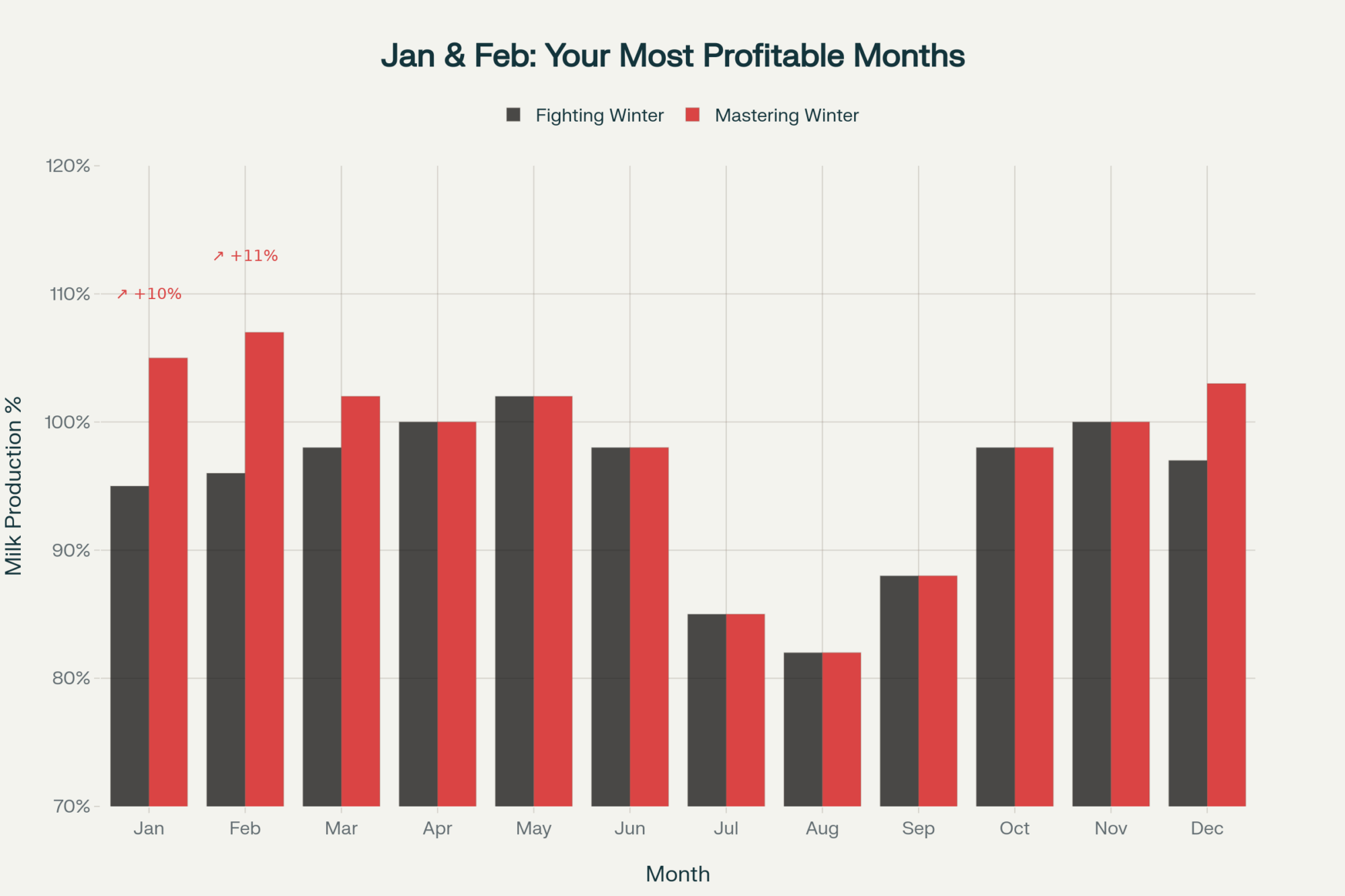
Many operations actually experience their best production in January and February, when heat stress is alleviated. Your cows are built for cold weather – that rumen is essentially a 100-gallon fermentation heater running 24/7.
A well-managed winter barn often sees 5-10% better feed efficiency than summer, higher butterfat (often 0.2-0.3% higher), and lower SCC. Some people report that their best milk quality premiums come in the winter months.
The fundamentals haven’t changed, but our understanding has. Focus on moisture, not temperature. Maintain equipment properly. Stay flexible as conditions change. Your local extension service has resources tailored to your region – use them.
Your Action Plan Starting Now
So where does this leave you? Here’s what actually needs doing:
This week: Check every fan belt and clean blades. Test all inlet controls. Order spare belts now – suppliers are expected to run out by December.
Before first freeze: Know your baseline humidity. Set up monitoring (even just a simple thermometer/hygrometer). Have your warm spell protocol ready.
All winter: Adjust based on conditions, not the calendar. Watch for that warm spell trap. Keep checking those belts – thermal cycling loosens them.
Winter’s coming whether we’re ready or not. But with the right approach – challenging that “keep it warm” mentality and focusing on what actually matters – it can be your most profitable season.
Where are you at with prep? Still thinking about it, or already getting things dialed in? Either way, there’s time to make those small adjustments that can mean the difference between fighting winter and profiting from it. Your cows are ready. Question is, are you?
KEY TAKEAWAYS
- Winter production gains are real and achievable: Operations maintaining 50-70% humidity (not temperature) report 5-10% better feed efficiency, 0.2-0.3% higher butterfat, and lower SCC – turning January and February into their most profitable months instead of their most expensive
- The $300 fix beats the $15,000 loss: Simple October maintenance – checking belt tension (half-inch deflection), cleaning fan blades (25% airflow improvement), and testing inlet controls – prevents the cascade of winter problems that cost thousands in treatments, lost production, and emergency repairs
- Regional adaptations matter but principles don’t change: Whether you’re dealing with Minnesota’s dry cold (15-50 CFM per cow minimum), Northeast humidity (20-30% more ventilation needed), or California’s tule fog (90%+ humidity for days), the focus stays on moisture removal, not heat retention
- Technology helps but basics still win: While $50-100 wireless humidity sensors and smartphone apps add convenience, the fundamentals – knowing your barn’s normal humidity baseline, adjusting for warm spell traps, maintaining consistent airflow – determine whether you profit from winter or fight it
- Your cows are telling you what they need: That 100-gallon rumen fermentation system makes them comfortable at 25-65°F when dry, so stop burning money trying to keep barns warm at 45°F while moisture creates the perfect storm for respiratory issues, equipment corrosion, and production losses
Complete references and supporting documentation are available upon request by contacting the editorial team at editor@thebullvine.com.
Learn More:
- Unlocking Cow Comfort: The Hidden Driver of Milk Production in 2025 – This article reveals how improving cow comfort, particularly lying time, is a powerful and controllable way to boost production. It provides specific metrics and shows how small adjustments to bedding and stocking density translate directly into thousands of dollars in your bulk tank.
- Why Your Milk Check Math Doesn’t Work Anymore (And 5 Ways Dairy Farmers Are Fighting Back) – Go beyond the barn with this strategic analysis. It explains the major economic forces reshaping the industry and provides strategies for fighting back with efficiency, technology, and strategic shifts that can protect margins even when commodity prices drop.
- Simple LED Lighting Can Boost Production 8% – Here’s Why Most Farms Haven’t Switched – Discover how a single, affordable technology can significantly impact your herd’s performance. This piece provides a clear framework for how to assess your current lighting and adopt a proven solution that uses photoperiod to boost production with a quick ROI.
 The Sunday Read Dairy Professionals Don’t Skip.
 The Sunday Read Dairy Professionals Don’t Skip.
Every week, thousands of producers, breeders, and industry insiders open Bullvine Weekly for genetics insights, market shifts, and profit strategies they won’t find anywhere else. One email. Five minutes. Smarter decisions all week.




