




84% of beef semen goes to dairy farms now. However, the extension agent requires still requires 6 months of planning first. Wonder why?
Look, I don’t know about you, but I’m tired of watching this happen…
Was at the sale barn last week, and I’m watching these beef-dairy crosses roll through.
Fourteen hundred. Thirteen fifty.
Hell, saw one nice Angus-cross heifer calf bring fifteen seventy-five.
Meanwhile, straight Holstein bulls? One ninety. Two ten if the buyers are feeling generous.
So here’s what’s eating at me…
USDA’s market reports from October 15th—they put these out every Tuesday from their Agricultural Marketing Service—are showing this same pattern across every Midwest auction. Beef crosses pulling twelve to fourteen hundred. Holstein bulls are barely breaking two hundred.
Seven times the money. Same barn. Same buyers. Different semen.
And the crazy part?
The difference between farmers banking fourteen hundred and farmers stuck at two hundred isn’t what you’d think. It’s not education or fancy genetics or herd size. Hell, it’s not even having a computer.
It’s whether they actually started or whether they’re still planning to start.
The Thing Extension Won’t Say Out Loud
You know what kills me about these beef-on-dairy workshops?
Every. Single. One. Same script.
Genomic testing first. Build your breeding hierarchy. Optimize your genetic selection matrix. Plan, plan, plan.
But here’s what the research actually shows—and I’m talking about real peer-reviewed stuff in the Agricultural Systems journal from March 2024, not marketing fluff—farmers who just jump in, who start immediately with their obvious cull cows? They’ve got way better sustained adoption rates than the ones sitting through six months of planning meetings.
I mean… think about it.
Guy I know near Fond du Lac—runs about 280 head, old tie-stall barn, been struggling with these milk prices—started breeding his worst cows to beef eighteen months ago—no genomic testing. No consultant. Just picked the obvious culls and started.
Banked an extra $68,000 last year.
Meanwhile, his neighbor’s still “developing a comprehensive strategy” with some consultant from Madison.
The behavioral economics research on this stuff is fascinating. They call it “implementation intention gap.” Basically, the longer you wait between deciding to do something and actually doing it, the less likely you are to ever do it.
And what’s extension pushing? Six months of planning before you breed your first cow.
Meanwhile—get this—NAAB’s 2024 annual report shows beef semen sales to dairy operations hit 7.9 million units. That’s eighty-four percent of all beef semen going to dairy farms.
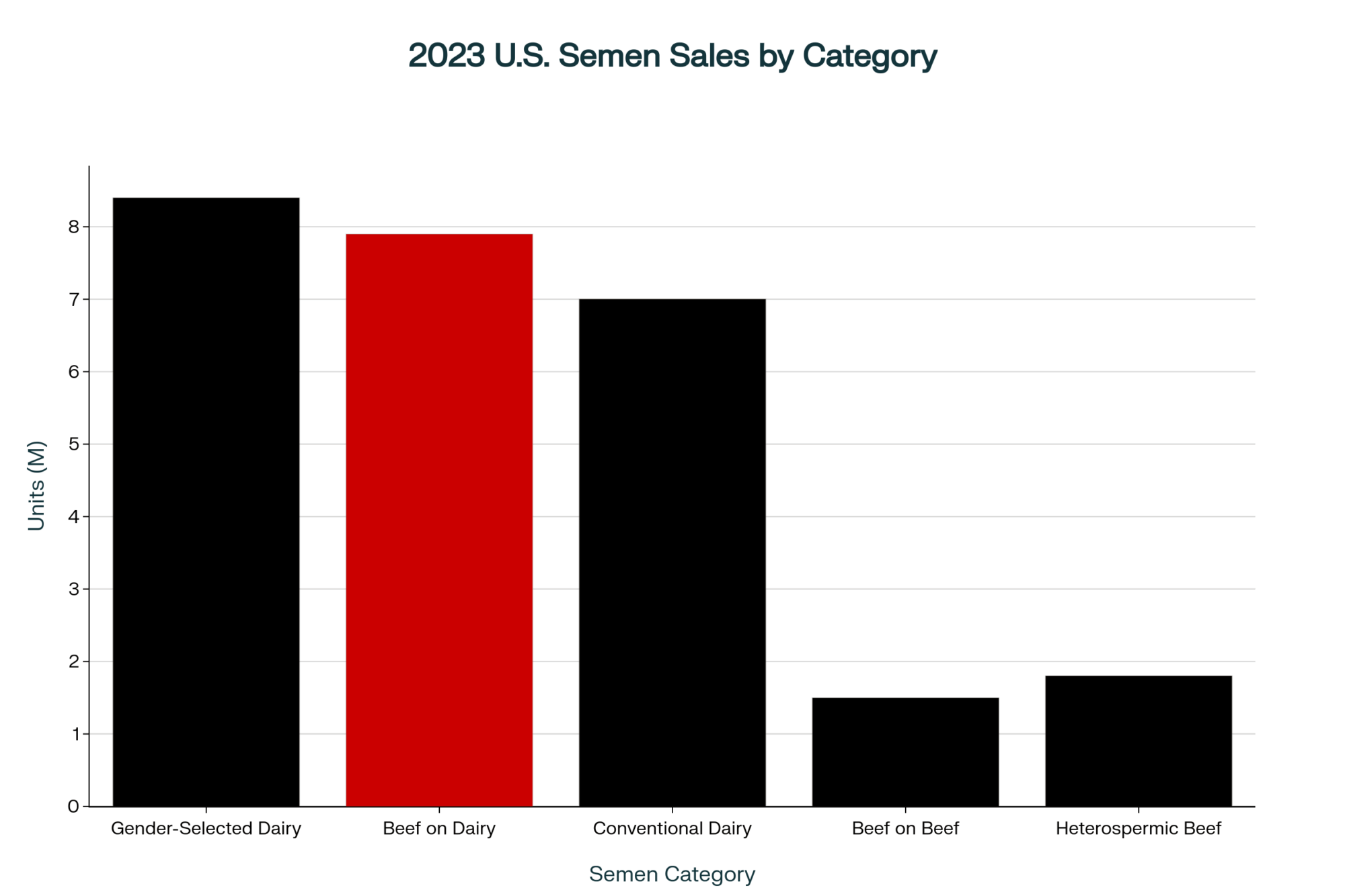
Most of those operations? They didn’t have comprehensive plans. They just… started.
What Nobody Talks About at The Co-op Meeting
Alright, so consultants.
I’ve been asking around about what these beef-on-dairy implementation consultants are actually charging. And… Jesus.
Industry pricing runs anywhere from five hundred to eight hundred just for the initial farm visit. Then they want genomic testing on everything—that’s forty bucks a cow plus coordination fees. Then monthly check-ins, implementation support, all that jazz.

For a hundred-cow operation? You’re easily looking at six, seven thousand dollars.
Before you’ve bred a single cow.
Seven grand!
And for what? The actual difference—I mean the actual, physical difference—is using twenty-five-dollar beef semen instead of dairy semen. That’s it. That’s the whole “technology” we’re talking about here.
You know what else seven grand buys?
- About 600 round bales at current prices
- Winter feed for forty cows
- A decent used TMR mixer
- Half a year’s worth of sawdust bedding
But somehow, we’ve built this whole consulting industrial complex around what amounts to ordering different straws from your Select Sires guy.
Who’s Actually at The Sale Barn These Days
Here’s something I’ve been noticing…
And this is especially bad now with corn harvest wrapping up and guys trying to get winter rye in before it freezes…
Have you ever really look around at who’s still showing up to the weekly auctions? I mean, really look?
It’s maybe thirty, forty percent of the dairy farms that used to come. Maybe.
The rest? They’re not there. And it’s not because they don’t care about calf prices.
They can’t get away from the farm. Simple as that.
The research on farmer stress—there’s good stuff from those 2023 Canadian parliamentary hearings on farmer mental health—basically confirms what we all know but don’t talk about. When farms get in real trouble, farmers withdraw. Stop going to auctions. Stop attending meetings.
They’re home, trying to keep the wheels from falling off.
And where’s extension holding their beef-on-dairy workshops?
The Holiday Inn conference room. Tuesday at ten. Right during morning milking.
I actually saw some research in the Journal of Extension from their April 2024 issue about how extension professionals get evaluated. You know what matters for their performance reviews?
Workshop attendance. Satisfaction scores from participants.
Not whether anyone actually implements anything. Not whether farmers make money.
Just… did people show up and were they happy.
What Your Banker Sees That Your Extension Agent Doesn’t
This is where it gets interesting…
Agricultural lenders—and I’m talking about the ones who actually work with dairy, not the kid fresh out of college who thinks TMR is a texting abbreviation—they see this completely different.
When you’re sitting across from your banker trying to restructure debt, drowning basically, they’re looking at cash flow.
And the math is simple. Brutally simple.
Fifty Holstein bull calves at two hundred bucks? That’s ten thousand dollars.
Those same fifty calves as beef crosses—based on current USDA pricing—that’s sixty, seventy thousand.
Fifty to sixty thousand in additional revenue. No capital investment. No new facilities. No extra labor.
Just different breeding decisions.
Had an ag lender tell me—off the record—”We see higher beef-on-dairy implementation rates when farmers are desperate than when they’re comfortable. Crisis clarifies priorities.”
And here’s what’s wild…
Behavioral economics research published in Agricultural Systems shows that these crisis-moment interventions? Where are you’re desperate and need something that works right now? Way higher implementation rates than educational workshops when times are good.
Because when you’re drowning, you grab the life preserver. You don’t sign up for swimming lessons.
Red Flags Your Consultant’s Full of Crap
After watching this industry for twenty-something years, here’s what I’ve learned to watch for:
They want comprehensive testing before anything
Genomic testing is cool. Science-y. Makes you feel sophisticated.
But research on how farmers actually make decisions—they call it “satisficing strategies”—shows we identify our cull cows pretty damn accurately just by looking at them.
That three-teater in pen four? The one that’s been open since last Christmas? The chronic mastitis case that’s cost you two grand in treatment this year?
You really need a DNA test to know she should get bred to beef?
Equipment before you have calves
Had a guy tell me last week his consultant wanted him to install twelve thousand dollars in calf monitoring sensors.
Before his first beef calf was even born. Twelve grand!
Meanwhile, university research from Wisconsin, Minnesota, and Cornell shows that proper colostrum management—four quarts in two hours—and actually checking your calves twice a day prevents most mortality.
That’s a thirty-dollar Brix refractometer and paying attention. Not twelve thousand in sensors.
National averages instead of neighbor results
“The industry average ROI is four hundred percent!”
Great. But what about Tom down the road with the same size herd as me? What about operations in my milk shed, dealing with Lake Michigan effect snow, and my feed costs?
Some massive operation in Texas getting four hundred percent ROI doesn’t help me make decisions for my tie-stall barn in Wisconsin when it’s twenty below, the waterers are frozen, and I’m feeding $280 hay because drought killed our second cutting.
The Planning Trap Nobody Calculates
So here’s the thing about all this planning…
Research on implementation—behavioral economists love studying this stuff—shows that in agriculture, the gap between deciding to do something and actually doing it is enormous.
And every week you delay? The probability of ever starting drops.
Think about the math here.
Every month you’re sitting in planning meetings, reviewing genomic reports, optimizing breeding strategies… that’s a month you’re not generating that extra twelve hundred per calf.
Ten calves a month? That’s twelve thousand in lost opportunity.
But we don’t calculate opportunity cost. We’re too busy calculating theoretical genetic improvement metrics that don’t mean much when you’re getting two hundred for bull calves and your milk check barely covers feed costs.
Why Time’s Running Out on This
And this is what really gets me…
The big ag finance outfits—Rabobank’s Q3 2024 report just came out on October 10th, CoBank released theirs on October 8th—they’re all documenting the same trend.
Processor consolidation in the beef-dairy supply chain is accelerating. Fast.
The major packers—Tyson, JBS, Cargill—want predictable supply from operations they can depend on. Which means what?
Exclusive contracts with big operations. Multi-year deals. Guaranteed premiums for guaranteed volume.
Meanwhile, small and mid-size farms are still “developing comprehensive implementation strategies.”
Industry source at one of the big three packers told me last month: “By the end of 2026, we expect seventy percent of beef-dairy supply under contract. The spot market will be whatever’s left.”
Another processor—different company, same message—said they’re already turning away small suppliers. “We need consistent weekly volume. Can’t build a supply chain on guys bringing five calves one week, none the next.”
By the time you’re ready with your perfect genomic plan? The contracts are gone.
You’ll be selling at auction—taking whatever you can get—while the five-thousand-cow dairy down the highway has a three-year exclusive at fourteen fifty a head.
What Actually Works (And It’s Stupidly Simple)
Look, here’s what I’m seeing actually work. And I mean actually work, not theoretically work.
Producers just… start. Small. Messy. But immediately.
They pick their obvious culls—we all have them—and breed them to beef. No genomic testing. No consultant. Just twenty-five-dollar straws of Angus or SimAngus or whatever your AI guy has in the tank.
Three weeks later at preg check?
If things are settling normally—and beef semen settles the same as dairy—they breed a few more. Then a few more. Scale based on what’s actually happening, not what some spreadsheet says should happen.
Universities Want Millions While the Answer Costs Twenty-Five Bucks
You know what really burns me?
Every land-grant university in the Midwest is after state funding for new facilities. Millions of dollars.
Wisconsin wants new research barns—sixteen million in their latest budget request. Michigan’s building some temple to dairy science. Minnesota’s got plans for… I don’t even know what.
Meanwhile, beef-on-dairy implementation is literally just using different semen. Twenty-five, thirty bucks a straw.
The money they’re asking for? Could buy enough beef semen to convert every Holstein bull calf in their state for the next decade. Every. Single. One.
But that doesn’t generate research grants. Doesn’t justify graduate programs. Doesn’t get anyone tenure.
So instead, we get million-dollar facilities to study something that basically amounts to ordering different semen.
Here’s Your Bottom Line
Look, I’ve watched enough “revolutions” in this industry to know most are garbage.
Remember when everybody was gonna get rich on organic? Or when robots were gonna solve all our labor problems?
But this beef-on-dairy thing? The math actually works.
USDA market reports prove it every week. Seven times the revenue for the same calf. Same feed. Same labor. Same facilities.
Just different genetics.
The problem isn’t the concept. It’s the planning-consulting-optimization industrial complex we’ve built around something that should be dead simple.
THE STUPIDLY SIMPLE ACTION PLAN

TODAY (Right Now):
→ Call your AI tech
Tell them to bring beef semen on their next visit
TOMORROW (Next AI Visit):
→ Pick your six worst cows
- That chronic mastitis case
- The one that’s been open 200+ days
- The three-teater
- You know which ones
→ Breed them to beef
Cost: $150 in semen (that’s it)
THREE WEEKS LATER (Preg Check):
→ If 4-5 settled, breed 15 more
Cost: Another $450
SIX WEEKS OUT:
→ Scale to 30-40 head if working
Still no genomic testing needed
SEVEN MONTHS:
→ First calves born
NOW you can think about optimization—but you’re already banking $1,400 instead of $200
No consultants. No genomic testing. No seven-thousand-dollar planning process.
Just different semen in the same cows you’re breeding anyway.
Because while you’re sitting through another workshop on genomic optimization matrices, your neighbor’s already twelve months into this. Banking fourteen hundred per calf. Every month.
And that neighbor?
They don’t have genomic testing. Don’t have a consultant. Don’t have a comprehensive plan.
They just have fourteen-hundred-dollar calf checks instead of two-hundred-dollar ones.
Seven times the money. Same cow. Different semen.
Tell me again why this needs to be complicated?
Key Takeaways:
- You’re Losing $1,200 Per Calf Right Now. Holstein bulls bring $200. Beef crosses bring $1,400. Same cow, different semen. That’s $60,000 extra on 50 calves—with zero capital investment.
- The $7,000 Planning Scam vs. The $150 Solution Consultants want genomic testing and six months of meetings. Meanwhile, your neighbor just ordered $150 in beef semen and banked $68,000 extra last year.
- Extension’s Evaluation Scandal: They get rewarded for workshop attendance, NOT your profitability. While you’re in meetings, processors are locking exclusive contracts with mega-dairies.
- The 2026 Deadline Nobody’s Discussing. Major packers will control 70% of the beef-dairy supply through exclusive contracts by the end of 2026. After that? You’re fighting for scraps at auction.
- Tomorrow’s Action (Not Next Month’s Plan) Call your AI tech TODAY. Breed your six worst cows. $150 investment. No genomics. No consultant. First $1,400 check in 7 months.
Executive Summary:
Your Holstein bulls are worth $200. Beef crosses bring $1,400. It’s the same cow, same feed, same labor—just different semen that costs $25 more per straw. This seven-fold price difference should be every dairy’s easiest decision, yet the extension-consultant complex has weaponized it into a $7,000 “comprehensive planning process” that behavioral economics research proves actually prevents farmers from starting. While consultants push genomic testing and extension runs workshops (they’re evaluated on attendance, not whether you make money), major processors are quietly locking up 70% of beef-dairy supply through exclusive contracts with mega-dairies—by 2026, you’ll be fighting for auction scraps. The farmers making money didn’t plan; they just started breeding their worst cows to beef and figured it out as they went—one neighbor banked $68,000 extra last year with zero genomics, zero consultants, just $150 in different semen. Every month you spend planning instead of breeding costs you $12,000 in lost revenue, and the contract window is slamming shut.
Complete references and supporting documentation are available upon request by contacting the editorial team at editor@thebullvine.com.
Learn More:
- Download “The Ultimate Dairy Breeders Guide to Beef on Dairy Integration” Now! – This guide provides actionable steps and best practices for implementing a beef-on-dairy program, covering everything from sire selection to calf management and marketing strategies. It gives you a tactical roadmap to maximize your profits beyond the initial breeding decision.
- Beef-on-Dairy: Real Talk on Turning Calves into Serious Profit – This article expands on the market dynamics driving the trend, revealing how beef crosses fundamentally change your farm’s profitability. It provides data on feed savings and market size to help you understand the strategic value of diversifying your income beyond milk prices.
- The Beef-on-Dairy Wake-Up Call: What Some Farms Are Still Missing – This piece offers a different perspective on the role of technology, explaining how genomic selection can be a powerful tool for strategically identifying which cows to breed to beef. It provides data-backed insights on how to optimize your herd and maximize genetic progress.
The Sunday Read Dairy Professionals Don’t Skip.

Every week, thousands of producers, breeders, and industry insiders open Bullvine Weekly for genetics insights, market shifts, and profit strategies they won’t find anywhere else. One email. Five minutes. Smarter decisions all week.