

Archive for fresh cow management

When the Methionine Standard Hit the Fat Bin: One Midwest Dairy’s $50,000 Omega‑3 Reckoning

A 500‑cow freestall realized more than 85% of the EPA and 75% of the DHA on their feed tag were being destroyed in the rumen. Here’s how a stuck fresh‑cow sheet started looking like a fat‑program problem.

Editor’s Note: The 500‑cow Midwest dairy in this piece is a composite scenario modeled on common transition and heat‑stress patterns reported by progressive Midwest freestall operations. The disease rates, ration components, dialogue, and decision sequence are illustrative and representative of multiple herds, not drawn from a single named farm. All cited research, USDA prices, and published cost‑of‑disease ranges are real and sourced.

The calves were coming easy that February. The fresh‑cow sheet still looked ugly.

In the farm office, the owner, the herd vet, and the nutritionist leaned over a laptop. DCAD was dialed in. Rumen‑protected methionine sat in both close‑up and fresh rations. Energy density matched targets. Cows weren’t overstocked or overfat. The numbers wouldn’t move. Retained placentas wouldn’t drop into single digits. Metritis hung high. Every summer, milk fell harder than feed refusals could explain.
Then the vet pointed at one line on the ration sheet and asked the question nobody around that table had a clean answer for: what was the actual in‑vivo rumen bypass rate for EPA and DHA in their omega‑3 product, at the dose they were feeding?
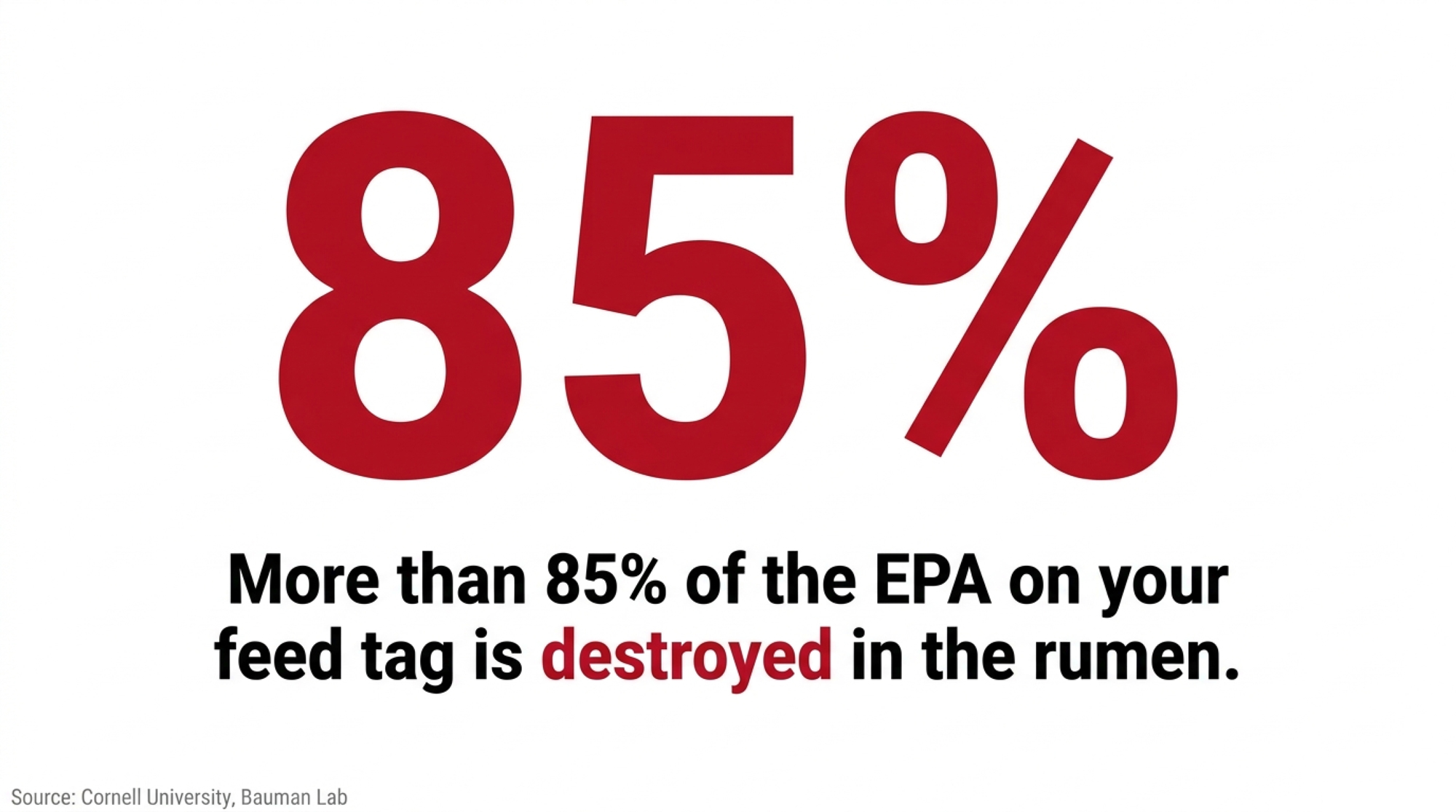
When the team went digging, work from Cornell’s Bauman lab on calcium salts of fish oil showed rumen biohydrogenation of EPA above 85% and DHA above 75% in cows fed those products. More than three‑quarters of the omega‑3 they thought they were buying for inflammation control wasn’t getting past the rumen.
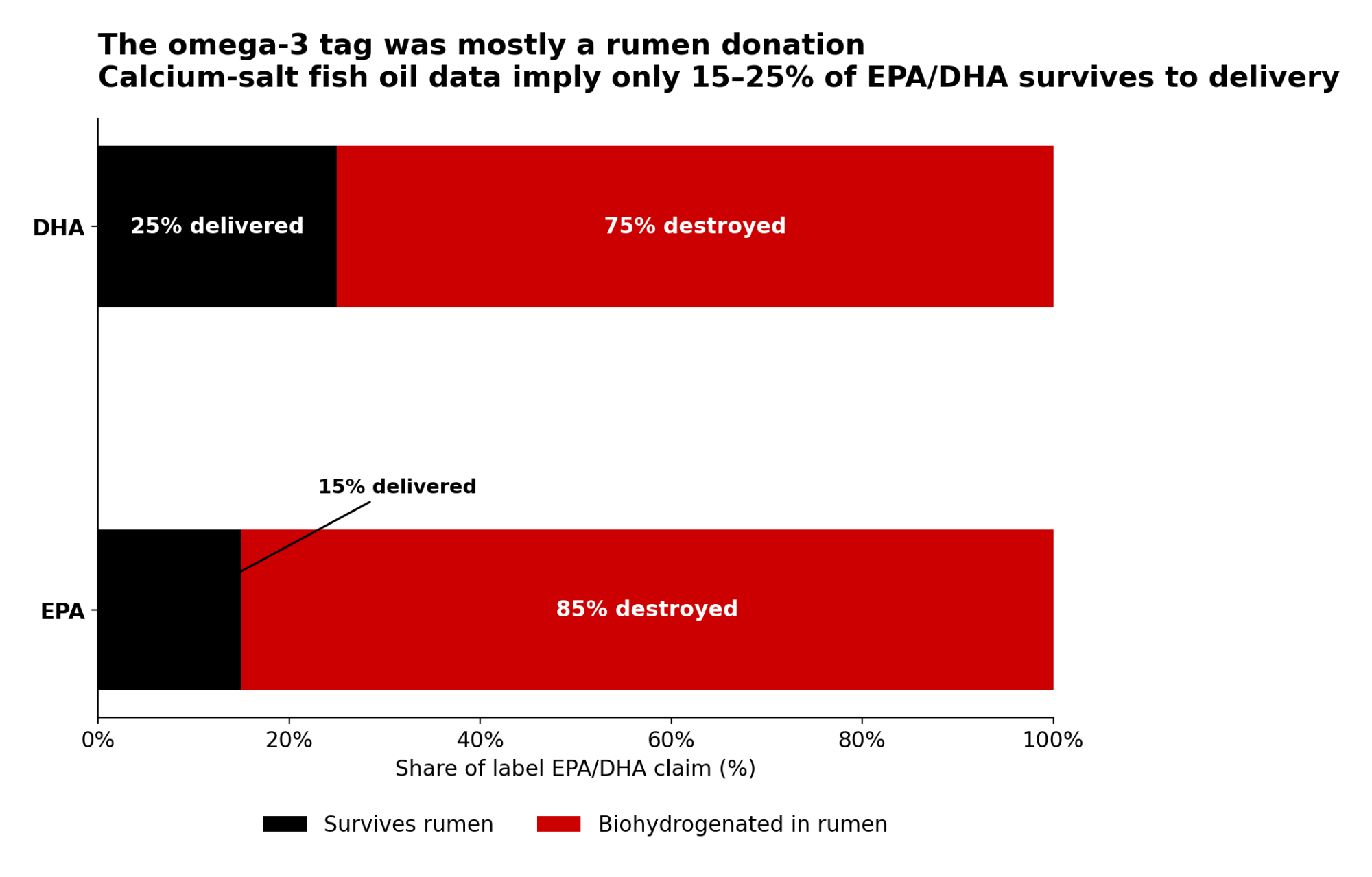
The product was protecting the rumen from the fat. It wasn’t protecting the fat from the rumen.

The Double Standard Hiding in Their Fat Program
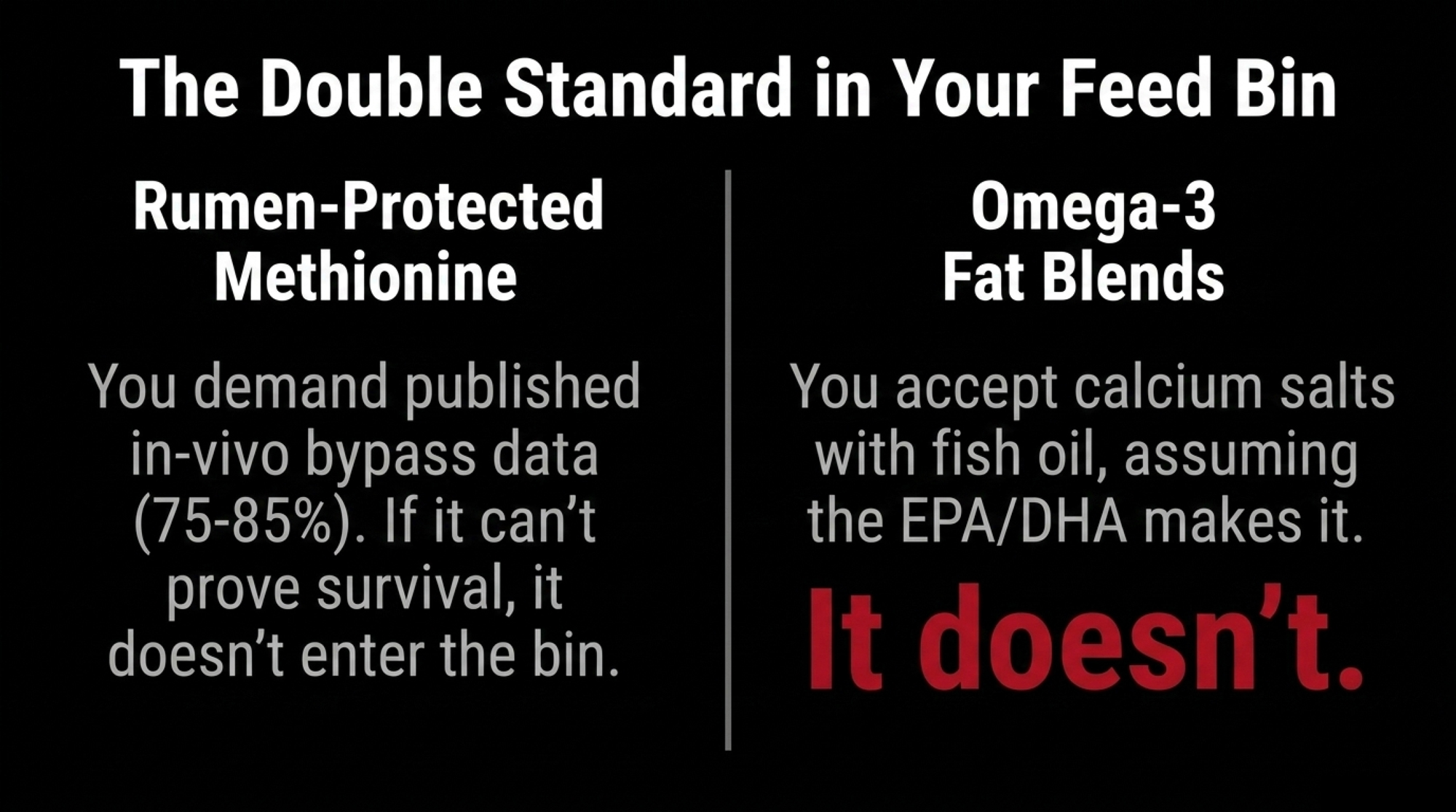
By the time this dairy added rumen‑protected methionine, they were already treating bypass data as non‑negotiable. The nutritionist could rattle off the target — published in‑vivo bypass values land in the 75–85% range for the major RP‑Met products. If a Met source couldn’t show how much survived the rumen, it never made it into their bins.

The fat program ran on a fuzzier standard. The herd used a common calcium salt blend that included fish oil, and the tag listed EPA and DHA alongside palmitic and other fatty acids. For years, everyone around that office table assumed that ticked the omega‑3 box for retained placenta, metritis, and inflammation control.

Then they sat down with the Cornell biohydrogenation data and the Resolution of Metabolic Inflammation review out of Penn. Two things became hard to argue with. Calcium salts are excellent at keeping fat from burning the rumen. But published biohydrogenation data — including Cornell Bauman‑lab work on calcium salts of fish oil — show they’re substantially less efficient at delivering intact EPA and DHA than technologies designed specifically for omega‑3 protection.

Why Doesn’t the Calcium Salt Carry EPA and DHA Through?
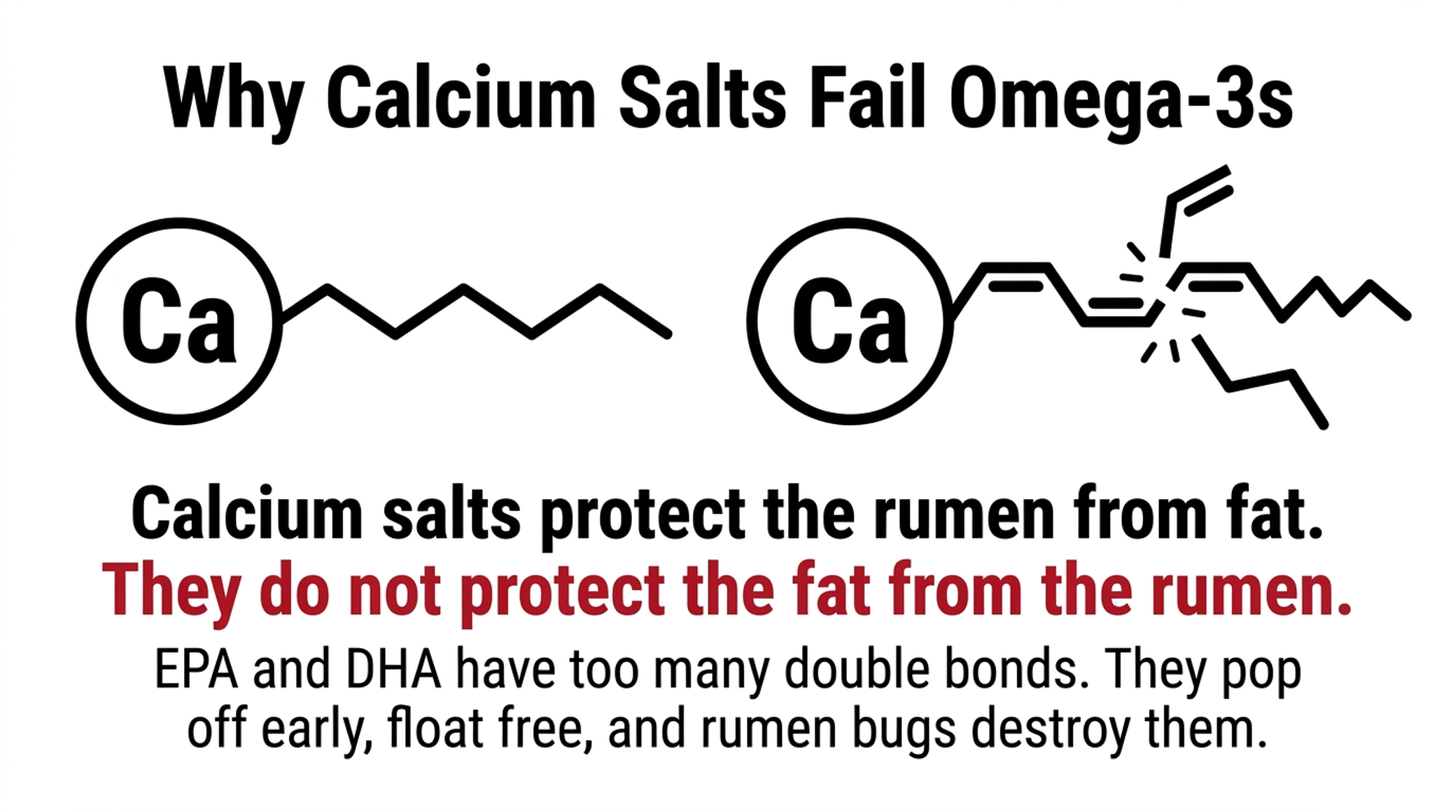
The chemistry isn’t exotic. Rumens don’t like free polyunsaturated fats. Bugs like Butyrivibrio fibrisolvens hydrogenate double bonds to protect themselves, turning unsaturated fatty acids into saturated stearic acid. Calcium salts help by binding fatty acids at rumen pH so they don’t float free and nuke the microbes.

That works fine for palmitic and other less‑unsaturated fats. EPA carries five double bonds. DHA carries six. The more double bonds a fatty acid has, the weaker its bond with calcium at rumen pH gets. EPA and DHA pop off the calcium early, float free, and become exactly the kind of toxin rumen bacteria rush to saturate.

Some Ca‑salt manufacturers are working on improved omega‑3 protection chemistry, and that work may close part of this gap over time. The decision facing this herd today, though, was based on what their current product was actually delivering.

The end result is simple. Plenty of calories make it past the rumen as saturated fat. Very little EPA or DHA reaches the small intestine or gets built into tissue membranes. For this Midwest herd, the math suggested they were spending omega‑3 dollars and mostly getting saturated fat energy — while still living with sticky uteruses, summer milk loss, and DAs that wouldn’t budge.

That raised the harder question. If you’d never accept a methionine product with 15–25% bioavailability, why are you letting an omega‑3 product off the hook with the same profile?

How an Omega‑3 Failure Showed Up in the Fresh‑Cow Pen

On paper, this herd looked like a lot of progressive Midwest dairies. Close‑up DMI was steady. Body condition wasn’t a problem. Transition pens weren’t overcrowded. Fans and soakers were in. RP‑Met went in at the right rate. A fat blend with fish oil hit the mixer every day.

The fresh sheet kept telling a different story. Retained placentas wouldn’t get into single digits no matter what they tried with DCAD or close‑up grouping. Metritis stayed stubbornly high through whole calving stretches. DAs picked off cows who had given them no warning at all on the feed pad. None of it was catastrophic. It was just persistently “not where we want them.” Familiar?

The vet kept asking the same question every month at the meeting. If we’re doing all the obvious things right, what are we missing? Cow comfort wasn’t it. Energy wasn’t it. The team was running out of obvious answers.

When Heat Stress Stops Looking Like an Intake Problem

The vet’s question clicked into place with something else they’d been reading. Reviews on transition biology show systemic inflammation is almost universal right after calving, even when cows don’t look sick. That early fire is necessary; it helps deliver the calf and clear the uterus. The problem is what happens if the cow doesn’t have enough raw material to put it out.

Modern TMRs don’t help her. With corn silage, grains, and by‑products, omega‑6:omega‑3 ratios in dairy diets regularly run 10:1 to 25:1 instead of the 1–2:1 a grazing cow on lush pasture sees. Plenty of arachidonic acid to drive inflammatory pathways. Not much EPA or DHA to compete at the same enzymes.

Pasture‑heavy and graziers’ herds start in a different place. Fresh forage delivers meaningful baseline alpha‑linolenic acid, and the omega‑3 gap this herd was chasing is narrower in those systems. The math in this article is built for confinement and freestall operations whose cows see little or no grass.
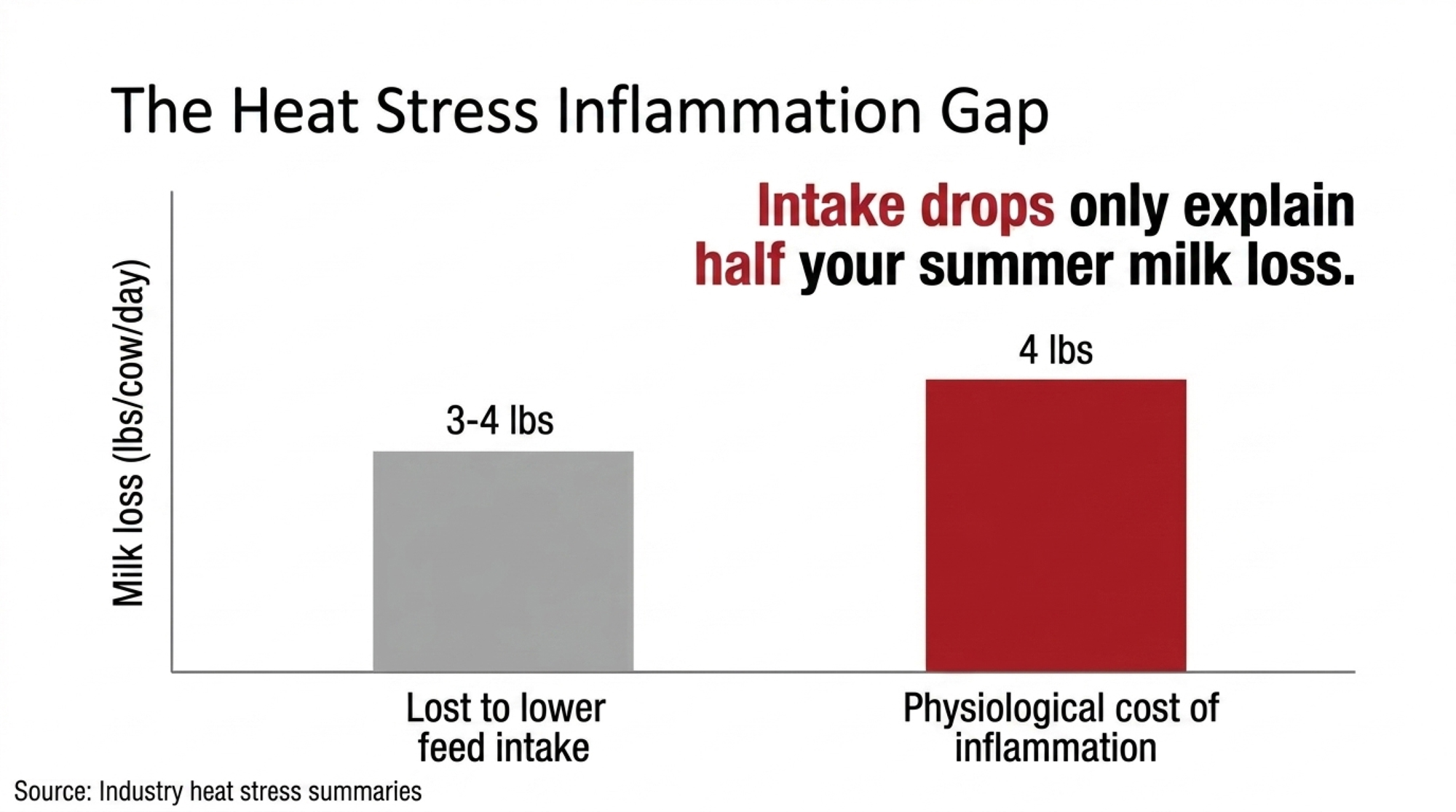
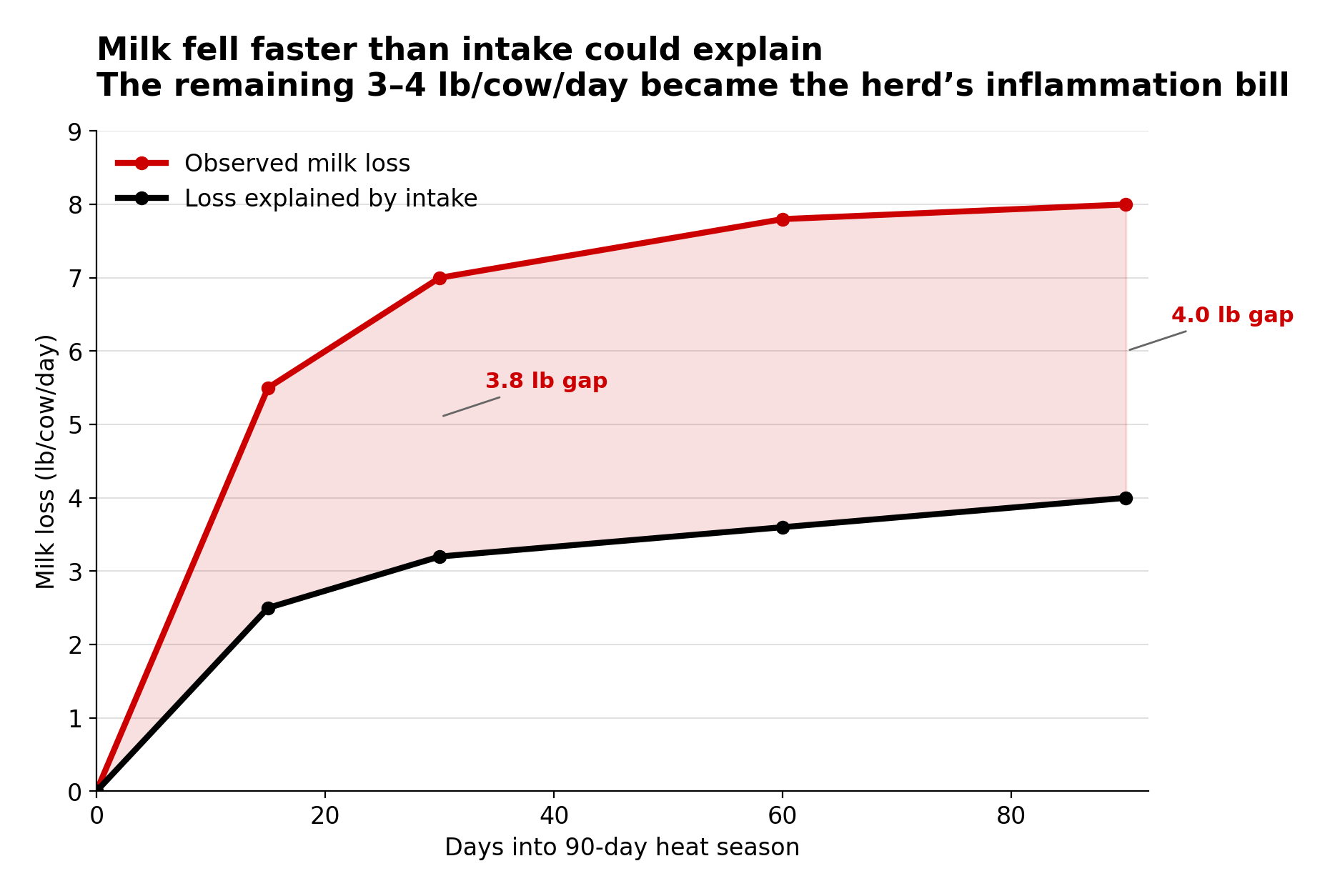
Pair‑feeding research keeps showing only about half of heat‑stress milk loss is explained by intake. The other half is the physiological and inflammatory cost of being hot. Industry write‑ups summarizing recent heat‑stress trial work cite roughly 4.4 lb more milk per day and about 50% lower LBP — a blood marker of endotoxin load — in cows receiving abomasally infused or highly protected EPA/DHA. Treat those figures as a directional indicator drawn from secondary industry summaries rather than a fixed expectation pulled from a single named trial.

That sounded a lot like the “extra” milk this herd kept losing every July. They stopped assuming the fish oil line on the tag meant inflammation was covered.
The Day They Put Real Numbers to the Problem

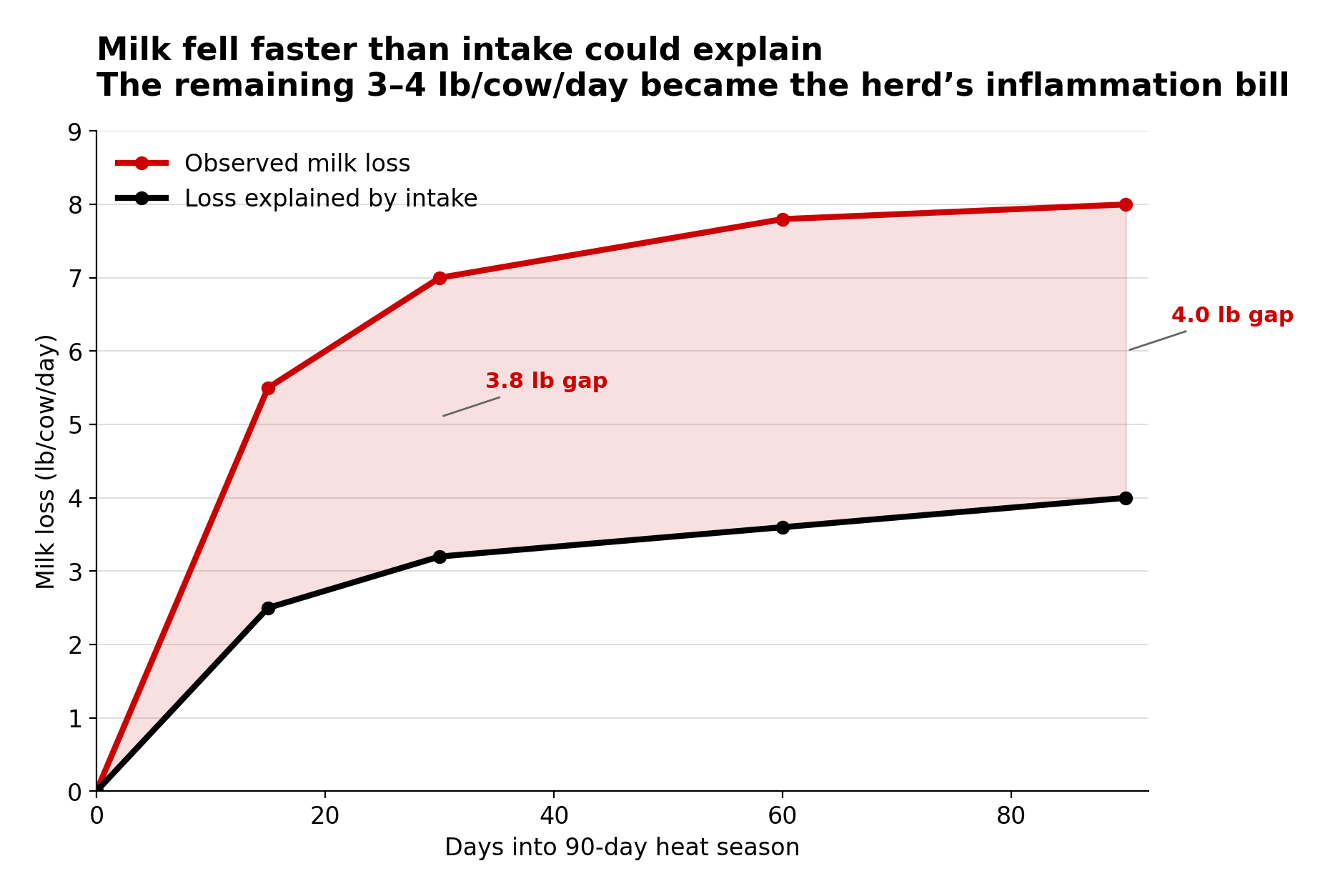
Once the team accepted they had an inflammation problem, the next step was the kind of barn math any 500‑cow herd can run. They started by writing the actual numbers on the whiteboard. Retained placentas were running roughly 12%of calvings against a target near 5%. Metritis sat in the 16–18% range against a 10% target. DAs were holding at 4–5%against a target closer to 3%. Summer milk loss hit 7–8 lb/cow/day, and intake drops only explained 3–4 lb of it.
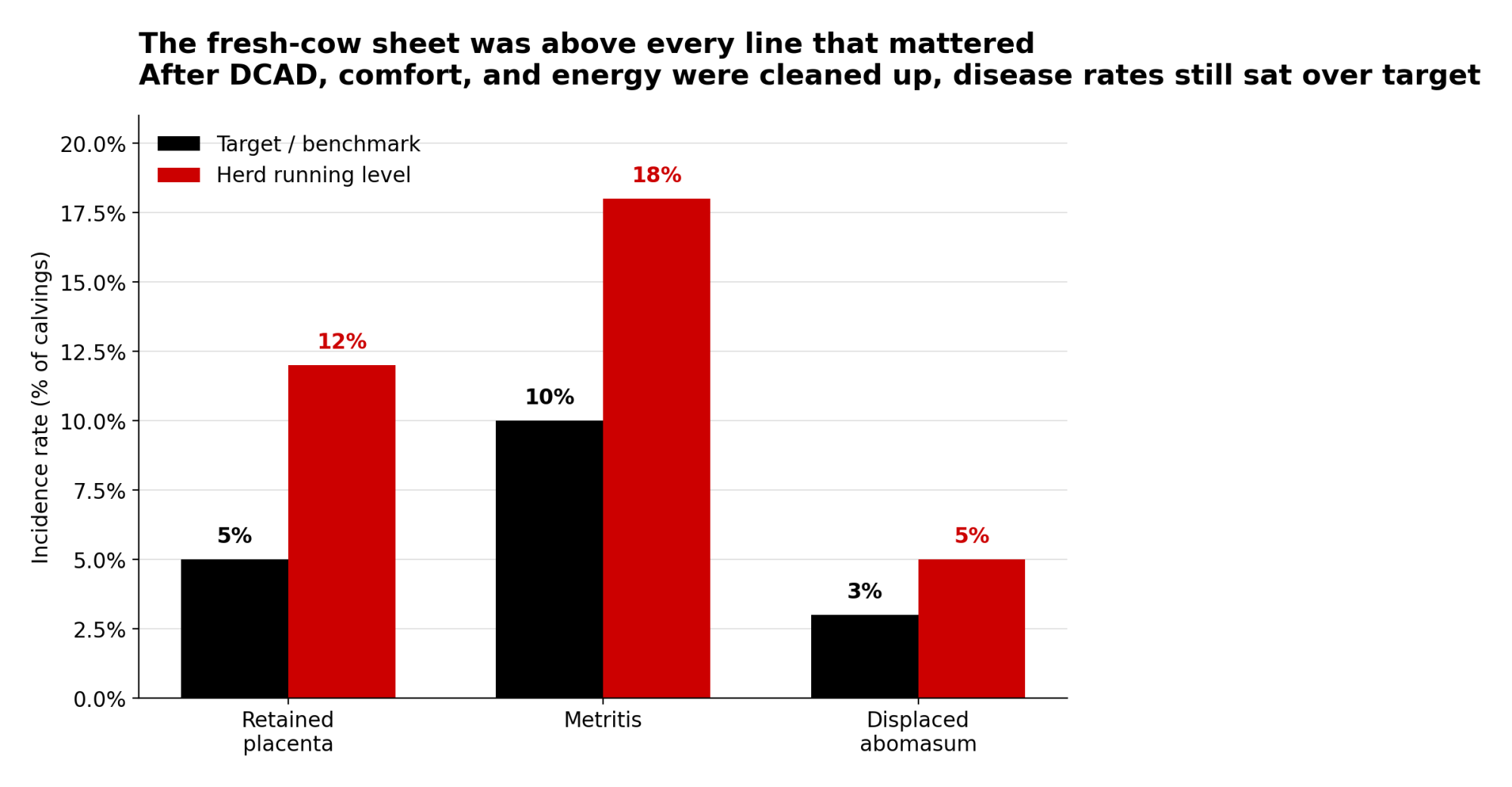
University benchmarks and field experience generally land under 5–8% RP, under 10–15% metritis, and under 3–5% DAs for Holsteins. This herd kept landing on the wrong side of every line — even after fixing the big stuff like DCAD and cow comfort.

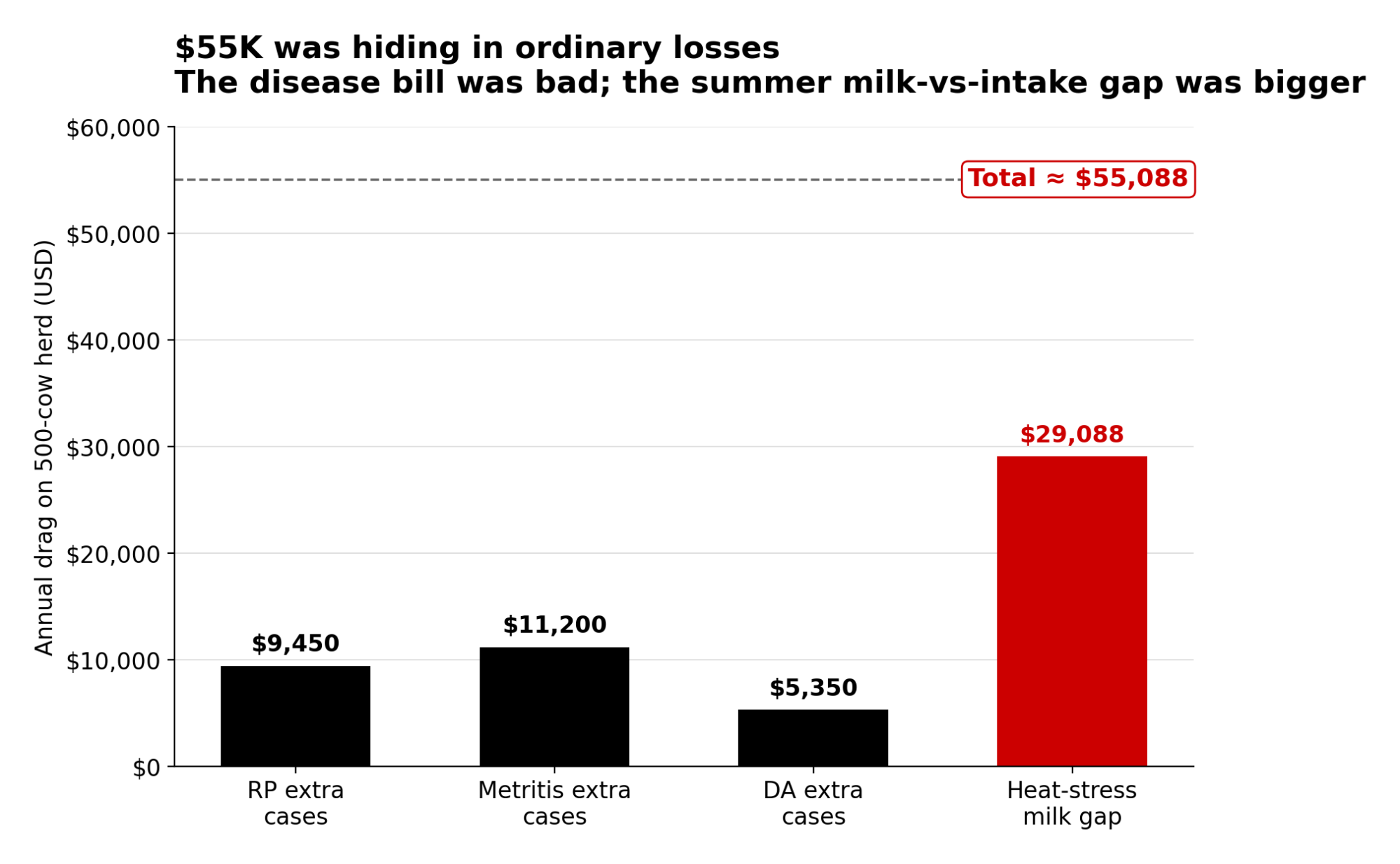
Then they ran the disease math. RP at 12% versus a 5% target meant 35 extra cases a year. Metritis at 18% versus 10% meant another 40. DAs at 5% versus 3% meant 10 more. Not laboratory science. A realistic, conservative comparison for a herd doing most things right.
They pulled cost‑per‑case ranges from extension and economic summaries. RP runs about $150–$389/case. Metritis lands at $171–$386/case. DAs come in at $432–$639/case. Using mid‑range values: 35 × ~$270 ≈ $9,450. Forty × ~$280 ≈ $11,200. And 10 × ~$535 ≈ $5,350.

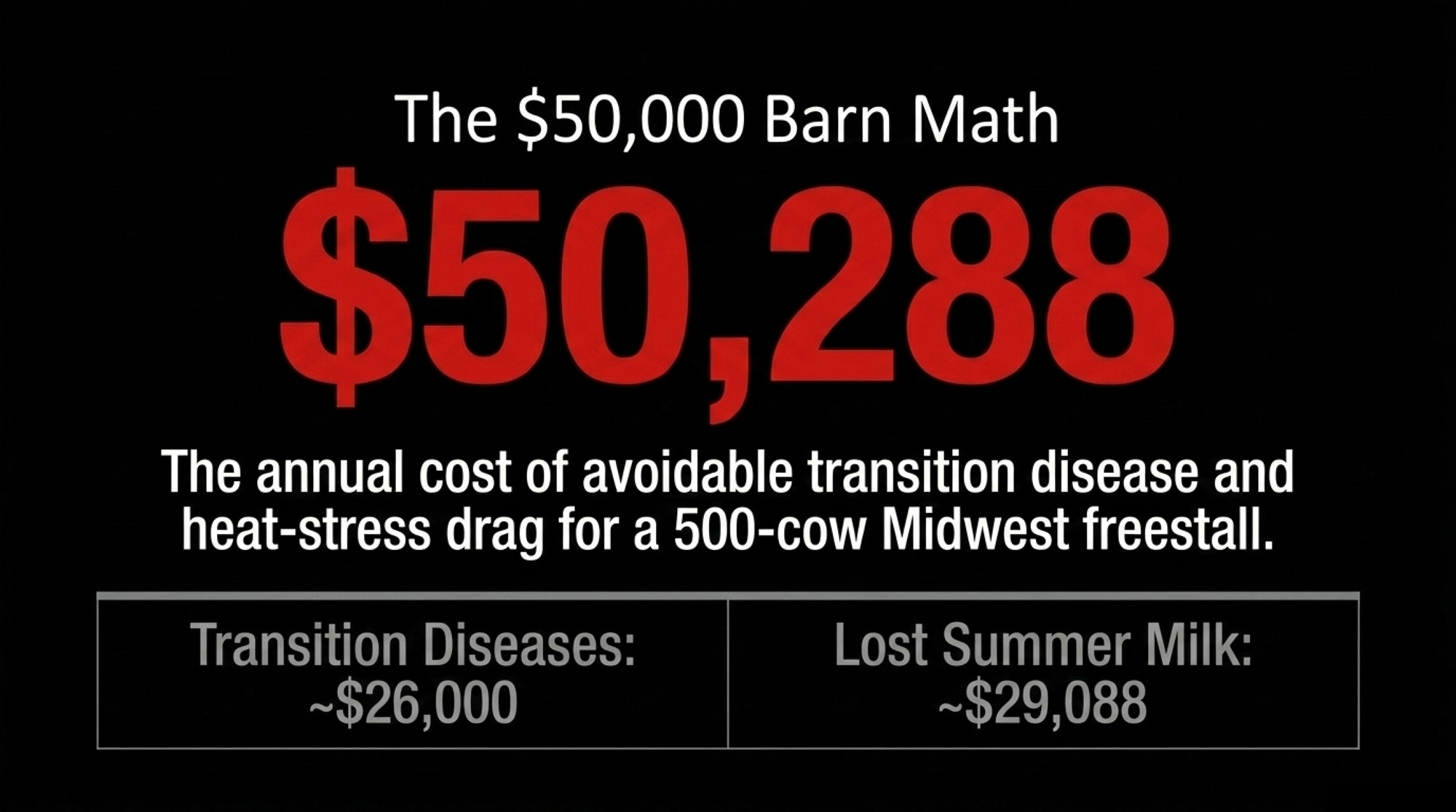
That’s roughly $26,000 a year in “above‑benchmark” transition disease cost without one clinical train wreck in the bunch. Worth keeping on the wall as a caveat: these are mid‑range cost‑per‑case values; actual herd costs vary with labor, lost milk, and culling assumptions.

Then they looked at heat stress. With 8 lb/cow/day of summer milk loss and intake explaining only 3–4 lb, that left a 4 lb “inflammation gap.” Over a 90‑day heat season, 4 lb × 500 cows × 90 days = 180,000 lb of milk. At a Class III milk price near $16.16/cwt — the figure carried through this thread for the March 2026 reference period — the math runs 180,000 ÷ 100 × $16.16 ≈ $29,088 in unexplained lost revenue. Run the same calculation against your current Class III or mailbox price before any decision; the dollar figure moves with the market, but the structural gap doesn’t.

Stack the two pieces and this 500‑cow herd was comfortably over $50,000 a year in avoidable transition disease and heat‑stress drag. Nobody at the table believed omega‑3 alone would erase that. Suddenly there was a big enough pot of money to justify checking whether their omega‑3 dollars were actually making it into cows.
“Cheap” Calcium Salts vs Real Omega‑3 Delivery: The Barn‑Math Flip

The farm wasn’t ready to throw calcium salts out of the ration. Palmitic‑based Ca‑salts still gave them the cheapest calories per pound of dry matter. But it was getting obvious they’d been expecting Ca‑salts to do a job they weren’t designed to do. The nutritionist drew up a comparison on the office whiteboard, using current commercial price ranges as the working assumption.

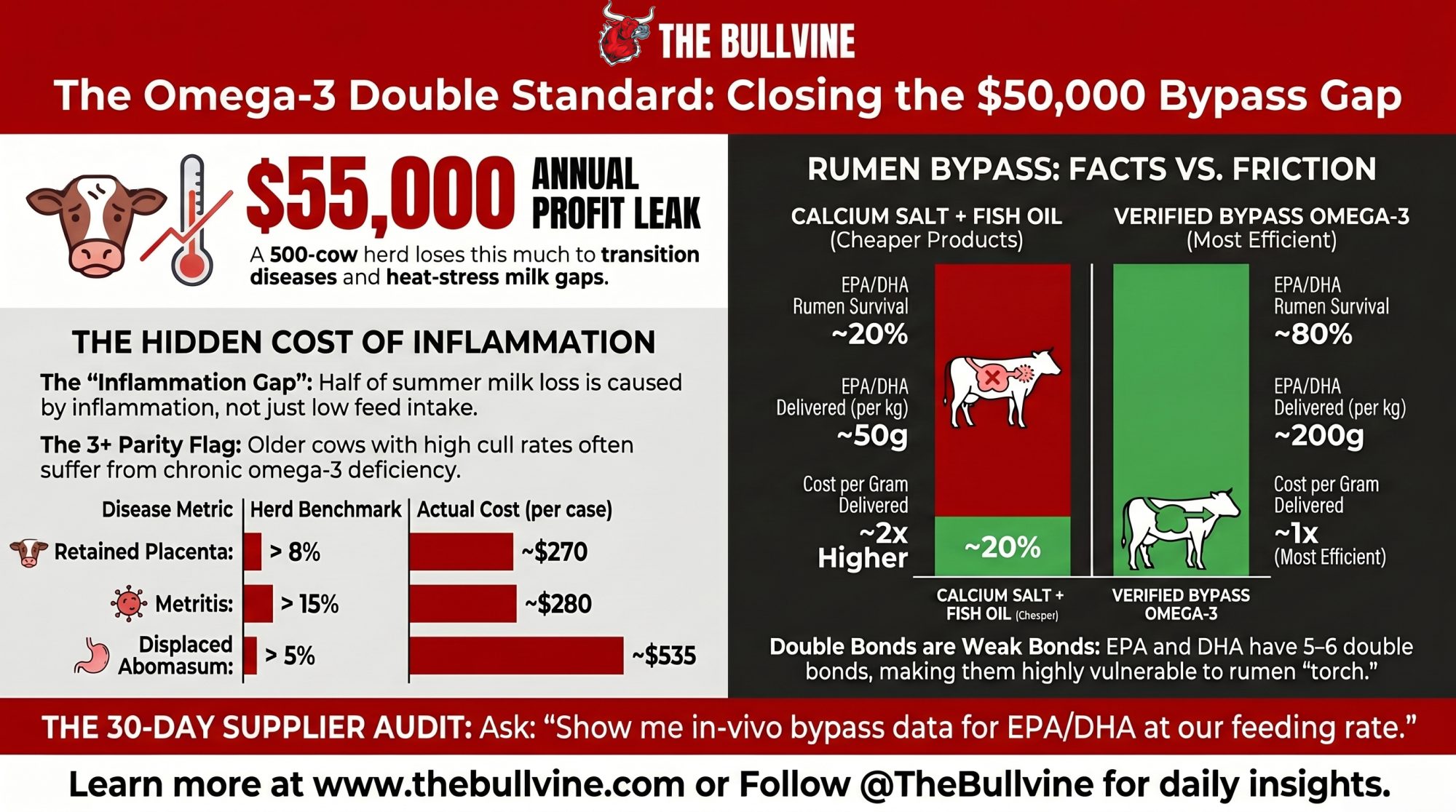
For the comparison, assume Product A is a calcium salt with fish oil at 250 g/kg EPA+DHA on the label, priced in the low single digits per kilogram. Product B is a verified bypass omega‑3 at the same 250 g/kg label claim, priced at roughly twice that. The ratio fits commonly observed price gaps but should be checked against your own supplier quotes before any commitment. Rumen data suggest roughly 80% of EPA and DHA are hydrogenated in Ca‑salt fish oil systems, leaving about 20% survival. The bypass technology is designed to protect EPA and DHA themselves; trials reported roughly 80% rumen bypass in protected forms.
MetricProduct A — Ca‑Salt + Fish OilProduct B — Verified Bypass
Label claim EPA+DHA250 g/kg250 g/kg
Working price assumption~1× (low single digits/kg)~2× Product A
Rumen survival of EPA+DHA~20%~80%
EPA+DHA delivered per kg fed~50 g~200 g
Cost per gram delivered~$0.06~$0.03
kg/cow/day to deliver 10 g EPA+DHA past rumen~0.20 kg~0.05 kg
Relative $/cow/day at that delivered target~2×~1×

Cost‑per‑gram figures use a notional $3/kg for Product A and $6/kg for Product B to illustrate the 1×–2× price ratio described above. The ratio is what matters; replace with your own current supplier quotes before any commitment.

On the price assumptions above, the bypass product cost about half as much per cow per day to hit the same delivered EPA+DHA target. That changed the conversation from “bypass is too expensive” to “we’re paying more per gram of EPA/DHA delivered with this approach than we realized.” Calcium salts stayed in the ration for energy. The omega‑3 job moved.

Why They Started Treating EPA and DHA Like Methionine

This dairy was already paying for RP‑Met because they believed the biology. Methionine supports phosphatidylcholine and VLDL export from the liver, antioxidant systems like glutathione, and protein synthesis when cows are deep in negative energy balance. Let the rumen torch most of it and the cow pays for it later in early lactation.

EPA and DHA work a different but complementary side of the transition problem. EPA competes with arachidonic acid at COX and LOX enzymes, capping how hot and how long inflammatory peaks run. DHA is the precursor for resolvins, protectins, and maresins — molecules that actively shut inflammation down and promote tissue repair.

Work from Joseph McFadden’s lab at Cornell, with co‑supplementation findings reported in the Journal of Dairy Science, shows that when cows get both bypass EPA+DHA and rumen‑protected methionine, the story changes. Liver Functionality Index improves. Energy‑corrected milk goes up versus cows missing one or both. Reproductive performance within roughly 150 DIM tracks better in supplemented groups. Specific volume and issue numbers for the McFadden JDS co‑supplementation paper will be added at copy‑edit once the citation is pulled from the lab’s publication list.

For this herd, that was the last puzzle piece. Their methionine program was doing its job. Without enough EPA and DHA actually reaching tissues, the immune system was burning glucose longer than needed and the liver was fighting a bigger inflammatory load than it should — especially in older cows.

According to project communications from Australia’s Dairy UP program, lipidomic work led by researcher David Sheedy and colleagues drew on roughly two thousand blood samples from a cross‑section of commercial herds and tracked phospholipid fatty acids against health outcomes. The exact published sample frame and herd count will be reconciled with the Dairy UP source document at copy‑edit. Herds and cows with higher omega‑3‑rich lipid species tended toward better health and longevity. As cows moved into later parities, omega‑3 status dropped and risk of leaving the herd climbed. Not a controlled product trial. But it fit what this farm kept seeing: third‑ and fourth‑lactation cows were the ones that “didn’t bounce back” after calving or summer.

Options and Trade‑Offs for Farmers

Most dairies don’t need to copy this herd‘s ration to steal their decision process. The useful part is the framework, and there are several honest paths through it depending on your scale, labor, and risk tolerance.

Path 1 — Run the supplier audit first (30‑day action; works for any herd). Before you change a single pound of the ration, ask every “omega‑3” supplier this question: Show me in‑vivo rumen bypass or biohydrogenation data for EPA and DHA — not total fat or total PUFA — at the inclusion rate we’re feeding. If they can answer with real numbers, you’ve learned something useful. If they can’t, you’ve also learned something useful. Where it shines: zero ration risk, zero capital cost, immediate clarity on what you’re actually buying. Where it hurts: you might find out your favorite product can’t back up the line on the tag, and that’s an uncomfortable conversation.

Path 2 — Keep Ca‑salts for energy, move the omega‑3 job (most common). Palmitic‑based calcium salts still belong in high‑energy rations; nobody is arguing that. The flip is putting the EPA/DHA inflammation job on a product designed specifically for omega‑3 bypass, and feeding it where it pays — close‑up and the first 40–60 DIM, plus the heat‑stress window. Where it shines: lets you keep your cheapest energy source while finally putting real EPA/DHA into tissues. Where it hurts: higher per‑kg sticker on the bypass omega‑3 product even when the cost‑per‑gram‑delivered math goes the other way; expect pushback at first quote.

Path 3 — Run a paired on‑farm trial (90‑day action). Work with your nutritionist to compare a transition pen on calcium‑salt omega‑3 against a transition pen on documented‑bypass EPA/DHA. Track RP, metritis, DAs, early milk, and summer milk vs intake. Where it shines: turns a vendor argument into your own data. Where it hurts: requires real recordkeeping discipline, and small herds may not generate enough fresh cows in 90 days to make the numbers move convincingly.

Path 4 — Wait and watch the Ca‑salt category innovation. Some calcium salt manufacturers are working on improved omega‑3 protection chemistry. If your fresh‑cow numbers are already at benchmark and your summer milk loss is fully explained by intake drop, sitting tight while the category catches up is a defensible call. Where it shines:no change cost. Where it hurts: every summer and every transition cycle you’re above benchmark is real money walking off the farm — and “we’re already at benchmark” is a higher bar than most herds clear honestly.

The forward‑looking signal worth watching across all four paths: peer‑reviewed in‑vivo bypass data on calcium‑salt fish‑oil reformulations. If the gap closes, the math in Path 2 changes. Until it does, the gap is the gap.

What This Means for Your Operation

  • Apply your methionine standard to your fat bin. If your nutritionist demands in‑vivo bypass numbers on RP‑Met, they should be demanding the same on any product carrying EPA and DHA on the tag. One conversation, this month.
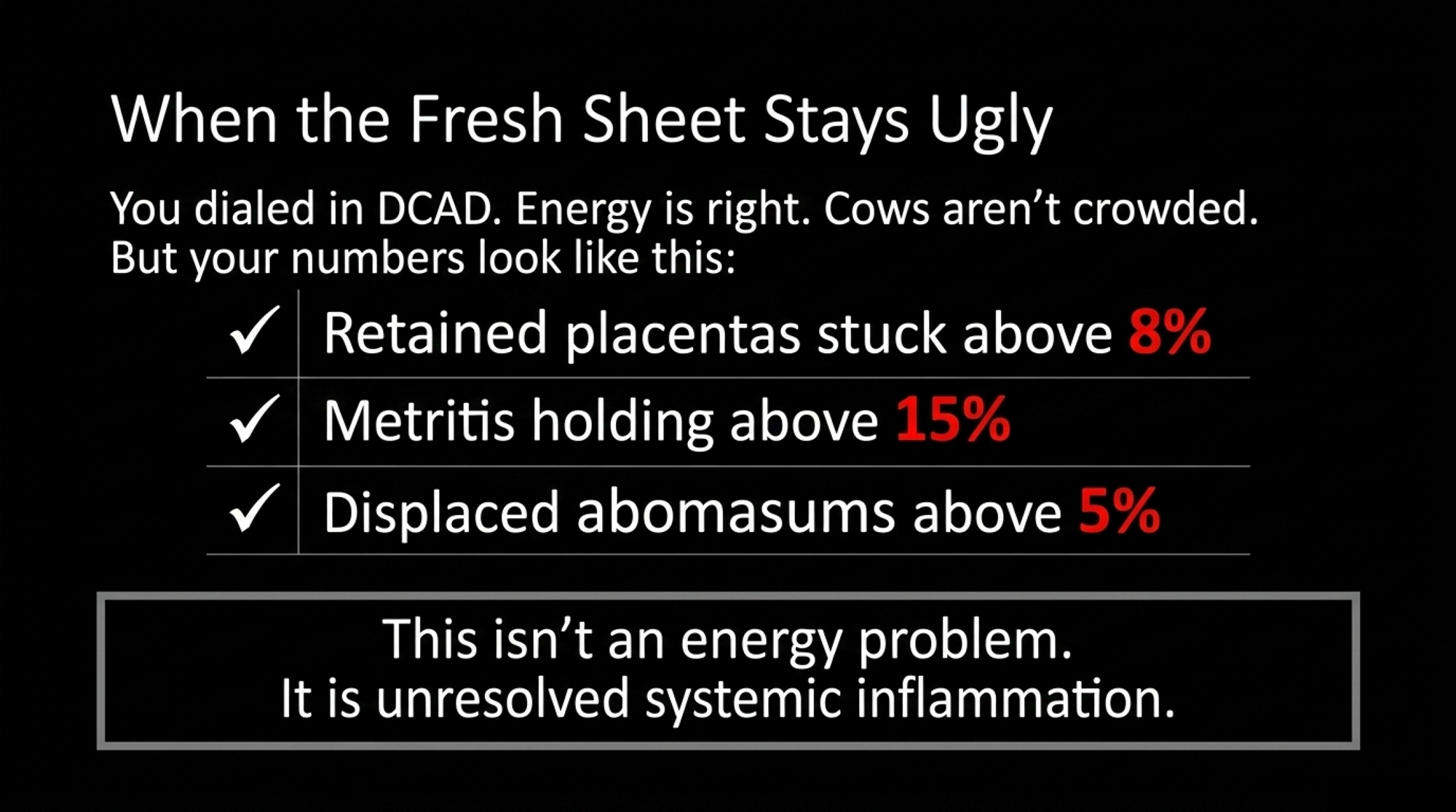
  • Read your fresh‑cow sheet for inflammation, not just energy. RP stuck above 8%, metritis above 15%, or DAs above 5% after DCAD, energy, and cow comfort are clean is a different problem than most herds are diagnosing.
  • Pull last summer’s milk and intake graphs side by side. If milk fell faster than intake — by 3 lb/cow/day or more — quantify the gap before next heat season. That’s your “inflammation bill” in real numbers, on your milk price.
  • Audit suppliers before you audit the ration. The 30‑day question — “show me in‑vivo EPA and DHA bypass data at our inclusion rate” — costs nothing and changes the buying conversation immediately.
  • Watch parity 3+ specifically. If your culls and transition wrecks cluster in older cows, treat that as an omega‑3 status flag, not a “those cows just got old” excuse. Dairy UP lipidomic work points the same direction.
  • Don’t throw the Ca‑salts out. Palmitic‑based calcium salts still earn their slot for energy. The job that moves is the EPA/DHA inflammation job — not the calorie job.
  • Keep watching Ca‑salt reformulations. If peer‑reviewed in‑vivo bypass data on next‑generation Ca‑salt fish oil ever closes the gap, the math in Path 2 changes. Until then, plan on the gap being real.
Key Takeaways

  • If you wouldn’t buy rumen‑protected methionine without in‑vivo bypass data, don’t let any product call itself your omega‑3 strategy unless it has in‑vivo EPA and DHA bypass numbers at the rate you feed.
  • If RP is stuck above 8%, metritis above 15%, or DAs above 5% even after fixing DCAD, energy, and cow comfort, you’re probably treating symptoms of unresolved inflammation rather than the nutritional gap that helps resolve it.
  • If summer milk regularly runs 3–5 lb/cow/day below what your intake drop predicts, you’re paying a real “inflammation gap” bill — and heat‑stress trials suggest verified bypass EPA/DHA can claw back roughly 4 lb of that in the right setups.
  • Calcium salts of palm fats still belong in high‑energy rations. For inflammation‑focused EPA and DHA delivery, the evidence reviewed here suggests omega‑3‑specific bypass technologies deliver more EPA/DHA per dollar than fish‑oil calcium salts.
  • If third‑ and fourth‑lactation cows are over‑represented in your transition wrecks or early culls, treat that pattern as a parity‑driven omega‑3 status flag — not a “those cows just got old” excuse.

This 500‑cow Midwest dairy didn’t fix everything in one ration change. They started by holding their fat program to the same standard they were already demanding from their amino acid program — and once they did, the cost of not doing it stopped looking abstract.

Look at your own fresh‑cow sheet and your last summer’s milk graph. Where would the gap have to be on your operation before you’d ask your nutritionist for in‑vivo bypass data on every “omega‑3” line on the tag — and what would it cost you to wait another transition cycle to find out?

Complete references and supporting documentation are available upon request by contacting the editorial team at editor@thebullvine.com.

Learn More

The Sunday Read Dairy Professionals Don’t Skip.

Every week, thousands of producers, breeders, and industry insiders open Bullvine Weekly for genetics insights, market shifts, and profit strategies they won’t find anywhere else. One email. Five minutes. Smarter decisions all week.
NewsSubscribe
First
Last
Consent

46% Subclinical Ketosis in ‘Good’ Herds – Are Your Transition Cows Any Different?

One herd guessed 4% ketosis. The meter said 40.7%. This is the story behind that gap—and how to find your real number before it costs you.

Executive Summary: Four high‑producing herds thought subclinical ketosis was a minor issue; whole‑herd BHBA testing showed an average 46% of fresh cows were ketotic, including one herd that guessed 4% and actually sat at 40.7%. That kind of hidden SCK rate quietly drives more metritis, fever, extra days open, culls, and lameness—even when cows “look fine” at the bunk. Using published cost estimates, a 300‑cow herd can easily be leaking around $34,800 a year to undetected SCK alone, before you price in extra DAs or foot problems. The article walks through what’s actually working in transition pens right now: realistic DCAD and calcium strategies, where NASEM 2021 sets the floor on MP and methionine, and what newer data say about rumen‑protected methionine, fatty acids, and choline. It also lays out practical guardrails on BCS loss, fat: protein ratios, NEFA, stocking density, and bunk space so you can read early‑lactation milk records like a health report, not just a production snapshot. The core challenge is simple: stop guessing at SCK and fresh‑cow energy balance and start measuring them with BHBA tests and a few key ratios. If you’re willing to run a 30‑day BHBA check and one clean pen trial with your nutritionist, this piece gives you the numbers and thresholds to decide whether your transition program is truly dialed in or looks that way.

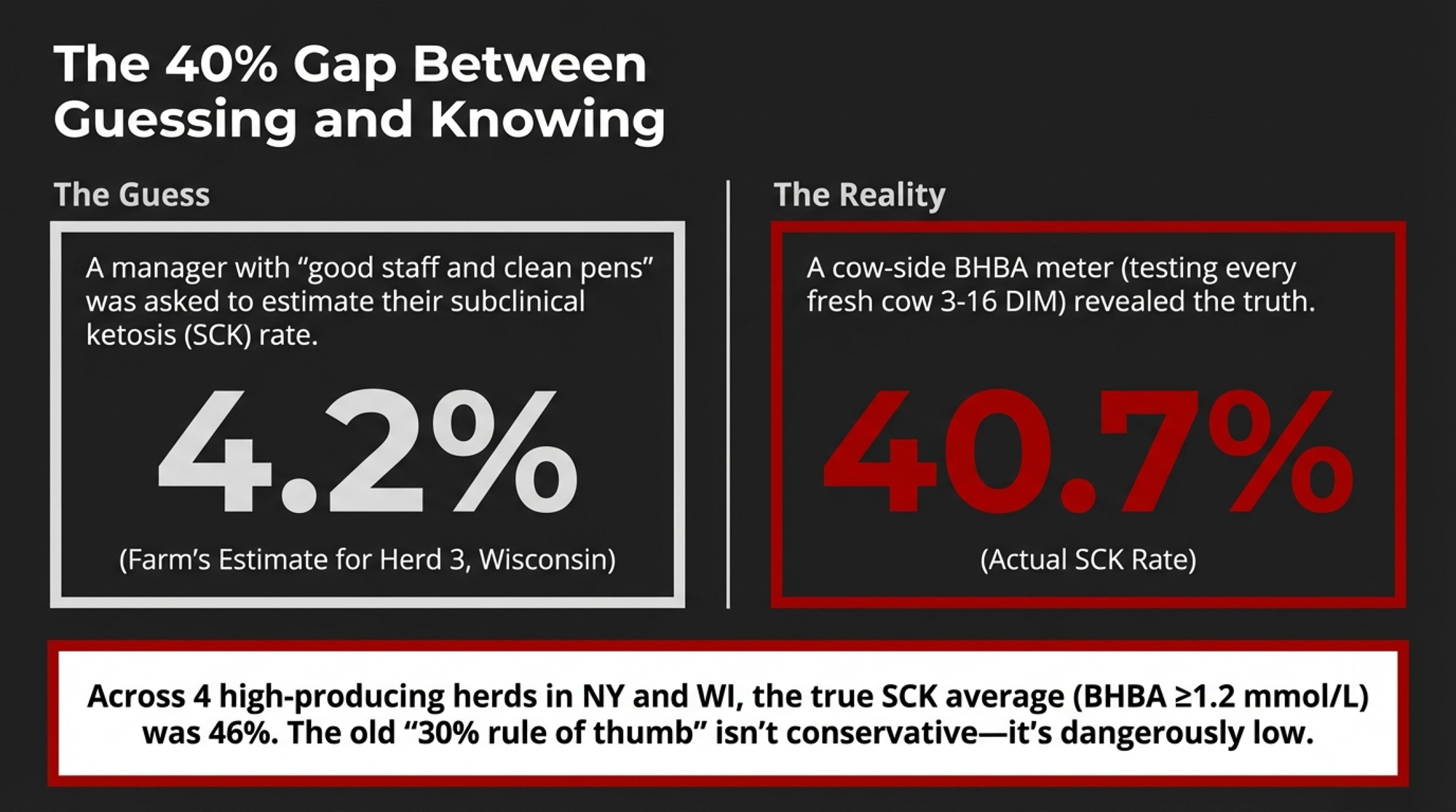
The herd thought they knew their fresh cows. Good staff. Clean pens. A close‑up program that had been “working” for years. When the vet asked how many fresh cows were dealing with subclinical ketosis, the manager guessed around four percent. Maybe five on a bad month.

Then they pulled blood on every fresh cow between 3 and 16 DIM with a cow‑side BHBA meter.

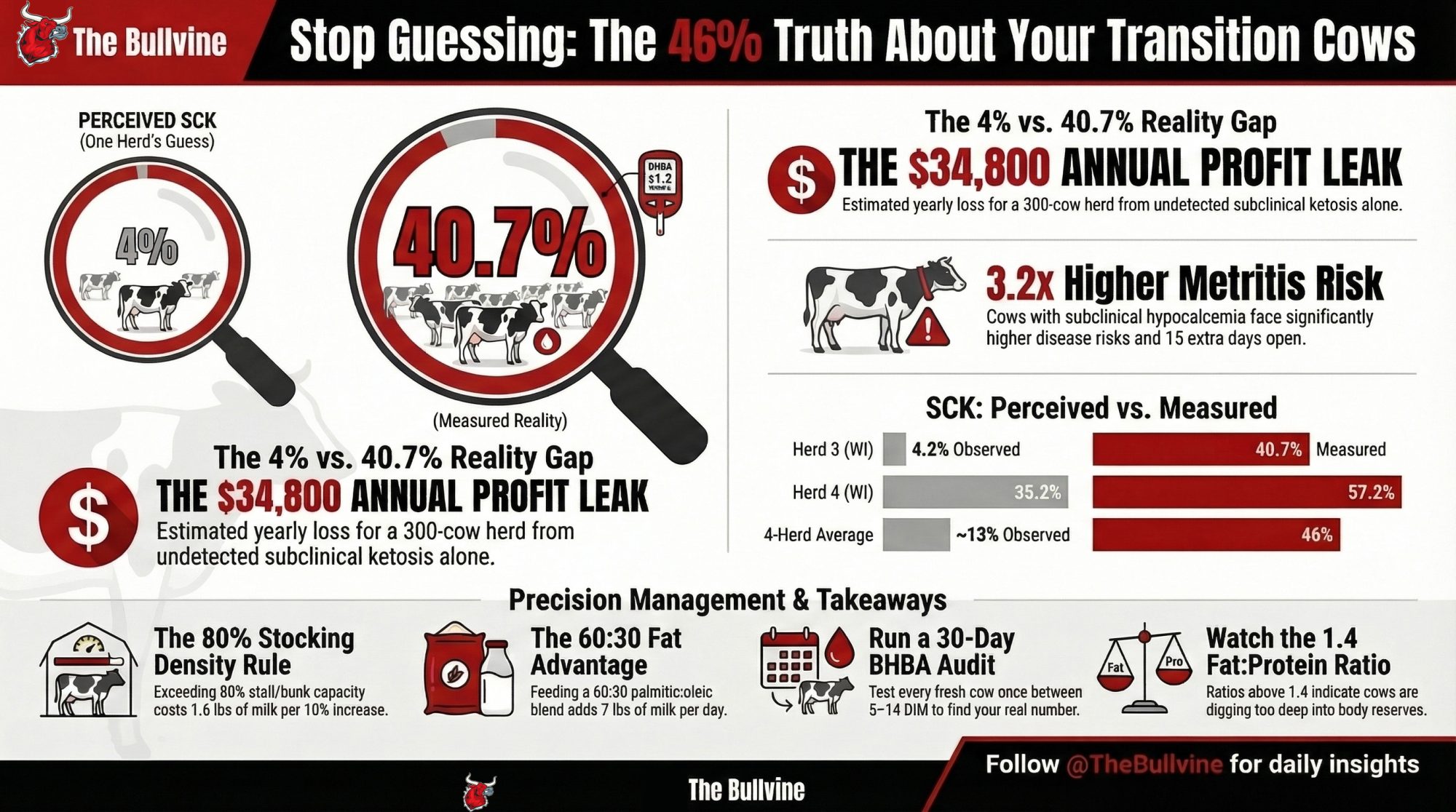
The number wasn’t 4%. It was 40.7% — and when the researchers put that herd together with three other high‑producing herds in New York and Wisconsin, the true average was 46% subclinical ketosis, using a BHBA cut‑point of 1.2 mmol/L in early lactation. The cows were standing, eating, and milking. On the surface, they looked fine.

That’s the uncomfortable starting point for any honest conversation about transition cows in 2026. The risk isn’t just in “train wreck” fresh pens. It’s in the gap between what you think is happening and what a simple meter would show.

Three Transition Groups, Three Real Jobs

Most progressive herds now run some version of three transition groups: far‑off drys, close‑ups, and fresh cows. On paper, that sounds basic. In practice, how those three groups are fed, stocked, and managed is where profit gets made or lost.

Far‑off dry cows usually live on a controlled‑energy diet. Think straw or other lower‑energy forages to hold intake and energy down while keeping the rumen full and chewing. Their job is boring by design: don’t get fat, don’t crash, keep the rumen ready to go back to work.

Close‑up cows have a much more delicate assignment in the last three weeks before calving:

  • Step up energy without packing on extra condition.
  • Step up the metabolizable protein to match colostrum and fetal growth.
  • Keep enough bunk and lying space open that they’ll actually eat what you’ve formulated.

NASEM 2021 pegs far‑off dry cows at around 12% crude protein and 7.2% MP, and close‑up cows at 13% CP and 8.6% MP, which works out to roughly 1,000 g of MP per day one week before calving. In the field, many nutritionists now push that closer to 1,100–1,200 g of MP in the last month to cover both a fast‑growing fetus and colostrum synthesis, especially if dry matter intake slips in the last 7–10 days.

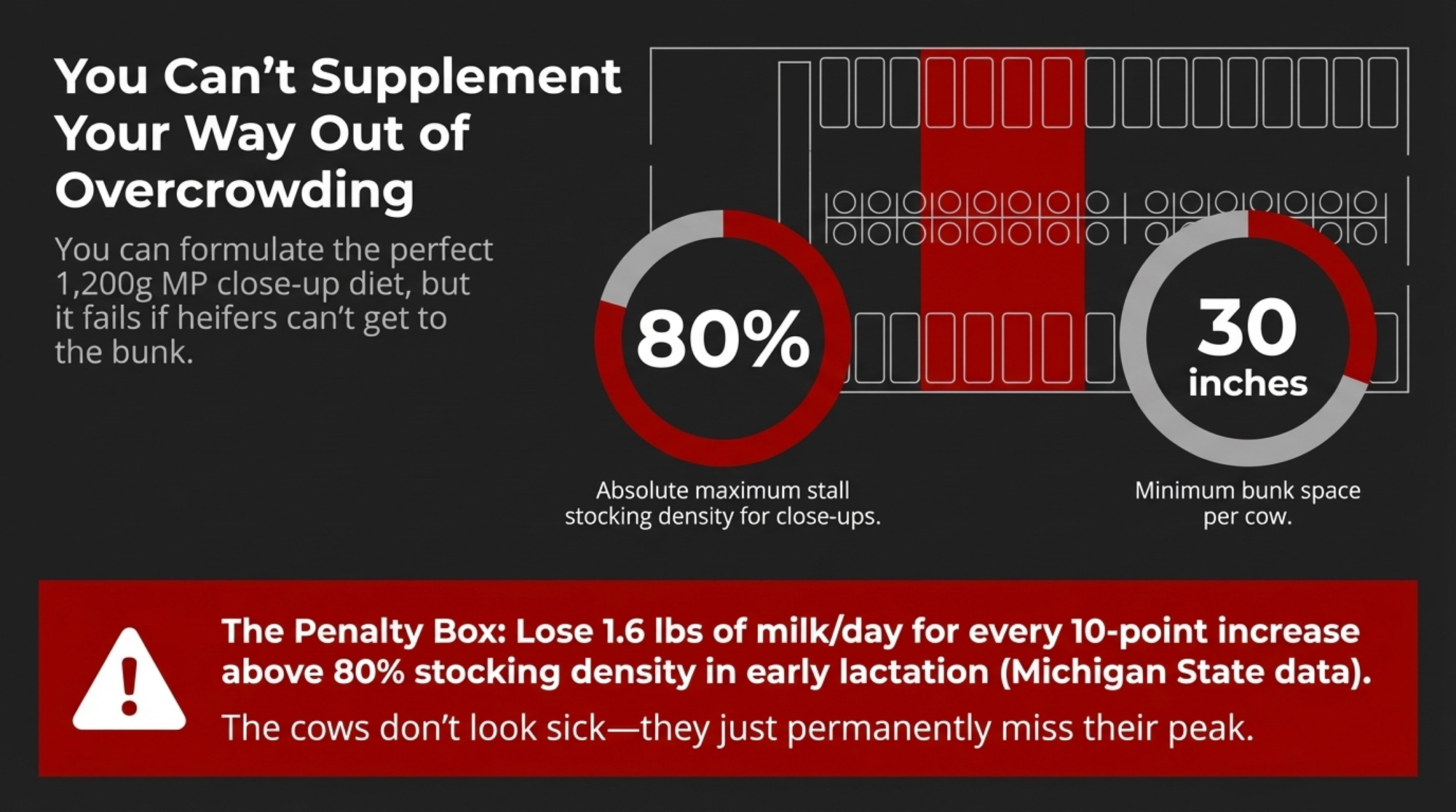
Space matters as much as the spreadsheet. Work out of Wisconsin and elsewhere points to 80% of stalls and at least 30 inches of bunk space per cow as realistic targets for close‑up pens. When first‑calvers get jammed in with older cows and bunk stocking goes much past that, Michigan State data shows you can lose about 1.6 lb of milk per day for every 10‑point increase above 80% stocking in early lactation. Those heifers don’t look “sick” — they just never hit the peaks they could have.

Fresh cows then step onto your high‑group TMR with deliberate tweaks Hutjens and others have hammered on for years:

  • Functional fiber: 3–4 lb of long hay or 1–2 lb of processed straw to keep the rumen happy and help keep DAs in check.
  • Additive stack: yeast, monensin, organic chromium, buffer, higher vitamin E, rumen‑protected choline, organic trace minerals — all packed into a 10–21 day fresh window.

On paper, that fresh‑cow ration looks expensive. In the barn, those first two to three weeks largely set the lactation curve.

Does Your Fresh Pen Have a Quiet Calcium Problem?

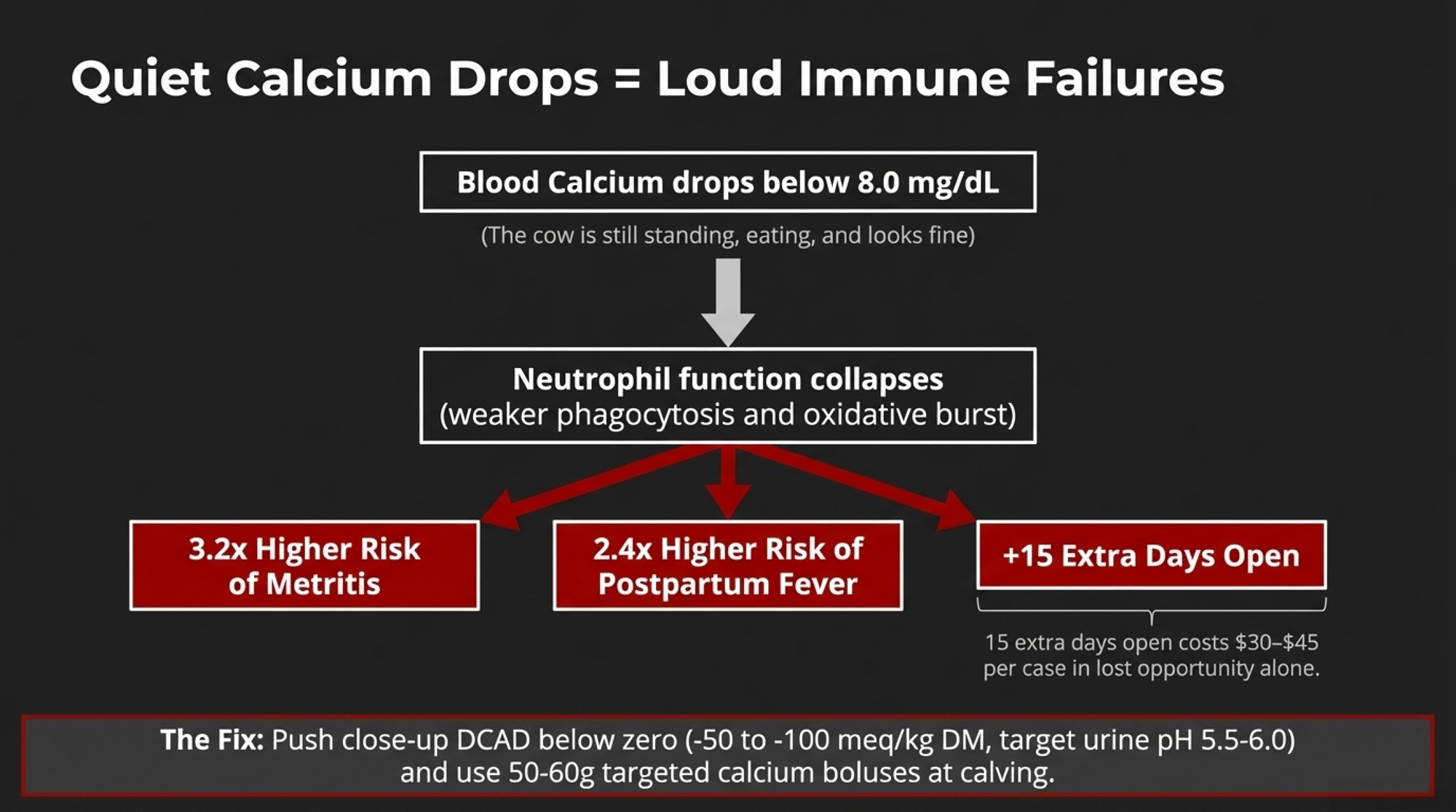
Clinical milk fever is obvious. Subclinical hypocalcemia? Not so much. Total blood calcium drops below about 8.0 mg/dL, but the cow is still standing, eating, and milking. From the aisle, she looks fine.

Martinez and co‑workers at the University of Florida followed multiparous Holsteins and grouped them by plasma calcium right after calving (JDS 95:7158, 2012). Cows with subclinical hypocalcemia (total Ca <8.0 mg/dL) had:

  • 3.2× higher risk of metritis,
  • 2.4× higher risk of postpartum fever,
  • Higher BHBA (around 1.0 vs 0.7 mmol/L), and
  • About 15 extra days open (124 vs. 109).

If you figure each extra day open beyond target costs in lost opportunity, 15 days open adds –45 per case on top of treatment and milk loss — and that’s before you price in more metritis and fever.

The immune story is even more interesting. Those subclinically hypocalcemic cows had fewer circulating neutrophils, and the ones they did have were less effective at phagocytosis and oxidative burst. In plain language, they walked through the highest‑risk period of their lactation with a weaker front‑line immune response.

You’ve basically got two big levers here:

  • DCAD close‑up programs. Push dietary cation–anion difference below zero a few weeks pre‑calving (often −50 to −100 meq/kg DM, depending on forages and salts). Aim for a urine pH of 5.5–6.0 in Holsteins and 5.0–5.5 in Jerseys, and feed 150–180 g of calcium per day in the close‑up ration so there’s actually calcium in the gut to absorb. 
  • Calcium boluses. Most commercial boluses deliver 50–60 g of calcium from a mix of calcium chloride, sulfate, and/or propionate. Given at calving and again 12–24 hours later, they push blood calcium up for 2–6 hours while the cow’s internal system catches up. 

Especially in older cows, skipping both DCAD and boluses is basically choosing more metritis, more fever, and a blunted immune system in the fresh pen.

Can 1.5% Fat in the First 21 Days Really Move the Needle?

A lot of herds feed fat. Very few have a clean answer to what it’s actually doing in the first three weeks after calving.

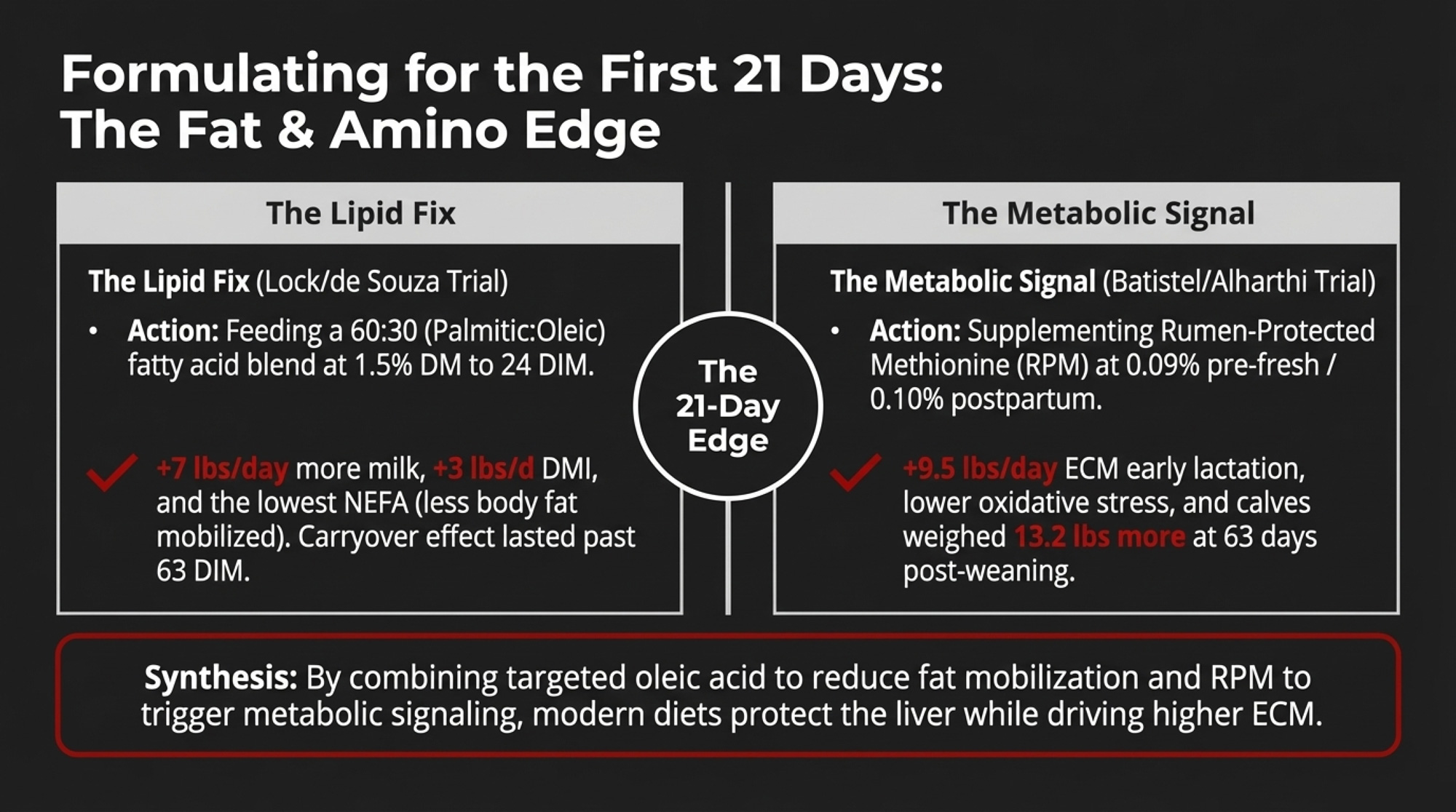
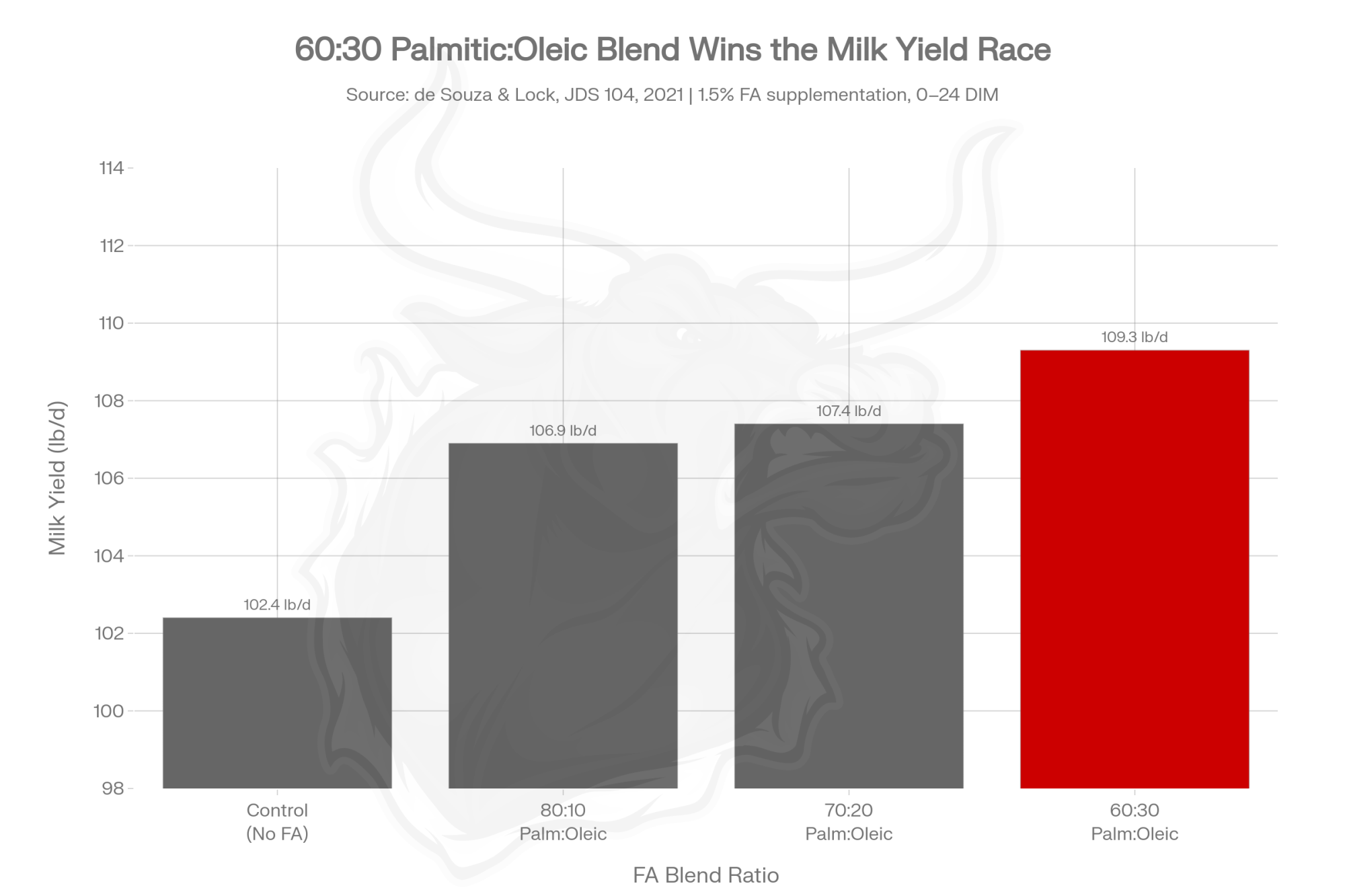
Adam Lock’s group at Michigan State ran a trial that has changed how a lot of nutritionists think about fresh cow fat. In de Souza’s study (JDS 104, 2021), fresh Holsteins were fed a fatty acid (FA) supplement at 1.5% of ration DM from calving to 24 DIM:

  • Treatments: control (no FA) or FA blends with palmitic (C16:0) to oleic (C18:1) ratios of 80:1070:20, and 60:30.
  • From 25 to 63 DIM, all cows went on the same diet with no supplemental FA.

Here’s what happened:

Control80:1070:2060:30
Milk (lb/d)102.4106.9107.4109.3
DMI (lb/d)44.745.546.048.0
Milk fat (lb/d)4.184.734.584.60
NEFA (mEq/L)0.720.840.750.67

The 60:30 palmitic: oleic blend was the clear winner. Compared with the control, those cows:

  • Gave about 7 lb/d more milk,
  • Ate 3+ lb/d more dry matter, and
  • Had the lowest NEFA, meaning less body fat mobilization. 

From day 25 to 63, after every cow was on the same non‑supplemented ration, the FA‑supplemented cows kept a production edge. De Souza and Lock called it a carryover effect: those extra fatty acids in the first three weeks seemed to set a higher production level that stuck even after the supplement was pulled.

Will 1.5% fresh‑cow fat pencil in every herd? No. It depends on your base ration energy, fat prices, and how hard cows are mobilizing tissue. But if you’re running high‑producing pens and watching BCS slide hard in the first month, this is the kind of trial you and your nutritionist can design and measure on your own farm.

Methionine in Transition Cows: More Than Just Balancing a Ratio

Methionine used to sit in the “balance it with lysine, then move on” bucket. Work out of Illinois and Wisconsin has pushed it into a different category for transition cows.

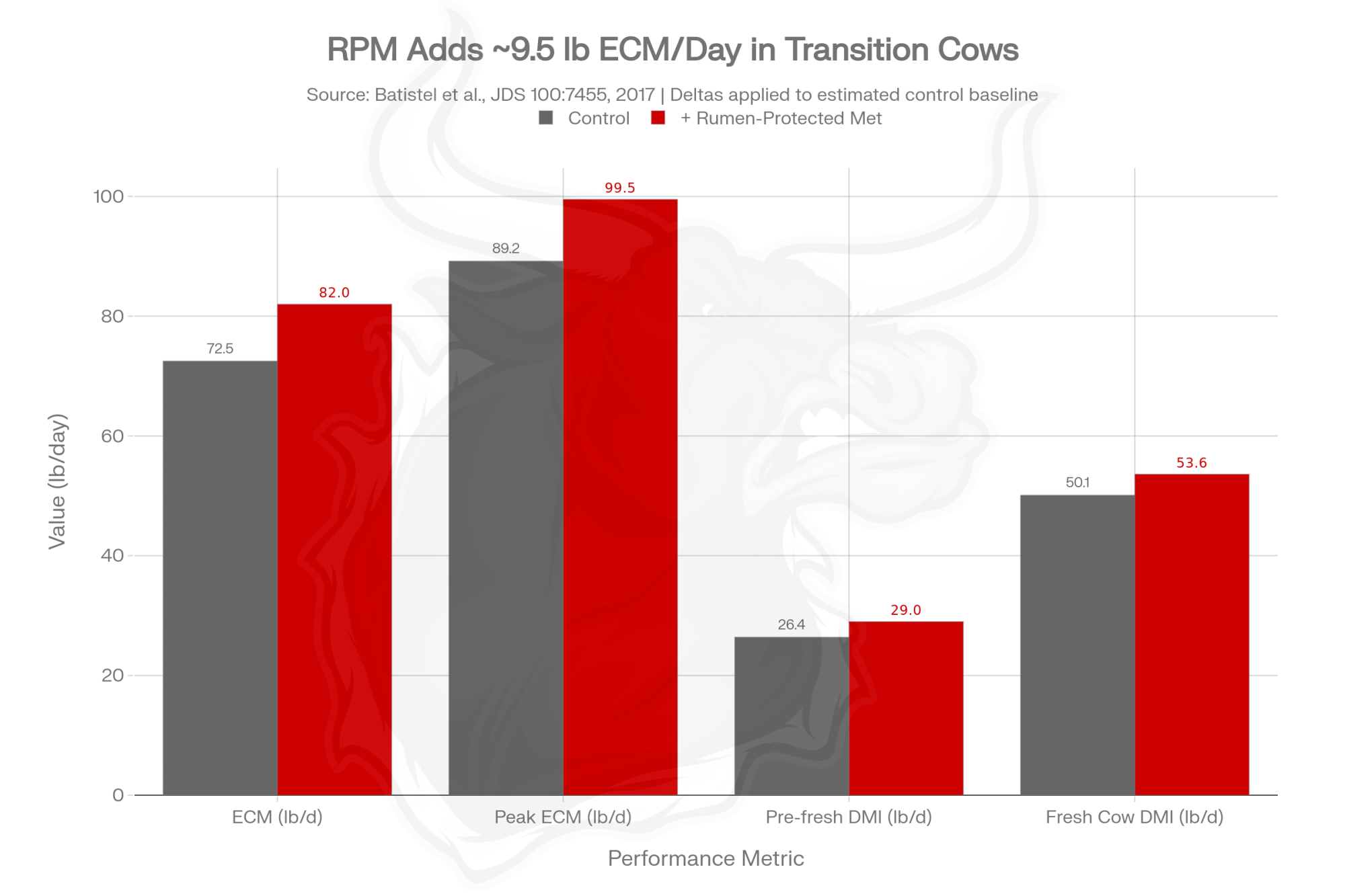
Batistel et al. supplemented Holstein cows with rumen‑protected methionine (RPM) at about 0.09% of DM pre‑freshand 0.10% postpartum in a series of trials (JDS 100:7455, 2017). Compared with controls, RPM cows:

  • Produced about 9.5 lb/d more energy‑corrected milk in early lactation,
  • Hit a peak ECM about 10.3 lb/d higher,
  • Ate about 2.6 lb/d more DM pre‑fresh, and
  • Ate 3.5 lb/d more DM as fresh cows, with peak DMI up 3.3 lb/d

That’s not a rounding error. That’s a different gear in the most sensitive part of the lactation.

In a follow‑up trial (JDS 101:480, 2018), the same group dug into what was happening inside those cows. Methionine‑supplemented cows had:

  • A higher liver functionality index,
  • Better neutrophil function (more aggressive about killing bacteria), and
  • Lower markers of oxidative stress and inflammation.

Then they followed the calves. Alharthi and co‑workers reported that calves from RPM‑supplemented dams weighed about 5 kg (11 lb) more at 42 days and about 6 kg (13.2 lb) more at 63 days post‑weaning (J Anim Sci Biotechnol9:78, 2018). They also documented meaningful changes in hepatic gene expression linked to energy metabolism.

That’s where the Illinois group started saying, “Methionine is more than just an essential amino acid.” In transition cows, it looks a lot like a metabolic signal.

NASEM 2021 still treats methionine strictly as an amino acid to meet MP requirements. The committee didn’t increase recommended methionine beyond what’s needed for milk yield and maintenance. Given the Batistel and Alharthi work, many field nutritionists now treat NASEM as the floor and add RPM on top when the economics make sense.

The Four-Herd Ketosis Data That Change How You Read “Fresh Cow Looks Fine”

Back to that 46% number, because it’s not a one‑off.

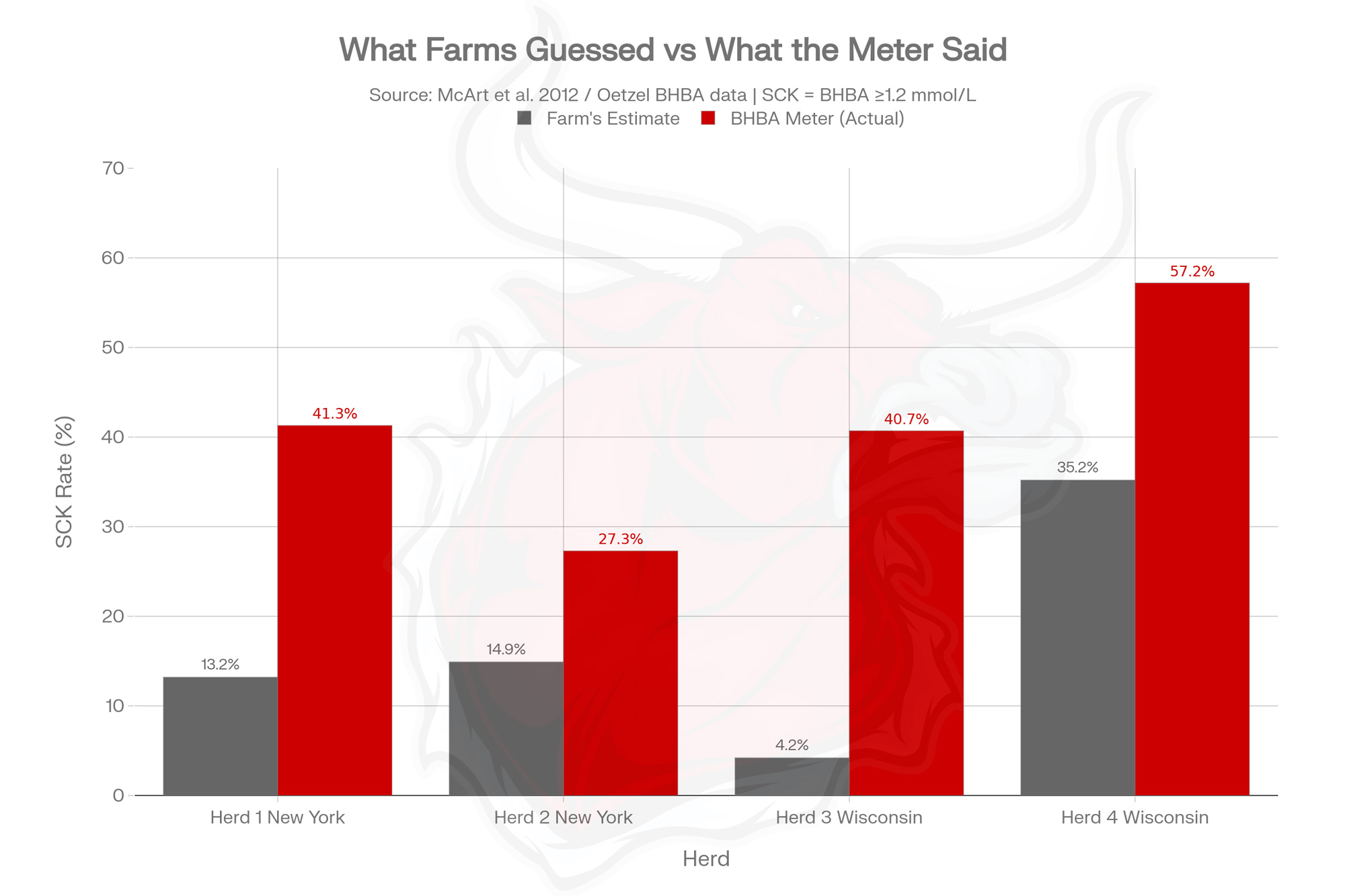
The four‑herd data set Hutjens uses in his classes comes from McArt et al. 2012 and Oetzel’s BHBA work. Here’s the snapshot:

HerdLocationCowsMilk (lb/d)SCK observed by farmSCK measured (BHBA ≥1.2)
1New York1,89092.013.2%41.3%
2New York1,82792.014.9%27.3%
3Wisconsin2,79486.74.2%40.7%
4Wisconsin4,10677.035.2%57.2%

Herd 3 is the one everyone remembers: 4.2% subclinical ketosis based on what the farm was catching vs 40.7% when every fresh cow was actually tested. Again, these weren’t disaster herds. Milk flowed. Cows walked.

Across all four herds, McArt et al. reported an overall prevalence of subclinical ketosis of 43.2%. Hutjens’ slide commentary rounds the field reality to about 46%. Either way, that “30% SCK” rule of thumb you still hear kicked around is on the low side, not the conservative side.

Wisconsin AgSource DHI data on 3,400 herds and 215,000 cows gives some real‑world weight to those numbers:

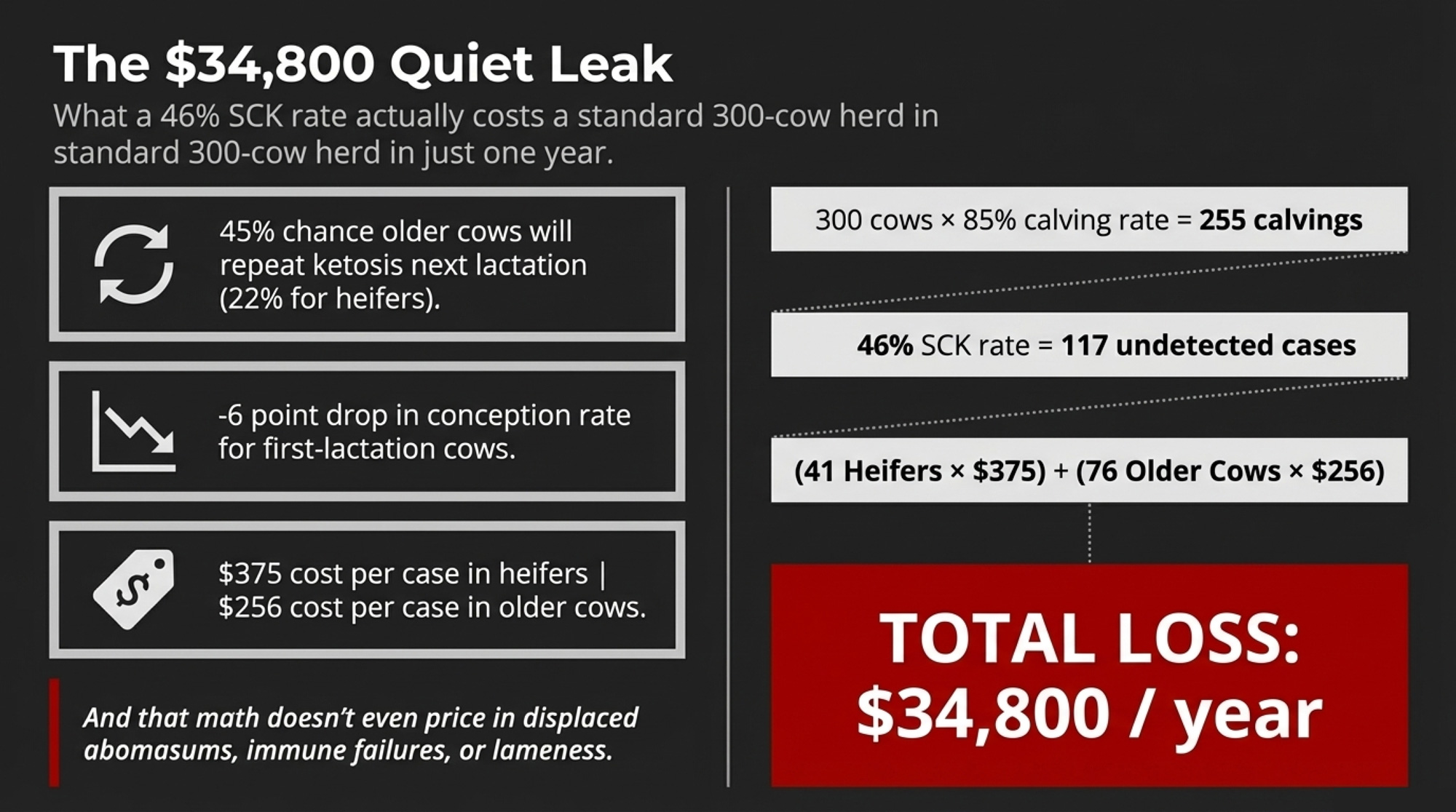
  • First‑lactation cows with SCK had about a 22% chance of repeat ketosis in the next lactation.
  • Older cows with SCK had about a 45% chance of repeat ketosis next time.
  • Conception rate dropped by 6 points in first‑lactation cows and 2 points in older cows.
  • Culling rates went up 6 points in heifers and 5 points in older cows.
  • Estimated cost per case: roughly $375 in first‑lactation cows and $256 in older cows.

Put that into your own barn math. Take a 300‑cow herd:

  • 300 cows × 85% calving rate ≈ 255 calvings per year.
  • If 46% of those calvings involve SCK, that’s about 117 cows with subclinical ketosis.
  • Assume 35% heifers and 65% older cows: 117 × 0.35 ≈ 41 heifers, 117 × 0.65 ≈ 76 older cows.
  • Cost: 41 × $375 + 76 × $256 ≈ $34,800 per year in SCK‑related losses.

That’s one year. On 300 cows. Without adding a single line for DAs, left shifts in immune function, or lameness.

BCS, Lameness, and Why the Digital Cushion Belongs in This Story

Cows melting after calving is almost background noise on many farms. You notice the very thin ones. The rest look like “fresh cows.”

Carvalho et al. followed Holsteins from calving through 21 DIM and grouped them by whether they gained or lostbody condition score in those first three weeks (JDS 97:3666, 2014). When they later looked at pregnancy per AI, cows that gained BCS had much higher pregnancy rates — on some farms, several times higher — than cows that lost condition. Barletta et al. (Theriogenology 104:30–36, 2017) told the same story: cows losing BCS after calving were less fertile than cows maintaining or gaining condition.

Then there’s the foot‑level math.

Lischer and Ossent’s work on digital cushion thickness (DCT) — the fat pad under the hoof — and lameness risk has been repeated and refined in more recent longitudinal studies. Cows with the thickest digital cushions had roughly 15% fewer lameness problems than those with the thinnest. DCT kept falling after calving and bottomed out around 110–120 DIM, roughly when cows finally return to positive energy balance.

Hutjens’ rule of thumb on that work is simple:

  • Aim to keep BCS loss under 0.5 after calving.
  • Treat any loss greater than 0.75 BCS in the first 60 DIM as a major red flag.

He backs that with three cheap warning lights:

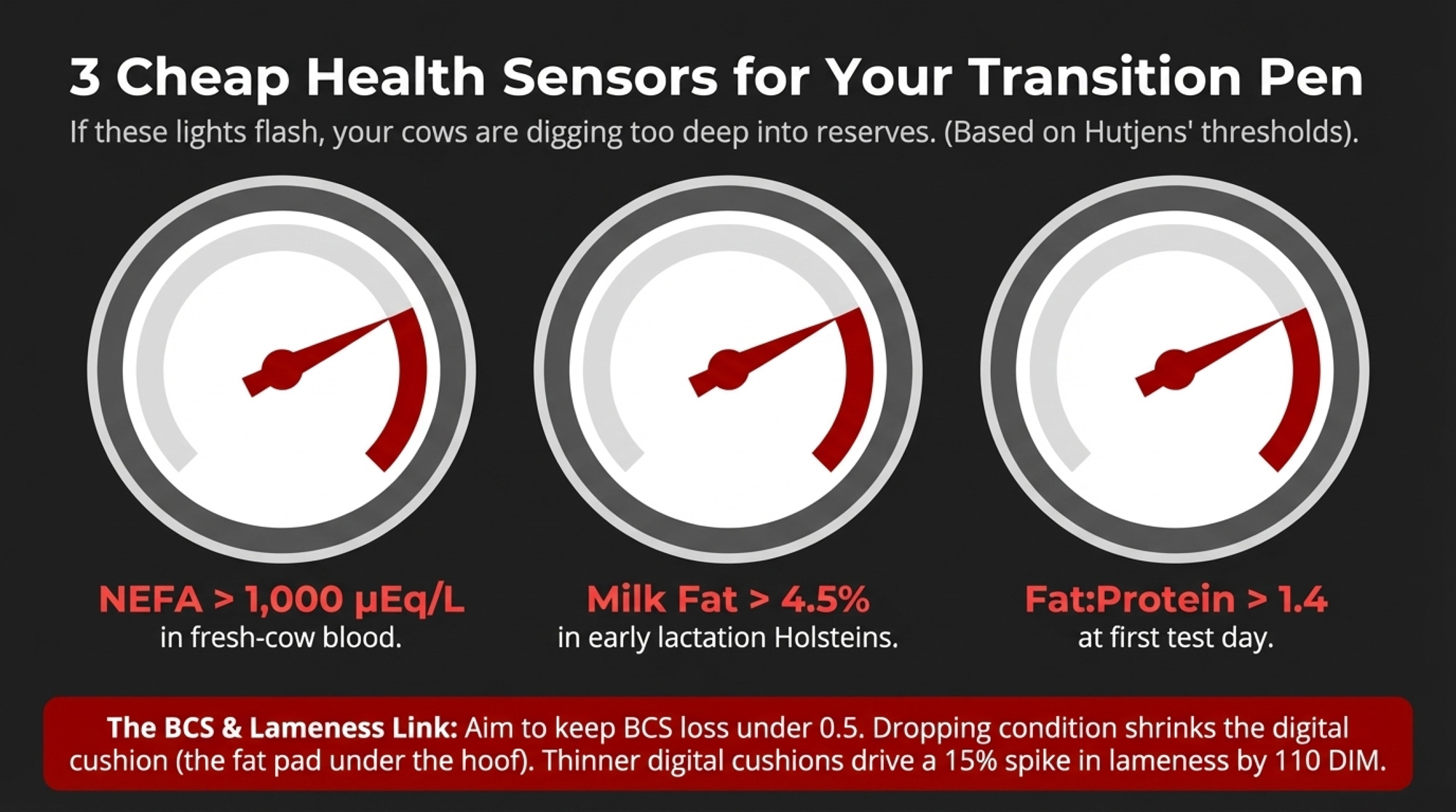
  • NEFA over 1,000 μEq/L in fresh‑cow blood.
  • Holstein milk fat over 4.5% in early lactation.
  • Fat: protein ratio above 1.4 (true protein) at first test. 

Those numbers cost very little to look at, and they tell you whether your transition program is quietly pushing cows into a level of negative energy balance that sets up both ketosis and lameness.

What NASEM 2021 Changed — and Where the Field Has Already Moved Past It

NASEM 2021 (the update to NRC 2001) gave nutritionists a new baseline. Bill Weiss laid out several transition‑relevant changes that show up in the tables Hutjens uses.

Key NASEM 2021 updates for transition cows:

  • Dry matter intake. Expected DMI is now adjusted for NDF and the pre‑calving drop. With a high‑straw, low‑energy dry diet, NASEM projects close‑up DMI around 1.8–2.0% of body weight, dropping to about 1.65%of body weight in the week before calving. 
  • Fetal requirements. Nutrient demand from the fetus is modeled starting at 150 days pregnant, rising on a curve to 280 days. There’s still no formal adjustment for twins, even though Hutjens notes 6–8% of older Holsteins carry twins. 
  • Protein for dry cows and heifers.
    • Far‑off dry cows: 12% CP7.2% MP.
    • Close‑ups: 13% CP8.6% MP.
    • Springing heifers: 14% CP9.2% MP.

Weiss mentions a target of roughly 1,000 g MP one week pre‑calving. Field practice often layers another 100–200 g MP on top in high‑producing herds to cover colostrum and the fetal curve.

NASEM models did not show a clear benefit to adding more starch to close‑up diets, and the committee chose not to bump methionine requirements or include rumen‑protected choline (RPC) as a required nutrient. That’s the conservative job of a requirement system. It also explains why a lot of nutritionists now talk about “where we’re going beyond NASEM” in transition cows:

Transition TopicNASEM 2021 StandardWhat Progressive Herds Are DoingRed Flag if You’re Not
Close-Up MP~1,000 g/d one week pre-calving (8.6% MP)1,100–1,200 g/d in last 30 days to cover fetal growth & colostrum synthesisLow-peak ECM in fresh cows; colostrum quality flags
MethionineMet as required amino acid to meet MP onlyAdding RPM on top of MP requirements based on Batistel 2017 (9.5 lb/d ECM gain)Sluggish fresh-cow DMI; high oxidative stress markers
Rumen-Protected CholineNot modeled as a required nutrientAdding 13–14 g/d choline chloride (Ghaffari 2025 meta-analysis: +1.29 kg/d milk, +0.48 kg/d DMI)High fatty liver incidence; poor early-lactation DMI recovery
Close-Up EnergyLow-energy, high-straw diet; no modeled benefit to added starchModest energy increase (slightly lower NDF, more starch/sugar) so cows arrive at calving adapted to high-energy rationBCS crashes in first 21 DIM; fat:protein ratio >1.4 at first test
Fresh Cow FatNo formal recommendation1.5% DM as 60:30 palmitic:oleic blend, 0–24 DIM (de Souza/Lock: +7 lb/d milk, lowest NEFA)High NEFA (>1,000 µEq/L); poor body condition maintenance
Stocking DensityNot modeledMax 80% of stalls; ≥30 in. bunk space in close-up pens (Michigan State: −1.6 lb milk/day per 10-pt overstock)Heifers underperforming vs. genetic potential at peak
SCK ThresholdNo formal monitoring protocolBHBA ≥1.2 mmol/L cow-side meter, every fresh cow 5–14 DIM, 30-day audit minimumYou’re guessing 4%; the meter may say 40.7%

NASEM’s job is to be slow and conservative. Yours is to know where that line sits and then, with your own numbers, decide where stepping beyond it makes sense.

What This Means for Your Operation

You don’t fix transition cows by copying a ration on Facebook. You fix it by measuring, then making decisions in your own pens. Here are a few places to start.

  • For the next 30 days, stop guessing on subclinical ketosis — measure it.
    For one full month, pull BHBA on every fresh cow between 5 and 14 DIM with a cow‑side meter. Don’t cherry‑pick the “sick” ones. Then compare the actual SCK rate to what you and your team would’ve guessed. If your gap looks anything like Herd 3’s 4.2% vs 40.7%, you know you’ve got a program problem, not a cow problem. 
  • Audit your close‑up pen with a notebook, not just your eyes.
    Count stalls. Count headlocks. Count cows. If your close‑up pen is consistently running much above 80% of stallsor cows have less than 30 inches of bunk space, accept that no supplement will fully outrun that stocking penalty in early lactation. That’s a facilities-and-grouping decision, not a magic additive. 
  • Let BCS, loss, fat, protein, and NEFA be your cheap health sensors.
    Pull your first test day data. If Holstein fresh cows are averaging fat: protein ratios over 1.4 or fat over 4.5%, and you’re seeing average BCS losses over 0.5 in the first 60 DIM, treat that as proof your cows are digging too deep into reserves. That’s your cue to re‑look at dry‑off BCS targets, close‑up intake, and time in the fresh pen. 
  • Run one clean pen trial on methionine or fresh‑cow fat.
    Take the Batistel methionine and de Souza/Lock fat data to your nutritionist. Pick one pen where records are solid, and agree on a 60–90 day window where that pen gets RPM or a 60:30 palmitic: oleic FA blend at 1.5% of DM. Track ECM, DMI, metritis, and ketosis against your own baseline. If it pays in your numbers, you’ve earned the budget. If it doesn’t, you’ve got real data instead of a brochure. 
  • Tilt your bull list a notch toward health, where the pen keeps biting you.
    If you’re constantly fighting ketosis, milk fever, or lameness, don’t try to solve it only in the feed alley. Push a little more weight toward metabolic and health traits in the index you already trust. It’s not an overnight fix, but your future transition cows can be a lot more forgiving than some of the cows you’re managing now.

Key Takeaways

  • If you do one thing in the next 30 days:
    Test BHBA on every fresh cow once between 5 and 14 DIM for a month. If your real SCK rate comes back anywhere near the 40–46% range those four herds saw, you’ll know this isn’t about “a few bad actors” — it’s a herd‑level pattern you can actually manage. 
  • If your fresh cows are losing more than 0.5 BCS by 60 DIM or your fat: protein ratio is over 1.4:
    Treat that as a system problem, not a cow problem. Before you add another product, check stocking rate, group moves, and whether your close‑up ration really lines up with what NASEM says those cows can eat in the last 7–10 days. 
  • If you’re on the fence about methionine, fat, or choline in transition diets:
    Don’t buy a “program.” Design a trial in one pen with good records, then decide based on your ECM, DMI, and disease numbers over 60–90 days whether those additives earn a spot in your budget. 

The Bottom Line

The four herds in the Oetzel/McArt project didn’t suddenly become “bad” the day the BHBA meter came out. The only thing that changed was that, for a few weeks, somebody measured instead of guessing. If you did the same in your fresh pen next month, would the numbers back up what you already believe about your transition cows — or hand you the kind of 46% shock that forces you to change how you feed and manage the most important group on your farm?

Complete references and supporting documentation are available upon request by contacting the editorial team at editor@thebullvine.com.

Learn More

The Sunday Read Dairy Professionals Don’t Skip.

Every week, thousands of producers, breeders, and industry insiders open Bullvine Weekly for genetics insights, market shifts, and profit strategies they won’t find anywhere else. One email. Five minutes. Smarter decisions all week.
NewsSubscribe
First
Last
Consent

Retained Placenta Rates Cut in Half: How a $10 Calcium Protocol Delivers $15,000 Annual Returns

That 10% retained placenta rate you accept as ‘normal’? It’s costing you $20,000/year. Here’s how to cut it in half for $5,000.

EXECUTIVE SUMMARY: You’re likely losing $20,000 annually to a problem you think costs $75 per case—retained placenta actually drains $389 when you count lost milk, open days, and cascade diseases. Progressive dairy operations have cracked the code, cutting rates from 10% to 4% with one simple change: dual calcium bolusing at $10 per cow. The game-changer is understanding that retained placenta isn’t mechanical—it’s an immune system failure caused by subclinical hypocalcemia, which affects 25-50% of fresh cows. Farms implementing this evidence-based protocol consistently achieve 307% ROI, banking $15,000+ net profit annually on a 500-cow operation. Research from Cornell, Wisconsin, and USDA confirms what leading producers already know: preventing retained placenta isn’t about treating problems better; it’s about stopping them before they start. With payback in under 4 months and proven results across North America, the only question is whether you’ll capture this value now or continue accepting ‘normal’ losses.

retained placenta prevention

Progressive farms are discovering that a simple calcium protocol delivers 307% ROI while cutting fresh cow disorders in half—here’s what they’re learning about transition cow economics

There’s a conversation happening in milk houses and conference rooms across the dairy industry right now, and it’s about something most of us thought we had figured out: retained placenta.

You know how it is. For generations, we’ve accepted that 8-12% of fresh cows will retain their placentas. Just another cost of doing business—like bedding expenses or fuel prices. But here’s what’s interesting: that acceptance might be costing your operation far more than you realize.

What I’ve been seeing across operations from Wisconsin to California is that retained placenta is actually running about $389 per case when you factor in all the downstream impacts. That figure comes from research published in the Journal of Dairy Science, and it’s been consistent with what Dairy Herd Management and other industry analysts have been documenting. For a typical 500-cow operation, addressing this one issue could mean the difference between breaking even and banking an extra $15,000 annually.

“We’ve spent decades selecting for higher production. Now we need to ensure our management systems support the remarkable cows we’ve created.”

The Economics Nobody’s Been Calculating

So here’s what really caught my attention. When researchers from the University of Guelph and Ontario Veterinary College dug into the true cost of retained placenta across multiple herds, they uncovered something remarkable. That immediate vet expense—the $75 bill most of us focus on—it’s just a tiny piece of the actual economic impact.

Stop Tracking the Wrong Number. That $75 vet bill you’re watching? It’s camouflage for a $389 problem. Lost milk production silently bleeds $287 per case while you’re focused on treatment costs. Progressive dairy operations banking an extra $15,000 annually know this truth: the real cost lives in what you’re NOT measuring. Time to start counting what counts.

The breakdown tells an interesting story:

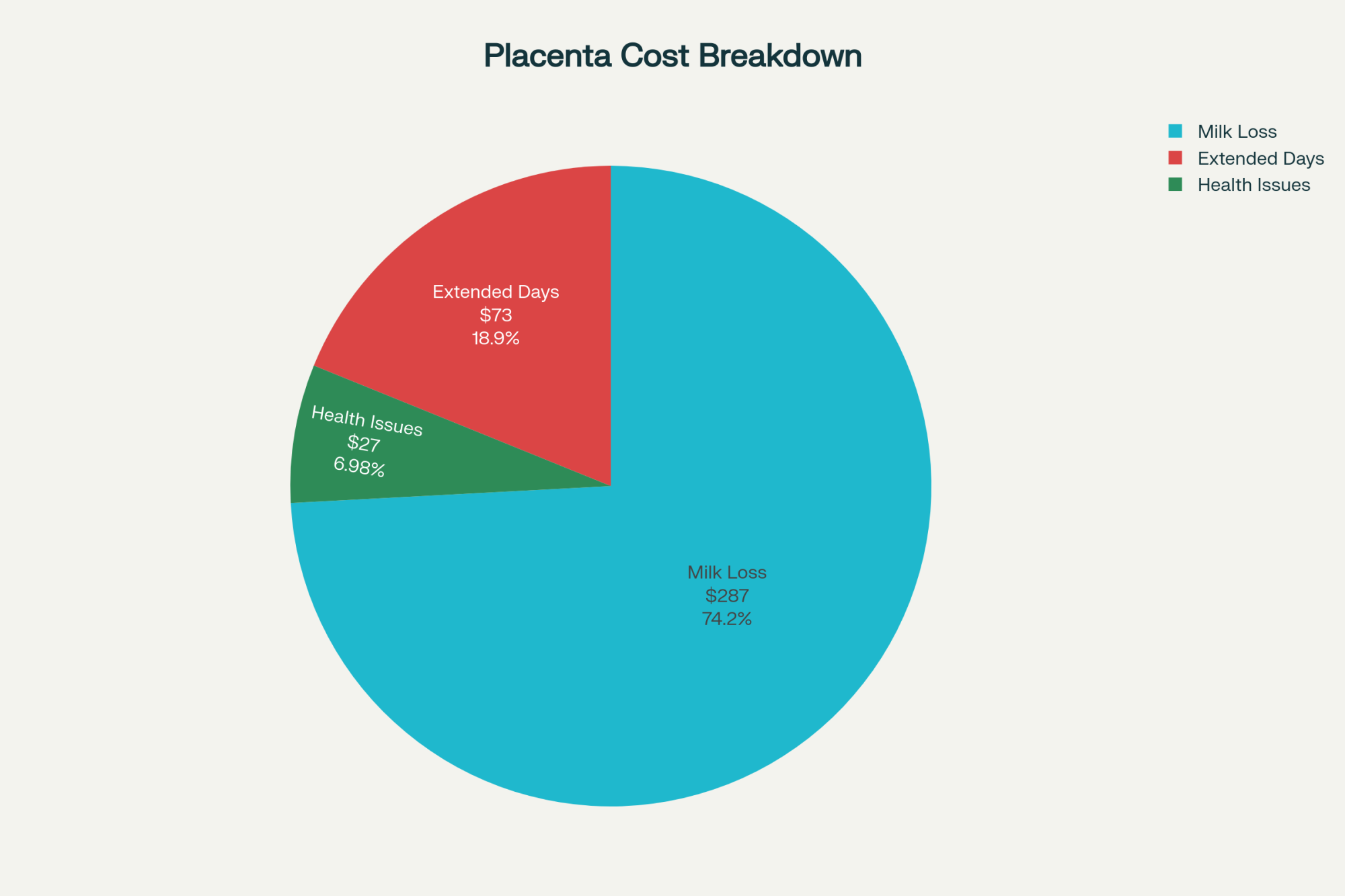
  • Direct milk production losses account for $287 per case (that’s roughly 74% of your total cost)
  • Extended time to pregnancy adds another $73, about 19% of the impact
  • Increased susceptibility to other diseases contributes $25-29 per case

What’s worth noting is the loss in milk production. These cows produce 300-500 kg less milk across their entire lactation—we’re talking 660 to 1,100 pounds that never makes it to your bulk tank. At current component-adjusted prices in most regions, you’re looking at $150-250 in lost revenue per affected cow.

And the reproductive piece… well, that’s where it really adds up. Research from Tanzania and several other countries tracking dairy herds shows that retained-placenta cows average around 52 more days open than their healthy herdmates. They need about 2.9 services per conception compared to 1.9 for unaffected cows.

You probably know this already, but each open day costs between $3 and $5, depending on your market. So that extended time to pregnancy alone can run $150-260 per affected cow. These aren’t theoretical numbers—they’re showing up in actual herd records from coast to coast.

Cost Breakdown: Where Your Money Goes

For each retained placenta case:

  • Milk production loss: $287 (74%)
  • Extended days open: $73 (19%)
  • Secondary health issues: $25-29 (7%)
  • Total: $389 per case

Understanding the Biological Transformation

To really appreciate why retained placenta has become such a challenge, we need to consider how dramatically our cows have changed.

I was talking with a dairyman the other day—third generation, been in the business his whole life—and he pulled out production records from the 1980s. His grandfather’s best cows were producing 12,000-14,000 pounds per lactation. Today? His herd averages over 26,000 pounds. That’s not just more milk. That’s a complete biological transformation.

Peak production has climbed from 60 pounds daily to routinely exceeding 120 pounds in well-managed herds. And the metabolic demands this places on transition cows? They’re unprecedented in the history of dairy farming.

Here’s where the science gets really interesting. Research from Dr. Kayoko Kimura’s team at the USDA’s National Animal Disease Center in Ames has revealed something that changes our entire understanding of retained placenta. Rather than being a mechanical failure—you know, the placenta simply being “stuck”—it’s fundamentally an immune system dysfunction.

The neutrophils (those white blood cells responsible for separating placental tissue from the uterine wall) show a 41% reduced response in cows destined to retain their placentas. These same animals have interleukin-8 concentrations averaging just 51 picograms per milliliter, compared to 134 in healthy cows.

What’s that mean for us in practical terms? Well, if retained placenta results from immune dysfunction rather than mechanical attachment, then our traditional approach of manually removing these membranes… it might be misguided. In fact, recent systematic reviews suggest it could actually be counterproductive.

The Calcium Connection: A Management Breakthrough

One of the most encouraging developments in transition cow management involves our understanding of calcium’s role beyond just milk fever prevention. Research from multiple institutions shows that subclinical hypocalcemia dramatically increases the risk of retained placenta risk.

And we’re not talking about clinical milk fever, that’s obvious to spot. This is the 25-50% of fresh cows with low blood calcium who appear perfectly normal during your morning walk-through.

Dr. Jessica McArt’s work at Cornell has really helped clarify calcium’s multiple roles in the transition period. Beyond muscle contraction (which we all know about), calcium is essential for immune cell function, influences stress hormone regulation, and affects rumen motility—which directly impacts dry matter intake.

The challenge, as many of us have seen, is that as milk production has intensified, our traditional calcium management strategies haven’t kept pace. A cow producing over 100 pounds of milk daily? She’s facing metabolic demands that would’ve been unimaginable just two decades ago.

Learning from High-Performing Operations

What I find encouraging is seeing operations achieving retained placenta rates below 4%—less than half the industry average. While each farm has its unique approach, they share several management strategies worth considering.

The Evolution of Calcium Supplementation

Here’s what’s working for many operations, particularly in California and the upper Midwest. Instead of the traditional single calcium treatment at calving, they’ve implemented what’s being called a dual-bolus protocol.

The approach is straightforward: administer the first dose within an hour of calving—two boluses of calcium chloride. Then return 12-24 hours later with two more boluses. That second dose catches the delayed hypocalcemia that often triggers problems two or three days after calving.

The research supports this approach. A comprehensive meta-analysis published this year demonstrated that while single bolusing addresses immediate calcium needs, it’s the second dose that prevents the delayed hypocalcemia associated with many fresh cow disorders.

The economics work out to about $10 per cow for the protocol, and many operations are seeing retained placenta rates drop from 10-11% down to 4-5% within months of implementation. That’s a pretty solid return.

The Critical Importance of DCAD Verification

You know what’s been eye-opening? How many farms believe they’re feeding an effective negative DCAD program when they’re actually not.

I was working with a nutritionist in Wisconsin recently, and she shared her experience testing urine pH on farms claiming to run negative DCAD programs. About half the time, when they actually test urine pH, it’s running 7.5 to 8.0—nowhere near the 6.0 to 6.5 target for Holsteins (or 5.5 to 6.0 for Jerseys).

The issue often traces back to high potassium levels in forages that overwhelm the anionic salts being fed. The solution typically involves adjusting the forage base to include lower-potassium feeds. Corn silage, wheat straw, and certain grass hays—these can help achieve the mineral balance needed for effective DCAD programs.

Rethinking Stocking Density in Transition Facilities

Research from the University of British Columbia, combined with extensive field observations from Wisconsin and New York operations, has really clarified the relationship between overcrowding and fresh cow health.

Here’s what we’re seeing: operations that thought they were being efficient running close-up pens at 120% capacity often see fresh cow health issues—including retained placenta—decrease by about a third when they drop to 80% stocking density.

The most successful operations typically maintain:

  • No more than 80% stocking density based on feed bunk space
  • At least 30 inches of bunk space per cow
  • Between 100 and 160 square feet per cow in bedded pack systems

And here’s something crucial—these farms size their transition facilities for 140% of the average monthly calving rate. Because, as we all know, calvings aren’t uniform throughout the year.

Quick Reference: Dual Calcium Bolus Protocol

Initial Dose: Within 1 hour of calving

  • 2 boluses of acidogenic calcium (chloride or sulfate form)
  • Provides 50-75g elemental calcium

Follow-up Dose: 12-24 hours post-calving

  • 2 additional boluses of the same product
  • Addresses delayed hypocalcemia risk

Investment: Approximately $10 per cow Expected outcome: 40-60% reduction in retained placenta incidence

Reconsidering Traditional Treatment Approaches

Perhaps the most surprising development—at least for those of us who’ve been doing this a while—involves our understanding of how to manage retained placenta when it does occur.

Multiple systematic reviews and surveys of veterinary practices across Europe and North America are challenging the long-standing practice of manual removal. Dr. Carlos Risco’s work at the University of Florida has been documenting outcomes from what he calls conservative management.


Management Approach
Traditional ManagementEvidence-Based ProtocolImpact
PhilosophyTreat problems after they occurPrevent immune dysfunctionParadigm shift: mechanical → metabolic
Intervention TimingWait 24-48 hours post-calvingWithin 1 hour + 12-24h follow-up60% reduction in cases
Treatment ProtocolManual placenta removal + antibioticsDual calcium bolus ($10/cow)88% treatment success when needed
Target Blood CalciumAccept subclinical hypocalcemiaMaintain >8.5 mg/dL throughout50% of cows affected without symptoms
Expected RP Rate10-12%4-5%60% fewer cases = 25 cows saved/year
Annual Cost (500 cows)$19,450 in losses$15,345 net profit$34,795 total swing
ROINegative307% ($3 back per $1)Payback in 3.9 months

The approach is simple: monitor cows for signs of systemic illness—fever, depression, reduced appetite. If the cow is otherwise healthy, leave the placenta alone. About 40% resolve without any intervention, with membranes typically passing within 2-11 days.

I’ll admit, this represents a significant departure from what most of us were taught. But farms implementing this approach are reporting fewer cases of metritis and improved long-term reproductive performance. The evidence is getting harder to ignore.

Traditional vs. Conservative Treatment: Making the Choice

Looking at the comparison between approaches, the shift in thinking becomes clear:

Traditional Manual Removal:

  • Immediate intervention within 24-48 hours
  • Physical removal of retained membranes
  • Often followed by intrauterine antibiotics
  • Higher risk of uterine contamination and trauma
  • Increased metritis rates have been reported in recent studies

Conservative Management:

  • Monitor for systemic signs only
  • Leave the placenta to separate naturally
  • Treat only if fever, depression, or reduced appetite develops
  • 40% spontaneous resolution without intervention
  • Lower metritis incidence and improved fertility outcomes

The data’s compelling enough that many progressive operations are making the switch, though it does require a mindset shift for both staff and veterinarians.

Calculating Return on Investment

Let’s look at the economics using real-world data from operations that have implemented comprehensive calcium management protocols. And these aren’t just projections—these are actual results we’re seeing.

307% ROI in Under 4 Months Isn’t Theory—It’s Basic Math. Invest $10 per cow in dual calcium bolusing and watch the cascade effect: $9,725 from prevented retained placenta, $4,200 from reduced metritis, $2,820 from fewer displaced abomasums, $3,600 from crushing ketosis. The total? Bank $15,345 net profit on your 500-cow herd. Here’s the revelation: leading producers aren’t preventing one disease—they’re preventing the entire fresh cow disorder cascade. That’s the difference between targeting symptoms and fixing the metabolic foundation.

For a typical 500-cow dairy operation:

What You’ll Invest:

  • Dual calcium bolus protocol: $5,000 annually
  • Urine pH monitoring supplies: About $200
  • Staff training time: Maybe 4 hours total
  • Total investment: $5,200

What You Can Expect Back:

  • Reduced retained placenta cases (from 10% to 5%): 25 fewer cases × $389 = $9,725
  • Decreased metritis incidence: 15 fewer cases × $280 = $4,200
  • Fewer displaced abomasums: 6 cases × $470 = $2,820
  • Reduced ketosis: 18 cases × $200 = $3,600
  • Total annual savings: $20,345

Net profit increase: $15,345 Return on investment: 307% Payback period: 3.9 months

Most operations report achieving these results within their first year of implementation.

Monitoring Success: The Fresh Cow Disorder Rate

Here’s what separates successful operations from those just hoping for the best—they track what’s commonly called the Fresh Cow Disorder Rate. That’s the percentage of cows experiencing any clinical disease during the first 21 days in milk.

Top 10% vs. The Rest: The Fresh Cow Disorder Gap Is Brutal and Real. Elite operations keep disorders under 15% through aggressive calcium management and systematic prevention. Average herds struggle along at 30%, losing thousands in hidden costs. Bottom tier? Over 40% of fresh cows hit metabolic problems they could’ve prevented. The difference isn’t genetics, facilities, or luck—it’s measurement and management discipline. Track your 90-day rolling Fresh Cow Disorder Rate weekly. You’ll know within one quarter whether you’re banking profits or bleeding money. Which bar describes your herd?

Analysis of data from multiple herds reveals pretty consistent patterns:

  • Leading operations (top 10%): Less than 15% disorder rate
  • Average performance: 25-35% disorder rate
  • Operations needing improvement: Over 40% disorder rate

Track this metric weekly, calculate a 90-day rolling average, and you’ll know within one quarter whether your investment is delivering expected returns.

Regional Adaptations and Seasonal Considerations

Now, it’s important to recognize that these protocols need adjustment based on where you’re farming. What works in Wisconsin doesn’t always translate directly to Arizona or Texas.

Field observations across various regions indicate that heat stress can significantly increase the risk of retained placenta. Some operations see rates increase from 7-8% during cooler months to 13% or higher during summer heat stress. If you’re in the Southwest or Southeast, you might need more aggressive calcium supplementation during the summer months.

I’ve noticed that Florida dairies, dealing with year-round heat and humidity, often run their calcium protocols more aggressively from May through October. One producer near Okeechobee told me they actually triple-dose during their worst heat—though that’s based on their specific conditions and vet recommendations.

Feed availability varies, too. Operations in regions where corn silage is limited or expensive face additional challenges in achieving that low-potassium forage base necessary for effective negative DCAD programs. Some Western operations have found success using wheat straw or importing specific grass hays to achieve an appropriate mineral balance.

The key is adapting these principles to your specific circumstances rather than trying to apply a one-size-fits-all approach.

Emerging Technologies and Future Directions

While current calcium management strategies offer immediate opportunities, several developments promise further to transform transition cow management over the coming decade.

Research teams at the University of Wisconsin-Madison and Michigan State University have been identifying blood biomarkers that can predict retained placenta risk weeks before calving. Dr. Heather White’s group at UW-Madison reports identifying specific metabolites in blood samples collected at dry-off with approximately 85% accuracy, flagging high-risk cows.

Sensor technology continues to advance as well. The latest generation of rumen boluses continuously monitors pH, temperature, and motility patterns. When combined with machine learning algorithms, these systems can identify metabolic problems days before clinical signs appear.

Within the next 5-10 years, we’re likely to see:

  • Practical on-farm biomarker testing for under $50 per cow
  • AI-driven risk scoring based on sensor data
  • Precision interventions targeted to individual cow needs
  • Industry-wide fresh cow disorder rates below 10%

Implementation Timeline: Your 90-Day Roadmap

For those ready to capture these opportunities, here’s a methodical approach that’s been working well:

Week 1-2: Assessment Phase

  • Review records from the past 90 days
  • Calculate the current fresh cow disorder rate
  • Order calcium boluses
  • Set up tracking system (whiteboard works fine)
  • Schedule staff training

Week 3-8: Implementation Phase

  • Begin dual calcium bolus protocol
  • Start weekly urine pH testing (if feeding negative DCAD)
  • Evaluate close-up pen stocking density
  • Calculate and post weekly disorder rates
  • Monitor compliance and troubleshoot

Week 9-12: Refinement Phase

  • Compare the disorder rate to the baseline
  • Calculate cases prevented
  • Document cost savings
  • Refine protocols based on results
  • Plan additional improvements

The consistent message from successful operations: reliable execution of simple protocols outperforms sporadic attempts at complex interventions every time.

The Bottom Line: Are You Leaving Money on the Table?

As we navigate today’s challenging economic environment—volatile milk prices, rising input costs—the question isn’t whether we can afford to invest in better transition cow management. It’s whether we can afford to leave $15,000 or more in annual returns uncaptured.

The science supporting these approaches is robust, with dozens of peer-reviewed studies confirming both the biological mechanisms and economic benefits. The protocols are practical enough for any motivated operation to implement. And perhaps most importantly, these improvements align with broader industry goals around animal welfare and reduced antibiotic use.

You know, a thoughtful producer said something to me recently that really stuck: “We’ve spent decades selecting for higher production. Now we need to ensure our management systems support the remarkable cows we’ve created. This isn’t about revolution—it’s about evolution, about adapting our practices to match biological reality.”

The tools and knowledge exist today. The only variable is whether individual operations will choose to implement them. For those who do, the rewards—both financial and in terms of animal health—are substantial and sustainable.

So here’s my question for you: If you could reduce retained placenta rates by half and bank an extra $15,000 annually with a $5,200 investment, what’s stopping you from starting this week?

Implementation of these protocols should be done in consultation with your herd veterinarian and nutritionist to ensure adaptation to your specific operational circumstances. Success depends on consistent execution and systematic outcome monitoring. The research and examples cited represent common industry findings and experiences; individual results will vary based on management, facilities, and regional factors.

KEY TAKEAWAYS 

  • True Cost Exposed: Retained placenta drains $389/case in lost milk, open days, and cascade diseases—turning your “normal” 10% rate into a $20,000 annual bleed
  • The $10 Solution: Dual calcium bolusing (at calving + 12-24 hours later) cuts retained placenta rates 60%, from 10% down to 4% within 90 days
  • Guaranteed ROI: $5,000 investment returns $20,000 in prevented losses = $15,000 net profit with 3.9-month payback (307% ROI)
  • The Science: Retained placenta isn’t mechanical—it’s immune dysfunction from subclinical hypocalcemia hiding in 25-50% of “healthy” fresh cows
  • Start Monday: Order calcium boluses, schedule 4-hour staff training, implement protocol, track Fresh Cow Disorder Rate weekly—see results within 30 days

Complete references and supporting documentation are available upon request by contacting the editorial team at editor@thebullvine.com.

Learn More:

The Sunday Read Dairy Professionals Don’t Skip.

Every week, thousands of producers, breeders, and industry insiders open Bullvine Weekly for genetics insights, market shifts, and profit strategies they won’t find anywhere else. One email. Five minutes. Smarter decisions all week.
NewsSubscribe
First
Last
Consent

The Proven Strains Behind Smarter Probiotics and  Stronger Herds

Proof, not promises. That’s what modern dairies expect from probiotics—and why the right strains deliver results you can measure.

Executive Summary: You know, it’s clear we’ve turned a corner with probiotics in dairy. What once felt like trial‑and‑error is now precision management—backed by data, field proof, and measurable ROI. Proven strains like Actisaf®, Levucell®, and CLOSTAT® are helping producers improve feed intake, stabilize butterfat, and ease transition stress —where most fresh‑cow challenges begin. Research from universities and extension programs shows results that speak volumes—stronger cows, healthier calves, and up to 20:1 returns. The dairies getting ahead are the ones matching microbial strategies to their region and feeding consistently. And with affordable DNA sequencing now unlocking deeper herd insights, the future of dairy health is becoming clearer than ever—because managing microbes is quickly becoming as important as managing genetics.

Probiotic strain selection

You know, it’s interesting how some dairy ideas come full circle. Probiotics are one of those. Years ago, we treated them like a shot in the dark – something you tried if you had a problem cow or a slugging tank. Today, the conversation sounds very different. Research, farm data, and extension trials all show the same thing: when probiotics are used the right way – with the right strain – they can consistently improve cow health, stabilize production, and boost profitability.

What’s especially exciting is that this isn’t about reinventing nutrition programs. It’s about managing what’s already in the cow—the hundreds of microbial species driving rumen efficiency, feed conversion, and fresh cow resilience. Once you support those microbes correctly, they pay you back every day they stay in balance.

Looking at the Transition Period: The Biggest Opportunity

If you’ve milked cows or managed fresh cows, you already know—the transition period is where you win or lose the year. Energy drops, feed intake declines, and health risks peak. University of Guelph and Cornell data confirm that over 70 percent of dairy herd health challenges occur within the first 30 days after calving. And they’re expensive. Cornell’s PRO‑DAIRY economic models estimate the average case of ketosis costs around $290 per cow, while a displaced abomasum often adds another $500 to $600 in lost production and treatment cost.

The encouraging news is that probiotics have now proven their place in this stage. Multiple studies published in the Journal of Dairy Science and verified by EFSA research show that the yeast strain Saccharomyces cerevisiae CNCM I‑4407—marketed as Actisaf®—increases average intake by around 1 kg/cow/dayand raises milk yield by approximately 3 kg/day during early lactation.

What’s happening is basic microbial biology. Actisaf helps rumen microbes stabilize pH, reduces lactic acid buildup, and supports acetate production for butterfat synthesis. In extension-monitored herds across Wisconsin and Ontario, producers report fewer off-feed cows and more consistent butterfat.

As one nutritionist for UW Extension puts it, “When rumen microbes are healthy, cows don’t crash.” That simplicity—keeping cows eating and fermenting evenly through transition—is what drives both milk gains and health paybacks.

Breaking Down What Works: The Proven Strains

DNA sequencing dropped from $3,000 to under $100 per sample—a 97% cost collapse that’s pushing microbiome management from research labs to feed bunks, with Cornell predicting commercial tools within 5 years

Let’s get clear about something important: not all probiotics perform equally. Think of them like sire lines—each strain has its own genetic potential and specialty. Here are the top three strains with consistent dairy‑specific validation:

Probiotic StrainBrand ExampleKey Function in Dairy Cows
S. cerevisiae CNCM I‑4407Actisaf®Improves feed intake, stabilizes rumen pH, supports butterfat production.
S. cerevisiae CNCM I‑1077Levucell® SCEnhances fiber digestion and fermentation for high‑forage diets.
Bacillus subtilis PB6CLOSTAT®Stabilizes feed intake, reduces inflammation, and improves performance under heat or metabolic stress.

What’s worth noting is how the environment or management influences effectiveness. In cooler climates—say, Minnesota or Ontario—yeast-based products like Actisaf perform consistently during the transition window. In the dry‑lot systems of California or Arizona, spore-forming Bacillus strains like CLOSTAT have an advantage because they survive high feed temperatures and long storage times.

As UW–Madison field specialists like to remind producers, “If the strain ID isn’t on the bag, it’s not a guarantee—it’s a gamble.” Verified strain research is what separates proven tools from placebo feeds.

Calf Health: The Race to Colonize Early

What’s fascinating about current research is how probiotics can change the trajectory of youngstock performance. The gut of a newborn calf is almost sterile at birth, so timing matters. The first microbes to colonize will shape that calf’s immunity and digestion for weeks to come.

Studies from the University of Alberta (2023) showed that giving Lactobacillus reuteri in colostrum cut the rate of E. coli K99 binding—linked to scours—by more than 80 percent and halved diarrhea cases. Meanwhile, research at Iowa State (2024) demonstrated that a multi‑strain blend of Bifidobacterium animalis and L. johnsonii increased weaning weights by about 4 kg and shortened scours duration by roughly a day.

Spending $4.50 per calf on probiotics prevents $250 in scours treatment costs—a 55:1 payback that’s backed by University of Alberta and Iowa State research showing 80% E. coli reduction and 50% fewer diarrhea cases

For those watching costs, scours prevention is one of the easiest wins. Wisconsin Extension values one case of calf scours at $250 per calf, once you include treatments and growth setbacks. Preventing even one in ten calves from scouring with a $4–5 probiotic investment per head adds up fast.

But the timing window’s short. Probiotics need to be in the first colostrum or milk feeding and continue through 10‑14 days. Wait longer, and the pathogens win the race to colonize.

Let’s Talk ROI: The Real Math Behind the Microbes

Transition cows deliver the highest immediate payback at 19:1 ROI—proof that precision nutrition during the critical 3-week window transforms both health and profitability

Herd data from the University of Wisconsin and Penn State Extension show remarkably consistent returns for well‑managed probiotic protocols:

Herd CategoryProgram Cost (100 Cows)Average ROIObserved Benefit
Calves $300 – $350 1:10 – 1:12 Stronger starts, fewer scours
Transition Cows ~$500 1:18 – 1:20 Better intake, smoother health curves
Lactating Herd ~$2,600 1:4 – 1:6 More consistent butterfat, feed efficiency

Transition cows deliver the most immediate payback, with returns up to 1:20, justifying the high ROI figures in the title. This happens because the improvements occur within the same lactation cycle. Calves show longer-term returns—lower morbidity and better feed conversion once they join the milking herd. Meanwhile, full-lactation programs amplify ration efficiency and component stability, particularly during summer heat or ration changes.

The common factor? Consistency. Herds that feed verified probiotic strains daily and track DMI, health events, and butterfat see repeatable, predictable returns.

When transition diseases can cost $289 to $550 per case and hit over 70% of fresh cows, the $5 probiotic investment looks less like a feed additive and more like production insurance

Regional Fit: Matching Microbes to Management

Probiotic performance depends on regional and environmental conditions, which is why “copy‑paste” programs rarely hold up across the country. In humid regions like the Great Lakes and Northeast, yeast strains that buffer rumen pH help offset silage variability and maintain component levels as forages shift in moisture content.

In contrast, herds in California’s San Joaquin Valley or Idaho’s Snake River region often rely on spore-forming Bacillusstrains for one key reason—they remain viable in feed that can exceed 100 °F in mixers or holding bins. Field studies presented at the California Animal Nutrition Conference confirm that these spores retain live-cell counts, unlike yeasts, which lose them.

Smaller herds often rely on pelleted mineral inclusion for simplicity, while large freestall or dry‑lot dairies integrate inoculants through automated micro-systems. The principle’s the same either way: healthy rumen bacteria need consistent delivery, regardless of herd size or region.

The Next Wave: Precision Microbiome Management

Here’s what’s encouraging. DNA sequencing that once cost thousands per sample now runs under $100. Cornell and Wageningen University researchers have shown that rumen microbiome profiles can now predict feed efficiency and methane output with about 85 percent accuracy.

European dairy herds are already testing tailored microbial feeding models in pilot programs, pairing sequencing data with ration adjustments. Cornell’s Dairy Innovation Group expects commercial applications in the United States within the next five years.

This development suggests that herd microbiome management is shifting from reactive to predictive. Soon, we’ll be adjusting feed programs not just for dry matter and energy—but for microbial populations that signal rumen resilience or stress. It’s technology catching up to the biology farmers have been managing intuitively for decades.

Practical Takeaways: From Research to Routine

Across the board, the dairies seeing the most consistent ROI from probiotics share three traits:

  1. They feed daily. Skipping doses resets microbial populations.
  2. They use verified strains. Each product lists strain number, live count, and dairy trial data.
  3. They track outcomes. DMI, components, and health metrics are logged every month.

When those three habits become routine, probiotics stop being “add‑ons” and start behaving like feed insurance. An Ontario field project reported at the 2024 Southwestern Dairy Conference found that herds running continuous Actisaf and CLOSTAT protocols saw 20 percent fewer ketosis cases after six months.

And as Université Laval microbiologist Dr. Marie Auger reminded producers during that same conference, “A dairy cow is the most advanced fermentation system you’ll ever manage.” She’s right. Once you view the cow’s gut microbes as vital production partners—not just digestive passengers—the economics, consistency, and herd health all speak for themselves.

Because at the end of the day, what the science and the field work both say is simple: better microbes make better cows. And better cows make better margins.

Key Takeaways:

  • Verified probiotics—Actisaf®, Levucell®, and CLOSTAT®—have moved past the marketing stage, delivering consistent 20:1 returns by keeping rumens stable and cows milking strong.
  • The transition period remains the biggest opportunity; feeding proven strains from 21 days pre‑calving through fresh boosts both intake and butterfat.
  • Calves benefit most when probiotics start at birth—giving them a microbial head start that reduces scours and strengthens lifetime performance.
  • Results depend on fit: pick yeast for humid forage‑heavy herds, Bacillus spores for hot, dry‑lot conditions, and always feed daily for consistency.
  • With affordable DNA testing on the horizon, farmers will soon manage rumen microbes as precisely as genetics—making the microbiome a true management tool.

Complete references and supporting documentation are available upon request by contacting the editorial team at editor@thebullvine.com.

Learn More:

The Sunday Read Dairy Professionals Don’t Skip.

Every week, thousands of producers, breeders, and industry insiders open Bullvine Weekly for genetics insights, market shifts, and profit strategies they won’t find anywhere else. One email. Five minutes. Smarter decisions all week.
NewsSubscribe
First
Last
Consent
Send this to a friend