

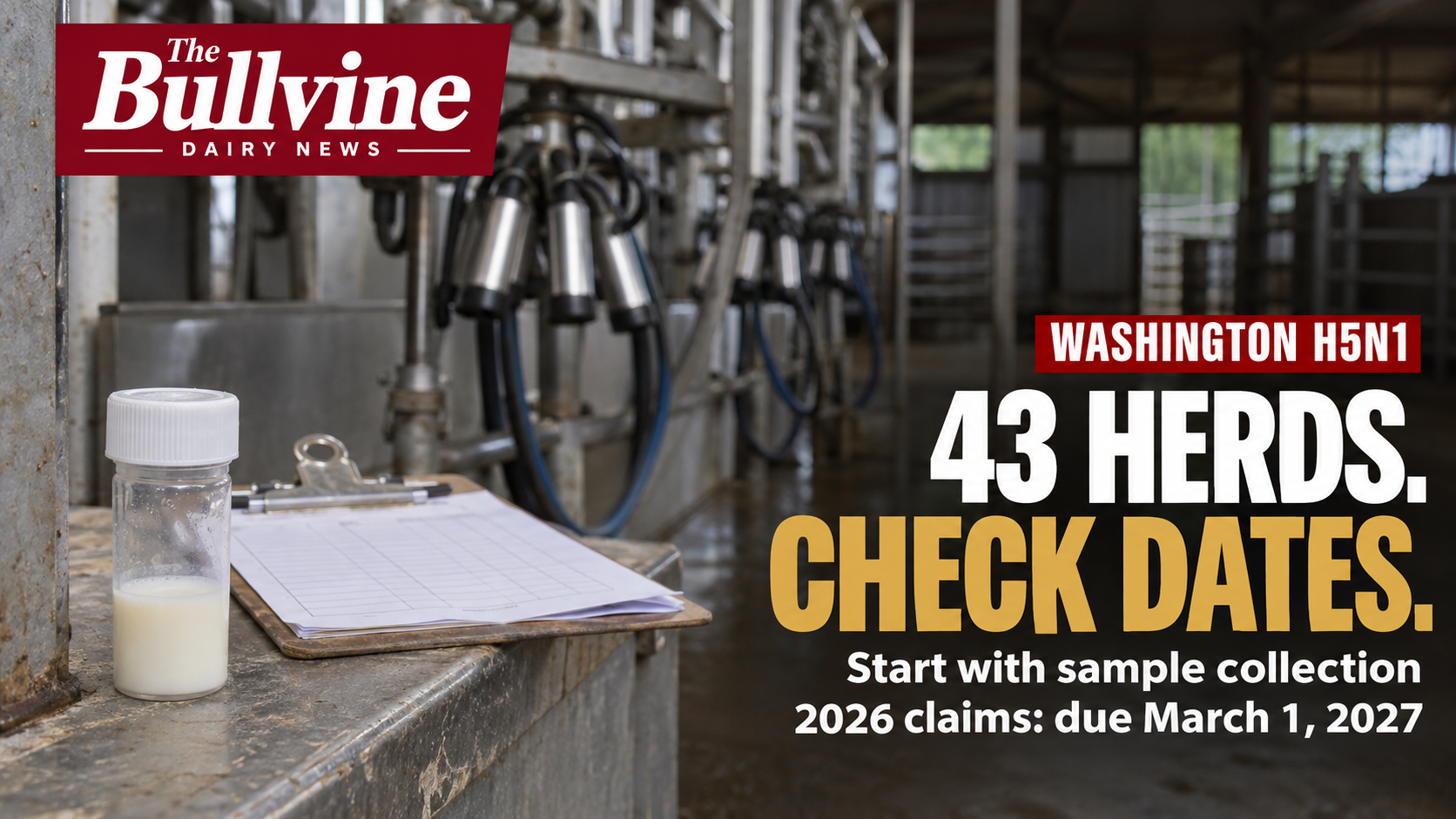





WSDA’s table now lists 43 herds, each dated by confirmation. ELAP looks back 14 days from sample collection. Start your removal log there, and file 2026 losses by March 1, 2027.
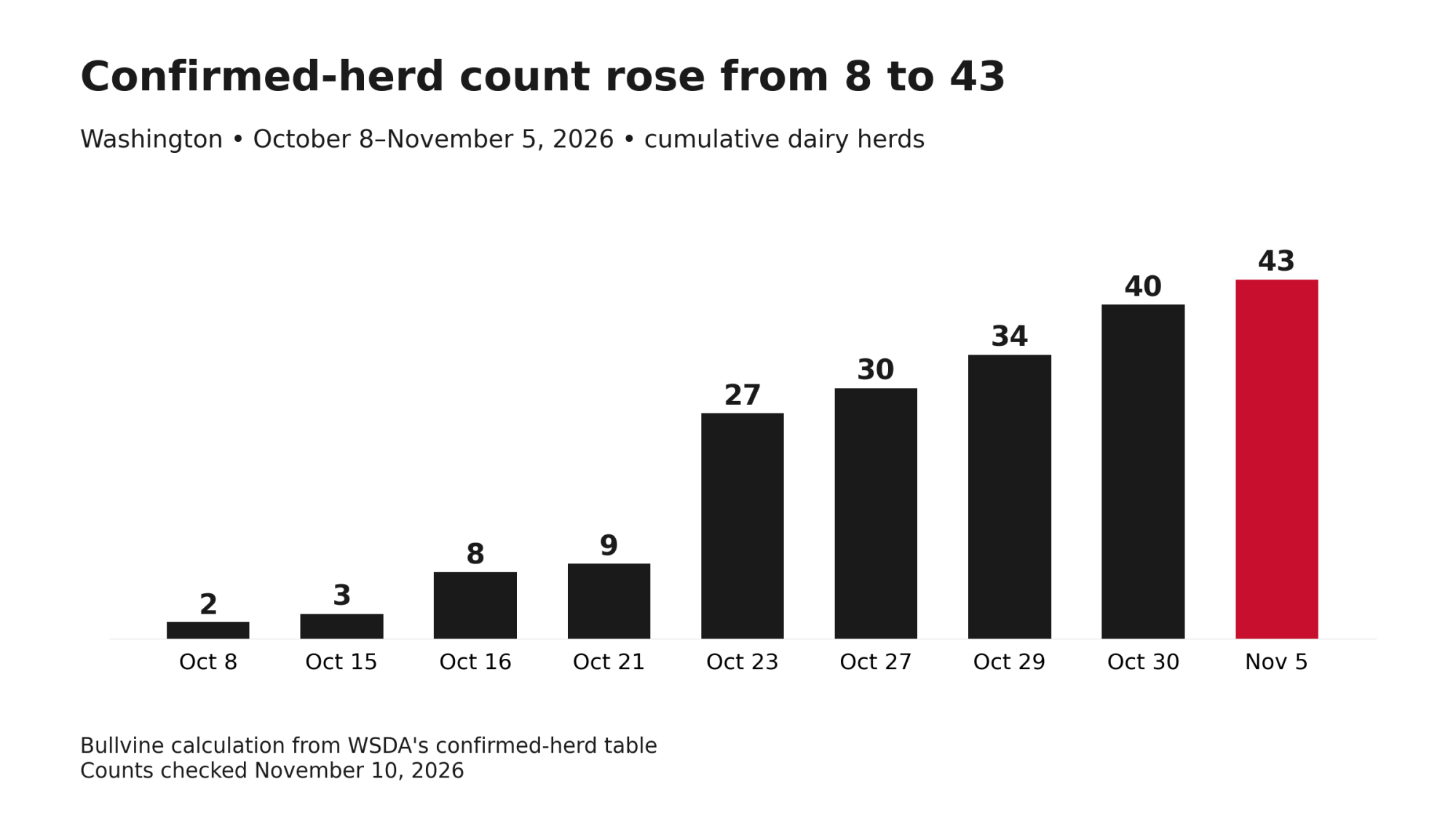
WSDA’s confirmed-herd table showed 8 H5N1 dairy herds on October 16. By November 5 it showed 43, in Yakima and Benton counties. APHIS announced the likely Idaho connection on November 4. State agriculture and animal-health groups requested a voluntary vaccine pilot on November 5. As of November 10, we had not located a public USDA authorization of that pilot.
For an affected dairy, the claim clock hasn’t changed. ELAP’s eligible removal window opens 14 days before the positive sample’s collection date, and 2026 losses are due March 1, 2027. Our Michigan-based illustration leaves about one-third of estimated milk value uncovered. It’s not a payment forecast.
What does WSDA’s table actually show?
The running total is Bullvine math.
| WSDA confirmation date | County | New herds | Washington cumulative |
| October 8 | Yakima | 2 | 2 |
| October 15 | Yakima | 1 | 3 |
| October 16 | Yakima | 5 | 8 |
| October 21 | Yakima | 1 | 9 |
| October 23 | Yakima 17, Benton 1 | 18 | 27 |
| October 27 | Yakima | 3 | 30 |
| October 29 | Yakima | 4 | 34 |
| October 30 | Yakima | 6 | 40 |
| November 5 | Yakima 2, Benton 1 | 3 | 43 |
That’s 41 herds in Yakima and 2 in Benton. The table dates the first Benton confirmation to October 23.
What confirmation dates do—and don’t—tell you
October 23 is the date to watch. WSDA logged 18 confirmations that day, more than doubling the running total, and recorded its first herd outside Yakima. WSDA’s table doesn’t explain why those confirmations share a date.
APHIS’s April 2024 FAQ gave a usual turnaround of 1–3 days at a National Animal Health Laboratory Network (NAHLN) laboratory. National Veterinary Services Laboratories (NVSL) confirmation of non-negative samples took another 1–2 days. Those estimates don’t establish the actual collection-to-confirmation or website-posting interval for these Washington herds.
The table records confirmation dates. It doesn’t establish when infection began.
What the movement rules require
On November 4, APHIS said whole-genome sequencing confirmed genotype B3.13 in Washington. It called the result “consistent with transmission of virus from Idaho to Washington likely through cattle movement.” APHIS also said the finding “does not change USDA’s HPAI eradication strategy.” The announcement didn’t identify the cattle class, the movement date or the parties involved.
Two provisions matter when reviewing cattle purchases:
- Non-lactating cattle. APHIS’s current requirements say non-lactating dairy cattle, “including heifers, dry cows, and bull calves,” are “not currently subject to testing for interstate movement due to their risk profile.”
- Lactating cows from Unaffected states. Under the same requirements, lactating cows from states with Unaffected status under the National Milk Testing Strategy can move interstate without a pre-movement test.
APHIS’s announcement doesn’t establish whether either provision applied to that movement.
APHIS recommends pre-movement testing of non-lactating cattle. WSDA says its veterinarians track cattle imported from affected states. Before arranging a shipment, check state entry requirements and any herd restrictions with your veterinarian.
What the vaccination request would change
The November 5 letter to Secretary Brooke Rollins is signed by NASDA CEO Ted McKinney and NASAHO President Dr. Alex Hamberg. It urges USDA to “immediately approve a voluntary national emergency vaccination framework for dairy cattle, beginning with a pilot program in willing states.” Vaccination in any state would need “the concurrence of the State Animal Health Official.” A task force would set “the conditions necessary to expand or conclude vaccination activities.”
The proposed pilot would evaluate vaccine effectiveness, surveillance, implementation and trade impacts. The letter identifies export disruption and additional certification requirements as risks to manage. NASDA says the groups met with USDA and delivered the letter on November 5. The request itself doesn’t authorize vaccination.
The science is promising but narrow. A Nature Biotechnology study published October 28 tested an mRNA vaccine on eight lactating Holsteins, four vaccinated and four given saline, then infused virus directly into the udder. At peak, the vaccinated cows shed about 1,000-fold less viral RNA in milk, and they had less mastitis. The authors say whether that limits spread between animals needs “additional large-scale field experiments.”
A separate January 2026 study in Research found milk neutralizing antibodies undetectable in three cows by week 15. Even so, two of those cows remained fully protected when challenged at week 19. These small challenge studies don’t establish how much vaccination would reduce transmission between commercial herds.
For an affected dairy, the immediate budgeting question is how much milk value remains uncovered after ELAP.
Running the Numbers: a 2,500-cow herd
ELAP pays a standard formula per eligible cow rather than reimbursing each farm’s measured milk loss. This 2,500-cow illustration:
- Uses the Michigan single-herd study described below.
- Values milk at US$20.50/cwt, matching FSA’s April 2024 payment example so both sides use the same price.
- Assumes all affected cows qualify and the producer owns the full milk share.
Our October 18 analysis used a different price basis and herd size, so its dollar figures aren’t directly comparable.
Milk value = kg lost × 2.20462 × $0.205/lb × affected cows. All figures are US dollars, rounded, and cover selected losses only. This isn’t a complete outbreak budget.
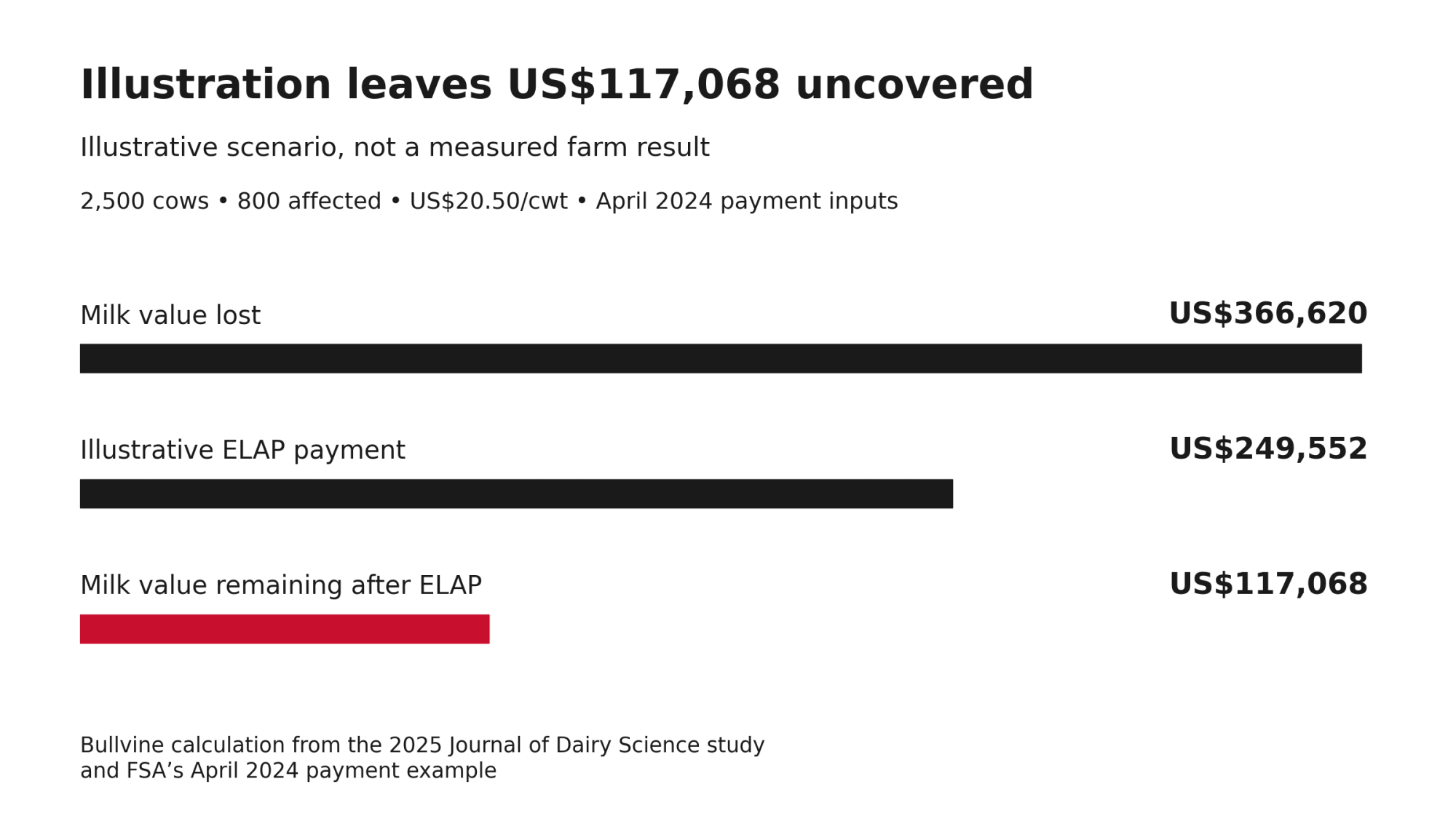
| Line | Michigan-based illustration: 800 affected cows |
| Milk value lost | US$366,620 |
| Illustrative ELAP payment | US$249,552 |
| Milk value remaining after ELAP | US$117,068 |
| ELAP share of milk value lost | 68% |
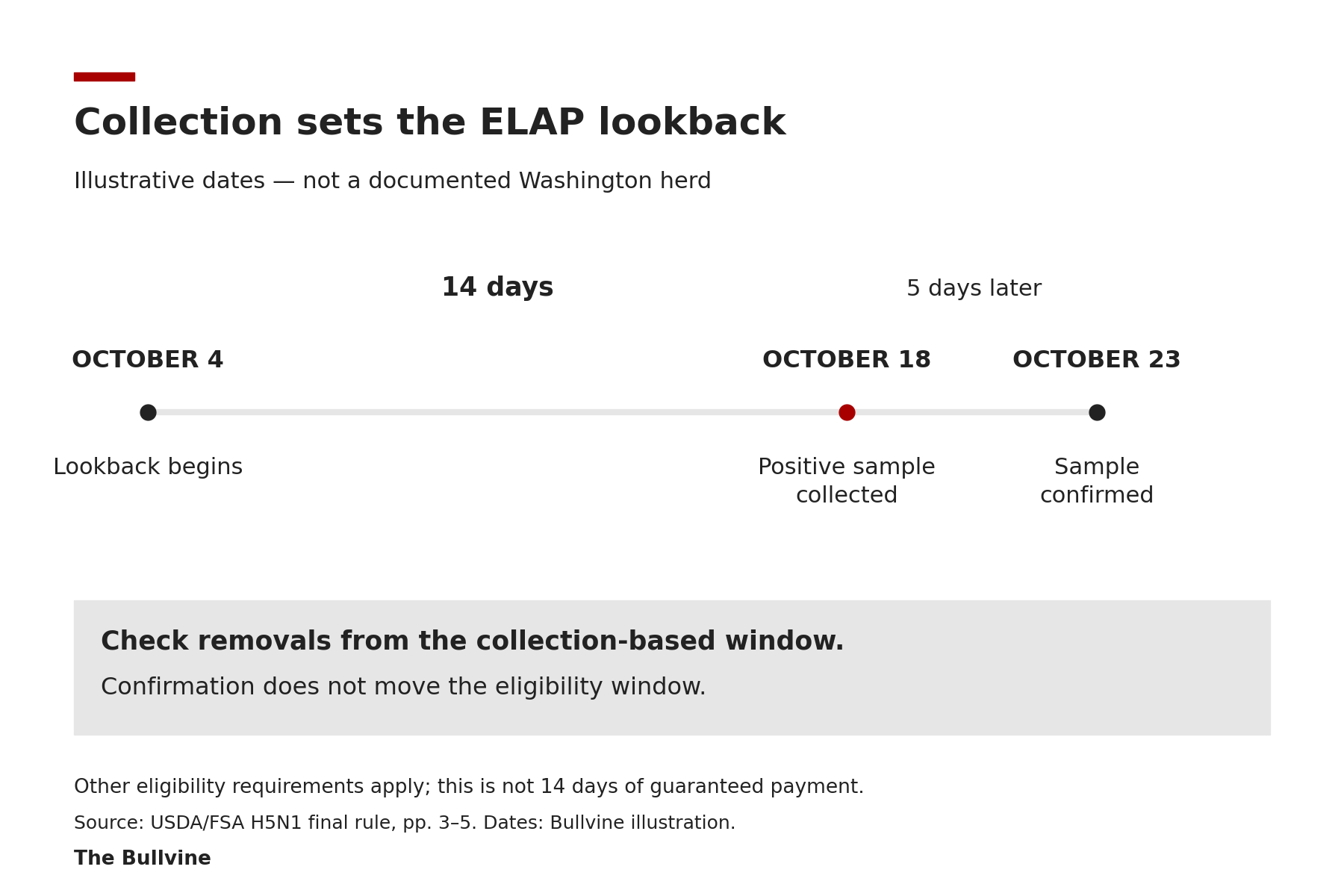
Two-clock check (illustrative). A sample collected October 18 and confirmed October 23 gives an ELAP lookback beginning October 4. Counting from confirmation instead starts the review five days late. Check those five days against removal records, then have FSA confirm the apparent-loss and loss-occurrence entries on CCC-939 before filing.
What this means for your operation
Follow Washington’s worker-protection guidance when handling sick or confirmed cattle. Washington offers commercial dairies a one-time provision of gloves, respirators and eye protection, shipped free on request (Washington State Department of Health).
- Use the collection date, not the table date. Get the sample collection date and NVSL confirmation documents through your veterinarian or WSDA. Enter the collection date as the apparent-loss date on CCC-939, then reconcile removals from 14 days earlier onward.
- File 2026 losses by March 1, 2027. Submit the notice of loss, payment application and required supporting documentation. Don’t rule yourself out solely because average AGI exceeds $900,000. FSA’s ELAP exceptionapplies when at least 75% of average gross income comes from farming, ranching or forestry, certified on Form CCC-943.
- Plan a second filing if losses cross into 2027. A mid-October sample puts the 120-day window into February 2027. For eligible removals on or after January 1, submit a separate 2027 notice of loss and payment application, with required supporting documentation, by March 1, 2028. Retain the original apparent-loss date.
For the full records checklist and lender cash plan, see our October 18 analysis.
What’s the H5N1 ELAP gap for your herd?
Find your 14-day lookback date and uncover the estimated milk revenue gap in 60 seconds.
Numbers change when FSA updates monthly ELAP rates. Bookmark this page or get the update in The Bullvine Weekly.
How we calculate this
Lost Milk Value: Kg lost (1,014 kg per Mich. study) × 2.20462 × Price/lb × Affected Cows.
ELAP Payment: FSA April 2024 example rate ($367.55) × 90% payment factor × 94.3% sequestration factor = $311.94 per eligible cow.
METHODOLOGY AND INPUTS (Bullvine calculation)
How ELAP pays. FSA uses national expected daily production for the applicable month and 24.5 equivalent days of lost production. That is multiplied by the all-milk price, the eligible cow count, the producer’s milk share and the 90% payment factor (7 CFR 1416.113). Eligible lactating cows must have been removed from commercial production because of H5N1-related illness, from 14 days before through 120 days after the positive sample was collected. Each cow is paid once. FSA applies a 5.7% sequestration reduction (1-ELAP, par. 2 G).
Payment example. FSA’s April 2024 example: $367.55 × 0.90 × 0.943 = $311.94 per eligible cow after rounding. Actual payments use the applicable monthly rates.
Michigan-based illustration. 32% affected and 1,014 kg of milk lost per affected cow. The 2025 Journal of Dairy Science study used fever alerts from 437 monitored Holsteins to classify affected cows.
Assumptions. Every affected cow qualifies and the producer owns the full milk share. The same milk price is used on both sides of the comparison. The April 2024 payment inputs are not a verified 2026 rate. WSDA counts were checked November 10, 2026.
Learn More
- H5N1 dairy biosecurity cost: Bivalve Dairy’s $0.04/cwt hit — Protect your 2027 margin using exact biosecurity math from a 1,000-cow operation doing everything right. This breakdown of a $12,500 annual PPE and bulk-tank testing budget reveals the hidden $0.04/cwt cost you need to pencil in today.
- A Third of Retail Milk Tested Positive. The Map Said Under 0.1%. — Exposes the dangerous gap between federal maps and actual virus spread, explaining why 36% of retail milk tested positive. It delivers a surveillance calculator proving how catching an outbreak before two clinical cases fully covers your yearly testing.
- The Vaccine Race That Will Make or Break the Dairy Industry: HPAI — Navigating the hype around upcoming HPAI cattle vaccines requires knowing who is actually delivering. Follow the money on injected versus nasal technology, and see why any annual protocol must prove mammary protection before it earns your dollars.
The Sunday Read Dairy Professionals Don’t Skip.

Every week, thousands of producers, breeders, and industry insiders open Bullvine Weekly for genetics insights, market shifts, and profit strategies they won’t find anywhere else. One email. Five minutes. Smarter decisions all week.