





WSDA’s table: 2 Yakima herds Oct 8, 8 by Oct 16. On 2,700 cows, using published infection rates, our math puts residual milk exposure at $49K–$304K. The whole-herd ceiling is $2.37M-plus.
Executive Summary: WSDA’s quarantine stops movement of lactating dairy cattle; it doesn’t automatically stop milk sales. That’s why “90 minus 28” misreads Washington’s eight confirmed Yakima herds. Bullvine lined up four clocks that start at different events: WSDA’s quarantine, USDA’s 120-day intervention support, ELAP’s 120-day removal window and APHIS’s 30-day interstate bar. WSDA releases a herd after two consecutive negative weekly bulk-tank tests. Using published infection rates of 20% and 32%, a 2,700-cow herd’s residual exposure runs $49,092 to $304,373. A sample collected after September 2 leaves room for removals in 2027, which would need a second ELAP filing.
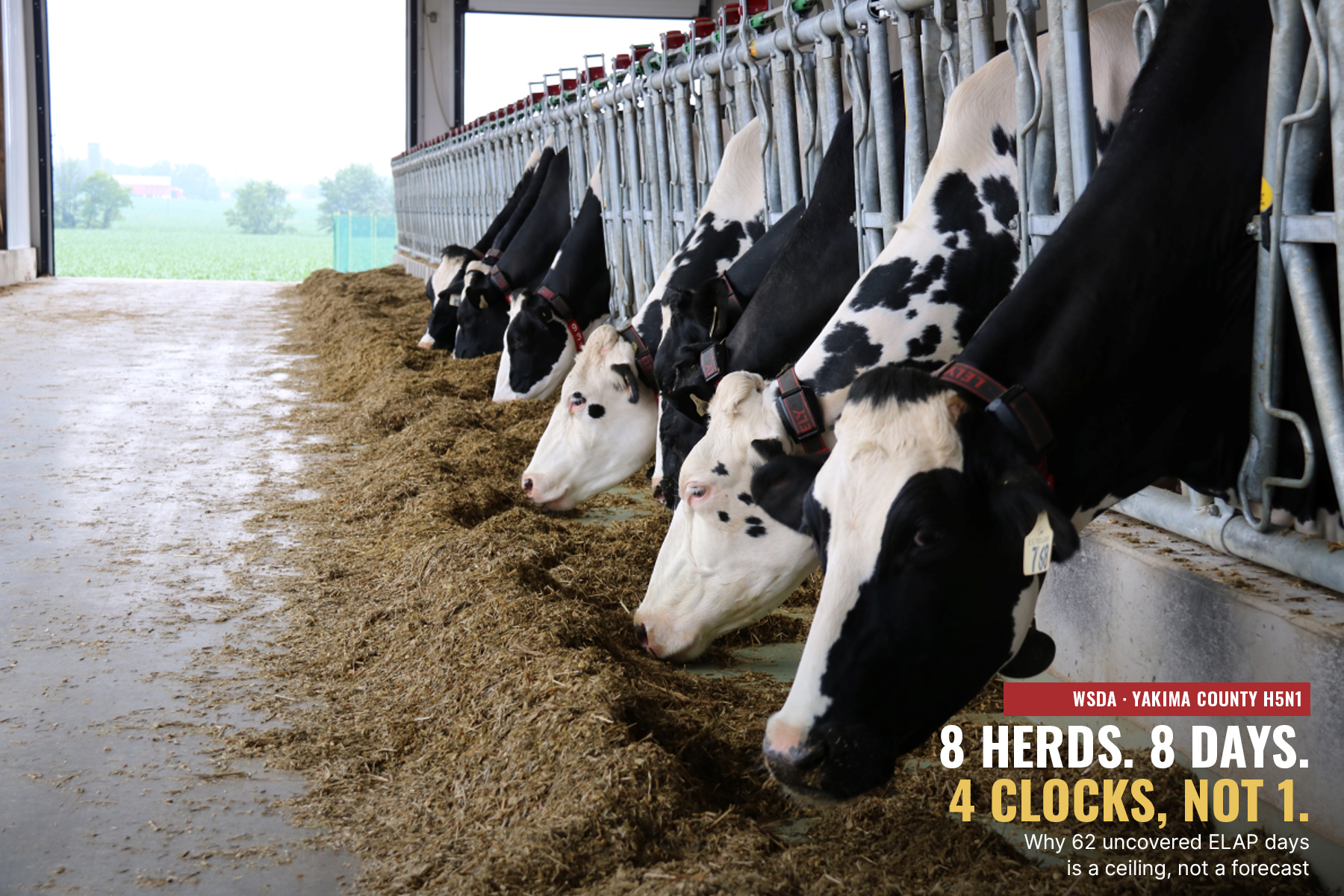
Washington has confirmed H5N1 in eight Yakima County dairy herds in eight elapsed days. The Washington State Department of Agriculture’s producer page lists two herds on October 8, one on October 15 and five on October 16. USDA’s National Veterinary Services Laboratory confirmed the first two detections, which came from the Washington Animal Disease Diagnostic Laboratory.
The number behind that curve is 96.4%. The 2022 Census of Agriculture counted 100,591 milk cows in Yakima County, with 96,998 of them on 32 farms milking 500 or more. The 96.4% is Bullvine’s arithmetic from those county totals.
The eight confirmed premises don’t necessarily hold that share. WSDA hasn’t published their herd sizes, so a lender multiplying eight premises by a county average is guessing.
How fast did other states climb?
Washington’s first eight confirmations came faster than Utah’s or Colorado’s openings and a bit slower than California’s. These are state-release checkpoints, not a matched APHIS daily series, so the rates are directional.
| State | First confirmation | Checkpoint | Elapsed days | Confirmed herds | Herds/week (Bullvine calc.) | Release evidence |
| Washington | Oct 8, 2026 | Oct 16, 2026 | 8 | 8 | 7.0 | Two consecutive negative weekly bulk-tank tests, Ct >38 |
| California | Aug 30, 2024 (3 herds) | Sept 30, 2024 | 31 | 43 | 9.7 | No clinical cows plus three consecutive weekly negative bulk tests |
| Utah | June 1, 2026 | July 14, 2026 | 43 | 22 | 3.6 | Aug 21: 25 dairies affected, 21 released, 4 still quarantined |
| Colorado | Apr 25, 2024 | July 22, 2024 | 88 | 47 | 3.7 | Premises release terms not in our ledger |
The Utah row is the useful one for a lender. In the same state, under the same rules, release dates varied by herd. Four of 25 dairies were still quarantined on August 21, eleven weeks after the first detection. A Yakima cash plan built on one fixed release date assumes every herd clears on schedule, and Utah’s herds didn’t.
Why doesn’t 62 days work?
The shortcut is tidy: 90 quarantine days minus 28 ELAP days equals 62 uncovered days. The subtraction holds. The assumption underneath fails on three counts.
First, the quarantine isn’t a milk stop. WSDA’s flowchart tells field veterinarians to “stop movement of lactating dairy cattle only.” Calves, heifers, springers and dry cows can still move, and cull lactating cows can go straight to slaughter with notification or a permit. California ran the same way: healthy cows on quarantined dairies kept shipping milk for pasteurization.
Second, ELAP’s 28 days are a payment formula, not a calendar. FSA prices each eligible cow on 21 days at zero milk plus seven days at 50%, then pays 90%. Bullvine’s conversion puts that at 24.5 full-production days before the 90% factor and your share of the milk.
Third, the formula only counts the cows that actually left the tank. FSA ties eligibility to “removal of adult dairy cows from the milking herd due to H5N1 infection.” APHIS adds that one missed milking cycle is enough to count a cow as removed.
Which Day 0 controls the money?
Four different dates control four different things:
- Sample collection date opens the ELAP window.
- WADDL’s non-negative result triggers WSDA’s hold.
- NVSL confirmation starts federal intervention support.
- The most recent positive sample restarts APHIS’s 30-day interstate bar.
On WSDA’s flowchart, a non-negative WADDL result means the agency contacts the veterinarian or owner, places a hold order and forwards samples to NVSL. A field veterinarian then issues the quarantine. Release requires “two consecutive negative weekly bulk tank tests” with Ct values above 38.
WSDA’s producer page says USDA support for eligible interventions can run up to 120 days from confirmation on the premises. That money pays for response work such as biosecurity, testing and PPE. Milk revenue sits in a different program.
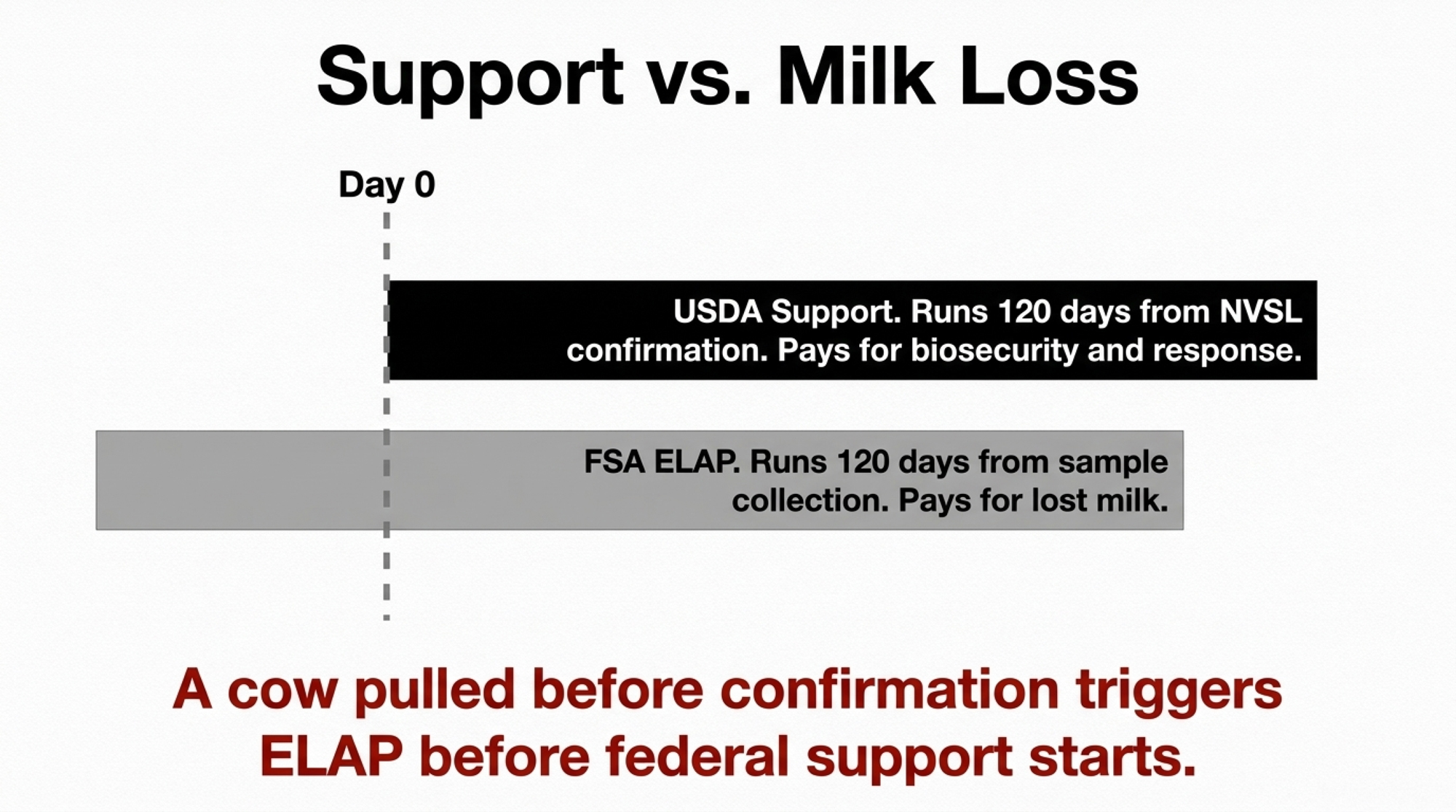
ELAP’s window covers cows first removed from production “beginning 14 days before the positive H5N1 test collection date through 120 days after.” The cow must have been owned, leased or raised for at least 60 days before that collection date, and it can be reported once, in the month it first came out of the tank.
One number, two clocks. Federal support and ELAP both use 120 days. One counts from confirmation and pays response costs. The other counts from sample collection and decides which cows qualify for milk-loss payments.
| Clock | Starts at | Governs | Ends when |
| WSDA quarantine | WADDL non-negative result, hold order, quarantine | Movement of lactating cattle | Two consecutive negative weekly bulk-tank tests, Ct >38 |
| USDA intervention support | NVSL confirmation on the premises | Eligible response and biosecurity costs | Up to 120 days after confirmation |
| FSA ELAP | 14 days before the positive sample’s collection date | Which cows qualify for the per-cow milk-loss payment | 120 days after collection; filed per program year |
| APHIS interstate bar | Most recent positive sample in the herd | Interstate movement of lactating cattle | 30 days with no positive sample, then a new test within 7 days of movement |
Here’s how the four interact. A cow pulled from the tank before confirmation can start ELAP eligibility before federal support begins. Milk from clinically normal cows can keep shipping while WSDA restricts movement. A response invoice can qualify for intervention support without ever counting as milk loss. Put those on one calendar and the ledger breaks.
What does this mean for cattle crossing state lines?
The fourth clock is the one Upper Midwest buyers will run into. Since April 23, 2026, APHIS hasn’t required pre-movement testing for lactating cattle from states with Unaffected State Status under the National Milk Testing Strategy.
That exemption depends on the status of the state the cattle come from. Before you count on it for lactating cattle out of Washington, check Washington’s current status on APHIS’s National Milk Testing Strategy map. If testing applies, the sample has to be collected no more than seven days before the move, and the cattle travel on a Certificate of Veterinary Inspection.
Lactating cattle from a herd that tested positive can’t move interstate for 30 days after the herd’s most recent positive sample, and they need a new test after that. Every new positive in the herd restarts the 30 days. Dry cows, heifers and bull calves aren’t currently subject to the federal pre-movement test.
What happens when a positive lands late in the year?
This is the paperwork trap October samples set.
FSA’s ELAP-23 notice makes H5N1 milk loss a permanent part of ELAP. Losses in each calendar year are paid in that year’s program, and a claim that runs into a new year needs a new notice of loss and application. Notice, application and supporting documents are due March 1 after the program year ends.
Bullvine’s date math: a sample collected September 2 has a 120-day window that runs through December 31. Any sample collected later leaves room for removals in 2027. For a sample collected October 10, 2026, the window runs into early February 2027. Exact end dates depend on how FSA counts Day 1, so confirm with your county office.
The split only happens if cows are actually removed after December 31. In that case you’d file 2026 losses by March 1, 2027, and 2027 losses by March 1, 2028. Every Washington confirmation so far is dated October 2026. Unless those samples were collected before September 3, their windows run into 2027.
Does the $900,000 AGI cap apply to ELAP?
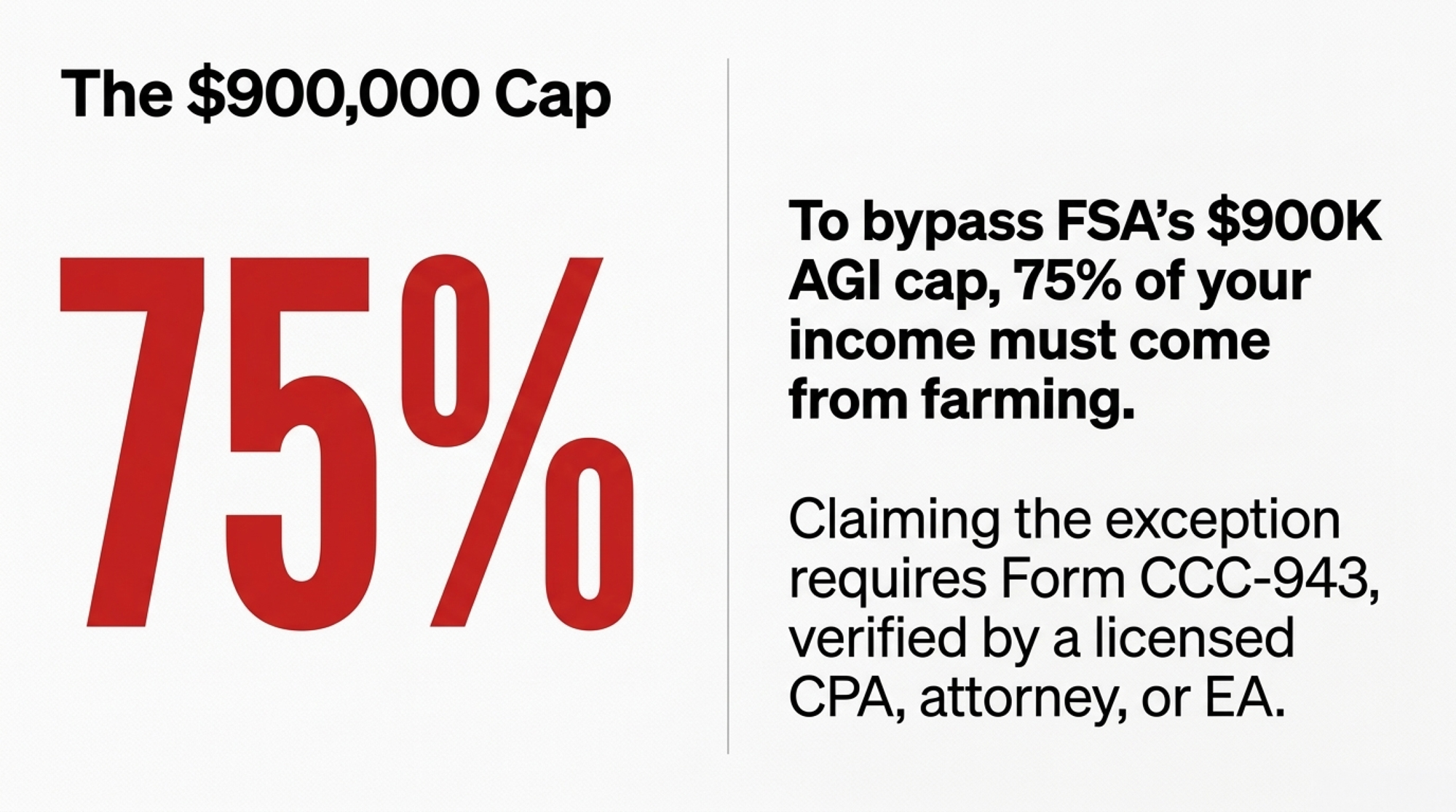
Yes, unless you qualify for FSA’s 75% exception. FSA’s 2026 ELAP fact sheet says producers are exempt from the $900,000 AGI cap if at least 75% of their average gross income comes from farming, ranching or silviculture. Claiming the exception requires Form CCC-943. FSA’s May 2026 AGI guidance credits the exception to the Working Families Tax Cuts Act.
According to Iowa State’s Center for Agricultural Law and Taxation, the certification now needs a verification statement signed by a licensed CPA, a licensed attorney or an IRS enrolled agent. FSA posted a new CCC-943 in June 2026.
For a large Yakima operation, that’s a CPA call to make before a claim goes in. Ask the county office which entity files, which base years apply, and whether your annual AGI certification and a current CCC-943 are already on file.
What belongs in the Day 0 file?
The Day 0 file is a Bullvine method, not an FSA form. It’s the last clean snapshot of the herd before disease starts moving the numbers. FSA’s look-back reaches 14 days before the positive sample, so that’s the window to lock.
Before the next bulk-tank sample leaves the farm, export and lock these records:
- Cow ID, lactation status, pen, ownership entity and purchase date (FSA requires 60 days of ownership before the collection date).
- The previous 14 days of milk, by cow or by pen.
- Daily bulk-tank weights and processor pickup tickets.
- Hospital-pen entries, with the date and reason each cow left the tank.
- Milk withheld, dumped or diverted, by date, volume and reason.
- Fresh cows, dry-offs, culls, deaths and transfers over the same period.
FSA counts each eligible cow once, in the month it was first removed. A lender needs more than that: which cows came out, what they were producing before, and when they went back in the tank.
The test: can one manager produce lactating inventory, pre-loss production, removed cows, shipped pounds and ownership share within an hour? A file that only counts cows on the dairy won’t give you a baseline for the loss.
Running the Numbers
Bullvine stress test. None of these figures is an estimate for a confirmed Yakima herd.
Published evidence
- USDA NASS: 32 Yakima farms milking 500 or more held 96,998 of the county’s 100,591 milk cows in 2022.
- USDA AMS: September 2026 Class IV was $18.94/cwt; Class III was $16.04/cwt.
- FSA: ELAP prices each eligible cow on 21 days at zero and seven days at 50%, paid at 90%.
- Ohio herd study (3,876 adult cows): clinical disease in 20.0% of cows. Clinically affected cows lost 901.2 kg over the 60 days after diagnosis, an average of 18.8 kg a day, and losses lasted up to 60 days.
- Journal of Dairy Science (2025): modeled herd losses assuming 32% of cows affected.
Stated assumptions
- Herd: 2,700 lactating cows. WSDA’s public licensing data groups large dairies into size ranges without naming them, and 2,700 is one of those range boundaries, not a known herd. That’s above Bullvine’s usual 300–500-cow default because the county’s cows sit on large dairies.
- Residual loss: 30 lb per affected cow per day from Day 29 on. Ohio’s 60-day average converts to about 41.4 lb (Bullvine conversion). Those losses were heaviest early, so 30 lb across Days 29 onward probably runs high.
- Affected share: 10% low (half Ohio’s observed rate; our assumption), 20% central (Ohio’s observed rate), 32% high (the JDS model’s assumption).
- Horizon: 62 days (the 90-minus-28 shortcut), plus a 32-day version (Days 29–60) matching how long Ohio’s losses lasted.
- Price proxy: September 2026 Class IV, $18.94/cwt. It’s a dated national class price, not Washington’s Pacific Northwest order blend. Using Class III would cut every figure by 15.3%.
- Not netted out: ELAP, intervention support, insurance, salvage value or interest.
Bullvine calculation: affected cows × 30 lb ÷ 100 × $18.94/cwt × days
| Case | Affected share | Affected cows | 32 days (to Day 60) | 62 days (to Day 90) |
| Low | 10% | 270 | $49,092 | $95,117 |
| Central | 20% | 540 | $98,185 | $190,233 |
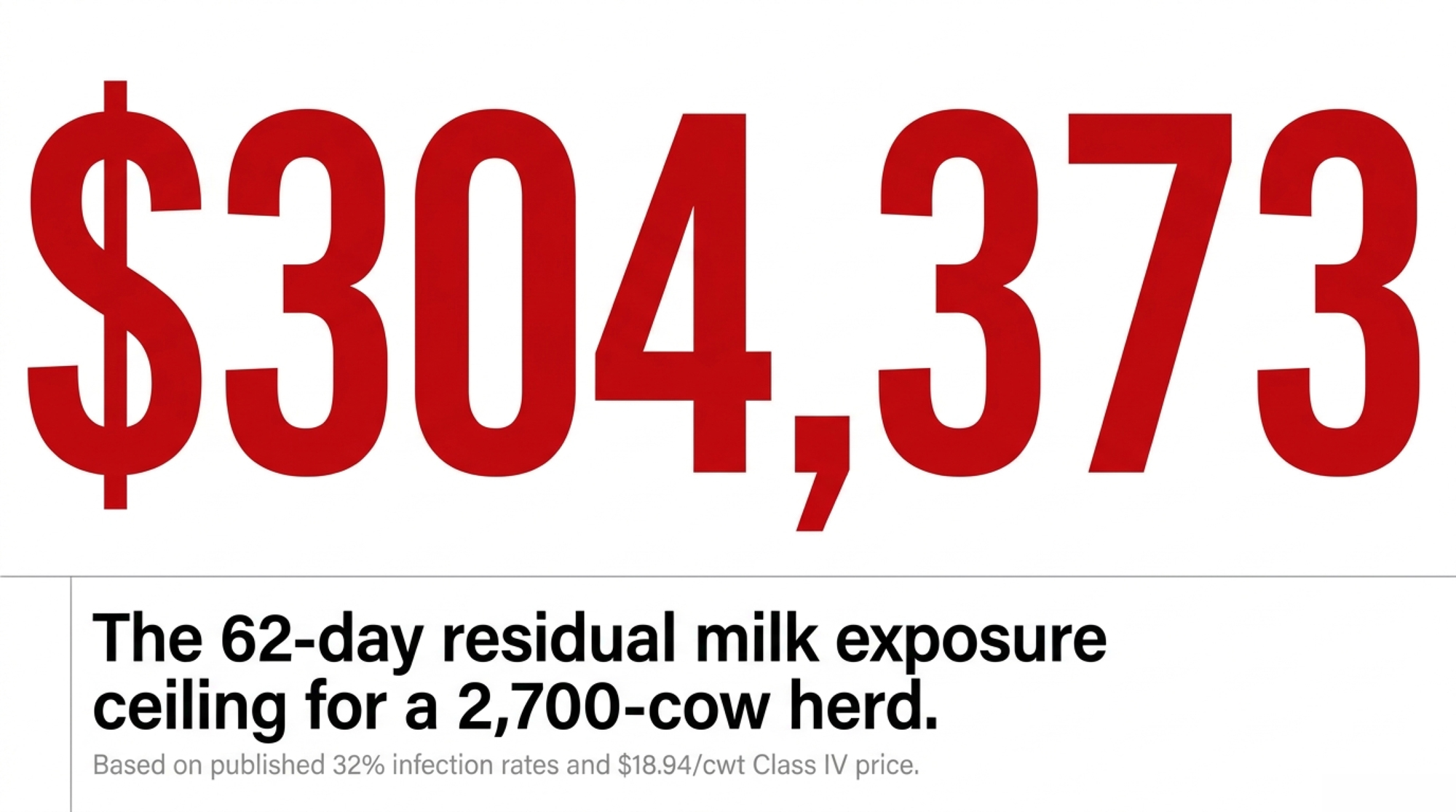
| High | 32% | 864 | $157,096 | $304,373 |
Moving from 10% to 32% of cows more than triples the figure. Cutting the horizon from 62 days to 32 nearly halves it. The central case loses about $3,068 a day, and each $1/cwt change in the price proxy moves its 62-day total by $10,044.
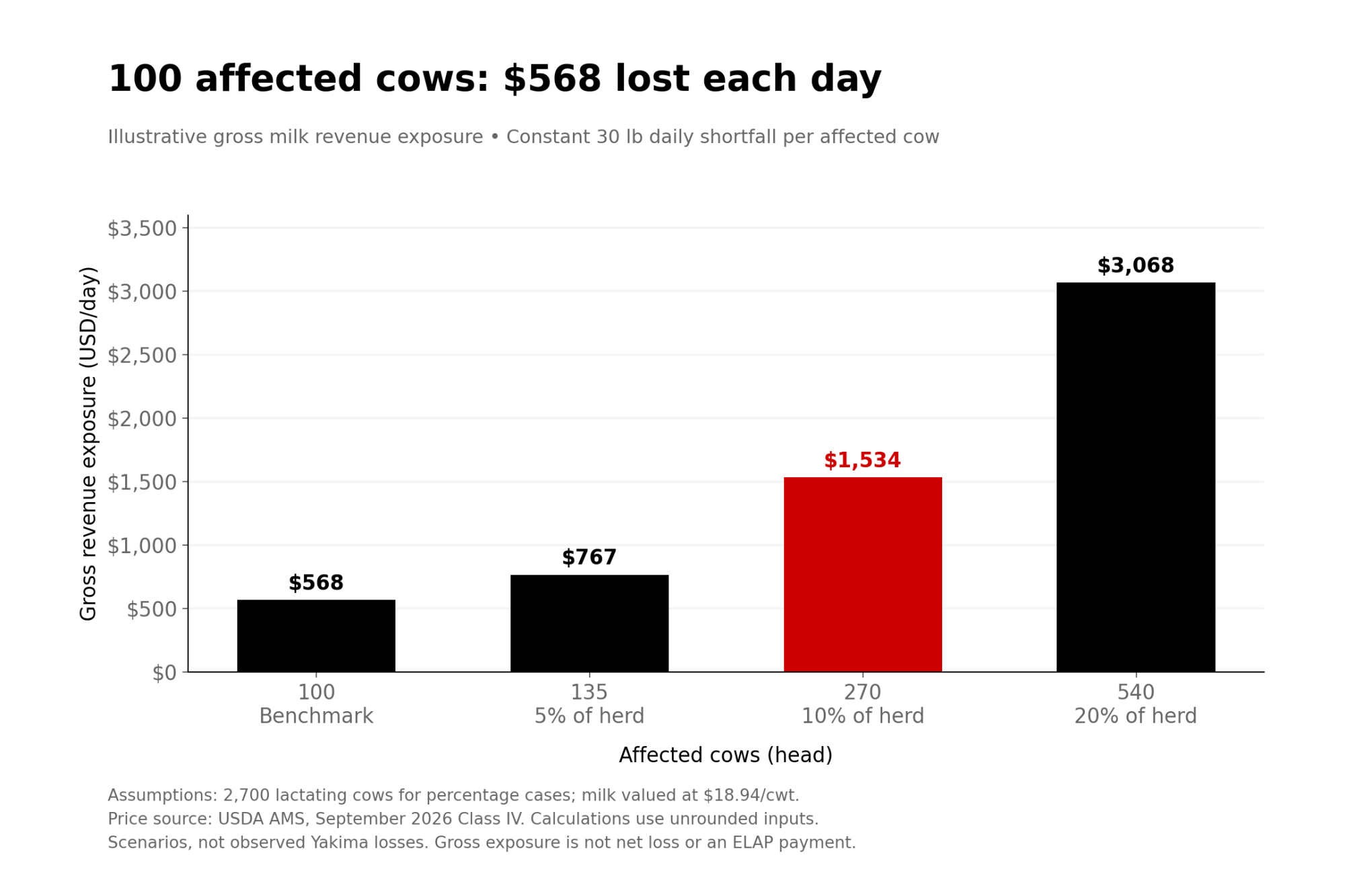
The old whole-herd ceiling is 2,700 cows × 75 lb ÷ 100 × $18.94 × 62 days = $2,377,917. That needs every cow to lose all 75 lb for all 62 days, which no published Washington, Ohio or JDS figure supports. Treat it as the maximum-stress case.
At the farm level the formula is affected cows × documented residual lb lost × milk value × documented loss days. Movement costs, response costs and program payments each go on their own line. If you blend them into one total, nobody can audit it.
When does ELAP become cash?
California’s payment record shows timing risk. A July 28, 2025, report based on USDA records counted 644 payments to 359 California dairies between November 2024 and June 2025, totaling $231 million. Individual payments ranged from $2,058 to $4.4 million.
The report didn’t match outbreak dates, completed applications and payment dates farm by farm, so it can’t tell you how long any one dairy waited. What it does show is money arriving in several payments over eight months: by Bullvine’s math, an average of 1.79 payments per dairy that was paid.
A Yakima lender should carry three separate lines:
- Loss incurred: milk revenue and documented costs already gone.
- Claim estimated: what the farm expects to qualify.
- Cash received: money actually deposited.
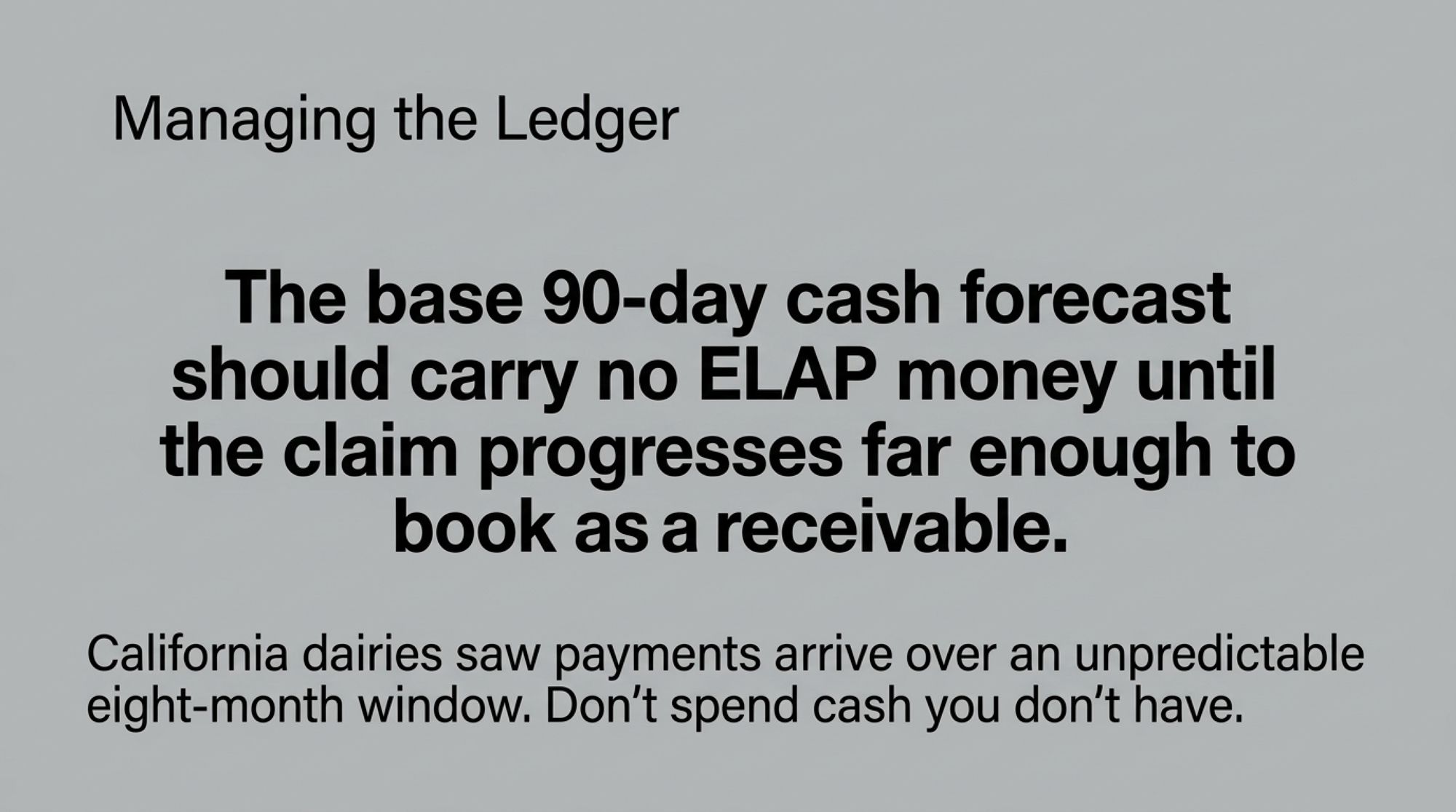
The base 90-day cash forecast should carry no ELAP money until the claim has progressed far enough for the lender to book it as a receivable.
How do you protect workers without naming a farm?
On October 15, Yakima Health District reported a confirmed avian-influenza case in a Yakima County resident who had been exposed to infected dairy cattle. The agency said the person hadn’t had severe illness, wasn’t hospitalized and was isolating at home, and it rated the risk to the general public as low. The statement doesn’t name an employer or link the case to a particular herd, and neither does this article.
CDC recommends monitoring exposed people from the first day of exposure until 10 days after the last one. Active monitoring covers anyone with unprotected exposure, and CDC says “most exposed dairy farm workers fall in this category.” The worker’s clock runs from exposure, and continued exposure pushes the end date back.
Keep two files. The exposure file holds the task, the date, the PPE issued and any breach. The health-response file holds symptom referrals and public-health instructions, with restricted access. Supervisors record what happened; Yakima Health District and CDC decide on testing and case status.
What should you do now?
| Horizon | What to do | What it takes | Urgent when | Where it backfires |
| Next 30 days | Lock a timestamped Day 0 file covering the 14 days before each bulk-tank sample; reconcile removed cows against shipped milk daily | Cow- or pen-level exports, processor tickets, purchase dates, ownership share, one accountable manager | Clinical signs, a milk drop, a scheduled sample or a pending WADDL result | Records rebuilt after the fact can misclassify cows and inflate the baseline |
| Next 90 days | Run a weekly cash forecast keeping loss incurred, claim estimated and cash received separate; get the AGI certification and CCC-943 filed with CPA, attorney or EA verification | Real affected-cow counts, dated invoices, lender-approved assumptions, a verifier’s signature | Unrestricted cash falls below the next payroll, feed or debt-service cycle | Netting an unapproved ELAP estimate against current losses books cash the farm doesn’t have |
| Next 365 days | If removals continue past December 31, split the claim into two program-year files (2026 by March 1, 2027; 2027 by March 1, 2028); rebuild the herd H5N1 plan around four clocks; buyers check origin-state status before moving lactating cattle | An annual review with the vet, processor, FSA county office and lender | Any plan that still runs quarantine, ELAP, support and interstate movement on one timeline | A generic 90-day reserve funds the wrong cost and leaves the actual exposure uncovered |
If you do one thing before the next bulk-tank test, export and lock the last 14 days of herd, milk and removal records. Get the evidence on file before you estimate the check.
Key Takeaways
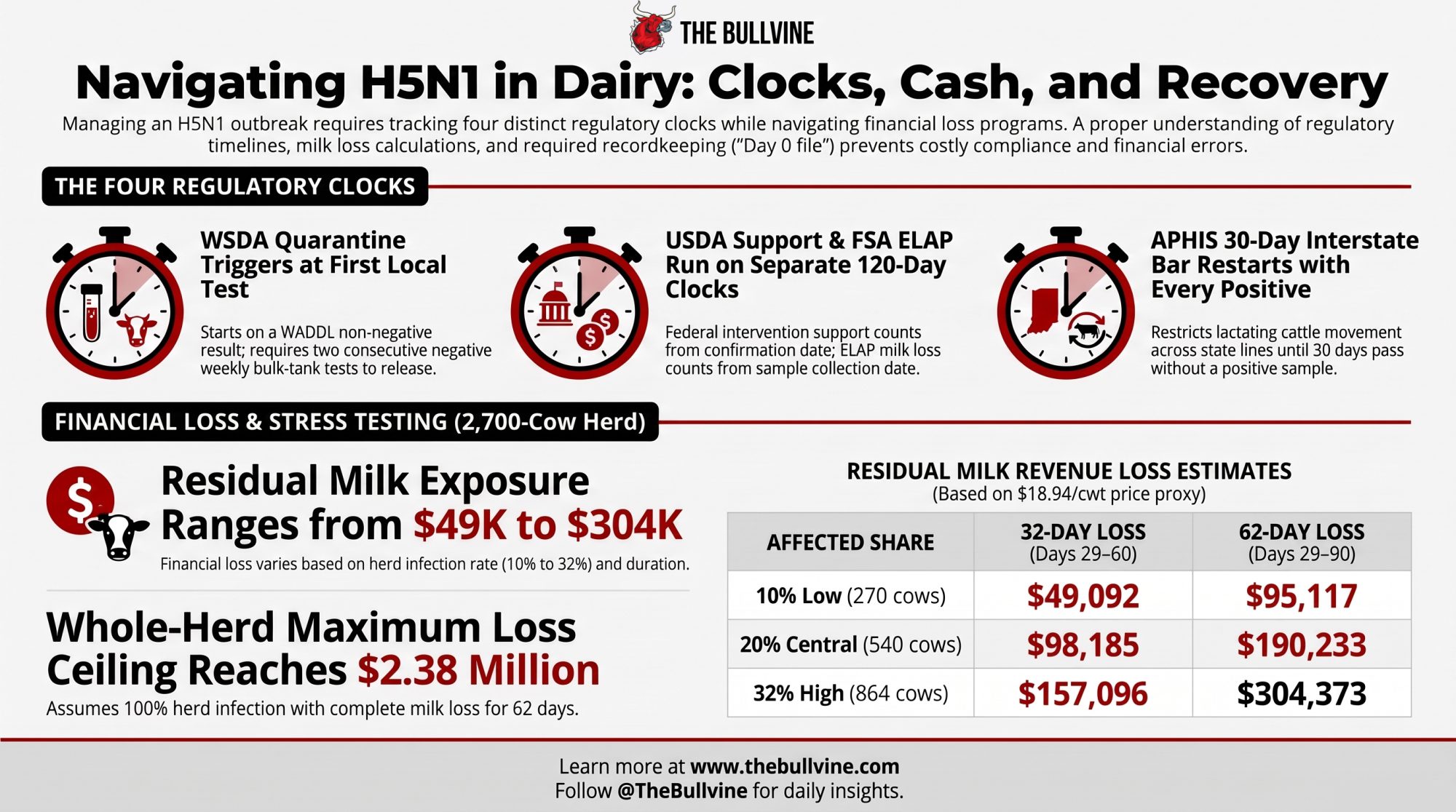
- On a 2,700-cow herd, Bullvine’s math puts residual milk exposure at $49,092 to $304,373, depending on the share of cows affected and whether losses end at Day 60. The whole-herd ceiling is $2,377,917.
- Federal support and ELAP both run 120 days but start on different dates. Support counts from confirmation and pays response costs. ELAP counts from sample collection, with a 14-day look-back, and pays for milk.
- WSDA releases a herd after two consecutive negative weekly bulk-tank tests. In Utah, 4 of 25 dairies were still quarantined on August 21, so don’t pencil in one release date.
- Any cows removed after December 31 go on a 2027 ELAP filing due March 1, 2028. If you’re near the $900,000 AGI line, get your CCC-943 verified before you file.
Methodology Note
The Bullvine Four-Clock Exposure Model combines WSDA’s confirmation table and response flowchart, FSA’s ELAP rule and notices, APHIS’s interstate requirements, USDA NASS’s 2022 county herd distribution, USDA AMS’s September 2026 Class IV price, and published infection and milk-loss rates from the Ohio herd study and the 2025 JDS model. The state comparison uses state-release checkpoints, not a matched APHIS daily series. The 30-lb residual loss, the 10% low share, the horizons and the 2,700-cow herd are stated assumptions. All dollar results are Bullvine calculations. The model leaves out vet costs, labor, cattle-market effects, financing, insurance and final program payments.
Learn More
- Bivalve Dairy Did Everything Right. The H5N1 Air Data Just Added $0.04/cwt to Dairy 2026. — Maps the exact $12,500 annual PPE and testing cost added to a 1,000-cow dairy after air sampling proved H5N1 transmits inside milking parlors. Arms you with a precise budget blueprint to protect workers when standard protocols fail.
- One Positive Test, a 90-Day Lockdown, and a $939K Hole in Your Year. — Exposes the brutal math when a 90-day state quarantine outlasts the standard 28-day ELAP compensation window. Follows the money to show how uncompensated feed and labor bills silently crush farm equity during an extended lockdown.
- H5N1 Is Slamming American Dairies: The $950 Cow Loss, Hidden Biosecurity Risks, and How Smart Farms Are Fighting Back — Details how progressive herds use smart sensors to cut clinical lag by four days and turn viral chaos into an operational advantage. Reveals why treating biosecurity tech as an aggressive investment beats relying on government payouts.