

Ten days of 90°F and THI in the 70s can quietly strip $8,600–$14,000 from a 400-cow herd — unless your fans and dry cows are actually set up to fight back.
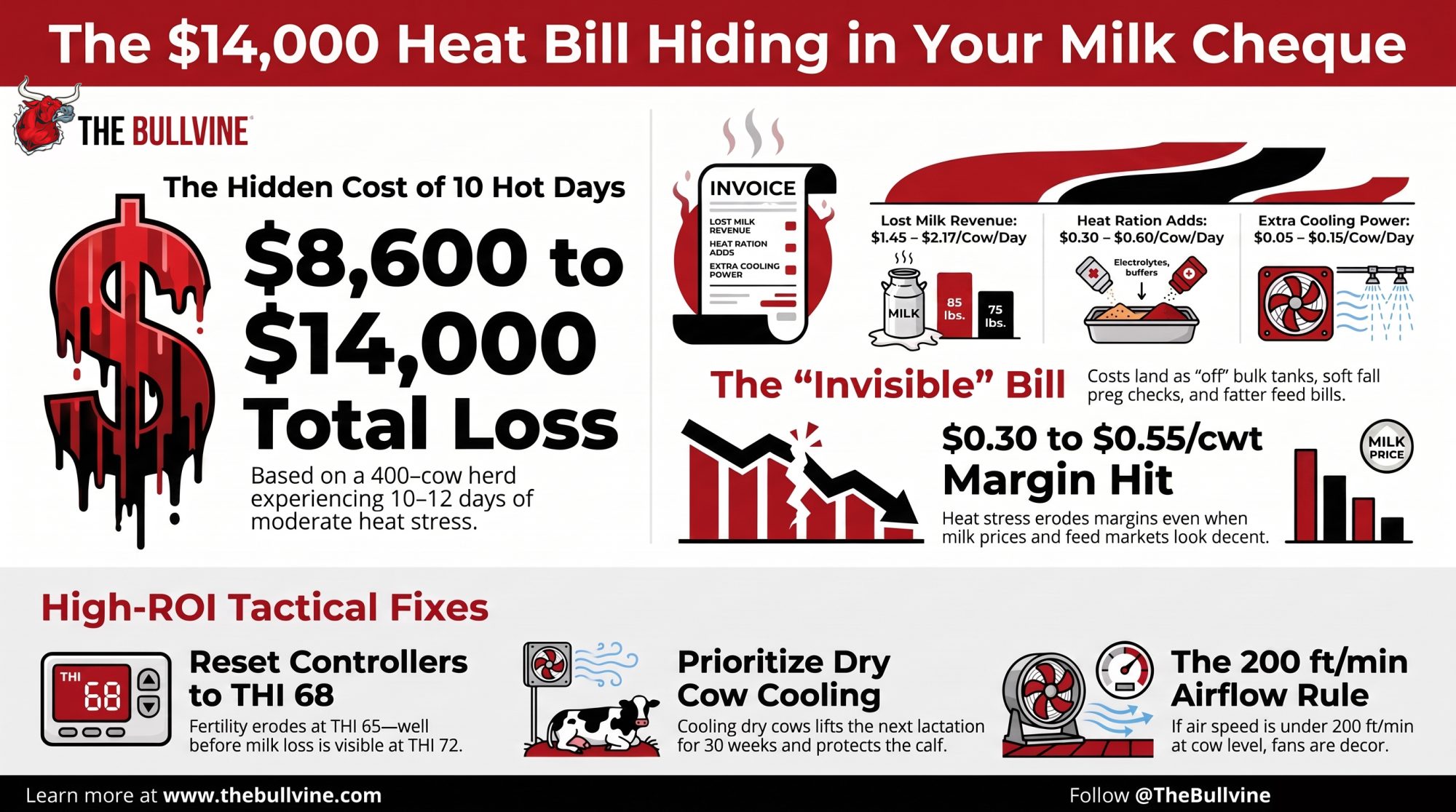
Executive Summary: Ten days of 90°F-plus with THI in the mid-70s can quietly pull $8,600 to $14,000 off a 400-cow herd — roughly $1.80 to $2.92 per cow per day in lost milk, heat-stress ration adds, and cooling power, or about $0.30 to $0.55/cwt off your July margin. Most of it never shows up labeled “heat”; it lands as an “off” bulk tank, a fatter feed bill, and soft fall preg checks nobody walks back to July. The single highest-leverage fix costs almost nothing: set your fans and soakers on a controller to trip at THI 68, not “when it feels hot” — fertility starts eroding at THI 65, a full seven points before milk visibly drops. Dry cows are the most-skipped, highest-ROI target, since full dry-period cooling lifts the next lactation for up to 30 weeks and protects the developing heifer calf’s mammary and ovarian growth. DRP and DMC cover the price side of a bad summer, but nothing in those tools rewards the cooling that protects your herd — that gap is yours to close, one barn at a time. If your July milk per cow runs 5–10 lbs light every hot stretch, this piece hands you the barn math and the three moves worth making before the next dome builds.
When One French Farm Melts, Every Barn Should Pay Attention
In late June, western France baked under a heatwave that’s already going into the record books. Reporting from the region described milk shipments down 15 to 20% from some herds as cows backed away from the bunk and spent their days crowding water troughs. The same coverage documented tens of thousands of broiler chickens dead in a matter of days and vegetable yields slashed as harvest crews worked around heat alerts.
Those French barns are a long way from your lane. But they’re living the physics you’re feeling more quietly this summer. Across the Midwest, climatologists have been warning about a string of heat domes landing right as corn and soy slide into critical growth stages. The weather stories talk about pollination risk and futures rallies. You see the same thing as cows eating less, fans that can’t quite keep up, and a July bulk tank that feels “off” without any obvious disaster.
That “off” tank isn’t just a bad week. It’s the first line item in a heat bill that includes extra ration cost, more hydro, softer conception, and calves that never quite hit the ceiling they should. You don’t get that bill labeled “heat.” It just shows up as thin margins and “rough July” in the notes column.
THE ONE SETTING THAT DOES THE MOST WORK: THI 68
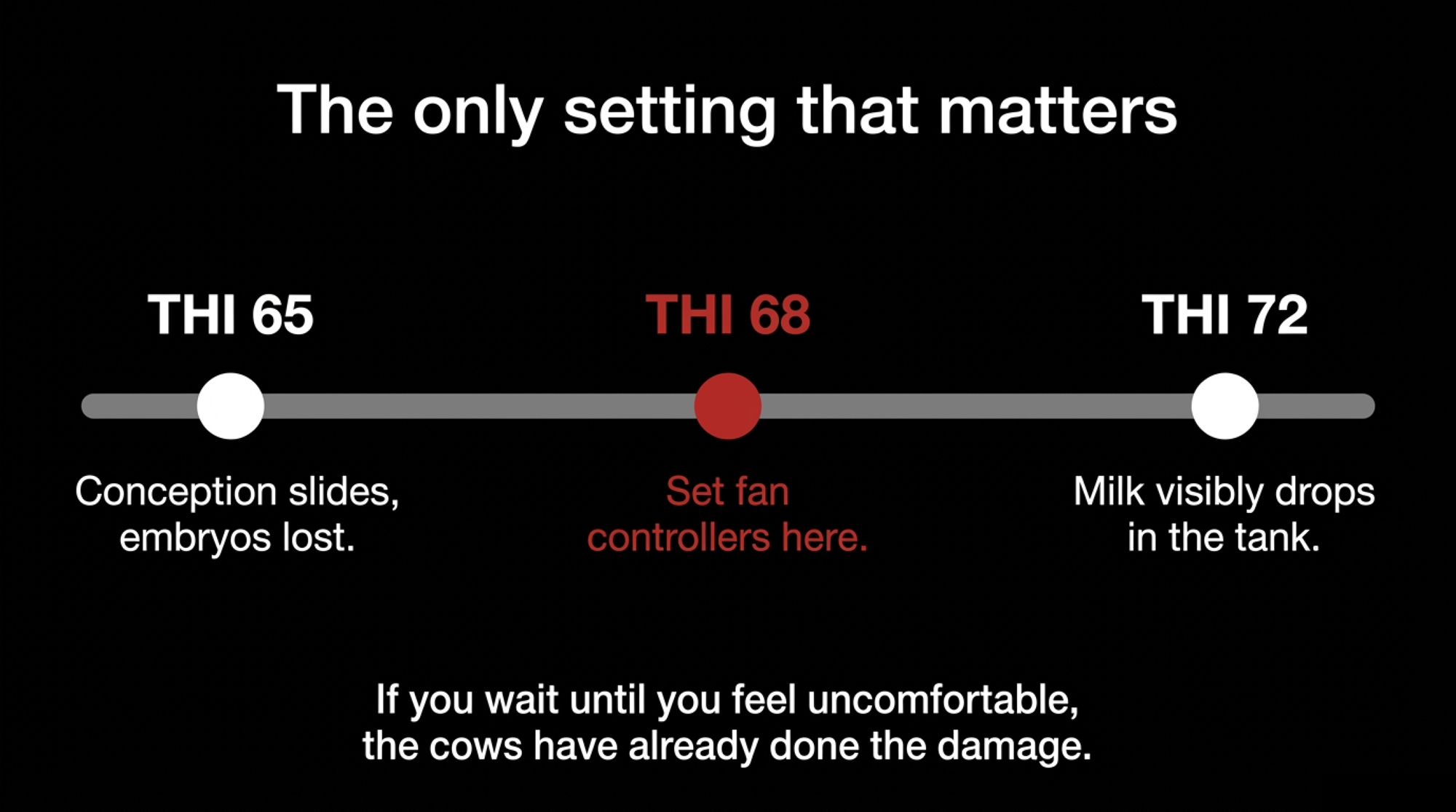
Put your fans and soakers on a controller and set them to kick on at a temperature-humidity index (THI) of 68 — not “when it feels hot” and not at the old THI 72 rule of thumb. Fertility starts eroding around THI 65 and visible milk loss kicks in past 72. If you wait until you feel uncomfortable, the cows have already done most of the damage.
The Summer 2026 Heat Story — Corn, Cows, and Timing
In the northern and central Midwest, this summer’s heat hasn’t just been hot; it’s been badly timed. Iowa’s climatologist, Justin Glisan, has warned about “two heat domes” sitting over the region with 90°F-plus highs and high dewpoints stretching over 7–10 days as corn entered pollination. Purdue’s Dan Quinn has been flagging the same concern for Indiana’s crop — accelerated growth under stress, pollination happening under heat advisories, and fields that were already rough coming out of wet conditions.
AccuWeather meteorologist Chad Merrill, speaking on Farm Futures, has been blunt: mid-90s at pollination will likely shave 5–6% off expected corn yields across parts of the belt, with soy more vulnerable later in July. Traders have noticed. Corn and soy futures pushed more than 3% higher in early July as heat-damage risk in Europe and North America began to show up on screens. That’s where your ration costs start to move.
Globally, the FAO–WMO “Extreme Heat & Agriculture” report released in April laid out what this kind of weather means at scale. It warned that over a billion people whose livelihoods are tied to agrifood systems are now exposed to increasing heat risk, with yields and herd productivity dropping sharply once common thresholds are crossed. For crops, losses ramp up once mean daily temperatures climb much above 30°C; for livestock, heat stress starts showing up around 25°C and becomes severe at 30–35°C depending on humidity. Dairy cattle are right in the cross-hairs.
What Heat Actually Does Inside the Barn
The number that ties all this together is THI — the temperature-humidity index. It blends heat and humidity into a single score that tracks how hard your cows are working to stay cool. Several JDS and subtropical-environment studies put the comfort band for most lactating cows under about THI 68–72. Above that, things change fast.
A 2023 meta-analysis in the Journal of Dairy Science pulled data from dozens of trials and found that under sustained heat stress, dry matter intake (DMI) dropped by roughly 19% and energy-corrected milk (ECM) fell about 18% compared with thermoneutral conditions. Feed efficiency and milk components shifted, and the longer cows stayed hot, the worse the numbers got. In Girolando cows — ¾ Holstein, ¼ Gir — heat stress reduced milk yield by around 7% compared with cooled controls.
Here’s the part most herds miss: reproduction cracks first. Reproduction studies now point to fertility starting to erode around THI 65, a good seven points below where you see obvious milk loss. Conception rates slide, early embryo loss ticks up, and days open stretch out. You feel July again when the vet reads off your fall preg checks, and you rarely line those numbers back up against the one hot spell that kicked it off.
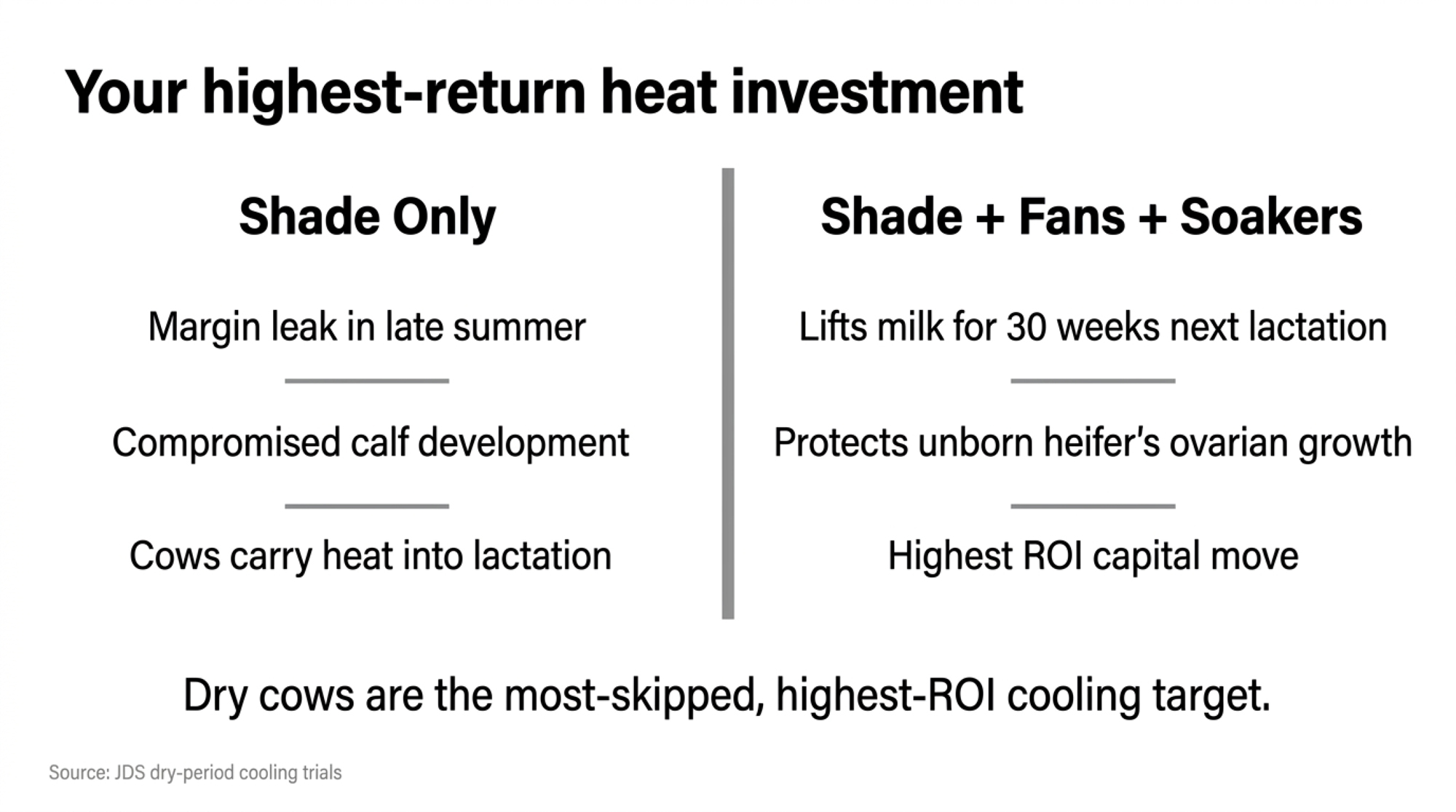
There’s also a group of cows almost nobody budgets for in their heat plan: dry cows. Work by Laporta, Davidson, and others has shown that cooling cows throughout the entire dry period — with shade, fans, and soakers — lifts milk yield for up to 30 weeks into the following lactation compared with cows left under heat stress. Even splitting cooling into “early dry” and “late dry” partially helps, but full-period cooling gave the best results. The trials also showed that in-utero heat stress hits the calf she’s carrying: mammary and ovarian development are compromised, setting a lower ceiling on that heifer’s future production.
You’re not just losing July milk when a dry pen cooks. You’re writing down the next three years of that family line.
How Much Does Ten Hot Days Actually Cost You?
Let’s put real barn math to a very common situation. Picture a 400-cow Holstein herd in the eastern Corn Belt. This is a disclosed composite — not a single real farm, but a scenario built from several mid-size operations in the region — and every number under it comes from published data.
On a normal July day:
- Cows ship about 85 lbs/head/day.
- Ration cost runs around $9.00/cow/day, right in the middle of current lactation feed budgets, which range from $8.16 to $9.39.
- Fans run in the freestalls and over the parlor return lane, with a simple soaker line at the bunk.
Now ten to twelve days of 90°F-plus roll in, with THI pushing into the mid-70s by early afternoon and flirting with 80. Under that kind of sustained moderate heat, JDS data support an 8–12% drop in milk yield if cooling is partial — so think of that herd sliding from 85 lbs down into the 75–78 lb range.
USDA’s May 2026 Livestock, Dairy and Poultry Outlook pegs the annual all-milk price forecast around $18.95 to $21.25/cwt depending on scenario. Using the higher $21.25 number to make the math simple, that 8–12% hit works out to about $1.45 to $2.17 per cow per day in lost milk revenue.
You don’t stand still on feed. Most herds bump electrolytes, buffers, and energy density to fight the intake drop, which adds somewhere around $0.30 to $0.60 per cow per day in ration costs. Fans and soakers running longer and harder will add perhaps $0.05 to $0.15 per cow per day in power, depending on how efficient your setup is.
Put that together:
Financial Impact Summary — 400-Cow Composite, 12 Hot Days
| Line item | Approx. cost per cow per day | Basis |
| Lost milk (85→75–78 lbs @ $21.25/cwt) | $1.45 – $2.17 | JDS meta-analysis on yield loss; USDA 2026 all-milk forecast |
| Heat-stress ration add | $0.30 – $0.60 | Modeled from DMI and ECM drops under heat stress |
| Extra cooling power | $0.05 – $0.15 | Fans/soakers energy estimates; full-period cooling trials |
| Total per cow per day | $1.80 – $2.92 | — |
| Herd total, 400 cows × 12 days | ≈$8,600 – $14,000 | Computed from the lines above |
| Approximate margin hit | ~$0.30 – $0.55 per cwt | Derived from daily total vs shipped milk |
That’s a heat bill. And it lands even when milk price and feed markets look decent on paper.
You can plug your own numbers into that table. If you’re shipping 70 lbs instead of 85, and your ration is cheaper because you’re closer to corn, the ranges shift. But the shape doesn’t.
How Does This Map to Your Herd?
A few quick back-of-the-envelope checks you can run on your own books:
- Take your average July milk per cow and ask what happens if you lose 8–12% of it for 10–15 days at your actual mailbox price — not the futures screen. That’s your top line.
- Add what you spent on buffers, electrolytes, and extra energy those weeks — and be honest about whether you’d have bought those products in a cool summer.
- Look at your power bill for the month and split out what’s cooling vs everything else — even a rough estimate will do.
- Finally, mark your July and August breedings and walk them forward to your fall preg checks. If conception drops right after those hot spells, that’s the invisible part of the bill.
Most producers have never stacked those four lines together under the heading “heat.” When you do, July starts looking different.
Why Dry Cows Are Your Highest-Return Heat Investment
Dry pens are often the simplest part of a barn: shade, water, and not much else. That’s fine on a mild day. Under extreme heat, it’s a margin leak.
Trials in which cows were given full cooling — shade, fans, and soakers — throughout the entire dry period showed higher subsequent milk yield for up to 30 weeks into the next lactation compared with cows that had only shade. Cooled cows ate more, calved in better shape, and carried less heat stress into early lactation.
Economic feasibility work has gone a step further. Ferreira and colleagues modeled dry-cow cooling in hot climates and found that even at lower milk prices, cooling dry cows paid for itself once herds faced around 100 heat-stress days a year. That’s not a fancy robot. It’s fans and water over cows that aren’t even milking.
And then there’s the calf. In-utero heat stress has been shown to affect mammary and ovarian development in the heifer calf. Heifers gestated under heat in late pregnancy produced less milk later in life and showed altered reproductive performance. You can’t see that in this year’s milk cheque. You feel it years from now when daughters of those summers never quite hit the top of the family line.
If your dry pen has shade and no fans, this is probably the highest-return heat move you can make in the next month.
Are Margin Tools Designed for This Kind of Risk?
Heat doesn’t just move milk. It moves feed and policy.
On the feed side, early-summer heat and dryness in Europe and parts of North America pushed corn and soy futures up more than 3%, with traders explicitly citing stress on pollinating corn and shrinking maize projections in France. French analysts have talked openly about the country’s maize crop potentially falling by as much as a third this year — which would make it the smallest in 35 years if current estimates hold. Those moves ripple straight into your TMR.
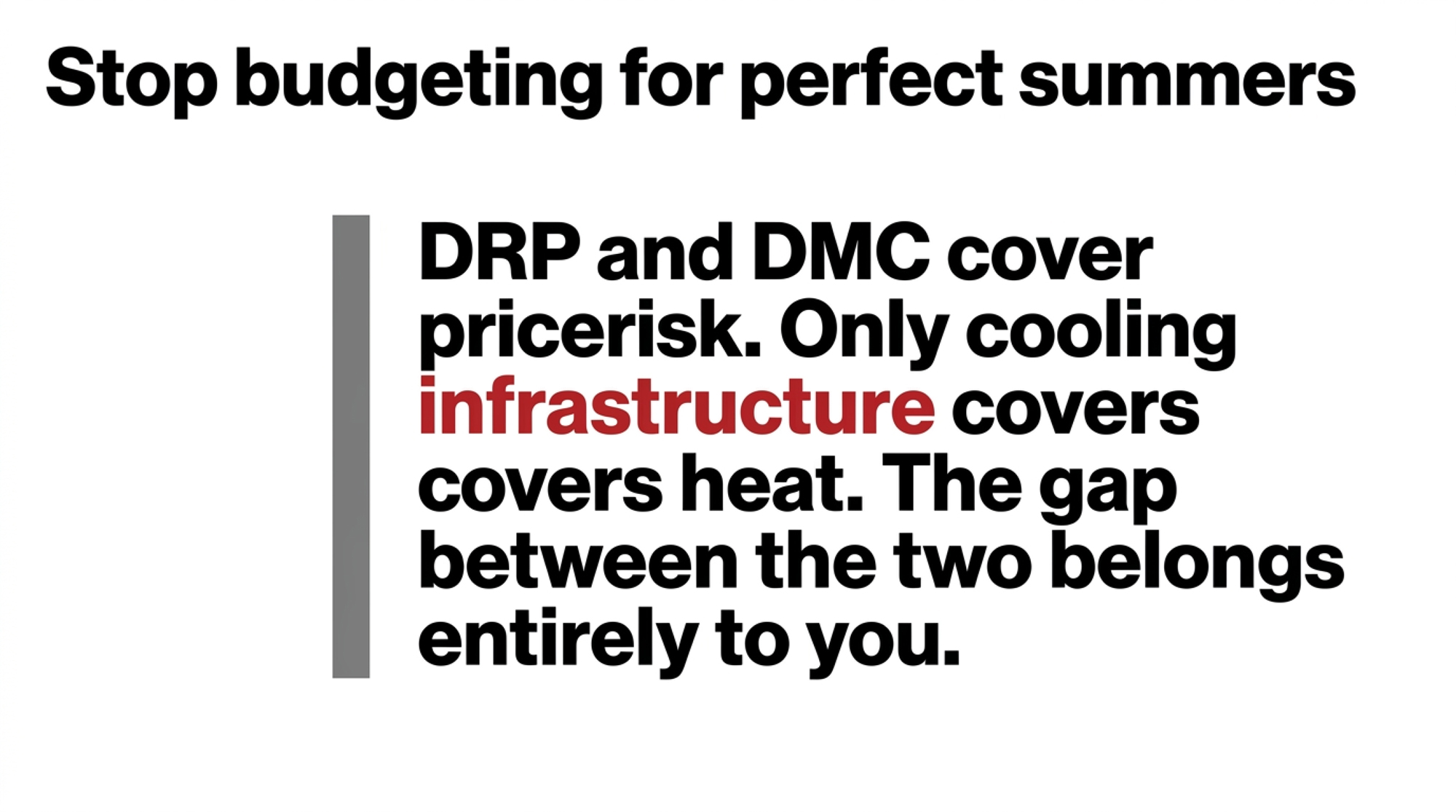
On the risk-management side, Dairy Revenue Protection (DRP) and Dairy Margin Coverage (DMC) are built around milk-feed margin and price swings — not around ten days of THI 78 shaving 10 lbs off every cow while feed cost and hydro inch higher. They help on the price side of a bad year. They don’t directly reward the operator who spends on cooling that protects the herd.
France has started treating cooling as infrastructure. Coverage of the 2026 heatwaves there has highlighted emergency measures to fund building ventilation, misting, and water-spraying systems, along with fast-tracked support for livestock losses. In North America, similar support mostly appears as EQIP cost-share for barn projects filed under environmental or animal-welfare headings, rather than as a targeted heat-risk program. The FAO–WMO report is blunt: without adaptation, extreme heat will push agrifood systems toward systemic risk — but it also notes practical measures, from shade and cooling to early warning systems, that cut the damage.
You’re expected to manage that risk one barn at a time.
Question 1: Where Does Heat Start to Break Your Margin?
This is the economics question.
If your herd routinely sees more than 50–60 days a year with THI above the high-60s, you’re already in the band where the DMI and ECM drops from the JDS meta-analysis apply more than just a week or two. USDA and academic modeling points to average annual heat-stress milk losses on the order of 1% of total yield for many U.S. dairies, with higher losses in small herds and hotter regions — and those losses are projected to climb as summers warm.
The practical check is simple:
- If your July and August milk per cow are consistently 5–10 lbs below where they “should be” based on genetics, feed, and health history, and those months line up with spelled-out heat events, you’re paying a recurring heat tax.
- If your annual shipped milk sits noticeably below what your repro, culling, and genetics should support — and you’ve ruled out disease and nutrition — heat is one of the quiet culprits.
The threshold where cooling moves from “nice to have” to “margin tool” is lower than most barn budgets have assumed.
Question 2: Is Your Cooling System Actually Doing the Job You Think It Is?
This is the management question.
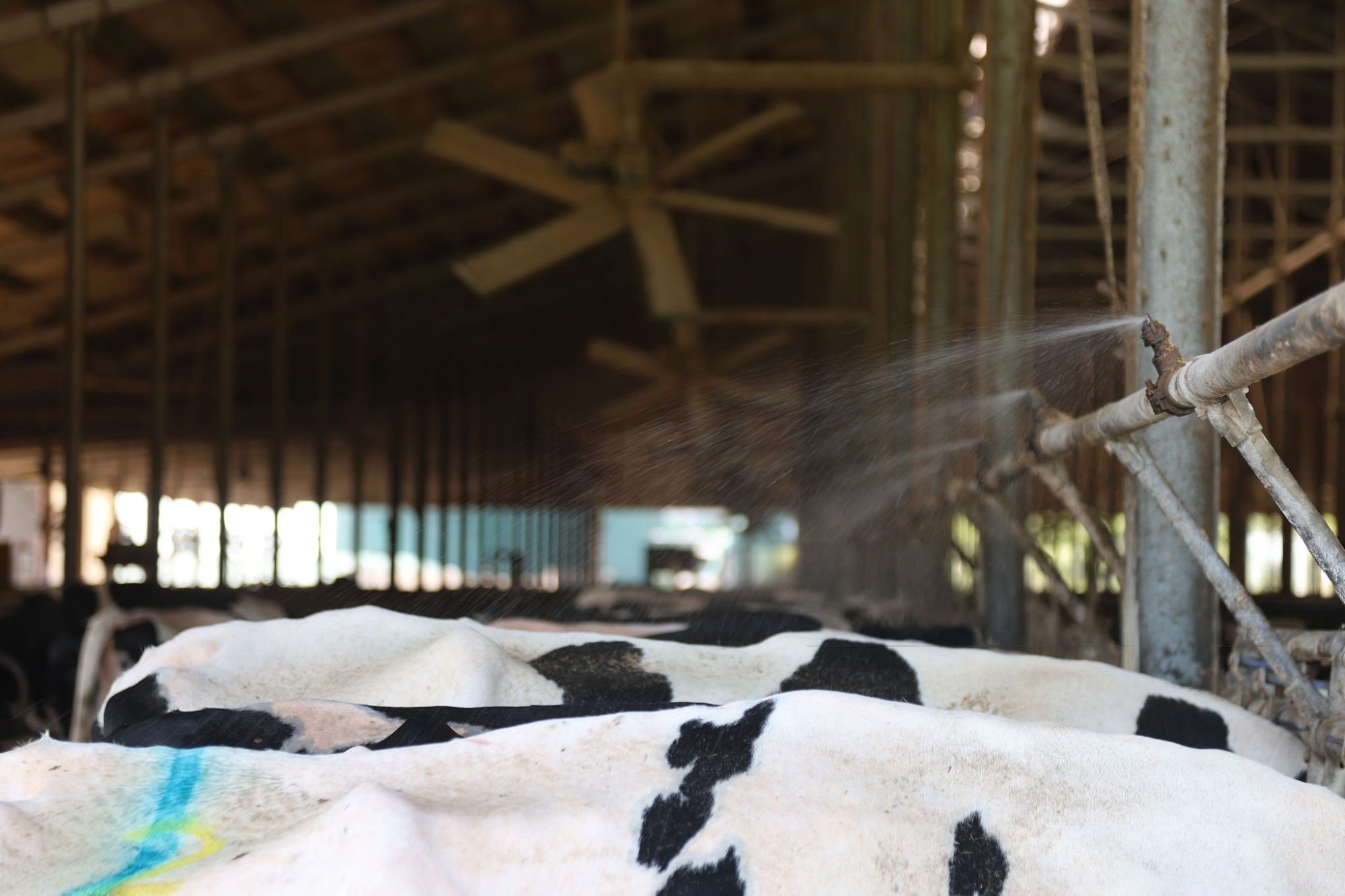
Most barns have fans. Fewer have the airflow and water they think they have.
The practical steps:
- Grab a cheap anemometer and walk your barn. If you’re seeing much under 200 feet per minute at cow levelin stalls and at the bunk, those fans are décor more than cooling. Adding or repositioning fans to hit that band is a very different upgrade than buying one more box fan for the alley. thedairylandinitiative.vetmed.wisc
- Look closely at your soaker lines. You want a coarse droplet that wets the cow’s skin, not a fine mist that cools the air, raises humidity, and wets bedding. The FAO–WMO report and several extension pieces emphasize that water on the cow, not just in the air, drives evaporative cooling.
- Check where your controller is actually set. If fans and soakers only kick in at THI 72 or at some guessed temperature (“about 80°F”), you’ve left fertility and a chunk of milk exposed. Reset to THI 68 and watch how often you’re in that band.
| THI Threshold | What’s Already Failing | Recommended Action | Risk Level |
|---|---|---|---|
| 65 | Fertility begins eroding, embryo loss ticks up | Fans/soakers should already be active | Early warning |
| 68 | Cooling still masks most damage if triggered here | Set controller to trip here — not later | Optimal trigger |
| 72 | Milk yield visibly drops; old “rule of thumb” setting | Too late — fertility already compromised | High |
| 78–80 | DMI down ~19%, ECM down ~18% | Full-period dry cow cooling now urgent | Severe |
Most operations that go through that three-step audit find they were cooling “some” cows “some” of the time — and leaving dry cows and youngstock almost entirely out of the plan.
Options and Trade-Offs for Your Barn
You can’t do everything this month. Here’s a realistic sequence.
Path 1: Dry Cow Cooling First (30-Day Action) When it makes sense: Herds in regions that regularly see THI above 68 for weeks at a time — much of the southern U.S., parts of the Midwest, and hotter pockets elsewhere. What it requires: Shade plus fans and a soaker line over the dry pen, tied to a THI controller set at 68. Modest capital, some wiring, and a slight uptick in water and power use. Risks/limits: Payback shows up in next lactation and in daughters’ performance, not in this month’s pay. It’s easy to bump down the priority list when cash is tight. But the trials and economic modeling are clear that in hot climates, this is one of the highest-ROI heat moves you can make. Forward-looking signal: If your area is on track for 80–100 heat-stress days a year, treat this as infrastructure, not a luxury.
Path 2: Fix Air and Water at the Bunk When it makes sense: Herds already seeing milk slips under heat even with “lots of fans.” What it requires: A barn walk with anemometer, adding or re-aiming fans to hit 200 ft/min, and swapping or re-nozzling soakers to a coarse droplet pattern. Risks/limits: Easy to do halfway and assume you’re covered. If stalls stay at 120–150 ft/min and soakers mist the air more than cows, you won’t see the full benefit. Forward-looking signal: As summers trend hotter, this gap only gets more expensive. It’s the fix you make once and benefit from for years.
Path 3: Ration Tweaks as a Guardrail When it makes sense: Herds already running decent cooling but still seeing DMI dips in hot spells. What it requires: Pre-emptive changes — more electrolytes and buffer, tighter feeding windows, and energy-dense ingredients where appropriate. Risks/limits: This is a cost to lose less, not a cure. You’re paying for products that mostly blunt the damage, and the gains are smaller if airflow and water aren’t there. Forward-looking signal: Works best as part of a package — ration + cooling + reproductive timing — not as the only move.
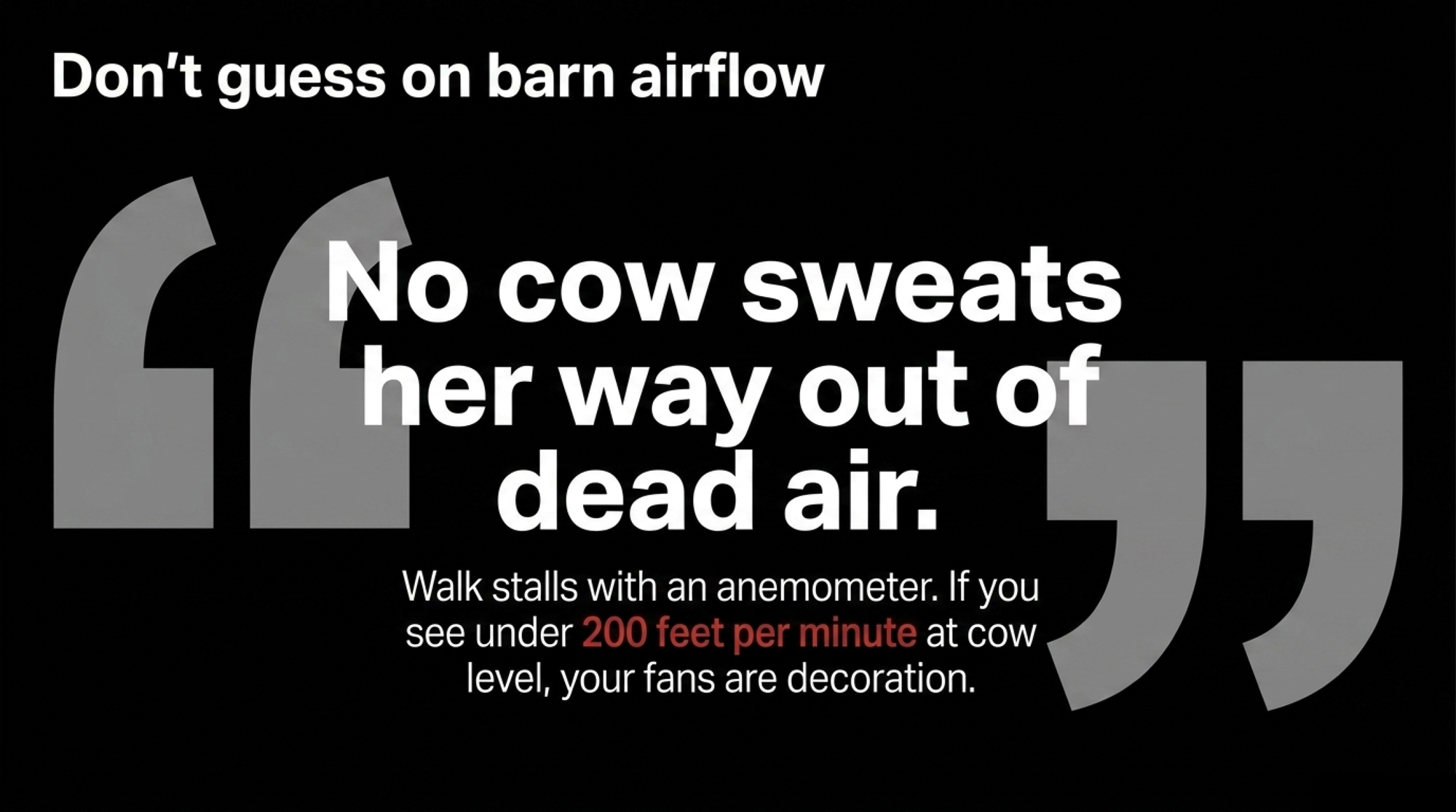
Path 4: Heat-Tolerance Genetics as a Tie-Breaker When it makes sense: Herds already selecting aggressively on TPI, Net Merit, or similar indexes and running proper cooling. What it requires: Asking your genetics rep for heat-tolerance EBVs, particularly Milk_THI breeding values. JDS work on U.S. Holsteins and Jerseys shows cows can differ by roughly −1.27 to +1.07 kg of milk per THI unit, meaning some cows give up a kilo of milk for every point the heat index climbs, while others hold much closer. Risks/limits: If you chase heat tolerance at the expense of production, type, or health, you’ll give up margin in cool seasons. And genetics cannot replace fans — no cow sweats her way out of dead air. Forward-looking signal: Treat heat tolerance like a health trait tie-breaker among bulls you already like. That way, your 2030 herd is better built for the summers you’ll actually face, without bleeding today’s income.
Key Takeaways
- If your controller still kicks fans and soakers on at “when it feels hot,” change it to THI 68. Fertility starts eroding around THI 65, and milk loss shows up past 72; the 68 trigger is where you protect both the cheque and the pregnancy.
- Walk your barn with an anemometer and a sharp eye on dry cows. If you’re under 200 ft/min at cow level or your dry pen has shade and no fans, your cooling system is decoration, not protection, and dry cows are likely your highest-ROI fix.
- Line up your fall preg checks against your July THI history. If conception softens after heat spells, stop treating that as bad luck. That’s the invisible part of your heat bill, and it can be bigger than the milk drop.
- Separate price risk from heat risk on paper. DRP and DMC help on the price side; only cooling, ration changes, and genetics touch the heat side. If you don’t see those moves in your plan, the gap belongs to you.
- Use heat-tolerance genetics to break ties, not as a magic bullet. Bulls and cows differ in how much milk they lose per THI unit, but no breeding program fixes a barn with poor airflow and no water on backs.
So here’s the question to sit with before the next dome shows up on your forecast. If you added up the milk you lost this July, the extra feed and hydro you paid, and the repro softness you’ll see in a few months — then stacked that against what a cool July should have returned — how big is that hole on your own farm?
If the number makes you uncomfortable, that’s useful. It’s telling you exactly how much room you have to justify a fan controller, a dry-cow cooling line, or a re-aimed bunk. And if you want the deeper math — the full cost-per-cwt models by herd size, the dry-cow cooling ROI, and where heat-tolerance genetics genuinely pencil out — watch for the follow-up Bullvine economics piece. That’s where we’ll run the full numbers.
Run Your Numbers
Dairy Profit Projector — Plug in your herd size, ration, and corn-price scenario to see what a hotter summer does to your IOFC, breakeven milk price, and margin per cwt before the next heat dome lands. Stress-test a feed-cost spike against your milk check and find out where the number actually breaks.
Complete references and supporting documentation are available upon request by contacting the editorial team at editor@thebullvine.com.
Learn More
- Dry cow cooling: the $87 loss you never book — Breaks down the multi-year ROI of late-gestation heat abatement, proving that uncooled dry pens quietly bleed 925 lbs of next-lactation milk and permanently stunt the genetic potential of unborn calves.
- Your Fans Can’t Fix Half of Heat Stress. Your Ration Can. — Delivers a tactical timeline to recalibrate summer mineral balances, audit close-up DCAD, and deploy switchable ration strategies before THI thresholds trigger gut barrier breakdown.
- Beating The Heat: How High-Speed Air Is Revolutionizing Dairy Productivity — Reveals why maintaining consistent 200+ ft/min airspeed at resting stall level prevents 5–15 lb daily yield crashes by eliminating hot spots and preserving natural lying time.
The Sunday Read Dairy Professionals Don’t Skip.

Every week, thousands of producers, breeders, and industry insiders open Bullvine Weekly for genetics insights, market shifts, and profit strategies they won’t find anywhere else. One email. Five minutes. Smarter decisions all week.