





About half your summer milk loss happens inside the cow, not at the bunk — and no number of fans touches it. A $15 forage test and the right DCAD do. Here’s the play.
Executive Summary: Only 20–50% of summer milk loss comes from cows eating less — the rest happens inside the cow, where heat shunts blood from the gut, the barrier leaks, and inflammation burns the energy that should’ve gone in the tank. That’s why hanging more fans never fully closes the gap: the fix is as much ration as it is air. On a 100-cow herd, a DCAD miss and reactive feeding can cost roughly 2 lb/cow/day across a 90-day heat window — about $3,500 at USDA’s May 2026 all-milk price of $19.70/cwt — while the wet-chemistry forage panel that would’ve caught it runs about $15 a sample. The play the best herds run by late April: test forage minerals by wet chemistry (not NIR), push lactating DCAD to +35–40 with K at 1.5–1.8% and magnesium raised alongside, build it with both sodium and potassium, and cool the dry cows — because UF/IFAS ties an uncooled dry period to ~10 lb/day less next lactation plus a penalty in the daughters. Canadian producers have the sharpest stake, since a July butterfat slide can leave hard-bought quota unfilled. None of it is extra work — it’s the same scramble you’d do in July, just moved to spring when you’ve got time to think. If you’re still treating heat stress as a fan problem, this is the piece that resets the math.
By the time the first run of 28°C days shows up, the farm that handles heat stress well already knows exactly what its high-group ration will do. The summer bunk’s been pre-built. The dry cows are under fans. And the feeder knows there’s a second drop coming in the evening. The neighbor down the road? He’s still telling people it got hot “all of a sudden.”
That gap — between the operations that decide early and those that react late — is the whole story of heat-stress nutrition. And here’s the part that should bother you: it’s rarely a knowledge problem. The research has been settled for decades. The difference is when the decisions get made.
What’s Actually at Stake When the THI Climbs
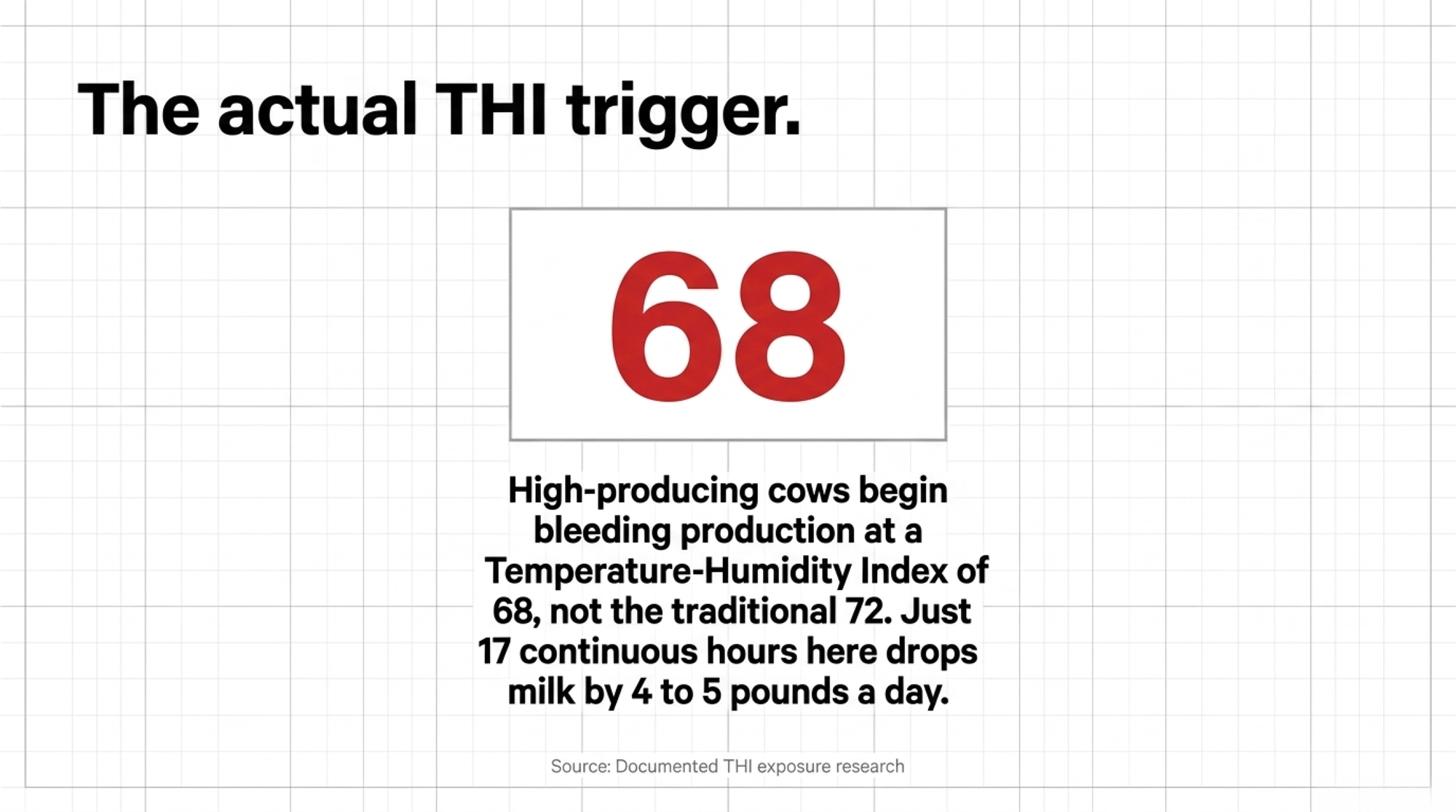
Heat stress doesn’t just make cows uncomfortable. It rewires their biochemistry, and it starts earlier than most producers act on it. High-producing cows can begin losing milk once the temperature-humidity index crosses 68, not the 72 that many people still treat as the trigger. Research has documented a loss of 4 to 5 pounds of milk per cow per day after roughly 17 hours of continuous exposure at THI 68. Dry matter intake can decline by 8 to 12% once THI exceeds 72.
The producer who’ll see himself in this story is the one who’s been at it 20 or 30 years, runs a tight operation, and still watches his tank slide every July. He’s not lazy, and he’s not behind. He’s stuck in a reactive pattern. And the cost of that pattern stays invisible until somebody sits down and does the math.
That’s the trap. The cow you fail to manage in August shows up as a lighter milk cheque in November. The connection is real, but it’s buried in noise — easy to pin on the corn silage fermentation, the parlor, or last week’s weather.
The Part of the Loss Your Fans Were Never Going to Fix
Here’s the piece that reframes everything. For years, the standard line was simple: cows get hot, cows eat less, milk drops. Cool them down, fix the intake, fix the problem. But the research doesn’t back that clean story.
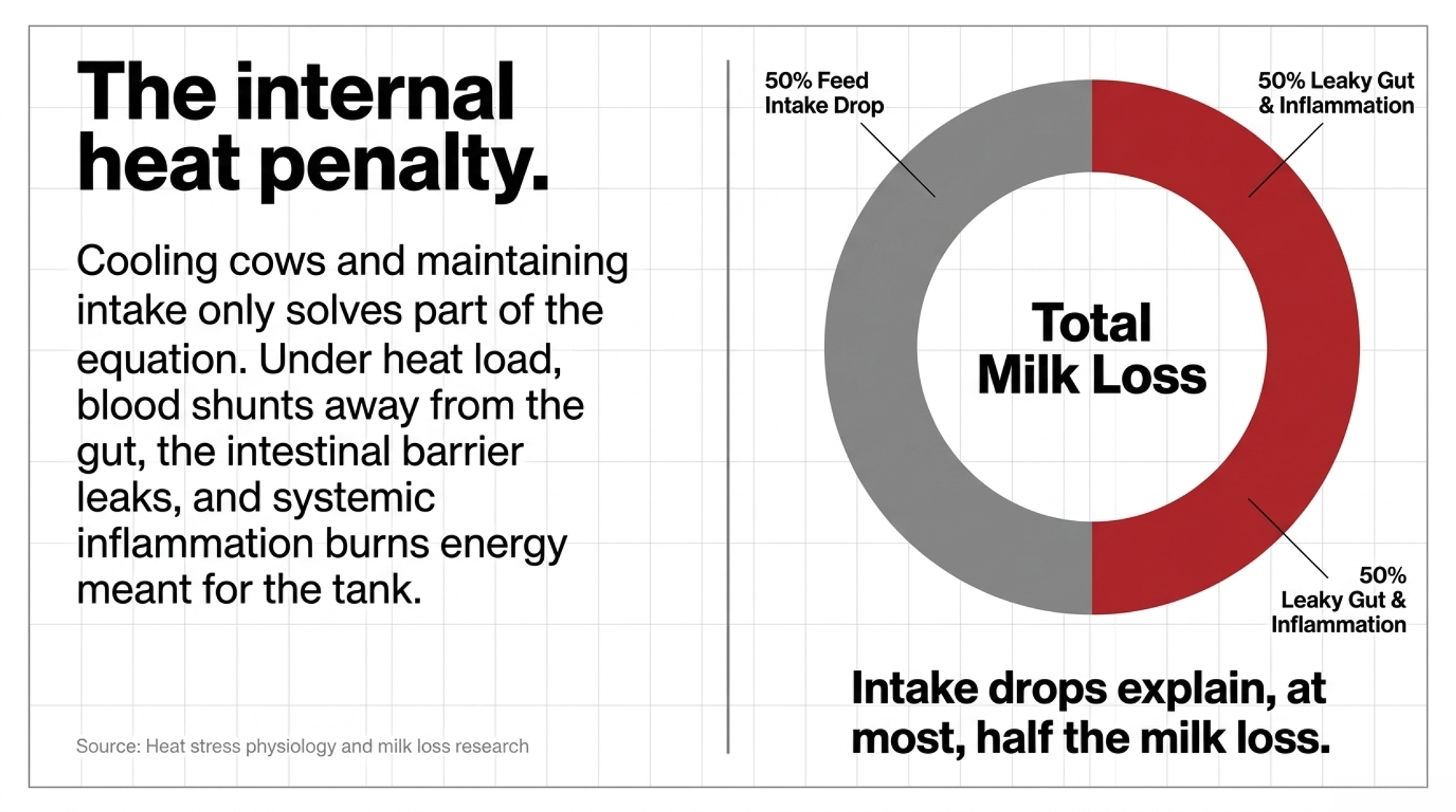
Reduced feed intake accounts for only about 20% to 50% of the milk loss during heat stress. The rest comes from inside the cow. Under heat load, blood gets shunted away from the gut to the skin for cooling, the intestinal barrier loosens, and bacterial toxins leak into the bloodstream — what researchers now call “leaky gut.” That triggers systemic inflammation, and fighting inflammation burns energy that would otherwise go into the tank.
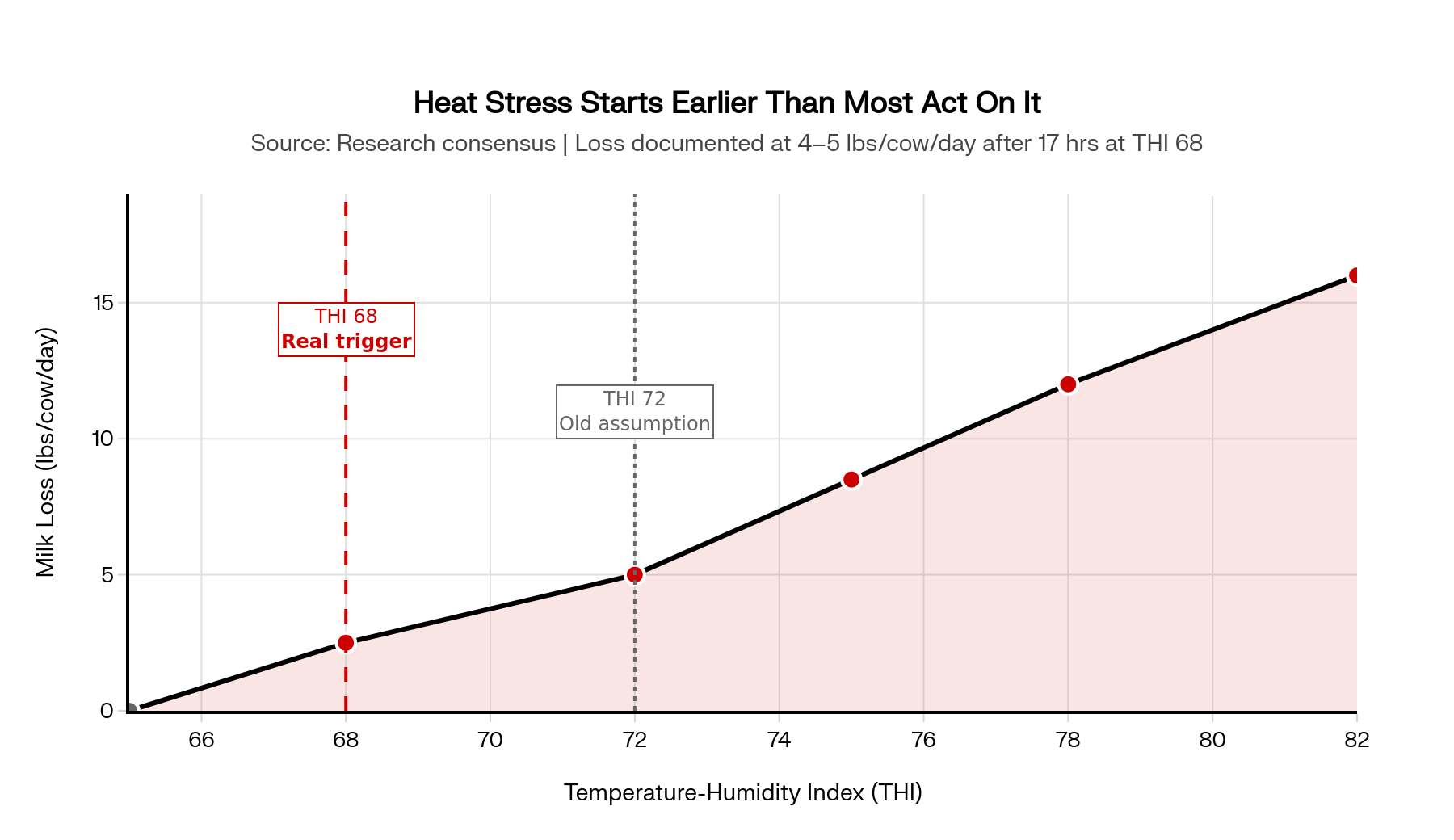
So a cow can be eating reasonably well and still bleed production, because half the damage isn’t about the bunk at all. That’s why cooling alone never fully closes the gap, and why the nutrition side — electrolytes, DCAD, rumen stability — does real work that fans can’t. You’re not just keeping her eating. You’re defending the gut and the acid-base balance while she pants off carbon dioxide and throws her blood chemistry out of whack.
The Decision That Has to Come First
Ask the farms that hold production through a heat wave what they do differently, and it’s not a product. It’s a forage test — done in spring, with the right chemistry.
By late April, these operations collect fresh samples of every major forage and send them for wet-chemistry mineral analysis, including potassium, sodium, chloride, and sulfur. Not NIR. Near-infrared is fast and cheap, but its mineral predictions ride entirely on the calibration database behind them, and they can miss the swings that matter most. Wet chemistry directly isolates and measures minerals, and minerals are exactly what drive the dietary cation-anion difference.
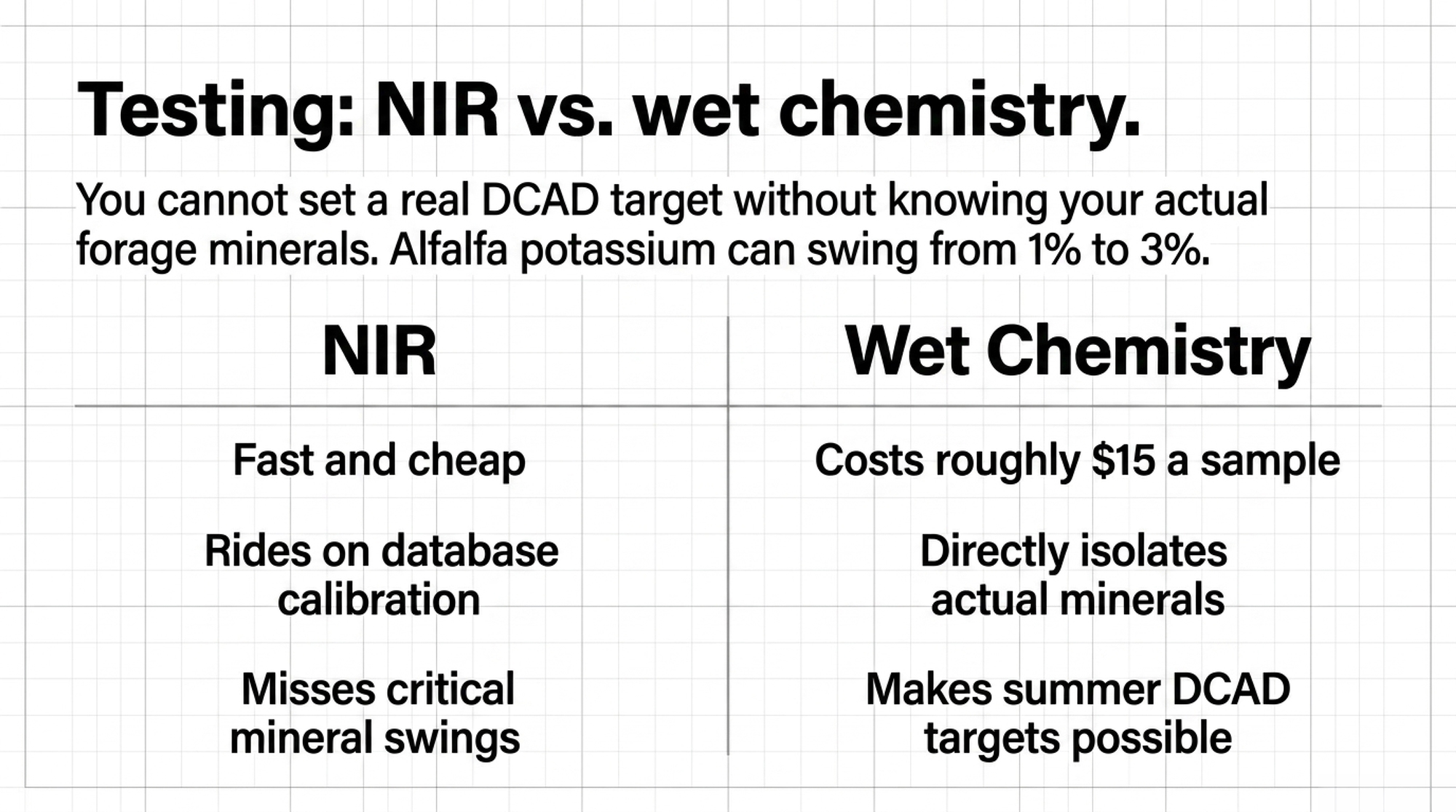
| Attribute | NIR Analysis | Wet-Chemistry Mineral Panel |
|---|---|---|
| Cost per sample | ~$8–12 | ~$15 (add-on) |
| Turnaround | 24–48 hours | 3–5 business days |
| Mineral accuracy | Calibration-database dependent | Direct measurement of K, Na, Cl, S |
| Forage K prediction | Can miss 1–3% DM swing | Catches full potassium range |
| DCAD reliability | Unreliable for anion/cation balance | Required for real DCAD formulation |
| Best use case | Energy, protein, NDF screening | Pre-summer ration build, DCAD setting |
| Risk if you skip it | None for energy; fine for bulk screening | DCAD miss = ~$3,546 per 100 cows |
Here’s why it matters. Alfalfa can run anywhere from 1% to 3% potassium on a dry-matter basis, depending on soil, cutting, and variety. That’s a threefold spread. Swing your forage potassium that far, and your ration DCAD moves with it — enough to be the line between a ration that holds summer production and one that quietly undercuts it.
You can’t set a real DCAD target without knowing your actual forage minerals. You can’t decide whether you need supplemental potassium or how much without knowing what the silage and alfalfa already contain. Skip the test, and every decision downstream is a guess wearing a lab coat. Run a lab report through our Forage Quality Value Calculator to see exactly where a given cutting fits before you build the summer ration around it.
For producers weighing which analysis to order, our breakdown of feed analysis technology and ration accuracy lays out where NIR earns its keep and where wet chemistry is worth the wait.
What DCAD Should Your Summer Ration Actually Target?
Watch a well-run operation in May, and it looks almost boring. That’s the tell.
They’ve already modeled the summer version of their rations. Lactating cows are pushed toward a DCAD of +35 to +40 mEq/100g of dry matter, with potassium targeted at 1.5% to 1.8% to cover electrolyte losses that spike in heat. That target isn’t a Bullvine invention — Wisconsin extension, drawing on long-standing NRC guidance, puts the summer potassium window at 1.5–1.6% of dry matter and sodium at 0.4–0.6%, while Manitoba’s dairy specialists land on roughly 1.5% potassium, 0.5% sodium, and 0.35% magnesium for heat-stressed cows. Fresh and early-lactation pens are first in line for the full bump and the best forages — these operations treat that group as the highest priority heading into summer.
Here’s where those targets land for the two pens that matter most in a heat wave:
| Mineral (% of DM) | High/Early Lactation | Dry & Close-Up | Why It Matters in Heat |
|---|---|---|---|
| Potassium (K) | 1.5–1.8% | Moderate; avoid high-K | Replaces electrolytes lost through panting & sweat |
| Sodium (Na) | 0.4–0.6% | 0.4–0.5% | Builds DCAD alongside K; Saskatchewan trial links Na to milk fat |
| Magnesium (Mg) | 0.35–0.40% | 0.35–0.40% | Must rise with K — high K suppresses Mg absorption |
| Chloride (Cl) | Minimize | Elevate for close-up DCAD | Anion that pulls close-up DCAD negative for transition |
| DCAD (mEq/100g DM) | +35 to +40 | Negative / low | Acid-base buffer critical while cow pants off CO₂ |
| Ration K source | High-K alfalfa + K carbonate blend | Avoid potassium carbonate | Anhydrous K₂CO₃ in wet TMR can heat and suppress intake |
They’ve also already settled which ingredient carries the potassium. If they’ve got high-K alfalfa near the top of that 1-to-3% band, they know how far they can lean on it before something else in the ration breaks. If they’re using potassium carbonate, they’ve lined up a stabilized or coated form — or agreed on a liquid-dissolution protocol — so they don’t discover in July that standard anhydrous K₂CO₃ can heat up on contact with wet feed and pull intake down.
The economics of getting that DCAD call right are bigger than most producers price in — our deep dive on Nigel Cook’s heat-stress math and how +400 DCAD protects milk fat runs the full numbers.
Potassium or Sodium — and Why the Answer Is “Both”
Once you’ve decided to raise DCAD, the next question is which cation does it: potassium, sodium, or some mix. This is where a lot of rations leave money on the table by leaning too hard on one.
A 2024 University of Saskatchewan trial found that increasing DCAD by increasing sodium supply during mild heat stress improved blood acid-base balance and may increase milk fat yield. But older work is equally clear that the best milk-yield response comes when both sodium and potassium are used to build DCAD, with the lowest yields occurring when the ration leans on one cation alone. The practical read: don’t try to hit your whole DCAD target with potassium carbonate and call it done, and don’t lean on sodium bicarb alone either. Blend them. The buffer trade has its own ratio logic — the rumen-buffer economics piece covers where the sodium-bicarb-to-potassium-carbonate ratio actually pays.
There’s a magnesium catch that bites herds every summer. When you push potassium up, magnesium absorption drops, so the higher-K summer ration needs magnesium raised right alongside it — extension targets sit around 0.35% to 0.40% of dry matter. Miss that, and you can chase a clean DCAD number while quietly starving the cow of available magnesium. The cations don’t work in isolation; the winning ratio treats them as a system, not a checklist.
Why That Sodium Study Matters More in Canada Than the U.S.
That Saskatchewan milk-fat finding isn’t a footnote — it’s worth more to some producers than others, and the reason is how you get paid.
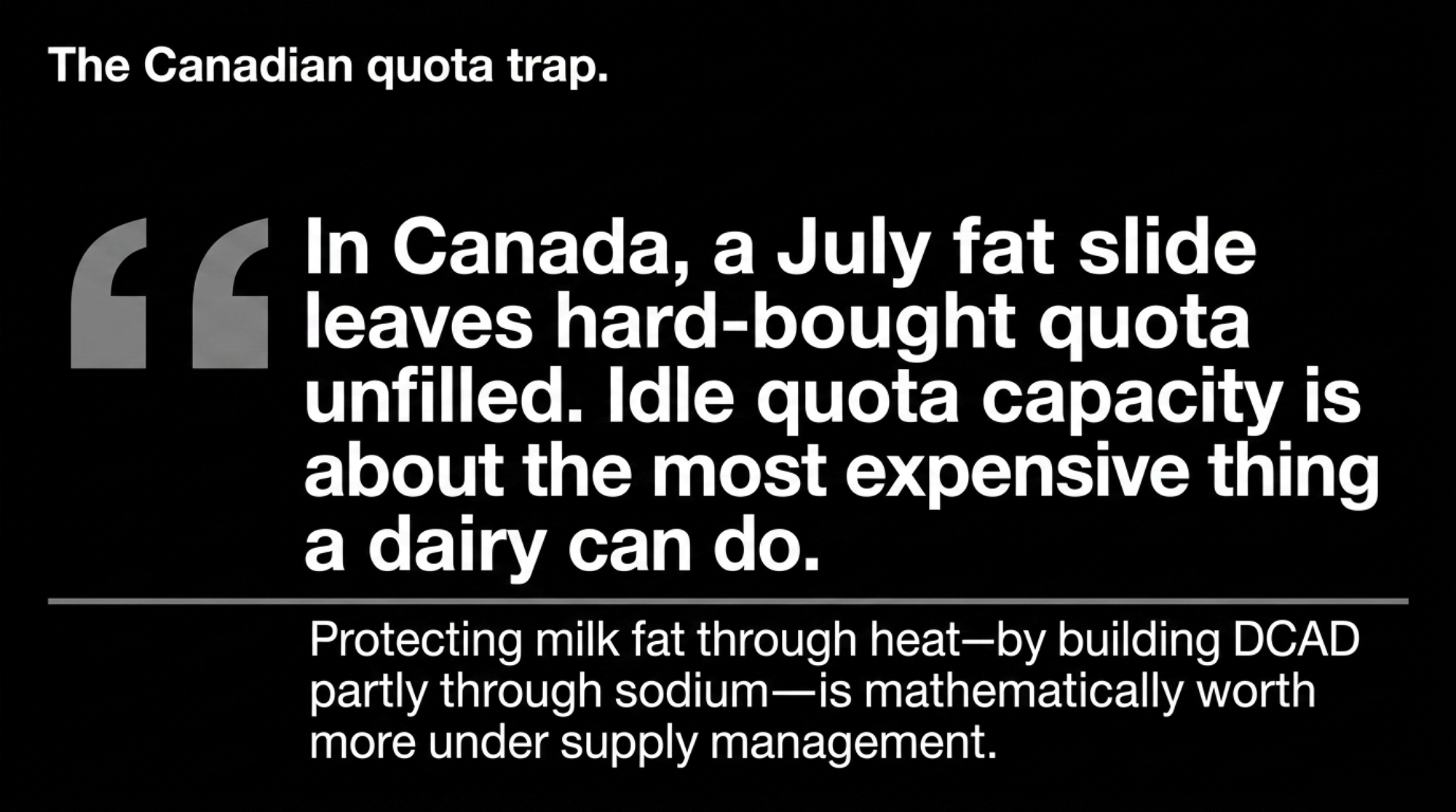
In the U.S. fluid-and-component market, a summer fat dip costs you a slice of your component cheque, but you’re still selling the volume. In Canada, under supply management, the math is sharper. Returns hinge on butterfat, so a July fat slide doesn’t just trim your per-pound return — it can leave you short of the butterfat quota you’ve already paid dearly to hold. That’s quota capacity sitting idle, which is about the most expensive thing a Canadian dairy can do. So a strategy that defends milk fat through heat — like building DCAD partly through sodium, per the Saskatchewan work — is arguably worth more to an Ontario or Quebec producer than to a fluid-market herd facing the same heat.
The chemistry doesn’t care about the border. A cow in Ontario sweats off the same electrolytes as one in Wisconsin, and Ontario’s own extension service points to the same playbook — maximize ventilation, fog the front third of the pad, pack nutrients into smaller volumes, feed most of the ration overnight. But the milk-cheque consequences of getting it wrong aren’t evenly distributed. The producer most exposed to a summer fat drop has the most reason to pre-build the ration that prevents it.
The Dry-Cow Blind Spot
There’s one piece of this that consistently costs the most and gets the least attention: the dry pen.
The farms that get heat stress right walk their dry-cow facilities in April the same way they walk the high group. By mid-to-late May, the shade, fans, and any soakers in the dry and close-up pens are checked and running — not just the parlor holding area. Water, space, and flow get the same treatment because late-gestation cows under heat stress drink more, too.
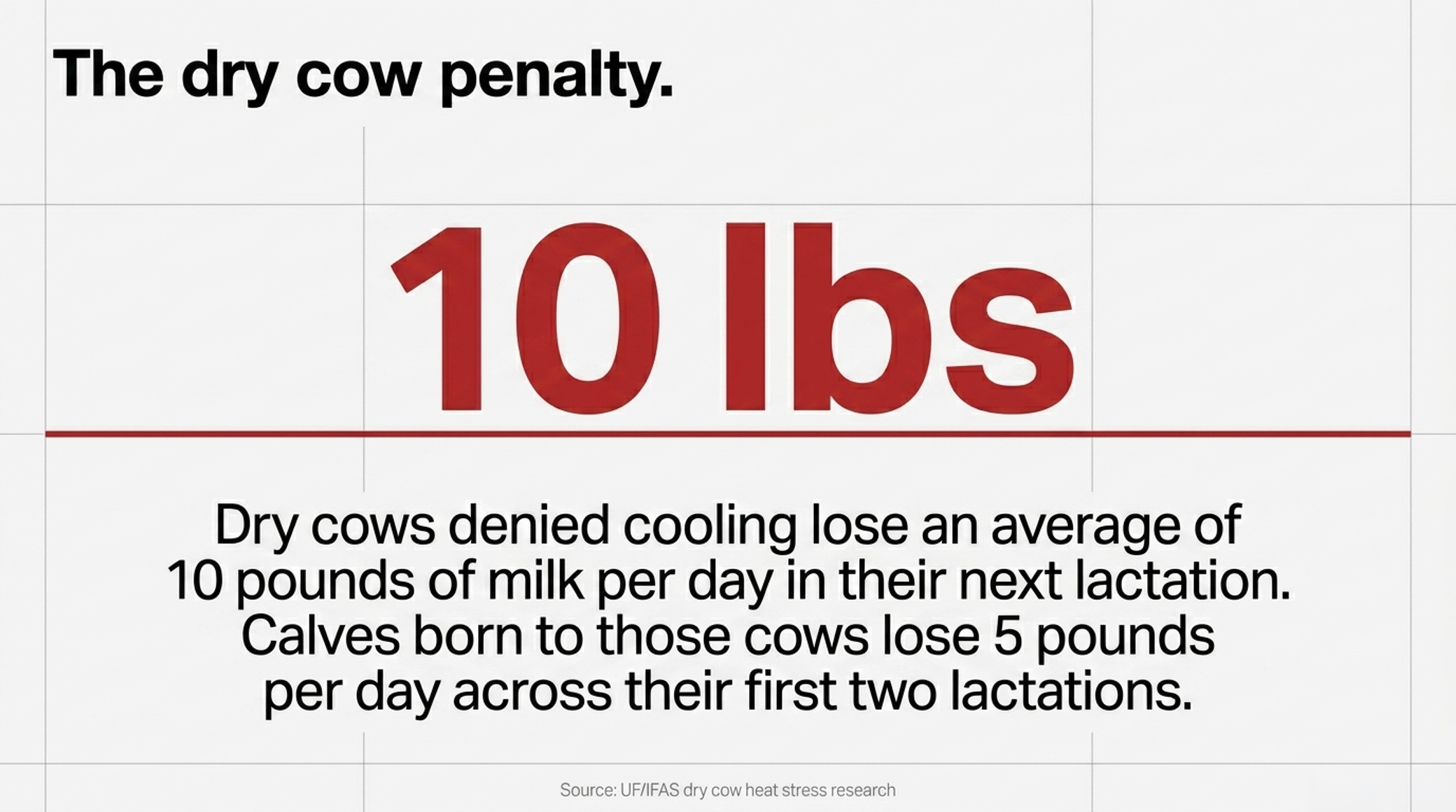
Why the urgency over cows that aren’t even milking? Because the research is blunt about it. University of Florida work led by Geoffrey Dahl and Jimena Laporta found that dry cows denied cooling lose an average of about 10 pounds of milk per day in the next lactation, and the effect holds whether they’re deprived for half the dry period or all of it. Their daughters carry the penalty forward — UF/IFAS reports that calves born to heat-stressed dry cows produced roughly 5 pounds less milk per day across both their first and second lactations. The same UF/IFAS work puts the sector-wide cost of failing to cool dry pregnant cows at up to $595 million a year, once you factor in lost productive life and extra heifer rearing.
That’s not an August problem. That’s a problem you pay for the following winter — and again two years later, when those heifers freshen. Which is exactly why dry-cow cooling shows up on the spring to-do list right beside planting, not in the “if we have time” column.
Water, Bunk Timing, and the Cheap Wins Producers Skip
Nutrition on paper means nothing if the cow can’t get to water or won’t eat when feed’s in front of her. Two of the highest-return moves in a heat plan cost almost nothing — and both get skipped under pressure.
Start with water, because it’s the single most important nutritional input in summer. A heat-stressed cow’s water intake climbs sharply — research has documented increases of around 30% or more — and access right after milking matters most, when she’s walked back hot and thirsty. An extra trough on the return alley from the parlor, troughs cleaned to drinking-water standard, and chilled water in the 21–27°C range all measurably lift intake. One waterer per cow is the hot-weather benchmark — not the year-round standard.
Then there’s when the feed goes out. Cows shift their feeding to the cooler hours and will refuse the bunk during peak heat, so farms that focus on production push the bulk of the ration into the evening. Feeding 60–70% of the ration between roughly 6 p.m. and 8 a.m. is the standing recommendation from Ontario and Manitoba dairy extension to maintain summer intake and milk production. More frequent feeding and push-ups keep fresh feed in front of cows and keep the TMR from heating and spoiling — and an organic-acid stabilizer buys bunk life when the silage face is fighting July heat. None of this is exotic. It’s just decided in advance, rather than improvised at 2 p.m. on the first 30°C day.
The Math Nobody Runs Until It’s Too Late
The reason this stays broken on most farms is that the cost is never calculated for this farm this summer. The industry-wide figure — heat stress costing the U.S. dairy sector somewhere between $897 million and $1.5 billion a year in lactating losses alone — lands as somebody else’s problem.
So run a version you can feel. Take a 100-cow herd. Say a DCAD miss and a reactive feeding schedule cost you a conservative 2 pounds of milk per cow per day across a 90-day heat window. That’s 18,000 pounds of milk you didn’t have to lose. At USDA’s May 2026 WASDE all-milk forecast of $19.70 per hundredweight, that’s about $3,546 off the cheque — traced straight back to a forage test you didn’t run and a ration you didn’t pre-build. Call it the better part of $3,500, gone, on a 100-cow herd that did nothing wrong except react late.
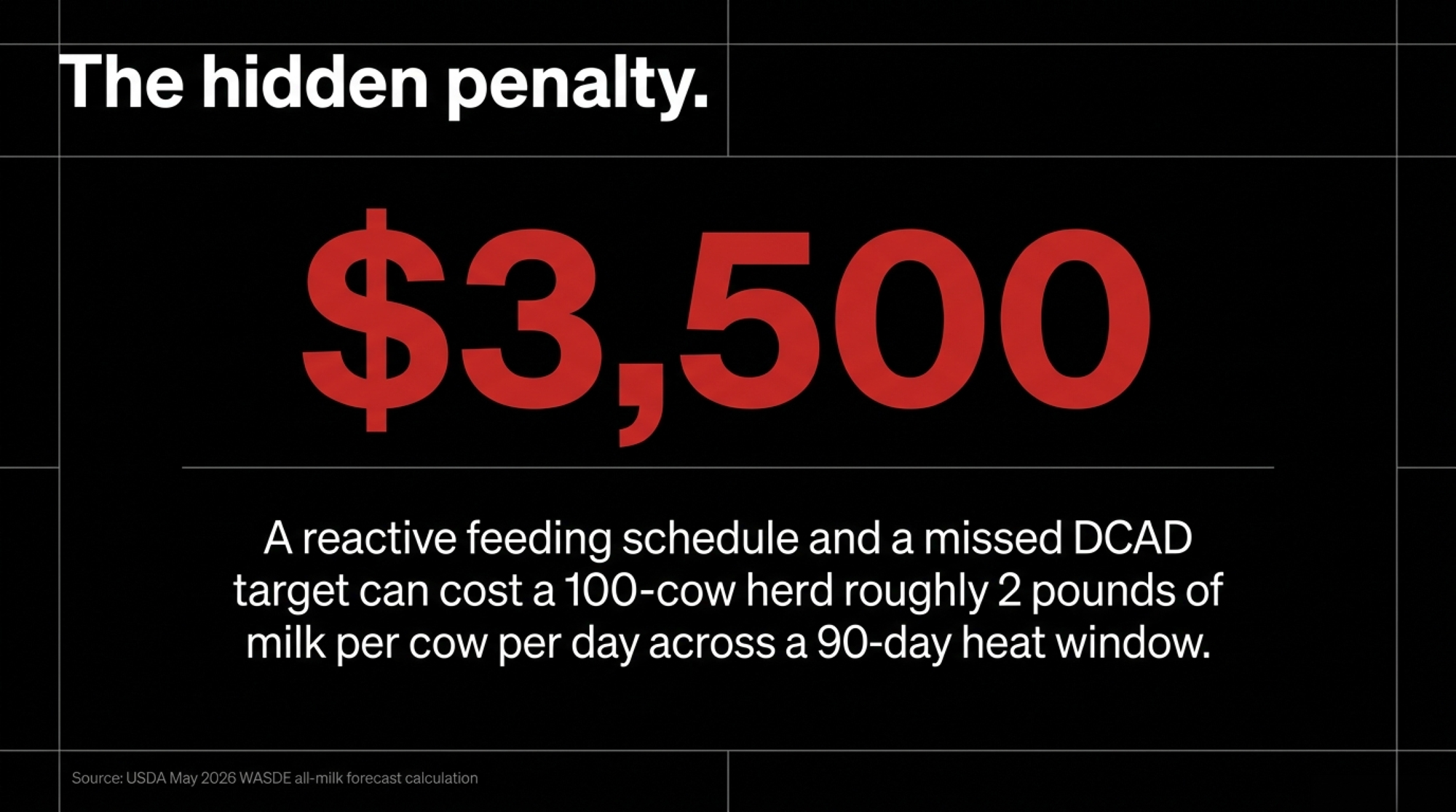
Now put that next to the fix. The wet-chemistry mineral panel that would have caught the DCAD miss runs about $15 a sample as an add-on to a standard NIR package. Test your three or four main forages a couple of times throughout the season, and you’re into low double-digit dollars rather than a four-figure loss. That’s the whole trade the headline points at: a few dollars of testing on one side, thousands in lost milk on the other. The test is never an expensive decision. Skipping it is.
Is this a national pattern or a single-herd quirk? Both. The biology is universal — every lactating cow loses potassium through panting, sweating, and milk when it gets hot. What varies is execution, and execution is a choice each operation makes on its own calendar.
Where to Start — and What It Costs You to Get It Wrong
There’s no single right answer here. It depends on herd size, your forage base, and how much risk you’re willing to carry into summer. Ranked roughly by return on effort, here’s the sequence the best-run farms follow — and where each move bites if you botch it.
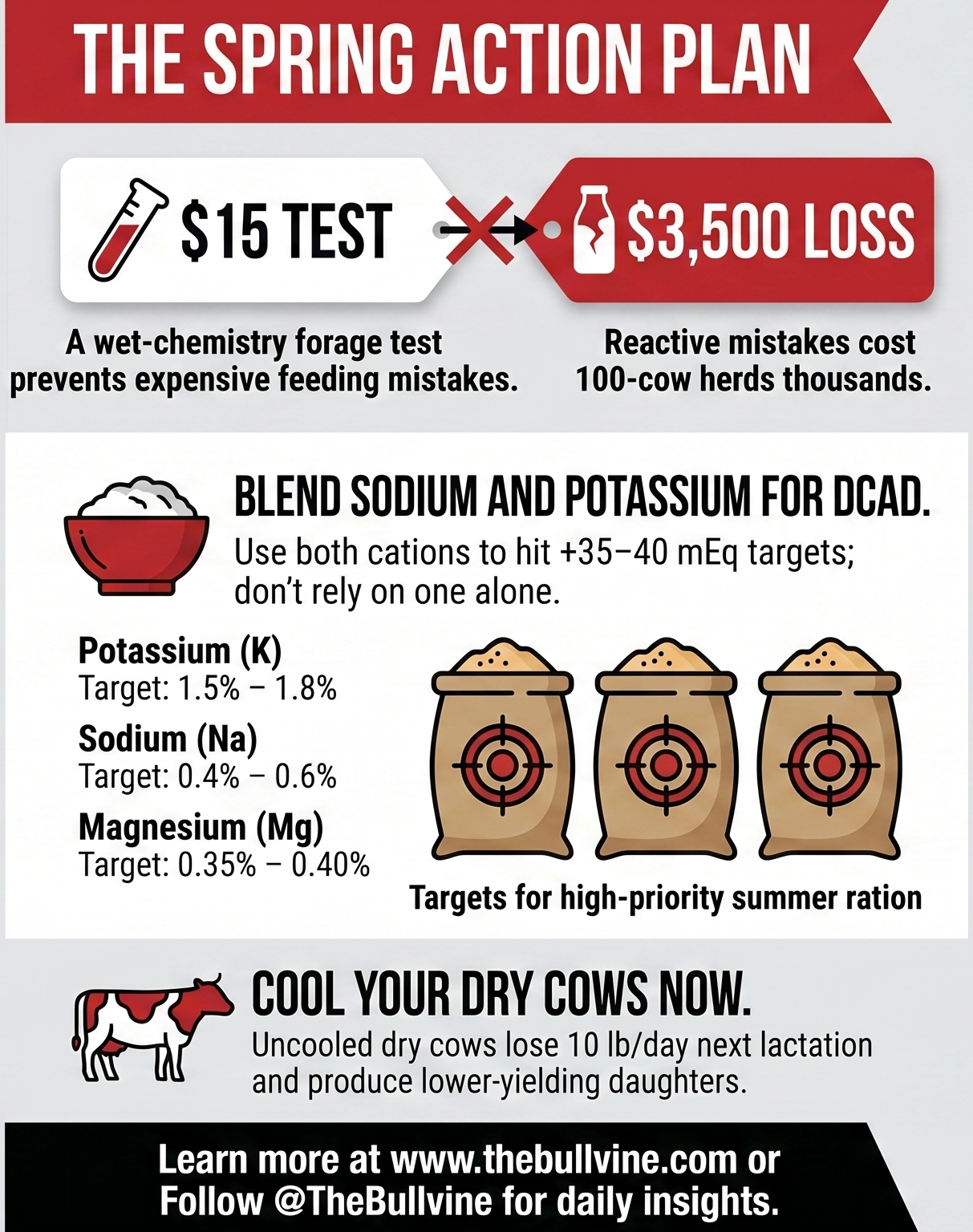
1. Pre-build the summer ration off spring forage tests — the 30-day move. In the next month, pull fresh forage samples, order wet-chemistry minerals, and book an hour with your nutritionist to recalculate DCAD, potassium, and magnesium for the high group and fresh pens first. About $15 a sample and one focused session. Worst case, you confirm the ration’s already right — information worth having. This is the move that everything else depends on.
2. Fix water and bunk timing now — the free wins. Add a trough on the parlor return, commit to feeding 60–70% of the ration in the cool hours, and schedule more frequent push-ups before the heat lands. Costs mostly labor and discipline. It only backfires if it gets written down and then ignored when things get busy.
3. Lock in the cation decision before June. Decide whether you’re leaning on high-K forage, a stabilized potassium carbonate, sodium bicarb, or a blend — and remember the trial data says a mix of both cations beats either alone. Most critical for corn-silage-heavy rations, where natural potassium levels run low. Where it backfires: grabbing off-the-shelf anhydrous K₂CO₃ and feeding it into wet TMR — the intake problem is real.
4. Treat dry-cow cooling as a spring capital project. Walk the dry pen in April, as you would the high group, for any herd that hasn’t audited dry-cow shade, fans, and water since last summer. The trap is skipping it because those cows “aren’t milking” — the cost shows up two years out, in their lactation and their daughters’.
5. Build the monitoring tripwires before the heat. Agree with your nutritionist on the indicators you’ll watch and the if-this-then-that rules once THI clears 68. Costs a conversation, not hardware — and only works if the rules actually get followed.
What This Means for Your Operation
- If you only do one thing this month, run wet-chemistry mineral analyses on your forages — about $15 per sample — and rebuild your summer ration based on the results. Every downstream decision depends on those numbers.
- If you think cooling alone fixes heat stress, remember that intake accounts for only 20–50% of the loss — the rest is gut and inflammation, and that’s the nutrition side’s job.
- If you’re building DCAD, use sodium and potassium together, and raise magnesium with potassium — the cations work as a system, not as a single lever.
- If you milk in Canada, protecting summer milk fat isn’t optional — a fat slide can leave butterfat quota unfilled, so the sodium-DCAD strategy matters more to your cheque than to a U.S. fluid-market herd’s.
- If your dry cows get shade but no fans, treat that as this spring’s highest-ROI cooling fix — UF/IFAS data ties uncooled dry periods to roughly 10 lb/day less next lactation, plus a penalty in the daughters.
- If you wait for “cows off feed” calls to act, you’re already two weeks into the loss. Set your THI 68 tripwires, water, and overnight feeding now.
Key Takeaways
- If your forage potassium hasn’t been measured by wet chemistry this spring, your DCAD target is a guess — fix that before you touch anything else.
- If you’re hanging more fans and still losing milk, you’ve maxed the 20–50% of the loss that’s about intake and ignored the other half that lives in the gut.
- If you build DCAD with one cation, you’re leaving milk on the table — the data says blend sodium and potassium and lift magnesium alongside.
- If your dry cows aren’t cooled, that’s your single highest-ROI fix this spring, and the bill comes due in the next lactation, plus two years out in the daughters.

What should sit with you is how little of this is actually extra work. Pre-building the ration, testing the forage, cooling the dry cows, moving the feed to the cool hours — it’s the same work you’d scramble through in July, just moved to March when you’ve got time to think instead of time to panic. The farms that get this right didn’t find a secret additive. They moved their decisions earlier on the calendar. So here’s the real question for your barn: when the first heat wave lands this year, are you going to be running a plan you already wrote — or writing one while the tank slides?
Run Your Numbers
Forage Quality Value Calculator — Punch in your spring forage tests and milk price, and this tool turns them into $/ton DM, $/cow/day, and annual herd impact so you can see exactly what a bad DCAD guess or missed K swing is really costing.
Complete references and supporting documentation are available upon request by contacting the editorial team at editor@thebullvine.com.
Learn More
- Nigel Cook’s $74 Heat Stress Number Was Never Wrong. It Was Never Finished. — Exposes the hidden financial drain of out-of-date mineral strategies, proving that pushing summer DCAD targets to +350–+400 mEq/kg using potassium carbonate captures thousands in lost milk fat yield that cheap chloride salts completely blunt.
- Heat stress fertility: why cows quit breeding at THI 60 — Delivers a critical warning for long-term genetic planning, showing how embryonic damage triggers weeks before visible milk loss and arming you with tactical protocols to purge summer-fragile cow families using targeted beef-on-dairy breedings.
- Beating The Heat: How High-Speed Air Is Revolutionizing Dairy Productivity — Breaks down the next-generation hardware shift required to stop systemic inflammation, revealing how precision systems maintaining 200+ ft/min at cow level eliminate “hot spot” bunching and protect the 12–14 hours of mandatory resting time.
The Sunday Read Dairy Professionals Don’t Skip.

Every week, thousands of producers, breeders, and industry insiders open Bullvine Weekly for genetics insights, market shifts, and profit strategies they won’t find anywhere else. One email. Five minutes. Smarter decisions all week.