






Three Franklin County plants are going dark in 18 months, and the rerouting bill lands on farmers who never got a vote.
Executive Summary: Three plants in one Vermont county — DFA’s St. Albans, Franklin Foods in Enosburg Falls, and Perrigo’s Georgia formula plant — are shutting or winding down inside an 18-month window, stripping out local competition and pushing more milk out of state. Once DFA reroutes St. Albans milk after its August 17 idle, a 350-cow herd could absorb an estimated $73,000–$269,000 a year in extra hauling: an added $0.85–$3.15/cwt, where even a $1.00/cwt bump runs about $85,000 on 24,390 lb/cow. The 2019 co-op merger vote gave those farmers market access but no direct say on this closure — and DFA hasn’t detailed how milk gets rerouted or whether the decision went to a member vote. Inside, there’s a barn-math example you can plug your own cwt into, plus three moves to make within 30 days: get your new rate in writing, ask your delegate who voted and under which bylaw, and confirm whether “ray of hope” plants like Franklin County Cheese will actually take your milk. If your hauling line is creeping up or your co-op is talking about “optimizing the network,” this shows you in dollars per year what that means for your check. Before the next plant on your route quietly goes “idle.”
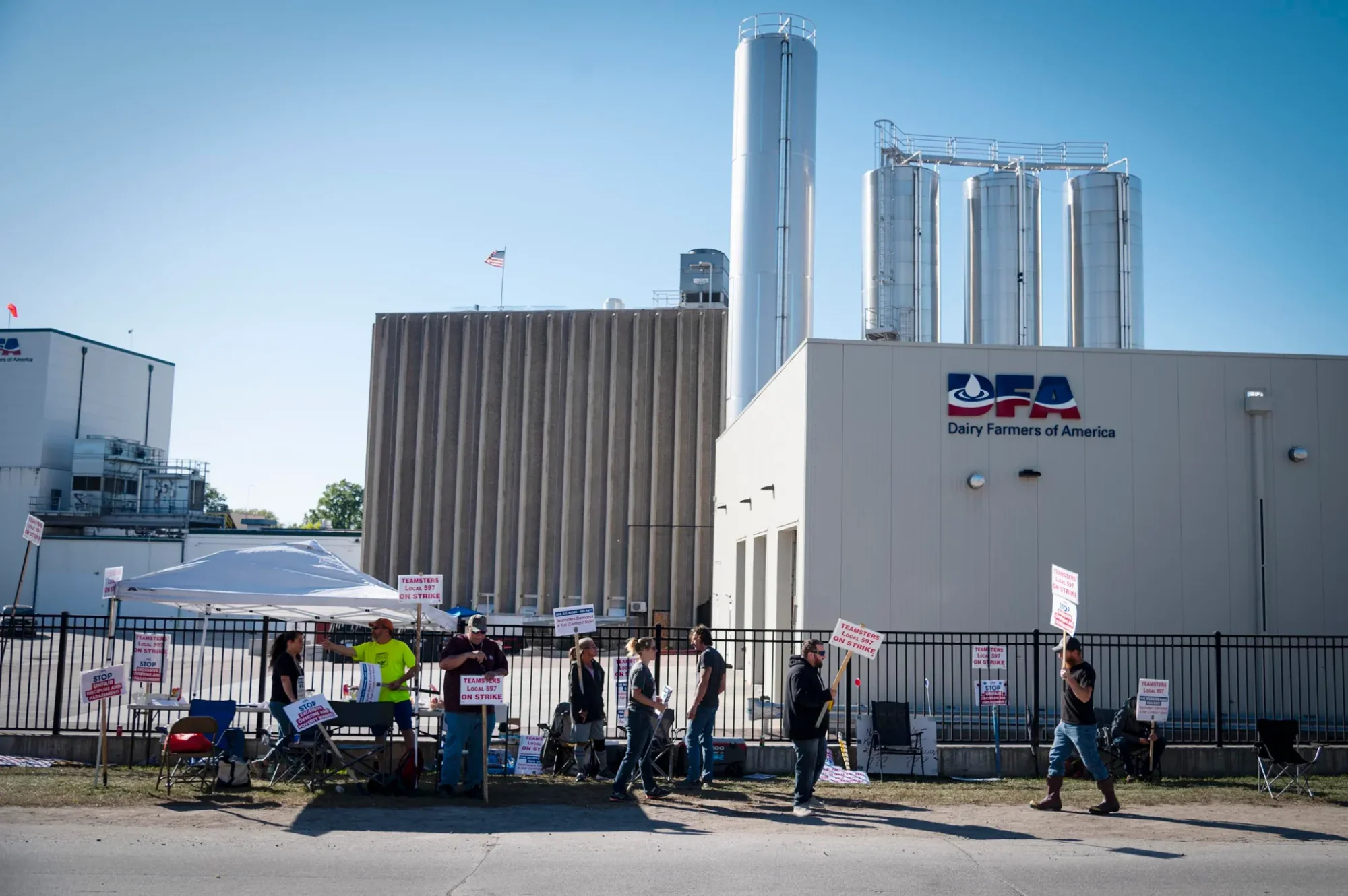
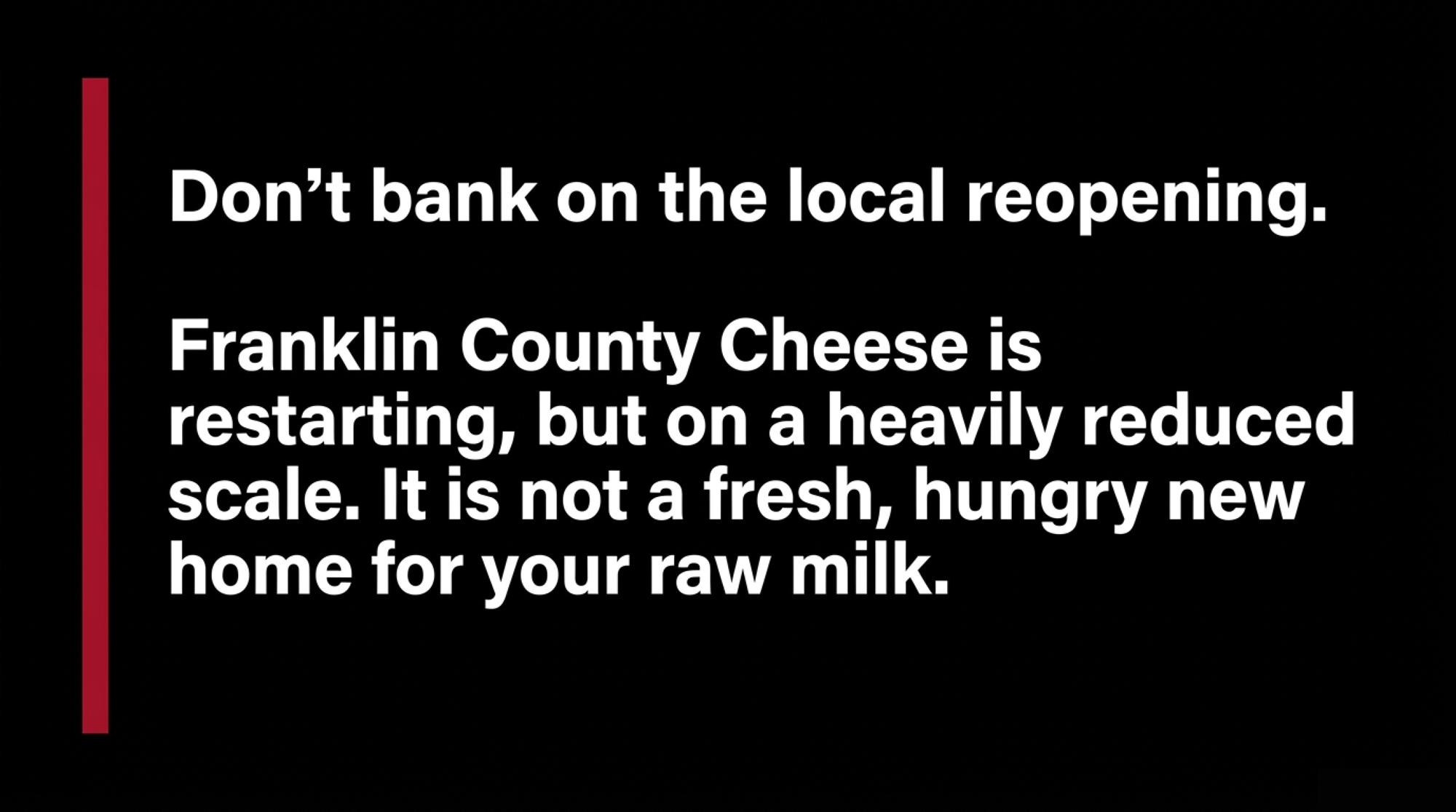
John Ovitt has walked into the same Enosburg Falls cream cheese plant for 37 years — a Franklin Foods operation that’s been making cheese in that town for 125 years — until its German owner, Hochland, decided to shut it down this summer. On September 1, Ovitt plans to take it over and reopen it as Franklin County Cheese, a rare bright spot in a county bleeding processing jobs. But here’s the part that should stop every dairy farmer around him cold: Ovitt himself has said he’ll restart the plant on a reduced scale, running some of the old product lines but not at the volume that came before. It is not a fresh, hungry new home for your raw milk.
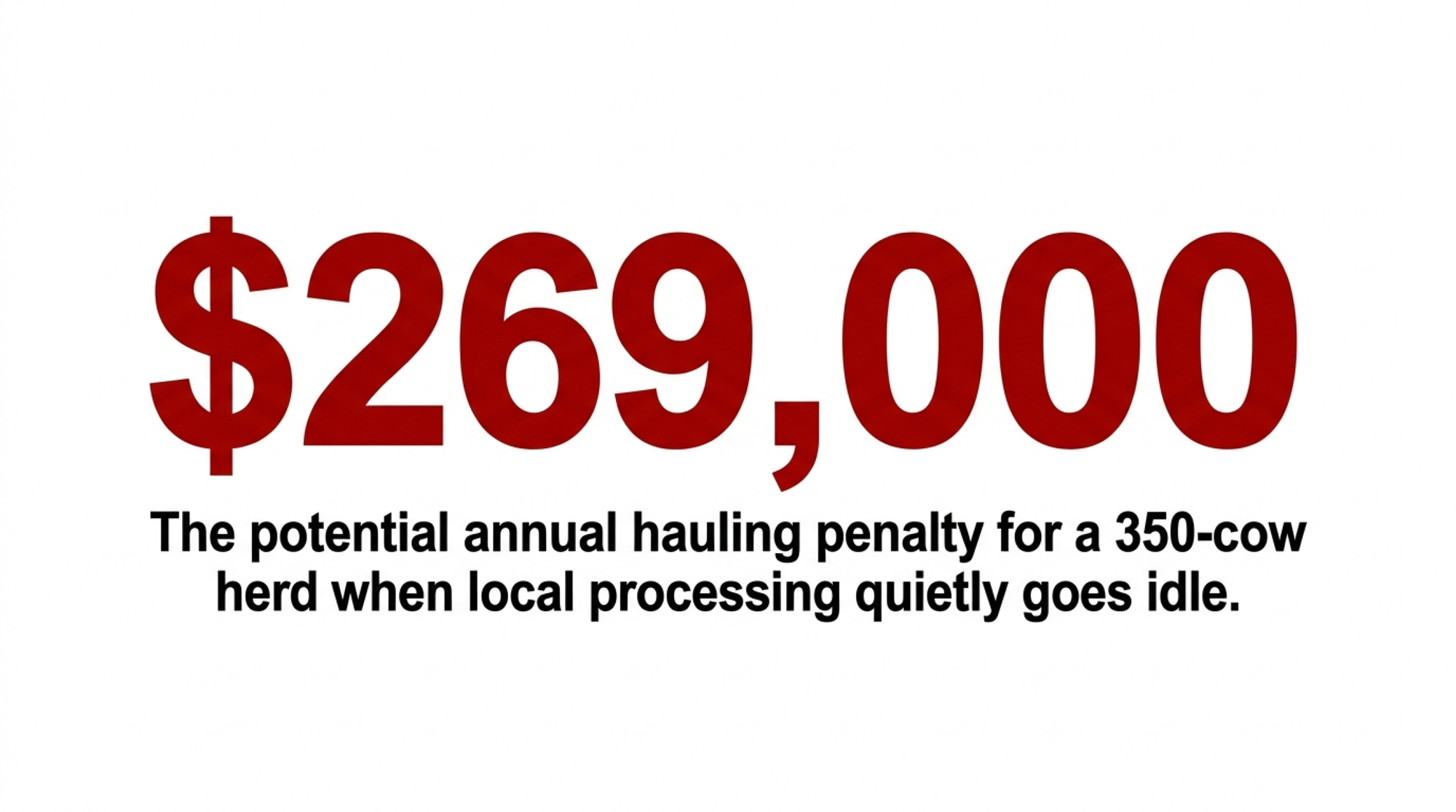
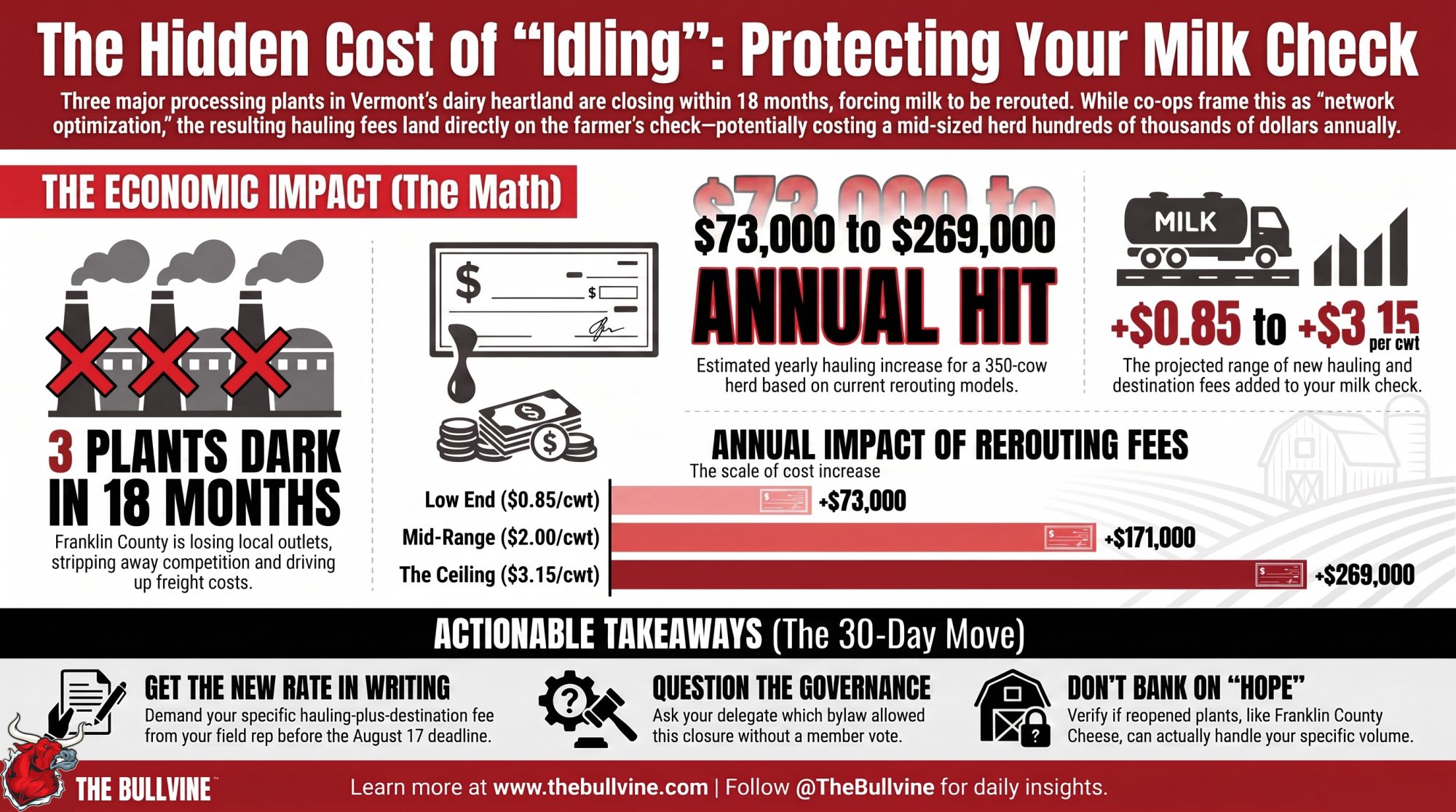
That’s the gap that matters right now. Because about 19 miles away, DFA said on June 17 it had “made the difficult decision to idle” its St. Albans plant effective August 17, telling farmers the milk received there would keep being processed for now “to ensure a market for regional dairy farmers.” For a 350-cow dairy, that quiet word “idle” could still translate into $73,000 to $269,000 a year in new hauling costs once the milk gets rerouted, based on Bullvine’s modeling. Same cows. Same barn. A very different milk check.
| Scenario | Added Rate ($/cwt) | Annual Cost (350-cow herd, 85,365 cwt) | Risk Level |
|---|---|---|---|
| Low End | $0.85 | $73,000 | Likely floor |
| Mid Range | $2.00 | $171,000 | Most probable outcome |
| Ceiling | $3.15 | $269,000 | Worst case — plan for it, don’t bank on it |
Three Plants, One County, One Year
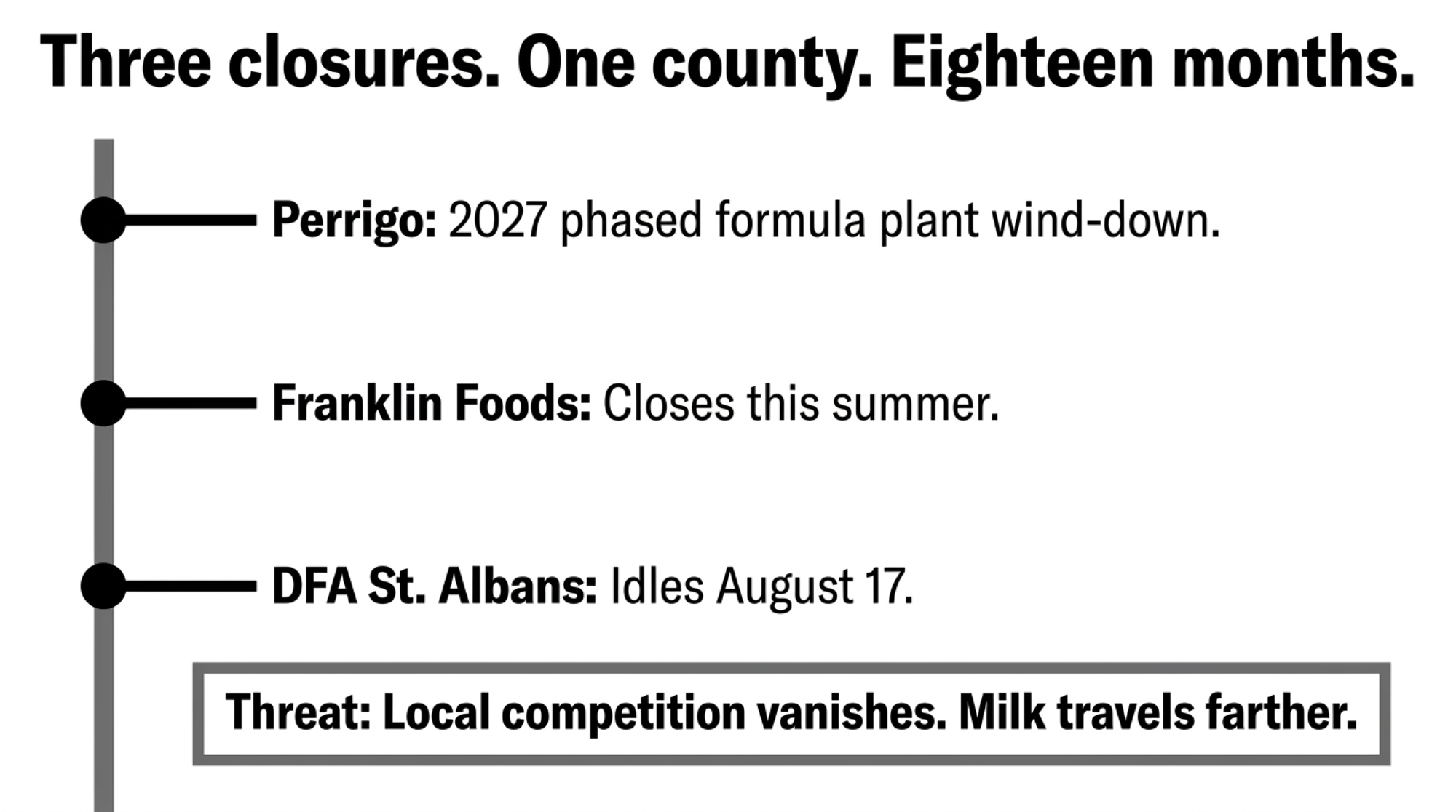
Franklin County is Vermont’s dairy heartland, and in about 18 months it’s watched its processing capacity walk out the door. St. Albans goes idle August 17, with roughly 80 jobs gone and DFA keeping the building but winding down production. Franklin Foods closes this summer before Ovitt’s reopening — and even that reopening comes back at reduced capacity, not full throttle. Between St. Albans and Enosburg Falls alone, Franklin County stands to lose more than 150 jobs.
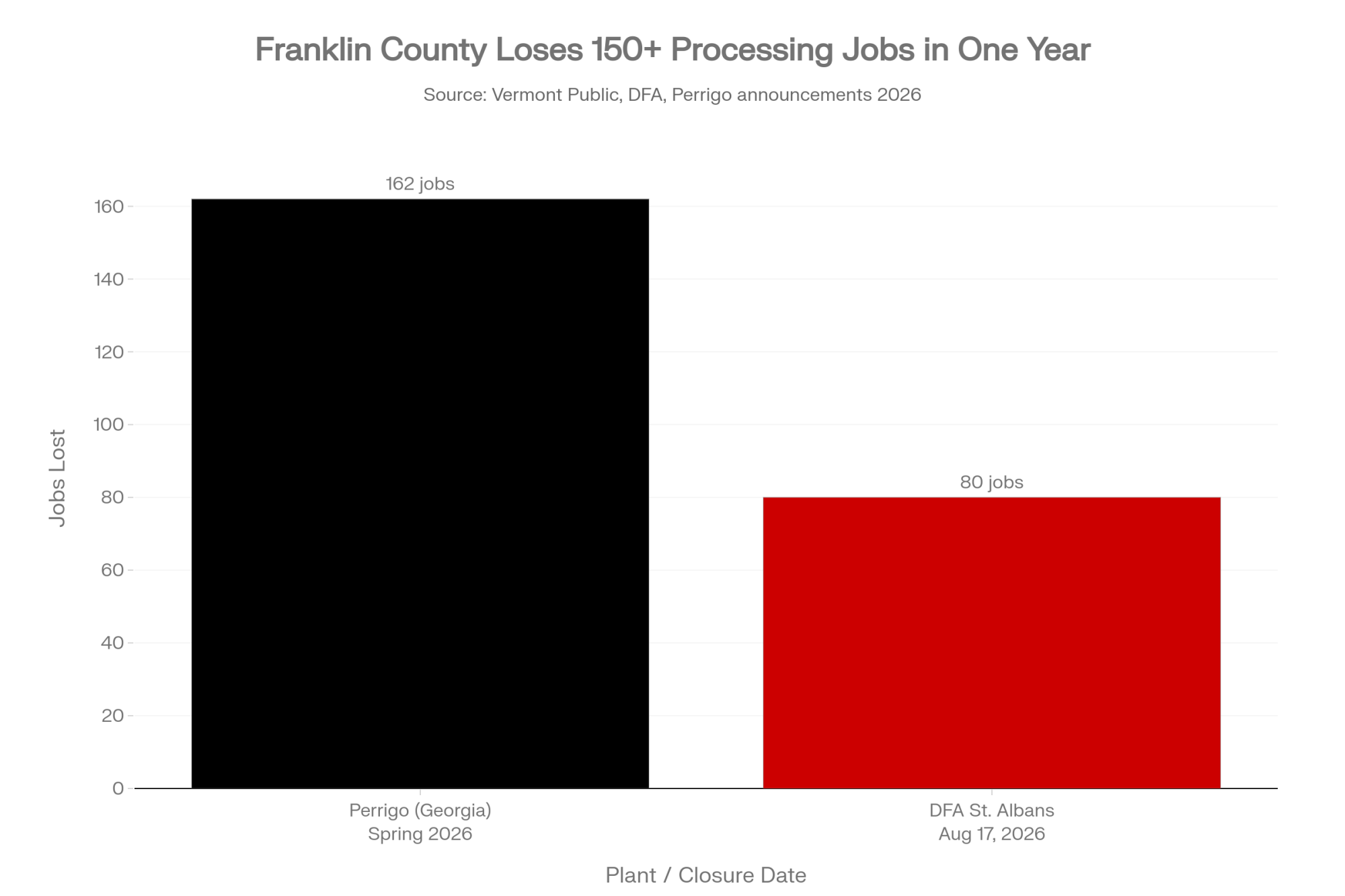
| Plant | Status & Date | Jobs Affected | Takes Your Raw Milk? |
|---|---|---|---|
| DFA St. Albans | Idles Aug 17, 2026 | ~80 jobs | Yes — but rerouted, plant unnamed |
| Franklin Foods (Enosburg Falls) | Closes summer 2026; reopens Sept 1 as Franklin County Cheese | Not disclosed | Reduced scale only — not full volume |
| Perrigo (Georgia, infant formula) | Mfg ended June 2026; full wind-down through 2027 | 162 laid off (of ~420 total) | No — never processed raw milk |
Then there’s Perrigo. Its infant formula plant in the town of Georgia laid off 162 workers this spring and ended manufacturing at the end of June, the first phase of a full wind-down of the roughly 420-person site that runs through 2027 — another anchor employer gone, even if it never took your milk.
Here’s what makes this different from the usual closure story: it’s the clustering. Three plants, one county, one narrow window — which means farmers lose every local outlet at roughly the same time, with no nearby competitor left to bid for their milk or hold hauling rates honest. When plants close, milk doesn’t disappear — it has to travel farther to find a buyer, and in dairy, the farmer usually eats that freight. Vermont Public framed the core worry plainly in its reporting: whether the closure will ultimately raise the transportation costs Vermont farmers have to shoulder.
The answer is almost always yes. More milk moving out of state means longer hauls, and those costs show up as a deduction on your monthly check.
How This Lands on a Real Farm
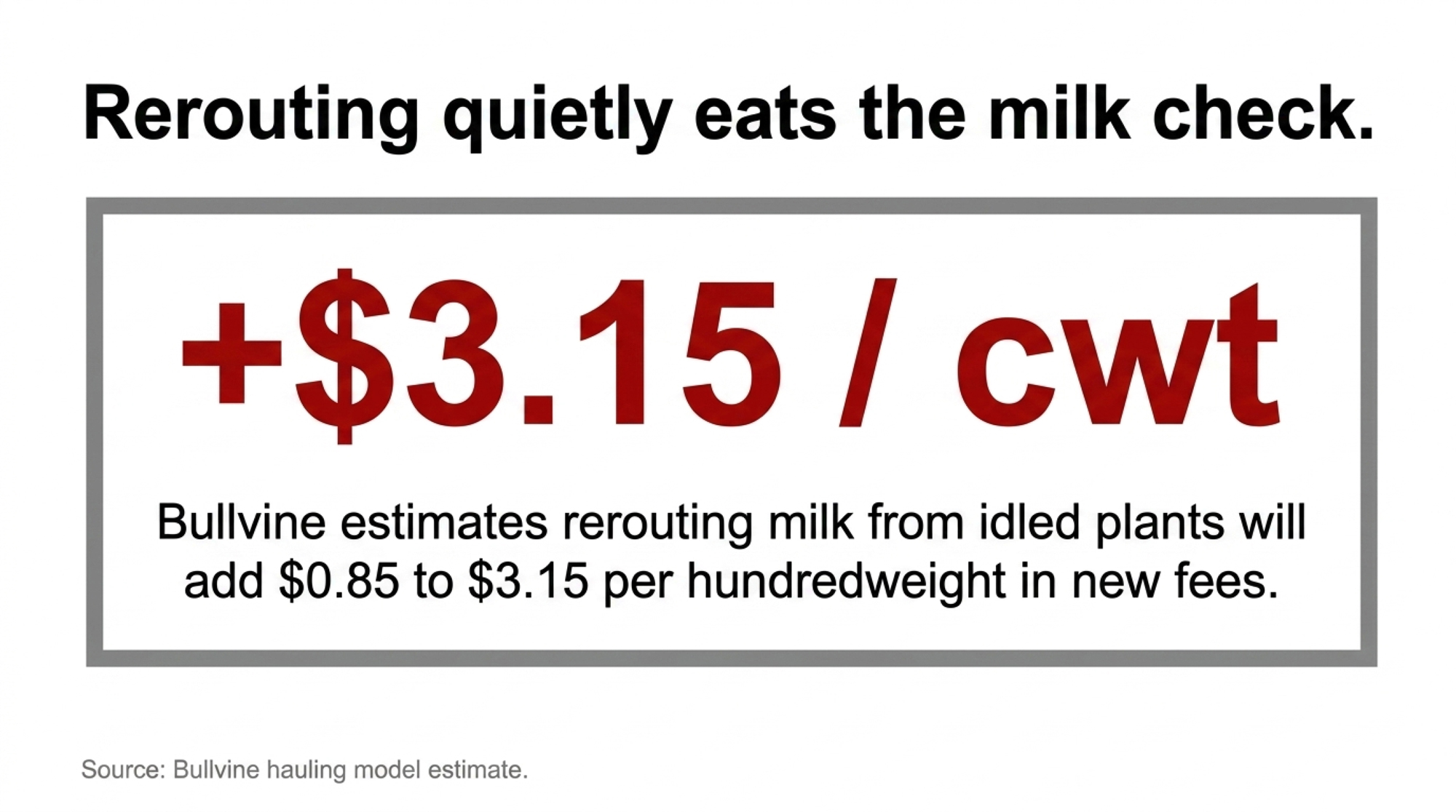
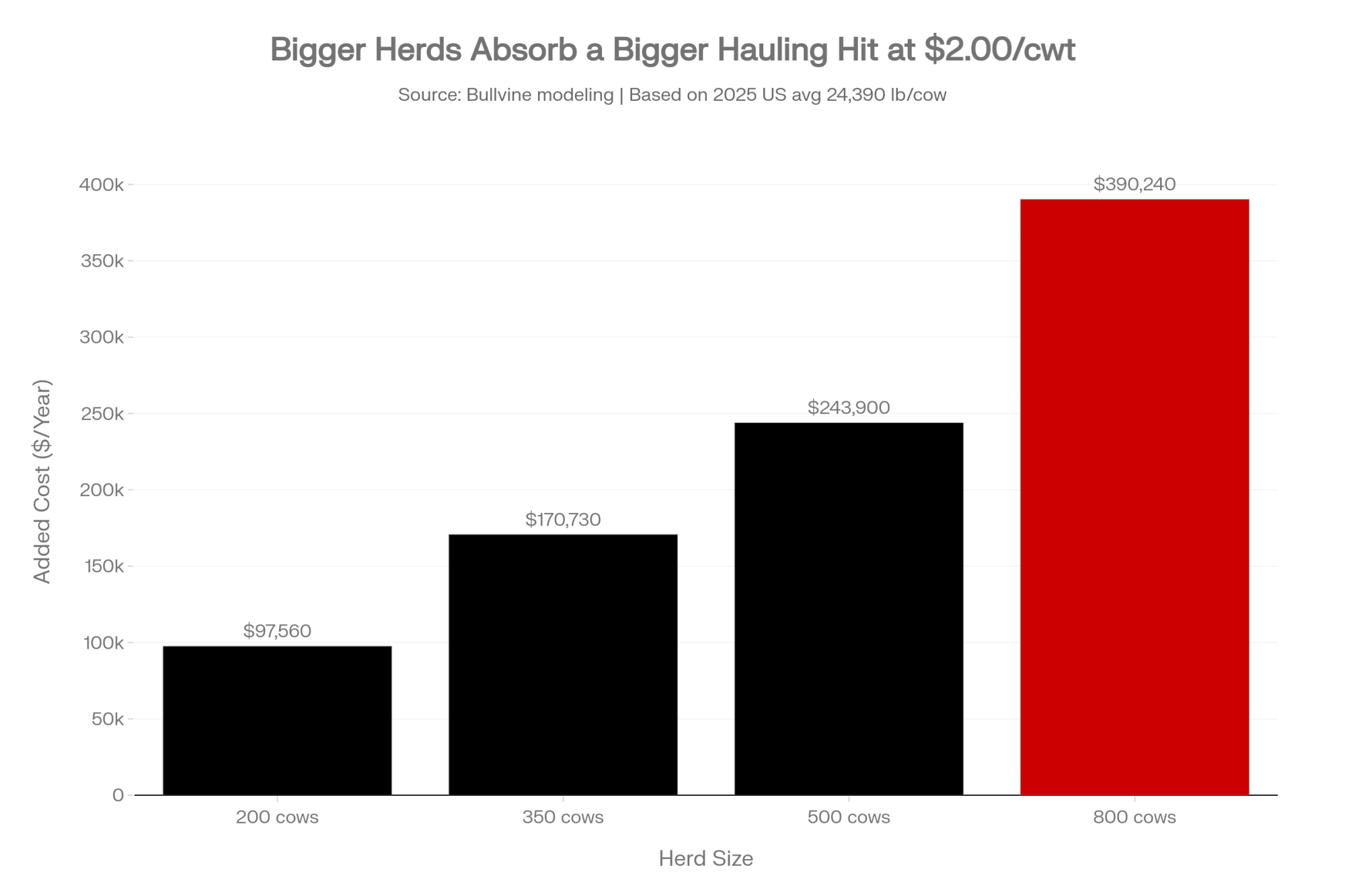
Let’s put a number on it. Bullvine’s analysis of the St. Albans closure estimates rerouting could add $0.85 to $3.15 per cwt in hauling and destination fees, depending on which plant DFA sends your milk to — and DFA hasn’t named one yet. Take a 350-cow herd running at the 2025 US average of 24,390 pounds per cow. That’s roughly 85,365 cwt going out the driveway each year.
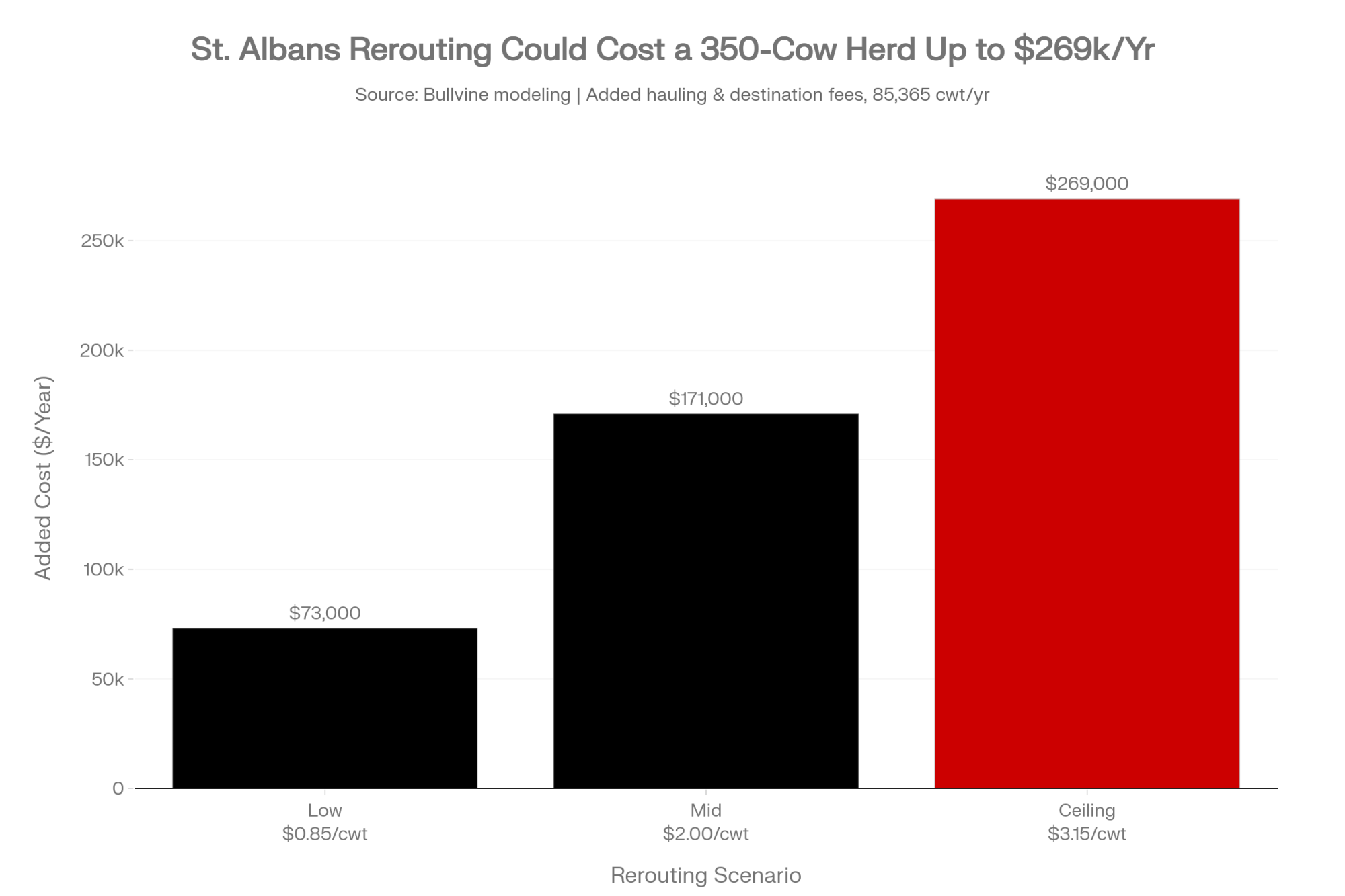
The Cost Breakdown (350-Cow Herd) Based on an added $0.85 to $3.15 per cwt in rerouting fees:
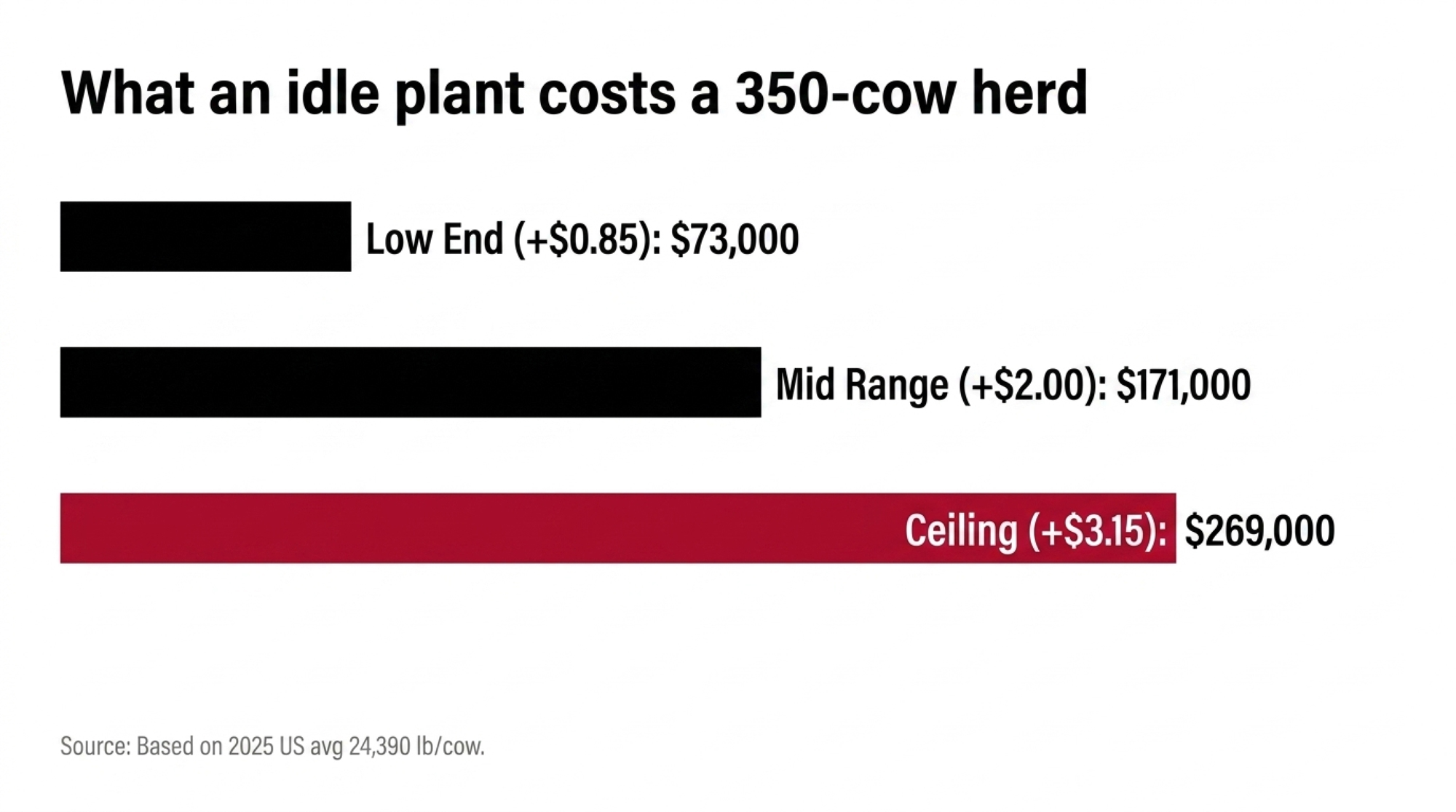
- The Low End — $0.85/cwt: +$73,000 / year
- The Mid Range — $2.00/cwt: +$171,000 / year
- The Ceiling — $3.15/cwt: +$269,000 / year
That ceiling is the worst case, not the likely one. Most reroutes will land somewhere in the middle, and that’s before basis, shrink, and fuel adjustment even enter the picture. Run it on your own herd’s real production and your number will shift — that’s the point.
Now picture Ovitt’s neighbors, the ones who fed St. Albans for years. The farmer who never pulls those numbers finds out six months from now, when the statement looks different, and nobody’s around to explain why. The one who lays three milk stubs on the kitchen table and does the arithmetic walks into that conversation holding something the first one doesn’t — a figure.
Who Actually Decided This?
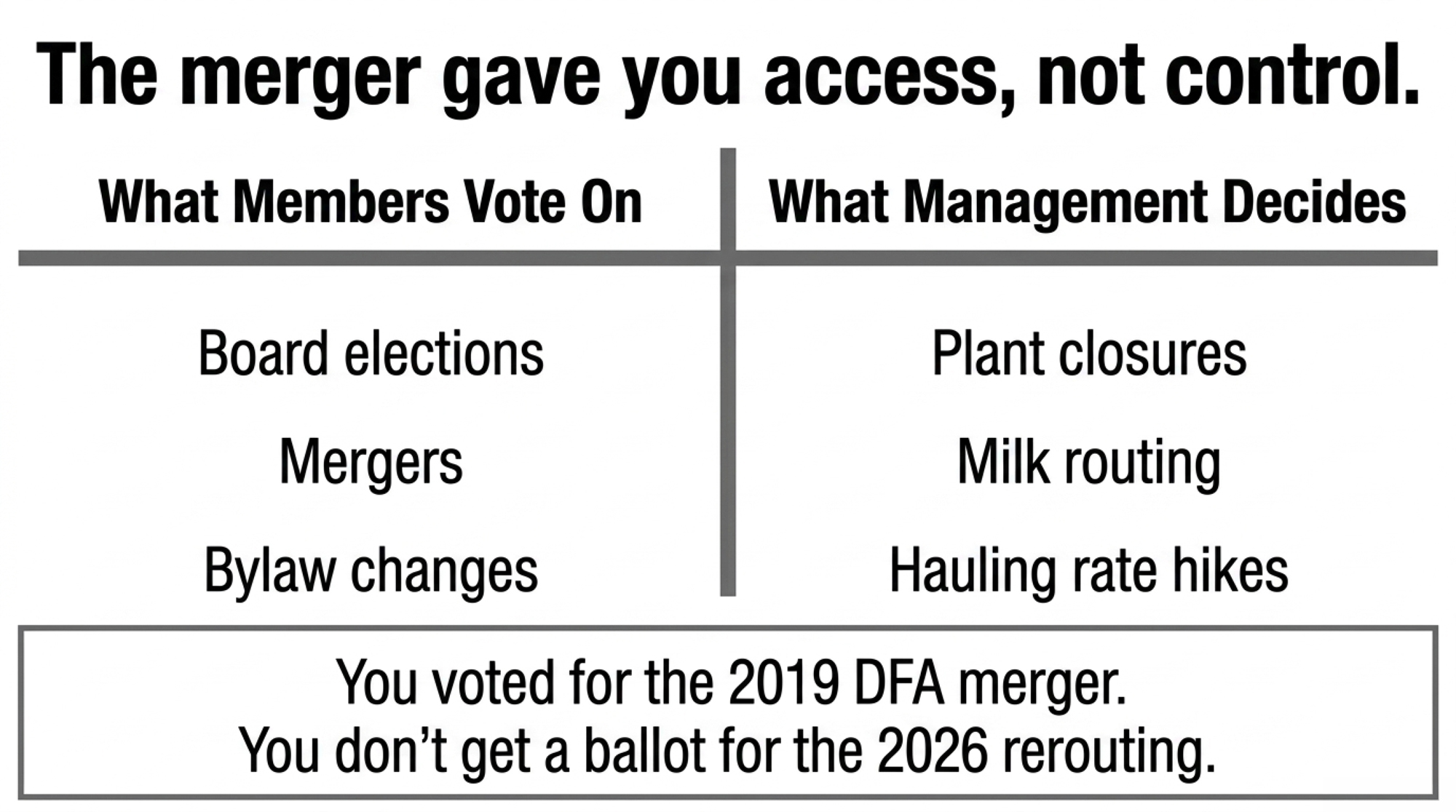
Here’s where it stings. St. Albans farmers voted 99-9 in 2019 to merge into DFA — but only 108 of roughly 307 members showed up to cast a ballot, about a third of the membership. That wasn’t naivety. Those were smart people making a rational call under real price pressure — they needed a buyer, and DFA was the truck that showed up.
What the vote gave them was market access. What it didn’t give them was a seat at the table when the 2026 routing decision got made. DFA framed the closure as a decision it “has made,” attributing it to broader operational changes, and has not publicly detailed how affected farms’ milk will be rerouted long term or whether the decision went to a member vote.
That’s not necessarily a communication failure. It’s how the authority is split. According to the University of Wisconsin Center for Cooperatives, members control the co-op mainly by electing a board of directors and by voting on bylaw changes, mergers, or dissolution — not on operational calls like which plant runs. Which plant runs, and where your milk gets trucked? That sits with the board and management, not with a member ballot. So to a farmer facing the hauling bill, “network optimization” can feel like a cost shift with a nicer name — and unless you turn it into a number tied to your farm, it stays abstract.
How Much Does Waiting 30 Days Actually Cost?
Do the arithmetic before August 17 comes and goes. If you’re milking 350 cows and rerouting adds even $1.00/cwt, that’s roughly $85,000 a year you never budgeted for. Every month you don’t confirm the real number is a month you absorb it blind.
The cost of waiting isn’t the deduction itself — it’s the difference between negotiating from preparation versus negotiating from surprise. And a farmer who shows up at a board meeting with a hauling-drag figure and a bylaw question is a completely different meeting than one who shows up with a grievance. One is easy to manage. The other puts a number on the table.
Is Your Location Quietly Becoming a Milk-Check Risk?
Some farms sit in a corridor where milk is cheap to move and easy to sell. Others don’t — and the drag from hauling, basis, and thinning processing options can quietly eat a slice of every check. Bullvine’s own hauling work found that past about 25 extra miles, the freight line stops being background noise, and a 500-cow herd can start losing 1% of gross before feed or labor. Franklin County, with three closures in a single year, is close to a textbook case of that risk rising fast.
You don’t need a fancy calculator to start reading the signal. Pull your last three milk stubs. Find the hauling and destination lines. Then watch what they do after August. That trend line is your early warning system, and it costs you nothing but ten minutes at the table.
Options and Trade-Offs
There’s a 30- to 90-day window after a closure notice when the useful moves actually happen. Here’s what farmers are doing with it.
Action 1: Make the Three Calls This Week
- Best For: Anyone shipping to St. Albans.
- The Goal: Call your DFA field rep or milk accounting to get the specifics in writing — which plant your milk goes to once rerouting starts, the new hauling-plus-destination fee per cwt, the effective date, and whether it’s temporary or permanent.
- What It Takes: Your recent milk stubs in hand first.
- The Catch: You may not get a clean answer on the first try — be persistent, and ask for it in writing.
Action 2: Ask the Governance Question
- Best For: Regaining long-term leverage before the next plant closes, not just answers after this one.
- The Goal: Contact your board delegate. Ask whether the board formally voted on the closure and rerouting, and request the bylaw provision covering plant and routing decisions.
- What It Takes: Knowing who your delegate is.
- The Catch: You’re asking about authority and process, not confidential minutes — keep it specific.
Action 3: Don’t Count the Reopening as Your Outlet
- Best For: Any farm tempted to assume the local plant solves the problem.
- The Goal: Call Franklin County Cheese directly and confirm what — and how much — it’ll actually buy. Ovitt’s operation is real and welcome, but he’s said it comes back on a reduced scale, running some of the former product lines at lower volume.
- What It Takes: A direct call before you bank on it.
- The Catch: A “ray of hope” headline isn’t a milk contract.
Action 4: Compare Notes With Your Neighbors
- Best For: The long game — months, not this week.
- The Goal: Put your numbers side by side with other affected farms. When 200-plus Irish farmers gathered outside Dairygold’s Mitchelstown offices last September — each able to name a roughly €2,290-a-month gap against what neighboring Carbery suppliers were paid — insulated management suddenly had to answer for it.
- What It Takes: Neighbors willing to lay their figures on the table alongside yours.
- The Catch: Sustained collective action is the hardest thing to organize — but organized members change bylaws and boards, and isolated ones absorb decisions.
Key Takeaways
- If you ship to St. Albans, call your field rep this week and get your new hauling-plus-destination rate per cwt in writing before August 17.
- Multiply your own annual cwt by a $0.85–$3.15 range to see your realistic added-cost band before you assume the impact is small.
- If you can’t name who voted on this closure, ask your delegate — and request the bylaw section covering routing and plant decisions.
- Watch the hauling and destination lines on your next three checks; a rising trend is your corridor-risk signal, no software required.
- Before you treat the reopened Enosburg Falls plant as an option, confirm it’ll buy raw milk at your volume — the operator has already said he’s restarting at reduced scale.
- If several neighbors see the same drag, put your numbers together now, while you still have a window to act on them.
So where does your hauling line sit right now — and do you actually know who decided it? That’s the question worth carrying into the next board meeting, not as a complaint, but as a figure nobody can wave away. The plants are closing whether anyone runs the math or not. The only variable left is whether you’re the farmer who ran it first.
Run Your Numbers
Dairy Farm Corridor Score Calculator — Plug in your state, herd size, and hauling cost per cwt to see whether your location is quietly becoming a milk-check risk. It turns “network optimization” into a Red, Yellow, or Green read on your own corridor — before the next plant on your route goes idle.
Methodology: Barn-math figures use the 2025 US average of 24,390 lb/cow (USDA NASS, released February 2026) as a national benchmark; your own herd’s production will change the result. The $0.85–$3.15/cwt hauling range is a Bullvine modeled estimate for an as-yet-unnamed receiving plant, not a published DFA rate; actual impact will vary by route, basis, shrink, and fuel adjustment.
Complete references and supporting documentation are available upon request by contacting the editorial team at editor@thebullvine.com.
Learn More
- 25 extra miles is where your milk check starts bleeding — Arms you with a 30-day auditing plan to calculate exact hauling-mileage exposure on your own stub. It reveals the explicit point where a longer haul stops being background noise and drains four to seven percent of your gross margin.
- A CA$686M Co-op Just Sent Maritime Farmers the Hauling Bill — Delivers critical long-term warning signs by tracing how profitable co-ops leverage pooling rules to hide regional freight shifts. Learn to defend your five-year catchment strategy before localized plant shutdowns silently slice $32,000 from your annual bottom line.
- $337 Million Left Conventional Milk Checks in 90 Days — No Bill, No Plaintiff — Exposes the quiet regulatory shift behind updated USDA make allowances that shaved nearly $0.92/cwt off regulated minimum pricing formulas. This analysis shows you where manufacturing-class revenue is leaking and how to stress-test your risk portfolio against it.
 The Sunday Read Dairy Professionals Don’t Skip.
 The Sunday Read Dairy Professionals Don’t Skip.
Every week, thousands of producers, breeders, and industry insiders open Bullvine Weekly for genetics insights, market shifts, and profit strategies they won’t find anywhere else. One email. Five minutes. Smarter decisions all week.




