




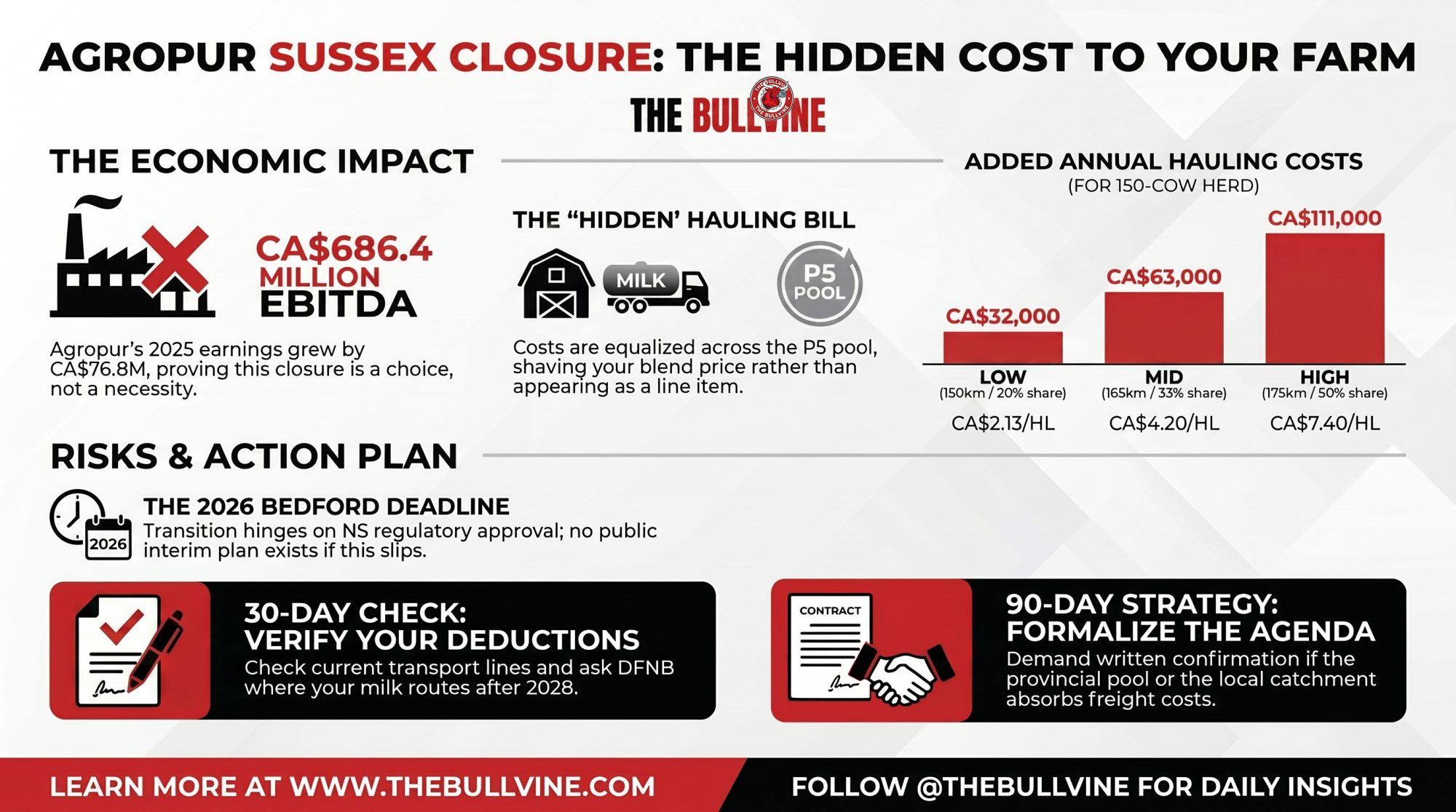
Agropur posted CA$686M in EBITDA, then closed Sussex. Reroute math runs CA$32K–111K a year for a 150-cow herd — and the P5 pool buries it so you never see it on your cheque.
Executive Summary: Up CA$76.8 million year over year, with leverage cut to 1.4x, Agropur posted CA$686.4 million in EBITDA in fiscal 2025 — and then announced it’s closing the Sussex Butternut Valley plant by the end of 2028. That’s the tell: this isn’t a co-op short on cash, it’s one moving roughly 74 million litres of butter-and-powder volume off the books while it spends CA$20M-plus expanding liquid capacity at Miramichi. The hit lands on the ~62 farms in the Sussex catchment, where rerouted milk pencils out to somewhere between CA$32,000 and CA$111,000 a year in added hauling for a 150-cow herd, depending on your distance and load share. Here’s the part that should worry every New Brunswick producer, not just Sussex-area ones: under the P5 pool, that freight gets equalized across the province per hectolitre, so it never shows up as a line on any single milk cheque — it just quietly shaves the blend. The whole transition also hangs on Bedford, NS getting board and regulatory approval by end-2026, and there’s no public interim plan if it slips. With Atlantic producers holding one seat out of sixteen on the board, the question your DFNB rep needs to answer before the next meeting is simple: does the pool eat this freight, or does your catchment?
A 150-cow dairy in Kings County, New Brunswick, is looking at between CA$32,000 and CA$111,000 a year in additional hauling once Agropur shuts its Sussex plant and the milk has to travel farther. That’s the routing-cost range for the roughly 62 farms in the Sussex catchment, the figure Dairy Farmers of New Brunswick General Manager Steve Michaud confirmed to CBC in April 2026. Here’s the part the press release skipped: under the Maritime milk pool, that cost may never appear as a line on any single milk cheque — but somebody still pays it.
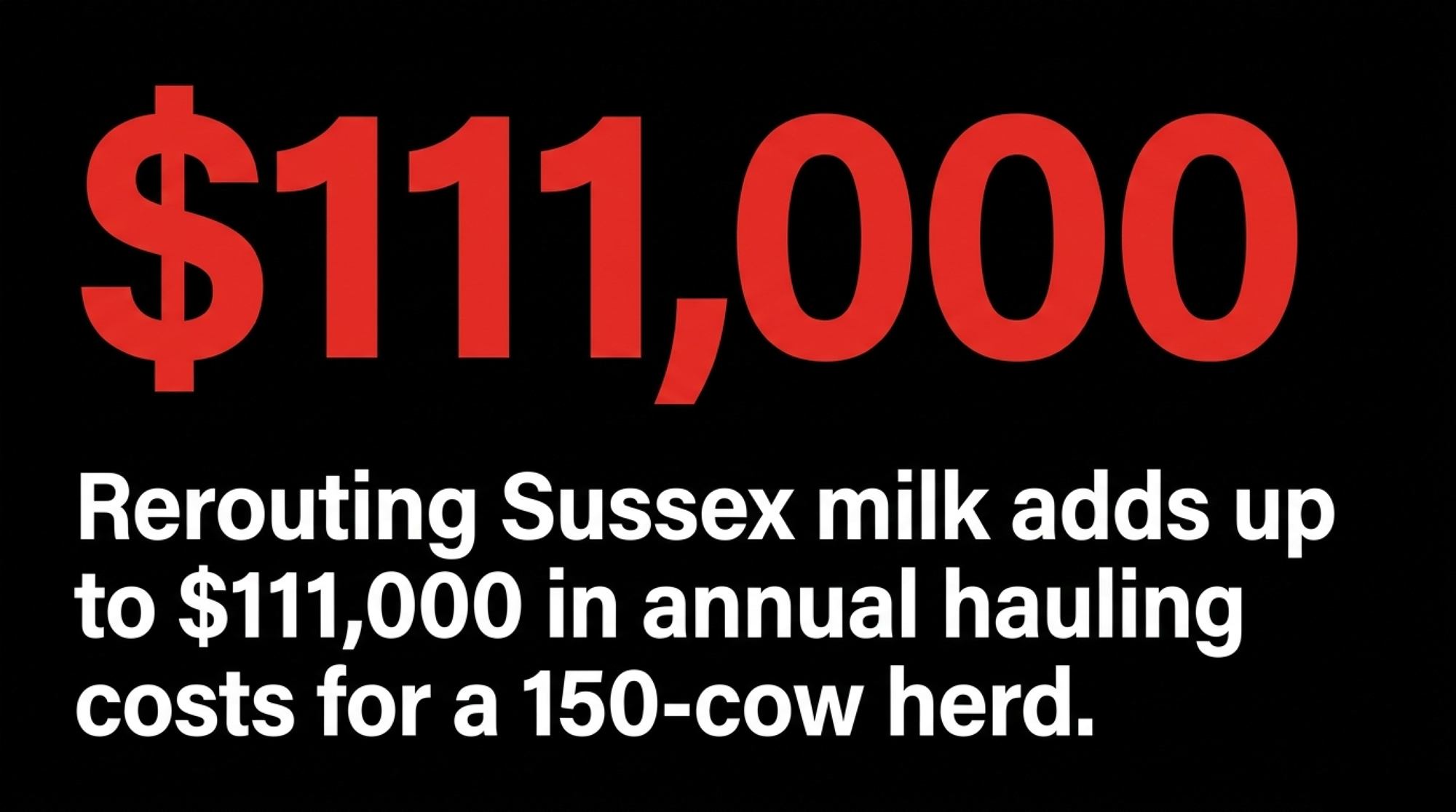
This is the Agropur Sussex closure story for New Brunswick dairy 2026, and the only open question about cost is who bears it. Not whether it exists.
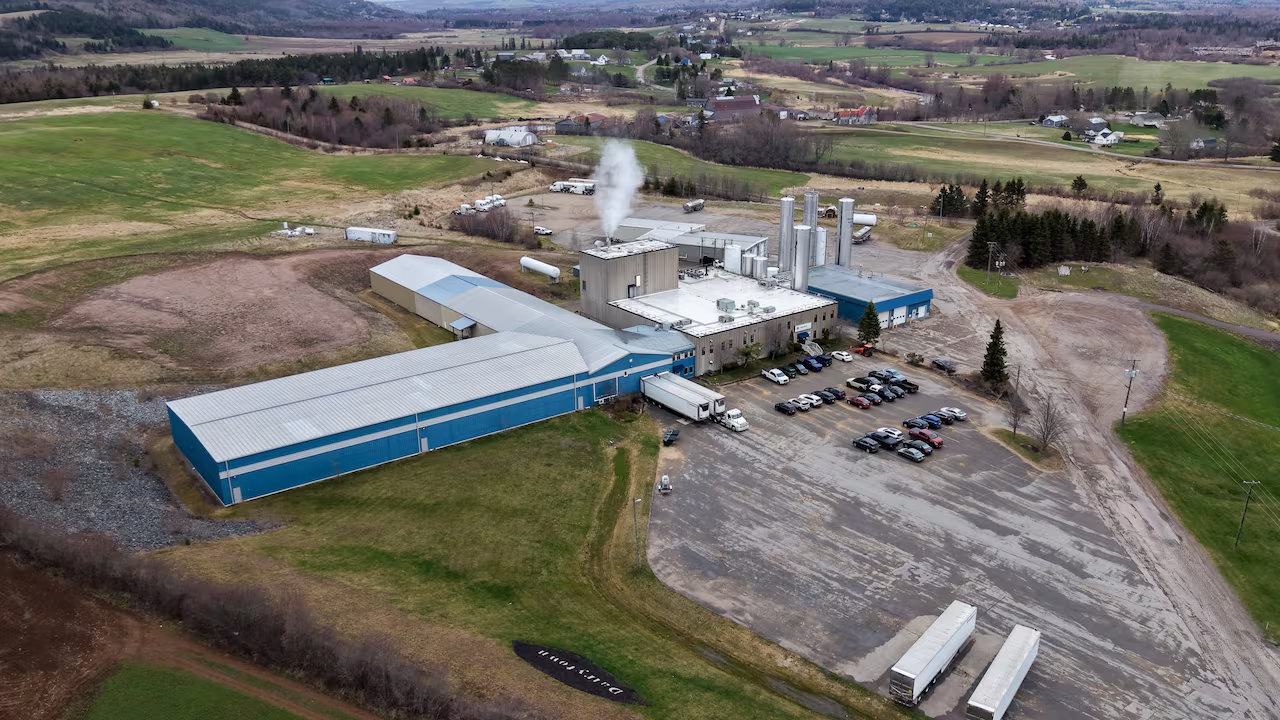
Agropur announced on April 23, 2026, that it’s closing the Sussex Butternut Valley facility by the end of 2028 and putting more than CA$20 million into a 50 percent capacity expansion at Miramichi, backed by a CA$2.4 million provincial modernization grant. The official framing is regional investment and modernization. The framing the math supports is narrower: a strong co-op moves production to where it runs cheapest, and Maritime producers absorb the freight.
A Co-op Sitting on CA$686 Million in EBITDA Made This Call
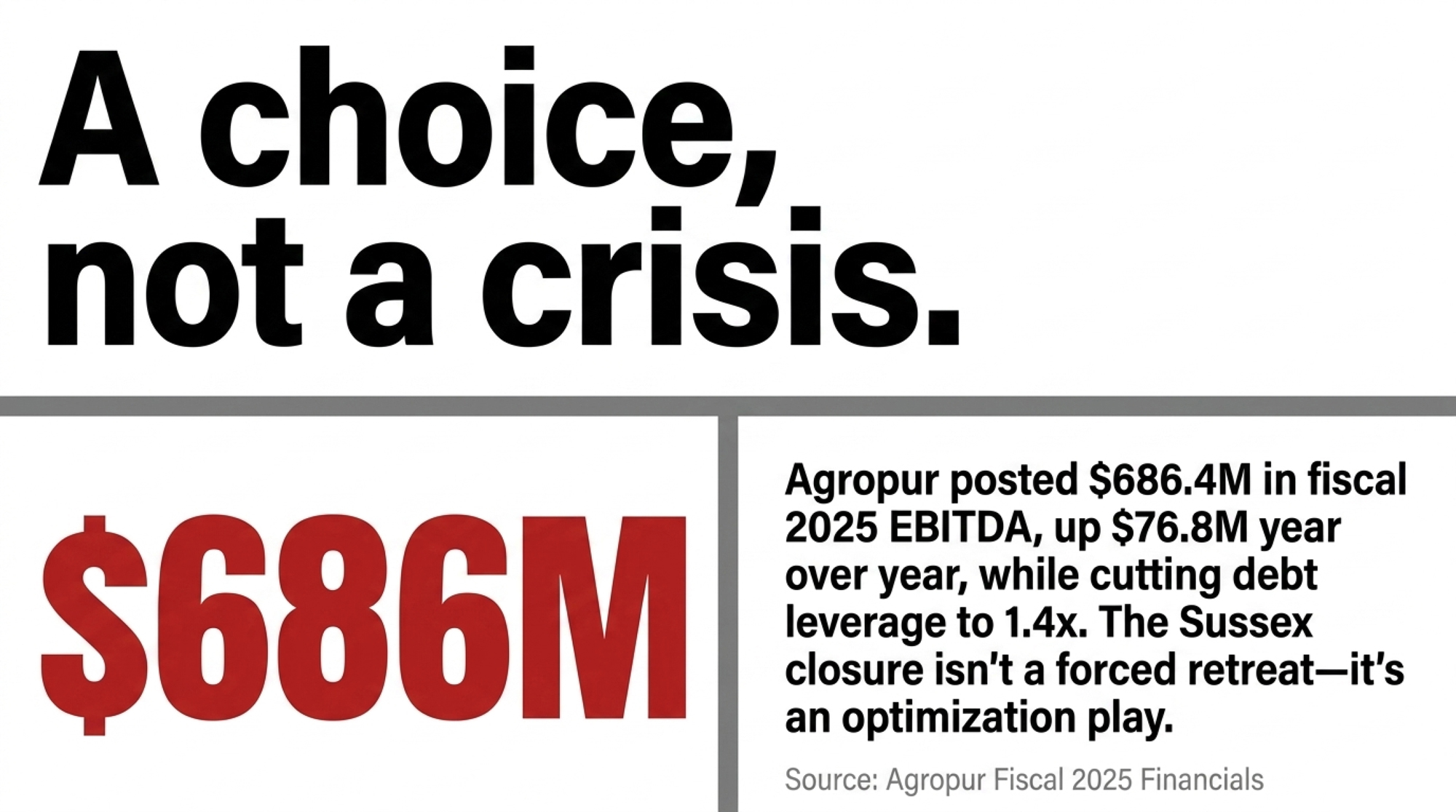
When a plant closes, the reflex is to assume the company couldn’t afford to keep it open. Agropur’s own books say the opposite.
The cooperative reported CA$686.4 million in EBITDA for fiscal 2025, up CA$76.8 million year over year. It cut debt leverage from 2.0x to 1.4x EBITDA in the same year. It returned CA$70 million to its roughly 2,700 member-producers — CA$17.5 million in cash and CA$52.5 million in Class A shares. Total assets hit CA$4.8 billion.
A strong balance sheet doesn’t make consolidation wrong. A co-op that runs lean serves its members better across the full cycle, and idle capacity helps no one. What the balance sheet changes is the conversation Agropur owes those members. This wasn’t a forced retreat. It was a choice. And choices invite questions that “we had no option” lets a company skip.
Where Kings County Milk Goes After 2028 Is Still Unanswered
Steve Michaud runs Dairy Farmers of New Brunswick, the board representing every milk producer in the province. After the April announcement, he told CBC the Sussex and Moncton corridor holds the largest concentration of dairy farms in New Brunswick. That’s the catchment in question — not a handful of farms on the edge of a service area, but the densest cluster of dairy in the province.
What nobody has spelled out is where that milk goes after Butternut Valley shuts down. Per Agropur’s facility profile, Sussex processes roughly 74 million litres a year on an industrial stream — butter and powdered milk. Miramichi is being rebuilt as the regional center for liquid milk.
That distinction is the whole problem. Fluid milk and industrial butter-and-powder run on different processing lines, so a larger liquid plant at Miramichi can’t simply absorb Sussex’s product mix. The butter and powder volume has to land somewhere else — and that somewhere is a proposed mega-plant in Bedford, Nova Scotia. Which means the routing future of every farm in the Sussex catchment hangs on a board-and-regulatory approval that hasn’t happened yet, in another province.
Agropur has said the majority of production will transition to Miramichi “by the following spring” — spring 2029, per the company’s transition language — once the reorganization is complete. The plant meant to anchor the displaced industrial volume is Bedford. And Bedford isn’t approved yet.
What Does the Bedford Approval Timeline Mean for Your Milk in 2029?
The whole plan rests on one load-bearing assumption: Bedford gets approved and built on schedule. Agropur’s own language is that the Bedford and Beauceville investments “remain subject to final approval by the end of 2026.” Sussex will close by the end of 2028. Two timelines, running close, with little slack between approval, construction, and shutdown.
Stack them that tight and the risk writes itself. If approval slips into 2027, a billion-dollar plant doesn’t compress its build to cover the gap. So where does Sussex’s butter and powder go in the meantime?
| Milestone | Status | Deadline | Risk if Slipped |
|---|---|---|---|
| Bedford, NS plant — board & regulatory approval | Pending | End-2026 | No industrial anchor for Sussex butter/powder volume |
| Sussex Butternut Valley — closure | Confirmed | End-2028 | 74M L of industrial stream has nowhere confirmed to go |
| Miramichi expansion — liquid capacity +50% | In progress | Spring 2029 | Fluid milk absorbed; industrial stream still open |
| Interim routing plan for Sussex volume | No public plan | — | Producers carry unknown cost with no contractual protection |
| DFNB pool vs. direct-charge decision | Unconfirmed | Pre-closure | Determines whether 62 farms or all NB producers absorb freight |
No interim plan has been announced publicly. The record says approval is expected by the end of 2026, that Sussex closes by the end of 2028, and that members are asked to trust the sequence. “Pending final approval” is a condition, not a commitment. Conditions slip. When the co-op asking its Maritime members to plan around that condition is carrying CA$686 million in EBITDA, those members have standing to ask what the fallback is.
One Atlantic Seat Out of Sixteen
The second assumption worth retiring is that membership in Agropur means the co-op is structurally on your side as a Maritime producer. The governance math says hold on — and it’s worth being precise about why. This isn’t bad faith. It’s geometry.
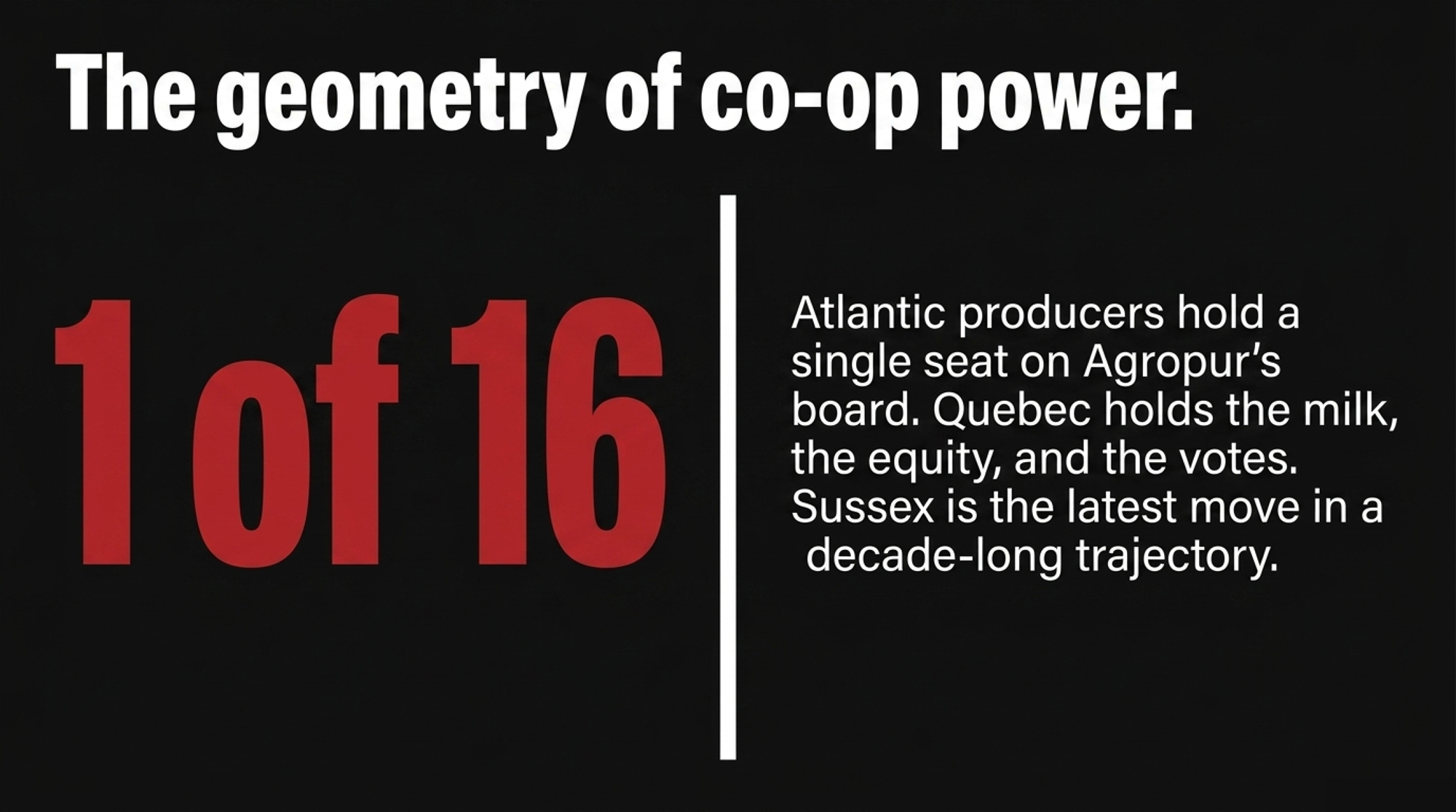
Quebec holds the equity, so Quebec holds the votes. Agropur processes 6.7 billion litres a year, with the bulk of its Canadian volume and most of its 2,700 members in Quebec. Atlantic producers hold one of sixteen seats on the board. A cooperative weights its votes toward where the milk and the equity sit, and for Agropur, that’s Quebec. The board that approved this restructuring reflects exactly the ownership structure it’s built on. No conspiracy required. The Maritime voice is one-sixteenth of the room, and the decision went the way one-sixteenth of the room usually goes.
This isn’t the first Atlantic pullback, either. Agropur sold its St. John’s operation in 2024 and cut Atlantic positions in earlier rounds. Sussex is the latest move in a decade-long trajectory, not a one-off.
| Event | Year | Move | Atlantic Impact |
|---|---|---|---|
| St. John’s operation | 2024 | Sold / divested | Newfoundland loses local processing |
| Atlantic staffing rounds | 2021–2023 | Position cuts | Reduced regional headcount |
| Sussex Butternut Valley | 2028 (announced) | Plant closure | ~62 farms lose local processor; ~74M L rerouted |
| Miramichi expansion | 2026–2029 | CA$20M+ liquid capacity | Fluid milk centralized; industrial stream TBD |
| Bedford, NS mega-plant | Pending (end-2026 approval) | New industrial hub | Butter/powder anchor — not yet approved |
Running the Numbers: What Rerouting Costs a Maritime Dairy
Here’s the barn math, with every assumption on the table so you can swap in your own herd.
Take a 150-cow herd at roughly 10,000 litres per cow per year — about 1.5 million litres annually, or 15,000 hectolitres. On every-other-day pickup, that’s about 180 milk-truck runs a year. The Sussex-to-Miramichi reroute adds roughly 150 to 175 kilometres to a one-way trip, depending on farm location, based on the road distance between the two plants. Maritime bulk hauling runs in the range of CA$2.50 to CA$3.50 per loaded kilometre, and a single farm shares a load rather than filling it, so only a portion of that incremental distance lands on any one operation.
Run it across the plausible band:
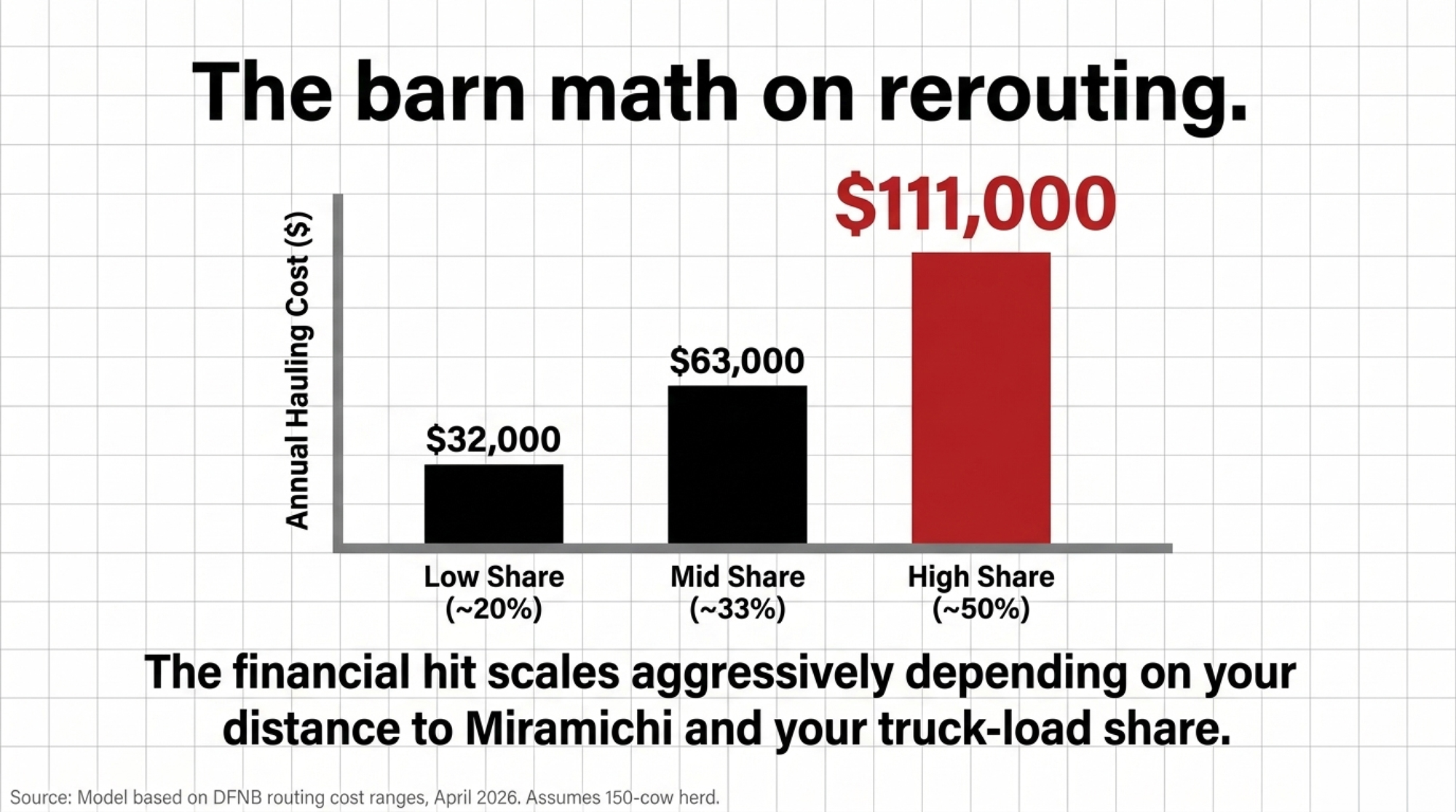
| Scenario | Added one-way km | Effective $/km load share | Added annual hauling cost | Added cost per hectolitre |
| Low | ~150 km | ~$2.50, ~20% share | ~CA$32,000 | ~CA$2.13 |
| Mid | ~165 km | ~$3.00, ~33% share | ~CA$63,000 | ~CA$4.20 |
| High | ~175 km | ~$3.50, ~50% share | ~CA$111,000 | ~CA$7.40 |
The same band scaled to other herd sizes shows how fast this moves with cow numbers — an 80-cow herd sits well below the figures above, a 300-cow herd well above.
Two honest caveats. The per-kilometre rate and the load-share fraction are the swing variables — change those and the whole range moves, which is exactly why this is shown as a band, not a single number. And the distance is plant-to-plant; your farm’s actual additional kilometres depend on where you sit within the catchment.
Now, the part that changes how you should read every figure above.
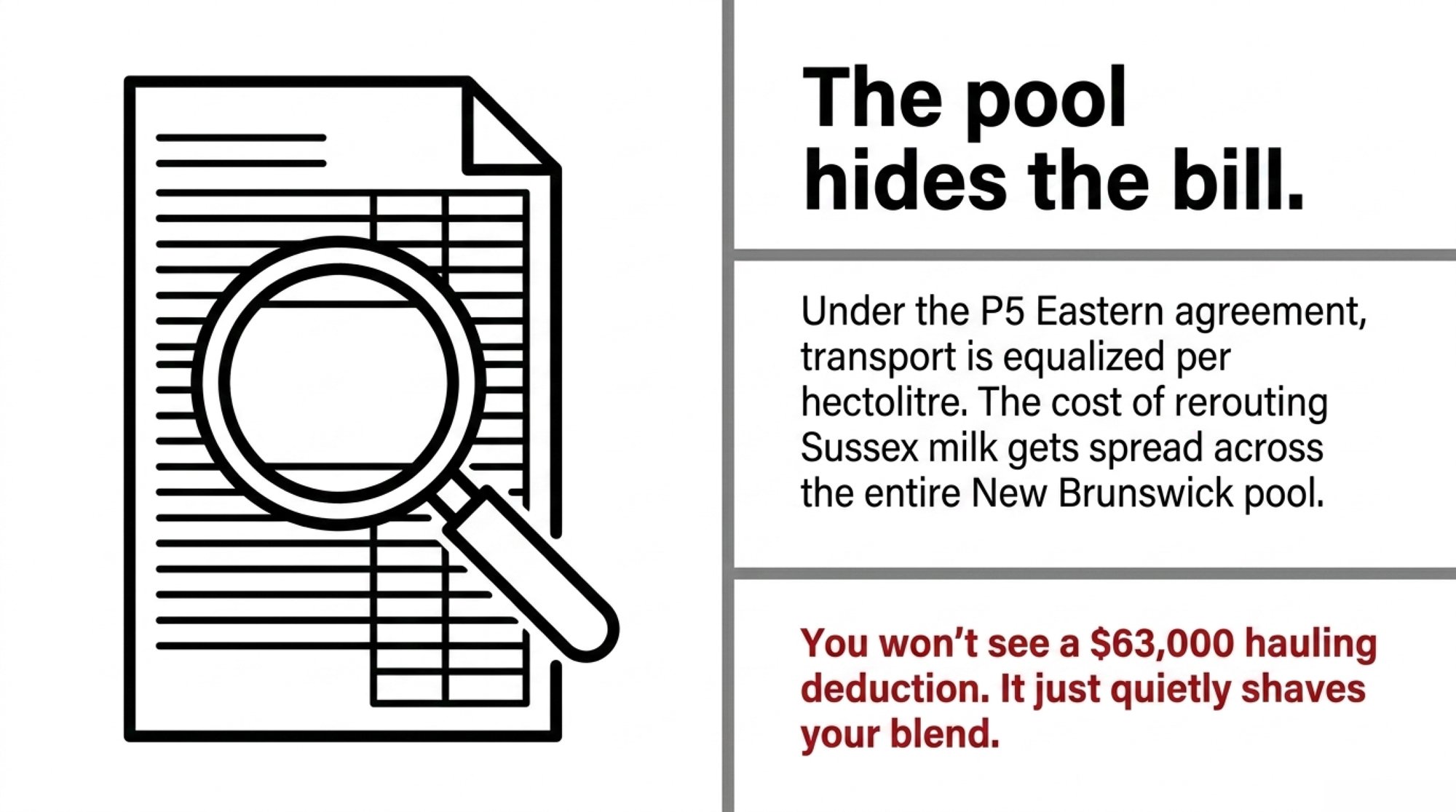
The P5 Pool Doesn’t Erase This Cost. It Hides It.
Everyone assumes transport is the trucking company’s problem, or the processor’s. In the Maritime system, it’s neither — and that’s the turn.
New Brunswick milk is pooled through the P5 Eastern Canadian agreement, which equalizes transport and revenue across producers on a per-hectolitre basis rather than billing each farm for its own truck. So the Kings County farmer may never see a CA$63,000 line on a statement. The cost gets spread across the provincial pool and comes to a few cents per hectolitre on everyone’s blend.
Read that twice, because it cuts two ways. Dilution isn’t absorption. The cost doesn’t vanish into the pool — it just becomes untraceable on any single milk cheque. Every producer in the New Brunswick pool helps carry the freight for a closure that benefits a co-op booking CA$686 million in EBITDA. The pool protects you from a catastrophic individual hit. It also makes it nearly impossible to point at a number and say, “That one’s Agropur’s decision.”
That’s the question your board has to answer: does DFNB absorb this into the provincial pool and spread it thin, or does Agropur negotiate a catchment-specific hauling arrangement that sticks the bill to the Sussex-area farms directly? The answer decides whether this is everyone’s nickel or 62 farms’ dollar.
The 30/90/365-Day Playbook for Herds in the Sussex Catchment
30-Day Actions — urgent checks
- Pull your last three milk cheques and find the transport and hauling deduction line. Know what you pay per hectolitre today, before anything reroutes. What it requires: ten minutes and your statements. Trigger to escalate: if you can’t find the line at all, call DFNB and ask how transport is allocated in your pool — you can’t track a change you can’t see.
- Ask DFNB directly where your milk routes after end-2028 and whether the cost flows through the pool or a separate catchment charge. What it requires: one phone call. Where it backfires: a vague answer is itself information — note who said it and when.
90-Day Actions — structural
- Get the routing question on the DFNB meeting agenda in writing, with the pool-versus-direct-charge decision explicitly named. What it requires: a few producers raising it together; one voice is easy to table. Trigger: do this before the Bedford approval decision lands at the end of 2026, not after — once capital’s committed, your leverage drops.
- Model your own farm’s added kilometres, not the plant-to-plant figure. What it requires: your location, your pickup schedule, and the rate band above. Where it backfires: assuming the mid-case applies to you when your geography puts you at the high end.
365-Day Moves — strategic positioning
- Watch the Bedford approval decision as your real signal. If it clears on schedule by the end of 2026, the transition timeline holds; if it slips, the interim-volume question becomes live, and you want to be the producer already asking it. Opportunity signal: if DFNB commits in writing to pool-based equalization of reroute costs, your individual exposure stays a few cents per hectolitre, and you can plan around it. If it won’t commit, treat the high-case as your planning number until proven otherwise.
What This Means for Your Operation
Strip away the press release, and the trade-off is plain. Agropur gains processing efficiency by concentrating volume. Maritime producers carry the routing cost in a pool structure that makes it hard to see and harder to contest. You gain the stability of a financially strong co-op. You give up a clear line of sight into who pays when that co-op optimizes around you.
The number to demand isn’t in the announcement. It’s the one DFNB and Agropur haven’t published: the confirmed post-2028 routing plan for Kings County milk, and whether its cost flows through the provincial pool or onto 62 specific farms.
So before the next DFNB meeting, pull your transport deduction line and answer the only question that decides your exposure — when Sussex closes, does your pool eat the freight, or does your catchment?
Key Takeaways
- Agropur closed Sussex while sitting on CA$686.4M in EBITDA — read this as a cost-driven efficiency move, not a co-op in trouble, and judge the transition on that basis.
- If your milk runs through Sussex, the reroute pencils out to CA$32K–111K a year on a 150-cow herd, but the P5 pool spreads it per hectolitre so you won’t see it as a line on your cheque.
- Watch the Bedford, NS approval decision due by end-2026 — if it slips, there’s no public plan for where Sussex’s butter-and-powder volume goes before the 2028 closure.
- Before your next DFNB meeting, get one answer in writing: does the provincial pool absorb this freight, or does your catchment get charged directly?

Complete references and supporting documentation are available upon request by contacting the editorial team at editor@thebullvine.com.
Learn More
- How 600 Irish Farmers Got Their Co-op to Finally Answer the Hard Questions — Arms you with the seven written questions and documentation method 600 Dairygold members used to force a €1.4 billion co-op into written accountability — the exact playbook for pressing DFNB and Agropur on the routing decision.
- How Regional Economics Are Reshaping America’s Milk Map — Follows the money on the “hidden tax” of milk hauling, which jumped 21% in a year to 35–93¢ per cwt for farms shipping beyond 50 miles, showing why processor proximity now decides profitability more than feed efficiency.
- Dairy Showdown: Canadian Quotas vs. American Free Market — Breaks down what quota stability actually buys and costs Canadian producers, exposing the succession and quota-investment pressures that determine whether a Maritime operation can absorb a structural shock like the Sussex closure over the next five years.
 The Sunday Read Dairy Professionals Don’t Skip.
 The Sunday Read Dairy Professionals Don’t Skip.
Every week, thousands of producers, breeders, and industry insiders open Bullvine Weekly for genetics insights, market shifts, and profit strategies they won’t find anywhere else. One email. Five minutes. Smarter decisions all week.