










Cornell’s chamber cows sprang a gut leak by day 3 — before the tank flinched. Fans handle about 60% of the loss; the other 40% needs a THI-68 trigger, not more airflow.
Executive Summary: Your fans are only doing about 60% of the job — Cornell’s chamber trial showed the cow’s gut goes permeable by day 3 of heat, dumping milk that no amount of airflow gets back. The bigger surprise sits in your milk check: a 10-point THI jump cuts yield 1.2% but revenue 2.8%, because fat and protein slide before volume does, so you’re bleeding component money on days that don’t even feel hot enough to hurt. The science isn’t fully settled — Cornell found the leak, Virginia Tech didn’t, and pinned 66% of its yield loss on lower intake alone — which is exactly why you should demand real trial data before you buy any “gut” additive. Most cooling controllers still fire at THI 72; Cornell and Ohio State both put the real start at 68 for cows milking 77 lbs or more, so if you wait for 75–80°F you’ve already programmed a loss. Recovering a conservative 2 kg/cow/day over a 120-day summer is worth roughly $54,800 on 500 cows at $20.70 milk — but net the additive cost and only pull the trigger if it still clears at $16. And don’t forget the dry pen: heat there costs 8–10 lbs/day across the whole next lactation, and cooling it pays back fast when the barn already exists. Reset your trigger to 68, cool the dry cows, and make any additive earn its spot on the wagon.
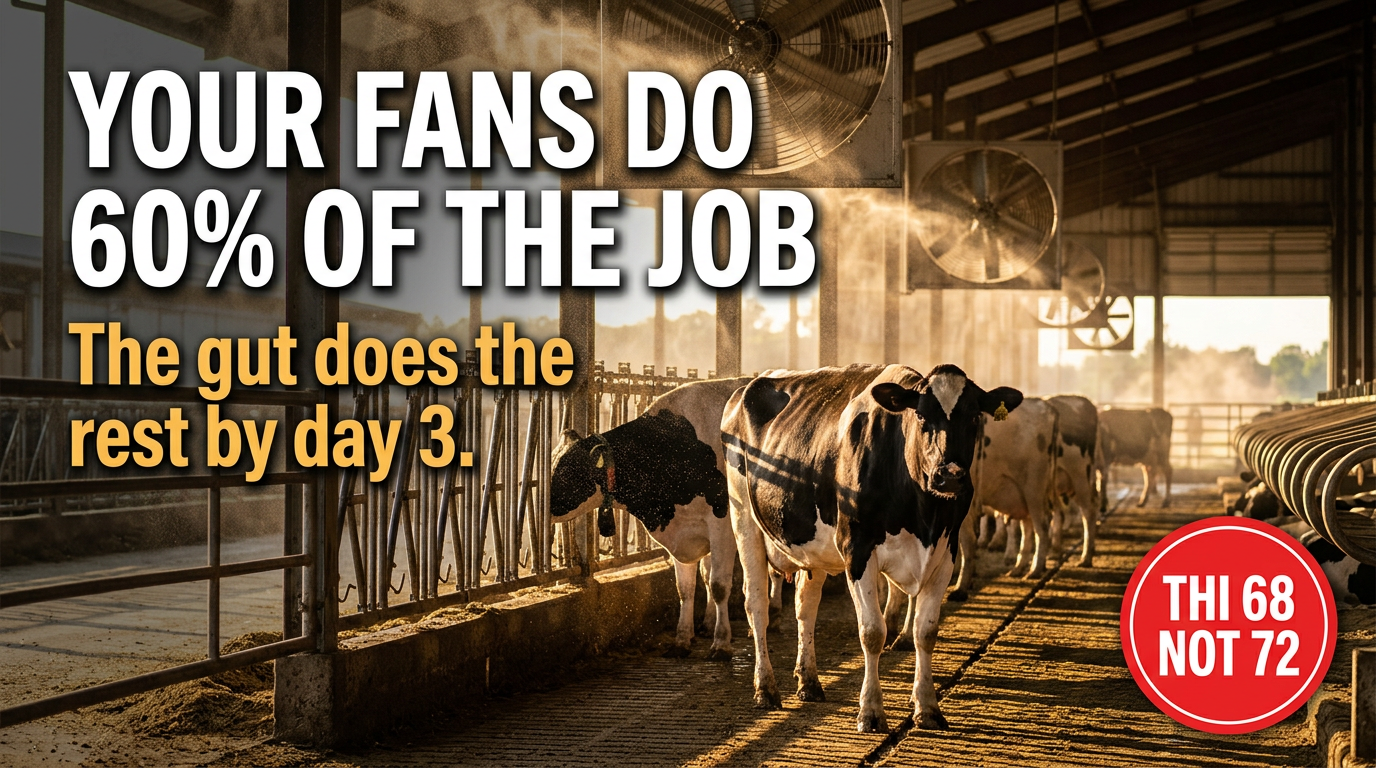
It’s mid-July. The fans are screaming, the soakers are firing, and the tank keeps sliding anyway. If you’re a nutritionist or herd manager staring at that gap, here’s the uncomfortable news from Cornell on dairy heat stress: your cooling system is probably doing only about 60% of the job — the pair-fed chamber work shows intake alone can’t explain the milk you’re losing. The other 40% is happening inside the cow’s gut — and in the Cornell trial, the leak showed up within three days of the heat coming on, well before the tank told anybody anything was wrong.
Here’s what changed, what didn’t, and what to walk out and check tomorrow morning.
The 46-Cow Trial That Broke the “She’s Just Eating Less” Excuse
Joseph McFadden’s group at Cornell put 46 Holsteins through a climate chamber and published the results in the Journal of Dairy Science in September 2022. The design is what makes it stick. Cows kept cool at THI 68 during the covariate period, then split into cool controls, heat-stressed controls, cool cows pair-fed the reduced ration the hot cows chose to eat, and heat-stressed cows on a gut-support additive.
That pair-fed group is the whole argument. Cool cows, eating like heat-stressed cows. If the lost milk were purely a feed-intake story, they’d have milked like the hot group. They didn’t — they out-milked them. The gap that intake couldn’t explain is what pointed Cornell at the gut.
That somewhere is the gut wall. Total-tract gut permeability measured at day 3 was higher in the heat-stressed cows than in either the cool controls or the pair-fed cool cows — the loss was independent of how much they ate. Blood gets pulled to the skin for cooling, the intestinal lining loosens, bacterial endotoxin slips across, and the immune system lights up. An activated immune system is a glutton, and the glucose it burns is glucose that was supposed to leave the barn as milk. It’s the same leaky-gut mechanism we broke down in why your fans can’t fix half of heat stress.
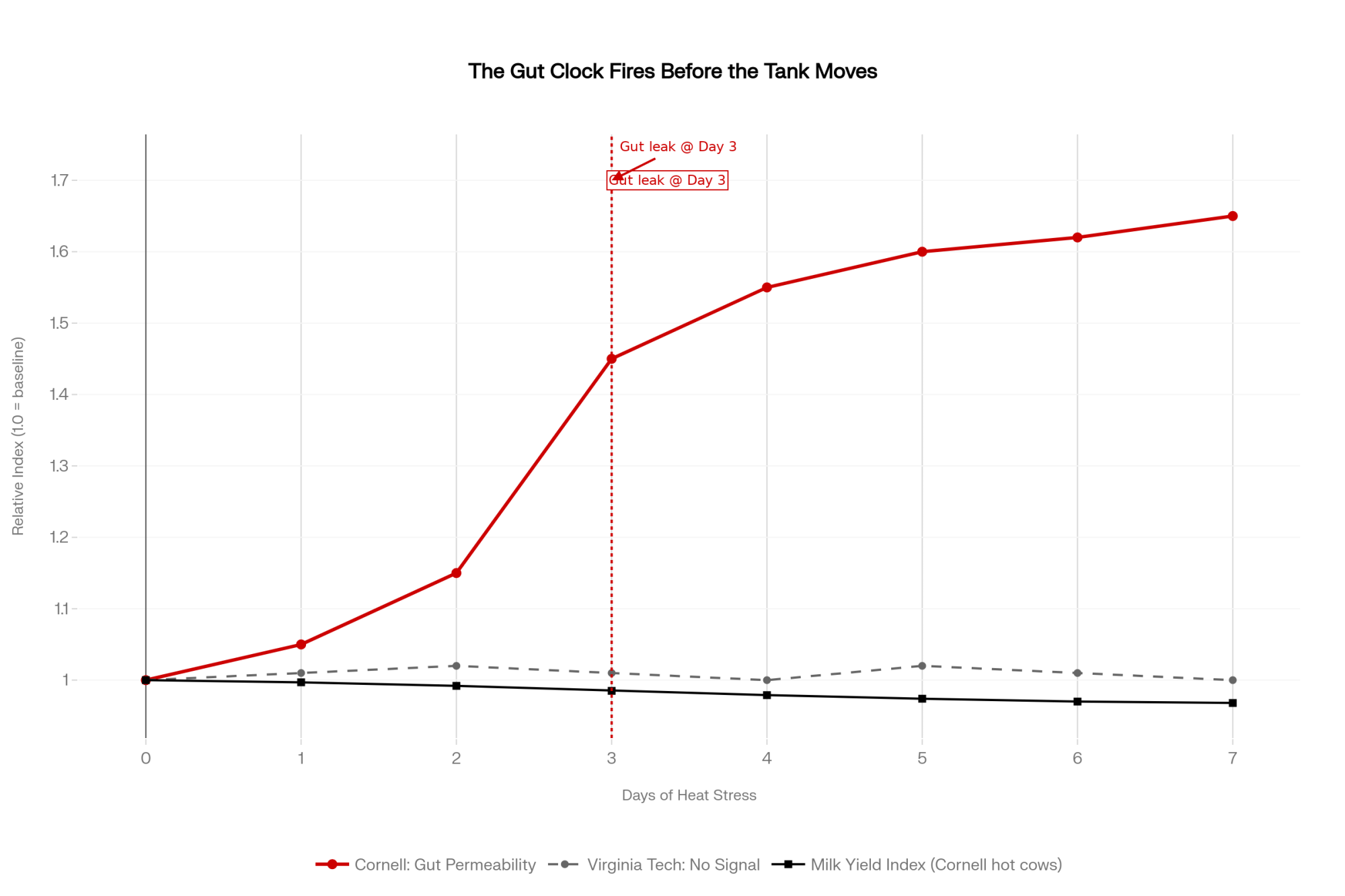
The additive was a microencapsulated organic-acid and pure-botanical blend, wrapped to slip past the rumen and release in the small intestine. It restored about 3 kg of milk per day and pulled gut permeability and nitrogen efficiency back toward the cool-cow group — the study calls it partial restoration, not a full fix.
Worth noting how this one got validated: the work ties to a commercial additive, which is standard when a product goes through independent university trial work. What matters is that the pair-fed design stands on its own — and it does.
What Changed: A Second Study Says “Not So Fast”
Good editors don’t cherry-pick the study they like. In 2024, a Virginia Tech team ran its own chamber trial, published it in the same journal, and did not find increased gut permeability.
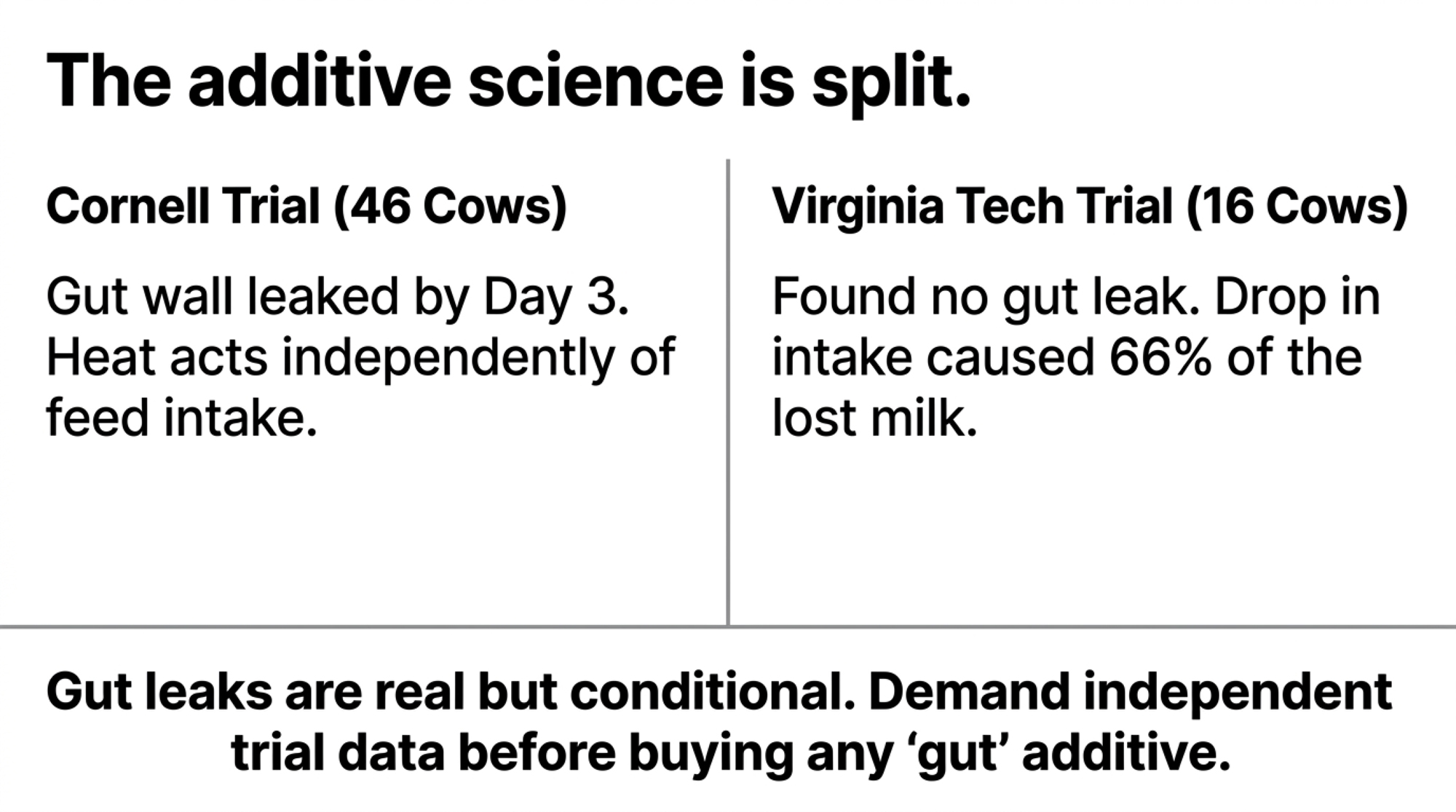
Same broad question, tighter design, different answer. They used 16 multiparous Holsteins against a pair-fed thermoneutral control, and dosed both Cr-EDTA and sucralose to track gut leak. Heat stress cut feed intake 35%, and that intake drop accounted for 66% of the milk-yield loss — leaving 34% to heat acting independently of feed. But neither permeability marker moved, and lipopolysaccharide-binding protein didn’t budge. Their conclusion was blunt: under their conditions, gut-derived endotoxin wasn’t behind the milk drop.
So who’s right? Both, probably. Same species, overlapping conditions — yet the leak showed in Cornell’s 46-cow chamber and not in Virginia Tech’s 16. That points to a mechanism that’s real but conditional. It depends on how hard, how long, and on which cows the heat lands — not a switch that flips in every barn.
| Parameter | Cornell (McFadden et al., JDS 2022) | Virginia Tech (2024) |
|---|---|---|
| Sample size | 46 multiparous Holsteins | 16 multiparous Holsteins |
| Study design | Cool controls + heat-stressed + pair-fed + additive group | Heat-stressed + pair-fed thermoneutral control |
| Permeability markers | Total-tract gut permeability measured | Cr-EDTA + sucralose dual-marker dosing |
| Gut leak detected? | ✅ Yes — elevated by Day 3 | ❌ No — neither marker moved |
| LPS-binding protein change? | Elevated (immune activation signal) | No change |
| Feed intake drop | Reduced (heat group ate less) | 35% reduction |
| % yield loss from intake alone | Intake couldn’t explain full loss | 66% attributed to intake |
| Residual loss beyond intake | ~40% — pointed at gut mechanism | 34% — heat acting independently |
| Additive tested? | Yes — microencapsulated organic acid/botanical | No |
| Additive restored milk? | ~3 kg/cow/day (partial) | N/A |
| Bottom line | Gut leak is real, conditional, and fast | Gut endotoxin not behind milk drop in this trial |
Which means anybody selling you a “gut” additive as a guaranteed universal fix is ignoring a peer-reviewed study showing the mechanism doesn’t fire every time. Ask for the trial data before you believe the pitch.
What didn’t change: both studies agree heat steals milk beyond what feed intake explains — Virginia Tech itself put that share at 34%. Fans and soakers alone don’t close that gap either way.
“Double the Damage”: The Number You’re Not Even Counting Yet
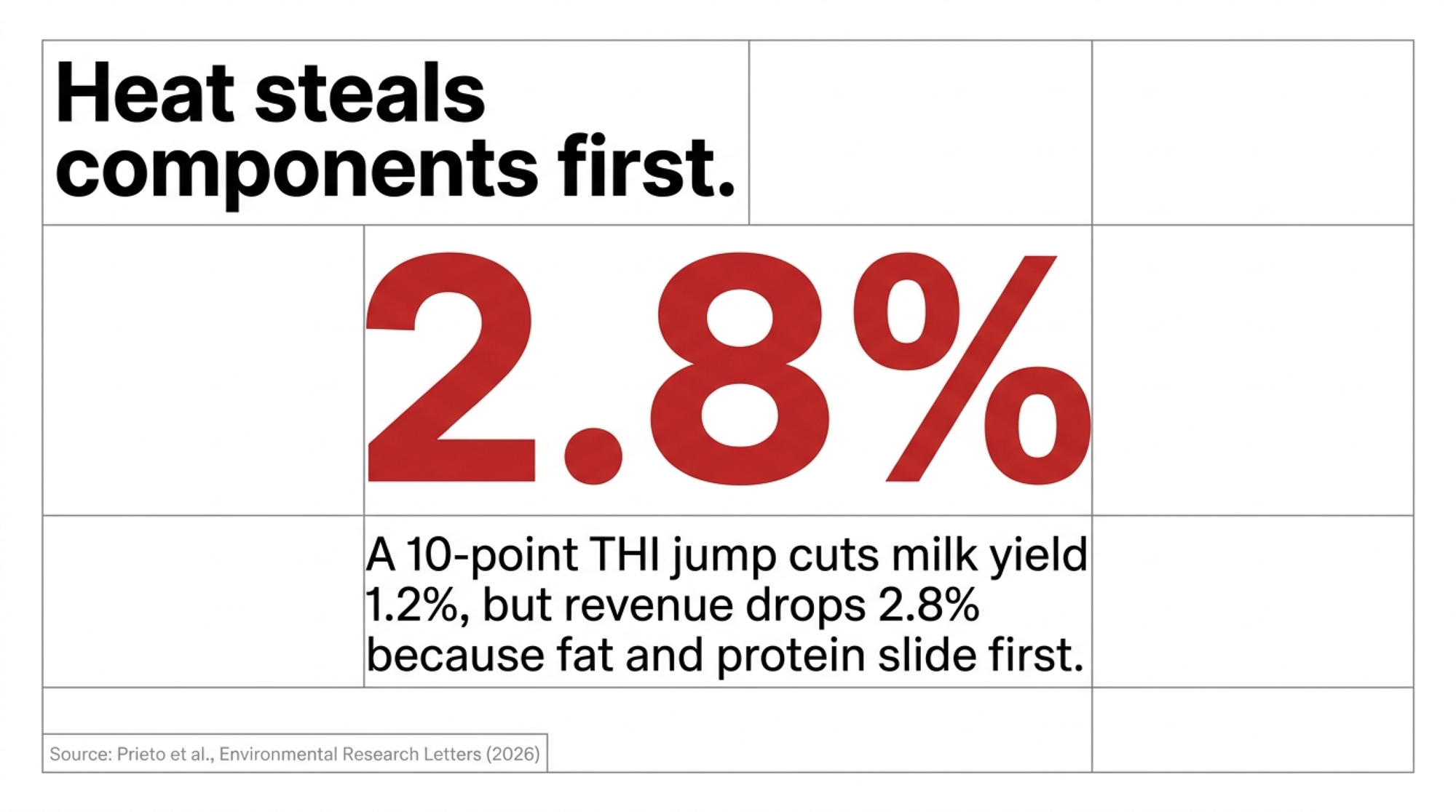
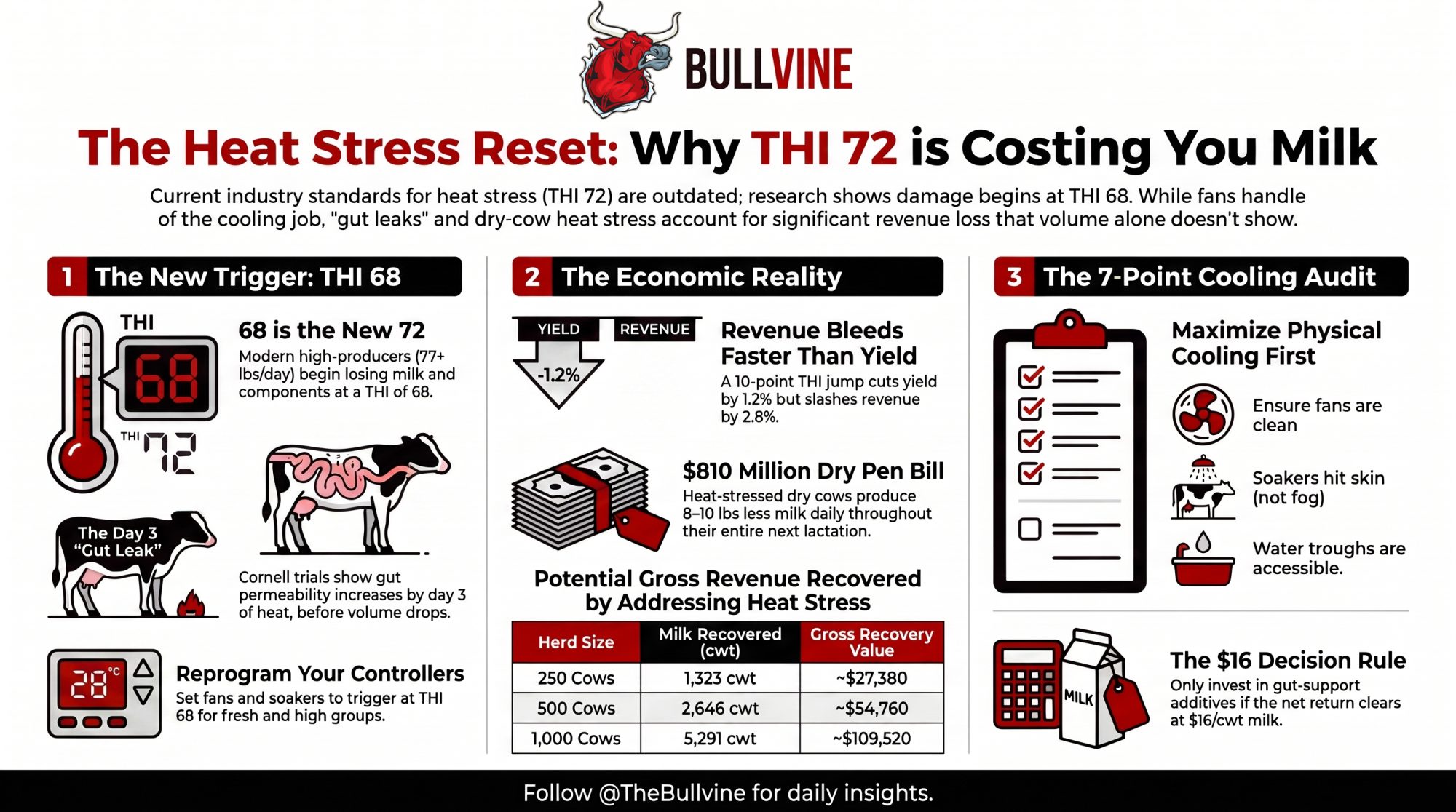
On June 17, 2026, Cornell put a price on a loss most barns never track. A study by Jeisson Prieto, Ariel Ortiz-Bobea, and colleagues — published online May 29 and announced June 17 in Environmental Research Letters — found that a 10-point rise on the temperature-humidity index cuts milk yield 1.2% but cuts revenue 2.8%. More than double.
Why? Heat doesn’t just thin the tank; it thins the milk. Fat and protein fall, and you get paid on components — so the revenue hit runs ahead of the volume hit. The researchers framed it plainly: the losses from lower fat and protein match the well-established losses from lower yield. Translation for your barn: if you set your “heat-on” trigger by the bulk tank, you’re already late. The component meter starts running earlier.
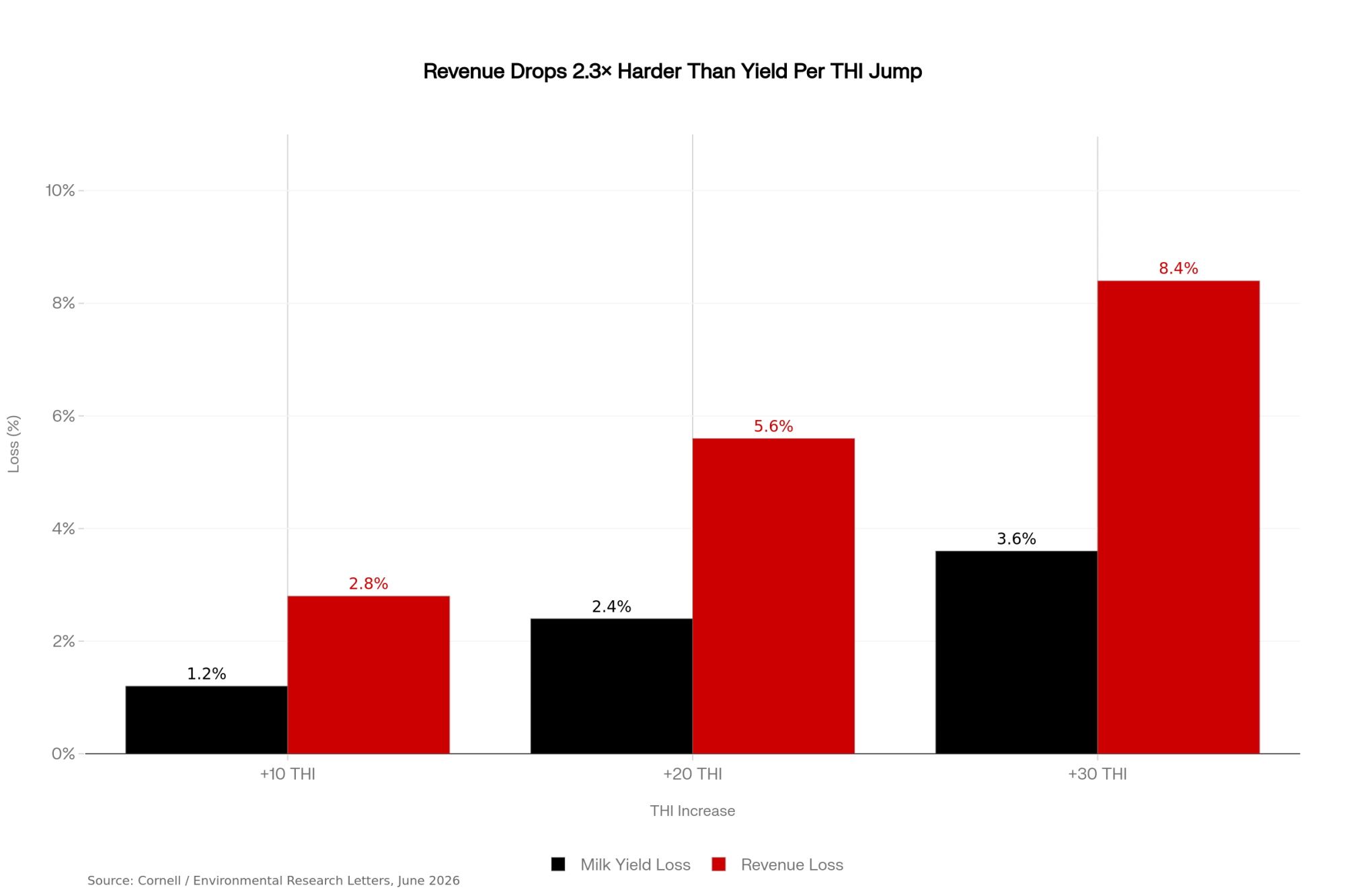
That’s on top of the broader bill. Modeling in the Canadian Journal of Animal Science pegged U.S. heat-stress losses above $1.2 billion a year — roughly $800 million tied to lactating cows and $595 million to dry-cow and in-utero effects.
Why the Dry Pen Is Where Next Year’s Milk Already Lives
Everything above is your milking string. The bigger, quieter bill sits in the dry pen.
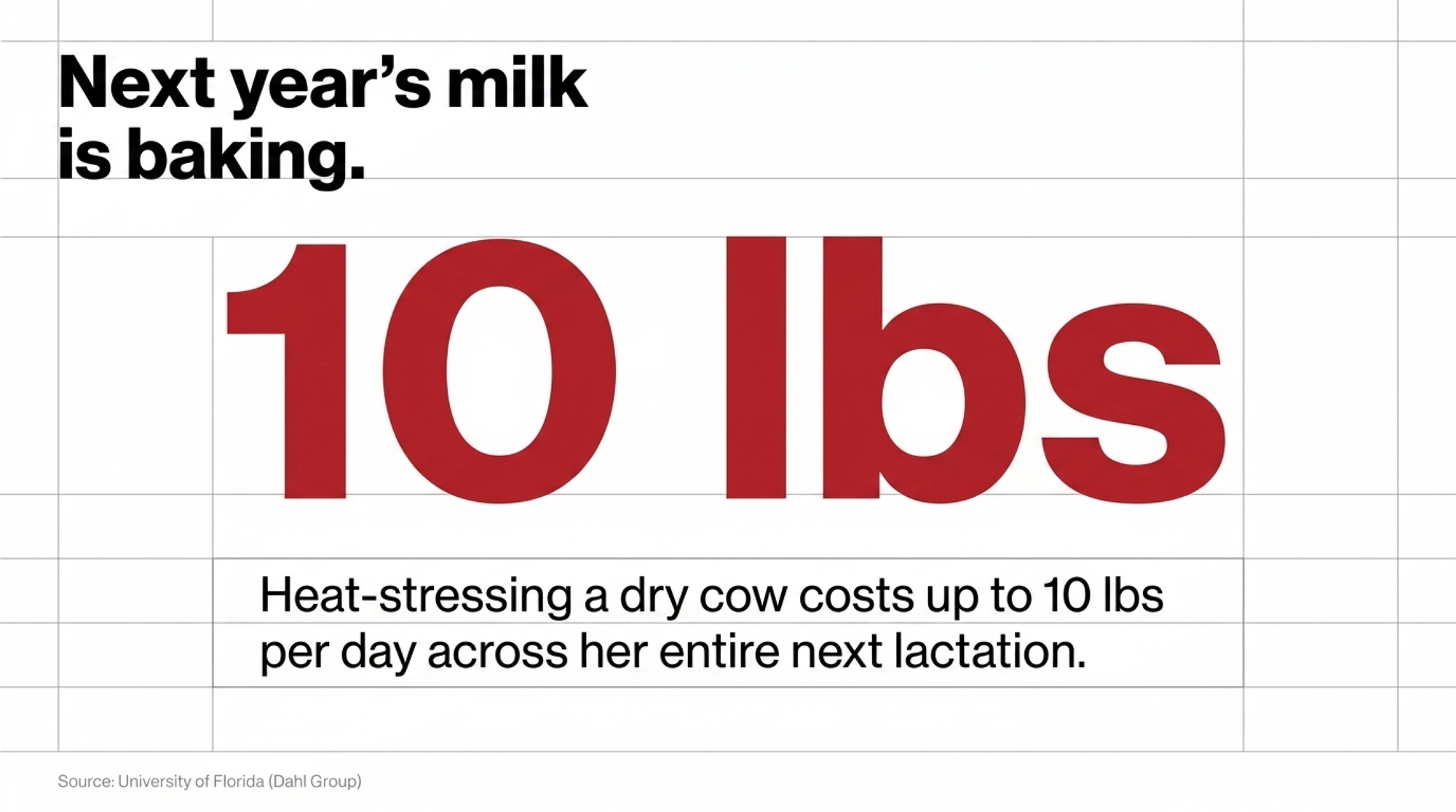
Geoffrey Dahl’s group at the University of Florida has shown for years that a cow heat-stressed during the dry period milks 8 to 10 lbs/day less through the entire next lactation — not for a rough week, for the whole thing. Partial cooling doesn’t rescue it. Any heat stress in the dry period does the damage, and those cows tend to come in with more fresh-cow trouble.
Jimena Laporta’s group at the University of Wisconsin–Madison followed it down the family tree. In a Florida Holstein dataset, daughters of heat-stressed dry cows lost about 4.9 months of productive life and were culled more often before first calving; the effect reached into the granddaughters, too. UF/IFAS work estimated that failing to cool dry cows could cost the U.S. industry roughly $810 million a year once the dam’s own next-lactation loss is counted.
| Factor | Milking String Heat Stress | Dry Pen Heat Stress |
|---|---|---|
| Immediate yield loss | 1.2%+ per 10-pt THI jump | 0 (cow is dry) |
| Revenue loss timeline | Starts within hours of THI rise | Hidden until next lactation |
| Lactation impact | Current lactation only | 8–10 lbs/day across entire next lactation |
| Mechanism | Gut leak + intake suppression + immune activation | Blunted mammary redevelopment (structural) |
| Reversible mid-season? | Partially — respond to gut/cooling interventions | No — baked in before first fresh day |
| Multigenerational effect? | No direct evidence | Yes — daughters lose ~4.9 months productive life (UW–Madison) |
| Effect on granddaughters? | No | Yes — extends to F2 generation (Laporta et al.) |
| US industry annual cost estimate | ~$800M (lactating cows) | ~$810M (dry cow + next-lactation) |
| Cooling infrastructure needed | Fans + soakers (existing) | Fans AND soakers — fans alone insufficient |
| Payback speed | Immediate if barn exists | Fast — when barn already exists |
The mechanism is structural. Heat during the dry period blunts mammary redevelopment, so the cow builds fewer milk-making cells. You can’t cool your way out of that in August. It’s baked in months earlier.
Is THI 72 Costing You Money Before You Even Notice?
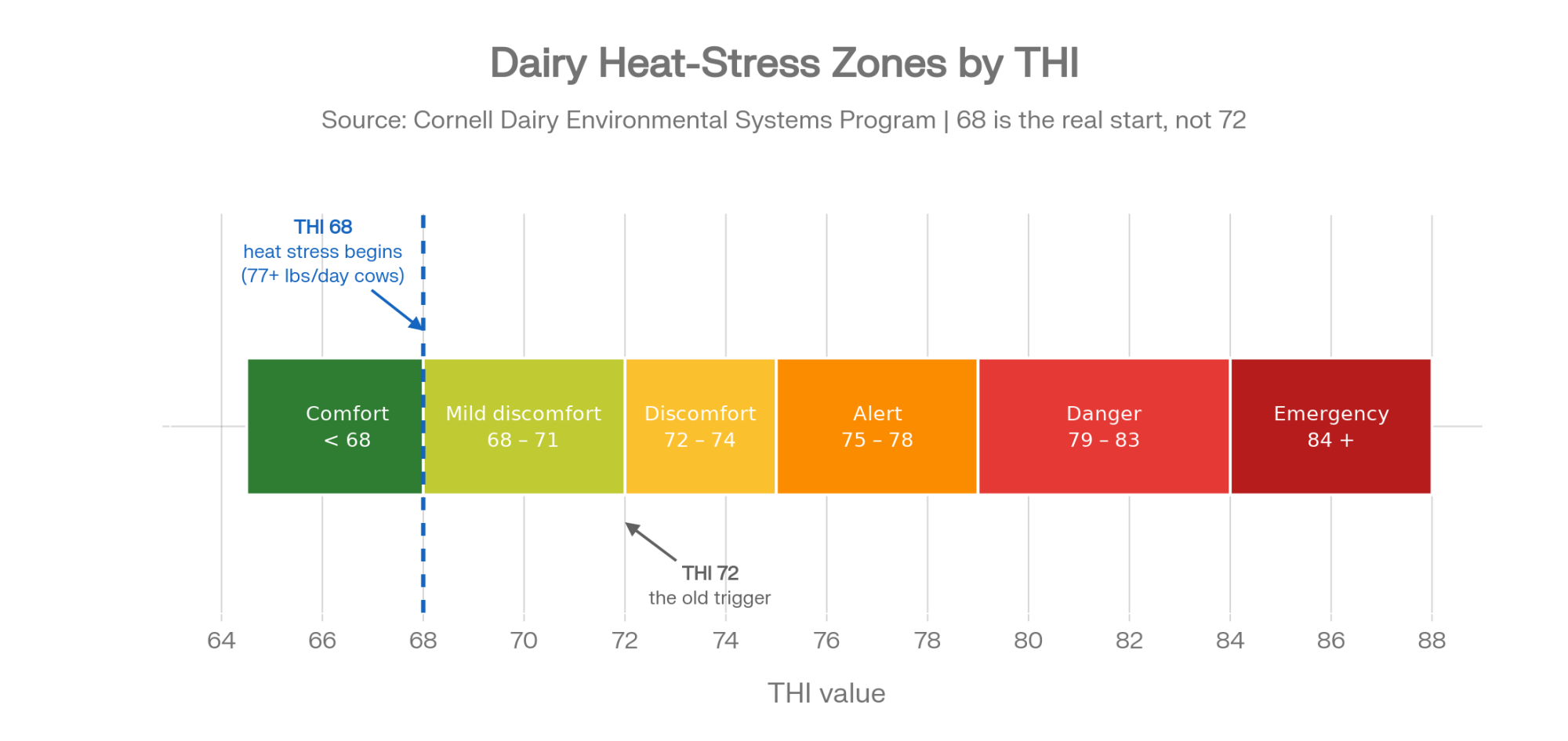
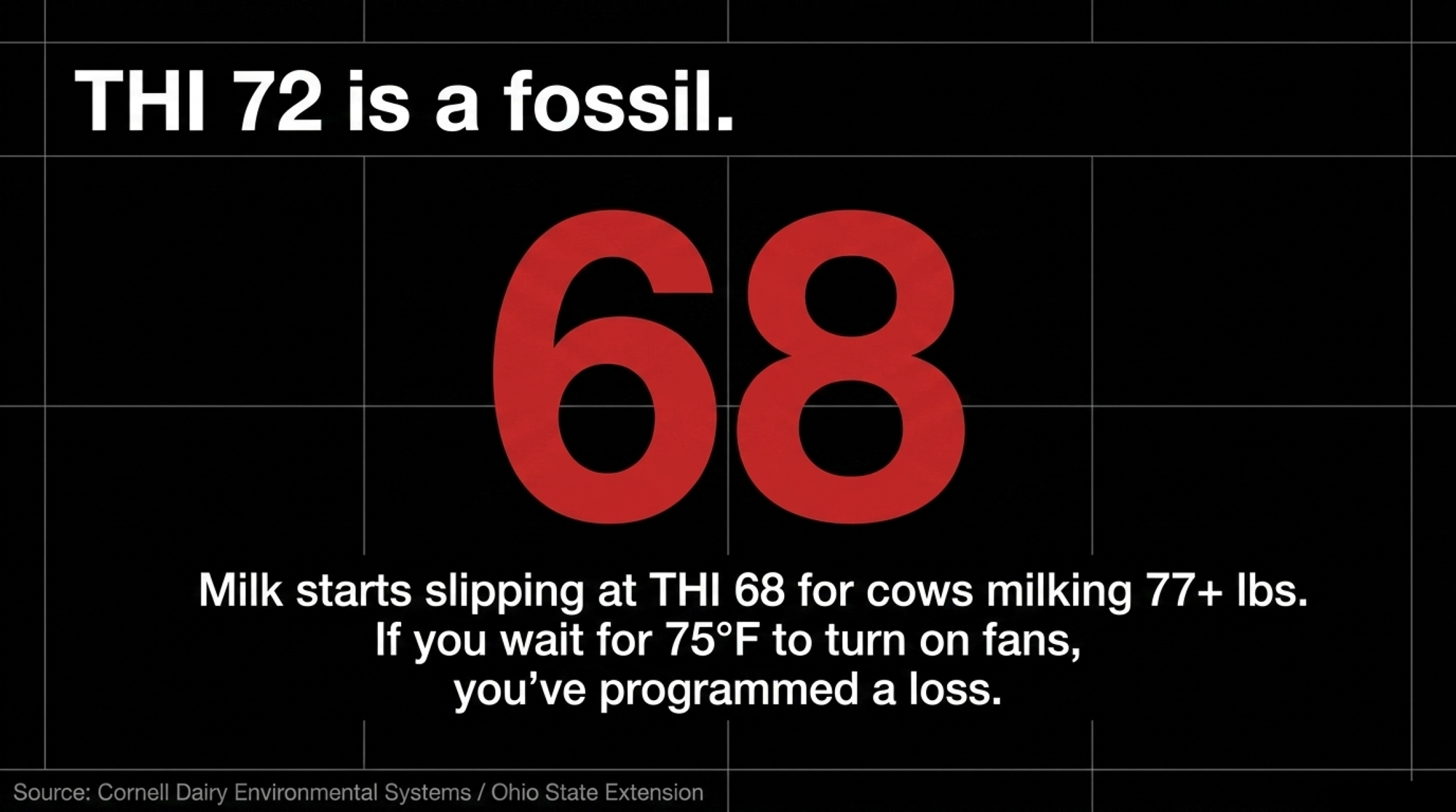
Short answer: yes. The number a lot of cooling controllers still run on — THI 72 — is a fossil. Cornell’s Dairy Environmental Systems Program puts the start of heat stress for a moderate-to-high producer (77 lbs/day or more) at THI 68, not 72. Ohio State extension lands in the same place: milk starts slipping at THI 68. And the component data pulls the real trigger lower still, because fat and protein fade before volume does.
| Factor | Old Standard (THI 72) | Cornell / OSU Recommendation (THI 68) |
|---|---|---|
| Trigger temperature (approx.) | ~75–80°F with humidity | ~72–74°F with humidity |
| When cooling activates | After stress is measurable | Before measurable milk loss begins |
| Gut permeability clock | Heat has already started Day 1–2 | Cooling active before gut clock fires at Day 3 |
| Component revenue bleeding | Fat/protein already falling before trigger fires | Cooling covers fat/protein window |
| Cows covered at 77+ lbs/day | Heat stress underway for hrs–days | Covered at biological threshold |
| Dry cow trigger | Often set at 72 or higher — or ignored | Same 68 threshold required (or lower) |
| Estimated lag cost (500 cows) | 2+ kg/cow/day loss during lag window | Recoverable if trigger reset this month |
| Source | Legacy industry default | Cornell Dairy Environmental Systems / OSU Extension |
We made the same case in the $74-per-cow number was never finished — the newer data just moved the number down again.
Here’s the reference chart to tape inside the office door — Cornell’s own THI zones, with the real 68 trigger marked against the old 72 setting: If your fans don’t kick on until 75–80°F, you’ve programmed a loss into the system.
The Barn Math: What 2 kg/Cow/Day Is Actually Worth
Cornell’s chamber restored about 3 kg of milk per day with gut support. Be conservative on your own farm — call it 2 kg/cow/day over a 120-day heat season, at USDA ERS’s 2026 all-milk forecast of $20.70/cwt (June 17 revision). Canadian producers, swap in your own farmgate rate — the Canadian Dairy Commission raised the farm-gate price 2.3255% effective February 1, 2026.
| 🐄 Herd | ECM recovered | Milk (cwt) | 💵 Gross at $20.70 |
| 250 cows | 60,000 kg / 132,300 lb | 1,323 | ~$27,380 |
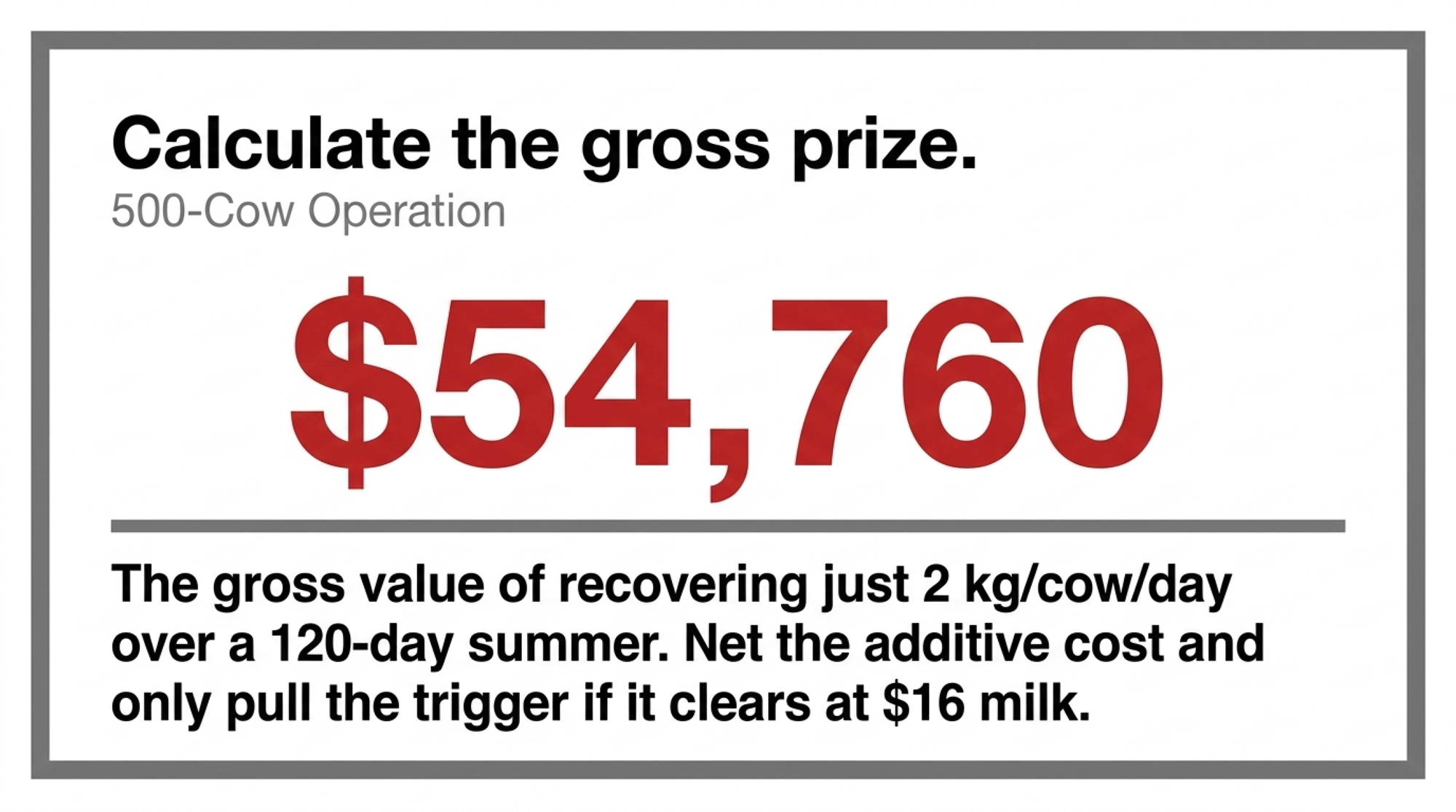
| 500 cows | 120,000 kg / 264,550 lb | 2,646 | ~$54,760 |
| 750 cows | 180,000 kg / 396,830 lb | 3,968 | ~$82,140 |
| 1,000 cows | 240,000 kg / 529,110 lb | 5,291 | ~$109,520 |
That’s the gross prize, before product cost. The decision rule: get a real quote on whatever you’re feeding, subtract it, and only pull the trigger if the net still clears at $16/cwt. If it only works at $20 milk, it’s not a protocol — it’s a bet on a strong year.
Dry-cow cooling runs the other direction — cheaper, surer. UF/IFAS built a feasibility spreadsheet for exactly this call, and the payback is fast when the barn already exists. The sequencing is straightforward: cooling first, always. You don’t feed your way out of a broken fan. The nutritional layer only earns its keep after physical cooling is maxed and a long, hot stretch is still bleeding milk.
The THI Action Guide: Set Your Trigger by the Number, Not the Calendar
| THI | 🚦 Level | Do this |
| 65–68 | 🟡 Yellow | Pre-season done: fans clean, soakers aimed, water flowing. Nutritional module ready to switch on. |
| 68–72 | 🟠 Amber | Cooling active for every group — lactating, dry, bred heifers. Shift feed push-up to cool hours. |
| 72–76 | 🔴 Red | Full cooling. Holding-pen priority. Gut-support module on if a long stretch is coming. Check stocking density. |
| 76+ | ⛔ Emergency | Max cooling. Fresh and high groups first. Minimize midday movement. |
Walk the Barn: The 7-Point Cooling Audit
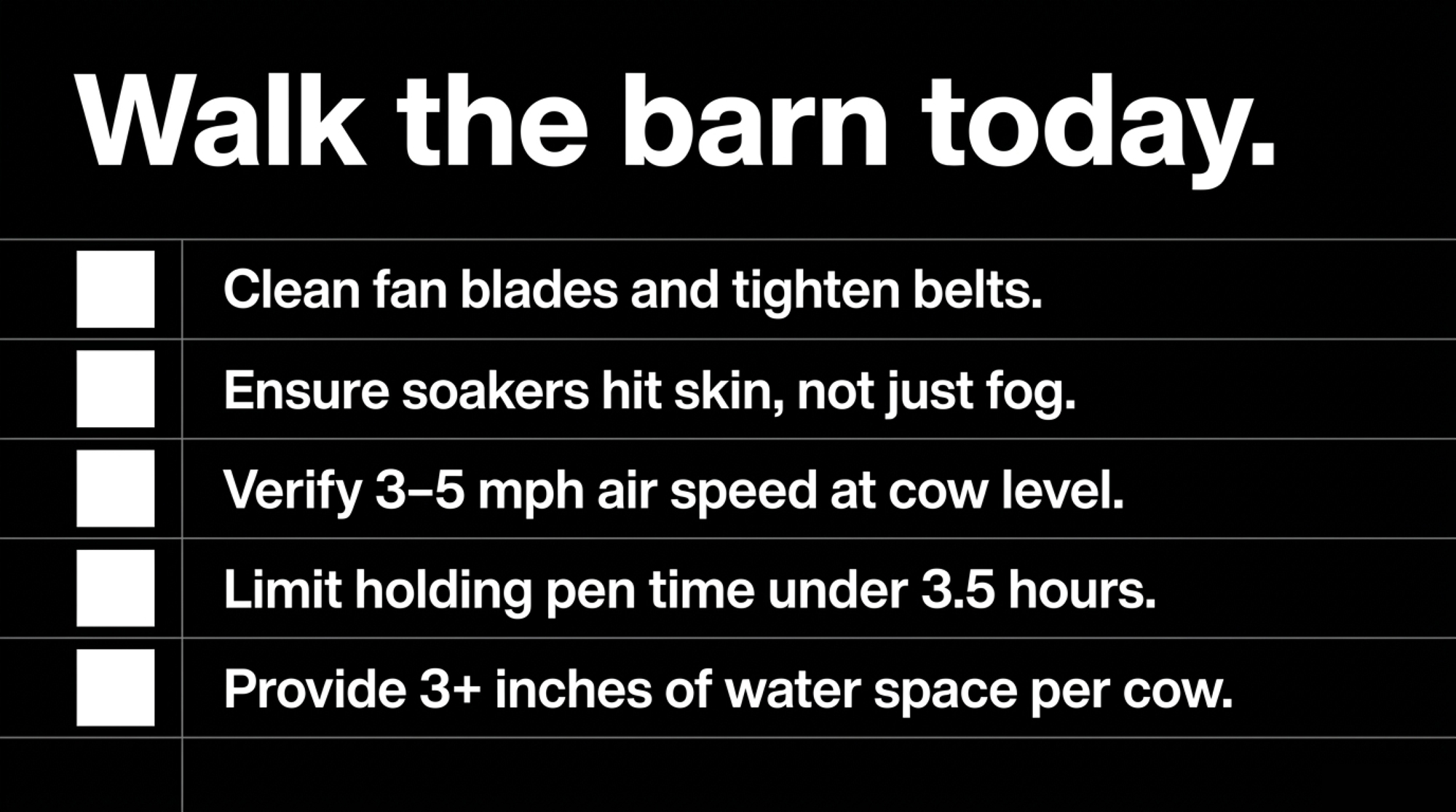
Run this sequence today, in order — each step is a pass/fail you can fix on the spot:
- Fans — blades clean, belts tight? Dirty fans quietly lose a big chunk of airflow.
- Soakers — hitting skin, not fogging, with overlapping coverage?
- Air speed — roughly 3–5 mph at cow level where they rest and eat?
- Holding pen — cooled, and cows out of it in under about 3.5 hours a day total?
- Dry pen — fans and soakers, not just fans?
- Water — 3+ inches of clean trough space per cow, good flow?
- Close-up DCAD — audited separately from the lactating ration, holding a negative target (most programs run roughly −100 to −150 mEq/kg DM)? See how to audit your close-up DCAD.
Two more levers worth knowing. Betaine acts as an osmolyte, helping cells hold water when a cow’s losing fluid through sweat and breath. Live yeast (Saccharomyces cerevisiae) steadies rumen pH, which slides when a hot cow slug-feeds at night, and JDS trial work under heat has generally leaned positive on intake and metabolic profile. Both are worth a look, neither is a substitute for airflow and water on skin.
What This Means for Your Operation
- Your trigger is probably set too high. If controllers fire at 75–80°F, you’re paying for the lag — Cornell and OSU both put the real start at THI 68 for 77+ lb/day cows, not 72. Decision: reprogram fresh, high, and dry groups first, this month.
- You’re measuring the wrong loss. Volume is the tail, not the dog — a 10-point THI jump costs 1.2% yield but 2.8% revenue. Check: lay your test-day fat and protein over local THI and find the days you bled without noticing.
- The dry pen is the cheapest fix you’re skipping. Dry-period heat costs 8–10 lbs/day for the whole next lactation, and cooling it pays back fast when the barn already exists. Decision: does your dry pen have soakers, or just fans?
- Treat the additive as conditional, not automatic. Cornell found a gut leak by day 3; Virginia Tech found none, and pinned 66% of its yield loss on intake alone. Threshold: only feed it after physical cooling is maxed, and only if the net clears at $16 milk.
Key Takeaways
- If your controllers still trigger at THI 72, reset them to 68 in the next month — cooling handles maybe 60% of your summer milk loss, and the rest starts before the tank shows it. Fresh and dry groups first.
- The gut-additive science is split: Cornell saw a leak by day 3, Virginia Tech saw none. Demand a lactating-Holstein heat-stress trial with a real milk or permeability endpoint, then net the cost and only feed it if it still pays at $16 milk.
- Your biggest quiet loss is the dry pen — heat there costs 8–10 lbs/day across the whole next lactation, and cooling it pays back fast when the barn already exists. Fans and soakers before feed additives, every time.
The science didn’t fire your fans — you still need them, and they’re doing most of the physical work. What it moved is the timing, the trigger, and the accounting. In the Cornell chamber, the gut clock ran at three days. The component meter runs before the tank. And the dry pen decides next year’s milk months before the first hot morning. So the real question isn’t whether you’re cooling. It’s whether you’re cooling early enough, in the right pen, and counting what it costs when you don’t. What would your last two summers of test-day data say if you finally laid them over the THI chart?
Run Your Numbers
Component Value Tracker — This piece says heat thins your fat and protein before it thins the tank. This calculator turns that into dollars: it shows what 0.1 point of butterfat or protein is worth in your herd, flags your P:F ratio, and pressure-tests whether a summer additive clears its break-even before you buy.
Learn More
- Your Fans Can’t Fix Half of Heat Stress. Your Ration Can. — Arms you with a tactical 30-day timeline to adjust summer high-group rations, recalculate mineral balances, and implement an automated “heat-on” switchable feeding strategy before environmental thresholds breach THI 68.
- Only a Third of Your Summer Milk Loss Comes From the Bunk — Exposes the long-term economic damage of subclinical inflation, demonstrating how a single day of unmitigated extreme heat triggers a gut-immune cascade that drags down milk yields by up to 8.2% a week later.
- Mastering the Transition: A Holistic Approach to Dairy Cow Health and Productivity — Delivers a structured framework to protect the next lactation cycle, proving that customized pre-calving environments and anti-inflammatory strategies reduce transitional metabolic disorders by up to 30%.
 The Sunday Read Dairy Professionals Don’t Skip.
 The Sunday Read Dairy Professionals Don’t Skip.
Every week, thousands of producers, breeders, and industry insiders open Bullvine Weekly for genetics insights, market shifts, and profit strategies they won’t find anywhere else. One email. Five minutes. Smarter decisions all week.




