





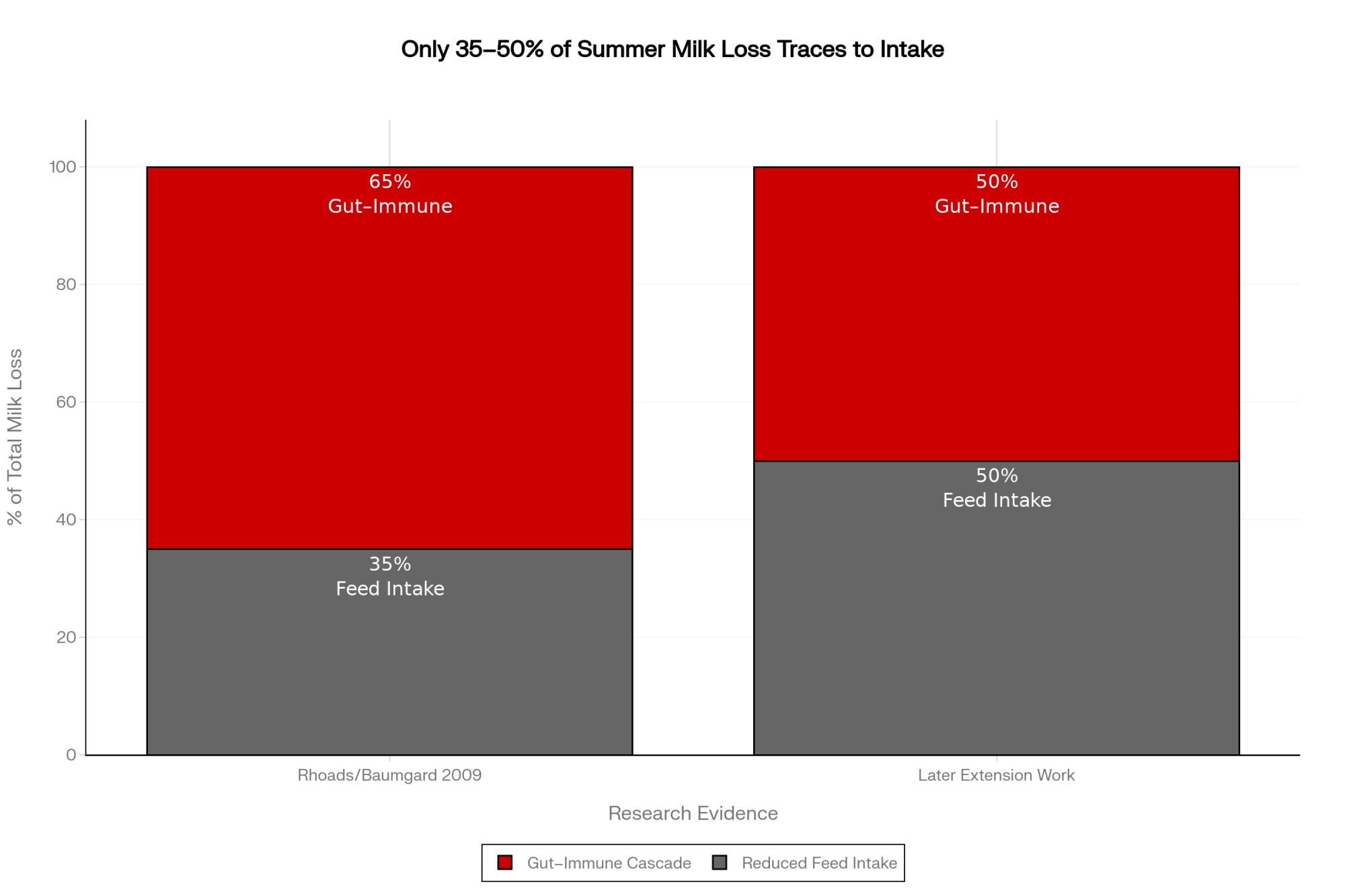
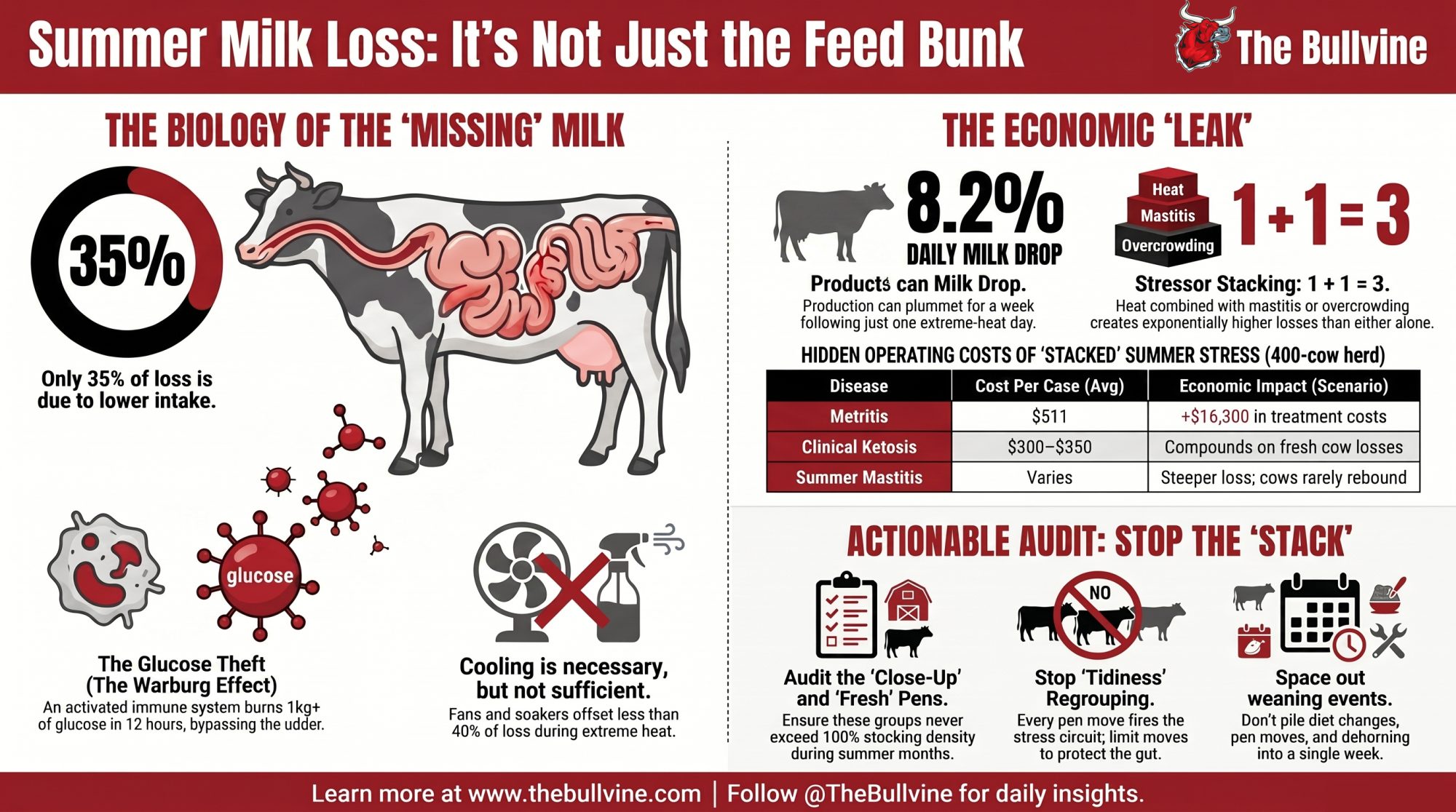
Rhoads and Baumgard proved it: cut intake to match a heat-stressed cow, and you can explain only about a third of her milk drop. The rest leaks out through her gut.
Executive Summary: Only about a third of your summer milk loss traces back to reduced intake — the rest comes from a gut–immune cascade your fans can’t touch. When a cow shunts blood from her gut to dump heat, tight junctions loosen, LPS leaks into circulation, and the Warburg effect kicks in: her immune system burns more than a kilogram of glucose in twelve hours that the mammary gland needed for milk synthesis (Kvidera et al., Journal of Dairy Science, 2017). A University of Illinois analysis of 56 million production records found up to 8.2% of a day’s milk gone in the week after a single extreme-heat day — even in cooled barns (farmdoc, March 2025). Heat-stressed cows mount a stronger local inflammatory response to intramammary LPS than thermoneutral cows do (Tao et al., Journal of Dairy Science, 2023), which is why the same coliform that would’ve been a subclinical case in October becomes your July mastitis cluster. On a 400-cow herd, an 8-point climb in fresh-cow metritis incidence across a bad heat stretch runs 16,300 dollars or more in treatment costs before you count the milk curve those cows never recover. The fix isn’t another soaker line — it’s auditing where stressors stack: overstocked close-up pens running past 100%, multiple pen moves in the last three weeks pre-fresh, and weaning protocols that pile diet change, pen move, and dehorning into the same week all trigger the same leaky-gut circuit. Cooling is necessary; it’s just not sufficient.
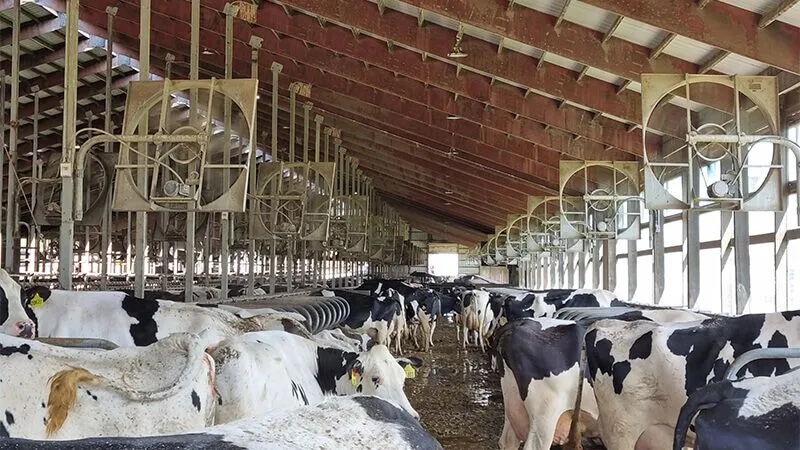
It’s mid-July. The fans are running, the soakers are firing, and you tweaked the ration three weeks before the heat rolled in. And your fresh pen is still throwing mastitis cases like it’s got a grudge.
You blame the bedding. You blame the milkers. You blame the flies. But a growing body of US dairy research points somewhere earlier in the chain — leaky gut. The idea is that those cows walked into the fight already worn down, their gut barriers leaking and their immune systems half spent, before a single pathogen ever reached the teat canal. That’s not a comfort story. It’s a milk-cheque story, and it changes which end of the problem you should be working on.
Why “They’re Just Not Eating” Stopped Holding Up
The industry spent decades treating summer milk loss as a simple intake problem. Cows get hot, they eat less, and they milk less. Add cooling, adjust the ration, move on.
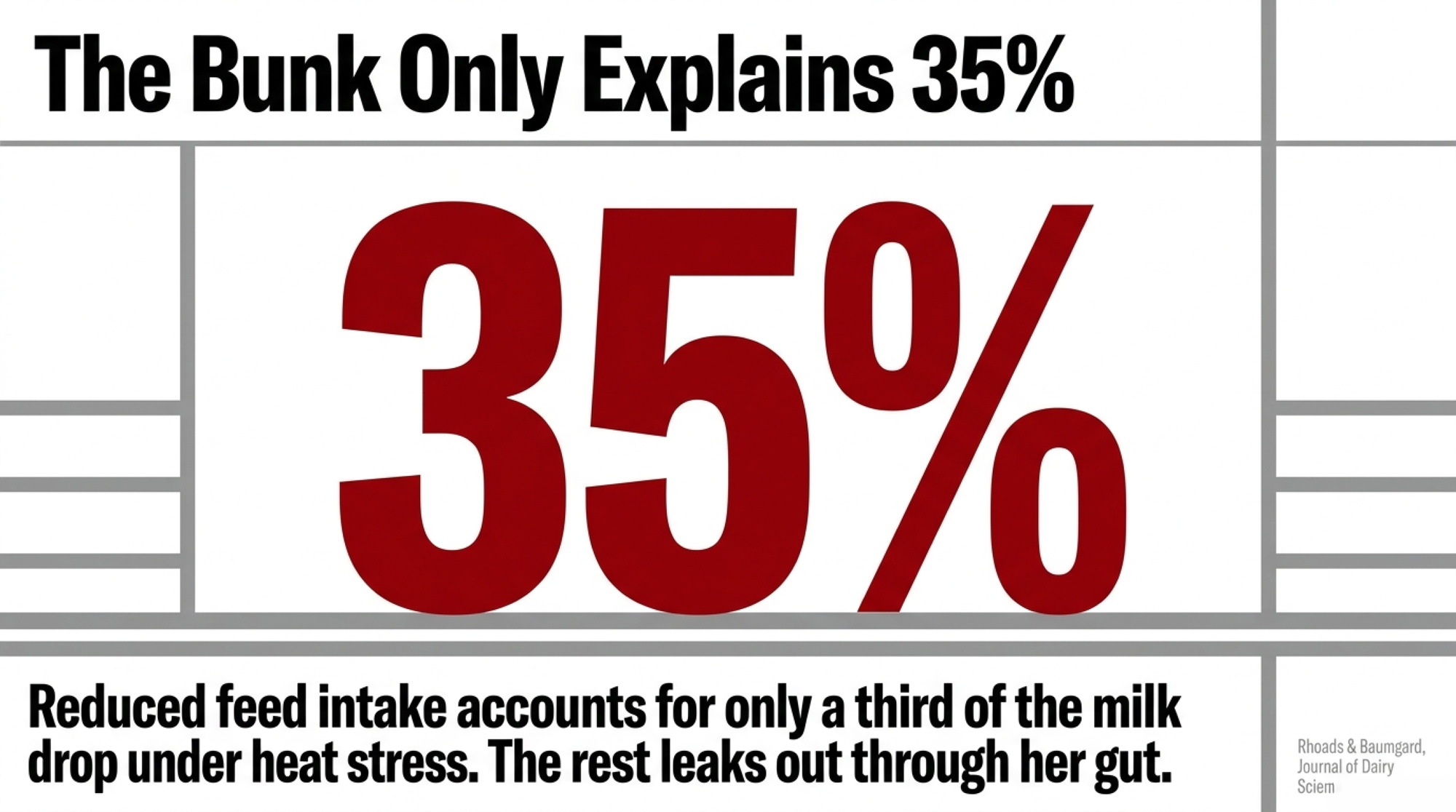
Then researchers did the thing almost nobody bothers to do — they separated the heat from the feed. In the landmark pair-feeding study by Rhoads, Baumgard, and colleagues (Journal of Dairy Science, 2009), heat-stressed cows were compared with thermoneutral cows fed the same reduced intake. Reduced feed intake accounted for only about 35% of the drop in milk yield under heat stress. Later work from the same group, presented in extension talks, has put that figure closer to half — but either way, the headline holds: most of the loss isn’t about the bunk.
So where does it go? That’s the question that reframes the whole summer.
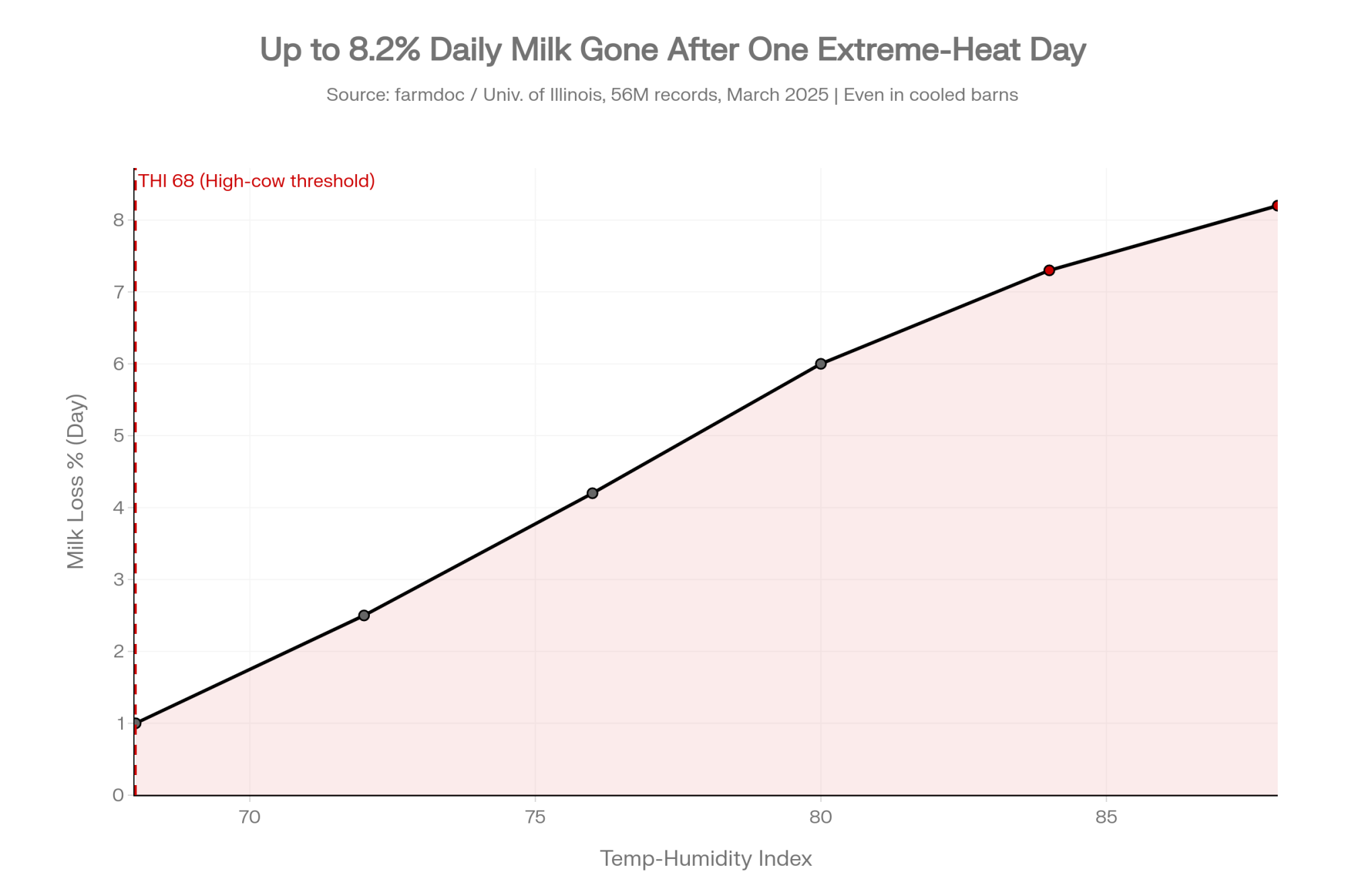
Most of this work comes out of US research herds — Iowa State, Cornell, and the University of Georgia, among them — so read the findings as US-condition science, not a Canadian or EU benchmark. And the money is real: a University of Illinois analysis of more than 56 million production records across nine Midwest states (farmdoc, March 2025) found herds lose about 1% of annual yield to heat stress every year, with up to 8.2% of a day’s milk gone in the week following a single extreme-heat day. If you run a herd of over 500 cows in a hot climate, that missing share of production is a line item you’ve probably never put on the books.
The Energy Balance That Doesn’t Add Up
Here’s the part that puzzled researchers early on. A heat-stressed cow should look like any other underfed cow — burning body fat to cover the energy she’s not eating. She doesn’t.
Rhoads and Baumgard’s metabolic work found that heat-stressed cows had higher circulating insulin levels and failed to mobilize body fat, unlike feed-restricted cows, even as milk production dropped. The cow was holding onto her reserves and still losing production. That doesn’t fit a simple intake story. It points to glucose being pulled elsewhere — and that somewhere else turned out to be the immune system, fed by a gut that had begun to leak.
The Wall That Does Two Jobs Until It Can’t
Picture a high-producing Holstein on a July afternoon, the kind giving 45 to 50 kilograms (100 to 110 pounds). For a cow at that level, heat stress isn’t a far-off threshold — high-yielding cows start feeling it at a temperature-humidity index around 68, which can hit as mild as 21 degrees Celsius at moderate humidity. To dump heat, she shunts blood away from her gut toward her skin and extremities. The cells lining her intestine — the ones sealing the gut contents off from her bloodstream — are now working on less oxygen while still handling a heavy load of feed, acid, and bacteria.
That gut wall is asking a lot of a single layer of cells. On one side sits a churning soup of feed, rumen acid, digestive enzymes, and a bacterial population that outnumbers every cell in the cow’s own body. On the other side sits her bloodstream. The only thing keeping the two apart is that sheet of intestinal cells and the protein “zippers” — tight junctions — that stitch them edge to edge. The wall has to be selective, not sealed: it intentionally pulls nutrients through while blocking everything else. That’s a hard job on a good day.
On a good day, that wall is well-caulked: nutrients move through in a controlled way, and almost nothing slips between. Under heat, the junctions loosen. That’s the leaky-gut moment.
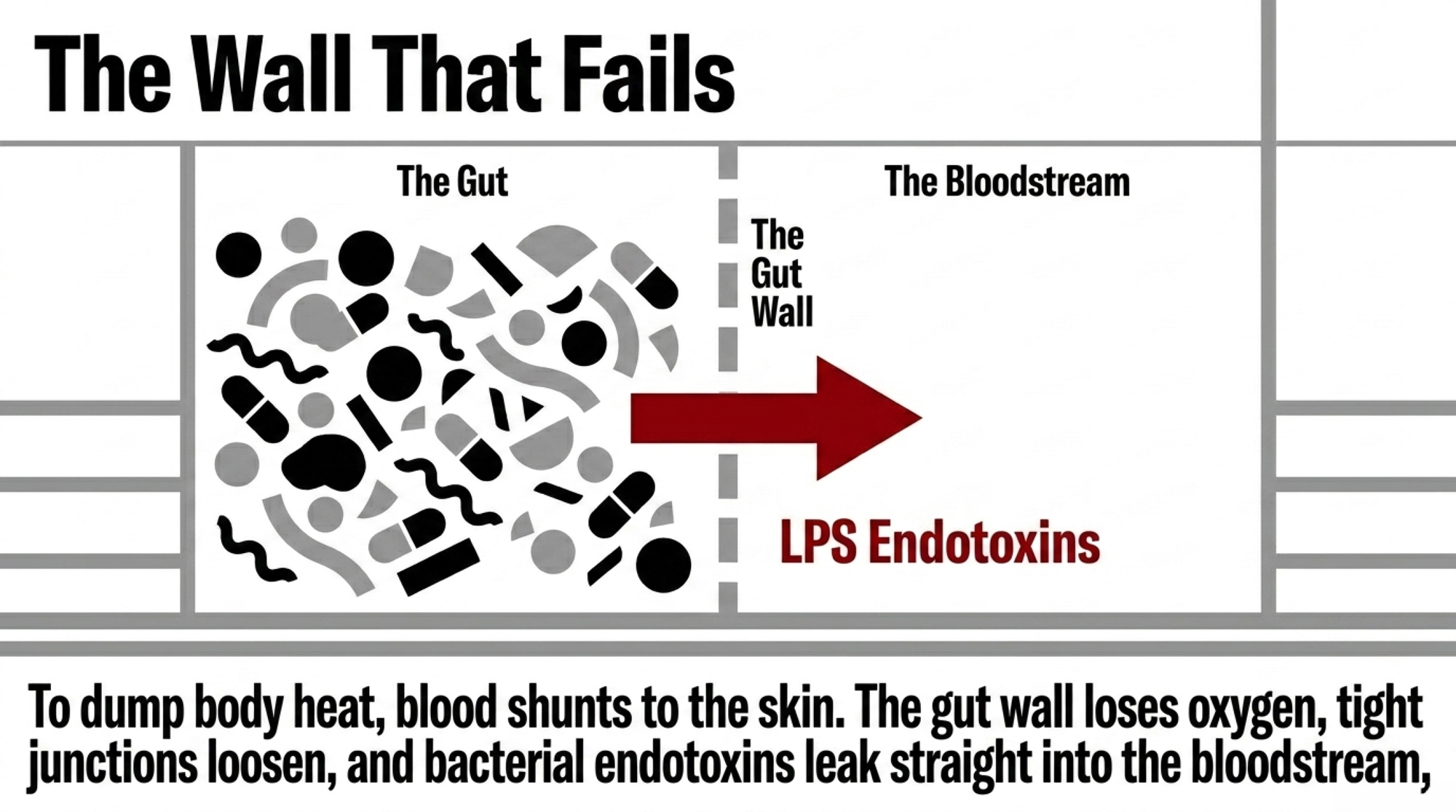
Bacterial fragments cross first. Then, lipopolysaccharide endotoxins are shed by gram-negative bacteria. In the worst cases, whole bacteria get through. From the cow’s point of view, that reads as an invasion, and her immune system responds like one’s underway.
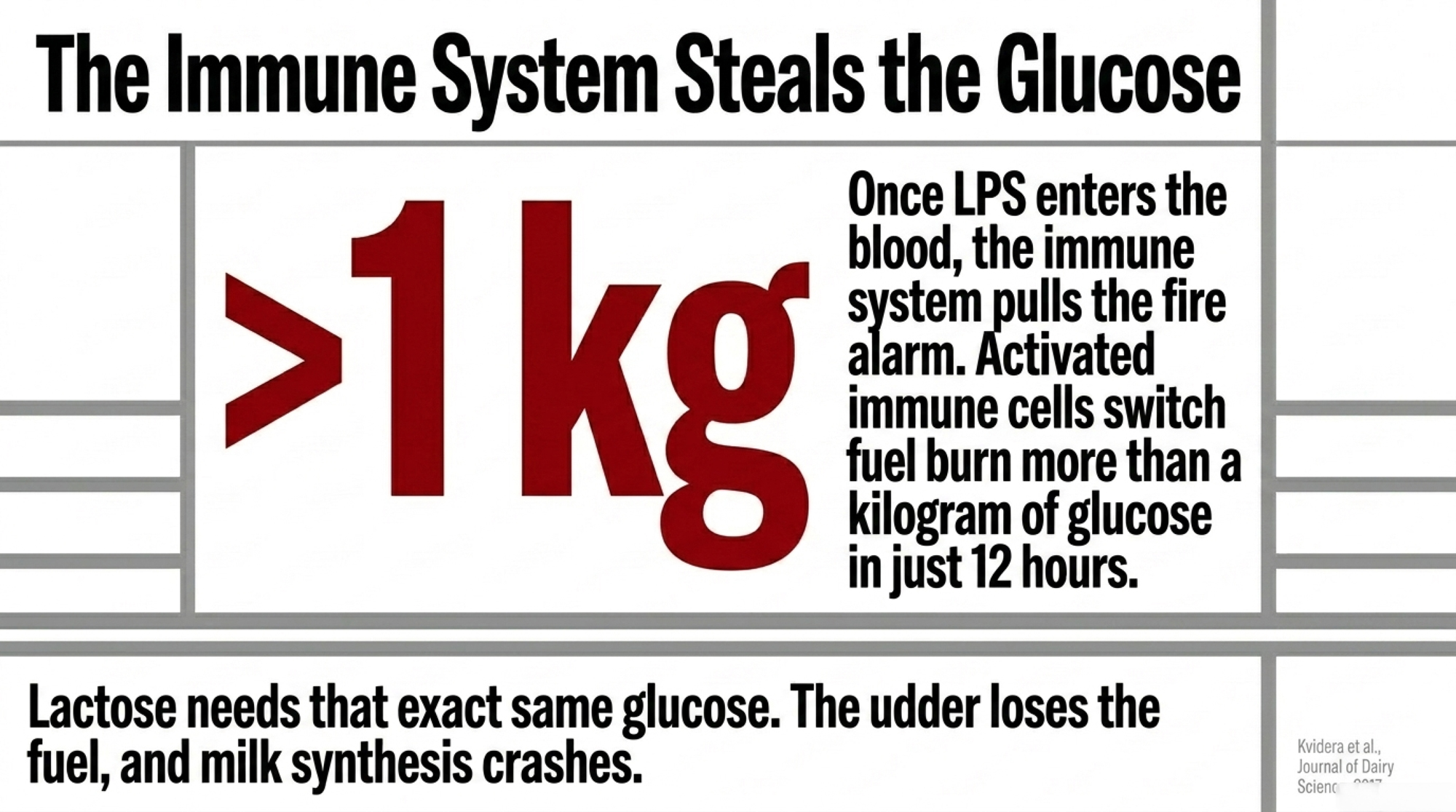
Here’s the expensive part. Activated immune cells switch fuel — they stop burning fat and amino acids and become glucose hogs through a process called the Warburg effect, first described by Otto Warburg back in the 1920s and now well documented in bovine immune cells. In LPS-challenge work from Baumgard’s group (Kvidera et al., Journal of Dairy Science, 2017), an acutely activated immune system burned through more than a kilogram of glucose in just twelve hours — and topping cows up with extra glucose to keep blood sugar normal still didn’t rescue milk synthesis. The immune system sits higher in the body’s priority list than the udder. Lactose needs glucose. Milk protein needs the same amino acids that the immune system is now grabbing. The mammary gland loses both at once.
All of this happens downstream of your fans. Cooling fights body temperature. It does nothing once LPS is in the bloodstream and the immune system has pulled the fire alarm. A 2025 analysis of heat-stress impacts found that even in high-tech, heavily cooled systems, fans and soakers offset at best about half the loss on moderately hot days — and less than 40% once it gets truly hot.
| Intervention | What It Addresses | What It Misses | Effectiveness Limit |
|---|---|---|---|
| Fans & Soakers | Reduces core body temperature rise | LPS already in bloodstream, glucose drain underway | Offsets ~50% loss on moderate heat days; <40% on extreme days |
| Ration Adjustment | Supports DMI maintenance; reduces heat increment | Gut–immune glucose burn; tight-junction loosening | Addresses ~35–50% of the milk loss equation |
| Stocking Reduction (<100%) | Lowers social stress; reduces cortisol spikes | Doesn’t reverse LPS already in circulation | Removes a documented additive stressor from the stack |
| Eliminating Redundant Pen Moves | Reduces cortisol-driven gut permeability events | Doesn’t fix inadequate cooling or overcrowding alone | Each move removed = one fewer trigger on the same stress circuit |
| Gut-Barrier Additives (Zn, live yeast, buffers) | Supports tight-junction integrity; rumen pH | Cannot recover glucose already burned by immune activation | Support tool — third lever, not first |
| Pre-Fresh Ventilation Upgrade | Reduces thermal load on the highest-risk animals | Doesn’t reduce stocking or pen-move frequency | Highest ROI location if close-up THI routinely exceeds 68 |
Can One Hot Spell Really Set Off a Chain This Long?
It can, because the gut isn’t just a heat problem — it’s the place nearly every stressor lands.
Heat, overcrowding, a pen move, weaning, and a rough calving: the cow doesn’t run a separate system for each. She’s got one shared stress circuit. The brain reads “threat,” the stress axis fires, cortisol and adrenaline flood in, and digestion gets deprioritized. Blood leaves the gut. Stress hormones and inflammatory signals loosen those same tight junctions. The microbiome tilts toward more endotoxin-shedding bugs.
Different trigger, same sequence — LPS across the wall, immune system up, glucose gone. One way to put it: the costumes change, but the script doesn’t.
The gut ends up as the landing zone for two reasons. It’s the thinnest, most exposed barrier the cow has, in constant contact with feed, acid, and bacteria across an enormous surface. And it’s wired straight into the stress and immune systems, so those hormones don’t have far to travel.
When One Plus One Equals Three
So what happens when a cow takes two or three of these hits at once?
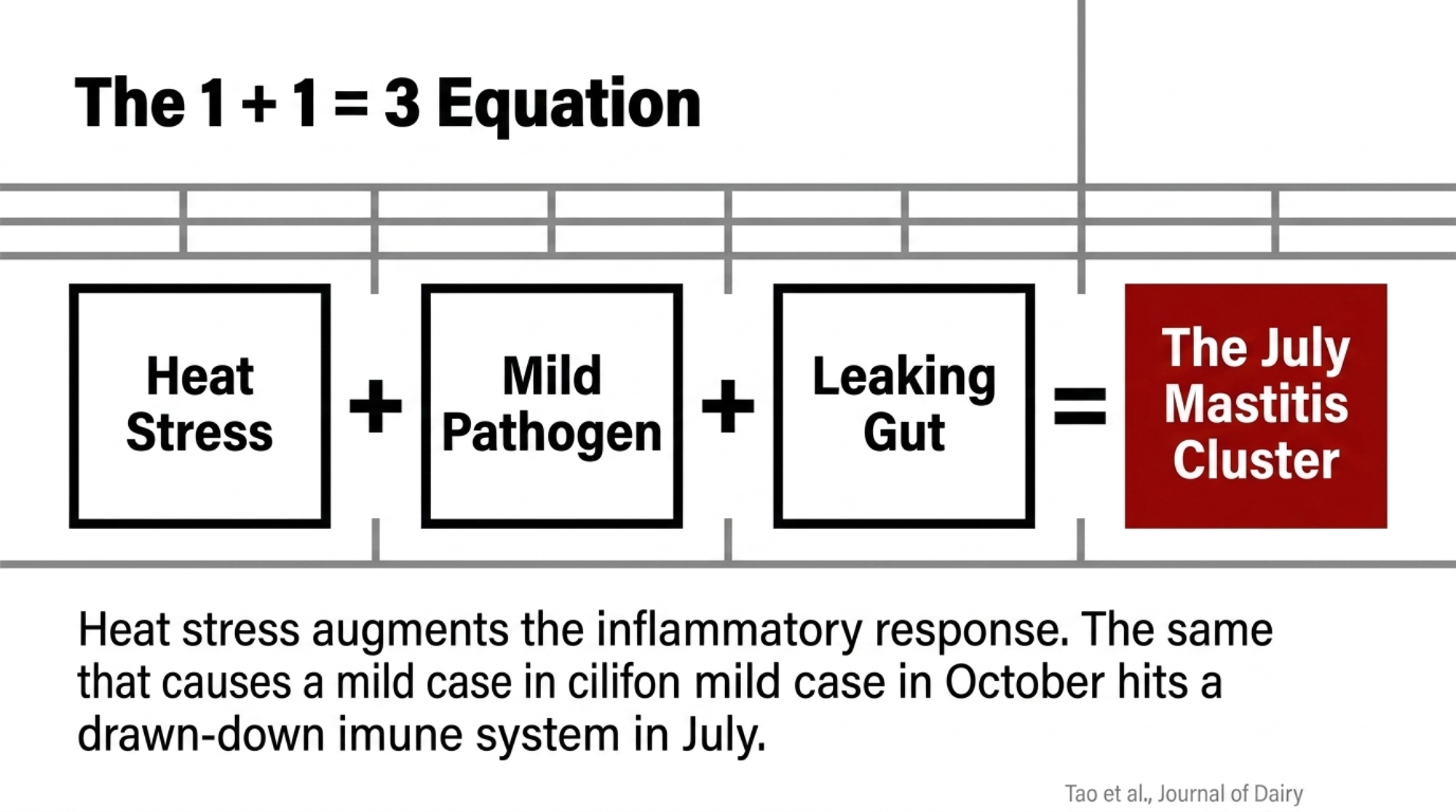
This is stressor stacking, and the framing comes from watching cows that should have shrugged off a problem fail badly once a second stressor landed. The cleanest proof is heat plus mastitis. A University of Georgia team (Tao and colleagues, with results published in the Journal of Dairy Science in 2023 and summarized by UGA Dairy Extension in May 2024) gave cows the same intramammary LPS challenge with and without evaporative cooling.
The non-cooled cows mounted a stronger local mammary inflammatory response, with a higher milk somatic cell count following the LPS infusion, at the same pathogen dose. Their systemic inflammatory markers didn’t spike the same way — suggesting the heat-stressed cow throws more of her fight into the udder itself. The researchers’ read: heat stress augments the mammary inflammatory response to LPS-induced mastitis — part of why summer SCC climbs.
In the barn, that’s your July cluster. The same coliform or strep that would’ve caused a contained case in cool October weather lands on a cow whose gut has been leaking for days and whose immune budget is already drawn down. You don’t get one mild case — you get several, with steeper milk losses and cows that never climb back to their old curve.
| Factor | October Case (Thermoneutral) | July Case (Heat-Primed) | Clinical Implication |
|---|---|---|---|
| Gut barrier status | Intact tight junctions; minimal LPS leak | Loosened junctions; chronic low-level LPS in circulation | July cow enters the fight immunologically pre-spent |
| Immune budget | Full glucose reserves available for immune response | Warburg effect already drawing >1 kg glucose in 12 hrs | Less capacity to mount a contained, resolved response |
| Mammary inflammatory response | Moderate local SCC elevation | Augmented local response to same LPS dose (Tao et al., JDS 2023) | Higher SCC spike; more severe tissue damage |
| Milk curve recovery | Returns to pre-case trajectory within 2–3 weeks | Flatter recovery; cows often carry lower curve all lactation | Each July mastitis case costs more than the treatment invoice shows |
| Metritis incidence context | 12% baseline on a well-managed herd | 20%+ with stressor stacking in July–August | +$16,300+ in metritis costs alone on a 400-cow herd |
| Recommended intervention point | Pathogen management (bedding, milking hygiene) | Upstream: fix stocking, pen moves, and close-up THI beforesummer peaks | Treating the bug misses two-thirds of the problem |
With just heat, you’d have lost some milk. With just that pathogen pressure, you’d have had manageable cases. Stacked, you land in the “one plus one equals three” zone. The outbreak was never only about the bug. It was about cows walking into the fight already tired.
The Same Story Plays Out at the Hutch
If the gut is where every stressor lands, the youngstock side of the barn is the clearest place to watch it happen — because weaning loads several hits at once.
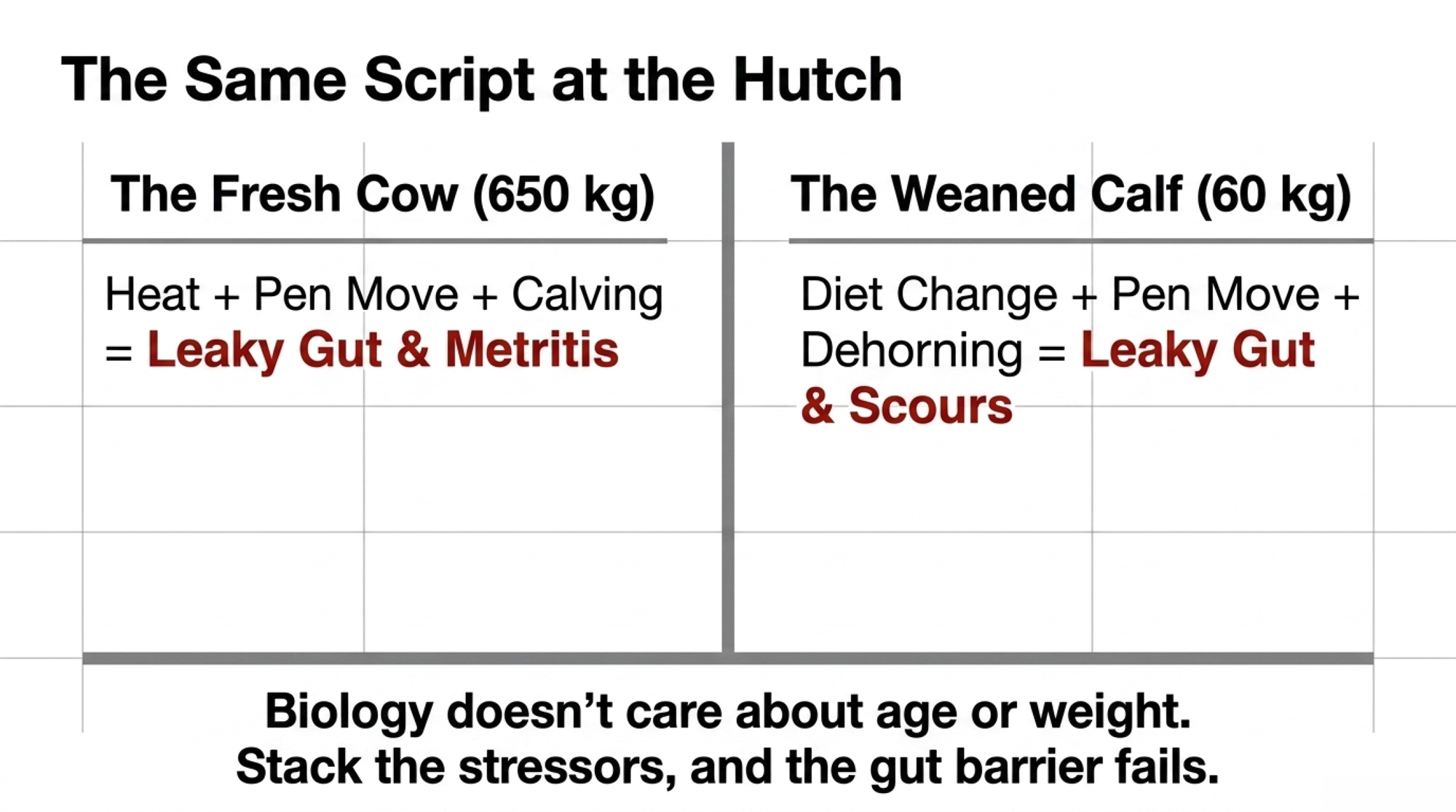
Pull a calf off milk, and you change her diet, her routine, and often her pen and pen-mates in the same window. Each is a stressor on its own; together they fire the same circuit that loosens the gut wall in a lactating cow. Research on weaning transitions has documented elevated cortisol, inflammatory markers, and signs of increased gut permeability in calves during that period — the same leaky-gut fingerprint, just in a 60-kilogram animal rather than a 650-kilogram one. That’s part of why post-weaning scours and slumps show up even in calves that looked bulletproof a week earlier.
The lesson reads straight across to the milking string: it isn’t the single event that breaks the calf, it’s the pile-up. Spread the diet change, the pen move, and the dehorning out across separate weeks, and you give the gut barrier time to recover between hits instead of asking it to absorb all three at once. Biology doesn’t care whether an animal is making milk or just trying to grow — the script is the same.
Where the Damage Concentrates: You Load the Gun, Then It Fires
Walk a 500-plus-cow herd with stressor-stacking glasses on, and you don’t start in the high group. You go where you’re about to ask the most.
| Pen / Stage | Primary Stressors Present | Stacking Risk Level | Most Common Management Errors | Priority Fix |
|---|---|---|---|---|
| Close-Up (3 wks pre-fresh) | Late-gestation immune dip; metabolic shift; THI exposure | 🔴 HIGHEST— gun-loading zone | >100% stocking; 2–3 pen moves in final 3 wks; inferior ventilation vs. main barn | Reduce to <100% stocking; limit moves to 1 max; match or exceed main-barn cooling |
| Fresh Pen (0–21 DIM) | Calving inflammation; peak energy demand; ration transition | 🔴 HIGHEST— trigger zone | Worst-ventilated corner; aggressive ration switch; excess handling | Best stalls + bunk space on the farm; gradual ration transition; minimize exams |
| High Group | Production pressure; summer SCC creep | 🟡 MODERATE— slow bleed | Tolerated as “normal” summer loss | Improve cooling; monitor SCC trend; address after close-up/fresh fixed |
| Calves at Weaning | Diet change + pen move + dehorning in same week | 🔴 HIGH — same leaky-gut script | Stacking all three events simultaneously for operational convenience | Spread events across separate weeks; one stressor per recovery window |
| Dry Cows (early dry) | Lower metabolic demand; often under-resourced | 🟢 LOWER— relative priority | Neglected cooling (“they’re not milking”) | Ensure THI <68 threshold met; don’t ignore as pre-cursor to close-up stress |
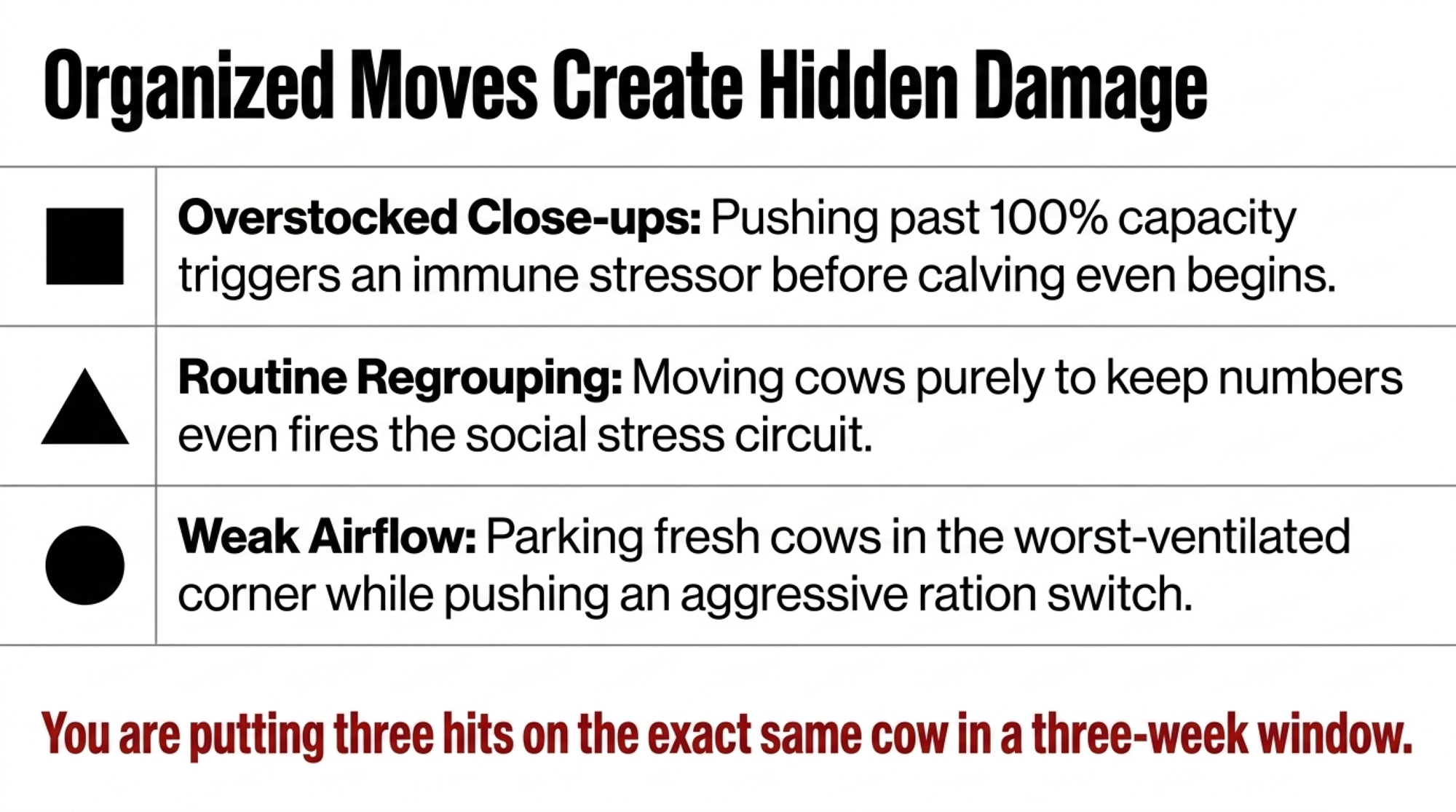
The close-up pen is usually the worst offender — that’s where you load the gun. She’s late-gestation heavy, her immune system is in its normal transition dip, and her metabolism is shifting hard. Now, stack on what’s common on a lot of dairies: a pen pushed past 100% stocking, weaker fans than the main barn, and two or three pen moves in her last three weeks. None of those look like emergencies on their own.
The fresh group is where it fires. First 21 days in milk, climbing a vertical energy demand, still inflamed from calving, and too often parked in the worst-ventilated corner with extra handling and an aggressive ration switch. This is where ketosis, metritis, displaced abomasums, and mastitis cluster on the same animals. A fresh cow that misses peak doesn’t just cost you that week — she carries a lower curve for the whole lactation.
The high group pays too, but it’s a slow bleed — higher summer SCC, a couple of kilos off the top of the whole pen that don’t come back until fall. Real, but not the train wreck. If you’ve only got the political capital to fix stacking in two places, start with close-up, then fresh. The high group can wait its turn.
Run the Stacking Math on Your Own Fresh Pen
Here’s where the biology turns into a number you can put in front of a partner or a lender.
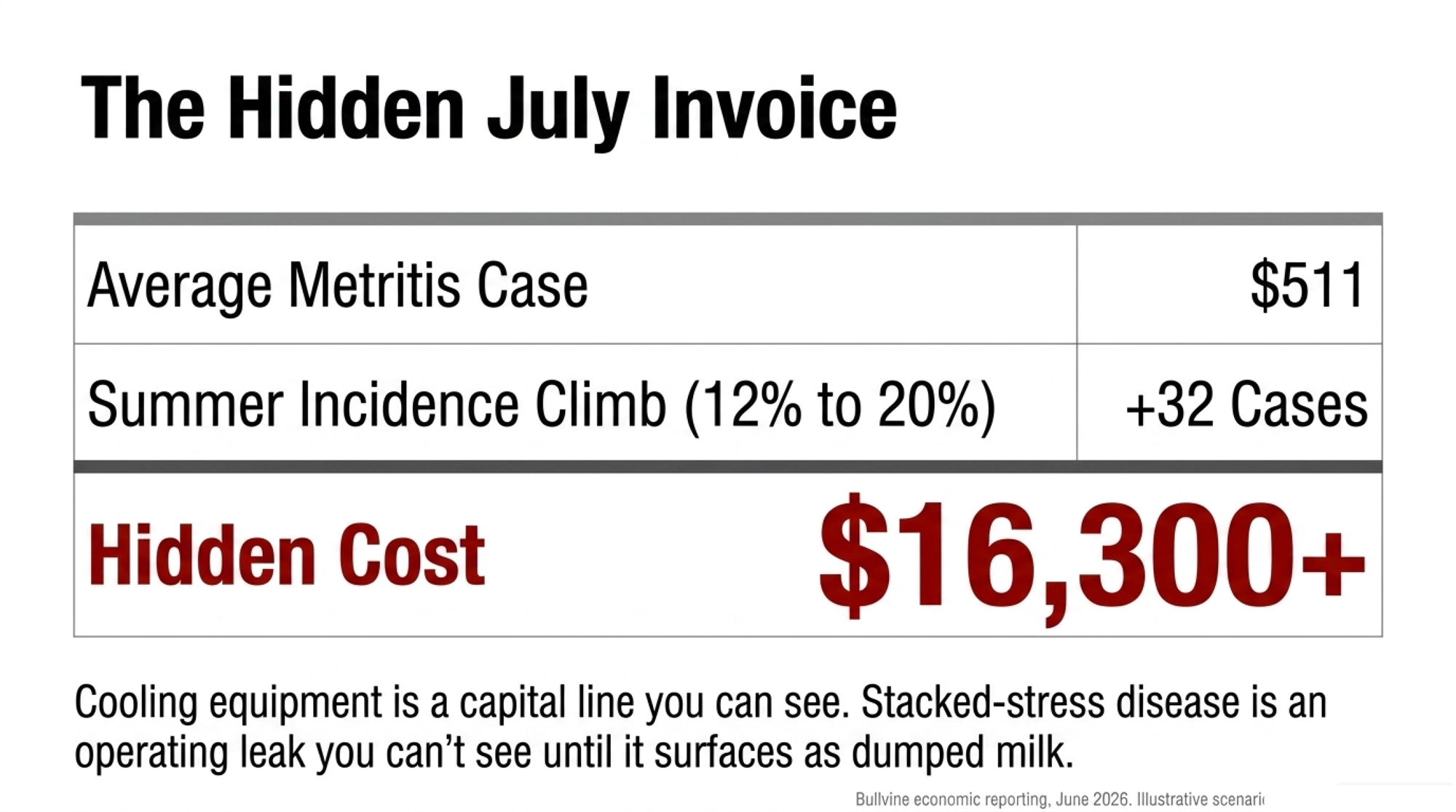
Bullvine’s own economic reporting pegs the average metritis case at around 511 dollars, with clinical ketosis at roughly 300 to 350 dollars a case before you count the lost milk. Run it on a 400-cow herd: push fresh-cow metritis from a manageable 12% up to a stacked-summer 20%, and that single disease alone walks out the door with more than 16,300 dollars in one bad stretch. Layer summer ketosis and a mastitis cluster on the same cows, and the bill compounds fast.
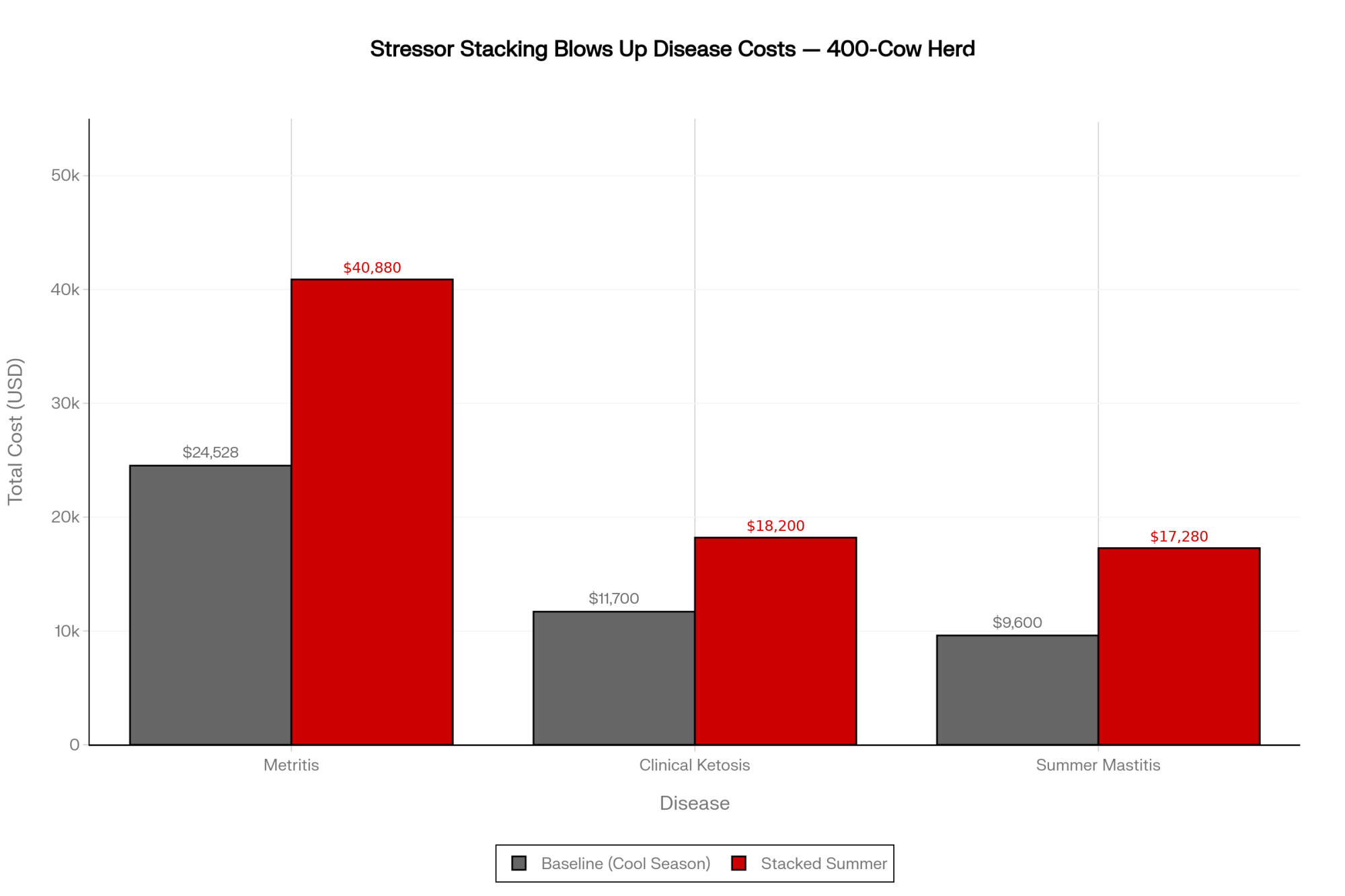
| What it costs | Per-case figure | Stacked-summer scenario (400-cow herd) |
| Metritis | ~511 dollars avg (median 398; most 240–884) | 12% → 20% incidence = +32 cases ≈ 16,300+ |
| Clinical ketosis | ~300–350 dollars, before lost milk | Compounds on the same fresh cows |
| Summer mastitis cluster | Steeper milk loss; cows that don’t rebound | Lands on the same drawn-down immune systems |
Sources: Bullvine economic reporting (June 2026) for per-case costs; the incidence shift is an illustrative scenario, not a single-herd result.
That’s the part the fan invoice never shows you. Cooling equipment is a capital line you can see; stacked-stressor disease is an operating leak you mostly can’t see until it surfaces as treatment costs, dumped milk, and cows that don’t breed back. The stacking math is the argument for fixing pen flow and stocking before you write the next equipment cheque.
Can You Feed the Gut Wall Back Together?
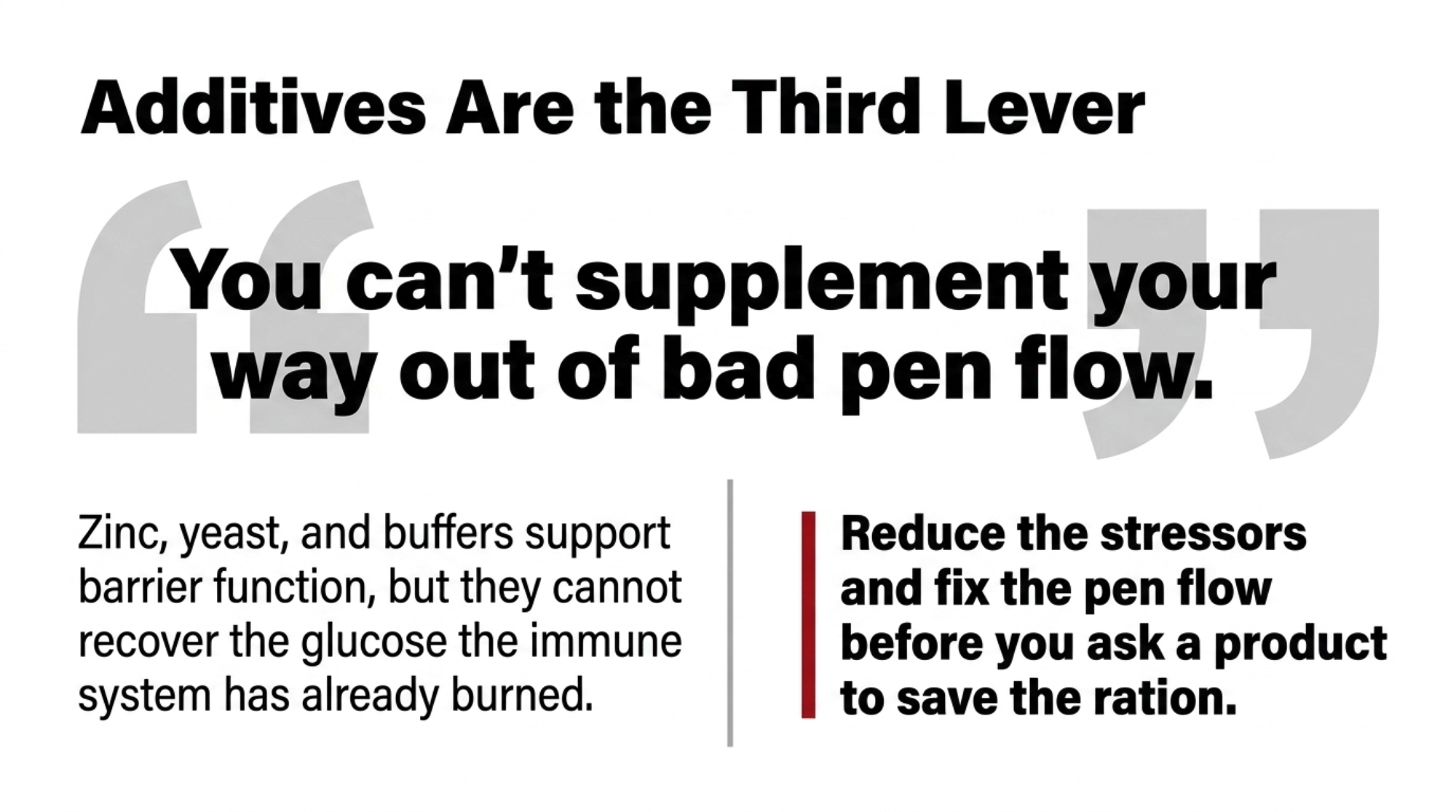
Short answer: you can support it, but you can’t supplement your way out of bad pen flow. The data on gut-barrier feed additives is real but still maturing, so read it as a support tool, not a fix.
The evidence is strongest where it’s been tested directly. Work on zinc amino acid complex showed improved intestinal architecture and lower leaky-gut biomarkers in heat-stressed cattle models (Journal of Dairy Science, 2020), and rumen-protected zinc-methionine has been shown to improve intestinal barrier function under heat stress (Frontiers in Veterinary Science, 2022). Live yeast (Saccharomyces cerevisiae) trials have improved energy-corrected milk and feed efficiency in heat-stressed cows. And buffering rumen acidosis matters in its own right, because sub-acute ruminal acidosis loosens the same junctions from the inside. But none of that recovers the glucose the immune system has already burned, and none of it substitutes for taking a stressor off the pile.
So treat additives as the third lever, not the first. Reduce the stressors, fix the pen flow, then ask whether a barrier-support product earns its place in the ration.
The Quiet Practice That Makes It All Worse
Here’s the one that stings, because it’s so defensible in the moment: routine regrouping of close-up and fresh cows to keep the numbers even.
Nobody’s being careless. They’re being organized. You move cows up when there’s space. You like the groups balanced. None of that sounds like abuse. But every pen move is a social-stress event — new hierarchy, more shoving, time off feed — and you’re firing the same stress circuit each time you do it. Stack that on late-gestation stress and July heat, and you’ve put three hits on the same cow in the same two- to three-week window.
One regrouping? She’d shrug it off. A warm barn? Uncomfortable, maybe a little milk. Transition alone? She’d adapt. Together, you get cows going off feed “for no reason” and a bump in fresh-cow disease that looks like bad luck and is really a policy decision.
What This Means for Your Operation
- In the next month, pull your last two summers of fresh-cow disease records and sort them by season and pen. If your mastitis, metritis, and ketosis cases cluster in hot weather and in specific groups, that’s a stacking fingerprint — not a coincidence — and it tells you where to act first.
- Walk your close-up pen this week and ask one question: is it getting the best stalls and bunk space on the farm, or the leftovers? If it runs over 100% stocking in summer, fix that before you buy another fan — you’re piling a documented immune stressor on top of the transition stress that’s already there.
- Count how many separate things happen to a cow in her last 30 days pre-calving and first 10 days fresh — every pen move, exam, and ration change is a hit. If you regroup mainly for tidiness, stop: limit the moves, make them predictable, and don’t stack a social shake-up on top of heat and calving unless you have to.
- Apply the same spacing rule at the hutch. Don’t pile the diet change, pen move, and dehorning into one week at weaning — spread them out so the calf’s gut wall recovers between hits.
- Check the afternoon temperature and humidity in your holding pen and close-up, not the 6 a.m. number. The THI line for high cows sits around 68 — lower than most people guess — and that’s where the gut starts to leak.
- When a summer mastitis case drags on longer and costs more milk than the same bug does in the fall, read it as a heat-primed immune system — not just a tougher pathogen. At about 511 dollars per metritis case and 300-plus per ketosis, eight points of extra incidence in a 400-cow herd is real money.
- Before you spend on a barrier-support additive, take one real stressor off the pile first. Zinc, yeast, and buffers help at the margin, but they can’t outrun a bad transition layout — and fans manage thermal load, not a gut that’s already leaking.
Key Takeaways
- If your fresh-cow disease and milk losses spike in July even with good cooling, assume a gut-driven stressor stack — not just “they’re not eating” — and start looking upstream.
- If your close-up and fresh pens ever run over 100% stocking in the summer, that’s a bigger risk to your milk cheque than one more fan or soaker line.
- If your weaning protocol stacks diet change, pen move, and dehorning into the same week, you’re teaching your calves the same leaky-gut script your cows are already paying for.
- If you’re about to write a cheque for a gut-health additive, ask first which pen-move, stocking, or ration-switch stressor you could remove instead.

None of this shows up on a morning pen walk. Leaky gut, immune fatigue, the glucose drain — they stay invisible until they cash out as a cluster, a slow fresh cow, or a summer slump you can’t pin down. So the next time you walk the barn, don’t just ask whether they’re eating. Ask where you’re stacking stress on the same animals, and which one of those hits you could actually pull off the pile. You can’t cool your way out of a problem that started after the heat already got in. So what’s the one stressor you could take off your most fragile cows before this summer peaks?
Run Your Numbers
Health ROI Calculator — Before you write a cheque for another fan or a gut-health additive, run the Health ROI Calculator. It puts a dollar value on cutting fresh-cow mastitis, metritis, and culling losses, so you can see whether fixing stocking and pen flow pays harder than the equipment.
Complete references and supporting documentation are available upon request by contacting the editorial team at editor@thebullvine.com.
Learn More
- Nigel Cook’s $74 Heat Stress Number Was Never Wrong. It Was Never Finished. — Exposes the true $120/cow financial gravity of summer weather by quantifying hidden fertility collapse, three-month oocyte damage, and elevated sync costs that conventional milk-only metrics completely ignore.
- Mastering the Transition: A Holistic Approach to Dairy Cow Health and Productivity — Delivers a multi-year management blueprint built on targeted anti-inflammatory strategies and strict environmental pillars, driving a 3.5% boost in 305-day milk yield by eliminating early lactation disease cascades.
- Dairy Calf Nutrition for Healthier, Higher‑Producing Cows | The Bullvine — Breaks down the biological mechanics of the post-weaning slump, arming you with a six-month “stress calendar” protocol that decouples management events to protect early life intestinal integrity.
The Sunday Read Dairy Professionals Don’t Skip.

Every week, thousands of producers, breeders, and industry insiders open Bullvine Weekly for genetics insights, market shifts, and profit strategies they won’t find anywhere else. One email. Five minutes. Smarter decisions all week.