UW–Madison ran 30 strategies. At a 30% pregnancy rate, sexed semen on first-service heifers returns $6,215 a month. At 20%? Four layers deep to hold the pipeline — for a third of that.
Executive Summary: Livestock in Withee, Wisconsin reported beef-cross calves at $1,200 to $1,910 in February and $950 to $1,400 on September 9 — $510 off the top in seven months. Bullvine’s break-even calculation puts the crossover band at $1,300 to $1,650 a head against $3,130 replacement cows, so that September range opens below it. Abel Dairy Farms in Eden runs 55% Angus, and a 32% pregnancy rate is what makes it pay. Peer-reviewed UW–Madison modeling found the return collapses as reproduction slips. Herds placing fall semen orders in the next six weeks are setting their 2027 calf crop.
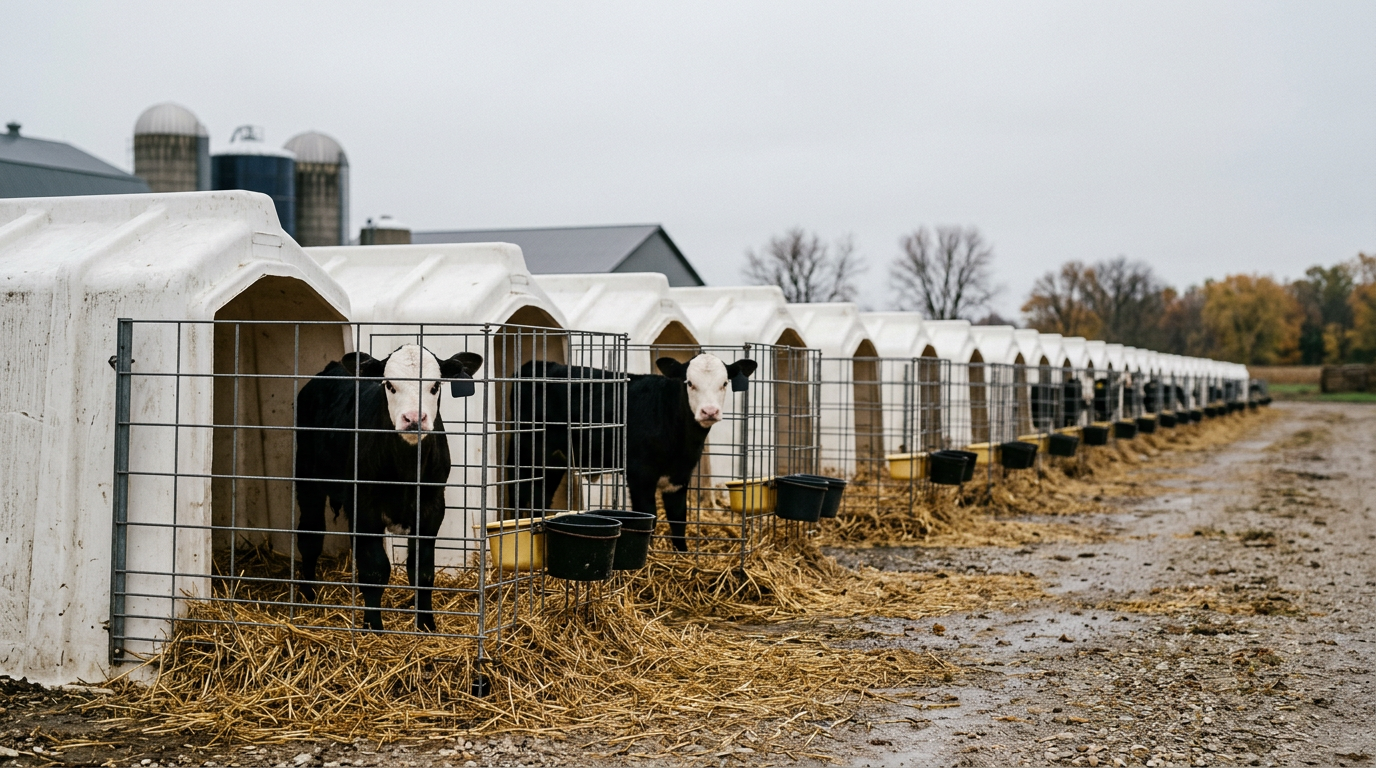
Steve Abel no longer buys conventional dairy semen. Not some of it. None of it. On the 4,500-cow operation this sixth-generation farmer runs in Eden, Wisconsin, alongside his father Allen, his brother Bill, and his son Nate, the rule is one sentence long. “Everything is either sexed semen or it’s Angus,” he told Dairy Herd Management in July 2026. Roughly 55% of the calves born there go to Angus bulls, and the rest come from sexed dairy semen aimed at the top genomic tier, backed by seven years of Zoetis testing data.
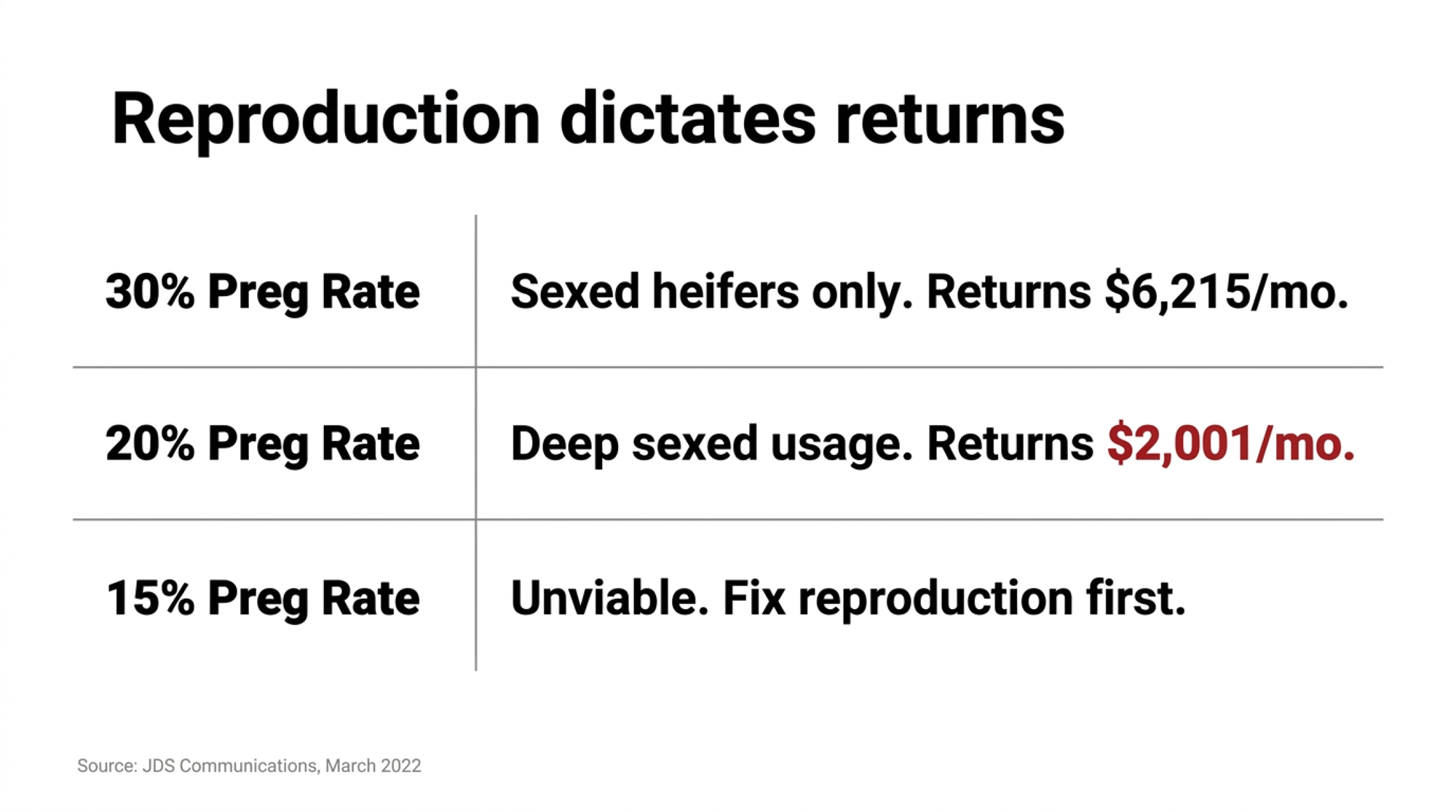
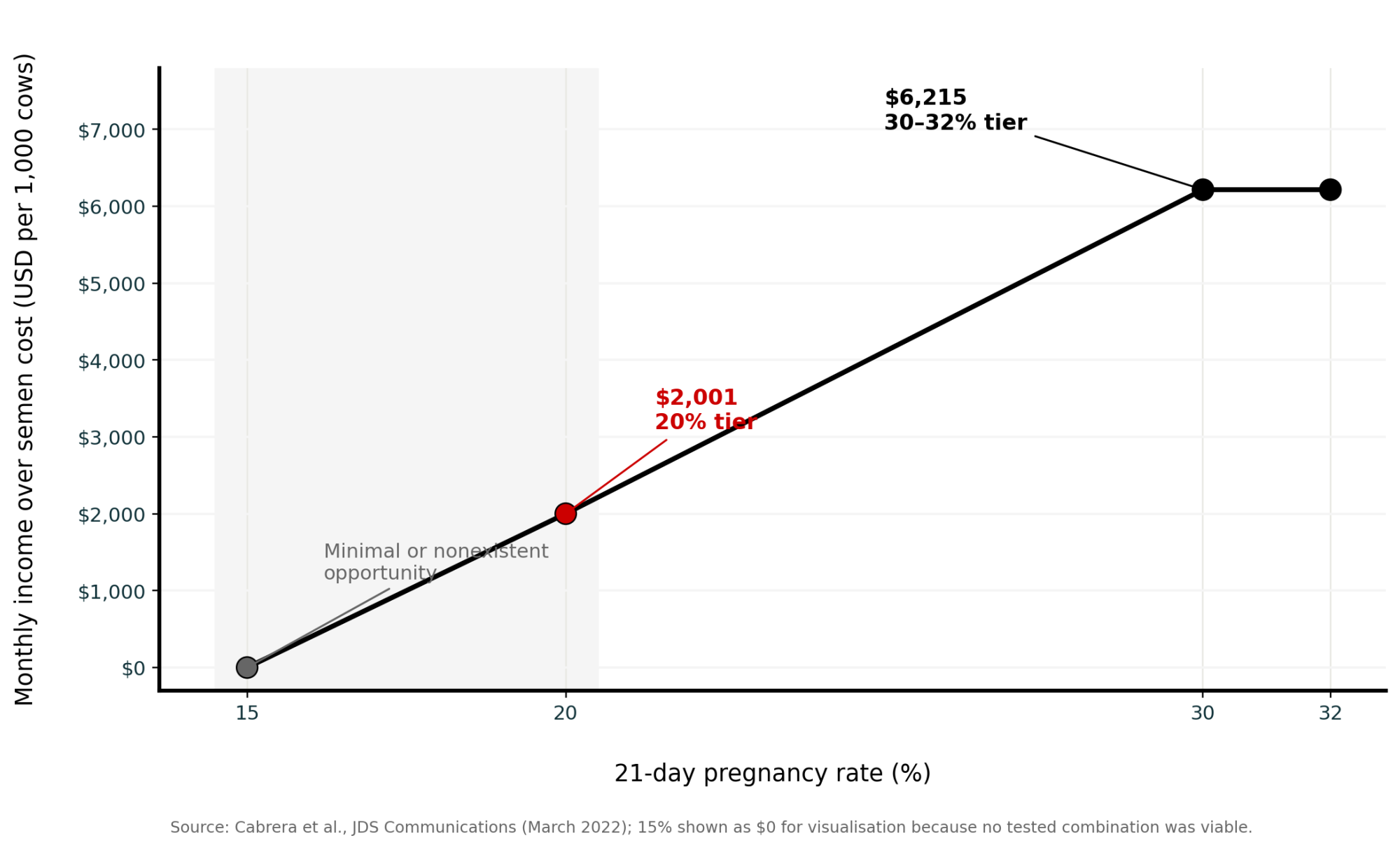
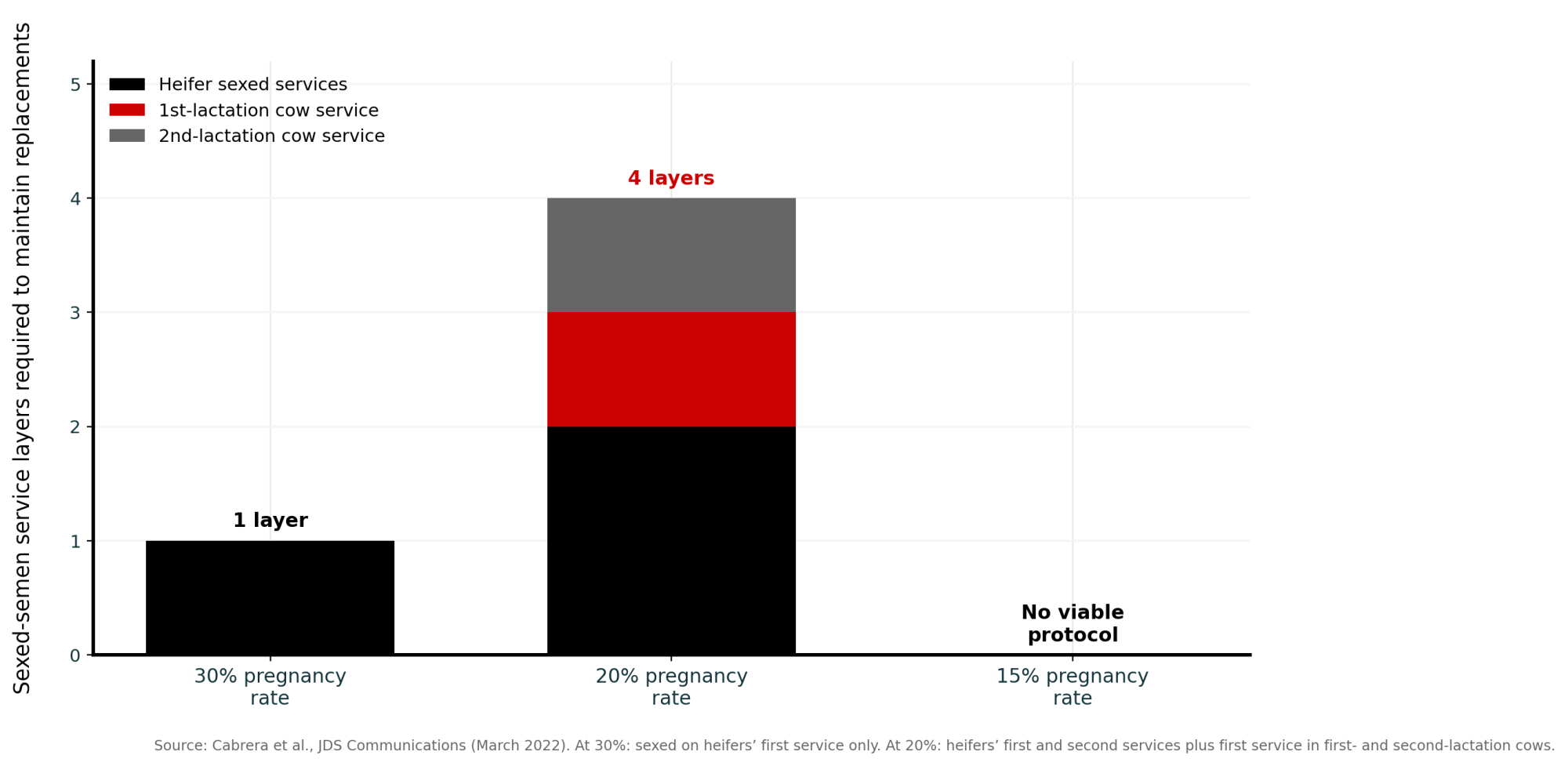
Those beef calves, he said in the same profile, “created a hedge that didn’t exist a decade ago.” He’s right. But here’s what doesn’t travel from a 4,500-cow barn to a 300-cow one: peer-reviewed work out of the University of Wisconsin–Madison found the return on beef semen collapses as reproduction slips. At a 30% 21-day pregnancy rate, the best strategy returned $6,215 a month on a 1,000-cow herd. At 20%, the same herd got $2,001. Down at 15%, the researchers called the opportunity “minimal or nonexistent.”
Abel’s herd runs at 32%. That puts him in the top band Cabrera modeled, the only tier where the sexed-then-beef strategy returns $6,215. The 55% travels well in conversation. The 32% is what makes it work.
The Arc That Built This, and the Part That Stalled
Day-old beef-on-dairy calves went from roughly $650 a head three years ago to about $1,400, according to Laurence Williams, beef-on-dairy development specialist at Purina Animal Nutrition, whose comparison dates to late 2025. Ohio auctions ran beef-cross calves $1,200 to $1,975 a head in August 2026, per Farm and Dairy’s weekly livestock markets, with straight dairy-bred calves trailing at $700 to $1,175.
But watch one Wisconsin barn across this year. Premier Livestock in Withee posted beef-dairy cross calves at $1,200 to $1,910 in February. On September 9, the same barn reported them at $950 to $1,400, with most Holstein bull calves at $850 to $1,235. The top end came off $510 in seven months.
USDA’s blended number runs more conservative. The AMS National Dairy Comprehensive Report for the month ending August 31, 2026 puts calves 0–14 days old at $1,100.78/cwt for No. 1 heifers and $1,027.08/cwt for No. 1 bulls. Assume a 95-pound calf, and that’s about $975 to $1,045 a head. Your local beef-cross premium sits above that blend, but the spread between the national average and the barn headline is wider than most people carry in their heads.
The replacement side moved faster. USDA NASS put milk cows sold for dairy herd replacement at $3,130 a head nationally in April 2026, a record, up $270 from January and $270 from a year earlier. Michigan averaged $3,360 and Wisconsin $3,320. NASS runs that series quarterly in its Agricultural Prices report, so April is the current print.
Heifer supply isn’t in freefall anymore. USDA NASS put milk replacement heifer inventory at 3.905 million head on January 1, 2026, or 40.8% of productive cows, with 2.498 million expected to calve. By the July 1, 2026 report, replacement numbers were up modestly from a year earlier. Still tight. But the direction changed, and a strategy built on permanent scarcity should account for that.
How This Plays Out on Real Farms
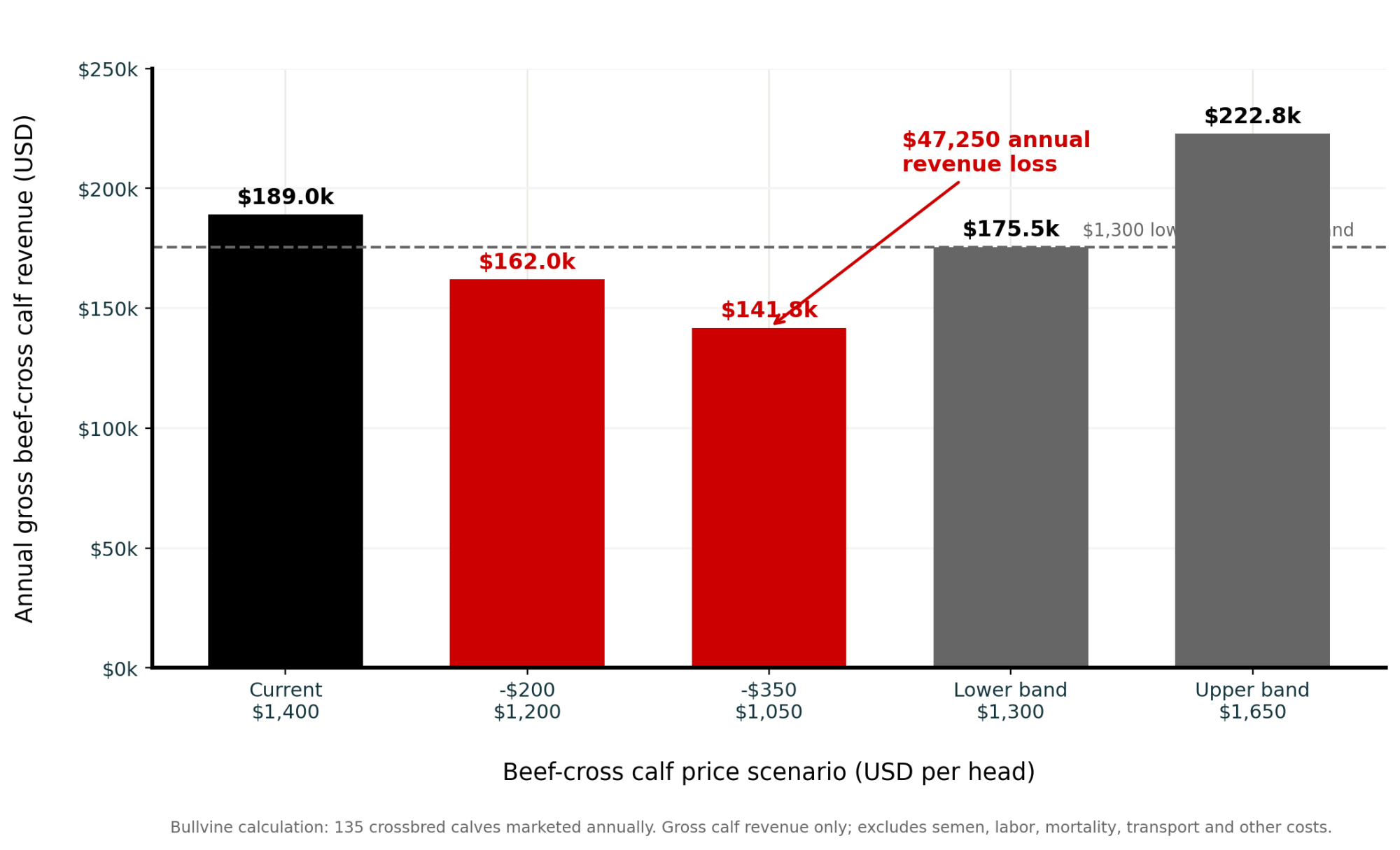
Run it on a 300-cow herd. Breed about half the milking string to beef, and you’re marketing somewhere between 135 and 150 crossbred calves a year once stillbirths and open cows take their cut. Call it 135 at the cautious end. A $200-per-head price drop is roughly $27,000 off the top line over twelve months. Not fatal by itself. Plenty to flip a marginal decision.
Now move the other lever. Push replacement cost from $3,000 to $4,000 a head and your break-even beef-calf price shifts by a few hundred dollars in the same direction, a bigger swing than realistic conception-rate variation produces. Abel puts the number he’s working with at $3,500, and says the beef side is what makes it tolerable: a producer can pay that for a replacement and feel confident, he told DHM, because she’s still worth real money at the end of her milking career. “The value of the beef is providing the cash flow needed to stay competitive.”
Bullvine calculation: our break-even model puts the crossover band at roughly $1,300 to $1,650 a head at today’s replacement costs. The Methodology Note below covers inputs, assumptions, and limits. Not a recommendation for your operation. Run yours.
Then set that band against what Premier reported on September 9. The whole range for beef-dairy crosses topped out at $1,400. That’s the bottom of our band, at one Wisconsin barn, in one week. It doesn’t make a national trend. It does tell you what a real sale looked like four days ago, and which direction to point your own stress test.
Two numbers are doing two jobs here, so keep them straight. Our band tells you whether the calf price still clears the bar. Cabrera’s tiers tell you whether your herd can execute on the strategy at all. That question comes first. For what this kind of line-by-line accounting looks like when someone runs it to the end, the real ROI math at Clark Farms is the closest parallel we’ve published.
One Thing Abel Does That You Probably Don’t
The Abels don’t sell wet calves. They keep ownership from birth in Wisconsin through harvest: Kansas Dairy Development for the first five or six months, then Oshkosh Heifer Development in Nebraska, which they co-own with seven other dairies, then a Nebraska feedlot that finishes them around 15 months.
“We maintain ownership through harvest,” Abel says. It’s also why they didn’t unwind the beef enterprise to fund growth: “The beef business was so profitable for us that we decided not to get out of the beef business to expand the dairy.”
The Retained Ownership Gap
Sale-barn seller, day-old calf. A 100% price-taker. The return is locked at birth and exposed entirely to whatever that week’s local sale barn did.
The Abel model, birth to harvest. Margin is spread across backgrounding in Kansas and custom feeding in Nebraska. A dip in day-old values is one input among several, not the whole return.
Most operations don’t have this structure. It takes scale and partners willing to co-own a heifer development facility, with working capital sitting in cattle for fifteen months. The point is where the exposure sits. We’re not claiming a premium we can’t price, and Abel’s operation isn’t insulated from beef-market weakness.
It meets that market at a different stage, with feeding decisions still in front of it. So if you’re selling day-old, benchmark yourself against his reproduction rather than his returns. That part scales to any herd size.
The Mechanics Behind the Outcomes
Dr. Victor Cabrera at UW–Madison built a decision-support model, presented at the 2021 ADSA meeting and carried in the March 2022 issue of JDS Communications, that calculates income from calves over semen costs, or ICOSC. His team crossed five beef-semen strategies for adult cows, running from zero to 100% in 25-point steps, against six sexed-semen protocols. Thirty combinations, run on a virtual 1,000-cow Holstein herd through a Markov-chain simulation that tracks every animal’s status month by month.
The winners had to clear two bars at once: maximize ICOSC and still produce enough replacements. That second condition is what separates a strategy from a cash grab.
| 21-Day Pregnancy Rate | Winning Sexed-Semen Protocol | Monthly Income Over Semen Cost (1,000 cows) | Operational Viability |
| ~30% (High) | Sexed on first service in heifers only, then 100% beef on cows | $6,215 | Best of the 30 combinations tested |
| ~20% (Medium) | Sexed on heifers’ first and second services, plus first service on first-lactation cows, plus first service on second-lactation cows, then 100% beef | $2,001 | Viable, but the sexed net runs four layers deep to hold the pipeline |
| ~15% (Low) | No tested combination cleared both bars | Negative or minimal | Unviable. Fix reproduction first |
Cabrera, JDS Communications, March 2022. Modeled on a 1,000-cow Holstein herd at 35% turnover and 7% stillbirth, with beef calves priced ~4x a dairy calf and sexed semen ~2.3x conventional. ICOSC measures calf income against semen cost only. It is not net profit and excludes labor, feed, and facilities.
Look closely at that middle row. A 20% pregnancy rate forces you to play expensive defense: breeding first- and second-lactation cows to sexed dairy semen just to keep the heifer pens full. You burn premium straws chasing replacements on adult cows, give up the beef-cross calves those same services would have produced, and still land under a third of the ICOSC a 30% herd generates by putting sexed semen in heifers only. Poor reproduction shrinks the prize and narrows your options for chasing it.
Cabrera watched the industry learn this the expensive way. “We looked at the opportunity, and we were having better reproduction performance, and we used too much beef semen,” he said in a Bullvine profile published in February. “We entered into the problem—which I think now we are coming out of—which was having not enough replacements.” He isn’t arguing against the strategy. “It’s a great economic alternative,” he said. “And looking at the markets in the future, the opportunity seems here to stay.”
Abel Dairy Farms won the inaugural Most Improved ReproStar Award in December 2025, recognizing a herd that improved pregnancy rate by 9% over twelve months to reach 32%. The award comes from CentralStar Cooperative, which also sells breeding products. ReproStar judges rolling 12-month pregnancy rates against published criteria, and CentralStar reports that metric as the 21-day pregnancy rate, the same one Cabrera’s tiers use.
They posted that gain while going from 2,000 cows to 4,500 in three years, a stretch when reproduction usually slips rather than climbs. Nate, working alongside his father, is the seventh generation on that ground. Simplifying systems and streamlining protocols is how CentralStar described the fix. That’s the order of operations most people reverse.
“Run Cabrera’s model against Abel’s numbers and the order reverses. The 32% pregnancy rate is what made the 55% Angus possible.” — The Bullvine’s analysis
One caveat before anyone quotes the ICOSC figures. The model’s beef-to-dairy calf price ratio of roughly four-to-one doesn’t hold everywhere today, with the premium over a Holstein bull calf running closer to two-to-one at a lot of barns. Premier’s September 9 report is a live example: beef-dairy crosses at $950 to $1,400 against most Holstein bulls at $850 to $1,235. The strategy rankings held across a range of market conditions in the sensitivity analysis, but the dollar amounts are five years old. We profiled Cabrera and his UW–Madison lab in February, the group behind most of the replacement optimizers and reproductive calculators this math runs on.
Is Your Beef Semen Going to the Wrong Cows?
UW–Madison producer surveys found 80% of respondents in 2019, and 88% by 2023, preferentially use beef semen on cows that have already failed to conceive to dairy semen. Beef as the consolation round.
The clean comparison numbers look fine. A 2020 USDA-ARS study matching the ten most popular Angus sires against Holstein sires on dairy females found heifers at 53% (Angus) versus 55% (Holstein), and cows at 34% for both.
But the study’s own authors flagged the catch: beef matings pile up disproportionately on repeat-breeder cows, who carry lower fertility for reasons that have nothing to do with which straw you thawed. Your effective beef-side conception rate is likely below the study figure. We looked for published research isolating how many points are lost to that sequencing and came up empty. The literature has a real hole here. When you run your own numbers, use your recorded rate and check whether repeat-breeders dominate the sample.
What Happens If Calves Drop Another $300?
The American Farm Bureau Federation, which represents farm and ranch members, published its read on September 3, 2026: the current tariff waiver amounts to an estimated $650 million reduction in duties for foreign sellers, landing as ranchers sell calves at prices $300 to $400 per head below levels from two months earlier.
Farm Bureau’s figure describes ranch calves rather than day-old crossbreds, so read it as direction rather than forecast for your calf check. But run a $350 slide through a 300-cow herd marketing 135 crossbreds, and you’re looking at roughly $47,250 off the year. It also drops a $1,400 calf to about $1,050, which sits inside Premier’s September range. That’s arithmetic on a published number. Treat it as a stress test.
Be precise about what’s actually law. Two proclamations are in force. The first, signed February 6, 2026, expanded the lean beef trimmings tariff-rate quota by 80,000 metric tons allocated to Argentina. The second, announced August 21 and signed August 26, suspended the 26.4% out-of-quota tariff on up to 300,000 metric tons of lean beef trimmings for 90 days, which runs into late November.
Then, on September 4, President Trump signed two executive orders. One lets ranchers butcher, process, and sell their own product directly. The other directs USDA to review mandatory country-of-origin labeling along with a range of grazing and processing rules. That second order sets a clock worth marking: Section 4 gives the Secretary of Agriculture 90 days, so roughly December 3, to review every statutory and regulatory authority that might permit mandatory COOL for beef, deliver an economic analysis, and then either write regulations or send legislative recommendations.
That’s a review. It doesn’t change any rule yet. Mandatory COOL itself remains unfinished business in Congress, sitting in S.421 from Sen. John Thune and a House companion in H.R. 5818 from Rep. Harriet Hageman. An amendment to fold COOL into the Farm Bill cleared the Senate Agriculture Committee in early August. None of it is law, so don’t build a breeding plan around it. We tracked the waiver’s first week and what it did to the lean trim contract your culls actually compete in, as of August 26.
Options and Trade-Offs
Path 1: Pull your real pregnancy rate, then run the free Wisconsin tool. Do this within 30 days. In DairyComp 305, the command is BREDSUM\E. It gives you the 21-day pregnancy rate and service rate broken out by heat interval. In PCDART, it’s Standard Report 126, the Pregnancy Rate Summary. Use the rolling 12-month figure, not a single cycle, which bounces on one hot week or a tech’s vacation. Then take that number to the Premium Beef on Dairy Program at DairyMGT.info under Tools → Reproduction, built by Cabrera and Wen Li on the model above. Enter your actual rolling 12-month records. Feed it a target pregnancy rate instead of your real one, and the output will flatter you.
Path 2: Fix reproduction before you touch the breeding mix. Risk first, because it’s the honest part: the payoff lands next breeding season, and that’s a hard sell in a fall budget meeting. But near 15%, no tested combination cleared both bars. The answer is transition cow management and fresh cow protocols. CentralStar credited Abel’s 9% gain to simplifying systems and streamlining protocols, so this isn’t theoretical. Split your pregnancy rate into its two levers first: service rate and conception rate. We ran two herds with the same weak number and opposite fixes, and the number alone hides which problem you actually have.
Path 3: Sort which cows get beef semen instead of changing the percentage. This is the Abel approach, and it scales down cleanly. He isn’t running more beef. He’s running sorted beef, with genomic rank deciding who gets sexed dairy. UW–Madison Extension puts genomic testing at roughly $40 per animal, with commercial panels ranging from $35 to $55 depending on the test and your volume. A 300-cow herd can run the same logic on a fraction of Abel’s testing bill. Risk: the cost hits now, the return shows up about two years out.
Path 4: Hold the mix and watch the file. A high replacement cost pushes your break-even higher, which means you can absorb a real calf-price pullback before anything changes. That’s a legitimate position. But you’re taking the policy exposure above with no hedge underneath it, at a moment when the calf-price direction is unfriendly, and the tariff suspension runs into late November. Know that’s the bet you’re making.
Are You Actually Producing Enough Heifers?
The trap here is the lag. Breed a cow this September, and the calf arrives next June. But a replacement heifer bred this fall doesn’t enter the milking string for roughly 24 months. Over-commit to beef, under-build the pipeline, and you won’t find out in the calf check. You’ll find out when the pen is short in 2028.
Abel’s own framing is the tightest version of this. Genomics and sexed semen, he told DHM, “allow you to minimize the number of animals that you need for replacements because you can be more accurate. The rest can go to beef-on-dairy. It allows us to truly right-size our heifer pipeline.” Note the order. Accuracy comes first, and the beef percentage follows.
The Wisconsin tool exists because that cushion is thin. Its replacement-balance output measures the gap between the calves your protocol supplies and the replacements your culling rate demands, month by month. Cabrera’s case herd runs a 35% turnover rate against that 7% stillbirth assumption. Run yours on your real records before you assume there’s slack.
And run it more than once. “If you do that one-time analysis today, your herd demographics are going to change nine months from now when you’re having the calvings,” Cabrera said in the same profile. Count your heifers by age group against your culling rate this month, using the rate your records show rather than the one you’re aiming for. For the structural version of where this pressure ends up, the Bullvine Dairy Curve maps who’s still milking in 2035.
Key Takeaways
The Reproduction Check
- Pull your rolling 12-month 21-day pregnancy rate using BREDSUM\E in DairyComp 305 or Standard Report 126 in PCDART. Not a single cycle. Not your target.
- The research puts a 20% herd at $2,001 a month and still positive. Our read: if you’re drifting below that toward 15%, stop expanding the beef ratio until reproduction turns, because transition and fresh-cow protocols will out-earn straw selection from there.
- If you’re in the 20% tier, expect to run sexed semen deeper into the cow herd than a 30% operation does. That’s what the model’s winning protocol required, and it’s the cost of weaker reproduction nobody prices in.
The Pipeline and Inventory Math
- Audit your replacement balance on Cabrera’s DairyMGT tool to confirm the pipeline covers culling, then re-run it when your demographics shift. His case herd assumes 35% turnover and roughly 7% stillbirths. Enter your real numbers.
- If replacement cows are running $3,130 nationally and $3,320 in Wisconsin, test whether beef calves clearing under $1,300 cover the gap between what a replacement costs and what her cull check returns. That spread is what the calf revenue has to fund.
The Market Reality
- Pull your own barn’s last three market reports before you assume the premium held. At Premier Livestock in Withee, beef-dairy crosses ran $1,200 to $1,910 in February and $950 to $1,400 on September 9. One barn, seven months, $510 off the top.
- If you sell at one to fourteen days, your entire return is set in a single transaction with no feedlot margin behind it. Farm Bureau’s $300 to $400 per head decline describes ranch calves rather than day-old crossbreds, so read it as direction and stress-test accordingly.
- Mark two dates. The 90-day tariff suspension signed August 26 runs into late November. USDA’s COOL review under the September 4 order is due around December 3. Both land after your fall semen order is placed.
- Whatever you lock in over the next six to eight weeks is the mix you’re living with through most of 2027.
Where Does Your Number Actually Sit?
The uncomfortable part isn’t that the math is hard. It’s that the tool has been sitting there free since 2021, built on a beef-to-dairy calf ratio the market has since compressed, while the calf itself went up five or six times and has now started coming back down. That makes the strategy look bulletproof right up until your pregnancy rate says otherwise. Copy the breeding mix without the reproductive program, and you’ve taken the visible half of a two-part decision.
So what does your ICOSC come back as when you feed it your real pregnancy rate instead of the one you’d like to have? And if that answer surprises you, is it the semen order that needs changing, or what’s happening in the fresh pen?
Pull the number this week. Then decide. Next, we’re building the full sensitivity grid: break-even by herd size, replacement cost, and conception rate, with every assumption exposed so you can stress-test ours against your own. Bullvine Weekly subscribers get it first. And for the other half of this equation — what a replacement really costs once you count the cull check on the far side — the 127-day gap in cull-cow decisions is where that math lives.
Run Your Numbers
Pregnancy Rate Economics Calculator — Cabrera’s model tells you which tier you’re in. This one puts a dollar value on climbing out of it: what one point of pregnancy rate is worth in your herd, what the repro program costs to get there, and whether heats, conception, or transition health is the bottleneck. Advanced mode takes sexed semen value and beef-on-dairy premiums as inputs.
Methodology Note — The Bullvine break-even band
Published evidence: milk cows sold for dairy herd replacement at $3,130/head (USDA NASS Agricultural Prices, quarterly series, April 2026, U.S. national average; Michigan $3,360, Wisconsin $3,320); day-old calf prices from USDA AMS National Dairy Comprehensive Report, month ending August 31, 2026; Premier Livestock, Withee, Wisconsin, market reports of February and September 9, 2026; Ohio auctions via Farm and Dairy weekly livestock markets, August 2026; conception rates 53%/55% heifers and 34%/34% cows (USDA-ARS, McWhorter et al., 2020); genomic testing $35–$55/animal (UW–Madison Extension).
Stated assumptions: 95-pound day-old calf for per-head conversion; 300-cow herd with roughly half the milking string bred to beef; 135 crossbred calves marketed annually, the cautious end of a 135–150 range after applying the 7% stillbirth rate used in Cabrera’s model.
Bullvine math: the $1,300–$1,650 crossover band is our calculation on those inputs. It has not been published or peer-reviewed elsewhere, and it is not derived from Cabrera’s ICOSC model, which answers a different question. The Premier comparison is a single barn across two dated reports, not a regional index.
Limits: the band moves with replacement cost, which is the dominant input. It also assumes every one of those 135 calves reaches the sale. The 7% stillbirth rate comes from Cabrera’s model, but the band carries no post-natal death loss and no transport or yard shrink, so treat it as a floor rather than a midpoint. Any calf mortality or weight loss between the hutch and the ring pushes your real break-even above the band. National and regional averages may not reflect your operation, and your recorded conception rates, heifer-raising cost, and local calf premiums will all move where your own line sits.
Learn More
- 21-day pregnancy rate: two herds, opposite fixes — Isolates whether your herd’s reproduction bottleneck is heat detection or cow fertility before you spend a dime on hormones, using DairyComp diagnostic commands to unlock a six-point gain worth up to $36 per cow annually.
- $585 a Straw: What Every Beef Service Really Costs Your Next Heifer — Exposes the hidden $117,000 replacement penalty 500-cow herds surrender by over-breeding beef against $3,100 springers, arming you with the Bullvine Pipeline Index to cap beef matings before heifer deficits force emergency market purchases.
- 67% Conception Rates: The 140-Day Heifer Breeding Strategy That’s Changing Everything — Leverages extended voluntary waiting periods to capitalize on primiparous milk persistency, delivering up to $1,380 in additional profit per animal while slashing first-lactation involuntary culling down to 10%.
 The Sunday Read Dairy Professionals Don’t Skip.
 The Sunday Read Dairy Professionals Don’t Skip.
Every week, thousands of producers, breeders, and industry insiders open Bullvine Weekly for genetics insights, market shifts, and profit strategies they won’t find anywhere else. One email. Five minutes. Smarter decisions all week.