







Treasury moved the 45Z manure math on September 8. On 2,000 cows, “25% of the credit” pays US$187,800 or US$82,700 depending on one undefined word. Which one does your contract use?
Notice 2026-53, issued September 8, splits dairy manure from swine in the 2026 45Z emissions rate table and ties the carbon intensity to a farm’s own pre-digester manure practices — practices a taxpayer must substantiate or lose the avoided emissions entirely. Dairies holding feedstock agreements signed before that date carry the exposure, since those contracts allocated a number that didn’t exist yet. On the conservative yield, gross credit runs US$188 per cow at low CI and US$563 at high. Bullvine’s own cascade math traces where it goes: the fixed US$150,000 of transaction costs leaves a farm with 24% of its nominal quarter-share at low CI against 51% at high.
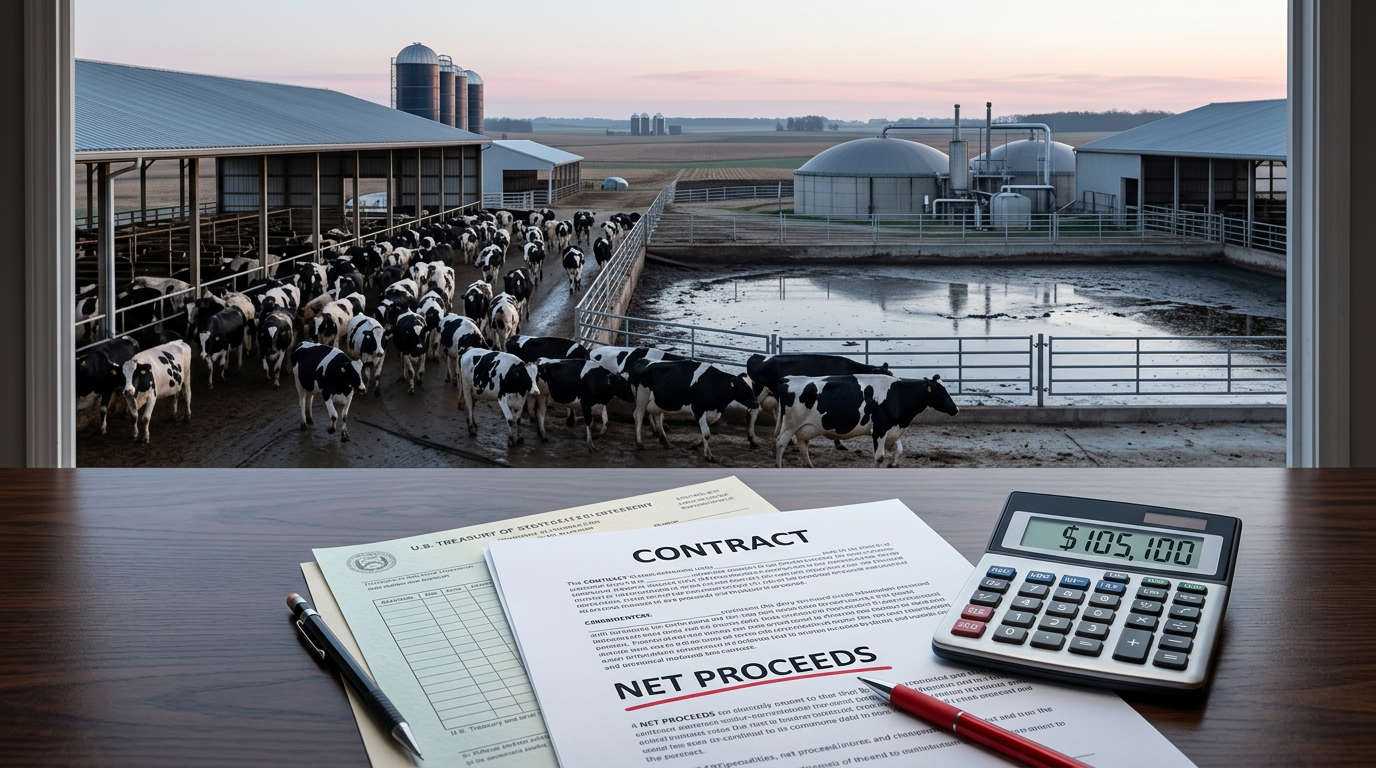
The Internal Revenue Service issued Notice 2026-53 on September 8, 2026, and it does something no earlier guidance did. The carbon intensity behind the 45Z manure digester credit in 2026 can now turn on your own farm’s prior manure management practices, and the notice states that a taxpayer who cannot substantiate those practices “will not have avoided emissions included in the 45ZCF-GREET model for such farm’s portion of the taxpayer’s manure inputs.”
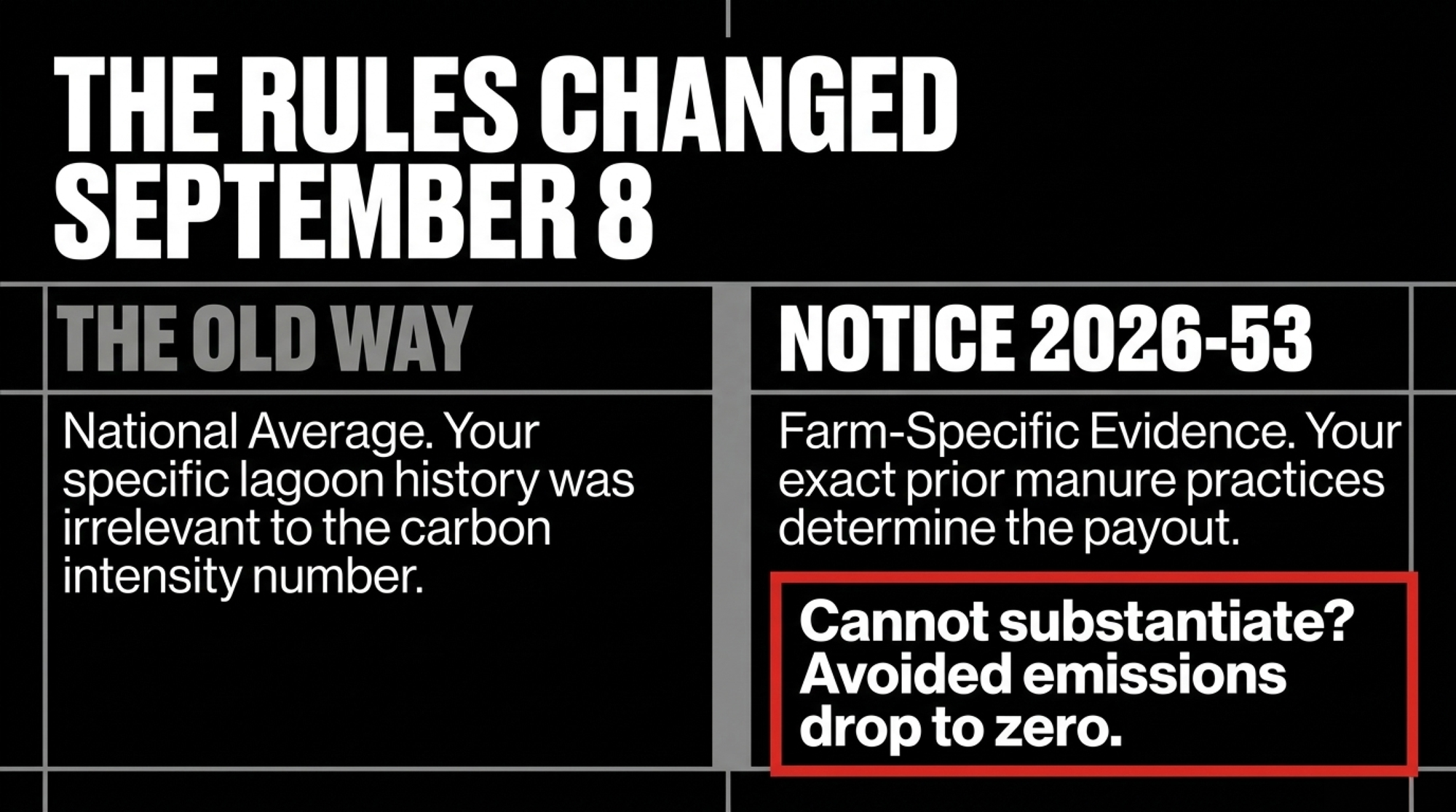
Not reduced. Not averaged to a national default. Not included.
That is the reframe. Under the prior approach, manure-derived gas leaned on an alternative fate built from the national average of all animal waste management practices, which made your own lagoon history irrelevant to the number. The notice replaces that averaging with your farm’s documented practices, and states the averaging approach is incompatible with the statute for fuel produced after 2025.
The “Paper Baseline” Trap
The maximum-exposure operation is specific: a large herd with a genuine pre-digester uncovered lagoon, a signed agreement assigning environmental attributes, and no indexed file proving what that lagoon handled. Physical baseline strong, paper baseline thin, contract silent. Leverage sharpens it — an operation carrying the digester on its own borrowing has less room to walk away from a bad clause than one hosting a developer-owned system on a lease.
The same notice adds U.S. dairy manure and U.S. swine manure as separate primary feedstocks in the calendar-year 2026 emissions rate table, for fuel produced after December 31, 2025 only, and confines the old generic animal-manure row to fuel produced before January 1, 2026.
The prevailing-wage multiplier: 4.95×
For all transportation fuel produced and sold in calendar 2026, IRS Notice 2026-41 sets two amounts on a 2026 inflation adjustment factor of 1.0929:
| Applicable amount, 2026 sales | Per gallon gasoline equivalent |
| Base amount | 22 cents |
| Where the qualified facility meets prevailing-wage and apprenticeship requirements | US$1.09 |
Same gas, same lagoon, same model. A workforce compliance question moves the credit by a factor of 4.95. The per-cow effect is in Running the Numbers, below.
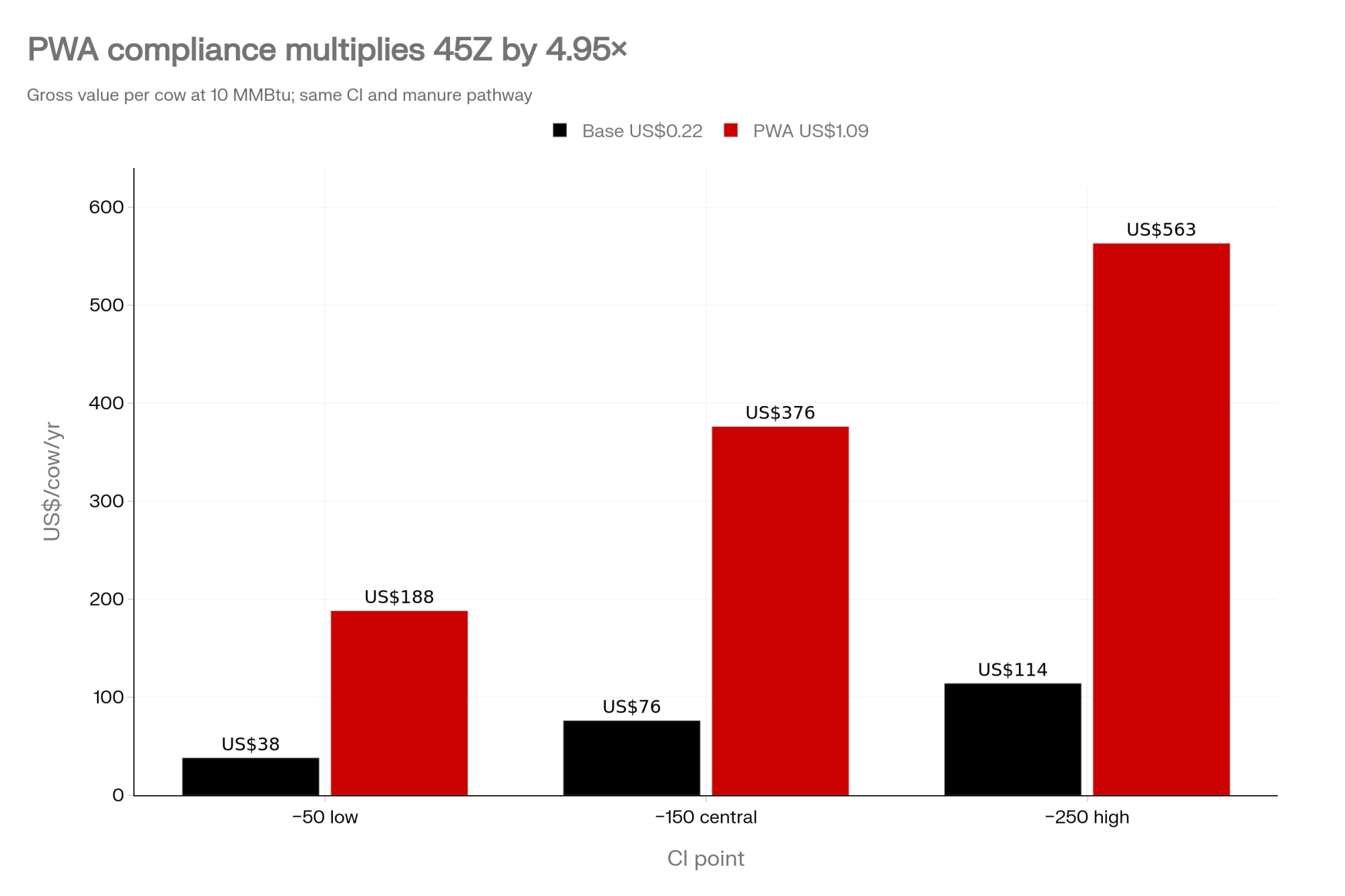
Manure is also the one feedstock that keeps a negative emissions rate after 2025. Every other pathway gets floored at zero.
So US$1.09 is not the ceiling. It is the multiplier, and for manure the emissions factor can run above 1.0.
What the two documents establish, and what they don’t
Notice 2026-53 is guidance, effective on and after September 8, 2026. The DOE document is the September 2026 revision of the 45ZCF-GREET guidelines, which now display separate life-cycle results for fuel produced in 2025 and fuel produced after December 31, 2025. The regulations at 91 F.R. 5160, published February 4, 2026, are proposed and not in force. Anyone treating §1.45Z-2 as settled is running ahead of the record.
The mechanism, in the notice’s own terms. A taxpayer determines a distinct emissions rate by entering the number of animals by type and the share of manure managed under each prior practice in place immediately preceding the earlier of two dates: the commencement of digester operation, or September 8, 2026. Where manure went off-site, the commencement date is when the farm first began diverting to any off-site digester. A digester counts as operational once it starts capturing, using, or destroying biogas after a start-up period that cannot exceed nine months.
Recognized prior practices include uncovered lagoons, deep pits, liquid/slurry, pasture/range/paddock, dry lot, and solid storage. A farm, for this purpose, is any animal feeding operation with or without a nutrient management plan.
Two limits matter for anyone building. A farm that begins operations after September 8, 2026 gets no farm-specific alternative fate until Treasury issues further guidance; the notice says a new farm “could be incentivized to select the highest emitting practices on startup.” Poultry and beef manure pathways are anticipated rather than published, and the notice tells those producers to wait rather than petition for a provisional emissions rate.
What neither document contains is a dairy CI figure. The 2026 table names the feedstock and directs you to the most recent 45ZCF-GREET version. The number comes out of a workbook run on your animals, your prior practices, your gas.
Running the Numbers
Bullvine calculation. Gross statutory 45Z value on modeled dairy RNG, before any contract sharing.
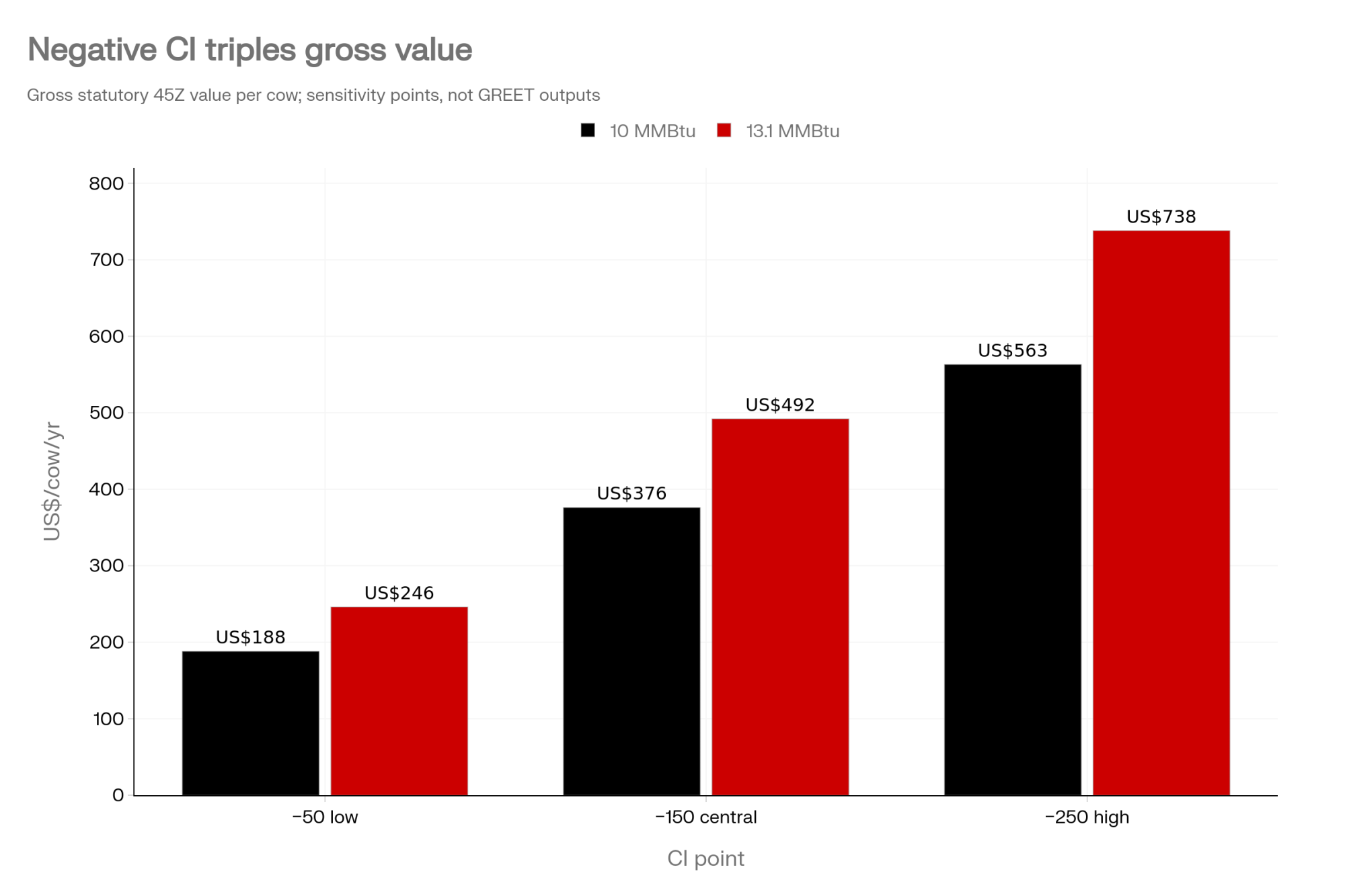
Methodology note — two inputs, stated separately.
- Yield spread, MMBtu per cow per year. NREL’s 2021 case study of the Aurora Organic Dairy High Plains Complex in Gill, Colorado (NREL/BR-6A50-80381) modeled 170,322 MMBtu of upgraded RNG a year from 13,000 cows: 13.10 MMBtu per cow. Bartlett & West, an engineering and consulting firm working on biogas projects, puts the figure nearer 10 MMBtu per cow in its producer guidance — a consultancy estimate rather than an agency or peer-reviewed figure, used here only as the conservative bound. That is a 31% spread on the single input every dollar below depends on, so the tables run on the conservative 10, and NREL’s modeled result appears as the upper bound. Both are models; neither is your barn, and regional climate, bedding, solids separation, and digester type all move it.
- Statutory conversion and brackets. 116,090 Btu per GGE on a lower-heating-value basis per the DOE September 2026 guidelines, giving 8.614 GGE per MMBtu. Applicable amount: US$1.09/GGE, 2026 sales, prevailing-wage and apprenticeship conditions met. Emissions factor (50 − CI) ÷ 50, rounded to the nearest 0.1 under §45Z(b)(2). The three CI values are stated sensitivity points chosen to bracket the arithmetic — not 45ZCF-GREET outputs, and no dairy should treat them as its own result.
(Swipe horizontally to view all herd sizes.)
| Sensitivity CI (kg CO2e/MMBtu) | Emissions factor | Gross per cow, 10 MMBtu | Gross per cow, 13.10 MMBtu | 500 cows | 1,500 cows | 4,000 cows |
| −50 (low) | 2.0 | US$188 | US$246 | US$93,900 | US$281,700 | US$751,100 |
| −150 (central) | 4.0 | US$376 | US$492 | US$187,800 | US$563,400 | US$1,502,300 |
| −250 (high) | 6.0 | US$563 | US$738 | US$281,700 | US$845,100 | US$2,253,400 |
Herd columns run on the conservative 10 MMBtu yield. At NREL’s modeled yield, they rise about 31%.
Arithmetic at 500 cows, central, conservative yield: 500 × 10 = 5,000 MMBtu, × 8.614 = 43,070 GGE, × US$1.09 × 4.0 = US$187,800. Swap to the 22-cent base amount and the low case drops to US$38 per cow.
What a missing nutrient management plan costs. Take the 2,000-cow model at central sensitivity on the conservative yield: US$751,100 of gross statutory credit. The negative CI driving that number comes from avoided methane, and the notice excludes avoided emissions entirely for an unsubstantiated farm’s share of manure inputs. Remove that contribution and the emissions rate moves toward and past the 50 kg CO2e/MMBtu eligibility ceiling, where the emissions factor reaches zero, and the credit attributable to that farm’s manure goes with it. Exposure runs from a partial reduction up to the full US$751,100, depending on where the model lands. That range is directional and bounded by the arithmetic above, not a model output. The bottom of it is not a haircut.
Take the conservative row and hold it. US$188 per cow per year of gross federal credit rides on a calculation that sits inside a workbook the dairy usually never sees.
Does my feedstock contract still price the 45Z manure digester credit right?
Probably not, and bad faith is not required to get there. These agreements were drafted to allocate RINs, LCFS credits, and gas revenue. One publicly filed RNG interconnection agreement defines environmental attributes to reach every attribute, compliance credit, benefit, emission reduction, offset, and allowance arising from the gas, whether it exists at signing or comes into being afterward. Public company disclosure describes biogas projects secured through long-term gas rights, manure supply agreements, and property leases. Trade guidance has flagged compensation and environmental incentives as critical manure-supply terms since 2022.
None of it anticipated a federal calculation that pays for documented lagoon history.
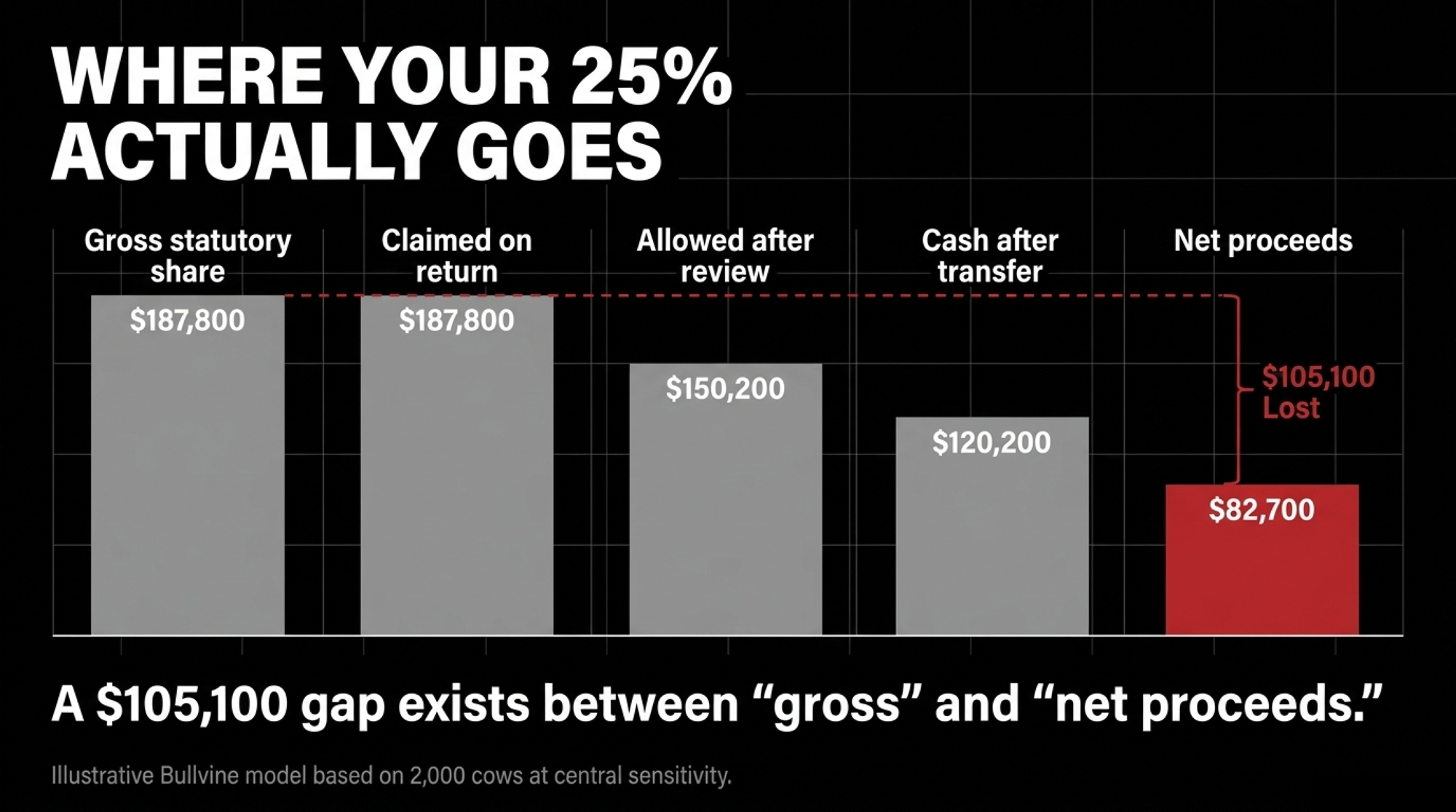
Bullvine calculation — the credit-definition cascade. One modeled 2,000-cow herd, central sensitivity CI, conservative yield, PWA met, gross statutory value US$751,100. The contract says the dairy gets 25%.

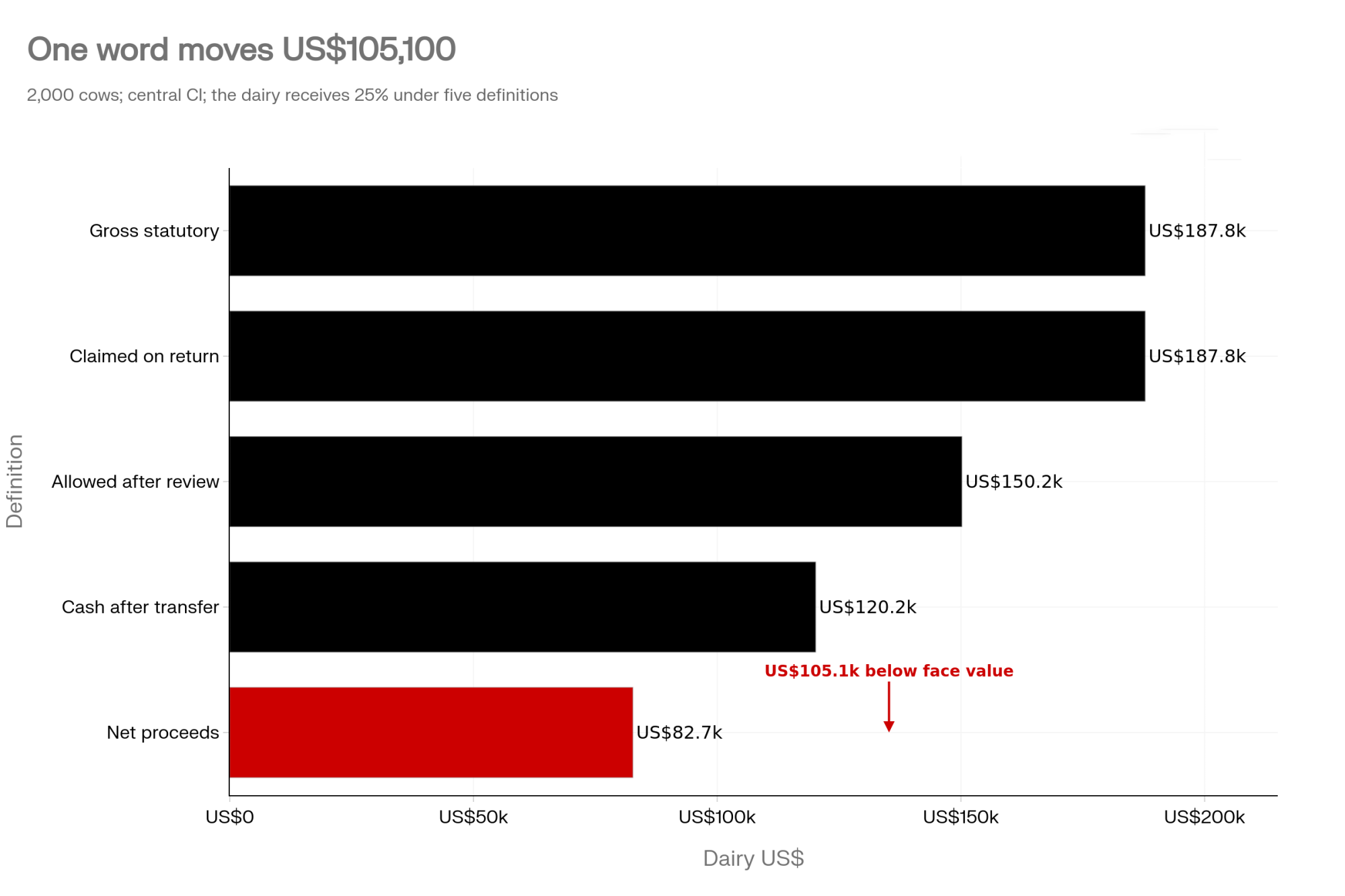
| What “the credit” is defined as | Producer’s figure | Dairy’s 25% | Gap vs. face value |
| Gross statutory credit | US$751,100 | US$187,800 | — |
| Credit claimed on return | US$751,100 | US$187,800 | US$0 |
| Credit allowed after substantiation review | US$600,900 | US$150,200 | US$37,600 |
| Cash after credit transfer | US$480,700 | US$120,200 | US$67,600 |
| Net proceeds after defined deductions | US$330,700 | US$82,700 | US$105,100 |
Illustrative Bullvine model — not a project payment.
Assumptions, stated plainly: 20% of the claimed credit disallowed or reserved, 20% transfer discount, and US$150,000 of contract-permitted third-party costs covering brokerage, credit insurance, tax counsel, verification, and an indemnity reserve. These are scenario assumptions built to test one contract phrase.
Run the same cascade at all three sensitivity points and something worth knowing falls out.
| Sensitivity CI | Gross statutory credit | Dairy’s 25% of gross | Dairy after the full cascade | Share of nominal payment retained |
| −50 (low) | US$375,600 | US$93,900 | US$22,600 | 24% |
| −150 (central) | US$751,100 | US$187,800 | US$82,700 | 44% |
| −250 (high) | US$1,126,700 | US$281,700 | US$142,800 | 51% |
Illustrative Bullvine model — not a project payment.
2,000 cows, conservative yield, same disclosed assumptions at every row, US dollars. At NREL’s modeled yield, the central row’s gap widens to US$126,060.
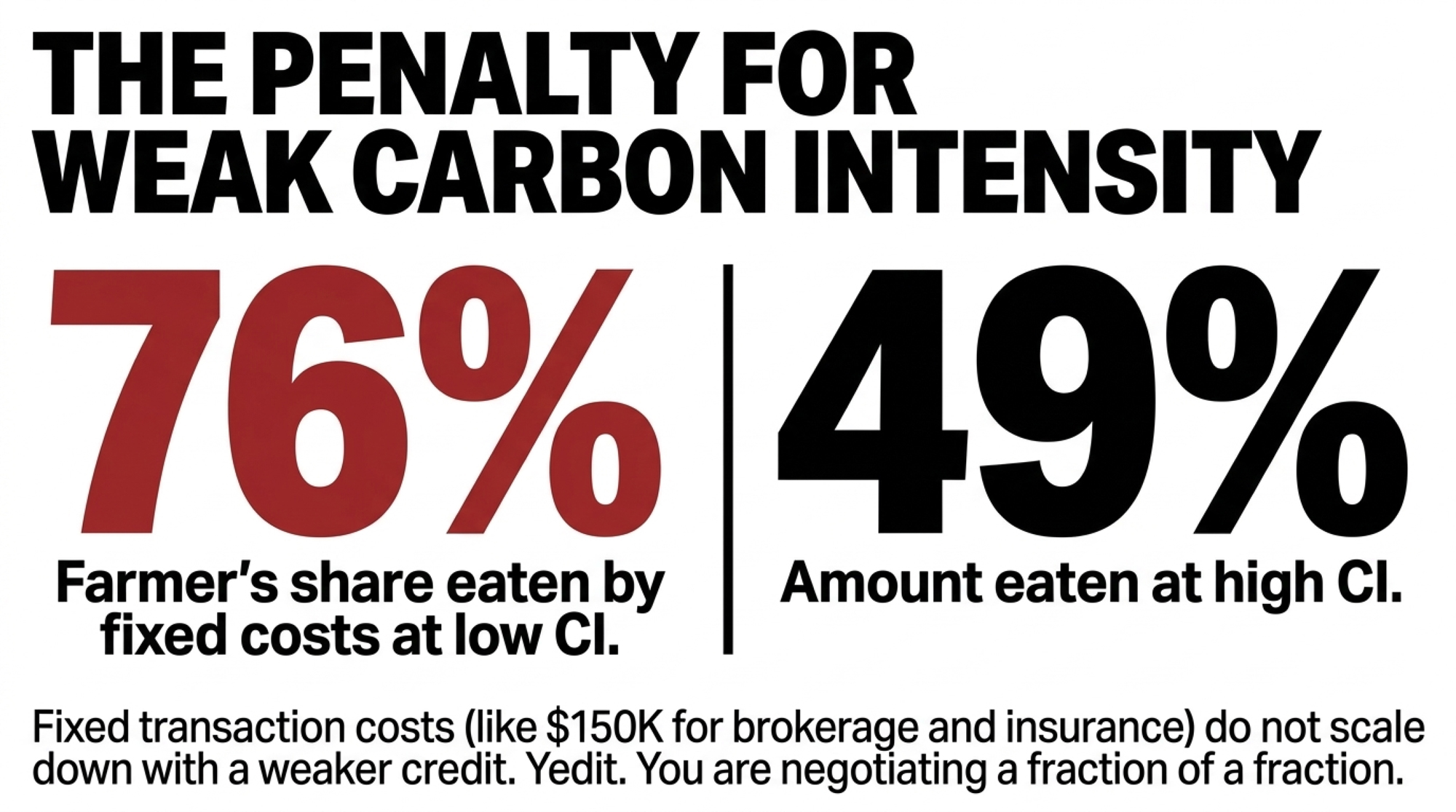
The fixed US$150,000 is what does that. Percentage deductions scale with the credit; transaction costs largely don’t. So the weaker your project’s carbon intensity, the more of your nominal quarter-share those fixed costs eat — 76% of it at the low row against 49% at the high row. A farm negotiating a percentage of net proceeds on a modest-CI project is negotiating for a fraction of a fraction.
The 2,000-cow figure is a modeling convenience. It describes no actual operation, none of the percentages above is drawn from any real agreement, and no real developer’s conduct is described or implied.
The percentage never moved. The denominator did.
Why your old paperwork is now an asset, not an errand
Here is the part of Notice 2026-53 that runs in your favor, and it hasn’t been said plainly anywhere yet.
The taxpayer claiming the credit is generally the fuel producer rather than the farm. The proposed regulations would define that producer as the party processing the gas until it is interchangeable with fossil natural gas, and those regulations are not final. What the notice does put beyond argument is where the substantiation burden sits: the taxpayer must be able to substantiate the farm-specific prior manure management practices “for all collected manure” where those data establish the alternative fate. Fail, and the model carries no avoided emissions for that farm’s portion of the manure inputs.
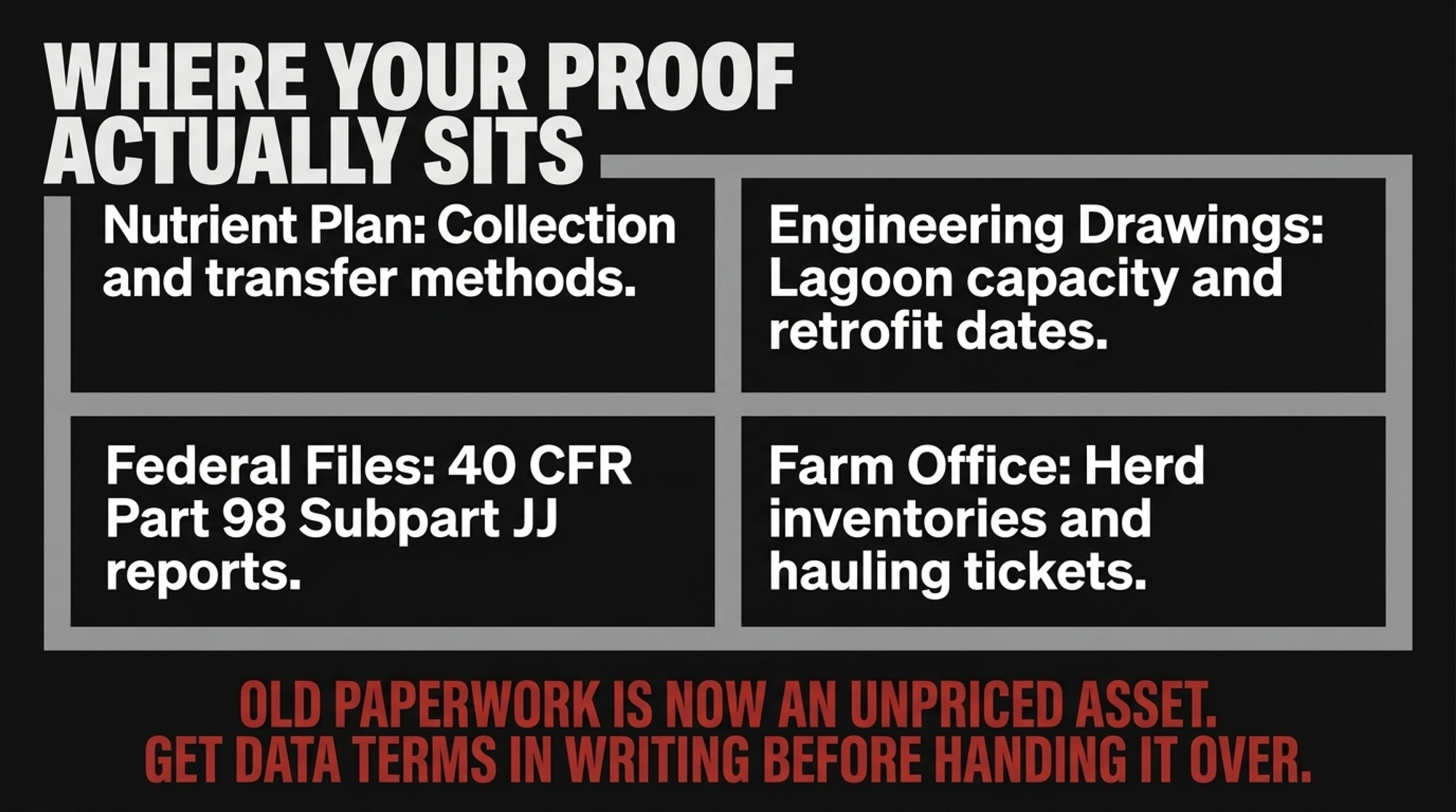
Read that against the cascade. The producer’s negative-CI position on your manure rests chiefly on inputs your farm’s history supplies — animals by type, and the share managed under each prior practice at the cutoff date. Your nutrient management plan, your engineering drawings, your herd inventories, and, where you report under 40 CFR Part 98 Subpart JJ, the manure-fraction allocation you already file. Documents you built for a permit fight or a lender, now sitting upstream of a federal tax calculation.
That is a negotiating position, and it has a shelf life. Where your agreement doesn’t already compel disclosure on terms set before September 8, 2026, the records are an asset you still control the pricing of. Where it does compel disclosure, the price of that cooperation was fixed before this calculation existed, which is its own argument for reopening the clause rather than filling the request.
Two cautions, because leverage cuts both ways. Check what your agreement already obligates you to provide before you treat the file as unencumbered — many do. And a developer may be able to reconstruct part of the baseline from public permits, agency files, or its own engineering record, so the position is strong rather than absolute.
One correction to our own file, while the cascade is still in front of you. Bullvine’s May 19, 2026 analysis, $80M on her land, $0 in carbon credits, reported dairy manure RNG carbon intensity as “often −250 to −270 g CO2e/MJ,” and used it to explain why the credit stack on a herd’s manure was worth more than the gas. That framing is now retired for tax purposes. Post-2025, dairy stands as its own feedstock, and the number depends on your animals and your documentation rather than a range that travels between farms.
The contract conclusion from that piece held up better than the CI number did. Curtis Creek Dairy in Newton County, Indiana had its cows, manure, and ground sitting behind a 15-to-25-year supply contract recorded against the property, with the developer holding the LCFS and RIN stack, according to that reporting. Whether that structure serves the operation well is a question only its own numbers can answer, and we make no claim either way. What it shows is the mechanism: where a supply agreement assigns the credit stack and carries no revision clause, later federal methodology changes accrue to whoever holds the attributes.
No executed feedstock agreement was made available to Bullvine for this analysis. The clause questions below are drawn from the primary documents, not quoted from any contract.
What records do I need to prove my old lagoon?
The ones describing the farm you ran before the digester, tied to animal counts and manure shares at the notice’s cutoff date.
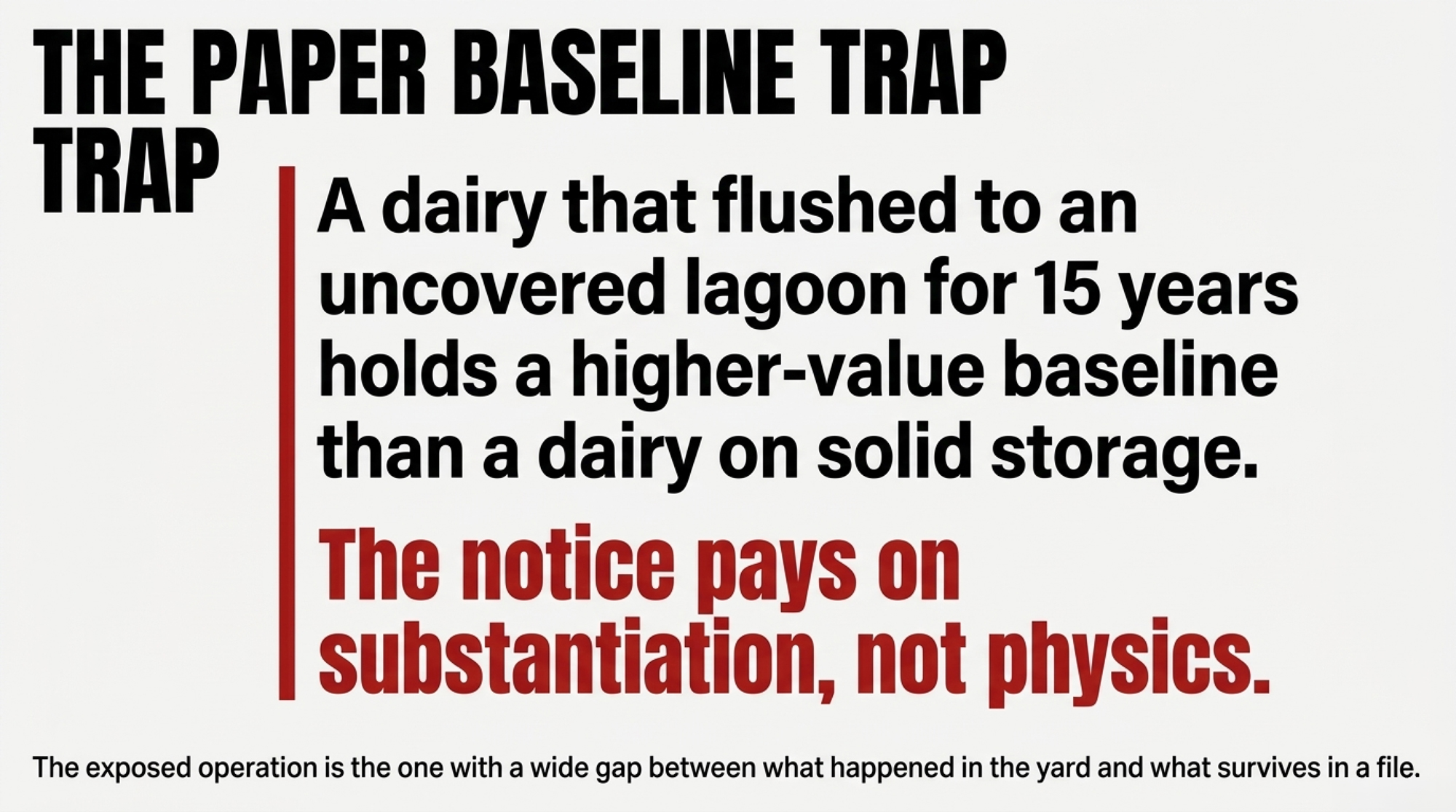
Here is the part that runs against intuition. A dairy that flushed to an uncovered lagoon for fifteen years holds the higher-value baseline, while a dairy on solid storage and daily spread holds a weaker one. The notice pays on substantiation rather than physics. So the exposed operation is the one with the widest distance between what happened in the yard and what survives in a file.
Where that file usually sits:
- Your nutrient management planner — the plan nearest the cutoff, describing collection, storage, and transfer. EPA requires NPDES-permitted CAFOs to implement nutrient management plans.
- Your engineer — lagoon drawings, capacity, pipelines, separator layout, construction and retrofit dates. NRCS Conservation Practice Standard 359, Waste Treatment Lagoon, October 2017, requires the lagoon be planned, designed, and constructed to documented specifications.
- Federal reporting files — 40 CFR Part 98 Subpart JJ, as currently codified, requires operations that report under it to determine the fraction of total manure by weight managed in each on-site system component. That is the closest existing analog to what the model now asks for, and if you file it, you are further along than you think.
- Your own office — herd inventories by class, pumping logs, hauling and custom-applicator tickets, invoices, dated photographs. Before you hand over a page of it, get the data terms in writing: what the records may be used for, who else sees them, whether they leave with the developer if the project is sold, and how the credit value they support is attributed and paid. Send copies, keep originals, and log what went where and when.
- The developer — delivery volumes, meter data, digester start-up date. Rarely your historical baseline.
Aerial imagery proves a lagoon existed. It does not prove what share of manure from which animal class reached it, and that gap is where a claim gets thin.
What This Means for Your Operation: The 90-Day Playbook
Next 30 days — establish the record
- Find the attribute clause. Pull the executed agreement, not the term sheet, and mark every reference to environmental attributes, tax credits, carbon intensity, GREET, and change in law. Requires the signed original and all amendments. Urgent once the producer starts assembling its 2026 return. Backfires if you negotiate from a summary against language that isn’t in the document.
- Read your own data obligations before you read anything else. Find what the agreement already requires you to hand over, on what notice, and at whose cost. Requires the same executed copy. Urgent before any records request arrives. Backfires if you treat the file as yours to price when the contract already committed it.
- Send one written request. Ask for the model version, your farm-specific inputs, the output CI and emissions factor, the volume attributed to your manure, and the provision governing what happens if your records raise the credit. Requires an email and a deadline. Backfires on verbal assurances, so get it in writing.
- Date your cutoff. Use the earlier of digester commencement or September 8, 2026, and, for off-site digestion, the date manure first left the farm. Requires start-up records and first delivery tickets. Backfires if you assume your longest-running system is the relevant one.
- Red-flag trigger: if the agreement pays a percentage of net proceeds and does not define permitted deductions in a schedule you can read, this moves to the top of the list today. On the low-CI row above, that structure returns 24 cents of every nominal dollar.
Next 90 days — build and price the file
- Index the evidence before you buy any of it. Mark every model input as documented, corroborated, estimated, or unsupported. Requires your planner, your engineer, and someone who knows the pre-digester manure flow. Urgent ahead of any filing. Backfires if you fund forensic reconstruction before knowing whether the contract shares what it produces.
- Price any new offer against a benchmark. One from our earlier work: if a developer-owned offer clears under about US$80 per cow per year in avoided costs on your own numbers, look harder at what the manure is worth before signing. Requires your own cost figures for bedding, hauling, storage, and nutrient value. Urgent before signature, not after. Backfires if you treat a benchmark as a valuation, because a single number cannot price your site, your gas, or your term.
- Negotiate the uplift term. Ask for a share of the gross incremental credit attributable to your substantiated alternative fate, measured against a baseline run with all other inputs held constant, before discounts and deductions. Requires your lawyer and your accountant, plus roughly two weeks of turnaround. Backfires if you demand a percentage without demanding the controlled comparison that proves the increment.
- Split the attribute schedule. Separate 45Z from RINs, LCFS value, and voluntary claims rather than leaving one undefined bundle. Backfires into an anti-double-crediting problem you created by selling the same molecule twice.
Next 365 days — reposition
- Preserve your own data room. Keep originals, share dated copies, log what went where. The opportunity signal sits here: a dairy with a clean indexed historical file becomes the preferred feedstock partner in a market where substantiation now sets the credit.
- Put a true-up in writing. Same formula on the way up and the way down, tied to credit allowed or cash received, surviving termination. Backfires if the clause recovers developer losses from you but never shares developer gains. Watch for a reserve that never releases.
The same discipline that priced a twelve-month Wisconsin permit stall at US$2.14M against a US$96K legal billapplies here, and the file you built for that fight is now part of a tax file. On the ration side, the arithmetic behind the US$73-a-cow gap on a 2027 Bovaer contract is worth rerunning too, because feed and bedding changes move feedstock chemistry and can move CI with it.

The number check before you sign anything
Notice 2026-53 did not make every dairy contract unfair. It made the value of every dairy contract’s silence visible, and silence is what most of these agreements say about a calculation that didn’t exist when they were signed.
Put your agreement on the table and answer five questions in writing. Which GREET version does it name? Who elects a later version released during the production year? Is your percentage applied to gross statutory credit, credit allowed, transfer cash, or net proceeds? Who pays to retrieve the historical records? Who absorbs an IRS adjustment three years out?
If your contract cannot answer all five, you do not have a price for your manure. You have a placeholder.
Then ask the developer the question that settles it: if my old lagoon records increase your 45Z value, show me the clause that pays me for that increase, and if there isn’t one, show me the clause that says I must spend money finding them.

Key Takeaways
- “Net proceeds” is where the money goes. Four contract definitions of the same word — gross statutory, claimed, allowed, net of deductions — produce a US$105,100 spread on a modeled 2,000-cow herd.
- Fixed transaction costs hit hardest where the carbon intensity is weakest. A farm keeps 24% of its nominal quarter-share at low CI against 51% at high, because the US$150,000 doesn’t scale down with the credit.
- Records built for a permit fight or a lender are now tax-file inputs. The taxpayer must substantiate a farm’s pre-digester practices for all collected manure, and where it can’t, that manure contributes no avoided emissions at all.
- The window that matters is the one just before your digester started, not your longest-running system. Fix the earlier of digester start-up or September 8, 2026, and check what your contract already obligates you to hand over before you price the file as yours.
45Z Dairy Manure Credit & Cascade Calculator
IRS Notice 2026-53 ties 45Z value to farm-specific lagoon history. Calculate your gross statutory credit and test what remains after contract deductions and transaction fees.
| Contract Definition of “The Credit” | Project Total | Dairy Share () | Gap vs. Face Value |
|---|---|---|---|
|
Gross Statutory Credit
Raw model output before filing adjustments
|
$751,100 | $187,800 | — |
|
Credit Allowed After Review
After audit reserves and substantiation holdbacks
|
$600,900 | $150,200 | -$37,600 |
|
Cash After Transfer Discount
Actual cash realized on transfer market
|
$480,700 | $120,200 | -$67,600 |
|
Net Proceeds (After Fixed Deductions)
What your check actually is if contract says “Net Proceeds”
|
$330,700 | $82,700 | -$105,100 |
Methodology and corrections: credit values here are estimates built on the assumptions and sensitivity points shown, in US dollars, for fuel produced and sold in calendar 2026. This is not tax, accounting, or legal advice — eligibility, registration, emissions modeling, transferability, and contract ownership require review by qualified advisers. Modeled figures may not reflect your region, herd size, digester configuration, gas yield, or contract terms. If your agreement is structured differently, or your own 45ZCF-GREET runs land somewhere else, send us the numbers and we’ll report what they show. Factual corrections: contact the editor through The Bullvine’s contact page and we’ll publish a visible correction note.
Learn More
- The Carbon Credit Goldmine: How Forward-Thinking Dairy Producers Are Turning Methane Reduction into Cash Flow — Arms you with farm-level verification protocols to audit baseline data, dodge developer pitfalls, and capture up to $450 per cow annually in verifiable compliance-market revenue.
- The Carbon Credit Programs Every Dairy Should Join Before 2026 — Exposes aggregator fee traps eating 15% to 50% of nominal value, comparing high-retention insetting splits against long-term compliance market contracts before programmatic rules reset.
- Stop Chasing Feed Fixes: Why Genetic Methane Solutions Deliver 30% Greater ROI Than Additives — Dismantles recurring $150–$300 annual additive expenses by proving permanent genomic selection redirects lost feed energy directly into milk components while cementing permanent baseline emission reductions.
 The Sunday Read Dairy Professionals Don’t Skip.
 The Sunday Read Dairy Professionals Don’t Skip.
Every week, thousands of producers, breeders, and industry insiders open Bullvine Weekly for genetics insights, market shifts, and profit strategies they won’t find anywhere else. One email. Five minutes. Smarter decisions all week.




