








University of Minnesota proved selective dry-cow therapy saves $7.83 a cow and cuts antibiotics 55% — but it only pays if you kept the one record most farms wipe off by Friday.
Executive Summary: University of Minnesota research clocked algorithm-guided selective dry-cow therapy at a 55% cut in antibiotic use at dry-off and a net $7.83 a cow — that’s roughly $3,900 a year on 500 cows and close to $7,800 on 1,000, dropping straight to your bottom line with no measured hit to udder health, milk, or culling. The catch is the one most farms miss: it only works if you kept clean per-cow SCC and clinical-mastitis records, and Guelph found fewer than half of producers log every treatment. That whiteboard in your treatment pen — wiped by Friday — is the gap, and it’s the same gap a processor will eventually ask you to fill. As EU antimicrobial-use rules tighten toward a 50% cut by 2030 and premium buyers like Danone already lean on documented stewardship, the well-run farm with no record sits in the same hole as the careless one. The fix runs in three moves: log every treatment at the cow this month, sit down with your vet to read what it says about your protocols, then pilot SDCT if your bulk tank holds under 250,000 SCC. Start in 2026 and you’ll have four years of your own proof by 2030. Start later and you’re rebuilding it under a contract deadline.
Aidan Connolly has spent his career at the intersection of animal agriculture and technology, and as president of AgriTech Capital, he watches where the money and the data are heading. This June, in a Forbes Tech Council column, he put his finger on a gap most of us stopped noticing: medication is still barely recorded on modern farms, and that hole quietly drags down learning, consistency, productivity, and welfare. The sensors around the cow keep getting smarter. The record of what we actually do to her hasn’t moved in decades.
Look at the whiteboard in your treatment pen right now. A tag number, a drug, a date in dry-erase marker. Gone by next week. Stack that up across every cow you treat this year, and you’re staring at the single biggest data gap on most dairies — and it’s costing you money, market access, and the one thing your vet has never had: proof of what actually works on your cows.

What’s Actually Breaking
We track nearly everything else to the decimal. Feed in, milk out, rumination, activity, heats — all digital, all crunched. The treatment itself? Marker on a board, or nothing at all. Connolly’s point is that medication shouldn’t be a one-and-done event you scribble down for compliance and forget. Catch it at the moment the needle goes in, tie it to that individual cow’s health and production, and it stops being a chore and becomes a number you can learn from.
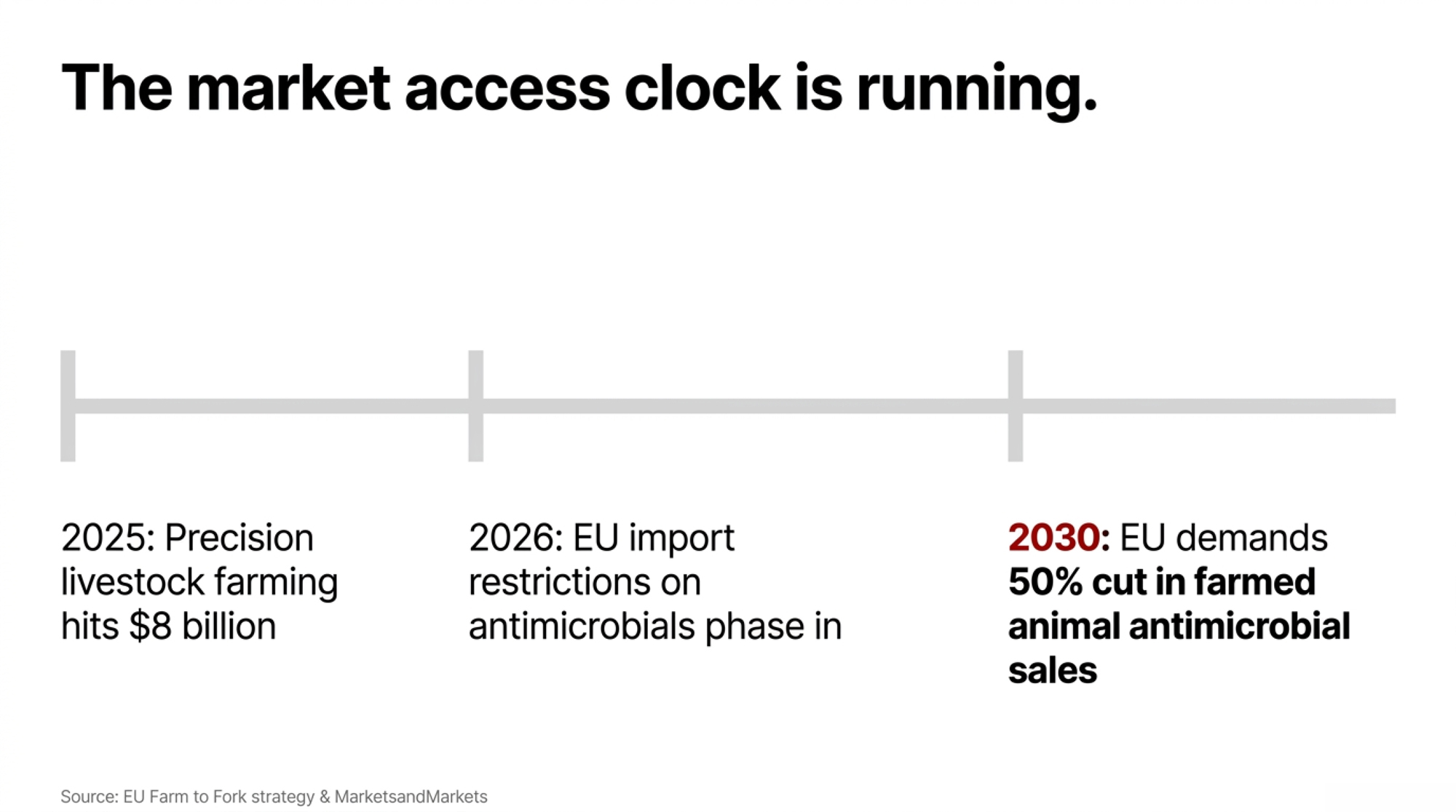
And the clock’s running. The European Union has a legally binding target to cut antimicrobial sales for farmed animals 50% by 2030 under its Farm to Fork strategy. On this side of the Atlantic, two programs keep tightening their documentation rules with every revision: the U.S. FARM Antibiotic Stewardship program and, in Canada, proAction. Meanwhile, the precision livestock farming market is projected to grow from nearly $8 billion in 2025 to over $12 billion by 2030, according to MarketsandMarkets. That money isn’t flowing toward farms that are still undecided about data.
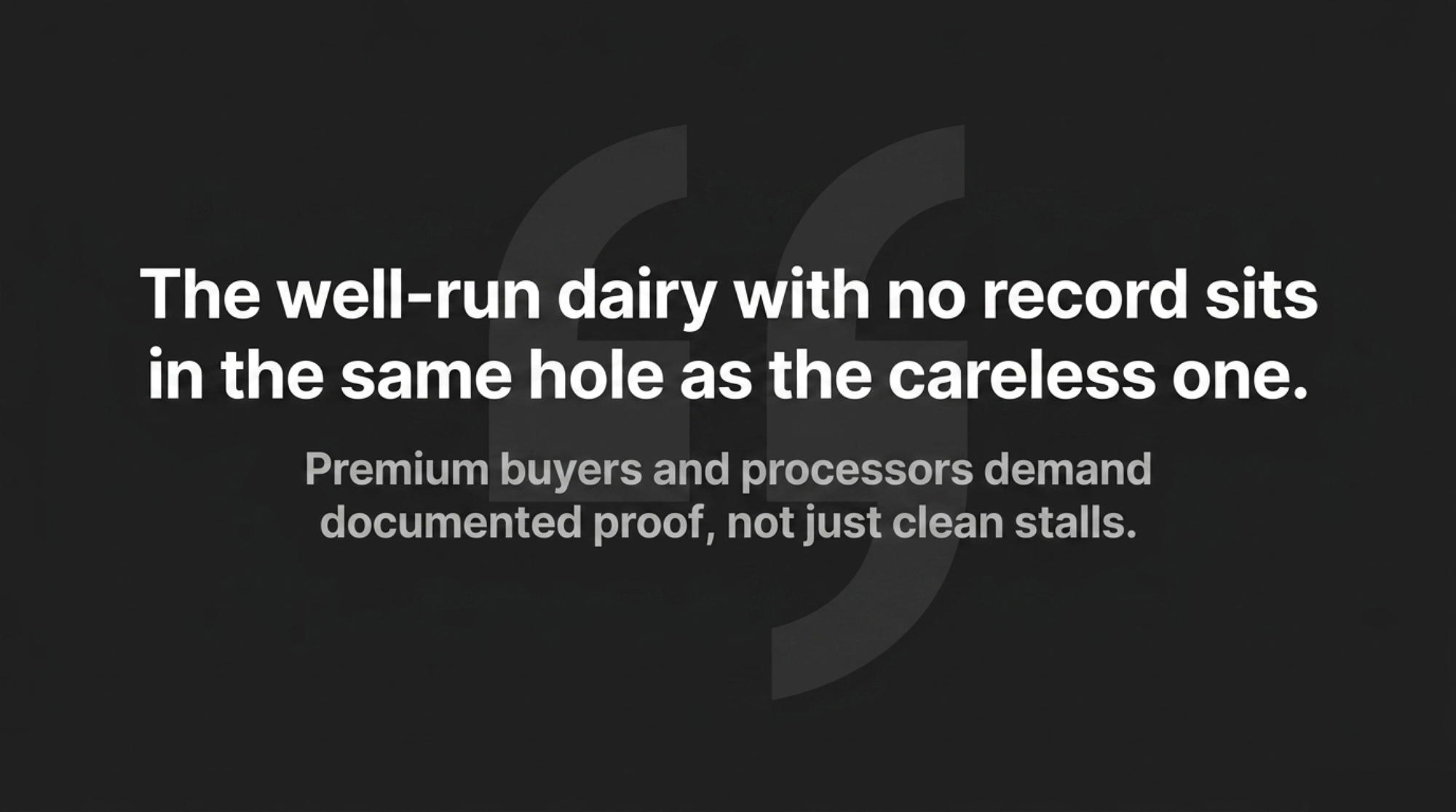
Here’s the part that stings. The most exposed operations aren’t the sloppy ones — they’re the clean farms running on a whiteboard. When a processor asks for antimicrobial use records as a condition of the contract, and the premium buyers are already drifting that way, the well-run dairy with no record sits in the same hole as the careless one. The proof that should have separated them was never written down.
How This Plays Out in the Barn
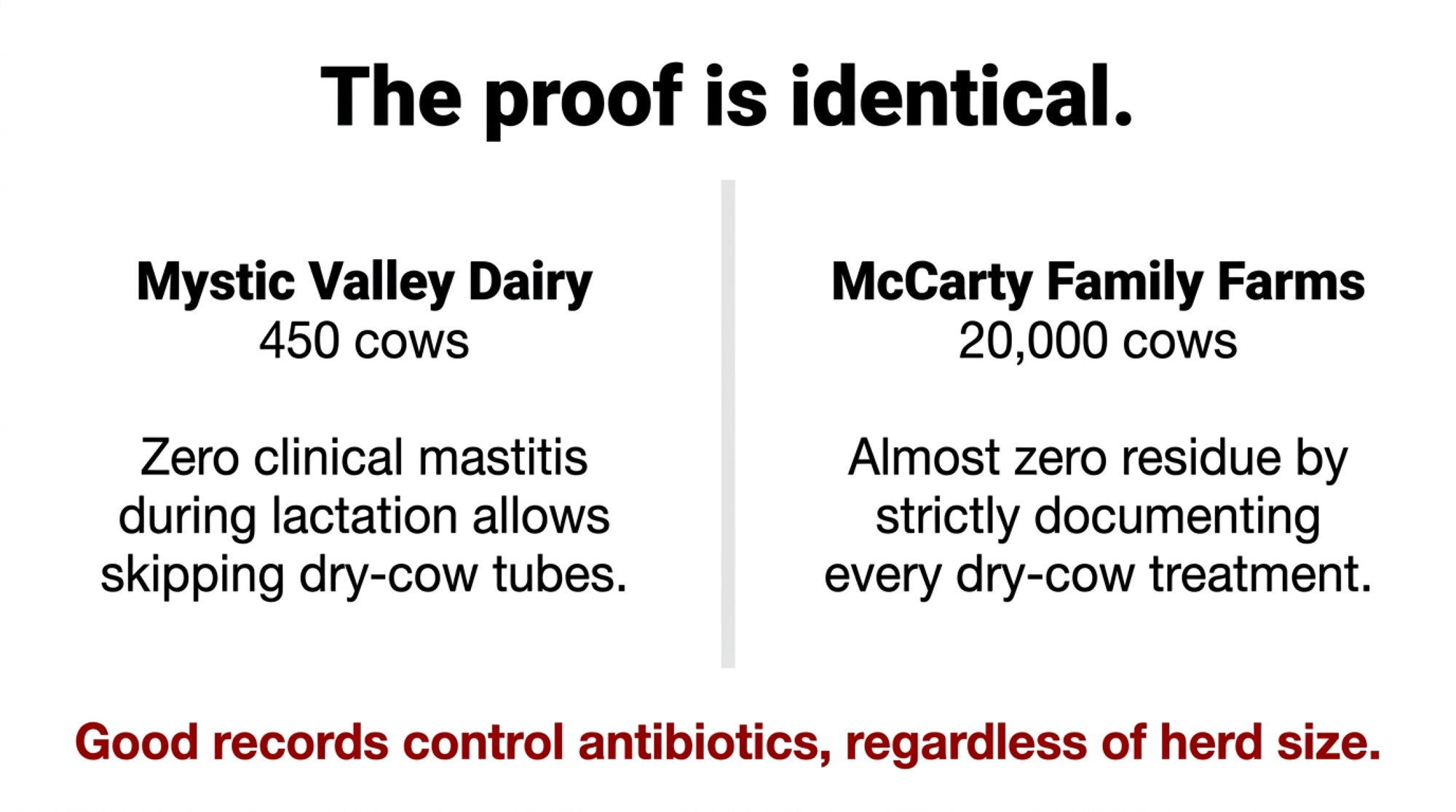
Take Mystic Valley Dairy in Sauk City, Wisconsin — about 450 registered Holsteins, bulk tank SCC running a tight 70,000 to 90,000 cells/mL. When The Bullvine profiled the farm’s move toward selective dry-cow therapy, owner Mitch Breunig didn’t lean on instinct. He leaned on records: three straight individual SCC tests under 200,000, no clinical mastitis during lactation, no flagged problem quarters before a cow ever qualified to skip a dry-cow tube. That’s the whole game in one farm. The decision is only as good as the per-cow history feeding it.
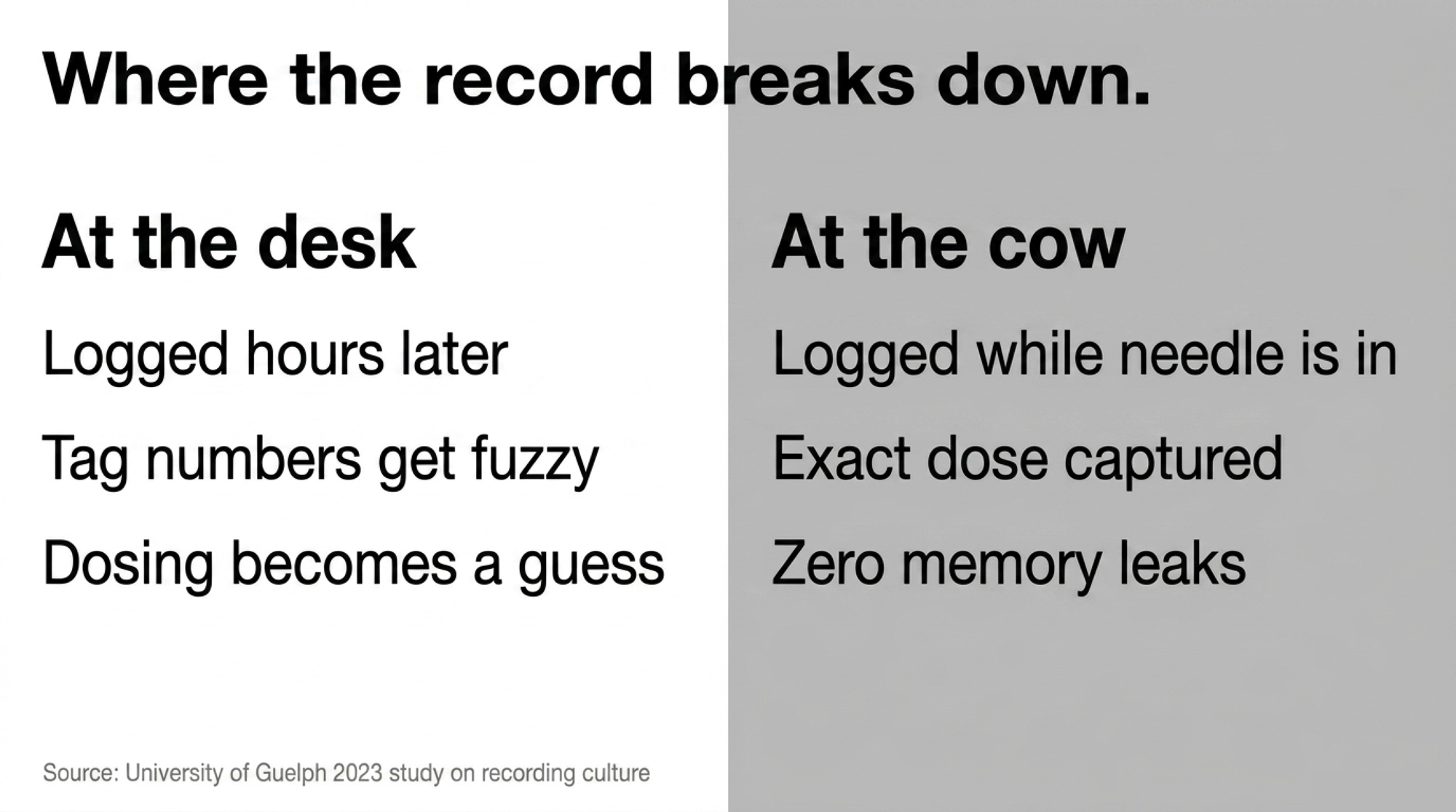
Most farms aren’t there yet, and the University of Guelph put numbers to why. A 2023 study of Ontario dairy farms found fewer than 25% of producers consistently recorded all calf illnesses, and fewer than half documented every antimicrobial treatment given to calves — a pattern researchers tied to the farm’s broader recording culture. These weren’t lazy operators. They had a feedback problem: when nothing useful came back from the records, the reason for keeping them fell off a cliff. The fix producers asked for most was simple — a system easy enough to use at the cow, in the barn, not back at the house.
Now look at the top end of the scale. McCarty Family Farms, the fourth-generation operation based in Rexford, Kansas, milks roughly 20,000 cows across several dairies and ships to Danone. “We have limited the potential milk residue antibiotics that we use on the farm to almost zero,” Ken McCarty told The Bullvine. “Those that we do use are tightly controlled, typically at one location that is not a milk-producing site — our dry cow and calving facility.” Mystic Valley runs 450 cows, McCarty runs 20,000, and the thing that lets both control antibiotics is identical: records clean enough to trust.
| Metric | Mystic Valley Dairy (WI) | McCarty Family Farms (KS) | Undocumented Farm — Same Quality, No Record |
|---|---|---|---|
| Herd size | ~450 registered Holsteins | ~20,000 cows (multi-site) | 500–1,000 cows (typical) |
| Bulk tank SCC | 70,000–90,000 cells/mL | Not published (Danone-certified) | <200,000 (self-reported) |
| SDCT eligibility | ✅ Qualifies — 3 sub-200k SCC tests required per cow | ✅ Tightly controlled dry-cow protocols | ❌ No per-cow SCC history to qualify |
| AMU documentation | Per-cow, per-lactation | Facility-specific, near-zero residue policy | Whiteboard — wiped by Friday |
| Processor relationship | Direct regional markets | Danone supply contract | Standard commodity — no premium tier |
| Proof for processor AMU audit | Ready | Ready | Cannot produce |
| Market access risk (2026–2030) | Low | Low | 🔴 High — same hole as careless farm |
What Does Logging at the Cow Actually Look Like?
Here’s where most record systems die: they ask the person holding the syringe to remember the treatment and enter it later, somewhere else. The Guelph data is blunt about why that fails — when producers logged treatments back at the house rather than in the barn, the records weren’t made. Time and memory both leak. A cow gets treated at 6 a.m.; by the time anyone sits at the office computer, the tag number’s fuzzy, and the dose is a guess.
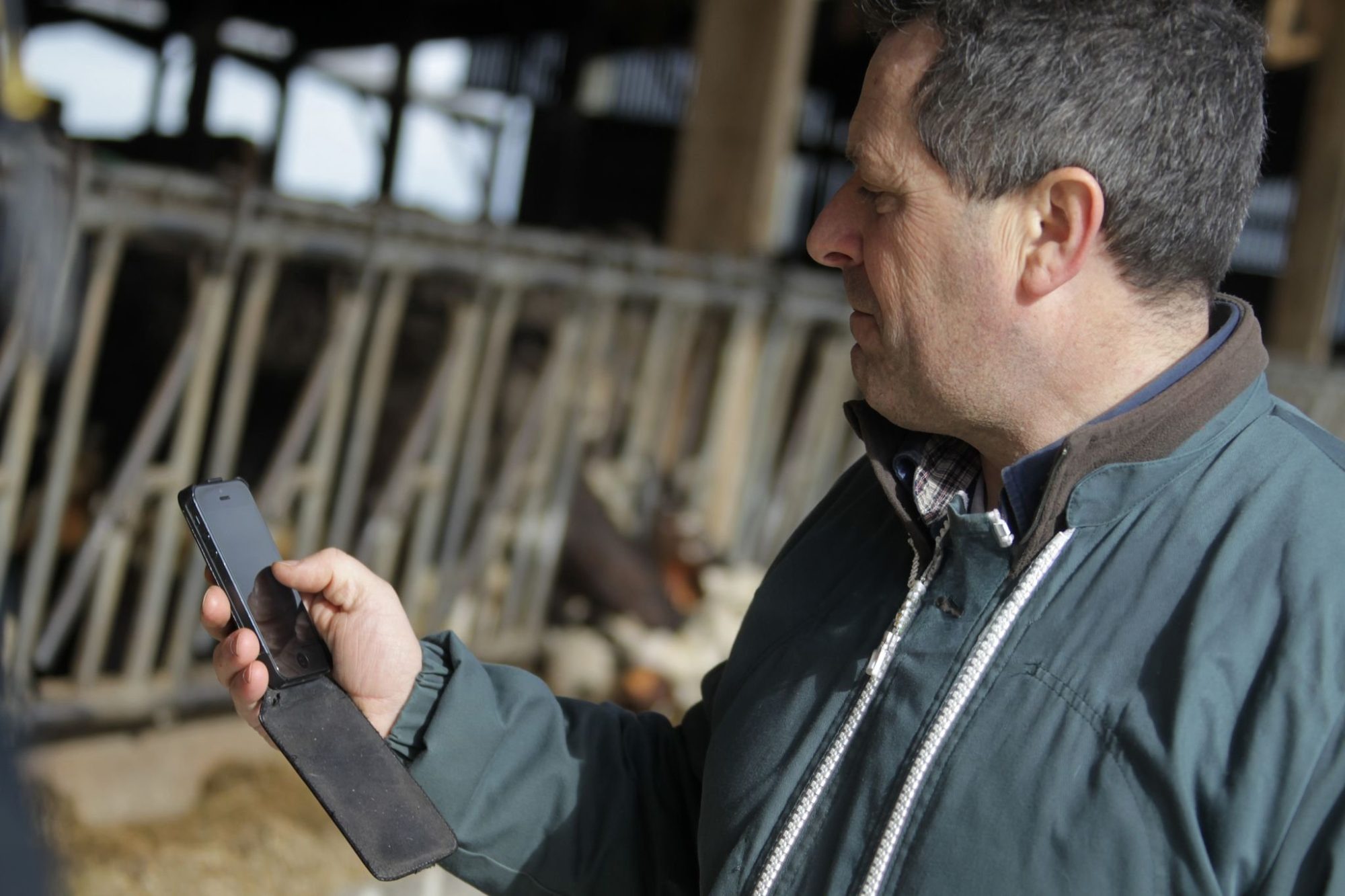
Point-of-administration logging flips the order. The record gets made while the needle’s in the cow, on whatever’s already in the treatment person’s pocket. A phone or a rugged tablet at the headlock, a few taps: tag, drug, dose, route, days in milk. Some systems integrate directly with the herd-management software you already run, so the treatment is recorded on that cow’s individual record without anyone re-keying it. The behavioral fix matters as much as the tech — Guelph found the two things producers most wanted were a mobile app they could reach at the cow and a system simple enough that it didn’t slow the job down.
Think about who’s actually doing the treating on your farm. On a lot of operations, it’s not the owner — it’s a herdsperson, a relief milker, an employee whose first language might not be English. The record only survives staff turnover if it’s idiot-proof and lives in one place. Build it around the person with the syringe, not the person at the desk, and you get a treatment history you can actually trust six months later. Skip that, and you’re back to the whiteboard — and the whiteboard forgets.
Why Has Your Vet Been Flying Half-Blind?
The real prize here isn’t compliance. It’s the feedback loop your herd-health vet has never actually had.
Right now, your vet recommends a protocol, drives off, and finds out how it went six months later through bulk tank numbers. No per-cow signal comes back. Flip that. With treatments logged at the point of care — tag, drug, dose, days in milk — your vet walks in with a real question instead of a hunch. Research on veterinary herd-health management keeps running into the same wall: vets want to move from firefighting sick cows to proactive advising, but they lack compiled, analyzable farm data to anchor the conversation. Clean treatment records knock that wall down.
Picture a concrete one. You’ve been treating clinical mastitis with the same intramammary protocol for two years. With logged records, you and your vet can finally split the outcomes: cows treated before day 10 of the case versus after, this pathogen versus that one, first-lactation versus mature cows. Maybe your early-treatment cure rate is strong, and your late catches are dragging the average down — which isn’t a drug problem, it’s a detection problem, and the fix is cheaper monitoring, not a more expensive tube. You can’t see any of that on a whiteboard. The record is what turns “I think this works” into “here’s what works on our cows.”
The cows make the dollar case themselves. A single bout of metritis costs an estimated $329 to $386, and a 2021 peer-reviewed study put the median loss even higher — around $398 per case once you factor in milk losses, reproductive failure, and culling risk. That same research found treated metritis cows ran about 10 percentage points lower on pregnancy rates at 300 days in milk than healthy herdmates. And published clinical mastitis cure rates range from 25% to 98%, depending on the study. That spread is useless for making any decisions on your farm. The only way to know where your cows land is to build your own dataset, one treatment at a time. (For the management side, here’s how to assess your own SDCT readiness rather than relying on averages.)
What’s the Saving Actually Worth on Your Farm?
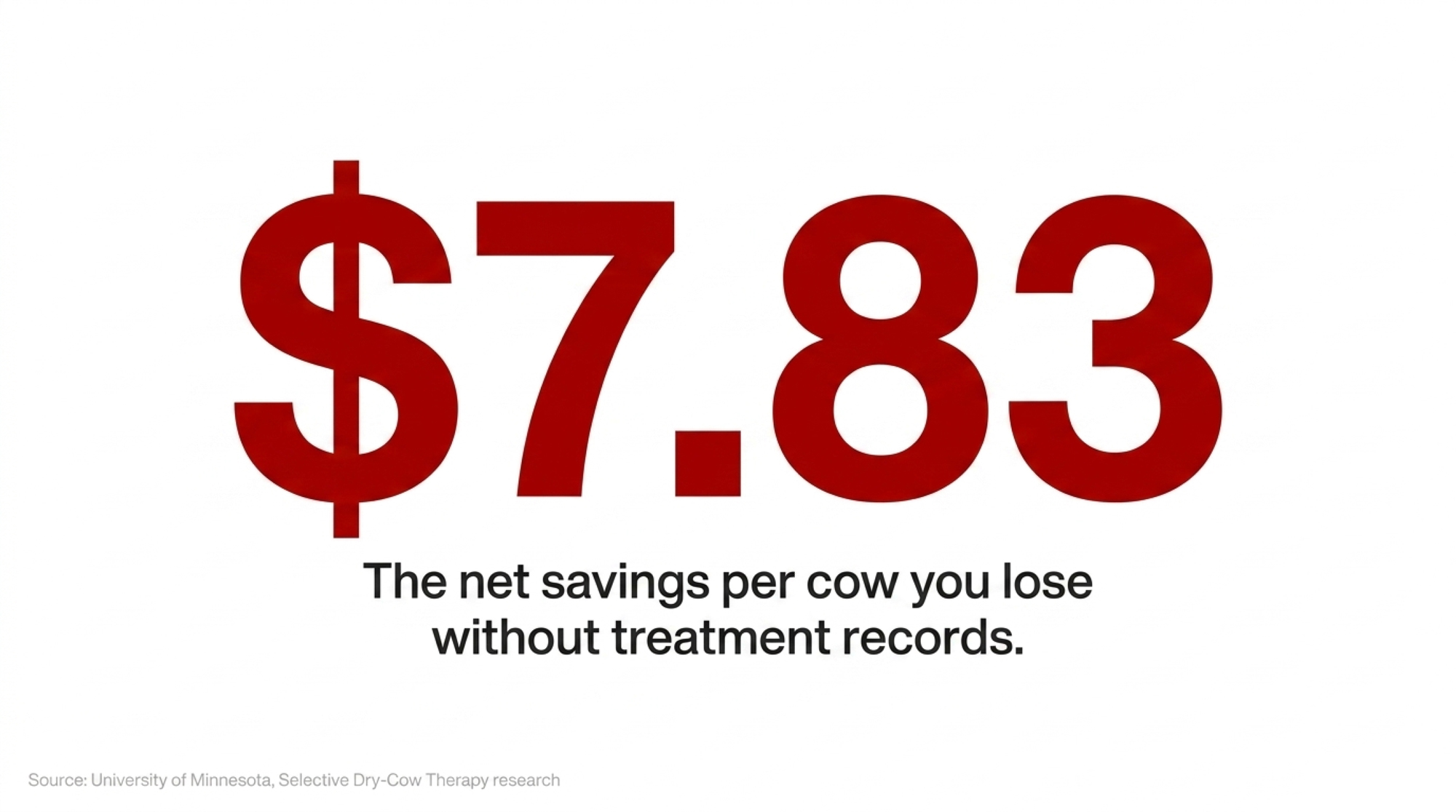
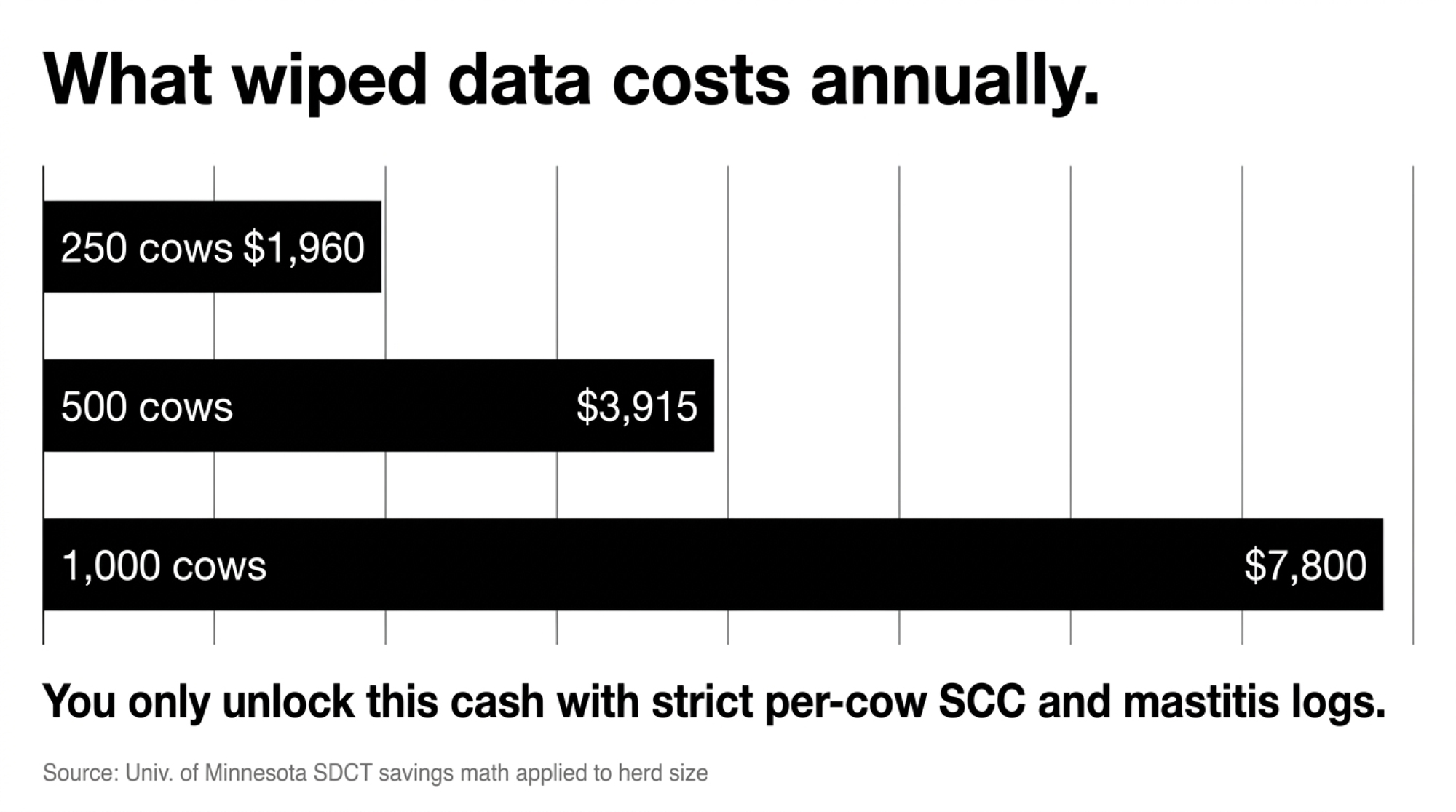
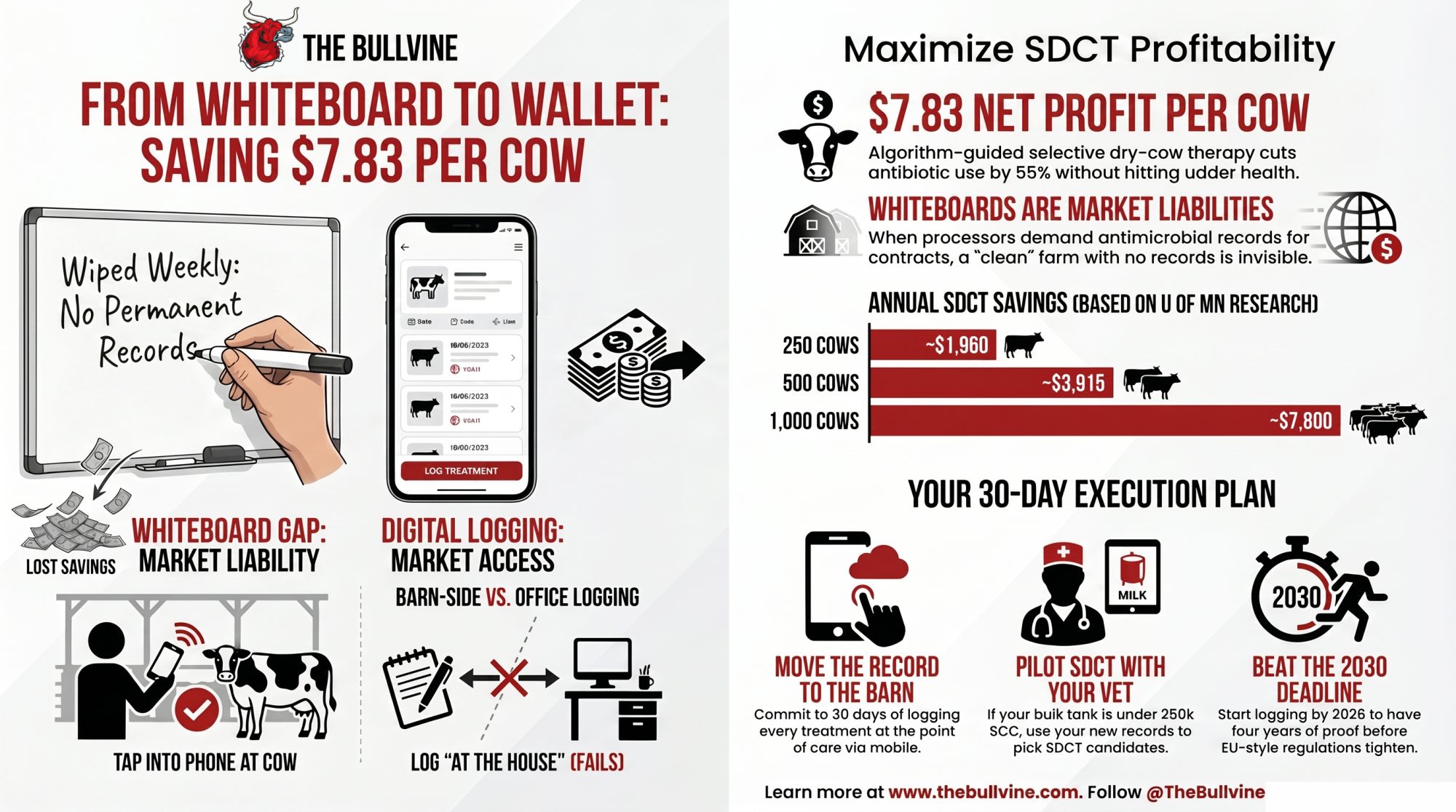
University of Minnesota research found that algorithm-guided selective dry-cow therapy cut antibiotic use at dry-off by 55%, with no impact on udder health, milk yield, or culling, and an average net benefit of $7.83 per cow. Run that against your own herd while it’s in front of you:
| Herd size | Annual saving at $7.83/cow |
| 250 cows | ~$1,960 |
| 500 cows | ~$3,915 |
| 1,000 cows | ~$7,800 |
Every dry-off cycle — plus a lower AMU number you can show a buyer. But mind the gate: that math holds for herds with fewer than 250,000 SCC and contagious mastitis under control. Above that line, blanket therapy may still be the smarter call. And the downside is real — in a separate Cornell New York project tracking 24 herds, 7 backed out of selective therapy once fresh-cow mastitis slipped. The saving is real. It just isn’t free of conditions.
Is Your Treatment Data an Asset or a Liability?
This is the honest tension, and nobody’s been straight about it. The principle’s clean: dairy data belongs to the producer. The practice is murkier. As Lactanet’s researchers put it: “Most farmers and non-farmers agree that the farmer owns the raw data produced on a farm, yet they don’t remember signing an agreement and don’t have control over how their data is used.” A 2025 commentary in Animals, drawn from a multidisciplinary group of U.S. dairy data stakeholders, makes the same point — ownership on paper isn’t the same as control in practice — and ties that concern directly to the sway large tech firms hold over how farm data is used.
Treatment records are sensitive in a way milk weights never will be. They’re a liability profile — your AMU history, your protocol calls, your disease rates. You’re right to ask who sees it and on what terms. The good news: newer systems let you share selectively, proving protocol compliance to a processor without handing over the whole herd-health picture. The honest catch: that infrastructure isn’t everywhere yet. So the answer isn’t to skip the record. It’s about building a system where you own what you generate — and pushing for clear governance terms before someone else writes them for you. (Worth reading before you sign anything: who really controls the data your farm produces.)
What Will Your Processor Actually Ask For?
This is the part that turns a nice-to-have into a contract term. The pattern’s already visible at the premium end. McCarty’s relationship with Danone isn’t a handshake — it’s a supply arrangement where tight stewardship and the records to prove it are part of how the milk earns its home. The “almost zero” residue position McCarty describes only means something to a buyer if it’s documented down to the cow and the facility.
The regulatory edge sharpens the same way. The EU’s antimicrobial rules already extend beyond Europe’s own farms: under Regulation 2023/905, imports of animal products must comply with restrictions on certain antimicrobials, with application phasing in from 2026. Once a brand sells into Europe or builds a premium “responsible antibiotic use” claim for North American shelves, that verification pressure runs back down the supply chain to the farm gate. Your buyer doesn’t have to wait for a law to be enacted in your state. They just have to want the claim.
So the real question isn’t whether AMU documentation is coming — it’s whether you’ll be building your record on your own terms now, or scrambling to reconstruct one under a contract deadline later. The farm with four years of clean treatment data walks into that conversation holding proof. Show up with a wiped whiteboard, and you’ve got nothing to put on the table.
Your 30-Day Execution Plan
Three moves, in order. You can start the first this week; the others follow once the data starts flowing.
Step 1 — Move the record into the barn (start within 30 days). Pick one logging tool and commit to it for a full month — every treatment, every cow, entered at the point of care. Before you choose, run it against this checklist:
- Can the person holding the syringe enter it in the barn, one-handed?
- Who owns the data — and can you export all of it if you switch systems?
- Can you share selected records with a processor or vet without exposing everything?
- Does it tie treatments to individual cow IDs and days in milk, not just a date?
| Evaluation Criterion | Whiteboard in Treatment Pen | Entry Back at the House (PC/Book) | Point-of-Care Mobile App | Integrated Herd Mgmt. System |
|---|---|---|---|---|
| Can be entered one-handed at the cow | ✅ Yes | ❌ No — requires separate trip | ✅ Yes | ✅ Depends on hardware |
| Survives staff turnover | ❌ No | ❌ No | ✅ If cloud-based | ✅ Yes |
| Tied to individual cow ID + DIM | ❌ Tag only, no history | Varies | ✅ Yes | ✅ Yes |
| Exportable / shareable selectively | ❌ No | Limited | ✅ Most platforms | ✅ Yes |
| Producer owns the data | ✅ Yes | ✅ Yes | ⚠️ Verify in contract | ⚠️ Verify in contract |
| Guelph: records actually get made? | ❌ <50% compliance | ❌ <50% compliance | ✅ Significant improvement | ✅ Significant improvement |
| Ready for processor AMU audit 2026+ | ❌ No | ❌ No | ✅ Yes | ✅ Yes |
Step 2 — Read the data with your vet, then pilot selective dry-cow therapy. After 30 days of clean logging, sit down with your vet and look at what it actually says about your protocols. If your bulk tank SCC sits under 250,000, that’s your green light to test SDCT on a small group — the same records-first discipline Mystic Valley used, with three straight sub-200,000 SCC tests before a cow qualified. Start small and watch the results before going protocol-wide; the next-lactation mastitis worry is legitimate.
Step 3 — Turn the record into a market-access asset. Ask your buyer now what AMU documentation they’ll want in two years. The EU’s 50% target lands in 2030, and supply-chain verification tends to cascade from there into any brand selling into those channels. Start logging in 2026, and you’ll have four years of your own evidence by then. Start in 2030, and you start from zero.
Key Takeaways
- If your bulk tank SCC runs under 250,000 and contagious mastitis is controlled, selective dry-cow therapy is worth piloting at roughly $7.83 a cow — if it runs higher, stay with blanket therapy until you fix the SCC first.
- If your treatments get logged anywhere but at the cow, assume they aren’t getting logged at all — Guelph’s data says recording away from the barn is where the record breaks down.
- If a logging tool won’t let you export your own data or share it selectively, treat that as a liability, not a feature — your AMU history is a sensitive record, and you want to own it.
- If you don’t know what AMU documentation your processor will want in the next few years, that’s a phone call to make this month, not a problem to meet at contract renewal.
So, Could You Answer the Question?
If your vet walked into the parlor tomorrow and asked which of your mastitis protocols has the highest cure rate on your cows — not in a journal, on your cows — could you tell them? Most of us couldn’t, not from carelessness, but because the record was never built to answer it. Mitch Breunig could, because he built one before he ever skipped a tube.
The farms that close this loop early stack a feedback advantage that compounds every year. The full per-herd math on selective dry cow therapy — and a closer look at what processor AMU requirements could actually demand by 2030 — is where we’re headed next in Bullvine Weekly. That’s where the real numbers live.
Run Your Numbers
Herd Health ROI Calculator — Plug in your herd size, mastitis incidence, culling rate, and replacement cost, and the tool puts a dollar value on your health and treatment spend — the same number your medication records exist to prove or disprove on your own cows.
Complete references and supporting documentation are available upon request by contacting the editorial team at editor@thebullvine.com.
Learn More
- Selective Dry Cow Therapy – Is It Right for Your Dairy? — Arms you with the exact herd eligibility benchmarks and university trial results needed to determine whether transitioning away from blanket treatment will protect your milk quality or spike your clinical mastitis rates.
- The $30,000 Question: Who Really Owns Your Farm’s Digital DNA? — Exposes the hidden data traps written into modern tech contracts, revealing how corporate fine print aggregates your treatment histories and holds your generational breeding records hostage.
- What’s Happening with the $2.7 Billion Hidden Loss in Our Dairy Herds – and How the Industry is Shifting — Delivers a radical look at biotechnology designed to bypass traditional antibiotics entirely, targeting the cellular communication networks bacteria use to build defenses inside the udder.
 The Sunday Read Dairy Professionals Don’t Skip.
 The Sunday Read Dairy Professionals Don’t Skip.
Every week, thousands of producers, breeders, and industry insiders open Bullvine Weekly for genetics insights, market shifts, and profit strategies they won’t find anywhere else. One email. Five minutes. Smarter decisions all week.




