






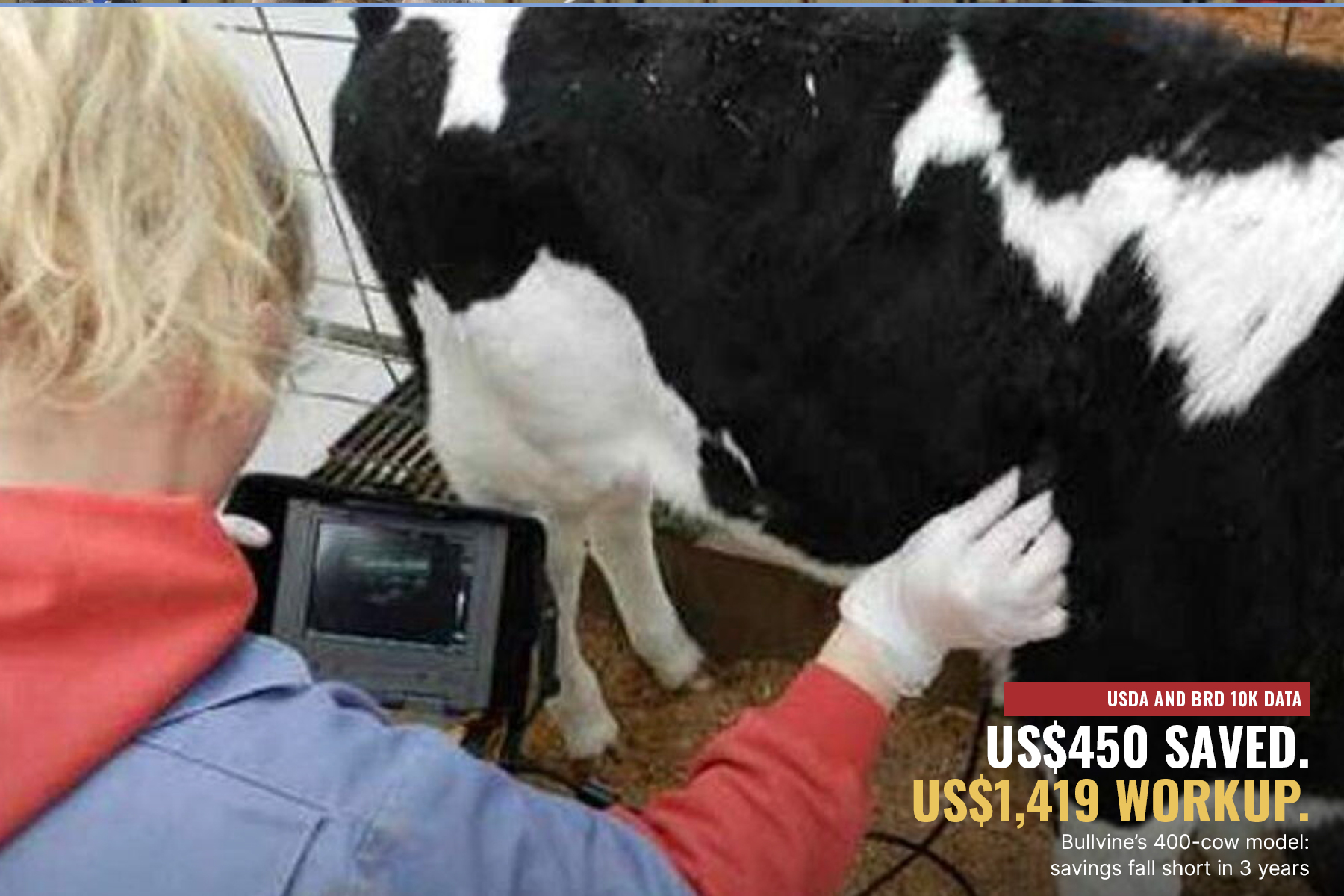
In Bullvine’s illustrative herd, preventing every second episode saves about US$450 in modeled short-term costs over three years, against a US$1,419 investigation budget. Payback requires additional benefits.
At a Glance
- Across Bullvine’s illustrative herd scenarios, second episodes carry US$81–US$382 annually in modeled short-term costs, excluding deaths and long-term losses.
- The lowest illustrative workup budget is US$756 without PCR; the central budget with PCR is US$1,419.
- Recovering the central investigation cost over three years means preventing about eight affected calves a year, before paying for any correction.
- The first question for the veterinarian is which decision the next test would change.
Her ears came up and she went back to drinking. Two weeks later she is coughing again, and a second treatment goes on her card. That tally shows she was treated twice, but it cannot establish whether the first illness persisted or a new episode began. Treatment stays under the herd veterinarian’s protocol; the next question is what to spend finding out why cases keep returning.
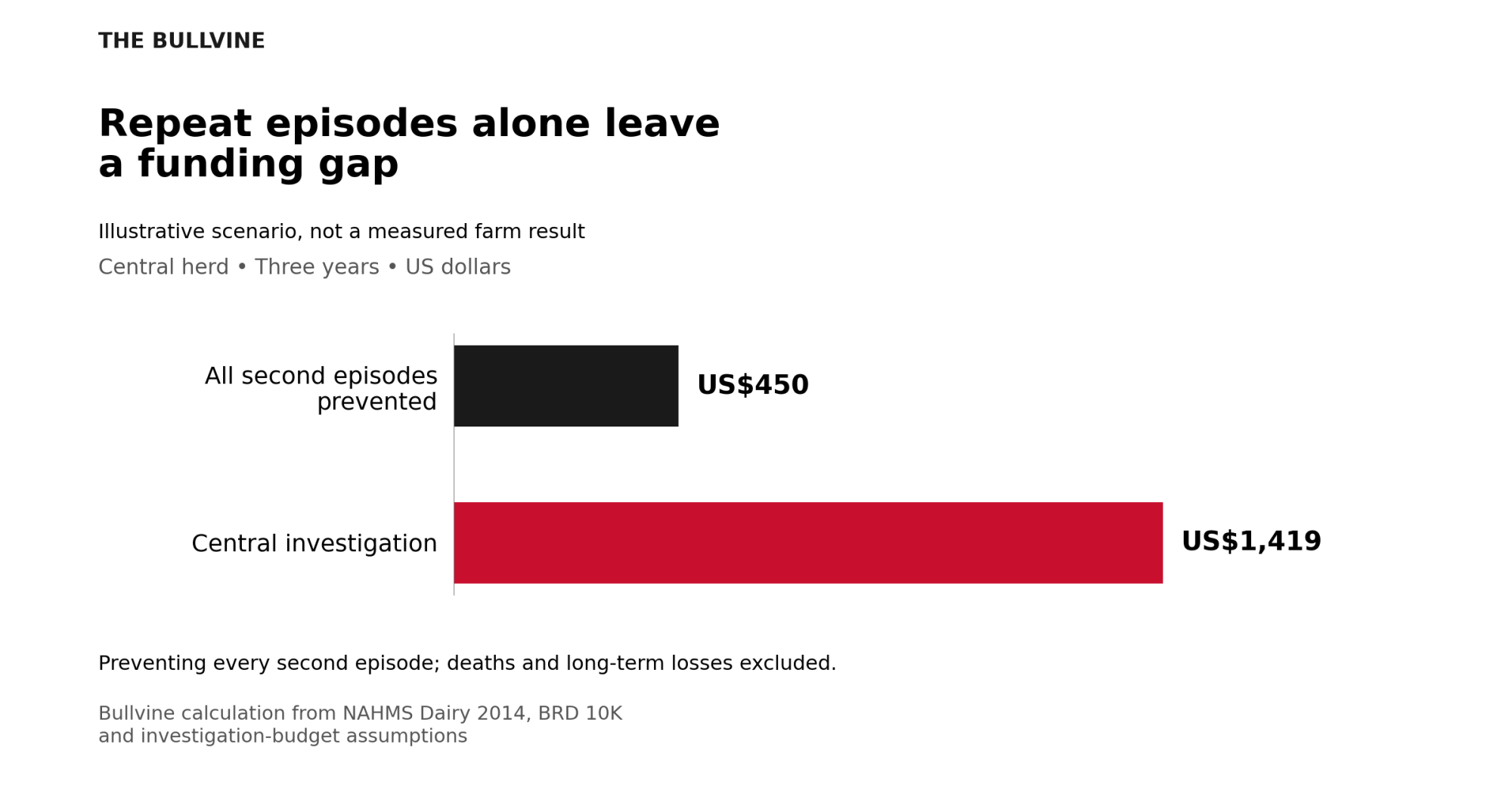
Bullvine modeled an illustrative 400-cow herd raising 190 heifer calves a year. In that herd, second episodes of bovine respiratory disease (BRD) account for about US$150 a year in modeled short-term costs, before deaths and longer-term production losses. The central investigation budget below is US$1,419. Preventing every second episode would save about US$450 over three years, which does not recover it.
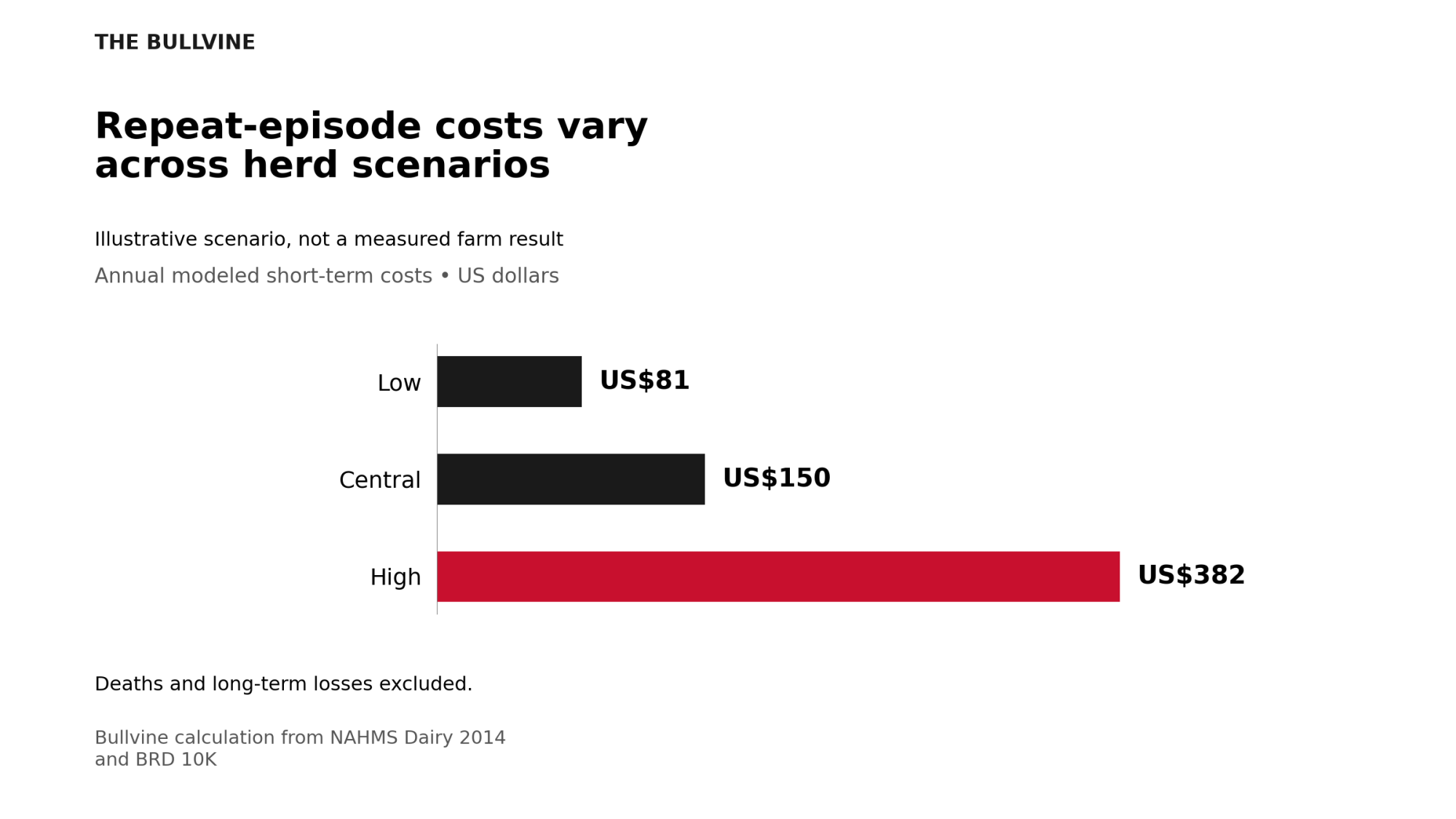
The model prices a second episode at US$44.77 in September 2026 dollars. That covers medication, assumed labor, and modeled growth loss, not the lifetime cost of pneumonia. The 12% BRD rate comes from USDA’s NAHMS Dairy 2014 study, and the 14.7% second-case rate from the five-dairy California BRD 10K study. Even in the high scenario, one year of second-episode losses comes to US$382, short of the cheapest package, a US$756 workup. Over three years, the high scenario’s second episodes total about US$1,146, enough to cover either low package but not the central ones.
| Cost line (second case, with anti-inflammatory) | BRD 10K, 2015–16 US$ | Sept. 2026 US$ (Bullvine math, ×1.4127) | Share of cost |
|---|---|---|---|
| Medication | 8.96 | 12.66 | 28% |
| Labor (1 hr at US$14.87) | 14.87 | 21.01 | 47% |
| Lost gain (7 days of milk fed) | 7.86 | 11.10 | 25% |
| Total | 31.69 | 44.77 | 100% |
A correction that prevents first cases across several cohorts is one route to payback; the break-even table further down shows how correction costs move that target. Bullvine’s table leaves out deaths and milder cases.
| Scenario | Heifers/yr | BRD rate | 2nd-case rate | 2nd episodes/yr | Cost/yr |
| Low | 180 | 12.0% | 8.4% | 1.8 | US$81 |
| Central | 190 | 12.0% | 14.7% | 3.4 | US$150 |
| High | 200 | 22.0% | 19.4% | 8.5 | US$382 |
The BRD rate is the share of calves with a first episode; the second-case rate is the share of those affected calves that develop a second episode. Low and high second-case rates are the lowest and highest BRD 10K dairies; 22.0% is the national estimate BRD 10K used. The spread is not a confidence interval, because several inputs change at once.
BRD in Calves: The Limits of a Second Treatment Record
BRD 10K counted a second case only after a calf finished a multi-day treatment protocol and stayed symptom-free for at least two weeks. Calf crews called cases on nasal discharge, coughing, depression, and fever, not ultrasound. The rule keeps the counts consistent, but it does not prove the lungs healed in between.
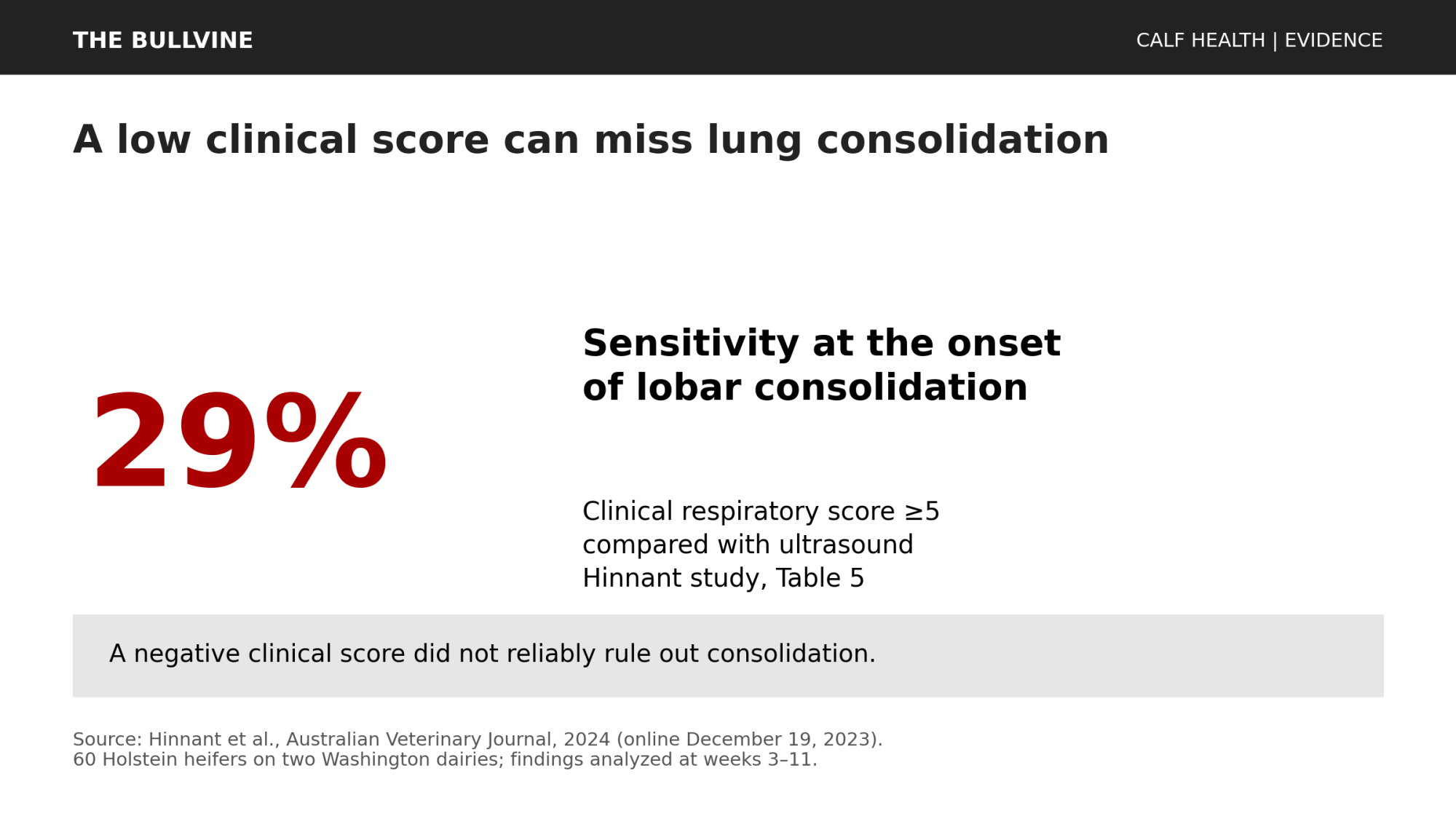
Clinical signs can miss lung consolidation, meaning lung tissue that has lost its normal air content. Hinnant and colleagues followed 60 Holstein heifers on two Washington dairies in 2021, from the second week of life through the eleventh, and analyzed weekly scores and scans from weeks three through eleven. Ultrasound found consolidation in 63% of the calves at least once. Only 28% ever reached a Wisconsin score of 5 or more.
Against ultrasound, a score of 5 or more caught the onset of lobar consolidation with 29% sensitivity and 98% specificity, and sensitivity stayed under 40% across the study’s comparisons. At that threshold, scoring missed many examinations that showed consolidation and flagged few that did not. In these calves, a low clinical score did not reliably rule out lung consolidation.
The serial scans also showed some calves developing consolidation again after an earlier lesion resolved. Ultrasound can identify consolidation without establishing its cause. Bronchopneumonia is the most likely cause, although atelectasis, abscesses, and pleural effusion also appear on scans. In this study, calling a lesion new or chronic depended on comparison with earlier scans.
Investigate the System Before Naming the Cause
Any one of these four signs warrants a veterinary review:
- Calves getting worse: they are declining despite treatment.
- Poor response to the protocol: they are not recovering on the protocol’s expected timeline.
- Deaths: any loss is reason for a review.
- More cases than usual: measured against a farm baseline counted the same way every time.
Once the veterinarian is involved, these patterns steer the investigation:
- Follow-up scans still show consolidation: the follow-up scans feed the veterinarian’s read on response and recovery.
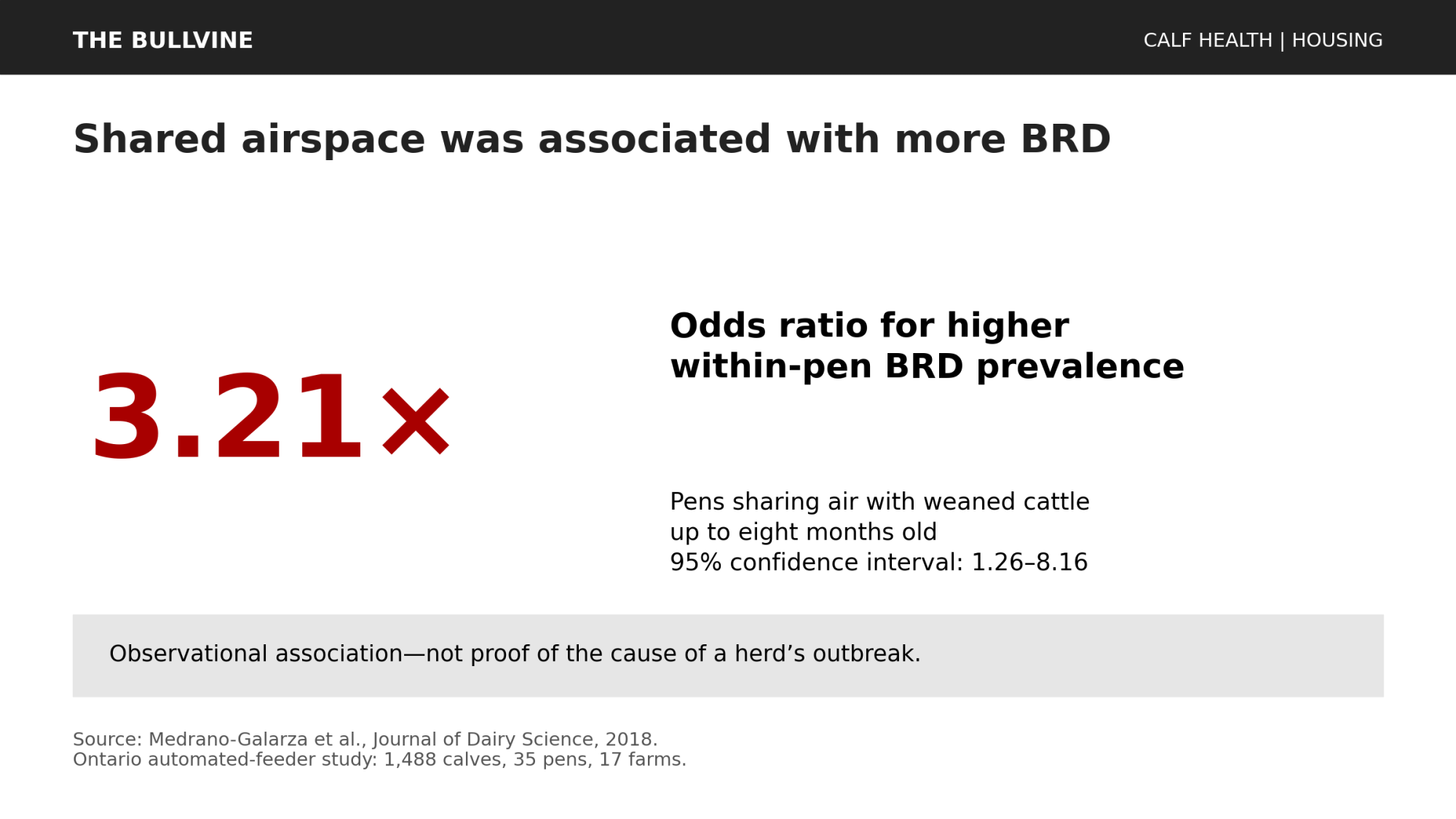
- Cases cluster in one airspace: include ventilation and air exchange in the review. In an Ontario study of 1,488 calves in 35 automated-feeder pens on 17 farms, pens sharing air with weaned cattle up to eight months old had 3.21 times the odds of higher within-pen BRD prevalence. Deeper wet bedding packs were also linked to more BRD. These are observational associations and do not establish the cause of any one herd’s outbreak.
- Cases appear tied to feeding: whether feeding technique or aspiration belongs in the investigation is a question for the veterinarian. Calf age, equipment, timing, and workload need review before anyone pins the pattern on a person or a procedure.
- Cases seem to follow one person: check whether cases also cluster by pen, calf age, arrival group, or periods when the crew is stretched.
- Feeding equipment fails a hygiene check: it deserves attention, but dirty equipment does not establish the cause of a respiratory outbreak. In the Ontario study, total bacterial counts of 100,000 cfu/mL or more in the feeder mixing jar were linked to more calf diarrhea in summer; they were not among the factors the study associated with BRD.
- The pattern points to a specific pathogen: which calves to sample and which test to run are the veterinarian’s calls.
If the investigation points to the shared airspace, changes to stocking, grouping, or airflow may cost less than new construction. Those costs and their expected benefits belong in the decision.
What the Investigation Costs
Each package covers the same 20 calves, scanned twice each, for 40 examinations over two vet visits. Twenty calves and two visits are budgeting assumptions, not a universal sampling recommendation; the veterinarian picks the calves and the timing to answer the herd’s specific question. The packages differ only in assumed vet hours, staff hours, and per-examination scanning charges, and each can add the same three PCR panels.
| Package | Low | Central | High |
| Without PCR | US$756 | US$1,173 | US$1,625 |
| With three PCR panels | US$1,002 | US$1,419 | US$1,871 |
| Second episodes to recover it, with PCR | 22.4 | 31.7 | 41.8 |
| Same, without PCR | 16.9 | 26.2 | 36.3 |
The second-episode rows are total avoided second episodes needed to recover each package’s cost, not annual targets.
Not budgeted: bacterial culture, ventilation measurement, passive-transfer testing, shipping, accession charges, sampling supplies, and other services. An itemized quote from the herd’s own practice should replace these packages. Line items are in the methods box.
How a Fix Changes the Break-Even Math
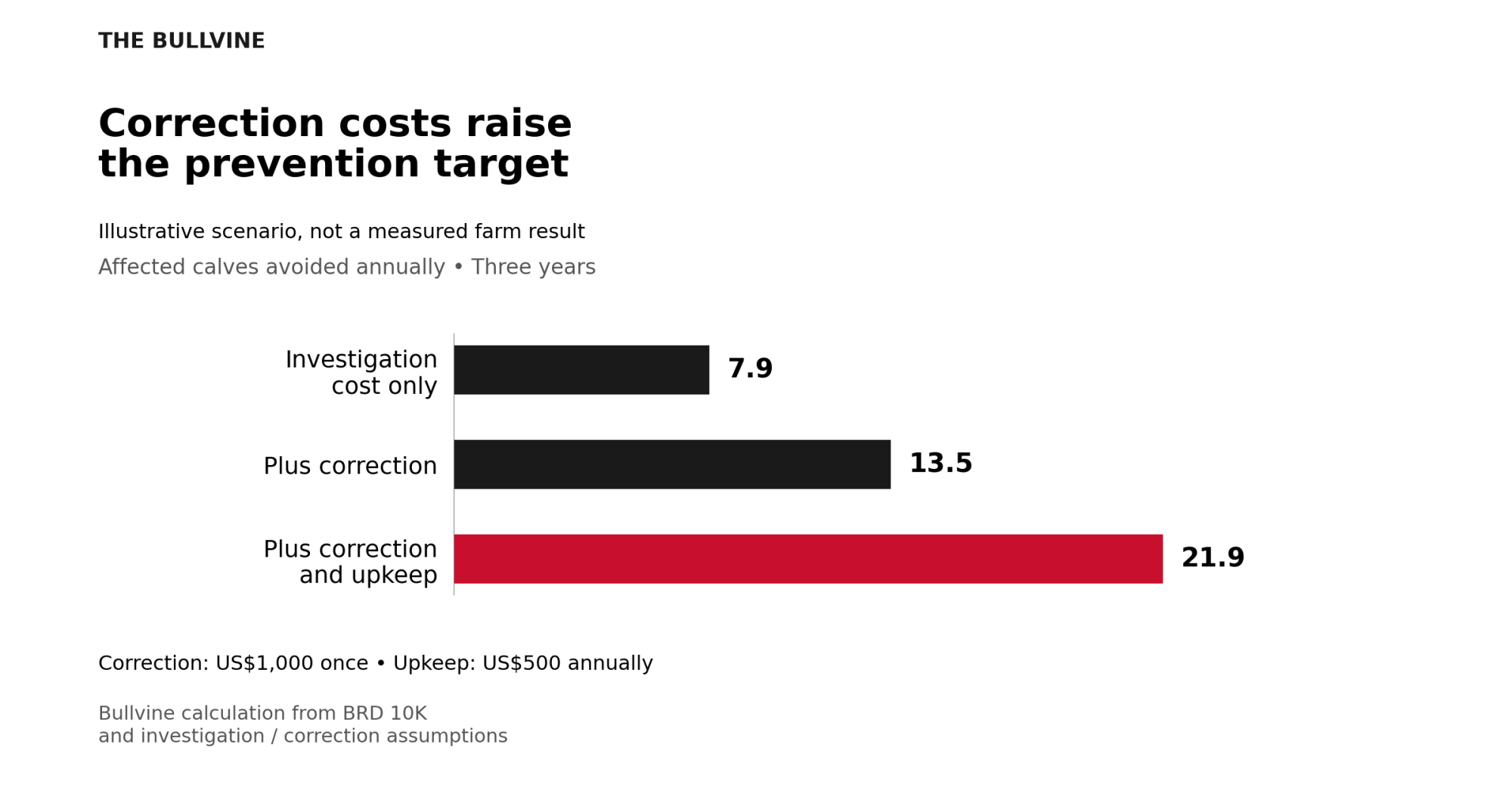
Over three years, the central US$1,419 package has to prevent 7.9 affected calves a year to break even, out of 22.8 affected among 190 heifers raised. Bullvine values each prevented affected calf at US$59.54, its 2026-dollar restatement of BRD 10K’s cost per affected calf. That value already includes expected repeat episodes, so adding separate recurrence savings would count them twice.
| Central package (3 yrs) | Calves to prevent/yr | Share of affected | BRD rate must fall to |
| Investigation cost only (US$1,419) | 7.9 | 34.8% | 7.8% |
| Plus a one-time US$1,000 correction | 13.5 | 59.4% | 4.9% |
| Plus that correction and US$500 a year in upkeep | 21.9 | 96.2% | 0.5% |
These are break-even targets, not predictions of how many cases an investigation and correction will prevent. The first row assigns no correction cost, and testing alone does not prevent disease. The US$1,000 correction and US$500 upkeep are illustrative assumptions. On the high package, the last row’s combination needs 24.5 prevented calves a year, more than the 22.8 the herd has affected.
Avoided deaths and longer-term performance gains could improve the result, but they need separate estimates. Welfare can justify action when this narrow cost calculation shows no payback. Labor made up 40% of BRD 10K’s treatment costs; saved labor and growth are economic benefits that do not always show up as cash.
Before Commissioning the Workup
The first question for the herd veterinarian is which decision the next test will change. If neither the manager nor the veterinarian can name a result that would change treatment or management, the scope should shrink before the herd books the full package.
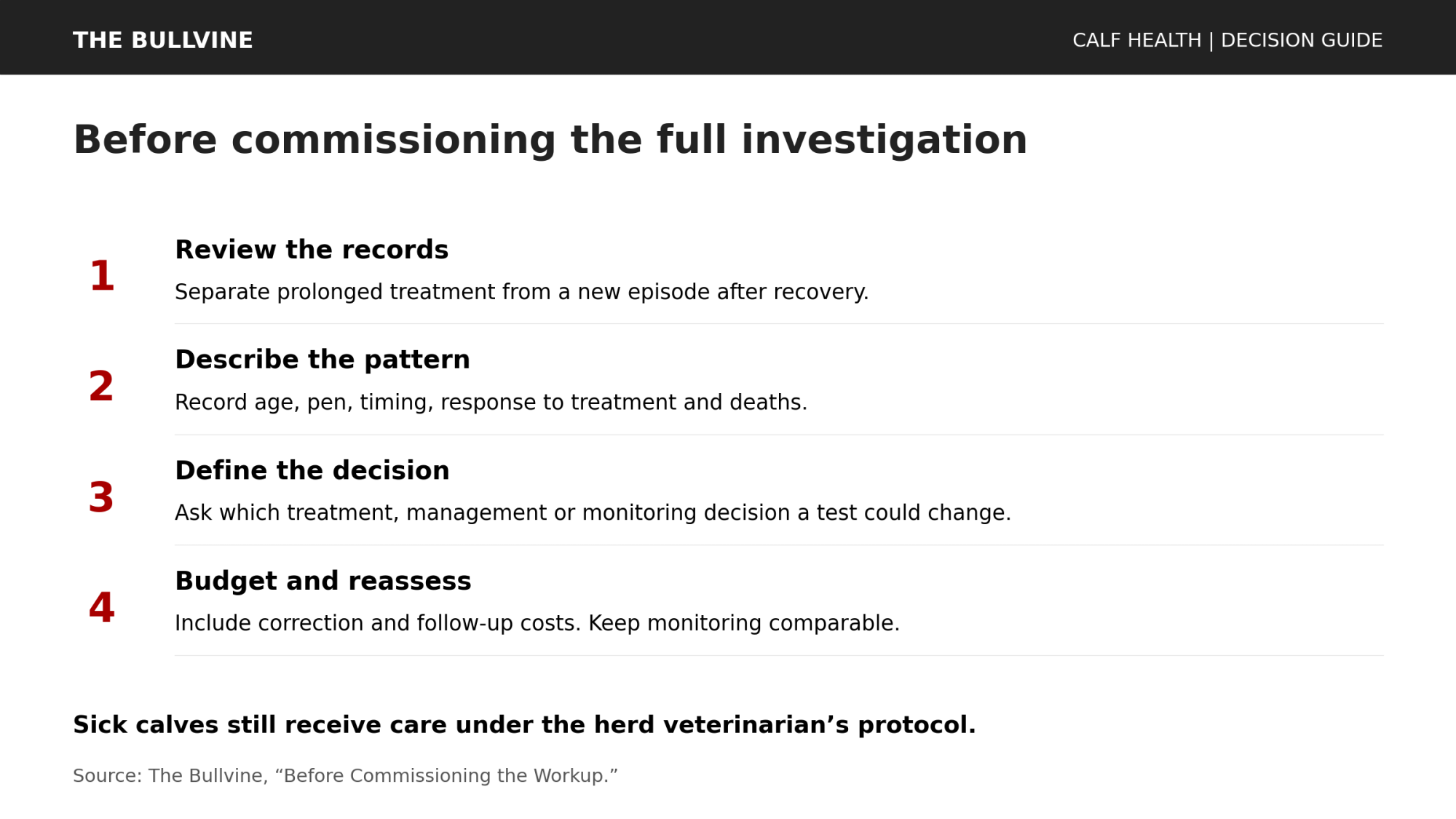
- Review the records: separate prolonged treatment from a new episode after recovery.
- Describe the pattern: affected calves, age, pen, timing, response, and deaths.
- Define the decision: identify what each proposed test could change.
- Budget and reassess: include correction and follow-up costs, then measure results across later cohorts with the same case definition and comparable monitoring before and after the change. Without that, better detection can look like more disease.
The Bullvine Break-Even Calculator
Will a veterinary respiratory workup pay off for your herd? Plug in your numbers to find out how many cases you must prevent to recover the cost over three years.
Your Farm’s Inputs
The Bottom Line
Assumes a prevented affected calf value of US$59.54 and second-episode cost of US$44.77 (Sept 2026 dollars), consistent with the BRD 10K model. Deaths and long-term production losses are excluded.
Resources
- Bullvine Health ROI Calculator and the Bullvine Tools Index: free calf, health, and herd-economics calculators. They are separate tools and do not reproduce this model.
- Esophageal-feeder technique: UC ANR tube-feeder guide · Utah State University Extension fact sheet. Both were written for beef calves, so the herd veterinarian should confirm technique.
Methods
Second-episode cost: BRD 10K priced a second case at US$31.69 in 2015–16 dollars, including anti-inflammatory treatment. That figure combines medication costs calculated from the study farms’ treatment protocols (priced from four California veterinarians for an assumed 4-week-old, 49.9-kg calf) with one hour of labor at US$14.87 and a modeled growth loss of seven days without gain, which BRD 10K valued at the cost of milk fed. The study’s economic analysis left out long-term production effects. Annual cost = heifers raised × BRD rate × second-case rate × US$44.77.
BRD rate: The 12% is the respiratory-disease estimate NAHMS Dairy 2014 Report 3 reported for preweaned heifers on operations that gave any antimicrobials. Report 3 covers 265 operations with 30 or more cows in 17 states; its tables refer to calendar year 2013.
Inflation adjustment (Bullvine math): BLS CPI-U, U.S. city average, all items, not seasonally adjusted (1982–84 = 100). Base: average of the 2015 and 2016 annual averages (237.017 and 240.007) = 238.512. Comparison month: September 2026, 336.940 (BLS CPI release, Oct. 14, 2026, archived). Factor: 1.4127, giving US$44.77 per second episode and US$59.54 per affected calf. CPI expresses historical costs on a common dollar basis; it does not update veterinary fees, drug prices, or calf values individually.
Break-even formula (Bullvine math):
Step 1: Annual cost = (investigation cost + one-time correction cost) ÷ 3 + annual upkeep
Step 2: Affected calves to prevent each year = annual cost ÷ US$59.54
The formula assumes constant annual calf numbers, avoided costs and benefits lasting three years, no investigation or monitoring costs beyond those budgeted, and no discounting.
Package line items:
| Line item | Low | Central | High |
| Veterinary time | 2 hr: US$360 | 3 hr: US$540 | 4 hr: US$720 |
| Farm calls | 2: US$160 | 2: US$160 | 2: US$160 |
| Scanning charges | 40 × US$5: US$200 | 40 × US$10: US$400 | 40 × US$15: US$600 |
| Staff time | 2 hr: US$36 | 4 hr: US$73 | 8 hr: US$145 |
| PCR panels (optional) | 3: US$246 | 3: US$246 | 3: US$246 |
Price sources: The US$180 hourly rate and US$80 farm call are posted prices from Bobbin Mill Veterinary Services in Vermont. The US$18.15 staff wage is the USDA NASS rate for livestock workers in April 2025 (Farm Labor, May 21, 2025); the all-hired-worker average was US$19.52. The US$82 PCR panel price comes from the Kansas State Veterinary Diagnostic Laboratory fee schedule. Those unit prices are observed; the hours, visit counts, and number of calves are Bullvine assumptions.
Scanning-charge assumption: Bullvine assumes an additional scanning charge of US$5, US$10, or US$15 per examination. These are illustrative sensitivity inputs, not verified examination fees. Veterinary hours cover the separate services: record review, barn walk-through, case mapping, sampling, and reporting. A practice’s own billing structure should replace both charges, without double-counting where services are bundled. Excluded items are listed under What the Investigation Costs.
Canadian herds: All costs are U.S. dollars from U.S. sources; Canadian herds should substitute an itemized quote from their own practice and local wage rates.
Rounding: dollars to the nearest dollar, except unit costs shown to the cent; calf counts and percentages to one decimal. Calculations use unrounded inputs.
Disclosure: One BRD 10K co-author, M.W. Overton, was with Elanco Animal Health.
Learn More
- How to Prevent Diarrhea in Dairy Calves — Dismantle the sanitation failures fueling your wet calf outbreaks before they escalate into respiratory crashes. This operational playbook delivers a hard-nosed colostrum management defense, securing an immediate edge in protecting early-stage immune systems against environmental stress.
- Nearly 1/3 of UK Dairy Calves Suffer Hidden Lung Damage Costing Millions — Silent lung lesions quietly rob first and second lactation yields, masking a massive economic drain. The data breaks down this 29% prevalence rate and follows the money on why poor barn ventilation permanently limits lifetime herd ROI.
- Why Your Calf’s Saliva Is the Untapped Goldmine for Revolutionary Health Monitoring — With a 48-hour head start on clinical symptoms, you gain a massive diagnostic advantage. Emerging salivary technology arms you with non-invasive testing protocols that expose disease early and slash treatment costs without ever drawing blood.
The Sunday Read Dairy Professionals Don’t Skip.

Every week, thousands of producers, breeders, and industry insiders open Bullvine Weekly for genetics insights, market shifts, and profit strategies they won’t find anywhere else. One email. Five minutes. Smarter decisions all week.