




Cut for volume, not quality, after 25 years. Now it’s £47,000 and an August 1 deadline against the tanker — and the barn math says 51 litres a day decides if the build pays for itself.
Executive Summary: A 50-cow Herefordshire organic herd, Wicton Farm’s Wild Cow Dairy, just lost a 25-year milk contract for one reason: it’s too small for the buyer’s tanker route — quality and welfare never came into it. The Howlett family now has until August 1 to raise £47,000 and build their own on-farm processing, or lose the only market they’ve got. Here’s the math the BBC and the trade wires skipped: at roughly 50 pence of extra margin per litre over wholesale, that build needs about 51 litres a day sold direct to pay for itself — under a tenth of the daily tank — so the capex isn’t the risk, the customer base is. And Wicton isn’t an outlier; GB lost around 160 dairy farms in six months while average output per farm climbed 7.6%, which is consolidation squeezing the bottom end out one route at a time. With UK farmgate at 33.99 ppl against 40–49 ppl production costs, any small or mid-size herd flagged on volume should run its own break-even now — daily direct litres times margin spread, minus annualised capex — before the letter arrives, not after. If the tanker stopped coming next spring, do you have a route to market, or just a tank and a problem?
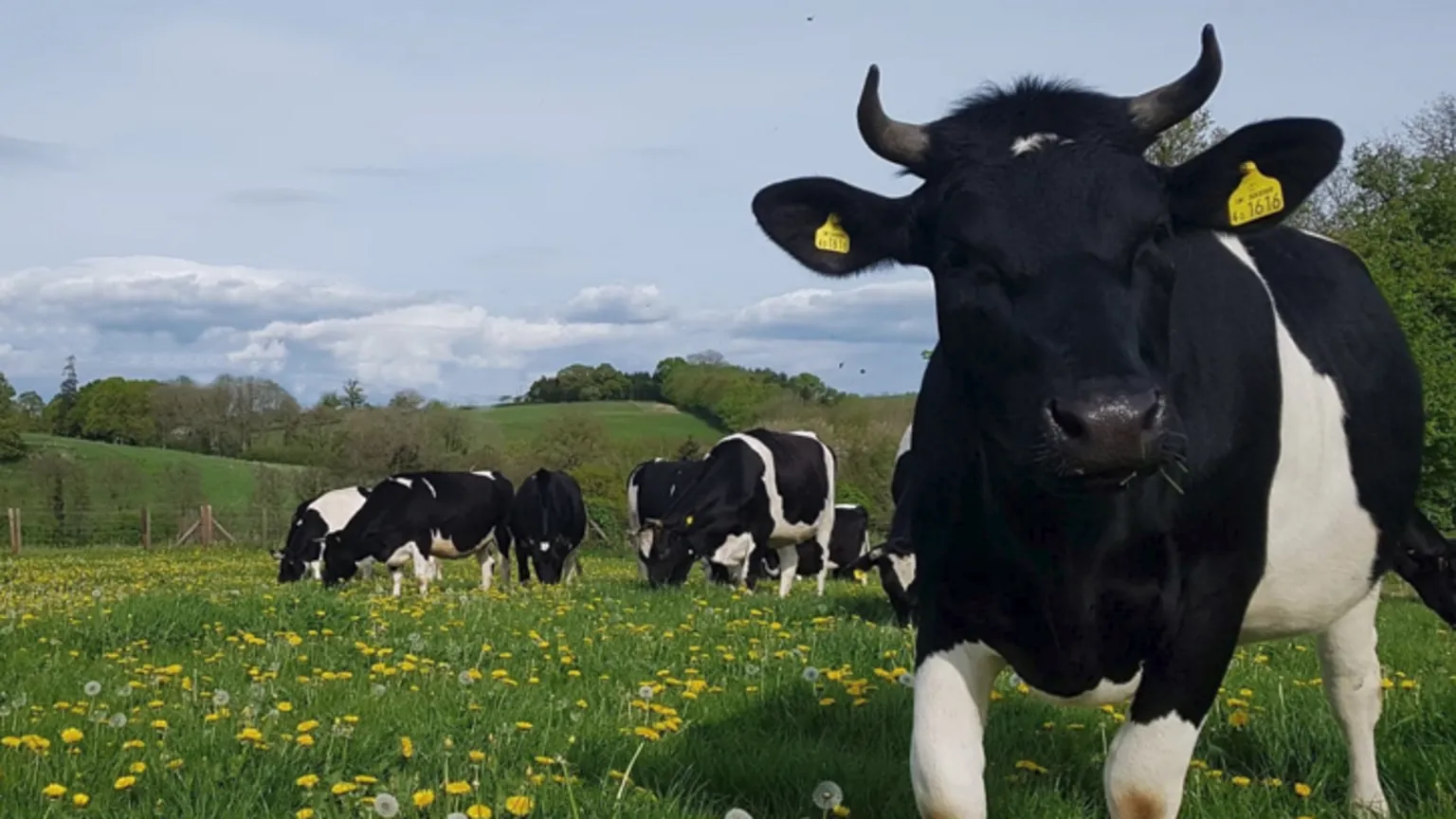
The news came three months ago. For the Howlett family behind Wild Cow Dairy at Wicton Farm, near Bromyard in Herefordshire, it landed like a gut punch dressed up as a logistics memo. “Three months ago, we received devastating news,” the farm wrote on its crowdfunding page. “After more than 25 years with the same milk buyer, our organic bulk milk contract was being terminated.” The reason given wasn’t quality or welfare. The farm was judged too small, its “values and farming methods no longer fitting [with] the industrial dairy model.” So now there’s a crowdfunder, a £47,000 target, and a deadline to hit it: August 1, 2026, with the build due to finish by Christmas.
The BBC ran the story. So did FarmingUK and the trade wires. Every version stopped at the appeal. Nobody ran the barn math behind it — what cutting out the tanker actually costs, what it returns per litre, and the daily volume you’d need before any of it pays. That’s the part that matters, whether you milk 50 cows or 500. Because Wicton isn’t a freak accident, it’s the visible edge of a squeeze that’s been tightening on small UK herds for years, and the question it forces — go direct or go home — is sitting in a lot more inboxes than anyone’s admitting.
What Actually Changed at Wicton — and Why It’s Not Personal
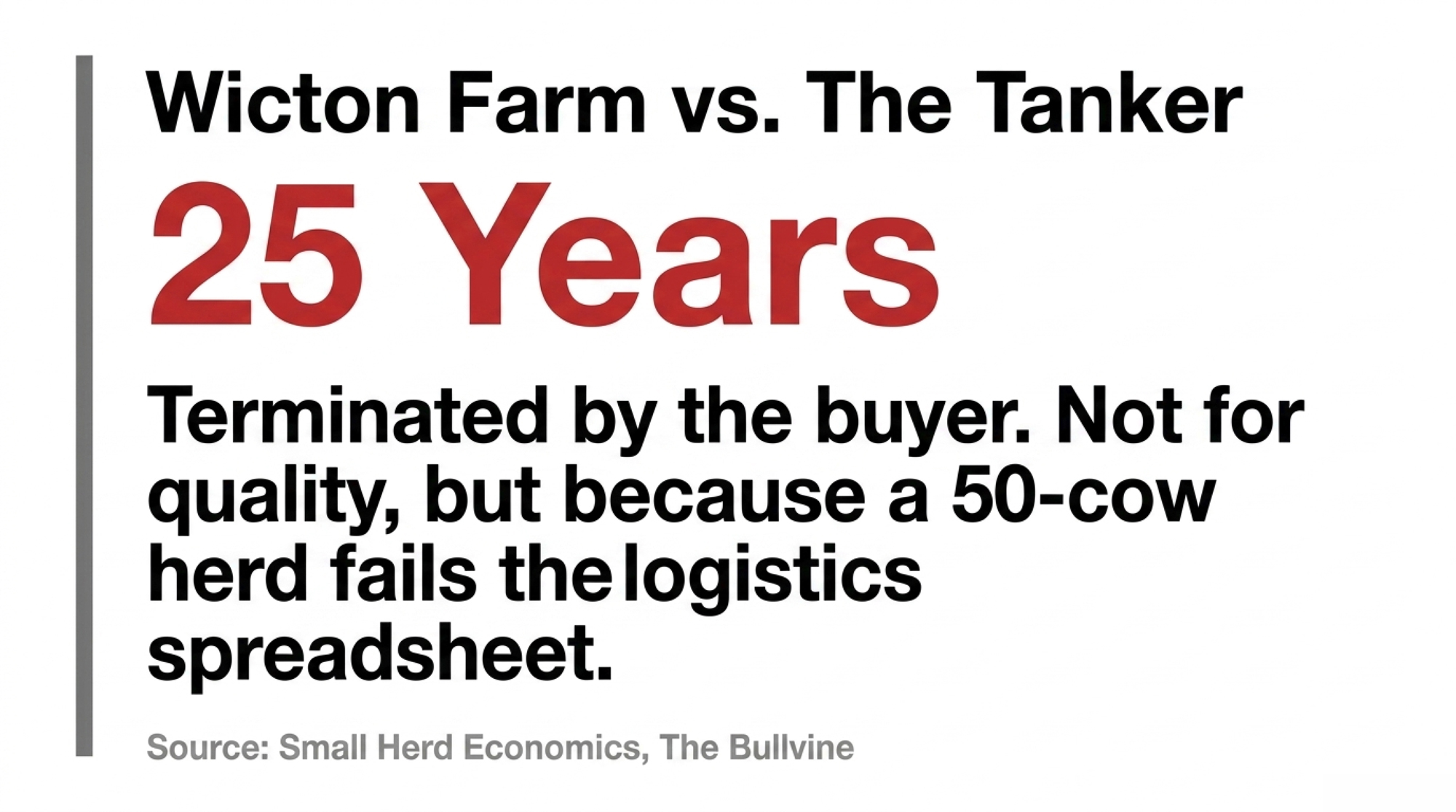
Strip the sentiment out, and the buyer’s logic is cold but rational. Processors build tanker routes around volume. A 50-cow herd at the end of a long collection run costs more per litre to pick up than a 500-cow herd on a main road. When margins tighten, the small accounts at the end of the route get cut first. Wicton didn’t fail an inspection. It failed a spreadsheet. The farm itself described the choice it was left with bluntly: either stop dairy farming or process and sell all its own milk.
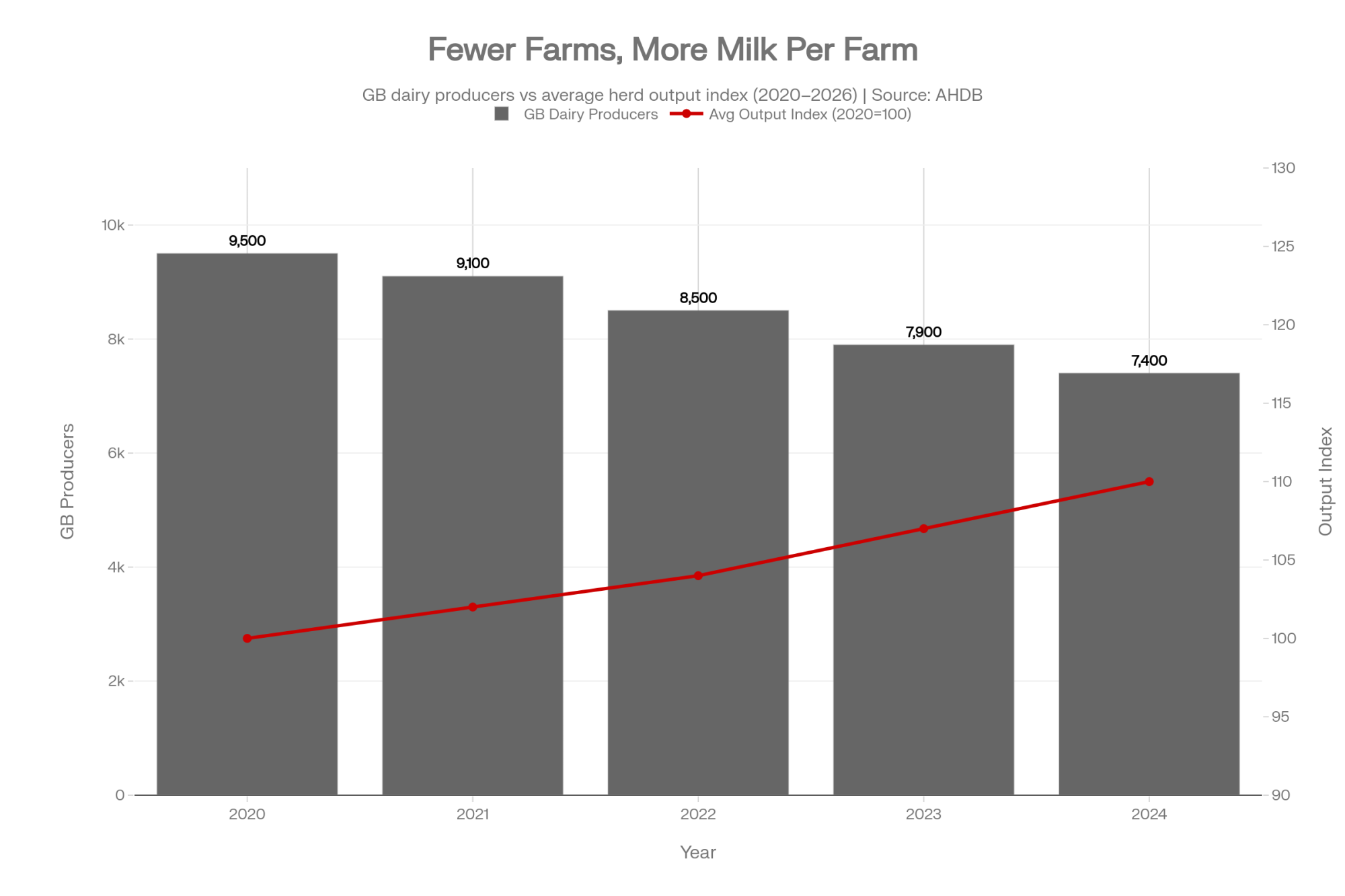
Here’s the macro picture in one view — and it tells you Wicton is a data point, not an outlier:
| UK dairy reality (2026) | Figure | Source |
| GB dairy producers, April 2026 | 6,850, down from 7,040 a year earlier | AHDB milk-buyer survey |
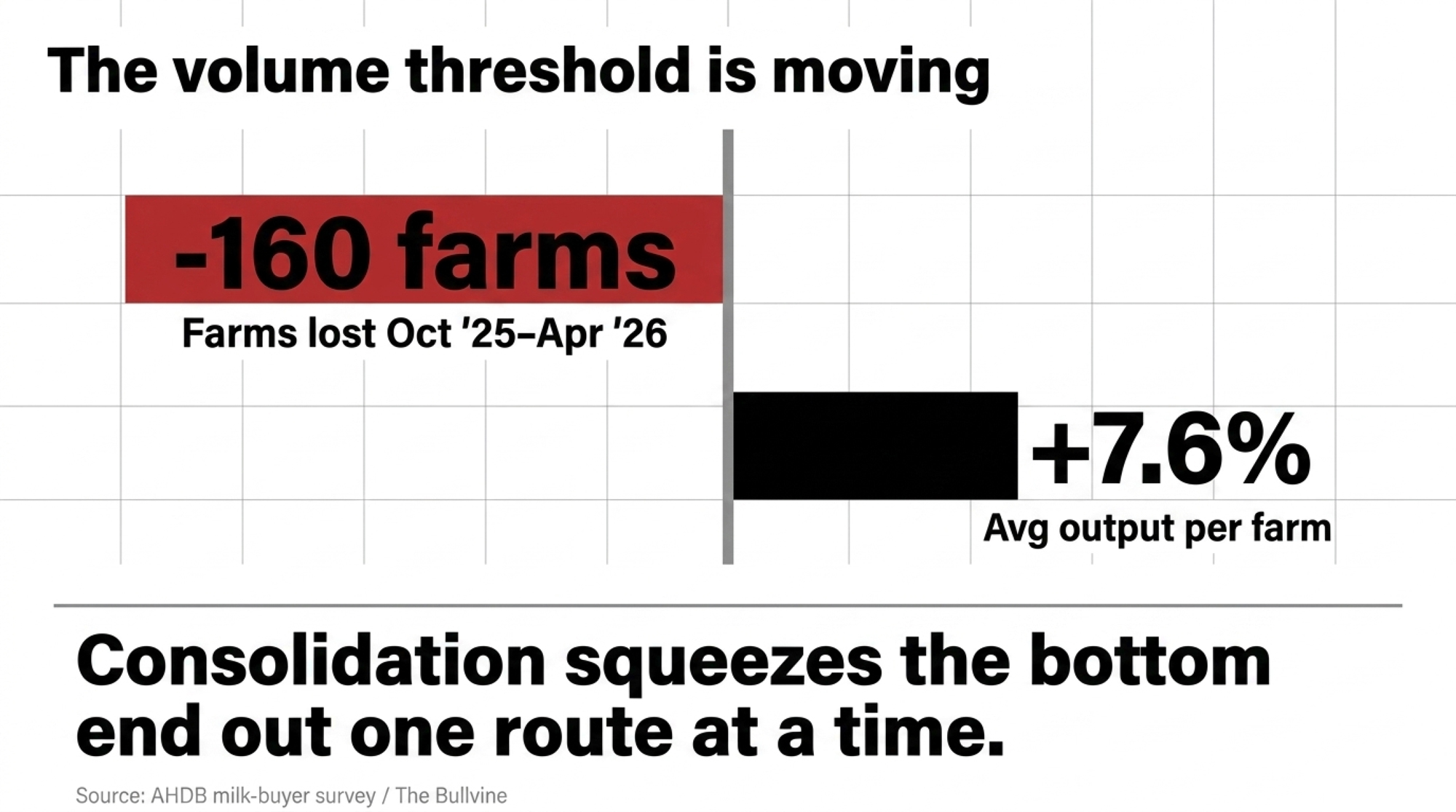
| Farms lost Oct 2025–Apr 2026 | ~160 in six months | AHDB |
| Average output per farm, year-on-year | +7.6% | AHDB |
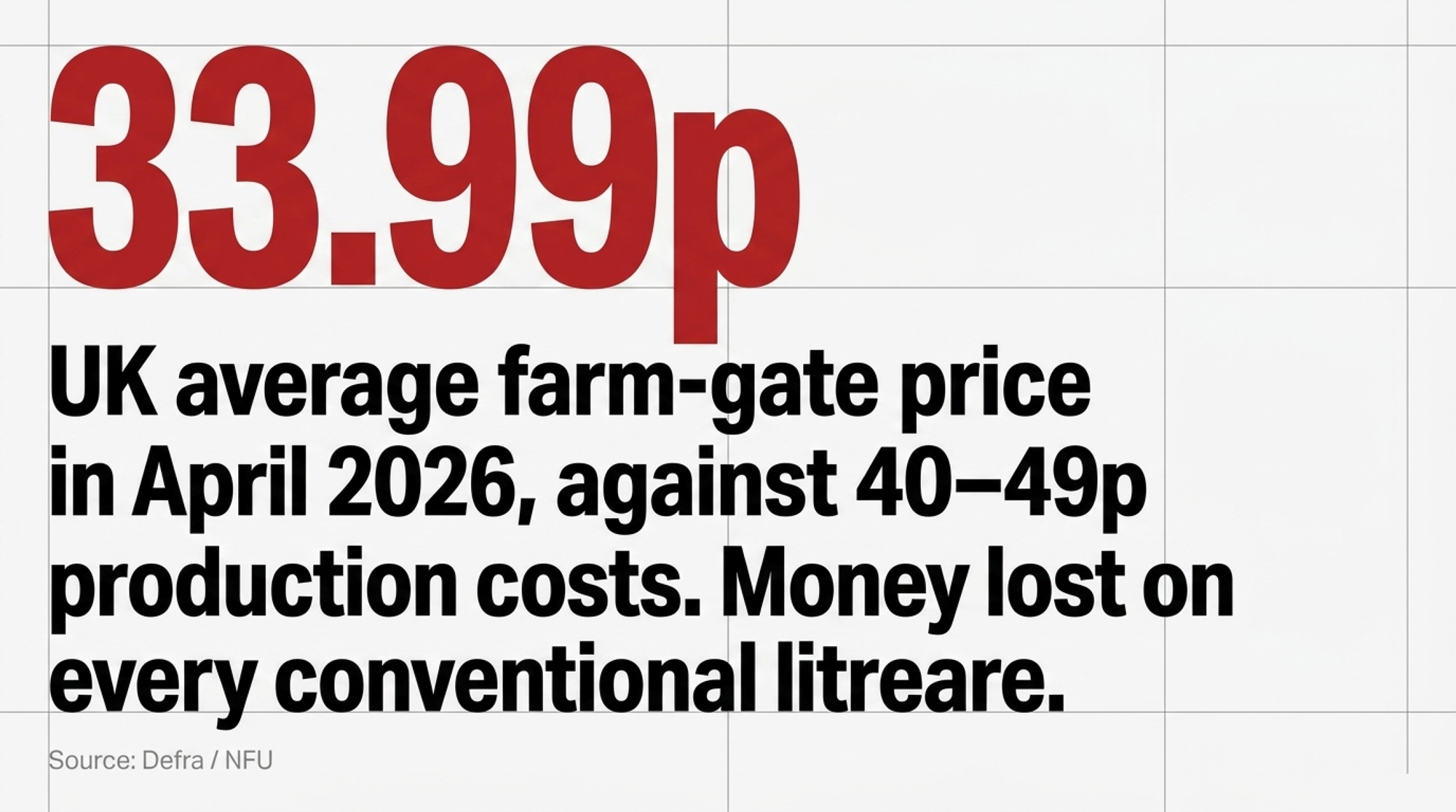
| UK average farm-gate price, April 2026 | 33.99 pence/litre | Defra |
| Cost of production (by system) | 40–49 pence/litre | NFU / BBC, mid-2026 |
| Organic herd, two-year change | 48,000 → 46,000 cows | AHDB organic update, June 2026 |
Fewer farms. More milk from each one. That’s consolidation written in two numbers, and it doesn’t reverse.
The processor squeeze isn’t theoretical either. On March 30, 2026, Müller issued 12-month termination notices to a cluster of farms across North Wales and Scotland — the company didn’t disclose how many, though over half were offered an ingredients-only contract as a fallback. Müller’s agricultural director, Richard Collins, told producers that the move followed “a recent adjustment in our contracted volumes” and “continued unprecedented levels of oversupply.” Read that next to Wicton’s “too small” letter and the pattern’s obvious. The volume threshold is moving, and it’s moving against the bottom end.
And here’s the part that should make you angry, or at least curious: demand isn’t the problem. The organic herd is shrinking even as demand holds firm. People still want the milk. It’s the road to market that’s built against small herds — not the appetite at the other end.
Does a Running Start Actually Change the Math?
Wicton has something most farms in its spot don’t. A running start. The farm runs 50 Holstein Friesians across 175 acres, already sells through 24/7 vending and a webshop, and pasteurises milk and makes cheese and yoghurt on-site — including a Cow-lloumi line. The Howletts have been building the direct-sales muscle for years. So this £47,000 isn’t a cold start from a standing position. It funds a dedicated processing and bottling space, raw and pasteurised bottling, an on-farm customer collection hub, and a winter cow-housing upgrade — scaling something that already turns a few coins.
Now run it the way it should be run. Show the math, hold every number in pencil. The herd is milked once a day, calf-at-foot, 100% grass-fed — a low-input system that trades volume for a slower lifecycle, so saleable litres run lower than a conventional herd this size. The farm hasn’t published its daily volume, so the figures below are from a Bullvine model based on a 500-to-600-litre-a-day assumption — not the farm’s numbers. Treat them as a framework you’d plug your own figures into, not gospel.
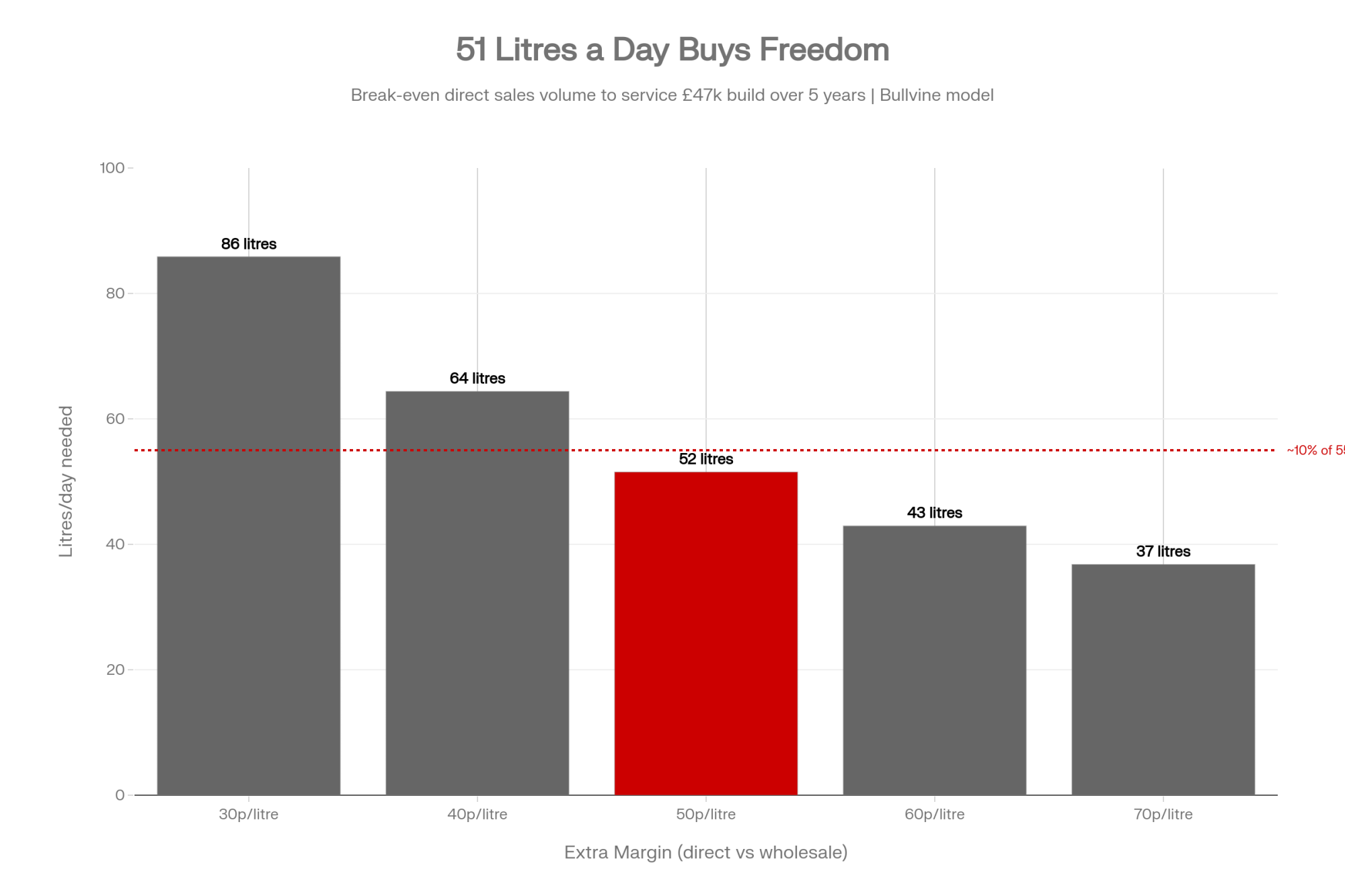
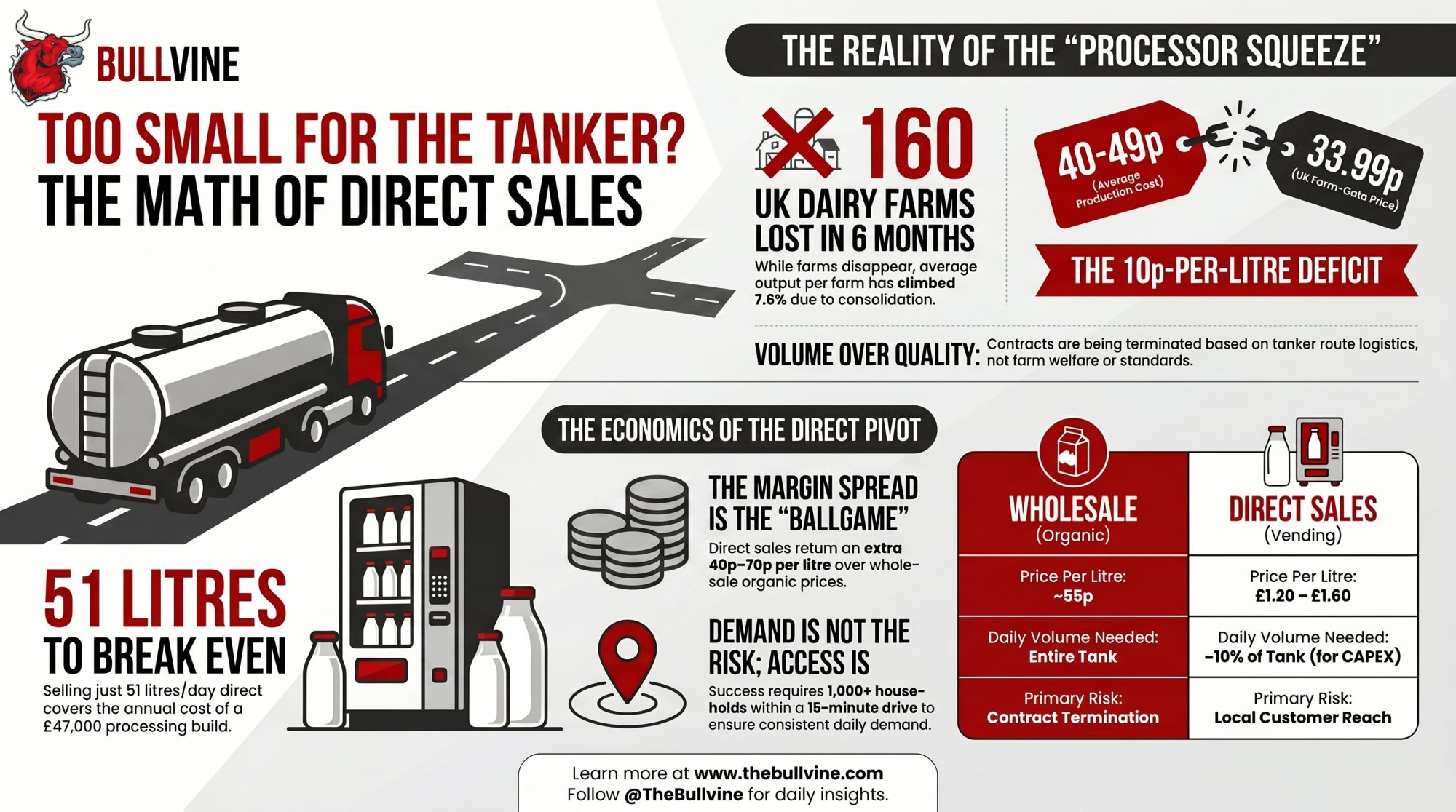
Wholesale organic milk runs around 54 to 56 pence a litre through buyers like Arla right now. As of 2022 reporting, on-farm vending returned £1.20–£1.60 per litre. Strip out bottling, energy, and labour, and the extra margin over wholesale is around 40 to 70 pence per litre. That spread is the whole ballgame.
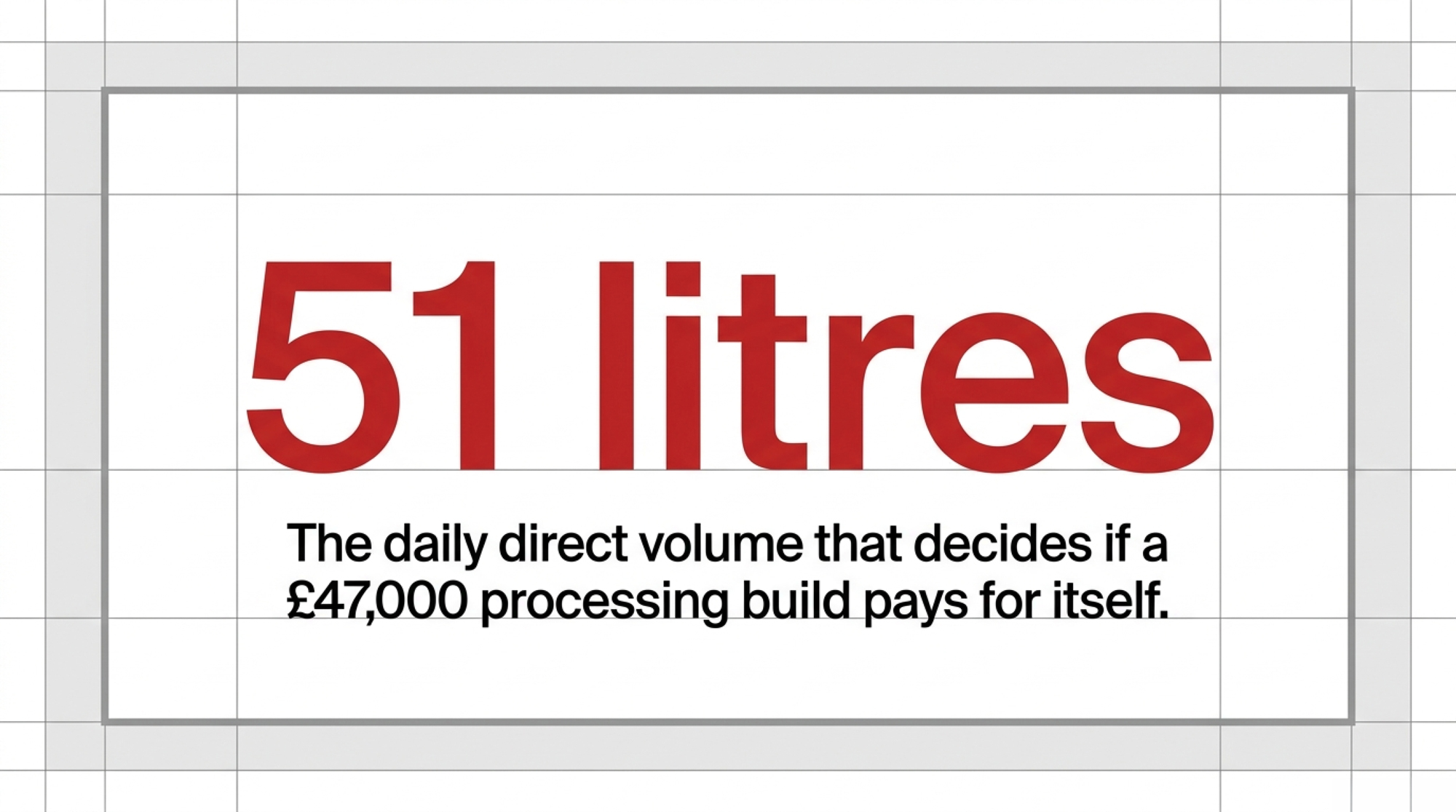
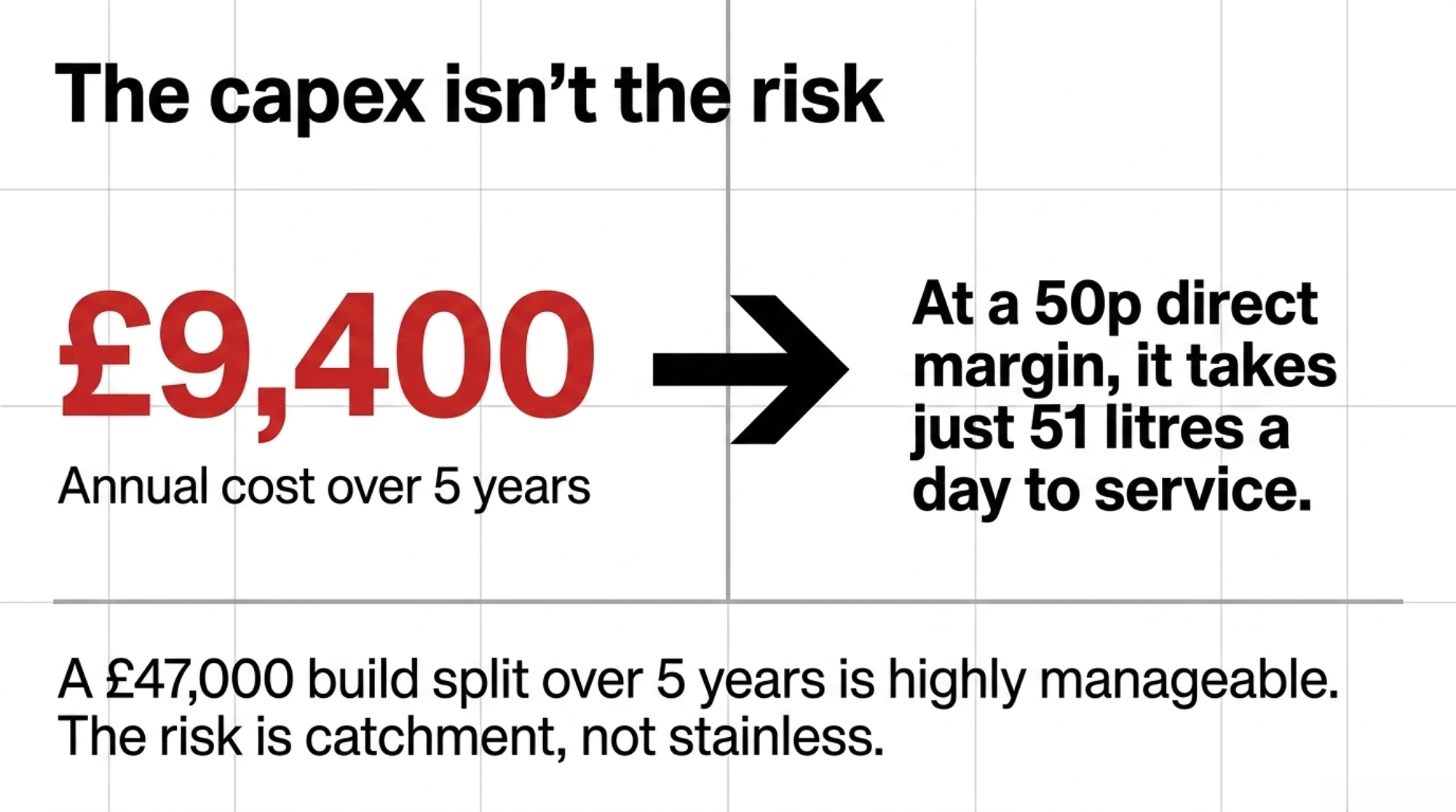
Here’s the math you can map onto your own yard. Take a 50 pence per litre extra margin and spread £47,000 across five years — call it £9,400 a year to service the build. A farm would need to sell roughly 51 litres a day to cover it. On a 550-litre herd, that’s under a tenth of the daily tank. Push 30% of the milk direct, and that’s around £30,000 a year in extra gross margin; get to 50%, and you’re near £40,000 even after servicing the capex. The economics aren’t the hard part. The customers are. Always.
The Mechanics Behind the Numbers
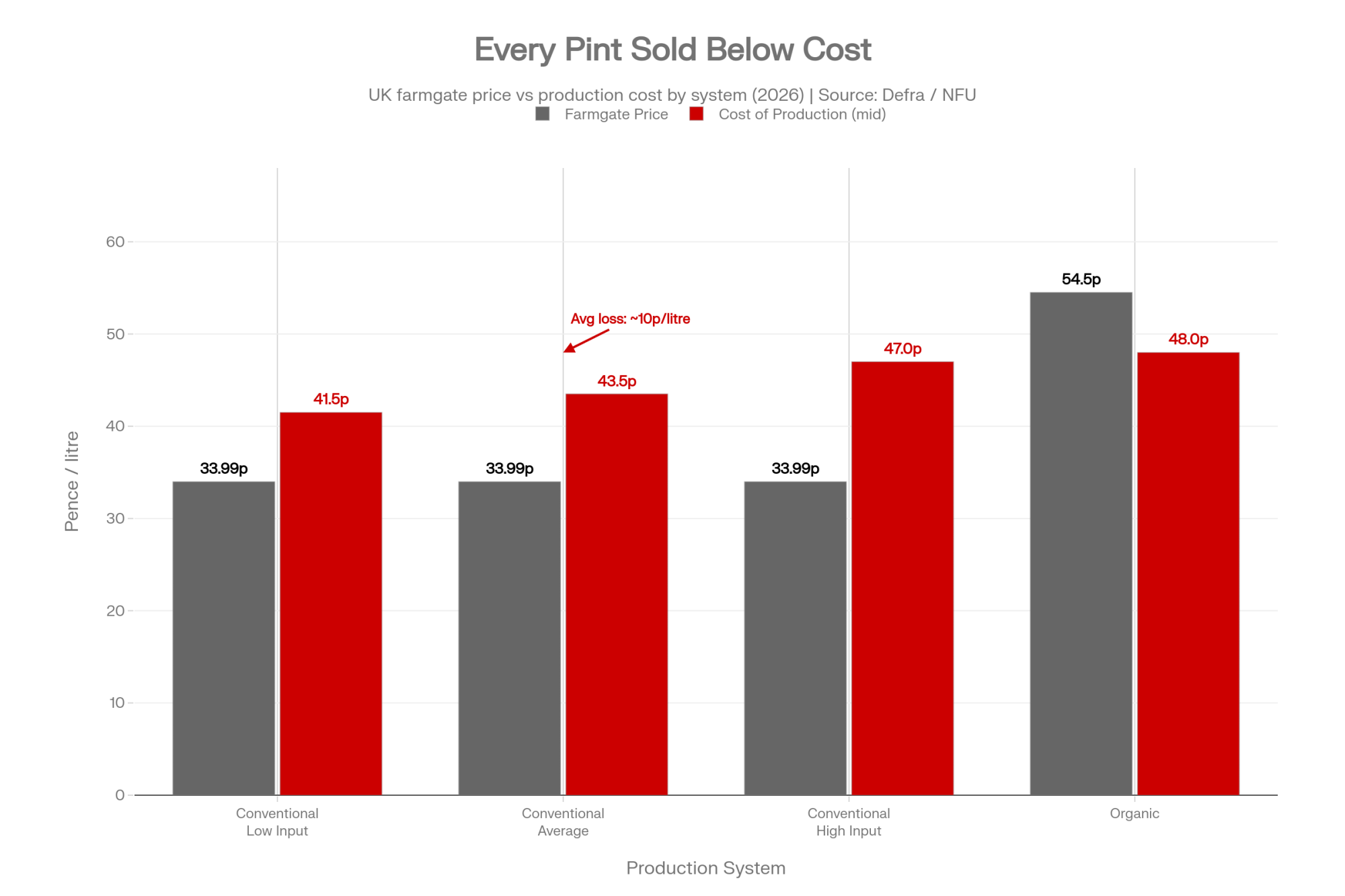
The gap driving all of this is brutal and simple. The UK average farm-gate price sat at 33.99 pence per litre in April 2026, while production costs ranged from 40 to 49 pence per litre, depending on the system. That’s money lost on every conventional litre leaving the yard — the BBC put the average loss at around 10 pence per litre in May 2026. Organic holds a premium in the mid-50s. But with costs climbing toward 50 pence, even the organic margin thins out fast.
Direct sales flip that ratio because you keep the retail price instead of the wholesale one. The Milk Station Company told Farmers Weekly in 2022 that a typical vending-plus-pasteuriser setup runs “in the region of £30,000,” with payback often “within about 12 months” when the site sits right. Small pasteurisers handling 100 to 500 litres a day ran £6,000 to £15,000 at that time.
But the spreadsheet only comes true if the demand shows up daily. The pasteuriser doesn’t care where your buyers are. You do. You need steady local demand soaking up your volume at a premium every day — not just on a sunny August Saturday when the farm-shop crowd is out. Without it, you’ve bought stainless steel and changed nothing about your margin.
How Much Does It Really Cost to Cut Out the Tanker?
Less than the headlines imply — if the customers are there. Servicing a £47,000 build over five years requires around 51 litres per day at a 50 pence extra margin. A vending-and-pasteuriser setup ran about £30,000 in 2022. Wicton’s plan goes further — adding bottling, a customer collection hub, and a winter housing upgrade — which is why the target sits higher.
The nasty surprises usually aren’t the equipment. University of Tennessee Extension found US producers consistently underbudget the building work and the cost of passing inspection — it’s the regulatory stack, not the stainless, that blows the number (US data, 2020; the structural warning travels). In England, the Class R permitted development right lets you convert an agricultural building to commercial processing use of up to 1,000 square metres without full planning permission, which can shave both costs and delays off the front end. That’s a real lever. Use it before you pour concrete.
What Are Your Notice Rights If the Letter Ever Comes?
Here’s a question worth knowing the answer to before you ever need it. Since FDOM24 — the Fair Dealing Obligations (Milk) Regulations 2024 — a UK milk buyer must generally give a producer at least 12 months’ notice to end a contract that’s run longer than 12 months, unless the producer consents to less or has breached the agreement. Every existing contract had to comply by July 9, 2025.
Wicton’s public statements describe being told “three months ago” but don’t say when its milk actually stops, and August 1 is consistently reported as the fundraising deadline, not a contract-termination date. So there’s no public basis to say the rule was or wasn’t followed here — the formal notice may have been given separately and earlier. The point for you is the rule itself. If a termination letter ever lands in your yard, FDOM24 sets the notice floor, and the Agricultural Supply Chain Adjudicator (ASCA) can investigate complaints and impose penalties of up to 1% of a processor’s turnover. Worth noting: in ASCA’s first year of operation, the adjudicator reported receiving confidential approaches from producers but no formal complaints had progressed to investigation (DEFRA/ASCA, 2025) — a rule you don’t use protects no one. Know in ink what your contract entitles you to before the call comes.
Go deeper: The Bullvine on farm risk management and contract terms.
Is Your Customer Base Actually There — or Just the Crowdfunder Crowd?
This is the question that decides Wicton’s second act, and it’s the one the coverage skipped entirely. A crowdfunder gets you to August 1. An email list gets you to Christmas. A standing-order subscription base gets you to 2030. The novelty wave — the BBC clip, the viral appeal, the goodwill donations — has a shelf life. Then it’s just a farm trying to shift milk on a wet Tuesday in November.
Move 150 litres a day direct, and you need roughly 50 customer visits daily at a few litres each, or a tighter core of households locked into weekly orders. The farms that last past year one aren’t really selling milk. They’re selling a relationship with specific cows, a specific place, a specific story. Wicton’s farm presence, its calf-at-foot herd, and a team built around refugees, local apprentices with learning differences, and volunteers aren’t a sideline — they’re the story that drives retention. A customer who’s met the cows doesn’t bolt back to the supermarket the first cold week. That’s the moat. Build it before you need it.
A Working Model: What Mossgiel Did
If you want proof that the pivot can hold, look north. Mossgiel Organic Dairy in Ayrshire — a roughly 45-cow operation — built a direct, batch-pasteurised, non-homogenised supply business and a delivery community around it. By spring 2026, it had gone further: taking on three organic farms in northern Scotland as direct supply partners, at least one of which had already lost its processor contract. That’s the model Wicton is reaching for. A small organic herd that stopped waiting for a tanker and built its own route to market.
But don’t romanticise it. Mossgiel had years of community building, a recognisable brand, and a delivery network before it could absorb other farms’ milk. You can’t crowdfund your way to a customer base in eight weeks. The pivot works. The timeline is the trap.
| Factor | Wild Cow Dairy (Wicton) | Mossgiel Organic |
|---|---|---|
| Herd size | ~50 Holstein Friesians | ~45 cows |
| Acreage | 175 acres | ~200 acres |
| System | Calf-at-foot, once-a-day, grass-fed | Pasture-based, batch pasteurised |
| Processing | On-farm vending + pasteuriser + cheese/yoghurt | Batch pasteurised, non-homogenised |
| Direct sales infrastructure | Vending, webshop, 24/7 collection | Delivery community + local retail |
| Contract status | Terminated — Aug 2026 deadline | Self-directed — no processor dependency |
| Years to build customer base | ~3 years (existing) + crisis forcing scale | 5–7 years before absorbing partner farms |
| Supplier expansion | Not yet | Added 3 organic farms as supply partners (2026) |
| Crowdfunding target | £47,000 by Aug 1, 2026 | None required at this stage |
| Key lesson | Capex is the easy part; the 90-day customer clock is the hard part | Community build time can’t be crowdfunded |
Options and Trade-Offs for Farmers
If you’re watching this and wondering whether you’re one phone call away from Wicton’s position, there are a few real moves — each with a catch.
- Add a vending or a small processing line. Makes sense when you’ve got footfall: a busy road, a market town inside 10 to 15 minutes, existing farm-shop traffic. A vending-plus-pasteuriser setup ran about £30,000 in 2022, plus roughly an hour a day of filling and cleaning, plus steady marketing forever. The risk: location is everything. No catchment, no payback. The forward signal here — with producer numbers down by ~160 in six months — is that more small herds will try this at once, and the best roadside sites will be claimed first.
- Partner with an existing direct brand. The Mossgiel route. Makes sense if there’s an established direct seller within haulage range who needs volume. Lower capex, faster to market, but you’re trading independence for someone else’s brand and terms. The signal: as more farms lose contracts, these partnerships fill up — the farm that calls first gets the slot.
- Do the 30-day check before you do anything (start this week). Pull your last 12 months of milk cheques, your cost per litre, and a map of every town within a 15-minute drive. Calculate your real margin over cost and your plausible daily direct volume. That’s a weekend with your accountant, and it’s the difference between a decision made on your terms and one made under a deadline someone else set.
| Route | Upfront Capex | Break-Even Timeline | Daily Litres Required | Biggest Risk | Mossgiel-Scale? |
|---|---|---|---|---|---|
| Wholesale Tanker (status quo) | £0 | Immediate | 0 | Contract termination; loss ~10p/litre | N/A |
| On-Farm Vending + Pasteuriser | ~£30,000 | 12 months(right location) | ~37 litres @ 70p margin | No local catchment = zero payback | No |
| Full Processing + Bottling Build (Wicton model) | £47,000 | ~5 years @ 50p margin | 51 litres/day | Customer base, not equipment | Starting |
| Partner with Existing Direct Brand (Mossgiel model) | Low / £0–£5k | 3–6 months | Negotiated — based on partner terms | Dependent on partner capacity & terms | Yes |
| Farmhouse Cheese / Value-Added Processing | £15,000–£50,000 | 2–4 years | Varies by product mix | Skills gap; regulatory stack; spoilage | Partial |
Key Takeaways
- If your contract margin is under 10 pence over cost or flagged on volume, model the direct pivot now — not after the letter arrives.
- If you can’t name 1,000-plus households within a 15-minute drive, fix demand before you buy stainless. The capex isn’t your risk. The catchment is.
- If 10 to 15% of your daily litres can’t realistically sell direct in January — not just August — the vending math doesn’t close.
- If you ever receive a termination notice, check the FDOM24 12-month rule and the Adjudicator route before you accept the timeline you’re handed.
- If you don’t have an email list and a standing-order base, building one is a 90-day job you should start before you need it, not after.
| Metric | Where to Find It | Red Flag Threshold | What to Do If You’re There |
|---|---|---|---|
| Farmgate price (ppl) | Monthly milk statement | Below 38p (conventional); below 52p (organic) | Model direct pivot immediately |
| Cost of production (ppl) | Farm accounts / your nutritionist | Within 5p of your farmgate price | You have less than one bad quarter of buffer |
| Margin over cost | Above two combined | Under 10p/litre | Run break-even model — this week |
| Contract notice period | Your current milk contract | Under 12 months | Check FDOM24 entitlement in writing |
| Households within 15-min drive | Google Maps + census data | Under 1,000 | Fix demand before buying stainless |
| Direct litres sellable in January | Honest conversation with yourself | Under 10–15% of daily tank | Vending math doesn’t close in winter |
| Email/subscription list size | Your current contacts | Under 200 households | Build this before you need it — 90-day job |
So where does your breakeven actually sit right now — and if the tanker stopped coming next spring, do you have a route to market, or just a tank and a problem? Wicton had 25 years to build the customer relationships that will decide whether £47,000 is enough. Some of that groundwork was already done. Most farms don’t have that cushion, and the smart move is to build it while the milk cheque’s still arriving.
Run Your Numbers
The Bullvine Consolidation Clock — Wicton’s “go direct or go home” choice isn’t unique to Herefordshire. Answer five questions on herd size, cost position, and succession to see whether your signal reads Specialize & Pivot, Hold & Optimize, or something harder — before a processor makes the call for you.
Complete references and supporting documentation are available upon request by contacting the editorial team at editor@thebullvine.com.
Learn More
- After 75 Years and 850 Doorsteps, One Number Forced Cooil’s Dairy to Choose – How Close Are You? — Delivers the exact financial framework required to stress-test your direct retail-to-wholesale ratio. Uncovers why overbuilt processing infrastructure collapses when direct sales drop below 30% of total output, arming you with clear asset-replacement triggers.
- Decide or Decline: 2025 and the Future of Mid-Size Dairies — Exposes the equity erosion threatening family operations that delay long-term planning. Maps out how the most successful alternative models maintain a strict debt ratio under 35% to successfully capture premium regional pricing.
- Same Milk, Different Payday: How Your Processor’s Product Mix Shapes Your Future — Reveals how to match your herd’s specific component strengths with a buyer’s industrial output. Provides the diagnostic questions necessary to negotiate volume stability and trace where your milk lands in the consolidation pipeline.
 The Sunday Read Dairy Professionals Don’t Skip.
 The Sunday Read Dairy Professionals Don’t Skip.
Every week, thousands of producers, breeders, and industry insiders open Bullvine Weekly for genetics insights, market shifts, and profit strategies they won’t find anywhere else. One email. Five minutes. Smarter decisions all week.