




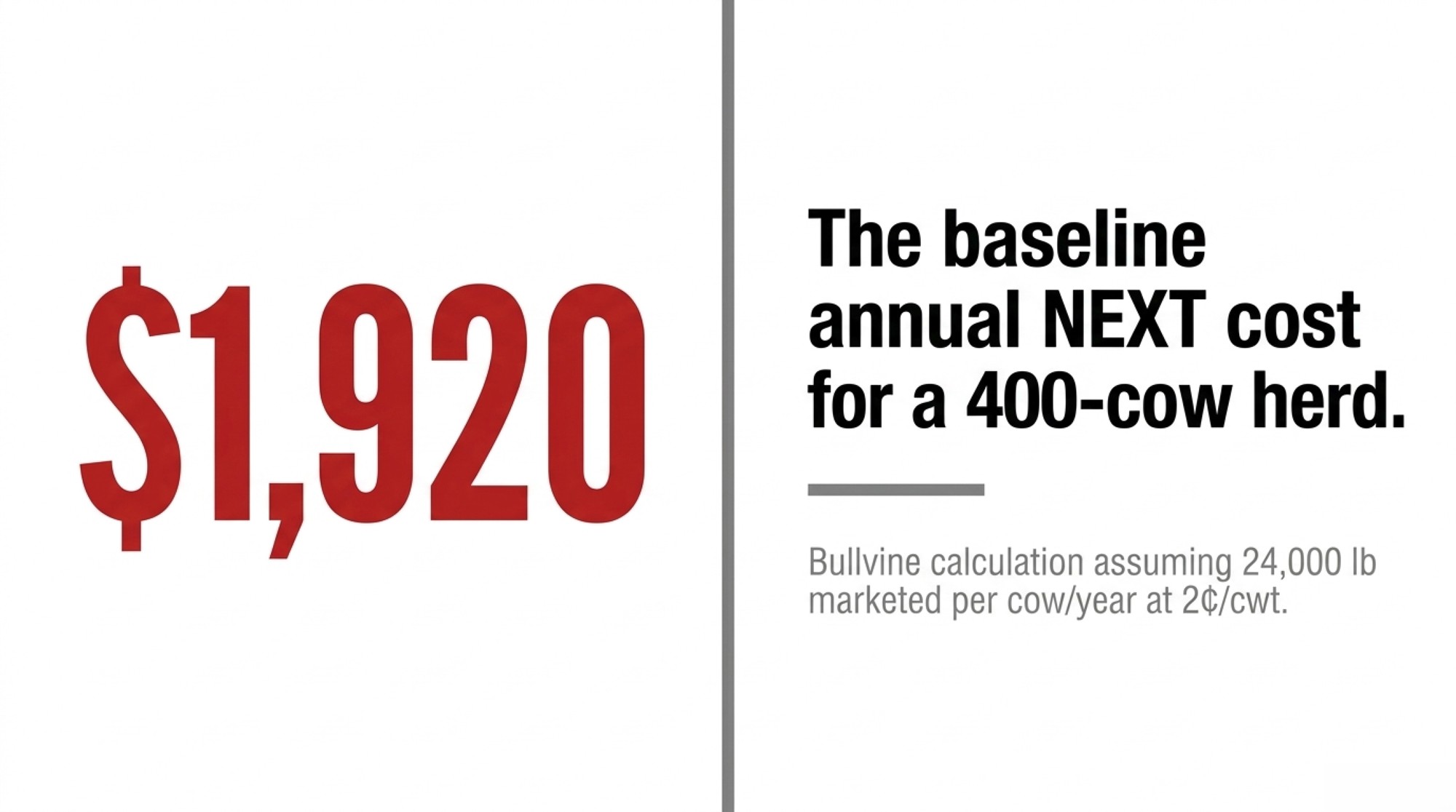
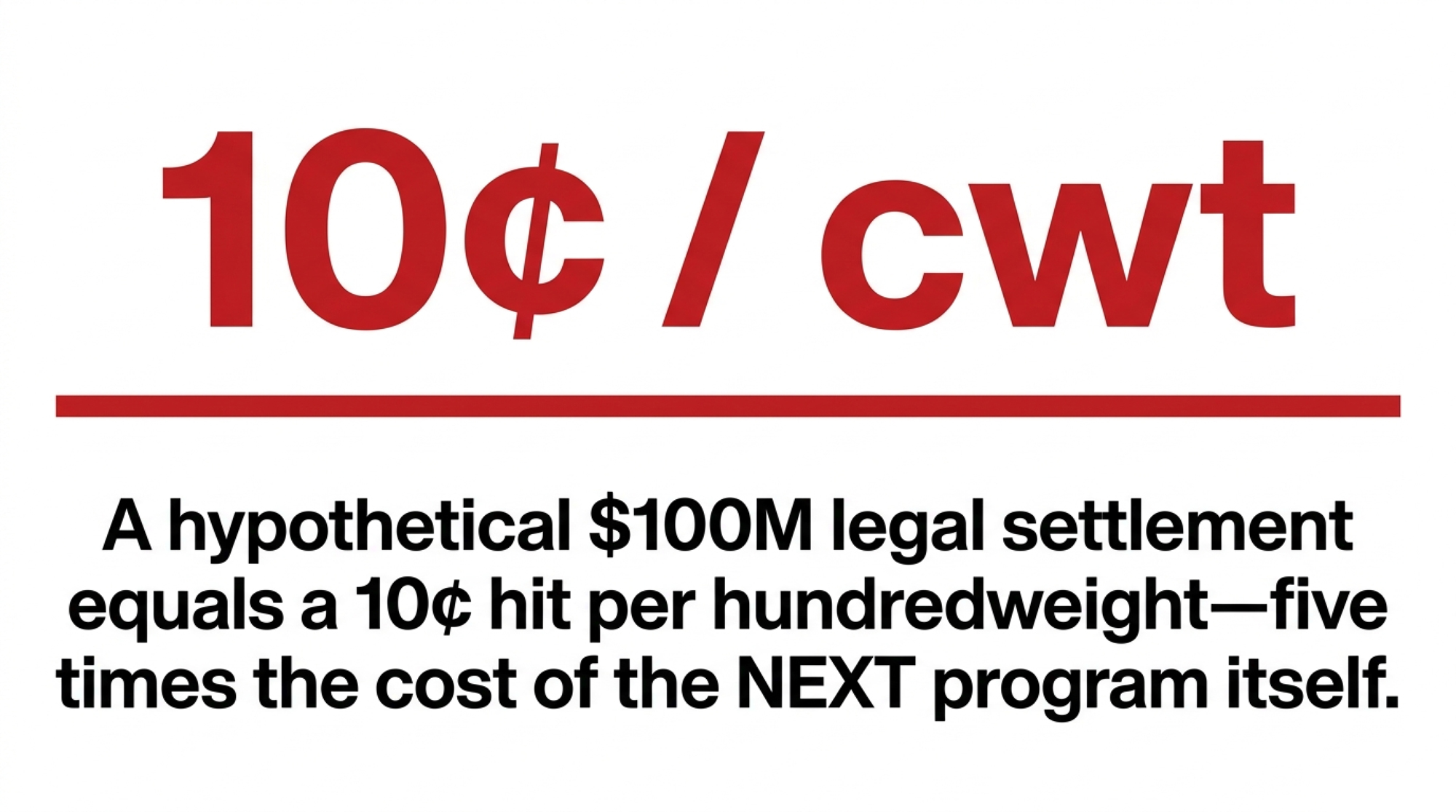
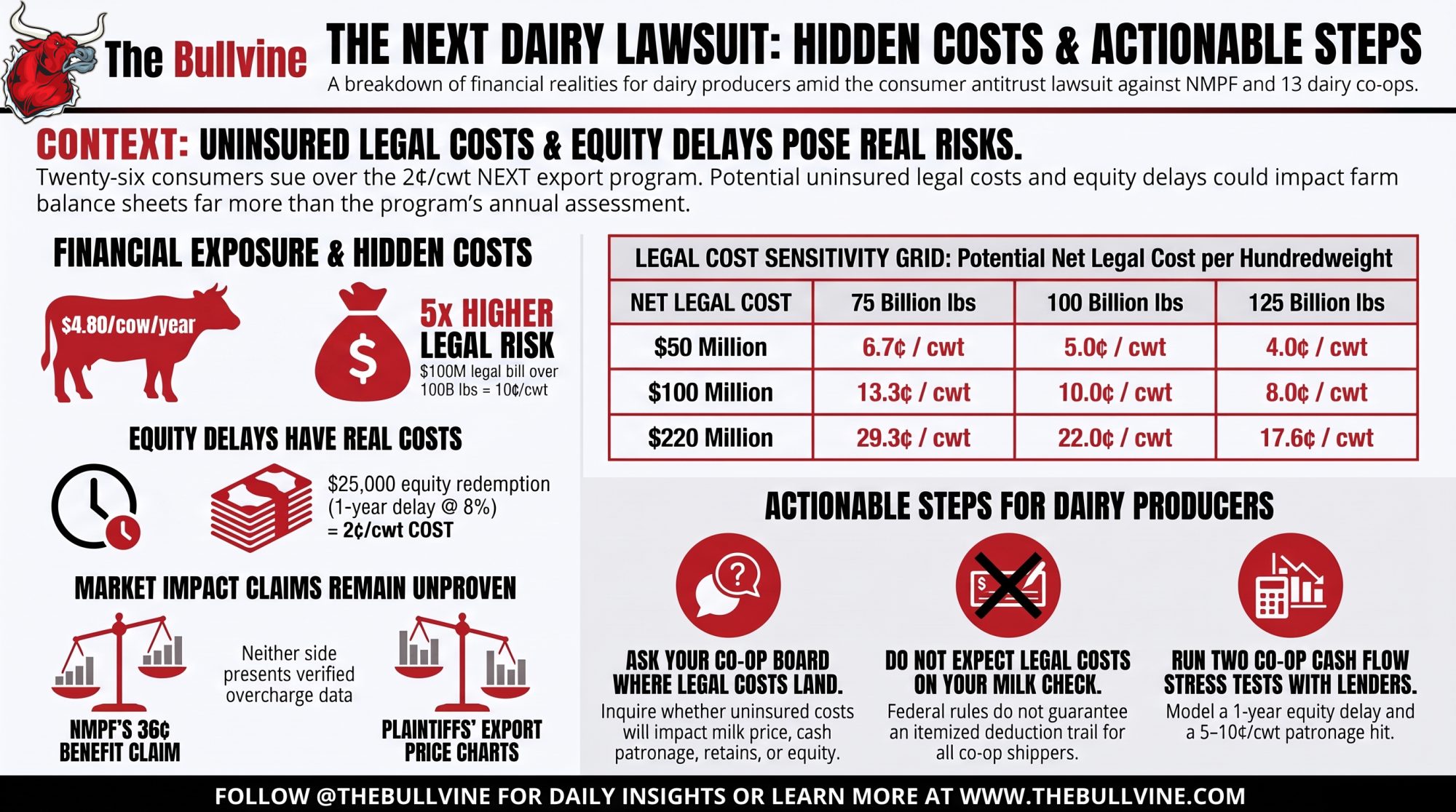
A 400-cow herd’s NEXT share runs about $1,920 a year. Run a hypothetical $100M legal bill over 100B lb, and it’s 10¢/cwt. Where would your board book it?
Executive Summary: Twenty-six consumers sued NMPF and 13 dairy co-ops, DFA, Darigold, and Tillamook among them, in Norfolk federal court on October 5. They allege the 2¢/cwt NEXT export program, and CWT before it, raised retail dairy prices from 2018. No court has ruled. The Bullvine’s grid puts a hypothetical $50 million net legal cost at 5¢/cwt over 100 billion lb, 2.5 times the assessment members already fund. A one-year equity delay on a $25,000 redemption at 8% costs a 400-cow herd about 2¢/cwt, with no deduction on the statement. The complaint’s 70% share figure dates to 2011. Its export-price charts are correlations, not an overcharge estimate.

The complaint, filed October 5 in the U.S. District Court for the Eastern District of Virginia, Norfolk Division, names Yvette Oriakhi of New York as lead plaintiff, plus 25 others from 18 more jurisdictions, from Arizona to Vermont. The case is Oriakhi et al. v. National Milk Producers Federation et al., No. 2:26-cv-01093. Its public docket is open on CourtListener.
Most coverage will stop at “consumers sued.” For a member-owner, the better question is the funding. NMPF says member co-ops fund NEXT at 2¢ per hundredweight of milk marketed. The complaint alleges the named cooperatives agreed to contribute that 2¢ to NEXT or its predecessor. The Bullvine has asked each cooperative to confirm whether it still participates and how the assessment is paid. If legal costs fall on those co-ops, they’d sit on member-owned balance sheets.
The defendants named in the caption are:
- National Milk Producers Federation
- Agri-Mark, Inc.
- Bongards Creameries
- Cooperative Milk Producers Association
- Dairy Farmers of America, Inc.
- Lanco Dairy Farms Coop, Inc.
- Lonestar Milk Producers
- Maryland & Virginia Milk Producers Cooperative d/b/a Maola Local Dairies
- Michigan Milk Producers Association
- Mount Joy Farmers Co-operative Association
- Northwest Dairy Association d/b/a Darigold
- Prairie Farms Dairy, Inc.
- Tillamook County Creamery Association
- United Dairymen of Arizona
The caption also lists “Does 1–100,” placeholders for other program members the plaintiffs may add later.
Glasser and Glasser of Norfolk filed the complaint as local counsel. Steve Berman and Raffi Melanson of Hagens Berman, along with Yagman PLLC, are listed with pro hac vice applications still to be filed.
These are allegations. No court has ruled on the merits, and no class has been certified. As of October 8, the public docket listed no answer or motion from any defendant.
The Antitrust Allegations
The theory fits in one sentence from ¶5 of the complaint: members “agree to use their voluntary contributions to subsidize each other’s exports of dairy products to foreign markets.” The plaintiffs argue this pulls cheese, butter, and other products out of the domestic market and raises U.S. prices. Because the money moves among competitors rather than coming from government, they call the program more anticompetitive than a government export subsidy.
The proposed class is end consumers who bought dairy at retail. The complaint alleges they “have paid, and continue to pay, supracompetitive prices from January 1, 2018, to the present” (¶6). That start date falls years after CWT’s 2003 launch, and clear of the herd-retirement years already settled.
Four counts, no dollar figure
| Count | Claim | Relief sought |
| I | Sherman Act §1, via Clayton Act §16 | Injunction only |
| II | State antitrust laws in Illinois Brick repealer states (32 jurisdictions) | Damages, trebled where state law allows |
| III | State consumer-protection laws (35 jurisdictions) | Damages, restitution, and disgorgement |
| IV | Unjust enrichment | Restitution and disgorgement |
The federal claim asks only for an injunction. Every damages claim runs through state law, in states that let indirect purchasers recover, though at least one early trade report described treble damages under federal antitrust law. The complaint names no damages amount. It says only that the case exceeds the Class Action Fairness Act’s $5 million threshold.
Using NMPF’s Own Numbers Against It
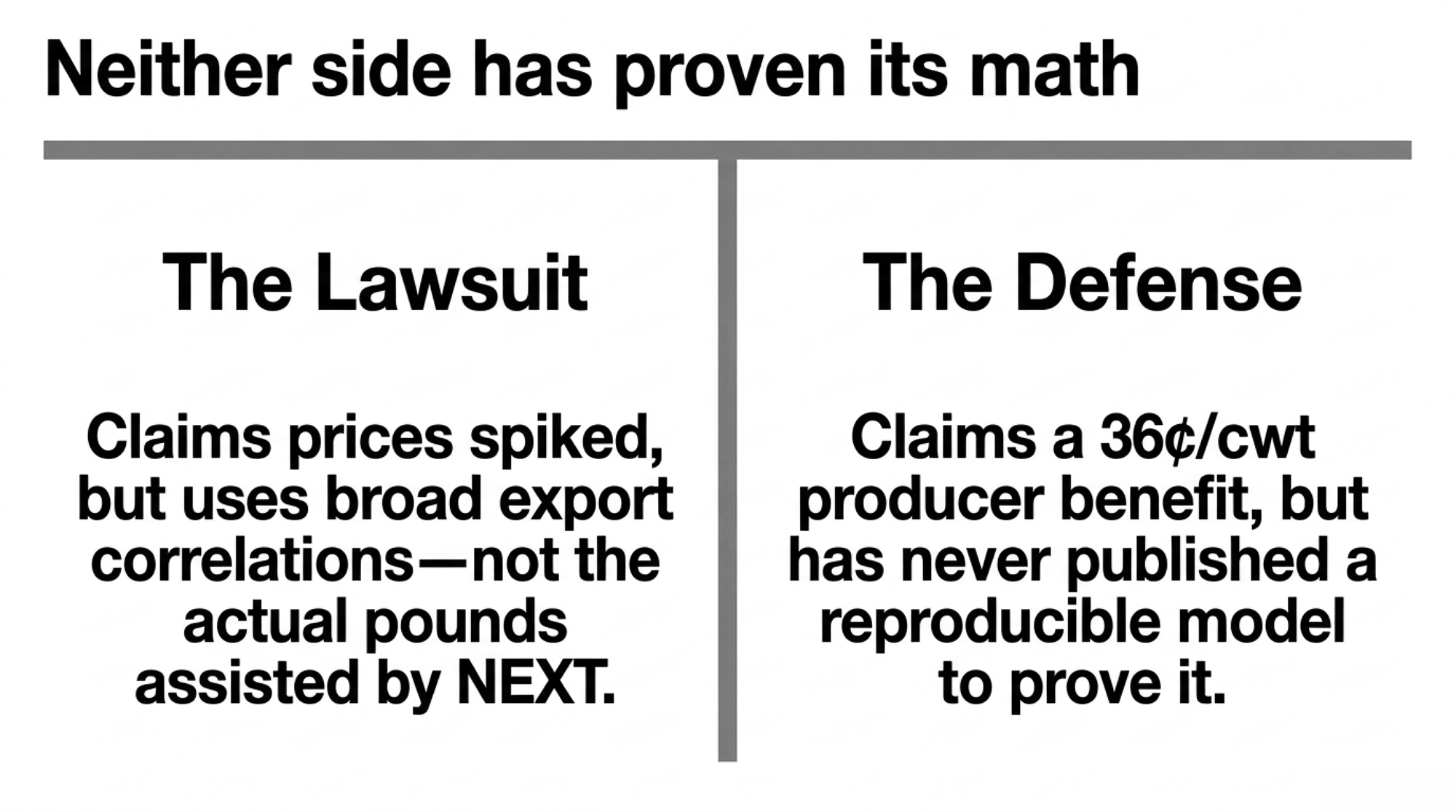
The complaint quotes NMPF’s 2018 Activities and Accomplishments Report: CWT sales “improved dairy farmer milk prices by an estimated average of $0.36/cwt. per year – a return nine times the investment” (¶155). It also quotes former NMPF CEO Jim Mulhern saying the program could “improve the milk prices received by all U.S. dairy farmers by as much as $0.50/cwt., according to both external and internal estimates” (¶4). That line traces to a December 6, 2018 Feedstuffs story, reprinted by eDairy News. These are NMPF’s own claims, not court findings, and the plaintiffs are using them as evidence of intent.
The complaint’s own harm evidence
The plaintiffs present their own charts (¶¶196–202):
- Exports and farm price. Each extra 100,000 metric tons of monthly U.S. dairy exports is associated with an all-milk price about $4.20/cwt higher (¶199).
- Farm to retail. A $1 rise in the all-milk price is associated with retail increases of $1.09 for whole milk, $1.26 for Cheddar, and $0.69 for butter, per cwt of milk equivalent (¶¶201–202).
- 2008–09. The all-milk price fell about 38% between September 2008 and June 2009 as exports collapsed (¶198).
These are correlations. The export series is total U.S. dairy exports by product weight, not milk equivalent (fn. 60), and it isn’t the volume CWT or NEXT assisted. Strong world demand raises exports and U.S. prices at the same time, so that line would slope upward whether or not any subsidy moved the market. The complaint offers no overcharge figure that separates assisted pounds from everything else.
The 70% problem
The complaint uses “70%” three different ways:
- ¶6: “as much as 70% of the U.S.’s dairy-marketing cooperatives”
- ¶93: CWT farmers produce “as much as 70% of the nation’s dairy products”
- ¶124: CWT’s members “comprise as much as 70% of the dairy production”
The figure traces to a November 2011 CWT release. A 2015 release quoted in ¶135 spread that 70% across 37 co-ops and more than 100 individual farmers, not 13. Early coverage reported co-ops “controlling up to 70%” of U.S. milk production, but whatever the 13 defendants’ combined share is today, the complaint doesn’t establish it.
Capper-Volstead
If the co-ops’ Capper-Volstead immunity holds, the federal claim is in trouble, and the state-law damages counts become the fight. The complaint attacks the immunity two ways. It argues NEXT is an output restraint rather than collective marketing (¶¶211–212). It also says National Farmers Organization, which the complaint calls a non-producer, took part (¶213). The Supreme Court has stripped the immunity where non-producers were members, in Case-Swayne (1967) and National Broiler (1978). In Maryland & Virginia Milk Producers (1960), it held the immunity doesn’t extend to conduct that suppresses competition beyond collective marketing.
How NEXT works
NMPF’s board authorized NEXT, short for NMPF Exports & Trade, in June 2025. It replaced CWT’s export program on July 1, 2025. Under NMPF’s program rules, eligible member co-ops bid for assistance on specific export sales. Payment comes only after delivery to the end customer is documented.
What members have paid
| Period | Rate | Source |
| Dues collected from January 2012 | 2¢/cwt | CWT/NMPF release, June 2011 (complaint ¶127) |
| July 1, 2013 – Dec. 31, 2015 | 4¢/cwt | CWT release, June 2013 (¶134) |
| Extended through 2018, then through 2021 | 4¢/cwt | NMPF releases, 2015 and 2018 (¶¶135–136) |
| Through June 2025 (last CWT year) | 4¢/cwt | NMPF: NEXT is “half the CWT assessment” |
| July 2025 through 2028 (NEXT) | 2¢/cwt | NMPF |
What the program reported moving
| Year | Reported volume | Basis |
| 2015 | 81.8M lb product; 1.07B lb milk equivalent | Contracted (¶135) |
| 2018 | Nearly 1.3B lb milk equivalent | Contracts “so far this year,” per Mulhern |
| 2024 (last CWT year) | About 182M lb product, implied by NMPF’s “73% greater” comparison | Bullvine calculation |
| July 2025 – July 2026 (NEXT year one) | More than 315M lb product | “Committed” assistance |
The units keep changing: product pounds, milk equivalent, contracts, and commitments. None of these numbers shows how many sales would have happened without assistance.
In NMPF’s year-one release, CEO Gregg Doud said NEXT “committed export assistance on more than 315 million pounds of dairy products destined for international markets.” He called that a 73% greater volume than in 2024, at a cost to members half that of the CWT assessment. The complaint quotes his description of NEXT as “more targeted, more flexible, and more transparent” than CWT (¶139).
Running the numbers
The figures in this section are Bullvine models built from stated assumptions. They are not company data. All cent figures are gross, before tax treatment or patronage allocation.
What NEXT costs a herd
Assumptions: 24,000 lb marketed per cow per year, or 240 cwt. The full 2¢ is treated as an economic cost spread across that milk. That doesn’t mean every co-op deducts 2¢ on the milk statement.
| Herd | Annual milk | Annual cwt | NEXT at 2¢/cwt | Per month |
| 100 cows | 2.4M lb | 24,000 | $480 | $40 |
| 400 cows | 9.6M lb | 96,000 | $1,920 | $160 |
| 2,000 cows | 48.0M lb | 480,000 | $9,600 | $800 |
Run your own: cows × lb per cow ÷ 100 × 0.02 = annual NEXT cost in dollars. At 24,000 lb per cow, that’s $4.80 per cow per year. At 22,000 lb it’s $4.40, and at 26,000 lb it’s $5.20.
If a legal cost lands on the co-ops
There’s no damages figure, no settlement, and no finding of liability, so this is a sensitivity grid, not a forecast. The formula: cents per cwt = (10 × X) ÷ V, where X is net cost in millions of dollars and V is defendant milk volume in billions of pounds.
| Net cost to co-ops | Spread over 75B lb | 100B lb | 125B lb |
| $50M | 6.7¢ | 5¢ | 4¢ |
| $100M | 13.3¢ | 10¢ | 8¢ |
| $220M | 29.3¢ | 22¢ | 17.6¢ |
Read the grid with these limits:
- Volume bands. The 75, 100, and 125 billion lb columns are illustrative. For scale, U.S. farms marketed about 231 billion lb in 2025. The Bullvine hasn’t assembled a consistent same-year total for all 13 named cooperatives, so treat the grid as a scale test, not an allocation estimate.
- Net cost means settlement plus unreimbursed defense costs, minus insurance recovery.
- The $220M row is a scale reference only. It’s the reported size of the earlier First Impressions settlement, not an estimate for this case.
Then decide how much reaches members:
| Member-allocation case | Share of net cost | Effect at 10¢/cwt gross | 400-cow herd |
| Low | 0% | 0¢ | $0 |
| Central | 50% | 5¢ | $4,800 |
| High | 100% | 10¢ | $9,600 |
The 10¢ gross case is a $100 million net cost spread over 100 billion lb. In the central case, a 400-cow herd takes a one-time hit equal to about 2.5 years of its NEXT contributions. So a 2¢ program could carry a legal tail several times its own annual cost. That isn’t a prediction that it will.
The cost nobody bills
A cooperative may never put a legal assessment on the milk check, and a cost can still reach members through the balance sheet. The quietest route is time. USDA Rural Development’s Research Report 220 (2010) surveyed 792 cooperatives on equity redemption. It treats redemption as a board decision, made under the bylaws when finances allow. When capital gets tight, the revolving cycle can stretch, and that costs the member money even though nothing new is deducted.
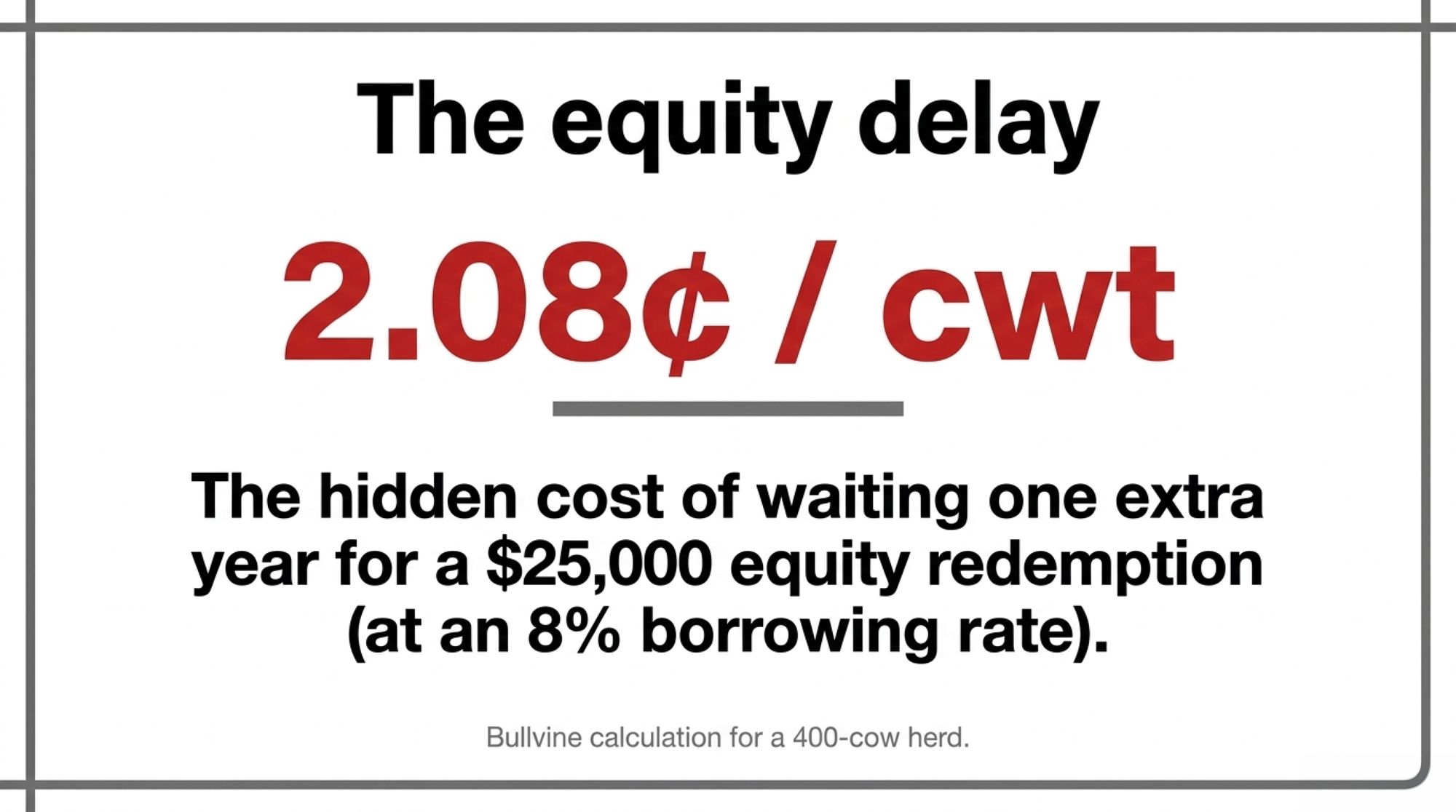
As an illustration only, not evidence of any defendant’s practice, take a member expecting a $25,000 equity redemption who waits one more year:
| Member borrowing rate | One-year carrying cost | Per cwt, 400-cow herd |
| 6% | $1,500 | 1.56¢ |
| 8% | $2,000 | 2.08¢ |
| 10% | $2,500 | 2.60¢ |
At 8%, a one-year delay costs about as much per cwt as NEXT itself. Nothing new appears on the milk statement. The member just waits.
Where the uninsured dollar goes
A co-op’s communications team will be ready for “how big is the lawsuit?” The harder question is where any uninsured cost would actually land.
In the Northeast order, 7 CFR 1001.73 requires handlers to give producers a statement showing each deduction’s nature and amount or rate. It excludes producers whose milk is received from cooperative-association handlers described in §1000.9(a) or (c). That doesn’t mean any defendant has hidden anything. It means the federal rule doesn’t guarantee every member the same itemized trail, and whether the exclusion applies depends on each co-op’s handler status in each order. The Bullvine’s Chobani Rome plant analysis walks through the same carve-out.
USDA guidance on cooperative equity and per-unit retains describes the routes. Net margin can be paid out as cash patronage or kept as member equity, and per-unit retains are documented through written notices. Those routes leave very different trails:
| Route | When a member might notice | How visible |
| Direct assessment | Next milk statement | Highest |
| Extra per-unit retain | Statement or annual equity notice | High |
| Lower cash patronage | After year-end | Medium: blended with margins and capital spending |
| More co-op debt | Annual report | Low: the borrowing shows, its purpose may not |
| Delayed equity redemption | When the expected check doesn’t come | Lowest: nothing new happens |
For more on what the milk check doesn’t have to show, see The Bullvine’s Milk Check Transparency Co-op Exemptionand Class III/IV Spread Depooling.
Tracking Pounds vs. Member Benefit
Past industry coverage, The Bullvine’s included, has often reported CWT and NEXT activity in pounds assisted. It has rarely set assessment dollars against independently verified member benefit. NMPF’s 36¢ claim and Mulhern’s “as much as” 50¢ both rest on estimates that, as far as The Bullvine can find, have never been published as a model anyone could reproduce. The complaint now uses those same numbers as evidence of intent.
The test this piece applies: pounds are activity, and benefit is what changed because those pounds moved. If NMPF released the 36¢ model and it held up, that would answer the market-level question for the years it covers. It still wouldn’t show how much reached the members who paid, or where an uninsured legal dollar would land.
Is this CWT again?
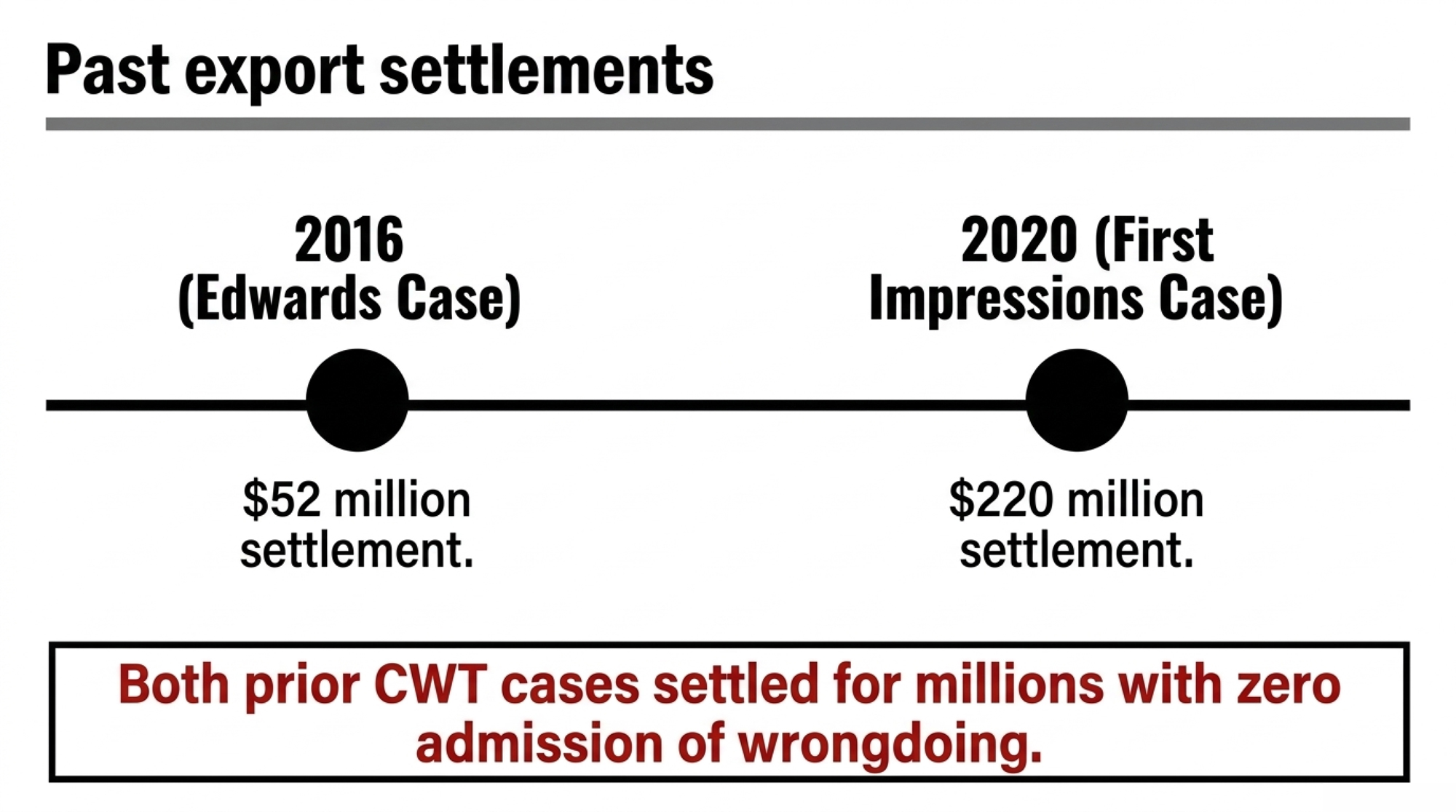
Not quite. Two earlier cases challenged CWT’s herd-retirement program, and the Oriakhi complaint puts their combined settlements at “nearly $272 million” (¶4):
- Edwards v. NMPF (N.D. Cal., No. 11-cv-04766). The Oriakhi complaint says this consumer case settled in 2016 for $52 million. Progressive Dairy reported that the settlement included no admission of wrongdoing.
- First Impressions Salon v. NMPF (S.D. Ill., No. 3:13-cv-00454). Direct purchasers alleged in the S.D. Illinois case that herd buyouts from 2003 to 2010 inflated milk, butter, and cheese prices. The Oriakhi complaint says the case settled in 2020 for $220 million. Courthouse News reports that the defendants admitted no wrongdoing.
The old cases targeted fewer cows; this one targets product shipped abroad. Both rest on related supply-restriction theories. That makes them useful for gauging scale and strategy, but they don’t decide this case.
What happens next
The first defense filings will likely target standing, the indirect-purchaser rules, the state-law counts, and Capper-Volstead. The Bullvine will update this story from the federal docket when a defendant responds. For how antitrust cases move from allegation to evidence, see Cattle Auction Bid Rigging 2026 and the DOJ A.I. Bid-Rigging Probe.
What this means for your operation
The 2026 NDB/NMPF/UDIA Joint Annual Meeting opens October 19 at the Gaylord Palms in Kissimmee. Email these questions to your co-op board member or member-relations contact before then:
- Is the 2¢ deducted on member statements, or paid out of co-op operating funds?
- How much NEXT assistance did our co-op receive, compared with what it contributed?
- Has the board approved a policy for uninsured legal costs?
- Could this litigation change our equity revolvement schedule?
For lenders: this isn’t a probable liability yet, and booking it as one would overstate the risk. Two stress tests are still reasonable for co-op shippers with tight cash flow. The first is a one-year equity delay: about 2¢/cwt at 8% on a $25,000 redemption. The second is a 5–10¢/cwt patronage hit, which matches the $50–100 million rows of the grid at 100 billion lb.
“We’re insured” doesn’t answer the real question, and neither does “the case has no merit.” A real answer names the route, the threshold, and how members will be told. If you ask only one thing, ask this, in writing:
The question to put to your board: “If NEXT or this lawsuit creates costs insurance doesn’t cover, where will they show up for members (milk price, cash patronage, retains, equity redemption, or debt), and will the board report the effect in cents per hundredweight?”
Key Takeaways
- Nothing’s been proven yet. No court has ruled or certified a class, and the federal count asks only for an injunction, so every damages claim runs through state law.
- Cents per cwt = 10 × net legal cost in $M ÷ volume in billion lb. A First Impressions-sized $220M bill over 100B lb is 22¢, 11 times NEXT’s 2¢. That’s a scale check, not a forecast.
- Neither side has shown its math. NMPF’s 36¢/cwt benefit hasn’t been published as a reproducible model, as far as we can find, and the complaint’s charts track total exports, not assisted pounds.
- Don’t count on the milk statement to flag a legal cost. In the Northeast order, the itemized-deduction rule excludes milk received through certain co-op handlers, and a delayed equity check puts nothing on the statement.
Complete references and supporting documentation are available upon request by contacting the editorial team at editor@thebullvine.com.
Learn More
- The $3 Milk Trap: How 2026’s Class III–IV Spread Becomes a $382,000 Hit on a 500-Cow Milk Check — Arms you with the exact math needed to calculate depooling losses before they hit your balance sheet. While the main article tracks export fees, this breaks down a $63 per-cow monthly drain from Class III/IV spreads.
- FMMO Reality Check: Why 2025’s $2.3 Billion Dairy Pricing Revolution Exposes the Fatal Flaw in American Milk Marketing — Exposes how recent make-allowance hikes legally transfer $91 million annually from producer pools to processors. Broadening our focus beyond export litigation, this delivers a strategic blueprint for navigating permanent differential shifts and adjusting genetic selection targets.
- Your Milk Check Just Got $337M Lighter – And Your Co-op Helped Plan It — Follows the money on the inherent conflict of interest when farmer-owned cooperatives also operate processing facilities. Deepening the cooperative transparency debate, it dismantles the regulatory capture driving an 85–90¢/cwt margin compression.
 The Sunday Read Dairy Professionals Don’t Skip.
 The Sunday Read Dairy Professionals Don’t Skip.
Every week, thousands of producers, breeders, and industry insiders open Bullvine Weekly for genetics insights, market shifts, and profit strategies they won’t find anywhere else. One email. Five minutes. Smarter decisions all week.